LOSS LEADERS: Marketing Tactics Used by Doctors to Attract Patients

By Dr. David Edward Marcinko MBA MEd

***

***

Doctors use loss leader tactics—offering discounted or free services—to attract new patients and build long-term loyalty. These strategies are increasingly common in competitive healthcare markets.

In today’s healthcare landscape, physicians and clinics face intense competition for patient attention. Traditional referral systems are no longer sufficient, as patients increasingly rely on online reviews, social media, and digital advertising to choose providers. To stand out, many doctors have adopted loss leader marketing tactics—a strategy borrowed from retail where a business offers a product or service at a loss to attract customers and stimulate future sales.

A loss leader in healthcare typically involves offering free consultations, discounted exams, or low-cost procedures. For example, aesthetic clinics might advertise free skin evaluations or reduced-price Botox sessions. Primary care practices may offer complimentary wellness screenings or discounted flu shots. These services are not intended to generate immediate profit but to introduce patients to the practice, build trust, and encourage them to return for more comprehensive—and profitable—care.

This tactic works particularly well in specialties where patients have discretionary choice, such as dermatology, dentistry, chiropractic care, and cosmetic surgery. By lowering the barrier to entry, doctors can attract hesitant or price-sensitive patients who might otherwise delay care. Once inside the practice, patients experience the quality of service firsthand, increasing the likelihood of repeat visits and word-of-mouth referrals.

***

***

Digital marketing amplifies the effectiveness of loss leader strategies. Physicians use platforms like Google Ads, Facebook, and Instagram to promote their offers to targeted demographics. A well-designed landing page might advertise a “$49 New Patient Exam” with a clear call to action and online booking. These campaigns often include retargeting ads and email follow-ups to nurture leads into loyal patients.

However, loss leader tactics must be carefully managed. Offering services below cost can strain resources if not paired with a clear conversion strategy. Doctors must ensure that the initial offer leads to higher-value services, such as diagnostic testing, treatment plans, or elective procedures. Additionally, practices must maintain ethical standards and avoid misleading promotions that could erode patient trust.

Reputation management plays a crucial role in sustaining the benefits of loss leader marketing. Positive patient experiences from initial discounted visits often translate into glowing online reviews, which further attract new patients. Conversely, poor execution—such as rushed appointments or upselling pressure—can backfire and damage the practice’s credibility.

Ultimately, loss leader marketing is not about giving away services indefinitely. It’s a strategic investment in patient acquisition, brand building, and long-term growth. When executed thoughtfully, it allows doctors to showcase their expertise, differentiate their practice, and foster lasting relationships with patients.

In conclusion, loss leader tactics have become a powerful tool in the modern physician’s marketing arsenal. By offering low-cost entry points to care, doctors can attract new patients, build trust, and grow their practice sustainably.

As competition intensifies, those who master this strategy—while maintaining quality and transparency—will be best positioned to thrive in the evolving healthcare marketplace.

COMMENTS APPRECIATED

EDUCATION: Books

SPEAKING: Dr. Marcinko will be speaking and lecturing, signing and opining, teaching and preaching, storming and performing at many locations throughout the USA this year! His tour of witty and serious pontifications may be scheduled on a planned or ad-hoc basis; for public or private meetings and gatherings; formally, informally, or over lunch or dinner. All medical societies, financial advisory firms or Broker-Dealers are encouraged to submit an RFP for speaking engagements: CONTACT: Ann Miller RN MHA at MarcinkoAdvisors@outlook.com -OR- http://www.MarcinkoAssociates.com

Like, Refer and Subscribe

***

***

CASH BALANCE PLANS: Hybrid Retirement Savings for Physicians

By Dr. David Edward Marcinko MBA MEd

***

***

Retirement planning has evolved significantly over the past several decades, with employers and employees seeking solutions that balance security, flexibility, and predictability. Among the various retirement plan options available today, cash balance plans stand out as a hybrid design that combines features of both traditional defined benefit pensions and defined contribution plans. Their unique structure makes them an attractive choice for employers aiming to provide meaningful retirement benefits while maintaining financial predictability.

At their core, cash balance plans are a type of defined benefit plan. Unlike traditional pensions, which promise retirees a monthly income based on years of service and final salary, cash balance plans define the benefit in terms of a hypothetical account balance. Each participant’s account grows annually through two components: a “pay credit” and an “interest credit.” The pay credit is typically a percentage of the employee’s salary or a flat dollar amount, while the interest credit is either a fixed rate or tied to an index such as U.S. Treasury yields. Although the account is hypothetical—meaning the funds are not actually segregated for each employee—the structure provides participants with a clear, understandable statement of their retirement benefit.

One of the primary advantages of cash balance plans is their transparency. Employees can easily track the growth of their account balance, much like they would with a 401(k). This clarity helps workers better understand the value of their retirement benefits and fosters a sense of ownership. Additionally, cash balance plans are portable: when employees leave a company, they can roll over the vested balance into an IRA or another qualified plan, ensuring continuity in retirement savings.

***

***

From the employer’s perspective, cash balance plans offer several benefits as well. Traditional pensions often create unpredictable liabilities, as they depend on factors such as longevity and investment performance. Cash balance plans, by contrast, provide more predictable costs because the employer commits to specific pay and interest credits. This predictability makes them easier to manage and budget for, particularly in industries where workforce mobility is high. Moreover, cash balance plans can be designed to reward long-term employees while still appealing to younger workers who value portability.

Despite these advantages, cash balance plans are not without challenges. Because they are defined benefit plans, employers bear the investment risk and must ensure the plan is adequately funded. Regulatory requirements, including nondiscrimination testing and funding rules, add complexity and administrative costs. Additionally, while cash balance plans are generally more equitable across generations of workers, transitions from traditional pensions to cash balance designs have sometimes sparked controversy, particularly among older employees who may perceive a reduction in benefits.

In recent years, cash balance plans have gained popularity among professional firms, such as law practices and medical groups, as well as small businesses seeking tax-efficient retirement solutions. These plans allow owners and highly compensated employees to accumulate larger retirement savings than would be possible under defined contribution limits, while still providing benefits to rank-and-file workers. As such, they serve as a valuable tool for both talent retention and financial planning.

COMMENTS APPRECIATED

EDUCATION: Books

SPEAKING: Dr. Marcinko will be speaking and lecturing, signing and opining, teaching and preaching, storming and performing at many locations throughout the USA this year! His tour of witty and serious pontifications may be scheduled on a planned or ad-hoc basis; for public or private meetings and gatherings; formally, informally, or over lunch or dinner. All medical societies, financial advisory firms or Broker-Dealers are encouraged to submit an RFP for speaking engagements: CONTACT: Ann Miller RN MHA at MarcinkoAdvisors@outlook.com -OR- http://www.MarcinkoAssociates.com

Like, Subscribe and Refer

***

***

PHYSICIAN PAYMENT: Direct Reimbursement Models

By Dr. David Edward Marcinko MBA MEd

BASIC DEFINITIONS

***

***

The Direct Reimbursement Payment Model allows physicians to receive payment directly from patients or employers, bypassing traditional insurance systems. This model emphasizes transparency, autonomy, and personalized care, offering an alternative to fee-for-service and managed care structures.

The Direct Reimbursement Payment Model is a healthcare financing approach in which physicians are paid directly by patients or sponsoring entities—such as employers—rather than through insurance companies or government programs. This model is gaining traction as a response to the administrative burdens, opaque billing practices, and fragmented care often associated with traditional insurance-based systems.

One prominent example of direct reimbursement is Direct Primary Care (DPC). In DPC, patients pay a recurring fee—monthly, quarterly, or annually—that covers a broad range of primary care services. These include routine checkups, preventive screenings, chronic disease management, and basic lab work. By eliminating third-party billing, DPC practices reduce overhead costs and administrative complexity, allowing physicians to spend more time with patients and focus on quality care.

***

***

Employers have also embraced direct reimbursement models to manage healthcare costs and improve employee wellness. In such arrangements, employers reimburse physicians or clinics directly for services rendered to their employees, often through a defined benefit structure. This can be part of a self-funded health plan or a supplemental offering alongside high-deductible insurance policies. The goal is to provide accessible, cost-effective care while avoiding the inefficiencies of traditional insurance networks.

Key advantages of the direct reimbursement model include:

  • Price transparency: Patients know upfront what services cost, reducing surprise billing and financial stress.
  • Improved access: Physicians often offer same-day or next-day appointments, extended visits, and direct communication via phone or email.
  • Lower administrative burden: Without insurance paperwork, practices can operate more efficiently and focus on patient care.
  • Stronger patient-physician relationships: More time per visit fosters trust, continuity, and better health outcomes.

However, the model is not without limitations. Direct reimbursement may not cover specialist care, hospitalization, or emergency services, requiring patients to maintain supplemental insurance. Additionally, the model may be less accessible to low-income populations who cannot afford recurring fees or out-of-pocket payments. Critics also argue that widespread adoption could fragment care and reduce risk pooling, undermining the broader goals of universal coverage.

Despite these concerns, the direct reimbursement model aligns with broader trends in healthcare reform, including value-based care, consumer empowerment, and decentralized service delivery. It offers a viable path for physicians seeking autonomy and for patients desiring personalized, transparent care. As healthcare continues to evolve, hybrid models that combine direct reimbursement with traditional insurance may emerge, offering flexibility and choice across diverse patient populations.

In conclusion, the Direct Reimbursement Payment Model represents a meaningful shift in how healthcare services are financed and delivered.

By prioritizing simplicity, transparency, and patient-centered care, it challenges the status quo and opens new possibilities for sustainable, high-quality medical practice.

COMMENTS APPRECIATED

EDUCATION: Books

SPEAKING: Dr. Marcinko will be speaking and lecturing, signing and opining, teaching and preaching, storming and performing at many locations throughout the USA this year! His tour of witty and serious pontifications may be scheduled on a planned or ad-hoc basis; for public or private meetings and gatherings; formally, informally, or over lunch or dinner. All medical societies, financial advisory firms or Broker-Dealers are encouraged to submit an RFP for speaking engagements: CONTACT: Ann Miller RN MHA at MarcinkoAdvisors@outlook.com -OR- http://www.MarcinkoAssociates.com

Like, Refer and Subscribe

***

***

REAL-WORLD FINANCE: How Some RNs Can Retire Richer Than Physicians

By Dr. David Edward Marcinko MBA MEd

***

***

For generations, the prevailing belief in healthcare has been that physicians [MD, DO and DPM], with their high salaries and prestige, inevitably retire wealthier than nurses. Yet this assumption overlooks the financial realities of different nursing specialties and the long‑term impact of debt, lifestyle, and retirement planning. In fact, some Registered Nurses (RNs)—particularly Certified Registered Nurse Anesthetists (CRNAs), visiting nurses, and those who participate in structured pay programs like the Baylor plan—can retire richer than physicians. The reasons lie in the interplay of education costs, career flexibility, income potential, and disciplined financial planning.

Education Costs and Debt Burden

One of the most decisive factors shaping retirement wealth is the cost of education. Physicians often spend over a decade in training, including undergraduate studies, medical school, and residency. This path not only delays their earning years but also saddles them with substantial student debt. The median medical school debt in the United States exceeds $200,000, and many physicians spend years paying it down.

By contrast, RNs typically complete their training in two to four years, with advanced practice nurses such as CRNAs requiring graduate‑level education. Even so, their debt burden is far lighter, often less than half of what physicians carry. This difference means nurses can begin earning earlier, save for retirement sooner, and avoid the crushing interest payments that erode physicians’ wealth. A CRNA who starts practicing in their late twenties may already be investing in retirement accounts while a physician is still in residency earning a modest stipend.

Income Potential of Specialized Nurses

While physicians generally earn more annually than nurses, the gap is narrower in certain specialties. CRNAs, for example, are among the highest‑paid nursing professionals, with average salaries often exceeding $200,000 per year. This places them in direct competition with some physician specialties, especially primary care doctors, who may earn similar or even lower salaries.

Visiting nurses also benefit from unique financial advantages. Many work on flexible schedules, contract arrangements, or per‑visit compensation models. This allows them to maximize income while minimizing burnout. By avoiding the overhead costs of private practice and the administrative burdens physicians face, visiting nurses can channel more of their earnings directly into savings and investments.

When combined with lower debt and earlier career starts, these income streams can compound into significant retirement wealth.

💰 Highest-Paying Nursing Careers (2025)

  • Certified Registered Nurse Anesthetist (CRNA) – ~$212,000 annually
  • Nurse Practitioner (NP) – $120,000–$140,000+ depending on specialty (Family, Acute Care, Psychiatric)
  • Clinical Nurse Specialist (CNS) – $120,000–$135,000
  • Nurse Midwife – ~$115,000
  • Nurse Manager/Administrator – $110,000–$120,000
  • Informatics Nurse Specialist – ~$115,000
  • Neonatal ICU Nurse (NICU) – $110,000+
  • ICU Nurse – $105,000+
  • Pain Management Nurse – ~$104,000
  • Oncology Nurse – ~$100,000

***

***

The Baylor Pay Plan Advantage

The Baylor plan, a structured pay program used by some hospitals, allows nurses to work full‑time hours compressed into fewer days—often weekends—while still receiving full‑time pay and benefits. This arrangement provides several financial advantages. First, it enables nurses to earn competitive wages while freeing up weekdays for additional work, education, or entrepreneurial ventures. Second, it reduces commuting and childcare costs, allowing more income to be saved. Third, the plan often includes robust retirement benefits, such as employer‑matched contributions to 401(k) or pension programs.

Nurses who consistently participate in such structured pay plans can accumulate substantial nest eggs, often surpassing physicians who delay retirement savings due to debt repayment or lifestyle inflation. The Baylor plan highlights the importance of systematic investing: by automating contributions and focusing on long‑term growth, nurses can harness the power of compound interest. A nurse who invests steadily for 35 years may accumulate more wealth than a physician who begins saving late and inconsistently, despite earning a higher salary.

Lifestyle and Work‑Life Balance

Another overlooked factor is lifestyle. Physicians often face grueling schedules, high stress, and the temptation to maintain expensive lifestyles commensurate with their social status. Luxury homes, cars, and vacations can erode their financial base. Nurses, while not immune to lifestyle inflation, often maintain more modest spending habits.

Visiting nurses, in particular, enjoy flexibility that allows them to balance work with personal life. This reduces burnout and healthcare costs while enabling consistent employment into later years. By living within their means and prioritizing savings, nurses can accumulate wealth steadily without the financial pitfalls that sometimes accompany physician lifestyles.

Retirement Wealth Beyond Salary

Retirement wealth is not solely determined by annual income. It is shaped by debt management, savings discipline, investment strategies, and lifestyle choices. Nurses who leverage high‑paying specialties like anesthesia, flexible arrangements like visiting nursing, and structured programs like the Baylor plan can outperform physicians in these areas.

Consider two professionals: a physician earning $250,000 annually but burdened by $200,000 in debt and high living expenses, and a CRNA earning $200,000 with minimal debt and disciplined savings. Over decades, the CRNA may accumulate more net wealth, retire earlier, and enjoy greater financial security.

Conclusion

The assumption that physicians always retire richer than nurses is outdated. While physicians command higher salaries, their delayed earnings, heavy debt, and lifestyle pressures often undermine long‑term wealth. Nurses, particularly CRNAs, visiting nurses, and those who participate in structured pay programs like the Baylor plan, can retire wealthier by combining lower debt, earlier savings, competitive incomes, and disciplined financial planning.

Ultimately, retirement wealth is not about prestige but about strategy. Nurses who recognize this truth and act accordingly may find themselves enjoying more financial freedom than the very physicians they once assisted.

COMMENTS APPRECIATED

EDUCATION: Books

SPEAKING: Dr. Marcinko will be speaking and lecturing, signing and opining, teaching and preaching, storming and performing at many locations throughout the USA this year! His tour of witty and serious pontifications may be scheduled on a planned or ad-hoc basis; for public or private meetings and gatherings; formally, informally, or over lunch or dinner. All medical societies, financial advisory firms or Broker-Dealers are encouraged to submit an RFP for speaking engagements: CONTACT: Ann Miller RN MHA at MarcinkoAdvisors@outlook.com -OR- http://www.MarcinkoAssociates.com

Like, Refer and Subscribe

***

***

RICARDIAN ECONOMICS: Can it Save Medicine?

By Dr. David Edward Marcinko MBA MEd

***

***

Ricardian economics, rooted in the theories of 19th-century economist David Ricardo, emphasizes comparative advantage, free trade, and the neutrality of government debt—most notably through the concept of Ricardian equivalence. While these ideas have shaped macroeconomic thought, their relevance to medicine and healthcare policy is less direct. Still, exploring Ricardian principles offers a provocative lens through which to examine the fiscal sustainability and efficiency of modern healthcare systems.

At the heart of Ricardian equivalence is the idea that consumers are forward-looking and internalize government budget constraints. If a government finances healthcare through debt rather than taxes, rational agents will anticipate future tax burdens and adjust their behavior accordingly. In theory, this undermines the effectiveness of deficit-financed healthcare spending as a stimulus. Applied to medicine, this suggests that long-term fiscal responsibility is crucial: expanding healthcare access through borrowing may not yield the intended economic or health benefits if citizens expect future costs to rise.

This insight could inform debates on healthcare reform, especially in countries grappling with ballooning medical expenditures. Ricardian economics warns against short-term fixes that ignore long-term fiscal implications. For example, expanding public insurance programs without sustainable funding mechanisms could lead to intergenerational inequities and economic distortions. Policymakers might instead focus on reforms that align incentives, reduce waste, and promote cost-effective care—principles that resonate with Ricardo’s emphasis on efficiency and comparative advantage.

***

***

However, Ricardian economics offers limited guidance on the unique moral and practical dimensions of medicine. Healthcare is not a typical market good. Patients often lack the information or autonomy to make rational choices, especially in emergencies. Moreover, the sector is rife with externalities: one person’s vaccination benefits the broader community, and untreated illness can strain public resources. These complexities challenge the assumption of rational, forward-looking behavior central to Ricardian equivalence.

Additionally, Ricardo’s theory of comparative advantage—where nations benefit by specializing in goods they produce most efficiently—has implications for global health. It supports international collaboration in pharmaceutical production, medical research, and telemedicine. Yet, over-reliance on global supply chains can expose vulnerabilities, as seen during the COVID-19 pandemic when countries faced shortages of critical medical supplies.

In conclusion, Ricardian economics provides valuable fiscal insights that can inform healthcare policy, particularly regarding debt sustainability and efficient resource allocation. Its emphasis on long-term planning and comparative advantage can guide reforms that make medicine more resilient and cost-effective. However, the theory’s assumptions about rational behavior and market dynamics limit its applicability to the nuanced realities of healthcare. Medicine requires not just economic efficiency but ethical considerations, equity, and compassion—areas where Ricardian economics falls short. Thus, while it can contribute to the conversation, it cannot “save” medicine alone.

COMMENTS APPRECIATED

EDUCATION: Books

SPEAKING: Dr. Marcinko will be speaking and lecturing, signing and opining, teaching and preaching, storming and performing at many locations throughout the USA this year! His tour of witty and serious pontifications may be scheduled on a planned or ad-hoc basis; for public or private meetings and gatherings; formally, informally, or over lunch or dinner. All medical societies, financial advisory firms or Broker-Dealers are encouraged to submit an RFP for speaking engagements: CONTACT: Ann Miller RN MHA at MarcinkoAdvisors@outlook.com 

Like, Refer and Subscribe

***

***

Understanding the Risks of Capitation in Healthcare

By A.I.

***

***

The Pitfalls of Capitation in Medicine

Capitation, a payment model in healthcare where providers receive a fixed amount per patient regardless of the services rendered, has been promoted as a way to control costs and incentivize efficiency. However, despite its theoretical appeal, capitation medicine presents significant drawbacks that can compromise patient care, distort provider incentives, and exacerbate systemic inequities.

One of the most concerning aspects of capitation is the potential for under-treatment. Since providers are paid a set fee per patient, regardless of how much care that patient requires, there is a financial incentive to minimize services. This can lead to situations where necessary tests, referrals, or treatments are delayed or denied in order to preserve profit margins. Patients with complex or chronic conditions—who require more frequent and intensive care—may be especially vulnerable under this model. The risk is that medical decisions become driven by cost containment rather than clinical need, undermining the ethical foundation of healthcare.

NURSING CAPITATION: https://medicalexecutivepost.com/2024/07/07/on-nursing-capitation-reimbursement/

Capitation also introduces challenges in maintaining quality standards. Unlike value-based care, which ties reimbursement to outcomes, capitation focuses solely on cost predictability. Without robust oversight and accountability mechanisms, providers may cut corners or avoid high-risk patients altogether. This can result in cherry-picking, where healthier individuals are favored, and sicker patients are subtly discouraged from enrolling. Such practices not only distort the patient pool but also deepen health disparities, particularly among marginalized populations who already face barriers to care.

Furthermore, capitation can strain the provider-patient relationship. Physicians may feel pressured to limit time spent with each patient or avoid costly interventions, leading to a sense of transactional care rather than personalized attention. This erosion of trust can diminish patient satisfaction and reduce adherence to treatment plans. In a system where providers are rewarded for doing less, the intrinsic motivation to go above and beyond for patients may be compromised.

Operationally, capitation demands sophisticated infrastructure to manage risk, track utilization, and ensure compliance. Smaller practices or those serving underserved communities may lack the resources to implement such systems effectively. This can create a two-tiered system where well-funded organizations thrive while others struggle to deliver basic care. Additionally, the administrative burden of managing capitation contracts, monitoring performance metrics, and navigating complex reimbursement rules can divert attention from clinical priorities.

Critics also argue that capitation may stifle innovation. When providers are locked into fixed budgets, there is little room to experiment with new technologies, therapies, or care models that might improve outcomes but carry upfront costs. This conservative approach can hinder progress and limit access to cutting-edge treatments.

CAPITATION HISTORY: https://medicalexecutivepost.com/2025/09/15/capitation-reimbursement-a-historical-economic-review/

In conclusion, while capitation medicine aims to control costs and streamline care, its inherent risks—under-treatment, inequity, and diminished quality—make it a problematic model when not carefully regulated. To truly reform healthcare, payment systems must balance financial sustainability with ethical responsibility, ensuring that every patient receives the care they need, not just the care that fits a budget.

COMMENTS APPRECIATED

EDUCATION: Books

Like, Refer and Subscribe

***

***

MEDICAL PRACTICE MARKETING: Strategies for Success

By Dr. David Edward Marcinko MBA MEd

***

***

In today’s competitive healthcare landscape, effective marketing is essential for the growth and sustainability of a medical practice. Gone are the days when word-of-mouth alone could sustain a clinic. Patients now seek providers who not only offer excellent care but also communicate their value clearly and consistently. Strategic marketing helps medical practices attract new patients, retain existing ones, and build a strong reputation in the community.

🎯 Understanding the Target Audience

The foundation of any successful marketing strategy is a deep understanding of the target audience. Medical practices must identify the demographics, needs, and preferences of their ideal patients. For example, a pediatric clinic will focus on parents, while a dermatology practice may target young adults concerned with skin health. Tailoring messages to resonate with these groups ensures that marketing efforts are relevant and effective.

🌐 Building a Strong Online Presence

In the digital age, a robust online presence is non-negotiable. A professional, user-friendly website serves as the virtual front door of the practice. It should include essential information such as services offered, provider bios, contact details, and online appointment scheduling. Search engine optimization (SEO) ensures the site ranks well on Google, making it easier for potential patients to find the practice.

Social media platforms like Facebook, Instagram, and LinkedIn offer additional avenues to engage with the community. Regular posts about health tips, staff spotlights, and patient testimonials humanize the practice and foster trust. Paid advertising on these platforms can also target specific demographics, increasing visibility and driving traffic to the website.

🗣️ Leveraging Patient Reviews and Testimonials

Online reviews are a powerful form of social proof. Encouraging satisfied patients to leave positive feedback on platforms like Google, Yelp, and Healthgrades can significantly influence prospective patients. Testimonials can also be featured on the practice’s website and social media channels. Responding to reviews—both positive and negative—demonstrates attentiveness and a commitment to patient satisfaction.

📬 Utilizing Email and Content Marketing

Email marketing remains a cost-effective way to stay connected with patients. Monthly newsletters can include health tips, updates on services, and reminders for annual checkups or vaccinations. Content marketing, such as blog posts and educational videos, positions the practice as a trusted authority in healthcare. This not only boosts SEO but also builds credibility and patient loyalty.

***

***

🤝 Community Engagement and Partnerships

Participating in local events, offering free health screenings, or partnering with schools and businesses can enhance visibility and goodwill. These efforts show that the practice is invested in the well-being of the community, which can translate into increased patient referrals and long-term relationships.

📊 Measuring Success

Finally, tracking the performance of marketing campaigns is crucial. Metrics such as website traffic, appointment bookings, social media engagement, and patient acquisition rates provide insights into what’s working and what needs adjustment. Regular analysis ensures that marketing efforts remain aligned with business goals.

Marketing a medical practice requires a thoughtful blend of digital tools, patient engagement, and community outreach. When done right, it not only drives growth but also reinforces the practice’s mission to provide compassionate, high-quality care.

COMMENTS APPRECIATED

EDUCATION: Books

SPEAKING: Dr. Marcinko will be speaking and lecturing, signing and opining, teaching and preaching, storming and performing at many locations throughout the USA this year! His tour of witty and serious pontifications may be scheduled on a planned or ad-hoc basis; for public or private meetings and gatherings; formally, informally, or over lunch or dinner. All medical societies, financial advisory firms or Broker-Dealers are encouraged to submit an RFP for speaking engagements: CONTACT: Ann Miller RN MHA at MarcinkoAdvisors@outlook.com -OR- http://www.MarcinkoAssociates.com

Like, Refer and Subscribe

***

***

MEDICAL SCHOOLS: What They Do Not Teach About Money!

By Dr. David Edward Marcinko MBA MEd

SPONSOR: http://www.MarcinkoAssociates.com

***

WARNING! WARNING! All DOCTORS

What Medical School Didn’t Teach Doctors About Money

Medical school is designed to mold students into competent, compassionate physicians. It teaches anatomy, pathology, pharmacology, and clinical skills with precision and rigor. Yet, despite the depth of medical knowledge imparted, one critical area is often overlooked: financial literacy. For many doctors, the transition from student to professional comes with a steep learning curve—not in medicine, but in money. From managing debt to understanding taxes, investing, and retirement planning, medical school leaves a financial education gap that can have long-term consequences.

The Debt Dilemma

One of the most glaring omissions in medical education is how to manage student loan debt. The average medical student graduates with over $200,000 in debt, yet few are taught how to navigate repayment options, interest accrual, or loan forgiveness programs. Many doctors enter residency with little understanding of income-driven repayment plans or Public Service Loan Forgiveness (PSLF), missing opportunities to reduce their financial burden. Without guidance, some make costly mistakes—such as refinancing federal loans prematurely or choosing repayment plans that don’t align with their career trajectory.

Income ≠ Wealth

Medical students often assume that a high salary will automatically lead to financial security. While physicians do earn more than most professionals, income alone doesn’t guarantee wealth. Medical school rarely addresses the importance of budgeting, saving, and investing. As a result, many doctors fall into the “HENRY” trap—High Earner, Not Rich Yet. They spend lavishly, assuming their income will always cover expenses, only to find themselves living paycheck to paycheck. Without a solid financial foundation, even high earners can struggle to build net worth.

***

***

Taxes and Business Skills

Doctors are also unprepared for the complexities of taxes. Whether employed by a hospital or running a private practice, physicians face unique tax challenges. Medical school doesn’t teach how to track deductible expenses, optimize retirement contributions, or navigate self-employment taxes. For those who open their own clinics, the lack of business education is even more pronounced. Understanding profit margins, payroll, insurance billing, and compliance regulations is essential—but rarely covered in medical training.

Investing and Retirement Planning

Another blind spot is investing. Medical students are rarely taught the basics of compound interest, asset allocation, or retirement accounts. Many don’t know the difference between a Roth IRA and a traditional 401(k), or how to evaluate mutual funds and index funds. This lack of knowledge delays retirement planning and can lead to missed opportunities for long-term growth. Some doctors rely on financial advisors without understanding the fees or conflicts of interest involved, putting their wealth at risk.

Insurance and Risk Management

Medical school also fails to educate students on insurance—life, disability, malpractice, and health. Doctors need robust coverage to protect their income and assets, but many don’t know how to evaluate policies or understand terms like “own occupation” or “elimination period.” Inadequate coverage can leave physicians vulnerable to financial disaster in the event of illness, injury, or litigation.

Emotional and Behavioral Finance

Beyond technical knowledge, medical school overlooks the emotional side of money. Physicians often face pressure to maintain a certain lifestyle, especially after years of sacrifice. The desire to “catch up” can lead to impulsive spending, luxury purchases, and financial stress. Without tools to manage money mindset and behavioral habits, doctors may struggle with guilt, anxiety, or burnout related to finances.

The Case for Financial Education

Fortunately, awareness of this gap is growing. Organizations like Medics’ Money and podcasts such as “Docs Outside the Box” are working to fill the void by offering financial education tailored to physicians.

These resources cover everything from budgeting and debt management to investing and entrepreneurship. Some medical schools are beginning to incorporate financial literacy into their curricula, but progress is slow and inconsistent.

Conclusion

Medical school equips doctors to save lives, but it doesn’t prepare them to secure their own financial future. The lack of financial education leaves many physicians vulnerable to debt, poor investment decisions, and lifestyle inflation. To thrive both professionally and personally, doctors must seek out financial knowledge beyond the classroom. Whether through self-study, mentorship, or professional guidance, understanding money is as essential as understanding medicine. After all, financial health is a cornerstone of overall well-being—and every doctor deserves to master both.

COMMENTS APPRECIATED

EDUCATION: Books

SPEAKING: Dr. Marcinko will be speaking and lecturing, signing and opining, teaching and preaching, storming and performing at many locations throughout the USA this year! His tour of witty and serious pontifications may be scheduled on a planned or ad-hoc basis; for public or private meetings and gatherings; formally, informally, or over lunch or dinner. All medical societies, financial advisory firms or Broker-Dealers are encouraged to submit an RFP for speaking engagements: CONTACT: Ann Miller RN MHA at MarcinkoAdvisors@outlook.com -OR- http://www.MarcinkoAssociates.com

Like, Refer and Subscribe

***

***

MEDICAL PRACTICE: Part-Time Physician Employment Difficulties

By Staff Reporters

SPONSOR: http://www.MarcinkoAssociates.com

***

***

Why It Is Difficult to Practice Medicine Part-Time Today?

In the past, part-time medical practice offered physicians a flexible way to balance professional responsibilities with personal or family commitments. Today, however, the healthcare environment has evolved in ways that make part-time medicine increasingly challenging. From administrative burdens to economic pressures and patient expectations, the obstacles are both systemic and personal.

One of the most significant barriers is the rise in administrative complexity. Physicians are now required to navigate electronic health records (EHRs), comply with insurance documentation, and meet regulatory standards such as HIPAA and MACRA. These tasks consume hours of non-clinical time, which is difficult to compress into a part-time schedule. Even seeing fewer patients doesn’t exempt part-time doctors from the same documentation and compliance requirements as their full-time counterparts.

***

***

Another challenge is financial viability. Many physicians are paid based on productivity metrics, such as Relative Value Units (RVUs), which reward volume over quality. Part-time practitioners often struggle to meet these benchmarks, resulting in lower compensation and reduced benefits. Additionally, malpractice insurance premiums and licensing fees remain fixed regardless of hours worked, further eroding the financial appeal of part-time practice.

Continuity of care is also a concern. Patients increasingly expect immediate access to their providers, especially in primary care and specialties like psychiatry or pediatrics. Part-time physicians may not be available for urgent issues, leading to fragmented care and dissatisfaction. This can strain relationships with patients and colleagues who must cover gaps in availability.

From a professional standpoint, part-time physicians may face limited career advancement. Leadership roles, academic appointments, and research opportunities often favor full-time commitment. There’s also a perception—sometimes unfair—that part-time doctors are less dedicated or less competent, which can affect peer respect and influence within medical institutions.

Technology, while beneficial, adds another layer of complexity. Telemedicine, remote monitoring, and digital communication tools have expanded access but also increased the expectation for constant availability. Part-time physicians may find it difficult to manage asynchronous messages, follow-ups, and virtual visits without extending their work hours beyond what they intended.

***

***

Lastly, burnout and work-life balance—ironically one of the reasons doctors seek part-time roles—can still be elusive. The pressure to maintain clinical excellence, stay updated with medical advancements, and meet patient needs doesn’t diminish with reduced hours. In fact, squeezing these responsibilities into fewer days can intensify stress rather than alleviate it.

In conclusion, while part-time medical practice may seem like a solution to modern work-life challenges, the reality is far more complex. The structure of today’s healthcare system, combined with economic, technological, and cultural pressures, makes it difficult for physicians to thrive in part-time roles. Addressing these challenges will require systemic reform, flexible compensation models, and a cultural shift in how we value and support diverse medical careers.

COMMENTS APPRECIATED

EDUCATION: Books

SPEAKING: ME-P Editor Dr. David Edward Marcinko MBA MEd will be speaking and lecturing, signing and opining, teaching and preaching, storming and performing at many locations throughout the USA this year! His tour of witty and serious pontifications may be scheduled on a planned or ad-hoc basis; for public or private meetings and gatherings; formally, informally, or over lunch or dinner. All medical societies, financial advisory firms or Broker-Dealers are encouraged to submit an RFP for speaking engagements: CONTACT: Ann Miller RN MHA at MarcinkoAdvisors@outlook.com -OR- http://www.MarcinkoAssociates.com

Like, Refer and Subscribe

***

***

Financial Self-Discovery for Medical Professionals

By Dr. David Edward Marcinko; MBA MEd CMP

PHYSICIAN COACHING: https://marcinkoassociates.com/process-what-we-do/

***

***

SPONSOR: http://www.CertifiedMedicalPlanner.org

A Financial Self Discovery Questionnaire for Medical Professionals

For understanding your relationship with money, it is important to be aware of yourself in the contexts of culture, family, value systems and experience.  These questions will help you.  This is a process of self-discovery.  To fully benefit from this exploration, please address them in writing.  You will simply not get the full value from it if you just breeze through and give mental answers.  While it is recommended that you first answer these questions by yourself, many people relate that they have enjoyed the experience of sharing them with others who are important to them. 

As you answer these questions, be conscious of your feelings, actually describing them in writing as part of your process. 

Childhood

  • What is your first memory of money?
  • What is your happiest moment with Money? Your most unhappy?
  • Name the miscellaneous money messages you received as a child.
  • How were you confronted with the knowledge of differing economic circumstances among people, that there were people “richer” than you and people “poorer” than you?

Cultural heritage

  • What is your cultural heritage and how has it interfaced with money?
  • To the best of your knowledge, how has it been impacted by the money forces?  Be specific.  
  • To the best of your knowledge, does this circumstance have any motive related to Money?
  • Speculate about the manners in which your forebears’ money decisions continue to affect you today? 

Family

  • How is/was the subject of money addressed by your church or the religious traditions of your forebears?
  • What happened to your parents or grandparents during the Depression?
  • How did your family communicate about money?
  • How?  Be as specific as you can be, but remember that we are more concerned about impacts upon you than historical veracity.
  • When did your family migrate to America (or its current location)?
  • What else do you know about your family’s economic circumstances historically?

Your parents

  • How did your mother and father address money?
  • How did they differ in their money attitudes?
  • How did they address money in their relationship?
  • Did they argue or maintain strict silence?
  • How do you feel about that today?

Please do your best to answer the same questions regarding your life or business partner(s) and their parents.

Childhood: Revisited

  • How did you relate to money as a child?  Did you feel “poor” or “rich”? 
    Relatively?  Or, absolutely?  Why?
  • Were you anxious about money?
    Did you receive an allowance?  If so, describe amounts and responsibilities.
  • Did you have household responsibilities?
  • Did you get paid regardless of performance?
  • Did you work for money?

If not, please describe your thoughts and feelings about that.

***

***

Same questions, as a teenager, young adult, older adult.

Credit

  • When did you first acquire something on credit?
  • When did you first acquire a credit card?
  • What did it represent to you when you first held it in your hands?
  • Describe your feelings about credit.
  • Do you have trouble living within your means?
  • Do you have debt?

Adulthood

  • Have your attitudes shifted during your adult life?  Describe.

Why did you choose your personal path? 
a)      Would you do it again?
b)      Describe your feelings about credit.

Adult attitudes

  • Are you money motivated? 
    If so, please explain why?  If not, why not? 
    How do you feel about your present financial situation? 
    Are you financially fearful or resentful?  How do you feel about that?
  • Will you inherit money?  How does that make you feel?
  • If you are well off today, how do you feel about the money situations of others? 
    If you feel poor, same question. 
  • How do you feel about begging?  Welfare?
    If you are well off today, why are you working?
  • Do you worry about your financial future?
  • Are you generous or stingy?  Do you treat?  Do you tip?
  • Do you give more than you receive or the reverse?  Would others agree?
  • Could you ask a close relative for a business loan?  For rent/grocery money?
  • Could you subsidize a non-related friend?  How would you feel if that friend bought something you deemed frivolous? 
  • Do you judge others by how you perceive they deal with their Money?
    Do you feel guilty about your prosperity?
    Are your siblings prosperous?
  • What part does money play in your spiritual life?
  • Do you “live” your Money values?

Conclusion

There may be other questions that would be useful to you.  Others may occur to you as you progress in your life’s journey. The point is to know your personal money issues and their ramifications for your life, work, and personal mission. 

This will be a “work-in-process” with answers both complex and incomplete.  Don’t worry. 

Just incorporate fine-tuning into your life’s process.

COMMENTS APPRECIATED

Read, Like, Refer and Subscribe

***

***

QUATERNARY: Medical Care Defined

Primary – Secondary – Tertiary Care

By A.I. and Staff Reporters

***

***

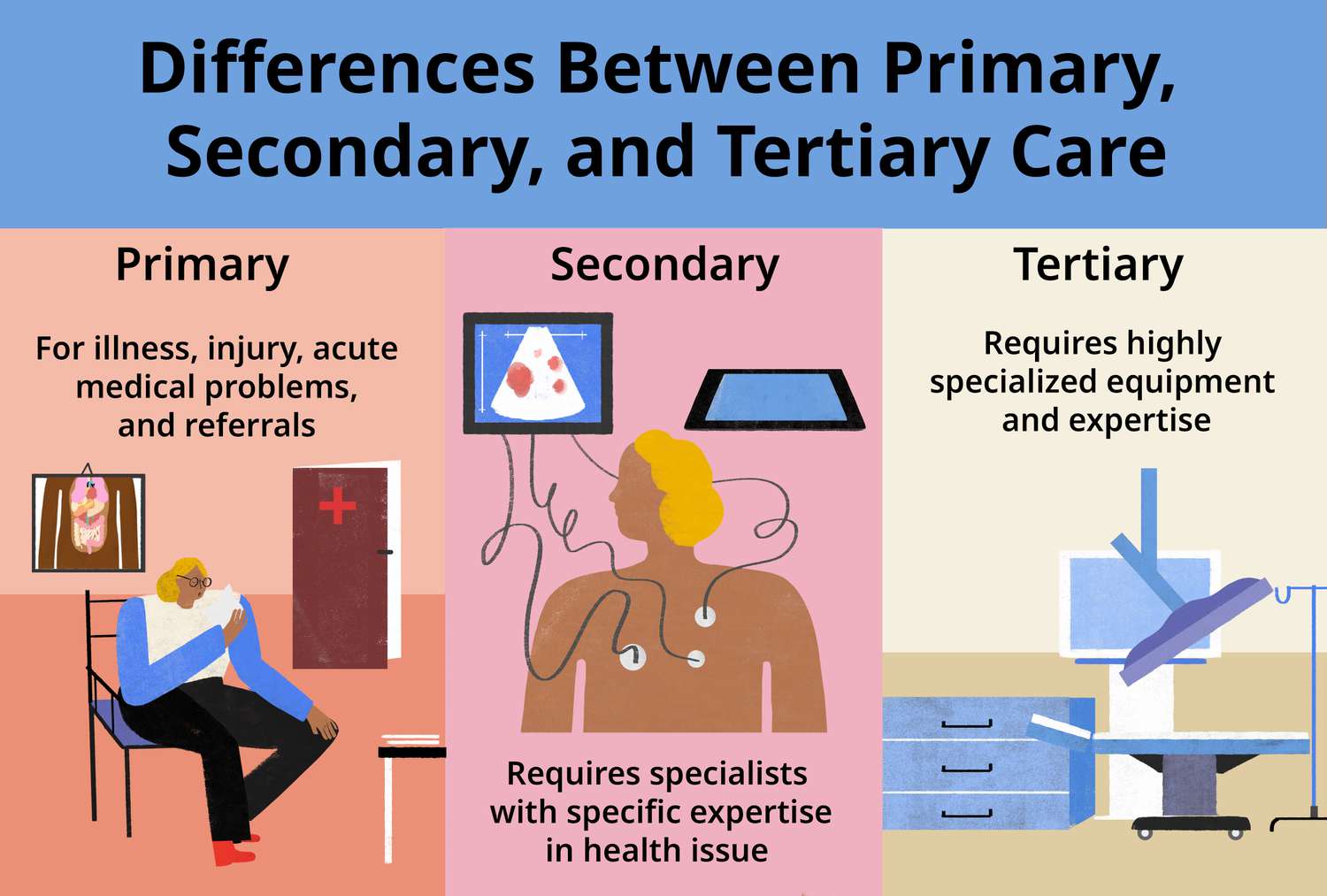
In medicine, there are four levels of care: primary, secondary, tertiary, and quaternary. The levels of care refer to the complexity of the medical cases that doctors and healthcare providers treat and the skills and specialties of the providers. 

Primary care involves consulting with a primary care provider. Secondary care refers to seeing a specialist such as a dermatologist, neurologist or oncologist. Tertiary care is specialized care in a hospital setting such as brain surgery, renal dialysis or heart surgery.

Quaternary care is thus an advanced level of specialized care.

PRIMARY CARE: https://medicalexecutivepost.com/2024/09/27/cms-a-new-primary-care-medicine-model/

QUATERNARY CARE

Classic: Sometimes used as an extension of tertiary medical and surgical care in reference to advanced levels of medicine which are highly specialized and not widely accessed by most patients.

Modern: A higher level of specialized care within a hospital. Experimental medicine and some types of uncommon diagnostic or surgical procedures are also considered quaternary care.

According to the Wonca International Dictionary for General/Family Practice -Quaternary Prevention [QP] – is defined as: ‘Action taken to identify patient at risk of over medicalization, to protect him/her from new medical invasion, and to suggest to him interventions, which are ethically acceptable’.

Examples: Types of quaternary care include: experimental medicine, procedures and uncommon and specialized surgeries. This includes sub-specialty services such as advanced trauma care and organ [heart, lung, liver, kidney, etc] transplantation.

MEDICAL CARE: https://medicalexecutivepost.com/2024/07/29/survey-primary-care-doctors-deliver-most-medical-care/

COMMENTS APPRECIATED

EDUCATION: Books

Like, Refer and Subscribe

***

***

***

PHYSICIANS BEWARE: The APR Car Lease “Money Factor”

By A.I. and Dr. David Edward Marcinko MBA MEd CMP

SPONSOR: http://www.CertifiedMedicalPlanner.org

***

***

What is it?

The so-called money factor (abbreviated as MF on invoices) is a number in a decimal form that dealers use to calculate the APR of a car lease. It’s a major part of your monthly payment and dealers are known to jack up the money factor to pad their profits.

BROKE DOCTORS: https://medicalexecutivepost.com/2025/08/02/doctors-going-broke-and-living-paycheck-to-paycheck/

How it works

Most doctors don’t ask to see it because they’re not aware of it or don’t know how to calculate it. Ask to see the money factor, then multiply it by 2,400.

For example, if the money factor is .00150, you multiply it by 2,400 to get 3.6%. If that’s higher than the prevailing rate, you have room to talk them down.

How to reduce it

So how do you get a good interest rate when you lease a vehicle? The same way you do when borrowing for any other reason, whether it’s buying a home or applying for a personal loan: by having good credit. This may reduce your interest rate because you’ll represent a lower risk to a lender.

A high residual value on the car could also help you get a better interest rate. A higher residual value means you’d have lower monthly payments because there would be less depreciation on the vehicle. Since interest is applied to your monthly payment, a lower monthly payment would equate to reduced interest charges.

MONEY DOCTORS: https://medicalexecutivepost.com/2025/04/08/psychology-a-money-relationship-questionnaire-for-doctors/

Financial implications

The money factor is one of the many numbers you may want to learn about when leasing a car. It’s one of the transactional costs that come with leasing, and allows dealers and finance companies to make a profit on every lease they execute. As a consumer, it’s a smart idea to learn the financial implications of this number and how it’ll affect your overall costs over the course of a multi-year lease.

***

***

If the interest rate is too high, you may need to shop around for a better rate, negotiate with the dealer or lender to lower the money factor, or consider leasing another vehicle that’s more in line with your budget. Either way, make sure you explore all your financial options before taking a car off the lot.

SALARY NEGOTIATIONS: https://medicalexecutivepost.com/2016/08/21/salary-negotiations-skills-for-doctors-hospitalists/

COMMENTS APPRECIATED

EDUCATION: Books

SPEAKING: Dr. Marcinko will be speaking and lecturing, signing and opining, teaching and preaching, storming and performing at many locations throughout the USA this year! His tour of witty and serious pontifications may be scheduled on a planned or ad-hoc basis; for public or private meetings and gatherings; formally, informally, or over lunch or dinner. All medical societies, financial advisory firms or Broker-Dealers are encouraged to submit an RFP for speaking engagements: CONTACT: Ann Miller RN MHA at MarcinkoAdvisors@outlook.com -OR- http://www.MarcinkoAssociates.com

Like and Subscribe

***

***

V.I.P. PATIENT PARADOX: A Joe Biden Medical Scenario?

By Dr. David Edward Marcinko MBA MEd

***

Dr. David Edward Marcinko with non-VIP patients

***

The House Committee on Oversight and Government Reform expanded its investigation of the cover-up of former President Joe Biden’s health, prostate cancer, and mental decline.

On June 4th, Chairman James Comer subpoenaed five former senior White House aides to appear for transcribed interviews in addition to Biden’s physician, Kevin O’Connor, M.D. In May, Biden revealed he was diagnosed with advanced prostate cancer. The announcement left the public dumbfounded.

At 82, having spent more than five decades as a president, vice president and senator, Biden had access to world-class medical care. Donald Trump Jr. was one of many political observers who speculated the diagnosis might have been covered up to win the 2020 election. And, Biden’s doctors may have followed standard medical guidelines, and the recommendations about screenings for people of different ages can be controversial, writes health care economist Devon Herrick at the Goodman Institute Health Care Blog.

“Experts often say that men are more apt to die with prostate cancer than from prostate cancer,” wrote Herrick. “There is even some disagreement about whether doctors should treat most occurrences of prostate cancer in older men. That partly explains why Biden had not been screened in a decade.”

Screenings can be costly, time-consuming and uncomfortable, and false positive results can lead to invasive procedures that do not markedly extend life or health. Biden made his first public remarks about his cancer after a Memorial Day event. Biden said he was “feeling good” and expected to “be able to beat this.”

QUESTION: So, was this a case of VIP Patient Paradox?

***

DEFINITION: “VIP medical patient paradox syndrome” is a term coined in 1964 by the psychiatrist Walter Weintraub to describe an intriguing paradox: Throughout history, the rich and famous, with all their resources and fancy doctors, have often received worse medical treatment, and suffered from worse health outcomes, than the average person.

VIP DEFINED: https://mdwhistleblower.blogspot.com/2024/08/the-vip-syndrome-threatens-doctors.html

Example: When physicians afford “special privileges” to their powerful patients, from “Mad King” George III to Michael Jackson, they seem to get sicker and even die.

While Weintraub, a psychoanalyst, attributed the problem in part to doctors unconsciously resenting their influential patients, it seems doctors simply get starstruck around famous people and high-ranking figures. Despite their medical expertise, these physicians find themselves opting out of basic tests for “privacy” or prescribing dangerous medications for “comfort.”

COMMENTS APPRECIATED

EDUCATION: Books

SPEAKING: Dr. Marcinko will be speaking and lecturing, signing and opining, teaching and preaching, storming and performing at many locations throughout the USA this year! His tour of witty and serious pontifications may be scheduled on a planned or ad-hoc basis; for public or private meetings and gatherings; formally, informally, or over lunch or dinner. All medical societies, financial advisory firms or Broker-Dealers are encouraged to submit an RFP for speaking engagements: CONTACT: Ann Miller RN MHA at MarcinkoAdvisors@outlook.com -OR- http://www.MarcinkoAssociates.com

Like and Subscribe

***

***

Why [Too Many] Physician Colleagues Don’t Get Rich?

Subscribe to continue reading

Subscribe to get access to the rest of this post and other subscriber-only content.

PHYSICIANS: Do You Use A Financial Planner?

***

***

TO: All Physicians and Dentists

QUESTION?

Do you use a financial advisor?

What has been your experience with him or her?

THANK YOU

EDUCATION: Books

SPEAKING: Dr. Marcinko will be speaking and lecturing, signing and opining, teaching and preaching, storming and performing at many locations throughout the USA this year! His tour of witty and serious pontifications may be scheduled on a planned or ad-hoc basis; for public or private meetings and gatherings; formally, informally, or over lunch or dinner. All medical societies, financial advisory firms or Broker-Dealers are encouraged to submit an RFP for speaking engagements: CONTACT: Ann Miller RN MHA at MarcinkoAdvisors@outlook.com -OR- http://www.MarcinkoAssociates.com

DOCTORS AND LAWYERS: Often Aren’t Millionaires

Subscribe to continue reading

Subscribe to get access to the rest of this post and other subscriber-only content.

BRAND MANAGEMENT: 7 Approaches For Doctors and Financial Advisors

By A.I.

***

***

Any extensive analysis of numerous papers published on brand management leads to the seven approaches mentioned below. This included 300+ articles from Journal of Marketing, Journal of Marketing Research, Journal of Consumer Research, Harvard Business Review and European Journal of Marketing.

So, it can be safe to claim that no matter which framework or model one follows it must have originated via one of the seven approaches listed below.

The Seven Branding Approaches are:

  • The economic approach: the brand as part of the traditional marketing mix.
  • The identity approach: the brand as linked to corporate identity.
  • The consumer-based approach: the brand as linked to consumer associations.
  • The personality approach: the brand as a human-like character.
  • The relational approach: the brand as a viable relationship partner.
  • The community approach: the brand as the pivotal point of social interaction.
  • The cultural approach: the brand as part of the broader cultural fabric.

There are multiple theories and model to be followed in the area of brand management with their own school of thought and have been proven to work.

These include the Aaker’s brand identity model, Kapferer’s brand prism or Keller’s customer-based brand equity pyramid. All of them will enhance the brand equity of the product or service but may have evolved from different school of thoughts. Though everyone talks about the different models, rarely we find text on the school of thought rather then the actual model in practice.

***

***

And, you will find the Brand Asset Valuator Model in many books but you might never come to know the author’s perspective.

COMMENTS APPRECIATED

Like and Subscribe

***

DOCTOR BRANDING STRATEGIES: Exploring 9 [NINE] Different Types

By A.I.

***

***

Medical doctors, dentists, and podiatrists have to undergo extensive training before they can practice medicine independently. Once they receive training, there are opportunities to increase pay and prestige in the medical field through a series of promotions. As a doctor, how much training, experience and skills you have can determine your ability to move upward in these levels. But, personal branding strategies may even be more vital in today’s social media age?

***

Physician, medical and healthcare branding is more than just the creation of logos, taglines, or specific brand messaging. It’s about creating a meaningful connection between your mission, vision and values and the people served – from patients and their families to local and global communities.

While there are many different types of branding strategies in marketing science, they all share key elements that serve as the foundation for the strategy. These 9 elements for all physicians and medical professionals include the following:

  1. Brand purpose: The reason the physician is in practice and what he/she is trying to achieve.
  2. Brand vision: The ideas and goals behind the dentist which serve as inspiration for practice growth.
  3. Brand values: The osteopaths beliefs and what they stand for.
  4. Target audience: The demographic(s) and patient targets that the podiatrist is aiming to reach.
  5. Market analysis: An analysis of the marketplace that identifies gaps where the chiropractor has an opportunity to position him/her self based on a unique value proposition.
  6. Awareness goals: The initiatives the doctor will take in order to reach a target market patient demographic.
  7. Brand personality: The human-like attributes of the physician that will help build relationships with patients, consumers and other physicians and practitioners.
  8. Brand voice: The language and tone the doctor uses to communicate with patients, physicians and consumers.
  9. Brand tagline: A memorable slogan that sums up the physician and their medical offering in a few choice words.

And so, physician branding is the development of a easily recognizable identity for a medical practice, clinic or healthcare organization that helps to shape perception by current and prospective patients and the wider world.

COMMENTS APPRECIATED

Like and Subscribe

***

MARCINKO ASSOCIATES: How our Second Investment Portfolio Opinions are Different?

SPONSOR: http://www.MarcinkoAssociates.com

***

***

We make second investment portfolio opinions affordable

Approximately 1 million allopathic physicians, 150,000 dentists, 200,000 osteopaths, 15,000 podiatrists and 6 million nurses often find it difficult to get an unbiased and fiduciary second opinion on their retirement or brokerage accounts. By offering second opinions for a flat fee, the monetary barriers that prevented colleagues from receiving a second opinion in the past have been removed.

We make second investment portfolio opinions convenient

Here’s how we work: you book an initial appointment with us, answer a few preliminary questions and email us your portfolio information. We then provide a second opinion. It is then up to you to incorporate or not.

INVESTMENT ADVISORY: https://medicalexecutivepost.com/2025/05/04/investment-advisory-portfolio-second-opinions-for-physician-colleagues/

We make second investment portfolio opinions timely

Financial markets, jobs and colleague age change like the weather. It is not always okay to wait a week, year or more, to seek a professional second financial portfolio opinion. You need to receive an opinion now. That’s where we come in. We are standing by, ready to take your email [MarcinkoAdvisors@outlook.com] and schedule a free initial consultation within two or three days, or less.

ASSET ALLOCATION: https://medicalexecutivepost.com/2024/10/23/musings-on-a-famous-portfolio-asset-allocation-study-3/

We make second investment portfolio opinions accurate

Fiduciary and non-sales orientated second opinions have the power to change financial lives in the long term. We’ve seen it happen many times. What characterizes a good second opinion? Three things: the opinion must be individualized to your investment portfolio[s], informed and results-oriented. That’s the informed fiduciary approach we take. We are colleagues and look forward to working with you.

PORTFOLIO MANAGEMENT: https://medicalexecutivepost.com/2025/05/27/physicians-personal-portfolio-management/

CONTACT: Ann Miller RN MHA CPHQ: Email: MarcinkoAdvisors@outlook.com

Invite Dr. Marcinko

COMMENTS APPRECIATED

EDUCATION: Books

Like and Refer

***

***

PHYSICIANS: On Real Estate Investing

OVER HEARD IN THE FINANCIAL ADVISOR’S LOUNGE

***

***

By Perry D’Alessio, CPA
[D’Alessio Tocci & Pell LLP]

What I see in my accounting practice is that significant accumulation in younger physician portfolio growth is not happening as it once did. This is partially because confidence in the equity markets is still not what it was; but that doctors are also looking for better solutions to support their reduced incomes.

For example, I see older doctors with about 25 percent of their wealth in the market, and even in retirement years, do not rely much on that accumulation to live on. Of this 25 percent, about 80 percent is in their retirement plan, as tax breaks for funding are just too good to ignore.

What I do see is that about 50 percent of senior physician wealth is in rental real estate, both in a private residence that has a rental component, and mixed-use properties. It is this that provides a good portion of income in retirement.

***

***

QUESTION: So, could I add dialog about real estate as a long term solution for retirement?

Yes, as I believe a real estate concentration in the amount of 5 percent is optimal for a diversified portfolio, but in a very passive way through mutual or index funds that are invested in real estate holdings and not directly owning properties.

Today, as an option, we have the ability to take pension plan assets and transfer marketable securities for rental property to be held inside the plan collecting rents instead of dividends.

Real estate holdings never vary very much, tend to go up modestly, and have preferential tax treatment due to depreciation of the property against income.

COMMENTS APPRECIATED

Read, Subscribe and Refer

EDUCATION: Books

***

***

CREDIT CARDS: Mistakes All Doctors Must Avoid

By Staff Reporters

***

***

Credit Card Mistakes to Avoid

No number has as far-reaching an impact on your money as your credit scores. Here are some credit card obstacles all physicians, nurses and medical professionals should dodge on the road to financial security

***

***

  • Don’t pay for a credit card repair service.
  • Don’t miss a payment.
  • Don’t max out your card.
  • Don’t take a cash-advance.
  • Don’t skip using your cards.
  • Don’t chase interest rates.
  • Don’t apply for several credit cards all at once.
  • Don’t co-sign a loan.
  • Don’t spread our car or mortgage payments.


COMMENTS APPRECIATED

Refer and Subscribe

***

***

FINANCIAL MODELING TERMS: All Physicians Should Review and Know

By Staff Reporters

SPONSOR: http://www.CertifiedMedicalPlanner.org

***

***

Financial Modeling is one of the most highly valued, but thinly understood, skills in financial analysis. The objective of financial modeling is to combine accounting, finance, and business metrics to create a forecast of a company’s future results.

According to Jeff Schmidt, a financial model is simply a spreadsheet, usually built in Microsoft Excel, that forecasts a business’s financial performance into the future. The forecast is typically based on the company’s historical performance and assumptions about the future and requires preparing an income statement, balance sheet, cash flow statement, and supporting schedules (known as a three-statement model, one of many types of approaches to financial statement modeling). From there, more advanced types of models can be built such as discounted cash flow analysis (DCF model), leveraged buyout (LBO), mergers and acquisitions (M&A), and sensitivity analysis

***

DEFINED TERMS

Discounted Cash Flow (DCF): A valuation method used to estimate the value of an investment based on its expected future cash flows, adjusted for the time value of money. It’s like deciding whether a treasure chest is worth diving for now, based on the gold coins you’ll be able to cash in later.

Sensitivity Analysis: This involves changing one variable at a time to see how it affects an outcome. Imagine tweaking your coffee-to-water ratio each morning to achieve the perfect brew strength.

Budget – A budget is the amount of money a department, function, or business can spend in a given period of time. Usually, but not always, finance does this annually for the upcoming year.

Rolling ForecastA rolling forecast maintains a consistent view over a period of time (often 12 months). When one period closes, finance adds one more period to the forecast.

Topside – A topside adjustment is an overlay to a forecast. This is typically completed by the corporate or headquarter team. As individual teams submit a forecast, the consolidated result might not make sense or align with expectations. When this occurs, the high-level teams use a topside adjustment to streamline or adjust the consolidated view.

Monte Carlo Simulation: Picture yourself at the casino, but instead of gambling your savings away, you’re using this technique to predict different outcomes of your business decisions based on random variables. It’s like playing financial roulette with the odds in your favor.

What-If Analysis: Ever daydream about what would happen if you took that leap of faith with your business? This tool allows you to explore various scenarios without risking a dime. It’s like trying on outfits in a virtual dressing room before making a purchase.

Leveraged Buyout (LBO) Model: This is a bit like orchestrating a heist, but legally. It’s about acquiring a company using borrowed money, with plans to pay off the debts with the company’s own cash flows. High stakes, high rewards.

Mergers and Acquisitions (M&A) Model: Picture two puzzle pieces coming together. This model evaluates how combining companies can create a new, more valuable entity. It’s the corporate version of a matchmaker.

Three Statement Model: The holy trinity of financial modeling, linking the income statement, balance sheet, and cash flow statement. It’s like weaving a tapestry where each thread is crucial to the overall picture.

Capital Asset Pricing Model (CAPM): A formula that calculates the expected return on an investment, considering its risk compared to the market. It’s like choosing the best roller coaster in the park, balancing thrill and safety.

Cash Flow Forecasting: This is your financial weather forecast, predicting the cash flow climate of your business. It helps you plan for sunny days and save for the rainy ones.

Cost of Capital: The price of financing your business, whether through debt or equity. It’s like the interest rate on your growth engine, pushing you to maximize every dollar invested.

Debt Schedule: A timeline of your business’s debts, showing when and how much you owe. It’s your roadmap to becoming debt-free, one milestone at a time.

Equity Valuation: Determining the value of a company’s shares. It’s like assessing the worth of a rare gemstone, ensuring investors pay a fair price for a piece of the treasure.

Financial Leverage: Using debt to amplify returns on investment. It’s like using a lever to lift a heavy object, increasing force but also risk.

Forecast Model: A crystal ball for your finances, projecting future performance based on past and present data. It’s your guide through the financial wilderness, helping you navigate with confidence.

Operating Model: A detailed blueprint of how a business generates value, mapping out operational activities and their financial impact. It’s like laying out the inner workings of a clock, ensuring every gear turns smoothly.

Revenue Growth Model: This tracks potential increases in sales over time, charting a course for expansion. It’s like plotting your ascent up a mountain, anticipating the effort required to reach the summit.

COMMENTS APPRECIATED

Subscribe, Like, Refer and Learn

***

***

BLOGGING: All Doctors Please Beware!

WARNING – WARNING

By Dr. DavidEdwardMarcinko; MBA MEd

***

***

According to www.NPR.org, there are more than120,000 health care forums on the Internet with opinions ranging from pharmaceuticals, to sexual dysfunction, to acne. The same goes for commercial doctor blogs that promote lotions, balms and potions, diets and vitamins, minerals, herbs, drinks and elixirs, or various other ingest-ants, digest-ants or pharmaceuticals, etc.

And, to other doctors, the blogging craze is a new novelty where there are no rules, protocols, standards or precise figures on how many “medical-doctor” or related physician-blogs are “out there.” Unfortunately, too many recount gory ER scenes, or pictorially illustrate horrific medical conditions, or serious and traumatic injuries. Of course, others simply are medical practice websites, or those that entice patients into more lucrative plastic surgery or concierge medical practices. Some are from self-serving/credible plaintiff-seeking attorneys wishing to assist patients.

Not all physician blogs are geared toward practice information, marketing or medical sensationalism. In fact, just the opposite seems to be the case in extremely candid blogs, like “Ranting Docs”, “White Coat Rants,” “Grunt Docs”, “Cancer Doc,” “The Happy Hospitalist,” “Mom MD”, “Cross-Over Health”, “Angry Docs” and “M.D.O.D.,” which bills itself as “Random Thoughts from a Few Cantankerous American Physicians.”

According to some of these, they are more like personal journals, or public diaries, where doctors vent about reimbursement rates, difficult cases, medical mistakes, declining medical prestige and control, and/or what a “bummer” it is to have so many patients die; not pay, or who are indigent, noncompliant. We call these the “disgruntled doctor sites.” Some even talk about their own patients, coding issues, or various doctor-patient shenanigans.

But, according to psychiatrist and blogger Dr. Deborah Peel and others, the problem with blogging about patients is the danger that one will be able to identify themselves – the doctor – or that others who know them will be able to identify them.”  Her affiliation, Patient Privacy Rights, rightly worries that patients might track back to the individual, and adversely affect their employment, health insurance or other aspects of life.

***

***

And, according to Dr. Jay S. Grife; MA Esq., it is certainly true that if a doctor violates a patient’s privacy there could be legal consequences. Under HIPAA, physicians could face fines or even jail time. In some states, patients can file a civil lawsuit if they believe a doctor has violated their privacy. Still, internet privacy issues are an evolving gray-area that if not wrong, may still be morally and ethically questionable [personal communication].

Our colleague Robert Wachter MD, author of the blog called “Wachter’s World,” says it’s important for doctors to be able to share cases, as long as they change the facts substantially. On the other hand, the author of “Wachter’s World” and a leading expert on patient safety alternately suggests “You might say we as doctors should never be talking about experiences with our patients online or in books or in articles.” But, he says that “patients shouldn’t take all the information on blogs at face value. Taken for what they are — unedited opinions, and in some cases entertainment — blogs can give readers some useful insight into the good, the bad and the ugly of the medical profession”. Link: http://www.the-hospitalist.org/blogs

Well, fair enough! But, doctors unhappy with their current medical career choice, or its modern evolution, should probably consider counseling or even career change guidance, re-education and re-engineering. It is very inappropriate to vent career frustrations in a public venue. It’s far better for the blog to be private and/or by invitation only; if at all [Personal communication].

We believe that a hybrid mash-up of both views can be wholly appropriate, or grossly inappropriate in some cases. Of course the devil is in the details; linguistics and semantics aside. Nevertheless; what is not addressed in electronic physician “mea-culpas” are the professional liability risks and concerns that are evolving in this quasi-professional, quasi-lay, communication forum.

***

***

Example: We have seen medical mistakes, and liability admissions of all sorts, freely and glibly presented. In fact,

“Some physicians find that the act of liability blogging as a professional confession that is useful in moving past their malpractice mistakes. And, it is also a useful way to begin a commitment to a better professional life of caring in the future. It helps eliminate the toxic residue and angst of professional liability and guilt. Moreover, as they are unburdened of past acts of omission or commission, doctors should remember to also forgive those who have wronged them. This helps greatly with the process and brings additional peace.”

However, although some may say that this electronic confession is good for the soul, it may not be good for your professional liability carrier, or you, when plaintiff’s attorneys release a legion of IT focused interns, or automated bots, searching online for your self-admissions and scouring for your self-incriminations. Of course, a direct connection to a specific patient may still not be made and no HIPAA violation is involved. But, a vivid imagination is not need needed to envision this type of blind medical malpractice discovery deposition query even now.

QUESTION: “Doctor Smith, I noted all the medical errors admitted on your blog. What other mistakes did you make in the care and treatment of my client?”

And so, the question of plausible deniability, or culpability, is easily raised.  If you must journalize your thoughts for sanity or stress release; do it in print. And, don’t tell anyone about it so the diary won’t be subpoenaed. Then tear it up and throw it away. Remember, with risk management, “It is all about credibility.” Don’t trash yours! These thoughts may be especially important if you covet a medical career as a researcher, editor, educator, medical expert or something other than a working-class or employed physician.

EDUCATION: Books

SPEAKING: Dr. Marcinko will be speaking and lecturing, signing and opining, teaching and preaching, storming and performing at many locations throughout the USA this year! His tour of witty and serious pontifications may be scheduled on a planned or ad-hoc basis; for public or private meetings and gatherings; formally, informally, or over lunch or dinner. All medical societies, financial advisory firms or Broker-Dealers are encouraged to submit a RFP for speaking engagements: CONTACT: MarcinkoAdvisors@outlook.com 

COMMENTS APPRECIATED

Read, Like Subscribe and Refer

***

***

MEDICAL OFFICE: Patient Satisfaction Management

The “Soft Science” of Patient Relationship Management

***

By Dr. David Edward Marcinko; MBA MEd CMP

SPONSOR: http://www.CertifiedMedicalPlanner.org

***

INTRODUCTION

Patient satisfaction occurs when patient perceptions exceed their expectations. They get an intangible “something extra” from their visit, above what they paid for. When patient expectations match their perceptions, mutual obligations are fulfilled, making both practitioner and patient “break-even”.

The clinical result, within a relevant range, is only part of the patient’s perceptions. Numerous sub-conscious impressions comprise the remainder. We’ve all had patients love us despite a less than optimal result. We’ve all had patients angrily leave the practice over some non-clinical matter like a trivial billing dispute. A patient’s perception of any health care service is colored by a vast array of prior experiences that set up current expectations. The patient is pleased to the extent that his current perceptions exceed his/her pre existing expectations. This encompasses far more than the clinical result (within a relevant range), and includes such non-treatment issues as the demeanor of the staff, condition of the physical premises, psychological comfort during the visit, etc.

Remember, all patients talk about you anyway. In the past, a happy patient told four others about what a nice doctor you are. Today, patients post website comments or blogs immediately after their visits. They are more likely to complete treatment and follow instructions, thus obtaining a better medical outcome, and, generating additional fees for the practice. They pay quicker, cause less bad-debt and help create a pleasant environment for us to work in.

An unhappy patient vehemently tells nine others, onground or online, what a nasty greedy rip-off artist you are. Sad, but true! They are not as likely to complete treatment, thus incurring a less than optimal result, and generate fewer fees. They pay slower, if at all, create a stressed environment and detrimentally affect the attitude of other patients in the office.

Try to eliminate problems that might cause negative perceptions (i.e., a filthy restroom) and implement controls that help assure positive perceptions. Patient satisfaction is a soft managerial science. It is a numbers game. Most patients don’t pre-define what would be “acceptable” from this encounter, but have vaguely defined ranges of prior expectations anyway, gleaned from a lifetime of health care related experience. Any variance between these this “acceptable” range of expectations and each trivial encounter invokes some degree positive or negative feeling in the patient.

***

***

The total perception of the office experience is an aggregate of multiple trivial, often subliminal, observations. Patient satisfaction is an intangible and amorphous process complicated by:

Inter patient variables: Significant differences between patients in their “expectations”.
Intra patient variables: A single patient can perceive the same thing or situation differently at different times, depending on uncontrollable variables like mood, or, context of occurrence which may (sometimes and/or partially) be controllable by the practice.
Luck of the draw” in physical variables: Does Sally or Mary escort the patient to the exam room? Was it the blue or green exam room? Did the last patient to use the rest room, five minutes ago, leave a disgusting mess?
Heterogeneous staff variables: Even with appropriate training, people are not machines and have their own quirks.

ASSESSMENT

By proactively anticipating the entire visit, from the patient’s perspective, the practitioner can structure and arrange things such that most patients have, mostly positive perceptions, most of the time. This can be done despite all the potential hetero-genicity of the above factors. Patient satisfaction can be improved in any office, and can be done by anyone.

CONCLUSION

Because patient satisfaction is a multi-faceted amorphous subject, there are multiple correct approaches to the subject and no “cook book” recipe on how to proceed. Try and get the big picture. Identify the worst areas and fix them. Identify the best areas and reinforce them. Proceed slowly. It can be done one facet at a time. Adapt things to your own managerial style and personality. Be completely open to suggestion and change.

Finally, be aware that patient relationship and satisfaction implementation strategies frequently overlap.

EDUCATION: Books

SPEAKING: Dr. Marcinko will be speaking and lecturing, signing and opining, teaching and preaching, storming and performing at many locations throughout the USA this year! His tour of witty and serious pontifications may be scheduled on a planned or ad-hoc basis; for public or private meetings and gatherings; formally, informally, or over lunch or dinner. All medical societies, financial advisory firms or Broker-Dealers are encouraged to submit a RFP for speaking engagements: MarcinkoAdvisors@outlook.com 

COMMENTS APPRECIATED

Read Refer, Like and Subscribe

***

***

CELEBRATE: National Physicians Week 2025

EDITOR-IN-CHIEF

By Dr. David Edward Marcinko; FACFAS MBA MEd

***

***

NATIONAL PHYSICIANS WEEK

National Physicians Week sets out March 25-31 to honor the healers dedicated to the art of medicine. In 2017, National Physicians Week highlighted the shortage of physicians in the United States against a growing landscape of minorities joining the ranks.

#NationalPhysiciansWeek

“In hindsight, I am proud of what we have accomplished in a short period of time, including raising the recognition of our group and spotlighting the years of sacrifice by those in our profession to serve our patients. We are poised to initiate actionable efforts to engage and educate our physician community.”

Cite: Dr. Kimberly Funches Jackson, President

Today in 2025, let’s explore the invaluable contributions of physicians, celebrate their hard work during National Physicians Week, and highlight the essential role that locum doctors play in enhancing healthcare delivery.

A Week to Honor All Physicians

National Physicians Week is a celebration of the remarkable work that doctors do every single day. From diagnosing complex conditions to providing life-saving treatments, physicians dedicate themselves to improving the health and well-being of their patients. It’s a week for healthcare professionals, patients, and communities to come together and show appreciation for the doctors who make a difference in our lives.

Physicians work long hours, face immense pressure, and make critical decisions daily. Their contributions go beyond the walls of the hospital, as many are also involved in research, teaching, and community outreach.

So, this week, it’s important to acknowledge not only their professional expertise but also the compassion and resilience they exhibit in their work.

EDUCATION: Books

SPEAKING: Dr. Marcinko will be speaking and lecturing, signing and opining, teaching and preaching, storming and performing at many locations throughout the USA this year! His tour of witty and serious pontifications may be scheduled on a planned or ad-hoc basis; for public or private meetings and gatherings; formally, informally, or over lunch or dinner. All medical societies, financial advisory firms or Broker-Dealers are encouraged to submit a RFP for speaking engagements: CONTACT: MarcinkoAdvisors@outlook.com 

COMMENTS APPRECIATED

Subscribe, Read, refer and Subscribe

***

***

DAILY UPDATE: A.I. to Replace Doctors, 23andMe Drops as US Stock Markets Slide

MEDICAL EXECUTIVE-POST TODAY’S NEWSLETTER BRIEFING

***

Essays, Opinions and Curated News in Health Economics, Investing, Business, Management and Financial Planning for Physician Entrepreneurs and their Savvy Advisors and Consultants

Serving Almost One Million Doctors, Financial Advisors and Medical Management Consultants Daily

A Partner of the Institute of Medical Business Advisors , Inc.

http://www.MedicalBusinessAdvisors.com

SPONSORED BY: Marcinko & Associates, Inc.

***

http://www.MarcinkoAssociates.com

Daily Update Provided By Staff Reporters Since 2007.
How May We Serve You?
© Copyright Institute of Medical Business Advisors, Inc. All rights reserved. 2025

REFER A COLLEAGUE: MarcinkoAdvisors@outlook.com

SPONSORSHIPS AVAILABLE: https://medicalexecutivepost.com/sponsors/

ADVERTISE ON THE ME-P: https://tinyurl.com/ytb5955z

Your Referral Count -0-

CITE: https://www.r2library.com/Resource

Over the next decade, advances in artificial intelligence will mean that humans will no longer be needed “for most things” in the world, says Bill Gates. That’s what the Microsoft co-founder and billionaire philanthropist told comedian Jimmy Fallon during an interview on NBC’s “The Tonight Show” in February. At the moment, expertise remains “rare,” Gates explained, pointing to human specialists we still rely on in many fields, including “a great doctor” or “a great teacher.”

CITE: https://tinyurl.com/2h47urt5

US stocks closed sharply loser Wednesday as President Trump prepared to unveil new tariffs on US auto imports. The benchmark S&P 500 (^GSPC) was down more than 1.1%, while the Dow Jones Industrial Average (^DJI) fell about 0.4%. The tech-heavy NASDAQ Composite (^IXIC) led the losses, sliding over 2%. Tech leaders Nvidia (NVDA) and Tesla (TSLA) both closed down more than 5%.

CITE: https://tinyurl.com/tj8smmes

It’s a shocking fall for 23andMe that once boasted a $6 billion valuation in 2021—despite never making a profit. As of Friday, it was worth $50 million, and on Monday, shares for the consumer genetic testing pioneer fell 50% to 88 cents, Reuters reported.

Visualize: How private equity tangled banks in a web of debt, from the Financial Times.

COMMENTS APPRECIATED

PLEASE SUBSCRIBE: MarcinkoAdvisors@outlook.com

Thank You

***

***

***

***

EDUCATIONAL TEXTBOOKS: https://tinyurl.com/4zdxuuwf

***

FINANCIAL ADVISORS & MEDICAL MANAGEMENT CONSULTANTS: Marcinko & Associates, Inc

SPONSOR: http://www.MarcinkoAssociates.com

D. E. Marcinko & Associates Core Operating Values

9.   We act with honesty, integrity and are always straightforward.
8.   We strive to be innovative, creative, iconoclastic, and flexible.
7.   We admit and learn from mistakes and don’t repeat them.
6.   We work hard always as competitors are trying to catch up.
5.   We treat others with dignity and respect.
4.   We are the onus of consulting advice for the well being of others.
3.   We fight complacency as former success is in the past.
2.   The best management styles are timeless, not timely.
1.   Our clients are colleagues and always come first.

EDUCATION: Books

SPEAKING: Dr. David Edward Marcinko MBA MEd will be speaking and lecturing, signing and opining, teaching and preaching, storming and performing at many locations throughout the USA this year! His tour of witty and serious pontifications may be scheduled on a planned or ad-hoc basis; for public or private meetings and gatherings; formally, informally, or over lunch or dinner. All medical societies, financial advisory firms or Broker-Dealers are encouraged to submit a RFP for speaking engagements.

***

***

CONTACT: Ann Miller RN MHA at: MarcinkoAdvisors@outlook.com 

***

A NEW NORM: Revising Financial Planning Principles for Physicians?

DR. DAVID EDWARD MARCINKO; MBA MEd CMP

SPONSOR: http://www.MarcinkoAssociates.com

***

In 1972, Nobel Laureate Kenneth J. Arrow, PhD shocked academe’ by identifying health economics as a separate and distinct field. Yet, the seemingly disparate insurance, tax, risk management and financial planning principles that he also studied are just now becoming transparent to some medical professionals and their financial advisors. Despite the fact that a basic, but hardly promoted premise of this new wave financial planning era, is imprecision.

More: https://medicalexecutivepost.com/2024/11/09/arrow-information-paradox/

Nevertheless, to informed cognoscenti like Certified Medical Planners™, the principles served as predecessors to the modern physician-focused financial advisory niche sector. In 2004, Arrow was selected as one of eight recipients of the National Medal of Science for his innovative views.

More: http://www.CertifiedMedicalPlanner.org

And now, as a long bull market may be over, and if the current “new-normal” prevails – meaning a 4.5% real annualized rate of return on equities and a 1.5% real rate on bonds – wealth accumulation for all may be reduced.

An Imprecise Science

There is a major variable, dominant in any marketplace that pushes an economy in a forward direction. It is called consumerism. This became apparent while waiting in a doctor’s office one recent afternoon.

Scenario:

The front office receptionist, who appeared to be about 21 years old, was breaking for lunch and her replacement, who appeared not much older, came over to assist. Realizing the propensity for a long wait, one was taken by the size of waiting room and the number of patients coming in and out of the office. [Americans consume healthcare and a lot of it]. There was another notable peculiarity. The sample prescription bags being carried out the door were no match for the bags under everyone’s eyes, including the doctor’s. The office staff was probably working overtime, if not two jobs, and the doctor was working harder and faster in a managed care system.

Assessment

Why? So they all could afford to buy and voraciously consume for their children and themselves. Americans indeed work longer hours than any other industrialized nation.

Conclusion

Finally, as women medical professionals entered the workforce in unprecedented numbers, the stock markets reached an all time high in 2025, even as money was spent at a feverish pace as the Federal Reserve pumped out money in inflammatory fashion.

EDUCATION: Books

SPEAKING: Dr. Marcinko will be speaking and lecturing, signing and opining, teaching and preaching, storming and performing at many locations throughout the USA this year! His tour of witty and serious pontifications may be scheduled on a planned or ad-hoc basis; for public or private meetings and gatherings; formally, informally, or over lunch or dinner. All medical societies, financial advisory firms or Broker-Dealers are encouraged to submit a RFP for speaking engagements: CONTACT: MarcinkoAdvisors@outlook.com 

COMMENTS APPRECIATED

Refer, Like and Subscribe

***

***

HOSPITAL Revenue Metrics Review

By Staff Reporters

***

***

The emphasis on hospital revenue metrics at hospitals may be a sign of misplaced prioritization away from patients and their well-being. For example:

  • Orthopedic Surgeons Generated the $2.75 Million in Hospital Revenue Per Orthopedist Per Year.
  • Interventional Cardiologists Generated $2.45 Million in Hospital Revenue Per Cardiologist Per Year.
  • General Surgeons Generated $2.17 Million in Hospital Revenue Per Surgeon Per Year.
  • Family Practice Doctors Generated $1.5 Million in Hospital Revenue Per Doctor Per Year.

COMMENTS APPRECIATED

Subscribe and Refer.

***

***

PHYSICIANS: Career Change Conundrum

By Dr. David Edward Marcinko MBA MEd CMP™

SPONSOR: https://marcinkoassociates.com/process-what-we-do/

***

***

Half of Physicians Plan to Change Career Paths

The Physicians Foundation conducted a survey on physician practice patterns and perspectives a few years ago. Here are some key findings from the report:

• 31% of physicians identify as independent practice owners or partners.
• Almost half (47%) of physicians plan to change career paths.
• 78% of physicians sometimes, often or always experience feelings of burnout.
• Nearly a quarter of physician time is spent on non-clinical paperwork.

This result is not good for Medicine.

Cite: The Physicians Foundation, September 2018

COMMENTS APPRECIATED

Subscribe Today!

***

***

JOHNS HOPKINS: Medical School Free!

By Dr. David Edward Marcinko MBA MEd CMP

I grew up in SE inner city Baltimore, Maryland and played stick ball in the parking lot of JHU medical school. And so, I was gratified to learn that it is about to get a lot cheaper—for many students at Johns Hopkins University, at least.

Thanks Mike Bloomberg. Be like Mike!

***

***

The former New York mayor, entrepreneur, and 1964 John Hopkins alum Michael Bloomberg donated $1 billion to the university, according to Bloomberg Philanthropies and the university in a recent announcement. Starting this fall, tuition will be free for students coming from households that earn less than $300,000 annually, and the gift will also cover living expenses and other fees for students from families with less than $175,000 in annual income.

CITE: https://www.r2library.com/Resource

Financial access to medical school is a challenge for many students: The median debt for the class of 2023 is $200,000, according to the Association of American Medical Colleges. This cost can discourage students from attending medical school at a time when the US needs more physicians; the association predicted that there will be a physician shortage of up to 86,000 doctors nationwide by 2036.

READ: https://tinyurl.com/bd6sbmvj

COMMENTS APPRECIATED

Thank You

***

***

SUBMITTED ESSAYS: Economics, Management and Finance from Advisors to Physicians

By Staff Reporters

SPONSOR: http://www.MARCINKOASSOCIATES.com

Finance, economics and management essays of most current interest to all physicians and healthcare professionals

READ ESSAYS: https://marcinkoassociates.com/articles-essays/

Check back periodically for practical updates. Our catalogue library of major books, texts, case models and dictionaries is suggested for additional financial, economic, business and medical practice management information and education.

COMMENTS APPRECIATED

Thank You

***

***

***

FINANCIAL PLANNING: Next Generation for Physicians Only

By Dr. David Edward Marcinko MBA CMP™

SPONSOR: http://www.MARCINKOASSOCIATES.com

***

SPONSOR: http://www.CertifiedMedicalPlanner.org

(“Informed Voice of a New Generation of Fiduciary Advisors for Healthcare”)

For most lay folks, personal financial planning typically involves creating a personal budget, planning for taxes, setting up a savings account and developing a debt management, retirement and insurance recovery plan. Medicare, Social Security and Required Minimal Distribution [RMD] analysis is typical for lay retirement. Of course, we can assist in all of these activities, but lay individuals can also create and establish their own financial plan to reach short and long-term savings and investment goals.

But, as fellow doctors, we understand better than most the more complex financial challenges doctors can face when it comes to their financial planning. Of course, most physicians ultimately make a good income, but it is the saving, asset and risk management tolerance and investing part that many of our colleagues’ struggle with. Far too often physicians receive terrible guidance, have no time to properly manage their own investments and set goals for that day when they no longer wish to practice medicine.

For the average doctor or healthcare professional, the feelings of pride and achievement at finally graduating are typically paired with the heavy burden of hundreds of thousands of dollars in student loan debt.

CITE: https://www.r2library.com/Resource

You dedicated countless hours to learning, studying, and training in your field. You missed birthdays and holidays, time with your families, and sacrificed vacations to provide compassionate and excellent care for your patients. Amidst all of that, there was no time to give your finances even a second thought.

Between undergraduate, medical school, and then internship and residency, most young physicians do not begin saving for retirement until late into their 20s, if not their 30s. You’ve missed an entire decade or more of allowing your money and investments to compound and work for you. When it comes to addressing your financial health and security, there’s no time to waste.

And you may be misled by unscrupulous “advisors”.

READ HERE: https://marcinkoassociates.com/financial-planning/

RELATED: https://medicalexecutivepost.com/2023/12/15/doctor-are-you-a-financial-advisors-customer-or-client/

COMMENTS APPRECIATED

Thank You

***

***

RESOURCES: Financial and Economic Essays for Doctors and Healthcare Professionals

https://marcinkoassociates.com

***

***

Informational essays of most current interest to healthcare professionals. Check back periodically for practical updates. Our catalogue library of major books, texts, case models and dictionaries is suggested for additional financial, economic, business and medical practice management information and education.

READ HERE: https://marcinkoassociates.com/articles-essays/

UPDATE: Prior ME-P Topics:

1-The number of balance billing disputes reaching arbitration is far higher than federal projections suggested.


2-Experts worry ACOs could face lasting financial difficulties due to an alleged $2 billion Medicare urinary catheter fraud scheme. 

COMMENTS APPRECIATED

Thank You

INVITE DR. MARCINKO: https://medicalexecutivepost.com/2024/02/05/invite-dr-marcinko-to-speak-at-your-next-seminar-webcast-or-event-in-2024/

***

PHYSICIANS: Leaving Medical Practice

By Staff Reporters

***

***

QUESTION: Why are doctors leaving their practices?

For many it’s about demographics. Just like the rest of us, doctors are aging too. Already the average physician age is about 53 years old. The Association of American Medical Colleges reports that about half of doctors are over the age of 55. Over the next decade, an estimated 40% of physicians will be over 65 years old. This means more than two of every five active physicians will reach age 65 within the next 10 years.

Moreover, compared with their boomer colleagues who were more likely to work past retirement, a robust 60% of younger Generation X doctors are reporting that they plan to retire by age 60.

***

***

Doctors cite poor quality of life and stress as reasons for their early departure. The pandemic certainly crushed many providers and has led to burnout. Generation X physicians in their 40s and early 50s were more likely than boomers to report that their current work life was not making the grade. In short, 43% of middle-aged doctors, compared with 31% of doctors over age 55, were reporting lower levels of professional fulfillment. Moreover, 47% of mostly Gen X doctors indicated dissatisfaction with their level of personal fulfillment compared with 36% of practicing boomer physicians.

COMMENTS APPRECIATED

Thank You

***

***

PODCAST: Doctors Divorcing from their Hospital Systems

By Eric Bricker MD

***

***

***

COMMENTS APPRECIATED

Thank You

***

***

CELEBRATE: National Physician’s Week 2023

By Staff Reporters

SPONSOR: http://www.CertifiedMedicalPlanner.org

***

This National Physicians Week, from March 25–31, we can show doctors we appreciate them as much as they deserve with creative gifts, simple notes, and appreciation posts online.

Doctors deal with years of school, grueling shifts, and emotionally difficult decisions, and still manage to care for us with focus and kindness. Physicians drastically improve the duration and quality of life for everyone, and throughout history have done their best to use cutting-edge science to care for others.

Physician appreciation is also symbolized by a red carnation, so be sure to bring one to your favorite doc this week!

***

***

Here Are the Top Ten Ways To Celebrate National Physicians Week in 2023:

  1. Send a doctor red carnation and/or gift of your choice to show appreciation.
  2. Host a Zoom or virtual celebration.
  3. Doctors can take the day off (If the schedule permits)
  4. Record and post a video to show gratitude for your doctor and physicians nationwide.
  5. Encourage others and spread the word about National Physicians Week on and offline.
  6. Write or share an article about National Physicians Week.
  7. Offer product or service discounts to doctors.
  8. Host an office party to celebrate staff physicians.
  9. Plan a happy hour or networking event for physicians and the community.
  10. Send red carnations and or/greeting cards.

READ: https://www.physiciansworkingtogether.org/national-physicians-week

LOCUM: https://www.locumjobsonline.com/blog/week-remember-showing-appreciation-doctors-physicians-week/

COMMENTS APPRECIATED

Thank You

***

VIDEO TELECONFERENCE: How to Prepare?

By Coach: Dr. David Edward Marcinko MBA

***

***

PHYSICIANS AND ADVISORS

TIPS TO PREPARE FOR A VIDEO INTERVIEW

Practice with someone to become comfortable with the process.

Background/Staging:


• Pay attention to the background, what will be seen around and behind you. Get rid of
clutter – it affects “your presentation.” Make sure there is nothing in the background you
don’t want anyone to see including personal pictures, etc.


• Conduct the test in the same location you plan to conduct the video interview.
• Adjust lighting to highlight your face. Do not let light wash out your facial features.


• Have back-up equipment nearby (extra laptop, phones, cables).
Clothing


• Dress in professional, conservative, non-fussy clothing as though you were going to be
with the committee in person. Wear a jacket.


• Wear a solid/bold color. Stay away from dark colors.


• Stay away from prints (e.g. herringbone) which, depending upon the design, lighting and
camera pixels, can make your outfit “vibrate” on screen.


• Dress knowing that the committee will see you “closer up” than you will see them.
Eye Contact/Body Language/Clear Communications


• Be sure to look at the camera not at the image of the committee on the screen;
otherwise you do not appear to be “looking them in the eye” or will appear nervous.


• It is hard to read committee body language without typical in-person conversation cues,
so watch the time and limit each answer to 3-4 minutes. Be attuned to a timer.


• Be attentive to your body language — leaning back in your chair is a no-no; lean forward
to convey interest in the position and the committee. Don’t rock back and forth.


• Place support things out of camera range (glass of water, a timer, notes, notepad, pen,
list of committee members) so your eyes go to the side and not up/down to these items.


• Don’t be afraid to ask to have questions repeated, either because the question was long
and complex or because of audio problems. Jot notes on complex questions.

COACH: https://medicalexecutivepost.com/2023/01/08/personal-coaching-dr-marcinko-at-your-service/


Sound Amplification and Noise Control:


• Microphones magnify noises and can be distracting to the committee. Avoid ruffling
papers and jangling jewelry. In the same vein, speak up clearly and enunciate your
words.


• Place a “do not disturb/do not enter” sign on the door of your space. Turn off running
programs (like your email) to eliminate beeps when new emails arrive.

• Silence all other technology EXCEPT if there should be technical issues, turn your
phone back on to receive a call from your Greenwood/Asher consultant for
troubleshooting.


• Ask family and colleagues to be quiet during the interview. If a family member or
colleague is your resident IT expert, have that person close-at-hand but out-of-sight
during the call.


• Be prepared to switch to a landline or cell speaker phone for the audio portion since
audio with Skype/Zoom is not always great. If you do use this option, mute your
computer microphone to eliminate conflicting noise.

SECOND OPINIONS: https://medicalexecutivepost.com/2023/01/10/physician-coaching-second-opinions

PODCAST: https://www.youtube.com/watch?v=n7bYGhEVjd8

***

COMMENTS APPRECIATED

Thank You

***

Primary Care Provider – Eliminating the Term

Eliminating the Term Primary Care “Provider”

Consequences of Language for the Future of Primary Care

By Allan H. Goroll, MD

LINK:

https://jamanetwork.com/journals/jama/article-abstract/2506307

***

US Healthcare – Giving Doctors a Say

US Healthcare: Giving Doctors a Say

[A Bain infographic]

Doctors that are involved in the decision-making process are more willing to lead change.

***

***

http://www.bain.com/publications/articles/front-line-of-healthcare-2017-doctors-infographic.aspx

***

***

About the Institute of Medical Business Advisors, Inc

Join Our Mailing List

iMBA, Inc

[www.MedicalBusinessAdvisors.com]

Championing the Financial Success of

Doctors and their Consulting Advisors

[Career Development Products and Services]

Comprehensive Financial Planning Strategies for Doctors and Advisors: Best Practices from Leading Consultants and Certified Medical Planners(TM)

Your Personal DR. Invitation: Letterhead.iMBA_Inc.

Call for Authors, Contributors, Opinions and Essays

The Network and Forum for Doctors, and their Financial Advisors and Management Consultants

By Ann Miller RN MHA

[Executive-Director

MarcinkoAdvisors@msn.com

Join Our Mailing List 

The Medical Executive-Post publishes material that is practical, versatile, and user-friendly for our target audience in the integrated healthcare industrial and financial services complex. So, if you have an essay, article, op-ed piece or post proposal on a topic that would benefit our readers and subscribers, we would like to hear from you.

Topic Specificity

Or, become part of our ME-P search team and get published for fun and profit! We’ll give you an occasional topic, and you tell us how your life and medical or financial advisory practice has been affected by it. Just send in your best stories and musings in essay form.

Examples:

Doctors: tell us your most interesting Health 2.0 story from the patient clinical examination room.

Financial Advisors: tell us your most interesting Web 2.0 story from a physician-client engagement.

Conclusion

Your thoughts and comments on this ME-P are appreciated. Feel free to review our top-left column, and top-right sidebar materials, links, URLs and related websites, too. Then, subscribe to the ME-P. It is fast, free and secure.

Link: http://feeds.feedburner.com/HealthcareFinancialsthePostForcxos

Speaker: If you need a moderator or speaker for an upcoming event, Dr. David E. Marcinko; MBA – Publisher-in-Chief of the Medical Executive-Post – is available for seminar or speaking engagements. Contact: MarcinkoAdvisors@msn.com

OUR OTHER PRINT BOOKS AND RELATED INFORMATION SOURCES:

DICTIONARIES: http://www.springerpub.com/Search/marcinko
PHYSICIANS: www.MedicalBusinessAdvisors.com
PRACTICES: www.BusinessofMedicalPractice.com
HOSPITALS: http://www.crcpress.com/product/isbn/9781466558731
CLINICS: http://www.crcpress.com/product/isbn/9781439879900
BLOG: www.MedicalExecutivePost.com
FINANCE: Financial Planning for Physicians and Advisors
INSURANCE: Risk Management and Insurance Strategies for Physicians and Advisors

Product DetailsProduct DetailsProduct Details

Product Details  Product Details

   Product Details 

On American Health Care and Financial Services Competitiveness

A MEMORIAL DAY OPINION – EDITORIAL

[Innovation – Not Nationalization – Can Again Lead]

By Dr. David Edward Marcinko; FACFAS, MBA, CPHQ, CMP™

[Publisher-in-Chief]

By Hope Rachel Hetico; RN, MHA, CPHQ, CMP™

[Managing Editor]

Ann Miller; RN, MHA

[Executive-Director]

American Flag

On this 2010 Memorial Day weekend, please allow us to directly reflect for a moment on the decline of the healthcare, banking and financial services industry in America. And; then somewhat indirectly comment on the hopeful emergence of the web 2.0 phenomena of which we all are a part. The competitive applicability to these sectors should be appreciated by the insightful ME-P reader.

Collapse of Command and Control Monopolies and Oligarchies   

Old monopolies everywhere are crumbling because of tougher new competitors and the transparency wrought by electronic connectedness. For example, our old newspaper has to compete with the internet, your electric utility company battles low-cost local start-ups, telephone companies must begin installing fiber optic lines to fend off cable companies; and RIAs and fiduciary focused financial advisors [FAs] will supplant BDs and stock brokers in the financial services sector.

www.CertifiedMedicalPlanner.com

cmp-logo

The airline industry collapsed a few years ago, the banking industry has just collapsed, and the auto industry is recovering as we pen this post. [We have a particular affinity for the auto sector however, as the son of a UAW member and step-daughter of Michiganders]. Regardless, the rush to more intense competition cannot be stopped. As a doctor, FA or other business competitor; you either keep pace or get crushed by quasi-oligarchic organizations like the American Medical Association [AMA], American Podiatric Medical Association [FPMA], American Dental Association [ADA], American Osteopathic Medical Association AOMA], Financial Planning Association [FPA], Certified Financial Planner Board of Standards [CFP BoS], College for Financial Planning [CFP] or the National Association of Personal Financial Advisors [NAPFA], etc. What have they, and Wall Street, done for you … lately? Scandal, taint, doubt, lost-credibility, a business-as-usual ennui, lethargy and ruin! Enter www.Sermo.com

Link: https://healthcarefinancials.wordpress.com/2009/04/19/calling-for-cfp%c2%ae-fiduciary-status-real-education-and-higher-duty/#comment-4136

Health Insurance Companies

In the last-generation of health insurance companies and related fraternal medical organizations, patients exercised great control over physician selection, had quicker access to specialists and encountered fewer restrictions on care. The reverse was true with financial services. But, because of advancing technology, aging demographics, intense R&D, global manufacturing, and escalating domestic HR costs – competitive market forces against traditional and structured staff model managed care companies – many industry analysts [like us] predicted growth would decline [Yes, greed was also involved as healthcare was presumed a recession-proof sector; and didn’t we all own behemoth big-pharma and HMO stocks in our 401-K, and 403-B plans]? But now, many former stock-brokers and FAs are going rogue; er – independent!

“Although inefficiencies in any business often open up in the short term, and can be greatly exploited by creative and visionary entrepreneurs – as in most business structures – market forces will prevail in the long run”.

Leo F. Mullin, MBA

[Former CEO – Delta Airlines]Shadows

Next-Gen with “Fly”

Fortunately, a new generation of enlightened physician and FA entrepreneurs is coming “out-of-the-shadows” as new-wave web 2.0 corporations and RIAs are becoming more flexible, competitive and market responsive. Simultaneously, monolithic and collectivist political ideas keep trying to regulate the medical and financial services workplace with rules, regulations and contracts to control entire populations. Yet, in the new healthcare economy, this new generation of doctors and FAs with “fly,” is headed toward more competition; not less – with more collaboration with patients and clients – regaining self autonomy.

Physician and FA Advocates

Meanwhile, as medical professionals, FAs and patient advocates, we must all choose between staying flexible to ride out tough times – or – adopting a hard, brittle line that will crack under the pressure of competition. We know where we stand at the ME-P, do you?

Flexibility and Virtual Reality

In recent years, many large corporations and top-down business models were not market responsive and change was not inherent in their DNA. These traditional organizations represented a rigid or “used-to-be” mentality, not a flexible or “wanna-be” mindset; according to business columnist Alan Webber. Some financial advisory corporations, and today’s emerging health 2.0 initiatives, may possess the market nimbleness that cannot be recreated in a controlled or collectivist [nationalistic] environment. And so, going forward, it is not difficult to imagine the following new rules for the new financial and virtual medical ecosystem.

[A] Rule No. 1

Forget about “SEC suitability and FINRA rules”, large office suites, surgery centers, fancy equipment, larger hospitals and the bricks and mortar that comprised traditional medical practices or financial product delivery systems. One doctor or niche focused FA with a great idea, good bedside manners or competitive advantage, can outfox a slew of public servants, the AMA, SEC, ADA or FINRA “faux copy-cat examiners”, while still serving the public – and patients – and making money. It’s now a unit-of-one economy where “Me Inc.”, is the standard. Physicians and FAs must maneuver for advantages that boost their standing and credibility among patients, peers, payers, customers and clients. Examples include patient satisfaction surveys; outcomes research analysis, evidence-based-medicine, physician economics credentialing and true integrated fiduciary-focused financial planning.

However, we should also realize the power of networking, vertical integration and the establishment of virtual RIAs or medical practices, which come together to treat a patient, or help a client, and then disband when a successful outcome is achieved. Job security is earned with more successful outcomes; not necessarily a degree, automatic AUMs, certifications or onsite presence. In fact, some competition experts, like Shirley Svorny PhD, a professor of economics and chair of the Department of Economics at California State University, wonder if a medical degree is a barrier – rather than enabler – of affordable healthcare.

Link: https://healthcarefinancials.wordpress.com/2009/01/08/medical-licensing-obstacle-to-affordable-quality-care

Others even presume the establishment of virtual medical schools and hospitals, where students and doctors learn and practice their art on cyber-entities that look and feel like real patients, but are generated electronically through the wonders of virtual reality units. The same can be said for the financial services industry, although much farther down-line given its current slow rate of real education and quasi-professional acceptance.

[B] Rule No. 2

Challenge conventional wisdom, think outside the traditional box, recapture your dreams and ambitions, disregard conventional gurus and work harder than you have ever worked before. Remember the old saying, “if everyone is thinking alike, then nobody is thinking”. Do collective-nistas and nationalized healthcare advocates react rationally; or irrationally? [THINK: Wall Street, medical unions]

[C] Rule No 3

Differentiate yourself among your healthcare and financial advisory peers. Do or learn something new and unknown by your competitors. Market your accomplishments and let the world know. Be a non-conformist. Conformity is an operational standard and a straitjacket on creativity. Doctors and FAs should create and innovate, not blindly follow organization or political “union” leaders [shop stewards, BDs, etc] into oblivion.

[D] Rule No 4

Realize that the present situation is not necessarily the future. Attempt to see the future and discern your place in it. Master the art of the quick change with fast but informed decision making. Do what you love, disregard what you don’t, and let the fates have their way with you. Then, decide for yourself if you are of this ilk – and adhere to any of the above rules? Or, just become an employed [government, BD] doctor or FA shill. Just remember that the political party, or monopoly that can give you a job, can also take it away [THINK: LB, ML, Wachovia, national healthcare, etc].

CP 1

Memorial Day Considerations

Finally, on this Memorial Day weekend, consider that life and career is a journey, and that in this country we have the choice to ponder or pursue any, and all of the above options, and more. We have the ability to think, cogitate and ruminate, as we have done here today. So – please – thank those who have helped turn this idealistic philosophy, into pragmatic daily reality.

For us personally, we thank Bonze Star Medal Winner Captain Cecelia T. Perez, RN. Now – ponder and consider – who do you thank? If no one has impacted you up-close on this Memorial Day weekend and national holiday, please visit our military channel to reflect, comment and opine.

Link: https://healthcarefinancials.wordpress.com/category/military-medicine

Conclusion

And so, your thoughts and comments on this Medical Executive-Post are appreciated. Feel free to review our top-left column, and top-right sidebar materials, links, URLs and related websites, too. Then, be sure to subscribe to the ME-P. It is fast, free and secure.

Link: http://feeds.feedburner.com/HealthcareFinancialsthePostForcxos

Speaker: If you need a moderator or speaker for an upcoming event, Dr. David E. Marcinko; MBA – Publisher-in-Chief of the Executive-Post – is available for seminar or speaking engagements. Contact: MarcinkoAdvisors@msn.com  or Bio: www.stpub.com/pubs/authors/MARCINKO.htm

Get our Widget: Get this widget!

Our Other Print Books and Related Information Sources:

Practice Management: http://www.springerpub.com/prod.aspx?prod_id=23759

Physician Financial Planning: http://www.jbpub.com/catalog/0763745790

Medical Risk Management: http://www.jbpub.com/catalog/9780763733421

Healthcare Organizations: www.HealthcareFinancials.com

Health Administration Terms: www.HealthDictionarySeries.com

Physician Advisors: www.CertifiedMedicalPlanner.com

Subscribe Now: Did you like this Medical Executive-Post, or find it helpful, interesting and informative? Want to get the latest ME-Ps delivered to your email box each morning? Just subscribe using the link below. You can unsubscribe at any time. Security is assured.

Link: http://feeds.feedburner.com/HealthcareFinancialsthePostForcxos

Why Practicing Medicine is More than just a Paycheck

Your Healthcare Career Evaluation

By Eugene Schmuckler PhD, MBA

By Dr. David E. Marcinko MBA

www.MedicalBusinessAdvisors.com

Studs Turkel, in his outstanding book Working, makes the comment that work is the mechanism by which many of us get our daily bread and our daily purpose. If this is to be the case then the workplace needs to offer us something more than a paycheck. The Wilson Learning Corporation surveyed 1500 people asking “If you had enough money to live comfortably for the rest of your life, would you continue to work? Seventy percent said that they would continue to work, but 60 percent of those said they would change jobs and seek “more satisfying” work.

Auto Career Advisor

Each of us has in fact been put in charge of our own careers. Our personal career management is a lifelong process. Our task is to be able to discover our place in the world where we will be able to enjoy a high level of wellness. This requires us to now assess our career, not from the eyes of the sixteen year old who initially chose the career. The career you are now pursuing needs to be compatible with your own unique skills, knowledge, personality and interests. It is important to keep in mind that no one is married to his or her job. When it comes to the workplace most of us are in dating relationships.

A Medical Career Worth Examined

As part of your examining your current medical career, answer the following questions: Why do you work? What does work mean to you? What do you want from work?

Research shows that most people work for three major reasons. The first of these is money. Not only is this necessary for our most basic needs it also serves as a means of determining our self-image. A second reason is to be with other people. Being at work enables us to belong, to be part of something beyond ourselves. We become part of a team. Some offices consider co-workers to be part of an extended family. The work setting affords us the opportunity for receiving feedback, recognition and support. The third most often given reason is that work validates us as people if we consider what we do as having meaning. “I chose the medical profession so as to make a difference.” Individuals with career success have a sense of purpose, a feeling that their work has meaning and contributes to a worthwhile cause. This is not a trick question. How well does what you do in your office every day meet your needs for money, affiliation and meaning?

sf

Job Purpose

Without a sense of purpose on the job the chances are that your performance while adequate will not place you in the excellent category. Therefore, it is necessary for each and every one of us to be able to succinctly answer the question, “What is the purpose of your job?” That is a tough question to answer.

As a medical professional you may have seen what you considered to be the purpose of your job radically changed due to changes in the way services are now delivered. While we cannot bring back the past we can work around the present. Think about this for a moment, “If you want something to happen make a space for it.”4 What this means that whether you remain in your current profession or move elsewhere there is a need for you to establish long-range, medium-range, short-range, mini, and micro goals.

Long Term

Long-range goals are those concerned with the overall style of life that you wish to live. Regardless of your current age these goals are necessary. Long-range goals don’t need to be too detailed, because like the federal budget surplus, changes will come along. Just as the government is making projections into the future you too need to be making projections including but not limited to retirement.

Medium Term

Medium-range goals are goals covering the next five years or so. These are the goals that include the next step in your career. These are goals over which we have control and we are able to monitor them and see whether we are on track to accomplishing them and modify our efforts accordingly.

Short Term

Short-range goals generally cover a period of time about one month to one year from now. These are goals that can be set quite realistically and we are able to see fairly quickly whether or not we are on track to reaching them. We don’t want to set these goals at impossible levels but we do want to stretch ourselves. After all, that is the reason you are probably reading this chapter.

Mini-Goals

Mini-goals are those goals covering from about one day to one month. Obviously we have much greater control over these goals than you do over those of a longer-term. By thinking in small blocks of time there is much more control over each individual unit.

Micro-Goals

Micro-goals are goals covering the next 15 minutes to an hour. These are the only goals over which you have direct control. Because of this direct control, micro-goals, even though modest in impact, are extraordinarily important, for it is only through these micro-goals that you can attain your larger goals. If you don’t take steps toward your long-range goals in the next 15 minutes, when will you? The following 15 minutes? The 15 minutes after that? Sooner or later, you have to pick 15 minutes and get going. At some point procrastination has to be put aside.5

Personal Assets Evaluation

In thinking of your goals it now becomes necessary to evaluate your personal assets. Conducting this personal inventory requires you to identify your assets as well as your shortcomings. First, look at a time in your life when you were performing at your best. What were your thoughts and feelings? How did you behave? What were you doing? Now look at the reverse when you were doing poorly. What were your thoughts and feelings at that time? How did you behave? What were you doing?

If you are like others when you were at your best you described yourself as being confident, enthusiastic, organized, relaxed, focused, in control, friendly and decisive. The flip side, when at your worst you were fearful, apathetic, messy, anxious, lacking direction, out of control, argumentative and frustrated.

As you can see the emotions when we are at our best are all positive. This leads to the conclusion that it is to our advantage to be at our best as much as possible. Being at our best derives from working in those areas where we contribute our talents to something we believe in.  As we continue our own personal inventory we need to look at our special abilities. That is, what are you good at and find easy to do. Think of the following questions. It’s not necessary to write down you answers just think about them.

  1. How would you like to be remembered?
  2. What have you always dreamed of contributing to the world?
  3. Looking back on your life, what are some of your major contributions?
  4. When people think of you, what might they say are your most outstanding characteristics?
  5. What do you really want from your life and your work?
  6. In what way may you still feel limited by the past? If so, by what?
  7. What will it take to let go of what has happened, no matter how good or bad? Are you willing to let go?
  8. How might the rut of conformity or comfort be limiting you? Why?
  9. How different do you really want life to be? Why.
  10. Have you ever stated what it is you truly desire? If no, why not?
  11. How good could stand life to be?

doctors

Career Changers

Thinking about remaining in your present career or moving into another one is not easy. You are at the edge of a cliff and need to decide if you are going to turn back or to trust in yourself to successfully make it down to the bottom. People who are afraid of the dark lose their fear with just the slightest of a light in the room. As you have been going through this chapter you have been shining a light, however dim it may appear to you. You can see all of the items around you. The obstacles are there but with your advance knowledge you can anticipate ways to avoid them.

Personal Analysis

Having looked at and possibly re-evaluated your plans you can now do a thorough analysis of your assets. The assets requiring the most scrutiny are the following:

  1. Your talents and skills
  2. Your intelligence
  3. Your motivation
  4. Your friends
  5. Your education
  6. Your family

Your talents and skills are more than likely what has gotten you to the point you are at in your present career. For purposes of definition talents are innate, skills are acquired. Some have talent in interpersonal relations and some in artistic pursuits. Skills may be selected to complement the already present talents. It is skills that are necessary for expanding your options. As you seek out new skill areas ask yourself these questions. Do the skills provide occupational relevance? Might you be able to get others to pay you to teach them the skill? Will the skill be useful throughout life? Will the skill help you conquer new environments and gain new experiences? And, of course, Is it something you like to do?

Intelligence

Intelligence is considered to be the ability of the individual to cope with the world. Originally, intelligence focused primarily in the area of cognitive skills. Recently attention has been directed to what is called emotional intelligence, a concept that directs attention to social skills. Whether you were able to breeze through your courses in college or you truly had to work hard, earning your degrees demonstrates a better than average amount of cognitive intellectual ability. In order to maximize your brainpower, challenge yourself regularly.

Motivation

Motivation looks at how hard you are willing to work, your level of persistence, and the degree to which you want to do well. Different things motivate each of us and our personal motivators can vary from day to day. How many times have you had people say that they could not do your job? What are the activities that are attractive to you? More than likely an important motivator for you is to do something worthwhile. It has also been found that we tend to perform at about the same level as those people who are close to us. What this means is that those people with whom you work are going to have s substantial impact on your motivation.

Friends

Friends of course are invaluable assets. We use our friends as models for our own behavior. Those persons we consider friends share many of our attitudes, actions and opinions. With time we will change to be like our friends and they will change to become like us. Associating with those like us tends to temper our behavior. We try not to associate with the “wrong crowd” lest we become like them.

Education

Education needs to be ongoing. Recently, it was reported “all careers and businesses will be transformed by new technologies in often unpredictable ways. The era of the entrepreneur will make ‘boutique’ businesses more competitive with the behemoths, as mid-sized institutions get squeezed out. And medical break-throughs and the ongoing health movement will enhance-and extend-people’s lives.”[1] The implication of these changes is that new technologies often require a higher level of education and training to use them effectively and new biotechnology jobs will open up. The authors state that all the technological knowledge we work with today will represent only 1 percent of the knowledge that will be available in 2050. The half-life of an engineer’s knowledge today is only five years; in ten years, 90 percent of what an engineer knows will be available on the computer. In electronics, fully half of what a student learns as a freshman is obsolete by his or her senior year. The implication here is that all of us must get used to the idea of lifelong learning.

Join Our Mailing List

Assessment

Finally, family influences who and what we are and do. They can be a support group or they can be a deterrent to your goals. It is incumbent on every individual reading this chapter to consult with immediate family members at all stages of your career planning process.

Conclusion

And so, your thoughts and comments on this ME-P are appreciated. What career stage are you in currently; and are you satisfied-why or why not? Is practicing medicine more than a paycheck?

Feel free to review our top-left column, and top-right sidebar materials, links, URLs and related websites, too. Then, be sure to subscribe. It is fast, free and secure.

Link: http://feeds.feedburner.com/HealthcareFinancialsthePostForcxos

Note Dr. Gene Schmuckler is director of behavior economics for www.CertifiedMedicalPlanner.com, as well as www.MedicalBusinessAdvisors.com. He is an expert on physician career re-engineering, and a retired Professor of Organizational Behavior who taught Dr. Marcinko [our Publisher-in-Chief] in business school, almost two decades ago. He contributed the chapter on physician leadership and personal branding in the third edition of the upcoming book: www.BusinessofMedicalPractice.com to be released in the autumn of 2010.

Speaker: If you need a moderator or speaker for an upcoming event, Dr. David E. Marcinko and Dr. Schmuckler, are available for seminar or speaking engagements.

Contact: MarcinkoAdvisors@msn.com

Subscribe Now: Did you like this Medical Executive-Post, or find it helpful, interesting and informative? Want to get the latest ME-Ps delivered to your email box each morning? Just subscribe using the link below. You can unsubscribe at any time. Security is assured.

Link: http://feeds.feedburner.com/HealthcareFinancialsthePostForcxos

Sponsors Welcomed

And, credible sponsors and like-minded advertisers are always welcomed.

Link: https://healthcarefinancials.wordpress.com/2007/11/11/advertise


4 Campbell, D. If You Don’t Know Where You are Going You’ll Probably End Up Somewhere Else, Niles, IL: Argus Communications, 1974.

5 Campbell, D. op. cit.

[1] The Futurist, March–April 2001.

Product DetailsProduct Details

Become a Published Print Author with Us

Join Our Mailing List

The Business of Medical Practice [3rd Edition]

By Hope Rachel Hetico RN, MHA, CMP™

[Managing Editor]biz-book5

Dear Colleagues and ME-P Champions

As you may know, we are commencing work on the third edition of our best selling book: The Business of Medical Practice

TOC 1st: http://www.amazon.com/Business-Medical-Practice-Maximizing-Doctors/dp/0826113117/ref=sr_1_8?ie=UTF8&s=books&qid=1231111232&sr=1-8

TOC 2nd: http://www.springerpub.com/prod.aspx?prod_id=23759

Invitation to Contribute

Accordingly, we would be honored for you to consider contributing a new or revised chapter, in your area of expertise, for a low-effort but high-yield contribution. Our goal is to help physician colleagues and management executives benefit from nationally known experts, as an essential platform for their success in the healthcare industry. Many topics are still available: [health accounting; law, policy and administration; Medicare fraud and abuse; cloud computing; and finance and economics, etc].

Support Always Available

Editorial support is available, and you would enjoy increasing subject-matter notoriety, exposure and public relations in an erudite and credible fashion. As a reader, or preferably a subscriber to the ME-P, your synergy in this space may be ideal. Time line for submission of a 5,000-7,500 word chapter is ample, and in a prose writing style that is “wide, not deep.” 

A Health 2.0 Initiative

And, be sure to address health 2.0 modernity. Update chapters from the second edition are also available. 

Definition: https://healthcarefinancials.wordpress.com/2008/09/12/emerging-healthcare-20-initiatives

Assessment

Please contact me for more details [MarcinkoAdvisors@msn.com], if interested [770.448.0769]. A best selling-book is rare; while a third-edition volume even more so. Join us in this project. Regardless, we trust you will remain apostles of our core ME-P vision, “uniting medical mission and financial profit margin”, and promoting it whenever possible.

Front Matter Link: frontmatter1advancedbusinessmedicine

Channel Surfing the ME-P

Have you visited our other topic channels? Established to facilitate idea exchange and link our community together, the value of these topics is dependent upon your input. Please take a minute to visit. And, to prevent that annoying spam, we ask that you register. It is fast, free and secure.

Conclusion

Your thoughts and comments on this ME-P are appreciated. Feel free to review our top-left column, and top-right sidebar materials, links, URLs and related websites, too. Then, subscribe to the ME-P. It is fast, free and secure.

Speaker: If you need a moderator or speaker for an upcoming event, Dr. David E. Marcinko; MBA – Publisher-in-Chief of the Medical Executive-Post – is available for seminar or speaking engagements. Contact: MarcinkoAdvisors@msn.com

OUR OTHER PRINT BOOKS AND RELATED INFORMATION SOURCES:

Product Details

Dictionary of Health Insurance and Managed Care

ADVERTISEMENT

Whither the Dictionary of Health Insurance and Managed Care?

HDS

A simple query that demands a cogent answer!

Why do we need the Dictionary of Health Insurance and Managed Care, and, why do payers, providers, benefits managers, consultants, and consumers need a credible and unbiased source of explanations for their health insurance needs and managed care products?

The Answer is Clear!

Health care is the most rapidly changing domestic industry. The revolution occurring in health insurance and managed care delivery is particularly fast. Some might even suggest these machinations were malignant, as many industry segments, professionals, and patients suffer because of them. And so, because knowledge is power in times of great flux, codified information protects all people from physical, as well as economic harm.

We appreciate the support of our sponsors. So, click-on on the links and review all dictionary products.

Link: http://healthdictionaryseries.com/TechnologySecurity.aspx

Link: http://www.findbookprices.com/author/Hope_Hetico

Subscribe Now: Did you like this Medical Executive-Post, or find it helpful, interesting and informative? Want to get the latest ME-Ps delivered to your email box each morning? Just subscribe using the link below. You can unsubscribe at any time. Security is assured.

Link: http://feeds.feedburner.com/HealthcareFinancialsthePostForcxos

Sponsors Welcomed

And, credible sponsors and like-minded advertisers are always welcomed.

Link: https://healthcarefinancials.wordpress.com/2007/11/11/advertise

Product DetailsProduct DetailsProduct Details

About Certified Medical Planner™


SPONSOR NOTICE


Top 10 Reasons to Become a

Certified Medical Planner™


1. Expertise: Provide health economics, business and financial advice to physicians.

2. Credibility: Gain health industry recognition and fiduciary clout.

3. Opportunity: Focus on the lucrative and expanding physician advisory niche.

4. Recognition: Join a select group of advisory experts.

5. Distinction: Become quality; rather than product driven.

6. Achievement: 500 hours of financial, health economics and management education.

7. Evidence: Validate deep healthcare industry knowledge.

8. Resource: CMP™ text and hand books, dictionaries, and institutional print journal.

9. Distinction: Set yourself apart with our chartered logo and trade-mark identity.

10. Commitment: Become the “go-to” financial advisor for all medical professionals.


www.CertifiedMedicalPlanner.com


cmp-logo3

 Speaker: If you need a moderator or speaker for an upcoming event, Dr. David E. Marcinko; MBA – Publisher-in-Chief of the Executive-Post – is available for seminar or speaking engagements. Contact: MarcinkoAdvisors@msn.com  or Bio: www.stpub.com/pubs/authors/MARCINKO.htm

Get our Widget: Get this widget!

Subscribe Now: Did you like this Medical Executive-Post, or find it helpful, interesting and informative? Want to get the latest ME-Ps delivered to your email box each morning? Just subscribe using the link below. You can unsubscribe at any time. Security is assured.

Link: http://feeds.feedburner.com/HealthcareFinancialsthePostForcxos