A Hospital Industry Outlook for 2013

Join Our Mailing List

One Expert’s Opinion

By Ann Miller RN MHA

[Managing Editor]

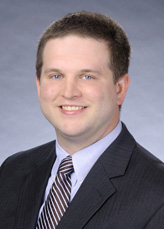
The ME-P and nation recently celebrated National Hospital Week for 2013. And so, what better time than now to ask health economist and financial expert Robert James Cimasi MHA, ASA, AVA, CMP for his take on the industry outlook. www.HealthCapital.com

cimasiHistory Background and Overview

The U.S. Healthcare Delivery System is facing what is perhaps its greatest challenge in the expected demand for increased health services from the aging of the “baby-boom” generation, the fastest-growing segment of the population.

The enactment of healthcare reform in March 2010, requiring increased insurance coverage requirements for individuals and employers, will also increase patient demand for hospital inpatient and outpatient services in the coming years.

Hospital Industry 

The hospital industry continues to face many challenges in the changing healthcare environment, including workforce shortages, rising healthcare costs to provide care, and difficulty acquiring needed capital. With consistent financial stresses, hospitals in some areas appear to be struggling.

However, general acute-care hospitals recorded record high profits of $35.2 billion in 2006, an increase of over 20% from 2005.  Total net revenues for general acute-care hospitals were $587.1 billion, resulting in an average profit margin of 6% (the highest since 1997, when the average profit margin was 6.7%).

While the demand for healthcare continues to rise, the site of service also continues to evolve as more procedures are performed on an outpatient basis and by freestanding facilities rather than by inpatient acute care hospitals.  As evidence of this trend, the number of freestanding ambulatory care surgery centers increased from 2,864 in 2000 to 5,197 in 2006.

U.S. healthcare costs are again increasing after their rate of growth slowed in the mid-1990s.

In 2009, total national health expenditures (NHE) in the U.S. grew to $2.5 trillion, a 5.7% increase from 2008.  Meanwhile, the nation’s gross domestic product (GDP) shrank by 1.1%, and as a result, NHE increased from 16.2% to 17.3% of the GDP: the largest one-year increase-in history. Additionally, healthcare spending has been projected to grow to 19.6% by 2016. The potential impact of the 2010 healthcare reform legislation to reduce rising healthcare expenditures is yet uncertain.

According to a 2002 study conducted by the Blue Cross and Blue Shield Association (BCBSA), inpatient costs are responsive to hospital market organization.  Each 1% increase in for-profit hospital market share is associated with a 2% increase in inpatient expenditure per person.  Conversely, each 1% increase in network hospital market share corresponds to a 1% decrease in inpatient expenditures.

Risk Sharing

As healthcare costs again continue to rise faster than inflation in the overall economy in 2013, driven by advances in technology and treatment (as well as the growing baby-boomer population), pressures to reduce costs, such as those included in the ACA will result in a changed paradigm for healthcare delivery.

Reimbursement mechanisms are increasingly designed to control costs and access, and hospitals must continually adjust to deal with increasing pressure to contain reimbursement and utilization levels; ie., share financial risks.

The Marketplace

The healthcare marketplace continues to experience dramatic change as the business of healthcare becomes increasingly competitive, particularly in the outpatient ancillary services arena.  Providers and payors continue to seek to control costs and markets. Legal and regulatory issues also affect change as providers adapt to new opportunities and restrictions.

In particular, there are a wide variety of cost, operational, and regulatory pressures impacting the specialty and surgical hospital industry.

Of course, these pressures are offset by the stable and increasing demand for hospital services, particularly for those hospitals already in operation.

national-hospital-week

Assessment

Bob feels that hospitals that are operationally efficient will continue to be successful within this environment; others will not. How about you?

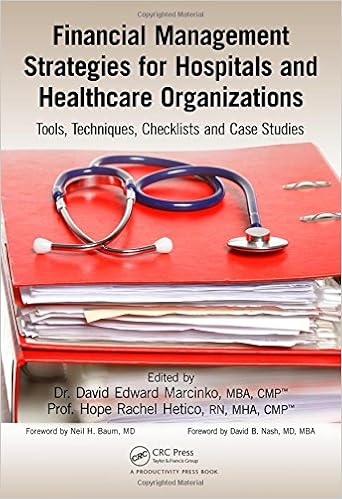
More: Financial Management Strategies for Hospitals and Healthcare Organizations : Tools, Techniques, Checklists and Case Studies

More: Arkansas Medical News Interviews Dr. Marcinko

Conclusion

Your thoughts and comments on this ME-P are appreciated. Feel free to review our top-left column, and top-right sidebar materials, links, URLs and related websites, too. Then, subscribe to the ME-P. It is fast, free and secure.

Link: http://feeds.feedburner.com/HealthcareFinancialsthePostForcxos

Speaker: If you need a moderator or speaker for an upcoming event, Dr. David E. Marcinko; MBA – Publisher-in-Chief of the Medical Executive-Post – is available for seminar or speaking engagements. Contact: MarcinkoAdvisors@msn.com

OUR OTHER PRINT BOOKS AND RELATED INFORMATION SOURCES:

Health Dictionary Series: http://www.springerpub.com/Search/marcinko

Practice Management: http://www.springerpub.com/product/9780826105752

Physician Financial Planning: http://www.jbpub.com/catalog/0763745790

Medical Risk Management: http://www.jbpub.com/catalog/9780763733421

Hospitals: http://www.crcpress.com/product/isbn/9781439879900

Physician Advisors: www.CertifiedMedicalPlanner.org

Product Details

Purchase ME-P Textbooks, Handbooks and Dictionaries to Thrive

 Our Library is Growing … thanks to you

Join Our Mailing List

By Ann Miller RN MHA

[ME-P Executive-Director]

We have been publishing the Medical Executive-Post for more than eight years now. And, with almost 3,000 formal posts, by the nation’s brightest experts, we have a treasure trove of information available to you.

So now, for the first time, all this information – and more – has been codified, updated, copy-righted and copy-protected in print form for your purchase and use. All have been edited by our Publisher – Dr. David Edward Marcinko and Professor Hope Rachel Hetico.

Just click on an image below to order.

Product DetailsProduct DetailsProduct Details

Product Details  Product Details

Product DetailsProduct Details

Assessment

Purchase our white papers, too: https://medicalexecutivepost.com/white-papers/

Conclusion

Your thoughts and comments on this ME-P are appreciated. Feel free to review our top-left column, and top-right sidebar materials, links, URLs and related websites, too. Then, subscribe to the ME-P. It is fast, free and secure.

Link: http://feeds.feedburner.com/HealthcareFinancialsthePostForcxos

Speaker: If you need a moderator or speaker for an upcoming event, Dr. David E. Marcinko; MBA – Publisher-in-Chief of the Medical Executive-Post – is available for seminar or speaking engagements. Contact: MarcinkoAdvisors@msn.com

OUR OTHER PRINT BOOKS AND RELATED INFORMATION SOURCES:

Health Dictionary Series: http://www.springerpub.com/Search/marcinko

Practice Management: http://www.springerpub.com/product/9780826105752

Physician Financial Planning: http://www.jbpub.com/catalog/0763745790

Medical Risk Management: http://www.jbpub.com/catalog/9780763733421

Hospitals: http://www.crcpress.com/product/isbn/9781439879900

Physician Advisors: www.CertifiedMedicalPlanner.org

Business%20Optimization

Health 2.0 Financial Planning for Medical Executive-Post Members

A By-Product of Health 2.0?

By Dr. David Edward Marcinko FACFAS MBA CMP*

[Founder and CEO]

www.MedicalBusinessAdvisors.com

Dr David E Marcinko MBAA decade ago, Editor Gregory J. Kelley of Physician’s MONEY DIGEST and I reported that a 47 year old-doctor with $184,000 annual income would need about $5.5 million dollars for retirement at age 65. Then came the “flash-crash’ of 2007-08, the home mortgage fiasco and the Patient Protection and Accountable Care Act [PP-ACA] of 2010; etc.

No wonder that medical provider career panic is palpable. Much like the new medical home concept, the idea of holistic life planning was born.

Life Planning

Life planning has many detractors and defenders. Formally, life planning has been defined in the following way. 

Financial Life Planning is an approach to financial planning that places the history, transitions, goals, and principles of the client at the center of the planning process.  For the client, their life becomes the axis around which financial planning develops and evolves.

But, for physicians, life planning’s quasi-professional and informal approach to the largely isolated disciplines of medically focused financial planning, was still largely inadequate.

Why? 

Today’s personal financial and practice environment is incredibly more complex than it was in 2007-08, as economic stress from HMOs, Wall Street, liability fears, criminal scrutiny from government agencies, IT mischief from hackers, economic benchmarking from hospitals and the lost confidence of patients all converged to inspire a robust new financial planning 2.0 approach for medical professionals.

Example of a financial planning mistake 

Recall the tale of Dr. Debasis Kanjilal, a pediatrician from New York who put more than $500,000 into the dot.com company, InfoSpace, upon the advice of Merrill Lynch’s star but non fiduciary analyst Henry Bloget.

Is it any wonder that when the company crashed, the analyst was sued, and Merrill settled out of court? Other analysts, such as Mary Meeker of Morgan Stanley, Dean Witter and Jack Grubman from Salomon Smith Barney, were involved in similar fiascos.

Although sad, this story is a matter of public record. Hopefully, doctors now understand that the big brokerage houses that underwrite and recommend stocks may have credibility problems, and that physicians got burned with the adrenalin rush of “self-directed” investment portfolios.

Example of a medical practice management mistake 

Just reflect a moment on colleagues willing to securitize their medical practices a few years ago, and cash out to Wall Street for perceived riches that were not rightly deserved

Where are firms such as MedPartners, Phycor, FPA and Coastal now? A recent survey of the Cain Brothers Physician Practice Management Corporation Index of publicly traded PPMCs revealed a market capital loss of more than 95%, since inception. 

Another Approach?

This disruptive narrative shift was formally noted by the Institute of Medical Business Advisors Inc [iMBA, Inc] and introduced to the medical and financial services industry. This research and corpus of work resulted in hundreds of publications in the Library of Medicine, National Institute of Health (NIH) and the Library of Congress, along with related publications, a dozen textbooks and white papers

http://www.ncbi.nlm.nih.gov/nlmcatalog?term=marcinko

The iMBA approach to financial planning, as championed by the www.CertifiedMedicalPlanner.org professional charter designation, integrates the traditional concepts of fiduciary focused financial planning, with the increasing complex business concepts of medical practice management.

The former ideas are presented in our textbook on financial planning for doctors: Financial Planning for Physicians and Advisors

The later in our companion book: Business of Medical Practice [Edition 3.0]

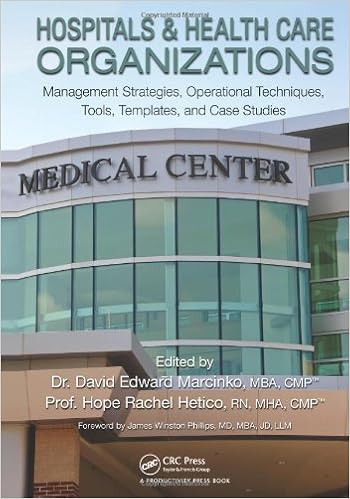
A textbook for hospital CXOs and physician-executives: Hospitals & Healthcare Organizations

While most issues of risk management, liability and insurance are found in Risk Management and Insurance Strategies for Physicians and Advisors

And, for the perplexed, all definitions are codified in the dictionary glossary Health Dictionary Series

Health 2.0 Paradigm Shift

And so, the ME-P community now realizes that a more integrated approach is needed.  The traditional vision of medical practice management, personal physician financial planning and how they may look in the future are rapidly changing as the retail mentality of medicine is replaced with a wholesale philosophy.

Or, how views on maximizing current practice income might be more profitably sacrificed for the potential of greater wealth upon eventual practice sale and disposition.

Or, how Yale University economist Robert J Shiller warns in “The New Financial Order” [Risk in the 21st Century] that the risk for choosing the wrong healthcare profession or specialty might render physicians obsolete by technological changes, managed care systems or fiscally unsound demographics. 

Physician-Executive

My Assessment

Yet, the opportunity to re-vise the future at any age through personal re-engineering, exists for all of us, and allows a joint exploration of the medicine, business and the meaning and purpose of life.

To allow this deeper and more realistic approach, the advisor and the doctor must build relationships based on fiduciary trust, greater self-knowledge and true medical business and financial enhancement acumen.

Are you up to the task?

Conclusion

Your thoughts and comments on this ME-P are appreciated. Feel free to review our top-left column, and top-right sidebar materials, links, URLs and related websites, too. Then, subscribe to the ME-P. It is fast, free and secure.

Link: http://feeds.feedburner.com/HealthcareFinancialsthePostForcxos

Speaker: If you need a moderator or speaker for an upcoming event, Dr. David E. Marcinko; MBA – Publisher-in-Chief of the Medical Executive-Post – is available for seminar or speaking engagements. Contact: MarcinkoAdvisors@msn.com

OUR OTHER PRINT BOOKS AND RELATED INFORMATION SOURCES:

Product DetailsProduct DetailsProduct Details

Product Details  Product Details

Product DetailsProduct Details

Informing Doctors about Automobile Motor Oil Changes

Join Our Mailing List 

What doctors need to know before their next service

[By Dr. David Edward Marcinko MBA and Nalley Lexus-Roswell]

DEM 2013Chances are you might have heard a thing or two about oil prices and all the work it takes to get it out of the ground. You may have even walked into an auto parts store and seen a wall filled with a plethora of different types, viscosities, and brands of oil. Luckily, there are choices to be had, and we’re here to walk you through them.

To Lubricate – Not Burn

Right off the bat, the point should be made clear that motor oil is not meant to be burnt. Sure, oils are used to make the gasoline and diesel fuels that power our vehicles, but motor oil is purely there to lubricate the internals of your engine, not to be burnt as an energy source. It’s that type of burning that causes some of the environmental issues. If you notice a blue smoke emitting from the tailpipe of your vehicle, and the need to add oil every so often, your engine might have a serious problem.

But, for normal motor oil usage, the lubrication of engine internals to keep metal from touching metal while the various bits and pieces move a couple thousand times a minute, there are basically two types – conventional and synthetic.

My Jaguar's engine after a steam

Conventional Oil

Conventional motor oil has done a great job for the past hundred years or so, and is still largely the norm when it comes to servicing your vehicle. Why is this? For the vast majority of drivers in normal vehicles, conventional motor oil meets the vehicle’s needs while being lower cost. In fact, a quart of conventional motor oil will only set you back half of what a quart of synthetic oil costs.

What are some of the benefits of conventional motor oil? First of all, there’s the cost proposition. And if you drive a normal vehicle, conventional oil might actually be a better choice, as it’s a thicker substance. Also, for that same reason, conventional oil is often the lubricant of choice in higher-mileage engines, where some worn components might not have the ability to seal that they once had.

Synthetic Oil

Synthetic motor oil, however, is the new wave of engine lubrication. First designed for aircraft applications in the 1970s, it has also found a home in the engines of many high-performance vehicles. With the requirement of maintaining lubricating abilities at high altitudes and temperatures in aircraft, it was a natural fit. Because of the higher tolerances of aircraft and high-performance engines, the thinner nature of synthetic oil is meant to squeeze into every nook and cranny available, exactly what is needed in these finely-crafted engines.

While synthetic oil might cost twice as much as conventional, it’s thermal properties that keep it from breaking down over time mean that oil changes can occur less often at higher mileage intervals, saving you headaches and recouping some of those costs. Also, due to its thinner nature, it flows easier in cold weather, meaning less warm-up time for your engine, decreasing, once again, headaches and harmful exhaust fumes.

My Kitty Oil

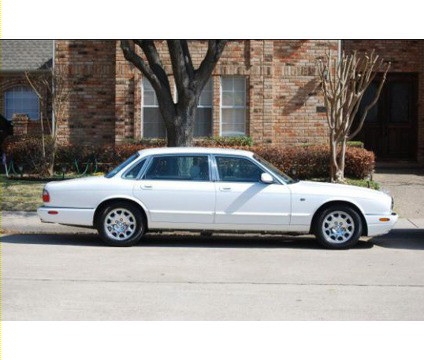
I’ve got a near showroom and mint conditioned 2000 Jaguar XJ-V8-LWB. It  is a full-size luxury sedan, offering sporting drive characteristics, mixed with a classic style and interior comfort. It was available in multiple trims which all came very well equipped with upscale amenities. And, this extended wheelbase version offers much more rear seat leg room for long and winding Georgia road trips. The standard steel engine [not nikasil] in this XJ is a 4.0L V8 which produces 290 hp. The upper and lower timing chain tensioners are original, second generation metal, not plastic.

There is also a supercharged version of this vehicle which bumps output to an impressive 370 hp. Even with all of its power and weight, my XJ-8-L is still rated at over 20 mpg on the highway. Ammenities and upgrades include a mobile phone, Magellan GPS, LoJack theft recovery system, CD and MP-3 players, with internal and external cable antenna for satellite radio.

As for oil, my owners manual calls for 10w30 as preferred, but 10w40 is acceptable for hotter climates like Atlanta. Since my XJ-8 has 90,000 miles on it, I tend to use something a little thicker 15w40 and might used 20-50 come summer if it starts consuming in the high heat.

What a Cat!She is my third favorite female after my intelligent and beautiful wife, and smart and lovely daughter.

Assessment

Now that we know the key differences in the available types of motor oil, which should you choose at your next service? For that, your mechanic will take into account your driving style, vehicle mileage, and other factors, and help you decide what is best for your vehicle.

XJ-V8-LWB Jaguar touring sedan


Conclusion

Your thoughts and comments on this ME-P are appreciated. Feel free to review our top-left column, and top-right sidebar materials, links, URLs and related websites, too. Then, subscribe to the ME-P. It is fast, free and secure.

Speaker: If you need a moderator or speaker for an upcoming event, Dr. David E. Marcinko; MBA – Publisher-in-Chief of the Medical Executive-Post – is available for seminar or speaking engagements. Contact: MarcinkoAdvisors@msn.com

OUR OTHER PRINT BOOKS AND RELATED INFORMATION SOURCES:

Product DetailsProduct DetailsProduct Details

Product Details  Product Details

Product DetailsProduct Details

More on the Doctor Salary “WARS” – er! ah! … CONUNDRUM!

Join Our Mailing List

Compensation Trend Data Sources

cropped-dem

By Dr. David Edward Marcinko MBA

[Editor-in-Chief] www.BusinessofMedicalPractice.com

Related chapters: Chapter 27: Salary Compensation and Chapter 29: Concierge Medicine and Chapter 30: Practice Value-Worth


***

PERSONAL PREAMBLE

***

Physician compensation is a contentious issue and often much fodder for public scrutiny. Throw modern pay for performance [P4P], and related metrics, into the mix and few situations produce the same level of emotion as doctors fighting over wages, salary and other forms of reimbursement.

This situation often springs from a failure of both sides to understand mutual compensation terms-of-art when the remuneration deal was first negotiated. This physician salary and compensation information is thus offered as a reference point for further investigations.

Introduction 

More than a decade ago, Fortune magazine carried the headline “When Six Figured Incomes Aren’t Enough. Now Doctors Want a Union.” To the man in the street, it was just a matter of the rich getting richer. The sentiment was quantified in the March 31, 2005 issue of Physician’s Money Digest when Greg Kelly and I reported that a 47-y.o. doctor with 184,000 dollars in annual income would need about 5.5 million dollars for retirement at age.

Of course, physicians were not complaining back then under the traditional fee-for-service system; the imbroglio only began when managed care adversely impacted income and the stock market crashed in 2008.

Today, the situation is vastly different as medical professionals struggle to maintain adequate income levels. Rightly or wrongly, the public has little sympathy for affluent doctors following healthcare reform. While a few specialties flourish, others, such as primary care, barely move.

In the words of colleague Atul Gawande, MD, a surgeon and author from Brigham and Women’s Hospital in Boston, “Doctors quickly learn that how much they make has little to do with how good they are. It largely depends on how they handle the business side of practice.”  And so, it is critical to understand contemporary thoughts on physician compensation and related trends.

Compensation Trend Data Sources

A growing number of surveys measure physician compensation, encompassing a varying depth of analysis. Physician compensation data, divided by specialty and subspecialty, is central to a range of consulting activities including practice assessments and valuations of medical entities. It may be used as a benchmarking tool, allowing the physician executive or consultant to compare a practitioner’s earnings with national and local averages.

The Medical Group Management Association’s (MGMA’s) annual Physician Compensation and Production Correlations Survey is a particularly well-known source of this data in the valuation community. Other information sources include Merritt Hawkins and Associates; and the annual the Health Care Group’s, [www.theHealthCareGroup.com] Goodwill Registry.

###

Portfolio analysis

www.CertifiedMedicalPlanner.org

Assessment

However, all sources are fluid and should be taken with a grain of statistical skepticism, and users are urged to seek out as much data as possible and assess all available information in order to determine a compensation amount that may be reasonably expected for a comparable specialty situation. And, realize that net income is defined as salary after practice expenses but before payment of personal income taxes.

Conclusion

Your thoughts and comments on this ME-P are appreciated. Feel free to review our top-left column, and top-right sidebar materials, links, URLs and related websites, too. Then, subscribe to the ME-P. It is fast, free and secure.

Link: http://feeds.feedburner.com/HealthcareFinancialsthePostForcxos

Speaker: If you need a moderator or speaker for an upcoming event, Dr. David E. Marcinko; MBA – Publisher-in-Chief of the Medical Executive-Post – is available for seminar or speaking engagements. Contact: MarcinkoAdvisors@msn.com

OUR OTHER PRINT BOOKS AND RELATED INFORMATION SOURCES:

DICTIONARIES: http://www.springerpub.com/Search/marcinko
PHYSICIANS: www.MedicalBusinessAdvisors.com
PRACTICES: www.BusinessofMedicalPractice.com
HOSPITALS: http://www.crcpress.com/product/isbn/9781466558731
CLINICS: http://www.crcpress.com/product/isbn/9781439879900
BLOG: www.MedicalExecutivePost.com
FINANCE: Financial Planning for Physicians and Advisors
INSURANCE: Risk Management and Insurance Strategies for Physicians and Advisors

Product Details

Risk Management, Liability Insurance, and Asset Protection Strategies for Doctors and Advisors: Best Practices from Leading Consultants and Certified Medical Planners™ Risk Management, Liability Insurance, and Asset Protection Strategies for Doctors and Advisors: Best Practices from Leading Consultants and Certified Medical Planners™

***

Invite Dr. Marcinko

***

ME-P Book Reviewers Needed

Join Our Mailing List
New Text Book Testimonials Requested
By Dr. David Edward Marcinko MBA
[Editor-in-Chief]
DEM 2013
Greetings all ME-P Readers from Atlanta, Georgia
###
After reading and being inspired by Dr. Atul Gawandi’s December 10, 2007 New  Yorker article, “The Checklist”, as well as the Checklist Manifesto, I am writing to ask that you consider this request to write a 3-5 sentence testimonial review to our upcoming new textbook:  Financial  Management Strategies for Hospitals and Healthcare Organizations: Tools,  Techniques, Checklists and Case Studies

It is the follow up to: Hospitals & Health Care Organizations: Management Strategies, Operational Techniques,  Tools, Templates, and Case Studies

Book Focus

Please realize that the focus of the work is non-clinical in nature, and is replete with managerial case models and administrative checklists following each chapter.

Just as Atul believed the time is right for medical checklists, we believe in a similar philosophy for hospitals, health enitites, and healthcare administration. It is right for any physician or medical practitioner, regardless of degree or specialty designation.

New Book

Ideal Reviewers

Ideal book reviewers are doctors, financial advisors, economists, accountants, nurses, insurance agents, politicians and healthcare CXOs. So, please see the TOC links as we ask you to keep this request confidential.  Regardless of your decision, we remain an apostle of your core vision whenever possible.

Fraternally,

Dr. David Edward Marcinko MBA

[Editor-in-Chief]

INSTITUTE OF MEDICAL BUSINESS ADVISORS, INC.

Suite #5901 Wilbanks Drive Norcross, Georgia, 30092 USA

Phone: 770.448.0769

MarcinkoAdvisors@msn.com

Secrets

###

Automobile Rust Prevention Methods for Frugal Doctors

Join Our Mailing List

Getting the Most Beauty and Utility from your Car

By Dr. David Edward Marcinko MBA [Publisher]

via Nalley Lexus Georgia

Dr. MarcinkoCar manufacturers have invested heavily in the use of new and improved materials to help reduce the risk of damage to your car from rust. Where decades ago rust was a very common problem, modern cars are rather more resilient.

But, if you drive an older depreciated car like we recommend on this ME-P; or a vintage vehicle like my classic 2000 Jaguar XJ-V8-LWB touring sedan; or if you just want to keep your new car in great condition for as long as possible, then you should never ignore the threat of rust.

On Rising Used Car Prices

The good news is that there are plenty of things [wash, clay-bar and wax] that you can do to prevent rust on your car; and care products abound. I use Meguir’s car care products on my favorite cat.

Here are five of them:

1. Protect your undercarriage

Your car’s undercarriage is very vulnerable to damage, and there are a number of critical mechanical components to protect. As the undercarriage is not something most drivers ever really look at, it is easy to neglect it. This could be a costly mistake. Invest in an undercarriage sealant to help protect mechanical parts from damage.

How Doctors Might Buy a Pre-Owned Car?

There are a number of products that you can apply yourself, but working on the undercarriage is potentially dangerous if you are not properly equipped, so you may want to ask your mechanic or service department for help.

My Jaguar touring sedan 2000 XJ-V8-L

2. Inspect your paint work regularly

Rust is a problem that gets progressively worse and the longer you leave a rust problem, the harder and more expensive it will be to fix. Learn about the parts of your car that are the most vulnerable. Paint work is constantly exposed to the elements, and the early signs of rust appear as bumps and lumps under the paint work. Treat these areas promptly.

Automobile Windshield Maintenance Tips for Physicians

There are a variety of ways to do this. Removing the affected metal is one possibility. Rust convertors halt the rusting process, but may not always be effective.

3. Use a rust preventative

There are a variety of rust preventative products available to consumers, many of which can easily be applied at home. A rust preventative can, for example, be sprayed onto or into a part of the car that is otherwise very difficult to access. This will help slow down the formation of any rust, and will also halt the spread of existing rust. Always follow the manufacturer’s instructions closely when using these products.

Helping Doctors Understand Multi-Point Automobile Check-Up Inspections

4. Apply wax and sealant to your paint work

Look after your paint work to ensure that it stays in great condition. This is not just about cleaning and polishing the paint work. Over time, your paint work will wear and become more susceptible to rust if you are unable to protect the finish. A wax layer, with sealant, adds an additional physical barrier between the paint work and the elements. This prevents damage to the bodywork, which might otherwise expose the metal underneath the paint and allow rust to form. You can apply wax and sealant at home.

My Jaguar's engine after a steam

5. Keep your car clean

The simplest thing you can do to protect your car from rust is keep it clean. Deposits of mud, salt, and other dirt can all corrode your paint work surprisingly quickly. Regular car washing reduces the amount of time it takes to get the vehicle clean on an ongoing basis.

Reasons Why Doctors Should Get New Automobile Tires

Do not forget the undercarriage and other hard-to-reach places too, but do not use a jet spray underneath the car as this could damage vital parts. Again, it may be a good idea to ask your mechanic or service department to help if you are unsure.

And, don’t forget to steam clean that engine when needed, too!

Assessment 

Conclusion

Your thoughts and comments on this ME-P are appreciated. Feel free to review our top-left column, and top-right sidebar materials, links, URLs and related websites, too. Then, subscribe to the ME-P. It is fast, free and secure.

Link: http://feeds.feedburner.com/HealthcareFinancialsthePostForcxos

Speaker: If you need a moderator or speaker for an upcoming event, Dr. David E. Marcinko; MBA – Publisher-in-Chief of the Medical Executive-Post – is available for seminar or speaking engagements. Contact: MarcinkoAdvisors@msn.com

OUR OTHER PRINT BOOKS AND RELATED INFORMATION SOURCES:

DICTIONARIES: http://www.springerpub.com/Search/marcinko
PHYSICIANS: www.MedicalBusinessAdvisors.com
PRACTICES: www.BusinessofMedicalPractice.com
HOSPITALS: http://www.crcpress.com/product/isbn/9781466558731
CLINICS: http://www.crcpress.com/product/isbn/9781439879900
BLOG: www.MedicalExecutivePost.com
FINANCE: Financial Planning for Physicians and Advisors
INSURANCE: Risk Management and Insurance Strategies for Physicians and Advisors

Product Details  Product Details

On Googling Myself [Oh My]

Join Our Mailing List

A Solitary Pursuit?

By Dr. David Edward Marcinko MBA CMP™ www.CertifiedMedicalPlanner.org

Dr. MarcinkoI am a doctor, financial advisor, editor, publisher, health economist, teacher, runner and a few other things, as well. A real diletant!

But, there is something else I must admit to you. It is sinister. Something I often do at night, in the dark, when no one else is around. Not even my wife.

What is It? …. Why Googling my self, of course! Also known as “ego surfing.”

Ego Surfing

Have you ever Googled yourself or your financial advisory, management or medical practice? Did you know that you have an ever growing online reputation? Whether you know it or not, Financial Advisors and Doctors have an online presence. When you type your name in a search engine you may be surprised by what you find.

Digital Footprints

Everything you do professionally, or socially, creates a digital footprint. If you are involved in social media then you are contributing to your online reputation. If not, your online reputation is being written for you. There is a conversation taking place about you online, but unfortunately you may not be included in it.

google-chrome-logo

So Much Information

A simple Google search of your name will likely show your practice website. Your name will also appear in numerous third party review sites. Take the time to read a few. You may be surprised. You will find your name and your practice appearing on people’s Facebook and Twitter pages too.

And, you may see comments from clients and patients [both satisfied, and not so much], too. So, keep abreast of your digital bona fides. Google yourself regularily …. Just, dont go blind.

Assessment

While at first this may be disturbing, I view it as an opportunity to get the [positive] word out. How about you? Sinister, or no?

Conclusion

Your thoughts and comments on this ME-P are appreciated. Feel free to review our top-left column, and top-right sidebar materials, links, URLs and related websites, too. Then, subscribe to the ME-P. It is fast, free and secure.

Link: http://feeds.feedburner.com/HealthcareFinancialsthePostForcxos

Speaker: If you need a moderator or speaker for an upcoming event, Dr. David E. Marcinko; MBA – Publisher-in-Chief of the Medical Executive-Post – is available for seminar or speaking engagements. Contact: MarcinkoAdvisors@msn.com

Our Other Print Books and Related Information Sources:

Health Dictionary Series: http://www.springerpub.com/Search/marcinko

Practice Management: http://www.springerpub.com/product/9780826105752

Physician Financial Planning: http://www.jbpub.com/catalog/0763745790

Medical Risk Management: http://www.jbpub.com/catalog/9780763733421

Hospitals: http://www.crcpress.com/product/isbn/9781439879900

Physician Advisors: www.CertifiedMedicalPlanner.org

Product DetailsProduct DetailsProduct Details

Product Details  Product Details

Product DetailsProduct Details

Succeed with the “Business of Medical Practice” Textbook

ADVERTISEMENT

[Transformational Health 2.0 Skills for Doctors]

By Ann Miller RN, MHA

www.BusinessofMedicalPractice.com

December 23rd, 2011 – The Institute of Medical Business Advisors [iMBA] Inc, in Atlanta, GA www.MedicalBusinessAdvisors.com and Springer Publishing Company of New York, just released the third edition of “The Business of Medical Practice” [Transformational Health 2.0 Skills for Doctors] edited by iMBA founder Dr. David Edward Marcinko MBA, CMP™ and President Hope Rachel Hetico RN, MHA, CPHQ, CMP™

Internal Contents

The 37 chapter, 750 page hard-cover textbook provides a comprehensive resource for those physicians, medical professionals, practice managers, nurse executives, health care administrators and graduate students seeking working knowledge on running a private facility or medical clinic.

Three Major Sections

The BoMP is comprised of three enterprise-wide sections: [1] Qualitative Office Operations, [2] Quantitative Aspects of Medical Practice and [3] Health Policies, Ethics and Leadership. Topics like ARRA, HITECH, ACA and the social networking aspects and ramifications of health 2.0 connectivity for all stakeholders are included for modernity.

Tools and Templates

Tools used throughout the book help readers reference and retain complex information. These tools include:

  • Sidebars. Key terms, key concepts, key sources, associations, and factoids all serve to enhance and reinforce the core takeaways from each chapter.
  • Tables. Tables are used to display and reference benchmark data, draw comparisons, and illustrate industry data trends.
  • Figures. Graphical depictions of concepts help you comprehend the material.
  • Charts. Charts allow easily referenced standard industry taxonomies alongside comparisons of related topics.

Assessment

For a further description of the Business of Medical Practice, with online “live’ community, please click: www.BusinessofMedicalPractice.com

To order directly: http://www.springerpub.com/product/9780826105752 

Conclusion

Your thoughts and comments on this ME-P are appreciated. Feel free to review our top-left column, and top-right sidebar materials, links, URLs and related websites, too. Then, subscribe to the ME-P. It is fast, free and secure.

Link: http://feeds.feedburner.com/HealthcareFinancialsthePostForcxos

Speaker: If you need a moderator or speaker for an upcoming event, Dr. David E. Marcinko; MBA – Publisher-in-Chief of the Medical Executive-Post – is available for seminar or speaking engagements. Contact: MarcinkoAdvisors@msn.com

OUR OTHER PRINT BOOKS AND RELATED INFORMATION SOURCES:

DICTIONARIES: http://www.springerpub.com/Search/marcinko
PHYSICIANS: www.MedicalBusinessAdvisors.com
PRACTICES: www.BusinessofMedicalPractice.com
HOSPITALS: http://www.crcpress.com/product/isbn/9781466558731
CLINICS: http://www.crcpress.com/product/isbn/9781439879900
BLOG: www.MedicalExecutivePost.com
FINANCE: Financial Planning for Physicians and Advisors
INSURANCE: Risk Management and Insurance Strategies for Physicians and Advisors

Product Details

Product DetailsProduct DetailsProduct Details

Cash May Soon be King in Hospital Care

Join Our Mailing List

Forget About Health Insurance, Darling!

Only the little people pay with insurance.

By Dr. David Edward Marcinko MBA CMP™

[Editor-in-Chief]

www.CertifiedMedicalPlanner.org

Like many other doctors, I remember my dismay when I saw uninsured patients paying full price for their medical care. Insurance companies used their market clout and patient volumes to negotiate discounts for their insureds that have always been unavailable to the uninsured, MSA, HSA participants or individual healthcare consumers.

The Insider Gossip

There is even industry hearsay that some charity-care and non-profit hospitals charge their indigent patients up to four times more than their insured patients in order to have huge write-offs [bad-debt expenses] so as to secure private and public monetary grants. After all; many non-profit CEOs are well paid, indeed.

But, the tide may be turning on the healthcare institutional level as cash becomes king in the new economy and world of healthcare 2.0

Cash Patients Rule – Insured Patients Drool

Of course, we’ve written about direct care, concierge care and cash care medical practice business models before on this ME-P. And, I’ve been ranting and raving, opining and testifying, as well.  It is being written about in the blog-o-sphere, on the hospital level, increasingly.

Link:  http://www.kevinmd.com/blog/2012/06/hide-health-insurance-status-pay-cash.html

We even have an entire Chapter 29 devoted to the codified topic in our newest book The Business of Medical Practice.

Link: http://businessofmedicalpractice.com/chapter-29/

Source: Austin Frakt PhD’s TIE cartoon via Brad Flansbaum.

The Coming Payment Apocalypse

The days of paying more when paying cash may be coming to an end. Doctors and hospitals are starting to do what every other business has done since the beginning of time – give a discount for cash. States are beginning to require pricing transparency and hospitals and physicians are starting to publish their “cash prices” for all to see.

And, why not when it can take up to two years to be reimbursed a fraction of the billed amount from Medicaid and Medicare payers, and CMS, etc? Now, don’t get me started on some highly discounted private payers and managed care plans.

Assessment

What do you think of this trend as a healthcare provider; Financial Advisor, medical management consultant or patient? Are you in favor of this private business arrangement; or do you favor the proposed public Obama Care business model?  Is it even legal? How about keeping the status-quo?

Conclusion

Your thoughts and comments on this ME-P are appreciated. Feel free to review our top-left column, and top-right sidebar materials, links, URLs and related websites, too. Then, subscribe to the ME-P. It is fast, free and secure.

Link: http://feeds.feedburner.com/HealthcareFinancialsthePostForcxos

Speaker: If you need a moderator or speaker for an upcoming event, Dr. David E. Marcinko; MBA – Publisher-in-Chief of the Medical Executive-Post – is available for seminar or speaking engagements. Contact: MarcinkoAdvisors@msn.com

Our Other Print Books and Related Information Sources:

Health Dictionary Series: http://www.springerpub.com/Search/marcinko

Practice Management: http://www.springerpub.com/product/9780826105752

Physician Financial Planning: http://www.jbpub.com/catalog/0763745790

Medical Risk Management: http://www.jbpub.com/catalog/9780763733421

Hospitals: http://www.crcpress.com/product/isbn/9781439879900

Physician Advisors: www.CertifiedMedicalPlanner.org

Product Details

Product Details

How the ME-P Helps Doctors Become and Remain Professionally and Personally Fiscally Fit

 Sponsored: www.CertifiedMedicalPlanner.com

Financial Planning Handbook

Conclusion

And so, your thoughts and comments on this ME-P are appreciated. Please review our top-left column, and top-right sidebar materials, links, URLs and related websites, too. Then, subscribe to the ME-P. It is fast, free and secure.

Link: http://feeds.feedburner.com/HealthcareFinancialsthePostForcxos

Speaker: If you need a moderator or speaker for an upcoming event, Dr. David E. Marcinko; MBA – Publisher-in-Chief of the Medical Executive-Post – is available for seminar or speaking engagements. Contact: MarcinkoAdvisors@msn.com

Our Other Print Books and Related Information Sources:

Health Dictionary Series: http://www.springerpub.com/Search/marcinko

Practice Management: http://www.springerpub.com/product/9780826105752

Physician Financial Planning: http://www.jbpub.com/catalog/0763745790

Medical Risk Management: http://www.jbpub.com/catalog/9780763733421

Healthcare Organizations: www.HealthcareFinancials.com

Physician Advisors: www.CertifiedMedicalPlanner.com

Subscribe Now: Did you like this Medical Executive-Post, or find it helpful, interesting and informative? Want to get the latest ME-Ps delivered to your email box each morning? Just subscribe using the link below. You can unsubscribe at any time. Security is assured.

Link: http://feeds.feedburner.com/HealthcareFinancialsthePostForcxos

Sponsors Welcomed: And, credible sponsors and like-minded advertisers are always welcomed.

Link: https://healthcarefinancials.wordpress.com/2007/11/11/advertise

###

TESTIMONIAL

In his book Financial Planning Handbook for Physicians and Advisors, Dr. David E. Marcinko, MBA CMP® CFP® provides us with a simple and yet very complete view on the basics of financial planning that every physician should know in order to maximize our chances for success in the financial aspect of our medical careers and personal lives.

The book is well structured, organized and easy to read. Divided in ten chapters, it covers important aspects of personal financial planning such as insurance, home mortgages, retirement plans, auto buying, taxes and more. In an era where doctors must have a solid understanding of the basics of financial management, this book is a must-have on every physician’s private book collection.

Although not a substitute for a formal business education, this book will help physicians navigate effectively through the hurdles of day-to-day financial decisions with the help of an accountant, financial and legal advisors.  This book would make an excellent reference for teaching medical students and residents the basics of monetary management.

I highly recommend this book and commend Dr. Marcinko and the Institute of Medical Business Advisors, Inc. on a job well done.

Manuel J. Colón, MD

Product Details

Health Industry Collaboration and e-Patients

More on Inter and Intra Healthcare Stakeholder Relationships 

Join Our Mailing List

According to Jennifer Tomasik MS [jtomasik@cfar.com], writing in the soon to be released ME-P textbook from iMBA Inc www.MedicalBusinessAdvisors.com: “Healthcare Organizations” [Management Strategies, Tools, Techniques and Case Studies], now in-process from (c) Productivity Press for 2012:

We are in a time of great change in healthcare. No one is certain how the future landscape will unfold, but it is clear that changes in regulation, reimbursement, technology, the economy, and science will significantly impact the work of those clinicians and administrators who dedicate their careers to improving patient care.

More Collaboration Needed

Experience has shown that better collaboration between patients and among the many different parts of the healthcare delivery system holds great potential to improve the quality of care and the relationships of those delivering it. It has also shown that the opportunities to improve collaboration are widespread.

Our focus, therefore, should be to introduce and share a selected set of tools that can be used to improve collaboration along several dimensions:

  • Clarifying roles and authority through decision charting,
  • Understanding the “give” and the “get” needed to establish effective alliances through the current state, and
  • Working jointly to establish and test a set of refined expectations through a physician-administrator compact.

Assessment

In the end, improved collaboration can help medical institutions with everything from inter professional productivity, to patient satisfaction to the most critical service of all: caring for patients and saving lives.

Link: http://www.crcpress.com/product/isbn/9781439879900

Conclusion

And so, your thoughts and comments on this ME-P are appreciated. Please review our top-left column, and top-right sidebar materials, links, URLs and related websites, too. Then, subscribe to the ME-P. It is fast, free and secure.

Link: http://feeds.feedburner.com/HealthcareFinancialsthePostForcxos

Speaker: If you need a moderator or speaker for an upcoming event, Dr. David E. Marcinko; MBA – Publisher-in-Chief of the Medical Executive-Post – is available for seminar or speaking engagements. Contact: MarcinkoAdvisors@msn.com

Our Other Print Books and Related Information Sources:

Health Dictionary Series: http://www.springerpub.com/Search/marcinko

Practice Management: http://www.springerpub.com/product/9780826105752

Physician Financial Planning: http://www.jbpub.com/catalog/0763745790

Medical Risk Management: http://www.jbpub.com/catalog/9780763733421

Healthcare Organizations: www.HealthcareFinancials.com

Physician Advisors: www.CertifiedMedicalPlanner.com

Subscribe Now: Did you like this Medical Executive-Post, or find it helpful, interesting and informative? Want to get the latest ME-Ps delivered to your email box each morning? Just subscribe using the link below. You can unsubscribe at any time. Security is assured.

Link: http://feeds.feedburner.com/HealthcareFinancialsthePostForcxos

Sponsors Welcomed: And, credible sponsors and like-minded advertisers are always welcomed.

Link: https://healthcarefinancials.wordpress.com/2007/11/11/advertise

Buy from Amazon

Men vs. Women on Financial Planning

Also True for Medical Professionals?

Join Our Mailing List 

Statistics show that men and women handle money differently. While there are exceptions to every rule, men generally are better prepared for retirement, are more willing to put money into savings, pay off credit card balances in full and are more educated about investing. Men are also more prepared for unemployment, which is fortunate because there are more unemployed men than women in the U.S. and the growth of the unemployment rate for men is currently outpacing the unemployment rate for women.

Assessment

But, is the above true of male and female doctors and medical professionals?

Conclusion

Your thoughts and comments on this ME-P are appreciated. Feel free to review our top-left column, and top-right sidebar materials, links, URLs and related websites, too. Then, subscribe to the ME-P. It is fast, free and secure.

Speaker: If you need a moderator or speaker for an upcoming event, Dr. David E. Marcinko; MBA – Publisher-in-Chief of the Medical Executive-Post – is available for seminar or speaking engagements. Contact: MarcinkoAdvisors@msn.com

OUR OTHER PRINT BOOKS AND RELATED INFORMATION SOURCES:

Product Details  Product Details

Comprehensive Financial Planning Strategies for Doctors and Advisors: Best Practices from Leading Consultants and Certified Medical Planners(TM)

About “Hospitals and Health Care Organizations”

ADVERTISEMENT

Join Our Mailing List

Management Strategies, Operational Techniques, Tools, Templates and Case Studies

PRE-RELEASE REVIEW

ORDER HERE

http://www.crcpress.com/product/isbn/9781439879900

Automobile Insurance Update for Medical Professionals

Some Need-to-Know [Not Boring] Information for Doctors, Nurses and CXOs

Join Our Mailing List

By Dr. David Edward Marcinko FACFAS, MBA, CPHQ, CMP™

[Publisher-in-Chief]

As regular ME-P readers know, I held a property and casualty insurance license for more than 15 years; this included homeowners and automobile insurance.

BTW:  P&C also includes malpractice insurance [doctors and medical professionals] and E&O insurance [accountants, financial advisors, attorneys, etc]. Yep! Med-mal is classified under the property-casualty moniker. I even edited a handbook on the topic. But, I digress.

On the Importance of Automobiles

With the possible exception of the handgun, the automobile represents the greatest single item of ownership that is capable of inflicting death, injury and damage. I learned this first-hand after covering the ER for many years.

America’s fascination with the automobile has resulted in a marked increase in the power and potential speed of our vehicles.  The aging trend in Sports Utility Vehicles (SUVs) has also witnessed a substantial increase in damage due to their higher ground clearance and heavier frames.  The owners and operators of any vehicle must be financially able to respond to any resulting claims, or they need to transfer the risk through insurance.  All states require some minimal coverage for personal vehicles.

The F.A.P.

The most frequently used policy to insure individual private passenger vehicle risks is the Family Automobile Policy (FAP).   It provides two major types of coverage: liability and physical damage.

Liability coverage includes both bodily injury and property damage. Physical damage, on the other hand, includes comprehensive and collision coverage.

[A] Liability Coverage

The liability section of the FAP is contained within most policies as Part A – Liability and Part B -Personal Injury Protection.

[1] Bodily Injury

Bodily injury liability coverage generally includes sickness, disease and death, and is expressed in dual limits — per person and per occurrence.  Nearly half of the states require minimums of $25,000 per person and $50,000 per occurrence.  Higher limits of $100,000 per person and $300,000 per occurrence are often required for consideration of umbrella coverage.

[2] Property Damage

Property damage liability is coverage for damage or destruction to the property of others and includes loss of use.  Liability coverage limits usually include property damage limits as the third number, i.e., $100/300/25.  The coverage here would be for $25,000 of property damage.  As automobiles become more expensive, however, coverage to $50,000 is not considered excessive.

[3] Personal Injury

Personal injury coverage is provided for medical expenses, funeral expenses and loss of earnings for anyone sustaining an injury while occupying your vehicle, or from being struck by your vehicle while a pedestrian.

Liability insurance follows the vehicle, not the driver.  Coverage is extended to the vehicle owner and any resident in the same household.  It also covers anyone using the insured vehicle with the permission of the owner and within the scope of that permission.

Newly acquired vehicles are usually covered automatically for liability for 15-30 [getting shorter] days after acquisition, but physical damage must have been on all currently covered vehicles to be included.  Coverage is also typically extended to a temporary substitute automobile, but only if this vehicle is used in place of the covered automobile, because of its breakdown, repair, servicing, loss or destruction.

[B] Physical Damage Coverage

[1] Comprehensive

Comprehensive physical damage includes coverage for theft, vandalism, broken windshields, falling objects, riot or civil commotion, and even damage from foreign substances, such as paint.  Comprehensive is often described as coverage for all those hazards other than collision.

[2] Collision

Collision involves the upset of the covered vehicle and collision with an object, usually another vehicle, and not enumerated in the discussion of comprehensive.  Colliding with a bird or animal is considered under the comprehensive coverage.

The distinction between comprehensive coverage and collision coverage is more than technical.  The deductible provisions of the FAP often show a considerable difference in these areas, with the collision deductible typically being much greater.

Damage to tires can be covered by provisions in either comprehensive or collision.  Exclusions typically include normal wear and tear, rough roads, hard driving or hitting or scraping curbs.

[C] Repairs after the Accident

Following a collision, the insurance company will assign a claims adjuster to determine the extent of damage and the cost of repairs.  If these repairs exceed the estimated value of the vehicle, it may be “totaled.”  Experience tells me that the value of the vehicle to the owner nearly always exceeds that estimated by the insurance company.

[D] Uninsured / Underinsured Motorists Coverage

Uninsured motorist coverage provides protection from the other driver who is operating his/her vehicle without any insurance coverage.  It covers expenses resulting from injury or death as well as property damage.  There are currently a dozen states where it is estimated that over 20 percent of the vehicles on the highway are being operated without any insurance.  This is not coverage that should be rejected when buying automobile insurance.

Underinsured motorist coverage provides protection from the other driver who purchased only the state-mandated minimum liability insurance coverage.  Again, this is not coverage that the medical professional or healthcare practitioner should thoughtlessly reject when buying automobile insurance.

Assessment

The medical professional is strongly urged to consider purchasing replacement cost coverage rather than accepting actual cash value car insurance, which is the depreciated value of the vehicle. The cost may be higher for this coverage, but accepting a larger deductible will often make up the difference. Paying a little more towards the deductible could easily be worth it, if the damage is extensive.

Or, if you have a classic pristine Eurpean touring sedan [2000 pearl-white Jaguar, XJ-V8-L], built for the Queen in Coventry England, like I do. Jay Leno is my hero!

Conclusion                

And so, your thoughts and comments on this ME-P are appreciated. Feel free to review our top-left column, and top-right sidebar materials, links, URLs and related websites, too. Then, subscribe to the ME-P. It is fast, free and secure.

Link: http://feeds.feedburner.com/HealthcareFinancialsthePostForcxos

Speaker: If you need a moderator or speaker for an upcoming event, Dr. David E. Marcinko; MBA – Publisher-in-Chief of the Medical Executive-Post – is available for seminar or speaking engagements. Contact: MarcinkoAdvisors@msn.com

Our Other Print Books and Related Information Sources:

Health Dictionary Series: http://www.springerpub.com/Search/marcinko

Practice Management: http://www.springerpub.com/product/9780826105752

Physician Financial Planning: http://www.jbpub.com/catalog/0763745790

Medical Risk Management: http://www.jbpub.com/catalog/9780763733421

Healthcare Organizations: www.HealthcareFinancials.com

Physician Advisors: www.CertifiedMedicalPlanner.com

Subscribe Now: Did you like this Medical Executive-Post, or find it helpful, interesting and informative? Want to get the latest ME-Ps delivered to your email box each morning? Just subscribe using the link below. You can unsubscribe at any time. Security is assured.

Link: http://feeds.feedburner.com/HealthcareFinancialsthePostForcxos

Sponsors Welcomed: And, credible sponsors and like-minded advertisers are always welcomed.

Link: https://healthcarefinancials.wordpress.com/2007/11/11/advertise

Product Details  Product Details

The Ten Best Apps for [MD] Car Phones

Physician Necessity or Luxury?

By Dr. David Edward Marcinko MBA

[Editor-in-Chief]

The ME-P has published many insightful essays and comments on health information technology and related issues. It’s a hot topic, no doubt. Robust and controversial, too!

Regular readers of the ME-P also know that I’m a Jaguar fanatic; not the animal –  the British automobile. In fact, I’ve got a classic 2000 pearl white, XJ-V8-LWB from Coventry England, sitting in my garage right now. She’s never seen snow or rain; and when I’m not out jogging, on speaking tour or consulting with clients; or involved with this publication – you can usually find me ministering to her needs [and there are many]. Do I spend too much time with her; just ask my wife? She’s another high maintenance babe, but we both love her.

So, how do smart phones and tablet PCs relate to HIT and Jaguars?

Of Smart Phonese and Tablet PCs

Smartphones and tablets have revolutionized the way many of us live, and practice medicine. This change was undoubtedly what prompted one manufacturer to coin the marketing phrase, “There’s an app for that.”

Apps can help with shopping, exercising, learning, health information–and even driving.  So, here we look at the 10 best apps for car owners [courtesy Nalley Lexus-Jaguar] that help with everything from maximizing fuel efficiency and organizing a carpool to locating roadside assistance while using your hands-free via voice commands [checking patient status or relaying hospital orders]. Doctors, Jaguar owners and laymen alike, often love em’.

More http://www.nalleylexusroswellnews.com/Articles/10BestAppsforCarOwners/

Conclusion

Your thoughts and comments on this ME-P are appreciated. Feel free to review our top-left column, and top-right sidebar materials, links, URLs and related websites, too. Then, subscribe to the ME-P. It is fast, free and secure.

Link: http://feeds.feedburner.com/HealthcareFinancialsthePostForcxos

Speaker: If you need a moderator or speaker for an upcoming event, Dr. David E. Marcinko; MBA – Publisher-in-Chief of the Medical Executive-Post – is available for seminar or speaking engagements. Contact: MarcinkoAdvisors@msn.com

OUR OTHER PRINT BOOKS AND RELATED INFORMATION SOURCES:

DICTIONARIES: http://www.springerpub.com/Search/marcinko
PHYSICIANS: www.MedicalBusinessAdvisors.com
PRACTICES: www.BusinessofMedicalPractice.com
HOSPITALS: http://www.crcpress.com/product/isbn/9781466558731
CLINICS: http://www.crcpress.com/product/isbn/9781439879900
BLOG: www.MedicalExecutivePost.com
FINANCE: Financial Planning for Physicians and Advisors
INSURANCE: Risk Management and Insurance Strategies for Physicians and Advisors

   Product Details

A Message to all ME-P Readers about Physician Nexus TV for Doctors

Launching a New Video News TV Channel for Physicians

Join Our Mailing List 

By Omar Baig

Dear ME-P Community,

Drum roll please!

We have just launched a 24/7 video news channel.

Now every hour every day we will be adding valuable video content to Nexus. Our community is composed of physicians from 81 countries in time zones that span the world.  So regardless of where the member is or what time of the day it is there will be new and valuable content added within the hour.

You can search by specialty, latest videos, most popular, keyword, etc.

http://physiciannexus.com/video/

We are going through great lengths to ensure you get the highest value content possible.   If there is anything you would like us to add, just let us know.  We are here to serve you.

Instead of having to go to multiple sites to get the content you need, just come to Nexus.  Every minute that is saved is time that you can use to see patients or spend with your family.

We have also included a poll on the homepage which asks the type of information you seek (alternative/additional revenue opportunities, free CME, jobs, or other).  This feedback will be used to better serve our global physician community.

http://physiciannexus.com/main

Finally, I want to thank our entire team, including your ME-P publisher Dr. David Edward Marcinko, and all the members of our Medical Advisory Board for helping to make this vision a reality! 

About the Author

Omar Baig – Physician Nexus Team

2530 Berryessa Road – San Jose, CA 95132

www.PhysicianNexus.com 

Assessment

Visit Physician Nexus at: http://physiciannexus.com/?xg_source=msg_mes_network

Conclusion            

And so, your thoughts and comments on Physician Nexus are appreciated. Please review our top-left column, and top-right sidebar materials, links, URLs and related websites, too. Then, subscribe to the ME-P. It is fast, free and secure.

Link: http://feeds.feedburner.com/HealthcareFinancialsthePostForcxos

The One-Woman Physician Investors Should Not Trust

Join Our Mailing List

Why We Should “Run” from the SEC’s Mary Schapiro

By Dr. David Edward Marcinko MBA CMP™

[Publisher-in-Chief]

OK, I’ve opined about fiduciary accountability for stock brokers, FAs and FPs – as well as Mary Schapiro [Chairman of the SEC] before – on this ME-P. And usually, in not so glowing terms!

But now, Mary really chaps my ethical and linguistic sensibilities.

Why I’m So P…… Off!

According to Bloomberg, and Advisor One [a financial services industry trade magazine], the chairwoman is considering something called the “business model neutral” rule that retains proprietary financial products, and brokerage sales commissions.

This concept of ‘business neutral’ is the one sought by many in the brokerage and insurance industry in order to redefine the term ‘fiduciary’ as an enhanced form of ‘suitability’ with opt-out provisions.

But, it is not sought by me, and should not be accepted by physicians.

Definitions

Suitability Rule – According to the Free Dictionary:

A stated or implied requirement by a regulatory body that a broker or investment adviser must reasonably believe that a certain investment decision will benefit a client before making a recommendation to him/her. That is, the broker or investment adviser must act in good faith, and may not knowingly recommend bad investments. Different regulators and self-regulating organizations incorporate suitable rules in different places in their bylaws. Two commonly referenced suitability rules are Rule 2310 for the Financial Industry Regulatory Authority and Rule 405 for the NYSE. See also: Due diligence, Prudent-person rule, Twisting.

Fiduciary Rule – According to the Free Dictionary:

A uniform standard for financial advisors that requires them to put retail customer interests ahead of their own financial interests.

This is clearly a higher duty [level of care] than suitability. Insurance agents, stock brokers, BDs and most “financial advisors” hate it.

Link: http://www.advisorone.com/2011/12/09/reaction-to-schapiro-comments-on-fiduciary-rule-ar?ref=hp

“Suitability on Steroids”

Some pundits suggest we think of this new “business model neutral” rule as “suitability on steroids.”

However, as most of us in medicine know, steroids are not a panacea and are typically used as a quick fix for short term gain, only.

Otherwise, the excessive use of anabolic steroids is bad for our physical health. Just like Mary Schapiro is bad for our fiscal health. But, a Certified Medical Planner™ is a fiduciary at all times http://www.CertifiedMedicalPlanner.org

More: Enter the CMPs

Assessment       

And so, your thoughts and comments on this ME-P are appreciated. I was an insurance agent and certified financial planner for almost 15 years [Series 7, 63 and 65] before I resigned all – in disgust over the fiduciary flap.

Doctors are fiduciaries. I am a fiduciary, a doctor, and a financial advisor. Shouldn’t all physician-investors demand same from their own financial advisors [NASD-FINRA, RIAs, RIA-Reps]?

But hey – I’m just a medical provider.

Conclusion

Your thoughts and comments on this ME-P are appreciated. Feel free to review our top-left column, and top-right sidebar materials, links, URLs and related websites, too. Then, subscribe to the ME-P. It is fast, free and secure.

Speaker: If you need a moderator or speaker for an upcoming event, Dr. David E. Marcinko; MBA – Publisher-in-Chief of the Medical Executive-Post – is available for seminar or speaking engagements. Contact: MarcinkoAdvisors@msn.com

OUR OTHER PRINT BOOKS AND RELATED INFORMATION SOURCES:

Product DetailsProduct DetailsProduct Details

Financial Planning MDs 2015

Comprehensive Financial Planning Strategies for Doctors and Advisors: Best Practices from Leading Consultants

Front Matter with Foreword by Jason Dyken MD MBA

[BY DOCTORS – FOR DOCTORS – PEER REVIEWED – NICHE FOCUSED]

***

Why I’m Joining the Physician Nexus Medical Advisory Board

Join Our Mailing List

On My Non-Linear … and Sometimes Concurrent Career Path

By Dr. David Edward Marcinko MBA CMP™

[Publisher-in-Chief]

As Medical Executive-Post readers know, I am a big believer in career and change management; evolution if you will. As an entrepreneurial doctor, writer, publisher, speaker, financial advisor, economist, management consultant and business owner, with a non-linear career spanning more than 30 years, I’m acutely aware that to thrive, I must evolve.

Evolution not Revolution

Most of our readers know my career story, but you probably don’t know that even now, my career continues to evolve. For example, I recently accepted a position on the Physician Nexus Medical Advisory Board http://physiciannexus.com/page/nexus-board-of-advisors

THINK: Evolution; not revolution.

Am I Un-Happy?

Why did I embark on this project? Am I giving up my day job at this ME-P? Am I moving on from my business? These are questions I’ve been asked, and I’ve given them all some thought. The nature of these questions signifies a fundamental assumption that, to be considered stable and sane, we must remained attached to “one occupation”, and that if anything changes in that equation, we are surely about to make a move because we are unhappy www.BusinessofMedicalPractice.com

Not so!

Last Gen Parents – Next Gen Son

Don’t believe m? Just ask me about the time I told my last-generation dad and mom I was going to business school, after medical school www.CertifiedMedicalPlanner.org then promptly started an online educational and testing firm for doctors, financial advisors, CPAs and stock brokers. Or; when I sold my ambulatory surgery center – and later still – my private practice, etc! Can you say ballistic?

I added this new patch work to my career quilt because I accepted an opportunity – a chance to do things that I truly love; have engaging clients, speak and write about it. But, don’t worry about me! I’ve got the support of my next-generation wife.

iMBA Inc

And, as we at the www.MedicalBusinessAdvisors.com continue to consult with medical practices to improve their operational results … or with doctors for their financial planning needs, I’m always keeping my eyes open for the next opportunity that catches my fancy.

A Kindred Spirit

Like my colleague Philippa Kennearly MD MPH, over at the Entrepreneurial MD http://www.entrepreneurialmd.com I’m here to argue that the contemporary career of an entrepreneurial physician can and perhaps should be a non-linear projection; it can contain clinical practice AND an Internet business AND writing books AND taking on clients AND seminar speaking and consulting projects AND being part of a family and community.

Just recall, Bill Gates of Microsoft said that most contemporary knowledge workers will follow a career path that changes every seven [7] years. But, I don’t know if he meant doctors, as well?

Assessment

Doesn’t that sound more exhilarating to you than feeling stuck in one gear? Isn’t it time to shift that gear from either … or  to and … and, as Philippa is prone to say?

Conclusion

Your thoughts and comments on this ME-P are appreciated. Feel free to review our top-left column, and top-right sidebar materials, links, URLs and related websites, too. Then, subscribe to the ME-P. It is fast, free and secure.

Link: http://feeds.feedburner.com/HealthcareFinancialsthePostForcxos

Speaker: If you need a moderator or speaker for an upcoming event, Dr. David E. Marcinko; MBA – Publisher-in-Chief of the Medical Executive-Post – is available for seminar or speaking engagements. Contact: MarcinkoAdvisors@msn.com

OUR OTHER PRINT BOOKS AND RELATED INFORMATION SOURCES:

DICTIONARIES: http://www.springerpub.com/Search/marcinko
PHYSICIANS: www.MedicalBusinessAdvisors.com
PRACTICES: www.BusinessofMedicalPractice.com
HOSPITALS: http://www.crcpress.com/product/isbn/9781466558731
CLINICS: http://www.crcpress.com/product/isbn/9781439879900
BLOG: www.MedicalExecutivePost.com
FINANCE: Financial Planning for Physicians and Advisors
INSURANCE: Risk Management and Insurance Strategies for Physicians and Advisors

Product DetailsProduct DetailsProduct Details

Product Details  Product Details

   Product Details

Practice Management ‘Book of the Month’

“Book of the Month”

for

All Medical Professionals


Product Details
 

www.BusinessofMedicalPractice.com

 
Sponsor: www.MedicalBusinessAdvisors.com
 

Thinking About Selling or Transitioning Your Medical Practice?

We Can Help with a FMV Practice Appraisal

ADVERTISEMENT

The www.MedicalBusinessAdvisors.com practice valuation and transition team can help you appraise your medical practice, develop a new associate/partner transition plan, and even help transition your patients.

A Profitable Transition

You can also choose how to “wind-down” or transition out of practice gracefully and economically, as you work with only select patients, on-board a new associate/partner, or sell your practice outright.


Your Practice Business Equity

Either way, we can help you unlock the hard-earned equity in your medical practice and ensure that your patients – and life’s work – are taken care of with a fair market valuation. Purchasing and reviewing our books and white-papers is a great way to start. Otherwise – call us today?

Let’s Talk

770.448.0769

MarcinkoAdvisors@msn.com

Speaker: If you need a moderator or speaker for an upcoming event, Dr. David E. Marcinko; MBA – Publisher-in-Chief of the Medical Executive-Post – is available for seminar or speaking engagements. Contact: MarcinkoAdvisors@msn.com

Our Other Print Books and Related Information Sources:

Health Dictionary Series: http://www.springerpub.com/Search/marcinko

Practice Management: http://www.springerpub.com/product/9780826105752

Physician Financial Planning: http://www.jbpub.com/catalog/0763745790

Medical Risk Management: http://www.jbpub.com/catalog/9780763733421

Healthcare Organizations: www.HealthcareFinancials.com

Physician Advisors: www.CertifiedMedicalPlanner.com

Product Details 

Top Ten Car Insurance Companies for Doctors

Information All Medical Professionals Need to Know

By Dr. David Edward Marcinko MBA CMP™

[Publisher-in-Chief]

As regular ME-P readers know, I held a property and casualty insurance license for more than 15 years; this included homeowners and automobile insurance.

It also included malpractice [doctors and medical professionals] and E&O insurance [accountants, financial advisors, attorneys, etc]. Yep! Med-mal is classified under the property-casualty moniker. I even edited a handbook on the topic.

So, it is no surprise that car insurance companies number well over 100 in many states. But, who are the top 10 car insurance companies? Most doctors and lay drivers would not be surprised to see Allstate, State Farm or GEICO on the list of top 10 car insurance companies by market share; but how about USAA, Farmers or Liberty Mutual?

Source: Carinsurancecompanies.net

After an Accident

Following a collision, the insurance company will assign a claims adjuster to determine the extent of damage and the cost of repairs.  If these repairs exceed the estimated value of the vehicle, it may be “totaled.”  Experience tells me that the value of the vehicle to the owner nearly always exceeds that estimated by the insurance company. This is true in my case, as well.

Assessment

The medical professional is therefore strongly urged to consider purchasing replacement cost coverage rather than accepting actual cash value, which is the depreciated value of the vehicle. The cost may be higher for this coverage, but accepting a larger deductible will often make up the difference. Paying a little more towards the deductible could easily be worth it, if the damage is extensive.

Or, if you have a special vehicle [pristine pearl white 2001 Jaguar, XJ-V8-LWB] like I do.

Conclusion

Your thoughts and comments on this ME-P are appreciated. Feel free to review our top-left column, and top-right sidebar materials, links, URLs and related websites, too.

Then, subscribe to the ME-P. It is fast, free and secure.

Speaker: If you need a moderator or speaker for an upcoming event, Dr. David E. Marcinko; MBA – Publisher-in-Chief of the Medical Executive-Post – is available for seminar or speaking engagements. Contact: MarcinkoAdvisors@msn.com

OUR OTHER PRINT BOOKS AND RELATED INFORMATION SOURCES:

  Product DetailsProduct Details

Selecting Practice Management Consultants Wisely

Business Education Needed for Physicians and all Medical Colleagues

By Dr. David Edward Marcinko MBA CMP™

[Publisher-in-Chief]

While the doctors consult, the patient dies

-English Proverb

There are many self-help publications, online resources and management guru’s purporting to impart business information to their physician clients. Within the current managed care climate, economic malaise, and specter of nationalized healthcare following the 2010 health insurance reform legislation, medical business consultants are all the rage.

However, in the same vein, physician bankruptcies are mounting, medical student loan delinquencies are increasing, physician finances are friable and medical and ancillary practices are closing at record numbers. What gives?

Do Doctors Lack Business Knowledge?

Perhaps the answer lies in the lack of real business, accounting, financial and managerial acumen by the average practitioner? This growing concern is prompting more and more doctors to seek the help of a healthcare consultant or financial advisor. But, just what does a practice management consultant do, what credentials are needed to be in the business, and how can a healthcare advisor help you coordinate all aspects of your practice’s life? 

Here are two examples of major practice management fiascos.

Corporate Medicine and Doctor Super-Groups

As the managed and healthcare care crisis exacerbates, and Obama Care [Patient Protection and Affordable Care Act] unfolds over the next eight years, there will be many examples of irrational practice management behavior on the part of physicians, and no specialty is immune.

Just collectively reflect a moment on colleagues willing to securitize their practices a decade ago – and currently with so the so called medical super groups – and cash out to Wall Street for riches that were not rightly deserved. Where are firms such as MedPartners, Phycor, FPA and Coastal Healthcare now? A survey of the Cain Brothers Physician Practice Management Corporation Index of publicly traded PPMCs revealed a market capital loss of more than 99%, since inception; despite their various heath 2.0 re-incarnations. And, how will modern financial regulatory reform, Dodd-Frank, the SEC, insurance company and banking controls resulting from Wall Street’s 2008-09 economic debacles, impact physicians?

A Southern Gentleman and Solo Physician

Or, consider the personal situation of a solo Southern primary care physician who learned an accounting lesson the hard way when he asked his CPA to appraise his business. Upon sale, his attorney brother-in-law drew up the contract, as he was pleased the practice quickly sold for its full asking price. What he didn’t know, but would soon discover, is that accounting value or “book” value — the figure his accountant gave him — is far different than the fair-market value that he could have received for his long years of toil. Was the CPA wrong? Not really. Was the gentleman doctor incorrect? No. Both were merely operating under a different set of practice management terms, and accounting definitions, without communication or knowledge of each other’s perspectives. 

Assessment

Product Details

Link: www.BusinessofMedicalPractice.com

Conclusion

And so, your thoughts and comments on this ME-P are appreciated. Feel free to review our top-left column, and top-right sidebar materials, links, URLs and related websites, too. Then, subscribe to the ME-P. It is fast, free and secure.

http://feeds.feedburner.com/HealthcareFinancialsthePostForcxos

Speaker: If you need a moderator or speaker for an upcoming event, Dr. David E. Marcinko; MBA – Publisher-in-Chief of the Medical Executive-Post – is available for seminar or speaking engagements. Contact: MarcinkoAdvisors@msn.com

Our Other Print Books and Related Information Sources:

Health Dictionary Series: http://www.springerpub.com/Search/marcinko

Practice Management: http://www.springerpub.com/product/9780826105752

Physician Financial Planning: http://www.jbpub.com/catalog/0763745790

Medical Risk Management: http://www.jbpub.com/catalog/9780763733421

Healthcare Organizations: www.HealthcareFinancials.com

Physician Advisors: www.CertifiedMedicalPlanner.com

Subscribe Now: Did you like this Medical Executive-Post, or find it helpful, interesting and informative? Want to get the latest ME-Ps delivered to your email box each morning? Just subscribe using the link below. You can unsubscribe at any time. Security is assured.

Link: http://feeds.feedburner.com/HealthcareFinancialsthePostForcxos

Sponsors Welcomed: And, credible sponsors and like-minded advertisers are always welcomed.

Link: https://healthcarefinancials.wordpress.com/2007/11/11/advertise

Product DetailsProduct DetailsProduct Details       

My “One” Criterion for Hiring Physician Consultants and Doctor Advisors

More about the Frightening “F” Word

Dr. David Edward Marcinko MBA CMP™

[Publisher-in-Chief]

As you begin to search for a medical practice business advisor or healthcare consultant, be sure to contact the advisor and request a short initial meeting that should be free of charge.

Just as you would select your own physician, you should base your consulting decision on credentials, experience and especially education. Fee schedules are probably of least importance. And, by understanding the “F” word, you stand the best chance of finding an advisor that’s right for your budget, practice and personality.

The Traditional View

The traditional view of medical management consulting, or the financial advisory or financial planning business, is not of a fiduciary. Historically, in the view of many, attorneys, doctors, CPAs and the clergy are proto-typical fiduciaries, as are the small but emerging class of contemporary Certified Medical Planners [CMP™]. They have a clear duty to put the best interests of their clients, patients, congregation, etc., above their own and to disclose conflicts of interest, etc. Too many others who retain this title function as poseurs.

Link: www.CertifiedMedicalPlanner.com

The stock market collapse, SEC debacle, home mortgage and real estate fiascos of the past few years, all highlight the lack of general accounting, financial, business and advisory oversight of Wall Street, the NASD/FINRA and related private and government monitoring agencies. This includes financial and investment advisors, wealth managers and healthcare consultants.

Fiduciary Definition

According to Bennett Aikin, Accredited Investment Fiduciary [AIF®], a fiduciary consultant is someone who offers advice, or manages the assets of another person and stands in a special relationship of trust, confidence, and/or legal responsibility [personal communication].

Link: https://medicalexecutivepost.com/2009/03/01/an-interview-with-bennett-aikin-aif%c2%ae/

Financial designations that indicate fiduciary duty do not exist absent the proto-types mentioned above. Rather, it is function that determines who is a fiduciary; not designations, certifications or licenses to hold a particular trade-mark, service-mark or registration-mark.

So, a fiduciary advisory, according to these definitions can be held accountable for a breach in fiduciary duty, regardless of any expertise they do, or do not have. This underscores the critical nature of understanding the fiduciary standard and delegating certain duties to qualified “professionals” who can fulfill the parts of the process that a non-qualified fiduciary cannot.

Fiduciary? – Get it in Writing!

But, this does not mean it is impossible to find a healthcare consultant who accepts fiduciary responsibility and acknowledges the same. The best way to rectify confusion is to get fiduciary status acknowledged in writing and review all of the necessary steps in the fiduciary process to ensure fulfillment. An acknowledgement of fiduciary status letter can even be a simple checklist to ensure the entire fiduciary process is being covered.

Link: www.CertifiedMedicalPlanner.com

About http://www.fi360.com

Public resources for understanding the fiduciary process and for choosing appropriate consultants include the Department of Labor, the AICPA’s Personal Financial Planning division, and iMBA Inc. Private resources are available from the law firm of Reish Luftman Reicher & Cohen. The firm specializes in employee-benefits law and is considered leading ERISA experts. More resources from www.fi360.com include:

  • Fiduciary Standard of Excellence
  • Safe Steward Document
  • Stewardship Handbook
  • Legal Memorandum Handbook

Conclusion

And so, your thoughts and comments on this ME-P are appreciated. Feel free to review our top-left column, and top-right sidebar materials, links, URLs and related websites, too. Then, subscribe to the ME-P. It is fast, free and secure.

Link: http://feeds.feedburner.com/HealthcareFinancialsthePostForcxos

Speaker: If you need a moderator or speaker for an upcoming event, Dr. David E. Marcinko; MBA – Publisher-in-Chief of the Medical Executive-Post – is available for seminar or speaking engagements. Contact: MarcinkoAdvisors@msn.com

Our Other Print Books and Related Information Sources:

Health Dictionary Series: http://www.springerpub.com/Search/marcinko

Practice Management: http://www.springerpub.com/product/9780826105752

Physician Financial Planning: http://www.jbpub.com/catalog/0763745790

Medical Risk Management: http://www.jbpub.com/catalog/9780763733421

Healthcare Organizations: www.HealthcareFinancials.com

Physician Advisors: www.CertifiedMedicalPlanner.com

Subscribe Now: Did you like this Medical Executive-Post, or find it helpful, interesting and informative? Want to get the latest ME-Ps delivered to your email box each morning? Just subscribe using the link below. You can unsubscribe at any time. Security is assured.

Link: http://feeds.feedburner.com/HealthcareFinancialsthePostForcxos

Sponsors Welcomed: And, credible sponsors and like-minded advertisers are always welcomed.

Link: https://healthcarefinancials.wordpress.com/2007/11/11/advertise


Product DetailsProduct DetailsProduct Details       

Product Details  Product Details

   Product Details

How to Select a Property and Casualty Insurance Agent

Eschewing Conventional Wisdom

[By Dr. David Edward Marcinko MBA CMP™]

http://www.CertifiedMedicalPlanner.org

In my travels, and various consulting engagements, I am often asked how to select a good PC agent. As a former insurance agent myself, I know what is required for my medical colleagues. And, there is no doubt that a good property and casualty (P&C) agent is needed to protect the physicians’ home and medical practice business entity, etc.

No Dedicated Agents

The P&C agent should not be dedicated to a single company, but have an array of carriers with which the home or practice can be placed.  I opine thusly even though most insurance companies will offer a discount if you place multiple coverage with them.

Select “Best of Breed”

However, this may not be as beneficial as insuring each need with a specialist. So, do not hesitate to place different types of coverage with different insurers. Selecting the “best of breed” may be more work; but it also may be more beneficial when a claim is made.

Assessment

Remember, by agency law, and definition, P&C agents are not fiduciaries.

Conclusion

Your thoughts and comments on this ME-P are appreciated. Feel free to review our top-left column, and top-right sidebar materials, links, URLs and related websites, too. Then, subscribe to the ME-P. It is fast, free and secure.

Speaker: If you need a moderator or speaker for an upcoming event, Dr. David E. Marcinko; MBA – Publisher-in-Chief of the Medical Executive-Post – is available for seminar or speaking engagements. Contact: MarcinkoAdvisors@msn.com

OUR OTHER PRINT BOOKS AND RELATED INFORMATION SOURCES:

Product Details  Product Details

Celebrating Our Four-Year Anniversary

Be Sure to Opt-In, Too!

Dr. David Edward Marcinko MBA CMP™

Professor Hope Rachel Hetico RN MHA

Ann Miller RN MHA

[ME-P Executive Staff]

This month is the four year blogaversary of the ME-P. We had a big bash planned but canceled it because it really isn’t worth a lot of e-hoopla.

But, we do wish to thank a few classes of people, if not those folks individually.

So, we’ll thank all briefly, and then move on with today’s post.

Our Successful Network

We share the success of this blog with our readers, subscribers and guests – all of whom have contributed first rate posts and comments. We also have an informal network of support behind the scenes; these are individuals to whom we go with questions about technical issues, seek writing advice, and/or a few kind souls who listen or try out rough-drafts of new ideas.

Our ME-P Reach

We are also grateful for the internet recognition that has helped elevate the relevance and extend the reach of this publication and the ideas expressed in it. So, many thanks to other supporters for their links, advertisements, experts and sponsors!

Assessment

And finally, thanks to the readers of this blog who have helped us make it what it is. Had no one showed up to read and receive the ME-P, we’d have stopped publishing long ago. We also receive good comments and references from readers. A few of you have proven so valuable that we’ve become e-mail correspondents to facilitate the sharing of ideas. To you all – many thanks!

Conclusion

And so, your thoughts and comments on this ME-P are appreciated. Feel free to review our top-left column, and top-right sidebar materials, links, URLs and related websites, too. Then, please congratulate us by opting-in and subscribe to the ME-P. It is fast, free and secure.

Link: http://feeds.feedburner.com/HealthcareFinancialsthePostForcxos

Speaker: If you need a moderator or speaker for an upcoming event, Dr. David E. Marcinko; MBA – Publisher-in-Chief of the Medical Executive-Post – is available for seminar or speaking engagements. Contact: MarcinkoAdvisors@msn.com

Our Other Print Books and Related Information Sources:

Health Dictionary Series: http://www.springerpub.com/Search/marcinko

Practice Management: http://www.springerpub.com/product/9780826105752

Physician Financial Planning: http://www.jbpub.com/catalog/0763745790

Medical Risk Management: http://www.jbpub.com/catalog/9780763733421

Healthcare Organizations: www.HealthcareFinancials.com

Physician Advisors: www.CertifiedMedicalPlanner.com

Subscribe Now: Did you like this Medical Executive-Post, or find it helpful, interesting and informative? Want to get the latest ME-Ps delivered to your email box each morning? Just subscribe using the link below. You can unsubscribe at any time. Security is assured.

Link: http://feeds.feedburner.com/HealthcareFinancialsthePostForcxos

Sponsors Welcomed: And, credible sponsors and like-minded advertisers are always welcomed.

Link: https://healthcarefinancials.wordpress.com/2007/11/11/advertise

Product DetailsProduct DetailsProduct Details       

Product Details  Product Details

   Product Details 

About Healthcare Financials.com

WELCOME ALL HEALTH 2.0 COLLEAGUES

[An Open Invitation]

Product Details 

All hospitals and healthcare organizations, both emerging and mature, face a daunting financial scenario in today’s volatile healthcare reimbursement environment.  Decreasing revenues, increasing costs, and high consumer expectations present a complex challenge for CEOs, CFOs, physicians and nurse executives, administrators, financial advisors and department managers who must not only lead in today’s climate, but also position their organizations for tomorrow’s financial tumult and potential political changes of the Obama Administration.

Produced by a team of leading doctors, physician executives, nurses, medical professionals, economists, administrators, lawyers, and accountants, skilled business leaders and IT consultants, among many others; Healthcare Organizations [Journal of Financial Management Strategies] on CD-ROM, or SaaS, looks at ways to manage assets, costs, human resources and healthcare claims.  Everything – from inventory management to hybrid and activity based cost analysis in order to accelerate the cash conversion cycle – is scrutinized.  And, modern health economic themes like competitive strategy, workplace violence and financial benchmarks, for both public and private entities, are included.

We also examine contemporaneous topics such as the lessons learned from the corporate healthcare market competition and the PPMC imbroglio of the early 2000’s, and the domestic financial meltdown of 2009. This includes current methods for achieving hospital objectives, negotiating and analyzing cost-volume-profit contracts, and understanding the financial impact of regulatory requirements under HIPAA, STARK I-III, OSHA, the US Patriot Acts, the Deficit Reduction Act [DRA], the often contentious Sarbanes-Oxley Act, ARRA and HITECH Acts, and the Fair and Accurate Credit Transactions [FACT] Act.

In addition, information technology issues like electronic medical records (eMRs), RFID controls, RSS feeds and blogs, Health 2.0 initiatives and computerized physician order entry (CPOE) systems are examined in detail. Virtually no  operational, strategic business, health economics, or financial management topic is omitted.

“This wide-ranging examination of the fiscal

management scene for hospitals, healthcare

organizations, clinics and outpatient centers 

includes case models, extensive appendices, 

and detailed checklists and templates that

step the reader through a review of main

issues for each chapter.”

Health Care Organizations [Journal of Financial Management Strategies] on CD-ROM, or SaaS, is dedicated to meeting the administrative needs of our nation’s healthcare organizations in order to help them maintain a competitive edge in the markets they serve; and to take advantage of emerging business opportunities. We therefore invite you to be the first health economics cynosure in your hospital, facility, or healthcare system to join us for the journey.

Let Health Care Organizations [Journal of Financial Management Strategies] be your guide. 

Subscribe today … Succeed tomorrow!

Dr. David Edward Marcinko MBA, CMP

[Founder, CEO and Editor-in-Chief]

iMBA Inc – Suite #5901 Wilbanks Drive

Norcross, GA 30092-1141

Product Details 

Why I Rue the Hospital “Team-Based Medicine” Approach to In-Patient Care

Join Our Mailing List

Or, Whose Patient is it – Anyway?

By Dr. David Edward Marcinko MBA, CMP™

www.CertifiedMedicalPlanner.org

[ME-P Publisher-in-Chief]

Ok, I admit it; I may be an aging curmudgeon [just ask my wife and daughter] who has not regularly seen patients in the office for the last decade. A consult here, Independent Medical Examination [IME] there, or a surgical assist when needed has been the extent of my patient experience since my transition out of direct care medicine in 2000-01.

Moreover, I admit to not being an ardent fan of hospital-based medicine [with all due respect to colleague and uber-hospitalist Robert Wachter MD, who I admire and have frequently mentioned in my books, white papers, speaking engagements and here on this Medical-Executive Post].

I am also not completely in favor of the many new-fangled “specialties” and medical business models.  And, as recent models and linguistic evolution occurred, the nomenclature designation of hospitalist was followed by that of hospital-intensivist, hospital-proceduralist and hospital-nocturnalist, etc [http://medinnovationblog.blogspot.com and personal communication Richard L. Reece MD].

Enter the Team-Based Hospital Doctors

And now – for the last five years or so on my radar – there is a new term to add to the lexicon: team-based hospital medicine [practice], or similar. But, I ask, whose patient is it? Who is accountable? Where does the buck of responsibility stop?

The Quintessential Example

On Friday, May 9, 2003, a 5-year-old boy was undergoing diagnostic testing for his epilepsy at Children’s Hospital in Boston when he suffered a massive seizure. Two days later, on Mother’s Day, he died. Despite the fact that he was in intensive care at one of the world’s leading pediatric hospitals, none of the physicians caring for him ordered the treatment that could have saved his life.

The death was tragic, but even more troubling from an organizational perspective was the series of events that led up to it. The Massachusetts Department of Public Health investigated the death, and The Boston Globe reported on the results that, “the investigation portrays a situation where lines of authority were deeply tangled, and where no one person had accountability for the patient. Each of the doctors who initially worked on the case–two at the bedside and one consulting by phone–told investigators that they thought one of the others was in charge.” In the end, no one was in charge.

This is a striking example of how even the most talented clinicians in one of the world’s best hospitals can fail not only to provide adequate care, but to save a savable life—all because the lines of authority were unclear. The lack of clarity resulted in this team’s inability to collaborate effectively at a time when the stakes couldn’t have been higher.

Here are two other benign, but more personal, examples circa 2011.

My Personal Experiences

My Sister

This past summer, my sister was in a VA hospital [extremity injuries, nothing serious] for about a week. She was seen by 13 different physicians who were on her “team”; not to mention the plethora of other allied healthcare “team-members”. Me, my wife [RN], and/or her boyfriend [Army Medic and a PA] were at her bedside at least 12-15 hours each day. She was rarely left alone, by design, as we all recalled the admonition of former AMA President Tom R. Reardon MD, to always have a bedside advocate while in the hospital.

Yet, she was offered the wrong medications on one occasion, personally mis-identified twice, and it was obvious that her team-members rarely communicated or discussed her case [by their own admission], or even reviewed her electronic medical records [vistA system] before rounds. Here, the “system is down” was cited as causative: https://medicalexecutivepost.com/2009/09/21/what-is-a-client-server-system

My Dad

Now, later this same year and under the same patient advocate approach, my dad was in two different hospitals sequentially, both using the “team-based” care model. In each, members did not know, or were loathe acknowledging, who was in charge of his case! Malpractice phobia was apparent despite the coterie of, no doubt brilliant, MD/PhD interns, residents and fellows making daily rounds by starring at their shoes. One physician even cited her hectic return from vacation as the reason she examined my dad – for the first time – without reading his paper chart. “Doctors need vacations, too”, was her flippant response when challenged.

Outcomes

Fortunately, our insider knowledge and – shall we say – “charming swagger” was helpful in avoiding major complications with the continuity-of-care in the above two examples. But, most patients are not so blessed!

Our Newest Book

These stories reflect just one of many difficult collaboration challenges in healthcare, today.

In her textbook chapter, Collaborating to Improve Operating Performance in a Changing Healthcare Landscape [Opportunities for Improvement Widespread], contributing author Jennifer Tomasik MS, Principal at CFAR [Center For Applied Research Inc, in Cambridge, MA], focuses on the increasing need for collaboration among physicians, clinicians, hospital executives, and administrative leaders in the dynamic, complex healthcare environment. She looks specifically at collaboration along three different dimensions, including

  • inter-professional teams,
  • institution to institution, and
  • physicians and administrators.

In each instance, she describes useful tools that can be applied to improve collaboration and overall institutional performance—all in the service of providing better patient care.

Assessment

To me, it seems pretty obvious that “hospital team-based” medical care is an oxy-moron. On one hand, it appears to reduce risk, but on the other hand, it appears to reduce quality care as well. Moreover, it also seems to be an invoice generating machine, and revenue enhancing mechanism

And so, beyond this individual ME-P, and its’ tragic and trivial examples, it is important for hospitals and healthcare organizations to improve collaboration. Our patients depend on us to get the philosophy of “hospital team-based” care right, if it is to continue. Otherwise, it will become another good intention, gone awry, in the changing hospital ecosystem that is domestic health care.

Pre-Order Here:

“Healthcare Organizations” [Management Strategies, Tools, Techniques and Case Studies]

In-Process, 425 pages, est., from (c) Productivity Press 2012
http://www.crcpress.com/product/isbn/9781439879900

Product DetailsProduct Details

Conclusion

Your thoughts and comments on this ME-P are appreciated. Feel free to review our top-left column, and top-right sidebar materials, links, URLs and related websites, too. Then, subscribe to the ME-P. It is fast, free and secure.

Link: http://feeds.feedburner.com/HealthcareFinancialsthePostForcxos

Speaker: If you need a moderator or speaker for an upcoming event, Dr. David E. Marcinko; MBA – Publisher-in-Chief of the Medical Executive-Post – is available for seminar or speaking engagements. Contact: MarcinkoAdvisors@msn.com

OUR OTHER PRINT BOOKS AND RELATED INFORMATION SOURCES:

LEXICONS: http://www.springerpub.com/Search/marcinko
PHYSICIANS: www.MedicalBusinessAdvisors.com
PRACTICES: www.BusinessofMedicalPractice.com
HOSPITALS: http://www.crcpress.com/product/isbn/9781466558731
CLINICS: http://www.crcpress.com/product/isbn/9781439879900
ADVISORS: www.CertifiedMedicalPlanner.org
BLOG: www.MedicalExecutivePost.com

Product DetailsProduct DetailsProduct Details

Product Details  Product Details

   Product Details 

The Legal eHR [Extreme Caution Ahead]

Is there such a thing?

By Dr. David Edward Marcinko MBA CMP

[Editor-in-Chief]

Electronic medical and healthcare records [eMRs and eHRs] are a hot topic and the subject of many positive and negative posts and comments on this ME-P; and around the healthcare space. Personally, I am agnostic on the subject – trending against – for most physicians at this point in time.

In other words, the technology is just not there yet regarding “ease of use”, inter-operability, common transmission and security standards, and common platform, etc. This is reminiscent of the early days of the word processing industry, when I first used Edix-Wordex, Leading Edge, Word Perfect, Word Star, ASCII, PFR-Write, PC-Write, etc.  It was both exciting and confusing, being a writer and editor, at that time. Sorta like working in an electronic Tower of Babel; or using the many disparate eHR systems existing today?

I am not a Luditte, however. I’m a former American Health Information Management Association (AHIMA), and Healthcare Information and Management Systems Society (HIMSS), member. And, I’m certain that eHRs will be pervasive one day, but I’ll reserve my opinions, my money and information security, and my patient’s data until then. After all, I am a MSFT-Word® guy today as I thank Bill Gates for consolidating the formerly competitive, and chaotic, word processing software space. Yes, sometimes monopolies are a good thing! 

Malpractice Issues

Moreover, it seems I have been a Cassandra [the daughter of King Priam and Queen Hecuba of Troy] of sorts, crying aloud about the professional liability and medical malpractice issues of eMRS; here on this ME-P, during my speeches and lectures, as wells as in our books and CDs. All to no avail; until now!

Links: https://medicalexecutivepost.com/2009/12/23/will-electronic-records-raise-the-legal-standard-of-care-and-increase-malpractice-risk/

I suppose this is a product of my prior work as a licensed insurance agent for the State of Georgia, a malpractice reviewer, a court approved medical-legal expert witness, and author of the book: “Risk Management and Insurance Planning for Physicians and their Advisors”.

Link: http://www.jbpub.com/catalog/9780763733421

Assessment

Q: And so, is there a legal eHR and is it different from traditional eHRs?

A: You bet there is!

Read Link: http://www.himss.org/content/files/LegalEMR_Flyer3.pdf

Conclusion

And so, your thoughts and comments on this ME-P are appreciated. Think I am still mis-guided, or worse, paranoid? Feel free to review our top-left column, and top-right sidebar materials, links, URLs and related websites, too. Then, subscribe to the ME-P. It is fast, free and secure.

Link: http://feeds.feedburner.com/HealthcareFinancialsthePostForcxos

Speaker: If you need a moderator or speaker for an upcoming event, Dr. David E. Marcinko; MBA – Publisher-in-Chief of the Medical Executive-Post – is available for seminar or speaking engagements. Contact: MarcinkoAdvisors@msn.com

Our Other Print Books and Related Information Sources:

Health Dictionary Series: http://www.springerpub.com/Search/marcinko

Practice Management: http://www.springerpub.com/product/9780826105752

Physician Financial Planning: http://www.jbpub.com/catalog/0763745790

Medical Risk Management: http://www.jbpub.com/catalog/9780763733421

Physician Advisors: www.CertifiedMedicalPlanner.org

   Product Details

Understanding the Risks of Health 2.0 in Medical Practice

Risk Management and Insurance Strategies for Physicians and Financial Advisors

Insurance and Risk Management Strategies for Physicians and Advisors

Channel Surfing the ME-P

Have you visited our other topic channels? Established to facilitate idea exchange and link our community together, the value of these topics is dependent upon your input. Please take a minute to visit. And, to prevent that annoying spam, we ask that you register. It is fast, free and secure.

Conclusion

Your thoughts and comments on this ME-P are appreciated. Feel free to review our top-left column, and top-right sidebar materials, links, URLs and related websites, too. Then, subscribe to the ME-P. It is fast, free and secure.

Speaker: If you need a moderator or speaker for an upcoming event, Dr. David E. Marcinko; MBA – Publisher-in-Chief of the Medical Executive-Post – is available for seminar or speaking engagements. Contact: MarcinkoAdvisors@msn.com

OUR OTHER PRINT BOOKS AND RELATED INFORMATION SOURCES:

Comprehensive Financial Planning Strategies for Doctors and Advisors: Best Practices from Leading Consultants and Certified Medical Planners(TM)* 8

Video on Being a ‘Real Doctor’

DVM vs MD, etc.

By Dr. David Edward Marcinko MBA

[Publisher-in-Chief]

While discussing the future of medicine at Drexel University in Philadelphia recently [privately and off-the-record], a medical colleague shared the below video with me that strangely struck a chord.

Turf Battles

MD vs DO vs DPM vs DDS vs NP vs ANP vs PA vs DNP vs OD vs PT vs DC etc.

Can you think of any others; formal degrees and designations, or mere turf battles?

Assessment

Trust me … it’s worth 3.55 minutes out of your life to view and ponder.

Link: http://www.xtranormal.com/watch/6868901/veterinarian-vs-md

Conclusion

Have we created a system that is more careless health than health care?

And so, your thoughts and comments on this ME-P are appreciated. Feel free to review our top-left column, and top-right sidebar materials, links, URLs and related websites, too. Then, subscribe to the ME-P. It is fast, free and secure.

Link: http://feeds.feedburner.com/HealthcareFinancialsthePostForcxos

Our Other Print Books and Related Information Sources:

Health Dictionary Series: http://www.springerpub.com/Search/marcinko

Practice Management: http://www.springerpub.com/product/9780826105752

Physician Financial Planning: http://www.jbpub.com/catalog/0763745790

Medical Risk Management: http://www.jbpub.com/catalog/9780763733421

Healthcare Organizations: www.HealthcareFinancials.com

Physician Advisors: www.CertifiedMedicalPlanner.com

Subscribe Now: Did you like this Medical Executive-Post, or find it helpful, interesting and informative? Want to get the latest ME-Ps delivered to your email box each morning? Just subscribe using the link below. You can unsubscribe at any time. Security is assured.

Link: http://feeds.feedburner.com/HealthcareFinancialsthePostForcxos

Sponsors Welcomed: And, credible sponsors and like-minded advertisers are always welcomed.

Link: https://healthcarefinancials.wordpress.com/2007/11/11/advertise

Product DetailsProduct DetailsProduct Details       

Product Details  Product Details

   Product Details 

Understanding Healthcare Leadership Today

More Mentor – Less Administrator

By Dr. David Edward Marcinko MBA

[Editor-in-Chief]

The organizational changes necessary for good health care entity operational performance rarely occur without some initiative on the part of management.

IOW: If you want good financial performance, you need to assert the leadership necessary to design and implement needed changes in operations management.

Healthcare Leadership Today

But, healthcare leadership today is not something that is done to people; it is something you do with them.

Today’s successful hospital executive must act more like a leader and mentor, and less like an administrator or manager.  They must create trust and collaboration to empower their professional staff, volunteers, and employees.

The Mentoring Paradigm

For some executives, this requires a fundamental shift in mindset.  This new mentoring paradigm demands a holistic approach for the total healthcare organization so that the enterprise-wide environment assists everyone to realize their full potential.  This maximization of performance is more than just a trendy business concept for leadership.

And, it is more than merely putting on a business suit and expecting results.  It is a commitment to being a transparent informed leader.  One of the elements in this shift in mindset involves information communication.  All relationships involve communication as an element of education, and healthcare leadership is no exception.  In fact, what is really enabling is the dissemination of information to all stakeholders and peers.

Assessment

In essence, the leader takes on a more communicative role and thus empowers employees to their full potential.  To successfully achieve this, the hospital, nurse or physician executive must have a clear understanding of self and consider human values relative to the role of the health organization measurements and mission.  This attention assists the executive to lead with self-confidence and to encourage differing opinions, rather than the opposite.

Remember

Leadership is the driver of all components including Healthcare Information Technology and Analysis, Strategic Planning, Human Resource Development and Management, Motivation Theory and Process Management.

Conclusion

Your thoughts and comments on this ME-P are appreciated. Feel free to review our top-left column, and top-right sidebar materials, links, URLs and related websites, too. Then, subscribe to the ME-P. It is fast, free and secure.

Link: http://feeds.feedburner.com/HealthcareFinancialsthePostForcxos

Speaker: If you need a moderator or speaker for an upcoming event, Dr. David E. Marcinko; MBA – Publisher-in-Chief of the Medical Executive-Post – is available for seminar or speaking engagements. Contact: MarcinkoAdvisors@msn.com

OUR OTHER PRINT BOOKS AND RELATED INFORMATION SOURCES:

DICTIONARIES: http://www.springerpub.com/Search/marcinko
PHYSICIANS: www.MedicalBusinessAdvisors.com
PRACTICES: www.BusinessofMedicalPractice.com
HOSPITALS: http://www.crcpress.com/product/isbn/9781466558731
CLINICS: http://www.crcpress.com/product/isbn/9781439879900
BLOG: www.MedicalExecutivePost.com
FINANCE: Financial Planning for Physicians and Advisors
INSURANCE: Risk Management and Insurance Strategies for Physicians and Advisors

Product DetailsProduct Details

Product Details

Supply-Chain Management in Healthcare

Understanding Competitive Trends

By Dr. David Edward Marcinko MBA MEd

[Editor-in-Chief]

Improved management of the supply chain has long been a focus in many industries; it is now having an impact on the healthcare industry.

For instance, one study has shown that hospitals in the United States have been more successful than hospitals in France in reducing levels of supplies inventory.

Just In Time Inventory Management

Just-in-time approaches to inventory management can improve financial performance. Improved supply chain management can reduce costs by eliminating unnecessary delays and eliminating defects in healthcare supplies.

Competitive Trends

Current competitive trends will likely make supply chain management more important. For example, the emergence of complementary medicine has implications for the supply function in hospitals, as these therapies require supplies of rather exotic items such as acupuncture needles, herbs, beads and so on. Of course, DME is the obvious example.

Thus, improvements in patient care often require concomitant improvements in operations management processes.

Patient Focused Care

Improving the quality of care using patient-focused care can also improve the financial performance of a facility. Patient-focused care not only refers to a holistic approach to care, but it also refers to the re-engineering of processes to facilitate patient care. This re-engineering may lead to increased efficiency of healthcare providers that result in lower costs.

In another example, in an effort to provide patient-focused care, a hospital may conduct job analyses leading to cross-training of personnel and the elimination of the duplication of performance of tasks.

Strategic Management Improvement

SCM Dr. DEM SAMPLE

Conclusion

Your thoughts and comments on this ME-P are appreciated. Feel free to review our top-left column, and top-right sidebar materials, links, URLs and related websites, too. Then, subscribe to the ME-P. It is fast, free and secure.

Speaker: If you need a moderator or speaker for an upcoming event, Dr. David E. Marcinko; MBA – Publisher-in-Chief of the Medical Executive-Post – is available for seminar or speaking engagements. Contact: MarcinkoAdvisors@msn.com

OUR OTHER PRINT BOOKS AND RELATED INFORMATION SOURCES:

Product DetailsProduct Details

Dr. Marcinko Interviewed by PedSource.com

On … Medical Practice Mission Statements [“Use Them or Lose Them”]

By Jill Fahy

Join Our Mailing List

You won’t find a formal mission statement posted on the website or framed on the wall at East Bay Pediatrics, in Berkeley, California.

Dr. Marcinko Speaks

But, you will find a few words on medical practice Mission Statements, from our ME-P Editor-in-Chief Dr. David E. Marcinko MBA CMP™, right here.

Assessment

http://www.pedsource.com/library/mission-statements-use-them-or-lose-them

About

PCC created PedSource, an online community for pediatricians, to share insights they’ve gained through their extensive experiences improving revenue and implementing technology in pediatric practices. Their vision is to share resources and build a community to improve the health of pediatric practices nationwide.

Conclusion

And so, your thoughts and comments on this ME-P are appreciated. Feel free to review our top-left column, and top-right sidebar materials, links, URLs and related websites, too. Then, subscribe to the ME-P. It is fast, free and secure.

Link: http://feeds.feedburner.com/HealthcareFinancialsthePostForcxos

Speaker: If you need a moderator or speaker for an upcoming event, Dr. David E. Marcinko; MBA – Publisher-in-Chief of the Medical Executive-Post – is available for seminar or speaking engagements. Contact: MarcinkoAdvisors@msn.com

Our Other Print Books and Related Information Sources:

Health Dictionary Series: http://www.springerpub.com/Search/marcinko

Practice Management: http://www.springerpub.com/product/9780826105752

Physician Financial Planning: http://www.jbpub.com/catalog/0763745790

Medical Risk Management: http://www.jbpub.com/catalog/9780763733421

Healthcare Organizations: www.HealthcareFinancials.com

Physician Advisors: www.CertifiedMedicalPlanner.com

Subscribe Now: Did you like this Medical Executive-Post, or find it helpful, interesting and informative? Want to get the latest ME-Ps delivered to your email box each morning? Just subscribe using the link below. You can unsubscribe at any time. Security is assured.

Link: http://feeds.feedburner.com/HealthcareFinancialsthePostForcxos

Sponsors Welcomed: And, credible sponsors and like-minded advertisers are always welcomed.

Link: https://healthcarefinancials.wordpress.com/2007/11/11/advertise

Product DetailsProduct DetailsProduct Details       

Product Details  Product Details

   Product Details 

Events Planner: May 2011

ADVERTISEMENT

Events-Planner: MAY 2011

“Keeping track of important health economics and financial industry meetings, conferences and summits”

Welcome to this issue of the Medical Executive-Post and our Events-Planner. It contains the latest information on conferences, news, and relevant resources in healthcare finance, economics, research and development, business management, pharmaceutical pricing, and physician/entity reimbursement!  Watch for a new Events-Planner each month.

First, a little about us! The Medical Executive-Post is still a relative newcomer. But today, we have almost 175,000 visitors and readers each month from all over the country, in addition to our growing subscriber base. We have been a successful collaborative effort, thanks to your contributions.  As a result, we are adding new resources daily. And, we hope the website continues to provide the best place to go for journals, books, conferences, educational resources, tools, and other things you need to establish the value of your healthcare consulting and/or financial advisory intervention.

So, enjoy the Medical Executive-Post and this monthly Events-Planner with our compliments. 

A Look Ahead this Month – And now, the important dates:

  • May 16-18: Healthcare Quality Institute Conference, Pittsburgh, PA
  • May 16-20: IMCA Conference, Las Vegas, NEV.
  • May 18-20: NAPFA Conference, Salt Lake City, UT.

Please send in your meetings and dates for listing in the next issue of our Events-Planner.

MarcinkoAdvisors@msn.com

Speaker: If you need a moderator or speaker for an upcoming event, Dr. David E. Marcinko; MBA – Publisher-in-Chief of the Executive-Post – is available for seminar or speaking engagements. Contact: MarcinkoAdvisors@msn.com 

Subscribe Now: Did you like this Medical Executive-Post, or find it helpful, interesting and informative? Want to get the latest E-Ps delivered to your email box each morning? Just subscribe using the link below. It’s free. You can unsubscribe at any time. Security is assured.

Link: http://feeds.feedburner.com/HealthcareFinancialsthePostForcxos

Product DetailsProduct DetailsProduct Details       

Product Details  Product Details

   Product Details 

Understanding the Referral Relationship in Medicine

Cultivating a Steady Stream of Patients

By Dr. David Edward Marcinko MBA

[Publisher-in-Chief]

Developing and cultivating a steady stream of referrals involves good planning, an investment of time and energy in the referral relationship, and a keen understanding of referring physicians’ needs and priorities.

According to consultant Carolyn Merriman, enhancing the referral relationship is a step-by-step process, not unlike the clinical process, that begins by identifying target physicians and their needs, prioritizing the list of referral contacts and then determining the best way to reach them.

Link: www.BusinessofMedicalPractice.com

Make it a Win-Win Relationship

For example, a physician may routinely refer patients to a particular specialist because he or she has an out­standing reputation for medical expertise and competence, is more accessible than comparable practitioners or has a convenient location for the referring physician’s patients. The physician may have a relationship with the specialist because of marketing by a local hospital or the specialist’s own practice. And, in some cases the two physicians have a social relationship.

There are many ways to create and maintain these relationships. Physicians should choose the approach that works best for them, put together a plan and stay consistent. Look for ways to make the relationship a win-win for both practices or for the referring hospital or outpatient facility.

Link: Front Matter BoMP – 3

The SHSMD

If you are not comfortable with developing referral relationships for your practice, seek out partners, office staff or hospital partners who can appropriately assist, train or support you in this effort. Many hospitals have staff focused on physician sales and service.

The Society for Healthcare Strategy and Market Development (SHSMD) recently reported that 41% of hospitals had dedicated sales staff support, with more than half of those using their sales staff to support cardiology and radiology.

Assessment

Often, hospitals are seeking physician speakers for community seminars, wellness programs and other outreach efforts. Ask about participating in these venues. Offer to write articles for newsletters, the Web site or local media outlets. All of these expose the physician and the practice to referral sources as well as the public.

Conclusion

Your thoughts and comments on this ME-P are appreciated. Feel free to review our top-left column, and top-right sidebar materials, links, URLs and related websites, too. Then, subscribe to the ME-P. It is fast, free and secure.

Speaker: If you need a moderator or speaker for an upcoming event, Dr. David E. Marcinko; MBA – Publisher-in-Chief of the Medical Executive-Post – is available for seminar or speaking engagements. Contact: MarcinkoAdvisors@msn.com

OUR OTHER PRINT BOOKS AND RELATED INFORMATION SOURCES:


Ref: “By the Numbers, 2008.”  Society for Healthcare Strategy and Market Development of the American Hospital Association.

Product Details 

Strengthening Physician Hospital Relationships

A PHO Primer 

By Dr. David Edward Marcinko MBA, CMP™

[Publisher-in-Chief]

Contrary to popular belief, physician-hospital relationships are not always driven by formal economics partnerships such as joint ventures, employment or medical director stipends. A concerted physician outreach program demonstrates a hospital’s commitment to working together more effectively.

Example

For example, Bon Secours Hampton Roads Health System in Virginia uses a systematic outreach program in which senior leadership, supplemented by physicians sales staff, meet regularly with physicians to identify critical operational issues that are disrupting their practice. The program is so important to building referral relationships with physicians who have other options for alignment that the system CEO reviews the issues list daily.

Link: www.BusinessofMedicalPractice.com

Key Areas 

Regardless of the partnership model, consultant Carolyn Merriman believes effective physician-hospital relationships call for alignment in four key areas:

  • Leadership – physicians are included in developing the strategic direction of the hospital and its programs and services.
  • Input – physician input is sought from people and areas beyond the traditional medical executive committee, often using younger, informal leaders who are the future leaders of the medical staff.
  • Communication – physicians feel heard and responded to as they identify issues and challenges they encounter as they practice medicine, and they feel that processes are in place for effectively resolving the issues.
  • Relationship Management – executives understand what motivates physicians professionally and personally and use that information to build a solid foundation of trust and mutual respect as they build and foster relationships.

Assessment

In a 2007 survey, the American College of Healthcare Executives (ACHE) found that physician-hospital relations was the third most pressing issue for hospital CEOs, topped only by financial challenges and care for the uninsured. Within the physician-hospital category, specific concerns included creating win-win collaboration, physician requests for payment for service to the hospital, competition with physician-owned facilities/equipment, medical staff structures/leadership and niche providers. 

Certainly from the physician’s perspective, a better relationship with hospital leaders and hospital staff makes life infinitely easier. We do, after all, share a common denominator—the patient. Like the physician, the hospital is equally interested in providing patients with the very best quality and service possible.

Conclusion

And so, your thoughts and comments on this ME-P are appreciated. Feel free to review our top-left column, and top-right sidebar materials, links, URLs and related websites, too. Then, subscribe to the ME-P. It is fast, free and secure.

Link: http://feeds.feedburner.com/HealthcareFinancialsthePostForcxos

Speaker: If you need a moderator or speaker for an upcoming event, Dr. David E. Marcinko; MBA – Publisher-in-Chief of the Medical Executive-Post – is available for seminar or speaking engagements. Contact: MarcinkoAdvisors@msn.com

Our Other Print Books and Related Information Sources:

Health Dictionary Series: http://www.springerpub.com/Search/marcinko

Practice Management: http://www.springerpub.com/product/9780826105752

Physician Financial Planning: http://www.jbpub.com/catalog/0763745790

Medical Risk Management: http://www.jbpub.com/catalog/9780763733421

Healthcare Organizations: www.HealthcareFinancials.com

Physician Advisors: www.CertifiedMedicalPlanner.com

Subscribe Now: Did you like this Medical Executive-Post, or find it helpful, interesting and informative? Want to get the latest ME-Ps delivered to your email box each morning? Just subscribe using the link below. You can unsubscribe at any time. Security is assured.

Link: http://feeds.feedburner.com/HealthcareFinancialsthePostForcxos

Sponsors Welcomed: And, credible sponsors and like-minded advertisers are always welcomed.

Link: https://healthcarefinancials.wordpress.com/2007/11/11/advertise

Product Details 

Heathcare Administraton Dictionary Series

ADVERTISEMENT


Product DetailsProduct DetailsProduct Details      

Sample Front Matter Link:

9780826149947_chapter 

Call for Authors, Contributors, Opinions and Essays

The Network and Forum for Doctors, and their Financial Advisors and Management Consultants

By Ann Miller RN MHA

[Executive-Director

MarcinkoAdvisors@msn.com

Join Our Mailing List 

The Medical Executive-Post publishes material that is practical, versatile, and user-friendly for our target audience in the integrated healthcare industrial and financial services complex. So, if you have an essay, article, op-ed piece or post proposal on a topic that would benefit our readers and subscribers, we would like to hear from you.

Topic Specificity

Or, become part of our ME-P search team and get published for fun and profit! We’ll give you an occasional topic, and you tell us how your life and medical or financial advisory practice has been affected by it. Just send in your best stories and musings in essay form.

Examples:

Doctors: tell us your most interesting Health 2.0 story from the patient clinical examination room.

Financial Advisors: tell us your most interesting Web 2.0 story from a physician-client engagement.

Conclusion

Your thoughts and comments on this ME-P are appreciated. Feel free to review our top-left column, and top-right sidebar materials, links, URLs and related websites, too. Then, subscribe to the ME-P. It is fast, free and secure.

Link: http://feeds.feedburner.com/HealthcareFinancialsthePostForcxos

Speaker: If you need a moderator or speaker for an upcoming event, Dr. David E. Marcinko; MBA – Publisher-in-Chief of the Medical Executive-Post – is available for seminar or speaking engagements. Contact: MarcinkoAdvisors@msn.com

OUR OTHER PRINT BOOKS AND RELATED INFORMATION SOURCES:

DICTIONARIES: http://www.springerpub.com/Search/marcinko
PHYSICIANS: www.MedicalBusinessAdvisors.com
PRACTICES: www.BusinessofMedicalPractice.com
HOSPITALS: http://www.crcpress.com/product/isbn/9781466558731
CLINICS: http://www.crcpress.com/product/isbn/9781439879900
BLOG: www.MedicalExecutivePost.com

FINANCE: Financial Planning for Physicians and Advisors
INSURANCE: Risk Management and Insurance Strategies for Physicians and Advisors

Product DetailsProduct DetailsProduct Details

Product Details  Product Details

   Product Details 

Planning your eMR Escape from IT Hell

Lessons I Learned in B-School

Dr. David Edward Marcinko MBA

[Publisher-in-Chief]

www.BusinessofMedicalPractice.com

Of course, as a doctor, you will spend weeks or months in the “sales and demo cycle” for selecting an EMR. If you’re lucky you will have time to consider all workflows; if you’re even luckier you will test drive the system and make sure training goes smoothly. You will also try to ensure that deployment will be easy. However, another thing not to forget is to plan how to get out of an HIT application or her system after it’s been installed for a while.

Why Get Out?

Why is getting out important? Every application looks better in a demo than in a working environment and every solution becomes “legacy” sooner or later. Every system will be replaced or augmented at some point in time. The cost of acquisition (“barrier to entry”) is well understood now as something we need to calculate. But the “barrier to exit” or switching cost is something you must calculate at the time you decide what systems to purchase.

If you can’t answer the “how, in 6, 18, or 24 months, will I be able to move on to the next-better technology or system?” Question if you’ve not completed your due diligence in the sales cycle. Vendor sales staff are quite reticent to answer the “how do I leave your system” question; you will need to press hard and ask for a plan before signing any contracts.

The Hard Questions

When preparing an RFI or RFP, ask eMR vendors specific questions about how easy it is to get out of their technology (rather than just how easy to it is to deploy and interoperate). Put in specific test cases and have your folks consider this fact when they are looking at all new purchases.

The Expert Speaks

And, according to HIT expert Shahid N. Shah MS, writing for Chapter 13 in the third edition of our book, the “Business of Medical Practice”, here are some specific factors to consider:

Front Matter Link: Front Matter BoMP – 3

  • Do you own your data or does the vendor? If you don’t have crystal clear statements in writing that the data is yours and that you can do whatever you want with it, don’t sign the contract. Look for a new vendor.
  • Is the database structure and all data easily accessible to you without involving the vendor? If only your vendor can see the data, you’re locked in so be very wary. Find out what database the vendor is using and make sure you can get to the database directly without needing their permission.
  • Are the data formats that the system uses to communicate with other vendors open? If not, you don’t own your data. Be sure that at least CCR and CCD formats are available and that all document data is accessible in standard PDF or MS Office friendly formats. Discrete data should be extractable in XML or HL7.
  • How much of the technology stack is based on industry standards? The more proprietary the tech, the more you’re locked in.
  • Are all the programming APIs open, documented, and available without paying royalties or license costs? If not, when you try to get out you’ll pay dearly.

Assessment

In B-school, back in the day, the first thing we learned when writing a business plan and/or seeking banking, angel or VC money was formulating an exit strategy. Or, how do I get my [own] investors money back? A lesson I still remember today and can apply to eMRs. How about you?

Conclusion

And so, your thoughts and comments on this ME-P are appreciated. Feel free to review our top-left column, and top-right sidebar materials, links, URLs and related websites, too. Then, subscribe to the ME-P. It is fast, free and secure.

Speaker: If you need a moderator or speaker for an upcoming event, Dr. David E. Marcinko; MBA – Publisher-in-Chief of the Medical Executive-Post – is available for seminar or speaking engagements. Contact: MarcinkoAdvisors@msn.com and http://www.springerpub.com/Search/marcinko

Our Other Print Books and Related Information Sources:

Health Dictionary Series: http://www.springerpub.com/Search/marcinko

Practice Management: http://www.springerpub.com/product/9780826105752

Physician Financial Planning: http://www.jbpub.com/catalog/0763745790

Medical Risk Management: http://www.jbpub.com/catalog/9780763733421

Healthcare Organizations: www.HealthcareFinancials.com

Physician Advisors: www.CertifiedMedicalPlanner.com

Subscribe Now: Did you like this Medical Executive-Post, or find it helpful, interesting and informative? Want to get the latest ME-Ps delivered to your email box each morning? Just subscribe using the link below. You can unsubscribe at any time. Security is assured.

Link: http://feeds.feedburner.com/HealthcareFinancialsthePostForcxos

Sponsors Welcomed: And, credible sponsors and like-minded advertisers are always welcomed.

Link: https://healthcarefinancials.wordpress.com/2007/11/11/advertise

Product DetailsProduct DetailsProduct Details       

Product Details  Product Details

   Product Details 

Understanding Workers’ Compensation

Join Our Mailing List

A Primer for the Physician Executive

By Dr. David Edward Marcinko MBA

[Publisher-in-Chief]

Workers’ Compensation is reported to be the largest line of commercial insurance, possibly because it is also a statutory obligation for employers, like doctors, who have common law employees.  Workers’ Compensation provides coverage for lost income due to on-the-job accidents or work-related disability or death, and benefits vary by state.  Its purpose is not only to provide these benefits but also to reduce potential litigation. Employees accepting the benefit payments from a Workers’ Compensation claim generally forego the right to sue their employer. Workers’ Compensation rates are established by job descriptions and commercial rates for the medical professional’s office are some of the lowest available.

The Methods

There are three methods of providing Workers’ Compensation coverage:

1.   Private commercial insurance

2.   Governmental insurance funds

3.   Self-insure

The medical professional may be inclined to the third method, especially in the larger offices. Since the weekly benefits are typically below $500, this would seem to make a lot of sense. But, as in larger groups, the officers and owners can elect not to be covered – it is usually more convenient for the medical professional to cover this risk with personal disability income insurance.

The Monopolistic States

There are, however, seven “monopolistic” states – Nevada, North Dakota, Ohio, Washington, West Virginia, and Wyoming – which do not permit private commercial insurance.

Assessment

Larger offices or companies, which wish to take more direct control of costs and benefit management, should consider self-insuring only after receiving expert advice.  This is one form of coverage that truly requires a trusted, knowledgeable insurance advisor.

Channel Surfing the ME-P

Have you visited our other topic channels? Established to facilitate idea exchange and link our community together, the value of these topics is dependent upon your input. Please take a minute to visit. And, to prevent that annoying spam, we ask that you register. It is fast, free and secure.

Conclusion

Your thoughts and comments on this ME-P are appreciated. Feel free to review our top-left column, and top-right sidebar materials, links, URLs and related websites, too. Then, subscribe to the ME-P. It is fast, free and secure.

Speaker: If you need a moderator or speaker for an upcoming event, Dr. David E. Marcinko; MBA – Publisher-in-Chief of the Medical Executive-Post – is available for seminar or speaking engagements. Contact: MarcinkoAdvisors@msn.com

OUR OTHER PRINT BOOKS AND RELATED INFORMATION SOURCES:

Product DetailsProduct DetailsProduct Details

Product Details  Product Details

   Product Details 

Understanding Over the Counter (OTC) Markets

A Decentralized, Dealer-2-Dealer Market

By Dr. David Edward Marcinko MBA

[Publisher-in-Chief]       

www.CertifiedMedicalPlanner.com

Securities are bought and sold every day by physicians and other investors who never meet each other. The market impersonally enables transfer (or sale) of securities from individuals who are selling to those who are buying. These trades may occur on an organized exchange such as the New York Stock Exchange, or, a decentralized, dealer to dealer market, which is called the over-the-counter (OTC).  Any transaction that does not take place on the floor of an exchange, takes place over-the-counter.

A Negotiated Market

The over-the-counter market is a national negotiated market, without a central market place, without a trading floor, composed of a network of thousands of brokers and dealers who make securities transactions for themselves and their customers. Professional buyers and sellers seek each other out electronically and by telephone and negotiate prices on the most favorable basis that can be achieved. Often, these negotiations are accomplished in a matter of seconds, there is no auction procedure comparable to that on the floor of an exchange.

The over-the-counter market is far the largest market in terms of numbers of securities issues traded. There are over 40,000 issues on which regular quotations are published OTC, while there are less than 5,000 stocks listed on all securities exchanges. There are frequently days when the reported volume of over-the-counter trades exceeds that of the NYSE. What really is the over-the-counter market? Is it where securities of inferior quality trade? Here is a list to remember of the types of securities traded exclusively over-the-counter:

  • All Government bonds .
  • All municipal bonds.
  • All mutual funds.
  • All new issues (primary distributions).
  • All variable annuities.
  • All tax shelter programs.
  • All equipment trust certificates.

Of course, the OTC market is also where all of the “unseasoned” issues are traded and most of them are quite speculative, but there certainly are many high quality issues available over-the- counter. Now, let’s take a look at how this over-the-counter market works.

The Market Maker

Whereas, the “main player” on the exchange is the specialist, his OTC counter part, in terms of importance, is the market maker. In the over-the-counter market, many securities firms act as dealers by creating and maintaining markets in selected securities. Dealers act as principals in a securities transaction and buy and sell securities for their own account and risk. Since they do not act as agents or brokers but instead as principals or dealers in securities transactions, they do not receive any commission for their services but instead buy at one price and sell at a higher price making a profit from “mark-up” on the security price. A dealer is said to have a position in a stock when he purchases and holds a security in his inventory. He, of course takes a risk that the market price of the security he holds may decline in value. This is how dealers make money; they buy wholesale and sell it retail, and the physician investor pays retail.

The OTC market bears little resemblance to the one of the mid-sixties. The major difference has been the electronic technological advances as embodied by the NASDAQ system. NASDAQ stands for National Association of Securities Dealers Automated Quotation system. Back in 1966, if you wanted to find out who was the market maker in the particular security you would go to a brightly colored stack of papers called the pink sheets, containing a listing, alphabetically, of over-the-counter stocks and underneath each issue is listed the name of one or more market makers, securities firms willing to trade that stock. After each firm name is the firm’s telephone number and a ‘bid and ask price”, that is, an approximate price representing what the dealer is asking for the stock and is bidding for the stock. 

Back 35-40 years ago, the only way of locating a market maker was by using the pink sheets, while O-T-C traded corporate bonds are quoted on yellow sheets. Under certain conditions, it could take a good deal of effort to try to get the best deal. Today, with the computer that sits on doctor’s desks, or a mobile device or smart-phone, you can push a few buttons and instantaneously see the best bid and the best offer that exists right now on over 5,000 of the most active over-the- counter stocks. Not only that, you can pull up the names of every market maker in that particular stock and the actual (firm) quotes on those securities right now.

Join Our Mailing List

Electronic Sources of Securities Information

Level 1 service, available on the stock broker’s desk top, provides price information only on the highest bid and the lowest offer (the inside market). No market makers are identified, and since this is an inside quote, it may not be used by the registered representative (stock broker) for giving firm quotes. 

Level 2 service provides a doctor subscriber with price information and quotation sizes of all participating registered market makers. When a trader, or medical investor, looks at his computer screen on Level 2, he sees who’s making a market, their firm bid – or – ask; and the size of the market. One can get firm calls from level 2 information.

Level 3 service takes it one step further; and allows registered market makers to enter bid and ask prices (quotes) and quotation sizes into the NASDAQ system and to report their trades. This is the level of service maintained by market makers.

Conclusion

And so, your thoughts and comments on this ME-P are appreciated. Feel free to review our top-left column, and top-right sidebar materials, links, URLs and related websites, too. Then, subscribe to the ME-P. It is fast, free and secure.

Speaker: If you need a moderator or speaker for an upcoming event, Dr. David E. Marcinko; MBA – Publisher-in-Chief of the Medical Executive-Post – is available for seminar or speaking engagements. Contact: MarcinkoAdvisors@msn.com and http://www.springerpub.com/Search/marcinko

Our Other Print Books and Related Information Sources:

Health Dictionary Series: http://www.springerpub.com/Search/marcinko

Practice Management: http://www.springerpub.com/product/9780826105752

Physician Financial Planning: http://www.jbpub.com/catalog/0763745790

Medical Risk Management: http://www.jbpub.com/catalog/9780763733421

Healthcare Organizations: www.HealthcareFinancials.com

Physician Advisors: www.CertifiedMedicalPlanner.com

Subscribe Now: Did you like this Medical Executive-Post, or find it helpful, interesting and informative? Want to get the latest ME-Ps delivered to your email box each morning? Just subscribe using the link below. You can unsubscribe at any time. Security is assured.

Link: http://feeds.feedburner.com/HealthcareFinancialsthePostForcxos

Sponsors Welcomed: And, credible sponsors and like-minded advertisers are always welcomed.

Link: https://healthcarefinancials.wordpress.com/2007/11/11/advertise

Product Details  Product Details

Mike Kitces asks: What Can Financial Planners Learn from Suze Orman and Dave Ramsey?

Join Our Mailing List

Follow Paretto’s Law – or Learn Something Unique and Compete?

By Dr. David Edward Marcinko; FACFAS, MBA, CMP™

[Publisher-in-Chief]

Michael Kitces is an industry pundit, and well known certified financial planner [CFP], who writes for a financial advisory and financial planner audience at thewebsite Nerd’s Eye View:

http://www.kitces.com

He is a bright guy, who holds the following professional degrees and designations:

  • MSFS – Master of Science in Financial Services
  • MTAX – Master’s in Taxation
  • CFP – Certified Financial Planner
  • CLU – Chartered Life Underwriter
  • ChFC – Chartered Financial Consultant
  • RHU – Registered Health Underwriter
  • REBC – Registered Employee Benefits Consultant
  • CASL – Chartered Advisor of Senior Living
  • CWPP – Chartered Wealth Preservation Planner

Yet, in a recent essay, he laments that all the CFPs® in the country added together don’t have as much reach, or impact, as three mass marketing gurus: Suze Orman, David Bach, and Dave Ramsey. And, he is correct.

Markets Vary

These gurus, and the CFPs®, serve different markets for sure. The gurus’ products are free or inexpensive. Their messages are simple and actionable. Once you go beyond the simple messages, however, you will find the gurus no longer satisfying. So, it’s no coincidence that the three gurus focus on controlling spending and getting out of debt. Why?

Eighty percent of us do need to get out of debt and control our spending, period!

Link: Do Financial Planners Have Something To Learn From Suze Orman and Dave Ramsey?

Pareto’s Law

Here is where the mass market is located, said economist V. Pareto PhD more than a century ago. The Pareto principle (also known as the 80-20 rule, the law of the vital few, or the principle of scarsity) states that, for many events, roughly 80% of the effects come from 20% of the causes. It is a common thumb-rule in business; e.g., “80% of your sales come from 20% of your clients”.

Look, most clients can’t control their income but they can be taught to control spending and debt habits [needs versus wants]. Most patients need a family doctor; not a brain surgeon.  And, most of us do not have Einstein’s intelligence, Gate’s wealth, or Hercules’s strength.

But, our lives can vastly be improved by 80%, with just 20% more effort and cost. This is what the gurus know – most of us are average – not so the CFPs® who believe we all need a comprehensive financial plan and have the ability to pay for it and the time to execute and monitor it.

Assessment

And so, CFPs® can’t charge an 80% premium – to 80% of the population – when clients don’t need or want a comprehensive financial plan. Or, when clients can be better off by 80%, and such success can be had for 20% of the cost and effort offered by the CFPs®.

Basic supply-demand economics 101! Ford autos are fine – we all don’t need or want a Mercedes.

More confusing is the fact that even the CFPs® themselves are suspect since prior to 2008 a college degree was not required for the certification mark. And, having same allows the practitioner no additional diagnostic or interventional tools.

IOW: Whatever a CFP® can do – a non-CFP® can do.  And, it is increasingly considered by the well-informed …. to be a marketing mark …. to hold a marketing mark. This is akin to being famous; for being famous.  That’s why I resigned my CFP® mark years ago.

Full Disclosure: I am the Founder of the: http://www.CertifiedMedicalPlanner.org online program. CMP™ certificants – like doctors – hold fiduciary accountability at all times and with unique healthcare industry specificity.

Conclusion

Your thoughts and comments on this ME-P are appreciated. Feel free to review our top-left column, and top-right sidebar materials, links, URLs and related websites, too. Then, subscribe to the ME-P. It is fast, free and secure.

Speaker: If you need a moderator or speaker for an upcoming event, Dr. David E. Marcinko; MBA – Publisher-in-Chief of the Medical Executive-Post – is available for seminar or speaking engagements. Contact: MarcinkoAdvisors@msn.com

OUR OTHER PRINT BOOKS AND RELATED INFORMATION SOURCES:


Product DetailsProduct Details

  Product Details

   Product Details 

Understanding MCO-Medical Practice Contract Standards

The Conversion to Negotiated Managed Healthcare is Significant

Dr. David Edward Marcinko, MBA CMP™

Prof. Hope Rachel Hetico, RN MHA CPHQ CMP™

www.BusinessofMedicalPractice.com

The conversion to managed healthcare and capitation financing is a significant marketing force and not merely a temporary business trend. More than 60% of all physicians in the country are now employees of a MCO. Those that embrace these forces will thrive, while those opposed will not.

Developing an Attractive Practice

After you have evaluated the HMOs in your geographic area, you must then make your practice more attractive to them, since there are far too many physicians in most regions today. The following issues are considered by most MCO financial managers and business experts, as they decide whether or not to include you in their network:

General Standards

  • Is there a local or community need for your practice, with a sound patient base that is not too small or large? Remember, practices that already have a significant number of patients have some form of leverage since MCOs know that patients do not like switching their primary care doctors or pediatricians, and women do not want to be forced to change their OB/GYN specialist. If the group leaves the plan, members may complain to their employers and give a negative impression of the plan.
  • A positive return on investment (ROI) from your economically sound practice is important to MCOs because they wish to continue their relationship with you. Often, this means it is difficult for younger practitioners to enter a plan, since plan actuaries realize that there is a high attrition rate among new practitioners. They also realize that more established practices have high overhead costs and may tend to enter into less lucrative contract offerings just to pay the bills.
  • A merger or acquisition is a strategy for the MCO internal business plan that affords a seamless union should a practice decide to sell out or consolidate at a later date. Therefore, a strategy should include things such as: strong managerial and cost accounting principles, a group identity rather than individual mindset, profitability, transferable systems and processes, a corporate form of business, and a vertically integrated organization if the practice is a multi-specialty group.
  • Human resources, capital, and IT service should complement the existing management information system (MIS) framework. This is often difficult for the solo or small group practice and may indicate the need to consolidate with similar groups to achieve needed economies of scale and capital, especially in areas of high MCO penetration.
  • Consolidated financial statements should conform to Generally Accepted Accounting Principles (GAAP), Internal Revenue Code (IRC), Office of the Inspector General (OIG), and other appraisal standards.
  • Strong and respected MD leadership in the medical and business community is an asset. MCOs prefer to deal with physician executives with advanced degrees. You may not need a MBA or CPA, but you should be familiar with basic business, managerial, and financial principles. This includes a conceptual understanding of horizontal and vertical integration, cost principles, cost volume analysis, financial ratio analysis, and cost behavior.
  • The doctors on staff should be willing to treat all conditions and types of patients. The adage “more risk equates to more reward” is still applicable and most groups should take all the full risk contracting they can handle, providing they are not pooled contracts.
  • Are you a team player or solo act? The former personality type might do better in a group or MCO-driven practice, while a fee-for-service market is still possible and may be better suited to the latter personality type.
  • Each member of a physician group, or a solo doctor, should have a valid license, DEA narcotics license, continuing medical education, adequate malpractice insurance, board qualification or certification, hospital privileges, agree with the managed care philosophy, and have partners in a group practice that meet all the same participation criteria. Be available for periodic MCO review by a company representative.

Specific Medical Office Standards

MCOs may require that the following standards are maintained in the medical office setting:

  • It is clean and presentable with a professional appearance.
  • It is readily accessible and has a barrier-free design (see OSHA requirements).
  • There is appropriate medical emergency and resuscitation equipment.
  • The waiting room can accommodate 5 – 7 patients with private changing areas.
  • There is an adequate capacity (e.g., 5,000 – 10,000 member minimum), business plan, and office assistants for the plan.
  • There is an office hour minimum (e.g., 20 hours/week).
  • 24/7 on-call coverage is available, with electronic tracking and eMRs.
  • There are MCO-approved sub-contractors.

Assessment

What have we missed?

Front Matter Link: Front Matter BoMP – 3


Conclusion

Your thoughts and comments on this ME-P are appreciated. Feel free to review our top-left column, and top-right sidebar materials, links, URLs and related websites, too. Then, subscribe to the ME-P. It is fast, free and secure.

Speaker: If you need a moderator or speaker for an upcoming event, Dr. David E. Marcinko; MBA – Publisher-in-Chief of the Medical Executive-Post – is available for seminar or speaking engagements. Contact: MarcinkoAdvisors@msn.com

OUR OTHER PRINT BOOKS AND RELATED INFORMATION SOURCES:

Product Details 

Seeking Healthcare Administration Experts and Contributing Print Authors

Healthcare Organizations [second edition]

By Ann Miller RN MHA

[Executive-Director]

Join Our Mailing List 

Greetings ME-P Readers, Experts and Subscribers,

As you may know, we are now preparing the next edition of our book: Healthcare Organizations [Management Strategies, Operational Techniques and Case Studies]. And so, we solicit your interest in crafting new material or simply updating original chapters for subscriber, ACPE, Barnes & Noble, MGMA, ACHE and related distribution channels.

Tentative Table of Contents [400 pages]

  1. On the Origins and Development of Quality Initiatives in Healthcare
  2. Competitive Analysis of the Contemporary Healthcare Ecosystem
  3. Capital Formation Strategies for Healthcare Entities
  4. Inventory Management and Economic Order Quantity Analysis
  5. Improving Operations and Management to Achieve Objectives
  6. Financial and Clinical Features of Hospital Information Systems
  7. Managing Health Information Technology Security Risks
  8. Monitoring, Managing and Enhancing Hospital Revenue Cycles  
  9. Patient [Customer] Relations Management in Healthcare
  10. Healthcare Organization Compliance Processes and Tactics
  11. Reviewing OSHA Standards and Health Policy Practices
  12. Operational Impact of HIPAA, Sarbanes-Oxley and the USA PATRIOT ACT
  13. Understanding Continuous Healthcare Process Improvement
  14. Using Medical Informatics to Track Health Care
  15. Appreciating Six-Sigma Healthcare Quality Improvement
  16. Hospital-Flow Through Efficiency and Logistics.

Editorial support is available, and you would enjoy increasing subject-matter notoriety, exposure and public relations in an erudite and credible fashion. ME-P expert reader synergy seems ideal and our time line for submission is ample in a prose writing style that is “wide, and deep.”  Scheduled release is 2012.

Assessment [first edition]

Foreword: http://healthcarefinancials.com/aboutus.aspx

Style and format: http://healthcarefinancials.com/Documents/Clinical%20and%20Financial%20Features%20of%20Hospital%20IT%20Systems.pdf

Prior authors: http://healthcarefinancials.com/contributors.aspx

TOC: http://healthcarefinancials.com/Documents/TABLE%20OF%20CONTENTS.pdf

We look forward to working with you and appreciate your continued “crowd-sourced” interest in this important body of work. So, please advise me of your interest: MarcinkoAdvisors@msn.com

Conclusion

And so, your thoughts and comments on this ME-P are appreciated. Feel free to review our top-left column, and top-right sidebar materials, links, URLs and related websites, too. Then, subscribe to the ME-P. It is fast, free and secure.

Speaker: If you need a moderator or speaker for an upcoming event, Dr. David E. Marcinko; MBA – Publisher-in-Chief of the Medical Executive-Post – is available for seminar or speaking engagements. Contact: MarcinkoAdvisors@msn.com and http://www.springerpub.com/Search/marcinko

Our Other Print Books and Related Information Sources:

Health Dictionary Series: http://www.springerpub.com/Search/marcinko

Practice Management: http://www.springerpub.com/product/9780826105752

Physician Financial Planning: http://www.jbpub.com/catalog/0763745790

Medical Risk Management: http://www.jbpub.com/catalog/9780763733421

Healthcare Organizations: www.HealthcareFinancials.com

Physician Advisors: www.CertifiedMedicalPlanner.com

Subscribe Now: Did you like this Medical Executive-Post, or find it helpful, interesting and informative? Want to get the latest ME-Ps delivered to your email box each morning? Just subscribe using the link below. You can unsubscribe at any time. Security is assured.

Link: http://feeds.feedburner.com/HealthcareFinancialsthePostForcxos

Sponsors Welcomed: And, credible sponsors and like-minded advertisers are always welcomed.

Link: https://healthcarefinancials.wordpress.com/2007/11/11/advertise

Product DetailsProduct DetailsProduct Details       

Product Details  Product Details

   Product Details