The Deeper Damage From a Declining Dollar

By Rick Kahler CFPMSFP

***

***

DECLINE OF THE DOLLAR

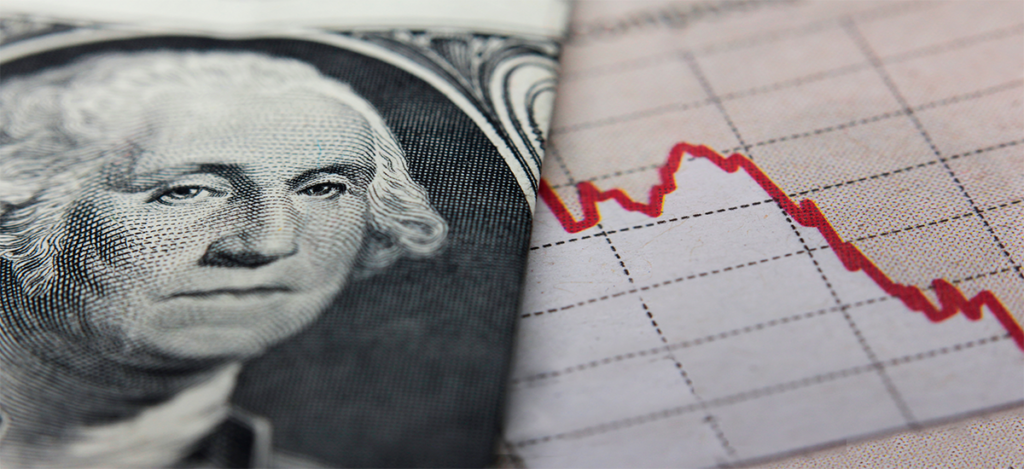
On-again, off-again tariffs. Rising prices. Dramatic market swings. The anxiety-producing headlines come so fast it’s hard to know what to worry about first. Meanwhile, one serious consequence of all this chaos is going almost unnoticed. That is the decline of the dollar.

Since the start of this year, the value of the U.S. dollar has slipped more than 10% against other major currencies. That drop is not just an economic statistic. It affects all Americans’ daily lives.

People are feeling the pinch of rising prices at checkout lines, gas stations, and shipping counters. But there isn’t a full understanding of why. Tariffs are only half the story. The weakening dollar amplifies those price increases even further.

For years, the dollar remained strong even as the national debt ballooned. It benefited from its reputation as a safe haven, from global demand, and from U.S. interest rates. But much of that strength, as we now see, was fragile—propped up more by perception than fundamentals. In April, sweeping tariffs triggered a sharp market correction, and the dollar suddenly fell to its lowest point in over three years. Market confidence vanished overnight.

This was more than a market reaction. It signaled a collapse in trust—not just in policy, but in principle. It is no longer a given that the U.S. will act with consistency, reason, and long-term responsibility. What’s unraveling is both our country’s financial credibility and the moral foundation that underpinned it.

When a currency represents a nation, its value reflects more than economics. It reflects governance, accountability, stability, and integrity. When the dollar stumbles, it speaks to who we are, and whether we can still be counted on.

Yet, most people aren’t talking about the decline of the dollar. This may come from being overwhelmed, choosing to ignore even more bad news, or actually believing that this is a necessary step in making things better. It is not.

We all respond differently to financial uncertainty. Some lean into hyper-vigilance—tightening budgets, tracking every headline. Others shut down, turning toward distraction. Still others press on as if nothing has changed. These are all natural human reactions.

They are not the same as leadership. And leadership—internal and external—is what’s needed now. Not panic. Not blame. Just the courage to face where we are and the willingness to start again from there.

But leadership is in short supply in Washington, where many in both parties remain silent. Some fear political retribution from the administration, others fear backlash from increasingly extreme and vocal constituencies. That silence costs us all.

A respected government official recently told me that, while some of the domestic damage to our economy could be repaired within a few years, rebuilding global confidence in the United States may take a generation. That is a reflection of the rapid erosion of trust that has already happened in the last three months. Trust that took decades to build has been unwound in a matter of weeks. Even if we reversed every policy decision tomorrow, the damage is done.

We cannot change what’s already happened. We can still choose to show up. To pay attention. To have the hard conversations. To lead our own financial lives with more clarity, integrity, and intention than before. That kind of personal leadership may not fix the dollar. But it can help rebuild what underlies its value: trust, steadiness, and the moral grounding we’ve begun to lose.

Because the dollar’s decline is more than an economic headline.

It’s a story about who we are—and whether we’re ready to live with open eyes in a world where the old assumptions no longer hold.

COMMENTS APPRECIATED

Like and Refer

***

***

DAILY UPDATE: U.S. GDP Down as Stock Markets Collapse

MEDICAL EXECUTIVE-POST TODAY’S NEWSLETTER BRIEFING

***

Essays, Opinions and Curated News in Health Economics, Investing, Business, Management and Financial Planning for Physician Entrepreneurs and their Savvy Advisors and Consultants

Serving Almost One Million Doctors, Financial Advisors and Medical Management Consultants Daily

A Partner of the Institute of Medical Business Advisors , Inc.

http://www.MedicalBusinessAdvisors.com

SPONSORED BY: Marcinko & Associates, Inc.

***

http://www.MarcinkoAssociates.com

Daily Update Provided By Staff Reporters Since 2007.
How May We Serve You?
© Copyright Institute of Medical Business Advisors, Inc. All rights reserved. 2025

REFER A COLLEAGUE: MarcinkoAdvisors@outlook.com

SPONSORSHIPS AVAILABLE: https://medicalexecutivepost.com/sponsors/

ADVERTISE ON THE ME-P: https://tinyurl.com/ytb5955z

Your Referral Count -0-

CITE: https://www.r2library.com/Resource

🟢 What’s up

  • Ford managed to rise 2.45% despite the automaker suspending its 2025 fiscal guidance, citing “industrywide supply chain disruption impacting production.”
  • WeRide skyrocketed 31.68% on the news that it’s expanding its partnership with Uber to include rolling out robotaxis in 15 new cities. Pony AI soared 47.63% thanks to its bigger role helping Uber grow throughout the Middle East.
  • Hims & Hers Health gained 18.12% after the telehealth stock beat analyst forecasts last quarter,even though it provided lower-than-expected revenue guidance this quarter.
  • Celsius Holdings missed on both top and bottom line expectations, but shares of the energy drink maker still managed to bubble 4.81% higher.
  • Mattel rose 2.78% even though the toy company paused its fiscal guidance and warned it will raise prices in the US.
  • Upwork, everyone’s favorite side-gig platform, soared 18.02% as Americans brace for economic upheaval by finding second jobs.
  • Constellation Energy may have missed Wall Street forecasts last quarter, but shareholders pushed the stock 10.29% higher on upbeat fiscal guidance.
  • SolarEdge Technologies climbed 11.22% on a smaller-than-expected loss last quarter and projections that tariffs won’t be as bad as feared.
  • Neurocrine Biosciences popped 8.36% thanks to strong revenue growth due to high sales of its movement disorder treatment Ingrezza.

What’s down

  • Tesla fell 1.75% on the latest data showing its sales plummeted in Europe last month, including a 46% decline in Germany.
  • Pharma stocks took a beating after the FDA announced that industry critic Dr. Vinay Prasad will be named its top vaccine regulator. Moderna lost 12.25%, Novavax fell 3.19%, Merck sank 4.59%, and Pfizer fell 4.15%.
  • Clorox got taken to the cleaners, losing 2.41% after missing Wall Street’s profit forecasts.
  • Vertex Pharmaceuticals fell 10.03% thanks to big misses across the board last quarter due to higher costs.
  • Lattice Semiconductor lost 9.28% after management warned that tariffs will have indirect consequences on its business.

CITE: https://tinyurl.com/2h47urt5

  • US gross domestic product (GDP) contracted 0.3% in Q1, the Commerce Department reported yesterday, missing economists’ expectations of a 0.4% increase.
  • That drop can likely be attributed to a massive spike in imports (roughly a 41% increase from the previous quarter) from companies stocking up on goods and materials before President Trump’s tariffs took effect. The Commerce Department counts imports as a negative in GDP calculations as they represent spending on foreign goods.

CITE: https://tinyurl.com/tj8smmes

Visualize: How private equity tangled banks in a web of debt, from the Financial Times.

COMMENTS APPRECIATED

PLEASE SUBSCRIBE: MarcinkoAdvisors@outlook.com

Thank You

***

***

***

***

EDUCATIONAL TEXTBOOKS: https://tinyurl.com/4zdxuuwf

***

Lessons from History’s Technology Booms

By Vitaliy Katsenelson CFA

***

***

The technology at the core of the mania is different every time. What doesn’t change over time is human emotion – the fear of missing out and then the fear of loss.

AI has a feel of “this time is different.” Optimism rarely erupts about the same technology twice; this is why history doesn’t repeat but rhymes. The technology at the core of the mania is different every time. What doesn’t change over time is human emotion – the fear of missing out and then the fear of loss, in that order. 

Humans are an optimistic bunch. We need it; it’s essential to our survival and progress; but eventually, we take our optimism too far. The graveyard of financial ruins is full of these stories.

I have beat the dotcoms and Nifty Fifties to death, so let’s go to back another century. My friend the brilliant Edward Chancellor wrote about the railroad boom and bust in England in the 1800s. Here he is, edited for brevity:

The first railway to use steam locomotives opened in 1825 and was designed to carry coal, not passengers. Railway promoters simply did not appreciate the potential demand for high-speed travel. The successful launch of the Liverpool and Manchester Railway in 1830, however, demonstrated the commercial viability of passenger travel. By the early 1840s, Britain’s railway network stretched to more than 2,000 miles. Railway companies were delivering acceptable, if not spectacular, returns for investors.

Then railway fever suddenly gripped the nation. Enthusiasts touted rail transport not just for its economic benefits, but for its benign effects on human civilization. One journal envisaged a day when the “whole world will have become one great family speaking one language, governed in unity by like laws, and adoring one God.” In the two years after 1843, the index of rail stocks doubled.

Investment peaked at around 7% of Britain’s national income. Railway enthusiasts predicted that rail would soon replace all the country’s roads and that “horse and foot transit shall be nearly extinct.”

In 1845, Britain’s railways carried nearly 34 million passengers. If the 8,000 miles of newly authorized railways were to deliver their expected 10% return, then the industry’s total revenue and passenger traffic would have to climb five fold or more – all within the space of just five years. “This should have alarmed observers by itself … But they were deluded by the collective psychology of the Mania”, writes Odlyzko. 

In 1847 a severe financial crisis broke out, induced in part by the diversion of large amounts of capital into unprofitable railway schemes. It turned out that the revenue projections provided by so-called “traffic takers” were wildly overoptimistic. Railway engineers underestimated costs. The vogue for constructing direct lines between large urban centers proved mistaken, as most traffic turned out to be local. As a result, Britain’s rail network was plagued with overcapacity. By the end of the decade, the index of railway stocks was down 65% from its 1845 peak. 

The railroad bubble in England is just one example; there are hundreds of similar stories across market history. They all share this theme:

A new technology appears on the horizon. In the early stages, investment is rational, but then at some point excitement, imagination, and optimism take over, leading to overinvestment (usually creating a financial bubble). Investors make a lot of money until most lose it all. When the dust settles, only a few companies survive.

This AI boom reminds me of the telecom sector in the 1990s. The internet was going to change the world, and it did, but first we had tremendous overcapacity in global fiber and telecom equipment.

One could say that telecommunications companies overestimated demand for broadband and underestimated changes in technology, and that would be true. But there was a more nuanced dynamic at play, what economists call the fallacy of composition.

What’s true for one participant isn’t necessarily true for the group.

COMMENTS APPRECIATED

Like and Refer

***

***

DAILY UPDATE: CVS Exits ACA Marketplace as Markets Flounder

MEDICAL EXECUTIVE-POST TODAY’S NEWSLETTER BRIEFING

***

Essays, Opinions and Curated News in Health Economics, Investing, Business, Management and Financial Planning for Physician Entrepreneurs and their Savvy Advisors and Consultants

Serving Almost One Million Doctors, Financial Advisors and Medical Management Consultants Daily

A Partner of the Institute of Medical Business Advisors , Inc.

http://www.MedicalBusinessAdvisors.com

SPONSORED BY: Marcinko & Associates, Inc.

***

http://www.MarcinkoAssociates.com

Daily Update Provided By Staff Reporters Since 2007.
How May We Serve You?
© Copyright Institute of Medical Business Advisors, Inc. All rights reserved. 2025

REFER A COLLEAGUE: MarcinkoAdvisors@outlook.com

SPONSORSHIPS AVAILABLE: https://medicalexecutivepost.com/sponsors/

ADVERTISE ON THE ME-P: https://tinyurl.com/ytb5955z

Your Referral Count -0-

CITE: https://www.r2library.com/Resource

Aetna is waving goodbye to the ACA marketplace. Executives announced during CVS Health’s Q1 2025 earnings call on May 1 that the insurance giant is withdrawing from the individual marketplace created under the Affordable Care Act, as the company expects to lose as much as $400 million from that part of the business in 2025.

CITE: https://tinyurl.com/2h47urt5

Stocks sank a bit today while investors remain in wait-and-see mode. All eyes are on Jerome Powell & Co. this Wednesday: The market thinks the Fed will stay put until June, while some pros think the next rate cut will be in July.

Among the major indexes, the Dow Jones industrials fared best, though it was only up 0.1%. McDonald’s and UnitedHealth led blue chips with gains of more than 1%. Apple lagged most, dropping 2.6%. Chevron skidded more than 2%. The NASDAQ composite fell 0.4%. Trade Desk outperformed here, rallying more than 3%, while Charter Communications and Fortinet each rose nearly 3%. Meanwhile, On Semiconductor and Grail lagged, diving more than 8% and 4%, respectively. The S&P 500 dropped 0.4%. The benchmark index’s sectors were mixed, but with a slight downside bias. Energy and consumer discretionary were getting hit the hardest. Industrials and consumer staples made the best gains.

CITE: https://tinyurl.com/tj8smmes

🟢 What’s up

  • Skechers exploded 24.35% after the footwear retailer inked a deal with 3G Capital to go private.
  • Electronic Arts climbed 2.41% on the news that it has teamed up with Major League Soccer to offer four matches via its mobile gaming platform this year.
  • United Airlines rose 1.07% despite its announcement that it’s cutting some flights out of Newark, New Jersey, where apparently flying is terrible.
  • Howard Hughes Holdings gained 2.81% thanks to a $900 million investment in the real estate company from Bill Ackman’s Pershing Square.

What’s down

  • Sunoco sank 5.64% on the oil & gas company’s plans to acquire Canadian gas station chain Parkland Corporation for $9.1 billion.
  • Shell fell 2.28% on reports that the company is considering ways to acquire rival BP.
  • ON Semiconductor lost 8.35% despite outpacing analysts’ estimates on both the top and bottom lines, as shareholders focused on warnings of weaker demand.
  • Tyson Foods fell 7.75% after the meat giant missed sales estimates and warned revenue will remain flat in the coming year.
  • Loews may have beaten analysts’ estimates on revenue, but the luxury hospitality stock still fell 1.77% after missing on profits.
  • Wolfspeed, which is a company name we will never get tired of writing, gave up another 8.52% following a wild short squeeze last week.

COMMENTS APPRECIATED

PLEASE SUBSCRIBE: MarcinkoAdvisors@outlook.com

Thank You

***

***

***

***

EDUCATIONAL TEXTBOOKS: https://tinyurl.com/4zdxuuwf

***

VALUE INVESTING: Lesson from the Blackjack Table

By Vitaliy Katsenelson CFA

***

***

“Any time you make a bet with the best of it, where the odds are in your favor, you have earned something on that bet, whether you actually win or lose the bet. By the same token, when you make a bet with the worst of it, where the odds are not in your favor, you have lost something, whether you actually win or lose the bet.”

– David Sklansky, The Theory of Poker

Over a lifetime, active investors will make hundreds, often thousands of investment decisions. Not all of those decisions will work out for the better. Some will lose and some will make us money. As humans we tend to focus on the outcome of the decision rather than on the process.

On a behavioral level, this makes sense. The outcome is binary to us – good or bad, we can observe with ease. But the process is more complex and is often hidden from us.

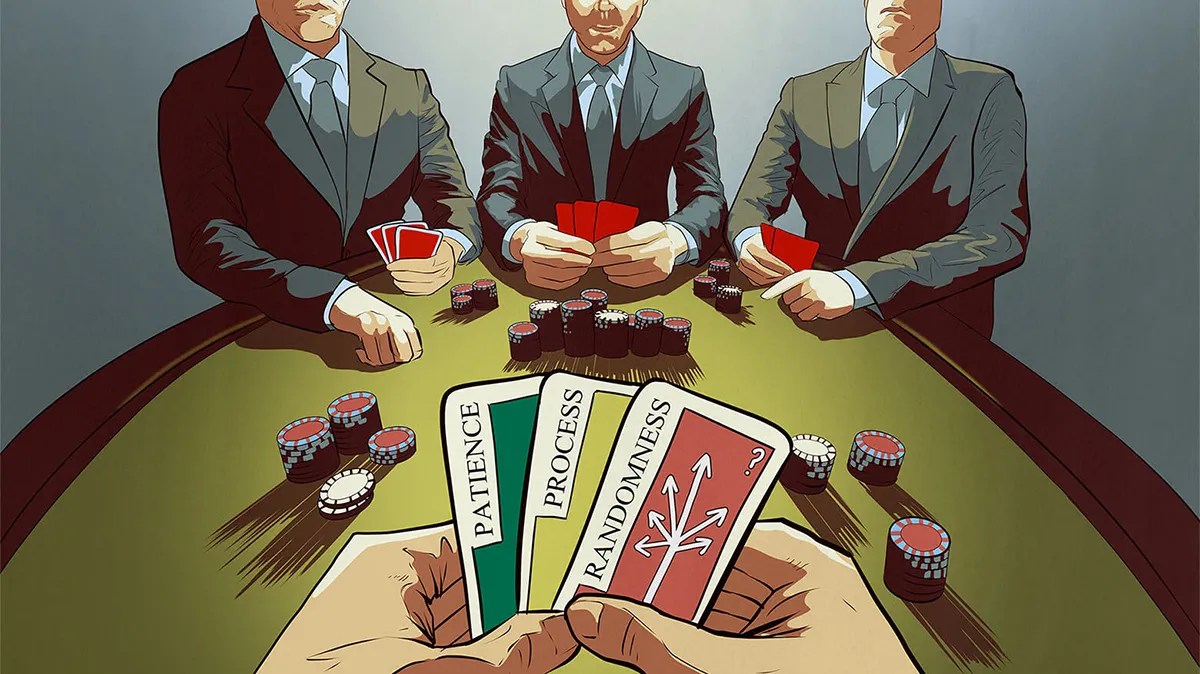
One of two things (sometimes a bit of both) can unite great investors: process and randomness (luck). Unfortunately, there is not much we can learn from randomness, as it has no predictive power. But the process we should study and learn from. To be a successful investor, all you need is a successful process and the ability (or mental strength) to stick to it.

Several years ago, I was on a business trip. I had some time to kill so I went to a casino to play blackjack. Aware that the odds were stacked against me, I set a $40 limit on how much I was willing to lose in the game.

I figured a couple hours of entertainment, plus the free drinks provided by the casino, were worth it. I was never a big gambler (as I never won much). However, several days before the trip I had picked up a book on blackjack on the deep discount rack in a local bookstore. All the dos and don’ts from the book were still fresh in my head. I figured if I played my cards right I would minimize the house advantage from 2-3 per cent to 0.5 per cent.

Wanting to get as much mileage out of my $40 as possible, I found a table with the smallest minimum bet requirement. My thinking was that the smaller the hands I played, the more time it would take for the casino’s advantage to catch up with me and take my money.

I joined a table that was dominated by a rowdy, half-drunken blue-collar worker who told me several times that it was his payday (literally: he was holding a stack of $100 bills in his hand) and that he was winning. I played by the book. But it did not matter. Luck was not on my side and my $40 was thinning with every hand.

Meanwhile, the rowdy guy was making every wrong move. He would ask for an extra card when he had a hard 18 while the dealer showed 6. The next card he drew would be a 3, giving him 21. Then the dealer would get a 10 and then a 2 (on top of the 6 that already showed), leaving him with 18. The rowdy guy barely paid attention to the cards.

He was more interested in saying “hit me”.

COMMENTS APPRECIATED

Refer and Like

***

***

DAILY UPDATE: Strong Labor Department as Stock Markets Soar Last Week but Stock and Oil Futures Drop Early Monday Morning

MEDICAL EXECUTIVE-POST TODAY’S NEWSLETTER BRIEFING

***

Essays, Opinions and Curated News in Health Economics, Investing, Business, Management and Financial Planning for Physician Entrepreneurs and their Savvy Advisors and Consultants

Serving Almost One Million Doctors, Financial Advisors and Medical Management Consultants Daily

A Partner of the Institute of Medical Business Advisors , Inc.

http://www.MedicalBusinessAdvisors.com

SPONSORED BY: Marcinko & Associates, Inc.

***

http://www.MarcinkoAssociates.com

Daily Update Provided By Staff Reporters Since 2007.
How May We Serve You?
© Copyright Institute of Medical Business Advisors, Inc. All rights reserved. 2025

REFER A COLLEAGUE: MarcinkoAdvisors@outlook.com

SPONSORSHIPS AVAILABLE: https://medicalexecutivepost.com/sponsors/

ADVERTISE ON THE ME-P: https://tinyurl.com/ytb5955z

Your Referral Count -0-

U.S. stock futures declined after the S&P 500 notched its longest winning streak in more than 20 years last week. Dow Jones Industrial Average futures were down around 280 points, or 0.7%, as of 11 p.m. Eastern. S&P 500 futures and NASDAQ-100 futures were off about 0.8%.

CITE: https://www.r2library.com/Resource

The labor market stayed strong. The US added 177,000 jobs in April, while unemployment stayed steady at 4.2%, new Labor Department data shows. That was slightly less job growth than the month before, but still more than expected, and it shows a resilient labor environment even as the president’s introduction of tariffs roiled the stock and bond markets and raised concerns about a recession. President Trump celebrated the news in a Truth Social post that once again urged the Fed to cut interest rates.

CITE: https://tinyurl.com/2h47urt5

Markets: Stocks soared like a balloon whose string a toddler couldn’t keep hold of yesterday. Unexpectedly strong jobs data for last month and reports that China is open to trade talks helped push the S&P 500 to its longest winning streak in more than 20 years (more on that later), erasing the losses from recent tariff turmoil. On its own impressive streak is Netflix, which hit an all-time high and finished its 11th day in the green for its longest positive run ever.

CITE: https://tinyurl.com/tj8smmes

Crude oil futures dropped more than 3% Sunday after OPEC+ agreed to accelerate production increases for a second straight month in June by 411K bbl/day.

U.S. WTI crude (CL1:COM) for June delivery recently traded -3.4% at $56.28/bbl and July Brent crude (CO1:COM) -3.2% at $59.34/bbl, with both front-month contracts touching their lowest levels since April 9th.

Visualize: How private equity tangled banks in a web of debt, from the Financial Times.

COMMENTS APPRECIATED

PLEASE SUBSCRIBE: MarcinkoAdvisors@outlook.com

Thank You

***

***

***

***

EDUCATIONAL TEXTBOOKS: https://tinyurl.com/4zdxuuwf

***

BERKSHIRE HATHAWAY: Warren Buffett to Retire

BREAKING NEWS

By Staff Reporters

***

***

According to the Washington Post, legendary investor Warren Buffett said Saturday that he plans to step down from his role leading Berkshire Hathaway. Warren, 94, serves as the conglomerate’s chairman and chief executive. He said Saturday that he will recommend to the Berkshire Hathaway board that Greg Abel become CEO at the end of 2025.

“I think the time has arrived where Greg should become the chief executive officer of the company at year end,” Buffett said at Berkshire Hathaway’s annual meeting in Omaha.

Abel is chairman and CEO of Berkshire Hathaway Energy. Buffett has previously signaled that Abel would be in line to succeed him as CEO.

***

UPDATE: Berkshire Hathaway (NYSE:BRK.A)(NYSE:BRK.B) on Saturday reported its worst drop in quarterly operating earnings since 2020, and noted “considerable uncertainty” around international trade policies and tariffs. 

The sprawling conglomerate’s Q1 operating earnings slipped 14.1% Y/Y to $9.64B. This was the steepest fall in operating earnings since a 32.1% decrease logged in the third quarter of 2020

COMMENTS APPRECIATED

Like and Refer

***

***

DAILY UPDATE: Dr. Marty Makary Appointed to FDA as Stock Markets Continue Rise

MEDICAL EXECUTIVE-POST TODAY’S NEWSLETTER BRIEFING

***

Essays, Opinions and Curated News in Health Economics, Investing, Business, Management and Financial Planning for Physician Entrepreneurs and their Savvy Advisors and Consultants

Serving Almost One Million Doctors, Financial Advisors and Medical Management Consultants Daily

A Partner of the Institute of Medical Business Advisors , Inc.

http://www.MedicalBusinessAdvisors.com

SPONSORED BY: Marcinko & Associates, Inc.

***

http://www.MarcinkoAssociates.com

Daily Update Provided By Staff Reporters Since 2007.
How May We Serve You?
© Copyright Institute of Medical Business Advisors, Inc. All rights reserved. 2025

REFER A COLLEAGUE: MarcinkoAdvisors@outlook.com

SPONSORSHIPS AVAILABLE: https://medicalexecutivepost.com/sponsors/

ADVERTISE ON THE ME-P: https://tinyurl.com/ytb5955z

Your Referral Count -0-

CITE: https://www.r2library.com/Resource

Stat: $1.5 billion. That’s how much a lawsuit alleged hospitals lost because of under funding for facilities serving low-income patients. The Supreme Court ruled against the push for more reimbursement. (Healthcare Dive)

Read: An exclusive interview with Marty Makary, the newly appointed FDA commissioner, on cuts, vaccines, and his future goals. (MedPage Today)

CITE: https://tinyurl.com/2h47urt5

🟢 What’s up

  • Big day for Big Oil: Shell rose 2.81% on better-than-expected earnings, Chevron inched 1.73% higher after beating on profits but missing on revenue, and Exxon Mobil eked out a 0.38% gain after reporting a big boost in production thanks to a recent acquisition.
  • MicroStrategy climbed 3.35% despite reporting a bigger EPS loss than expected. Shareholders must have liked hearing CEO Michael Saylor call the company the Domino’s Pizza of crypto.
  • Maplebear, which does business as Instacart, rose 13.62% after missing analyst estimates but issuing strong fiscal guidance for the coming quarter.
  • Dexcom popped 16.17% on strong earnings for the glucose monitor manufacturer.
  • Five Below rose 11.88% after the discount retailer raised its revenue guidance for the quarter ahead.
  • Wolfspeed exploded 23.89% higher as shareholders cheered the departure of the semiconductor stock’s CFO and a short squeeze took traders by surprise.

What’s down

  • Take Two Interactive Software tumbled 6.66% after the video game maker announced the release of its highly anticipated Grand Theft Auto 6 will be delayed until next May.
  • Reddit fell 4.15% despite crushing analysts’ EPS estimates, while daily active users soared 31% year over year.
  • Block plummeted 20.43% after the company behind Square and Cash App missed earnings estimates and cut its fiscal forecast due to macro uncertainty.
  • Roku sank 8.50% despite beating analysts’ revenue estimates this quarter, but predicting a worse-than-expected quarter ahead.
  • Atlassian beat top and bottom line forecasts, but the software maker still sank 8.99% after issuing weak guidance for the current quarter.
  • GoDaddy lost 8.36% after the domain registrar projected lower revenue for the coming quarter than analysts expected.

CITE: https://tinyurl.com/tj8smmes

Visualize: How private equity tangled banks in a web of debt, from the Financial Times.

COMMENTS APPRECIATED

PLEASE SUBSCRIBE: MarcinkoAdvisors@outlook.com

Thank You

***

***

***

***

EDUCATIONAL TEXTBOOKS: https://tinyurl.com/4zdxuuwf

***

DAILY UPDATE: Meta, Eli Lilly, Microsoft, Amazon, Apple and the Roaring Markets

MEDICAL EXECUTIVE-POST TODAY’S NEWSLETTER BRIEFING

***

Essays, Opinions and Curated News in Health Economics, Investing, Business, Management and Financial Planning for Physician Entrepreneurs and their Savvy Advisors and Consultants

Serving Almost One Million Doctors, Financial Advisors and Medical Management Consultants Daily

A Partner of the Institute of Medical Business Advisors , Inc.

http://www.MedicalBusinessAdvisors.com

SPONSORED BY: Marcinko & Associates, Inc.

***

http://www.MarcinkoAssociates.com

Daily Update Provided By Staff Reporters Since 2007.
How May We Serve You?
© Copyright Institute of Medical Business Advisors, Inc. All rights reserved. 2025

REFER A COLLEAGUE: MarcinkoAdvisors@outlook.com

SPONSORSHIPS AVAILABLE: https://medicalexecutivepost.com/sponsors/

ADVERTISE ON THE ME-P: https://tinyurl.com/ytb5955z

Your Referral Count -0-

Meta Platforms jumped 4.23% after the big tech giant reported that its advertising revenue came in at $41.39 billion, beating analyst projections of $40.44 billion, thanks to higher ad price growth than expected. Daily active users rose to 3.43 billion, up from 3.35 billion last quarter, while nearly 1 billion people use its digital AI assistant every month. Management expects Q2 sales to come in between $42.5 billion and $45.5 billion, in-line with analyst forecasts of $44.03 billion.

  • EPS: $6.43 per share, crushing estimates of $5.28
  • Revenue: $42.31 billion, above the $41.10 expected

Microsoft leaped 7.63% after reporting its profit jumped a staggering 18% from a year earlier. That wasn’t the only good news: Revenue from Microsoft’s Azure cloud software grew 33% year over year, higher than the 31% expected by analysts. But perhaps the best news of all was management’s upbeat guidance—Microsoft projected revenue between $73.15 billion and $74.25 billion for the current quarter, well above expectations of $72.26 billion.

  • EPS: $3.46 per share, beating forecasts of $3.22
  • Revenue: $70.07 billion, above the $68.42 billion projected

Eli Lilly dropped 11.66% today, despite the fact that the pharmaceutical giant reported that sales skyrocketed 45% year over year thanks to its lucrative GLP-1 drugs, Zepbound and Mounjaro. Two things spooked investors today: The company lowered its profit outlook well below its preview estimate due its acquisition of a cancer drug from Scorpion Therapeutics, and CVS Health dropped Zepbound from its preferred drug list in lieu of arch-rival Novo Nordisk’s Wegovy this morning.—LB

  • EPS: $3.34 adjusted, beating the $3.02 expected
  • Revenue: $12.73 billion, compared to the $12.67 projected

CITE: https://www.r2library.com/Resource

🟢 What’s up

  • Kohls popped 7.76% after the retailer fired its brand-new CEO for unethical behavior.
  • CVS Health not only beat earnings expectations but raised its fiscal guidance, pushing shares of the pharmacy chain up 4.11%.
  • Wayfair rose 3.65% on surprisingly strong earnings for an online furniture seller that analysts were convinced would be hit hard by tariffs.
  • Roblox gained 2.91% as people checked out of reality and hit the metaverse in higher numbers than ever.
  • CoreWeave popped 7.31% thanks to key customer Microsoft’s strong capex guidance.
  • Carrier Global climbed 11.61% after the air conditioning company boosted its fiscal forecast. Turns out everyone needs AC regardless of economic uncertainty.
  • People also need straight teeth: Dental products manufacturer Align Technology rose 1.98% on solid earnings.
  • Quanta Services gained 9.99% after the construction engineering company beat Wall Street estimates on both the top and bottom line.

What’s down

  • Qualcomm may have beaten earnings expectations, but shares fell 8.92% after investors were disappointed by the chipmaker’s lower guidance.
  • GM was in the same boat: Earnings beat forecasts, but poor guidance and warnings that tariffs could cost the company up to $5 billion this year pushed shares 0.42% lower.
  • Robinhood Markets enjoyed a 50% increase in revenue last quarter as traders played the volatile market, but the stock still sank 5.07%.
  • Moderna fell 5.29% after the vaccine maker missed revenue expectations and said it’s planning another $1.5 billion in cost cuts.
  • Church & Dwight, maker of household goods like Arm & Hammer Baking Soda, missed revenue forecasts last quarter and sank 6.87%.
  • Becton Dickinson & Co. lost 18.13% after the medical device maker warned of the adverse effects of, what else, tariffs.

CITE: https://tinyurl.com/2h47urt5

Amazon plans to invest about $4 billion into its rural delivery network across the US.

Apple is in hot water after a judge ruled it violated a court order to reform the App Store.

The Department of Justice sued several big health insurers, alleging they used illegal kickbacks to nudge members into Medicare programs.

CITE: https://tinyurl.com/tj8smmes

Visualize: How private equity tangled banks in a web of debt, from the Financial Times.

COMMENTS APPRECIATED

PLEASE SUBSCRIBE: MarcinkoAdvisors@outlook.com

Thank You

***

***

***

***

EDUCATIONAL TEXTBOOKS: https://tinyurl.com/4zdxuuwf

***

PHANTOM: Stock Equity Plans

DEFINITIONS

By Staff Reporters

SPONSOR: http://www.CertifiedMedicalPlanner.org

***

***

Phantom equity is an increasingly popular tool within businesses, particularly startups and private companies, for incentivizing employees without diluting ownership. It allows firms to reward key personnel by linking compensation to the company’s performance, aligning employee interests with those of shareholders.

Basic Mechanisms of Phantom Equity

Phantom equity operates as a contractual agreement offering employees a simulated stake in the business without issuing actual stock. This arrangement appeals to companies aiming to maintain control over their equity structure while providing performance-based incentives. The benefits mimic stock ownership, such as dividends and capital appreciation, without the complexities of transferring actual shares.

The company establishes a phantom equity plan that defines terms such as vesting schedules, performance metrics, and payout conditions. Vesting schedules, often ranging from three to five years, encourage employee retention. Performance metrics may include revenue growth, profit margins, or other financial indicators aligned with strategic goals. Once vested, employees receive cash payments based on the value of the phantom shares, determined by the company’s valuation at payout.

Valuations, often conducted through third-party appraisals or internal financial metrics, directly affect payouts. If the company grows significantly, the value of phantom shares increases, resulting in higher payouts. Conversely, if performance declines, the value of these shares decreases, reducing compensation.

Types of Phantom Equity Plans

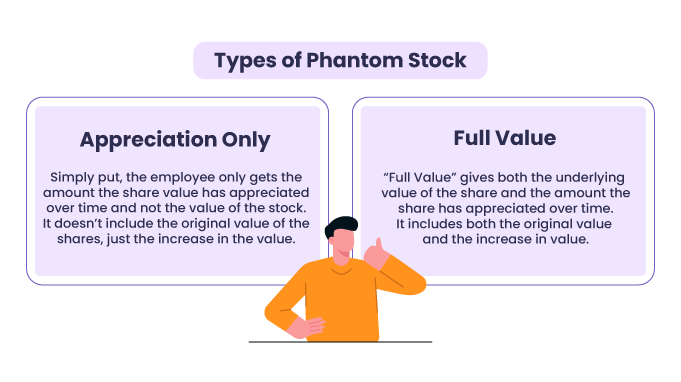
Phantom equity plans can be customized to suit a company’s goals, with two primary types being most common: appreciation-only arrangements and full-value arrangements.

Appreciation-Only Arrangements

Appreciation-only arrangements reward employees for the increase in the company’s value over a specified period. Employees are granted phantom shares that reflect the appreciation in the company’s valuation from the grant date to the payout date.

For instance, if phantom shares are initially valued at $10 each and the valuation rises to $15, the employee receives a payout of $5 per share. This structure ties employee rewards to company growth without affecting equity. Companies must rely on precise valuation methods, often adhering to GAAP or IFRS, to ensure fairness and compliance.

Full-Value Arrangements

Full-value arrangements provide payouts equivalent to the full value of phantom shares at vesting or payout. This includes both the initial value and any appreciation.

For example, if phantom shares are initially valued at $10 and later rise to $15, the employee receives $15 per share. While offering greater potential rewards, full-value arrangements require a larger financial commitment from the company. Careful financial planning and adherence to standards like ASC 718, which governs share-based compensation, are essential for managing these plans effectively.

Tax Implications: https://eqvista.com/phantom-stock/phantom-stock-plans-taxation/

COMMENTS APPRECIATED

Like and Review

***

***

DAILY UPDATE: Sutter Heath & Medicare as Stock End Up Mixed

MEDICAL EXECUTIVE-POST TODAY’S NEWSLETTER BRIEFING

***

Essays, Opinions and Curated News in Health Economics, Investing, Business, Management and Financial Planning for Physician Entrepreneurs and their Savvy Advisors and Consultants

Serving Almost One Million Doctors, Financial Advisors and Medical Management Consultants Daily

A Partner of the Institute of Medical Business Advisors , Inc.

http://www.MedicalBusinessAdvisors.com

SPONSORED BY: Marcinko & Associates, Inc.

***

http://www.MarcinkoAssociates.com

Daily Update Provided By Staff Reporters Since 2007.
How May We Serve You?
© Copyright Institute of Medical Business Advisors, Inc. All rights reserved. 2025

REFER A COLLEAGUE: MarcinkoAdvisors@outlook.com

SPONSORSHIPS AVAILABLE: https://medicalexecutivepost.com/sponsors/

ADVERTISE ON THE ME-P: https://tinyurl.com/ytb5955z

Your Referral Count -0-

CITE: https://www.r2library.com/Resource

🟢 What’s up

  • Seagate Technology popped 11.56% thanks to a beat-and-raise quarter and promises from management that tariff disruption would be minimal.
  • WingStop can’t stop, won’t stop: The purveyor of fried chicken rose 14.48% after posting an incredible earnings report.
  • Humana climbed 0.92% after the health insurer beat earnings expectations and kept its fiscal guidance intact.
  • GE HealthCare Technologies managed to rise 3.29% despite cutting its forward guidance.
  • Caterpillar eked out a 0.54% gain after raising its fiscal 2025 revenue forecast, but the construction giant warned that it will eat about $350 million in extra tariff-related costs.

What’s down

  • Super Micro Computer plunged 11.50% after reporting terrible preliminary earnings and warned of weaker results still to come.
  • Nvidia was pulled down just 0.09% by its very first “sell” rating from Wall Street analysts.
  • Etsy beat revenue expectations last quarter, but fell 5.74% after missing profit forecasts as the number of buyers and sellers using its platform continued to fall.
  • Snap tumbled 12.43% after the social media stock warned that economic uncertainty could hurt its advertising business and refused to issue a fiscal forecast.
  • Chili’s parent company Brinker International fell 1.89% despite posting solid earnings as investors worry about slowing consumer spending.
  • Norwegian Cruise Line sank 7.77% after missing earnings and warning of a slowdown in demand.

CITE: https://tinyurl.com/2h47urt5

Stat: $228 million. That’s how much Sacramento-based Sutter Health—one of the largest health systems in the US—agreed to pay to settle allegations of inflating insurance premiums. (Reuters)

Read: Here’s what some say the new Medicare director, a former tech CEO, is likely to focus on. (Stat)

CITE: https://tinyurl.com/tj8smmes

Visualize: How private equity tangled banks in a web of debt, from the Financial Times.

COMMENTS APPRECIATED

PLEASE SUBSCRIBE: MarcinkoAdvisors@outlook.com

Thank You

***

***

***

***

EDUCATIONAL TEXTBOOKS: https://tinyurl.com/4zdxuuwf

***

CONSUMERS: Worried about the Economy

By Staff Reporters

***

***

Consumer sentiment is a statistical measurement of the overall health of the economy as determined by consumer opinion. It takes into account how people feel about their current financial health, the health of the economy in the short-term, and the prospects for longer-term economic growth. It is widely considered to be a useful economic indicator.

Consumer sentiment emerged as an economic statistic during the mid-20th century and has since become a barometer that influences public and economic policy. It is considered a lagging indicator because it takes people several months to notice and feel the effects of changes in economic activity.

American consumers are Worried about the Economy

Consumer sentiment dropped 8% from March to April amid worries about inflation, according to the University of Michigan’s closely watched survey. Though sentiment edged up slightly from an even lower reading earlier in the month, inflation expectations climbed to their highest since 1991 as consumers fret about the potential impact of tariffs.

And even beyond possible rising prices, things could be about to get rougher for consumers: Major retailers have warned that unless President Trump’s tariff policy toward China changes, they’re likely to encounter empty store shelves in a few weeks.

Like and Refer

***

***

QUANTUM COMPUTING: Healthcare and Banking Affected [B-QTUM Index Fund]

FUNDAMENTAL INDUSTRY CHANGES

By Staff Reporters

***

***

Index Funds

An index mutual fund or ETF (exchange-traded fund) tracks the performance of a specific market benchmark—or “index,” like the popular S&P 500 Index—as closely as possible. That’s why you may hear people refer to indexing as a “passive” investment strategy.

Instead of hand-selecting which stocks or bonds the fund will hold, the fund’s manager buys all (or a representative sample) of the stocks or bonds in the index it tracks.

***

Quantum Computing

Unlike traditional computers that use bits, quantum computers utilize qubits. These qubits are capable of being in a state of superposition, where they can represent both 0 and 1 simultaneously, enabling the processing of multiple calculations at once. This could allow quantum computers to outperform classical computers in solving certain complex problems. However, the field is still overcoming challenges such as qubit stability and decoherence; especially in these three areas:

  • Quantum computing could fundamentally alter healthcare by accelerating drug discovery and improving individualized medicine. Rapid analysis of enormous volumes of biological data allows quantum computers to find trends that might guide the creation of more potent treatments. In addition to accelerating drug development, this will enable customized treatments tailored to unique genetic profiles.
  • Faster and more accurate financial models produced by quantum computing will transform the banking sector. Through real-time analysis of intricate financial systems, it can help investors to control risk and make better decisions. More precise market forecasts will help maximize portfolio management and trading strategies.
  • Through greatly enhanced medical diagnosis and patient care, quantum computing can transform the healthcare industry. Quantum computers can remarkably accurately find trends and possible health hazards by analyzing enormous volumes of medical data in a fraction of the time. Early diagnosis and more customized treatment alternatives follow from this.

BQTUM Index Fund

Index Description: The BlueStar® Machine Learning and Quantum Computing Index (BQTUM) tracks liquid companies in the global quantum computing and machine learning industries, including products and services related to quantum computing or machine learning, such as the development or use of quantum computers or computing chips, superconducting materials, applications built on quantum computers, embedded artificial intelligence chips, or software specializing in the perception, collection, visualization, or management of big data.

Citation and Disclosure: https://www.defianceetfs.com/qtum/

COMMENTS APPRECIATED

Read, Like, Subscribe and Refer

***

***

DAILY UPDATE: Coca-Cola and Pfizer as Stock Markets Rise

MEDICAL EXECUTIVE-POST TODAY’S NEWSLETTER BRIEFING

***

Essays, Opinions and Curated News in Health Economics, Investing, Business, Management and Financial Planning for Physician Entrepreneurs and their Savvy Advisors and Consultants

Serving Almost One Million Doctors, Financial Advisors and Medical Management Consultants Daily

A Partner of the Institute of Medical Business Advisors , Inc.

http://www.MedicalBusinessAdvisors.com

SPONSORED BY: Marcinko & Associates, Inc.

***

http://www.MarcinkoAssociates.com

Daily Update Provided By Staff Reporters Since 2007.
How May We Serve You?
© Copyright Institute of Medical Business Advisors, Inc. All rights reserved. 2025

REFER A COLLEAGUE: MarcinkoAdvisors@outlook.com

SPONSORSHIPS AVAILABLE: https://medicalexecutivepost.com/sponsors/

ADVERTISE ON THE ME-P: https://tinyurl.com/ytb5955z

Your Referral Count -0-

CITE: https://www.r2library.com/Resource

Coca-Cola rose 0.84% after the beverage behemoth beat earnings expectations. Not only that, it also doubled down on its forward-looking guidance, saying that revenue will grow 5% to 6% while comparable earnings per share will jump 2% to 3% in 2025. Tariff mania may raise some costs, but the company said it would be “manageable,” putting it a step ahead of arch-rival PepsiCo.

Pfizer jumped 3.28% today after the pharma giant announced that it expects to cut costs by about $7.7 billion by the end of 2027 thanks to advances in AI and automation. Despite lower sales in Q1, the company managed to keep its 2025 revenue guidance of $61 billion to $64 billion intact. While that forecast takes into account the $150 million blow from tariffs, it does not include any future tariffs (which President Trump has threatened to slap on the pharma industry).—LB

CITE: https://tinyurl.com/2h47urt5

What’s up

  • Meta Platforms gained 0.85% after the social media giant announced it will launch a standalone AI app to compete with ChatGPT. Expect more details in its earnings call tomorrow.
  • JetBlue Airways may have pulled guidance, but investors like the airline’s lower-than-expected loss last quarter so pushed shares 2.70% higher.
  • SoFi Technologies rose 0.53% after it crushed analyst expectations on both the top and bottom line.
  • Speaking of fintech, PayPal climbed 2.14% thanks in no small part to a 20% pop in Venmo revenue.
  • Honeywell International gained 5.40% thanks to strong earnings and sales for the manufacturing conglomerate.
  • Deutsche Bank climbed 4.08% after Germany’s largest lender reported a 39% increase in profit last quarter.
  • Sherwin-Williams may have missed on revenue last quarter, but the paint company beat earnings estimates and kept its forward guidance intact, so shareholders pushed it up 4.80%.
  • Royal Caribbean eked out a 0.02% despite reporting record bookings and boosting its profit outlook, a rare move these days amid tariff uncertainty.
  • Leggett & Platt may not be a household name, but it sells household goods—and the bedding company’s solid earnings and strong fiscal guidance sent shares 31.73% higher.

What’s down

  • General Motors fell 0.64% after the automaker beat on top and bottom line estimates but warned that it will have to pull its forward guidance and suspend stock buybacks.
  • Spotify dropped 3.04% despite active monthly users rising 10% last quarter. The problem, believe it or not, was lower guidance.
  • Regeneron lost 6.87% thanks to disappointing sales for its hit eye drug Eylea.
  • NXP Semiconductors may have beaten analyst estimates last quarter, but management’s lower-than-expected earnings guidance disappointed investors, and pushed shares 6.94% lower.
  • Wolfspeed tumbled 15.98% after the chipmaker’s impressive short squeeze rally fizzled out.

CITE: https://tinyurl.com/tj8smmes

Visualize: How private equity tangled banks in a web of debt, from the Financial Times.

COMMENTS APPRECIATED

PLEASE SUBSCRIBE: MarcinkoAdvisors@outlook.com

Thank You

***

***

***

***

EDUCATIONAL TEXTBOOKS: https://tinyurl.com/4zdxuuwf

***

ZWEIG BREADTH THRUST: A Stock Indicator

By Staff Reporters

SPONSOR: http://www.MarcinkoAssociates.com

***

***

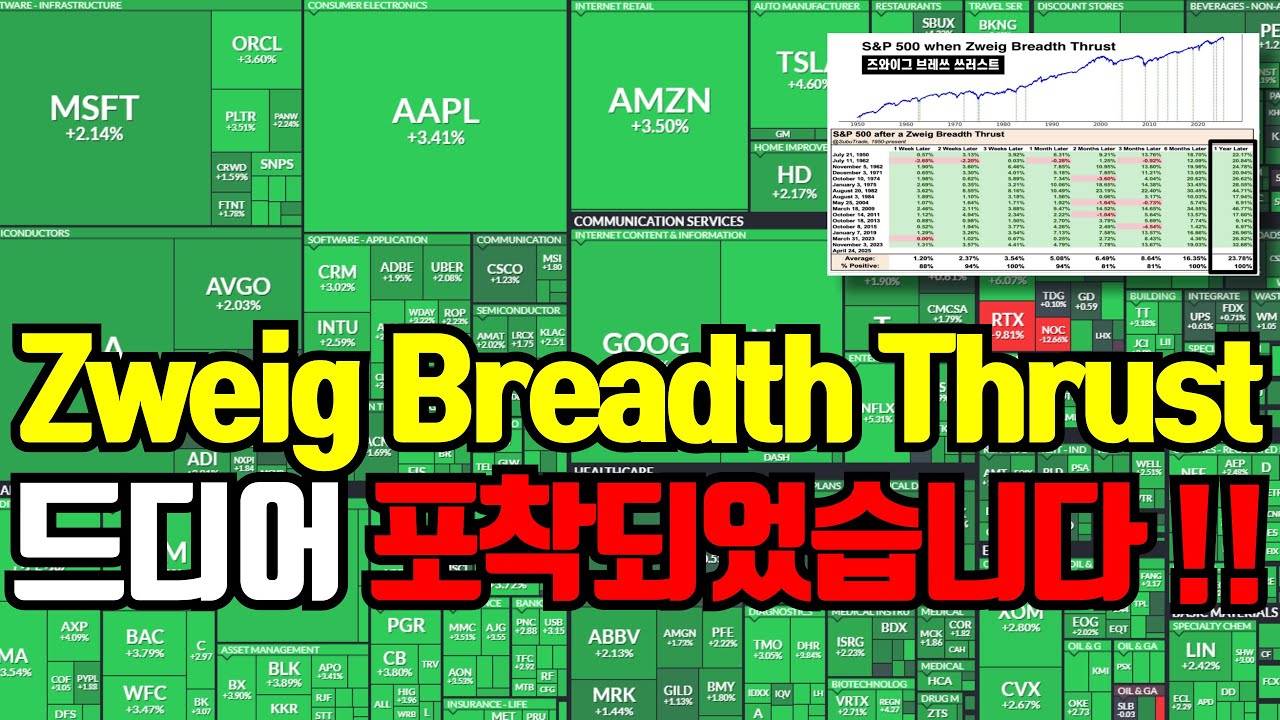
The Zweig Breadth Thrust may sound like an extremely difficult yoga position, but it’s actually a bullish technical indicator with an extraordinary record of 100% accuracy that was just triggered.

Created by investment advisor and author Martin Zweig, the indicator takes the 10-day moving average of the number of advancing stocks across the market and divides it by the number of advancing stocks plus the number of declining stocks. When the resulting percentage rises from below 40% to above 61.5% in 10 trading days, it’s a sign that stocks are rapidly going from oversold to overbought.

The math is a bit complicated, but Carson Research’s Chief Market Strategist Ryan Detrick certainly thinks highly of it.

According to the chart that he just posted on X, the Zweig Breadth Thrust has a perfect record of predicting market gains 6 and 12 months after it appears.

With the indicator triggering on Friday, here’s hoping that we can continue to trust the Zweig Thrust.

COMMENTS APPRECIATED

Like and Refer

***

***

STOCK MARKET WRAP-UP: As IBM, Nvidia & Apple Invest in Quantum Computers

By Staff Reporters

SPONSOR: http://www.MarcinkoAssociates.com

***

***

If you looked at how stocks were doing yesterday morning and then looked away, we’ve got good news.

After a rough start to the day—especially for tech companies, whose earnings are due out soon—stocks mostly turned things around, with the S&P 500 and the Dow ending the day in the green.

***

***

IBM plans to invest $150 billion in the US over five years. That includes $30 billion earmarked for R&D for manufacturing its mainframe and quantum computers in the US. It’s not the only tech company to announce a big commitment to spend in the US since President Trump took office and unveiled steep tariffs on imports from abroad.

Nvidia and Apple have each separately said that they plan to spend $500 billion stateside over the next four years. Companies in other industries, including pharmaceuticals, have also committed to increased US investment.—AR

COMMENTS APPRECIATED

Like and Refer

***

***

SOCIAL SECURITY: Is Not a Ponzi Scheme

By Rick Kahler CFP

***

***

Lately, I’ve been hearing the same question from clients and readers alike: “Is Social Security even going to be there in five years?” Fueling this concern is a recent viral comment from Elon Musk, who told Joe Rogan that Social Security is “the biggest Ponzi scheme of all time.” That quote has been repeated in every corner of the internet, stirring up uncertainty and fear.

Elon Musk is a genius, but his brilliance in technology and innovation doesn’t automatically translate into expertise in public policy. When it comes to Social Security, he’s outside his lane. Calling it a Ponzi scheme may make for a great soundbite, but it’s a fundamental mischaracterization.

Social Security is not a Ponzi scheme. Not even close.

A Ponzi scheme is a form of financial fraud that lures investors with the promise of high returns. Instead of earning those returns through legitimate investments, the scheme pays earlier investors using money from newer ones. Eventually, the model collapses when there aren’t enough new participants to keep it going, leaving most people with significant losses. This is what happened to those who trusted Bernie Madoff, operator of one of the worst Ponzi schemes in history. Ponzi schemes are illegal, deceptive, and doomed from the start.

Social Security, in contrast, is a government-run, pay-as-you-go tax program. It’s fully transparent; you know exactly where your money is going. The payroll taxes you and your employer pay are used to provide income to today’s retirees, people with disabilities, and surviving family members of deceased workers. This isn’t a con, it’s a social contract.

So why the confusion? Part of the issue is that Social Security does, on the surface, resemble the flow of a Ponzi scheme: money coming in from the young to support the old. But similarity in structure doesn’t make it fraudulent. The program does not promise high returns, it promises a modest, inflation-adjusted benefit to support people as they age.

Social Security does face challenges. The trust fund reserves, built up during years when payroll taxes exceeded payouts, are projected to run dry around 2033. If Congress does nothing, benefits will need to be cut by about 20%. That’s serious, but it’s a solvency issue, not a scam.

And the solvency issue is fixable. There are numerous bipartisan proposals to shore up the system for the long term, from raising the payroll tax cap to gradually adjusting benefits. These aren’t radical ideas, they’re common-sense repairs. A bipartisan mix of 100 CFPs in a room could work out a solution in two days.

When clients ask me if the system will be around in five years, what they’re really asking is: Can I trust it? Can I trust the government? Can I trust that my years of work and tax payments will mean something in retirement? These are not just policy questions. They are emotional questions based on fear of scarcity and a desire for security. When someone with Elon Musk’s influence wrongly calls Social Security a Ponzi scheme, his attention-grabbing soundbite shakes the emotional foundation of that trust.

If we’re serious about preserving Social Security, let’s start by calling it what it is: a commitment to our elders. A tax-supported promise to care for one another across generations.

Social Security is not a fraud, it’s a shared responsibility based on the kind of society we want and woven into the fabric of American life. Yes, it needs some adjustments, but it’s not broken. Rather than eroding public trust with misleading comparisons, we should be focused on debating public policy and how we can strengthen and sustain the program for future generations.

***

ME-P NOTE: An increase in Social Security benefits is on the horizon, providing a potential financial cushion against rising inflation. The Cost of Living Adjustment (COLA) for 2025 is set at 2.5% monthly, translating to an average annual increase of approximately $600 for beneficiaries. This adjustment is based on the Consumer Price Index for Urban Wage Earners and Clerical Workers. While not guaranteed annually, COLA has historically been implemented in most years due to persistent inflationary trends.

COMMENTS APPRECIATED

Like and Refer

***

***

DAILY UPDATE: Stocks Mixed and End Flat

MEDICAL EXECUTIVE-POST TODAY’S NEWSLETTER BRIEFING

***

Essays, Opinions and Curated News in Health Economics, Investing, Business, Management and Financial Planning for Physician Entrepreneurs and their Savvy Advisors and Consultants

Serving Almost One Million Doctors, Financial Advisors and Medical Management Consultants Daily

A Partner of the Institute of Medical Business Advisors , Inc.

http://www.MedicalBusinessAdvisors.com

SPONSORED BY: Marcinko & Associates, Inc.

***

http://www.MarcinkoAssociates.com

Daily Update Provided By Staff Reporters Since 2007.
How May We Serve You?
© Copyright Institute of Medical Business Advisors, Inc. All rights reserved. 2025

REFER A COLLEAGUE: MarcinkoAdvisors@outlook.com

SPONSORSHIPS AVAILABLE: https://medicalexecutivepost.com/sponsors/

ADVERTISE ON THE ME-P: https://tinyurl.com/ytb5955z

Your Referral Count -0-

CITE: https://www.r2library.com/Resource

CITE: https://tinyurl.com/2h47urt5

What’s up

  • Plug Power soared 25.68% on the news that the hydrogen fuel cell manufacturer has signed a deal that allows it to issue $525 million in secured debentures.
  • Tesla eked out a 0.33% gain as investors took profits following the EV company’s strong week in spite of terrible earnings.
  • IBM rose 1.61% after the tech company pledged to invest $150 billion in US manufacturing over the next five years.
  • Peloton climbed 4.93% thanks to an upgrade from Truist analysts, who said the home workout company has cleaned up the “BS.”
  • MGM Resorts International gained 1.71% after reporting an impressive 34% increase in revenue last quarter thanks to its BetMGM platform.
  • ADMA Biologics popped 12.12% on FDA approval of its new production process that draws 20% more usable material from donated plasma than current methods.

What’s down

  • Nvidia sank 2.05% on the news that China’s Huawei Technologies is preparing to test a new semiconductor that could rival Nvidia’s most powerful tech.
  • Coinbase fell 2.08% on a double downgrade from Compass Point analysts, who cited a decline in retail trading activity.
  • DraftKings dropped 1.51% after Mizuho analysts lowered their price target on the company, cutting their expectations for the gambling stock’s EBITDA.

CITE: https://tinyurl.com/tj8smmes

Visualize: How private equity tangled banks in a web of debt, from the Financial Times.

COMMENTS APPRECIATED

PLEASE SUBSCRIBE: MarcinkoAdvisors@outlook.com

Thank You

***

***

***

***

EDUCATIONAL TEXTBOOKS: https://tinyurl.com/4zdxuuwf

***

STOCKS: Bounce Back Like a House

By Staff Reporters

SPONSOR: http://www.MarcinkoAssociates.com

***

***

Much like a springy inflatable structure often resembling a four-sided building and used by children for jumping for sport and fun, stocks staged a much-needed bounce-house back week on hopes that the trade war would de-escalate, with the S&P 500 climbing for four straight days to close 4.6% higher.

Whether the rally continues this week may depend on the Magnificent Seven earnings on tap—each of those Big Tech stocks has fallen at least 6.5% this year, shedding a combined $2.5 trillion in market value, per the Wall Street Journal.

COMMENTS APPRECIATED

Refer and Like

***

***

EARNINGS REPORTS: Out This Week

BREAKING NEWS

By Staff Reporters

***

***

This Week is Full of Data

On the economic side, things kick off on Tuesday with the S&P Case-Shiller home price index, and the job openings and labor turnover survey.

Then Wednesday brings the banga-bing, banga-boom: GDP, the ADP employment report, and of course, PCE.

On Thursday we get initial jobless claims and the ISM manufacturing index, followed by Friday’s US jobs report.

Company Earnings Reports

Monday: Domino’s Pizza, Waste Management, Nucor, and NXP Semiconductors

Tuesday: Visa, Coca-Cola, Novartis, AstraZeneca, HSBC, Pfizer, Honeywell, Spotify, Snap, American Tower, Altria, Starbucks, Mondelez International, Sherwin-Williams, UPS, BP, PayPal, Royal Caribbean Cruises, Universal Music Group, Hilton, Porsche, Adidas, GM, Corning, Kraft Heinz, JetBlue Airways, and Paccar

Wednesday: Microsoft, Meta, Samsung, Qualcomm, Caterpillar, Airbus, UBS, GSK, Barclays, Volkswagen, Robinhood, Humana, eBay, Norwegian Cruise Line, Albemarle, Wingstop, and Etsy

Thursday: Apple, Amazon, Eli Lilly, Mastercard, McDonald’s, Amgen, MicroStrategy, CVS Health, Airbnb, Dominion Energy, Roblox, Block, Hershey, Live Nation Entertainment, Kellanova, Estee Lauder, Reddit, Duolingo, Twilio, Juniper Networks, Moderna, United States Steel, Roku, Wayfair, and Harley-Davidson

Friday: ExxonMobil, Chevron, Shell, Eaton, Cigna Group, T. Rowe Price, Apollo, ING, and Wendy’s

COMMENTS APPRECIATED

Like and Refer

***

***

FOURTH MARKET: Private Security Transactions

DEFINITIONS

By Staff Reporters

SPONSOR: http://www.CertifiedMedicalPlanner.org

***

***

The Fourth Market?

The fourth market is defined as private transactions made directly between large medical investors, institutions such as banks, mutual funds, and insurance companies, without the use of a securities firm. In other words, fourth market trading is usually one institution swapping securities in its portfolio with another large institution.

From the stock broker’s viewpoint, there is one problem with the fourth market. Since no broker/dealer is involved, no registered representative is involved and there is no commission to be earned. These trades are reported on a system called Instinet.

This is advantageous to larger medical foundations or institutional investors.

What Is Instinet?

Instinet is a global financial securities service that operates an electronic securities order matching, trading, and information system which allows members, primarily institutional traders, and investors, to display bids and offer quotes for stocks, and conduct transactions with each other.

Instinet is an example of a dark pool of liquidity, a private exchange for trading securities that is not accessible by the investing public. The name implies a lack of transparency. and it facilitates block trading by institutional investors who do not wish to impact the markets with their large orders.

According to the SEC, there were 74 registered Alternative Trading Systems, or dark pools, as of February 2024.

COMMENTS APPRECIATED

Like and Refer

***

***

NEWS IN BRIEF: Financial, Investing, Economics and IT

BREAKING NEWS

By Staff Reporters

***

***

  • Spot bitcoin ETFs saw their highest inflows since January over the last few days, sparking a crypto rally.
  • The Federal Reserve withdrew its guidance for banks about engaging in crypto-related business.
  • California is now the fourth-largest economy in the world.
  • OpenAI expects its revenue to reach $125 billion in 2029, up from $3.7 billion last year.
  • The median pay for CEOs rose to a record $16.8 million in 2024.
  • Meta Platforms is laying off staff working in its virtual reality division.
  • Apple announced it’s shifting its iPhone production from China to India.

COMMENTS APPRECIATED

Refer and Like

***

***

DAILY UPDATE: Elevance Health, Health Start-Ups and Rising Stock Markets

MEDICAL EXECUTIVE-POST TODAY’S NEWSLETTER BRIEFING

***

Essays, Opinions and Curated News in Health Economics, Investing, Business, Management and Financial Planning for Physician Entrepreneurs and their Savvy Advisors and Consultants

Serving Almost One Million Doctors, Financial Advisors and Medical Management Consultants Daily

A Partner of the Institute of Medical Business Advisors , Inc.

http://www.MedicalBusinessAdvisors.com

SPONSORED BY: Marcinko & Associates, Inc.

***

http://www.MarcinkoAssociates.com

Daily Update Provided By Staff Reporters Since 2007.
How May We Serve You?
© Copyright Institute of Medical Business Advisors, Inc. All rights reserved. 2025

REFER A COLLEAGUE: MarcinkoAdvisors@outlook.com

SPONSORSHIPS AVAILABLE: https://medicalexecutivepost.com/sponsors/

ADVERTISE ON THE ME-P: https://tinyurl.com/ytb5955z

Your Referral Count -0-

CITE: https://www.r2library.com/Resource

Despite rising Medicare Advantage (MA) utilization, Elevance Health has come out of Q1 2025 unscathed. The company reported adjusted diluted earnings per share of $11.97 and stuck to its prediction of $34.15 to $34.85 adjusted earnings per share for 2025. This contrasts with peer UnitedHealth Group, which lowered its earnings predictions for the year in its call last week following a disappointing quarter. (Elevance released a preview of its earnings in a Form 8-K on April 17, hours after UnitedHealth detailed its surprisingly bad quarter, to reassure investors.)

CITE: https://tinyurl.com/2h47urt5

What’s up

  • Tesla gained 9.80% following a White House announcement yesterday that it will loosen US regulations around self-driving cars.
  • Boston Beer popped 2.26% thanks to strong light beer sales offsetting lower craft beer revenue.
  • Charter Communications climbed 11.43% after it lost fewer internet customers than last year and beat estimates on both the top and bottom line.
  • VeriSign rose 8% following strong results for the internet infrastructure company, as well as the announcement of a new dividend.
  • SoFi Technologies got a 4.63% boost from Citizens JMP analysts, who initiated coverage of the fintech stock with an “outperform” rating and called the company “a compelling long-term investment opportunity.”

What’s down

  • T-Mobile tumbled 11.22% after the cell carrier added 495,000 new wireless phone subscribers last quarter, below Wall Street’s forecasts.
  • Gilead Sciences sank 2.81% due to a revenue miss in the first quarter thanks to lower sales of its cancer and Covid treatments.
  • Avantor plummeted 16.58% after the lab chemicals manufacturer missed estimates, cut its forecast, and announced its CEO is departing.
  • Saia plunged 30.66% thanks to an enormous first-quarter miss from the shipping company due to customer pullback amid tariff uncertainty.

CITE: https://tinyurl.com/tj8smmes

Investments are soaring: A new SVB report found that women’s health startups saw a whopping 55% increase in VC investments in 2024. Learn about the factors driving this record-breaking funding and the sector’s long-term potential.*

Visualize: How private equity tangled banks in a web of debt, from the Financial Times.

COMMENTS APPRECIATED

PLEASE SUBSCRIBE: MarcinkoAdvisors@outlook.com

Thank You

***

***

***

***

EDUCATIONAL TEXTBOOKS: https://tinyurl.com/4zdxuuwf

***

TESLA: My Current Thoughts

By Vitaliy Katsenelson CFA

***

***

Tesla market value of $780 billion mostly reflects Elon’s future dreams, not car sales. The reality? Only $100-180 billion tied to the actual vehicle business.

***

Current thoughts on Tesla (TSLA)

Tesla has a market capitalization as of this writing of $780 billion. It made around $14 billion of profit in 2023 and $7 billion in 2024. A good chunk of profit comes not from selling cars but from regulatory credits. It sold fewer cars in 2024 than in 2023. Unless we see a significant shift change in battery capacity, speed of charging, and improved quality and availability of charging infrastructure, we have reached peak EV penetration (I wrote about this earlier).

However, today Tesla is not trading based on car sales but on future dreams of self-driving robo-taxis, robots, semis, and whatever else Elon dreams up. The car company may be worth $100–180 billion; the rest is what investors are willing to pay for Elon’s dreams.

Quick thoughts on each dream:

Self-driving: I would not trust my life or my kids’ lives to a car company that only uses cameras. They are passive sensors that have limited range and are easily impacted by bad weather. I’ve used Tesla self-driving software – it is great most of the time, except when it’s not – and then it might kill you or others.

Robo-taxis: They may work in geo-fenced areas, but they pose a huge reputational risk to Tesla. One death and this business is done. That’s what happened to Uber’s self-driving business, and why Google’s Waymo has taken a much more conservative route. It uses radar/lidar and launched the service in geo-fenced areas first.

Semis: They were announced in 2017 and were going to hit the road the next year. They are still not out there. I suspect Elon is waiting for a breakthrough in battery technology.

Robots: Exciting, huge market, but this will be a crowded field.

New competition: There are lots of Chinese EVs invading Europe and the rest of the world. BYD looks like a real competitor.

China looked like a great opportunity for Tesla, but may turn into a liability if the trade war intensifies.

Finally, though at times he seems superhuman, Musk is constrained by the number of hours in the day. As of today he is running Tesla, SpaceX, Twitter (x.com), xAI (the maker of Grok – a ChatGPT competitor), The Boring Company, Neuralink, and oh, yes, DOGE. The EV market is getting more, not less, competitive.

Tesla needs an un-distracted Elon Musk.

COMMENTS APPRECIATED

Refer and Like

***

***

DAILY UPDATE: Merck and the Surging Stock Markets

MEDICAL EXECUTIVE-POST TODAY’S NEWSLETTER BRIEFING

***

Essays, Opinions and Curated News in Health Economics, Investing, Business, Management and Financial Planning for Physician Entrepreneurs and their Savvy Advisors and Consultants

Serving Almost One Million Doctors, Financial Advisors and Medical Management Consultants Daily

A Partner of the Institute of Medical Business Advisors , Inc.

http://www.MedicalBusinessAdvisors.com

SPONSORED BY: Marcinko & Associates, Inc.

***

http://www.MarcinkoAssociates.com

Daily Update Provided By Staff Reporters Since 2007.
How May We Serve You?
© Copyright Institute of Medical Business Advisors, Inc. All rights reserved. 2025

REFER A COLLEAGUE: MarcinkoAdvisors@outlook.com

SPONSORSHIPS AVAILABLE: https://medicalexecutivepost.com/sponsors/

ADVERTISE ON THE ME-P: https://tinyurl.com/ytb5955z

Your Referral Count -0-

CITE: https://www.r2library.com/Resource

Merck rose 1.40% today after beating earnings expectations. The problem is that the pharma giant expects a $200 million hit to its bottom line due to tariffs. And that doesn’t count the potential additional pharmaceutical levies Trump has indicated he’s planning.

CITE: https://tinyurl.com/2h47urt5

🟢 What’s up

  • Alphabet warned some remote employees that they must return to the office three days a week or lose their jobs. Shareholders clearly approve: The stock gained 2.53%.
  • Amazon and Nvidia executives made it clear that contrary to popular belief, demand for AI data centers isn’t slowing down. Amazon rose 3.29%, while Nvidia climbed 3.62%.
  • Newmont gained 4.80% after the gold miner reported strong earnings thanks to gold’s incredible run.
  • ServiceNow soared 15.49% after the enterprise tech company posted a beat-and-raise earnings report.
  • Texas Instruments popped 6.56% thanks to a strong first quarter and healthy fiscal guidance from the domestic semiconductor company.
  • Chipotle eked out a 1.60% gain despite a mixed quarter that saw same-store sales fall for the first time since 2020.

What’s down

  • IBM topped analyst expectations on sales and profits, but the tech stock fell 6.58% thanks to a poor performance from its consulting and its mainframe businesses.
  • Nokia tumbled 8.65% following a big earnings miss last quarter, and warned that tariffs will take a serious toll on its business this quarter.
  • Fiserv plunged 18.52% after the software provider beat expectations for profits but missed on revenue.
  • Procter & Gamble outpaced Wall Street’s forecast for earnings but fell short on revenue and cut its fiscal guidance, pushing shares of the consumer goods giant down 3.74%.
  • Comcast also beat analyst estimates on both the top and bottom lines, but sank 3.71% after reporting it lost 199,000 broadband customers last quarter.

CITE: https://tinyurl.com/tj8smmes

  • Warren Buffett owns 5% of all Treasury bills—more than the Federal Reserve
  • A list of every company that’s announced it’s moving manufacturing to the US
  • Home sales fell 5.9% in March, their biggest drop since 2022
  • The $TRUMP crypto surged over 50% after President Trump invited the coin’s top 220 holders to a private dinner
  • Durable goods orders, AKA purchases of big-ticket items like autos and aircraft, popped 9.2% as people rushed to buy ahead of tariffs
  • Speaking of, US liquor exports surged 10% to a record $2.4 billion

COMMENTS APPRECIATED

PLEASE SUBSCRIBE: MarcinkoAdvisors@outlook.com

Thank You

***

***

***

***

EDUCATIONAL TEXTBOOKS: https://tinyurl.com/4zdxuuwf

***

Alphabet & Intel

By Staff Reporters

***

***

Alphabet has been declared a monopoly for the second time in under a year. Analysts will have plenty of questions about the repercussions of the most recent ruling, but don’t expect a breakup of Google’s many businesses just yet.

And, the best business unit of them all these days is YouTube, which has seen a stunning surge in popularity lately that the search company will likely try to capitalize on, while it continues to tinker with its Gemini AI model. Consensus: $2.02 EPS, $89.25 billion in revenue.

***

***

Intel seems like a bit of an also-ran in the AI race these days, with shares down over 40% in the last 12 months. But to bulls, that just means the stock is cheap, while the company itself has plenty of opportunities for growth ahead, including partnerships with Nvidia and TSMC.

And, don’t forget that Intel’s status as a dark horse lets it slip below the tariff radar—the domestic chip producer dodged the latest round of restrictions that hit Nvidia and AMD. Shareholders will be hoping to hear more good news ahead. Consensus: $0.09 EPS, $12.31 billion in revenue.

***

The Medical Executive-Post is a  news and information aggregator and social media professional network for medical and financial service professionals. Feel free to submit education content to the site as well as links, text posts, images, opinions and videos which are then voted up or down by other members. Comments and dialog are especially welcomed. Daily posts are organized by subject. ME-P administrators moderate the activity. Moderation may also conducted by community-specific moderators who are unpaid volunteers.

COMMENTS APPRECIATED

Refer and Like

***

***

DAILY UPDATE: OpenAI, FDA, Roche & Rite Aid as Stocks Soar

MEDICAL EXECUTIVE-POST TODAY’S NEWSLETTER BRIEFING

***

Essays, Opinions and Curated News in Health Economics, Investing, Business, Management and Financial Planning for Physician Entrepreneurs and their Savvy Advisors and Consultants

Serving Almost One Million Doctors, Financial Advisors and Medical Management Consultants Daily

A Partner of the Institute of Medical Business Advisors , Inc.

http://www.MedicalBusinessAdvisors.com

SPONSORED BY: Marcinko & Associates, Inc.

***

http://www.MarcinkoAssociates.com

Daily Update Provided By Staff Reporters Since 2007.
How May We Serve You?
© Copyright Institute of Medical Business Advisors, Inc. All rights reserved. 2025

REFER A COLLEAGUE: MarcinkoAdvisors@outlook.com

SPONSORSHIPS AVAILABLE: https://medicalexecutivepost.com/sponsors/

ADVERTISE ON THE ME-P: https://tinyurl.com/ytb5955z

Your Referral Count -0-

CITE: https://www.r2library.com/Resource

  • OpenAI would be open to buying Chrome if Google is forced by a federal court to sell the web browser, the company’s ChatGPT head said yesterday.
  • The FDA suspended milk quality tests in some dairy products due to reduced capacity stemming from federal workforce cuts, Reuters reported.
  • Roche, the Swiss pharmaceutical giant, is investing $50 billion in US manufacturing to circumvent President Trump’s tariffs, the company said yesterday.
  • Rite Aid is preparing to sell itself in pieces ahead of a possible second bankruptcy, Bloomberg reported.

CITE: https://tinyurl.com/2h47urt5

What’s up

  • Intel surged 5.54% on reports that the chipmaker plans to cut 20% of its workforce.
  • Oklo gained 8.60% after OpenAI CEO Sam Altman announced he’s stepping down as chairman of the board of the nuclear power startup.
  • Duolingo popped 10.01% after Morgan Stanley initiated coverage of the language learning company, calling it a “best-in-class consumer internet asset.”
  • Cava climbed 6.29% due to an upgrade from analysts at Bernstein, who think the bowl slop stock will not only survive but thrive in an economic downturn.
  • Amphenol rose 8.21% thanks to impressive earnings for the high-speed cable company, coupled with a solid fiscal outlook.
  • Vertiv Holdings jumped 8.60% after the data center company posted an impressive quarterly profit and raised its fiscal forecast.
  • SAP rose 7.47% following the software stock’s strong profit performance last quarter.
  • Novavax soared 19.52% on the news that the FDA has asked for more clinical data about its Covid vaccine.

What’s down

  • Enphase Energy plunged 15.65% thanks to a big miss on both the top and bottom lines for the solar tech stock.
  • Going down: Elevator manufacturer Otis Worldwide fell 6.64% on an earnings miss thanks to fewer orders from Chinese customers.
  • Online learning platform Chubb fell 2.17% after announcing a 38% decline in net income last quarter.
  • Baker Hughes may have beaten profit forecasts last quarter, but the oilfield operator’s revenue miss sent shares tumbling 6.44%.
  • Bristol Myers Squibb lost 2.59% after the pharma giant announced its schizophrenia drug Cobenfy performed poorly in Phase 3 trials.

CITE: https://tinyurl.com/tj8smmes

  • Stocks surged first thing this morning after President Trump said the media blew things out of proportion and that he has “no intention” of firing Jerome Powell. He also said he would be “very nice” to China in tariff negotiations.
  • Treasury Secretary Scott Bessent also did some damage control, touting the opportunity for a “big deal” between the US and China.
  • The combination sent a relief rally sweeping through markets, and while the euphoria faded by mid-afternoon, all three indexes ended the day in the green.
  • Gold fell and bitcoin rose as investors took on more risk (see below), while oil dropped on reports that OPEC+ may hike its crude output after its meeting next month.

COMMENTS APPRECIATED

PLEASE SUBSCRIBE: MarcinkoAdvisors@outlook.com

Thank You

***

***

***

***

EDUCATIONAL TEXTBOOKS: https://tinyurl.com/4zdxuuwf

***

ANNUITIES: Three Types of Insurance Products

By Staff Reporters

SPONSOR: http://www.MarcinkoAssociates.com

***

***

An annuity is a contract between you and an insurance company.  When you purchase an annuity, you make a lump-sum contribution or a series of contributions, generally each month.  In return, the insurance company makes periodic payments to you beginning immediately or at a pre-determined date in the future.  These periodic payments may last for a finite period, such as 20 years, or an indefinite period, such as until both you and your spouse are deceased.  Annuities may also include a death benefit that will pay your beneficiary a specified minimum amount, such as the total amount of your contributions.

The growth of earnings in your annuity is typically tax-deferred; this could be beneficial as you may be in a lower tax bracket when you begin taking distributions from the annuity. 

Warning: A word of caution: Annuities are intended as long-term investments. If you withdraw your money early from an annuity, you may pay substantial surrender charges to the insurance company as well as tax penalties to the IRS and state.

***

***

There are three basic types of annuities — fixed, indexed, and variable

1. With a fixed annuity, the insurance company agrees to pay you no less than a specified (fixed) rate of interest during the time that your account is growing. The insurance company also agrees that the periodic payments will be a specified (fixed) amount per dollar in your account.

2. With an indexed annuity, your return is based on changes in an index, such as the S&P. Indexed annuity contracts also state that the contract value will be no less than a specified minimum, regardless of index performance.

3. A variable annuity allows you to choose from among a range of different investment options, typically mutual funds. The rate of return and the amount of the periodic payments you eventually receive will vary depending on the performance of the investment options you select. 

READ: SEC’s publication, Variable Annuities: What You Should Know.

COMMENTS APPRECIATED

The Medical Executive-Post is a  news and information aggregator and social media professional network for medical and financial service professionals.

Feel free to submit education content to the site as well as links, text posts, images, opinions and videos which are then voted up or down by other members. Comments and dialog are especially welcomed.

Daily posts are organized by subject. ME-P administrators moderate the activity. Moderation may also conducted by community-specific moderators who are unpaid volunteers.

Like and Refer

***

***

DAILY UPDATE: Bitcoin and Stock Markets Soar

MEDICAL EXECUTIVE-POST TODAY’S NEWSLETTER BRIEFING

***

Essays, Opinions and Curated News in Health Economics, Investing, Business, Management and Financial Planning for Physician Entrepreneurs and their Savvy Advisors and Consultants

Serving Almost One Million Doctors, Financial Advisors and Medical Management Consultants Daily

A Partner of the Institute of Medical Business Advisors , Inc.

http://www.MedicalBusinessAdvisors.com

SPONSORED BY: Marcinko & Associates, Inc.

***

http://www.MarcinkoAssociates.com

Daily Update Provided By Staff Reporters Since 2007.
How May We Serve You?
© Copyright Institute of Medical Business Advisors, Inc. All rights reserved. 2025

REFER A COLLEAGUE: MarcinkoAdvisors@outlook.com

SPONSORSHIPS AVAILABLE: https://medicalexecutivepost.com/sponsors/

ADVERTISE ON THE ME-P: https://tinyurl.com/ytb5955z

Your Referral Count -0-

Bitcoin climbed above $90,000 for the first time since March as investors search for alternatives anywhere they can find them.

CITE: https://www.r2library.com/Resource

Stocks came off of their highs yesterday afternoon trading after US Treasury Secretary Scott Bessent reportedly said in a private speech for JPMorgan Chase that talks between the United States and China had yet to formally start and that negotiations will likely be a “slog.”

CITE: https://tinyurl.com/2h47urt5

Still, US stocks soared on Tuesday following a bruising day on Wall Street, as investors built hope for deescalation on several fronts of President Trump’s trade battles.

Still, markets delivered solid gains with Dow Jones Industrial Average (^DJI) adding over 1,000 points as the benchmark S&P 500 (^GSPC) and tech-heavy NASDAQ (^IXIC) each rose around 2.5% and 2.7%, respectively.

CITE: https://tinyurl.com/tj8smmes

Prior to Bessent’s reported comments, stocks hit earlier session highs as Bloomberg reported the treasury secretary told a closed-door investor summit Tuesday that “the tariff standoff with China is unsustainable and that he expects the situation to de-escalate.”

🟢 What’s up

  • Amazon rose 3.5% a day after Wells Fargo analysts revealed that the tech giant has paused some of its data center leases, the latest sign of an AI trade slowdown.
  • The DOJ has called for a breakup of Alphabet’s business. Investors don’t seem to mind: Shares of the search giant rose 2.57%.
  • Boeing gained 2% after announcing it will sell portions of its digital aviation solutions business to Thoma Bravo for $10.55 billion.
  • Ford is up 1.90% a day after reports emerged that it has stopped shipping cars to China.
  • 3M gained 8.12% after the industrial manufacturing giant beat Wall Street’s expectations in the first quarter.
  • Coreweave rose 8.74% after several Wall Street analysts initiated coverage of the newly public cloud computing company. While the pros lean toward bullish, the stock’s reception has been largely mixed.
  • Equifax soared 13.84% following strong results for the credit rating company, as well as its announcement of a $3 billion buyback program.
  • BP managed to gain 2.81% after regulatory filings revealed that Elliott Investment Management has accrued a 5% stake in the oil giant.
  • Verizon eked out a 0.61% gain after it beat Wall Street forecasts for the first quarter but lost more postpaid net phone subscribers than expected.

What’s down

  • Halliburton disappointed shareholders with a decline in both revenue and profits last quarter, sending the oil service company’s shares 5.57% lower.
  • Defense contractors tumbled after reporting mixed earnings. RTX lost 9.81%, and Northrop Grumman sank 12.66%.
  • Medpace Holdings crumbled 2.32% after the clinical research company revealed a 19% decline in net new business awards last quarter.

COMMENTS APPRECIATED

PLEASE SUBSCRIBE: MarcinkoAdvisors@outlook.com

Thank You

***

***

***

***

EDUCATIONAL TEXTBOOKS: https://tinyurl.com/4zdxuuwf

***

CPA, CMA, CFA and Enrolled Agents

DEFINITIONS

By Staff Reporters

SPONSOR: http://www.MarcinkoAssociates.com

***

***

Certified Public Accountant

A Certified Public Accountant (CPA) is a licensed professional who has passed an examination administered by a state’s Board of Accountancy. State CPA exams are created under guidelines issued by The American Institute of Certified Public Accountants (AICPA). The Uniform CPA Exam can only be taken by accountants who already have professional experience in the field and a bachelor’s degree.CPAs are not fiduciaries.

Not all accountants are CPAs. Accountants who are CPAs are licensed by their state’s Board of Accountancy after passing the Uniform CPA Exam. CPAs prepare reports that accurately reflect the business dealings of the companies and individuals that hire them. Many prepare tax returns for individuals or businesses and advise them on ways to minimize taxes. Obtaining the CPA designation requires a bachelor’s degree, typically with a major in business administration, finance, or accounting. Other majors are acceptable if the applicant meets the minimum requirements for accounting courses.  

Enrolled Agent

Although not a CPA, an Enrolled Agent [EA] is a person who has earned the privilege of representing taxpayers before the Internal Revenue Service [IRS]. This is done by either passing a three-part comprehensive IRS test covering individual and business tax returns, or through experience as a former IRS employee. Enrolled agent status is the highest credential the IRS awards. Individuals who obtain this elite status must adhere to ethical standards and complete 72 hours of continuing education courses every three years.

Certified Managerial Accountant

A Certified Management Accountant (CMA), which is issued by the Institute of Management Accountants (IMA), builds on financial accounting proficiency by adding management skills that aid in making strategic business decisions based on financial data.

Oftentimes, the reports and analyses prepared by certified management accountants (CMAs) will go above and beyond those required by generally accepted accounting principles (GAAP). 

For example, in addition to a company’s required GAAP financial statements, CMAs may prepare additional management reports that provide specific insights useful to corporate decision-makers, such as performance metrics on specific company departments, products, or even employees.

Certified Financial Analyst

A Certified Financial Analyst [CFA] is a globally-recognized professional designation offered by the CFA Institute, an organization that measures and certifies the competence and integrity of financial analysts. Candidates are required to pass three levels of exams covering areas such as accounting, economics, ethics, money management, and security analysis. From 1963 through November 2023, more than 3.7 million candidates had taken the CFA exam. The overall pass rate was 45%. From 2014 through 2023, the 10-year average pass rate was 43%.1

CFA Institute. The CFA Institute was formerly the Association for Investment Management and Research (AIMR).

The CFA charter is one of the most respected designations in finance and is widely considered to be the gold standard in the field of investment analysis. To become a charter holder, candidates must pass three difficult exams, have a bachelors degree, and have at least 4,000 hours of relevant professional experience over a minimum of three years. Passing the CFA Program exams requires strong discipline and an extensive amount of studying. 

There are more than 200,000 CFA charter holders worldwide in 164 countries.The designation is handed out by the CFA Institute, which has 11 offices worldwide and 160 local member societies.

COMMENTS APPRECIATED

Like and Refer

***

***

DAILY UPDATE: Meta Anti-Trust Trial and Drug Price Negotiations with Few UP and Many DOWN Stocks

MEDICAL EXECUTIVE-POST TODAY’S NEWSLETTER BRIEFING

***

Essays, Opinions and Curated News in Health Economics, Investing, Business, Management and Financial Planning for Physician Entrepreneurs and their Savvy Advisors and Consultants

Serving Almost One Million Doctors, Financial Advisors and Medical Management Consultants Daily

A Partner of the Institute of Medical Business Advisors , Inc.

http://www.MedicalBusinessAdvisors.com

SPONSORED BY: Marcinko & Associates, Inc.

***

http://www.MarcinkoAssociates.com

Daily Update Provided By Staff Reporters Since 2007.
How May We Serve You?
© Copyright Institute of Medical Business Advisors, Inc. All rights reserved. 2025

REFER A COLLEAGUE: MarcinkoAdvisors@outlook.com

SPONSORSHIPS AVAILABLE: https://medicalexecutivepost.com/sponsors/

ADVERTISE ON THE ME-P: https://tinyurl.com/ytb5955z

Your Referral Count -0-

CITE: https://www.r2library.com/Resource

Meta’s antitrust trial resumes: The FTC is accusing CEO Mark Zuckerberg of purchasing Instagram and WhatsApp to gain an unfair monopoly in the social media space, while the defense is expected to argue that the success of those apps is a product of Meta’s acquisition. Testimony will continue this week, with one Vanderbilt law professor telling Quartz that she expects to hear more expert testimony: “Judges tend to put a lot of stock in expert opinion in antitrust cases, especially when it comes to market definition and monopoly power.”

CITE: https://tinyurl.com/2h47urt5

🟢 What’s up

  • Netflix rose 1.57% on a strong vote of confidence from Wall Street pros: After last week’s earnings blowout, the streaming service received price target upgrades from JPMorgan, Wells Fargo, Goldman Sachs, Evercore ISI, Morgan Stanley and Piper Sandler today.
  • Discover Financial Services climbed 3.53% after its merger with Capital One got the greenlight from regulators. Capital One rose 1.54%.
  • MicroAlgo exploded 74.93% after the tech holding company became the latest hot penny stock du jour.
  • Gold miners continue to mint big gains as the hot commodity broke yet another record. Barrick Gold gained 1.39%, while Anglogold Ashanti climbed 2.13%.

What’s down

  • Chipotle sank 3.48% after announcing plans to open its first restaurant in Mexico.
  • Hertz Global gave up some of last week’s big gains today, dropping 4.98% as investors took profits following Bill Ackman’s hint that the rental car company may team up with Uber.
  • Speaking of, Uber fell 3.08% after the FTC sued the ride-hailing company for “deceptive billing and cancellation practices.”
  • Amazon lost 3.11% thanks to a downgrade from Raymond James analysts. They believe the e-commerce titan’s retail and advertising businesses are too exposed to tariffs.
  • Salesforce stumbled 4.45% on a downgrade from DA Davidson analysts, who say the SAAS company is too focused on AI and not on its core business.
  • Deutsche Post AG, better known as DHL, announced it is suspending shipments worth over $800 as the international shipping company struggles with tariffs. Shares fell 1%.
  • Comerica lost 4.36% after the regional bank forecast lower loans and deposits in 2025.

CITE: https://tinyurl.com/tj8smmes

Now that the US government is negotiating drug prices directly with manufacturers, states want to get in on the action, too. These efforts vary by state, but generally involve creating a board to review drugs’ affordability and sometimes setting upper price limits (UPLs). While none have implemented UPLs as of April, as the idea gains momentum, there are questions about UPLs and boards’ legality, practicality, and whether they will actually lower costs for patients.

Visualize: How private equity tangled banks in a web of debt, from the Financial Times.

COMMENTS APPRECIATED

PLEASE SUBSCRIBE: MarcinkoAdvisors@outlook.com

Thank You

***

***

***

***

EDUCATIONAL TEXTBOOKS: https://tinyurl.com/4zdxuuwf

***

BEWARE THE “DEAD CAT”: Stock Market Bounce?

DCB = What it Is AND How it Works?

Update Courtesy: www.CertifiedMedicalPlanner.org

In finance, a “Dead Cat Bounce” is a small, brief recovery in the price of a declining stock.

Derived from the idea that “even a dead cat will bounce if it falls from a great height“, the phrase, which originated on Wall Street, is also popularly applied to any case where a subject experiences a brief resurgence during or following a severe market decline.

ESSAY: https://www.forbes.com/sites/chuckjones/2020/03/13/beware-of-a-dead-cat-bounce/#6c800aab2324

QUERY: But, does the DCB concept apply to current ‘Bear” and “Tarriff” markets today?

***

***

PODCAST: https://www.bing.com/videos/search?q=dead+cat+bounce&&view=detail&mid=EF19382256D32E28CD76EF19382256D32E28CD76&&FORM=VRDGAR&ru=%2Fvideos%2Fsearch%3Fq%3Ddead%2Bcat%2Bbounce%26FORM%3DHDRSC3

ASSESSMENT: Your thoughts are appreciated.

THANK YOU

***

Risk Management, Liability Insurance, and Asset Protection Strategies for Doctors and Advisors: Best Practices from Leading Consultants and Certified Medical Planners™8Comprehensive Financial Planning Strategies for Doctors and Advisors: Best Practices from Leading Consultants and Certified Medical Planners™

***

JOHN B. TAYLOR’S: Monetary Policy Rule

SPONSOR: http://www.CertifiedMedicalPlanner.org

By Staff Reporters

***

***

Named for a U.S. economist, the JB Taylor Rule is a mathematical monetary-policy formula that recommends how much a central bank should change its nominal short-term interest rate target (such as the U.S. Federal Reserve’s federal funds rate target) in response to changes in economic conditions, particularly inflation and economic growth. It’s typically viewed as guideline for raising short-term interest rates as inflation and potentially inflationary pressures increase. The rule recommends a relatively high interest rate (“tight” monetary policy) when inflation is above its target or when the economy is above its full employment level, and a relatively low interest rate (“easy” monetary policy) under the opposite conditions.

To illustrate, the monetary policy of the FOMC changed throughout the 20th century. The period between the 1960s and the 1970s is evaluated by Taylor and others as a period of poor monetary policy; the later years typically characterized as stagflation. The inflation rate was high and increasing, while interest rates were kept low. Since the mid-1970s monetary targets have been used in many countries as a means to target inflation.

However, in the 2000s the actual interest rate in advanced economies, notably in the US, was kept below the value suggested by the Taylor rule.

COMMENTS APPRECIATED

Like and Refer

***

***

INTRA-DAY: Stock Markets Crash!

BREAKING NEWS

Artificial Intelligence Enhanced

***

***

Markets drop as tariff concerns shake the market

Key takeaways (1:30 EST)

  • The Dow Jones Industrial Average experienced a significant drop of more than 1,100 points, reflecting investor anxiety over tariff policies finance. The S&P was down 150 and the NASDAQ was down 550.
  • This decline is part of a broader trend affecting the S&P 500 and NASDAQ, as geopolitical tensions and economic uncertainties weigh heavily on market sentiment finance.yahoo.com .
  • Investors are closely monitoring developments regarding trade policies and their potential impact on the economy, leading to heightened volatility in the stock market

COMMENTS APPRECIATED
Refer and Like

***

***

The DOCTOR EFFECT

Dr. David Edward Marcinko; MBA MEd CMP™

Medical Colleagues Beware the Advisors

***

***

SPONSOR: http://www.MarcinkoAssociates.com

Several years ago a group of highly trusted and deeply  experienced financial advisors, insurance service professionals and estate planners noted that far too many of their mature retiring physician clients, using traditional stock brokers, management consultants and financial advisors, seemed to be less successful than those who went it alone. These Do-it-Yourselfers [DIYs] had setbacks and made mistakes, for sure. But, the ME Inc doctors seemed to learn from their mistakes and did not incur the high management and service fees demanded from general or retail one-size-fits-all “advisors.”

In fact, an informal inverse related relationship was noted, and dubbed the Doctor Effect.” In others words, the more consultants an individual doctor retained; the less well they did in all disciplines of the financial planning and medical practice management, continuum.

Of course, the reason for this discrepancy eluded many of them as Wall Street brokerages and wire-houses flooded the media with messages, infomercials, print, radio, TV, texts, tweets, dinners and internet ads to the contrary. Rather than self-learn the basics, the prevailing sentiment seemed to purse the holy grail of finding the “perfect financial advisor.”  This realization confirmed the industry culture which seemed to be:

Bread for the advisor – Crumbs for the client!

And so, Marcinko Associates formed a cadre’ of technology focused and highly educated multi-degreed doctors, nurses, financial advisors, attorneys, accountants, psychologists and educational visionaries who decided there must be a better way for their healthcare colleagues to receive financial planning advice, products and related advisory services within a culture of fiduciary responsibility.

We trust you agree with this specific niche knowledge, and collegial consulting philosophy, as illustrated thru our firm and these two books.

EDUCATION: Books

SPEAKING: Dr. Marcinko will be speaking and lecturing, signing and opining, teaching and preaching, storming and performing at many locations throughout the USA this year! His tour of witty and serious pontifications may be scheduled on a planned or ad-hoc basis; for public or private meetings and gatherings; formally, informally, or over lunch or dinner. All medical societies, financial advisory firms or Broker-Dealers are encouraged to submit a RFP for speaking engagements: MarcinkoAdvisors@outlook.com 

COMMENTS APPRECIATED

Like, Refer and Subscribe

***

***

***

VIX: Stock Market Fear Gauge Update

VOLATILITY INDEX

By Staff Reporters

***

***

DEFINITION: https://medicalexecutivepost.com/2024/05/30/what-up-vix/

***

UPDATE

The VIX soared to 60.13 last Monday before plummeting all the way to 33.76 on Wednesday, the day after the president paused tariffs. But while the VIX has since settled down a bit, investor fear is still high. The VIX closed above 30 for 10 straight trading sessions and the last time that happened was during the bear market back in October 2022, according to MarketWatch—not exactly a comforting comparison.

Then again, just because fear skyrocketed last week doesn’t mean the markets will tank in turn. “Since 1997, there have been 11 times the VIX spiked above 45—and 10 out of 11 times, the S&P 500 was higher four months later by an average of +6.4%,” noted Austin Hankowitz in the latest edition of the Rich Habits newsletter.

Finally, the VIX closed above 30 Thursady as tariff talk and monetary policy pivots keep investors on their toes. But while worries might keep investors on the sidelines, some on Wall Street are taking this opportunity to be greedy while others are fearful.

COMMENTS APPRECIATED

Refer and Like

***

***

DAILY UPDATE: Red Stocks, United Airlines and the Capital One-Discover Merger

MEDICAL EXECUTIVE-POST TODAY’S NEWSLETTER BRIEFING

***

Essays, Opinions and Curated News in Health Economics, Investing, Business, Management and Financial Planning for Physician Entrepreneurs and their Savvy Advisors and Consultants

Serving Almost One Million Doctors, Financial Advisors and Medical Management Consultants Daily

A Partner of the Institute of Medical Business Advisors , Inc.

http://www.MedicalBusinessAdvisors.com

SPONSORED BY: Marcinko & Associates, Inc.

***

http://www.MarcinkoAssociates.com

Daily Update Provided By Staff Reporters Since 2007.
How May We Serve You?
© Copyright Institute of Medical Business Advisors, Inc. All rights reserved. 2025

REFER A COLLEAGUE: MarcinkoAdvisors@outlook.com

SPONSORSHIPS AVAILABLE: https://medicalexecutivepost.com/sponsors/

ADVERTISE ON THE ME-P: https://tinyurl.com/ytb5955z

Your Referral Count -0-

HAPPY EASTER 2025

CITE: https://www.r2library.com/Resource

  • Markets: The markets were closed for Good Friday giving investors time to take a breather amid tariff-induced volatility after all three major indexes finished the short trading week in the red.
  • Stock spotlight: As a sign of just how confusing it is out there, United Airlines stock rose this week after the company released two different forecasts—one for a stable economy and one for a possible US recession.

CITE: https://tinyurl.com/2h47urt5

A $35 billion merger between Capital One and Discover that would make Capital One the nation’s largest credit card issuer cleared a major regulatory hurdle this week, according to multiple outlets, as the Justice Department told antitrust officials it did not find reasons to block the deal, paving the way for a potentially historic shakeup of the American credit card space.

CITE: https://tinyurl.com/tj8smmes

Visualize: How private equity tangled banks in a web of debt, from the Financial Times.

COMMENTS APPRECIATED

PLEASE SUBSCRIBE: MarcinkoAdvisors@outlook.com

Thank You

***

***

***

***

EDUCATIONAL TEXTBOOKS: https://tinyurl.com/4zdxuuwf

***

DECOY BIAS EFFECT: The Asymmetric Dominance Effect of Choice Manipulation

A Concept All Financial Advisors, Planners and Insurance Sales Agents Should Know

SPONSOR: http://www.CertifiedMedicalPlanner.org

By Staff Reporters

***

***S

Decoy Bias Effect is a dubious phenomenon in decision-making where the introduction of a third, less attractive option (the “decoy”) influences individuals to change their preference between two other options.

The decoy bias effect describes how, when we are choosing between two alternatives, the addition of a third, less attractive option (the decoy) can influence our perception of the original two choices. Decoys are “asymmetrically dominated:” they are completely inferior to one option (the target) but only partially inferior to the other (the competitor). For this reason, the decoy effect is sometimes called the “asymmetric dominance effect.”

EXAMPLE: This bias is commonly used in financial planning sales; as well as marketing and mutual fund, ETF, REIT, stock broker, insurance agent and financial advisor pricing strategies to manipulate investor choices.

COMMENTS APPRECIATED

Refer and Like

***

***

DAILY UPDATE: Measles, Mental Health and Lab Tests

MEDICAL EXECUTIVE-POST TODAY’S NEWSLETTER BRIEFING

***

Essays, Opinions and Curated News in Health Economics, Investing, Business, Management and Financial Planning for Physician Entrepreneurs and their Savvy Advisors and Consultants

Serving Almost One Million Doctors, Financial Advisors and Medical Management Consultants Daily

A Partner of the Institute of Medical Business Advisors , Inc.

http://www.MedicalBusinessAdvisors.com

SPONSORED BY: Marcinko & Associates, Inc.

***

http://www.MarcinkoAssociates.com

Daily Update Provided By Staff Reporters Since 2007.
How May We Serve You?
© Copyright Institute of Medical Business Advisors, Inc. All rights reserved. 2025

REFER A COLLEAGUE: MarcinkoAdvisors@outlook.com

SPONSORSHIPS AVAILABLE: https://medicalexecutivepost.com/sponsors/

ADVERTISE ON THE ME-P: https://tinyurl.com/ytb5955z

Your Referral Count -0-

CITE: https://www.r2library.com/Resource

Stat: $30,000–$50,000. That’s the estimated cost to address one case of measles, making the growing outbreak quite pricey for the US public health system, a CDC official said Tuesday. (NBC)

Quote: “These are still children with illnesses, and they want to be in their home city, where their family can visit them.”—Cynthia Rogers, a pediatric psychiatrist at St. Louis Children’s Hospital, on resistance against pediatric mental health hospitals being built in some communities (KFF)

CITE: https://tinyurl.com/2h47urt5

Read: An FDA effort to better regulate laboratory-developed tests (LDTs) has hit a major hurdle. (Medtech Dive)

CITE: https://tinyurl.com/tj8smmes

Visualize: How private equity tangled banks in a web of debt, from the Financial Times.

COMMENTS APPRECIATED

PLEASE SUBSCRIBE: MarcinkoAdvisors@outlook.com

Thank You

***

***

***

***

EDUCATIONAL TEXTBOOKS: https://tinyurl.com/4zdxuuwf

***

STOCKS: Basic Definitions

By Staff Reporters

SPONSOR: http://www.MarcinkoAssociates.com

***

***

When you buy a share of stock, you are taking ownership in a company.  Collectively, the company is owned by all the shareholders, and each share represents a claim on assets and earnings.  If the company distributes profits to its shareholders, you should receive a proportionate share of the earnings.

Stocks are often categorized by the size of the company, or their market capitalization.  The market capitalization is determined by multiplying the number of outstanding shares by the current share price.  The most common market cap classes are small-cap (valued from $100 million to $1 billion), mid-cap ($1 billion to $10 billion), and large cap ($10 billion to $100 billion).

Stocks are also categorized by their sector, or the type of business the company conducts.  Common sectors include utilities, consumer staples, energy, communications, financial, health care, transportation, and technology.

***

***

Stocks are often viewed as being in one of two categories — growth or value.

  • Growth stocks are ones that are associated with high quality, successful companies that are expected to continue growing at a better-than-average rate as compared to the rest of the market.
  • Value stocks are ones that have generally solid fundamentals, but are currently out of favor with the market.  This may be due to the company being relatively new and unproven in the market, or because the company has recently experienced a decline due to the company’s sector being affected negatively.  An example of this would be if the federal government was to levy a new tax on all cell phones, thus negatively affecting all cell phone company stocks.

History has shown that, over time, stocks have provided a better return than bonds, real estate, and other savings vehicles.  As a result, stocks may be the ideal investment for investors with long-term goals.

COMMENTS APPRECIATED

Refer and Like

***

***

Few Stocks UP with Many Stocks DOWN

By Staff Reporters

***

U.S. stock and bond markets will be closed on Good Friday. Many global markets will also be closed Friday. Exceptions include Japan and mainland China, which will be open as usual. U.S. markets will reopen Monday. Many international markets will remain shut to mark Easter Monday, including Australia, Hong Kong, and exchanges in France, Germany and the U.K.

***

YESTERDAY 4/17/25

***

🟢 What’s up

  • TSMC eked out a 0.10% gain after the semiconductor maker reported a 60% increase in profits last quarter and downplayed the effects of tariffs.
  • Charles Schwab isn’t just the guy who made $2 billion from market chaos last week. It’s also the brokerage that reported record quarterly revenue, but shares only rose 0.65%.
  • Hertz climbed another 43.87%, tacking on another day of big wins after Bill Ackman’s Pershing Square Capital took a stake in the rental car company.
  • Trump Media & Technology Group popped 11.65% after the company asked the SEC to investigate a hedge fund with a $105 million short bet against it.
  • Chinese tea chain Chagee soared 15.86% in its first day of trading on the Nasdaq.
  • DR Horton missed analyst expectations last quarter and lowered its fiscal year guidance, but investors quickly forgave the country’s largest homebuilder and pushed shares up 3.16%.

What’s down

  • Alphabet took a 1.38% hit after a federal judge ruled that Google is a monopoly. This marks Alphabet’s second antitrust loss since last August.
  • Alcoa fell 6.98% after the aluminum mining behemoth announced it ate about $20 million in tariff-related costs last quarter, noting that this figure could rise to $90 million in the current quarter.
  • American Express fell 0.64% even though the credit card company beat Wall Street’s expectations last quarter.
  • Global Payments tumbled 17.43% after the payment processor announced a $24 billion acquisition of competitor Worldpay.

COMMENTS APPRECIATED

Like and Refer

***

***

DAILY UPDATE: Stocks End Short Week on Mixed Note

MEDICAL EXECUTIVE-POST TODAY’S NEWSLETTER BRIEFING

***

Essays, Opinions and Curated News in Health Economics, Investing, Business, Management and Financial Planning for Physician Entrepreneurs and their Savvy Advisors and Consultants

Serving Almost One Million Doctors, Financial Advisors and Medical Management Consultants Daily

A Partner of the Institute of Medical Business Advisors , Inc.

http://www.MedicalBusinessAdvisors.com

SPONSORED BY: Marcinko & Associates, Inc.

***

http://www.MarcinkoAssociates.com

Daily Update Provided By Staff Reporters Since 2007.
How May We Serve You?
© Copyright Institute of Medical Business Advisors, Inc. All rights reserved. 2025

REFER A COLLEAGUE: MarcinkoAdvisors@outlook.com

SPONSORSHIPS AVAILABLE: https://medicalexecutivepost.com/sponsors/

ADVERTISE ON THE ME-P: https://tinyurl.com/ytb5955z

Your Referral Count -0-

CITE: https://www.r2library.com/Resource

USPS open, as usual, today

CITE: https://tinyurl.com/2h47urt5

  • Stocks ended the shortened trading week on a mixed note.
  • The Dow sank all day long, while the NASDAQ and S&P 500 struggled to stay out of negative territory. The S&P 500 squeaked by with a win, but the NASDAQ fell into the red just before the closing bell.
  • The VIX is up.
  • US sanctions on a Chinese refinery that imported $1 billion worth of Iranian oil helped crude wrap the week with a win.
  • The WSJ reported that President Trump has explored firing Jerome Powell for months now. “If I want him out he’ll be out of there real fast, believe me,” Trump told reporters at the White House today.

CITE: https://tinyurl.com/tj8smmes

Visualize: How private equity tangled banks in a web of debt, from the Financial Times.

COMMENTS APPRECIATED

PLEASE SUBSCRIBE: MarcinkoAdvisors@outlook.com

Thank You

***

***

***

***

EDUCATIONAL TEXTBOOKS: https://tinyurl.com/4zdxuuwf

***

PRIVATE EQUITY COMPENSATION: Carried Interest [Pros and Cons]

DEFINITION

By Staff Reporters

SPONSORS: http://www.MarcinkoAssociates.com

***

***

Carried interest accounts for the bulk of private equity fund managers’ compensation. It is calculated as a share of fund profits, historically 20% above a threshold rate of return for limited partners.

In contrast with most other forms of employment compensation and business income, carried interest earned from fund investments held for at least three years is taxed as a long-term capital gain at a rate below the top marginal income tax rate.

Critics of the provision contend it taxes highly compensated private equity managers at a lower rate than comparably paid providers of labor or business services.

Defenders of carried interest argue taxing it as income would be unfair because it represents capital gains even if they’re not derived from recipients’ capital.

COMMENTS APPRECIATED

Refer and Subscribe

***

***

UNITEDHEALTH: Stock Dives

By Staff Reporters

***

***

UnitedHealth stock nosedived 20% in morning trading, falling by $116 per share from Wednesday’s $585 close to $469. The Minnesota-based firm is on track for its steepest daily loss since Aug. 6, 1998.

The losses came after UnitedHealth’s first-quarter financial report was worse than analysts expected across each of the three major quarterly yardsticks: revenue, earnings per share and future earnings outlook.

Furthermore, after the opening bell, the Dow Jones Industrial Average tumbled 1.3%, or around 500 points. The S&P 500 moved up 0.4%, while the tech-heavy NASDAQ composite gained 0.5%.

COMMENTS APPRECIATED

Refer and Like

***

***

Very Few Stocks UP but Many Stocks DOWN

By Staff Reporters

***

***

🟢 What’s up

  • Hertz Global soared 56.44% on the news that Bill Ackman’s Pershing Square Capital has taken a $46.5 million stake in the rental car company.
  • Travelers Cos. rose 1.13% in spite of massive losses from California wildfires, which didn’t hurt the insurer’s bottom line as badly as Wall Street feared.
  • Abbott Laboratories gained 2.77% after the pharma company missed sales estimates but still beat earnings forecasts.
  • Gold miners continue to climb as gold keeps hitting new highs. Newmont rose 2.51%, while Gold Fields gained 3.35%.

What’s down

  • Tesla sank 4.94% after the company’s share of EV sales in California fell below 50% in the first quarter, while export controls threaten plans to produce Cybercabs in the US.
  • United Airlines fell 0.01% despite reporting its “best first-quarter financial results in five years,” according to management. The airline took the unique measure of providing two different financial outlooks for the year ahead: one for a stable economy, and one for a recession.
  • Lyft shed just 0.46% on the news that the ride-hailing company is acquiring European taxi app Free Now for $199 million.
  • Interactive Brokers Group reported a 47% increase in trading volume last quarter that helped it beat revenue expectations, but the brokerage still tumbled 8.95% after missing profit forecasts.
  • Palantir gave up some of its recent gains following its big NATO announcement, sinking 5.78% today as investors collected profits.
  • JB Hunt Transport Services’ management team warned that the logistics company sits squarely in the crosshairs of the trade war, pushing shares down 7.68%.
  • Omnicom Group tumbled 7.28% after the advertising firm missed revenue estimates thanks to economic uncertainty.

COMMENTS APPRECIATED

Refer and Like

***

***

HONESTY BOX: Experiment

SPONSOR: http://www.CertifiedMedicalPlanner.org

By Staff Reporters

***

***

Classic: It’s no surprise that people are more honest when they know that they’re being watched. But what about just reminding them of the idea of being watched, without them actually being watched?

Modern: Researchers at the University of Newcastle’s Division of Psychology have an honor (or trust) system where they are requested to deposit payment for coffee in an “honesty box.” There was a note saying how much they should pay.

In 2006, Dr. Melissa Bateson and colleagues decided to do a little experiment: they placed an image above the note. They alternate between two pictures: one week they would use a picture of alleged human eyes and the other week, flowers. After 10 weeks, they plotted the amount of money received versus drinks consumed and found that people paid nearly three times as much for their drinks when eyes were displayed.

There’s an argument that if nobody is watching us it is in our interests to behave selfishly. But when we think we’re being watched we should behave better, so people see us as co-operative and behave the same way towards us,” — Dr Bateson said

EXAMPLE:

Tax: This has great exemplar potential in things like federal, state and local income tax preparation, etc.

Insight: “It’s a definite that you’re all going to screw up, but it’s not a definite that any of you will learn from that,” declared one of our medical school instructors, years ago. “Cultivate the attitude that allows you to own your mistakes, and then, not repeat them” — reported Monique Tello MD MPH.

COMMENTS APPRECIATED

Like and Refer

***

***

Stocks UP and Stocks DOWN

By Staff Reporters

***

***

Investors were apparently tired of all the volatility yesterday, leading to a relatively calm day where indexes ever-so-slightly slipped. But it was a big day for Netflix after the Wall Street Journal reported that the streaming giant has plans to double its revenue and reach a $1 trillion valuation by 2030.

***

🟢 What’s up

  • Hewlett Packard Enterprise popped 5.11% after Elliott Investment Management took a $1.5 billion stake in the tech company.
  • Rocket Lab rocketed (sorry) 10.14% higher after the space stock inked deals with both the US Air Force and the UK Ministry of Defense.
  • Netflix rose 4.83% on a report from the Wall Street Journal that the streaming giant plans to hit a $1 trillion market capitalization and double its revenue by 2030. The company announces earnings on Thursday.
  • Bank of America and Citigroup both posted strong Q1 earnings that beat analyst forecasts (more on that below). BofA climbed 3.60%, while Citi rose 1.76%.
  • Palantir rose another 6.24% a day after NATO agreed to purchase its AI-powered warfighting system.

What’s down

  • Albertsons tumbled 7.49% after the grocer’s full-year guidance came in below expectations.
  • Allegro Microsystems sank 9.68% on the news that ON Semiconductor has withdrawn its offer to acquire the chipmaker.
  • Applied Digital plummeted 35.94% after the digital infrastructure company missed analyst revenue estimates, despite sales climbing 22% last quarter.
  • #recessionindicator: Coty sank 8.57% after the beauty retailer was double downgraded by Bank of America analysts, citing a slowdown in makeup spending.

COMMENTS APPRECIATED

Like and Refer

***

***

DAILY UPDATE: Zuck’s Testimony and Pfizer’s Liver as Stocks Fizzle Out

MEDICAL EXECUTIVE-POST TODAY’S NEWSLETTER BRIEFING

***

Essays, Opinions and Curated News in Health Economics, Investing, Business, Management and Financial Planning for Physician Entrepreneurs and their Savvy Advisors and Consultants

Serving Almost One Million Doctors, Financial Advisors and Medical Management Consultants Daily

A Partner of the Institute of Medical Business Advisors , Inc.

http://www.MedicalBusinessAdvisors.com

SPONSORED BY: Marcinko & Associates, Inc.

***

http://www.MarcinkoAssociates.com

Daily Update Provided By Staff Reporters Since 2007.
How May We Serve You?
© Copyright Institute of Medical Business Advisors, Inc. All rights reserved. 2025

REFER A COLLEAGUE: MarcinkoAdvisors@outlook.com

SPONSORSHIPS AVAILABLE: https://medicalexecutivepost.com/sponsors/

ADVERTISE ON THE ME-P: https://tinyurl.com/ytb5955z

Your Referral Count -0-

CITE: https://www.r2library.com/Resource

Mark Zuckerberg testified as the trial for the FTC’s antitrust case against Meta over its purchases of Instagram and WhatsApp began yesterday.

Pfizer said it would end development of its daily weight loss pill after a patient reported liver damage.

CITE: https://tinyurl.com/2h47urt5

  • Stocks started the day strong but the rally eventually fizzled out as reports of trade talks between the US and EU making “little progress” left all three major indexes in the red.
  • The dreaded death cross has arrived: The S&P 500’s 50-day moving average is now below the 200-day moving average for the first time since 2022, a bearish technical indicator that has investors worried.
  • 10-year Treasury yields fell to a one-week low, letting traders breathe a small sigh of relief after tariffs upended the status quo last week.

CITE: https://tinyurl.com/tj8smmes

Visualize: How private equity tangled banks in a web of debt, from the Financial Times.

COMMENTS APPRECIATED

PLEASE SUBSCRIBE: MarcinkoAdvisors@outlook.com

Thank You

***

***

***

***

EDUCATIONAL TEXTBOOKS: https://tinyurl.com/4zdxuuwf

***

STOCK MARKET: Update

By Staff Reporters

***

***

Stocks kept the good vibes going for a second trading day yesterday with tech companies like Apple rising as investors reacted to the weekend’s news that smartphones and computers would be temporarily exempt from “reciprocal” tariffs—at least until new semiconductor tariffs are imposed.

Car companies also jumped after President Trump suggested he wanted to “help” as automakers try to transition their production to the US in the face of 25% auto tariffs.

COMMENTS APPRECIATED

Refer and Subscribe

***

***