MONEY: Macro-Economic Velocity

By Dr. David Edward Marcinko MBA MEd

BASIC DEFINITIONS

***

***

The velocity of money is a fundamental concept in macroeconomics that measures how quickly money circulates through the economy. It reflects the frequency with which a unit of currency is used to purchase goods and services within a given time period. This metric is crucial for understanding economic activity, inflation, and the effectiveness of monetary policy.

At its core, the velocity of money is calculated using the formula:

Velocity = GDPMoney Supply\text{Velocity} = \frac{\text{GDP}}{\text{Money Supply}}

This equation shows how many times money turns over in the economy to support a given level of economic output. For example, if the GDP is $20 trillion and the money supply (say, M2) is $10 trillion, the velocity is 2—meaning each dollar is used twice in a year to purchase goods and services.

There are different measures of money supply used in this calculation, most commonly M1 and M2. M1 includes the most liquid forms of money, such as cash and checking deposits, while M2 includes M1 plus savings accounts and other near-money assets. The choice of which measure to use depends on the context and the specific economic analysis being conducted.

The velocity of money is influenced by several factors:

  • Consumer and business confidence: When people feel optimistic about the economy, they are more likely to spend rather than save, increasing velocity.
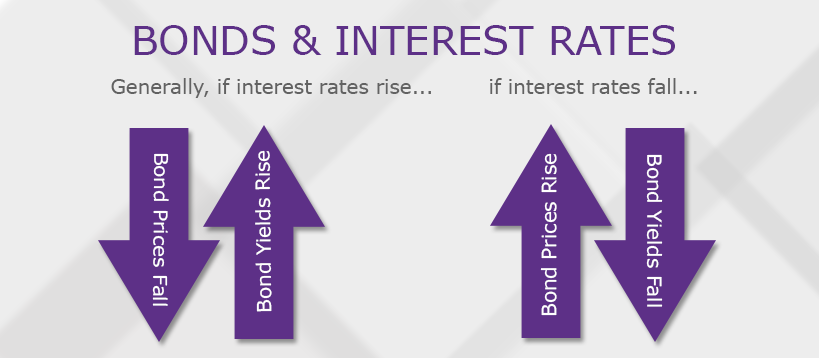
  • Interest rates: Higher interest rates can encourage saving and reduce spending, lowering velocity. Conversely, lower rates can stimulate borrowing and spending.
  • Inflation expectations: If people expect prices to rise, they may spend more quickly, increasing velocity.
  • Technological and structural changes: Innovations in digital payments and shifts in consumer behavior can also affect how quickly money moves.

Historically, the velocity of money has fluctuated with economic cycles. During periods of economic expansion, velocity tends to rise as spending increases. In contrast, during recessions or periods of uncertainty, velocity often falls as consumers and businesses hold onto cash. For instance, during the 2008 financial crisis and the early stages of the COVID-19 pandemic, velocity dropped sharply due to reduced consumer spending and increased saving.

In recent years, the U.S. has experienced persistently low velocity, even amid significant increases in the money supply. This phenomenon has puzzled economists and raised questions about the effectiveness of monetary policy. Despite aggressive stimulus measures, much of the new money has remained in savings or financial markets rather than circulating through the real economy.

Understanding the velocity of money is essential for policymakers. A low velocity may signal weak demand and justify expansionary fiscal or monetary policies. Conversely, a high velocity could indicate overheating and the need for tightening measures to prevent inflation.

In conclusion, the velocity of money is a dynamic indicator of economic vitality. It helps economists and central banks assess the flow of money, the strength of demand, and the potential for inflation.

While often overlooked by the public, it plays a vital role in shaping economic policy and understanding the broader health of the economy.

COMMENTS APPRECIATED

EDUCATION: Books

SPEAKING: Dr. Marcinko will be speaking and lecturing, signing and opining, teaching and preaching, storming and performing at many locations throughout the USA this year! His tour of witty and serious pontifications may be scheduled on a planned or ad-hoc basis; for public or private meetings and gatherings; formally, informally, or over lunch or dinner. All medical societies, financial advisory firms or Broker-Dealers are encouraged to submit an RFP for speaking engagements: CONTACT: Ann Miller RN MHA at MarcinkoAdvisors@outlook.com -OR- http://www.MarcinkoAssociates.com

Like, Refer and Subscribe

***

***

PHYSICIAN: Car Repossessions Rise!

By Dr. David Edward Marcinko MBA MEd

SPONSOR: http://www.MarcinkoAssociates.com

***

***

Physicians are increasingly facing car repossessions in 2025 due to rising debt, high vehicle prices, and economic pressures that are reshaping the financial landscape for medical professionals.

Traditionally viewed as financially secure, doctors are now among the growing number of Americans struggling to keep up with auto loan payments. The surge in car repossessions—expected to reach a record 10.5 million assignments by the end of 2025—has not spared the medical community. While physicians often earn higher-than-average incomes, they also carry significant financial burdens, including student loan debt, practice overhead, and personal expenses. These pressures are being amplified by macroeconomic forces such as inflation, high interest rates, and stagnant reimbursement rates.

One of the key contributors to this trend is the soaring cost of vehicles. In 2025, the average price of a new car in the U.S. surpassed $50,000, a dramatic increase from just a decade ago. For physicians who rely on vehicles for commuting between hospitals, clinics, and private practices, owning a reliable car is not a luxury—it’s a necessity. However, the combination of high sticker prices and elevated interest rates—averaging 7.3% for used cars and 11.5% for new cars—has made financing increasingly difficult.

***

***

Even high-income professionals are not immune to the broader auto loan crisis. Subprime auto loan delinquencies reached 6.6% in early 2025, the highest rate in over 30 years.While physicians typically fall into the prime or super-prime credit categories, many are still affected by cash flow disruptions, especially those in private practice or rural areas where patient volumes and insurance reimbursements have declined. Additionally, younger doctors with substantial student debt may find themselves overleveraged, making it harder to keep up with car payments.

The emotional and professional toll of a car repossession can be significant. Beyond the embarrassment and logistical challenges, losing a vehicle can disrupt a physician’s ability to provide care, attend emergencies, or maintain a consistent work schedule. This can lead to further income loss, creating a vicious cycle of financial instability.

To combat this trend, some physicians are turning to financial advisors to restructure their debt, refinance auto loans, or downsize to more affordable vehicles. Others are advocating for systemic reforms, such as student loan forgiveness, higher Medicare reimbursements, and better financial literacy training during medical education.

In conclusion, the rise in car repossessions among doctors is a stark reminder that no profession is immune to economic volatility. As the cost of living continues to climb and financial pressures mount, even those in traditionally stable careers must adapt to protect their assets and livelihoods.

Addressing this issue requires both individual financial planning and broader policy changes to ensure that physicians can continue to serve their communities without the looming threat of personal financial collapse.

COMMENTS APPRECIATED

EDUCATION: Books

SPEAKING: Dr. Marcinko will be speaking and lecturing, signing and opining, teaching and preaching, storming and performing at many locations throughout the USA this year! His tour of witty and serious pontifications may be scheduled on a planned or ad-hoc basis; for public or private meetings and gatherings; formally, informally, or over lunch or dinner. All medical societies, financial advisory firms or Broker-Dealers are encouraged to submit an RFP for speaking engagements: CONTACT: Ann Miller RN MHA at MarcinkoAdvisors@outlook.com -OR- http://www.MarcinkoAssociates.com

Like, Refer and Subscribe

***

***

BAD MONEY MOVES of Physicians!

By Dr. David Edward Marcinko MBA MEd

SPONSOR: http://www.MarcinkoAssociates.com

***

***

Money is a powerful tool. It can provide security, open opportunities, and help build a fulfilling life. Yet, when mismanaged, it can quickly become a source of stress and regret. Understanding the worst ways to use money is essential for anyone who wants to avoid financial pitfalls and build lasting stability.

1. Impulse Spending

One of the most damaging habits is spending without thought. Buying items on impulse—whether it’s clothes, gadgets, or luxury goods—often leads to regret and wasted resources. These purchases rarely align with long‑term goals and can drain savings meant for emergencies or investments.

2. High‑Interest Debt

Credit cards and payday loans can trap people in cycles of debt. Paying 20% or more in interest means that even small purchases balloon into massive financial burdens. Using debt irresponsibly is one of the fastest ways to erode wealth.

3. Ignoring Savings and Investments

Failing to save for the future is another critical mistake. Without an emergency fund, unexpected expenses like medical bills or car repairs can derail financial stability. Similarly, neglecting investments means missing out on compound growth that builds wealth over time.

4. Chasing Get‑Rich‑Quick Schemes

From pyramid schemes to speculative “hot tips,” chasing unrealistic returns is a recipe for disaster. These schemes prey on greed and impatience, often leaving participants with nothing but losses. Sustainable wealth comes from patience and discipline, not shortcuts.

5. Overspending on Status

Many people waste money trying to impress others—buying luxury cars, designer clothes, or extravagant experiences they cannot afford. This pursuit of status often leads to debt and financial insecurity, while providing only fleeting satisfaction.

6. Neglecting Insurance

Skipping health, auto, or home insurance to save money may seem smart in the short term, but it can be catastrophic when disaster strikes. Without protection, one accident or emergency can wipe out years of savings.

7. Failing to Budget

Living without a plan is like sailing without a map. Without a budget, it’s easy to overspend, miss bills, or fail to allocate money toward goals. Budgeting is not restrictive—it’s empowering, because it ensures money is used intentionally.

8. Ignoring Education and Skills

Spending money without investing in personal growth is another hidden mistake. Education, training, and skill development often yield lifelong returns. Neglecting these opportunities can limit earning potential and financial independence.

Conclusion

The worst things to do with money often stem from short‑term thinking, lack of discipline, or the desire for instant gratification. Impulse spending, high‑interest debt, chasing schemes, and neglecting savings all undermine financial health. By avoiding these traps and focusing on budgeting, investing wisely, and protecting against risks, money can serve as a foundation for security and freedom rather than a source of stress.

COMMENTS APPRECIATED

Like, Refer and Subscribe

EDUCATION: Books

SPEAKING: Dr. Marcinko will be speaking and lecturing, signing and opining, teaching and preaching, storming and performing at many locations throughout the USA this year! His tour of witty and serious pontifications may be scheduled on a planned or ad-hoc basis; for public or private meetings and gatherings; formally, informally, or over lunch or dinner. All medical societies, financial advisory firms or Broker-Dealers are encouraged to submit an RFP for speaking engagements: CONTACT: Ann Miller RN MHA at MarcinkoAdvisors@outlook.com -OR- http://www.MarcinkoAssociates.com

***

***

Austrian vs Keynesian Economics Explained

Austrian Economics vs. Keynesian Economics in One Simple Chart

Courtesy of 

***

AE-vs_-KE-326x1024

***

***

***

***

***

Conclusion

Your thoughts and comments on this ME-P are appreciated. Feel free to review our top-left column, and top-right sidebar materials, links, URLs and related websites, too. Then, subscribe to the ME-P. It is fast, free and secure.

Speaker: If you need a moderator or speaker for an upcoming event, Dr. David E. Marcinko; MBA – Publisher-in-Chief of the Medical Executive-Post – is available for seminar or speaking engagements.

OUR OTHER PRINT BOOKS AND RELATED INFORMATION SOURCES:

Risk Management, Liability Insurance, and Asset Protection Strategies for Doctors and Advisors: Best Practices from Leading Consultants and Certified Medical Planners™8Comprehensive Financial Planning Strategies for Doctors and Advisors: Best Practices from Leading Consultants and Certified Medical Planners™

***

FEDERAL RESERVE: Cuts Interest Rates

BREAKING NEWS!

By Staff Reporters

***

***

Federal Reserve Chairman Jerome Powell just announced that the central bank [FOMC] would cut interest rates amid President Donald Trump’s attempts to reshape the Fed’s independence.

The chairman announced that the Federal Reserve would cut the interest rate by .25 points, the first time that it cut interest rates since December.

COMMENTS APPRECIATED

EDUCATION: Books

Like, Refer and Subscribe

***

***

Stocks, Bonds and Commodities

By A.I.

***

***


Bonds
: Treasury yields rose yesterday as investors dug into a Federal appeals court ruling last Friday stating that most of President Trump’s tariffs are illegal. The 30-year yield closed in on the key 5% level.
Stocks: Equities tumbled across the board as technology stocks sold off and pulled the rest of the market down with them.
Commodities: Gold hit a new record high as traders hedged against tariff uncertainty and braced themselves for an extremely important US jobs report on Friday that could make or break the case for the Fed to start cutting rates.

COMMENTS APPRECIATED

EDUCATION: Books

Refer, Like and Subscribe

***

***

PHYSICIANS BEWARE: The APR Car Lease “Money Factor”

By A.I. and Dr. David Edward Marcinko MBA MEd CMP

SPONSOR: http://www.CertifiedMedicalPlanner.org

***

***

What is it?

The so-called money factor (abbreviated as MF on invoices) is a number in a decimal form that dealers use to calculate the APR of a car lease. It’s a major part of your monthly payment and dealers are known to jack up the money factor to pad their profits.

BROKE DOCTORS: https://medicalexecutivepost.com/2025/08/02/doctors-going-broke-and-living-paycheck-to-paycheck/

How it works

Most doctors don’t ask to see it because they’re not aware of it or don’t know how to calculate it. Ask to see the money factor, then multiply it by 2,400.

For example, if the money factor is .00150, you multiply it by 2,400 to get 3.6%. If that’s higher than the prevailing rate, you have room to talk them down.

How to reduce it

So how do you get a good interest rate when you lease a vehicle? The same way you do when borrowing for any other reason, whether it’s buying a home or applying for a personal loan: by having good credit. This may reduce your interest rate because you’ll represent a lower risk to a lender.

A high residual value on the car could also help you get a better interest rate. A higher residual value means you’d have lower monthly payments because there would be less depreciation on the vehicle. Since interest is applied to your monthly payment, a lower monthly payment would equate to reduced interest charges.

MONEY DOCTORS: https://medicalexecutivepost.com/2025/04/08/psychology-a-money-relationship-questionnaire-for-doctors/

Financial implications

The money factor is one of the many numbers you may want to learn about when leasing a car. It’s one of the transactional costs that come with leasing, and allows dealers and finance companies to make a profit on every lease they execute. As a consumer, it’s a smart idea to learn the financial implications of this number and how it’ll affect your overall costs over the course of a multi-year lease.

***

***

If the interest rate is too high, you may need to shop around for a better rate, negotiate with the dealer or lender to lower the money factor, or consider leasing another vehicle that’s more in line with your budget. Either way, make sure you explore all your financial options before taking a car off the lot.

SALARY NEGOTIATIONS: https://medicalexecutivepost.com/2016/08/21/salary-negotiations-skills-for-doctors-hospitalists/

COMMENTS APPRECIATED

EDUCATION: Books

SPEAKING: Dr. Marcinko will be speaking and lecturing, signing and opining, teaching and preaching, storming and performing at many locations throughout the USA this year! His tour of witty and serious pontifications may be scheduled on a planned or ad-hoc basis; for public or private meetings and gatherings; formally, informally, or over lunch or dinner. All medical societies, financial advisory firms or Broker-Dealers are encouraged to submit an RFP for speaking engagements: CONTACT: Ann Miller RN MHA at MarcinkoAdvisors@outlook.com -OR- http://www.MarcinkoAssociates.com

Like and Subscribe

***

***

Stocks Up, Bond Yields Down as Commodities Rise and Fall

By A.I and ME-P Staff Reporters

SPONSOR: http://www.CertifiedMedicalPlanner.org

***

***

  • Stocks: The stock markets rose today after Jerome Powell opened the door to interest rate cuts. The Dow soared to a new all-time high, while small-cap stocks in the Russell 2000 had a banner day.
  • Bonds: Yields fell while the chances of a rate cut after the Fed’s next meeting in September rose to 83%.
  • Commodities: Gold rose on rate cut hopes while oil fell as peace talks between Ukraine and Russia stalled. But the biggest winner is coffee: prices have risen for six straight days to cap off its biggest weekly gain since 2021.

COMMENTS APPRECIATED

EDUCATION: Books

Like and Subscribe

***

***

Beware of Borrowing That Helps Your Advisor – Not You

By Rick Kahler MSFP CFP

***

***

When Maria needed $400,000 for a down payment on a new home, her broker at a large Wall Street firm offered a solution: “Don’t sell investments and trigger capital gains. Just take out a margin loan.”

A margin loan is a line of credit from a brokerage firm, secured by the client’s investment portfolio. It offers quick access to cash with no immediate tax consequences and minimal paperwork. But the convenience comes at a cost. As of mid-2025, margin loan interest rates range from 6.25% to over 11%.

Margin loan recommendations are often presented by brokers as tax-savvy strategies that allow clients to access “tax-free” cash while keeping their portfolios intact. In many cases, however, the math benefits the advisor more than the investor. The cost of borrowing often exceeds what an investor is likely to earn by holding on.

For example, let’s assume an interest rate of 7.5% on Maria’s $400,000 margin loan. While borrowing delayed the payment of $20,000 in capital gains tax, she will eventually have to pay that tax anyway unless she holds the investments until her death. Two years later, with portfolio returns of 4% annually, she had earned around $32,000 from the $400,000 in investments she might have sold. Meanwhile, she had paid $60,000 in interest—leaving her some $28,000 worse off. That’s without factoring in ongoing interest payments, or the risks of a margin call if the investments securing the loan drop in value.

Why do advisors keep recommending margin loans? Because selling investments reduces the portfolio size and the advisor’s fee. Borrowing keeps the portfolio intact and the compensation unchanged—while the firm receives additional income from interest on the loan. In some cases, advisors suggest using margin loans to buy more investments, increasing both the portfolio and the fee they collect.

None of this is illegal. But when the borrowing cost is higher than expected returns and the advisor benefits financially, the ethics are questionable. The client takes the risk, while the advisor keeps the revenue.

This kind of conflict appears more often in portfolios where compensation is tied to asset volume and the company’s primary culture rewards gathering assets over delivering unbiased advice. By contrast, fee-only financial planning and investment advisors typically operate on simpler hourly, flat, or tiered fee structures. Their compensation doesn’t depend on whether a client borrows, sells, or holds. The culture of the firm focuses on conflict-free advice aligned with the client’s best interest.

Wall Street brokers are often held to a fiduciary standard, but structure still matters. In 2024 the SEC reported their examinations of brokers would continue to focus on advisor recommendations unduly influenced by the company’s compensation and incentives.

There are rare situations where a margin loan may be appropriate. A client with large unrealized gains might use a short-term margin loan to minimize taxes. An elderly investor might borrow tax-free rather than sell assets that will receive a step-up in basis at their death. Even in those cases, the math must be exact and the client must clearly understand the risks, including the possibility of a margin call.

If your advisor recommends a margin loan, especially to buy more investments, ask strong questions. What’s the interest rate? What return is realistic? What are the tax consequences of selling? How does this affect the advisor’s income?

If you don’t get direct answers, that’s a warning sign.

In a high-rate, low-return environment, margin loans rarely favor the client. The exceptions are narrow. The risks are significant. And the conflict of interest is measurable.

Sometimes the smartest move is the simplest: sell what you need, pay the tax, and leave leverage out of your plan.

COMMENTS APPRECIATED

Like and Subscribe

***

***

EMPLOYMENT: Growing Slowly

By AI

BREAKING NEWS

***

***

Job growth is slowing, but still bigger than expected

US employers added 139,000 jobs last month, government data released yesterday shows—that’s less than the down-wardly revised 147,000 new jobs that were added in April, but more than economists had predicted. Meanwhile, the unemployment rate held steady.

MAY: https://medicalexecutivepost.com/2025/06/06/may-jobs-report/

Overall, the highly anticipated jobs report reflects employers growing more cautious in the face of the economic uncertainty brought on by the trade war, but so far, there doesn’t seem to be a steep drop off in the labor market. That could give the Fed reason to stay in wait-and-see mode on interest rates, though President Trump still used the occasion to urge Jerome Powell to cut rates “a full point” on Truth Social.

PHYSICIAN EMPLOYMENT CONTRACTS: https://medicalexecutivepost.com/2024/01/12/sample-new-physician-letter-of-employment-contract/

COMMENTS APPRECIATED

Like and Refer

***

***

Tariffs, Private Sector Jobs, Interest Rates, Gold and the US Dollar

BREAKING NEWS!

By Staff Reporters with AI Generation

SPONSOR: http://www.CertifiedMedicalPlanner.org

***

***

  • 50% tariffs on steel and aluminum went into effect today. To celebrate, President Trump hopped on Truth Social to put China’s President Xi on blast ahead of an expected call between the two heads of state. And, Temu lost 58% of its daily users thanks to tariffs.
  • The president also pushed Jerome Powell to “LOWER THE RATE” following terrible private sector job numbers. Stocks are seemingly immune to tough trade talk and interest rate rants at this point, but bond yields sank on fears of slower economic growth.
  • The US dollar slipped, propelling gold higher as investors sought safety.

COMMENTS APPRECIATED

Like and Subscribe

***

***

OSTRICH BIAS: Negative Information

SPONSOR: http://www.CertifiedMedicalPlanner.org

Financial Advisor, Planner and Insurance Agent Information

By Staff Reporters

***

***

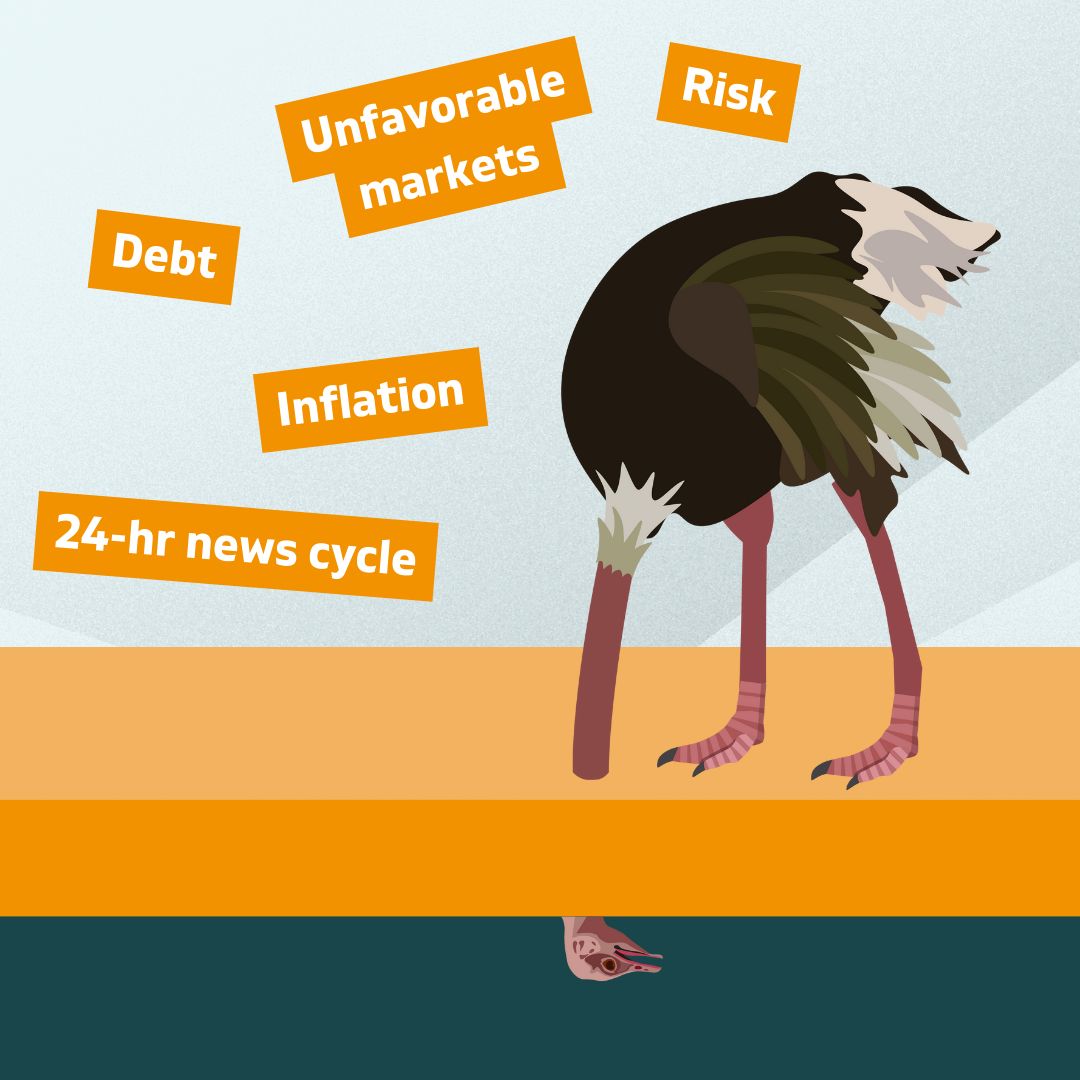
Ostrich Bias is a behavioral phenomenon describing the tendency of individuals to avoid or ignore information that they perceive as negative or threatening. This term is derived from the popular but inaccurate belief that ostriches bury their heads in the sand when faced with danger, even though they do not exhibit such behavior.

Evidence: There is neuro-scientific evidence of the ostrich effect. Sharot et al. (2012) investigated the differences in positive and negative information when updating existing beliefs. Consistent with the ostrich effect, participants presented with negative information were more likely to avoid updating their beliefs; wills, estate plans, investment portfolios, and insurance policies, etc..

Moreover, they found that the part of the brain responsible for this cognitive bias was the left IFG – inferior frontal gyrus – by disrupting this part of the brain with TMS – transcranial magnetic stimulation – participants were more likely to accept the negative information provided.

EXAMPLE: The Ostrich Bias can cause someone to avoid looking at their bills, because they’re worried about seeing how far behind they are on home mortgage payments, credit cards, education or auto loans, etc.

COMMENTS APPRECIATED

The Medical Executive-Post is a  news and information aggregator and social media professional network for medical and financial service professionals.

Feel free to submit education content to the site as well as links, text posts, images, opinions and videos which are then voted up or down by other members. Comments and dialog are especially welcomed.

Daily posts are organized by subject. ME-P administrators moderate the activity. Moderation may also conducted by community-specific moderators who are unpaid volunteers.

Invite Dr. Marcinko

Refer and Like

***

***

DAILY UPDATE: Fed Holds Interest Rates Steady as Stock Markets Rise

MEDICAL EXECUTIVE-POST TODAY’S NEWSLETTER BRIEFING

***

Essays, Opinions and Curated News in Health Economics, Investing, Business, Management and Financial Planning for Physician Entrepreneurs and their Savvy Advisors and Consultants

Serving Almost One Million Doctors, Financial Advisors and Medical Management Consultants Daily

A Partner of the Institute of Medical Business Advisors , Inc.

http://www.MedicalBusinessAdvisors.com

SPONSORED BY: Marcinko & Associates, Inc.

***

http://www.MarcinkoAssociates.com

Daily Update Provided By Staff Reporters Since 2007.
How May We Serve You?
© Copyright Institute of Medical Business Advisors, Inc. All rights reserved. 2025

REFER A COLLEAGUE: MarcinkoAdvisors@outlook.com

SPONSORSHIPS AVAILABLE: https://medicalexecutivepost.com/sponsors/

ADVERTISE ON THE ME-P: https://tinyurl.com/ytb5955z

Your Referral Count -0-

CITE: https://www.r2library.com/Resource

The Federal Reserve is still firmly in wait-and-see mode.

The Fed left its key interest rate unchanged again Wednesday and gave no hint it plans to lower it soon as President Donald Trump’s sweeping tariffs raise the risks of both another inflation spike and recession. But officials signaled they’re growing increasingly concerned about both hazards.

CITE: https://tinyurl.com/2h47urt5

What’s up

  • Netflix rose 1.56% after the streamer revamped its homepage and rolled out new AI search tools.
  • Nvidia popped 3.10% on news that President Trump will rescind Biden-era global chip curbs.
  • Advanced Micro Devices rose just 1.76% despite the chipmaker beating earnings and forecasting solid growth ahead.
  • Lions Gate Entertainment soared 20.77% after it finalized the separation of its studio and STARZ business segments into two distinct companies.
  • Logitech rose 1.46% thanks to an upgrade from UBS analysts who say the device maker is well-positioned to capitalize on Gen Alpha, 94% of whom play video games.
  • Charles River Laboratories popped 18.81% after the pharmaceutical company raised its full-year guidance above Wall Street’s expectations.
  • Rockwell Automation gained 11.90% on a beat-and-raise quarter thanks to higher demand for domestic manufacturing.

What’s down

  • Super Micro Computer fell 1.40% after the AI server maker missed on revenue last quarter and forecast slower revenue growth this quarter.
  • WW International, better known as Weight Watchers, plummeted 43.04% on the news that the company is going bankrupt.
  • Marvell Technology plunged 8.02% after the data storage manufacturer postponed its investor day—never a good sign.
  • Rivian Automotive tumbled 5.78% on management’s forecast that vehicle deliveries will be lower than expected this year.
  • Arista Networks beat Wall Street’s estimates but fell 4.76% after it warned that its margins will be squeezed in the coming quarters.
  • Sarepta Therapeutics plummeted 21.45% after posting a bigger-than-expected loss last quarter and projecting slower revenue growth this quarter.

CITE: https://tinyurl.com/tj8smmes

Visualize: How private equity tangled banks in a web of debt, from the Financial Times.

COMMENTS APPRECIATED

PLEASE SUBSCRIBE: MarcinkoAdvisors@outlook.com

Thank You

***

***

***

***

EDUCATIONAL TEXTBOOKS: https://tinyurl.com/4zdxuuwf

***

The Deeper Damage From a Declining Dollar

By Rick Kahler CFPMSFP

***

***

DECLINE OF THE DOLLAR

On-again, off-again tariffs. Rising prices. Dramatic market swings. The anxiety-producing headlines come so fast it’s hard to know what to worry about first. Meanwhile, one serious consequence of all this chaos is going almost unnoticed. That is the decline of the dollar.

Since the start of this year, the value of the U.S. dollar has slipped more than 10% against other major currencies. That drop is not just an economic statistic. It affects all Americans’ daily lives.

People are feeling the pinch of rising prices at checkout lines, gas stations, and shipping counters. But there isn’t a full understanding of why. Tariffs are only half the story. The weakening dollar amplifies those price increases even further.

For years, the dollar remained strong even as the national debt ballooned. It benefited from its reputation as a safe haven, from global demand, and from U.S. interest rates. But much of that strength, as we now see, was fragile—propped up more by perception than fundamentals. In April, sweeping tariffs triggered a sharp market correction, and the dollar suddenly fell to its lowest point in over three years. Market confidence vanished overnight.

This was more than a market reaction. It signaled a collapse in trust—not just in policy, but in principle. It is no longer a given that the U.S. will act with consistency, reason, and long-term responsibility. What’s unraveling is both our country’s financial credibility and the moral foundation that underpinned it.

When a currency represents a nation, its value reflects more than economics. It reflects governance, accountability, stability, and integrity. When the dollar stumbles, it speaks to who we are, and whether we can still be counted on.

Yet, most people aren’t talking about the decline of the dollar. This may come from being overwhelmed, choosing to ignore even more bad news, or actually believing that this is a necessary step in making things better. It is not.

We all respond differently to financial uncertainty. Some lean into hyper-vigilance—tightening budgets, tracking every headline. Others shut down, turning toward distraction. Still others press on as if nothing has changed. These are all natural human reactions.

They are not the same as leadership. And leadership—internal and external—is what’s needed now. Not panic. Not blame. Just the courage to face where we are and the willingness to start again from there.

But leadership is in short supply in Washington, where many in both parties remain silent. Some fear political retribution from the administration, others fear backlash from increasingly extreme and vocal constituencies. That silence costs us all.

A respected government official recently told me that, while some of the domestic damage to our economy could be repaired within a few years, rebuilding global confidence in the United States may take a generation. That is a reflection of the rapid erosion of trust that has already happened in the last three months. Trust that took decades to build has been unwound in a matter of weeks. Even if we reversed every policy decision tomorrow, the damage is done.

We cannot change what’s already happened. We can still choose to show up. To pay attention. To have the hard conversations. To lead our own financial lives with more clarity, integrity, and intention than before. That kind of personal leadership may not fix the dollar. But it can help rebuild what underlies its value: trust, steadiness, and the moral grounding we’ve begun to lose.

Because the dollar’s decline is more than an economic headline.

It’s a story about who we are—and whether we’re ready to live with open eyes in a world where the old assumptions no longer hold.

COMMENTS APPRECIATED

Like and Refer

***

***

JOHN B. TAYLOR’S: Monetary Policy Rule

SPONSOR: http://www.CertifiedMedicalPlanner.org

By Staff Reporters

***

***

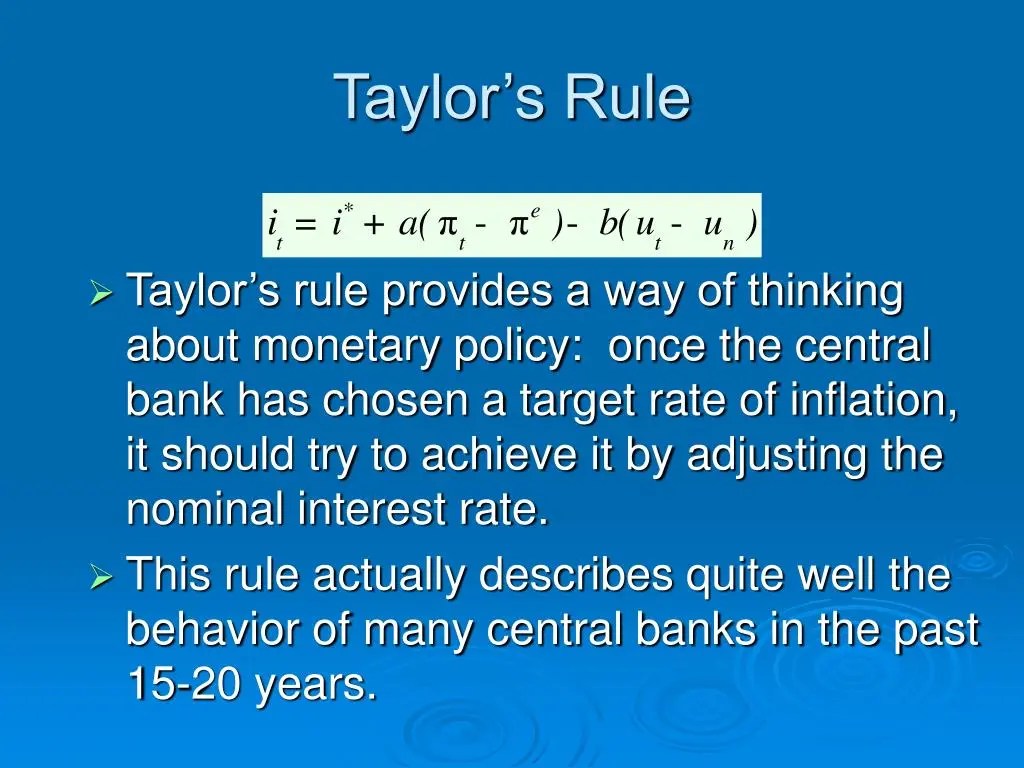
Named for a U.S. economist, the JB Taylor Rule is a mathematical monetary-policy formula that recommends how much a central bank should change its nominal short-term interest rate target (such as the U.S. Federal Reserve’s federal funds rate target) in response to changes in economic conditions, particularly inflation and economic growth. It’s typically viewed as guideline for raising short-term interest rates as inflation and potentially inflationary pressures increase. The rule recommends a relatively high interest rate (“tight” monetary policy) when inflation is above its target or when the economy is above its full employment level, and a relatively low interest rate (“easy” monetary policy) under the opposite conditions.

To illustrate, the monetary policy of the FOMC changed throughout the 20th century. The period between the 1960s and the 1970s is evaluated by Taylor and others as a period of poor monetary policy; the later years typically characterized as stagflation. The inflation rate was high and increasing, while interest rates were kept low. Since the mid-1970s monetary targets have been used in many countries as a means to target inflation.

However, in the 2000s the actual interest rate in advanced economies, notably in the US, was kept below the value suggested by the Taylor rule.

COMMENTS APPRECIATED

Like and Refer

***

***

CREDIT CARDS: Mistakes All Doctors Must Avoid

By Staff Reporters

***

***

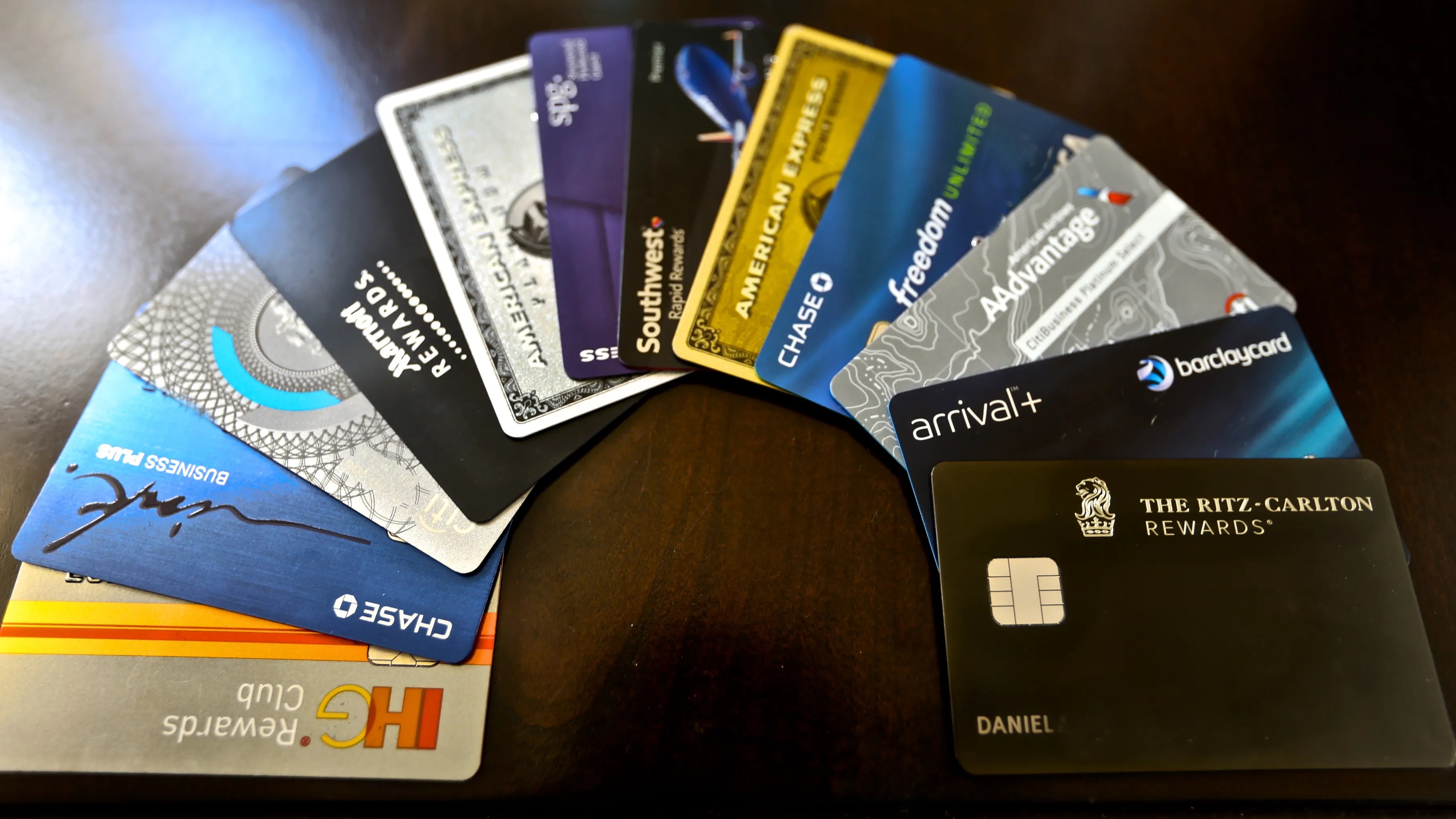
Credit Card Mistakes to Avoid

No number has as far-reaching an impact on your money as your credit scores. Here are some credit card obstacles all physicians, nurses and medical professionals should dodge on the road to financial security

***

***

  • Don’t pay for a credit card repair service.
  • Don’t miss a payment.
  • Don’t max out your card.
  • Don’t take a cash-advance.
  • Don’t skip using your cards.
  • Don’t chase interest rates.
  • Don’t apply for several credit cards all at once.
  • Don’t co-sign a loan.
  • Don’t spread our car or mortgage payments.


COMMENTS APPRECIATED

Refer and Subscribe

***

***

FOMC: Interest Rates Remain Steady

BREAKING NEWS!

***

***

The Federal Reserve just opted to hold interest rates steady as officials reckon with fearful markets and concerns of an economic slowdown sparked by the trade wars launched by President Donald Trump and his efforts to overhaul and dismantle government agencies.

After a two-day meeting of its monetary policy committee in Washington, D.C., the Fed announced it would hold its rate target at a range of 4.25% to 4.50%. Investors anticipated the move. The Fed’s target rate remains a full percentage point lower than it was when the Fed pivoted to cutting rates last September.

COMMENTS APPRECIATED

Subscribe, Read and Refer

***

***

DAILY UPDATE: BC/BS Anti-Trust Lawsuit as Stock Markets Close Mixed

MEDICAL EXECUTIVE-POST TODAY’S NEWSLETTER BRIEFING

***

Essays, Opinions and Curated News in Health Economics, Investing, Business, Management and Financial Planning for Physician Entrepreneurs and their Savvy Advisors and Consultants

Serving Almost One Million Doctors, Financial Advisors and Medical Management Consultants Daily

A Partner of the Institute of Medical Business Advisors , Inc.

http://www.MedicalBusinessAdvisors.com

SPONSORED BY: Marcinko & Associates, Inc.

***

http://www.MarcinkoAssociates.com

Daily Update Provided By Staff Reporters Since 2007.
How May We Serve You?
© Copyright Institute of Medical Business Advisors, Inc. All rights reserved. 2025

REFER A COLLEAGUE: MarcinkoAdvisors@outlook.com

SPONSORSHIPS AVAILABLE: https://medicalexecutivepost.com/sponsors/

ADVERTISE ON THE ME-P: https://tinyurl.com/ytb5955z

Your Referral Count -0-

CITE: https://www.r2library.com/Resource

Blue Cross Blue Shield will soon begin paying out $2.67 billion to customers follow a years-long lawsuit alleging that the health insurance giant broke antitrust laws. The litigation began in 2013, when a class-action lawsuit was filed against more than 35 Blue Cross Blue Shield health insurance plans. The lawsuit claims the company broke antitrust laws by limiting market competition, resulting in increased premiums and reduced options for customers.

CITE: https://tinyurl.com/2h47urt5

US stocks closed mixed on Tuesday as investors assessed more tariff policy shifts from President Donald Trump and looked ahead to upcoming inflation data.

Traders also digested the start of Federal Chair Jerome Powell’s two-day testimony in Congress. In his opening remarks, Powell told lawmakers the Fed is not in a rush to adjust interest rates and reiterated the central bank’s stance of not commenting on trade policy.

The Dow Jones Industrial Average (^DJI) edged around 0.3% higher, while the benchmark S&P 500 (^GSPC) closed just above the flatline. The tech-heavy NASDAQ Composite (^IXIC) pulled back about 0.4%.

CITE: https://tinyurl.com/tj8smmes

Visualize: How private equity tangled banks in a web of debt, from the Financial Times.

COMMENTS APPRECIATED

PLEASE SUBSCRIBE: MarcinkoAdvisors@outlook.com

Thank You

***

***

***

***

EDUCATIONAL TEXTBOOKS: https://tinyurl.com/4zdxuuwf

***

DAILY UPDATE: US Stocks Close Mixed

MEDICAL EXECUTIVE-POST TODAY’S NEWSLETTER BRIEFING

***

Essays, Opinions and Curated News in Health Economics, Investing, Business, Management and Financial Planning for Physician Entrepreneurs and their Savvy Advisors and Consultants

Serving Almost One Million Doctors, Financial Advisors and Medical Management Consultants Daily

A Partner of the Institute of Medical Business Advisors , Inc.

http://www.MedicalBusinessAdvisors.com

SPONSORED BY: Marcinko & Associates, Inc.

***

http://www.MarcinkoAssociates.com

Daily Update Provided By Staff Reporters Since 2007.
How May We Serve You?
© Copyright Institute of Medical Business Advisors, Inc. All rights reserved. 2025

REFER A COLLEAGUE: MarcinkoAdvisors@outlook.com

SPONSORSHIPS AVAILABLE: https://medicalexecutivepost.com/sponsors/

ADVERTISE ON THE ME-P: https://tinyurl.com/ytb5955z

Your Referral Count -0-

CITE: https://www.r2library.com/Resource

US stocks were mixed on Thursday in anticipation of Amazon’s (AMZN) quarterly results, as investors assessed the earnings season so far and eyed President Donald Trump’s fast-moving policy overhaul.

CITE: https://tinyurl.com/2h47urt5

The Dow Jones Industrial Average (^DJI) fell 0.3%. The S&P 500 (^GSPC) rose more than 0.3%, and the tech-heavy NASDAQ Composite (^IXIC) popped 0.5% on the heels of two winning days in a row for the major gauges.

CITE: https://tinyurl.com/tj8smmes

The tariff jitters that shook stocks earlier in the week may have eased, but markets are tracking incoming earnings for any company warnings. At the same time, tech- and chip-related results are being scrutinized for signals about the strength of AI demand.

Visualize: How private equity tangled banks in a web of debt, from the Financial Times.

COMMENTS APPRECIATED

PLEASE SUBSCRIBE: MarcinkoAdvisors@outlook.com

Thank You

***

***

***

***

EDUCATIONAL TEXTBOOKS: https://tinyurl.com/4zdxuuwf

***

DAILY UPDATE: Stocks Regain Steam

MEDICAL EXECUTIVE-POST TODAY’S NEWSLETTER BRIEFING

***

Essays, Opinions and Curated News in Health Economics, Investing, Business, Management and Financial Planning for Physician Entrepreneurs and their Savvy Advisors and Consultants

Serving Almost One Million Doctors, Financial Advisors and Medical Management Consultants Daily

A Partner of the Institute of Medical Business Advisors , Inc.

http://www.MedicalBusinessAdvisors.com

SPONSORED BY: Marcinko & Associates, Inc.

***

http://www.MarcinkoAssociates.com

Daily Update Provided By Staff Reporters Since 2007.
How May We Serve You?
© Copyright Institute of Medical Business Advisors, Inc. All rights reserved. 2025

REFER A COLLEAGUE: MarcinkoAdvisors@outlook.com

SPONSORSHIPS AVAILABLE: https://medicalexecutivepost.com/sponsors/

ADVERTISE ON THE ME-P: https://tinyurl.com/ytb5955z

Your Referral Count -0-

CITE: https://www.r2library.com/Resource

US stocks gained steam on Thursday afternoon as investors digested megacap tech earnings and waited for Apple (AAPL) results for more clues on prospects for Big Tech. The S&P 500 (^GSPC) gained 0.5%, while the Dow Jones Industrial Average (^DJI) rose nearly 0.4%. The tech-heavy NASDAQ Composite (^IXIC) was up nearly 0.3%.

And, after the Federal Reserve stood pat on interest rates as expected, investors have turned to parsing earnings reports — and in particular, the first wave of results from the “Magnificent Seven” companies that have driven broader stock market gains.

CITE: https://tinyurl.com/2h47urt5

Right ahead of the closing bell, President Donald Trump once again teased looming 25% tariffs on Mexico and Canada. The US dollar (DX=F) index spiked on the news, reversing earlier losses to close near flat.

CITE: https://tinyurl.com/tj8smmes

Visualize: How private equity tangled banks in a web of debt, from the Financial Times.

COMMENTS APPRECIATED

PLEASE SUBSCRIBE: MarcinkoAdvisors@outlook.com

Thank You

***

***

***

***

EDUCATIONAL TEXTBOOKS: https://tinyurl.com/4zdxuuwf

***

DAILY UPDATE: Healthcare Cyber Attacks as the FOMC Pauses Rates and Stock Markets Retreat

MEDICAL EXECUTIVE-POST TODAY’S NEWSLETTER BRIEFING

***

Essays, Opinions and Curated News in Health Economics, Investing, Business, Management and Financial Planning for Physician Entrepreneurs and their Savvy Advisors and Consultants

Serving Almost One Million Doctors, Financial Advisors and Medical Management Consultants Daily

A Partner of the Institute of Medical Business Advisors , Inc.

http://www.MedicalBusinessAdvisors.com

SPONSORED BY: Marcinko & Associates, Inc.

***

http://www.MarcinkoAssociates.com

Daily Update Provided By Staff Reporters Since 2007.
How May We Serve You?
© Copyright Institute of Medical Business Advisors, Inc. All rights reserved. 2025

REFER A COLLEAGUE: MarcinkoAdvisors@outlook.com

SPONSORSHIPS AVAILABLE: https://medicalexecutivepost.com/sponsors/

ADVERTISE ON THE ME-P: https://tinyurl.com/ytb5955z

Your Referral Count -0-

HAPPY LUNAR NEW YEAR

CITE: https://www.r2library.com/Resource

Over half the US population was affected by the Change Healthcare cyberattack last February, according to a statement from its parent company UnitedHealth Group. While United had told the federal government in October that 100 million people were hit by the attacks, an updated estimate on Monday put that number at 190 million.

CITE: https://tinyurl.com/2h47urt5

Tech stocks led markets lower on Wednesday as the broader mood stayed muted after the Federal Reserve’s latest interest rate decision saw the central bank keep rates unchanged in a range of 4.25%-4.5%.

The tech-heavy NASDAQ Composite (^IXIC) was down about 0.5%, retracing some of a bounce-back rally on Tuesday. The S&P 500 (^GSPC) was also down nearly 0.5%, while the Dow Jones Industrial Average (^DJI) lost 0.3%. In its statement on Wednesday, the Federal Reserve notably removed language from its December statement indicating that it was making progress towards its goal of 2% inflation, stating simply: “Inflation remains somewhat elevated.” Fed Chair Jerome Powell pushed back on that notion, referring to the change as “language cleanup” rather than intending to send a signal. Markets bounced off their lows of the day on Powell’s comments.

CITE: https://tinyurl.com/tj8smmes

Visualize: How private equity tangled banks in a web of debt, from the Financial Times.

COMMENTS APPRECIATED

PLEASE SUBSCRIBE: MarcinkoAdvisors@outlook.com

Thank You

***

***

***

***

EDUCATIONAL TEXTBOOKS: https://tinyurl.com/4zdxuuwf

***

K SHAPED: Economy and Recovery

By Staff Reporters

***

***

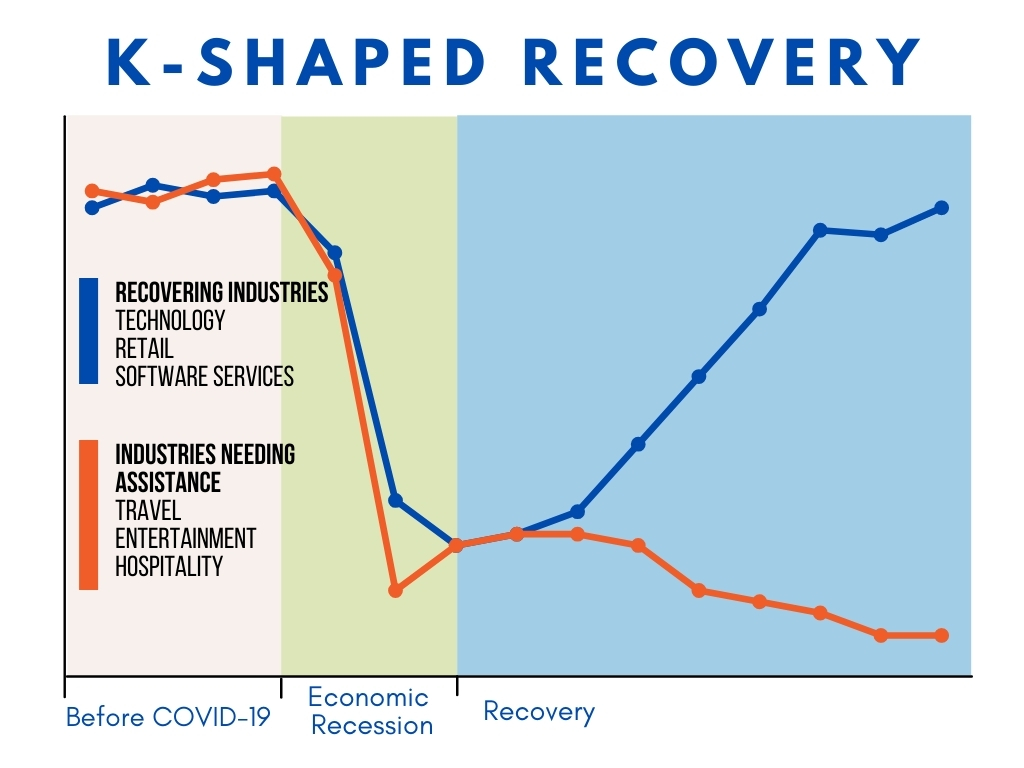
Understanding the K-shaped Economy

According to Olivia Voltaggio, in a V-shaped economy, things go down but then bounce back for everyone. In a K-shaped economy, the overall economy might go down. Only some parts of it recover, while others keep struggling.

In a K-shaped economy, people’s financial situations vary widely. Not everyone faces the same struggles. Lenders and financial institutions need to be flexible with strategy. They need to understand the different challenges their customers are dealing with.

Navigate with caution: The gaps in economic recovery highlight the importance of taking a careful, strategic approach.

How did we end up with a K-shaped recovery in 2024?

Inflation-driven price increases seem to be getting more stable. But, they may not reach the goal set by the government until 2026. This has made things more expensive for regular families.

For example, people with student loan debt had to start paying it back in October 2023. This was after a pandemic-induced grace period. Student loan repayment made budgeting harder. Borrowers might need to spend more on average than expected. For young adults (Gen Z), it could be even more.

Finally, more people are using credit cards because things are getting more expensive. Some are struggling to pay their credit card bills on time.

COMMENTS APPRECIATED

Like and Subscribe

***

***

FREDDIE MAC: (FHLMC-Federal Home Loan Mortgage Corporation)

By Staff Reporters

***

***

Freddie Mac (FHLMC-Federal Home Loan Mortgage Corporation)

Freddie Mac is a GSE [government-sponsored enterprise] established by Congress. It’s similar to Fannie Mae with a publicly owned corporate structure. (Freddie Mac’s stock (FRE) trades on the New York Stock Exchange.) These two giant GSEs increase liquidity in the U.S. mortgage market by purchasing mortgages from lenders, then typically repackaging (securitizing) the debt and reselling it to investors, helping to create a “secondary” market for mortgages.

The GSEs’ main purpose is to assure that mortgage money is available for borrowers. But they don’t lend money directly. Instead, they purchase mortgages from “primary” lenders like mortgage companies, banks, and credit unions. That allows the primary lenders to replenish their funds and lend more money to home buyers. The GSEs finance their mortgage purchases by issuing mortgage-backed securities (MBS) and other debt instruments (often referred to as agency debt, even though, technically, the GSEs aren’t government agencies). GSE debt is considered to have relatively high credit quality based on its implicit government backing, reinforced by what happened during the Financial Crisis in 2008.

Since Fannie Mae and Freddie Mac were placed into government conservatorship in September 2008, the government has pledged to support any shortfall in the balance sheets of the two GSEs. The U.S. Treasury has said it will ensure that both GSEs can maintain a positive net worth and fulfill all of their financial obligations. This statement of support lends credence to the very high credit ratings of MBS and other debt issued by Fannie and Freddie.

COMMENTS APPRECIATED

Like and Subscribe

***

***

FOMC: Cuts Interest Rates

BREAKING NEWS!

SPONSOR: http://www.MarcinkoAssociates.com

By Staff Reporters

***

***

The Federal Reserve cut interest rates by a quarter of a percentage point just now, delivering relief for borrowers at the central bank’s last meeting before President-elect Donald Trump takes office next month. The central bank predicted fewer rate cuts next year than it had previously indicated, however, suggesting concern that inflation may prove more difficult to bring under control than policymakers thought just a few months ago.

The move marked the third consecutive interest rate cut since the Fed opted to start dialing back its fight against inflation in the fall. The FOMC has lowered interest rates by a percentage point in recent months.

However, the Fed’s forecast said it anticipates only a half a percentage point of rate cuts next year and another half-percent cut in 2026.

COMMENTS APPRECIATED

Subscribe and Refer

***

***

EXPECTED: Breakeven Inflation Rate

Measure of Expected Inflation

By Staff Reporters

SPONSOR: http://www.MarcinkoAssociates.com

***

***

The breakeven inflation rate is the difference between the nominal yield (usually the market yield, which includes an inflation premium) on a fixed-income investment and the real yield (with no inflation premium) on an inflation-linked investment of similar maturity and credit quality.

So, if inflation averages more than the breakeven rate, the inflation-linked investment will outperform the investment with the nominal yield.

Conversely, if inflation averages below the breakeven rate, the investment with the nominal yield will outperform the inflation-linked investment.

Breakeven inflation rates are also considered useful measures of inflation expectations—higher breakeven rates represent higher inflation expectations (and higher relative prices for inflation-linked investments), while lower breakeven rates represent lower inflation expectations (and lower relative prices for inflation-linked investments).

Therefore, ideally, investors want to purchase inflation-linked investments when breakeven rates are relatively low because that’s typically when prices are also relatively low.

COMMENTS APPRECIATED

Thank You

***

***

CMO: Collateralized Mortgage Obligations

By Staff Reporters

SPONSOR: http://www.MarcinkoAssociates.com

***

***

Collateralized Mortgage Obligations (CMOs) are a form of securitized debt derived from mortgage-backed securities. It’s a form of derivative security. Like most MBS pass-through securities, CMOs are typically backed by pools of residential mortgages and their payments. But not all investors want to receive the monthly payments of principal and interest that “plain vanilla” MBS pass-throughs offer–some prefer just the principal, some prefer just the interest, or some want payments with other particular/special characteristics.

For them, the cash flows from MBS can be pooled and structured into many classes of CMOs with different maturities and payment schedules, creating securities with very specific characteristics and behaviors. These characteristics and behaviors can vary widely. Some CMOs can offer less risk than “plain-vanilla” MBS, or can help offset other forms of risk in a diversified portfolio, but others can be much more volatile.

CMOs typically have two or more bond classes, called tranches. Each tranche has its own expected maturity and cash flow pattern. The unique cash flow patterns of each CMO tranche allow investors to tailor their mortgage exposure to meet a range of investment objectives, since different classes can have different risk/return characteristics.

COMMENTS APPRECIATED

Thank You

***

***

DAILY UPDATE: FOMC Cuts Interest Rates as Stock Markets Rise

MEDICAL EXECUTIVE-POST TODAY’S NEWSLETTER BRIEFING

***

Essays, Opinions and Curated News in Health Economics, Investing, Business, Management and Financial Planning for Physician Entrepreneurs and their Savvy Advisors and Consultants

Serving Almost One Million Doctors, Financial Advisors and Medical Management Consultants Daily

A Partner of the Institute of Medical Business Advisors , Inc.

http://www.MedicalBusinessAdvisors.com

SPONSORED BY: Marcinko & Associates, Inc.

***

http://www.MarcinkoAssociates.com

Daily Update Provided By Staff Reporters Since 2007.
How May We Serve You?
© Copyright Institute of Medical Business Advisors, Inc. All rights reserved. 2024

REFER A COLLEAGUE: MarcinkoAdvisors@msn.com

SPONSORSHIPS AVAILABLE: https://medicalexecutivepost.com/sponsors/

ADVERTISE ON THE ME-P: https://tinyurl.com/ytb5955z

Your Referral Count -0-

The Federal Reserve cut interest rates by 0.25 percentage points Thursday, the second consecutive cut after a two-year rate-hike run to curb post-pandemic inflation.

CITE: https://www.r2library.com/Resource

What’s up

  • Lyft announced impressive earnings results thanks to more commuters using the ride-hailing service, as well as upbeat guidance for the future. Shares rose 22.92%.
  • Shareholders worried about a housing market slowdown hurting Zillow had nothing to fear: The real estate website crushed earnings estimates, and shares popped 23.77%.
  • Warner Bros. Discovery enjoyed its biggest single-quarter surge in subscribers ever thanks to streaming service Max, which sent shares soaring 11.81%.
  • Under Armour rocketed 23.33% higher after its cost-savings plan paid off last quarter and management guided for a strong quarter ahead.
  • Planet Fitness surprised shareholders with a solid quarter for the gym giant, as well as forecasts of more growth ahead. Shares climbed 11.26%.
  • Prison operators GEO Group and CoreCivic both surged on Trump’s election, and their rally continued today—in-spite of very different paths forward for each stock. GEO Group gained 13.63%, while CoreCivic rose 25.60%.

What’s down

  • Trump Media & Technology Group was one of the biggest winners on election night, and although the stock soared over the last few days, investors decided to take profits today. Shares sank 22.97%.
  • Wolfspeed plummeted 39.24% after announcing larger-than-expected losses last quarter, poor forecasts for next quarter, and layoffs to cut costs.
  • Match Group shareholders were heartbroken to hear that Tinder’s revenue fell last quarter, though strong revenue growth from Hinge helped ease the pain. Shares dropped 17.87%.
  • Virgin Galactic isn’t just a mean nickname from your high school years—it’s also a space stock that can’t make money to save its life. Shares fell 11.87%.

CITE: https://tinyurl.com/2h47urt5

Here’s where the major benchmarks ended:

  • The S&P 500® index (SPX) rose 44.06 points (0.74%) to 5,973.10; the Dow Jones Industrial Average® ($DJI) fell 0.59 points (0.00%) to 43,729.34; and the NASDAQ Composite® ($COMP) gained 285.99 points (1.51%) to 19,269.46.
  • The 10-year Treasury note yield (TNX) fell nine basis points to 4.34%, with most of the drop coming long before the Fed decision.
  • The CBOE Volatility Index® (VIX) continued its post-election plunge to 15.21.

CITE: https://tinyurl.com/tj8smmes

Visualize: How private equity tangled banks in a web of debt, from the Financial Times.

COMMENTS APPRECIATED

PLEASE SUBSCRIBE: MarcinkoAdvisors@msn.com

Thank You

***

***

***

***

EDUCATIONAL TEXTBOOKS: https://tinyurl.com/4zdxuuwf

***

ECONOMICS: John B. Taylor’s Rule

By Dr. David Edward Marcinko MBA MEd

SPONSOR: http://www.MarcinkoAssociates.com

***

***

Named for a U.S. economist, the JB Taylor Rule is a mathematical monetary-policy formula that recommends how much a central bank should change its nominal short-term interest rate target (such as the U.S. Federal Reserve’s federal funds rate target) in response to changes in economic conditions, particularly inflation and economic growth. It’s typically viewed as guideline for raising short-term interest rates as inflation and potentially inflationary pressures increase. The rule recommends a relatively high interest rate (“tight” monetary policy) when inflation is above its target or when the economy is above its full employment level, and a relatively low interest rate (“easy” monetary policy) under the opposite conditions.

To illustrate, the monetary policy of the FOMC, changed throughout the 20th century. The period between the 1960s and the 1970s is evaluated by Taylor and others as a period of poor monetary policy; the later years typically characterized as stagflation. The inflation rate was high and increasing, while interest rates were kept low. Since the mid-1970s monetary targets have been used in many countries as a means to target inflation.

However, in the 2000s the actual interest rate in advanced economics, notably in the US, was kept below the value suggested by the Taylor rule.

CITE: https://www.r2library.com/Resource/Title/0826102549

COMMENTS APPRECIATED

Subscribe Today!

Thank You

***

***

DAILY UPDATE: Markets & Economy USA

By Staff Reporters

***

***

  • Markets: Wall Street life was looking good last week as all the major indexes clinched their third consecutive winning week. Stocks were a mixed bag for Friday, but the Dow Jones scored another record close. Bristol Myers Squibb rose after the FDA approved its schizophrenia drug as the first new treatment for the condition in decades.
  • Economy: The FOMC’s favorite inflation gauge came in lower than expected for last month, likely clearing the way for Jerome Powell and the Federal Reserve to keep cutting interest rates.

CITE: https://www.r2library.com/Resource

COMMENTS APPRECIATED

Thank You

***

***

FEDERAL RESERVE: Lowers Interest Rates as Expected

By Staff Reporters

BREAKING NEWS

***

***

Jerome Powell and the Federal Reserve Bank just said that it is cutting its benchmark interest rate by 0.50 percentage points, marking the first reduction in four years and moving to ease borrowing costs as inflation-weary consumers are grappling with high rates on everything from mortgages to credit cards.

It is the first drop in the federal funds rate — or what banks charge each other for short-term loans — since the U.S. central bank lowered rates to nearly zero in March 2020 amid an economic standstill caused by the pandemic.

But as prices surged during the health crisis, the FOMC repeatedly hiked rates into a target range of 5.25% to 5.5%, the highest in 23 years, in an effort to curb inflation.

CITE: https://www.r2library.com/Resource

COMMENTS APPRECIATED

Thank You

***

***

FOMC: Interest Rate Cut Today?

At 2 pm EST Today

By Staff Reporters

***

***

ABOUT THE FEDERAL OPEN MARKET COMMITTEE

The term “monetary policy” refers to the actions undertaken by a central bank, such as the Federal Reserve, to influence the availability and cost of money and credit to help promote national economic goals. The Federal Reserve Act of 1913 gave the Federal Reserve responsibility for setting monetary policy.

The Federal Reserve controls the three tools of monetary policy–open market operations, the discount rate, and reserve requirements. The Board of Governors of the Federal Reserve System is responsible for the discount rate and reserve requirements, and the Federal Open Market Committee is responsible for open market operations. Using the three tools, the Federal Reserve influences the demand for, and supply of, balances that depository institutions hold at Federal Reserve Banks and in this way alters the federal funds rate. The federal funds rate is the interest rate at which depository institutions lend balances at the Federal Reserve to other depository institutions overnight.

Changes in the federal funds rate trigger a chain of events that affect other short-term interest rates, foreign exchange rates, long-term interest rates, the amount of money and credit, and, ultimately, a range of economic variables, including employment, output, and prices of goods and services.

Cite: https://www.federalreserve.gov/monetarypolicy/fomc.htm

***

And so, the macroeconomic FOMC is kicking off at 2pm ET today, when the Fed will announce the first interest rate cut in over four years. But, financial watchers are split between two predictions: a standard 0.25% cut or a more aggressive one of 0.5% (investors are betting on the latter, while many analysts think the former).

Regardless of its size, today’s rate cut and subsequent ones are expected to make borrowing cheaper for consumers and businesses, with ripple effects throughout the economy.

CITE: https://www.r2library.com/Resource

COMMENTS APPRECIATED

Thank You

***

***

STOCK MARKETS: Summer Ends at Record High

By Staff Reporters

Sponsored By: http://www.MarcinkoAssociates.com

***

***

Stock Markets celebrated Labor Day 2024 and the end of summer with the Dow Jones Industrial Average closing at another record high and the S&P 500 clinching its fourth straight winning month. The Fed’s favorite inflation gauge came in as expected, providing yet another sign pointing to a September interest rate cut.

CITE: https://www.r2library.com/Resource

And Intel rose on reports that the beleaguered micro chip maker is considering various options, including breaking up the business, to overcome its slump.

COMMENTS APPRECIATED

Thank You

***

***

What is a CARRY TRADE?

By Staff Reporters

***

***

A carry trade is a tactic in which an investor borrows a currency with lower interest rates and invests the proceeds in a higher-yielding asset, often in a different market with higher interest rates.

CITE: https://www.r2library.com/Resource

Over the past few years, many funds were using this strategy by buying US equities or selling US bonds with money borrowed from the yen because of the huge disparity in interest rates between the US and Japan. Japan kept the yen cheap on purpose because its economy is primarily export-driven, and the low price of Japanese products kept exports thriving. And the dollar, as the dominant global currency, has remained impressively strong through thick and thin.

This was all fun and profits, until Japan raised interest rates for the first time in 17 years last week. Suddenly, the yen wasn’t as cheap as it once was. And at the exact same time, the US is expected to cut interest rates in September, which means the dollar would become less valuable, completely throwing this international carry trade out of balance

COMMENTS APPRECIATED

Thank You

***

***

ECONOMIC LANDSCAPE: Understanding Today

By Vitaliy Katsenelson CFA

***

***

Interest rates that stay low and actually keep declining for almost a quarter of a century slowly propagate deep into the fabric of the economy.

***

Interest rates went up and refused to decline. They are high in relation to where they came from, but they look reasonable in relation to inflation, which is running about 3%.

Bulls argue that current interest rates only appear to be high in relation to the last 20 years, and they are actually low if you look at the 30 years before the turn of the century. This argument is historically accurate, but it is missing a very important point – interest rates that stay low and actually keep declining for almost a quarter of a century slowly propagate deep into the fabric of the economy.

Let me try this analogy.

HERE: Understanding Today’s Economic Landscape

***

COMMENTS APPRECIATED

Thank You

***

***

CONSUMER PRICE INDEX: Down Mid-Year 2024

INFLATION EASING

By Staff Reporters

***

***

For the first time since May 2020, the average cost of goods and services in the US made like a remote worker with wanderlust and dipped last month, the Labor Department just reported in July 2024, bolstering confidence that inflation is easing.

Carried by softening gas and rent prices, the consumer price index (CPI) decreased 0.1% in June, beating economists’ forecasts of a 0.1% monthly increase.

  • That dip brought down the annual CPI, which also beat expectations, to record a 3% year over year gain in June—a one-year price growth low and a rate last seen in early 2021.
  • Average gas prices fell 3.8% in June, after dropping 3.6% in May.
  • Shelter prices, which account for about one-third of the CPI, only rose 0.2% in June as rents cooled. It was the category’s smallest monthly rise in three years.

COMMENTS APPRECIATED

Thank You

***

***

LABOR DEPARTMENT: US Jobs

US ECONOMY

By Staff Reporters

The Labor Department just reported that the U.S. added 206,000 jobs last month, slightly beating expectations. But the unemployment rate ticked up to 4.1%, a sign of slack in a labor market that has been remarkably strong even in the face of high interest rates.

There were other signs as well that the job market continues to cool. Average hourly earnings were up 3.9% in June from a year earlier, marking their smallest gain since 2021. The jobs counts for both April and May were revised lower. The labor force participation rate, the share of working-age people who were employed or seeking work, ticked up—an indication that more people are entering the labor market.

COMMENTS APPRECIATED

Thank You

***

***

DAILY UPDATE: Bilt, Mortgage Rates, Private Equity in Behavioral Health and the Stock Markets

MEDICAL EXECUTIVE-POST TODAY’S NEWSLETTER BRIEFING

***

Essays, Opinions and Curated News in Health Economics, Investing, Business, Management and Financial Planning for Physician Entrepreneurs and their Savvy Advisors and Consultants

Serving Almost One Million Doctors, Financial Advisors and Medical Management Consultants Daily

A Partner of the Institute of Medical Business Advisors , Inc.

http://www.MedicalBusinessAdvisors.com

SPONSORED BY: Marcinko & Associates, Inc.

***

http://www.MarcinkoAssociates.com

Daily Update Provided By Staff Reporters Since 2007.
How May We Serve You?
© Copyright Institute of Medical Business Advisors, Inc. All rights reserved. 2024

REFER A COLLEAGUE: MarcinkoAdvisors@msn.com

SPONSORSHIPS AVAILABLE: https://medicalexecutivepost.com/sponsors/

ADVERTISE ON THE ME-P: https://tinyurl.com/ytb5955z

***

Wells Fargo is losing $10 million per month on its partnership with Bilt, whose credit card offers users reward points for paying rent, and is looking to renegotiate, the WSJ reports. Apple has stopped offering its buy now, pay later program, Apple Pay Later, after partnering with outside companies, including Affirm.

CITE: https://www.r2library.com/Resource

Private equity (PE) is all over healthcare, with investment firms owning more than 400 hospitals around the US. But as the country faces a mental health crisis—US Surgeon General Vivek Murthy called it the “the defining public health crisis of our time”—PE has its sights set on one of the fastest-growing areas of the industry: behavioral health care. PE has accounted for over 60% of all behavioral health deal flow since 2018, and firms like Thurston Group and Five Points Capital now own about a quarter of facilities offering behavioral health care in some states, according to a recent cross-sectional study published in JAMA Psychiatry.

CITE: https://tinyurl.com/2h47urt5

U.S. markets were closed Wednesday for the Juneteenth holiday. Here’s where the major benchmarks ended:

  • The S&P 500 index fell 13.86 points (0.3%) to 5,473.17; the Dow Jones Industrial Average® ($DJI) gained 299.90 points (0.8%) to 39,134.76; the NASDAQ Composite® ($COMP) dropped 140.64 points (0.8%) to 17,721.59.
  • The 10-year Treasury note yield (TNX) climbed about 4 basis points to 4.257%.
  • The CBOE Volatility Index® (VIX) rose 0.80 to 13.28.

What’s up

  • Gilead jumped 8.46% after clinical data revealed that its new twice-a-year shot prevents 100% of HIV cases.
  • Penn Entertainment rose 9.93% on the news that Boyd Gaming has approached its competitor with an acquisition offer.
  • Accenture rose 7.30% after the IT consulting company missed earnings estimates but more than made up for it with bullish bookings data thanks to AI.
  • Darden Restaurants rose 1.53% after a mixed earnings report. Its acquisition of Ruth’s Chris Steak House propped up earnings, while Olive Garden’s same-store sales came in flat, probably because I eat several hundred free breadsticks there every month.

What’s down

  • Trump Media & Technology Group fell 14.56% after the SEC ruled that early shareholders can resell their stock in the company, diluting new shareholders—though providing upward of $247 million in funding for the beleaguered company.
  • Nikola plummeted 31.46% after the company announced a 1-for-30 stock split in a bid to stay listed on the Nasdaq.
  • Kroger fell 3.27% despite beating analyst revenue estimates in its fiscal first quarter as investors digest the chances of the company sealing a deal to buy Albertsons.
  • Tempest Therapeutics dropped 29.47% upon the release of the latest trial data for its liver cancer treatment.
  • Jabil fell 11.45% today after the electronics supplier beat earnings estimates but warned of softer growth in the year ahead.

Mortgage rates fell below 7% last week to their lowest level since March, but this didn’t spur much extra demand.

CITE: https://tinyurl.com/tj8smmes

COMMENTS APPRECIATED

PLEASE SUBSCRIBE: MarcinkoAdvisors@msn.com

Thank You

***

***

***

***

EDUCATIONAL TEXTBOOKS: https://tinyurl.com/4zdxuuwf

***

DAILY UPDATE: Cooling Labor Markets with Unemployment Rate Uptick

MEDICAL EXECUTIVE-POST TODAY’S NEWSLETTER BRIEFING

***

Essays, Opinions and Curated News in Health Economics, Investing, Business, Management and Financial Planning for Physician Entrepreneurs and their Savvy Advisors and Consultants

Serving Almost One Million Doctors, Financial Advisors and Medical Management Consultants Daily

A Partner of the Institute of Medical Business Advisors , Inc.

http://www.MedicalBusinessAdvisors.com

SPONSORED BY: Marcinko & Associates, Inc.

***

http://www.MarcinkoAssociates.com

Daily Update Provided By Staff Reporters Since 2007.
How May We Serve You?
© Copyright Institute of Medical Business Advisors, Inc. All rights reserved. 2024

REFER A COLLEAGUE: MarcinkoAdvisors@msn.com

SPONSORSHIPS AVAILABLE: https://medicalexecutivepost.com/sponsors/

ADVERTISE ON THE ME-P: https://tinyurl.com/ytb5955z

***

A cooling labor market raises hopes for a rate cut in the summer. The latest Labor Department data shows the US added 175,000 jobs in April, but much less than the 300,000 added in March and also less than economists expected. Meanwhile, the unemployment rate ticked up to 3.9% from 3.8% in March, and wages rose less than anticipated. All that bad news for us was music to the ears of investors who are holding out hope that the Federal Reserve might still cut interest rates this summer despite most recent economic data showing that inflation is sticking around.

CITE: https://www.r2library.com/Resource

Rate cuts appear to be back on the 2024 menu following Friday’s softer-than-expected jobs report, fueling gains for all three major stock indexes last week. With the report calming worries that inflation is ticking back up, investors now project a 50% likelihood that the Federal Reserve will reduce rates in September.

Coinbase is benefiting from the hype around new bitcoin ETFs. The crypto exchange reported a $1.2 billion quarterly profit last week, and net revenue rose by 115%.

CITE: https://tinyurl.com/2h47urt5

COMMENTS APPRECIATED

PLEASE SUBSCRIBE: MarcinkoAdvisors@msns.com

Thank You

***

***

***

***

EDUCATIONAL TEXTBOOKS: https://tinyurl.com/4zdxuuwf

***

Interest Rates and the Money Commodity

Medial Office Equipment Interest Rate Costs

David Edward Marcinko

Dr. David E. Marcinko; MBA, MEd, CMP™

[Publisher in Chief]

Physicians, administrators and healthcare entrepreneurs are aware of the compounding effect of interest. However, since interest is deductible as a medical office business expense, many seem to forget about it despite the fact that it must be continually paid until the asset is either purchased or otherwise disposed. 

So, what are the various types of interest rates important to the medical practitioner and commodity – money?

[1] Simple Interest

Simple interest is merely the pro rata interest on a loan or deposit and represents the most basic interest rate type.

For example, for every $100 Dr. Bill borrows at 12 percent annual interest, he pays twelve dollars per year. The interest is calculated by multiplying the principal or original amount, by the interest rate in decimal form (100 x .12). 

[2] Add-On Interest

Add on interest immediately attaches the annual interest amount, to the principal amount, at the beginning of the payment period. Payments are then made according to the number of years required.

The following formula is useful: 

Add-on-Interest minus Payment  = Total Interest on Balance/Number of Payments

For example, if Dr. William Needy borrows $10,000 at 8 percent add-on interest, he will repay $10,000 plus $ 800 ($10,000 x 8%) or $10,800, divided by twelve months, for a total of $900 per month, since $ 900/month x 12 months equals $10,800.  

[3] Discounted Interest

When using the discounted interest method, the interest amount is deducted from the principal right up front. Notice that this is the opposite of add-on-interest that is applied up front.

For example, if Dr. Bill borrows the same $ 10,000 at a discounted interest rate of 8 percent, he will only receive a $9,200 loan, since $10,000 – $800 is $9,200.

Obviously, the discount method is the most expense way to borrow money.  

[4] Annual Percentage Rate

 Most financial institutions advertise an annual percentage rates (APR) for loans, deposits and investments.  The APR is the periodic interest rate multiplied by the number of periods a year. If the APR is 12 percent, and interest is compounded monthly, you receive (or pay) 1 percent of your balance each month, and the balance shifts with each compounding. 

For example, if Dr. Bill deposits $ 100 dollars at 12 percent APR compounded monthly, he receives $ 1 interest the first month (1% of $100), $1.10 the second month (1% of $101), and so forth. If compounding is daily, the interest accumulates at the rate of 1/365 of the APR each day.  

Unless interest is compounded annually, the APR will be lower than the effective annual interest rate, discussed below. 

[5] Effective Interest Rate

It is important to differentiate between the effective interest rate and the APR, which is often the most prominent figure in advertisements for medical business equipment, consumer goods and financial services (loans, annuities, IRAs, CDs, investment analysis, college funding or retirement planning).  Although the APR is the periodic interest rate multiplied by the number of periods per year, the effective annual interest rate is the periodic rate, compounded. 

In our case, if the APR is 12 percent, compounded monthly, the monthly interest rate is 1 percent and the effective annual rate is the monthly rate compounded for 12 periods.

Therefore, if your calculation is for a single year, you can treat the effective rate as simple interest. If you deposit (or borrow) $1,000 at 12 percent APR, the effective rate is 12.68 percent, and interest for the first year is about $126.80 (12.68% of $1,000).

For longer periods, you can use the effective interest rate as the periodic interest rate, compounded annually. 

[a] “Rule of 72” (Double your Money)

The number of periods required to double a lump sum of money can be quickly estimated by using what is known as the “Rule of 72”. To get the number of periods, usually years, just divide 72 by the periodic interest rate, expressed as a whole number (not a decimal).

For example, if the annual interest rate is 10 percent, it will take about 7.2 years (72/10) to double any lump cache of money. Conversely, you can also calculate the interest rate required to double your money in a given period by dividing 72 by the term.

Thus, to double your money in ten years, you need to earn about 7.2 percent annual interest (72/10) = 7.2%).  

[b] “Rule of 78”

According to this method, interest is front end loaded like a home mortgage, or office condominium, to discourage prepayment of a loan and consequently preserve the lender’s profit. In other words, it is a method of calculating installment loan interest rebates. 

The number 78 comes from an approved method of accelerated tax depreciation, known as the “Sum of the Years Digits” (SOYD) method (i.e., 12 + 11 + 10 + 9 . . . = 78). This fact is important because, throughout the period of a loan, even though the payments are all the same, the portions that are interest and principal are very different.

Using this method for a one year loan shows that, in the first payment, 15.38 percent of the interest due is paid off, and by the sixth month, 73.08 percent of the interest is paid off.  This means, that if a physician makes a one year equipment loan with a total interest charge of $ 100 and pays the loan off in full with the sixth payments, he or she will not get an interest rebate of $ 50, but only $ 26.92, since $ 73.08 of the interest has already been prepaid. 

Most ethical lenders use simple interest rates for loan rebates, and the Rule of 78 is unfair according to many authorities.  

[c] “Rule of 116”

A derivative of the Rule of 72 is the Rule of 116.  This determines the number of years it takes for a principal amount to be tripled and is calculated by dividing the annual interest rate into 116.

The Rules of 72 and 78 are very handy for figuring the amount of interest payments made or growth of funds invested. They can also be used in reverse to calculate at what rate of interest money must be invested to double or triple in a certain number of years.     

[6] Medical Equipment Payback Cost Analysis

The payback period, expressed in years, is the length of time that it takes for the medical equipment investment to recoup its initial cost out of the cash receipts it generates. The basic premise is that the quicker the cost of an investment can be recovered, the better the investment is. It is most often used when considering equipment whose useful life is short and unpredictable.

When the same cash flow occurs every year, the formula is as follows: 

Investment Required / Net Annual Cash Inflow = Payback Period 

Thus, in today’s tightening medical reimbursement atmosphere, practice cost control and expense reduction is the easiest method to increase medical office profitability.  Keeping the cost of the commodity money in the form of interest rate charges, as low as possible, will assist in this endeavor 

Assessment

And so, how have these rules affected your medical office borrowing costs; if at all? Does these principles apply to the medical student loan crisis, today? 

***

Risk Management, Liability Insurance, and Asset Protection Strategies for Doctors and Advisors: Best Practices from Leading Consultants and Certified Medical Planners™8Comprehensive Financial Planning Strategies for Doctors and Advisors: Best Practices from Leading Consultants and Certified Medical Planners™

DEFLATION: Another Holiday Surprise?

By Staff Reporters

***

***

Deflation could be arriving this holiday season. Walmart CEO Doug McMillon recently said deflation may be on the horizon, citing a decline in the prices of grocery items such as chicken and eggs. McMillion said that although some items like beef remain expensive, he expects prices on other staples to come down in the coming months.

CITE: https://www.r2library.com/Resource/Title/082610254

It’s the latest welcome news for everyone feeling the squeeze from inflation and rising interest rates.

  • Target Chief Growth Officer Christina Hennington said earlier this week that the average price of basics fell three percentage points between Q2 and Q3.
  • JCPenney announced last month that it planned to keep prices for Black Friday the same or lower than last year.

COMMENTS APPRECIATED

Thank You

***

***

2024: FOMC Interest Rate Cuts?

By Staff Reporters

***

***

The Dow hit an all-time high yesterday after the Federal Reserve hinted at plans to make multiple rate cuts next year. Not having such a good day was Pfizer, which touched a 10-year low after releasing disappointing projections for 2024 because people just aren’t buying Covid products like they used to.

CITE: https://www.r2library.com/Resource/Title/082610254

Fed rate cuts may come in threes next year

The Federal Reserve had investors popping bottles yesterday, not just because it made the expected move of holding interest rates steady for now but also for signaling that there may be multiple interest rate cuts in 2024. Most Fed officials penciled in three quarter-percentage-point cuts in their projections. Fed Chair Jerome Powell said inflation had “eased” but still did his best to keep everyone from getting too excited, saying, “No one is declaring victory. That would be premature.” Even so, markets started pricing in even more aggressive cuts than the projections.

COMMENTS APPRECIATED

Thank You

***

***

DAILY UPDATE: Health Care, FOMC and the Tepid Markets

By Staff Reporters

***

SPONSOR: http://www.MarcinkoAssociates.com

***

In healthcare, legislators could vote next week on a major health reform package that includes a ban on spread pricing in Medicaid and a push toward site-neutral payments.


In more news from the Hill, a bipartisan bill was introduced that seeks to cancel a 3.4% Medicare pay cut to docs, which has drawn plenty of ire from the industry.

***

The final FOMC meeting of the year will take place this week, and like most work meetings in mid-December, not a whole lot is going to happen. Chair Jerome Powell is widely expected to leave interest rates unchanged as inflation continues its descent to a 2% target. But 2024 planning is in full swing, and investors are desperate to learn when the Federal Reserve thinks it will need to cut rates next year.

***

Here is where the major stock index benchmarks ended:

  • The S&P 500 index was up 18.07 points (0.4%) at 4,622.44; the Dow Jones Industrial Average® (DJI) was up 157.06 points (0.4%) at 36,404.93; the NASDAQ Composite was up 28.51 points (0.2%) at 14,432.49.
  • The 10-year Treasury note yield (TNX) was little-changed at 4.239%.
  • The CBOE® Volatility Index (VIX) was up 0.28 at 12.63.

In addition to retailers, semiconductor company shares also posted outsized gains Monday, boosted in part by a jump of nearly 10% in Broadcom (AVGO). The Philadelphia Semiconductor Index (SOX) gained more than 3% and ended near a two-year high. Transportation companies were also strong.

In other markets, Natural Gas futures (/NG) plunged more than 6% to a six-month low, reflecting warmer-than-normal U.S. temperatures and excess supplies.

Finally, the so-called Magnificent Seven stocks of Apple, Microsoft, Alphabet, Amazon.com, Nvidia, Tesla and Meta Platforms each fell at least 0.8%. Meta led the declines, dropping 2.2%. But only one out of 11 S&P 500 sectors fell. Even the information technology sub-index ticked higher, reflecting gains outside of the largest companies in the sector.

COMMENTS APPRECIATED

Refer a Colleague: MarcinkoAdvisors@msn.com

Your referral Count: 0

Thank You

***

***

BONDS: Are Best Right Now?

By Staff Reporters

***

CITE: https://www.r2library.com/Resource

***

The bond market just finished its best month since 1985, according to the Financial Times, with investor optimism creating a surge in bond prices and a plunge in yields (reminder: they move in opposite directions). The yield on the benchmark 10-year US Treasury note dipped below 4.3% for the first time since September. And other economic measures are looking good:

  • The bond rally spilled over to stocks, where the S&P 500 and Dow just clinched their best months since July 2022 and October 2022, respectively.
  • Mortgage rates dropped for the fifth consecutive week, to 7.22%.

Traders are optimistic that the FOMC may be done hiking interest rates. With recent data showing both consumer spending and the job market cooling down—but not too much—economists see the once-aspirational economic soft landing as achievable, which is great news for Wall Street and to avoid a recession).

CITE: https://www.r2library.com/Resource/Title/082610254

COMMENTS APPRECIATED

Thank You

***

***

JEROME POWELL: Speaks On “Premature” Interest Rate Cuts

By Staff Reporters

***

What Is Money Factor for SMB? : On Auto Monthly Lease Payment

***

With the Fed’s aggressive rate hikes to curb inflation looking like they’ve finally come to an end thanks to encouraging data on prices falling, investors are starting to look forward to when the central bankers start slashing rates again.

CITE: https://www.r2library.com/Resource/Title/082610254

But Jerome Powell sought to pour some cold water on the rate cut hype cycle during a speech at Spelman College in Atlanta, Georgia yesterday, saying that it was too soon “to speculate on when policy might ease.” However, investors still think he’ll come around: Markets are putting the odds that the Fed will cut rates in March above 50% and are totally convinced it’ll happen by May, according to Bloomberg.

***

COMMENTS APPRECIATED

Thank You

***

***

DAILY UPDATE: Apple Credit Card, Drug Prices and the Modest Stock Markets

By Staff Reporters

***

SPONSOR: http://www.MarcinkoAssociates.com

***

Apple is pulling the plug on its credit card partnership with Goldman Sachs Group, the Wall Street Journal reported on Tuesday. The tech giant recently sent a proposal to the Wall Street bank to exit the contract in the next 12 to 15 months, the report said, citing people briefed on the matter.

***

Senators Elizabeth Warren (Democrat) and Mike Braun (Republican) sent a letter to the US Department of Health and Human Services last week, asking it to investigate whether large insurance companies are hiking prescription drug prices at pharmacies they own

***

***

Here is where the major benchmarks ended:

Here’s where the major benchmarks ended:

  • The S&P 500® index (SPX) was up 4.46 points (0.1%) at 4,554.89; the Dow Jones Industrial Average was up 83.51 points (0.2%) at 35,416.98; the NASDAQ Composite® (COMP) was up 40.73 points (0.3%) at 14,281.76.
  • The 10-year Treasury yield was down about 6 basis points at 4.33%.
  • The CBOE® Volatility Index (VIX) was little-changed at 12.69.

Semiconductor and transportation shares were among the weakest performers Tuesday, and regional banks were also under pressure. Small cap stocks also lagged. The Russell 2000® Index (RUT) fell about 0.4% for its lowest close in a week.

Retailers and utilities were among the firmest sectors. In other markets, the U.S. Dollar Index (DXY) weakened to its lowest level since mid-August, reflecting expectations that U.S. interest rates have peaked.

CITE: https://www.r2library.com/Resource

COMMENTS APPRECIATED

Thank You

***

***

DAILY UPDATE: Interest Rate Cuts, CPA Holidays Spending Watch and the Markets

By Staff Reporters

***

SPONSOR: http://www.MarcinkoAssociates.com

***

Wall Street is gearing up for rate cuts. Yep! Twenty months after the Federal Reserve began a historic campaign against inflation, investors now believe there is a much greater chance that the central bank will cut rates in just four months than raise them again in the foreseeable future.

Interest-rate futures indicated last week a roughly 60% chance the Fed will lower rates by a quarter-of-a-percentage point by its May 2024 policy meeting, up from 29% at the end of October, according to CME Group data. The same data has pointed to four cuts by the end of the year. And, investors, battered by the Fed’s efforts to slow the economy, have reacted by driving the S&P 500 up nearly 9% this month. That is despite the wagers reflecting different possible paths for the economy, not all of them favorable for stocks.

Of course, investors look ahead to the release this week of key US inflation data that could provide a guide for the Federal Reserve’s plans for interest rates going into the new year.

CITE: https://www.r2library.com/Resource

***

Read: Can AI save accounting? (the Journal of Accountancy)

***

Here is where the major benchmarks ended:

  • The S&P 500 Index was down 8.91 points (0.2%) at 4,550.43; theDow Jones Industrial Average® (DJI) was down 56.68 points (0.2%) at 35,333.47; the NASDAQ Composite® was down 9.83 points (0.1%) at 14,241.02.
  • The 10-year Treasury note yield (TNX) was down about 10 basis points at 4.387%.
  • CBOE Volatility Index® (VIX) was up 0.23 at 12.69.

Transportation shares were among the weakest performers Monday, and energy was also soft behind a drop in crude oil futures. Weakness in many retail stocks suggested some concern over consumer spending given high interest rates and slower job growth. The S&P Retail Select Index (SPSIRE) fell 0.6% but is still up 8.2% for the month. Consumer discretionary and real estate shares were among the few gainers.

COMMENTS APPRECIATED

Thank You

***

***

DAILY UPDATE: Powell Speaks and Stock Markets Tumble

By Staff Reporters

***

***

The NYSE and the NASDAQ will follow a regular schedule on Friday, the day before Veterans Day. The U.S. bond market, which may be poised for a big comeback next year if yields continue to fall, will be open Friday as usual.

***

The major indexes ended a brief winning streak after comments from Fed Chairman Jerome Powell stoked concerns over interest rates. More interest-rate hikes are still a possibility to bring inflation under control, he said. In a dramatic campaign to tamp down inflation, the Federal Reserve has raised the benchmark federal funds rate to a range of 5.25% to 5.5%, a 22-year high.

Here is where the major stock market benchmarks ended:

  • The S&P 500 Index was down 35.43 points (0.8%) at 4,347.35; the Dow Jones Industrial Average was down 220.33 points (0.7%) at 33,891.94; the NASDAQ Composite was down 128.97 points (0.9%) at 13,521.45.
  • The 10-year Treasury note yield was up about 12 basis points at 4.632%.
  • CBOEs Volatility Index (VIX) was up 0.84 at 15.28.

Nearly every market sector was under pressure Thursday, with consumer discretionary and health care among the weakest performers. Energy shares were an exception, thanks to a rebound in crude oil futures, though oil prices remain near the 3½-month lows touched earlier this week. The U.S. dollar index (DXY) strengthened for the fourth- straight day.

CITE: https://www.r2library.com/Resource

***

COMMENTS APPRECIATED

Thank You

***