VOLATILITY INDICES: In Financial Markets

By Dr. David Edward Marcinko MBA MEd

SPONSOR. http://www.MarcinkoAssociates.com

***

***

The Role of Volatility Indices in Financial Markets

Volatility is often described as the pulse of financial markets, reflecting the collective emotions of investors as they respond to uncertainty, risk, and opportunity. Among the many tools designed to measure this phenomenon, the CBOE Volatility Index, or VIX, stands out as the most widely recognized. Dubbed the “fear gauge,” the VIX captures market expectations of near-term volatility in the S&P 500, derived from options pricing. Its movements often mirror investor sentiment: rising sharply during periods of crisis and falling when confidence returns. Yet, the VIX is not alone. A family of volatility indices exists across global markets, each offering unique insights into sector-specific or regional risk.

The importance of volatility indices lies in their ability to quantify uncertainty. Traditional measures such as historical volatility look backward, analyzing past price fluctuations. In contrast, indices like the VIX are forward-looking, reflecting implied volatility based on options markets. This distinction makes them invaluable for traders, portfolio managers, and policymakers. For example, a sudden spike in the VIX often signals heightened fear, prompting investors to hedge positions or reduce exposure to equities. Conversely, a low VIX suggests complacency, though it can also precede unexpected shocks.

Beyond the VIX, other indices provide complementary perspectives. The VXN tracks volatility in the Nasdaq-100, often dominated by technology stocks. Because the tech sector is highly sensitive to innovation cycles and regulatory changes, the VXN can diverge significantly from the VIX, highlighting sector-specific risks. Similarly, the RVX measures volatility in the Russell 2000, offering a window into small-cap stocks that are more vulnerable to domestic economic conditions. Internationally, indices such as the VSTOXX in Europe and India VIX extend this framework globally, allowing investors to compare risk sentiment across regions. Together, these indices form a mosaic of market psychology, enabling a more nuanced understanding of global financial stability.

Volatility indices also play a crucial role in risk management. Derivatives linked to these indices, such as futures and exchange-traded products, allow investors to hedge against sudden downturns. For instance, during the 2008 financial crisis, demand for VIX futures surged as investors sought protection from extreme market swings. More recently, volatility products have become popular among retail traders, though their complexity and tendency to lose value over time make them risky for long-term holding.

Critics argue that volatility indices can be misleading. A low VIX does not guarantee stability, and a high VIX does not always signal disaster. Moreover, the rise of volatility-linked products has occasionally amplified market stress, as seen during the “Volmageddon” event of February 2018, when inverse volatility ETFs collapsed. These episodes underscore the need for caution: volatility indices are powerful tools, but they must be used with a clear understanding of their limitations.

In conclusion, volatility indices such as the VIX serve as vital instruments for gauging investor sentiment and managing risk. They provide a forward-looking measure of uncertainty, complementing traditional metrics and offering insights across sectors and regions. While not infallible, their role in modern finance is undeniable.

For traders, analysts, and policymakers alike, these indices are more than numbers on a screen—they are reflections of the market’s collective psyche, guiding decisions in times of both calm and crisis.

COMMENTS APPRECIATED

EDUCATION: Books

SPEAKING: Dr. Marcinko will be speaking and lecturing, signing and opining, teaching and preaching, storming and performing at many locations throughout the USA this year! His tour of witty and serious pontifications may be scheduled on a planned or ad-hoc basis; for public or private meetings and gatherings; formally, informally, or over lunch or dinner. All medical societies, financial advisory firms or Broker-Dealers are encouraged to submit an RFP for speaking engagements: CONTACT: Ann Miller RN MHA at MarcinkoAdvisors@outlook.com -OR- http://www.MarcinkoAssociates.com

Like, Refer and Subscribe

***

***

What is the S&P 500 Stock Index?

By A.I. and Staff Reporters

SPONSOR: http://www.MarcinkoAssociates.com

***

***

The S&P 500, short for the Standard & Poor’s 500 Index, is one of the most widely followed stock market indices in the world. It tracks the performance of 500 of the largest publicly traded companies in the United States, offering a broad snapshot of the overall health and direction of the U.S. economy. Created in 1957 by the financial services company Standard & Poor’s, the index has become a benchmark for investors, analysts, and economists alike.

Composition and Criteria The S&P 500 includes companies from a wide range of industries, such as technology, healthcare, finance, energy, and consumer goods. To be included in the index, a company must meet specific criteria: it must be based in the U.S., have a market capitalization of at least $14.5 billion (as of 2025), be highly liquid, and have a public float of at least 50% of its shares. Additionally, the company must have positive earnings in the most recent quarter and over the sum of its most recent four quarters.

Some of the most recognizable names in the S&P 500 include Apple, Microsoft, Amazon, Johnson & Johnson, JPMorgan Chase, and ExxonMobil. These companies are selected by a committee that reviews eligibility and ensures the index remains representative of the broader market.

How It Works The S&P 500 is a market-capitalization-weighted index, meaning that companies with larger market values have a greater influence on the index’s performance. For example, a significant movement in Apple’s stock price will affect the index more than a similar movement in a smaller company’s stock. This weighting system helps reflect the real impact of large corporations on the economy.

The index is updated in real time during trading hours and is used by investors to gauge market trends. It also serves as the basis for many investment products, such as mutual funds and exchange-traded funds (ETFs), which aim to replicate its performance.

VIX: https://medicalexecutivepost.com/2025/10/12/vix-the-stock-market-fear-gauge/

Why It Matters The S&P 500 is considered a leading indicator of U.S. equity markets and the economy as a whole. When the index rises, it often signals investor confidence and economic growth. Conversely, a decline may indicate uncertainty or economic slowdown. Because it includes companies from diverse sectors, the S&P 500 provides a more balanced view than narrower indices like the Dow Jones Industrial Average, which only tracks 30 companies.

Investment and Strategy Many investors use the S&P 500 as a benchmark to measure the performance of their portfolios. Passive investment strategies, such as index funds, aim to match the returns of the S&P 500 rather than beat it. This approach has gained popularity due to its low fees and consistent long-term performance.

In summary, the S&P 500 is more than just a number—it’s a powerful tool that reflects the pulse of the American economy. By tracking the performance of 500 major companies, it offers insights into market trends, investor sentiment, and economic health. Whether you’re a seasoned investor or just starting out, understanding the S&P 500 is essential to navigating the world of finance.

VIX Today: 20.81USD▲ +1.78 (+9.35%) today

COMMENTS APPRECIATED

EDUCATION: Books

Like, Refer and Subscribe

***

***

INVESTMENT TYPES: Young Physicians and Medical Practitioners

By Dr. David Edward Marcinko MBA MEd

***

***

Types of investments

Once a physician [MD, DO, DPM or DDS] has a brokerage account, the young doctior will need to decide what to invest in. There are lots of options, and each comes with different benefits and drawbacks. Here are some of the most common options for new physician investors.

BROKE DOCTORS: https://medicalexecutivepost.com/2025/08/02/doctors-going-broke-and-living-paycheck-to-paycheck/

Individual stocks.

Stocks are the first thing most people think about when they are considering investing, but they are not the only option. The prices of stocks change daily, sometimes by large amounts, as the market adjusts to news and various cycles. For that reason, it’s important to do your research. If you’re just beginning with a retirement account, you could also consider the longer-term products listed below.

Index funds and mutual funds.

Index funds attempt to replicate the performance of an un-managed market index. The performance of mutual funds [open and closed] varies. You can often get involved for a lower initial investment, and they can provide good diversification, which makes your portfolio better equipped to handle market fluctuations [active and passive].

For that reason, many financial experts say they should form the core of your retirement portfolio. While they have many similar characteristics, there are important differences. Read more about some of the differences in index funds and mutual funds.

Annuities.

These technically aren’t investment products; they are a contract between you and an insurance company. However, they work to accomplish a similar goal. There are immediate annuities that convert some of your existing savings into lifetime payments, but if we’re talking about saving for retirement, a deferred income annuity is the closest comparison. You make premium payments into the deferred annuity on a regular or irregular basis depending on the contract terms, and when you reach retirement age, you annuitize those savings and receive payments for the rest of your life. They can make a valuable addition to a retirement savings strategy.

Other investments.

There are many other types of investments and financial vehicles: bonds [local, state or US], money market funds, certificates of deposit through a brokerage account or investment apps. Even the cash value of life insurance can play a part. They are all designed to address different needs and have benefits and drawbacks and may be important to your overall strategy.

***

***

Crypto-Currency.

Crypto.com is a cryptocurrency company based in Singapore that offers various financial services, including an app, exchange, and noncustodial DeFi wallet, NFT marketplace, and direct payment service in cryptocurrency. As of 2024, the company reportedly had more than 100 million customers and more than 4,000 employees.

CRYPTO CURRENCY: https://medicalexecutivepost.com/2025/03/27/cryptocurrency-real-money-or-not/

COMMENTS APPRECIATED

EDUCATION: Books

SPEAKING: Dr. Marcinko will be speaking and lecturing, signing and opining, teaching and preaching, storming and performing at many locations throughout the USA this year! His tour of witty and serious pontifications may be scheduled on a planned or ad-hoc basis; for public or private meetings and gatherings; formally, informally, or over lunch or dinner. All medical societies, financial advisory firms or Broker-Dealers are encouraged to submit an RFP for speaking engagements: CONTACT: Ann Miller RN MHA at MarcinkoAdvisors@outlook.com -OR- http://www.MarcinkoAssociates.com

Like and Subscribe

***

***

ETFs: Alternatively Weighted Investments

DEFINITION

By Staff Reporters

SPONSOR: http://www.MarcinkoAssociates.com

***

***

Alternatively Weighted Exchange Traded Funds are designed to track an index that is constructed based on criteria other than market capitalization (the methodology used for most traditional indexes).

Instead, alternatively weighted indexes select and weight securities based on other factors, such as growth, valuation, and price momentum, among others. Examples include:

  • Invesco S&P 500 Equal Weight ETF (NYSEARCA: RSP)
  • SPDR Technology ETF (NYSEARCA: XNTK)
  • First Trust NYSE Arca Biotechnology Index Fund (NYSEARCA: FBT)
  • Amplify Online Retail ETF (NASDAQ: IBUY)
  • iShares MSCI USA Equal Weighted ETF (NYSEARCA: EUSA)
  • ALPS Equal Sector Weight ETF (NYSEARCA: EQL)

These may also be known as “smart beta” funds.

COMMENTS APPRECIATED

Refer and Subscribe

***

***

MUTUAL FUNDS, SECTOR FUNDS, ETFs & INDEX FUNDS

By Dr. David Edward Marcinko MBA MEd CMP

***

***

MUTUAL FUNDS, SECTOR FUNDS, ETFs AND INDEX FUNDS

SPONSOR: http://www.MarcinkoAssociates.com

here are many ways for a doctor, osteopath, podiatrist or dentist to financially invest. Traditionally, this meant picking individual stocks and bonds. Today, there are many other ways to purchase securities en mass. For example:

MUTUAL FUND: A regulated investment company that manages a portfolio of securities for its shareholders.

Open End Mutual Funds: An investment company that invests money in accordance with specific objectives on behalf of investors. Fund assets expand or contract based on investment performance, new investments and redemptions. Trade at Net Asset Value or the price the fund shares scheduled with the US Securities and Exchange Commission (SEC) trade. NAV can change on a daily basis. Therefore, per-share NAV can, as well.

Closed End Mutual Funds: Older than open end mutual funds and more complex. A CEMF is an investment company that registers shares SEC regulations and is traded in securities markets at prices determined by investments. Shares of closed-end funds can be purchased and sold anytime during stock market hours. CEMF managers don’t need to maintain a cash reserve to redeem or / repurchase shares from investors. This can reduce performance drag that may otherwise be attributable to holding cash. CEMFs may be able to offer higher returns due to the heavier use of leverage [debt]. They are subject to volatility, less liquid than open-end funds, available only through brokers and may sells at a heavily discount or premium to [NAV] determined by subtracting its liabilities from its assets. The fund’s per-share NAV is then obtained by dividing NAV by the number of shares outstanding.  .

Sector Mutual Funds: Sector funds are a type of mutual fund or Exchange-Traded Fund (ETF) that invests in a specific sector or industry such as technology, healthcare, energy, finance, consumer goods, or real estate. Sector funds focus on a particular industry, allowing investors to gain targeted exposure to specific market areas. The goal is to outperform the overall market by investing in companies within a specific sector that is expected to perform well. However, they are also more susceptible to market fluctuations and specific sector risks, making them a more specialized and potentially higher-risk investment option.

STOCKS, BONDS AND MUTUAL FUNDS: https://medicalexecutivepost.com/2025/06/11/stocks-bonds-and-commodities/

***

***

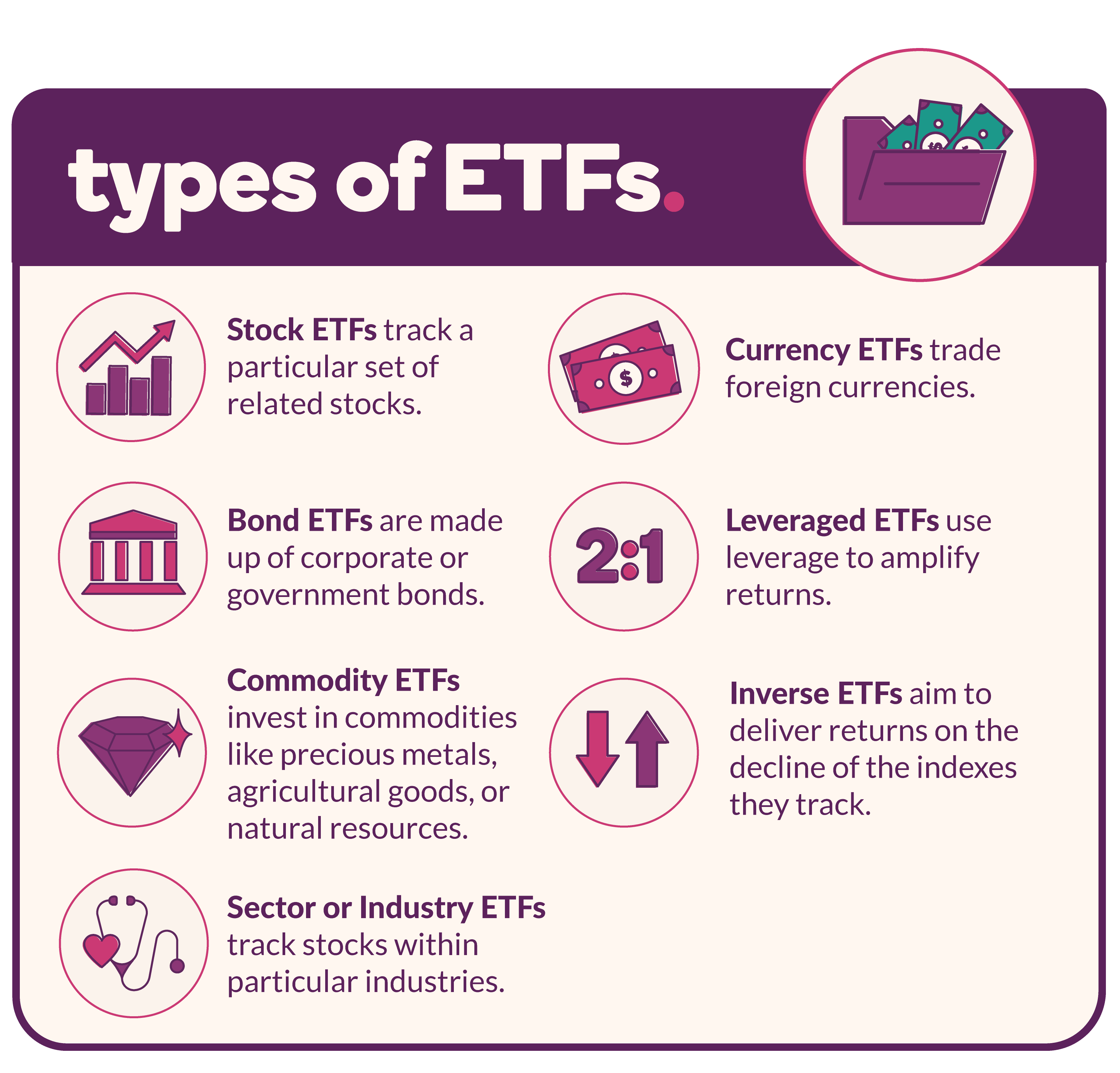
EXCHANGE TRADED FUNDS:  ETFs are a type of fund that owns various kinds of securities, often of one type. For example, a stock ETF holds stocks, while a bond ETF holds bonds. One share of the ETF gives buyers ownership of all the stocks or bonds in the fund. If an ETF held 100 stocks, then those who owned the fund would own a stake – albeit a very tiny one – in each of those 100 stocks.

ETFs are typically passively managed, meaning that the fund usually holds a fixed number of securities based on a specific preset index of investments. These are tax efficient. In contrast, many mutual funds are actively managed, with professional investors trying to select the investments that will rise and fall.

The Standard & Poor’s 500 Index is perhaps the world’s best-known index, and it forms the basis of many ETFs. Other popular indexes include the Dow Jones Industrial Average and the National Association of Securities Dealers Automated Quotations [NASDAQ] Composite Index.

ETFs based on these funds are called Index Funds and just buy and hold whatever is in the index and make no active trading decisions. ETFs trade on a stock exchange during the day, unlike mutual funds that trade only after the market closes. With an ETF you can place a trade whenever the market is open and know exactly the price you’re paying for the fund.

ETFs: https://medicalexecutivepost.com/2025/01/06/etfs-alternatively-weighted-investments/

INDEX FUNDS: Index funds mirror the performance of benchmarks like the DJIA. These passive investments are an unimaginative way to invest. Passive index funds tracking market benchmarks accounted for just 21% of the U.S. equity fund market in 2012. By 2024, passive index funds had grown to about half of all U.S. fund assets. This rise of passive funds has come as they often outperform their actively managed peers. According to the widely followed S&P Indices Versus Active (SPIVA) scorecards, about 9 out of 10 actively managed funds didn’t match the returns of the S&P 500 benchmark in the past 15 years.

ASSESSMENT

Investing in individual stocks is psychologically and academically different than investing in the above funds, according to psychiatrist and colleague Ken Shubin-Stein MD, MPH, MS, CFA who is a professor of finance at the Columbia University Graduate School of Business  When you buy shares of a company, you are putting all your eggs in one basket. If the company does well, your investment will go up in value. If the company does poorly, your investment will go down. Fund diversification helps reduce this risk.

CONCLUSION

Investing in the above fund types will help mitigate single company security risk.

References: 

1. Fenton, Charles, F: Non-Disclosure Agreements and Physician Restrictive Covenants. In, Marcinko, DE and Hetico, HR: Risk Management, Liability Insurance, and Asset Protection Strategies for Doctors and Advisors [Best Practices from Leading Consultants and Certified Medical Planners™]. Productivity Press, New York, 2015.

Readings:

1. Marcinko, DE and Hetico, HR; Comprehensive Financial Planning Strategies for Doctors and Advisors [Best Practices from Leading Consultants and Certified Medical Planners™] Productivity Press, New York, 2017 

2. Marcinko, DE: Dictionary of Health Economics and Finance. Springer Publishing Company, NY 2006

3.  https://www.ft.com

4. Shubin-Stein, Kenneth: Unifying the Psychological and Financial Planning Divide [Holistic Life Planning, Behavioral Economics, Trading Addiction and the Art of Money]. Marcinko, DE and Hetico, HR; Comprehensive Financial Planning Strategies for Doctors and Advisors [Best Practices from Leading Consultants and Certified Medical Planners™] Productivity Press, New York, 2017

COMMENTS APPRECIATED

Like, Subscribe and Refer

EDUCATION: Books

SPEAKING: Dr. Marcinko will be speaking and lecturing, signing and opining, teaching and preaching, storming and performing at many locations throughout the USA this year! His tour of witty and serious pontifications may be scheduled on a planned or ad-hoc basis; for public or private meetings and gatherings; formally, informally, or over lunch or dinner. All medical societies, financial advisory firms or Broker-Dealers are encouraged to submit a RFP for speaking engagements: MarcinkoAdvisors@outlook.com 

***

***

Simplifying the Investment Decision

A Basic Overview for Emerging Physician and Medical Professional Investors

By Somnath Basu; PhD, MBA

There are three basic considerations in any investment decision.

1] The first is the understanding of the investment objective or why the investment is being made. While this may seem somewhat irrelevant at first – why would you be investing if you do not know what you are doing – combining investment objectives can pose problems down-stream.

For example, if you are saving for your retirement so that you can afford the retirement lifestyle you desire (the investment objective), your saving plan should not include any savings you are making for your children’s education (a separate investment objective). Compounding the two savings streams in one plan can very easily lead to one or both of the plans failing.

2] The second consideration is the time horizon of the investment. As a rough guide, investments that need to mature in the next 5-7 years can be considered as short term, 8-15 years as medium term and the rest as long term.

3] Finally, and probably the most important consideration of all is the importance you attach (priority) to achieving your investment objective; in other words, how safe and secure should your investments be. For example, if you are 70 years old and considering how you should invest your retirement funds so that your expenses are covered say for the next 25 years, you do not want a large margin of error in how your investments turn out; you can ill afford to be broke when you are older and hence you want your investments to be as secure as possible.

On the other hand, if the investment is for a second home or a boat, for example, you may wish to engage in some risk taking which may help in lowering your upfront investment needs. It is very important for any investor to clearly understand how much loss they can bear from any investment decision.

Decision Matrix

It is useful to express the investment framework described above as a simple decision matrix. Using the matrix (shown below) as a decision support system should clarify and simplify most investment decisions.

Link:  Investment Scenarios

Understanding where in the matrix your decision falls is a very good first step of your decision. Both these elements (safety and time) will ultimately decide the kinds of financial instruments that will reside in your portfolio. We will examine the structure of each of the 9 possible combinations shown in the matrix. Before doing so, let us start by examining the various investment alternatives (e.g. stocks, bonds, etc.) since they have an implicit connection with the two dimensions portrayed in our matrix.

Stocks

Stocks are the most well known and popular form of financial investments. Stocks may be further segregated between large cap and small cap stocks, where the term “cap” is surrogate for the size of the underlying corporation or firm.

Stocks may represent investments in both domestic and international companies. Within the international category, stocks may represent corporations registered in developed (safer) or emerging (riskier) markets. In terms of our matrix dimensions, stocks are best suited when the decision is of medium or long term. In terms of safety, large cap (both domestic and international) stocks are the safest, while small cap and emerging market stocks are the most risky. The riskier the stock, the greater are the profit possibilities as are the chances of large losses.

Bonds 

The second common type of investment are bonds Generally, bonds are much safer than stocks with the exception of a class of bonds known as high yield (or junk) bonds. Bonds are issued by companies, governments (domestic and international) and other agencies such as local governments (municipal bonds or “munis” which are especially desirable for those in high income tax rate categories) and quasi-government agencies such as Federal Home Loan Bank, Student Loan Administration, Agricultural Cooperative Banks, etc (collectively known as “Agency” bonds such as Ginnie/Fannie/Sallie Mae, Freddie Mac, etc.).

Government bonds are the safest, followed by agency and municipal bonds and then by bonds issues by corporations.

Corporate bonds may be safe (which are assigned credit safety ratings such as AAA, AA, BBB, etc.) or risky (junk bonds with ratings such as BB, CCC, CC etc.).

Bonds can be used for all time horizons, their maturities ranging from 3 months to 30 years. Very short term bond and bond like instruments (with maturities of one year or less) are known as money market securities which are generally safer than most other investments.

Alternate Investments

Other types of investments include real estate (long term, risky), commodities (such as energy, basic building materials, precious metals, etc.) which are also risky and which may be used for both short term and long term purposes and provide a good hedge (counter balance) in an inflationary environment, derivatives (options and futures) which are very risky and typically short term in nature. Derivatives are generally suggested for very sophisticated investors and are best left alone otherwise.

Risk Reduction

A very important feature about investments is that when various types of investments are bundled together in a portfolio, they help to reduce the risk of the investment decision without affecting the profits in a comparable way. This basic aspect of mixing various kinds of investments (stocks, bonds, etc) to reduce risk is known as diversification and it is a “must” for any investment portfolio. It is a “must” because this technique of risk reduction is generally costless (unless you are paying a financial advisor to do this for you) and it is very worthwhile. All other methods of risk reduction have cost implications.

Scenario Matrix

Armed with this nomenclature regarding various investment types we can now go about examining what the 9 combination (Scenario) portfolios may look like for investment purposes.

Link: Investment Scenarios

Starting with Scenario 1, if you wish to make a short term decision that is very important to you and needs to be very safe, investments should be made in very short term bonds (government or treasury bills)and other similar money market (short term, safe) securities. International short term bonds of developed countries may also be included. Such investment products are generally available through mutual funds or Exchange Traded Funds (or ETFs). ETFs are just like mutual funds except that they are usually cheaper, much easier to buy and sell and may provide tax deferral benefits.

If your investment falls in the Scenario 2 category, include agency/municipal bonds as well as some domestic and international (developed country) large cap stocks while for Scenario 3, smaller portions of small cap and emerging market stocks may be added proportionately while reducing some of the safer investments.

If your investment was a Scenario 4 type of investment, corporate large cap stocks (both domestic and international) could be added to agency or corporate (domestic and international) bonds. Before investing in stocks (in any Scenario) for this Scenario 4, a good question to ask is the following:  how profitable were stock investments in the last 3-5 years? If the answer is “very profitable” then reduce the proportion of stocks as compared to bonds in the portfolio. If the last few years were not good, then it would be good to increase their comparable shares. The main reason for this “fine tuning” is that the fortunes of stocks (and many other types of investments) follow a cyclical pattern and the cycle is related to the general cycle of economic (GDP) growth and contraction.

It can be seen now how Scenarios 5 and 6 (as also 8 and 9) will follow a similar pattern as before, increasing proportionally in stocks (of all sizes, domestic/international), real estate, commodities, etc. Portfolios falling in these groups may also include some small cap and emerging market stocks as well as high yield or junk bonds. The proportion of these riskier investments would of course be higher for Scenario 6 over Scenario 5 (and Scenario 9 over 8).

For Scenario 7, the investment portfolio would typically resemble one that would be like an opposite of the portfolio in Scenario 1 and would include a greater proportion of large cap (domestic/international) stocks and a much smaller proportion of bonds. As we move towards Scenarios 8 and 9, the portfolios would be dominated by small cap and emerging market stocks as well as junk bonds.

Assessment

In the discussion above, I have tried to generalize the investment decision in a simplifying way. While the discussion may have centered more on stocks and bonds, it is important to note that all portfolios must “diversify” the investment risks by expanding upon the various types of investment products contained in the portfolios. The very fact that a portfolio contains various types of investments will ensure that the portfolio will perform better than those which are not as well diversified. This will be so in spite of any one of the investment types underperforming at any point in time and the diversification benefit will be received consistently over long periods of time. A popular analogy to this diversification benefit is the common phrase of not putting all eggs in one basket.

Editor’s Note: Somnath Basu PhD is program director of the California Institute of Finance in the School of Business at California Lutheran University where he’s also a professor of finance. He can be reached at (805) 493 3980 or basu@callutheran.edu

Conclusion

The above approach to investment decision-making can be considered as a basic template that can be used universally. For those seeking greater sophistication and who have a foundation built on the above model, expert advice is strongly recommended.

And so, your thoughts and comments on this ME-P are appreciated. Financial advisors please chime in on the debate? Is Basu correct; why or why not? Review our top-left column, and top-right sidebar materials, links, URLs and related websites, too. Then, be sure to subscribe to the ME-P. It is fast, free and secure.

Link: http://feeds.feedburner.com/HealthcareFinancialsthePostForcxos

Speaker: If you need a moderator or speaker for an upcoming event, Dr. David E. Marcinko; MBA – Publisher-in-Chief of the Medical Executive-Post – is available for seminar or speaking engagements. Contact: MarcinkoAdvisors@outlook.com

Comprehensive Financial Planning Strategies for Doctors and Advisors: Best Practices from Leading Consultants and Certified Medical Planners™

Subscribe Now: Did you like this Medical Executive-Post, or find it helpful, interesting and informative? Want to get the latest ME-Ps delivered to your email box each morning? Just subscribe using the link below. You can unsubscribe at any time. Security is assured.

Sponsors Welcomed

And, credible sponsors and like-minded advertisers are always welcomed.

Link: https://healthcarefinancials.wordpress.com/2007/11/11/advertise

***

INVESTING: Stocks, Bonds & Oil Updates

Generated by AI

SPONSOR: http://www.CertifiedMedicalPlanner.org

***

***

  • Stocks: The S&P 500 touched 6,000 points for the first time since February and wrapped up its fifth positive week in the past seven following a better-than-expected jobs report. The vibes got even better in the afternoon following a President Trump announcement that the US and China trade teams will meet in London on Monday. STOCKS: https://medicalexecutivepost.com/2025/04/18/stocks-basic-definitions/
  • Bonds: Treasury yields ticked up in response to the solid May jobs report, a sign that investors were reducing bets on the scale of rate cuts this year. That’s not what Trump wants to hear: He urged Fed Chair Jerome Powell to slash interest rates by a jumbo-sized full point to pour “rocket fuel” on the economy. REVENUE BONDS: https://medicalexecutivepost.com/2024/12/20/bonds-revenue/
  • Oil: Oil prices have gone sideways for three straight weeks now, trading within a $4 range around $65/barrel since the middle of May. We’ll let you know when something interesting happens. CRUDE OIL: https://medicalexecutivepost.com/2024/08/14/wti-crude-oil/

EDUCATION: Books

COMMENTS APPRECIATED

Like and Subscribe

***

***

QUANTUM COMPUTING: Healthcare and Banking Affected [B-QTUM Index Fund]

FUNDAMENTAL INDUSTRY CHANGES

By Staff Reporters

***

***

Index Funds

An index mutual fund or ETF (exchange-traded fund) tracks the performance of a specific market benchmark—or “index,” like the popular S&P 500 Index—as closely as possible. That’s why you may hear people refer to indexing as a “passive” investment strategy.

Instead of hand-selecting which stocks or bonds the fund will hold, the fund’s manager buys all (or a representative sample) of the stocks or bonds in the index it tracks.

***

Quantum Computing

Unlike traditional computers that use bits, quantum computers utilize qubits. These qubits are capable of being in a state of superposition, where they can represent both 0 and 1 simultaneously, enabling the processing of multiple calculations at once. This could allow quantum computers to outperform classical computers in solving certain complex problems. However, the field is still overcoming challenges such as qubit stability and decoherence; especially in these three areas:

  • Quantum computing could fundamentally alter healthcare by accelerating drug discovery and improving individualized medicine. Rapid analysis of enormous volumes of biological data allows quantum computers to find trends that might guide the creation of more potent treatments. In addition to accelerating drug development, this will enable customized treatments tailored to unique genetic profiles.
  • Faster and more accurate financial models produced by quantum computing will transform the banking sector. Through real-time analysis of intricate financial systems, it can help investors to control risk and make better decisions. More precise market forecasts will help maximize portfolio management and trading strategies.
  • Through greatly enhanced medical diagnosis and patient care, quantum computing can transform the healthcare industry. Quantum computers can remarkably accurately find trends and possible health hazards by analyzing enormous volumes of medical data in a fraction of the time. Early diagnosis and more customized treatment alternatives follow from this.

BQTUM Index Fund

Index Description: The BlueStar® Machine Learning and Quantum Computing Index (BQTUM) tracks liquid companies in the global quantum computing and machine learning industries, including products and services related to quantum computing or machine learning, such as the development or use of quantum computers or computing chips, superconducting materials, applications built on quantum computers, embedded artificial intelligence chips, or software specializing in the perception, collection, visualization, or management of big data.

Citation and Disclosure: https://www.defianceetfs.com/qtum/

COMMENTS APPRECIATED

Read, Like, Subscribe and Refer

***

***

FEAR BASED GOLD FEVER: Protect Yourself

By Rick Kahler CFP

***

***

On January 21, 1980, in what I thought was a brilliant financial move, I bought gold. At what was then an all-time high of $873 an ounce.

Fast forward 45 years, and here we are again. Gold is on a tear, priced just over $3,000 an ounce at the time of this writing. It needs to rise another 16% to reach its inflation-adjusted record and many analysts think it might just get there.

What’s driving this gold rally? The same thing that drove it in 1980—fear.

Back then, the U.S. was grappling with rising inflation, double-digit price increases, and interest rates in the high teens. Investors feared that the dollar and stock market would collapse, that their hard-earned savings would erode into oblivion, and that gold was a safe haven. Sound familiar?

Today, inflation is less dramatic and the stock market would have to go a long way down to even register as a bear market, but it’s still a major concern. Central banks are buying gold at record levels. Gold-backed ETFs, which had been seeing years of outflows, are finally pulling investors back in.

For most, gold isn’t just an investment, it’s an emotional hedge against uncertainty. Back in 1980, I wasn’t thinking about long-term strategy. I was reacting to fear. Inflation had hit 14%, and like many others, I was convinced the dollar would soon be worthless. Gold, I thought, was my best shot at preserving wealth.

The problem? Inflation eventually cooled; it had dropped to an average of 3.5% by the mid-1980s. Gold prices tumbled along with it. Investors who, like me, bought at the peak, 45 years later still haven’t broken even on an inflation-adjusted basis. (My $873 purchase price, adjusted for inflation, equates to $3,580 today.) If I had stuck with a well-diversified portfolio, I likely would have fared much better over time.

Over the years, I’ve come to realize that our financial decisions aren’t just about numbers. They’re deeply influenced by our Internal Financial System™, a framework that helps explain why we handle money the way we do. I now see that my decision to buy gold was a battle between different financial “parts” of myself.

One part panicked, convinced that money was about to become worthless. Another saw gold prices soaring and didn’t want to miss out. Yet another part convinced me that buying at the peak was still a smart move. Had I paused and examined these internal voices, I might have made a different decision.

My gold purchase shows why emotionally driven investment decisions rarely lead to great financial outcomes. Instead of asking, “Is gold a smart long-term investment?” I was asking, “How do I make sure I don’t lose everything?” Those are two very different questions.

If you’re thinking about buying gold, I urge you to consider these questions:

“Am I investing from a place of fear or strategy?” If you’re rushing in because you’re scared of inflation, pause and reassess.

“How does gold fit into my broader financial plan?” Gold can be a great hedge—if held in appropriate amounts in a diversified portfolio. It is best viewed as catastrophic financial insurance, rather than an investment.

“Am I reacting to headlines or making a well-thought-out decision?” The financial media loves a good gold rally. But remember, markets move in cycles. Today’s rally may be history repeating itself.

Back in 1980, fear persuaded me that gold was a sure thing. I forgot an essential caveat—there are no sure things in investing. If bad market timing were an Olympic sport, I’d have taken home the gold (pun intended) for least profitable performance.

COMMENTS APPRECIATED

Refer and Like

***

***

FINANCIAL ADVISORS: Real Monetary Worth?

BY DR. DAVID EDWARD MARCINKO; MBA MEd CMP®

***

SPONSOR: http://www.MarcinkoAssociates.com

***

SO – HOW MUCH IS A “FINANCIAL ADVISOR” REALLY WORTH?

This blog holds a rather uncomplimentary opinion of financial advisors, and the financial services and brokerage industry as a whole; deserved, or not? The entire site hints at this attitude as well, in favor of a going it alone or ME, Inc investing when possible. Nevertheless, it is reasonable to wonder how much boost in net-returns might an educated and informed, fee transparent and honest, fiduciary focused “financial advisor” add to a clients’ investment portfolio; all things being equal [ceteris paribus].

And, can it be quantified?

Well, according to Vanguard Brokerage Services®, perhaps as much as 3%? In a decade long paper from the Valley Forge, PA based mutual fund and ETF giant, Vanguard said financial advisors can generate returns through a framework focused on five wealth management principles:

Being an effective behavioral coach: Helping clients maintain a long-term perspective and a disciplined approach is arguably one of the most important elements of financial advice. (Potential value added: up to 1.50%).

Applying an asset location strategy: The allocation of assets between taxable and tax-advantaged accounts is one tool an advisor can employ that can add value each year. (Potential value added: from 0% to 0.75%).

Employing cost-effective investments: This component of every advisor’s tool kit is based on simple math: Gross return less costs equals net return. (Potential value added: up to 0.45%).

Maintaining the proper allocation through rebalancing: Over time, as investments produce various returns, a portfolio will likely drift from its target allocation. An advisor can add value by ensuring the portfolio’s risk/return characteristics stay consistent with a client’s preferences. (Potential value added: up to 0.35%).

Implementing a spending strategy: As the retiree population grows, an advisor can help clients make important decisions about how to spend from their portfolios. (Potential value added: up to 0.70%).

Source: Financial Advisor Magazine, page 20, April 2014.

Assessment

However, Vanguard notes that while it’s possible all of these principles could add up to 3% in net returns for clients, it’s more likely to be an intermittent number than an annual one because some of the best opportunities to add value happen during extreme market lows and highs when angst or giddiness [fear and greed] can cause investors to bail on their well-thought-out investment plans.

And, is the study applicable to doctors and allied healthcare providers? Doe Vanguard have a vested interest in the topic. What about fee based versus fee-only financial advice?

Conclusion

Finally, recognize the plethora of other financial planning life-cycle topics addressed in this ME-P were not included in the Vanguard investment portfolio-only study a decade ago. 

And what about today with contemporaneous internet advising, chat-rooms, linkedin, robo-advisors, reddit and the like?

COMMENTS APPRECIATED

Read, Subscribe and Like

EDUCATION: Books

***

***

PHANTOM: Income Tax on TIPS

By Staff Reporters

Sponsor: http://www.MarcinkoAssociates.com

***

***

“Phantom Tax” or “Phantom Income” for direct owners of Treasury inflation-protected securities (TIPS) TIPS adjust their principal values and interest payments for inflation. As with other directly owned Treasury securities, TIPS principal, including the inflation adjustments, is not paid back to investors until the securities mature.

However, the principal adjustments are taxed by the IRS as income in the year in which they occur, even though no actual payments are made in those years to investors who own TIPS directly. This is why this income is called “phantom income” and the tax on it is known as the “phantom tax.”

Investors can avoid the phantom income/tax issue for TIPS by holding TIPS in tax-deferred retirement accounts. Mutual funds and Exchange Traded Funds (ETFs) typically take the “phantom” factor out of TIPS ownership by distributing the principal adjustments as taxable dividends.

As with direct ownership of TIPS, the tax consequences of these distributions by mutual funds and ETFs can be reduced by holding TIPS-owning instruments in tax-deferred retirement accounts

COMMENTS APPRECIATED

Subscribe and Like

***

***

PRIMARY MARKETS: Exchange Traded Funds

BY: http://www.MarcinkoAssociates.com

***

***

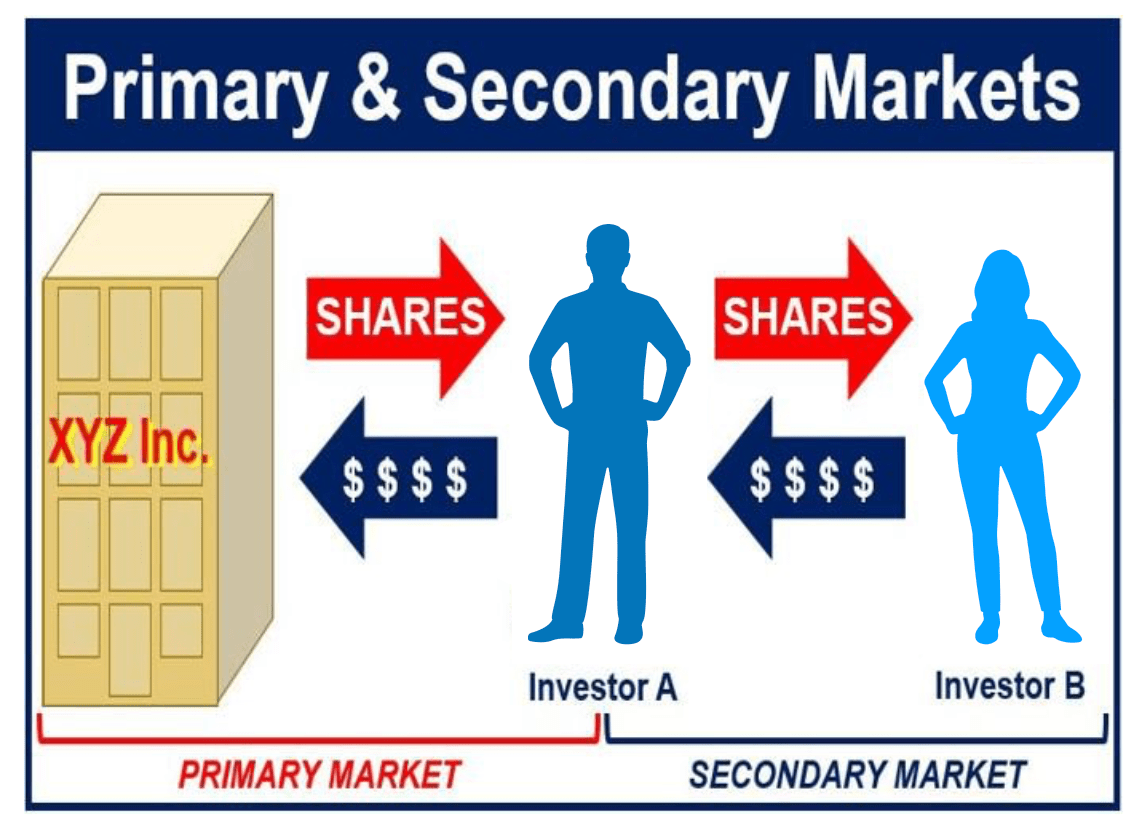
Primary Market: The primary market is also part of the stock market but differs from the secondary market because it only sells newly issued stocks.

Primary Market for Exchange Traded Funds: The primary market is where ETF shares are created and redeemed amongst ETF issuers and authorized participants. This is where the underlying basket of securities that make up an ETF is created. Shares of ETFs are made in large batches called Creation Units—usually 25,000 to 600,000 ETF shares are created at a time through this process.

COMMENTS APPRECIATED

Subscribe and Refer!

***

***

ACTIVE: Transparent Exchange Traded Funds

DEFINITION

SPONSOR: http://www.MarcinkoAssociates.com

By Staff Reporters

***

***

Active transparent ETFs: Daily disclosure of portfolio holdings is an attribute of traditional index-based Exchange Traded Funds (ETFs).

Active transparent exchange traded funds are actively managed by a portfolio manager or team of managers. As with index-based ETFs, their portfolio holdings are disclosed daily.

COMMENTS APPRECIATED

Subscribe and Like

***

***

INVESTMENT: Management Strategies

By Staff Reporters

***

***

Active investment management strategies are the opposite of passive investment strategies. Active portfolio managers regularly take investment positions that clearly differ from those of the portfolio’s performance benchmark, with the objective of outperforming the benchmark over time.

Passive: https://medicalexecutivepost.com/2024/06/09/active-or-passive-investing-pursuits/

In addition to the upside potential of outperforming the benchmark, there’s also the downside possibility of under performing the benchmark. In an efficient market, there should be roughly the same magnitude of out performers and under performers for any given benchmark. But, markets are not always efficient.

Active non-transparent investment management strategies are Exchange Traded Funds that are actively managed by a portfolio manager or team of managers without daily disclosure of portfolio holdings. Active transparent strategies are daily disclosures of portfolio holdings as an attribute of traditional index-based Exchange Traded Funds (ETFs). Active transparent exchange traded funds are actively managed by a portfolio manager or team of managers. As with index-based ETFs, their portfolio holdings are disclosed daily.

Di-Worsification: https://medicalexecutivepost.com/2024/04/09/what-is-financial-portfolio-di-worsification-2/

NOTE: Absolute return as an investment vehicle seeks to make positive returns by employing investment management techniques that differ from traditional mutual funds. Absolute return investment techniques include using short selling, futures, options, derivatives, arbitrage, leverage and unconventional assets.

CITE: https://www.r2library.com/Resource/Title/0826102549

COMMENTS APPRECIATED

Subscribe Today!

***

***

BITCOIN: “Halving”

BITCOIN MINER HALVING

By Staff Reporters

***

***

DEFINITION: After the network mines 210,000 blocks—roughly every four years—the block chain reward given to Bitcoin miners for processing transactions is cut in half. This event is called halving because it cuts the rate at which new bitcoins are released into circulation in half. This rewards system will continue until about 2140, when the proposed limit of 21 million coins is reached. At that point, miners will be rewarded with fees for processing transactions, which network users will pay. These fees ensure miners are still incentivized to participate and keep the network going.

CITE: https://www.r2library.com/Resource

***

And, so, the total value of the world’s most popular cryptocurrency surpassed $1 trillion yesterday for the first time since 2021. The overall crypto market, meanwhile, broke $2 trillion in market cap, fueled by investor confidence. If crypto were a publicly traded company, it would be the fourth-largest in the world behind Microsoft, Apple, and Saudi Aramco.

***

***

HALVING – The quadrennial event, expected to take place today or tomorrow, was built into bitcoin’s original code to cut the amount of new coins going into circulation in half every four years. The purpose is to thwart inflation and increase the currency’s value. Bitcoin’s mysterious creator, Satoshi Nakamoto, designed the crypto so that only 21 million bitcoins would ever exist. It will take about a century to hit that number, but as it approaches the cutoff, the crypto hose slowly constricts. No one’s sure what happens next

Historically, halvings have coincided with big jumps in price—the coin’s first halving in 2012 saw the price jump from $12.35 to $127 within five months, according to Time. But critics argue that the narrative around halving is much stronger than the actual event. Even bitcoin experts aren’t sure what will happen with the volatile asset. It already hit a record high of over $73,750 in March, thanks to the spot bitcoin ETF approval. And, lest we forget, the whole FTX thing happened since the last halving.

COMMENTS APPRECIATED

Thank You

***

***

PODCAST: What is a “Leveraged” ETF?

WHAT IT IS – HOW IT WORKS

Traditional ETFs: https://medicalexecutivepost.com/2008/01/07/exchange-traded-funds-etfs/

***

***

Leveraged DEFINITION:

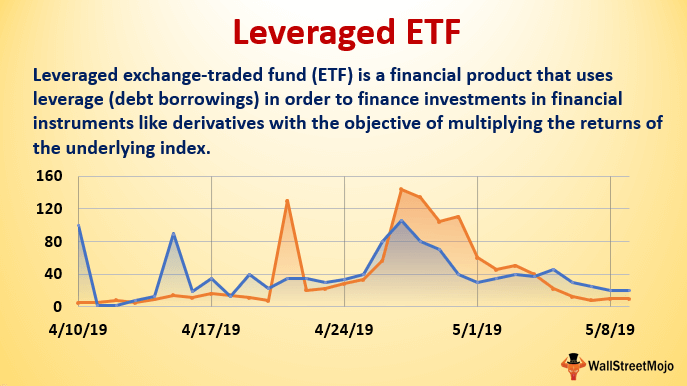
Leveraged ETFs have received tremendous media attention and are proving to be extremely popular with both individual and institutional investors. There are hundreds of leveraged ETFs, covering virtually every asset class and industry sector. The majority are double-leveraged, but there’s a sizeable group of triple-leveraged ETFs.

For professional investors, leveraged ETFs are useful in statistical arbitrage, short-term tactical strategies, and for use as short-term hedges without the need to roll futures. For individual investors, leveraged ETFs are alluring because of the potential for higher returns.

Citation: https://www.r2library.com/Resource/Title/0826102549

Now, some physicians and Uninformed investors might assume that the leverage returns are generated on a continuous basis, so that if an underlying index is up 5% for a month, the double-leveraged ETF will be up 10% for the same month; if the index is up 10% for 6 months, the ETF will be up 20%, and so forth. That is absolutely not the case. The leverage is determined on a daily basis and the returns for any other period usually will not be double or triple the underlying index.

In order for the leveraged funds to achieve appropriate levels of assets so they can provide their implied leverage, they have to rebalance daily. In the case of an ETF providing long 2-times leveraged exposure, they would typically attain exposure to a notional set of assets equal to 2 times their NAV.

Example: An example would be an ETF that takes in 100 units in assets that does a swap with a counterparty to provide exposure to 200 units in performing assets. The rebalancing activity of these funds will almost always be in the same direction as the market.

In essence, a leveraged ETF is essentially marked to market every night. It starts with a clean slate the next day, almost as if the previous day had not existed. This process produces daily leverage results. However, over time, the compounding of this reset can potentially vary the performance of the fund versus its underlying benchmark. This can result in either greater or lesser degrees of final leverage over individual holding periods.

PODCAST: https://www.investopedia.com/terms/l/leveraged-etf.asp

RELATED: https://smartasset.com/investing/what-is-a-leveraged-etf

ASSESSMENT: Your comments and thoughts are appreciated.

INVITATIONS: https://medicalexecutivepost.com/dr-david-marcinkos-bookings/

CONTACT: Ann Miller RN MHA

MarcinkoAdvisors@msn.com

Ph: 770-448-0769

Second Opinions: https://medicalexecutivepost.com/schedule-a-consultation/

DIY Textbooks: https://medicalexecutivepost.com/2021/04/29/why-are-certified-medical-planner-textbooks-so-darn-popular/

THANK YOU

***

FINANCE: https://www.amazon.com/Comprehensive-Financial-Planning-Strategies-Advisors/dp/1482240289/ref=sr_1_1?ie=UTF8&qid=1418580820&sr=8-1&keywords=david+marcinko

***

What is an INVERSE ETF?

By Staff Reporters

***

***

What are inverse ETFs?

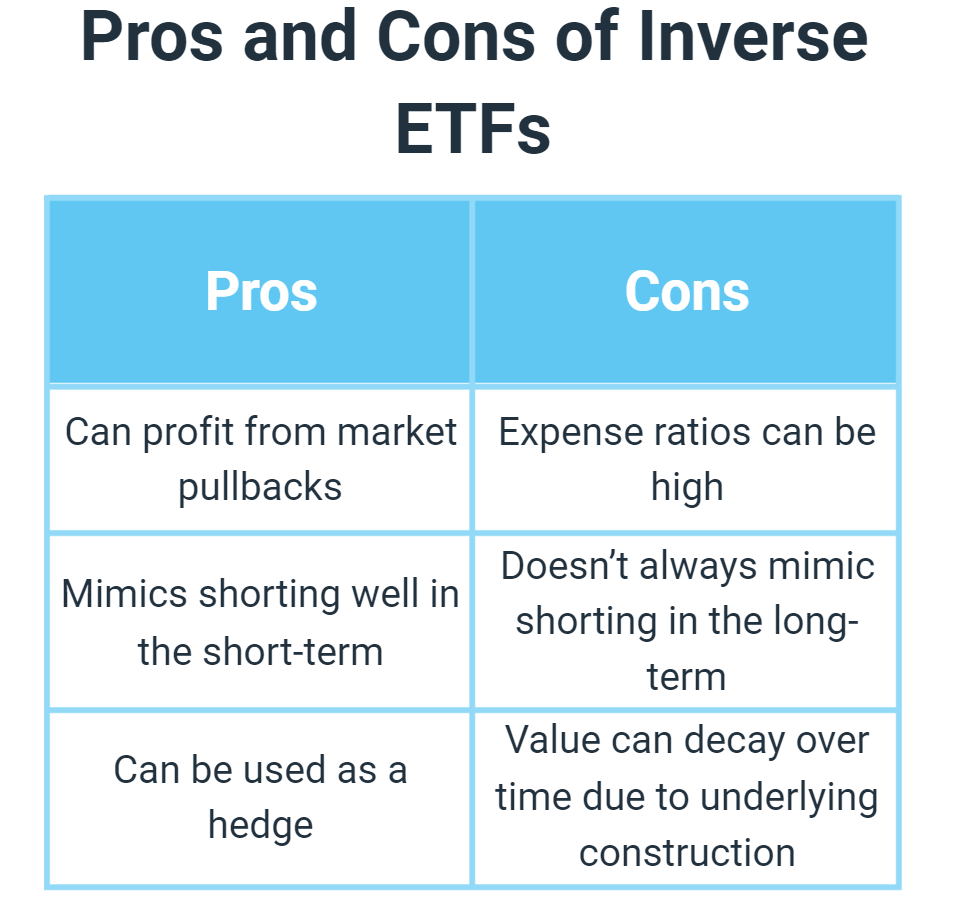
An inverse ETF, often known as a bear or short ETF, is an exchange-traded fund designed to profit from a market decline. These short-term, publicly traded investments are utilized by investors who believe that a particular market or individual security will lose value in the near future. They may use inverse ETFs as a way of hedging losses during a downturn.

“Inverse ETFs are a tool to hedge a stock portfolio,” according to John DeYonker. “If the S&P 500 is your benchmark, and it goes up 1%, then your hedge will go down 1% and vice versa. Hedging with inverse ETFs can reduce volatility for investors—it’s like insurance.”

Investors may also use inverse ETFs as a way to take advantage of a predicted decline. In this way, they may be used as an alternative to short selling. For example, if an investor believes that the oil industry will have a setback in the immediate future, they may choose to purchase an inverse ETF of securities tied to energy producers. If correct in their prediction, the investor’s inverse ETF may recognize a profit. If the investor is incorrect, and the market or individual security increases in price, they may see a loss.

An investor who believes that the S&P 500 will decline, for example, may choose to purchase shares of the ProShares Short S&P 500. This inverse ETF’s value is inversely proportional to the overall S&P 500 index.

Inverse ETFs are generally considered to be highly volatile investments, as their losses typically compound daily. This makes inverse ETFs more risky than the index to which they are tied.

CITE: https://en.wikipedia.org/wiki/Exchange-traded_fund

***

COMMENTS APPRECIATED

Thank You

RELATED: https://medicalexecutivepost.com/2021/12/26/podcast-what-is-a-leveraged-etf/?preview=true

MORE: https://www.routledge.com/Comprehensive-Financial-Planning-Strategies-for-Doctors-and-Advisors-Best/Marcinko-Hetico/p/book/9781482240283

***

ETFs: Happy 31st. Birthday

EXCHANGE TRADED FUNDS

By Staff Reporters

SPONSOR: http://www.MarcinkoAssociates.com

***

***

Thirty one years ago yesterday, the first exchange-traded fund (ETF) in the US launched. In the decades since, these once-niche investment products have become ubiquitous on Wall Street, disrupting the mutual fund industry and transforming people’s relationship with the stock market.

CITE: https://www.r2library.com/Resource/Title/0826102549

Exchange Traded Funds

On January 29th, 1993, a spider decoration hanging in the American Stock Exchange heralded the arrival of the first US ETF—what’s now called the SPDR S&P 500 ETF Trust. It had a measly $6.5 million in assets and no one really paid much attention to it. The first US ETF is now the world’s biggest, with $375 billion in assets, and the ETF sector in total had amassed $6.5 trillion in assets by the end of 2022. While mutual funds still have 3x the amount of assets that ETFs have, the tide is turning: Investors poured $600 billion into US ETFs on a net basis last year, but pulled out almost $1 trillion from mutual funds.

ETFs and Tax Efficiency

Definition: An ETF is simply a security that tracks the performance of a particular basket of investments, like stocks. The SPDR S&P 500 ETF, for example, tracks the performance of companies in the S&P 500. Many other ETFs also track indexes, allowing people to park their money in funds that follow the ebbs and flows of the broader market.

If that sounds like a mutual fund…it’s similar. But ETFs have a few advantages over its stuffy, older cousin.

  • ETFs generally have lower fees than mutual funds.
  • They have built-in tax benefits.
  • They’re accessible to anyone with a brokerage account—you can buy or sell them like you would a stock.

CITE: https://www.r2library.com/Resource/Title/0826102549

Finally, all these advantages aside, the rise of ETFs has been also fueled by the growing recognition that trying to invest in individual stocks is foolish. Passive index funds, which aren’t designed for frequent trading, have surged to represent almost half of US fund assets, compared to less than 2% in the early ’90s.

COMMENTS APPRECIATED

Thank You

***

ORDER: https://www.routledge.com/Comprehensive-Financial-Planning-Strategies-for-Doctors-and-Advisors-Best/Marcinko-Hetico/p/book/9781482240283

***

DAILY UPDATE: Wall Street Stocks, Dow Dogs, Commodities, Gold, the Fed, Yen and Bitcoin

MEDICAL EXECUTIVE-POST TODAY’S NEWSLETTER BRIEFING

***

Essays, Opinions and Curated News in Health Economics, Investing, Business, Management and Financial Planning for Physician Entrepreneurs and their Savvy Advisors and Consultants

Serving Almost One Million Doctors, Financial Advisors and Medical Management Consultants Daily

A Partner of the Institute of Medical Business Advisors , Inc.

http://www.MedicalBusinessAdvisors.com

SPONSORED BY: Marcinko & Associates, Inc.

***

http://www.MarcinkoAssociates.com

Daily Update Provided By Staff Reporters Since 2007.
How May We Serve You?
© Copyright Institute of Medical Business Advisors, Inc. All rights reserved. 2024

REFER A COLLEAGUE: MarcinkoAdvisors@msn.com

SPONSORSHIPS AVAILABLE: https://medicalexecutivepost.com/sponsors/

ADVERTISE ON THE ME-P: https://tinyurl.com/ytb5955z

***

If you can believe it, Friday was the final trading day of the first half of 2024. It might be a good time to reflect on your New Year’s resolutions to see how you’re measuring up halfway through the year.

CITE: https://www.r2library.com/Resource

Dogs of the Dow: The 139-year-old index has never looked more its age, with components Nike, Intel, and Boeing all down more than 30% in 2024. The Dow has gained less than 4% this year.

CITE: https://tinyurl.com/2h47urt5

But, the S&P 500 gained a sublime 15% in H1, and Nvidia alone was responsible for more than a third of that gain. The maker of AI chips surged ~150% since Jan. 1st to become the most valuable company in the USA at one point.

Going into 2024, investors were expecting the Fed to cut interest rates six times. There hasn’t been a single rate cut yet, but that hasn’t stopped the S&P from notching 31 all-time closing highs, good for the second-best tally of records this century. Stocks have overcome the Fed’s delay thanks to strong earnings, a sturdy economy, and AI fever.

Commodities soar and a currency plummets. Cocoa boomed nearly 85% over shortage concerns. Gold hit a record high last month. The Japanese yen has slumped to a 38-year low against the US dollar.

Bitcoin got a boost from new ETFs, but it’s getting boring.

CITE: https://tinyurl.com/tj8smmes

COMMENTS APPRECIATED

PLEASE SUBSCRIBE: MarcinkoAdvisors@msn.com

Thank You

***

***

***

***

EDUCATIONAL TEXTBOOKS: https://tinyurl.com/4zdxuuwf

***

ETFs and Tax Efficiency

A Better Financial Product than Mutual Funds?

[By JD Steinhilber]

Exchange-traded funds are inherently more tax efficient than actively managed mutual funds, which have been rightly criticized for their tax-inefficiency. Tax-efficiency is a critical issue for financial advisors and physician-investors because delaying the taxation of appreciating assets normally enhances after-tax returns over time.

For example, it is estimated that between 1994 and 1999, investors in diversified U.S. stock mutual funds lost, on average, 15% of their annual gains to taxes. The tax inefficiency of mutual funds is the result of portfolio turnover at the fund level caused by two factors: the trading activity of the portfolio manager and the activity of other shareholders in the fund.       

The Mutual Fund Performance / Redemption Problem

Due to fund manager efforts to outperform benchmarks, actively managed mutual funds almost invariably experience more “manager-driven” portfolio turnover than ETFs, where trading is generally driven by change in the composition of the underlying indexes being replicated. Mutual fund portfolio turnover can also be caused by the actions of shareholders in the fund. 

In a mutual fund structure, redemption requests by shareholders can force the fund to sell securities to raise cash. These sales may give rise to gains that, by law, must be distributed and will be taxed to all shareholders in the fund.

Unique Architectural Structure

ETFs, in contrast, are structured in such a way that the actions of one shareholder do not result in tax consequences to another shareholder.  ETFs accomplish this through the innovative architecture in which ETF “units” (which are subdivided into individual ETF shares) are created and redeemed to accommodate the fluctuating demand for the shares of a particular ETF.

ETF units are created and redeemed by institutional investors though non-taxable, “in-kind” transactions, which means that only securities – not cash – change hands in the creation and redemption process. 

An example of this process would be an institution exchanging a portfolio of stocks constituting the S&P 500 index for an S&P 500 ETF “creation unit”. And, once created, the S&P 500 ETF can be subdivided into individual shares that are tradable by investors on the exchange.   

Assessment

As a result of the above – physicians may be insulated from a tax standpoint by the actions of other investors – because taxable transactions don’t take place at the fund level.  Instead, ETF shares are traded between retail investors in transactions on the exchanges, so the tax accounting becomes very similar to that associated with individual stocks.    

Have you used ETFs in your own portfolio, and what is your tax efficiency experience with them; truth or hype? 

Conclusion

Your thoughts and comments on this ME-P are appreciated. Feel free to review our top-left column, and top-right sidebar materials, links, URLs and related websites, too. Then, subscribe to the ME-P. It is fast, free and secure.

Speaker: If you need a moderator or speaker for an upcoming event, Dr. David E. Marcinko; MBA – Publisher-in-Chief of the Medical Executive-Post – is available for seminar or speaking engagements. Contact: MarcinkoAdvisors@msn.com

OUR OTHER PRINT BOOKS AND RELATED INFORMATION SOURCES:

Product Details

Comprehensive Financial Planning Strategies for Doctors and Advisors: Best Practices from Leading Consultants and Certified Medical Planners(TM)

***

DAILY UPDATE: Friday Before Memorial Day Weekend and the Stock Market Collapse

MEDICAL EXECUTIVE-POST TODAY’S NEWSLETTER BRIEFING

***

Essays, Opinions and Curated News in Health Economics, Investing, Business, Management and Financial Planning for Physician Entrepreneurs and their Savvy Advisors and Consultants

Serving Almost One Million Doctors, Financial Advisors and Medical Management Consultants Daily

A Partner of the Institute of Medical Business Advisors , Inc.

http://www.MedicalBusinessAdvisors.com

SPONSORED BY: Marcinko & Associates, Inc.

***

http://www.MarcinkoAssociates.com

Daily Update Provided By Staff Reporters Since 2007.
How May We Serve You?
© Copyright Institute of Medical Business Advisors, Inc. All rights reserved. 2024

REFER A COLLEAGUE: MarcinkoAdvisors@msn.com

SPONSORSHIPS AVAILABLE: https://medicalexecutivepost.com/sponsors/

ADVERTISE ON THE ME-P: https://tinyurl.com/ytb5955z

***

The Friday before Memorial Day is never action packed, and this year is no exception as earnings season begins to wrap up and economic readings slow down. Two reports to watch for tomorrow: April Durable Goods Orders and University of Michigan’s May sentiment report.

Durable Goods Orders are big-ticket items with a shelf life of three or more years—think appliances and furniture for consumers, or machinery, equipment, and vehicles for businesses. More durable goods orders indicate a healthy economy, as consumers and companies alike wouldn’t spend as much if they weren’t confident they could afford it, and also provides insight into how strong the manufacturing industry is.

The University of Michigan’s consumer sentiment index is a survey of consumers via telephone to better understand how they feel about the economy, what they’re spending their money on, etc. The preliminary findings earlier this month weren’t great thanks to sticky inflation, and tomorrow’s finalized readings won’t change much. But with the latest CPI reading indicating inflation might yet be tamed, next month’s report could be much more illuminating.

CITE: https://www.r2library.com/Resource

Here’s where the major benchmarks ended:

  • The S&P 500® index (SPX) fell 39.17 points (0.7%) to 5,267.84; the Dow Jones Industrial Average lost 605.78 points (1.5%) to 39,065.26; the NASDAQ Composite® ($COMP) shed 65.51 points (0.4%) to 16,736.03.
  • The 10-year Treasury note yield rose more than 4 basis points to 4.479%.
  • The CBOE Volatility Index® (VIX) rose 0.48 to 12.77.

Financial shares were among Thursday’s weakest performers amid ideas a “higher-for-longer” Fed rate outlook could pressure bank margins. The KBW Regional Bank Index (KRX) dropped almost 3% to a three-week low. Other interest-rate-sensitive sectors, including real estate and utilities, took pressure.

In other markets, WTI Crude Oil (/CL) futures fell for the fourth straight trading day and closed at a three-month low under $76 per barrel.

CITE: https://tinyurl.com/2h47urt5

Spot Ethereum ETFs were approved by the SEC in another big win for crypto, following the approval of spot bitcoin ETFs earlier this year.

CITE: https://tinyurl.com/tj8smmes

COMMENTS APPRECIATED

PLEASE SUBSCRIBE: MarcinkoAdvisors@msns.com

Thank You

***

***

***

***

EDUCATIONAL TEXTBOOKS: https://tinyurl.com/4zdxuuwf

***

DAILY UPDATE: Cooling Labor Markets with Unemployment Rate Uptick

MEDICAL EXECUTIVE-POST TODAY’S NEWSLETTER BRIEFING

***

Essays, Opinions and Curated News in Health Economics, Investing, Business, Management and Financial Planning for Physician Entrepreneurs and their Savvy Advisors and Consultants

Serving Almost One Million Doctors, Financial Advisors and Medical Management Consultants Daily

A Partner of the Institute of Medical Business Advisors , Inc.

http://www.MedicalBusinessAdvisors.com

SPONSORED BY: Marcinko & Associates, Inc.

***

http://www.MarcinkoAssociates.com

Daily Update Provided By Staff Reporters Since 2007.
How May We Serve You?
© Copyright Institute of Medical Business Advisors, Inc. All rights reserved. 2024

REFER A COLLEAGUE: MarcinkoAdvisors@msn.com

SPONSORSHIPS AVAILABLE: https://medicalexecutivepost.com/sponsors/

ADVERTISE ON THE ME-P: https://tinyurl.com/ytb5955z

***

A cooling labor market raises hopes for a rate cut in the summer. The latest Labor Department data shows the US added 175,000 jobs in April, but much less than the 300,000 added in March and also less than economists expected. Meanwhile, the unemployment rate ticked up to 3.9% from 3.8% in March, and wages rose less than anticipated. All that bad news for us was music to the ears of investors who are holding out hope that the Federal Reserve might still cut interest rates this summer despite most recent economic data showing that inflation is sticking around.

CITE: https://www.r2library.com/Resource

Rate cuts appear to be back on the 2024 menu following Friday’s softer-than-expected jobs report, fueling gains for all three major stock indexes last week. With the report calming worries that inflation is ticking back up, investors now project a 50% likelihood that the Federal Reserve will reduce rates in September.

Coinbase is benefiting from the hype around new bitcoin ETFs. The crypto exchange reported a $1.2 billion quarterly profit last week, and net revenue rose by 115%.

CITE: https://tinyurl.com/2h47urt5

COMMENTS APPRECIATED

PLEASE SUBSCRIBE: MarcinkoAdvisors@msns.com

Thank You

***

***

***

***

EDUCATIONAL TEXTBOOKS: https://tinyurl.com/4zdxuuwf

***

“Magnificent Seven” Stocks Down while Bitcoin Up

STATE OF THE UNION EVENING

***

  • Markets: Stocks rose yesterday as investors watched Jerome Powell tell lawmakers that he still expects to cut interest rates this year, just not right away.
  • Stock spotlight: Troubled regional lender New York Community Bancorp, which fell 40% before soaring back up after announcing it’s getting $1 billion from investors, including ex-Treasury Secretary Steven Mnuchin’s firm.

***

***

Meanwhile, Stocks tumbled on Tuesday as several of the “Magnificent Seven” tech giants shed some of their gains from earlier this year, dragging the entire market with them. One of those companies was Apple, which fell about 3% after a report suggested that iPhone sales in China have plunged in the first six weeks of 2024.

And, Bitcoin set a new record yesterday, briefly jumping past $69k before falling back down to ~$62k. The rally highlighted the crypto’s seemingly rapid recovery from the nail-in-the-coffin that was FTX’s demise in 2022.

COMMENTS APPRECIATED

Thank You

***

***

FINANCIAL ASSET CLASSES: Like a Box of Valentine Chocolates?

On Valentine’s Day Diversification

                                         By Rick Kahler MS CFP® ChFC CCIM 

                                                   www.KahlerFinancial.com

Rick Kahler CFPThe stock markets crashed yesterday after the new CPI report and update.

Nevertheless, with displays of Valentine candy in every store, February is the perfect time to talk about chocolate. A creative financial planner might even steal Forrest Gump’s analogy and say, “Diversification is like a box of chocolates.”

Except that it isn’t.

True, a box of chocolates might have a lot of variety. Cream centers. Caramels. Nougats. Nuts. Dark chocolate. Milk chocolate. Truffles. Yet it’s all still chocolate.

Retirement Savings

Buying that box would be like investing your retirement savings in a variety of US stocks. Even if you had a dozen different companies, they would all be the same basic category of investment, or asset class.

For example, suppose you gave your true love a slightly more diversified Valentine gift made up of chocolates, Girl Scout cookies, baklava, and apple pie. That would compare to investing in different types of stocks like US, international, or emerging markets. But, everything would still be dessert.

Wiser Physician-Investors

You would be a wiser doctor-investor if you took your true love out for dinner and had a meat course, a salad, vegetables, bread, dessert, and wine. Now you’d start to see real diversification.

In addition to US, international, and emerging market stocks (all dessert), you might have some other asset classes like US and international bonds (meat), real estate (bread), cash (salad), commodities (veggies), and absolute return strategies (wine).

***

box

***

Long Term Growth Generator

This kind of asset class diversification is the best investment strategy for long-term growth. My preference is eight or nine different classes. For many clients, I recommend a mix of US and international stocks and bonds, real estate investment trusts, a commodities index fund, market neutral funds like merger arbitrage and managed futures, junk bonds, and Treasury Inflation Protected Securities (TIPS).

Market Fluctuations

Fluctuations in the market will tend to affect the various securities within a given asset class in the same way. Most US stocks, for example, would generally move up or down at the same times. So, owning shares of several different stocks wouldn’t protect you against changes in the market. When a portfolio is well-diversified, the volatility is reduced even during times when the markets are moving strongly up or down.

When I talk about investing in a variety of asset classes, I don’t mean owning stocks, real estate, gold, or other assets directly. For individual investors, mutual funds are a much better choice. Occasionally, someone will ask me, “But why should I have everything in mutual funds? That isn’t diversified, is it?”

Mutual Funds

Mutual funds are not an asset class. A mutual fund isn’t like a type of food; it’s like the plate you put the food on. A single plate might hold one food item or servings from several different food groups. More specifically, mutual funds are pools of money invested by managers. One fund might invest in real estate investment trusts (REITS). Another might have international stocks chosen for their high returns. Still others invest in a diversified mix of asset classes. The mutual fund is just the container that holds the investments.

heart[Courtesy GE Healthcare]

Annuities

Annuities and IRAs aren’t asset classes, either, but are also examples of different types of containers that hold investments. If you use your IRA to purchase an annuity, all you’re doing is stacking one plate on top of another. It doesn’t give you another asset class, it just costs you more for the second plate.

Assessment

Having a box of chocolates for dinner might seem more appealing in the short term than eating a balanced meal. Investing in the “get-rich-now” flavor of the month might seem tempting, too. Yet in the long run, asset class diversification is the best way to make sure you have a healthy investment diet.

***

February 14th, 2024

***

Conclusion

Your thoughts and comments on this ME-P are appreciated. Feel free to review our top-left column, and top-right sidebar materials, links, URLs and related websites, too. Then, subscribe to the ME-P. It is fast, free and secure.

Speaker: If you need a moderator or speaker for an upcoming event, Dr. David E. Marcinko; MBA – Publisher-in-Chief of the Medical Executive-Post – is available for seminar or speaking engagements. Contact: MarcinkoAdvisors@msn.com

OUR OTHER PRINT BOOKS AND RELATED INFORMATION SOURCES:

***

  Comprehensive Financial Planning Strategies for Doctors and Advisors: Best Practices from Leading Consultants and Certified Medical Planners(TM)* 8

CRYPTO: Bitcoin Rising!

By Staff Reporters

***

***

Crypto may not be back to having celebs hawk it during the Super Bowl after a series of scams and bankruptcies rocked the industry, but yesterday, the price of bitcoin rose higher than $50,000 for the first time since December 2021.

Last month’s decision by US regulators to allow spot bitcoin ETFs, which pushes the digital currency toward the mainstream by making it easier for people to access, didn’t initially significantly drive up prices, but interest in the ETFs helped spur the recent rise.

READ HERE: https://marcinkoassociates.com/bank-types/

COMMENTS APPRECIATED

Thank You

***

***

Inflation Up a Bit While the SEC Approves Spot Bitcoin ETFs

By Staff Reporters

***

***

Inflation climbed from 3.1% to 3.4% in December, a sign the Federal Reserve will continue to have to wrestle consumer price growth down to its desired 2% level. Forecasts had been for a reading of 3.2%.

On a monthly basis, inflation hit 0.3%, while core inflation, which strips away the more volatile costs of food and energy, was 3.9%, down from 4% in November but ahead of forecasts for a reading of 3.8%.

***

***

The Securities and Exchange Commission (SEC) officially approved spot bitcoin ETFs yesterday for the first time. The 11 exchange-traded funds will let old-school investors and bitcoin enthusiasts alike access the world’s biggest cryptocurrency without having to keep a long password for a crypto wallet.

CITE: https://www.r2library.com/Resource

The long-awaited win for the beleaguered crypto industry came after a false start on Tuesday, when someone hacked the agency’s X account that…didn’t have two-factor authentication enabled…and spuriously said the ETFs had been approved.

Crypto investors have been asking for spot bitcoin ETFs since roughly 2013, but the SEC has historically grimaced at the idea of inviting such a volatile asset into the financial system, concerned that a bitcoin ETF could be easily manipulated. Trading could begin as early as today.

COMMENTS APPRECIATED

Thank You

***

***

HACKED: The SEC’s X Account

By Staff Reporters

***

SEC stands for the U.S. Securities and Exchange Commission which is an ...

***

Everyone is waiting for the SEC’s decision, expected today, about whether it will allow spot bitcoin ETFs that would make buying the cryptocurrency easier and more accessible. But it seems someone wasn’t willing to wait it out!

CITE: https://www.r2library.com/Resource

After the SEC’s account posted to X yesterday that the ETFs had been approved, Chair Gary Gensler said on his own account that there had been no approval and the agency’s account was “compromised.” The false post briefly caused a spike in bitcoin prices.

COMMENTS APPRECIATED

Thank You

***

***

DAILY UPDATE: Crypto-Currency, ETFs and the Stock Markets

By Staff Reporters

***

SPONSOR: http://www.MarcinkoAssociates.com

***

The Markets as of 10:00am ET. Here’s what these numbers mean.
Markets: One week into 2024, stocks and bonds are off to their worst start in 21 years as investors maybe got a bit ahead of their skis in anticipating Fed rate cuts.

This week, Wall Street will be focused on fresh inflation data and the beginning of Q4 earnings season.


Bitcoin ETF cleared for launch? The first spot bitcoin ETF—could be approved by regulators this week in what would be a watershed moment for Wall Street’s embrace of digital tokens. The hype around these proposed funds, which would allow regular investors to gain exposure to bitcoin without buying it directly, drove bitcoin’s price up 162% over the past year.

Here is where the major benchmarks ended:

  • The S&P 500 Index was up 84.15 points (1.9%) at 4,495.70; the Dow Jones Industrial Average (DJI) was up 489.83 points (1.4%) at 34,827.70; the NASDAQ Composite (COMP) was up 326.64 points (2.4%) at 14,094.38.
  • The 10-year Treasury note yield (TNX) was down about 18 basis points at 4.453%.
  • CBOE’s Volatility Index (VIX) was down 0.60 at 14.16.

The small-cap focused Russell 2000 Index (RUT), which has lagged large-cap benchmarks for most of the year, jumped more than 5% Tuesday. Small-caps are often seen as being more exposed to the economic cycle and had suffered because of concerns that high interest rates could push the economy into recession.

Other interest rate-sensitive sectors, such as real estate, materials, and utilities, also saw outsize gains.

CITE: https://www.r2library.com/Resource

COMMENTS APPRECIATED

Thank You

***

***

What is an “Inverse” ETF?

WHAT IT IS – HOW IT WORKS

Traditional ETFs: https://medicalexecutivepost.com/2008/01/07/exchange-traded-funds-etfs/

Tax and ETFs: https://medicalexecutivepost.com/2008/01/11/etfs-and-tax-efficiency/

INVERSE DEFINITION:

An inverse exchange-traded fund is an exchange-traded fund, traded on a public stock market, which is designed to perform as the inverse of whatever index or benchmark it is designed to track. These funds work by using short selling, trading derivatives such as futures contracts, and other leveraged investment techniques.

Citation: https://www.r2library.com/Resource/Title/0826102549

***

How Inverse ETFs Can Help And Hurt You

READ: https://smartasset.com/investing/inverse-etf

RELATED: https://smartasset.com/investing/what-is-a-leveraged-etf

ASSESSMENT: Your comments and thoughts are appreciated.

THANK YOU

****


2021-Tax Hits on Distributed Stock Market Gains

Doctors Must Understand the Tax Man

By Staff Reporters

***

Mutual-fund physician and other investors with holdings in taxable accounts need to prepare for a tax hit on distributed gains — even if they reinvest the distributions. They can offset some or all of the gains (and taxes) if they’ve sold positions at a loss.

CITE: https://www.r2library.com/Resource/Title/082610254

Physicians and people who own mutual funds in tax-sheltered accounts such as 401(k)s or individual retirement accounts and are reinvesting the distributions, on the other hand, don’t have to worry. In those accounts, taxes only count when investors sell holdings in retirement, and those who have funds in qualified Roth IRAs won’t have to pay even then.

MORE: https://www.marketwatch.com/story/brace-yourself-for-an-extra-tax-hit-from-large-mutual-fund-payouts-11639175633?mod=home-page

***

Comprehensive Financial Planning Strategies for Doctors and Advisors: Best Practices from Leading Consultants and Certified Medical Planners™

ORDER: https://www.amazon.com/Comprehensive-Financial-Planning-Strategies-Advisors/dp/1482240289/ref=sr_1_1?ie=UTF8&qid=1418580820&sr=8-1&keywords=david+marcinko

***
YOUR COMMENTS ARE APPRECIATED.

Thank You

***

More on “Passive Investing” for Physicians

Join Our Mailing List 

Basic Financial Concepts

tim

By Timothy J. McIntosh; CFPMBA MPH CMP [hon]

By Jeffery S. Coons; PhD CFA

By Dr. David E. Marcinko; MBA CMP™

Passive investing is a monetary plan in which an investor invests in accordance with a pre-determined strategy that doesn’t necessitate any forecasting of the economy or an individual company’s prospects.

Premise

The primary premise is to minimize investing fees and to avoid the unpleasant consequences of failing to correctly predict the future. The most accepted method to invest passively is to mimic the performance of a particular index. Investors typically do this today by purchasing one or more ‘index funds’. By tracking an index, an investor will achieve solid diversification with low expenses.  Thus, a physician-investor could potentially earn a higher rate of return than an investor paying higher management fees.

Passive management is most widespread in the stock markets.  But; with the explosion of exchange traded funds on the major exchanges, index investing has become more popular in other categories of investing. There are now literally hundreds of different index funds.

***

Bull Markets

[Domestic Bull Markets – Historical USA]

***

Passive management is based upon the Efficient Market Hypothesis theory.  The Efficient Market Hypothesis (EMH) states that securities are fairly priced based on information regarding their underlying cash flows and that investors should not anticipate to consistently out-perform the market over the long-term.

The Efficient Market Hypothesis evolved in the 1960s from the Ph.D. dissertation of Eugene Fama.  Fama persuasively made the case that in an active market that includes many well-informed and intelligent investors, securities will be appropriately priced and reflect all available information. If a market is efficient [even emerging and/or world markets], no information or analysis can be expected to result in outperformance of an appropriate benchmark.

***

World Markets

[USA versus World Index]

***

Channel Surfing the ME-P

Have you visited our other topic channels? Established to facilitate idea exchange and link our community together, the value of these topics is dependent upon your input. Please take a minute to visit. And, to prevent that annoying spam, we ask that you register. It is fast, free and secure.

More:

The Author

Timothy J. McIntosh is Chief Investment Officer and founder of SIPCO.  As chairman of the firm’s investment committee, he oversees all aspects of major client accounts and serves as lead portfolio manager for the firm’s equity and bond portfolios. Mr. McIntosh was a Professor of Finance at Eckerd College from 1998 to 2008. He is the author of The Bear Market Survival Guide and the The Sector Strategist.  He is featured in publications like the Wall Street Journal, New York Times, USA Today, Investment Advisor, Fortune, MD News, Tampa Doctor’s Life, and The St. Petersburg Times.  He has been recognized as a Five Star Wealth Manager in Texas Monthly magazine; and continuously named as Medical Economics’ “Best Financial Advisors for Physicians since 2004.  And, he is a contributor to SeekingAlpha.com., a premier website of investment opinion. Mr. McIntosh earned a Bachelor of Science Degree in Economics from Florida State University; Master of Business Administration (M.B.A) degree from the University of Sarasota; Master of Public Health Degree (M.P.H) from the University of South Florida and is a CERTIFIED FINANCIAL PLANNER® practitioner. His previous experience includes employment with Blue Cross/Blue Shield of Florida, Enterprise Leasing Company, and the United States Army Military Intelligence.

Conclusion

Your thoughts and comments on this ME-P are appreciated. Feel free to review our top-left column, and top-right sidebar materials, links, URLs and related websites, too. Then, subscribe to the ME-P. It is fast, free and secure.

Speaker: If you need a moderator or speaker for an upcoming event, Dr. David E. Marcinko; MBA – Publisher-in-Chief of the Medical Executive-Post – is available for seminar or speaking engagements. Contact: MarcinkoAdvisors@msn.com

OUR OTHER PRINT BOOKS AND RELATED INFORMATION SOURCES:

Comprehensive Financial Planning Strategies for Doctors and Advisors: Best Practices from Leading Consultants and Certified Medical Planners(TM)

Is Passive Investing Right for You?

Join Our Mailing List

On the “Buy low and Sell high” Strategy 

By Rick Kahler CFP® http://www.KahlerFinancial.com

Rick Kahler CFP“Buy low and sell high.” That was my simple approach when I was a smart young investment advisor. I poured over a company’s balance sheet, earnings statements, and forecasted returns. Then I bought those companies that were bargains and waited for my gains to roll in. More times than not, they did—eventually.

The problem came with the “not” and “eventually.” A majority of my picks did go up in value, but the minority that were “nots” still lost enough to have a negative impact on my bottom line. Even more frustrating, some of my “nots” turned into gains “eventually” after I sold them.

My investment returns were similar to findings from Dalbar, Inc., a financial services research firm. Dalbar’s studies have shown that average active investors barely beat inflation over the long term. They significantly underperform investors who put their money in an index fund of stocks and leave it alone.

So much for my early investment brilliance! Over the past 40 years, I’ve learned that with every passing year I know less than I thought I did the year before. I’ve proven to myself I have no idea where any market is going tomorrow, next month, next year, or in the next 10 years.

This awareness has led me to become increasingly passive in my investments. In passive investing, rather than trying to time the buying and selling of winners and losers, you instead buy a representative sample of the entire market. This is possible in any market: bonds, stocks, real estate investment trusts, or commodities. You simply buy mutual funds and exchange-traded funds (ETF’s) called index funds.

Benefits

The two biggest benefits of passive investing are cost and diversification.

Costs

Index funds have incredibly low costs, with annual fees as low as 0.1%. Contrast that with the average equity fund that costs 1.5%, fifteen times more. According to research, 97% of active mutual fund managers don’t beat the index over 20 years. Even the 3% who do must beat the index by more than the 1.5% fee they charge, in order for their investors to come out ahead.

Diversification

The smaller number of stocks owned – the more my fortunes are tied to those few companies. It’s the old adage, “don’t put all your eggs in one basket.” By owning index funds, I own hundreds or thousands of securities. While I will never hit a home run, I also will never strike out. My returns will be “average.” Investing may be one of the few professions where being average puts you in the 97th percentile of all investment managers.

The NaySayers

Not all of my peers agree with this philosophy. Many very smart investment advisors jumped off the passive investing bandwagon after 2008 and returned to tactical asset allocation, which is another name for timing the markets.

###

cropped-the-medical-executive-post3.jpg

###

Harold’ Strategy

A noted investment advisor, Harold Evensky MBA CFP® of Evensky & Katz, addressed this issue at a conference last year. After the 2008 crisis, his firm hired researchers to evaluate whether they could find any tactical strategies that would have avoided the crisis. They found some that, in hindsight, would have worked. Yet he didn’t feel those strategies could be comfortably applied looking forward. Instead, the firm decided to add a 20% allocation to non-correlated alternative investments, something I’ve done since the late 90’s. In other words, they increased their clients’ diversification.

Assessment

The bottom line is that passive investing actually gives you more control. It allows you to focus on reducing costs and taxes, the aspects of investing you can control. It frees you from trying to beat the market and worrying over what you can’t control.

Conclusion

Your thoughts and comments on this ME-P are appreciated. Feel free to review our top-left column, and top-right sidebar materials, links, URLs and related websites, too. Then, subscribe to the ME-P. It is fast, free and secure.

Link: http://feeds.feedburner.com/HealthcareFinancialsthePostForcxos

Speaker: If you need a moderator or speaker for an upcoming event, Dr. David E. Marcinko; MBA – Publisher-in-Chief of the Medical Executive-Post – is available for seminar or speaking engagements. Contact: MarcinkoAdvisors@msn.com

OUR OTHER PRINT BOOKS AND RELATED INFORMATION SOURCES:

Health Dictionary Series: http://www.springerpub.com/Search/marcinko

Practice Management: http://www.springerpub.com/product/9780826105752

Physician Financial Planning: http://www.jbpub.com/catalog/0763745790

Medical Risk Management: http://www.jbpub.com/catalog/9780763733421

Hospitals: http://www.crcpress.com/product/isbn/9781439879900

Physician Advisors: www.CertifiedMedicalPlanner.org

Product DetailsProduct DetailsProduct Details

Product Details  Product Details

Whither Physician Self-Portfolio Management?

Do it Yourself Considerations

By Clifton N. McIntire, Jr.; CIMA, CFP®

By Lisa Ellen McIntire; CIMA, CFP®fp-book

In order to self create and monitor an investment portfolio for personal, office, or medical foundation use, the physician investor should ask him/herself three questions:

1. How much do I have invested?

2. How much did I make on my investments?

3. How much risk did I take to get that rate of return?

How Am I Doing?

Most doctors and health care professionals know how much money they have invested. If they don’t, they can add a few statements together to obtain a total. Few actually know the rate of return achieved during last year’s debacle, or so far this year in 2009. Everyone can get this number by simply subtracting the ending balance from the beginning balance and dividing the difference. But, few take the time to do it. Why? A typical response to the question is, “We were doing fine” -or- “We did terrible last year.”

But, ask how much risk is in the portfolio and help is needed. Nobel laureate Harry Markowitz, PhD said, “If you take more risk, you deserve more return.” Using standard deviation, he referred to the “variability of returns” –  in other words, how much the portfolio goes up and down, its volatility.

Your Own Portfolio

How, and even whether or not to create and manage your own portfolio, is what this brief post is about.

First, you must determine what to do with your investments. How much risk can be taken and what is the time frame? You must understand the concept of risk vs. reward and write an investment policy statement.

Next, the assets that will be used for investment must be selected. This involves asset allocation and mixing different styles of investment management to achieve the desired results, and is the point where you go it alone, or professional investment managers are selected.

Be sure to review expenses, like wrap accounts, service fees, AUMs, commissions and compare mutual funds with private money management.

Monitor

Once the initial portfolio is in place, the performance must be monitored to assure compliance with the investment policy.  Here’s where you consider 401k or 403(b) plans, pension plans, retirement accounts, as well as how to change doctor trustees or managers when necessary.

Assessment

Finally, consider the role of professional consultants. Now after all of this, if you still want to do it yourself rather than be a doctor, the entire process will be professionally illustrated. An actual physicians’ financial plan with investing portfolio was reviewed previously, along with the steps taken to improve returns and reduce risk.

Link: https://healthcarefinancials.wordpress.com/2009/09/03/evaluating-a-sample-physician-financial-plan-iii/

Join Our Mailing List

Conclusion

And so, your thoughts and comments on this Medical Executive-Post are appreciated. Feel free to review our top-left column, and top-right sidebar materials, links, URLs and related websites, too. Then, be sure to subscribe to the ME-P. It is fast, free and secure.

Link: http://feeds.feedburner.com/HealthcareFinancialsthePostForcxos

Speaker: If you need a moderator or speaker for an upcoming event, Dr. David E. Marcinko; MBA – Publisher-in-Chief of the Executive-Post – is available for seminar or speaking engagements. Contact: MarcinkoAdvisors@msn.com 

Get our Widget: Get this widget!

Our Other Print Books and Related Information Sources:

Practice Management: http://www.springerpub.com/prod.aspx?prod_id=23759

Physician Financial Planning: http://www.jbpub.com/catalog/0763745790

Medical Risk Management: http://www.jbpub.com/catalog/9780763733421

Healthcare Organizations: www.HealthcareFinancials.com

Health Administration Terms: www.HealthDictionarySeries.com

Physician Advisors: www.CertifiedMedicalPlanner.com

ETF Portfolio Diversification and Cost Reductions

A Multi-Dimensional Investment Product

By JD Steinhilber

 Certified Medical Planner  

Most physicians and their financial advisors and/or Certified Medical Planners™ [CMP™] believe that effective diversification is most readily achieved by combining poorly correlated asset classes within an investment portfolio.

And, when combined with low costs, a winning combination may be achieved for most any physician-investor’s wealth achievement and management goals.

Diversification Impact

One of the most basic examples of proper diversification is two poorly correlated assets like stocks and bonds. Over time, the returns of these two asset classes have a very low level of correlation. Over shorter time periods, the degree of correlation between stocks and bonds can vary widely.

From January 1999 to November 2002, for example, stocks and bonds had a negative, or inverse, correlation. Real Estate Investment Trusts [REITS] and international stocks are examples of other asset classes that tend to be poorly correlated with US stocks. And, volatility is expected to increase beyond 2008.

Because exchange-traded funds replicate the performance of entire asset classes, which themselves are diversified among numerous securities, it is possible to construct well-diversified, high-performing portfolios with only 5-10 ETFs. Accordingly, ETFs provide a highly efficient means of diversification.

Reduction of “Style Drift

Mutual funds also facilitate diversification, but actively managed mutual funds are susceptible to “style drift” and their portfolio holdings at any particular time are unknown. This presents a challenge to diversification efforts.

In contrast, ETFs offer asset class purity, meaning their holdings are totally transparent, disclosed daily and not subject to style drift. Actively managed mutual funds are also more expensive and less tax-efficient than ETFs.

Cost Impact

Exchange-traded funds have some of the lowest expense ratios of any registered investment product. In fact, ETFs have a cost advantage, on average, in excess of 100 basis points relative to actively managed mutual funds. This can have a significant impact on a portfolio’s performance over time.

For example, assume that investor A and investor B each invest $10,000 and earn the same gross annualized return over a 20 year time frame. After expenses, assume that investor A earns a net return of 10% and investor B earns a net return of 9%. After 20 years, investor A would have $67,275, while investor B would have $56,044, representing a difference of $11,231.

Trading Cautions

It is important to point out that physician-investors have to pay commissions when they buy or sell ETFs.As a result, the cost advantages of ETFs relative to mutual funds diminish the more actively an ETF portfolio is traded. ETFs are therefore not appropriate vehicles for active traders; they are more suitable for investors.

Of course, physicians and all investors tend to be more conscious of investment costs when portfolio returns are low or negative.Given that costs are among the few controllable variables in a portfolio’s returns, investors and advisors should always be evaluating portfolio costs relative to the benefits received.

Assessment: 

Exchange-traded funds may provide an opportunity to enhance net returns by reducing investment expenses and increasing returns through improved diversification.

Conclusion

Your thoughts and comments on this ME-P are appreciated. Feel free to review our top-left column, and top-right sidebar materials, links, URLs and related websites, too. Then, subscribe to the ME-P. It is fast, free and secure.

Link: http://feeds.feedburner.com/HealthcareFinancialsthePostForcxos

Speaker: If you need a moderator or speaker for an upcoming event, Dr. David E. Marcinko; MBA – Publisher-in-Chief of the Medical Executive-Post – is available for seminar or speaking engagements. Contact: MarcinkoAdvisors@msn.com

OUR OTHER PRINT BOOKS AND RELATED INFORMATION SOURCES:

DICTIONARIES: http://www.springerpub.com/Search/marcinko
PHYSICIANS: www.MedicalBusinessAdvisors.com
PRACTICES: www.BusinessofMedicalPractice.com
HOSPITALS: http://www.crcpress.com/product/isbn/9781466558731
CLINICS: http://www.crcpress.com/product/isbn/9781439879900
BLOG: www.MedicalExecutivePost.com
FINANCE: Financial Planning for Physicians and Advisors
INSURANCE: Risk Management and Insurance Strategies for Physicians and Advisors


Product Details  Product Details