RECESSION: A Heightened Risk in 2026?

By Dr. David Edward Marcinko MBA MEd

***

***

SPONSOR: http://www.MarcinkoAssociates.com

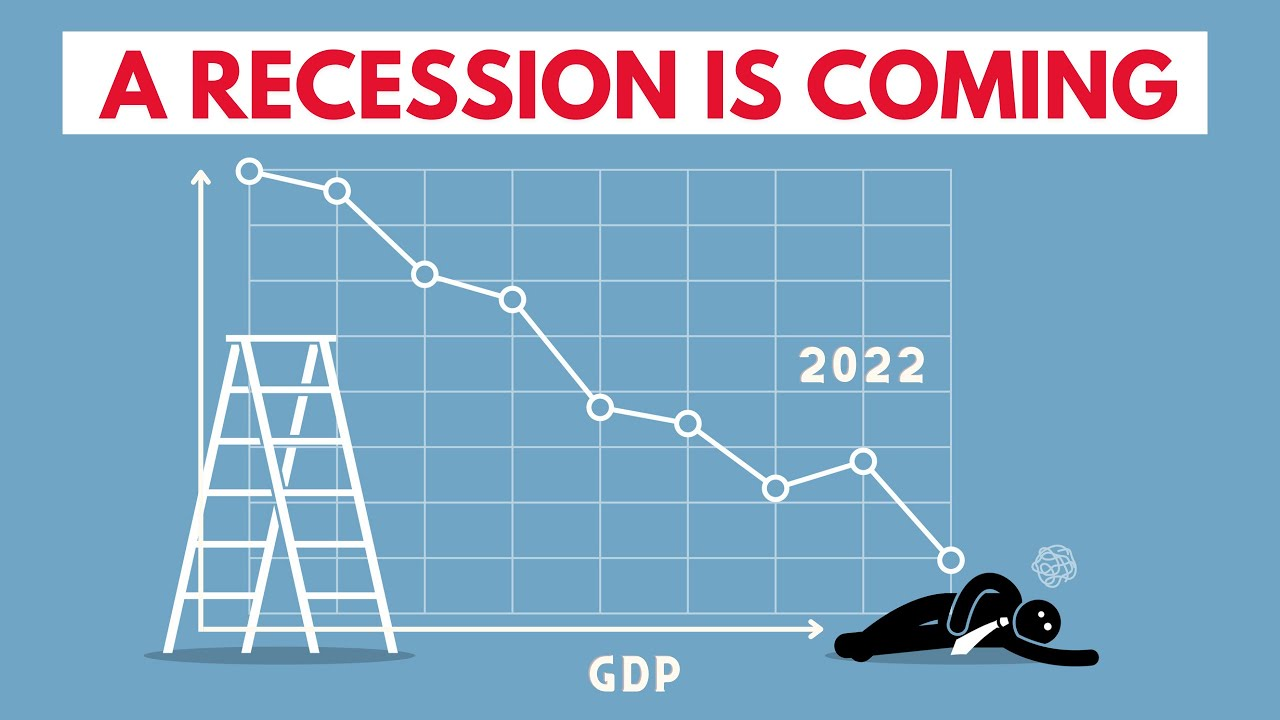
The U.S. faces a heightened risk of recession in 2026, with economic indicators, expert forecasts, and global instability contributing to widespread concern. While some analysts remain cautiously optimistic, the probability of a downturn is significant.

The potential for a U.S. recession in 2026 is a topic of growing concern among economists, policymakers, and investors. According to UBS, the probability of a recession has surged to 93% based on hard data analysis, including employment trends, industrial production, and credit market signals. This alarming figure reflects a convergence of economic stressors that could culminate in a downturn by the end of 2026.

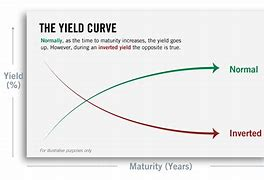
One of the most prominent warning signs is the inverted yield curve, a historically reliable predictor of recessions. When short-term interest rates exceed long-term rates, it suggests that investors expect weaker growth ahead. This inversion, coupled with elevated federal debt and persistent inflationary pressures, has led many analysts to forecast a slowdown in consumer spending and business investment.

Despite these concerns, some sectors—particularly artificial intelligence (AI)—are providing temporary buoyancy. The AI infrastructure boom has fueled GDP growth and market optimism, with global AI investment projected to reach $500 billion by 2026.

However, experts warn that this surge may be masking underlying economic fragility. If AI-driven investment slows, the economy could quickly lose momentum, revealing vulnerabilities in other sectors such as manufacturing and retail.

Global factors also play a critical role. Trade tensions, geopolitical instability, and fluctuating oil prices have created an unpredictable environment. The lingering effects of tariff pass-throughs and policy uncertainty are expected to intensify in 2026, further straining the U.S. economy. Additionally, speculative forecasts—like those from mystic Baba Vanga—have captured public imagination by predicting a “cash crush” that could disrupt both virtual and physical currency systems, although such claims lack empirical support. Not all forecasts are dire. Oxford Economics suggests that while growth will moderate, the U.S. may avoid a full-blown recession thanks to continued investment incentives and robust AI-related spending. Their above-consensus GDP forecast hinges on the assumption that business confidence remains stable and that fiscal policy supports non-AI sectors effectively.

Nevertheless, the risks are real and multifaceted. The Polymarket prediction platform currently estimates a 43% chance of a U.S. recession by the end of 2026, based on criteria such as two consecutive quarters of negative GDP growth or an official declaration by the National Bureau of Economic Research.

In conclusion, while the U.S. economy may continue to navigate “choppy waters,” the potential for a recession in 2026 is substantial. Policymakers must remain vigilant, balancing stimulus with fiscal discipline, and addressing structural weaknesses before temporary growth drivers fade.

The coming year will be pivotal in determining whether the U.S. can steer clear of recession or succumb to the mounting pressures.

COMMENTS APPRECIATED

EDUCATION: Books

SPEAKING: Dr. Marcinko will be speaking and lecturing, signing and opining, teaching and preaching, storming and performing at many locations throughout the USA this year! His tour of witty and serious pontifications may be scheduled on a planned or ad-hoc basis; for public or private meetings and gatherings; formally, informally, or over lunch or dinner. All medical societies, financial advisory firms or Broker-Dealers are encouraged to submit an RFP for speaking engagements: CONTACT: Ann Miller RN MHA at MarcinkoAdvisors@outlook.com -OR- http://www.MarcinkoAssociates.com

Like, Refer and Subscribe

***

***

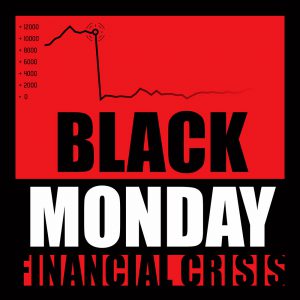
BLACK MONDAY REDEUX: Interesting Day or Financial Crisis?

BILL ACKMAN versus JIM KRAMER

By Staff Reporters

SPONSOR: http://www.CertifiedMedicalPlanner.org

***

***

Interesting Day?

Markets: Last week’s market bloodbath will go down in the history books. The S&P 500’s 10% plunge on Thursday and Friday, after President Trump announced massive tariffs, ranks among the steepest two-day decline in the last 70 years, on par with Black Monday in 1987, the post-Lehman Brothers rout in 2008, and the Covid plunge in March 2020. More than $6 trillion was wiped out from stocks over two days, and the NASDAQ entered a bear market, down 20% from a previous high.

Trading restarted at 9:30 am ET for what Bill Ackman predicts will be “one of the more interesting days in our country’s economic history.”

***

Monday Crash?

On the other hand, CNBC host and market commentator Jim Cramer just warned that America is in store for another “Black Monday” market crash similar to the record 1987 collapse if President Trump doesn’t curtail his tariff plan.

Cramer — who noted that the 1987 crash saw the Dow Jones Industrial Average fall by 22.6% in a single day — said the bloodbath could be repeated after the brutal two-day sell-off following the announcement of Trump’s sweeping tariffs against nearly 90 countries.

If the president doesn’t try to reach out and reward these countries and companies that play by the rules, then the 1987 scenario … the one where we went down three days and then down 22% on Monday, has the most cogency,” Cramer said on his show Saturday, referencing the worst single-day fall in the history of the Dow.

QUESTION: Who is correct; Ackman or Cramer?

COMMENTS APPRECIATED

Read, Like, Refer and Subscribe

***

***

TRADITIONAL INVESTMENT PORTFOLIO DIVERSIFICATION MODEL: Routed by Larry Fink CEO of BlackRock?

BREAKING NEWS – MARKET VOLATILITY

By Staff Reporters

***

***

US stocks nosedived on Thursday, with the Dow tumbling more than 1,200 points as President Trump’s surprisingly steep “Liberation Day” tariffs sent shock waves through markets worldwide. The tech-heavy NASDAQ Composite (IXIC) led the sell-off, plummeting over 4%. The S&P 500 (GSPC) dove 3.7%, while the Dow Jones Industrial Average (^DJI) tumbled roughly 3%. [ongoing story].

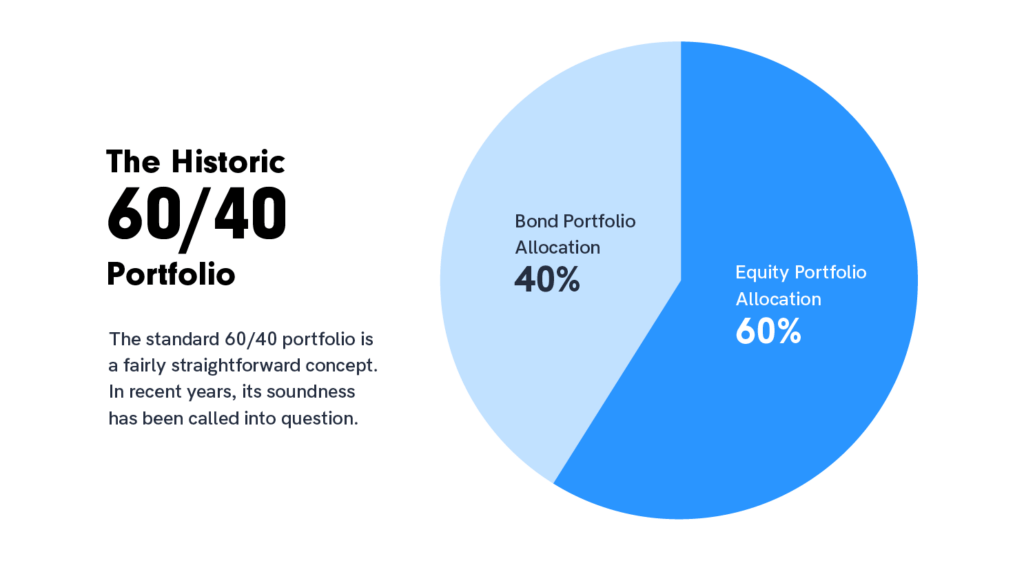
So, does the traditional 60 stock / 40 bond strategy still work or do we need another portfolio model?

***

The 60/40 strategy evolved out of American economist Harry Markowitz’s groundbreaking 1950s work on modern portfolio theory, which holds that investors should diversify their holdings with a mix of high-risk, high-return assets and low-risk, low-return assets based on their individual circumstances.

While a portfolio with a mix of 40% bonds and 60% equities may bring lower returns than all-stock holdings, the diversification generally brings lower variance in the returns—meaning more reliability—as long as there isn’t a strong correlation between stock and bond returns (ideally the correlation is negative, with bond returns rising while stock returns fall).

CORRELATION: https://medicalexecutivepost.com/2024/10/27/correlation-diversification-in-finance-and-investments/

For 60/40 to work, bonds must be less volatile than stocks and economic growth and inflation have to move up and down in tandem. Typically, the same economic growth that powers rallies in equities also pushes up inflation—and bond returns down. Conversely, in a recession stocks drop and inflation is low, pushing up bond prices.

***

  • But, the traditional 60/40 portfolio may “no longer fully represent true diversification,” BlackRock CEO Larry Fink writes in a new letter to investors.
  • Instead, the “future standard portfolio” may move toward 50/30/20 with stocks, bonds and private assets like real estate, infrastructure and private credit, Fink writes.
  • Here’s what experts say individual investors may want to consider before dabbling in private investments.

It may be time to rethink the traditional 60/40 investment portfolio, according to BlackRock CEO Larry Fink. In a new letter to investors, Fink writes the traditional allocation comprised of 60% stocks and 40% bonds that dates back to the 1950s “may no longer fully represent true diversification.

DI-WORSIFICATION: https://medicalexecutivepost.com/2024/04/09/what-is-financial-portfolio-di-worsification-2/

EDUCATION: Books

SPEAKING: Dr. Marcinko will be speaking and lecturing, signing and opining, teaching and preaching, storming and performing at many locations throughout the USA this year! His tour of witty and serious pontifications may be scheduled on a planned or ad-hoc basis; for public or private meetings and gatherings; formally, informally, or over lunch or dinner. All medical societies, financial advisory firms or Broker-Dealers are encouraged to submit a RFP for speaking engagements: MarcinkoAdvisors@outlook.com 

COMMENTS APPRECIATED

Read, Like, Subscribe and Refer

***

***

Elon Musk and Mike Burry MD Speak Out & About Consumer Debt

WARNING – WARNING

By Dr. David Edward Marcinko MBA MEd CMP

SPONSOR: http://www.CERTIFIEDMEDICALPLANNER.org

***

Echoing Elon Musk and my colleague medical Michael Burry MD has warned about American consumers’ debt woes.

Echoing the likes of Tesla’s Elon Musk and “The Big Short” investor Michael Burry, a veteran economist has warned that American households have racked up historic amounts of debt — and the economy will pay the price.

“Consumers are just waking up to the fact that they’re financing their spending by running up their credit cards, and that the interest on those credit cards is over the top, out of control, and off the hook right now,” Carl Weinberg told CNBC. Record credit-card debt threatens to spark a consumer-spending slowdown soon, Carl Weinberg said.

“That’s going to lead to a retrenchment in consumer spending as we get into the new year” the chief economist at High Frequency Economics said. Weinberg expects the US economy to cool but not slide into recession, and he sees inflation fading.

PS: Mike Burry contributed to our 800 page textbook on investing for physicians.

COMMENTS APPRECIATED

Thank You

***

MORE: https://www.routledge.com/Comprehensive-Financial-Planning-Strategies-for-Doctors-and-Advisors-Best/Marcinko-Hetico/p/book/9781482240283

***

RECESSION INDICATOR: Inverted Yield Curve?

By Staff Reporters

***

***

When economic trouble and/or uncertainty is brewing, it’s not uncommon for the US Treasury yield curve to flatten or even invert. A yield curve inversion, like we’re experiencing now, involves short-term-maturing bonds sporting higher yields than longer-dated Treasury bonds. It’s an indication that investors are worried about the U.S. economic outlook.

For the past 64 years, the Federal Reserve Bank of New York has used the Treasury yield spread between the 10-year bond rate and three-month bond rate to calculate the probability of a U.S. recession occurring within the next 12 months. Over these 64 years, the probability of a recession has topped 25% a dozen times and 40% on eight occasions. 

With the exception of a peak probability of a recession of 41.14% in October 1966, the New York Fed’s recession-forecasting tool hasn’t been wrong if it’s surpassed 40%. In other words, if the New York Fed’s recession probability indicator surpasses 40%, we’ve had a recession within 12 months, without fail, for more than a half-century.

In December 2022, this recession probability tool hit 47.31%. That’s the highest reading since 1981, and a very clear indication that economic activity is expected to slow at some point in 2024?

***

***

COMMENTS APPRECIATED

Comprehensive Financial Planning Strategies for Doctors and Advisors: Best Practices from Leading Consultants and Certified Medical Planners™

ORDER: https://www.routledge.com/Comprehensive-Financial-Planning-Strategies-for-Doctors-and-Advisors-Best/Marcinko-Hetico/p/book/9781482240283

***

COMMENTS APPRECIATED

Thank You

***

DAILY UPDATE: Senior Care Facility Bankruptcies Up with Recession Life Spans?

By Staff Reporters

***

***

Financial hardship has led dozens of operators of senior facilities to file for bankruptcy over the past three years, with 13 companies filing petitions in 2021, 12 debtors filing in 2022 and 15 more in 2023, according to Gibbins Advisors.

***

***

Notable Chapter 11 filings over the past year have included Evangelical Retirement Homes of Greater Chicago, which filed Chapter 11 in the U.S. Bankruptcy Court for the Northern District of Illinois in June 2023 to sell its assets at auction. Also, Windsor Terrace Health, an operator of 32 nursing homes in California and three in Arizona, filed its petition in the U.S. Bankruptcy Court for the Central District of California in August 2023 listing $1 million to $10 million in assets and liabilities and unable to pay its debts.

CITE: https://www.r2library.com/Resource/Title/082610254

More recently, Magnolia Senior Living, an operator of four facilities in Georgia, filed for Chapter 11 protection on March. 19 in the U.S. Bankruptcy Court for the Northern District of Georgia.

***

The Great Recession of 2008 had a lot of downsides: People lost homes, jobs, and retirement savings, had their careers derailed, and were forced to learn what the heck synthetic collateralized debt obligations are. But according to recent research, it also made people in the US live longer.

COMMENTS APPRECIATED

Thank You

***

***

DAILY UPDATE: Recession and the Markets

By Staff Reporters

***

***

There are certain types of stocks, bonds and mutual funds that perform better when the market is in decline. Seasoned investors tend to survive bear markets by focusing on the stocks of companies that make products necessary for daily life. Companies that often thrive in a recessionary environment are defensive stocks that provide products and services people simply cannot live without. Stocks included in this list are considered to be defensive by Wall Street analysts.

These type of stocks have performed -5.35% over the past year. By comparison, the S&P 500 is 7.13% over the same period. These types of stocks include: 30.00% of Consumer Cyclical stocks, 30.00% of Consumer Non-Cyclical stocks, 20.00% of Healthcare stocks, 10.00% of Technology stocks and 10.00% of Energy stocks.

Bear markets and recessions also tend to present themselves when market prices have been rising for a time; and investors are feeling irrationally exuberant. But, some markets have seen downturns in 2022 and 2023.

CITE: https://www.r2library.com/Resource

Here is where the major benchmarks ended yesterday:

  • The S&P 500® Index fell 60 points (1.35%) to 4,376.31; the Dow Jones Industrial Average (DJIA) fell 374 points (1.08%) to 34,099.42; the NASDAQ Composite fell 257 points (1.87%) to 13,463.97.
  • The 10-year Treasury note yield (TNX) rose 4 basis points to 4.236%.
  • CBOE’s Volatility Index (VIX) rose roughly 1 point to 17.08.

Consumer discretionary was the weakest sector Thursday, as heavyweight constituents Amazon (AMZN) and Tesla (TSLA) both slid around 2.5%, with communication services and tech right behind. No sector was higher for the day.

***

ORDER: https://www.routledge.com/Comprehensive-Financial-Planning-Strategies-for-Doctors-and-Advisors-Best/Marcinko-Hetico/p/book/9781482240283

***

COMMENTS APPRECIATED

Thank You

***

Recession, Interest Rates and Earnings?

By Staff Reporters

***

***

Recession: Last October, economists surveyed by Bloomberg were predicting a 100% chance of a Recession. But currently, the Dow is riding a 10-day winning streak, and the S&P 500 is just over 5% away from its all-time high. This week, Wall Street will be glued to the Fed’s interest rate announcement and a heavy slate of earnings.

Final Fed rate hike? The Federal Reserve will likely announce another interest rate increase this week, but this could be the final hike in its 16-month quest to bring down inflation. If the Fed hikes 25 basis points as expected, interest rates would be at their highest level since 2001.

Earnings galore: Corporate America’s A-list will report Q2 earnings this week, including Meta, Alphabet, Microsoft, McDonald’s, Coca-Cola, and Exxon Mobil. In all, about one-third of companies in the S&P 500 will give financial updates over the next five days, so we should get a good look into the health of a bunch of different industries.

***

COMMENTS APPRECIATED

Thank You

***

***

RECESSION: Healthcare Industry Layoffs

Not even the healthcare industry is recession-proof

By Staff Reporters

***

***

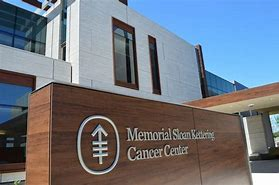
According to Kristine White of Healthcare Brew, New York City-based Memorial Sloan Kettering Cancer Center (MSK), one of the country’s top cancer treatment facilities, laid off 337 employees on Jan. 17 in response to ongoing financial challenges, according to a New York State Department of Labor filing.

The 337 employees, who worked across 14 sites and in multiple departments, represent about 1.5% of MSK’s 22,500 employees. This is a slight decrease from the expected 3% of layoffs announced in November 2022.

“This reduction was necessary to ensure that MSK can continue to invest in the future of cancer care, research, and education for the benefit of generations to come, and every effort has been made to ensure that patient care is not impacted,” spokesperson John Connolly said in a statement shared with Healthcare Brew.

The institution’s operating losses totaled $116.1 million for Q3 of 2022, compared to a loss of $8.7 million during the same period in 2021, according to a quarterly financial report released in November last year.

Factors such as increased patient activity, wages, and supply costs from inflation pushed the system’s operating expenses up by 7.5% from Q3 of 2021 to Q3 of 2022. The cancer center hired more staff in 2022 with the expectation that patient volume would increase, according to the financial report.

CITE: https://www.r2library.com/Resource/Title/0826102549

Health systems like MSK often reevaluate their biggest expense (workers) when business is down, Lori Kalic, a healthcare senior analyst at consulting firm RSM, told Healthcare Brew.

Just this year, multiple hospitals and health systems have also announced layoffs, including Tufts Medicine in Boston and Integris Health in Oklahoma, according to White.

***

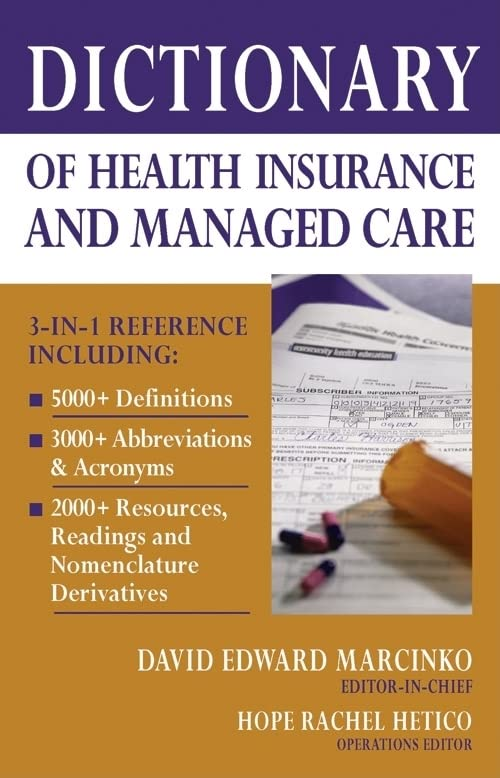
ORDER: https://www.amazon.com/Dictionary-Health-Insurance-Managed-Care/dp/0826149944/ref=sr_1_4?ie=UTF8&s=books&qid=1275315485&sr=1-4

***

COMMENTS APPRECIATED

Thank You

***

Recession OR Not … You Decide?

A ME-P Reader Opinion Poll

***

***

DEFINITION: NBER defines a recession as “a significant decline in economic activity that is spread across the economy and that lasts more than a few months.” That definition encompasses a range of economic factor but is based on three main criteria: The depth, diffusion and duration of a downturn.

CITE: https://www.r2library.com/Resource/Title/082610254

***

Former Federal Reserve Chair Alan Greenspan recently said a US recession is the “most likely outcome” in 2023 as the central bank tightens monetary policy to curb inflation. 

So – Tell Us What You Think.

FELL FREE TO PONTIFICATE

LEAVE A COMMENT BELOW

***

COMMENTS APPRECIATED

Thank You

***

ORDER: https://www.routledge.com/Comprehensive-Financial-Planning-Strategies-for-Doctors-and-Advisors-Best/Marcinko-Hetico/p/book/9781482240283

***

HAPPY NEW [Recessionary] YEAR 2023?

By Staff Reporters

The Fed hikes interest rates, sending economy teetering toward a recession?

If everyone was an opinionated virologist in 2020, then 2022 turned us all into macro-economists. In an effort to fight historic inflation, the Fed raised its benchmark interest rate seven times this year, pushing it to a 15-year high. Chair Jerome Powell’s hawkish turn slowed the economy and was a major catalyst for the brutal sell-off in stocks, particularly in the tech sector. This year, Amazon became the first public company to lose $1 trillion in market value.

CITE: https://www.r2library.com/Resource/Title/082610254

EVEN HOUSING MARKETS DOWN

The U.S. housing market is experiencing its second-biggest home price correction of the post-World War II era. Macro Trends Advisors founding partner Mitch Roschelle attributed the massive correction to Americans’ uncertainty for the markets and their “uneasiness” regarding the economy. He explained on “Varney & Co.” that the “shoe to drop” would be if the nation starts to see a rise in unemployment, which could cause a “leg down” in the housing market.

Finis?

So what’s ahead for 2023? According to MorningBrew, Economists think that a recession is likely, but a few are holding out hope that the Fed can achieve a so-called “soft landing,” where it brings inflation down to normal levels without causing the economy to shrink. Recent months have brought cautiously hopeful news: Annual inflation has cooled from a peak of 9.1% to 7.1%, so rate hikes are expected to be much less aggressive next year.

ALL THE BEST

Comprehensive Financial Planning Strategies for Doctors and Advisors: Best Practices from Leading Consultants and Certified Medical Planners™

ORDER: https://www.routledge.com/Comprehensive-Financial-Planning-Strategies-for-Doctors-and-Advisors-Best/Marcinko-Hetico/p/book/9781482240283

***
COMMENTS APPRECIATED

Thank You

***

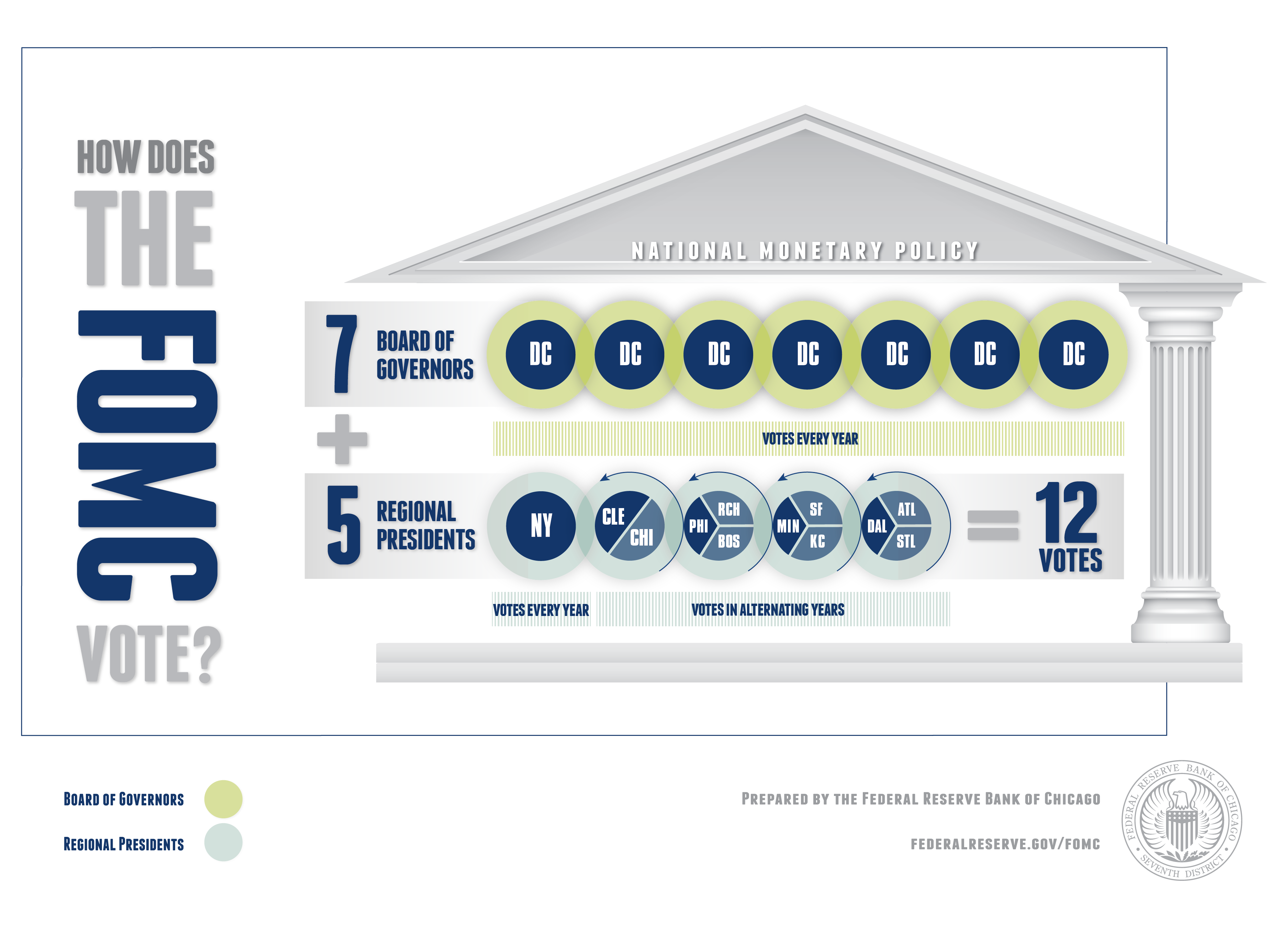
FOMC: May Keep Tightening Until a Recession!

By Staff Reporters

***

The FOMC just reiterated calls for aggressive policy to combat stubbornly high inflation—fueling expectations for bigger rate hikes amid a stock-market sell-off that’s seen major indexes hit new lows for the year—and some analysts project the losses could only deepen.

Expectations for rate hikes climbed amid the comments, with markets pricing in an end-of-year rate of 4.5%—above the 4.4% rate Fed officials projected earlier this month, which itself was one percentage point higher than the forecast in June.

***

COMMENTS APPRECIATED

Thank You

***

FINANCE: https://www.routledge.com/Comprehensive-Financial-Planning-Strategies-for-Doctors-and-Advisors-Best/Marcinko-Hetico/p/book/9781482240283

***

UPDATE: Recession, Goldman Sachs, and Tesla

By Staff Reporters

***

***

The director of the nonpartisan Congressional Budget Office [CBO] added his voice Thursday to those economists who say it’s unclear if the economy has hit a downturn, despite posting two straight quarterly drops in growth. “The U.S. economy shows signs of slowing, but whether the economy is currently in a recession is difficult to say,” wrote CBO Director Phillip Swagel in a letter to Sen. Lindsey Graham (R-S.C.). “It is possible that, in retrospect, it will become apparent that the economy moved into recession sometime this year. However, that is not clear from data that were available at the beginning of August,” Swagel added.

Goldman Sachs said its credit card unit is under investigation by the Consumer Financial Protection Bureau, a federal agency tasked with protecting Americans from financial abuse. In a securities filing, Goldman said the CFPB is examining a number of the company’s credit card account management practices, including refunds, resolving billing errors, advertisements and reporting to credit bureaus. And, in a statement to CBS MoneyWatch, Goldman said the bank “is cooperating with the CFPB on this matter.”

Finally, shares of electric vehicle maker Tesla rallied in after-hours trading as the company won shareholder approval for a 3:1 stock split, the second such move in two years, as the world’s most valuable automaker looks to make its stock more affordable.

***

COMMENTS APPRECIATED

Thank You

***

FINANCIAL PLANNING: https://www.routledge.com/Comprehensive-Financial-Planning-Strategies-for-Doctors-and-Advisors-Best/Marcinko-Hetico/p/book/9781482240283

****

UPDATE: The Markets, Gasoline, Recession and the Bear

By Staff Reporters

***

***

For the domestic markets, the S&P 500 closed down 151 points, or 3.88%. It’s down nearly 22% since January. The Dow was down 876 points (2.79%) and the NASDAQ dropped 530 points (4.68%). And, investors were disappointed to learn that inflation is moving in the wrong direction. U.S. consumer prices surged 8.6% year-over-year in May, to a fresh 40-year high, led by higher prices for energy, food and housing.

For the first time in history, a gallon of regular gasoline now costs $5 on average nationwide, according to AAA, and experts predict gas prices could average $6 a gallon by August.

Moreover, nearly 70% of leading economists expect the US to tumble into a recession as the country grapples with inflation. In a Financial Times poll, the bulk of economists said they expect a recession to be declared in the first half of 2023. The poll comes after US inflation soared to 8.6% in May, outstripping economists’ expectations and piling the pressure on the Fed.

Finally, S&P Global says a 20% decline in the S&P 500 on a closing basis from its previous peak is all it takes to define a bear market. Which means that this bear market is already more than five months old, since the S&P 500 all-time high came on January 3rd, 2022.

***

***

COMMENTS APPRECIATED

Thank You

***

***

UPDATE: Vitalik Buterin, Recession Risk the Euro and BOA

By Staff Reporters

***

***

  • Vitalik Buterin tweeted Friday that he’s no longer a billionaire. Crypto has crashed in recent weeks amid a broad sell-off in traditional markets. Ethereum cofounder Vitalik Buterin tweeted Friday that he’s no longer a billionaire. Buterin, who cofounded the blockchain network in 2014, has seen its Ether token crash by 59% since hitting a high of around $4,800 in November 2021, when his holding was valued at around $1.5 billion.
  • Historically, the S&P 500 has fallen an average of 29% around recession (median of 24%). With the S&P 500 currently showing a peak-to-trough decline of almost 19%, the market is effectively already pricing in a 60%-75% chance of recession based on the average and median.
  • Thanks to a surging US dollar and a faltering Euro, many analysts expect that the two currencies could reach parity this year—meaning one dollar would fetch you one euro. The two currencies haven’t reached a 1:1 exchange rate since 2002, three years after the euro was introduced in an effort to bring stability to Europe. The euro closed at $1.057 against the dollar, just 5% above equal value with the US currency.
  • Finally, the current market plunge hasn’t yet scared investors like downturns in years past. Bank of America’s private clients are still dedicating 63% of their portfolios to stocks, compared to 39% after the 2008 financial crisis.

***

COMMENTS APPRECIATED

Thank You

***

***

The Impact Of The U.S. Recession On Hospitals

Join Our Mailing List

Drivers of Decline

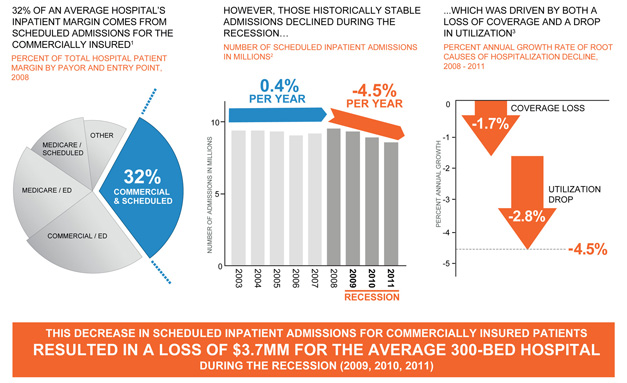
Commercially insured scheduled admissions are the largest contributor to inpatient margins for the average US hospital. During the US recession (2009-2011), volumes in this segment declined. There were two primary drivers of this decline.

####

Recession Impact

Dual Causes

First, commercial insurance coverage decreased, stemming from unemployment and underemployment. This is expected to reverse and rebound as the economy recovers and as healthcare reform is implemented.

Second, even among those who retained coverage, utilization of inpatient services decreased as patients delayed or forewent elective and preventative care. This was influenced by a range of economic factors, including reduced household incomes, higher co-pays, and a reduced ability to leave work for medical care, as well as factor unrelated to the recession, such as a shift to outpatient management of disease.

More: Are Cost Estimates Leading To The Wrong Decisions in US Hospitals?

Assessment

It is unclear whether this second driver will diminish fully as the economy recovers. A slow recovery – or one that fails to see volumes to return to pre-recession levels – suggests that hospitals may need to refocus their strategies on service lines and segments that have historically been less attractive.

Channel Surfing the ME-P

Have you visited our other topic channels? Established to facilitate idea exchange and link our community together, the value of these topics is dependent upon your input. Please take a minute to visit. And, to prevent that annoying spam, we ask that you register. It is fast, free and secure.

Conclusion

Your thoughts and comments on this ME-P are appreciated. Feel free to review our top-left column, and top-right sidebar materials, links, URLs and related websites, too. Then, subscribe to the ME-P. It is fast, free and secure.

Speaker: If you need a moderator or speaker for an upcoming event, Dr. David E. Marcinko; MBA – Publisher-in-Chief of the Medical Executive-Post – is available for seminar or speaking engagements. Contact: MarcinkoAdvisors@msn.com

OUR OTHER PRINT BOOKS AND RELATED INFORMATION SOURCES:

Product Details

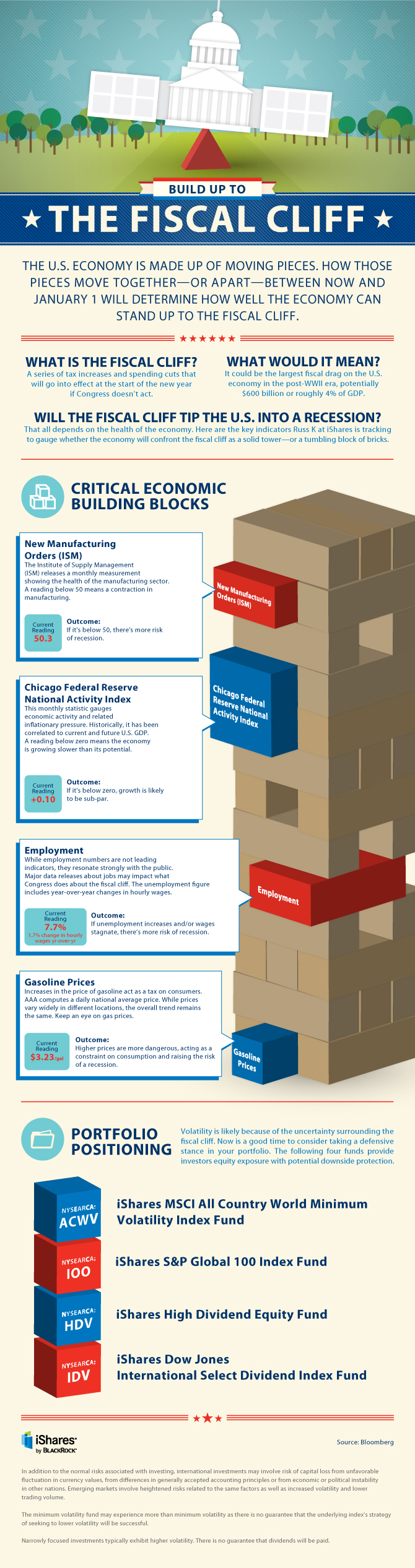
Building Up to the Fiscal Cliff

Join Our Mailing List

A Historic Review

Fiscal Cliff

Assessment

Doctors, FAs and all ME-P readers. What is your strategy for the fiscal cliff situation?

Conclusion

Your thoughts and comments on this ME-P are appreciated. Feel free to review our top-left column, and top-right sidebar materials, links, URLs and related websites, too. Then, subscribe to the ME-P. It is fast, free and secure.

Link: http://feeds.feedburner.com/HealthcareFinancialsthePostForcxos

Speaker: If you need a moderator or speaker for an upcoming event, Dr. David E. Marcinko; MBA – Publisher-in-Chief of the Medical Executive-Post – is available for seminar or speaking engagements. Contact: MarcinkoAdvisors@msn.com

Our Other Print Books and Related Information Sources:

Health Dictionary Series: http://www.springerpub.com/Search/marcinko

Practice Management: http://www.springerpub.com/product/9780826105752

Physician Financial Planning: http://www.jbpub.com/catalog/0763745790

Medical Risk Management: http://www.jbpub.com/catalog/9780763733421

Hospitals: http://www.crcpress.com/product/isbn/9781439879900

Physician Advisors: www.CertifiedMedicalPlanner.org

Product Details  Product Details

What are the Prospects for US Recession? [A Voting and Opinion Poll]

Is Wall Street Driving Main Street?

By Staff Reporters

Join Our Mailing List 

Concern is high that the US economy may be close to or entering recession, yet the fundamentals lend little support to such a projection. There has been no decline in jobs, while corporate health is very strong.

So, the recession concerns appear to be driven more by the decline in stock prices than by economic developments.

IOW: Is Wall Street pessimism driving Main Street gloom?

What do you think? Please vote and be sure to add your comments below.

Conclusion

And so, your thoughts and comments on this ME-P are appreciated. Feel free to review our top-left column, and top-right sidebar materials, links, URLs and related websites, too. Then, subscribe to the ME-P. It is fast, free and secure.

Link: http://feeds.feedburner.com/HealthcareFinancialsthePostForcxos

Speaker: If you need a moderator or speaker for an upcoming event, Dr. David E. Marcinko; MBA – Publisher-in-Chief of the Medical Executive-Post – is available for seminar or speaking engagements. Contact: MarcinkoAdvisors@msn.com  

Product Details

Product Details

Medical News of Arkansas Interviews Dr. Marcinko

Join Our Mailing List

Current Status of Hospitals and the Economy [Op-Ed]

[By Steve Brawner]

atlanta-skylineWhat: An exclusive telephonic and email interview.

Who: Dr. David Edward Marcinko; FACFAS, MBA [Editor, administrator and health economist]

Topic: The recession and economy, hospital operations, and the Obama administration.

Where: The telephone and internet virtual ME-P ether.

Why: To forecast informed opinions and pontifications on the healthcare industrial complex.

Among the dilemmas in healthcare, we seek answers to queries like:

• When will the recession end, and how will it affect hospitals and physicians?
• What operations and organizational policies can hospitals pursue to survive?
• How will the Obama stimulus affect hospitals and healthcare organizations?

Now, in as much as this controversy affects patients, administrators, politicians, Wall Street, nurse-executives and physicians alike, we went right to the source for up-to-date information regarding this current topic.

Assessment

Get ready for this controversial [unedited] interview and Q-A session, with Dr. David Edward Marcinko; Publisher-in-Chief, of this ME-P.

Arkansas Medical News Interviews Dr. Marcinko

Read it Here: interview-dr-marcinko1

Sponsored Link: www.MedicalBusinessAdvisors.com

Conclusion

Your thoughts and comments on this ME-P are appreciated. Feel free to review our top-left column, and top-right sidebar materials, links, URLs and related websites, too. Then, subscribe to the ME-P. It is fast, free and secure.

Speaker: If you need a moderator or speaker for an upcoming event, Dr. David E. Marcinko; MBA – Publisher-in-Chief of the Medical Executive-Post – is available for seminar or speaking engagements. Contact: MarcinkoAdvisors@msn.com

OUR OTHER PRINT BOOKS AND RELATED INFORMATION SOURCES:

[HOSPITAL OPERATIONS, ORGANIZATIONAL BEHAVIOR AND FINANCIAL MANAGEMENT COMPANION TEXTBOOK SET]

Product DetailsProduct Details

***