THANKSGIVING: Donor Advised Funds

DONATION: In “Name” Only?

Staff Reporters

***

Proponents of DAFs say that their structure encourages giving: The tax deduction encourages wealthy patrons to dedicate money for charity even before they’ve decided which cause to support. “Donors may have good reasons to postpone grants,” a Stanford Law School article says..

In one hypothetical, a tech founder who “sells a startup for millions of dollars” may want to donate her takings but is too busy to immediately decide how to direct the funds; a DAF is a good choice for this person, the law article notes.

However, while DAFs could in theory grow the charitable pie, in practice, they too often allow the donor the illusion of charity while letting them keep control of their funds, critics say. 

While a gift to a DAF is treated the same as an outright gift to the Red Cross or United Way, in practice, it “effectively allows the donor to retain ongoing control over the charitable disposition and investment of the donated assets,” tax scholars Roger Colinvaux and Ray Madoff wrote in 2019. What’s more, “donors are under no obligation, and have no incentive, ever to release their advisory privileges to make the funds available for charitable use.”

And ultra wealthy donors get a substantially larger tax break than a middle-class worker. As much as 74 cents of every dollar given to charity comes back to the donor in the form of tax breaks, according to calculations by Colinvaux and Madoff, with the highest-earning donors getting the biggest benefits A person in the top tax bracket would save 37% of their federal income tax for every dollar they contribute with a charitable donation; a similar amount of state income tax; and, depending on what they donate and when, they can also avoid capital gains tax and estate tax. (By contrast, a typical worker who makes about $60,000 and doesn’t own stocks would save 22% from their cash contribution, in addition to any state tax savings.) 

What’s more, because there’s no way to track donations from particular DAF accounts, they act as a form of “dark money,” allowing donors to give vast sums, essentially anonymously, to a range of potentially unsavory organizations, including nonprofits that advocate for specific political causes or organizations classified as hate groups, IPS says. 

“This allows DAFs to be used to hide transfers — similar to the way the ultra-wealthy use multiple shell companies to hide the movement of money among offshore accounts,” IPS writes. 

All of these strategies are completely legal, the IPS notes, as are other potentially questionable tactics used by family foundations—such as paying family members to serve as foundation trustees or act as executives of foundations, sometimes at salaries in the hundreds of thousands of dollars a year. However, the IPS argues, they erode public trust in charities and the tax system overall.

“The fact that billionaires opt out of paying taxes, have these closely held family foundations and get to play God about where the money goes, that’s private power — unaccountable private power,” Collins said. 

“At this point philanthropy is at risk of becoming taxpayer-subsidized private power.”

COMMENTS APPRECIATED

Refer a Colleague: MarcinkoAdvisors@msn.com

Your Referral Count: 0

***

***

Valuation of Hospitals [Technological Environment]

By Health Capital Consultants, LLC

***

***

Technological advancements have accelerated the shift of healthcare services from inpatient to outpatient settings, creating both opportunities and challenges for hospitals. For instance, minimally invasive procedures often serve as alternatives to traditional, more invasive surgeries. Additionally, the integration of telehealth and artificial intelligence (AI) has the potential to enhance access to and quality of care while reducing expenditures and administrative burdens.

This final installment of a five-part series on the valuation of hospitals examines the technological advancements transforming the industry. (Read more…) 

COMMENTS APPRECIATED

Subscribe Today!

***

***

PHYSICIAN FINANCIAL FEAR: Money Anxiety & Chrometophobia

By Dr. David Edward Marcinko MBA MEd

SPONSOR: http://www.MarcinkoAssociates.com

***

***

If you’ve found yourself worrying about the stock market or money lately, you definitely have company. Money anxiety, also called financial anxiety, has become more common than ever after the presidential election of November 2024.

In fact, the American Psychological Association’s 2022 Stress in America Survey, 87 percent of people who responded listed inflation as a source of significant stress. The rise in prices for everything from fuel to food has people from all backgrounds worried, today. The researchers say, in fact, that no other issue has caused this much stress since the survey began in 2007.

When money and financial concerns cause ongoing stress in your life, you could eventually begin to experience some feelings of anxiety as a result. This anxiety can, in turn, have a negative impact on your quality of life.

***

Chrometophobia, commonly known as fear of money, is a psychological condition characterized by overwhelming anxiety and avoidance of currency; according to colleague Dan Ariely PhD.

CITE: https://www.r2library.com/Resource/Title/0826102549

***

Physician Financial Fear is probably the most common emotion among physicians. The fear of being wrong – as well as the fear of being correct! It can be debilitating, as in the corollary expression on fear: the paralysis of analysis.

According to Paul Karasik, there are four common investor and physician fears, which can be addressed by financial advisors and psychologists in the following manner:

  • Fear of making the wrong decision: ameliorated by being a teacher and educator.
  • Fear of change: ameliorated by providing an agenda, outline and/or plan.
  • Fear of giving up control: ameliorated by asking for permission and agreement.
  • Fear of losing self-esteem: ameliorated by serving the client first and communicating that sentiment in a positive manner.

COMMENTS APPRECIATED

Please Subscribe and Thank You!

***

***

CHARGE MASTER: Medical Bills Paradox

By Dr. David Edward Marcinko MBA MEd CMP™

SPONSOR: http://www.CertifiedMedicalPlanner.org

***

***

CHARGE MASTER MEDICAL BILLS

Classic Definition: A comprehensive review of a physician, clinic, facility, medical provider or hospital’s charges to ensure Medicare billing compliance through complete and accurate HCPCS/CPT and UB-92 revenue code assignments for all items including supplies and pharmaceuticals. The charge master captures the costs of each procedure, service, supply, prescription drug, and diagnostic test provided at the hospital, as well as any fees associated with services, such as equipment fees and room charges

Modern Circumstance: A charge master quizlet (charge description master [CDM]) document that contains a computer-generated list of procedures, services, and supplies with charges for each. Charge master rates are essentially the health care market equivalent of Manufacturer’s Suggested Retail Price (MSRP) in the car buying market. Poor charge master maintenance can lead to overpayments or underpayments. It can also lead to claim rejections from insurance companies, poor patient experience, or compliance violations.

Paradox Examples:

  • Superbills: An encounter form that is the financial record source document used by healthcare providers and other personnel to record treated diagnoses and services rendered to the patient during the current encounter. It is also called a superbill.
  • Payment rates: Almost no one actually pays the publicized charge master rates. The vast majority of health care consumers are represented by a payer of some kind, such as a commercial health insurance company, Medicaid, or Medicare. Commercial insurers negotiate the actual prices they pay during the process of contracting with providers. Medicare and Medicaid establish their own payment levels independent of hospitals’ charge master lists – Medicare through the federal government and Medicaid through state governments.
  • Cash pay: The sad irony of the charge master is that the uninsured are the most likely to be billed charge master rates because they are not represented by a third-party payer.
  • Problematic features: Other items also impede the ability of payers to have a comprehensive and accurate understanding of hospitals’ financial positions. For example, nonprofit hospitals are required to report charity care, bad debt expenses, community benefit initiatives, and uncompensated care. When these expenses are reported at the charge master level, expenses can be paradoxically overstated, potentially making a hospital’s financial position look worse than it actually is.

COMMENTS APPRECIATED

Subscribe Today!

***

***

***

DAILY UPDATE: All About the Stock Markets

MEDICAL EXECUTIVE-POST TODAY’S NEWSLETTER BRIEFING

***

Essays, Opinions and Curated News in Health Economics, Investing, Business, Management and Financial Planning for Physician Entrepreneurs and their Savvy Advisors and Consultants

Serving Almost One Million Doctors, Financial Advisors and Medical Management Consultants Daily

A Partner of the Institute of Medical Business Advisors , Inc.

http://www.MedicalBusinessAdvisors.com

SPONSORED BY: Marcinko & Associates, Inc.

***

http://www.MarcinkoAssociates.com

Daily Update Provided By Staff Reporters Since 2007.
How May We Serve You?
© Copyright Institute of Medical Business Advisors, Inc. All rights reserved. 2024

REFER A COLLEAGUE: MarcinkoAdvisors@msn.com

SPONSORSHIPS AVAILABLE: https://medicalexecutivepost.com/sponsors/

ADVERTISE ON THE ME-P: https://tinyurl.com/ytb5955z

Your Referral Count -0-

  • Stocks ended the day mixed, with the Dow sinking into the red while the S&P 500 and NASDAQ kicked off the week on a positive note thanks to gains from tech stocks.
  • Oil popped on a double-whammy of news: Long-range, US-made ballistic missiles launched from Ukraine into Russia might disrupt oil supply, while the shutdown of Norway’s Johan Sverdrup oil field due to a power outage will definitely disrupt oil supply.
  • Crypto continued its hot streak today: Bitcoin popped back above $90,000, giving other cryptocurrencies a boost.
  • Bitcoin’s boom has certainly helped MicroStrategy, which announced today that it purchased 51,780 bitcoins for approximately $4.6 billion in cash, or roughly $88,627 per bitcoin, in the last week alone.

CITE: https://www.r2library.com/Resource

STOCKS UP

The new Trump Trade continues: The president-elect’s selection of Liberty Energy CEO Chris Wright to lead the Department of Energy gave Liberty a 4.85% boost today. Wright is also on the board of nuclear company Oklo, which popped 14.83%.

  • Speaking of Trump, Trump Media & Technology Group soared 16.65% on the news that it may purchase crypto trading firm Bakkt.
  • Netflix disappointed viewers with its glitchy showing of Jake Paul vs. Mike Tyson, but shareholders forgave the company after it announced record viewership of the fight. Shares climbed 2.80%.
  • CVS Health gained 5.41% on news that it struck a deal with activist investor Glenview Capital Management to add four new seats to its board.
  • Robinhood jumped 8.29% to a new all-time high thanks to an upgrade from Needham analysts giving the investing app a “buy” rating due to its crypto offerings under a pro-crypto Trump presidency.
  • Warner Bros. Discovery rose 2.71% on a Wall Street Journal report that it has settled its legal dispute with the NBA, guaranteeing broadcast rights for the next decade.

STOCKS DOWN

  • Nvidia isn’t often in this section of the newsletter, but the semiconductor leader sank 1.29% today on a report from The Information that its new Blackwell chips are prone to overheating.
  • Palantir popped after moving over to the Nasdaq last week, but the red-hot software stock dropped 6.86% as investors collected profits.
  • Redfin may help you buy a house, but the online real estate brokerage is a “sell,” according to Goldman Sachs. The Wall Street firm cited low home sales, low affordability, and low chances of success in a competitive market. Shares fell 4.42%.
  • Uber dropped 5.35% to a new 52-week low on the threat of Tesla’s robotaxis ruling the road thanks to a Trump administration that seems keen on cutting self-driving regulations.

CITE: https://tinyurl.com/2h47urt5

Here’s where the major benchmarks ended:

  •  The SPX was up 23.00 points (0.4%) to 5893.62; the Dow Jones Industrial Average® ($DJI) fell 55.39 points (0.1%) to 43,389.6; and the NASDAQ Composite® ($COMP) was up 111.69 points (0.6%) to 18,791.81.
  • The 10-year Treasury note yield fell one basis point to 4.41%.
  • The CBOE Volatility Index® (VIX) eased to 15.57.

CITE: https://tinyurl.com/tj8smmes

Visualize: How private equity tangled banks in a web of debt, from the Financial Times.

COMMENTS APPRECIATED

PLEASE SUBSCRIBE: MarcinkoAdvisors@msn.com

Thank You

***

***

***

***

EDUCATIONAL TEXTBOOKS: https://tinyurl.com/4zdxuuwf

***

STOCK POSITION SIZING: How to Construct Investment Portfolios That Protect You

By Vitaliy Katsenelson CFA
For a while in the value investing community the number of positions you held was akin to bragging on your manhood– the fewer positions you owned the more macho an investor you were. 

I remember meeting two investors at a value conference. At the time they had both had “walk on water” streaks of returns. One had a seven-stock portfolio, the other held three stocks. Sadly, the financial crisis humbled both – the three-stock guy suffered irreparable losses and went out of business (losing most of his clients’ money). The other, after living through a few incredibly difficult years and an investor exodus, is running a more diversified portfolio today.

Under-diversification is dangerous, because a few mistakes or a visit from Bad Luck may prove to be fatal to the portfolio.

On the other extreme, you have a mutual fund industry where it is common to see portfolios with hundreds of stocks (I am generalizing). There are many reasons for that. Mutual funds have an army of analysts who need to be kept busy; their voices need to be heard; and thus their stock picks need to find their way into the portfolio (there are a lot of internal politics in this portfolio). 

These portfolios are run against benchmarks; thus their construction starts to resemble Noah’s Ark, bringing on board a few animals (stocks) from each industry. Also, the size of the fund may limit its ability to buy large positions in small companies.

There are several problems with this approach. First, and this is the important one, it breeds indifference: If a 0.5% position doubles or gets halved, it will have little impact on the portfolio. The second problem is that it is difficult to maintain research on all these positions. Yes, a mutual fund will have an army of analysts following each industry, but the portfolio manager is the one making the final buy and sell decisions. Third, the 75th idea is probably not as good as the 30th, especially in an overvalued market where good ideas are scarce.

Then you have index funds. On the surface they are over-diversified, but they don’t suffer from the over-diversification headaches of managed funds. In fact, index funds are both over-diversified and under-diversified. Let’s take the S&P 500 – the most popular of the bunch. It owns the 500 largest companies in the US. You’d think it was a diversified portfolio, right? Well, kind of. The top eight companies account for more than 25% of the index. Also, the construction of the index favors stocks that are usually more expensive or that have recently appreciated (it is market-cap-weighted); thus you are “diversified” across a lot of overvalued stocks.

If you own hundreds of securities that are exposed to the same idiosyncratic risk, then are you really diversified?

Our portfolio construction process is built from a first-principles perspective. If a Martian visited Earth and decided to try his hand at value investing, knowing nothing about common (usually academic) conventions, how would he construct a portfolio?

We want to have a portfolio where we own not too many stocks, so that every decision we make matters – we have both skin and soul in the game in each decision. But we don’t want to own so few that a small number of stocks slipping on a banana will send us into financial ruin.

In our portfolio construction, we are trying to maximize both our IQ and our EQ (emotional quotient). Too few stocks will decapitate our EQ – we won’t be able to sleep well at night, as the relatively large impact of a low-probability risk could have a devastating impact on the portfolio. I wrote about the importance of good sleep before (link here). It’s something we take seriously at IMA.

Holding too many stocks will result in both a low EQ and low IQ. It is very difficult to follow and understand the drivers of the business of hundreds of stocks, therefore a low IQ about individual positions will eventually lead to lower portfolio EQ. When things turn bad, a constant in investing, you won’t intimately know your portfolio – you’ll be surrounded by a lot of (tiny-position) strangers.

Portfolio construction is a very intimate process. It is unique to one’s EQ and IQ. Our typical portfolios have 20–30 stocks. Our “focused” portfolios have 12–15 stocks (they are designed for clients where we represent only a small part of their total wealth). There is nothing magical about these numbers – they are just the Goldilocks levels for us, for our team and our clients. They allow room for bad luck, but at the same time every decision we make matters.

Now let’s discuss position sizing. We determine position sizing through a well-defined quantitative process. The goals of this process are to achieve the following: Shift the portfolio towards higher-quality companies with higher returns. Take emotion out of the portfolio construction process. And finally, insure healthy diversification.

Our research process is very qualitative: We read annual reports, talk to competitors and ex-employees, build financial models, and debate stocks among ourselves and our research network. In our valuation analysis we try to kill the business – come up with worst-case fair value (where a company slips on multiple bananas) and reasonable fair value. 

We also assign a quality rating to each company in the portfolio. Quality is absolute for us – we don’t allow low-quality companies in, no matter how attractive the valuation is (though that doesn’t mean we don’t occasionally misjudge a company’s quality).

The same company, at different stock prices, will merit a higher or lower position size. In other words, if company A is worth (fair value) $100, at $60 it will be a 3% position and at $40 it will be a 5% position. Company B, of a lower quality than A but also worth $100, will be a 2% position at $60 and a 4% position at $40 (I just made up these numbers for illustration purposes). 

In other words, if there are two companies that have similar expected returns, but one is of higher quality than the other, our system will automatically allocate a larger percentage of the portfolio to the higher-quality company. If you repeat this exercise on a large number of stocks, you cannot but help to shift your portfolio to higher-quality, higher-return stocks. It’s a system of meritocracy where we marry quality and return.

Let’s talk about diversification. We don’t go out of our way to diversify the portfolio. At least, not in a traditional sense. We are not going to allocate 7% to mining stocks because that is the allocation in the index or they are negatively correlated to soft drink companies. (We don’t own either and are not sure if the above statement is even true, but you get the point.) 

We try to assemble a portfolio of high-quality companies that are attractively priced, whose businesses march to different drummers and are not impacted by the same risks. Just as bank robbers rob banks because that is where the money is, value investors gravitate towards sectors where the value is. To keep our excitement (our emotions) in check, and to make sure we are not overexposed to a single industry, we set hard limits of industry exposure. These limits range from 10%–20%. We also set limits of country exposure, ranging from 7%–30% (ex-US).

In portfolio construction, our goal is not to limit the volatility of the portfolio but to reduce true risk – the permanent loss of capital. We are constantly thinking about the types of risks we are taking. Do we have too much exposure to a weaker or stronger dollar? To higher or lower interest rates? Do we have too much exposure to federal government spending? I know, risk is a four-letter word that has lost its meaning. But not to us. Low interest rates may have time-shifted risk into the future, but they haven’t cured it.

READ: Position Sizing: How to Construct Portfolios That Protect You

COMMENTS APPRECIATED

Subscribe Today!

***

***

IRMAA: Income Related Monthly Adjustment Amount

By Staff Reporters

***

***

The income-related monthly adjustment amount (IRMAA) is a fee you pay on top of your Medicare Part B and Part D premiums if you make a yearly income above the annual thresholds.

READ: https://secure.ssa.gov/poms.nsf/lnx/0601101020

COMMENTS APPRECIATED

Subscribe Today!

***

***

FATAL: Narcissism

BY DR. DAVID EDWARD MARCINKO MBA MEd

***

***

Imagine if Narcissus had a social media account. Fatal narcissism is what happens when self-love goes off the rails. It’s not just about admiring your reflection; it’s an all-consuming need for admiration and validation. Think endless selfies and humblebrags.

***

***

While a bit of narcissism is normal, fatal narcissism is like a black hole – it sucks in all attention and gives nothing back.

So, if my Instagram looks like a shrine to my own greatness, you might be witnessing fatal narcissism in action.

COMMENTS APPRECIATED

Subscribe Today!

***

***

PODCAST: Farzad Mostashari MD and “Aledade”Primary Care

By Shahid N Shah

***

***

Our guest on this episode is Dr. Farzad Mostashari. Farzad is the co-founder and CEO of Aledade, a primary care enablement company that partners with independent PCPs to transition to value-based care and, as a result, maintain their independence.

Founded in 2014, Aledade works with 11,000 physicians across 40 states and DC, accounting for 1.7M patients under management in Medicare, Medicare Advantage, Commercial and Medicaid contracts. Farzad previously served as the National Coordinator for Health IT in the Department of Health and Human Services, he completed medical school at the Yale School of Medicine and a Master’s in Population Health from Harvard’s T.H. Chan School of Public Health. Earlier this year, Aledade raised a $123M Series E round of funding led by OMERS Growth Equity.

***

In this episode, colleague Shahid N. Shah will discuss with Farzad about (1) his journey to starting Aledade and the role policy expertise and evidence have played in the company’s success (2) why he and the company are betting on independent physicians as the drivers of change in value-based care and (3) how Aledade became the rare profitable health tech company.

-Dr. David Edward Marcinko MBA MEd

PODCAST: https://soundcloud.com/wharton-pulse-podcast/mostashari-aledade

***

ORDER: https://www.amazon.com/Dictionary-Health-Information-Technology-Security/dp/0826149952/ref=sr_1_5?ie=UTF8&s=books&qid=1254413315&sr=1-5

***

ORDER: https://www.amazon.com/Business-Medical-Practice-Transformational-Doctors/dp/0826105750/ref=sr_1_9?ie=UTF8&qid=1448163039&sr=8-9&keywords=david+marcinko

COMMENTS APPRECIATED

Thank You

***

Take the Physician-Focused FINANCIAL PLAN “Challenge”

Do You Have “What it Takes”?

Book Marcinko

DEM 2

By Professor David E. Marcinko MBBS DPM MBA MEd CMP®

Institute of Medical Business Advisors, Inc.

mba

www.CertifiedMedicalPlanner.org

cmp-logo16

My History

More than 20 years ago I crafted a comprehensive holistic financial plan for a young doctor colleague who was born in 1959. In fact, he was not even a medical student at the time; so “canned off-the-shelf plans”, computer generated software or generic spread sheets were not a viable creation option. It was all a granular, detailed, specific and cognitive work-product. Today, he is a board-certified internist.

So, in 2023, it is right and just to take a look back and see how well, or poorly, we’ve fared.

Now, I appreciate more than most how financial planning is a “process”; and not an isolated event. Yet, all sorts of “advisors” and “consultants” create and charge hefty fees for same, and on-going monitoring, every day.

The ME-P Challenge

Nevertheless, I challenge all you mid-career or senior financial planners /advisors to this competition; regardless of degree, certification or designation.

“Show me your financial plan” – AND – “I’ll show you my financial plan”

Here Comes the Judge

Then, our community of ME-P readers, subscribers, visitors and “judges” will decide the winner.

The contest is open to any financial advisor, planner, consultant, wealth manager, CFP®, CFA, insurance agent, CPA or CLU, ChFC, or stock-broker, etc., who is not afraid of transparency in his or her work product and purported expertise.

Of Financial Certifications and Designations

*** [Creating and Evaluating a physician focused financial plan]

***

Assessment

So, just send in a copy of any “blinded” physician-focused financial plan that is about 21 years old. We will post for all to see and review …. warts and all … including my own; three part mega-plan!

The winner will receive bragging rights, academic swagger, and expert promotion to our entire ME-P ecosystem and network of medical, business, law and graduate school communities; as well as physicians, nurses, healthcare executives and allied health care professionals.

An informed sought-after and lucrative sector – indeed!

IOW: Free publicity and positive “new-wave” PR – PRICELESS!

Of course, as an educator and professor of health economics and finance, we are pleased to present you with the deep medical business knowledge and detailed financial,managerial and accounting techniques used, with some real-life “tips and pearls” developed over the last two decades of R&D, right here:

MORE: Comprehensive Financial Planning Strategies for Doctors[Best Practices from Leading Consultants and Certified Medical Planners™]

MORE: Risk Management Liability Insurance, and Asset Protection Strategies for Doctors and Advisors [Best Practices from Leading Consultants and Certified Medical Planners™]

Conclusion

Your thoughts and comments on this ME-P are appreciated. Feel free to review our top-left column, and top-right sidebar materials, links, URLs and related websites, too. Then, subscribe to the ME-P. It is fast, free and secure.

Speaker: If you need a moderator or speaker for an upcoming event, Dr. David E. Marcinko; MBA – Publisher-in-Chief of the Medical Executive-Post – is available for seminar or speaking engagements. Contact: MarcinkoAdvisors@msn.com

OUR OTHER PRINT BOOKS AND RELATED INFORMATION SOURCES:

***

Risk Management, Liability Insurance, and Asset Protection Strategies for Doctors and Advisors: Best Practices from Leading Consultants and Certified Medical Planners™           8Comprehensive Financial Planning Strategies for Doctors and Advisors: Best Practices from Leading Consultants and Certified Medical Planners™

***

PART 1: My Sample Financial Plan I [Data gathering, goals and objectives]

PART 2: My Sample Financial Plan II [Data Analytics, Creation and Crafting]

PART 3: Request here: MarcinkoAdvisors@msn.com [Stress Testing and Completion]

***

Go back

Your message has been sent

Warning
Warning
Warning
Warning

Warning.

INVESTING NEWS: Stocks, Bonds, Oil, Gold, Bitcoin and Sectors Review Post Election

By Staff Reporters

SPONSOR: http://www.MarcinkoAssociates.com

BREAKING NEWS!

***

***

  • Stocks surged and stayed higher all yesterday day on news of Donald Trump’s presidential victory. The Dow rocketed over 1,350 points as soon as markets opened, and all three indexes ended the day at record highs.
  • Treasury yields have paralleled Trump’s chances of taking the White House for the last few weeks, and his election sent them soaring to over 4.46% at one point today.
  • Oil and gold both fell as the dollar rose after Trump’s win. The greenback popped on the promise of Trump’s protectionist tariff policies and the lower likelihood of the Fed cutting interest rates as fast as previously expected.
  • Bitcoin surged as traders celebrated the beginning of the new, friendlier regulatory environment that Trump promised during his campaign.

CITE: https://www.r2library.com/Resource/Title/0826102549

Sector check-up

  • Financials were the biggest sector mover Wednesday, up 6.16%, hitting a new high.
  • Industrials were up 3.93% Wednesday, hitting a new high.
  • Energy was up 3.54% in the session. It’s now 4.28% from the April high.
  • Real Estate fell 2.64% during trading. It’s now 5.6% from the high. 
  • Consumer Staples fell 1.5%. The sector is 5.76% from the September high.
  • Utilities fell 1%. It’s now 5.72% from the mid-October high.
  • Duke Energy was flat over the past three months, and it is 6.3% from the October high.

COMMENTS APPRECIATED

Please Subscribe!

***

***

PODCAST: Role of the “Entrepreneur” in Society

ACCORDING TO AUSTRIAN ECONOMISTS

BY PER BYLUND

Colleague Peter R. Quinones and Per Bylund return to the show to talk about the role of the entrepreneur not only in society, but according to the Austrian School of Economics. Medical perspectives are implied.

PODCAST: https://freemanbeyondthewall.libsyn.com/episode-312

YOUR THOUGHTS AND COMMENTS ARE APPRECIATED.

Thank You

***

***

OCTOBER: “Financial Planning” Month for Doctors

DR. DAVID EDWARD MARCINKO MBA MEd CMP™

http://www.MarcinkoAssociates.com

History for Us All

http://www.CertifiedMedicalPlanner.org

***

***

History of Financial Planning Month

Financial planning as a concept has been around for a long time, but not as we know it today. When Loren Dunton set up the Society for Financial Counseling Ethics in 1969, or when the first graduating class of the College of Financial Planning graduated in 1973, financial planning was very different. It was centered around selling limited partnerships, which came to end with the Tax Reform Act of 1986.

However, financial planning re-emerged — all thanks to Richard Averitt III. The certified financial planner gave new meaning to financial planning, this time with a focus on who the client is and what their needs are. This approach was purely methodological in nature.

Soon after, financial planning picked up again. According to the Certified Financial Planner (C.F.P.) Board of Standards in Denver, today, there are more than 94,000 C.F.P.s worldwide, including over 48,000 in the U.S. Additionally, there are also organizations that have been set up for C.F.P.s, such as the Financial Planning Association (FPA), which has approximately 22,000 members.

And, don’t forget the emerging Certified Medical Planner professional fiduciary designation for physicians, dentists, nurses and allied healthcare clients.

Financial planning, as we know it now, includes investing, tax planning, retirement planning, and basically other ways to get your finances in order and create mindful budgets to ensure a safe and secure future. Getting a step ahead of your spending and finances is beneficial in the long run and Financial Planning Month in October is the perfect time to do that.

MORE: https://medicalexecutivepost.com/2022/10/27/october-national-financial-planning-month/

***

COMMENTS APPRECIATED

Thank You

***

ORDER: https://www.routledge.com/Comprehensive-Financial-Planning-Strategies-for-Doctors-and-Advisors-Best/Marcinko-Hetico/p/book/9781482240283

****

CMS: A New Primary Care Medicine Model

“MAKING CARE PRIMARY”

By Health Capital Consultants, LLC

***

***

CMS Announces New Primary Care Model

On June 8, 2023, the Centers for Medicare and Medicaid Services (CMS) announced the establishment of Making Care Primary (MCP) Model, a voluntary primary care model that will be tested in Colorado, Massachusetts, Minnesota, New Mexico, North Carolina, New York, New Jersey, and Washington.

Launched on July 1, 2024, the 10 ½ year model will seek to improve the coordination and management of care, enable primary care clinicians to form relationships with healthcare specialists, and form community-based connections to address the health needs of patients, as well as health-related social needs such as nutrition and housing.
CITE: https://www.r2library.com/Resource

This Health Capital Topics article will discuss the new MCP Model and its implications for the healthcare industry. (Read more...)

***

***

COMMENTS APPRECIATED

Thank You

***

MICRO-CERTIFICATIONS: Financial Advisors Seeking Physician-Client Niche Success?

Micro-Credentials on the Rise

KNOWLEDGE RICHES IN NICHES

DR. DAVID EDWARD MARCINKO MBA MEd CMP

SPONSOR: http://www.CertifiedMedicalPlanner.org

***

***

Do you ever wish you could acquire specific information for your career activities without having to complete a university Master’s Degree or finish our entire Certified Medical Planner™ professional designation program? Well, Micro-Certifications from the Institute of Medical Business Advisors, Inc., might be the answer. Read on to learn how our three Micro-Certifications offer new opportunities for professional growth in the medical practice, business management, health economics and financial planning, investing and advisory space for physicians, nurses and healthcare professionals.

Micro-Certification Basics

Stock-Brokers, Financial Advisors, Investment Advisors, Accountants, Consultants, Financial Analyists and Financial Planners need to enhance their knowledge skills to better serve the changing and challenging healthcare professional ecosystem. But, it can be difficult to learn and demonstrate mastery of these new skills to employers, clients, physicians or medical prospects. This makes professional advancement difficult. That’s where Micro-Certification and Micro-Credentialing enters the online educational space. It is the process of earning a Micro-Certification, which is like a mini-degree or mini-credential, in a very specific topical area.

Micro-Certification Requirements

Once you’ve completed all of the requirements for our Micro-Certification, you will be awarded proof that you’ve earned it. This might take the form of a paper or digital certificate, which may be a hard document or electronic image, transcript, file, or other official evidence that you’ve completed the necessary work.

Uses of Micro-Certifications

Micro-Certifications may be used to demonstrate to physicians prospective medical clients that you’ve mastered a certain knowledge set. Because of this, Micro-Certifications are useful for those financial service professionals seeking medical clients, employment or career advancement opportunities.

Examples of iMBA, Inc., Micro-Certifications

Here are the three most popular Micro-Certification course from the Institute of Medical Business Advisors, Inc:

  • 1. Health Insurance and Managed Care: To keep up with the ever-changing field of health care physician advice, you must learn new medical practice business models in order to attract and assist physicians and nurse clients. By bringing together the most up-to-date business and medical prctice models [Medicare, Medicaid, PP-ACA, POSs, EPOs, HMOs, PPOs, IPA’s, PPMCs, Accountable Care Organizations, Concierge Medicine, Value Based Care, Physician Pay-for-Performance Initiatives, Hospitalists, Retail and Whole-Sale Medicine, Health Savings Accounts and Medical Unions, etc], this iMBA Inc., Mini-Certification offers a wealth of essential information that will help you understand the ever-changing practices in the next generation of health insurance and managed medical care.
  • 2. Health Economics and Finance: Medical economics, finance, managerial and cost accounting is an integral component of the health care industrial complex. It is broad-based and covers many other industries: insurance, mathematics and statistics, public and population health, provider recruitment and retention, health policy, forecasting, aging and long-term care, and Venture Capital are all commingled arenas. It is essential knowledge that all financial services professionals seeking to serve in the healthcare advisory niche space should possess.
  • 3. Health Information Technology and Security: There is a myth that all physician focused financial advisors understand Health Information Technology [HIT]. In truth, it is often economically misused or financially misunderstood. Moreover, an emerging national HIT architecture often puts the financial advisor or financial planner in a position of maximum uncertainty and minimum productivity regarding issues like: Electronic Medical Records [EMRs] or Electronic Health Records [EHRs], mobile health, tele-health or tele-medicine, Artificial Intelligence [AI], benefits managers and human resource professionals.

Other Topics include: economics, finance, investing, marketing, advertising, sales, start-ups, business plan creation, financial planning and entrepreneurship, etc.

How to Start Learning and Earning Recognition for Your Knowledge

Now that you’re familiar with Micro-Credentialing, you might consider earning a Micro-Certification with us. We offer 3 official Micro-Certificates by completing a one month online course, with a live instructor consisting of twelve asynchronous lessons/online classes [3/wk X 4/weeks = 12 classes]. The earned official completion certificate can be used to demonstrate mastery of a specific skill set and shared with current or future employers, current clients or medical niche financial advisory prospects.

Mini-Certification Tuition, Books and Related Fees

The tuition for each Mini-Certification live online course is $1,250 with the purchase of one required dictionary handbook. Other additional guides, white-papers, videos, files and e-content are all supplied without charge. Alternative courses may be developed in the future subject to demand and may change without notice.

***

Contact: For more information, or to speak with an academic representative, please contact Ann Miller RN MHA CMP™ at: MarcinkoAdvisors@msn.com [24/7].

***

CAREER: Physician Coaching and Development

MARCINKO ASSOCIATES, Inc.

SPONSOR: http://www.MarcinkoAssociates.com

***

***

Did you Know?

Experts estimate that it can cost more than $1 million to recruit and train a replacement for a doctor who leaves the profession because of burnout. But, as no broad calculation of burnout costs exists, Dr. Tait Shanafelt [Mayo Clinic researcher and Stanford Medicine’s first Chief Physician Wellness Officer] said Stanford, Harvard Business School, Mayo Clinic and the American Medical Association (AMA) are further cost estimating the issue. Nevertheless, Shanafelt and other researchers have shown that burnout erodes job performance, increases medical errors, and leads doctors to leave a profession they once loved.

CITE: https://www.r2library.com/Resource

Fortunately, we can help. From formal coaching to second career opinions, mentoring and advising, we can help with our remediation executive career programs. Regardless of what is happening in your life, it is wonderful to have a non-partial, confidential and informed career coach and sounding board on your side.

CITE: JAMA Internal Medicine [Effect of a Professional Coaching Intervention on the Well-Being and Distress of Physicians].

NCBI: https://www.ncbi.nlm.nih.gov/pmc/articles/PMC6686971/

THANK YOU

CONTACT US: https://marcinkoassociates.com/process-what-we-do/

***

PHYSICIAN FINANCIAL & BUSINESS ADVICE ONLY – Not Sales!

MISSION STATEMENT

Open Letter from the CEO

Dr. David Edward Marcinko MBA CMP™

http://www.MarcinkoAssociates.com

ALL MEDICAL AND HEALTHCARE COLLEAGUES

Did you know that at MARCINKO & Associates, all medical colleagues throughout the United States may contact us when they are considering the sale, purchase, strategic operating improvement, merger, acquisition and/or other financial business or related personal financial planning transaction?

MORE: https://marcinkoassociates.com/welcome-medical-colleagues/

***

Our difference is “hard” knowledge and insider financial guidance that helps medical colleagues, nurses, private practitioners, clinics, ambulatory surgery, radiology and outpatient wound care centers realize their ultimate economic goals. This typically includes managerial and cost accounting, financial ratio analysis, fair market valuation business appraisals, business plan creation and personal financial planning.

MORE: https://marcinkoassociates.com/fmv-appraisals/

Our “expert witness” business litigation support service and divorce mediation, arbitration, asset division, settlement and second opinion offerings are always available, as well.

MORE: https://marcinkoassociates.com/expert-witness/

And, our “soft” skill professional career guidance and mentoring center includes executive coaching, consulting and mentoring advisory programs for stressed, conflicted or burned-out physicians and medical practitioners.

Most importantly, our professional fees are reasonable and always transparent.

MARCINKO & Associates also serves universities, medical, business, graduate and nursing schools; physicians, dentists, podiatrists, optometrists and legal societies. This includes accountants, financial service providers, wealth and hedge fund managers, emerging entities, hospitals, CEOs and their BODs, the press, media and related organizations.

MORE: https://marcinkoassociates.com/speaking-seminars/

Contact us for an educational white-paper on most any topic.

MORE: https://marcinkoassociates.com/case-studies/

***

Now, please review our website to learn more.

And, always retain us when needed.

How May We Serve You?

DAVID EDWARD MARCINKO

email: MarcinkoAdvisors@msn.com

***

© Copyright: Institute of Medical Business Advisors, Inc. All rights reserved, USA. Present to 2024.

PODCAST: Healthcare Start-Ups, Accelerators and Incubators

By Eric Bricker MD

***

***

COMMENTS APPRECIATED

Thank You

***

***

FINANCIAL EDUCATION PODCAST: CMPs™ are In … Are CPAs Out?

CERTIFIED MEDICAL PLANNER

By Staff Reporters

SPONSOR: http://www.CertifiedMedicalPlanner.og

***

Statistics: 7.4%. That’s the percentage drop in students who graduated with a degree in accounting in the 2021–2022 school year than the year before. Low starting salaries, heavy workloads, and uncertainty around AI are driving the exodus of students from choosing accounting degrees. (the Wall Street Journal).

MORE: https://www.wsj.com/lifestyle/careers/accounting-salary-cpa-shortage-dec2caa2?utm_campaign=mb&utm_medium=newsletter&utm_source=morning_brew

PODCAST: https://www.ted.com/talks/dan_bricklin_meet_the_inventor_of_the_electronic_spreadsheet

***
COMMENTS APPRECIATED
Thank You

***

***

HEALTH EXPENDITURES: Projected to Approach $8 Trillion by 2032

By Health Capital Consultants LLC

***

On June 12, 2024, the Centers for Medicare & Medicaid Services (CMS) released their health insurance enrollment and national health expenditure (NHE) projections for 2023 through 2032. The annually-updated NHE is the official U.S. estimate of insurance enrollment and health spending. CMS projects that, between 2023 and 2032, the NHE’s annual growth rate of 5.6% will surpass the U.S. gross domestic product (GDP) annual growth rate of 4.3%. As a result, health spending as a share of the U.S. GDP is expected to jump from 17.3% in 2022 to 19.7% in 2032.

This Health Capital Topics article reviews the notable findings from CMS’s projections. (Read more…) 

***

***

COMMENTS APPRECIATED

Thank You

***

ECONOMIC LANDSCAPE: Understanding Today

By Vitaliy Katsenelson CFA

***

***

Interest rates that stay low and actually keep declining for almost a quarter of a century slowly propagate deep into the fabric of the economy.

***

Interest rates went up and refused to decline. They are high in relation to where they came from, but they look reasonable in relation to inflation, which is running about 3%.

Bulls argue that current interest rates only appear to be high in relation to the last 20 years, and they are actually low if you look at the 30 years before the turn of the century. This argument is historically accurate, but it is missing a very important point – interest rates that stay low and actually keep declining for almost a quarter of a century slowly propagate deep into the fabric of the economy.

Let me try this analogy.

HERE: Understanding Today’s Economic Landscape

***

COMMENTS APPRECIATED

Thank You

***

***

MEDICAL DEBT: Remains a Household Strain

Report underscores ongoing concerns about accuracy of collections data, particularly with respect to medical debt

By Staff Reporters

***

***

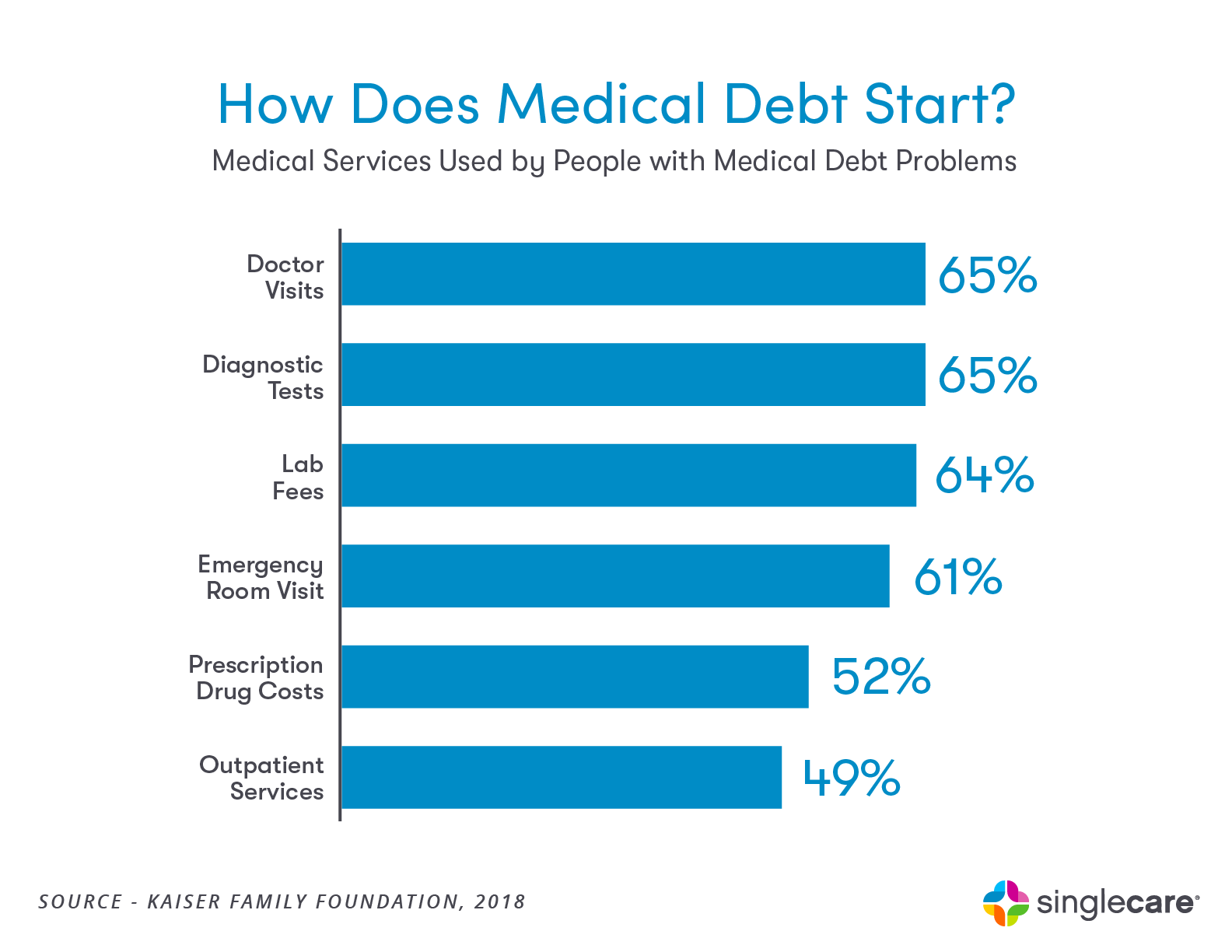
According to Gabriella Cruz-Martinez, tens of millions of debt collections disappeared from Americans’ credit reports during the pandemic, a new government watchdog report found, but overdue medical bills remain a big strain on many households nationwide. The total number of debt collections on credit reports dropped by 33% from 261 million in 2018 to 175 million in 2022, according to the Consumer Financial Protection Bureau, while the share of consumers with a debt collection on their credit report shrunk by 20%.

Medical debt collections also dropped by 17.9% during that time, but still made up 57% of all collection accounts on credit reports, far more than other types of debt combined — including credit cards, utilities, and rent accounts. Despite the reduction in collections, the CFPB noted that the results underscore ongoing concerns that current medical billing and collection practices can lack transparency, often hurting the credit scores and financial health of those most vulnerable.

“Our analysis of credit reports provides yet another indicator that, due to a strong labor market and emergency programs during the pandemic, household financial distress reduced over the last two years,” Rohit Chopra, CFPB director said in a statement. “However, false and inaccurate medical debt on credit reports continues to drag on household financial health.”

CITE: https://www.r2library.com/Resource/Title/0826102549

***

***

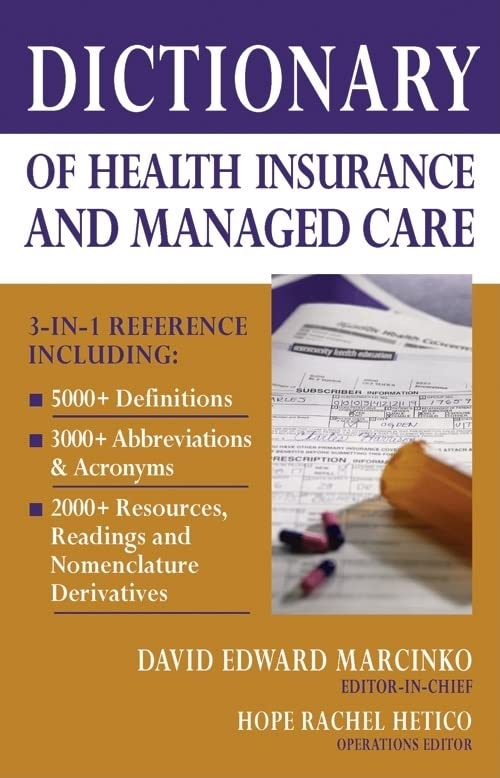
ORDER: https://www.amazon.com/Dictionary-Health-Insurance-Managed-Care/dp/0826149944/ref=sr_1_4?ie=UTF8&s=books&qid=1275315485&sr=1-4

COMMENTS APPRECIATED

Thank You

***

Why a Physician’s Charitable Contribution was Denied

Setty Gundanna Viralam et ux. v. Commissioner

[A Case Model]

By Children’s Home Society of Florida Foundation

In Setty Gundanna Viralam et ux. v. Commissioner; 136 T.C. No. 8; No. 21355-03 (13 Feb 2011), the Tax Court denied a deduction for a charitable gift to an organization maintaining donor advised funds for doctors. In addition to not receiving the charitable deduction, the doctor was subject to capital gains tax on sale of the stock and an accuracy-related penalty.

Physician Example

Dr. Viralam is a medical practitioner. In 1998, Dr. Viralam sold his 50% interest in a medical practice for $2,262,500, producing a taxable gain of $2,261,750. Dr. Viralam had joined a membership organization of doctors named Xelan. He paid a $975 membership fee for the “Xelan tax reduction plan.”

Xelan Foundation

Based upon promotional materials that promised “a tax reduction” program, Dr. Viralam transferred appreciated stock to the Xelan Foundation (“Foundation”) in 1998. The Foundation indicated that Dr. Viralam could create an account described variously as a “donor advised fund” or “family public charity.” The fund was available for “charitable giving, income tax reduction planning, estate tax reduction, educational funding and future retirement planning.”

The Xelan Foundation had been recognized by the IRS as a public charity and was included in IRS Publication 78. In addition, the Foundation had obtained an opinion letter from the Conner & Winters law firm on deductibility of gifts. In their opinion letter, Conner & Winters suggested that gifts to the Foundation were more likely than not to be deductible. However, the opinion letter declined to issue an opinion on the specific grants or educational programs of the Foundation donor advised funds.

The Gifting Mechanism

Following Dr. Viralam’s gift of stock with fair market value of $262,433 and cost basis of $131,360, the Foundation sold the gifted stock and provided him with a receipt. The receipt included the Sec. 170(f)(8) statement that “no goods or services” were transferred in exchange for the gift.

At the recommendation of Dr. Viralam, the Foundation accountant distributed $15,500 to religious organizations for the next two years. However, his Foundation account also made distributions to the University of Pennsylvania of $70,299. Dr. Viralam’s son Vinay was at that time a student at that university. The IRS audited Dr. Viralam and issued a notice of deficiency for 1998. The IRS denied the charitable deduction, assessed a tax on the sale of the appreciated stock by Xelan Corporation and also accessed an accuracy-related penalty under Sec. 6662.

The Court and IRS Opines

The court noted that under Sec. 170(c)(2), a charitable contribution is permitted if it is given to “a foundation organized and operated exclusively for charitable or educational purposes.”

The IRS claimed that the supposed “student loan” to Vinay showed that Dr. Viralam had “never surrendered dominion and control” over the fund. When Dr. Viralam created the fund in 1998, he anticipated that his three children would receive most of the fund for their college expenses. The initial distributions for the benefit of Vinay were made and “the Foundation’s approval of petitioner’s son as a student loan beneficiary was perfunctory.”
While it was true that the Foundation had been granted exempt status and was listed in Publication 78, the issue of the operation exclusively for the benefit of charitable purposes remained. Even though the purported donor advised fund was supposedly for charitable purposes, the facts indicated that Dr. Viralam had retained dominion and control.

The Sec. 170(f)(8)(A) receipt issued by Xelan Foundation indicated that there were no “goods or services” provided in consideration of the gift. However, the “student loans” were clearly within the regulatory definition of “cash, property, services, benefits and privileges.” Because the student loans were contemplated as part of the fund benefits, the gift failed the “no goods or services” test. Under Sec. 170(f)(8), there is “no deduction” if that test is failed.

Assessment

Because there was no charitable deduction, Dr. Viralam is also taxable on the long-term capital gain produced by sale of the stock in 1998. In addition, the penalty under Sec. 6662 applied. Dr. Viralam pointed to the legal opinion by the law firm Connor & Winters. However, that legal opinion explicitly excepted a potential student loan program. In the view of the court, the arrangement fails the “too good to be true” test. In the view of a reasonable person, a taxpayer should realize that this gift to provide university-level educations for children would not be deductible.

Conclusion

And so, your thoughts and comments on this ME-P are appreciated. Feel free to review our top-left column, and top-right sidebar materials, links, URLs and related websites, too. Then, subscribe to the ME-P. It is fast, free and secure.

Speaker: If you need a moderator or speaker for an upcoming event, Dr. David E. Marcinko; MBA – Publisher-in-Chief of the Medical Executive-Post – is available for seminar or speaking engagements. Contact: MarcinkoAdvisors@msn.com

Our Other Print Books and Related Information Sources:

Physician Financial Planning: http://www.jbpub.com/catalog/0763745790

Medical Risk Management: http://www.jbpub.com/catalog/9780763733421

Subscribe Now: Did you like this Medical Executive-Post, or find it helpful, interesting and informative? Want to get the latest ME-Ps delivered to your email box each morning? Just subscribe. You can unsubscribe at any time. Security is assured.

Sponsors Welcomed: And, credible sponsors and like-minded advertisers are always welcomed.

Link: https://healthcarefinancials.wordpress.com/2007/11/11/advertise

Product DetailsProduct DetailsProduct Details

Product Details  Product Details

Novant/CHS Deal Scrapped after FTC Intervenes

By Health Capital Consultants LLC

In February 2023, Novant Health, a 19-hospital, non-profit health system operating throughout the Carolinas, agreed to acquire two North Carolina hospitals – Davis Regional Medical Center and Lake Norman Regional Medical Center – from Community Health System (CHS), a publicly-traded mega-system operating in 15 states.

After the $320 million deal was announced, the Federal Trade Commission (FTC) began an extensive review of the acquisition, and concluded that: (1) the transaction may substantially reduce competition; (2) create a monopoly; and (3) constitute an unfair method of competition. (Read more…)

***

***

COMMENTS APPRECIATED

Thank You

***

***

JULY FOURTH WEEKEND READING LIST 2024

Happy Independence Weekend Greetings to our Readers and Subscribers for 2024

Product Details

From the Medical Executive-Post

***

Product Details
Product Details
Product Details
Product Details
Product Details
Product Details
Product Details

Rate this:

Comprehensive Financial Planning Strategies for Doctors and Advisors: Best Practices from Leading Consultants and Certified Medical Planners™
Risk Management, Liability Insurance, and Asset Protection Strategies for Doctors and Advisors: Best Practices from Leading Consultants and Certified Medical Planners™

INVITE DR. MARCINKO: https://medicalexecutivepost.com/dr-david-marcinkos-

CONTACT: Ann Miller RN MH

[Executive Director]

MarcinkoAdvisors@msn.com

THANK YOU

***

PODCAST: Healthcare Costs are Too Low?

By Eric Bricker MD

***

CITE: https://www.r2library.com/Resource

COMMENTS APPRECIATED

Thank You

***

***

***

CORPORATE: Entrants in Healthcare Struggle

By Health Capital Consultants LLC.

***

On April 30, 2024, retail giant Walmart announced their closure of Walmart Health, a network of 51 health centers that provided “primary and urgent care, labs, x-ray and diagnostics, behavioral health, dental, optometry and hearing services.” Walmart cited the lack of profitability, escalating costs of operation, and challenging environment for reimbursement as the reasons behind Walmart Health’s unsustainability.

This Health Capital Topics article discusses Walmart’s closures, the other corporate entrants struggling in the healthcare market, and what these challenges indicate for the primary care space. (Read more…)

***

***
COMMENTS APPRECIATED

Thank You

***

***

PODCAST: Shortages in Healthcare

SUPPLY DEMAND CURVE

By Eric Bricker MD

***

***

COMMENTS APPRECIATED

Subscribe Today!

***

***

PODCASTS: Avoid 5 Marketing Mistakes Financial Advisors Make Engaging Doctors & More!

Our ME-P MARKETING Colleague

By Vicki Rackner MD

Have you been frustrated in your efforts to attract, engage and serve doctors? In this episode, colleague Dr. Vicki Rackner shares 5 common mistake financial advisors make; with more.

PODCAST: https://www.listennotes.com/podcasts/the-academy-of/avoid-the-5-mistakes-l65YVT4UP3S/

PODCAST: https://www.youtube.com/watch?v=Dr5GXKRd3Xg

PODCAST: https://www.youtube.com/watch?v=W0SGlL0UzXE

****

YOUR COMMENTS ARE APPRECIATED.

Thank You

***

Whither the CERTIFIED MEDICAL PLANNER™ Marks?

Wither the CERTIFIED MEDICAL PLANNER™ Professional Certification?

CMP logo

DEAR INVESTMENT ADVISORS, CPAs, FINANCIAL PLANNERS, FINANCIAL ADVISORS & INSURANCE AGENTS

We believe that:

If you do not have a market niche; you are not deeply informed
If you are not deeply informed; you can’t different yourself
If you can’t differentiate yourself; you can’t differentiate price
If you can’t differentiate price; you have no market power
If you have no market power; you have no unique knowledge
If you have no unique knowledge; you have fewer profits

If you have fewer profits; you are not likely a CMP™

CMP

PROGRAM CURRICULUM: Enter the CMPs

POPULAR BOOKS: https://medicalexecutivepost.com/2021/04/29/why-are-certified-medical-planner-textbooks-so-darn-popular/

Dean Gene Schmuckler PhD MBA MEd CTS
http://www.CertifiedMedicalPlanner.org

THANK YOU

***

Invite Dr. Marcinko to Speak at your Next Seminar, Webcast or Event in 2024?

Invite Dr. Marcinko

The Choice is Up to You

***

Colleagues know that I enjoy personal coaching and public speaking and give as many talks each year as possible, at a variety of medical society and financial services conferences around the country and world.

These include lectures and visiting professorships at major academic centers, keynote lectures for hospitals, economic seminars and health systems, keynote lectures at city and statewide financial coalitions, and annual keynote lectures for a variety of internal yearly meetings.

 Topics Link: imba-inc-firm-services

And so, we appreciate your consideration.

Invite Dr. Marcinko

THANK YOU!

***

VALUE BASED CARE: CVS and Walgreens

The retail pharmacy giants have made a string of multi-billion dollar deals!

By Staff Reporters

***

***

CVS and Walgreens have been spending money like there is no tomorrow! In fact, the two retail pharmacy giants have made a string of multi-billion dollar acquisitions of primary care providers in the past couple years, including the $5.2 billion VillageMD acquisition in 2021 (Walgreens) and the $10.6 billion plan to buy Oak Street Health (CVS).

VillageMD also bought primary care clinic operator Summit Health-CityMD in January 2023, which Walgreens invested $3.5 billion in, and CVS spent roughly $8 billion to acquire Signify Health, a value-based payment platform, in September 2022.

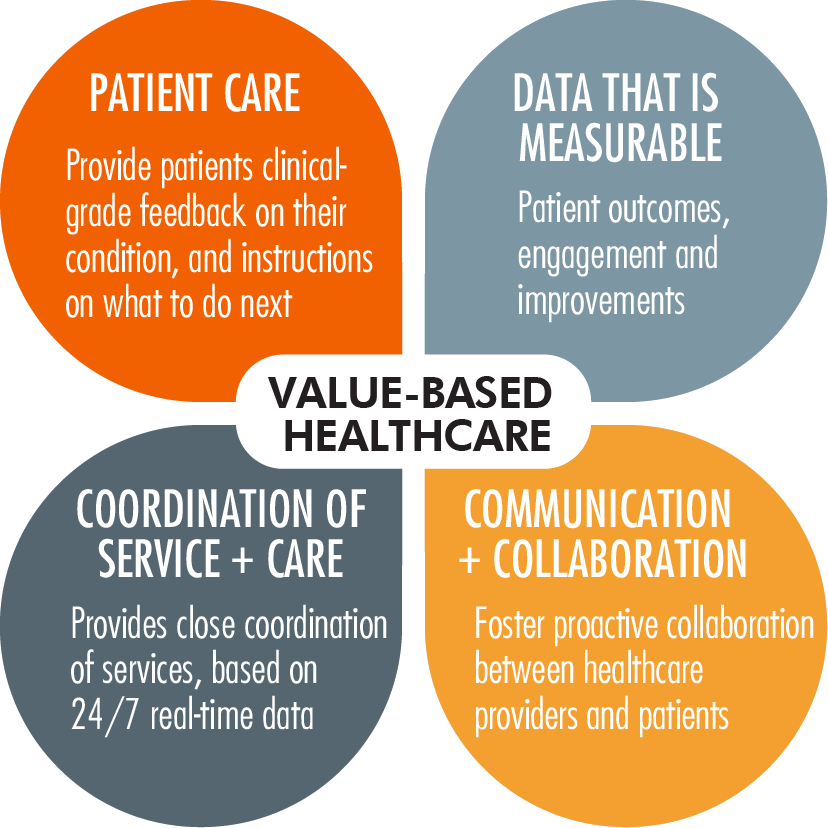
So what do all these deals have in common? Value-based care.

CITE: https://www.r2library.com/Resource/Title/082610254

READ Healthcare Brew: https://www.healthcare-brew.com/stories/2023/03/03/cvs-walgreens-value-based-care?cid=30723705.29836&mid=349b552221c994e2540a304649746d7c&utm_campaign=hcb&utm_medium=newsletter&utm_source=morning_brew

***

***

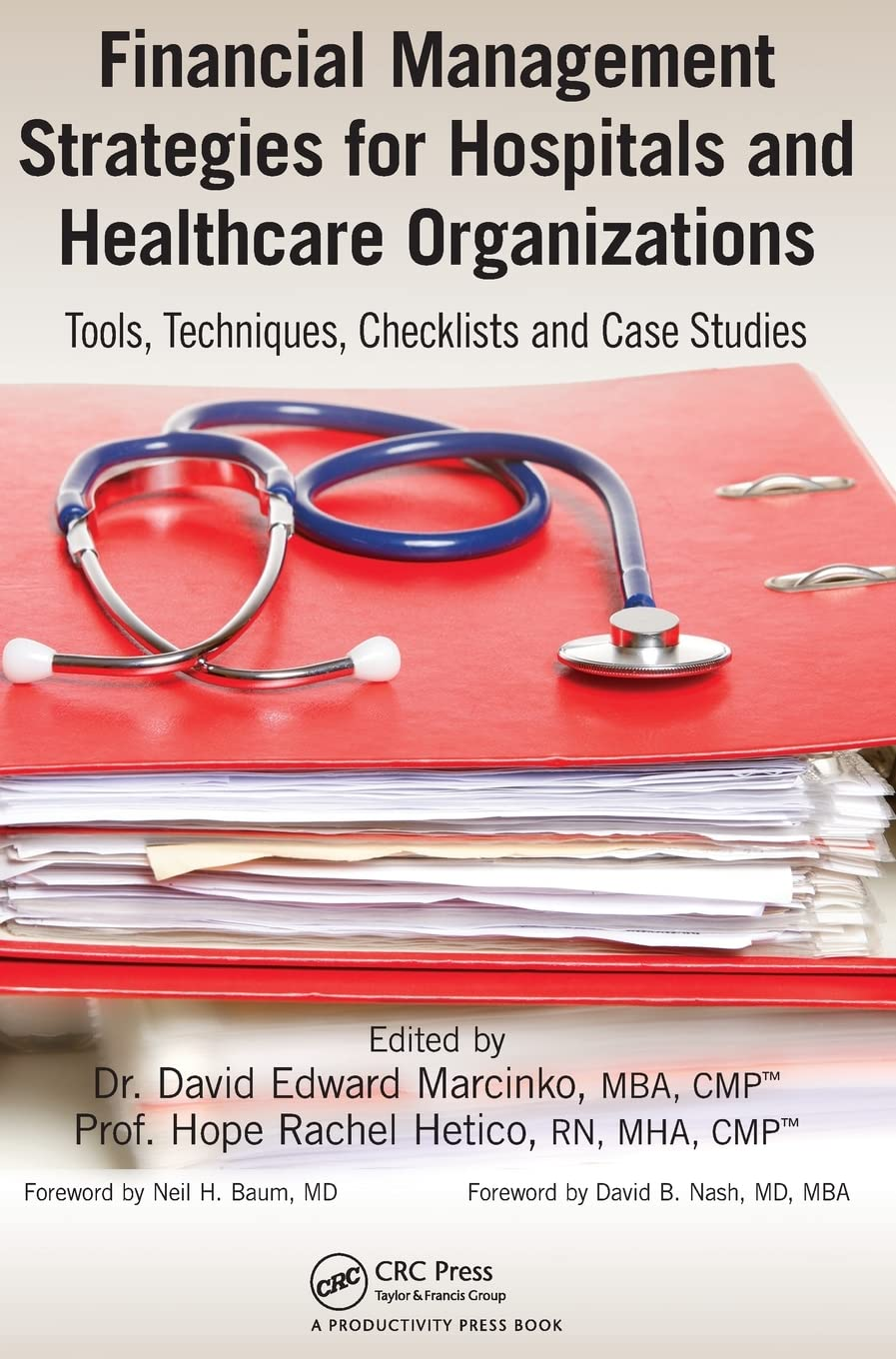
ORDER: https://www.amazon.com/Financial-Management-Strategies-Healthcare-Organizations/dp/1466558733/ref=sr_1_3?ie=UTF8&qid=1380743521&sr=8-3&keywords=david+marcinko

COMMENTS APPRECIATED

Thank You

***

On Elder Safety and Frugality

Spending Money for Comfort and Safety

By Rick Kahler MS CFP®

Rick Kahler CFPWant to increase your independence in retirement? Save money? Live safely in your own home? Then buy a new car. No, this isn’t a scam or a seedy sales pitch. In certain cases, a new car can be a wise use of your retirement dollars.

Introduction

As regular readers of the ME-P know, I’m a big fan of frugality. Spending less than you earn is a crucial strategy for building wealth. Continuing this frugal lifestyle in retirement can also be a good way to be sure of having enough money to last for the rest of your life.

Some retirees, though, take it too far. Under-spending can be a threat to retirement as much as overspending, especially when it affects your comfort and safety.

As more of my retired clients move into their later years, I am becoming increasingly aware of one kind of retirement spending that can actually be considered more of an investment than an expense. This, for elderly people or adult children caring for elderly parents, is spending money to make their homes and activities safer.

Safer Spending

One immediate benefit of this kind of spending is being able to live more comfortably and with less anxiety. A second benefit is financial. Helping elderly parents stay in their homes and live independently for as long as possible can save money in the long term by reducing medical costs and long-term care expenses. It’s especially important to invest in this type of spending if you live too far away from your parents to provide regular help yourself.

Some of the ways to invest relatively small amounts to provide more comfort, safety, and independence for elderly parents are obvious. Or, carpet slick tile or hardwood floors to reduce the risk of falls. Upgrade older appliances to newer ones with safety features like automatic shutoffs or warning signals. Add basic safety aids like stair railings and shower bars. Repair hazards like worn carpets, uneven steps, or broken sidewalks. Provide emergency alert buttons. Install phones in several rooms.

Other Considerations

Some less obvious ways to foster safety and extend independent living might require a bit more spending. Such expenditures can be a good use of retirement income if they extend parents’ ability to live independently. Here are a few possibilities to consider:

1. Buying that new car. Safety features like GPS navigation systems and backup cameras can allow elderly people to hold onto their drivers’ licenses longer without putting themselves or others at risk.

2. Paying for gym memberships or exercise classes. Increasing strength, balance, and flexibility can help prevent falls and possibly even help stave off dementia.

3. Taking care of ears and eyes. Hearing aids and corrective lenses may not be cheap, but good hearing and eyesight can help people drive more safely, avoid falls, and take care of themselves and their homes.

4. Remodeling. Moving the laundry room to the main floor or replacing bathtubs with walk-in showers can make homes safer and more comfortable.

5. Hiring help. Many of us equate in-home help for the elderly with home health care. Certainly, hiring aides to help with cooking, bathing, and other needs as people become frail is an important option. But well before that time, it makes sense to get help with a host of other services that become harder or even dangerous to do as we grow older. Hire a house cleaner. Find someone to do yard work, home maintenance, and heavy cleaning jobs (especially if they involve ladders) like window washing.

***

Elder

***

Assessment

Spending that creates safety belongs in any retirement budget. It’s a good way to use your financial independence to help maintain your physical and mental independence.

Conclusion

Your thoughts and comments on this ME-P are appreciated. Feel free to review our top-left column, and top-right sidebar materials, links, URLs and related websites, too. Then, subscribe to the ME-P. It is fast, free and secure.

Speaker: If you need a moderator or speaker for an upcoming event, Dr. David E. Marcinko; MBA – Publisher-in-Chief of the Medical Executive-Post – is available for seminar or speaking engagements. Contact: MarcinkoAdvisors@msn.com

***

Risk Management, Liability Insurance, and Asset Protection Strategies for Doctors and Advisors: Best Practices from Leading Consultants and Certified Medical Planners™8Comprehensive Financial Planning Strategies for Doctors and Advisors: Best Practices from Leading Consultants and Certified Medical Planners™

The Elderly Population is Exploding

Yet, Nursing Homes are Still Closing!

Here is a visually compelling graphic that covers the rash of nursing home closures that have been occurring since 2008 across the United States.

Even in the face of a ballooning Boomer and elderly population and the ACA, nursing homes are closing, and minority areas are feeling the brunt of it.

What gives?

Source: assistedlivingtoday.com 

Conclusion

Your thoughts and comments on this ME-P are appreciated. Feel free to review our top-left column, and top-right sidebar materials, links, URLs and related websites, too. Then, subscribe to the ME-P. It is fast, free and secure.

Speaker: If you need a moderator or speaker for an upcoming event, Dr. David E. Marcinko; MBA – Publisher-in-Chief of the Medical Executive-Post – is available for seminar or speaking engagements. Contact: MarcinkoAdvisors@msn.com

OUR OTHER PRINT BOOKS AND RELATED INFORMATION SOURCES:

Product Details  Product Details

PODCAST: Corporate Practice of Medicine Laws

Private Equity Owning Doctor Practices

LEGALITY?

By Eric Bricker MD

***

PODCAST: https://www.youtube.com/watch?v=2epmk4_-kUI

These Laws Were Put Into Place So That Doctors Would Not Put Shareholders Before Patients and So That Corporations Would Not Interfere with Doctor Judgement.

Corporate Practice of Medicine Laws are at the State Level, NOT the Federal Level.

Each State Has Its Own Exceptions Such as 1) Doctors Can Work for Companies That Are Owned by Other Doctors and 2) Doctors Can Work for Hospitals.

Accordingly, Private Equity Firms Have Been on a Physician Practice Buying Binge.

Private Equity Firms Bought 355 Physician Practices from 2013 – 2016.

Two of the Largest Purchases Were KKR’s Purchase of Envision’s 25,000 Doctors for Almost $10 Billion and Blackstone’s Purchase of Team Health’s 20,000 Doctors for $6 Billion.

If Corporate Practice of Medicine Laws Say that Doctors Cannot Work for a Corporation, How are Private Equity Purchases of Physician Practices Legal?

CITE: https://www.r2library.com/Resource/Title/0826102549

PODCAST: https://www.youtube.com/watch?v=DgWEybUSiuo

***

***

ORDER: https://www.amazon.com/Business-Medical-Practice-Transformational-Doctors/dp/0826105750/ref=sr_1_9?ie=UTF8&qid=1448163039&sr=8-9&keywords=david+marcinko

***

COMMENTS APPRECIATED

Thank You

***

PODCAST: Blue Cross Health Insurance Companies Must Now Compete

Second BlueBid Explained

By Eric Bricker MD

***

***

COMMENTS APPRECIATED

Thank You

***

***

VENTURE CAPITAL: In the Digital Health Care Space

Dr. David Edward Marcinko MBA CMP

SPONSOR: http://www.MarcinkoAssociates.com

***

***

At Marcinko & Associates, we appreciate that Venture Capital funding for entrepreneurs in the digital health space cooled a bit in 2020-22 following a red-hot 2018-20. And, overall, digital health companies raised $15.3 billion last year, down from the $29.1 billion raised in 2021—but still above the $14.1 billion raised in 2020, according to Rock Health a seed fund that supports digital health startups.

CITE: https://www.r2library.com/Resource

Nevertheless, other analysts predict VC investors and Investment Bankers will still put a good amount of money into digital health in 2024 thru 2027, especially in alternative care, drug development, health information technology, artificial intelligence, EMRs and software that reduces physician workload.

An essential first part of attracting VC interest and IB money is the crafting and presentation of your formal business plan [“elevator pitch”]; as well as the needed technical and managerial experience. This too is crucial for success and exactly where we can assist.

Of course, companies focused on scaling and growing will have different needs across the business lifecycle.

And so, no matter where you are in your journey—from seeking early funding to making final preparations for your IPO—we have equity and insightful administration solutions for you and can assist at any stage of your growth spectrum.

MORE: https://marcinkoassociates.com/fmv-appraisals/

CONTACT US TODAY – RETAIN US TOMORROW

How May We Serve You?

E-mail: MarcinkoAdvisors@msn.com

Thank You

***

***

SPEAKING: MARCINKO Associates, Inc.

CAREER DEVELOPMENT

By: http://www.MarcinkoAssociates.com

***

***

As CEO and favorite on the lecture circuit, medical and entrepreneurial futurist Dr. David Edward Marcinko MBA MEd CMP™ enjoys public speaking and gives many talks each year to a variety of conferences around the country, Asia and Europe. He is often quoted in the media, with speaking engagements to more than 135 financial, educational and state medical societies and business groups in an entertaining and witty fashion.

These include seminar speaking engagements and interviews for TV, radio, news and trade magazines, podcasts, blogs and vlogs, and Key-note speeches for colleges, universities, hospitals, business schools or commencement exercises; End-note lectures at city, state, regional or national coalitions on capitalism and free-markets; and annual Break-out sessions for a variety of public and population healthcare policy, management and administration colloquia and meetings.

Past sponsors include Medical Pharmaceutical Companies [Pfizer, Glaxo, Smith-Klein-Fujisawa, Novartis, Shering, Terumo, Sunoviom, Schering-Plough, Sepracor and Aventis, etc]; and Financial Services Corporations [First Global Financial Advisors, Merrill Lynch, Sun-Trust, The Principal, and Pacific Life Insurance Company, etc].

SEMINARS: https://marcinkoassociates.com/speaking-seminars/

CONTACT: Ann Miller RN MHA for public speaking and interview information, professional fees and related engagement details: MarcinkoAdvisors@msn.com

THANK YOU

***

PODCAST: Number #1 Rule for Healthcare Investing

SUPPLY-DEMAND CONSIDERATIONS

By Eric Bricker MD

***

CITE: https://www.r2library.com/Resource

***

COMMENTS APPRECIATED

Thank You

***

***

***

CONNECT: With Us

http://www.MedicalExecutivePost.com

***

It’s been a while since you’ve connected with us. Are you still interested in emerging financial planning, investing, medical practice management and health information technology insights from the Institute of Medical Business, Advisors, Inc?

If so, please email us if you want to continue receiving daily updates about cutting-edge news and trends or if you’d like to be removed from our e-mailing list.

Your own related posts, comments and personal referrals are appreciated as well.

Thank You
Dr. David Edward Marcinko MBA MEd CMP
Editor-in-Chief
MarcinkoAdvisors@msn.com

***

***

DIGITAL HEALTH: Technology Start-Ups

By Staff Reporters

***

***

The “new normal” is characterized by fewer deals, smaller deal sizes, and fewer investors, Rock Health found in a recent study. And if funding in the second half of the year continues at its current pace, 2023 will be the lowest digital health funding year since 2019, according to the report, authored primarily by research associates Mihir Somaiya and Madelyn Knowles. For example, in the first half of 2023:

  • Digital health startups raised $6.1 billion in 244 deals. The average deal size was $24.8 million.
  • In Q1, startups raised $3.5 billion in 131 deals, and $2.5 billion over 113 deals in Q2.
  • 555 investors were involved in fund raises, compared to 775 in the first half of 2022 and 832 in the first half of 2021. Of those investors, 71% had previously invested in digital health.
  • There were roughly 12 digital health startup acquisitions per month, compared to 15 monthly in 2022 and 14 each month for the past five years.

The lack of dollars flowing to companies is already reverberating: Some startups are closing down. Pear Therapeutics filed for bankruptcy in April and sold its assets to four buyers in May. Other digital health startups—SimpleHealth, The Pill Club, Hurdle, and Quil Health—also closed in the first half of 2023.

RELATED: https://medicalexecutivepost.com/2023/08/04/venture-capital-rising-for-womens-health-start-ups/

Assessment: There may be fewer investors overall, but those still investing in digital health are putting a lot of money down, according to Rock Health.

***

***
COMMENTS APPRECIATED

Thank You

***

***

PODCAST: Healthcare Business Start-Ups and Incubators

By Eric Bricker MD

***

***

COMMENTS APPRECIATED

Thank You

***

***

***

OMAHA: Breakfast Meeting 2024

By Vitaliy Kensenelson CFA

***

***

Breakfast in Omaha Meeting 2024 – Session One
While I was in Omaha attending the BRK annual meeting, I hosted Q&A sessions for my readers. Due to high reader interest, what started out as a simple breakfast get-together turned into two breakfast sessions and an afternoon session. We had so much interest that we were still unable to accommodate all of our readers – we had 200 folks on the waiting list.

I was exhausted, but I really enjoyed answering questions and meeting readers. The upside of this is that we have three video recordings.

Over the next three weeks, I will share the videos from each session. For those who prefer to read, I will also include a lightly edited full transcript.

For those who don’t have the time to read 15 pages or watch an hour-long video, I’ll include my favorite excerpts from each session.

COMMENTS APPRECIATED

Thank You

***

***

Select and Check Your Stock Broker and Financial Advisor?

Shopping Suggestions

Rick Kahler MS CFP

By Rick Kahler MS CFP®

Shopping for a financial adviser you can trust has never been easy. The Department of Labor [DOL] rule requiring brokers to act in a fiduciary capacity when dealing with retirement plan assets has not made it any easier. The government’s intent was to help consumers clearly distinguish when financial professionals can be relied upon to give unbiased financial advice or when they are acting in their own interests to sell a financial product. Unfortunately, the rule has only exacerbated the confusion.

When shopping for financial advisers, you need to investigate their education, niche, process, compensation structure, and experience to see whether they are a good fit for your needs. Equally important, it’s up to you to do a background check and determine whose interest the adviser is looking out for. No one else will do it for you.

Two-Steps

Here are two important steps you can take to greatly increase your chances of getting someone who will truly be looking out for you.

First, ask any adviser you deal with to sign a statement affirming they will act in the capacity of a fiduciary to you, meaning you will be a client, not a customer. A copy of this form can be found at www.advisorperspectives.com. Advisers unwilling to sign the Form Adv are not likely to be fiduciaries who will put your interests first.

Second, check the adviser’s background. If advisers receive any type of fee, they are held to a fiduciary standard automatically by the SEC. Still, it’s wise to check their background for any misconduct, which you can do at www.adviserinfo.sec.gov. If advisers sell securities, mutual funds, private REITs, or limited partnerships and receive any type of commission, they will be regulated by FINRA. You can go to BrokerCheck.finra.org to view their records for misconduct.

It’s important to check an adviser’s background because being found guilty of misconduct doesn’t mean they can’t actively be selling financial products.

For example, in a March 7 article at kitces.com, financial planner and writer Michael Kitces points out that over 73% of FINRA-registered brokers who FINRA lists as having a misconduct “are still employed a year later, despite the fact that such brokers are a whopping 5x more likely to engage in misconduct again in the future.”

Kitces explains that while just 7.3% of all FINRA brokers have some type of misconduct on their records, only about half of them actually lose their jobs and about half of those find employment with another firm. Additionally, it seems some firms have more of a culture of employing brokers with misconduct.

***

Wall Street

***

The top five brokerage firms with the highest (15% or more) concentration of brokers with misconduct are Oppenhiemer & Co, First Allied Securities, Wells Fargo Advisers Financial Network, UBS Financial Services, and Cetera Advisers. This is according to a working paper, “The Market for Financial Adviser Misconduct,” by Mark Egan, Gregor Matvos, and Amit Seru, business school professors at the University of Chicago and University of Minnesota. Geographic location also makes a big difference with the states of California, Florida, and New York having counties with much higher concentrations of brokers guilty of misconduct (15 – 30%) than states like Pennsylvania, Kansas, Iowa, Kentucky, and Vermont with the counties having the lowest concentration (2 – 3%).

Kitces reminds us that the “single greatest predictor of whether a broker will engage in misconduct is whether he/she has engaged in any prior misconduct.”

Assessment

For this reason, it’s crucial to make FINRA’s Broker Check part of your research before hiring a financial adviser. Before trusting any adviser to put your interests first, look out for your own interests by investigating the adviser’s history.

Conclusion

Your thoughts and comments on this ME-P are appreciated. Feel free to review our top-left column, and top-right sidebar materials, links, URLs and related websites, too. Then, subscribe to the ME-P. It is fast, free and secure.

Speaker: If you need a moderator or speaker for an upcoming event, Dr. David E. Marcinko; MBA – Publisher-in-Chief of the Medical Executive-Post – is available for seminar or speaking engagements. Contact: MarcinkoAdvisors@msn.com

OUR OTHER PRINT BOOKS AND RELATED INFORMATION SOURCES:

Comprehensive Financial Planning Strategies for Doctors and Advisors: Best Practices from Leading Consultants and Certified Medical Planners™

***

PSYCHOLOGICAL “TRAPS” of Investing

MIND TRAPS PHYSICIAN INVESTORS MUST REDUCE AND AVOID AT ALL COSTS

See the source image

By Dr. David E. Marcinko MBA MEd CMP®

SPONSOR: http://MarcinkoAssociates.com

CMP logo

SPONSOR: http://www.CertifiedMedicalPlanner.org

As human beings, our brains are booby-trapped with psychological barriers that stand between making smart financial decisions and making dumb ones. The good news is that once you realize your own mental weaknesses, it’s not impossible to overcome them.

CITE: https://www.r2library.com/Resource/Title/0826102549

In fact, Mandi Woodruff, a financial reporter whose work has appeared in Yahoo! Finance, Daily Finance, The Wall Street Journal, The Fiscal Times and the Financial Times among others; related the following mind-traps in a September 2013 essay for the finance vertical Business Insider; as these impediments are now entering the lay-public zeitgeist.

***

8 Psychological Traps All Stock Investors Should Avoid - YouTube

 Anchoring happens when we place too much emphasis on the first piece of information we receive regarding a given subject. For instance, when shopping for a wedding ring a salesman might tell us to spend three months’ salary. After hearing this, we may feel like we are doing something wrong if we stray from this advice, even though the guideline provided may cause us to spend more than we can afford.

 Myopia makes it hard for us to imagine what our lives might be like in the future. For example, because we are young, healthy, and in our prime earning years now, it may be hard for us to picture what life will be like when our health depletes and we know longer have the earnings necessary to support our standard of living. This short-sightedness makes it hard to save adequately when we are young, when saving does the most good.

 Gambler’s fallacy occurs when we subconsciously believe we can use past events to predict the future. It is common for the hottest sector during one calendar year to attract the most investors the following year. Of course, just because an investment did well last year doesn’t mean it will continue to do well this year. In fact, it is more likely to lag the market.

 Avoidance is simply procrastination. Even though you may only have the opportunity to adjust your health care plan through your employer once per year, researching alternative health plans is too much work and too boring for us to get around to it. Consequently, we stick with a plan that may not be best for us.

 Loss aversion affected many investors during the stock market crash of 2008. During the crash, many people decided they couldn’t afford to lose more and sold their investments. Of course, this caused the investors to sell at market troughs and miss the quick, dramatic recovery.

 Overconfident investing happens when we believe we can out-smart other investors via market timing or through quick, frequent trading. Data convincingly shows that people who trade most often underperform the market by a significant margin over time.

 Mental accounting takes place when we assign different values to money depending on where we get it from. For instance, even though we may have an aggressive saving goal for the year, it is likely easier for us to save money that we worked for than money that was given to us as a gift.

MORE: https://medicalexecutivepost.com/2021/09/04/more-on-money-psychology/

RELATED: https://medicalexecutivepost.com/2014/12/15/on-internet-investing-psychology/

 Herd mentality makes it very hard for humans to not take action when everyone around us does. For example, we may hear stories of people making significant profits buying, fixing up, and flipping homes and have the desire to get in on the action, even though we have no experience in real estate.

YOUR COMMENTS ARE APPRECIATED.

Thank You

***

RISK MANAGEMENT: https://www.routledge.com/Risk-Management-Liability-Insurance-and-Asset-Protection-Strategies-for/Marcinko-Hetico/p/book/9781498725989

Risk Management, Liability Insurance, and Asset Protection Strategies for Doctors and Advisors : Best Practices from Leading Consultants and Certified Medical Planners™ book cover

***

PODCAST: Healthcare Start-Up Accelerators and Incubators

By Dr. Eric Bricker MD

***

***
MORE: https://medicalexecutivepost.com/2017/04/02/on-digital-health-accelerator-and-corporate-start-up-programs/

COMMENTS APPRECIATED

Thank You

***

***

***

RE-BROADCAST: An Interview with Fiduciary Bennett Aikin AIF®

On Financial Fiduciary Accountability

[By Dr. David E. Marcinko MBA MEd CMP™]

[By Ann Miller; RN, MHA]

Currently, there is a growing dilemma in the financial sales and services industry. It goes something like this:

  • What is a financial fiduciary?
  • Who is a financial fiduciary?
  • How can I tell if my financial advisor is a fiduciary?

Now, in as much as this controversy affects laymen and physician-investors alike, we went right to the source for up-to-date information regarding this often contentious topic, for an email interview and Q-A session, with Ben Aikin.ben-aikin

About Bennett Aikin AIF® and fi360.com

Bennett [Ben] Aikin is the Communications Coordinator for fi360.com. He oversees all communications for fi360. His responsibilities include messaging, brand management, copyrights and trademarks, and publications. Mr. Aikin received his BA in English from Virginia Tech in 2003 and is currently an MS candidate in Journalism from Ohio University.

Q. Medical Executive Post 

You have been very helpful and gracious to us. So, let’s get right to it, Ben. In the view of many; attorneys, doctors, CPAs and the clergy are fiduciaries; most all others who retain this title seem poseurs; sans documentation otherwise.

A. Mr. Aikin

You are correct. Attorneys, doctors and clergy are the prototype fiduciaries. They have a clear duty to put the best interests of their clients, patients, congregation, etc., above their own. [The duty of a CPA isn’t as clear to me, although I believe you are correct]. Furthermore, this is one of the first topics we address in our AIF training programs, and what we call the difference between a profession and an industry.  The three professions you name have three common characteristics that elevate them from an industry to a profession:

  1. Recognized body of knowledge
  2. Society depends upon practitioners to provide trustworthy advice
  3. Code of conduct that places the clients’ best interests first

Q. Medical Executive Post 

It seems that Certified Financial Planner®, Chartered Financial Analysts, Registered Investment Advisors and their representatives, Registered Representative [stock-brokers] and AIF® holders, etc, are not really financial fiduciaries, either by legal statute or organizational charter. Are we correct, or not? Of course, we are not talking ethics or morality here. That’s for the theologians to discuss.

A. Mr. Aikin

One of the reasons for the “alphabet soup”, as you put it in one of your white papers [books, dictionaries and posts] on financial designations, is that while there is a large body of knowledge, there is no one recognized body of knowledge that one must acquire to enter the financial services industry.  The different designations serve to provide a distinguisher for how much and what parts of that body of knowledge you do possess.  However, being a fiduciary is exclusively a matter of function. 

In other words, regardless of what designations are held, there are five things that will make one a fiduciary in a given relationship:

  1. You are “named” in plan or trust documents; the appointment can be by “name” or by “title,” such as CFO or Head of Human Resources
  2. You are serving as a trustee; often times this applies to directed trustees as well
  3. Your function or role equates to a professional providing comprehensive and continuous investment advice
  4. You have discretion to buy or sell investable assets
  5. You are a corporate officer or director who has authority to appoint other fiduciaries

So, if you are a fiduciary according to one of these definitions, you can be held accountable for a breach in fiduciary duty, regardless of any expertise you do, or do not have. This underscores the critical nature of understanding the fiduciary standard and delegating certain duties to qualified “professionals” who can fulfill the parts of the process that a non-qualified fiduciary cannot.

Q. Medical Executive Post 

How about some of the specific designations mentioned on our site, and elsewhere. I believe that you may be familiar with the well-known financial planner, Ed Morrow, who often opines that there are more than 98 of these “designations”? In fact, he is the founder of the Registered Financial Consultants [RFC] designation. And, he wrote a Foreword for one of our e-books; back-in-the-day. His son, an attorney, also wrote as a tax expert for us, as well. So, what gives?

A. Mr. Aikin

As for the specific designations you list above, and elsewhere, they each signify something different that may, or may not, lend itself to being a fiduciary: For example:

• CFP®: The act of financial planning does very much imply fiduciary responsibility.  And, the recently updated CFP® rules of conduct does now include a fiduciary mandate:

• 1.4 A certificant shall at all times place the interest of the client ahead of his or her own. When the certificant provides financial planning or material elements of the financial planning process, the certificant owes to the client the duty of care of a fiduciary as defined by CFP Board. [from http://www.cfp.net/Downloads/2008Standards.pdf]

•  CFA: Very dependent on what work the individual is doing.  Their code of ethics does have a provision to place the interests of clients above their own and their Standards of Practice handbook makes clear that when they are working in a fiduciary capacity that they understand and abide by the legally mandated fiduciary standard.

• FA [Financial Advisor]: This is a generic term that you may find being used by a non-fiduciary, such as a broker, or a fiduciary, such as an RIA.

• RIA: Are fiduciaries.  Registered Investment Advisors are registered with the SEC and have obligations under the Investment Advisers Act of 1940 to provide services that meet a fiduciary standard of care.

• RR: Registered Reps, or stock-brokers, are not fiduciaries if they are doing what they are supposed to be doing.  If they give investment advice that crosses the line into “comprehensive and continuous investment advice” (see above), their function would make them a fiduciary and they would be subject to meeting a fiduciary standard in that advice (even though they may not be properly registered to give advice as an RIA).

• AIF designees: Have received training on a process that meets, and in some places exceeds, the fiduciary standard of care.  We do not require an AIF® to always function as a fiduciary. For example, we allow registered reps to gain and use the AIF® designation. In many cases, AIF designees are acting as fiduciaries, and the designation is an indicator that they have the full understanding of what that really means in terms of the level of service they provide.  We do expect our designees to clearly disclose whether they accept fiduciary responsibility for their services or not and advocate such disclosure for all financial service representatives.

Q. Medical Executive Post 

Your website, http://www.fi360.com, seems to suggest, for example, that banks/bankers are fiduciaries. We have found this not to be the case, of course, as they work for the best interests of the bank and stockholders. What definitional understanding are we missing?

A. Mr. Aikin

Banks cannot generally be considered fiduciaries.  Again, it is a matter of function. A bank may be a named trustee, in which case a fiduciary standard would generally apply.  Banks that sell products are doing so according to their governing regulations and are “prudent experts” under ERISA, but not necessarily held to a fiduciary standard in any broader sense.

Q. Medical Executive Post 

And so, how do we rectify the [seemingly intentional] industry obfuscation on this topic. We mean, our readers, subscribers, book and dictionary purchasers, clients and colleagues are all confused on this topic. The recent financial meltdown only stresses the importance of understanding same.

For example, everyone in the industry seems to say they are the “f” word. But, our outreach efforts to contact traditional “financial services” industry pundits, CFP® practitioners and other certification organizations are continually met with resounding silence; or worse yet; they offer an abundance of parsed words and obfuscation but no confirming paperwork, or deep subject-matter knowledge as you have kindly done. We get the impression that some FAs honesty do-not have a clue; while others are intentionally vague.

A. Mr. Aikin

All of the evidence you cite is correct.  But that does not mean it is impossible to find an investment advisor who will manage to a fiduciary standard of care and acknowledge the same. The best way to rectify confusion as it pertains to choosing appropriate investment professionals is to get fiduciary status acknowledged in writing and go over with them all of the necessary steps in a fiduciary process to ensure they are being fulfilled. There also are great resources out there for understanding the fiduciary process and for choosing professionals, such as the Department of Labor, the SEC, FINRA, the AICPA’s Personal Financial Planning division, the Financial Planning Association, and, of course, Fiduciary360.

We realize the confusion this must cause to those coming from the health care arena, where MD/DO clearly defines the individual in question; as do other degrees [optometrist, clinical psychologist, podiatrist, etc] and medical designations [fellow, board certification, etc.]. But, unfortunately, it is the state of the financial services industry as it stands now.

Q. Medical Executive Post 

It is as confusing for the medical community, as it is for the lay community. And, after some research, we believe retail financial services industry participants are also confused. So, what is the bottom line?

A. Mr. Aikin

The bottom line is that lay, physician and all clients have a right to expect and demand a fiduciary standard of care in the managing of investments. And, there are qualified professionals out there who are providing those services.  Again, the best way to ensure you are getting it is to have fiduciary status acknowledged in writing, and go over the necessary steps in a fiduciary process with them to ensure it is being fulfilled.

Q. Medical Executive Post 

The “parole-evidence” rule, of contract law, applies, right? In dealing with medical liability situations, the medics and malpractice attorneys have a rule: “if it wasn’t written down, it didn’t happen.”  

A. Mr. Aikin

An engagement contract accepting fiduciary status should trump a subsequent attempt to claim the fiduciary standard didn’t apply. But, to reiterate an earlier point, if someone acts in one of the five functional fiduciary roles, they are a fiduciary whether they choose to acknowledge it or not.  I have attached a sample acknowledgement of fiduciary status letter with copies of our handbook, which details the fiduciary process we instruct in our programs, and our SAFE, which is basically a checklist that a fiduciary should be able to answer “Yes” to every question to ensure the entire fiduciary process is being covered.

Q. Medical Executive Post 

It is curious that you mention checklists. We have a post arguing that very theme for doctors and hospitals as they pursue their medial error reduction, and quality improvement, endeavors. And, we applaud your integrity, and wish only for clarification on this simple fiduciary query?

A. Mr. Aikin

Simple definition: A fiduciary is someone who is managing the assets of another person and stands in a special relationship of trust, confidence, and/or legal responsibility.

Q. Medical Executive Post 

Who is a financial fiduciary and what, if any, financial designation indicates same?

A. Mr. Aikin

Functional definition: See above for the five items that make you a fiduciary.

Financial designations that unequivocally indicate fiduciary duty: Short answer is none, only function can determine who is a fiduciary. 

Q. Medical Executive Post 

Please repeat that?

A. Mr. Aikin

Financial designations that indicate fiduciary duty: none. It is the function that determines who is a fiduciary.  Now, having said that, the CFP® certification comes close by demanding their certificants who are engaged in financial planning do so to a fiduciary standard. Similarly, other designations may certify the holder’s ability to perform a role that would be held to a fiduciary standard of care.  The point is that you are owed a fiduciary standard of care when you engage a professional to fill that role or they functionally become one.  And, if you engage a professional to fill a non-fiduciary role, they will not be held to a fiduciary standard simply because they have a particular designation.  One of the purposes the designations serve is to inform you what roles the designation holder is capable of fulfilling.

It is also worth keeping in mind that just being a fiduciary doesn’t equate to a full knowledge of the fiduciary standard. The AIF® designation indicates having been fully trained on the standard.

Q. Medical Executive Post 

Yes, your website mentions something about fiduciaries that are not aware of same! How can this be? Since our business model mimics a medical model, isn’t that like saying “the doctor doesn’t know he is doctor?” Very specious, with all due respect!

A. Mr. Aikin

I think it is first important to note that this statement is referring not just to investment professionals.  Part of the audience fi360 serves is investment stewards, the non-professionals who, due to facts and circumstances, still owe a fiduciary duty to another.  Examples of this include investment committee members, trustees to a foundation, small business owners who start 401k plans, etc.  This is a group of non-sophisticated investors who may not be aware of the full array of responsibilities they have. 

However, even on the professional side I believe the statement isn’t as absurd as it sounds.  This is basically a protection from both ignorant and unscrupulous professionals.  Imagine a registered representative who, either through ignorance or design, begins offering comprehensive and continuous investment advice.  Though they may deny or be unaware of the fact, they have opened themselves up to fiduciary liability. 

Q. Medical Executive Post 

Please clarify the use of arbitration clauses in brokerage account contracts for us. Do these disclaim fiduciary responsibility? If so, does the client even know same?

A. Mr. Aikin

By definition, an engagement with a broker is a non-fiduciary relationship.  So, unless other services beyond the scope of a typical brokerage account contract are specified, fiduciary responsibility is inherently not applicable.  Unfortunately, I do imagine there are clients who don’t understand this. Furthermore, AIF® designees are not prohibited from signing such an agreement and there are some important points to understand the reasoning.

First, by definition, if you are entering into such an agreement, you are entering into a non-fiduciary relationship. So, any fiduciary requirement wouldn’t apply in this scenario.

Second, if this same question were applied into a scenario of a fiduciary relationship, such as with an RIA, this would be a method of dispute resolution, not a practice method. So, in the event of dispute, the advisor and investor would be free to agree to the method of resolution of their choosing. In this scenario, however, typically the method would not be discussed until the dispute itself arose.

Finally, it is important to know that AIF/AIFA designees are not required to be a fiduciary. It is symbolic of the individuals training, knowledge and ongoing development in fiduciary processes, but does not mean they will always be acting as a fiduciary.

Q. Medical Executive Post 

Don’t the vast majority of arbitration hearings find in favor of the FA; as the arbitrators are insiders, often paid by the very same industry itself?

A. Mr. Aikin

Actual percentages are reported here: http://www.finra.org/ArbitrationMediation/AboutFINRADR/Statistics/index.htm However, brokerage arbitration agreements are a dispute resolution method for disputes that arise within the context of the securities brokerage industry and are not the only means of resolving differences for all types of financial advisors.  Investment advisers, for example, are subject to respond to disputes in a variety of forums including state and federal courts.  Clients should look at their brokerage or advisory agreement to see what they have agreed to. If you wanted to go into further depth on this question, we would recommend contacting Brian Hamburger, who is a lawyer with experience in this area and an AIFA designee. Bio page: http://www.hamburgerlaw.com/attorneys/BSH.htm.

Q. Medical Executive Post 

What about our related Certified Medical Planner® designation, and online educational program for financial advisors and medical management consultants? Is it a good idea – reasonable – for the sponsor to demand fiduciary accountability of these charter-holders? Cleary, this would not only be a strategic competitive advantage, but advance the CMP™ mission to put medical colleagues first and champion their cause www.CertifiedMedicalPlanner.org above all else. 

A. Mr. Aikin

I think it is a good idea for any plan sponsor to demand fiduciary status be acknowledged from anyone engaged to provide comprehensive and continuous investment advice.  I also think it is a good idea to be proactive in verifying that the fiduciary process is being followed.

Q. Medical Executive Post 

Is there anything else that we should know about this topic?

A. Mr. Aikin

Yes, a further note about fi360’s standards. I wrote generically about the fiduciary standard, because there is one that is defined by multiple sources of regulation, legislation and case law.  The process defined in our handbooks, we call a Fiduciary Standard of Excellence, because it covers that minimum standard and also best practice standards that go above and beyond.  All of our Practices, which comprise that standard, are legally substantiated in our Legal Memoranda handbook, which was written by Fred Reish’s law firm, who is considered a leading ERISA attorney.

Additional resources:

Q. Medical Executive Post 

Thank you so much for your knowledge and willingness to frankly share it with the Medical-Executive-Post.

Assessment

All are invited to continue the conversation with Mr. Aikin, asynchronously online, or thru this contact information:

fi360.com
438 Division Street
Sewickley, PA 15143
412-741-8140 Phone
866-390-5080 Toll-free phone
412-741-8142 Fax

Conclusion

Your thoughts and comments on this ME-P are appreciated. Feel free to review our top-left column, and top-right sidebar materials, links, URLs and related websites, too. Then, subscribe to the ME-P. It is fast, free and secure.

Speaker: If you need a moderator or speaker for an upcoming event, Dr. David E. Marcinko; MBA – Publisher-in-Chief of the Medical Executive-Post – is available for seminar or speaking engagements. Contact: MarcinkoAdvisors@msn.com

OUR OTHER PRINT BOOKS AND RELATED INFORMATION SOURCES:

HOSPITALS: http://www.crcpress.com/product/isbn/9781466558731
CLINICS: http://www.crcpress.com/product/isbn/9781439879900
ADVISORS: www.CertifiedMedicalPlanner.org
BLOG: www.MedicalExecutivePost.com

Product DetailsProduct DetailsProduct Details

Product Details  Product Details

Product DetailsProduct Details

Product Details

Risk Management, Liability Insurance, and Asset Protection Strategies for Doctors and Advisors: Best Practices from Leading Consultants and Certified Medical Planners™8Comprehensive Financial Planning Strategies for Doctors and Advisors: Best Practices from Leading Consultants and Certified Medical Planners™