INCENTIVE STOCK OPTIONS: Defined

SPONSOR: http://www.CertifiedMedicalPlanner.org

By Staff Reporters and AI

***

***

Incentive stock options (ISOs)

Also called “qualified” or “statutory” stock options, ISOs are considered tax-advantaged stock options based on U.S. tax law. With ISOs, the spread (the difference between the award price and the fair market value) will count as income for the alternative minimum tax (AMT) in the year you exercise your options.

CBOE: https://medicalexecutivepost.com/2024/11/19/cboe-chicago-board-of-trade-volatility-indexes/

Example: If you exercise and hold the shares for more than one year past the exercise date and more than two years past the original grant date, the sale of the stock becomes a qualifying disposition, and any realized profit is typically taxed at the long-term capital gains rate. If you sell earlier, the spread will be taxed at your ordinary income tax rate.

ISOs vs. NSOs: What’s the difference?

There are two types of employee stock options: statutory and nonstatutory. They can also be referred to as qualified and nonqualified, respectively. ISOs are statutory (qualified) and differ from nonstatutory (nonqualified) stock options (NSOs) in a few key ways:

***

***

  • Eligibility. ISOs are issued only to employees, whereas NSOs can be granted to outside service providers like advisors, board directors or other consultants. Typically, mainly senior executives or key employees are given ISOs, as a company is not required to offer ISOs to all employees.
  • Tax perks. ISOs have more compelling tax treatment compared with NSOs.

COMMENTS APPRECIATED

Like, Subscribe and Refer

EDUCATION: Books

***

***

BETTORS & GAMBLERS: Taxation Update

SPONSOR: http://www.CertifiedMedicalPlanner.org

By Staff Reporters

***

***

What’s Different?

Bettors are currently able to deduct 100% of their gambling losses, so they only pay taxes on their winnings. But starting next year, only 90% of gambling losses will be deductible.

So, if a professional gambler wins $100,000, then loses $100,000 that same year, according to the New York Times:

  • In 2025, that gambler would owe taxes on $0.
  • In 2026, that gambler would owe taxes on $10,000.

Bettors could even end up paying taxes if they finished the year with a net loss.

COMMENTS APPRECIATED

Like and Subscribe

***

***

PRIVATE EQUITY COMPENSATION: Carried Interest [Pros and Cons]

DEFINITION

By Staff Reporters

SPONSORS: http://www.MarcinkoAssociates.com

***

***

Carried interest accounts for the bulk of private equity fund managers’ compensation. It is calculated as a share of fund profits, historically 20% above a threshold rate of return for limited partners.

In contrast with most other forms of employment compensation and business income, carried interest earned from fund investments held for at least three years is taxed as a long-term capital gain at a rate below the top marginal income tax rate.

Critics of the provision contend it taxes highly compensated private equity managers at a lower rate than comparably paid providers of labor or business services.

Defenders of carried interest argue taxing it as income would be unfair because it represents capital gains even if they’re not derived from recipients’ capital.

COMMENTS APPRECIATED

Refer and Subscribe

***

***

PHYSICIANS: On Real Estate Investing

OVER HEARD IN THE FINANCIAL ADVISOR’S LOUNGE

***

***

By Perry D’Alessio, CPA
[D’Alessio Tocci & Pell LLP]

What I see in my accounting practice is that significant accumulation in younger physician portfolio growth is not happening as it once did. This is partially because confidence in the equity markets is still not what it was; but that doctors are also looking for better solutions to support their reduced incomes.

For example, I see older doctors with about 25 percent of their wealth in the market, and even in retirement years, do not rely much on that accumulation to live on. Of this 25 percent, about 80 percent is in their retirement plan, as tax breaks for funding are just too good to ignore.

What I do see is that about 50 percent of senior physician wealth is in rental real estate, both in a private residence that has a rental component, and mixed-use properties. It is this that provides a good portion of income in retirement.

***

***

QUESTION: So, could I add dialog about real estate as a long term solution for retirement?

Yes, as I believe a real estate concentration in the amount of 5 percent is optimal for a diversified portfolio, but in a very passive way through mutual or index funds that are invested in real estate holdings and not directly owning properties.

Today, as an option, we have the ability to take pension plan assets and transfer marketable securities for rental property to be held inside the plan collecting rents instead of dividends.

Real estate holdings never vary very much, tend to go up modestly, and have preferential tax treatment due to depreciation of the property against income.

COMMENTS APPRECIATED

Read, Subscribe and Refer

EDUCATION: Books

***

***

TAXATION: Avoidance V. Evasion V. Voluntary Compliance

DEFINITION

SPONSOR: http://www.MarcinkoAssociates.com

***

***

Tax avoidance—An action taken to lessen tax liability and maximize after-tax income.

Tax evasion—The failure to pay or a deliberate underpayment of taxes.

Underground economy—Money-making activities that people don’t report to the government, including both illegal and legal activities.

Voluntary compliance—A system of compliance that relies on individual citizens to report their income freely and voluntarily, calculate their tax liability correctly, and file a tax return on time.

MORE: https://apps.irs.gov/app/understandingTaxes/whys/thm01/les03/media/ws_ans_thm01_les03.pdf

COMMENTS APPRECIATED

Subscribe, Review and Like

***

***

FOMC: Interest Rates Remain Steady

BREAKING NEWS!

***

***

The Federal Reserve just opted to hold interest rates steady as officials reckon with fearful markets and concerns of an economic slowdown sparked by the trade wars launched by President Donald Trump and his efforts to overhaul and dismantle government agencies.

After a two-day meeting of its monetary policy committee in Washington, D.C., the Fed announced it would hold its rate target at a range of 4.25% to 4.50%. Investors anticipated the move. The Fed’s target rate remains a full percentage point lower than it was when the Fed pivoted to cutting rates last September.

COMMENTS APPRECIATED

Subscribe, Read and Refer

***

***

STRADDLES: Offsetting Personal Property Positions and Stock

By Staff Reporters and IRS

***

***

Straddles: A straddle is any set of offsetting positions on personal property. For example, a straddle may consist of a purchased option to buy and a purchased option to sell on the same number of shares of the security, with the same exercise price and period.

Personal property.

This is any actively traded property. It includes stock options and contracts to buy stock but generally does not include stock.

Straddle rules for stock.

Although stock is generally excluded from the definition of personal property when applying the straddle rules, it is included in the following two situations.

  1. The stock is of a type that is actively traded, and at least one of the offsetting positions is a position on that stock or substantially similar or related property.
  2. The stock is in a corporation formed or availed of to take positions in personal property that offset positions taken by any shareholder.

Note

For positions established before October 22, 2004, condition 1 above does not apply. Instead, personal property includes stock if condition 2 above applies or the stock was part of a straddle in which at least one of the offsetting positions was:

  • An option to buy or sell the stock or substantially identical stock or securities,
  • A securities futures contract on the stock or substantially identical stock or securities, or
  • A position on substantially similar or related property (other than stock).

Position

A position is an interest in personal property. A position can be a forward or futures contract or an option.

An interest in a loan denominated in a foreign currency is treated as a position in that currency. For the straddle rules, foreign currency for which there is an active inter bank market is considered to be actively traded personal property.

Offsetting position

This is a position that substantially reduces any risk of loss you may have from holding another position. However, if a position is part of a straddle that is not an identified straddle, do not treat it as offsetting to a position that is part of an identified straddle.

Presumed offsetting positions

Two or more positions will be presumed to be offsetting if:

  • The positions are established in the same personal property (or in a contract for this property), and the value of one or more positions varies inversely with the value of one or more of the other positions;
  • The positions are in the same personal property, even if this property is in a substantially changed form, and the positions’ values vary inversely as described in the first condition;
  • The positions are in debt instruments with a similar maturity, and the positions’ values vary inversely as described in the first condition;
  • The positions are sold or marketed as offsetting positions, whether or not the positions are called a straddle, spread, butterfly, or any similar name; or
  • The aggregate margin requirement for the positions is lower than the sum of the margin requirements for each position if held separately.

Related persons

To determine if two or more positions are offsetting, you will be treated as holding any position your spouse holds during the same period. If you take into account part or all of the gain or loss for a position held by a flow-through entity, such as a partnership or trust, you are also considered to hold that position.

COMMENTS APPRECIATED

Refer, Like and Subscribe

***

***

IRS: Digital Income and Third Party Payment Platforms

The IRS 1099-k Tax Form

By Staff Reporters and IRS

***

***

Third party payment platforms are required to send you a 1099-K tax form if you made more than $5,000 on the platform in 2024. This reporting change will give the IRS a clearer picture of how much you earned in untaxed income this year to help ensure you pay your taxes properly. For the 2025 tax year, the threshold will drop to $2,500.

The IRS originally rolled out a plan to implement new reporting requirements for anyone earning over $600 via payment apps in 2023. After two years of delays, the tax agency has decided to implement a phased rollout, lifting the reporting threshold to $5,000 for the 2024 tax year.

If you earn freelance or self-employment income, you’re likely no stranger to 1099 tax forms. You’re required to report any net earnings over $400 to the IRS when you file your tax return, even if you don’t receive a 1099. The 1099-K tax change places a reporting requirement on payment apps so the IRS can keep better tabs on income earnings that might otherwise go unreported.

More: https://www.irs.gov/payments

COMMENTS APPRECIATED

Refer and Subscribe

***

***

CPA versus CMA

Certified Public Accountant VERSUS Certified Managerial Accountant

By Staff Reporters

SPONSOR: http://www.MarcinkoAssociates.com

***

***

The CPA and CMA designations cater to distinct professional focuses within the accounting and finance fields. A CPA is often seen as the gold standard for public accounting, emphasizing auditing, tax, and regulatory compliance. This certification is highly regarded for roles that require a deep understanding of financial reporting and external auditing. CPAs are frequently employed by public accounting firms, government agencies, and corporations that need to ensure their financial statements adhere to strict regulatory standards.

On the other hand, the CMA designation is tailored for professionals who aim to excel in management accounting and strategic financial management. CMAs are trained to analyze financial data to inform business decisions, focusing on internal processes and performance management. This makes the CMA particularly valuable for roles in corporate finance, strategic planning, and management consulting. Companies looking to optimize their internal financial operations and drive business strategy often seek out CMAs for their expertise in cost management, budgeting, and financial analysis.

The educational and experiential requirements for these certifications also differ. To become a CPA, candidates typically need to complete 150 semester hours of college education, which often includes a bachelor’s degree in accounting or a related field. Additionally, CPAs must pass the Uniform CPA Examination and meet specific state licensing requirements, which usually include a certain amount of professional experience.

In contrast, the CMA certification requires a bachelor’s degree in any discipline, two years of relevant work experience, and passing the two-part CMA exam. This flexibility in educational background can make the CMA more accessible to a broader range of professionals.

MORE: https://www.becker.com/blog/cpa/cma-vs-cpa-the-difference-between-cpa-and-cma

COMMENTS APPRECIATED

Refer and Subscribe

***

***

BONDS: Revenue

DEFINITION

By Staff Reporters

SPONSOR: http://www.MarcinkoAssociates.com

***

***

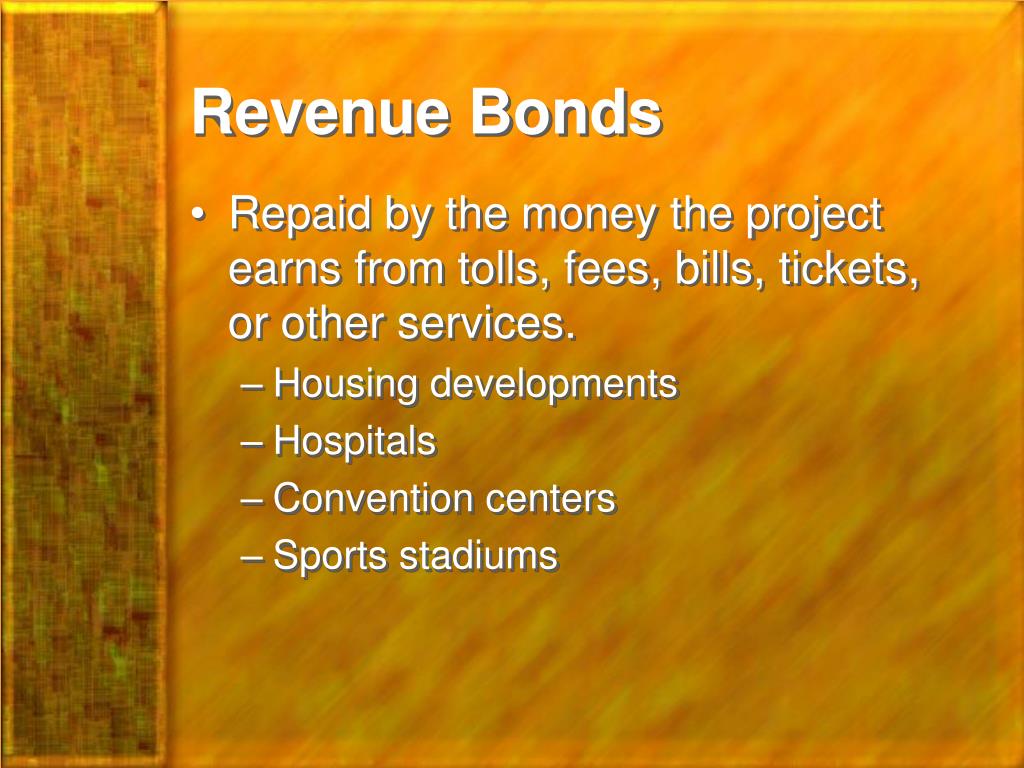
Revenue bonds are one of the biggest sectors in the municipal debt market.

Unlike a general obligation (GO) bond, revenue bonds are not backed by a municipal issuer’s taxing authority. Instead, interest and principal are secured by the net revenues (tolls, fees, or other charges tied to usage) from the project or facility being financed.

Revenue bonds are issued to finance a variety of capital projects, including construction or refurbishment of utility and waste disposal systems, highways, bridges, tunnels, air and seaport facilities, schools and hospitals.

COMMENTS APPRECIATED

Subscribe and Refer

***

***

TAX SEASON: Planning and Preparation for Doctors

By Staff Reporters

***

DEFINITION: Tax season is the period of time, generally between January 1st and April 15th of each year, when individual taxpayers prepare to report their taxable income to the federal government and, in most cases, to the government of the state in which they live.

CITE: https://www.r2library.com/Resource

Some Year-End Preparation for the Upcoming Tax Filing Season

The filing season for 2023 tax returns us now upon us. A little advance preparation can prevent stressful tax time surprises for doctors and all medical professionals. Here are some important steps you can take now to set yourself up for worry-free tax filing:

  • Do one last withholding checkup. Time is running out to adjust your paycheck withholding to make sure you have paid enough tax throughout 2023. You can use the online IRS Withholding Estimator tool to make sure your numbers are on track.
  • If your name changed in 2023, report the change to the Social Security Administration as soon as possible, preferably before the end of the year.
  • Locate your bank account information, including both your account number and the bank routing number, so you can receive your tax refund by direct deposit.
  • Watch for year-end income statements, especially in late January and early February. These statements may include W-2 forms, along with 1099-NEC, 1099-MISC, 1099-INT, 1099-G and other 1099 forms. Note that some of these forms may come by mail, while others may be sent to you electronically. Keep all of the forms together and organized.
  • Organize records for tax deductions and credits. These records may include Form 1095-A (Health Insurance Marketplace Statement), tuition statements (Form 1098-T), medical bills, mortgage interest statements, and home energy improvement or clean vehicle receipts or invoices.

Waiting until the last minute to try to assemble these documents can lead to missing the filing deadline, so start early.

COMMENTS APPRECIATED

Thank You

***

***

15: PODCAST: CPAs are Out … Are CMPs™ In?

CERTIFIED MEDICAL PLANNER

By Staff Reporters

SPONSOR: http://www.CertifiedMedicalPlanner.org

***

The giant accounting firm Grant Thornton LLP is laying off 200 people, its second round of layoffs in the past six months and an indication that the major players in the professional consulting, accounting and advisory business are preparing for an economic slowdown that could squeeze profits across corporate America.

***

Statistics: 7.4%. That’s the percentage drop in students who graduated with a degree in accounting in the 2021–2022 school year than the year before. Low starting salaries, heavy workloads, and uncertainty around AI are driving the exodus of students from choosing accounting degrees. (the Wall Street Journal).

MORE: https://www.wsj.com/lifestyle/careers/accounting-salary-cpa-shortage-dec2caa2?utm_campaign=mb&utm_medium=newsletter&utm_source=morning_brew

PODCAST: https://www.ted.com/talks/dan_bricklin_meet_the_inventor_of_the_electronic_spreadsheet

CMP RELATED: https://medicalexecutivepost.com/2023/10/29/become-a-board-certified-medical-planner-healthcare-niche-advisor-and-thrive/

***
COMMENTS APPRECIATED
Thank You

***

***

IRS: A Late PayPal Gift for 2023 Tax Returns

GOODBYE FORM 1099-Ks

By Staff Reporters

***

***

The IRS just said it is again delaying the implementation of a 2021 law that requires payment platforms such as Venmo, Paypal or Cash App to send tax forms called 1099-Ks to anyone who received more than $600 in the current tax year. 

It’s the second consecutive year the IRS has delayed enacting the new regulation, after the tax agency last year pushed off the new law until 2023. On Tuesday, the IRS said it will push the regulation back another year “to reduce taxpayer confusion” after hearing from taxpayers, tax professionals and payment processors.

CITE: https://www.r2library.com/Resource/Title/082610254

COMMENTS APPRECIATED

Thank You

***

***

IRS: Gift and Estate Tax Exempt Limits Increased

By Staff Reporters

***

***

Annual Gift Tax Exclusion Increased

Currently, you can give any number of people up to $17,000 each in a single year without taxation. For 2024, this will be increased to $18,000. For married couples, $36,000 will be available to be given to beneficiaries, tax-free, beginning next year.

Lifetime Gift Tax Exemption

Additionally, the IRS has announced that the lifetime estate and gift tax exemption will increase to $13.61 million in 2024. If a gift exceeds the annual limit ($17,000 this year, $18,000 in 2024), that does not automatically prompt a gift tax. The difference is simply taken from the person’s lifetime exemption limit and no taxes are owed.

COMMENTS APPRECIATED

Thank You

***

***

INCOME: It Depends on the Meaning of the Word?

By Staff Reporters

***

Incomes Keep Rising| Concrete Construction Magazine

***

DEFINITION: Income is the money you receive in exchange for your labor or products. Income may have different definitions depending on the context—for example, taxation, financial accounting, or economic analysis. For most people, income is their total earnings in the form of wages and salaries, the return on their investments, pension distributions, and other receipts. For businesses, income is the revenue from selling services, products, and any interest and dividends received with respect to their cash accounts and reserves related to the business. Economists have different definitions of income and different ways of measuring it, from focusing on earnings, savings, consumption, production, public finance, capital investment or other topics … Maybe?

CITE: https://www.r2library.com/Resource

WASHINGTON (Reuters) – The U.S. Supreme Court is set on Tuesday to consider a challenge to the legality of a tax targeting owners of foreign corporations that could undermine efforts at imposing a wealth tax on the very rich in a case that has already sparked controversy over a call for Justice Samuel Alito to recuse.

The justices are due to hear arguments in an appeal by Charles and Kathleen Moore – a retired couple from Redmond, Washington couple – of a lower court’s decision rejecting their challenge to the tax on foreign company earnings, even though those profits had not been distributed.

The one-time “mandatory repatriation tax” (MRT), which applied to taxpayers owning at least 10% of certain foreign corporations, was part of a 2017 Republican-backed tax bill signed into law by former President Donald Trump.

At issue in the case is whether this levy on unrealized gains is allowed under the U.S. Constitution’s 16th Amendment, which enabled Congress to “collect taxes on incomes.” The Moores, backed by the Competitive Enterprise Institute and other conservative and business groups, contend that “income” means only those gains that are realized through payment to the taxpayer, not a mere increase in the value of property.

COMMENTS APPRECIATED

Thank You

***

***

SCOTUS: “Quadrillion-Dollar” IRS Tax Code Question?

By Staff Reporters

SPONSOR: http://www.CertifiedMedicalPlanner.org

***

***

SCOTUS will hear the “quadrillion-dollar” question?

Kicking off the Supreme Court this week will hear oral arguments today for a case that could upend the US tax code.

In Moore v. United States, the justices will be asked to decide whether the federal government can tax certain “unrealized gains”—assets that have yet to be sold.

CITE: https://www.r2library.com/Resource/Title/082610254

***

COMMENTS APPRECIATED

Thank You

***

***

What is GAAP?

HOW IT WORKS

By Dr. David E. Marcinko MBA CMP®

http://www.MarcinkoAssociates.com

CMP logo

SPONSOR: http://www.CertifiedMedicalPlanner.org

Generally Accepted Accounting Principles

As a new physician investor, it’s important to know the distinctions between like measurements because the market allows firms to advertise their numbers in ways not otherwise regulated. Often companies will publicize their numbers using either GAAP or non-GAAP measures. GAAP, or generally accepted accounting principles, outlines rules and conventions for reporting financial information. It is a means to standardize financial statements and ensure consistency in reporting.

When a company publicizes its earnings and includes non-GAAP figures, it means it wants to provide investors with an arguably more accurate depiction of the company’s health (for instance, by removing one-time items to smooth out earnings). However, the further a company deviates from GAAP standards, the more room is allocated for some creative accounting and manipulation.

When looking at a company that is publishing non-GAAP numbers, new physician investors should be wary of these pro forma statements, because they may differ greatly from what GAAP deems acceptable.

CITE: https://www.r2library.com/Resource/Title/0826102549

***

***

The Core GAAP Principles

GAAP is set forth in 10 primary principles, as follows:

  1. Principle of consistency: This principle ensures that consistent standards are followed in financial reporting from period to period.
  2. Principle of permanent methods: Closely related to the previous principle is that of consistent procedures and practices being applied in accounting and financial reporting to allow comparison.
  3. Principle of non-compensation: This principle states that all aspects of an organization’s performance, whether positive or negative, are to be reported. In other words, it should not compensate (offset) a debt with an asset.
  4. Principle of prudence: All reporting of financial data is to be factual, reasonable, and not speculative.
  5. Principle of regularity: This principle means that all accountants are to consistently abide by the GAAP.
  6. Principle of sincerity: Accountants should perform and report with basic honesty and accuracy.
  7. Principle of good faith: Similar to the previous principle, this principle asserts that anyone involved in financial reporting is expected to be acting honestly and in good faith.
  8. Principle of materiality: All financial reporting should clearly disclose the organization’s genuine financial position.
  9. Principle of continuity: This principle states that all asset valuations in financial reporting are based on the assumption that the business or other entity will continue to operate going forward.
  10. Principle of periodicity: This principle refers to entities abiding by commonly accepted financial reporting periods, such as quarterly or annually.

Thank You

***

***

FINANCE: https://www.amazon.com/Comprehensive-Financial-Planning-Strategies-Advisors/dp/1482240289/ref=sr_1_1?ie=UTF8&qid=1418580820&sr=8-1&keywords=david+marcinko

YOUR COMMENTS ARE APPRECIATED

BUSINESS MEDICINE: https://www.amazon.com/Business-Medical-Practice-Transformational-Doctors/dp/0826105750/ref=sr_1_9?ie=UTF8&qid=1448163039&sr=8-9&keywords=david+marcinko

***

HOSPITALS: https://www.amazon.com/Financial-Management-Strategies-Healthcare-Organizations/dp/1466558733/ref=sr_1_3?ie=UTF8&qid=1380743521&sr=8-3&keywords=david+marcinko

***

IRS: “No More Door Knocks”

By Staff Reporters

***

***

 The IRS will not come to the front / back door 

The tax agency will no longer make unannounced visits to taxpayers’ homes or businesses to collect payments due (in most cases). The IRS said it was halting the controversial practice, which has been around since at least the 1950s, to protect its agents’ safety.

Instead, the agency will send letters requesting that the taxpayer schedule an appointment. In specific cases, such as to deliver a summons or subpoena or seize assets, an unannounced visit may still occur, but there are only a few hundred of those each year compared to tens of thousands of the more routine visits, according to Reuters.

***

COMMENTS APPRECIATED

Thank You

***

***

TRIVIA: After Tax Day 2023?

By Staff Reporters

***

***

  • In 1696, England imposed a tax on windows to extract more revenue from the wealthy (whose houses had more windows). But all it did was incentivize fewer windows in homes and public health deteriorated from the lack of ventilation.
  • People 100 years old and older in New Mexico are exempt from the state’s income tax.
  • In 2009, local officials in China’s Hubei province were required to smoke more cigarettes to boost sales tax collections. They were fined if they didn’t hit their targets.

CITE: https://www.r2library.com/Resource

MORE FUN TRIVIA: https://blog.cheapism.com/fun-tax-facts/

***

***

COMMENTS APPRECIATED

Thank You

***

IRS: Tax Changes to Know for 2022

By Staff Reporters

***

Here are eight things to keep in mind as you prepare to file your 2022 taxes

1. Income tax brackets shifted somewhat

There are still seven tax rates, but the income ranges (tax brackets) for each rate shifted slightly to account for inflation. For 2022, the following rates and income ranges apply:

Taxable income brackets

Tax rate  Single filers Married couples filing jointly (and qualifying widows or widowers)
10% $0 to $10,275$0 to $20,550
12%$10,276 to $41,775$20,551 to $83,550
22% $41,776 to $89,075$83,551 to $178,150
24%$89,076 to $170,050$178,151 to $340,100
32% $170,051 to $215,950$340,101 to $431,900
35% $215,951 to $539,900$431,901 to $647,850
37% $539,901 or more$647,851 or more

2. The standard deduction increased somewhat

After an inflation adjustment, the 2022 standard deduction increases to $12,950 for single filers and married couples filing separately and to $19,400 for single heads of household, who are generally unmarried with one or more dependents. For married couples filing jointly, the standard deduction rises to $25,900.

3. Itemized deductions remain essentially the same

For most filers, taking the higher standard deduction is more practical and saves the hassle of keeping track of receipts. But if you have enough tax-deductible expenses, you might benefit from itemizing.

  • State and local taxes: The deduction for state and local income taxes, property taxes, and real estate taxes is capped at $10,000.
  • Mortgage interest deduction: The mortgage interest deduction is limited to $750,000 of indebtedness. But people who had $1,000,000 of home mortgage debt before December 16, 2017 will still be able to deduct the interest on that loan.
  • Medical expenses: Only medical expenses that exceed 7.5% of adjusted gross income (AGI) can be deducted in 2022.
  • Charitable donations: The deductions for charitable donations are not as generous as they were in 2021. In 2022, the annual income tax deduction limits for gifts to public charities1 are 30% of AGI for contributions of non-cash assets—if held for more than one year—and 60% of AGI for contributions of cash.
  • Miscellaneous deductions: No miscellaneous itemized deductions are allowed.

4. IRA contribution limits remain the same and 401(k) limits are slightly higher

The traditional IRA and Roth contribution limits in 2022 remain the same as the prior year. Individuals can contribute up to $6,000 to an IRA, and those age 50 and older also qualify to make an additional $1,000 catch-up contribution. If you’re able to max out your IRA, consider doing so—you may qualify to deduct some or all of your contribution.

However, the 2022 contribution limits for 401(k) accounts have increased to $20,500. If you’re age 50 or older, you qualify to make an additional $6,500 catch-up contribution for this tax year as well.

5. You can save a bit more in your health savings account (HSA)

For 2022, the maximum you can contribute to an HSA is $3,650 for an individual (up $50 from 2021) and $7,300 for a family (up $100). People age 55 and older can contribute an extra $1,000 catch-up contribution.

To be eligible for an HSA, you must be enrolled in a high-deductible health plan (which usually has lower premiums as well). Learn more about the benefits of an HSA.

6. The Child Tax Credit is lower after a one-year bump

Tax credits, which reduce the tax you owe dollar for dollar, are normally better than deductions, which reduce how much of your income is subject to tax.

In 2021, the American Rescue Plan Act (ARPA) temporarily enlarged the Child Tax Credit. But in 2022, the credit returns to $2,000 per child age sixteen or younger. The credit is also subject to a phase-out starting at $400,000 for joint filers and $200,000 for single filers. For other qualified dependents, you can claim a $500 credit.

7. The alternative minimum tax (AMT) exemption is higher

Until the AMT exemption enacted by the Tax Cuts and Jobs Act expires in 2025, the AMT will continue to affect mostly households with incomes over $500,000. For 2022, the AMT exemptions are $75,900 for single filers and $118,100 for married taxpayers filing jointly. The phase-out thresholds are $1,079,800 for married taxpayers filing a joint return and $539,900 for all other taxpayers. (Once your income for the AMT hits the phase-out threshold, your AMT exemption begins to phase out at 25 cents for every dollar over the threshold.)

8. The estate tax exemption is even higher

The estate and gift tax exemption, which is indexed to inflation, rises to $12.06 million for 2022. But the now-higher exemption is set to expire at the end of 2025, meaning it could be essentially cut in half at that time if Congress doesn’t act.

The annual gift exclusion, which allows you to give money to your loved ones each year without incurring any tax liability or using up any of your lifetime estate and gift tax exemption, increases to $16,000 per recipient (up $1,000 from 2021).

Don’t get caught

Finally, if you’re age 72 or older, make sure you’ve taken your required minimum distribution (RMD) from your retirement accounts before the end of the year or else you face a 50% penalty on any undistributed funds (unless it’s your first RMD, in which case you can wait until April 1, 2023).

CITE: https://www.r2library.com/Resource/Title/082610254

COMMENTS APPRECIATED

Thank You

***

Front Matter with Foreword by Jason Dyken MD MBA

ORDER: https://www.routledge.com/Comprehensive-Financial-Planning-Strategies-for-Doctors-and-Advisors-Best/Marcinko-Hetico/p/book/9781482240283

***

RMDs: Are You of IRS Taxation Age?

Stop 2020 – Restart 2021

By Staff Reporters

***

CITE: https://www.r2library.com/Resource/Title/082610254

***

Are You of RMD Age?
A Required Minimum Distribution (RMD) is an amount of money the IRS requires you to withdraw from most retirement accounts, beginning at age 72.
Due to the Coronavirus Aid, Relief, and Economic Security (CARES) Act, RMDs were not required in 2020, but RMDs are required in 2021 and each year after. RMDs can be an important part of your retirement income strategy.

IRS: https://www.irs.gov/retirement-plans/retirement-plans-faqs-regarding-required-minimum-distributions

***

COMMENTS APPRECIATED

Thank You

***

ORDER: https://www.routledge.com/Comprehensive-Financial-Planning-Strategies-for-Doctors-and-Advisors-Best/Marcinko-Hetico/p/book/9781482240283

***

TAX LOSS HARVESTING: What it is?

By Staff Reporters

***

***

What Is Tax-Loss Harvesting?

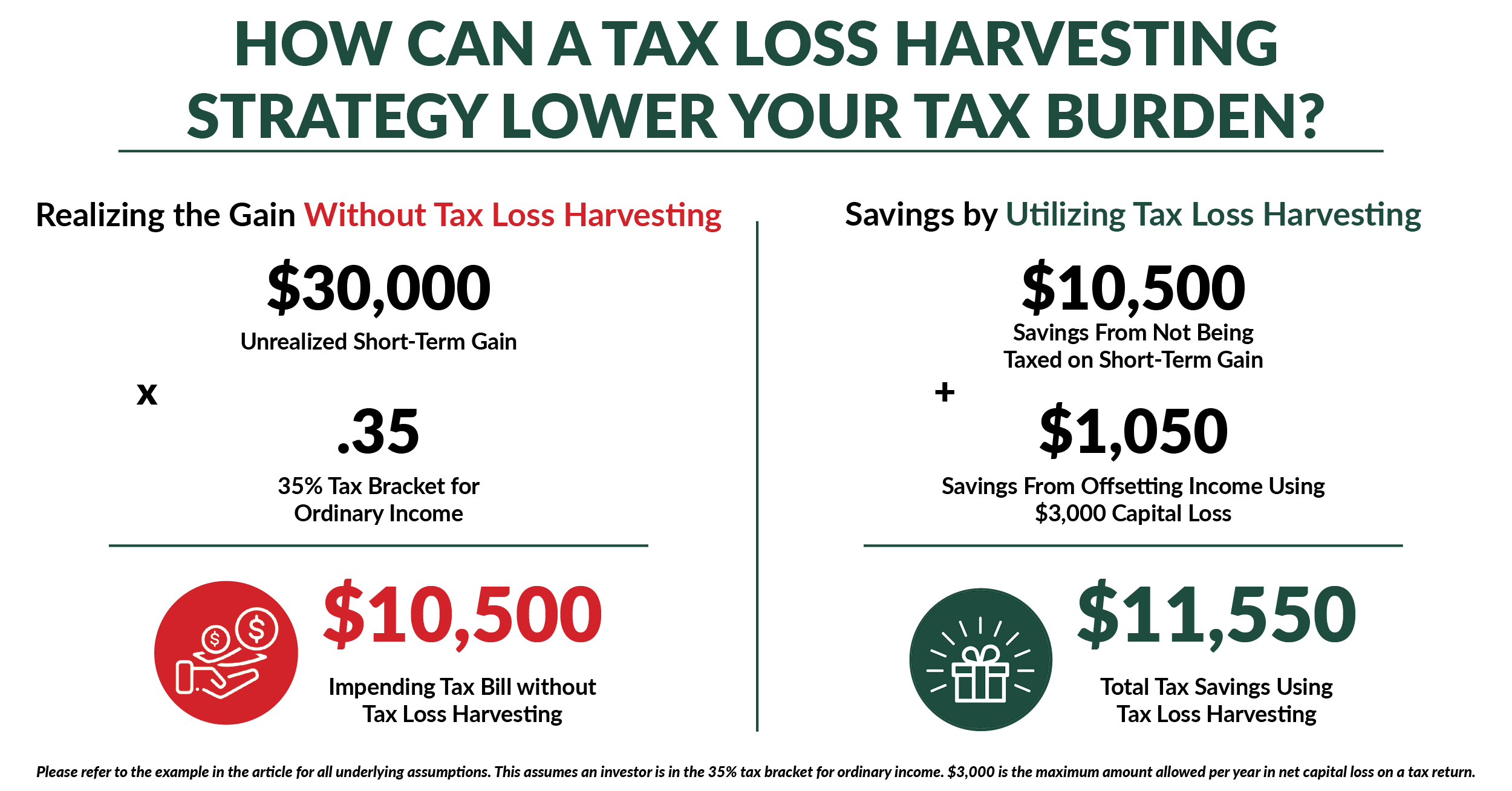
Tax-loss harvesting is the timely selling of securities at a loss in order to offset the amount of capital gains tax due on the sale of other securities at a profit. 

This strategy is most often used to limit the amount of taxes due on short-term capital gains, which are generally taxed at a higher rate than long-term capital gains. However, the method may also offset long-term capital gains. This strategy can help preserve the value of the investor’s portfolio while reducing the cost of capital gains taxes.

There is a $3,000 limit on the amount of capital gains losses that a federal taxpayer can deduct in a single tax year. However, Internal Revenue Service (IRS) rules allow additional losses to be carried forward into the following tax years.

4 Key Points

  • Tax-loss harvesting is a strategy investors can use to reduce the total amount of capital gains taxes due from the sale of profitable investments.
  • The strategy involves selling an asset or security at a net loss.
  • The investor can then use the proceeds to purchase a similar asset or security, maintaining the portfolio’s overall balance.
  • The investor must be careful not to violate the IRS rule against buying a “substantially identical” investment within 30 days.

***
COMMENTS APPRECIATED

Thank You

***

ORDER: https://www.amazon.com/Comprehensive-Financial-Planning-Strategies-Advisors/dp/1482240289/ref=sr_1_1?ie=UTF8&qid=1418580820&sr=8-1&keywords=david+marcinko

***

UPDATE: Domestic Markets Soar as United Kingdom Scraps Taxation

By Staff Reporters

***

***

The Dow surged 825 points, or 2.8%. The Dow has soared more than 1,500 points in the past two days. It is now back above the key 30,000 milestone and is about 18% off its most recent record high, meaning that is no longer in a bear market.

The S&P 500 and Nasdaq gained 3.1% and 3.3%, respectively. But both of those indexes remain in bear territory, at more than 20% off their all-time highs.

***

The UK is scrapping its plan to remove the 45% top rate of income tax, calling it a huge distraction from other priorities. The plan, which the government defended just recently, caused a mini-financial meltdown before the Bank of England stepped in with emergency measures.

***

COMMENTS APPRECIATED

Thank You

***

FINANCE: https://www.routledge.com/Comprehensive-Financial-Planning-Strategies-for-Doctors-and-Advisors-Best/Marcinko-Hetico/p/book/9781482240283

***

Tax Deductions versus Tax Credits

By Staff Reporters

***

What is a tax deduction?

A deduction reduces the amount of income you pay taxes on, which means you could pay less in taxes. You subtract deductions from your income before calculating how much taxes you owe. How much a deduction saves you depends on your income tax bracket.

To calculate how much a deduction could reduce your taxes, you multiply the amount of the deduction by your marginal tax rate. For example, if a deduction is worth $5,000 and you are in the 10% tax bracket (the lowest), the deduction would reduce your taxes by $500.

A deduction’s value to you is tied to your tax rate. So if you’re paying a higher tax rate, you can reap more of a deduction’s benefit. The lower your tax rate, the less benefit a deduction will have for you. Imagine that you take a $5,000 deduction, but you’re in the 35% tax bracket — the second highest. Now you’re saving $1,750 in taxes.

CITE: https://www.r2library.com/Resource/Title/082610254

What is a tax credit?

On the other hand, a credit is a dollar-for-dollar reduction in the amount of tax you owe. For example, if you qualify for a $1,000 tax credit of some kind and owe $5,000 in taxes, that credit will reduce your tax burden to $4,000.

***

But – Do Not Claim Too Many Tax Deductions

Deductions are enticing to taxpayers because they can reduce the amount of your income before you calculate the tax you owe, which in turn might significantly lower how much you have to pay in taxes or increase your refund. But that doesn’t mean you should go wild writing things off on your tax returns, as experts say claiming too many deductions is the most common reason people end up getting audited by the IRS.

Don’t try writing off deductions that are no longer accepted by the IRS. The tax code has changed over the years, and there are some things the tax agency no longer recognizes. You should remember that some of the tax write-offs were terminated by the IRS, including deductions on alimony, moving expenses, and any expenses related to investing, hobbies, and tax preparation.

***

Comments Appreciated

THANK YOU

Subscribe to the Medical Executive-Post

***

***

Income Tax Brackets for 2021

By Staff Reporters

***

CITE: https://www.r2library.com/Resource/Title/082610254

***

If taxable income is:The tax due is:
Under $9,95010% of the taxable income
Over $9,950 but under or equal to $40,525$995 plus 12% of the excess over $9,950
Over $40,525 but under or equal to $86,375$4,664 plus 22% of the excess over $40,525
Over $86,375 but under or equal to $164,925$14,751 plus 24% of the excess over $86,375
Over $164,925 but under or equal to $209,425$33,603 plus 32% of the excess over $164,925
Over $209,425 but under or equal to $523,600$47,843 plus 35% of the excess over $209,425
Over $523,600$157,804.25 plus 37% of the excess over $523,600

,

If taxable income is:The tax due is:
Not over $9,95010% of the taxable income
Over $9,950 but under or equal to $40,525$995 plus 12% of the excess over $9,950
Over $40,525 but under or equal to $86,375$4,664 plus 22% of the excess over $40,525
Over $86,375 but under or equal to $164,925$14,751 plus 24% of the excess over $86,375
Over $164,925 but under or equal to $209,425$33,603 plus 32% of the the excess over $164,925
Over $209,425 but under or equal to $314,150$47,843 plus 35% of the excess over $209,425
Over $314,150$84,496 plus 37% of the excess over $314,150

,

If taxable income is:The tax due is:
Not over $19,90010% of the taxable income
Over $19,900 but under or equal to $81,050$1,990 plus 12% of the excess over $19,900
Over $81,050 but under or equal to $172,750$9,328 plus 22% of the excess over $81,050
Over $172,750 but under or equal to $329,850$29,502 plus 24% of the excess over $172,750
Over $329,850 but under or equal to $418,850$67,206 plus 32% of the excess over $329,850
Over $418,850 but under or equal to $628,300$95,686 plus 35% of the excess over $418,850
Over $628,300$168,993.50 plus 37% of the excess over $628,300

,

If taxable income is:The tax due is:
Not over $14,20010% of the taxable income
Over $14,200 but under or equal to $54,200$1,420 plus 12% of the excess over $14,200
Over $54,200 but under or equal to $86,350$6,220 plus 22% of the excess over $54,200
Over $86,350 but under or equal to $164,900$13,293 plus 24% of the excess over $86,350
Over $164,900 but under or equal to $209,400$32,145 plus 32% of the the excess over $164,900
Over $209,400 but under or equal to $523,600$46,385 plus 35% of the excess over $209,400
Over $523,600$156,355 plus 37% of the excess over $523,600

***

COMMENTS APPRECIATED

Thank You

Subscribe to the Medical Executive-Post

***

***

IRS & PHYSICIANS: Married Filing Separately May Save Taxes?

By Staff Reporters

****

The IRS considers taxpayers married if they are legally married under state law, live together in a state-recognized common-law marriage, or are separated but have no separation maintenance or final divorce decree as of the end of the tax year.

CITE: https://www.r2library.com/Resource/Title/082610254

Of the 150.3 million tax returns filed in 2016, the latest year for which the IRS has published statistics, 3.07 million belonged to twosomes who filed separately.

  • These partners reported individual income and expenses on individual tax returns.
  • They had to agree on either itemizing expenses or using the standard deduction.
  • By filing separately, their similar incomes, miscellaneous deductions or medical expenses likely helped them save taxes.

***

Consequences of Filing Married Separate | SC Associates

Filing separately with similar incomes

A couple may pay the IRS less by filing separately when both physician spouses work and earn about the same amount.

  • When they compare the tax due amount under both joint and separate filing statuses, they may discover that combining their earnings puts them into a higher tax bracket.
  • Their savings depends on a variety of other factors, however, including their investment situation and whether they have children.
  • The “married filing separately” status cuts the deductions for IRA contributions and eliminates certain tax credits, among other tax breaks.

Using miscellaneous deductions by filing separately (for tax years prior to 2018)

Miscellaneous deductions can lower taxable income, but in order to enter them on Schedule A, they must add up to more than 2% of adjusted gross income (AGI).

  • Physician or other spouses with union dues, job-search costs, tax-preparation fees and un-reimbursed business expenses may find their miscellaneous deductions don’t qualify when their higher combined income raises their AGI.
  • A spouse who travel frequently for business could rack up a sizable tally in airline fees for baggage and itinerary changes that makes the miscellaneous deduction worth pursuing.

Beginning in 2018, these types of miscellaneous expenses are no longer deductible.

Filing separately to save with unforeseen expenses

Adjusted gross income also determines if a couple can use un-reimbursed health care costs and casualty losses on Schedule A to save taxes.

  • Unless out-of-pocket medical expenses exceed 7.5% of AGI for 2021, they don’t qualify as a deduction.
  • Casualty losses must also total more than 10% of AGI and occur in a federally declared disaster area.

The spouse with the loss or substantial medical outlay calculates deductibility against his or her own lower AGI when the couple files separate returns. When one spouse can lower taxable income this way, married filing separately might trim a couple’s overall tax burden.

Filing separately to guard the future

When you don’t want to be liable for your partner’s tax bill, choosing the married-filing-separately status offers financial protection: the IRS won’t apply your refund to your spouse’s balance due. Separate returns make sense to prevent the IRS from seizing a spouse’s tax refund when the other has fallen behind on child support payments.

Couples in the process of divorcing may shun joint returns to avoid post-divorce complications with the IRS, while a spouse who questions her partner’s tax ethics may feel more comfortable living a separate tax life.

Couples living in community-property states should consider state law when deciding how to file.

***

COMMENTS APPRECIATED

Thank You

Subscribe to the Medical executive-Post

***

***

UPDATE: IRS Interest Rates Rising, Currency Inflation and Upcoming Earning Reports, etc.

By Staff Reporters

****

IRS: The IRS sent out a notice on February 23rd, warning taxpayers about a price hike coming in the next few months. The tax agency said that interest rates will increase for the calendar quarter starting April 1st, 2022. You can accrue interest on two types of payments: over-payment or underpayment. So starting in April, over-payments will have an interest rate of 4 percent, except for corporations which will earn a 3 percent rate and a 1.5 percent rate for the portion of a corporate over-payment that exceeds $10,000. In terms of underpayments, the interest rate will increase to 4 percent overall and 6 percent for large corporate underpayments.

“Under the Internal Revenue Code, the rate of interest is determined on a quarterly basis,” the IRS website explained. The tax agency did not change interest rates in this last quarter, which began Jan. 1, 2022. Before they get changed in April, the rates are currently 3 percent for general over-payments and 2 percent for corporation over-payments, with a 0.5 percent rate for the portion of a corporate over-payment exceeding $10,000. The underpayment interest is 3 percent right now, expect for large corporations which have a 5 percent rate.

***

***

CURRENCY INFLATION: Inflation may occur when the Federal Reserve, or another central bank, adds fiat currency into circulation at a rate that exceeds that of the economy’s growth rate. That creates a situation in which there are more dollars bidding on fewer goods and services. The result is that goods and services cost more. One reason that inflation has been a constant in the US since 1933 is that the FOMC has continually increased the money supply. In response to the 2008 financial crisis, the Fed dropped its lending rate close to zero as a way to inject more liquidity into the economy, which led to increased inflation but not hyperinflation. While those increases have usually moved in step with growth, that hasn’t always been the case.

CITE: https://www.r2library.com/Resource/Title/0826102549

And so, in response to the COVID-19 pandemic and subsequent lock-downs, the Federal Reserve released the equivalent of $3.8 trillion in new liquidity in 2020. That amount was equal to roughly 20% of the dollars previously in circulation. And it is one reason why many investors were watching the CPI closely in 2021.

EARNING REPORTS:

Monday: India GDP data; Earnings from Lordstown Motors, Groupon, HP, SmileDirectClub and Zoom Video

Tuesday: US and China manufacturing data; Earnings from AutoZone, Baidu, Domino’s Pizza, Hostess Brands, J.M. Smucker, Kohl’s, Target, AMC Entertainment and Salesforce

Wednesday: European inflation data; Earnings from Abercrombie & Fitch, Dine Brands, Dollar Tree, Snowflake and Victoria’s Secret

Thursday: ISM Non-Manufacturing Index; Earnings from Best Buy, Weibo, Costco and Gap

Friday: US jobs report

10-Year: Treasuries rallied to 1.902%.

Oil: The rise in oil prices is spilling over at the gas pump: The average gas price in the US has jumped 10 cents, to $3.64/gallon, in the past two weeks.

Partial SWIFT ban: Western governments put aside their hesitations and proposed banning some Russian lenders from SWIFT, the global messaging service that facilitates cross-border transactions. It’s a move that could cause turmoil across global financial markets.

***

COMMENTS APPRECIATED

Thank You

Subscribe to the Medical Executive-Post

***

***

CURRENCY: Devaluation versus Depreciation

KNOW THE FINANCIAL DIFFERENCE

****

BY DR. DAVID E. MARCINKO MBA CPM®

INVITE: https://medicalexecutivepost.com/dr-david-marcinkos-bookings/

Competitive World 27

CMP logo

SPONSOR: http://www.CertifiedMedicalPlanner.org

Devaluation is the deliberate downward adjustment of the value of a country’s money related to another currency, group of currencies or currency standard. It is often confused with depreciation and is the opposite of revaluation which refers to the readjustment of a currency exchange rate.

CITE: https://www.r2library.com/Resource/Title/0826102549

Definition

The government of a country may decide to devalue its currency and like depreciation it is not the result of non-governmental activities.

One reason a country made devalue its currency is to combat a trade imbalance. Devaluation reduces the cost of a country’s export rendering them more competitive in the Global market which is which in turn increases the cost of imports.

If imports are more expensive domestic consumers are less likely to purchase them further strengthening domestic businesses because exports increase and imports decrease there is typically a better balance of payments because the trade deficit shrinks. In short a country that devalue its currency can produce is difficult because there is a greater demand for cheaper exports.

***

***

In accountancy, depreciation refers to two aspects of the same concept: first, the actual decrease of fair value of an asset, such as the decrease in value of factory equipment each year as it is used and wear, and second, the allocation in accounting statements of the original cost of the assets to periods in which the assets are used (depreciation with the matching principle).

Depreciation is thus the decrease in the value of assets and the method used to reallocate, or “write down” the cost of a tangible asset (such as equipment) over its useful life span. Businesses depreciate long-term assets for both accounting and tax purposes. The decrease in value of the asset affects the balance sheet of a business or entity, and the method of depreciating the asset, accounting-wise, affects the net income, and thus the income statement that they report.

CITE: https://www.r2library.com/Resource/Title/0826102549

Generally, the cost is allocated as depreciation expense among the periods in which the asset is expected to be used.

YOUR COMMENTS ARE APPRECIATED.

Thank You

***

ORDER TEXT: https://www.routledge.com/Comprehensive-Financial-Planning-Strategies-for-Doctors-and-Advisors-Best/Marcinko-Hetico/p/book/9781482240283

***

ALTERNATIVE MINIMUM TAX: Physicians Beware!

By Staff Reporters

****

Alternative Minimum Tax

DEFINITION: The alternative minimum tax (AMT) is a tax imposed by the United States federal government in addition to the regular income tax for certain individuals, estates, and trusts. As of tax year 2018, the AMT raises about $5.2 billion, or 0.4% of all federal income tax revenue, affecting 0.1% of taxpayers, mostly in the upper income ranges.

CITE: https://www.r2library.com/Resource/Title/0826102549

***

See the source image

Key Takeaways

  • The alternative minimum tax (AMT) ensures that certain taxpayers pay their fair share of income taxes.
  • However, the structure was not indexed to inflation or tax cuts. …
  • For those subject to AMT, there are certain strategies that can be employed to reduce your exposure to this tax.

MORE: https://www.forbes.com/sites/kellyphillipserb/2020/09/11/your-first-look-at-2021-tax-rates-projected-brackets-standard-deductions–more/?sh=119ff37413ba

***

COMMENTS APPRECIATED

Thank You

Subscribe to the Medical Executive-Post

****

***

IRS Tax Reduction Issues for Self-Employed Physician Executives

***

By Dr. David Edward Marcinko MBA CMP®

SPONSOR: http://www.CertifiedMedicalPlanner.org


INTRODUCTION

Whether you do contract work or have your own small business, tax deductions for the self-employed physician consultant and/or medical executive or nurse consultant, etc., can add up to substantial tax savings.

Welcome Tax Season: https://www.msn.com/en-us/money/taxes/tax-season-2022-irs-now-accepting-tax-returns-what-to-know-before-filing-taxes-about-your-refund/ar-AAT53rR?li=BBnb7Kz


With self-employment comes freedom, responsibility, and a lot of expense. While most self-employed people celebrate the first two, they cringe at the latter, especially at tax time. They might not be aware of some of the tax write-offs to which they are entitled.

When it comes time to file your returns, don’t hesitate to claim the benefits you get for being the boss. As a self-employed success story, you’ve earned them.

FORM 1099 NEC: Form 1099 NEC is one of several IRS tax forms used in the United States to prepare and file an information return to report various types of income other than wages, salaries, and tips. The term information return is used in contrast to the term tax return although the latter term is sometimes used colloquially to describe both kinds of returns.

READ: https://turbotax.intuit.com/tax-tips/self-employment-taxes/how-to-file-taxes-with-irs-form-1099-misc/L3UAsiVBq?tblci=GiC9aWPDzN9yXLpSuE8LDo3YRMDPuoFwO9ycCY6qixKJ8CC8ykEo94-H7prplp7cAQ

CITE: https://www.r2library.com/Resource/Title/082610254

“Many times an overlooked deduction is educational expenses. If one is taking courses or buying research material to be more effective in their work, this can be deductible.”

Individual Retirement Plans (IRAs)

One of the best tax write-offs for the self-employed physician consultant is a retirement plan. A person with no employees can set up an individual 401 (k). “You can contribute $19,500 in 2021 as a 401(k) deferral, plus 25 percent of net income.”

If you have employees, consider a SIMPLE (Savings Incentive Match Plan for Employees) IRA—an IRA-based plan that gives small employers a simplified method to make contributions to their employees’ retirement. As of 2021, an employee may defer up to $13,500 and employees over 50 may contribute an additional $3,000.

“A third retirement plan is Simplified Employee Pension IRA (SEP IRA).” The employer may contribute the lesser of 25 percent of income or $58,000 in 2021. If the employer has eligible employees, an equal percentage of their income must be contributed.

Recall that retirement plans are “absolutely the No. 1 tax deduction. The government is helping fund retirement.”

Business use of home or dwelling

Now, most self-employed taxpayers’ businesses start as home-based businesses. These people need to know portions of business costs are deductible and so “It is very important that you keep track of expenses relating to your housing costs.”

If your gross income from your business exceeds your total expenses, then you can deduct all of your expenses related to the business use of your home. If your gross income is less than your total expenses, your deduction will be limited to the difference between your gross income and the sum of all business expenses you would pay if the business was not in your home. Those expenses could include telephone lines, the Internet, and other costs to do business.

You must also have a home office that is truly used for work and the Internal Revenue Service may require you to document this.

***

Deducting automobile expenses

If you travel for business, even short distances within your own city, you may deduct the dollar value of business miles traveled on your tax return. The taxpayer may file the actual expense s/he incurred, or use the standard mileage rate prescribed by the IRS, which is 56 cents as of 2021. The IRS allowable mileage rates should be checked every year as they can change.

“If you decide to use actual car expenses, be sure to include payments, depreciation, registration, insurance, garage rent, licenses, repairs and maintenance, and parking and toll fees.” AND, “If you decide to use the standard mileage rate, it would be in your best interest to keep a log—daily, weekly or monthly—of miles driven to distinguish personal use from business use.”

Depreciation of property and equipment

Some self-employed people may purchase property and equipment for a business. If they expect that property to last longer than one year, it should be depreciated on the tax return.

Claims regarding property, according to the IRS, must meet the following criteria: You must own the property and it must be used or held to generate income. The property should have an estimated useful life, meaning you should be able to guess how long you can generate income with it. It may not have a useful life of one year or less, and may not be purchased and disposed of in the same year.

Certain repairs on property used for business may also be deducted.

Educational expenses

Any educational expense is potentially tax-deductible.

“Many times an overlooked deduction is educational expenses. “If one is taking courses or buying research material to be more effective in their work, this can be deductible.”

Think about any books, web courses, local college courses, or other classes or materials that you have purchased to improve your job or business. It’s easy to forget a work-related webinar or business e-book that was purchased online, so remember to save e-receipts.

Also recall that subscriptions to trade or professional publications and donations to business organizations, both of which are frequently necessary for the continuation and growth of your business.

Other areas to explore

Other deductions that can be easily missed are advertising and promotional expenses, banking fees, and air, bus, or train fare. Restaurant meals and other entertainment costs may be written off as long as they are necessary business expenses.

And, consider health insurance premiums, which in most cases represent a credit rather than a tax deduction. “A credit goes directly against one’s taxes, rather than a reduction of income.”

Regardless of which expenses you discover that you may write off, the most important thing is to keep accurate records throughout the year. Save receipts, including e-mail receipts, and file or log them so you have easy access to them at tax time. Not only does keeping receipts, mileage logs, and other expense records make filing taxes easier, but it also facilitates a system that allows you to track changes from year to year.

***

Long-term tax-saving strategies

Don’t just look at last-minute write-offs when considering self-employment tax deductions. Think about laying down some long-term strategies for money savings from year to year—particularly if you are a high earner.

“Accountants typically tell you what you have to pay but they don’t always tell you strategies to reduce your payments.”

To reduce your gross taxable income, consider setting up a defined-benefit pension plan. This plan is based on your age and income: The older you are and the higher your earnings, the more you are allowed to contribute. An alternative plan is an age-weighted profit-sharing plan, which is similar and can benefit those who have several employees.

Another strategy for high-earning business owners who own their own building through a limited liability company or similar business structure is to pay themselves rent. This rent is used to pay down the mortgage, but it is also considered a business expense for tax purposes.

Self-employed professionals required to have liability insurance should consider setting up their own insurance company. A captive insurance company is one that insures the risks of the business—or businesses, in the case of a cooperative. Its premiums can be tax-deductible.

But, if money accumulates and claims are minimal, the money taken out is taxable under capital gains. This is not a retirement strategy, but that it can save you money by allowing you to “pay yourself” instead of an insurance company and still deduct the premiums.

Assessment

With any of these more complicated, long-term strategies, consult with a business attorney, CPA/EA or financial planner to ensure you have the best plan possible for your business.

***

CAPITAL GAINS UPDATE: https://wordpress.com/post/medicalexecutivepost.com/251470

***

COMMENTS APPRECIATED

Thank You

Subscribe to the Medical Executive-Post

***

Risk Management, Liability Insurance, and Asset Protection Strategies for Doctors and Advisors: Best Practices from Leading Consultants and Certified Medical Planners™

ORDER: https://www.amazon.com/Business-Medical-Practice-Transformational-Doctors/dp/0826105750/ref=sr_1_9?ie=UTF8&qid=1448163039&sr=8-9&keywords=david+marcinko

***

2021 TAXES: 8 Things All Physicians Must Know

By Staff Reporters

CITE: https://www.r2library.com/Resource/Title/082610254

***

Here are eight things to keep in mind as you prepare to file your 2021 taxes.

1. Income tax brackets have shifted a bit

There are still seven tax rates, but the income ranges (tax brackets) for each rate have shifted slightly to account for inflation. For 2021, the following rates and income ranges apply:

Tax rateTaxable income brackets: Single filersTaxable income brackets: Married couples filing jointly (and qualifying widows or widowers) 
10%$0 to $9,950$0 to $19,900
12%$9,951 to $40,525$19,901 to $81,050
22%$40,526 to $86,375$81,051 to $172,750
24%$86,376 to $164,925$172,751 to $329,850
32%$164,926 to $209,425$329,851 to $418,850
35%$209,426 to $523,600$418,851 to $628,300
37%$523,601 or more$628,301 or more

Source: Internal Revenue Service

2. The standard deduction has increased slightly

After an inflation adjustment, the 2021 standard deduction has increased slightly to $12,550 for single filers and married couples filing separately and $18,800 for single heads of household, who are generally unmarried with one or more dependents. For married couples filing jointly, the standard deduction has risen to $25,100.

3. Itemized deductions remain the same

For most filers, taking the higher standard deduction is more practical and saves the hassle of keeping track of receipts. But if you have enough tax-deductible expenses, you might benefit from itemizing.

The following rules for itemized deductions haven’t changed much for 2021, but they’re still worth pointing out.

  • State and local taxes: The deduction for state and local income taxes, property taxes, and real estate taxes is capped at $10,000. 
  • Mortgage interest deduction: The mortgage interest deduction is limited to $750,000 of indebtedness. But people who had $1,000,000 of home mortgage debt before December 16, 2017, will still be able to deduct the interest on that loan. 
  • Medical expenses: Only medical expenses that exceed 7.5% of adjusted gross income (AGI) can be deducted in 2021. 
  • Charitable donations: The cash donation limit of 100% of AGI remains in place for 2021, if donations were made to operating charities.1
  • Miscellaneous deductions: No miscellaneous itemized deductions are allowed. 
     

4. IRA and 401(k) contribution limits remain the same 

The traditional IRA and Roth contribution limits in 2021 remain the same as in 2020. Individuals can contribute up to $6,000 to an IRA, and those age 50 and older also qualify to make an additional $1,000 catch-up contribution. If you’re able to max out your IRA, consider doing so—you may qualify to deduct some or all of your contribution.

The 2021 contribution limit for 401(k) accounts also stays at $19,500. If you’re age 50 or older, you qualify to make an additional $6,500 catch-up contribution as well.

5. You can save a bit more in your health savings account (HSA) 

For 2021, the max you can contribute into an HSA is $3,600 for an individual (up $50 from 2020) and $7,200 for a family (up $100). People age 55 and older can contribute an extra $1,000 catch-up contribution.

To be eligible for an HSA, you must be enrolled in a high-deductible health plan (which usually has lower premiums as well). Learn more about the benefits of an HSA

6. The Child Tax Credit has been expanded 

For 2021, the American Rescue Plan Act (ARPA) has temporarily modified the Child Tax Credit requirements and amounts for household incomes below $75,000 for single filers and $150,000 for married filing jointly. 

First, the ARPA has raised the age limit for dependents from 16 to 17. In addition, the child tax credit has increased from $2,000 to $3,000 for children age 6 through 17 and up to $3,600 for children under 6. If your income exceeded the above limits but was below $200,000 for single filers or $400,000 for joint filers, you’ll receive the standard child tax credit of $2,000 per child. 

The IRS began sending monthly advance Child Tax Credit payments to eligible families in July and sent its last advance in December. If your dependent didn’t qualify for the child tax credit, you may still qualify for up to $500 of tax credits under the “credit for other dependents” (see IRS Publication 972 for more details). Tax credits, which reduce the tax you owe dollar for dollar, are generally better than deductions, which reduce your taxable income. 

7. The alternative minimum tax (AMT) exemption has gone up

Until the AMT exemption enacted by the Tax Cuts and Jobs Act expires in 2025, the AMT will continue to affect mostly households with incomes over $500,000. Still, the AMT has investment implications for some high earners. 

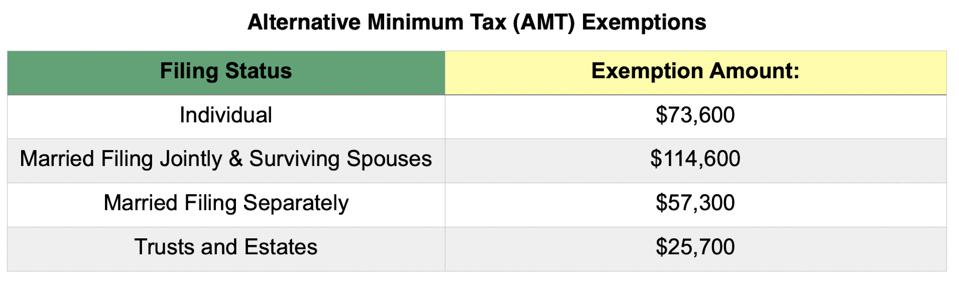
For 2021, the AMT exemptions are $73,600 for single filers and $114,600 for married taxpayers filing jointly. The phase-out thresholds are $1,047,200 for married taxpayers filing a joint return and $523,600 for all other taxpayers.  

8. The estate tax exemption is even higher

The estate and gift tax exemption, which is indexed to inflation, has risen to $11.7 million for 2021. But the now-higher exemption is set to expire at the end of 2025, meaning it could be essentially cut in half at that time if Congress doesn’t act. 

The annual gift exclusion, which allows you to give money to your loved ones each year without incurring any tax liability or using up any of your lifetime estate and gift tax exemption, stays at $15,000 per recipient.

Don’t get caught off guard

As you prepare to file your taxes for 2021, here are a few additional items to consider. 

  • If you’re not retired, the 10% early withdrawal penalty that was waived for retirement account distributions in 2020 has been reinstated for 2021.
  • If you’re age 72 or older, make sure you’ve taken your required minimum distribution (RMD) from your retirement accounts or else you face a 50% penalty on any undistributed funds (unless it’s your first RMD, in which case, you can wait until April 1, 2022).

If you haven’t contributed to your retirement accounts already, now is the time. Review your earnings for the year and take advantage of any deductions that can lower your tax bill. Also, keep an eye on Washington for any last-minute tax changes that could affect your return before you file. Tax season will be here before you know it, and it’s never too early to start preparing.

1Operating charities, or qualifying public charities, are defined by Internal Revenue Code section 170(b)(1)(A). You can use the Tax Exempt Organization Search tool on IRS.gov to check an organization’s eligibility.

***

MORE: https://www.msn.com/en-us/money/taxes/a-historically-underfunded-irs-is-preparing-for-a-rough-tax-season-and-only-has-1-person-for-every-16000-calls-it-gets/ar-AASFVds?li=BBnb7Kz

***

COMMENTS APPRECIATED.

Thank You

Subscribe to the Medical Executive-Post

***

***

2021-Tax Hits on Distributed Stock Market Gains

Doctors Must Understand the Tax Man

By Staff Reporters

***

Mutual-fund physician and other investors with holdings in taxable accounts need to prepare for a tax hit on distributed gains — even if they reinvest the distributions. They can offset some or all of the gains (and taxes) if they’ve sold positions at a loss.

CITE: https://www.r2library.com/Resource/Title/082610254

Physicians and people who own mutual funds in tax-sheltered accounts such as 401(k)s or individual retirement accounts and are reinvesting the distributions, on the other hand, don’t have to worry. In those accounts, taxes only count when investors sell holdings in retirement, and those who have funds in qualified Roth IRAs won’t have to pay even then.

MORE: https://www.marketwatch.com/story/brace-yourself-for-an-extra-tax-hit-from-large-mutual-fund-payouts-11639175633?mod=home-page

***

Comprehensive Financial Planning Strategies for Doctors and Advisors: Best Practices from Leading Consultants and Certified Medical Planners™

ORDER: https://www.amazon.com/Comprehensive-Financial-Planning-Strategies-Advisors/dp/1482240289/ref=sr_1_1?ie=UTF8&qid=1418580820&sr=8-1&keywords=david+marcinko

***
YOUR COMMENTS ARE APPRECIATED.

Thank You

***

On the TAXATION of Capital Gains and Losses

UPDATE FOR PHYSICIANS AND ALL INVESTORS

By Dr. David E. Marcinko MBA CMP®

CMP logo

SPONSOR: http://www.CertifiedMedicalPlanner.org

Almost everything you own and use for personal or investment purposes is a capital asset. Examples include a home, personal-use items like household furnishings, and stocks or bonds held as investments. When you sell a capital asset, the difference between the adjusted basis in the asset and the amount you realized from the sale is a capital gain or a capital loss.

CITE: https://www.r2library.com/Resource/Title/0826102549

Generally, an asset’s basis is its cost to the owner, but if you received the asset as a gift or inheritance, refer to Topic No. 703 for information about your basis.

For information on calculating adjusted basis, refer to Publication 551, Basis of Assets. You have a capital gain if you sell the asset for more than your adjusted basis. You have a capital loss if you sell the asset for less than your adjusted basis. Losses from the sale of personal-use property, such as your home or car, aren’t tax deductible.

IRS: https://www.irs.gov/taxtopics/tc409

MORE: https://medicalexecutivepost.com/2021/04/23/bidens-capital-gains-tax-proposal/

RELATED: https://medicalexecutivepost.com/2021/05/01/capital-gains-tax-non-sense/

YOUR COMMENTS ARE APPRECIATED.

Thank You

***

Two Vital IRS Audit Flags for Physicians

For Doctors and all Investors

By Hayden Adams

Image result for irs

***

Red Flag #1: Under reporting income

Generally speaking, all income is taxable unless it’s specifically excluded, as is the case with certain gifts and inheritances. In most instances, the income you earn will be reported to both you and the government on an information return, such as a Form 1099 or W-2. If the income you report doesn’t match the IRS’s records, you could face problems down the road—so be sure you include the income from all of the following forms that are applicable to your situation:

  • 1099-B: The form on which financial institutions report capital gains.
  • 1099-DIV: The form on which financial institutions report dividends.
  • 1099-MISC: The form used to report various types of income, such as royalties, rents, payments to independent contractors, and numerous other types of income.
  • 1099-R:The form on which financial institutions report withdrawals from tax-advantaged retirement accounts.
  • Form 1099-INT: The form on which financial institutions report interest income.
  • Form SSA-1099:The form on which the Social Security Administration reports Social Security benefits (a portion of which may be taxable, depending on your level of income).
  • Form W-2:The form on which employers report total annual compensation, payroll taxes, contributions to retirement accounts, and other information.

If you receive an inaccurate statement of income, immediately contact the responsible party to request a corrected form and have them resend the documents to both you and the IRS as soon as possible to avoid delaying your tax return. Also, be aware that you must report income for which there is no form, such as renting out your vacation home.

CITE: https://www.r2library.com/Resource/Title/0826102549

***

Red Flag #2: Misreporting investment gains

When you sell an investment, you’ll need to know both the cost basis (what you paid for the investment) and the sale price to determine your net gain or loss. The cost basis of your investment may need to be adjusted to account for commissions, fees, stock splits, or other events, which could help reduce your taxable gain or increase your net loss.

Financial institutions are required to adjust your investments’ cost basis and provide that information on a Form 1099. However, brokerages aren’t required to report the cost basis for investments purchased prior to a certain date, which means you’ll be responsible for supplying that information (see the table below). Be sure to keep records of all investment purchases and sales—even those for which your brokerage is responsible.

Your reporting responsibility

Depending on security type and date of purchase, you—rather than your brokerage—could be responsible for reporting the cost basis of your investment to the IRS.

CITE: https://www.r2library.com/Resource/Title/0826102549

***

Security typeInvestor’s responsibility if
Stocks (including real estate investment trusts)Acquired before 01/01/2011
Mutual funds, exchange-traded funds, and dividend reinvestment plansAcquired before 01/01/2012
Other specified securities, including most bonds, derivatives, and options

***

YOUR COMMENTS ARE APPRECIATED.

Thank You

***

***

What is the “SAVER’S CREDIT”?

By Dr. David E. Marcinko MBA CMP®

CMP logo

Sponsor: http://www.CertifiedMedicalPlanner.org

The saver’s credit is a tax credit that’s intended to promote retirement savings among low- and moderate-income workers. It can reduce an eligible taxpayer’s federal income taxes when they save in a qualified retirement plan. It may be especially useful to medical students, nurses, interns, residents and fellows.

****

IRS Releases Plan Limits for 2020 - Montgomery Retirement Plan Advisors

***

In 2021, the maximum credit is worth $1,000 for individuals and $2,000 for married couples filing jointly, although it phases out for higher earners. To qualify for the credit, individuals must have an adjusted gross income of $32,500 or less. The income threshold for married couples is $65,000.

Because the credit is non-refundable, eligible taxpayers are able to use it to effectively reduce their tax bill to zero – but it cannot provide them with a tax refund.

IRS: https://www.irs.gov/retirement-plans/plan-participant-employee/retirement-savings-contributions-savers-credit

CITE: https://www.r2library.com/Resource/Title/0826102549

YOUR THOUGHTS AND COMMENTS ARE APPRECIATED.

***

ORDER: https://www.amazon.com/Comprehensive-Financial-Planning-Strategies-Advisors/dp/1482240289/ref=sr_1_1?ie=UTF8&qid=1418580820&sr=8-1&keywords=david+marcinko

Thank You

***

PERSONAL FINANCIAL ACCOUNTING AND INCOME TAXATION FOR DOCTORs

Join Our Mailing List

A SPECIAL ME-P REPORT

[The Ethical Pursuit of Tax Reduction and Avoidance]

perry-dalessio-cpa

[By Perry D’Alessio CPA]

The objective of tax planning is to arrive at the lowest overall tax cost on the activities performed.  In as much as physicians constitute 14% of the so-called and maligned “one-percenters” [$388,905 earned-not passive income/year]; this essay will address some methods and strategies to reduce federal and state income taxes. It is applicable to all physicians and medical professionals; as independent practitioners or employees.

So, how much in income taxes do the wealthy pay? The top 10 percent of taxpayers paid over 70 percent of the total amount collected in federal income taxes in 2010, the latest year figures are available, according to the Tax Foundation, a think tank that advocates for lower taxes. That’s up from 55 percent in 1986. The remaining 90 percent bore just under 30 percent of the tax burden. And, 47 percent of all Americans pay hardly anything at all.

Realize, that’s just federal income tax and doesn’t include payroll tax for Social Security and Medicare (which the vast majority of people pay), plus state taxes and all of the other taxes we face. When you add them all together; using figures from the Tax Policy Center and the Institute on Taxation and Economic Policy. Earners in the top 1 percent pay about 43 percent of their incomes in tax. People in the middle quintile pay 25 percent while the poorest fifth pays 13 percent.

Finally, before you assume these one- and 10-percenters are living on luxury yachts and in million-dollar mansions, consider how little money it takes to be a top wage earner.

According to 2011 IRS data, the top 1 percent have adjusted gross incomes of $388,905 per year or more. To be in the top 10 percent, you need an adjusted gross income of just $120,136 or more. These are good incomes to be sure, but definitely not enough to be out work, or the medical office, for more than a few weeks each year.

***

Comprehensive Financial Planning Strategies for Doctors and Advisors: Best Practices from Leading Consultants and Certified Medical Planners(TM)

***

Now consider the following more specifically:

  • 42 percent of all federal tax revenue came from individual income taxes in 2010 and it has been the largest single source of revenue since 1950.
  • Individuals paid more than $2.2 trillion in 2010.
  • Bush-era tax cuts have finally expired, giving us the 20th century tax rates with the top income tax rate of 39.6%, we have not seen rates this high in almost 15 years.
  • 39.6% tax rate kicks in at $400,000 for individual taxpayers and $450,000 for married couples filing jointly.
  • Taxpayers who make over $200,000 ($250,000 for married taxpayers) will be subject to the Medicare surtax. If that’s you, Medicare surtax will be tacked on to your wages, compensation, or self-employment income over that amount. The amount of the surcharge is .9%. 
  • Net Investment Income Tax (NIIT) new as of 2013; if you have both net investment income and modified adjusted gross income (MAGI) of at least $200,000 for an individual taxpayer and $250,000 for taxpayers filing as married an additional 3.8 percent of the net investment income is an added tax. 

ASSESMENT

So, where do you fall on this schematic, doctor?

Channel Surfing

Have you visited our other topic channels? Established to facilitate idea exchange and link our community together, the value of these topics is dependent upon your input. Please take a minute to visit. And, to prevent that annoying spam, we ask that you register.

Link: http://feeds.feedburner.com/HealthcareFinancialsthePostForcxos

ABOUT

Perry D’Alessio has twenty years’ experience in public accounting. He specializes in the taxation of closely held businesses and their owners, as well as high wealth individuals. He has a broad range of experience that includes individual, corporate, partnership, fiduciary, estate, and gift taxation. Business development has also been a focus. Particularly in the Healthcare and Fitness Industry, he worked with successful entities whose emphasis was on growth through development of strategic relationships and unit building.  Mr.  D’Alessio received his Bachelor of Business Administration degree in Accounting from Baruch College. He is a Certified Public Accountant in New York. He is a member of the American Institute of Certified Public Accountants (AICPA), the New York State Society of Certified Public Accountants (NYSSCPA). He served on several New York State Society tax committees including: PCAOB and HealthCare. Mr. D’Alessio presents at financial and medical associations throughout the region, and authored a book chapter in the “Financial Management Strategies for Hospitals and Healthcare Organizations” for the Institute of Medical Business Advisors, Inc.

Conclusion

Your thoughts and comments on this ME-P are appreciated. Feel free to review our top-left column, and top-right sidebar materials, links, URLs and related websites, too. Then, subscribe to the ME-P. It is fast, free and secure.

Speaker: If you need a moderator or speaker for an upcoming event, Dr. David E. Marcinko; MBA – Publisher-in-Chief of the Medical Executive-Post – is available for seminar or speaking engagements. Contact: MarcinkoAdvisors@msn.com

OUR OTHER PRINT BOOKS AND RELATED INFORMATION SOURCES:

Risk Management, Liability Insurance, and Asset Protection Strategies for Doctors and Advisors: Best Practices from Leading Consultants and Certified Medical Planners™8Comprehensive Financial Planning Strategies for Doctors and Advisors: Best Practices from Leading Consultants and Certified Medical Planners™

Understanding Healthcare Employment Benefits that are NOT Taxed at Full Economic Value

Join Our Mailing List 

On Entirely Legal AUTOMOBILE Employment Fringe Benefit Strategies 

[By Perry Dalessio CPA]

perry-dalessio-cpaWhen an employment fringe benefit does not qualify for exclusion under a specific statute or regulation, the benefit is considered taxable to the recipient.  It is included in wages for withholding and employment-tax purposes, at the excess of its fair market value over any amount paid by the employee for the benefit.

Examples:

For example, hospitals often provide automobiles for use by employees. Treasury regulations exclude from income the value of the following types of vehicles’ use by an employee:

  • Vehicles not available for the personal use of an employee by reason of a written policy statement of the employer
  • Vehicles not available to an employee for personal use other than commuting (although in this case commuting is includable)
  • Vehicles used in connection with the business of farming [in which case the exclusion is equal to the value of an arbitrary 75% of the total availability for use, and the value of the balance may be includable or excludable, depending upon the facts (Treas. Regs. § 1.132-5(g)) involved)]
  • Certain vehicles identified in the regulations as “qualified non-personal-use vehicles,” which by reason of their design do not lend themselves to more than a de minimus amount of personal use by an employee [examples are ambulances and hearses].
  • Vehicles provided for qualified automobile demonstration use
  • Vehicles provided for product testing and evaluation by an employee outside the employer’s work place

If the employer-provided vehicle does not fall into one of the excluded categories, then the employee is required to report his personal use as a taxable benefit. The value of the availability for personal use may be determined under one of several approaches.

jag346_SWHT

Assessment

Under any of the approaches, the after-tax cost to the employee is substantially less than if the employee used his or her own dollars to purchase the automobile and then deducted a portion of the cost as a business expense.

Conclusion

Your thoughts and comments on this ME-P are appreciated. Feel free to review our top-left column, and top-right sidebar materials, links, URLs and related websites, too. Then, subscribe to the ME-P. It is fast, free and secure.

Speaker: If you need a moderator or speaker for an upcoming event, Dr. David E. Marcinko; MBA – Publisher-in-Chief of the Medical Executive-Post – is available for seminar or speaking engagements. Contact: MarcinkoAdvisors@msn.com

OUR OTHER PRINT BOOKS AND RELATED INFORMATION SOURCES:

Product Details  Product Details

Product Details

How the IRS’s Nonprofit Division Got So Dysfunctional

Join Our Mailing List

The IRS Controversy

By Kim Barker and Justin Elliott

ProPublica, May 17, 2013, 5:14 p.m.

The IRS division responsible for flagging Tea Party groups has long been an agency afterthought, beset by mismanagement, financial constraints and an unwillingness to spell out just what it expects from social welfare nonprofits, former officials and experts say.

The controversy that erupted in the past week, leading to the ousting of the acting Internal Revenue Service commissioner, an investigation by the FBI, and congressional hearings that kicked off Friday, comes against a backdrop of dysfunction brewing for years.

Moves launched in the 1990s were designed to streamline the tax agency and make it more efficient. But they had unintended consequences for the IRS’s Exempt Organizations division.

Checks and balances once in place were taken away. Guidance frequently published by the IRS and closely read by tax lawyers and nonprofits disappeared. Even as political activity by social welfare nonprofits exploded [1] in recent election cycles, repeated requests for the IRS to clarify exactly what was permitted for the secretly funded groups were met, at least publicly, with silence.

All this combined to create an isolated office in Cincinnati, plagued by what an inspector general this week described [2] as “insufficient oversight,” of fewer than 200 low-level employees responsible for reviewing more than 60,000 nonprofit applications a year.

A Major Mistake

In the end, this contributed to what everyone from Republican lawmakers to the president says was a major mistake: The decision by the Ohio unit to flag for further review applications from groups with “Tea Party” and similar labels. This started around March 2010, with little pushback from Washington until the end of June 2011.

“It’s really no surprise that a number of these cases blew up on the IRS,” said Marcus Owens, who ran the Exempt Organizations division from 1990 to 2000. “They had eliminated the trip wires of 25 years.”

Of course, any number of structural fixes wouldn’t stop rogue employees with a partisan ax to grind. No one, including the IRS [3] and the inspector general [4], has presented evidence that political bias was a factor, although congressional and FBI investigators are taking another look.

But what is already clear is that the IRS once had a system in place to review how applications were being handled and to flag potentially problematic ones. The IRS also used to show its hand publicly, by publishing educational articles for agents, issuing many more rulings, and openly flagging which kind of nonprofit applications would get a more thorough review.

All of those checks and balances disappeared in recent years, largely the unforeseen result of an IRS restructuring in 1998, former officials and tax lawyers say.

“Until 2008, we had a dialogue, through various rulings and cases and the participation of various IRS officials at various ABA meetings, as to what is and what is not permissible campaign intervention,” said Gregory Colvin, the co-chair of the American Bar Association subcommittee that dealt with nonprofits, lobbying, and political intervention from 1991 to 2009.

“And there has been absolutely no willingness in the last five years by the IRS to engage in that discussion, at the same time the caseload has exploded at the IRS.”

IRS

Stone Walling

The IRS did not respond to requests for comment on this story.

Social welfare nonprofits, which operate under the 501(c)(4) section of the tax code, have always been a strange hybrid, a catchall category for nonprofits that don’t fall anywhere else. They can lobby. For decades, they have been allowed to advocate for the election or defeat of candidates, as long as that is not their primary purpose. They  also do not have to disclose their donors.

Social welfare nonprofits were only a small part of the exempt division’s work, considered minor when compared with charities. When the groups sought IRS recognition, the agency usually rubber-stamped them. Out of 24,196 applications for social welfare status between 1998 and 2009, the exempt organizations division rejected only 77, according to numbers compiled from annual IRS data books.

Into this loophole came the Supreme Court’s Citizens United decision in January 2010, which changed the campaign-finance game [5] by allowing corporate and union spending on elections.

Sensing an opportunity, some political consultants started creating social welfare nonprofits geared to political purposes. By 2012, more than $320 million in anonymous money poured into federal elections.

A couple of years earlier, beginning in 2010, the Cincinnati workers had flagged applications of tiny Tea Party groups, according to the inspector general, though the groups spent almost no money in federal elections.

Main Question

The main question raised by the audit is how the Cincinnati office and superiors in Washington could have gotten it so wrong. The audit shows no evidence that these workers even looked at records from the Federal Election Commission to vet much larger groups [6] that spent hundreds of thousands and even millions [7] in anonymous money to run election ads.

The IRS Exempt Organizations division, the watchdog for about 1.5 million nonprofits, has always had to deal with controversial groups. For decades, the division periodically listed red flags that would merit an application being sent to the IRS’s Washington, D.C., headquarters for review, said Owens, the former division head.

In the 1970s, that meant flagging all applications for primary and secondary schools in the south facing desegregation. In the 1980s, during the wave of consolidation in the health-care industry, all applications from health-care nonprofits needed to be sent to headquarters. The division’s different field offices had to send these applications up the chain.

“Back then, many more applications came to Washington to be worked — the idea was to have the most sensitive ones come to Washington,” said Paul Streckfus, a former IRS lawyer who screened applications at headquarters in the 1970s and founded the industry publication EO Tax Journal [8] in 1996.

Because this list was public, lawyers and nonprofits knew which cases would automatically be reviewed.

“We had a core of experts in tax law,” recalled Milton Cerny, who worked for the IRS, mainly in Exempt Organizations, from 1960 to 1987. “We had developed a broad group of tax experts to deal with these issues.”

In the 1980s, the division issued many more “revenue rulings” than issued in recent years, said Cerny, then head of the rulings process. These revenue rulings set precedents for the division. Revenue rulings along with regulations are basically the binding IRS rules for nonprofits.

“We would do a revenue ruling, so the public and agents would know,” Cerny said. “Over the years, it apparently was felt that a revenue ruling should only be published at an extraordinary time. So today you’re lucky if you get one a year. Sometimes it’s less than that. It’s amazing to me.”

Other checks and balances had existed too. Not only were certain kinds of applications publicly flagged, there was another mechanism called “post-review,” Owens said. Headquarters in Washington would pull a random sample every month from the different field offices, to see how applications were being reviewed. There was also a surprise “saturation review,” once a year, for each of the offices, where everything from a certain time period needed to be sent to Washington for another look.

So internally, the division had ways, if imperfect, to flag potential problems. It also had ways of letting the public know what exactly agents were looking at and how the division was approaching controversial topics.

For instance, there was the division’s “Continuing Professional Education,” or CPE, technical instruction program. These articles were supposed to be used for training of line agents, collecting and putting out the agency’s best information on a particular topic — on, say, political activity [9] by social welfare nonprofits in 1995.

“People in a group would write up their thoughts: ‘Here’s the law,’” said Beth Kingsley, a Washington lawyer with Harmon, Curran, Spielberg & Eisenberg who’s worked with nonprofits for almost 20 years. “It wasn’t pushing the envelope. It was, ‘This is how we see this issue.’ It told us what the IRS was thinking.”

The system began to change in the mid-1990s. The IRS was having trouble hiring people for low-level positions in field offices like New York or Atlanta — the kinds of workers that typically reviewed applications by nonprofits, Owens said.

In Cincinnati

The answer to this was simple: Cincinnati.

The city had a history of being able to hire people at low federal grades, which in 1995 paid between $19,704 and $38,814 a year — almost the same as those federal grades paid in New York City or Chicago. (Adjusted for inflation, that’s between $30,064 and $59,222 now.)

“That was well below what the prevailing rate was in the New York City area for accountants with training,” Owens said. “We had one accountant who just had gotten out of jail — that’s the sort of people who would show up for jobs. That was really the low point.”

So in 1995, the Exempt Organizations division started to centralize. Instead of field offices evaluating applications for nonprofits in each region, those applications would all be sent to one mailing address, a post-office box in Covington, Ky. Then a central office in Cincinnati would review all the applications.

Almost inadvertently, because people there were willing to work for less than elsewhere, Cincinnati became ground zero for nonprofit applications.

For the time being, the checks remained in place. The criteria for flagged nonprofits were still made public. The Continuing Professional Education text was still made public. Saturation reviews and post reviews were still in place.

But by 1998, after hearings in which Republican Senator Trent Lott accused the IRS of “Gestapo-like” tactics, a new law mandated the agency’s restructuring. In the years that followed, the agency aimed to streamline. For most of the ‘90s, the IRS had more than 100,000 employees. That number would drop every year, to slightly less than 90,000 [10] by 2012.

Change Will Come

Change also came to the Exempt Organizations division.

The IRS tried to remove discretion from lower-level employees around the country by creating rules they had to follow. While the reorganization was designed to centralize power in the agency’s Washington headquarters, it didn’t work out that way.

“The distance between Cincinnati and Washington was such that soon Cincinnati became a power center,” said Streckfus, the former IRS lawyer.

Following reorganization, many highly trained lawyers in Washington who previously handled the most sensitive nonprofit applications were reassigned to focus on special projects, he said.

Owens, who left the IRS in 2000 but stayed in touch with his old division, said the focus on efficiency meant “eliminating those steps deemed unimportant and anachronistic.”

In 2003, the saturation reviews and post reviews ended, and the public list of criteria that would get an application referred to headquarters disappeared, Owens said. Instead, agents in Cincinnati could ask to have cases reviewed, if they wanted. But they didn’t very often.

“No one really knows what kinds of cases are being sent to Washington, if any,” Owens said. “It’s all opaque now. It’s gone dark.”

By the end of 2004, the Continuing Professional Education articles stopped [11].

Recommendations [12] from an ABA task force for IRS guidelines on social welfare nonprofits and politics that same year were met with silence.

Even the IRS’s Political Activities Compliance Initiative, which investigated [13] complaints of charities engaged in politics — primarily churches — closed up shop in early 2009 after less than five years, without any explanation.

Both before and after the changes, the Exempt Organizations division has been a small part of the IRS, which is focused on collecting money and chasing delinquent taxpayers.

US capitol

IRS Employee Count in 2012

Rulings and Agreements, the division that handles applications of all nonprofits, accounted for less than 0.5 percent of all IRS employees in 2012.

Source: IRS Data Books [14], IRS Exempt Organizations Annual Report [15]

Of the 90,000 employees at the agency last year, only 876 worked in the Exempt Organizations’ division, or less than 1 in 1,000 employees.

Of those, 335 worked in the office that actually handles applications of nonprofits.

Most of those — about 300 — worked in Cincinnati, Streckfus estimates. The rest were at headquarters, in Washington D.C.

In Cincinnati, the employees’ primary job was sifting through the applications of nonprofits, making determinations as to whether a nonprofit should be recognized as tax-exempt. In a press release [16] Wednesday, the IRS said fewer than 200 employees were responsible for that work.

In 2012, these employees received 60,780 applications. The bulk of those — 51,748 — were from groups that wanted to be recognized as charities.

But the number of social welfare nonprofit applications spiked from 1,777 in 2011 to 2,774 in 2012. It’s impossible to say how many of those groups indicated whether they would engage in politics, or why the number of applications increased. The IRS said Wednesday that it “has seen an increase in the number of tax-exempt organization applications in which the organization is potentially engaged in political activity,” including both charities and social welfare nonprofits, but didn’t specify any numbers.

Total 501(c)(4) [17] Nonprofit Applications from 2002 to 2012

From 2011 to 2012, applications increased by more than 50 percent.

Source: IRS Data Books [14]

On average, one employee in Cincinnati would be responsible for going through roughly one application per day.

Some would be easy — say, a local soup kitchen. But to evaluate whether a social welfare nonprofit has social welfare as its primary purpose, the agent is supposed to use a “facts and circumstances” test. There is no checklist. Reviewing just one social welfare nonprofit could take days or weeks, to look through a group’s website, track down TV ads and so forth.

“You’ve got 60,000 applications coming through, and it’s hard to do that with the number of agents looking at them,” said Philip Hackney [18], who was in the IRS’s chief counsel office in Washington between 2006 and 2011 but said he wasn’t involved in the Tea Party controversy. “The reality is that they cannot do that, and that’s why you’re seeing them pick stuff out for review. They tried to do that here, and it burned them.”

As we have previously reported, last year the same Cincinnati office sent ProPublica [19] confidential applications from conservative groups. An IRS spokeswoman said the disclosures were inadvertent.

The Commissioner Speaks

Mark Everson, IRS commissioner for four years during the George W. Bush administration, said he believed the fact that the division is understaffed is relevant, but not an excuse for what happened. “The whole service is under-funded,” he pointed out.

And Dan Backer, a lawyer in Washington who represented six of the groups held up because of the Tea Party criteria, said he doesn’t buy the notion that low-level employees in Cincinnati were alone responsible.

“It doesn’t just strain credulity,” Backer said. “It broke credulity and left it laying on the road about a mile back. Clearly these guys were all on the same marching orders.”

The inspector general’s audit was prompted last year after members of Congress, responding to complaints by Tea Party groups, asked for it.

Like former officials interviewed by ProPublica, the audit suggests that officials at IRS headquarters in Washington were unable to manage their subordinates in Cincinnati. When Lois Lerner, the Exempt Organizations division director in Washington, learned [20] in June 2011 about the improper criteria for screening applications, she instructed that they be “immediately revised.”

But just six months later, Cincinnati employees changed [21] the revised criteria to focus on “organizations involved in limiting/expanding government” or “educating on the Constitution.” They did so “without executive approval.”

“The story people are overlooking is: Congress is complaining about underpaid, overworked employees who are not adequately trained,” said Bryan Camp, a former attorney in the IRS chief counsel’s office.

Assessment

In the end, after all the millions of anonymous money spent by some groups to elect candidates in 2012, after all [22] the groups [23] that said in their applications that they would not spend money to elect candidates before doing exactly that, after the Cincinnati office flagged conservative groups, the IRS approved almost all the new applications. Only eight applications were denied.

Source: http://www.propublica.org/article/how-irs-nonprofit-division-got-so-dysfunctional

Conclusion

Your thoughts and comments on this ME-P are appreciated. Feel free to review our top-left column, and top-right sidebar materials, links, URLs and related websites, too. Then, subscribe to the ME-P. It is fast, free and secure.

Link: http://feeds.feedburner.com/HealthcareFinancialsthePostForcxos

Speaker: If you need a moderator or speaker for an upcoming event, Dr. David E. Marcinko; MBA – Publisher-in-Chief of the Medical Executive-Post – is available for seminar or speaking engagements. Contact: MarcinkoAdvisors@msn.com

OUR OTHER PRINT BOOKS AND RELATED INFORMATION SOURCES:

Health Dictionary Series: http://www.springerpub.com/Search/marcinko

Practice Management: http://www.springerpub.com/product/9780826105752

Physician Financial Planning: http://www.jbpub.com/catalog/0763745790

Medical Risk Management: http://www.jbpub.com/catalog/9780763733421

Hospitals: http://www.crcpress.com/product/isbn/9781439879900

Physician Advisors: www.CertifiedMedicalPlanner.org

Product DetailsProduct DetailsProduct Details

Product Details  Product Details

Product DetailsProduct Details


Deducting Un-Reimbursed Professional Expenses

Join Our Mailing List

Tax expenses must be”ordinary” and “necessary”

By Andrew D. Schwartz CPA http://www.schwartzaccountants.com

Andrew SchwartzAccording to the IRS, to be deductible, the expenditure must be both “ordinary” and “necessary” in connection with your medical profession or specialty.

The Definition

The IRS defines “ordinary” as common and accepted in a particular profession and “necessary” as helpful and appropriate for a particular profession.

The List

Here’s a list of 16 professional expenditures commonly incurred by young or mature health care professionals:

  • Automobile expenses
  • Beepers and pagers
  • Books/library
  • Cellular telephones
  • Computer purchases
  • Education, examinations & licenses
  • Equipment & instruments
  • Job search
  • Malpractice insurance
  • Meals & entertainment
  • Parking & tolls
  •  Professional dues, journals & subscriptions
  • Psychoanalysis as part of training
  • Supplies
  • Travel & lodging
  • Uniforms & cleaning

Assessment

Please note: Employees, like hospitalists, may not deduct professional expenses that are eligible for reimbursement from their employer.

Conclusion

Your thoughts and comments on this ME-P are appreciated. Feel free to review our top-left column, and top-right sidebar materials, links, URLs and related websites, too. Then, subscribe to the ME-P. It is fast, free and secure.

Link: http://feeds.feedburner.com/HealthcareFinancialsthePostForcxos

Speaker: If you need a moderator or speaker for an upcoming event, Dr. David E. Marcinko; MBA – Publisher-in-Chief of the Medical Executive-Post – is available for seminar or speaking engagements. Contact: MarcinkoAdvisors@msn.com

Our Other Print Books and Related Information Sources:

Health Dictionary Series: http://www.springerpub.com/Search/marcinko

Practice Management: http://www.springerpub.com/product/9780826105752

Physician Financial Planning: http://www.jbpub.com/catalog/0763745790

Medical Risk Management: http://www.jbpub.com/catalog/9780763733421

Hospitals: http://www.crcpress.com/product/isbn/9781439879900

Physician Advisors: www.CertifiedMedicalPlanner.org

Product Details  Product Details

Product DetailsProduct DetailsProduct Details

Change in Distribution of Income Among Tax Filers 1996-2006

A Congressional Research Services White Paper

Join Our Mailing List 

As tax season draws near, here is an important essay from CRS, by:

Thomas L. Hungerford

[Specialist in Public Finance]

Assessment

Link: http://taxprof.typepad.com/files/crs-1.pdf

Conclusion       

And so, your thoughts and comments on this ME-P are appreciated. Please review our top-left column, and top-right sidebar materials, links, URLs and related websites, too. Then, subscribe to the ME-P. It is fast, free and secure.

Link: http://feeds.feedburner.com/HealthcareFinancialsthePostForcxos

Speaker: If you need a moderator or speaker for an upcoming event, Dr. David E. Marcinko; MBA – Publisher-in-Chief of the Medical Executive-Post – is available for seminar or speaking engagements. Contact: MarcinkoAdvisors@msn.com

Our Other Print Books and Related Information Sources:

Health Dictionary Series: http://www.springerpub.com/Search/marcinko

Practice Management: http://www.springerpub.com/product/9780826105752

Physician Financial Planning: http://www.jbpub.com/catalog/0763745790

Medical Risk Management: http://www.jbpub.com/catalog/9780763733421

Healthcare Organizations: www.HealthcareFinancials.com

Physician Advisors: www.CertifiedMedicalPlanner.com

Subscribe Now: Did you like this Medical Executive-Post, or find it helpful, interesting and informative? Want to get the latest ME-Ps delivered to your email box each morning? Just subscribe using the link below. You can unsubscribe at any time. Security is assured.

Link: http://feeds.feedburner.com/HealthcareFinancialsthePostForcxos

Sponsors Welcomed: And, credible sponsors and like-minded advertisers are always welcomed.

Link: https://healthcarefinancials.wordpress.com/2007/11/11/advertise

Product Details  Product Details

Financial Planning and Risk Management Strategies for Physicians

Financial Planning Handbook for Physicians and Advisors

Product Details

 • http://www.jblearning.com/catalog/9780763745790/

Insurance Planning and Risk Management Strategies for Physicians and Advisors

Product Details

http://www.jblearning.com/catalog/9780763733421/

ADVERTISEMENT

Speaker: If you need a moderator or speaker for an upcoming event, Dr. David E. Marcinko; MBA – Publisher-in-Chief of the Medical Executive-Post – is available for seminar or speaking engagements. Contact: MarcinkoAdvisors@msn.com and http://www.springerpub.com/Search/marcinko

Remember Tax Deadline Day is April 18th 2011

Tax Emancipation Day is April 15th 2011

By Dr. Gary L. Bode MSA, CPA, PC

In the 2011 tax filing season, taxpayers have until Monday, April 18 to file their 2010 tax returns and pay any tax due. Emancipation Day, a holiday observed in the District of Columbia, falls this year on Friday, April 15. By law, District of Columbia holidays impact tax deadlines in the same way that federal holidays do; therefore, all taxpayers will have three extra days to file this year. Taxpayers requesting an extension will have until October 17 to file their 2010 tax returns.

Who Must Wait to File

For most taxpayers, the 2011 tax filing season starts on schedule. However, tax law changes enacted by Congress and signed by President Obama in December mean some people need to wait until mid to late February to file their tax returns in order to give the IRS time to reprogram its processing systems. The IRS recently announced February 14, 2011 as the start date for processing these delayed tax returns.

Some taxpayers, including those who itemize deductions on Form 1040 Schedule A, will need to wait until February 14, 2011 to file. This includes taxpayers impacted by any of three tax provisions that expired at the end of 2009 and were renewed by the Tax Relief, Unemployment Insurance Reauthorization, and Job Creation Act of 2010 enacted December 17, 2010. Those who need to wait to file include:

  • Taxpayers Claiming Itemized Deductions on Schedule A. Itemized deductions include mortgage interest, charitable deductions, and medical and dental expenses as well as state and local taxes. In addition, itemized deductions include the state and local general sales tax deduction that was also extended and that primarily benefits people living in areas without state and local income taxes.
  • Taxpayers Claiming the Higher Education Tuition and Fees Deduction. This deduction for parents and students, covering up to $4,000 of tuition and fees paid to a post-secondary institution, is claimed on Form 8917. However, the IRS emphasized that there will be no delays for millions of parents and students who claim other education credits, including the American Opportunity Tax Credit extended last month and the Lifetime Learning Credit.
  • Taxpayers Claiming the Educator Expense Deduction. This deduction is for kindergarten through grade 12 educators with out-of-pocket classroom expenses of up to $250. The educator expense deduction is claimed on Form 1040, Line 23 and Form 1040A, Line 16.

Assessment

In addition to extending those tax deductions for 2010, the Tax Relief, Unemployment Insurance Reauthorization, and Job Creation Act also extended those deductions for 2011 and a number of other tax deductions and credits for 2011 and 2012, such as the American Opportunity Tax Credit and the modified Child Tax Credit. The Act also provides various job creation and investment incentives, including 100% expensing and a 2% payroll tax reduction for 2011. Those changes have no effect on the 2011 filing season.

http://www.amazon.com/Financial-Planning-Handbook-Physicians-Advisors/dp/0763745790/ref=sr_1_1?ie=UTF8&s=books&qid=1276795609&sr=1-1

Conclusion

And so, your thoughts and comments on this ME-P are appreciated. Feel free to review our top-left column, and top-right sidebar materials, links, URLs and related websites, too. Then, subscribe to the ME-P. It is fast, free and secure.

Our Other Print Books and Related Information Sources:

Health Dictionary Series: http://www.springerpub.com/Search/marcinko

Practice Management: http://www.springerpub.com/product/9780826105752

Physician Financial Planning: http://www.jbpub.com/catalog/0763745790

Medical Risk Management: http://www.jbpub.com/catalog/9780763733421

Healthcare Organizations: www.HealthcareFinancials.com

Physician Advisors: www.CertifiedMedicalPlanner.com

Subscribe Now: Did you like this Medical Executive-Post, or find it helpful, interesting and informative? Want to get the latest ME-Ps delivered to your email box each morning? Just subscribe using the link below. You can unsubscribe at any time. Security is assured.

Link: http://feeds.feedburner.com/HealthcareFinancialsthePostForcxos

Sponsors Welcomed: And, credible sponsors and like-minded advertisers are always welcomed.

Link: https://healthcarefinancials.wordpress.com/2007/11/11/advertise

Product DetailsProduct DetailsProduct Details      

On the Proposed Tax Cuts

Senate Debate on Extending 2001/2003 Tax Cuts

By Children’s Home Society of Florida Foundation

Join Our Mailing List

The Senate Finance Committee conducted a hearing on July 14, 2010 to discuss the potential extension of tax cuts. In the Economic Growth and Tax Relief Reconciliation Act of 2001 (EGTRRA) and the Jobs and Growth Tax Relief Reconciliation Act of 2003 (JGTRRA), there were tax reductions for nearly all Americans. The tax reductions continue through 2010, but are set to be repealed on January 1, 2011.

Proposals

The White House has proposed to extend these tax cuts for single persons with incomes under $200,000 ($250,000 for couples), but to increase the capital gain rate and top income tax brackets. Under the White House plan, the capital gain rate will increase from 15% to 20%, the 33% bracket increases to 36% and the 35% tax bracket is raised to 39.6%.

[picapp align=”none” wrap=”false” link=”term=income+tax&iid=238905″ src=”http://view1.picapp.com/pictures.photo/image/238905/thinkstock-single-image/thinkstock-single-image.jpg?size=500&imageId=238905″ width=”337″ height=”506″ /]

The Senate

Senate Finance Chair Max Baucus (D-MT) opened the hearing by stating, “Americans are struggling to make ends meet, and we need to do all we can to put more money back in the hands of workers, middle-class families and small businesses so our economy can grow. I support extending the middle-class tax cuts permanently, as soon as possible, so working families can keep more of their hard-earned money.”

Sen. Baucus and the White House are both advocating a permanent extension of the tax cuts for low and middle-income taxpayers, with an increase in taxes for those in the upper brackets.

Ranking Member on the Senate Finance Committee Charles Grassley (R-IA) has repeatedly expressed concern about the increase of taxes on small business owners. He noted, “To those who are pushing the higher marginal rates, I say the burden is on you to show that you are not harming our primary job creators.” Sen. Grassley has noted that two-thirds of new jobs in the past decade have been created by the small business owners who will be subject to the higher taxes.

Editor’s Note: The hearings on taxes are the first step in creation of a tax bill. Because the failure to act this year would result in repeal of all of the tax cuts, it is probable that there will be a tax bill prior to the end of 2010. However, with the shortened legislative calendar due to the fall elections, the tax bill is quite likely to be deferred until after the election.

Conclusion

Douglas Holtz-Eakin is President of the American Action Forum and was formerly the Congressional Budget Office Director. He testified that approximately one-half of the $1 trillion in business income that will be reported in 2011 will be subject to the higher 36% and 39.6% tax brackets. In his opinion these higher rates will reduce the willingness of small businesses to hire new employees.

Please comment and feel free to review our top-left column, and top-right sidebar materials, links, URLs and related websites, too. Then, be sure to subscribe to the ME-P. It is fast, free and secure.

Get our Widget: Get this widget!

Our Other Print Books and Related Information Sources:

Practice Management: http://www.springerpub.com/prod.aspx?prod_id=23759

Physician Financial Planning: http://www.jbpub.com/catalog/0763745790

Medical Risk Management: http://www.jbpub.com/catalog/9780763733421

Healthcare Organizations: www.HealthcareFinancials.com

Physician Advisors: www.CertifiedMedicalPlanner.com

Subscribe Now: Did you like this Medical Executive-Post, or find it helpful, interesting and informative? Want to get the latest ME-Ps delivered to your email box each morning? Just subscribe using the link below. You can unsubscribe at any time. Security is assured.

Link: http://feeds.feedburner.com/HealthcareFinancialsthePostForcxos

Sponsors Welcomed: And, credible sponsors and like-minded advertisers are always welcomed.

Link: https://healthcarefinancials.wordpress.com/2007/11/11/advertise

Meet Dr. Gary L. Bode CPA MSA CMP™ [Hon]

Join Our Mailing List

Introducing our Newest Thought-Leader

Dr. Gary Bode; CPA, MSA, CMP

[By Ann Miller RN MHA]

The Medical Executive-Post is proud to introduce Dr. Gary L. Bode as our newest thought-leader for healthcare financial modernity. Dr. Bode was the Chief Financial Officer [CFO] for a private mental healthcare facility, and previously the Chief Executive Officer [CEO] of Comprehensive Practice Accounting, Inc, in Wilmington, NC. The firm specialized in providing tax solution to medical professionals. Dr. Bode was a board certified practitioner and managing partner of a multi-office medical group practice for a decade before earning his Master’s of Science degree in Accounting [MSA] from the University of North Carolina. He is a nationally known forensic health accountant, financial author, educator and speaker.

A Multi-Faceted Healthcare Financial Expert

Areas of expertise include producing customized managerial accounting reports, practice appraisals and valuations, restructurings and innovative financial accounting, as well as proactive tax positioning and tax return preparation for healthcare facilities. Currently, Dr. Bode is Chief Accounting and Valuation Officer (CAVO) for the Institute of Medical Business Advisors, Inc. He is also a Certified Medical Planner™ http://www.CertifiedMedicalPlanner.org  He provides litigation support in his areas of expertise and has been previously accepted as a legal expert witness www.MedicalBusinessAdvisors.com

Assessment

Gary has promised to publish his most exciting ideas and innovative work on our blog. He is also available for private consulting engagements and related professional work on an ad-hoc, or interim basis. So, let’s give a warm ME-P “shout-out” to Dr. Gary L Bode; our newest thought-leader.   

Channel Surfing the ME-P

Have you visited our other topic channels? Established to facilitate idea exchange and link our community together, the value of these topics is dependent upon your input. Please take a minute to visit. And, to prevent that annoying spam, we ask that you register. It is fast, free and secure.

Conclusion

Your thoughts and comments on this ME-P are appreciated. Feel free to review our top-left column, and top-right sidebar materials, links, URLs and related websites, too. Then, subscribe to the ME-P. It is fast, free and secure.

Speaker: If you need a moderator or speaker for an upcoming event, Dr. David E. Marcinko; MBA – Publisher-in-Chief of the Medical Executive-Post – is available for seminar or speaking engagements. Contact: MarcinkoAdvisors@msn.com

OUR OTHER PRINT BOOKS AND RELATED INFORMATION SOURCES:

Product DetailsProduct DetailsProduct Details