How to Calculate your Financial APGAR Score

Join Our Mailing List

Using a Well-Known Medical Model for Personal Financial Planning

By Andrew D. Schwartz CPA

The term “APGAR Score” should already be familiar to people who’ve experienced the birth of a child and to people in the medical community. Immediately after birth, every baby is evaluated by a doctor to determine its medical condition. The evaluation consists of the following five signs: appearance, pulse, grimace, activity, and respiration. The the eponymous Dr. Virginia APGAR score, developed in 1952, ranges from 0 to 10 and serves as an initial indication of the baby’s overall health.

The Financial Affairs Paradigm Shift

Anyone looking to gain control of their financial affairs must first get a sense of where they stand. And so, we’ve developed a variation of the APGAR test to help people make an initial self-evaluation of their financial condition. The five financial attributes of our APGAR test are as follows:

  1. Accumulated Wealth
  2. Payment of Credit Card and Consumer Debt
  3. Got Life and Disability Insurance
  4. Automobile Habits
  5. Residential Equity
Accumulated Wealth

In this first step, you compare your net investments, your age, and your income. You first need to calculate the total fair market value of all of your investments assets, excluding your principal residence and your cars. Make sure to include non-retirement savings, retirement savings, and any other investments that you may own. You should then calculate the total of all of your debts, excluding any loans on your principal residence and your cars. Don’t forget to include your student loans and your credit card debts.

You should then subtract your total debts (excluding loans on your principal residence and your cars) from your total assets (excluding your principal residence and your cars) and:

  • Give yourself 2 points if your net assets divided by your annual household income exceeds
    {[(your age – 30) * .2] +1}. Married couples should use the average of their two ages.
  • Give yourself 1 point if your net assets are greater than $0 but not enough to qualify you for 2 points.
  • Give yourself 0 points if your net assets are less than $0.
Payment of Credit Card and Consumer Debt

In this step, you’ll take a look at your credit card habits. Always maintaining a balance on your credit cards can really cause your financial position to erode significantly.

  • Give yourself 2 points if you generally pay off your credit cards each month.
  • Give yourself 1 point if you owe money on your credit cards, but will have them all paid off within 6 months.
  • Give yourself 0 points if there is no way that you’ll be out of credit card debt within 6 months.
Got Life and Disability Insurance

Life insurance and disability insurance are two key ingredients to a successful financial plan. Generally, a person will obtain life insurance and disability insurance either as part of their benefits package provided by their employer or on their own through an insurance salesperson or financial advisor.

  • Give yourself 2 points if you have purchased life insurance or disability insurance on your own.
  • Give yourself 1 point if you have life and/or disability insurance through the benefits package offered by your employer.
  • Give yourself 0 points if you have no life or disability insurance at all.
Automobile Habits

Besides one’s home, automobiles are generally a person’s largest purchase. The car you drive is also perceived as a status symbol and can be an area where even the most frugal person would consider being extravagant. How long do you generally hold onto your cars for?

  • Give yourself 2 points if you hold onto your cars for more than 5 years, are provided with a company car from your employer, or don’t own a car and spend less than $300 per month on rentals and cabs.
  • Give yourself 1 point if you generally hold onto your cars for less than 5 years, but more than 3 1/2 years or, if you don’t own a car, you spend more than $300 per month but less than $500 per month on car rentals and taxis.
  • Give yourself 0 points if you generally hold onto your cars for less than 3 1/2 years or, if you don’t own a car, spend more than $500 per month on car rentals and taxis.
Residential Equity

Owning a home is an essential component to most financial plans. Home ownership provides a hedge against inflation and a tax-free means of accumulating wealth. For this step, you’ll need to know the fair market value of your home and the current balance of any mortgages and equity loans on that property.

If you own a home, you must calculate the value of your home’s equity by subtracting the current balance of your mortgages and equity loans from the current fair market value of the home.

  • Give yourself 2 points if the equity in your home divided by the home’s fair market value exceeds {[(your age – 30) * 2.5%] +25%}.
  • Give yourself 1 point if the home’s value exceeds the current balance of the mortgage and equity loans but you don’t have enough equity to qualify for 2 points.
  • Give yourself 0 points if you do not own a home, or if the amount that is owed on your home exceeds its fair market value.

Your APGAR Score Card

A: _____________

P: _____________

G: _____________

A: _____________

R: _____________

TOTAL: ______________

 Assessment and Score Interpretation
  • If your score is 8 or higher, you appear to be on the right track with your finances. Take a look at any attribute that didn’t score a 2, and see if you should make any changes.
  • If your score is between 5 and 7, you have a pretty big job ahead of you. You should try to determine which of the financial attributes need work and put together a plan to make improvements in those areas.
  • If your score is 4 or less, you have lots of work to do. Take a deep breath, and make a commitment to get your finances on track. Keep in mind that the challenge you face may be daunting, but it is not insurmountable.

About the Author

Andrew D. Schwartz, CPA is founder and managing partner of Schwartz & Schwartz, PC, in Woburn, MA. Since 1993, Andrew has provided tax, practice management, payroll, and basic financial planning services to healthcare professionals and their practices. Andrew is also the founder of The MDTAXES Network, a national association of CPAs that specialize in the healthcare profession. Andrew is a frequent speaker at national and area conferences (including the Yankee Dental Congress and the 2012 National Audiology Conference), medical and dental schools, and community events.  Andrew is the author of many tax and basic financial planning articles on a variety of issues that impact healthcare professionals. He is frequently interviewed as a tax advisor on current topics in national media, such as ABCNews.com, Washington Post and Wall Street Journal, and local media, such as Greater Boston Radio 92.9 and Boston.com.  Andrew graduated from the Wharton School at the University of Pennsylvania. He is a member of the Massachusetts Society of CPAs (MSCPA) and the American Institute of CPAs (AICPA). Andrew was selected as a 2011 and a 2010 winner of Boston Magazine’s “Five-Star Wealth Manager – Best in Client Satisfaction” award.

Conclusion

Your thoughts and comments on this ME-P are appreciated. Feel free to review our top-left column, and top-right sidebar materials, links, URLs and related websites, too. Then, subscribe to the ME-P. It is fast, free and secure.

Link: http://feeds.feedburner.com/HealthcareFinancialsthePostForcxos

Speaker: If you need a moderator or speaker for an upcoming event, Dr. David E. Marcinko; MBA – Publisher-in-Chief of the Medical Executive-Post – is available for seminar or speaking engagements. Contact: MarcinkoAdvisors@msn.com

***

Risk Management, Liability Insurance, and Asset Protection Strategies for Doctors and Advisors: Best Practices from Leading Consultants and Certified Medical Planners™8Comprehensive Financial Planning Strategies for Doctors and Advisors: Best Practices from Leading Consultants and Certified Medical Planners™

***

Life Planning 101 for Young Adults and New Doctors

Join Our Mailing List

My Annual Graduation and Wedding Advice

By Rick Kahler MS CFP® ChFC CCIM

www.KahlerFinancial.com

June is traditionally filled with college and medical school graduations and weddings; rituals that mark two of our most important life transitions. Whether you are a new physician walking across the stage or a new spouse walking down the aisle, you’re focusing on your future. It’s a perfect opportunity to think about what you need to do financially to provide for that future.

My Best Financial Advice

Here, adapted from a column I originally wrote a few years ago, is what I might call “Life Planning 101 for Beginning Adults.” It’s a summary of my best financial advice for graduates, newlyweds, and anyone else just starting out in their adult lives and careers; including doctors. Here’s how anyone can manage money wisely to create a life with more security, flexibility, and opportunity.

  1. On every gross dollar you earn, pay your taxes first. Estimate your total tax liability and be sure your employer withholds enough to cover it. If you are self-employed, set up a savings account, deposit a percentage of every check, and use that money to pay your quarterly estimated taxes. Never “raid” these funds.
  2. Save for the future by putting away 20% or more of every gross dollar you earn until you have six months to one year of living expenses in an emergency account [physicians may actually need more]. Then begin investing in your employer’s 401(k) or a retirement plan. If you are self-employed, set up a retirement plan that will allow you to invest as much as you possibly can. My co-authored book Conscious Finance (www.consciousfinance.com) includes a chapter on how to begin investing.
  3. Set up a short-term savings account for future lump sum expenses like car and home repairs, vacations, holiday giving, college tuition,and medical emergencies Figure out how much you’ll need to save from each paycheck to fund all of them annually; then, if possible, have your employer automatically send that amount to a savings account.
  4. After you’ve taken out for your taxes, long-term savings, and short-term savings, you get to blow the rest any way you want. For most people, this means living on 30 to 60 cents out of every gross dollar you earn.
  5. To maintain a comfortable lifestyle, spend frugally. Shop sales, clip coupons, read labels, compare and bargain. People who build wealth usually don’t wear designer clothes, drive luxury cars, live in extravagant houses, or shop at Neiman Marcus [doctors beware]. They typically wear jeans bought on sale, drive Fords, live in middle class neighborhoods, and shop at Walmart.
  6. Pay cash for everything but your home. For convenience, you can use a debit card. Never use a credit card unless you pay it off every month. If you ever find yourself unable to pay off your card, cut it up. Pay off the balance as quickly as you can, and then don’t use a credit card for at least one year.
  7. When you get a raise, a new job, or a promotion, don’t change your lifestyle. Save at least half of the increased income.
  8. Your career is your number one financial asset. As much as possible, find a job you love. Invest in educating yourself and keeping abreast of changes in your career field.

Assessment

Use money as a tool, not a goal. Money itself will never give you meaning or make you happy, but it is a valuable tool to support your quest for meaning and happiness.  This self-disciplined approach isn’t going to help you get rich in a hurry. What it will do is establish a lifetime pattern of sound money management. It can help you create a satisfying, responsible relationship with money now as well as a secure, prosperous future.

Conclusion

Your thoughts and comments on this ME-P are appreciated. Feel free to review our top-left column, and top-right sidebar materials, links, URLs and related websites, too. Then, subscribe to the ME-P. It is fast, free and secure.

Link: http://feeds.feedburner.com/HealthcareFinancialsthePostForcxos

Speaker: If you need a moderator or speaker for an upcoming event, Dr. David E. Marcinko; MBA – Publisher-in-Chief of the Medical Executive-Post – is available for seminar or speaking engagements. Contact: MarcinkoAdvisors@msn.com

Our Other Print Books and Related Information Sources:

Health Dictionary Series: http://www.springerpub.com/Search/marcinko

Practice Management: http://www.springerpub.com/product/9780826105752

Physician Financial Planning: http://www.jbpub.com/catalog/0763745790

Medical Risk Management: http://www.jbpub.com/catalog/9780763733421

Hospitals: http://www.crcpress.com/product/isbn/9781439879900

Physician Advisors: www.CertifiedMedicalPlanner.org

Product Details  Product Details

Why Physicians Should Double-Check Their 2012 Taxes

 Join Our Mailing List

A New AICPA Service

The American Institute of CPAs (AICPA) is offering a new service on the Total Tax Insights Website.

Surveys by the AICPA show that most Americans do not realize how much they are paying in federal, state and local taxes. AICPA President Barry C. Melancon noted, “Our recent national poll showed that taxpayers do not know the percentage of their income that goes to pay taxes or how many types of tax they pay annually. AICPA’s goal is to make federal, state and local taxes more transparent and the total tax insights calculator does that.”

In AICPA surveys, two-thirds of Americans did not understand the amount of tax that they were paying. Many did not realize that they were paying 10 to 20 different taxes over the course of a year.

The Total Tax Insights Website

AICPA’s website, www.totaltaxinsights.org is designed as a public service to help everyone understand taxes. AICPA believes that understanding taxes will be very helpful to Americans in their monthly financial planning.

The Total Tax Insights calculator enables taxpayers to enter their basic information. This includes their city, marital status, adjusted gross income and number of dependents. The optional entries include medical deductions, property taxes, charitable deductions and similar items.

After entering in your information, the calculator will show your federal income tax, state income tax and 10 to 15 other potential taxes. In addition to the list of potential taxes, there also is a pie-chart that shows the total amount and the percentage of each tax.

Assessment

Your identification is protected on the site. There is no name or identification required. The AICPA offers the educational website and calculator as a public service. So doctors, check it out and tell us what you think?

Conclusion

Your thoughts and comments on this ME-P are appreciated. Feel free to review our top-left column, and top-right sidebar materials, links, URLs and related websites, too. Then, subscribe to the ME-P. It is fast, free and secure.

Link: http://feeds.feedburner.com/HealthcareFinancialsthePostForcxos

Speaker: If you need a moderator or speaker for an upcoming event, Dr. David E. Marcinko; MBA – Publisher-in-Chief of the Medical Executive-Post – is available for seminar or speaking engagements. Contact: MarcinkoAdvisors@msn.com

Our Other Print Books and Related Information Sources:

Health Dictionary Series: http://www.springerpub.com/Search/marcinko

Practice Management: http://www.springerpub.com/product/9780826105752

Physician Financial Planning: http://www.jbpub.com/catalog/0763745790

Medical Risk Management: http://www.jbpub.com/catalog/9780763733421

Hospitals: http://www.crcpress.com/product/isbn/9781439879900

Physician Advisors: www.CertifiedMedicalPlanner.org

Product Details  Product Details

102 Personal Finance Tips Your Medical School Professor Never Taught You

Join Our Mailing List

Ask the Advisor

If you’re anything like most doctors, you graduated from college and perhaps even took a finance class or accounting class here or there, but you didn’t learn anything about managing your personal finances.

In fact, there probably wasn’t even an opportunity to take any such class in high school, college or medical school, either.

But, if medical school is partly about training for a job, shouldn’t we learn what to do with the money we earn from medical practice? Especially in a country where 45% of college students are in credit card debt and 40% of all Americans say they live beyond their means, many think it’s time to wise up to some of the challenges of money management.

Assessment

So, here are a few (say, 102) simple tips that can help get your money life (back) on the right track.

Link: http://www.yourcreditadvisor.com/blog/2006/10/102_personal_fi.html

Channel Surfing the ME-P

Have you visited our other topic channels? Established to facilitate idea exchange and link our community together, the value of these topics is dependent upon your input. Please take a minute to visit. And, to prevent that annoying spam, we ask that you register. It is fast, free and secure.

Conclusion

Your thoughts and comments on this ME-P are appreciated. Feel free to review our top-left column, and top-right sidebar materials, links, URLs and related websites, too. Then, subscribe to the ME-P. It is fast, free and secure.

Speaker: If you need a moderator or speaker for an upcoming event, Dr. David E. Marcinko; MBA – Publisher-in-Chief of the Medical Executive-Post – is available for seminar or speaking engagements. Contact: MarcinkoAdvisors@msn.com

OUR OTHER PRINT BOOKS AND RELATED INFORMATION SOURCES:

Comprehensive Financial Planning Strategies for Doctors and Advisors: Best Practices from Leading Consultants and Certified Medical Planners(TM)* 8

Seven Ways to Stretch Retirement Income

Join Our Mailing List

Back to Basics

Assessment

Read more: 7 ways to stretch your retirement income http://www.bankrate.com/finance/retirement/7-ways-to-stretch-your-retirement-income-infographic.aspx#ixzz1qLZ0z5Ua

Conclusion

Your thoughts and comments on this ME-P are appreciated. Feel free to review our top-left column, and top-right sidebar materials, links, URLs and related websites, too. Then, subscribe to the ME-P. It is fast, free and secure.

Link: http://feeds.feedburner.com/HealthcareFinancialsthePostForcxos

Speaker: If you need a moderator or speaker for an upcoming event, Dr. David E. Marcinko; MBA – Publisher-in-Chief of the Medical Executive-Post – is available for seminar or speaking engagements. Contact: MarcinkoAdvisors@msn.com

Our Other Print Books and Related Information Sources:

Health Dictionary Series: http://www.springerpub.com/Search/marcinko

Practice Management: http://www.springerpub.com/product/9780826105752

Physician Financial Planning: http://www.jbpub.com/catalog/0763745790

Medical Risk Management: http://www.jbpub.com/catalog/9780763733421

Hospitals: http://www.crcpress.com/product/isbn/9781439879900

Physician Advisors: www.CertifiedMedicalPlanner.org

Product Details  Product Details

What Did You Do When the Stock Market was Down?

Join Our Mailing List 

Investing Hero or Zero … On Market Timing or NOT!

By Staff Reporters

Here at the ME-P, we believe we have some of the most intelligent and savvy readers in the blog-o-sphere. And – why not?

Most are physicians, nurses and medical specialist of all stripes. Others are CPAs, financial advisors and wealth managers. And, some are medical management and HIT consultants with PhDs and MBAs, etc. More than a few more even have dual and triple degrees and professional designations, like www.CertifiedMedicalPlanner.com

The Question

Accordingly, our friends over at The Finance Buff recently asked:

Q: Do you remember those days last summer when the Dow went down 400 points one day and then it went up 400 points the next day, before it went down another 400 points the following day?

Going Granular

Well – if you do – what did you, or your clients do about it? Did you invest more, stay put, bail out or something else? Go granular on us and your fellow ME-P readers, subscribers and lurkers.

Assessment

Please tell us who you are, what you did during the “flash-crash” a few years ago, or last summer’s mini-meltdown, and how it turned out in hindsight?

Conclusion

And so, your thoughts and comments on this ME-P are appreciated. Please review our top-left column, and top-right sidebar materials, links, URLs and related websites, too. Then, subscribe to the ME-P. It is fast, free and secure.

Link: http://feeds.feedburner.com/HealthcareFinancialsthePostForcxos

Speaker: If you need a moderator or speaker for an upcoming event, Dr. David E. Marcinko; MBA – Publisher-in-Chief of the Medical Executive-Post – is available for seminar or speaking engagements. Contact: MarcinkoAdvisors@msn.com

Our Other Print Books and Related Information Sources:

Health Dictionary Series: http://www.springerpub.com/Search/marcinko

Practice Management: http://www.springerpub.com/product/9780826105752

Physician Financial Planning: http://www.jbpub.com/catalog/0763745790

Medical Risk Management: http://www.jbpub.com/catalog/9780763733421

Healthcare Organizations: www.HealthcareFinancials.com

Physician Advisors: www.CertifiedMedicalPlanner.com

Subscribe Now: Did you like this Medical Executive-Post, or find it helpful, interesting and informative? Want to get the latest ME-Ps delivered to your email box each morning? Just subscribe using the link below. You can unsubscribe at any time. Security is assured.

Link: http://feeds.feedburner.com/HealthcareFinancialsthePostForcxos

Sponsors Welcomed: And, credible sponsors and like-minded advertisers are always welcomed.

Link: https://healthcarefinancials.wordpress.com/2007/11/11/advertise

Product Details  Product Details

It’s all About Personal Financial Management [PFM]

Join Our Mailing List 

Building Deeper Relationships with Medical Professionals and other Clients

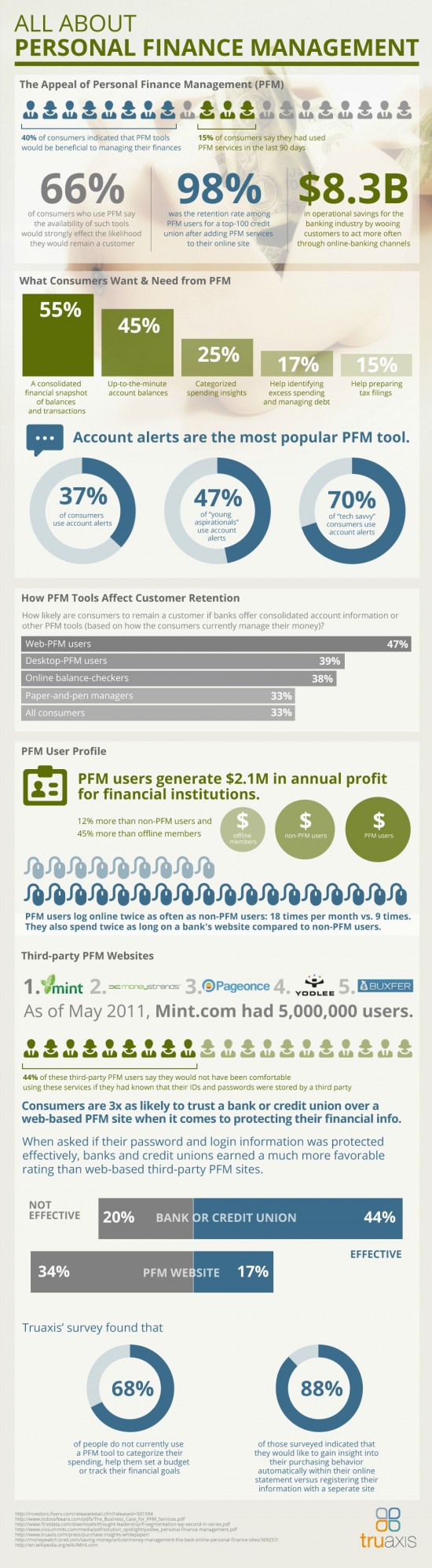
To build deeper relationships with their clients and customers, financial advisors, wealth managers, brokerages and banks need to move away from just being an account to store money – and more towards helping their customers take control of their finances. Adding personal financial management (PFM) tools are a great way to start.

Right now, medical professional clients and many customers, are turning to third party sites to help them with their finances. But, a recent Javelin reports shows that customers are 3-x as likely to trust a bank with these services.

Below are some reasons why FAs, WMs and SBs should consider providing PFM capabilities (such as StatementRewards’ Purchase Insights) to physicians and lay customers.

Source: truaxis.com

Conclusion

And so, your thoughts and comments on this ME-P are appreciated. FAs – please advise? Please review our top-left column, and top-right sidebar materials, links, URLs and related websites, too. Then, subscribe to the ME-P. It is fast, free and secure.

Link: http://feeds.feedburner.com/HealthcareFinancialsthePostForcxos

Speaker: If you need a moderator or speaker for an upcoming event, Dr. David E. Marcinko; MBA – Publisher-in-Chief of the Medical Executive-Post – is available for seminar or speaking engagements. Contact: MarcinkoAdvisors@msn.com

Our Other Print Books and Related Information Sources:

Health Dictionary Series: http://www.springerpub.com/Search/marcinko

Practice Management: http://www.springerpub.com/product/9780826105752

Physician Financial Planning: http://www.jbpub.com/catalog/0763745790

Medical Risk Management: http://www.jbpub.com/catalog/9780763733421

Healthcare Organizations: www.HealthcareFinancials.com

Physician Advisors: www.CertifiedMedicalPlanner.com

Subscribe Now: Did you like this Medical Executive-Post, or find it helpful, interesting and informative? Want to get the latest ME-Ps delivered to your email box each morning? Just subscribe using the link below. You can unsubscribe at any time. Security is assured.

Link: http://feeds.feedburner.com/HealthcareFinancialsthePostForcxos

Sponsors Welcomed: And, credible sponsors and like-minded advertisers are always welcomed.

Link: https://healthcarefinancials.wordpress.com/2007/11/11/advertise

Product DetailsProduct DetailsProduct Details

Product Details Product Details

Product Details

On “Financial Planning for Physicians AND their Advisors”

Let’s Meet Dr. Peter Benedek CFA

At Your Service as Our Newest ME-P “Thought-Leader”

By Ann Miller RN MHA

[Executive-Director]

www.retirementaction.com

Peter Benedek retired in 2002, after almost thirty years working as an engineer, manager and then executive in telecommunications Research and Development. While having a PhD in Electrical Engineering, he was always also interested in the financial world.

Enabling Others to Control their Destinies

However, due to work and family pressures, he had the opportunity to delve deeply in a formal finance related study only after retirement. The collapse of telecom industry, coincidental with retirement, reinforced his interest in financial related matters – not just as an intellectual pursuit – but also as a means to better understand how to manage his own personal financial affairs, and assist others to better manage their affairs in order to achieve some level of control over their destinies.

What Peter Brings to the ME-P Ecosystem

Dr. Benedek is no novice however. In the summer of 2006 he successfully completed the three levels of study toward the Chartered Financial Analyst designation offered by the CFA Institute®. He is thus a CFA charter-holder.

Assessment 

In addition to authoring his pro bono website, he started providing research and consulting services to investment management firms in 2009.

Conclusion

Your thoughts and comments on this ME-P are appreciated. Feel free to review our top-left column, and top-right sidebar materials, links, URLs and related websites, too. Then, subscribe to the ME-P. It is fast, free and secure.

Speaker: If you need a moderator or speaker for an upcoming event, Dr. David E. Marcinko; MBA – Publisher-in-Chief of the Medical Executive-Post – is available for seminar or speaking engagements. Contact: MarcinkoAdvisors@msn.com

OUR OTHER PRINT BOOKS AND RELATED INFORMATION SOURCES:


Product Details  Product Details

A Review of Current Personal Finance and Investment Literature

Current Synopsis [Around the Literary World of Economics]

By Dr. Peter Benedek CFA

http://retirementaction.com/

Investors will grapple with more turbulence surrounding Europe’s deepening debt problems this week and the prospect of another round of dismal data on the faltering U.S. economy. So, let us listen while Doctor Benedek speaks.

Dr. David E. Marcinko; FACFAS, MBA, CMP[Publisher-in-Chief]

In the Globe and Mail’s “In an emergency, is your info safe?” Dianne Nice suggests a teachable moment associated with the recent US andOntario tornadoes, north-eastern earthquake and hurricane threat. Specifically, she suggests that we consider taking steps to safeguard our important papers, should our home be destroyed. The ICBA recommends keeping important documents in a bank safe: marriage certificate, tax returns, property deeds, birth certificates insurance policies, credit card number, and list of household valuables for insurance claims, paper or electronic copies of important computer records. Additionally consider keeping copies in the home in sealed plastic bags (Probably not a bad idea.)

Scott Willenbrock in the Financial Analysts Journal’s “Diversification return, portfolio rebalancing, and the commodity return puzzle” argues that “the underlying source of the diversification return is the rebalancing, which forces the investor to sell assets that have appreciated in relative value and buy assets that have declined in relative value, as measured by their weights in the portfolio. Although a buy-and-hold portfolio generally has a lower variance than the weighted average variance of its assets, it does not earn a diversification return. Diversification is often described as the only “free lunch’’ in finance because it allows for the reduction of risk for a given expected return. Diversification return might be described as the only “free dessert” in finance because it is an incremental return earned while maintaining a constant risk profile. The contrarian activity of rebalancing, however, must be performed to earn the diversification return; diversification is a necessary but not sufficient condition. Although an un-rebalanced portfolio generally has reduced risk, it does not earn a diversification return and suffers from a varying risk profile. The control of risk, together with the diversification return, is a powerful argument for rebalanced portfolios.”

In the CFA Institute’s Financial Analysts Journal’s “The winners’ game” Charles Ellis looks at the investment profession’s challenges and opportunities. He writes that the investment profession has made three errors:  two of commission and one of omission. He writes that “In addition to the two errors of commission—accepting the increasingly improbable prospect of beat-the-market performance as the best measure of our profession and focusing more and more attention on business achievements rather than on professional success— we have somehow lost sight of our best professional opportunity to serve our clients well and shifted our focus away from effective investment counseling. Some of the help clients need is in understanding that selecting managers who will actually beat the market over the long term is no longer a realistic assumption or a “given” … most investors need help in developing a balanced, objective understanding of themselves and their situation: their investment knowledge and skills; their tolerance for risk in assets, incomes, and liquidity; their financial and psychological needs; their financial resources; their financial aspirations and obligations in the short and long run … Our profession’s clients and practitioners would all benefit if we devoted less energy to attempting to “win” the loser’s game of beating the market and more skill, knowledge, and time to helping clients recognize market realities, understand themselves as investors, and clarify their realistic objectives and then stay the course that is best for each of them.” (Charles Ellis is the author of the must read book entitled“Winning the Loser’s Game- Timeless Strategies for Successful Investing”.)

Glenn Ruffenach in the WSJ SmartMoney’s “5 best online retirement guides” provides a list from  “One of the most comprehensive and valuable sites online is also among the least known: the Employee Benefits Security Administration.”

In WSJ SmartMoney’s “Why Wall Street’s forecast can’t be trusted” Alex Tarquinio writes that “Over the years, some market forecasters have been about as accurate as, well, weather forecasters… But some financial planners ignore the Wall Street prognostications altogether. George Papadopoulos, the owner of the eponymous financial planning firm in Novi, Mich., says most stock strategists tend to be too bullish, save a few who are “perma-bears.” Ignore the headline number, he says, and “focus on what you can control,” like finding a good balance of stocks and bonds for your portfolio.” (Now there is some sensible advice; ignore talking-heads, ‘strategists’, ‘prognosticators’ and soothsayers. Remember there are very few things that you can actually control: your spend-rate, saving-rate, investment fees and costs, asset allocation and rebalancing.)

In the Globe and Mail’s “Hunting high and low for safe yields” John Heinzl enumerates some of the available options for ‘safe yields’ and concludes that none come even close to paying off your 4% mortgage which at 40% tax rate gives you 6.67% guaranteed.

In Bloomberg’s “Homeowners on East Coast may have to pay for earthquake damage” Leondis and Ody report that “Earthquake protection is generally excluded from standard homeowners’ insurance policies, and consumers have to purchase coverage either as a separate policy…“For most of us, having earthquake insurance doesn’t make sense,” said Sheryl Garrett, founder of Shawnee Mission, Kansas-based Garrett Planning Network Inc., a network of fee-only financial planners. That’s because residents of areas where earthquakes rarely occur generally don’t need the coverage, and policies in parts of the country with frequent earthquakes are more expensive to compensate for the increased risk, she said.”

In the Globe and Mail’s “Vanguard to launch six ETFs in Canada” Shirley Won reports that Vanguard is launching “six exchange-traded funds (ETFs) inCanada. The stock ETFs include Vanguard MSCI Canada and the Vanguard MSCI Emerging Markets, as well as the Vanguard MSCI U.S. Broad Market and Vanguard MSCI EAFE, which will both be hedged to Canadian dollars. The bond category includes Vanguard Canadian Aggregate Bond and Vanguard Canadian Short-Term Bond ETFs.”

Real Estate

On the Canadian front, in the Globe and Mail’s “Most housing ‘reasonably affordable’: RBC” Steve Ladurantaye reports that Vancouver house prices are in “uncharted territory” and “it would take 92 per cent of the median household’s pretax income to own a bungalow in the city at current prices – the highest reading yet in its quarterly national survey on affordability. However according to RBC most (other) Canadian cities offered reasonably affordable” housing options in the second quarter compared to the first. Nationally, a condo required 29.2 per cent of pretax household income (a 0.8 per cent increase), a bungalow 43.3 per cent (1.7 per cent) and a detached home 49.3 per cent (1.8 per cent)… The bank’s affordability index looks at the proportion of pre-tax household income needed to service the costs of owning different categories of homes at current market values. Its standard measure is a 1,200-square-foot bungalow, and the carrying costs include mortgage payments (principal and interest), property taxes and utilities.”

However in the WSJ’s “Toronto wary of condo correction” (note this is in WSJ, not the Globe and Mail or the National Post) Monica Gutschi reports that “A condominium-building boom is lifting Canada’s largest city into the same stratosphere as London, Sydney, Vancouver and Miami, but deepening the worries about a potential tumble…Toronto is a long way from Miami, but the condominium boom north of the border has begun to evoke ominous comparisons, even among real-estate agents. TheToronto area is home to 1,198 condo projects with 210,000 units, according to research firm Urbanation. About 40,000 additional condominium units are under construction, including 16,000 set to hit the market next year. “There’s more supply coming than the market really needs, unless we have a stronger economy than we have today,” says independent housing economist Will Dunning…As many as 60% of recent condominium buyers in Toronto are investors who bought their units from developers before construction began—and then sold their condos…But buyers whose condominiums are investments are getting squeezed. Stagnant rents make it harder to cover mortgage payments.”

On the US front, in Bloomberg’s “Home prices decline 5.9% in second quarter” Kathleen Howley reports that “Home prices in the U.S. fell 5.9 percent in the second quarter from a year earlier, the biggest decline since 2009, as foreclosures added to the inventory of properties for sale…Purchases decreased 3.5 percent to a 4.67 million annual rate, the weakest since November.” Furthermore Nick Timiraos in WSJ’s  “Home-loan delinquencies rise again” reports that “The Mortgage Bankers Association said 12.87% of mortgage loans on one-to-four-unit homes were 30 days or longer past due or in the foreclosure process at the end of the second quarter, representing more than 6.3 million households. The second-quarter figure was down from 14.4% one year earlier but up from 12.84% at the end of March…While mortgage delinquencies remain highest in states hard hit by the housing bubble—such as Nevada, California and Florida—the inventory of loans in foreclosure is highest in states that require banks to obtain court approval when they foreclose on homeowners. Nationally, about 4.4% of all loans were in foreclosure at the end of June. Of the nine states that exceeded the national average, all but one—Nevada—have a judicial foreclosure process. Foreclosure rates were highest inFlorida (14.4%),Nevada (8.2%),New Jersey (8%),Illinois (7%),Maine andNew York (5.5%).”

In Florida context, in Palm Beach Post’s “Palm Beach County home sales slump in July from previous month” Kimberly Miller reports that “A Florida Realtors report released Thursday found 972 single-family Palm Beach County homes traded hands in July, a 21 percent increase from the same time in 2010, but an 18 percent drop from the previous month. The median sales price in Palm Beach County fell 17 percent from last year to $187,900 – a price not seen consistently since 2002. Statewide, sales of existing homes fell 12 percent in July from the previous month, but were up 12 percent compared to July 2010. The median sales price of $136,500 remained mostly stable…The inventory of homes for sale in Palm Beach County was down to an eight month supply in June, a 46.5 percent decrease from 2010 and down 62 percent from 2009, according to the Realtors Association of the Palm Beaches. That may change soon. Forbes, as well as Realtor Dean Hooker, owner of Pompano Beach-based Southeast REO, said banks are preparing to release more foreclosures for re-sale. Also in the PBP is Jeff Ostrowski’s article “Foreclosure-related sales’ prices fall, and the discount widens” in which ne reports that “The average price of a foreclosure sold inPalm BeachCounty in the second quarter was $116,642, down from $142,997 a year ago. And the discount for foreclosure sales compared to non-foreclosure sales widened to 38 percent this year from 23 percent a year ago. There were 3,253 distressed sales – including foreclosure sales, pre-foreclosure sales and sales after a lender has taken ownership – inPalm BeachCounty in April, May and June, according to RealtyTrac. Those sales made up 37 percent of all transactions in the county. In St. Lucie County, 701 foreclosure deals in the quarter accounted for 44 percent of all sales. Statewide, there were 34,558 foreclosure sales in the second quarter, accounting for 35 percent of all sales in the state.”

In the Globe and Mail’s “Foreign buyers see value in U.S. real estate” Simon Avery writes that with Florida prices off typically 50% since the peak, low mortgage rates, the strong Canadian dollar: ” As an alternative investment, U.S. real estate may never look so attractive to Canadians again…At the moment, the best deals in the Miami area are in South Beach, an area where the properties on average are older. There are currently 172 properties listed under $150,000 and 50 per cent of them are within walking distance to the beach. Generally, these are small, art deco-style, low rises. Their monthly maintenance fees run $320 or less and the sizes range from 240 square feet to 440 square feet.” (That doesn’t sound that cheap for an average of 340 SF units comes to about $441/SF…bargain??? You be the judge.)

Things to Ponder

In the Globe and Mail’s “Amid slowdown, Fed has few tools left” Kevin Carmichael discusses the limited remaining options available for the Fed to provide stimulus to rekindleUS growth and employment. The real problem, however, might be related to that “these aren’t normal times. When businesses and consumers would rather save than spend, as currently is the case in theUnited States, the power of monetary policy is muted. Corporations are sitting on some $2-trillion (U.S.) in profits and the household savings rate has climbed to more than 5 per cent from zero before the financial crisis, even though the cost of borrowing already is at record-low levels… What theU.S. economy needs is a massive jolt to demand that would encourage companies to hire and invest. The best way to do that, many economists argue, is through fiscal policy.”

Jack Hough in WSJ SmartMoney’s “Treasurys versus stocks: spot the safe one” provides some support to Jeremy Siegel’s arguments that “bonds are in a bubble and stocks are good deal”. Arnott says that the 10-year Treasurys yield about zero, given nominal yields of 2.1% and past year’s inflation of 3.6%; whereas the S&P 500 dividend yield is 2.3%. “Bond yields are usually larger because stock dividends tend to grow over time and bond coupons don’t, so bond buyers typically want to be compensated for this…The choice is between stocks’ higher and rising yield and bonds’ lower and flat one…The third reason is that stocks have a better chance of keeping up with inflation…Dividends have rarely looked safer…Today’s payments are 29% of S&P 500 profits. That’s the lowest level since 1900, and perhaps in history…(but) Economists have slashed growth forecasts for most rich economies, and many put the chances of renewed U.S. recession at a coin flip.” So it depends on your horizon/risk tolerance, but “savers with a decade to wait” will find the arguments for stocks persuasive. But not everyone agrees that the metrics are valid. For example, in the Financial Times Lex column’s “Equities: metrics of the trade” discusses pundits indicating that based on P/E ratios and dividend yields compared to bond yields, it is time to buy stocks. Lex suggests that “the big flaw with this approach is that current or near-future earnings are very unlikely to represent an equilibrium return from stocks… It is a fact that company returns normalise, so a much longer earnings period against which to compare stock prices is needed. Inflation also needs be taken into account, as do accounting changes over time. Robert Shiller’s cyclically adjusted p/e ratio is a step in the right direction. Such an approach holds the S&P 500 to be anywhere up to 40 per cent overvalued… Likewise, history shows there to be no predictive power comparing equity and bond yields. Why should there be? Dividends are risky and rise with inflation; coupons are risk free and do not. It is like buying apples because pears are cheap. There are good reasons why stocks might rally – flaky valuation metrics are not among them.”

In the Guardian’s “Rating agencies suffer ‘conflict of interest’, says former Moody’s boss” Rupert Neate reports that “ratings agencies suffer from a conflict of interest because they are paid by the banks and companies they are supposed to rate objectively.”This salient conflict of interest permeates all levels of employment, from entry-level analyst to the chairman and chief executive officer of Moody’s corporation,” Harrington said in a filing to theUS financial regulator the Securities and Exchange Commission (SEC), which is considering new rules to reform the agencies. Harrington claims that Moody’s uses a long-standing culture of “intimidation and harassment” to persuade its analysts to ensure ratings match those wanted by the company’s clients.” (Recommended by the CFA Institute Financial Newsbrief)

In Bloomberg’s “Baby Boomers selling shares may depress stocks for decades, Fed paper says” Vivien Lou Chen writes that “Aging baby boomers may hold down U.S. stock values for the next two decades as they sell their investments to finance retirement, according to researchers from the Federal Reserve Bank of San Francisco … Jeremy Siegel, 65, a finance professor at the University of Pennsylvania’s Wharton School in Philadelphia, has also researched the link between demographics and U.S. stocks. He said that growth in developing countries should generate enough demand to absorb a baby-boomer selloff and “keep stock prices high.””

In the Financial Times’ “Inflation a danger for safe havens” Steve Johnson argues that the US/UK/German 10-year government bonds yielding in the 2-2.2% range is due to their perceived “safe haven” status from the wild swings of the markets. “But these miserly yields must also reflect investors’ confidence that inflation will be muted over the next decade. How logical is this assumption?…this insouciance about the prospects for inflation misses the international dimension, that stemming from rising import prices … (but) For the seven US recessions between 1957 and 1991, commodity prices on average fell 1.6 per cent during the period between the start of the recession and two years after its end. The equivalent figure for the two recessions so far this century is a rise of 27.3 per cent… Rather than enjoying a tailwind from falling commodity prices and low inflation rates, it may become the norm for recession-ravaged developed nations to face a commodity headwind and stubbornly high inflation.”

Assessment

And finally, in the NYT’s “In Korea, the game of trading has rules” Floyd Norris writes that “Finance ought to provide an economy with an efficient means of allocating capital. It should provide a means of price discovery of assets, whether real or financial. It should provide a safe and reliable payments system. Financial innovations are worthwhile if, and only if, they help in those areas.  All too often, players see financial innovations as providing ways to manipulate the system and make money off less savvy traders.” In South Korea things are changing. Four traders were indicted for intentionally manipulating stock prices for profit, specifically for causing a market drop. “Countries around the world felt called upon to bail out banks during the financial crisis. That made sense because a functioning financial system is necessary. But these kind of games are not necessary, whether or not they are criminal. These charges provide an endorsement of the Volcker Rule, named for Paul A. Volcker, the former Federal Reserve chairman, and included in the Dodd-Frank law in theUnited States, which sought to restrict proprietary trading by banks whose deposits are insured. If such games are to be played, let them be played by others.“ The article concludes with the need for prison terms for these traders to insure a deterrent effect  (Thanks to DB for recommending.)

Conclusion

And so, your thoughts and comments on this ME-P are appreciated. Feel free to review our top-left column, and top-right sidebar materials, links, URLs and related websites, too. Then, subscribe to the ME-P. It is fast, free and secure.

Link: http://feeds.feedburner.com/HealthcareFinancialsthePostForcxos

Speakers: If you need a moderator or speaker for an upcoming event, Dr. Peter Benedek and Dr. David E. Marcinko; MBA – Publisher-in-Chief of the Medical Executive-Post – are available for seminar or speaking engagements. Contact: MarcinkoAdvisors@msn.com

Other Print Books and Related Information Sources for Doctor and Advisors:

Health Dictionary Series: http://www.springerpub.com/Search/marcinko

Practice Management: http://www.springerpub.com/product/9780826105752

Physician Financial Planning: http://www.jbpub.com/catalog/0763745790

Medical Risk Management: http://www.jbpub.com/catalog/9780763733421

Healthcare Organizations: www.HealthcareFinancials.com

Physician Advisors: www.CertifiedMedicalPlanner.com

Subscribe Now: Did you like this Medical Executive-Post, or find it helpful, interesting and informative? Want to get the latest ME-Ps delivered to your email box each morning? Just subscribe using the link below. You can unsubscribe at any time. Security is assured.

Link: http://feeds.feedburner.com/HealthcareFinancialsthePostForcxos

Sponsors Welcomed: And, credible sponsors and like-minded advertisers are always welcomed.

Link: https://healthcarefinancials.wordpress.com/2007/11/11/advertise

Product DetailsProduct DetailsProduct Details       

Product Details  Product Details

   Product Details 

Dr. Somnath Basu on Financial Planning Client Expectations [PodCast]

Join Our Mailing List

By Staff Reporters

On Client Attitudes in the New Economy

In this encore podcast, Somnath Basu PhD examines how the recent economic turmoil has changed financial planning clients’ attitudes and expectations.

Dr. Basu is a popular ME-P contributor and thought-leader.

Assessment: http://www.youtube.com/watch?v=jzAkB8h5v3Q

Conclusion

Your thoughts and comments on this ME-P are appreciated. Feel free to review our top-left column, and top-right sidebar materials, links, URLs and related websites, too. Then, subscribe to the ME-P. It is fast, free and secure.

Speaker: If you need a moderator or speaker for an upcoming event, Dr. David E. Marcinko; MBA – Publisher-in-Chief of the Medical Executive-Post – is available for seminar or speaking engagements. Contact: MarcinkoAdvisors@msn.com

OUR OTHER PRINT BOOKS AND RELATED INFORMATION SOURCES:

Product DetailsProduct DetailsProduct Details

Product Details  Product Details

   Product Details 

Thoughts On Financial Advisors and Planners [Videos]

Candid YouTube Videos

By Staff Reporters

Join Our Mailing List

A Conversation with My Financial Planner:

http://www.youtube.com/watch?v=dFf6ibuAl5w&feature=related

The Wrong Financial Advisor:

http://www.youtube.com/watch?v=Vv4HQG2Hz0I&feature=related

Become an Investment Advisor:

http://www.youtube.com/watch?v=N1xpd4Z2p-g&feature=related

Assessment

“Many a true word is spoken in jest” and “Some truths, too painful or too likely to provoke, can be spoken only when the listener has been disarmed by laughter.”

-Geoffrey Chaucer

Conclusion

And so, your thoughts and comments on this ME-P are appreciated. How true are these videos? Are they more tongue-in-cheek or thoughtful and sobering?

Feel free to review our top-left column, and top-right sidebar materials, links, URLs and related websites, too. Then, subscribe to the ME-P. It is fast, free and secure.

Link: http://feeds.feedburner.com/HealthcareFinancialsthePostForcxos

Speaker: If you need a moderator or speaker for an upcoming event, Dr. David E. Marcinko; MBA – Publisher-in-Chief of the Medical Executive-Post – is available for seminar or speaking engagements. Contact: MarcinkoAdvisors@msn.com

Our Other Print Books and Related Information Sources:

Health Dictionary Series: http://www.springerpub.com/Search/marcinko

Practice Management: http://www.springerpub.com/product/9780826105752

Physician Financial Planning: http://www.jbpub.com/catalog/0763745790

Medical Risk Management: http://www.jbpub.com/catalog/9780763733421

Healthcare Organizations: www.HealthcareFinancials.com

Physician Advisors: www.CertifiedMedicalPlanner.com

Subscribe Now: Did you like this Medical Executive-Post, or find it helpful, interesting and informative? Want to get the latest ME-Ps delivered to your email box each morning? Just subscribe using the link below. You can unsubscribe at any time. Security is assured.

Link: http://feeds.feedburner.com/HealthcareFinancialsthePostForcxos

Sponsors Welcomed: And, credible sponsors and like-minded advertisers are always welcomed.

Link: https://healthcarefinancials.wordpress.com/2007/11/11/advertise

Product DetailsProduct DetailsProduct Details       

Product Details  Product Details

   Product Details 

What is the Point of Financial Planning [Pod Cast]?

A Video and Audio Survey

By Staff Reporters

Join Our Mailing List

Question

What’s the point of financial planning?

One Answer

Read WSJ’s post from Richard Reyes and comment below to share what you think the point is.

Assessment

PodCast link: http://www.vimeo.com/22892025?ab

Conclusion

And so, your thoughts and comments on this ME-P are appreciated.

Is financial planning different for doctors, as we contend here at the ME-P? Do we need a separate educational track and designation for healthcare, like: www.CertifiedMedicalPlanner.com ?

Feel free to review our top-left column, and top-right sidebar materials, links, URLs and related websites, too. Then, subscribe to the ME-P. It is fast, free and secure.

Link: http://feeds.feedburner.com/HealthcareFinancialsthePostForcxos

Speaker: If you need a moderator or speaker for an upcoming event, Dr. David E. Marcinko; MBA – Publisher-in-Chief of the Medical Executive-Post – is available for seminar or speaking engagements. Contact: MarcinkoAdvisors@msn.com

Our Other Print Books and Related Information Sources:

Health Dictionary Series: http://www.springerpub.com/Search/marcinko

Practice Management: http://www.springerpub.com/product/9780826105752

Physician Financial Planning: http://www.jbpub.com/catalog/0763745790

Medical Risk Management: http://www.jbpub.com/catalog/9780763733421

Healthcare Organizations: www.HealthcareFinancials.com

Physician Advisors: www.CertifiedMedicalPlanner.com

Subscribe Now: Did you like this Medical Executive-Post, or find it helpful, interesting and informative? Want to get the latest ME-Ps delivered to your email box each morning? Just subscribe using the link below. You can unsubscribe at any time. Security is assured.

Link: http://feeds.feedburner.com/HealthcareFinancialsthePostForcxos

Sponsors Welcomed: And, credible sponsors and like-minded advertisers are always welcomed.

Link: https://healthcarefinancials.wordpress.com/2007/11/11/advertise

Product DetailsProduct DetailsProduct Details       

Product Details  Product Details

   Product Details 

Financial Life Planning Defined for Physicians and Advisors

Integrating Financial Planning, Practice Management and Life

By Dr. David Edward Marcinko MBA, CMP™

www.CertifiedMedicalPlanner.com

Life planning has many detractors and defenders. Formally, it has been defined by Mitch Anthony, Gene R. Lawrence and Roy T. Diliberto of the Financial Life Institute, in the following trinitarian way.

Financial Life Planning is an approach to financial planning that places the history, transitions, goals, and principles of the client at the center of the planning process.  For the financial advisor or planner, the life of the client becomes the axis around which financial planning develops and evolves.

Other definitions are: 

  • Financial Life Planning is about coming to the right answers by asking the right questions. This involves broadening the conversation beyond investment selection and asset management to exploring life issues as they relate to money.
  • Financial Life Planning is a process that helps advisors move their practice from financial transaction thinking, to life transition thinking. The first step aiming to help clients “see” the connection between their financial lives and the challenges and opportunities inherent in each life transition.

But, for informed physicians, life planning’s quasi-professional and informal approach to the largely isolate disciplines of financial planning and medical practice management is inadequate. Today’s practice environment is incredibly complex, as compressed economic stress from HMOs, financial insecurity from Wall Street, liability fears from attorneys, criminal scrutiny from government agencies, IT mischief from malicious hackers, economic benchmarking from hospitals and lost confidence from patients all converge to inspire a robust new financial planning approach for medical professionals. Now, add politics and the ACA of 2010.

Our Approach

The iMBA approach to financial planning, as championed by the Certified Medical Planner, integrates the traditional concepts of financial life planning, with the increasing complex business concepts of medical practice management. The former are presented in our textbook on financial planning for doctors. And, the later is in our companion book: “The Business of Medical Practice” www.BusinessofMedicalPractice.com

Others on risk management and insurance; accounting, tax and investing; retirement, practice succession and estate planning, are planned in our future iMBA Handbook series for physicians and their advisors www.MedicalBusinessAdvisors.com

Example

For example, views of medical practice, personal lifestyle, investing and retirement, both what they are and how they may look in the future, are rapidly changing as the retail mentality of medicine is replaced with a wholesale philosophy. Or, how views on maximizing current practice income might be more profitably sacrificed for the potential of greater wealth upon eventual practice sale and disposition. Or, how the ultimate fear represented by Yale University economist Robert J Shiller, in “The New Financial Order”: Risk in the 21st Century, warns that the risk for choosing the wrong profession or specialty, might render physicians obsolete by technological changes, managed care systems or fiscally unsound demographics.

Assessment

Yet, the opportunity to re-vise the future at any age through personal re-engineering, exists for all of us, and allows a joint exploration of the meaning and purpose in life. To allow this deeper and more realistic approach, the advisor and the doctor must build relationships based on trust, greater self-knowledge and true medical business and financial enhancement acumen.

Conclusion

And so, your thoughts and comments on this ME-P are appreciated. Feel free to review our top-left column, and top-right sidebar materials, links, URLs and related websites, too. Then, subscribe to the ME-P. It is fast, free and secure.

Speaker: If you need a moderator or speaker for an upcoming event, Dr. David E. Marcinko; MBA – Publisher-in-Chief of the Medical Executive-Post – is available for seminar or speaking engagements. Contact: MarcinkoAdvisors@msn.com and http://www.springerpub.com/Search/marcinko

Our Other Print Books and Related Information Sources:

Health Dictionary Series: http://www.springerpub.com/Search/marcinko

Practice Management: http://www.springerpub.com/product/9780826105752

Physician Financial Planning: http://www.jbpub.com/catalog/0763745790

Medical Risk Management: http://www.jbpub.com/catalog/9780763733421

Healthcare Organizations: www.HealthcareFinancials.com

Physician Advisors: www.CertifiedMedicalPlanner.com

Subscribe Now: Did you like this Medical Executive-Post, or find it helpful, interesting and informative? Want to get the latest ME-Ps delivered to your email box each morning? Just subscribe using the link below. You can unsubscribe at any time. Security is assured.

Link: http://feeds.feedburner.com/HealthcareFinancialsthePostForcxos

Sponsors Welcomed: And, credible sponsors and like-minded advertisers are always welcomed.

Link: https://healthcarefinancials.wordpress.com/2007/11/11/advertise

Product DetailsProduct DetailsProduct Details       

Product Details  Product Details

   Product Details

Financial Planning and Risk Management Strategies for Physicians

Financial Planning Handbook for Physicians and Advisors

Product Details

 • http://www.jblearning.com/catalog/9780763745790/

Insurance Planning and Risk Management Strategies for Physicians and Advisors

Product Details

http://www.jblearning.com/catalog/9780763733421/

ADVERTISEMENT

Speaker: If you need a moderator or speaker for an upcoming event, Dr. David E. Marcinko; MBA – Publisher-in-Chief of the Medical Executive-Post – is available for seminar or speaking engagements. Contact: MarcinkoAdvisors@msn.com and http://www.springerpub.com/Search/marcinko

Are You Scared of Investment Losses?

Well Doctors – You Should Be!

By Somnath Basu PhD, MBA
President: AgeBander
Thousand Oaks, CA

There is a very simple way for medical professionals, and us all, to approach investment decision making. To start with, begin by asking yourself some basic and preliminary questions such as what is the investment for (to buy a house, to fund a kid’s education, or is it to fund retirement and the like) and how long these investments will last (for example, up to 40 – 50 years sometimes when one starts planning for retirement early).

Basic Questions

Once these basic questions are answered then ask this $64 million dollar question of your-self. Over your planning time horizon, how much of this money are you willing to lose? For example if you are trying to accumulate $100,000 for a house, how much could you afford to lose and still not lose your bearings? What if it is a five-year plan and in the 4th year you lose 50% of your accumulated funds with only one more year to go. How would you feel? This is the critical question in any investment decision. Typically you will not hear a financial planner [FP] or financial advisor [FA] talk in such terms; but perhaps they should!

www.CertifiedMedicalPlanner.com

Conservative Investing

When financial planners and financial advisors talk about conservative investing, they couch the same idea in terms of risk and return. In the language of these experts such measures are often quantitative and difficult to understand for the average investor. While return on investments seems like a fairly straightforward concept (8% or 11% for example), risk is mentioned usually in terms of standard deviation, a statistical terminology difficult both to explain and to understand. Hence, most physicians and investors are pretty much in the dark when it comes down to making the decision itself since it is their sole responsibility. Thus, the investor is left with no other choice but to decide on whether the suggested investment return sounds attractive or not. On this track, the higher the return, the more attractive the investment seems.

Furthermore, FAs may suggest that a return such as 8-10% is a conservative rate whereas 12-15% is aggressive. Hence if an 8-10% based investment is being suggested, the investor is likely to go with what she/he thinks is the most conservative decision, being the conservative investors they believe they are. (As an aside, there is a whole theory about physician investors being conservative and risk averse)

Unwinding the Mystery

To unwind this basic mystery, simply ask the FA the likelihood of various amounts of losses in any single year including the last year of the investment. Could half your funds be wiped out in any year including the last year? What is the likelihood of such an event? What is the likelihood that it could be 25% in any given year? Suppose your planner shows how your $100,000 will grow to $150,000 in five years if you were to earnings the average rate of 8% per year for five years. Under such a scenario, what is the likelihood that you could lose half your accumulated funds in the last year and come out with a negative investment return even though you still earned that 8% average rate over the five years? As we know now such possibilities not only exist but are not uncommon either. As an extreme case in point consider the 2008-09 financial debacle [flash-crash]! If your investment was maturing in 2009, the outcome would have been a lot worse.

The Driver of Concern

This concern of loss is what should drive us in our investment decisions. Most planners are unable to explain this concept of loss aversion to their clients because they themselves are not adequately educated to understand the concept themselves. However, as mentioned before, the solution is simple. Now reconsider the example above of earning an average annual rate of 8% over 5 years. While it sounds conservative on the surface, it is actually quite aggressive. Earning 8% a year for five consecutive years (or averaging out over the five years to an 8% rate) is a very tall order. To do so, especially under most circumstances, one would actually be exposed to a large amount of loss in any given year.

Without getting into the details of how the standard deviation measurement of risk converts into the loss propensity and using very rough estimates, another way to view the 8% investment opportunity is to understand that in any year, you may not even earn a dollar (0%) and this could happen in each and every year. The likelihood of such an outcome is astonishingly high – about 25%. Thus, the investment decision is about whether you are willing to bet where the odds of loss is one to four (25%) every year for each of the five years. Of course the reverse is also true that in each of the years you have a 75% chance to  earn a positive return on your investment and the earning rate itself could be anywhere from zero to the highest rate imaginable. Further, there is a 12% chance that you could be actually losing 8% a year for each of the five years! In prolonged economic downturns, which are not so uncommon, such are the outcomes. Now ask yourself this question: If you were told about these odds of losses, would you still consider the 8% investment opportunity to be conservative? Hopefully not, especially when you feel unsettled about the existing economic state of affairs. Further, would you consider a 10% return to be attractive and conservative if you were rejecting a 15% investment and choosing the 10% one?

Assessment

As mentioned earlier, this idea of loss aversion is probably the most powerful tool in the investor’s bag. Once you understand the implications of loss from any investment decision, then the loss aversion approach to making this decision is a dimensional shift, something that can be easily understood and applied by all investors. Furthermore, if most physicians and investors behaved similarly, collectively we would make the investment market a much safer place. Unfortunately for now, there are no known ways of educating all investors about this critical aspect since the tools that currently exist are all based on statistical concepts of risk and return which make little sense to most lay investors.

Conclusion

And so, your thoughts and comments on this ME-P are appreciated. Feel free to review our top-left column, and top-right sidebar materials, links, URLs and related websites, too. Then, subscribe to the ME-P. It is fast, free and secure.

Speaker: If you need a moderator or speaker for an upcoming event, Dr. David E. Marcinko; MBA – Publisher-in-Chief of the Medical Executive-Post – is available for seminar or speaking engagements. Contact: MarcinkoAdvisors@msn.com and http://www.springerpub.com/Search/marcinko

Get our Widget: Get this widget!

Our Other Print Books and Related Information Sources:

Health Dictionary Series: http://www.springerpub.com/Search/marcinko

Practice Management: http://www.springerpub.com/product/9780826105752

Physician Financial Planning: http://www.jbpub.com/catalog/0763745790

Medical Risk Management: http://www.jbpub.com/catalog/9780763733421

Healthcare Organizations: www.HealthcareFinancials.com

Physician Advisors: www.CertifiedMedicalPlanner.com

Subscribe Now: Did you like this Medical Executive-Post, or find it helpful, interesting and informative? Want to get the latest ME-Ps delivered to your email box each morning? Just subscribe using the link below. You can unsubscribe at any time. Security is assured.

Link: http://feeds.feedburner.com/HealthcareFinancialsthePostForcxos

Sponsors Welcomed: And, credible sponsors and like-minded advertisers are always welcomed.

Link: https://healthcarefinancials.wordpress.com/2007/11/11/advertise

Product DetailsProduct DetailsProduct Details       

Product Details  Product Details

   Product Details 

Book Dr. Marcinko to Speak

At Your Next Medical Management, Pharma or Financial Services Seminar  

Our Editor-and-Chief, Dr. David Edward Marcinko MBA CMP™ is a former medical practitioner and board certified surgeon [FACFAS], certified financial planner, stock-broker, insurance agent, Registered Rep, RIA representative, writer, editor, journalist, expert witness and healthcare economist who enjoys public speaking and gives as many talks each year as possible, at a variety of medical society, pharmaceutical and financial services conferences around the country and world.

Many Venues

These have included lectures and visiting professorships at major academic centers, keynote lectures for hospitals, economic seminars, pharma conventions and health systems, endnote lectures at city and statewide financial coalitions, and break-out lectures for a variety of internal and external yearly meetings.

Assessment

More info: https://medicalexecutivepost.com/dr-david-marcinko%e2%80%99s-bookings/

Speaker: And so, if you need a moderator or speaker for an upcoming event, Dr. David E. Marcinko; MBA – Publisher-in-Chief of the Medical Executive-Post – is available for seminar or speaking engagements. Contact: MarcinkoAdvisors@msn.com and http://www.springerpub.com/Search/marcinko

Get our Widget: Get this widget!

Our Other Print Books and Related Information Sources:

Health Dictionary Series: http://www.springerpub.com/Search/marcinko

Practice Management: http://www.springerpub.com/product/9780826105752

Physician Financial Planning: http://www.jbpub.com/catalog/0763745790

Medical Risk Management: http://www.jbpub.com/catalog/9780763733421

Healthcare Organizations: www.HealthcareFinancials.com

Physician Advisors: www.CertifiedMedicalPlanner.com

Subscribe Now: Did you like this Medical Executive-Post, or find it helpful, interesting and informative? Want to get the latest ME-Ps delivered to your email box each morning? Just subscribe using the link below. You can unsubscribe at any time. Security is assured.

Link: http://feeds.feedburner.com/HealthcareFinancialsthePostForcxos

Sponsors Welcomed: And, credible sponsors and like-minded advertisers are always welcomed.

Link: https://healthcarefinancials.wordpress.com/2007/11/11/advertise

Product DetailsProduct DetailsProduct Details       

Product Details  Product Details

   Product Details 

Get a Free Retirement Planning e-Book

Unveiling the Retirement Myth

Review by: Dr. David Edward Marcinko MBA CMP™

[Publisher-and-Chief]

Jim Otar is a certified financial planner in Canada. He wrote the book: Unveiling the Retirement Myth on retirement income planning: how to make your retirement portfolio last as long as you do when you are living off your savings and investments in retirement.

The Print Version

The print version costs $49.99 on Amazon. But, for a limited time only, Jim Otar is offering a PDF version of this 525-page, 45 chapter book for FREE on his website retirementoptimizer.com.

The e-Book

Here’s the download link until January 10th, 2011:

http://www.retirementoptimizer.com/downloads/URMG/URMGreem.pdf

Assessment

This is a very worthwhile e-book offered at an excellent price-point. Its’ subtitle is advanced retirement planning based on market history, and that is exactly what is presented – much historical review although not especially of an advanced nature. But, it is voluminous. Additionally, since the past is no indication of the future – and current events like the potential of a “new economics normal” are not explicitly entertained – the treatise lacks a feeling of modernity!

Fortunately, the author does include many figures, graphs, illustrations and tables for ease of understanding. The mini case-examples also help keep it from trending to the boorish. This is an important point I have painfully learned after almost four decades of writing, editing and publishing [i.e., readability and interest]. Moreover, if the reader was not familiar with time-value of money calculations and concepts before reading, s/he will surely be after.

While mostly generic in nature – containing little tax, insurance, risk management and accounting information  – and not written for a physician or medical professional audience; the book represents a worthwhile review for doctor colleagues and/or those laymen unfamiliar with the ever widening topic. However, those physicians seeking healthcare specificity should look elsewhere for assistance www.CertifiedMedicalPlanner.com

Conclusion

And so, your thoughts and comments on this ME-P are appreciated. Feel free to review our top-left column, and top-right sidebar materials, links, URLs and related websites, too. Then, subscribe to the ME-P. It is fast, free and secure.

Speaker: If you need a moderator or speaker for an upcoming event, Dr. David E. Marcinko; MBA – Publisher-in-Chief of the Medical Executive-Post – is available for seminar or speaking engagements. Contact: MarcinkoAdvisors@msn.com and http://www.springerpub.com/Search/marcinko

Get our Widget: Get this widget!

Our Other Print Books and Related Information Sources:

Health Dictionary Series: http://www.springerpub.com/Search/marcinko

Practice Management: http://www.springerpub.com/product/9780826105752

Physician Financial Planning: http://www.jbpub.com/catalog/0763745790

Medical Risk Management: http://www.jbpub.com/catalog/9780763733421

Healthcare Organizations: www.HealthcareFinancials.com

Physician Advisors: www.CertifiedMedicalPlanner.com

Subscribe Now: Did you like this Medical Executive-Post, or find it helpful, interesting and informative? Want to get the latest ME-Ps delivered to your email box each morning? Just subscribe using the link below. You can unsubscribe at any time. Security is assured.

Link: http://feeds.feedburner.com/HealthcareFinancialsthePostForcxos

Sponsors Welcomed. And, credible sponsors and like-minded advertisers are always welcomed.

Link: https://healthcarefinancials.wordpress.com/2007/11/11/advertise

Product DetailsProduct DetailsProduct Details       

Product Details  Product Details

ME-P Recommends the “Health Dictionary Series”

Product DetailsProduct DetailsProduct Details       

   ADVERTISEMENT 

Doctors – Are You Preparing for Retirement [A Voting Opinion Poll]?

ME-P Voting Poll with Survey

By Dr. David Edward Marcinko FACFAS,  MBA, CMP™

[Publisher-in-Chief]

www.CertifiedMedicalPlanner.com

As a physician-focused financial advisor, I know that for those medical professionals between the ages of 45 to 54, the thought of retirement should be popping up a few times these days.

And, for doctors between ages 55 and 64, the thought may be taking on urgent tones about now!

In fact, many of us are reconciling to the idea that it may be a fact that we have to either postpone our retirements or live a much simpler life during retirement. Whatever the thoughts may be, what’s driving them is our preparedness to retire.

And so, we’d appreciate your vote and comments, too!

Disclaimer: I am a reformed Certified Financial Planner®, Series 7 [stock-broker], 63 and 65 license holder, and RIA representative who also held all applicable insurance and security licenses.

Product DetailsProduct DetailsProduct Details       

Product Details  Product Details

   Product Details 

What is the Role of a Physician-Focused Financial Advisor?

Changing Times – Demand Changing Roles

By Dr. David Edward Marcinko MBA, CMP™

Editor-in-Chief

www.HealthcareFinancials.com

As a financial advisor for more than 15 years, it has been my experience that many doctors who require assistance in developing a comprehensive personal financial plan also need help with implementing any investment planning recommendations. While perhaps not so true before the “flash-crash” of 2008-09, the issue seems especially true today as retirement portfolios have been decimated, and the specter of healthcare reform is no longer just a threat but a political reality. The mindset of hubris has been replaced by a tone of fear in many medical colleagues.

The Financial Advisors

Physician investors who develop an investment plan may use a competent financial advisor [FA] or other specialist in the investment area. A financial advisor can help clients understand their current financial situations and develop strategies for achieving their goals. Other FAs are specialists that help clients design and implement plans for investing. Still others use a more comprehensive approach to the entire financial planning process with extreme degrees of healthcare specificity

www.CertifiedMedicalPlanner.com

These Certified Medical Planners™ are fiduciaries at all times and put client needs first as registered investment advisors [RIAs], not commissioned sales agents or mere stock-brokers despite often confusing monikers.

Implementation

Implementation may be accomplished using professionally managed portfolios and mutual funds. The following shows how a plan may be implemented with an advisor assisting the physician-investor. The process may include:

• Developing investment policy and strategies

• Selecting and implementing managed portfolios and mutual funds

• Evaluating performance on a periodic basis

• Periodically reviewing and adjusting the investment plan as required

Note: The advisor may provide all of the investment services, or the physician investor may use other advisors in the process.

Example: 

A financial planner has developed a number of financial planning recommendations for a client. One recommendation is to develop a written investment plan, review current investments, and implement changes. The planner has recommended an investment advisor experienced in selecting and monitoring managed portfolios and mutual funds. The financial planner will meet with the client and advisor initially and once each year to monitor the plan.

Example: 

A financial planner has developed a financial plan for a client. The financial planner specializes in developing investment policy but not in implementing investments. The financial planner will use asset allocation software and develop a written long-term plan for the client. The doctor-client will work with a major brokerage firm to implement the plan using managed portfolios and mutual funds. The financial planner will monitor the brokerage firm and help the client evaluate performance.

Example:

A financial planner has developed a financial plan for a physician-client and will assist the client in developing asset allocation strategies. The planner has extensive knowledge in implementing the asset allocation strategies using managed portfolios and mutual funds. The planner will select and monitor the choices. The planner will provide the client with a quarterly performance report and meet with the client every six months to review the plan and strategies.

Assessment

Understanding the above is more critical than ever as physician-income continues to shrink going forward in the era of healthcare reform.

Conclusion

And so, your thoughts and comments on this ME-P are appreciated. Feel free to review our top-left column, and top-right sidebar materials, links, URLs and related websites, too. Do you seek professional assistance with your investing needs, or do you go-it-alone; why or why not? Then, subscribe to the ME-P. It is fast, free and secure.

Speaker: If you need a moderator or speaker for an upcoming event, Dr. David E. Marcinko; MBA – Publisher-in-Chief of the Medical Executive-Post – is available for seminar or speaking engagements. Contact: MarcinkoAdvisors@msn.com and http://www.springerpub.com/Search/marcinko

Get our Widget: Get this widget!

Our Other Print Books and Related Information Sources:

Health Dictionary Series: http://www.springerpub.com/Search/marcinko

Practice Management: http://www.springerpub.com/product/9780826105752

Physician Financial Planning: http://www.jbpub.com/catalog/0763745790

Medical Risk Management: http://www.jbpub.com/catalog/9780763733421

Healthcare Organizations: www.HealthcareFinancials.com

Physician Advisors: www.CertifiedMedicalPlanner.com

Subscribe Now: Did you like this Medical Executive-Post, or find it helpful, interesting and informative? Want to get the latest ME-Ps delivered to your email box each morning? Just subscribe using the link below. You can unsubscribe at any time. Security is assured.

Link: http://feeds.feedburner.com/HealthcareFinancialsthePostForcxos

Sponsors Welcomed: And, credible sponsors and like-minded advertisers are always welcomed.

Link: https://healthcarefinancials.wordpress.com/2007/11/11/advertise


Product DetailsProduct DetailsProduct Details       

Product Details  Product Details

   Product Details 

The ME-P Recommends: Financial Planning and Risk Management Handbooks

Product Details  Product Details

ADVERTISEMENT

A Brief History of the ME-P

Enhancing Health 2.0 Connectivity for Physicians and their Financial Advisors

By Staff Reporters

Join Our Mailing List 

The Medical Executive-Post [ME-P] was launched in 2006, and was a resounding success. We first went online in October 2006 with an overwhelmingly positive response. Readers and subscribers alike reported finding it a credible source of information with more than half saying the information was far new to them. Our parent company remains: www.MedicalBusinessAdvisors.com

Our Research

In additional, our internal research revealed:

  • 85% of those surveyed considered practice-related, non-clinical information very important to them.
  • 82% heavily favored solutions and essays to specific needs versus general editorial content.
  • 77% found practice management information integrated with financial planning content very unique.
  • 68% felt a journal or newspaper presentation as increasingly irrelevant.

Physician and Financial Advisory Books Launched Since Inception

Product DetailsProduct DetailsProduct Details       

Product Details  Product Details

   Product Details 

Healthcare Organizations Financial Journal: www.HealthcareFinancials.com

Medical Practice Management CD-ROMs

Personal Financial and Medical Management Consulting Services

Link: https://medicalexecutivepost.com/schedule-a-consultation/

Certification Education for Financial Advisors and Management Consultants

Link: www.CertifiedMedicalPlanner.com

More about Us

Link: https://medicalexecutivepost.com/2007/10/08/hello-world/

Advertise with Us

Link: https://medicalexecutivepost.com/2007/11/11/advertise/

Sponsor Us                                             

Link: https://healthcarefinancials.wordpress.com/2007/11/11/advertise

Speaker: If you need a moderator or speaker for an upcoming event, Dr. David E. Marcinko; MBA – Publisher-in-Chief of the Medical Executive-Post – is available for seminar or speaking engagements. Contact: MarcinkoAdvisors@msn.com and http://www.springerpub.com/Search/marcinko

Get our Widget: Get this widget!

Our Other Print Books and Related Information Sources:

Health Dictionary Series: http://www.springerpub.com/Search/marcinko

Practice Management: http://www.springerpub.com/product/9780826105752

Physician Financial Planning: http://www.jbpub.com/catalog/0763745790

Medical Risk Management: http://www.jbpub.com/catalog/9780763733421

Healthcare Organizations: www.HealthcareFinancials.com

Physician Advisors: www.CertifiedMedicalPlanner.com

Subscribe Now: Did you like this Medical Executive-Post, or find it helpful, interesting and informative? Want to get the latest ME-Ps delivered to your email box each morning? Just subscribe using the link below. You can unsubscribe at any time. Security is assured.

Link: http://feeds.feedburner.com/HealthcareFinancialsthePostForcxos

What is Term Life Insurance and How Does it Work?

Insurance Basics for Medical Professionals

By Jeffrey H. Rattiner, CPA, CFP®, MBA

Join Our Mailing List 

After determining the need for insurance and the amount to purchase, the doctor-client and financial planner’s next task is to match those needs to the client’s objectives to determine what type of policy the client should purchase. The life insurance industry features more products today than ever before. One reason for this change is that, clearly, the insurance industry has expanded its product base to become more competitive. Another reason is that clients’ needs are constantly changing and the insurance companies must keep up with those needs or run the risk of having funds withdrawn from their companies. New and different types of life insurance products are here to stay. Since life insurance represents a significant part of a client’s risk-management program, planners have to be versed in the specifics of the varied product base.

Term Insurance

Term insurance provides protection against financial loss resulting from death during a specified time. Term insurance is often characterized as providing “pure” protection because it pays only death benefits and does not contain any cash value features. Coverage stops at the end of the policy period. Term insurance comes in two forms: nonrenewable term and annual renewable term.

Nonrenewable Term Insurance

Nonrenewable term insurance offers the client the poorest quality because the insured has to requalify or prove evidence of insurability for coverage every year. As a result, its cost is the lowest since the insurance company annually re-underwrites the individual applying for coverage. This allows the insurance company to be selective and avoid adverse risks.

Risk Management, Liability Insurance, and Asset Protection Strategies for Doctors and Advisors: Best Practices from Leading Consultants and Certified Medical Planners™8

Annual Renewable Term Insurance

Annual renewable term insurance is a quality term product. Under this type of term insurance, the policyholder may continue coverage on an annual basis. The rates are higher than nonrenewable term since the insurance company must continue to renew the policy at the insured’s option. The premiums generally increase as the policy matures, and the policy offers no flexibility. Coverage automatically stops if the premiums are not paid.

Conversion Provisions

Term insurance may offer a conversion provision that allows the insured to convert the term policy into a cash value policy without evidence of insurability, providing the insured with a guaranteed hedge against future un-insurability. The insured can convert the policy to a whole life policy at a later date. This can be done in one of two ways:

1. The insured can go back to the original policy date of issue and pay premiums on the basis of the younger age. All back premiums, including interest, must be paid to date.

2. The insured can pay premiums at the attained age (or at the age of the insured at the time of conversion).

Advantages of term insurance policies include a lower initial cost, allowing dollars to be invested elsewhere, and pure death protection. Disadvantages include the lack of permanence, the absence of a savings element, the expiration of the policy after a specified period, and a periodic increase in cost. The increasing premium structure of term insurance results from the decreased life expectancies of an individual’s later years.

Comprehensive Financial Planning Strategies for Doctors and Advisors: Best Practices from Leading Consultants and Certified Medical Planners™

Assessment

Term insurance is most appropriate for young couples who have children or who otherwise may need a large amount of insurance. It is also appropriate for people who do not want to invest in a cash value insurance vehicle, who cannot afford the higher premiums of cash surrender policies, whose insurance needs will decrease over time, or who have temporary needs. Term insurance consists of mortality charges and policy expense. Because term insurance is quite expensive at the older ages, an alternative product was developed.

Conclusion

Your thoughts and comments on this ME-P are appreciated. Feel free to review our top-left column, and top-right sidebar materials, links, URLs and related websites, too. Then, subscribe to the ME-P. It is fast, free and secure.

Link: http://feeds.feedburner.com/HealthcareFinancialsthePostForcxos

Speaker: If you need a moderator or speaker for an upcoming event, Dr. David E. Marcinko; MBA – Publisher-in-Chief of the Medical Executive-Post – is available for seminar or speaking engagements. Contact: MarcinkoAdvisors@msn.com

OUR OTHER PRINT BOOKS AND RELATED INFORMATION SOURCES:

Product DetailsProduct DetailsProduct Details

  Risk Management, Liability Insurance, and Asset Protection Strategies for Doctors and Advisors: Best Practices from Leading Consultants and Certified Medical Planners™
Comprehensive Financial Planning Strategies for Doctors and Advisors: Best Practices from Leading Consultants and Certified Medical Planners™

   Product Details 

On Medical Practice [Business] Succession Planning

A Process of Financial Steps

By Dr. David Edward Marcinko, MBA CMP™

[Editor-in-Chief]

http://www.CertifiedMedicalPlanner.org

Succession planning is a dynamic process requiring current ownership and management to plan the medical practice or company’s future, and then implement the resulting plan. As a financial planner and advisor myself, I see many doctors and clients approach business [practice] succession planning initially through retirement planning. Once they understand the issues and realities of the tax laws, they are much more amenable to working out a viable succession plan. Many doctors and other clients have not clearly articulated their goals, but have many pieces of the plan that need to be organized and analyzed by the financial planner to meet their objectives, including both personal and financial issues.

A Step-Wise Process

The steps necessary for successful succession planning are as follows:

• Gathering and analyzing data and personal information

• Contacting the doctor [client’s] other advisors

• Valuing the medical practice or business

• Projecting estate and transfer taxes

• Presenting liquidity needs

• Gathering additional corporate information

• Identifying dispositive and financial goals

• Analyzing the needs and desires of nonfamily key employees

• Identifying potential ownership, physician-executive and/or management successors

• Making recommendations, modifying goals, and providing methodologies

• Assisting the doctor-client in implementation

Gathering and Analyzing Data and Personal Information

The first step in data collection is talking to the doctor or client, and explaining the process of gathering data. Most successful financial planners use a questionnaire to be sure to address all important information. The planner should gain an understanding of the interrelationships between the practice, family and the business and address each of these areas as separate parts of the same equation. Finding out how the practice or business operates and why it operates that way can help the planner determine whether change is necessary and how to go about implementing it. Other important elements to address include the environment in which the practice [business] operates, potential flaws in the current structure and operations, appropriate levels of key-person life insurance coverage, investment asset diversification, prior estate planning efforts, and existing legal contracts that may need modification.

A Timely Process

It may take some time, from weeks to months, for the client to gather the required information. The planner should be encouraging and should periodically check on the doctor-client’s progress. If it appears that the client may not be motivated to complete the questionnaires independently, the planner should schedule an appointment to help the doctor-client finish. The client may create obstacles because he or she does not want to talk about death or relinquish control of the practice or business. These are delicate topics, and the financial planner cannot force the client to face them. Still, the consequences of not carrying out personal financial and estate planning can be explained.

Understanding the Practice or Business

To be most helpful to the doctor-client, the financial planner must understand the client’s medical practice or business. Reviewing the history of the company, getting acquainted with its current operations, and becoming familiar with the industry is important. By reviewing financial statements, income tax returns, business plans, and all pertinent legal documents, the planner will be able to identify key areas to focus on during the engagement. Understanding the patient or customer base of the business is also important. For example, exploring the impact of the principal’s death on the patient [customer] base helps the financial planner understand what changes could occur in the business after the physician-owner’s death.

Fair Market Valuation

Next, the planner must translate the balance sheet to current fair market values and analyze the debt, capital structure, and cash flows. A review of accounts receivable, inventory, and any fixed assets should be included to determine whether there is sufficient collateral for a leveraged buy-out or other estate planning technique for succession planning. Also, the cash flow should be reviewed to see if new fixed payments such as debt repayments or dividend distributions could be made.

Contacting the Doctor-Client’s Other Advisors

After gathering the documents, it’s a good idea for the planner to contact the client’s attorney, accountant or tax advisor, bank or trust officer, insurance advisor, investment advisor, stockbroker, and other business advisors. As many key advisers as possible should be contacted early in the engagement to create a spirit of cooperation. A planner will benefit by creating team harmony and establishing himself or herself as the team leader. Additionally, a planner could be engaged by these professionals in the future, and a planner is a valuable source of referrals.

Valuing the Medical practice of Business

The next step in the succession planning process is computing the value of the practice or business. It may surprise the planner to hear what the doctor or client perceives as the value of the [practice] business at the beginning of the engagement. Likewise, the client may be surprised to hear what value could be placed on the business for estate tax purposes. The goal in valuation is determining the price at which the business would change hands between a willing buyer and a willing seller, assuming:

• The buyer is not under any compulsion to buy.

• The seller is not under any compulsion to sell.

• Both parties have reasonable knowledge of the relevant facts.

Revenue Ruling 59-60 (1959-1, CB 237

The IRS issued Revenue Ruling 59-60 (1959-1, CB 237), which lists several factors to be used in valuing a business:

• Nature and history of the practice or business

• Economic outlook and condition of the healthcare industry

• Book value and financial condition of the practice or business

• Earning capacity of the practice or business

• Dividend-paying capacity of the practice or business

• Value of any goodwill or other intangibles

• Value of similar stocks traded on open markets

• Degree of control represented by the size of the block of stock interest

Highest and Best Use

The IRS computes a value based on the “highest and best use” of the practice or business. This means that the business will be valued by the IRS at the highest possible value that can be reasonably justified. Valuation methods include the asset approach, income approaches, and market approach.

• Asset approach:  This is primarily used for a business that is worth more if it is sold in pieces rather than as a whole. The tangible asset value is added to the intangible goodwill value.

• Income approaches:  A business as a going concern has value in its ability to produce profits in the future. These profits represent a return on the investment. The value of the business is a function of expected profits and desired rate of return.

— Discounted future earnings method:  Projected future earnings are discounted to present value.

— Discounted cash flow method:  Cash that the owner can withdraw from the business is discounted to present value.

— Capitalization of earnings method: Expected earnings are divided by the capitalization rate.

— Capitalization of excess earnings method.  Expected earnings that are not needed in the business are divided by the capitalization rate.

• Market approach: A business is worth what similar businesses sell for. Referred to as the comparable method of business valuation, this method should be used only when the comparable business is truly comparable.

Each of these primary methods has numerous variations that may provide a more desirable or justifiable value.

Assessment

When reviewing potentially taxable estates, the planner should analyze the opportunity to use favorable valuation discounts for loss of a key employee, lack of marketability, or possibly a minority discount for lack of control. Alternatively, planning recommendations can be made to avoid exposure to valuation premiums for control. The physician-owner may avail himself or herself of many of these discounts by reducing holdings to less than 50% prior to death.

Conclusion

Your thoughts and comments on this ME-P are appreciated. Feel free to review our top-left column, and top-right sidebar materials, links, URLs and related websites, too. Then, subscribe to the ME-P. It is fast, free and secure.

Link: http://feeds.feedburner.com/HealthcareFinancialsthePostForcxos

Speaker: If you need a moderator or speaker for an upcoming event, Dr. David E. Marcinko; MBA – Publisher-in-Chief of the Medical Executive-Post – is available for seminar or speaking engagements. Contact: MarcinkoAdvisors@msn.com

OUR OTHER PRINT BOOKS AND RELATED INFORMATION SOURCES:

DICTIONARIES: http://www.springerpub.com/Search/marcinko
PHYSICIANS: www.MedicalBusinessAdvisors.com
PRACTICES: www.BusinessofMedicalPractice.com
HOSPITALS: http://www.crcpress.com/product/isbn/9781466558731
CLINICS: http://www.crcpress.com/product/isbn/9781439879900
BLOG: www.MedicalExecutivePost.com
FINANCE: Financial Planning for Physicians and Advisors
INSURANCE: Risk Management and Insurance Strategies for Physicians and Advisors

Product DetailsProduct DetailsProduct Details

Product Details  Product Details

   Product Details 

Financial Planning and Risk Management Handbooks from iMBA, Inc

For Doctors and their Financial Advisors

[By Staff Reporters]

For more on these topics, see the handbooks below:

Product Details  Product Details

Conclusion

Your thoughts and comments on this ME-P are appreciated. Feel free to review our top-left column, and top-right sidebar materials, links, URLs and related websites, too. Then, subscribe to the ME-P. It is fast, free and secure.

Speaker: If you need a moderator or speaker for an upcoming event, Dr. David E. Marcinko; MBA – Publisher-in-Chief of the Medical Executive-Post – is available for seminar or speaking engagements. Contact: MarcinkoAdvisors@msn.com

OUR OTHER PRINT BOOKS AND RELATED INFORMATION SOURCES:

Sponsors WelcomedAnd, credible sponsors and like-minded advertisers are always welcomed.

Product DetailsProduct DetailsProduct Details

Financial Planning & Risk Management Handbook for Doctors and Financial Advisors

Financial Planning and Risk Management Handbooks for Doctors and Financial Advisors

Product Details  Product Details

Hope R. Hetico RN, MHA
[Managing Editor]
http://www.MedicalBusinessAdvisors.com

Financial Planning for Physicians and Advisors

Our Handbook

By Ann Miller RN, MHA

Managed care and government-led initiatives to control health care costs have decreased physician compensation. Physicians must now carefully plan their practices and seek financial security in a manner that is markedly different from other professionals. To do so, physicians and their advisors must be well informed about the growing range of financial planning options to choose the course that balances risk, cost, time horizon, outcome and their own personal economic style. This innovative guide confronts the reality that personal financial planning for physicians is decidedly more complex than it is in other professions.

Financial Planning for Physicians and Advisors

This handbook describes a personal financial planning program to help doctors avoid the perils of harsh economic sacrifice. It outlines how to select a knowledgeable financial advisor and develop a comprehensive personal financial plan, and includes important sections on: insurance and risk management, asset diversification and modern portfolio construction, income tax and retirement planning, and succession and estate planning. When fully implemented with a professional’s assistance, this book will help physicians and their financial advisors develop an effective long-term financial plan.

Assessment

http://www.jblearning.com/catalog/0763745790/

Conclusion

And so, your thoughts and comments on this ME-P are appreciated. Be the first to review this text. Feel free to review our top-left column, and top-right sidebar materials, links, URLs and related websites, too. Then, subscribe to the ME-P. It is fast, free and secure.

Speaker: If you need a moderator or speaker for an upcoming event, Dr. David E. Marcinko; MBA – Publisher-in-Chief of the Medical Executive-Post – is available for seminar or speaking engagements. Contact: MarcinkoAdvisors@msn.com

Get our Widget: Get this widget!

Our Other Print Books and Related Information Sources:

Practice Management: http://www.springerpub.com/prod.aspx?prod_id=23759

Physician Financial Planning: http://www.jbpub.com/catalog/0763745790

Medical Risk Management: http://www.jbpub.com/catalog/9780763733421

Healthcare Organizations: www.HealthcareFinancials.com

Physician Advisors: www.CertifiedMedicalPlanner.com

Subscribe Now: Did you like this Medical Executive-Post, or find it helpful, interesting and informative? Want to get the latest ME-Ps delivered to your email box each morning? Just subscribe using the link below. You can unsubscribe at any time. Security is assured.

Link: http://feeds.feedburner.com/HealthcareFinancialsthePostForcxos

Sponsors Welcomed: And, credible sponsors and like-minded advertisers are always welcomed.

Link: https://healthcarefinancials.wordpress.com/2007/11/11/advertise

Product Details  Product Details

Preparing Physicians for Financial Emergencies

Join Our Mailing List

Domestic Personal Savings Rate Increasing?

By Somnath Basu PhD, MBA [www.clunet.edu/cif]

[Director California Institute of Finance]

There is a heartening change that we are observing today, an event that is truly national in character. At the bottom of the financial abyss we single-handedly turned around our personal savings for the first time in 12 years.  The chart (Department of Commerce publications data) below expresses this turnaround emphatically.

Graph: Personal Savings Rate

It is the timing of this turnaround that is so heartening. The realization that this crisis may truly be worse than any other enabled us as a nation to halt this decline. We have our emergency “nest eggs’ rebuilt again. Amazing still is that this feat was achieved with a determined effort to curtail our consumption levels to ensure that our emergency funds were rebuilt. Again, a similar chart expresses this aspect much better.

Graph: Change in Consumption

What next then?  With our emergency nest eggs rebuilt, we must now ponder the question as to continue to increase our savings or not. For lay and senior physicians, the object would be to ensure they did not outlive their funds. For those medical professionals, and the rest of us, between the ages of 45-65 in general, retirement must loom somewhere, and retirement is sweet. Similarly, for those between ages 25 to 45, thoughts would turn towards families, home purchase and children’s education; all worthwhile savings objectives.

Assessment

Thus, the central question is whether we should increase our current consumption or postpone consumption to attain our future objectives. Only time will tell whether we continue the trend of increasing savings and moderating consumption or whether we go back to drawing down on our savings to increase current consumption.

Conclusion

And so, your thoughts and comments on this ME-P are appreciated. What is your propensity to save or consume? Is it more or less for medical professionals? Feel free to review our top-left column, and top-right sidebar materials, links, URLs and related websites, too. Then, be sure to subscribe. It is fast, free and secure.


Editor’s Note: Somnath Basu PhD is program director of the California Institute of Finance in the School of Business at California Lutheran University where he’s also a professor of finance. He can be reached at (805) 493 3980 or basu@callutheran.edu. See the agebander at work at www.agebander.com

Speaker: If you need a moderator or speaker for an upcoming event, Dr. David E. Marcinko; MBA – Publisher-in-Chief of the Medical Executive-Post – is available for seminar or speaking engagements. Contact: MarcinkoAdvisors@msn.com

OUR OTHER PRINT BOOKS AND RELATED INFORMATION SOURCES:

Product Details  Product Details

Doctors – Are You Ready to Retire?

Moneywise?

By Somnath Basu; PhD, MBA

For those of us between the ages of 45 to 54, the thought of retirement should be popping up a few times these days. And, for doctors between ages 55 and 64, the thought may be taking on urgent tones. Many of us are reconciling to the idea that it may be a fact that we have to either postpone our retirements or live a much simpler life during retirement. Whatever the thoughts may be, what’s driving them is our preparedness to retire.

Preparedness Components

So, we will now examine what the component (dos and don’ts) may be for physicians, and others, to assess whether they are on the right path in their preparations to retire. It is somewhat easier if we consider the preparedness issues of the expectant retirees along the two age groups we tagged earlier. It is possible that we may find that the proper components of our retirement plans may already exist for us and we need to give them a good and disciplined effort to carry us through in the retirement years. It is also important to note, in this vein, that as a nation, our savings rate has gone from -0.6% in 2006 to about 5% today. While most of the increase in savings is the result of people building back an emergency nest egg, we can also take heart in the fact that the savings habit has not become obsolete or even rusty, and given the proper motivation (e.g. a sub-standard retired lifestyle), we can alter our destinies by riding on the same savings wave.

The Possibilities

Let us begin by describing the possibilities for the younger group (ages 45-54) doctors and employees pondering their retirement moves. There are two aspects of retirement that needs consideration. First is the contemplation of the needs associated with retirement lifestyles and the corresponding financial requirements required to sustain such lifestyles.

The second is to consider our current lifestyles, living standards (consumption), our income and savings and to assess whether we are set to achieve our retirement lifestyle targets. To understand the many possibilities, we will examine some typical scenarios using data from the Employee Benefits Research Institute (EBRI). Note that all calculations are only approximations for a typical individual.

Join Our Mailing List 

Example:

If you are about 50 years of age, have worked and saved for about 20 years [401(k), or 403(b)] or other pension plan) and earn about $100,000 a year, you should have about $200,000 in your retirement account today. Assuming that Social Security (if the organization remains viable and makes its required payouts), covers about 27% of your needed retirement expenses. You could expect a Social Security payment of about $30,000 per year at age 65. This would mean that in about 15 years, you would need to generate an additional $80,000 per year from your own savings. While you may think that you are not consuming $110,000 worth of lifestyle today, it is useful to note that this estimate is in future (and inflated) dollar terms.

This brings us back to the second question of how much you may be consuming today. If you are paying about 25% as taxes and saving another 5%, then you are currently spending about $70,000 today. At a 3% inflation rate, in 15 years this amounts to a spending of $110,000 on an income of approximately $160,000.

Thus, if your 403(b) balance does not change from now till retirement and you estimate to plan for a 25 year retirement phase, then your 403(b) account will be equivalent to about an additional $8,000 per year, which itself will grow every year minimally at the inflation rate.

If you assume the 403(b) plan will itself grow at about 7% a year over the next 40 years (from ages 50 to 90) then at retirement (age 65) you’ll have about $550,000 and be able to withdraw about $50,000 per year. This will leave you with a shortfall of $30,000 per year. To be able to afford retirement to its fullest, you’ll need to save an additional $15,000 per year for the next 15 years. Before you begin thinking that is a doable task and start assessing which parts of current lifestyle to pare, note that many of the assumptions above may not hold true.

Average Rates of Return

For example, earning a 7% average rate of return over 40 years is no simple task; Social Security may not be able to deliver on its promise. Physician income and job security is a political issue. Paring current lifestyle is a bigger issue. Healthcare and leisure types of costs during retirement may increase by more than 3%, even as you consume more of these retirement lifestyle services.

Therefore, you may want to continue enjoying your current medical practice lifestyle and consider worrying about retirement about 10 years (or more) later or you may take stock of your current situation. If your situation is worse than the average portrayed above, a big issue for you is to keep your physical and mental health well balanced and not depressed and medicated; plan to postpone retirement and practice or work longer, albeit in good health.

Assessment

If you are about 60 years of age, have worked for about 25-30 years, earn $100,00 per year and have about $350,000 in your retirement accounts, your problems are more exacerbated and your fears (of postponing retirement, paring current or future lifestyle or not being able to make up shortfalls) are much more real. The strategies remain the same from earlier in that you have to make some urgent and difficult decisions. These are decisions that cannot be postponed any longer.

Note: First released “All Things Financial Planning Blog” on December 18, 2009.

Conclusion

Your thoughts and comments on this ME-P are appreciated. Feel free to review our top-left column, and top-right sidebar materials, links, URLs and related websites, too. Then, subscribe to the ME-P. It is fast, free and secure.

Link: http://feeds.feedburner.com/HealthcareFinancialsthePostForcxos

Speaker: If you need a moderator or speaker for an upcoming event, Dr. David E. Marcinko; MBA – Publisher-in-Chief of the Medical Executive-Post – is available for seminar or speaking engagements. Contact: MarcinkoAdvisors@msn.com

OUR OTHER PRINT BOOKS AND RELATED INFORMATION SOURCES:

Product Details  Product Details

Dr. Somnath Basu on Investing

Join Our Mailing List

He Writes for the Medical Executive-Post

By Ann Miller; RN, MHA

[Executive-Director]

Dr. Somnath Basu is no stranger to the ME-P, or the financial planning community. He is a Professor of Finance at California Lutheran University and the Director of its California Institute of Finance.

Academic Background

Dr Basu earned his BA in Economics, University of Delhi, MBA (Finance), Marquette University and a PhD (Finance), University of Arizona. He is well published and is an award winning teacher. He has significant consulting experience with US Fortune 100 companies, advising institutional money managers and in developing proprietary finance and planning software. He serves on various Boards and committees including the CFP (chaired the Model Curriculum Revision Committee) Board of Standards and the Financial Planning Association.

Basu’s New Book

His new book, co-authored with Professors’ Block and Hirt, Investment Planning for Financial Professionals is available now, published by McGraw Hill, in May 2006.

Link: http://www.amazon.com/Investment-Planning-Geoffrey-Hirt/dp/0071437215/ref=sr_1_1?ie=UTF8&s=books&qid=1265918999&sr=1-1

Additional essays by Dr. Basu can be viewed at: http://blog.fpaforfinancialplanning.org/author/somnathbasufpa/

He also writers a column for the Journal of Financial Services Professionals. He can be reached at:

Contact Dr. Somnath Basu
Director – California Institute of Finance
Cell: 805 405 4448
Work: 805 493 3980
http://www.clunet.edu/cif

Conclusion

Your thoughts and comments on this ME-P are appreciated. Feel free to review our top-left column, and top-right sidebar materials, links, URLs and related websites, too. Then, subscribe to the ME-P. It is fast, free and secure.

Speaker: If you need a moderator or speaker for an upcoming event, Dr. David E. Marcinko; MBA – Publisher-in-Chief of the Medical Executive-Post – is available for seminar or speaking engagements. Contact: MarcinkoAdvisors@msn.com

OUR OTHER PRINT BOOKS AND RELATED INFORMATION SOURCES:

Comprehensive Financial Planning Strategies for Doctors and Advisors: Best Practices from Leading Consultants and Certified Medical Planners(TM)

Hospital Capital Formation, Harry Markowitz and Modern Portfolio Theory

Strategic Risk Considerations for Physician-Executives and Healthcare CXOs

[By Calvin W. Wiese; MBA, CPA, CMA]

To most all financial advisors, wealth managers and stock-brokers, the work of Harry Markowitz and Modern Portfolio Theory [MPT] is not usually discussed in terms of hospital capital formation. But, perhaps it should!

Capital Investments Create Risk

Capital investments create risk. Risk is the uncertainty of future events. When hospitals make capital investments, they commit to costs that affect future periods. Those costs are known and relatively fixed. What are unknown are the benefits to be realized by those capital investments.

Defining Risk

For capital investments, risk is the certainty of future costs coupled with the uncertainty of future benefits. In some cases, while the future benefits are uncertain, there is a high degree of certainty that the benefits will exceed the costs. In these cases, risk can be very low. Risk may be better defined as the degree to which the uncertainty of unknown benefits will exceed the known and committed costs.

Asset Burdens and Benefits

When capital assets are purchased, both the burdens and the benefits of ownership are transferred to the owner. The burdens are primarily the costs associated with acquisition and installation. The benefits are primarily the revenues generated by operating the capital assets. Risk of ownership is created to the degree that the benefits are uncertain.

Understanding Risk

Hospital managers need to be skilled at putting hospital assets at risk. Without clear knowledge and understanding of the benefits and the burdens, hospitals can quickly find themselves at unacceptably high levels of risk. Risk must be continually assessed and evaluated in order to successfully put hospital assets at risk. Hospitals require many varied capital investments; their capital investments represent a risk portfolio. An effective combination of risky assets can often create risk that is less than the sum of the risk of each asset.

Modern Portfolio Theory

Of course, financial managers have know this for years as a basic principle of Modern Portfolio Theory (MPT), first introduced by Harry Markowitz, PhD, with the paper “Portfolio Selection,” which appeared in the 1952 Journal of Finance. Thirty-eight years later, he shared a Nobel Prize with Merton Miller, PhD, and William Sharpe, PhD, for what has become a broad theory for securities asset selection; and hospital assets may be viewed as little different.

Prior to Markowitz’s work, investors focused on assessing the rewards and risks of individual securities in constructing a portfolio. Standard advice was to identify those that offered the best opportunities for gain with the least risk and then construct a portfolio from them. Following this advice, a hospital administrator might conclude that a positron emission tomography (PET) scanning machine offered good risk-reward characteristics, and pursue a strategy to compile a network of them in a given geographic area. Intuitively, this would be foolish. Markowitz formalized this intuition.

Detailing the mathematics of diversity, he proposed that investors focus on selecting portfolios based on their overall risk-reward characteristics instead of merely compiling portfolios of securities, or capital assets that each individually has attractive risk-reward characteristics. In a nutshell, just as investors should select portfolios not individual securities, so hospital administrators should select a wide spectrum of radiology services, not merely machines.

Join Our Mailing List

Assessment

Savvy hospital managers will mitigate ownership risk by constructing their portfolio of risky assets in a manner that lowers overall risk

Conclusion

Your thoughts and comments on this ME-P are appreciated. Feel free to review our top-left column, and top-right sidebar materials, links, URLs and related websites, too. Then, subscribe to the ME-P. It is fast, free and secure.

Link: http://feeds.feedburner.com/HealthcareFinancialsthePostForcxos

Speaker: If you need a moderator or speaker for an upcoming event, Dr. David E. Marcinko; MBA – Publisher-in-Chief of the Medical Executive-Post – is available for seminar or speaking engagements. Contact: MarcinkoAdvisors@msn.com

OUR OTHER PRINT BOOKS AND RELATED INFORMATION SOURCES:

Product Details  Product Details

Product Details

When to Change Portfolio Managers

Some Considerations for Medical Professionalsfp-book

By Clifton N. McIntire, Jr.; CIMA, CFP®

By Lisa Ellen McIntire; CIMA, CFP®

Sometimes even the best made physician financial plans just don’t work out. And, despite extensive time and energy spent on due diligence before hiring an investment or portfolio manager, it becomes evident that you must change managers.

Some Thoughts for Doctors

Here are a few thoughts when considering a portfolio manager change:

  • You should have initially hired the manager with a long-term relationship in mind. Realizing that styles go in and out of favor, we were not simply buying last quarter’s best numbers; in 2009.
  • Market statistics often mask “real” performance of money managers, both good and bad. The S&P 500’s 2007 performance can be attributed to a few very large companies.
  • Generally, a full market cycle would be required to assess money manager performance. Having said that, what could happen that would warrant changing managers? Here is a brief list:
  1. Style Drift: You have a growth manager and when growth stocks turn down, you begin to see the purchase of “value” stocks.
  2. Not Sticking to Previously Established Disciplines: If the process is to sell if the price declines 20 percent down from the original buy range and now they are holding because, “This time, it is different.”
  3. Personnel Changes: New analysts are hired with a different philosophy. Recent transactions seem 180 degrees off course.
  4. Principals Leave: Like professional sports figures, good money managers are in demand and sometimes change firms. The replacement may be a 29-year-old MBA with little experience.
  5. The Firm is Sold: This may be good new if it broadens ownership and helps retain good people.  Look for long-term incentive driven “staying” bonus plans.
  6. Loss of Major Accounts: Reduced revenues may force cut backs in personnel and services. Attention may shift from portfolio management to marketing.

Assessment

Finally, sometimes it is just not working. Misjudgments in asset allocation and poor stock selection over a reasonable period of time can be reason enough to change managers.

Join Our Mailing List

Conclusion

Your thoughts and comments on this ME-P are appreciated. Feel free to review our top-left column, and top-right sidebar materials, links, URLs and related websites, too. Then, subscribe to the ME-P. It is fast, free and secure.

Link: http://feeds.feedburner.com/HealthcareFinancialsthePostForcxos

Speaker: If you need a moderator or speaker for an upcoming event, Dr. David E. Marcinko; MBA – Publisher-in-Chief of the Medical Executive-Post – is available for seminar or speaking engagements. Contact: MarcinkoAdvisors@msn.com

OUR OTHER PRINT BOOKS AND RELATED INFORMATION SOURCES:

DICTIONARIES: http://www.springerpub.com/Search/marcinko
PHYSICIANS: www.MedicalBusinessAdvisors.com
PRACTICES: www.BusinessofMedicalPractice.com
HOSPITALS: http://www.crcpress.com/product/isbn/9781466558731
CLINICS: http://www.crcpress.com/product/isbn/9781439879900
BLOG: www.MedicalExecutivePost.com
FINANCE: Financial Planning for Physicians and Advisors
INSURANCE: Risk Management and Insurance Strategies for Physicians and Advisors

Product Details  Product Details

Comprehensive Financial Planning Strategies for Doctors and Advisors: Best Practices from Leading Consultants and Certified Medical Planners(TM)

Get the New ME-P Widget

Spreading ME-P Content and Informaton with our Gift to You

By Ann Miller; RN, MHA

[Executive Director]Our Gift

As someone who reads far too many medical, healthcare finance, political and health economics blogs on a daily basis, I decided to compile our ME-P blog RSS feeds into a nice, clean widget which you can quickly cut and paste into your own blog, wike or website.

Why Would you Want this Widget?

  • Easily keep up with latest ME-P posts and comments on more than 50 topical channels.
  • Spread goodwill throughout the blogo-sphere when you send visitors to other blogs.

Assessment

If you’re not tech savvy, we’ve done the hard work – just cut and paste and you’re done. Please e-mail me if you have any questions.

Get our Widget: Get this widget!

Channel Surfing

Get more from www.BlogSurfer.US  Be sure to visit our other topic channels too! Established to facilitate idea exchange and link our community together, the value of these topics is dependent upon your input. Please take a minute to visit. And, to prevent that annoying spam, we ask that you register. 

Link: http://feeds.feedburner.com/HealthcareFinancialsthePostForcxos

Our Other Print Books and Related Information Sources:

Practice Management: http://www.springerpub.com/prod.aspx?prod_id=23759

Physician Financial Planning: http://www.jbpub.com/catalog/0763745790

Medical Risk Management: http://www.jbpub.com/catalog/9780763733421

Healthcare Organizations: www.HealthcareFinancials.com

Health Administration Terms: www.HealthDictionarySeries.com

Physician Advisors: www.CertifiedMedicalPlanner.com

Subscribe Now: Did you like this Medical Executive-Post, or find it helpful, interesting and informative? Want to get the latest ME-Ps delivered to your email box each morning? Just subscribe using the link below. You can unsubscribe at any time. Security is assured.

Link: http://feeds.feedburner.com/HealthcareFinancialsthePostForcxos

Sponsors Welcomed

And, credible sponsors and like-minded advertisers are always welcomed.

Link: https://healthcarefinancials.wordpress.com/2007/11/11/advertise

Whither Physician Self-Portfolio Management?

Do it Yourself Considerations

By Clifton N. McIntire, Jr.; CIMA, CFP®

By Lisa Ellen McIntire; CIMA, CFP®fp-book

In order to self create and monitor an investment portfolio for personal, office, or medical foundation use, the physician investor should ask him/herself three questions:

1. How much do I have invested?

2. How much did I make on my investments?

3. How much risk did I take to get that rate of return?

How Am I Doing?

Most doctors and health care professionals know how much money they have invested. If they don’t, they can add a few statements together to obtain a total. Few actually know the rate of return achieved during last year’s debacle, or so far this year in 2009. Everyone can get this number by simply subtracting the ending balance from the beginning balance and dividing the difference. But, few take the time to do it. Why? A typical response to the question is, “We were doing fine” -or- “We did terrible last year.”

But, ask how much risk is in the portfolio and help is needed. Nobel laureate Harry Markowitz, PhD said, “If you take more risk, you deserve more return.” Using standard deviation, he referred to the “variability of returns” –  in other words, how much the portfolio goes up and down, its volatility.

Your Own Portfolio

How, and even whether or not to create and manage your own portfolio, is what this brief post is about.

First, you must determine what to do with your investments. How much risk can be taken and what is the time frame? You must understand the concept of risk vs. reward and write an investment policy statement.

Next, the assets that will be used for investment must be selected. This involves asset allocation and mixing different styles of investment management to achieve the desired results, and is the point where you go it alone, or professional investment managers are selected.

Be sure to review expenses, like wrap accounts, service fees, AUMs, commissions and compare mutual funds with private money management.

Monitor

Once the initial portfolio is in place, the performance must be monitored to assure compliance with the investment policy.  Here’s where you consider 401k or 403(b) plans, pension plans, retirement accounts, as well as how to change doctor trustees or managers when necessary.

Assessment

Finally, consider the role of professional consultants. Now after all of this, if you still want to do it yourself rather than be a doctor, the entire process will be professionally illustrated. An actual physicians’ financial plan with investing portfolio was reviewed previously, along with the steps taken to improve returns and reduce risk.

Link: https://healthcarefinancials.wordpress.com/2009/09/03/evaluating-a-sample-physician-financial-plan-iii/

Join Our Mailing List

Conclusion

And so, your thoughts and comments on this Medical Executive-Post are appreciated. Feel free to review our top-left column, and top-right sidebar materials, links, URLs and related websites, too. Then, be sure to subscribe to the ME-P. It is fast, free and secure.

Link: http://feeds.feedburner.com/HealthcareFinancialsthePostForcxos

Speaker: If you need a moderator or speaker for an upcoming event, Dr. David E. Marcinko; MBA – Publisher-in-Chief of the Executive-Post – is available for seminar or speaking engagements. Contact: MarcinkoAdvisors@msn.com 

Get our Widget: Get this widget!

Our Other Print Books and Related Information Sources:

Practice Management: http://www.springerpub.com/prod.aspx?prod_id=23759

Physician Financial Planning: http://www.jbpub.com/catalog/0763745790

Medical Risk Management: http://www.jbpub.com/catalog/9780763733421

Healthcare Organizations: www.HealthcareFinancials.com

Health Administration Terms: www.HealthDictionarySeries.com

Physician Advisors: www.CertifiedMedicalPlanner.com

Understanding Expenses and Investment Portfolio Performance

A Direct Relationship

By Clifton N. McIntire, Jr.; CIMA, CFP®

By Lisa Ellen McIntire; CIMA, CFP®fp-book

Expenses can play an important role in portfolio performance. You don’t hear much about expense ratios in an up market, like early 2007. If your account was up +28 percent, whether the expense was 3 percent or 1 percent doesn’t seem to make much difference. But, let the market decline, like it did later on in October 2007 and we change our perspective. A 10 percent portfolio decline plus charges of 3 percent equals a 13 percent decline. Now we need a 15 percent increase net of fees just to get even.

The Four Cost Horsemen

Basically you have four cost areas:

  1. Custody—someone must hold the stocks and bonds, collect dividends and interest, prepare tax information for the government, issue monthly statements, and send checks.
  2. Commissions—orders must be executed, transfer securities into and out of your account, trades settled.
  3. Investment Decisions—the money manager must be paid.
  4. Monitoring Performance and Advice—usually an investment management analyst is engaged to provide this service; as well as write the investment policy statement and prepare the asset allocation study.

Portfolio Size

Naturally, size makes a difference. For a doctor’s stock account with a $200,000 total value, all of the above can be accomplished for annual fees between 2.00 and 3.00 percent. An account with $1,500,000 in total assets part bonds and part stocks would pay annual fees between 1.25 and 1.75 percent depending on the ratio of stocks and bonds. These are annual fees and are all-inclusive. Commissions, portfolio management fees, and statements check charges are all included. One quarter of the annual fee is charged every three months. Family related accounts are generally grouped for a quantity fee discount.

Assessment

Some financial consultants prefer to use mutual funds with smaller accounts. A charge of 1 percent per year for their service with a stated minimal fee is common practice. This does not include fees deducted from the account by the mutual fund (anywhere from .50 to 2.50 percent) or commissions paid by the fund managers for trade executions. 

Morningstar Report: Morningstar Expense Ratio Results

Conclusion

And so, your thoughts and comments on this Medical Executive-Post are appreciated. How much do you pay for this service? Feel free to review our top-left column, and top-right sidebar materials, links, URLs and related websites, too. Then, be sure to subscribe to the ME-P. It is fast, free and secure.

Link: http://feeds.feedburner.com/HealthcareFinancialsthePostForcxos

Speaker: If you need a moderator or speaker for an upcoming event, Dr. David E. Marcinko; MBA – Publisher-in-Chief of the Executive-Post – is available for seminar or speaking engagements. Contact: MarcinkoAdvisors@msn.com 

Get our Widget: Get this widget!

Our Other Print Books and Related Information Sources:

Practice Management: http://www.springerpub.com/prod.aspx?prod_id=23759

Physician Financial Planning: http://www.jbpub.com/catalog/0763745790

Medical Risk Management: http://www.jbpub.com/catalog/9780763733421

Healthcare Organizations: www.HealthcareFinancials.com

Health Administration Terms: www.HealthDictionarySeries.com

Physician Advisors: www.CertifiedMedicalPlanner.com

Introducing Somnath Basu; PhD MBA

Our Newest ME-P Thought-Leader in Finance and Economics

By Ann Miller; RN, MHA

[Executive Director]Dr. Basu

Dr. Somnath Basu is a Professor of Finance at California Lutheran University and the Director of its California Institute of Finance. Dr. Basu is also a Professor of the Helsinki School of Economics Executive MBA Program. He earned his BA in Economics, University of Delhi, MBA (Finance), Marquette University and a PhD (Finance), University of Arizona.

Publications and Experience

Dr. Basu is extensively published in the field of investments and financial planning and is an award winning teacher. He has significant consulting experience with US Fortune 100 companies, advising institutional money managers and in developing proprietary personal investment software. Dr. Basu is actively involved with financial planning organizations including the National Endowment for Financial Education (NEFE), the CFP Board of Standards, International CFP Board and the Financial Planning Association. He coauthored the book (with Block and Hirt), “Investment Planning for Financial Professionals” McGraw Hill, May 2006 which is widely used by financial planning programs nationwide. 

AssessmentCLU

To regular our ME-P readers, Dr. Basu’s opinions are well known and not without controversy. But, whether you agree with him or not, his commitment to the industry and his economics and financial planning students is solid. And, always adhering to the Socratic dialog tradition of candor intelligence and goodwill.

Link: https://healthcarefinancials.wordpress.com/2009/04/09/i-jealously-shake-my-fist-at-somnath-basu/

Link: https://healthcarefinancials.wordpress.com/2009/04/16/dr-somnath-basu-replies-to-the-cfp%c2%ae-mis-trust-controversy/ 

Conclusion

And so, your thoughts and comments on this Medical Executive-Post are appreciated. Pleas give Somnath a warm ME-P welcome and electronic “shout-out”. Then, be sure to subscribe to the ME-P. It is fast, free and secure.

Link: http://feeds.feedburner.com/HealthcareFinancialsthePostForcxos

Get our Widget: Get this widget!

Our Other Print Books and Related Information Sources:

Practice Management: http://www.springerpub.com/prod.aspx?prod_id=23759

Physician Financial Planning: http://www.jbpub.com/catalog/0763745790

Medical Risk Management: http://www.jbpub.com/catalog/9780763733421

Healthcare Organizations: www.HealthcareFinancials.com

Health Administration Terms: www.HealthDictionarySeries.com

Physician Advisors: www.CertifiedMedicalPlanner.com

More on Doctors and Personal Net Worth

Join Our Mailing List

Determinations Using Rules-of-Thumb

[By Staff Reporters]fp-book1

Once the value of all personal assets and liabilities is known, physician net worth can be determined with the following formula: Net worth – assets minus liabilities. Obviously, higher is better.

And, although eschewed in the past, rule-of-thumb determinations are making a comeback because of the recent financial implosion and stock market meltdown.

Benchmarks

In The Millionaire Next Door, Thomas H. Stanley, Ph.D., and William H. Danko gave the following benchmark for net worth accumulation. Although conservative for physicians of a past generation, it may again be more applicable in the future because of the current managed care environment and political turmoil.

Here is the guide: Multiple your age by your annual pre-tax income from all sources, except inheritances; and then divide by ten.

Example

As an HMO pediatrician, Dr. Curtis earned $60,000 last year. So, if she is 35, her net worth should be at least $210,000. How do you get to that point? In a word, consume less and save more. Stanley and Danko found that the typical millionaire set aside 15 percent of earned income annually and has enough invested to survive 10 years, at current income levels if he stopped working. If Dr. Curtis lost her job tomorrow, how long could she pay herself the same salary?

More:

Assessment 

In one non-medical but stark example of inattentiveness to net-worth, John McAfee, the entrepreneur who founded the antivirus software company that bears his name, is now worth about $4 million, down from a peak of more than $100 million, according to the New York Times.

Conclusion

Your thoughts and comments on this ME-P are appreciated. Feel free to review our top-left column, and top-right sidebar materials, links, URLs and related websites, too. Then, subscribe to the ME-P. It is fast, free and secure.

Link: http://feeds.feedburner.com/HealthcareFinancialsthePostForcxos

Speaker: If you need a moderator or speaker for an upcoming event, Dr. David E. Marcinko; MBA – Publisher-in-Chief of the Medical Executive-Post – is available for seminar or speaking engagements. Contact: MarcinkoAdvisors@msn.com

OUR OTHER PRINT BOOKS AND RELATED INFORMATION SOURCES:

DICTIONARIES: http://www.springerpub.com/Search/marcinko
PHYSICIANS: www.MedicalBusinessAdvisors.com
PRACTICES: www.BusinessofMedicalPractice.com
HOSPITALS: http://www.crcpress.com/product/isbn/9781466558731
CLINICS: http://www.crcpress.com/product/isbn/9781439879900
BLOG: www.MedicalExecutivePost.com
FINANCE: Financial Planning for Physicians and Advisors
INSURANCE: Risk Management and Insurance Strategies for Physicians and Advisors

Product Details  Product Details

Comprehensive Financial Planning Strategies for Doctors and Advisors: Best Practices from Leading Consultants and Certified Medical Planners(TM)

What is a Zero-Based Budget?

A Most Cruel – but Needed – Endeavor

[By Staff Reporters]fp-book2

A zero-based budget means you start with the absolute essential expenses and then add-back expenses from there until you run out of money. This is an extremely effective, yet rigorous, exercise for most doctors and medical professionals; and can be used personally or at the office.

Triage and Prioritize

Your first personal financial item should be retirement plan contributions, then your mortgage and other debt payments, and then other required fixed expenses. From the office perspective, the first budget item should be salary expenses for both you and your staff. Operating assets and other big ticket items come next, followed by the more significant items on your net income statement. Some doctors even review their P&L statements quarterly, line by line, in an effort to reduce expenses. Then, you add discretionary personal or business expenses that you have some control over.

More Month than Money

Now, do you run out of money before you reach the end of the month, quarter, or year? Then you better cut back on entertainment at home or that fancy new, but unproven piece of office or medical equipment. This sounds Draconian until you remind yourself that your choice is either (1) entertainment now but no money later or; (2) living a simpler lifestyle now as you invest so you’re able to enjoy yourself at retirement.

Assessment

When you were a young doctor, budgeting may have seemed a task needed far into the future; but at midlife, you are staring retirement right in the face.

Conclusion

Your thoughts and comments on this ME-P are appreciated. Feel free to review our top-left column, and top-right sidebar materials, links, URLs and related websites, too. Then, subscribe to the ME-P. It is fast, free and secure.

Link: http://feeds.feedburner.com/HealthcareFinancialsthePostForcxos

Speaker: If you need a moderator or speaker for an upcoming event, Dr. David E. Marcinko; MBA – Publisher-in-Chief of the Medical Executive-Post – is available for seminar or speaking engagements. Contact: MarcinkoAdvisors@msn.com

OUR OTHER PRINT BOOKS AND RELATED INFORMATION SOURCES:

DICTIONARIES: http://www.springerpub.com/Search/marcinko
PHYSICIANS: www.MedicalBusinessAdvisors.com
PRACTICES: www.BusinessofMedicalPractice.com
HOSPITALS: http://www.crcpress.com/product/isbn/9781466558731
CLINICS: http://www.crcpress.com/product/isbn/9781439879900
BLOG: www.MedicalExecutivePost.com
FINANCE: Financial Planning for Physicians and Advisors
INSURANCE: Risk Management and Insurance Strategies for Physicians and Advisors


Product DetailsProduct DetailsProduct Details

Discount Brokerages versus On-Line Brokerages

Physicians Must Appreciate the Differences

By Daniel B. Moisand; CFP® and the ME-P StaffME-P Blogger

Here are a few questions for all physician-investors to consider in 2009:

1. True or False? 

The key to investment success is to pay as little for a trade as possible.

2. True or False? 

The higher the number of trades in an investment account, the better the investment results.

3. True or False? 

The majority of revenue of a discount or on-line brokerage comes from trades. 

A: The answers should be crystal clear! False, False and True. It is almost entirely that simple.

Cost Control

Much like a medical practice, keeping costs down is an important objective of personal finance but, it is certainly not the key to success.  There are many studies that show that active trading garners inferior results compared to a longer term buy and hold type of strategy. One of the most publicized recently was conducted by a UC-Davis team led by Dr. Terrance Odean. The study examined the actual tracing activity of thousands of self-directed accounts at a major discount brokerage over a six-year period. The results were clear. Regardless of trading level, most of the accounts underperformed the market and showed that the higher the number of trades, the worse the result.

Of Bulls and Bears

While the U.S. markets were on a dramatic upswing a decade ago, the general interest level in them increased as well.  More households owned financial assets than ever before. Demographics drive much of this surge. The older edge of the baby boom generation is finding that as the children leave home, they have more income than ever before and saving for retirement becomes a higher priority. The proliferation of defined contribution [401-k, 403-b] retirement plans has also forced more people to take responsibility for their long-term security. When, the US stock market was on a tear; one would have be wise to remember an old Wall Street saying – “Don’t confuse brains with a bull market.” Unfortunately today, far too many self-directed investors did not heed the warnings. The media is full of stories about investors whose portfolios were decimated by the recent bear market. While this loss of wealth is somewhat tragic, in almost all cases the losses were made possible by poor planning and/or poor execution that a mediocre advisor would have avoided.

The Business of Advice

One also cannot conclude that everyone is acting as his or her own investment advisor. The advice business continues to thrive. Sales of load mutual funds have continued to grow, as has commission revenue at full-service firms. No-load funds have continued to grow as well and gain market share from the load funds. However, it would be inaccurate to tie that growth to do-it-yourselfers. Much of the growth of no-load funds can be attributed to the advice of various types of advisors who are recommending the funds. In addition, several traditionally no-load fund families have begun to offer funds through brokers for a load.

The Discounters

For physicians and all clients, the primary attraction to a discounter is cost. Everyone loves a bargain. Once it is determined that it is a good idea to buy say 100 shares of IBM, the trade needs to get executed. When the trade settles one owns 100 shares of IBM, regardless of what was paid for the trade. There is no harm in saving a few bucks. However, the decision to buy the IBM shares and when to sell those shares will have a far greater impact on the investment results than the cost of the trade as long as the level of trading is kept at a prudent level. The fact is that most good advisors use discount firms for custodial and transaction services. The leading providers to advisors are Schwab, Fidelity, and Waterhouse.fp-book1

Ego Driven

In addition to cost savings, discounters appeal to one’s ego for business. Everyone wants to feel like a smart investor; especially doctors. Often, marketing materials will cite the IBM example and portray the cost difference as an example of how the investor is either stupid or being ripped off. There is also a strong appeal to one’s sense of control. An investor is made to feel like they are the masters of their own destiny.  All of this is a worthy goal. One should feel confident, in control, and smart about financial issues. Hiring a professional should not result in losing any of these feelings, rather solidify them. Getting one’s affairs in order is smart. The advisor works for the client so a client should maintain control by only delegating tasks to the extent one is comfortable. Knowing that the particular circumstances are being addressed effectively should yield enhanced confidence.

Sales Pressure Release

The final reason people turn to discount and on-line brokerages is to avoid sales pressure. Unlike the stereotypical stockbroker, no one calls to push a particular stock. Instead, sales pressure is created within the mind of the investor. By maintaining a steady flow of information about stocks and the markets to the account holders, brokerages keep these issues in the forefront of the investor’s minds. This increases the probability that the investor will act on the information and execute a trade. Add some impressive graphics and interfaces and the brokerage can keep an investor glued to the screen. The Internet has made this flow easier and cheaper for the brokerages, lowering costs and increasing the focus on trade volume to achieve profitability.

Assessment

The pressurized information flow however, does little to protect investors during a bear market. Ironically, this focus on trading is one of the very conflicts investors are trying to avoid by fleeing a traditional full service broker.

Conclusion

And so, your thoughts and comments on this Medical Executive-Post are appreciated. What are your feelings on discount and internet brokers? Tell us what you think. Feel free to review our top-left column, and top-right sidebar materials, links, URLs and related websites, too. Then, be sure to subscribe to the ME-P. It is fast, free and secure.

Link: http://feeds.feedburner.com/HealthcareFinancialsthePostForcxos

Speaker: If you need a moderator or speaker for an upcoming event, Dr. David E. Marcinko; MBA – Publisher-in-Chief of the Executive-Post – is available for seminar or speaking engagements. Contact: MarcinkoAdvisors@msn.com 

Get our Widget: Get this widget!

Our Other Print Books and Related Information Sources:

Practice Management: http://www.springerpub.com/prod.aspx?prod_id=23759

Physician Financial Planning: http://www.jbpub.com/catalog/0763745790

Medical Risk Management: http://www.jbpub.com/catalog/9780763733421

Healthcare Organizations: www.HealthcareFinancials.com

Health Administration Terms: www.HealthDictionarySeries.com

Physician Advisors: www.CertifiedMedicalPlanner.com

Subscribe Now: Did you like this Medical Executive-Post, or find it helpful, interesting and informative? Want to get the latest ME-Ps delivered to your email box each morning? Just subscribe using the link below. You can unsubscribe at any time. Security is assured.

Link: http://feeds.feedburner.com/HealthcareFinancialsthePostForcxos

Sponsors Welcomed

And, credible sponsors and like-minded advertisers are always welcomed.

Link: https://healthcarefinancials.wordpress.com/2007/11/11/advertise

Doctor – Are You on Your Way to $5.5 Million?

Update 2015

[By Staff Reporters]

[Initially Published on September 16, 2008]

As a physician, how much do you need in your retirement kitty to finance your golden years?

It was a vexing question when this article was first written by Physician’s Money Digest’s Editor-in-Chief, Gregory J. Kelly, and is an even more vexing dilemma in 2009. It is also one that most physicians tend to ignore; hence the reprint.

Assessment

And so, for those doctors curious about whether they’ll be living on Easy Street, or Skid Row, when they hang up their stethoscope, it helps to do some basic math and to review this link:

Read: http://www.hcplive.com/print.php?url=http://www.hcplive.com/publications/pmd/2005/95/4030

Channel Surfing the ME-P

Have you visited our other topic channels? Established to facilitate idea exchange and link our community together, the value of these topics is dependent upon your input. Please take a minute to visit. And, to prevent that annoying spam, we ask that you register. It is fast, free and secure.

More:

  1. More on the Doctor Salary Conundrum
  2. Doctor Salary v. Others [Present Value of Career Wealth]
  3. Are Doctors Members of the Middle Class?
  4. Taxing the [not so] Rich [doctors]
  5. Doctor – Are You on Your Way to $5.5 Million?

Conclusion

Your thoughts and comments on this ME-P are appreciated. Feel free to review our top-left column, and top-right sidebar materials, links, URLs and related websites, too. Then, subscribe to the ME-P. It is fast, free and secure.

Speaker: If you need a moderator or speaker for an upcoming event, Dr. David E. Marcinko; MBA – Publisher-in-Chief of the Medical Executive-Post – is available for seminar or speaking engagements. Contact: MarcinkoAdvisors@msn.com

OUR OTHER PRINT BOOKS AND RELATED INFORMATION SOURCES:

Financial Planning MDs 2015

Comprehensive Financial Planning Strategies for Doctors and Advisors: Best Practices from Leading Consultants and Certified Medical Planners(TM)

Essential Insights on Successful Physician Budgeting

fp-book5Special Report for all Medical Professionals

By Dr. David Edward Marcinko; MBA

By Hope Rachel Hetico; RN, MHA

What: A Special Report Prepared upon the Request of “Podiatry Today”

Who: Dr. David E Marcinko and Hope Rachel Hetico; MHA


Topic: Essential Insights on Successful Budgeting

Reporter: Jeffrey Hall [Editor “Podiatry Today” Magazine]

Where: Internet Ether

Although some doctors might view a budget as unnecessarily restrictive, sticking to a spending plan can be a useful tool in enhancing the wealth of a medical practice. These authors emphasize keys to smart budgeting and how to track spending and savings in these tough economic times. The universal applicability to all doctors is obvious.

Read the Report Here

Link: http://www.podiatrytoday.com/essential-insights-on-successful-budgeting

Conclusion

And so, your thoughts and comments on this Medical Executive-Post are appreciated?

Subscribe: Link: http://feeds.feedburner.com/HealthcareFinancialsthePostForcxos

Speaker: If you need a moderator or speaker for an upcoming event, Dr. David E. Marcinko; MBA – Publisher-in-Chief of the Executive-Post – is available for seminar or speaking engagements. Contact: MarcinkoAdvisors@msn.com  or Bio: www.stpub.com/pubs/authors/MARCINKO.htm

Get our Widget: Get this widget!

Our Other Print Books and Related Information Sources:

Practice Management: http://www.springerpub.com/prod.aspx?prod_id=23759

Physician Financial Planning: http://www.jbpub.com/catalog/0763745790

Medical Risk Management: http://www.jbpub.com/catalog/9780763733421

Healthcare Organizations: www.HealthcareFinancials.com

Health Administration Terms: www.HealthDictionarySeries.com

Physician Advisors: www.CertifiedMedicalPlanner.com

Subscribe Now: Did you like this Medical Executive-Post, or find it helpful, interesting and informative? Want to get the latest ME-Ps delivered to your email box each morning? Just subscribe using the link below. You can unsubscribe at any time. Security is assured.

Link: http://feeds.feedburner.com/HealthcareFinancialsthePostForcxos

Impact of Size on Mutual Fund Performance

Vital Information for Doctors to Consider

[By Dr. David Edward Marcinko; FACFAS, MBA, CMP™]

[By Professor Hope Rachel Hetico; RN, MHA, CMP™]dave-and-hope3

The actual size of a mutual or index fund, in terms of amount of assets, and the growth rate of a fund are the two aspects of size to consider. The impact of size on mutual fund performance varies—it can be negative, neutral, or positive. Size affects different types of funds differently; it also affects the manager’s ability to achieve objectives. Monitor size changes and make investment decisions accordingly.

Economies of Scale

A relatively large amount of assets available to a portfolio manager presents various economies. The costs at most funds (e.g., expense ratios) are reduced as a percentage of net asset value as the fund grows. Expense ratios can have a major impact on performance. In addition to being an effect of size, low fees can cause size changes. Funds do at times waive some fees to attract assets.

Asset Base

A larger asset base provides more liquidity to a fund. With more assets, the manager can buy more shares and more stocks. Transaction costs are reduced if higher trading volumes are achieved. A larger asset base also can reduce relative tax costs. Realized but undistributed capital gain can be spread over more shares at the time of year-end distribution. A larger asset base and manager success attracts higher-caliber managers to the management team.

fp-book20

Fund Growth

Growth of fund assets impairs certain funds more than others. Generally, bond funds are less affected by asset growth and size than equity funds. Growth may have a positive impact on bond funds because buying bonds of similar characteristics further diversifies credit, event, and other risks. Equity funds that invest in larger capitalization stocks can be less affected than funds buying less liquid small-cap stocks. (This is so because funds usually limit their investments in a single company, i.e., many funds will not buy more than 5% of a specific company. Five percent of a small company uses up less cash than 5% of a large company. Therefore, a small-cap fund is more likely to exhaust its choice of available companies sooner than a large-cap fund. A large-cap fund could increase its investment to a 5% level, whereas a small-cap fund may already be fully invested in the companies the manager likes to own.)

Growth Rate

The rate of growth can affect performance. Rapid growth may mean that a large portion of the portfolio remains un-invested. A rapidly growing growth-type equity fund with a high percentage of cash earns lower returns in a rising market than a fully invested fund. With rapid growth, the fund may not provide pure exposure to the desired asset class. At a certain point, however, fund asset growth impairs the manager’s ability to achieve objectives. For this reason, funds often close to new investors or to new investment once they have reached a certain size. Growth affects managers in many ways. Many fund managers or teams of managers direct a number of funds and possibly even private accounts. As the fund grows, managers are spread thin and may have difficulty in reacting quickly or efficiently to changing market conditions. Managers may need to hire assistant portfolio managers or delegate work to analysts or other employees. As a result, the manager manages people, administration, or internal quality control systems rather than studying companies or investment strategies. Also, a manager may become complacent in periods of rapid asset growth. Such growth can mean their own compensation is substantially greater, which may in turn change the manager’s motivation. Rapid growth often changes a fund because there are not enough opportunities to invest in the targeted securities. For example, a fund can change from aggressive to conservative, small cap to large cap. Managers may have to slow trading or increase liquidity in the portfolio to prevent this occurrence.

Meaningful Positions Difficult

Rapid growth or a large asset base can prevent managers from taking meaningful positions in market sectors they believe will outperform others. Smaller funds are more flexible and may take advantage of opportunities or liquidate unwanted positions faster than larger funds. A large fund that owns a significant position will negatively affect a security’s market price if it unloads shares all at one time. Rapid growth also impairs research of funds, affecting an investor’s choice of funds. A fund with outstanding performance over the past 5 years and a $150 million asset base may be much different when its base grows to $1 billion; at that point, it may no longer be the “right choice” for an investor.

insurance-book9Asset Declinations

Just as rapid asset growth affects performance, a rapid decline of fund assets also may impact performance. Significant quantities of redemptions over short periods force managers to liquidate security positions, often at the wrong time (i.e., they would rather be buying in a declining market than selling to accommodate redemptions). To prevent this scenario, some funds have redemption charges to discourage investors from such short-term decisions. Such environments can negatively impact bond funds as easily as equity funds. Large redemptions compound the effect of declining fund net asset values.

What a Doctor-Investor Can Do?

What can physician-investors do to avoid negative effects on investment? Avoid overloading a portfolio with hot, rapidly growing funds, if possible. Generally, size should be a neutral factor for most bond funds. Small and/or aggressive equity funds can be affected by growth, however. Emphasize funds that promise to close to new investors after assets reach a certain size. Once a fund becomes large, monitor it closely for problems caused by the growth. If there is a better, smaller fund, it may be wise to change. Also, closed-end funds are always a possibility. These funds have a major advantage in that their asset base is a factor of growth in security values, not new investment (unless the fund makes a secondary stock offering). Closed-end managers work with a finite portfolio, which reduces the problem of sudden asset growth.

Assessment

To the extent that a lack of SEC and FINRA over-sight, and the recent financial, insurance and banking meltdown has affected the above; such investing is left up to the doctor’s discretion and personal situation.  When it comes to the financial services product sales industry; always remember “caveat emptor” or “buyer-beware.”

Disclaimer: Both contributors are former licensed insurance agents and financial advisors.

Conclusion

Your thoughts and comments on this ME-P are appreciated. Feel free to review our top-left column, and top-right sidebar materials, links, URLs and related websites, too. Then, subscribe to the ME-P. It is fast, free and secure.

Link: http://feeds.feedburner.com/HealthcareFinancialsthePostForcxos

Speaker: If you need a moderator or speaker for an upcoming event, Dr. David E. Marcinko; MBA – Publisher-in-Chief of the Medical Executive-Post – is available for seminar or speaking engagements. Contact: MarcinkoAdvisors@msn.com

OUR OTHER PRINT BOOKS AND RELATED INFORMATION SOURCES:

DICTIONARIES: http://www.springerpub.com/Search/marcinko
PHYSICIANS: www.MedicalBusinessAdvisors.com
PRACTICES: www.BusinessofMedicalPractice.com
HOSPITALS: http://www.crcpress.com/product/isbn/9781466558731
CLINICS: http://www.crcpress.com/product/isbn/9781439879900
BLOG: www.MedicalExecutivePost.com
FINANCE: Financial Planning for Physicians and Advisors
INSURANCE: Risk Management and Insurance Strategies for Physicians and Advisors

Product Details  Product Details

About Sharkey, Howes & Javer

Advertisement

Enhanced Listing about Our Practiceshj

At Sharkey, Howes & Javer, we specialize in people, their money and their choices. We offer our clients peace of mind and the guidance to help them make wise lifetime decisions along their path to success.

Team Approach

We are a team, working in partnership with our clients and their other professional advisors to ensure a comprehensive approach to long-lasting financial decisions.

Our History

We were established in Denver, Colorado in 1990, when Eileen M. Sharkey, CFP®, formed the firm of Sharkey, Howes & Javer, a partnership with Lawrence E. Howes, MBA, CFP® and Joel B. Javer, CLU, CFP®. Since then, our team of professional planners and support staff has grown to serve over 1000 clients.

Industry Acknowledged Certifications

Larry Howes, MBA, AIF®, CFP® is a founder and principal of Sharkey, Howes & Javer, Inc., a firm that provides financial planning and portfolio management to individuals and businesses. He received his MBA from Regis University and Bachelor of Science degree in Management from Metropolitan State College in Denver and was admitted to the Registry of Financial Planning Practitioners in 1986. He received his CFP® designation in 1987. Larry was awarded an AIF®, Accredited Investment Fiduciary, in 2004 from the University of Pittsburgh. He is also a Certified Medical Planner™ (Hon).

Fiduciary – Yes

RIA – Yes

Published Authors and Educators

Mr. Howes is an adjunct professor of financial planning at Metropolitan State College – Denver.

Larry teaches the Investment course for the Certified Financial Planning certification program for Metro.

Larry is a featured writer for the Metropolitan Denver Dental Society’s journal entitled Articulator.  Larry is also a featured writer for Colorado Medicine.  In addition, Larry co-authored the Estate Planning and Execution chapter in the book entitled the Financial Planning Handbook for Physicians and Advisors


fp-book14

Clean CRD record – Yes

Clean Criminal record – Yes


More information:

Tammy K. Durnford; MA

Manager of Client Relations

tammy@shwj.com

Sharkey, Howes & Javer, Inc.

720 S. Colorado Blvd.

Suite 600 South Tower

Denver, Colorado 80246

303-639-5100

800-557-9380

Fax 303-759-2335

Website: www.shwj.com

Product Details  Product Details


Integrating Financial and Medical Practice Succession Planning

Some Steps to Consider

By Dr. David Edward Marcinko; MBA, CMP™

[Publisher-in-Chief]dr-david-marcinko8

Medical practice succession planning is a dynamic process requiring current physician ownership and management to plan for the future and implement the resulting plan. Many doctors approach succession planning initially through retirement planning. Once they understand the issues and realities of the tax laws, they are much more amenable to working out a viable succession plan. At the Institute of Medical Business Advisors Inc, we find that some physician-clients have not clearly articulated their goals, but have many pieces of the plan that need to be organized and analyzed to meet their objectives; including both personal and financial issues.

Link: www.MedicalBusinessAdvisors.com

A Step Wise Process

The steps necessary for successful succession planning are as follows: 

  • Gathering and analyzing data and personal information
  • Contacting the doctor’s other advisors
  • Valuing the practice according to USPAP and IRS guidelines
  • Indentifying the right qualified physician purchaser
  • Projecting estate and transfer taxes
  • Presenting liquidity needs
  • Gathering additional corporate information
  • Identifying dispositive and financial goals
  • Analyzing the needs and desires of non-key employees

An Integrated Approach 

Succession planning can help address financial and nonfinancial issues in a timely manner. Proper planning can also help the doctor accomplish goals with effective, appropriate strategies that satisfy family needs as well as tax issues. Here is a triad approach:

1. First: Address financial and nonfinancial issues in a timely manner

As with other estate planning engagements, there is no due date for succession planning. The owner of a medical practice is busy growing and managing the office. S/he is often not focused on the desirable outcomes in an orderly practice succession. For example, if family members are involved in the practice, there is a good chance that personal issues will need to be addressed. These nonfinancial issues can be just as important as financial concerns when building a comprehensive, workable succession plan.

2. Next: Focus on taxes

Taxes are important because the medical practice probably represents the largest concentration of wealth in the doctor’s estate. When planning for estates with large amounts of wealth, doctors frequently ignore personal issues. It’s important not to make the critical error of maximizing tax savings but destroying the practice through a poor succession plan.

3. Finally: Identify and reach goals

When the physician-owner has addressed succession planning issues in a timely manner, s/he has the opportunity to develop the most effective objectives to accomplish goals. Given enough time, the doctor can even modify goals to reflect changes in the economic environments, as well changes in his or her personal life.

Assessment 

fp-book8

Medical practices exhibit particular strengths and weaknesses not typically found in publicly owned companies or non-professional family businesses. For example, many times the doctor doesn’t realize the type and amount of planning that needs to be done to transfer the business to a new doctor for maximum value. That is why doctors often need the advice of professionals to define goals and formulate medical practice succession strategies.

Conclusion

Your thoughts and comments on this ME-P are appreciated. Feel free to review our top-left column, and top-right sidebar materials, links, URLs and related websites, too. Then, subscribe to the ME-P. It is fast, free and secure.

Link: http://feeds.feedburner.com/HealthcareFinancialsthePostForcxos

Speaker: If you need a moderator or speaker for an upcoming event, Dr. David E. Marcinko; MBA – Publisher-in-Chief of the Medical Executive-Post – is available for seminar or speaking engagements. Contact: MarcinkoAdvisors@msn.com

OUR OTHER PRINT BOOKS AND RELATED INFORMATION SOURCES:

DICTIONARIES: http://www.springerpub.com/Search/marcinko
PHYSICIANS: www.MedicalBusinessAdvisors.com
PRACTICES: www.BusinessofMedicalPractice.com
HOSPITALS: http://www.crcpress.com/product/isbn/9781466558731
CLINICS: http://www.crcpress.com/product/isbn/9781439879900
BLOG: www.MedicalExecutivePost.com
FINANCE: Financial Planning for Physicians and Advisors
INSURANCE: Risk Management and Insurance Strategies for Physicians and Advisors

Product DetailsProduct DetailsProduct Details

Challenging Standard & Poor’s 500 Index

Join Our Mailing List

Dr. Jeremy Siegel Opines

[By Staff Reporters]56371606

According to Financial Advisor News – an electronic trade magazine on March 17 2009 – Standard & Poor’s underestimate the earnings of its S&P 500 Index. So says, Jeremy Siegel PhD, a finance professor at the University of Pennsylvania’s Wharton School of Business and author of Stocks for the Long Run.

The Dilemma

The problem started when the Wall Street Journal ran an op-ed piece by Siegel that argued Standard & Poor’s uses a “bizarre” methodology for calculating the earnings and P/E ratio for the S&P 500. In it, Siegel explained that the earnings of S&P 500 companies are currently treated equally, but should instead be weighted in proportion to their market capitalization. Market capitalization weighting, he noted, is used to measure the S&P 500 returns. Such a system gives larger weight to the earnings of a company such as Exxon-Mobil, and lower weight to an S&P 500 member such as Jones Apparel.

Siegel’s Example

For example, “a 10% rise in Exxon-Mobil’s price would boost the S&P 500 by 4.64 index points, while the same fall in Jones Apparel would have no impact since the change is far less than the one-hundredth of one point to which the index is routinely rounded,” Siegel wrote.

fp-book10

Outcome

As a result of the above, if capitalization weightings were applied to 2008, the earnings of S&P 500 companies would have been $71.10 per share instead of $39.73 per share.

S&P’s Support

In response, an S&P official said Siegel’s argument “fails the test of both logic and index mathematics.”

Conclusion

Your thoughts and comments on this ME-P are appreciated. Feel free to review our top-left column, and top-right sidebar materials, links, URLs and related websites, too. Then, subscribe to the ME-P. It is fast, free and secure.

Link: http://feeds.feedburner.com/HealthcareFinancialsthePostForcxos

Speaker: If you need a moderator or speaker for an upcoming event, Dr. David E. Marcinko; MBA – Publisher-in-Chief of the Medical Executive-Post – is available for seminar or speaking engagements. Contact: MarcinkoAdvisors@msn.com

OUR OTHER PRINT BOOKS AND RELATED INFORMATION SOURCES:

DICTIONARIES: http://www.springerpub.com/Search/marcinko
PHYSICIANS: www.MedicalBusinessAdvisors.com
PRACTICES: www.BusinessofMedicalPractice.com
HOSPITALS: http://www.crcpress.com/product/isbn/9781466558731
CLINICS: http://www.crcpress.com/product/isbn/9781439879900
BLOG: www.MedicalExecutivePost.com
FINANCE: Financial Planning for Physicians and Advisors
INSURANCE: Risk Management and Insurance Strategies for Physicians and Advisors

Product DetailsProduct DetailsProduct Details

Product Details  Product Details