PODCAST: Is Private Equity Buying Doctors Illegal?

By Eric Bricker MD

***

***

COMMENTS APPRECIATED

Thank You

***

***

NOBEL PRIZE PHYSICS: John Hopfield and Geoffrey Hinton in 2024

BREAKING NEWS

By Staff Reporters

***

***

The Nobel Prize in Physics has been awarded to two researchers who helped build the foundations of the artificial intelligence that surrounds us today.

John Hopfield and Geoffrey Hinton both worked on machine learning techniques that would go on to power products such as ChatGPT.

Hopfield’s research is carried out at Princeton University and Hinton works at the University of Toronto.

MORE: https://www.nobelprize.org/

COMMENTS APPRECIATED

Thank You

***

***

NOBEL PRIZE MEDICINE: Victor Ambros and Gary Ruvkun in 2024

BREAKING NEWS!

By Staff Reporters

***

***

STOCKHOLM (AP) — Two scientists won the Nobel Prize in physiology or medicine on Monday for their discovery of microRNA, tiny bits of genetic material that offer a way for scientists to control what’s happening in our cells and that could lead to new ways of detecting and treating diseases including cancer. The work by Americans Victor Ambros and Gary Ruvkun is “proving to be fundamentally important for how organisms develop and function,” according to a panel that awarded the prize in Stockholm.

NOBEL PRIZE: https://www.nobelprize.org/

Ambros and Ruvkun were initially interested in genes that control the timing of different genetic developments, ensuring that cell types develop at the right time. Their discovery ultimately “revealed a new dimension to gene regulation, essential for all complex life forms,” the panel said.

COMMENTS APPRECIATED

Thank You

***

***

SMART PHONES: Not for All Financial Advisors or Doctors

DUMB PHONES ANYONE?

By Anonymous Reporter[s]

***

***

Allow us [me] to suggest the use of Android and iOS shortcuts that disable bio-metric unlocking on your cell phone.  

“If you use a bio-metric phone sensor [eye scan or fingerprint], you can be compelled to decrypt your device for law enforcement because a bio-metric is something you are,” lawyer Riana Pfefferkorn said in a 2019 talk at the Defcon security conference.

But, “If you use a pass-code to decrypt, typically, you can’t be compelled to unlock, because a pass-code is something that you know.” Her talk did not cover how claiming to have forgotten a pass-code would affect those issues. 

In either case, if your cell phone becomes in possession of federal investigators, you may faces the risk of them determining the unlock code through other means, like using such third-party tools as Cellebrite’s unlocking kits to defeat the phone’s security.

Stay Legal! Or simply invoked your Fifth Amendment right against self-incrimination; if needed. 

In conclusion: I [we] advise the awareness of cell phone privacy risks involved in having so much of your life stored on personal smart cell phone devices that you take almost everywhere. Stay Safe!

COMMENTS APPRECIATED

Thank You

***

***

What is the “S” Logistics Chart Curve?

SIGMOID CURVE

By Staff Reporters

***

DEFINITION

The S curve refers to a chart that is used to describe, visualize, and predict the performance of a project or business overtime. More specifically, it is a logistic curve that plots the progress of a variable by relating it to another variable over time. 

CITE: https://www.r2library.com/Resource/Title/0826102549

The term S curve was developed as a result of the shape that the data takes. Projects on the S curve often experience a slow growth at the beginning, rapid growth in the middle, and slow growth and at the end. The maximum point of acceleration is called the point of inflexion. It is at this point that the project or business returns to the initial slow growth it started from. 

MATH PROOF: https://mathworld.wolfram.com/SigmoidFunction.html

***

ORDER: https://www.amazon.com/Dictionary-Health-Information-Technology-Security/dp/0826149952/ref=sr_1_5?ie=UTF8&s=books&qid=1254413315&sr=1-5

***

COMMENTS APPRECIATED

Thank You

***

PODCAST: The Opioid Crisis Exposed By Mises Senior Fellow Dr. Mark Thornton

By Free Man Beyond the Wall

***

***

We welcomes Senior Mises Institute Fellow Dr. Mark Thornton to the show. Dr. Thornton recently gave a talk at the Mises Institute Supporters Summit on the opioid crisis that is plaguing the United States. Dr. Thornton lays out a short history of this tragic epidemic that is taking lives every day.

CITE: https://www.r2library.com/Resource/Title/0826102549

He addresses how doctors prescribe these drugs, how government regulates them and explains what happens when people are forced into the “black market” to sustain their addiction.

CITE: https://www.amazon.com/Dictionary-Health-Insurance-Managed-Care/dp/0826149944/ref=sr_1_4?ie=UTF8&s=books&qid=1275315485&sr=1-4

PODCAST HERE: https://freemanbeyondthewall.libsyn.com/episode-169-the-opioid-crisis

***

COMMENTS APPRECIATED

Thank You

***

MOOCs & MOODLES – Are You a Teaching and Educational Futurist?

On Massive Open Online Courses

By Dr. David Edward Marcinko MBA M.Ed

Courtesy: www.CertifiedMedicalPlanner.org

Today, colleges and universities are beginning to identify students who are adept at learning online and reward top achievers and professors. Employers, graduate and business schools are beginning to troll MOOCs [massive open online courses] seeking viable job, and academic, candidates.

Definition

A massive open online course ( MOOC / m uː k / ) is an online course aimed at unlimited participation and open access via the web.  In addition to traditional course materials such as filmed lectures, readings, and problem sets , many MOOCs provide interactive courses with user forums to support community interactions among students, professors, and teaching assistants (TAs) as well as immediate feedback to quick quizzes and assignments.

Dictionary: https://www.amazon.com/Dictionary-Health-Information-Technology-Security/dp/0826149952/ref=sr_1_5?ie=UTF8&s=books&qid=1254413315&sr=1-5

Update

In fact, when I last checked, the nation’s graduate, B-school and MBA students were enrolled in more than 118 online MBA/MPH/MSH healthcare administration programs. MOOCs offer greater access for a larger number of students, at significantly lower costs than on-site programs.

By the same token, technology like Blackboard®, Cengage, eXplorance, BANNER and Kalture must be used to full potential. Smart phones, PCs and tablets, videos, interactive games, A.I. simulators and apps with Skype®-like virtual classrooms and cloud storage are obvious embellishments to online initiatives.

***

***

Definition

A Moodle is a free and open-source learning management system written in PHP and distributed under the GNU General Public License. Developed on pedagogical principles, Moodle is used for blended learning, distance education, flipped classroom and other e-learning projects in schools, universities, workplaces and other sectors.

Note: PHP is a popular general-purpose scripting language that is especially suited to web development. Fast, flexible and pragmatic, PHP powers everything from your blog to the most popular websites in the world.

Dictionary: https://www.amazon.com/Dictionary-Health-Information-Technology-Security/dp/0826149952/ref=sr_1_5?ie=UTF8&s=books&qid=1254413315&sr=1-5

ASSESSMENT: Your thoughts are appreciated. Are you a didactic educational futurist? MOOCs or MOODLES anyone?

MORE BUSINESS, EDUCATION AND FINANCE FOR DOCTORS:

“Insurance & Risk Management Strategies for Doctors” https://tinyurl.com/ydx9kd93

“Fiduciary Financial Planning for Physicians” https://tinyurl.com/y7f5pnox

“Business of Medical Practice 2.0” https://tinyurl.com/yb3x6wr8

THANK YOU

Product DetailsProduct Details

Invite Dr. Marcinko

***

When Medical Doctors are Entrepreneurs

***

By Michael Accad MD

***

In this article, I wish to introduce the reader to the theory of entrepreneurship advanced by Frank Knight (1885–1972), and show that the common, everyday work of the physician could be considered a form of entrepreneurial activity in the Knightian sense.

FRANK KNIGHT PhD: https://medicalexecutivepost.com/2019/06/12/what-is-knightian-uncertainty-in-economics/

***

READ: https://mises.org/library/when-medical-doctors-are-entrepreneurs

***

COMMENTS APPRECIATED

Thank You

Subscribe to the Medical Executive-Post

***

***

ADVICE: Financial, Investment or Medical Practice Management Second Fiduciary Opinions

***

MARCINKO & ASSOCIATES, Inc.

SPONSOR: http://www.MARCINKOASSOCIATES.com

Dr. David Edward Marcinko MBA MEd CMP®

Certified Medical Planner®

SPONSOR: http://www.CertifiedMedicalPlanner.org

CMP logo

***

FINANCIAL PLANNING

CAREER DEVELOPMENT

MEDICAL PRACTICE BUY IN / OUT

INVESTMENT ANALYSIS

PORTFOLIO MANAGEMENT

MERGERS AND ACQUISITIONS

PRACTICE APPRAISALS AND VALUATIONS

RETIREMENT PLANNING

FEE-ONLY

***

CONTACT: Ann Miller RN MHA

EMAIL: MarcinkoAdvisors@msn.com

***

CMS: A New Primary Care Medicine Model

“MAKING CARE PRIMARY”

By Health Capital Consultants, LLC

***

***

CMS Announces New Primary Care Model

On June 8, 2023, the Centers for Medicare and Medicaid Services (CMS) announced the establishment of Making Care Primary (MCP) Model, a voluntary primary care model that will be tested in Colorado, Massachusetts, Minnesota, New Mexico, North Carolina, New York, New Jersey, and Washington.

Launched on July 1, 2024, the 10 ½ year model will seek to improve the coordination and management of care, enable primary care clinicians to form relationships with healthcare specialists, and form community-based connections to address the health needs of patients, as well as health-related social needs such as nutrition and housing.
CITE: https://www.r2library.com/Resource

This Health Capital Topics article will discuss the new MCP Model and its implications for the healthcare industry. (Read more...)

***

***

COMMENTS APPRECIATED

Thank You

***

MICRO-CERTIFICATIONS: Financial Advisors Seeking Physician-Client Niche Success?

Micro-Credentials on the Rise

KNOWLEDGE RICHES IN NICHES

DR. DAVID EDWARD MARCINKO MBA MEd CMP

SPONSOR: http://www.CertifiedMedicalPlanner.org

***

***

Do you ever wish you could acquire specific information for your career activities without having to complete a university Master’s Degree or finish our entire Certified Medical Planner™ professional designation program? Well, Micro-Certifications from the Institute of Medical Business Advisors, Inc., might be the answer. Read on to learn how our three Micro-Certifications offer new opportunities for professional growth in the medical practice, business management, health economics and financial planning, investing and advisory space for physicians, nurses and healthcare professionals.

Micro-Certification Basics

Stock-Brokers, Financial Advisors, Investment Advisors, Accountants, Consultants, Financial Analyists and Financial Planners need to enhance their knowledge skills to better serve the changing and challenging healthcare professional ecosystem. But, it can be difficult to learn and demonstrate mastery of these new skills to employers, clients, physicians or medical prospects. This makes professional advancement difficult. That’s where Micro-Certification and Micro-Credentialing enters the online educational space. It is the process of earning a Micro-Certification, which is like a mini-degree or mini-credential, in a very specific topical area.

Micro-Certification Requirements

Once you’ve completed all of the requirements for our Micro-Certification, you will be awarded proof that you’ve earned it. This might take the form of a paper or digital certificate, which may be a hard document or electronic image, transcript, file, or other official evidence that you’ve completed the necessary work.

Uses of Micro-Certifications

Micro-Certifications may be used to demonstrate to physicians prospective medical clients that you’ve mastered a certain knowledge set. Because of this, Micro-Certifications are useful for those financial service professionals seeking medical clients, employment or career advancement opportunities.

Examples of iMBA, Inc., Micro-Certifications

Here are the three most popular Micro-Certification course from the Institute of Medical Business Advisors, Inc:

  • 1. Health Insurance and Managed Care: To keep up with the ever-changing field of health care physician advice, you must learn new medical practice business models in order to attract and assist physicians and nurse clients. By bringing together the most up-to-date business and medical prctice models [Medicare, Medicaid, PP-ACA, POSs, EPOs, HMOs, PPOs, IPA’s, PPMCs, Accountable Care Organizations, Concierge Medicine, Value Based Care, Physician Pay-for-Performance Initiatives, Hospitalists, Retail and Whole-Sale Medicine, Health Savings Accounts and Medical Unions, etc], this iMBA Inc., Mini-Certification offers a wealth of essential information that will help you understand the ever-changing practices in the next generation of health insurance and managed medical care.
  • 2. Health Economics and Finance: Medical economics, finance, managerial and cost accounting is an integral component of the health care industrial complex. It is broad-based and covers many other industries: insurance, mathematics and statistics, public and population health, provider recruitment and retention, health policy, forecasting, aging and long-term care, and Venture Capital are all commingled arenas. It is essential knowledge that all financial services professionals seeking to serve in the healthcare advisory niche space should possess.
  • 3. Health Information Technology and Security: There is a myth that all physician focused financial advisors understand Health Information Technology [HIT]. In truth, it is often economically misused or financially misunderstood. Moreover, an emerging national HIT architecture often puts the financial advisor or financial planner in a position of maximum uncertainty and minimum productivity regarding issues like: Electronic Medical Records [EMRs] or Electronic Health Records [EHRs], mobile health, tele-health or tele-medicine, Artificial Intelligence [AI], benefits managers and human resource professionals.

Other Topics include: economics, finance, investing, marketing, advertising, sales, start-ups, business plan creation, financial planning and entrepreneurship, etc.

How to Start Learning and Earning Recognition for Your Knowledge

Now that you’re familiar with Micro-Credentialing, you might consider earning a Micro-Certification with us. We offer 3 official Micro-Certificates by completing a one month online course, with a live instructor consisting of twelve asynchronous lessons/online classes [3/wk X 4/weeks = 12 classes]. The earned official completion certificate can be used to demonstrate mastery of a specific skill set and shared with current or future employers, current clients or medical niche financial advisory prospects.

Mini-Certification Tuition, Books and Related Fees

The tuition for each Mini-Certification live online course is $1,250 with the purchase of one required dictionary handbook. Other additional guides, white-papers, videos, files and e-content are all supplied without charge. Alternative courses may be developed in the future subject to demand and may change without notice.

***

Contact: For more information, or to speak with an academic representative, please contact Ann Miller RN MHA CMP™ at: MarcinkoAdvisors@msn.com [24/7].

***

Selecting Financial Advisors the Risky Way

Physician Due Diligence is Important

[By Daniel B. Moisand; CFP®, and the ME-P Staff]Tall Shadows

While the merits of hiring the right financial advisor [FA] may be clear, hiring the wrong one can be devastating. Medical professionals still tend to have higher incomes and are an attractive target for most financial institutions and scam artists. This fear is a poor excuse for not getting the assistance necessary. Advice about who to engage for financial assistance comes from a hodge-podge of disjointed sources. This leads to good intentions and bad results. Take caution when using the following as sources of advice.

Relying on Family and Friends

By far more people seek financial advice from trusted family members and friends than any other source.  This is only natural. It is essential to trust that you are getting advice from a source that means well. It is also important that you get along well with your advisors. Hesitating to communicate with your advisor, even a great advisor, can cause problems even more problematic that getting bad advice from someone you like. While these sources have a good handle on the essential elements of trust and rapport, it is the competence of the advice that is most often the issue. The life and money experiences of those who are close to you certainly have value, but they are not necessarily relevant to your unique goals and circumstances. THINK: Bernie Madoff.

Media

A few years ago, the dominant media force in consumer oriented financial matters was the print media.  Magazines and newsletters proliferated with the bull market. More recently however, television has supplanted print even in the bear market. For example, a study now estimates that 80 percent of what the average American knows about current events comes from TV. Why wait three weeks for the next issue when you can get a commentary instantly on the television? There is nothing wrong with watching shows that cover the markets or subscribing to a consumer finance magazine. It is certainly a good idea to be informed. However, be wary of the quality and applicability of information put out by the media.

The Internet

It is easy to run across an ad for prescriptions drugs on television. Images prance across the screen followed by a litany of potential side effects and the obligatory, “Ask your doctor about”. With the expansion of the information superhighway, more and more companies are going direct to the consumer in some manner or another.

Financially speaking this information can be of great benefit but should also generate more concern. It is very easy to project a particular image via the web. The webmaster controls the interaction from what you see to what you hear. One of the results of this is that the Internet has already garnered a reputation as a breeding ground for new scams. More prevalent, however, is the presentation of information meant to be useful that is simply wrong, misinterpreted, or misapplied. The most terrifying source of misinformation on the net is the chat rooms. Here the entire interaction is clouded by anonymity. Some people enter chat rooms because there is a comfort in anonymity when asking a question. There is also a danger in an anonymous answer. When it comes to something as important as your finances or your health, the prudent course should be to take all the advice with a grain of salt. A great deal of consideration to the quality of the source is in order. It is also essential that one understand the level of accountability a source may possess.   fp-book2

Assessment

Much has been written on financial advisor selection, here on the ME-P and elsewhere; but little on how not to select an advisor. We trust this information will be of assistance to the medical professional in some small increment. Send in your FA stories; both good and bad.

Channel Surfing the ME-P

Have you visited our other topic channels? Established to facilitate idea exchange and link our community together, the value of these topics is dependent upon your input. Please take a minute to visit. And, to prevent that annoying spam, we ask that you register. It is fast, free and secure.

Conclusion

Your thoughts and comments on this ME-P are appreciated. Feel free to review our top-left column, and top-right sidebar materials, links, URLs and related websites, too. Then, subscribe to the ME-P. It is fast, free and secure.

Speaker: If you need a moderator or speaker for an upcoming event, Dr. David E. Marcinko; MBA – Publisher-in-Chief of the Medical Executive-Post – is available for seminar or speaking engagements. Contact: MarcinkoAdvisors@msn.com

OUR OTHER PRINT BOOKS AND RELATED INFORMATION SOURCES:

Product Details  Product Details

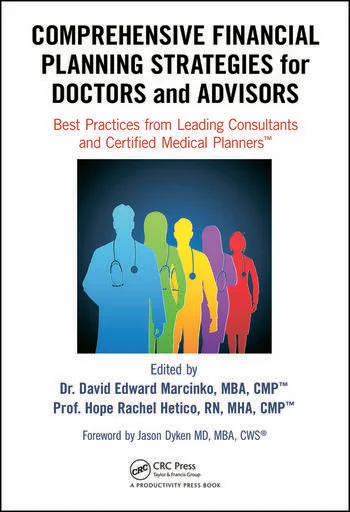
Comprehensive Financial Planning Strategies for Doctors and Advisors: Best Practices from Leading Consultants and Certified Medical Planners™

***

PODCAST: Suicide Financial Crisis Risk?

By Rick Kahler MS CFP

***

***

I lost over $450,000, I cannot pay the bank, I’ll become homeless. Suicide is the only way out.”

This desperate plea summarizes one of the top posts a few months ago on a Reddit forum for the cryptocurrency Terra Luna. Like other cryptocurrencies, it has recently lost more than 99% of its value.

Over the past five years I have written several columns and given a number of media interviews on the risks of speculating in cryptocurrencies. My most recent one generated a conversation with several of my financial planning peers about the recent crypto meltdown. One of them called my attention to the discussions about suicide on cryptocurrency forums, where some members were posting suicide prevention phone numbers.

READ HERE: https://kahlerfinancial.com/financial-awakenings/money-psychology/financial-crisis-and-the-risk-of-suicide

***

COMMENTS APPRECIATED

Thank You

***

ORDER: https://www.routledge.com/Comprehensive-Financial-Planning-Strategies-for-Doctors-and-Advisors-Best/Marcinko-Hetico/p/book/9781482240283

****

INTERVIEW: A Healthcare Financing Solution for Entrepreneurs?

Former: CEO and Founder
Superior Consultant Company, Inc.
[SUPC-NASD]

EDITOR’S NOTE: I first met Rich in B-school, when I was a student, back in the day. He was the Founder and CEO of Superior Consultant Holdings Corp. Rich graciously wrote the Foreword to one of my first textbooks on financial planning for physicians and healthcare professionals. Today, Rich is a successful entrepreneur in the technology, health and finance space.

-Dr. David E. Marcinko MBA MEd CMP®

***

Staff & Contributors - CHAMPIONS OF WAYNE

By Richard Helppie

Today for your consideration – How to fix the healthcare financing methods in the United States?

I use the term “methods” because calling what we do now a “system” is inaccurate. I also focus on healthcare financing, because in terms of healthcare delivery, there is no better place in the world than the USA in terms of supply and innovation for medical diagnosis and treatment. Similarly, I use the term healthcare financing to differentiate from healthcare insurance – because insurance without supply is an empty promise.

This is a straightforward, 4-part plan. It is uniquely American and will at last extend coverage to every US citizen while not hampering the innovation and robust supply that we have today. As this is about a Common Bridge and not about ideology or dogma, there will no doubt be aspects of this proposal that every individual will have difficulty with. However, on balance, I believe it is the most fair and equitable way to resolve the impasse on healthcare funding . . . .

CITE: https://www.r2library.com/Resource/Title/0826102549

Let me start in an area sure to raise the ire of a few. And that is, we have to start with eliminating the methods that are in place today. The first is the outdated notion that healthcare insurance is tied to one’s work, and the second is that there are overlapping and competing tax-supported bureaucracies to administer that area of healthcare finance.

Step 1 is to break the link between employment and health insurance. Fastest way to do that is simply tax the cost of benefits for the compensation that it is. This is how company cars, big life insurance policies and other fringe benefits were trimmed. Eliminating the tax-favored treatment of employer-provided healthcare is the single most important change that should be made.

Yes, you will hear arguments that this is an efficient market with satisfied customers. However, upon examination, it is highly risky, unfair, and frankly out of step with today’s job market.

Employer provided health insurance is an artifact from the 1940’s as an answer to wage freezes – an employer could not give a wage increase, but could offer benefits that weren’t taxed. It makes no sense today for a variety of reasons. Here are a few:

1. Its patently unfair. Two people living in the same apartment building, each making the same income and each have employer provided health insurance. Chris in unit 21 has a generous health plan that would be worth $25,000 each year. Pays zero tax on that compensation. Pat, in unit 42 has a skimpy plan with a narrow network, big deductibles and hefty co-pays. The play is worth $9,000 each year. Pat pays zero tax.

3. The insurance pools kick out the aged. Once one becomes too old to work, they are out of the employer plan and on to the retirement plan or over to the taxpayers (Medicare).

4. The structure is a bad fit. Health insurance and healthy living are longitudinal needs over a long period of time. In a time when people change careers and jobs frequently, or are in the gig economy, they are not any one place long enough for the insurance to work like insurance.

5. Creates perverse incentives. The incentives are weighted to have employers not have their work force meet the standards of employees so they don’t have to pay for the health insurance. Witness latest news in California with Uber and Lyft.

6. Incentives to deny claims abound. There is little incentive to serve the subscriber/patient since the likelihood the employer will shop the plan or the employee will change jobs means that stringing out a claim approval is a profitable exercise.

7. Employers have difficulty as purchasers. An employer large enough to supply health insurance has a diverse set of health insurance needs in their work force. They pay a lot of money and their work force is still not 100% happy.

Net of it, health insurance tied to work has outlived its usefulness. Time to end the tax-favored treatment of employer-based insurance. If an employer wants to provide health insurance, they can do it, but the value of that insurance is reflected in the taxable W-2 wages – now Pat and Chris will be treated equally.

Step 2 is to consolidate the multiple tax-supported bureaus that supply healthcare. Relieve the citizens from having to prove they are old enough, disabled enough, impoverished enough, young enough. Combine Medicare, Medicaid, CHIP, Tricare and even possibly the VA into a single bureaucracy. Every American Citizen gets this broad coverage at some level. Everyone pays something into the system – start at $20 a year, and then perhaps an income-adjusted escalator that would charge the most wealthy up to $75,000. Collect the money with a line on Form 1040.

I have not done the exact math. However, removing the process to prove eligibility and having one versus many bureaucracies has to generate savings. Are you a US Citizen? Yes, then here is your base insurance. Like every other nationalized system, one can expect longer waits, fewer referrals to a specialist, and less innovation. These centralized systems all squeeze supply of healthcare services to keep their spend down. The reports extolling their efficiencies come from the people whose livelihoods depend on the centralized system. However, at least everyone gets something. And, for life threatening health conditions, by and large the centralized systems do a decent job. With everyone covered, the fear of medical bankruptcy evaporates. The fear of being out of work and losing healthcare when one needs it most is gone.

So if you are a free market absolutist, then the reduction of vast bureaucracies should be attractive – no need for eligibility requirements (old enough, etc.) and a single administration which is both more efficient, more equitable (everyone gets the same thing). And there remains a private market (more on this in step 3) For those who detest private insurance companies a portion of that market just went away. There is less incentive to purchase a private plan. And for everyone’s sense of fairness, the national plan is funded on ability to pay. Bearing in mind that everyone has to pay something. Less bureaucracies. Everyone in it together. Funded on ability to pay.

Step 3 is to allow and even encourage a robust market for health insurance above and beyond the national plan – If people want to purchase more health insurance, then they have the ability to do so. Which increases supply, relieves burden on the tax-supported system, aligns the US with other countries, provides an alternative to medical tourism (and the associated health spend in our country) and offers a bit of competition to the otherwise monopolistic government plan.

Its not a new concept, in many respects it is like the widely popular Medigap plans that supplement what Medicare does not cover.

No one is forced to make that purchase. Other counties’ experience shows that those who choose to purchase private coverage over and above a national plan often cite faster access, more choice, innovation, or services outside the universal system, e.g., a woman who chooses to have mammography at an early age or with more frequency than the national plan might allow.  If the insurance provider can offer a good value to the price, then they will sell insurance. If they can deliver that value for more than their costs, then they create a profit. Owners of the company, who risk their capital in creating the business may earn a return.

For those of you who favor a free market, the choices are available. There will be necessary regulation to prevent discrimination on genetics, pre-existing conditions, and the like. Buy the type of plan that makes you feel secure – just as one purchases automobile and life insurance.For those who are supremely confident in the absolute performance of a centralized system to support 300+ million Americans in the way each would want, they should like this plan as well – because if the national plan is meeting all needs and no one wants perhaps faster services, then few will purchase the private insurance and the issuers will not have a business. Free choice. More health insurance for those who want it. Competition keeps both national and private plans seeking to better themselves.

Step 4 would be to Permit Access to Medicare Part D to every US Citizen, Immediately

One of the bright spots in the US Healthcare Financing Method is Medicare Part D, which provides prescription drug coverage to seniors. It is running at 95% subscriber satisfaction and about 40% below cost projections.

Subscribers choose from a wide variety of plans offered by private insurance companies. There are differences in formularies, co-pays, deductibles and premiums.

So there you have it, a four part plan that would maintain or increase the supply of healthcare services, universal insurance coverage, market competition, and lower costs. Its not perfect but I believe a vast improvement over what exists today. To recap:

1. Break the link between employment and healthcare insurance coverage, by taxing the benefits as the compensation they are.

2. Establish a single, universal plan that covers all US citizens paid for via personal income taxes on an ability-to-pay basis.  Eliminate all the other tax-funded plans in favor of this new one.

3. For those who want it, private, supplemental insurance to the national system, ala major industrialized nations.

4. Open Medicare Part D (prescription drugs) to every US citizen. Today.

YOUR THOUGHTS ARE APPRECIATED.

Thank You

***

HOSPITALS: https://www.amazon.com/Financial-Management-Strategies-Healthcare-Organizations/dp/1466558733/ref=sr_1_3?ie=UTF8&qid=1380743521&sr=8-3&keywords=david+marcinko

***

HEALTHCARE: https://www.amazon.com/Hospitals-Healthcare-Organizations-Management-Operational/dp/1439879907/ref=sr_1_4?s=books&ie=UTF8&qid=1334193619&sr=1-4

***

Individuals Working in Health Care Management Rose by 63.8%

By Staff Reporters

***

***

***
Individuals Working in Care Management Rose by 63.8% Nearly 100 entities responded to the Sixth Annual Survey of Healthcare Consumer Engagement Practices. According to the survey: 

•  65.8% of respondents reported that member experience was within the scope of their role in 2021:
 •  40.5% of respondents indicated their role included some responsibility for on-boarding and retention
 •  Individuals working in care management rose by 63.8%
 •  Individuals working in digital transformation rose by 50.4%
 •  Individuals working in population health grew by 47.1%
Source: Engagys, December 16, 2021
CITE: https://www.r2library.com/Resource/Title/082610254

Related: https://medicalexecutivepost.com/2018/02/28/growth-of-physicians-and-administrators-1970-2009/

***

***

COMMENTS APPRECIATED.

Thank You

Subscribe to the Medical Executive-Post

***

***

CASH FLOW ANALYSIS: Real Life ACO Accounting Example

ACCOUNTABLE CARE ORGANIZATION EXAMPLE

Touring with Marcinko | The Leading Business Education ...

BY DR. DAVID EDWARD MARCINKO MBA MEd CMP®

CMP logo

SPONSOR: http://www.CertifiedMedicalPlanner.org

What is an ACO?

ACOs are groups of doctors, hospitals, and other health care providers, who come together voluntarily to give coordinated high-quality care to their Medicare patients. The goal of coordinated care is to ensure that patients get the right care at the right time, while avoiding unnecessary duplication of services and preventing medical errors.

When an ACO succeeds both in delivering high-quality care and spending health care dollars more wisely, the ACO will share in the savings it achieves for the Medicare program.

Citation: https://www.r2library.com/Resource/Title/0826102549

Case Model

Now, suppose that in a new Accountable Care Organization [ACO] contract, a certain medical practice was awarded a new global payment or capitation styled contract that increased revenues by $100,000 for the next fiscal year. The practice had a gross margin of 35% that was not expected to change because of the new business. However, $10,000 was added to medical overhead expenses for another assistant and all Account’s Receivable (AR) are paid at the end of the year, upon completion of the contract.

Cost of Medical Services Provided (COMSP):

The Costs of Medical Services Provided (COMSP) for the ACO business contract represents the amount of money needed to service the patients provided by the contract.  Since gross margin is 35% of revenues, the COMSP is 65% or $65,000.  Adding the extra overhead results in $75,000 of new spending money (cash flow) needed to treat the patients. Therefore, divide the $75,000 total by the number of days the contract extends (one year) and realize the new contract requires about $ 205.50 per day of free cash flows.

Assumptions

Financial cash flow forecasting from operating activities allows a reasonable projection of future cash needs and enables the doctor to err on the side of fiscal prudence. It is an inexact science, by definition, and entails the following assumptions:

  • All income tax, salaries and Accounts Payable (AP) are paid at once.
  • Durable medical equipment inventory and pre-paid advertising remain constant.
  • Gains/losses on sale of equipment and depreciation expenses remain stable.
  • Gross margins remain constant.
  • The office is efficient so major new marginal costs will not be incurred.

Physician Reactions:

Since many physicians are still not entirely comfortable with global reimbursement, fixed payments, capitation or ACO reimbursement contracts; practices may be loath to turn away short-term business in the ACA era.  Physician-executives must then determine other methods to generate the additional cash, which include the following general suggestions:

1. Extend Account’s Payable

Discuss your cash flow difficulties with vendors and emphasize their short-term nature. A doctor and her practice still has considerable cache’ value, especially in local communities, and many vendors are willing to work them to retain their business

2. Reduce Accounts Receivable

According to most cost surveys, about 30% of multi-specialty group’s accounts receivable (ARs) are unpaid at 120 days. In addition, multi-specialty groups are able to collect on only about 69% of charges. The rest was written off as bad debt expenses or as a result of discounted payments from Medicare and other managed care companies. In a study by Wisconsin based Zimmerman and Associates, the percentages of ARs unpaid at more than 90 days is now at an all time high of more than 40%. Therefore, multi-specialty groups should aim to keep the percentage of ARs unpaid for more than 120 days, down to less than 20% of the total practice. The safest place to be for a single specialty physician is probably in the 30-35% range as anything over that is just not affordable.

The slowest paid specialties (ARs greater than 120 days) are: multi-specialty group practices; family practices; cardiology groups; anesthesiology groups; and gastroenterologists, respectively. So work hard to get your money, faster. Factoring, or selling the ARs to a third party for an immediate discounted amount is not usually recommended.

3. Borrow with Short-Term Bridge Loans

Obtain a line of credit from your local bank, credit union or other private sources, if possible in an economically constrained environment. Beware the time value of money, personal loan guarantees, and onerous usury rates. Also, beware that lenders can reduce or eliminate credit lines to a medical practice, often at the most inopportune time.

4. Cut Expenses

While this is often possible, it has to be done without demoralizing the practice’s staff.

5.  Reduce Supply Inventories

If prudently possible; remember things like minimal shipping fees, loss of revenue if you run short, etc.

6. Taxes

Do not stop paying withholding taxes in favor of cash flow because it is illegal.

Hyper-Growth Model:

Now, let us again suppose that the practice has attracted nine more similar medical contracts. If we multiple the above example tenfold, the serious nature of potential cash flow problem becomes apparent. In other words, the practice has increased revenues to one million dollars, with the same 35% margin, 65% COMSP and $100,000 increase in operating overhead expenses.  Using identical mathematical calculations, we determine that $750,000 / 365days equals $2,055.00 per day of needed new free cash flows!  Hence, indiscriminate growth without careful contract evaluation and cash flow analysis is a prescription for potential financial disaster.

ASSESSMENT: Your comments are appreciated.

INVITE DR. MARCINKO: https://medicalexecutivepost.com/dr-david-marcinkos-

CONTACT: Ann Miller RN MH

[Executive Director]

THANK YOU

BUSINESS: https://www.amazon.com/Business-Medical-Practice-Transformational-Doctors/dp/0826105750/ref=sr_1_9?ie=UTF8&qid=1448163039&sr=8-9&keywords=david+marcinko

***

Recognizing the Differences between Healthcare and Other Industries

Why Hospitals, Clinics and Medical Offices are Not Hotels, or Manufacturing Plants or Production Assembly Lines, etc!

By Dr. David E. Marcinko FACFAS, MBA, MEd, CMP™

[Editor-in-Chief]

The rising cost of health insurance remains a major concern for business; despite the Affordable Care Act [ACA] of March 2010. Local and national news publications have trumpeted that healthcare costs are not just rising but are growing in proportion to the cost of other goods and services.

Many of these publications have expressed the widely held view that because of the “inflation gap,” the cost of medical expenses needs curbing.  Proponents of this viewpoint attribute the growth in the gross domestic product (GDP) devoted to personal medical services (from 5% in 1965 to approximately 14% in 2005 and 17% in 2012) to increases in both total national medical expenditures as well as prices for specific services, and then conclude that there is a need to rein in the growing costs of healthcare services for the average American, even if it be through a legislative mandate.

Healthcare Is the Economy

According to colleague Robert James Cimasi MHA, AVA, CMP™ of Health Capital Consultants LLC in St. Louis, MO, healthcare cannot be separated from the economy at large. Although economists have cited the aging population as the reason for the increase in healthcare’s share of the GDP, other voices assert that financial greed among HMOs, pharmaceutical companies, hospitals, and medical providers like doctors and nurses is responsible.  In reality, the rise in healthcare expenditures is, at least in large part, the result of a much deeper economic force.

www.CertifiedMedicalPlanner.org

As economist William J. Baumol of New York University explained in a November 1993 New Republic article: “the relative increase in healthcare costs compared with the rest of the economy is inevitable and an ineradicable part of a developed economy. The attempt [to control relative costs] may be as foolhardy as it is impossible”.

Baumol’s observation is based on documented and significant differences in productivity growth between the healthcare sector of the economy and the economy as a whole.

Low Productivity Growth

Healthcare services have experienced significantly lower productivity growth rates than other industry sectors for three reasons, according to Cimasi:

1) Healthcare services are inherently resistant to automation. Innovation in the form of technological advancement has not made the same impact on healthcare productivity as it has in other industry sectors of the economy.  The manufacturing process can be carried out on an assembly line where thousands of identical (or very similar) items can be produced under the supervision of a few humans utilizing robots and statistical sampling techniques (e.g., defects per 1,000 units). The robot increases assembly line productivity by accelerating the process and reducing labor input. In medicine, most technology is still applied in a patient-by-patient manner — a labor-intensive process. Patients are cared for one at a time. Hospitals and physician offices cannot (and, most would agree, should not) try to operate as factories because patients are each unique and disease is widely variable.

2) Healthcare is local. Unlike other labor-intensive industries (e.g., shoe making), healthcare services are essentially local in nature. They cannot regularly be delivered from Mexico, India or Malaysia.  They must be provided locally by local labor.  Healthcare organizations must compete within a local community with low or no unemployment among skilled workers for high quality and higher cost labor.

3) Healthcare quality is — or is believed to be — correlated with the amount of labor expended. For example, a 30-minute office visit with a physician is perceived to be of higher quality than a 10-minute office visit. In mass production, the number of work-hours per unit is not as important a predictor of product quality as the skills and talents of a small engineering team, which may quickly produce a single design element for thousands of products (e.g., a common car chassis).

Assessment

Healthcare suffers a number of serious consequences when its productivity grows at a slower rate than other industries, the most serious being higher relative costs for healthcare services. The situation is an inevitable and ineradicable part of a developed economy.

For example, as technological advancements increase productivity in the computer, and eHR, manufacturing industry, wages for computer industry labor likewise increase. However, the total cost per computer produced actually declines.  But in healthcare (where technological advancements do not currently have the same impact on productivity), wage increases that would be consistent with other sectors of the economy yield a problem: the cost per unit of healthcare produced increases.

Conclusion

Your thoughts and comments on this ME-P are appreciated. Feel free to review our top-left column, and top-right sidebar materials, links, URLs and related websites, too. Then, subscribe to the ME-P. It is fast, free and secure.

Speaker: If you need a moderator or speaker for an upcoming event, Dr. David E. Marcinko; MBA – Publisher-in-Chief of the Medical Executive-Post – is available for seminar or speaking engagements. Contact: MarcinkoAdvisors@msn.com

OUR OTHER PRINT BOOKS AND RELATED INFORMATION SOURCES:

PRACTICES: www.BusinessofMedicalPractice.com
HOSPITALS: http://www.crcpress.com/product/isbn/9781466558731
CLINICS: http://www.crcpress.com/product/isbn/9781439879900
BLOG: www.MedicalExecutivePost.com
FINANCE: Financial Planning for Physicians and Advisors

Product DetailsProduct DetailsProduct Details

Product DetailsProduct Details

Product Details

What Kind of [Physician] Entrepreneur Are You?

More Doctors are Joining the Ranks

http://www.MarcinkoAssociates.com

Marcnko & Associates

[Medical] entrepreneurs, doctors and nurses, clinics and small-to-medium size healthcare business are on the forefront of  job creation in the United States because of the Affordable Care Act [ACA] of 2010.

And so, we now preview this infographic to celebrate the entrepreneur, their styles, and to investigate the data behind startup growth. Hopefully, it will encourage the next generation of physician-entrepreneurs.

Who knows, there just may be the next Steve Jobs MD out there!

Source: BizSugar

Conclusion

And so, your thoughts and comments on this ME-P are appreciated. Feel free to review our top-left column, and top-right sidebar materials, links, URLs and related websites, too. Then, subscribe to the ME-P. It is fast, free and secure.

Speaker: If you need a moderator or speaker for an upcoming event, Dr. David E. Marcinko; MBA – Publisher-in-Chief of the Medical Executive-Post – is available for seminar or speaking engagements. Contact: MarcinkoAdvisors@msn.com

Subscribe Now: Did you like this Medical Executive-Post, or find it helpful, interesting and informative? Want to get the latest ME-Ps delivered to your email box each morning? Just subscribe any time.

Sponsors Welcomed: And, credible sponsors and like-minded advertisers are always welcomed. Link: https://healthcarefinancials.wordpress.com/2007/11/11/advertise

Product Details

MEDICAL PRACTICE MANAGEMENT: Consulting & Advice

START TO FINISH CYCLE

SPONSORED: http://www.MARCINKOASSOCIATES.com

***

Our Process

***

READ: https://marcinkoassociates.com/case-studies/

COMMENTS APPRECIATED

Thank You

***

***

DE MARCINKO & ASSOCIATES: Financial, Business & Management Education and Advisory Opinions for Physicians

By Dr. David Edward Marcinko MBA MEd CMP

“AT YOUR SERVICE”

E-mail: MarcinkoAdvisors@msn.com

SPONSOR: http://www.MarcinkoAssociates.com

Marcinko & Associates is financial guide. We help answer your questions in an empowering way. We educate and guide medical colleagues to understand their financial picture and to make better financial decisions. We strive to simplify everything, clear up confusion, and address specific needs and goals.

Simply put, we’re a financial services company on a mission to empower financial freedom for all healthcare professionals; only. We work with doctors, nurses, medical providers, individuals and all sizes of organizations to offer investment, wealth management and retirement solutions so everyone can have a clear and simple understanding of where their finances and career is today and where it is headed tomorrow.

Whatever your financial situation, we do not shame, criticize, or sell. We enrich, educate and empower. We work only with medical colleagues at every stage of their financial journey [students, interns, residents, practitioners, mid-career and mature physicians], through big life personal changes to annual employment reviews, in order to help them understand, invest, and protect their money and lifestyle.

CITE: https://www.r2library.com/Resource

For example, the following are current issues of review need for each Fall and Winter:

  • Financial planning reviews: 401-k, insurance, budget plans, investing, debt and savings, etc
  • Assess, develop, and align financial retirement and estate planning goals
  • Risk Management: Malpractice, home, life, medical, auto and personal indemnity
  • Life Insurance Need Reviews: whole, universal and term  
  • Business, operations, HR, employment negotiations and medical practice management
  • Annuity Need Reviews: Indexed and Fixed [Pros and Cons].

***

***

At Marcinko & Associates we discuss specific needs and answer specific questions. We educate and make personalized recommendations that you are free to use, incorporate or disregard. Referrals to trusted specialists and strategic alliance partners then occur if – and as – needed [pro re nata].

SPONSOR: http://www.CertifiedMedicalPlanner.org

***


iMBA Inc = Supporting Doctors and their Consulting Advisors

The Medical Executive-Post Educational Resource

[By Ann Miller RN MHA]

We are an emerging online and onground community that connects medical professionals with financial advisors and management consultants. We participate in a variety of insightful educational seminars, teaching conferences and national workshops. We produce journals, textbooks and handbooks, white-papers, CDs and award-winning dictionaries. And, our didactic heritage includes innovative R&D, litigation support, opinions for engaged private clients and media sourcing in the sectors we passionately serve.

Through the balanced collaboration of this rich-media sharing and ranking forum, we have become a leading network at the intersection of healthcare administration, practice management, medical economics, business strategy and financial planning for doctors and their consulting advisors. Even if not seeking our products or services, we hope this knowledge silo is useful to you. Our content creation—including speaking topics, articles and course development—is client-driven.

In the Health 2.0 era of political reform, our goal is to: “bridge the gap between practice mission and financial solidarity for all medical professionals.”  

THE CHALLENGE

Join the ME-P Nation today … and tell us what you think!

challenge

***

Risk Management, Liability Insurance, and Asset Protection Strategies for Doctors and Advisors: Best Practices from Leading Consultants and Certified Medical Planners™8Comprehensive Financial Planning Strategies for Doctors and Advisors: Best Practices from Leading Consultants and Certified Medical Planners™

Product DetailsProduct Details

Product DetailsProduct DetailsProduct Details

Product Details

 BOOK REVIEW

Am I over-insured and thus wasting money? Am I under-insured and thus at risk for a liability or other disaster? I never really had the means of answering these questions; until now.

LLOYD M. KRIEGER; MD, MBA

[Rodeo Drive Plastic Surgery – Beverly Hills, CA]

FEELING WEALTHY: How Much is [Really] Enough?

By Staff Reporters

***

***

At the most general level, economists may define wealth as “the total of anything of value” that captures both the subjective nature of the idea and the idea that it is not a fixed or static concept. Various definitions and concepts of wealth have been asserted by various people in different contexts. Defining wealth can be a normative process with various ethical implications, since often wealth maximization is seen as a goal or is thought to be a normative principle of its own. A community, region or country that possesses an abundance of such possessions or resources to the benefit of the common good is known as wealthy.

What does wealth mean to you?

In a recent survey by Edelman Financial Engines, 57% of respondents said they’d feel wealthy if they had $1 million in the bank. But for many people, that’s not enough.

Among those with $500,000 and $3 million in assets, 53% said it would take over $3 million in the bank for them to feel wealthy, and 33% said it would take over $5 million. Given that these are amounts some people will never even come close to amassing in their lifetimes, it may be hard to wrap your head around these answers.

***

ORDER: https://www.routledge.com/Comprehensive-Financial-Planning-Strategies-for-Doctors-and-Advisors-Best/Marcinko-Hetico/p/book/9781482240283

***

COMMENTS APPRECIATED

Thank You

***

CAREER: Physician Coaching and Development

MARCINKO ASSOCIATES, Inc.

SPONSOR: http://www.MarcinkoAssociates.com

***

***

Did you Know?

Experts estimate that it can cost more than $1 million to recruit and train a replacement for a doctor who leaves the profession because of burnout. But, as no broad calculation of burnout costs exists, Dr. Tait Shanafelt [Mayo Clinic researcher and Stanford Medicine’s first Chief Physician Wellness Officer] said Stanford, Harvard Business School, Mayo Clinic and the American Medical Association (AMA) are further cost estimating the issue. Nevertheless, Shanafelt and other researchers have shown that burnout erodes job performance, increases medical errors, and leads doctors to leave a profession they once loved.

CITE: https://www.r2library.com/Resource

Fortunately, we can help. From formal coaching to second career opinions, mentoring and advising, we can help with our remediation executive career programs. Regardless of what is happening in your life, it is wonderful to have a non-partial, confidential and informed career coach and sounding board on your side.

CITE: JAMA Internal Medicine [Effect of a Professional Coaching Intervention on the Well-Being and Distress of Physicians].

NCBI: https://www.ncbi.nlm.nih.gov/pmc/articles/PMC6686971/

THANK YOU

CONTACT US: https://marcinkoassociates.com/process-what-we-do/

***

DAILY UPDATE: Google DOJ, Big Lots Bankrupt, Starbucks CEO, Rite Aid Private as Markets Rise

MEDICAL EXECUTIVE-POST TODAY’S NEWSLETTER BRIEFING

REMEMBER SEPTEMBER 11th – PATRIOT DAY

***

Essays, Opinions and Curated News in Health Economics, Investing, Business, Management and Financial Planning for Physician Entrepreneurs and their Savvy Advisors and Consultants

Serving Almost One Million Doctors, Financial Advisors and Medical Management Consultants Daily

A Partner of the Institute of Medical Business Advisors , Inc.

http://www.MedicalBusinessAdvisors.com

SPONSORED BY: Marcinko & Associates, Inc.

***

http://www.MarcinkoAssociates.com

Daily Update Provided By Staff Reporters Since 2007.
How May We Serve You?
© Copyright Institute of Medical Business Advisors, Inc. All rights reserved. 2024

REFER A COLLEAGUE: MarcinkoAdvisors@msn.com

SPONSORSHIPS AVAILABLE: https://medicalexecutivepost.com/sponsors/

ADVERTISE ON THE ME-P: https://tinyurl.com/ytb5955z

Your Referral Count -0-

Rite Aid completed its financial restructuring by eliminating $2 billion in debt and adding $2.5 billion in exit financing, as the slimmed-down chain is now led by a new CEO

Google reported to court yesterday to defend itself against monopoly allegations for the second time in less than a year in a new case that has the potential to strip the world’s largest online advertiser of a chunk of its ad business.

And, Apple and Google lost on appeal to the European Union’s highest court Tuesday in two separate cases requiring the tech giants to face billions of dollars in fines. The decisions by the Court of Justice of the European Union mark a significant win for the bloc’s antitrust chief Margrethe Vestager.

CITE: https://www.r2library.com/Resource

What’s up

  • Mission Produce soared 21.05% after the farming company announced impressive revenue growth last quarter thanks to rising avocado, blueberry, and mango prices. Rival produce producer Calavo Growers announced similarly strong results for much the same reasons, pushing shares 10.75% higher.
  • Alibaba rose 2.90% after its Hong Kong shares were added to a new program linking Hong Kong stocks with Chinese stock exchanges, which should help attract more investors.
  • Boot Barn, which is the name of a real company that sells Western apparel, popped 9.94% and hit an all-time high today after a JPMorgan analyst raised his price target 10%.

What’s down

  • Southwest Airlines descended 1.61% after Executive Chairman Gary Kelly announced he’ll retire next year in the face of activist investing pressure.
  • Ally Financial plummeted 17.65% after the consumer lending company’s CEO highlighted ongoing credit challenges in today’s economy.
  • JPMorgan sank 5.21% thanks to comments from its COO that investor expectations for net interest income, a key part of the bank’s business, are too high.
  • Hewlett Packard Enterprise dropped 8.41% on the news that the tech company will sell $1.35 billion in preferred stock to fund its acquisition of Juniper Networks.

CITE: https://tinyurl.com/2h47urt5

Here’s where the major benchmarks ended:

  • The SPX rose 24.47 points (0.45%) to 5,495.52; Dow Jones Industrial Average® ($DJI) fell 92.63 points (–0.23%) to 40,736.96; NASDAQ Composite® ($COMP)added 141.27 points (0.84%) 17,025.88.
  • The 10-year Treasury note yield (TNX) dropped five basis points to 3.64%, the lowest close since mid-2023.
  • The CBOE Volatility Index® (VIX) continued to pull back from last week’s elevations, closing at 19.08.

CITE: https://tinyurl.com/tj8smmes

Big Lots, the 1,300+ store discount chain, has filed for bankruptcy with a plan to sell itself to private equity firm Nexus Capital Management for ~$760 million and a commitment to keep offering “extreme bargains.”

The new CEO of Starbucks, Brian Niccol, formerly of Chipotle, is now officially in charge of the coffee chain.

Visualize: How private equity tangled banks in a web of debt, from the Financial Times.

COMMENTS APPRECIATED

PLEASE SUBSCRIBE: MarcinkoAdvisors@msn.com

Thank You

***

***

***

***

EDUCATIONAL TEXTBOOKS: https://tinyurl.com/4zdxuuwf

***

PHYSICIAN FINANCIAL & BUSINESS ADVICE ONLY – Not Sales!

MISSION STATEMENT

Open Letter from the CEO

Dr. David Edward Marcinko MBA CMP™

http://www.MarcinkoAssociates.com

ALL MEDICAL AND HEALTHCARE COLLEAGUES

Did you know that at MARCINKO & Associates, all medical colleagues throughout the United States may contact us when they are considering the sale, purchase, strategic operating improvement, merger, acquisition and/or other financial business or related personal financial planning transaction?

MORE: https://marcinkoassociates.com/welcome-medical-colleagues/

***

Our difference is “hard” knowledge and insider financial guidance that helps medical colleagues, nurses, private practitioners, clinics, ambulatory surgery, radiology and outpatient wound care centers realize their ultimate economic goals. This typically includes managerial and cost accounting, financial ratio analysis, fair market valuation business appraisals, business plan creation and personal financial planning.

MORE: https://marcinkoassociates.com/fmv-appraisals/

Our “expert witness” business litigation support service and divorce mediation, arbitration, asset division, settlement and second opinion offerings are always available, as well.

MORE: https://marcinkoassociates.com/expert-witness/

And, our “soft” skill professional career guidance and mentoring center includes executive coaching, consulting and mentoring advisory programs for stressed, conflicted or burned-out physicians and medical practitioners.

Most importantly, our professional fees are reasonable and always transparent.

MARCINKO & Associates also serves universities, medical, business, graduate and nursing schools; physicians, dentists, podiatrists, optometrists and legal societies. This includes accountants, financial service providers, wealth and hedge fund managers, emerging entities, hospitals, CEOs and their BODs, the press, media and related organizations.

MORE: https://marcinkoassociates.com/speaking-seminars/

Contact us for an educational white-paper on most any topic.

MORE: https://marcinkoassociates.com/case-studies/

***

Now, please review our website to learn more.

And, always retain us when needed.

How May We Serve You?

DAVID EDWARD MARCINKO

email: MarcinkoAdvisors@msn.com

***

© Copyright: Institute of Medical Business Advisors, Inc. All rights reserved, USA. Present to 2024.

DENTAL OFFICE: Cyber Hacks

By Staff Reporters

***

***

Recently, the FBI warned the American Dental Association in May of the potential danger to providers from hackers. In May 2023, hackers attacked Delta Dental of California in a breach exposing the information of around 7 million patients.

And, in April 2023, Aspen Dental—a chain with more than 1,000 dentists’ offices across the country—suffered a ransomware hack that exposed user data, including health insurance information and Social Security numbers.

COMMENTS APPRECIATED

Thank You

***

***

THE DIFFERENT SCHOOLS OF PSYCHOLOGY

Five [5] Schools

By staff reporters

***

***

***

HEALTH CARE: Cyber Attack Costs

By Staff Reporters

***

***

Cyberattacks are causing issues across all sorts of industries, from Microsoft to AT&T to Ascension. But it looks like the healthcare industry is getting hit the hardest—financially, at least.

The 2024 Cost of a Data Breach Report from IBM and think tank Ponemon Institute found that the global average cost of a data breach rose 10% between March 2023 and February 2024, reaching a total average cost of $4.88 million in that period. Costs for disruptions to business processes and post-breach customer support and remediation were the largest drivers behind the increase.

However, of the 17 industries studied, healthcare had the most expensive data breaches, with an average cost of $9.77 million during that same period. In fact, healthcare has held the No. 1 spot for costliest breaches since 2011, according to the study.

For comparison, the next highest average cost was in finance, at $6.08 million.

CITE: https://www.r2library.com/Resource

COMMENTS APPRECIATED

Thank You

***

***

On Wall Street’s Suitability, Prudence and Fiduciary Accountability

Financial Advisor’s are Not Doctors!

dr-david-marcinko1

Dr. David E. Marcinko FACFAS MBA MEd CMP™ MBBS

THRIVE-BECOME A CMP™ Physician Focused Fiduciary

http://www.CertifiedMedicalPlanner.org

Financial advisors don’t ascribe to the Hippocratic Oath.  People don’t go to work on “Wall Street” for the same reasons other people become firemen and teachers.  There are no essays where they attempt to come up with a new way to say, “I just want to help people.”

Financial Advisor’s are Not Doctors

Some financial advisors and insurance agents like to compare themselves to CPAs, attorneys and physicians who spend years in training and pass difficult tests to get advanced degrees and certifications. We call these steps: barriers-to-entry. Most agents, financial product representatives and advisors, if they took a test at all, take one that requires little training and even less experience. There are few BTEs in the financial services industry.

For example, most insurance agent licensing tests are thirty minutes in length. The Series #7 exam for stock brokers is about 2 hours; and the formerly exalted CFP® test is about only about six [and now recently abbreviated]. All are multiple-choice [guess] and computerized. An aptitude for psychometric savvy is often as important as real knowledge; and the most rigorous of these examinations can best be compared to a college freshman biology or chemistry test in difficulty.

Yet, financial product salesman, advisors and stock-brokers still use lines such as; “You wouldn’t let just anyone operate on you, would you?” or “I’m like your family physician for your finances.  I might send you to a specialist for a few things, but I’m the one coordinating it all.”  These lines are designed to make us feel good about trusting them with our hard-earned dollars and, more importantly, to think of personal finance and investing as something that “only a professional can do.”

Unfortunately, believing those lines can cost you hundreds of thousands of dollars and years of retirement.

***

231_1

***

Suitability Rule

A National Association of Securities Dealers [NASD] / Financial Industry Regulatory Authority [FINRA] guideline that require stock-brokers, financial product salesman and brokerages to have reasonable grounds for believing a recommendation fits the investment needs of a client. This is a low standard of care for commissioned transactions without relationships; and for those “financial advisors” not interested in engaging clients with advice on a continuous and ongoing basis. It is governed by rules in as much as a Series #7 licensee is a Registered Representative [RR] of a broker-dealer. S/he represents best-interests of the firm; not the client.

And, a year or so ago there we two pieces of legislation for independent broker-dealers-Rule 2111 on suitability guidelines and Rule 408(b)2 on ERISA. These required a change in processes and procedures, as well as mindset change.

Note: ERISA = The Employee Retirement Income Security Act of 1974 (ERISA) codified in part a federal law that established minimum standards for pension plans in private industry and provides for extensive rules on the federal income tax effects of transactions associated with employee benefit plans. ERISA was enacted to protect the interests of employee benefit plan participants and their beneficiaries by:

  • Requiring the disclosure of financial and other information concerning the plan to beneficiaries;
  • Establishing standards of conduct for plan fiduciaries ;
  • Providing for appropriate remedies and access to the federal courts.

ERISA is sometimes used to refer to the full body of laws regulating employee benefit plans, which are found mainly in the Internal Revenue Code and ERISA itself. Responsibility for the interpretation and enforcement of ERISA is divided among the Department Labor, Treasury, IRS and the Pension Benefit Guarantee Corporation.

Yet, there is still room for commissioned based FAs. For example, some smaller physician clients might have limited funds [say under $100,000-$250,000], but still need some counsel, insight or advice.

Or, they may need some investing start up service from time to time; rather than ongoing advice on an annual basis. Thus, for new doctors, a commission based financial advisor may make some sense. 

Prudent Man Rule

This is a federal and state regulation requiring trustees, financial advisors and portfolio managers to make decisions in the manner of a prudent man – that is – with intelligence and discretion. The prudent man rule requires care in the selection of investments but does not limit investment alternatives. This standard of care is a bit higher than mere suitability for one who wants to broaden and deepen client relationships. 

***

student-849825_640

***

Prudent Investor Rule

The Uniform Prudent Investor Act (UPIA), adopted in 1992 by the American Law Institute’s Third Restatement of the Law of Trusts, reflects a modern portfolio theory [MPT] and total investment return approach to the exercise of fiduciary investment discretion. This approach allows fiduciary advisors to utilize modern portfolio theory to guide investment decisions and requires risk versus return analysis. Therefore, a fiduciary’s performance is measured on the performance of the entire portfolio, rather than individual investments 

Fiduciary Rule

The legal duty of a fiduciary is to act in the best interests of the client or beneficiary. A fiduciary is governed by regulations and is expected to judge wisely and objectively. This is true for Investment Advisors [IAs] and RIAs; but not necessarily stock-brokers, commission salesmen, agents or even most financial advisors. Doctors, lawyers, and the clergy are prototypical fiduciaries. 

***

business-insurance

***

More formally, a financial advisor who is a fiduciary is legally bound and authorized to put the client’s interests above his or her own at all times. The Investment Advisors Act of 1940 and the laws of most states contain anti-fraud provisions that require financial advisors to act as fiduciaries in working with their clients. However, following the 2008 financial crisis, there has been substantial debate regarding the fiduciary standard and to which advisors it should apply. In July of 2010, The Dodd-Frank Wall Street Reform and Consumer Protection Act mandated increased consumer protection measures (including enhanced disclosures) and authorized the SEC to extend the fiduciary duty to include brokers rather than only advisors, as prescribed in the 1940 Act. However, as of 2014, the SEC has yet to extend a meaningful fiduciary duty to all brokers and advisors, regardless of their designation.

The Fiduciary Oath: fiduciaryoath_individual

Assessment 

Ultimately, physician focused and holistic “financial lifestyle planning” is about helping some very smart people change their behavior for the better. But, one can’t help doctors choose which opportunities to take advantage of along the way unless there is a sound base of technical knowledge to apply the best skills, tools, and techniques to achieve goals in the first place.

Most of the harms inflicted on consumers by “financial advisors” or “financial planners” occur not due to malice or greed but ignorance; as a result, better consumer protections require not only a fiduciary standard for advice, but a higher standard for competency.

The CFP® practitioner fiduciary should be the minimum standard for financial planning for retail consumers, but there is room for post CFP® studies, certifications and designations; especially those that support real medical niches and deep healthcare specialization like the Certified Medical Planner™ course of study [Michael E. Kitces; MSFS, MTax, CLU, CFP®, personal communication].

Being a financial planner entails Life-Long-Learning [LLL]. One should not be allowed to hold themselves out as an advisor, consultant, or planner unless they are held to a fiduciary standard, period. Corollary – there’s nothing wrong with a suitability standard, but those in sales should be required to hold themselves out as a salesperson, not an advisor.

The real distinction is between advisors and salespeople. And, fiduciary standards can accommodate both fee and commission compensation mechanisms. However; there must be clear standards and a process to which advisors can be held accountable to affirm that a recommendation met the fiduciary obligation despite the compensation involved.

Ultimately, being a fiduciary is about process, not compensation.

More: Deception in the Financial Service Industry

Full Disclosure:

As a medical practitioner, Dr. Marcinko is a fiduciary at all times. He earned Series #7 (general securities), Series #63 (uniform securities state law), and Series #65 (investment advisory) licenses from the National Association of Securities Dealers (NASD-FINRA), and the Securities Exchange Commission [SEC] with a life, health, disability, variable annuity, and property-casualty license from the State of Georgia.

Dr.Marcinko was a licensee of the CERTIFIED FINANCIAL PLANNER™ Board of Standards (Denver) for a decade; now reformed, and holds the Certified Medical Planner™ designation (CMP™). He is CEO of iMBA Inc and the Founding President of: http://www.CertifiedMedicalPlanner.org

More: Enter the CMPs

***

[PHYSICIAN FOCUSED FINANCIAL PLANNING AND RISK MANAGEMENT COMPANION TEXTBOOK SET]

  Risk Management, Liability Insurance, and Asset Protection Strategies for Doctors and Advisors: Best Practices from Leading Consultants and Certified Medical Planners™  Comprehensive Financial Planning Strategies for Doctors and Advisors: Best Practices from Leading Consultants and Certified Medical Planners™

[Dr. Cappiello PhD MBA] *** [Foreword Dr. Krieger MD MBA]

[Two Newest Books by Marcinko annd the iMBA, Inc Team]

Conclusion

Your thoughts and comments on this ME-P are appreciated. Feel free to review our top-left column, and top-right sidebar materials, links, URLs and related websites, too. Then, subscribe to the ME-P. It is fast, free and secure.

Speaker: If you need a moderator or speaker for an upcoming event, Dr. David E. Marcinko; MBA – Publisher-in-Chief of the Medical Executive-Post – is available for seminar or speaking engagements. Contact: MarcinkoAdvisors@msn.com

OUR OTHER PRINT BOOKS AND RELATED INFORMATION SOURCES:

***

Product DetailsProduct Details

Product DetailsProduct DetailsProduct Details

[PRIVATE MEDICAL PRACTICE BUSINESS MANAGEMENT TEXTBOOK – 3rd.  Edition]

Product DetailsProduct Details

  [Foreword Dr. Hashem MD PhD] *** [Foreword Dr. Silva MD MBA]

***

AbbVie: The Economic Recession Index?

The BOTOX Predictor Index?

By Staff Reporters

***

***

It’s looking more than likely that we’ll see a recession in the next year, and Americans are preparing themselves by taking steps like delaying major purchases, allocating more of their income to savings, and staying in jobs they don’t love. Another thing they’re not doing? Getting Botox. And that’s bad news for AbbVie; according to Neal Freyman of Morning Brew.

AbbVie, one of the biggest drug manufacturers in the US, brought Botox into its medical aesthetics portfolio—which also includes the popular dermal filler Juvederm—in 2020, when it bought rival drug maker Allergan for $63 billion. AbbVie CEO Richard Gonzalez said during the company’s Oct. 28th earnings call that the company expects the aesthetics business to take a hard hit in 2024 as recession fears cause consumers to be more cautious with their spending.

“Based on all the data we’ve been observing, especially in the US, with both the consumer-confidence index and real personal consumption expenditures trending down and continued high inflation, these factors are putting pressure on consumer’s discretionary spending,” Gonzalez said.

AbbVie lowered its 2022-23 full-year forecast for its aesthetics business by $600 million, down to $5.3 billion. After the earnings call, AbbVie’s stock fell 4.3%. Through the third quarter of 2022, Botox has brought in $1.97 billion for the aesthetics business. The third quarter saw $637 million in cosmetic Botox sales, down from an expected $640 million. Gonzalez said he doesn’t think the hit on sales will last long, though.

***

***

“As consumer confidence improves, we would once again expect the market growth to accelerate. Our aesthetics portfolio experienced a rapid and sustained recovery following the 2008, 2009 recession,” Gonzalez said.

But Botox also faces a new competitor, called Daxxify, which just got FDA approval in September. Made by Revance Therapeutics, the drug may last longer: In clinical trials, Daxxify injections lasted six to nine months, while Botox injections typically last three months.

***

ORDER: https://www.routledge.com/Comprehensive-Financial-Planning-Strategies-for-Doctors-and-Advisors-Best/Marcinko-Hetico/p/book/9781482240283

***

COMMENTS APPRECIATED

Thank You

***

RETIREMENT: America’s Millionaires

By Staff Reporters

***

***

It seems many of America’s millionaires are saving for retirement. Thanks largely to a stock market, the number of 401(k) millionaires hit a new record last quarter—rising 2.5% to 497,000, as per Fidelity. It was the third quarter in a row of growth for retirement savings, Quartz reports, and the average amount in retirement accounts hit $127,100.

CITE: https://www.r2library.com/Resource

But even those who have made it to the $1 million mark haven’t quite hit the figure most Americans think they need to retire comfortably. That’d be $1.46 million, according to the latest survey by Northwestern Mutual.

COMMENTS APPRECIATED

Thank You

***

***

Traditional Reasons for a Medical Practice Financial Valuation

Some economic reasons for a medical practice valuation 

http://www.MarcinkoAssociates.com

By Dr. David Edward Marcinko MBA MEd CMP™

http://www.CertifiedMedicalPlanner.org

The decision to sell, buy or merge a medical practice, while often financially driven, and is inherently an emotional one for these impact investors who went into the profession largely because of a deep seated zeal to help others.

Still, beyond impact investing musings, there are other economic reasons for a practice valuation that include changes in ownership, determining insurance coverage for a practice buy-sell agreement or upon a physician-owner’s death, organic growth meter, establishing stock options, or bringing in a new partner; etc.

Practice appraisals are also used for legal reasons such as divorce, bankruptcy, breach of contract and minority shareholder complaints. In 2002, the Financial Accounting Standards Board (FASB) issued rules that required certain intangible assets to be valued, such as goodwill. This may be important for practices seeking start-up, service segmentation extensions, or operational funding. Some other reasons for a medical practice appraisal, and the considerations that go along with them, are discussed here.

MORE: https://www.crcpress.com/Risk-Management-Liability-Insurance-and-Asset-Protection-Strategies-for/Marcinko-Hetico/p/book/9781498725989

Estate Planning

Medical practice valuation may be required for estate planning purposes. For a decedent physician with a gross estate of more than current in-place tax limits, his or her assets must be reported at fair market value on an estate tax return. If lifetime gifts of a medial practice business interest are made, it is generally wise to obtain an appraisal and attach it to the gift tax return.

Note that when a “closely-held” level of value (in contrast to “freely traded,” “marketable,” or “publicly traded” level) is sought, the valuation consultant may need to make adjustments to the results. There are inherent risks relative to the liquidity of investments in closely held, non-public companies (e.g., medical group practice) that are not relevant to the investment in companies whose shares are publicly traded (freely-traded). Investors in closely-held companies do not have the ability to dispose of an invested interest quickly if the situation is called for, and this relative lack of liquidity of ownership in a closely held company is accompanied by risks and costs associated with the selling of an interest said company (i.e., locating a buyer, negotiation of terms, advisor/broker fees, risk of exposure to the market, etc.). Conversely, investors in the stock market are most often able to sell their interest in a publicly traded company within hours and receive cash proceeds in a few days. Accordingly, a discount may be applicable to the value of a closely held company due to the inherent illiquidity of the investment. Such a discount is commonly referred to as a “discount for lack of marketability.”

Discount for lack of marketability is typically discussed in three categories: (1) transactions involving restricted stock of publicly traded companies; (2) private transactions of companies prior to their initial public offering (IPO); and, (3) an analysis and comparison of the price to earnings (P/E) ratios of acquisitions of public and private companies respectively published in the “Mergerstat Review Study.”\

With a non-controlling interest, in which the holder cannot solely authorize and cannot solely prevent corporate actions (in contrast to a controlling interest), a “discount for lack of control,” (DLOC), may be appropriate. In contrast, a control premium may be applicable to a controlling interest. A control premium is an increase to the pro rata share of the value of the business that reflects the impact on value inherent in the management and financial power that can be exercised by the holders of a control interest of the business (usually the majority holders). Conversely, a discount for lack of control or minority discount is the reduction from the pro rata share of the value of the business as a whole that reflects the impact on value of the absence or diminution of control that can be exercised by the holders of a subject interest.

LINK: https://www.amazon.com/Comprehensive-Financial-Planning-Strategies-Advisors/dp/1482240289/ref=sr_1_1?ie=UTF8&qid=1418580820&sr=8-1&keywords=david+marcinko

Several empirical studies have been done to attempt to quantify DLOC from its antithesis, control premiums. The studies include the Mergerstat Review, an annual series study of the premium paid by investors for controlling interest in publicly traded stock, and the Control Premium Study, a quarterly series study that compiles control premiums of publicly traded stocks by attempting to eliminate the possible distortion caused by speculation of a deal.

Buy-Sell Agreements

The ideal situation is for physician partners to put in place a buy-sell agreement when practice relationships are amicable. This establishes the terms for departure before they are required, and is akin to a prenuptial agreement in the marriage contract. Disagreements most often occur when a doctor leaves the group, often acrimoniously. Business operations of the practice decline, employee and partner morale suffers, feuding factions develop spilling over into the office, and the practice begins to implode creating a downward valuation spiral. And so, valuations should be done every 2-3 years, or as the economic circumstances of the practice change. Independence and credibility are provided, and emotional overtones are purged from the transaction.

Physician Partnership Disputes

Medical practice appraisals are often used in partnership disputes, such as breach-of-contract or departure issues. Obvious revenue declinations are not difficult to quantify. But, revenues may not immediately fall since certain Current Procedural Terminology [CPT®] code reimbursements may actually increase. Upon verification however, lost business may be camouflaged as the number of procedures performed, or number of patients decrease after partner departure.

MORE: https://www.crcpress.com/Risk-Management-Liability-Insurance-and-Asset-Protection-Strategies-for/Marcinko-Hetico/p/book/9781498725989

Divorce

Physicians getting divorced should get a practice appraisal, and either side may hire the appraiser, although occasionally the court will order an expert to provide a neutral valuation. Such valuations should be done in light of both court discovery rules and IRS requirements for closely held businesses. Generally, this requires the consideration of eight elements:

• Practice specialty and operating history
• Economic and healthcare industry condition
• Estimates of practice risks and future returns
• Book value and financial condition of the practice
• Practice future earning capacity
• Physician bonuses, dividends and distributions
• Intangible assets
• Comparable practice sales

LINK: https://www.crcpress.com/Risk-Management-Liability-Insurance-and-Asset-Protection-Strategies-for/Marcinko-Hetico/p/book/9781498725989

Assessment

Sometimes, the non-physician spouse may even desire a lifestyle analysis to evaluate the potential for under reported income, by a forensic accountant, or appraiser. A family law judge is often the final arbiter of different valuations, and because of varying state laws there may be 50 different nuances of what the practice is really worth.

MORE: Valuation

Conclusion

Your thoughts and comments on this ME-P are appreciated. Feel free to review our top-left column, and top-right sidebar materials, links, urls and related websites, too. Then, subscribe to the ME-P. It is fast, free and secure.

Speaker: If you need a moderator or speaker for an upcoming event, Dr. David E. Marcinko; MBA – Publisher-in-Chief of the Medical Executive-Post – is available for seminar or speaking engagements.

Contact: MarcinkoAdvisors@msn.com

***

PHYSICIANS: Seeking Vital [Non-Clinical] Second Opinions?

By Dr. David Edward Marcinko MBA CMP™

EDUCATION: http://www.CERTIFIEDMEDICALPLANNER.org

SPONSOR: http://www.MARCINKOASSOCIATES.com

***

When You May Need a Business, Management or Financial Planning Second Opinion?

The Marcinko & Associates second opinion service is a physician-to-advisor telephone or e-mail portal that connects independent financial and business management professionals and consultants, with doctors or healthcare executives desiring affordable and unbiased financial or business advice on an as-needed, or per-use basis.

***

Medical professionals and healthcare executives can now receive direct access to us in the areas of Practice Enhancement, Investing, Financial Planning, Asset Allocation, Portfolio Management, Insurance, Mortgage and Lending, Practice Management, Information Technology, Human Resources and Employee Benefits. To assist our doctor / healthcare executive members, we can be contracted with per-hour or per-project fees, and contacted by client phone, email or secure instant messaging.

CITE: https://www.r2library.com/Resource

This Marcinko & Associates service is designed to fill a growing need for medically focused financial or managerial advice that traditional consultants have not been able to serve.

READ MORE: https://marcinkoassociates.com/opinions-second/

COMMENTS APPRECIATED

Thank You

***

***


DAILY UPDATE: McKesson, CMS and Epic as Stocks Lost Ground

MEDICAL EXECUTIVE-POST TODAY’S NEWSLETTER BRIEFING

***

Essays, Opinions and Curated News in Health Economics, Investing, Business, Management and Financial Planning for Physician Entrepreneurs and their Savvy Advisors and Consultants

Serving Almost One Million Doctors, Financial Advisors and Medical Management Consultants Daily

A Partner of the Institute of Medical Business Advisors , Inc.

http://www.MedicalBusinessAdvisors.com

SPONSORED BY: Marcinko & Associates, Inc.

***

http://www.MarcinkoAssociates.com

Daily Update Provided By Staff Reporters Since 2007.
How May We Serve You?
© Copyright Institute of Medical Business Advisors, Inc. All rights reserved. 2024

REFER A COLLEAGUE: MarcinkoAdvisors@msn.com

SPONSORSHIPS AVAILABLE: https://medicalexecutivepost.com/sponsors/

ADVERTISE ON THE ME-P: https://tinyurl.com/ytb5955z

Your Referral Count -0-

McKesson plans to grow its oncology platform by investing nearly $2.5 billion for a 70% stake in Community Oncology Revitalization Enterprise Ventures (Core Ventures), which was launched earlier this year by Florida Cancer Specialists & Research Institute (FCS). The institute is a group practice of more than 250 physicians, 280 advanced practice providers and almost 100 Florida locations that will remain independent following the deal’s close. The deal will bring advanced treatments and improved care to patients while reducing the overall cost of care, McKesson’s chief executive said.


The Centers for Medicare & Medicaid Services (CMS) issued a new report detailing total complaints related to the No Surprises Act and Affordable Care Act compliance. Providers and consumers earned $4.18 million in relief. More than 12,000 complaints were tied to the No Surprises Act compliance, 10,300 of which were against providers, facilities and air ambulance services. Most of such complaints were about surprise billing for non-emergency services at an in-network facility, followed by surprise billing for emergency services and good faith estimates.


And…Electronic health records giant Epic recently announced plans to transition its customers to TEFCA, the Trusted Exchange Framework and Common Agreement, a nationwide network to exchange patient data that was mandated by the 21st Century Cures Act back in 2016. On the same day, Carequality, an interoperability network that Epic belongs to, also announced that it plans to align with TEFCA. As one of the largest health IT vendors in the industry, Epic’s commitment to moving customers over to TECFA is noteworthy and will likely help to drive adoption, health IT experts say.  

CITE: https://www.r2library.com/Resource

What’s up

  • Chewy gained 11.06% today as profits at the online pet supplies retailer surged last quarter, easily beating projections.
  • Ambarella, a semiconductor company, jumped 10.63% after topping Q2 revenue estimates.
  • Box rose 10.83% with the cloud company upping its sales outlook for the year.
  • AeroVironment was up 9.06% after the defense firm secured a $990 million five-year contract with the US Army.

What’s down

  • Super Micro Computer plunged 19.02% after announcing it would delay filing its annual financial disclosures with the SEC. Yesterday, short-seller Hindenburg Research accused the high-flying server maker of “glaring accounting red flags” and other sketchy business practices.
  • Abercrombie & Fitch’s 21% revenue growth last quarter wasn’t enough to impress investors, who sent the retailer’s stock down 16.99%. They got spooked when CFO Fran Horowitz mentioned the “increasingly uncertain environment” in the second half of the year.
  • Trump Media stock dipped below $20/share for the first time since the Truth Social owner went public in March. It’s down more than 75% from its intraday peak set that month.
  • Foot Locker beat top and bottom line estimates for the second quarter. But its stock dropped 10.24% when it kept its full-year outlook steady and announced store closures in Asia and Europe.

CITE: https://tinyurl.com/2h47urt5

Here’s where the major benchmarks ended:

  • The S&P 500® index (SPX) fell 33.62 points (–0.60%) to 5,592.18; the Dow Jones Industrial Average® ($DJI) declined 159.08 (–0.39%) to 41,091.42; the NASDAQ Composite®($COMP) dropped 198.79 points (–1.12%) to 17,556.03.
  • The 10-year Treasury note yield (TNX) rose about one basis point to 3.84%.
  • The CBOE Volatility Index® (VIX) climbed to 16.95, back toward levels seen nearly a week ago.

CITE: https://tinyurl.com/tj8smmes

Visualize: How private equity tangled banks in a web of debt, from the Financial Times.

COMMENTS APPRECIATED

PLEASE SUBSCRIBE: MarcinkoAdvisors@msn.com

Thank You

***

***

***

***

EDUCATIONAL TEXTBOOKS: https://tinyurl.com/4zdxuuwf

***

ECONOMIC INDICATORS: “Lipstick Index” and “Cosmetic” Others?

By Staff Reporters

SPONSOR: http://www.CertifiedMedicalPlanner.org

***

***

DEFINITION: According to Wikipedia, the lipstick index is a term coined by Leonard Lauder, chairman of the board of Estee Lauder, used to describe increased sales of cosmetics during the early 2000s recession. Lauder made the claim that lipstick sales could be an economic indicator, in that purchases of cosmetics – lipstick in particular – tend to be inversely correlated to economic health. The speculation was that women substitute lipstick for more expensive purchases like dresses and shoes in times of economic distress.

Lauder identified the Lipstick index as sales across the Estee Lauder family of brands. Subsequent recessions, including the late-2000s recession, provided controverting evidence to Lauder’s claims, as sales have actually fallen with reduced economic activity. Conversely, lipstick sales have experienced growth during periods of increased economic activity. As a result, the lipstick index has been discredited as an economic indicator. The increased sales of cosmetics in 2001 has since been attributed to increased interest in celebrity-designed cosmetics brands.

In the 2010s, many media outlets reported that with the rise of nail art as fad in the English-speaking countries and as far afield as Japan and the Philippines, nail-polish had replaced lipstick as the main affordable indulgence for women in place of bags and shoes during recession, leading to talk of a Nail Polish index. Similar sentiment was noted during the coronavirus pandemic, when the mandated use of face masks to prevent the spread of the disease resulted in an increase of eye makeup purchases, suggesting a Mascara index.

CITE: https://www.r2library.com/Resource

***

Now, decades after former Estée Lauder chairman Leonard Lauder first recognized the infamous “lipstick index”—the idea that cosmetics sales hold steady and sometimes spike during economic downturns—the same company posted a relatively downbeat earnings report.

Currently, the economy’s not great, but not abysmal, which makes for two possible interpretations of Estée Lauder’s latest report: Either the economy’s better than it seems, or the lipstick index was always a bit off.

The cosmetics giant reported declining sales figures, while weakening its full-year forecast. “For full-year fiscal 2023, we delivered organic sales growth and prestige beauty share gains in many developed and emerging markets, but Asia travel retail pressured results, particularly in skin care, and we continued to experience softness in North America,” the report said.

***

Waffle House Index: https://medicalexecutivepost.com/2022/10/08/what-is-the-waffle-house-index/

COMMENTS APPRECIATED

Thank You

***

***

***

NDAs: Federal Judge Strikes Down Non-Compete [Disclosure] Agreement Ban

By Health Capital Consultants, LLC

***

***

On August 20th, 2024, a Texas federal judge stopped the FTC’s ban on non-compete agreements from going into effect on September 4, 2024. This decision comes after the FTC issued a final rule on April 23, 2024, that bans employers from imposing non-competes on their employees. The FTC asserted that this exploitative practice kept wages low and suppressed new ideas. While the FTC’s ban will affect all industries – not just healthcare – it comes at a time when healthcare employers across the U.S. are struggling with staffing shortages. 

This Health Capital Topics article reviews the court’s ruling and discusses the FTC’s ban on noncompete agreements. (Read more…)

***
COMMENTS APPRECIATED

Thank You

***

***

Selecting a Medical Practice Business Entity?

By http://www.MarcinkoAssociates.com

Incorporating a practice is something many doctors are unaware but at Marcinko Associates, Inc., we are here to help you in getting your medical practice or clinical business up and running. We believe this category is by far the most important when acquiring or starting a new practice as well as a continuing practice. Selecting a business entity that will be the most conducive to your overall clinic or medical practice objectives is vital. 

For example, clinic or medical business entity selection would include: Sole Proprietorship, Limited Liability Company, S-Corporation, C-Corporation, Professional Association or Non-profit organization.

***

***

FAIR MARKET VALUATION DETERMINATION: Medical Practices or Clinics

MEDICAL PRACTICE OR AMBULATORY SURGERY CENTER

MARCINKO ASSOCIATES, Inc.

http://www.MARCINKOASSOCIATES.com

***

FAIR MARKET VALUATION DETERMINATION

There are a Myriad of Reasons for Obtaining a Medical Practice Valuation and Appraisal Engagement:

  • Outright selling-buying
  • Partnership and Associate buy-in / buy-out
  • Mergers and Acquisitions
  • Organic growth tracking
  • Hospital integrations
  • Private and public reporting
  • Financing and Venture Capital
  • Estate and tax planning

Our Capability

We have the ability to provide extensive analysis of value components in healthcare practices and provide appraisals based on business, economic, and market conditions. This involves detailed examination of financials and clinical data in the context of numerous factors including medical specialty, physician supply and demand, payer mix, regulatory environment, regional dynamics, and risk premium.

CITE: https://www.r2library.com/Resource

***

READ MORE: https://marcinkoassociates.com/welcome-medical-colleagues/

THANK YOU

***

***

***

Sample Medical Practice Sales Non-Disclosure Agreement

Customizable Medical Practice Example

[By Staff Reporters]insurance-book

The undersigned acknowledges that Hamilton Family Clinic (HFC) has furnished to the undersigned potential Investor (“Investor”) certain proprietary data (“Confidential Information”) relating to the business affairs and operations of Hamilton Family Clinic (HFC) for study and evaluation by Investor for possibly investing in Hamilton Family Clinic (HFC).

It is acknowledged by Investor that the information provided by Hamilton Family Clinic (HFC) is confidential; therefore, Investor agrees not to disclose it and not to disclose that any discussions or contracts with Hamilton Family Clinic (HFC) have occurred or are intended, other than as provided for in the following paragraph.

It is acknowledged by Investor that information to be furnished is in all respects confidential in nature, other than information which is in the public domain through other means and that any disclosure or use of same by Investor, except as provided in this agreement, may cause serious harm or damage to Hamilton Family Clinic (HFC), and its owners and officers.

Therefore, Investor agrees that Investor will not use the information furnished for any purpose other than as stated above, and agrees that Investor will not either directly or indirectly by agent, employee, or representative, disclose this information, either in whole or in part, to any third party; provided, however that (a) information furnished may be disclosed only to those directors, officers and employees of Investor and to Investor’s advisors or their representatives who need such information for the purpose of evaluating any possible transaction (it being understood that those directors, officers, employees, advisors and representatives shall be informed by Investor of the confidential nature of such information and shall be directed by Investor to treat such information confidentially), and (b) any disclosure of information may be made to which Hamilton Family Clinic (HFC) consents in writing. At the close of negotiations, Investor will return to Hamilton Family Clinic (HFC) all records, reports, documents, and memoranda furnished and will not make or retain any copy thereof.

__________________

Signature – and – Date

LINK: Sample

Assessment

No intent to practice law; sample customizable template only. Always consult an attorney or competent consultant familiar with your individual circumstances before use.

Conclusion

Your thoughts and comments on this ME-P are appreciated. Feel free to review our top-left column, and top-right sidebar materials, links, URLs and related websites, too. Then, subscribe to the ME-P. It is fast, free and secure.

Speaker: If you need a moderator or speaker for an upcoming event, Dr. David E. Marcinko; MBA – Publisher-in-Chief of the Medical Executive-Post – is available for seminar or speaking engagements. Contact: MarcinkoAdvisors@msn.com

OUR OTHER PRINT BOOKS AND RELATED INFORMATION SOURCES:

HOSPITALS: http://www.crcpress.com/product/isbn/9781466558731
CLINICS: http://www.crcpress.com/product/isbn/9781439879900
BLOG: www.MedicalExecutivePost.com
FINANCE: Financial Planning for Physicians and Advisors
INSURANCE: Risk Management and Insurance Strategies for Physicians and Advisors

Product DetailsProduct DetailsProduct Details

Product Details  Product Details

Why [Some] Doctors Won’t Ever Work for Uncle Sam

Understanding the Medical Career Path

[circa 2024]

cropped-dem 

By Dr. David E. Marcinko MBA, MEd, CMP

By Eugene Schmuckler PhD, MBA, CTS

www.MedicalBusinessAdvisors.com

MEDICARE FOR ALL?

Who seeks or writes about, physician careers under a M-4-Uber scenario?

When you think about careers, how many adults are truly aware of their own interests, values, strengths and weaknesses during their teen years? As with much of human behavior, career choices actually go through a series of stages.

Psychologists have for years identified stages of human development.  Kohlberg discussed stages of moral development. In the 1970’s, Daniel Levinson published The Season’s of a Man’s Life, a project he undertook when he began to look inward and tried to understand his behaviors, values and attitudes to work. Discussions with his university colleagues indicated that what he was experiencing was not unique to him.

Traditional Career Routes

For many years the prevailing thought was that the correct way to function in the labor market was to gain employment with a company progressing through the years until such time as you were eligible to receive the “gold watch”, the symbol of retirement. If you entered a professional discipline such as medicine or law, you did that for the rest of your life.

Alternate Career Paths

Today there are still individuals who follow these traditional patterns but there are other career paths that may be taken.

The most traditional career route follows a linear path, one that most of you have rejected. This entails gaining employment in a large, bureaucratic organization with a tall pyramidal structure [command-control]. It involves a series of upward (hopefully) moves in the organization until the career limit is reached. As the individual progresses upward in the organization he or she may work in different functional departments such as marketing, finance, and production. Organizations having these paths seek employees who tend to be highly oriented toward success defined in organizational terms and exhibit “leadership” skills. In general, these people demonstrate a strong commitment to the workplace. A person with this type of orientation (Organizationalist) exhibits the following tendencies:

  1. A strong identification with the organization; seeking organization rewards and advancement that are important measures of success and organizational status.
  2. High morale and job satisfaction.
  3. A low tolerance for ambiguity about work goals and assignments.
  4. Identification with superiors, showing deference toward them, conforming and complying out of a desire to advance; maintains the chain of command and compliance, and views respect for authority as the way to succeed.
  5. Emphasis on organizational goals of efficiency and effectiveness, avoiding controversy and showing concern for threats to organizational success.

As many readers of the Medical Executive-Post are aware, you have followed the expert medical career path, building a career on the basis of personal competence, or the development of a profession (legal or accounting professionals). As you are so painfully aware, you invest heavily, personally and financially in acquiring a particular skill and then you spend the major portion of your life following that skill. Unlike the pyramidal structure of the linear path, career paths are found in organizations that tend to be relatively flat, have departments in which there is a functional emphasis, emphasize quality and reliability, and have reward systems containing a strong recognition component.

md

Medical Professionals are Different

Medical professionals are folks who are job-centered – not organization centered – viewing the demands of the organization as a nuisance that they seek to avoid [THINK: Gregory House MD].

However, that avoidance is impossible since the healthcare professional must have an organization in which to work. This is even more prevalent in today’s era of managed health care and e-Health 2.0, than ever before. At work, professionals experience more role conflict and are more alienated. Medical professionals exhibit these four tendencies:

  1. An experience of occupational socialization that instills high standards of performance in the chosen field; highly ideological about work values.
  2. Sees organizational authority as non-rational when there is pressure to act in ways that are not professionally acceptable.
  3. Tends to feel that their skills are not fully utilized in organizations; self-esteem may be threatened when they do not have the opportunity to do those things for which they have been trained;
  4. Seeks recognition from other professionals outside the organization, and refuses to play the organizational status game except as it reflects their worth relative to others in the organization. Professionals are very concerned with personal achievement and doing well in their chosen field. Organizational rewards serve to reflect the professional’s importance relative to others in the system. This recognition may be extremely fulfilling, especially when he or she is accorded higher status and pay than others. In the absence of organizational rewards the professional may use material objects (large homes, expensive cars) as a way of reflecting status and accomplishment.

Performance not Authority

Medical professionals are of the opinion that successful performance, not compliance with authority, is more reinforcing. With this mindset it is not surprising why many medical practitioners balk at working in the managed health care, state-run or governmental lead healthcare environment. Many professionally oriented people come from the middle class and have become successful through a higher level of education or by other efforts to acquire competence.

The Spiral Career Path

Those on the spiral career path make periodic moves from one occupation to another. Individuals who follow this career path tend to have high personal growth motives and are relatively creative. Usually these changes come after you have developed competence in the occupation you are working in and you think it is time to change what you do. The ideal spiral career path is to move from one occupation to an area related to it. This enables you to use some of the basic knowledge that you developed in your past work and to transfer it to your new occupation. The difference between this path and the linear path discussed above is that in this case the mobility pattern is lateral, not upward.

The Transitory Career Path

People who take the transitory career path cannot seem to, and perhaps do not want to settle down. The pattern is one of consistent inconsistency in their work. These are individuals who may find a great deal of satisfaction working as healthcare consultants. The work style is marked by an ability to do many things reasonably well. They value independence and variety, and they work best in relatively loose and unstructured organizations that tolerate the type of freedom they demand in their work.

Sam (1)

The Indifferents          

We have so far discussed the four types of career paths and two career orientations. A final form of career orientation is that of the indifferents, those who simply work for a paycheck. Will this be the result of Obama care? These are individuals who do their work well, but they are not highly committed to their job or the organization. Some characteristics of indifferents are:

  1. More oriented toward leisure, not the work ethic (is it Friday yet?); separates work from more meaningful aspects of life, and seeks higher-order need satisfaction outside the work organization.
  2. Tends to be alienated from work and not committed to the organization.
  3. Rejects status symbols in organizations.
  4. Withdraws psychologically from work and organizations when possible.

Assessment

Indifferents are not necessarily born that way; some are actually a product of their work experiences. People who once had an organizational orientation and were highly loyal may no longer follow orders without question.

For example, you may have had a medical officer manager who very early in his or her career was extremely committed to you and your medical practice, hospital or healthcare organization. He or she may seek rewards and want to advance. However, in later career life, after having been passed over several times for promotion, the person seeks rewards elsewhere. Thus, it is possible that through office practices, your healthcare organization may turn highly committed organizationalists (or medical professionals) into relative indifferents; HMO patsies or grunts for Uncle Sam.

Conclusion

And so, your thoughts and comments on this ME-P are appreciated. Feel free to review our top-left column, and top-right sidebar materials, links, URLs and related websites, too. Then, be sure to subscribe. It is fast, free and secure.

Note: Dr. Gene Schmuckler is director of behavioral economics. He is an expert on physician career re-engineering, and a retired Professor of Organizational Behavior who taught Dr. Marcinko [our Publisher-in-Chief] in business school, a decade ago.

Speaker: If you need a moderator or speaker for an upcoming event, Dr. David E. Marcinko and Dr. Schmuckler are available for seminar or speaking engagements .Contact: MarcinkoAdvisors@msn.com

Subscribe Now: Did you like this Medical Executive-Post, or find it helpful, interesting and informative? Want to get the latest ME-Ps delivered to your email box each morning? Just subscribe using the home page link. You can unsubscribe at any time.

Sponsors Welcomed: And, credible sponsors and like-minded advertisers are always welcomed.Link: https://healthcarefinancials.wordpress.com/2007/11/11/advertise


Brousseau, K.R., Driver, M.J., Eneroth, K. and Larson, R.: Career Pandemonium: Realigning organizations and individuals. Academy of Management Executive 10 (4), 52-66. 1996

Presthus, R. The Organizational Society. New York, NY: St. Martin’s Press.

Product DetailsProduct DetailsProduct Details

   Product Details

Product DetailsProduct Details

Risk Management, Liability Insurance, and Asset Protection Strategies for Doctors and Advisors: Best Practices from Leading Consultants and Certified Medical Planners™8Comprehensive Financial Planning Strategies for Doctors and Advisors: Best Practices from Leading Consultants and Certified Medical Planners™

Invite Dr. Marcinko

***

PODCAST: Healthcare Start-Ups, Accelerators and Incubators

By Eric Bricker MD

***

***

COMMENTS APPRECIATED

Thank You

***

***

2025 Proposed Physician Fee Schedule Cuts Payments – Again

By Health Capital Consultants, LLC

***

***

On July 10, 2024, the Centers for Medicare & Medicaid Services (CMS) released its proposed Medicare Physician Fee Schedule (MPFS) for calendar year (CY) 2025.

CITE: https://www.r2library.com/Resource

In addition to the agency’s suggested cut to physician payments, the proposed rule also announced new covered services. According to CMS, the proposed rule “reflect[s] a broader Administration-wide strategy to create a more equitable health care system that results in better accessibility, quality, affordability, empowerment, and innovation for all Medicare beneficiaries.(Read more…)

COMMENTS APPRECIATED

Thank You

***

***

KEY PRINCIPLES: Assessing Medical Practice Financial Value via U.S.P.A.P. Rules

****

Invite Dr. Marcinko | The Leading Business Education Network for Doctors,  Financial Advisors and Health Industry Consultants

BY DR. DAVID EDWARD MARCINKO MBA CMP®

https://certifiedmedicalplannerdotorg1.files.wordpress.com/2012/03/cmp-logo17.jpg

SPONSOR: http://www.CertifiedMedicalPlanner.org

CITE: https://www.r2library.com/Resource/Title/082610254

***

When it comes to purchasing a medical practice, there are a variety of factors that one must consider in evaluating the worth of the practice. Assessing the value of a practice is fraught with potential landmines if one does not go into the process with a strong understanding of some key principles to medical practice valuation.

   According to the Dictionary of Health Economics and Finance, practice valuation is the “formal process of determining the worth of healthcare or other medical business entity at a specific point in time and the act or process of determining fair market value.” Fair market value is defined as “ … the price at which a willing buyer will buy and a willing seller will sell an asset in an open free market with full disclosure.”

   The Internal Revenue Service (IRS) Revenue Ruling 59-60 clearly states that fair market value “is essentially a future prophecy and must be based on facts available at the required date of appraisal.”

   Unfortunately, one cannot directly observe the value of a medical practice as there are a number of underlying issues. Obviously, the buyer and seller are pursuing opposite objectives, and this reality is not necessarily conducive to facilitating clarity on those issues.

   Accordingly, let us consider a few mistakes that are commonly made by physicians who are considering the purchase of a medical practice.

A Guide To The Myths And Realities Of Medical Practice Valuation

   • Valuations are material representations providing a range of transferable worth.
   • Valuations are reproducible estimates based on economic assumptions.
   • Valuations are not “back of the envelope multiples” using specious benchmarks.
   • Valuations are defensible and should be “signed off” by the completing firm attesting to origination guidelines and in accordance with the Uniform Standards of Professional Appraisal Practice (USPAP) and IRS formats as needed.
   • Financial accounting value (book value) is not fair market value.
   • Professional valuators represent only one party. The buyer or seller-owner is the client.
   • Unbiased valuators do not provide financing or equity participation schemes.

Knowing The Distinctions Among Engagement Types

   The Institute of Medical Business Advisors uses three levels that approximate engagement types for the industry. These levels are comprehensive valuation, limited valuation and ad-hoc valuation.

   A comprehensive valuation is an extensive service designed to provide an unambiguous opinion of the value range. It is supported by all procedures that valuators deem relevant with mandatory onsite review. This gold standard is suitable for contentious situations like divorce, partnership dissolution, estate planning and gifting, etc. The written opinion of value is applicable for litigation support activities like depositions and trial. It is also useful for external reporting to bankers, investors, the public and IRS, etc.

   A limited valuation lacks additional suggested USPAP procedures. It is considered to be an “agreed upon procedure,” which is used in circumstances in which the client is the only user. For example, one may use the limited valuation when updating a buy-sell agreement or when putting together a practice buy-in for a valued associate. This limited valuation would not be for external purposes. No onsite visit is needed. A formal opinion of value is not rendered.

   An ad-hoc valuation is a low level engagement that provides a gross and non-specific approximation of value based on limited limited parameters or concerns by involved parties. Neither a written report nor an opinion of value is rendered. The ad-hoc valuation is often used periodically as an internal organic growth/decline gauge.

Are You Following Industry Standards And Rules?

   Specifically, when it comes to USPAP transactions involving physician practices, the following points are implied by the industry and the IRS.

   • Discounted cash flow analysis is the most relevant income approach and must be done on an “after-tax” basis. It generally produces a higher value but is costly, detail-oriented and time consuming.
   • Project practice collections based on reasonable assumptions for the practice and market, etc.
   • Physician compensation is based on market rates consistent with age, experience and productivity.
   • Majority (control) premiums and minority (lack of control) discounts are also to be considered. A majority premium is the amount paid to gain enough ownership to set policies, direct operations and make decisions for the practice. A minority discount for partial ownership does not allow this power. Thus, majority ownership is valuated higher than minority ownership purchase.

What About Personal Goodwill And Practice Goodwill?

   Goodwill represents the difference between practice purchase price and the value of the net assets. Personal goodwill results from the charisma, skills and reputation of a specific doctor. These attributes accrue solely to the individual, are not transferable and cannot be sold. Personal goodwill has little or no economic value.

   Transferable medical practice goodwill has value, may be transferred and is defined as the unidentified residual attributes that contribute to the propensity of patients and managed care contracts (and their revenue streams) to return in the future.

   However, bear in mind that the Goodwill Registry, an older source used to determine the average percentage of revenue contributed to practice goodwill, has sparse to no podiatry input, may be dated for some specialties and leads to abnormally high values.

   In addition to various multiple factors, one must also appreciate the impact of a changing environment and practice transfer in a local market, which can augment or blunt goodwill value. It is also important to determine whether patients or HMOs return because of true goodwill or are mandated to do so by contractual obligations.

   Now to further confuse the issue, how each kind of goodwill is allocated in situations like divorce depends on state law. For example, some courts weigh in on the apportionment of both kinds of goodwill, other courts exclude both kinds of goodwill and other courts pursue a case-by-case approach.

Understanding ‘Excess Earnings Capitalization’ And Compensation Issues

   Another way to determine goodwill value is through “excess earnings capitalization.” This economic method looks at the difference between salary and what you would have to pay a comparable doctor replacement.

   As an example, when you subtract the numbers and divide the result by 20 percent, an important percentage referred to as the capitalization rate emerges. The final number gives a dollar value for practice goodwill. Courts seem to prefer this method in divorce situations because it tends to reflect a practice’s current value.

   Regardless of the practice business model, physician compensation is inversely related to practice value. In other words, the more a doctor takes home in above average salary, the less the practice is generally worth and vice versa.

Emphasize Practice Specifics Over Benchmarks And Formulas

   In the stable economic past, physicians may have used industry benchmarks as quick and inexpensive substitutes for professionally prepared valuations. However, this practice can be fraught with peril if challenged. The courts seem to frown on this simplistic and dated methodology. Moreover, generic benchmark formulas assume a financial statement reporting standard that just does not exist with contemporary professional valuations.

   Therefore, almost every competitive issue that impacts value should be addressed with each practice engagement. This includes but is not limited to:

   • contemporary dislocations by third parties, Medicare and commercial payers;
   • retail clinics and changes in supply/ demand and specialty trends;
   • the rise of ambulatory surgery centers, walk-in clinics and specialty hospitals;
   • outsourced care and medical tourism;
   • alterations in resource based-relative value units, ambulatory payment classifications (APCs), diagnosis-related groups (DRGs) and newer Medicare-severity diagnosis-related groups (MS-DRGs); and
• the Medicare Modernization Act, HIPAA, OSHA, the EEOC and other regulations.

   One must also consider the impact of current employee trends to high-deductible health care plans and private concierge medicine. Another consideration is employer shifts away from defined benefits plans to defined contribution plans.

Aggregating Or ‘Normalizing’ Financial Information: What You Should Know

   In addition to possibly conducting employee interviews, one must gather appropriate financial information in order to properly value a practice. As a starting point, interested physician buyers should be able to see the following information for the most recent three-year period.

   • Practice (corporate) tax returns
   • Equipment/automobile leasing and/or tax depreciation schedules
   • Accounts receivable aging schedule
   • Consolidated financial statements (P&L, cash flow, balance sheet and retained earnings)
   • Prior buy-sell and/or non-compete agreements

   It is especially important to eliminate one-time, non-recurring practice expenses. These are adjusted for excessive or below normal expenses on the profit and loss statement. Such “normalization” can produce a big surprise for benchmark proponents and formula-driven advocates when a selling doctor runs personal expenditures through the practice that a buyer or court would not consider legitimate. Of course, one is less likely to encounter such shenanigans when the valuation is conducted according to professional USPAP and IRS style guidelines.

   For example, we recall one doctor who painted his home and wrote it off as a valid business expense. Deleting other major expenses such as country club memberships make a practice look more profitable. This is good news if you are selling it. It is bad news if you are getting a divorce.

   Conversely, you may have to defend legitimate business expenses that an appraiser may seek to normalize. For example, doctors may pay for a vehicle through their practice. If they use the vehicle to travel between multiple offices and hospitals, the expense may be legitimate.

   Also realize that the appraiser may also add expenses that have not been incurred. For example, the appraiser may add an office manager’s salary if your spouse is in that role for free. This produces a lower appraised value and is common in small podiatry practices. Honorarium is another example that does not figure into value calculations.

   Of course, normalization is a sophisticated and time intensive process. However, the expert earns his or her professional fee, and defends the resulting valuation range when challenged.

Keys To Selecting The Right Valuator Professional

   The most important credentials to look for are fiduciary level experience, specificity and independence. Some doctors mistakenly turn to those who may have never appraised a practice before. Just because an appraiser has initials behind his or her name, it does not mean he or she understands the peculiarities of medical specialties. Agents, brokers, solicitors and other intermediaries are not fiduciaries.

   Physicians looking to assess a practice for possible sale/purchase should only select an independent health economist, who will be your advocate under Securities Exchange Commission (SEC), IRS or other relevant managerial accounting guidelines.

   Moreover, be very wary if the valuation is not done in an independent manner or, worse, performed for both parties simultaneously.

Essential Insights On Professional Fees And What You Can Expect

   Of course, it is almost impossible to answer concerns regarding fees without specific information. The cost of a valuation can range from $0 to $50,000 for an onsite team of experts for behemoth practices and ambulatory surgery centers. Keep in mind that in most cases you want to ensure the value determination will stand up to IRS scrutiny so the $0 rule of thumb approach is not an option.

   However, most reputable firms use a blended fee schedule of fixed and hourly rates (plus expenses). Internists should expect to spend approximately $5,000 to $10,000 for an average sized practice and a limited appraisal that is completely suitable for most internal activities.

   External appraisals or poorly aggregated financial information, onsite reviews and litigation support services incur additional costs. However, most doctors find the money well spent. Expect to pay a retainer and sign a formal professional engagement letter.

   Finally, once the practice price is agreed upon, sales contract terms and agreements present a plethora of financing challenges for both parties to consider. For example, one must negotiate bank loans (if they are even available), payment rates and length, personal promissory guarantees, down payment offsets, earn-out arrangements and Uniform Commercial Codes.

Final Notes

   Do not be surprised if a sales broker does not consider the aforementioned issues as the modern health era emerges. Most agent-appraisers are predominantly concerned with earning commissions by working both transaction parties and may not represent your best interests. Also be aware that they are usually not obliged to disclose conflicts of interest and do not provide testimony as a court approved expert witness.

   However, it is a fait accompli that medical practice worth is presently deteriorating. As the population ages and third-party reimbursements plummet, doctors are commoditized and traditional retail medicine is replaced by more efficient wholesale business models like workplace health clinics. The subprime mortgage default fiasco, credit freeze, potential tax reform law expiration, the ACA, VBC, capitation payments and the political specter of a nationalized healthcare system only add fuel to the macroeconomic fires of uncertainty. Do not forget the corona pandemic.

   As a result, a good medical practice is no longer good business necessarily and retiring doctors can no longer automatically expect to extract premium sales prices. Moreover, uninformed young physicians should not be goaded to overpay.

COMMENTS APPRECIATED.

Subscribe to the Medical Executive Post

Thank You

The Author

Dr. Marcinko is a nationally known speaker and the founding partner of the iMBA Inc and http://www.MedicalExecutivePost.com He is also the Academic Provost for http://www.CertifiedMedicalPlanner.org

***

***

***

FINANCIAL EDUCATION PODCAST: CMPs™ are In … Are CPAs Out?

CERTIFIED MEDICAL PLANNER

By Staff Reporters

SPONSOR: http://www.CertifiedMedicalPlanner.og

***

Statistics: 7.4%. That’s the percentage drop in students who graduated with a degree in accounting in the 2021–2022 school year than the year before. Low starting salaries, heavy workloads, and uncertainty around AI are driving the exodus of students from choosing accounting degrees. (the Wall Street Journal).

MORE: https://www.wsj.com/lifestyle/careers/accounting-salary-cpa-shortage-dec2caa2?utm_campaign=mb&utm_medium=newsletter&utm_source=morning_brew

PODCAST: https://www.ted.com/talks/dan_bricklin_meet_the_inventor_of_the_electronic_spreadsheet

***
COMMENTS APPRECIATED
Thank You

***

***

PODCAST: About the Mathematical WOLFRAM ALPHA Computational Knowledge Engine

What it is – How it works

SMART CONTRACTS

[By Staff Reporters]

Wolfram Alpha is an online mathematical search engine launched in March 2009 and developed by Stephen Wolfram. It seeks to answer factual queries directly by computing the answer from structured data, rather than providing a list of web pages that might contain the answer.

In this way, WA differs from traditional semantic search engines, which index a large number of answers and then try to match the question to one. Wolfram Alpha has many parallels with Cyc, a project aimed since the 1980s at developing a common-sense inference engine. Wolfram Alpha is built on Wolfram’s earlier flagship product, Mathematica, which encompasses computer algebra, symbolic and numerical computation, visualization, and statistics capabilities.

With Mathematica running in the background, WA is suited to answer mathematical questions. The answer usually presents a human-readable solution.

Link: http://www.wolframalpha.com/

Technology

Wolfram Alpha is written in about 5 million lines of Mathematica (using webMathematica and gridMathematica) code and runs on 10,000 CPUs. As well as being a web site, Wolfram Alpha provides an API (for a fee) that delivers computational answers to other applications. One such application is the Bing search engine.

Capabilities

As an example, one can input the name of a website, and it will return relevant information about the site, including its location, site rank, number of visitors and more. The database currently includes hundreds of datasets, including current and historical weather, drug data, star charts, currency conversion, and many others. The datasets have been accumulated over approximately two years, and are expected to continue to grow. The range of questions that can be answered is also expected to grow with the expansion of the datasets.

Audio: http://www.wolframalpha.com/screencast/introducingwolframalpha.html

Utility and Usefulness

Wolfram Alpha is ideal for use by all readers and subscribers of the ME-P. It may be used by doctors, nurses, financial advisors and insurance agents, economists, mathematicians, editors, and publishers, teachers and students of all academic levels. The graphical nature of output is particularly helpful.

Assessment

Wolfram Alpha has received mixed reviews, to date. Advocates point to its potential, some even stating that how it determines output result is more important than current usefulness.

Note: Info courtesy wikipedia.org

PODCAST: https://www.bing.com/videos/search?q=stephen+wolfram&docid=608027542444182789&mid=7432EA16AEF1CDF4FCDD7432EA16AEF1CDF4FCDD&view=detail&FORM=VIRE

Conclusion

And so, your thoughts and comments on this ME-P are appreciated. Give Wolfram Alpha a click, listen to the audio-cast, and tell us what you think. Your thoughts and comments on this ME-P are appreciated. Feel free to review our top-left column, and top-right sidebar materials, links, URLs and related websites, too. Then, subscribe to the ME-P. It is fast, free and secure.

Speaker: If you need a moderator or speaker for an upcoming event, Dr. David E. Marcinko; MBA – Publisher-in-Chief of the Medical Executive-Post – is available for seminar or speaking engagements. Contact: MarcinkoAdvisors@msn.com

OUR OTHER PRINT BOOKS AND RELATED INFORMATION SOURCES:
HOSPITALS: http://www.crcpress.com/product/isbn/9781466558731
CLINICS: http://www.crcpress.com/product/isbn/9781439879900
BLOG: www.MedicalExecutivePost.com
FINANCE: Financial Planning for Physicians and Advisors
INSURANCE: Risk Management and Insurance Strategies for Physicians and Advisors

Product DetailsProduct DetailsProduct Details

Three BOTS of Artificial Intelligence

A.I. and Computers

By Staff Reporters

***

***

***

***

  • Google revealed its answer to ChatGPT: an “experimental conversational AI service” called Bard that’s currently in testing mode.
  • Microsoft (which invested in ChatGPT) announced its own surprise event scheduled for later today in order to “share some progress on a few exciting projects.”
  • Chinese tech giant Baidu confirmed it’s on track to introduce its AI chatbot, known as “Ernie Bot” in English, in March.

***
COMMENTS APPRECIATED

Thank You

***

ORDER: https://www.amazon.com/Dictionary-Health-Information-Technology-Security/dp/0826149952/ref=sr_1_5?ie=UTF8&s=books&qid=1254413315&sr=1-5

***

LAUGH -or- CRY?

***

IAN BEAN MD

***

SURVEY: Primary Care Doctors Deliver Most Medical Care

***

By MCOL

***

***

25% of Primary Care Doctors Delivered 86% of Medical Care

 •  25% of primary care doctors delivered 86% of medical care.
 •  25% of specialists on average provided 75% of medical care.
 •  16.3% of physicians listed in Medicaid managed care plan provider network directors in a year qualified as ghost physicians (seeing zero Medicaid beneficiaries over the course of the year in an outpatient setting).
 •  The share of ghost physicians ranged from 13.4% to 24.9% across states.

Source: Health Affairs via Fierce Healthcare, May 5, 2022

***

COMMENTS APPRECIATED

Thank You

***

***

***