PARADOX: Medical Progress

By Dr. David Edward Marcinko MBA MEd CMP

SPONSOR: http://www.MarcinkoAssociates.com

***

***

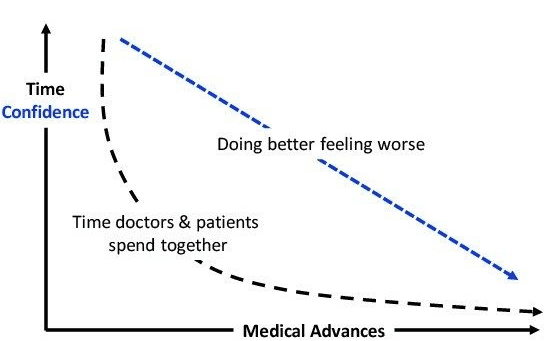
“Paradox of Medical Progress” is a language of medicine is loaded with misnomers, inaccuracies, and ambiguities, and is in need of reform.

Paradoxes on the other hand, deserve a different kind of attention. These seeming self-contradictions are set apart from other inconsistencies because of the truths they tell. The veracity of a paradox is at once appealing and vexing. Anyone who has tried to suppress a thought knows that trying not to think of white polar bears is a sure way to think of white polar bears!

The comic impact of a paradox was even famously explored in Joseph Heller’s Catch 22 and in Groucho Marx’s reluctance to be a member of any club that would accept him. However, the provocative nature of a paradox is its capacity to express familiar wisdom and this is particularly evident in medical science.

The more we learn, the more we learn how much we still have to learn; whereas, “what gets us into trouble is not what we don’t know, it’s what we know for sure that just ain’t so.

On the significance of the knowledge paradox in biology, Lewis Thomas regarded ignorance as the only scientific truth of which he was confident, and discovering “the depth and scope of ignorance” as the greatest contribution of modern science.

COMMENTS APPRECIATED

Please Subscribe Today!

***

***

Small Business Saturday

By Staff Reporters

***

***

Champion small businesses nationwide and #ShopSmall on Saturday, November 30th, 2024.

Now more than ever, small businesses need our support. Please join SBA and organizations across the country as they celebrate small business contributions to their communities by shopping at a small business on November 30th, Small Business Saturday.

Small Business Saturday was founded by American Express in 2010 and officially cosponsored by SBA since 2011. It is an important part of small businesses’ busiest shopping season.

  • In 2023, the reported projected spending in the U.S. from those who shopped at small businesses on Small Business Saturday was around $17 billion

Since 2010, the total reported U.S. spending at small businesses during the annual Small Business Saturday is an estimated $201 billion

  • Join the highly successful team of SBA, Women Impacting Public Policy (WIPP), and American Express in kicking off the 2024 holiday season. Support our nation’s more than 34 million independent businesses this Small Business Saturday and all holiday season long.

More: https://www.sba.gov/about-sba/organization/sba-initiatives/small-business-saturday

COMMENTS APPRECIATED

Subscribe Today!

***

***

AMA: 41 Senators Sign Letter to Stop Medicare Cuts

By Staff Reporters

***

***

In a sign of legislative momentum, 41 senators are supporting efforts to prevent a pending 2.8 percent cut in Medicare physician payments that will go into effect January 1st. The bipartisan letter led by Sens. John Boozman, R-Ark., and Peter Welch, D-Vt., to Senate leaders says the cuts would interfere with the ability of physicians to provide high-quality care. “These continued payment cuts undermine the ability of independent clinical practices – especially in rural and under served areas – to care for their communities,” the letter said.

The Senate letter follows one from the American Medical Association (AMA) and 127 other state medical associations and national medical societies asking Congress to use these last few congressional days to prevent the scheduled cuts. The letter to congressional leaders also urges Congress to provide a positive payment update for 2025. All 50 state medical societies – and DC— as well as 77 national medical societies signed.

Source: AMA

CITE: https://www.r2library.com/Resource/Title/0826102549

COMMENTS APPRECIATED

Subscribe Today!

***

***

DAILY UPDATE: Intel Suspends Dividend as Major Stock Index Climbs

MEDICAL EXECUTIVE-POST TODAY’S NEWSLETTER BRIEFING

***

Essays, Opinions and Curated News in Health Economics, Investing, Business, Management and Financial Planning for Physician Entrepreneurs and their Savvy Advisors and Consultants

Serving Almost One Million Doctors, Financial Advisors and Medical Management Consultants Daily

A Partner of the Institute of Medical Business Advisors , Inc.

http://www.MedicalBusinessAdvisors.com

SPONSORED BY: Marcinko & Associates, Inc.

***

http://www.MarcinkoAssociates.com

Daily Update Provided By Staff Reporters Since 2007.
How May We Serve You?
© Copyright Institute of Medical Business Advisors, Inc. All rights reserved. 2024

REFER A COLLEAGUE: MarcinkoAdvisors@msn.com

SPONSORSHIPS AVAILABLE: https://medicalexecutivepost.com/sponsors/

ADVERTISE ON THE ME-P: https://tinyurl.com/ytb5955z

Your Referral Count -0-

***

CITE: https://www.r2library.com/Resource

Computer company Intel didn’t just lower its dividend; it suspended it entirely earlier this year. The company’s CEO Pat Gelsinger said that the move was necessary due to liquidity needs and for the business to be able to “support the investments needed to execute our strategy.” Intel has been investing heavily in its foundry business, which has been a challenge. In the company’s most recent quarter, which ended on September 28th, the foundry business incurred an operating loss of $5.8 billion — more than four times the $1.4 billion loss it reported a year earlier.

CITE: https://tinyurl.com/2h47urt5

Here’s where the major benchmarks ended:

  • The SPX gained 33.64 points (0.6%) to 6,032.38; the $DJI rose 188.59 points (0.4%) to 44,910.65; and the NASDAQ Composite® ($COMP) advanced 157.69 points (0.8%) to 19,218.17.
  • The 10-year Treasury note yield fell five basis points to 4.19%.
  • The CBOE Volatility Index® (VIX) gave back 0.59 points to 13.51.

CITE: https://tinyurl.com/tj8smmes

Visualize: How private equity tangled banks in a web of debt, from the Financial Times.

COMMENTS APPRECIATED

PLEASE SUBSCRIBE: MarcinkoAdvisors@msn.com

Thank You

***

***

***

EDUCATIONAL TEXTBOOKS: https://tinyurl.com/4zdxuuwf

***

INVESTING: Absolute Return Fund

DEFINITION

SPONSOR: http://www.MarcinkoAssociates.com

By Staff Reporters

***

***

As an investment vehicle, an absolute return fund seeks to make positive returns by employing investment management techniques that differ from traditional mutual funds.

Absolute return investment techniques include using short selling, futures, options, derivatives, arbitrage, leverage and unconventional assets.

COMMENTS APPRECIATED

Subscribe Today

***

***

BLACK FRIDAY 2024: The Physician Micro-Economy

Is it Good for Retailers … but Bad for Doctors and Consumers?

***

If Black Friday 2024 is anything like 2023, retailers may not be swimming in cash while shoppers bathe in savings. Black Friday deals drew 212 million shoppers to stores in fabulous 2010 and collectively spent $39 billion on products and services.

And, the average amount spent by a Black Friday shopper in 2010 was a whopping $365.34.

***

***

Assessment

We predict Black Friday 2024 sales surpass 2023 with a slight increase over 20222 because of fewer shopping days; and the COVID pandemic explosion..

QUESTION: But, is Black Friday good for the [healthcare] economics sector post [thu] the pandemic? Do patients go shopping rather than to the doctor? What about inflation?

Channel Surfing the ME-P

Have you visited our other topic channels? Established to facilitate idea exchange and link our community together, the value of these topics is dependent upon your input. Please take a minute to visit. And, to prevent that annoying spam, we ask that you register. It is fast, free and secure.

Conclusion

Your thoughts and comments on this ME-P are appreciated.

Speaker: If you need a moderator or speaker for an upcoming event, Dr. David E. Marcinko; MBA – Publisher-in-Chief of the Medical Executive-Post – is available for seminar or speaking engagements. Contact: MarcinkoAdvisors@msn.com

OUR OTHER PRINT BOOKS AND RELATED INFORMATION SOURCES:

Product DetailsProduct DetailsProduct Details

Product Details  Product Details

   Product Details

BLACK FRIDAY: Profiting From “Reverse Supply Chain Logistics”

By Staff Reporters

***

Black Friday, one of the biggest shopping days of the year, is a half day for the stock market. Both stock exchanges close at 1:00 p.m. ET, with eligible options trading until 1:15 p.m. Normal trading hours resume on the Monday after Thanksgiving, also known as Cyber Monday, when many online retailers host major sales.

***

SPONSOR: http://www.MarcinkoAssociates.com

***

DEFINITION: Reverse logistics—or the supply-chain processes of returns—is a little-known but rapidly growing sector of the economy that’s booming alongside the rise in online shopping that started during the pandemic.

Now, as retailers crack down on returns to avoid hearing another “it was broken when I got it” excuse, some companies are counting on you to send your holiday gifts back. A “reverse logistics” industry has sprung up in recent years to take advantage of the more than $300 billion in returns Americans make every holiday season.

  • Venture capital firms pumped nearly $200 million into reverse logistics startups last year—over 2.5x as much as in 2021, according to Bloomberg.
  • Loop Returns, which sells software to companies looking to streamline the return process on the customer side, raised $115 million at the end of 2022.

Established companies see potential in reverse logistics as well. Last year, Uber launched a feature enabling drivers to pick up your packages and bring them to a returns center. Meanwhile, UPS, whose returns business has grown 25% since 2020, recently acquired the startup Happy Returns.

COMMENTS APPRECIATED

Thank You

***

***

INDEX: Li Keqiang

By Staff Reporters

***

***

The Li Keqiang Index was created by The Economist and measure’s China’s economy using three indicators: railway cargo volume, electricity consumption and bank loans.

According to Wikipedia and a leaked US State Department Memorandum, Li Keqiang (then the Chinese Communist Party Committee Secretary of Liaoning) told a US ambassador in 2007 that the GDP figures in Liaoning were unreliable and that he himself used the three other indicators: [1] railway cargo volume, [2] electricity consumption and [3] bank loans

The “Keqiang index” is also used by Haitong Securities released in 2013, suggesting decelerating China’s economic growth since the beginning of 2013

The index is seen as an alternative to official gross domestic product numbers released by the Chinese government.

CITE: https://www.r2library.com/Resource/Title/0826102549

COMMENTS APPRECIATED

Thank You

Subscribe Today!

***

***

DAILY UPDATE: “Black” Friday?

By Staff Reporters

***

***

Black Friday is a colloquial term for the Friday after Thanksgiving in the United States, that is the Friday after 28th November. It traditionally marks the start of the Christmas shopping season in the United States. Many stores offer highly promoted sales at discounted prices and often open early, sometimes as early as midnight or even on Thanksgiving. Some stores’ sales continue to Monday (“Cyber Monday“) or for a week (“Cyber Week“).

Occurring on the fourth Friday in November unless November 1st is a Friday (in which case it’s the fifth Friday), Black Friday has routinely been the busiest shopping day of the year in the United States since 2005.

***

***

COMMENTS APPRECIATED

Thank You

***

NAVIGATING STOCK MARKET CYCLES: From Bulls to Nvidia [AI Edition]

By Viataliy Katsenelson CFA

***

***

I’m embarking on something I’ve never done before—I’ve enlisted AI to inform, educate, and maybe even entertain you. I took several essays I wrote and asked my bestie AI to transform them into a radio show-style conversation between two hosts. (The AI tool I used is Notebook LM, a product created by Google.) I didn’t write the scripts myself.

Here were my instructions to the AI: “Here’s my essay. I’m taking a break from writing. Educate, inform and entertain my readers.” That’s it. If what you hear doesn’t surprise you—or even shock you to your socks—I don’t know what will. The future is here.

These essays are just as relevant today as when I first wrote them this summer. You can read the original of the first essay here. Be sure to leave your comments about the conversation you’re about to hear, and feel free to share it with friends, enemies, or even random strangers.
Navigating Market Cycles: From Bulls to Nvidia – AI Edition
In this episode, my AI friends will discuss stock market math, sideways markets, the role of P/E in market cycles, impact of interest rates on P/E, economic analysis, Magnificent Seven stocks, NVIDIA, and a lot more.

COMMENTS APPRECIATED

Subscribe Today!

***

***

THANKSGIVING TURKEY: How Long to Cook the Bird?

By Staff Reporters

***

***

COMMENTS APPRECIATED

Thank You

***

ORDER: https://www.amazon.com/Dictionary-Health-Insurance-Managed-Care/dp/0826149944/ref=sr_1_4?ie=UTF8&s=books&qid=1275315485&sr=1-4

***

Physician Career Development Essay

Professional Medical Career Development

  • By Eugene Schmuckler; PhD, MBA
  • By Dr. David E. Marcinko MBA

Dr. Marcinko with ME-P Fans

Dr. Marcinko with Future Medical Students

Invite Dr. Marcinko

Jimmy’s mother called out to him at seven in the morning, “Jimmy, get up. It’s time for school.” There was no answer. She called again, this time more loudly, “Jimmy, get up! It’s time for school!” Once more there was no more answer.

Exasperated, she went to his room and shook him saying, “Jimmy, it’s time to get ready for school.” He answered, “Mother, I’m not going to school. There are fifteen hundred kids at that school and every one of them hates me. I’m not going to school.” “Get to school!” she replied sharply. “But, Mother, all the teachers hate me, too. I saw three of them talking the other day and one of them was pointing his finger at me. I know they all hate me so I’m not going to school,” Jimmy answered. “Get to school!” his mother demanded again. “But mother, I don’t understand it. Why would you want to put me through all of that torture and suffering?” he protested. “Jimmy, for two good reasons,” she fired back.

“First, you’re forty-two years old.”

“Secondly, you’re the principal.”

Introduction 

Many of us have had conversations with medical colleagues at which time sentiments of those expressed by Jimmy have been voiced. The career choice that was made many years ago is now, for some reason, no longer as exciting, interesting and enjoyable, as it was when we first began in the field. The career that was undertaken with great anticipation is now something to dread. 

The reason for this is occurrence is not that difficult to understand.  Two of the most important decisions individuals are asked to make are ones for which the least amount of training is offered: choice of spouse and choice of career. How many college students receive a degree in the field they identified when they first enrolled at the college or university?

In fact, how many entering freshmen list their choice of major as undecided? It is only during the sophomore year when a major must be declared is the choice actually made. So, career choices made at the age of 19 might be due to having taken a course that was interesting or easy, appeared to have many entry level jobs, did not require additional educational or professional training requirements, or was a form of the “family business.”

Now as an adult, the individual is functioning in a career field that was selected for him or her by an eighteen-year-old. How do we judge career success? A career represents more than just the job or sequence of jobs we hold in a lifetime. The typical standard for a successful career is by judging how high the individual goes in the organization, how much money is earned, or one’s standing attained in the profession.

Career success actually needs to be judged on several dimensions. Career adaptability refers to the willingness and capacity to change occupations and/or the work setting to maintain a standard of career progress. 

Many of you did not anticipate the changes in your chosen medical profession, or specialty, when you began your training. A second factor is career attitudes. These are your own attitudes about the work itself, our place of work, your level of achievement, and the relationship between work and other parts of your life.  Career identity is that part of your life related to occupational and organizational activities. This is the unique way in which we believe that we fit into the world.

Our career is only one part of our being. We play many roles in life each of which combine to make up or totality. At any point in time one role may be more important than another. The importance of the roles will generally change over time. Thus at some point you may choose to identify more with your career, and at other times, with your family. 

A final factor is career performance, a function of both the level of objective career success and the level of psychological success.  How much you earn and your reputation factor into, and reflect, objective career success. To be recognized as a “leader” in a field and asked to submit chapters for inclusion in books such as this may be a more important indicator of career success than money.   Psychological success is the second measure of career performance. It is achieved when your self-esteem, the value you place on yourself, increases.

As you can see, there is a direct relationship between psychological success and objective success. It may increase as you advance in pay and status at work or decrease with job disappointment and failure. Self-esteem may also increase as one begins to sense personal worth in other ways such as family involvement or developing confidence and competence in a particular field, such as consistently shooting par on the golf course. At that point, objective career success may be secondary in your life. This is why many persons choose to become active in their church or in politics. Even though one may have slowed down on the job, or in their professional career they can be extremely content with their life. 

Consider the following situation. You are traveling on business. Although you are on a direct flight, you have a one-hour layover before the second leg of the flight and your final destination. Leaving the plane, after having placed the “occupied” card on your seat you walk down the concourse. On the way, you encounter a friend that you knew in high school. The two of you sit to have a cup of coffee and then you realize that your departure time is rapidly approaching. In fact, you will be cutting it quite close. Running down the concourse you return to the gate only to find that the door has been closed, the jetway is being retracted and the plane is being backed away from the gate. You stare out the window watching the plane go to the end of the runway and then begin its takeoff. Something goes horrible wrong and the plane crashes on takeoff, bursting into flames. It is apparent that there will be no survivors. To the world you are on that plane (remember the occupied card). Traveling on business your generous insurance policy will be activated. In anticipation of being in a location where they may not have ATM machines you have a good deal of cash, sufficient for at least a month.

The question for you to consider is: What do you do?

For many of you this will be a good indicator of your career as well as personal success.  

Surgery

Medical Career Paths

In retrospect how many persons are truly aware of their own interests, values, strengths and weaknesses during their teen years?

As with much of human behavior, career choices actually go through a series of stages. Psychologists have for years identified stages of human development.  Kohlberg discussed stages of moral development. In the 1970’s, Daniel Levinson published The Season’s of a Man’s Life, a project he undertook when he began to look inward and tried to understand his behaviors, values and attitudes to work. Discussions with his university colleagues indicated that what he was experiencing was not unique to him.  

For many years the prevailing thought was that the correct way to function in the labor market was to gain employment with a company progressing through the years until such time as you were eligible to receive the “gold watch”, the symbol of retirement. If you entered a professional discipline such as medicine or law, you did that for the rest of your life. 

Today there are still individuals who follow these traditional patterns but there are other career paths that may be taken.  The most traditional career route follows a linear path, one that most of you have rejected. This entails gaining employment in a large, bureaucratic organization with a tall pyramidal structure. It involves a series of upward (hopefully) moves in the organization until the career limit is reached. As the individual progresses upward in the organization he or she may work in different functional departments such as marketing, finance, and production. Organizations having these paths seek employees who tend to be highly oriented toward success defined in organizational terms and exhibit “leadership” skills.

In general, these people demonstrate a strong commitment to the workplace. A person with this type of orientation (Organizationalist) exhibits the following tendencies:

1.  A strong identification with the organization; seeking organization rewards and advancement that are important measures of success and organizational status.

2.  High morale and job satisfaction.

3.  A low tolerance for ambiguity about work goals and assignments.

4. Identification with superiors, showing deference toward them, conforming and complying out of a desire to advance; maintains the chain of command and compliance, and views respect for authority as the way to succeed.

5. Emphasis on organizational goals of efficiency and effectiveness, avoiding controversy and showing concern for threats to organizational success. 

As readers of this essay, you have followed the expert career path, building a career on the basis of personal competence, or the development of a profession (professionals). As you are so painfully aware, you invest heavily, personally and financially in acquiring a particular skill and then you spend the major portion of your life following that skill.

Unlike the pyramidal structure of the linear path, career paths are found in organizations that tend to be relatively flat, have departments in which there is a functional emphasis, emphasize quality and reliability, and have reward systems containing a strong recognition component.  Medical professionals are persons who are job-centered – not organization centered – viewing the demands of the organization as a nuisance that they seek to avoid.

However, that avoidance is impossible since the professional must have an organization in which to work. This is even more prevalent in today’s era of managed health care. At work, professional experience more role conflict and are more alienated. 

Medical professionals exhibit these four tendencies: 

1.  An experience of occupational socialization that instills high standards of performance in the chosen field; highly ideological about work values.

2. Sees organizational authority as nonrational when there is pressure to act in ways that are not professionally acceptable.

3. Tends to feel that their skills are not fully utilized in organizations; self-esteem may be threatened when they do not have the opportunity to do those things for which they have been trained.

4. Seeks recognition from other professionals outside the organization, and refuses to play the organizational status game except as it reflects their worth relative to others in the organization.

Professionals are very concerned with personal achievement and doing well in their chosen field. Organizational rewards serve to reflect the professional’s importance relative to others in the system. This recognition may be extremely fulfilling, especially when he or she is accorded higher status and pay than others. In the absence of organizational rewards the professional may use material objects (large homes, expensive cars) as a way of reflecting status and accomplishment. 

Medical professionals are of the opinion that successful performance, not compliance with authority, is more reinforcing. With this mindset it is not surprising why may medical practitioners balk at working in the managed health care environment.

Many professionally oriented people come from the middle class and have become successful through a higher level of education or by other efforts to acquire competence.  Those on the spiral career path make periodic moves from one occupation to another. Individuals who follow this career path tend to have high personal growth motives and are relatively creative.

Usually, these changes come after you have developed competence in the occupation you are working in and you think it is time to change what you do. The ideal spiral career path is to move from one occupation to an area related to it. This enables you to use some of the basic knowledge that you developed in your past work and to transfer it to your new occupation. The difference between this path and the linear path discussed above is that in this case the mobility pattern is lateral, not upward. 

People who take the transitory career path cannot seem to, and perhaps do not want to settle down. The pattern is one of consistent inconsistency in their work. These are individuals who may find a great deal of satisfaction working as consultants. The work style is marked by an ability to do many things reasonably well. They value independence and variety, and they work best in relatively loose and unstructured organizations that tolerate the type of freedom they demand in their work.

We have so far discussed the four types of career paths and two career orientations.

A final form of career orientation is that of the indifferents, those who simply work for a paycheck. These are individuals who do their work well, but they are not highly committed to their job or the organization.

Some characteristics of indifferents are:

1.  More oriented toward leisure, not the work ethic (is it Friday yet?); separates work from more meaningful aspects of life, and seeks higher-order need satisfaction outside the work organization.

2. Tends to be alienated from work and not committed to the organization.

3. Rejects status symbols in organizations.

4. Withdraws psychologically from work and organizations when possible. 

Indifferents are not necessarily born that way; some are actually a product of their work experiences. People who once had an organizational orientation and were highly loyal may no longer follow orders without question.

For example, you may have had an officer manager who very early in his or her career was extremely committed to you and your organization. He or she may seek rewards and want to advance. However, in later career life, after having been passed over several times for promotion, the person seeks rewards elsewhere. Thus it is possible that through office practices, your organization may turn highly committed organizationalists (or professionals) into indifferents. 

surgery

Medical Career Evaluation

Studs Turkel, in his outstanding book Working, makes the comment that work is the mechanism by which many of us get our daily bread and our daily purpose. If this is to be the case then the workplace needs to offer us something more than a paycheck.

A few years back, the Wilson Learning Corporation surveyed 1,500 people asking “If you had enough money to live comfortably for the rest of your life, would you continue to work?

Seventy percent said that they would continue to work, but 60 percent of those said they would change jobs and seek “more satisfying” work.

Each of us has in fact been put in charge of our own careers. Our personal career management is a lifelong process. Our task is to be able to discover our place in the world where we will be able to enjoy a high level of wellness.

This requires us to now assess our career, not from the eyes of the sixteen year old that initially chose the career. The career you are now pursuing needs to be compatible with your own unique skills, knowledge, personality and interests. It is important to keep in mind that no one is married to his or her job. When it comes to the workplace most of us are in dating relationships. 

As part of your examining your current medical career, answer the following questions:

  • Why do you work?
  • What does work mean to you?
  • What do you want from work? 

Research shows that most people work for three major reasons.

The first of these is money. Not only is this necessary for our most basic needs it also serves as a means of determining our self-image.

A second reason is to be with other people. Being at work enables us to belong, to be part of something beyond ourselves. We become part of a team. Some offices consider co-workers to be part of an extended family. The work setting affords us the opportunity for receiving feedback, recognition and support.

The third most often given reason is that work validates us as people if we consider what we do as having meaning. “I chose the medical profession so as to make a difference.”

Individuals with career success have a sense of purpose, a feeling that their work has meaning and contributes to a worthwhile cause. This is not a trick question. How well does what you do in your office every day meet your needs for money, affiliation and meaning?  Without a sense of purpose on the job the chances are that your performance while adequate will not place you in the excellent category.

Therefore, it is necessary for each and every one of us to be able to succinctly answer the question, “What is the purpose of your job?” That is a tough question to answer.

As a medical professional you may have seen what you considered to be the purpose of your job radically changed due to changes in the way services are now delivered. While we cannot bring back the past we can work around the present. Think about this for a moment, “If you want something to happen make a space for it.” What this means that whether you remain in your current profession or move elsewhere there is a need for you to establish long-range, medium-range, short-range, mini, and micro goals.  

Long-range goals are those concerned with the overall style of life that you wish to live. Regardless of your current age these goals are necessary. Long-range goals don’t need to be too detailed, because like the federal budget surplus, changes will come along. Just as the government is making projections into the future you too need to be making projections including but not limited to retirement. 

Medium-range goals are goals covering the next five years or so. These are the goals that include the next step in your career. These are goals over which we have control and we are able to monitor them and see whether we are on track to accomplishing them and modify our efforts accordingly.

Short-range goals generally cover a period of time about one month to one year from now. These are goals that can be set quite realistically and we are able to see fairly quickly whether or not we are on track to reaching them. We don’t want to set these goals at impossible levels but we do want to stretch ourselves. After all, that is the reason you are probably reading this chapter.  

Mini-goals are those goals covering from about one day to one month. Obviously we have much greater control over these goals than you do over those of a longer-term. By thinking in small blocks of time there is much more control over each individual unit. 

Micro-goals are goals covering the next 15 minutes to an hour. These are the only goals over which you have direct control. Because of this direct control, micro-goals, even though modest in impact, are extraordinarily important, for it is only through these micro-goals that you can attain your larger goals.

If you don’t take steps toward your long-range goals in the next 15 minutes, when will you? The following 15 minutes? The 15 minutes after that? Sooner or later, you have to pick 15 minutes and get going.

At some point procrastination has to be put aside.  In thinking of your goals it now becomes necessary to evaluate your personal assets. Conducting this personal inventory requires you to identify your assets as well as your shortcomings.

First, look at a time in your life when you were performing at your best. What were your thoughts and feelings? How did you behave? What were you doing? Now look at the reverse when you were doing poorly. What were your thoughts and feelings at that time? How did you behave? What were you doing? If you are like others when you were at your best you described yourself as being confident, enthusiastic, organized, relaxed, focused, in control, friendly and decisive.

The flip side, when at your worst you were fearful, apathetic, messy, anxious, lacking direction, out of control, argumentative and frustrated. 

As you can see the emotions when we are at our best are all positive. This leads to the conclusion that it is to our advantage to be at our best as much as possible.

Being at our best derives from working in those areas where we contribute our talents to something we believe in.  As we continue our own personal inventory we need to look at our special abilities. That is, what are you good at and find easy to do.

doctors

Think of the following questions.

It’s not necessary to write down you answers just think about them:

1. How would you like to be remembered?

2. What have you always dreamed of contributing to the world?

3. Looking back on your life, what are some of your major contributions?

4. When people think of you, what might they say are your most outstanding characteristics?

5. What do you really want from your life and your work?

6. In what way may you still feel limited by the past? If so, by what?

7. What will it take to let go of what has happened, no matter how good or bad? Are you willing to let go?

8. How might the rut of conformity or comfort be limiting you? Why?

9. How different do you really want life to be? Why.

10. Have you ever stated what it is you truly desire? If no, why not?

11. How good could stand life to be?  

Thinking about remaining in your present career or moving into another one is not easy. You are at the edge of a cliff and need to decide if you are going to turn back or to trust in yourself to successfully make it down to the bottom. People who are afraid of the dark lose their fear with just the slightest of a light in the room.

As you have been going through this chapter you have been shining a light, however dim it may appear to you. You can see all of the items around you. The obstacles are there but with your advance knowledge you can anticipate ways to avoid them.  Having looked at and possibly re-evaluated your plans you can now do a thorough analysis of your assets.

The assets requiring the most scrutiny are the following:

1.Your talents and skills

2. Your intelligence

3. Your motivation

4. Your friends

5. Your education

6. Your family.

Your talents and skills are more than likely what has gotten you to the point you are at in your present career.

For purposes of definition talents are innate, skills are acquired. Some have talent in interpersonal relations and some in artistic pursuits. Skills may be selected to complement the already present talents. It is skills that are necessary for expanding your options. As you seek out new skill areas ask yourself these questions. Do the skills provide occupational relevance? Might you be able to get others to pay you to teach them the skill? Will the skill be useful throughout life? Will the skill help you conquer new environments and gain new experiences?

And, of course, is it something you like to do? Intelligence is considered to be the ability of the individual to cope with the world.

Originally, intelligence focused primarily in the area of cognitive skills. Recently attention has been directed to what is called emotional intelligence, a concept that directs attention to social skills. Whether you were able to breeze through your courses in college or you truly had to work hard, earning your degrees demonstrates a better than average amount of cognitive intellectual ability. In order to maximize your brainpower, challenge yourself regularly.

Motivation looks at how hard you are willing to work, your level of persistence, and the degree to which you want to do well. Different things motivate each of us and our personal motivators can vary from day to day. How many times have you had people say that they could not do your job? What are the activities that are attractive to you? More than likely an important motivator for you is to do something worthwhile.

It has also been found that we tend to perform at about the same level as those people who are close to us. What this means is that those people with whom you work are going to have s substantial impact on your motivation. 

Friends, of course, are invaluable assets. We use our friends as models for our own behavior. Those persons we consider friends share many of our attitudes, actions and opinions. With time we will change to be like our friends and they will change to become like us. Associating with those like us tends to temper our behavior. We try not to associate with the “wrong crowd” lest we become like them.  Education needs to be ongoing.

Recently, it was reported “all careers and businesses will be transformed by new technologies in often unpredictable ways. The era of the entrepreneur will make ‘boutique’ businesses more competitive with the behemoths, as mid-sized institutions get squeezed out. And, medical breakthroughs and the ongoing health movement will enhance-and extend-people’s lives.”

The implication of these changes is that new technologies often require a higher level of education and training to use them effectively and new biotechnology jobs will open up. The authors state that all the technological knowledge we work with today will represent only 1 percent of the knowledge that will be available in 2050.

The half-life of an engineer’s knowledge today is only five years; in ten years, 90 percent of what an engineer knows will be available on the computer.

In electronics, fully half of what a student learns as a freshman is obsolete by his or her senior year. The implication here is that all of us must get used to the idea of lifelong learning. Family influences who and what we are and do. They can be a support group or they can be a deterrent to your goals. It is incumbent on every individual reading this chapter to consult with immediate family members at all stages of your career planning process.    

Doctors Labor Day

Conclusion

This essay has presented an overview of initial career selection, career pathing and career change in order to help you determine what you truly want to be when you grow up.

As I write, I can not help but reflect on an anecdote shared with me by a colleague.

An individual came to see him expressing concern that at 40 years of age he still hadn’t reached a satisfactory point in his life. My colleague then asked him where he wanted to be. The response was “I don’t know” to which my colleague responded, “Congratulations, you’ve arrived.

Too many times I encounter in my practice, physicians who express the same statements. Unhappy with what they are doing they have no idea as to what it is they would like to be doing. 

Victor Frankl, a psychiatrist who was a holocaust survivor, created an entire school of psychotherapy based upon his experiences in the German concentration camps. In his book, Man’s Search for Meaning, he makes reference to the fact that it became possible for him to determine when a fellow prisoner was going to die simply by that person’s behavior – giving up.

Frankl writes, “Evermore people today have the means to live, but no meaning to live for.      

Thus, it may be appropriate to conclude with this anonymous poem. 

Take time to work-

It is the price of success.Take time to think-

It is the source of power.Take time to play-

It is the secret of perpetual youth.Take time to read- 

It is the fountain of wisdom.Take time to be friendly-

It is the road to happiness.Take time to love and be loved-

It is nourishment for the soul.Take time to share-  

It is too short a life to be selfish.Take time to laugh- 

It is the music of the heart.Take time to dream- 

It is hitching your wagon to a star.

Now, how do you view your medical, executive, professional or healthcare administrative career amid all the turmoil in the industry today? 


McNally, D. Even Eagles Need A Push, New York, NY: Delacorte Press, 1991.

Brousseau, K.R., Driver, M.J., Eneroth, K. and Larson, R.: Career Pandemonium: Realigning organizations and individuals. Academy of Management Executive 10 (4), 52-66. 1996

Presthus, R. The Organizational Society. New York, NY: St. Martin’s Press.Campbell, D. If You Don’t Know Where You are Going You’ll Probably End Up Somewhere Else, Niles, IL: Argus Communications, 1974. 

Campbell, D. op. cit.The Futurist, March–April 2001.

Risk Management, Liability Insurance, and Asset Protection Strategies for Doctors and Advisors: Best Practices from Leading Consultants and Certified Medical Planners™8Comprehensive Financial Planning Strategies for Doctors and Advisors: Best Practices from Leading Consultants and Certified Medical Planners™

[Dr. Cappiello PhD MBA] *** [Foreword Dr. Krieger MD MBA]

Front Matter with Foreword by Jason Dyken MD MBA

Invite Dr. Marcinko

***

2024 HAPPY THANKSGIVING DAY

Dr. David Edward Marcinko MBA

Ann Miller RN MHA

ME-P Staff Reporters

***

***

Securities Industry and Financial Markets Association (SIFMA)

CLOSINGS TODAY ON THANKSGIVING 2024

By Staff Reporters

***

***

United States stock markets will be closed on Thursday, November 28th and will close early on Friday, November 29th in observance of the Thanksgiving Holiday.

The NASDAQ and NYSE will both be closed on Thanksgiving and will open on November 29th, but close early at 1 p.m. ET. The U.S. bond market will also be closed on Thursday and are scheduled to close at 2 p.m. ET on Friday, according to the The Securities Industry and Financial Markets Association (SIFMA)..

After closing for the Thanksgiving holiday, and closing early on Black Friday, it will be business as usual on Wall Street until late December. The next scheduled stock market closure is on Wednesday, December 25th in observance of Christmas. Markets are also scheduled to close early on Christmas Eve

***

***

DAILY UPDATE: Intel, Tether as Technology Markets Lead Downturn

MEDICAL EXECUTIVE-POST TODAY’S NEWSLETTER BRIEFING

***

Essays, Opinions and Curated News in Health Economics, Investing, Business, Management and Financial Planning for Physician Entrepreneurs and their Savvy Advisors and Consultants

Serving Almost One Million Doctors, Financial Advisors and Medical Management Consultants Daily

A Partner of the Institute of Medical Business Advisors , Inc.

http://www.MedicalBusinessAdvisors.com

SPONSORED BY: Marcinko & Associates, Inc.

***

http://www.MarcinkoAssociates.com

Daily Update Provided By Staff Reporters Since 2007.
How May We Serve You?
© Copyright Institute of Medical Business Advisors, Inc. All rights reserved. 2024

REFER A COLLEAGUE: MarcinkoAdvisors@msn.com

SPONSORSHIPS AVAILABLE: https://medicalexecutivepost.com/sponsors/

ADVERTISE ON THE ME-P: https://tinyurl.com/ytb5955z

Your Referral Count -0-

HAPPY THANKSGIVING DAY 2024

Intel and the US government finalized a $7.9 billion grant from the CHIPS and Science Act that will help fund factory construction.

The cryptocurrency Tether is being used by organizations linked to Mexican drug cartels to launder tens of millions of dollars, 404 Media reported.

CITE: https://www.r2library.com/Resource

STOCKS UP

  • Unusual Machines got an unusually strong boost today, soaring 84.51% after Donald Trump Jr. announced he’s joining the drone maker’s advisory board.
  • Ambarella continued to climb another 5.89% today after the semiconductor company announced a strong beat-and-raise quarter.
  • Urban Outfitters isn’t just where you go to buy overpriced beanies—it’s also where you go for strong holiday revenue expectations. Shares rose 18.31% after the retailer’s best third quarter ever.
  • SolarEdge Technologies will close its energy storage division and lay off hundreds of employees to cut costs. Shares popped 8.55% on the announcement.
  • Iris Energy jumped 29.71% after the bitcoin miner announced it’s growing so quickly that it may be able to distribute funds to shareholders sooner than previously thought.

STOCKS DOWN

  • Symbotic plummeted 35.86% after the robotics company announced it won’t meet its financial filing deadline thanks to some accounting errors.
  • Dell may have impressed with its AI offerings, but earnings came up short last quarter. That, plus management’s “meh” forecast for the coming quarter, sent shares tumbling 12.25%.
  • HP sank 11.36% after it, too, projected worse-than-expected profits next quarter.
  • Keeping the trend alive, cybersecurity company CrowdStrike also anticipates lower earnings next quarter—a sign that it still hasn’t fully recovered from this summer’s massive IT outage. Shares dropped 4.59%.
  • Nordstrom actually beat earnings expectations and announced a solid sales forecast—but apparently, it wasn’t good enough. The retailer still lost 8.09% today.

CITE: https://tinyurl.com/2h47urt5

Here’s where the major benchmarks ended:

  •  The SPX fell 22.89 points (–0.38%) to 5,998.74; the Dow Jones Industrial Average® ($DJI) lost 138.25 points (–0.31%) to 44,722.06; and the NASDAQ Composite® ($COMP) dropped 115.10 points (–0.60%) to 19,060.48.
  • The 10-year Treasury note yield dropped six basis points to 4.24%, a one-month low close. 
  • The CBOE Volatility Index® (VIX)was close to flat at 14.14.

CITE: https://tinyurl.com/tj8smmes

Visualize: How private equity tangled banks in a web of debt, from the Financial Times.

COMMENTS APPRECIATED

PLEASE SUBSCRIBE: MarcinkoAdvisors@msn.com

Thank You

***

***

***

***

EDUCATIONAL TEXTBOOKS: https://tinyurl.com/4zdxuuwf

***

SALARY PRIME NUMBERS: Financial Success by Generation

By Staff Reporters

***

***

According to HVL from Morning Brew, a new survey from financial services company Empower ignited a conversation about what monetary success means. Turns out, it depends on who you ask. Boomers believe that success means having an annual salary of about $100,000. Gen Z thinks your mom can’t brag about you to her dentist until you earn $600k/year. On average, respondents said success is making $270,000 annually.

Additionally, less than 40% of respondents said they considered themselves financially successful. Almost 50% don’t believe they will achieve the level of success they desire.

But there was some good news: Forty-three percent said their idea of success didn’t depend on a specific sum of money. And almost 60% said happiness is most important, as long as happiness is defined as “being able to spend money on the things and experiences that bring the most joy.”

COMMENTS APPRECIATED

Subscribe Today!

***

***

THANKSGIVING: Donor Advised Funds

DONATION: In “Name” Only?

Staff Reporters

***

Proponents of DAFs say that their structure encourages giving: The tax deduction encourages wealthy patrons to dedicate money for charity even before they’ve decided which cause to support. “Donors may have good reasons to postpone grants,” a Stanford Law School article says..

In one hypothetical, a tech founder who “sells a startup for millions of dollars” may want to donate her takings but is too busy to immediately decide how to direct the funds; a DAF is a good choice for this person, the law article notes.

However, while DAFs could in theory grow the charitable pie, in practice, they too often allow the donor the illusion of charity while letting them keep control of their funds, critics say. 

While a gift to a DAF is treated the same as an outright gift to the Red Cross or United Way, in practice, it “effectively allows the donor to retain ongoing control over the charitable disposition and investment of the donated assets,” tax scholars Roger Colinvaux and Ray Madoff wrote in 2019. What’s more, “donors are under no obligation, and have no incentive, ever to release their advisory privileges to make the funds available for charitable use.”

And ultra wealthy donors get a substantially larger tax break than a middle-class worker. As much as 74 cents of every dollar given to charity comes back to the donor in the form of tax breaks, according to calculations by Colinvaux and Madoff, with the highest-earning donors getting the biggest benefits A person in the top tax bracket would save 37% of their federal income tax for every dollar they contribute with a charitable donation; a similar amount of state income tax; and, depending on what they donate and when, they can also avoid capital gains tax and estate tax. (By contrast, a typical worker who makes about $60,000 and doesn’t own stocks would save 22% from their cash contribution, in addition to any state tax savings.) 

What’s more, because there’s no way to track donations from particular DAF accounts, they act as a form of “dark money,” allowing donors to give vast sums, essentially anonymously, to a range of potentially unsavory organizations, including nonprofits that advocate for specific political causes or organizations classified as hate groups, IPS says. 

“This allows DAFs to be used to hide transfers — similar to the way the ultra-wealthy use multiple shell companies to hide the movement of money among offshore accounts,” IPS writes. 

All of these strategies are completely legal, the IPS notes, as are other potentially questionable tactics used by family foundations—such as paying family members to serve as foundation trustees or act as executives of foundations, sometimes at salaries in the hundreds of thousands of dollars a year. However, the IPS argues, they erode public trust in charities and the tax system overall.

“The fact that billionaires opt out of paying taxes, have these closely held family foundations and get to play God about where the money goes, that’s private power — unaccountable private power,” Collins said. 

“At this point philanthropy is at risk of becoming taxpayer-subsidized private power.”

COMMENTS APPRECIATED

Refer a Colleague: MarcinkoAdvisors@msn.com

Your Referral Count: 0

***

***

The NASDAQ, S&P 500, Dow and Treasury Yields Rise as Oil & Bitcoin Fall

By Staff Reporters

***

***

  • The S&P 500 and NASDAQ stayed in the green all day, with the S&P 500 hitting yet another new all-time high, while the Dow clawed its way out of negative territory to reach a new high as well.
  • The minutes from the last Federal Reserve meeting revealed that central bankers feel rate cuts are still warranted, though they’ll need to be gradual. Treasury yields rose on the news.
  • Oil fell after Israel and Lebanon agreed on a ceasefire deal.
  • Bitcoin continues to fall further away from the promised land of $100,000 as traders begin logging off ahead of the holiday—though bulls believe this is just a pullback to gather momentum ahead of the final push.

CITE: https://www.r2library.com/Resource/Title/0826102549

COMMENTS APPRECIATED

Subscribe Today

***

***

DAILY UPDATE: Semaglutide Drugs, CMS, Emory & UnitedHealthcare as Stock Markets Rise High

MEDICAL EXECUTIVE-POST TODAY’S NEWSLETTER BRIEFING

***

Essays, Opinions and Curated News in Health Economics, Investing, Business, Management and Financial Planning for Physician Entrepreneurs and their Savvy Advisors and Consultants

Serving Almost One Million Doctors, Financial Advisors and Medical Management Consultants Daily

A Partner of the Institute of Medical Business Advisors , Inc.

http://www.MedicalBusinessAdvisors.com

SPONSORED BY: Marcinko & Associates, Inc.

***

http://www.MarcinkoAssociates.com

Daily Update Provided By Staff Reporters Since 2007.
How May We Serve You?
© Copyright Institute of Medical Business Advisors, Inc. All rights reserved. 2024

REFER A COLLEAGUE: MarcinkoAdvisors@msn.com

SPONSORSHIPS AVAILABLE: https://medicalexecutivepost.com/sponsors/

ADVERTISE ON THE ME-P: https://tinyurl.com/ytb5955z

Your Referral Count -0-

In breaking news, the Biden administration is attempting to cover anti-obesity drugs for weight loss under Medicare and Medicaid. A recent study finds 137 million people are eligible for semaglutide drugs nationwide.


Another insurer can claim victory against CMS after UnitedHealthcare prevailed in its star ratings lawsuit on Friday. The feds will now have to recalculate the scores.


And ... Emory Healthcare is looking to expand value-based care for more than 350,000 patients through a population health partnership with tech company Guidehealth.

CITE: https://www.r2library.com/Resource

STOCKS UP

Uncrustables taste almost as good as today’s gains: J.M. Smucker rose 5.70% thanks to a beat-and-raise quarter for the company.

  • Walmart gained 2.02% on a report that Target is losing its high-end customers to the low-price retailer. Target sank 3.03%.
  • Semiconductor stock Semtech rose another 18.10% after announcing stronger-than-expected earnings last night.

STOCKS DOWN

  • Amgen’s new drug did help patients lose up to 20% of their weight in a given year, but that wasn’t enough to impress shareholders, who kicked shares down 4.76%.
  • Kohl’s plummeted 17.01% after the retailer met revenue expectations but missed on earnings last quarter. It definitely doesn’t help that the CEO announced his retirement last night.
  • Abercrombie & Fitch’s turnaround is well underway, and the company beat earnings forecasts last quarter and projected strong holiday sales. But it still fell short of shareholder expectations, and the stock sank 5.10% today.
  • Best Buy rounded out retailer earnings today, dropping 4.89% after missing revenue expectations last quarter and cutting its full-year guidance.
  • Zoom Communications changed its name, but that wasn’t enough to save the company from a 6.31% decline today thanks to its tepid fiscal outlook.

CITE: https://tinyurl.com/2h47urt5

Here’s where the major benchmarks ended:

  •  The S&P 500® index (SPX)rose 34.26 points (0.57%) to 6,021.63; the Dow Jones Industrial Average® ($DJI) added 123.74 points (0.28%) to 44,860.31; and the NASDAQ Composite® ($COMP) gained 119.46 points (0.63%) to 19,174.30.
  • The 10-year Treasury note yield climbed four basis points to 4.3% after Trump’s tariff comments, but shorter-term yields fell after the Fed minutes, keeping the yield curve slightly out of inversion.
  • The CBOE Volatility Index® (VIX)dropped to 14.19, near a two-week low.

CITE: https://tinyurl.com/tj8smmes

Visualize: How private equity tangled banks in a web of debt, from the Financial Times.

COMMENTS APPRECIATED

PLEASE SUBSCRIBE: MarcinkoAdvisors@msn.com

Thank You

***

***

***

***

EDUCATIONAL TEXTBOOKS: https://tinyurl.com/4zdxuuwf

***

CONVERSATIONAL “Switch Tracking” Ad Argumentum

By Staff Reporters

***

***

Switch Tracking is the art of changing the focus of an argument or conversation to another topic. It’s like sleight of hand for your words. When the discussion gets uncomfortable, switching tracks can divert attention and defuse tension. Politicians are masters of this, skillfully shifting topics to avoid tough questions.

According to psychologist and colleague Dan Ariely PhD, while it can be a useful tactic, be aware when it’s being used on you. Stay focused on the main issue, and don’t let switch tracking derail your conversation.

COMMENTS APPRECIATED

Subscribe Today!

***

***

FIXED FINANCIAL SPREADS FOR PHYSICIANS: Duration, Sectors, Widening, Tightening and Other Fixed Income Strategies

DEFINITIONS FOR PHYSICIANS

By Dr. David Edward Marcinko MBA MEd

SPONSOR: http://www.MarcinkoAssociates.com

***

***

Spread duration is a risk measure, expressed in years, that estimates the price sensitivity of a fixed income investment to a 100 basis point change in credit spreads relative to similar-maturity Treasuries.

Spread sectors (aka “spread products,” “spread securities”) in fixed income parlance, are typically non-Treasury securities that usually trade in the fixed income markets at higher yields than same-maturity U.S. Treasury securities. The yield difference between Treasuries and non-Treasuries is called the “spread”), hence the name “spread sectors” for non-Treasuries.

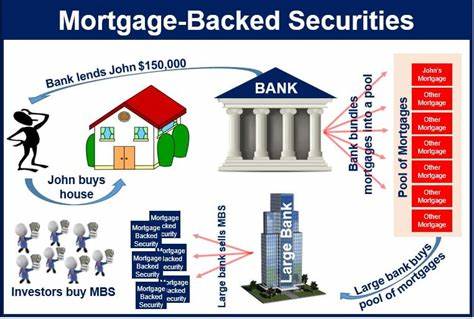
These sectors–such as corporate-issued securities and mortgage-backed securities (MBS–typically trade at higher yields (spreads) than Treasuries because they usually have relatively lower credit quality and more credit / default risk and / or they have more prepayment risk.

CITE: https://www.r2library.com/Resource/Title/0826102549

Spread widening, tightening are changes in spreads that reflect changes in relative value, with “spread widening” usually indicating relative price depreciation and “spread tightening” indicating relative price appreciation.

Spreads (aka “interest-rate spreads”, “maturity spreads,” “yield spreads” or “credit spreads”)

In fixed income parlance, spreads are simply measured differences or gaps that exists between two interest rates or yields that are being compared with each other. Spreads typically exist and are measured between fixed income securities of the same credit quality, but different maturities, or of the same maturity, but different credit quality.

Changes in spreads typically reflect changes in relative value, with “spread widening” usually indicating relative price depreciation of the securities whose yields are increasing most, and “spread tightening” indicating relative price appreciation of the securities whose yields are declining most (or remaining relatively fixed while other yields are rising to meet them). Value-oriented investors typically seek to buy when spreads are relatively wide and sell after spreads tighten.

CITE: https://www.r2library.com/Resource/Title/0826102549


COMMENTS APPRECIATED

Subscribe Today!

***

***

DAILY UPDATE: Health Insurance Affordability as Stock Markets Broadly Rise

MEDICAL EXECUTIVE-POST TODAY’S NEWSLETTER BRIEFING

***

Essays, Opinions and Curated News in Health Economics, Investing, Business, Management and Financial Planning for Physician Entrepreneurs and their Savvy Advisors and Consultants

Serving Almost One Million Doctors, Financial Advisors and Medical Management Consultants Daily

A Partner of the Institute of Medical Business Advisors , Inc.

http://www.MedicalBusinessAdvisors.com

SPONSORED BY: Marcinko & Associates, Inc.

***

http://www.MarcinkoAssociates.com

Daily Update Provided By Staff Reporters Since 2007.
How May We Serve You?
© Copyright Institute of Medical Business Advisors, Inc. All rights reserved. 2024

REFER A COLLEAGUE: MarcinkoAdvisors@msn.com

SPONSORSHIPS AVAILABLE: https://medicalexecutivepost.com/sponsors/

ADVERTISE ON THE ME-P: https://tinyurl.com/ytb5955z

Your Referral Count -0-

The Commonwealth Fund’s 2024 biennial health insurance survey, released November 21, found that though 79% of US adults had continuous health insurance for 12 months, 23% were under insured, meaning they have health insurance and still can’t afford care. About 56% of those surveyed had adequate insurance coverage all year.

CITE: https://www.r2library.com/Resource

STOCKS UP

  • Rocket Lab rocketed (sorry) 3.44% to a new record high after launching not one, but two different rockets in two different hemispheres in a single day.
  • Bath & Body Works soared 16.51% on a strong beat-and-raise quarter.
  • Robinhood jumped 3.27% after Morgan Stanley analysts doubled their price target for the investing app.
  • Super Micro Computer surged yet another 15.87%, more than doubling in the last seven days, and shareholders cheered its comeback.
  • Hims & Hers Health climbed 23.77% on the news that the new head of the FDA may be an ally.
  • Flying taxi company Vertical Aerospace popped 45.51% after announcing an additional $50 million in funding from one of its biggest shareholders.

STOCKS DOWN

  • Defense contractor stocks got a double whammy today: Hopes of a ceasefire between Israel and Hezbollah, combined with Elon Musk’s declaration on X that buying manned military aircraft is wasteful. Lockheed Martin fell 3.76%, Northrop Grumman dropped 2.39%, and Raytheon Technologies parent company RTX Corp. fell 1.74%.
  • Speaking of Musk, Tesla sank 3.96% after California announced it may exclude the automaker from incentives that encourage drivers to buy EVs in the state.
  • Pipeline operator Oneok lost 4.72% on the news that it will acquire the remaining portion of EnLink Midstream that it doesn’t already own.
  • After rallying last week thanks to its inclusion in the S&P 500, Texas Pacific Land sank 6.71% today as investors took profits.

CITE: https://tinyurl.com/2h47urt5

Here’s where the major benchmarks ended:

  •  The SPX rose 18.03 points (0.30%) to 5,987.37; the $DJI added 440.06 points (0.99%) to 44,736.57; and the NASDAQ Composite® ($COMP) gained 51.18 points (0.27%) to 19,054.84.
  • The 10-year Treasury note yield fell 15 basis points to 4.27%.
  • The CBOE Volatility Index® (VIX)dropped to 14.74, the lowest since November 14.

CITE: https://tinyurl.com/tj8smmes

Visualize: How private equity tangled banks in a web of debt, from the Financial Times.

COMMENTS APPRECIATED

PLEASE SUBSCRIBE: MarcinkoAdvisors@msn.com

Thank You

***

***

***

***

EDUCATIONAL TEXTBOOKS: https://tinyurl.com/4zdxuuwf

***

ILLUSORY: Correlation

CORRELATION IS NOT CAUSATION

By Staff Reporters

***

***

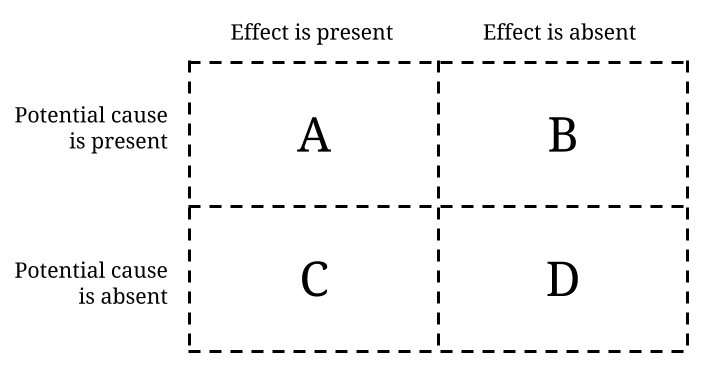
According to colleague Dan Ariely PhD, Illusory Correlation is the perception of a relationship between variables when none exists. It’s like thinking that carrying an umbrella causes it to rain. Our brains are pattern-seeking machines, often connecting dots that aren’t actually connected. This bias can lead to superstitions and incorrect beliefs.

The illusory correlation occurs when someone believes that there is a relationship between two people, events, or behaviors, even though there is no logical way to connect them. The illusory correlation fools us into believing stereotypes, superstitions, old wives’ tales, and other silly ideas. Sometimes, the perceived connection between two events is harmless. It’s silly to think that a certain number always brings you luck. But forming these connections is completely normal. To avoid illusory correlations, rely on data and evidence rather than anecdotal observations.

So always remember: correlation does not imply causation, no matter how convincing it seems.

More: https://medicalexecutivepost.com/2024/06/05/correlation-is-not-causation/

COMMENTS APPRECIATED

Thank You

***

***

Valuation of Hospitals [Technological Environment]

By Health Capital Consultants, LLC

***

***

Technological advancements have accelerated the shift of healthcare services from inpatient to outpatient settings, creating both opportunities and challenges for hospitals. For instance, minimally invasive procedures often serve as alternatives to traditional, more invasive surgeries. Additionally, the integration of telehealth and artificial intelligence (AI) has the potential to enhance access to and quality of care while reducing expenditures and administrative burdens.

This final installment of a five-part series on the valuation of hospitals examines the technological advancements transforming the industry. (Read more…) 

COMMENTS APPRECIATED

Subscribe Today!

***

***

DAILY UPDATE: Morningstar, Amazon Anthropic and Private Equity Banks

MEDICAL EXECUTIVE-POST TODAY’S NEWSLETTER BRIEFING

***

Essays, Opinions and Curated News in Health Economics, Investing, Business, Management and Financial Planning for Physician Entrepreneurs and their Savvy Advisors and Consultants

Serving Almost One Million Doctors, Financial Advisors and Medical Management Consultants Daily

A Partner of the Institute of Medical Business Advisors , Inc.

http://www.MedicalBusinessAdvisors.com

SPONSORED BY: Marcinko & Associates, Inc.

***

http://www.MarcinkoAssociates.com

Daily Update Provided By Staff Reporters Since 2007.
How May We Serve You?
© Copyright Institute of Medical Business Advisors, Inc. All rights reserved. 2024

REFER A COLLEAGUE: MarcinkoAdvisors@msn.com

SPONSORSHIPS AVAILABLE: https://medicalexecutivepost.com/sponsors/

ADVERTISE ON THE ME-P: https://tinyurl.com/ytb5955z

Your Referral Count -0-

CITE: https://www.r2library.com/Resource

Amazon invests $4 billion more in Anthropic. The deal marks the second time in a year that Amazon has earmarked $4 billion for Anthropic as it seeks to keep pace with its main rival, OpenAI, which raised $6.6 billion in October.

CITE: https://tinyurl.com/2h47urt5

Morningstar Inc. has announced a change to the methodology for its Morningstar Medalist Rating system that it says provides a more precise assessment of investment alpha. The change, which will take effect on October 29th, will alter the medalist ratings of about 20% of the 200,000 funds Morningstar has rated, with most of those changes downgrades. For example, Morningstar expects around 40% of funds currently assigned Bronze ratings globally will be assigned Neutral ratings after the change.

CITE: https://tinyurl.com/tj8smmes

Visualize: How private equity tangled banks in a web of debt, from the Financial Times.

COMMENTS APPRECIATED

PLEASE SUBSCRIBE: MarcinkoAdvisors@msn.com

Thank You

***

***

***

***

EDUCATIONAL TEXTBOOKS: https://tinyurl.com/4zdxuuwf

***

SOCIAL COMPARISON THEORY: Downward and Upward

By Staff Reporters

***

***

According to some studies, as much as 10 percent of our thoughts involve comparisons of some kind. Social comparison theory is the idea that individuals determine their own social and personal worth based on how they stack up against others. The theory was developed in 1954 by psychologist Leon Festinger. Later research has shown that people who regularly compare themselves to others may find motivation to improve, but may also experience feelings of deep dissatisfaction, guilt or remorse, and engage in destructive behaviors like lying or disordered eating.

***

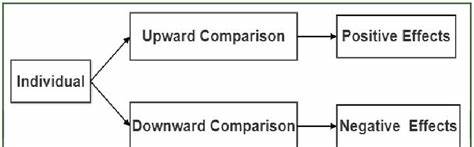
Downward Comparison is the act of comparing oneself to others who are worse off to feel better about one’s situation. It’s like looking at someone else’s messy desk to feel better about your clutter.

On the other hand, Upward Comparison is the act of comparing oneself to others who are better off to feel bad about one’s situation. It’s like looking at someone else’s neat desk and feel worse about your own clutter.

Finally, according to Dan Ariely PhD, these coping mechanisms boosts self-esteem or depress us with a sense of relief or dread. While helpful in moderation, relying too much on upward or downward comparisons can help hinder personal growth and/or depress growth or empathy; etc.

So, them sparingly and remember: upward comparisons can inspire you to improve and strive for better; while downward comparisons have the opposite effects.

MORE: https://www.verywellmind.com/what-is-the-social-comparison-process-2795872

COMMENTS APPRECIATED

Subscribe Today!

***

***

CONTRAST EFFECT: Cognitive Bias

FOR FINANCIAL ADVISORS

By Dr. David Edward Marcinko MBA MEd CMP

SPONSOR: http://www.CertifiedMedicalPlanner.org

***

***

Sensation, emotion and cognition work by Contrast Effect [cognitive bias]. 

Now, such perception is not only on an absolute scale, it also functions relative to prior stimuli.  This is why room temperature water feels hot when experienced after being exposed to the cold.  It is also why the cessation of negative emotions “feels” so good. 

Cognitive bias functioning also works on this principle.  So one’s ability to analyze information and draw conclusions is very much related to the context with in which the analysis takes place, and to what information was originally available.  This is why it is so important to manage one’s own expectations as well as those of a financial advisor’s or stock broker’s clients. 

For example, a client is much more likely to be satisfied with a 10% portfolio return if they were expecting 7% than if they were hoping for 15%.

COMMENTS APPRECIATED

Subscribe, Like and Refer Today!

***

***

BID/ASK SPREAD: Basis Points with Formulas

By Staff Reporters

SPONSOR: http://www.MarcinkoAssociates.com

DEFINITIONS

***

***

Basis Points are used in financial literature to express values that are carried out to two decimal places (hundredths of a percentage point), particularly ratios, such as yields, fees, and returns. Basis points describe values that are typically on the right side of the decimal point–one basis point equals one one-hundredth of a percentage point (0.01%). So 25 basis points equals 0.25%, and 50 basis points equals 0.50%.

Only when basis points equal or exceed 100 does the value move to the left of the decimal point–100 basis points equals 1.00%, 500 basis points equals 5.00%, etc.

CITE: https://www.r2library.com/Resource/Title/0826102549

Bid/Ask Spread (also known as bid/offer spread) is the difference between the National Best Bid and the National Best Offer, which represents the implied cost to trade a security.

As compensation for the risk taken, the market maker (or dealer) earns the bid/offer spread in exchange for facilitating the trade. Wider spreads generally indicate higher costs associated with trading the underlying assets in the ETF, hedging costs, inventory management costs, and general market risk.

CITE: https://www.r2library.com/Resource/Title/0826102549

COMMENTS APPRECIATED

Thank You

Please Subscribe

***

***

PHYSICIAN FINANCIAL FEAR: Money Anxiety & Chrometophobia

By Dr. David Edward Marcinko MBA MEd

SPONSOR: http://www.MarcinkoAssociates.com

***

***

If you’ve found yourself worrying about the stock market or money lately, you definitely have company. Money anxiety, also called financial anxiety, has become more common than ever after the presidential election of November 2024.

In fact, the American Psychological Association’s 2022 Stress in America Survey, 87 percent of people who responded listed inflation as a source of significant stress. The rise in prices for everything from fuel to food has people from all backgrounds worried, today. The researchers say, in fact, that no other issue has caused this much stress since the survey began in 2007.

When money and financial concerns cause ongoing stress in your life, you could eventually begin to experience some feelings of anxiety as a result. This anxiety can, in turn, have a negative impact on your quality of life.

***

Chrometophobia, commonly known as fear of money, is a psychological condition characterized by overwhelming anxiety and avoidance of currency; according to colleague Dan Ariely PhD.

CITE: https://www.r2library.com/Resource/Title/0826102549

***

Physician Financial Fear is probably the most common emotion among physicians. The fear of being wrong – as well as the fear of being correct! It can be debilitating, as in the corollary expression on fear: the paralysis of analysis.

According to Paul Karasik, there are four common investor and physician fears, which can be addressed by financial advisors and psychologists in the following manner:

  • Fear of making the wrong decision: ameliorated by being a teacher and educator.
  • Fear of change: ameliorated by providing an agenda, outline and/or plan.
  • Fear of giving up control: ameliorated by asking for permission and agreement.
  • Fear of losing self-esteem: ameliorated by serving the client first and communicating that sentiment in a positive manner.

COMMENTS APPRECIATED

Please Subscribe and Thank You!

***

***

Some Retirement Statistics and Questions for Physicians

Transitioning to the End of Your Medical Career

SPONSOR: https://marcinkoassociates.com/

 BY DR. DAVID EDWARD MARCINKO MBA MEd CMP®

CMP logo

SPONSOR: http://www.CertifiedMedicalPlanner.org

With the PP-ACA, increased compliance regulations and higher tax rates impending from the Biden administration – not to mention the corona pandemic, venture capital based healthcare corporations and telehealth – physicians are more concerned about their retirement and retirement planning than ever before; and with good reason. After payroll taxes, dividend taxes, limited itemized deductions, the new 3.8% surtax on net investment income and an extra 0.9% Medicare tax, for every dollar earned by a high earning physician, almost 50 cents can go to taxes!

Introduction

Retirement planning is not about cherry picking the best stocks, ETFs or mutual funds or how to beat the short term fluctuations in the market. It’s a disciplined long term strategy based on scientific evidence and a prudent process. You increase the probability of success by following this process and monitoring on a regular basis to make sure you are on track.

General Surveys

According to a survey from the Employee Benefit Research Institute [EBRI] and Greenwald & Associates; nearly half of workers without a retirement plan were not at all confident in their financial security, compared to 11 percent for those who participated in a plan, according to the 2014 Retirement Confidence Survey (RCS).

In addition, 35 percent of workers have not saved any money for retirement, while only 57 percent are actively saving for retirement. Thirty-six percent of workers said the total value of their savings and investments—not including the value of their home and defined benefit plan—was less than $1,000, up from 29 percent in the 2013 survey. But, when adjusted for those without a formal retirement plan, 73 percent have saved less than $1,000.

Debt is also a concern, with 20 percent of workers saying they have a major problem with debt. Thirty-eight percent indicate they have a minor problem with debt. And, only 44 percent of workers said they or their spouse have tried to calculate how much money they’ll need to save for retirement. But, those who have done the calculation tend to save more.

The biggest shift in the 24 years has been the number of workers who plan to work later in life. In 1991, 84 percent of workers indicated they plan to retire by age 65, versus only 9 percent who planned to work until at least age 70. In 2014, 50 percent plan on retiring by age 65; with 22 percent planning to work until they reach 70.

Physician Statistics

Now, compare and contrast the above to these statistics according to a 2018 survey of physicians on financial preparedness by American Medical Association [AMA] Insurance. The statistics are still alarming:

  • The top personal financial concern for all physicians is having enough money to retire.
  • Only 6% of physicians consider themselves ahead of schedule in retirement preparedness.
  • Nearly half feel they were behind
  • 41% of physicians average less than $500,000 in retirement savings.
  • Nearly 70% of physicians don’t have a long term care plan.
  • Only half of US physicians have a completed estate plan including an updated will and Medical directives.

Retired MD Doctor Retirement Gift Idea Retiring - Doctor ...

Thoughts to Ponder

And so, to help make your golden years comfortable and worry free, here are ten important retirement questions for all physicians to consider:

  1. How much money do you need to retire?
  2. What is your retirement cash flow?
  3. What is your retirement vision?
  4. How to stay on retirement track?
  5. How to maximize retirement plan contributions such as 401(k) or 403(b)?
  6. How to maximize retirement income from retirement plans?
  7. What are some other retirement plan savings options?
  8. What is your retirement plan and investing style?
  9. What is the role of social security in retirement planning?
  10. How to integrate retirement with estate planning?

The opinion of a competent Certified Medical Planner® can assist.

ASSESSMENT: Your thoughts, comments and input are appreciated.

Comprehensive Financial Planning Strategies for Doctors and Advisors: Best Practices from Leading Consultants and Certified Medical Planners™

ORDER Textbook: https://www.amazon.com/Comprehensive-Financial-Planning-Strategies-Advisors/dp/1482240289/ref=sr_1_1?ie=UTF8&qid=1418580820&sr=8-1&keywords=david+marcinko

SECOND OPINIONS: https://medicalexecutivepost.com/schedule-a-consultation/

INVITE DR. MARCINKO: https://medicalexecutivepost.com/dr-david-marcinkos-bookings/

THANK YOU

***

BONDS: Tobacco

By Staff Reporters

***

***

Tobacco bonds are a form of municipal debt securities and securitized debt whose payment obligations are tied to a master medical lawsuit settlement agreement between 46 states and several major U.S. tobacco companies.

In exchange for the states settling their lawsuits against the tobacco industry for recovery of tobacco-related health care costs and exempting the tobacco companies from private tort liability regarding harm caused by tobacco use, the companies agreed to curtail or cease certain tobacco marketing practices and to pay, in perpetuity, various annual payments to the states to compensate for the medical costs of tobacco-related illnesses.

These tobacco industry payments have been securitized into municipal bonds. One underlying risk, among others, is that if certain conditions are met, the tobacco companies may reduce or suspend part of their payments.

COMMENTS APPRECIATED

Subscribe Today!

***

***

MEDICAL ECONOMICS: Healthcare Inflation

By Staff Reporters

***

***

Inflation has hit record levels this year as demand for goods and services far outpaced supply, and many companies are still trying to bounce back from the shutdowns of early 2020. Health systems, which have razor-thin operating margins even in the best of times, aren’t an exception.

“In the past, we’ve always said that healthcare was kind of recession-proof because demand for healthcare keeps going, regardless of what’s happening in the economy,” said Tina Wheeler, leader of consulting firm Deloitte’s US healthcare practice.

But in the last year, inflation hovered around 8% for much of the year, while medical-care prices increased by only 4.8%, according to Wheeler. Since medical costs are negotiated between hospitals and payers years in advance, hospitals can’t just raise their prices now to keep up with the pace of inflation, said Gerard Brogan Jr., senior vice president and chief revenue officer at Northwell Health.

READ: https://medicalexecutivepost.com/2022/11/10/the-cpi-and-stock-markets/

Here’s how badly hospitals could be hurting:

  • Inflation could cause an additional $370 billion more in healthcare spending than the expected baseline increase by 2027, according to McKinsey.
  • The national health expenditure could grow at a rate of 7.1% over the next five years, compared to the expected economic growth rate of 4.7%, according to McKinsey.
  • By the end of 2021, total hospital expenses per adjusted discharge were up 20.1% compared to 2019, according to the trade group American Hospital Association.

Rising interest rates also hurt hospitals since their main access to capital is through issuing tax-exempt bonds, Wheeler said. The rising cost of capital limits hospitals’ ability to fund projects, like opening a new oncology center to treat patients, for example. Keep reading here

***

ORDER: https://www.amazon.com/Financial-Management-Strategies-Healthcare-Organizations/dp/1466558733/ref=sr_1_3?ie=UTF8&qid=1380743521&sr=8-3&keywords=david+marcinko

COMMENTS APPRECIATED

Thank You

***

About iMBA Inc Expertise in Healthcare Valuation

iMBA Inc., and the ME-P Team

By Ann Miller RN MHA CMP

SPONSOR: http://www.MarcinkoAssociates.com

The www.MedicalBusinessAdvisors.com is focused solely on appraising medical practices, surgery centers [ASCs], medicine, podiatry, optometry and allied healthcare businesses.

Working with our affiliated partners, like the ME-P and others, we are also available for behemoth multi-specialty medical practices, major clinics, hospitals, related healthcare organizations and networks, and PHOs, etc.

We are backed by the expertise of dedicated appraisers and valuation analysts who are trained by the foremost organizations in our industry www.CertifiedMedicalPlanner.org

Practice owners, attorneys and accountants retain us for projects including, but not limited to the following:.

There are a Myriad of Reasons for Obtaining a Medical Practice Valuation and Appraisal Engagement

  • Outright selling-buying
  • Partnership and Associate buy-in / buy-out
  • Mergers and Acquisitions
  • Organic growth tracking
  • Hospital integrations
  • Private and public reporting
  • Financing and Venture Capital
  • Estate and tax planning

Our Capability

We have the ability to provide extensive analysis of value components in healthcare practices and provide appraisals based on business, economic, and market conditions. This involves detailed examination of financials and clinical data in the context of numerous factors including medical specialty, physician supply and demand, payer mix, regulatory environment, regional dynamics, and risk premium.

Assessment

Our methods and approaches adhere to accepted standards of healthcare practice appraisal and utilize direct market data to reach justifiable conclusions.  These are documented in a comprehensive report which is tailored to meet the need of the specific engagement.

BLUNDERS TO AVOID: Medical Practice Valuation Blunders[1]

SAMPLE ENGAGEMENTS: See partial engagement list below.

Conclusion

Your thoughts and comments on this ME-P are appreciated. Feel free to review our top-left column, and top-right sidebar materials, links, URLs and related websites, too. Then, subscribe to the ME-P. It is fast, free and secure.

Speaker: If you need a moderator or speaker for an upcoming event, Dr. David E. Marcinko; MBA – Publisher-in-Chief of the Medical Executive-Post – is available for seminar or speaking engagements. Contact: MarcinkoAdvisors@msn.com

OUR OTHER PRINT BOOKS AND RELATED INFORMATION SOURCES:

Thank you for your consideration

  Product DetailsProduct Details

   Product Details

***

DAILY UPDATE: Bitcoin, MicroStrategy and Credit Card Competition as the DJIA Hits a Record

MEDICAL EXECUTIVE-POST TODAY’S NEWSLETTER BRIEFING

***

Essays, Opinions and Curated News in Health Economics, Investing, Business, Management and Financial Planning for Physician Entrepreneurs and their Savvy Advisors and Consultants

Serving Almost One Million Doctors, Financial Advisors and Medical Management Consultants Daily

A Partner of the Institute of Medical Business Advisors , Inc.

http://www.MedicalBusinessAdvisors.com

SPONSORED BY: Marcinko & Associates, Inc.

***

http://www.MarcinkoAssociates.com

Daily Update Provided By Staff Reporters Since 2007.
How May We Serve You?
© Copyright Institute of Medical Business Advisors, Inc. All rights reserved. 2024

REFER A COLLEAGUE: MarcinkoAdvisors@msn.com

SPONSORSHIPS AVAILABLE: https://medicalexecutivepost.com/sponsors/

ADVERTISE ON THE ME-P: https://tinyurl.com/ytb5955z

Your Referral Count -0-

Bitcoin jumped about 130% this year, but MicroStrategy has skyrocketed almost 500%.

CITE: https://www.r2library.com/Resource

The proposed Credit Card Competition Act (CCCA) could devastate credit card rewards at the national level if passed. Now, states are getting involved too Read on.

CITE: https://tinyurl.com/2h47urt5

STOCKS UP

Ross Stores rose 2.19% after beating earnings estimates but missing sales forecasts last quarter, with shoppers spending less thanks to inflation.

  • MicroStrategy tumbled big time yesterday after a short seller report highlighted the risk inherent in betting it all on bitcoin, but the stock recovered 6.19% today.
  • Super Micro Computer continues to recover from the brink of defeat, rising another 11.62% as investors beg the tech company’s forgiveness for ever doubting it.
  • Data analytics company Elastic sprang 14.77% higher today on a strong earnings report highlighted by rising demand from customers building AI applications.

STOCKS DOWN

Tax-filing company Intuit sank 5.68% after reporting strong earnings last quarter but forecasting weaker results this quarter.

  • Reddit dropped 7.18% after a one-two punch from shareholders: Tencent Holdings sold a chunk of its stake in the social media company, while Advance Magazine Publishers is selling its stake but, through some financial trickery, is keeping control of the shares.
  • Palo Alto Networks may have beaten earnings expectations yesterday afternoon, but the cybersecurity stock fell 3.61% after shareholders weren’t impressed by its full-year guidance.

CITE: https://tinyurl.com/tj8smmes

Here’s where the major benchmarks ended:

  •  The S&P 500® index (SPX) rose 20.63 points (0.35%) to 5,969.34 to end the week up 1.68%; the $DJI gained 426.16 points (0.97%) to 44,296.51 to end the week up 1.96%; and the NASDAQ Composite® ($COMP) added 31.23 points (0.16%) to 19,003.65 to end the week up 1.73%.
  • The 10-year Treasury note yield fell two basis points to 4.41% and is down two basis points for the week, while the 2-year note yield rose seven basis points this week as rate cut odds fell.
  • The CBOE Volatility Index® (VIX)fell sharply to 15.31 and finished slightly lower for the week.

COMMENTS APPRECIATED

PLEASE SUBSCRIBE: MarcinkoAdvisors@msn.com

Thank You

***

***

***

***

EDUCATIONAL TEXTBOOKS: https://tinyurl.com/4zdxuuwf

***

MORTGAGE BACKED SECURITIES: Prepayment Risk

DEFINITION

By Staff Reporters

SPONSOR: http://www.MarcinkoAssociates.com

***

***

Prepayment risk is typically used in reference to mortgage-backed securities. It refers to the risk that mortgage refinancing activity might increase when market interest rates decline, which is generally not favorable for MBS investors.

For example, when homeowners refinance their mortgages, MBS investors are “prepaid,” shortening the life of their investments and forcing investors to reinvest the proceeds under lower interest rate conditions than what were most likely prevailing at the time of the original MBS investment.

Price adjustments for prepayment risk are one factor that helps explain why MBS, despite their generally high credit quality, have higher yields than comparable-maturity Treasury securities.

COMMENTS APPRECIATED

Subscribe Today!

***

***

AMA: Bye-Bye Medicare Billing Codes?

By Staff Reporters

***

***

Robert F Kennedy Jr, who was selected by Donald Trump to run the U.S. health and human services department, is working on plans to rid the American Medical Association from its role in drawing up Medicare’s billing codes, which sets doctors’ fees for more than 10,000 procedures, Oliver Barnes of The Financial Times reports.

The plan would result in an upheaval of a system that has been in place for decades. Publicly traded companies in the healthcare space include CVS Health (CVS), Centene (CNC), Cigna (CI), Elevance Health (ELV), Humana (HUM), Molina Healthcare (MOH) and UnitedHealth (UNH).

COMMENTS APPRECIATED

Subscribe, Reply and Refer!

***

***

The TIPPING POINT: Meanings Vary

By Staff Reporters

***

***

A “Tipping point” has slightly varied meanings depending upon the field of study, but is frequently defined as a series of small changes in an evolutionary process that ultimately lead to a significant change or point beyond which new circumstances and conditions obtain.

For example, the point at which emerging economies go from being a long-time source of deflation to a source of inflation can be said to be an inflationary tipping point.

***

The Tipping Point: How Little Things Can Make a Big Difference is the debut book by Malcolm Gladwell, first published by Litttle, Brown in 2000. Gladwell defines a tipping point as “the moment of critical mass, the threshold, the boiling point.” The book seeks to explain and describe the “mysterious” sociological changes that mark everyday life. As Gladwell stated: “Ideas and products and messages and behaviors spread like viruses do.”

Examples of such changes in his book include the rise in popularity and sales of Hush Puppies shoes in the mid-1990s and the steep drop in New York City‘s crime rate after 1990.

COMMENTS APPRECIATED

Subscribe Today!

***

***

DAILY UPDATE: Google and Ford Motor as Stock Markets Rise and Broaden

MEDICAL EXECUTIVE-POST TODAY’S NEWSLETTER BRIEFING

***

Essays, Opinions and Curated News in Health Economics, Investing, Business, Management and Financial Planning for Physician Entrepreneurs and their Savvy Advisors and Consultants

Serving Almost One Million Doctors, Financial Advisors and Medical Management Consultants Daily

A Partner of the Institute of Medical Business Advisors , Inc.

http://www.MedicalBusinessAdvisors.com

SPONSORED BY: Marcinko & Associates, Inc.

***

http://www.MarcinkoAssociates.com

Daily Update Provided By Staff Reporters Since 2007.
How May We Serve You?
© Copyright Institute of Medical Business Advisors, Inc. All rights reserved. 2024

REFER A COLLEAGUE: MarcinkoAdvisors@msn.com

SPONSORSHIPS AVAILABLE: https://medicalexecutivepost.com/sponsors/

ADVERTISE ON THE ME-P: https://tinyurl.com/ytb5955z

Your Referral Count -0-

The DOJ asked a judge to force Google to sell its Chrome browser, following his ruling that Google maintained an illegal monopoly in search.
Ford said it is cutting 4,000 jobs in Europe, about 14% of its workforce on the continent, citing weak demand for EVs and competition from Chinese cars.

CITE: https://www.r2library.com/Resource

STOCKS UP

  • Data analytics firm Snowflake soared 32.71% after posting impressive earnings, including a 28% increase in revenue last quarter.
  • BJ’s Wholesale Club has had an okay year, but its latest earnings report gave shareholders plenty to cheer. The big news: BJ’s is increasing its membership fee for the first time in seven years. Shares rose 8.24%.
  • Despite the fact that the world’s largest farming equipment manufacturer sees a big slowdown ahead, Deere beat earnings estimates last quarter, which was enough to help shares climb 8.12%.

STOCKS DOWN

It took a second, but it’s finally registering that Alphabet may be forced by the Department of Justice to divest its popular Chrome browser. Shares fell 4.74% as investors digest this stark reality.

  • Speaking of search engines, Baidu sank 5.90% after the Chinese tech stock missed analyst estimates on both earnings and revenue last quarter.
  • Speaking of Chinese companies, PDD Holdings, parent company of online retailer Temu, reported higher earnings and revenue last quarter—but it still fell short of analyst forecasts. Shares dropped 10.64%.
  • Speaking of struggling retailers, Beyond Inc., the company that owns Bed, Bath & Beyond and Overstock.com, was supposed to invest $40 million into struggling retailer The Container Store. Unfortunately for both, the deal fell through. Shares of Beyond sank 2.87%, while The Container Store dropped 9.79%.

CITE: https://tinyurl.com/2h47urt5

Here’s where the major benchmarks ended:

  • The SPX buoyed 31.60 points (0.53%) to 5,948.71; the Dow Jones Industrial Average® ($DJI) rose 461.88 points (1.06%) to 43,870.35; and the NASDAQ Composite® ($COMP) stayed relatively flat, up 6.28 points (0.03%) to 18,972.42.
  • The 10-year Treasury note yield added two basis points to 4.42%, staying rangebound.
  • The CBOE Volatility Index® (VIX) slipped to 16.87, still above last week’s levels.

CITE: https://tinyurl.com/tj8smmes

Visualize: How private equity tangled banks in a web of debt, from the Financial Times.

COMMENTS APPRECIATED

PLEASE SUBSCRIBE: MarcinkoAdvisors@msn.com

Thank You

***

***

***

***

EDUCATIONAL TEXTBOOKS: https://tinyurl.com/4zdxuuwf

***

INVESTMENT: Management Strategies

By Staff Reporters

***

***

Active investment management strategies are the opposite of passive investment strategies. Active portfolio managers regularly take investment positions that clearly differ from those of the portfolio’s performance benchmark, with the objective of outperforming the benchmark over time.

Passive: https://medicalexecutivepost.com/2024/06/09/active-or-passive-investing-pursuits/

In addition to the upside potential of outperforming the benchmark, there’s also the downside possibility of under performing the benchmark. In an efficient market, there should be roughly the same magnitude of out performers and under performers for any given benchmark. But, markets are not always efficient.

Active non-transparent investment management strategies are Exchange Traded Funds that are actively managed by a portfolio manager or team of managers without daily disclosure of portfolio holdings. Active transparent strategies are daily disclosures of portfolio holdings as an attribute of traditional index-based Exchange Traded Funds (ETFs). Active transparent exchange traded funds are actively managed by a portfolio manager or team of managers. As with index-based ETFs, their portfolio holdings are disclosed daily.

Di-Worsification: https://medicalexecutivepost.com/2024/04/09/what-is-financial-portfolio-di-worsification-2/

NOTE: Absolute return as an investment vehicle seeks to make positive returns by employing investment management techniques that differ from traditional mutual funds. Absolute return investment techniques include using short selling, futures, options, derivatives, arbitrage, leverage and unconventional assets.

CITE: https://www.r2library.com/Resource/Title/0826102549

COMMENTS APPRECIATED

Subscribe Today!

***

***

ABSURDISM versus NIHILISM

By Staff Reporters

***

***

Absurdism is the philosophical idea that life is inherently meaningless, but we should embrace the absurdity and create our own meaning. Think of it as existentialism’s quirky cousin. It’s like laughing at the cosmic joke instead of crying over spilled milk. Absurdism encourages us to find joy in the randomness and chaos of life.

So, according to colleague Dan Arily PhD, the next time you’re feeling overwhelmed by the lack of purpose, channel your inner absurdist and find humor in the absurdity of it all.

Nihilism, on the other hand, is the belief that all values are baseless and that nothing can be known or communicated. It is often associated with extreme pessimism and a radical skepticism that condemns existence. A true nihilist would believe in nothing, have no loyalties, and no purpose other than, perhaps, an impulse to destroy. While few philosophers would claim to be nihilists, nihilism is most often associated with Friedrich Nietzsche who argued that its corrosive effects would eventually destroy all moral, religious, and metaphysical convictions and precipitate the greatest crisis in human history.

In the 20th century, nihilistic themes–epistemological failure, value destruction, and cosmic purposelessness–have preoccupied artists, social critics and philosophers, alike. Mid-century, for example, the existentialists helped popularize tenets of nihilism in their attempts to blunt its destructive potential. By the end of the century, existential despair as a response to nihilism gave way to an attitude of indifference, often associated with anti-foundationalism.

COMMENTS APPRECIATED

Subscribe Today!

***

***

GROSSMAN-STIGLITZ: Financial Information Paradox

By Staff Reporters

***

***

The Grossman-Stiglitz Paradox was introduced by Sanford J. Grossman and Joseph Stiglitz in a joint publication in American Economic Review in 1980 that argues perfectly informationally efficient markets are an impossibility since, if prices perfectly reflected available information, there is no profit to gathering information, in which case there would be little reason to trade and markets would eventually collapse.

IOW: According to colleague Eugene Schmuckler PhD MBA CTS, the Grossman-Stiglitz paradox is the inability to recoup the cost of obtaining market information and thus implies that efficient markets cannot exist.

COMMENTS APPRECIATED

Subscribe Today

***

***

DAILY UPDATE: GoodRx as Stocks End Flat

MEDICAL EXECUTIVE-POST TODAY’S NEWSLETTER BRIEFING

***

Essays, Opinions and Curated News in Health Economics, Investing, Business, Management and Financial Planning for Physician Entrepreneurs and their Savvy Advisors and Consultants

Serving Almost One Million Doctors, Financial Advisors and Medical Management Consultants Daily

A Partner of the Institute of Medical Business Advisors , Inc.

http://www.MedicalBusinessAdvisors.com

SPONSORED BY: Marcinko & Associates, Inc.

***

http://www.MarcinkoAssociates.com

EDUCATIONAL TEXTBOOKS: https://tinyurl.com/4zdxuuwf

***

Daily Update Provided By Staff Reporters Since 2007.
How May We Serve You?
© Copyright Institute of Medical Business Advisors, Inc. All rights reserved. 2024

REFER A COLLEAGUE: MarcinkoAdvisors@msn.com

SPONSORSHIPS AVAILABLE: https://medicalexecutivepost.com/sponsors/

ADVERTISE ON THE ME-P: https://tinyurl.com/ytb5955z

Your Referral Count -0-

It’s not all good news for GoodRx.

CITE: https://www.r2library.com/Resource

STOCKS UP

Williams-Sonoma soared 27.50% to a record high after the home goods store beat top and bottom line earnings expectations. Its operating profit margin jumped to 17.8% from 17% last year, and the company said its board greenlit a $1 billion stock buyback plan.

  • Wix jumped 14.31% on a solid beat for its third quarter. Profit for the software firm reached $0.46 per share, compared to the $0.12 per share it reported last year.
  • Lemonade rose 16.04% after Morgan Stanley upgraded the insurance company from “underweight” to “equal-weight.” At its investor day, Lemonade unveiled a plan to juice its premiums from $1 billion to $10 billion over the next several years.

STOCKS DOWN

  • Ford said it was cutting 4,000 jobs in Europe, about 14% of its workforce on the continent, citing weak demand for EVs and competition from Chinese cars. Shares fell 2.90%.
  • Qualcomm dropped 6.34% after its first Investor Day in three years disappointed. On Tuesday, the chipmaker revealed its big plans to expand from its bread-and-butter smartphone business into making chips for cars and PCs.
  • Elf sank 2.23% after short seller Carson Block, the founder of Muddy Waters Research, accused the beauty company of inflating revenue.

CITE: https://tinyurl.com/2h47urt5

Here’s where the major benchmarks ended:

  •  The S&P 500® index (SPX) stayed mostly flat, up 0.13 points (0.0%) to 5,917.11; the Dow Jones Industrial Average® ($DJI) rose 139.53 points (0.32%) to 43,408.47; and the NASDAQ Composite® ($COMP) fell 21.32 points (0.11%) to 18,966.14. 
  • The 10-year Treasury note yield added four basis points to 4.41%.
  • The CBOE Volatility Index® (VIX) climbed to 17.26, near recent highs.

CITE: https://tinyurl.com/tj8smmes

Visualize: How private equity tangled banks in a web of debt, from the Financial Times.

COMMENTS APPRECIATED

PLEASE SUBSCRIBE: MarcinkoAdvisors@msn.com

Thank You

***

***

***

***

EDUCATIONAL TEXTBOOKS: https://tinyurl.com/4zdxuuwf

***

PSYCHOLOGY: Retrospective Framing

By Staff Reporters

***

***

Ever notice how memories change over time? That’s retrospective framing.

According to Dan Ariely PhD, our brains are like movie editors, constantly tweaking the past to fit our current narrative. Recall that terrible vacation where everything went wrong? Fast forward and now it’s a hilarious adventure. This mental editing helps us make sense of our lives and learn from our experiences.

So, just remember, the past is a story we keep rewriting, and sometimes those edits can be more fiction than fact

COMMENTS APPRECIATED

Subscribe Today!

***

***

Stocks, Treasuries, Gold and Bitcoin

SPONSOR: http://www.MarcinkoAssociates.com

***

***

  • Stocks sank yesterday on news that Russian President Vladimir Putin lowered the threshold for using nuclear weapons, retaliation against the US for allowing Ukraine to use American-made long-range missiles. The NASDAQ and S&P 500 managed to recover, but the DJIA stayed all day in the red.
  • Treasury yields dropped as bonds rose.
  • Gold popped as traders sought safety, as the commodity benefited from the US dollar pulling back from a recent one-year high.
  • Bitcoin continued to climb slowly but surely, reaching another new all-time high.

COMMENTS APPRECIATED

Subscribe Today!

***

***

CHARGE MASTER: Medical Bills Paradox

By Dr. David Edward Marcinko MBA MEd CMP™

SPONSOR: http://www.CertifiedMedicalPlanner.org

***

***

CHARGE MASTER MEDICAL BILLS

Classic Definition: A comprehensive review of a physician, clinic, facility, medical provider or hospital’s charges to ensure Medicare billing compliance through complete and accurate HCPCS/CPT and UB-92 revenue code assignments for all items including supplies and pharmaceuticals. The charge master captures the costs of each procedure, service, supply, prescription drug, and diagnostic test provided at the hospital, as well as any fees associated with services, such as equipment fees and room charges

Modern Circumstance: A charge master quizlet (charge description master [CDM]) document that contains a computer-generated list of procedures, services, and supplies with charges for each. Charge master rates are essentially the health care market equivalent of Manufacturer’s Suggested Retail Price (MSRP) in the car buying market. Poor charge master maintenance can lead to overpayments or underpayments. It can also lead to claim rejections from insurance companies, poor patient experience, or compliance violations.

Paradox Examples:

  • Superbills: An encounter form that is the financial record source document used by healthcare providers and other personnel to record treated diagnoses and services rendered to the patient during the current encounter. It is also called a superbill.
  • Payment rates: Almost no one actually pays the publicized charge master rates. The vast majority of health care consumers are represented by a payer of some kind, such as a commercial health insurance company, Medicaid, or Medicare. Commercial insurers negotiate the actual prices they pay during the process of contracting with providers. Medicare and Medicaid establish their own payment levels independent of hospitals’ charge master lists – Medicare through the federal government and Medicaid through state governments.
  • Cash pay: The sad irony of the charge master is that the uninsured are the most likely to be billed charge master rates because they are not represented by a third-party payer.
  • Problematic features: Other items also impede the ability of payers to have a comprehensive and accurate understanding of hospitals’ financial positions. For example, nonprofit hospitals are required to report charity care, bad debt expenses, community benefit initiatives, and uncompensated care. When these expenses are reported at the charge master level, expenses can be paradoxically overstated, potentially making a hospital’s financial position look worse than it actually is.

COMMENTS APPRECIATED

Subscribe Today!

***

***

***

DAILY UPDATE: Dermatology and Oura Rings as NASDAQ Rises

MEDICAL EXECUTIVE-POST TODAY’S NEWSLETTER BRIEFING

***

Essays, Opinions and Curated News in Health Economics, Investing, Business, Management and Financial Planning for Physician Entrepreneurs and their Savvy Advisors and Consultants

Serving Almost One Million Doctors, Financial Advisors and Medical Management Consultants Daily

A Partner of the Institute of Medical Business Advisors , Inc.

http://www.MedicalBusinessAdvisors.com

SPONSORED BY: Marcinko & Associates, Inc.

***

http://www.MarcinkoAssociates.com

Daily Update Provided By Staff Reporters Since 2007.
How May We Serve You?
© Copyright Institute of Medical Business Advisors, Inc. All rights reserved. 2024

REFER A COLLEAGUE: MarcinkoAdvisors@msn.com

SPONSORSHIPS AVAILABLE: https://medicalexecutivepost.com/sponsors/

ADVERTISE ON THE ME-P: https://tinyurl.com/ytb5955z

Your Referral Count -0-

How dermatology became the hottest field in medicine.

CITE: https://www.r2library.com/Resource

STOCKS UP

  • Talk about cutting it close: Super Micro Computer filed a much-delayed financial plan at the 11th hour, avoiding a delisting from the Nasdaq. Shares soared 31.24%.
  • AI-enabled robotics company Symbotic surged 27.68% after announcing an impressive beat-and-raise quarter.
  • MicroStrategy climbed another 11.89% after yesterday’s huge surge. The crypto company announced it will continue to purchase more bitcoin in the weeks ahead.

STOCKS DOWN

  • More Trump Trade 2.0 developments: The newly formed Department of Government Efficiency is considering creating an app that allows Americans to file their taxes on a phone for free. Intuit sank 5.10%, and H&R Block dropped 8.31% on the news.
  • Speaking of Trump, platform Bakkt popped then dropped 0.67% following yesterday’s news that Trump Media & Technology Group may acquire the company. Trump Media shares fell 8.88%.
  • Kraft Heinz fell 1.58% on a Piper Sandler downgrade due to the company’s slow retail sales and the threat of new government regulations from the Health Department.
  • Lowe’s may have beaten top and bottom line expectations last quarter, but the home improvement retailer’s forecast of slower sales next year sent the stock falling 4.62%.
  • Incyte tumbled 8.33% after the pharma company announced it was pausing the Phase 2 trial of its new spontaneous hives treatment.

CITE: https://tinyurl.com/2h47urt5

Here’s where the major benchmarks ended:

  •  The S&P 500® index (SPX) was up 23.36 points (0.4%) to 5916.98; the Dow Jones Industrial Average® ($DJI) dipped 120.66 points (0.28%) to 43,268.94; and the NASDAQ Composite® ($COMP) rose 195.66 points (1.04%) to 18,987.49.
  • The 10-year Treasury note yield fell four basis points to 4.38%.
  • The CBOE Volatility Index® (VIX) eased to 16.04 after an earlier pop above 17.

CITE: https://tinyurl.com/tj8smmes

Oura rings will soon be integrated with glucose biosensors after a $75 million series D funding round with medical device maker Dexcom.

Visualize: How private equity tangled banks in a web of debt, from the Financial Times.

COMMENTS APPRECIATED

PLEASE SUBSCRIBE: MarcinkoAdvisors@msn.com

Thank You

***

***

***

***

EDUCATIONAL TEXTBOOKS: https://tinyurl.com/4zdxuuwf

***

CBOE: Chicago Board Options Exchange [Volatility Indexes]

By Staff Reporters

SPONSOR: http://www.MarcinkoAssociates.com

RELATED DEFINITIONS

***

***

Volatility indexes are forward-looking measures of the market’s expectations of volatility (or how much a stock index’s price moves). The CBOE manages and publishes three of the most widely used volatility indexes based on three major stock indexes:

The VIX Index tracks the expected 30-day future volatility of the S&P 500 Index.

The VXN Index tracks the expected 30-day future volatility of the NASDAQ-100 Index.

The VXD Index tracks the expected 30-day future volatility of the Dow Jones Industrial Average Index.

CITE: https://www.r2library.com/Resource/Title/0826102549

COMMENTS APPRECIATED

Financial Planning Textbook: https://tinyurl.com/549p78u9

***

SECURITY ORDERS: Stop-Loss and Stop-Limit

By Dr. David Edward Marcinko MBA MEd

SPONSOR: http://www.MarcinkoAssociates.com

***

***

A Stop order, also known as a “stop-loss order,” a stop order is an order placed with a bank or brokerage firm to either buy or sell a security after it reaches a specified price. Once the price is reached, the stop order becomes a market order, meaning there is no guarantee that an order will be completely filled at the specified stop price.

MORE: https://medicalexecutivepost.com/2024/08/30/stock-orders-positions-doctors-should-know/

A Stop-limit order is order placed with a bank or brokerage firm to buy or sell a fixed amount of an investment after it reaches a specified or better price, combining the features of a stop order and a limit order.

MORE: https://medicalexecutivepost.com/2024/08/07/about-securities-order-and-position-types/

A stop-limit order requires investors to set two price points: the first initiates the stop (the order to buy or sell) and the second sets the limit, or price beyond which the investor would not like to buy or sell. The investor also sets a time frame for which the order is valid before being cancelled. If the investor’s price cannot be met during the specified time frame, the order will be cancelled.


CITE: https://www.r2library.com/Resource/Title/0826102549

COMMENTS APPRECIATED

Subscribe Today!

***

***