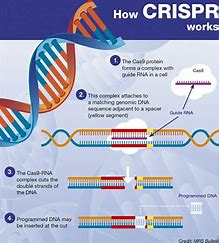
CRISPR: Play-by-Play of an Experiment

Scientists in Jennifer Doudna’s lab pull back the veil on their gene-editing process

***

Clustered Regularly InterSpaced Palindromic Repeat

By Hayden Field

***

***

CRISPR is a family of DNA sequences found in the genomes of prokaryotic organisms such as bacteria and archaea. These sequences are derived from DNA fragments of bacteriophages that had previously infected the prokaryote. They are used to detect and destroy DNA from similar bacteriophages during subsequent infections

CITE: https://www.amazon.com/Dictionary-Health-Information-Technology-Security/dp/0826149952/ref=sr_1_5?ie=UTF8&s=books&qid=1254413315&sr=1-5

And, we’ve posted about CRISPR before: https://medicalexecutivepost.com/2021/07/08/on-crispr-gene-editing/

So now, what is the use of CRISPR for antiobiotics?

READ: https://www.emergingtechbrew.com/stories/2022/07/26/from-infant-poop-to-trance-music-here-s-a-play-by-play-of-a-crispr-experiment?mid=349b552221c994e2540a304649746d7c

***

COMMENTS APPRECIATED

Thank You

***

FINANCIAL PLANNING: https://www.routledge.com/Comprehensive-Financial-Planning-Strategies-for-Doctors-and-Advisors-Best/Marcinko-Hetico/p/book/9781482240283

***

CHARITY LURE: Identifiable Victim Effect

IDENTIFIABLE PERPETRATOR EFFECT

By Staff Reporters

***

***

According to colleague Dan Ariely PhD, the The Identifiable Victim Effect [IVE] is why we’re more moved by one person’s story than by statistics. It’s easier to empathize with a single, identifiable victim than with a faceless group. Charities know this and often highlight individual stories to tug at our heartstrings. It’s a powerful reminder that our compassion is wired for personal connections.

The identifiable victim effect has two components. People are more inclined to help an identified victim than an unidentified one, and people are more inclined to help a single identified victim than a group of identified victims. Although helping an identified victim may be commendable, the identifiable victim effect is considered a cognitive bias. From a consequential point of view, the cognitive error is the failure to offer N times as much help to N unidentified victims.

The identifiable victim effect has a mirror image that is sometimes called the identifiable perpetrator effect. Research has shown that individuals are more inclined to mete out punishment, even at their own expense, when they are punishing a specific, identified perpetrator.

So, when you hear a touching story that makes you want to help, remember: it’s your brain responding to the power of a single, human face.

COMMENTS APPRECIATED

Thank You

***

***

DAILY UPDATE: Maximum Lifespan as Medicare Part C is Down and Stocks Markets Decline

MEDICAL EXECUTIVE-POST TODAY’S NEWSLETTER BRIEFING

***

Essays, Opinions and Curated News in Health Economics, Investing, Business, Management and Financial Planning for Physician Entrepreneurs and their Savvy Advisors and Consultants

Serving Almost One Million Doctors, Financial Advisors and Medical Management Consultants Daily

A Partner of the Institute of Medical Business Advisors , Inc.

http://www.MedicalBusinessAdvisors.com

SPONSORED BY: Marcinko & Associates, Inc.

***

http://www.MarcinkoAssociates.com

Daily Update Provided By Staff Reporters Since 2007.
How May We Serve You?
© Copyright Institute of Medical Business Advisors, Inc. All rights reserved. 2024

REFER A COLLEAGUE: MarcinkoAdvisors@msn.com

SPONSORSHIPS AVAILABLE: https://medicalexecutivepost.com/sponsors/

ADVERTISE ON THE ME-P: https://tinyurl.com/ytb5955z

Your Referral Count -0-

Maximum lifespans. The upper limit of human life expectancy is leveling out, according to a new study published in the journal Nature Aging. Back in 1990, life-extending tech and health measures were increasing the average global lifespan by about 2.5 years per decade, but that dropped to 1.5 years per decade in the 2010s and closer to zero in the US, where there are more drug overdoses, shootings, and medical care inequities.

CITE: https://www.r2library.com/Resource

STOCKS UP

Sphere Entertainment popped 6.33% on the news that a second Sphere will be built in Abu Dhabi. London was originally supposed to be the location of a second venue, but they’ve already got the Eye, and didn’t need more circular tourist attractions.

  • Oklo, a Sam Altman-backed nuclear energy startup, rose another 16.04% on the news that Google will purchase nuclear power to turbocharge its AI infrastructure.
  • Charles Schwab climbed 6.10% after the bank announced a top and bottom line beat last quarter, as well as higher revenue projections for the full fiscal year.
  • Boeing somehow gained 2.26% after announcing it is raising $35 billion to support its struggling finances as the machinist union strike enters its second month.
  • Wolfspeed, which sounds like a super power in a YA novel, soared 21.27% on the news that the US government will provide the chipmaker with up to $750 million in government grants.

STOCKS DOWN

  • Semiconductor stocks got a double whammy in the last 48 hours. First, Bloomberg revealed that US officials are considering limiting the sale of AI chips outside the country. Then, ASML missed its Q3 sales estimates (more on that below). Nvidia shares slid 4.52%, AMD fell 5.22%, and Intel dropped 3.33%.
  • Citigroup beat earnings estimates this quarter, but shareholders punished the bank for setting aside more money in case of higher loan losses ahead. Shares dropped 5.11%.
  • Coty, parent company of numerous beauty brands like CoverGirl, fell 10.74% to a new 52-week low after it warned of a sales slowdown in the coming quarters.
  • Enphase Energy tumbled 9.29% after RBC analysts downgraded the solar power stock, citing growing competition from the likes of Tesla as well as slowing demand for solar batteries.
  • Speaking of energy, oil stocks plummeted on news of Israel’s targeting of Iranian military assets rather than crude production facilities. Exxon Mobil fell 3.01%, Chevron dropped 2.67%, and Valero Energy sank 4.62%.

CITE: https://tinyurl.com/2h47urt5

Here’s where the major benchmarks ended yesterday:

  • The S&P 500® index (SPX) fell 44.59 points (–0.76%) to 5,815.26; the Dow Jones Industrial Average® ($DJI) dropped 324.80 points (–0.75%) to 42,740.42; and the NASDAQ Composite® ($COMP) lost 187.09 points (–1.01%) to 18,315.59.
  • The 10-year Treasury note yield (TNX) fell three basis points to 4.04%, the lowest close in a week.
  • The CBOE Volatility Index® (VIX) climbed to 20.72, an elevated level.

CITE: https://tinyurl.com/tj8smmes

Millions of seniors will lose access to their Medicare Advantage plans after major insurer cuts in the aftermath of the Inflation Reduction Act. Experts spoke with Newsweek about what’s going on and what steps seniors can take to get the coverage they need.

COMMENTS APPRECIATED

PLEASE SUBSCRIBE: MarcinkoAdvisors@msn.com

Thank You

***

***

***

***

EDUCATIONAL TEXTBOOKS: https://tinyurl.com/4zdxuuwf

***

FRAUD SCHEMES of [Fewer] Medical Providers

[TOP TEN IN HEALTH CARE]

Sponsor: http://www.CertifiedMedicalPlanner.org

CMP logo

https://medicalexecutivepost.com/wp-content/uploads/2018/06/david-edward-marcinko.png

By Dr. David E. Marcinko MBA CMP®

  1. Billing for services not rendered.
  2. Billing for a non-covered service as a covered service.
  3. Misrepresenting dates of service.
  4. Misrepresenting locations of service.
  5. Misrepresenting provider of service.
  6. Waiving of deductibles and/or co-payments.
  7. Incorrect reporting of diagnoses or procedures (includes unbundling).
  8. Overutilization of services.
  9. Corruption (kickbacks and bribery).
  10. False or unnecessary issuance of prescription drugs.

[Source]: Charles Piper; CFE CRT January/February 2013 ACFE

Related: https://medicalexecutivepost.com/2020/10/01/healthcare-fraud-and-abuse-costs-and-cases-rose-in-2019/

More: https://medicalexecutivepost.com/2017/05/03/combating-healthcare-fraud/

Update: https://medicalexecutivepost.com/2021/04/24/fraudsters-phishing-for-physician-signatures/

ASSESSMENT: Your thoughts are appreciated.

Risk Management, Liability Insurance, and Asset Protection Strategies for Doctors and Advisors : Best Practices from Leading Consultants and Certified Medical Planners™ book cover

TEXTBOOK ORDER: https://www.routledge.com/Risk-Management-Liability-Insurance-and-Asset-Protection-Strategies-for/Marcinko-Hetico/p/book/9781498725989

Invite Dr. Marcinko

THANK YOU

***

MEDICARE: Open Enrollment Period Commences

By Staff Reporters & The Medicare Team

Medicare open enrollment—which runs from October 15th through December 7th this year—is your chance to check in on your Medicare plan and, if needed, change it.

***

***

Mark your calendars — Medicare Open Enrollment starts October 15th! Did you know new benefits are coming to Medicare drug coverage next year?

Starting in 2025, all Medicare plans will include a $2,000 cap on what you pay out-of-pocket for prescription drugs covered by your plan. So, it’s more important than ever to make sure your drugs are covered.

Also starting next year, you can choose to participate in a program that spreads your out-of-pocket drug costs across the calendar year, instead of paying all at once at the pharmacy. It’s called the Medicare Prescription Payment Plan — and you can opt in with your plan throughout the 2025 plan year. Contact your plan for more details.

Preview Coverage Options

Remember, Medicare plans can change from one year to the next, and so can your health needs. Preview and compare all your health and drug options and see if you can save!

The Medicare Team

***

***

Medical Practice Valuation Blunders

 Top Ten Appraisal Blunders to Avoid

By Dr. David Edward Marcinko; MBA, MEd, CMP™

MARCINKO & ASSOCIATES: https://marcinkoassociates.com/

Top Ten Appraisal Blunders to Avoid

The science of the modern medical practice valuation can be traced to the Estate of Edgar A. Berg v. Commissioner (T. C. Memo 1991-279). In this case, the Court criticized CPAs as not being qualified to perform business valuations, failing to provide analysis of an appropriate discount rates, and making only general references to justify their   “Opinion of Value.”

In rejecting accountants, the Court accepted IRS economists because of background, education and training, as well as discount rate calculations and reproducible evidence applied to the assets being examined. This marked the beginning of the Tax Court leaning toward the side with the most comprehensive appraisal. Previously, it had a tendency to “split the difference.” Now, some feel the Berg case launched the valuation profession; especially for contemporaneous health economists.

But, it was not until after 1995 that the IRS issued guidelines for the valuation of physician practices. As a result, the Uniform Standards of Professional Appraisal Practice [USPAP] requires that a blended constellation of three recognized valuation approaches (income, market, and cost approaches) be considered when estimating fair market value.

Operative Valuation Definitions

When pursuing any discussion of medical practice worth, two key elements must be understood: (1) the valuation process, and (2) fair market value.  According to the Dictionary of Health Economics and Finance

  1. Practice valuation is the “the formal process of determining the worth of a healthcare or other medical business entity, at a specific point in time, and the act or process of determining fair market value.”
  2. Fair market value [FMV] is “a legal term generally meaning the price at which a willing buyer will buy, and a willing seller will sell an asset in an open free market with full disclosure.”  IRS Revenue Ruling 59-60 clearly states that FMV “is essentially a future prophesy and must be based on facts available at the required date of appraisal”

Unfortunately, the value of a medical practice cannot be directly observed by activity in thinly traded private markets. Perhaps this is why we continually observe the following valuation blunders? They are committed by both sellers and buyers who are pursuing opposite objectives; sale price maximization versus price minimization?

Top 10 Blunders:

Not Understanding What a Medical Practice Valuation Is and Is Not

  • Valuations are not source document fraud audits.
  • Valuations are material representations providing a range of transferable worth.
  • Valuations are reproducible estimates based on economic assumptions.
  • Valuations are not “back-of-the envelope multiples” using specious benchmarks.
  • Valuations are defensible and “signed-off” attesting to USPAP/IRS formats.
  • Financial accounting value [book-value] is not fair market value.
  • Professional valuators represent only one party at arm’s length; not both sides.
  • Engagement solicitor and/or valuation payer is the client.
  • Unbiased valuators do not provide financing or equity-participation schemes. Although not standardized, the Institute of Medical Business Advisors, Inc uses the following three levels that approximate engagement types for the industry.

2. A Limited Valuation lacks additional suggested USPAP procedures.  It is considered an “agreed-upon-procedure”, used in circumstances where the client is the only user [i.e., updating a buy-sell agreement, or practice buy-in for a valued associate] and not for external purposes. No onsite visit is needed. A formal Opinion of Value is not rendered.

3. Not Observing Industry Standards, Rules and Regulations

Specifically, in USPAP transactions involving physician practices, the IRS implied:

  • Ad-Hoc Valuation is low level engagement that provides a gross and non-specific approximation of value based on limited meters by involved parties. Neither a written report, nor an Opinion of Value is rendered. It is often used periodically as an internal organic growth / decline gauge.
  • A Comprehensive Valuation is an extensive service designed to provide an unambiguous Opinion of Value range. It is supported by all procedures that valuators deem relevant with mandatory onsite review. This “gold-standard” is suitable for contentious situations like divorce, partnership dissolution, estate planning and gifting, etc. The written Opinion of Value is applicable for litigation support activities like depositions and trial. It is also useful for external reporting to bankers, investors, the public and IRS, etc.

4. Not Understanding Engagement Types and Levels

  • Discounted cash flow (DCF) analysis is the most relevant income approach and must be done on an “after-tax” basis.
  • Practice collections must be projected based on reasonable assumptions for the practice and market; etc.
  • Physician compensation must be based on market rates consistent with age, experience and productivity.
  • Majority premiums and minority discounts are to be considered.Goodwill represents the difference between practice purchase price and the value of the net assets.  Personal goodwill results from the charisma, skills and reputation of a specific doctor. Its attributes accrue solely to the individual, are not transferable and can’t be sold. It has little or no economic value as it “goes to the grave” with the doctor.  Transferable medical practice goodwill has value, may be transferred, and is defined as the unidentified residual attributes that contribute to the propensity of patients and managed care contracts (and their revenue streams) to return in the future (Schilbach v. Commissioner, T.C. Memo 1991-556).  And so, one must also appreciate the: (i) impact of a changing environment; (ii) practice transfer in a local market which can augment or blunt goodwill value; and the (iii) determination of whether patients or HMOs return because of true goodwill, or are mandated by contractual obligations; among many other multi-variable determinants.
  • Even the Goodwill Registry however, a classic source used to determine the average percentage of revenue contributed to practice goodwill, may be dated for some specialties leading to abnormally high values.

5. Not Understanding the Value of Practice Goodwill: Unlimited life span.

6. Not Understanding the Value of Personal Goodwill: Limited life span.

Now, to further confuse the issue, how each kind of goodwill is allocated in situations like divorce depends on state law. For example, some courts include both kinds of goodwill to be apportioned – some exclude both – and others pursue a case-by-case approach.

7. Not Understanding “Excess Earnings Capitalization”

Another way to determine goodwill value is through “excess earnings capitalization.” This economic method looks at the difference between salary, and what you’d have to pay a comparable doctor replacement.

As an example, when you subtract the numbers, and divide the result by 20%, an important percentage referred to as the Capitalization Rate emerges. The final number gives a dollar value for practice goodwill. Courts seem to prefer this method in divorces because it tends to reflect a practice’s current value.

8. Not Understanding the Present Compensation versus Future Value Paradox

Regardless of practice business model, physician compensation is inversely related to practice value. In other words, the more a doctor takes home in above-average salary, the less the practice is generally worth, and vice versa; ceteris paribus

9. Substituting Benchmarks and Formulas for Practice Specificity

In the stable economic past, industry benchmarks might have been used as quick and inexpensive substitutes for professionally prepared valuations.  Muck like preparing one’s own income tax return today – while legal – it is a fraught with peril if challenged. The Courts seem to frown on this simplistic and dated methodology.

Moreover, generic benchmark formulas assume a financial statement reporting standard that just does not exist in public accounting.

Therefore, most every competitive issue that impacts value should be addressed with each practice engagement. This includes, but is not limited to contemporary dislocations by third parties, Medicare and commercial payers; retail clinics and changes in supply/demand and specialty trends; rise of ambulatory surgery centers and specialty hospitals; outsourced care and medical tourism, alterations in resource based-relative value units, APCs, DRGs and newer MS-DRGs; the Medicare Modernization Act, HIPAA, OSHA, EEOC, Sarbanes-Oxley and US Patriot Acts, PP-CA, and ACOs; among other regulations.

Current employee trends to high-deductible health care plans [HD-HCPs] and private concierge medicine must also be considered, as well as demographic and employer shifts to defined contribution plans – from defined benefits plans – to name just a few more complicating issues.

10. Not Aggregating or “Normalizing” Financial Information

Employees may be interviewed and financial information must be gathered before a medical practice can be properly valued. The following data, for the most recent three year period, serves as a starting point:

  • Practice (corporate) tax returns.
  • Equipment / automobile leasing and/or tax depreciation schedules.
  • Accounts Receivable aging-schedule.
  • Practice consolidated financial statements (P&L, Cash Flow, Balance Sheet and Retained Earnings).
  • Prior Buy-Sell and/or non-compete agreements, and;
  • Sample medical record chart review is increasingly being demanded.
  • It is especially important to eliminate one-time, non-recurring practice expenses. These are adjusted for excessive or below normal expenses on the profit and loss statement. Such “normalization” can produce a big surprise for benchmark proponents and formula-driven advocates when a selling doctor runs personal expenditures through the practice that a buyer [or Court] wouldn’t consider legitimate.  Of course, such shenanigans are less noted using professional USPAP/IRS guidelines. Conversely, you may have to defend legitimate business expenses that an appraiser may seek to normalize. For example, doctors may pay for a vehicle through their practice, but if used to travel between multiple offices and hospitals, the expense may be legitimate.  Of course, normalization is a sophisticated and time-intensive process. But, it is where the expert earns his/her professional fee, and defends the resulting valuation range when challenged.The most important credential to look for is fiduciary experience, specificity and independence. Some doctors mistakenly turn to those who may have never appraised a practice before. And, just because an appraiser has initials behind his name, doesn’t mean he understands the peculiarities of medical specialties, especially podiatry. We believe that only an independent health economist, who will be your advocate under Securities Exchange Commission [SEC] fiduciary [not lower “suitability”] guidelines, should be selected. Of course, it is almost impossible to answer concerns regarding fees without specific information. The cost of a valuation can range from $0 (benchmarks-rule of thumb) to $50,000 for an onsite team of experts for behemoth practices and ambulatory surgery centers. Keep in mind that in most cases you want to ensure the value determination will stand up to IRS scrutiny, so the $0 rule-of-thumb is not an optionExternal appraisals, or poorly aggregated financial information, onsite reviews and litigation support services incur additional costs; yet most doctors find the money well spent. Expect to pay a retainer and sign a formal professional engagement letter.

Assessment

Don’t be surprised if a sales-broker does not consider the above issues as the modern health era emerges. Most agent-appraisers are predominantly concerned with earning commissions by working both transaction parties, and may not represent your best interests. And, they are usually not obliged to disclose conflicts-of-interest and don’t provide legal testimony.

As a result, a good medical practice is no longer necessarily a good business; and retiring doctors can no longer automatically expect to extract premium sales prices. Moreover, uninformed young physicians should not be goaded to over-pay. Regardless of your dismay – or delight – in the changing healthcare milieu, always be foreword thinking and remember the admonition, Trust-but Verify, for any business transaction. 

But, it is a fait accompli that medical practice worth is presently deteriorating. As the population ages and third-party reimbursements plummet, doctors are commoditized and traditional retail medicine is replaced by more efficient wholesale business models like workplace health clinics. The recent sub-prime mortgage de-fault fiasco, potential tax-reform law expiration and the political specter of a nationalized healthcare system, only adds fuel to the macro-economic fires of uncertainly.

Finally, once practice price is mutually agreed upon, sales contract terms and agreements present a plethora of financing challenges for both involved parties to consider [bank loan payment rates and length, personal promissory guarantees, down-payment offsets, earn-out arrangements, Uniform Commercial Codes-1 asset guarantees, etc] in their due-diligence efforts.

However, most reputable firms use a blended fee-schedule of fixed and hourly rates (plus expenses). So, doctors should expect to spend approximately $5,000-15,000 for an average sized – limited appraisal – that is completely suitable for most internal activities.

Moreover, look-out if the valuation not done at an-arm’s-length and independent manner; or worse still, if it is performed for both parties simultaneously.

 Selecting the Wrong Valuator and Not Understanding Professional Fees

  • Realize too, that the appraiser may also add expenses that have not been incurred; like an office manager’s salary if your spouse is in that role for free. This produces a lower appraised value and is common in small medical practices. Honoraria are another example that does not figure into value calculations.
  • For example, we recall one doctor who painted his personal residence and wrote it-off as a valid business expense. Deleting other major expenses such as country club memberships, make a practice look more profitable—good news if you’re selling it, bad news if you’re getting a divorce.

Conclusion

Your thoughts and comments on this ME-P are appreciated. Feel free to review our top-left column, and top-right sidebar materials, links, URLs and related websites, too. Then, subscribe to the ME-P. It is fast, free and secure.

Speaker: If you need a moderator or speaker for an upcoming event, Dr. David E. Marcinko; MBA – Publisher-in-Chief of the Medical Executive-Post – is available for seminar or speaking engagements. Contact: MarcinkoAdvisors@msn.com

 ***

Risk Management, Liability Insurance, and Asset Protection Strategies for Doctors and Advisors: Best Practices from Leading Consultants and Certified Medical Planners™8Comprehensive Financial Planning Strategies for Doctors and Advisors: Best Practices from Leading Consultants and Certified Medical Planners™

[Dr. Cappiello PhD MBA] *** [Foreword Dr. Krieger MD MBA]

Front Matter with Foreword by Jason Dyken MD MBA

Invite Dr. Marcinko

***

***


DAILY UPDATE: Life Span, Earnings Reports, Oil, Gold and Bitcoin with Closing Stock Highs

MEDICAL EXECUTIVE-POST TODAY’S NEWSLETTER BRIEFING

***

Essays, Opinions and Curated News in Health Economics, Investing, Business, Management and Financial Planning for Physician Entrepreneurs and their Savvy Advisors and Consultants

Serving Almost One Million Doctors, Financial Advisors and Medical Management Consultants Daily

A Partner of the Institute of Medical Business Advisors , Inc.

http://www.MedicalBusinessAdvisors.com

SPONSORED BY: Marcinko & Associates, Inc.

***

http://www.MarcinkoAssociates.com

Daily Update Provided By Staff Reporters Since 2007.
How May We Serve You?
© Copyright Institute of Medical Business Advisors, Inc. All rights reserved. 2024

REFER A COLLEAGUE: MarcinkoAdvisors@msn.com

SPONSORSHIPS AVAILABLE: https://medicalexecutivepost.com/sponsors/

ADVERTISE ON THE ME-P: https://tinyurl.com/ytb5955z

Your Referral Count -0-

Maximum lifespans. The upper limit of human life expectancy is leveling out, according to a new study published in the journal Nature Aging. Back in 1990, life-extending tech and health measures were increasing the average global lifespan by about 2.5 years per decade, but that dropped to 1.5 years per decade in the 2010s and closer to zero in the US, where there are more drug overdoses, shootings, and medical care inequities.

CITE: https://www.r2library.com/Resource

  • Stocks kicked off the first full week of earnings season at full throttle. The S&P 500 rose to a new intraday record, the Dow closed above 43,000 for the first time ever, and the NASDAQ climbed steadily throughout the trading session.
  • Bitcoin soared on the news of China’s additional stimulus spending that broke this weekend. Although the Chinese government’s plans are light on details at the moment, the promise of more support for the world’s second largest economy was enough to get crypto traders hyped.

CITE: https://tinyurl.com/2h47urt5

  • Interestingly enough, those same promises of Chinese stimulus sent oil tumbling to start the day. The selling was exacerbated by OPEC’s announcement that crude demand will fall lower than expected in 2024 and 2025.
  • Gold sank a hair today as traders weighed Chinese stimulus against a stronger dollar.

CITE: https://tinyurl.com/tj8smmes

Here’s where the major benchmarks ended:

  • The S&P 500® index (SPX) rose44.82points (0.77%) to 5,859.85, a new closing high; the Dow Jones Industrial Average® ($DJI) increased 201.36 points (0.47%) to 43,065.22, also a new closing high; and the NASDAQ Composite® ($COMP) added 159.74 points (0.87%) to 18,502.69.
  • The 10-year Treasury note yield (TNX) did not trade today due to the holiday. 
  • The CBOE Volatility Index® (VIX) slipped to 19.9, its first drop below 20 since October 4.

A slate of corporate earnings reports coming from Goldman Sachs, Bank of America, and Citigroup in the financial sector, along with healthcare giants Johnson & Johnson, Walgreens, and UnitedHealth. And throughout the week: Morgan Stanley will report on Wednesday, Netflix reports on Thursday, and Procter & Gamble and American Express drop their financials on Friday. It’ll pose a big test for the stock market’s $8 trillion rally this year.

COMMENTS APPRECIATED

PLEASE SUBSCRIBE: MarcinkoAdvisors@msn.com

Thank You

***

***

***

***

EDUCATIONAL TEXTBOOKS: https://tinyurl.com/4zdxuuwf

***

MARCINKO & ASSOCIATES: Financial Planning and Business Management Education for Physicians

By Dr. David Edward Marcinko MBA MEd CMP

CONSULTING ADVICE – NOT SALES

“AT YOUR SERVICE”

E-mail: MarcinkoAdvisors@msn.com

SPONSOR: http://www.MarcinkoAssociates.com

Marcinko & Associates is financial guide. We help answer your questions in an empowering way. We educate and guide medical colleagues to understand their financial picture and to make better financial decisions. We strive to simplify everything, clear up confusion, and address specific needs and goals.

Simply put, we’re a financial services company on a mission to empower financial freedom for all healthcare professionals; only. We work with doctors, nurses, medical providers, individuals and all sizes of organizations to offer investment, wealth management and retirement solutions so everyone can have a clear and simple understanding of where their finances and career is today and where it is headed tomorrow.

Whatever your financial situation, we do not shame, criticize, or sell. We enrich, educate and empower. We work only with medical colleagues at every stage of their financial journey [students, interns, residents, practitioners, mid-career and mature physicians], through big life personal changes to annual employment reviews, in order to help them understand, invest, and protect their money and lifestyle.

CITE: https://www.r2library.com/Resource

For example, the following are current issues of review need for each Fall and Winter:

  • Financial planning reviews: 401-k, insurance, budget plans, investing, debt and savings, etc
  • Assess, develop, and align financial retirement and estate planning goals
  • Risk Management: Malpractice, home, life, medical, auto and personal indemnity
  • Life Insurance Need Reviews: whole, universal and term  
  • Business, operations, HR, employment negotiations and medical practice management
  • Annuity Need Reviews: Indexed and Fixed [Pros and Cons].

***

***

At Marcinko & Associates we discuss specific needs and answer specific questions. We educate and make personalized recommendations that you are free to use, incorporate or disregard. Referrals to trusted specialists and strategic alliance partners then occur if – and as – needed [pro re nata].

SPONSOR: http://www.CertifiedMedicalPlanner.org

***


AVOIDANT BEHAVIOR: Disease and Illness

COMMON SENSE PUBLIC AND POPULATION HEALTH

By Staff Reporters

***

***

According to colleague Dan Ariely PhD, Disease Avoidant Behavior are the actions we take to avoid illness, often driven by instinctive or learned responses. It’s why we wash our hands obsessively during flu season, wear a balaclava mask and/or avoid people who are sneezing or coughing.

Note: A balaclava is a form of cloth headgear designed to expose only part of the face, usually the eyes and mouth. Depending on style and how it is worn, only the eyes, mouth and nose, or just the front of the face are unprotected. Versions with enough of a full face opening may be rolled into a hat to cover the crown of the head or folded down as a collar around the neck.

This behavior is rooted in our evolutionary survival instincts, helping us steer clear of contagious health threats like RSV, COVID and the winter flu. While it’s usually a good thing, excessive disease avoidant behavior can lead to anxiety and social isolation.

So, balance caution with common sense and public/population health directives to stay healthy and sane.

COMMENTS APPRECIATED

Thank You

***

***

What is Stock Market “Front-Running”?

What is Is – How it Works

dem-at-wharton2.jpg

By Dr. David E. Marcinko MBA MEd CMP

http://www.MarcinkoAssociates.com

According to Wikipedia, Front Running, also known as Tailgating, is the prohibited practice of entering into an equity (stock) trade, option, futures contract, derivative, or security-based swap to capitalize on advance, nonpublic knowledge of a large pending transaction that will influence the price of the underlying security.

Front running is considered a form of market manipulation in many markets. Cases typically involve individual brokers or brokerage firms trading stock in and out of undisclosed, un-monitored accounts of relatives or confederates. Institutional and individual investors may also commit a front running violation when they are privy to inside information. A front running firm either buys for its own account before filling customer buy orders that drive up the price, or sells for its own account before filling customer sell orders that drive down the price.

Front running is prohibited since the front-runner profits from nonpublic information, at the expense of its own customers, the block trade, or the public market.

Scandals

In 2003, several hedge fund and mutual fund companies became embroiled in an illegal late trading scandal made public by a complaint against Bank of America brought by New York Attorney General Eliot Spitzer. A resulting U.S. Securities and Exchange Commission investigation into allegations of front-running activity implicated Edward D. Jones & Co., Inc., Goldman Sachs, Morgan Stanley, Strong Mutual Funds, Putnam Investments, Invesco, and Prudential Securities.

Following interviews in 2012 and 2013, the FBI said front running had resulted in profits of $50 million to $100 million for the bank. Wall Street traders may have manipulated a key derivatives market by front running Fannie Mae and Freddie Mac.

Term Origins

The terms originate from the era when stock market trades were executed via paper carried by hand between trading desks. The routine business of hand-carrying client orders between desks would normally proceed at a walking pace, but a broker could literally run in front of the walking traffic to reach the desk and execute his own personal account order immediately before a large client order.

Likewise, a broker could tail behind the person carrying a large client order to be the first to execute immediately after. Such actions amount to a type of insider trading, since they involve non-public knowledge of upcoming trades, and the broker privately exploits this information by controlling the sequence of those trades to favor a personal position.

Assessment

So, was front-running implicated in the market drop today? OR, a technical correction or Panic selling? Any thoughts.

MORE: Investing “Tips” on Initial Public Offerings  https://medicalexecutivepost.com/2017/12/18/initial-public-offerings/

Conclusion

Your thoughts and comments on this ME-P are appreciated. Feel free to review our top-left column, and top-right sidebar materials, links, URLs and related websites, too. Then, subscribe to the ME-P. It is fast, free and secure.

Speaker: If you need a moderator or speaker for an upcoming event, Dr. David E. Marcinko; MBA – Publisher-in-Chief of the Medical Executive-Post – is available for seminar or speaking engagements.

Book Marcinko: https://medicalexecutivepost.com/dr-david-marcinkos-bookings/

https://www.crcpress.com/Comprehensive-Financial-Planning-Strategies-for-Doctors-and-Advisors-Best/Marcinko-Hetico/p/book/9781482240283

Risk Management, Liability Insurance, and Asset Protection Strategies for Doctors and Advisors: Best Practices from Leading Consultants and Certified Medical Planners™8Comprehensive Financial Planning Strategies for Doctors and Advisors: Best Practices from Leading Consultants and Certified Medical Planners™

COLUMBUS DAY 2024: Stocks, Bonds, Gold & Oil

By Staff Reporters

***

U.S. stock markets, including the New York Stock Exchange and the NASDAQ remain open and follow a regular schedule today.

The bond markets will be closed, however.

***

***

  • Stocks ended last week on a high note, closing out their fifth straight week of gains. The Dow was pushed to yet another new all-time high by strong earnings from JPMorgan, while the S&P 500 was in the green and rose to its own record close, and the NASDAQ clawed its way out of the red by early Friday afternoon.
  • Bond yields took a breather, falling below 4.1% thanks to a better-than-expected PPI report that helped offset inflation fears that had re-arisen after a worse-than-expected CPI report.
  • Gold rose as well on PPI news, since the data pointed to a better chance of more rate cuts ahead.
  • Oil fell a bit but gained over the last two weeks on geopolitical tensions and destruction in the Gulf of Mexico following the two major hurricanes.

COMMENTS APPRECIATED

Thank You

***

***

STOCK MARKET: A Zero Sum Bias?

By Staff Reporters

FINANCIAL / INVESTMENT ADVISORS & STOCK BROKERS

SPONSOR: http://www.MarcinkoAssociates.com

***

***

According to colleague Dan Ariely PhD, a Zero Sum Bias [ZSB] is the mistaken belief that one person’s gain is another’s loss. It’s like thinking the world is a giant pie with only so many slices. This mindset fuels competition and jealousy, making us forget that collaboration can create more pie. It’s why we sometimes root against others instead of working together.

Question: Is the stock market a zero-sum game? You frequently hear media refer to games and markets as zero-sum games.

Answer: Well, yes, we define the stock market as a zero-sum game, both in the short and in the long term, although it technically is incorrect. A zero-sum game is where one person’s gain is another person’s loss – thus there is no wealth created and the overall benefit is zero. This doesn’t apply to stocks, but it’s a zero-sum game in relation to a stock market benchmark.

For example, short-term trading in stocks is theoretically not a zero-sum game, and neither is long-term investing. But short-term trading is close to a zero-sum game, and long-term investing is a zero-sum game if we use a broad index as a benchmark.

Essentially, in other words, the stock market functions as an expansive network of zero-sum transactions; each trade engages a buyer and a seller–their perspectives on a security’s future value contrasting. These opposing views propel market prices: they mirror not only risk transfer but also potential reward—a dynamic process indeed! Traders and investors must grasp the crucial zero-sum aspect; it underscores trading’s inherent competitiveness. Effectively anticipating market trends and actions from other participants: therein lies success in this environment. 

CITE: https://www.r2library.com/Resource/Title/0826102549

So, next time you feel like someone else’s success diminishes your own, remember: there’s more than enough pie to go around.

COMMENTS APPRECIATED

Thank You

***

***

ORTHOPEDIC & PODIATRIC SURGERY: Ambulatory Surgery Centers

AVERAGE REVENUE PER CASE

By Staff Reporters

***

Podiatry is 3rd in Average Revenue Per Case in ASCs

***

Ambulatory Surgery Centers: Creating Value through Outpatient Surgery

***

Orthopedic surgery topped the pack for ASC revenue per case, according to VMG Health’s “Multi-Specialty ASC Benchmarking Study” for 2022.

The specialty was only the fourth most-represented among ASC cases, however. Nationally, gastroenterology was the most-represented specialty among ASCs, with 32 percent of all cases, followed by ophthalmology, with 26 percent, and pain management and orthopedics, with 22 and 21 percent, respectively.

Average revenue per case:

1. Orthopedics — $3,791

2. Gynecology — $3,117

3. Podiatry — $2,990

4. Urology — $2,724

5. Otolaryngology — $2,617

6. General surgery — $2,508

7. Plastic surgery — $2,264

8. Ophthalmology — $1,487

9. Pain management — $1,273

10. Gastroenterology — $1,079

Source: Marcus Robertson, Becker’s ASC [2/15/22]

***

ORDER INFECTION TEXTBOOK: https://tinyurl.com/ms647rnt

***

***

COMMENTS APPRECIATED

Thank You

Subscribe to the Medical Executive-Post

***

Dr. Marcinko Interviewed on Physician Retirement and Succession Planning

imba inc
***

Physicians Have Unique Challenges and Opportunities

ENCORE PRESENTATION

http://www.MarcinkoAssociates.com

By Ann Miller RN MHA CMP

[Executive-Director]

Medical Executive-Post Publisher-in-Chief, Dr. David Edward Marcinko MBA CMP™, and financial planner Paul Larson CFP™, were interviewed by Sharon Fitzgerald for Medical News, Inc. Here is a reprint of that interview.

Doctors Squeezed from both Ends

Physicians today “are getting squeezed from both ends” when it comes to their finances, according Paul Larson, president of Larson Financial Group. On one end, collections and reimbursements are down; on the other end, taxes are up. That’s why financial planning, including a far-sighted strategy for retirement, is a necessity.

Larson Speaks

“We help these doctors function like a CEO and help them quarterback their plan,” said Larson, a Certified Financial Planner™ whose company serves thousands of physicians and dentists exclusively. Headquartered in St. Louis, Larson Financial boasts 19 locations.

Larson launched his company after working with a few physicians and recognizing that these clients face unique financial challenges and yet have exceptional opportunities, as well.

What makes medical practitioners unique? One thing, Larson said, is because they start their jobs much later in life than most people. Physicians wrap up residency or fellowship, on average, at the age of 32 or even older. “The delayed start really changes how much money they need to be saving to accomplish these goals like retirement or college for their kids,” he said.

Another thing that puts physicians in a unique category is that most begin their careers with a student-loan debt of $175,000 or more. Larson said that there’s “an emotional component” to debt, and many physicians want to wipe that slate clean before they begin retirement saving.

Larson also said doctors are unique because they are a lawsuit target – and he wasn’t talking about medical malpractice suits. “You can amass wealth as a doctor, get sued in five years and then lose everything that you worked so hard to save,” he said. He shared the story of a client who was in a fender-bender and got out of his car wearing his white lab coat. “It was bad,” Larson said, and the suit has dogged the client for years.

The Three Mistake of Retirement Planning

Larson said he consistently sees physicians making three mistakes that may put a comfortable retirement at risk.

  1. The first is assuming that funding a retirement plan, such as a 401(k), is sufficient. It’s not. “There’s no way possible for you to save enough money that way to get to that goal,” he said. That’s primarily due to limits imposed by the Internal Revenue Service, which allows a maximum contribution of $49,000 annually if self-employed and just $16,500 annually until the age of 50. He recommends that physicians throughout their career sock away 20 percent of gross income in vehicles outside of their retirement plan.
  2. The second common mistake is making investments that are inefficient from a tax perspective. In particular, real estate or bond investments in a taxable account prompt capital gains with each dividend, and that’s no way to make money, he said.
  3. The third mistake, and it’s a big one, is paying too much to have their money managed. A stockbroker, for example, takes a fee for buying mutual funds and then the likes of Fidelity or Janus tacks on an internal fee as well. “It’s like driving a boat with an anchor hanging off the back,” Larson said.

Marcinko Speaks

Dr. David E. Marcinko MBADr. David E. Marcinko MBA MEd CPHQ, a physician and [former] certified financial planner] and founder of the more specific program for physician-focused fiduciary financial advisors and consultants www.CertifiedMedicalPlanner.org, sees another common mistake that wreaks havoc with a physician’s retirement plans – divorce.

He said clients come to him “looking to invest in the next Google or Facebook, and yet they will get divorced two or three times, and they’ll be whacked 50 percent of their net income each time. It just doesn’t make sense.”

Marcinko practiced medicine for 16 years until about 10 years ago, when he sold his practice and ambulatory surgical center to a public company, re-schooled and retired. Then, his second career in financial planning and investment advising began. “I’m a doctor who went to business school about 20 years ago, before it was in fashion. Much to my mother’s chagrin, by the way,” he quipped. Marcinko has written 27 books about practice management, hospital administration and business, physician finances, risk management, retirement planning and practice succession. He’s the founder of the Georgia-based Institute of Medical Business Advisors Inc.

ECON

Succession Planning for Doctors

Succession planning, Marcinko said, ideally should begin five years before retirement – and even earlier if possible. When assisting a client with succession, Marcinko examines two to three years of financial statements, balance sheets, cash-flow statements, statements of earnings, and profit and loss statements, yet he said “the $50,000 question” remains: How does a doctor find someone suited to take over his or her life’s work? “We are pretty much dead-set against the practice broker, the third-party intermediary, and are highly in favor of the one-on-one mentor philosophy,” Marcinko explained.

“There is more than enough opportunity to befriend or mentor several medical students or interns or residents or fellows that you might feel akin to, and then develop that relationship over the years.” He said third-party brokers “are like real-estate agents, they want to make the sale”; thus, they aren’t as concerned with finding a match that will ensure a smooth transition.

The only problem with the mentoring strategy, Marcinko acknowledged, is that mentoring takes time, and that’s a commodity most physicians have too little of. Nonetheless, succession is too important not to invest the time necessary to ensure it goes off without a hitch.

Times are different today because the economy doesn’t allow physicians to gradually bow out of a practice. “My overhead doesn’t go down if I go part-time. SO, if I want to sell my practice for a premium price, I need to keep the numbers up,” he noted.

Assessment

Dr. Marcinko’s retirement investment advice – and it’s the advice he gives to anyone – is to invest 15-20 percent of your income in an Vanguard indexed mutual fund or diversified ETF for the next 30-50 years. “We all want to make it more complicated than it really is, don’t we?” he said.

QUESTION: What makes a physician moving toward retirement different from most others employees or professionals? Marcinko’s answer was simple: “They probably had a better shot in life to have a successful retirement, and if they don’t make it, shame on them. That’s the difference.”

More:

Conclusion

Your thoughts and comments on this ME-P are appreciated. Feel free to review our top-left column, and top-right sidebar materials, links, URLs and related websites, too. Then, subscribe to the ME-P. It is fast, free and secure.

Speaker: If you need a moderator or speaker for an upcoming event, Dr. David E. Marcinko; MBA – Publisher-in-Chief of the Medical Executive-Post – is available for seminar or speaking engagements. Contact: MarcinkoAdvisors@msn.com

OUR OTHER PRINT BOOKS AND RELATED INFORMATION SOURCES:

PRACTICES: www.BusinessofMedicalPractice.com
HOSPITALS: http://www.crcpress.com/product/isbn/9781466558731
CLINICS: http://www.crcpress.com/product/isbn/9781439879900
BLOG: www.MedicalExecutivePost.com
FINANCE: Financial Planning for Physicians and Advisors
INSURANCE: Risk Management and Insurance Strategies for Physicians and Advisors

Product DetailsProduct DetailsProduct Details

Product Details  Product Details

Product DetailsProduct Details

Risk Management, Liability Insurance, and Asset Protection Strategies for Doctors and Advisors: Best Practices from Leading Consultants and Certified Medical Planners™8Comprehensive Financial Planning Strategies for Doctors and Advisors: Best Practices from Leading Consultants and Certified Medical Planners™
 ***

DAILY UPDATE: Boeing, Nobel Peace Prize, Tesla, JPMorgan and Wells Fargo

MEDICAL EXECUTIVE-POST TODAY’S NEWSLETTER BRIEFING

***

Essays, Opinions and Curated News in Health Economics, Investing, Business, Management and Financial Planning for Physician Entrepreneurs and their Savvy Advisors and Consultants

Serving Almost One Million Doctors, Financial Advisors and Medical Management Consultants Daily

A Partner of the Institute of Medical Business Advisors , Inc.

http://www.MedicalBusinessAdvisors.com

SPONSORED BY: Marcinko & Associates, Inc.

***

http://www.MarcinkoAssociates.com

Daily Update Provided By Staff Reporters Since 2007.
How May We Serve You?
© Copyright Institute of Medical Business Advisors, Inc. All rights reserved. 2024

REFER A COLLEAGUE: MarcinkoAdvisors@msn.com

SPONSORSHIPS AVAILABLE: https://medicalexecutivepost.com/sponsors/

ADVERTISE ON THE ME-P: https://tinyurl.com/ytb5955z

Your Referral Count -0-

Yom Kippur. Wishing a meaningful and easy fast to our readers who observe.

Boeing plans to lay off 10% of its workforce, or ~17,000 people, to cut costs as its factory workers’ strike continues.

The Nobel Peace Prize was awarded to Nihon Hidankyo, a Japanese organization of survivors of the atomic bombings of Hiroshima and Nagasaki, that advocates against nuclear weapons.

CITE: https://www.r2library.com/Resource

  • Markets: After big banks—which are often viewed as a proxy for the economy’s health—kicked off earnings season strong, the S&P 500 and the Dow hit new records, capping off stocks’ fifth winning week in a row.

CITE: https://tinyurl.com/2h47urt5

Stock spotlight: Elon Musk’s presentation of Tesla’s long-awaited Robocab didn’t go as badly as that time the Cybertruck’s “unbreakable” window got smashed on stage, but investors were unimpressed by its lack of key details.

Hailing the news were Uber and Lyft, which rose after Tesla failed to present a looming threat.

CITE: https://tinyurl.com/tj8smmes

JPMorgan says the soft landing is here. Reporting its first quarterly earnings since the Fed’s big interest rate cut, America’s biggest bank earned more than expected from loans and boosted what it forecasts it’ll earn for the year.

In other banking news, Wells Fargo also beat earnings expectations.

COMMENTS APPRECIATED

PLEASE SUBSCRIBE: MarcinkoAdvisors@msn.com

Thank You

***

***

***

***

EDUCATIONAL TEXTBOOKS: https://tinyurl.com/4zdxuuwf

***

On Psychology, Financial Planning and Investing Bias

Psychological Biases Affecting Financial Planning and Investing

Dr. Marcinko at Johns Hopkins University

By Dr. David Edward Marcinko MBA MEd CMP®

http://www.MarcinkoAssociates.com

[Editor-in-Chief]

Sponsored: http://www.CertifiedMedicalPlanner.org

CMP logo

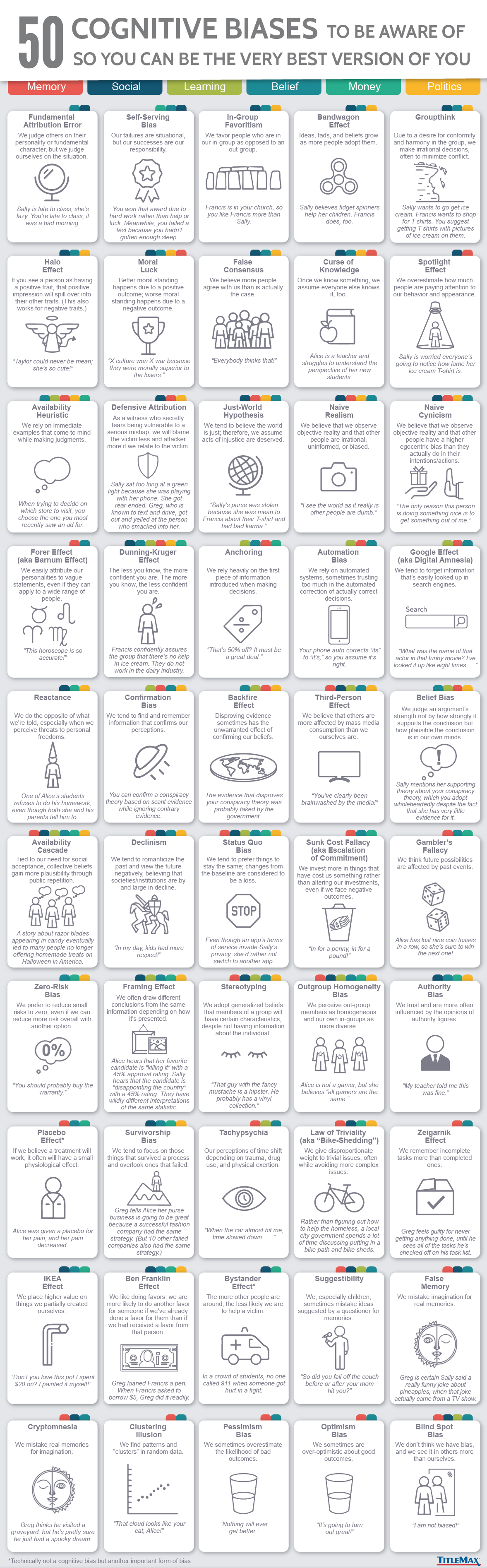
The following are some of the most common psychological biases.  Some are learned while others are genetically determined (and often socially reinforced).  While this essay focuses on the financial implications of these biases, they are prevalent in most areas in life.

[A] Incentives

It is broadly accepted that incenting someone to do something is effective, whether it be paying office staff a commissions to sell more healthcare products, or giving bonuses to office employees if they work efficiently to see more HMO patients.  What is not well understood is that the incentives cause a sub-conscious distortion of decision-making ability in the incented person.  This distortion causes the affected person – whether it is yourself or someone else – to truly believe in a certain decision, even if it is the wrong choice when viewed objectively.  Service professionals, including financial advisors and lawyers, are affected by this bias, and it causes them to honestly offer recommendations that may be inappropriate, and that they would recognize as being inappropriate if they did not have this bias.  The existence of this bias makes it important for each one of us to examine our incentive biases and take extra care when advising physician clients, or to make sure we are appropriately considering non-incented alternatives.

[B] Denial

Denial is a well known, but under-appreciated, psychological force.  Physicians, clients and professionals (like everyone else) are prone to the mistake of ignoring a painful reality, like putting off an unpleasant call (thus prolonging a problematic situation and potentially making it worse) or not opening account statements because of the desire not to see quantitative proof of losses.  Denial also manifests itself by causing human beings to ignore evidence that a mistake has been made.  If you think of yourself as a smart person (and what professional doesn’t?), then evidence pointing to the conclusion that a mistake has been made will call into question that belief, causing cognitive dissonance.  Our brains function to either avoid cognitive dissonance or to resolve it quickly, usually by discounting or rationalizing the disconfirming evidence. Not surprisingly, colleagues at Kansas State University and elsewhere, found that financial denial, including attempts to avoid thinking about or dealing with money, is associated with lower income, lower net worth, and higher levels of revolving credit.

[C] Consistency and Commitment Tendency

Human beings have evolved – probably both genetically and socially – to be consistent.  It is easier and safer to deal with others if they honor their commitments and if they behave in a consistent and predictable manner over time. This allows people to work together and build trust that is needed for repeat dealings and to accomplish complex tasks.  In the jungle, this trust was necessary to for humans to successfully work as a team to catch animals for dinner, or fight common threats.  In business and life it is preferable to work with others who exhibit these tendencies.  Unfortunately, the downside of these traits is that people make errors in judgment because of the strong desire not to change, or be different (“lemming effect” or “group-think”).  So the result is that most people will seek out data that supports a prior stated belief or decision and ignore negative data, by not “thinking outside the box”.  Additionally, future decisions will be unduly influenced by the desire to appear consistent with prior decisions, thus decreasing the ability to be rational and objective.  The more people state their beliefs or decisions, the less likely they are to change even in the face of strong evidence that they should do so.  This bias results in a strong force in most people causing them to avoid or quickly resolve the cognitive dissonance that occurs when a person who thinks of themselves as being consistent and committed to prior statements and actions encounters evidence that indicates that prior actions may have been a mistake.  It is particularly important therefore for advisors to be aware that their communications with clients and the press clouds the advisor’s ability to seek out and process information that may prove current beliefs incorrect.  Since this is obviously irrational, one must actively seek out negative information, and be very careful about what is said and written, being aware that the more you shout it out, the more you pound it in.

[D] Pattern Recognition

On a biological level, the human brain has evolved to seek out patterns and to work on stimuli-response patterns, both native and learned.  What this means is that we all react to something based on our prior experiences that had shared characteristics with the current stimuli.  Many situations have so many possible inputs that our brains need to take mental short cuts using pattern recognition we would not gain the benefit from having faced a certain type of problem in the past.  This often-helpful mechanism of decision-making fails us when past correlations or patterns do not accurately represent the current reality, and thus the mental shortcuts impair our ability to analyze a new situation.  This biologic and social need to seek out patterns that can be used to program stimuli-response mechanisms is especially harmful to rational decision-making when the pattern is not a good predictor of the desired outcome (like short term moves in the stock market not being predictive of long term equity portfolio performance), or when past correlations do not apply anymore.

[E] Social Proof

It is a subtle but powerful reality that having others agree with a decision one makes, gives that person more conviction in the decision, and having others disagree decreases one’s confidence in that decision.  This bias is even more exaggerated when the other parties providing the validating/questioning opinions are perceived to be experts in a relevant field, or are authority figures, like people on television.  In many ways, the short term moves in the stock market are the ultimate expression of social proof – the price of a stock one owns going up is proof that a lot of other people agree with the decision to buy, and a dropping stock price means a stock should be sold.  When these stressors become extreme, it is of paramount importance that all participants in the financial planning process have a clear understanding of what the long-term goals are, and what processes are in place to monitor the progress towards these goals.  Without these mechanisms it is very hard to resist the enormous pressure to follow the crowd; think social media.

[F] Contrast

Sensation, emotion and cognition work by contrast.  Perception is not only on an absolute scale, it also functions relative to prior stimuli.  This is why room temperature water feels hot when experienced after being exposed to the cold.  It is also why the cessation of negative emotions “feels” so good.  Cognitive functioning also works on this principle.  So one’s ability to analyze information and draw conclusions is very much related to the context with in which the analysis takes place, and to what information was originally available.  This is why it is so important to manage one’s own expectations as well as those of clients.  A client is much more likely to be satisfied with a 10% portfolio return if they were expecting 7% than if they were hoping for 15%.

[G] Scarcity

Things that are scarce have more impact and perceived value than things present in abundance.  Biologically, this bias is demonstrated by the decreasing response to constant stimuli (contrast bias) and socially it is widely believed that scarcity equals value.  People who feel an opportunity may “pass them by” and thus be unavailable are much more likely to make a hasty, poorly reasoned decision than they otherwise would.  Investment fads and rising security prices elicit this bias (along with social proof and others) and need to be resisted.  Understanding that analysis in the face of perceived scarcity is often inadequate and biased may help professionals make more rational choices, and keep clients from chasing fads.

[H] Envy / Jealousy

This bias also relates to the contrast and social proof biases.  Prudent financial and business planning and related decision-making are based on real needs followed by desires.  People’s happiness and satisfaction is often based more on one’s position relative to perceived peers rather than an ability to meet absolute needs.  The strong desire to “keep up with the Jones” can lead people to risk what they have and need for what they want.  These actions can have a disastrous impact on important long-term financial goals.  Clear communication and vivid examples of risks is often needed to keep people focused on important financial goals rather than spurious ones, or simply money alone, for its own sake.

[I] Fear

Financial fear is probably the most common emotion among physicians and all clients. The fear of being wrong – as well as the fear of being correct! It can be debilitating, as in the corollary expression on fear: the paralysis of analysis.

According to Paul Karasik, there are four common investor and physician fears, which can be addressed by financial advisors in the following manner:

  • Fear of making the wrong decision: ameliorated by being a teacher and educator.
  • Fear of change: ameliorated by providing an agenda, outline and/or plan.
  • Fear of giving up control: ameliorated by asking for permission and agreement.
  • Fear of losing self-esteem: ameliorated by serving the client first and communicating that sentiment in a positive manner.

https://images.routledge.com/common/jackets/crclarge/978148224/9781482240283.jpg

Textbook Order: https://www.amazon.com/Comprehensive-Financial-Planning-Strategies-Advisors/dp/1482240289/ref=sr_1_1?ie=UTF8&qid=1418580820&sr=8-1&keywords=david+marcinko

Psychological Traps

Now, as human beings, our brains are booby-trapped with psychological barriers that stand between making smart financial decisions and making dumb ones. The good news is that once you realize your own mental weaknesses, it’s not impossible to overcome them. 

In fact, Mandi Woodruff, a financial reporter whose work has appeared in Yahoo! Finance, Daily Finance, The Wall Street Journal, The Fiscal Times and the Financial Times among others; related the following mind-traps in a September 2013 essay for the finance vertical Business Insider; as these impediments are now entering the lay-public zeitgeist:

  • Anchoring happens when we place too much emphasis on the first piece of information we receive regarding a given subject. For instance, when shopping for a wedding ring a salesman might tell us to spend three months’ salary. After hearing this, we may feel like we are doing something wrong if we stray from this advice, even though the guideline provided may cause us to spend more than we can afford.
  • Myopia makes it hard for us to imagine what our lives might be like in the future. For example, because we are young, healthy, and in our prime earning years now, it may be hard for us to picture what life will be like when our health depletes and we know longer have the earnings necessary to support our standard of living. This short-sightedness makes it hard to save adequately when we are young, when saving does the most good.
  • Gambler’s fallacy occurs when we subconsciously believe we can use past events to predict the future. It is common for the hottest sector during one calendar year to attract the most investors the following year. Of course, just because an investment did well last year doesn’t mean it will continue to do well this year. In fact, it is more likely to lag the market.
  • Avoidance is simply procrastination. Even though you may only have the opportunity to adjust your health care plan through your employer once per year, researching alternative health plans is too much work and too boring for us to get around to it. Consequently, we stick with a plan that may not be best for us.
  • Loss aversion affected many investors during the stock market crash of 2008. During the crash, many people decided they couldn’t afford to lose more and sold their investments. Of course, this caused the investors to sell at market troughs and miss the quick, dramatic recovery.
  • Overconfident investing happens when we believe we can out-smart other investors via market timing or through quick, frequent trading. Data convincingly shows that people who trade most often under-perform the market by a significant margin over time.
  • Mental accounting takes place when we assign different values to money depending on where we get it from. For instance, even though we may have an aggressive saving goal for the year, it is likely easier for us to save money that we worked for than money that was given to us as a gift.
  • Herd mentality makes it very hard for humans to not take action when everyone around us does. For example, we may hear stories of people making significant profits buying, fixing up, and flipping homes and have the desire to get in on the action, even though we have no experience in real estate.
https://images.routledge.com/common/jackets/crclarge/978149872/9781498725989.jpg

Textbook Order: https://www.routledge.com/Risk-Management-Liability-Insurance-and-Asset-Protection-Strategies-for/Marcinko-Hetico/p/book/9781498725989

Your thoughts are appreciated.

THANK YOU

***

DEFINE: “Back-End Ratio” or “Back Ratio”

By Staff Reporters

***

***

Back-End Ratio or Back Ratio

DEFINITION: The sum of your monthly mortgage payment and all other monthly debts (credit cards, car payments, student loans, etc.) divided by your monthly pre-tax income.

Traditionally, lenders wouldn’t give people loans that increased this ratio past 36%, but they often do now.

CITE: https://www.r2library.com/Resource/Title/082610254

COMMENTS APPRECIATED

Thank You

***

***

How to Reduce Patient Wait Times?

On Patient Satisfaction

[By Dr. David Edward Marcinko MBA MEd]

DEM blue

The traditional linear patient scheduling system is slowly being abandoned by modern medical practitioners; in all venues (medical practices, clinics, hospitals and various other healthcare entities).

Why? Waiting room times are too long!

According to this infographic put together by the folks at evisit.com the amount of time patients spend waiting in your office have a huge effect when it comes to patient satisfaction.

For example, did you know that the national average wait time is currently around 21 minutes!

***

reducepatientwaittime_infographic

 [Click to Enlarge]

Patient Scheduling Issues

Most mature doctors follow a linear (series-singular) time allocation strategy for scheduling patients (i.e., every 15 or 20 minutes).  This can create bottlenecks because of emergencies, late patients, traffic jams, absent office personal, paperwork delays, etc.

Therefore, as proposed by colleague Dr. Neal Baum MD, a practicing urologist in New Orleans, one of these three newer scheduling approaches might prove more useful.  

1. Customized Scheduling

The bottleneck problem may be reduced by trying to customize, estimate or project the time needed for the patient’s next office visit. For example:  CPT #99211 (5 minutes), #99212 (10 minutes), #99213 (15 minutes), #99214 (25 minutes), or #99215 (40 minutes). Occasionally, extra time is need, and can be accommodated, if the allocated times are not too tightly scheduled.   

2. Wave Scheduling

Some patient populations do not mind a brief 20-30 minute wait prior to seeing the doctor.  Wave scheduling assumes that no patient will wait longer than this time period, and that for every three patients; two will be on time and one will be late. This model begins by scheduling the three patients on the hour; and works like this. The first patient is seen on schedule, while the second and third wait for a few minutes.  The later two patients are booked at 20 minutes past the hour and one or both may wait a brief time. One patient is scheduled for 40 minutes past the hour. The doctor then has 20 minutes to finish with the last three patients and may then get back on schedule before the end of the hour. 

3. Bundle Scheduling

Bundling involves scheduling like-patient activities in blocks of time to increase efficiency.  For example, schedule minor surgical checkups on Monday morning, immunizations on Tuesday afternoon, and routine physical examinations on Wednesday evening, or make Thursday kid’s day and Friday senior citizens day. Do not be too rigid, but by scheduling similar activities together, assembly-line efficiency is achieved without assembly line mentality, and allows you to develop the most economically profitable operational flow process possible for the office.  

Patient Self Scheduling (Internet Based Access Management)

New software programs, and internet cloud applications, allow patients to schedule their own appointments over the internet. The software allows solo or individual group physicians with a practice to set their own parameters of time, availability and even insurance plans. Through a series of interrogatories, the program confirms each appointment. When the patient arrives, a software tracker communicates with office staff and follows the patients from check-in, to procedures, to checkout.

Today, many hospitals have even abandoned the check-in or admissions, department. It has been replaced by access management systems.

***

hospital

***

Waiting Room Strategies 

In any potentially detrimental situation, delineate what the staff can do to make it right. A service paradox exists and timely, appropriate action can sometimes build more patient internal satisfaction than if the situation had never occurred.

Take the wait for example. It is not enough to just have policies in place that help prevent a prolonged wait from occurring. There must also be policies in place that ameliorate an adverse situation when it does arise. This can involve placating a patient over long wait, or, reassuring a patient about an empty waiting room.

  • An apology form you and/or the staff might be one technique, “I’m so sorry to keep you waiting. Doctor X and I really try to stay on schedule because we know how valuable your time is.”
  • Offering some refreshments might be another.
  • In extreme cases, giving the patient a beeper and turning them loose until you see them may work.

Many patients will be impressed you have even considered how the wait affects them. Sometimes the above management techniques, if the wait is not too offensive, can actually build more patient satisfaction than just seeing them on time.

Conclusion

Your thoughts and comments on this ME-P are appreciated. Feel free to review our top-left column, and top-right sidebar materials, links, URLs and related websites, too. Then, subscribe to the ME-P. It is fast, free and secure.

More:

Speaker: If you need a moderator or speaker for an upcoming event, Dr. David E. Marcinko; MBA – Publisher-in-Chief of the Medical Executive-Post – is available for seminar or speaking engagements. Contact: MarcinkoAdvisors@msn.com

OUR OTHER PRINT BOOKS AND RELATED INFORMATION SOURCES:

Product Details

Product DetailsProduct Details

DAILY UPDATE: Ikea & Fidelity Investments with SPX Bank at New High

MEDICAL EXECUTIVE-POST TODAY’S NEWSLETTER BRIEFING

***

Essays, Opinions and Curated News in Health Economics, Investing, Business, Management and Financial Planning for Physician Entrepreneurs and their Savvy Advisors and Consultants

Serving Almost One Million Doctors, Financial Advisors and Medical Management Consultants Daily

A Partner of the Institute of Medical Business Advisors , Inc.

http://www.MedicalBusinessAdvisors.com

SPONSORED BY: Marcinko & Associates, Inc.

***

http://www.MarcinkoAssociates.com

Daily Update Provided By Staff Reporters Since 2007.
How May We Serve You?
© Copyright Institute of Medical Business Advisors, Inc. All rights reserved. 2024

REFER A COLLEAGUE: MarcinkoAdvisors@msn.com

SPONSORSHIPS AVAILABLE: https://medicalexecutivepost.com/sponsors/

ADVERTISE ON THE ME-P: https://tinyurl.com/ytb5955z

Your Referral Count -0-

Ikea’s revenue fell for the first time in four years after it lowered prices to spark an increase in orders.

CITE: https://www.r2library.com/Resource

Stocks up

Stocks down

  • Stellantis continued to tumble today, falling another 2.22% after the carmaker announced its CEO will step down in early 2026.
  • A.O. Smith probably doesn’t ring a bell, but there’s a good chance they made the water heater in your basement. Unfortunately, they’re not selling too many these days, and shares sank 6.25% after the company cut its full-year outlook.

CITE: https://tinyurl.com/2h47urt5

Here’s where the major benchmarks ended:

  • The SPX rose 34.98 points (0.61%) to 5,815.03 to end the week up 1.11%; the $DJI added 409.74 points (0.97%) to 42,863.86 to end the week up 1.21%; and the $COMP gained 60.88 points (0.33%) to 18,342.94 to end the week up 1.13%.
  • The 10-year Treasury note yield (TNX) fell two basis points to 4.07% but rose nine basis points this week.
  • The CBOE Volatility Index® (VIX) slipped to 20.41, still up slightly for the week.

CITE: https://tinyurl.com/tj8smmes

Fidelity Investments has notified 77,099 people that their personal information was stolen in an August data breach. he mega asset manager has not disclosed what data the digital crooks nabbed, but assured customers that the security snafu “did not involve any access to your Fidelity account(s).” But hey, no worries, the firm claimed no evidence of data misuse.

COMMENTS APPRECIATED

PLEASE SUBSCRIBE: MarcinkoAdvisors@msn.com

Thank You

***

***

***

***

EDUCATIONAL TEXTBOOKS: https://tinyurl.com/4zdxuuwf

***

Efficient Market Hypothesis – or Perhaps Not?

Contradicting the Hypothesis

[A SPECIAL ME-P REPORT]

[By Timothy J McIntosh MBA CFP® MPH CMP™ [Hon]

[By Dr. David Edward Marcinko MBA MEd CMP™]

http://www.CertifiedMedicalPlanner.org

http://www.MarcinkoAssociates.com

***

Not everyone believes in the efficient market.  Numerous researchers over the previous decades have found stock market anomalies that indicate a contradiction with the hypothesis.  The search for anomalies is effectively the hunt for market patterns that can be utilized to outperform passive strategies.

white swan

[White Swan of the EMH]

Such stock market anomalies that have been proven to go against the findings of the EMH theory include:

  1. Low Price to Book Effect
  2. January Effect
  3. The Size Effect
  4. Insider Transaction Effect
  5. The Value Line Effect

The Anomalies

All the above anomalies have been proven over time to outperform the market.  For example, the first anomaly listed above is the Low Price to Book Effect.  The first and most discussed study on the performance of low price to book value stocks was by Dr. Eugene Fama and Dr. Kenneth R. French.  The study covered the time period from 1963-1990 and included nearly all the stocks on the NYSE, AMEX and NASDAQ. The stocks were divided into ten subgroups by book/market and were re-ranked annually.

In the study, Fama and French found that the lowest book/market stocks outperformed the highest book/market stocks by a substantial margin (21.4 percent vs. 8 percent).  Remarkably, as they examined each upward decile, performance for that decile was below that of the higher book value decile.  Fama and French also ordered the deciles by beta (measure of systematic risk) and found that the stocks with the lowest book value also had the lowest risk.

What is Value?

Today, most researchers now deem that “value” represents a hazard feature that investors are compensated for over time.  The theory being that value stocks trading at very low price book ratios are inherently risky, thus investors are simply compensated with higher returns in exchange for taking the risk of investing in these value stocks.

The Fama and French research has been confirmed through several additional studies.  In a Forbes Magazine 5/6/96 column titled “Ben Graham was right–again,” author David Dreman published his data from the largest 1500 stocks on Compustat for the 25 years ending 1994. He found that the lowest 20 percent of price/book stocks appreciably outperformed the market.

***

Ex-Cathedra black swan

[Ex-Cathedra or Black Swan Event]

Assessment

One item a medical professional should be aware of is the strong paradox of the efficient market theory.   If each investor believes the stock market were efficient, then all investors would give up analyzing and forecasting.  All investors would then accept passive management and invest in index funds.

But, if this were to happen, the market would no longer be efficient because no one would be scrutinizing the markets.  In actuality, the efficient market hypothesis actually depends on active investors attempting to outperform the market through diligent research

Channel Surfing the ME-P

Have you visited our other topic channels? Established to facilitate idea exchange and link our community together, the value of these topics is dependent upon your input. Please take a minute to visit. And, to prevent that annoying spam, we ask that you register. It is fast, free and secure.

More:

The Author

Timothy J. McIntosh is Chief Investment Officer and founder of SIPCO.  As chairman of the firm’s investment committee, he oversees all aspects of major client accounts and serves as lead portfolio manager for the firm’s equity and bond portfolios. Mr. McIntosh was a Professor of Finance at Eckerd College from 1998 to 2008. He is the author of The Bear Market Survival Guide and the The Sector Strategist.  He is featured in publications like the Wall Street Journal, New York Times, USA Today, Investment Advisor, Fortune, MD News, Tampa Doctor’s Life, and The St. Petersburg Times.  He has been recognized as a Five Star Wealth Manager in Texas Monthly magazine; and continuously named as Medical Economics’ “Best Financial Advisors for Physicians since 2004.  And, he is a contributor to SeekingAlpha.com., a premier website of investment opinion. Mr. McIntosh earned a Bachelor of Science Degree in Economics from Florida State University; Master of Business Administration (M.B.A) degree from the University of Sarasota; Master of Public Health Degree (M.P.H) from the University of South Florida and is a CERTIFIED FINANCIAL PLANNER® practitioner. His previous experience includes employment with Blue Cross/Blue Shield of Florida, Enterprise Leasing Company, and the United States Army Military Intelligence.

Conclusion

So, what about the “January Effect for 2025“?

Your thoughts and comments on this ME-P are appreciated. Feel free to review our top-left column, and top-right sidebar materials, links, URLs and related websites, too. Then, subscribe to the ME-P. It is fast, free and secure.

Speaker: If you need a moderator or speaker for an upcoming event, Dr. David E. Marcinko; MBA – Publisher-in-Chief of the Medical Executive-Post – is available for seminar or speaking engagements. Contact: MarcinkoAdvisors@msn.com

OUR OTHER PRINT BOOKS AND RELATED INFORMATION SOURCES:

Comprehensive Financial Planning Strategies for Doctors and Advisors: Best Practices from Leading Consultants and Certified Medical Planners(TM)

Invite Dr. Marcinko

Medicare Advantage [Part C] Plans Face Headwinds

By Health Capital Consultants, LLC

***

***

With the annual enrollment period for Medicare Advantage (MA) plans slated to open in less than two months, many MA plans are cutting benefits and provider payments, while approving fewer claims. Further, after a decade of accelerated growth in the MA market, several MA plan executives have announced MA market exits and decreases in membership for the upcoming plan year.

CITE: https://www.r2library.com/Resource

This Health Capital Topics article discusses recently announced MA market exits, the reasons for those exits, and the current environment in which MA plans are operating. (Read more...)

COMMENTS APPRECIATED

Thank You

***

***

Integration as a Competitive Strategy in Healthcare Reform

Understanding Horizontal and Vertical Integration

ENCORE PRESENTATION

[By Robert James Cimasi MHA, AVA, CMP™]

Health Capital Consultants, LLC

St. Louis MO

Several potential benefits are associated with the integration of companies in the same or related industries. These synergistic benefits depend upon the type of companies and their integration strategies, as well as whether the anticipated transaction is a manifestation of horizontal consolidation or vertical integration.

Horizontal consolidation is “the acquisition and consolidation of like organizations or business ventures under a single corporate management, in order to produce synergy, reduce redundancies and duplication of efforts or products, and achieve economies of scale while increasing market share.”

Vertical integration involves the joining of organizations that are fundamentally different in their product and/or services offerings, i.e., “the aggregation of dissimilar but related business units, companies, or organizations under a single ownership or management in order to provide a full range of related products and services.”

Healthcare Locality

As healthcare is essentially a local business, horizontal integration within the local market has been limited by antitrust laws. Therefore, in order to control greater market share, a hospital’s strategy has required vertical integration. Healthcare providers and organizations have placed much emphasis on the benefits of vertical system integration in the last 10 or more years, whereby a single healthcare organization owns all of the elements needed to provide a continuum of care for all the needs of a given patient population. Much of this effect has stemmed from the desire to be able provide a “continuum of care,” i.e., to be able to single source contract for the healthcare needs of a patient population and to profit from implementing preventative healthcare and utilization management measures. The relative economic benefits of this type of vertical integration versus horizontal integration strategies remain the subject of great debate in academia and among the strategic managers of other industries. One lesson that may be drawn from other industries is that neither of these forms of integration is universally applicable or beneficial to every organization and market. There are also great costs to integration, which must be outweighed by the benefits. Each specific benefit should be identified and researched when examining the probable effects of integration, consolidation, mergers or divestitures as a competitive strategy.

Rapid Consolidation Periods

During the rapid consolidation and integration of healthcare providers, insurers, and purchasers, in recent years, there was much discussion of a concept termed “managed competition.” This term appears to have been an outgrowth of the term “managed care” and was viewed by many as the logical result of the integration of healthcare markets nationally. The concept of “managed competition” apparently related to an idealized vision of competition between very large, integrated providers (organized into integrated delivery systems), large, national managed care payors, and purchasing group coalitions that could achieve a balance of power between these interacting groups. However, many believe that the result of such an arrangement would more likely be a reduction in competition between members of each of these three groups and the creation of powerful bureaucratic and intractable organizations. Further, this scenario does not appear to effectively remove any of the existing barriers to competition and therefore doesn’t introduce any additional incentives for innovation to produce value for consumers which, of course, is the “sine qua non” of competition.

Disadvantages

The disadvantages of integration are becoming apparent, including:

  • the loss of autonomy;
  • increased bureaucracy;
  • difficulty in aligning incentives; and
  • other failed expectations.

Many organizations that sought strategic advantage through integration are ending those arrangements and now divesting acquired organizations.

Other Industries

In other industries, specialized providers of goods and services are increasingly able to offer customers a full range of services through affiliation and affinity with other independent specialists, made more seamless through the use of increasingly sophisticated communications and computing technologies. However, this move to “dis-integration” must also be carefully considered if organizations are not to make further costly organizational changes inspired by a rushed judgment of general market trends.

Porter Speaks

Michael Porter (et al.) wrote in the Harvard Business Review that,

In industry after industry, the underlying dynamic is the same: competition compels companies to deliver increasing value to customers. The fundamental driver of this continuous quality improvement and cost reduction is innovation. Without incentives to sustain innovation in health care, short-term cost savings will soon be overwhelmed by the desire to widen access, the growing health needs of an aging population, and the unwillingness of Americans to settle for anything less than the best treatments available. Inevitably, the failure to promote innovation will lead to lower quality or more rationing of care — two equally undesirable results.

Assessment

Therefore, if the emerging healthcare industry is to respond successfully to the Affordable Care Act [ACA] and related market pressures to reduce costs, then the healthcare market must first create incentives for innovation. The barriers to competition cannot include barriers to innovation as many do now. Physicians, nurses, healthcare purchasers, managers, and legislators must ensure innovation takes the forefront of any reform, if it is to be effective.

Conclusion

Your thoughts and comments on this ME-P are appreciated. Feel free to review our top-left column, and top-right sidebar materials, links, URLs and related websites, too. Then, subscribe to the ME-P. It is fast, free and secure.

Speaker: If you need a moderator or speaker for an upcoming event, Dr. David E. Marcinko; MBA – Publisher-in-Chief of the Medical Executive-Post – is available for seminar or speaking engagements. Contact: MarcinkoAdvisors@msn.com

OUR OTHER PRINT BOOKS AND RELATED INFORMATION SOURCES:

PHYSICIANS: www.MedicalBusinessAdvisors.com
HOSPITALS: http://www.crcpress.com/product/isbn/9781466558731
CLINICS: http://www.crcpress.com/product/isbn/9781439879900
BLOG: www.MedicalExecutivePost.com
FINANCE: Financial Planning for Physicians and Advisors
INSURANCE: Risk Management and Insurance Strategies for Physicians and Advisors

Product DetailsProduct DetailsProduct Details

Product Details  Product Details

   Product Details 

COMPASSION FATIGUE: Be Aware & Beware!

AND … BURNOUT

By Staff Reporters

***

***

Compassion fatigue is emotional exhaustion caused by the repeated exposure to others’ suffering. It’s like burning out your empathy circuits. Caregivers, doctors, nurses, healthcare workers and anyone in the helping professions are especially susceptible.

When you’re constantly giving support, it’s easy to feel drained and detached. To combat compassion fatigue, practice self-care and set healthy boundaries.

So, remember, you can’t pour from an empty cup – take care of yourself so you can take care of others.

BURNOUT COACH: https://medicalexecutivepost.com/2024/07/28/medical-coaching-physician-burnout-and-career-change/

COMMENTS APPRECIATED

Thank You

***

***

ME-P READERS: You Are a 10/10 Today!

By Staff Reporters

Today is the only day of the year we can use the line: “Hey ME-P readers – you’re a 10/10.”

***

***

Markets: Another day, more all-time highs for the S&P 500 and the Dow Jones Industrial Average.

Whether this two-day rally could extend to three will likely depend on this morning’s consumer price index inflation report for September, which will help shape the path of future Federal Reserve interest rate cuts. While most Big Tech stocks gained, Alphabet sank after the Department of Justice said it was considering asking a judge to break it up as we previously reported on this ME-P.

COMMENTS APPRECIATED

Thank You

***

***

Be Aware of Your Cognitive Biases!

Top Fifty [50] to Know

[By staff reporters]

***

***

Assessment: Your thoughts are appreciated.

THANK YOU

***

Product DetailsProduct Details

***

UNITEDHEALTHGROUP: Recent Pros and Cons of UNH

By Staff Reporters

***

SPONSOR: http://www.MarcinkoAssociates.com

A class action lawsuit has been filed in Minnesota against UnitedHealth Group (NYSE:UNH) over allegations that the health insurer and its subsidiary, NaviHealth, used a faulty algorithm to deny rehabilitation care for Medicare Advantage beneficiaries. California-based Clarkson Law Firm filed the lawsuit in the U.S. District Court of Minnesota on Tuesday following an investigative report published by the health-focused news site Stat.

It alleges that UnitedHealth and its subsidiary, NaviHealth, used the computer algorithm named nH Predict to “systematically deny claims” of patients recovering from debilitating illnesses in nursing homes. According to the lawsuit, despite its 90% error rate, the company used the algorithm to deny claims, knowing that only 0.2% would appeal its decision. According to Stat, Humana (HUM), the nation’s second-largest player in the Medicare Advantage market behind UnitedHealth (UNH), also uses nH Predict. UnitedHealth (UNH) denied it used the NaviHealth predict tool to arrive at coverage decisions.

***

***

Ironically, UnitedHealth’s (NYSE:UNH) Optum Rx unit announced plans to move eight insulin products to “preferred” status on formularies to further expand the number of patients benefiting from $35 or less monthly out-of-pocket costs for the lifesaving therapy.

Optum Rx, UNH’s pharmacy benefit manager (PBM), said that effective January 1, 2024, all short- and rapid-acting insulins will move to Tier 1 in commercial formularies, a list of drugs the company maintains to indicate coverage for insured patients.

CITE: https://www.r2library.com/Resource

COMMENTS APPRECIATED

Thank You

***

***

DAILY UPDATE: Wegovy, Home Health Medicare, Federal Budget Deficit and Organ Transplants as Stock Markets Set New Highs

MEDICAL EXECUTIVE-POST TODAY’S NEWSLETTER BRIEFING

***

Essays, Opinions and Curated News in Health Economics, Investing, Business, Management and Financial Planning for Physician Entrepreneurs and their Savvy Advisors and Consultants

Serving Almost One Million Doctors, Financial Advisors and Medical Management Consultants Daily

A Partner of the Institute of Medical Business Advisors , Inc.

http://www.MedicalBusinessAdvisors.com

SPONSORED BY: Marcinko & Associates, Inc.

***

http://www.MarcinkoAssociates.com

Daily Update Provided By Staff Reporters Since 2007.
How May We Serve You?
© Copyright Institute of Medical Business Advisors, Inc. All rights reserved. 2024

REFER A COLLEAGUE: MarcinkoAdvisors@msn.com

SPONSORSHIPS AVAILABLE: https://medicalexecutivepost.com/sponsors/

ADVERTISE ON THE ME-P: https://tinyurl.com/ytb5955z

Your Referral Count -0-

Kamala Harris announced a plan to broaden Medicare to cover home healthcare for the first time in an effort to help the “sandwich generation” of Americans who are taking care of both their children and their parents.

WeightWatchers said it will offer cheaper copycat versions of Novo Nordisk’s weight loss drug, Wegovy.

CITE: https://www.r2library.com/Resource

Stocks up

  • Reddit gained 0.31% thanks to Jefferies analysts, who debuted their coverage of the social media stock with a “buy” rating, praising the company’s AI potential.
  • Biogen climbed 1.90% after the FDA gave its treatment for kidney transplant patients a special Breakthrough Therapy Designation.
  • Cruise stocks sailed higher today, in spite of the oncoming hurricane in the Gulf of Mexico. Norwegian Cruise Line, Carnival, and Royal Caribbean popped 10.91%, 7.05%, and 5.26%, respectively, on upgrades from Citi analysts.
  • Astera Labs jumped 15.60% after it debuted a new family of data center switches built specifically for AI.
  • Helen of Troy soared 17.88% thanks to a stronger-than-expected earnings report from the struggling consumer goods manufacturer.
  • Arcadium Lithium continued to rocket higher today after mining behemoth Rio Tinto announced it’s buying the lithium miner for $5.85 per share. Arcadium shares rose 30.90%.

Stocks down

  • Boeing just can’t catch a break: Talks with striking machinists broke down and the airplane manufacturer withdrew its recent contract offer. Shares sank 3.41% on the news.
  • US-traded shares of German life sciences company Bayer dropped 6.96% after a US court decided it will hear arguments that products from Bayer brand Monsanto allegedly harmed people.
  • Trump Media & Technology Group finally settled down after a wild rally following a wild rally in Pennsylvania featuring Elon Musk, falling 5.64% today.

CITE: https://tinyurl.com/2h47urt5

Here’s where the major benchmarks ended:

  • The S&P 500® index (SPX) rose 40.91 points (0.71%) to 5,792.04, a new record-high close; the Dow Jones Industrial Average® ($DJI) added 431.63 points (1.03%) to 42,512.00, also a new closing high; and the NASDAQ Composite® ($COMP) increased 108.70 points (0.60%) to 18,291.62.
  • The 10-year Treasury note yield (TNX) climbed three basis points to 4.06%, the highest since late July.
  • The CBOE Volatility Index® (VIX) eased to 20.8.

CITE: https://tinyurl.com/tj8smmes

In 2023, about 36% of Hispanic or Latino candidates waiting for a transplant received one, compared to 58% of non-Hispanic white candidates, according to the US Department of Health and Human Services Office of Minority Health.

Stat: $1.8 trillion. That eye-watering number is the federal budget deficit as of September 30th, according to the Congressional Budget Office. Higher interest rates, and increases in Social Security and Medicare, are driving the budget gap. (the Wall Street Journal)

COMMENTS APPRECIATED

PLEASE SUBSCRIBE: MarcinkoAdvisors@msn.com

Thank You

***

***

***

***

EDUCATIONAL TEXTBOOKS: https://tinyurl.com/4zdxuuwf

***

OPINIONS: Secure Unbiased Financial Planning -or- Economic Practice Management Advice

***

Dr. David Edward Marcinko MBA MEd CMP®

Certified Medical Planner®

SPONSOR: http://www.CertifiedMedicalPlanner.org

CMP logo

***

FINANCIAL PLANNING

CAREER DEVELOPMENT

MEDICAL PRACTICE BUY IN / OUT

INVESTMENT ANALYSIS

PORTFOLIO MANAGEMENT

MERGERS AND ACQUISITIONS

PRACTICE APPRAISALS AND VALUATIONS

RETIREMENT PLANNING

FEE-ONLY

***

CONTACT: Ann Miller RN MHA CMP®

EMAIL: MarcinkoAdvisors@msn.com

***

NOBEL PRIZE CHEMISTRY: David Baker, Demis Hassabis and John Jumper in 2024

BREAKING NEWS

By Staff Reporters

***

***

he 2024 Nobel Prize in chemistry has been awarded to a trio of scientists who used artificial intelligence to “crack the code” of almost all known proteins, the “chemical tools of life.”

The Nobel Committee lauded David Baker, a US biochemist, for completing “the almost impossible feat of building entirely new kinds of proteins,” along with Demis Hassabis and John Jumper, who work at Google DeepMind, for developing an AI model to predict proteins’ complex structures – a problem that had been unsolved for 50 years.

“The potential of their discoveries is enormous,” the committee said as the award was just announced in Sweden. The prize, seen as the pinnacle of scientific achievement, carries a cash award of 11 million Swedish kronor ($1 million).

READ: https://www.nobelprize.org

COMMENTS APPRECIATED

Thank You

***

***

What is the Cost Per Patient Acquisition [CPA]?

By Neal Baum MD

***

There’s a saying by John Wanamaker who pontificated, “Half the money I spend on advertising is wasted; the trouble is, I don’t know which half”.

Today you have opportunities to determine which parts of your marketing efforts are effective and what is wasted. However, you have to measure your marketing results.

This article will discuss marketing metrics and how to use them to get the best bang for your marketing buck.

***

***

The cost per acquisition (CPA)

Not all initial phone callers to a medical practice will convert to paying patients. The 50 patients who made appointments can be plugged into the equation, i.e., campaign costs divided by patients who became paying patients or $2,000 divided by 50 equals $40, representing the patient acquisition cost (PAC).

Now, if each patient who entered the practice spends $800 over the patient’s lifetime, that’s an increase in income of $40,000, not shabby for $2,000 in marketing expenses.

Source: Neil Baum, MD, Physicians Practice [8/26/22]

***

MORE: https://pubmed.ncbi.nlm.nih.gov/22834190/

BUSINESS MEDICINE: https://www.amazon.com/Business-Medical-Practice-Transformational-Doctors/dp/0826105750/ref=sr_1_9?ie=UTF8&qid=1448163039&sr=8-9&keywords=david+marcinko

***

COMMENTS APPRECIATED

Thank You

***

The DUPONT Decomposition Equation for ROI [Collections Rules for Hospitals]

D.D.E. FOR HOSPITALS AND HEALTHCARE ORGANIZATIONS

DEM blue

By Dr. David E. Marcinko MBA MEd CMP

[Editor-in-Chief] http://www.CertifiedMedicalPlanner.org

According to the Dupont Decomposition Equation – which involves the conglomeration of net operating income, revenues, expenses and average operating assets – ROI and economic profit is increased in three prioritized ways:

  1. Cost and expense reductions.
  2. Revenue increases [Rev]
  3. Reduced average operating assets [AOO]

Note: ROI = NOI / Rev X Rev / AOO

Cost and expense reductions

Although many hospitals have reduced expenses, postponed projects and put clinical or information technology projects on hold because of the current healthcare conundrum, this may be unwise and quality may suffer. And, mental health care programs are almost always the first cost center to be reduced in tough times.

Upgrades today, especially with concurrent marketing and advertising promotions, may well be considered a strategic competitive advantage, and at bargain basement prices for those with cash or credit. This cost reduction is easy because it gives the biggest buck-bang in the ROI equation, and is the first line of ROI augmentation by savvy administrators and CEOs. It is also intuitive and wholly “wrung-out” in the marketplace, to date.

Revenue increases

On the other hand, revenues can usually be only incrementally increased by improving services like emergency care, urgent care, wellness, out-patient and/or surgical departments. This is the more difficult part of the equation and yields a positive, but lesser return in the ROI equation.

CITE: https://www.r2library.com/Resource/Title/0826102549

DuPont Formula: Learn More At Accounting Play

Three Modern Collections Rules for Hospitals

The following medical practice procedures will markedly increase upfront office collections:  

  • Train staff to handle exceptions. What is your policy if the patient payment is significant? Will you allow 25% payments—one today and three over the next three months? Communicate your policy to all staff. What will you do if a patient shows up without an insurance card? There will be other exceptions. Train employees to call the appropriate practice-management contact when an exception does not fit in the categories you provide and make sure those managers are responsive.
  • Understand that not everyone will shine in collections. The value of this new front-desk function should be reflected in job descriptions and wages. Track staff performance and hold employees accountable for collection goals. The most successful practices collect in the 90% range.
  • Provide professional signage that states your basic policy. “Payments are due at time of service.” Avoid typewritten, lengthy explanations taped to walls or desks that look like clutter.

Reduced average operating assets

Finally, any delay in updating facilities – while easy and may reduce operating assets – there is little ROI advantage and profit potential. Of course, facility asset upgrades mean borrowing funds through tax-exempt bonds – the main source of debt for most hospitals – and is currently difficult or impossible in this climate. Loans from banks, private investors, angels, venture capitalists or other financial institutions are similarly difficult to obtain. Thus, this part of the equation may often be neglected; as is the case now.

YOUR COMMENTS ARE APPRECIATED.

FINANCE: https://www.amazon.com/Financial-Management-Strategies-Healthcare-Organizations/dp/1466558733/ref=sr_1_3?ie=UTF8&qid=1380743521&sr=8-3&keywords=david+marcinko

***ttps://www.amazon.com/Hospitals-Healthcare-Organizations-Management-Operational/dp/1439879907/ref=sr_1_4?s=books&ie=UTF8&qid=1334193619&sr=1-4

THANK YOU

***

PODCAST: Is Private Equity Buying Doctors Illegal?

By Eric Bricker MD

***

***

COMMENTS APPRECIATED

Thank You

***

***

DAILY UPDATE: Pfizer Down While Stock Markets Ignite

MEDICAL EXECUTIVE-POST TODAY’S NEWSLETTER BRIEFING

***

Essays, Opinions and Curated News in Health Economics, Investing, Business, Management and Financial Planning for Physician Entrepreneurs and their Savvy Advisors and Consultants

Serving Almost One Million Doctors, Financial Advisors and Medical Management Consultants Daily

A Partner of the Institute of Medical Business Advisors , Inc.

http://www.MedicalBusinessAdvisors.com

SPONSORED BY: Marcinko & Associates, Inc.

***

http://www.MarcinkoAssociates.com

Daily Update Provided By Staff Reporters Since 2007.
How May We Serve You?
© Copyright Institute of Medical Business Advisors, Inc. All rights reserved. 2024

REFER A COLLEAGUE: MarcinkoAdvisors@msn.com

SPONSORSHIPS AVAILABLE: https://medicalexecutivepost.com/sponsors/

ADVERTISE ON THE ME-P: https://tinyurl.com/ytb5955z

Your Referral Count -0-

Activist investor takes $1 billion stake in Pfizer. The firm Starboard Value has amassed a stake in the pharma giant, which has struggled after reaching new heights during the pandemic, in hopes of turning the company around.

CITE: https://www.r2library.com/Resource

What’s up

  • If you can’t beat ‘em, join ‘em: WW International, aka WeightWatchers, soared 46.95% after the company announced it will begin offering GLP-1 weight-loss drugs.
  • Nvidia rose 4.05% after the Foxconn CEO told CNBC that AI demand is still incredibly strong.
  • Trump Technology & Media Group soared 18.54% after Tesla CEO Elon Musk appeared alongside the former president at a rally in Pennsylvania over the weekend.
  • Palantir popped 6.58% after the CTO of the data analytics firm appeared on CNBC and told everyone that his company is making mad money.
  • Welcome to the club: S&P Global announced that DocuSign is replacing MDU Resources Group in the S&P MidCap 400 index, while MDU is moving to the S&P SmallCap 600 index. Docusign rose 6.55% on the news, while MDU gained 2.44%.
  • Humana finally caught a break when a Bernstein analyst upgraded the stock today, writing that the health insurer has been hurt enough. Shares rose 2.92%.

What’s down

  • What goes up must come down: Chinese stocks, which have enjoyed an impressive rally recently, came tumbling back to Earth today after the country’s state planner didn’t announce any new stimulus measures. Bilibili fell 12.93%, JD.com lost 7.52%, Alibaba sold off 6.67%, and Nio dropped 8.10%.
  • Today’s oil selloff pummeled energy stocks: Valero Energy lost 5.31%, while Marathon Petroleum stumbled 7.66%.
  • Sphere Entertainment dropped 2.84% on the news that its CFO is leaving the company.
  • Super Micro Computer gave back 5.01% after its rally yesterday as investors pocketed their profits.

CITE: https://tinyurl.com/2h47urt5

Here’s where the major benchmarks ended:

  • The SPX rose 55.19 points (0.97%) to 5,751.15; the Dow Jones Industrial Average® ($DJI) added 126.13 points (0.30%) to 42,080.37; and the NASDAQ Composite® ($COMP) gained 259.01 points (1.45%) to 18,182.92.
  • The 10-year Treasury note yield (TNX) rose one basis point to 4.03%.
  • The CBOE Volatility Index® (VIX) sank to 21.24, still above its long-term average.

CITE: https://tinyurl.com/tj8smmes

COMMENTS APPRECIATED

PLEASE SUBSCRIBE: MarcinkoAdvisors@msn.com

Thank You

***

***

***

***

EDUCATIONAL TEXTBOOKS: https://tinyurl.com/4zdxuuwf

***

NOBEL PRIZE PHYSICS: John Hopfield and Geoffrey Hinton in 2024

BREAKING NEWS

By Staff Reporters

***

***

The Nobel Prize in Physics has been awarded to two researchers who helped build the foundations of the artificial intelligence that surrounds us today.

John Hopfield and Geoffrey Hinton both worked on machine learning techniques that would go on to power products such as ChatGPT.

Hopfield’s research is carried out at Princeton University and Hinton works at the University of Toronto.

MORE: https://www.nobelprize.org/

COMMENTS APPRECIATED

Thank You

***

***

Dental Managed Care is Substandard Care

 Dental Managed Care [DMC] is Substandard Care – count on it!

1-darrellpruittBy D. Kellus Pruitt DDS

Have you noticed most employer-sponsored dental plans boast savings of 30% and more on dental care, without mentioning how unsustainable discounts harms their employees?

Dental Managed Care [DMC] is substandard care: Discount dentistry, like virtually all underfunded handwork, has always been substandard … Or perhaps someone would like to argue that intricate surgery in sensitive mouths of nervous patients is improved when rushed.

Discounts are popular

Those who market obscure, hard to understand managed care plans to clueless, perhaps non-caring employers, do not control the quality of the discounted dentistry they sell.

Think about it: Discount dentistry without quality control. Can you think of a worse idea in healthcare?

What’s more, not one Delta Dental, Humana or Cigna executive can be held accountable for causing harm to equally clueless dental patients through under financed dentistry they sell. Employees who must choose their dentists from preferred provider lists have forfeited freedom of choice, whether they realize it or not. Their underfunded, substandard dentistry is subsidized by tax payers as a special tax-free benefit, benefiting unaccountable third parties most of all.

For example:

  • Want to know what you get with managed care dentistry? Quick prophys. 
  • How many of you get your teeth cleaned in 30 minutes or less? Do they feel clean?

One Hour

l always allowed my hygienists 1 hour to clean patients’ teeth simply because it often takes that long to do the job right – regardless what insurers say hygienists’ time is worth. The economic climate is tough on fee-for-service.

As I am considering signing on as a preferred provider – not because I want to – I notice that the fees allowed by insurers do not cover the hourly rate of most hygienists… unless they can “clean” teeth, take x-rays, take blood pressure, go over patients’ medical history, allow time for the doctor to do a quick exam and turn around the room in less than 30 minutes.

***

retro dental exam room

***

Assessment 

The motto of my practice is “Dentistry Unhurried.” I don’t want to compete in a race to the bottom which uninformed dental patients always lose.

Conclusion

Your thoughts and comments on this ME-P are appreciated. Feel free to review our top-left column, and top-right sidebar materials, links, URLs and related websites, too. Then, subscribe to the ME-P. It is fast, free and secure.

Speaker: If you need a moderator or speaker for an upcoming event, Dr. David E. Marcinko; MBA – Publisher-in-Chief of the Medical Executive-Post – is available for seminar or speaking engagements. Contact: MarcinkoAdvisors@msn.com

OUR OTHER PRINT BOOKS AND RELATED INFORMATION SOURCES:

Product DetailsProduct Details

 ***

Stocks, Oil, Gold and Bitcoin

By Staff Reporters

***

  • October continues to be a tough month for stocks, with all three major indexes spending yesterday afternoon in the red. The Dow in particular had a horrible day and dropped over 500 points, while major tech stocks were pushed lower by a series of analyst downgrades.
  • Oil continued its hot streak yesterday, rising above $77 on the back of geopolitical conflict in the Middle East. That helped ensure that, while everything else fell, energy was the only positive sector in the S&P 500.
  • Gold has often found itself rising in tandem with crude, though it broke that habit, with the shiny safe haven dropping a hair as investors digest the idea that the Fed’s next interest rate cut may be smaller than they thought.
  • Bitcoin broke above $64,000 for a moment yesterday only to be yanked back down, as crypto traders ride out the recent volatility.

COMMENTS APPRECIATED

Thank You

***

***

DAILY UPDATE: Obesity, Three Mile Island and Medical Records as Stocks Crash

MEDICAL EXECUTIVE-POST TODAY’S NEWSLETTER BRIEFING

***

Essays, Opinions and Curated News in Health Economics, Investing, Business, Management and Financial Planning for Physician Entrepreneurs and their Savvy Advisors and Consultants

Serving Almost One Million Doctors, Financial Advisors and Medical Management Consultants Daily

A Partner of the Institute of Medical Business Advisors , Inc.

http://www.MedicalBusinessAdvisors.com

SPONSORED BY: Marcinko & Associates, Inc.

***

http://www.MarcinkoAssociates.com

Daily Update Provided By Staff Reporters Since 2007.
How May We Serve You?
© Copyright Institute of Medical Business Advisors, Inc. All rights reserved. 2024

REFER A COLLEAGUE: MarcinkoAdvisors@msn.com

SPONSORSHIPS AVAILABLE: https://medicalexecutivepost.com/sponsors/

ADVERTISE ON THE ME-P: https://tinyurl.com/ytb5955z

Your Referral Count -0-

In a public health milestone, the US adult obesity rate stopped its long climb and dropped by roughly two percentage points between 2020 and 2023, according to new data from the National Health and Nutrition Examination Survey.

In 2024, about 62% of clinicians reported that “excessive documentation requirements” is a leading cause of burnout, according to Athenahealth, a health tech and electronic health record (EHR) company. The American Medical Association reported in January that primary care physicians, for example, can spend up to 45.7 minutes on medical record documentation for every 30-minute appointment.

CITE: https://www.r2library.com/Resource

What’s up

  • Scholar Rock shares quadrupled (yes, you read that right) 361.99% after its spinal muscular atrophy drug apitegromab provided a dramatic improvement for patients in a late-stage clinical trial.
  • Super Micro Computer surged 15.79% after the semiconductor company announced it shipped over 100,000 GPUs last quarter, highlighting strong data center demand.
  • Generac Holdings makes generators, so it’s no wonder that the stock popped 8.54% thanks to huge demand for back-up power from areas hit by Hurricane Helene and places preparing to deal with Hurricane Milton.
  • Arcadium Lithium skyrocketed 35.39% after it announced that Rio Tinto has approached the lithium miner about an acquisition.
  • Air Products and Chemicals rose 9.53% after CNBC reported that activist investor Mantle Ridge has taken a $1 billion stake in the industrial gas supplier. Activist investors are clearly getting more active these days.

What’s down

  • Netflix sank 2.47% thanks to a downgrade from Barclays analysts worried that the streaming service’s revenues will slow in the coming months. That outweighed an upgrade from Piper Sandler analysts, who think the streamer’s high valuation is warranted.
  • In another big tech downgrade, Wells Fargo analysts downgraded Amazon due to multiple headwinds like competition from Walmart and lower advertising revenue. Shares sank 3.06%.
  • Back-to-back hurricanes hitting the South are pummeling insurance stocks like Universal Insurance (down 19.60%), Allstate (down 4.90%) Travelers Companies (down 4.34%) and Chubb (down 4.61%).
  • Garmin tumbled 4.06% on a downgrade from Morgan Stanley analysts, who think the device-maker’s revenue will decline and margins will shrink in the coming quarters.

CITE: https://tinyurl.com/2h47urt5

Here’s where the major benchmarks ended:

  • The S&P 500® index (SPX) fell 55.13 points (–0.96%) to 5,695.94;the Dow Jones Industrial Average® ($DJI) dropped 398.51 points (–0.94%) to 41,954.24; and the NASDAQ Composite® ($COMP) lost 213.94 points (–1.18%) to 17,923.90.
  • The 10-year Treasury note yield (TNX) rose five basis points to 4.03%, near two-month highs.
  • The CBOE Volatility Index® (VIX) climbed to 22.77, the highest in a month.

CITE: https://tinyurl.com/tj8smmes

Stat: $1.6 billion. That’s the size of the federal loan guarantee that the operators of Three Mile Island are seeking from the Energy Department. Constellation Energy plans to restart the infamous plant to sell electricity to Microsoft data centers (Washington Post)

COMMENTS APPRECIATED

PLEASE SUBSCRIBE: MarcinkoAdvisors@msn.com

Thank You

***

***

***

***

EDUCATIONAL TEXTBOOKS: https://tinyurl.com/4zdxuuwf

***

NOBEL PRIZE MEDICINE: Victor Ambros and Gary Ruvkun in 2024

BREAKING NEWS!

By Staff Reporters

***

***

STOCKHOLM (AP) — Two scientists won the Nobel Prize in physiology or medicine on Monday for their discovery of microRNA, tiny bits of genetic material that offer a way for scientists to control what’s happening in our cells and that could lead to new ways of detecting and treating diseases including cancer. The work by Americans Victor Ambros and Gary Ruvkun is “proving to be fundamentally important for how organisms develop and function,” according to a panel that awarded the prize in Stockholm.

NOBEL PRIZE: https://www.nobelprize.org/

Ambros and Ruvkun were initially interested in genes that control the timing of different genetic developments, ensuring that cell types develop at the right time. Their discovery ultimately “revealed a new dimension to gene regulation, essential for all complex life forms,” the panel said.

COMMENTS APPRECIATED

Thank You

***

***

USA HIRING: Up Full Force

By Staff Reporters
***

***

Markets: Stocks soared last week despite concerns about geopolitics after new government data showed companies were hiring in full force last month.

Some other highlights:

  • The unemployment rate fell 0.1 percentage point to 4.1%.
  • The underemployment rate (for people working part-time but who want to be working more and so-called “discouraged workers”) also dropped for the first time in about a year.
  • The biggest employment gains last month came from sectors like hospitality and construction, and hourly pay inched up about 0.4%, which if you zoom out, means wages are up 4% compared to a year ago.

Plus, August’s revised jobs report showed the US actually created 159,000 jobs, up from 142,000 initially reported last month.

CITE: https://www.r2library.com/Resource/Title/0826102549

But, one stock that didn’t take flight was Spirit Airlines, which sank to a record low.

COMMENTS APPRECIATED

Thank You

***

***

DAILY UPDATE: FluMist, Neural Data and the Jobs Report

MEDICAL EXECUTIVE-POST TODAY’S NEWSLETTER BRIEFING

***

Essays, Opinions and Curated News in Health Economics, Investing, Business, Management and Financial Planning for Physician Entrepreneurs and their Savvy Advisors and Consultants

Serving Almost One Million Doctors, Financial Advisors and Medical Management Consultants Daily

A Partner of the Institute of Medical Business Advisors , Inc.

http://www.MedicalBusinessAdvisors.com

SPONSORED BY: Marcinko & Associates, Inc.

***

http://www.MarcinkoAssociates.com

Daily Update Provided By Staff Reporters Since 2007.
How May We Serve You?
© Copyright Institute of Medical Business Advisors, Inc. All rights reserved. 2024

REFER A COLLEAGUE: MarcinkoAdvisors@msn.com

SPONSORSHIPS AVAILABLE: https://medicalexecutivepost.com/sponsors/

ADVERTISE ON THE ME-P: https://tinyurl.com/ytb5955z

Your Referral Count -0-


The FDA just approved FluMist from AstraZeneca for self- or caregiver administration for the prevention of influenza virus subtypes A and B.

Plus, August’s revised jobs report showed the US actually created 159,000 jobs, up from 142,000 initially reported last month.

People in CA will have explicit rights to their own “neural data”—covering anything a person thinks or physically/emotionally feels—which is designed to prevent companies from gathering and selling that type of personal info

COMMENTS APPRECIATED

PLEASE SUBSCRIBE: MarcinkoAdvisors@msn.com

Thank You

https://www.amazon.com/Comprehensive-Financial-Planning-Strategies-Advisors/dp/1482240289/ref=sr_1_1?ie=UTF8u0026amp;qid=1418580820u0026amp;sr=8-1u0026amp;keywords=david+marcinko

***

***

***

EDUCATIONAL TEXTBOOKS: https://tinyurl.com/4zdxuuwf

***

TOP 25: Financial Accounting Concepts for Medical Practice Management

Your Top 25 Most Urgent Questions Answered by iMBA, Inc.

http://www.MarcinkoAssociates.com

By Dr. David Edward Marcinko; MBA, MEd, CMP™

www.CertifiedMedicalPlanner.com

cmp-logoThe modern medical practice is both similar, and unlike, other businesses today. This disparity often adds to confusion for the private practitioner. And so, the experts at iMBA Inc, list the top 25 most urgent questions in practice financial management, asked by clients to date.

Assessment

Since inception in 2000, the Institute of Medical Business Advisors Inc., has become one of North America’s leading professional health consulting and valuation firms; and focused provider of textbooks, CDs, tools, templates, onsite and distance education for the health economics, administration and financial management policy space. As competition and litigation support activities increase and the cognitive demands of the global marketplace change, iMBA Inc is well positioned with offices in five states and Europe, to meet the needs of medical colleagues, related advisory clients and corporate customers today; and into the future.

Link: iMBA Inc Q and As

Website: www.MedicalBusinessAdvisors.com

biz-book1

Conclusion

And so, your thoughts and comments on this Medical Executive-Post are appreciated. Tell us what you think. Send in your own questions. Feel free to review our top-left column, and top-right sidebar materials, links, URLs and related websites, too. Then, be sure to subscribe to the ME-P. It is fast, free and secure.

Speaker: If you need a moderator or speaker for an upcoming event, Dr. David E. Marcinko; MBA – Publisher-in-Chief of the Executive-Post – is available for seminar or speaking engagements. Contact: MarcinkoAdvisors@msn.com

Subscribe Now: Did you like this Medical Executive-Post, or find it helpful, interesting and informative? Want to get the latest ME-Ps delivered to your email box each morning? Just subscribe using the link below. You can unsubscribe at any time. Security is assured.

Sponsors Welcomed

And, credible sponsors and like-minded advertisers are always welcomed.

***

***

***

TELECOMMUNICATIONS: The Infinite Game

By Vitaliy Katsenelson, CFA

***

CABLE COMPANIES
CHTR, just like Comcast, showed only a very slight decline in broadband customers in the last quarter. Most of the decline came from the US government removing subsidies for rural customers. Overall, the business is doing very well.

I want to remind you that broadband is not a secularly challenged business, but an advantaged business that we believe will resume growth soon. 

Cable companies continue to offer a great product on the market, which is actually improving in quality as I type this because they are upgrading their networks to be as fast as fiber. They should be done with their full network upgrade in a year or so.

Also, cable companies have shown that they are very good at attracting wireless customers from wireless carriers. (They have grown their wireless business by 25% in 2024). The more we analyzed this industry. the more bearish we became on AT&T and Verizon.

Though owning cable stocks has not been rewarding (I’m being very gentle to myself), the more research we’ve done into the industry, the more convinced we’ve become that once the dust settles, their market share will not decrease but likely increase. Fixed wireless has taken all the share it will take and will start donating share to cable companies as customers get frustrated with intermittency of the service and usage caps. 

The industry is moving towards the bundle – one bill for broadband and wireless (and maybe TV service, though that has been marginalized by streamers). It’s a lot easier for cable companies to add wireless customers than for wireless companies to add wired broadband customers. 

This point is paramount! 

It costs very little for a cable company to add a wireless subscriber, as 80-90% of a subscriber’s data is traveling on Wi-Fi (i.e., the cable network is already there). 

Meanwhile, the cost of building out broadband is pushing into uneconomical territory, for several reasons. First of all, all the low-hanging fruit has already been picked. It costs, let’s say, $50-100 thousand dollars to lay a mile of fiber, whether that covers one or a thousand homes. High-density areas already have cable or fiber service. With the latest upgrades the cable industry is doing, both their upload and download speeds are on par with fiber. Second, labor costs have gone up significantly over the last few years.

Verizon just announced buying Frontier Communications for $20 billion. Frontier has 2.2 million fiber subscribers. With this purchase, Verizon is paying $9,000 per fiber subscriber.

Let’s examine the economics of this transaction:

Frontier gets about $800 a year of revenues from these broadband customers (on a par with Charter and Comcast). Let’s say they achieve a 23% margin (Frontier is barely a profitable business, so I’m using Charter’s margins). Thus, each customer will generate $184 of profit for them. So Verizon is paying $9,000 for $184 of profit, and it will take Verizon 49 years to break even on this transaction. 

As you can see, these economics make no sense. Verizon and AT&T are horrible at capital allocation, and this deal is a sign of supreme desperation. The market has been slow to see what we see in Charter and Comcast, and this is always our goal – we want the market to agree with us, later. 

Our very conservative estimate of Charter’s 2028 free cash flow per share is $48-60. In this estimate we are assuming no customer growth in broadband and 2% price increases a year. At 13-15 times free cash flows, we get a price of around $630-900 in 2028. Charter is trading at about $320 as I write this. 

We really like Charter’s management. We heard an anecdote about Charter CEO Chris Winfrey that warmed our soul. A week after he became CEO, Charter announced a huge, multibillion-dollar upgrade for its broadband network. This news sent the stock down 15%. (I wrote about it; we thought it was a great idea.) Anyway, someone met Chris at a party and told him, “That’s the right move, but very gutsy.” Chris said, “We build the company for our grandchildren.” This is what we want to see from our CEOs. They’re willing to sacrifice short-term profitability to improve the business’s moat.

Often, the idea of “creating shareholder value” is misunderstood. Paying employees poorly, abusing suppliers, and trying to rip off your customers is not going to create long-term (key term) shareholder value. It may bring short-term profits and boost the stock price, but it shortens the company’s growth runway and erodes its moat.

I don’t want to get off topic, but I’ve been thinking a lot about this. We’ve spent a lot of time studying the aircraft industry; our focus was Airbus, and thus we spent a lot of time looking at Boeing.

Boeing, under previous management, focused on “shareholder value creation.” It cut costs, laid off a lot of workers, including many quality control folks. Its “shareholder value creation” didn’t stop there; it willingly lied to regulators and took shortcuts in safety. Specifically, Boeing made critical design changes to its 737 MAX aircraft without fully informing regulators or pilots, and pushed for reduced pilot training requirements to save costs. These decisions directly contributed to two fatal crashes in 2018 and 2019, resulting in 346 deaths and the worldwide grounding of the 737 MAX for nearly two years.

Did its management actions maximize shareholder value? Well, it depends on the time frame. It boosted short-term earnings and drove the stock price higher. It may have made its CEO rich beyond belief.

But.

Over a longer time frame, these decisions have destroyed shareholder value. People used to say, “If it’s not Boeing, I’m not going.” Today, I become slightly more religious when I board a Boeing plane. The company has incurred over $20 billion in direct costs related to the 737 MAX crisis, including compensation to airlines and families of crash victims, and increased production costs. 

This doesn’t account for the incalculable damage to Boeing’s reputation and loss of market share. It gave Airbus an opening to produce more planes and take market share, with Airbus surpassing Boeing in deliveries and orders in recent years, particularly in the crucial narrow-body market.

We want to own companies that aim to maximize long-term shareholder value by treating all their stakeholders fairly. We want our companies to play the infinite game. What does “fairly” mean in this context? I’ll borrow from US Supreme Court Justice Potter Stewart, who famously dodged defining pornography by saying, “I know it when I see it.”

Update: After I wrote the above, Charter proposed to buy Liberty through a merger. We don’t own Charter directly, but rather through Liberty Broadband, which holds a 25% stake in Charter. Liberty was trading at a significant discount (around 30%) to the value of its Charter shares. Liberty agreed, but at a higher price. Our estimate of Liberty’s net asset value is about $88. The shares are trading at $75 as of this writing (up from $60). If the deal goes through we’ll end up owning shares of Charter at a significant discount.

COMMENTS APPRECIATED

Thank You

***

***

The “WOOZLE EFFECT” is Not a GOOZLE!

Evidence by Citation

By Dr. David E. Marcinko MBA

Courtesy: www.CertifiedMedicalPlanner.org

“A reliable way to make people believe in falsehoods is frequent repetition, because familiarity is not easily distinguished from truth.”Daniel Kahneman

As I was watching with interest more [fake] news such as stories surrounding evidence by citations of Russian involvement in US elections and fake prices leading to some violent market gyrations as in Bitcoin and the Corona Virus Pandemic, and societal musings around the thematic of hoaxes … we decided to offer this theme.

Enter the WOOZLE

And so, the Woozle effect, also known as evidence by citation, or a woozle, occurs when frequent citation of previous publications that lack evidence misleads individuals, groups and the public into thinking or believing there is evidence, and non-facts become urban myths and factoids.

Not a GOOZLE: https://www.daredictionary.com/view/dare/ID_00024696

H INDEX: https://medicalexecutivepost.com/2014/11/07/understanding-the-scientific-publication-h-index/

GOOGLE SCHOLAR INDEX: Google Scholar Search

LINK: https://en.wikipedia.org/wiki/Woozle_effect

Assessment: Your thoughts are appreciated.

***

BUSINESS, FINANCE AND INSURANCE TEXTS FOR DOCTORS:

***

Product DetailsProduct DetailsProduct Details

THANK YOU

***

SMART PHONES: Not for All Financial Advisors or Doctors

DUMB PHONES ANYONE?

By Anonymous Reporter[s]

***

***

Allow us [me] to suggest the use of Android and iOS shortcuts that disable bio-metric unlocking on your cell phone.  

“If you use a bio-metric phone sensor [eye scan or fingerprint], you can be compelled to decrypt your device for law enforcement because a bio-metric is something you are,” lawyer Riana Pfefferkorn said in a 2019 talk at the Defcon security conference.

But, “If you use a pass-code to decrypt, typically, you can’t be compelled to unlock, because a pass-code is something that you know.” Her talk did not cover how claiming to have forgotten a pass-code would affect those issues. 

In either case, if your cell phone becomes in possession of federal investigators, you may faces the risk of them determining the unlock code through other means, like using such third-party tools as Cellebrite’s unlocking kits to defeat the phone’s security.

Stay Legal! Or simply invoked your Fifth Amendment right against self-incrimination; if needed. 

In conclusion: I [we] advise the awareness of cell phone privacy risks involved in having so much of your life stored on personal smart cell phone devices that you take almost everywhere. Stay Safe!

COMMENTS APPRECIATED

Thank You

***

***

DAILY UPDATE: PayPal, IRS, Flood Insurance and the US Hiring Pace as Stocks Roar Ahead

MEDICAL EXECUTIVE-POST TODAY’S NEWSLETTER BRIEFING

***

Essays, Opinions and Curated News in Health Economics, Investing, Business, Management and Financial Planning for Physician Entrepreneurs and their Savvy Advisors and Consultants

Serving Almost One Million Doctors, Financial Advisors and Medical Management Consultants Daily

A Partner of the Institute of Medical Business Advisors , Inc.

http://www.MedicalBusinessAdvisors.com

SPONSORED BY: Marcinko & Associates, Inc.

***

http://www.MarcinkoAssociates.com

Daily Update Provided By Staff Reporters Since 2007.
How May We Serve You?
© Copyright Institute of Medical Business Advisors, Inc. All rights reserved. 2024

REFER A COLLEAGUE: MarcinkoAdvisors@msn.com

SPONSORSHIPS AVAILABLE: https://medicalexecutivepost.com/sponsors/

ADVERTISE ON THE ME-P: https://tinyurl.com/ytb5955z

Your Referral Count -0-

PayPal completed its first transaction using its proprietary stablecoin to pay an invoice to Ernst & Young. It’s a milestone for the payments company’s advance into cryptocurrency.

The free IRS tax filing software, which was piloted in 12 states for the 2024 tax season, will be available in 24 states for 2025.

CITE: https://www.r2library.com/Resource

Stocks Up

  • Your loss is our gain: Shares of airline stocks popped on the news of Spirit’s problems. Delta Air Lines ascended 3.84%, United Airlines climbed 6.47%, and Frontier Group Holdings soared 16.43%.
  • Albemarle popped 8.25% on the rumor that mining behemoth Rio Tinto may try to make an acquisition of the lithium miner. Other potential takeover targets rose as well, including Arcadium (up 10%) and SQM (up 3%).
  • Abercrombie & Fitch rose 9.10% thanks to an upgrade from JP Morgan analysts, who are bullish about the fashion retailer’s recent momentum.
  • Ubisoft Entertainment skyrocketed 29.87% on the news that the video game maker’s parent company and founders are considering a buyout.

Stocks down

  • Rivian Automotive tumbled 3.15% after the EV startup cut its 2024 production forecast and missed on Q3 deliveries.
  • Homebuilder stocks sank on today’s strong jobs report, which propelled treasury yields higher, which means that mortgage rates aren’t getting any lower. D.R. Horton dropped 2.91%, Lennar fell 2.52%, and Toll Brothers lost 2.57%.
  • Transportation stocks fell thanks to an agreement between port owners and longshoremen to put the recent strike on pause. Moller-Maersk lost 5.37%, while Zim Integrated Shipping Services stumbled 12.55%.

CITE: https://tinyurl.com/2h47urt5

Here’s where the major stock benchmarks ended:

  • The S&P 500® index (SPX) climbed 51.13 points (0.9%) to 5,751.07 up 0.22% for the week;the Dow Jones Industrial Average® ($DJI) added 341.16 points (0.81%) to 42,352.75, up 0.09% for the week; and the NASDAQ Composite® ($COMP) rose 219.37 points (1.22%) to 18,137.85, up 0.1% for the week. 
  • The 10-year Treasury note yield (TNX) soared 13 basis points to 3.98%, finishing the week up 23 basis points. The 2-year yield rose 37 basis points this week.
  • The CBOE Volatility Index® (VIX)fell to 18.58 but remains elevated from last month’s lows, likely on geopolitical concerns.

CITE: https://tinyurl.com/tj8smmes

Only 2% of the homes hit by Hurricane Helene in Georgia, North Carolina, and South Carolina had a policy protecting them against catastrophic flooding, according to an analysis by Politico and E&E News.

The US Hiring Pace picked up strongly in September and the unemployment rate ticked down to 4.1%, signs the U.S. economy had continued momentum in a month the Federal Reserve delivered its first interest-rate cut in four years. U.S. employers added 254,000 jobs last month, the Labor Department said Friday.

COMMENTS APPRECIATED

PLEASE SUBSCRIBE: MarcinkoAdvisors@msn.com

Thank You

***

***

***

***

EDUCATIONAL TEXTBOOKS: https://tinyurl.com/4zdxuuwf

***

About the Phillips Curve

[By staff reporters]

An important concept in macroeconomics

When Federal Reserve officials meet to decide whether to raise interest rates again, one question will be front and center according to Neil Irwin?

***

[Rate of Change of Wages against Unemployment

United Kingdom 1913–1948 from Phillips (1958)]

***

Question: How much faith should be placed in a line on a graph first drawn by a New Zealand economist nearly six decades ago, based on data on wages and employment in Britain dating to the 1860s?

The 57-Year-Old Chart That Is Dividing the Fed

More:

Assessment

So, if you believe in the traditional Phillips curve, as some at the Fed do, inflation should be taking off any day now?

Conclusion

Your thoughts and comments on this ME-P are appreciated. Feel free to review our top-left column, and top-right sidebar materials, links, URLs and related websites, too. Then, subscribe to the ME-P. It is fast, free and secure.

Speaker: If you need a moderator or speaker for an upcoming event, Dr. David E. Marcinko; MBA – Publisher-in-Chief of the Medical Executive-Post – is available for seminar or speaking engagements. Contact: MarcinkoAdvisors@msn.com

OUR OTHER PRINT BOOKS AND RELATED INFORMATION SOURCES:

***

Comprehensive Financial Planning Strategies for Doctors and Advisors: Best Practices from Leading Consultants and Certified Medical Planners(TM)

***

J CURVE: The Economics Paradox

IN PRIVATE EQUITY AND MEDICINE

By Staff Reporters

***

***

PRIVATE EQUITY

In private equity, the J curve is used to illustrate the historical tendency of private equity funds to deliver negative returns in early years and investment gains in the outlying years as the portfolios of companies mature.

And, according to Wikipedia, in the early years of the fund, a number of factors contribute to negative returns including management fees, investment costs and under-performing investments that are identified early and written down. Over time the fund will begin to experience unrealized gains followed eventually by events in which gains are realized (e.g., IPOs, mergers and acquisitions, leveraged recapitalizations).

Historically, the J curve effect has been more pronounced in the US, where private equity firms tend to carry their investments at the lower of market value or investment cost and have been more aggressive in writing down investments than in writing up investments. As a result, the carrying value of any investment that is under performing will be written down but the carrying value of investments that are performing well tend to be recognized only when there is some kind of event that forces the PE to mark up the investment.

The steeper the positive part of the J curve, the quicker cash is returned to investors. A private equity firm that can make quick returns to investors provides investors with the opportunity to reinvest that cash elsewhere. Of course, with a tightening of credit markets, private equity firms have found it harder to sell businesses they previously invested in. Proceeds to investors have reduced. J curves have flattened dramatically. This leaves investors with less cash flow to invest elsewhere, such as in other private equity firms. The implications for private equity could well be severe. Being unable to sell businesses to generate proceeds and fees means some in the industry have predicted consolidation among private equity firms.

MEDICINE

In medicine, the “J curve” refers to a graph in which the x-axis measures either of two treatable symptoms (blood pressure or blood cholesterol level) while the y-axis measures the chance that a patient will develop cardiovascular disease (CVD). It is well known that high blood pressure or high cholesterol levels increase a patient’s risk.

Paradoxically, what is less well known is that plots of large populations against CVD mortality often take the shape of a J curve which indicates that patients with very low blood pressure and/or low cholesterol levels are also at increased risk.

CITE: https://www.r2library.com/Resource

COMMENTS APPRECIATED

Subscribe Today

***

***

PODCAST: The Economic “KUZNETS” Curve

The “KUZNETS” Curve

Courtesy: www.CertifiedMedicalPlanner.org

In economics, a Kuznets curve (/ˈkʌznɛts/) graphs the hypothesis that as an economy develops, market forces first increase and then decrease economic inequality.

CITE: https://www.r2library.com/Resource

The hypothesis was first advanced by economist Simon Kuznets in the 1950s and 1960s.

PODCAST: https://www.bing.com/videos/search?q=Kuznets+Curve&view=detail&mid=A5D7EFB417EC37F3CDFEA5D7EFB417EC37F3CDFE&FORM=VIRE

Assessment: Your thoughts are appreciated.

BUSINESS, FINANCE AND INSURANCE TEXTS FOR DOCTORS:1

THANK YOU

Product DetailsProduct DetailsProduct Details

***

DAILY UPDATE: Costco Gold, US Dock Workers & OpenAI Funding as Stocks Close Lower

MEDICAL EXECUTIVE-POST TODAY’S NEWSLETTER BRIEFING

***

Essays, Opinions and Curated News in Health Economics, Investing, Business, Management and Financial Planning for Physician Entrepreneurs and their Savvy Advisors and Consultants

Serving Almost One Million Doctors, Financial Advisors and Medical Management Consultants Daily

A Partner of the Institute of Medical Business Advisors , Inc.

http://www.MedicalBusinessAdvisors.com

SPONSORED BY: Marcinko & Associates, Inc.

***

http://www.MarcinkoAssociates.com

Daily Update Provided By Staff Reporters Since 2007.
How May We Serve You?
© Copyright Institute of Medical Business Advisors, Inc. All rights reserved. 2024

REFER A COLLEAGUE: MarcinkoAdvisors@msn.com

SPONSORSHIPS AVAILABLE: https://medicalexecutivepost.com/sponsors/

ADVERTISE ON THE ME-P: https://tinyurl.com/ytb5955z

Your Referral Count -0-

Costco, which found success selling gold bars, will now sell platinum ones, too.

US dock workers agreed to return to work after port operators sweetened their contract offer, ending a three-day strike that threatened to disrupt the American economy. The breakthrough Thursday came after port employers offered a 62% increase in wages over six years, according to people familiar with the matter.

CITE: https://www.r2library.com/Resource

Stocks up

  • Nvidia gained 3.32% after CEO Jensen Huang said in an interview that demand for the company’s new Blackwell chips is “insane.”
  • EVgo soared 60.81% after the EV charging company received both a $1.05 billion loan from the Department of Energy and an upgrade from JP Morgan analysts.
  • Utility stocks soared in the third quarter thanks to higher electricity demand for AI, and it isn’t stopping anytime soon. Both Vistra Corp. and Constellation Energy surged 5.62% and 4.52%, respectively, on comments from Google CEO Sundar Pichai that the tech titan may utilize nuclear energy in the coming years.

Stocks down

  • Levi Strauss sank 7.69% after releasing subpar earnings, cutting its full-year sales forecast , and announcing it may sell its Dockers brand.
  • Tesla fell 3.35% after announcing a recall of over 27,000 Cybertrucks due to issues with their rearview camera.
  • Hims & Hers Health dropped 9.60% on the announcement that Eli Lilly’s weight-loss drugs are no longer on the FDA’s shortage list.
  • Joby Aviation tumbled 8.63%, giving up a portion of yesterday’s gains after the aviation startup received $500 million in additional funding from Toyota.
  • Stellantis, makers of Jeep, Dodge, and Chrysler vehicles, sank 4.11% to a new 52-week low today as a combination of terrible sales forecasts and a downgrade from Barclays analysts kicked the automaker while it’s already down.
  • Constellation Brands had strong beer sales but terrible wine and spirits sales last quarter, leading to a mixed earnings report that has shareholders worried about what the future holds. Shares sank 4.70%.

CITE: https://tinyurl.com/2h47urt5

Here’s where the major stock benchmarks ended:

  • The S&P 500® index (SPX)fell 10 points (–0.17%) to 5,699.96; the Dow Jones Industrial Average ($DJI) dropped 185 points (–0.44%) to 42,011.59; the  NASDAQ Composite® ($COMP) shed 7 points (–0.04%) to 17,918.48.
  • The 10-year Treasury note yield (TNX) added 7 basis points to 3.85%. 
  • The CBOE Volatility Index® (VIX) rose 1.7 points to 20.59.

CITE: https://tinyurl.com/tj8smmes

Microsoft, NVIDIA, and Apple were rumored to be among the investors to participate in OpenAI’s latest funding round, pushing its market cap well beyond $150 billion. However, Apple dropped out of the exercise at the eleventh hour for unclear reasons as OpenAI was about to close the funding round.

COMMENTS APPRECIATED

PLEASE SUBSCRIBE: MarcinkoAdvisors@msn.com

Thank You

***

***

***

***

EDUCATIONAL TEXTBOOKS: https://tinyurl.com/4zdxuuwf

***