How I KISS My IRA [A Prudent Checklist]

Simplified Retirement Thoughts for Physicians in 2011

By Dr. David Edward Marcinko MBA CMP™

www.CertifiedMedicalPlanner.com

[Publisher-in-Chief]

As a reformed certified financial planner and stockbroker, and current CMP™ professional charter holder for more than a decade, I am always amazed at how complex and convoluted some medical colleages and other folks make IRAs and their retirement planning.

So, please allow me to offer this brief checklist of advice on how to KISS your IRA in 2011!

What to have in an IRA?

Assets that are expected to generate the greatest relative pretax returns, such as:

  • fixed-income investments expected to yield high returns
  • stocks with high dividend yields
  • stocks expected to be held short term
  • mutual funds that emphasize stocks paying high dividends
  • mutual funds that expect to hold stocks short term.

What not to have:

  • collectibles (e.g., art objects, antiques, and stamps)
  • tax-free, tax-deferred, or tax-sheltered vehicles (e.g., municipal bonds, Series EE U.S. savings bonds, or variable annuities)
  • investments in individual foreign securities or mutual funds that hold primarily foreign securities.

Activities to avoid:

  • borrowing from the account
  • creating unrelated business taxable income, which may result from ownership of an interest in a partnership or S corporation or from purchasing securities on margin or borrowing to acquire real estate.

Assessment

So, what’s in your IRA, doctor? Do you have a Keep It Simple and Sane [KISS] checklist? 

Conclusion

And so, your thoughts and comments on this ME-P are appreciated. Do you KISS your IRA like me? Feel free to review our top-left column, and top-right sidebar materials, links, URLs and related websites, too. Then, subscribe to the ME-P. It is fast, free and secure.

Speaker: If you need a moderator or speaker for an upcoming event, Dr. David E. Marcinko; MBA – Publisher-in-Chief of the Medical Executive-Post – is available for seminar or speaking engagements. Contact: MarcinkoAdvisors@msn.com and http://www.springerpub.com/Search/marcinko

Get our Widget: Get this widget!

Our Other Print Books and Related Information Sources:

Health Dictionary Series: http://www.springerpub.com/Search/marcinko

Practice Management: http://www.springerpub.com/product/9780826105752

Physician Financial Planning: http://www.jbpub.com/catalog/0763745790

Medical Risk Management: http://www.jbpub.com/catalog/9780763733421

Healthcare Organizations: www.HealthcareFinancials.com

Physician Advisors: www.CertifiedMedicalPlanner.com

Subscribe Now: Did you like this Medical Executive-Post, or find it helpful, interesting and informative? Want to get the latest ME-Ps delivered to your email box each morning? Just subscribe using the link below. You can unsubscribe at any time. Security is assured.

Link: http://feeds.feedburner.com/HealthcareFinancialsthePostForcxos

Sponsors Welcomed: And, credible sponsors and like-minded advertisers are always welcomed.

Link: https://healthcarefinancials.wordpress.com/2007/11/11/advertise

Product DetailsProduct DetailsProduct Details       

Product Details  Product Details

   Product Details 

Why You’re Better off with Variable Annuities than Mutual Funds?

Investing Under the Umbrella

By Dr. David Edward Marcinko MBA, CMP™

[Editor-in-Chief]

http://www.CertifiedMedicalPlanner.org

While participation in savings programs such as 401(k), 403(b), IRAs, and SEPs were at record numbers before the “flash-crash” of 2008-09, each of these plans is subject to a contribution cap.

Consequently, investors are always looking for tax-efficient methods to save more for retirement; especially medical professionals as the economy improves as it has been doing of late. Many have turned, or continue to use, mutual funds. In fact approximately 47% of mutual fund assets are composed of nonqualified funds. And, investors tend to buy mutual funds on the basis of before-tax performance rankings.

Enter the VAs

But these folks might far better off with variable annuities [VAs] according to C. Michael Carty and Robert E. Skinner in the article “Variable Annuities vs. Mutual Funds” (Financial Planning, November 1996, pp. 75–84, Securities Data Publishing, Inc). In fact, they present a strong case for investing in variable annuities (said to operate under an umbrella that protects them from current taxation and inflation) as compared to mutual funds, which may continue today.

The Dickson-Shoven Study

Carty and Skinner refer to a 1993 study by Dickson and Shoven conducted at Stanford University in which mutual funds were ranked on an after-tax basis. The change in relative rankings was dramatic. Dickson and Shoven concluded that:

  • Investors should always use after-tax rankings to evaluate and select mutual funds.
  • Given two investments with similar pretax returns, an investor should select the one involving fewer taxes.
  • A variety of approaches to sheltering or deferring taxes should be considered.

And, in one of the first comparison of returns between variable annuities and mutual funds, Rodney Rhoda of Fidelity Investments demonstrated that the difference in expense charges between variable annuities and mutual funds are less than one would expect because of lower variable annuity trading costs and a more stable asset base, which is usually more fully invested.

Assessment

I am not a fan of VAs as several essays in this ME-P suggest. Fees, expenses, loads and commissions are just too darned high.  And, most are sold, not bought.

However, the authors demonstrated that under either lump-sum or gradual withdrawal assumptions, variable annuities consistently beat mutual funds, particularly for medium to high tax-bracket investors who achieve only median investment performance. Low tax-bracket investors who achieve average or lower investment performance benefit least from variable annuities. Also, variable annuities have been shown to be more likely to withstand the ravages of inflation.

And so, the conundrum continues.

Conclusion

Your thoughts and comments on this ME-P are appreciated. Feel free to review our top-left column, and top-right sidebar materials, links, URLs and related websites, too. Then, subscribe to the ME-P. It is fast, free and secure.

Link: http://feeds.feedburner.com/HealthcareFinancialsthePostForcxos

Speaker: If you need a moderator or speaker for an upcoming event, Dr. David E. Marcinko; MBA – Publisher-in-Chief of the Medical Executive-Post – is available for seminar or speaking engagements. Contact: MarcinkoAdvisors@msn.com

OUR OTHER PRINT BOOKS AND RELATED INFORMATION SOURCES:

PRACTICES: www.BusinessofMedicalPractice.com
HOSPITALS: http://www.crcpress.com/product/isbn/9781466558731
CLINICS: http://www.crcpress.com/product/isbn/9781439879900
ADVISORS: www.CertifiedMedicalPlanner.org
BLOG: www.MedicalExecutivePost.com
FINANCE: Financial Planning for Physicians and Advisors
INSURANCE: Risk Management and Insurance Strategies for Physicians and Advisors

Product Details  Product Details

How Equity-Based Securities Affect a Physician’s Total Financial Plan

Equity Securities Provide a Portfolio Growth Engine

By Dr. David Edward Marcinko MBA, CMP™

www.HealthcareFinancials.com

[Editor-in-Chief]

Equity securities provide growth. Theoretically, the amount of growth potential in an equity security is infinite. A stock’s price appreciation possibilities have no limit. However, a stock’s price can also go to zero and an investor can lose the entire amount invested. Therefore, while stocks contribute long-term growth to a portfolio, they also add risk.

Stock Diversification is Key

Diversification is the best defense against risk, so only a portion of every portfolio should be in stocks. Other investments—fixed income securities; cash equivalents that can be used to take advantage of opportunities or for emergencies; real estate; and even commodities (precious metals, for instance, or securities of companies whose businesses are commodity-based)—should all be considered by the responsible physician-investor or financial advisor as components of a well-rounded, balanced portfolio.

And So is Portfolio Diversification

The stock portfolio itself should also be diversified. Diversify among all types of equity securities such as some large capitalization stocks, some small capitalization stocks, some utilities, some cyclical stocks, some value stocks, some growth stocks, and some defensive stocks. Because it is difficult to adequately diversify an equity portfolio with a small amount of money, consider mutual funds or ETFs for some doctors or financial advisory clients. At least this is the philosophy of our Certified Medical Planner™ [CMP] online educational program.  

www.CertifiedMedicalPlanner.com

Assessment

Always remember that, because the equity component of the portfolio can be expected to provide more than its proportionate share of the risk of a portfolio, it must be constantly monitored. Also remember that every physician-investor as a different level of risk tolerance, and some may be able to handle ownership of only the most solid and stable equity investments.

Conclusion

And so, your thoughts and comments on this ME-P are appreciated. But, what is “di-worsification?” Feel free to review our top-left column, and top-right sidebar materials, links, URLs and related websites, too. Then, subscribe to the ME-P. It is fast, free and secure.

Speaker: If you need a moderator or speaker for an upcoming event, Dr. David E. Marcinko; MBA – Publisher-in-Chief of the Medical Executive-Post – is available for seminar or speaking engagements. Contact: MarcinkoAdvisors@msn.com and http://www.springerpub.com/Search/marcinko

Get our Widget: Get this widget!

Our Other Print Books and Related Information Sources:

Health Dictionary Series: http://www.springerpub.com/Search/marcinko

Practice Management: http://www.springerpub.com/product/9780826105752

Physician Financial Planning: http://www.jbpub.com/catalog/0763745790

Medical Risk Management: http://www.jbpub.com/catalog/9780763733421

Healthcare Organizations: www.HealthcareFinancials.com

Physician Advisors: www.CertifiedMedicalPlanner.com

Subscribe Now: Did you like this Medical Executive-Post, or find it helpful, interesting and informative? Want to get the latest ME-Ps delivered to your email box each morning? Just subscribe using the link below. You can unsubscribe at any time. Security is assured.

Link: http://feeds.feedburner.com/HealthcareFinancialsthePostForcxos

Sponsors Welcomed: And, credible sponsors and like-minded advertisers are always welcomed.

Link: https://healthcarefinancials.wordpress.com/2007/11/11/advertise

Product Details  Product Details

What is the Role of a Physician-Focused Financial Advisor?

Changing Times – Demand Changing Roles

By Dr. David Edward Marcinko MBA, CMP™

Editor-in-Chief

www.HealthcareFinancials.com

As a financial advisor for more than 15 years, it has been my experience that many doctors who require assistance in developing a comprehensive personal financial plan also need help with implementing any investment planning recommendations. While perhaps not so true before the “flash-crash” of 2008-09, the issue seems especially true today as retirement portfolios have been decimated, and the specter of healthcare reform is no longer just a threat but a political reality. The mindset of hubris has been replaced by a tone of fear in many medical colleagues.

The Financial Advisors

Physician investors who develop an investment plan may use a competent financial advisor [FA] or other specialist in the investment area. A financial advisor can help clients understand their current financial situations and develop strategies for achieving their goals. Other FAs are specialists that help clients design and implement plans for investing. Still others use a more comprehensive approach to the entire financial planning process with extreme degrees of healthcare specificity

www.CertifiedMedicalPlanner.com

These Certified Medical Planners™ are fiduciaries at all times and put client needs first as registered investment advisors [RIAs], not commissioned sales agents or mere stock-brokers despite often confusing monikers.

Implementation

Implementation may be accomplished using professionally managed portfolios and mutual funds. The following shows how a plan may be implemented with an advisor assisting the physician-investor. The process may include:

• Developing investment policy and strategies

• Selecting and implementing managed portfolios and mutual funds

• Evaluating performance on a periodic basis

• Periodically reviewing and adjusting the investment plan as required

Note: The advisor may provide all of the investment services, or the physician investor may use other advisors in the process.

Example: 

A financial planner has developed a number of financial planning recommendations for a client. One recommendation is to develop a written investment plan, review current investments, and implement changes. The planner has recommended an investment advisor experienced in selecting and monitoring managed portfolios and mutual funds. The financial planner will meet with the client and advisor initially and once each year to monitor the plan.

Example: 

A financial planner has developed a financial plan for a client. The financial planner specializes in developing investment policy but not in implementing investments. The financial planner will use asset allocation software and develop a written long-term plan for the client. The doctor-client will work with a major brokerage firm to implement the plan using managed portfolios and mutual funds. The financial planner will monitor the brokerage firm and help the client evaluate performance.

Example:

A financial planner has developed a financial plan for a physician-client and will assist the client in developing asset allocation strategies. The planner has extensive knowledge in implementing the asset allocation strategies using managed portfolios and mutual funds. The planner will select and monitor the choices. The planner will provide the client with a quarterly performance report and meet with the client every six months to review the plan and strategies.

Assessment

Understanding the above is more critical than ever as physician-income continues to shrink going forward in the era of healthcare reform.

Conclusion

And so, your thoughts and comments on this ME-P are appreciated. Feel free to review our top-left column, and top-right sidebar materials, links, URLs and related websites, too. Do you seek professional assistance with your investing needs, or do you go-it-alone; why or why not? Then, subscribe to the ME-P. It is fast, free and secure.

Speaker: If you need a moderator or speaker for an upcoming event, Dr. David E. Marcinko; MBA – Publisher-in-Chief of the Medical Executive-Post – is available for seminar or speaking engagements. Contact: MarcinkoAdvisors@msn.com and http://www.springerpub.com/Search/marcinko

Get our Widget: Get this widget!

Our Other Print Books and Related Information Sources:

Health Dictionary Series: http://www.springerpub.com/Search/marcinko

Practice Management: http://www.springerpub.com/product/9780826105752

Physician Financial Planning: http://www.jbpub.com/catalog/0763745790

Medical Risk Management: http://www.jbpub.com/catalog/9780763733421

Healthcare Organizations: www.HealthcareFinancials.com

Physician Advisors: www.CertifiedMedicalPlanner.com

Subscribe Now: Did you like this Medical Executive-Post, or find it helpful, interesting and informative? Want to get the latest ME-Ps delivered to your email box each morning? Just subscribe using the link below. You can unsubscribe at any time. Security is assured.

Link: http://feeds.feedburner.com/HealthcareFinancialsthePostForcxos

Sponsors Welcomed: And, credible sponsors and like-minded advertisers are always welcomed.

Link: https://healthcarefinancials.wordpress.com/2007/11/11/advertise


Product DetailsProduct DetailsProduct Details       

Product Details  Product Details

   Product Details 

The ME-P Recommends: Financial Planning and Risk Management Handbooks

Product Details  Product Details

ADVERTISEMENT

A Brief History of the ME-P

Enhancing Health 2.0 Connectivity for Physicians and their Financial Advisors

By Staff Reporters

Join Our Mailing List 

The Medical Executive-Post [ME-P] was launched in 2006, and was a resounding success. We first went online in October 2006 with an overwhelmingly positive response. Readers and subscribers alike reported finding it a credible source of information with more than half saying the information was far new to them. Our parent company remains: www.MedicalBusinessAdvisors.com

Our Research

In additional, our internal research revealed:

  • 85% of those surveyed considered practice-related, non-clinical information very important to them.
  • 82% heavily favored solutions and essays to specific needs versus general editorial content.
  • 77% found practice management information integrated with financial planning content very unique.
  • 68% felt a journal or newspaper presentation as increasingly irrelevant.

Physician and Financial Advisory Books Launched Since Inception

Product DetailsProduct DetailsProduct Details       

Product Details  Product Details

   Product Details 

Healthcare Organizations Financial Journal: www.HealthcareFinancials.com

Medical Practice Management CD-ROMs

Personal Financial and Medical Management Consulting Services

Link: https://medicalexecutivepost.com/schedule-a-consultation/

Certification Education for Financial Advisors and Management Consultants

Link: www.CertifiedMedicalPlanner.com

More about Us

Link: https://medicalexecutivepost.com/2007/10/08/hello-world/

Advertise with Us

Link: https://medicalexecutivepost.com/2007/11/11/advertise/

Sponsor Us                                             

Link: https://healthcarefinancials.wordpress.com/2007/11/11/advertise

Speaker: If you need a moderator or speaker for an upcoming event, Dr. David E. Marcinko; MBA – Publisher-in-Chief of the Medical Executive-Post – is available for seminar or speaking engagements. Contact: MarcinkoAdvisors@msn.com and http://www.springerpub.com/Search/marcinko

Get our Widget: Get this widget!

Our Other Print Books and Related Information Sources:

Health Dictionary Series: http://www.springerpub.com/Search/marcinko

Practice Management: http://www.springerpub.com/product/9780826105752

Physician Financial Planning: http://www.jbpub.com/catalog/0763745790

Medical Risk Management: http://www.jbpub.com/catalog/9780763733421

Healthcare Organizations: www.HealthcareFinancials.com

Physician Advisors: www.CertifiedMedicalPlanner.com

Subscribe Now: Did you like this Medical Executive-Post, or find it helpful, interesting and informative? Want to get the latest ME-Ps delivered to your email box each morning? Just subscribe using the link below. You can unsubscribe at any time. Security is assured.

Link: http://feeds.feedburner.com/HealthcareFinancialsthePostForcxos

The Asset Allocation Decision for Physician Investors

A Historical Perspective for all Lay and Medical Professionals

By Manning & Napier, Inc.

http://www.manning-napier.com/

Introduction

Join Our Mailing List 

To a large extent, your investment objectives are driven by your investment time horizon and the needs for cash that may arise from now until then.  Once these objectives have been set, you must decide how to allocate assets in pursuit of your goals.  Establishing the appropriate asset allocation for your portfolio is widely considered the most important factor in determining whether or not you meet your investment objectives.  In fact, academic studies have determined that more than 90% of a portfolio’s return can be attributed to the asset allocation decision.  The following will provide a historical perspective on the risks which need to be balanced when making the asset allocation decision, and the resulting implications regarding the way this important decision is made by investors today.

The Balance between Growth and Preservation of Capital

The asset allocation decision (i.e., identifying an appropriate mix between different types of investments, such as stocks, bonds and cash) is the primary tool available to manage risk for your portfolio.  The goal of any asset allocation should be to provide a level of diversification for the portfolio, while also balancing the goals of growth and preservation of capital required to meet your objectives.

How do investment professionals make asset allocation decisions?  One way is a passive approach, in which a set mix of stocks, bonds and cash is maintained based on a historical risk/return tradeoff.  The alternative is an active approach, in which the expected tradeoff between risk and return for the asset classes is based upon the current market and economic environment.

Can any single mix of stocks, bonds and cash achieve your needs in every market environment that may arise over your investment time frame?  If such a mix exists, then it is reasonable for you to maintain that particular passive asset allocation.  On the other hand, if no single mix exists that will certainly meet your objectives over your time frame, and then some judgment must be made regarding the best mix for you on a forward-looking basis.  This case implies that some form of active decision making is required when determining your portfolio’s asset allocation.  To answer this question, let’s consider the historical tradeoff between the pursuit of growth and the need to preserve capital over various investment time frames.

[picapp align=”none” wrap=”false” link=”term=stock+market&iid=163135″ src=”http://view1.picapp.com/pictures.photo/image/163135/foreign-money-newspaper/foreign-money-newspaper.jpg?size=500&imageId=163135″ width=”337″ height=”506″ /]

The Need for Growth

Our first conclusion is that you have to be willing to commit a majority of your assets to stocks to pursue capital growth, but even an equity-oriented portfolio is not guaranteed to meet your growth goals over a long-term time period.  To provide some historical perspective using Ibbotson data, a mix of 50% stocks and 50% bonds provided an 8.9% annualized return from 1926-1998, but failed to surpass what many consider to be a modest return of 8.0% in approximately 49% of the rolling ten and twenty year periods over this time.  In fact, a portfolio of 100% stocks provided an 11.2% annualized return, but failed to surpass 8.0% in almost 1 of every 3 ten-year periods and more than 1 of every 4 twenty-year periods.

This data also reflects the difficulty through history of consistently achieving an 8.0% rate even with an aggressive mix of stocks and bonds.  In this time of high flying stock markets, it is important to keep in mind that taking more risk is no guarantee of higher returns.  However, what is clear from this data is the importance of allowing a manager the flexibility to achieve meaningful exposure to stocks in attractive market environments to pursue the goal of long-term capital growth.

The Need for Capital Preservation

Of course, there is a clear risk of long-term declines in an equity-oriented investment approach, especially for a portfolio dealing with interim cash needs (e.g., a defined benefit plan with ongoing benefit payments, a defined contribution plan with participants having different dates until retirement, or an endowment with ongoing withdrawal needs).  An illustration of the sustained losses that may result from heavy allocations to stocks is the fact that 1 of every 4 one year periods and 1 of every 10 five-year periods resulted in a loss for a portfolio of 100% stocks.  Even the 50% stock and 50% bond portfolio has seen losses in almost 1 of every 5 one-year periods and more than 1 of every 25 five-year periods over the past 73 years of available data.  Thus, it is clear that no single mix of investments is likely to meet all of the needs for a portfolio in every market environment.

The Need for Active Management of Risk

The analysis to this point has discussed the need to balance long-term growth and preservation of capital, and it has summarized the tradeoff between these conflicting goals.  There remains, however, an important issue regarding the appropriate stock exposure for you in the current environment.  Even though returns over the long-term may have been strong for an all-stock portfolio, your returns will be very much dependent on the market conditions at the start of the investment period.

To set up this discussion, consider the risk of failing to achieve a target return of 5%, 8% or 10% in the S&P 500 over the last 44 years.

FAILURE RATES OF TARGET RETURNS IN STOCKS [1955-1998]


   1 Year  3 Years  5 Years  10 Years
 % Periods with Less Than a 5% Return:   32%   15%   17%   13%
 % Periods with Less Than an 8% Return   38%   29%   27%   32%
 % Periods with Less Than a 10% Return   41%   41%   41%   44%


Taking the risk of failing to achieve your return goals one step further, does this risk increase with an expensive stock market?  Looking at several different stock valuation measures, the U.S. stock market is currently at historically extreme levels.  As an example, the S&P Industrials price-to-sales ratio was 2.0 at the end of 1998.  High valuation measures are often associated with periods of high volatility in stocks, and a price-to-sales ratio greater than 1.0 (i.e., ½ of current level) has historically been considered high.

FAILURE OF STOCKS TO MEET GOALS WHEN S&P INDUSTRIALS PRICE-TO-SALES RATIO IS GREATER THAN 1.0 [1955-1998]


   1 Year  3 Years  5 Years  10 Years
 % Periods with Less Than a 5% Return:   42%   26%   24%   45%
 % Periods with Less Than an 8% Return   47%   55%   55%   79%
 % Periods with Less Than a 10% Return   49%   71%   71%   97%


Understanding the Data

The data in the table above indicates that high market valuations significantly increase the risk of failing to achieve even moderate return goals.  In all, there were 50 quarters from 1955 to 1998 in which the S&P Industrials price-to-sales ratio was over the 1.0.  During these periods, strong returns were possible, but less likely to be sustained than when there are less optimistic valuations in the market.  While this does not mean that a major correction or bear market will necessarily occur, the risk of failing to meet your goals is clearly higher than average based upon this data.  Because the market is a discounting mechanism, the positive economic environment we see today may become over discounted, resulting in moderate returns until fundamentals catch up with the optimism.

Assessment

Clearly, history tells us that no single mix of assets may provide both long-term capital growth and stability of market values in all market and economic conditions.  Far too often, investment professionals take a passive approach to asset allocation, relying on past average returns and correlations to determine asset allocation without a full understanding of the long periods of time in history over which there are significant deviations from long-term averages. This data confirms that a more active approach to asset allocation based on the risk faced in today’s market and economic environment is key to lowering the risk to your portfolio failing to meet its investment objectives.

Conclusion

And so, your thoughts and comments on this ME-P are appreciated. Feel free to review our top-left column, and top-right sidebar materials, links, URLs and related websites, too. Then, subscribe to the ME-P. It is fast, free and secure.

Speaker: If you need a moderator or speaker for an upcoming event, Dr. David E. Marcinko; MBA – Publisher-in-Chief of the Medical Executive-Post – is available for seminar or speaking engagements. Contact: MarcinkoAdvisors@msn.com 

Get our Widget: Get this widget!

Our Other Print Books and Related Information Sources:

Practice Management: http://www.springerpub.com/prod.aspx?prod_id=23759

Physician Financial Planning: http://www.jbpub.com/catalog/0763745790

Medical Risk Management: http://www.jbpub.com/catalog/9780763733421

Healthcare Organizations: www.HealthcareFinancials.com

Physician Advisors: www.CertifiedMedicalPlanner.com

Subscribe Now: Did you like this Medical Executive-Post, or find it helpful, interesting and informative? Want to get the latest ME-Ps delivered to your email box each morning? Just subscribe using the link below. You can unsubscribe at any time. Security is assured.

Link: http://feeds.feedburner.com/HealthcareFinancialsthePostForcxos

Sponsors Welcomed: And, credible sponsors and like-minded advertisers are always welcomed.

Link: https://healthcarefinancials.wordpress.com/2007/11/11/advertise

Product Details  Product Details

Financial Planning and Risk Management Handbooks from iMBA, Inc

For Doctors and their Financial Advisors

[By Staff Reporters]

For more on these topics, see the handbooks below:

Product Details  Product Details

Conclusion

Your thoughts and comments on this ME-P are appreciated. Feel free to review our top-left column, and top-right sidebar materials, links, URLs and related websites, too. Then, subscribe to the ME-P. It is fast, free and secure.

Speaker: If you need a moderator or speaker for an upcoming event, Dr. David E. Marcinko; MBA – Publisher-in-Chief of the Medical Executive-Post – is available for seminar or speaking engagements. Contact: MarcinkoAdvisors@msn.com

OUR OTHER PRINT BOOKS AND RELATED INFORMATION SOURCES:

Sponsors WelcomedAnd, credible sponsors and like-minded advertisers are always welcomed.

Product DetailsProduct DetailsProduct Details

How Well Behaved Are Your Financial Decisions-Doctor?

Join Our Mailing List

“Massively Confused Investors Making Conspicuously Ignorant Choices”

By Somnath Basu PhD, MBA

How well we make investment decisions depends in part on how reasoned or emotional the decision was. The greater the emotional content the more likely will be the mistake. It is useful for all of us to understand the emotional pitfalls of financial decision-making.

Financial Psychologists

An appropriately titled study by a financial psychologist Michael S. Rashes, “Massively Confused Investors Making Conspicuously Ignorant Choices” cites that the widespread phenomenon witnessed in the market, whereby several stocks with similar ticker symbols all went up in value when positive news was announced about any one of them.

Example: http://ideas.repec.org/a/bla/jfinan/v56y2001i5p1911-1927.html

A case in point is the parallel movement between two entirely unrelated stocks, MCIC (ticker symbol for the telecommunications firm, MCI, bought by Worldcom in 1997), and MCI (ticker symbol for the Massmutual Corporate Investors fund). The acquisition of MCI, the telecommunications firm, in 1997-8 caused an upward movement in its stock (MCIC). That movement was also closely correlated with the upward movement in the stock of Massmutual Corporate Investors (MCI), whose ticker symbol was the same as the telecommunications company’s name. Rampant confusion of this sort strongly supports the notion that irrationality, not rationality, rules the financial markets. Another noted scientist, B. Malkiel suggests that when it comes to investing, people generally follow their emotions, not their reason, their hearts, not their minds.

Behavioral Finance and Economic Gurus

This line of argument has been gaining credibility over the last decade or so, not only among behavioral finance experts, but also economists themselves, as well as stock market pundits and the population at large. There is a strong sense among all these groups that greed, exuberance, fear and herding behavior affect markets as much as or more than calculations of P/E ratios, profit projections, or market benchmarks. The bursting of the stock market bubbles of 2000 and 2008 only confirmed these long-held suspicions. As a result, widely used economic models based on rational investor behavior require some reevaluation and could be found to be unreliable at best and irrelevant at worst.

The Decision Biases

The following is only a partial list of the biases that may be induced in you if the financial decisions you make are based on emotion and not on reason. The list includes the bias name, a descriptive definition and an example of application error. Before closing that next trade you make, a good question to ask yourself is whether any of the biases from the list were included in your financial decision. If so, these decisions too need further evaluation.

1. Over-Confidence:

Over-estimating the chances of correctly predicting the direction of price changes!

Example: Attribute good outcomes (i.e., gains) to your skill while attributing bad outcomes (i.e., losses) to your bad luck.

2. Pride and Regret:

Investors often over-estimate their powers of discerning stock winners from losers. Some physicians and other investors (essentially, active traders) may rapidly sell and buy back stocks, in order to capture expected gains.

Example: Selling your winning picks early and holding onto losers hoping they rebound. Studies show that doing the opposite can increase your annual returns by 3-4%.

3. Cognitive Dissonance:

Suggests that investors experience an internal conflict when a belief or assumption of theirs is proven wrong

Example: It’s easier to remember your winning picks than your losing ones since the latter outcomes disagreed with your earlier beliefs.

4. Confirmation Bias:

Suggests that they try to seek out information that will help confirm their existing views whether those views be right or wrong.

Example: When you hear someone agreeing with your investment decision you feel that person is much more knowledgeable than one who disagrees with you.

5. Anchoring:

A phenomenon whereby people stay within range of what they already know in making guesses or estimates about what they do not know.

Example: The Dow Jones Industrial Average (DJIA), which grew from a value of 41 in 1896 to 9,181 in 1998, does not include dividends. They then value the index in 1998, including dividends, at a whopping 652,230. When asked, investors estimate the value of the DJIA would be if dividends were included, all were way off the mark, keeping their answers close to its familiar value of 9,181. The highest guesses came in at under 30,000, less than 5% of the actual value.

6. Representative Heuristics:

An over-reliance on familiar clues, such as past performance of a stock!

Example: most investors assume that the stock of a company with strong earnings will perform well and that the stock of a company with weak earnings will perform poorly. The law of large numbers suggests however that the exact opposite is much likelier to be true.

Conclusion

And so, your thoughts and comments on this ME-P are appreciated. Feel free to review our top-left column, and top-right sidebar materials, links, URLs and related websites, too. Then, subscribe to the ME-P. It is fast, free and secure.

NOTE: Somnath Basu is a Professor of Finance at California Lutheran University and the creator of the innovative AgeBander (www.agebander.com) retirement planning software.


Is Another [Double-Dip] Stock Market Crash Looming?

Join Our Mailing List

Understanding the Hindenburg Omen [A Bearish Sell Signal or Mere Folly?]

By Dr. David Edward Marcinko MBA, CMP™

[Editor-in-Chief]

According to Wikipedia, the Hindenburg Omen is a technical analysis pattern that is said to portend a stock market crash. It is named after the Hindenburg disaster of May 6, 1937, during which the German zeppelin Hindenburg was destroyed. The Omen is said to have originated with Jim Miekka. Miekka, who was probably the foremost expert on the Omen, suggesting to his friend Kennedy Gammage that the pattern be dubbed the “Hindenburg Omen” after that ill-fated dirigible.

Historical Review

The HO rests firmly on the logic of Norman G. Fosback’s High-Low Logic Index; and indeed the HLLI is the most important component of the HO. The HLLI was developed in 1979 and published in chapter 20 of Mr. Fosback’s book “Stock Market Logic”, ISBN 0-917604-48-2. The raw value of HLLI is the lesser of the NYSE New Highs or New Lows divided by the number of NYSE Issues Traded. For daily data Mr. Fosback recommended smoothing with an 18% exponential moving average, for weekly a 5% exponential smoothing.

Source: http://en.wikipedia.org/wiki/Hindenburg_Omen

Readings:

Assessment

DJIA = 10,400 2010

DJIA = 28,992 February 2020

***

h

***

Channel Surfing the ME-P

Have you visited our other topic channels? Established to facilitate idea exchange and link our community together, the value of these topics is dependent upon your input. Please take a minute to visit. And, to prevent that annoying spam, we ask that you register. It is fast, free and secure.

Conclusion

Your thoughts and comments on this ME-P are appreciated. Feel free to review our top-left column, and top-right sidebar materials, links, URLs and related websites, too. Then, subscribe to the ME-P. It is fast, free and secure.

Speaker: If you need a moderator or speaker for an upcoming event, Dr. David E. Marcinko; MBA – Publisher-in-Chief of the Medical Executive-Post – is available for seminar or speaking engagements. Contact: MarcinkoAdvisors@msn.com

****

Risk Management, Liability Insurance, and Asset Protection Strategies for Doctors and Advisors: Best Practices from Leading Consultants and Certified Medical Planners™8Comprehensive Financial Planning Strategies for Doctors and Advisors: Best Practices from Leading Consultants and Certified Medical Planners™

****

Product DetailsProduct DetailsProduct Details

Common Physician Retirement Plan Payout Methods

Join Our Mailing List

Targeting Portfolios and Medical Endowment Funds

[By Staff Reporters]

According to Wayne Firebaugh CPA, CFP® CMP™ recognizing the risk that market volatility represents to long-term portfolio portfolios or medical endowments utilize a variety of methods to calculate periodic payouts. These include the following:

  • Investment Yield: A portfolio/endowment using this method spends only its dividends and interest and re-invests any unrealized and realized gains. There would appear to be two primary disadvantages of this method. First, the payout amount will be extremely volatile as yields on equity and fixed income investments fluctuate. Second, the endowment manager could be encouraged to adopt a short-term focus on yield to the detriment of purchasing power preservation.
  • Percentage of the Prior Year’s Ending Market Value: An endowment/portfolio using this method would withdraw some fixed percentage of the prior year’s market value. As with the Investment Yield method, disbursements from the endowment can be somewhat volatile under this method.
  • Moving Average: This approach, which is most common among educational institutions, generally involves taking a percentage of a moving average of the endowment market value. The percentage commonly approximates 5% over a 3-year period.
  • Inflation Adjusted: This method simply adds some factor to the applicable rate of inflation for the institution/portfolio.
  • Banded Inflation or Corridor: This method is similar to the Inflation Adjusted method except that it establishes a corridor or band of minimum and maximum increases in an attempt to limit the volatility of disbursement amounts for the portfolio/endowment.

Mature Woman

Assessment

How does the above compare to the typical 4% withdrawal rate suggested by many FAs today … too much or too little?

Does a private MD “spend-down” or “conserve” principle like an endowment fund make sense?

Conclusion

Your thoughts and comments on this ME-P are appreciated. Feel free to review our top-left column, and top-right sidebar materials, links, URLs and related websites, too. Then, subscribe to the ME-P. It is fast, free and secure.

Speaker: If you need a moderator or speaker for an upcoming event, Dr. David E. Marcinko; MBA – Publisher-in-Chief of the Medical Executive-Post – is available for seminar or speaking engagements. Contact: MarcinkoAdvisors@msn.com

OUR OTHER PRINT BOOKS AND RELATED INFORMATION SOURCES:

Product Details  Product Details

Understanding the Tactical Approach to Medical Endowment Fund Management

Guiding Long-Term Investment Decisions

By Staff Reporters

www.HealthcareFinancials.com

According to Wayne Firebaugh CPA, CFP® CMP™ many successful medical endowment funds will establish a “strategic” allocation policy that is intended to guide long-term (greater than one-year) investment decisions. This strategic allocation reflects the endowment’s thinking regarding the existence of perceived fundamental shifts in the market.

Asset Class Target Ranges

Most endowments will also establish a target range or band for each asset class. The day-to-day managers then have the flexibility to make tactical decisions for a given class so long as they stay within the target range.

Definition

The term “tactical” when used in the context of investment strategy refers to the manager’s ability to take advantage of short-term (under one year) market anomalies such as pricing discrepancies between different sectors or across different styles.

Historically, tactical decisions with respect to asset allocation were derided as “market timing.” However, market timing implies moving outside of the target ranges whereas tactical decision making simply addresses the opportunistic deployment of funds within the asset class target range.

Product DetailsProduct DetailsProduct Details

Assessment

www.CertifiedMedicalPlanner.com

Conclusion

And so, your thoughts and comments on this ME-P are appreciated. Feel free to review our top-left column, and top-right sidebar materials, links, URLs and related websites, too. Then, subscribe to the ME-P. It is fast, free and secure.

Speaker: If you need a moderator or speaker for an upcoming event, Dr. David E. Marcinko; MBA – Publisher-in-Chief of the Medical Executive-Post – is available for seminar or speaking engagements. Contact: MarcinkoAdvisors@msn.com

Other Print Books and Related Information Sources:

Practice Management: http://www.springerpub.com/prod.aspx?prod_id=23759

Physician Financial Planning: http://www.jbpub.com/catalog/0763745790

Medical Risk Management: http://www.jbpub.com/catalog/9780763733421

Healthcare Organizations: www.HealthcareFinancials.com

Physician Advisors: www.CertifiedMedicalPlanner.com

Subscribe Now: Did you like this Medical Executive-Post, or find it helpful, interesting and informative? Want to get the latest ME-Ps delivered to your email box each morning? Just subscribe using the link below. You can unsubscribe at any time. Security is assured.

Link: http://feeds.feedburner.com/HealthcareFinancialsthePostForcxos

Sponsors Welcomed: And, credible sponsors and like-minded advertisers are always welcomed.

Link: https://healthcarefinancials.wordpress.com/2007/11/11/advertise

The “Life Cycle Investment Hypothesis”

Join Our Mailing List

Physicians Returning to Zero?

[By Somnath Basu PhD, MBA] 

How have your investments done over the last three years? If you were to ask doctors, or the myriads of people who are or even pose as professional financial advisors, they would generally say that it would depend on how well your portfolio was diversified. By this jargon, they would mean how your money (in what proportions) was invested among various asset classes such as stocks, bonds, commodities, cash etc. The more it was spread out around various asset classes, the safer they would have been.

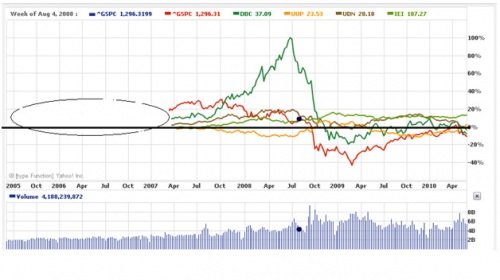
To see how safe (or how risky) your portfolio was over the last few years, it’s useful to view how these asset classes themselves fared over this time period. That is what is shown in the next chart where the following asset class performances over the last few years are shown. The chart shows the performances of stocks (S&P 500 shown by the symbol ^GPSC, in red), bonds (symbol IEI, Barclay’s 3-7 Year Treasury Bond index etf, in light green), Commodities (DBC, Powershares etf, in dark green), Long dollar (UUP, Powershares long dollar etf, in orange; this fund allows speculating on the dollar going up against a basket of important currencies; whenever the world financial markets are in turmoil, this index generally goes up as investors around the world seek the “safe haven” status of the dollar.

Alternately, note that this index value will also typically rise when the domestic economy is in a sound condition and both domestic and international investors favor the U.S. financial markets) and the short dollar (UDN, the Powershares inverse of UUP). Note that the “Cash” asset class has been left out and returns on cash (or money market funds) have been close to zero the whole time.

There are a few startling observations from this period. The first part that arrests the eye is how commodities performed over this time period. If your portfolio was heavy in this sector, you had a heck of a ride these last three years. If you had a lot of stocks as well, heck, your ride just got wilder. As can also be seen from the picture, healthy doses of bonds and currencies would have made your ride that much smoother.

On the other hand, what is additionally startling to observe is that we all started this period close to zero returns in the beginning of 2007 (around March 2007) and in June 2010, we are all converging back to zero returns. No matter how you were diversified, you either took a smooth ride (well diversified portfolio) from a zero return environment to a zero return environment or a wilder ride. That is why diversification is so important. Another way to gauge your diversification benefit is to use a two-pronged system.

The first is what I refer to as the “monthly statement effect”. When your monthly financial statements come in, you first observe the current month’s ending balance, then the previous month’s ending balance and then have a great day, a lousy day or an uneventful day. Depending on how good or bad (how volatile the ride) the monthly effect is, it may last for much more than just a day, maybe days. The second piece is your age.

Life Cycle Investment Hypothesis

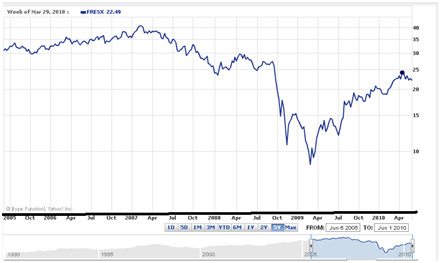
As you grow older, you ask yourself how wild a ride can you tolerate at this point in your life? Hopefully, as you age, this tolerance level should show significant declines. If it does, you are then joining a rational investment group practicing a “lifecycle-investment hypothesis” style. Finally, did anything do well during this time? Yes, and surprisingly from an asset class whose underlying asset is shaped too like a zero – mother earth and real estate. Having some real estate in your investment basket (another important diversification asset) would not only have smoothed your ride but would have made your financial life so much more pleasurable. Just take a look at this picture below (FRESX, an old Fidelity’s real estate index fund) which says it all.

Assessment

Even in the darkest days of falling real estate markets of 2008, this fund produced a positive return. Of course many other real estate indexes lost their bottoms; thus finding these stable indexes in all asset classes are well worth their salt. That is, if it is time for you to diversify.

Conclusion

Your thoughts and comments on this ME-P are appreciated. Feel free to review our top-left column, and top-right sidebar materials, links, URLs and related websites, too. Then, subscribe to the ME-P. It is fast, free and secure.

Speaker: If you need a moderator or speaker for an upcoming event, Dr. David E. Marcinko; MBA – Publisher-in-Chief of the Medical Executive-Post – is available for seminar or speaking engagements. Contact: MarcinkoAdvisors@msn.com

OUR OTHER PRINT BOOKS AND RELATED INFORMATION SOURCES:

Product Details  Product Details

Medical Endowment Fund Contingency Planning

Understanding Stock Market Volatility?

Source: www.HealthcareFinancials.com

Join Our Mailing List 

According to Wayne Firebaugh CPA, CFP®, CMP™ the many quantitative methods of stock, bond, derivatives, alternative assets and mutual fund investing would have suggested that the October 1987 crash was impossible; yet the flash-crash of 2008 still occurred.

The Improbable Happens

For example, Mark Rubenstein, a professor at University of California at Berkeley, noted that if annualized stock market volatility was assumed to be approximately 20% “(the historical average since 1928), the probability that the stock market could fall 29% in a single day is 10–160. So improbable is such an event that it would not be anticipated to occur even if the stock market were to last for 20 billion years. Indeed, such an event should not occur even if the stock market were to enjoy a rebirth for 20 billion years in each of 20 billion big bangs.”

Statistically Impossible

Although it was statistically impossible for it to happen, it did happen in 1987 and again 2008. The nature of crises is such that many will be unanticipated events with unexpected precipitators. As such, a medical endowment or physician’s portfolio contingency plan cannot address every conceivable event. What a contingency plan should address is the process for confronting these events. Most importantly, the plan should assign responsibility for actions and contain provisions to limit the ability of panic to impair long-term decisions.

Donor Trust is Core

Healthcare and all endowments have at their core donor trust. As such, it is important for an endowment’s contingency plan to include provisions for communicating promptly and forthrightly with the public. One only has to look at the Red Cross’ performance during the aftermath of the 9/11 tragedy to receive a lesson on an inappropriate approach. After donating more than $550 million to the Liberty Fund, donors learned that less than $175 million had been spent on direct aid for victims and that the Red Cross was allocating a large portion of the funds to other programs. After public outcry and congressional hearings, the Red Cross announced that all donations would be spent on direct victim relief.

Unfortunately, Dr. Bernadine Healy, the president of the Red Cross, resigned at least in part because of this controversy. These alleged violations of public confidence can have long-term impacts on an endowment’s donor base. Consider also the United Way whose national leader, William V. Aramony, was accused of fraud, embezzlement, and other charges in 1992. Even a decade later, inflation-adjusted contributions are lower than they were before the scandal even though charitable giving in general has doubled.

Assessment

The very nature of crises is such that pre-determined contingency plans generally allow more rapid and appropriate reaction. For an endowment, a well-considered contingency plan will include both an action (or standstill) plan and a public relations plan.

Note: Red Cross defends handling of September 11 donations on November 6, 2001: see: www.cnn.com

Conclusion

And so, your thoughts and comments on this ME-P are appreciated. Feel free to review our top-left column, and top-right sidebar materials, links, URLs and related websites, too. Then, subscribe to the ME-P. It is fast, free and secure.

Speaker: If you need a moderator or speaker for an upcoming event, Dr. David E. Marcinko; MBA – Publisher-in-Chief of the Medical Executive-Post – is available for seminar or speaking engagements. Contact: MarcinkoAdvisors@msn.com

Get our Widget: Get this widget!

Our Other Print Books and Related Information Sources:

Practice Management: http://www.springerpub.com/prod.aspx?prod_id=23759

Physician Financial Planning: http://www.jbpub.com/catalog/0763745790

Medical Risk Management: http://www.jbpub.com/catalog/9780763733421

Healthcare Organizations: www.HealthcareFinancials.com

Health Administration Terms: www.HealthDictionarySeries.com

Physician Advisors: www.CertifiedMedicalPlanner.com

Subscribe Now: Did you like this Medical Executive-Post, or find it helpful, interesting and informative? Want to get the latest ME-Ps delivered to your email box each morning? Just subscribe using the link below. You can unsubscribe at any time. Security is assured.

Link: http://feeds.feedburner.com/HealthcareFinancialsthePostForcxos

Sponsors Welcomed: And, credible sponsors and like-minded advertisers are always welcomed.

Link: https://healthcarefinancials.wordpress.com/2007/11/11/advertise

More on Modern Investment Portfolio Rebalancing

Understanding Risks and Benefits

By Dr. David Edward Marcinko MBA CMP™

Join Our Mailing List 

According to Wayne Firebaugh CPA, CFP®, CMP™ rebalancing a private physician’s portfolio or medical endowment contradicts conventional market “wisdom” that you allow your winners to run. Perhaps in speculation this is true, but for investing such a view can be deadly.

One Healthcare Case Example

Take, for example, the Cleveland Clinic’s experience with its endowment. In 1999, the Cleveland Clinic Foundation reported $1.2 billion in investments. Unfortunately, by the end of 2002, the Foundation’s investments were valued at $650 million, a loss of approximately 50%. Its losses reflected its substantial allocation into technology stocks during the technology boom of the late 1990s. As a result of these investment losses, the Clinic had to postpone a planned $300 million cardiology center and certain debt financing had to be restructured. In addition, both Moody’s and Standard & Poor lowered their ratings on the Clinic.

Definition

Since rebalancing by definition requires an endowment to take money from more successful investment classes and invest it into under-performing classes, it will always cause some measure of anguish. There will always be some reason why rebalancing should not take place. In 1987, the unprecedented single day decline in the market could have been presented as an argument against moving into equities. In 1998, the seemingly endless number of world financial crises could have provided a useful excuse to avoid rebalancing into emerging markets. So too; the flash crash of 2008!

Assessment

Current bond prices could provide similar reasons for not rebalancing into an appropriate fixed income position. However, since the whole reason for asset allocation policy decisions is to mitigate the negative impact that irrational behavior can have on a portfolio or an endowment’s investment performance, they should include a process for periodic rebalancing of its assets.

Conclusion

Your thoughts and comments on this ME-P are appreciated. Feel free to review our top-left column, and top-right sidebar materials, links, URLs and related websites, too. Then, subscribe to the ME-P. It is fast, free and secure.

Link: http://feeds.feedburner.com/HealthcareFinancialsthePostForcxos

Speaker: If you need a moderator or speaker for an upcoming event, Dr. David E. Marcinko; MBA – Publisher-in-Chief of the Medical Executive-Post – is available for seminar or speaking engagements. Contact: MarcinkoAdvisors@msn.com

OUR OTHER PRINT BOOKS AND RELATED INFORMATION SOURCES:

LEXICONS: http://www.springerpub.com/Search/marcinko
PHYSICIANS: www.MedicalBusinessAdvisors.com
PRACTICES: www.BusinessofMedicalPractice.com
HOSPITALS: http://www.crcpress.com/product/isbn/9781466558731
CLINICS: http://www.crcpress.com/product/isbn/9781439879900
ADVISORS: www.CertifiedMedicalPlanner.org
BLOG: www.MedicalExecutivePost.com

Product Details  Product Details

Where Are We in the Life Cycle of Stock Market Emotions?

Join Our Mailing List

An Opinion Poll

[By Staff Reporters]

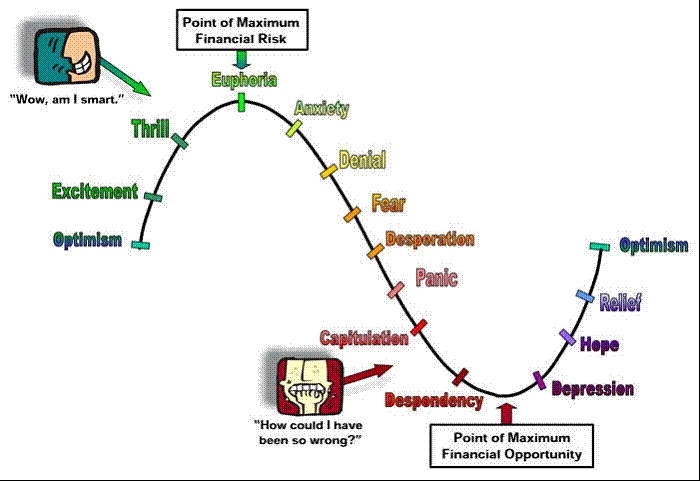
According to behavioral economists and financial advisors like Brian Knabe MD CFP™ CMP™ people feel the pain of loss twice as much as they derive pleasure from an equal gain. Studies show that humans process investment losses using the same part of the brain that responds to mortal danger.

For example, a 10% loss in the market causes twice the emotion as a 10% gain would elicit, and the short time period involved in the “flash crash” of 2008-09 compounded this effect.

And so, we ask in this ME-P poll “Where Are We in the Life Cycle of Stock Market Emotions?”

Conclusion

Your thoughts and comments on this ME-P are appreciated. Feel free to review our top-left column, and top-right sidebar materials, links, URLs and related websites, too. Then, subscribe to the ME-P. It is fast, free and secure.

Link: http://feeds.feedburner.com/HealthcareFinancialsthePostForcxos

Speaker: If you need a moderator or speaker for an upcoming event, Dr. David E. Marcinko; MBA – Publisher-in-Chief of the Medical Executive-Post – is available for seminar or speaking engagements. Contact: MarcinkoAdvisors@msn.com

OUR OTHER PRINT BOOKS AND RELATED INFORMATION SOURCES:

DICTIONARIES: http://www.springerpub.com/Search/marcinko
PHYSICIANS: www.MedicalBusinessAdvisors.com
PRACTICES: www.BusinessofMedicalPractice.com
HOSPITALS: http://www.crcpress.com/product/isbn/9781466558731
CLINICS: http://www.crcpress.com/product/isbn/9781439879900
BLOG: www.MedicalExecutivePost.com
FINANCE: Financial Planning for Physicians and Advisors
INSURANCE: Risk Management and Insurance Strategies for Physicians and Advisors

Product Details  Product Details

Beware Medical and Money Management ‘Groupthink’

Join Our Mailing List

Helping Doctors Understand Peer Comparisons

By J. Wayne Firebaugh CPA, CFP® CMP™

By Dr. David E. Marcinko MBA, CMP™

Source: http://www.CertifiedMedicalPlanner.org

More than a few mutual, hedge and endowment fund managers have noted that they commonly compare their endowment and portfolio allocations to those of peer institutions and that as a result, allocations are often similar to the “average” as reported by one or more surveys/consulting firms.

One interviewed endowment fund manager expanded this thought by presciently noting that expecting materially different performance with substantially the same allocation is unreasonable. It is anecdotally interesting to wonder whether any “seminal” study “proving” the importance of asset allocation could have even had a substantially different conclusion. It seems likely that the pensions and funds surveyed in these types of studies have very similar allocations given the human tendency to measure one-self against peers and to use peers for guidance.

This is a truism in medicine as well as the financial services sector.

Understanding Peer Comparisons

Although peer comparisons can be useful in evaluating your portfolio, or your hospital or medical practice’s own processes, groupthink can be highly contagious and dangerous.

For historical example, in the first quarter of 2000, net flows into equity mutual funds were $140.4 billion as compared to net inflows of $187.7 billion for all of 1999. February’s equity fund inflows were a staggering $55.6 billion, the record for single month investments. For all of 1999, total net mutual fund investments were $169.8 billion[1] meaning that investors “rebalanced” out of asset classes such as bonds just in time for the market’s March 24, 2000 peak (as measured by the S&P 500).

Of course, physicians and investors are not immune to poor decision making in upward trending markets. In 2001, investors withdrew a then-record amount of $30 billion[2] in September, presumably in response to the September 11th terrorist attacks. These investors managed to skillfully “rebalance” their ways out of markets that declined approximately 11.5% during the first several trading sessions after the market reopened, only to reach September 10th levels again after only 19 trading days. In 2002, investors revealed their relentless pursuit of self-destruction when they withdrew a net $27.7 billion from equity funds[3] just before the S&P 500’s 29.9% 2003 growth.

Amateurs versus Professionals [is there such a thing?]

Although it is easy to dismiss the travails of mutual fund investors as representing only the performance of amateurs, it is important to remember that institutions are not automatically immune by virtue of being managed by investment professionals.

For example, in the 1960s and early 1970s, common wisdom stipulated that portfolios include the Nifty Fifty stocks that were viewed to be complete companies.  These stocks were considered “one-decision” stocks for which the only decision was how much to buy. Even institutions got caught up in purchasing such current corporate stalwarts as Joe Schlitz Brewing, Simplicity Patterns, and Louisiana Home & Exploration.  Collective market groupthink pushed these stocks to such prices that Price Earnings ratios routinely exceeded 50 [nothing in the internet age]. Subsequent disappointing performance of this strategy only revealed that common wisdom is often neither common nor wisdom.

The Bear Sterns Example

Recall that The New York Times reported on June 21, 2007, that Bear Stearns had managed to forestall the demise of the Bear Stearns High Grade Structured Credit Strategies and the related Enhanced Leveraged Fund.  The two funds held mortgage-backed debt securities of almost $2 billion many of which were in the sub-prime market.  To compound the problem, the funds borrowed much of the money used to purchase these securities.  The firms who had provided the loans to make these purchases represented some of the smartest names on Wall Street, including JP Morgan, Goldman Sachs, Bank of America, Merrill Lynch, and Deutsche Bank.[4]  Despite its efforts Bear Stearns had to inform investors less than a week later on June 27 that these two funds had collapsed. The subsequent fate of these firms, and the history of the past two years, need not be repeated to appreciate that the king surely had no clothes.

Assessment

What broader message lies in this post relative to such medical initiatives as P4P, various clinical quality improvement endeavors and benchmarks, hospital peer-review, PROs, Medicare compliance, etc?  

Conclusion

Your thoughts and comments on this ME-P are appreciated. Feel free to review our top-left column, and top-right sidebar materials, links, URLs and related websites, too. Then, subscribe to the ME-P. It is fast, free and secure.

Speaker: If you need a moderator or speaker for an upcoming event, Dr. David E. Marcinko; MBA – Publisher-in-Chief of the Medical Executive-Post – is available for seminar or speaking engagements. Contact: MarcinkoAdvisors@msn.com

OUR OTHER PRINT BOOKS AND RELATED INFORMATION SOURCES:

References


[1]   2001 Fact Book, Investment Company Institute.

[2]   Id.

[3]   2003 Fact Book, Investment Company Institute.

[4]    Bajaj, Vikas and Creswell, Julie. “Bear Stearns Staves off Collapse of 2 Hedge Funds.” New York Times, June 21, 2007.

Comprehensive Financial Planning Strategies for Doctors and Advisors: Best Practices from Leading Consultants and Certified Medical Planners(TM)

Understanding Absolute Investment Returns

Exploiting Market Inefficiencies

By J. Wayne Firebaugh CPA, CFP® CMP™

By Dr. David E. Marcinko MBA, CMP™

Source: www.HealthcareFinancials.com

This class of investments seeks to exploit market inefficiencies and generate positive returns regardless of broader market performance. Often, investments in this class are made through the use of hedge funds. Hedge funds will often employ leverage, short-selling, and arbitrage to take advantage of pricing distortions in their targeted strategy area.

Relation to Healthcare Endowments

When investing an endowment’s assets in this category, the physician director or money manager should be aware of fee structures that commonly include performance-related incentive fees, hurdle rates, and claw-back clauses. The endowment managers should also remember that these types of investments generally have much less transparency than other asset classes with which they may be more familiar.

Assessment

Finally, since many of these investments are offered only to accredited investors, the physician or investment manager is often free to pursue much more aggressive strategies than would otherwise be pursued for retail or lay customers.

Join Our Mailing List 

Conclusion

But, can we [anyone] exploit market inefficiencies? Is the market efficient or inefficient? What about Modern Portfolio Theory [MPT] or the Arbitrage Pricing Model? Did we really learn anything from the market crash of 2008?

Your comments on this ME-P are appreciated. Feel free to review our top-left column, and top-right sidebar materials, links, URLs and related websites, too. Then, be sure to subscribe. It is fast, free and secure.

Speaker: If you need a moderator or speaker for an upcoming event, Dr. David E. Marcinko; MBA – Publisher-in-Chief of the Medical Executive-Post – is available for seminar or speaking engagements. Contact: MarcinkoAdvisors@msn.com 

Get our Widget: Get this widget!

Our Other Print Books and Related Information Sources:

Practice Management: http://www.springerpub.com/prod.aspx?prod_id=23759

Physician Financial Planning: http://www.jbpub.com/catalog/0763745790

Medical Risk Management: http://www.jbpub.com/catalog/9780763733421

Healthcare Organizations: www.HealthcareFinancials.com

Health Administration Terms: www.HealthDictionarySeries.com

Physician Advisors: www.CertifiedMedicalPlanner.com

Subscribe Now: Did you like this Medical Executive-Post, or find it helpful, interesting and informative? Want to get the latest ME-Ps delivered to your email box each morning? Just subscribe using the link below. You can unsubscribe at any time. Security is assured.

Link: http://feeds.feedburner.com/HealthcareFinancialsthePostForcxos

Sponsors Welcomed: And, credible sponsors and like-minded advertisers are always welcomed.

Link: https://healthcarefinancials.wordpress.com/2007/11/11/advertise

The Madoff Circle

Who Knew What?

By Jake Bernstein, ProPublica – June 2, 2010 2:40 pm EDT

Join Our Mailing List

When Bernard Madoff pleaded guilty to running the biggest Ponzi scheme in history, he insisted he was the lone perpetrator, asserting that no one – not his family, not his colleagues, not his friends – knew of the fraud.

Alternative Narrative

But an alternate narrative is emerging from the pile of Madoff-related civil suits and court motions that have been filed in the last two years – one in which a small circle of men played knowing, integral roles in the scheme, in some cases benefiting more from it than even Madoff himself.

The evidence for this remains largely circumstantial. These relationships were forged in the days before e-mail, and none of the cases has yet produced anything for public consumption that delivers insights into what these men were thinking. In the one instance in which a judge has ruled on allegations against some of the men, he dismissed the charges for lack of evidence.

But the men’s actions, as described in the court cases, appear to have furthered the scheme. The Securities and Exchange Commission and the trustee charged with recovering money for Madoff’s victims have alleged that some of the men had expectations and influence far beyond what is typical for the usual investor. Most tellingly, the documents say that in at least one instance, and possibly more, these men helped keep the Madoff scam afloat, providing hundreds of millions of dollars of cash when it was on the verge of collapsing.

If this was a conspiracy – and the available information is by no means complete – it does not seem to have been one in which the perpetrators plotted together around a tavern table. Irving Picard, the trustee, has sued several of Madoff’s biggest beneficiaries, alleging they “knew or willfully ignored” that they were participating in a fraud.  The suits are silent on the question of whether those involved coordinated or knew of one another’s activities, but they don’t need to demonstrate that to be successful.

A Commonality

What these men undeniably shared were similar backgrounds and interests. Based largely in New York and South Florida, they moved through parallel milieus of affluent Jewish country clubs and synagogues. They were active in similar philanthropies and served on the boards of foundations, universities and yeshivas.

The cast of characters, spelled out mostly in complaints filed by the trustee and the SEC, includes: Carl Shapiro, [1] 97, a Boston-based philanthropist who made one fortune in ladies dresses and a larger one with Madoff; Robert Jaffe [2], 66, Shapiro’s son-in-law; Maurice “Sonny” Cohn, 79, a one-time Madoff neighbor turned business partner; Robert Jaffe [3], 83, a close friend of Madoff’s for more than 50 years and one of his earliest investors; and Jeffry Picower [4], a lawyer and accountant, who recently died of a heart attack at 67.

None of these men has been charged criminally. Thus far, federal authorities have indicated in court filings that just one of them – Chais – is the subject of a criminal inquiry. A year ago, The Wall Street Journal, citing anonymous sources, reported that the U.S. Attorney’s Office in Manhattan was investigating at least eight investors, including Picower, Chais and Shapiro [5].

All have denied being anything but victims of Madoff’s [6].

Chais, Cohn and Jaffe have drawn considerable ire from investors for running so-called feeder funds that channeled huge sums into Madoff’s investment business. Jaffe alone funneled more than $1 billion of investor money to Madoff, according to the SEC. He worked with Cohn in a business called Cohmad – a contraction of Cohn and Madoff – that operated out of Madoff’s offices. Contrary to what some investors in the funds believed, it appears the men did little to manage the money beyond simply collecting it for delivery to Madoff.

Inner Circle Fared Well

Members of this circle not only did far better than other investors, who averaged 10 percent to 12 percent returns annually, they also had a highly unusual level of input into the nature of their returns.

According to the trustee’s complaint, there were several instances in which Picower or his associates contacted Madoff’s office, asking for specific monthly returns [7]. Over a five-year period in the late ’90s, two of Picower’s accounts [8] had annual returns ranging between 120 percent and 550 percent. A third had yearly returns as high as 950 percent.

Chais and his family consistently received yearly returns higher than 100 percent, far exceeding the gains realized by investors in his funds. Moreover, according to an SEC complaint [9], when Madoff told Chais he was switching to a new strategy that might show occasional short-term trading losses without interfering with net gains, Chais made a special demand to maintain the appearance of loss-free investments.

“Chais told Madoff that he did not want there to be any losses in any of [his] Fund’s trades,” the SEC complaint alleges [9]. “Madoff complied with Chais’ request. Between 1999 and 2008, despite purportedly executing thousands of trades on behalf of the Funds, Madoff did not report a loss on a single equities trade.”

Chais disputes the allegations [9], and his lawyer characterized the SEC’s complaint in a statement as “a distorted and false picture of Stanley Chais.”

“Like so many others, Mr. Chais was blindsided and victimized by Bernard Madoff’s unprecedented and pervasive fraud,” the statement said. “Mr. Chais and his family have lost virtually everything – an impossible result were he involved in the underlying fraud.”

Many of those in the circle took money from the scheme as fees rather than investment gains.

Cohmad officials reaped a total of $98.4 million in payments between 1996 and 2008, most of it labeled income from “account supervision,” according to the SEC [10].

Chais charged fees equal to 25 percent of each Chais fund’s net profit for calendar years in which profits exceeded 10 percent, according to the trustee. As profits exceeded 10 percent every year, Chais took in almost $270 million in fees from 1995 to 2008.

Though Madoff receives the lion’s share of the blame and/or credit for his scheme, it appears that several of his close associates profited more handsomely than he did. Shortly after he confessed, Madoff declared in court documents that his household net worth was about $825 million.

Picower, the biggest beneficiary of the scheme by far, took in $7.2 billion in profit, according to the trustee. Picower’s widow and the trustee are currently haggling over the exact amount of a multibillion-dollar settlement. Carl Shapiro and his family received more than $1 billion, the trustee charged in a court document filed last November in U. S. Bankruptcy Court.

Chais and his family members withdrew approximately $200 million more than they invested with Madoff, according to the SEC. This came on top of the hundreds of millions in fees Chais charged investors.

Chais’ lawyer denied that his client had any knowledge of the Ponzi scheme or that he had raked in the vast riches alleged. “Despite the astronomical numbers mentioned by the Trustee in his complaint, the bulk of the funds alleged to have been distributed to Mr. Chais were in fact distributed to his investors,” his statement said.

Keeping the Scheme Going

At key moments, Madoff’s investors came to the rescue to keep the scheme going. The first instance came in 1992, when the SEC shut down a feeder fund run by the accountants Frank Avellino and Michael Bienes, then Madoff’s largest, accusing the pair of operating a Ponzi scheme. Avellino and Bienes admitted they had acted as unregistered investment managers, but insisted the money had been invested with Madoff, who promptly returned more than $300 million.

Ironically, the SEC mistook Madoff’s ability to raise that amount so quickly as proof that his business was legitimate and “the money was where we [the agency] would expect it to be,” a staff attorney told the SEC’s inspector general last year. Almost two decades later, investigators suspect Madoff may have tapped his circle to collect the cash while scrambling, with the help of his right-hand man, Frank DiPascali, to fabricate trading records, a scene detailed in the agency’s case against DiPascali.

Identifying precisely who helped Madoff repay Avellino and Bienes’ investors is currently an area of inquiry for law enforcement, according to a person familiar with the investigation.

Despite his ever-growing network of feeder funds, Madoff had another liquidity crisis in November 2005. According to a federal complaint [11] filed against his employee Daniel Bonventre, Madoff’s investor account had an end-of-day balance of about $13 million to cover about $105 million in wires scheduled to go out over the next three days.

Two days later, one of Madoff’s investors, identified in the complaint [11] as “Client A,” sent about $100 million in bonds to Madoff, which he used as collateral to secure a $95 million bank loan to continue the Ponzi scheme. The following January, Client A gave Madoff $54 million more in bonds, which were used as collateral for a $50 million loan.

Investigators have not revealed the identity of Client A, but a person close to the investigation said he was among Madoff’s group of longtime close associates.

The final bailout came toward the end of 2008, when Madoff was hit with a tidal wave of redemption requests from investors caught up in the larger financial crisis. Toward the end of 2008, he looked to Shapiro, who pitched in $250 million.

Shapiro and his family have said repeatedly through spokesmen that they were unaware of the true nature of Madoff’s business. The spokesman declined to comment on the $250 million.

No civil or criminal complaints have been filed against Shapiro, but a court filing by the trustee raised questions about the nonagenarian’s “contentions that he is a victim of Madoff’s scheme,” alleging “inconsistencies between Mr. Shapiro’s counsel’s account of the family history with Madoff and the records available to the Trustee.” The trustee is negotiating with the family to recover profits made over the years.

The emergency cash infusion failed. Just 10 days later, Madoff says he confessed to his sons that “it’s all just one big lie,” finally ending the scheme.

The Case-To-Date

So far, efforts to hold Madoff associates accountable have met with mixed results.

Civil claims by the SEC [10] against Jaffe, Cohmad and Cohn were largely rejected by Federal District Judge Louis Stanton, who ruled in February that the agency had failed to prove they “knew of, or recklessly disregarded, Madoff’s fraud.” The judge left the door open for the SEC to refile its complaint by June 18, if it can strengthen its case.

Lawyers for Maurice Cohn and Cohmad released the following statement in response to the ruling: “As we have maintained all along and Judge Stanton agrees, the SEC’s complaint supports nothing other than “the reasonable inference that Madoff fooled the defendants as he did individual investors, financial institutions and regulators.”

Assessment

If there were others involved in the Ponzi scheme, building federal or state criminal cases against Madoff’s circle may prove difficult. Though their relationships go back decades, most of their dealings were done verbally, and there isn’t a lot of correspondence, according to a person with knowledge of the investigations. Federal investigators are working with DiPascali to get a clearer picture of the degree of complicity of others in the scheme.

Illness and age also may become factors. Though a grand jury could consider charges against Chais by mid-June, he suffers from a rare blood disorder and is in and out of the hospital. Shapiro, too, is said to be in ill health.

The trustee is expected to file more lawsuits in coming months as the date approaches when the statute of limitations runs out.

Criminal cases brought against several former Madoff employees have already eroded the notion, lodged so powerfully in the public imagination, that Madoff worked alone, said Daniel Richman, a professor at Columbia Law School and a former prosecutor. With each additional case, he said, it may well crumble further.

“I imagine the paradigmatic Ponzi scheme with the evil genius who keeps all the secrets to himself and engineers this massive crime, like most stick figures, will probably not hold true,” he said.

Link: http://www.propublica.org/feature/the-madoff-circle-who-knew-what

Conclusion

Industry Indignation Index: 99

Conclusion

Your thoughts and comments on this ME-P are appreciated. Feel free to review our top-left column, and top-right sidebar materials, links, URLs and related websites, too. Then, subscribe to the ME-P. It is fast, free and secure.

Link: http://feeds.feedburner.com/HealthcareFinancialsthePostForcxos

Speaker: If you need a moderator or speaker for an upcoming event, Dr. David E. Marcinko; MBA – Publisher-in-Chief of the Medical Executive-Post – is available for seminar or speaking engagements. Contact: MarcinkoAdvisors@msn.com

OUR OTHER PRINT BOOKS AND RELATED INFORMATION SOURCES:

DICTIONARIES: http://www.springerpub.com/Search/marcinko
PHYSICIANS: www.MedicalBusinessAdvisors.com
PRACTICES: www.BusinessofMedicalPractice.com
HOSPITALS: http://www.crcpress.com/product/isbn/9781466558731
CLINICS: http://www.crcpress.com/product/isbn/9781439879900
BLOG: www.MedicalExecutivePost.com
FINANCE: Financial Planning for Physicians and Advisors
INSURANCE: Risk Management and Insurance Strategies for Physicians and Advisors

Product DetailsProduct DetailsProduct Details

Product Details  Product Details

   Product Details

Should the Government Mandate 401(k) Annuities?

About the Guaranteed Retirement Accounts Proposal
By Robert Giese
bob.giese@chsfl.org

Recent hearings in the House and Senate have focused on the need for 401(k) and IRA accounts to provide better retirement income. Vice President Joe Biden referred to these discussions in the White House Task Force on the Middle Class. He suggested creating “Guaranteed Retirement Accounts [GRAs].”

The guaranteed retirement accounts may replace conventional 401(k)s and could eventually provide annuity income to individuals.

Response to GAO Report

In response to a White House request, the General Accounting Office (GAO) released a report on April 28, 2010 that discussed some of these retirement issues. The GAO noted that a couple age 62 has at least a 47% probability that one of the two spouses will live to age 90. While life expectancy is in the mid-to-late 70s when one is born, the age at maturity increases as we grow older. Therefore, the average retirement age couple in America has a reasonable prospect that the survivor will live to be age 90.

GAO reports that Social Security is the primary support for lower income retired Americans. For the median retired person, Social Security is expected to provide approximately 47% of retirement income. The balance will come from savings or investments, a qualified plan such as a 401(k) or IRA and retirement earnings from employment.

Better than Conservative Investments?

The GAO report notes that an annuity may provide more income than a conservative investment, such as a bond or CD.

Assessment

Republican lawmakers this week wrote a letter to Treasury Secretary Timothy Geithner and expressed concern about the guaranteed retirement accounts. They noted that a number of the witnesses before the various committees would “dismantle the present private-sector 401(k) system” and replace it with the GRA.
Their letter expressed concern and opposition to any effort to “nationalize” the 401(k) system. The Republican lawmakers continued by noting that over 90% of households have a favorable opinion of 401(k) or IRA accounts.

Conclusion

And so, your thoughts and comments on this ME-P are appreciated. Is this new vehicle really better than a bond or CD? Is it the correct vehicle for a long-term retirement strategy? Is it even appropriate for physicians and medical professionals?

Feel free to review our top-left column, and top-right sidebar materials, links, URLs and related websites, too. Then, be sure to subscribe. It is fast, free and secure.

Link: http://feeds.feedburner.com/HealthcareFinancialsthePostForcxos

Get our Widget: Get this widget!

Our Other Print Books and Related Information Sources:

Practice Management: http://www.springerpub.com/prod.aspx?prod_id=23759

Physician Financial Planning: http://www.jbpub.com/catalog/0763745790

Medical Risk Management: http://www.jbpub.com/catalog/9780763733421

Healthcare Organizations: www.HealthcareFinancials.com

Health Administration Terms: www.HealthDictionarySeries.com

Physician Advisors: www.CertifiedMedicalPlanner.com

Subscribe Now: Did you like this Medical Executive-Post, or find it helpful, interesting and informative? Want to get the latest ME-Ps delivered to your email box each morning? Just subscribe using the link below. You can unsubscribe at any time. Security is assured.

Link: http://feeds.feedburner.com/HealthcareFinancialsthePostForcxos

Sponsors Welcomed

And, credible sponsors and like-minded advertisers are always welcomed.

Link: https://healthcarefinancials.wordpress.com/2007/11/11/advertise

Product Details  Product Details

Retirement Plan Risks for Physician-Employers

Join Our Mailing List

Advantages Well Known – Disadvantages Not So

By Brian J. Knabe, MD

[Certified Medical Planner™ candidate]

A source of risk often overlooked by the physician-employer is the risk involved in offering a retirement plan.

Medical practice owners, like other small business owners, find several advantages to starting a retirement plan. The plan can be used to allow the owners to save money in a tax-advantaged manner, and a generous retirement plan can help to attract and retain quality employees.

Administration Risks 

The recent “Great Recession” and turbulence in the stock market have highlighted the risks involved in administering these plans. There is a long history of fraud and neglect in the field of retirement savings plans, and a series of legislative efforts have been enacted to counter these abuses.

Current standards are based primarily on four federal laws, the Employee Retirement Income Security Act (ERISA), the Uniform Prudent Investors Act (UPIA), the Management of Public Employee Retirement Systems Act (MPERS), and the Pension Protection Act of 2006 (PPA).

ERISA Standards 

According to ERISA standards, you may be considered a fiduciary for a retirement plan if you meet any of the following tests:

  • You exercise discretionary authority or control over plan assets or plan management.
  • You are specifically identified in the written documents of a plan as a named fiduciary.
  • You have discretionary responsibility in the administration of the plan.
  • You manage the plan or its assets or render investment advice for a fee.

Recent court decisions have found fiduciaries to be personally liable, even for acts of which they were unaware or in areas not considered within their scope of responsibility. Acting with good intentions or in good faith is not an acceptable defense. Neither is ignorance of your responsibilities.

www.CertifiedMedicalPlanner.com

Liability Mitigation 

The liability of the administrator (or business owner) can be diminished by taking these steps:

  • Act in a procedurally prudent manner.
  • Diversify investments to minimize the risk of large losses.
  • Provide sufficient information and education to employees to enable them to exercise control over their investments.
  • Offer a broad, diversified investment menu having at least three (preferably five or six) “core” alternatives, each of which must be diversified.

Assessment

The most efficient way to meet these and other requirements is to hire a retirement plan provider which is a certified as a fiduciary, and which accepts “co-fiduciary” status along with the practice owner.  The Centre for Fiduciary Excellence (CEFEX) offers certification as a fiduciary.

For more information, see www.savantcapital.com/cefex.

Savant Capital Management, Inc®

190 Buckley Drive

Rockford, IL 61107

Tel 815-227-0300

Fax 815-226-2195

bknabe@savantcapital.com

Channel Surfing the ME-P

Have you visited our other topic channels? Established to facilitate idea exchange and link our community together, the value of these topics is dependent upon your input. Please take a minute to visit. And, to prevent that annoying spam, we ask that you register. It is fast, free and secure.

Conclusion

Your thoughts and comments on this ME-P are appreciated. Feel free to review our top-left column, and top-right sidebar materials, links, URLs and related websites, too. Then, subscribe to the ME-P. It is fast, free and secure.

Speaker: If you need a moderator or speaker for an upcoming event, Dr. David E. Marcinko; MBA – Publisher-in-Chief of the Medical Executive-Post – is available for seminar or speaking engagements. Contact: MarcinkoAdvisors@msn.com

OUR OTHER PRINT BOOKS AND RELATED INFORMATION SOURCES:

Product Details  Product Details

Bank Deals Similar to Goldman Sach’s Gone Awry

Other Major Banks Participated, Too?

By Marian Wang, ProPublica – April 16, 2010 1:36 pm EDT

As you may have heard, or read on this ME-P, Goldman Sachs is being sued for fraud [1] by the Securities and Exchange Commission [2] for allegedly misleading investors about a deal that Goldman helped structure and sell. In the civil suit, the SEC specifically faulted Goldman for failing to disclose that a hedge fund was helping create the investment while betting big the deal would fail.

According to the SEC, Goldman Sachs knew about the hedge fund’s bets, knew it played a significant role in choosing the assets in the portfolio, and yet did not tell investors about it. (Goldman Sachs has called the SEC’s accusations “completely unfounded in law and fact.” And in another more detailed statement [3], it said it “did not structure a portfolio that was designed to lose money.”) 

[picapp align=”none” wrap=”false” link=”term=Goldman+Sachs&iid=8541566″ src=”0/4/f/8/The_Goldman_Sachs_7d6f.jpg?adImageId=12513388&imageId=8541566″ width=”380″ height=”568″ /]

In ProPublica

As we reported at ProPublica last week, many other major investment banks were doing a similar thing [4].

Investment banks including JPMorgan Chase [5], Merrill Lynch [6] (now part of Bank of America), Citigroup, Deutsche Bank and UBS also created CDOs that a hedge fund named Magnetar was both helping create and betting would fail. Those investment banks marketed and sold the CDOs to investors without disclosing Magnetar’s role or the hedge fund’s interests.

Here is a list of the banks that were involved [7] in Magnetar deals, along with links to many of the prospectuses on the deals, which skip over Magnetar’s role. In all, investment banks created at least 30 CDOs with Magnetar, worth roughly $40 billion overall. Goldman’s 25 Abacus CDOs — one of which is the basis of the SEC’s lawsuit — amounted to $10.9 billion [8].

One reporter Jake Bernstein explained the investment banks’ disclosure failures on Chicago Public Radio’s This American Life [9]:

On the Magnetar Hedge Fund

The role of Magnetar, both as equity investor and in their bets against the very CDOs they helped create were not disclosed in any way to investors in the written documents about the deals. Not the marketing materials, not the prospectuses, not in the hundreds of pages that an investor could get to see information about the deal was it disclosed that it was in fact Magnetar who’d helped create the deal, and who’d bet against.

That is, of course, along the lines of what the SEC is suing Goldman Sachs for now. The SEC’s suit also says CDOs like the ones Goldman built “contributed to the recent financial crisis by magnifying losses associated with the downturn in the United States housing market.”

Notably, the SEC did not sue the hedge fund [10] involved in Goldman’s Abacus deals — Paulson & Co. — or its manager, John Paulson. Instead, it’s going after Goldman. And as we pointed out in our reporting, there’s no evidence that what Magentar did was illegal [11].

Assessment

We’ve called the major banks involved in Magnetar CDO deals to see if they were concerned about similar lawsuits. Thus far, Bank of America, Citigroup, Deutsche, Wells Fargo (which bought Wachovia) and UBS have responded and have all declined our requests for comment. Here is Magnetar’s response [12] to our original reporting.

Conclusion

And so, your thoughts and comments on this ME-P are appreciated. Who else can send us some insider-knowledge on this sordid topic? Feel free to review our top-left column, and top-right sidebar materials, links, URLs and related websites, too. Then, be sure to subscribe. It is fast, free and secure.

Link: http://feeds.feedburner.com/HealthcareFinancialsthePostForcxos

Get our Widget: Get this widget!

Our Other Print Books and Related Information Sources:

Practice Management: http://www.springerpub.com/prod.aspx?prod_id=23759

Physician Financial Planning: http://www.jbpub.com/catalog/0763745790

Medical Risk Management: http://www.jbpub.com/catalog/9780763733421

Healthcare Organizations: www.HealthcareFinancials.com

Health Administration Terms: www.HealthDictionarySeries.com

Physician Advisors: www.CertifiedMedicalPlanner.com

Subscribe Now: Did you like this Medical Executive-Post, or find it helpful, interesting and informative? Want to get the latest ME-Ps delivered to your email box each morning? Just subscribe using the link below. You can unsubscribe at any time. Security is assured.

Link: http://feeds.feedburner.com/HealthcareFinancialsthePostForcxos

How One Hedge Fund Helped Keep the Bubble Going

Join Our Mailing List

On the Magnetar Trade

By Jesse Eisinger and Jake Bernstein, ProPublica – April 9, 2010 1:00 pm EDT

In late 2005, the booming U.S. housing market seemed to be slowing. The Federal Reserve had begun raising interest rates. Subprime mortgage company shares were falling. Investors began to balk at buying complex mortgage securities. The housing bubble, which had propelled a historic growth in home prices, seemed poised to deflate. And if it had, the great financial crisis of 2008, which produced the Great Recession of 2008-09, might have come sooner and been less severe.

Precise Timing

At just that moment, a few savvy financial engineers at a suburban Chicago hedge fund [1] helped revive the Wall Street money machine, spawning billions of dollars of securities ultimately backed by home mortgages.

Get ProPublica’s Top Stories and Major Investigations Delivered to Your Inbox

When the crash came, nearly all of these securities became worthless, a loss of an estimated $40 billion paid by investors, the investment banks who helped bring them into the world, and, eventually, American taxpayers.

Yet the hedge fund, named Magnetar for the super-magnetic field created by the last moments of a dying star, earned outsized returns in the year the financial crisis began.

The Magnetar Trade

How Magnetar pulled this off is one of the untold stories of the meltdown. Only a small group of Wall Street insiders was privy to what became known as the Magnetar Trade [2]. Nearly all of those approached by ProPublica declined to talk on the record, fearing their careers would be hurt if they spoke publicly. But interviews with participants, e-mails [3], thousands of pages of documents and details about the securities that until now have not been publicly disclosed shed light on an arcane, secretive corner of Wall Street.

According to bankers and others involved, the Magnetar Trade worked this way: The hedge fund bought the riskiest portion of a kind of securities known as collateralized debt obligations — CDOs. If housing prices kept rising, this would provide a solid return for many years. But that’s not what hedge funds are after. They want outsized gains, the sooner the better, and Magnetar set itself up for a huge win: It placed bets that portions of its own deals would fail.

Chance Enhancement

Along the way, it did something to enhance the chances of that happening, according to several people with direct knowledge of the deals. They say Magnetar pressed to include riskier assets in their CDOs that would make the investments more vulnerable to failure. The hedge fund acknowledges it bet against its own deals but says the majority of its short positions, as they are known on Wall Street, involved similar CDOs that it did not own. Magnetar says it never selected the assets that went into its CDOs.

Magnetar says it was “market neutral,” meaning it would make money whether housing rose or fell. (Read their full statement. [4]) Dozens of Wall Street professionals, including many who had direct dealings with Magnetar, are skeptical of that assertion. They understood the Magnetar Trade as a bet against the subprime mortgage securities market. Why else, they ask, would a hedge fund sponsor tens of billions of dollars of new CDOs at a time of rising uncertainty about housing?

Key details of the Magnetar Trade remain shrouded in secrecy and the fund declined to respond to most of our questions. Magnetar invested in 30 CDOs from the spring of 2006 to the summer of 2007, though it declined to name them. ProPublica has identified 26 [5].

Independent Analysis

An independent analysis [6] commissioned by ProPublica shows that these deals defaulted faster and at a higher rate compared to other similar CDOs. According to the analysis, 96 percent of the Magnetar deals were in default by the end of 2008, compared with 68 percent for comparable CDOs. The study [6] was conducted by PF2 Securities Evaluations, a CDO valuation firm. (Magnetar says defaults don’t necessarily indicate the quality of the underlying CDO assets.)

From what we’ve learned, there was nothing illegal in what Magnetar did; it was playing by the rules in place at the time. And the hedge fund didn’t cause the housing bubble or the financial crisis. But the Magnetar Trade does illustrate the perverse incentives and reckless behavior that characterized the last days of the boom.

Major Players

Magnetar worked with major banks, including Merrill Lynch, Citigroup, and UBS. At least nine banks helped Magnetar hatch deals. Merrill Lynch, Citigroup and UBS all did multiple deals with Magnetar. JPMorgan Chase, often lauded for having avoided the worst of the CDO craze, actually ended up doing one of the riskiest deals with Magnetar, in May 2007, nearly a year after housing prices started to decline. According to marketing material and prospectuses [5], the banks didn’t disclose to CDO investors the role Magnetar played.

Many of the bankers who worked on these deals personally benefited, earning millions in annual bonuses. The banks booked profits at the outset. But those gains were fleeting. As it turned out, the banks that assembled and marketed the Magnetar CDOs had trouble selling them. And when the crash came, they were among the biggest losers.

Assessment

Of course, some bankers involved in the Magnetar Trade now regret what they did. We showed one of the many people fired as a result of the CDO collapse a list of unusually risky mortgage bonds included in a Magnetar deal he had worked on. The deal was a disaster. He shook his head at being reminded of the details and said: “After looking at this, I deserved to lose my job.”

Magnetar wasn’t the only market player to come up with clever ways to bet against housing. Many articles and books, including a bestseller by Michael Lewis [7], have recounted how a few investors saw trouble coming and bet big. Such short bets can be helpful; they can serve as a counterweight to manias and keep bubbles from expanding.

Magnetar’s approach had the opposite effect — by helping create investments it also bet against, the hedge fund was actually fueling the market. Magnetar wasn’t alone in that: A few other hedge funds also created CDOs they bet against. And, as the New York Times has reported, Goldman Sachs did too. But Magnetar industrialized the process, creating more and bigger CDOs.

Conclusion

Several journalists have alluded to the Magnetar Trade in recent years, but until now none has assembled a full narrative. Yves Smith, a prominent financial blogger who has reported on aspects of the Magnetar Trade, writes in her new book, “Econned,” [8] that “Magnetar went into the business of creating subprime CDOs on an unheard of scale. If the world had been spared their cunning, the insanity of 2006-2007 would have been less extreme and the unwinding milder.”

And so, your thoughts and comments on this ME-P are appreciated. Dr. Mike Burry, please opine. All feel free to review our top-left column, and top-right sidebar materials, links, URLs and related websites, too. Then, be sure to subscribe. It is fast, free and secure.

Link: http://feeds.feedburner.com/HealthcareFinancialsthePostForcxos

Speaker: If you need a moderator or speaker for an upcoming event, Dr. David E. Marcinko; MBA – Publisher-in-Chief of the Medical Executive-Post – is available for seminar or speaking engagements. Contact: MarcinkoAdvisors@msn.com

OUR OTHER PRINT BOOKS AND RELATED INFORMATION SOURCES:

DICTIONARIES: http://www.springerpub.com/Search/marcinko
PHYSICIANS: www.MedicalBusinessAdvisors.com
PRACTICES: www.BusinessofMedicalPractice.com
HOSPITALS: http://www.crcpress.com/product/isbn/9781466558731
CLINICS: http://www.crcpress.com/product/isbn/9781439879900
BLOG: www.MedicalExecutivePost.com
FINANCE: Financial Planning for Physicians and Advisors
INSURANCE: Risk Management and Insurance Strategies for Physicians and Advisors


Product Details  Product Details

Financial Advisory Reform Going Down in Flames

A [False] Hobson’s Choice*

By Staff Reporters

In political Washington DC, according to Ian Salisbury, almost anything will fly if you can make an argument it will benefit the middle class. It worked in the fight against requiring advisors to act in clients’ best interests … Say what?

Is this the case of a classic Hobson’s choice?

[picapp align=”none” wrap=”false” link=”term=bank+reform&iid=8227139″ src=”c/3/0/3/Sen_Dodd_Discusses_655e.jpg?adImageId=12270785&imageId=8227139″ width=”380″ height=”570″ /]

The Strategy

Yep, its true! At least, this strategy worked for the National Association of Insurance and Financial Advisors [NAIFA], which fought a recent proposal that would have made all financial advisors act in clients’ best interests … you know – the “F” word.

Assessment

It seems that there are few protections for the public from unscrupulous FAs, stockbrokers, and insurance agents. And, few wish to become fiduciaries.

http://www.fa-mag.com/online-extras/5406-a-phony-argument.html

*A Hobson’s choice is a free, usually economic, choice in which only one option is offered.

Conclusion

And so, your thoughts and comments on this ME-P are appreciated. Please visit: www.CertifiedMedicalPlanner.com

As former certified financial planner, insurance agent, stockbroker, surgeon and this ME-P publisher Dr. David Edward Marcinko MBA, CMP™ has always opined to physician colleagues: it is “buyer-beware” out there!

Feel free to review our top-left column, and top-right sidebar materials, links, URLs and related websites, too. Then, be sure to subscribe to the ME-P. It is fast, free and secure.

Speaker: If you need a moderator or speaker for an upcoming event, Dr. David E. Marcinko; MBA – Publisher-in-Chief of the Medical Executive-Post – is available for seminar or speaking engagements. Contact: MarcinkoAdvisors@msn.com

Get our Widget: Get this widget!

Our Other Print Books and Related Information Sources:

Practice Management: http://www.springerpub.com/prod.aspx?prod_id=23759

Physician Financial Planning: http://www.jbpub.com/catalog/0763745790

Medical Risk Management: http://www.jbpub.com/catalog/9780763733421

Healthcare Organizations: www.HealthcareFinancials.com

Health Administration Terms: www.HealthDictionarySeries.com

Physician Advisors: www.CertifiedMedicalPlanner.com

Subscribe Now: Did you like this Medical Executive-Post, or find it helpful, interesting and informative? Want to get the latest ME-Ps delivered to your email box each morning? Just subscribe using the link below. You can unsubscribe at any time. Security is assured.

Link: http://feeds.feedburner.com/HealthcareFinancialsthePostForcxos

Sponsors Welcomed

And, credible sponsors and like-minded advertisers are always welcomed.

Link: https://healthcarefinancials.wordpress.com/2007/11/11/advertise

More on Lehman Brothers and Repo 105

Join Our Mailing List

The Auditors Attempt to Explain

By Marian Wang, ProPublica – March 25, 2010 4:18 pm

Ever since we began following the storyline of “Repo 105”, a sly balance-sheet maneuver performed by Lehman Brothers that helped it hide billions in dodgy assets, we noted that Lehman auditor Ernst & Young had some explaining to do. That explaining has begun.

The Contrarian Pundit

Contrarian Pundit posted a letter that Ernst & Young sent out yesterday, defending itself: not to the media, but to its clients. Check out both pages of the letter (PDFs).

A Few More Choice Bits

Lehman’s bankruptcy was the result of a series of unprecedented adverse events in the financial markets. The months leading up to Lehman’s bankruptcy were among the most turbulent periods in our economic history. Lehman’s bankruptcy was caused by a collapse in its liquidity, which was in turn caused by declining asset values and loss of market confidence in Lehman. It was not caused by accounting issues or disclosure issues.

Assessment

While no specific disclosures around Repo 105 transactions were reflected in Lehman’s financial statement footnotes, the 2007 audited financial statements were presented in accordance with US GAAP, and clearly portrayed Lehman as a leveraged entity operating in a risky and volatile industry. In other words, we at Ernst & Young didn’t point out that Lehman was doing things to hide its risks, but you should’ve known Lehman was in trouble anyway. Felix Salmon points out that at least they’re no longer denying that they knew about Repo 105.

Link: http://www.propublica.org/ion/blog/item/more-on-lehman-and-repo-105-the-auditors-attempt-to-explain

Conclusion

And so, your thoughts and comments on this ME-P are appreciated.

Get our Widget: Get this widget!

Our Other Print Books and Related Information Sources:

Practice Management: http://www.springerpub.com/prod.aspx?prod_id=23759

Physician Financial Planning: http://www.jbpub.com/catalog/0763745790

Medical Risk Management: http://www.jbpub.com/catalog/9780763733421

Healthcare Organizations: www.HealthcareFinancials.com

Health Administration Terms: www.HealthDictionarySeries.com

Physician Advisors: www.CertifiedMedicalPlanner.com

Subscribe Now: Did you like this Medical Executive-Post, or find it helpful, interesting and informative? Want to get the latest ME-Ps delivered to your email box each morning? Just subscribe using the link below. You can unsubscribe at any time. Security is assured.

Link: http://feeds.feedburner.com/HealthcareFinancialsthePostForcxos

Sponsors Welcomed: And, credible sponsors and like-minded advertisers are always welcomed.

Link: https://healthcarefinancials.wordpress.com/2007/11/11/advertise

Product DetailsProduct DetailsProduct Details

Product Details  Product Details

Lehman Brothers Autopsy

Repo 105 and Why Auditors Have Some “Splainen to Do”

Join Our Mailing List

[By Staff Reporters]

According to ProPublica on March 16, 2010 on 9:07 am EDT, a post-mortem report on Lehman Brothers revealed a shady accounting maneuver through which the bank hid its financial troubles for nearly a decade.

Pleading Ignorance

In this repot, Marian Wang takes a closer look at the parties pleading ignorance and the auditors who admit they knew, but insist they did no wrong.

Assessment

Link: http://www.propublica.org/ion/bailout/item/lehman-brothers-autopsy-repo-105-explained-auditors-in-trouble

Conclusion

And so, your thoughts and comments on this ME-P are appreciated. Feel free to review our top-left column, and top-right sidebar materials, links, URLs and related websites, too. Then, be sure to subscribe to the ME-P. It is fast, free and secure.

Link: http://feeds.feedburner.com/HealthcareFinancialsthePostForcxos

Our Other Print Books and Related Information Sources:

Practice Management: http://www.springerpub.com/prod.aspx?prod_id=23759

Physician Financial Planning: http://www.jbpub.com/catalog/0763745790

Medical Risk Management: http://www.jbpub.com/catalog/9780763733421

Subscribe Now: Did you like this Medical Executive-Post, or find it helpful, interesting and informative? Want to get the latest ME-Ps delivered to your email box each morning? Just subscribe using the link below. You can unsubscribe at any time. Security is assured.

Link: http://feeds.feedburner.com/HealthcareFinancialsthePostForcxos

Product Details  Product Details

Insuring the Investment Portfolio

A Multi-Strategic Discussion

By Ann Miller RN, MHA

Since the market crash, portfolio insurance and program trading are not as popular as they were in the mid-1980s.

In this essay, Dr. Somnath Basu explains why.

Link: Insuring the Investment Portfolio

Somnath Basu, Ph.D., is program director of the California Institute of Finance in the School of Business at California Lutheran University where he’s also a professor of finance. He can be reached at (805) 493 3980 or basu@callutheran.edu.

Conclusion

And so, your thoughts and comments on this ME-P are appreciated. Financial advisors please chime in on the debate? Is Basu correct; why or why not? Review our top-left column, and top-right sidebar materials, links, URLs and related websites, too. Then, be sure to subscribe to the ME-P. It is fast, free and secure.

Link: http://feeds.feedburner.com/HealthcareFinancialsthePostForcxos

Contact: MarcinkoAdvisors@msn.com 

Get our Widget: Get this widget!

Our Other Print Books and Related Information Sources:

Practice Management: http://www.springerpub.com/prod.aspx?prod_id=23759

Physician Financial Planning: http://www.jbpub.com/catalog/0763745790

Medical Risk Management: http://www.jbpub.com/catalog/9780763733421

Healthcare Organizations: www.HealthcareFinancials.com

Health Administration Terms: www.HealthDictionarySeries.com

Physician Advisors: www.CertifiedMedicalPlanner.com

Subscribe Now: Did you like this Medical Executive-Post, or find it helpful, interesting and informative? Want to get the latest ME-Ps delivered to your email box each morning? Just subscribe using the link below. You can unsubscribe at any time. Security is assured.

Link: http://feeds.feedburner.com/HealthcareFinancialsthePostForcxos

Sponsors Welcomed

And, credible sponsors and like-minded advertisers are always welcomed.

Link: https://healthcarefinancials.wordpress.com/2007/11/11/advertise

Wall Street and athenahealth

More than just a Hiccup?

By Staff Reporters

According to TheStreet, health care information company AthenaHealth(ATHN Quote) just announced what seemed like a minor account hiccup.

Last night however, another accounting hiccup for AthenaHealth surfaced, and the health care information company announced that it will be postponing its fourth-quarter earnings.

Link: http://www.thestreet.com/story/10690575/1/athena-health-dives-on-accounting-issues.html

Assessment

Investors now fear that the seemingly isolated accounting events, one right on top of the other, could snowball.

According to one physician-investor,“this looks less like a hiccup, and more like a spasm of the diaphragm, which is innervated by the phrenic nerve.”

Conclusion

And so, your thoughts and comments on this ME-Pare appreciated. Feel free to review our top-left column, and top-right sidebar materials, links, URLs and related websites, too. Then, be sure to subscribe to the ME-P. It is fast, free and secure.

Link: http://feeds.feedburner.com/HealthcareFinancialsthePostForcxos

Speaker: If you need a moderator or speaker for an upcoming event, Dr. David E. Marcinko; MBA – Publisher-in-Chief of the Medical Executive-Post – is available for seminar or speaking engagements. Contact: MarcinkoAdvisors@msn.com

Our Other Print Books and Related Information Sources:

Practice Management: http://www.springerpub.com/prod.aspx?prod_id=23759

Physician Financial Planning: http://www.jbpub.com/catalog/0763745790

Medical Risk Management: http://www.jbpub.com/catalog/9780763733421

Subscribe Now: Did you like this Medical Executive-Post, or find it helpful, interesting and informative? Want to get the latest ME-Ps delivered to your email box each morning? Just subscribe using the link below. You can unsubscribe at any time. Security is assured.

Link: http://feeds.feedburner.com/HealthcareFinancialsthePostForcxos

Sponsors Welcomed: And, credible sponsors and like-minded advertisers are always welcomed.

Product Details  Product Details

Dr. Somnath Basu on Investing

Join Our Mailing List

He Writes for the Medical Executive-Post

By Ann Miller; RN, MHA

[Executive-Director]

Dr. Somnath Basu is no stranger to the ME-P, or the financial planning community. He is a Professor of Finance at California Lutheran University and the Director of its California Institute of Finance.

Academic Background

Dr Basu earned his BA in Economics, University of Delhi, MBA (Finance), Marquette University and a PhD (Finance), University of Arizona. He is well published and is an award winning teacher. He has significant consulting experience with US Fortune 100 companies, advising institutional money managers and in developing proprietary finance and planning software. He serves on various Boards and committees including the CFP (chaired the Model Curriculum Revision Committee) Board of Standards and the Financial Planning Association.

Basu’s New Book

His new book, co-authored with Professors’ Block and Hirt, Investment Planning for Financial Professionals is available now, published by McGraw Hill, in May 2006.

Link: http://www.amazon.com/Investment-Planning-Geoffrey-Hirt/dp/0071437215/ref=sr_1_1?ie=UTF8&s=books&qid=1265918999&sr=1-1

Additional essays by Dr. Basu can be viewed at: http://blog.fpaforfinancialplanning.org/author/somnathbasufpa/

He also writers a column for the Journal of Financial Services Professionals. He can be reached at:

Contact Dr. Somnath Basu
Director – California Institute of Finance
Cell: 805 405 4448
Work: 805 493 3980
http://www.clunet.edu/cif

Conclusion

Your thoughts and comments on this ME-P are appreciated. Feel free to review our top-left column, and top-right sidebar materials, links, URLs and related websites, too. Then, subscribe to the ME-P. It is fast, free and secure.

Speaker: If you need a moderator or speaker for an upcoming event, Dr. David E. Marcinko; MBA – Publisher-in-Chief of the Medical Executive-Post – is available for seminar or speaking engagements. Contact: MarcinkoAdvisors@msn.com

OUR OTHER PRINT BOOKS AND RELATED INFORMATION SOURCES:

Comprehensive Financial Planning Strategies for Doctors and Advisors: Best Practices from Leading Consultants and Certified Medical Planners(TM)

Hospital Capital Formation, Harry Markowitz and Modern Portfolio Theory

Strategic Risk Considerations for Physician-Executives and Healthcare CXOs

[By Calvin W. Wiese; MBA, CPA, CMA]

To most all financial advisors, wealth managers and stock-brokers, the work of Harry Markowitz and Modern Portfolio Theory [MPT] is not usually discussed in terms of hospital capital formation. But, perhaps it should!

Capital Investments Create Risk

Capital investments create risk. Risk is the uncertainty of future events. When hospitals make capital investments, they commit to costs that affect future periods. Those costs are known and relatively fixed. What are unknown are the benefits to be realized by those capital investments.

Defining Risk

For capital investments, risk is the certainty of future costs coupled with the uncertainty of future benefits. In some cases, while the future benefits are uncertain, there is a high degree of certainty that the benefits will exceed the costs. In these cases, risk can be very low. Risk may be better defined as the degree to which the uncertainty of unknown benefits will exceed the known and committed costs.

Asset Burdens and Benefits

When capital assets are purchased, both the burdens and the benefits of ownership are transferred to the owner. The burdens are primarily the costs associated with acquisition and installation. The benefits are primarily the revenues generated by operating the capital assets. Risk of ownership is created to the degree that the benefits are uncertain.

Understanding Risk

Hospital managers need to be skilled at putting hospital assets at risk. Without clear knowledge and understanding of the benefits and the burdens, hospitals can quickly find themselves at unacceptably high levels of risk. Risk must be continually assessed and evaluated in order to successfully put hospital assets at risk. Hospitals require many varied capital investments; their capital investments represent a risk portfolio. An effective combination of risky assets can often create risk that is less than the sum of the risk of each asset.

Modern Portfolio Theory

Of course, financial managers have know this for years as a basic principle of Modern Portfolio Theory (MPT), first introduced by Harry Markowitz, PhD, with the paper “Portfolio Selection,” which appeared in the 1952 Journal of Finance. Thirty-eight years later, he shared a Nobel Prize with Merton Miller, PhD, and William Sharpe, PhD, for what has become a broad theory for securities asset selection; and hospital assets may be viewed as little different.

Prior to Markowitz’s work, investors focused on assessing the rewards and risks of individual securities in constructing a portfolio. Standard advice was to identify those that offered the best opportunities for gain with the least risk and then construct a portfolio from them. Following this advice, a hospital administrator might conclude that a positron emission tomography (PET) scanning machine offered good risk-reward characteristics, and pursue a strategy to compile a network of them in a given geographic area. Intuitively, this would be foolish. Markowitz formalized this intuition.

Detailing the mathematics of diversity, he proposed that investors focus on selecting portfolios based on their overall risk-reward characteristics instead of merely compiling portfolios of securities, or capital assets that each individually has attractive risk-reward characteristics. In a nutshell, just as investors should select portfolios not individual securities, so hospital administrators should select a wide spectrum of radiology services, not merely machines.

Join Our Mailing List

Assessment

Savvy hospital managers will mitigate ownership risk by constructing their portfolio of risky assets in a manner that lowers overall risk

Conclusion

Your thoughts and comments on this ME-P are appreciated. Feel free to review our top-left column, and top-right sidebar materials, links, URLs and related websites, too. Then, subscribe to the ME-P. It is fast, free and secure.

Link: http://feeds.feedburner.com/HealthcareFinancialsthePostForcxos

Speaker: If you need a moderator or speaker for an upcoming event, Dr. David E. Marcinko; MBA – Publisher-in-Chief of the Medical Executive-Post – is available for seminar or speaking engagements. Contact: MarcinkoAdvisors@msn.com

OUR OTHER PRINT BOOKS AND RELATED INFORMATION SOURCES:

Product Details  Product Details

Product Details

Understanding the New “Mixed” Economy

Musings of an Informed Thought-Leader

By Somnath Basu PhD, MBA

Brief Excerpt

The recent debacle in the financial markets has opened up a plethora of issues that require serious attention from all market participants. Perhaps the most serious concern is the emergence of a “mixed” economy where both “public” and government-owned enterprises will coexist with “private” enterprises.

Review of Past Performance

Unfortunately, the historical performances of such economies have been fairly dismal. The debacle is also bound to usher in additional regulation of financial markets. The new regulations are likely to focus on ways to control the possibilities of similar failures in the future.

Assessment

However, the structure of regulation should not be constructed on the basis of how the markets failed the people but instead on how people failed the market. The ramifications of the debacle require our attention and understanding, especially the possibilities of the existence of a regime of both high inflation and high market volatility. 

White Paper Link Here:  The New Economy

Conclusion

And so, your thoughts and comments on this ME-P are appreciated. Feel free to review our top-left column, and top-right sidebar materials, links, URLs and related websites, too. Then, be sure to subscribe to the ME-P. It is fast, free and secure.

Link: http://feeds.feedburner.com/HealthcareFinancialsthePostForcxos

Get our Widget: Get this widget!

Our Other Print Books and Related Information Sources:

Practice Management: http://www.springerpub.com/prod.aspx?prod_id=23759

Physician Financial Planning: http://www.jbpub.com/catalog/0763745790

Medical Risk Management: http://www.jbpub.com/catalog/9780763733421

Healthcare Organizations: www.HealthcareFinancials.com

Health Administration Terms: www.HealthDictionarySeries.com

Physician Advisors: www.CertifiedMedicalPlanner.com

Subscribe Now: Did you like this Medical Executive-Post, or find it helpful, interesting and informative? Want to get the latest ME-Ps delivered to your email box each morning? Just subscribe using the link below. You can unsubscribe at any time. Security is assured.

Link: http://feeds.feedburner.com/HealthcareFinancialsthePostForcxos

Sponsors Welcomed

And, credible sponsors and like-minded advertisers are always welcomed.

Link: https://healthcarefinancials.wordpress.com/2007/11/11/advertise

Investment Returns Drop for Nonprofit Healthcare Organizations

A Commonfund Report

By Roy Chernus
SK Communication, LLC for Commonfund

Did you know that nonprofit healthcare organizations reported average investment returns which dropped [minus] -21.2% in fiscal year 2008, ending December 31st 2008?

Results

Attached below is a press release with findings from the 2009 Commonfund Benchmarks Study of Healthcare Organizations. The 143 participating healthcare organizations represented total investable and Defined Benefit plan assets of $113.8 billion, comprising investable assets of $81.6 billion and $32.2 billion in DB plan assets.

Assessment
www.commonfund.org/Commonfund/Archive/CF+Institute/2009+0921+CBS+Healthcare+Press+Release.htm

Channel Surfing

Join Our Mailing List

Have you visited our other topic channels? Established to facilitate idea exchange and link our community together, the value of these topics is dependent upon your input. Please take a minute to visit. And, to prevent that annoying spam, we ask that you register. 

Link: http://feeds.feedburner.com/HealthcareFinancialsthePostForcxos

Speaker: If you need a moderator or speaker for an upcoming event, Dr. David E. Marcinko; MBA – Publisher-in-Chief of the Executive-Post – is available for seminar or speaking engagements. Contact: MarcinkoAdvisors@msn.com 

Get our Widget: Get this widget!

Our Other Print Books and Related Information Sources:

Practice Management: http://www.springerpub.com/prod.aspx?prod_id=23759

Physician Financial Planning: http://www.jbpub.com/catalog/0763745790

Medical Risk Management: http://www.jbpub.com/catalog/9780763733421

Healthcare Organizations: www.HealthcareFinancials.com

Health Administration Terms: www.HealthDictionarySeries.com

Physician Advisors: www.CertifiedMedicalPlanner.com

Subscribe Now: Did you like this Medical Executive-Post, or find it helpful, interesting and informative? Want to get the latest ME-Ps delivered to your email box each morning? Just subscribe using the link below. You can unsubscribe at any time. Security is assured.

Link: http://feeds.feedburner.com/HealthcareFinancialsthePostForcxos

Sponsors Welcomed

And, credible sponsors and like-minded advertisers are always welcomed.

Link: https://healthcarefinancials.wordpress.com/2007/11/11/advertise

About the New Video-Launch of InvestorGov.com

Do You Trust Mary?

By Dr. David Edward Marcinko; MBA

[Publisher-in-Chief]Dr. David E. Marcinko MBA

Did you know that according to this new website, the mission of the US Securities and Exchange Commission [SEC] is to protect investors, maintain fair, orderly and efficient markets, and facilitate capital formation?

Well, I did, but during the last two years you might surmise that the SEC didn’t.

So – What’s an Inept Government to Do?

Launch a new website, of course, with these tab menus:

1. Invest Wisely

2. Avoid Fraud

3. Plan for Your Future

4. How the SEC Helps

A FINRA Re-Deux

Much information on the site is from the Financial Industry Regulatory Authority [FINRA/NASD]. Of course, SEC Chairwoman Mary Schapiro is the former chief executive of that organization, and we all know how they protected us from Bernie Madoff and his ilk, don’t we.

Assessment

Nevertheless, take a look at this video from Mary Schapiro. She sure looks serious, doesn’t she?

Video Link: http://investor.gov/welcome-message-from-chairman-schapiro/

Conclusion

Click to play :

And so, your thoughts and comments on this Medical Executive-Post are appreciated. What do you think about the new site? Oh, by the way, my answer to the posed question is No! But, feel free to review our top-left column, and top-right sidebar materials, links, URLs and related websites, too. Then, be sure to subscribe to the ME-P. It is fast, free and secure.

Link: http://feeds.feedburner.com/HealthcareFinancialsthePostForcxos

Speaker: If you need a moderator or speaker for an upcoming event, Dr. David E. Marcinko; MBA – Publisher-in-Chief of the Executive-Post – is available for seminar or speaking engagements. Contact: MarcinkoAdvisors@msn.com 

Get our Widget: Get this widget!

Our Other Print Books and Related Information Sources:

Practice Management: http://www.springerpub.com/prod.aspx?prod_id=23759

Physician Financial Planning: http://www.jbpub.com/catalog/0763745790

Medical Risk Management: http://www.jbpub.com/catalog/9780763733421

Healthcare Organizations: www.HealthcareFinancials.com

Health Administration Terms: www.HealthDictionarySeries.com

Physician Advisors: www.CertifiedMedicalPlanner.com

Subscribe Now: Did you like this Medical Executive-Post, or find it helpful, interesting and informative? Want to get the latest ME-Ps delivered to your email box each morning? Just subscribe using the link below. You can unsubscribe at any time. Security is assured.

Link: http://feeds.feedburner.com/HealthcareFinancialsthePostForcxos

Sponsors Welcomed

And, credible sponsors and like-minded advertisers are always welcomed.

Link: https://healthcarefinancials.wordpress.com/2007/11/11/advertise

When to Change Portfolio Managers

Some Considerations for Medical Professionalsfp-book

By Clifton N. McIntire, Jr.; CIMA, CFP®

By Lisa Ellen McIntire; CIMA, CFP®

Sometimes even the best made physician financial plans just don’t work out. And, despite extensive time and energy spent on due diligence before hiring an investment or portfolio manager, it becomes evident that you must change managers.

Some Thoughts for Doctors

Here are a few thoughts when considering a portfolio manager change:

  • You should have initially hired the manager with a long-term relationship in mind. Realizing that styles go in and out of favor, we were not simply buying last quarter’s best numbers; in 2009.
  • Market statistics often mask “real” performance of money managers, both good and bad. The S&P 500’s 2007 performance can be attributed to a few very large companies.
  • Generally, a full market cycle would be required to assess money manager performance. Having said that, what could happen that would warrant changing managers? Here is a brief list:
  1. Style Drift: You have a growth manager and when growth stocks turn down, you begin to see the purchase of “value” stocks.
  2. Not Sticking to Previously Established Disciplines: If the process is to sell if the price declines 20 percent down from the original buy range and now they are holding because, “This time, it is different.”
  3. Personnel Changes: New analysts are hired with a different philosophy. Recent transactions seem 180 degrees off course.
  4. Principals Leave: Like professional sports figures, good money managers are in demand and sometimes change firms. The replacement may be a 29-year-old MBA with little experience.
  5. The Firm is Sold: This may be good new if it broadens ownership and helps retain good people.  Look for long-term incentive driven “staying” bonus plans.
  6. Loss of Major Accounts: Reduced revenues may force cut backs in personnel and services. Attention may shift from portfolio management to marketing.

Assessment

Finally, sometimes it is just not working. Misjudgments in asset allocation and poor stock selection over a reasonable period of time can be reason enough to change managers.

Join Our Mailing List

Conclusion

Your thoughts and comments on this ME-P are appreciated. Feel free to review our top-left column, and top-right sidebar materials, links, URLs and related websites, too. Then, subscribe to the ME-P. It is fast, free and secure.

Link: http://feeds.feedburner.com/HealthcareFinancialsthePostForcxos

Speaker: If you need a moderator or speaker for an upcoming event, Dr. David E. Marcinko; MBA – Publisher-in-Chief of the Medical Executive-Post – is available for seminar or speaking engagements. Contact: MarcinkoAdvisors@msn.com

OUR OTHER PRINT BOOKS AND RELATED INFORMATION SOURCES:

DICTIONARIES: http://www.springerpub.com/Search/marcinko
PHYSICIANS: www.MedicalBusinessAdvisors.com
PRACTICES: www.BusinessofMedicalPractice.com
HOSPITALS: http://www.crcpress.com/product/isbn/9781466558731
CLINICS: http://www.crcpress.com/product/isbn/9781439879900
BLOG: www.MedicalExecutivePost.com
FINANCE: Financial Planning for Physicians and Advisors
INSURANCE: Risk Management and Insurance Strategies for Physicians and Advisors

Product Details  Product Details

Comprehensive Financial Planning Strategies for Doctors and Advisors: Best Practices from Leading Consultants and Certified Medical Planners(TM)

When Investing or Stock Trading Is No Longer Fun

Understanding Obsessive-Compulsive Behavior

By: Dr. David Edward Marcinko; FACFAS, MBA, CMP™

By: Dr. Eugene Schmuckler; MBA, CTS

By: Dr. Kenneth H. Shubin-Stein, CFA

By: Richard B. Wagner; JD, CFP®fp-book1

An obsession is a persistent, recurring preoccupation with an idea or thought. A compulsion is an impulse that is experienced as irresistible. Obsessive-compulsive individuals feel compelled to think thoughts that they say they do not want to think or to carry out actions that they say are against their will. These individuals usually realize that their behavior is irrational, but it is beyond their control. In general, these individuals are preoccupied with orderliness, perfectionism, and mental and interpersonal control, at the expense of flexibility, openness, and efficiency.

Specifically, behaviors such as the following may be seen:

  • Preoccupation with details.
  • Perfectionism that interferes with task completion.
  • Excessive devotion to work and office productivity.
  • Scrupulous and inflexible about morality (not accounted for by cultural or religious identification).
  • Inability to discard worn-out or worthless objects without sentimental value.
  • Reluctance to delegate tasks or to work with others.
  • Adopts a miserly spending style toward both self and others.
  • Demonstrates a rigid, inflexible and stubborn nature.

Most people resort to some minor obsessive-compulsive patterns under severe pressure or when trying to achieve goals that they consider critically important. In fact, many individuals refer to this as superstitious behavior. The study habits required for medical students entail a good deal of compulsive behavior.

Related Addictions

As the above examples suggest, there are a variety of addictions possible. Recent news accounts have pointed out that even high-level governmental officials can experience sex addiction. The advent of the Internet has led to what is referred to as Internet addiction where an individual is transfixed to the computer working for hours on end without a specific project in mind. The simple act of “surfing” offers the person afflicted with the addiction some degree of satisfaction.

The Gambler

Still another form of addictive behavior is that of the compulsive gambler. This is the behavior of an individual who is unable to resist the impulse to gamble. Many reasons have been posited for this type of behavior including the death instinct; a need to lose; a wish to repeat a big win; identification with adults the “gambler” knew as an adolescent; and a desire for action and excitement. There are other explanations offered for this form of compulsive behavior. The act of betting allows the individual to express an immature bravery, courage, manliness, and persistence against unfavorable odds. By actually using money and challenging reality, he puts himself into “action” and intense emotion. By means of gambling, the addicted individual is able to pretend that he is favored by “lady luck,” specially chosen, successful, able to beat the system and escape from feelings of discontent.

Just Plain Greed

Greed is another reason. In fact, a 1987 poll conducted by the Chicago Tribune revealed that people who earned less than $30,000 a year, said that $50,000 would fulfill their dreams, whereas those with yearly incomes of over $100,000 said they would need $250,000 to be satisfied. More recent studies confirm that goals keep getting pushed upward as soon as a lower level is reached. Now, consider Bernie Madoff, and the recent sub-prime mortgage debt fiasco in this light?

Compulsive Doctors

Edward Looney, executive director of the Trenton, New Jersey based Council on Compulsive Gambling (CCG) reports that the number of individuals calling with trading-associated problems is doubling annually. In the mid 1980s, when the council was formed, the number of people calling the council’s hotline (1 – 800 Gambler) with stock-market gambling problems was approximately 1.5 percent of all calls received. In 1998 that number grew to 3 percent and it is projected to rise to 7-8 percent by 2005. Dr. Robert Custer, an expert on compulsive gambling reported, that stock market gamblers represent over 20 percent of the gamblers that he has diagnosed. It is evident that on-line trading presents a tremendous risk to the speculator. The CCG describes some of the consequences:

  • Dr. Fred B. is a 43-year-old Caucasian male physician with a salary above $100,000 and in debt for more than $100,000. He is married with two children. He was a day trader.
  • Michael Q. is a 28-year-old Caucasian male registered nurse. He is married and the father of one (7 month old) child. He earns $65,000 and lost $40,000 savings in day trading and is in debt for $25,000. He has suicidal ideation.

Assessment

Join Our Mailing List

Question: So how much money is enough?

Answer: Just a little bit more.

Conclusion

And so, your thoughts and comments on this Medical Executive-Post are appreciated. Feel free to review our top-left column, and top-right sidebar materials, links, URLs and related websites, too. Then, be sure to subscribe to the ME-P. It is fast, free and secure.

Link: http://feeds.feedburner.com/HealthcareFinancialsthePostForcxos

Speaker: If you need a moderator or speaker for an upcoming event, Dr. David E. Marcinko; MBA – Publisher-in-Chief of the Medical Executive-Post – is available for seminar or speaking engagements. Contact: MarcinkoAdvisors@msn.com

Our Other Print Books and Related Information Sources:

Practice Management: http://www.springerpub.com/prod.aspx?prod_id=23759

Physician Financial Planning: http://www.jbpub.com/catalog/0763745790

Medical Risk Management: http://www.jbpub.com/catalog/9780763733421

Physician Advisors: www.CertifiedMedicalPlanner.org

Subscribe Now: Did you like this Medical Executive-Post, or find it helpful, interesting and informative? Want to get the latest ME-Ps delivered to your email box each morning? Just subscribe using the link below. You can unsubscribe at any time. Security is assured.

Link: http://feeds.feedburner.com/HealthcareFinancialsthePostForcxos

Sponsors Welcomed

And, credible sponsors and like-minded advertisers are always welcomed.

Link: https://healthcarefinancials.wordpress.com/2007/11/11/advertise

Product Details  Product Details

Stock Broker Report Card Survey

Join Our Mailing List

Doctor – Does your Broker Make the Grade?

[By Staff Reporters]Medical staff

Dear Colleagues,

Does your stock-broker or brokerage firm make the grade?

Be sure to participate in the annual broker report cards survey. And, if you work for Merrill Lynch, UBS, Morgan Stanley Smith Barney, Wells Fargo Advisors or Edward Jones, this trade magazine [Registered Rep] survey is for you.

Assessment

Click here to participate!

Channel Surfing the ME-P

Have you visited our other topic channels? Established to facilitate idea exchange and link our community together, the value of these topics is dependent upon your input. Please take a minute to visit. And, to prevent that annoying spam, we ask that you register. It is fast, free and secure.

Conclusion

Your thoughts and comments on this ME-P are appreciated. Feel free to review our top-left column, and top-right sidebar materials, links, URLs and related websites, too. Then, subscribe to the ME-P. It is fast, free and secure.

Speaker: If you need a moderator or speaker for an upcoming event, Dr. David E. Marcinko; MBA – Publisher-in-Chief of the Medical Executive-Post – is available for seminar or speaking engagements. Contact: MarcinkoAdvisors@msn.com

OUR OTHER PRINT BOOKS AND RELATED INFORMATION SOURCES:

Product Details  Product Details

Take the Hospital Endowment Fund Management Challenge!

Calling all Financial Advisors – Are You CMP™ Worthy?

By Staff ReportersBecome a CMP

After conducting a comprehensive fundraising program, the Hoowa Medical Center received initial gifts of $50 million to establish an endowment. Its status as the community’s only trauma center and neonatal intensive care unit causes it to provide substantial amounts of unreimbursed care every year. This phenomenon, together with the declining reimbursements and an estimated 6% increase in operating costs, leaves the Center with a budgeted cash shortfall of $4 million next fiscal year. Although the new endowment’s funds are available to cover such operating shortfalls, the donors also expect their gifts to provide perpetual support for a leading-edge medical institution.

The Treasurer

Bill, the Center’s treasurer, has been appointed to supervise the day-to-day operations of the endowment. One of his initial successes was convincing his investment committee to retain a consultant who specializes in managing endowment investments. The consultant has recommended a portfolio that is expected to generate long-term investment returns of approximately 10%. The allocation reflects the consultant’s belief that endowments should generally have long-term investment horizons. This belief results in an allocation that has a significant equity bias. Achieving the anticipated long-term rate of returns would allow the endowment to transfer sufficient funds to the operating accounts to cover the next year’s anticipated deficit. However, this portfolio allocation carries risk of principal loss as well as risk that the returns will be positive but somewhat less than anticipated. In fact, Bill’s analysis suggests that the allocation could easily generate a return ranging from a 5% loss to a 25% gain over the following year.

The Committee

Although the committee authorized Bill to hire the consultant, he knows that he will have some difficulty selling the allocation recommendation to his committee members. In particular, he has two polarizing committee members around whom other committee members tend to organize into factions. John, a wealthy benefactor whose substantial inheritances allow him to support pet causes such as the Center, believes that a more conservative allocation that allows the endowment to preserve principal is the wisest course. Although such a portfolio would likely generate a lower long-term return, John believes that this approach more closely represents the donors’ goal that the endowment provide a reliable and lasting source of support to the Center. For this committee faction, Bill hopes to use MVO to illustrate the ability of diversification to minimize overall portfolio risk while simultaneously increasing returns. He also plans to share the results of the MCS stress testing he performed suggesting that the alternative allocation desired by these “conservative” members of his committee would likely cause the endowment to run out of money within 20 to 25 years.

The Polarizer

Another polarizing figure on Bill’s committee is Marcie, an entrepreneur who took enormous risks but succeeded in taking her software company public in a transaction that netted her millions. She and other like-minded committee members enthusiastically subscribe to the “long-term” mantra and believe that the endowment can afford the 8% payout ratio necessary to fund next year’s projected deficit. Marcie believes that the excess of the anticipated long-term rate of return over the next year’s operating deficit still provides some cushion against temporary market declines. Bill is certain that Marcie will focus on the upside performance potential. Marcie will also argue that, in any event, additional alternative investments could be used as necessary to increase the portfolio’s long-term rate of return. Bill has prepared a comparative analysis of payout policies illustrating the potential impact of portfolio fluctuations on the sustainability of future payout levels. Bill is also concerned that Marcie and her supporters may not fully understand some of the trade-offs inherent in certain of the alternative investment vehicles to which they desire to increase the allocated funds.

Key Issues:

1. Given the factors described in the case study (anticipated long-term investment return, anticipated inflation rate, and operating deficit) how should Bill recommend compromise with respect to maximum sustainable payout rates?

2. How should Bill incorporate the following items into his risk management strategy?

a. educating the committee regarding types of risk affecting individual investments, classes, and the entire portfolio;

b. measuring risk and volatility;

c. provisions for periodic portfolio rebalancing;

d. using tactical asset allocation; and,

e. developing and implementing a contingency plan.

3) What additional steps should Bill take to form a group consensus regarding the appropriate level of endowment investment risk?

4) What additional elements should Bill add to his presentation to target the concerns of the “conservative” and “aggressive” committee members, respectively?

Assessment

And so, financial advisors, planners and wealth managers; are you up to answering this challenge? We dare you to respond! Visit: www.CertifiedMedicalPlanner.com

Conclusion

And so, your thoughts and comments on this Medical Executive-Post are appreciated. Feel free to review our top-left column, and top-right sidebar materials, links, URLs and related websites, too. Then, be sure to subscribe to the ME-P. It is fast, free and secure.

Link: http://feeds.feedburner.com/HealthcareFinancialsthePostForcxos

Speaker: If you need a moderator or speaker for an upcoming event, Dr. David E. Marcinko; MBA – Publisher-in-Chief of the Executive-Post – is available for seminar or speaking engagements. Contact: MarcinkoAdvisors@msn.com 

Get our Widget: Get this widget!

Our Other Print Books and Related Information Sources:

Practice Management: http://www.springerpub.com/prod.aspx?prod_id=23759

Physician Financial Planning: http://www.jbpub.com/catalog/0763745790

Medical Risk Management: http://www.jbpub.com/catalog/9780763733421

Healthcare Organizations: www.HealthcareFinancials.com

Health Administration Terms: www.HealthDictionarySeries.com

Physician Advisors: www.CertifiedMedicalPlanner.com

Whither Physician Self-Portfolio Management?

Do it Yourself Considerations

By Clifton N. McIntire, Jr.; CIMA, CFP®

By Lisa Ellen McIntire; CIMA, CFP®fp-book

In order to self create and monitor an investment portfolio for personal, office, or medical foundation use, the physician investor should ask him/herself three questions:

1. How much do I have invested?

2. How much did I make on my investments?

3. How much risk did I take to get that rate of return?

How Am I Doing?

Most doctors and health care professionals know how much money they have invested. If they don’t, they can add a few statements together to obtain a total. Few actually know the rate of return achieved during last year’s debacle, or so far this year in 2009. Everyone can get this number by simply subtracting the ending balance from the beginning balance and dividing the difference. But, few take the time to do it. Why? A typical response to the question is, “We were doing fine” -or- “We did terrible last year.”

But, ask how much risk is in the portfolio and help is needed. Nobel laureate Harry Markowitz, PhD said, “If you take more risk, you deserve more return.” Using standard deviation, he referred to the “variability of returns” –  in other words, how much the portfolio goes up and down, its volatility.

Your Own Portfolio

How, and even whether or not to create and manage your own portfolio, is what this brief post is about.

First, you must determine what to do with your investments. How much risk can be taken and what is the time frame? You must understand the concept of risk vs. reward and write an investment policy statement.

Next, the assets that will be used for investment must be selected. This involves asset allocation and mixing different styles of investment management to achieve the desired results, and is the point where you go it alone, or professional investment managers are selected.

Be sure to review expenses, like wrap accounts, service fees, AUMs, commissions and compare mutual funds with private money management.

Monitor

Once the initial portfolio is in place, the performance must be monitored to assure compliance with the investment policy.  Here’s where you consider 401k or 403(b) plans, pension plans, retirement accounts, as well as how to change doctor trustees or managers when necessary.

Assessment

Finally, consider the role of professional consultants. Now after all of this, if you still want to do it yourself rather than be a doctor, the entire process will be professionally illustrated. An actual physicians’ financial plan with investing portfolio was reviewed previously, along with the steps taken to improve returns and reduce risk.

Link: https://healthcarefinancials.wordpress.com/2009/09/03/evaluating-a-sample-physician-financial-plan-iii/

Join Our Mailing List

Conclusion

And so, your thoughts and comments on this Medical Executive-Post are appreciated. Feel free to review our top-left column, and top-right sidebar materials, links, URLs and related websites, too. Then, be sure to subscribe to the ME-P. It is fast, free and secure.

Link: http://feeds.feedburner.com/HealthcareFinancialsthePostForcxos

Speaker: If you need a moderator or speaker for an upcoming event, Dr. David E. Marcinko; MBA – Publisher-in-Chief of the Executive-Post – is available for seminar or speaking engagements. Contact: MarcinkoAdvisors@msn.com 

Get our Widget: Get this widget!

Our Other Print Books and Related Information Sources:

Practice Management: http://www.springerpub.com/prod.aspx?prod_id=23759

Physician Financial Planning: http://www.jbpub.com/catalog/0763745790

Medical Risk Management: http://www.jbpub.com/catalog/9780763733421

Healthcare Organizations: www.HealthcareFinancials.com

Health Administration Terms: www.HealthDictionarySeries.com

Physician Advisors: www.CertifiedMedicalPlanner.com

Understanding Expenses and Investment Portfolio Performance

A Direct Relationship

By Clifton N. McIntire, Jr.; CIMA, CFP®

By Lisa Ellen McIntire; CIMA, CFP®fp-book

Expenses can play an important role in portfolio performance. You don’t hear much about expense ratios in an up market, like early 2007. If your account was up +28 percent, whether the expense was 3 percent or 1 percent doesn’t seem to make much difference. But, let the market decline, like it did later on in October 2007 and we change our perspective. A 10 percent portfolio decline plus charges of 3 percent equals a 13 percent decline. Now we need a 15 percent increase net of fees just to get even.

The Four Cost Horsemen

Basically you have four cost areas:

  1. Custody—someone must hold the stocks and bonds, collect dividends and interest, prepare tax information for the government, issue monthly statements, and send checks.
  2. Commissions—orders must be executed, transfer securities into and out of your account, trades settled.
  3. Investment Decisions—the money manager must be paid.
  4. Monitoring Performance and Advice—usually an investment management analyst is engaged to provide this service; as well as write the investment policy statement and prepare the asset allocation study.

Portfolio Size

Naturally, size makes a difference. For a doctor’s stock account with a $200,000 total value, all of the above can be accomplished for annual fees between 2.00 and 3.00 percent. An account with $1,500,000 in total assets part bonds and part stocks would pay annual fees between 1.25 and 1.75 percent depending on the ratio of stocks and bonds. These are annual fees and are all-inclusive. Commissions, portfolio management fees, and statements check charges are all included. One quarter of the annual fee is charged every three months. Family related accounts are generally grouped for a quantity fee discount.

Assessment

Some financial consultants prefer to use mutual funds with smaller accounts. A charge of 1 percent per year for their service with a stated minimal fee is common practice. This does not include fees deducted from the account by the mutual fund (anywhere from .50 to 2.50 percent) or commissions paid by the fund managers for trade executions. 

Morningstar Report: Morningstar Expense Ratio Results

Conclusion

And so, your thoughts and comments on this Medical Executive-Post are appreciated. How much do you pay for this service? Feel free to review our top-left column, and top-right sidebar materials, links, URLs and related websites, too. Then, be sure to subscribe to the ME-P. It is fast, free and secure.

Link: http://feeds.feedburner.com/HealthcareFinancialsthePostForcxos

Speaker: If you need a moderator or speaker for an upcoming event, Dr. David E. Marcinko; MBA – Publisher-in-Chief of the Executive-Post – is available for seminar or speaking engagements. Contact: MarcinkoAdvisors@msn.com 

Get our Widget: Get this widget!

Our Other Print Books and Related Information Sources:

Practice Management: http://www.springerpub.com/prod.aspx?prod_id=23759

Physician Financial Planning: http://www.jbpub.com/catalog/0763745790

Medical Risk Management: http://www.jbpub.com/catalog/9780763733421

Healthcare Organizations: www.HealthcareFinancials.com

Health Administration Terms: www.HealthDictionarySeries.com

Physician Advisors: www.CertifiedMedicalPlanner.com

Introducing Somnath Basu; PhD MBA

Our Newest ME-P Thought-Leader in Finance and Economics

By Ann Miller; RN, MHA

[Executive Director]Dr. Basu

Dr. Somnath Basu is a Professor of Finance at California Lutheran University and the Director of its California Institute of Finance. Dr. Basu is also a Professor of the Helsinki School of Economics Executive MBA Program. He earned his BA in Economics, University of Delhi, MBA (Finance), Marquette University and a PhD (Finance), University of Arizona.

Publications and Experience

Dr. Basu is extensively published in the field of investments and financial planning and is an award winning teacher. He has significant consulting experience with US Fortune 100 companies, advising institutional money managers and in developing proprietary personal investment software. Dr. Basu is actively involved with financial planning organizations including the National Endowment for Financial Education (NEFE), the CFP Board of Standards, International CFP Board and the Financial Planning Association. He coauthored the book (with Block and Hirt), “Investment Planning for Financial Professionals” McGraw Hill, May 2006 which is widely used by financial planning programs nationwide. 

AssessmentCLU

To regular our ME-P readers, Dr. Basu’s opinions are well known and not without controversy. But, whether you agree with him or not, his commitment to the industry and his economics and financial planning students is solid. And, always adhering to the Socratic dialog tradition of candor intelligence and goodwill.

Link: https://healthcarefinancials.wordpress.com/2009/04/09/i-jealously-shake-my-fist-at-somnath-basu/

Link: https://healthcarefinancials.wordpress.com/2009/04/16/dr-somnath-basu-replies-to-the-cfp%c2%ae-mis-trust-controversy/ 

Conclusion

And so, your thoughts and comments on this Medical Executive-Post are appreciated. Pleas give Somnath a warm ME-P welcome and electronic “shout-out”. Then, be sure to subscribe to the ME-P. It is fast, free and secure.

Link: http://feeds.feedburner.com/HealthcareFinancialsthePostForcxos

Get our Widget: Get this widget!

Our Other Print Books and Related Information Sources:

Practice Management: http://www.springerpub.com/prod.aspx?prod_id=23759

Physician Financial Planning: http://www.jbpub.com/catalog/0763745790

Medical Risk Management: http://www.jbpub.com/catalog/9780763733421

Healthcare Organizations: www.HealthcareFinancials.com

Health Administration Terms: www.HealthDictionarySeries.com

Physician Advisors: www.CertifiedMedicalPlanner.com

Do Financial Advisors Add Value to Retail Portfolios?

Some Consultants Emphatically Say … No!

By Staff Reportersfp-book1

Nope! So says Andre’ Cappon, Guy Manual, Stephan Mignot and Seth Varnhagen of the CBM Group, Inc; a consulting firm in Manhattan, New York. In fact, while writing in Registered Rep – a trade magazine for FAs in September 2009 – they estimate that long-term real (adjusted for inflation), actual (after taxes, fees and market timing) returns for the average retail investor, to be around 0 percent. That’s right; not the 8-12 percent usually attributed to long term investing trends.

Or; do you simply have the wrong type of Financial Advisor [FA]?

Visit: www.CertifiedMedicalPlanner.com Do you need a fiduciary advisor? Who really knows for sure?

About the CBM Group

Founded in 1992, the CBM Group is a general management consulting firm specialized in the financial services industry. Their goal is to help leading financial institutions, and their financial advisors, create and sustain the competitive advantages necessary to thrive in the global marketplace.

Link: www.theCBMGroup.com

Assessment

Despite the math, and numerics like Ibbotson charts showing impressive long-term gains, on average retail investors — like doctors, medical professionals and ME-P readers — have made very little actual return on their savings; according to CMB.

Link: http://registeredrep.com/advisorland/marketing_selling/0901-small-investment-return/index.html

Conclusion

And so, your thoughts and comments on this Medical Executive-Post are appreciated. Does your FA add value to his/her fees of 1-3%; or are they a drag on your portfolio’s performance. Ever consider “doing it yourself”  like some medical institutions www.HealthcareFinancials.com 

Feel free to review our top-left column, and top-right sidebar materials, links, URLs and related websites, too. Then, be sure to subscribe to the ME-P. It is fast, free and secure.

Link: http://feeds.feedburner.com/HealthcareFinancialsthePostForcxos

Speaker: If you need a moderator or speaker for an upcoming event, Dr. David E. Marcinko; MBA – Publisher-in-Chief of the Executive-Post – is available for seminar or speaking engagements. Contact: MarcinkoAdvisors@msn.com 

Get our Widget: Get this widget!

Our Other Print Books and Related Information Sources:

Practice Management: http://www.springerpub.com/prod.aspx?prod_id=23759

Physician Financial Planning: http://www.jbpub.com/catalog/0763745790

Medical Risk Management: http://www.jbpub.com/catalog/9780763733421

Healthcare Organizations: www.HealthcareFinancials.com

Health Administration Terms: www.HealthDictionarySeries.com

Physician Advisors: www.CertifiedMedicalPlanner.com

Product Details  Product Details

Meet Brian J. Knabe MD CFP™ CMP™

A New ME-P Thought-Leader

By Ann Miller; RN, MHA

[Executive Director]Brian J. Knabe MD

Brian J Knabe MD is a financial advisor with Savant Capital Management www.SavantCapital.com. He uses his experience from the medical field in his work with clients, portfolio managers, physicians and other financial advisors to develop comprehensive planning, investment, and tax strategies for professionals.

Medical and Financial Background

Brian is a magna cum laude graduate of Marquette University with an honors degree in biomedical engineering. He earned his medical degree from the University Illinois College of Medicine. Brian also attended the University of Illinois for his family practice residency, where he served as chief resident. Brian is currently pursuing his Certified Financial Planner (CFP®) designation, and he recently passed the exam.

Certified Medical Planner™

Dr. Knabe is also matriculating in the online www.CertifiedMedicalPlanner.org [CMP™] charter-designation program for financial advisors and medical management consultants, from the Institute of Medical Business Advisors, Inc.

Personal Background

As if the above were not enough to keep him busy, Brian is also a clinical assistant professor in the Department of Family Medicine with the University of Illinois. He is a member of several professional organizations, including the American Academy of Family Physicians, the American Medical Association [AMA], and the Catholic Medical Association. Brian has also served as the vice president of membership for the Blackhawk Area Council of the Boy Scouts of America.

Our Congratulations

And so, we trust all ME-P readers will give a congratulatory “shout-out” to Brian J. Knabe MD, our newest “thought-leader.” Read his position paper here:

Evidence Based Investing [A Scientific Framework for the Art of Investing]

Link: Evidence Based Investing[1][1]

We trust we will hear much more from him in the future.

Conclusion

And so, your thoughts and comments on this Medical Executive-Post are appreciated. Tell us what you think about the credentials of Dr. Knabe. Is this extreme education a new-wave of fiduciary focus for all financial advisors and planners in the healthcare space? Feel free to review our top-left column, and top-right sidebar materials, links, URLs and related websites, too. Then, be sure to subscribe to the ME-P. It is fast, free and secure.

Link: http://feeds.feedburner.com/HealthcareFinancialsthePostForcxos

Speaker: If you need a moderator or speaker for an upcoming event, Dr. David E. Marcinko; MBA – Publisher-in-Chief of the Executive-Post – is available for seminar or speaking engagements. Contact: MarcinkoAdvisors@msn.com

Our Other Print Books and Related Information Sources:

Practice Management: http://www.springerpub.com/prod.aspx?prod_id=23759

Physician Financial Planning: http://www.jbpub.com/catalog/0763745790

Medical Risk Management: http://www.jbpub.com/catalog/9780763733421

Subscribe Now: Did you like this Medical Executive-Post, or find it helpful, interesting and informative? Want to get the latest ME-Ps delivered to your email box each morning? Just subscribe using the link below. You can unsubscribe at any time. Security is assured.

Link: http://feeds.feedburner.com/HealthcareFinancialsthePostForcxos

Sponsors Welcomed

And, credible sponsors and like-minded advertisers are always welcomed.

Link: https://healthcarefinancials.wordpress.com/2007/11/11/advertise

Product Details  Product Details

Product DetailsProduct Details

Discount Brokerages versus On-Line Brokerages

Physicians Must Appreciate the Differences

By Daniel B. Moisand; CFP® and the ME-P StaffME-P Blogger

Here are a few questions for all physician-investors to consider in 2009:

1. True or False? 

The key to investment success is to pay as little for a trade as possible.

2. True or False? 

The higher the number of trades in an investment account, the better the investment results.

3. True or False? 

The majority of revenue of a discount or on-line brokerage comes from trades. 

A: The answers should be crystal clear! False, False and True. It is almost entirely that simple.

Cost Control

Much like a medical practice, keeping costs down is an important objective of personal finance but, it is certainly not the key to success.  There are many studies that show that active trading garners inferior results compared to a longer term buy and hold type of strategy. One of the most publicized recently was conducted by a UC-Davis team led by Dr. Terrance Odean. The study examined the actual tracing activity of thousands of self-directed accounts at a major discount brokerage over a six-year period. The results were clear. Regardless of trading level, most of the accounts underperformed the market and showed that the higher the number of trades, the worse the result.

Of Bulls and Bears

While the U.S. markets were on a dramatic upswing a decade ago, the general interest level in them increased as well.  More households owned financial assets than ever before. Demographics drive much of this surge. The older edge of the baby boom generation is finding that as the children leave home, they have more income than ever before and saving for retirement becomes a higher priority. The proliferation of defined contribution [401-k, 403-b] retirement plans has also forced more people to take responsibility for their long-term security. When, the US stock market was on a tear; one would have be wise to remember an old Wall Street saying – “Don’t confuse brains with a bull market.” Unfortunately today, far too many self-directed investors did not heed the warnings. The media is full of stories about investors whose portfolios were decimated by the recent bear market. While this loss of wealth is somewhat tragic, in almost all cases the losses were made possible by poor planning and/or poor execution that a mediocre advisor would have avoided.

The Business of Advice

One also cannot conclude that everyone is acting as his or her own investment advisor. The advice business continues to thrive. Sales of load mutual funds have continued to grow, as has commission revenue at full-service firms. No-load funds have continued to grow as well and gain market share from the load funds. However, it would be inaccurate to tie that growth to do-it-yourselfers. Much of the growth of no-load funds can be attributed to the advice of various types of advisors who are recommending the funds. In addition, several traditionally no-load fund families have begun to offer funds through brokers for a load.

The Discounters

For physicians and all clients, the primary attraction to a discounter is cost. Everyone loves a bargain. Once it is determined that it is a good idea to buy say 100 shares of IBM, the trade needs to get executed. When the trade settles one owns 100 shares of IBM, regardless of what was paid for the trade. There is no harm in saving a few bucks. However, the decision to buy the IBM shares and when to sell those shares will have a far greater impact on the investment results than the cost of the trade as long as the level of trading is kept at a prudent level. The fact is that most good advisors use discount firms for custodial and transaction services. The leading providers to advisors are Schwab, Fidelity, and Waterhouse.fp-book1

Ego Driven

In addition to cost savings, discounters appeal to one’s ego for business. Everyone wants to feel like a smart investor; especially doctors. Often, marketing materials will cite the IBM example and portray the cost difference as an example of how the investor is either stupid or being ripped off. There is also a strong appeal to one’s sense of control. An investor is made to feel like they are the masters of their own destiny.  All of this is a worthy goal. One should feel confident, in control, and smart about financial issues. Hiring a professional should not result in losing any of these feelings, rather solidify them. Getting one’s affairs in order is smart. The advisor works for the client so a client should maintain control by only delegating tasks to the extent one is comfortable. Knowing that the particular circumstances are being addressed effectively should yield enhanced confidence.

Sales Pressure Release

The final reason people turn to discount and on-line brokerages is to avoid sales pressure. Unlike the stereotypical stockbroker, no one calls to push a particular stock. Instead, sales pressure is created within the mind of the investor. By maintaining a steady flow of information about stocks and the markets to the account holders, brokerages keep these issues in the forefront of the investor’s minds. This increases the probability that the investor will act on the information and execute a trade. Add some impressive graphics and interfaces and the brokerage can keep an investor glued to the screen. The Internet has made this flow easier and cheaper for the brokerages, lowering costs and increasing the focus on trade volume to achieve profitability.

Assessment

The pressurized information flow however, does little to protect investors during a bear market. Ironically, this focus on trading is one of the very conflicts investors are trying to avoid by fleeing a traditional full service broker.

Conclusion

And so, your thoughts and comments on this Medical Executive-Post are appreciated. What are your feelings on discount and internet brokers? Tell us what you think. Feel free to review our top-left column, and top-right sidebar materials, links, URLs and related websites, too. Then, be sure to subscribe to the ME-P. It is fast, free and secure.

Link: http://feeds.feedburner.com/HealthcareFinancialsthePostForcxos

Speaker: If you need a moderator or speaker for an upcoming event, Dr. David E. Marcinko; MBA – Publisher-in-Chief of the Executive-Post – is available for seminar or speaking engagements. Contact: MarcinkoAdvisors@msn.com 

Get our Widget: Get this widget!

Our Other Print Books and Related Information Sources:

Practice Management: http://www.springerpub.com/prod.aspx?prod_id=23759

Physician Financial Planning: http://www.jbpub.com/catalog/0763745790

Medical Risk Management: http://www.jbpub.com/catalog/9780763733421

Healthcare Organizations: www.HealthcareFinancials.com

Health Administration Terms: www.HealthDictionarySeries.com

Physician Advisors: www.CertifiedMedicalPlanner.com

Subscribe Now: Did you like this Medical Executive-Post, or find it helpful, interesting and informative? Want to get the latest ME-Ps delivered to your email box each morning? Just subscribe using the link below. You can unsubscribe at any time. Security is assured.

Link: http://feeds.feedburner.com/HealthcareFinancialsthePostForcxos

Sponsors Welcomed

And, credible sponsors and like-minded advertisers are always welcomed.

Link: https://healthcarefinancials.wordpress.com/2007/11/11/advertise

About Fiduciary Benchmarks, Inc

Independent Custom Benchmark Groups

By Staff Reportersfp-book1

Department of Labor [DOL] regulations under ERISA, and specifically pending section 408(b)(2), requires that retirement plan sponsors obtain fee disclosures for their plans and that all fees be “reasonable” for services provided.

Fiduciary Benchmarks, Inc. [FBi] was launched to support plan sponsors, advisors, consultants, record-keepers and other plan service providers in addressing this obligation. Fiduciary Benchmarks helps document a thorough and objective process and well-informed decisions. This is an increasingly important topic for hospitals, healthcare systems, CXOs, CFOs, sponsoring medical entities and many modern physician-executives.

Background

Fiduciary Benchmarks, Inc was founded in October 2007 with the express purpose of providing pension and retirement plan benchmarking services. The genesis of the firm was recognition by FBi principals that the marketplace did not have an efficient and affordable way to help plan sponsors meet their fiduciary obligation to determine if plan fees are reasonable.

Progressing Past Current Approaches

Existing marketplace approaches to assessing fee reasonableness (including the use of simple averages books, issuing RFIs, participating in a mock RFPs or actually taking a plan to market) were falling short in terms of validity and/or the time, effort and disruption involved. These gaps continue today.

FBi Modern Approaches

FBi spent more than a year sharing their methodology and reports with the marketplace. They solicited and considered feedback from record-keepers and TPAs, advisors, consultants, independent auditors and ERISA attorneys. As a result, products are claimed to be well vetted and improved.

Link: http://www.fiduciarybenchmarks.com

Fiduciary Report [The Duty to Use Outside Sources]

“Fiduciaries are not expected to be experts. They may reasonably rely on the assistance of others in performing required investigation of and data gathering process. One of the key issues in determining whether reliance on the expert is reasonable is whether the expert is independent and unbiased.”

-Fred Reish

Assessment

In order to remain independent and conflict free, FBi does not perform any traditional investment consulting, plan monitoring and/or record-keeper search work. FBi offers benchmarking services, where desired, by plan sponsors, directly. Fiduciary Benchmarks, Inc. is a completely independent company.

Conclusion

And so, your thoughts and comments on this Medical Executive-Post are appreciated; especially from FAs, wealth managers, CPAs, CFAs and CMPs™? Experienced customer opinions are appreciated. Feel free to review our top-left column, and top-right sidebar materials, links, URLs and related websites, too. Then, be sure to subscribe to the ME-P. It is fast, free and secure.

Link: http://feeds.feedburner.com/HealthcareFinancialsthePostForcxos

Speaker: If you need a moderator or speaker for an upcoming event, Dr. David E. Marcinko; MBA – Publisher-in-Chief of the Medical Executive-Post – is available for seminar or speaking engagements. Contact: MarcinkoAdvisors@msn.com

OUR OTHER PRINT BOOKS AND RELATED INFORMATION SOURCES:

DICTIONARIES: http://www.springerpub.com/Search/marcinko
PHYSICIANS: www.MedicalBusinessAdvisors.com
PRACTICES: www.BusinessofMedicalPractice.com
HOSPITALS: http://www.crcpress.com/product/isbn/9781466558731
CLINICS: http://www.crcpress.com/product/isbn/9781439879900
ADVISORS: www.CertifiedMedicalPlanner.org
PODIATRISTS: www.PodiatryPrep.com
BLOG: www.MedicalExecutivePost.com
FINANCE: Financial Planning for Physicians and Advisors
INSURANCE: Risk Management and Insurance Strategies for Physicians and Advisors


Product Details  Product Details

Broker Compensation for Debt-Based Securities

Understanding Commission Methods for Selling Investments

By Staff Reporters

steveBrokers earn commissions on debt instruments based on the spread, or markup, between the price at which the broker can secure the bond and the price at which it is sold.

Bond Funds

In the case of bond funds, the fund charges a management fee and/or an expense fee. There may or may not be a load, or commission, paid to a broker.

Assessmentdhimc-book10

For more terminology information, please refer to the Dictionary of Health Economics and Finance.

www.HealthDictionarySeries.com

Conclusion

And so, your thoughts and comments on this Medical Executive-Post are appreciated?

Link: http://feeds.feedburner.com/HealthcareFinancialsthePostForcxos

Speaker: If you need a moderator or speaker for an upcoming event, Dr. David E. Marcinko; MBA – Publisher-in-Chief of the Executive-Post – is available for seminar or speaking engagements. Contact: MarcinkoAdvisors@msn.com  or Bio: www.stpub.com/pubs/authors/MARCINKO.htm

Get our Widget: Get this widget!

Our Other Print Books and Related Information Sources:

Practice Management: http://www.springerpub.com/prod.aspx?prod_id=23759

Physician Financial Planning: http://www.jbpub.com/catalog/0763745790

Medical Risk Management: http://www.jbpub.com/catalog/9780763733421

Healthcare Organizations: www.HealthcareFinancials.com

Health Administration Terms: www.HealthDictionarySeries.com

Physician Advisors: www.CertifiedMedicalPlanner.com

Subscribe Now: Did you like this Medical Executive-Post, or find it helpful, interesting and informative? Want to get the latest E-Ps delivered to your email box each morning? Just subscribe using the link below. You can unsubscribe at any time. Security is assured.

Link: http://feeds.feedburner.com/HealthcareFinancialsthePostForcxos

Impact of Size on Mutual Fund Performance

Vital Information for Doctors to Consider

[By Dr. David Edward Marcinko; FACFAS, MBA, CMP™]

[By Professor Hope Rachel Hetico; RN, MHA, CMP™]dave-and-hope3

The actual size of a mutual or index fund, in terms of amount of assets, and the growth rate of a fund are the two aspects of size to consider. The impact of size on mutual fund performance varies—it can be negative, neutral, or positive. Size affects different types of funds differently; it also affects the manager’s ability to achieve objectives. Monitor size changes and make investment decisions accordingly.

Economies of Scale

A relatively large amount of assets available to a portfolio manager presents various economies. The costs at most funds (e.g., expense ratios) are reduced as a percentage of net asset value as the fund grows. Expense ratios can have a major impact on performance. In addition to being an effect of size, low fees can cause size changes. Funds do at times waive some fees to attract assets.

Asset Base

A larger asset base provides more liquidity to a fund. With more assets, the manager can buy more shares and more stocks. Transaction costs are reduced if higher trading volumes are achieved. A larger asset base also can reduce relative tax costs. Realized but undistributed capital gain can be spread over more shares at the time of year-end distribution. A larger asset base and manager success attracts higher-caliber managers to the management team.

fp-book20

Fund Growth

Growth of fund assets impairs certain funds more than others. Generally, bond funds are less affected by asset growth and size than equity funds. Growth may have a positive impact on bond funds because buying bonds of similar characteristics further diversifies credit, event, and other risks. Equity funds that invest in larger capitalization stocks can be less affected than funds buying less liquid small-cap stocks. (This is so because funds usually limit their investments in a single company, i.e., many funds will not buy more than 5% of a specific company. Five percent of a small company uses up less cash than 5% of a large company. Therefore, a small-cap fund is more likely to exhaust its choice of available companies sooner than a large-cap fund. A large-cap fund could increase its investment to a 5% level, whereas a small-cap fund may already be fully invested in the companies the manager likes to own.)

Growth Rate

The rate of growth can affect performance. Rapid growth may mean that a large portion of the portfolio remains un-invested. A rapidly growing growth-type equity fund with a high percentage of cash earns lower returns in a rising market than a fully invested fund. With rapid growth, the fund may not provide pure exposure to the desired asset class. At a certain point, however, fund asset growth impairs the manager’s ability to achieve objectives. For this reason, funds often close to new investors or to new investment once they have reached a certain size. Growth affects managers in many ways. Many fund managers or teams of managers direct a number of funds and possibly even private accounts. As the fund grows, managers are spread thin and may have difficulty in reacting quickly or efficiently to changing market conditions. Managers may need to hire assistant portfolio managers or delegate work to analysts or other employees. As a result, the manager manages people, administration, or internal quality control systems rather than studying companies or investment strategies. Also, a manager may become complacent in periods of rapid asset growth. Such growth can mean their own compensation is substantially greater, which may in turn change the manager’s motivation. Rapid growth often changes a fund because there are not enough opportunities to invest in the targeted securities. For example, a fund can change from aggressive to conservative, small cap to large cap. Managers may have to slow trading or increase liquidity in the portfolio to prevent this occurrence.

Meaningful Positions Difficult

Rapid growth or a large asset base can prevent managers from taking meaningful positions in market sectors they believe will outperform others. Smaller funds are more flexible and may take advantage of opportunities or liquidate unwanted positions faster than larger funds. A large fund that owns a significant position will negatively affect a security’s market price if it unloads shares all at one time. Rapid growth also impairs research of funds, affecting an investor’s choice of funds. A fund with outstanding performance over the past 5 years and a $150 million asset base may be much different when its base grows to $1 billion; at that point, it may no longer be the “right choice” for an investor.

insurance-book9Asset Declinations

Just as rapid asset growth affects performance, a rapid decline of fund assets also may impact performance. Significant quantities of redemptions over short periods force managers to liquidate security positions, often at the wrong time (i.e., they would rather be buying in a declining market than selling to accommodate redemptions). To prevent this scenario, some funds have redemption charges to discourage investors from such short-term decisions. Such environments can negatively impact bond funds as easily as equity funds. Large redemptions compound the effect of declining fund net asset values.

What a Doctor-Investor Can Do?

What can physician-investors do to avoid negative effects on investment? Avoid overloading a portfolio with hot, rapidly growing funds, if possible. Generally, size should be a neutral factor for most bond funds. Small and/or aggressive equity funds can be affected by growth, however. Emphasize funds that promise to close to new investors after assets reach a certain size. Once a fund becomes large, monitor it closely for problems caused by the growth. If there is a better, smaller fund, it may be wise to change. Also, closed-end funds are always a possibility. These funds have a major advantage in that their asset base is a factor of growth in security values, not new investment (unless the fund makes a secondary stock offering). Closed-end managers work with a finite portfolio, which reduces the problem of sudden asset growth.

Assessment

To the extent that a lack of SEC and FINRA over-sight, and the recent financial, insurance and banking meltdown has affected the above; such investing is left up to the doctor’s discretion and personal situation.  When it comes to the financial services product sales industry; always remember “caveat emptor” or “buyer-beware.”

Disclaimer: Both contributors are former licensed insurance agents and financial advisors.

Conclusion

Your thoughts and comments on this ME-P are appreciated. Feel free to review our top-left column, and top-right sidebar materials, links, URLs and related websites, too. Then, subscribe to the ME-P. It is fast, free and secure.

Link: http://feeds.feedburner.com/HealthcareFinancialsthePostForcxos

Speaker: If you need a moderator or speaker for an upcoming event, Dr. David E. Marcinko; MBA – Publisher-in-Chief of the Medical Executive-Post – is available for seminar or speaking engagements. Contact: MarcinkoAdvisors@msn.com

OUR OTHER PRINT BOOKS AND RELATED INFORMATION SOURCES:

DICTIONARIES: http://www.springerpub.com/Search/marcinko
PHYSICIANS: www.MedicalBusinessAdvisors.com
PRACTICES: www.BusinessofMedicalPractice.com
HOSPITALS: http://www.crcpress.com/product/isbn/9781466558731
CLINICS: http://www.crcpress.com/product/isbn/9781439879900
BLOG: www.MedicalExecutivePost.com
FINANCE: Financial Planning for Physicians and Advisors
INSURANCE: Risk Management and Insurance Strategies for Physicians and Advisors

Product Details  Product Details

Impact of Performance Fees on Mutual Funds and Physician Portfolios

Join Our Mailing List

More Complex than Realized by Some Doctors

[By Dr. David Edward Marcinko; FACFAS, MBA, CMP™]

[By Professor Hope Rachel Hetico; RN, MHA, CMP™]dave-and-hope4

Physician-investors may find themselves paying advisory fees, brokerage commissions, and other sales charges and expenses. All of these layers of expense can reduce or eliminate the advantage of professional management, if not monitored carefully. Also, fees can have a major impact on investment results. As a percentage of the portfolio, they normally range from low of 15–30 basis points (or .15% to .30%, a basis point is one one-hundredth of one percent) to a high of 300–400 basis points or even higher.

Charges are Universal

All portfolio managers, mutual funds, and investment advisors charge fees in one form or another. Ultimately, they must justify their fees by creating value added, or they would not be in business. Value added includes tangibles, such as greater investment return, as well as intangibles, such as assurance that the investment plan is successfully implemented and monitored, investor convenience, and professional service.

Comparisons Required

Always compare investment performance of funds or managed accounts after fees are deducted; only then can adequate comparisons be made. Also, compare fees within asset classes. Management fees and expenses of investing in bonds or bond funds are much different than the fees of investing in, for example, small companies or emerging market stocks. Whereas 100–200 basis points of fees may be appropriate for an equity portfolio or fund, similar charges may offset the advantages of a managed bond portfolio. With managed bond portfolios, real bond returns have limited long-term potential, because returns are ultimately based on interest rates. For example, if a 3% real (i.e., after inflation) return is expected, 200 basis points in fees may produce a negative after-tax result: 3% real return minus 2% fees minus 10% taxes equals a negative 9% total return.fp-book22

Sales Charges

Mutual funds (and some private portfolio managers) charge sales charges to sell or “distribute” the product. Investors who buy funds through the advice of brokers or “commission based” financial planners will pay a sales load. The many combinations of sales charges fall into three basic categories: front-end, deferred (or back-end), and continuous.

Front-End Fees

Front-end fees are a direct assessment against the initial investment and are limited to a maximum of 8.5%. They usually are stated either as a percentage of the investment or as a percentage of the investment, net of sales charges. For example, a 6% charge on a $10,000 investment is really a $600 charge to invest $9,400 or a real charge of 6.4%. Many low-load funds charge in the range of 1% to 3%. Rather than pay brokers or other purveyors, these fund companies or sponsors use the charges to offset selling or distribution costs. Although rare, some funds charge a load against reinvested dividends.

Deferred Charges

Deferred charges (or back-end loads, or redemption fees) come in many forms. Often, the longer the investor stays with the fund the smaller the charge is upon fund redemption. A typical sliding scale used for deferred charges may be 5-4-3-2-1, where redemption in year 1 is charged 5%, and redemption in year 5 is charged 1%; after year 5, there are no sales charges. Sometimes deferred charges are combined with front-end charges.

Redemption Fees

Certain quoted redemption fees may not apply after a period, such as one year. Funds often use such fees to discourage the trading of funds. Frequently, these charges are paid to the fund itself rather than to the fund management company; or broker. Long-term physician investors actually benefit from this fee structure; short-term shareholders who redeem shares bear the additional liquidation costs to satisfy redemption requests.

Continuous Charges

Continuous sales charges, known as 12b-1 fees for the SEC rule governing such charges, represent ongoing charges to pay distribution costs, including those of brokers who sell and maintain accounts, in which case they are known as “trail commissions.” The fund company may be reimbursed for distribution costs as well. In the prospectus, funds quote 12b-1 charges in the form of a maximum charge. This does not mean that the full charge is incurred, however. For example, a fund with a .75% 12b-1 approved plan may actually incur much lower expenses than .75%. Compared to front-end charges, a .75% per year sales charge of this type could be more costly to investment performance, given enough time.

Sales Loads

Portfolio managers can charge sales loads as well, usually in the form of a traditional WRAP fee arrangement (the investor pays a broker an all-inclusive fee that covers portfolio manager fees and transactions costs). No-load funds can be purchased through brokers or discount brokerage firms. The broker charges a commission for such purchases or sales.

Management Advisory Fees

Private account managers and mutual funds charge a fee for managing the portfolio. These fees typically range between 25 and 150 basis points. Bond funds tend to charge in the range of 25 to 100 basis points, and equity funds charge 75 to 150 basis points. Fees charged by private account managers usually are higher because of the direct attention given to a single doctor client. These managers do not pass along additional administrative costs, however, because they pay them out of the management fee. These management fees come in many forms. Tiered fees can charge smaller accounts a higher fee than larger accounts. Mutual funds often charge “group fees”: a fund family may tier its fee structure to encompass all funds offered by the fund family or by a group of similar funds (such as all international equity funds). Performance fees, although subject to SEC regulations, may be charged as well. A performance fee may be charged if the manager exceeds a certain return or outperforms a particular index or benchmark portfolio.

Administrative Expenses and Expense Ratios

Most private managers are compensated with higher management fees, as mentioned above. Therefore, many private accounts usually do not incur separate administrative expenses. Some management firms charge custodial fees or similar account maintenance fees. Mutual funds incur a number of administrative expenses, including shareholder servicing, prospectuses, reporting, legal and auditing costs, and registration and custodial costs. Mutual funds report these expenses and management fees as an expense ratio—the ratio of expenses to the average net assets of the fund. Expense ratios also include distribution costs or 12b-1 charges.insurance-book10 

Brokerage Commissions

Almost all buyers and sellers of securities incur brokerage commissions. Private “wealth managers” usually provide commission schedules to prospective physician-investors or current clients. Some private managers charge higher management fees and a discounted commission schedule, while others charge lower fees and higher commissions. These combinations of management and commission fees make comparison of prospective managers’ cost structures a difficult task. Most portfolio managers obtain research from brokerage firms, which can affect the commission relationship between broker and manager. Reduced commission schedules exchanged for information are known as “soft dollar costs.” Mutual funds may negotiate similar reduced commission schedules. In this regard, more-competitive brokerage firms can charge lower fees to investors. Commissions are not part of the expense ratio, because they are a part of the security cost basis. Firms with higher portfolio turnover are more likely to have higher commission costs than those with low turnover. Asset class impacts such costs as well. For example, small-cap stocks may be more expensive than large-cap stocks, or foreign bonds may be more expensive than domestic bonds.

Total Cost Approach

To arrive at a relevant comparison of fees among funds and managers, and to see what the total effect of fees on investment performance is, analyze the various charges on a net present value basis. Begin with a given investment amount (e.g., $10,000) and factor in fees over time to arrive at the present value of those fees. Present the comparisons in an easy-to-use table.

Sources of Fee Information

Consult the mutual fund prospectus for fee information. The prospectus has a fund expenses section that summarizes sales charges, expense ratios, and management fees; it does not cover commissions, however. Expense ratios usually are reported for the past 10 years. Commission or brokerage fees are more difficult to find. The statement of additional information and often the annual report disclose the annual amounts paid for commissions. When the total commission paid is divided by average asset values a sense of commission costs can be determined. Private wealth managers disclose fee structures in the ADV I filed with the SEC. Managers must disclose these fees to potential and current clients by providing either ADV Part II or equivalent form to the investor.

Reporting Services

Reporting services, such as Morningstar and Lipper, provide similar information from their own research of mutual funds. These services can be extremely beneficial, because fee information is summarized and often accounted for in the reports’ investment return calculations. This helps the investor and planner make good comparisons of funds. Information services that cover private managers provide information, primarily about management fees.

Assessment

To the extent that online trading, deep discount brokerages, lack of SEC and FINRA oversight, and the recent financial, insurance and banking meltdown has affected the above, it is left up to your discretion and personal situation. Generally, all fess are, and should be, negotiable.

Disclaimer: Both contributors are former licensed insurance agents and financial advisors.

Conclusion

Your thoughts and comments on this ME-P are appreciated. Feel free to review our top-left column, and top-right sidebar materials, links, URLs and related websites, too. Then, subscribe to the ME-P. It is fast, free and secure.

Link: http://feeds.feedburner.com/HealthcareFinancialsthePostForcxos

Speaker: If you need a moderator or speaker for an upcoming event, Dr. David E. Marcinko; MBA – Publisher-in-Chief of the Medical Executive-Post – is available for seminar or speaking engagements. Contact: MarcinkoAdvisors@msn.com

OUR OTHER PRINT BOOKS AND RELATED INFORMATION SOURCES:

Comprehensive Financial Planning Strategies for Doctors and Advisors: Best Practices from Leading Consultants and Certified Medical Planners™

***

The Gay Doctor Dilemma

Join Our Mailing List

Understanding Domestic Partnership Problems

[By Staff Reporters]fp-book16

Legal Strangers

In spite of many changes to state laws and with a few exceptions, for all intents and purposes, unmarried physician couples are still considered strangers to one another. The unmarried partner has no right to make health care decisions, no right to Social Security survivor benefits, and no inheritance rights without proper documentation. An unmarried partner generally has no standing to seek damages for the “wrongful death” of a spouse, nor any standing for any other contractual rights.

Tax Treatment

Unmarried couples do not get the same tax treatment—such as the ability to file a joint tax return—as do married couples. While this may not necessarily mean higher taxes for married couples, it can make deductions difficult to determine for unmarried couples. Nor can an unmarried couple use the spousal Individual Retirement Account deductions for a nonworking spouse. An unmarried couple may not use a family partnership for tax purposes.

Non-Tax Benefits

Unmarried partners do not have the benefits that spouses have when a relationship ends or one partner dies. Domestic partners may not receive alimony or child support, except in special cases. A partner may not receive pension rights, and generally will not receive employer benefits, except in certain companies and municipalities. One partner who is forced to quit practice when the other partner is transferred may not receive unemployment benefits, while a spouse can. Unmarried partners may not qualify to get residency status for a non-citizen partner to avoid deportation.

Estates and Gift Problems

Estate tax law allows married couples an unlimited deduction for estate and gift tax purposes. Unmarried couples do not get this benefit, and may be taxed on what would otherwise be a tax-free transfer. If one partner dies intestate (without a will) the couple’s joint property would not necessarily go to the survivor. A married couple can give away $26,000 per recipient each year without gift tax consequences, but an unmarried individual with a high income is limited to $13,000, per recipient per year, even when living with a partner.

Personal Benefits

Domestic partners may be kept from visiting a partner in a prison or in the hospital or any other place restricted to “immediate family” members. Without specific legal permission, such as a durable power of attorney, the blood relatives of the partner who is ill can keep the domestic partner from seeing his or her mate. Except in a few municipalities and companies, domestic partners may not be eligible for bereavement leave when one partner dies.

Conclusion

Your thoughts and comments on this ME-P are appreciated. Feel free to review our top-left column, and top-right sidebar materials, links, URLs and related websites, too. Then, subscribe to the ME-P. It is fast, free and secure.

Link: http://feeds.feedburner.com/HealthcareFinancialsthePostForcxos

Speaker: If you need a moderator or speaker for an upcoming event, Dr. David E. Marcinko; MBA – Publisher-in-Chief of the Medical Executive-Post – is available for seminar or speaking engagements. Contact: MarcinkoAdvisors@msn.com

OUR OTHER PRINT BOOKS AND RELATED INFORMATION SOURCES:

DICTIONARIES: http://www.springerpub.com/Search/marcinko
PHYSICIANS: www.MedicalBusinessAdvisors.com
PRACTICES: www.BusinessofMedicalPractice.com
HOSPITALS: http://www.crcpress.com/product/isbn/9781466558731
CLINICS: http://www.crcpress.com/product/isbn/9781439879900
ADVISORS: www.CertifiedMedicalPlanner.org
PODIATRISTS: www.PodiatryPrep.com
BLOG: www.MedicalExecutivePost.com
FINANCE: Financial Planning for Physicians and Advisors
INSURANCE: Risk Management and Insurance Strategies for Physicians and Advisors

Product Details  Product Details

Risk Management, Liability Insurance, and Asset Protection Strategies for Doctors and Advisors: Best Practices from Leading Consultants and Certified Medical Planners™8Comprehensive Financial Planning Strategies for Doctors and Advisors: Best Practices from Leading Consultants and Certified Medical Planners™

About Bond Uni-Trusts

What they Are –  How they Work

By Staff Reportersdhimc-book12

Bond uni-trusts are a type of closed-end investment company. Their funds issue a fixed number of shares, and the value of the shares is determined by the market for them.

Obtaining unit trust bonds

A physician-investor wishing to buy into a closed-end fund must buy shares from an owner of the shares of that fund. The same holds true for selling shares. The market price may or may not be related to the net asset value of the fund. If the market for the shares is higher than the net asset value, then the shares are said to be trading at a premium. If the market for the shares is lower, they are said to be trading at a discount.

Appropriate uses

Unit trusts are generally sold in units of $1,000. As funds are received into the trust, reflecting payment of principal and interest, they are distributed to the shareholders. Because the portfolio is fixed and therefore does not incur the higher expenses normally associated with research and trading, the unit trust’s expenses are relatively low. For these reasons, unit trusts are appropriate for physician-investors who need a steady and periodic income. The doctor-investor who needs to withdraw capital may do so by selling shares back to the unit trust at their current net asset value. Again, depending on where interest rates are, the medical professional may or may not suffer a capital loss.

Assessment

For more terminology information, please refer to the Dictionary of Health Economics and Finance.

www.HealthDictionarySeries.com

Conclusion

And so, your thoughts and comments on this Medical Executive-Post are appreciated?

Link: http://feeds.feedburner.com/HealthcareFinancialsthePostForcxos

Speaker: If you need a moderator or speaker for an upcoming event, Dr. David E. Marcinko; MBA – Publisher-in-Chief of the Executive-Post – is available for seminar or speaking engagements. Contact: MarcinkoAdvisors@msn.com  or Bio: www.stpub.com/pubs/authors/MARCINKO.htm

Get our Widget: Get this widget!

Our Other Print Books and Related Information Sources:

Practice Management: http://www.springerpub.com/prod.aspx?prod_id=23759

Physician Financial Planning: http://www.jbpub.com/catalog/0763745790

Medical Risk Management: http://www.jbpub.com/catalog/9780763733421

Healthcare Organizations: www.HealthcareFinancials.com

Health Administration Terms: www.HealthDictionarySeries.com

Physician Advisors: www.CertifiedMedicalPlanner.com

Subscribe Now: Did you like this Medical Executive-Post, or find it helpful, interesting and informative? Want to get the latest E-Ps delivered to your email box each morning? Just subscribe using the link below. You can unsubscribe at any time. Security is assured.

Link: http://feeds.feedburner.com/HealthcareFinancialsthePostForcxos