Effects of Affordable Care Act on Uninsured Hospitalization

By Nima Khodakarami PhD and Benjamin Ukert PhD

Evidence from Texas

***

***

Medical care services before the health service is performed—became standard practice beginning with Medicare and Medicaid legislation in the 1960s.

Although research has uncovered disparities in prior coverage for cancer patients based on race, little has been known to date on the role of prior authorization in increasing or decreasing these disparities.

CITE: https://www.r2library.com/Resource

To learn more about the issue, Benjamin Ukert, Ph.D., an assistant professor of health policy and management in the Texas A&M University School of Public Health, and a colleague at Penn State conducted a retrospective study of data provided by a major national commercial insurance provider on 18,041 patients diagnosed with cancer between Jan. 1st, 2017, and April 1st, 2020.

The study is published in the journal Health Services Research.

READ: https://onlinelibrary.wiley.com/doi/epdf/10.1111/1475-6773.14334

COMMENTS APPRECIATED

Thank You

***

***

DAILY UPDATE: Cerberus Capital Management, AT&T, Microsoft, Bank America and the Rising Markets

MEDICAL EXECUTIVE-POST TODAY’S NEWSLETTER BRIEFING

***

Essays, Opinions and Curated News in Health Economics, Investing, Business, Management and Financial Planning for Physician Entrepreneurs and their Savvy Advisors and Consultants

Serving Almost One Million Doctors, Financial Advisors and Medical Management Consultants Daily

A Partner of the Institute of Medical Business Advisors , Inc.

http://www.MedicalBusinessAdvisors.com

SPONSORED BY: Marcinko & Associates, Inc.

***

http://www.MarcinkoAssociates.com

Daily Update Provided By Staff Reporters Since 2007.
How May We Serve You?
© Copyright Institute of Medical Business Advisors, Inc. All rights reserved. 2024

REFER A COLLEAGUE: MarcinkoAdvisors@msn.com

SPONSORSHIPS AVAILABLE: https://medicalexecutivepost.com/sponsors/

ADVERTISE ON THE ME-P: https://tinyurl.com/ytb5955z

Your Referral Count -0-

The country’s largest private, for-profit hospital chain paid out a $790 million dividend — with a big chunk of that money going to its Manhattan-based private equity owner — before it filed for bankruptcy several years later, according to a report. Steward Health Care System, the Boston-based network of 30 hospitals that operated in rural and low-income areas, made the payout to Cerberus Capital Management in 2016, the same year the chain recorded a net loss of $300 million, The Wall Street Journal reported.

CITE: https://www.r2library.com/Resource

What’s up

  • Roku rose 5.67% thanks to an analyst upgrade by Wolfe Research, pushing the streaming platform from hold to buy based on its focus on profitability.
  • Signet Jewelers gained 11.26% in spite of missing on revenue forecasts. But shareholders were encouraged to see stronger same store sales, solid earnings, and signs that the engagement ring industry is improving.
  • Kroger popped 7.14% after the supermarket stock missed top and bottom line estimates this quarter, but then adjusted its earnings per share to make them look better.
  • Petco Health & Wellness added another 11.27% on top of yesterday’s post-earnings surge after getting a shout-out from meme stock royalty Roaring Kitty.
  • Warner Bros. Discovery jumped 10.37% thanks to a new deal with Charter Communications, whose stock also rose 3.55% on the news.

What’s down

  • Micron Technology dropped 3.79% after a double-whammy of analyst downgrades from Raymond James and BNP Paribas citing its slowing growth.
  • Sirius XM Holdings sank another 9.86% after yesterday’s news that the company will merge with Liberty Sirius XM Group, offer a 10-for-1 stock split, and buy back about $1.2 billion in shares (phew, that’s a busy day).
  • US Bancorp slid 1.95% after announcing a share buyback program of up to $5 billion, which is usually a good thing.

CITE: https://tinyurl.com/2h47urt5

Here’s where the major benchmarks ended:

  • The SPX gained 42 points (0.75%) to 5,595.76; the Dow Jones Industrial Average® ($DJI) rose 235 points (0.58%) to 41,096.77; the NASDAQ Composite® ($COMP) gained174 points (1.0%) to 17,569.68.
  • The 10-year Treasury note yield (TNX) gained 3 basis points to 3.69%.
  • The CBOE Volatility Index® (VIX) fell 3.34% to 17.10.

CITE: https://tinyurl.com/tj8smmes

he networks for Microsoft Teams and Outlook, as well as AT&T, suffered widespread outages on Thursday morning, according to the tracking site Downdetector. About 4,000 outages on Microsoft Teams were reported at 9 a.m. ET, increasing from less than 300 an hour earlier. A lesser outage for Microsoft Outlook was also noted by Downdetector, with reports of more than 1,000 outages at 9 a.m. ET. Reports of an outage with landline internet and mobile internet for AT&T also jumped to more than 4,000 at 9 a.m. ET on Sept. 12th, according to Downdetector.

Stat: $24. That’s Bank of America’s new hourly minimum wage in the US, a dollar increase on the way to its long-promised $25 by 2025. (CBS News)

COMMENTS APPRECIATED

PLEASE SUBSCRIBE: MarcinkoAdvisors@msn.com

Thank You

***

***

***

***

EDUCATIONAL TEXTBOOKS: https://tinyurl.com/4zdxuuwf

***

Investing “Tips” on Initial Public Offerings [IPOs]

Some Investing Tips and Pearls

By Dr. David Marcinko MBA MEd CMP

http://www.MarcinkoAssociates.com

Initial public offerings, known as IPOs, tend to attract a lot of investor interest – especially when the company is well-known. However, that excitement isn’t always matched by investment returns.

“Tips and Pearls”

So, here are some tips to consider before you decide to invest in an IPO:

• Don’t let the excitement surrounding an IPO cloud your judgment. Too often, there is little financial information about the companies themselves, and many are not profitable. This can translate into extremely volatile stock prices.

• While an IPO’s stock price tends to rise on the day it begins trading, investors who bought shares at the end of the first day haven’t always fared well. The stocks have often fallen below the closing first-day price after six months.

High volatility and a falling stock price are not generally a recipe for attractive investor returns.

So what steps should you take if you’re still interested in an IPO?

1. Understand that the opening price will likely be different from the official IPO price. New issues can experience extreme volatility in the first few hours and days of trading in the secondary market. When the company’s stock opens for secondary trading and becomes more widely available, the price can be significantly different from the IPO price set by the security underwriters. In addition, new issues often do not begin trading the moment the market opens.

2. Use a limit order. This can help you avoid paying more for the stock than you intended. Once you understand the risks of purchasing a stock during its first public trading days, work with your financial advisor to determine the highest price you’re willing to pay for the stock, and then set that amount as your limit.

3. Remember that an IPO must be priced before an order can be accepted. For example, Edward Jones typically does not accept orders until after an IPO has been priced, which is usually the morning the new issue begins trading. In addition, your financial advisor is not permitted to accept market orders for any IPO prior to its trading in the secondary market.

***

https://www.amazon.com/Comprehensive-Financial-Planning-Strategies-Advisors/dp/1482240289/ref=sr_1_1?ie=UTF8&qid=1418580820&sr=8-1&keywords=david+marcinko

***

Assessment

Remember to always do your homework before deciding on any investment, including an IPO. This includes working with your financial advisor or accountant to determine whether the investment is suitable for your portfolio.

Conclusion

Your thoughts and comments on this ME-P are appreciated. Feel free to review our top-left column, and top-right sidebar materials, links, URLs and related websites, too. Then, subscribe to the ME-P. It is fast, free and secure.

Speaker: If you need a moderator or speaker for an upcoming event, Dr. David E. Marcinko; MBA – Publisher-in-Chief of the Medical Executive-Post – is available for seminar or speaking engagements.

Book Marcinko: https://medicalexecutivepost.com/dr-david-marcinkos-bookings/

Subscribe: MEDICAL EXECUTIVE POST for curated news, essays, opinions and analysis from the public health, economics, finance, marketing, IT, business and policy management ecosystem.

***

Risk Management, Liability Insurance, and Asset Protection Strategies for Doctors and Advisors: Best Practices from Leading Consultants and Certified Medical Planners™8Comprehensive Financial Planning Strategies for Doctors and Advisors: Best Practices from Leading Consultants and Certified Medical Planners™

***

On Standard & Poor’s Depository Receipts

Don’t be Afraid of ‘SPIDERS’

By Dr. David Edward Marcinko MBA MEd CMP™

http://www.CertifiedMedicalPlanner.org

[Publisher-in-Chief]

What they are – How they work?

No, I’m not talking about creepy, crawly insects. I’m referring to Standard & Poor’s Depository Receipts (SPDRs, or spiders), a derivative product, which combines many of the advantages of index funds with the superior trading flexibility of common stocks.

Creation

SPDRs were created in January 1993 by the American Stock Exchange. SPDRs are units in a trust holding the S&P 500 securities in proportion to their index weighting and which are adjusted as necessary to track changes made to the index by S&P. They pay quarterly cash dividend distributions based on the accumulated dividends paid by the stocks held in the SPDR trust minus an annual fee of about .19% of principal to cover trust expenses. They trade at approximately one-tenth the value of the index.

Conclusion

And so, your thoughts and comments on this ME-P are appreciated. Do you use SPDRs; why or why not? Feel free to review our top-left column, and top-right sidebar materials, links, URLs and related websites, too. Then, subscribe to the ME-P. It is fast, free and secure.

Speaker: If you need a moderator or speaker for an upcoming event, Dr. David E. Marcinko; MBA – Publisher-in-Chief of the Medical Executive-Post – is available for seminar or speaking engagements. Contact: MarcinkoAdvisors@msn.com

Subscribe Now: Did you like this Medical Executive-Post, or find it helpful, interesting and informative? Want to get the latest ME-Ps delivered to your email box each morning? Just subscribe using the link below. You can unsubscribe at any time. Security is assured.

Sponsors Welcomed: And, credible sponsors and like-minded advertisers are always welcomed.

Link: https://healthcarefinancials.wordpress.com/2007/11/11/advertise

Product DetailsProduct DetailsProduct Details

***

FEELING WEALTHY: How Much is [Really] Enough?

By Staff Reporters

***

***

At the most general level, economists may define wealth as “the total of anything of value” that captures both the subjective nature of the idea and the idea that it is not a fixed or static concept. Various definitions and concepts of wealth have been asserted by various people in different contexts. Defining wealth can be a normative process with various ethical implications, since often wealth maximization is seen as a goal or is thought to be a normative principle of its own. A community, region or country that possesses an abundance of such possessions or resources to the benefit of the common good is known as wealthy.

What does wealth mean to you?

In a recent survey by Edelman Financial Engines, 57% of respondents said they’d feel wealthy if they had $1 million in the bank. But for many people, that’s not enough.

Among those with $500,000 and $3 million in assets, 53% said it would take over $3 million in the bank for them to feel wealthy, and 33% said it would take over $5 million. Given that these are amounts some people will never even come close to amassing in their lifetimes, it may be hard to wrap your head around these answers.

***

ORDER: https://www.routledge.com/Comprehensive-Financial-Planning-Strategies-for-Doctors-and-Advisors-Best/Marcinko-Hetico/p/book/9781482240283

***

COMMENTS APPRECIATED

Thank You

***

DAILY UPDATE: Unemployment Rate, Banking Rules and Mental Health as the Markets Continue to Rise

MEDICAL EXECUTIVE-POST TODAY’S NEWSLETTER BRIEFING

***

Essays, Opinions and Curated News in Health Economics, Investing, Business, Management and Financial Planning for Physician Entrepreneurs and their Savvy Advisors and Consultants

Serving Almost One Million Doctors, Financial Advisors and Medical Management Consultants Daily

A Partner of the Institute of Medical Business Advisors , Inc.

http://www.MedicalBusinessAdvisors.com

SPONSORED BY: Marcinko & Associates, Inc.

***

http://www.MarcinkoAssociates.com

Daily Update Provided By Staff Reporters Since 2007.
How May We Serve You?
© Copyright Institute of Medical Business Advisors, Inc. All rights reserved. 2024

REFER A COLLEAGUE: MarcinkoAdvisors@msn.com

SPONSORSHIPS AVAILABLE: https://medicalexecutivepost.com/sponsors/

ADVERTISE ON THE ME-P: https://tinyurl.com/ytb5955z

Your Referral Count -0-

After rising for more than a year, the unemployment rate fell to 4.2% in August from 4.3% in July, the Bureau of Labor Statistics reported. That dip matched Wall Street’s consensus forecast, but the 142,000 new jobs added fell short of the 160,000 that analysts had expected, according to FactSet data cited by CNN.

The Biden administration released a final rule this week that would require payers to cover behavioral health services, including addiction care, to the same extent that they’d cover all other forms of healthcare. The move comes amid a rising mental health crisis in the US and in light of the fact that the vast majority of people with substance use disorders don’t receive treatment.

CITE: https://www.r2library.com/Resource

What’s up

  • Dave & Busters Entertainment popped 4.66% after announcing strong sales and earnings growth last quarter, along with opening 13 new locations (more tokens for everyone!).
  • Petco Health and Wellness roared 32.90% despite mixed earnings last quarter, though shareholders wagged their tails at new CEO Joel Anderson’s plans to improve profitability.
  • Viking Therapeutics rose 11.31% thanks to JP Morgan initiating coverage of the company with a bullish overweight rating.

What’s down

  • Bank of America slipped 0.71% after a new filing revealed that Warren Buffett sold more shares of the company last quarter.
  • Rentokil Initial plummeted 21.07% once the pest control company made it clear that slow sales and currency exchange rates will take a $105 million toll on full-year profits.

CITE: https://tinyurl.com/2h47urt5

Here’s where the major benchmarks ended:

  • The SPX rose 59 points (1.0%) to 5,554.13; the Dow Jones Industrial Average® ($DJI) gained 125 points (0.3%) to 40,861.71; the NASDAQ Composite® ($COMP)rose 370 points (2.17%) to 17,395.53.
  • The 10-year Treasury note yield (TNX) climbed just under two basis points to 3.66%.
  • The CBOE Volatility Index® (VIX) fell to 17.7, the lowest close so far this month.

CITE: https://tinyurl.com/tj8smmes

Planned Fed rules are a win for big banks. The likes of JPMorgan and Bank of America celebrated the Fed walking back some of its proposals for tighter banking rules yesterday

Visualize: How private equity tangled banks in a web of debt, from the Financial Times.

COMMENTS APPRECIATED

PLEASE SUBSCRIBE: MarcinkoAdvisors@msn.com

Thank You

***

***

***

***

EDUCATIONAL TEXTBOOKS: https://tinyurl.com/4zdxuuwf

***

On Poor Financial “Specialist” Advice

Dubious Financial Specialists?


By Rick Kahler MS CFP®

Even if you work with a financial planner, there are times you may also need the services of a financial specialist such as an attorney, accountant, or insurance agent.

Conflicted

In a situation where the specialist’s advice may seem to conflict with the suggestions of your financial planner, as a rule the specialist always has the last word. After all, they are the experts. Their particular knowledge is the reason your generalist financial planner recommended consulting them in the first place.

Occasionally, however, a specialist’s recommendations may not be in your best interest. Most are skilled professionals who are very good at their jobs and provide a great service to their clients in moving the financial planning process forward.

However, as in any profession, there are exceptions.

  • One example of this is when a specialist’s knowledge doesn’t adequately cover the particular needs of a client’s situation.
  • Another example is a specialist who has a conflict of interest because of receiving commissions for the sale of financial products.

Both of these may be more likely to occur when specialists are chosen less because of their skills and more because of a prior relationship with the client.

While most specialists are open to listening to another point of view, acknowledging errors, or learning new information, some are not. It’s those specialists who lack needed knowledge and are unwilling to admit errors that cause financial planners to lose sleep.

A Choice

If a planner disagrees with the client’s specialist and says so, this can put the client in a difficult and unenviable position of having to choose between two trusted professionals, one of whom may have some incorrect information.

Unfortunately, the client usually doesn’t have the training or knowledge to know which. If the client is forced to side with one professional against the other, at best this damages the ongoing ability of the professionals to work together and at worst it finds the client firing one or both.

Planners who choose to keep silent about the disagreement and defer to the specialist can save face as well as retain working relationships with both the client and the specialist. They can only hope that the apparent poor advice the specialist has given the client works out in the long run.

Most planners I know will weigh the severity of the issue, as well as the strength of the client’s relationships with them and the specialist, when deciding how forcefully to oppose poor advice. If the consequences are significant, many financial planners will risk losing their relationship with the client to point out a specialist’s error.

***

***

To Do List

What can you do to encourage your planner to level with you if one of your specialists is giving you advice that doesn’t serve you well?

I don’t have a definitive answer to this difficult question.

  • One thing I can suggest is that communication is essential. It’s important that you fully and openly explore any disagreement a planner expresses, no matter how insignificant it sounds.
  • My second suggestion is to minimize the chances of getting poor advice in the first place. Avoid anyone who might have a conflict of interest, especially if they receive commissions for selling you something. Don’t assume a professional you’ve worked with in other areas is qualified for this particular concern.

Assessment

Make sure your planner has thoroughly researched the specialist’s expertise, and don’t be afraid to ask questions about anything you don’t fully understand. Partner with your financial planner to choose a specialist carefully in the beginning, and you increase the likelihood that all of you will be able to work effectively as a team. 

Conclusion

Your thoughts and comments on this ME-P are appreciated. Feel free to review our top-left column, and top-right sidebar materials, links, URLs and related websites, too. Then, subscribe to the ME-P. It is fast, free and secure.

Speaker: If you need a moderator or speaker for an upcoming event, Dr. David E. Marcinko; MBA – Publisher-in-Chief of the Medical Executive-Post – is available for seminar or speaking engagements. Contact: MarcinkoAdvisors@msn.com

OUR OTHER PRINT BOOKS AND RELATED INFORMATION SOURCES:

Risk Management, Liability Insurance, and Asset Protection Strategies for Doctors and Advisors: Best Practices from Leading Consultants and Certified Medical Planners™        8Comprehensive Financial Planning Strategies for Doctors and Advisors: Best Practices from Leading Consultants and Certified Medical Planners™

***

Multi-Specialty Surveys for Physician Compensation – Released

By Health Capital Consultants, LLC

***

***

It’s the most wonderful time of the year – Survey Season! Beginning in late May each year, numerous industry normative benchmark physician production and compensation surveys begin publishing the most recent year’s reports. These healthcare and specialty specific surveys annually report specific types of physician compensation and productivity metrics across the country for various specialties and are widely used by hospitals, physician practices, and healthcare compensation and valuation experts, are often used for the determination of Fair Market Value (FMV) physician compensation for regulatory compliance purposes.

CITE: https://www.r2library.com/Resource

Additionally, the government has referenced and utilized industry normative benchmark compensation surveys (including those listed below) in reviewing and litigating physician compensation arrangements, indicating their reliance on this data as well. (Read more…)

COMMENTS APPRECIATED

Thank You

***

***

CAREER: Physician Coaching and Development

MARCINKO ASSOCIATES, Inc.

SPONSOR: http://www.MarcinkoAssociates.com

***

***

Did you Know?

Experts estimate that it can cost more than $1 million to recruit and train a replacement for a doctor who leaves the profession because of burnout. But, as no broad calculation of burnout costs exists, Dr. Tait Shanafelt [Mayo Clinic researcher and Stanford Medicine’s first Chief Physician Wellness Officer] said Stanford, Harvard Business School, Mayo Clinic and the American Medical Association (AMA) are further cost estimating the issue. Nevertheless, Shanafelt and other researchers have shown that burnout erodes job performance, increases medical errors, and leads doctors to leave a profession they once loved.

CITE: https://www.r2library.com/Resource

Fortunately, we can help. From formal coaching to second career opinions, mentoring and advising, we can help with our remediation executive career programs. Regardless of what is happening in your life, it is wonderful to have a non-partial, confidential and informed career coach and sounding board on your side.

CITE: JAMA Internal Medicine [Effect of a Professional Coaching Intervention on the Well-Being and Distress of Physicians].

NCBI: https://www.ncbi.nlm.nih.gov/pmc/articles/PMC6686971/

THANK YOU

CONTACT US: https://marcinkoassociates.com/process-what-we-do/

***

DAILY UPDATE: Google DOJ, Big Lots Bankrupt, Starbucks CEO, Rite Aid Private as Markets Rise

MEDICAL EXECUTIVE-POST TODAY’S NEWSLETTER BRIEFING

REMEMBER SEPTEMBER 11th – PATRIOT DAY

***

Essays, Opinions and Curated News in Health Economics, Investing, Business, Management and Financial Planning for Physician Entrepreneurs and their Savvy Advisors and Consultants

Serving Almost One Million Doctors, Financial Advisors and Medical Management Consultants Daily

A Partner of the Institute of Medical Business Advisors , Inc.

http://www.MedicalBusinessAdvisors.com

SPONSORED BY: Marcinko & Associates, Inc.

***

http://www.MarcinkoAssociates.com

Daily Update Provided By Staff Reporters Since 2007.
How May We Serve You?
© Copyright Institute of Medical Business Advisors, Inc. All rights reserved. 2024

REFER A COLLEAGUE: MarcinkoAdvisors@msn.com

SPONSORSHIPS AVAILABLE: https://medicalexecutivepost.com/sponsors/

ADVERTISE ON THE ME-P: https://tinyurl.com/ytb5955z

Your Referral Count -0-

Rite Aid completed its financial restructuring by eliminating $2 billion in debt and adding $2.5 billion in exit financing, as the slimmed-down chain is now led by a new CEO

Google reported to court yesterday to defend itself against monopoly allegations for the second time in less than a year in a new case that has the potential to strip the world’s largest online advertiser of a chunk of its ad business.

And, Apple and Google lost on appeal to the European Union’s highest court Tuesday in two separate cases requiring the tech giants to face billions of dollars in fines. The decisions by the Court of Justice of the European Union mark a significant win for the bloc’s antitrust chief Margrethe Vestager.

CITE: https://www.r2library.com/Resource

What’s up

  • Mission Produce soared 21.05% after the farming company announced impressive revenue growth last quarter thanks to rising avocado, blueberry, and mango prices. Rival produce producer Calavo Growers announced similarly strong results for much the same reasons, pushing shares 10.75% higher.
  • Alibaba rose 2.90% after its Hong Kong shares were added to a new program linking Hong Kong stocks with Chinese stock exchanges, which should help attract more investors.
  • Boot Barn, which is the name of a real company that sells Western apparel, popped 9.94% and hit an all-time high today after a JPMorgan analyst raised his price target 10%.

What’s down

  • Southwest Airlines descended 1.61% after Executive Chairman Gary Kelly announced he’ll retire next year in the face of activist investing pressure.
  • Ally Financial plummeted 17.65% after the consumer lending company’s CEO highlighted ongoing credit challenges in today’s economy.
  • JPMorgan sank 5.21% thanks to comments from its COO that investor expectations for net interest income, a key part of the bank’s business, are too high.
  • Hewlett Packard Enterprise dropped 8.41% on the news that the tech company will sell $1.35 billion in preferred stock to fund its acquisition of Juniper Networks.

CITE: https://tinyurl.com/2h47urt5

Here’s where the major benchmarks ended:

  • The SPX rose 24.47 points (0.45%) to 5,495.52; Dow Jones Industrial Average® ($DJI) fell 92.63 points (–0.23%) to 40,736.96; NASDAQ Composite® ($COMP)added 141.27 points (0.84%) 17,025.88.
  • The 10-year Treasury note yield (TNX) dropped five basis points to 3.64%, the lowest close since mid-2023.
  • The CBOE Volatility Index® (VIX) continued to pull back from last week’s elevations, closing at 19.08.

CITE: https://tinyurl.com/tj8smmes

Big Lots, the 1,300+ store discount chain, has filed for bankruptcy with a plan to sell itself to private equity firm Nexus Capital Management for ~$760 million and a commitment to keep offering “extreme bargains.”

The new CEO of Starbucks, Brian Niccol, formerly of Chipotle, is now officially in charge of the coffee chain.

Visualize: How private equity tangled banks in a web of debt, from the Financial Times.

COMMENTS APPRECIATED

PLEASE SUBSCRIBE: MarcinkoAdvisors@msn.com

Thank You

***

***

***

***

EDUCATIONAL TEXTBOOKS: https://tinyurl.com/4zdxuuwf

***

PHYSICIAN FINANCIAL & BUSINESS ADVICE ONLY – Not Sales!

MISSION STATEMENT

Open Letter from the CEO

Dr. David Edward Marcinko MBA CMP™

http://www.MarcinkoAssociates.com

ALL MEDICAL AND HEALTHCARE COLLEAGUES

Did you know that at MARCINKO & Associates, all medical colleagues throughout the United States may contact us when they are considering the sale, purchase, strategic operating improvement, merger, acquisition and/or other financial business or related personal financial planning transaction?

MORE: https://marcinkoassociates.com/welcome-medical-colleagues/

***

Our difference is “hard” knowledge and insider financial guidance that helps medical colleagues, nurses, private practitioners, clinics, ambulatory surgery, radiology and outpatient wound care centers realize their ultimate economic goals. This typically includes managerial and cost accounting, financial ratio analysis, fair market valuation business appraisals, business plan creation and personal financial planning.

MORE: https://marcinkoassociates.com/fmv-appraisals/

Our “expert witness” business litigation support service and divorce mediation, arbitration, asset division, settlement and second opinion offerings are always available, as well.

MORE: https://marcinkoassociates.com/expert-witness/

And, our “soft” skill professional career guidance and mentoring center includes executive coaching, consulting and mentoring advisory programs for stressed, conflicted or burned-out physicians and medical practitioners.

Most importantly, our professional fees are reasonable and always transparent.

MARCINKO & Associates also serves universities, medical, business, graduate and nursing schools; physicians, dentists, podiatrists, optometrists and legal societies. This includes accountants, financial service providers, wealth and hedge fund managers, emerging entities, hospitals, CEOs and their BODs, the press, media and related organizations.

MORE: https://marcinkoassociates.com/speaking-seminars/

Contact us for an educational white-paper on most any topic.

MORE: https://marcinkoassociates.com/case-studies/

***

Now, please review our website to learn more.

And, always retain us when needed.

How May We Serve You?

DAVID EDWARD MARCINKO

email: MarcinkoAdvisors@msn.com

***

© Copyright: Institute of Medical Business Advisors, Inc. All rights reserved, USA. Present to 2024.

DENTAL OFFICE: Cyber Hacks

By Staff Reporters

***

***

Recently, the FBI warned the American Dental Association in May of the potential danger to providers from hackers. In May 2023, hackers attacked Delta Dental of California in a breach exposing the information of around 7 million patients.

And, in April 2023, Aspen Dental—a chain with more than 1,000 dentists’ offices across the country—suffered a ransomware hack that exposed user data, including health insurance information and Social Security numbers.

COMMENTS APPRECIATED

Thank You

***

***

THE DIFFERENT SCHOOLS OF PSYCHOLOGY

Five [5] Schools

By staff reporters

***

***

***

DAILY UPDATE: Eli Lilly & Private Health Equity as Stocks Rebound

MEDICAL EXECUTIVE-POST TODAY’S NEWSLETTER BRIEFING

***

Essays, Opinions and Curated News in Health Economics, Investing, Business, Management and Financial Planning for Physician Entrepreneurs and their Savvy Advisors and Consultants

Serving Almost One Million Doctors, Financial Advisors and Medical Management Consultants Daily

A Partner of the Institute of Medical Business Advisors , Inc.

http://www.MedicalBusinessAdvisors.com

SPONSORED BY: Marcinko & Associates, Inc.

***

http://www.MarcinkoAssociates.com

Daily Update Provided By Staff Reporters Since 2007.
How May We Serve You?
© Copyright Institute of Medical Business Advisors, Inc. All rights reserved. 2024

REFER A COLLEAGUE: MarcinkoAdvisors@msn.com

SPONSORSHIPS AVAILABLE: https://medicalexecutivepost.com/sponsors/

ADVERTISE ON THE ME-P: https://tinyurl.com/ytb5955z

Your Referral Count -0-

Stat: 60%. That’s how much Eli Lilly’s stock has grown this year, making it a contender to be the first healthcare stock to hit $1 trillion. (CNBC)

Quote: “We can’t wait another day to begin reviewing private equity investments in healthcare. When we look across the nation, we see private equity’s interest in healthcare growing by leaps and bounds.”—Jim Wood, a California state representative who cosponsored a bill to block PE acquisitions in healthcare (the Wall Street Journal)

CITE: https://www.r2library.com/Resource

What’s up

  • Boeing went boing 3.36% after the beleaguered airplane maker reached a tentative agreement with the Machinists union to avoid a strike.
  • Summit Therapeutics soared 55.99% after the pharma company announced the stunning results of its lung cancer treatment ivonescimab (say that name five times fast).
  • JetBlue Airways rose 7.17% after a Bank of America analyst upgraded the company, citing the airline’s revenue-improvement initiatives.
  • Cannabis stocks got high(er) after former President Donald Trump announced he’d be willing to relax Federal marijuana laws if he is re-elected.

What’s down

  • Big Lots plummeted 40% before it was delisted entirely after the discount retailer filed for bankruptcy and sold itself to a private equity firm. Big Lots? More like Big Loss, amirite?! (Credit to reader Chris C. for that terrible joke)
  • Merck sank 2.06% after Summit Therapeutics (see above) announced that, as part of its late-stage trial results, its new drug ivonescimab outperformed Merck’s Keytruda.
  • Alphabet fell 1.33% as the search behemoth’s antitrust trial began this afternoon.

CITE: https://tinyurl.com/2h47urt5

Here’s where the major benchmarks ended:

  • The S&P 500® index (SPX) rose 62.63points (1.16%) to 5,471.05; Dow Jones Industrial Average® ($DJI) gained 484.18 points (1.20%) to 40,829.59; NASDAQ Composite® ($COMP)added 193.77 points (1.16%) 16,884.60.
  • The 10-year Treasury note yield (TNX)fell just over one basis point to slightly below 3.7%.
  • The CBOE Volatility Index® (VIX) dropped sharply to 19.8, back below the historic average of 20.

The influential semiconductor sector, which wilted last week amid concerns about guidance from Nvidia (NVDA) and Broadcom (AVGO), revived Monday with a 2% gain for the PHLX Semiconductor Index (SOX). The SOX is still down double-digits from its August highs, pulled down by concerns of slowing economic demand. 

CITE: https://tinyurl.com/tj8smmes

Visualize: How private equity tangled banks in a web of debt, from the Financial Times.

COMMENTS APPRECIATED

PLEASE SUBSCRIBE: MarcinkoAdvisors@msn.com

Thank You

***

***

***

***

EDUCATIONAL TEXTBOOKS: https://tinyurl.com/4zdxuuwf

***

On Internet and Investing Psychology

And … Wi-Fi Doctor Investors

[By ME-P Staff Reporters]

***

wifi

Sourcehttp://www.xkcd.com

***

OVER HEARD IN THE DOCTOR’S LOUNGE

***

Of course you don’t need a human financial advisor … until you do.

Today, we’ve had unfettered internet access to a wide range of investments, opinions and models for at least two decades. So, why the bravado to go it alone; five straight positive years for equities, since 2009!

The financial advisor’s role is to remove the human element and emotion from investing decisions for something as personal as your wealth. Emotion drives the retail investor to sell low (fear) and buy high (greed). This is the reason why the average equity returns for retail investors is less than half of the S&Ps returns.

No, of course you don’t need a human financial advisor … until you do. And when you do, it may be too late.

***

Dan Ariely PhD

[The Irrational Economist]

WiFi

OUR TEXT BOOK

[BY DOCTORS – FOR DOCTORS – PEER REVIEWED]

[Chapter One]

UNIFYING THE PHYSIOLOGIC AND PSYCHOLOGIC FINANCIAL PLANNING DIVIDE  [Holistic Life Planning, Behavioral Economics, Trading Addiction and the Art of Money]

  • Dr. Brad Klontz PhD CFP
  • Dr. Ted Klontz PsyD
  • Dr. Eugene Schmuckler PhD MBA MEd
  • Dr. Kenneth Shubin-Stein MD CFA
  • Dr. David Edward Marcinko MBA CMP MBBS [Hon]

More:

COACH

Channel Surfing the ME-P

Have you visited our other topic channels? Established to facilitate idea exchange and link our community together, the value of these topics is dependent upon your input. Please take a minute to visit. And, to prevent that annoying spam, we ask that you register. It is fast, free and secure.

Conclusion

Your thoughts and comments on this ME-P are appreciated. Feel free to review our top-left column, and top-right sidebar materials, links, URLs and related websites, too. Then, subscribe to the ME-P. It is fast, free and secure.

Speaker: If you need a moderator or speaker for an upcoming event, Dr. David E. Marcinko; MBA – Publisher-in-Chief of the Medical Executive-Post – is available for seminar or speaking engagements. Contact: MarcinkoAdvisors@msn.com

OUR OTHER PRINT BOOKS AND RELATED INFORMATION SOURCES:

Financial Planning MDs 2015

Comprehensive Financial Planning Strategies for Doctors and Advisors: Best Practices from Leading Consultants

***

Annuities and their Associated Costs

Another Look at Expenses

By Rick Kahler MS CFP™

Rick Kahler MS CFPAnnuities are popular investments; almost every new physician or other client I see has one. Part of any investment adviser’s due diligence is to understand the history and intentions of the investments in a portfolio.

When I ask why someone purchased an annuity, the most common responses are: “We didn’t have to pay any fees or commissions.” “There are no ongoing expenses.” “All my money is working for me.” “The principal is guaranteed.”

Warning … Warning!

Any time you read or hear “no fees,” “no commissions,” “no expenses,” “free,” or “guaranteed” used in conjunction with an investment, it’s a red flag. All investments, including annuities, have costs associated with them. You need to ask some probing questions about those costs before proceeding.

Fixed Annuity Example

Let’s look at the costs for one popular type of annuity, the fixed annuity. This simply gives you a stated rate of return that often can change annually, similar to a bank certificate of deposit.

Suppose Investor A is sold a fixed annuity with a guaranteed return of 3.5%. Investor B invests her money in a plain vanilla portfolio of mutual funds holding 60% stocks and 40% bonds, which has a long-term projected return of 6%.

The insurance company selling the annuity must earn enough of a return on Investor A’s money to cover their expenses, pay commissions, and return something to Investor A. There is no magic formula on how that’s done. The insurance company invests the money in the same asset classes available to anyone. For the sake of this example, it’s reasonable to assume the insurance company would hold the same 60/40 portfolio as Investor B.

The annuity incurs internal costs for administration, managing the money, insuring the return of principal, and commissions paid to salespeople. While these vary somewhat from company to company, a cost of 2.5% isn’t unreasonable.

***

business-insurance

***

If the company earns 6% and deducts 1% to recoup the upfront commission paid to the salesperson, 1.0% for management costs, and 0.5% for administrative fees, they pay out the remainder as a “fixed” return of 3.5%. Investor A only sees that 3.5% fixed return. If Investor A wants out of the policy before the cost of the up-front commission is fully recovered (usually 4 to 15 years), he will also incur a “surrender penalty” that is approximately equal to the remaining amount of commission paid to the broker selling the policy.

Investor B’s 60/40 portfolio will have the same 6% gross return as the insurance company’s portfolio. If Investor B purchases index funds from a company like Vanguard, her costs could be as low as 0.10%, leaving her a return of 5.9%.

Suppose Investors A and B each accumulates $1 million in retirement funds. The difference between Investor A’s guaranteed 3.5% return and Investor B’s average and unguaranteed 5.9% return is potentially an extra $2,000 a month in retirement income. Guarantees come with a cost.

Why Bother?

Given these numbers, you may wonder why anyone would purchase a fixed annuity? Why bother?

One reason is that many buyers don’t have the confidence that they can invest the money wisely or the stomach to watch the portfolio’s inevitable peaks and valleys.

Another reason is that most buyers don’t fully understand the costs.

Assessment

Unlike stocks, bonds, and mutual funds, most annuities are sold, not bought. I have never had a new client who independently purchased a no-load annuity. The annuities I typically see were sold by someone who received a commission. Commissions are not inherently bad, but in most cases they do inherently create a conflict of interest.

There are always fees associated with any investment. In my experience, the less transparent those fees are, the higher they are.

More:

Even More:

Conclusion

Your thoughts and comments on this ME-P are appreciated. Feel free to review our top-left column, and top-right sidebar materials, links, URLs and related websites, too. Then, subscribe to the ME-P. It is fast, free and secure.

Speaker: If you need a moderator or speaker for an upcoming event, Dr. David E. Marcinko; MBA – Publisher-in-Chief of the Medical Executive-Post – is available for seminar or speaking engagements. Contact: MarcinkoAdvisors@msn.com

OUR OTHER PRINT BOOKS AND RELATED INFORMATION SOURCES:

Comprehensive Financial Planning Strategies for Doctors and Advisors: Best Practices from Leading Consultants and Certified Medical Planners(TM)

DAILY UPDATE: Dell, Palantir and the Markets with Fewer Jobs

MEDICAL EXECUTIVE-POST TODAY’S NEWSLETTER BRIEFING

***

Essays, Opinions and Curated News in Health Economics, Investing, Business, Management and Financial Planning for Physician Entrepreneurs and their Savvy Advisors and Consultants

Serving Almost One Million Doctors, Financial Advisors and Medical Management Consultants Daily

A Partner of the Institute of Medical Business Advisors , Inc.

http://www.MedicalBusinessAdvisors.com

SPONSORED BY: Marcinko & Associates, Inc.

***

http://www.MarcinkoAssociates.com

Daily Update Provided By Staff Reporters Since 2007.
How May We Serve You?
© Copyright Institute of Medical Business Advisors, Inc. All rights reserved. 2024

REFER A COLLEAGUE: MarcinkoAdvisors@msn.com

SPONSORSHIPS AVAILABLE: https://medicalexecutivepost.com/sponsors/

ADVERTISE ON THE ME-P: https://tinyurl.com/ytb5955z

Your Referral Count -0-

Dell and Palantir are poised to be added to the S&P 500 index, replacing Etsy and American Airlines, respectively.

CITE: https://www.r2library.com/Resource

Markets: September has been around for one week, and it’s already taking a toll on the market. Stocks dipped yesterday after new government data showed the labor market continuing to cool, capping off the S&P 500’s worst week since March 2023 and the NASDAQ’s worst since 2022. Nvidia had another rough day as investors fretted about tech stocks.

CITE: https://tinyurl.com/2h47urt5

The Labor Department said that the economy added 142,000 jobs in August, which was fewer than economists expected, bringing the three-month job creation average to its lowest since mid-2020.

CITE: https://tinyurl.com/tj8smmes

Visualize: How private equity tangled banks in a web of debt, from the Financial Times.

COMMENTS APPRECIATED

PLEASE SUBSCRIBE: MarcinkoAdvisors@msn.com

Thank You

***

***

***

***

EDUCATIONAL TEXTBOOKS: https://tinyurl.com/4zdxuuwf

***

What is the “GINI” Statistical Diversion Index?

What it is – How it works?

[By Staff reporters]

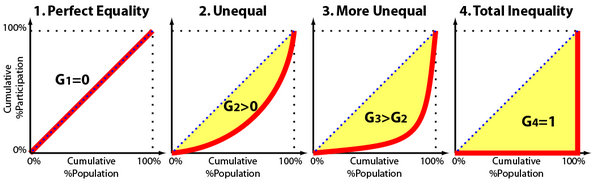
The Gini Coefficient (also known as the Gini index or Gini ratio) is a measure of statistical dispersion intended to represent the income distribution of a nation’s residents, and is the most commonly used measure of inequality.

It is related to the Lorenz Curve and was developed by the Italian statistician and sociologist Corrado Gini and published in his 1912 paper Variability and Mutability.

***


***

MORE: About the Lorenz Curve

MORE: https://www.investopedia.com/terms/g/gini-index.asp

Assessment

Recently, the Gini Index has been in the Atlanta, Georgia news; and not in a good way. Learn why here?

ATLANTA: https://www.bloomberg.com/news/articles/2018-10-10/atlanta-takes-top-income-inequality-spot-among-american-cities

Conclusion

Your thoughts and comments on this ME-P are appreciated. Feel free to review our top-left column, and top-right sidebar materials, links, URLs and related websites, too. Then, subscribe to the ME-P. It is fast, free and secure.

Speaker: If you need a moderator or speaker for an upcoming event, Dr. David E. Marcinko; MBA – Publisher-in-Chief of the Medical Executive-Post – is available for seminar or speaking engagements.

Book Marcinko: https://medicalexecutivepost.com/dr-david-marcinkos-bookings/

Subscribe: MEDICAL EXECUTIVE POST for curated news, essays, opinions and analysis from the public health, economics, finance, marketing, IT, business and policy management ecosystem.

DOCTORS:

“Insurance & Risk Management Strategies for Doctors” https://tinyurl.com/ydx9kd93

“Fiduciary Financial Planning for Physicians” https://tinyurl.com/y7f5pnox

“Business of Medical Practice 2.0” https://tinyurl.com/yb3x6wr8

HOSPITALS:

“Financial Management Strategies for Hospitals” https://tinyurl.com/yagu567d

“Operational Strategies for Clinics and Hospitals” https://tinyurl.com/y9avbrq5

***

Risk Management, Liability Insurance, and Asset Protection Strategies for Doctors and Advisors: Best Practices from Leading Consultants and Certified Medical Planners™8Comprehensive Financial Planning Strategies for Doctors and Advisors: Best Practices from Leading Consultants and Certified Medical Planners™

Physician Fees Throughout Time

INFLATION ADJUSTED FEE SCHEDULE PAYMENTS

By Anonymous

The Triple Aim framework serves as the foundation for optimizing health for individuals and populations by simultaneously improving the patient experience of care (including quality and satisfaction), improving the health of the population, and reducing per capita cost of care for the benefit of communities.

***

In a value-based care model, physicians and medical providers would work with patients to determine a treatment plan, then measure the relevant clinical results over the course of the patient’s treatment.

CITE: https://www.r2library.com/Resource

***

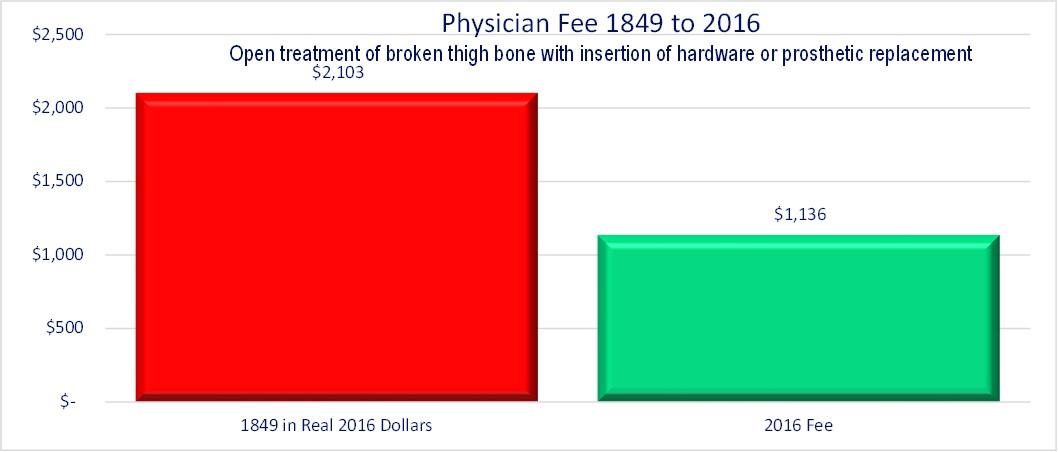
Physicians and medical scientists have intervened in the three revolutions in triple aim since the rise of American dominance in medical training, orthopedic technology, and Nobel Prizes. So, how has value based care rewarded them?

As an example: the open treatment of broken thigh bone paid 85% higher in 1849 than today when adjusted for inflation.

Join our movement for technology that works every physician every patient every time.

***

***

***

Physician Medical Risk Management and Insurance Planning Practices of Leading CERTIFIED MEDICAL PLANNERS®

SPONSOR: http://www.CertifiedMedicalPlanner.org 

 Our New Texts – “Take a Peek Inside – Now Available

      Risk Management, Liability Insurance, and Asset Protection Strategies for Doctors and Advisors: Best Practices from Leading Consultants and Certified Medical Planners™  Risk Management, Liability Insurance, and Asset Protection Strategies for Doctors and Advisors: Best Practices from Leading Consultants and Certified Medical Planners™

 logos

“BY DOCTORS – FOR DOCTORS – PEER REVIEWED – FIDUCIARY FOCUSED”

SAMPLE: 21. Practice Risks

MORE: Risk Mgmt Leadership

***

PODCAST: Machine Learning for Population Health

By Eric Bricker MD

***

***

COMMENTS APPRECIATED

Thank You

***

***

About EngagewithGrace.org

Contemplating End-of-Life Dignity

[By Staff Reporters] 

SPONSOR: http://www.MarcinkoAssociates.com

According to the website, Engage with Grace, we make choices throughout our lives — where we want to live, what types of activities will fill our days, and with whom we spend our time, etc. These choices are often a balance between our desires and our means, but at the end of the day, they are decisions made with intent.

Somehow when we get close to death, however, we stop making decisions. We get frozen in our tracks and can’t talk about our preferences for end of life care. 


Death Studies

Studies loom out there — 73% of Americans would prefer to die at home, but anywhere between 20-50% of Americans die in hospital settings. More than 80% of Californians say their loved ones “know exactly” or have a “good idea” of what their wishes would be if they were in a persistent coma, but only 50% say they’ve talked to them about their preferences.

But, end of life experience is about a lot more than statistics. It’s about all of us.

Genesis and Epiphany

In the summer of 2008, Matt Holt (Founder of Health2.0) and Alexandra Drane (President of Eliza) met with some friends for dinner. Over their second cocktail, they got deep into conversation about these very topics. Many of us live with such intent — why do we put the end of our lives in someone else’s control?  Why isn’t this topic a conversation that people are having? How could we help start it? And it hit them — What if we could work together to start a viral movement — a movement focused on improving the end of life experience?  What if we took responsibility for starting a national (even global) discussion that, until now, most of us haven’t had?

Engage With Grace

The One Slide Project was designed with one simple goal: to help get the conversation about end of life experience started. The idea is simple: Create a tool to help get people talking. One Slide, with just five questions on it.  Five questions designed to help get us talking with each other, with our loved ones, about our preferences. And we’re asking people to share this One Slide — wherever and whenever they can… at a presentation, at dinner, at their book club. Just One Slide with five questions to help get all of us talking about death. Just One Slide that we as a community could collectively rally around sharing — in meetings, at a conference, or over a drink.

This is the link to the slide, and this is what we are asking you to do …

Download the One Slidehttp://engagewithgrace.org/about/

Share it any time you can — at the end of presentations, at dinner, or at your book club. Think of the slide as currency and donate just two minutes whenever you can. Commit to being able to answer these five questions about end of life experience for yourself and for your loved ones. Then commit to helping others do the same. Get this conversation started.

Assessment

Let’s start a viral movement driven by the change we as individuals can affect …and the incredibly positive impact we could have collectively. Donate just two minutes to adding just this One Slide to the end of your presentations. Get others involved. Help ensure that all of us — and the people we care for — can end our lives in the same purposeful way we live them.

Just One Slide, just one goal. Think of the enormous difference we can make together.

Conclusion

Your thoughts and comments on this ME-P are appreciated. Feel free to review our top

-left column, and top-right sidebar materials, links, URLs and related websites, too. Then, subscribe to the ME-P. It is fast, free and secure.

Speaker: If you need a moderator or speaker for an upcoming event, Dr. David E. Marcinko; MBA – Publisher-in-Chief of the Medical Executive-Post – is available for seminar or speaking engagements. Contact: MarcinkoAdvisors@msn.com

OUR OTHER PRINT BOOKS AND RELATED INFORMATION SOURCES:

Product DetailsProduct DetailsProduct Details    

Product DetailsProduct Details

A Brief Look at Level Life Insurance Sales Commissions

Of Interest to All Insurance Agents

https://medicalexecutivepost.com/wp-content/uploads/2018/06/david-edward-marcinko.png

By Dr. David Edward Marcinko MBA MEd CMP™

Sponsored: http://www.CertifiedMedicalPlanner.org

CMP logo

According to colleague David K. Luke MIM, MS-PFP, CMP™ the current structure of the life insurance industry regarding cash-value life insurance policies with most major insurance companies is to reward the selling agent with the entire commission upfront on a newly issued policy. The criticism to this practice is that this of course reduces the needed client-agent reviews and interaction and generates more “churning” and “flipping”. Unscrupulous agents are tempted to sell physician-clients another policy for another commission rather than encourage them to maintain and keep their existing policy, which most likely would have lower costs than any new policy considering the client was younger and most likely in better health with the existing contract. A model in which the insurance agent would have a financial incentive for their client’s continued patronage could create a win-win for both parties. We see this “pay as you” model currently operating successfully with wealth advisors and property/casualty agents, why not life insurance agents [personal communication]?

There are some flaws to this argument. The reality is that the captive life insurance industry and their agents prefer this form of lump compensation. The claim is that selling an individual a life insurance policy (the ultimate intangible product) is hard work, and likewise the 70% – 110% of the first year premium is fair compensation for the efforts. For existing agents to reduce their current income to a fraction of this commission upfront, but convert it into a trail over a multiyear period is actually quite distasteful. Therefore, this change will likewise not be initiated from the Insurance agent or insurance industry side unless other forces prevail.

The drive by the consumer to change this up front lump form of compensation has not yet presented itself in full force. After all, why does the consumer care about how the agent is paid if the consumer is satisfied with the end result? One must acknowledge that the drive to reduce commissions and up front loads in the investment advisory business was driven by the consumer that insisted on lower fees and costs.

However, the relevant costs of a life insurance policy are not quite as obvious. Only by comparing a quote from different companies can a consumer compare costs, and even then it is unknown and not understood how the pricing mechanisms used by the insurance company work. The advent of non-agent sold policies however is decreasing the cost of life insurance (there is no big commission check written to the selling agent) and is hitting the radar of consumers. The consumer can notice this difference if the consumer compares the proposed agent sold policy premium with one sold directly by a financial institution such as USAA or AARP. These companies have a work force of sales people that are compensated primarily on salary. Likewise the company can structure more competitive pricing, and in effect offers a levelized cost (in place of commission) insurance product.

https://images.routledge.com/common/jackets/crclarge/978149872/9781498725989.jpg

Textbook Order: https://www.routledge.com/Risk-Management-Liability-Insurance-and-Asset-Protection-Strategies-for/Marcinko-Hetico/p/book/9781498725989

For example, Mark Maurer CFP® of Low Load Insurance Services believes that a levelized compensation basis will not occur unless all the insurance companies were to go to such a plan all at once. If an agent can “pick and choose” he/she may use a “levelized compensation” policy when in a competitive situation, as such a policy should in theory make a policy more inexpensive. An agent would then use the higher “front-end” policy when there is a large up-front premium or in a scenario with limited competition. Mark believes the answer to the whole argument is full disclosure. Both agents and home offices would not want the purchaser to know that 100% or more of their premium is going to sales costs and then products would then get better [personal communication].

The insurance industry has a powerful lobby in Washington. Only market pressure will cause a change in this decades old insurance industry practice that has made many life insurance policies expensive and inefficient. Pricing from non-agent sold life insurance companies will be the impetus that drives the old-line Insurance companies to restructure their commissions to agents.

Insurance agents also remember the days of 8% load mutual fund commissions and minimum $60 dollar commissions on stock trades in the late 1980’s! That is an inflation equivalent of more than $130 per trade, minimum commission, today. The current investing world would laugh at these costs [charges] today. When the physician-consumer realizes, through full disclosure and outside competitive market pressures, that life insurance protection can be more affordable from other non-traditional channels, then s/he will insist on a better, more affordable product.

https://images.routledge.com/common/jackets/crclarge/978148224/9781482240283.jpg

Textbook Order: https://www.amazon.com/Comprehensive-Financial-Planning-Strategies-Advisors/dp/1482240289/ref=sr_1_1?ie=UTF8&qid=1418580820&sr=8-1&keywords=david+marcinko

Ultimately, the big agent driven life insurance companies will have to change their commission structure. The transition is currently in process. Only time will tell now [personal communication].

Your thoughts are appreciated.

Please subscribe.

THANK YOU

***

HEALTH CARE: Cyber Attack Costs

By Staff Reporters

***

***

Cyberattacks are causing issues across all sorts of industries, from Microsoft to AT&T to Ascension. But it looks like the healthcare industry is getting hit the hardest—financially, at least.

The 2024 Cost of a Data Breach Report from IBM and think tank Ponemon Institute found that the global average cost of a data breach rose 10% between March 2023 and February 2024, reaching a total average cost of $4.88 million in that period. Costs for disruptions to business processes and post-breach customer support and remediation were the largest drivers behind the increase.

However, of the 17 industries studied, healthcare had the most expensive data breaches, with an average cost of $9.77 million during that same period. In fact, healthcare has held the No. 1 spot for costliest breaches since 2011, according to the study.

For comparison, the next highest average cost was in finance, at $6.08 million.

CITE: https://www.r2library.com/Resource

COMMENTS APPRECIATED

Thank You

***

***

DOJ Intervenes in Fraud & Abuse Case Against Tennessee Hospital

By Health Capital Consultants, LLC

***

On July 26, 2024, the U.S. Department of Justice (DOJ) filed a complaint in intervention against Murphy Medical Center, doing business as Erlanger Western Carolina Hospital, and Chattanooga-Hamilton County Hospital Authority, doing business as the Erlanger Health System and Erlanger Medical Center. The government’s complaint, filed in the U.S. District Court for the Western District of North Carolina, alleges that Erlanger violated the Stark Law, and subsequently submitted false claims to the Medicare program in violation of the False Claims Act (FCA).

CITE: https://www.r2library.com/Resource

This Health Capital Topics article reviews the allegations underlying the case. (Read more...) 

COMMENTS APPRECIATED

Thank You

***

***

On Wall Street’s Suitability, Prudence and Fiduciary Accountability

Financial Advisor’s are Not Doctors!

dr-david-marcinko1

Dr. David E. Marcinko FACFAS MBA MEd CMP™ MBBS

THRIVE-BECOME A CMP™ Physician Focused Fiduciary

http://www.CertifiedMedicalPlanner.org

Financial advisors don’t ascribe to the Hippocratic Oath.  People don’t go to work on “Wall Street” for the same reasons other people become firemen and teachers.  There are no essays where they attempt to come up with a new way to say, “I just want to help people.”

Financial Advisor’s are Not Doctors

Some financial advisors and insurance agents like to compare themselves to CPAs, attorneys and physicians who spend years in training and pass difficult tests to get advanced degrees and certifications. We call these steps: barriers-to-entry. Most agents, financial product representatives and advisors, if they took a test at all, take one that requires little training and even less experience. There are few BTEs in the financial services industry.

For example, most insurance agent licensing tests are thirty minutes in length. The Series #7 exam for stock brokers is about 2 hours; and the formerly exalted CFP® test is about only about six [and now recently abbreviated]. All are multiple-choice [guess] and computerized. An aptitude for psychometric savvy is often as important as real knowledge; and the most rigorous of these examinations can best be compared to a college freshman biology or chemistry test in difficulty.

Yet, financial product salesman, advisors and stock-brokers still use lines such as; “You wouldn’t let just anyone operate on you, would you?” or “I’m like your family physician for your finances.  I might send you to a specialist for a few things, but I’m the one coordinating it all.”  These lines are designed to make us feel good about trusting them with our hard-earned dollars and, more importantly, to think of personal finance and investing as something that “only a professional can do.”

Unfortunately, believing those lines can cost you hundreds of thousands of dollars and years of retirement.

***

231_1

***

Suitability Rule

A National Association of Securities Dealers [NASD] / Financial Industry Regulatory Authority [FINRA] guideline that require stock-brokers, financial product salesman and brokerages to have reasonable grounds for believing a recommendation fits the investment needs of a client. This is a low standard of care for commissioned transactions without relationships; and for those “financial advisors” not interested in engaging clients with advice on a continuous and ongoing basis. It is governed by rules in as much as a Series #7 licensee is a Registered Representative [RR] of a broker-dealer. S/he represents best-interests of the firm; not the client.

And, a year or so ago there we two pieces of legislation for independent broker-dealers-Rule 2111 on suitability guidelines and Rule 408(b)2 on ERISA. These required a change in processes and procedures, as well as mindset change.

Note: ERISA = The Employee Retirement Income Security Act of 1974 (ERISA) codified in part a federal law that established minimum standards for pension plans in private industry and provides for extensive rules on the federal income tax effects of transactions associated with employee benefit plans. ERISA was enacted to protect the interests of employee benefit plan participants and their beneficiaries by:

  • Requiring the disclosure of financial and other information concerning the plan to beneficiaries;
  • Establishing standards of conduct for plan fiduciaries ;
  • Providing for appropriate remedies and access to the federal courts.

ERISA is sometimes used to refer to the full body of laws regulating employee benefit plans, which are found mainly in the Internal Revenue Code and ERISA itself. Responsibility for the interpretation and enforcement of ERISA is divided among the Department Labor, Treasury, IRS and the Pension Benefit Guarantee Corporation.

Yet, there is still room for commissioned based FAs. For example, some smaller physician clients might have limited funds [say under $100,000-$250,000], but still need some counsel, insight or advice.

Or, they may need some investing start up service from time to time; rather than ongoing advice on an annual basis. Thus, for new doctors, a commission based financial advisor may make some sense. 

Prudent Man Rule

This is a federal and state regulation requiring trustees, financial advisors and portfolio managers to make decisions in the manner of a prudent man – that is – with intelligence and discretion. The prudent man rule requires care in the selection of investments but does not limit investment alternatives. This standard of care is a bit higher than mere suitability for one who wants to broaden and deepen client relationships. 

***

student-849825_640

***

Prudent Investor Rule

The Uniform Prudent Investor Act (UPIA), adopted in 1992 by the American Law Institute’s Third Restatement of the Law of Trusts, reflects a modern portfolio theory [MPT] and total investment return approach to the exercise of fiduciary investment discretion. This approach allows fiduciary advisors to utilize modern portfolio theory to guide investment decisions and requires risk versus return analysis. Therefore, a fiduciary’s performance is measured on the performance of the entire portfolio, rather than individual investments 

Fiduciary Rule

The legal duty of a fiduciary is to act in the best interests of the client or beneficiary. A fiduciary is governed by regulations and is expected to judge wisely and objectively. This is true for Investment Advisors [IAs] and RIAs; but not necessarily stock-brokers, commission salesmen, agents or even most financial advisors. Doctors, lawyers, and the clergy are prototypical fiduciaries. 

***

business-insurance

***

More formally, a financial advisor who is a fiduciary is legally bound and authorized to put the client’s interests above his or her own at all times. The Investment Advisors Act of 1940 and the laws of most states contain anti-fraud provisions that require financial advisors to act as fiduciaries in working with their clients. However, following the 2008 financial crisis, there has been substantial debate regarding the fiduciary standard and to which advisors it should apply. In July of 2010, The Dodd-Frank Wall Street Reform and Consumer Protection Act mandated increased consumer protection measures (including enhanced disclosures) and authorized the SEC to extend the fiduciary duty to include brokers rather than only advisors, as prescribed in the 1940 Act. However, as of 2014, the SEC has yet to extend a meaningful fiduciary duty to all brokers and advisors, regardless of their designation.

The Fiduciary Oath: fiduciaryoath_individual

Assessment 

Ultimately, physician focused and holistic “financial lifestyle planning” is about helping some very smart people change their behavior for the better. But, one can’t help doctors choose which opportunities to take advantage of along the way unless there is a sound base of technical knowledge to apply the best skills, tools, and techniques to achieve goals in the first place.

Most of the harms inflicted on consumers by “financial advisors” or “financial planners” occur not due to malice or greed but ignorance; as a result, better consumer protections require not only a fiduciary standard for advice, but a higher standard for competency.

The CFP® practitioner fiduciary should be the minimum standard for financial planning for retail consumers, but there is room for post CFP® studies, certifications and designations; especially those that support real medical niches and deep healthcare specialization like the Certified Medical Planner™ course of study [Michael E. Kitces; MSFS, MTax, CLU, CFP®, personal communication].

Being a financial planner entails Life-Long-Learning [LLL]. One should not be allowed to hold themselves out as an advisor, consultant, or planner unless they are held to a fiduciary standard, period. Corollary – there’s nothing wrong with a suitability standard, but those in sales should be required to hold themselves out as a salesperson, not an advisor.

The real distinction is between advisors and salespeople. And, fiduciary standards can accommodate both fee and commission compensation mechanisms. However; there must be clear standards and a process to which advisors can be held accountable to affirm that a recommendation met the fiduciary obligation despite the compensation involved.

Ultimately, being a fiduciary is about process, not compensation.

More: Deception in the Financial Service Industry

Full Disclosure:

As a medical practitioner, Dr. Marcinko is a fiduciary at all times. He earned Series #7 (general securities), Series #63 (uniform securities state law), and Series #65 (investment advisory) licenses from the National Association of Securities Dealers (NASD-FINRA), and the Securities Exchange Commission [SEC] with a life, health, disability, variable annuity, and property-casualty license from the State of Georgia.

Dr.Marcinko was a licensee of the CERTIFIED FINANCIAL PLANNER™ Board of Standards (Denver) for a decade; now reformed, and holds the Certified Medical Planner™ designation (CMP™). He is CEO of iMBA Inc and the Founding President of: http://www.CertifiedMedicalPlanner.org

More: Enter the CMPs

***

[PHYSICIAN FOCUSED FINANCIAL PLANNING AND RISK MANAGEMENT COMPANION TEXTBOOK SET]

  Risk Management, Liability Insurance, and Asset Protection Strategies for Doctors and Advisors: Best Practices from Leading Consultants and Certified Medical Planners™  Comprehensive Financial Planning Strategies for Doctors and Advisors: Best Practices from Leading Consultants and Certified Medical Planners™

[Dr. Cappiello PhD MBA] *** [Foreword Dr. Krieger MD MBA]

[Two Newest Books by Marcinko annd the iMBA, Inc Team]

Conclusion

Your thoughts and comments on this ME-P are appreciated. Feel free to review our top-left column, and top-right sidebar materials, links, URLs and related websites, too. Then, subscribe to the ME-P. It is fast, free and secure.

Speaker: If you need a moderator or speaker for an upcoming event, Dr. David E. Marcinko; MBA – Publisher-in-Chief of the Medical Executive-Post – is available for seminar or speaking engagements. Contact: MarcinkoAdvisors@msn.com

OUR OTHER PRINT BOOKS AND RELATED INFORMATION SOURCES:

***

Product DetailsProduct Details

Product DetailsProduct DetailsProduct Details

[PRIVATE MEDICAL PRACTICE BUSINESS MANAGEMENT TEXTBOOK – 3rd.  Edition]

Product DetailsProduct Details

  [Foreword Dr. Hashem MD PhD] *** [Foreword Dr. Silva MD MBA]

***

DAILY UPDATE: Nvidia DOJ and Nippon Steel as Stocks Sill Slide

MEDICAL EXECUTIVE-POST TODAY’S NEWSLETTER BRIEFING

***

Essays, Opinions and Curated News in Health Economics, Investing, Business, Management and Financial Planning for Physician Entrepreneurs and their Savvy Advisors and Consultants

Serving Almost One Million Doctors, Financial Advisors and Medical Management Consultants Daily

A Partner of the Institute of Medical Business Advisors , Inc.

http://www.MedicalBusinessAdvisors.com

SPONSORED BY: Marcinko & Associates, Inc.

***

http://www.MarcinkoAssociates.com

Daily Update Provided By Staff Reporters Since 2007.
How May We Serve You?
© Copyright Institute of Medical Business Advisors, Inc. All rights reserved. 2024

REFER A COLLEAGUE: MarcinkoAdvisors@msn.com

SPONSORSHIPS AVAILABLE: https://medicalexecutivepost.com/sponsors/

ADVERTISE ON THE ME-P: https://tinyurl.com/ytb5955z

Your Referral Count -0-

A bad day for Nvidia got even worse on Tuesday when Bloomberg reported that the Department of Justice subpoenaed the chipmaker as part of its investigation into whether the world’s hottest company unfairly wields its industry dominance. Yesterday, Nvidia denied it was technically subpoenaed. Bloomberg followed up to say that Nvidia was merely splitting hairs about the type of request it received from the DOJ but that it was in fact asked to answer questions about its empire.

CITE: https://www.r2library.com/Resource

What’s up

What’s down
  • C3.ai, which sounds like the name of a new Star Wars droid, sank 8.21% after the enterprise software company announced that subscription revenue fell short of expectations last quarter.
  • Hewlett Packard Enterprise staggered 6.02% after posting record AI revenue but paying the price for it.
  • Copart dropped 6.67% once the online car auctioneer reported solid revenue growth but missed earnings expectations last quarter.
  • ChargePoint plummeted 17.75% thanks to an absolutely terrible quarter for the EV charging network company.
  • Toro Company, makers of your dad’s favorite lawnmower, fell 10.09%. Sales to residential customers rose last quarter, but sales to professionals, who buy more expensive equipment, fell.

CITE: https://tinyurl.com/2h47urt5

Here’s where the major benchmarks ended:

  • The SPX fell 16.66 points (–0.30%) to 5,503.41; the Dow Jones Industrial Average® ($DJI) dropped 219.22 points (–0.54%) to 40,755.75; the NASDAQ Composite® ($COMP) added 43.36 points (0.25%) to 17,127.66.
  • The 10-year Treasury note yield (TNX)slid to 3.73%, its lowest close since August 5 following today’s jobs-related data. 
  • The CBOE Volatility Index® (VIX)fell to just above 20, near its historic average.

CITE: https://tinyurl.com/tj8smmes

The president is gearing up to block Japan’s Nippon Steel from acquiring US Steel, according to the Washington Post—a move that could end the highly politicized deal.

Visualize: How private equity tangled banks in a web of debt, from the Financial Times.

COMMENTS APPRECIATED

PLEASE SUBSCRIBE: MarcinkoAdvisors@msn.com

Thank You

***

***

***

***

EDUCATIONAL TEXTBOOKS: https://tinyurl.com/4zdxuuwf

***

What are FRACTIONAL STOCK SHARES?

Information that Physician Investors Should Know?

By Staff Reporters

DEFINITION: Fractional shares are partial shares of a company’s stock. Instead of owning one or more full shares of the stock, you own a portion, or fraction, of one. In the past, investors generally would end up with fractional shares only after a stock split, since brokers allowed the purchase of full shares only.

CITE: https://www.r2library.com/Resource/Title/082610254

  • A fractional share is a portion of an equity stock that is less than one full share.
  • Fractional shares often result from stock splits, which don’t always result in an even number of shares.
  • Mergers or acquisitions create fractional shares, as companies combine new common stock using a predetermined ratio.
  • Fractional shares can make it easy to buy very small stakes in many different companies. But, if your brokerage charges commissions, you might wind up paying a lot of fees due to the temptation to invest in many different companies.

***

Stock too Pricey? Try Partial Shares. - WSJ

***

READ: https://www.mybanktracker.com/blog/investing/fractional-shares-310822

COMMENTS APPRECIATED

Thank You

Subscribe to the Medical Executive-Post

***

***

LEASING: The “Money Factor Lie”

By Staff Reporters

***

***

An increasingly common leasing scam is the money factor lie

The “money factor” in leasing is the financing cost of a monthly lease payment and is similar to an interest rate – and it’s important to know the difference. The money factor is a small decimal and should be shown as such, whereas the interest rate is a percentage. A deceitful sales person will count on you not knowing the difference.

For example, a interest rate of 2.5% is not the same as a factor of .0025 and when the latter is used to calculate your lease payment, he or she ends up overcharging you. As a result, you have to pay much more over the lease term without realizing it.

Cite: https://www.r2library.com

To calculate the money factor, use this formula: Money Factor = Lease Charge / (Capitalized Cost * Residual Value) * Lease Term. It’s important to note that the customer’s credit score determines the money factor. The higher your credit score is, the lower the money factor on the lease will be.

One way to calculate the money factor is by converting it to an APR. To do this, you multiply the money factor by 2,400. If a car dealer provides you with an interest rate, divide it by 2,400 to find the money factor.

In another example, if you are quoted a money factor of .003 on a loan, that would be (2,400x.003) 7.2%. If the car dealer quotes you an interest rate of 4.2%, you can divide it by 2,400 to find the money factor of .00175.

The money factor may be shown in an easier-to-read format, like 1.75 instead of .00175. This can often confuse customers because it appears to be a low interest rate. But don’t be fooled by a money factor presented as a factor of 1,000. Always be sure to ask if the number you are given is the APR or the money factor. If it’s the money factor, convert it to APR so that you can clearly see the interest rate.

COMMENTS APPRECIATED

Thank You

***

***

Who Does a Stock Broker Work for – Really?

And … What’s Up at the Bank of America?

http://www.CertifiedMedicalPlanner.org

A Vintage ME-P

According to E. Dilts, BoA is making it harder for brokers to take some of their clients with them when they leave Merrill Lynch-specifically, clients that were referred to the broker by a Bank of America branch.

Brokers in recent months have been asked to sign contracts saying that if they leave Merrill Lynch, they can’t take the names or phone numbers of those customers with them, because those clients belong to the bank.

Lawyers said this policy chips away at the decade-old truce among brokerages known as the Protocol for Broker Recruiting.

The agreement was meant to end the continual and costly legal battles between brokerages and their brokers over who had the right to keep clients, and allows departing brokers to take client information including names and phone numbers with them.

***

Stocker

Stock Broker versus Brokerage House

***

Assessment

So, who does the broker [er-ah! financial advisor] really work for – the [physician] client or the brokerage house? And doesn’t this make your account just a portion of their “book of business?”

Talk about advice versus product sales?

Link: http://wealthmanagement.com/wirehouse/bank-america-chips-away-brokerage-industry-truce?NL=WM-27&Issue=WM-27_20150224_WM-27_400&sfvc4enews=42&cl=article_2&YM_RID=CPG09000002702210&YM_MID=2033

More:

Channel Surfing the ME-P

Have you visited our other topic channels? Established to facilitate idea exchange and link our community together, the value of these topics is dependent upon your input. Please take a minute to visit. And, to prevent that annoying spam, we ask that you register. It is fast, free and secure.

Even More:

Conclusion

Your thoughts and comments on this ME-P are appreciated. Feel free to review our top-left column, and top-right sidebar materials, links, URLs and related websites, too. Then, subscribe to the ME-P. It is fast, free and secure.

Speaker: If you need a moderator or speaker for an upcoming event, Dr. David E. Marcinko; MBA – Publisher-in-Chief of the Medical Executive-Post – is available for seminar or speaking engagements. Contact: MarcinkoAdvisors@msn.com

OUR OTHER PRINT BOOKS AND RELATED INFORMATION SOURCES:

Comprehensive Financial Planning Strategies for Doctors and Advisors: Best Practices from Leading Consultants and Certified Medical Planners(TM)* 8

DAILY UPDATE: Pfizer and Eli Lilly as Stock Fall Again!

MEDICAL EXECUTIVE-POST TODAY’S NEWSLETTER BRIEFING

***

Essays, Opinions and Curated News in Health Economics, Investing, Business, Management and Financial Planning for Physician Entrepreneurs and their Savvy Advisors and Consultants

Serving Almost One Million Doctors, Financial Advisors and Medical Management Consultants Daily

A Partner of the Institute of Medical Business Advisors , Inc.

http://www.MedicalBusinessAdvisors.com

SPONSORED BY: Marcinko & Associates, Inc.

***

http://www.MarcinkoAssociates.com

Daily Update Provided By Staff Reporters Since 2007.
How May We Serve You?
© Copyright Institute of Medical Business Advisors, Inc. All rights reserved. 2024

REFER A COLLEAGUE: MarcinkoAdvisors@msn.com

SPONSORSHIPS AVAILABLE: https://medicalexecutivepost.com/sponsors/

ADVERTISE ON THE ME-P: https://tinyurl.com/ytb5955z

Your Referral Count -0-

Pfizer is stepping out from the pharmacy aisle and into the living room with a new website called PfizerForAll. The platform helps patients find information about migraines, Covid, flu, or other seasonal respiratory viruses, the pharma giant said in a Tuesday press release.

Eli Lilly is slashing the price of its blockbuster weight loss drug, Zepbound, offering new, single-dose vials, the company announced on August 27th. Self-pay patients with an on-label prescription can purchase 2.5-mg and 5-mg single-dose vials of Zepbound at roughly 50% off the drug’s list price through the pharma giant’s direct-to-consumer website, LillyDirect, which launched in January. This is the first time the drug maker has offered the drug in single-dose vials rather than an auto-injector.

CITE: https://www.r2library.com/Resource

What’s up

What’s down

  • Dollar Tree plummeted 22.16%, its biggest selloff in 23 years, after the discount retailer posted a terrible earnings report.
  • Zscaler plunged 18.67% after issuing much lower guidance for the coming quarters than shareholders expected, despite the cybersecurity company beating estimates this quarter.
  • Dick’s Sporting Goods fell 4.89% in spite of management projecting strong sales growth in the rest of the year. Investors thought that forecasts would be higher.
  • Asana sank 4.97% due to today’s theme: The software management company’s growth projections didn’t meet shareholder expectations.
  • Super Micro Computer dropped 4.14% after it was downgraded by Barclays analysts as the fallout from short seller Hindenburg Research’s latest report continues.

CITE: https://tinyurl.com/2h47urt5

Here’s where the major benchmarks ended:

  • The S&P 500® index (SPX) fell 8.86points (–0.16%) to 5,520.07; the Dow Jones Industrial Average® ($DJI) added 38.04 points (0.09%) to 40,974.97; the NASDAQ Composite® ($COMP) declined 52.00 points (–0.30%) to 17,084.30. 
  • The TNX dropped to just under 3.77%, the lowest since August 21st.
  • The CBOE Volatility Index® (VIX) closed higher at 21.05 but down from intra-day peaks.

And, the market’s defensive pose continued, with utilities, staples, and real estate leading sector gains, while energy dove again amid weak commodity prices. Info tech, the last place finisher Tuesday, fell again, but only 0.35%, helped by slight gains in the semiconductor sector.

CITE: https://tinyurl.com/tj8smmes

Stat: 19%. That’s how much lower your risk of developing heart disease could be if you caught up on sleep during the weekend, according to a recent study. (CNN)

Visualize: How private equity tangled banks in a web of debt, from the Financial Times.

COMMENTS APPRECIATED

PLEASE SUBSCRIBE: MarcinkoAdvisors@msn.com

Thank You

***

***

***

***

EDUCATIONAL TEXTBOOKS: https://tinyurl.com/4zdxuuwf

***

On Sexual Violence Against Women

The Hard Truths

Sexual violence against women is a serious abuse of women’s human rights, and an injustice experienced by women around the world.

***

Assessment

Sexual violence against women is a serious abuse of women’s human rights, and an injustice experienced by women around the world. The infographic above aims to highlight the reality of sexual violence and the different ways that women – children, adolescents and adults – can be affected by sexual violence throughout their lives. The first step to change is education, so let’s share the hard truths about sexual violence.

Source: actionaid.org.au

Racism in Medicine: racistConclusion

Your thoughts and comments on this ME-P are appreciated. Feel free to review our top-left column, and top-right sidebar materials, links, URLs and related websites, too. Then, subscribe to the ME-P. It is fast, free and secure.

Speaker: If you need a moderator or speaker for an upcoming event, Dr. David E. Marcinko; MBA – Publisher-in-Chief of the Medical Executive-Post – is available for seminar or speaking engagements. Contact: MarcinkoAdvisors@msn.com

OUR OTHER PRINT BOOKS AND RELATED INFORMATION SOURCES:

***

***

Sexual Harassment in the [Healthcare] Workplace

And … How to Prevent It

By Staff Reporter Ashley

We’ve written about medical workplace violence and sexual harassment before on the ME-P and in our handbooks and texts. It is an increasingly important issue around the blog-o-sphere and in the real world.

Link: https://medicalexecutivepost.com/2008/08/02/risk-management%e2%80%94it%e2%80%99s-not-all-about-medical-malpractice/

This harassment in the workplace Infographic explains through images what sexual harassment is and how to prevent sexual harassment from happening at your small business or [medical practice, clinic or healthcare entity].

The authors’ research shows that your business [practice] is more at risk than you think and that you need to act now in proactively protecting that business.

Romance Sex Harassment

Assessment

Source: boltinsurance.com

Conclusion

Your thoughts and comments on this ME-P are appreciated. Feel free to review our top-left column, and top-right sidebar materials, links, URLs and related websites, too. Then, subscribe to the ME-P. It is fast, free and secure.

Speaker: If you need a moderator or speaker for an upcoming event, Dr. David E. Marcinko; MBA – Publisher-in-Chief of the Medical Executive-Post – is available for seminar or speaking engagements. Contact: MarcinkoAdvisors@msn.com

OUR OTHER PRINT BOOKS AND RELATED INFORMATION SOURCES:

Risk Management, Liability Insurance, and Asset Protection Strategies for Doctors and Advisors: Best Practices from Leading Consultants and Certified Medical Planners™

Product Details  Product Details

WORLD: Sexual Health Day

By Staff Reporters

***

***

Today is World Sexual Health Day, and according to the World Health Organization,good sexual health is fundamental to the overall health and well-being of individuals, couples, and families.

This year’s theme is all about forming positive relationships, so consider taking some time today to reflect on yours (and maybe tell someone what they mean to you).

***

Sexual Rights as Human Rights

One of the main aims of WSHD is to help people around the world recognize that sexual rights are basic human rights, and they are essential for peoples’ well-being and for living a fulfilled life. The day fosters a positive perspective on sexuality, one that is respectful of everyone’s sexual identity, irrespective of where they see themselves on the human sexuality spectrum. The spectrum is a continuous scale that goes beyond conventional gender binaries and suggests that sexuality is a fluid concept – one that can change over time and space.

Talking About It

Sexuality is an integral part of an individual’s life and identity. Despite this, sexuality and sexual health are often considered taboo subjects. World Sexual Health Day attempts to change this by engaging youth, adults, educators, sexual health practitioners, nonprofit organizations, and government policy-makers in an open and earnest conversation about sex, sexuality, and sexual health.

The day also encourages parents, teachers, guardians, and pediatricians to provide children and youth under their care with age-appropriate and scientifically accurate sex education. Comprehensive sexuality education can help young people and, eventually, adults, to be more sex-positive – the notion that all sex is good as long as it involves consenting participants and does not compromise their health. In addition, sex education promotes safe sex, which is one of the bedrocks of sexual health. It also helps make consent an integral part of all sexual encounters.

What Happens on World Sexual Health Day?

World Sexual Health Day is not an official holiday so businesses, schools, and government offices are open. Sexual health groups and educators organize outreach drives, conferences, and workshops to bring attention to the importance of sexual health in maintaining a happy and fulfilling lifestyle.

COMMENTS APPRECIATED

Thank You

***

***

How Stock-Brokers Execute Trades

What Every Physician-Investor Should Know

And … Why Trade Execution Isn’t Instantaneous!

By Dr. Gary L. Bode MSA CPA CMP [Hon]; PC

http://www.CertifiedMedicalPlanner.org

Dr. Gary Bode; CPA, MSA, CMP

Many physician investors who trade through online brokerage accounts assume they have a direct connection to the securities markets.

But, they don’t. When you press “enter,” your order is sent over the Internet to your broker – who in turn decides which market to send it to for execution. A similar process occurs when you call your broker to place a trade.

While trade execution is usually seamless and quick, it does take time. And prices can change quickly, especially in fast-moving markets. Because price quotes are only for a specific number of shares, MD investors may not always receive the price they saw on their screen or the price their broker quoted over the phone. By the time your order reaches the market, the price of the stock could be slightly – or very – different.

Note: No SEC regulations require a trade to be executed within a set period of time. But if firms advertise their speed of execution, they must not exaggerate or fail to tell investors about the possibility of significant delays.

Tip: To avoid buying or selling a stock at a price higher or lower than you wanted, place a limit order rather than a market order. A limit order is an order to buy or sell a security at a specific price. A buy limit order can only be executed at the limit price or lower, and a sell limit order can only be executed at the limit price or higher. When you place a market order, you can’t control the price at which your order will be filled.

Example: You want to buy the stock of a “hot” IPO that was initially offered at $9, but don’t want to end up paying more than $20 for the stock. Place a limit order to buy the stock at any price up to $20. By entering a limit order rather than a market order, you will not be caught buying the stock at $90 and then suffering immediate losses as the stock drops later in the day or the weeks ahead.

Caution: Your limit order may never be executed because the market price may quickly surpass your limit before your order can be filled. But by using a limit order you also protect yourself from buying the stock at too high a price. 

More:

ABOUT

Dr. Gary L. Bode was Chief Executive Officer of Comprehensive Practice Accounting, Inc., a firm specializing in providing tax solutions to medical professionals. Originally, he was a board certified podiatrist and managing partner of a multi-office medical practice for a decade before earning his Master of Science degree in Accounting from the University of North Carolina. He then served as Chief Financial Officer [CFO] for a private mental healthcare facility. Today, Dr. Bode is a nationally known Certified Public Accountant, financial author, educator, and speaker. Areas of expertise include producing customized managerial accounting reports, practice appraisals and valuations, restructurings, and innovative financial accounting as well as proactive tax positioning and tax return preparation for healthcare facilities. He has been quoted in Newsweek.

Conclusion

Your thoughts and comments on this ME-P are appreciated. Feel free to review our top-left column, and top-right sidebar materials, links, URLs and related websites, too. Then, subscribe to the ME-P. It is fast, free and secure.

Speaker: If you need a moderator or speaker for an upcoming event, Dr. David E. Marcinko; MBA – Publisher-in-Chief of the Medical Executive-Post – is available for seminar or speaking engagements. Contact: MarcinkoAdvisors@msn.com

OUR OTHER PRINT BOOKS AND RELATED INFORMATION SOURCES:

Comprehensive Financial Planning Strategies for Doctors and Advisors: Best Practices from Leading Consultants and Certified Medical Planners(TM)* 8

SEPTEMBER: Stock Market Effect?

***

***

Yesterday was only the first trading day of what’s traditionally Wall Street’s weakest month of the year, and September’s already living up to its reputation.

U.S. stocks tumbled Tuesday to their worst day since an early August sell-off, as a week full of updates on the economy got off to a discouragingly weak start. The S&P 500 sank 2.1% to give back a chunk of the gains from a three-week winning streak that had carried it to the cusp of its all-time high. The Dow Jones Industrial Average dropped 626 points, or 1.5%, from its own record set on Friday before Monday’s Labor Day holiday. The NASDAQ composite fell 3.3% as Nvidia and other Big Tech stocks led the way lower.

Understanding the September Effect

From 1928 through 2023, the S&P 500 index has averaged a decline during the month of September.

Stock Trader’s Almanac. “September Almanac: Worst Month of the Year since 1950.” This is, however, an average observed over many nearly a century, and September is certainly not the worst month of stock-market trading every year. In fact, for some years September has been among the best-performing months. Moreover, while the average return for September is negative, the median return for that month has turned positive.

CITE: https://www.r2library.com/Resource

While the September Effect might present a market anomaly in the sense that it violates the assumption of market efficiency, the effect is not overwhelming and, more importantly, is not predictive in any useful sense. This is because the time period under consideration will matter a great deal.

For instance, if an individual had bet against September over the last 100 years, that individual would have made an overall profit. If the investor had made that bet only since 2014, though, that investor would have lost money.  

COMMENTS APPRECIATED

Thank You

***

***

AbbVie: The Economic Recession Index?

The BOTOX Predictor Index?

By Staff Reporters

***

***

It’s looking more than likely that we’ll see a recession in the next year, and Americans are preparing themselves by taking steps like delaying major purchases, allocating more of their income to savings, and staying in jobs they don’t love. Another thing they’re not doing? Getting Botox. And that’s bad news for AbbVie; according to Neal Freyman of Morning Brew.

AbbVie, one of the biggest drug manufacturers in the US, brought Botox into its medical aesthetics portfolio—which also includes the popular dermal filler Juvederm—in 2020, when it bought rival drug maker Allergan for $63 billion. AbbVie CEO Richard Gonzalez said during the company’s Oct. 28th earnings call that the company expects the aesthetics business to take a hard hit in 2024 as recession fears cause consumers to be more cautious with their spending.

“Based on all the data we’ve been observing, especially in the US, with both the consumer-confidence index and real personal consumption expenditures trending down and continued high inflation, these factors are putting pressure on consumer’s discretionary spending,” Gonzalez said.

AbbVie lowered its 2022-23 full-year forecast for its aesthetics business by $600 million, down to $5.3 billion. After the earnings call, AbbVie’s stock fell 4.3%. Through the third quarter of 2022, Botox has brought in $1.97 billion for the aesthetics business. The third quarter saw $637 million in cosmetic Botox sales, down from an expected $640 million. Gonzalez said he doesn’t think the hit on sales will last long, though.

***

***

“As consumer confidence improves, we would once again expect the market growth to accelerate. Our aesthetics portfolio experienced a rapid and sustained recovery following the 2008, 2009 recession,” Gonzalez said.

But Botox also faces a new competitor, called Daxxify, which just got FDA approval in September. Made by Revance Therapeutics, the drug may last longer: In clinical trials, Daxxify injections lasted six to nine months, while Botox injections typically last three months.

***

ORDER: https://www.routledge.com/Comprehensive-Financial-Planning-Strategies-for-Doctors-and-Advisors-Best/Marcinko-Hetico/p/book/9781482240283

***

COMMENTS APPRECIATED

Thank You

***

DAILY UPDATE: Berkshire Hathaway & the “September Effect” Stock Market Collapse

MEDICAL EXECUTIVE-POST TODAY’S NEWSLETTER BRIEFING

***

Essays, Opinions and Curated News in Health Economics, Investing, Business, Management and Financial Planning for Physician Entrepreneurs and their Savvy Advisors and Consultants

Serving Almost One Million Doctors, Financial Advisors and Medical Management Consultants Daily

A Partner of the Institute of Medical Business Advisors , Inc.

http://www.MedicalBusinessAdvisors.com

SPONSORED BY: Marcinko & Associates, Inc.

***

http://www.MarcinkoAssociates.com

Daily Update Provided By Staff Reporters Since 2007.
How May We Serve You?
© Copyright Institute of Medical Business Advisors, Inc. All rights reserved. 2024

REFER A COLLEAGUE: MarcinkoAdvisors@msn.com

SPONSORSHIPS AVAILABLE: https://medicalexecutivepost.com/sponsors/

ADVERTISE ON THE ME-P: https://tinyurl.com/ytb5955z

Your Referral Count -0-

The September Effect refers to the historically weak stock market returns observed during the month of September. In fact, September has been the worst performing month, on average, going back nearly a century.

Stat: $1 trillion. That’s how much Berkshire Hathaway is now worth. The Warren Buffet-led company is the first outside of tech to join the trillion-dollar club, joining behemoths like Apple, Amazon, and Microsoft. (the Washington Post)

CITE: https://www.r2library.com/Resource

What’s up

What’s down

CITE: https://tinyurl.com/2h47urt5

Here’s where the major benchmarks ended:

  • The S&P 500® index (SPX)dropped 119.47points (–2.12%) to 5,528.93; the Dow Jones Industrial Average® ($DJI) fell 626.15 points (–1.51%) to 40,936.93; the $COMP plummeted 577.32 points (–3.26%) to 17, 136.30.
  • The 10-year Treasury note yield gave back seven basis points to 3.84%.
  • The VIX soared to 20.72, the highest since August 13.

CITE: https://tinyurl.com/tj8smmes

Visualize: How private equity tangled banks in a web of debt, from the Financial Times.

COMMENTS APPRECIATED

PLEASE SUBSCRIBE: MarcinkoAdvisors@msn.com

Thank You

***

***

***

***

EDUCATIONAL TEXTBOOKS: https://tinyurl.com/4zdxuuwf

***

QUANTUM COMPUTING: In Finance?

By Staff Reporters

***

***

quantum computer is a computer that exploits quantum mechanical phenomena. At small scales, physical matter exhibits properties of both particles and waves, and quantum computing leverages this behavior using specialized hardware. Classic physics cannot explain the operation of these quantum devices, and a scalable quantum computer could perform some calculations exponentially faster than any modern “classical” computer. In particular, a large-scale quantum computer could break widely used encryption schemes and aid physicists in performing physical simulations; however, the current state of the art is largely experimental and impractical.

The basic unit of information in quantum computing is the qubit, similar to the bit in traditional digital electronics. Unlike a classical bit, a qubit can exist in a superposition of its two “basis” states, which loosely means that it is in both states simultaneously. When measuring a qubit, the result is a probabilistic output of a classical bit. If a quantum computer manipulates the qubit in a particular way, wave interference effects can amplify the desired measurement results. The design of quantum algorithms involves creating procedures that allow a quantum computer to perform calculations efficiently and quickly.

Quantum Computing in Finance

Quantum-computing use cases in finance are slightly further in the future. The long-term promise of quantum computing in finance lies in portfolio and risk management.

CITE: https://www.r2library.com/Resource

One example could be quantum-optimized loan portfolios that focus on collateral to allow lenders to improve their offerings.

(Read more about how quantum computing could affect financial services.)

***

COMMENTS APPRECIATED

Thank You

***

***

CURRENCY PAIRS: Investing Ratio Definition

By Staff Reporters

***

***

A currency pair is the quotation of the relative value of a currency unit against the unit of another currency in the foreign exchange market. The currency that is used as the reference is called the counter currency, quote currency, or currency and the currency that is quoted in relation is called the base currency or transaction currency.

CITE: https://www.r2library.com/Resource

Currency pairs are generally written by concatenating the ISO currency codes (ISO 4217) of the base currency and the counter currency, and then separating the two codes with a slash. Alternatively the slash may be omitted, or replaced by either a dot or a dash. A widely traded currency pair is the relation of the euro against the US dollar, designated as EUR/USD. The quotation EUR/USD 1.2500 means that one euro is exchanged for 1.2500 US dollars. Here, EUR is the base currency and USD is the quote currency (counter currency). This means that 1 Euro can be exchangeable to 1.25 US Dollars.

COMMENTS APPRECIATED

Thank You

***

***

CLINICAL DRUG TRIALS: Safer?

By Staff Reporters

***

***

A new device could make drug trials safer

Northwestern University scientists have developed a smaller-than-a-shoebox contraption that can simulate how the human body reacts to various diseases or medications. This technology could be used as an additional fail-safe check in clinical trials between the animal and human testing stages. The device makes it easier for scientists to understand how diseases and drugs affect the body because it can simulate the effects of up to eight different organ tissue samples at once for as long as 28 days.

It’s a big step up from current drug-simulating lab systems, which can only accommodate two tissue cultures that don’t last for very long.

COMMENTS APPRECIATED

Thank You

***

***

DAILY UPDATE: Softening U.S. Labor Market

MEDICAL EXECUTIVE-POST TODAY’S NEWSLETTER BRIEFING

***

Essays, Opinions and Curated News in Health Economics, Investing, Business, Management and Financial Planning for Physician Entrepreneurs and their Savvy Advisors and Consultants

Serving Almost One Million Doctors, Financial Advisors and Medical Management Consultants Daily

A Partner of the Institute of Medical Business Advisors , Inc.

http://www.MedicalBusinessAdvisors.com

SPONSORED BY: Marcinko & Associates, Inc.

***

http://www.MarcinkoAssociates.com

Daily Update Provided By Staff Reporters Since 2007.
How May We Serve You?
© Copyright Institute of Medical Business Advisors, Inc. All rights reserved. 2024

REFER A COLLEAGUE: MarcinkoAdvisors@msn.com

SPONSORSHIPS AVAILABLE: https://medicalexecutivepost.com/sponsors/

ADVERTISE ON THE ME-P: https://tinyurl.com/ytb5955z

Your Referral Count -0-

CITE: https://www.r2library.com/Resource

Recent data suggest that the US labor market is softening, and the Federal Reserve appears to be taking notice. The Fed gave a strong signal in July that it was prepared to cut the federal funds rate target by 25 basis points in September. And so, Vanguard RIA is anticipating an additional second 25-basis-point cut this year and a target range of 3.25%–3.5% at the end of 2025.

CITE: https://tinyurl.com/2h47urt5

  • The U.S. economy created 114,000 jobs in July, and the unemployment rate rose to 4.3%. The unemployment rate increase is attributable to labor force growth exceeding job growth rather than an increase in job losses.
  • Broad consumer prices rose in July at the slowest year-over-year pace since early 2021. The Consumer Price Index (CPI) rose by 2.9% compared with July 2023, with shelter price increases accounted for nearly 90% of the monthly increase. The report reaffirms our view that shelter inflation will remain sticky through the rest of the year as supply expands only slowly and demand remains steady.
  • The Fed’s preferred inflation measure to guide policymaking, the core Personal Consumption Expenditures (PCE) price index, held steady year-over-year in June, rising by 2.6%. We foresee the pace of core PCE rising to 2.9% by year-end because of challenging comparisons with year-earlier data.
  • The U.S. economy displayed continued resilience in the second quarter, with real GDP growth increasing by an annualized 2.8%, with support from increases in consumer spending, nonresidential fixed investment, and government spending. Through midyear, GDP growth is tracking largely in line with our 2% outlook for the year. 

CITE: https://tinyurl.com/tj8smmes

Visualize: How private equity tangled banks in a web of debt, from the Financial Times.

COMMENTS APPRECIATED

PLEASE SUBSCRIBE: MarcinkoAdvisors@msn.com

Thank You

***

***

***

***

EDUCATIONAL TEXTBOOKS: https://tinyurl.com/4zdxuuwf

***

LABOR DAY: 2024 Message from the Editor


Dear Medical Executive-Post Readers and Subscribers

To give my health a boost, I’m taking a complete break from alcohol, sugar, cookies, ice cream, coffee and tea for the entire month of September. Besides that, I’ll also prioritize sleep and increase my exercise from 7 to at least 10 times [hours] a week. This will allow me to focus on my diet and mental well-being. It’s essentially a month of health and wellness rejuvenation.

I’ve chosen to focus on alcohol and sugar because I want to challenge the idea that moderate drinking is part of a healthy lifestyle. In reality, only those who maintain a healthy lifestyle can afford to enjoy alcohol in moderation. But, sugar is everywhere and must be minimized for Type II diabetes and weight control.

Moreover, the long-term and excessive intake of sugary beverages and refined sugars can negatively impact your overall caloric intake and create a domino effect on your health. For example, excess sugar in the body can turn into fat deposits and lead to fatty liver disease.

A low sugar diet can help you lose weight and also help you manage and/or prevent diabetes, heart disease5 and stroke, reduce inflammation, and even improve your mood and the health of your skin. That’s why the low sugar approach is a key tenet of other well-known healthy eating patterns, such as the Mediterranean diet and the DASH diet.

And so, do you also commit to such “factory resets” now and then? Please comments. Do, enjoy the Labor Day Weekend, Bar-B-Ques with friends, family and colleagues.

I hope you continue to find the Medical Executive-Post useful!

Many thanks for your referrals.

***

Best regards,
Dr. David Edward Marcinko MBA MEd CMP
Editor and Chief

***

LABOR DAY: Year 2024

By Staff Reporters

***

***

The first Labor Day holiday was celebrated on Sept. 5th, 1882, in New York City, in accordance with the plans of the Central Labor Union. President Grover Cleveland signed a law on June 28th, 1894, that made the first Monday in September of each year a national holiday, according to the Department of Labor.

***

The financial markets will be closed today Monday, September 2nd, for Labor Day, 2024. Most brokerages will process transaction requests received after 4 p.m., Eastern time, on Friday as if received before 4 p.m., Eastern time, on Tuesday, September 3rd, 2024.

***

The stock market has had a strong 2024 so far, but that doesn’t mean investors won’t enjoy the long weekend. The Dow Jones Industrial Average has gained 11% this year, while the S&P 500 has climbed 15% and the NASDAQ Composite has moved 21% higher. A handful of tech stocks, such as Nvidia (ticker: NVDA) and Meta Platforms (META), have led the charge as traders bet on the future of artificial intelligence.

***

ORDER: https://www.routledge.com/Comprehensive-Financial-Planning-Strategies-for-Doctors-and-Advisors-Best/Marcinko-Hetico/p/book/9781482240283

***

COMMENTS APPRECIATED

Thank You

***

RETIREMENT: America’s Millionaires

By Staff Reporters

***

***

It seems many of America’s millionaires are saving for retirement. Thanks largely to a stock market, the number of 401(k) millionaires hit a new record last quarter—rising 2.5% to 497,000, as per Fidelity. It was the third quarter in a row of growth for retirement savings, Quartz reports, and the average amount in retirement accounts hit $127,100.

CITE: https://www.r2library.com/Resource

But even those who have made it to the $1 million mark haven’t quite hit the figure most Americans think they need to retire comfortably. That’d be $1.46 million, according to the latest survey by Northwestern Mutual.

COMMENTS APPRECIATED

Thank You

***

***