About the Institute of Medical Business Advisors, Inc

Join Our Mailing List

iMBA, Inc

[www.MedicalBusinessAdvisors.com]

Championing the Financial Success of

Doctors and their Consulting Advisors

[Career Development Products and Services]

Comprehensive Financial Planning Strategies for Doctors and Advisors: Best Practices from Leading Consultants and Certified Medical Planners(TM)

Your Personal DR. Invitation: Letterhead.iMBA_Inc.

Alternative Solutions to Medical Malpractice Insurance

Join Our Mailing List

About Captive Insurance Companies

By William Clay Tucker CAP CMFC CRPS

The Woodville Group, LLC wctucker@thewoodvillegroupllc.com

Most states don’t recognize small captive insurance companies (CIC’s) as beneficial holders for required medical malpractice coverage.

Couple this with the fact that most medical practitioners aren’t insurance experts, and the end result is that doctors have only a few (very similar, quite expensive) malpractice insurance options.

So, when it comes time to purchase or renew your medical malpractice insurance, you have three options:

  1. Retail Med-Mal: While this may seem like the simplest solution, it is also the most expensive. With zero returns on premiums paid, you are funneling your money into a “black hole”. Regardless of your claims history, you never see a return on reserves. In the event of a claim, you may have little – or no – say in your defense or the claims negotiation and settlement process.
  2. Normal Risk Retention Groups (RRGs): Although an RRG is a step in the right direction, your medical group will be sharing overall medical malpractice risks with other medical groups insured by the RRG. While you may get back some of what you put in (as a return on equity or a stock repurchase), the amount depends on the claims experience of the RRG’s insureds as a whole and the financial condition of the RRG at the time of your departure from the RRG. Under this approach, the medical group’s financial investment remains 100% in the RRG during the entire insurance coverage period.
  3.  A Single Practice Risk Retention Group: A medical practice can now form its own small Risk retention Group (RRG).  The RRG retains a small percentage of overall insurance risk (an average of ten percent) and therefore your group’s participation in shared risk with all of other insured medical groups remains small.  The primary reinsurance structure is the reinsuring Captive Insurance Company (CIC) which is owned 100% by your  medical group’s owners and only reinsures the physicians in your medical group practice. In the Single Practice RRG model, the majority of your medical group’s financial investment remains in its CIC, which will remain owned and controlled by the owners of your medical group.

Enter the Single Practice Risk Retention Group

Year after year, as rates go up, doctors are funding their med-mal insurance and never seeing a return on the premiums they pay. With this structure you can insure your medical group’s practice and see a significant return on paid premiums by practicing good medicine and good risk management.

Advantages

Here are just a few advantages that a Single Practice Risk Retention Group can offer:

  • The insurance company is owned by the same medical groups it insures
  • Regulated financial and insurance reporting methodologies, no questionable loopholes or practices
  • Return of stock at book value when medical group is no longer an insured or medical practice changes its insured personnel.
  • Recapture lost wealth through practicing good medicine and risk management!
  • After five years, your medical group could get back more than 50% of what it has paid in total premiums
  • After ten years, your medical group could get back more than 100% of what it has paid in total premiums

Assessment

Those with the highest insurance rates, such as surgeons or OB/GYN doctors have the most to gain from self-insurance structures. In order to get started in forming your own Captive Insurance Company (CIC), you must first understand that this is not meant for a short-term solution. Because of the fees due when getting started, a minimum of three years commitment is required. The longer you hold this insurance with fewer claims, the more assets will be available at its completion. Recapture lost wealth—you owe it to yourself to investigate.

Conclusion

Your thoughts and comments on this ME-P are appreciated. Feel free to review our top-left column, and top-right sidebar materials, links, URLs and related websites, too. Then, subscribe to the ME-P. It is fast, free and secure.

Link: http://feeds.feedburner.com/HealthcareFinancialsthePostForcxos

Speaker: If you need a moderator or speaker for an upcoming event, Dr. David E. Marcinko; MBA – Publisher-in-Chief of the Medical Executive-Post – is available for seminar or speaking engagements. Contact: MarcinkoAdvisors@msn.com

OUR OTHER PRINT BOOKS AND RELATED INFORMATION SOURCES:

LEXICONS: http://www.springerpub.com/Search/marcinko
PHYSICIANS: www.MedicalBusinessAdvisors.com
PRACTICES: www.BusinessofMedicalPractice.com
HOSPITALS: http://www.crcpress.com/product/isbn/9781466558731
CLINICS: http://www.crcpress.com/product/isbn/9781439879900
ADVISORS: www.CertifiedMedicalPlanner.org
BLOG: www.MedicalExecutivePost.com

Product Details  Product Details


The True Cost of Automobile Ownership for Physicians

Join Our Mailing List

The First Ten Thousand Miles is the Most Expensive

dr-david-marcinko

By Dr. David Edward Marcinko MBA FACFAS CMP™

[Editor-in-Chief]

With the July Fourth Holiday behind us, America’s summer long vacation road-trips begin.

But, anyone looking to buy a new car should be well aware that the cost of a car doesn’t end at the purchase price.

Other Factors

For example, you must consider additional concerns such as: depreciation, fuel costs, insurance, maintenance and repair, invoicing and sales tax.

***

***

To help potential buyers with their purchases, we’ve put together the above infographic that outlines the real cost of ownership of various types of cars.

Source: www.insurancequotes.org

And, always let some other fool take the depreciation hit; buy previously owned [a.k.a. used] cars.

Assessment

Anyone who is a regular reader of the ME-P knows about my vintage 2000 Jaguar XJ-V8-LWB European touring sedan built in Coventy, England. She is a beauty who has never known rain, winter or snow. Mostly highway miles, always garaged. She not only clicks – she ROARs!

Conclusion

Your thoughts and comments on this ME-P are appreciated. Feel free to review our top-left column, and top-right sidebar materials, links, URLs and related websites, too. Then, subscribe to the ME-P. It is fast, free and secure.

Link: http://feeds.feedburner.com/HealthcareFinancialsthePostForcxos

Speaker: If you need a moderator or speaker for an upcoming event, Dr. David E. Marcinko; MBA – Publisher-in-Chief of the Medical Executive-Post – is available for seminar or speaking engagements. Contact: MarcinkoAdvisors@msn.com

OUR OTHER PRINT BOOKS AND RELATED INFORMATION SOURCES:

Product DetailsProduct DetailsProduct Details

Product Details  Product Details

Product Details

Transparency Emerges in Dentistry

Join Our Mailing List

Cavities Blamed on Patients

[By D. Kellus Pruitt DDS]

If your car repeatedly requires costly repairs because you never change the oil, would you blame your mechanic?

PBS Frontline

Dentists are justifiably upset because the recent PBS Frontline documentary “Dollars and Dentists” blames them for our nation’s deteriorating oral health.

http://www.pbs.org/wgbh/pages/frontline/dollars-and-dentists/

When in reality, good oral hygiene habits are the very basics of personal accountability – reinforced by painful and embarrassing lessons as needed.

Tradition Dentists Usually Silent

Traditionally, dentists seldom speak up. But at a time when they are finding it difficult to keep their chairs filled, even by discounting their fees, “Dollars and Dentists” struck an inflamed nerve – causing dentists to publicly react in defense of the profession like never before.

As an example, here is Dr. Alan Mead’s blunt response which he posted for his patients to read on his Mead Family Dental website:

“If you have dental problems, it’s mostly your fault. And if you want to have less dental problems, it’s your responsibility. It’s not the fault of the dental insurance company. It’s not the government’s responsibility. It’s on you.”

http://meadfamilydental.com/2012/07/preventable/

Responses

According to other responses, apparently far fewer blameless people are born with “soft teeth” than one might be led to believe by people with lots of cavities. Dentists have politely, but futilely reminded people for decades that it’s refined sugar, bacteria and poor brushing habits that rots teeth.

Assessment

I think the demand for truth in healthcare is going to continue. Over the next few months watch for one or more recognized leaders in the dental profession to actually mention the word “transparency” for the first time since 2008 when an ADA President-elect candidate from California used the word in his campaign platform. He lost. But now that dentists are finally becoming sufficiently annoyed by reporters’ broad accusations of greed and malfeasance, it could be interesting to watch the predictable emergence from obscurity of this perky little healthcare niche – one agitated dentist at a time.

Conclusion

If openness were popular, someone would have long ago told Grandpa his breath smells like death.

Your thoughts and comments on this ME-P are appreciated. Feel free to review our top-left column, and top-right sidebar materials, links, URLs and related websites, too. Then, subscribe to the ME-P. It is fast, free and secure.

Speaker: If you need a moderator or speaker for an upcoming event, Dr. David E. Marcinko; MBA – Publisher-in-Chief of the Medical Executive-Post – is available for seminar or speaking engagements. Contact: MarcinkoAdvisors@msn.com

OUR OTHER PRINT BOOKS AND RELATED INFORMATION SOURCES:


Product Details

A Review of LP / LLC Transfer Hazards for Physicians

Join Our Mailing List

Can standard boilerplate and default corporate law provisions inadvertently disinherit your family from controlling the business or cost millions in additional estate/gift tax?

By Ed Morrow, JD, LL.M. (tax), MBA, CFP®

[Manager, Wealth Strategies Communications, Key Private Bank]

Many physicians use limited liability companies, limited liability partnerships or limited partnerships (“LLCs”, “LLPs” and “LPs”) to operate a trade or business, to hold real estate, or even to hold investment assets.  When only immediate family are owners, these are often referred to as family limited partnerships or limited liability companies (“FLPs” and “FLLCs”).  There are numerous business, asset protection and estate planning reasons for using these entities (hereinafter lumped together for simplicity as “LLCs”).  In many cases, these are preferable to old-fashioned corporations (see separate companion article on LP/LLC Advantages).

As a doctor – you must be very careful, however, when transferring LLC shares during lifetime or at death, to your spouse, children, trusts or others.  Especially when there are co-owners outside the immediate family.  This is due to a stark difference between LLC/partnership law and corporate law and the concept known as “assignee interests”.  Understanding this is even more crucial in 2012 because of the overwhelming demand and interest in transferring LLC interests to irrevocable trusts to exploit the $5.12million gift tax exclusion, which is slated to reduce to only $1 million in 2013.

An LLC owner (called a “member”, not a “stockholder”) has two bundles of rights:

  1. Economic rights – which are the rights to receive property from the LLC both during existence and upon liquidation, along with tax attributes and profit/losses; and
  2. Management rights – the right to vote, participate in management and receive reports and accountings.

It is the latter category that can cause problems when transferring LLC interests by gift or at death.

Members of an LLC usually establish an Operating Agreement to set the rules for transfer of interests.  State statutes (such as the Uniform Limited Liability Company Act) usually provide default rules where the document is silent.

The problem occurs when an LLC member transfers a portion of his or her ownership interest in the LLC to another person, either during lifetime or at death.  At that point, the transferee may become a “mere assignee” of the LLC interest, and not a full “substitute member.”  Under the laws of most states, unless the Operating Agreement provides or parties otherwise agree, an assignee only receives the transferor’s economic rights in the LLC, but not the management rights.

In fact, some court cases require member consent even if the operating agreement seems to otherwise permit such transfers (Ott v. Monroe, 719 S.E.2d 309, 282 Va. 403 (2011).  These state laws were enacted to protect business owners from unwillingly becoming partners with someone they never intended or contracted to be partners with.

This treatment is completely different from transferring C or S corporation stock – when you buy P&G stock, you get the same rights as the previous owner.  S Corporation stock is not even allowed to have differing classes of ownership interests (although voting/non-voting is permitted).  Usually, this quirk in the law has numerous asset protection benefits to LLC owners (discussed in the companion article), but it can cause havoc to one’s business planning in unforeseen circumstances.

Examples of Inadvertent Loss of Control

#1- Doctors Able and Baker, unrelated parties, form and operate an LLC.  Able owns 49% and Baker owns 51%.  Baker has a controlling interest in the LLC.  Baker dies and his 51% interest in the LLC is transferred to his revocable living trust.  Now, the trust is a “mere assignee” and while the trust receives 100% of Baker’s economic rights in the LLC (51% of the total LLC economic rights), it has none of the management rights.  After Baker’s death, Able will have 100% of the LLC’s management rights.  The trustee may have serious difficulty even getting books and records of the LLC, much less have any say on reviewing Able’s business decisions (including new hire and new salary expectations).

#2 – Same ownership structure as above, but Baker leaves assets via Transfer on Death designation or via Will to his spouse, children or others directly.  Same result.

#3 – Same ownership scenario as above, but Baker gifts his membership interests during life to his spouse, children, UTMA account or an irrevocable grantor trust.  Same result.

#3a – Same scenario as above, but Baker simply transfers his shares to his revocable living trust (called “funding”) via Schedule A attached to trust or other assignment.  Same result.

#4 – Same scenario, but Dr. Baker got express permission of Able to transfer his LLC interest to his revocable living trust and have it remain a full substitute member.  No issue – until Baker dies and the LLC interests pass to a new subtrust, such as a bypass, marital, QTIP, or other irrevocable trust, or to beneficiaries outright.  Able must have agreed to this subsequent transfer as well, otherwise the transfer to the new subtrust will be a mere assignee interest and the Baker family loses control.

Creditor Issues

Again, Able and Baker own 49%/51%.  Baker has some creditor issues from a tort claim and co-signed loans unrelated to the LLC.  He files bankruptcy to reorganize or get a clean start (or perhaps the creditor forces a bankruptcy).  This is probably another trigger that causes Baker to lose all of his management rights in the LLC.

Incapacity Issues

Again, Able and Baker own 49% and 51% economic and management rights respectively.  This time, Baker has a stroke or an accident and his wife or one of his family takes over as guardian or conservator.  Similar result.  Able now has 100% controlling management rights, even though Baker still keeps the same economic rights.  He can fire Baker and raise his own salary.

Estate/Gift Tax Issues 

Able and Baker’s company is worth $10Million.  Baker’s 51% interest gets marketability discount, but a controlling premium, so valuation experts and the IRS agree it is worth $4Million.  Able’s 49% interest gets a marketability and lack of control discount, so his interest is only worth $3 million.  Yet when Baker dies, he leaves this 51% interest to his spouse (or marital trust) as a mere assignee, and because the interest has no voting control or management rights, it may be worth only about $3 million in the hands of the spouse/trust (because there is no “control” or management rights, the 51% is worth considerably less).  Thus, Baker’s 51% interest is taxed at $4 million, but only gets a $3 million marital deduction (this same discrepancy is true for charitable gifts, which is why physicians should also be careful gifting LLC interests to charities or charitable trusts).  Did $1 million in value inadvertently pass to Able?  At best, this wastes Baker’s estate tax exemption.  At worst, it may lead to an additional 55% tax (and probably penalties, since it would unlikely be reported and caught on audit) on $1million, or $550,000 additional tax that could easily be avoided.

This same issue arises in gifting shares to a spouse or to a trust for a spouse that is intended to qualify for the marital deduction (or to charities or charitable trusts).

In addition, gifting a mere “assignee” interest risks disqualifying any LLC/LP gifts for the “present interest” annual exclusion under IRC 2503(e) ($13,000 per donor per donee) pursuant to the recent IRS wins in the Hackl, Fisher and Price cases.

Furthermore, it adds grist to a favorite line of attack that the IRS uses to add to taxpayers’ estate tax bill.  If a taxpayer has a “retained interest” in a gift, the IRS has been successful in pulling such gifts back into a taxpayer’s estate (therefore causing additional 35-55% estate tax).

What Can Physicians Who Own LP/LLCs Do?

If you want to transfer both economic rights and management rights in your LLCs, similar to shares of stock of a corporation, then the LLC’s written Operating Agreement should be reviewed and/or revised to admit certain transferees or assignees (like a guardian/conservator, spouse, children, trust, subtrusts, etc) as full “substitute members”, while other transferees (like creditors, ex-spouses) can remain “mere assignees”, with no management rights.

LLC owners may decide on other variations on the above solution if desired.  For instance, some owners might prefer to exclude a surviving spouse or children from management rights, but be perfectly comfortable with having an independent or agreed upon trustee of a marital trust accede to those rights.  The key to good planning is to know the consequences of gifts/bequests beforehand to adequately plan.

Make sure your entire wealth management team is on the same page when orchestrating your wealth planning.  Ask whether they use a checklist of any sorts in their planning, or even if they do, whether they communicate the checklist with other advisors on your team – many do not.

Assessment

As noted in Atul Gawande’s The Checklist Manifesto, simple checklists can often prevent mistakes and miscommunications among even the most educated of professionals – this is certainly true for asset protection and tax planning for LLC interests, and at no time more than in 2012 with all of the anticipated tax changes and proposals threatening to snare any missteps in planning.

ABOUT THE AUTHOR

© 2012 Edwin P. Morrow III and KeyBank, NA.  The author holds the following designations:  J.D., LL.M. (masters in tax law), MBA, CFP® and RFC®.  He is a Board Certified Specialist in Estate Planning, Probate and Trust Law through the Ohio State Bar Association.  He is an approved arbitrator for the Financial Industry Regulatory Association (FINRA).  He currently provides educational and consultative services nationwide for the financial advisors and clients of Key Private Bank.  Contact:  (937) 285-5343 or:  Edwin_P_Morrow@KeyBank.com Ed is also a friend of the ME-P and designated “thought-leader”. 

Conclusion

Your thoughts and comments on this ME-P are appreciated. Feel free to review our top-left column, and top-right sidebar materials, links, URLs and related websites, too. Then, subscribe to the ME-P. It is fast, free and secure.

Link: http://feeds.feedburner.com/HealthcareFinancialsthePostForcxos

Speaker: If you need a moderator or speaker for an upcoming event, Dr. David E. Marcinko; MBA – Publisher-in-Chief of the Medical Executive-Post – is available for seminar or speaking engagements. Contact: MarcinkoAdvisors@msn.com

OUR OTHER PRINT BOOKS AND RELATED INFORMATION SOURCES:

DICTIONARIES: http://www.springerpub.com/Search/marcinko
PHYSICIANS: www.MedicalBusinessAdvisors.com
PRACTICES: www.BusinessofMedicalPractice.com
HOSPITALS: http://www.crcpress.com/product/isbn/9781466558731
CLINICS: http://www.crcpress.com/product/isbn/9781439879900
BLOG: www.MedicalExecutivePost.com
FINANCE: Financial Planning for Physicians and Advisors
INSURANCE: Risk Management and Insurance Strategies for Physicians and Advisors

Product Details  Product Details

Do Clients Trust Financial Advisors More than Doctors or CPAs?

Join Our Mailing List

I Think … Not in My Universe

By Dr. David Edward Marcinko MBA CMP™

[Editor-in-Chief]

www.CertifiedMedicalPlanner.org

Survey after survey has shown that the public does not trust the financial services industry; it was – in fact, the least trusted industry in a recent Rick Edelman survey.

John Hancock?

But, perhaps they were looking at the wrong industries, or maybe investors just don’t trust your firm. A new survey by John Hancock shows that investors with assets of $200,000 or more, trust their financial advisor [FA] more than their primary doctor, accountant, contractor/handyman, boss and real estate agent. It was penned by one young staff writer named Diana Britton.

Link: http://wealthmanagement.com/blog/clients-trust-you-more-doctors-cpas?NL=WM-04&Issue=WM-04_20120611_WM-04_597&YM_RID=marcinkoadvisors%40msn.com&YM_MID=1318408

My View Point is Pretty Unique

Now, I am a doctor and board certified surgeon who held Series #7, #63 and #65 securities licenses, and was a Certified Financial Planner® for more than a decade. I was registered with a BD, SEC and NASD/FINRA, and held life, health and PC insurance licenses. This is the so-called “dual registration” to earn commissions and fees.

And, I’ve got a current partner who is a doctor-CPA who has a Master’s Degree in Accounting.  So, I know from whence I speak.

An Insurance Company!

Now, I resigned all of the above financial services monikers because of their lack of education and fiduciary accountability. These are sales licenses, certifications to hold a certification, and related gimmicks, all. Insurance agents have a duty to the company, not the client. Always ask them to put your best interests ahead of their own – in writing before hire – and watch them run.

Assessment

I suspect this study from an insurance company is less than accurate. How do I know? My gut heuristics tell me. Agency law tells me. No surveys needed or damn statistics for me. How about you? OR, are the marketing and PR gurus winning the public opinion battle with their insurance company advertising chicanery? ie., Hancock’s the future is yours!

If really so, here is my razzy for them.

 
Note: It is for the above reasons, and more, that we started the www.CertifiedMedicalPlanner.org online education program for financial advisors and management consultants that truly want to be trusted.

Conclusion

Your thoughts and comments on this ME-P are appreciated. Diana – call me.  Feel free to review our top-left column, and top-right sidebar materials, links, URLs and related websites, too. Then, subscribe to the ME-P. It is fast, free and secure.

Link: http://feeds.feedburner.com/HealthcareFinancialsthePostForcxos

Speaker: If you need a moderator or speaker for an upcoming event, Dr. David E. Marcinko; MBA – Publisher-in-Chief of the Medical Executive-Post – is available for seminar or speaking engagements. Contact: MarcinkoAdvisors@msn.com

OUR OTHER PRINT BOOKS AND RELATED INFORMATION SOURCES:

DICTIONARIES: http://www.springerpub.com/Search/marcinko
PHYSICIANS: www.MedicalBusinessAdvisors.com
PRACTICES: www.BusinessofMedicalPractice.com
HOSPITALS: http://www.crcpress.com/product/isbn/9781466558731
CLINICS: http://www.crcpress.com/product/isbn/9781439879900
BLOG: www.MedicalExecutivePost.com
FINANCE: Financial Planning for Physicians and Advisors
INSURANCE: Risk Management and Insurance Strategies for Physicians and Advisors

Product DetailsProduct DetailsProduct Details

Product Details  Product Details

Product Details

How Health Reform Could Expand Medicaid

Join Our Mailing List

PP-ACA Results State-by-State

By Lena Groeger
ProPublica

Experts estimate that nearly 16 million Americans could be added to the Medicaid rolls by 2019 under an expansion in the Affordable Care Act. But, the Supreme Court ruled last Thursday that states can opt out without risk of losing federal support for Medicaid, raising the stakes that some may do so.

The Big Picture

Here is a look at forecast growth in state Medicaid rolls under the expansion. Twenty-six challenged the act in court.

IMAGE LINK: http://www.propublica.org/special/state-by-state-how-health-reform-could-expand-medicaid

Related: Mystery After the Health Care Ruling: Which States Will Refuse Medicaid Expansion?

Conclusion

Your thoughts and comments on this ME-P are appreciated. Feel free to review our top-left column, and top-right sidebar materials, links, URLs and related websites, too. Then, subscribe to the ME-P. It is fast, free and secure.

Speaker: If you need a moderator or speaker for an upcoming event, Dr. David E. Marcinko; MBA – Publisher-in-Chief of the Medical Executive-Post – is available for seminar or speaking engagements. Contact: MarcinkoAdvisors@msn.com

OUR OTHER PRINT BOOKS AND RELATED INFORMATION SOURCES:

Product Details

Are Doctors Withdrawing Enough for Retirement OR Too Much?

Join Our Mailing List

Retirement Planning www.KahlerFinancial.com

By Rick Kahler MS CFP® ChFC CCIM

One of the biggest adjustments for doctors, and all medical professionals, when they retire is making the switch from saving to spending. For years and years, they’ve been putting money away for the future. It’s hard to accept that it’s time to start taking that money out because “the future” has arrived.

How Much – The Big Question

Financial planners can help retired clients make this transition more comfortably by helping them decide on a reasonable withdrawal rate to answer the crucial question, “How much can I take out of my portfolio every year?” That rate needs to balance the need to have enough money to live comfortably and the need to make sure there is enough money for the rest of the clients’ lives.

Pessimism Rules

This is one area of financial planning where pessimism is a virtue. If an advisor claims you can withdraw eight or ten percent, or even more, that’s a red flag that you’re getting bad financial advice. For most people, rates that high are simply not sustainable. A few planners are comfortable recommending withdrawal rates of five or six percent. The more standard rate is four percent. Conservative planners, me among them, tend to recommend three percent.

The Four Percent Anchor

Over my years as a financial planner, however, I’ve come to realize the futility of anchoring on a set withdrawal rate. This is a number that needs to be established based on each client’s needs and circumstances. Because so many variables affect safe withdrawal rates, planners need to keep up on the latest research and continually refine their thinking in this area.

Every time we change the investment mix in clients’ portfolios, it changes the standard deviations, which in turn affect withdrawal rates. For example, at Kahler Financial Group we historically have used a cost-of-living estimate for Social Security of 3%. This was even with our long-term projected increase for the Consumer Price Index (CPI). With some of the current turmoil and lack of confidence that Congress will put Social Security on a firm footing without some type of crisis, we have lowered our COLA expectations to 1% under the CPI, or 2%. Of course, this affects the withdrawal rate we recommend to clients.

The Frugal Types

Most financial planners have some clients who withdraw significantly less than they could. These frugal types are extremely unlikely to run out of money before the end of their lives. They will almost certainly “leave some money on the table.” This is fine if they want to leave money to their heirs. The possible downside is that they could have used some of that money to live more comfortably during their retirement years.

The Spendthrift Types

At the other extreme are those who, for various reasons, take out the maximum that the planner recommends or even more. The higher the withdrawal rate, the lower the probability that they will have enough money to last as long as they live. Only the clients themselves can decide whether their comfort level is at a 99% chance of having enough and even leaving money on the table, a 95% chance, or even down to a 60% or 50% probability of having enough.

Assessment

A projected withdrawal rate is just that, a projection. It’s an educated guess. Markets change, economies change, and unplanned events happen in life. All of those circumstances will affect portfolios and withdrawal rates.

And so, what type of medical professional drawdown participant are you?

Conclusion

Your thoughts and comments on this ME-P are appreciated. Feel free to review our top-left column, and top-right sidebar materials, links, URLs and related websites, too. Then, subscribe to the ME-P. It is fast, free and secure.

Link: http://feeds.feedburner.com/HealthcareFinancialsthePostForcxos

Speaker: If you need a moderator or speaker for an upcoming event, Dr. David E. Marcinko; MBA – Publisher-in-Chief of the Medical Executive-Post – is available for seminar or speaking engagements. Contact: MarcinkoAdvisors@msn.com

OUR OTHER PRINT BOOKS AND RELATED INFORMATION SOURCES:

LEXICONS: http://www.springerpub.com/Search/marcinko
PHYSICIANS: www.MedicalBusinessAdvisors.com
PRACTICES: www.BusinessofMedicalPractice.com
HOSPITALS: http://www.crcpress.com/product/isbn/9781466558731
CLINICS: http://www.crcpress.com/product/isbn/9781439879900
ADVISORS: www.CertifiedMedicalPlanner.org
BLOG: www.MedicalExecutivePost.com

Product Details  Product Details


Some Starting Salaries for New Under-Graduates

Join Our Mailing List

Jobs Outlook

Many doctors and medical professionals have offspring about to enter the job market. While the current economy can certainly make job hunting frustrating for some recent grads, it’s not all bad news.

Source: Online Colleges Guide

Assessment

Nearly 60% of employers surveyed rated the current job market good to excellent, and many plan to increase their number of hires this year.

Conclusion

Your thoughts and comments on this ME-P are appreciated. Feel free to review our top-left column, and top-right sidebar materials, links, URLs and related websites, too. Then, subscribe to the ME-P. It is fast, free and secure.

Link: http://feeds.feedburner.com/HealthcareFinancialsthePostForcxos

Speaker: If you need a moderator or speaker for an upcoming event, Dr. David E. Marcinko; MBA – Publisher-in-Chief of the Medical Executive-Post – is available for seminar or speaking engagements. Contact: MarcinkoAdvisors@msn.com

Our Other Print Books and Related Information Sources:

Health Dictionary Series: http://www.springerpub.com/Search/marcinko

Practice Management: http://www.springerpub.com/product/9780826105752

Physician Financial Planning: http://www.jbpub.com/catalog/0763745790

Medical Risk Management: http://www.jbpub.com/catalog/9780763733421

Hospitals: http://www.crcpress.com/product/isbn/9781439879900

Physician Advisors: www.CertifiedMedicalPlanner.org

Product DetailsProduct DetailsProduct Details

Product Details  Product Details

Product Details


The Supreme Court Permits Healthcare Taxation “Penalty”

Join Our Mailing List

On the PP-ACA

By Children’s Home Society of Florida Foundation

In 2010 Congress passed the Patient Protection and Affordable Care Act (PPACA). A key part of the Act is an individual mandate for health insurance. All individuals must have health insurance by 2014 or pay a tax-penalty.

The Tax Penalty

The tax-penalty starts at the greater of $285 per family or 1% of income in 2014. However, by 2016, the tax-penalty increases to $2,085 per family or 2.5% of income, whichever is larger.

Commerce Clause

Many states sued the federal government and asked that the individual mandate be held invalid. While the various courts had different positions on the issue, some federal judges were concerned that requiring a person to purchase insurance could be a violation of the Commerce Clause of the U.S. Constitution.

CJSC John Roberts

Chief Justice of the Supreme Court John Roberts wrote the opinion for a 5-4 majority in the PPACA case. First, he determined whether or not the Court was prohibited from ruling on the case under the Anti-Injunction Act. He decided that the required payment would be a “penalty” for purposes of that Act and not a tax. Therefore, the Supreme Court could issue a ruling.

Second, Chief Justice Roberts reviewed the powers of government under the Commerce Clause. He agreed with the other four justices opposing PPACA that Congress had the right to regulate commerce, but does not have the right to regulate non-activity. Therefore, requiring individuals to purchase health insurance is not a permitted power under that provision. PPACA could not be approved under the Commerce Clause.

However, Roberts observed that it is permissible for the Court to consider the validity of PPACA under the power of the government to tax. He determined that the individual mandate to purchase insurance or pay a penalty-tax is permitted under that power. Roberts stated, “Because the Constitution permits such a tax, it is not our role to forbid it, or to pass upon its wisdom or fairness.” He carefully approved the use of the power without discussing the appropriateness of PPACA provisions.

Roberts found several reasons for permitting the taxing power. The tax-penalty will be paid when filing IRS Form 1040. As is true with other tax provisions, lower-income individuals are excluded from this tax-penalty. The tax-penalty is part of the Internal Revenue Code and will be collected by the IRS.

Dissenters

The four dissenting Justices would have determined that PPACA fails to meet the requirements of the Commerce Clause and would have invalidated the entire bill.

Editor’s Note: The taxes to pay for PPACA include a new tax on medical devices that will increase costs to individuals and healthcare providers. There also is a new 3.8% Medicare tax. It applies in 2013 to income and capital gains. If the expected post-election tax bill extends the current 15% capital gain rate, then the capital gains tax rate will be 18.8% in 2013. However, if the 15% federal capital gains tax rate is increased to 20%, then the new rate in January of 2013 will be 23.8%. The increase in capital gains rate may influence charitable gifts of appreciated property in 2013.

Conclusion

Your thoughts and comments on this ME-P are appreciated. Feel free to review our top-left column, and top-right sidebar materials, links, URLs and related websites, too. Then, subscribe to the ME-P. It is fast, free and secure.

Link: http://feeds.feedburner.com/HealthcareFinancialsthePostForcxos

Speaker: If you need a moderator or speaker for an upcoming event, Dr. David E. Marcinko; MBA – Publisher-in-Chief of the Medical Executive-Post – is available for seminar or speaking engagements. Contact: MarcinkoAdvisors@msn.com

Our Other Print Books and Related Information Sources:

Health Dictionary Series: http://www.springerpub.com/Search/marcinko

Practice Management: http://www.springerpub.com/product/9780826105752

Physician Financial Planning: http://www.jbpub.com/catalog/0763745790

Medical Risk Management: http://www.jbpub.com/catalog/9780763733421

Hospitals: http://www.crcpress.com/product/isbn/9781439879900

Physician Advisors: www.CertifiedMedicalPlanner.org

Product Details

Taxes and the SCOTUS ACA Decision

Join Our Mailing List

My Synopsis for Physician Investors

By Dr. David Edward Marcinko FACFAS MBA CMP™

www.CertifiedMedicalPlanner.org

[Publisher-in-Chief]

I was at Emory University this past weekend for an unrelated colloquium. But all the chatter, of course, was about SCOTUS, taxes and the just announced ACA decision.

Most doctors I know – just don’t like paying needless taxes. So, what’s the buzz for physicians and other medical professional investors, and their financial advisors [FAs]?

The Synopsis

The taxes to pay for the Affordable Care Act include a new tax on medical devices that will increase costs to individuals and healthcare providers.

There also is a new 3.8% Medicare tax. It applies in 2013 to income and capital gains.

If the expected post-election tax bill extends the current 15% capital gain rate, then the capital gains tax rate will be 18.8% in 2013. However, if the 15% federal capital gains tax rate is increased to 20%, then the new rate in January of 2013 will be 23.8%.

In addition to dividend seeking investors, the increase in capital gains rate may also influence charitable gifts of appreciated property in 2013.

Assessment

Please weigh-in all you FAs and healthcare focused CPAs. What is a physician investor supposed to do, now?

Conclusion

Your thoughts and comments on this ME-P are appreciated. Feel free to review our top-left column, and top-right sidebar materials, links, URLs and related websites, too. Then, subscribe to the ME-P. It is fast, free and secure.

Speaker: If you need a moderator or speaker for an upcoming event, Dr. David E. Marcinko; MBA – Publisher-in-Chief of the Medical Executive-Post – is available for seminar or speaking engagements. Contact: MarcinkoAdvisors@msn.com

OUR OTHER PRINT BOOKS AND RELATED INFORMATION SOURCES:

Product Details

Events Planner: July 2012

Join Our Mailing List

Events-Planner: JULY 2012

ADVERTISEMENT

“Keeping track of important health economics and financial industry meetings, conferences and summits”

Welcome to this issue of the Medical Executive-Post and our Events-Planner. It contains the latest information on conferences, news, and relevant resources in healthcare finance, economics, research and development, business management, pharmaceutical pricing, and physician/entity reimbursement!  Watch for a new Events-Planner each month.

First, a little about us! The Medical Executive-Post is still a relative newcomer. But today, we have almost 175,000 visitors and readers each month from all over the country, in addition to our growing subscriber base. We have been a successful collaborative effort, thanks to your contributions.  As a result, we are adding new resources daily. And, we hope the website continues to provide the best place to go for journals, books, conferences, educational resources, tools, and other things you need to establish the value your healthcare consulting and financial advisory intervention.

So, enjoy the Medical Executive-Post and this monthly Events-Planner with our compliments.

A Look Ahead this Month – And now, the important dates:

Contact: MarcinkoAdvisors@msn.com

Conclusion

Your thoughts and comments on this ME-P are appreciated. Feel free to review our top-left column, and top-right sidebar materials, links, URLs and related websites, too. Then, subscribe to the ME-P. It is fast, free and secure.

Link: http://feeds.feedburner.com/HealthcareFinancialsthePostForcxos

Speaker: If you need a moderator or speaker for an upcoming event, Dr. David E. Marcinko; MBA – Publisher-in-Chief of the Medical Executive-Post – is available for seminar or speaking engagements. Contact: MarcinkoAdvisors@msn.com

Our Other Print Books and Related Information Sources:

Health Dictionary Series: http://www.springerpub.com/Search/marcinko

Practice Management: http://www.springerpub.com/product/9780826105752

Physician Financial Planning: http://www.jbpub.com/catalog/0763745790

Medical Risk Management: http://www.jbpub.com/catalog/9780763733421

Hospitals: http://www.crcpress.com/product/isbn/9781439879900

Physician Advisors: www.CertifiedMedicalPlanner.org

Product DetailsProduct DetailsProduct Details

Product Details  Product Details

Product Details

Community Rating and Guaranteed Issue in the Individual Health Insurance Market

Join Our Mailing List

Expert Voices

[By Staff Reporters]

In this essay Dr. Anthony Lo Sasso provides empirical evidence of the adverse selection that resulted when states adopted community rating and guaranteed issue requirements in their individual health insurance markets but did not implement complementary mechanisms to keep lower risk individuals in the insurance risk pools.

Results of Adverse Selection

Such adverse selection can raise premiums, destabilize markets and even lead to market failure through the following cycle of events:

  • Community rating prohibits differential premiums based on health status, effectively lowering premiums for individuals in poorer health and increasing them for healthier individuals.
  • Guaranteed issue allows people to purchase coverage when they get sick, decreasing the need to maintain insurance coverage.
  • Healthy individuals respond by dropping coverage and entering the market only when they need coverage, thus the pool of enrollees becomes increasingly older and sicker.
  • This adverse selection pushes premiums for all remaining enrollees higher, provoking further departures by those at the healthier end of the spectrum.
  • Premiums increase again to reflect the ever-worsening risk pool of enrollees.
  • The cycles continue, further destabilizing the market and potentially leading to complete market collapse.

Assessment

Dr. Lo Sasso’s findings highlight the importance of providing effective mechanisms to protect the integrity of the risk pool in conjunction with the community rating and guaranteed issue provisions contained in the SCOTUS upheld Patient Protection and Affordable Care Act.

Link: EV-LoSassoFINAL

Conclusion

Your thoughts and comments on this ME-P are appreciated. Feel free to review our top-left column, and top-right sidebar materials, links, URLs and related websites, too. Then, subscribe to the ME-P. It is fast, free and secure.

Speaker: If you need a moderator or speaker for an upcoming event, Dr. David E. Marcinko; MBA – Publisher-in-Chief of the Medical Executive-Post – is available for seminar or speaking engagements. Contact: MarcinkoAdvisors@msn.com

OUR OTHER PRINT BOOKS AND RELATED INFORMATION SOURCES:

Product DetailsProduct DetailsProduct Details

Product Details  Product Details

Product Details


ACA – UPHELD

The Patient Protection and Affordable Care Act

S.C.O.T.U.S.

UPHELD

Read the Entire Court Ruling

The Centenarian Diet

Join Our Mailing List

Is There Such a Thing?

By Muhammad Saleem

Source: www.TermLifeInsurance.org

Conclusion

Your thoughts and comments on this ME-P are appreciated. Feel free to review our top-left column, and top-right sidebar materials, links, URLs and related websites, too. Then, subscribe to the ME-P. It is fast, free and secure.

Link: http://feeds.feedburner.com/HealthcareFinancialsthePostForcxos

Speaker: If you need a moderator or speaker for an upcoming event, Dr. David E. Marcinko; MBA – Publisher-in-Chief of the Medical Executive-Post – is available for seminar or speaking engagements. Contact: MarcinkoAdvisors@msn.com

Our Other Print Books and Related Information Sources:

Health Dictionary Series: http://www.springerpub.com/Search/marcinko

Practice Management: http://www.springerpub.com/product/9780826105752

Physician Financial Planning: http://www.jbpub.com/catalog/0763745790

Medical Risk Management: http://www.jbpub.com/catalog/9780763733421

Hospitals: http://www.crcpress.com/product/isbn/9781439879900

Physician Advisors: www.CertifiedMedicalPlanner.org

Product Details  Product Details


How Americans Embrace Medicare Reform

Join Our Mailing List

The 2012 Elections … and Medigap

[By Staff Reporters]

Americans are spending more on Medicare than is coming in.

In fact, Rand Paul states, “It’s your grandparents’ fault for having too many kids and then your fault for not having enough kids. It’s a demographic problem.”

Source: www.mostmedicare.com

Conclusion

Your thoughts and comments on this ME-P are appreciated. Feel free to review our top-left column, and top-right sidebar materials, links, URLs and related websites, too. Then, subscribe to the ME-P. It is fast, free and secure.

Speaker: If you need a moderator or speaker for an upcoming event, Dr. David E. Marcinko; MBA – Publisher-in-Chief of the Medical Executive-Post – is available for seminar or speaking engagements. Contact: MarcinkoAdvisors@msn.com

OUR OTHER PRINT BOOKS AND RELATED INFORMATION SOURCES:

Product Details

Update on Tax Reform and New Revenue with FFS Medicare Plans?

Join Our Mailing List

About the Bipartisan Policy Center Debt Reduction Task Force

By Children’s Home Society of Florida Foundation

Senator Max Baucus (D-MT) is continuing his series of tax reform hearings as Chairman of the Senate Finance Committee. On June 19, former Sen. Pete Domenici (R-NM) and Alice Rivlin, former Director of the Congressional Budget Office and the Office of Management and Budget, described their solution. Domenici and Rivlin are the Co-Chairs of the Bipartisan Policy Center Debt Reduction Task Force.

The Domenici-Rivlin Plan

Domenici emphasized that there are two essential parts of the potential 2013 financial reform. He stated, “Healthcare reform and tax reform that raises additional revenue are essential pieces of any serious plan.” Then, Rivlin continued to describe the basic principles for tax reform. She commented, “Assume that all income from whatever source is taxable, which would enable you to raise more revenue from much lower rates, and then go back to decide which modifications are absolutely essential, even though they would raise the rates.”

Two Major Changes

The Domenici-Rivlin plan starts with a modification of Medicare. They propose two major changes.

1. Federal Medicare Exchanges. Private companies could offer fee-for-service and other comprehensive Medicare plans. All Medicare beneficiaries could choose their plan.

2. Competitive Pricing. The private plans and traditional fee-for-service Medicare plans would receive federal support at the level of the second-lowest-cost plan. This pricing method encourages plan providers to economize and reduce overall costs.

Tax Reform

Domenici and Rivlin also offered very specific proposals for comprehensive tax reform.

1. Tax Brackets. Their personal tax system has brackets of 28% and 15%. The corporate rate is 28%.

2. Capital Gains. All gains from capital asset sales are taxed at ordinary income rates. Most taxpayers would pay 28% capital gains rates.

3. Child Credit. The credit per child would be $1,600.

4. Itemized Deductions. None; except miscellaneous deductions that exceed 5% of adjusted gross income.

5. Mortgage Deduction. A 15% credit on interest paid with a limit of $25,000 per year.

6. Charitable Gifts. A 15% credit on deductible gifts.

7. State and Local Taxes. Not deductible.

8. IRAs and Retirement Plans. A 15% tax credit or deductions up to $20,000 per year.

Assessment

Ms. Rivlin concluded her discussion by observing that the plan under discussion was similar to the Bowles-Simpson plan approved by the National Commission on Fiscal Responsibility and Reform. She observed, “The basic structure is the same. You can’t get there any other way.”

Editor’s Note:

Sen. Baucus and House Ways and Means Chairman Dave Camp (R-MI) are steadily moving toward major tax reform in 2013. The two bipartisan groups advocating reform have agreed on general principles. However, there still remains a major political discussion at the end of this year before broad-based reform can commence. Your editor and this organization take no specific position on these recommendations. This information is offered because it will have major impact on all Americans.

Conclusion

Your thoughts and comments on this ME-P are appreciated. Feel free to review our top-left column, and top-right sidebar materials, links, URLs and related websites, too. Then, subscribe to the ME-P. It is fast, free and secure.

Link: http://feeds.feedburner.com/HealthcareFinancialsthePostForcxos

Speaker: If you need a moderator or speaker for an upcoming event, Dr. David E. Marcinko; MBA – Publisher-in-Chief of the Medical Executive-Post – is available for seminar or speaking engagements. Contact: MarcinkoAdvisors@msn.com

Our Other Print Books and Related Information Sources:

Health Dictionary Series: http://www.springerpub.com/Search/marcinko

Practice Management: http://www.springerpub.com/product/9780826105752

Physician Financial Planning: http://www.jbpub.com/catalog/0763745790

Medical Risk Management: http://www.jbpub.com/catalog/9780763733421

Hospitals: http://www.crcpress.com/product/isbn/9781439879900

Physician Advisors: www.CertifiedMedicalPlanner.org

Product Details  Product Details


How Financial Advisors and Medical Management Consultants Grow their Business Online

Join Our Mailing List

Discover 30 Ways You Can Grow Your Business Online!

Free Guide. Learn how tap in to social media, ramp up your SEO efforts and work on your website and email marketing with InfusionSoft.

Download this FREE Internet Marketing Guidebook

Link: http://aj.600z.com/aj/121893/0/cc?z=1&b=121890&c=122209

Conclusion

Your thoughts and comments on this ME-P are appreciated. Feel free to review our top-left column, and top-right sidebar materials, links, URLs and related websites, too. Then, subscribe to the ME-P. It is fast, free and secure.

Link: http://feeds.feedburner.com/HealthcareFinancialsthePostForcxos

Speaker: If you need a moderator or speaker for an upcoming event, Dr. David E. Marcinko; MBA – Publisher-in-Chief of the Medical Executive-Post – is available for seminar or speaking engagements. Contact: MarcinkoAdvisors@msn.com

Our Other Print Books and Related Information Sources:

Health Dictionary Series: http://www.springerpub.com/Search/marcinko

Practice Management: http://www.springerpub.com/product/9780826105752

Physician Financial Planning: http://www.jbpub.com/catalog/0763745790

Medical Risk Management: http://www.jbpub.com/catalog/9780763733421

Hospitals: http://www.crcpress.com/product/isbn/9781439879900

Physician Advisors: www.CertifiedMedicalPlanner.org

Product Details  Product Details

Doctors on Drugs

Join Our Mailing List

Profitable Prescriptions?

Increasing in costs each year, prescription pills are one of the most profitable and dominating industries in the nation, with annual sales in the hundreds of billions. Prescribed medications constitute a significant bulk of work that medical coders must transcribe.

The Rx Pill Industry

Shockingly, the prescription pill industry uses questionable practices to increase their bottom line, and in turn, increase coding workload through unnecessary prescriptions. Though pharmaceutical companies have long-earned a reputation for wooing doctors with gifts, bribes, and incentives, it was only revealed in recent years that they’ve also been paying doctors huge sums of money to promote certain products. And, some and doctors are taking up on these offers.

These pre-selected medications are not only violating a conflict of interest, but they can also be largely responsible for increases in patient and insurance costs: a doctor may feel obligated to prescribe an expensive “sponsored” medication over a cheaper alternative.

Assessment

This in turn, is reflected on the overall rising cost of healthcare, which unfortunately, is exactly what the doctor ordered.

Conclusion

Your thoughts and comments on this ME-P are appreciated. Feel free to review our top-left column, and top-right sidebar materials, links, URLs and related websites, too. Then, subscribe to the ME-P. It is fast, free and secure.

Link: http://feeds.feedburner.com/HealthcareFinancialsthePostForcxos

Speaker: If you need a moderator or speaker for an upcoming event, Dr. David E. Marcinko; MBA – Publisher-in-Chief of the Medical Executive-Post – is available for seminar or speaking engagements. Contact: MarcinkoAdvisors@msn.com

Our Other Print Books and Related Information Sources:

Health Dictionary Series: http://www.springerpub.com/Search/marcinko

Practice Management: http://www.springerpub.com/product/9780826105752

Physician Financial Planning: http://www.jbpub.com/catalog/0763745790

Medical Risk Management: http://www.jbpub.com/catalog/9780763733421

Hospitals: http://www.crcpress.com/product/isbn/9781439879900

Physician Advisors: www.CertifiedMedicalPlanner.org

Product DetailsProduct DetailsProduct Details

On Rising Used Car Prices

Join Our Mailing List

Good News if You’re a Seller

By Dr. David Edward Marcinko MBA CMP™

[Editor-in-Chief]Dr David E Marcinko MBA

Smart doctors, nurses and medical professionals never buy a new car; they let someone else take the economic depreciation hit. I did and loved restoring my vintage Jaguar 2000-V8-LWB European touring sedan. What a class act – it doesn’t click – it ROARS!

Yet, used car prices are starting to fall after rising steadily for much of the year. Easing gas prices in much of the nation, and more trade-ins coming back to dealers because new car sales have picked up, are behind the decrease.

How Much?

Used car prices are expected to decline 2 percent in June from May, according to the National Automobile Dealers Association Used Car Guide. Used truck prices are expected to dip 1 percent.

Read more: http://www.bankrate.com/finance/auto/used-car-prices-up-and-staying-strong.pdf

Assessment

Some cars, especially fuel-efficient autos, will see much larger drops, the National Automobile Dealers Association said, as falling gas prices reduce demand for the vehicles.

Conclusion

Your thoughts and comments on this ME-P are appreciated. Feel free to review our top-left column, and top-right sidebar materials, links, URLs and related websites, too. Then, subscribe to the ME-P. It is fast, free and secure.

Speaker: If you need a moderator or speaker for an upcoming event, Dr. David E. Marcinko; MBA – Publisher-in-Chief of the Medical Executive-Post – is available for seminar or speaking engagements. Contact: MarcinkoAdvisors@msn.com

OUR OTHER PRINT BOOKS AND RELATED INFORMATION SOURCES:

DICTIONARIES: http://www.springerpub.com/Search/marcinko
PHYSICIANS: www.MedicalBusinessAdvisors.com
PRACTICES: www.BusinessofMedicalPractice.com
HOSPITALS: http://www.crcpress.com/product/isbn/9781466558731
CLINICS: http://www.crcpress.com/product/isbn/9781439879900
BLOG: www.MedicalExecutivePost.com
FINANCE: Financial Planning for Physicians and Advisors
INSURANCE: Risk Management and Insurance Strategies for Physicians and Advisors

Product Details  Product Details

Are Cost Estimates Leading To The Wrong Decisions in US Hospitals?

Join Our Mailing List

Rethinking Cost-to-Charge Ratios

By www.ObjectiveHealth.com

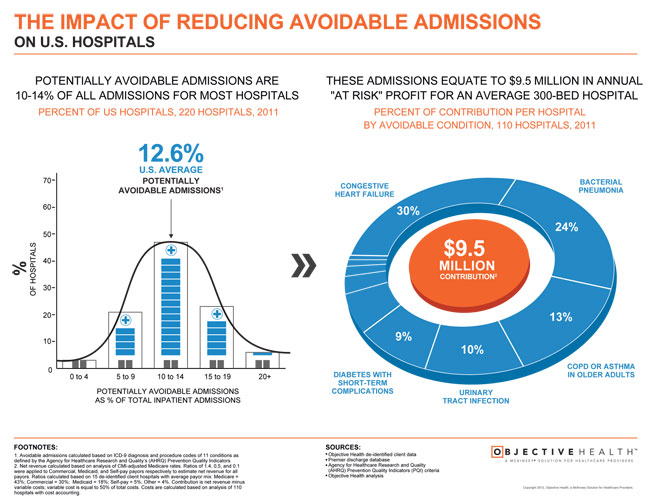
More than half of US hospitals use cost-to-charge ratios as a primary cost estimation method since true procedural cost accounting can be prohibitively expensive.

Risks are Present

Although many hospitals believe that cost-to-charge ratios are relatively acceptable for internal planning purposes, there are many risks of this approach which can lead to sub-optimal strategic decisions.

###

Click to see the full size or download the PDF.

Conclusion

Your thoughts and comments on this ME-P are appreciated. Feel free to review our top-left column, and top-right sidebar materials, links, URLs and related websites, too. Then, subscribe to the ME-P. It is fast, free and secure.

Link: http://feeds.feedburner.com/HealthcareFinancialsthePostForcxos

Speaker: If you need a moderator or speaker for an upcoming event, Dr. David E. Marcinko; MBA – Publisher-in-Chief of the Medical Executive-Post – is available for seminar or speaking engagements. Contact: MarcinkoAdvisors@msn.com

Our Other Print Books and Related Information Sources:

Health Dictionary Series: http://www.springerpub.com/Search/marcinko

Practice Management: http://www.springerpub.com/product/9780826105752

Physician Financial Planning: http://www.jbpub.com/catalog/0763745790

Medical Risk Management: http://www.jbpub.com/catalog/9780763733421

Hospitals: http://www.crcpress.com/product/isbn/9781439879900

Physician Advisors: www.CertifiedMedicalPlanner.org

Product Details

Appreciating the Harmful Effects of Multi-tasking, Social Media and Digital Internet Stress‏

Join Our Mailing List

Internet Use and Brain Atrophy

By Muhammad Saleem

While conventional wisdom teaches us that multitasking makes us more efficient, research suggests that we’re incapable of efficiently managing more than two tasks at a time.

Brain Impact

eHRs, CPOEs and MU … oh my!

If you have a moment, take a break from what you’re doing to look at this infographic on how multitasking induced stress impacts our brains.

Synopsis

Here are some of the findings in brief:

  • Our daily consumption of social media has more than doubled in the last 50 years from 5 hours to 12 hours.
  • The average computer user checks 40 websites a day, switching between programs 36 times an hour.
  • 61% of adults admit to being addicted to the internet.

Assessment

Excessive internet use by doctors and Financial Advisors may lead to the atrophy of grey matter and impact memory, goal-setting, and decision making.

Conclusion

Your thoughts and comments on this ME-P are appreciated. Feel free to review our top-left column, and top-right sidebar materials, links, URLs and related websites, too. Then, subscribe to the ME-P. It is fast, free and secure.

Link: http://feeds.feedburner.com/HealthcareFinancialsthePostForcxos

Speaker: If you need a moderator or speaker for an upcoming event, Dr. David E. Marcinko; MBA – Publisher-in-Chief of the Medical Executive-Post – is available for seminar or speaking engagements. Contact: MarcinkoAdvisors@msn.com

Our Other Print Books and Related Information Sources:

Health Dictionary Series: http://www.springerpub.com/Search/marcinko

Practice Management: http://www.springerpub.com/product/9780826105752

Physician Financial Planning: http://www.jbpub.com/catalog/0763745790

Medical Risk Management: http://www.jbpub.com/catalog/9780763733421

Hospitals: http://www.crcpress.com/product/isbn/9781439879900

Physician Advisors: www.CertifiedMedicalPlanner.org

Product DetailsProduct DetailsProduct Details

Product Details  Product Details

Product Details

Life Planning 101 for Young Adults and New Doctors

Join Our Mailing List

My Annual Graduation and Wedding Advice

By Rick Kahler MS CFP® ChFC CCIM

www.KahlerFinancial.com

June is traditionally filled with college and medical school graduations and weddings; rituals that mark two of our most important life transitions. Whether you are a new physician walking across the stage or a new spouse walking down the aisle, you’re focusing on your future. It’s a perfect opportunity to think about what you need to do financially to provide for that future.

My Best Financial Advice

Here, adapted from a column I originally wrote a few years ago, is what I might call “Life Planning 101 for Beginning Adults.” It’s a summary of my best financial advice for graduates, newlyweds, and anyone else just starting out in their adult lives and careers; including doctors. Here’s how anyone can manage money wisely to create a life with more security, flexibility, and opportunity.

  1. On every gross dollar you earn, pay your taxes first. Estimate your total tax liability and be sure your employer withholds enough to cover it. If you are self-employed, set up a savings account, deposit a percentage of every check, and use that money to pay your quarterly estimated taxes. Never “raid” these funds.
  2. Save for the future by putting away 20% or more of every gross dollar you earn until you have six months to one year of living expenses in an emergency account [physicians may actually need more]. Then begin investing in your employer’s 401(k) or a retirement plan. If you are self-employed, set up a retirement plan that will allow you to invest as much as you possibly can. My co-authored book Conscious Finance (www.consciousfinance.com) includes a chapter on how to begin investing.
  3. Set up a short-term savings account for future lump sum expenses like car and home repairs, vacations, holiday giving, college tuition,and medical emergencies Figure out how much you’ll need to save from each paycheck to fund all of them annually; then, if possible, have your employer automatically send that amount to a savings account.
  4. After you’ve taken out for your taxes, long-term savings, and short-term savings, you get to blow the rest any way you want. For most people, this means living on 30 to 60 cents out of every gross dollar you earn.
  5. To maintain a comfortable lifestyle, spend frugally. Shop sales, clip coupons, read labels, compare and bargain. People who build wealth usually don’t wear designer clothes, drive luxury cars, live in extravagant houses, or shop at Neiman Marcus [doctors beware]. They typically wear jeans bought on sale, drive Fords, live in middle class neighborhoods, and shop at Walmart.
  6. Pay cash for everything but your home. For convenience, you can use a debit card. Never use a credit card unless you pay it off every month. If you ever find yourself unable to pay off your card, cut it up. Pay off the balance as quickly as you can, and then don’t use a credit card for at least one year.
  7. When you get a raise, a new job, or a promotion, don’t change your lifestyle. Save at least half of the increased income.
  8. Your career is your number one financial asset. As much as possible, find a job you love. Invest in educating yourself and keeping abreast of changes in your career field.

Assessment

Use money as a tool, not a goal. Money itself will never give you meaning or make you happy, but it is a valuable tool to support your quest for meaning and happiness.  This self-disciplined approach isn’t going to help you get rich in a hurry. What it will do is establish a lifetime pattern of sound money management. It can help you create a satisfying, responsible relationship with money now as well as a secure, prosperous future.

Conclusion

Your thoughts and comments on this ME-P are appreciated. Feel free to review our top-left column, and top-right sidebar materials, links, URLs and related websites, too. Then, subscribe to the ME-P. It is fast, free and secure.

Link: http://feeds.feedburner.com/HealthcareFinancialsthePostForcxos

Speaker: If you need a moderator or speaker for an upcoming event, Dr. David E. Marcinko; MBA – Publisher-in-Chief of the Medical Executive-Post – is available for seminar or speaking engagements. Contact: MarcinkoAdvisors@msn.com

Our Other Print Books and Related Information Sources:

Health Dictionary Series: http://www.springerpub.com/Search/marcinko

Practice Management: http://www.springerpub.com/product/9780826105752

Physician Financial Planning: http://www.jbpub.com/catalog/0763745790

Medical Risk Management: http://www.jbpub.com/catalog/9780763733421

Hospitals: http://www.crcpress.com/product/isbn/9781439879900

Physician Advisors: www.CertifiedMedicalPlanner.org

Product Details  Product Details

The Physician’s Home Mortgage Tax Benefit

Join Our Mailing List

What is the Real Benefit?

Your home is likely your biggest investment. So, knowing exactly what, and how much, you’re paying is just common sense.

Total Costs

But, when medical professionals map out the life of their home mortgage and the total cost — even factoring the best mortgage rate – they often fail to consider the copious tax benefits they will receive.

Going Granular

We take a look at three home-buyer scenarios to determine just how much they will receive in tax benefits over the life of their loan, and the total amount they will have paid when their loan is finally over.

Assessment

Also included is the cutoff point for each filing status for when the standard tax deduction becomes more than the itemized deduction.

Conclusion

Your thoughts and comments on this ME-P are appreciated. Feel free to review our top-left column, and top-right sidebar materials, links, URLs and related websites, too. Then, subscribe to the ME-P. It is fast, free and secure.

Link: http://feeds.feedburner.com/HealthcareFinancialsthePostForcxos

Speaker: If you need a moderator or speaker for an upcoming event, Dr. David E. Marcinko; MBA – Publisher-in-Chief of the Medical Executive-Post – is available for seminar or speaking engagements. Contact: MarcinkoAdvisors@msn.com

Our Other Print Books and Related Information Sources:

Health Dictionary Series: http://www.springerpub.com/Search/marcinko

Practice Management: http://www.springerpub.com/product/9780826105752

Physician Financial Planning: http://www.jbpub.com/catalog/0763745790

Medical Risk Management: http://www.jbpub.com/catalog/9780763733421

Hospitals: http://www.crcpress.com/product/isbn/9781439879900

Physician Advisors: www.CertifiedMedicalPlanner.org

Product Details  Product Details

The Case for Major Tax Reform in 2013

Join Our Mailing List

Tax Code is “Beast with Hundreds of Heads”

By Children’s Home Society of Florida Foundation

Senate Finance Committee Chairman Max Baucus (D-MT) has been holding a series of hearings in preparation for major tax reform in 2013. In an address on June 11 to the Bipartisan Policy Center, Baucus outlined the basic guidelines for major tax reform. He compared the current tax code to “Hydra, the mythical Greek beast with hundreds of heads.” Baucus noted that the last major tax reform of the entire code was 1986. Since that time, Congress has made 15,000 changes to the Tax Code. He suggested it is long past time to “get rid of the deadwood and simplify the code.” Baucus believes that the Tax Code needs to reflect the major changes in America since 1986.

Deficits and Debt:

There has been a rapid growth in both the deficit and the debt in the past decade. The public debt is now 73% of America’s gross domestic product (GDP). This is the highest level of debt since World War II. In addition, with the reduction in tax revenue from capital gains and other business revenue, the total receipts by the government are the “lowest they have been since World War II.” A combination of higher spending and lower revenues has created a serious debt and deficit problem. Tax reform will need to be accompanied by a sound budget that reduces the national debt and deficit. This will include both tax increases and spending reductions.

World Competition:

All of America faces major challenges because of the changing world. The U.S. economy has grown 88% since 1986. However, most of the gains have gone to upper-income individuals. In the past 15 years, America has 15% more college graduates. However, some of the other nations in the third world have increased their number of graduates by 90%. All of these new college graduates throughout the world are creating substantial competition for job growth. Families have also changed significantly. In 1986, there were more couples with one breadwinner. Now there are more single persons and working couples. There are fewer manufacturing jobs. The American economy has moved steadily from manufacturing to exporting financial services, software and engineering.

Finally, many foreign nations have acted aggressively to modernize their education systems, infrastructure and tax codes. Foreign companies increasingly have grown to join the members of the Fortune Global 500. Many of these large foreign companies have been acquiring U.S. companies and reducing the jobs in this nation. For example, when the European company Unilever acquired the U.S. company Alberto Culver, it closed an Illinois production facility and moved hundreds of jobs overseas.

A Solution?

Baucus foresees a four-part solution. A new tax code will be needed that has a focus on jobs, competition, innovation and opportunity.

1. Jobs.

The primary factor that will increase employment is to reduce personal income tax rates. This will require reducing or eliminating tax expenditures (such as deductions for medical care, retirement plans, mortgage interest, state and local taxes and charitable giving).

2. Competition.

The foreign nations have all reduced their corporate tax rates. America now has the highest corporate tax rate in the industrial world. The corporate tax rate will need to be reduced by eliminating many corporate deductions.

3. Innovation.

America will need to encourage research and new technologies with appropriate incentives.

4. Opportunity.

In the present world, education is more important than ever before. Therefore, a new tax code will need to facilitate higher education opportunities. Baucus stated that he is “making progress on a detailed tax reform proposal that will attract bipartisan support.”

Editor’s Note: Chairman Baucus and House Ways and Means Chair Dave Camp (R-MI) are both holding hearings. They believe that 2013 is the “once-in-a-generation” opportunity for them to craft comprehensive new personal and corporate tax codes.

Conclusion

Your thoughts and comments on this ME-P are appreciated. Feel free to review our top-left column, and top-right sidebar materials, links, URLs and related websites, too. Then, subscribe to the ME-P. It is fast, free and secure.

Link: http://feeds.feedburner.com/HealthcareFinancialsthePostForcxos

Speaker: If you need a moderator or speaker for an upcoming event, Dr. David E. Marcinko; MBA – Publisher-in-Chief of the Medical Executive-Post – is available for seminar or speaking engagements. Contact: MarcinkoAdvisors@msn.com

Our Other Print Books and Related Information Sources:

Health Dictionary Series: http://www.springerpub.com/Search/marcinko

Practice Management: http://www.springerpub.com/product/9780826105752

Physician Financial Planning: http://www.jbpub.com/catalog/0763745790

Medical Risk Management: http://www.jbpub.com/catalog/9780763733421

Hospitals: http://www.crcpress.com/product/isbn/9781439879900

Physician Advisors: www.CertifiedMedicalPlanner.org


Product Details  Product Details

Top Financial Challenges for Physicians‏


Insufficient Income Rated as #1 Financial Challenge

The financial health of physicians continues to lag significantly behind other measures in the Physician Wellbeing Index:

  • Overall Wellbeing: 57%
  • Financial Wellbeing: 50%


Pre-Order Now:

http://www.crcpress.com/product/isbn/9781439879900

US Senate Seeks [Medical] Student Loan Solution

Join Our Mailing List

Will Medical and Health Sciences Students Benefit?

By Children’s Home Society of Florida Foundation

The Senate was still unable to craft a compromise last week on efforts to maintain the current student loan interest rate. If there is no action before July 1st, the student loan interest rate on most loans will increase from 3.4% to 6.8%. Both major parties have proposed a one year freeze on the interest rate at 3.4%. However, the leaders from the two parties have different opinions on how to offset or pay for the $6 billion cost of that interest rate freeze.

Democrats

The Democratic proposal by Senate Majority Leader Harry Reid (D-NV) carries the title Stop the Student Loan Interest Rate Hike Act of 2012 (S. 2343). It failed on a vote of 51-43 last week, nine votes below the required 60-vote threshold for passage.

Republicans

The Republican alternative is the Interest Rate Reduction Act (S. 2366). It also failed on a vote of 34-62.

Both Sides

Senate Democrats proposed requiring Subchapter S corporations with three or fewer members and income levels of $200,000 per year ($250,000 for joint filers) to make payroll tax contributions on all income. The Republican solution is to repeal the Prevention and Public Health Fund.

Response

In response to the vote, White House Press Secretary Jay Carney stated, “For the second time this month, they voted to ask millions of students to pay an average of $1,000 each rather than close a loophole that allows the very wealthy to avoid paying their fair share.”

Assessment

Senate Republican Leader Mitch McConnell (R-KY) stated, “In order to cover the cost of a temporary rate freeze that both parties want, they proposed to divert $6 billion from Medicare and to raise taxes on small businesses – hurting the very companies we are counting on to hire today’s college graduates.”

Editor’s Note: There is very broad support for a one year extension and it is an election year. While the parties have been unable to agree on offsets during the past year, eventually they may choose to pass the bill without offsets. It is quite possible that will happen with the student loan interest freeze.

Conclusion

Your thoughts and comments on this ME-P are appreciated. Feel free to review our top-left column, and top-right sidebar materials, links, URLs and related websites, too. Then, subscribe to the ME-P. It is fast, free and secure.

Link: http://feeds.feedburner.com/HealthcareFinancialsthePostForcxos

Speaker: If you need a moderator or speaker for an upcoming event, Dr. David E. Marcinko; MBA – Publisher-in-Chief of the Medical Executive-Post – is available for seminar or speaking engagements. Contact: MarcinkoAdvisors@msn.com

OUR OTHER PRINT BOOKS AND RELATED INFORMATION SOURCES:

LEXICONS: http://www.springerpub.com/Search/marcinko
PHYSICIANS: www.MedicalBusinessAdvisors.com
PRACTICES: www.BusinessofMedicalPractice.com
HOSPITALS: http://www.crcpress.com/product/isbn/9781466558731
CLINICS: http://www.crcpress.com/product/isbn/9781439879900
ADVISORS: www.CertifiedMedicalPlanner.org
BLOG: www.MedicalExecutivePost.com

Product Details

Why Doctors Must Consider Fees When Building A Retirement Nest Egg

Join Our Mailing List

Understanding Mutual Fund Share Classes and Costs

[By Rick Kahler MS CFP® ChFC CCIM]

www.KahlerFinancial.com

Doctors – Do you want to add $500,000 or more to your retirement nest egg? Pay attention to the fees that mutual funds charge you for investing your money. Few physicians or small investors understand that the same mutual fund can charge a wide range of fees, depending on the share class you select.

For many medical professionals and most Americans, the best way to build wealth is to live on less than you make and invest 15% to 35% of your paycheck into mutual funds. It’s essential to find funds that are diversified among five or more asset classes.

The Choice After Mutual Fund Selection

Once you’ve found a mutual fund with a mix of appropriate asset classes, there’s one more choice to make. What class of shares should you buy? The most popular classes are A, B, and I shares; however, many funds offer even more classes like C, F, and R shares.

The difference between the classes has nothing to do with the underlying management or structure of the mutual fund. All share classes own the same stocks or bonds. The difference lies in the fees you pay the mutual fund for their services and for commissions to brokers who sell the funds.

Types of Share Classes

Many A shares and almost all B, C, F, and R shares impose sales commissions, often called “loads,” which are based on the amount you invest. For example, A shares usually charge you a one-time commission ranging from 4.0% to 5.75% of your initial investment. With B shares there is no up-front commission, but they will charge you a stiff penalty to sell the funds in the early years and will impose an additional annual commission often ranging from .25% to 1.00% a year. Some discount brokers will waive the upfront commission on A shares for their customers.

Typically the best shares to purchase are the I class, which don’t have any commissions associated with them and offer the lowest management fees of any other share class. The downside is that I shares often require a minimum investment ranging from $10,000 to $1,000,000. Financial advisors often have relationships with discount brokers that allow them to purchase the shares for clients in smaller amounts.

Fee Comparisons

It pays to compare fees.

For example, a comparison of fees available at the website of the Financial Industry Regulatory Authority (finra.org/fundanalyzer) shows that a $10,000 investment in the Invesco S&P 500 Index fund’s A shares will cost you $129 a year, while the same investment in the C shares will run $163. If instead you invest in the Fidelity Spartan 500 Index fund you will pay just $11.50 annually, which is over 1% less than the Invesco A shares.

The Savings

It’s surprising what a 1% savings means to your retirement nest egg. According to a study by the Vanguard Group reported by Jack Hough in SmartMoney.com, if a 25-year old saves 9% of his pay in a mutual fund, paying .25% a year in expenses versus 1.25% amounts to having an additional $500,000 by age 65.

Assessment

With all that said, most investors don’t have either the knowledge or the time to construct a diversified portfolio of mutual funds that will carry them through to retirement. Paying a fee or commission for advice can ultimately save you a lot of money. There are advisors who will help smaller investors select investments for an hourly or flat fee. Others charge fees based on the size of your portfolio, which normally range from .3% to 1.5%.

Conclusion

Your thoughts and comments on this ME-P are appreciated. Feel free to review our top-left column, and top-right sidebar materials, links, URLs and related websites, too. Then, subscribe to the ME-P. It is fast, free and secure.

Speaker: If you need a moderator or speaker for an upcoming event, Dr. David E. Marcinko; MBA – Publisher-in-Chief of the Medical Executive-Post – is available for seminar or speaking engagements. Contact: MarcinkoAdvisors@msn.com

OUR OTHER PRINT BOOKS AND RELATED INFORMATION SOURCES:

Product Details  Product Details

Comprehensive Financial Planning Strategies for Doctors and Advisors: Best Practices from Leading Consultants and Certified Medical Planners(TM)

Rating Financial Advisors and Doctors Like Toasters

 Join Our Mailing List 

On Finding a Good Physician and Financial Planner in 2012

[By staff reporters]

What happens when patients and clients are able to compare the performance of primary care physicians and financial advisors? Well, for the first time ever, we’re about to find out.

RATING DOCTORS:

Consumer Reports for Doctors

Consumer Reports, best known for rating the nuts and bolts of cars, household appliances and other electronics, is getting into the business of rating primary care doctors.

The magazine is getting ready to mail out ratings for nearly 500 adult, family and pediatric physician practices in Massachusetts, the first step in a multistate project to evaluate doctors the way it has rated consumer products for decades.

RATING FINANCIAL ADVISORS:

AdviceIQ

www.AdviceIQ.com is an online service that educates all consumers about the need to hire a trusted, local financial advisor, while giving all pre-vetted advisors exposure to local investors. Also, their FAs write insightful articles that inform the public about investing and wealth management, and they syndicate them to top-branded media sites around the country.

BrightScope® for Wealth Managers and Plan Sponsors

BrightScope, Inc. is a financial information company that brings transparency to opaque markets. Delivered through web-based software, BrightScope data drives better decision-making for individual investors, corporate plan sponsors, asset managers, broker-dealers, and financial advisors.

BrightScope primarily operates in two major segments: Retirement Plans and Wealth Management: http://www.brightscope.com/

Assessment

Ultimately, we hope and believe that the reliability of the data, the credibility of the organizations responsible for the research and reporting, and a process based on collaboration and the desire for continuous improvement, will combine to gain the confidence of clients and patients alike and help advance the cause of patient-centered health care and fiduciary focused financial planning.

www.CertifiedMedicalPlanner.org

Conclusion

Your thoughts and comments on this ME-P are appreciated. Feel free to review our top-left column, and top-right sidebar materials, links, URLs and related websites, too. Then, subscribe to the ME-P. It is fast, free and secure.

Link: http://feeds.feedburner.com/HealthcareFinancialsthePostForcxos

Speaker: If you need a moderator or speaker for an upcoming event, Dr. David E. Marcinko; MBA – Publisher-in-Chief of the Medical Executive-Post – is available for seminar or speaking engagements. Contact: MarcinkoAdvisors@msn.com

site

OUR OTHER PRINT BOOKS AND RELATED INFORMATION SOURCES:

DICTIONARIES: http://www.springerpub.com/Search/marcinko
PHYSICIANS: www.MedicalBusinessAdvisors.com
PRACTICES: www.BusinessofMedicalPractice.com
HOSPITALS: http://www.crcpress.com/product/isbn/9781466558731
CLINICS: http://www.crcpress.com/product/isbn/9781439879900
BLOG: www.MedicalExecutivePost.com
FINANCE: Financial Planning for Physicians and Advisors
INSURANCE: Risk Management and Insurance Strategies for Physicians and Advisors

Product Details  Product Details

On the Financial Rain in Spain for Physician Investors

Join Our Mailing List

Understanding European Woes and the Global Financial Crisis

By Daniel Minihan

Spain has been the focus of the latest woes in Europe over the past few weeks. And, the key issue surrounding their banks is over lending into a property market that has fallen sharply. So, I thought the chart below best summed up their predicament.

GFC Confidence

In the lead up to the GFC, Spanish confidence was riding high and was directly correlated to retail spending, which is not dissimilar to where the USA was (and currently is).

But, after the property market tanked, so did confidence and with it went the desire to spend. With unemployment in Spain approaching 25% of the workforce, household spending is dropping which perpetuates a cycle of higher unemployment which in turn puts more pressure on the property market and the banks that lent into it

Assessment

The Spanish bank rally fizzled yesterday.

Link: http://money.msn.com/market-news/post.aspx?post=ee6e272d-7247-4e14-b33a-d8e82d337ffa

Not sure where this one will end. How about you?

Conclusion

Your thoughts and comments on this ME-P are appreciated. Feel free to review our top-left column, and top-right sidebar materials, links, URLs and related websites, too. Then, subscribe to the ME-P. It is fast, free and secure.

Link: http://feeds.feedburner.com/HealthcareFinancialsthePostForcxos

Speaker: If you need a moderator or speaker for an upcoming event, Dr. David E. Marcinko; MBA – Publisher-in-Chief of the Medical Executive-Post – is available for seminar or speaking engagements. Contact: MarcinkoAdvisors@msn.com

Our Other Print Books and Related Information Sources:

Health Dictionary Series: http://www.springerpub.com/Search/marcinko

Practice Management: http://www.springerpub.com/product/9780826105752

Physician Financial Planning: http://www.jbpub.com/catalog/0763745790

Medical Risk Management: http://www.jbpub.com/catalog/9780763733421

Hospitals: http://www.crcpress.com/product/isbn/9781439879900

Physician Advisors: www.CertifiedMedicalPlanner.org

Product DetailsProduct DetailsProduct Details

Product Details  Product Details

Cash May Soon be King in Hospital Care

Join Our Mailing List

Forget About Health Insurance, Darling!

Only the little people pay with insurance.

By Dr. David Edward Marcinko MBA CMP™

[Editor-in-Chief]

www.CertifiedMedicalPlanner.org

Like many other doctors, I remember my dismay when I saw uninsured patients paying full price for their medical care. Insurance companies used their market clout and patient volumes to negotiate discounts for their insureds that have always been unavailable to the uninsured, MSA, HSA participants or individual healthcare consumers.

The Insider Gossip

There is even industry hearsay that some charity-care and non-profit hospitals charge their indigent patients up to four times more than their insured patients in order to have huge write-offs [bad-debt expenses] so as to secure private and public monetary grants. After all; many non-profit CEOs are well paid, indeed.

But, the tide may be turning on the healthcare institutional level as cash becomes king in the new economy and world of healthcare 2.0

Cash Patients Rule – Insured Patients Drool

Of course, we’ve written about direct care, concierge care and cash care medical practice business models before on this ME-P. And, I’ve been ranting and raving, opining and testifying, as well.  It is being written about in the blog-o-sphere, on the hospital level, increasingly.

Link:  http://www.kevinmd.com/blog/2012/06/hide-health-insurance-status-pay-cash.html

We even have an entire Chapter 29 devoted to the codified topic in our newest book The Business of Medical Practice.

Link: http://businessofmedicalpractice.com/chapter-29/

Source: Austin Frakt PhD’s TIE cartoon via Brad Flansbaum.

The Coming Payment Apocalypse

The days of paying more when paying cash may be coming to an end. Doctors and hospitals are starting to do what every other business has done since the beginning of time – give a discount for cash. States are beginning to require pricing transparency and hospitals and physicians are starting to publish their “cash prices” for all to see.

And, why not when it can take up to two years to be reimbursed a fraction of the billed amount from Medicaid and Medicare payers, and CMS, etc? Now, don’t get me started on some highly discounted private payers and managed care plans.

Assessment

What do you think of this trend as a healthcare provider; Financial Advisor, medical management consultant or patient? Are you in favor of this private business arrangement; or do you favor the proposed public Obama Care business model?  Is it even legal? How about keeping the status-quo?

Conclusion

Your thoughts and comments on this ME-P are appreciated. Feel free to review our top-left column, and top-right sidebar materials, links, URLs and related websites, too. Then, subscribe to the ME-P. It is fast, free and secure.

Link: http://feeds.feedburner.com/HealthcareFinancialsthePostForcxos

Speaker: If you need a moderator or speaker for an upcoming event, Dr. David E. Marcinko; MBA – Publisher-in-Chief of the Medical Executive-Post – is available for seminar or speaking engagements. Contact: MarcinkoAdvisors@msn.com

Our Other Print Books and Related Information Sources:

Health Dictionary Series: http://www.springerpub.com/Search/marcinko

Practice Management: http://www.springerpub.com/product/9780826105752

Physician Financial Planning: http://www.jbpub.com/catalog/0763745790

Medical Risk Management: http://www.jbpub.com/catalog/9780763733421

Hospitals: http://www.crcpress.com/product/isbn/9781439879900

Physician Advisors: www.CertifiedMedicalPlanner.org

Product Details

Product Details

CBO Director Elmendorf on Debt and Taxes

Join Our Mailing List

A CBO Political Review

By Children’s Home Society of Florida Foundation

The nonpartisan Congressional Budget Office (CBO) is responsible for providing Congress with financial estimates for future budget and tax policies. CBO Director Douglas Elmendorf testified before the Budget Committee of the House of Representatives on June 6.

Elmendorf started by noting that the public federal debt for the past 40 years has averaged 38% of the economy. At the end of 2008, the public debt was 40% of gross domestic product (GDP). By the end of 2012, the public debt will be 70% of GDP.

Elmendorf pointed out that there are two major trends that will substantially impact the federal budget. First, there are 78 million baby boomers that will be retiring and receiving benefits from Social Security and Medicare. Second, the cost of healthcare for the past decade has been increasing more rapidly than the general inflation rate. He suggests that this increasing cost for healthcare is going to continue for the foreseeable future.

Elmendorf then offered two scenarios for the future. He called these the “baseline scenario” and the “alternative scenario.”

Baseline Scenario

The baseline scenario assumes that the current law will be applicable. On January 1, 2013, the existing tax cuts will expire. In addition to higher tax rates, many individuals will be subject to alternative minimum tax. Finally, the 3.8% tax under the Affordable Care Act will apply starting in 2013.

With the substantial tax increases under the baseline scenario, federal tax revenue increases to 24% of the economy by the year 2037. Elmendorf noted that this would be the highest level of taxation since World War II. Under this scenario, the increasing tax revenue permits debt to be reduced from the current 70% to 53% of GDP by 2037.

The alternative scenario assumes that Congress will follow the pattern of the past four years. The tax cuts enacted in 2001 and 2003 will be extended. The alternative minimum tax exemptions will be indexed. The $5.12 million applicable exclusion amount for gift and estate taxes will continue (with indexed increases in future years). Medicare payment rates for physicians will continue to increase. This last provision has been called the “Doc Fix” in Washington. Finally, federal budgets will continue with the same general provisions that exist today.

Under the alternative scenario, the increasing deficits lead to public debt of 90% of GDP by 2022. With the rising expenditures for the baby boom generation, the public debt increases to 200% of GDP by 2037.

Elmendorf Opines

Elmendorf noted that many economists believe that this large debt may lead to creation of fewer new jobs. He suggested that it will be necessary to increase revenue and decrease spending substantially from projected levels to avoid a large increase in the national debt. He did not specify how this should be accomplished.

Assessment

Chairman of the Federal Reserve Ben Bernanke also testified before Congress this week. He pointed out that January 1 is a “fiscal cliff” that could have great impact on the nation. Bernanke believes that the scheduled increase in taxes and reduction in spending should be spaced out over time to avoid a dramatic impact in January. However, he also declined to offer any advice on specific ways to increase taxes or cut spending.

Editor’s Note: These discussions in Congress are preparations for the legislative session that will occur following the November election. Congress is debating the combination of tax increases and budget cuts to pass this year. In addition, preparations are being made for a major tax reform act in 2013.

Conclusion

Your thoughts and comments on this ME-P are appreciated. Feel free to review our top-left column, and top-right sidebar materials, links, URLs and related websites, too. Then, subscribe to the ME-P. It is fast, free and secure.

Link: http://feeds.feedburner.com/HealthcareFinancialsthePostForcxos

Speaker: If you need a moderator or speaker for an upcoming event, Dr. David E. Marcinko; MBA – Publisher-in-Chief of the Medical Executive-Post – is available for seminar or speaking engagements. Contact: MarcinkoAdvisors@msn.com

Our Other Print Books and Related Information Sources:

Health Dictionary Series: http://www.springerpub.com/Search/marcinko

Practice Management: http://www.springerpub.com/product/9780826105752

Physician Financial Planning: http://www.jbpub.com/catalog/0763745790

Medical Risk Management: http://www.jbpub.com/catalog/9780763733421

Hospitals: http://www.crcpress.com/product/isbn/9781439879900

Physician Advisors: www.CertifiedMedicalPlanner.org

Product DetailsProduct DetailsProduct Details

Product Details  Product Details

Product Details

About the Occupy Wall Street Healthcare Movement

Join Our Mailing List

Working together for change

By Staff Reporters

No; not Occupy Wall Street … It’s Occupy Healthcare.

Occupy Healthcare is a new website created to help spawn a movement. Of course, it has always been the right time to take on the issue of healthcare, but now they have the tools, the ability to organize and the knowledge to make a difference.

The OHC Community

The website is a location where the community can come to discuss healthcare, and a place where meaningful healthcare issues can be raised, critiqued and worked on together.

Assessment

Healthcare is evolving at a rapid pace, and within this evolution, the voice of the community needs to be heard. It must be heard. So, give them a click, and tell us what you think?

www.OccupyHealthcare.net

Conclusion

Your thoughts and comments on this ME-P are appreciated. Feel free to review our top-left column, and top-right sidebar materials, links, URLs and related websites, too. Then, subscribe to the ME-P. It is fast, free and secure.

Link: http://feeds.feedburner.com/HealthcareFinancialsthePostForcxos

Speaker: If you need a moderator or speaker for an upcoming event, Dr. David E. Marcinko; MBA – Publisher-in-Chief of the Medical Executive-Post – is available for seminar or speaking engagements. Contact: MarcinkoAdvisors@msn.com

OUR OTHER PRINT BOOKS AND RELATED INFORMATION SOURCES:

LEXICONS: http://www.springerpub.com/Search/marcinko
PHYSICIANS: www.MedicalBusinessAdvisors.com
PRACTICES: www.BusinessofMedicalPractice.com
HOSPITALS: http://www.crcpress.com/product/isbn/9781466558731
CLINICS: http://www.crcpress.com/product/isbn/9781439879900
ADVISORS: www.CertifiedMedicalPlanner.org
BLOG: www.MedicalExecutivePost.com

Product DetailsProduct DetailsProduct Details

Product Details  Product Details

Product Details

A Video Exploring Better Ways to Pay for Health Care?

Join Our Mailing List

A YouTube Encore Presentation

Harold Luft, Director, Palo Alto Medical Foundation Research Institute; Professor Emeritus of Health Policy and Health Economics explores ways to pay for healthcare. 

Video: http://www.youtube.com/watch?v=FfcVtglVM54

Conclusion

Your thoughts and comments on this ME-P are appreciated. Feel free to review our top-left column, and top-right sidebar materials, links, URLs and related websites, too. Then, subscribe to the ME-P. It is fast, free and secure.

Link: http://feeds.feedburner.com/HealthcareFinancialsthePostForcxos

Speaker: If you need a moderator or speaker for an upcoming event, Dr. David E. Marcinko; MBA – Publisher-in-Chief of the Medical Executive-Post – is available for seminar or speaking engagements. Contact: MarcinkoAdvisors@msn.com

Our Other Print Books and Related Information Sources:

Health Dictionary Series: http://www.springerpub.com/Search/marcinko

Practice Management: http://www.springerpub.com/product/9780826105752

Physician Financial Planning: http://www.jbpub.com/catalog/0763745790

Medical Risk Management: http://www.jbpub.com/catalog/9780763733421

Hospitals: http://www.crcpress.com/product/isbn/9781439879900

Physician Advisors: www.CertifiedMedicalPlanner.org

Product Details

A Resource For Financial Planners Who Advise Doctors and Medical Professionals

Emerging Education Network with Professional CMPDesignation

Certified Medical Planner

Wealth managers, CPAs, JDs, MBAs, MDs, RNs, CFPs, RIAs and financial advisors etc., with an interest in physician clients, the healthcare space, ecoonomics, practice management and medical social media, can now indulge their tastes in all with a new venture by the Institute of Medical Business Advisors, Inc.

Education and Certification: www.CertifiedMedicalPlanner.org

Professional Network: www.MedicalExecutivePost.com

Invitation to Matriculate: Letterhead CMP

Assessment

CERTIFIED MEDICAL PLANNER™ – Entering a niche market, with focused advice from educated advisors and consultants, is the ‘win-win’ business model of the future.

Conclusion

Your thoughts and comments on this ME-P are appreciated. Feel free to review our top-left column, and top-right sidebar materials, links, URLs and related websites, too. Then, subscribe to the ME-P. It is fast, free and secure.

Link: http://feeds.feedburner.com/HealthcareFinancialsthePostForcxos

Speaker: If you need a moderator or speaker for an upcoming event, Dr. David E. Marcinko; MBA – Publisher-in-Chief of the Medical Executive-Post – is available for seminar or speaking engagements. Contact: MarcinkoAdvisors@msn.com

Our Other Print Books and Related Information Sources:

Health Dictionary Series: http://www.springerpub.com/Search/marcinko

Practice Management: http://www.springerpub.com/product/9780826105752

Physician Financial Planning: http://www.jbpub.com/catalog/0763745790

Medical Risk Management: http://www.jbpub.com/catalog/9780763733421

Hospitals: http://www.crcpress.com/product/isbn/9781439879900

Physician Advisors: www.CertifiedMedicalPlanner.org

Product DetailsProduct DetailsProduct Details

Product Details  Product Details

Product Details

Is 2012 a Good Year to Buy a House?

Join Our Mailing List

Doctors Appreciating the Reasons of Home Ownership

[By staff reporters]

There may be several reasons for a medical professional to buy a home. For example, you’re ready to practice and commit to a certain area and call it home. You’re ready to make a financial investment, or housing prices have dropped to an affordable level and the market is highly favorable for home buyers.

Rule of Thumb

But, how do you tell if it’s a buyer’s market? In a buyer’s market, the price of a home will be under 20 times a year’s worth of rent for an equivalent home. If the price of a home is more than 20 times the annual rent, it’s generally better to rent.

Current Climate

Today’s housing climate is better for home buyers. The average price of homes for sale in the US is currently around 19 times the average annual rent. The general housing climate is much friendlier than a few years ago, but still fluctuates greatly depending on your specific location. Some of the buyer’s markets in 2011 were Charlotte, Inland Empire, Phoenix, Raleigh, Sacramento, San Diego and San Jose.

Source: www.SeaHomes.com

Assessment

The decision to buy or rent also depends on your lifestyle and long-term goals. 2011 saw a resurgence in buyer’s markets across the country and that trend is likely to continue for the foreseeable future. It’s true that housing markets will fluctuate from year-to-year, but owning property usually remains a wise investment over time.

Conclusion

Your thoughts and comments on this ME-P are appreciated. Feel free to review our top-left column, and top-right sidebar materials, links, URLs and related websites, too. Then, subscribe to the ME-P. It is fast, free and secure.

Link: http://feeds.feedburner.com/HealthcareFinancialsthePostForcxos

Speaker: If you need a moderator or speaker for an upcoming event, Dr. David E. Marcinko; MBA – Publisher-in-Chief of the Medical Executive-Post – is available for seminar or speaking engagements. Contact: MarcinkoAdvisors@msn.com

Our Other Print Books and Related Information Sources:

Health Dictionary Series: http://www.springerpub.com/Search/marcinko

Practice Management: http://www.springerpub.com/product/9780826105752

Physician Financial Planning: http://www.jbpub.com/catalog/0763745790

Medical Risk Management: http://www.jbpub.com/catalog/9780763733421

Hospitals: http://www.crcpress.com/product/isbn/9781439879900

Physician Advisors: www.CertifiedMedicalPlanner.org

Product Details  Product Details

Who Should Share The Presidential Ticket With Mitt Romney as Best for all Healthcare Stakeholders?

Join Our Mailing List

A Voting Opinion Poll

By ME-P Staff

The 2012 Election for President of the United States [POTUS]

The ME-P is conducting an important election year poll. With Mitt Romney now positioned to receive the GOP nomination for president of the United States, who would you like to see as his Vice Presidential running mate?

The results of the poll will be available to you after you submit your vote and we’ll also share the poll results with major media outlets across the country. Thousands will vote, so take a moment right now to stand up and be counted. Your opinion matters!

Vote today!


Conclusion

Your thoughts and comments on this ME-P are appreciated. Feel free to review our top-left column, and top-right sidebar materials, links, URLs and related websites, too. Then, subscribe to the ME-P. It is fast, free and secure.

Link: http://feeds.feedburner.com/HealthcareFinancialsthePostForcxos

Speaker: If you need a moderator or speaker for an upcoming event, Dr. David E. Marcinko; MBA – Publisher-in-Chief of the Medical Executive-Post – is available for seminar or speaking engagements. Contact: MarcinkoAdvisors@msn.com

Our Other Print Books and Related Information Sources:

Health Dictionary Series: http://www.springerpub.com/Search/marcinko

Practice Management: http://www.springerpub.com/product/9780826105752

Physician Financial Planning: http://www.jbpub.com/catalog/0763745790

Medical Risk Management: http://www.jbpub.com/catalog/9780763733421

Hospitals: http://www.crcpress.com/product/isbn/9781439879900

Physician Advisors: www.CertifiedMedicalPlanner.org

Product DetailsProduct DetailsProduct Details

Product Details  Product Details

Product Details

Physician’s Understanding Payroll Tax Deductions

Join Our Mailing List

Doctor as Employer or Employee [A Primer]

The Payroll and Tax Deductions infographic from Paycor takes an unbelievably dry topic and makes it interesting by visually walking someone through their paycheck. The design allows them to understand all of the different things that may come out prior to the final amount that makes it to their bank account.

Are We Un-Aware

Some American healthcare workers aren’t aware of the factors that determine how much is deducted from their paychecks, yet it’s important to have that understanding so you can speak up about any errors.

Typical Deductions

So what exactly is that payroll software deducting from your paycheck? Typical deductions include federal income tax, OASDI, Medicare tax, disability and state income tax. Your tax bracket will range from 10% to 35% depending on your amount of taxable income. Medicare tax rates will be different depending on whether you work for a hospital or medical company; or are self-employed in private practice.

State Level

At the state level, individual states handle taxes differently, with seven states charging all residents a flat tax rate and nine other states not collecting any income taxes at all.

Assessment

Use this calculator  to help determine the impact of changing your payroll deductions. You can  enter your current payroll information and deductions, and then compare them to  your proposed deductions. Try changing your withholdings, filing status or  retirement savings and let the payroll deduction calculator show you the [approximate] impact on your take home pay.

LinkPayroll Tax Calculator http://www.bankrate.com/calculators/tax-planning/401k-deduction-calculator-taxes.aspx#ixzz1x3EbwgTf

Conclusion

Your thoughts and comments on this ME-P are appreciated. Feel free to review our top-left column, and top-right sidebar materials, links, URLs and related websites, too. Then, subscribe to the ME-P. It is fast, free and secure.

Link: http://feeds.feedburner.com/HealthcareFinancialsthePostForcxos

Speaker: If you need a moderator or speaker for an upcoming event, Dr. David E. Marcinko; MBA – Publisher-in-Chief of the Medical Executive-Post – is available for seminar or speaking engagements. Contact: MarcinkoAdvisors@msn.com

Our Other Print Books and Related Information Sources:

Health Dictionary Series: http://www.springerpub.com/Search/marcinko

Practice Management: http://www.springerpub.com/product/9780826105752

Physician Financial Planning: http://www.jbpub.com/catalog/0763745790

Medical Risk Management: http://www.jbpub.com/catalog/9780763733421

Hospitals: http://www.crcpress.com/product/isbn/9781439879900

Physician Advisors: www.CertifiedMedicalPlanner.org

Product Details  Product Details

Euro Currency in the Cross Hairs? [Video]

Join Our Mailing List

How We Got There –  A Review for Physician Investors

By Jonathan Reyes

It’s been two decades since the dream of a unified Europe inched toward a reality. But, as crises have taken hold and bail-outs have become commonplace, how has the continent’s shared currency weathered the storms?

Video Link: http://www.infographicsarchive.com/economics/video-infographic-the-euro-in-the-crosshairs-how-we-got-here

Source: Video infographic made for Bloomberg TV.

Assessment

Important information for all medical professsionals and retail physician investors interested in emerging markets or international investing.

Conclusion

Your thoughts and comments on this ME-P are appreciated. Feel free to review our top-left column, and top-right sidebar materials, links, URLs and related websites, too. Then, subscribe to the ME-P. It is fast, free and secure.

Speaker: If you need a moderator or speaker for an upcoming event, Dr. David E. Marcinko; MBA – Publisher-in-Chief of the Medical Executive-Post – is available for seminar or speaking engagements. Contact: MarcinkoAdvisors@msn.com

OUR OTHER PRINT BOOKS AND RELATED INFORMATION SOURCES:


Product Details  Product Details

A Review of Healthcare Spending in Developed Countries

Join Our Mailing List

A Selected Graphical Health Economics Comparison

Assessment

Domestic healthcare spending in the USA is now 17% of GDP.

Link: Money supply as a percentage of domestic GDP: https://medicalexecutivepost.com/2012/06/05/understanding-the-money-supply-as-a-percentage-of-gdp/

Conclusion

Your thoughts and comments on this ME-P are appreciated. Feel free to review our top-left column, and top-right sidebar materials, links, URLs and related websites, too. Then, subscribe to the ME-P. It is fast, free and secure.

Link: http://feeds.feedburner.com/HealthcareFinancialsthePostForcxos

Speaker: If you need a moderator or speaker for an upcoming event, Dr. David E. Marcinko; MBA – Publisher-in-Chief of the Medical Executive-Post – is available for seminar or speaking engagements. Contact: MarcinkoAdvisors@msn.com

Our Other Print Books and Related Information Sources:

Health Dictionary Series: http://www.springerpub.com/Search/marcinko

Practice Management: http://www.springerpub.com/product/9780826105752

Physician Financial Planning: http://www.jbpub.com/catalog/0763745790

Medical Risk Management: http://www.jbpub.com/catalog/9780763733421

Hospitals: http://www.crcpress.com/product/isbn/9781439879900

Physician Advisors: www.CertifiedMedicalPlanner.org

Product Details

Some Ways to Lower the Cost of Higher Education

Join Our Mailing List

Exploring Solutions to the College Tuition Bubble

By Rick Kahler MS CFP® ChFC CCIM www.KahlerFinancial.com

My daughter is a high-school sophomore, so any essay on the cost of college is uncomfortably personal for me.

Nevertheless, let’s take a look at some possible solutions to the problem of high college costs.

Some Possible Solutions to the High Cost of College

1. Don’t just hope for scholarships, pursue them.

The most important college-saving strategy a student can have may be focusing on getting top grades in high school in order to qualify for scholarships. Even straight-A students, however, shouldn’t sit passively and wait for scholarship offers to roll in.

Instead, actively go after them. Research online and through your high school to find out what is available. Many organizations, individuals, and institutions offer small, specialized scholarships. Most of these are only a few hundred dollars, but they are well worth trying for. Surprisingly often, there are few applicants for these awards because people don’t take the time to research them and apply. One warning: don’t pay a service to find scholarships. Even if a so-called agency isn’t a scam, the service is unnecessary since the information is readily available.

2. Explore career options early.

Volunteering, summer jobs, internships, and shadowing programs are all valuable ways to find out more about careers a student might be interested in. I know my first job, cleaning cages at a veterinarian’s office, was enough to prove to me that animal medicine wasn’t my career niche. If schools don’t offer career shadowing opportunities, many professionals would be glad to let a student follow them around for a day or two. It’s important to make sure students are interested in the career a given degree prepares them for, not just the subject area of the degree itself.

3. Summer jobs.

If your children have summer jobs, require them to save half their earnings for college. Be wary of letting kids overdo it with part-time jobs during the school year. If their grades and scholarship opportunities suffer as a result, the job may cost more than it’s worth in the long term.

4. Shop for value.

Find out whether neighboring states offer reciprocal in-state tuition rates. Compare tuition costs, fees, housing and travel costs, class sizes, and career placement numbers. Don’t just assume a big-name school offers more opportunities. Depending on the career field, a degree from a state institution may be a far better value than one from an Ivy League school.

5. Two or Four years.

Remember that “higher education” doesn’t have to mean “four-year college”.  Don’t overlook other options such as vocational schools or apprenticeship programs. Careers such as massage therapy, welding, and medical technology can pay very well without requiring a four-year degree. Compare values here, as well. Some for-profit technical schools can be more expensive than state universities. Also investigate jobs in high-demand fields that may offer on-the-job training or tuition reimbursement.

6. Postpone college.

Consider encouraging your kids to work for a year or two and postpone college until they know what their career goals are. The risk with this approach, of course, is that they may end up not going to college at all.

7. Plan.

Have a five-year plan, or even six or seven. There’s no rule that says a student has to graduate in four years. One option is to “pay as you go” as much as possible by taking fewer classes and working part-time or even full-time. Even if it takes longer, graduating with much less debt can still mean starting out ahead.

Assessment

Although some of the ideas above may be anathema to some highly educated and well-heeled doctors, lawyers and accountants, we all realize that education certainly is an important way to invest in higher earnings and career success. Planning ahead and doing plenty of homework before classes start is a good way to make sure that investment is a wise one.

Conclusion

Your thoughts and comments on this ME-P are appreciated. Feel free to review our top-left column, and top-right sidebar materials, links, URLs and related websites, too. Then, subscribe to the ME-P. It is fast, free and secure.

Link: http://feeds.feedburner.com/HealthcareFinancialsthePostForcxos

Speaker: If you need a moderator or speaker for an upcoming event, Dr. David E. Marcinko; MBA – Publisher-in-Chief of the Medical Executive-Post – is available for seminar or speaking engagements. Contact: MarcinkoAdvisors@msn.com

Our Other Print Books and Related Information Sources:

Health Dictionary Series: http://www.springerpub.com/Search/marcinko

Practice Management: http://www.springerpub.com/product/9780826105752

Physician Financial Planning: http://www.jbpub.com/catalog/0763745790

Medical Risk Management: http://www.jbpub.com/catalog/9780763733421

Hospitals: http://www.crcpress.com/product/isbn/9781439879900

Physician Advisors: www.CertifiedMedicalPlanner.org

Product Details  Product Details

Understanding the Money Supply as a Percentage of GDP

Join Our Mailing List

By Country for our Domestic and International ME-P Readers

By Staff Reporters

There’s a lot of money in the world, but not all of it can be easily defined as “money.” Just where the money is and who has it is a complicated issue. The wad of money in your pocket is one form of money, but the money supply is hardly limited to that. So, where is the money and what exactly is it?

Finding Out

To find out what Broad Money, Money Zero Maturity, the Monetary Base, and Money and Close Substitutes mean, take a look at the graphic for an explanation. You’ll see that there is a lot more to money than you may have realized. The cash you use from day to day is M0, but there are also MB, M1, M2, M3 and more.

What Is Quasi Money?

If you want to measure how much money a country has, there is much more to consider than just how much printed money is within that country. If you think about how much money you have, it’s likely a lot more than just the cash you have on hand. You have bank accounts, checks and other forms of money that factor into how much money you have. The same is true for countries.

By Country

How much money a country can get pretty complicated, but there is a way to figure out each country’s quasi money. No, this doesn’t mean fake money or “sort of” money, like the name may imply. Quasi money may also sound like our paychecks these days, but what it refers to is actually a pretty neat assessment of the money that a country really has.

The money supply of every single country can be measured accurately by looking at a number of different things. To find out exactly what goes into the money that a country has, take a look at the graphic.

How Does Your Country Stack Up?

How does your country compare to other countries in terms of money? The amount of quasi money in each country when measured as a percentage of a country’s Gross Domestic Product (GDP) is pretty telling. Check out the graphic to see how your country rates and whether it makes the top 10, the bottom 10 or falls somewhere in the middle. If you know someone from a country on the top or bottom lists, forward the graphic to them and let them know about it. Depending on where their country falls, it may be time to gloat or to pretend not to be jealous.

Where are the top and bottom countries located?

Are they countries that are typically thought of as being rich and poor, or do they come straight out of left field for a sneak attack? There are certainly some countries in there that will surprise you as well as some that won’t. Take a look for yourself and see where the wealth of the world lies.

Conclusion

Your thoughts and comments on this ME-P are appreciated. Feel free to review our top-left column, and top-right sidebar materials, links, URLs and related websites, too. Then, subscribe to the ME-P. It is fast, free and secure.

Link: http://feeds.feedburner.com/HealthcareFinancialsthePostForcxos

Speaker: If you need a moderator or speaker for an upcoming event, Dr. David E. Marcinko; MBA – Publisher-in-Chief of the Medical Executive-Post – is available for seminar or speaking engagements. Contact: MarcinkoAdvisors@msn.com

Our Other Print Books and Related Information Sources:

Health Dictionary Series: http://www.springerpub.com/Search/marcinko

Practice Management: http://www.springerpub.com/product/9780826105752

Physician Financial Planning: http://www.jbpub.com/catalog/0763745790

Medical Risk Management: http://www.jbpub.com/catalog/9780763733421

Hospitals: http://www.crcpress.com/product/isbn/9781439879900

Physician Advisors: www.CertifiedMedicalPlanner.org

Product Details  Product Details

The Increased Competition of Ambulatory Surgery Centers (ASCs) to US Hospitals

Join Our Mailing List

The Competition Heats Up!

By Dr. David Edward Marcinko MBA CMP™

www.CertifiedMedicalPlanner.org

[Editor-in-Chief]

Over the last 10 years, Ambulatory Surgery Centers’ (ASCs) footprints have increased dramatically.

As hospitals and health systems accelerate towards population health/ global payment models, such as Accountable Care Organizations (ACOs), lower priced ASCs will become more critical competitors to hospitals.

Assessment

I acquired the Certificate-of-Need [CON], co-founded and operated an ASC for 15 years before sale in 2000 to a public company. My local hospital fought me tooth and nail. I likely would not do so, again, today!

Conclusion

Your thoughts and comments on this ME-P are appreciated. Feel free to review our top-left column, and top-right sidebar materials, links, URLs and related websites, too. Then, subscribe to the ME-P. It is fast, free and secure.

Speaker: If you need a moderator or speaker for an upcoming event, Dr. David E. Marcinko; MBA – Publisher-in-Chief of the Medical Executive-Post – is available for seminar or speaking engagements. Contact: MarcinkoAdvisors@msn.com

OUR OTHER PRINT BOOKS AND RELATED INFORMATION SOURCES:

Product Details

What If Broccoli Were Like Buying Health Insurance?

Join Our Mailing List

Some Food for Thought

Source: Jen Sorensen via Austin Frakt PhD of the Incidental Economist.

Assessment

Many a true word hath been spoke in jest. [c 1665 in Roxburghe Ballads (1890) VII. 366].

Conclusion

Your thoughts and comments on this ME-P are appreciated. Feel free to review our top-left column, and top-right sidebar materials, links, URLs and related websites, too. Then, subscribe to the ME-P. It is fast, free and secure.

Link: http://feeds.feedburner.com/HealthcareFinancialsthePostForcxos

Speaker: If you need a moderator or speaker for an upcoming event, Dr. David E. Marcinko; MBA – Publisher-in-Chief of the Medical Executive-Post – is available for seminar or speaking engagements. Contact: MarcinkoAdvisors@msn.com

Our Other Print Books and Related Information Sources:

Health Dictionary Series: http://www.springerpub.com/Search/marcinko

Practice Management: http://www.springerpub.com/product/9780826105752

Physician Financial Planning: http://www.jbpub.com/catalog/0763745790

Medical Risk Management: http://www.jbpub.com/catalog/9780763733421

Hospitals: http://www.crcpress.com/product/isbn/9781439879900

Physician Advisors: www.CertifiedMedicalPlanner.org

Pre-Order Now!

http://www.crcpress.com/product/isbn/9781439879900

Physician’s Update on Flexible Spending Accounts [FSAs]

Join Our Mailing List

A Proposed $500 Bonus

[By Children’s Home Society of Florida Foundation]

House Ways and Means Committee Chair, Dave Camp, recently proposed an amendment on May 30 2012 that would permit new pliability for flexible health spending accounts. His amendment to the Health Flexible Spending Arrangements Improvement Act of 2012 permits employees who have a balance of up to $500 at the end of a year to receive a taxable payment of that amount.

Current Rules

Under current rules, employees are permitted to use salary reductions to allocate funds to a healthcare flexible spending account. The funds in the account may then be used for payment of qualified healthcare expenses.

However, the funds allocated to the account are forfeited back to the employer at the end of the year. Therefore, the accounts are frequently described as a “use it or lose it” plan.

Oversight Committee

Ways and Means Oversight Subcommittee Chair, Charles Boustany, Jr. (R-LA), proposed that the unspent money could be distributed to the employee as taxable income at the end of the year. Chairman Camp would permit the distribution, but only up to a maximum of $500.

Assessment

The proposed change in flexible spending accounts will cost the government about $4 billion over the next 10 years according to the Congressional Joint Committee on Taxation.

And so, as more and more medical professionals become employees, FSA rules should be monitored closely by doctors and their FAs.

Editor’s Note: If the House passes this change, the Senate would also need to take action. With the fall elections growing closer, it is becoming progressively more difficult to move forward on additional tax bills. If the change does not pass this year, it could quite possibly be included in the anticipated major tax reform expected for 2013.

Conclusion

Your thoughts and comments on this ME-P are appreciated. Feel free to review our top-left column, and top-right sidebar materials, links, URLs and related websites, too. Then, subscribe to the ME-P. It is fast, free and secure.

Link: http://feeds.feedburner.com/HealthcareFinancialsthePostForcxos

Speaker: If you need a moderator or speaker for an upcoming event, Dr. David E. Marcinko; MBA – Publisher-in-Chief of the Medical Executive-Post – is available for seminar or speaking engagements. Contact: MarcinkoAdvisors@msn.com

OUR OTHER PRINT BOOKS AND RELATED INFORMATION SOURCES:

DICTIONARIES: http://www.springerpub.com/Search/marcinko
PHYSICIANS: www.MedicalBusinessAdvisors.com
PRACTICES: www.BusinessofMedicalPractice.com
HOSPITALS: http://www.crcpress.com/product/isbn/9781466558731
CLINICS: http://www.crcpress.com/product/isbn/9781439879900
BLOG: www.MedicalExecutivePost.com
FINANCE: Financial Planning for Physicians and Advisors
INSURANCE: Risk Management and Insurance Strategies for Physicians and Advisors

Product Details  Product Details