







 Support our online development, and advance our onground research initiatives in free market economics, as we seek to showcase the brightest Next-Gen minds.
THE ME-P DISCLAIMER: Posts, comments and opinions do not necessarily represent iMBA, Inc., but become our property after submission. Copyright © 2006 to-date. iMBA, Inc allows colleges, universities, medical and financial professionals and related clinics, hospitals and non-profit healthcare organizations to distribute our proprietary essays, photos, videos, audios and other documents; etc. However, please review copyright and usage information for each individual asset before submission to us, and/or placement on your publication or web site. Attestation references, citations and/or back-links are required. All other assets are property of the individual copyright holder.
Support our online development, and advance our onground research initiatives in free market economics, as we seek to showcase the brightest Next-Gen minds.
THE ME-P DISCLAIMER: Posts, comments and opinions do not necessarily represent iMBA, Inc., but become our property after submission. Copyright © 2006 to-date. iMBA, Inc allows colleges, universities, medical and financial professionals and related clinics, hospitals and non-profit healthcare organizations to distribute our proprietary essays, photos, videos, audios and other documents; etc. However, please review copyright and usage information for each individual asset before submission to us, and/or placement on your publication or web site. Attestation references, citations and/or back-links are required. All other assets are property of the individual copyright holder.


By Dr. David Edward Marcinko; MBA MEd
SPONSOR: http://www.MarcinkoAssociates.com
***
***
Economic theories are structured frameworks—such as classical, Keynesian, supply and demand, and neoclassical—that explains how economies function, how resources are allocated, and how markets behave.
What is Economic Theory
Economic theory provides concepts, principles, and models to analyze how societies produce, distribute, and consume goods and services. It helps explain phenomena like price changes, market behavior, and economic growth, and guides policymakers in addressing issues such as inflation and unemployment.
Major Branches
- Microeconomic Theory: Focuses on individuals, firms, markets, and decision-making.
- Macroeconomic Theory: Examines aggregate indicators such as national income, fiscal policy, inflation, and unemployment.
Key Economic Theories
1. Classical Economic Theory
- Key Thinkers: Adam Smith, David Ricardo, and Thomas Malthus.
- Core Idea: Markets self-regulate through the “invisible hand,” promoting efficient resource allocation with minimal government intervention.
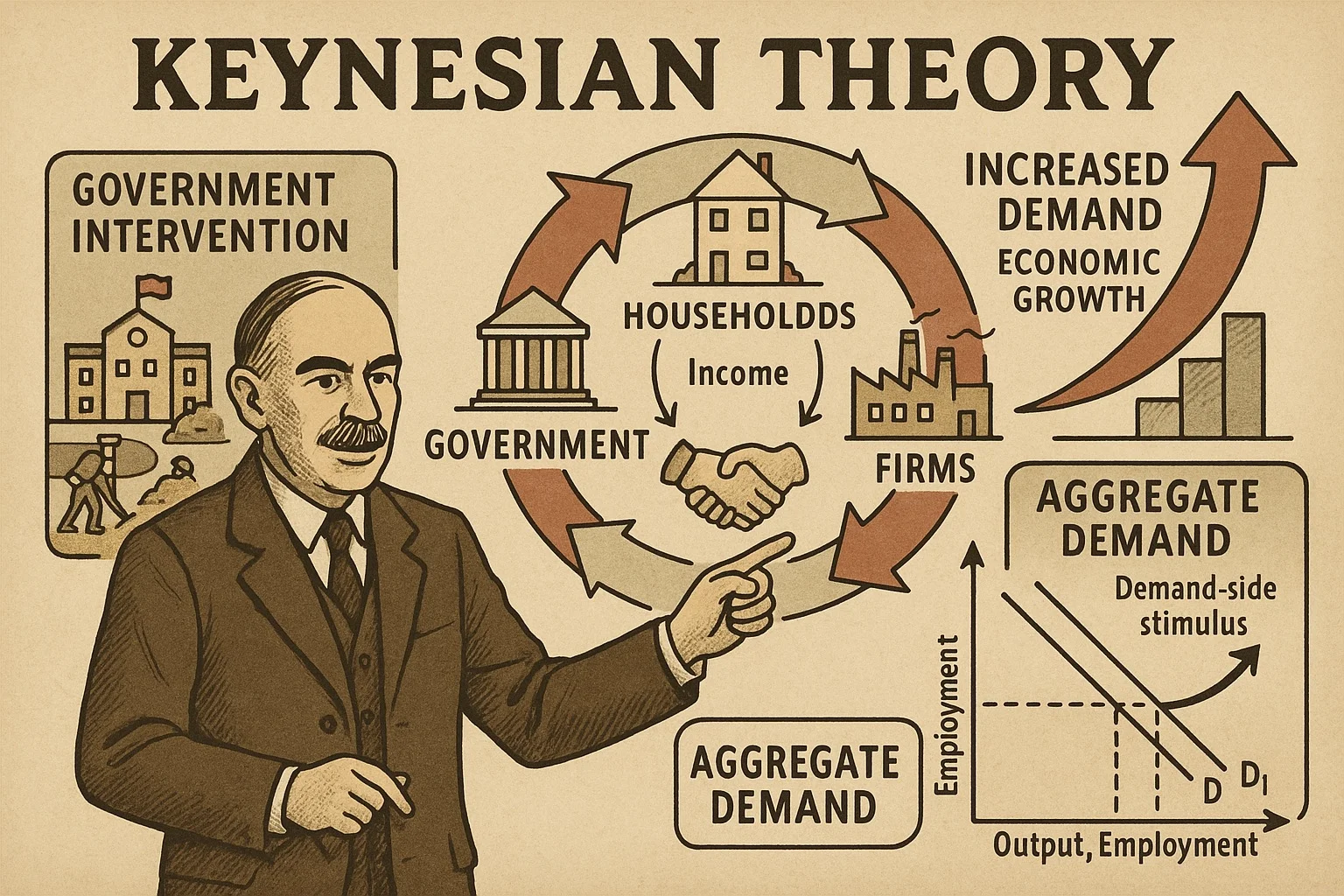
2. Keynesian Economic Theory
- Key Thinker: John Maynard Keynes.
- Core Idea: Demand drives economic activity; government intervention is necessary during recessions to stabilize the economy.
3. Supply and Demand Theory
- Explains price determination through equilibrium where quantity demanded equals quantity supplied.
4. Neoclassical Economics
- Focuses on rational choice, utility maximization, and market equilibrium.
5. Marxian Economics
- Analyzes capitalism through class struggle, labor value, and exploitation.
6. Monetarism
- Emphasizes the role of monetary policy and control of the money supply in managing economic stability.
7. New Classical & New Keynesian Economics
- New Classical: Advocates rational expectations and market-clearing models.
- New Keynesian: Incorporates price stickiness and supports policy intervention.
Schools of Economic Thought
Economic theories are often grouped into schools such as classical, Marxian, neoclassical, Keynesian, and heterodox approaches. Modern mainstream economics includes micro and macro branches, with distinctions like saltwater vs. freshwater economists in the U.S.
Economic theories continue to evolve, shaping how economists interpret markets, forecast trends, and design policy solutions.
SPEAKING: Dr. Marcinko will be speaking and lecturing, signing and opining, teaching and preaching, storming and performing at many locations throughout the USA this year! His tour of witty and serious pontifications may be scheduled on a planned or ad-hoc basis; for public or private meetings and gatherings; formally, informally, or over lunch or dinner. All medical societies, financial advisory firms or Broker-Dealers are encouraged to submit an RFP for speaking engagements: CONTACT: Ann Miller RN MHA at MarcinkoAdvisors1738@outlook.com -OR- http://www.MarcinkoAssociates.com
Like, Refer and Subscribe
SEND IN YOUR TOPIC IEAS, TODAY!
HOSPITALS: http://www.crcpress.com/product/isbn/9781466558731
CLINICS: http://www.crcpress.com/product/isbn/9781439879900
ADVISORS: www.CertifiedMedicalPlanner.org
FINANCE:Financial Planning for Physicians and Advisors
INSURANCE:Risk Management and Insurance Strategies for Physicians and Advisors
Dictionary of Health Economics and Finance
Dictionary of Health Information Technology and Security
Dictionary of Health Insurance and Managed Care
***
Share this:

Filed under: iMBA, Inc. |


Leave a Reply