Recent Tax Law Changes and Basic Retirement Planning [video]

Join Our Mailing List

For Healthcare Accountants

By Richard Schwartz CPA

http://schwartzaccountants.com/

Richard Schwartz CPA

Content: Video (mp4) – 105.32MB
Title: Richard Schwartz Webinar 1.23.13 Tax Changes and Retirement

Link: http://www.screencast.com/t/Huco7W8LOl

Richard S Schwartz, CPA, CVA, received a B.A. in Economics from Brandeis University in 1985 and an M.S. in Accounting from the Graduate School of Professional Accounting at Northeastern University in 1990.  Prior to joining his brother at Schwartz and Schwartz,  P.C. in 1993, he worked for the international accounting firm PricewaterhouseCoopers, LLP, in their Emerging Business Services Group.  Since joining Schwartz and Schwartz, P.C. he has worked with individuals providing tax expertise as well as small business owners providing both tax and accounting guidance to help their businesses grow.  In 2006, Rick earned the designation of Certified Valuation Analyst from the National Association of Certified Valuation Analysts (NACVA), which he uses to assist healthcare professionals in their evaluation of whether to purchase a practice.

Conclusion

In any case, early planning is the key to supporting both your kids’ futures and your retirement. Making logical college funding decisions, rather than emotional ones, creates a win/win for everyone.

Your thoughts and comments on this ME-P are appreciated. Feel free to review our top-left column, and top-right sidebar materials, links, URLs and related websites, too. Then, subscribe to the ME-P. It is fast, free and secure.

Link: http://feeds.feedburner.com/HealthcareFinancialsthePostForcxos

Speaker: If you need a moderator or speaker for an upcoming event, Dr. David E. Marcinko; MBA – Publisher-in-Chief of the Medical Executive-Post – is available for seminar or speaking engagements. Contact: MarcinkoAdvisors@msn.com

OUR OTHER PRINT BOOKS AND RELATED INFORMATION SOURCES:

DICTIONARIES: http://www.springerpub.com/Search/marcinko
PHYSICIANS: www.MedicalBusinessAdvisors.com
PRACTICES: www.BusinessofMedicalPractice.com
HOSPITALS: http://www.crcpress.com/product/isbn/9781466558731
CLINICS: http://www.crcpress.com/product/isbn/9781439879900
BLOG: www.MedicalExecutivePost.com
FINANCE: Financial Planning for Physicians and Advisors
INSURANCE: Risk Management and Insurance Strategies for Physicians and Advisors

Product Details  Product Details

Product DetailsProduct Details

A New IRA Withdrawal Limit Proposal

Join Our Mailing List 

Capping Tax-Advantaged Retirement Plans?

By Rick Kahler MS CFP® ChFC CCIM http://www.KahlerFinancial.com

Rick Kahler CFP“Max out your retirement plans every year” has long been standard advice I’ve given to working adults, and all medical professionals, who want to secure a reliable income when they retire.

Individual Retirement Accounts (IRAs), along with 401(k), 403(b), and profit sharing plans offered by some employers, are among the most accessible ways for middle-class workers to provide for retirement and build wealth.

If a proposal in President Obama’s budget plan is approved by Congress, however, retirement plans may no longer be the first and best stop along the road to financial independence.

The New Proposal

The proposal would limit a person’s total withdrawals from all tax-advantaged retirement plans to the amount it would cost to purchase an immediate annuity paying $205,000 a year. And, it appears to not be indexed for inflation. The articles I’ve read and my own calculations suggest this would mean capping retirement accounts at around $3 million.

From the sketchy details available so far, the proposal appears to target traditional IRAs and other tax-deferred retirement plans. Contributions to these accounts are made with pre-tax dollars, and the earnings in the account are not taxed until they are withdrawn.

Since 58% of Americans don’t have any retirement plan, my guess is they will pay little attention to this proposal. Saving $3 million dollars seems well out of reach. While that may be true in today’s dollars, it most likely will not be true in future dollars.

If inflation over the next 40 years matches that of the past 40, a $3,000,000 IRA in 2053 will be equal to $575,000 today. If today’s 25-year-old, retiring then, wanted to be sure the money would last another 40 years, the IRA would provide an income equivalent to about $1,500 a month.

Tax-Advantaged Retirement Plans

Even in today’s dollars, the $3 million maximum isn’t as unreachable as it may seem. Employees can currently contribute a maximum of $5,500 per year ($6,500 for those 50 and older) to Roth or traditional IRAs. Small business owners and the self-employed may have SIMPLE (savings incentive match plan for employees) or SEP (simplified employee pension) IRAs. The maximum annual contribution is currently $17,000 for a SIMPLE and $51,000 for a SEP. A self-employed plumber, business owner, or doctor who was a conscientious saver with a diversified portfolio could certainly accumulate $3 million over a lifetime.

Or, suppose the wife of a small business owner, or doctor, was a self-employed counselor with her own SEP plan. If he died at age 58 and she inherited his IRA, the combined totals could easily put her over the $3 million cap.

###

MD Retirement planning

Unclear Options

It isn’t clear how the proposal would equate the withdrawal rate with the cap. One possibility would be to raise the required minimum distribution amount, which would erode the value of an IRA more quickly.

Another option would be to penalize excess accumulations with a hefty tax of 40% or more. Of course, the President could follow in Argentina’s footsteps and just confiscate any amount over the cap.

Any of these would add to the diminution of retirement plans as a vehicle for income during retirement.

The Caveat

The proposal includes this statement:

“But, under current rules, some wealthy individuals are able to accumulate many millions of dollars in these accounts, substantially more than is needed to fund reasonable levels of retirement saving.”

Assessment

Apparently we, as individual citizens, are not considered capable of defining “reasonable levels” of retirement saving for ourselves. The real goal of this plan appears to be wealth distribution, instead of encouraging more Americans to save and provide for their own retirement.

More:

If this proposal is passed, retirement plans will play a much smaller role in many middle class Americans’ golden years.

Channel Surfing the ME-P

Have you visited our other topic channels? Established to facilitate idea exchange and link our community together, the value of these topics is dependent upon your input. Please take a minute to visit. And, to prevent that annoying spam, we ask that you register. It is fast, free and secure.

Conclusion

Your thoughts and comments on this ME-P are appreciated. Feel free to review our top-left column, and top-right sidebar materials, links, URLs and related websites, too. Then, subscribe to the ME-P. It is fast, free and secure.

Speaker: If you need a moderator or speaker for an upcoming event, Dr. David E. Marcinko; MBA – Publisher-in-Chief of the Medical Executive-Post – is available for seminar or speaking engagements. Contact: MarcinkoAdvisors@msn.com

OUR OTHER PRINT BOOKS AND RELATED INFORMATION SOURCES:

Product Details  Product Details

Controlling the Power of a “Power of Attorney”

Join Our Mailing List

A Primer and Review for Doctors

By Rick Kahler MS CFP® ChFC CCIM www.KahlerFinancial.com

Rick Kahler CFPIs it a good idea to give control of your finances to someone else through a power of attorney?

Maybe. Or maybe not. It’s foolish to sign away complete authority to someone who may or may not be trustworthy. It’s equally foolish to refuse to consider a power of attorney in circumstances where it could serve you well.

The Patricia Cornwell Case

In a recent case where a power of attorney might have been given too easily, best-selling author Patricia Cornwell charged a financial management firm with negligence, alleging that it cost her millions of dollars. She had hired the firm to take care of her financial affairs, authorizing its manager through a power of attorney to make decisions on her behalf.

A More Typical Case Example

At the other extreme, one of my clients was taking care of financial matters for her elderly father, who had Alzheimer’s. Yet when she mentioned a power of attorney, her father refused to sign one. Even with his memory failing, he had retained the idea that giving control of his money to someone else was a really bad idea.

Options are Wide Ranging

Doctors don’t necessarily realize that a power of attorney can offer a whole range of options between “go ahead and do everything” and “absolutely not.” There are many situations where a limited power of attorney might be useful. Such a document authorizes someone to act on your behalf only for a one narrow purpose. It spells out the boundaries of that person’s authority and often expires after a given period of time.

For example:

One common use for a limited power of attorney is to facilitate the sale of a piece of real estate or other property from a distance. If you have to move to Ohio but your house back in Nebraska hasn’t sold yet, you could authorize a trusted friend, relative, or financial professional to handle the transaction for you.

Another way a limited power of attorney is often used is to have someone take care of your affairs while you are temporarily unavailable or incapable. Suppose you’re undergoing treatment for a serious illness or injury, or you’re taking a three-month trip around the world. You might want to authorize a family member to pay your bills and make other necessary decisions. The authority you give them could be as broad or narrow as you deem appropriate.

Many physician-couples execute durable powers of attorney granting their spouses or children broad authority to act for them if they become disabled. This has become a common and helpful component of retirement/old age planning.

IBNRs

###

Limiting the Limited Power

Yet, I see far fewer folks, and even medical professionals, using limited powers of attorney. One reason for this may be the expense and hassle. You don’t necessarily want to hire an attorney to draw up a complex document every time you go on vacation.

If you think limited powers of attorney might be useful for you, one possibility could be to look online. Several sites offer legal forms at reasonable rates. Just keep in mind these are “one size fits all.” Be sure the forms are valid in your state and that you understand what you’re signing.

Another option might be to see if your attorney would draft one document as a template, including language to cover various situations. Then you could adapt it as needed for specific purposes.

Assessment

Whatever the circumstances; remember that a power of attorney is a useful but potentially dangerous tool. It’s a bit like a chainsaw—an expert can make beautiful sculpture with it, but an amateur can cut someone’s leg off. Before you put that much power into anyone’s hands, make sure you can trust the person to use it well.

Conclusion

Your thoughts and comments on this ME-P are appreciated. Feel free to review our top-left column, and top-right sidebar materials, links, URLs and related websites, too. Then, subscribe to the ME-P. It is fast, free and secure.

Link: http://feeds.feedburner.com/HealthcareFinancialsthePostForcxos

Speaker: If you need a moderator or speaker for an upcoming event, Dr. David E. Marcinko; MBA – Publisher-in-Chief of the Medical Executive-Post – is available for seminar or speaking engagements. Contact: MarcinkoAdvisors@msn.com

Our Other Print Books and Related Information Sources:

Health Dictionary Series: http://www.springerpub.com/Search/marcinko

Practice Management: http://www.springerpub.com/product/9780826105752

Physician Financial Planning: http://www.jbpub.com/catalog/0763745790

Medical Risk Management: http://www.jbpub.com/catalog/9780763733421

Hospitals: http://www.crcpress.com/product/isbn/9781439879900

Physician Advisors: www.CertifiedMedicalPlanner.org

Product Details  Product Details


Are Social Security Benefits Taxed?

Join Our Mailing List

And … By How Much?
By Lon Jefferies, MBA CFP™  www.NetWorthAdvice.com

Lon JeffriesDoctor – Ever wondered if your Social Security benefit is subject to federal tax?

The answer depends on your annual household income.

The first step is to calculate your “provisional income,” which is a combination of all your taxable income plus half your Social Security benefit.

Then, comparing your provisional income to the following chart tells you how much of your Social Security benefit is taxed at various income levels.

###

Social Security Tax

Assessment:

Conclusion

Your thoughts and comments on this ME-P are appreciated. Feel free to review our top-left column, and top-right sidebar materials, links, URLs and related websites, too. Then, subscribe to the ME-P. It is fast, free and secure.

Link: http://feeds.feedburner.com/HealthcareFinancialsthePostForcxos

Speaker: If you need a moderator or speaker for an upcoming event, Dr. David E. Marcinko; MBA – Publisher-in-Chief of the Medical Executive-Post – is available for seminar or speaking engagements. Contact: MarcinkoAdvisors@msn.com

OUR OTHER PRINT BOOKS AND RELATED INFORMATION SOURCES:

DICTIONARIES: http://www.springerpub.com/Search/marcinko
PHYSICIANS: www.MedicalBusinessAdvisors.com
PRACTICES: www.BusinessofMedicalPractice.com
HOSPITALS: http://www.crcpress.com/product/isbn/9781466558731
CLINICS: http://www.crcpress.com/product/isbn/9781439879900
BLOG: www.MedicalExecutivePost.com
FINANCE: Financial Planning for Physicians and Advisors
INSURANCE: Risk Management and Insurance Strategies for Physicians and Advisors

Product Details  Product Details

The Impact Of The U.S. Recession On Hospitals

Join Our Mailing List

Drivers of Decline

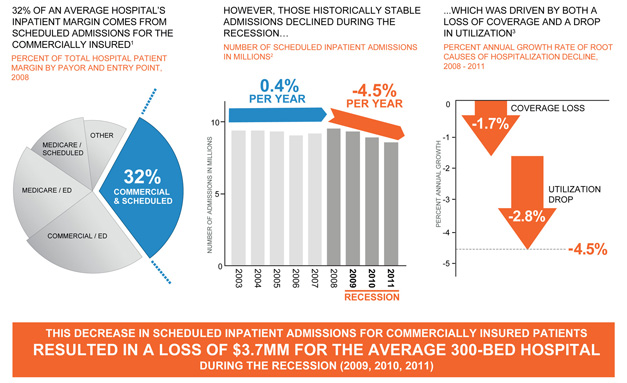
Commercially insured scheduled admissions are the largest contributor to inpatient margins for the average US hospital. During the US recession (2009-2011), volumes in this segment declined. There were two primary drivers of this decline.

####

Recession Impact

Dual Causes

First, commercial insurance coverage decreased, stemming from unemployment and underemployment. This is expected to reverse and rebound as the economy recovers and as healthcare reform is implemented.

Second, even among those who retained coverage, utilization of inpatient services decreased as patients delayed or forewent elective and preventative care. This was influenced by a range of economic factors, including reduced household incomes, higher co-pays, and a reduced ability to leave work for medical care, as well as factor unrelated to the recession, such as a shift to outpatient management of disease.

More: Are Cost Estimates Leading To The Wrong Decisions in US Hospitals?

Assessment

It is unclear whether this second driver will diminish fully as the economy recovers. A slow recovery – or one that fails to see volumes to return to pre-recession levels – suggests that hospitals may need to refocus their strategies on service lines and segments that have historically been less attractive.

Channel Surfing the ME-P

Have you visited our other topic channels? Established to facilitate idea exchange and link our community together, the value of these topics is dependent upon your input. Please take a minute to visit. And, to prevent that annoying spam, we ask that you register. It is fast, free and secure.

Conclusion

Your thoughts and comments on this ME-P are appreciated. Feel free to review our top-left column, and top-right sidebar materials, links, URLs and related websites, too. Then, subscribe to the ME-P. It is fast, free and secure.

Speaker: If you need a moderator or speaker for an upcoming event, Dr. David E. Marcinko; MBA – Publisher-in-Chief of the Medical Executive-Post – is available for seminar or speaking engagements. Contact: MarcinkoAdvisors@msn.com

OUR OTHER PRINT BOOKS AND RELATED INFORMATION SOURCES:

Product Details

What’s the Difference between a Millionaire and a Billionaire?

Join Our Mailing List

Three Zeroes … and a Comma

By Rick Kahler MS CFP® ChFC CCIM www.KahlerFinancial.com

Rick Kahler CFPNo, this isn’t a bad joke. It takes one thousand millions to make one billion. That’s a huge difference. And, how many doctors have arrived there?

A Political “Hot-Button”

Over the past couple of years, especially during the presidential election, one of the hot-button issues has been whether the wealthy are paying “their fair share” in taxes. A great deal of the media coverage and political rhetoric, from President Obama on down, has lumped “millionaires and billionaires” together.

That makes as much sense as putting a housecat and a tiger into the same cage and saying they’re just the same.

Who Wants to be a Billionaire?

The first issue to clarify is the definition of “millionaire” and “billionaire.” Is it someone with a net worth of $1 million or $1billion, or is it someone earning a million or a billion in a year?

According to wild.answers.com, only 80,000 Americans make $1 million or more a year. I couldn’t find a source listing how many people make over $1 billion a year, but I can guess. If you earned 6% on your investments, you would need a net worth of about $16 billion to provide an annual income of $1 billion. According to Forbes (March 2012), only 40 people in the entire world have a net worth of over $16 billion. Obviously, all those references we keep hearing to billionaires must refer to net worth, not income.

This is in line with the Merriam Webster dictionary, which defines millionaire (or billionaire) as “a person whose wealth is estimated at a million (or billion) or more.”

The Life-Style

What kind of lifestyle can you have with a net worth of a million as opposed to a billion dollars? Experts tell us the most reasonable sustainable withdrawal rate is 3%. That means your $1 million will provide $30,000 a year. Adding in Social Security of $18,000 a year means a millionaire can retire on an income of $48,000 a year. If you need assisted living, in-home care, or nursing home care in your later years, which at today’s rates cost a minimum of around $84,000 a year, you’ll be spending down your principal.

Three percent of $1 billion, on the other hand, will give you a retirement income of $30 million a year. At that rate, you could probably get by without bothering to file for Social Security.

MDs

Aiming High

Accumulating $1 million over a lifetime is certainly possible for middle-class earners who are willing to live on less than they make. If you started saving about $1,750 a month at age 25, you’d have your million by age 65. That’s about the same as a married couple each maximizing their 401(k) contributions.

To accumulate $1 billion by age 65, on the other hand, if you started at age 25 you’d need to save a mere $21 million a year.

Equating a millionaire with a billionaire is the same as equating the population of Rapid City, South Dakota (70,000) to the combined populations of California, Texas, and Virginia (70,000,000). There is simply no comparison.

Rich?

The point here is that in today’s world, a millionaire, especially one who is retired, isn’t “rich.” Accumulating a net worth of $1 million dollars by age 65 is a completely reasonable and achievable goal for anyone wanting a comfortable and secure retirement.

Assessment

Lumping “millionaires and billionaires” together might roll off the tongue with a rhythm that makes a nice sound bite. That doesn’t mean it makes sense. For anyone willing to do the math, the comparison is ludicrous. There’s a world of difference in earnings, wealth, and potential lifestyle in those extra three zeroes.

Conclusion

Your thoughts and comments on this ME-P are appreciated. Feel free to review our top-left column, and top-right sidebar materials, links, URLs and related websites, too. Then, subscribe to the ME-P. It is fast, free and secure.

Link: http://feeds.feedburner.com/HealthcareFinancialsthePostForcxos

Speaker: If you need a moderator or speaker for an upcoming event, Dr. David E. Marcinko; MBA – Publisher-in-Chief of the Medical Executive-Post – is available for seminar or speaking engagements. Contact: MarcinkoAdvisors@msn.com

Our Other Print Books and Related Information Sources:

Health Dictionary Series: http://www.springerpub.com/Search/marcinko

Practice Management: http://www.springerpub.com/product/9780826105752

Physician Financial Planning: http://www.jbpub.com/catalog/0763745790

Medical Risk Management: http://www.jbpub.com/catalog/9780763733421

Hospitals: http://www.crcpress.com/product/isbn/9781439879900

Physician Advisors: www.CertifiedMedicalPlanner.org

Product Details  Product Details

Product Details

Important Book Reviews by Dr. Peter Benedek CFA

Book Reviews

Join Our Mailing List

By Peter Benedek PhD CFA www.RetirementAction.com

Assessment

Link: http://retirementaction.com/category/books

Conclusion

Your thoughts and comments on this ME-P are appreciated. Feel free to review our top-left column, and top-right sidebar materials, links, URLs and related websites, too. Then, subscribe to the ME-P. It is fast, free and secure.

Link: http://feeds.feedburner.com/HealthcareFinancialsthePostForcxos

Speaker: If you need a moderator or speaker for an upcoming event, Dr. David E. Marcinko; MBA – Publisher-in-Chief of the Medical Executive-Post – is available for seminar or speaking engagements. Contact: MarcinkoAdvisors@msn.com

Our Other Print Books and Related Information Sources:

Health Dictionary Series: http://www.springerpub.com/Search/marcinko

Practice Management: http://www.springerpub.com/product/9780826105752

Physician Financial Planning: http://www.jbpub.com/catalog/0763745790

Medical Risk Management: http://www.jbpub.com/catalog/9780763733421

Hospitals: http://www.crcpress.com/product/isbn/9781439879900

Physician Advisors: www.CertifiedMedicalPlanner.org

Product DetailsProduct DetailsProduct Details

The Challenges of Aging

Join Our Mailing List

A Concern of Financial Planning?

By Rick Kahler MS CFP® ChFC CCIM www.KahlerFinancial.com

“Are any of you concerned that you may be experiencing signs of early-onset Alzheimer’s?”

A social anthropologist recently asked this question of a group of us who were aging Baby Boomer professionals. Almost every person in the room slowly raised a hand. She then told us we could all relax. The human brain is not designed to multi-task or retain the flood of information and data we experience daily. The sighs of relief were audible.

Information overload aside, some memory loss is normal as we age. Having some trouble remembering names or thinking of the right word to use in a sentence is a normal part of the aging process. Forgetting where you left something, not remembering why you came into a room, and taking longer to learn new things are also normal and not signs of more serious problems.

Symptoms

Serious symptoms of memory loss can include things like asking the same questions repeatedly, getting lost in familiar places, not being able to follow directions, forgetting to eat or bathe, poor judgment about safety, driving problems, and confusion over time, people and places.

While these symptoms can be indicators of the onset of serious diseases like dementia or Alzheimer’s, they can also be caused by other underlying issues. Medication side effects, depression, dehydration, Lyme disease, lack of vitamins, head injuries, and thyroid problems can all exacerbate memory loss.

Personal Finances

You may be wondering what memory loss has to do with personal finances. In one word; everything. Someone with memory loss should not handle financial decisions. People suffering memory loss often forget to pay bills or pay them twice. They become extremely susceptible to being victimized by fraud and scams.

Unfortunately, the loss of mental capability often occurs gradually. By the time family members realize it’s time to step in, someone may be in serious financial trouble. This is one more reason why it’s valuable for elderly people to have someone monitoring their finances.

Case Model

Several years ago an elderly client called our office requesting we transfer $50,000 into his and his wife’s joint checking account. Since we knew there were ample funds in the account, my associate asked what they needed such a large amount of money for. “I don’t know,” responded our client. He turned away from the phone and shouted to his wife, “Honey, what do we need $50,000 for?” She said she didn’t know, either. He then said, “Well, just make it $30,000.”

We immediately began an audit of their finances and discovered a host of unpaid bills, including insurance policies that had lapsed. After bringing the clients current and reinstating their policies, we phoned their sons, who both lived out-of-state, to alert them to the issues we were seeing. Neither son was aware of how serious their parents’ memory loss had become. They immediately made plans to visit.

The clients acknowledged that they needed help. We facilitated automating most of their payments, and they executed a power of attorney empowering their sons to take complete oversight of all their finances.

Our clients had a trusted advisor and a supportive family looking out for their best interests. Many elderly people aren’t as lucky.

Resources

Fortunately, there are resources available to help. You can find general information on eldercare resources at http://www.eldercare.gov. A listing of geriatric care managers is available at http://www.caremanager.org. There is even an association of daily money managers that will assist with bill paying duties at www.aadmm.com

Assessment

Facing the unkind realities of aging such as memory loss can be daunting. Planning ahead, having family conversations, and using the resources that are available can make dealing with those realities possible.

Conclusion

Your thoughts and comments on this ME-P are appreciated. Feel free to review our top-left column, and top-right sidebar materials, links, URLs and related websites, too. Then, subscribe to the ME-P. It is fast, free and secure.

Speaker: If you need a moderator or speaker for an upcoming event, Dr. David E. Marcinko; MBA – Publisher-in-Chief of the Medical Executive-Post – is available for seminar or speaking engagements. Contact: MarcinkoAdvisors@msn.com

OUR OTHER PRINT BOOKS AND RELATED INFORMATION SOURCES:


Product Details  Product Details

***

The NBER Bulletin on Aging and Health

Join Our Mailing List

The National Bureau of Economic Research — 2012 No. 2

The 2012 No. 2 Bulletin includes the articles below:

1)  Can Low-Cost Interventions Affect Retirement Saving Behavior?

by Gopi Shah Goda, Colleen Flaherty Manchester, and Aaron Sojourner –  #17927
by James Choi, Emily Haisley, Jennifer Kurkoski, and Cade Massey – #17843

http://www.nber.org/aginghealth/2012no2/w17927.html

2)  Labor Market Effects of the Massachusetts Health Insurance Reform

by Jonathan Kolstad and Amanda Kowalski

http://www.nber.org/aginghealth/2012no2/w17933.html

3)  Can Germany’s Riester Pensions Fill the Pension Gap?

by Axel Boersch-Supan, Michela Coppola, and Anette Reil-Held

http://www.nber.org/aginghealth/2012no2/w18014.html

4)  Retirement Before the Social Security Entitlement Age

by Kevin Milligan

http://www.nber.org/aginghealth/2012no2/w18051.html

5)  Are Consumers Forward-Looking in Responding to Health Care Prices?

by Aviva Aron-Dine, Liran Einav, Amy Finklestein, and Mark Cullen

http://www.nber.org/aginghealth/2012no2/w17802.html

NBER Profile:  Patricia Danzon

http://www.nber.org/aginghealth/2012no2/danzon.html

NBER Profile:  Doug Staiger

http://www.nber.org/aginghealth/2012no2/staiger.html

Conclusion

Your thoughts and comments on this ME-P are appreciated. Feel free to review our top-left column, and top-right sidebar materials, links, URLs and related websites, too. Then, subscribe to the ME-P. It is fast, free and secure.

Link: http://feeds.feedburner.com/HealthcareFinancialsthePostForcxos

Speaker: If you need a moderator or speaker for an upcoming event, Dr. David E. Marcinko; MBA – Publisher-in-Chief of the Medical Executive-Post – is available for seminar or speaking engagements. Contact: MarcinkoAdvisors@msn.com

Our Other Print Books and Related Information Sources:

Health Dictionary Series: http://www.springerpub.com/Search/marcinko

Practice Management: http://www.springerpub.com/product/9780826105752

Physician Financial Planning: http://www.jbpub.com/catalog/0763745790

Medical Risk Management: http://www.jbpub.com/catalog/9780763733421

Hospitals: http://www.crcpress.com/product/isbn/9781439879900

Physician Advisors: www.CertifiedMedicalPlanner.org

Product DetailsProduct DetailsProduct Details

Product Details Product Details

Product Details

Is Retirement Today a Game Changer for Mature Physicians?

Join Our Mailing List

Understanding Succession and Exit Planning for Physicians

By Michael J. Searcy, ChFC, CFP®, AIFA®

www.SearcyFinancial.com

Doctors who once planned to rely on the sale of their practice to fund their retirement are now finding it more difficult to recruit younger physicians for their succession plan.  If you are a mature doctor today who owns a smaller medical / dental practice (one or two doctor groups), you may be finding that both the economy and desires of younger doctors are changing the game for developing an exit strategy.

The Plan

In preparing a succession plan, a major key to success is starting the process early.  Waiting until you near retirement to begin thinking about selling your practice may leave you with limited (often unfavorable) options.  While some doctors choose to fund a buy-out vehicle during the early stages of their practice with the end goal of selling and retiring in mind, the majority are not in a position where they have a longstanding plan in place.  For doctors who are more than 5-7 years out from retirement, making time to consult with professionals and come up with an enticing purchase proposition for a younger doctor can lead to receiving maximum value for the practice.

Understand the Obstacles

Several factors lead to younger doctors not purchasing existing practices.  These include the heavy competition from hospitals that are competing for more doctors, their desire to set up their own practice, or their aversion to the responsibilities of running a business.  By understanding the obstacles you may face in finding a successor, you can plan ahead to overcome them and get your practice in optimal operating order to increase its attractiveness to potential successors.

The Questions

Questions to consider during the process include:

  • Do I know my practice’s worth?  Getting an accurate valuation is important for you and your successor.  Valuation companies that specialize in medical and dental practice valuations will consider your tangible assets, accounts receivable and the goodwill/brand of your practice to give you an accurate picture of your worth.  By overvaluing your practice, you may repel potential buyers.
  • Are all operations running smoothly?  There may be areas of your practice that need strengthened before a sale.  This can make things smoother as you prepare for a sale, and also make the practice more attractive.
  • Can I/we sustain another doctor’s salary while they are being groomed to take over?
  • If not, is there a hospital affiliate who can hire the doctor to work in my practice until we build the financial base to sustain another salary?
  • Am I protecting my patients?  Aside from adhering to any patient notification laws of your state, you want your patients to understand any upcoming transitions.  Creating a plan to protect your clients may help retain them after the transition.

Build an Alternative Nest Egg

While the sale of your practice may be a wonderful addition to your retirement fund, it is important to build a nest egg as you work and not rely on that big chunk from a sale at the end of your career.  No sale or purchase price is guaranteed and economic changes or new regulations could make your practice unsellable.  By building a nest egg for retirement throughout the course of your career, you can have greater peace of mind that you can experience financial freedom in retirement.

Assessment

Developing your exit strategy will take time, organization and careful planning.  Avoid adding additional stress by viewing the sale of your practice as your financial freedom for retirement.  When it comes time to transfer your ownership out of your practice, make sure you are able to focus solely on a successful outcome!

The Author

Michael J. Searcy, ChFC, CFP, AIFA, is President of Searcy Financial Services, Inc., a registered investment advisory firm in Overland   Park, KS, offering integrated wealth management solutions to doctors.  Searcy has been listed by Medical Economics as one of the “Top 150 Financial Advisors for Doctors” in 2002-2006 and 2011.  For additional information, visit www.SearcyFinancial.com

Your thoughts and comments on this ME-P are appreciated. Feel free to review our top-left column, and top-right sidebar materials, links, URLs and related websites, too. Then, subscribe to the ME-P. It is fast, free and secure.

Link: http://feeds.feedburner.com/HealthcareFinancialsthePostForcxos

Speaker: If you need a moderator or speaker for an upcoming event, Dr. David E. Marcinko; MBA – Publisher-in-Chief of the Medical Executive-Post – is available for seminar or speaking engagements. Contact: MarcinkoAdvisors@msn.com

OUR OTHER PRINT BOOKS AND RELATED INFORMATION SOURCES:

LEXICONS: http://www.springerpub.com/Search/marcinko
PHYSICIANS: www.MedicalBusinessAdvisors.com
PRACTICES: www.BusinessofMedicalPractice.com
HOSPITALS: http://www.crcpress.com/product/isbn/9781466558731
CLINICS: http://www.crcpress.com/product/isbn/9781439879900
ADVISORS: www.CertifiedMedicalPlanner.org
BLOG: www.MedicalExecutivePost.com

Product DetailsProduct DetailsProduct Details

Product Details Product Details

Product Details

About the RetireMark Planning System

Join Our Mailing List

From HealthView Services (HVS)

By Staff Reporters

According to their website, HealthView Services (HVS) is one of the only firms in the country that builds solutions for the financial services industry to address out-of-pocket health care costs that individuals will face during retirement.

Founding

HVS was founded in 2008 by a team of experienced executives who identified a serious deficiency in financial planning in relation to retirement planning. In order to fill this void, HVS founders employed a group of expert physicians, experienced actuaries, and healthcare industry programmers to develop the HVS RetireMark Planning System.

Financial Planning and Health-Risk Assessment Tools

At its core, RetireMark is a combination of financial planning and health-risk assessment tools that provide financial institutions, independent advisors, and healthcare related firms with web-based reports. These customized reports project personalized out-of-pocket healthcare costs, life expectancy, and the Income Floor—a sophisticated and revolutionary approach to income distribution for retirement protection.

Customization

HVS’s product offerings can be customized to meet each institution`s exclusive needs and be seamlessly integrated into existing marketing and branding platforms. In addition to the software, HVS provides clients with training programs, seminars, and customized presentations in order to expand sales and grow revenues.

Assessmernt

In collaboration with industry leaders such as the Retirement Income Industry Association (RIIA), HVS has developed innovative solutions to address the growing needs of investors in transition. HVS is also a regular contributor to the HealthWatch segment of Retirement Weekly, a www.MarketWatch.com publication. By partnering with such prominent organizations, the firm hopes to become a pioneer in this emerging field.

Conclusion

So, give em’ a click and tell us what you think www.hvsfinancial.com

Your thoughts and comments on this ME-P are appreciated. Feel free to review our top-left column, and top-right sidebar materials, links, URLs and related websites, too. Then, subscribe to the ME-P. It is fast, free and secure.

Link: http://feeds.feedburner.com/HealthcareFinancialsthePostForcxos

Speaker: If you need a moderator or speaker for an upcoming event, Dr. David E. Marcinko; MBA – Publisher-in-Chief of the Medical Executive-Post – is available for seminar or speaking engagements. Contact: MarcinkoAdvisors@msn.com

Our Other Print Books and Related Information Sources:

Health Dictionary Series: http://www.springerpub.com/Search/marcinko

Practice Management: http://www.springerpub.com/product/9780826105752

Physician Financial Planning: http://www.jbpub.com/catalog/0763745790

Medical Risk Management: http://www.jbpub.com/catalog/9780763733421

Hospitals: http://www.crcpress.com/product/isbn/9781439879900

Physician Advisors: www.CertifiedMedicalPlanner.org

Product DetailsProduct DetailsProduct Details

Product Details  Product Details

Product Details

Vital iMBA Inc Links for Savvy Doctors and their Financial Advisors

Join Our Mailing List

An Educational Resource Supporting Doctors and their Consulting Advisors 

Healthcare OrganizationsMedical Business AdvisorsCertified Medical PlannerHDS

We are an emerging online and onground community that connects medical professionals with financial advisors and management consultants. We participate in a variety of insightful educational seminars, teaching conferences and national workshops. We produce journals, textbooks and handbooks, white-papers, CDs and award-winning dictionaries. And, our didactic heritage includes innovative R&D, litigation support, opinions for engaged private clients and media sourcing in the sectors we passionately serve.

Through the balanced collaboration of this rich-media sharing and ranking forum, we have become a leading network at the intersection of healthcare administration, practice management, medical economics, business strategy and financial planning for doctors and their consulting advisors. Even if not seeking our products or services, we hope this knowledge silo is useful to you.

In the Health 2.0 era of political reform, our goal is to: “bridge the gap between practice mission and financial solidarity for all medical professionals.”

Join the ME-P Nation today … and tell us what you think!

###

We are sponsored by the Institute of Medical Business Advisors, Inc

www.MedicalBusinessAdvisors.com

INSTITUTE OF MEDICAL BUSINESS ADVISORS, INC.
Suite #5901 Wilbanks Drive
Norcross, Georgia, 30092-1141 USA
Phone: 770.448.0769

ADMINISTRATORS: http://www.springerpub.com/Search/marcinko
PHYSICIANS:www.MedicalBusinessAdvisors.com
PRACTICE: www.BusinessofMedicalPractice.com
PODIATRISTS: www.PodiatryPrep.com
HOSPITALS:http://www.crcpress.com/product/isbn/9781439879900
ADVISORS:www.CertifiedMedicalPlanner.org
BLOG: www.MedicalExecutivePost.com

Assessment

Link: Letterhead.iMBA_Inc.

Link: Letterhead CMP

Conclusion

Your thoughts and comments on this ME-P are appreciated. Feel free to review our top-left column, and top-right sidebar materials, links, URLs and related websites, too. Then, subscribe to the ME-P. It is fast, free and secure.

Link: http://feeds.feedburner.com/HealthcareFinancialsthePostForcxos

Speaker: If you need a moderator or speaker for an upcoming event, Dr. David E. Marcinko; MBA – Publisher-in-Chief of the Medical Executive-Post – is available for seminar or speaking engagements. Contact: MarcinkoAdvisors@msn.com

Our Other Print Books and Related Information Sources:

Health Dictionary Series: http://www.springerpub.com/Search/marcinko

Practice Management: http://www.springerpub.com/product/9780826105752

Physician Financial Planning: http://www.jbpub.com/catalog/0763745790

Medical Risk Management: http://www.jbpub.com/catalog/9780763733421

Hospitals: http://www.crcpress.com/product/isbn/9781439879900

Physician Advisors: www.CertifiedMedicalPlanner.org

Product DetailsProduct DetailsProduct Details

Product Details  Product Details

Product Details

Product Details 

An Rx for Physician’s Financial Health

Join Our Mailing List

Fundamental Principles for all Medical Professionals

Donald M. Roy CFP® CFS www.newealthadvisors.com

SPONSOR: www.PhysicianNexus.com

The demands on medical practitioners today can seem overwhelming. It’s no secret that health-care delivery is changing, and those changes are reflected in the financial issues that health-care professionals face every day. You must continually educate yourself about new research in your chosen specialty, stay current on the latest technology that is transforming health care, and pay attention to business considerations, including ever-changing state and federal insurance regulations.

Like many, you may have transitioned from medical school and residency to being on your own with little formal preparation for the substantial financial issues you now face. Even the day-to-day concerns that affect most people–paying college tuition bills or student loans, planning for retirement, buying a home, insuring yourself and your business–may be complicated by the challenges and rewards of a medical practice. It’s no wonder that many medical practitioners look forward to the day when they can relax and enjoy the fruits of their labors.

Unfortunately, substantial demands on your time can make it difficult for you to accurately evaluate your financial plan, or monitor changes that can affect it. That’s especially true given ongoing health care reform efforts that will affect the future of the industry as a whole. Just as patients need periodic checkups, you may need to work with a financial professional to make sure your finances receive the proper care.

Maximizing your personal assets

Much like medicine, the field of finance has been the subject of much scientific research and data, and should be approached with the same level of discipline and thoughtfulness. Making the most of your earning years requires a plan for addressing the following issues.

Retirement

Your years of advanced training and perhaps the additional costs of launching and building a practice may have put you behind your peers outside the health-care field by a decade or more in starting to save and invest for retirement. You may have found yourself struggling with debt from years of college, internship, and residency; later, there’s the ongoing juggling act between making mortgage payments, caring for your parents, paying for weddings and tuition for your children, and maybe trying to squeeze in a vacation here and there. Because starting to save early is such a powerful ally when it comes to building a nest egg, you may face a real challenge in assuring your own retirement. A solid financial plan can help.

Investments

Getting a late start on saving for retirement can create other problems.

For example, you might be tempted to try to make up for lost time by making investment choices that carry an inappropriate level or type of risk for you. Speculating with money you will need in the next year or two could leave you short when you need that money. And once your earnings improve, you may be tempted to overspend on luxuries you were denied during the lean years. One of the benefits of a long-range financial plan is that it can help you protect your assets–and your future–from inappropriate choices.

Tuition

Many medical professionals not only must pay off student loans, but also have a strong desire to help their children with college costs, precisely because they began their own careers saddled with large debts.

Tax considerations

Once the lean years are behind you, your success means you probably need to pay more attention to tax-aware investing strategies that help you keep more of what you earn.

Using preventive care

The nature of your profession requires that you pay special attention to making sure you are protected both personally and professionally from the financial consequences of legal action, a medical emergency of your own, and business difficulties. Having a well-defined protection plan can give you confidence that you can practice your chosen profession without putting your family or future in jeopardy.

Liability insurance

Medical professionals are caught financially between rising premiums for malpractice insurance and fixed reimbursements from managed-care programs and you may find yourself evaluating a variety of approaches to providing that protection. Some physicians also carry insurance that protects them against unintentional billing errors or omissions.

Remember that in addition to potential malpractice claims, you also face the same potential liabilities as other business owners. You might consider an umbrella policy as well as coverage that protects against business-related exposures such as fire, theft, employee dishonesty, or business interruption.

Disability insurance

Your income depends on your ability to function, especially if you’re a solo practitioner, and you may have fixed overhead costs that would need to be covered if your ability to work were impaired. One choice you’ll face is how early in your career to purchase disability insurance. Age plays a role in determining premiums, and you may qualify for lower premiums if you are relatively young. When evaluating disability income policies, medical professionals should pay special attention to how the policy defines disability. Look for a liberal definition such as “own occupation,” which can help ensure that you’re covered in case you can’t practice in your chosen specialty.

To protect your business if you become disabled, consider business overhead expense insurance that will cover routine expenses such as payroll, utilities, and equipment rental. An insurance professional can help evaluate your needs.

Practice management and business planning

Is a group practice more advantageous than operating solo, taking in a junior colleague, or working for a managed-care network? If you have an independent practice, should you own or rent your office space? What are the pros and cons of taking over an existing practice compared to starting one from scratch? If you’re part of a group practice, is the practice structured financially to accommodate the needs of all partners? Does running a “concierge” or retainer practice appeal to you? If you’re considering expansion, how should you finance it?

Questions like these are rarely simple and should be done in the context of an overall financial plan that takes into account both your personal and professional goals.

Many physicians have created processes and products for their own practices, and have then licensed their creations to a corporation. If you are among them, you may need help with legal and financial concerns related to patents, royalties, and the like. And if you have your own practice, you may find that cash flow management, maximizing return on working capital, hiring and managing employees, and financing equipment purchases and maintenance become increasingly complex issues as your practice develops.

Practice valuation

You may have to make tradeoffs between maximizing current income from your practice and maximizing its value as an asset for eventual sale. Also, timing the sale of a practice and minimizing taxes on its proceeds can be complex. If you’re planning a business succession, or considering changing practices or even careers, you might benefit from help with evaluating the financial consequences of those decisions.

Estate planning

Estate planning, which can both minimize taxes and further your personal and philanthropic goals, probably will become important to you at some point. Options you might consider include:

  • Life insurance
  • Buy-sell agreements for your practice
  • Charitable trusts

You’ve spent a long time acquiring and maintaining expertise in your field, and your patients rely on your specialized knowledge. Doesn’t it make sense to treat your finances with the same level of care?

Channel Surfing the ME-P

Have you visited our other topic channels? Established to facilitate idea exchange and link our community together, the value of these topics is dependent upon your input. Please take a minute to visit. And, to prevent that annoying spam, we ask that you register. It is fast, free and secure.

Conclusion

Your thoughts and comments on this ME-P are appreciated. Feel free to review our top-left column, and top-right sidebar materials, links, URLs and related websites, too. Then, subscribe to the ME-P. It is fast, free and secure.

Speaker: If you need a moderator or speaker for an upcoming event, Dr. David E. Marcinko; MBA – Publisher-in-Chief of the Medical Executive-Post – is available for seminar or speaking engagements. Contact: MarcinkoAdvisors@msn.com

OUR OTHER PRINT BOOKS AND RELATED INFORMATION SOURCES:

Dictionary of Health Insurance and Managed Care

Product DetailsProduct DetailsProduct Details

Product Details  Product Details

Product Details

IRA Strategies for Physicians in 2012

Join Our Mailing List

Money Flows-In Even as Volatility Continues in Mid-Year

By Martha J. Schilling AAMS CRP ETSC CSA

http://www.schillinggroupadvisors.com

The amount of money in IRAs is climbing even as the volatility continues.

Most of us have at least one IRA and eventually many people roll over their main retirement assets, 403(b) and 401(k) accounts to IRAs.

Unfortunately, a lot of the value in IRAs isn’t being maximized.

By focusing on a few key strategies you can make an IRA more valuable in your lifetime and beyond.

Now, doctors and all medical professionals should consider the following:

OWN THE RIGHT ASSETS

An IRA has the advantage of tax deferral. Gains and income compound free of taxes until they are distributed. They have the disadvantage of converting long-term capital gains into ordinary income. All taxable distributions from an IRA are taxed as ordinary income. Research reveals that assets that pay high ordinary income are best held in IRAs. High-Yield bonds, Real Estate Investment Trusts and investment grade bonds as well as stocks, mutual funds and other investments that tend to be owned for less than a year generate short-term capital gains. Nontraditional, or alternative investments can be utilized, however know which are prohibited in retirement accounts.

PRACTICE TAX DIVERSIFICATION

No one can forecast how the tax code will alter. Different scenarios are in the works, perhaps one will be put into place late this fall. Different types of accounts have different tax treatments now, and that could change. Instead of forecasting one tax outcome and arranging your finances accordingly, it’s safer to have different types of accounts so you won’t be burned in any scenario. Try to own investments in taxable accounts, traditional IRAs, and Roth IRAs

CONVERT TO A ROTH

Every year, consider whether it makes sense to convert all or part of your traditional IRA into a Roth IRA. Discuss with your Tax advisor factors such as your expected rate of return, the difference between your current tax rate and future tax rates, the source of the cash to pay the taxes and whether future required minimum distributions would exceed your spending needs.

Your CPA/advisor will add other questions as he would know your personal situation and needs.

CONSOLIDATE or SPLIT?

Simplifying your finances often means consolidating all your accounts at one financial institution. Many people have multiple IRAs and simplifying means rolling them over into one IRA when practical. But suppose you have multiple heirs and expect IRAs to be a significant legacy. You could name all heirs as joint beneficiaries and let them decide what to do with the account. On the other hand, you could split the IRA now and name one person as the primary beneficiary for each.

SPEND ACCOUNTS in the RIGHT Order

As a general rule, it’s best to spend taxable accounts first, traditional IRA’s next and ROTH IRAs last. Not in all cases. When you visit your advisor and review what you need in cash flow at retirement, you may find that taking your RMD at 70 ½ puts you into a higher tax bracket. It may be less taxing to take normal distributions on a regular basis after 591/2.

REVIEW your BENEFICIARIES. There are horror stories of people who haven’t changed beneficiaries for decades and find a sibling or a parent is the beneficiary rather than your spouse.

CONSIDER CHARITY. Should you decide to leave part of your estate to charity, the most tax efficient way to do that might be to name the charity as beneficiary of your IRA? Individuals pay tax on distributions, Charities do not.

CATCH-UP CONTRIBUTIONS

When you’re still working and making contributions to IRAs, you can make higher contributions when age 50 or older. In 2012, the maximum for those over 50 is $6000 rather than $5000.

CONSIDER SPOUSE Generally IRA contributions can be made only to the extent you have earned income from a job or business. When filing a joint return, contributions can be made for both spouses up to the maximum of $6000.

REQUIRED DISTRIBUTIONS It appears people continue to make mistakes when taking and computing their RMD after 70 ½. The IRS has been lax on this in the past but is stepping up its tracking and enforcement.

Assesment

Can you think of any others?

Conclusion

Your thoughts and comments on this ME-P are appreciated. Feel free to review our top-left column, and top-right sidebar materials, links, URLs and related websites, too. Then, subscribe to the ME-P. It is fast, free and secure.

Link: http://feeds.feedburner.com/HealthcareFinancialsthePostForcxos

Speaker: If you need a moderator or speaker for an upcoming event, Dr. David E. Marcinko; MBA – Publisher-in-Chief of the Medical Executive-Post – is available for seminar or speaking engagements. Contact: MarcinkoAdvisors@msn.com

Our Other Print Books and Related Information Sources:

Health Dictionary Series: http://www.springerpub.com/Search/marcinko

Practice Management: http://www.springerpub.com/product/9780826105752

Physician Financial Planning: http://www.jbpub.com/catalog/0763745790

Medical Risk Management: http://www.jbpub.com/catalog/9780763733421

Hospitals: http://www.crcpress.com/product/isbn/9781439879900

Physician Advisors: www.CertifiedMedicalPlanner.org

Product Details  Product Details

Doctors Shouldn’t Wait Till Retirement To Act On Travel Dreams

 Join Our Mailing List

By Rick Kahler MS CFP® ChFC CCIM www.KahlerFinancial.com

What’s at the top of your retirement bucket list? If you are like most folks that I help prepare for retirement, travel is high on that list.  As I’ve grown older, my views on retirement travel have changed. I used to buy into the dream of retirement as the “Golden Years.” I thought of it as the time in life when people are free to do what they want, when they want, with whom they want.

Working with older clients has taught me that my younger views of the glory of retirement were a bit naïve. While certainly some people do experience years of unlimited and unfettered travel, many more don’t find it so easy. Doing “what you want, when you want, with whom you want,” assumes three things we often take for granted: good health, adequate finances, and meaningful relationships.

This seems especially true for command-control type medical professionals.

The Three Legs of Retirement Lifesyle

1. Health. When it comes to travel, good health may not be essential, but it will make your experience more fulfilling and enjoyable. Of course, we aren’t typically in either “good” or “poor” health, but fall somewhere on a continuum. With limited mobility, you may be able to shop at the bazaar in Istanbul, but chances are you won’t hike the Grand Canyon or explore the Acropolis.

Like most things, good health typically requires a conscious intention to create and maintain it. Someone who has a money script of, “When I retire I’ll have the time and money to take better care of myself” may be in for a surprise. Most people who chose not to take care of their health before retirement won’t do so in retirement. As one retired friend said, “If you didn’t have the energy to work out when you were young, you sure won’t have it when you retire!”

What’s even more uncontrollable is the health of those with whom you wish to share your travel adventures. Even if you’ve taken care of yourself, your significant other may be unable to travel. Instead of strolling a beach in the Bahamas, you could end up at home being a caretaker.

2. Money. On average, baby boomers have saved less than $100,000 for retirement. That won’t pay for many around-the-world cruises. If you want to travel after you retire, you need a serious commitment during your working years to live frugally and invest as much as you can. Otherwise, you may end up with just barely enough to cover your basic living expenses.

3. Relationships. If you spend your career working 80-hour weeks, you may accumulate enough assets to fund plenty of retirement travel—but by then you may be traveling alone. Saving for the future is out of balance if it’s done at the expense of enjoying life and close relationships today.

Assessment

By now you may think I’m suggesting you have no better choice than to spend your retirement years at home. Not at all. Here’s one possibility: If travel is one of your dreams, what would happen if you did some of it now? Use your vacation time while you can enjoy yourself. Take that motorcycle trip through Europe or go scuba diving in Belize while you’re in top shape. Do the international travel now when you can better negotiate airports, handle travel delays, and power through jet lag. To save on expenses, plan ahead, use a credit card that awards frequent flyer miles (which you pay off monthly), and use cost-saving options like home swaps and off-season travel.

Then, after you retire, when you need more access to medical care and less demanding travel, you can stay closer to home and enjoy the opportunities in your own back yard.

More: http://www.mississippimedicalnews.com/retirement-and-succession-planning-cms-1524

Conclusion

Your thoughts and comments on this ME-P are appreciated. Feel free to review our top-left column, and top-right sidebar materials, links, URLs and related websites, too. Then, subscribe to the ME-P. It is fast, free and secure.

Link: http://feeds.feedburner.com/HealthcareFinancialsthePostForcxos

Speaker: If you need a moderator or speaker for an upcoming event, Dr. David E. Marcinko; MBA – Publisher-in-Chief of the Medical Executive-Post – is available for seminar or speaking engagements. Contact: MarcinkoAdvisors@msn.com

Our Other Print Books and Related Information Sources:

Health Dictionary Series: http://www.springerpub.com/Search/marcinko

Practice Management: http://www.springerpub.com/product/9780826105752

Physician Financial Planning: http://www.jbpub.com/catalog/0763745790

Medical Risk Management: http://www.jbpub.com/catalog/9780763733421

Hospitals: http://www.crcpress.com/product/isbn/9781439879900

Physician Advisors: www.CertifiedMedicalPlanner.org

Product Details

Product Details  Product Details

New IRS Guidance on Health FSAs for Doctors

Join Our Mailing List

On Section 125 Cafeteria Plans

By Children’s Home Society of Florida Foundation

In Notice 2012-40; 2012-25 IRB 1 (29 May 2012), the IRS issued guidance on the changes required in 2013 for Sec. 125 Cafeteria Plans.

Section 125 Plans

Many companies have created healthcare flexible spending accounts under Section 125.  For 2013, the salary reduction contributions are limited to $2,500.  The notice indicates that this limit will be adjusted for inflation in 2014 and later years. If contributions greater than $2,500 are made to the account, the excess funds will not subject the employee to penalties if the funds are distributed as taxable income in the taxable year in which the cafeteria plan year ends.  The $2,500 limit does not apply to non-elective plans.  Many of these plans are described as “flex limit” or similar plans.

New Limits

Written cafeteria plans must be modified to reflect the new $2,500 limit and other provisions.  If the plan follows the proposed regulations issued in 2007, the participants may rely on the plan to be qualified.

Assessment

And so, as more and more medical professionals become employees, FSA rules should be monitored closely by doctors and their FAs.

Conclusion

Your thoughts and comments on this ME-P are appreciated. Feel free to review our top-left column, and top-right sidebar materials, links, URLs and related websites, too. Then, subscribe to the ME-P. It is fast, free and secure.

Speaker: If you need a moderator or speaker for an upcoming event, Dr. David E. Marcinko; MBA – Publisher-in-Chief of the Medical Executive-Post – is available for seminar or speaking engagements. Contact: MarcinkoAdvisors@msn.com

OUR OTHER PRINT BOOKS AND RELATED INFORMATION SOURCES:

Product Details  Product Details

About the Institute of Medical Business Advisors, Inc

Join Our Mailing List

iMBA, Inc

[www.MedicalBusinessAdvisors.com]

Championing the Financial Success of

Doctors and their Consulting Advisors

[Career Development Products and Services]

Comprehensive Financial Planning Strategies for Doctors and Advisors: Best Practices from Leading Consultants and Certified Medical Planners(TM)

Your Personal DR. Invitation: Letterhead.iMBA_Inc.

Are Doctors Withdrawing Enough for Retirement OR Too Much?

Join Our Mailing List

Retirement Planning www.KahlerFinancial.com

By Rick Kahler MS CFP® ChFC CCIM

One of the biggest adjustments for doctors, and all medical professionals, when they retire is making the switch from saving to spending. For years and years, they’ve been putting money away for the future. It’s hard to accept that it’s time to start taking that money out because “the future” has arrived.

How Much – The Big Question

Financial planners can help retired clients make this transition more comfortably by helping them decide on a reasonable withdrawal rate to answer the crucial question, “How much can I take out of my portfolio every year?” That rate needs to balance the need to have enough money to live comfortably and the need to make sure there is enough money for the rest of the clients’ lives.

Pessimism Rules

This is one area of financial planning where pessimism is a virtue. If an advisor claims you can withdraw eight or ten percent, or even more, that’s a red flag that you’re getting bad financial advice. For most people, rates that high are simply not sustainable. A few planners are comfortable recommending withdrawal rates of five or six percent. The more standard rate is four percent. Conservative planners, me among them, tend to recommend three percent.

The Four Percent Anchor

Over my years as a financial planner, however, I’ve come to realize the futility of anchoring on a set withdrawal rate. This is a number that needs to be established based on each client’s needs and circumstances. Because so many variables affect safe withdrawal rates, planners need to keep up on the latest research and continually refine their thinking in this area.

Every time we change the investment mix in clients’ portfolios, it changes the standard deviations, which in turn affect withdrawal rates. For example, at Kahler Financial Group we historically have used a cost-of-living estimate for Social Security of 3%. This was even with our long-term projected increase for the Consumer Price Index (CPI). With some of the current turmoil and lack of confidence that Congress will put Social Security on a firm footing without some type of crisis, we have lowered our COLA expectations to 1% under the CPI, or 2%. Of course, this affects the withdrawal rate we recommend to clients.

The Frugal Types

Most financial planners have some clients who withdraw significantly less than they could. These frugal types are extremely unlikely to run out of money before the end of their lives. They will almost certainly “leave some money on the table.” This is fine if they want to leave money to their heirs. The possible downside is that they could have used some of that money to live more comfortably during their retirement years.

The Spendthrift Types

At the other extreme are those who, for various reasons, take out the maximum that the planner recommends or even more. The higher the withdrawal rate, the lower the probability that they will have enough money to last as long as they live. Only the clients themselves can decide whether their comfort level is at a 99% chance of having enough and even leaving money on the table, a 95% chance, or even down to a 60% or 50% probability of having enough.

Assessment

A projected withdrawal rate is just that, a projection. It’s an educated guess. Markets change, economies change, and unplanned events happen in life. All of those circumstances will affect portfolios and withdrawal rates.

And so, what type of medical professional drawdown participant are you?

Conclusion

Your thoughts and comments on this ME-P are appreciated. Feel free to review our top-left column, and top-right sidebar materials, links, URLs and related websites, too. Then, subscribe to the ME-P. It is fast, free and secure.

Link: http://feeds.feedburner.com/HealthcareFinancialsthePostForcxos

Speaker: If you need a moderator or speaker for an upcoming event, Dr. David E. Marcinko; MBA – Publisher-in-Chief of the Medical Executive-Post – is available for seminar or speaking engagements. Contact: MarcinkoAdvisors@msn.com

OUR OTHER PRINT BOOKS AND RELATED INFORMATION SOURCES:

LEXICONS: http://www.springerpub.com/Search/marcinko
PHYSICIANS: www.MedicalBusinessAdvisors.com
PRACTICES: www.BusinessofMedicalPractice.com
HOSPITALS: http://www.crcpress.com/product/isbn/9781466558731
CLINICS: http://www.crcpress.com/product/isbn/9781439879900
ADVISORS: www.CertifiedMedicalPlanner.org
BLOG: www.MedicalExecutivePost.com

Product Details  Product Details


Why Doctors Must Consider Fees When Building A Retirement Nest Egg

Join Our Mailing List

Understanding Mutual Fund Share Classes and Costs

[By Rick Kahler MS CFP® ChFC CCIM]

www.KahlerFinancial.com

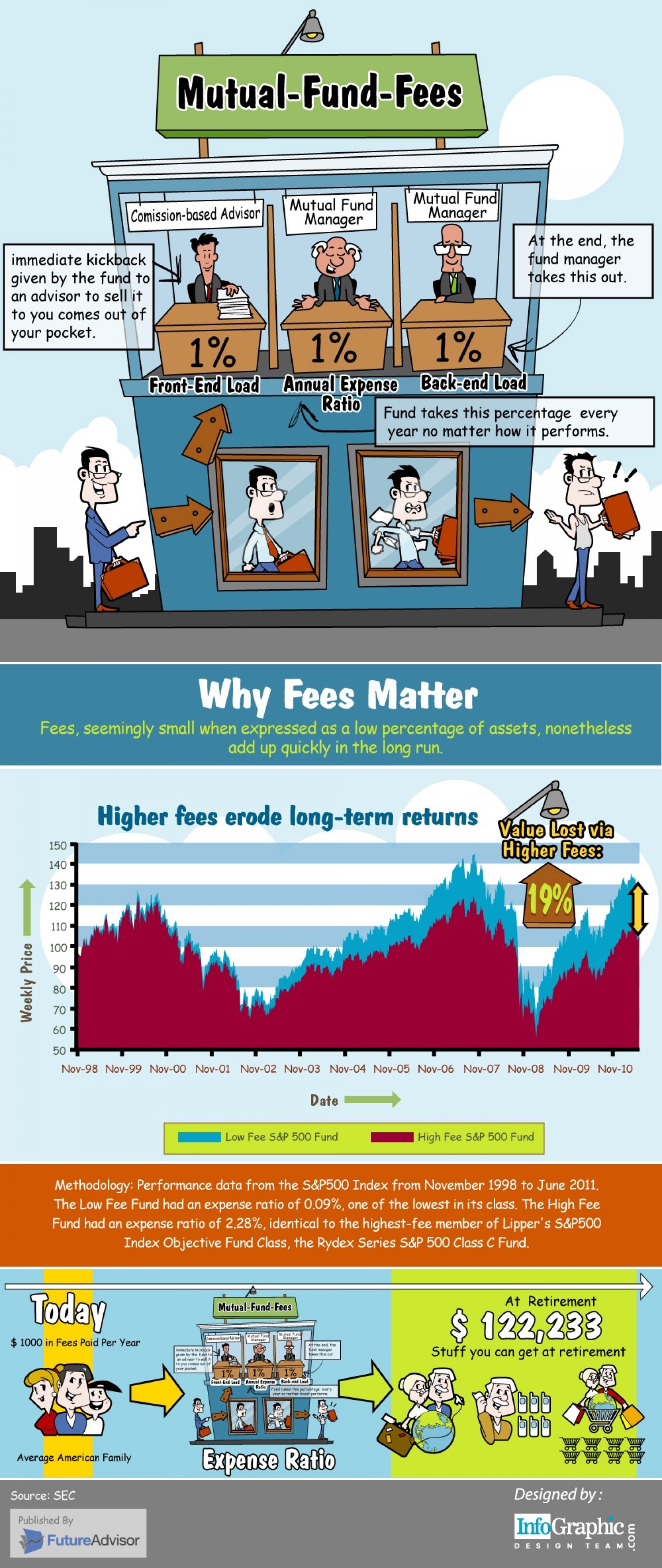
Doctors – Do you want to add $500,000 or more to your retirement nest egg? Pay attention to the fees that mutual funds charge you for investing your money. Few physicians or small investors understand that the same mutual fund can charge a wide range of fees, depending on the share class you select.

For many medical professionals and most Americans, the best way to build wealth is to live on less than you make and invest 15% to 35% of your paycheck into mutual funds. It’s essential to find funds that are diversified among five or more asset classes.

The Choice After Mutual Fund Selection

Once you’ve found a mutual fund with a mix of appropriate asset classes, there’s one more choice to make. What class of shares should you buy? The most popular classes are A, B, and I shares; however, many funds offer even more classes like C, F, and R shares.

The difference between the classes has nothing to do with the underlying management or structure of the mutual fund. All share classes own the same stocks or bonds. The difference lies in the fees you pay the mutual fund for their services and for commissions to brokers who sell the funds.

Types of Share Classes

Many A shares and almost all B, C, F, and R shares impose sales commissions, often called “loads,” which are based on the amount you invest. For example, A shares usually charge you a one-time commission ranging from 4.0% to 5.75% of your initial investment. With B shares there is no up-front commission, but they will charge you a stiff penalty to sell the funds in the early years and will impose an additional annual commission often ranging from .25% to 1.00% a year. Some discount brokers will waive the upfront commission on A shares for their customers.

Typically the best shares to purchase are the I class, which don’t have any commissions associated with them and offer the lowest management fees of any other share class. The downside is that I shares often require a minimum investment ranging from $10,000 to $1,000,000. Financial advisors often have relationships with discount brokers that allow them to purchase the shares for clients in smaller amounts.

Fee Comparisons

It pays to compare fees.

For example, a comparison of fees available at the website of the Financial Industry Regulatory Authority (finra.org/fundanalyzer) shows that a $10,000 investment in the Invesco S&P 500 Index fund’s A shares will cost you $129 a year, while the same investment in the C shares will run $163. If instead you invest in the Fidelity Spartan 500 Index fund you will pay just $11.50 annually, which is over 1% less than the Invesco A shares.

The Savings

It’s surprising what a 1% savings means to your retirement nest egg. According to a study by the Vanguard Group reported by Jack Hough in SmartMoney.com, if a 25-year old saves 9% of his pay in a mutual fund, paying .25% a year in expenses versus 1.25% amounts to having an additional $500,000 by age 65.

Assessment

With all that said, most investors don’t have either the knowledge or the time to construct a diversified portfolio of mutual funds that will carry them through to retirement. Paying a fee or commission for advice can ultimately save you a lot of money. There are advisors who will help smaller investors select investments for an hourly or flat fee. Others charge fees based on the size of your portfolio, which normally range from .3% to 1.5%.

Conclusion

Your thoughts and comments on this ME-P are appreciated. Feel free to review our top-left column, and top-right sidebar materials, links, URLs and related websites, too. Then, subscribe to the ME-P. It is fast, free and secure.

Speaker: If you need a moderator or speaker for an upcoming event, Dr. David E. Marcinko; MBA – Publisher-in-Chief of the Medical Executive-Post – is available for seminar or speaking engagements. Contact: MarcinkoAdvisors@msn.com

OUR OTHER PRINT BOOKS AND RELATED INFORMATION SOURCES:

Product Details  Product Details

Comprehensive Financial Planning Strategies for Doctors and Advisors: Best Practices from Leading Consultants and Certified Medical Planners(TM)

Physician’s Update on Flexible Spending Accounts [FSAs]

Join Our Mailing List

A Proposed $500 Bonus

[By Children’s Home Society of Florida Foundation]

House Ways and Means Committee Chair, Dave Camp, recently proposed an amendment on May 30 2012 that would permit new pliability for flexible health spending accounts. His amendment to the Health Flexible Spending Arrangements Improvement Act of 2012 permits employees who have a balance of up to $500 at the end of a year to receive a taxable payment of that amount.

Current Rules

Under current rules, employees are permitted to use salary reductions to allocate funds to a healthcare flexible spending account. The funds in the account may then be used for payment of qualified healthcare expenses.

However, the funds allocated to the account are forfeited back to the employer at the end of the year. Therefore, the accounts are frequently described as a “use it or lose it” plan.

Oversight Committee

Ways and Means Oversight Subcommittee Chair, Charles Boustany, Jr. (R-LA), proposed that the unspent money could be distributed to the employee as taxable income at the end of the year. Chairman Camp would permit the distribution, but only up to a maximum of $500.

Assessment

The proposed change in flexible spending accounts will cost the government about $4 billion over the next 10 years according to the Congressional Joint Committee on Taxation.

And so, as more and more medical professionals become employees, FSA rules should be monitored closely by doctors and their FAs.

Editor’s Note: If the House passes this change, the Senate would also need to take action. With the fall elections growing closer, it is becoming progressively more difficult to move forward on additional tax bills. If the change does not pass this year, it could quite possibly be included in the anticipated major tax reform expected for 2013.

Conclusion

Your thoughts and comments on this ME-P are appreciated. Feel free to review our top-left column, and top-right sidebar materials, links, URLs and related websites, too. Then, subscribe to the ME-P. It is fast, free and secure.

Link: http://feeds.feedburner.com/HealthcareFinancialsthePostForcxos

Speaker: If you need a moderator or speaker for an upcoming event, Dr. David E. Marcinko; MBA – Publisher-in-Chief of the Medical Executive-Post – is available for seminar or speaking engagements. Contact: MarcinkoAdvisors@msn.com

OUR OTHER PRINT BOOKS AND RELATED INFORMATION SOURCES:

DICTIONARIES: http://www.springerpub.com/Search/marcinko
PHYSICIANS: www.MedicalBusinessAdvisors.com
PRACTICES: www.BusinessofMedicalPractice.com
HOSPITALS: http://www.crcpress.com/product/isbn/9781466558731
CLINICS: http://www.crcpress.com/product/isbn/9781439879900
BLOG: www.MedicalExecutivePost.com
FINANCE: Financial Planning for Physicians and Advisors
INSURANCE: Risk Management and Insurance Strategies for Physicians and Advisors

Product Details  Product Details

Will Retirement Be a Bust for [Doctor] Boomers?

Join Our Mailing List

Are Doctors Different?

By Rick Kahler MS CFP® ChFC CCIM

www.KahlerFinancial.com

If you’re a lay or medical professional Baby Boomer, or your parents are, here’s a ray of sunshine to brighten your day: Boomers have so severely underfunded their retirements that Congress may turn to their children to bail them out.

Dr. Basu Speaks

This is the gist of an article in the April issue of Financial Advisor magazine, by ME-P “thought-leader” Dr. Somnath Basu PhD, professor of finance at California Lutheran University. He notes, “The problem could be as big, if not bigger, than the 2008 financial crisis.”

The Study

A new study by the Center For Retirement Research, Boston College, detailed on CNBC.com, finds the retirement years for Boomers will be much leaner than for their parents. An estimated 51% of them will be unable to maintain their current lifestyles in retirement.

Ironically, one major contributor to this bleak picture is the Boomer generation’s own optimism and positive thinking. Raised in a society of abundance with expectations of prosperity, Boomers have over-spent and under-saved for decades. Many of them assume they will receive ample inheritances. They see increased life expectancy as a wonderful thing, forgetting to factor in the higher medical costs that will come with it. They expect to work well into their 70′s, disregarding statistics that show many of them will be forced to retire sooner due to health problems or job layoffs.

The Numbers

Let’s look at some decidedly pessimistic numbers from the Center For Retirement Research study. The median 401(k) and IRA balance for Boomers nearing retirement is $78,000. Only around half can expect to inherit from their parents, with the median inheritance amount $40,000. That adds up to a total nest egg of $118,000, which at a 4% withdrawal rate provides less than $400 a month for life. Combining that with the average Social Security check of $1,077 means retiring on an income just above the poverty level.

What’s the Solution?

Many Boomers say they plan to never quit working. Unfortunately, this is delusional. According to a new survey by the Society of Actuaries, “The 2011 Risks and Process of Retirement Survey,” over one-third of Boomers think they will never retire and only 10% say they will retire by 60. Statistics show, however, that 50% have actually retired before age 60. The main reasons are health and downsizing, which boomers discount. Well over 90% of them maintain they have a healthy lifestyle and won’t get sick. Boomers are so out of touch with reality I wonder how many, if asked, “Will you ever die?” would answer, “No,” or “Maybe.”

Sadly, only one-third of Boomers have a plan for financing their retirement, other than planning to work until the day they die. What’s the solution for the remaining two-thirds who are unprepared?

Unfortunately, for many older Boomers it is already too late. Their lack of planning for their retirement years may mean forcing their children and grandchildren to decide whether taxpayers can afford to pick up the tab.

Assessment

Younger Boomers can take control of their retirement by radically downsizing their lifestyles and increasing their income. This means selling expensive homes, cars, and toys and living as frugally as possible. The resulting savings should first go to pay off high-interest debt, then to fund to the max every available retirement plan. Another possibility is to consider various employment options, including government jobs which offer pension plans unavailable in most private sector jobs.

Conclusion

Wise Boomers will also encourage their own children to emulate the frugality and money skills of their grandparents. The kids will need those skills for their own futures—especially if they have to help their Boomer parents pay the bills.

But, are doctors the same as the rest of us – or do they differ on this issue?

Your thoughts and comments on this ME-P are appreciated. Feel free to review our top-left column, and top-right sidebar materials, links, URLs and related websites, too. Then, subscribe to the ME-P. It is fast, free and secure.

Link: http://feeds.feedburner.com/HealthcareFinancialsthePostForcxos

Speaker: If you need a moderator or speaker for an upcoming event, Dr. David E. Marcinko; MBA – Publisher-in-Chief of the Medical Executive-Post – is available for seminar or speaking engagements. Contact: MarcinkoAdvisors@msn.com

Our Other Print Books and Related Information Sources:

Health Dictionary Series: http://www.springerpub.com/Search/marcinko

Practice Management: http://www.springerpub.com/product/9780826105752

Physician Financial Planning: http://www.jbpub.com/catalog/0763745790

Medical Risk Management: http://www.jbpub.com/catalog/9780763733421

Hospitals: http://www.crcpress.com/product/isbn/9781439879900

Physician Advisors: www.CertifiedMedicalPlanner.org

Product Details  Product Details

Seven Ways to Stretch Retirement Income

Join Our Mailing List

Back to Basics

Assessment

Read more: 7 ways to stretch your retirement income http://www.bankrate.com/finance/retirement/7-ways-to-stretch-your-retirement-income-infographic.aspx#ixzz1qLZ0z5Ua

Conclusion

Your thoughts and comments on this ME-P are appreciated. Feel free to review our top-left column, and top-right sidebar materials, links, URLs and related websites, too. Then, subscribe to the ME-P. It is fast, free and secure.

Link: http://feeds.feedburner.com/HealthcareFinancialsthePostForcxos

Speaker: If you need a moderator or speaker for an upcoming event, Dr. David E. Marcinko; MBA – Publisher-in-Chief of the Medical Executive-Post – is available for seminar or speaking engagements. Contact: MarcinkoAdvisors@msn.com

Our Other Print Books and Related Information Sources:

Health Dictionary Series: http://www.springerpub.com/Search/marcinko

Practice Management: http://www.springerpub.com/product/9780826105752

Physician Financial Planning: http://www.jbpub.com/catalog/0763745790

Medical Risk Management: http://www.jbpub.com/catalog/9780763733421

Hospitals: http://www.crcpress.com/product/isbn/9781439879900

Physician Advisors: www.CertifiedMedicalPlanner.org

Product Details  Product Details

Welfare Benefit Trust Plans for Physicians?

 Join Our Mailing List

A SPECIAL REPORT FOR THE ME-P

“Hall of Fame” for Egregious Investment Advice

By David K. Luke MIM, Certified Medical Planner™ – candidate

[Physician Financial Advisor – Fee Only]

www.NetWorthAdvice.com

www.CertifiedMedicalPlanner.org

Physicians unfortunately often become unwitting targets of some very egregious investment advice. Usually it involves an investment product with an imbedded fat commission just waiting to be deposited in a “financial advisor’s” bank account.

In the “Hall of Fame” of egregious investment advice is the Welfare Benefit Trust. About 10 years ago, while I was working for a top five national brokerage firm (this was before my fee-only days when I was still on the “dark side”) our internal Insurance Products Department at the brokerage firm’s head office presented an amazing investment product. This “Welfare Benefit Trust” we were told should be shown to our profitable small business owners as a cure for their every ill caused by paying too much taxes. A Welfare Benefit Trust essentially works like this:

  • The business provides a fringe benefit for their employees, such as health insurance and life insurance.
  • The benefit is established in the name of a trust and funded with a cash value life insurance policy
  • Here is the gravy: the entire amount deposited into the trust (insurance policy) is tax deductible to the company, and
  • The owners of the company can withdraw the cash value from the policy in later years tax-free.

Yes, the holy grail of tax avoidance has been achieved: tax deductible up front and tax-free when you withdraw. By the way, if you are not familiar with such investments there is a reason. They are not legal by the tax code. Physician practices, as well as other small and mid-sized businesses, became buyers into these welfare benefit trusts as they were sold as a way for the practice to “protect” a large profit in a certain year from being taxed. We were told it was not uncommon for a single transaction into a welfare benefit trust to be $200,000 to $300,000 dollars or more in a single premium payment, yielding typically a six-figure commission check.

A few years later the gig was up as it became obvious these could not be tax legal. My understanding is that most medical practices that bought these “unrolled” them when the major brokerage firms realized that avarice got the best of them and stopped selling them. In 2007, the IRS and the Treasury Department issued a formal warning cautioning “about certain Trust Arrangements Sold as Welfare Benefit Funds”. The IRS called these “abusive schemes” and made such a transaction what the IRS lovingly calls a “listed transaction”. Essentially, a listed transaction is a transaction that the IRS has determined to be a tax avoidance transaction. The IRS even keeps these Listed Transactions on their website, listed in chronological order from 1 to 34. Welfare Benefit Trusts is #33.

Good Welfare Benefit Trusts

First of all, it is important to mention that “there are many legitimate welfare benefit funds that provide benefits” according to the IRS. Internal Revenue Code Sections 419 and 419A spell out the rules allowing employers to make tax-deductible contributions to Welfare Benefit Plans. There is nothing wrong with these plans and no mystery to them. After all, a medical practice or any business for that matter is allowed to deduct the costs of doing business as an expense. This includes employee salary and benefits.

VEBAs (Voluntary Employee Benefits Association) have been around since 1928 and are used by employers to provide health, life, disability, education and other benefits for their employees and are the original Welfare Benefit Trusts. When properly established and executed, a VEBA can be a legitimate employee benefit structure. In 2007 the United Auto Workers, in order to relieve the Big 3 Automakers from carrying the liability for their health plans on their accounting books, formed the world’s largest VEBA with over $45 billion in assets.

Bad Welfare Benefit Trusts

However, the IRS does have a problem with Welfare Benefit Plans that are promoted to small business owners as a scheme to avoid taxes and provide medical and life insurance benefits to key employees that in substance primarily serve the owner(s) of the business. These 419 Welfare Benefit Plan schemes claim that the employer’s contributions are deductible under IRC section 419 as ordinary and necessary business expenses, allowing the business owner to provide a life insurance policy for his favorite employee, himself, and accumulate cash value in a life insurance policy.

Lest there be any confusion or debate, IRC 264(a)(1) states:

(a) General rule

No deduction shall be allowed for –

(1) Premiums on any life insurance policy, or endowment or

annuity contract, if the taxpayer is directly or indirectly a

beneficiary under the policy or contract.

While VEBAs have been used properly, as in the UAW example above, unfortunately they are often a front for an abusive tax shelter. In the 1970’s VEBAs were being used by the wealthy as a popular tool for tax reduction and asset protection. In 1984 Congress passed the Deficit Reduction Act, which limited the use of VEBAs. In the 1990’s however VEBAs were structured to give business owners tax benefits not allowed and got back on the IRS radar. Two state medical societies along with a neonatology group practice became test cases by the IRS that helped close those VEBAs with abusive tax structures and purporting to be employee welfare benefit plans: Southern California Medical Professionals Association VEBA, New Jersey Medical Profession Association VEBA and Neonatology Associates, PA. Although the VEBAs claimed to have favorable determination letters, the actual execution of the plan did not comply with the law, mainly by allowing the employees to hold term policies in the plan that could be converted into universal life policies at the same insurer and use the conversion credit account to spring cash value in the policy. This then allowed policyholders to borrow against the UL policy as a supposedly nontaxable source of retirement income, with the repayment of the loan paid out of the policy’s death benefits. (“Making Welfare Plans Work”, Advisor Today, September 2000 P 110). This of course is not allowed under the tax code.

Those that think that they may be in the clear with their abusive tax shelter because:

  1. A large passage of time has occurred since they have owned it
  2. They have a favorable determination letter
  3. Other honorable businesses/ Medical Societies also have the same tax shelter
  4. My insurance agent said it was legal

may want to read the 98-page ruling by the United States Tax Court filed on July 31, 2000 in the case of the above-mentioned Neonatology and related cases. The long arm of the IRS reached back 9 years to 1991, 1992, 1993 disallowing hundreds of thousands of dollars and assessing deficiencies and huge “accuracy-related” tax penalties. Even the doctors that had died since then were not given a break either; their estates and surviving widows were assessed the deficiencies and penalties.

In 2002 the IRS talked Congress into passing new laws basically killing the use of multiple employer 419 plans. Some TPAs (third party administrators) that had set up the multiple employer plans discovered that they could use single employer 419 welfare benefit trusts and VEBAs because Congress forgot to include them when they passed the negative laws shutting done the multiple employer plans. This forced the IRS to issue notices 2007-83 and 2007-84, Rev. Ruling 2007-65 and make welfare benefit trusts listed tax transactions now on the listed tax transactions list. (“Negative IRS Notices On 419 and VEBA Plans” Roccy M. Defrancesco Nov 1, 2007)

Ugly Welfare Benefit Trusts

I call these “Ugly” because these Welfare Benefit Trusts were sold to small business owners after the 2007 IRS listed transaction warning, and after the multiple IRS notices and revenue rulings. The major brokerage firms by 2004 had stopped selling Welfare Benefit Trusts to protect their own financial interests, realizing these were compliance and lawsuit time bombs. The 2007 IRS listed transaction notice along with multiple other notices however did not seem to stop some smaller broker dealer firms and life insurance agents from promoting these.

I have become aware of the fact that Welfare Benefit Trusts that are in violation of the basics of the tax code (unlimited full deduction of premium,  100% tax free distribution to owner of cash value) are still being sold even today and even affecting existing clients. These Welfare Benefit Trusts go by many different names and the insurance agents selling them are using a number of different insurance companies to fund the plan. These plans involve the sale of an insurance policy usually with a six-digit premium that often pays the insurance agent a six-digit commission, so perhaps I should not be surprised that individuals (physicians?) are still being victimized

Conversation with IRS Attorney on Welfare Benefit Trusts

On January 20, 2012 I discussed with Betty Clary, an IRS attorney that helped draft the listed transaction #33 on the IRS website, on what exactly the IRS considers an abusive Welfare Benefit Plan. She stated that, once you take out the fact that the trust cannot be offering a collective bargaining element which is covered by another IRS code, there were three elements they look for:

  1. There has to be a Trust that claims to be providing welfare benefits
  2. There is either a cash value policy involved that offers accumulation or a policy in which money is set aside for a future policy in which accumulation occurs, such as a term policy that can then offer a higher accumulated value.
  3. The plan cannot deduct in any year more than the benefit provided. For example if the plan just provides a death benefit, the most that can be deducted in a year is only the term cost of that benefit, not the entire premium. If the plan offers medical benefits, then only the cost (what was paid out to the employee) for that benefit can be deducted in that year.

I found it interesting that the IRS is pursuing this broader definition as an abusive plan. Betty explained that in the case of a discovered abusive Welfare Benefit Plan, the IRS would disallow the deductions, assert income back to the owner as a distribution of profits, and assess penalties. The courts are clear that you cannot get out of penalties by claiming you are relying on the person that sold you the Welfare Benefit Plan.

What if you currently have a Welfare Benefit Trust for your Practice?

Realizing that someone you trusted has financially devastated you, carelessly misguided you and sold you a bogus tax program in order to pay cash for his new 7 series BMW can be a difficult and rude awakening. After accepting the fact that your Welfare Benefit Plan you have for your practice meets the basic criteria as mentioned in this article as an abusive transaction, I would recommend that you consult an attorney that specializes in pursuing promoters of abusive Welfare Benefit Plans and discuss your options. I have had discussions with Lance Wallach, an accountant and expert witness used in a number of Welfare Benefit Trust cases, which has confirmed to me that you must be proactive. You may be advised to file an IRS form 8886, which is a disclosure form related to prohibited tax shelter transactions. The penalties for failure to file a form 8886 can be stiff. Of course, filing this form will open the Pandora’s Box on your Welfare Benefit Trust to the IRS. Lance has told me that many of these 8886 filings are done incorrectly. An incorrectly filed IRS form is an unfiled IRS form, so please consult a CPA who is experienced in this area. Your attorney that has expertise with Welfare Benefit Trusts will be able to guide you with this. Regarding recourse, according to Lance, most all cases are settled out of court, as the insurance company, the agent, and the agency prefer to avoid the publicity.

Conclusion

Your thoughts and comments on this ME-P are appreciated. Feel free to review our top-left column, and top-right sidebar materials, links, URLs and related websites, too. Then, subscribe to the ME-P. It is fast, free and secure.

Speaker: If you need a moderator or speaker for an upcoming event, Dr. David E. Marcinko; MBA – Publisher-in-Chief of the Medical Executive-Post – is available for seminar or speaking engagements. Contact: MarcinkoAdvisors@msn.com

OUR OTHER PRINT BOOKS AND RELATED INFORMATION SOURCES:

Product DetailsProduct DetailsProduct Details

Product Details  Product Details

Product Details

Physician’s Update on Dividend-Paying Stocks

Join Our Mailing List

But Some Doctors Ask – Why All the Hype?

By David K. Luke MIM CMPcandidate [www.CertifiedMedicalPlanner.com]

www.NetWorthAdvice.com

In an effort to help the US economy recover, the Federal Reserve has lowered interest rates to historically low levels. Furthermore, the Fed has announced its intent to keep interest rates low until 2014. Classic income-producing investments such as savings accounts and certificates of deposit pay next to nothing.

Borrowing Good – Saving Bad!

Borrowers are being rewarded, but savers are being punished. Low interest rates may have spurred the economy somewhat, but they have been devastating for retired people who have a low tolerance for risk. Physicians, other investors and their advisors are turning toward alternatives that pay higher returns, but these vehicles necessarily carry more risk. Among these alternatives, some investors are considering the purchase of stocks that pay reliable dividends.

Assessment

But, is this an appropriate strategy for mature doctors and similar retirees? What are the potential benefits and drawbacks?

Conclusion

Your thoughts and comments on this ME-P are appreciated. Feel free to review our top-left column, and top-right sidebar materials, links, URLs and related websites, too. Then, subscribe to the ME-P. It is fast, free and secure.

Link: http://feeds.feedburner.com/HealthcareFinancialsthePostForcxos

Speaker: If you need a moderator or speaker for an upcoming event, Dr. David E. Marcinko; MBA – Publisher-in-Chief of the Medical Executive-Post – is available for seminar or speaking engagements. Contact: MarcinkoAdvisors@msn.com

OUR OTHER PRINT BOOKS AND RELATED INFORMATION SOURCES:

Product Details

Product Details  Product Details

Product Details

Rethinking the Reverse Mortgage Paradigm

Join Our Mailing List

Option of Last Resort  -OR- Something Else?

By Rick Kahler CFP® MS ChFC CCIM

www.KahlerFinancial.com

Like most financial planners, I generally recommend not thinking of your home as a part of an investment portfolio or a source of retirement income. One possible exception to this rule, for medical professionals to consider, is a reverse mortgage.

Lenders

Lenders which are FHA-approved can offer Home Equity Conversion Mortgages, or HECM’s. These are insured by the U.S. government and allow homeowners age 62 and older to borrow against the equity in their homes. When the homeowner dies or moves out, the property is sold to repay the loan. Any equity left over belongs to the owners or their heirs. Any outstanding loan balance must be forgiven by the lender.

Reverse mortgages may be useful for elderly people in good health who have limited income or assets but who are living in paid-for homes.

Until now, I have viewed them as options of last resort. But, a new report by financial planner Michael Kitces CFP® has given me some cause to re-evaluate that position.

Link: http://www.kitces.com/index.php

Disadvantages

  1. One major disadvantage of reverse mortgages is that the income uses up the equity in the house. Seniors who take out reverse mortgages too early risk spending most of their home equity to cover living expenses. As long as they can stay in the house, that’s no problem. If they have to move, however, they will have to pay rent or long-term care costs. Without income from the sale of their house, they may be left with little except Social Security to pay their bills.
  2. A second disadvantage has been high upfront fees. A new option described by Kitces, however, significantly lowers those costs. The HECM Saver option eliminates the upfront mortgage insurance premium of 2%. This would drop the costs of a reverse mortgage on a $500,000 home from $17,000 to $7,000. The tradeoff is a lower lump-sum or monthly payment.

Typical Uses

  1. The most typical use of a reverse mortgage is to tap into home equity to pay the bills when all other means of support become exhausted. Instead of selling or refinancing, the homeowners can choose to stay in the home and receive monthly payments for life. They don’t have to sell the property until they can no longer continue to live in it.
  2. Another way to use a reverse mortgage is to refinance an existing mortgage. This can not only eliminate the monthly payment, but if there is enough equity in the home it can also provide a monthly income or a lump sum payment.

Example

Kitces uses the example of a 70-year old couple paying $1000 a month for a $175,000 traditional mortgage on a $450,000 property. A $175,000 reverse mortgage would eliminate the $1,000 payment. Assuming the net principal limit for the borrower was $250,000 on the property, they could use the reverse mortgage to extract an additional $75,000 of equity. They could receive this in a lump sum payment, create a $75,000 line of credit, or receive lifetime monthly payments based on the $75,000.

Let’s assume this couple’s monthly expenses, including the mortgage payment, are $5,000. They receive $1,500 a month from Social Security and withdraw $3,500 a month from their $600,000 investments. The total $42,000 annual withdrawal is an unsustainably high 7% of their portfolio.

The reverse mortgage would eliminate the $1,000 mortgage payment and reduce the investment withdrawal to $2,500 a month. This totals $30,000 annually, a more sustainable withdrawal rate of 5%. Investing the $75,000 of excess proceeds would produce additional monthly income and reduce the withdrawal rate even further. Using a reverse mortgage in this way makes sense if the lost home equity is offset by an increase in investment assets.

Assessment

We’ll look at some other reverse mortgage options another time, so stay tuned to this ME-P, and subscribe today!

Conclusion

Your thoughts and comments on this ME-P are appreciated. Feel free to review our top-left column, and top-right sidebar materials, links, URLs and related websites, too. Then, subscribe to the ME-P. It is fast, free and secure.

Speaker: If you need a moderator or speaker for an upcoming event, Dr. David E. Marcinko; MBA – Publisher-in-Chief of the Medical Executive-Post – is available for seminar or speaking engagements. Contact: MarcinkoAdvisors@msn.com

OUR OTHER PRINT BOOKS AND RELATED INFORMATION SOURCES:

Product Details  Product Details

PIMCO Interviews Somnath Basu PhD MBA on Retirement Planning

Join Our Mailing List 

A “Worried Sick” Encore Presentation

By Staff Reporters

Retirement is one of the most important life events many of us will ever experience; for doctor, nurse, FA, consultant or layman alike.

From both a personal and financial perspective, realizing a comfortable retirement is an incredibly extensive process that takes sensible planning and years of persistence. Even once reached, managing your retirement is an ongoing responsibility that carries well into one’s golden years.  While all of us would like to retire comfortably, the complexity and time required in building a successful retirement plan can make the whole process seem nothing short of daunting.

However, it can often be done with fewer headaches (and financial pain) than you might think – all it takes is a little homework, an attainable savings and investment plan, and a long-term commitment.

And so, in this encore presentation, Dr. Basu breaks down the process needed to plan, implement, execute and ultimately enjoy a comfortable retirement.

Assessment

During this DC Dialogue of late 2010, PIMCO talked with Dr. Somnath Basu, professor and Director of the California Institute of Finance at California Lutheran University,  and ME-P “thought leader”, on retirement planning issues of concern to us all

Link: http://www.agebander.com/pdf/DCD048-080310_SomnathBasu_FINAL-1.pdf

Conclusion

Your thoughts and comments on this ME-P are appreciated. Feel free to review our top-left column, and top-right sidebar materials, links, URLs and related websites, too. Then, subscribe to the ME-P. It is fast, free and secure.

Link: http://feeds.feedburner.com/HealthcareFinancialsthePostForcxos

Speaker: If you need a moderator or speaker for an upcoming event, Dr. David E. Marcinko; MBA – Publisher-in-Chief of the Medical Executive-Post – is available for seminar or speaking engagements. Contact: MarcinkoAdvisors@msn.com

OUR OTHER PRINT BOOKS AND RELATED INFORMATION SOURCES:

Product Details  Product Details

Self-Directed IRAs for Medical Professionals

Join Our Mailing List

Eschewing Limited Investment Choices

[By Rick Kahler CFP® MS ChFC CCIM]

Most people, and medical professionals, with Individual Retirement Accounts [IRAs] open them with a bank or brokerage firm (the custodian) that limits what investments can go into the account. These custodians typically limit your investments to stocks, bonds and mutual funds with firms where they have distribution agreements.

The Self-Directed IRA

A little-known option that allows owners of an IRA to have unlimited control of the investments they can hold is the self-directed IRA. Assets permitted in self-directed IRAs include real estate, promissory notes, mortgages, tax lien certificates, US gold coins, and private placement securities.

For example, I have clients who use self-directed IRAs to hold promissory notes, mortgages, and contracts for deed. The IRA acts like a bank by making a loan (secured by real estate) to a non-related party. They can often earn 5% to 10% returns. Of course, there is also a significant risk of having to foreclose on the loan and losing a portion of the investment.

But, before you jump into a self-directed IRA, you need to do some homework. When you make an investment in a self-directed account, you are on your own. The custodian does little more than be sure your documents are in order. It’s up to you to do your own due diligence on the merits of the investment.

Beware the Unscrupulous Promoters

Self-directed IRAs are proving to be such a magnet for unscrupulous promoters of dubious investment schemes that the SEC has issued an investor alert warning owners against fraudulent promoters. The best advice is the old axiom, “if it sounds too good to be true, it probably is.”

Tips and Pearls

That said; Ed Slot, publisher of the IRA Advisor, has some tips for self-directed IRA owners:

  • Be sure the investment is allowed in an IRA. Life insurance, collectables, numismatic coins, and S-corporation stock are not allowed.
  • Don’t partner with or purchase anything from a “disqualified person,”—a spouse, child, grandchild, or someone acting in a fiduciary role for the IRA.
  • If you sell real estate held in a traditional IRA, gains will be taxed at ordinary income rates when the proceeds come out of the IRA instead of as long-term capital gains. Gains on real estate held in Roth IRAs, however, come out tax-free.
  • Don’t think putting your business into an IRA could allow profits to grow tax-free. The Unrelated Business Income Tax is levied on a business owned by a tax-exempt entity like an IRA.
  • The IRS prohibits a “disqualified person” from running or occupying any business or investment owned by your IRA. You or your extended family cannot farm land owned by your IRA. You cannot occupy, even for a day, a property owned by your IRA. Doing so nullifies your IRA and makes it completely taxable.
  • Investment real estate in an IRA might be best owned free and clear of any financing. The Unrelated Debt-Financed Income tax applies to mortgage loans. Also, personally guaranteeing a loan is a prohibited transaction that nullifies your IRA.
  • You must value the assets of the IRA annually. This is a no-brainer for stocks, bonds, and mutual funds, but for real estate it may mean paying for costly annual appraisals.
  • Real estate owned in an IRA must generate enough cash flow to pay all its expenses. Writing a personal check for repairs or loaning money to the IRA are prohibited transactions that make the IRA fully taxable.
  • Holding illiquid investments in a self-directed IRA poses a problem when you reach 70½ and must begin taking distributions.

Assessment

Self-directed IRAs can be a great tool to bolster retirement income, when used properly. Just be sure you consider all the pitfalls before taking the plunge.

Channel Surfing the ME-P

Have you visited our other topic channels? Established to facilitate idea exchange and link our community together, the value of these topics is dependent upon your input. Please take a minute to visit. And, to prevent that annoying spam, we ask that you register. It is fast, free and secure.

Conclusion

Your thoughts and comments on this ME-P are appreciated. Feel free to review our top-left column, and top-right sidebar materials, links, URLs and related websites, too. Then, subscribe to the ME-P. It is fast, free and secure.

Speaker: If you need a moderator or speaker for an upcoming event, Dr. David E. Marcinko; MBA – Publisher-in-Chief of the Medical Executive-Post – is available for seminar or speaking engagements. Contact: MarcinkoAdvisors@msn.com

OUR OTHER PRINT BOOKS AND RELATED INFORMATION SOURCES:

Product Details  Product Details

Are Physicians Really Going Broke?

Am I Prescient, Lucky or Just an Observant Trend Reporter?

By Dr. David Edward Marcinko MBA CMP™

[Publisher-in-Chief]

A few years ago I was involved in a Physician’s Money Digest report that showed the average physician reader (ie, 47 years old and $184,000 in annual income) would need about $5.5 million to retire. This was in 2007-08, right before the infamous financial “meltdown”.

Lifestyle Preservation

Now, that’s if they planned to have the same lifestyle after retirement as in the years just prior to retirement. In other words, to live on 80% of pre-retirement income, my doctor colleagues would need about $4.4 million. Although that isn’t exactly loose change, the average PMD reader at the time, had a head start, with a net worth of $1.1 million. By maxing out on retirement plans, we reckoned the average reader could be in shouting distance of the goal by age 65.

Although the figures were daunting, they were a wakeup call to the fact these doctors, now age 52-53, still needed to save more aggressively to be able to finance the retirement they were working toward. But since then, their home worth and practice value, savings, investment and retirement accounts are probably down in 2012; as is their net worth. Down –  and I mean way down!

Link: http://www.physiciansmoneydigest.com/issues/2005/92/3951

Fast Forward to 2012

Today, some pundits posit that doctors in America are harboring an embarrassing secret: Many of them are going broke. This quiet trend and seeming reality, which is spreading nationwide, is claiming a wide range of casualties including family physicians, cardiologists and oncologists. Sadly, it is a trend that I have professionally observed and personally seen.

Link: http://money.cnn.com/2012/01/05/smallbusiness/doctors_broke/

Doctors list shrinking insurance reimbursements, changing regulations, rising business and drug costs among the factors preventing them from keeping their practices afloat. And, no doubt, these are all true reasons – in part. But, some experts counter that doctors’ lack of business acumen is also to blame.

So, that’s why we started our physician focused financial planning firm www.MedicalBusinessAdvisors.com  –  and – our online educational program for their managerial consultants and financial advisors www.CertifiedMedicalPlanner.com These firms were conceived and launched more than a decade ago; to much derision and haughtiness at the time. Not some much today, however! Why?

Assessment

A decade ago, Forbes magazine ran an article about doctors making six figure salaries and still wanting a medical union to bargain collectively.  This was a bit difficult for the average man or woman in the street to imagine about such learned professionals, formerly considered affluent and a cut above the rest. So, where is medical union clout today? Where is MD salary clout? And, where is physician net worth now – and in the future?  Doctor – what’s in your wallet?

Conclusion           

And so, your thoughts and comments on this ME-P are appreciated. Are doctors really going broke? Are they OWS…ers? Was I prescient, lucky or just an observant reporter of this trend, early on? Please review our top-left column, and top-right sidebar materials, links, URLs and related websites, too. Then, subscribe to the ME-P. It is fast, free and secure.

Link: http://feeds.feedburner.com/HealthcareFinancialsthePostForcxos

Speaker: If you need a moderator or speaker for an upcoming event, Dr. David E. Marcinko; MBA – Publisher-in-Chief of the Medical Executive-Post – is available for seminar or speaking engagements. Contact: MarcinkoAdvisors@msn.com

Our Other Print Books and Related Information Sources:

Health Dictionary Series: http://www.springerpub.com/Search/marcinko

Practice Management: http://www.springerpub.com/product/9780826105752

Physician Financial Planning: http://www.jbpub.com/catalog/0763745790

Medical Risk Management: http://www.jbpub.com/catalog/9780763733421

Healthcare Organizations: www.HealthcareFinancials.com

Physician Advisors: www.CertifiedMedicalPlanner.com

Subscribe Now: Did you like this Medical Executive-Post, or find it helpful, interesting and informative? Want to get the latest ME-Ps delivered to your email box each morning? Just subscribe using the link below. You can unsubscribe at any time. Security is assured.

Link: http://feeds.feedburner.com/HealthcareFinancialsthePostForcxos

Sponsors Welcomed: And, credible sponsors and like-minded advertisers are always welcomed.

Link: https://healthcarefinancials.wordpress.com/2007/11/11/advertise

Product DetailsProduct DetailsProduct Details

Product Details  Product Details

Product Details

How Much Money to Retire [The Number]?

Men and Women at Work

Join Our Mailing List

Conclusion           

And so, your thoughts and comments on this ME-P are appreciated. Please review our top-left column, and top-right sidebar materials, links, URLs and related websites, too. Then, subscribe to the ME-P. It is fast, free and secure.

Link: http://feeds.feedburner.com/HealthcareFinancialsthePostForcxos

Speaker: If you need a moderator or speaker for an upcoming event, Dr. David E. Marcinko; MBA – Publisher-in-Chief of the Medical Executive-Post – is available for seminar or speaking engagements. Contact: MarcinkoAdvisors@msn.com

Our Other Print Books and Related Information Sources:

Health Dictionary Series: http://www.springerpub.com/Search/marcinko

Practice Management: http://www.springerpub.com/product/9780826105752

Physician Financial Planning: http://www.jbpub.com/catalog/0763745790

Medical Risk Management: http://www.jbpub.com/catalog/9780763733421

Healthcare Organizations: www.HealthcareFinancials.com

Physician Advisors: www.CertifiedMedicalPlanner.com

Subscribe Now: Did you like this Medical Executive-Post, or find it helpful, interesting and informative? Want to get the latest ME-Ps delivered to your email box each morning? Just subscribe using the link below. You can unsubscribe at any time. Security is assured.

Link: http://feeds.feedburner.com/HealthcareFinancialsthePostForcxos

Product Details  Product Details

End of Year Tax Giving Tips for Charitable Giving

On IRS published IR-2011-18

By Children’s Home Society of Florida Foundation

Join Our Mailing List

On December 14, 2011, the IRS published IR-2011-18 and suggested a number of tax tips for end-of-year charitable giving. These included several specific recommendations.

1. IRA Rollover – For individuals age 70½ and older who are IRA owners, they may have their IRA custodian make a direct transfer to qualified charities of up to $100,000. These direct transfers may fulfill part or all of the required minimum distribution for this year.

2. Clothing and Household Goods – Deductions for gifts of clothing and household goods are permitted if they are in “good used condition or better.” A gift item that has a value over $500 may be of a different quality, provided that there is an appraisal.

3. Gifts of Money – All gifts of money must be documented through a bank record or receipt. The gift should show the date, amount of the gift and the name of the charitable organization. Bank records may include a cancelled check, a bank statement or a credit card statement. Gifts may also be made through payroll deductions. In this case, the taxpayer should retain a pay stub, Form W-2 or a pledge card that shows the amount, the date of the gift and the name of the charity. If the gift is $250 or more, a contemporaneous written acknowledgement from the charity is required. This receipt must be in the taxpayer’s possession on the date of filing his or her tax return.

4. Timing – A contribution is deductible in the year when it is given. Credit card contributions may be made through December 31st, 2011. Similarly, checks that are sent through U.S. mail by December 31 are deductible if they clear in the normal course.

5. Charities – Deductions are only permitted for gifts to qualified charities. IRS Publication 78 is available on http://www.irs.gov and lists the qualified charitable organizations.

6. Itemized Deductions – Individuals who wish to claim their charitable gifts will need to itemize deductions on Schedule A of Form 1040. Normally, a taxpayer will itemize only if his or her charitable gifts, state and local taxes, mortgage interest and other deductions are larger than the standard deduction.

7. Clothing and Household Item Receipts – The taxpayer should obtain a receipt from the charity. It must list the name of the charity, the date of the gift and a reasonably-detailed description of the gift items.

8. Boat, RV or Car – The gift is usually limited to the gross proceeds from sale if the vehicle is valued at over $500. The charity will send IRS Form 1098-C to the taxpayer and this should be attached to Form 1040.

Conclusion

Your thoughts and comments on this ME-P are appreciated. Feel free to review our top-left column, and top-right sidebar materials, links, URLs and related websites, too. Then, subscribe to the ME-P. It is fast, free and secure.

Link: http://feeds.feedburner.com/HealthcareFinancialsthePostForcxos

Speaker: If you need a moderator or speaker for an upcoming event, Dr. David E. Marcinko; MBA – Publisher-in-Chief of the Medical Executive-Post – is available for seminar or speaking engagements. Contact: MarcinkoAdvisors@msn.com

OUR OTHER PRINT BOOKS AND RELATED INFORMATION SOURCES:

DICTIONARIES: http://www.springerpub.com/Search/marcinko
PHYSICIANS: www.MedicalBusinessAdvisors.com
PRACTICES: www.BusinessofMedicalPractice.com
HOSPITALS: http://www.crcpress.com/product/isbn/9781466558731
CLINICS: http://www.crcpress.com/product/isbn/9781439879900
BLOG: www.MedicalExecutivePost.com
FINANCE: Financial Planning for Physicians and Advisors
INSURANCE: Risk Management and Insurance Strategies for Physicians and Advisors

Product Details  Product Details

The Challenge of Un-Expected [Physician] Retirement

Just a Word -or- Much More?

Join Our Mailing List 

By Rick Kahler; MS ChFC CCIM CFP®

Retirement is a word I’ve tried to purge from my professional vocabulary. Few people – even physicians and medical professionals – really know what it means anymore.

Instead, I like to think of retirement as being a stage in life where you get to choose what you want to do, when you want to do it, and with whom. It can also be that time when you attain financial independence and no longer intend or need to earn an income to support your lifestyle.

Early Retirement

Sometimes, however, “early retirement” can throw us a curve ball before we’re prepared for it or ready to become financially independent.

This often comes in the form of a job layoff, termination, or health issues that require we no longer work for an income. So, here are some action steps for an unexpected early retirement [applicable to doctors and laymen, alike]:

Some Tips

1. Immediately become aware of your monthly expenses. If you don’t track expenses, now would be a good time to go back over the last 12 months of expenditures and set up a cash flow tracking program like mint.com or quickbooksonline.com.

2. Create a spending plan for the next 12 months. Don’t forget to include savings for large purchases (cars, repairs, travel, Christmas, etc.) as a part of your annual expenses. Make sure you reduce or eliminate past expenses related to your work life and add expenses that come as a part of retirement, like increased travel or health care.

3. Estimate your sources of income. Include Social Security, employer pensions or severance packages, and your personal investments. For personal investments, use an income estimate of 4% of the principal. One million in investments will give you $40,000 a year in income.

4. Match your estimated annual retirement income with your spending plan expenses. If the expenses exceed your income, begin deciding where you can cut your spending. It is often helpful to enroll another person to help with ideas on reducing expenses. This is an area where we all have “blinders” on, and others can suggest creative cost savings we would never have thought of ourselves.

5. Don’t give up on finding part time employment [public clinics, part-time private offices, locum tenens, substitutes, hospitals, or even pro-bono work, etc].  There are many opportunities to create some income in retirement, and even a little paycheck can go a long way to preserving your investment savings. Check your ego at the door—this is not the time to let false pride keep you from taking a part-time job that’s less “professional” than what you’ve been doing.

6. Consider reducing monthly expenses by using savings or investments to pay off debts like car loans or credit card bills. Often your best investment is paying off debt. This can be especially true when your savings is earning 0.5% and your credit card is charging you 15% on the outstanding balance.

7. Consider downsizing by selling your house. This can be an especially good move if you have enough equity to pay cash for something smaller or at least end up with no mortgage or a smaller mortgage payment.

8. For couples, talk seriously about what both of you want, separately and together, in the next few years. Brainstorm creative ways—volunteering at state parks, for example—to carry out retirement plans inexpensively.

9. Take time to deal with the emotional side—anger, fear, depression, etc. It’s especially important to surround your-self with supportive friends and family and to talk about what’s going on.

Assessment

Unexpected retirement can be a life-changing blow, both emotionally and financially. Coping with it will require resiliency, courage, persistence, creativity, and support. You’ll be most successful when you take advantage of not just your financial resources, but all the resources at your disposal.

The Author

Rick Kahler, Certified Financial Planner®, MS, ChFC, CCIM, is the founder and president of Kahler Financial Group in Rapid City, South Dakota. In 2009 his firm was named by Wealth Manager as the largest financial planning firm in a seven-state area. A pioneer in the evolution of integrating financial psychology with traditional financial planning profession, Rick is a co-founder of the five-day intensive Healing Money Issues Workshop offered by Onsite Workshops of Nashville, Tennessee. He is one of only a handful of planners nationwide who partner with professional coaches and financial therapists to deliver financial coaching and therapy to his clients. Learn more at KahlerFinancial.com

Conclusion

Your thoughts and comments on this ME-P are appreciated. Feel free to review our top-left column, and top-right sidebar materials, links, URLs and related websites, too. Then, subscribe to the ME-P. It is fast, free and secure.

Speaker: If you need a moderator or speaker for an upcoming event, Dr. David E. Marcinko; MBA – Publisher-in-Chief of the Medical Executive-Post – is available for seminar or speaking engagements. Contact: MarcinkoAdvisors@msn.com

OUR OTHER PRINT BOOKS AND RELATED INFORMATION SOURCES:

Product Details

Product Details

***

Investing Behaviors That Leave Money on the Table

Are Physicians Guilty, Too?

By Rick Kahler, CFP®, MS, ChFC, CCIM

If you had half a million dollars for your retirement fund, and invested it in mutual funds, chances are you would leave $25,000 a year of potential income on the table. Over 20 years, that underperformance could cost you over $1,000,000 when you include reinvestment.

The Dalbar Study

This conclusion is based on a recent study by Dalbar, Inc. It found that mutual fund investors (individuals and investment advisors) consistently earn below-average rates of return. This group’s average annual rate of return for 20 years underperformed the average by over 5%.

The Results

The study concluded most of this underperformance has little to do with sound investment strategy and everything to do with psychological factors. It outlined several behaviors that contribute to poor investment decisions such as badly-timed buying and selling.

Lack of Diversification – Many investors try to reduce risk through diversification, but very few do it properly. They try to diversify by having several advisors, many brokerage companies, or different mutual funds. Using these strategies creates a false sense of security that one’s portfolio is diversified. Real diversification is having investments in many different asset classes, i.e., stocks, bonds, real estate, cash, commodities, absolute return, and international equivalents.

Anchoring – This is relating something to a familiar experience that isn’t necessarily true. For example, a financial salesperson may compare investing in an equity mutual fund to growing a tomato plant. You put in a little seed and watch your plant grow and grow, until one day you have a bushel basket of luscious tomatoes. It’s an appealing image, but it sets an unrealistic expectation of an equity mutual fund. Neither stocks nor tomato plants grow that steadily. Some don’t grow at all. Others grow overnight and then die just as suddenly. Some get wiped out by hail. And some thrive.

Media Reporting – Reacting to the financial news without a more in-depth examination can ruin the most sound investment strategy. Very few financial reporters have degrees in economics or finance. Most financial reporting is faddish, trendy, sensational, and shallow. Research suggests investors who shun or limit their intake of financial news do better than those who don’t.

Herding – This is the concept that the herd knows best. Few people want to be going east when the whole herd is heading west. This is especially true when the herd is panicking: selling out of fear that their investments are going to nothing or buying out of fear of being left behind. The most successful investors avoid stampedes.

Loss Aversion – This is placing more emphasis on avoiding loss than on the possibility of gain. It results in investors wanting their cake and eating it too by searching for an investment with a high return and low or no risk. Such investments don’t exist. When they discover this, many investors don’t invest at all. Others go into an investment expecting it won’t go down, then sell out at precisely the wrong time when it does.

Delusion – This is an attitude that “bad things only happen to others, but not me.” A deluded investor is one who holds onto an investment even when it’s apparent that it’s never coming back.

Narrow Framing – This is making a quick decision without gathering or being aware of all the facts and considering the implications. Usually, the investor doesn’t uncover “the rest of the story” until it’s too late and the financial damage is done.

Assessment

And so, are you guilty of any of the above investing behaviors? No one – not even doctors and medical professionals – wants to leave a sizeable amount of potential retirement income on the table. 

The best tool for getting more of that income into your pocket isn’t necessarily studying investment philosophy. It may be more important to learn more about your own behavior.

The Author

Rick Kahler, Certified Financial Planner®, MS, ChFC, CCIM, is the founder and president of Kahler Financial Group in Rapid City, South Dakota. In 2009 his firm was named by Wealth Manager as the largest financial planning firm in a seven-state area. A pioneer in the evolution of integrating financial psychology with traditional financial planning profession, Rick is a co-founder of the five-day intensive Healing Money Issues Workshop offered by Onsite Workshops of Nashville, Tennessee. He is one of only a handful of planners nationwide who partner with professional coaches and financial therapists to deliver financial coaching and therapy to his clients. Learn more at KahlerFinancial.com

Conclusion      

And so, your thoughts and comments on this ME-P are appreciated. Feel free to review our top-left column, and top-right sidebar materials, links, URLs and related websites, too. Then, subscribe to the ME-P. It is fast, free and secure.

Link: http://feeds.feedburner.com/HealthcareFinancialsthePostForcxos

Speaker: If you need a moderator or speaker for an upcoming event, Dr. David E. Marcinko; MBA – Publisher-in-Chief of the Medical Executive-Post – is available for seminar or speaking engagements. Contact: MarcinkoAdvisors@msn.com

Our Other Print Books and Related Information Sources:

Health Dictionary Series: http://www.springerpub.com/Search/marcinko

Practice Management: http://www.springerpub.com/product/9780826105752

Physician Financial Planning: http://www.jbpub.com/catalog/0763745790

Medical Risk Management: http://www.jbpub.com/catalog/9780763733421

Healthcare Organizations: www.HealthcareFinancials.com

Physician Advisors: www.CertifiedMedicalPlanner.com

Subscribe Now: Did you like this Medical Executive-Post, or find it helpful, interesting and informative? Want to get the latest ME-Ps delivered to your email box each morning? Just subscribe using the link below. You can unsubscribe at any time. Security is assured.

Link: http://feeds.feedburner.com/HealthcareFinancialsthePostForcxos

Sponsors Welcomed: And, credible sponsors and like-minded advertisers are always welcomed.

Link: https://healthcarefinancials.wordpress.com/2007/11/11/advertise

Product Details  Product Details

Doctors and Gift Annuities

On the ACGA Support for Tax Initiatives

By Children’s Home Society of Florida Foundation

Join Our Mailing List

A Senate Finance Committee hearing was held on October 18th, 2011 to discuss potential changes in the tax law relating to charitable deductions. Conrad Teitell, volunteer counsel to the American Council on Gift Annuities, prepared a statement for the record that was submitted to the Senate Finance Committee.

Teitell outlined five principles for considering changes to charitable deductions; including the following:

1. Tax Incentives – A reduction in tax incentives would harm a broad spectrum of Americans served by charities.

2. Current IRA Rollovers – The option for an IRA rollover up to $100,000 per IRA owner over age 70½ will expire on December 31, 2011. This should be made permanent.

3. IRA Nonitemizer Deduction – For IRA owners over age 70½ who do not itemize (about 70% of taxpayers), the IRA rollover functions in a manner similar to a nonitemizer deduction. While the IRA transfer is not deductible, an IRA owner’s taxable required minimum distribution is reduced by the amount of the qualified charitable distribution (QCD). This reduces taxable income by the amount of the IRA rollover.

4. Expanded IRA Rollover – The IRA rollover should permit the transfer from an IRA trustee to a charitable organization for a charitable gift annuity or to a trustee of a charitable remainder trust.

5. Decreased Federal and State Support – Budget cuts at both the Federal and the state level are frequently targeting social services and the most vulnerable citizens of our nation.

Teitell also outlined a proposed “All-American Charitable IRA Rollover Act of 2012.” His proposed bill permits the current tax-free distributions to charities of $100,000 per year for IRA owners over age 70½.

Expanded Rollover

However, he advocates an expanded rollover that would enable IRA owners over age 59½ to make QCDs up to $500,000 for a charitable gift annuity or to a charitable remainder trust. The QCD would be available for a one life gift annuity or CRT, or two lives for an IRA owner and spouse.

Assessment

QCDs would not be deductible charitable gifts, but they are also not included in taxable income. A QCD is permitted for a public charity gift, but not for transfers to a donor advised fund or supporting organization. All payments from a life income agreement will be ordinary income.

Conclusion

Your thoughts and comments on this ME-P are appreciated. Feel free to review our top-left column, and top-right sidebar materials, links, URLs and related websites, too. Then, subscribe to the ME-P. It is fast, free and secure.

Speaker: If you need a moderator or speaker for an upcoming event, Dr. David E. Marcinko; MBA – Publisher-in-Chief of the Medical Executive-Post – is available for seminar or speaking engagements. Contact: MarcinkoAdvisors@msn.com

OUR OTHER PRINT BOOKS AND RELATED INFORMATION SOURCES:

Product Details  Product Details

Financial Independence Guidelines for Medical Professionals

A Common Sense Approach

By Rick Kahler; MS ChFC CCIM CFP®

Someday, the time will come to retire from medical practice and actively earning a living.

But, for many newbie physicians, it’s way out there in the future, something to plan for – “someday.” You’re often too busy with your lives, families and professional careers to pay much attention to it.

Late Starters

In some cases, that in-attention lasts until the 50’s or even 60’s. All of a sudden it hits you that “someday” is getting closer faster, and you aren’t ready. You don’t have anywhere near enough in savings and investments to provide a sufficient income when no longer practicing medicine, dentistry, podiatry, osteopathy, or optometry etc. Or, working as a nurse, medical technician, hospital or clinic administrator; or office manager, etc.

General Guidelines

If you’re in this situation, it’s time to get serious about planning for financial independence. But, don’t panic. Before you start pricing cat food at the grocery store, and hinting to your kids about moving in with them, try these strategies first:

1. Cut back now so you can be more comfortable later. Make saving and investing to become financially independent your primary goal. This means no new cars, no new toys, no expensive vacations, and no funding college educations for kids or grandkids. Take an inventory of your spending, then go over it together with your spouse to find all the places you can cut expenses. Create a spending plan focused on freeing up funds to invest for your future.

2. Consider downsizing now instead of later, but only if you can live more cheaply by doing so. If you can sell your house for, say, $550,000, buying something smaller for maybe $250,000, and investing the difference might be a smart move. This works best if you have substantial equity in your house, meaning it is paid for or your mortgage is small.

3. Get rid of debt. Stop using credit cards unless you pay the bill in full every month. Pay off credit card balances and any other personal debt.

4. If you and your spouse are both working, pretend one of you loses your job and you have to live on one income; then put the second income toward saving and investing to become financially independent. A spouse who isn’t employed might consider getting a job solely for saving and investing.

5. Accept the reality that you’re probably going to need to postpone retiring from practice. If you enjoy your work, you might be happy to stay employed for a few more years. If you don’t, look into possibilities for changing careers now. This blog will help. Or, you might make plans for a second non-clinical career after you retire from your current one.

6. Take an inventory of your assets. Include your savings accounts, investments, and retirement plans. Don’t forget to include your Social Security income (yes, it will be there if you are over 55) and assets like a paid-for house or valuable personal property. Add in hobbies, skills, or interests that might bring in some part-time income. Also, include intangible assets like health, family, and friends. These may not affect your finances directly, but they have a great deal to do with your well-being.

7. Remember to enjoy the present. You may be cutting back on your spending, but don’t discourage yourself by cutting back so much that life – in the here and now – is bleak. Find creative and inexpensive ways to stay involved in activities that are important to you and enjoy time with friends and family.

Assessment

Don’t waste time and energy beating yourself up because you didn’t start saving earlier. Instead, give yourself credit for what you are doing now. Remember, you aren’t depriving or punishing yourself. You’re investing in yourself in order to build a more comfortable future.

The Author

Rick Kahler, Certified Financial Planner®, MS, ChFC, CCIM, is the founder and president of Kahler Financial Group in Rapid City, South Dakota. In 2009 his firm was named by Wealth Manager as the largest financial planning firm in a seven-state area. A pioneer in the evolution of integrating financial psychology with traditional financial planning profession, Rick is a co-founder of the five-day intensive Healing Money Issues Workshop offered by Onsite Workshops of Nashville, Tennessee. He is one of only a handful of planners nationwide who partner with professional coaches and financial therapists to deliver financial coaching and therapy to his clients. Learn more at KahlerFinancial.com

Conclusion                

And so, your thoughts and comments on this ME-P are appreciated. Feel free to review our top-left column, and top-right sidebar materials, links, URLs and related websites, too. Then, subscribe to the ME-P. It is fast, free and secure.

Link: http://feeds.feedburner.com/HealthcareFinancialsthePostForcxos

Speaker: If you need a moderator or speaker for an upcoming event, Dr. David E. Marcinko; MBA – Publisher-in-Chief of the Medical Executive-Post – is available for seminar or speaking engagements. Contact: MarcinkoAdvisors@msn.com

Our Other Print Books and Related Information Sources:

Health Dictionary Series: http://www.springerpub.com/Search/marcinko

Practice Management: http://www.springerpub.com/product/9780826105752

Physician Financial Planning: http://www.jbpub.com/catalog/0763745790

Medical Risk Management: http://www.jbpub.com/catalog/9780763733421

Healthcare Organizations: www.HealthcareFinancials.com

Physician Advisors: www.CertifiedMedicalPlanner.com

Subscribe Now: Did you like this Medical Executive-Post, or find it helpful, interesting and informative? Want to get the latest ME-Ps delivered to your email box each morning? Just subscribe using the link below. You can unsubscribe at any time. Security is assured.

Link: http://feeds.feedburner.com/HealthcareFinancialsthePostForcxos

Sponsors Welcomed: And, credible sponsors and like-minded advertisers are always welcomed.

Link: https://healthcarefinancials.wordpress.com/2007/11/11/advertise

Product Details  Product Details

Some Inexpensive – but worthwhile – Retirement Planning Tools for Medical Professionals

About Henry K. “Bud” Hebeler: http://www.analyzenow.com/author.html

By Staff Reporters

Join Our Mailing List

Analyze Now

According to their website, the mission of Analyze Now is to disseminate inexpensive retirement planning tools to educate the user about the realities of retirement planning.

No Securities Sales 

Analyze Now does not sell or promote any securities. It produces and distributes planning papers, booklets, books and software. 

In fact, you will find numerous Helpful Articles about various aspects of retirement planning and crucial retirement decisions.  Or, you can review answers to questions people Ask Bud About most often.

Free Programs, too!

Be sure to try the Free Retirement Programs if you have an Excel spreadsheet on your computer. These are not dumbed-down programs designed to sell products. They address key current issues, particularly those on social security and the decision whether to take a lump-sum or a pension or buy an annuity.

If you don’t want to download the free programs, you can get them all on one CD [Link to Order Information].

Assessment

If you are a doctor, or layman, who is thinking about how much you should save for retirement, or if you are already retired, this site can help you determine how much to spend this year, or next, etc? 

Download the Comprehensive Retirement Planning program, too. It does not have the many misleading elements of overly simplified financial advisors and financial planners that you often find on many web sites.  These provide other important retirement decisions that people must make, not ignore, as well. 

Conclusion

And so, your thoughts and comments on this ME-P are appreciated. Give em’ a click, and try, to tell us what you think. Feel free to review our top-left column, and top-right sidebar materials, links, URLs and related websites. Then, subscribe to the ME-P. It is fast, free and secure.

Link: http://feeds.feedburner.com/HealthcareFinancialsthePostForcxos

Speaker: If you need a moderator or speaker for an upcoming event, Dr. David E. Marcinko; MBA – Publisher-in-Chief of the Medical Executive-Post – is available for seminar or speaking engagements. Contact: MarcinkoAdvisors@msn.com

Our Other Print Books and Related Information Sources:

Health Dictionary Series: http://www.springerpub.com/Search/marcinko

Practice Management: http://www.springerpub.com/product/9780826105752

Physician Financial Planning: http://www.jbpub.com/catalog/0763745790

Medical Risk Management: http://www.jbpub.com/catalog/9780763733421

Healthcare Organizations: www.HealthcareFinancials.com

Physician Advisors: www.CertifiedMedicalPlanner.com

Subscribe Now: Did you like this Medical Executive-Post, or find it helpful, interesting and informative? Want to get the latest ME-Ps delivered to your email box each morning? Just subscribe using the link below. You can unsubscribe at any time. Security is assured.

Link: http://feeds.feedburner.com/HealthcareFinancialsthePostForcxos

Sponsors Welcomed: And, credible sponsors and like-minded advertisers are always welcomed.

Link: https://healthcarefinancials.wordpress.com/2007/11/11/advertise

Product Details  Product Details

A Social Security Owner’s Manual [Book Review]

A New Book by Jim Blankenship

By Staff Reporters

Who he is

Jim Blankenship is a Certified Financial Planner [CFP®], Enrolled Agent [EA] and the owner of Blankenship Financial Planning in Illinois.

Link: http://www.bfponline.com/

What he’s done

We’ve been following his blog Getting Your Financial Ducks In A Row for some time now. We also have referred to his online publication The IRA Owner’s Manual from time to time, with questions about inherited IRAs, etc. Jim knows his stuff.

Our Omission

Now, we admit that we’ve not paid much attention to Social Security because we are all still far from being eligible for it, and at the ME-P, we assume it won’t be here for us.

The Book

Nevertheless, when Jim published a new book A Social Security Owner’s Manual, we took the opportunity to learn more about Social Security.

And, we think, so should all medical professionals and their financial advisors.

Assessment

Jim provides expert guidance for retirement, education funding, and income tax issues, too. In addition to this all this, you’ll find Jim’s writings all around the internet, as he is a regular contributor to Forbes.com, TheStreet.com, and FiGuide. Several other sites also republish his work.

Conclusion                

Your thoughts and comments on social security and this ME-P are appreciated. Feel free to review our top-left column, and top-right sidebar materials, links, URLs and related websites, too. Then, subscribe to the ME-P. It is fast, free and secure.

Link: http://feeds.feedburner.com/HealthcareFinancialsthePostForcxos

Speaker: If you need a moderator or speaker for an upcoming event, Dr. David E. Marcinko; MBA – Publisher-in-Chief of the Medical Executive-Post – is available for seminar or speaking engagements. Contact: MarcinkoAdvisors@msn.com

Our Other Print Books and Related Information Sources:

Health Dictionary Series: http://www.springerpub.com/Search/marcinko

Practice Management: http://www.springerpub.com/product/9780826105752

Physician Financial Planning: http://www.jbpub.com/catalog/0763745790

Medical Risk Management: http://www.jbpub.com/catalog/9780763733421

Healthcare Organizations: www.HealthcareFinancials.com

Physician Advisors: www.CertifiedMedicalPlanner.com

Subscribe Now: Did you like this Medical Executive-Post, or find it helpful, interesting and informative? Want to get the latest ME-Ps delivered to your email box each morning? Just subscribe using the link below. You can unsubscribe at any time. Security is assured.

Link: http://feeds.feedburner.com/HealthcareFinancialsthePostForcxos

Sponsors Welcomed: And, credible sponsors and like-minded advertisers are always welcomed.

Link: https://healthcarefinancials.wordpress.com/2007/11/11/advertise

Product Details  Product Details

On Social Security Adjustments for 2012

Join Our Mailing List

Announcing a 3.6% COLA

By Children’s Home Society of Florida Foundation

On October 19th 2011, the Social Security Administration published a news release with increases in payments for 2012.

Based on the increase in costs this year and the economy, there will be a 3.6% cost-of-living adjustment (COLA) for 2012. This will result in increases both in contributions for some workers and in payments for retired persons.

Current Workers

Those current workers with higher incomes may be required to make larger payments. The Social Security wage limit for contributions (OASDI only) will increase from $106,800 to $110,100. The Medicare contribution of 1.45% will continue to apply to all earnings. Approximately 10 million workers are affected by this increased limit that changes their total contribution.

SS Old-Age, Survivors, and Disability Insurance

Social Security will continue to include the OASDI component of 6.2% and the Medicare portion of 1.45%, for a total of 7.65%. This contribution is required by both the employer and the employee. Self-employed persons will pay the total 15.3%.

Indexed Reduction

The potential reduction in payments for individuals between age 62 and their full retirement age is also indexed. The exempt portion increases from $14,160 to $14,640 per year. During the final year prior to the full retirement age, the limit in earnings prior to the full retirement date is increased from $37,680 to $38,880. Workers who exceed the applicable limit will lose $1 for every $2 in earnings above that amount.

Assessment

The maximum payment at full retirement age will increase from $2,366 per month to $2,513 per month. For all individuals receiving Social Security payments, the average payout is projected to increase from $1,186 to $1,229 per month.

Conclusion

Your thoughts and comments on this ME-P are appreciated. Feel free to review our top-left column, and top-right sidebar materials, links, URLs and related websites, too. Then, subscribe to the ME-P. It is fast, free and secure.

Speaker: If you need a moderator or speaker for an upcoming event, Dr. David E. Marcinko; MBA – Publisher-in-Chief of the Medical Executive-Post – is available for seminar or speaking engagements. Contact: MarcinkoAdvisors@msn.com

OUR OTHER PRINT BOOKS AND RELATED INFORMATION SOURCES:


Product DetailsProduct DetailsProduct Details

Product Details  Product Details

   Product Details


For Doctors Who Wish to Retire Wealthy [Despite the Economy?]

Financial Planning for Physicians and Advisors


Financial Planning Handbook for Physicians and Advisors


Speaker: If you need a moderator or speaker for an upcoming event, Dr. David E. Marcinko; MBA – Publisher-in-Chief of the Medical Executive-Post – is available for seminar or speaking engagements. Contact: MarcinkoAdvisors@msn.com


What It Costs to Hire and Train New Employees

H. R. Financial Information for Doctors, Clinics and Hospitals, etc.

Join Our Mailing List 

Sometimes, during slack periods in the economy, you have to reduce expenses by laying-off workers. Replacing them later, though, can be costly for your hospital HR department, clinic, medical practice or other business. Especially, for the knowledge based healthcare sector.

The Complete Financial Picture

So, whether it’s recruiting, on-boarding, extra salary, or something else, hiring new staff isn’t cheap. Make sure you understand the entire financial picture before you move forward with staffing changes.


Assessment

Brought to you by: tribehr.com

Conclusion

And so, your thoughts and comments on this ME-P are appreciated. Feel free to review our top-left column, and top-right sidebar materials, links, URLs and related websites, too. Then, subscribe to the ME-P. It is fast, free and secure.

Link: http://feeds.feedburner.com/HealthcareFinancialsthePostForcxos

Speaker: If you need a moderator or speaker for an upcoming event, Dr. David E. Marcinko; MBA – Publisher-in-Chief of the Medical Executive-Post – is available for seminar or speaking engagements. Contact: MarcinkoAdvisors@msn.com

Our Other Print Books and Related Information Sources:

Health Dictionary Series: http://www.springerpub.com/Search/marcinko

Practice Management: http://www.springerpub.com/product/9780826105752

Physician Financial Planning: http://www.jbpub.com/catalog/0763745790

Medical Risk Management: http://www.jbpub.com/catalog/9780763733421

Healthcare Organizations: www.HealthcareFinancials.com

Physician Advisors: www.CertifiedMedicalPlanner.com

Subscribe Now: Did you like this Medical Executive-Post, or find it helpful, interesting and informative? Want to get the latest ME-Ps delivered to your email box each morning? Just subscribe using the link below. You can unsubscribe at any time. Security is assured.

Link: http://feeds.feedburner.com/HealthcareFinancialsthePostForcxos

Sponsors Welcomed: And, credible sponsors and like-minded advertisers are always welcomed.

Link: https://healthcarefinancials.wordpress.com/2007/11/11/advertise

Product Details 

PODCAST: Dr. Somnath Basu on Retirement Happiness

Join Our Mailing List

By Staff Reporters

A PodCast Clip

This brief podcast clip features Dr. Somnath Basu, director of the California Institute for Finance [CIF].

Dr. Basu, a popular ME-P thought-leader, shares his insights on what makes people happy in retirement.

PODCAST: https://www.youtube.com/watch?v=iTrtmW831Xk

Conclusion

Your thoughts and comments on this ME-P are appreciated. Feel free to review our top-left column, and top-right sidebar materials, links, URLs and related websites, too. Then, subscribe to the ME-P. It is fast, free and secure.

Link: http://feeds.feedburner.com/HealthcareFinancialsthePostForcxos

Speaker: If you need a moderator or speaker for an upcoming event, Dr. David E. Marcinko; MBA – Publisher-in-Chief of the Medical Executive-Post – is available for seminar or speaking engagements.

How Lifetime Benefits and Contributions Point the Way Toward Reforming Our Senior Entitlement Programs

By Staff Reporters

From Expert Voices

By C. Eugene Steuerle PhD [Institute Fellow and Richard B. Fisher Chair, The Urban Institute]
By Stephanie Rennane [University of Maryland]

For August 2011

Reforms to Medicare and Social Security will likely be debated over the next few months as the new “super committee” formed by the debt ceiling agreement works to develop its long-term deficit reduction plan.

The Essay

In this essay, Dr. Eugene Steuerle and Stephanie Rennane help to inform this debate by presenting findings from their newly updated analysis showing that seniors retiring today can expect to receive dramatically more in entitlement program benefits during retirement than they contributed to the programs while working.

For example, the average Medicare beneficiary can expect $3 in benefits for every $1 paid in payroll taxes.

Link: http://nihcm.org/images/stories/EV-Steuerle-Rennane-FINAL.pdf

Assessment

The authors posit that the magnitude of the resources involved when viewing these programs in tandem over a lifetime gives policymakers new impetus and flexibility to develop coordinated entitlement reforms that promote a coherent, equitable and sustainable support system for current and future generations of seniors.

Conclusion

And so, your thoughts and comments on this ME-P are appreciated. Feel free to review our top-left column, and top-right sidebar materials, links, URLs and related websites, too. Then, subscribe to the ME-P. It is fast, free and secure.

Link: http://feeds.feedburner.com/HealthcareFinancialsthePostForcxos

Our Other Print Books and Related Information Sources:

Health Dictionary Series: http://www.springerpub.com/Search/marcinko

Practice Management: http://www.springerpub.com/product/9780826105752

Physician Financial Planning: http://www.jbpub.com/catalog/0763745790

Medical Risk Management: http://www.jbpub.com/catalog/9780763733421

Healthcare Organizations: www.HealthcareFinancials.com

Physician Advisors: www.CertifiedMedicalPlanner.com

Subscribe Now: Did you like this Medical Executive-Post, or find it helpful, interesting and informative? Want to get the latest ME-Ps delivered to your email box each morning? Just subscribe using the link below. You can unsubscribe at any time. Security is assured.

Link: http://feeds.feedburner.com/HealthcareFinancialsthePostForcxos

Sponsors Welcomed: And, credible sponsors and like-minded advertisers are always welcomed.

Link: https://healthcarefinancials.wordpress.com/2007/11/11/advertise

Product DetailsProduct DetailsProduct Details       

Product Details  Product Details

   Product Details 

Financial Planning and Risk Management Strategies for Physicians

Financial Planning Handbook for Physicians and Advisors

Product Details

 • http://www.jblearning.com/catalog/9780763745790/

Insurance Planning and Risk Management Strategies for Physicians and Advisors

Product Details

http://www.jblearning.com/catalog/9780763733421/

ADVERTISEMENT

Speaker: If you need a moderator or speaker for an upcoming event, Dr. David E. Marcinko; MBA – Publisher-in-Chief of the Medical Executive-Post – is available for seminar or speaking engagements. Contact: MarcinkoAdvisors@msn.com and http://www.springerpub.com/Search/marcinko

Why Classic Retirement Planning Often Fails Doctor Colleagues?

Monitor the Money – Not the Returns

Dr. David Edward Marcinko MBA CMP™

http://www.CertifiedMedicalPlanner.org

[Publisher-in-Chief]

While taking my certified financial planner courses to earn the CFP® designation, almost two decades ago at Oglethorpe University in Atlanta, I learned that in classic retirement planning engagements the financial planner or advisor determines the client’s retirement income needs, the assets already earmarked for the retirement portfolio, the desired retirement date, how distributions will need to be made, the assumed inflation rate, and life expectancy, etc.

Then, if a shortage develops, the advisor changes the asset allocation, increases the savings rate, proposes postponing retirement, or suggests reducing retirement income expectations, etc.

However, later in business school I learned that even when the inflation rate and investment returns prove to be accurate; this approach often fails doctors and all investors.

Geometry not Arithmetic

Why? Most planners focus on the wrong thing when monitoring portfolios. Possibly, there is confusion between compounding investment returns and compounding wealth. Planners tend to compound the arithmetical average return in projecting ending wealth over multi-period horizons. But, the accumulation of wealth is determined by the geometric compounding of actual returns.

Law of Large [Small]  Numbers

Still later on in B-school, I learned of the LoLN [normal distributions, parametric equations and cohorts], as well as Poisson distributions [non-normal or asymmetric distributions, and non-parametric equations and cohorts] or Law of Small Numbers.

Planners and Advisors often believe in the former Law of Large Numbers, and eschew [or are unaware of] the later — that is, that over time, average annual returns will approach ever more closely the expected return. The longer the investment horizon, the further the portfolio can wander from its expected dollar value despite the fact that it is approaching its expected return. The future value of each portfolio is determined by the unique and unpredictable pattern of compounded returns and inflation it suffers.

IOW: The longer the period over which this pattern can exercise its effects, the greater the potential divergence from its required return. In fact, while the expected range for the annualized rate of return narrows over time, the expected range for the terminal value of the portfolio diverges over time.

Assessment

Today, forward thinking advisors use “portfolio sufficiency monitoring” to adjust nominal performance results for inflation by establishing benchmarks for performance objectives, setting triggers for reevaluation of the portfolio when it wanders too far from established benchmarks, and monitoring and adjusting portfolio risk to maximize the probability of meeting retirement portfolio objectives.

It answers the question: “Will I have sufficient assets to meet my retirement income needs?” while investment performance monitoring answers the question, “Is my retirement portfolio performing well relative to other portfolios?” My doctor clients retire; not others!

Note: Monitoring Retirement Portfolio Sufficiency,” by Patrick J.Collins, Kristor J. Lawson, and Jon C. Chambers, Journal of Financial Planning, February 1997, pp. 66–74, Institute of Certified Financial Planners.

Conclusion

And so, your thoughts and comments on this ME-P are appreciated. How do you monitor your portfolio? And, how do FAs perform same for their physician and other clients. Feel free to review our top-left column, and top-right sidebar materials, links, URLs and related websites, too. Then, subscribe to the ME-P. It is fast, free and secure.

Speaker: If you need a moderator or speaker for an upcoming event, Dr. David E. Marcinko; MBA – Publisher-in-Chief of the Medical Executive-Post – is available for seminar or speaking engagements. Contact: MarcinkoAdvisors@msn.com

Practice Management: http://www.springerpub.com/product/9780826105752

Subscribe Now: Did you like this Medical Executive-Post, or find it helpful, interesting and informative? Want to get the latest ME-Ps delivered to your email box each morning? Just subscribe using the link below. You can unsubscribe at any time. Security is assured.

Link: http://feeds.feedburner.com/HealthcareFinancialsthePostForcxos

Product DetailsProduct DetailsProduct Details

Product Details  Product Details

   Product Details

Risk Management, Liability Insurance, and Asset Protection Strategies for Doctors and Advisors: Best Practices from Leading Consultants and Certified Medical Planners™8Comprehensive Financial Planning Strategies for Doctors and Advisors: Best Practices from Leading Consultants and Certified Medical Planners™

***

Invite Dr. Marcinko

***

Get a Free Retirement Planning e-Book

Unveiling the Retirement Myth

Review by: Dr. David Edward Marcinko MBA CMP™

[Publisher-and-Chief]

Jim Otar is a certified financial planner in Canada. He wrote the book: Unveiling the Retirement Myth on retirement income planning: how to make your retirement portfolio last as long as you do when you are living off your savings and investments in retirement.

The Print Version

The print version costs $49.99 on Amazon. But, for a limited time only, Jim Otar is offering a PDF version of this 525-page, 45 chapter book for FREE on his website retirementoptimizer.com.

The e-Book

Here’s the download link until January 10th, 2011:

http://www.retirementoptimizer.com/downloads/URMG/URMGreem.pdf

Assessment

This is a very worthwhile e-book offered at an excellent price-point. Its’ subtitle is advanced retirement planning based on market history, and that is exactly what is presented – much historical review although not especially of an advanced nature. But, it is voluminous. Additionally, since the past is no indication of the future – and current events like the potential of a “new economics normal” are not explicitly entertained – the treatise lacks a feeling of modernity!

Fortunately, the author does include many figures, graphs, illustrations and tables for ease of understanding. The mini case-examples also help keep it from trending to the boorish. This is an important point I have painfully learned after almost four decades of writing, editing and publishing [i.e., readability and interest]. Moreover, if the reader was not familiar with time-value of money calculations and concepts before reading, s/he will surely be after.

While mostly generic in nature – containing little tax, insurance, risk management and accounting information  – and not written for a physician or medical professional audience; the book represents a worthwhile review for doctor colleagues and/or those laymen unfamiliar with the ever widening topic. However, those physicians seeking healthcare specificity should look elsewhere for assistance www.CertifiedMedicalPlanner.com

Conclusion

And so, your thoughts and comments on this ME-P are appreciated. Feel free to review our top-left column, and top-right sidebar materials, links, URLs and related websites, too. Then, subscribe to the ME-P. It is fast, free and secure.

Speaker: If you need a moderator or speaker for an upcoming event, Dr. David E. Marcinko; MBA – Publisher-in-Chief of the Medical Executive-Post – is available for seminar or speaking engagements. Contact: MarcinkoAdvisors@msn.com and http://www.springerpub.com/Search/marcinko

Get our Widget: Get this widget!

Our Other Print Books and Related Information Sources:

Health Dictionary Series: http://www.springerpub.com/Search/marcinko

Practice Management: http://www.springerpub.com/product/9780826105752

Physician Financial Planning: http://www.jbpub.com/catalog/0763745790

Medical Risk Management: http://www.jbpub.com/catalog/9780763733421

Healthcare Organizations: www.HealthcareFinancials.com

Physician Advisors: www.CertifiedMedicalPlanner.com

Subscribe Now: Did you like this Medical Executive-Post, or find it helpful, interesting and informative? Want to get the latest ME-Ps delivered to your email box each morning? Just subscribe using the link below. You can unsubscribe at any time. Security is assured.

Link: http://feeds.feedburner.com/HealthcareFinancialsthePostForcxos

Sponsors Welcomed. And, credible sponsors and like-minded advertisers are always welcomed.

Link: https://healthcarefinancials.wordpress.com/2007/11/11/advertise

Product DetailsProduct DetailsProduct Details       

Product Details  Product Details