On the Financial Rain in Spain for Physician Investors

Join Our Mailing List

Understanding European Woes and the Global Financial Crisis

By Daniel Minihan

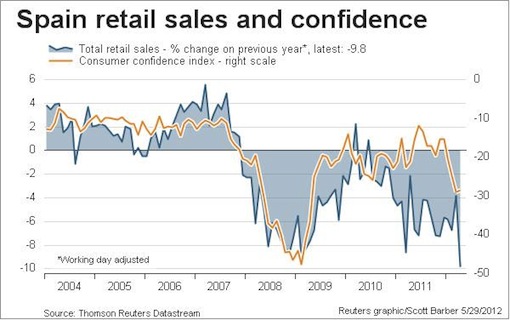
Spain has been the focus of the latest woes in Europe over the past few weeks. And, the key issue surrounding their banks is over lending into a property market that has fallen sharply. So, I thought the chart below best summed up their predicament.

GFC Confidence

In the lead up to the GFC, Spanish confidence was riding high and was directly correlated to retail spending, which is not dissimilar to where the USA was (and currently is).

But, after the property market tanked, so did confidence and with it went the desire to spend. With unemployment in Spain approaching 25% of the workforce, household spending is dropping which perpetuates a cycle of higher unemployment which in turn puts more pressure on the property market and the banks that lent into it

Assessment

The Spanish bank rally fizzled yesterday.

Link: http://money.msn.com/market-news/post.aspx?post=ee6e272d-7247-4e14-b33a-d8e82d337ffa

Not sure where this one will end. How about you?

Conclusion

Your thoughts and comments on this ME-P are appreciated. Feel free to review our top-left column, and top-right sidebar materials, links, URLs and related websites, too. Then, subscribe to the ME-P. It is fast, free and secure.

Link: http://feeds.feedburner.com/HealthcareFinancialsthePostForcxos

Speaker: If you need a moderator or speaker for an upcoming event, Dr. David E. Marcinko; MBA – Publisher-in-Chief of the Medical Executive-Post – is available for seminar or speaking engagements. Contact: MarcinkoAdvisors@msn.com

Our Other Print Books and Related Information Sources:

Health Dictionary Series: http://www.springerpub.com/Search/marcinko

Practice Management: http://www.springerpub.com/product/9780826105752

Physician Financial Planning: http://www.jbpub.com/catalog/0763745790

Medical Risk Management: http://www.jbpub.com/catalog/9780763733421

Hospitals: http://www.crcpress.com/product/isbn/9781439879900

Physician Advisors: www.CertifiedMedicalPlanner.org

Product DetailsProduct DetailsProduct Details

Product Details  Product Details

Euro Currency in the Cross Hairs? [Video]

Join Our Mailing List

How We Got There –  A Review for Physician Investors

By Jonathan Reyes

It’s been two decades since the dream of a unified Europe inched toward a reality. But, as crises have taken hold and bail-outs have become commonplace, how has the continent’s shared currency weathered the storms?

Video Link: http://www.infographicsarchive.com/economics/video-infographic-the-euro-in-the-crosshairs-how-we-got-here

Source: Video infographic made for Bloomberg TV.

Assessment

Important information for all medical professsionals and retail physician investors interested in emerging markets or international investing.

Conclusion

Your thoughts and comments on this ME-P are appreciated. Feel free to review our top-left column, and top-right sidebar materials, links, URLs and related websites, too. Then, subscribe to the ME-P. It is fast, free and secure.

Speaker: If you need a moderator or speaker for an upcoming event, Dr. David E. Marcinko; MBA – Publisher-in-Chief of the Medical Executive-Post – is available for seminar or speaking engagements. Contact: MarcinkoAdvisors@msn.com

OUR OTHER PRINT BOOKS AND RELATED INFORMATION SOURCES:


Product Details  Product Details

A Look at Some Famous IPOs [Including WebMD]

Join Our Mailing List

Where Are They Now?

Assessment

With all the FB hoopla recently, we thought it would be fun to look at some other famous IPOs.

Link: http://marketday.msnbc.msn.com/_news/2012/05/23/11830823-facebooks-dream-ipo-is-starting-to-look-like-a-nightmare?lite

Channel Surfing the ME-P

Have you visited our other topic channels? Established to facilitate idea exchange and link our community together, the value of these topics is dependent upon your input. Please take a minute to visit. And, to prevent that annoying spam, we ask that you register. It is fast, free and secure.

Conclusion

Your thoughts and comments on this ME-P are appreciated. Feel free to review our top-left column, and top-right sidebar materials, links, URLs and related websites, too. Then, subscribe to the ME-P. It is fast, free and secure.

Speaker: If you need a moderator or speaker for an upcoming event, Dr. David E. Marcinko; MBA – Publisher-in-Chief of the Medical Executive-Post – is available for seminar or speaking engagements. Contact: MarcinkoAdvisors@msn.com

OUR OTHER PRINT BOOKS AND RELATED INFORMATION SOURCES:

Product DetailsProduct DetailsProduct Details

Product Details  Product Details

Product Details

The Trouble with Stock Marketing Timing

Join Our Mailing List

Visual Statistics for ME-P Readers

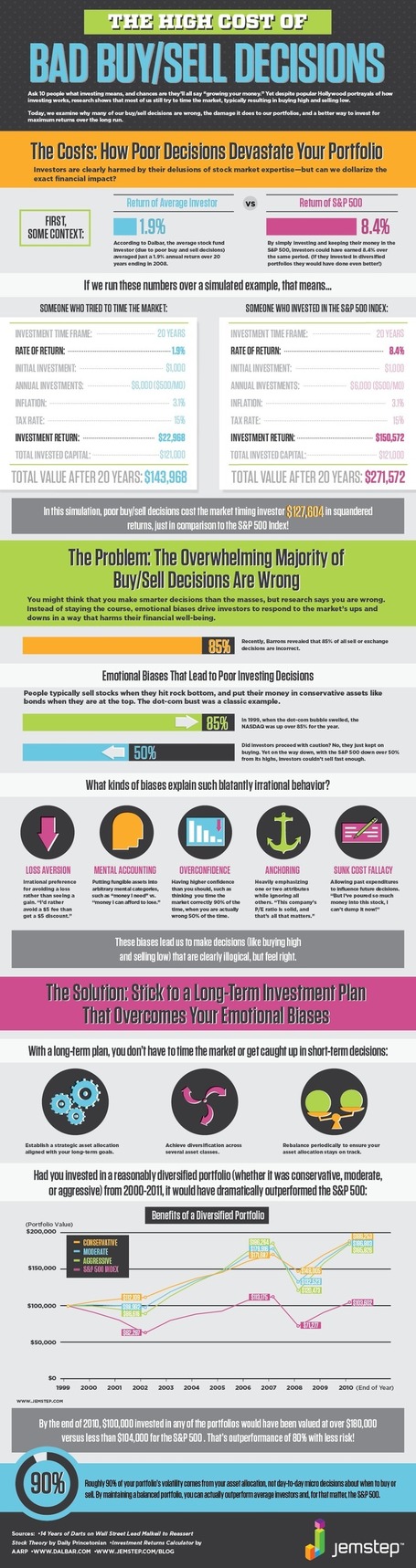
Here are some statistics on the perils of market timing presented in an infographic format, including the facts that:

  • Over 20 years, ending in 2008, the annual return of the S&P 500 in the U.S. was 8.4% compared to the Average Investor who received 1.9%;
  • This cost market timers around $127,000 over that period; and
  • 85% of sell decisions are wrong and are manly based on emotion.

Conclusion

Your thoughts and comments on this ME-P are appreciated. Feel free to review our top-left column, and top-right sidebar materials, links, URLs and related websites, too. Then, subscribe to the ME-P. It is fast, free and secure.

Link: http://feeds.feedburner.com/HealthcareFinancialsthePostForcxos

Speaker: If you need a moderator or speaker for an upcoming event, Dr. David E. Marcinko; MBA – Publisher-in-Chief of the Medical Executive-Post – is available for seminar or speaking engagements. Contact: MarcinkoAdvisors@msn.com

Our Other Print Books and Related Information Sources:

Health Dictionary Series: http://www.springerpub.com/Search/marcinko

Practice Management: http://www.springerpub.com/product/9780826105752

Physician Financial Planning: http://www.jbpub.com/catalog/0763745790

Medical Risk Management: http://www.jbpub.com/catalog/9780763733421

Hospitals: http://www.crcpress.com/product/isbn/9781439879900

Physician Advisors: www.CertifiedMedicalPlanner.org

Product Details  Product Details

The 20 Largest Private Companies in the US

Join Our Mailing List

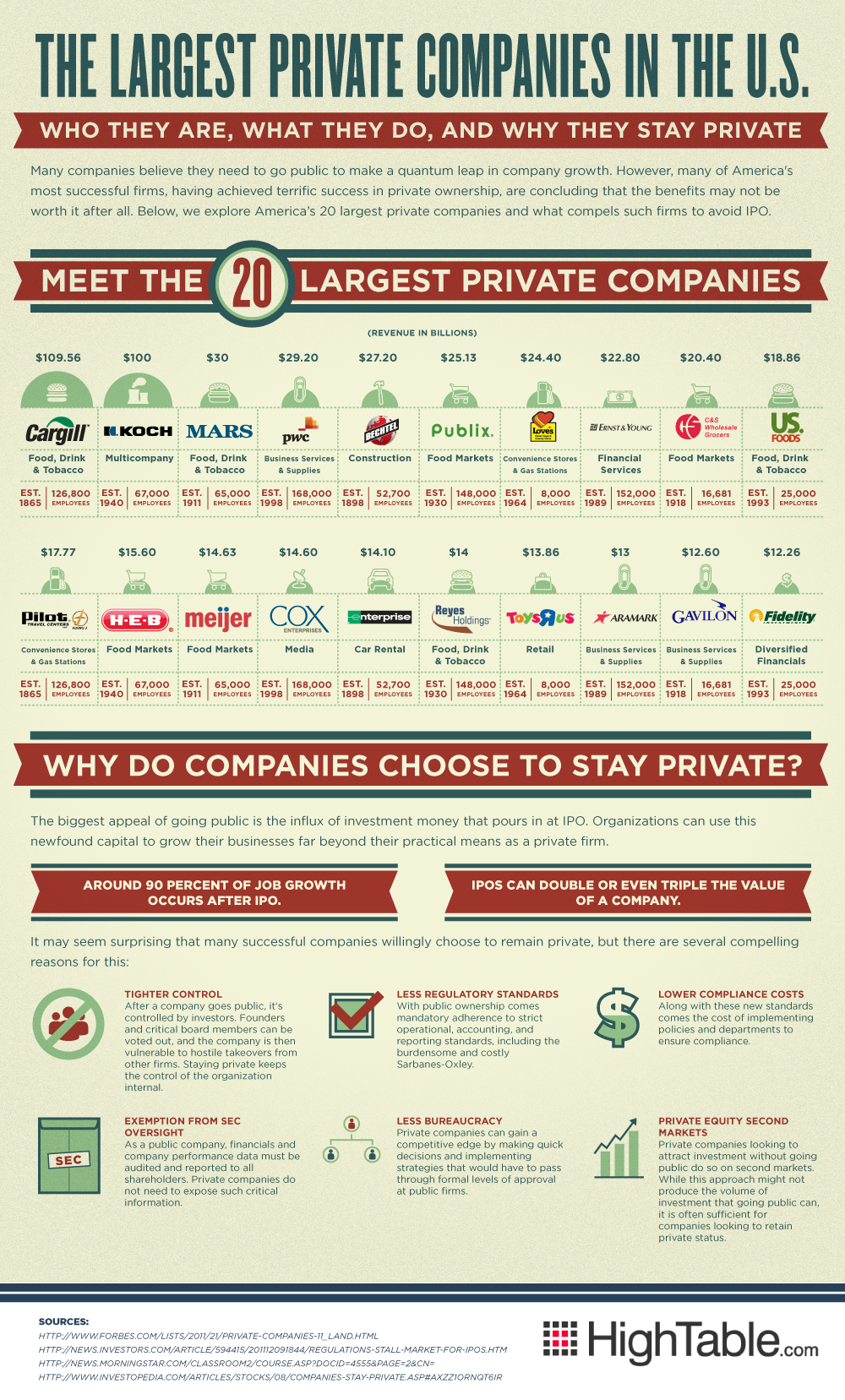
A look at the 20 largest private companies in the US

Interesting how many of them (8 of the 20) are in some way highly involved in food — Cargill, MARS, Publix, C&S Wholesale Grocers, US Foods, H-E-B, Meijer and Reyes Holdings.

And, although not grouped as such below, you could arguably add Love’s Travel Stops, Pilot Travel Centers and Aramark to that group – bringing it to 11 of the 20.

Assessment

Think any of these will go pubic; besides Facebook?

Conclusion

Your thoughts and comments on this ME-P are appreciated. Feel free to review our top-left column, and top-right sidebar materials, links, URLs and related websites, too. Then, subscribe to the ME-P. It is fast, free and secure.

Link: http://feeds.feedburner.com/HealthcareFinancialsthePostForcxos

Speaker: If you need a moderator or speaker for an upcoming event, Dr. David E. Marcinko; MBA – Publisher-in-Chief of the Medical Executive-Post – is available for seminar or speaking engagements. Contact: MarcinkoAdvisors@msn.com

Our Other Print Books and Related Information Sources:

Health Dictionary Series: http://www.springerpub.com/Search/marcinko

Practice Management: http://www.springerpub.com/product/9780826105752

Physician Financial Planning: http://www.jbpub.com/catalog/0763745790

Medical Risk Management: http://www.jbpub.com/catalog/9780763733421

Hospitals: http://www.crcpress.com/product/isbn/9781439879900

Physician Advisors: www.CertifiedMedicalPlanner.org

Product Details  Product Details

Doctors and the “Buffett Rule”

Join Our Mailing List

Once Earned – Twice Taxed

By Rick Kahler MS CFP® ChFC CCIM www.kahlerfinancial.com

The recent discussion of the “Buffett Rule” proposal to increase taxes on the wealthy [medical professionals and dividend seeking investors?] has focused attention on U. S. tax rates. It’s giving Americans a chance to better understand our tax policy and the economics of the free market system.

Mitt Romney, the probable Republican Presidential candidate, has come under attack from both Democrats and other Republican primary candidates for his high income and net worth and his low overall tax rate. The arguments are that Romney made his money by the wrong type of capitalism and that he pays too little in federal taxes.

A Tale of Two Tax Returns

The tax returns Romney has made public show most of his money comes from investment returns on his holdings rather than from wages or a salary. His overall tax rate in 2010 was 13.9% and his estimated rate for 2011 is 15.4%. This caused a predictable outcry that his tax rate is lower than the income tax bracket of many middle class Americans.

President Obama’s 2011 tax return shows a tax rate of just over 20%. Former Republican candidate Newt Gingrich paid 31% of his 2010 income in federal taxes.

Unfair Appearance

To the uninformed, these varying tax rates initially look unfair. What many people don’t understand is the big difference between “ordinary income” (from wages, a salary, short-term capital gains, and interest) and “passive income” (from stock dividends and long-term capital gains). The federal government taxes ordinary income at up to 35% and passive income at 15%.

Why the different rates?

First, let’s look at dividend income and long-term capital gains taxes on investments held over 12 months. Dividends come from corporations that must first pay income taxes on any profits. Long-term capital gains come from shares of a company purchased and held for more than 12 months.

Since the effective corporate rate is 39.2% (the top federal rate and the average state tax rate), the corporation has already paid taxes on all income, including what is paid out to investors as dividends. Prior to the Bush tax cuts in 2001, dividends were then additionally taxed at almost 40%. This meant every dollar of dividend income was taxed twice, once at the corporate level and again at the individual level. The result was that 60 cents out of every dollar of profit made by a company was paid to the federal government. The Bush tax cuts continued the practice of double taxation, but lowered the amount paid at the individual level to 15%.

The same double taxation applied to long-term capital gains, except that the tax rate was a flat 28% before the Bush tax cuts reduced it to 15%.

This double tax makes it seem that the wealthy pay less tax than they really do. An individual may pay 15% on passive income of, say, five million dollars. Yet corporations have already paid taxes of around 39.2% on that same income, for a total tax rate of 54.2%. Of the five million in profit, over two and a half million goes to Uncle Sam. That would seem to be more than a “fair share.”

Assessment

According to Congressional Budget Office figures from 2011, the top 1% of taxpayers pay an average of 29.5%, those in the percentiles from 81% to 99% pay 22.8%, those from 21% through 80% pay 15.1%, and the bottom 20% pay 4.7%. Those numbers, of course, don’t include the 49.5% of Americans who pay no federal income tax at all.

Even factoring in the different tax rates on ordinary and passive income, it’s clear that the more money Americans earn, the more tax they pay. What could be more fair than that?

Conclusion

Your thoughts and comments on this ME-P are appreciated. Feel free to review our top-left column, and top-right sidebar materials, links, URLs and related websites, too. Then, subscribe to the ME-P. It is fast, free and secure.

Link: http://feeds.feedburner.com/HealthcareFinancialsthePostForcxos

Speaker: If you need a moderator or speaker for an upcoming event, Dr. David E. Marcinko; MBA – Publisher-in-Chief of the Medical Executive-Post – is available for seminar or speaking engagements. Contact: MarcinkoAdvisors@msn.com

Our Other Print Books and Related Information Sources:

Health Dictionary Series: http://www.springerpub.com/Search/marcinko

Practice Management: http://www.springerpub.com/product/9780826105752

Physician Financial Planning: http://www.jbpub.com/catalog/0763745790

Medical Risk Management: http://www.jbpub.com/catalog/9780763733421

Hospitals: http://www.crcpress.com/product/isbn/9781439879900

Physician Advisors: www.CertifiedMedicalPlanner.org

Product Details  Product Details

Physician’s Update on Dividend-Paying Stocks

Join Our Mailing List

But Some Doctors Ask – Why All the Hype?

By David K. Luke MIM CMPcandidate [www.CertifiedMedicalPlanner.com]

www.NetWorthAdvice.com

In an effort to help the US economy recover, the Federal Reserve has lowered interest rates to historically low levels. Furthermore, the Fed has announced its intent to keep interest rates low until 2014. Classic income-producing investments such as savings accounts and certificates of deposit pay next to nothing.

Borrowing Good – Saving Bad!

Borrowers are being rewarded, but savers are being punished. Low interest rates may have spurred the economy somewhat, but they have been devastating for retired people who have a low tolerance for risk. Physicians, other investors and their advisors are turning toward alternatives that pay higher returns, but these vehicles necessarily carry more risk. Among these alternatives, some investors are considering the purchase of stocks that pay reliable dividends.

Assessment

But, is this an appropriate strategy for mature doctors and similar retirees? What are the potential benefits and drawbacks?

Conclusion

Your thoughts and comments on this ME-P are appreciated. Feel free to review our top-left column, and top-right sidebar materials, links, URLs and related websites, too. Then, subscribe to the ME-P. It is fast, free and secure.

Link: http://feeds.feedburner.com/HealthcareFinancialsthePostForcxos

Speaker: If you need a moderator or speaker for an upcoming event, Dr. David E. Marcinko; MBA – Publisher-in-Chief of the Medical Executive-Post – is available for seminar or speaking engagements. Contact: MarcinkoAdvisors@msn.com

OUR OTHER PRINT BOOKS AND RELATED INFORMATION SOURCES:

Product Details

Product Details  Product Details

Product Details

Physicians Taking Stock of the “Stock Act”

Join Our Mailing List 

A Side-by-Side Comparison

By Lena Groeger
ProPublica

The Stop Trading on Congressional Knowledge Act, or Stock Act, recently passed in both the House and Senate. The new law would make it easier for the SEC to prosecute federal officials from all three branches who trade equities like stocks based on nonpublic information they receive in the course of their duties.

The versions passed in each chamber are similar, but have notable distinctions that will have to be hashed out when legislators from the two chambers eventually meet.

Assessment

Here, we break down the main differences, with real-life scenarios that illustrate activities the bill targets

Full link: http://www.propublica.org/special/taking-stock-of-the-stock-act-a-side-by-side-comparison

Conclusion

And so, your thoughts and comments on this ME-P are appreciated. Please review our top-left column, and top-right sidebar materials, links, URLs and related websites, too. Then, subscribe to the ME-P. It is fast, free and secure.

Link: http://feeds.feedburner.com/HealthcareFinancialsthePostForcxos

Speaker: If you need a moderator or speaker for an upcoming event, Dr. David E. Marcinko; MBA – Publisher-in-Chief of the Medical Executive-Post – is available for seminar or speaking engagements. Contact: MarcinkoAdvisors@msn.com

Our Other Print Books and Related Information Sources:

Health Dictionary Series: http://www.springerpub.com/Search/marcinko

Practice Management: http://www.springerpub.com/product/9780826105752

Physician Financial Planning: http://www.jbpub.com/catalog/0763745790

Medical Risk Management: http://www.jbpub.com/catalog/9780763733421

Healthcare Organizations: www.HealthcareFinancials.com

Physician Advisors: www.CertifiedMedicalPlanner.com

Subscribe Now: Did you like this Medical Executive-Post, or find it helpful, interesting and informative? Want to get the latest ME-Ps delivered to your email box each morning? Just subscribe using the link below. You can unsubscribe at any time. Security is assured.

Link: http://feeds.feedburner.com/HealthcareFinancialsthePostForcxos

Sponsors Welcomed: And, credible sponsors and like-minded advertisers are always welcomed.

Link: https://healthcarefinancials.wordpress.com/2007/11/11/advertise

Product Details  Product Details

What Did You Do When the Stock Market was Down?

Join Our Mailing List 

Investing Hero or Zero … On Market Timing or NOT!

By Staff Reporters

Here at the ME-P, we believe we have some of the most intelligent and savvy readers in the blog-o-sphere. And – why not?

Most are physicians, nurses and medical specialist of all stripes. Others are CPAs, financial advisors and wealth managers. And, some are medical management and HIT consultants with PhDs and MBAs, etc. More than a few more even have dual and triple degrees and professional designations, like www.CertifiedMedicalPlanner.com

The Question

Accordingly, our friends over at The Finance Buff recently asked:

Q: Do you remember those days last summer when the Dow went down 400 points one day and then it went up 400 points the next day, before it went down another 400 points the following day?

Going Granular

Well – if you do – what did you, or your clients do about it? Did you invest more, stay put, bail out or something else? Go granular on us and your fellow ME-P readers, subscribers and lurkers.

Assessment

Please tell us who you are, what you did during the “flash-crash” a few years ago, or last summer’s mini-meltdown, and how it turned out in hindsight?

Conclusion

And so, your thoughts and comments on this ME-P are appreciated. Please review our top-left column, and top-right sidebar materials, links, URLs and related websites, too. Then, subscribe to the ME-P. It is fast, free and secure.

Link: http://feeds.feedburner.com/HealthcareFinancialsthePostForcxos

Speaker: If you need a moderator or speaker for an upcoming event, Dr. David E. Marcinko; MBA – Publisher-in-Chief of the Medical Executive-Post – is available for seminar or speaking engagements. Contact: MarcinkoAdvisors@msn.com

Our Other Print Books and Related Information Sources:

Health Dictionary Series: http://www.springerpub.com/Search/marcinko

Practice Management: http://www.springerpub.com/product/9780826105752

Physician Financial Planning: http://www.jbpub.com/catalog/0763745790

Medical Risk Management: http://www.jbpub.com/catalog/9780763733421

Healthcare Organizations: www.HealthcareFinancials.com

Physician Advisors: www.CertifiedMedicalPlanner.com

Subscribe Now: Did you like this Medical Executive-Post, or find it helpful, interesting and informative? Want to get the latest ME-Ps delivered to your email box each morning? Just subscribe using the link below. You can unsubscribe at any time. Security is assured.

Link: http://feeds.feedburner.com/HealthcareFinancialsthePostForcxos

Sponsors Welcomed: And, credible sponsors and like-minded advertisers are always welcomed.

Link: https://healthcarefinancials.wordpress.com/2007/11/11/advertise

Product Details  Product Details

PIMCO Interviews Somnath Basu PhD MBA on Retirement Planning

Join Our Mailing List 

A “Worried Sick” Encore Presentation

By Staff Reporters

Retirement is one of the most important life events many of us will ever experience; for doctor, nurse, FA, consultant or layman alike.

From both a personal and financial perspective, realizing a comfortable retirement is an incredibly extensive process that takes sensible planning and years of persistence. Even once reached, managing your retirement is an ongoing responsibility that carries well into one’s golden years.  While all of us would like to retire comfortably, the complexity and time required in building a successful retirement plan can make the whole process seem nothing short of daunting.

However, it can often be done with fewer headaches (and financial pain) than you might think – all it takes is a little homework, an attainable savings and investment plan, and a long-term commitment.

And so, in this encore presentation, Dr. Basu breaks down the process needed to plan, implement, execute and ultimately enjoy a comfortable retirement.

Assessment

During this DC Dialogue of late 2010, PIMCO talked with Dr. Somnath Basu, professor and Director of the California Institute of Finance at California Lutheran University,  and ME-P “thought leader”, on retirement planning issues of concern to us all

Link: http://www.agebander.com/pdf/DCD048-080310_SomnathBasu_FINAL-1.pdf

Conclusion

Your thoughts and comments on this ME-P are appreciated. Feel free to review our top-left column, and top-right sidebar materials, links, URLs and related websites, too. Then, subscribe to the ME-P. It is fast, free and secure.

Link: http://feeds.feedburner.com/HealthcareFinancialsthePostForcxos

Speaker: If you need a moderator or speaker for an upcoming event, Dr. David E. Marcinko; MBA – Publisher-in-Chief of the Medical Executive-Post – is available for seminar or speaking engagements. Contact: MarcinkoAdvisors@msn.com

OUR OTHER PRINT BOOKS AND RELATED INFORMATION SOURCES:

Product Details  Product Details

The “Collective Trust” – A New Financial Product?

Join Our Mailing List 

Much Like a Mutal Fund – But Less Transparent

By Staff Reporters

Recently, we received this query from a physician-investor. So, we went right to the innovator of this financial product for the answer.

A collective trust is similar to a mutual fund that only sells to institutional investors like 401-k and 403-b plans. Because a collective trust doesn’t take on retail investors, it’s exempt from some regulatory requirements, so beware!

But, not having to deal with retail investors also makes the costs lower.

Link: http://thefinancebuff.com/collective-trust-vs-mutual-fund-whats-the-difference.html

Assessment

The BlackRock EAFE Equity Index Collective Trust invests in stocks in developed countries, tracking the MSCI EAFE index.

Conclusion

And so, your thoughts and comments on this ME-P are appreciated. Please review our top-left column, and top-right sidebar materials, links, URLs and related websites, too. Then, subscribe to the ME-P. It is fast, free and secure.

Link: http://feeds.feedburner.com/HealthcareFinancialsthePostForcxos

Speaker: If you need a moderator or speaker for an upcoming event, Dr. David E. Marcinko; MBA – Publisher-in-Chief of the Medical Executive-Post – is available for seminar or speaking engagements. Contact: MarcinkoAdvisors@msn.com

Our Other Print Books and Related Information Sources:

Health Dictionary Series: http://www.springerpub.com/Search/marcinko

Practice Management: http://www.springerpub.com/product/9780826105752

Physician Financial Planning: http://www.jbpub.com/catalog/0763745790

Medical Risk Management: http://www.jbpub.com/catalog/9780763733421

Healthcare Organizations: www.HealthcareFinancials.com

Physician Advisors: www.CertifiedMedicalPlanner.com

Subscribe Now: Did you like this Medical Executive-Post, or find it helpful, interesting and informative? Want to get the latest ME-Ps delivered to your email box each morning? Just subscribe using the link below. You can unsubscribe at any time. Security is assured.

Link: http://feeds.feedburner.com/HealthcareFinancialsthePostForcxos

Sponsors Welcomed: And, credible sponsors and like-minded advertisers are always welcomed.

Link: https://healthcarefinancials.wordpress.com/2007/11/11/advertise

Product Details

For Financial Success – Doctors Must Outsmart their Brains

Join Our Mailing List

On Behavioral Economics 101

By Rick Kahler CFP® MS ChFC CCIM http://www.kahlerfinancial.com

By Dr. David Edward Marcinko MBA http://www.CertifiedMedicalPlanner.org

How’s this for a convincing excuse not to save for retirement? “I can’t help it. The human brain is programmed for financial failure.”

Why?

Emotional Decisions

An estimated 80 percent of our decisions are made emotionally. As all doctors are aware, our brain is divided into three sections. The upper brain, or cerebral cortex, is where we reason. The middle brain, or limbic system, is where we react to emotional impulse. The lower brain – basal ganglia – is what regulates the operations of the body.

Limbic System

The limbic system, where our emotions reside, functions to move us toward pleasure or away from danger. Feelings like fear or anger can cause us to move away from a perceived danger, while feelings of joy or pleasure can impel us toward a perceived benefit or reward. This aspect of our brain serves us very well when it comes to physical danger or life-enhancing decisions like choosing a mate. It isn’t quite so much help when we need to make financial decisions.

The Scenario

Suppose you and your spouse are talking about spending $5,000 on a trip to the Bahamas. Your middle brain lights up. It sees you sitting on a beach, it feels the light breeze twirling your hair, it hears the sound of the waves rolling onto the sand, and it can practically taste the Piña Colada you’re sipping.

Now, suppose you’re discussing putting that $5,000 into an IRA instead. What does your limbic system see, hear, feel, or smell? You writing a check? A brokerage statement? There’s no particular pleasure response for your emotional brain to get excited about. No wonder it’s going to urge you away from the IRA and toward the trip to the Bahamas.

Decision Making

When we’re faced with decisions, the option with the greatest emotional payoff tends to win. This is how our brains are wired to make financial decisions in favor of our short-term pleasure rather than the delayed gratification that is in our long-term best interest.

The secret to overcoming that self-defeating programming is to give our limbic system something to get excited about that supports saving for the future. Successful savers and physicians and all investors learn to link emotional rewards to their financial goals.

On Choices Revisited

Let’s take another look at the choice between an immediate tropical vacation and putting money into an IRA. Someone committed to investing for the future may imagine the same tempting beach scene. What they do, however, is see it happening once a year, or even every day—in the future. They imagine themselves enjoying that beach as one of the rewards of saving for their financial independence.

It’s also possible to trick the limbic system with negative images. Another saver might vividly imagine her-self as a bag lady, living out of garbage cans and sleeping on park benches, if she doesn’t write that check to her IRA. This isn’t nearly as much fun as imagining situations that reward investing, but it has the same effect of adding emotional impact to a financial decision.

In either case, the goal is to create an emotional charge from imagining the IRA contribution that is stronger than the image of spending the money today. The scene with the greatest emotional impact wins.

This is one reason it’s important for us to spend some time defining our life aspirations. Having clear images of what we want in the future makes it easier to imagine ourselves there. It helps us link strong emotional rewards to mundane activities like writing a check to an IRA.

Assessment

The human brain may be programmed for financial failure, but we have the ability to change that programming. With a little effort, we can rewire our brains for financial success.

Conclusion

And so, your thoughts and comments on this ME-P are appreciated. Please review our top-left column, and top-right sidebar materials, links, URLs and related websites, too. Then, subscribe to the ME-P. It is fast, free and secure.

Link: http://feeds.feedburner.com/HealthcareFinancialsthePostForcxos

Speaker: If you need a moderator or speaker for an upcoming event, Dr. David E. Marcinko; MBA – Publisher-in-Chief of the Medical Executive-Post – is available for seminar or speaking engagements. Contact: MarcinkoAdvisors@msn.com

Our Other Print Books and Related Information Sources:

Subscribe Now: Did you like this Medical Executive-Post, or find it helpful, interesting and informative? Want to get the latest ME-Ps delivered to your email box each morning? Just subscribe using the link below. You can unsubscribe at any time. Security is assured.

Link: http://feeds.feedburner.com/HealthcareFinancialsthePostForcxos

Sponsors Welcomed: And, credible sponsors and like-minded advertisers are always welcomed.

Link: https://healthcarefinancials.wordpress.com/2007/11/11/advertise

Product Details  Product Details

Is Malta a Hedge Fund Haven?

Join Our Mailing List 

Island in the Mediterranean Sea – South of Sicily (Italy)

By Dr. David Edward Marcinko MBA CMP

[Editor-in-Chief]

OK; I’ve written about hedge funds before, on this ME-P and in our www.MedicalBusinessAdvisors.com print publications for various textbooks, handbooks, white papers and journal. And, we discuss the concept in our online educational www.CertifiedMedicalPlanner.org program, as well. Some medical professionals love them, and some financial advisors use them in their work; others do not.

Of course, I’ve written frequently about my colleague – the now retired and newly anointed philanthropist  and uber-hedge fund manager Mike Burry MD; ad nauseam.

Link: https://medicalexecutivepost.com/2010/03/24/video-on-hedge-fund-manager-michael-burry-md/

But, now there is a new wrinkle on the island that I first visited about ten years ago, while on a working vacation

Rising Visibility

Malta–yes, Malta–has quietly leveraged the rising transparency imperative to attract hedge funds. There was a time when the quaint island sought to play on the traditional terrain, offering anonymity and a “laissez-faire regulatory regime,” not to mention very low taxes, as in no capital gains taxes and no taxes on dividends; all while English speaking and USD currency denominated.

Maybe back then, no more today, if this essay is to be believed.

Link: http://www.bloomberg.com/news/2012-01-05/malta-lures-connecticut-hedge-funds-with-300-days-of-sun-aided-by-eu-rules.html

Image 1

Why Malta?

Link: http://www.firstgozo.com/maltafacts.htm

Malta

Assessment

While many leading domiciles for offshore hedge funds remain in the Caribbean–notably the Cayman Islands, the British Virgin Islands, Bermuda, and the Bahamas–the island of Mata is drawing attention, especially from European funds.

Conclusion

Your thoughts and comments on this ME-P are appreciated. Feel free to review our top-left column, and top-right sidebar materials, links, URLs and related websites, too. Then, subscribe to the ME-P. It is fast, free and secure.

Link: http://feeds.feedburner.com/HealthcareFinancialsthePostForcxos

Speaker: If you need a moderator or speaker for an upcoming event, Dr. David E. Marcinko; MBA – Publisher-in-Chief of the Medical Executive-Post – is available for seminar or speaking engagements. Contact: MarcinkoAdvisors@msn.com

OUR OTHER PRINT BOOKS AND RELATED INFORMATION SOURCES:

DICTIONARIES: http://www.springerpub.com/Search/marcinko
PHYSICIANS: www.MedicalBusinessAdvisors.com
PRACTICES: www.BusinessofMedicalPractice.com
HOSPITALS: http://www.crcpress.com/product/isbn/9781466558731
CLINICS: http://www.crcpress.com/product/isbn/9781439879900
BLOG: www.MedicalExecutivePost.com
FINANCE: Financial Planning for Physicians and Advisors
INSURANCE: Risk Management and Insurance Strategies for Physicians and Advisors

Product Details  Product Details

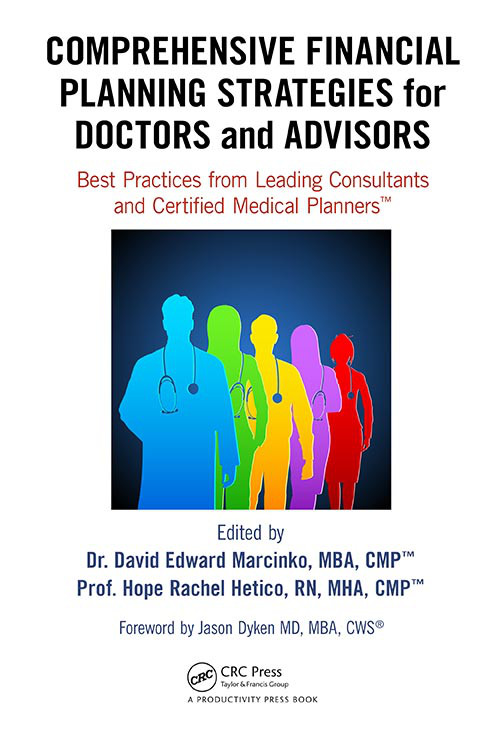
Comprehensive Financial Planning Strategies for Doctors and Advisors: Best Practices from Leading Consultants and Certified Medical Planners™

On “Financial Planning for Physicians AND their Advisors”

Self-Directed IRAs for Medical Professionals

Join Our Mailing List

Eschewing Limited Investment Choices

[By Rick Kahler CFP® MS ChFC CCIM]

Most people, and medical professionals, with Individual Retirement Accounts [IRAs] open them with a bank or brokerage firm (the custodian) that limits what investments can go into the account. These custodians typically limit your investments to stocks, bonds and mutual funds with firms where they have distribution agreements.

The Self-Directed IRA

A little-known option that allows owners of an IRA to have unlimited control of the investments they can hold is the self-directed IRA. Assets permitted in self-directed IRAs include real estate, promissory notes, mortgages, tax lien certificates, US gold coins, and private placement securities.

For example, I have clients who use self-directed IRAs to hold promissory notes, mortgages, and contracts for deed. The IRA acts like a bank by making a loan (secured by real estate) to a non-related party. They can often earn 5% to 10% returns. Of course, there is also a significant risk of having to foreclose on the loan and losing a portion of the investment.

But, before you jump into a self-directed IRA, you need to do some homework. When you make an investment in a self-directed account, you are on your own. The custodian does little more than be sure your documents are in order. It’s up to you to do your own due diligence on the merits of the investment.

Beware the Unscrupulous Promoters

Self-directed IRAs are proving to be such a magnet for unscrupulous promoters of dubious investment schemes that the SEC has issued an investor alert warning owners against fraudulent promoters. The best advice is the old axiom, “if it sounds too good to be true, it probably is.”

Tips and Pearls

That said; Ed Slot, publisher of the IRA Advisor, has some tips for self-directed IRA owners:

  • Be sure the investment is allowed in an IRA. Life insurance, collectables, numismatic coins, and S-corporation stock are not allowed.
  • Don’t partner with or purchase anything from a “disqualified person,”—a spouse, child, grandchild, or someone acting in a fiduciary role for the IRA.
  • If you sell real estate held in a traditional IRA, gains will be taxed at ordinary income rates when the proceeds come out of the IRA instead of as long-term capital gains. Gains on real estate held in Roth IRAs, however, come out tax-free.
  • Don’t think putting your business into an IRA could allow profits to grow tax-free. The Unrelated Business Income Tax is levied on a business owned by a tax-exempt entity like an IRA.
  • The IRS prohibits a “disqualified person” from running or occupying any business or investment owned by your IRA. You or your extended family cannot farm land owned by your IRA. You cannot occupy, even for a day, a property owned by your IRA. Doing so nullifies your IRA and makes it completely taxable.
  • Investment real estate in an IRA might be best owned free and clear of any financing. The Unrelated Debt-Financed Income tax applies to mortgage loans. Also, personally guaranteeing a loan is a prohibited transaction that nullifies your IRA.
  • You must value the assets of the IRA annually. This is a no-brainer for stocks, bonds, and mutual funds, but for real estate it may mean paying for costly annual appraisals.
  • Real estate owned in an IRA must generate enough cash flow to pay all its expenses. Writing a personal check for repairs or loaning money to the IRA are prohibited transactions that make the IRA fully taxable.
  • Holding illiquid investments in a self-directed IRA poses a problem when you reach 70½ and must begin taking distributions.

Assessment

Self-directed IRAs can be a great tool to bolster retirement income, when used properly. Just be sure you consider all the pitfalls before taking the plunge.

Channel Surfing the ME-P

Have you visited our other topic channels? Established to facilitate idea exchange and link our community together, the value of these topics is dependent upon your input. Please take a minute to visit. And, to prevent that annoying spam, we ask that you register. It is fast, free and secure.

Conclusion

Your thoughts and comments on this ME-P are appreciated. Feel free to review our top-left column, and top-right sidebar materials, links, URLs and related websites, too. Then, subscribe to the ME-P. It is fast, free and secure.

Speaker: If you need a moderator or speaker for an upcoming event, Dr. David E. Marcinko; MBA – Publisher-in-Chief of the Medical Executive-Post – is available for seminar or speaking engagements. Contact: MarcinkoAdvisors@msn.com

OUR OTHER PRINT BOOKS AND RELATED INFORMATION SOURCES:

Product Details  Product Details

Financial Planning for Physicians

A Handbook for Doctors and their Financial Advisors

ADVERTISEMENT

Financial Planning Handbook for Physicians and Advisors

Book Review and Summary

Financial Planning for Physicians and Advisors describes a personal financial planning program to help doctors avoid the perils of harsh economic sacrifice.

It outlines how to select a knowledgeable financial advisor and develop a comprehensive personal financial plan, and includes important sections on: insurance and risk management, asset diversification and modern portfolio construction, income tax and retirement planning, and medical practice succession and estate planning, etc.

When fully implemented with a professional’s assistance, this book will help physicians and their financial advisors develop an effective long-term financial plan.

Order now: http://www.jblearning.com/catalog/0763745790/

Speaker: If you need a moderator or speaker for an upcoming event, Dr. David E. Marcinko; MBA – Publisher-in-Chief of the Medical Executive-Post – is available for seminar or speaking engagements. Contact: MarcinkoAdvisors@msn.com

###

Are Physicians Really Going Broke?

Am I Prescient, Lucky or Just an Observant Trend Reporter?

By Dr. David Edward Marcinko MBA CMP™

[Publisher-in-Chief]

A few years ago I was involved in a Physician’s Money Digest report that showed the average physician reader (ie, 47 years old and $184,000 in annual income) would need about $5.5 million to retire. This was in 2007-08, right before the infamous financial “meltdown”.

Lifestyle Preservation

Now, that’s if they planned to have the same lifestyle after retirement as in the years just prior to retirement. In other words, to live on 80% of pre-retirement income, my doctor colleagues would need about $4.4 million. Although that isn’t exactly loose change, the average PMD reader at the time, had a head start, with a net worth of $1.1 million. By maxing out on retirement plans, we reckoned the average reader could be in shouting distance of the goal by age 65.

Although the figures were daunting, they were a wakeup call to the fact these doctors, now age 52-53, still needed to save more aggressively to be able to finance the retirement they were working toward. But since then, their home worth and practice value, savings, investment and retirement accounts are probably down in 2012; as is their net worth. Down –  and I mean way down!

Link: http://www.physiciansmoneydigest.com/issues/2005/92/3951

Fast Forward to 2012

Today, some pundits posit that doctors in America are harboring an embarrassing secret: Many of them are going broke. This quiet trend and seeming reality, which is spreading nationwide, is claiming a wide range of casualties including family physicians, cardiologists and oncologists. Sadly, it is a trend that I have professionally observed and personally seen.

Link: http://money.cnn.com/2012/01/05/smallbusiness/doctors_broke/

Doctors list shrinking insurance reimbursements, changing regulations, rising business and drug costs among the factors preventing them from keeping their practices afloat. And, no doubt, these are all true reasons – in part. But, some experts counter that doctors’ lack of business acumen is also to blame.

So, that’s why we started our physician focused financial planning firm www.MedicalBusinessAdvisors.com  –  and – our online educational program for their managerial consultants and financial advisors www.CertifiedMedicalPlanner.com These firms were conceived and launched more than a decade ago; to much derision and haughtiness at the time. Not some much today, however! Why?

Assessment

A decade ago, Forbes magazine ran an article about doctors making six figure salaries and still wanting a medical union to bargain collectively.  This was a bit difficult for the average man or woman in the street to imagine about such learned professionals, formerly considered affluent and a cut above the rest. So, where is medical union clout today? Where is MD salary clout? And, where is physician net worth now – and in the future?  Doctor – what’s in your wallet?

Conclusion           

And so, your thoughts and comments on this ME-P are appreciated. Are doctors really going broke? Are they OWS…ers? Was I prescient, lucky or just an observant reporter of this trend, early on? Please review our top-left column, and top-right sidebar materials, links, URLs and related websites, too. Then, subscribe to the ME-P. It is fast, free and secure.

Link: http://feeds.feedburner.com/HealthcareFinancialsthePostForcxos

Speaker: If you need a moderator or speaker for an upcoming event, Dr. David E. Marcinko; MBA – Publisher-in-Chief of the Medical Executive-Post – is available for seminar or speaking engagements. Contact: MarcinkoAdvisors@msn.com

Our Other Print Books and Related Information Sources:

Health Dictionary Series: http://www.springerpub.com/Search/marcinko

Practice Management: http://www.springerpub.com/product/9780826105752

Physician Financial Planning: http://www.jbpub.com/catalog/0763745790

Medical Risk Management: http://www.jbpub.com/catalog/9780763733421

Healthcare Organizations: www.HealthcareFinancials.com

Physician Advisors: www.CertifiedMedicalPlanner.com

Subscribe Now: Did you like this Medical Executive-Post, or find it helpful, interesting and informative? Want to get the latest ME-Ps delivered to your email box each morning? Just subscribe using the link below. You can unsubscribe at any time. Security is assured.

Link: http://feeds.feedburner.com/HealthcareFinancialsthePostForcxos

Sponsors Welcomed: And, credible sponsors and like-minded advertisers are always welcomed.

Link: https://healthcarefinancials.wordpress.com/2007/11/11/advertise

Product DetailsProduct DetailsProduct Details

Product Details  Product Details

Product Details

What is a Stock?

About Fractional Company Ownership

Join Our Mailing List

This inforgraphic explains what stock ownership is.

To make investment choices that ultimately pay off, you need to start by knowing the fundamentals. It’s a step many medical investor wannabes skip, since … well, studying the basic terms and trends are not exactly entertaining. See elsewhere on this ME.P.

Conclusion 

And so, your thoughts and comments on this ME-P are appreciated. Please review our top-left column, and top-right sidebar materials, links, URLs and related websites, too. Then, subscribe to the ME-P. It is fast, free and secure.

Link: http://feeds.feedburner.com/HealthcareFinancialsthePostForcxos

Speaker: If you need a moderator or speaker for an upcoming event, Dr. David E. Marcinko; MBA – Publisher-in-Chief of the Medical Executive-Post – is available for seminar or speaking engagements. Contact: MarcinkoAdvisors@msn.com

Our Other Print Books and Related Information Sources:

Health Dictionary Series: http://www.springerpub.com/Search/marcinko

Practice Management: http://www.springerpub.com/product/9780826105752

Physician Financial Planning: http://www.jbpub.com/catalog/0763745790

Medical Risk Management: http://www.jbpub.com/catalog/9780763733421

Healthcare Organizations: www.HealthcareFinancials.com

Physician Advisors: www.CertifiedMedicalPlanner.com

Subscribe Now: Did you like this Medical Executive-Post, or find it helpful, interesting and informative? Want to get the latest ME-Ps delivered to your email box each morning? Just subscribe using the link below. You can unsubscribe at any time. Security is assured.

Link: http://feeds.feedburner.com/HealthcareFinancialsthePostForcxos

Sponsors Welcomed: And, credible sponsors and like-minded advertisers are always welcomed.

Link: https://healthcarefinancials.wordpress.com/2007/11/11/advertise


Product Details  Product Details

About our Money

Interesting Facts on the USD

Join Our Mailing List

Conclusion      

And so, your thoughts and comments on this ME-P are appreciated. Please review our top-left column, and top-right sidebar materials, links, URLs and related websites, too. Then, subscribe to the ME-P. It is fast, free and secure.

Link: http://feeds.feedburner.com/HealthcareFinancialsthePostForcxos

Speaker: If you need a moderator or speaker for an upcoming event, Dr. David E. Marcinko; MBA – Publisher-in-Chief of the Medical Executive-Post – is available for seminar or speaking engagements. Contact: MarcinkoAdvisors@msn.com

Our Other Print Books and Related Information Sources:

Health Dictionary Series: http://www.springerpub.com/Search/marcinko

Practice Management: http://www.springerpub.com/product/9780826105752

Physician Financial Planning: http://www.jbpub.com/catalog/0763745790

Medical Risk Management: http://www.jbpub.com/catalog/9780763733421

Healthcare Organizations: www.HealthcareFinancials.com

Physician Advisors: www.CertifiedMedicalPlanner.com

Subscribe Now: Did you like this Medical Executive-Post, or find it helpful, interesting and informative? Want to get the latest ME-Ps delivered to your email box each morning? Just subscribe using the link below. You can unsubscribe at any time. Security is assured.

Link: http://feeds.feedburner.com/HealthcareFinancialsthePostForcxos

Sponsors Welcomed: And, credible sponsors and like-minded advertisers are always welcomed.

Link: https://healthcarefinancials.wordpress.com/2007/11/11/advertise


Product Details  Product Details

The One-Woman Physician Investors Should Not Trust

Join Our Mailing List

Why We Should “Run” from the SEC’s Mary Schapiro

By Dr. David Edward Marcinko MBA CMP™

[Publisher-in-Chief]

OK, I’ve opined about fiduciary accountability for stock brokers, FAs and FPs – as well as Mary Schapiro [Chairman of the SEC] before – on this ME-P. And usually, in not so glowing terms!

But now, Mary really chaps my ethical and linguistic sensibilities.

Why I’m So P…… Off!

According to Bloomberg, and Advisor One [a financial services industry trade magazine], the chairwoman is considering something called the “business model neutral” rule that retains proprietary financial products, and brokerage sales commissions.

This concept of ‘business neutral’ is the one sought by many in the brokerage and insurance industry in order to redefine the term ‘fiduciary’ as an enhanced form of ‘suitability’ with opt-out provisions.

But, it is not sought by me, and should not be accepted by physicians.

Definitions

Suitability Rule – According to the Free Dictionary:

A stated or implied requirement by a regulatory body that a broker or investment adviser must reasonably believe that a certain investment decision will benefit a client before making a recommendation to him/her. That is, the broker or investment adviser must act in good faith, and may not knowingly recommend bad investments. Different regulators and self-regulating organizations incorporate suitable rules in different places in their bylaws. Two commonly referenced suitability rules are Rule 2310 for the Financial Industry Regulatory Authority and Rule 405 for the NYSE. See also: Due diligence, Prudent-person rule, Twisting.

Fiduciary Rule – According to the Free Dictionary:

A uniform standard for financial advisors that requires them to put retail customer interests ahead of their own financial interests.

This is clearly a higher duty [level of care] than suitability. Insurance agents, stock brokers, BDs and most “financial advisors” hate it.

Link: http://www.advisorone.com/2011/12/09/reaction-to-schapiro-comments-on-fiduciary-rule-ar?ref=hp

“Suitability on Steroids”

Some pundits suggest we think of this new “business model neutral” rule as “suitability on steroids.”

However, as most of us in medicine know, steroids are not a panacea and are typically used as a quick fix for short term gain, only.

Otherwise, the excessive use of anabolic steroids is bad for our physical health. Just like Mary Schapiro is bad for our fiscal health. But, a Certified Medical Planner™ is a fiduciary at all times http://www.CertifiedMedicalPlanner.org

More: Enter the CMPs

Assessment       

And so, your thoughts and comments on this ME-P are appreciated. I was an insurance agent and certified financial planner for almost 15 years [Series 7, 63 and 65] before I resigned all – in disgust over the fiduciary flap.

Doctors are fiduciaries. I am a fiduciary, a doctor, and a financial advisor. Shouldn’t all physician-investors demand same from their own financial advisors [NASD-FINRA, RIAs, RIA-Reps]?

But hey – I’m just a medical provider.

Conclusion

Your thoughts and comments on this ME-P are appreciated. Feel free to review our top-left column, and top-right sidebar materials, links, URLs and related websites, too. Then, subscribe to the ME-P. It is fast, free and secure.

Speaker: If you need a moderator or speaker for an upcoming event, Dr. David E. Marcinko; MBA – Publisher-in-Chief of the Medical Executive-Post – is available for seminar or speaking engagements. Contact: MarcinkoAdvisors@msn.com

OUR OTHER PRINT BOOKS AND RELATED INFORMATION SOURCES:

Product DetailsProduct DetailsProduct Details

Financial Planning MDs 2015

Comprehensive Financial Planning Strategies for Doctors and Advisors: Best Practices from Leading Consultants

Front Matter with Foreword by Jason Dyken MD MBA

[BY DOCTORS – FOR DOCTORS – PEER REVIEWED – NICHE FOCUSED]

***

Investing Behaviors That Leave Money on the Table

Are Physicians Guilty, Too?

By Rick Kahler, CFP®, MS, ChFC, CCIM

If you had half a million dollars for your retirement fund, and invested it in mutual funds, chances are you would leave $25,000 a year of potential income on the table. Over 20 years, that underperformance could cost you over $1,000,000 when you include reinvestment.

The Dalbar Study

This conclusion is based on a recent study by Dalbar, Inc. It found that mutual fund investors (individuals and investment advisors) consistently earn below-average rates of return. This group’s average annual rate of return for 20 years underperformed the average by over 5%.

The Results

The study concluded most of this underperformance has little to do with sound investment strategy and everything to do with psychological factors. It outlined several behaviors that contribute to poor investment decisions such as badly-timed buying and selling.

Lack of Diversification – Many investors try to reduce risk through diversification, but very few do it properly. They try to diversify by having several advisors, many brokerage companies, or different mutual funds. Using these strategies creates a false sense of security that one’s portfolio is diversified. Real diversification is having investments in many different asset classes, i.e., stocks, bonds, real estate, cash, commodities, absolute return, and international equivalents.

Anchoring – This is relating something to a familiar experience that isn’t necessarily true. For example, a financial salesperson may compare investing in an equity mutual fund to growing a tomato plant. You put in a little seed and watch your plant grow and grow, until one day you have a bushel basket of luscious tomatoes. It’s an appealing image, but it sets an unrealistic expectation of an equity mutual fund. Neither stocks nor tomato plants grow that steadily. Some don’t grow at all. Others grow overnight and then die just as suddenly. Some get wiped out by hail. And some thrive.

Media Reporting – Reacting to the financial news without a more in-depth examination can ruin the most sound investment strategy. Very few financial reporters have degrees in economics or finance. Most financial reporting is faddish, trendy, sensational, and shallow. Research suggests investors who shun or limit their intake of financial news do better than those who don’t.

Herding – This is the concept that the herd knows best. Few people want to be going east when the whole herd is heading west. This is especially true when the herd is panicking: selling out of fear that their investments are going to nothing or buying out of fear of being left behind. The most successful investors avoid stampedes.

Loss Aversion – This is placing more emphasis on avoiding loss than on the possibility of gain. It results in investors wanting their cake and eating it too by searching for an investment with a high return and low or no risk. Such investments don’t exist. When they discover this, many investors don’t invest at all. Others go into an investment expecting it won’t go down, then sell out at precisely the wrong time when it does.

Delusion – This is an attitude that “bad things only happen to others, but not me.” A deluded investor is one who holds onto an investment even when it’s apparent that it’s never coming back.

Narrow Framing – This is making a quick decision without gathering or being aware of all the facts and considering the implications. Usually, the investor doesn’t uncover “the rest of the story” until it’s too late and the financial damage is done.

Assessment

And so, are you guilty of any of the above investing behaviors? No one – not even doctors and medical professionals – wants to leave a sizeable amount of potential retirement income on the table. 

The best tool for getting more of that income into your pocket isn’t necessarily studying investment philosophy. It may be more important to learn more about your own behavior.

The Author

Rick Kahler, Certified Financial Planner®, MS, ChFC, CCIM, is the founder and president of Kahler Financial Group in Rapid City, South Dakota. In 2009 his firm was named by Wealth Manager as the largest financial planning firm in a seven-state area. A pioneer in the evolution of integrating financial psychology with traditional financial planning profession, Rick is a co-founder of the five-day intensive Healing Money Issues Workshop offered by Onsite Workshops of Nashville, Tennessee. He is one of only a handful of planners nationwide who partner with professional coaches and financial therapists to deliver financial coaching and therapy to his clients. Learn more at KahlerFinancial.com

Conclusion      

And so, your thoughts and comments on this ME-P are appreciated. Feel free to review our top-left column, and top-right sidebar materials, links, URLs and related websites, too. Then, subscribe to the ME-P. It is fast, free and secure.

Link: http://feeds.feedburner.com/HealthcareFinancialsthePostForcxos

Speaker: If you need a moderator or speaker for an upcoming event, Dr. David E. Marcinko; MBA – Publisher-in-Chief of the Medical Executive-Post – is available for seminar or speaking engagements. Contact: MarcinkoAdvisors@msn.com

Our Other Print Books and Related Information Sources:

Health Dictionary Series: http://www.springerpub.com/Search/marcinko

Practice Management: http://www.springerpub.com/product/9780826105752

Physician Financial Planning: http://www.jbpub.com/catalog/0763745790

Medical Risk Management: http://www.jbpub.com/catalog/9780763733421

Healthcare Organizations: www.HealthcareFinancials.com

Physician Advisors: www.CertifiedMedicalPlanner.com

Subscribe Now: Did you like this Medical Executive-Post, or find it helpful, interesting and informative? Want to get the latest ME-Ps delivered to your email box each morning? Just subscribe using the link below. You can unsubscribe at any time. Security is assured.

Link: http://feeds.feedburner.com/HealthcareFinancialsthePostForcxos

Sponsors Welcomed: And, credible sponsors and like-minded advertisers are always welcomed.

Link: https://healthcarefinancials.wordpress.com/2007/11/11/advertise

Product Details  Product Details

The European Debt Crisis

Then … and Now

Join Our Mailing List 

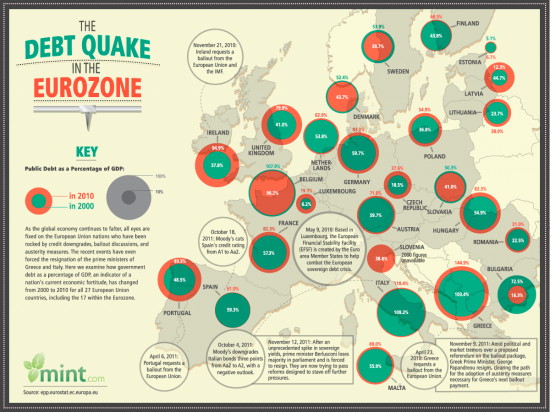
As the global economy continues to falter, all eyes are fixed on the European Union nations who have been rocked by credit downgrades, bailout discussions, and austerity measures.

Column Five Media created this infographic with Mint to examine how government debt as a percentage of GDP has changed from 2000 to 2010 for all 27 European Union countries, including the 17 within the Eurozone.

Source: Mint .

Channel Surfing the ME-P

Have you visited our other topic channels? Established to facilitate idea exchange and link our community together, the value of these topics is dependent upon your input. Please take a minute to visit. And, to prevent that annoying spam, we ask that you register. It is fast, free and secure.

Conclusion

Your thoughts and comments on this ME-P are appreciated. Feel free to review our top-left column, and top-right sidebar materials, links, URLs and related websites, too. Then, subscribe to the ME-P. It is fast, free and secure.

Speaker: If you need a moderator or speaker for an upcoming event, Dr. David E. Marcinko; MBA – Publisher-in-Chief of the Medical Executive-Post – is available for seminar or speaking engagements. Contact: MarcinkoAdvisors@msn.com

OUR OTHER PRINT BOOKS AND RELATED INFORMATION SOURCES:

Product Details  Product Details

The Quest for “Alpha”

Join Our Mailing List

A New Book Review

By Peter Benedek PhD CFA

In “The Quest for Alpha” Larry Swedroe systematically dismantles the theory that active money management (defined by him as stock selection and market timing) can lead to alpha (returns above risk-adjusted benchmark) after fees. He argues that “if markets are highly efficient, efforts to outperform are unlikely to prove productive after the expense of the efforts.

If that’s true, the winning strategy is to focus on the following: asset allocation, fund construction, costs, tax efficiency, and the building of globally diversified portfolios that minimize, if not eliminate, the taking of idiosyncratic, and therefore uncompensated, risks.”

He also argues that “In order to show that markets are inefficient, we need to see evidence of persistent outperformance beyond the randomly expected. Otherwise, we cannot differentiate skill from luck.”

Swedroe then ploughs through the available evidence on: mutual funds, pension plans, hedge funds, private equity/venture capital, individual investors and behavioral finance, to conclude that the evidence does not support the pursuit of active management in the quest for persistent alpha after costs.

Some messages [for doctors] and us all

  • “all activity is counterproductive” or “please don’t do something, just stand there”
  • attempts to generate alpha by the various means mentioned above are thwarted by: (1) highly efficient markets, (2) “the costs of exploiting any inefficiencies are sufficiently great to make it difficult to generate persistent alpha sufficient to overcome the costs of the effort, and (3) “if there are inefficiencies, the competition to exploit them causes them to disappear rapidly”
  • “since the underlying basis of most stock market forecasts is an economic forecast, the evidence suggests that stock market strategists who predict bull and bear markets will have no greater success than do economists” (and he equates economists forecasting skill level equivalent to guessing)
  • described “the winning investment strategy” involves a globally diversified portfolio of passively managed funds (such as index funds and exchange traded funds) tailored to an individual’s unique ability, willingness and need to take risk….(as well as) integrating an investment plan into a well-developed estate, tax, and risk management (insurance  of all types) plan.”
  • referring to the futility of active management and getting its practitioners to recognize that, he quotes Sinclair “It is difficult to get a man to understand something when his salary depends on his not understanding it”
  • William Sharpe is quoted as explaining the active vs. passive debate as: “If “active” and “passive” management styles are defined in sensible ways, it must be the case that: (1) before costs, the return on the average actively managed dollar will equal the return on the average passively managed dollar, and (2) after costs, the return on the average actively managed dollar will be less than the return on the average passively managed dollar”…so “active management is a negative sum game, also known as the loser’s game…(and) the quest for the Holy Grail of alpha is the triumph of hope, hype, and marketing over wisdom and experience.
  • Swedroe explains how one might improve portfolio performance relative to S&P500 alone by increasing its diversification across asset classes

Assessment

To paraphrase the message of the book, you have to be lucky, not smart, to generate after costs, alpha on a risk-adjusted basis with active management. And there are very many smart [physician] investors competing, but very few will end up being lucky.

So doctors, you’ll want to read this book, and then re-read it every time you get the urge to be active.

Conclusion

Your thoughts and comments on this ME-P are appreciated. Feel free to review our top-left column, and top-right sidebar materials, links, URLs and related websites, too. Then, subscribe to the ME-P. It is fast, free and secure.

Link: http://feeds.feedburner.com/HealthcareFinancialsthePostForcxos

Speaker: If you need a moderator or speaker for an upcoming event, Dr. David E. Marcinko; MBA – Publisher-in-Chief of the Medical Executive-Post – is available for seminar or speaking engagements. Contact: MarcinkoAdvisors@msn.com

OUR OTHER PRINT BOOKS AND RELATED INFORMATION SOURCES:

DICTIONARIES: http://www.springerpub.com/Search/marcinko
PHYSICIANS: www.MedicalBusinessAdvisors.com
PRACTICES: www.BusinessofMedicalPractice.com
HOSPITALS: http://www.crcpress.com/product/isbn/9781466558731
CLINICS: http://www.crcpress.com/product/isbn/9781439879900
BLOG: www.MedicalExecutivePost.com
FINANCE: Financial Planning for Physicians and Advisors
INSURANCE: Risk Management and Insurance Strategies for Physicians and Advisors

Product DetailsProduct DetailsProduct Details

Product Details  Product Details

   Product Details 

How Doctors Can [Legally] Lower their Investment Taxes

Strategies all Medical Professionals Can Use to Out-Smart the Tax Man

By Rick Kahler MS CFP® ChFC CCIM

Maybe Warren Buffett, the second richest man on the planet, doesn’t care how much he pays in taxes.

For medical professionals and the rest of us however, what our investments earn after taxes is much more important than what they earn before taxes. Federal and state income taxes, capital gains taxes, and alternative minimum taxes can reduce your investment earnings by up to 50%.

How so?

It doesn’t take much to substantially reduce your nest egg. If Dr. Smith earned an average of 8% and was taxed at 28%, his after-tax rate of return is 5.76%. A $50,000 investment earning 5.76% grows to $87,536 in 10 years. If that same $50,000 investment isn’t subject to taxes, it grows to $107,946. The higher tax bracket he is in, the more important it is for him to seek out ways to lower his tax bill.

Tax Free Growth

One of the best tax maneuvers is to invest your money where it will grow tax-free, meaning you will never pay any taxes on the income or accumulation.

One way to do this is via a Roth IRA or a Roth 401k plan. All earnings compound tax-free and are not subject to tax or penalties when you take them out of the Roth after age 59½. The downside is that your contribution is not deductible from current earnings.

Another tax-free investment is interest from municipal bonds. The higher income bracket a person is in, the more an investment in municipal bonds makes sense.

For a doctor in the 33% tax bracket, a 5% interest rate on a municipal bond is equivalent to a 7.46% rate on a taxable bond. But, for a new practitioner in the 15% tax bracket, it’s only equivalent to a taxable rate of 5.88%. Don’t make the mistake of investing in municipal bonds only because they have tax free income. Be sure the investment makes sense for you.

Tax Deferred Investing

After tax-free investing comes tax-deferred investing. This includes traditional retirement vehicles like IRA’s, 401k’s, 403b’s, pension plans, and annuities. Contributions to these plans are pre-tax, while contributions to annuities are after-tax. The earnings are not taxed until taken out, usually after retirement when you may be in a lower tax bracket.

Retirement Tax Rates

If you anticipate your overall tax rate (the average percentage of income taxes you pay for the year) in retirement to be over 15%, you’ll want to evaluate whether investments that earn most of their returns in the form of long-term capital gains might be better held outside of a tax-deferred account. That’s because withdrawals from tax-deferred accounts generally are taxed at your ordinary income tax rate, which may be higher than your capitals gains tax rate (currently 15%).

Get Advice

Look for advice from accountants and investment advisors who manage investments in ways that can help reduce the taxable distributions. Investment managers can employ a combination of tactics, such as investing in stocks that don’t pay dividends, counterbalancing the sale of stocks with gains against those with losses, tax harvesting, and minimizing portfolio turnover.

As important as minimizing tax is, be careful not to let the tax tail wag the dog. A poor investment doesn’t become a good one just because it’s tax-free.

Records

Finally, keep good records of purchases, sales, and distributions so you can accurately calculate the tax basis of your investments. Not keeping good records could mean paying more tax than you should when you eventually sell.

Assessment

While you can’t control the direction of the economy and markets, you can have a lot of control over where you invest your retirement funds, the taxes you will pay, and the costs. The tax consequences of investment choices matter to the rich. They matter even more to smaller investors; like doctors and nurses.

The Author

Rick Kahler, Certified Financial Planner®, MS, ChFC, CCIM, is the founder and president of Kahler Financial Group in Rapid City, South Dakota. In 2009 his firm was named by Wealth Manager as the largest financial planning firm in a seven-state area. A pioneer in the evolution of integrating financial psychology with traditional financial planning profession, Rick is a co-founder of the five-day intensive Healing Money Issues Workshop offered by Onsite Workshops of Nashville, Tennessee. He is one of only a handful of planners nationwide who partner with professional coaches and financial therapists to deliver financial coaching and therapy to his clients. Learn more at KahlerFinancial.com

Conclusion

And so, your thoughts and comments on this ME-P are appreciated. Feel free to review our top-left column, and top-right sidebar materials, links, URLs and related websites, too. Then, subscribe to the ME-P. It is fast, free and secure.

Link: http://feeds.feedburner.com/HealthcareFinancialsthePostForcxos

Speaker: If you need a moderator or speaker for an upcoming event, Mr. Rick Kahler and Dr. David E. Marcinko; MBA – Publisher-in-Chief of the Medical Executive-Post – are available for seminar or speaking engagements. Contact: MarcinkoAdvisors@msn.com

Our Other Print Books and Related Information Sources:

Health Dictionary Series: http://www.springerpub.com/Search/marcinko

Practice Management: http://www.springerpub.com/product/9780826105752

Physician Financial Planning: http://www.jbpub.com/catalog/0763745790

Medical Risk Management: http://www.jbpub.com/catalog/9780763733421

Healthcare Organizations: www.HealthcareFinancials.com

Physician Advisors: www.CertifiedMedicalPlanner.com

Subscribe Now: Did you like this Medical Executive-Post, or find it helpful, interesting and informative? Want to get the latest ME-Ps delivered to your email box each morning? Just subscribe using the link below. You can unsubscribe at any time. Security is assured.

Link: http://feeds.feedburner.com/HealthcareFinancialsthePostForcxos

Sponsors Welcomed: And, credible sponsors and like-minded advertisers are always welcomed.

Link: https://healthcarefinancials.wordpress.com/2007/11/11/advertise

Product Details  Product Details

Let’s Meet Dr. Peter Benedek CFA

At Your Service as Our Newest ME-P “Thought-Leader”

By Ann Miller RN MHA

[Executive-Director]

www.retirementaction.com

Peter Benedek retired in 2002, after almost thirty years working as an engineer, manager and then executive in telecommunications Research and Development. While having a PhD in Electrical Engineering, he was always also interested in the financial world.

Enabling Others to Control their Destinies

However, due to work and family pressures, he had the opportunity to delve deeply in a formal finance related study only after retirement. The collapse of telecom industry, coincidental with retirement, reinforced his interest in financial related matters – not just as an intellectual pursuit – but also as a means to better understand how to manage his own personal financial affairs, and assist others to better manage their affairs in order to achieve some level of control over their destinies.

What Peter Brings to the ME-P Ecosystem

Dr. Benedek is no novice however. In the summer of 2006 he successfully completed the three levels of study toward the Chartered Financial Analyst designation offered by the CFA Institute®. He is thus a CFA charter-holder.

Assessment 

In addition to authoring his pro bono website, he started providing research and consulting services to investment management firms in 2009.

Conclusion

Your thoughts and comments on this ME-P are appreciated. Feel free to review our top-left column, and top-right sidebar materials, links, URLs and related websites, too. Then, subscribe to the ME-P. It is fast, free and secure.

Speaker: If you need a moderator or speaker for an upcoming event, Dr. David E. Marcinko; MBA – Publisher-in-Chief of the Medical Executive-Post – is available for seminar or speaking engagements. Contact: MarcinkoAdvisors@msn.com

OUR OTHER PRINT BOOKS AND RELATED INFORMATION SOURCES:


Product Details  Product Details

For Doctors Who Wish to Retire Wealthy [Despite the Economy?]

Financial Planning for Physicians and Advisors


Financial Planning Handbook for Physicians and Advisors


Speaker: If you need a moderator or speaker for an upcoming event, Dr. David E. Marcinko; MBA – Publisher-in-Chief of the Medical Executive-Post – is available for seminar or speaking engagements. Contact: MarcinkoAdvisors@msn.com


More on Life-Cycle Investing [Revolution or Evolution]?

Join Our Mailing List

Are you Ready for its Implications – Doctor?

By Peter Benedek, PhD CFA

Founder: www.RetirementAction.com

Background

The financial planning and investment advice, like that offered on this website, has been rolling along on a framework based on wealth accumulation by saving and investing for the long-term; especially for medical professionals, but generally for us all!

The emphasis is generally heavily slanted toward equities, which historically delivered much higher average return than fixed income investments; this of course is due to the fact that the higher volatility (risk) is rewarded by higher returns. The effect of average historical inflation is included by working with “real” dollars. The analysis to estimate required savings rates to achieve certain standard of living and withdrawal rates or methods once in retirement, tends to be built on historical average returns of different asset classes, largely disregarding the potential impact of volatility of equities around the expected retirement date (and start of de-accumulation); the implication being that stocks are a safe investment in the long-run. More recently, Monte-Carlo methods started to be used to include the effect of historical or predicted volatility, and then calculating the probability of exhausting your actual/expected assets at retirement, given various withdrawal rates or methods.

Chorus of Growing Rumblings

During the past few years a faint though growing rumble has been emerging. It remains to be determined if this is a revolution or just an evolution, but under the heading of “life-cycle investing” many are starting to challenge both the fundamental framework and implementation that is used in investing in preparation for retirement. This matter has taken on increasing urgency as the demise of traditional Defined Benefit pension plans and the corresponding transfer of risk from plan sponsors (professionals) to individuals (mostly untrained, undisciplined and incompetent in the financial field).

The New Framework

Zvi Bodie PhD, of Boston University is one of the earliest and most in-your-face advocates of this new framework. (The first time I came across his work was around the technology stock crash after I read in the papers that my lifetime employer had a $2.5B pension plan shortfall, and I started reading about how pension plans should be managed; contrary to practice he was advocating significant reduction of equity component in pension plans). One has to pay attention because he is a well respected financial economist of long standing and he challenges the current ‘common wisdom’ that leads to the following fallacies:

– stocks are safe in the long-run (not)
– diversification is the only way to reduce risk (not)
– wealth is about assets (not quite)
– stocks overcome the effect of inflation (maybe)
– target-date funds solve asset allocation/rebalancing problem (maybe).

Definition of Total Wealth

In fact the whole starting point of the new framework is about the definition of wealth (Total Capital), which in this new framework is defined as:

TC (Total Capital) = HC (Human Capital) + FC (Financial Capital)

and Human Capital is defined as the present value of future earnings.

Typically, we start out with a mix of 0% FC and 100% HC and ends up with 100% FC and 0% HC. Wealth is not about assets, but about sustainable ‘real’ spend-rate. Looking at wealth through the entire Life-Cycle as HC and FC forces us to rethink what is an expense vs. an investment (e.g. cost of higher education). But even more so, it forces us to think about risk.

Risks

So let’s look at risk, or rather risks and their changing nature/emphasis throughout the life-cycle:

–  disability (initially most wealth is HC, so loss of earning ability can be disastrous)
–  death (with young family/dependents, death of (a) breadwinner can lead to poverty)
–  investment/market (especially near the start of de-accumulation, when volatility around retirement can result in significant reduction in retirement income and/or delay in the start date of retirement)
– longevity (not only are people retiring earlier, but life expectancy has increased to 19 and 12 years, for 65 and 75 year olds and is growing; of course about 50% of individuals live past the life expectancy indicated.

For example, a 65 year old medical professional couple, there is about a 50%, 25% and 10% probability to one of them living to 90, 95 and 100, respectively).The net effect is that people are spending more time in retirement).

– inflation (this is scourge throughout the life-cycle, but it especially severe during retirement, eating away at your predominant financial capital).

Other risks are: are you saving enough? Are you annuitizing at the ‘right’ time (interest rates, mortality credits, costs)?

The Solution / Implementation

Now let’s look at some of the solutions proposed for each of these risks:

– disability and disability insurance AND/OR death and life insurance
– market/investment: diversification/asset-allocation (including futures and options), hedging (including options), single vs. multi-period investment horizon (i.e. in the long-run you appear to be OK, but on the way, as you are withdrawing funds annually during a succession of negative returns, you may become insolvent), cap investment in employer
– longevity: DB plans, (delayed) SS/CPP, immediate or deferred annuities (especially if inflation indexed), estate/bequest plan
– inflation: inflation indexed bonds, inflation indexed annuities.

Other solutions may be reverse mortgages, life settlements (assuming the need is dire and costs are not prohibitive).

Diversification

So you will note that diversification is part of the plan, but it is only a small part of the story in this framework. In addition the mechanisms (insurance and hedging) that are used to reduce/eliminate these various risks, introduce new problems: higher costs (e.g. insurance is not free) and counterparty risk (e.g. will the insurance company be solvent when the claim must be paid). So we’ll have to figure out what is the right mix of saving/investing, insuring and hedging and perhaps, as professor Bodie seems to suggest, a smaller but more certain piece of cake is what we should settle for! Pretty tough to swallow, considering that we’ve gotten used to believe that we can have it all if we do the right things.

Assessment

This new framework is more complex (not that today’s planners don’t worry about inflation, insurance and longevity), but it also make life-time sustainable income (not assets) as the focus of wealth, and it makes everything more explicit. Much of the ‘financial engineering’ mechanisms proposed as the solution are already used for HNWI, the challenge will be to get it delivered to doctors and the average investor.

References

You can learn more about life-cycle investing in the following:

1. In the FPA Journal of Financial Planning, Paula Hogan in “Life-cycle investing is rolling our way” discusses what life-cycle planning is about and the implications for planners.

2. Zvi Bodie in “Retirement investing: a new approach” appearing in Financial Engineering News, illustrates application of life-cycle investing principles using inflation protected bonds, determining suitable asset allocation based on investors’ willingness to postpone retirement and call options to protect downside while maintaining upside opportunity.

3. Still on the conference, there is Anna Rappaport’s post-conference update on “Expanding solutions for retirement income management- risks, barriers and dreams” where she looks at the various implications/perspectives of the stakeholders in retirement benefit delivery: individuals, insurer/financial services company, employer and regulatory.

4. And finally the related “Lifetime financial advice: human capital, asset allocation and insurance” by Ibbotson, Milevsky, Chen and Zhu tackles an integrated view of life-cycle finance. They also have an excellent presentation on annuities and show the principles of how to create an asset allocation composed of risk-free and risky assets, and annuities; they also show the impact of risk aversion and the bequest motive will affect the resulting mix.

Conclusion

Your thoughts and comments on this ME-P are appreciated. Feel free to review our top-left column, and top-right sidebar materials, links, URLs and related websites, too. Then, subscribe to the ME-P. It is fast, free and secure.

Speaker: If you need a moderator or speaker for an upcoming event, Dr. David E. Marcinko; MBA – Publisher-in-Chief of the Medical Executive-Post – is available for seminar or speaking engagements. Contact: MarcinkoAdvisors@msn.com

OUR OTHER PRINT BOOKS AND RELATED INFORMATION SOURCES:

Product Details  Product Details

Knowledge Doctors Need to Survive the Financial Crisis on Wall Street

Dictionary of Health Economics and Finance 


Dictionary of Health Economics and Finance


Speaker: If you need a moderator or speaker for an upcoming event, Dr. David E. Marcinko; MBA – Publisher-in-Chief of the Medical Executive-Post – is available for seminar or speaking engagements. Contact: MarcinkoAdvisors@msn.com


Is the Mutual Fund Company “Invesco” Dissing Podiatrists?

Attacking One of Us = Attacking all of Us

By Ann Miller RN MHA

[Executive-Director]

Join Our Mailing List 

Dear ME-P Readers, Subscribers and Visitors,

As you know, here at the Medical Executive-Post, we champion all hard working, honest and ethical medical professionals, regardless of specialty or degree designation. From the ME-P corporate executive suite, to the mailroom, we appreciate their laborious ministrations under increasingly difficult cultural, political and financial conditions on behalf of the US citizenry.

And so, it was with much dismay when this new advertisement from the behemoth mutual fund company Invesco, headquartered right here in Atlanta GA, was brought to our attention. Rest assured. We are not amused and request your input!

You Input Requested

Do you agree with the Ad? Is it an attack on one medical specialty – or on all of us? Would your opinion differ if the ad mentioned a proctologist – or a dentist? How about a brain surgeon or a nurse? Is the dated impression of doctors being on the golf-course still accurate?

More importantly, does the ad affect your impression of Invesco as a contemporaneous company aware of the modern Health 2.0 culture, or a backward thinking dinosaur resting on its [glorious or in-glorious] past?

Is it Time to Close the Door on Invesco?

Are they Aware?

Do you think that the huge and costly marketing department at Invesco is is even aware that our iMBA Inc sponsored, and ME-P promoted textbooks and handbooks, dictionaries, white papers and CD-ROMs on investing, financial planning, insurance, and risk and wealth management for physicians, was largely written by medical professionals of all stripes? Many holding dual degrees and designations like MBA, CFP®, CMP™, JD, MHA, CFA, etc.

Link: http://www.CertifiedMedicalPlanner.org

Or, that they have been used in [non-clinical] continuing education programs for medical professionals, for more than a decade?

Of course, this includes allopaths, osteopaths, podiatrists, nurses, physical therapists and other related members of the healthcare ecosystem? After all, it often takes a team to treat a poly-systemically ill patient.

Link: www.BusinessofMedicalPractice.com

Assessment

Feel free to contact Invesco directly and tell em’ what you think about their new ad campaign [positive or negative]:

Inveso Client Services:

  • Calls within the United States 800.959.4246
  • Calls outside of the United States 713.626.1919 (Call Collect)

Hours of Service – Monday-Friday, 7:00am-6:00pm CST; subject to change due to NYSE holidays or early market closings.

Contact Link: https://www.invesco.com/portal/site/us/menuitem.33e9ce03dea2c250a83af864f14bfba0/

Industry Indignation Index: 65/100 [probably smelly]

Conclusion

Over the next few weeks we will aggregate your thoughts and may report back to you, and Invesco, about the results. Till then, be sure to also tell us what you think. right here? Feel free to review our top-left column, and top-right sidebar materials, links, URLs and related websites, too. Then, subscribe to the ME-P. It is fast, free and secure.

Link: http://feeds.feedburner.com/HealthcareFinancialsthePostForcxos

Speaker: If you need a moderator or speaker for an upcoming event, Dr. David E. Marcinko; MBA – Publisher-in-Chief of the Medical Executive-Post – is available for seminar or speaking engagements. Contact: MarcinkoAdvisors@msn.com

OUR OTHER PRINT BOOKS AND RELATED INFORMATION SOURCES:


Product DetailsProduct DetailsProduct Details

Product Details  Product Details

   Product Details 

Does Financial Regulation Kill Jobs?

Perhaps Not!

By Marian Wang
ProPublica, Sept. 12, 2011, 1:20 pm

Join Our Mailing List

With the presidential campaign in motion, and President Obama urging immediate passage of his new jobs bill, the attention in Washington has shifted almost exclusively to the economy and job creation. And, that means a shift away from regulation, right? Not necessarily.

Growth Spurts?

Some regulators and financial industry experts are predicting the opposite—that new financial regulations will spur some growth.

For example, The New York Times’ DealBook blog cited derivatives regulation [1] as one example. Dodd-Frank requires a substantial chunk of the $600-trillion derivatives market to trade on exchanges or on new electronic trading platforms.

“I have no doubt that these new regulations, instituting new types of clearing, trading and reporting platforms, will foster a landslide of hiring in the financial sector,”

Bart Chilton of the Commodity Futures Trading Commission said in a recent speech cited by the Times. As another New York Times piece noted, previous financial regulation laws have resulted in additional jobs for accountants and lawyers [2], at least.

But, separate from the jobs created to actually handle new regulation, others have pointed out that regulations can have a long-term, positive effect on overall economic growth by preventing the types of crises that put an industry on life-support.

The Studies

Last year, two studies by central bankers and regulators found that the short-term impacts of stricter capital requirements were “significantly smaller” than the estimates published by banking groups, the Times reported.

Rather, the studies said that stricter regulation would lead to more long-term growth [3] by preventing future crises.

Banks see higher capital requirements

  • Which require them to have more financial cushion to balance out risk-taking as a damper on profits.
  • And, they have repeatedly warned that tougher rules will hamper lending, reduce investment and slow economic growth.

Assessment

But, not everyone sees it that way. Swiss regulators, for instance, indicated last year that they would impose even tougher capital standards on their country’s banks on the premise that investors would rather put their trust [4]—and their dollars—in safer banks.

Conclusion

And so, your thoughts and comments on this ME-P are appreciated. Feel free to review our top-left column, and top-right sidebar materials, links, URLs and related websites, too. Then, subscribe to the ME-P. It is fast, free and secure.

Link: http://feeds.feedburner.com/HealthcareFinancialsthePostForcxos

Speaker: If you need a moderator or speaker for an upcoming event, Dr. David E. Marcinko; MBA – Publisher-in-Chief of the Medical Executive-Post – is available for seminar or speaking engagements. Contact: MarcinkoAdvisors@msn.com

Our Other Print Books and Related Information Sources:

Health Dictionary Series: http://www.springerpub.com/Search/marcinko

Practice Management: http://www.springerpub.com/product/9780826105752

Physician Financial Planning: http://www.jbpub.com/catalog/0763745790

Medical Risk Management: http://www.jbpub.com/catalog/9780763733421

Subscribe Now: Did you like this Medical Executive-Post, or find it helpful, interesting and informative? Want to get the latest ME-Ps delivered to your email box each morning? Just subscribe using the link below. You can unsubscribe at any time. Security is assured.

Link: http://feeds.feedburner.com/HealthcareFinancialsthePostForcxos

Sponsors Welcomed: And, credible sponsors and like-minded advertisers are always welcomed.

Link: https://healthcarefinancials.wordpress.com/2007/11/11/advertise

Product Details  Product Details

A Review of Current Personal Finance and Investment Literature

Current Synopsis [Around the Literary World of Economics]

By Dr. Peter Benedek CFA

http://retirementaction.com/

Investors will grapple with more turbulence surrounding Europe’s deepening debt problems this week and the prospect of another round of dismal data on the faltering U.S. economy. So, let us listen while Doctor Benedek speaks.

Dr. David E. Marcinko; FACFAS, MBA, CMP[Publisher-in-Chief]

In the Globe and Mail’s “In an emergency, is your info safe?” Dianne Nice suggests a teachable moment associated with the recent US andOntario tornadoes, north-eastern earthquake and hurricane threat. Specifically, she suggests that we consider taking steps to safeguard our important papers, should our home be destroyed. The ICBA recommends keeping important documents in a bank safe: marriage certificate, tax returns, property deeds, birth certificates insurance policies, credit card number, and list of household valuables for insurance claims, paper or electronic copies of important computer records. Additionally consider keeping copies in the home in sealed plastic bags (Probably not a bad idea.)

Scott Willenbrock in the Financial Analysts Journal’s “Diversification return, portfolio rebalancing, and the commodity return puzzle” argues that “the underlying source of the diversification return is the rebalancing, which forces the investor to sell assets that have appreciated in relative value and buy assets that have declined in relative value, as measured by their weights in the portfolio. Although a buy-and-hold portfolio generally has a lower variance than the weighted average variance of its assets, it does not earn a diversification return. Diversification is often described as the only “free lunch’’ in finance because it allows for the reduction of risk for a given expected return. Diversification return might be described as the only “free dessert” in finance because it is an incremental return earned while maintaining a constant risk profile. The contrarian activity of rebalancing, however, must be performed to earn the diversification return; diversification is a necessary but not sufficient condition. Although an un-rebalanced portfolio generally has reduced risk, it does not earn a diversification return and suffers from a varying risk profile. The control of risk, together with the diversification return, is a powerful argument for rebalanced portfolios.”

In the CFA Institute’s Financial Analysts Journal’s “The winners’ game” Charles Ellis looks at the investment profession’s challenges and opportunities. He writes that the investment profession has made three errors:  two of commission and one of omission. He writes that “In addition to the two errors of commission—accepting the increasingly improbable prospect of beat-the-market performance as the best measure of our profession and focusing more and more attention on business achievements rather than on professional success— we have somehow lost sight of our best professional opportunity to serve our clients well and shifted our focus away from effective investment counseling. Some of the help clients need is in understanding that selecting managers who will actually beat the market over the long term is no longer a realistic assumption or a “given” … most investors need help in developing a balanced, objective understanding of themselves and their situation: their investment knowledge and skills; their tolerance for risk in assets, incomes, and liquidity; their financial and psychological needs; their financial resources; their financial aspirations and obligations in the short and long run … Our profession’s clients and practitioners would all benefit if we devoted less energy to attempting to “win” the loser’s game of beating the market and more skill, knowledge, and time to helping clients recognize market realities, understand themselves as investors, and clarify their realistic objectives and then stay the course that is best for each of them.” (Charles Ellis is the author of the must read book entitled“Winning the Loser’s Game- Timeless Strategies for Successful Investing”.)

Glenn Ruffenach in the WSJ SmartMoney’s “5 best online retirement guides” provides a list from  “One of the most comprehensive and valuable sites online is also among the least known: the Employee Benefits Security Administration.”

In WSJ SmartMoney’s “Why Wall Street’s forecast can’t be trusted” Alex Tarquinio writes that “Over the years, some market forecasters have been about as accurate as, well, weather forecasters… But some financial planners ignore the Wall Street prognostications altogether. George Papadopoulos, the owner of the eponymous financial planning firm in Novi, Mich., says most stock strategists tend to be too bullish, save a few who are “perma-bears.” Ignore the headline number, he says, and “focus on what you can control,” like finding a good balance of stocks and bonds for your portfolio.” (Now there is some sensible advice; ignore talking-heads, ‘strategists’, ‘prognosticators’ and soothsayers. Remember there are very few things that you can actually control: your spend-rate, saving-rate, investment fees and costs, asset allocation and rebalancing.)

In the Globe and Mail’s “Hunting high and low for safe yields” John Heinzl enumerates some of the available options for ‘safe yields’ and concludes that none come even close to paying off your 4% mortgage which at 40% tax rate gives you 6.67% guaranteed.

In Bloomberg’s “Homeowners on East Coast may have to pay for earthquake damage” Leondis and Ody report that “Earthquake protection is generally excluded from standard homeowners’ insurance policies, and consumers have to purchase coverage either as a separate policy…“For most of us, having earthquake insurance doesn’t make sense,” said Sheryl Garrett, founder of Shawnee Mission, Kansas-based Garrett Planning Network Inc., a network of fee-only financial planners. That’s because residents of areas where earthquakes rarely occur generally don’t need the coverage, and policies in parts of the country with frequent earthquakes are more expensive to compensate for the increased risk, she said.”

In the Globe and Mail’s “Vanguard to launch six ETFs in Canada” Shirley Won reports that Vanguard is launching “six exchange-traded funds (ETFs) inCanada. The stock ETFs include Vanguard MSCI Canada and the Vanguard MSCI Emerging Markets, as well as the Vanguard MSCI U.S. Broad Market and Vanguard MSCI EAFE, which will both be hedged to Canadian dollars. The bond category includes Vanguard Canadian Aggregate Bond and Vanguard Canadian Short-Term Bond ETFs.”

Real Estate

On the Canadian front, in the Globe and Mail’s “Most housing ‘reasonably affordable’: RBC” Steve Ladurantaye reports that Vancouver house prices are in “uncharted territory” and “it would take 92 per cent of the median household’s pretax income to own a bungalow in the city at current prices – the highest reading yet in its quarterly national survey on affordability. However according to RBC most (other) Canadian cities offered reasonably affordable” housing options in the second quarter compared to the first. Nationally, a condo required 29.2 per cent of pretax household income (a 0.8 per cent increase), a bungalow 43.3 per cent (1.7 per cent) and a detached home 49.3 per cent (1.8 per cent)… The bank’s affordability index looks at the proportion of pre-tax household income needed to service the costs of owning different categories of homes at current market values. Its standard measure is a 1,200-square-foot bungalow, and the carrying costs include mortgage payments (principal and interest), property taxes and utilities.”

However in the WSJ’s “Toronto wary of condo correction” (note this is in WSJ, not the Globe and Mail or the National Post) Monica Gutschi reports that “A condominium-building boom is lifting Canada’s largest city into the same stratosphere as London, Sydney, Vancouver and Miami, but deepening the worries about a potential tumble…Toronto is a long way from Miami, but the condominium boom north of the border has begun to evoke ominous comparisons, even among real-estate agents. TheToronto area is home to 1,198 condo projects with 210,000 units, according to research firm Urbanation. About 40,000 additional condominium units are under construction, including 16,000 set to hit the market next year. “There’s more supply coming than the market really needs, unless we have a stronger economy than we have today,” says independent housing economist Will Dunning…As many as 60% of recent condominium buyers in Toronto are investors who bought their units from developers before construction began—and then sold their condos…But buyers whose condominiums are investments are getting squeezed. Stagnant rents make it harder to cover mortgage payments.”

On the US front, in Bloomberg’s “Home prices decline 5.9% in second quarter” Kathleen Howley reports that “Home prices in the U.S. fell 5.9 percent in the second quarter from a year earlier, the biggest decline since 2009, as foreclosures added to the inventory of properties for sale…Purchases decreased 3.5 percent to a 4.67 million annual rate, the weakest since November.” Furthermore Nick Timiraos in WSJ’s  “Home-loan delinquencies rise again” reports that “The Mortgage Bankers Association said 12.87% of mortgage loans on one-to-four-unit homes were 30 days or longer past due or in the foreclosure process at the end of the second quarter, representing more than 6.3 million households. The second-quarter figure was down from 14.4% one year earlier but up from 12.84% at the end of March…While mortgage delinquencies remain highest in states hard hit by the housing bubble—such as Nevada, California and Florida—the inventory of loans in foreclosure is highest in states that require banks to obtain court approval when they foreclose on homeowners. Nationally, about 4.4% of all loans were in foreclosure at the end of June. Of the nine states that exceeded the national average, all but one—Nevada—have a judicial foreclosure process. Foreclosure rates were highest inFlorida (14.4%),Nevada (8.2%),New Jersey (8%),Illinois (7%),Maine andNew York (5.5%).”

In Florida context, in Palm Beach Post’s “Palm Beach County home sales slump in July from previous month” Kimberly Miller reports that “A Florida Realtors report released Thursday found 972 single-family Palm Beach County homes traded hands in July, a 21 percent increase from the same time in 2010, but an 18 percent drop from the previous month. The median sales price in Palm Beach County fell 17 percent from last year to $187,900 – a price not seen consistently since 2002. Statewide, sales of existing homes fell 12 percent in July from the previous month, but were up 12 percent compared to July 2010. The median sales price of $136,500 remained mostly stable…The inventory of homes for sale in Palm Beach County was down to an eight month supply in June, a 46.5 percent decrease from 2010 and down 62 percent from 2009, according to the Realtors Association of the Palm Beaches. That may change soon. Forbes, as well as Realtor Dean Hooker, owner of Pompano Beach-based Southeast REO, said banks are preparing to release more foreclosures for re-sale. Also in the PBP is Jeff Ostrowski’s article “Foreclosure-related sales’ prices fall, and the discount widens” in which ne reports that “The average price of a foreclosure sold inPalm BeachCounty in the second quarter was $116,642, down from $142,997 a year ago. And the discount for foreclosure sales compared to non-foreclosure sales widened to 38 percent this year from 23 percent a year ago. There were 3,253 distressed sales – including foreclosure sales, pre-foreclosure sales and sales after a lender has taken ownership – inPalm BeachCounty in April, May and June, according to RealtyTrac. Those sales made up 37 percent of all transactions in the county. In St. Lucie County, 701 foreclosure deals in the quarter accounted for 44 percent of all sales. Statewide, there were 34,558 foreclosure sales in the second quarter, accounting for 35 percent of all sales in the state.”

In the Globe and Mail’s “Foreign buyers see value in U.S. real estate” Simon Avery writes that with Florida prices off typically 50% since the peak, low mortgage rates, the strong Canadian dollar: ” As an alternative investment, U.S. real estate may never look so attractive to Canadians again…At the moment, the best deals in the Miami area are in South Beach, an area where the properties on average are older. There are currently 172 properties listed under $150,000 and 50 per cent of them are within walking distance to the beach. Generally, these are small, art deco-style, low rises. Their monthly maintenance fees run $320 or less and the sizes range from 240 square feet to 440 square feet.” (That doesn’t sound that cheap for an average of 340 SF units comes to about $441/SF…bargain??? You be the judge.)

Things to Ponder

In the Globe and Mail’s “Amid slowdown, Fed has few tools left” Kevin Carmichael discusses the limited remaining options available for the Fed to provide stimulus to rekindleUS growth and employment. The real problem, however, might be related to that “these aren’t normal times. When businesses and consumers would rather save than spend, as currently is the case in theUnited States, the power of monetary policy is muted. Corporations are sitting on some $2-trillion (U.S.) in profits and the household savings rate has climbed to more than 5 per cent from zero before the financial crisis, even though the cost of borrowing already is at record-low levels… What theU.S. economy needs is a massive jolt to demand that would encourage companies to hire and invest. The best way to do that, many economists argue, is through fiscal policy.”

Jack Hough in WSJ SmartMoney’s “Treasurys versus stocks: spot the safe one” provides some support to Jeremy Siegel’s arguments that “bonds are in a bubble and stocks are good deal”. Arnott says that the 10-year Treasurys yield about zero, given nominal yields of 2.1% and past year’s inflation of 3.6%; whereas the S&P 500 dividend yield is 2.3%. “Bond yields are usually larger because stock dividends tend to grow over time and bond coupons don’t, so bond buyers typically want to be compensated for this…The choice is between stocks’ higher and rising yield and bonds’ lower and flat one…The third reason is that stocks have a better chance of keeping up with inflation…Dividends have rarely looked safer…Today’s payments are 29% of S&P 500 profits. That’s the lowest level since 1900, and perhaps in history…(but) Economists have slashed growth forecasts for most rich economies, and many put the chances of renewed U.S. recession at a coin flip.” So it depends on your horizon/risk tolerance, but “savers with a decade to wait” will find the arguments for stocks persuasive. But not everyone agrees that the metrics are valid. For example, in the Financial Times Lex column’s “Equities: metrics of the trade” discusses pundits indicating that based on P/E ratios and dividend yields compared to bond yields, it is time to buy stocks. Lex suggests that “the big flaw with this approach is that current or near-future earnings are very unlikely to represent an equilibrium return from stocks… It is a fact that company returns normalise, so a much longer earnings period against which to compare stock prices is needed. Inflation also needs be taken into account, as do accounting changes over time. Robert Shiller’s cyclically adjusted p/e ratio is a step in the right direction. Such an approach holds the S&P 500 to be anywhere up to 40 per cent overvalued… Likewise, history shows there to be no predictive power comparing equity and bond yields. Why should there be? Dividends are risky and rise with inflation; coupons are risk free and do not. It is like buying apples because pears are cheap. There are good reasons why stocks might rally – flaky valuation metrics are not among them.”

In the Guardian’s “Rating agencies suffer ‘conflict of interest’, says former Moody’s boss” Rupert Neate reports that “ratings agencies suffer from a conflict of interest because they are paid by the banks and companies they are supposed to rate objectively.”This salient conflict of interest permeates all levels of employment, from entry-level analyst to the chairman and chief executive officer of Moody’s corporation,” Harrington said in a filing to theUS financial regulator the Securities and Exchange Commission (SEC), which is considering new rules to reform the agencies. Harrington claims that Moody’s uses a long-standing culture of “intimidation and harassment” to persuade its analysts to ensure ratings match those wanted by the company’s clients.” (Recommended by the CFA Institute Financial Newsbrief)

In Bloomberg’s “Baby Boomers selling shares may depress stocks for decades, Fed paper says” Vivien Lou Chen writes that “Aging baby boomers may hold down U.S. stock values for the next two decades as they sell their investments to finance retirement, according to researchers from the Federal Reserve Bank of San Francisco … Jeremy Siegel, 65, a finance professor at the University of Pennsylvania’s Wharton School in Philadelphia, has also researched the link between demographics and U.S. stocks. He said that growth in developing countries should generate enough demand to absorb a baby-boomer selloff and “keep stock prices high.””

In the Financial Times’ “Inflation a danger for safe havens” Steve Johnson argues that the US/UK/German 10-year government bonds yielding in the 2-2.2% range is due to their perceived “safe haven” status from the wild swings of the markets. “But these miserly yields must also reflect investors’ confidence that inflation will be muted over the next decade. How logical is this assumption?…this insouciance about the prospects for inflation misses the international dimension, that stemming from rising import prices … (but) For the seven US recessions between 1957 and 1991, commodity prices on average fell 1.6 per cent during the period between the start of the recession and two years after its end. The equivalent figure for the two recessions so far this century is a rise of 27.3 per cent… Rather than enjoying a tailwind from falling commodity prices and low inflation rates, it may become the norm for recession-ravaged developed nations to face a commodity headwind and stubbornly high inflation.”

Assessment

And finally, in the NYT’s “In Korea, the game of trading has rules” Floyd Norris writes that “Finance ought to provide an economy with an efficient means of allocating capital. It should provide a means of price discovery of assets, whether real or financial. It should provide a safe and reliable payments system. Financial innovations are worthwhile if, and only if, they help in those areas.  All too often, players see financial innovations as providing ways to manipulate the system and make money off less savvy traders.” In South Korea things are changing. Four traders were indicted for intentionally manipulating stock prices for profit, specifically for causing a market drop. “Countries around the world felt called upon to bail out banks during the financial crisis. That made sense because a functioning financial system is necessary. But these kind of games are not necessary, whether or not they are criminal. These charges provide an endorsement of the Volcker Rule, named for Paul A. Volcker, the former Federal Reserve chairman, and included in the Dodd-Frank law in theUnited States, which sought to restrict proprietary trading by banks whose deposits are insured. If such games are to be played, let them be played by others.“ The article concludes with the need for prison terms for these traders to insure a deterrent effect  (Thanks to DB for recommending.)

Conclusion

And so, your thoughts and comments on this ME-P are appreciated. Feel free to review our top-left column, and top-right sidebar materials, links, URLs and related websites, too. Then, subscribe to the ME-P. It is fast, free and secure.

Link: http://feeds.feedburner.com/HealthcareFinancialsthePostForcxos

Speakers: If you need a moderator or speaker for an upcoming event, Dr. Peter Benedek and Dr. David E. Marcinko; MBA – Publisher-in-Chief of the Medical Executive-Post – are available for seminar or speaking engagements. Contact: MarcinkoAdvisors@msn.com

Other Print Books and Related Information Sources for Doctor and Advisors:

Health Dictionary Series: http://www.springerpub.com/Search/marcinko

Practice Management: http://www.springerpub.com/product/9780826105752

Physician Financial Planning: http://www.jbpub.com/catalog/0763745790

Medical Risk Management: http://www.jbpub.com/catalog/9780763733421

Healthcare Organizations: www.HealthcareFinancials.com

Physician Advisors: www.CertifiedMedicalPlanner.com

Subscribe Now: Did you like this Medical Executive-Post, or find it helpful, interesting and informative? Want to get the latest ME-Ps delivered to your email box each morning? Just subscribe using the link below. You can unsubscribe at any time. Security is assured.

Link: http://feeds.feedburner.com/HealthcareFinancialsthePostForcxos

Sponsors Welcomed: And, credible sponsors and like-minded advertisers are always welcomed.

Link: https://healthcarefinancials.wordpress.com/2007/11/11/advertise

Product DetailsProduct DetailsProduct Details       

Product Details  Product Details

   Product Details 

What Does the S&P Downgrade Mean?

If France Is Rated Higher Than the US!

By Marian Wang
ProPublica, Aug. 8, 2011, 5:38 p.m.

Join Our Mailing List

The decision by credit rating agency Standard & Poor’s to downgrade the United States [1] after markets closed on Friday may have kicked up political [2] consternation [3] and triggered a market plunge [4], but it also raises important questions about the reliability of credit ratings and, for that matter, the firms that bestow them.

Just over a dozen countries currently have an AAA [5]—or lowest-risk—rating from each of the three main rating agencies: Moody’s, Fitch, and Standard & Poor’s. Until this weekend, the United States was among them. (It’s now roughly on par with Australia, which also has two AAAs and one AA+.)

So, which countries are among the lucky few that still have perfect ratings from all three firms? The United Kingdom and France, just to name a couple. S&P apparently thinks that both the U.K. and France are safer investments than the United States.

The United States still has a higher per-capita GDP [6] than most countries, including both the U.K. and France. Last year, the U.S. GDP grew 2.9 percent [6]—almost double the U.K.’s 1.4 percent and France’s 1.5 percent. Between April and June of this year, the U.S. GDP grew 1.3 percent [7] while the U.K. economy grew 0.2 percent [8]. A June forecast from the Bank of France estimated that the country’s economy would grow 0.4 percent [9] in the second quarter. (U.S. growth, granted, is still slower than it used to be [10].)

As a percentage of GDP, both the U.K. and France have a higher percentage of external debt [11], or debt owed to outside bondholders. In 2010—the latest year for which the Organization for Economic Cooperation and Development has numbers—U.S. external debt was 61 percent of GDP, compared to France’s 67 percent and the U.K.’s 86 percent. Austria also maintains a lowest-risk rating from all three firms, and its external debt was 66 percent of GDP last year. 

Let’s not forget unemployment. Our July 2011 unemployment rate figure was 9.1 percent [10]. That’s higher than the U.K.’s, which has hovered around 7.7 percent [6], but it’s lower than France, which had 9.7 percent unemployment in June.

S&P, in explaining the historic downgrade—the first in U.S. history—cited both the U.S. debt burden and the political brinksmanship over the debt ceiling as reasons it lowered the credit rating of the United States to AA+, with a negative outlook.

So, what do the ratings mean, really? It seems to be a question that economists and investors are asking, too.

“France is not, in my view, a AAA country,” a UBS economist told Bloomberg [12]. And yet there are no indications [13] that France will face a downgrade, the Wall Street Journal reports. In fact, all three of the rating agencies recently affirmed France’s triple-As [12].

Credit rating agencies have taken a collective hit to their reputations for issuing flimsy triple-A credit ratings on securities that collapsed and helped trigger the financial meltdown. A Senate investigation earlier this year identified the firms as “a key cause [14]” of the financial crisis. Documents released by congressional investigators also pointed to serious conflicts of interest [15] that caused some ratings firms to bend to the wishes of the banks that paid for their ratings. 

Assessment

As we’ve written, some of the same problems with company culture [16] and inaccurate ratings [17] have persisted. Meanwhile, the Office of Credit Ratings—an office created by Dodd-Frank, the financial reform bill, to oversee these firms—hasn’t even been set up because Congress didn’t allocate funds for it. Other efforts written into the measure to lessen U.S. reliance on ratings and open up the firms to more liability have been slowed or stalled altogether.

Wiping out the references to credit ratings in U.S. law is a “harder task than the legislation assumes,” said Barbara Roper, director of investor protection for the Consumer Federation of America. The downgrade, she thinks, may provide just enough impetus to keep those efforts moving. 

Conclusion

And so, your thoughts and comments on this ME-P are appreciated. Feel free to review our top-left column, and top-right sidebar materials, links, URLs and related websites, too. Then, subscribe to the ME-P. It is fast, free and secure.

Link: http://feeds.feedburner.com/HealthcareFinancialsthePostForcxos

Our Other Print Books and Related Information Sources:

Health Dictionary Series: http://www.springerpub.com/Search/marcinko

Practice Management: http://www.springerpub.com/product/9780826105752

Physician Financial Planning: http://www.jbpub.com/catalog/0763745790

Medical Risk Management: http://www.jbpub.com/catalog/9780763733421

Healthcare Organizations: www.HealthcareFinancials.com

Physician Advisors: www.CertifiedMedicalPlanner.com

Subscribe Now: Did you like this Medical Executive-Post, or find it helpful, interesting and informative? Want to get the latest ME-Ps delivered to your email box each morning? Just subscribe using the link below. You can unsubscribe at any time. Security is assured.

Link: http://feeds.feedburner.com/HealthcareFinancialsthePostForcxos

Sponsors Welcomed: And, credible sponsors and like-minded advertisers are always welcomed.

Link: https://healthcarefinancials.wordpress.com/2007/11/11/advertise


Product Details  Product Details

The [Gold] Commodity Concern Bubble

Are We Looking At Another Bursting Bubble?

Join Our Mailing List 

Financial Advisors [FAs], doctors and all investors know that gold [and some other commodities] are at an all time high!

So, here’s a look at some of the most striking commodity rises over the last decade, and which ones have crashed in 2011. Brought to you by Focus.com

Conclusion

Your thoughts and comments on this ME-P are appreciated. Feel free to review our top-left column, and top-right sidebar materials, links, URLs and related websites, too. Then, subscribe to the ME-P. It is fast, free and secure.

Speaker: If you need a moderator or speaker for an upcoming event, Dr. David E. Marcinko; MBA – Publisher-in-Chief of the Medical Executive-Post – is available for seminar or speaking engagements. Contact: MarcinkoAdvisors@msn.com

OUR OTHER PRINT BOOKS AND RELATED INFORMATION SOURCES:

Product DetailsProduct DetailsProduct Details

Product Details  Product Details

   Product Details 

Dr. David E. Marcinko is “In-the-News”

Our ME-P Editor is an Industry “Mover and Shaker”

By Ann Miller RN MHA

[Executive-Director]

Link: http://www.physiciansmoneydigest.com/search?get1=search&get2=marcinko

Link: www.medicalbusinessadvisors.com_forum-books.asp

Our Other Print Books and Related Information Sources:

Health Dictionary Series: http://www.springerpub.com/Search/marcinko

Practice Management: http://www.springerpub.com/product/9780826105752

Physician Financial Planning: http://www.jbpub.com/catalog/0763745790

Medical Risk Management: http://www.jbpub.com/catalog/9780763733421

Healthcare Organizations: www.HealthcareFinancials.com

Physician Advisors: www.CertifiedMedicalPlanner.com

Subscribe Now: Did you like this Medical Executive-Post, or find it helpful, interesting and informative? Want to get the latest ME-Ps delivered to your email box each morning? Just subscribe using the link below. You can unsubscribe at any time. Security is assured.

Link: http://feeds.feedburner.com/HealthcareFinancialsthePostForcxos

Sponsors Welcomed: And, credible sponsors and like-minded advertisers are always welcomed.

Link: https://healthcarefinancials.wordpress.com/2007/11/11/advertise

Product DetailsProduct DetailsProduct Details       

Product Details  Product Details

   Product Details 

Merrill Lynch Investigated for CDO Deal Involving Magnetar

Hedge Fund Probed

By Marian Wang

ProPublica, June 15, 2011, 3:10 pm

Join Our Mailing List 

The Securities and Exchange Commission is investigating whether Merrill Lynch short-changed investors and gave undue influence to the hedge fund Magnetar in the creation of a $1.5-billion mortgage-backed security deal.

The investigation, which was first reported [1] by the Financial Times ($), appears to be the agency’s first probe of Merrill Lynch’s CDO business since the financial crisis. (Check our bank investigations cheat sheet [2] for which other firms are being probed.) Here’s the FT:

The investigation is one of several SEC probes into banks that helped underwrite billions of dollars of collateralised debt obligations, securities comprised of mortgages or derivatives linked to them.

It also marks a broadening of the SEC’s investigation into the role of collateral managers, institutions that help select the assets included in CDOs.

Podcast

Latest Episode: Senior editor Susan White shares some parting thoughts on ProPublica and the editing process before she leaves to move back to California.

Listen

The deal that the SEC is investigating—a collateralized debt obligation, or CDO, called Norma—was detailed both in our reporting last year [3] and in a report [4] by the Financial Crisis Inquiry Commission released in January. Norma was one of more than two dozen CDO deals [5] done by Magnetar, whose bets against a number of CDOs earned it billions in the waning days of the housing boom.

As the FCIC detailed, Magnetar helped select the assets that went into Norma even though it had a $600 million bet that would pay off substantially if the CDO failed. As we reported [6], Magnetar often invested in the portion of the CDO that was riskiest and hardest for the banks to sell. Banks typically gave such investors—equity investors—more say in how the deal was structured. (Magnetar isn’t named as a target of the investigation and had no responsibility to investors. It has also maintained that it did not have a strategy to bet against the housing market.)

In the offering documents for Norma, there’s no mention of Magnetar’s role in asset selection, according to the FCIC. Investors were told that an independent collateral manager, NIR Capital Management, would be selecting the assets with their best interest in mind. The report concluded: “NIR abdicated its asset selection duties… with Merrill’s knowledge.”

Bank of America

Bank of America, which took over Merrill Lynch in 2008, declined our request for comment. The firm’s general counsel told [4] the Financial Crisis Inquiry Commission that it was “common industry practice” for equity investors to have input during the asset selection process, though the collateral manager had final say.

NIR Capital Management

NIR Capital Management is also being investigated by the SEC, according to the FT. The firm did not immediately respond to our request for comment. (The Wall Street Journal did an impressively detailed story in 2007 on how NIR came to be manager [7] of the Norma deal.)

Magnetar declined our earlier requests for comment on Norma, but FT reports it has denied claims [1] that it selected the assets for Norma.

Assessment

As we reported, the SEC had launched a probe of Merrill’s CDO business 2007, but that investigation petered out without resulting in any charges.

Conclusion

Your thoughts and comments on this ME-P are appreciated. Feel free to review our top-left column, and top-right sidebar materials, links, URLs and related websites, too. Then, subscribe to the ME-P. It is fast, free and secure.

Link: http://feeds.feedburner.com/HealthcareFinancialsthePostForcxos

Speaker: If you need a moderator or speaker for an upcoming event, Dr. David E. Marcinko; MBA – Publisher-in-Chief of the Medical Executive-Post – is available for seminar or speaking engagements. Contact: MarcinkoAdvisors@msn.com

OUR OTHER PRINT BOOKS AND RELATED INFORMATION SOURCES:

DICTIONARIES: http://www.springerpub.com/Search/marcinko
PHYSICIANS: www.MedicalBusinessAdvisors.com
PRACTICES: www.BusinessofMedicalPractice.com
HOSPITALS: http://www.crcpress.com/product/isbn/9781466558731
CLINICS: http://www.crcpress.com/product/isbn/9781439879900
BLOG: www.MedicalExecutivePost.com
FINANCE: Financial Planning for Physicians and Advisors
INSURANCE: Risk Management and Insurance Strategies for Physicians and Advisors

Product Details  Product Details

Misdirection in Goldman Sachs’s Housing Short

Goldman Sachs appears to be trying to clear its name

By Jesse Eisinger

ProPublica, June 15, 2011, 3:10 pm

Join Our Mailing List 

The compelling Permanent Subcommittee on Investigations report on the financial crisis [1] is wrong, the bank says. Goldman Sachs didn’t have a Big Short against the housing market.

About The Trade

In this column, co-published with New York Times’ DealBook, I monitor the financial markets to hold companies, executives and government officials accountable for their actions. Tips? Praise? Contact me at jesse@propublica.org

But the size of Goldman’s short is irrelevant.

No one disputes that, by 2007, the firm had pivoted to reduce its exposure from mortgages and mortgage securities and had begun shorting the market on some scale. There’s nothing wrong with that. Don’t we want banks to reduce their risk when they see trouble ahead, as Goldman did in the mortgage markets?

Nor should shorting itself be seen as a bad thing. Putting money behind a bet that a stock (or bond or commodity or derivative) is overpriced is necessary for the efficient functioning of capital markets. Short-sellers can keep prices from getting out of whack and help deflate bubbles.

The problem isn’t that Goldman went short and reduced risk — it’s how.

It is How … Short?

To establish many of its short positions, the Senate report says, Goldman created new securities, backed them with its good name, and then strung together misleading statements to its customers about what it was actually doing. By shorting the way it did, the bank perverted the market instead of correcting it.

Take Hudson Mezzanine, a $2 billion collateralized debt obligation created by Goldman in 2006 [2]. In marketing material, the firm wrote that “Goldman Sachs has aligned incentives with the Hudson program.”

I suppose that was technically true: Goldman had made a small investment in the C.D.O. and therefore had an aligned incentive with the other investors. But the material failed to mention the firm’s much larger bet against the C.D.O. — a huge adverse incentive to its customers’ interests.

Goldman told investors that the Hudson assets had been “sourced from the Street,” which most investors would understand to mean that Goldman had purchased the assets from other broker-dealers. In fact, all the assets had come from Goldman’s own balance sheet, the Senate report found.

In his April 2010 testimony to the Senate, Goldman’s chief executive, Lloyd C. Blankfein, argued that Goldman was merely making a market in these securities and derivatives, matching willing and sophisticated buyers and sellers. But, Goldman was acting like an underwriter, not a market maker.

As the underwriter, Goldman threw its marketing muscle behind Hudson Mezzanine and other C.D.O.’s. When the bank’s salespeople ran into trouble selling the securities, they begged for help from the executives who created them. One requested material to give to clients about “how great” the sector was. One needed the aid to get a client to invest, to be “THERE AND IN SIZE,” according to e-mails cited in the report.

Sometimes, Goldman took advantage of the opaque markets. According to the Senate report, Goldman executives had extensive concerns about the prices of its 2007 Timberwolf C.D.O. Goldman sold the C.D.O. securities anyway, often at higher prices than it had them recorded on its books. In summer 2007, Goldman marked some Timberwolf assets at 55 cents on the dollar, but sold similar securities to an Israeli bank at 78.25 cents at the same time, according to the report. Oh, well, tough luck!

Goldman’s Famous Mantra

For decades, Goldman’s famous mantra was to be “long-term greedy” and a central element of that was putting customers first. In these C.D.O.’s, the bank’s customers were “only first in the same way that on Thanksgiving, the turkey is first,” a former C.D.O. professional told me.

Goldman declined to address these specific disclosures from the report. A spokesman maintained the firm fulfilled its obligations to buyers of these kinds of C.D.O.’s, which were made up of derivatives. The customers were large and sophisticated investors who knew that one side had to be long while the other was short. And they knew, or should have known, that Goldman might be on the other side.

“It was fully disclosed and well known to investors that banks that arranged synthetic C.D.O.’s took the initial short position,” a spokesman wrote in an e-mail.

True, but few thought that the bank that had created and hawked the C.D.O.’s expected them to fail.

Goldman’s techniques harmed the capital markets. Goldman brought something into the world that didn’t exist before. Instead of selling something — thereby decreasing the price or supply of it — and giving the market a signal that it was less desirable, Goldman did the opposite. The firm created more mortgage investments and gave the world the signal that there was more demand, for C.D.O.’s and for the mortgages that backed them.

Assessment

By shorting C.D.O.’s, Goldman also distorted the pricing of the underlying assets. The bank could have taken the securities it owned and sold them en masse in a fairly negotiated sale, though it likely would have gotten less for them than it was able to make by shorting the C.D.O.’s it created.

Because of Goldman’s actions, the financial system took greater losses than there otherwise would have been. Goldman’s form of shorting prolonged the boom and made the crisis that followed much worse.

Goldman executives surely hope to change the subject from the firm’s specific actions to a more general discussion of how much and when it shorted. We shouldn’t let them.

Link: http://www.propublica.org/thetrade/item/misdirection-in-goldman-sachss-housing-short/

Conclusion

Your thoughts and comments on this ME-P are appreciated. Feel free to review our top-left column, and top-right sidebar materials, links, URLs and related websites, too. Then, subscribe to the ME-P. It is fast, free and secure.

Link: http://feeds.feedburner.com/HealthcareFinancialsthePostForcxos

Speaker: If you need a moderator or speaker for an upcoming event, Dr. David E. Marcinko; MBA – Publisher-in-Chief of the Medical Executive-Post – is available for seminar or speaking engagements. Contact: MarcinkoAdvisors@msn.com

OUR OTHER PRINT BOOKS AND RELATED INFORMATION SOURCES:

DICTIONARIES: http://www.springerpub.com/Search/marcinko
PHYSICIANS: www.MedicalBusinessAdvisors.com
PRACTICES: www.BusinessofMedicalPractice.com
HOSPITALS: http://www.crcpress.com/product/isbn/9781466558731
CLINICS: http://www.crcpress.com/product/isbn/9781439879900
BLOG: www.MedicalExecutivePost.com
FINANCE: Financial Planning for Physicians and Advisors
INSURANCE: Risk Management and Insurance Strategies for Physicians and Advisors

Product DetailsProduct DetailsProduct Details

Product Details  Product Details

The Foreign Exchange Market Explained

Doctors are You Curious to Trade?

From Infographics Archive

Join Our Mailing List 

By CMSFOREX

This infographic was developed by CMS Forex, a Forex industry leader, explains the basics of Forex and presents an excellent starting point for anyone who is curious about how to trade Forex.

Assessment

It’s also great for experienced Forex traders who want to explain what they do to colleagues, friends and family.


Conclusion

And so, your thoughts and comments on this ME-P are appreciated. Feel free to review our top-left column, and top-right sidebar materials, links, URLs and related websites, too. Then, subscribe to the ME-P. It is fast, free and secure.

Link: http://feeds.feedburner.com/HealthcareFinancialsthePostForcxos

Speaker: If you need a moderator or speaker for an upcoming event, Dr. David E. Marcinko; MBA – Publisher-in-Chief of the Medical Executive-Post – is available for seminar or speaking engagements. Contact: MarcinkoAdvisors@msn.com

Our Other Print Books and Related Information Sources:

Health Dictionary Series: http://www.springerpub.com/Search/marcinko

Practice Management: http://www.springerpub.com/product/9780826105752

Physician Financial Planning: http://www.jbpub.com/catalog/0763745790

Medical Risk Management: http://www.jbpub.com/catalog/9780763733421

Healthcare Organizations: www.HealthcareFinancials.com

Physician Advisors: www.CertifiedMedicalPlanner.com

Subscribe Now: Did you like this Medical Executive-Post, or find it helpful, interesting and informative? Want to get the latest ME-Ps delivered to your email box each morning? Just subscribe using the link below. You can unsubscribe at any time. Security is assured.

Link: http://feeds.feedburner.com/HealthcareFinancialsthePostForcxos

Sponsors Welcomed: And, credible sponsors and like-minded advertisers are always welcomed.

Link: https://healthcarefinancials.wordpress.com/2007/11/11/advertise

Product Details  Product Details

How to Detect a Dishonest Mortgage Loan Officer

Some Red Flags for Doctors and Others to Consider

From Infographics Archive

Join Our Mailing List 

By creditsesame.com

Mortgage loan officers with questionable ethical standards profited sweetly during the go-go years of the real estate boom, mostly by pushing risky loans to borrowers who didn’t necessarily have what it took to qualify for one the honest way.

The Red Flags

Now, thanks to new legislation and regulations, predatory loan officers are all but out of business. But. that doesn’t necessarily mean you should trust your lender wholeheartedly.

Here are some of the red flags that your loan officer may not be completely honest with you — along with signs that they do have your best interest at heart.

Assessment

Link: http://www.infographicsarchive.com/economics/how-to-detect-a-dishonest-mortgage-loan-officer/

Conclusion

Your thoughts and comments on this ME-P are appreciated. Feel free to review our top-left column, and top-right sidebar materials, links, URLs and related websites, too. Then, subscribe to the ME-P. It is fast, free and secure.

Link: http://feeds.feedburner.com/HealthcareFinancialsthePostForcxos

Speaker: If you need a moderator or speaker for an upcoming event, Dr. David E. Marcinko; MBA – Publisher-in-Chief of the Medical Executive-Post – is available for seminar or speaking engagements. Contact: MarcinkoAdvisors@msn.com

OUR OTHER PRINT BOOKS AND RELATED INFORMATION SOURCES:

DICTIONARIES: http://www.springerpub.com/Search/marcinko
PHYSICIANS: www.MedicalBusinessAdvisors.com
PRACTICES: www.BusinessofMedicalPractice.com
HOSPITALS: http://www.crcpress.com/product/isbn/9781466558731
CLINICS: http://www.crcpress.com/product/isbn/9781439879900
BLOG: www.MedicalExecutivePost.com
FINANCE: Financial Planning for Physicians and Advisors
INSURANCE: Risk Management and Insurance Strategies for Physicians and Advisors

Product Details  Product Details

What is the Impact of Osama bin Laden’s Death on Investing? [An Opinion Poll]

A Bullish or Bearish Outlook?

By Staff Reporters

Join Our Mailing List

After enduring Europe’s credit crisis and Japan’s nuclear disaster, investors are unlikely to view the death of Osama bin Laden as anything but bullish; or are they?

Link: http://www.fa-mag.com/fa-news/7325-bin-laden-death-boosts-bull-clout-after-europe-asia-crises.html

VOTE HERE:

Conclusion

And so, your thoughts and comments on this ME-P are appreciated. Feel free to review our top-left column, and top-right sidebar materials, links, URLs and related websites, too. Then, subscribe to the ME-P. It is fast, free and secure.

Link: http://feeds.feedburner.com/HealthcareFinancialsthePostForcxos

Speaker: If you need a moderator or speaker for an upcoming event, Dr. David E. Marcinko; MBA – Publisher-in-Chief of the Medical Executive-Post – is available for seminar or speaking engagements. Contact: MarcinkoAdvisors@msn.com

Our Other Print Books and Related Information Sources:

Health Dictionary Series: http://www.springerpub.com/Search/marcinko

Practice Management: http://www.springerpub.com/product/9780826105752

Physician Financial Planning: http://www.jbpub.com/catalog/0763745790

Medical Risk Management: http://www.jbpub.com/catalog/9780763733421

Healthcare Organizations: www.HealthcareFinancials.com

Physician Advisors: www.CertifiedMedicalPlanner.com

Subscribe Now: Did you like this Medical Executive-Post, or find it helpful, interesting and informative? Want to get the latest ME-Ps delivered to your email box each morning? Just subscribe using the link below. You can unsubscribe at any time. Security is assured.

Link: http://feeds.feedburner.com/HealthcareFinancialsthePostForcxos

Sponsors Welcomed: And, credible sponsors and like-minded advertisers are always welcomed.

Link: https://healthcarefinancials.wordpress.com/2007/11/11/advertise

Product DetailsProduct DetailsProduct Details       

About the Third and Fourth Stock Trading Markets

On OTC and Private Transactions

dem

By Dr. David Edward Marcinko MBA

http://www.CertifiedMedicalPlanner.org

Join Our Mailing List

In most cases, a market maker of a stock in the NASDAQ system must report his trade in 90 seconds, but there is another circumstance in which the trade must be reported. This is called the third market, and is defined as transactions in exchange listed securities in the OTC market.

For example, even though IBM is listed on the NYSE, an OTC market marking firm can acquire the IBM stock and begin to make a market for it just like an OTC stock. All of these trades are considered the third market, and are reported to the Consolidated Quotation System (CQS) within 90 seconds of the trade.

Fourth Market

The fourth market is defined as private transactions made directly between large investors, institutions such as banks, mutual funds, and insurance companies without the use of a securities firm.

In other words, fourth market trading is usually one institution swapping securities in its portfolio with another large institution. From the stock broker’s viewpoint, there is one problem with the fourth market.

Assessment

Since no broker/dealer is involved, no registered representative is involved and there is no commission to be earned. These trades are reported on a system called Instinet. This is advantageous to larger medial foundations or institutional investors.

Conclusion

And so, your thoughts and comments on this ME-P are appreciated. Feel free to review our top-left column, and top-right sidebar materials, links, URLs and related websites, too. Then, subscribe to the ME-P. It is fast, free and secure.

Speaker: If you need a moderator or speaker for an upcoming event, Dr. David E. Marcinko; MBA – Publisher-in-Chief of the Medical Executive-Post – is available for seminar or speaking engagements. Contact: MarcinkoAdvisors@msn.com

What are Exempt Securities?

Exemptions from the SEC Act of 1933

By Dr. David Edward Marcinko MBA CMP™

[Publisher-in-Chief]

Historical Definition

The SEC Act was landmark legislation that established the SEC and gives it authority over proxy solicitation and registration of organized stock exchanges. In addition, the Act sets disclosure requirements for securities in the secondary market, regulates insider trading, and gives the Federal Reserve authority over credit purchases of securities. When established, the Act reflected an effort to extend and overcome shortcomings of the Securities Act of 1933. These two pieces of legislation are the basis of securities regulation in the twentieth century.

Exemptions

Today, there are many securities which are exempt from the Securities Exchange Commission [SAC] Act of 1933, its’ registration and resuting prospectus requirements.

They include the following securities and types:

  • US Government and Federal Agency issues.
  • Municipal, State issues and commercial paper with a maturity not in excess of 270 days.
  • Intra-state offerings (Rule 147) because they are blue-sky chartered within the state.
  • Small Public offerings (Regulation A) if the value of the securities issued does not exceed $5,000,000 in any 12 month period. An issuer using the Regulation A exemption does not make the normal filings with the SEC in Washington. Instead, they file a simplified disclosure document with their SEC Regional Office, known as an Offering Statement. It must be file at least 10 business days prior to the initial offering of the securities.  No securities may be sold unless issuer has furnished an offering circular (full disclosure document) to the purchaser at least 48 hours prior to the mailing of confirmation of the sale, and, if not completed within 9 months from the date of the offering circular, a revised circular must be filed. Every 6 months, issuers must file a report with the SEC of sales made under the Regulation A exemption until offering is completed.
  • Traditional insurance policies are considered to be securities and are exempt, as are fixed annuities. However, some of the newer forms of life insurance, like variable life, as well as variable annuities, have investment characteristics and, therefore are not exempt from registration.
  • Commercial paper and banker’s acceptances (9 month or shorter maturity), since they are money market instruments.

Assessment

What did we miss?

Here is a guide to help understand how to raise capital and comply with federal securities laws.

Link: http://www.sec.gov/info/smallbus/qasbsec.htm

Conclusion

And so, your thoughts and comments on this ME-P are appreciated. Feel free to review our top-left column, and top-right sidebar materials, links, URLs and related websites, too. Then, subscribe to the ME-P. It is fast, free and secure.

Speaker: If you need a moderator or speaker for an upcoming event, Dr. David E. Marcinko; MBA – Publisher-in-Chief of the Medical Executive-Post – is available for seminar or speaking engagements. Contact: MarcinkoAdvisors@msn.com and http://www.springerpub.com/Search/marcinko

Our Other Print Books and Related Information Sources:

Health Dictionary Series: http://www.springerpub.com/Search/marcinko

Practice Management: http://www.springerpub.com/product/9780826105752

Physician Financial Planning: http://www.jbpub.com/catalog/0763745790

Medical Risk Management: http://www.jbpub.com/catalog/9780763733421

Healthcare Organizations: www.HealthcareFinancials.com

Physician Advisors: www.CertifiedMedicalPlanner.com

Subscribe Now: Did you like this Medical Executive-Post, or find it helpful, interesting and informative? Want to get the latest ME-Ps delivered to your email box each morning? Just subscribe using the link below. You can unsubscribe at any time. Security is assured.

Link: http://feeds.feedburner.com/HealthcareFinancialsthePostForcxos

Sponsors Welcomed: And, credible sponsors and like-minded advertisers are always welcomed.

Link: https://healthcarefinancials.wordpress.com/2007/11/11/advertise

Product Details  Product Details

Product DetailsProduct DetailsProduct Details  

Understanding Over the Counter (OTC) Markets

A Decentralized, Dealer-2-Dealer Market

By Dr. David Edward Marcinko MBA

[Publisher-in-Chief]       

www.CertifiedMedicalPlanner.com

Securities are bought and sold every day by physicians and other investors who never meet each other. The market impersonally enables transfer (or sale) of securities from individuals who are selling to those who are buying. These trades may occur on an organized exchange such as the New York Stock Exchange, or, a decentralized, dealer to dealer market, which is called the over-the-counter (OTC).  Any transaction that does not take place on the floor of an exchange, takes place over-the-counter.
A Negotiated Market

The over-the-counter market is a national negotiated market, without a central market place, without a trading floor, composed of a network of thousands of brokers and dealers who make securities transactions for themselves and their customers. Professional buyers and sellers seek each other out electronically and by telephone and negotiate prices on the most favorable basis that can be achieved. Often, these negotiations are accomplished in a matter of seconds, there is no auction procedure comparable to that on the floor of an exchange.

The over-the-counter market is far the largest market in terms of numbers of securities issues traded. There are over 40,000 issues on which regular quotations are published OTC, while there are less than 5,000 stocks listed on all securities exchanges. There are frequently days when the reported volume of over-the-counter trades exceeds that of the NYSE. What really is the over-the-counter market? Is it where securities of inferior quality trade? Here is a list to remember of the types of securities traded exclusively over-the-counter:

  • All Government bonds .
  • All municipal bonds.
  • All mutual funds.
  • All new issues (primary distributions).
  • All variable annuities.
  • All tax shelter programs.
  • All equipment trust certificates.

Of course, the OTC market is also where all of the “unseasoned” issues are traded and most of them are quite speculative, but there certainly are many high quality issues available over-the- counter. Now, let’s take a look at how this over-the-counter market works.

The Market Maker

Whereas, the “main player” on the exchange is the specialist, his OTC counter part, in terms of importance, is the market maker. In the over-the-counter market, many securities firms act as dealers by creating and maintaining markets in selected securities. Dealers act as principals in a securities transaction and buy and sell securities for their own account and risk. Since they do not act as agents or brokers but instead as principals or dealers in securities transactions, they do not receive any commission for their services but instead buy at one price and sell at a higher price making a profit from “mark-up” on the security price. A dealer is said to have a position in a stock when he purchases and holds a security in his inventory. He, of course takes a risk that the market price of the security he holds may decline in value. This is how dealers make money; they buy wholesale and sell it retail, and the physician investor pays retail.

The OTC market bears little resemblance to the one of the mid-sixties. The major difference has been the electronic technological advances as embodied by the NASDAQ system. NASDAQ stands for National Association of Securities Dealers Automated Quotation system. Back in 1966, if you wanted to find out who was the market maker in the particular security you would go to a brightly colored stack of papers called the pink sheets, containing a listing, alphabetically, of over-the-counter stocks and underneath each issue is listed the name of one or more market makers, securities firms willing to trade that stock. After each firm name is the firm’s telephone number and a ‘bid and ask price”, that is, an approximate price representing what the dealer is asking for the stock and is bidding for the stock. 

Back 35-40 years ago, the only way of locating a market maker was by using the pink sheets, while O-T-C traded corporate bonds are quoted on yellow sheets. Under certain conditions, it could take a good deal of effort to try to get the best deal. Today, with the computer that sits on doctor’s desks, or a mobile device or smart-phone, you can push a few buttons and instantaneously see the best bid and the best offer that exists right now on over 5,000 of the most active over-the- counter stocks. Not only that, you can pull up the names of every market maker in that particular stock and the actual (firm) quotes on those securities right now.

Join Our Mailing List

Electronic Sources of Securities Information

Level 1 service, available on the stock broker’s desk top, provides price information only on the highest bid and the lowest offer (the inside market). No market makers are identified, and since this is an inside quote, it may not be used by the registered representative (stock broker) for giving firm quotes. 

Level 2 service provides a doctor subscriber with price information and quotation sizes of all participating registered market makers. When a trader, or medical investor, looks at his computer screen on Level 2, he sees who’s making a market, their firm bid – or – ask; and the size of the market. One can get firm calls from level 2 information.

Level 3 service takes it one step further; and allows registered market makers to enter bid and ask prices (quotes) and quotation sizes into the NASDAQ system and to report their trades. This is the level of service maintained by market makers.

Conclusion

And so, your thoughts and comments on this ME-P are appreciated. Feel free to review our top-left column, and top-right sidebar materials, links, URLs and related websites, too. Then, subscribe to the ME-P. It is fast, free and secure.

Speaker: If you need a moderator or speaker for an upcoming event, Dr. David E. Marcinko; MBA – Publisher-in-Chief of the Medical Executive-Post – is available for seminar or speaking engagements. Contact: MarcinkoAdvisors@msn.com and http://www.springerpub.com/Search/marcinko

Our Other Print Books and Related Information Sources:

Health Dictionary Series: http://www.springerpub.com/Search/marcinko

Practice Management: http://www.springerpub.com/product/9780826105752

Physician Financial Planning: http://www.jbpub.com/catalog/0763745790

Medical Risk Management: http://www.jbpub.com/catalog/9780763733421

Healthcare Organizations: www.HealthcareFinancials.com

Physician Advisors: www.CertifiedMedicalPlanner.com

Subscribe Now: Did you like this Medical Executive-Post, or find it helpful, interesting and informative? Want to get the latest ME-Ps delivered to your email box each morning? Just subscribe using the link below. You can unsubscribe at any time. Security is assured.

Link: http://feeds.feedburner.com/HealthcareFinancialsthePostForcxos

Sponsors Welcomed: And, credible sponsors and like-minded advertisers are always welcomed.

Link: https://healthcarefinancials.wordpress.com/2007/11/11/advertise

Product Details  Product Details

Understanding and Using Portfolio Performance Benchmarks

Concerning Periodic Measurements and Meters

By Dr. David Edward Marcinko MBA, CMP™

[Publisher-in-Chief]

The stock market has been booming lately; flirting with DJIA 12,000. Up almost 100% since March 2009, after being down almost 50%. And so, perhaps this is a good time to [re]-evaluate the performance of your investment portfolio[s]. But how?

Performance measurement has an important role in monitoring progress towards any physician’s portfolio’s goals.  The portfolio’s objective may be to preserve the purchasing power of the assets by achieving returns above inflation or to have total returns adequate to satisfy an annual spending need without eroding original capital, etc.  Whatever the absolute goal, performance numbers need to be evaluated based on an understanding of the market environment over the period being measured.

Time Weighted Return

One way to put a portfolio’s a time-weighted return in the context of the overall market environment is to compare the performance to relevant alternative investment vehicles.  This can be done through comparisons to either market indices, which are board baskets of investable securities, or peer groups, which are collections of returns from managers or funds investing in a similar universe of securities with similar objectives as the portfolio.  By evaluating the performance of alternatives that were available over the period, the physician investor and his/her advisor are able to gain insight to the general investment environment over the time period.

The Indices

Market indices are frequently used to gain perspective on the market environment and to evaluate how well the portfolio performed relative to that environment.  Market indices are typically segmented into different asset classes. 

Common stock market indices include the following:

  • Dow Jones Industrial Average- a price-weighted index of 30 large U.S. corporations.
  • Standard & Poor’s (S&P) 500 Index – a capitalization-weighted index of 500 large U.S. corporations.
  • Value Line Index – an equally-weighted index of 1700 large U.S. corporations.
  • Russell 2000 – a capitalization-weighted index of smaller capitalization U.S. companies.
  • Wilshire 5000 – a cap weighted index of the 5000 largest U.S. corporations.
  • Morgan Stanley Europe Australia, Far East (EAFE) Index – a capitalization-weighted index of the stocks traded in developed economies. 

Common bond market indices include the following:

  • Lehman Brothers Government Credit Index – an index of investment grade domestic bonds excluding mortgages [N/A].
  • Lehman Brothers Aggregate Index – the LBGCI plus investment grade mortgages [N/A].
  • Solomon Brothers Bond Index – similar in construction to the LBAI.
  • Merrill Lynch High Yield Index – an index of below investment grade bonds.
  • JP Morgan Global Government Bond – an index of domestic and foreign government-issued fixed income securities. 

The selection of an appropriate market index depends on the goals of the portfolio and the universe of securities from which the portfolio was selected.  Just as a portfolio with a short-time horizon and a primary goal of capital preservation should not be expected to perform in line with the S&P 500, a portfolio with a long-term horizon and a primary goal of capital growth should not be evaluated versus Treasury Bills.

While the Dow Jones Industrial Average and S&P 500 are often quoted in the newspapers, there are clearly broader market indices available to describe the overall performance of the U.S. stock market.  Likewise, indices like the S&P 500 and Wilshire 5000 are capitalization-weighted, so their returns are generally dominated by the largest 50 of their 500 – 5000 stocks.  While this capitalization-bias does not typically affect long-term performance comparisons, there may be periods of time in which large cap stocks out- or under-perform mid-to-small cap stocks, thus creating a bias when cap-weighted indices are used versus what is usually non-cap weighted strategies of managers or mutual funds. 

Finally, the fixed income indices tend to have a bias towards intermediate-term securities versus longer-term bonds.  Thus, an investor with a long-term time horizon, and therefore potentially a higher allocation to long bonds, should keep this bias in mind when evaluating performance.

Assessment

RIP: Lehman Brothers

Peer group comparisons tend to avoid the capitalization-bias of many market indices, although identifying an appropriate peer group is as difficult as identifying an appropriate market index.  Further, peer group universes will tend to have an additional problem of survivorship bias, which is the loss of (generally weaker) performance track records from the database.  This is the greatest concern with databases used for marketing purposes by managers, since investment products in these generally self-disclosure databases will be added when a track record looks good and dropped when the product’s returns falter.  Whether mutual funds or managers, the potential for survivorship bias and inappropriate manager universes make it important to evaluate the details of how a database is constructed before using it for relative performance comparisons.

Conclusion

And so, your thoughts and comments on this ME-P are appreciated. Feel free to review our top-left column, and top-right sidebar materials, links, URLs and related websites, too. Then, subscribe to the ME-P. It is fast, free and secure.

Speaker: If you need a moderator or speaker for an upcoming event, Dr. David E. Marcinko; MBA – Publisher-in-Chief of the Medical Executive-Post – is available for seminar or speaking engagements. Contact: MarcinkoAdvisors@msn.com and http://www.springerpub.com/Search/marcinko

Our Other Print Books and Related Information Sources:

Health Dictionary Series: http://www.springerpub.com/Search/marcinko 

Practice Management: http://www.springerpub.com/product/9780826105752

Physician Financial Planning: http://www.jbpub.com/catalog/0763745790

Medical Risk Management: http://www.jbpub.com/catalog/9780763733421

Healthcare Organizations: www.HealthcareFinancials.com

Physician Advisors: www.CertifiedMedicalPlanner.com

Subscribe Now: Did you like this Medical Executive-Post, or find it helpful, interesting and informative? Want to get the latest ME-Ps delivered to your email box each morning? Just subscribe using the link below. You can unsubscribe at any time. Security is assured.

Link: http://feeds.feedburner.com/HealthcareFinancialsthePostForcxos

Sponsors Welcomed: And, credible sponsors and like-minded advertisers are always welcomed.

Link: https://healthcarefinancials.wordpress.com/2007/11/11/advertise

Product DetailsProduct DetailsProduct Details       

Product Details  Product Details

Do Physician Investors and/or their Financial Advisors Use and Abuse Modern Portfolio Theory?

Join Our Mailing List

The Cultural Clash of Passivity versus Activity

By Dr. David Edward Marcinko MBA CMP™

www.CertifiedMedicalPlanner.org

[Publisher-in-Chief]

Ninety-three year old Professor Harry Markowitz PhD, coined the phrase “modern portfolio theory” [MPT] and concluded that investors are rewarded for taking certain risks but may not get rewarded for taking others. He developed the notion of an “efficient frontier” for different groups of asset classes and the idea that the higher the expected return, the higher the risk.

The Brinson, Hood, Beebower Study

In their 1986 study, Brinson, Hood, and Beebower attempted to measure three investment activities: (1) asset class selection, (2) market timing, and (3) security selection. They concluded that asset class selection had, by far, the greatest effect on the risk/return characteristics of a portfolio (some 93.6% of performance). But the most startling conclusion was that, if left alone, investment policy would have produced a higher average return than when market timing and security selection were taken into account. These latter factors actually reduced the average return over a 10-year period.

The Fama & French Study

In 1982, Fama and French found that three factors—market exposure, company size, and “value”—were systematic risks that explained the vast majority of equity market returns. “U.S. small-cap value stocks” is therefore a discreet asset class possessing all three of these systematic risks.

Most physicians and financial advisors are aware of modern portfolio theory but some fail to apply the principles to actual investor situations. Three examples: (1) using erroneous asset-class definitions, (2) using actively managed funds, and (3) relying on market timing. The abuse of modern portfolio theory can create portfolios loaded with latent risks that, on the surface, appear benign.

Not all Agree

Not everyone is in agreement with modern portfolio theory. Some detractors agree in principle, recognizing, for example, that “value” stocks have had higher returns than “growth” issues but they cite the cause as “mispricing” rather than risk.

Assessment

Institutional investors have gradually increased their commitment to passive strategies from virtually zero 20 years ago to 30% or more in the last decade [Think: Vanguard].

Individual and physician investors, on the other hand, have less than a 5% commitment.

Note: “Modern Portfolio Theory: Fact or Fiction?,” Gerard F. Stellwagen and Robin P. LaCouture, NAPFA Advisor, July 1997, pp. 1–7, National Association of Personal Financial Advisors for Fee-Only Financial Advisors.

Conclusion

Your thoughts and comments on this ME-P are appreciated. Feel free to review our top-left column, and top-right sidebar materials, links, URLs and related websites, too. Then, subscribe to the ME-P. It is fast, free and secure.

Link: http://feeds.feedburner.com/HealthcareFinancialsthePostForcxos

Speaker: If you need a moderator or speaker for an upcoming event, Dr. David E. Marcinko; MBA – Publisher-in-Chief of the Medical Executive-Post – is available for seminar or speaking engagements. Contact: MarcinkoAdvisors@msn.com

OUR OTHER PRINT BOOKS AND RELATED INFORMATION SOURCES:

DICTIONARIES: http://www.springerpub.com/Search/marcinko
PHYSICIANS: www.MedicalBusinessAdvisors.com
PRACTICES: www.BusinessofMedicalPractice.com
HOSPITALS: http://www.crcpress.com/product/isbn/9781466558731
CLINICS: http://www.crcpress.com/product/isbn/9781439879900
ADVISORS: www.CertifiedMedicalPlanner.org
PODIATRISTS: www.PodiatryPrep.com
BLOG: www.MedicalExecutivePost.com
FINANCE: Financial Planning for Physicians and Advisors
INSURANCE: Risk Management and Insurance Strategies for Physicians and Advisors

Product DetailsProduct DetailsProduct Details

Product Details  Product Details

   Product Details 

A Doctor-Financial Advisor Makes the Case for Stock-Market Timing

Do a Growing Number of Stock-Market Timers Outperform?

By Dr. David Edward Marcinko MBA CMP™

www.CertifiedMedicalPlanner.com

[Publisher-in-Chief]

Money management styles tend to fall in and out of favor in cycles. When the market goes through a sustained bull market, buy-and-hold becomes the proclaimed path to investing success as I have opined previously. But, when the market enters a bear phase, like the flash crash of 2008-09, there is renewed belief in market timing as I now try to explain.

The Studies

And yet, studies of actual results of professional money managers using market-timing techniques reveal that the average timer’s results, like the average mutual fund, slightly lag behind the market indexes. But a growing number of timers consistently outperform the market over a full market cycle. When risk-adjusted return is used as the standard to measure performance, even the average market timer outperforms the market by a notable margin. A study of 25 market timers by Wagner, Shellans, and Paul (1992) during the period 1985–1990 (both bull and bear) shows that the level of risk assumed by the average timer was 40–60% below the S&P 500, even after subtracting fees, and the returns were comparable to the S&P 500.

Marketplace Phases

History has shown that starting from the market’s last high water mark, the market typically goes through three phases: (1) a correction, (2) a recovery to breakeven, and (3) a move to new highs. A study of the 108-year period from 1885 to 1993 reveals that the average correction phase consumed 32% of the time period and the return to breakeven exhausted an additional 44%. The market spent only 24% of the time moving to new highs. This is the only time that typical buy-and-hold investors saw their investments appreciate. This makes the stock market an extremely inefficient money-making vehicle.

Since the market timer who sold at the top will have more money at the bear market bottom than the buy-and-hold investor, the study indicates that the timer may have between 26% and 54% more to invest on the upswing. The study also shows that a timer does not have to be perfect in discerning entry and exit points. In fact, he or she can miss 20% of the advance, participate in 20% of the decline, and lose money as much as 47% of the time and still have an average gain equal to the net average gain for the buy-and-hold investor.

Assessment

Of course, it is quite a feat to obtain all the returns attributable from the buy-and-hold strategy while being in the market about half the time. 

Note: “Why Market Timing Works,” Jerry C. Wagner; The Journal of Investing; Summer of 1997, pp. 78–81, Institutional Investor, Inc.

Conclusion

And so, your thoughts and comments on this ME-P are appreciated. Did I make my case? Are you a market timer or buy-hold strategist; and why? Did this strategy work until the market meltdown of 2008-09; how about since then? Feel free to review our top-left column, and top-right sidebar materials, links, URLs and related websites, too. Then, subscribe to the ME-P. It is fast, free and secure.

Speaker: If you need a moderator or speaker for an upcoming event, Dr. David E. Marcinko; MBA – Publisher-in-Chief of the Medical Executive-Post – is available for seminar or speaking engagements. Contact: MarcinkoAdvisors@msn.com and http://www.springerpub.com/Search/marcinko

Our Other Print Books and Related Information Sources:

Health Dictionary Series: http://www.springerpub.com/Search/marcinko

Practice Management: http://www.springerpub.com/product/9780826105752

Physician Financial Planning: http://www.jbpub.com/catalog/0763745790

Medical Risk Management: http://www.jbpub.com/catalog/9780763733421

Healthcare Organizations: www.HealthcareFinancials.com

Physician Advisors: www.CertifiedMedicalPlanner.com

Subscribe Now: Did you like this Medical Executive-Post, or find it helpful, interesting and informative? Want to get the latest ME-Ps delivered to your email box each morning? Just subscribe using the link below. You can unsubscribe at any time. Security is assured.

Link: http://feeds.feedburner.com/HealthcareFinancialsthePostForcxos

Sponsors Welcomed: And, credible sponsors and like-minded advertisers are always welcomed.

Link: https://healthcarefinancials.wordpress.com/2007/11/11/advertise

Product DetailsProduct DetailsProduct Details       

Product Details  Product Details

   Product Details 

Do SPDRs Yield Tax Advantages?

How about Trading Efficiency?

By Dr. David Edward Marcinko; MBA CMP™

www.CertifiedMedicalPlanner.com

[Publisher-in-Chief]

The bull market generated large mutual fund capital gains distributions at the end of 2007; and maybe again for 2011. Accordingly, tax efficient mutual funds are getting more attention as a result. Also growing in popularity is Standard & Poor’s Depository Receipts (SPDRs), sponsored by and traded on the American Stock Exchange (AMEX). SPDRs are trusts that own stock positions that match a particular index, like the S&P 500. Investors then buy shares of the trust.

The Facts about SPDRs

Investors sell their shares of SPDRs on the Exchange rather than redeeming shares through the mutual fund. The trust does not sell stock to make cash redemptions. This avoids most of the capital gain distributions that annoy long-term investors. As a prospectus from the American Stock Exchange notes:

In-Kind Redemptions

While no unequivocal statement can be made as to the net tax impact on a conventional mutual fund resulting from the purchases and sales of its portfolio stocks over a period of time, conventional funds that have accumulated substantial unrealized capital gains, if they experience net redemptions and do not have sufficient available cash, may be required to make taxable capital gains distributions that are generated by changes in such fund’s portfolio. In contrast, the ‘in kind’ redemption mechanism of SPDRs may make them more tax efficient investments under most circumstances than comparable conventional mutual fund shares.

Fund Trading and AMEX Insight

The AMEX prospectus not only provides a detailed look at the in-kind redemption mechanism of the SPDRs, which is important to their tax efficiency, it also offers analysis of the economics of intraday SPDRs fund trading. Unlike mutual funds, for which prices are determined at the end of each trading day, SPDRs can be bought or sold at anytime during the day at the spot price. SPDRs trade like a stock, so the account does not need futures approval and shares can be sold short or margined. The SPDRs shares track the futures closely.

Assessment

The reservation that physicians and all investors, as well as we financial advisors, have is simply “Are the SPDRs expensive to trade?” The AMEX prospectus does not answer that question in so many words, but it provides the data needed to make a cost calculation. In 1996, the bid/asked spread on the SPDRs was 1/16 or less more than 62% of the time and 1/8 or less about 95% of the time. Each investor can make his or her own commission assumptions, but the range on the S&P 500 exceeded 0.5% more than 75% of the time and was greater than 1% approximately 25% of the time. With such a narrow bid/asked spread relative to the average move in the shares and a reasonable level of commissions, it is often easy to get in or out of the fund at a price appreciably better than closing NAV.

Assessment

What are these spreads today? Copies of the prospectus and other information on SPDRs are available by calling 1-800 THE AMEX

Conclusion

And so, your thoughts and comments on this ME-P are appreciated. Do you use SPDRs; why or why not? Feel free to review our top-left column, and top-right sidebar materials, links, URLs and related websites, too. Then, subscribe to the ME-P. It is fast, free and secure.

Speaker: If you need a moderator or speaker for an upcoming event, Dr. David E. Marcinko; MBA – Publisher-in-Chief of the Medical Executive-Post – is available for seminar or speaking engagements. Contact: MarcinkoAdvisors@msn.com and http://www.springerpub.com/Search/marcinko

Our Other Print Books and Related Information Sources:

Health Dictionary Series: http://www.springerpub.com/Search/marcinko

Practice Management: http://www.springerpub.com/product/9780826105752

Physician Financial Planning: http://www.jbpub.com/catalog/0763745790

Medical Risk Management: http://www.jbpub.com/catalog/9780763733421

Healthcare Organizations: www.HealthcareFinancials.com

Physician Advisors: www.CertifiedMedicalPlanner.com

Subscribe Now: Did you like this Medical Executive-Post, or find it helpful, interesting and informative? Want to get the latest ME-Ps delivered to your email box each morning? Just subscribe using the link below. You can unsubscribe at any time. Security is assured.

Link: http://feeds.feedburner.com/HealthcareFinancialsthePostForcxos

Sponsors Welcomed: And, credible sponsors and like-minded advertisers are always welcomed.

Link: https://healthcarefinancials.wordpress.com/2007/11/11/advertise

Product DetailsProduct DetailsProduct Details       

Product Details  Product Details

Why Classic Retirement Planning Often Fails Doctor Colleagues?

Monitor the Money – Not the Returns

Dr. David Edward Marcinko MBA CMP™

http://www.CertifiedMedicalPlanner.org

[Publisher-in-Chief]

While taking my certified financial planner courses to earn the CFP® designation, almost two decades ago at Oglethorpe University in Atlanta, I learned that in classic retirement planning engagements the financial planner or advisor determines the client’s retirement income needs, the assets already earmarked for the retirement portfolio, the desired retirement date, how distributions will need to be made, the assumed inflation rate, and life expectancy, etc.

Then, if a shortage develops, the advisor changes the asset allocation, increases the savings rate, proposes postponing retirement, or suggests reducing retirement income expectations, etc.

However, later in business school I learned that even when the inflation rate and investment returns prove to be accurate; this approach often fails doctors and all investors.

Geometry not Arithmetic

Why? Most planners focus on the wrong thing when monitoring portfolios. Possibly, there is confusion between compounding investment returns and compounding wealth. Planners tend to compound the arithmetical average return in projecting ending wealth over multi-period horizons. But, the accumulation of wealth is determined by the geometric compounding of actual returns.

Law of Large [Small]  Numbers

Still later on in B-school, I learned of the LoLN [normal distributions, parametric equations and cohorts], as well as Poisson distributions [non-normal or asymmetric distributions, and non-parametric equations and cohorts] or Law of Small Numbers.

Planners and Advisors often believe in the former Law of Large Numbers, and eschew [or are unaware of] the later — that is, that over time, average annual returns will approach ever more closely the expected return. The longer the investment horizon, the further the portfolio can wander from its expected dollar value despite the fact that it is approaching its expected return. The future value of each portfolio is determined by the unique and unpredictable pattern of compounded returns and inflation it suffers.

IOW: The longer the period over which this pattern can exercise its effects, the greater the potential divergence from its required return. In fact, while the expected range for the annualized rate of return narrows over time, the expected range for the terminal value of the portfolio diverges over time.

Assessment

Today, forward thinking advisors use “portfolio sufficiency monitoring” to adjust nominal performance results for inflation by establishing benchmarks for performance objectives, setting triggers for reevaluation of the portfolio when it wanders too far from established benchmarks, and monitoring and adjusting portfolio risk to maximize the probability of meeting retirement portfolio objectives.

It answers the question: “Will I have sufficient assets to meet my retirement income needs?” while investment performance monitoring answers the question, “Is my retirement portfolio performing well relative to other portfolios?” My doctor clients retire; not others!

Note: Monitoring Retirement Portfolio Sufficiency,” by Patrick J.Collins, Kristor J. Lawson, and Jon C. Chambers, Journal of Financial Planning, February 1997, pp. 66–74, Institute of Certified Financial Planners.

Conclusion

And so, your thoughts and comments on this ME-P are appreciated. How do you monitor your portfolio? And, how do FAs perform same for their physician and other clients. Feel free to review our top-left column, and top-right sidebar materials, links, URLs and related websites, too. Then, subscribe to the ME-P. It is fast, free and secure.

Speaker: If you need a moderator or speaker for an upcoming event, Dr. David E. Marcinko; MBA – Publisher-in-Chief of the Medical Executive-Post – is available for seminar or speaking engagements. Contact: MarcinkoAdvisors@msn.com

Practice Management: http://www.springerpub.com/product/9780826105752

Subscribe Now: Did you like this Medical Executive-Post, or find it helpful, interesting and informative? Want to get the latest ME-Ps delivered to your email box each morning? Just subscribe using the link below. You can unsubscribe at any time. Security is assured.

Link: http://feeds.feedburner.com/HealthcareFinancialsthePostForcxos

Product DetailsProduct DetailsProduct Details

Product Details  Product Details

   Product Details

Risk Management, Liability Insurance, and Asset Protection Strategies for Doctors and Advisors: Best Practices from Leading Consultants and Certified Medical Planners™8Comprehensive Financial Planning Strategies for Doctors and Advisors: Best Practices from Leading Consultants and Certified Medical Planners™

***

Invite Dr. Marcinko

***