RECAST: An Interview with Fiduciary Bennett Aikin AIF®

On Financial Fiduciary Accountability

[By Dr. David E. Marcinko MBA CMP™]

[By Ann Miller; RN, MHA]

Currently, there is a growing dilemma in the financial sales and services industry. It goes something like this:

  • What is a financial fiduciary?
  • Who is a financial fiduciary?
  • How can I tell if my financial advisor is a fiduciary?

Now, in as much as this controversy affects laymen and physician-investors alike, we went right to the source for up-to-date information regarding this often contentious topic, for an email interview and Q-A session, with Ben Aikin.ben-aikin
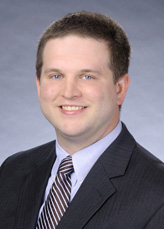
About Bennett Aikin AIF® and fi360.com

Bennett [Ben] Aikin is the Communications Coordinator for fi360.com. He oversees all communications for fi360. His responsibilities include messaging, brand management, copyrights and trademarks, and publications. Mr. Aikin received his BA in English from Virginia Tech in 2003 and is currently an MS candidate in Journalism from Ohio University.

Q. Medical Executive Post 

You have been very helpful and gracious to us. So, let’s get right to it, Ben. In the view of many; attorneys, doctors, CPAs and the clergy are fiduciaries; most all others who retain this title seem poseurs; sans documentation otherwise.

A. Mr. Aikin

You are correct. Attorneys, doctors and clergy are the prototype fiduciaries. They have a clear duty to put the best interests of their clients, patients, congregation, etc., above their own. [The duty of a CPA isn’t as clear to me, although I believe you are correct]. Furthermore, this is one of the first topics we address in our AIF training programs, and what we call the difference between a profession and an industry.  The three professions you name have three common characteristics that elevate them from an industry to a profession:

  1. Recognized body of knowledge
  2. Society depends upon practitioners to provide trustworthy advice
  3. Code of conduct that places the clients’ best interests first

Q. Medical Executive Post 

It seems that Certified Financial Planner®, Chartered Financial Analysts, Registered Investment Advisors and their representatives, Registered Representative [stock-brokers] and AIF® holders, etc, are not really financial fiduciaries, either by legal statute or organizational charter. Are we correct, or not? Of course, we are not talking ethics or morality here. That’s for the theologians to discuss.

A. Mr. Aikin

One of the reasons for the “alphabet soup”, as you put it in one of your white papers [books, dictionaries and posts] on financial designations, is that while there is a large body of knowledge, there is no one recognized body of knowledge that one must acquire to enter the financial services industry.  The different designations serve to provide a distinguisher for how much and what parts of that body of knowledge you do possess.  However, being a fiduciary is exclusively a matter of function. 

In other words, regardless of what designations are held, there are five things that will make one a fiduciary in a given relationship:

  1. You are “named” in plan or trust documents; the appointment can be by “name” or by “title,” such as CFO or Head of Human Resources
  2. You are serving as a trustee; often times this applies to directed trustees as well
  3. Your function or role equates to a professional providing comprehensive and continuous investment advice
  4. You have discretion to buy or sell investable assets
  5. You are a corporate officer or director who has authority to appoint other fiduciaries

So, if you are a fiduciary according to one of these definitions, you can be held accountable for a breach in fiduciary duty, regardless of any expertise you do, or do not have. This underscores the critical nature of understanding the fiduciary standard and delegating certain duties to qualified “professionals” who can fulfill the parts of the process that a non-qualified fiduciary cannot.

Q. Medical Executive Post 

How about some of the specific designations mentioned on our site, and elsewhere. I believe that you may be familiar with the well-known financial planner, Ed Morrow, who often opines that there are more than 98 of these “designations”? In fact, he is the founder of the Registered Financial Consultants [RFC] designation. And, he wrote a Foreword for one of our e-books; back-in-the-day. His son, an attorney, also wrote as a tax expert for us, as well. So, what gives?

A. Mr. Aikin

As for the specific designations you list above, and elsewhere, they each signify something different that may, or may not, lend itself to being a fiduciary: For example:

• CFP®: The act of financial planning does very much imply fiduciary responsibility.  And, the recently updated CFP® rules of conduct does now include a fiduciary mandate:

• 1.4 A certificant shall at all times place the interest of the client ahead of his or her own. When the certificant provides financial planning or material elements of the financial planning process, the certificant owes to the client the duty of care of a fiduciary as defined by CFP Board. [from http://www.cfp.net/Downloads/2008Standards.pdf]

•  CFA: Very dependent on what work the individual is doing.  Their code of ethics does have a provision to place the interests of clients above their own and their Standards of Practice handbook makes clear that when they are working in a fiduciary capacity that they understand and abide by the legally mandated fiduciary standard.

• FA [Financial Advisor]: This is a generic term that you may find being used by a non-fiduciary, such as a broker, or a fiduciary, such as an RIA.

• RIA: Are fiduciaries.  Registered Investment Advisors are registered with the SEC and have obligations under the Investment Advisers Act of 1940 to provide services that meet a fiduciary standard of care.

• RR: Registered Reps, or stock-brokers, are not fiduciaries if they are doing what they are supposed to be doing.  If they give investment advice that crosses the line into “comprehensive and continuous investment advice” (see above), their function would make them a fiduciary and they would be subject to meeting a fiduciary standard in that advice (even though they may not be properly registered to give advice as an RIA).

• AIF designees: Have received training on a process that meets, and in some places exceeds, the fiduciary standard of care.  We do not require an AIF® to always function as a fiduciary. For example, we allow registered reps to gain and use the AIF® designation. In many cases, AIF designees are acting as fiduciaries, and the designation is an indicator that they have the full understanding of what that really means in terms of the level of service they provide.  We do expect our designees to clearly disclose whether they accept fiduciary responsibility for their services or not and advocate such disclosure for all financial service representatives.

Q. Medical Executive Post 

Your website, http://www.fi360.com, seems to suggest, for example, that banks/bankers are fiduciaries. We have found this not to be the case, of course, as they work for the best interests of the bank and stockholders. What definitional understanding are we missing?

A. Mr. Aikin

Banks cannot generally be considered fiduciaries.  Again, it is a matter of function. A bank may be a named trustee, in which case a fiduciary standard would generally apply.  Banks that sell products are doing so according to their governing regulations and are “prudent experts” under ERISA, but not necessarily held to a fiduciary standard in any broader sense.

Q. Medical Executive Post 

And so, how do we rectify the [seemingly intentional] industry obfuscation on this topic. We mean, our readers, subscribers, book and dictionary purchasers, clients and colleagues are all confused on this topic. The recent financial meltdown only stresses the importance of understanding same.

For example, everyone in the industry seems to say they are the “f” word. But, our outreach efforts to contact traditional “financial services” industry pundits, CFP® practitioners and other certification organizations are continually met with resounding silence; or worse yet; they offer an abundance of parsed words and obfuscation but no confirming paperwork, or deep subject-matter knowledge as you have kindly done. We get the impression that some FAs honesty do-not have a clue; while others are intentionally vague.

A. Mr. Aikin

All of the evidence you cite is correct.  But that does not mean it is impossible to find an investment advisor who will manage to a fiduciary standard of care and acknowledge the same. The best way to rectify confusion as it pertains to choosing appropriate investment professionals is to get fiduciary status acknowledged in writing and go over with them all of the necessary steps in a fiduciary process to ensure they are being fulfilled. There also are great resources out there for understanding the fiduciary process and for choosing professionals, such as the Department of Labor, the SEC, FINRA, the AICPA’s Personal Financial Planning division, the Financial Planning Association, and, of course, Fiduciary360.

We realize the confusion this must cause to those coming from the health care arena, where MD/DO clearly defines the individual in question; as do other degrees [optometrist, clinical psychologist, podiatrist, etc] and medical designations [fellow, board certification, etc.]. But, unfortunately, it is the state of the financial services industry as it stands now.

Q. Medical Executive Post 

It is as confusing for the medical community, as it is for the lay community. And, after some research, we believe retail financial services industry participants are also confused. So, what is the bottom line?

A. Mr. Aikin

The bottom line is that lay, physician and all clients have a right to expect and demand a fiduciary standard of care in the managing of investments. And, there are qualified professionals out there who are providing those services.  Again, the best way to ensure you are getting it is to have fiduciary status acknowledged in writing, and go over the necessary steps in a fiduciary process with them to ensure it is being fulfilled.

Q. Medical Executive Post 

The “parole-evidence” rule, of contract law, applies, right? In dealing with medical liability situations, the medics and malpractice attorneys have a rule: “if it wasn’t written down, it didn’t happen.”  

A. Mr. Aikin

An engagement contract accepting fiduciary status should trump a subsequent attempt to claim the fiduciary standard didn’t apply. But, to reiterate an earlier point, if someone acts in one of the five functional fiduciary roles, they are a fiduciary whether they choose to acknowledge it or not.  I have attached a sample acknowledgement of fiduciary status letter with copies of our handbook, which details the fiduciary process we instruct in our programs, and our SAFE, which is basically a checklist that a fiduciary should be able to answer “Yes” to every question to ensure the entire fiduciary process is being covered.

Q. Medical Executive Post 

It is curious that you mention checklists. We have a post arguing that very theme for doctors and hospitals as they pursue their medial error reduction, and quality improvement, endeavors. And, we applaud your integrity, and wish only for clarification on this simple fiduciary query?

A. Mr. Aikin

Simple definition: A fiduciary is someone who is managing the assets of another person and stands in a special relationship of trust, confidence, and/or legal responsibility.

Q. Medical Executive Post 

Who is a financial fiduciary and what, if any, financial designation indicates same?

A. Mr. Aikin

Functional definition: See above for the five items that make you a fiduciary.

Financial designations that unequivocally indicate fiduciary duty: Short answer is none, only function can determine who is a fiduciary. 

Q. Medical Executive Post 

Please repeat that?

A. Mr. Aikin

Financial designations that indicate fiduciary duty: none. It is the function that determines who is a fiduciary.  Now, having said that, the CFP® certification comes close by demanding their certificants who are engaged in financial planning do so to a fiduciary standard. Similarly, other designations may certify the holder’s ability to perform a role that would be held to a fiduciary standard of care.  The point is that you are owed a fiduciary standard of care when you engage a professional to fill that role or they functionally become one.  And, if you engage a professional to fill a non-fiduciary role, they will not be held to a fiduciary standard simply because they have a particular designation.  One of the purposes the designations serve is to inform you what roles the designation holder is capable of fulfilling.

It is also worth keeping in mind that just being a fiduciary doesn’t equate to a full knowledge of the fiduciary standard. The AIF® designation indicates having been fully trained on the standard.

Q. Medical Executive Post 

Yes, your website mentions something about fiduciaries that are not aware of same! How can this be? Since our business model mimics a medical model, isn’t that like saying “the doctor doesn’t know he is doctor?” Very specious, with all due respect!

A. Mr. Aikin

I think it is first important to note that this statement is referring not just to investment professionals.  Part of the audience fi360 serves is investment stewards, the non-professionals who, due to facts and circumstances, still owe a fiduciary duty to another.  Examples of this include investment committee members, trustees to a foundation, small business owners who start 401k plans, etc.  This is a group of non-sophisticated investors who may not be aware of the full array of responsibilities they have. 

However, even on the professional side I believe the statement isn’t as absurd as it sounds.  This is basically a protection from both ignorant and unscrupulous professionals.  Imagine a registered representative who, either through ignorance or design, begins offering comprehensive and continuous investment advice.  Though they may deny or be unaware of the fact, they have opened themselves up to fiduciary liability. 

Q. Medical Executive Post 

Please clarify the use of arbitration clauses in brokerage account contracts for us. Do these disclaim fiduciary responsibility? If so, does the client even know same?

A. Mr. Aikin

By definition, an engagement with a broker is a non-fiduciary relationship.  So, unless other services beyond the scope of a typical brokerage account contract are specified, fiduciary responsibility is inherently not applicable.  Unfortunately, I do imagine there are clients who don’t understand this. Furthermore, AIF® designees are not prohibited from signing such an agreement and there are some important points to understand the reasoning.

First, by definition, if you are entering into such an agreement, you are entering into a non-fiduciary relationship. So, any fiduciary requirement wouldn’t apply in this scenario.

Second, if this same question were applied into a scenario of a fiduciary relationship, such as with an RIA, this would be a method of dispute resolution, not a practice method. So, in the event of dispute, the advisor and investor would be free to agree to the method of resolution of their choosing. In this scenario, however, typically the method would not be discussed until the dispute itself arose.

Finally, it is important to know that AIF/AIFA designees are not required to be a fiduciary. It is symbolic of the individuals training, knowledge and ongoing development in fiduciary processes, but does not mean they will always be acting as a fiduciary.

Q. Medical Executive Post 

Don’t the vast majority of arbitration hearings find in favor of the FA; as the arbitrators are insiders, often paid by the very same industry itself?

A. Mr. Aikin

Actual percentages are reported here: http://www.finra.org/ArbitrationMediation/AboutFINRADR/Statistics/index.htm However, brokerage arbitration agreements are a dispute resolution method for disputes that arise within the context of the securities brokerage industry and are not the only means of resolving differences for all types of financial advisors.  Investment advisers, for example, are subject to respond to disputes in a variety of forums including state and federal courts.  Clients should look at their brokerage or advisory agreement to see what they have agreed to. If you wanted to go into further depth on this question, we would recommend contacting Brian Hamburger, who is a lawyer with experience in this area and an AIFA designee. Bio page: http://www.hamburgerlaw.com/attorneys/BSH.htm.

Q. Medical Executive Post 

What about our related Certified Medical Planner® designation, and online educational program for financial advisors and medical management consultants? Is it a good idea – reasonable – for the sponsor to demand fiduciary accountability of these charter-holders? Cleary, this would not only be a strategic competitive advantage, but advance the CMP™ mission to put medical colleagues first and champion their cause www.CertifiedMedicalPlanner.org above all else. 

A. Mr. Aikin

I think it is a good idea for any plan sponsor to demand fiduciary status be acknowledged from anyone engaged to provide comprehensive and continuous investment advice.  I also think it is a good idea to be proactive in verifying that the fiduciary process is being followed.

Q. Medical Executive Post 

Is there anything else that we should know about this topic?

A. Mr. Aikin

Yes, a further note about fi360’s standards. I wrote generically about the fiduciary standard, because there is one that is defined by multiple sources of regulation, legislation and case law.  The process defined in our handbooks, we call a Fiduciary Standard of Excellence, because it covers that minimum standard and also best practice standards that go above and beyond.  All of our Practices, which comprise that standard, are legally substantiated in our Legal Memoranda handbook, which was written by Fred Reish’s law firm, who is considered a leading ERISA attorney.

Additional resources:

Q. Medical Executive Post 

Thank you so much for your knowledge and willingness to frankly share it with the Medical-Executive-Post.

Assessment

All are invited to continue the conversation with Mr. Aikin, asynchronously online, or thru this contact information:

fi360.com
438 Division Street
Sewickley, PA 15143
412-741-8140 Phone
866-390-5080 Toll-free phone
412-741-8142 Fax

Conclusion

Your thoughts and comments on this ME-P are appreciated. Feel free to review our top-left column, and top-right sidebar materials, links, URLs and related websites, too. Then, subscribe to the ME-P. It is fast, free and secure.

Link: http://feeds.feedburner.com/HealthcareFinancialsthePostForcxos

Speaker: If you need a moderator or speaker for an upcoming event, Dr. David E. Marcinko; MBA – Publisher-in-Chief of the Medical Executive-Post – is available for seminar or speaking engagements. Contact: MarcinkoAdvisors@msn.com

OUR OTHER PRINT BOOKS AND RELATED INFORMATION SOURCES:

LEXICONS: http://www.springerpub.com/Search/marcinko
PRACTICES: www.BusinessofMedicalPractice.com
HOSPITALS: http://www.crcpress.com/product/isbn/9781466558731
CLINICS: http://www.crcpress.com/product/isbn/9781439879900
ADVISORS: www.CertifiedMedicalPlanner.org
BLOG: www.MedicalExecutivePost.com

Product DetailsProduct DetailsProduct Details

Product Details  Product Details

Product DetailsProduct Details

Product Details

Risk Management, Liability Insurance, and Asset Protection Strategies for Doctors and Advisors: Best Practices from Leading Consultants and Certified Medical Planners™8Comprehensive Financial Planning Strategies for Doctors and Advisors: Best Practices from Leading Consultants and Certified Medical Planners™

UPDATE: Dr. Mike Burry, I-Bond Web-Site Crash and Wall Street

By Staff Reporters

***

“The Big Short” celebrity investor and colleague Michael Burry MD recently disclosed that he is short Apple stock. Could he be right about AAPL dipping even further from here? Famous hedge fund manager Michael Burry, the real-life character in “The Big Short”, became famous for his short position on subprime CDOs ahead of the 2008 crash. This time, he is shorting Apple stock. The bombshell news has come recently via a 13F filing released by Burry’s hedge fund.

CITE: https://www.r2library.com/Resource/Title/082610254

***

***

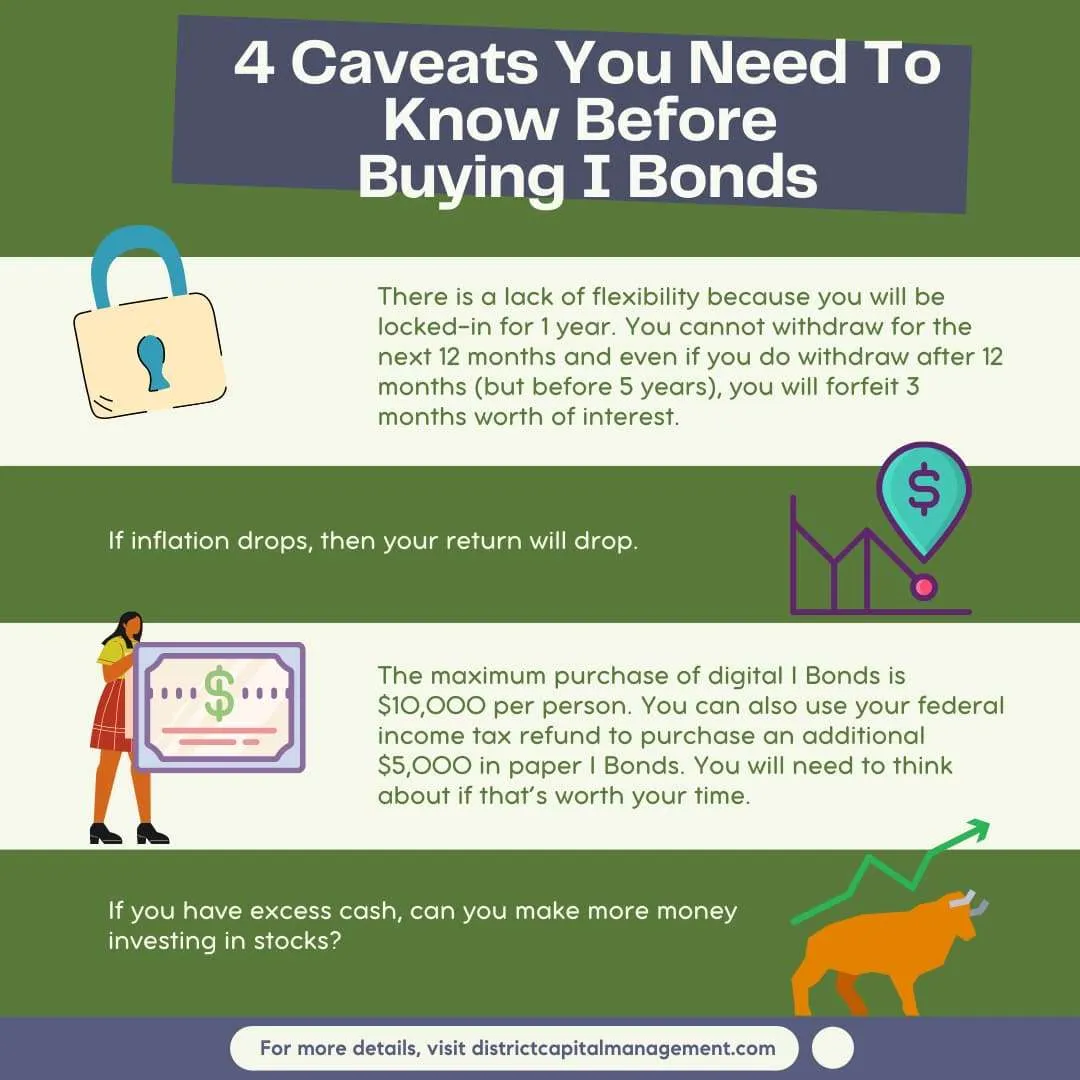
People searching for a respite from inflation have flooded the Treasury Department phone lines and website to try to buy Series I savings bonds, causing much longer waits than usual. It’s the latest example of outdated government computer systems causing anguish for Americans. On May 2nd, the Treasury Department announced that the inflation-protected I bonds will earn 9.62 percent interest at least until the end of October. A day later, TreasuryDirect, the website that people have to use to purchase the bonds, crashed.

Finally, Wall Street rumbled to the edge of a bear market after another drop for stocks briefly sent the S&P 500 more than 20% below its peak set early this year. The S&P 500 index, which sits at the heart of most workers’ 401(k) accounts, was down as much as 2.3% for the day before a furious comeback in the final hour of trading sent it to a tiny gain of less than 0.1%. It finished 18.7% below its record, set on January 3rd. The tumultuous trading capped a seventh straight losing week, its longest such streak since the dot-com bubble was deflating in 2001.

***

COMMENTS APPRECIATED

Thank You

***

***

ECONOMIC INFLATION: Why So High Right Now?

SIX REASONS

By Vitaliy Katsenelson CFA

***

DEFINITION: In economics, inflation is a general increase in the prices of goods and services in an economy. When the general price level rises, each unit of currency buys fewer goods and services; consequently, inflation corresponds to a reduction in the purchasing power of money.

CITE: https://www.r2library.com/Resource/Title/082610254

***

***

The war in Ukraine will likely pour more gasoline on the already raging inflationary fire, threatening to send the global economy into stagflation. Stagflation is a slowdown of economic activity caused by inflation.

READ: https://contrarianedge.com/why-is-inflation-so-high-right-now-6-reasons/?utm_source=IMA++-+Main+Articles&utm_campaign=8be9ec7af7-UBER_MONEY_MANAGER_KIDNAPPED_COPY_03&utm_medium=email&utm_term=0_f1c90406d1-8be9ec7af7-55139025

***
COMMENTS APPRECIATED

Thank You

***

****

SECURE Act 2.0 and Retirement Planning?

By Staff Reporters

***

***

On March 29, the House of Representatives voted 414-5 in favor of the Securing a Strong Retirement Act of 2022. If passed by the Senate, and then signed into law by President Joe Biden, the act could represent a massive economic policy shift regarding retirement savings and investment.

The retirement savings legislation, also known as SECURE Act 2.0, expands on the original SECURE Act and includes provisions to boost the required minimum distribution (RMD) age from 72 to 75 over time, broaden automatic enrollment in retirement plans, and enhance 403(b) plans.

READ: https://waysandmeans.house.gov/?s=secure+act

***

COMMENTS APPRECIATED

Thank You

***

FIN PLAN: https://www.amazon.com/Comprehensive-Financial-Planning-Strategies-Advisors/dp/1482240289/ref=sr_1_1?ie=UTF8&qid=1418580820&sr=8-1&keywords=david+marcinko

***

UPDATE: Stock Market Sentiment and Capitulation?

By Staff Reporters

***

More than $11 trillion in value has been erased from global stocks since the end of March. And, despite a a pop last Friday, many analysts don’t think we’ve hit the bottom yet. Fewer than 30% of S&P companies have hit a one-year low during this downturn, compared to almost 50% during 2018’s rout and 82% during the financial crisis in 2008, according to Bloomberg.

***

Capitulation means surrender. In financial markets, capitulation marks the point in time when a large enough proportion of investors simultaneously give up hopes of recouping recent losses, typically as the decline in prices gathers speed.

CITE: https://www.r2library.com/Resource/Title/082610254

***

***

According to MarketWatch, the latest bull market for U.S. stocks remains on the brink of expiring, with the benchmark S&P 500 just shy of the threshold that marks bear territory.

Going ganular, the S&P 500 SPX, +2.39% finished 0.1% lower at 3,930.08 on Wednesday, after falling as far as 3,858.87 at its session low. That was the index’s lowest close since March 25, 2021, and left it 18.1% below its record finish from early January. A Friday bounce for stocks saw the S&P 500 nearly halve its decline for the week to 2.4%, closing at 4023.89.

In One Chart: Stock market’s ‘ultimate lows’ are still ahead as investors have not yet capitulated, says B. of A.

A finish below 3,837.25 would mark a 20% fall, according to Dow Jones Market Data, meeting the widely used technical definition of a bear market.

***

COMMENTS APPRECIATED

Thank You

***

***

How the “6 percent rule” can help with a pension plan payout decision

A general guide

[By staff reporters]

As a general guide, according to financial advisor Wes Moss, if your monthly pension check equals 6 percent or more of the lump-sum offer, then you may want to go for the perpetual monthly payment. If the number is below 6 percent, then you could do as well (or better) by taking the lump sum and investing it, and then paying yourself each year (like a personal pension that you control).

Here’s how the math works:

Take your monthly pension offer and multiply it by 12, then divide that number by the lump-sum offer.

Example 1: $1,000 a month for life beginning at age 65 or $160,000 lump sum today?

$1,000 x 12 = $12,000 divided by $160,000 equals 7.5 percent.

Here, you would have to make approximately 7.5 percent per year on the $160,000 to earn the same $12,000 a year. Earning 7.5 percent a year consistently and over many years is a tall order. Taking the monthly amount in this case (7.5 percent is greater than 6 percent) may likely be a better deal over the long haul.

Example 2: $708 a month for life or a $170,000 lump sum today?

$708 x 12 = $8,496 divided by $170,000 equals 5 percent.

In this scenario, the monthly pension amount is offering you a return for life of about 5 percent. Remember, for the first 20 years even earning zero percent, you could do the same before you run out of money. If you made even a modest return (say, 2 percent per year), you would be far ahead of what the monthly pension would pay you. In this case, 5 percent is less than the benchmark of 6 percent, so you might be better off taking the lump sum of $170,000.

When You Should Take the Lump Sum Over the Pension

Assessment

Your thoughts are appreciated.

MORE FOR DOCTORS:

“Insurance & Risk Management Strategies for Doctors” https://tinyurl.com/ydx9kd93

“Fiduciary Financial Planning for Physicians” https://tinyurl.com/y7f5pnox

“Business of Medical Practice 2.0” https://tinyurl.com/yb3x6wr8

THANK YOU

Risk Management, Liability Insurance, and Asset Protection Strategies for Doctors and Advisors: Best Practices from Leading Consultants and Certified Medical Planners™8Comprehensive Financial Planning Strategies for Doctors and Advisors: Best Practices from Leading Consultants and Certified Medical Planners™

UPDATE: Carvana, DJIA, NASDAQ, S&P, Crypto, Gasoline and the US Budget Deficit

By Staff Reporters

***

***

Carvana, the fast-growing used-car seller based in Tempe, announced its plans to lay off 2,500 employees – more than 10% of its workforce – as losses mount. The company, which operates a network of high-profile vehicle “vending machines” including one at Loop 202 and Scottsdale Road, said the move was designed to “better align staffing and expense levels with sales volumes.” Carvana reported a $506 million loss in its first quarter ending March 31st, well above red ink of $82 million during the same stretch of 2021, despite a 56% jump in revenue to $3.5 billion and a 14% increase in vehicles sold.

And, new inflation data scared some investors, who continued to dump riskier assets like cryptocurrencies amid the ongoing market selloff: The price of Bitcoin fell up to 7%, to around $29,000, according to Coin Metrics, before paring back losses. The price of the Terra (LUNA) cryptocurrency has fallen by more than 99 per cent, wiping out the fortunes of crypto investors. Terra, which ranked among the top 10 most valuable cryptocurrencies, dropped below $1 on Wednesday, having peaked close to $120 last month.

LINK: https://www.msn.com/en-us/money/markets/crypto-billionaires-vast-fortunes-are-destroyed-in-weeks/ar-AAXaijp?li=BBnb7Kz

Indices:

  • The Dow Jones Industrial Average fell 215 points, or 0.7%, to 31,949 after swinging between gains and losses after the opening bell.
  • The S&P 500 shed 46 points, or 1.2%, to 3,954.
  • The NASDAQ Composite fell 296 points, or 2.5%, to 11,445.

The national average for a gallon of gas surged to $4.40, the highest price recorded by AAA since it began keeping track in 2000 (though lower when adjusted for inflation than the high-water mark in July 2008, when gas was $5.36 per gallon in today’s dollars).

Finally, the US federal government’s budget deficit has shrunk by some $1.57 trillion so far this fiscal year, driven by record receipts from a strong economy and a slowdown in spending as pandemic-era programs fade.

***

COMMENTS APPRECIATED

Thank You

***

***

BITCOIN: A Subjective Theory for Physicians

***

By Michel Accad, MD

Michel Accad MD Practices internal medicine and cardiology in San Francisco

***

Bitcoin Cash - Wikipedia

****

In a recent article on the Mises Institute’s Power and Market blog, Kyle Ward appealed to the subjective theory of value to castigate Peter Schiff for his notorious skepticism of Bitcoin:

READ: http://alertandoriented.com/the-subjective-theory-of-bitcoin/

CITE: https://www.r2library.com/Resource/Title/082610254

COMMENTS APPRECIATED.

Subscribe to the Medical Executive-Post

Thank You

****

***

***

What Really is a STABLECOIN?

Types with Guide

By Staff Reporters

***

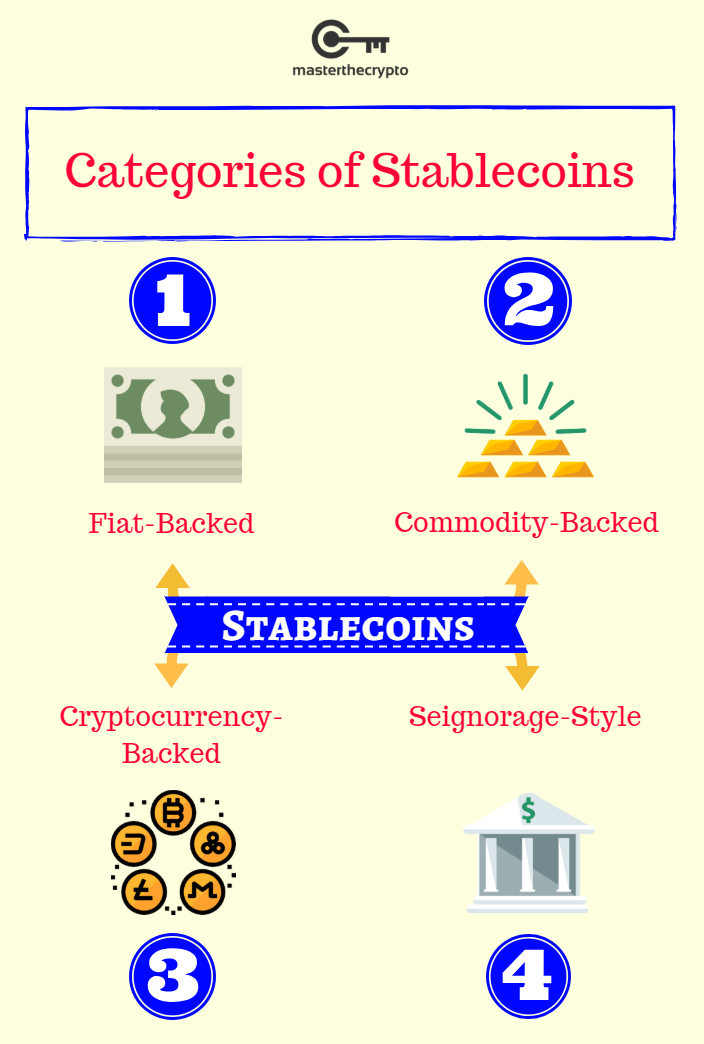
According to Investopedia, a stablecoin is a class of cryptocurrencies that attempt to offer price stability and are backed by a reserve asset. Stablecoins have gained traction as they attempt to offer the best of both worlds—the instant processing and security or privacy of payments of cryptocurrencies, and the volatility-free stable valuations of fiat currencies.

***

***

Stablecoins are cryptocurrencies where the price is designed to be pegged to a cryptocurrency, fiat money, or to exchange-traded commodities (such as precious metals or industrial metals).

CITE: https://www.r2library.com/Resource/Title/082610254

***

Key Points

  • Stablecoins are cryptocurrencies that attempt to peg their market value to some external reference.
  • Stablecoins may be pegged to a currency like the U.S. dollar or to a commodity’s price such as gold.
  • Stablecoins achieve their price stability via collateralization (backing) or through algorithmic mechanisms of buying and selling the reference asset or its derivatives.

***

***

COMMENTS APPRECIATED

Thank You

***

***

UPDATE: The Markets, Crypto and Online Retailers

By Staff Reporters

***

  • Markets: After booming stocks had their worst day of the year because of raging inflation, slowing economic growth, and a potential recession.
  • Crypto: Bitcoin and other major cryptos like ethereum also tumbled in the aftermath of the FOMC announcement. They’ve typically tracked the performance of growth stocks, which have gotten hammered on the prospect of higher interest rates.

***

Almost every major online retailer reporting earnings with signs of a decline:

  • Wayfair shares cratered nearly 26% yesterday after announcing that its active customer count dropped 23.4% from a year ago.
  • Bed Bath & Beyond reported an 18% nosedive in online sales.
  • Etsy and eBay shares both dropped by double digits yesterday after giving weak guidance for the current quarter.
  • At least five senior executives from Meta’s fledgling e-commerce division have fled in the last six months.
  • Shopify shares plummeted about 15% on Thursday after posting much lower-than-expected earnings.

***

COMMENTS APPRECIATED

Thank You

***

***

UPDATE: The FOMC, Markets and Cinco deMayo

By Staff Reporters

***

***

FOMC: The Federal Reserve approved a rare half-percentage-point interest rate increase and announced plans to shrink its $9 trillion asset portfolio starting next month in an effort to reduce inflation that is running at a four-decade high.

Markets: Stocks boomed after Fed Chair Jerome Powell spoke. Still, JPMorgan CEO Jamie Dimon pegged the probability of a recession at 33% and a “soft landing” (lower inflation, no recession) also at 33%.

And Lyft, the ride-hailing company lost nearly 30% of its value after its profit outlook came in below forecast. Uber tried to distance itself from its ailing rival, saying that it does not need to spend money recruiting drivers like Lyft does.

Cinco deMayo commemorates the defeat of French forces by the Mexican army at the Battle of Puebla in 1862, but its popularity jumped in the 1980s, when beer companies leveraged it in aggressive marketing campaigns. Now, Cinco de Mayo is a day for celebrating Mexican culture and, interestingly, it’s now more popular in the US than in Mexico.

***

COMMENTS APPRECIATED

Thank You

***

****

PODCAST: How Modernized Self-Directed IRAs Help Democratize [Physician] Retirement

***

In this podcast, host Dara Albright and guest, Eric Satz, Founder and CEO of Alto IRA, discuss how modern Self-Directed IRAs (SDIRAs) are democratizing retirement planning by providing all Americans with the ability to add non-correlated alternative asset classes to tax-advantaged accounts.

The single greatest – and free – investment tool is also disclosed.

***

What are the Advantages of Rolling the Money of My Retirement Plan into an  IRA? - Protection Point Advisors, Inc.

Discussion highlights include:

  • How SDIRAs offer wealth building opportunities for “not-yet accredited investors”;
  • How SDIRAs have evolved to accommodate micro-sized alternative investments; 
  • Why alternative assets belong in retirement vehicles;
  • Three reasons most retirement savers are underweighted in non-correlated assets;
  • Trading cryptocurrencies without tax consequences; 
  • Why RIAs are looking to ALTO for clients’ crypto allocation;
  • How to open a cryptoIRA account.

PODCAST: https://dwealthmuse.podbean.com/e/episode-12-how-modernized-selfdirected-iras-help-democratize-retirement-1623424270/

Your comments are appreciated.

THANK YOU

RELATED TEXTS: https://medicalexecutivepost.com/2021/04/29/why-are-certified-medical-planner-textbooks-so-darn-popular/

INVITE DR. MARCINKO: https://medicalexecutivepost.com/dr-david-marcinkos-

******

PODCAST: The TENDER OFFER?

By Staff Reporters

***

***

DEFINITION: In corporate finance, a tender offer is a type of public takeover bid. The tender offer is a public, open offer or invitation (usually announced in a newspaper advertisement) by a prospective acquirer to all stockholders of a publicly traded corporation (the target corporation) to tender their stock for sale at a specified price during a specified time, subject to the tendering of a minimum and maximum number of shares.

In a tender offer, the bidder contacts shareholders directly; the directors of the company may or may not have endorsed the tender offer proposal.

CITE: https://www.r2library.com/Resource/Title/0826102549

***

PODCAST: https://www.youtube.com/watch?v=wLaiOoVm99Q

***

COMMENTS APPRECIATED

Thank You

***

***

UPDATE: The Domestic GDP, Bond Yield Surge and Stock Market Volatility [VIX]

***

***

By Staff Reporters

***

The U.S. economy reversed course in this year’s first quarter, when it shrank at an annual rate of 1.4% after posting full-year growth of 5.7% in 2021. While many economists believe the first-quarter setback was temporary, it marked the worst quarterly GDP result since the second quarter of 2020, when the pandemic triggered a brief recession.

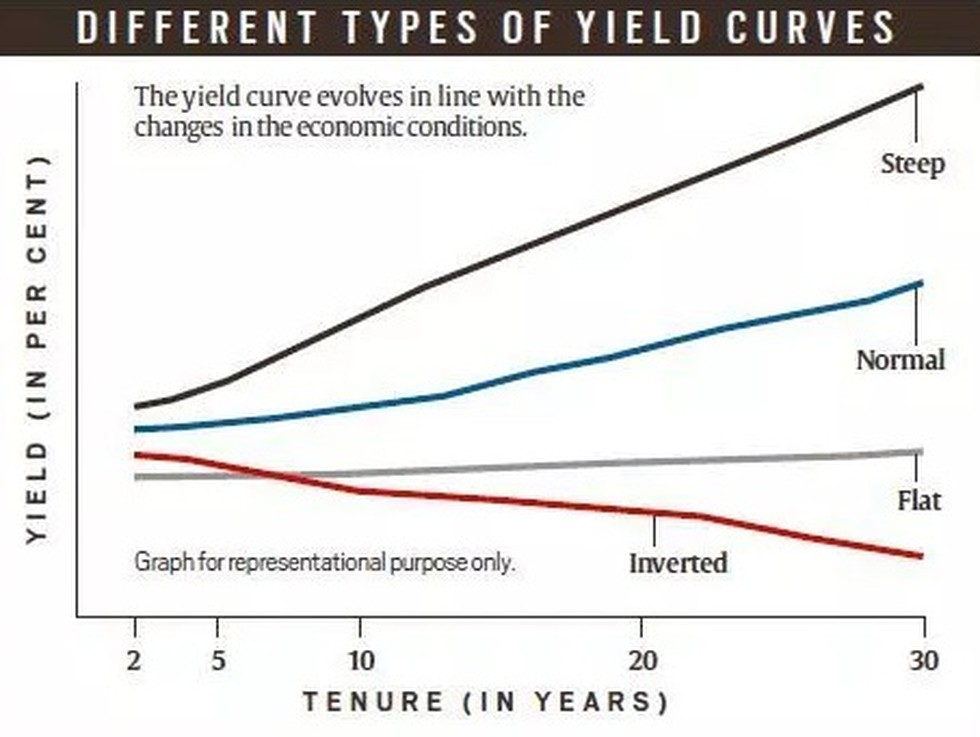
And, despite a relatively flat result in the latest week, the yield of the 10-year U.S. Treasury bond jumped in March and April, climbing from 1.83% at the start of that two-month period to around 2.89% on Friday. Rising interest rates have eroded bond prices, pushing yields higher.

Finally, the stock market’s relative calm in the first half of April was fleeting, as the past two weeks produced a 47% jump in an index that measures investors’ expectations of short-term volatility. The CBOE Volatility Indexꟷalso known as the VIXꟷrose to an index level of 33.4 on Friday, up from 22.7 on April 15.

CITE: https://www.r2library.com/Resource/Title/082610254

***

COMMENTS APPRECIATED

Thank You

***

***

UPDATE: The Markets and Energy

By Staff Reporters

***

***

Markets: The NASDAQ stayed flat at its lowest level this year. Spotify shares sank to a record low. Facebook is having a rough go, but it’s not the only one. Netflix stock plunged nearly 70% this year after hitting a ceiling on subscriber growth. At one point, it was worth more than Disney; now, it’s not even half as valuable. Even Google is googling “ways to make more money.” Its parent company, Alphabet, reported a slowdown in growth last quarter because, like Facebook, YouTube’s also being been dinged by TikTok and Apple’s privacy changes: The video platform’s revenue came in more than $500 million below expectations.

Energy: Russia’s halted oil shipments to Poland and Bulgaria yesterday.

COMMENTS APPRECIATED

Thank You

***

****

PODCAST: The War and Your Finances?

By Morning Brew

***

An event like the Russia-Ukraine war creates ripple effects throughout the financial markets, in sometimes surprising ways. In this episode of Brew Breakdown, they explain how geopolitics affect the global market and point out what you can look out for when it comes to your stock portfolio during times of uncertainty.

***

***

COMMENTS APPRECIATED

Thank You

***

***

Subscribe to the Medical Executive-Post

***

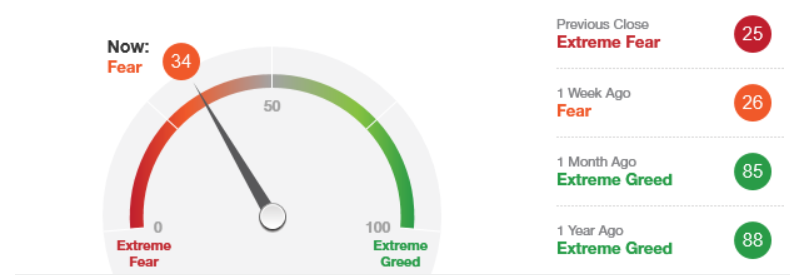
INDEX: Fear & Greed

By Staff Reporters

****

What a week in the world’s financial markets? It is perfect timing for this ME-P.

***

***

It is useful to look at stock market levels compared to where they’ve been over the past few months. When the S&P 500 is above its moving or rolling average of the prior 125 trading days, that’s a sign of positive momentum. But if the index is below this average, it shows investors are getting skittish.

The Fear & Greed Index uses slowing momentum as a signal for Fear and a growing momentum for Greed.

But, a few big stocks can skew returns for the market. So, it’s important to also know how many stocks are doing well versus those that are struggling.

***

***

COMMENTS APPRECIATED

Thank You

***

***

PODCAST: The BLANK CHECK Company?

By Staff Reporters

***

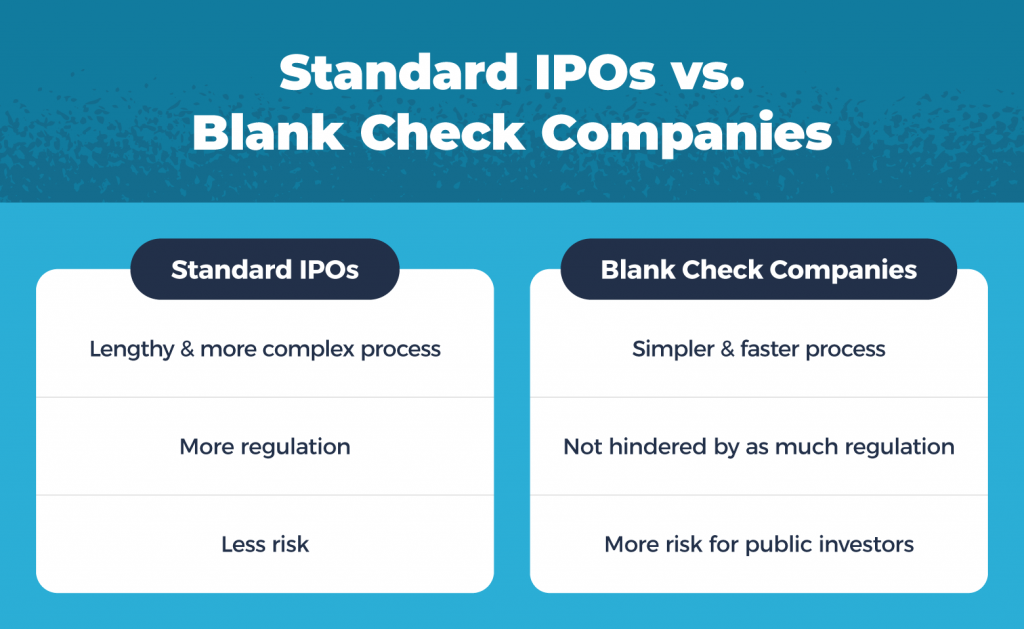
DEFINITION: A blank check company is a development stage company that has no specific business plan or purpose or has indicated its business plan is to engage in a merger or acquisition with an unidentified company or companies, other entity, or person.

CITE: https://www.r2library.com/Resource/Title/082610254

Blank check companies are speculative in nature and are bound by Securities and Exchange Commission Rule 419 to protect investors.

***

***

SPAC: https://medicalexecutivepost.com/2021/10/28/spac-v-direct-listing-v-ipo/

PUBLIC SPACS: https://stockmarketmba.com/listofcompaniesthathavemergedwithaspac.php

PODCAST: https://www.youtube.com/watch?v=OnYRxHuI10Q

***

COMMENTS APPRECIATED

Thank You

***

***

UPDATE: The Markets, COVID and Home Prices

By Staff Reporters

***

***

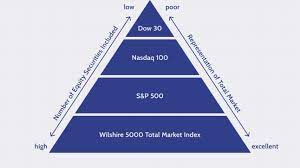
  • Markets: Yesterday was a tale of two markets. The Dow, which is home to blue-chip corporations like P&G, gained, while the NASDAQ, comprised of tech stocks, fell. Netflix is now the worst performing stock in the S&P this year.
  • Covid: The DOJ appealed a judge’s ruling that overturned a federal mask mandate for transportation. The move came at the suggestion of the CDC, which determined that people should still wear masks in indoor public transportation settings.
  • Homes: The median existing-home price in the US hit an all-time high of $375,300 in March, up 15% from the year before. With surging mortgage rates and higher home prices, the average borrower is paying ~38% more than they would have for the same home a year ago, according to Realtor.com.

***

COMMENTS APPRECIATED

Thank You

***

***

Stress Testing your Investment Portfolio

Join Our Mailing List

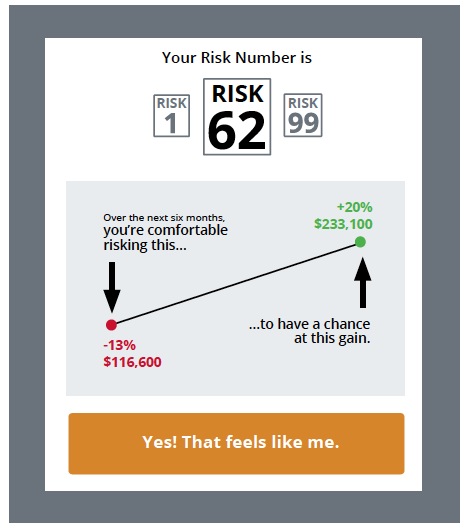
What is Your Risk Number?

DG

[By David Gratke]

Are your current investments aligned with YOUR investment goals and expectations in 2022?

As we all know, the global financial markets have responded tremendously to the past seven years of Global Central Bank monetary polices. i.e. asset prices, stocks, bonds and real estate have all gone up in price as a result. But now, we have the pandemic and Ukraine war to consider.

So, when have you last ‘stress-tested’ your portfolio to see how durable it may through various market cycles? And, how do you determine if your current investment holdings are right for you? Maybe they are too conservative, or just the opposite, still too aggressive?  Maybe they are right where they need to be, but how do you know, how do you measure that?

  • Capture you Risk Tolerance
  • See if your portfolio fits you.
  • OK, How do I Start?

By simply answering a few questions, and spending 10 minutes of your time, based upon the size of your investment portfolio, you will quickly determine your own tolerance for risk.

Comparing your Risk Number to your Portfolio

Now that you have calculated your Risk Number, how does that number compare to your actual portfolio holdings? Is the portfolio you have today, the one you started with some time ago regarding risk and return? Is it still in alignment with your original expectations?

Does your portfolio have?

  • Too much risk?
  • Is it too conservative?
  • Or, is it just right
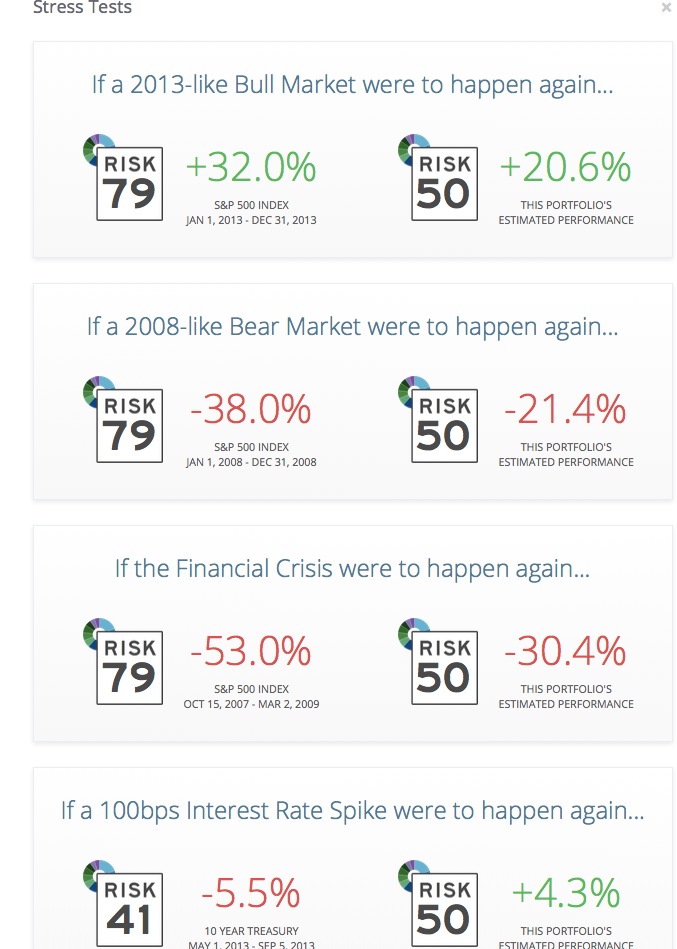
  • What if the market drops significantly? Instead, what if the market goes up significantly? See how your current portfolio will fair in any one of these market conditions:
  • Let’s put your portfolio onto the treadmill; just like the doctor’s office.
  • How do you know, how do you measure?

Let’s Stress Test your Portfolio

  1. Bull Market (Prices generally rise)
  2. Bear Market (Prices generally fall)
  3. Financial Crisis
  4. Rising Interest Rates

***

ScreenShot2015-06-01at11_34_02AM_113439

***

  • Are the results in alignment with your expectations?
  • Any ‘hot spots’ you need to know about?
  • Are there any individual holdings that will cause you loss of sleep over?
  • Maybe investments don’t generate enough income?
  • Maybe investments fluctuate too much in price?
  • Now you can have a look and see if there are any ‘hot spots’ where you may need to re-balance a portion of your holdings based upon these findings.

***

2

Yes! That feels like me

***

Congratulations. Once you have determined your Risk Number, and perhaps re-aligned your current portfolio to your Risk Number, then yes, you DO have the portfolio that is right for you, one that ‘feels like you’.

ABOUT

David Gratke is chief executive officer of Gratke Wealth LLC in Beaverton, Ore. A Registered Investment Advisory Firm.

***

Conclusion

Your thoughts and comments on this ME-P are appreciated. How does the current market tumult affect this ME-P or your own investing strategy? Feel free to review our top-left column, and top-right sidebar materials, links, URLs and related websites, too. Then, subscribe to the ME-P. It is fast, free and secure.

***

Risk Management, Liability Insurance, and Asset Protection Strategies for Doctors and Advisors: Best Practices from Leading Consultants and Certified Medical Planners™8Comprehensive Financial Planning Strategies for Doctors and Advisors: Best Practices from Leading Consultants and Certified Medical Planners™

“Physicians who don’t understand modern risk management, insurance, business and asset protection principles are sitting ducks waiting to be taken advantage of by unscrupulous insurance agents and financial advisors; and even their own prospective employers or partners. This comprehensive volume from Dr. David Marcinko, and his co-authors, will go a long way toward educating physicians on these critical subjects that were never taught in medical school or residency training.”

Dr. James M. Dahle MD FACEP [Editor of The White Coat Investor, Salt Lake City, Utah]

***

USA “With time at a premium, and so much vital information packed into one well organized resource, this comprehensive textbook should be on the desk of everyone serving in the healthcare ecosystem. The time you spend reading this frank and compelling book will be richly rewarded.”

Dr. J. Wesley Boyd MD PhD MA [Harvard Medical School, Boston, Massachusetts, USA]

UPDATE: Holiday Weekend Investing?

By Staff Reporters

***

***

Investors are about to embark on a three-day (or three-and-a-half-day) holiday weekend.

The stock market is closed on Friday, April 15, 2022 – Good Friday, as well as the start of Passover this year – ahead of the Easter Sunday holiday, which falls on April 17th. As a result, no major earnings are scheduled for Good Friday.

However, bond traders will enjoy not just a full Friday off, but also had a partial trading day Thursday. The bond markets shut down early, at 2 p.m., for Maundy Thursday. Stock and bond trading resume at their normal hours on Monday, the day after Easter Sunday.

***

COMMENTS APPRECIATED

Thank You

Subscribe to the Medical Executive-Post

***

***

RATE OF RETURN [RoR]: Investments 2022?

By Staff Reporters

***

***

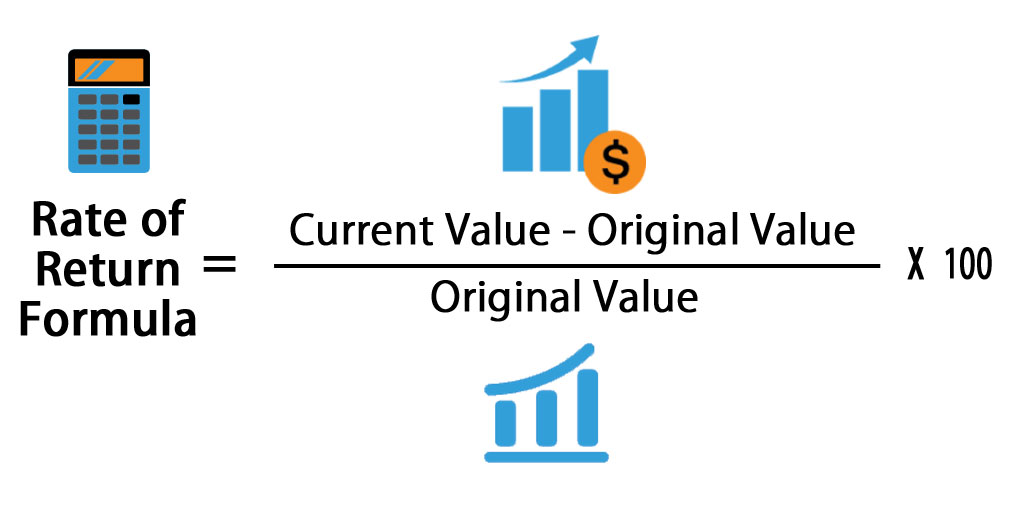
DEFINITION: A rate of return (RoR) is the net gain or loss of an investment over a specified time period, expressed as a percentage of the investment’s initial cost. When calculating the rate of return, you are determining the percentage change from the beginning of the period until the end.

***

And so, according to Greg McBride CFA, before you invest your money, you’re likely wondering how much you’re going to earn. This is known as the rate of return. The rate of return is expressed as a percentage of the total amount you invested. If you invest $1,000 and get back your original investment plus an additional $100 in interest, you’ve earned a 10 percent return.

CITE: https://www.r2library.com/Resource/Title/082610254

However, numbers don’t always tell the full story. You’ll also need to think about how long you plan to keep the money invested, how your investment options have performed historically and how inflation will impact your bottom line.

Key return on investment statistics

When you’re trying to get the best return on your investment, you’ll likely start combing through loads of data. A good place to start is looking at the past decade of returns on some of the most common investments:

  • Average annual return on stocks: 16.63%
  • Average annual return on international stocks: 7.39%
  • Average annual return on bonds: 3.05%
  • Average annual return on gold: -0.21%
  • Average annual return on real estate: 11.72%
  • Average annual return on CDs: 0.40%

CD rate data is from internal Bankrate averages.

***

ECONOMICS: https://www.msn.com/en-us/money/realestate/from-real-estate-to-inflation-heres-what-to-expect-from-the-economy-in-2022/ar-AASbBHN?li=BBnb7Kz

MARKETS: https://www.msn.com/en-us/money/markets/stock-market-outlook-were-going-to-get-an-explosion-to-the-upside-in-january-strategist-says/vi-AASbBih

***

COMMENTS APPRECIATED.

How have you done so far in 2022?

THANK YOU

***

Thank You

***

The STEP-UP In Investment Value?

Understanding the TAX loophole of a ‘step up’ in BASIS value

By Dr. David E. Marcinko MBA CMP®

CMP logo

SPONSOR: http://www.CertifiedMedicalPlanner.org

The term “step-up” refers to the difference in value and tax liability that an asset has when it is acquired and when it is transferred to an inheritor.

****

CITE: https://www.r2library.com/Resource/Title/0826102549

EXAMPLE #2: The proverbial millionaire Doctor Joe, for example, could buy a home for $350,000 and sell it for $1 million, after which he’d pay taxes on the $650,000 gain. But if Dr. Joe passes the home onto his daughter Ella, and she has it appraised at $1 million, its value has taken a “step up” in value to $1 million. If Ella sells the home for $1 million or less, she wouldn’t owe anything in taxes.

ASSESSMENT: For billionaires like Jeff Bezos, Bill Gates and Elon Musk who earn far more through their investments than their salaries, this loophole is a perfect way to shield their wealth. Intergenerational wealth has contributed to surging inequality in America, which grew wider during the pandemic. Since 2019, the wealth of the top 400 richest people in the US increased by $1.4 trillion, per research from Gabriel Zucman and Emmanuel Saez, a pair of left-leaning economists at the University of California, Berkeley.

“Often, for these people, wealth accumulates tax-free their entire lives,” Frank Clemente, executive director at the left-leaning advocacy group Americans for Tax Fairness, opined. President Joe Biden proposed ending this loophole and making billionaires “pay their fair share,” so why does it look like his party won’t touch it?

YOUR COMMENTS ARE APPRECIATED.

Thank You

***

INVITE DR. MARCINKO: https://medicalexecutivepost.com/dr-david-marcinkos-

***

COVID, Inflation and Value Investing [Millennial Interview]

***

By Vitaliy Katsenelson CFA

***

COVID, Inflation, and Value Investing: Millennial Investing Interview
I was recently interviewed by Millennial Investors podcast. They sent me questions ahead of time that they wanted to ask me “on the air”. I found some of the questions very interesting and wanted to explore deeper. Thus, I ended up writing answers to them (I think through writing). You can listen to the podcast here

By the way, I often get asked how I find time to write. Do I even do investment research? Considering how much content I’ve been spewing out lately, I can understand these questions. In short – I write two hours a day, early in the morning (usually from 5–7am), every single day. I don’t have time-draining hobbies like golf. I rarely watch sports. I have a great team at IMA, and I delegate a lot. I spend the bulk of my day on research because I love doing it. 

This is not the first time I was asked these questions. If you’d like to adapt some of my daily hacks in your life, read this essay.

***

CITE: https://www.r2library.com/Resource/Title/082610254

***

COMMENTS APPRECIATED

Thank You

Subscribe to the Medical Executive-Post

***

***