BOARD CERTIFICATION EXAM STUDY GUIDES Lower Extremity Trauma
[Click on Image to Enlarge]
ME-P Free Advertising Consultation
The “Medical Executive-Post” is about connecting doctors, health care executives and modern consulting advisors. It’s about free-enterprise, business, practice, policy, personal financial planning and wealth building capitalism. We have an attitude that’s independent, outspoken, intelligent and so Next-Gen; often edgy, usually controversial. And, our consultants “got fly”, just like U. Read it! Write it! Post it! “Medical Executive-Post”. Call or email us for your FREE advertising and sales consultation TODAY [678.779.8597] Email: MarcinkoAdvisors@outlook.com
Medical & Surgical e-Consent Forms
ePodiatryConsentForms.com
iMBA Inc., OFFICES
Suite #5901 Wilbanks Drive, Norcross, Georgia, 30092 USA [1.678.779.8597]. Our location is real and we are now virtually enabled to assist new long distance clients and out-of-town colleagues.
ME-P Publishing
SEEKING INDUSTRY INFO PARTNERS?
If you want the opportunity to work with leading health care industry insiders, innovators and watchers, the “ME-P” may be right for you? We are unbiased and operate at the nexus of theoretical and applied R&D. Collaborate with us and you’ll put your brand in front of a smart & tightly focused demographic; one at the forefront of our emerging healthcare free marketplace of informed and professional “movers and shakers.” Our Ad Rate Card is available upon request [678-779-8597].
Posted on November 6, 2025 by Dr. David Edward Marcinko MBA MEd CMP™
By Staff Reporters and Copilot A.I.
***
***
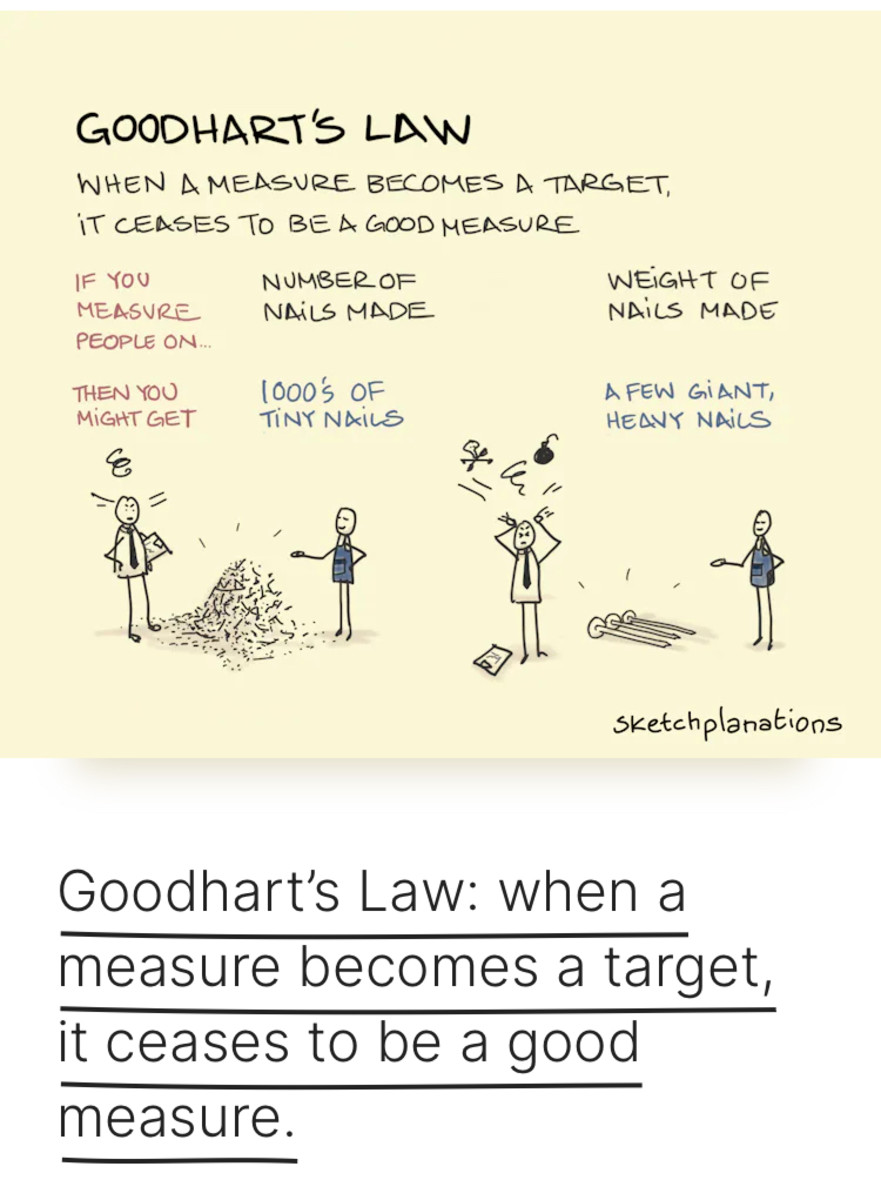
Goodhart’s law is an adage often stated as, “When a measure becomes a target, it ceases to be a good measure”. It is named after British economistCharles Goodhart, who is credited with expressing the core idea of the adage in a 1975 article on monetary policy in the United Kingdom:
Any observed statistical regularity will tend to collapse once pressure is placed upon it for control purposes.
It was used to criticize the British Margaret Thatcher Government for trying to conduct monetary policy on the basis of targets for broad and narrow money, but the law reflects a much more general phenomenon.
And so, aother famous Goodhart’s Law example is the cobra effect, where well-intentioned government policies inadvertently worsened the problem they were designed to solve.
For example, the British colonial government in India, concerned about the increasing number of venomous cobras in Delhi, began offering a bounty for each dead cobra that was delivered. Initially, this strategy was successful as locals brought in large numbers of slaughtered snakes. Over time, however, enterprising individuals started breeding cobras to kill them for supplemental income. When the government abandoned the bounty, the cobra breeders released their cobras into the wild, leading to a surge in Delhi’s snake population.
The cobra effect, where efforts to control a problem lead to unintended and often worse outcomes, serves as a cautionary tale for health care AI. If developers or health care institutions focus too narrowly on specific performance AI metrics, they risk undermining the system’s overall effectiveness, leading to suboptimal patient outcomes. Physicians must be vigilant in ensuring that health care AI systems are not only optimized for performance metrics but are also truly beneficial in practical, clinical applications.
Valuing a medical practice involves assessing its financial performance, assets, and intangible factors like goodwill and patient loyalty to determine its fair market worth.
Determining the value of a medical practice is a nuanced process that blends financial analysis with strategic insight. Whether you’re preparing to sell, merge, or bring in a partner, understanding how to value your practice ensures informed decision-making and fair negotiations.
There are several recognized methods for valuing a medical practice, each suited to different scenarios. The most common include the income approach, market approach, asset-based approach, and the rule-of-thumb method.
The income approach focuses on the practice’s ability to generate future earnings. This method involves analyzing historical financial statements, projecting future cash flows, and discounting them to present value using a risk-adjusted rate. It’s particularly useful when the practice has stable revenue and predictable expenses. Key metrics include net income, physician productivity, and reimbursement rates.
The market approach compares the practice to similar ones that have recently sold. It relies on data from comparable transactions, adjusted for differences in size, specialty, location, and profitability. This method is ideal when reliable market data is available, though such data can be scarce for niche specialties or rural practices.
The asset-based approach calculates the value of tangible and intangible assets. Tangible assets include medical equipment, office furniture, and real estate. Intangible assets—like patient records, brand reputation, and goodwill—are harder to quantify but can significantly impact value. Goodwill, for instance, reflects the practice’s reputation, patient loyalty, and referral networks.
The rule-of-thumb method uses industry benchmarks, such as a multiple of annual revenue or earnings. For example, a general practice might be valued at 60–80% of annual gross revenue. While quick and easy, this method oversimplifies and may not reflect the unique strengths or weaknesses of a specific practice.https:/https://medicalexecutivepost.com/2025/03/17/medial-practice-valuation-adjustments//medicalexecutivepost.com/2025/03/17/medial-practice-valuation-adjustments/
Beyond these methods, several qualitative factors influence valuation. These include the size and diversity of the patient base, the practice’s specialty, use of technology (like EHR systems or telemedicine), and whether key physicians will remain post-sale. A practice heavily reliant on one provider may be less valuable than one with a strong team and succession plan.
Timing also matters. Economic conditions, regulatory changes, and shifts in healthcare reimbursement can affect practice value. Tax implications and deal structure—such as asset sale vs. stock sale—should also be considered during negotiations.
Ultimately, valuing a medical practice is both art and science. Engaging a professional appraiser or valuation expert can help ensure accuracy and objectivity. They bring experience, access to market data, and the ability to tailor valuation methods to your specific situation.
In summary, a comprehensive valuation considers financial performance, assets, market trends, and intangible factors. By understanding these elements, practice owners can make strategic decisions that reflect the true worth of their medical enterprise.
SPEAKING: Dr. Marcinko will be speaking and lecturing, signing and opining, teaching and preaching, storming and performing at many locations throughout the USA this year! His tour of witty and serious pontifications may be scheduled on a planned or ad-hoc basis; for public or private meetings and gatherings; formally, informally, or over lunch or dinner. All medical societies, financial advisory firms or Broker-Dealers are encouraged to submit an RFP for speaking engagements: CONTACT: Ann Miller RN MHA at MarcinkoAdvisors@outlook.com
Posted on October 23, 2025 by Dr. David Edward Marcinko MBA MEd CMP™
By Dr. David Edward Marcinko MBA MEd
DEFINED
***
***
A physician practice management corporation (PPMC) is a business entity that provides non-clinical administrative and operational support to medical practices, allowing physicians to focus on patient care while the corporation handles the business side of healthcare.
Physician practice management corporations emerged in response to the increasing complexity of running a medical practice. As healthcare regulations, insurance requirements, and operational costs grew, many physicians found it challenging to manage both clinical responsibilities and business operations. PPMCs offer a solution by taking over the administrative burdens, enabling physicians to concentrate on delivering quality care.
At their core, PPMCs are responsible for a wide range of non-medical services. These include billing and coding, human resources, payroll, marketing, compliance, information technology, and financial management. By centralizing these functions, PPMCs can achieve economies of scale, reduce overhead costs, and improve operational efficiency for the practices they manage. This model is particularly attractive to small and mid-sized practices that may lack the resources to manage these functions independently.
PPMCs typically enter into long-term management agreements with physician groups. In some cases, they may purchase the non-clinical assets of a practice—such as equipment, office space, and administrative staff—while the physicians retain control over clinical decisions and patient care. This arrangement allows for a clear division between medical and business responsibilities, which is essential for maintaining compliance with healthcare regulations like the Stark Law and the Anti-Kickback Statute.
A physician practice management corporation (PPMC) is a business entity that provides non-clinical administrative and operational support to medical practices, allowing physicians to focus on patient care while the corporation handles the business side of healthcare.
Physician practice management corporations emerged in response to the increasing complexity of running a medical practice. As healthcare regulations, insurance requirements, and operational costs grew, many physicians found it challenging to manage both clinical responsibilities and business operations. PPMCs offer a solution by taking over the administrative burdens, enabling physicians to concentrate on delivering quality care.
At their core, PPMCs are responsible for a wide range of non-medical services. These include billing and coding, human resources, payroll, marketing, compliance, information technology, and financial management. By centralizing these functions, PPMCs can achieve economies of scale, reduce overhead costs, and improve operational efficiency for the practices they manage. This model is particularly attractive to small and mid-sized practices that may lack the resources to manage these functions independently.
PPMCs typically enter into long-term management agreements with physician groups. In some cases, they may purchase the non-clinical assets of a practice—such as equipment, office space, and administrative staff—while the physicians retain control over clinical decisions and patient care. This arrangement allows for a clear division between medical and business responsibilities, which is essential for maintaining compliance with healthcare regulations like the Stark Law and the Anti-Kickback Statute.
***
***
One of the key advantages of working with a PPMC is access to capital and advanced infrastructure. PPMCs often invest in state-of-the-art electronic health record (EHR) systems, data analytics tools, and revenue cycle management platforms. These technologies can enhance patient care, streamline operations, and improve financial performance. Additionally, PPMCs may offer strategic guidance on practice expansion, mergers and acquisitions, and payer contract negotiations.
However, the relationship between physicians and PPMCs must be carefully managed. While PPMCs bring valuable expertise and resources, there is a risk that business priorities could overshadow clinical autonomy. To mitigate this, successful PPMCs prioritize physician engagement, transparent governance, and aligned incentives. They work collaboratively with physicians to ensure that business strategies support, rather than hinder, the delivery of high-quality care.
The physician practice management industry has evolved significantly over the past few decades. After a wave of failures in the 1990s due to overexpansion and misaligned incentives, modern PPMCs have adopted more sustainable and physician-centric models. Today, they play a crucial role in helping practices adapt to value-based care, population health management, and other emerging trends in healthcare delivery.
In conclusion, a physician practice management corporation serves as a strategic partner to medical practices, offering the business acumen and operational support needed to thrive in a complex healthcare environment. By offloading administrative tasks and providing access to advanced resources, PPMCs empower physicians to focus on what they do best—caring for patients—while ensuring the long-term success and sustainability of their practices.
SPEAKING: Dr. Marcinko will be speaking and lecturing, signing and opining, teaching and preaching, storming and performing at many locations throughout the USA this year! His tour of witty and serious pontifications may be scheduled on a planned or ad-hoc basis; for public or private meetings and gatherings; formally, informally, or over lunch or dinner. All medical societies, financial advisory firms or Broker-Dealers are encouraged to submit an RFP for speaking engagements: CONTACT: Ann Miller RN MHA at MarcinkoAdvisors@outlook.com
Why It Is Difficult to Practice Medicine Part-Time Today?
In the past, part-time medical practice offered physicians a flexible way to balance professional responsibilities with personal or family commitments. Today, however, the healthcare environment has evolved in ways that make part-time medicine increasingly challenging. From administrative burdens to economic pressures and patient expectations, the obstacles are both systemic and personal.
One of the most significant barriers is the rise in administrative complexity. Physicians are now required to navigate electronic health records (EHRs), comply with insurance documentation, and meet regulatory standards such as HIPAA and MACRA. These tasks consume hours of non-clinical time, which is difficult to compress into a part-time schedule. Even seeing fewer patients doesn’t exempt part-time doctors from the same documentation and compliance requirements as their full-time counterparts.
***
***
Another challenge is financial viability. Many physicians are paid based on productivity metrics, such as Relative Value Units (RVUs), which reward volume over quality. Part-time practitioners often struggle to meet these benchmarks, resulting in lower compensation and reduced benefits. Additionally, malpractice insurance premiums and licensing fees remain fixed regardless of hours worked, further eroding the financial appeal of part-time practice.
Continuity of care is also a concern. Patients increasingly expect immediate access to their providers, especially in primary care and specialties like psychiatry or pediatrics. Part-time physicians may not be available for urgent issues, leading to fragmented care and dissatisfaction. This can strain relationships with patients and colleagues who must cover gaps in availability.
From a professional standpoint, part-time physicians may face limited career advancement. Leadership roles, academic appointments, and research opportunities often favor full-time commitment. There’s also a perception—sometimes unfair—that part-time doctors are less dedicated or less competent, which can affect peer respect and influence within medical institutions.
Technology, while beneficial, adds another layer of complexity. Telemedicine, remote monitoring, and digital communication tools have expanded access but also increased the expectation for constant availability. Part-time physicians may find it difficult to manage asynchronous messages, follow-ups, and virtual visits without extending their work hours beyond what they intended.
***
***
Lastly, burnout and work-life balance—ironically one of the reasons doctors seek part-time roles—can still be elusive. The pressure to maintain clinical excellence, stay updated with medical advancements, and meet patient needs doesn’t diminish with reduced hours. In fact, squeezing these responsibilities into fewer days can intensify stress rather than alleviate it.
In conclusion, while part-time medical practice may seem like a solution to modern work-life challenges, the reality is far more complex. The structure of today’s healthcare system, combined with economic, technological, and cultural pressures, makes it difficult for physicians to thrive in part-time roles. Addressing these challenges will require systemic reform, flexible compensation models, and a cultural shift in how we value and support diverse medical careers.
SPEAKING: ME-P Editor Dr. David Edward Marcinko MBA MEd will be speaking and lecturing, signing and opining, teaching and preaching, storming and performing at many locations throughout the USA this year! His tour of witty and serious pontifications may be scheduled on a planned or ad-hoc basis; for public or private meetings and gatherings; formally, informally, or over lunch or dinner. All medical societies, financial advisory firms or Broker-Dealers are encouraged to submit an RFP for speaking engagements: CONTACT: Ann Miller RN MHA at MarcinkoAdvisors@outlook.com -OR-http://www.MarcinkoAssociates.com
Posted on October 15, 2025 by Dr. David Edward Marcinko MBA MEd CMP™
By Staff Reporter and and A.I.
***
***
The Dark Web: A Hidden Layer of the Internet
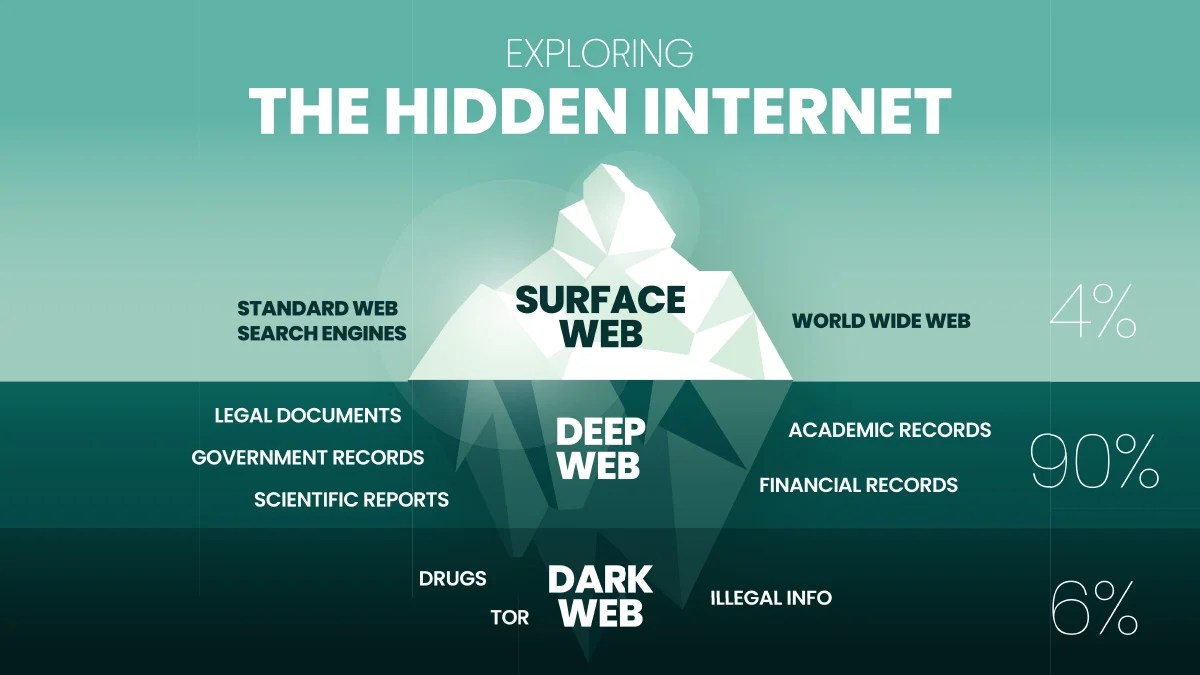
The internet is often described as an iceberg. The surface—what most users interact with daily—is the “surface web,” consisting of indexed websites accessible through standard search engines like Google or Bing. Beneath this lies the “deep web,” which includes content not indexed by search engines, such as private databases, academic journals, and password-protected sites. But even deeper still is the “dark web,” a hidden realm of the internet that requires special software to access and is often shrouded in mystery and controversy.
The dark web is accessible only through anonymizing networks like Tor (The Onion Router), which mask users’ identities and locations. This anonymity is both its greatest strength and most significant risk. Originally developed by the U.S. Navy to protect sensitive communications, Tor now serves as a gateway to a decentralized network where users can operate beyond the reach of traditional surveillance and censorship.
While the dark web is often associated with illegal activity—such as drug trafficking, weapons sales, and identity theft—it also serves legitimate purposes. Journalists, whistleblowers, and political dissidents in oppressive regimes use it to communicate safely and share information without fear of retaliation. Platforms like SecureDrop allow sources to submit documents anonymously to media outlets, helping expose corruption and injustice.
However, the dark web’s reputation is largely shaped by its criminal underbelly. Marketplaces like Silk Road, AlphaBay, and Hansa have been notorious for facilitating illicit trade. These platforms often use cryptocurrencies like Bitcoin to enable anonymous transactions. Law enforcement agencies around the world have responded with crackdowns, leading to arrests and shutdowns, but new sites frequently emerge to take their place.
The dual nature of the dark web presents a complex ethical dilemma. On one hand, it offers a haven for free speech and privacy in an increasingly monitored digital world. On the other, it enables activities that threaten public safety and national security. Governments and cybersecurity experts continue to grapple with how to regulate this space without infringing on civil liberties.
Understanding the dark web requires a nuanced perspective. It is not inherently evil, nor is it entirely virtuous. Like any tool, its impact depends on how it is used. As technology evolves, so too will the dark web, and society must remain vigilant in balancing the need for privacy with the imperative to prevent harm.
In conclusion, the dark web is a multifaceted component of the internet that challenges our notions of freedom, security, and ethics. It serves as both a refuge for the vulnerable and a playground for the unscrupulous. As we navigate this hidden frontier, education and awareness are key to ensuring that its potential is harnessed responsibly.
Posted on October 9, 2025 by Dr. David Edward Marcinko MBA MEd CMP™
By Co-Pilot
***
***
Artificial Intelligence in Finance: Revolutionizing the Industry
Artificial Intelligence (AI) is rapidly transforming the financial services industry, reshaping how institutions operate, manage risk, and serve customers. By leveraging machine learning, natural language processing, and predictive analytics, AI is enabling smarter decision-making, greater efficiency, and enhanced customer experiences across banking, investing, insurance, and regulatory compliance.
One of the most impactful applications of AI in finance is in fraud detection and prevention. Traditional systems rely on rule-based algorithms that often fail to catch sophisticated schemes. AI, however, can analyze vast amounts of transaction data in real time, identifying patterns and anomalies that signal fraudulent behavior. Machine learning models continuously improve as they process more data, making them increasingly effective at detecting threats and reducing false positives.
AI also plays a pivotal role in algorithmic trading, where decisions are made at lightning speed based on complex data inputs. These systems can process news articles, social media sentiment, and market data to execute trades with precision. Hedge funds and investment banks use AI to optimize portfolios, forecast market trends, and identify arbitrage opportunities that human analysts might miss.
In personal finance and banking, AI enhances customer service through chatbots and virtual assistants. These tools handle routine inquiries, assist with transactions, and offer financial advice based on user behavior. AI-driven platforms like robo-advisors provide personalized investment strategies, adjusting portfolios automatically based on market conditions and individual goals. This democratizes access to financial planning, making it more affordable and scalable.
Credit scoring and lending have also been revolutionized by AI. Traditional credit models often rely on limited data and can be biased against certain demographics. AI can incorporate alternative data sources—such as utility payments, social media activity, and online behavior—to assess creditworthiness more accurately and inclusively. This opens up lending opportunities for underserved populations and reduces default risk for lenders.
In insurance, AI streamlines underwriting and claims processing. By analyzing historical data and customer profiles, AI can assess risk more precisely and tailor policies to individual needs. During claims, AI can automate document review, detect fraud, and expedite payouts, improving both operational efficiency and customer satisfaction.
Regulatory compliance, or RegTech, is another area where AI shines. Financial institutions face increasing scrutiny and complex regulations. AI tools can monitor transactions, flag suspicious activity, and ensure adherence to legal standards. Natural language processing helps parse regulatory documents and automate reporting, reducing the burden on compliance teams.
Despite its benefits, AI in finance raises ethical and operational challenges. Data privacy, algorithmic bias, and transparency are critical concerns. Financial institutions must ensure that AI systems are explainable, fair, and secure. Regulatory bodies are beginning to address these issues, but ongoing collaboration between technologists, policymakers, and industry leaders is essential.
In conclusion, artificial intelligence is not just enhancing finance—it’s redefining it. From fraud prevention to personalized banking, AI is driving innovation and efficiency. As the technology matures, its integration must be guided by ethical principles and robust governance to ensure that the financial system remains fair, resilient, and inclusive.
Artificial Intelligence and Investing: A Transformative Partnership
Artificial Intelligence (AI) is revolutionizing the world of investing, reshaping how decisions are made, risks are assessed, and portfolios are managed. As financial markets grow increasingly complex and data-driven, AI offers powerful tools to navigate this landscape with greater precision, speed, and insight.
At its core, AI refers to systems that can perform tasks typically requiring human intelligence—such as learning, reasoning, and problem-solving. In investing, this translates into algorithms that can analyze vast amounts of financial data, detect patterns, and make predictions with remarkable accuracy. Machine learning, a subset of AI, enables these systems to improve over time by learning from new data, making them especially valuable in dynamic markets.
One of the most significant applications of AI in investing is algorithmic trading. These systems can execute trades at lightning speed, responding to market fluctuations in milliseconds. By analyzing historical data and real-time market conditions, AI-driven trading platforms can identify optimal entry and exit points, often outperforming human traders. High-frequency trading firms have long relied on such technologies to gain competitive advantages.
AI also enhances portfolio management through robo-advisors—digital platforms that use algorithms to provide personalized investment advice. These tools assess an investor’s goals, risk tolerance, and time horizon, then construct and manage a diversified portfolio accordingly. Robo-advisors democratize access to financial planning, offering low-cost, automated solutions to individuals who might not afford traditional advisory services.
Risk assessment is another area where AI shines. By processing alternative data sources—such as social media sentiment, news articles, and satellite imagery—AI can uncover hidden risks and opportunities. For instance, a sudden spike in negative sentiment around a company on Twitter might signal reputational issues, prompting investors to reevaluate their positions. AI models can also forecast macroeconomic trends, helping investors anticipate shifts in interest rates, inflation, or geopolitical events.
Moreover, AI is transforming fundamental analysis. Natural language processing (NLP) allows machines to read and interpret earnings reports, SEC filings, and analyst commentary. This enables investors to extract insights from unstructured data that would be time-consuming to analyze manually. AI can even detect subtle linguistic cues that may indicate a company’s future performance or management’s confidence.
Despite its advantages, AI in investing is not without challenges. Models can be opaque, making it difficult to understand how decisions are made—a phenomenon known as the “black box” problem. There’s also the risk of overfitting, where algorithms perform well on historical data but fail in real-world scenarios. Ethical concerns, such as bias in data and the potential for market manipulation, must also be addressed.
In conclusion, AI is reshaping the investing landscape, offering tools that enhance efficiency, accuracy, and accessibility. While it’s not a panacea, its integration into financial markets marks a profound shift in how capital is allocated and wealth is managed. As technology continues to evolve, investors who embrace AI will be better positioned to thrive in an increasingly data-driven world.
Posted on September 18, 2025 by Dr. David Edward Marcinko MBA MEd CMP™
By Carol Miller RN MBA
***
***
New-Wave Technology
To help hospitals and health systems comply with Health Insurance Portability and Accountability Act regulations, best practices are emerging for securing all electronic communication – cloud, wireless, and texting – of protected health information. These new technologies will continually be evolving with hospitals, providers and patients move to new means of communication. Below is a description of how each are impacted by HIPAA.
Cloud Solutions. Cloud solutions are becoming a needed commodity in treating patients today but also present a risk to privacy and security violation. Despite the advantages of cloud computing, organizations are often hesitant to use it because of concerns about security and compliance. Specifically, they fear potential unauthorized access to patient data and the accompanying liability and reputation damage resulting from the need to report HIPAA breaches. While these concerns are understandable, a review of data on HIPAA breaches published by the HHS shows that these concerns are misplaced. In fact, by using a cloud-based service with an appropriate security and compliance infrastructure, a facility can significantly reduce its compliance risk.
Because HIPAA compliance involves stringent privacy and security protections for electronic health information (PHI), many cloud providers are balking at signing new Business-Associate agreements. Most cloud-technology providers, such as Box and Dropbox, do not include the built-in privacy protections that guarantee HIPAA compliance. Because many cloud storage companies store plaintext data on their servers, PHI is especially vulnerable to breaches and compliance violations.
Mobility Solutions. The recent launches of Apple Health and Google Fit have stirred a lot of interest in health application development. It is important that hospitals and providers understand the laws around PHI and HIPAA compliance for any healthcare-focused mobile application or software. While not all healthcare applications fall under HIPAA rules, those that collect, store, or share personally identifiable health information with covered entities (such as hospitals and providers) must be HIPAA-compliant.
For years, hospitals have wanted to bring computers into exam rooms, waiting rooms, and treatment rooms to eliminate hard-to-read patient charts, making sure everyone treating the patient was seeing the same information, assuring that everything was recorded as it occurred, and enabling doctors, nurses, and technicians to stay connected to vital information and services wherever they were throughout the hospital. Many hospitals have adopted Computer on Wheels (COWs) or tablets but many of these were hard to use, had poor touchscreen interface and did not last long on a battery. Ipads seem to be the logical replacement as long as the iPad can comply with HIPAA rules.
HIPAA was written nearly 30 years ago, before mobile health applications were ever envisioned. Because of this, some areas of the law make it hard to determine which applications must be HIPAA- compliant and which are exempt. Considering the numerous ways security breaches can occur with a mobile device, it is not wonder that HHS is very leery about how PHI is handled on smartphones, wearables, and portable devices.
If the applications are going to send or share health data to a hospital, doctor or other covered entity, it MUST be HIPAA-compliant. Adhering to the Privacy and Security Rules of HIPAA is essential, especially considering the dangers that come with handling protected health data on a device. Examples include:
Phones, tablets, and wearables can be easily stolen and lost, meaning PHI could be compromised
Social media and email are easily accessible by the device, making it easy for users to post information that breaches HIPAA privacy laws.
Push notifications and other user communications can violate HIPAA laws if they contain PHI
Users may intentionally or unintentionally share personally identifiable information, even if the application’s intended use doesn’t account for it
Not all users take advanage of the password-protected screen-lock feature, making data visible and accessible to anyone who comes in contact with the device
Devices like the iPhone do not include physical keyboards, so users are more likely to use basic passwords that are not as safe as complex options.
This protected health information can include everything from medical records and images to scheduled appointment dates. Regardless of the device, it is important to take all the steps possible to comply with HIPAA guidelines.
Texting. Text (or SMS) messaging has become nearly ubiquitous on mobile devices. According to one survey, approximately 72 percent of mobile phone users send text messages. Clinical care is not immune from the trend, and in fact physicians appear to be embracing texting on par with the general population. Another survey found that 73 percent of physicians text other physicians about work.
(Source: Journal of AHIMA, “HIPAA Compliance for Clinician Texting”, by Adam Green, April 2012)
Texting can offer providers numerous advantages for clinical care. It may be the fastest and most efficient means of sending information in a given situation, especially with factors such as background noise, spotty wireless network coverage, lack of access to a desktop or laptop, and a flood of e-mails clogging inboxes. Further, texting is device neutral—it will work on personal or provider-supplied devices of all shapes and sizes. Because of these advantages, physicians may utilize texting to communicate clinical information, whether authorized to do so or not.
All forms of communication involve some level of risk. Text messaging merely represents a different set of risks that, like other communication technologies, needs to be managed appropriately to ensure both privacy and security of the information exchanged.
Text messages may reside on a mobile device indefinitely, where the information can be exposed to unauthorized third parties due to theft, loss, or recycling of the device. Text messages often can be accessed without any level of authentication, meaning that anyone who has access to the mobile phone may have access to all text messages on the device without the need to enter a password.
Texts also are generally not subject to central monitoring by the IT department. Although text messages communicated wirelessly are usually encrypted by the carrier, interception and decryption of such messages can be done with inexpensive equipment and freely available software (although a substantial level of sophistication is needed. If text messages are used to make decisions about patient care, then they may be subject to the rights of access and amendment. There is a risk of noncompliance with the privacy rule if the covered entity cannot provide patients with access to or amend such text messages.
According to 2012 data from CTIA–The Wireless Association, U.S. citizens alone exchange nearly 200 billion text messages every month. So it’s not surprising that an increasing number of clinicians are using text messaging to exchange clinical information, along with a wide range of other modes — smartphones, pagers, computerized physician order entry, emails, etc. Electronic communication is certainly faster, can be more efficient, enhances clinical collaboration and enables clinicians to focus on patient care. But with these benefits comes an increased risk of security breaches.
(Source: Clarifying the Confusion about HIPAA – Compliant Texting, by Megan Hardiman and Terry Edwards, May 2013)
Unfortunately, vendor hype about the Health Insurance Portability and Accountability Act is causing many hospitals and health systems to implement stop-gap measures that address part — but not all — of a problem. To identify all vulnerabilities, health care leaders need to consider not only text messaging, but all mechanisms by which protected health information in electronic form is transmitted — as well as the security of those mechanisms.
Mobile device-to-mobile device SMS text messages are generally not secure because they lack encryption. The sender does not know with certainty that his or her message is indeed received by the intended recipient. In addition, telecommunications vendor/wireless carrier may store the text messages. Recent HHS guidance indicates text messaging, as a means of communicating PHI, can be permissible under HIPAA depending in large part on the adequacy of the controls used. A hospital or provider may be approved for texting after performing a risk analysis or implementing a third-party messaging solution that incorporates measures to establish a secure communication platform that will allow texting on approved mobile devices.
A study reported in Computer World in May 2013 by the Ponemon Institute with 577 healthcare and It professional in facilities that ranged from fewer than 100 beds to over 500 beds stated that fifty-one percent of the respondents felt HIPAA compliance requirements can be a barrier to providing effective patient care. Specifically HIPAA reduces time available for patient care (85% of the respondents), makes access to electronic patient information difficult (79% of the respondents) and restricts the use of electronic mobile communications (56% of the respondents). The study stated “respondents agreed that the deficient communications tools currently in use decrease productivity and limit the time doctors have to spend with patients. “ They also stated “they recognized the value of implementing smartphones, text messaging and other modern forms of communications, but cited overly restrictive security policies as a primary reason why these technologies were not used.” Clinicians in the survey stated that only 45% of each workday is spent with patients; the remaining 55% is spent communicating and collaborating with other clinicians and using the electronic medical record and other clinical IT systems.
Several other statements made were:
Because of the need for security, hospitals and other healthcare organizations continue to use older, outdate technology such as pagers, email and facsimile machines. The use of older technology can also delay patient discharges – now taking an average of 102 minutes.
The Ponemon Institute estimated that the lengthy discharge process costs the U.S. hospital industry more than $3.189 billion a year in lost revenue, with another $5 billion lost through decrease doctor productivity and use of outdated technology. Secure text messaging could cut discharge time by 50 minutes.
(Source: Computer World, “HIPAA rules, outdate tech cost U.S. hospitals $3.38 B a year”, by Lucas Mearian, May, 2013)
Several suggestions offered for these preferred mobile devises are: 1) ensure encryption and access to individuals who need to have access; 2) use secure texting applications; and 3) even consider alerting employees with warnings before they send an email or share files that lets them know they are liable for the information sent.
Posted on August 31, 2025 by Dr. David Edward Marcinko MBA MEd CMP™
By Rick Kahler; MSFP CFP™
***
***
This month, the U.S. government demanded a direct cut of a company’s foreign sales as the price for letting those sales happen.
Tech companies Nvidia and AMD had been stuck in regulatory limbo over selling their newest AI chips to China. According to an August 12, 2025, Reuters article by Karen Freifeld, Nvidia CEO Jensen Huang had even received a public “green light” for the company’s H20 chip, but the Commerce Department would not issue the export licenses.
The stalemate ended only after Huang met with President Trump and agreed to a deal: the licenses would be granted, but the U.S. Treasury would get 15% of all H20 revenue from China. AMD agreed to identical terms for its MI308 chip. Two days later, both companies had their licenses.
The numbers are staggering. Bernstein Research estimates Nvidia could sell $15 billion worth of H20 chips in China this year, and AMD about $800 million of MI308s. That is more than $2 billion flowing straight to Washington, not as taxes but as a contractual price for market access. The legality of this arrangement is questionable, and the deal also raises security concerns.
It is worth noting the administration first asked for 20% before “settling” on 15%. This was not a polite request but a “take it or leave it” demand. From a behavioral economics standpoint, the decision was predictable. The pain of losing an entire market is far greater than the pain of losing a fraction of it.
How is this any different from a tariff? A tariff is a standardized, legally defined tax that applies broadly to certain goods and is collected under public trade policy. This 15% cut is a one-off, privately negotiated condition aimed at just two companies, tied to export license approval. It is taken from gross revenue, not profit, meaning the government gets paid on every dollar of sales before the companies cover a single expense.
“Tax farmming” is an old practice where the state sold the right to collect taxes for a fixed sum, allowing the collectors to keep the rest. Its use in France made some people enormously rich, made everyone else furious, and eventually helped spark the French Revolution. Similar systems appeared in Ottoman Egypt, Qing China, and the early Dutch Republic until abuses finally brought them down.
The Nvidia/AMD deal is not exactly tax farming, but it is a similar dynamic. The government’s role is no longer just regulating. It is stepping in as a business partner, taking a direct share of private sales. Supporters might call it a smart use of national leverage. Critics will see a step away from free-market capitalism toward something more political and transactional.
Nor is this deal a one-off. In June, the administration approved foreign investment in U.S. Steel only after securing a “golden share” that gives it veto power over strategic corporate decisions. History teaches us that once a government finds a way to take a cut, it rarely stops with one sector. Today it is steel and AI chips to China. Tomorrow it could be pharmaceuticals, energy, or consumer goods.
What is the likely impact for average Americans? Money flowing to the U.S. Treasury from a source other than taxpayers may seem like a benefit. Yet any company required to give away 15% of its gross revenue, which could equal its entire profit, has to compensate in some way. The most likely result is higher prices. Hiking prices on computer chips sold to China may not seem to be a big deal—until you consider that many of the products that use those chips are sold to U.S. consumers.
Posted on August 22, 2025 by Dr. David Edward Marcinko MBA MEd CMP™
By Dr. David Edward Marcinko MBA MEd
***
***
Medicine today is vastly different than a generation ago, and all health care professionals need new skills to be successful and reduce the emerging risks outlined in this textbook, as well as the “unknown-unknowns” elsewhere. Traditionally, the physician was viewed as the “captain of the ship”. Today, their role may be more akin to a ship’s navigator, using clinical, teaching skills and knowledge to chart the patient’s course through a confusing morass of insurance requirements, fees, choices, rules and regulations to achieve the best attainable clinical outcomes.
This new leadership paradigm includes many classic business school principles, now modified to fit the decade long PP-ACA, the era of health reform, and modern technical connectivity and EMRs.
Thus, the physician must be a subtle guide on the side; not bombastic sage on the stage. These, newer health 3.0 leadership philosophies might include:
•Negotiation – working to optimize appropriate treatment plans; ie., quality of life versus quantity of life, •Team play – working in concert with other allied healthcare professionals to coordinate care delivery ,ithin a clinically appropriate and cost-effective framework; •Working within the limits of competence – avoiding the pitfalls of the medical generalist versus the specialist that may restrict access to treatment, medications, physicians and facilities by clearly acknowledging when a higher degree of service is needed on behalf of the patient – all while embracing holistic primary care; •Respecting different cultures and values – inherent in the support of the medical Principle of Autonomy is the acceptance of values that may differ from one’s own. As the US becomes more culturally hetero geneous, medical providers are called upon to work within, and respect, the socio-cultural and/or spiritual framework of patients, students and their families; •Seeking clarity on what constitutes marginal care – within a system of finite resources; providers are called upon to openly communicate with patients regarding access to marginal medical information and/or treatments. •Supporting evidence-based practice – healthcare providers, should utilize outcomes data to reduce variation in treatments to achieve higher efficiencies and improved care delivery thru evidence based medicine [EBM]; •Fostering transparency and openness in communications – healthcare professionals should be willing, and prepared, to discuss all aspects of care, especially when discussing end-of-life issues or when problems arise; •Exercising decision-making flexibility – treatment algorithms, templates and clinical pathways are useful tools when used within their scope; but providers must have the authority to adjust the plan if circumstances warrant.
Becoming skilled in the art of listening and interpreting — In her ground-breaking book, Narrative Ethics: Honoring the Stories of Illness, Rita Charon, MD PhD, a professor at Columbia University, writes of the extraordinary value of using the patient’s personal story in the treatment plan. She notes that, “medicine practiced with narrative competence will more ably recognize patients and diseases; convey knowledge and regard, join humbly with colleagues, and accompany patients and their families through ordeals of illness.” In many ways, attention to narrative returns medicine full circle to the compassionate and caring foundations of the patient-physician relationship.
These thoughts represent only a handful of examples to illustrate the myriad of new skills that tomorrows’ healthcare professionals must master in order to meet their timeless professional obligations of compassionate care and contemporary treatment effectiveness; all within the context modern risk management principles.
SPEAKING: Dr. Marcinko will be speaking and lecturing, signing and opining, teaching and preaching, storming and performing at many locations throughout the USA this year! His tour of witty and serious pontifications may be scheduled on a planned or ad-hoc basis; for public or private meetings and gatherings; formally, informally, or over lunch or dinner. All medical societies, financial advisory firms or Broker-Dealers are encouraged to submit an RFP for speaking engagements: CONTACT: Ann Miller RN MHA at MarcinkoAdvisors@outlook.com -OR-http://www.MarcinkoAssociates.com
Posted on August 21, 2025 by Dr. David Edward Marcinko MBA MEd CMP™
By A.I. and Staff Reporters
***
***
Technology: Fears of an A.I. bubble continue to climb after MIT published a report that 95% of companies using generative A.I. programs have nothing to show for it, despite pouring billions of dollars into this space.
Stocks: Another day of technology stocks selling off pulled the S&P 500 and NASDAQ lower yesterday, with investors rotating out of some of the hottest names and sectors in the market.
FOMC Drama: President Trump demanded the resignation of Fed Governor Lisa Cook for allegations of mortgage fraud. Meanwhile, the minutes from the July FOMC meeting revealed a growing divide between central bankers.
Posted on August 17, 2025 by Dr. David Edward Marcinko MBA MEd CMP™
A Supply Chain Management Strategy
By Staff Reporters
***
***
RADIO FREQUENCY IDENTIFICATION
RFID refers to a device attached to an object that transmits data to an RFID receiver. A device can be a large piece of hospital hardware the size of a small book like those attached to ocean containers, or a very small device inserted into a label on a package. RFID has advantages over bar codes such as the ability to hold more data, and to change the stored data as processing occurs. Moreover, it does not require line-of-sight to transfer data, and is very effective in harsh environments where bar-code labels will not work. RFID is not without its own problems, however, as RF signals can be compromised by materials such as metals and liquids.
Although RFID technology is receiving much current attention, it still tends to be cost-prohibitive for some hospital inventory tracking applications. As chip prices go down, there will be continued growth in the application of RFID, but, as in the case of 2D bar codes, many hospital warehouse applications simply do not require this added functionality. The low-cost 1D bar code may continue to be the technology of choice for many hospital inventory tracking applications in the short term.
Smart labels are labels with integrated RFID chips. The idea is to produce labels (probably with bar codes) as well as programming the RFID chips embedded in the label. This would provide all current functionality (human- and machine-readable text and bar codes) as well as adding RFID functionality.
Slap-and-ship describes an approach to complying with vendor requirements for physical identification of shipped goods. More recently, slap-and-ship has been used to describe complying With RFID requirements (such as those from large health care systems); however, it is also applicable to any compliance labeling requirement (such as compliance bar-code labels). Slap-and-ship implies meeting the customer’s requirement by applying the bar-code labels or RFID tags, but not utilizing the technology internally.
Finally, anti-skimming bills were first approved by California and Washington State relative to RFID privacy and are focused on making it illegal for criminals or businesses (or criminal businesses) to read and use personal information from RFID-enabled items such as driver’s licenses and credit cards without the owner’s consent.
An important component of hospital credit analysis is essentiality. Hospitals are unusual businesses that many times possess some form of essentiality to their communities. Health care is important to the economic vitality of every community. Many hospitals have served their communities for many years; it is not uncommon to find hospitals that have been continuously operating for more than 100 years in the same community.
Most hospitals are not-for-profit. In not-for-profit hospitals, no private party actually “owns” the hospital; control is vested in various boards, but no one explicitly owns a not-for-profit hospital. In a broad sense, communities own not-for-profit hospitals. They are considered “charities” with a “charitable purpose.” Though a not-for-profit hospital may not have owners, it has many “stakehold-ers,” parties that have vested interests in the continuing success of the hospital.
Many hospitals have broad and vast webs of stakeholders. Stakeholders are why hospitals rarely close or are shut down. Too many stakeholders have interests in the continuing successful operation of hospitals.
Another dimension of the essentiality analysis is service analysis. How significant are the hospital’s services? If the hospital shuts down, what population segments would suffer? How significant is the population that would suffer? How much would they suffer?
And so, hospital stakeholder relationships need to be considered in the analysis of essentiality. How strong are these relations? How many are there? How important is the continuing success of this hospital to these stakeholders?
Analysis of hospital’s stakeholders and services should provide a credible view of the degree of essentiality associated with a hospital. Higher degrees of essentiality suggest higher likelihoods that hospitals, one way or another, will meet their commitments, particularly their payment commitments.
SPEAKING: Dr. Marcinko will be speaking and lecturing, signing and opining, teaching and preaching, storming and performing at many locations throughout the USA this year! His tour of witty and serious pontifications may be scheduled on a planned or ad-hoc basis; for public or private meetings and gatherings; formally, informally, or over lunch or dinner. All medical societies, financial advisory firms or Broker-Dealers are encouraged to submit an RFP for speaking engagements: CONTACT: Ann Miller RN MHA at MarcinkoAdvisors@outlook.com -OR-http://www.MarcinkoAssociates.com
Trump says pharma tariffs could be as high as 250%
The president revealed that he plans to formally announce tariffs on the pharmaceutical industry “within the next week or so” in an attempt to force drug manufacturing to the US, he told CNBC several days ago.
ORGANIZATIONAL BEHAVIOR ANDCLASSIFICATION OF RISKS
DEFINITION EMOTIONAL INTELLIGENCE: Emotional intelligence [EI] refers to the ability to identify and manage one’s own emotions, as well as the emotions of others. Emotional intelligence is generally said to include a few skills: namely emotional awareness, or the ability to identify and name one’s own emotions; the ability to harness those emotions and apply them to tasks like thinking and problem solving; and the ability to manage emotions, which includes both regulating one’s own emotions when necessary and helping others to do the same.
DEFINITIONAL ORGANIZATIONAL BEHAVIOR: Organizational behavior (OB) is the study of how individuals, groups, and organizations interact and influence one another. Though it is largely used within the field of business management as means to understand–and more effectively manage–groups of people. The reason businesses look to OB is because it can help organizations increase employee performance, while also creating a positive working environment.
CITE: Eugene Schmuckler; PhD MBA MEd CTS®
***
***
And so, as we review the concept of Emotional Intelligence and Organizational Behavior, it is possible to set up five EI/OB risk classes, based on the economic consequences of the occurrence of specific individual risks:
1. Prevented risks: Risks whose cost of occurrence is higher than their cost of management and whose occurrence may invoke additional legal sanctions. This class would include intentional torts and injuries caused by gross negligence.
2. Normally prevented risks: Risks whose cost of occurrence is greater than the cost of their management but whose occurrence will be considered only as negligent. This class includes most negligent injuries and most types of product liability actions.
3. Managed risks: Risks whose cost of occurrence is only slightly greater than their cost of management. The plaintiff usually has the burden of showing that the defendant owed the plaintiff a special duty to recover for one of these risks.
4. Un-Prevented risks: Risks whose cost of occurrence is less than their cost of management. The classic example of this class is the cost of railroad crossing barriers compared to the cost of people being hit by trains.
5. Un-Preventable risks: Risks whose occurrence is unmanageable. The assignment of a risk to one of these classes is a major problem in medical and healthcare quality control, because the class of a risk determines how much effort must be expended to prevent the risk. The misclassification of a prevented or normally prevented risk as a managed or un-prevented risk can result in large financial losses.
***
For example: A medical clinic that does not update obsolete equipment, such as inaccurate oxygen monitors, would be liable for any injuries attributable to the obsolete equipment. The classifications of risk must be reviewed periodically to determine if the cost of the risk-taking behavior has changed, thereby altering the classification.
***
***
For example: A small hospital in a rural area would not be expected to have the sophisticated equipment as a major hospital in a city. If an accident victim is brought into the rural facility, the hospital’s duty may be to transfer the patient to a better-equipped facility. The patient will face the risk of dying because of the delay in treatment, but the risk of insufficient treatments outweighs the risk of transfer. If the same victim were brought into a hospital in a major metropolitan center, the duty would be to treat the patient without a transfer. The risk of transfer has not changed, but the risk of insufficient treatment has disappeared.
SPEAKING: Dr. Marcinko will be speaking and lecturing, signing and opining, teaching and preaching, storming and performing at many locations throughout the USA this year! His tour of witty and serious pontifications may be scheduled on a planned or ad-hoc basis; for public or private meetings and gatherings; formally, informally, or over lunch or dinner. All medical societies, financial advisory firms or Broker-Dealers are encouraged to submit an RFP for speaking engagements: CONTACT: Ann Miller RN MHA at MarcinkoAdvisors@outlook.com -OR-http://www.MarcinkoAssociates.com
Posted on July 11, 2025 by Dr. David Edward Marcinko MBA MEd CMP™
MEDICAL EXECUTIVE-POST–TODAY’SNEWSLETTERBRIEFING
***
Essays, Opinions and Curated News in Health Economics, Investing, Business, Management and Financial Planning for Physician Entrepreneurs and their Savvy Advisors and Consultants
“Serving Almost One Million Doctors, Financial Advisors and Medical Management Consultants Daily“
A Partner of the Institute of Medical Business Advisors , Inc.
US measles cases have reached a 33-year high. A little more than halfway into 2025, the US has reported 1,288 measles cases, marking the highest yearly total since 1992, according to data from the Centers for Disease Control and Prevention.
Cereal legend WK Kellogg popped 30.57% after chocolate giant Ferrero agreed to acquire it for north of $3 billion.
Tesla (+4.73%) continued to rebound from its plunge on Monday. Elon Musk said that Tesla’s robotaxi service would expand into the Bay Area “probably in a month or two” and that his AI chatbot Grok is coming to Tesla vehicles by next week.
Estée Lauder gained 6.32% after Bank of America slapped a buy rating on the stock, implying a 27% upside from Wednesday’s closing price.
ProKidney continued its remarkable rally, rising another 19.35%, after the biotech announced positive trial results for its diabetes treatment. It’s gone from a penny stock to a $1.55 billion market cap in the past four days.
Copper companies Freeport-McMoRan (+3.51%) and Southern Copper (+2.34%) gained thanks to Trump’s announcement that copper tariffs would begin on August 1.
Stocks down
Biotech partners Ultragenyx (-25.11%) and Mereo BioPharma Group (-42.52%) plunged after issuing a disappointing update on their trial of a treatment for a rare genetic bone condition.
Vertiv, the maker of liquid cooling equipment,declined 5.96% when Amazon said it was rolling out a new liquid cooling system for its AI servers.
Hydro Flask owner Helen of Troy tumbled 22.71% after reporting a $450 million loss in its fiscal first quarter. CEO Brian Grass said “tariff-related impacts” were its Achilles heel.
Autodesk fell 6.89% after Bloomberg reported on Wednesday it was weighing a takeover of rival engineering software company PTC.
Posted on July 3, 2025 by Dr. David Edward Marcinko MBA MEd CMP™
MEDICAL EXECUTIVE-POST–TODAY’SNEWSLETTERBRIEFING
***
Essays, Opinions and Curated News in Health Economics, Investing, Business, Management and Financial Planning for Physician Entrepreneurs and their Savvy Advisors and Consultants
“Serving Almost One Million Doctors, Financial Advisors and Medical Management Consultants Daily“
A Partner of the Institute of Medical Business Advisors , Inc.
When it comes to scientific achievements that have advanced the practice of medicine, you’d be hard-pressed to find one more influential than the Human Genome Project. The project, a federally funded collaboration between scientists around the globe, began in October 1990 with the goal of improving our knowledge of human biology by sequencing an entire human genome, which is the complete set of DNA in a cell. Nearly 13 years and $2.7 billion later, the project wrapped up in April 2003, and scientists around the world now use the reference human genome to study genetics, biology, and more. Today, the entire human genome can be sequenced in as little as five hours and costs as little as $600. Learn more about the Human Genome Project’s impact here.
Jack in the Box popped like a…well, you know…after activist investor Biglari Capital reportedly accrued a 10% stake in the fast-food company. Shares rose 7.86%.
RobinhoodMarkets climbed 6.12% on speculation that it may be added to the S&P 500 to fill the spot left by Juniper Networks.
RigettiComputing rose 15.45% after Cantor Fitzgerald analysts initiated their coverage of the quantum computing company with an “overweight” rating.
VerintSystems jumped 15.33% on reports that the customer service software maker may be acquired by Thoma Bravo.
Corona parent company ConstellationBrands gained 4.48% after it reiterated its fiscal guidance, assuring shareholders that aluminum tariffs will only cost the company about $20 million.
Crypto companies gained across the board after bitcoin miner BitMineImmersionTechnologies announced it’s pivoting to ethereum. BitMine rose 21.17%, MARAHoldings gained 13.38%, and CleanSpark climbed 12.64%.
What’s down
Centene plunged 40.37% after the health insurer rescinded its fiscal 2025 guidance, warning that EPS will come in lower than anticipated.
Centene’s news pulled the rest of the health insurance industry down with it. UnitedHealth Group lost 5.70%, CVSHealth fell 4.28%, Elevance Health stumbled 11.50%, and MolinaHealthcare dropped 21.97%.
ParamountGlobal sank 2.43% after the company settled its 60 Minutes lawsuit with President Trump for $16 million.
MarvellTechnology slipped 2.61% on reports that Microsoft is cutting back on manufacturing AI chips in-house.
Intel lost 4.25% on the news that it may be shifting the strategy behind its foundry business.
Assets under advisement refer to assets on which your firm provides advice or consultation but for which your firm does either does not have discretionary authority or does not arrange or effectuate the transaction. Such services would include financial planning or other consulting services where the assets are used for the informational purpose of gaining a full perspective of the client’s financial situation, but you are not actually placing the trade.
Assets under advisement could also be those which you monitor for a client on a non-discretionary basis, where you may make recommendations but where the client is the party responsible for arranging or effecting the purchase or sale. A common example of this AUM scenario is when an advisor reviews a participant’s 401(k) allocations. If the adviser does not have the authority or ability to effect changes in the portfolio, these assets are likely considered assets under advisement rather than regulatory assets under management.
Assets under advisement are permitted to be disclosed on Form ADV Part 2A as a separate asset figure from the assets under management. There is no requirement to disclose the assets under advisement figure, but some advisors opt to include the figure to give prospective clients a more complete picture of the firm’s responsibilities. If you choose to report your assets under advisement, be sure to make a clear distinction between this figure and your regulatory assets under management.
***
D. E. Marcinko & Associates Core Operating Values
9. We act with honesty, integrity and are always straightforward. 8. We strive to be innovative, creative, iconoclastic, and flexible. 7. We admit and learn from mistakes and don’t repeat them. 6. We work hard always as competitors are trying to catch up. 5. We treat others with dignity and respect. 4. We are the onus of consulting advice for the fiduciary well being of others. 3. We fight complacency as former success is in the past. 2. The best management styles are timeless, not timely. 1. Our clients are colleagues and always come first.
SPEAKING: Dr. Marcinko will be speaking and lecturing, signing and opining, teaching and preaching, storming and performing at many locations throughout the USA this year! His tour of witty and serious pontifications may be scheduled on a planned or ad-hoc basis; for public or private meetings and gatherings; formally, informally, or over lunch or dinner. All medical societies, financial advisory firms or Broker-Dealers are encouraged to submit an RFP for speaking engagements: CONTACT: Ann Miller RN MHA at MarcinkoAdvisors@outlook.com
Posted on June 15, 2025 by Dr. David Edward Marcinko MBA MEd CMP™
MEDICAL EXECUTIVE-POST–TODAY’SNEWSLETTERBRIEFING
***
Essays, Opinions and Curated News in Health Economics, Investing, Business, Management and Financial Planning for Physician Entrepreneurs and their Savvy Advisors and Consultants
“Serving Almost One Million Doctors, Financial Advisors and Medical Management Consultants Daily“
A Partner of the Institute of Medical Business Advisors , Inc.
The world’s two biggest retailers, Amazon and Walmart, are looking into issuing their own stablecoins for US customers to use at checkout instead of credit or debit cards, the Wall Street Journal reportedy. Other big companies, including Expedia and some airlines, are also considering the move.
23andMe founder Anne Wojcicki is poised to regain control of the company because a nonprofit she controls outbid Regeneron Pharmaceuticals for its assets in a bankruptcy auction, offering $305 million. Wojcicki’s return to power over the company—and its DNA data—comes as a surprise after 23andMe announced last month that Regeneron had won the bidding (it got reopened because the nonprofit made an unsolicited bid).
Visualize: How private equity tangled banks in a web of debt, from the Financial Times.
Posted on June 13, 2025 by Dr. David Edward Marcinko MBA MEd CMP™
DEFINED
By CoPilot AI
***
***
Barcodes and QR codes are basically two forms of machine-readable codes that contain data and are useful in various sectors such as retail, logistics, and marketing. While both appear to fulfill the function of storing information, they have differences based on structure and storage size as well as the function they perform. This makes it easier for businesses to distinguish what is relevant in barcodes and what is relevant in QR codes so that they can be in a position to adopt the right technology that will suit their needs well.
Barcode provides us with a way to store numbers in a computer-understandable format. This is used to store information in a 1D or 2D format that can be scanned for data retrieval. It is used by stores’ back-off sweaters for keeping track of the patients just in case of rental car services to track where the car is in cases of airline luggage.
Simplicity: Barcodes are easy to implement and can be put into use within a short span of time and with comparatively less investment.
Low Cost: The equipment and technology required in the generation as well as the scanning of the bar codes are relatively cheap.
Quick Scanning: As has already been discussed, barcodes are easy to scan and this makes them suitable for_numeric environments such as the retail sector.
Disadvantages of Barcodes
Limited Data Capacity: Barcodes also have a limited data processing capability with limited numerical values, of between 8-20 characters per barcode.
One-Dimensional: Barcode is more vast than OWLT and cannot contain complex information since it is one-dimensional.
Prone to Damage: That is why they can be barely scratched or damaged in such a manner that they will not scan properly.
What is QR code?
QR codes are a way of storing data in the form of computer understandable format, that can be scanned by using QR code scanner to retrieve the data. These are widely used nowadays for cashless and UPI payment services. They can be used in case of identifications and are also used for sharing photos, videos and other files.
High Data Capacity: QR codes contain the ability to enclose thousands of characters that include numbers, letters and even the binary data.
Small Physical Footprint: In fact, most QR codes are small in size even though they have a high storage capacity thereby making it possible to print them despite the limited amount of space.
Error Correction: QR codes are also created with erasure correction, so the code can still be scanned even if SOME of the dots are scratched out.
Versatile Applications: According to the functional aspect QR codes can be used in marketing, payments, wither links, multimedia information storage etc.
Disadvantages of QR Codes
Requires Specific Software: Unlike barcodes that can be scanned by an ordinary laser scan gun, QR code must be scanned with a QR code scanner or simply an advanced telephone or tablet with a QR code scanner application.
Overuse in Marketing: The use of QR codes has been popularized mainly in the marketing sector, hence consumers are used to seeing it and may opt to look the other way.
Posted on June 11, 2025 by Dr. David Edward Marcinko MBA MEd CMP™
MEDICAL EXECUTIVE-POST–TODAY’SNEWSLETTERBRIEFING
***
Essays, Opinions and Curated News in Health Economics, Investing, Business, Management and Financial Planning for Physician Entrepreneurs and their Savvy Advisors and Consultants
“Serving Almost One Million Doctors, Financial Advisors and Medical Management Consultants Daily“
A Partner of the Institute of Medical Business Advisors , Inc.
Tesla climbed another 5.67% on signs that Elon Musk and President Trump are mending fences and on hype around the robotaxi reveal this week.
TSMC rose 2.63% after the semiconductor company reported that its revenue in the month of May rose 39.6% year over year.
Disney rose 2.65% higher a day after agreeing to purchase Comcast’s stake in streaming service Hulu for $438.7 million. Comcast climbed 2.95%.
Solar stocks got a bit of hope after the Wall Street Journal reported that tech companies are lobbying Congress to keep clean energy subsidies in the tax and spending bill. SolarEdge rose 11.81%, and Sunrun gained 7.13%.
Insmed exploded 28.65% thanks to strong results for the biopharma company’s new treatment for pulmonary arterial hypertension.
Casey’s General Store rose 11.59% after the retailer crushed Wall Street’s profit expectations last quarter and raised its dividend.
McDonald’s lost 1.43% thanks to a double downgrade from Redburn Atlantic analysts, who think the fast food titan’s slowing foot traffic and headwinds from obesity drugs will hurt its growth. That’s the company’s third downgrade in three days.
Stocks: Markets meandered higher as investors awaited news from ongoing US & China trade negotiations in London. Commerce Secretary Howard Lutnick said talks were going well and could continue into tomorrow.
Commodities: Oil soared to its highest price since April on hopes that a trade deal between the world’s largest economies could spur demand, but plunged back to earth after the US said oil output will fall next year.
Crypto: After just barely holding on last week, Bitcoin has now stayed above $100,000 for 30 days straight for the first time ever—a signal to traders that there’s a new level of support for the crypto king.
Posted on June 10, 2025 by Dr. David Edward Marcinko MBA MEd CMP™
MEDICAL EXECUTIVE-POST–TODAY’SNEWSLETTERBRIEFING
***
Essays, Opinions and Curated News in Health Economics, Investing, Business, Management and Financial Planning for Physician Entrepreneurs and their Savvy Advisors and Consultants
“Serving Almost One Million Doctors, Financial Advisors and Medical Management Consultants Daily“
A Partner of the Institute of Medical Business Advisors , Inc.
Stat: $18 billion. One report says that’s how much hospitals and health systems spent combating workplace violence in 2023. (the American Hospital Association)
The trading platform eToro rose 10.58% and touched a record high after analysts began coverage of the stock. They generally had nice things to say.
Aviation startups like Archer (+10.50%), Joby (+13.67%), Vertical Aerospace (+15.24%), and Blade Air Mobility (+11.58%) all popped after President Trump signed an executive order on Friday intended to spur drone manufacturing.
Stablecoin issuer Circle can’t stop won’t stop after its IPO last week, popping another 7.24% for its third straight day of gains.
Robinhood (-1.98%) and AppLovin (-8.21%) fell after S&P Dow Jones Indices decided not to include them—or anyone else—in the S&P 500 index.
Intuitive Surgical sank 5.55% after getting its first “sell” rating on the Street from Deutsche Bank analyst Imron Zafar, who argued that the medtech company is going to face some cutthroat competition over the next few years.
EchoStar, a satellite and wireless company, dropped 8.52% after the WSJ reported it was considering filing for chapter 11 bankruptcy.
The Children’s Place tumbled 32.22% after a rough earnings report for the kids’ clothing store: It posted a quarterly loss nearly 3x projections and revenue decreased 10% year over year.
Quishing, or QR phishing, is a cybersecurity threat in which attackers use QR codes to redirect victims to malicious websites or prompt them to download harmful content. The goal of this attack is to steal sensitive information, such as passwords, financial data, or personally identifiable information (PII), and use that information for other purposes, such as identity theft, financial fraud, or ransomware.
This type of phishing often bypasses conventional defenses like secure email gateways. Notably, QR codes in emails are perceived by many secure email gateways as meaningless images, making the users vulnerable to specific forms of phishing attacks. QR codes can also be presented to intended victims in a number of other ways.
QR codes, or Quick Response codes, are two-dimensional barcodes that can be scanned easily with a camera or a code reader application. The main component of a QR code is data storage. QR codes have the capability to store significant amounts of information including URLs, product details, or contact information. Scanning technology allows smartphone cameras or code readers to easily and quickly access the website to which the URL points.
In a quishing attack, the attackers create a QR code and link it to a malicious website. Typically, the attacker will embed the QR code in phishing emails, social media, printed flyers, or physical objects, and use social engineering techniques to entice the victims. For example, victims might receive an email urging them to access an encrypted voice message via a QR code for a chance to win a cash prize.
Upon using their phones to scan the QR code, victims are directed to the malicious site. The site may prompt victims to enter private information, such as login information, financial details, or personal information. In the example above, the site may request the user’s name, email, address, date of birth, or account login information.
Once this sensitive information is captured, attackers can exploit it for various malicious purposes, including identity theft, financial fraud, or ransomware.
Posted on June 3, 2025 by Dr. David Edward Marcinko MBA MEd CMP™
MEDICAL EXECUTIVE-POST–TODAY’SNEWSLETTERBRIEFING
***
Essays, Opinions and Curated News in Health Economics, Investing, Business, Management and Financial Planning for Physician Entrepreneurs and their Savvy Advisors and Consultants
“Serving Almost One Million Doctors, Financial Advisors and Medical Management Consultants Daily“
A Partner of the Institute of Medical Business Advisors , Inc.
Meta Platforms popped 3.62% on a report in the Wall Street Journal that the company is going all-in on using AI to create advertisements.
Applied Digital skyrocketed 48.46% after the data center operator announced two 15-year leases with CoreWeave that will bring in $7 billion in new revenue. CoreWeave rose 7.99%.
BioNTech soared 18.05% on news of a multibillion-dollar collaboration with Bristol Myers Squibb to develop cancer treatments. Bristol Myers Squibb rose 1.06%.
Moderna gained 1.84% thanks to the FDA’s approval of its new Covid vaccine, though it’s only for certain patients.
Blueprint Medicines exploded 26.09% after the biopharma company agreed to be acquired by Sanofi for $9.5 billion.
Auto stocks suffered from fears of higher pricing thanks to President Trump’s steel tariff hike. GeneralMotors tumbled 3.87%, Ford fell 3.86%, and Stellantis slid 3.55%.
Sports-betting stocks took a loss after Illinois lawmakers decided to tax the companies $0.25 per wager made on their apps. DraftKings lost 5.99%, and FlutterEntertainment dropped 2.74%.
Advertising stocks sank on Meta Platforms’ announcement of AI advances in its advertisements. Omnicom Group lost 4.02%, and WPP Group fell 2.45%.
Markets: Stocks closed out a winning month Friday with the S&P500 having its best one since 2023. But the markets are still rattled by the trade war, and stocks wavered during the day after President Trump accused China of breaching its recent trade deal with the US. Investors declined to fall into the Gap after the retail chain said tariffs would cost it up to $150 million this fiscal year.
A thought experiment is a mental exercise where you imagine a situation or scenario to explore an idea, test a theory, or examine a problem. It does not involve physical experiments or data. Instead, it uses reasoning, imagination, and logic to draw conclusions or raise important questions.
Sometimes referred to as the Inverted Spectrum Problem or the Knowledge Argument, this thought experiment is meant to stimulate discussions against a purely physical view of the universe, namely the suggestion that the universe, including mental processes, is entirely physical. This thought experiment tries to show that there are indeed non-physical properties — and attainable knowledge — that can only be learned through conscious experience.
Mary is a brilliant scientist who is, for whatever reason, forced to investigate the world from a black and white room via a black and white television monitor. She specializes in the neuro-physiology of vision and acquires, let us suppose, all the physical information there is to obtain about what goes on when we see ripe tomatoes, or the sky, and use terms like ‘red’, ‘blue’, and so on. She discovers, for example, just which wavelength combinations from the sky stimulate the retina, and exactly how this produces via the central nervous system the contraction of the vocal cords and expulsion of air from the lungs that results in the uttering of the sentence ‘The sky is blue’…What will happen when Mary is released from her black and white room or is given a color television monitor? Will she learn anything or not?
Put another way, Mary knows everything there is to know about color except for one crucial thing: She’s never actually experienced color consciously. Her first experience of color was something that she couldn’t possibly have anticipated; there’s a world of difference between academically knowing something versus having actual experience of that thing.
Posted on May 24, 2025 by Dr. David Edward Marcinko MBA MEd CMP™
MEDICAL EXECUTIVE-POST–TODAY’SNEWSLETTERBRIEFING
***
Essays, Opinions and Curated News in Health Economics, Investing, Business, Management and Financial Planning for Physician Entrepreneurs and their Savvy Advisors and Consultants
“Serving Almost One Million Doctors, Financial Advisors and Medical Management Consultants Daily“
A Partner of the Institute of Medical Business Advisors , Inc.
Medicare may soon be able to reimburse physicians for using artificial intelligence-based medical devices, thanks to a bipartisan bill recently introduced to Congress. The bill, called the Health Tech Investment Act, would set up a payment system for devices that use AI or machine learning, which the bill’s cosponsors say would encourage providers to use the technology in clinical settings and help improve diagnoses.
Stock markets were down in trading on Friday after President Donald Trump said he wanted to impose a 50-percent tariff on the European Union and a new 25-percent tariff on iPhone maker Apple.
The S&P 500 was down around 0.8 percent, the NASDAQ Composite down 1.0 percent, and the Dow Jones Industrial Average of 0.6 percent.
When you visit health clinic or hospital for a medical appointment, you’ll be seen by a doctor, healthcare provider and/or medical prescriber. But what do these words really mean?
***
***
Doctors / Physicians
Doctor of Medicine (MD), Doctor of Podiatric Medicine (DPM), Doctor of Osteopathy (DO, or Doctor of Dental Surgery (DDS/DMD). Doctors, also known as physicians, have extensive prescription privileges across various specialties. They can diagnose medical conditions, prescribe medication, and oversee the overall management of patient care. Doctors include general practitioners, specialists such as cardiologists or dermatologists, and surgeons. Their prescription authority encompasses a wide range of medications to address acute and chronic health conditions, ranging from antibiotics to specialized treatments for complex diseases.
A medical provider is a general term that encompasses a wide range of education levels, skill-sets, and specializations. A provider could be a Physician Assistant (PA), Nurse Practitioner (NP), Clinical Nurse Specialist (CNS), Doctor of Medicine (MD), Doctor of Podiatric Medicine (DPM), Dentist (DDSDMD) or Doctor of Osteopathy (DO).
***
Medical Drug Prescribers
Generally, psychologists and therapists do not have prescription privileges. They focus on psychotherapy and counseling rather than medication management. However, some jurisdictions may grant limited prescription rights to psychologists who undergo additional training and certification. Like psychologists, therapists typically do not have prescription privileges. They focus on providing counseling and psychotherapy to address mental health issues and emotional concerns.
Psychiatrists are medical doctors (MD/DO) who specialize in the diagnosis and treatment of mental health disorders. They have full prescription privileges and can prescribe a wide range of medications to manage psychiatric conditions.
In most cases, physical therapistsdo not have the authority to prescribe medication. They primarily focus on rehabilitation and physical interventions to improve mobility and function.
Nurse practitioners are advanced practice nurses with the authority to diagnose, treat, and prescribe medication independently in many states and countries. They undergo extensive education and training, which allows them to provide a wide range of healthcare services, including medication management.
Similar to nurse practitioners, psychiatric nurse practitioners have the authority to prescribe medication for mental health conditions. They specialize in psychiatric and mental health care, offering comprehensive treatment that may include medication management.
Chiropractors primarily focus on diagnosing and treating musculoskeletal disorders through manual adjustments and therapies. They do not have surgical or prescription privileges in most jurisdictions.
Optometrists are trained to diagnose and treat vision problems, including prescribing corrective lenses and medications for certain eye conditions such as infections or inflammation.
Registered nursestypically do not have prescription privileges. They work under the direction of physicians and nurse practitioners, assisting with patient care but not prescribing medication themselves.
Dentists have limited prescription privileges related to dental care, such as antibiotics or pain medications for dental procedures. However, they do not have the authority to prescribe general medications outside of their scope of practice.
Nutritionists typically do not have prescription privileges. They specialize in providing dietary advice and counseling to promote health and well-being through nutrition but do not prescribe medication.
Depending on their scope of practice and legal regulations in their jurisdiction, nurse midwives may have limited prescription privileges for certain medications related to prenatal care, childbirth, and postpartum care.
Posted on May 22, 2025 by Dr. David Edward Marcinko MBA MEd CMP™
MEDICAL EXECUTIVE-POST–TODAY’SNEWSLETTERBRIEFING
***
Essays, Opinions and Curated News in Health Economics, Investing, Business, Management and Financial Planning for Physician Entrepreneurs and their Savvy Advisors and Consultants
“Serving Almost One Million Doctors, Financial Advisors and Medical Management Consultants Daily“
A Partner of the Institute of Medical Business Advisors , Inc.
While stocks usually steal headlines, all eyes were on the bond market today. The 10-year bond yield popped back above 4.5% first thing this morning while the 30-year rose above 5% as fears of larger deficits due to the Republican tax and spending bill gave investors pause. A poorly received auction of $16 billion in 20-year bonds this afternoon only pushed yields higher.
Bitcoin climbed to a new all-time high early in the trading session, touching $109,500 at one point today as investors continue to search for alternatives to bonds and the US dollar.
Crude oil climbed to its highest price in a month on reports of flaring tensions between Israel and Iran, then tumbled lower after the US announced surprisingly high oil inventories.
WeRide soared 21.42% on the announcement that the robotaxi will buy back $100 million of its stock.
What’s down
UnitedHealth Group secretly paid nursing homes to transfer fewer people to hospitals so it could cut costs, according to The Guardian. Shares understandably tumbled 5.79%.
Target missed the mark last quarter, with fewer transactions thanks to DEI boycotts leading to lower sales and profits, pushing shares down 5.21%.
Lowe’s sank 1.77% despite sticking to its full-year guidance, noting that sales to professionals will pad its bottom line.
Palo Alto Network may have beaten analysts’ estimates for sales and profits, but the cybersecurity company still fell 6.80% due to thinner margins.
Take-Two Interactive sank 4.52% after the video game maker put $1 billion in common stock on the market.
Fair Isaac caught strays today from a Trump Administration official who was displeased by the credit analytics company’s decision to raise royalty fees.
Carter’s crashed 15.74% on the announcement that the children’s clothing retailer will slash its dividend due to higher costs from tariffs.
Airline stocks tumbled after the FAA limited flights in and out of Newark Airport. UnitedAirlines fell 3.93%, SouthwestAirlines lost 2.35%, and AmericanAirlines sank 3.52%.
Wolfspeed, easily the best-named stock on the market, may go bankrupt. Shares of the semiconductor supplier dropped 59.11%.
Posted on May 21, 2025 by Dr. David Edward Marcinko MBA MEd CMP™
MEDICAL EXECUTIVE-POST–TODAY’SNEWSLETTERBRIEFING
***
Essays, Opinions and Curated News in Health Economics, Investing, Business, Management and Financial Planning for Physician Entrepreneurs and their Savvy Advisors and Consultants
“Serving Almost One Million Doctors, Financial Advisors and Medical Management Consultants Daily“
A Partner of the Institute of Medical Business Advisors , Inc.
The S&P 500 snapped a 6-day winning streak as the rally following the US & China tariff ceasefire faded and investors looked elsewhere for buying signals.
Federal Reserve speeches abound this week, with several central bankers warning of an economy under duress.
Both gold and bitcoin consolidated their recent gains, offering investors alternatives to suddenly not-so-safe bonds and a sagging US dollar.
Tesla climbed 0.51% after CEO Elon Musk committed to spending the next five years running the EV manufacturer.
Moderna popped 6.06% after the FDA announced new limits on Covid-19 vaccine approvals that were more lenient than expected.
Warby Parker soared 15.57% on news of a partnership with Google to create smart glasses.
Pony AI rose 5.74% after the Chinese auto maker posted impressive earnings and cited high demand for autonomous taxi rides.
Amer Sports surged 19.05% after the athletic equipment maker posted a strong beat-and-raise earnings announcement.
D-Wave Quantum soared 25.93% after the quantum computing company unveiled its newest computing system.
Levi Strauss & Co. rose 1.42% on the news that the jeans company is selling Dockers to Authentic Brands Group for $311 million.
What’s down
Home Depot fell just 0.61% after the home renovation retailer missed earnings estimates, beat revenue forecasts, kept its fiscal guidance intact, and said it won’t raise prices.
Airbnb tumbled 3.27% after Spain ordered the company to take down over 65,000 listings.
VikingHoldings sank 4.99% despite earnings and sales beating estimates, but investors didn’t like hearing that the the cruise line operator transported fewer passengers last quarter than expected.
AES lost 4.05% after the solar stock was downgraded by Jefferies analysts, who are worried about lower demand for renewable energy.
Posted on May 15, 2025 by Dr. David Edward Marcinko MBA MEd CMP™
MEDICAL EXECUTIVE-POST–TODAY’SNEWSLETTERBRIEFING
***
Essays, Opinions and Curated News in Health Economics, Investing, Business, Management and Financial Planning for Physician Entrepreneurs and their Savvy Advisors and Consultants
“Serving Almost One Million Doctors, Financial Advisors and Medical Management Consultants Daily“
A Partner of the Institute of Medical Business Advisors , Inc.
Nvidia climbed 3.97% on CEO Jensen Huang’s announcement of a partnership with Saudi Arabia-backed Humain to build a 500 megawatt data center.
Advanced Micro Devices popped 4.18% after it, too, revealed it’s helping Humain out. The chipmaker’s board also authorized a $6 billion stock buyback program.
Super Micro Computer continued to rally, soaring another 15.69% on the back of Raymond James analysts’ initiating their coverage with an “outperform” rating.
Boeing climbed 0.59% thanks to a $96 billion deal with Qatar Airlines to buy up to 210 aircraft.
Exelixis soared 19.70% after the oncology company reported a shockingly strong beat-and-raise quarter.
Septerna exploded 28.97% on the news that Novo Nordisk will license its oral obesity pill candidate for $2.2 billion.
What’s down
Airline stockswere down across the board after the FAA met with executives to discuss cutting flights in and out of Newark Airport. Delta Air Lines lost 4.32%, and United Airlines sank 3.51%.
American Eagle Outfitters tumbled 5.93% after the retailer cut its fiscal guidance, announced it’s writing down $75 million in merchandise, and forecast a decline in next quarter’s sales.
Grail plummeted 23.48% after the biotech’s revenue last quarter failed to meet Wall Street’s expectations.
Aurora Innovation fell 7.58% thanks to an announcement from Uber that it’s offering $1 billion in convertible notes that can be exchanged for Aurora shares.
JD.com lost 4.24% after the Chinese online retailer beat earnings expectations yesterday but still saw its price target cut by Morgan Stanley analysts.
Posted on May 13, 2025 by Dr. David Edward Marcinko MBA MEd CMP™
MEDICAL EXECUTIVE-POST–TODAY’SNEWSLETTERBRIEFING
***
Essays, Opinions and Curated News in Health Economics, Investing, Business, Management and Financial Planning for Physician Entrepreneurs and their Savvy Advisors and Consultants
“Serving Almost One Million Doctors, Financial Advisors and Medical Management Consultants Daily“
A Partner of the Institute of Medical Business Advisors , Inc.
During the 2024–25 Annual Enrollment Period, Medicare Advantage drew in only 1.3 million new members, compared to 2+ million in each of the five years prior, according to a March 25 report by consulting firm HealthScape Advisors. Traditional fee-for-service Medicare grew by about 200,000 after years of losing hundreds of thousands of members, according to HealthScape. During the 2023–24 AEP, it lost about 800,000.
Semiconductor stocks that looked like some of the biggest losers of the trade war just last week soared on today’s China/US deal. Nvidia popped 5.44%, TSMC rose 5.93%, AMD climbed 5.13%, Broadcom rose 6.43%, and Qualcomm gained 4.78%.
Magnificent Seven stocks also shot higher, particularly Apple (6.31%) and Amazon (8.07%), two companies that were bearing the brunt of higher tariffs.
Tesla jumped 6.75% on the tariff deal news, given a massive production plant that was responsible for 22% of Tesla’s total revenue last year is located in China.
US-listed Chinese stocks popped, for obvious reasons: JD.com gained 6.47%, Alibaba rose 5.82%, and Baidu climbed 5.08%.
Healthcare company Kindly MD soared 251.03% today after merging with Nakamoto, a bitcoin investment company founded by Trump’s crypto advisor David Bailey.
NRG Energy popped 26.21% after it agreed to acquire a slew of natural gas facilities from LS Power Equity Advisors.
Next Technology Holding soared 38.56% after the software company added 5,000 bitcoin to its portfolio and said it wants to add even more.
What’s down
EchoStar tumbled 16.58% today after the Wall Street Journal reported that the Federal Communications Commission was opening an investigation into the firm’s 5G network.
A slew of metal mining stocks fell today as gold declined on the tariff deal: AngloGold Ashanti fell 10.31%, Wheaton Precious Metals dropped 7.92%, NewmontCorporation lost 5.93%, and Gold Fields Limited sank 10.47%.
Posted on May 12, 2025 by Dr. David Edward Marcinko MBA MEd CMP™
By Vitaliy Katsenelson CFA
***
***
I’ve received emails from readers asking my thoughts on DeepSeek. I need to start with two warnings. First, the usual one: I’m a generalist value investor, not a technology specialist (last week I was analyzing a bank and an oil company), so my knowledge of AI models is superficial. Second, and more unusually, we don’t have all the facts yet.
But this story could represent a major step change in both AI and geopolitics.
Here’s what we know:
DeepSeek—a year-old startup in China that spun out of a hedge fund—has built a fully functioning large language model (LLM) that performs on par with the latest AI models. This part of the story has been verified by the industry: DeepSeek has been tested and compared to other top LLMs. I’ve personally been playing with DeepSeek over the last few days, and the results it spit out were very similar to those produced by ChatGPT and Perplexity—only faster.
This alone is impressive, especially considering that just six months ago, Eric Schmidt (former Google CEO, and certainly no generalist) suggested China was two to three years behind the U.S. in AI.
But here’s the truly shocking—and unverified—part: DeepSeek claims they trained their model for only $5.6 million, while U.S. counterparts have reportedly spent hundreds of millions or even billions of dollars. That’s 20 to 200 times less.
The implications, if true, are stunning. Despite the U.S. government’s export controls on AI chips to China, DeepSeek allegedly trained its LLM on older-generation chips, using a small fraction of the computing power and electricity that its Western competitors have. While everyone assumed that AI’s future lay in faster, better chips—where the only real choice is Nvidia or Nvidia—this previously unknown company has achieved near parity with its American counterparts swimming in cash and datacenters full of the latest Nvidia chips. DeepSeek (allegedly) had huge compute constraints and thus had to use different logic, becoming more efficient with subpar hardware to achieve a similar result.
In other words, this scrappy startup, in its quest to create a better AI “brain,” used brains where everyone else was focusing on brawn—it literally taught AI how to reason.
Posted on May 10, 2025 by Dr. David Edward Marcinko MBA MEd CMP™
MEDICAL EXECUTIVE-POST–TODAY’SNEWSLETTERBRIEFING
***
Essays, Opinions and Curated News in Health Economics, Investing, Business, Management and Financial Planning for Physician Entrepreneurs and their Savvy Advisors and Consultants
“Serving Almost One Million Doctors, Financial Advisors and Medical Management Consultants Daily“
A Partner of the Institute of Medical Business Advisors , Inc.
Meta is reportedly developing a “super-sensing” mode for its AI glasses that could identify people by name.
De Beers, the South African-British diamond giant, is closing its lab-grown diamond business, the company announced, as the value of human-made gems declines.
Coinbase acquired Deribit, a popular trading platform for bitcoin and ether options, for $2.9 billion.
FEMA acting head Cameron Hamilton was fired yesterday, Politico reported, amid reports that President Trump could look to shrink the department or eliminate it entirely.
Match Group, which owns Hinge and Tinder, cut 13% of its workforce as it seeks a turnaround following several executive departures and pressure from activist investors.
Microchip Technology climbed 12.60% on a solid beat-and-raise quarter for the semiconductor stock.
Pinterest gained 4.84% thanks to higher-than-expected revenue last quarter and projected strong revenue growth in the current quarter.
Insulet popped 20.88% after the insulin device manufacturer crushed Wall Street’s estimates on the top and bottom lines and raised its fiscal forecast.
Trade Desk soared 18.60% thanks to an impressive first quarter for the digital marketing company, including EPS of $0.33 compared to forecasts of $0.25.
DraftKings rose 2.49% thanks to a smaller-than-expected loss last quarter due in part to fewer March Madness upsets than usual.
Cloudflare popped 6.32% on strong earnings after the cloud services provider inked its biggest contract ever last quarter.
Monster Beverage missed first-quarter revenue estimates, but the energy drink giant still managed to climb 1.43%.
What’s down
United Airlines lost 2.69% on the news that Newark Airport experienced its second major outage in two weeks.
Coinbase stumbled 3.48% lower on a surprise revenue miss last quarter, thanks to a 17% decline in consumer trading volume.
Expedia beat profit estimates, but lower revenue thanks to a travel spending slowdown still sank the stock 7.30%.
Sweetgreen was crushed by 16.25% due to full-year fiscal guidance that came in way worse than Wall Street anticipated.
Affirm may have done well in the third quarter, but the Buy Now, Pay Later company fell 14.47% thanks to lower revenue forecasts this quarter.
UnitedHealthcare Group was sued by shareholders claiming the company didn’t properly adjust its earnings outlook following the death of CEO Brian Thompson.
Posted on May 7, 2025 by Dr. David Edward Marcinko MBA MEd CMP™
MEDICAL EXECUTIVE-POST–TODAY’SNEWSLETTERBRIEFING
***
Essays, Opinions and Curated News in Health Economics, Investing, Business, Management and Financial Planning for Physician Entrepreneurs and their Savvy Advisors and Consultants
“Serving Almost One Million Doctors, Financial Advisors and Medical Management Consultants Daily“
A Partner of the Institute of Medical Business Advisors , Inc.
Ford managed to rise 2.45% despite the automaker suspending its 2025 fiscal guidance, citing “industrywide supply chain disruption impacting production.”
WeRide skyrocketed 31.68% on the news that it’s expanding its partnership with Uber to include rolling out robotaxis in 15 new cities. Pony AI soared 47.63% thanks to its bigger role helping Uber grow throughout the Middle East.
Hims & Hers Health gained 18.12% after the telehealth stock beat analyst forecasts last quarter,even though it provided lower-than-expected revenue guidance this quarter.
Celsius Holdings missed on both top and bottom line expectations, but shares of the energy drink maker still managed to bubble 4.81% higher.
Mattel rose 2.78% even though the toy company paused its fiscal guidance and warned it will raise prices in the US.
Upwork, everyone’s favorite side-gig platform, soared 18.02% as Americans brace for economic upheaval by finding second jobs.
Constellation Energy may have missed Wall Street forecasts last quarter, but shareholders pushed the stock 10.29% higher on upbeat fiscal guidance.
SolarEdge Technologies climbed 11.22% on a smaller-than-expected loss last quarter and projections that tariffs won’t be as bad as feared.
Neurocrine Biosciences popped 8.36% thanks to strong revenue growth due to high sales of its movement disorder treatment Ingrezza.
What’s down
Tesla fell 1.75% on the latest data showing its sales plummeted in Europe last month, including a 46% decline in Germany.
Pharma stocks took a beating after the FDA announced that industry critic Dr. Vinay Prasad will be named its top vaccine regulator. Moderna lost 12.25%, Novavax fell 3.19%, Merck sank 4.59%, and Pfizer fell 4.15%.
Clorox got taken to the cleaners, losing 2.41% after missing Wall Street’s profit forecasts.
Vertex Pharmaceuticals fell 10.03% thanks to big misses across the board last quarter due to higher costs.
Lattice Semiconductor lost 9.28% after management warned that tariffs will have indirect consequences on its business.
US gross domestic product (GDP) contracted 0.3% in Q1, the Commerce Department reported yesterday, missing economists’ expectations of a 0.4% increase.
That drop can likely be attributed to a massive spike in imports (roughly a 41% increase from the previous quarter) from companies stocking up on goods and materials before President Trump’s tariffs took effect. The Commerce Department counts imports as a negative in GDP calculations as they represent spending on foreign goods.
Posted on May 6, 2025 by Dr. David Edward Marcinko MBA MEd CMP™
By Vitaliy Katsenelson CFA
***
***
The technology at the core of the mania is different every time. What doesn’t change over time is human emotion – the fear of missing out and then the fear of loss.
AI has a feel of “this time is different.” Optimism rarely erupts about the same technology twice; this is why history doesn’t repeat but rhymes. The technology at the core of the mania is different every time. What doesn’t change over time is human emotion – the fear of missing out and then the fear of loss, in that order.
Humans are an optimistic bunch. We need it; it’s essential to our survival and progress; but eventually, we take our optimism too far. The graveyard of financial ruins is full of these stories.
I have beat the dotcoms and Nifty Fifties to death, so let’s go to back another century. My friend the brilliant Edward Chancellor wrote about the railroad boom and bust in England in the 1800s. Here he is, edited for brevity:
The first railway to use steam locomotives opened in 1825 and was designed to carry coal, not passengers. Railway promoters simply did not appreciate the potential demand for high-speed travel. The successful launch of the Liverpool and Manchester Railway in 1830, however, demonstrated the commercial viability of passenger travel. By the early 1840s, Britain’s railway network stretched to more than 2,000 miles. Railway companies were delivering acceptable, if not spectacular, returns for investors.
Then railway fever suddenly gripped the nation. Enthusiasts touted rail transport not just for its economic benefits, but for its benign effects on human civilization. One journal envisaged a day when the “whole world will have become one great family speaking one language, governed in unity by like laws, and adoring one God.” In the two years after 1843, the index of rail stocks doubled.
Investment peaked at around 7% of Britain’s national income. Railway enthusiasts predicted that rail would soon replace all the country’s roads and that “horse and foot transit shall be nearly extinct.”
In 1845, Britain’s railways carried nearly 34 million passengers. If the 8,000 miles of newly authorized railways were to deliver their expected 10% return, then the industry’s total revenue and passenger traffic would have to climb five fold or more – all within the space of just five years. “This should have alarmed observers by itself … But they were deluded by the collective psychology of the Mania”, writes Odlyzko.
In 1847 a severe financial crisis broke out, induced in part by the diversion of large amounts of capital into unprofitable railway schemes. It turned out that the revenue projections provided by so-called “traffic takers” were wildly overoptimistic. Railway engineers underestimated costs. The vogue for constructing direct lines between large urban centers proved mistaken, as most traffic turned out to be local. As a result, Britain’s rail network was plagued with overcapacity. By the end of the decade, the index of railway stocks was down 65% from its 1845 peak.
The railroad bubble in England is just one example; there are hundreds of similar stories across market history. They all share this theme:
A new technology appears on the horizon. In the early stages, investment is rational, but then at some point excitement, imagination, and optimism take over, leading to overinvestment (usually creating a financial bubble). Investors make a lot of money until most lose it all. When the dust settles, only a few companies survive.
This AI boom reminds me of the telecom sector in the 1990s. The internet was going to change the world, and it did, but first we had tremendous overcapacity in global fiber and telecom equipment.
One could say that telecommunications companies overestimated demand for broadband and underestimated changes in technology, and that would be true. But there was a more nuanced dynamic at play, what economists call the fallacy of composition.
What’s true for one participant isn’t necessarily true for the group.
Posted on May 5, 2025 by Dr. David Edward Marcinko MBA MEd CMP™
DEFINITION
By Staff Reporters
***
***
Classic: Despite a wide variety of empirical methods and data sources, the demand for health care is consistently found to be price inelastic
Modern: If you are sick, you will not be very price sensitive. There are exceptions to this rule (e.g., elective surgery such as plastic surgery, purchases of eyeglasses) but most studies find that patients are fairly insensitive to changes in health care prices.
Examples: For instance, the RAND Health Insurance Experiment found that the price elasticity of medical expenditures is -0.2.
***
The Medical Executive-Post is a news and information aggregator and social media professional network for medical and financial service professionals. Feel free to submit education content to the site as well as links, text posts, images, opinions and videos which are then voted up or down by other members. Comments and dialog are especially welcomed. Daily posts are organized by subject. ME-P administrators moderate the activity. Moderation may also conducted by community-specific moderators who are unpaid volunteers.
Posted on May 3, 2025 by Dr. David Edward Marcinko MBA MEd CMP™
MEDICAL EXECUTIVE-POST–TODAY’SNEWSLETTERBRIEFING
***
Essays, Opinions and Curated News in Health Economics, Investing, Business, Management and Financial Planning for Physician Entrepreneurs and their Savvy Advisors and Consultants
“Serving Almost One Million Doctors, Financial Advisors and Medical Management Consultants Daily“
A Partner of the Institute of Medical Business Advisors , Inc.
Stat: $1.5 billion. That’s how much a lawsuit alleged hospitals lost because of under funding for facilities serving low-income patients. The Supreme Court ruled against the push for more reimbursement. (Healthcare Dive)
Read: An exclusive interview with Marty Makary, the newly appointed FDA commissioner, on cuts, vaccines, and his future goals. (MedPage Today)
MicroStrategy climbed 3.35% despite reporting a bigger EPS loss than expected. Shareholders must have liked hearing CEO Michael Saylor call the company the Domino’s Pizza of crypto.
Maplebear, which does business as Instacart, rose 13.62% after missing analyst estimates but issuing strong fiscal guidance for the coming quarter.
Dexcom popped 16.17% on strong earnings for the glucose monitor manufacturer.
Wolfspeed exploded 23.89% higher as shareholders cheered the departure of the semiconductor stock’s CFO and a short squeeze took traders by surprise.
What’s down
Take Two Interactive Software tumbled 6.66% after the video game maker announced the release of its highly anticipated Grand Theft Auto 6 will be delayed until next May.
Posted on May 2, 2025 by Dr. David Edward Marcinko MBA MEd CMP™
MEDICAL EXECUTIVE-POST–TODAY’SNEWSLETTERBRIEFING
***
Essays, Opinions and Curated News in Health Economics, Investing, Business, Management and Financial Planning for Physician Entrepreneurs and their Savvy Advisors and Consultants
“Serving Almost One Million Doctors, Financial Advisors and Medical Management Consultants Daily“
A Partner of the Institute of Medical Business Advisors , Inc.
Meta Platforms jumped 4.23% after the big tech giant reported that its advertising revenue came in at $41.39 billion, beating analyst projections of $40.44 billion, thanks to higher ad price growth than expected. Daily active users rose to 3.43 billion, up from 3.35 billion last quarter, while nearly 1 billion people use its digital AI assistant every month. Management expects Q2 sales to come in between $42.5 billion and $45.5 billion, in-line with analyst forecasts of $44.03 billion.
EPS: $6.43 per share, crushing estimates of $5.28
Revenue: $42.31 billion, above the $41.10 expected
Microsoft leaped 7.63% after reporting its profit jumped a staggering 18% from a year earlier. That wasn’t the only good news: Revenue from Microsoft’s Azure cloud software grew 33% year over year, higher than the 31% expected by analysts. But perhaps the best news of all was management’s upbeat guidance—Microsoft projected revenue between $73.15 billion and $74.25 billion for the current quarter, well above expectations of $72.26 billion.
EPS: $3.46 per share, beating forecasts of $3.22
Revenue: $70.07 billion, above the $68.42 billion projected
Eli Lilly dropped 11.66% today, despite the fact that the pharmaceutical giant reported that sales skyrocketed 45% year over year thanks to its lucrative GLP-1 drugs, Zepbound and Mounjaro. Two things spooked investors today: The company lowered its profit outlook well below its preview estimate due its acquisition of a cancer drug from Scorpion Therapeutics, and CVS Health dropped Zepbound from its preferred drug list in lieu of arch-rival Novo Nordisk’s Wegovy this morning.—LB
EPS: $3.34 adjusted, beating the $3.02 expected
Revenue: $12.73 billion, compared to the $12.67 projected
Carrier Global climbed 11.61% after the air conditioning company boosted its fiscal forecast. Turns out everyone needs AC regardless of economic uncertainty.
People also need straight teeth: Dental products manufacturer Align Technology rose 1.98% on solid earnings.
Quanta Services gained 9.99% after the construction engineering company beat Wall Street estimates on both the top and bottom line.
What’s down
Qualcomm may have beaten earnings expectations, but shares fell 8.92% after investors were disappointed by the chipmaker’s lower guidance.
GM was in the same boat: Earnings beat forecasts, but poor guidance and warnings that tariffs could cost the company up to $5 billion this year pushed shares 0.42% lower.
Robinhood Markets enjoyed a 50% increase in revenue last quarter as traders played the volatile market, but the stock still sank 5.07%.
Moderna fell 5.29% after the vaccine maker missed revenue expectations and said it’s planning another $1.5 billion in cost cuts.
Church & Dwight, maker of household goods like Arm & Hammer Baking Soda, missed revenue forecasts last quarter and sank 6.87%.
Becton Dickinson & Co. lost 18.13% after the medical device maker warned of the adverse effects of, what else, tariffs.
Posted on May 1, 2025 by Dr. David Edward Marcinko MBA MEd CMP™
MEDICAL EXECUTIVE-POST–TODAY’SNEWSLETTERBRIEFING
***
Essays, Opinions and Curated News in Health Economics, Investing, Business, Management and Financial Planning for Physician Entrepreneurs and their Savvy Advisors and Consultants
“Serving Almost One Million Doctors, Financial Advisors and Medical Management Consultants Daily“
A Partner of the Institute of Medical Business Advisors , Inc.
Caterpillar eked out a 0.54% gain after raising its fiscal 2025 revenue forecast, but the construction giant warned that it will eat about $350 million in extra tariff-related costs.
What’s down
Super Micro Computer plunged 11.50% after reporting terrible preliminary earnings and warned of weaker results still to come.
Etsy beat revenue expectations last quarter, but fell 5.74% after missing profit forecasts as the number of buyers and sellers using its platform continued to fall.
Snap tumbled 12.43% after the social media stock warned that economic uncertainty could hurt its advertising business and refused to issue a fiscal forecast.
Chili’s parent company BrinkerInternational fell 1.89% despite posting solid earnings as investors worry about slowing consumer spending.
Norwegian Cruise Line sank 7.77% after missing earnings and warning of a slowdown in demand.
Stat: $228 million. That’s how much Sacramento-based Sutter Health—one of the largest health systems in the US—agreed to pay to settle allegations of inflating insurance premiums. (Reuters)
Read: Here’s what some say the new Medicare director, a former tech CEO, is likely to focus on. (Stat)
Posted on April 30, 2025 by Dr. David Edward Marcinko MBA MEd CMP™
FUNDAMENTAL INDUSTRY CHANGES
By Staff Reporters
***
***
Index Funds
An index mutual fund or ETF (exchange-traded fund) tracks the performance of a specific market benchmark—or “index,” like the popular S&P 500 Index—as closely as possible. That’s why you may hear people refer to indexing as a “passive” investment strategy.
Instead of hand-selecting which stocks or bonds the fund will hold, the fund’s manager buys all (or a representative sample) of the stocks or bonds in the index it tracks.
***
Quantum Computing
Unlike traditional computers that use bits, quantum computers utilize qubits. These qubits are capable of being in a state of superposition, where they can represent both 0 and 1 simultaneously, enabling the processing of multiple calculations at once. This could allow quantum computers to outperform classical computers in solving certain complex problems. However, the field is still overcoming challenges such as qubit stability and decoherence; especially in these three areas:
Quantum computing could fundamentally alter healthcare by accelerating drug discovery and improving individualized medicine. Rapid analysis of enormous volumes of biological data allows quantum computers to find trends that might guide the creation of more potent treatments. In addition to accelerating drug development, this will enable customized treatments tailored to unique genetic profiles.
Faster and more accurate financial models produced by quantum computing will transform the banking sector. Through real-time analysis of intricate financial systems, it can help investors to control risk and make better decisions. More precise market forecasts will help maximize portfolio management and trading strategies.
Through greatly enhanced medical diagnosis and patient care, quantum computing can transform the healthcare industry. Quantum computers can remarkably accurately find trends and possible health hazards by analyzing enormous volumes of medical data in a fraction of the time. Early diagnosis and more customized treatment alternatives follow from this.
B–QTUM Index Fund
Index Description: The BlueStar® Machine Learning and Quantum Computing Index (BQTUM) tracks liquid companies in the global quantum computing and machine learning industries, including products and services related to quantum computing or machine learning, such as the development or use of quantum computers or computing chips, superconducting materials, applications built on quantum computers, embedded artificial intelligence chips, or software specializing in the perception, collection, visualization, or management of big data.
Posted on April 30, 2025 by Dr. David Edward Marcinko MBA MEd CMP™
MEDICAL EXECUTIVE-POST–TODAY’SNEWSLETTERBRIEFING
***
Essays, Opinions and Curated News in Health Economics, Investing, Business, Management and Financial Planning for Physician Entrepreneurs and their Savvy Advisors and Consultants
“Serving Almost One Million Doctors, Financial Advisors and Medical Management Consultants Daily“
A Partner of the Institute of Medical Business Advisors , Inc.
Coca-Cola rose 0.84% after the beverage behemoth beat earnings expectations. Not only that, it also doubled down on its forward-looking guidance, saying that revenue will grow 5% to 6% while comparable earnings per share will jump 2% to 3% in 2025. Tariff mania may raise some costs, but the company said it would be “manageable,” putting it a step ahead of arch-rival PepsiCo.
Pfizer jumped 3.28% today after the pharma giant announced that it expects to cut costs by about $7.7 billion by the end of 2027 thanks to advances in AI and automation. Despite lower sales in Q1, the company managed to keep its 2025 revenue guidance of $61 billion to $64 billion intact. While that forecast takes into account the $150 million blow from tariffs, it does not include any future tariffs (which President Trump has threatened to slap on the pharma industry).—LB
Meta Platforms gained 0.85% after the social media giant announced it will launch a standalone AI app to compete with ChatGPT. Expect more details in its earnings call tomorrow.
JetBlue Airways may have pulled guidance, but investors like the airline’s lower-than-expected loss last quarter so pushed shares 2.70% higher.
Speaking of fintech, PayPal climbed 2.14% thanks in no small part to a 20% pop in Venmo revenue.
Honeywell International gained 5.40% thanks to strong earnings and sales for the manufacturing conglomerate.
Deutsche Bank climbed 4.08% after Germany’s largest lender reported a 39% increase in profit last quarter.
Sherwin-Williams may have missed on revenue last quarter, but the paint company beat earnings estimates and kept its forward guidance intact, so shareholders pushed it up 4.80%.
Royal Caribbean eked out a 0.02% despite reporting record bookings and boosting its profit outlook, a rare move these days amid tariff uncertainty.
Leggett & Platt may not be a household name, but it sells household goods—and the bedding company’s solid earnings and strong fiscal guidance sent shares 31.73% higher.
What’s down
General Motors fell 0.64% after the automaker beat on top and bottom line estimates but warned that it will have to pull its forward guidance and suspend stock buybacks.
Spotify dropped 3.04% despite active monthly users rising 10% last quarter. The problem, believe it or not, was lower guidance.
Regeneron lost 6.87% thanks to disappointing sales for its hit eye drug Eylea.
NXP Semiconductors may have beaten analyst estimates last quarter, but management’s lower-than-expected earnings guidance disappointed investors, and pushed shares 6.94% lower.
If you looked at how stocks were doing yesterday morning and then looked away, we’ve got good news.
After a rough start to the day—especially for tech companies, whose earnings are due out soon—stocks mostly turned things around, with the S&P 500 and the Dow ending the day in the green.
***
***
IBM plans to invest $150 billion in the US over five years. That includes $30 billion earmarked for R&D for manufacturing its mainframe and quantum computers in the US. It’s not the only tech company to announce a big commitment to spend in the US since President Trump took office and unveiled steep tariffs on imports from abroad.
Nvidia and Apple have each separately said that they plan to spend $500 billion stateside over the next four years. Companies in other industries, including pharmaceuticals, have also committed to increased US investment.—AR
Much like a springy inflatable structure often resembling a four-sided building and used by children for jumping for sport and fun, stocks staged a much-needed bounce-house back week on hopes that the trade war would de-escalate, with the S&P 500 climbing for four straight days to close 4.6% higher.
Whether the rally continues this week may depend on the Magnificent Seven earnings on tap—each of those Big Tech stocks has fallen at least 6.5% this year, shedding a combined $2.5 trillion in market value, per the Wall Street Journal.
Posted on April 26, 2025 by Dr. David Edward Marcinko MBA MEd CMP™
MEDICAL EXECUTIVE-POST–TODAY’SNEWSLETTERBRIEFING
***
Essays, Opinions and Curated News in Health Economics, Investing, Business, Management and Financial Planning for Physician Entrepreneurs and their Savvy Advisors and Consultants
“Serving Almost One Million Doctors, Financial Advisors and Medical Management Consultants Daily“
A Partner of the Institute of Medical Business Advisors , Inc.
Despite rising Medicare Advantage (MA) utilization, Elevance Health has come out of Q1 2025 unscathed. The company reported adjusted diluted earnings per share of $11.97 and stuck to its prediction of $34.15 to $34.85 adjusted earnings per share for 2025. This contrasts with peer UnitedHealth Group, which lowered its earnings predictions for the year in its call last week following a disappointing quarter. (Elevance released a preview of its earnings in a Form 8-K on April 17, hours after UnitedHealth detailed its surprisingly bad quarter, to reassure investors.)
Tesla gained 9.80% following a White House announcement yesterday that it will loosen US regulations around self-driving cars.
Boston Beer popped 2.26% thanks to strong light beer sales offsetting lower craft beer revenue.
Charter Communications climbed 11.43% after it lost fewer internet customers than last year and beat estimates on both the top and bottom line.
VeriSign rose 8% following strong results for the internet infrastructure company, as well as the announcement of a new dividend.
SoFi Technologies got a 4.63% boost from Citizens JMP analysts, who initiated coverage of the fintech stock with an “outperform” rating and called the company “a compelling long-term investment opportunity.”
What’s down
T-Mobile tumbled 11.22% after the cell carrier added 495,000 new wireless phone subscribers last quarter, below Wall Street’s forecasts.
Gilead Sciences sank 2.81% due to a revenue miss in the first quarter thanks to lower sales of its cancer and Covid treatments.
Avantor plummeted 16.58% after the lab chemicals manufacturer missed estimates, cut its forecast, and announced its CEO is departing.
Saia plunged 30.66% thanks to an enormous first-quarter miss from the shipping company due to customer pullback amid tariff uncertainty.
Investments are soaring: A new SVB report found that women’s health startups saw a whopping 55% increase in VC investments in 2024. Learn about the factors driving this record-breaking funding and the sector’s long-term potential.*
Visualize: How private equity tangled banks in a web of debt, from the Financial Times.
Posted on April 25, 2025 by Dr. David Edward Marcinko MBA MEd CMP™
By Vitaliy Katsenelson CFA
***
***
Tesla market value of $780 billion mostly reflects Elon’s future dreams, not car sales. The reality? Only $100-180 billion tied to the actual vehicle business.
***
Tesla has a market capitalization as of this writing of $780 billion. It made around $14 billion of profit in 2023 and $7 billion in 2024. A good chunk of profit comes not from selling cars but from regulatory credits. It sold fewer cars in 2024 than in 2023. Unless we see a significant shift change in battery capacity, speed of charging, and improved quality and availability of charging infrastructure, we have reached peak EV penetration (I wrote about this earlier).
However, today Tesla is not trading based on car sales but on future dreams of self-driving robo-taxis, robots, semis, and whatever else Elon dreams up. The car company may be worth $100–180 billion; the rest is what investors are willing to pay for Elon’s dreams.
Quick thoughts on each dream:
Self-driving: I would not trust my life or my kids’ lives to a car company that only uses cameras. They are passive sensors that have limited range and are easily impacted by bad weather. I’ve used Tesla self-driving software – it is great most of the time, except when it’s not – and then it might kill you or others.
Robo-taxis: They may work in geo-fenced areas, but they pose a huge reputational risk to Tesla. One death and this business is done. That’s what happened to Uber’s self-driving business, and why Google’s Waymo has taken a much more conservative route. It uses radar/lidar and launched the service in geo-fenced areas first.
Semis: They were announced in 2017 and were going to hit the road the next year. They are still not out there. I suspect Elon is waiting for a breakthrough in battery technology.
Robots: Exciting, huge market, but this will be a crowded field.
New competition: There are lots of Chinese EVs invading Europe and the rest of the world. BYD looks like a real competitor.
China looked like a great opportunity for Tesla, but may turn into a liability if the trade war intensifies.
Finally, though at times he seems superhuman, Musk is constrained by the number of hours in the day. As of today he is running Tesla, SpaceX, Twitter (x.com), xAI (the maker of Grok – a ChatGPT competitor), The Boring Company, Neuralink, and oh, yes, DOGE. The EV market is getting more, not less, competitive.
Posted on April 24, 2025 by Dr. David Edward Marcinko MBA MEd CMP™
By Staff Reporters
***
***
Alphabet has been declared a monopoly for the second time in under a year. Analysts will have plenty of questions about the repercussions of the most recent ruling, but don’t expect a breakup of Google’s many businesses just yet.
And, the best business unit of them all these days is YouTube, which has seen a stunning surge in popularity lately that the search company will likely try to capitalize on, while it continues to tinker with its Gemini AI model. Consensus: $2.02 EPS, $89.25 billion in revenue.
***
***
Intel seems like a bit of an also-ran in the AI race these days, with shares down over 40% in the last 12 months. But to bulls, that just means the stock is cheap, while the company itself has plenty of opportunities for growth ahead, including partnerships with Nvidia and TSMC.
And, don’t forget that Intel’s status as a dark horse lets it slip below the tariff radar—the domestic chip producer dodged the latest round of restrictions that hit Nvidia and AMD. Shareholders will be hoping to hear more good news ahead. Consensus: $0.09 EPS, $12.31 billion in revenue.
***
The Medical Executive-Post is a news and information aggregator and social media professional network for medical and financial service professionals. Feel free to submit education content to the site as well as links, text posts, images, opinions and videos which are then voted up or down by other members. Comments and dialog are especially welcomed. Daily posts are organized by subject. ME-P administrators moderate the activity. Moderation may also conducted by community-specific moderators who are unpaid volunteers.
Posted on April 24, 2025 by Dr. David Edward Marcinko MBA MEd CMP™
By Staff Reporters and Lawrence Rosenberg
***
***
Cold calling is a term that is typically applied to telesales, but most new business relationships actually begin with a “cold” contact of some kind. Whether through social media, email over the phone or door-to-door, “cold calling” lives up to its name; you are contacting prospects (hopefully decision makers) sans introduction and without warning. In some, if not many cases, you will be presenting to customers who have never heard of you, your firm, or your product/service prior to you getting a hold of them. You will also find yourself coming up against the palace guards (secretaries and personal assistants) whose most important job is to run interference for the boss and thwart any and all attempts that an unfamiliar caller might make to reach them. But, as the sales game will readily teach anyone with the fortitude to last long enough to learn the lesson, the more resistance one faces in the pursuit of a successful outcome, the bigger the payoff will be if one can muster the grit necessary to tough it out.
However difficult the road to riches, cold calling allows for a complete leveling of the playing field. Those that sweep the streets could tomorrow talk with billionaires; a man of little status or worth could enter into a contract with the founder of a blue chip, multinational firm — all with a single, unexpected phone call. The sheer daring of such an approach, its impromptu nature, works for so many reasons, not least of which is that it opens doors. From the intrigue and urgency the suddenness of the call implies, to the instant access a bold overture provides, cold calling is the great equalizer among executives, and a path to achievement open to all, no matter one’s experience, education or connections. Not that there ever were any truly insurmountable barriers to climbing the corporate ladder or accessing its highest rungs that a motivated self-starter could not overcome, but with the advent of the telephone and the brashness of the cold sell perfected, the most entrenched and frustrating of impediments, bureaucracy and fraternalism, ceased to be an obstacle. Yesteryear’s power elite traditionally only did business with friends, acquaintances and family (or perhaps a member of their local country club or lodge), but at the very least, those that connected in business were routinely introduced through a referral. However, the audacity of the unscheduled contact, the inspired notion of a “cold call,” and the realization that it worked, that a person of great esteem or importance was willing to do business with an unusually forward individual, made the glad-handing salesman who relied on his father’s rolodex obsolete.
With ivory towers toppled, etiquette overturned and tradition tossed out, ambitious men ignored propriety and custom and cold canvassed the board of directors and senior executive staff of companies both large and small. The old boy’s network, favoritism, and the “it’s not what you know, but who you know” principle of doing business crumbled in one fell swoop. The ramparts guarded by all manner of gatekeepers and middle men were trampled the moment the CEO became connected by wires to the outside world. Using nothing more than a telephone, a Horatio Alger-type work ethic and a well-rehearsed voice, the business world was invaded by those without patronage, underdogs and unknowns swarmed the gates. The cold call allowed the unfiltered, unapproved spirit of the upstart, unfettered by lackeys and administrators, to enter the inner sanctum of a chieftain and with the power of speech alone, win hearts and minds.
But, can one’s voice really move mountains? Must one not support the message with documentation and material, nurture relationships with lunches and meetings and personally shake hands to set the wheels of industry in motion? Is one unannounced, unsolicited, unscreened call enough?
The human voice is the master manipulator of sound and when paired with the right words it has a potent and intoxicating effect on behavior. Although some people react more favorably to stimulation of the other five senses, sound on its own can evoke them all. Those that study the science of suggestion will note the immense influence of other stimuli, such as that which affects sight and sensation, on how we make sense of our experiences, on how we make decisions, but it is the way in which such sensory bias is communicated (via the written word, and more powerfully, through speech) that truly tells the tale. The combination to unlocking the interests of many a man’s mind are often verbalized in the common yet telling replies to intriguing, thought provoking questions or action demanding requests.
***
***
It is all a matter of deciphering the code, the clue-laden language:
“What you said really touched me.”
“I see the light!”
“You can smell his fear.”
“Let’s give that guy a taste of his own medicine.”
“You are coming across loud and clear.”
The way in which we describe our observations provides the key to how we interpret data, how that data impacts us, and through what primary pathway we process such information. It is our use of language that exposes how we perceive the world around us, how the gears of our minds are moved, and which of the five senses most effectively winds the springs that turn them.
Many times a prospect will request to have a look at your proposition in writing before moving forward, others will react positively based solely on their impression. Some say seeing is believing, but if it soundsexciting and beneficial, they will take action regardless because it just feels right.
All our senses come alive when the brain is stimulated, some more than others depending on the man and the moment, but the terms, phrases and idioms that we use when speaking (their quality, nuance and character) and the way in which they are expressed, have the power to move us in life-changing ways — the spoken word, when used properly, can play us like a piano.
Whether impacted more by sight, olfaction or incitement of the somatosensory system (the way things feel physically), one can induce the imagery and kinesthesia necessary to motivate and influence a prospect from afar with voice alone. Provocative descriptions, the proper use of tone and inflection, and the strategic interweaving of silence (of which sometimes nothing can be more deafening or exert more pressure) can activate or set in motion all manner of action. Practiced speech can lighten the heaviest heart or wrest tears from the coldest stare, it can conjure up a dream state or snap you back to reality. Never underestimate what a skillful performer can do with the right vocabulary and properly trained vocals. Charlton Heston could inspire awe, Orson Welles conjure intrigue, and Luciano Pavarotti demand devotion with nothing more than the weight and timbre of their words.
You too can affect people, positions and outcomes with sonant spirit and verbal substance. Invest in the greatest tool for success a deal maker has, your lexicon, your locution and your delivery.
Posted on April 15, 2025 by Dr. David Edward Marcinko MBA MEd CMP™
MEDICAL EXECUTIVE-POST–TODAY’SNEWSLETTERBRIEFING
***
Essays, Opinions and Curated News in Health Economics, Investing, Business, Management and Financial Planning for Physician Entrepreneurs and their Savvy Advisors and Consultants
“Serving Almost One Million Doctors, Financial Advisors and Medical Management Consultants Daily“
A Partner of the Institute of Medical Business Advisors , Inc.
A recent study published in the Annals of Internal Medicine found that in 2021, UnitedHealth Group received just under $14 billion in extra Medicare Advantage payments after using a code that made its members appear sicker. It’s another tough break for the plan and provider that has faced allegations of illegally taking additional money from patients and taxpayers, especially after its CEO was fatally shot in early December.
US stocks edged higher on Monday as investors focused on tech’s temporary reprieve from President Trump’s tariffs.
The S&P 500 (^GSPC) trimmed bigger gains to rise a healthy 0.8%. The tech-heavy NASDAQ (^IXIC) also closed off its session high, up 0.6%. The Dow Jones Industrial Average (^DJI) was up around 0.7%, or more than 300 points.
Posted on April 12, 2025 by Dr. David Edward Marcinko MBA MEd CMP™
MEDICAL EXECUTIVE-POST–TODAY’SNEWSLETTERBRIEFING
***
Essays, Opinions and Curated News in Health Economics, Investing, Business, Management and Financial Planning for Physician Entrepreneurs and their Savvy Advisors and Consultants
“Serving Almost One Million Doctors, Financial Advisors and Medical Management Consultants Daily“
A Partner of the Institute of Medical Business Advisors , Inc.
US stocks turned higher on Friday to cap a chaotic week on Wall Street, as investors weighed the latest tariff-related developments in the trade war between the US and China.
The S&P 500 (^GSPC) rose 1.8% after seesawing earlier in the session. The tech-heavy NASDAQ Composite (^IXIC) climbed 2.1%. The Dow Jones Industrial Average (^DJI) advanced 1.5%, about 600 points.