What AI, Tariffs and Global Uncertainty Mean for Your Stock Portfolio

GUEST VIEW POINTS

By Vitaliy Katsenelson; CFA

***

***

The future feels less predictable because the range of possible outcomes has expanded. Here is my best attempt to think through that reality with humility, and why you should let me do the worrying for both of us.

***
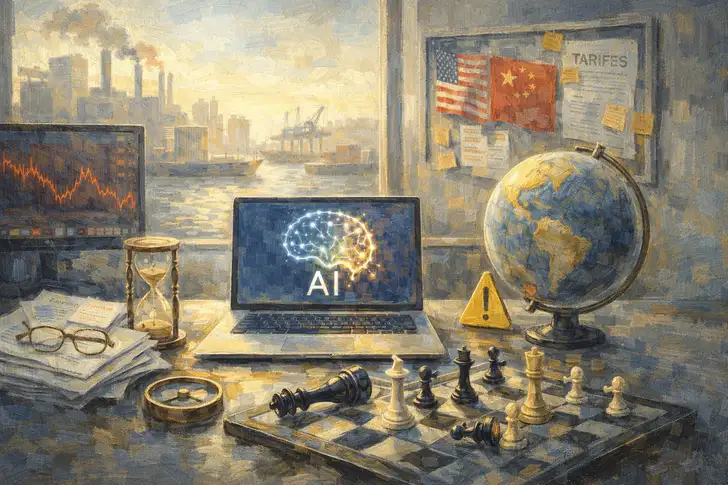
What AI, Tariffs, and Global Uncertainty Mean for Your Portfolio

Humility Clients have been asking about AI, our portfolio, and the world. The honest answer to all three starts in an uncomfortable place.

Not with conviction. With humility.

We are living through a period where change is happening faster than our ability to understand it. The future feels less predictable, not because we know less, but because the range of possible outcomes has expanded.

When that happens, confidence becomes dangerous. Assumptions that once felt stable begin to crack. And the way we think about risk, opportunity, and even our own decision-making has to evolve.

What follows is an excerpt from a recent client letter, and my best attempt to think through that reality.

AI

AI requires an enormous dose of humility. It is changing much faster than our ability to understand the change. AI creating AI makes its growth exponential – something our minds have difficulty processing.

AI is a great benefit, but it is also a threat.

Until recently, the market focused on the benefit part, but there will be losers. Software stocks are a great recent example. Many are down 50–70% from their highs, erasing gains for some of them over the last five years or even a decade.

A lot of them traded at nosebleed valuations, priced for out-of-this-world perfection, and most of these declines are just normalization – bringing some clouds into a multidecade cloudless forecast of uninterrupted growth. But as we spent time researching them, we couldn’t say how this story will play out on an industry-wide basis. What we do know is that the range of outcomes – both positive and negative – has widened substantially.

AI definitely lowers barriers to entry and in some cases switching costs. It reduces boundaries of expansion of existing and new players – you’ll have companies encroaching on each other’s space, benefiting consumers of software but impacting profit margins of the industry. However, the productivity of software engineers will go up a lot. This is a deflationary force – and one that will displace a lot of jobs.

The software industry is the one likely to be impacted first, for several reasons: first, it is the most adept at change; and second, it has been the focus of AI companies, as they are using AI to program AI. Finally, software is at the tip of the spear of AI because it speaks the same language – computer languages. Software engineers get paid a lot of money in part because they have learned to think like a computer. Now they are competing with a brilliant one.

But it is also important to understand that though these companies are in the “software” business, creating software is not everything. They also need to provide support and continuity of updates, have industry knowledge, provide uptime, integrations, security, “throat to choke” – someone reputable to redirect blame to when there are problems – and more. The best products, at least judged on the single dimension of software excellence, don’t always win. Just look at Microsoft. It is a collection of a lot of average products that work well together.

From a broader perspective, a lot will depend not just on individual companies’ competitive positioning, which is paramount, but also on management and culture. Those who embrace change and execute well will create a lot of value. The ones who dismiss it may look fine for a while, until their businesses turn into Kodak camera film. The further we are from tasks that can be put into an algorithm and the closer we are to human connection, the further we are from the spear of AI.

As my friend Saurabh Madan put it, “Knowing what to do and having tools at hand doesn’t mean that companies will do it. It is like everyone knows that we should eat healthy and exercise. Not all of us do it.”

Embracing AI

IMA is embracing AI. It’s easier for us; we are a small company. We can turn on a dime. We intentionally stayed away from complexity, choosing to do a few things but do them better. We can test and experiment with different models. We can hire consultants to help us adapt.

But at IMA change comes from the top, mainly yours truly. If you are worried about what is going on in the world today, I am worried even more: I am worried for you and for me, as my family’s net worth is invested in the same stocks as you are. So my advice: since I am going to worry anyway, maybe you need to worry a little bit less. Let me worry for both of us.

***

Your comments are appreciated.

EDUCATION: Books

Like, Refer and Subscribe

***

DEEPSEEK: Breaks the Artificial Intelligence Paradigm

By Vitaliy Katsenelson CFA

***

***

I’ve received emails from readers asking my thoughts on DeepSeek. I need to start with two warnings. First, the usual one: I’m a generalist value investor, not a technology specialist (last week I was analyzing a bank and an oil company), so my knowledge of AI models is superficial. Second, and more unusually, we don’t have all the facts yet.

But this story could represent a major step change in both AI and geopolitics.

Here’s what we know:

DeepSeek—a year-old startup in China that spun out of a hedge fund—has built a fully functioning large language model (LLM) that performs on par with the latest AI models. This part of the story has been verified by the industry: DeepSeek has been tested and compared to other top LLMs. I’ve personally been playing with DeepSeek over the last few days, and the results it spit out were very similar to those produced by ChatGPT and Perplexity—only faster.

This alone is impressive, especially considering that just six months ago, Eric Schmidt (former Google CEO, and certainly no generalist) suggested China was two to three years behind the U.S. in AI.

But here’s the truly shocking—and unverified—part: DeepSeek claims they trained their model for only $5.6 million, while U.S. counterparts have reportedly spent hundreds of millions or even billions of dollars. That’s 20 to 200 times less.

The implications, if true, are stunning. Despite the U.S. government’s export controls on AI chips to China, DeepSeek allegedly trained its LLM on older-generation chips, using a small fraction of the computing power and electricity that its Western competitors have. While everyone assumed that AI’s future lay in faster, better chips—where the only real choice is Nvidia or Nvidia—this previously unknown company has achieved near parity with its American counterparts swimming in cash and datacenters full of the latest Nvidia chips. DeepSeek (allegedly) had huge compute constraints and thus had to use different logic, becoming more efficient with subpar hardware to achieve a similar result.

In other words, this scrappy startup, in its quest to create a better AI “brain,” used brains where everyone else was focusing on brawn—it literally taught AI how to reason.

COMMENTS APPRECIATED

Like and Refer

***

***

PARADOX: Warren Buffett and Berkshire Hathaway (BRK)

By Vitaliy Katsenelson CFA

***

***

I am back from what has become over the past two decades an annual pilgrimage to Omaha. 

What’s fascinating about this trip is that it has everything and nothing to do with Warren Buffett. The main event that draws everyone to Omaha – the Berkshire Hathaway (BRK) annual meeting – is actually the least important part. I could have watched the shareholder meeting livestreamed on YouTube from the comfort of my living room couch.

The emergence of the Berkshire phenomenon reminds me of China’s manufacturing evolution. China initially attracted capital because of its cheap labor. But over time, China took this capital and plowed it into infrastructure. Factories were built next to each other, each specializing in certain areas. A specialized ecosystem emerged. 

Today, Chinese labor is no longer cheap. It’s been replaced by automation, and now China is a powerhouse for manufacturing anything and everything.

The transformation that the BRK weekend has undergone followed a similar progression. Initially, the only way to absorb Buffett and Munger’s wisdom was to come to Omaha, as the event was not streamed. But then something interesting happened. The BRK weekend attracted people who shared the same value system, and friendships were formed. A variety of smaller events began to be scheduled throughout the same weekend across Omaha, and an equally specialized ecosystem emerged.

The shareholder meeting began to be streamed about ten years ago, but that has had no impact on attendance. This is one reason why I think Buffett is at peace with the idea of no longer presiding at the meeting – people will still come to Omaha the weekend before Mother’s Day.
The BRK weekend now features dozens of excellent events. 

I spoke at several, including an investing panel at Creighton University, alongside the wonderful Bob Robotti, a die-hard value investor who runs Robotti & Co. I’ve known Bob for years – at 72, he exhibits the same enthusiasm for stocks as someone decades younger – and this panel was an excellent example of what the BRK Omaha ecosystem has produced.

Bob and I have very different approaches to value investing. He loves cyclical businesses, while I generally shun them. Bob mentioned that he’d buy a very cheap business run by a mediocre manager, while I would not touch it with a ten-foot pole. 

There is absolutely nothing wrong with either approach; indeed, there is an important lesson in it. Your investment philosophy and process have to fit your personality and your EQ. In my case, I get nervous (and thus irrational) when I own companies run by imbeciles who don’t have either skin or soul in the game. But the great thing about the BRK weekend is that I learn from Bob every time I spend time with him. He’s a thoughtful and genuinely kind human being. 

From the outside, the BRK weekend may seem like a place where people simply want to learn how to get and stay rich. But this gathering transcends value investing and capitalism and genuinely celebrates human values. People (like me) bring their kids to this event. And just like at the main event, at the Q&A breakfast I hosted for my readers, many questions centered on life rather than investing.

My first Omaha reader meetup fit around a small restaurant table. This year, to my surprise, 450 people packed into a venue with standing-room only. I answered questions on every imaginable topic for just over two hours, and by the end I was exhausted. 

This gave me even greater admiration for Buffett, who is four decades my senior, yet still fielded questions for four solid hours. I was delighted to hear Warren give a similar answer to one I had given the day before when asked what advice he’d give to graduating students: 
“Don’t worry too much about starting salaries and be very careful who you work for because you will take on the habits of the people around you.” 

(Incidentally, we are going to host our next Q&A Breakfast on May 1, 2026. You can sign up for it here. It’s free, but I suggest you sign up early, as it fills up fast.)

I also participated (as I have for over a decade) in an investing panel at YPO (Young President Organization) in the beautiful Holland Performance Art Center with Tom Gaynor, CEO of Markel (often described as a baby Berkshire Hathaway) and Lawrence Cunningham. Lawrence authored perhaps the most important book about Buffett, The Essays of Warren Buffett, masterfully editing Warren’s annual letters into a cohesive volume. This year’s panel was one of those occasions where I found myself listening intently to my fellow panelists instead of speaking more.

Lawrence has met Greg Abel – Buffett’s designated successor – and feels optimistic about him. He’s probably right – this was one of Buffett’s most crucial decisions, which he did not make lightly. Yet I can’t imagine sitting for four hours listening to Greg Abel. I am sure he is a brilliant CEO, but he’s neither Buffett nor Munger – few individuals possess so much worldly wisdom and communicate it with such clarity and humor.

This brings me to the point of this note: the dramatic (yet not unexpected) announcement that Buffett is stepping down as CEO of BRK at the end of the year.

Before I comment on this, let me tell you a story. Imagine you have been watching a soap opera for 17 years. You arrive dutifully every year to watch every episode in person. And then you miss the last five minutes of the explosive finale before it goes off the air. This is what happened to me when Buffett announced his retirement as CEO.

A few minutes before noon, while Buffett was answering a question I’d heard before and appeared to be winding down, I suggested we slip out early for lunch to avoid the crowds. When we came back, I discovered that the meeting had gone on until 1 pm, and just before it ended, Buffett announced that he would step down at the end of the year. Seventeen years of watching Warren speak and I missed the most dramatic moment of all, followed by a five-minute standing ovation.

I think Buffett has engineered his exit brilliantly. He will still remain chairman, and even before the announcement he was not managing BRK’s day-to-day operations. As a collection of hundreds of companies that often have absolutely nothing in common with each other, BRK is already highly decentralized. Buffett’s main contribution has been capital allocation.

Giving up the CEO title while he’s still alive means Buffett has brought in his replacement in an orderly way and created a smooth transition. But I have a feeling that on January 1, 2026, when Greg Abel officially becomes CEO, nothing will really change, and Warren will continue doing what he’s been doing for as long as he can. If Buffett is able – he’ll be 95 – he’ll still drive to the office and stop by McDonald’s for a breakfast sandwich (there’s a lot of wisdom in finding pleasure in little things). His son Howard Buffett will become chairman after Warren, with his only job being to preserve the culture.
I’ve been asked what I think of BRK stock. We bought the stock during the pandemic. It has done better than I expected, in part because of the strong performance of Apple, which was BRK’s largest holding. But BRK today is an unexciting investment at its current price. In all honesty, it is a conglomerate with some good and some merely okay businesses.

As a consumer, I get a (small) glimpse into how BRK businesses are being run by visiting Dairy Queen. BRK owns DQ, and I love their soft-serve ice cream (though I only eat it when I travel). My favorite part of research!

DQ has (or maybe had) a strong brand and operates on a capital-light model as a franchisor. But most stores I have visited looked like they have been neglected and need fresh paint. To be sure, I understand the limitations of this “analysis,” and DQ overall amounts to a rounding error on BRK’s financials. But little things often reveal much about big things.

BRK’s big businesses, from what I can glean through their financials, are not particularly well managed – GEICO and BNSF (railroad) have definitely been undermanaged lately. BNSF is not nearly as efficient as its competitors that embraced precision railroading, and until recently GEICO was losing market share to Progressive. 

BRK’s reinsurance business, a significant source of BRK’s profitability, is run by the extraordinary Ajit Jain. Ajit is in his 70s and unfortunately it seems he is not in great health. Is his replacement going to shoot the lights out, like he did? We don’t know. But Ajit is probably more important to BRK today than Buffett.

BRK is not going to melt into oblivion after Buffett is gone, but its best days are behind it. As Buffett has acknowledged, just its size alone makes it very difficult for BRK to grow. Truth be told, even if Buffett were thirty years younger and continued to run BRK, I am not sure the results would be much different than what I think the future holds with Abel at the helm. 

Buffett and Charlie Munger had a tremendous impact on me as an investor and human being. I am incredibly thankful to both. I hope Warren is there next year, but, in either case, I will be.

As value investors say, “next year in Omaha”.

COMMENTS APPRECIATED

Like and Refer

***

***