







 Support our online development, and advance our onground research initiatives in free market economics, as we seek to showcase the brightest Next-Gen minds.
THE ME-P DISCLAIMER: Posts, comments and opinions do not necessarily represent iMBA, Inc., but become our property after submission. Copyright © 2006 to-date. iMBA, Inc allows colleges, universities, medical and financial professionals and related clinics, hospitals and non-profit healthcare organizations to distribute our proprietary essays, photos, videos, audios and other documents; etc. However, please review copyright and usage information for each individual asset before submission to us, and/or placement on your publication or web site. Attestation references, citations and/or back-links are required. All other assets are property of the individual copyright holder.
Support our online development, and advance our onground research initiatives in free market economics, as we seek to showcase the brightest Next-Gen minds.
THE ME-P DISCLAIMER: Posts, comments and opinions do not necessarily represent iMBA, Inc., but become our property after submission. Copyright © 2006 to-date. iMBA, Inc allows colleges, universities, medical and financial professionals and related clinics, hospitals and non-profit healthcare organizations to distribute our proprietary essays, photos, videos, audios and other documents; etc. However, please review copyright and usage information for each individual asset before submission to us, and/or placement on your publication or web site. Attestation references, citations and/or back-links are required. All other assets are property of the individual copyright holder.


By Dr. David Edward Marcinko; MBA MEd
SPONSOR: http://www.MarcinkoAssociates.com
***
***
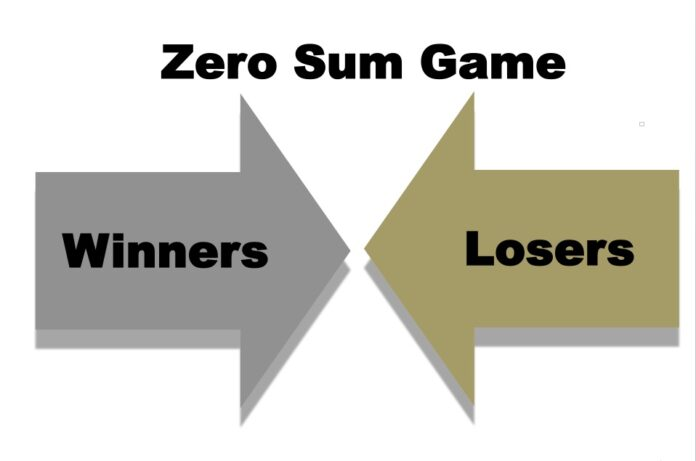
Zero-sum economics is the idea that one person’s or group’s economic gain must come at the expense of another’s. In a zero-sum situation, the total amount available is fixed. If one participant receives more, another participant necessarily receives less. The concept is useful for understanding certain economic conflicts, but it does not accurately describe the economy as a whole.
The term “zero-sum” comes from the idea of a fixed pool of resources. For example, imagine two people dividing ten dollars between themselves. If one person receives seven dollars, the other can receive only three. The total remains ten dollars. This is a zero-sum situation because the gains and losses exactly offset one another. Many economic activities can have zero-sum characteristics, particularly when participants are competing for a scarce and fixed resource.
Competition for land can provide a simple example. If two businesses want to purchase the same piece of property and only one can obtain it, the successful buyer gains control of the property while the other loses the opportunity to use it. Similarly, when governments negotiate over a fixed amount of a natural resource, gaining a larger share may leave less available for others. In these circumstances, thinking in zero-sum terms can help explain why disagreements occur.
However, much of economic activity is not inherently zero-sum. Economies can grow because people create new goods and services, develop technologies, improve productivity, and exchange resources in ways that benefit multiple parties. When a farmer grows more food because of better equipment, for example, the total amount of food available can increase. When a company develops a useful new product, consumers may receive something they value while the company earns revenue. Both sides can benefit from the transaction.
Trade is another important example. Two people may voluntarily exchange goods because each values what the other possesses more highly. A person who has extra vegetables might exchange them for clothing made by someone else. After the exchange, both participants may consider themselves better off. The transaction has not simply transferred a fixed amount of wealth from one person to another; it has created value through specialization and exchange.
Economic growth therefore challenges the assumption that wealth is a fixed quantity. Productivity improvements can allow societies to produce more with the same amount of labor and resources. Education can increase workers’ skills, while technological innovation can make production faster and less expensive. Investment in infrastructure can also make it easier for businesses and individuals to produce and exchange goods. These processes can expand the overall economic possibilities available to society.
Nevertheless, scarcity remains an important limitation. Resources such as land, time, energy, and certain raw materials are finite. Even in a growing economy, people and governments must make choices about how these resources are used. Choosing to devote more resources to one purpose can mean devoting fewer resources to another. For instance, a government that spends more money on transportation may have fewer resources available for other programs unless it increases revenue or reduces other spending.
***
***
The zero-sum perspective can also influence political and social debates about inequality. If people believe that economic gains are always obtained at someone else’s expense, they may view differences in wealth primarily as evidence of direct competition between groups. Sometimes economic outcomes do involve distributional conflicts, particularly when policies determine who receives a fixed benefit or bears a particular cost. At other times, however, the economy may be capable of generating additional wealth, making the central issue how that new wealth is distributed rather than whether one group must lose for another to gain.
Understanding the difference between zero-sum and positive-sum situations is therefore important. A zero-sum framework is appropriate when participants are dividing a genuinely fixed resource. It becomes less useful when applied to activities that increase production, encourage innovation, or create mutual gains through voluntary exchange. Economic life contains both types of situations.
Ultimately, zero-sum economics provides a valuable way of thinking about scarcity and competition, but it should not be treated as a complete description of economic activity. Some conflicts involve competing claims over limited resources, while other activities expand the amount of wealth and opportunity available. Recognizing the difference allows economic issues to be understood more clearly and helps explain why some situations require choices about distribution while others allow people to create mutual benefits.
SPEAKING: Dr. Marcinko will be speaking and lecturing, signing and opining, teaching and preaching, storming and performing at many locations throughout the USA this year! His tour of witty and serious pontifications may be scheduled on a planned or ad-hoc basis; for public or private meetings and gatherings; formally, informally, or over lunch or dinner. All medical societies, financial advisory firms or Broker-Dealers are encouraged to submit an RFP for speaking engagements: CONTACT: Ann Miller RN MHA at MarcinkoAdvisors1738@outlook.com -OR- http://www.MarcinkoAssociates.com
Like, Refer and Subscribe
SEND IN YOUR TOPIC IEAS, TODAY!
HOSPITALS: http://www.crcpress.com/product/isbn/9781466558731
CLINICS: http://www.crcpress.com/product/isbn/9781439879900
ADVISORS: www.CertifiedMedicalPlanner.org
FINANCE:Financial Planning for Physicians and Advisors
INSURANCE:Risk Management and Insurance Strategies for Physicians and Advisors
Dictionary of Health Economics and Finance
Dictionary of Health Information Technology and Security
Dictionary of Health Insurance and Managed Care
***
Share this:

Filed under: iMBA, Inc. | Tagged: economics, economics-zero-sum-game, finance, history, Marcinko, philosophy, politics |


Leave a comment