PREDICTION MARKETS: Uniting Economics, Finance and Collective Intelligence

By Dr. David Edward Marcinko MBA MEd

***

***

The Case of Kalshi

Financial prediction markets represent a fascinating intersection of economics, finance, and collective intelligence. Unlike traditional stock or commodity markets, these platforms allow participants to trade contracts whose value depends on the outcome of real‑world events. Kalshi, one of the most prominent examples, has emerged as a regulated exchange in the United States where individuals can buy and sell event contracts tied to measurable outcomes such as inflation rates, interest rate decisions, or even the release of government data. These markets transform uncertainty into tradable assets, offering both a mechanism for hedging risk and a tool for aggregating information.

At their core, prediction markets operate on a simple principle: the price of a contract reflects the probability of an event occurring. If a contract pays one dollar if the Federal Reserve raises interest rates at its next meeting, and it trades at seventy cents, the market is signaling a seventy percent chance of that outcome. This pricing mechanism is not dictated by a single analyst or institution but emerges from the collective actions of traders who bring diverse knowledge, expectations, and incentives to the table. The result is a dynamic forecast that updates in real time as new information becomes available.

Kalshi distinguishes itself by focusing on financial and economic events rather than purely political or cultural ones. Its contracts cover topics such as monthly inflation figures, unemployment rates, GDP growth, and central bank decisions. For businesses and investors, these markets provide a way to hedge against risks that are otherwise difficult to manage. A company worried about rising inflation can take positions in Kalshi’s inflation contracts, effectively offsetting potential losses in its operations. Similarly, an investor anticipating a change in interest rates can use event contracts to protect their portfolio or speculate on outcomes. In this sense, prediction markets serve both speculative and risk‑management purposes, much like traditional derivatives.

The appeal of financial prediction markets lies in their ability to aggregate dispersed information. Economists have long argued that markets are efficient at processing data because prices reflect the collective wisdom of participants. Prediction markets extend this logic to events that are not strictly financial but have financial consequences. By allowing traders to express their beliefs in monetary terms, these markets generate probabilities that often rival or surpass expert forecasts. For example, the probability of a rate hike inferred from Kalshi’s contracts may provide a more accurate signal than surveys of economists, because traders have skin in the game and adjust their positions continuously.

Another important aspect of Kalshi is its regulatory status. Unlike many informal or crypto‑based prediction platforms, Kalshi operates as a regulated exchange in the United States. This gives it legitimacy and ensures compliance with financial laws. Regulation also allows institutional investors to participate with greater confidence, expanding the scope and liquidity of the market. The presence of oversight helps distinguish financial prediction markets from gambling, emphasizing their role as instruments for hedging and forecasting rather than mere speculation.

Despite their promise, prediction markets face challenges. Liquidity is a constant concern; without sufficient participation, prices may not accurately reflect probabilities. There is also the question of accessibility, as not all individuals or institutions are comfortable trading event contracts. Moreover, critics argue that prediction markets could influence the very events they are meant to forecast, particularly in sensitive areas like politics. Kalshi mitigates some of these concerns by focusing on measurable economic outcomes, which are less susceptible to manipulation.

CONCLUSION

Looking ahead, financial prediction markets like Kalshi may become an integral part of the financial ecosystem. As global uncertainty increases, businesses and investors seek tools to manage risks beyond traditional hedging instruments. Event contracts provide a novel way to do so, while simultaneously offering valuable insights into collective expectations. If adoption continues to grow, prediction markets could evolve into a mainstream source of information, complementing surveys, expert analysis, and traditional financial indicators.

COMMENTS APPRECIATED

EDUCATION: Books

Like, Refer and Subscribe

***

***

CRYPTO-CURRENCY: Historical Review

By Dr. David Edward Marcinko MBA MEd

***

***

SPONSOR: http://www.MarcinkoAssociates.com

President Donald Trump signed a pardon on Wednesday for convicted crypto executive Changpeng Zhao, who founded the Binance crypto exchange, White House Press Secretary Karoline Leavitt said in a statement. “President Trump exercised his constitutional authority by issuing a pardon for Mr. Zhao, who was prosecuted by the Biden Administration in their war on cryptocurrency,” Leavitt said. “In their desire to punish the cryptocurrency industry, the Biden Administration pursued Mr. Zhao despite no allegations of fraud or identifiable victims.”

Zhao was sentenced to four months in prison after reaching a deal with the Justice Dept. to plead guilty to charges of enabling money laundering at Binance, which he ran at the time. The U.S. also ordered Binance to pay more than $4 billion in fines and forfeiture, while Zhao agreed to pay $50 million in fines. A spokesperson for Binance did not immediately respond to a request for comment yesterday.

***

The History of Cryptocurrency: From Concept to Revolution

Cryptocurrency has transformed the global financial landscape, offering a decentralized alternative to traditional banking systems. Its history is rooted in decades of technological innovation, philosophical ideals, and economic experimentation.

🌐 Early Foundations

The concept of digital currency predates Bitcoin by several decades. In 1982, cryptographer David Chaum published a groundbreaking paper on secure digital transactions, laying the foundation for future developments in electronic money. Chaum later founded DigiCash in the 1990s, which introduced the idea of anonymous digital payments using cryptographic protocols. Although DigiCash eventually failed, it was a crucial stepping stone in the evolution of cryptocurrency.

The Birth of Bitcoin

The true revolution began in 2008 when an anonymous figure—or group—known as Satoshi Nakamoto released the Bitcoin whitepaper titled “Bitcoin: A Peer-to-Peer Electronic Cash System.” This document proposed a decentralized digital currency that used blockchain technology to record transactions transparently and securely without the need for a central authority.

On January 3, 2009, Nakamoto mined the first block of the Bitcoin blockchain, known as the Genesis Block. The first real-world Bitcoin transaction occurred in May 2010, when programmer Laszlo Hanyecz paid 10,000 BTC for two pizzas—an event now celebrated annually as Bitcoin Pizza Day.

Blockchain and Beyond

Bitcoin’s success inspired the development of other cryptocurrencies and blockchain platforms. Ethereum, launched in 2015 by Vitalik Buterin, introduced smart contracts—self-executing agreements coded directly into the blockchain. This innovation expanded the use of cryptocurrency beyond simple transactions to decentralized applications (dApps), finance (DeFi), and even digital art (NFTs).

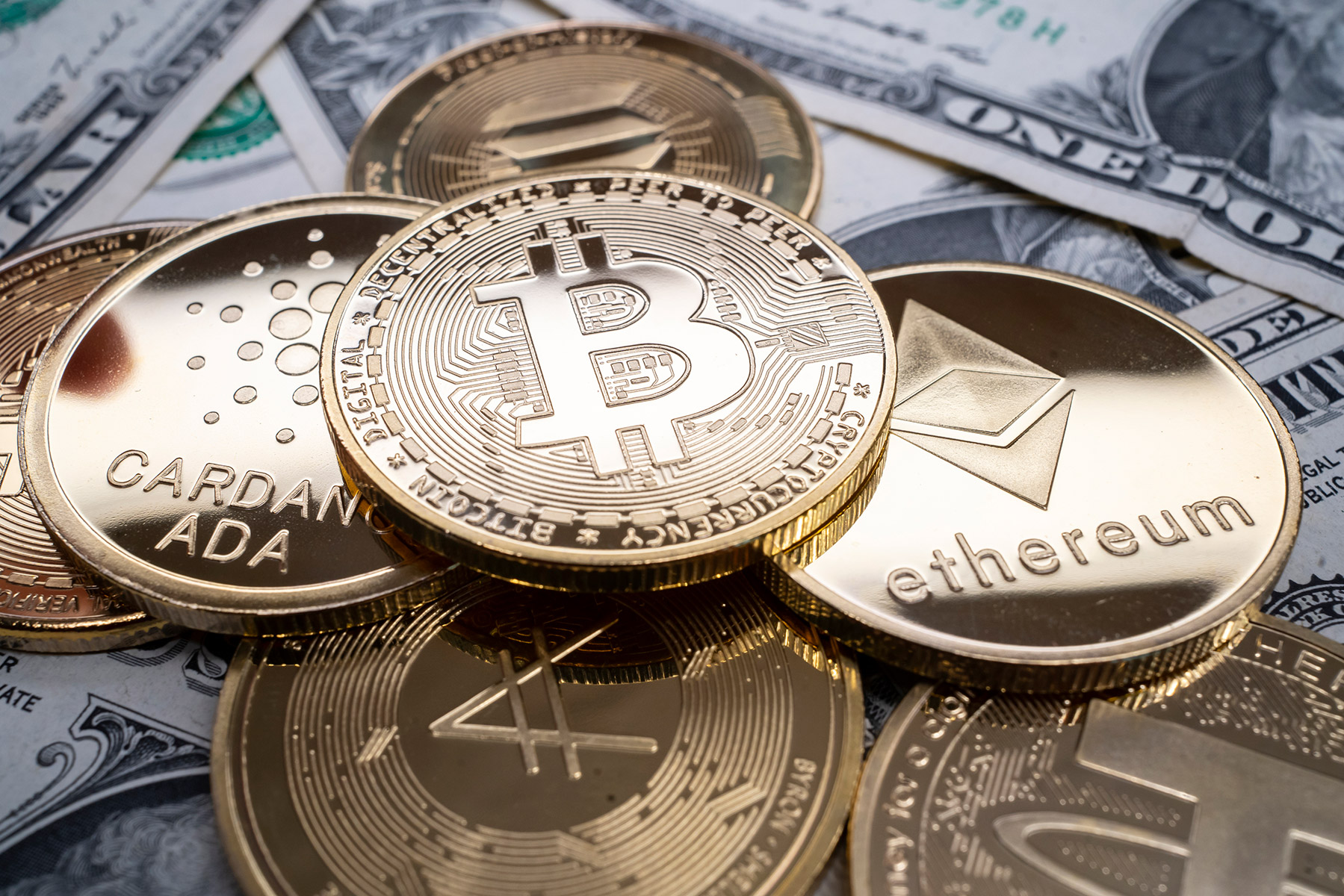
Other notable cryptocurrencies include Litecoin, Ripple (XRP), and Cardano, each offering unique features such as faster transaction speeds, improved scalability, or enhanced privacy.

***

***

⚖️ Challenges and Controversies

Despite its promise, cryptocurrency has faced significant hurdles. Regulatory uncertainty, security breaches, and market volatility have raised concerns among governments and investors. High-profile hacks, such as the Mt. Gox exchange collapse in 2014, highlighted the risks associated with digital assets.

Governments around the world have responded differently—some embracing crypto innovation, others imposing strict regulations or outright bans. The rise of central bank digital currencies (CBDCs) reflects an effort to merge the benefits of crypto with the stability of fiat systems.

🚀 The Future of Crypto

Today, cryptocurrency is more than a niche technology—it’s a global phenomenon. Major companies accept Bitcoin, institutional investors hold crypto assets, and blockchain is being integrated into industries from healthcare to supply chain management.

As the technology matures, the focus is shifting toward scalability, sustainability, and interoperability. Whether it becomes a mainstream financial tool or remains a disruptive alternative, cryptocurrency has undeniably reshaped how we think about money, trust, and digital ownership.

COMMENTS APPRECIATED

EDUCATION: Books

SPEAKING: Dr. Marcinko will be speaking and lecturing, signing and opining, teaching and preaching, storming and performing at many locations throughout the USA this year! His tour of witty and serious pontifications may be scheduled on a planned or ad-hoc basis; for public or private meetings and gatherings; formally, informally, or over lunch or dinner. All medical societies, financial advisory firms or Broker-Dealers are encouraged to submit an RFP for speaking engagements: CONTACT: Ann Miller RN MHA at MarcinkoAdvisors@outlook.com -OR- http://www.MarcinkoAssociates.com

Like, Refer and Subscribe

***

***

CRYPTO-CURRENCY: Crisis Risks

By Staff Reporters and A.I.

SPONSOR: http://www.CertifiedMedialPlanner.org

***

***

The Looming Cryptocurrency Crisis: Risks on the Horizon

Cryptocurrency has revolutionized the financial landscape, offering decentralized alternatives to traditional banking and investment systems. However, as digital assets become more integrated into global markets, concerns about a potential future cryptocurrency crisis are mounting. From regulatory uncertainty to systemic vulnerabilities, the risks associated with crypto are increasingly being scrutinized by economists, governments, and investors.

One of the most pressing concerns is regulatory instability. Cryptocurrencies operate in a fragmented legal environment, with different countries adopting varying stances—from full embrace to outright bans. The lack of unified global regulation creates loopholes that can be exploited for money laundering, tax evasion, and fraud. If major economies suddenly impose strict regulations or sanctions, it could trigger a rapid devaluation of crypto assets and erode investor confidence.

Another risk stems from market volatility and speculative behavior. Unlike traditional assets backed by tangible value or government guarantees, cryptocurrencies are often driven by hype, social media trends, and speculative trading. This creates a fragile ecosystem where prices can swing wildly. A sudden crash—similar to the 2022 Terra/Luna collapse—could wipe out billions in investor wealth and destabilize related financial institutions.

***

***

Technological vulnerabilities also pose a threat. While blockchain is considered secure, the platforms built on it are not immune to hacks, bugs, or exploitation. High-profile breaches of exchanges and wallets have already resulted in massive losses. As crypto adoption grows, so does the incentive for cybercriminals to target these systems. A coordinated attack on a major exchange or blockchain network could have cascading effects across the entire crypto economy. Geopolitical tensions may also catalyze a crisis. For instance, recent reports suggest that aggressive trade policies—such as the U.S. imposing 100% tariffs on Chinese imports—can indirectly impact crypto markets by shaking investor sentiment and triggering sell-offs.

The interconnection with traditional finance is another area of concern. As banks and hedge funds increasingly invest in crypto, the line between decentralized finance and conventional markets blurs. This integration means that a crypto collapse could spill over into broader financial systems, potentially triggering a global crisis. The 2023 banking collapses, which were partially linked to crypto exposure, serve as a warning of how intertwined these systems have become.

Geopolitical tensions may also catalyze a crisis. For instance, recent reports suggest that aggressive trade policies—such as the U.S. imposing 100% tariffs on Chinese imports—can indirectly impact crypto markets by shaking investor sentiment and triggering sell-offs. In such scenarios, cryptocurrencies may not serve as the safe haven they were once believed to be.

Lastly, overreliance on stablecoins and algorithmic assets introduces systemic risk. Many investors use stablecoins to hedge volatility, but these assets are only as stable as their underlying reserves and governance. If a major stablecoin fails, it could lead to a liquidity crunch and panic across exchanges and DeFi platforms.

In conclusion, while cryptocurrency offers transformative potential, it also carries significant risks that could culminate in a future crisis. To mitigate these dangers, stakeholders must push for clearer regulations, stronger technological safeguards, and more transparent financial practices. Without proactive measures, the next financial meltdown may not come from Wall Street—but from the blockchain.

NOTE: A crypto mogul has been found dead inside his luxury car in Ukraine after the digital currency market nosedived. Konstantin Galich, 32, also known as Kostya Kudo, has died after one of the worst turmoils shook the cryptocurrency market. The entrepreneur, who became a well-known figure in the crypto industry, was reportedly found with a gunshot wound to his head in his black Lamborghini parked up in Kyiv’s Obolonskyi neighbourhood. His death was later confirmed on his Telegram channel in a post saying ‘Konstantin Kudo tragically passed away. The causes are being investigated. We will keep you posted on any further news.’

COMMENTS APPRECIATED

EDUCATION: Books

Like, Refer and Subscribe

***

***

Stocks, Crypto-Currency and Commodities

By A.I. and Staff Reporters

***

***

  • Stocks: Equities climbed slowly but steadily yesterday as investors braced themselves for today’s all-important jobs report.
  • Crypto: Bitcoin fell as a selloff in cryptocurrencies associated with the Trump family pulled the entire crypto market lower.
  • Commodities: Gold remains in the spotlight as traders bulk up on bullion to protect their portfolios in case the FOMC loses its independence. If that does happen, Goldman Sachs analysts think gold could climb to $5,000.

COMMENTS APPRECIATED

EDUCATION: Books

Like, Refer and Subscribe

***

***

DAILY UPDATE: Stocks, Commodities & Crypto-Currency

MEDICAL EXECUTIVE-POST TODAY’S NEWSLETTER BRIEFING

***

Essays, Opinions and Curated News in Health Economics, Investing, Business, Management and Financial Planning for Physician Entrepreneurs and their Savvy Advisors and Consultants

Serving Almost One Million Doctors, Financial Advisors and Medical Management Consultants Daily

A Partner of the Institute of Medical Business Advisors , Inc.

http://www.MedicalBusinessAdvisors.com

SPONSORED BY: Marcinko & Associates, Inc.

***

http://www.MarcinkoAssociates.com

Daily Update Provided By Staff Reporters Since 2007.
How May We Serve You?
© Copyright Institute of Medical Business Advisors, Inc. All rights reserved. 2025

REFER A COLLEAGUE: MarcinkoAdvisors@outlook.com

SPONSORSHIPS AVAILABLE: https://medicalexecutivepost.com/sponsors/

ADVERTISE ON THE ME-P: https://tinyurl.com/ytb5955z

Your Referral Count -0-

CITE: https://www.r2library.com/Resource

🟢 What’s up

  • Tesla climbed another 5.67% on signs that Elon Musk and President Trump are mending fences and on hype around the robotaxi reveal this week.
  • TSMC rose 2.63% after the semiconductor company reported that its revenue in the month of May rose 39.6% year over year.
  • Disney rose 2.65% higher a day after agreeing to purchase Comcast’s stake in streaming service Hulu for $438.7 million. Comcast climbed 2.95%.
  • Solar stocks got a bit of hope after the Wall Street Journal reported that tech companies are lobbying Congress to keep clean energy subsidies in the tax and spending bill. SolarEdge rose 11.81%, and Sunrun gained 7.13%.
  • Insmed exploded 28.65% thanks to strong results for the biopharma company’s new treatment for pulmonary arterial hypertension.
  • Casey’s General Store rose 11.59% after the retailer crushed Wall Street’s profit expectations last quarter and raised its dividend.

What’s down

  • J.M. Smucker tumbled 15.59% on mixed earnings results and a weaker-than-expected fiscal forecast for the snack foods company.
  • McDonald’s lost 1.43% thanks to a double downgrade from Redburn Atlantic analysts, who think the fast food titan’s slowing foot traffic and headwinds from obesity drugs will hurt its growth. That’s the company’s third downgrade in three days.
  • Snap fell just 0.12% after the social media company unveiled its new augmented reality glasses.
  • Calavo Growers plunged 16.26% after the avocado distributor reported much worse quarterly results than Wall Street was expecting.
  • Biopharma stocks Liquidia and United Therapeutics lost 16.87% and 14.32%, respectively, on competitor Insmed’s good news.

CITE: https://tinyurl.com/2h47urt5

  • Stocks: Markets meandered higher as investors awaited news from ongoing US & China trade negotiations in London. Commerce Secretary Howard Lutnick said talks were going well and could continue into tomorrow.
  • Commodities: Oil soared to its highest price since April on hopes that a trade deal between the world’s largest economies could spur demand, but plunged back to earth after the US said oil output will fall next year.
  • Crypto: After just barely holding on last week, Bitcoin has now stayed above $100,000 for 30 days straight for the first time ever—a signal to traders that there’s a new level of support for the crypto king.

CITE: https://tinyurl.com/tj8smmes

Visualize: How private equity tangled banks in a web of debt, from the Financial Times.

COMMENTS APPRECIATED

PLEASE SUBSCRIBE: MarcinkoAdvisors@outlook.com

Thank You

***

***

***

***

EDUCATIONAL TEXTBOOKS: https://tinyurl.com/4zdxuuwf

***

DAILY UPDATE: Stocks End Day Mixed

MEDICAL EXECUTIVE-POST TODAY’S NEWSLETTER BRIEFING

***

Essays, Opinions and Curated News in Health Economics, Investing, Business, Management and Financial Planning for Physician Entrepreneurs and their Savvy Advisors and Consultants

Serving Almost One Million Doctors, Financial Advisors and Medical Management Consultants Daily

A Partner of the Institute of Medical Business Advisors , Inc.

http://www.MedicalBusinessAdvisors.com

SPONSORED BY: Marcinko & Associates, Inc.

***

http://www.MarcinkoAssociates.com

Daily Update Provided By Staff Reporters Since 2007.
How May We Serve You?
© Copyright Institute of Medical Business Advisors, Inc. All rights reserved. 2025

REFER A COLLEAGUE: MarcinkoAdvisors@outlook.com

SPONSORSHIPS AVAILABLE: https://medicalexecutivepost.com/sponsors/

ADVERTISE ON THE ME-P: https://tinyurl.com/ytb5955z

Your Referral Count -0-

CITE: https://www.r2library.com/Resource

  • Stocks wavered throughout the day as the 10-year Treasury yield rose back above 4.5%, making a convincing argument for investors to buy risk-free bonds with big yields rather than equities.
  • Yields on both 20-year and 30-year Treasuries traded above 5% after the Republican tax and spending bill passed the House, raising fears of a bigger US deficit and lower creditworthiness in the years ahead.
  • Bitcoin continued to climb last night, hitting a new record high of $111,886.41 in the wee hours of the morning before losing some ground throughout the trading session today.

CITE: https://tinyurl.com/2h47urt5

What’s up

  • Nike gained 2.30% on the news that it will begin selling its shoes on Amazon for the first time since 2019.
  • Fannie Mae popped 46.73% and Freddie Mac jumped 42.50% on President Trump’s comments that he’s seriously considering bringing the mortgage giants public.
  • Advance Auto Parts exploded 57.14% higher after better-than-feared earnings made it clear that its turnaround plan is working.
  • Urban Outfitters soared 22.84% after reporting EPS of $1.16 last quarter, far better than the $0.84 per share analysts had forecast.
  • Snowflake gained 13.47% thanks to a strong first quarter and management’s expectation that revenue will rise about 25% this quarter.

What’s down

  • Walmart lost 0.48% on the news that it will cut 1,500 jobs in a corporate restructuring.
  • Analog Devices fell 4.63% even though the semiconductor maker beat Wall Street estimates on both sales and profits last quarter.
  • Health insurance stocks took a hit on reports that the US government will conduct “aggressive” Medicare Advantage audits. Humana sank 7.58%, UnitedHealth Group fell 2.08%, and CVS Health dropped 3.06%.

CITE: https://tinyurl.com/tj8smmes

Visualize: How private equity tangled banks in a web of debt, from the Financial Times.

COMMENTS APPRECIATED

PLEASE SUBSCRIBE: MarcinkoAdvisors@outlook.com

Thank You

***

***

***

***

EDUCATIONAL TEXTBOOKS: https://tinyurl.com/4zdxuuwf

***

DAILY UPDATE: Stock Markets Collapse!

MEDICAL EXECUTIVE-POST TODAY’S NEWSLETTER BRIEFING

***

Essays, Opinions and Curated News in Health Economics, Investing, Business, Management and Financial Planning for Physician Entrepreneurs and their Savvy Advisors and Consultants

Serving Almost One Million Doctors, Financial Advisors and Medical Management Consultants Daily

A Partner of the Institute of Medical Business Advisors , Inc.

http://www.MedicalBusinessAdvisors.com

SPONSORED BY: Marcinko & Associates, Inc.

***

http://www.MarcinkoAssociates.com

Daily Update Provided By Staff Reporters Since 2007.
How May We Serve You?
© Copyright Institute of Medical Business Advisors, Inc. All rights reserved. 2025

REFER A COLLEAGUE: MarcinkoAdvisors@outlook.com

SPONSORSHIPS AVAILABLE: https://medicalexecutivepost.com/sponsors/

ADVERTISE ON THE ME-P: https://tinyurl.com/ytb5955z

Your Referral Count -0-

CITE: https://www.r2library.com/Resource

  • While stocks usually steal headlines, all eyes were on the bond market today. The 10-year bond yield popped back above 4.5% first thing this morning while the 30-year rose above 5% as fears of larger deficits due to the Republican tax and spending bill gave investors pause. A poorly received auction of $16 billion in 20-year bonds this afternoon only pushed yields higher.
  • Bitcoin climbed to a new all-time high early in the trading session, touching $109,500 at one point today as investors continue to search for alternatives to bonds and the US dollar.
  • Crude oil climbed to its highest price in a month on reports of flaring tensions between Israel and Iran, then tumbled lower after the US announced surprisingly high oil inventories.

CITE: https://tinyurl.com/2h47urt5

What’s up

  • Silly goose: Outdoor apparel maker Canada Goose soared 19.35% after reporting a stellar first quarter.
  • Alphabet rose 2.79% following a slew of big announcements at its developer conference, including a revamped AI Search.
  • Xpeng popped 13.06% thanks to a smaller-than-expected loss last quarter for the Chinese EV maker.
  • WeRide soared 21.42% on the announcement that the robotaxi will buy back $100 million of its stock.

What’s down

  • UnitedHealth Group secretly paid nursing homes to transfer fewer people to hospitals so it could cut costs, according to The Guardian. Shares understandably tumbled 5.79%.
  • Target missed the mark last quarter, with fewer transactions thanks to DEI boycotts leading to lower sales and profits, pushing shares down 5.21%.
  • Lowe’s sank 1.77% despite sticking to its full-year guidance, noting that sales to professionals will pad its bottom line.
  • Palo Alto Network may have beaten analysts’ estimates for sales and profits, but the cybersecurity company still fell 6.80% due to thinner margins.
  • Take-Two Interactive sank 4.52% after the video game maker put $1 billion in common stock on the market.
  • Fair Isaac caught strays today from a Trump Administration official who was displeased by the credit analytics company’s decision to raise royalty fees.
  • Carter’s crashed 15.74% on the announcement that the children’s clothing retailer will slash its dividend due to higher costs from tariffs.
  • Airline stocks tumbled after the FAA limited flights in and out of Newark Airport. United Airlines fell 3.93%, Southwest Airlines lost 2.35%, and American Airlines sank 3.52%.
  • Wolfspeed, easily the best-named stock on the market, may go bankrupt. Shares of the semiconductor supplier dropped 59.11%.

CITE: https://tinyurl.com/tj8smmes

Visualize: How private equity tangled banks in a web of debt, from the Financial Times.

COMMENTS APPRECIATED

PLEASE SUBSCRIBE: MarcinkoAdvisors@outlook.com

Thank You

***

***

***

***

EDUCATIONAL TEXTBOOKS: https://tinyurl.com/4zdxuuwf

***

DAILY UPDATE: Stock Markets Down Slightly

MEDICAL EXECUTIVE-POST TODAY’S NEWSLETTER BRIEFING

***

Essays, Opinions and Curated News in Health Economics, Investing, Business, Management and Financial Planning for Physician Entrepreneurs and their Savvy Advisors and Consultants

Serving Almost One Million Doctors, Financial Advisors and Medical Management Consultants Daily

A Partner of the Institute of Medical Business Advisors , Inc.

http://www.MedicalBusinessAdvisors.com

SPONSORED BY: Marcinko & Associates, Inc.

***

http://www.MarcinkoAssociates.com

Daily Update Provided By Staff Reporters Since 2007.
How May We Serve You?
© Copyright Institute of Medical Business Advisors, Inc. All rights reserved. 2025

REFER A COLLEAGUE: MarcinkoAdvisors@outlook.com

SPONSORSHIPS AVAILABLE: https://medicalexecutivepost.com/sponsors/

ADVERTISE ON THE ME-P: https://tinyurl.com/ytb5955z

Your Referral Count -0-

CITE: https://www.r2library.com/Resource

  • The S&P 500 snapped a 6-day winning streak as the rally following the US & China tariff ceasefire faded and investors looked elsewhere for buying signals.
  • Federal Reserve speeches abound this week, with several central bankers warning of an economy under duress.
  • Both gold and bitcoin consolidated their recent gains, offering investors alternatives to suddenly not-so-safe bonds and a sagging US dollar.

CITE: https://tinyurl.com/2h47urt5

What’s up

  • Tesla climbed 0.51% after CEO Elon Musk committed to spending the next five years running the EV manufacturer.
  • Moderna popped 6.06% after the FDA announced new limits on Covid-19 vaccine approvals that were more lenient than expected.
  • Warby Parker soared 15.57% on news of a partnership with Google to create smart glasses.
  • Pony AI rose 5.74% after the Chinese auto maker posted impressive earnings and cited high demand for autonomous taxi rides.
  • Amer Sports surged 19.05% after the athletic equipment maker posted a strong beat-and-raise earnings announcement.
  • D-Wave Quantum soared 25.93% after the quantum computing company unveiled its newest computing system.
  • Levi Strauss & Co. rose 1.42% on the news that the jeans company is selling Dockers to Authentic Brands Group for $311 million.

What’s down

  • Home Depot fell just 0.61% after the home renovation retailer missed earnings estimates, beat revenue forecasts, kept its fiscal guidance intact, and said it won’t raise prices.
  • Airbnb tumbled 3.27% after Spain ordered the company to take down over 65,000 listings.
  • Uber sagged 0.66% despite an upgrade from JPMorgan analysts and the news that it’s partnering with Waymo to offer robotaxis in Atlanta.
  • Viking Holdings sank 4.99% despite earnings and sales beating estimates, but investors didn’t like hearing that the the cruise line operator transported fewer passengers last quarter than expected.
  • AES lost 4.05% after the solar stock was downgraded by Jefferies analysts, who are worried about lower demand for renewable energy.

CITE: https://tinyurl.com/tj8smmes

Visualize: How private equity tangled banks in a web of debt, from the Financial Times.

COMMENTS APPRECIATED

PLEASE SUBSCRIBE: MarcinkoAdvisors@outlook.com

Thank You

***

***

***

***

EDUCATIONAL TEXTBOOKS: https://tinyurl.com/4zdxuuwf

***

DAILY UPDATE: Bitcoin and Stock Markets Soar

MEDICAL EXECUTIVE-POST TODAY’S NEWSLETTER BRIEFING

***

Essays, Opinions and Curated News in Health Economics, Investing, Business, Management and Financial Planning for Physician Entrepreneurs and their Savvy Advisors and Consultants

Serving Almost One Million Doctors, Financial Advisors and Medical Management Consultants Daily

A Partner of the Institute of Medical Business Advisors , Inc.

http://www.MedicalBusinessAdvisors.com

SPONSORED BY: Marcinko & Associates, Inc.

***

http://www.MarcinkoAssociates.com

Daily Update Provided By Staff Reporters Since 2007.
How May We Serve You?
© Copyright Institute of Medical Business Advisors, Inc. All rights reserved. 2025

REFER A COLLEAGUE: MarcinkoAdvisors@outlook.com

SPONSORSHIPS AVAILABLE: https://medicalexecutivepost.com/sponsors/

ADVERTISE ON THE ME-P: https://tinyurl.com/ytb5955z

Your Referral Count -0-

Bitcoin climbed above $90,000 for the first time since March as investors search for alternatives anywhere they can find them.

CITE: https://www.r2library.com/Resource

Stocks came off of their highs yesterday afternoon trading after US Treasury Secretary Scott Bessent reportedly said in a private speech for JPMorgan Chase that talks between the United States and China had yet to formally start and that negotiations will likely be a “slog.”

CITE: https://tinyurl.com/2h47urt5

Still, US stocks soared on Tuesday following a bruising day on Wall Street, as investors built hope for deescalation on several fronts of President Trump’s trade battles.

Still, markets delivered solid gains with Dow Jones Industrial Average (^DJI) adding over 1,000 points as the benchmark S&P 500 (^GSPC) and tech-heavy NASDAQ (^IXIC) each rose around 2.5% and 2.7%, respectively.

CITE: https://tinyurl.com/tj8smmes

Prior to Bessent’s reported comments, stocks hit earlier session highs as Bloomberg reported the treasury secretary told a closed-door investor summit Tuesday that “the tariff standoff with China is unsustainable and that he expects the situation to de-escalate.”

🟢 What’s up

  • Amazon rose 3.5% a day after Wells Fargo analysts revealed that the tech giant has paused some of its data center leases, the latest sign of an AI trade slowdown.
  • The DOJ has called for a breakup of Alphabet’s business. Investors don’t seem to mind: Shares of the search giant rose 2.57%.
  • Boeing gained 2% after announcing it will sell portions of its digital aviation solutions business to Thoma Bravo for $10.55 billion.
  • Ford is up 1.90% a day after reports emerged that it has stopped shipping cars to China.
  • 3M gained 8.12% after the industrial manufacturing giant beat Wall Street’s expectations in the first quarter.
  • Coreweave rose 8.74% after several Wall Street analysts initiated coverage of the newly public cloud computing company. While the pros lean toward bullish, the stock’s reception has been largely mixed.
  • Equifax soared 13.84% following strong results for the credit rating company, as well as its announcement of a $3 billion buyback program.
  • BP managed to gain 2.81% after regulatory filings revealed that Elliott Investment Management has accrued a 5% stake in the oil giant.
  • Verizon eked out a 0.61% gain after it beat Wall Street forecasts for the first quarter but lost more postpaid net phone subscribers than expected.

What’s down

  • Halliburton disappointed shareholders with a decline in both revenue and profits last quarter, sending the oil service company’s shares 5.57% lower.
  • Defense contractors tumbled after reporting mixed earnings. RTX lost 9.81%, and Northrop Grumman sank 12.66%.
  • Medpace Holdings crumbled 2.32% after the clinical research company revealed a 19% decline in net new business awards last quarter.

COMMENTS APPRECIATED

PLEASE SUBSCRIBE: MarcinkoAdvisors@outlook.com

Thank You

***

***

***

***

EDUCATIONAL TEXTBOOKS: https://tinyurl.com/4zdxuuwf

***

REPUTATIONAL BANKRUPTCY: Of the American Dollar

By Vitaliy Katsenelson CFA

***

***

The Reputational Bankruptcy of the American Dollar
I am in an unenviable position. The policy coming out of the White House has a significant impact on economics, more than ever before in my career. If I say anything positive about that policy, I’ll be put in the MAGA camp. If I criticize it, I’ll be accused of suffering from Trump derangement syndrome. I am hired by you to make the best investment decisions possible. Rather than see me as engaged in political commentary, I’d ask that you view my remarks as purely analytical.

Let me give you this analogy. I live in Denver. Let’s imagine I am a huge Broncos fan, and the Broncos are playing the Chicago Bears. If I am betting a significant amount of money on this game, I should put my affinity for the Broncos and hatred of the Chicago Bears aside and analyze data and facts. The Broncos are either going to win or lose; my wanting them to win has zero impact on the outcome. The same applies to my analysis here. My motto in life is Seneca’s saying, “Time discovers truth.” I just try to discover it before time does.

When it comes to politics, I also have a significant advantage. I was not born in this country. From a young age, I was brainwashed about communism, not about team Republican versus team Democrat. The failure of the Soviet Union de-brainwashed me fast concerning the virtues of communism and converted me into a believer in free markets.

As a result, I never bought into either party’s ideology, and thus in the last four presidential elections I voted for a Republican, an independent, a Democrat, and wrote in my youngest daughter, Mia Sarah (not in that order). In my articles I have criticized the policies of both Biden (student loan forgiveness, unions) and Trump (Bitcoin reserve).

I remind myself that in times like these you have to be a nuanced thinker. Some of Trump’s policies are terrific, others … not so much (I am being diplomatic here).

Scott Fitzgerald once said “The test of a first-rate intelligence is the ability to hold two opposed ideas in mind at the same time, and still retain the ability to function.” In 2025 we are taking this “first-rate intelligence” test daily.

What will happen to the US dollar? The US dollar will likely continue to get weaker, which is inflationary for the US. Let me start with some easily identifiable reasons:

We have too much debt. We ran 6-7% budget deficits while our economy was growing and unemployment was at record lows. Now we have $36 trillion in debt. Our interest expenses exceed our defense spending, and these costs will continue to climb. If/when we go into recession, we may see something we have not seen in a long time – higher interest rates. Our budget deficits will balloon to between 9–12%, and the debt market, realizing that inflation (i.e., money printing) is inevitable, will say, “Pay up!”

New competition from Bitcoin. President Trump’s approval of Bitcoin as a potential reserve currency is one of the most self-serving and anti-American things I’ve seen any president do. The US dollar is the world’s reserve currency. We still have little competition for that title. China could be a contender, but it is not a democracy and has capital controls. This policy has no upside for America, only downside.

A stronger Europe. Ironically, we may inadvertently create a stronger Europe by threatening to abandon NATO. I don’t want to insult European clients (or my European friends), but the following analogy describes the US-Europe relationship on some level: Europe gradually evolved into a trust fund kid (when it came to security) and the US turned into its sugar daddy. The trust fund kid was incredibly dependent on the sugar daddy. It criticized its parent for being a barbarian and money-driven, but it relied heavily on that parent to protect it from bullies.

President Trump cut off Europe’s allowance by threatening that the US might not protect Europe from Russia. This has forced Europe to spend more money on defense. Outside of Germany (which has little debt), few European economies can afford that. This may force Europe (or at least some European countries) to become more pragmatic – to cut social programs and bureaucracy. If this leads to a stronger Europe both economically and militarily, the euro will be competing with the US dollar. This is a big if.

Our new foreign policy.

When people describe President Trump’s foreign policy as “transactional,” they’re highlighting a fundamental shift in how America engages with the world – one with profound implications for our global standing, national interests, and the US dollar. The shift affects both types of capital – financial and reputational.

Reputational capital isn’t at risk in ‘one-shot’ transactions like house selling. Imagine you’re selling your primary residence and moving elsewhere. Do you disclose every flaw, or let the buyer figure things out? Your incentive is to maximize short-term profits. You’ll likely never meet this buyer again, and therefore there are incentives not to care what they’ll think of you afterward. You’ll be transactional, seeking the highest price possible for your biggest asset. This exemplifies a ‘one-shot’ system where future interactions aren’t expected.

Contrast this with a relationship- and trust-based system. Now imagine you are a homebuilder in a small town. Your suppliers only extend credit if you have a reputation for paying on time. Your employees do quality work only if you treat them fairly. Your buyers tell friends about their experience with you. The incentives naturally create a relational approach. In this trust-based system, incentives skew toward maximizing long-term profits, where reputational capital becomes the glue creating continuity.

Reputational capital radiates predictability – you know how someone will behave based on their history – but operating with low or negative reputational capital is difficult and expensive. People won’t enter long-term contracts with you or will demand external guarantees. Many potential partners will simply refuse to deal with you.

Building reputational capital works like adding pennies to a jar – each good deed incrementally adds to your standing. Yet reputational capital can collapse instantly by removing the jar’s bottom. A single breach of trust doesn’t just remove one penny; it can wipe out your entire balance and plunge you into reputational bankruptcy. The math is brutally asymmetric: good deeds might add a point or two, while bad deeds subtract by factors of 50 or 100.

This doesn’t mean transactions shouldn’t be profitable. If you’re accumulating reputational capital while consistently losing money, you’re probably in the wrong business. Each deal should be evaluated considering both long-term financial and reputational capital.

Individual transactions can sacrifice some profit but cannot afford to lose reputational capital. A “one-shot” transactional approach used in a trust-system environment may provide greater short-term profitability, but if this success comes at the expense of reputational capital, the long-term consequences for America’s global position could be devastating.

This brings us to our current foreign policy.

Relationships between nations are a trust-based system. I’d argue it’s a super-relational system because it’s multigenerational, lasting beyond the life of any one human. Reputational capital is paramount here.

Part of the US’s strength has been the soft power – the reputational capital – it exerted. We had a lot of friends, which helped us to be more effective in dealing with our foes. We keep telling ourselves that America is an “exceptional” nation. This exceptionalism didn’t just come from our financial and military might – it accumulated based on our reputational capital.

Though we don’t always succeed, we are a people who try to do the right thing. Our exceptionalism has been earned through our actions. We are the country that helped rebuild Europe and gave it six decades to repay lend-lease. We toppled communism.

I don’t know the nuances of the Ukraine mineral deal, but initially it had the optics of extortion. Though I think the renegotiated and signed version appears to be fair to both sides, forcing repayment while Ukraine is dodging Russian missiles made the US look transactional.

Actions by President Trump over the last month have undermined our reputation. We are quickly becoming a “one-shot” transactional player in a trust-based environment. Imposing tariffs on Canada on a whim to try to get it to become the 51st state erodes American reputational capital. So does not ruling out America invading Greenland. This puts us on the same moral plane as Russia invading Ukraine.

The conversation about tariffs has many nuances. For instance, I don’t know anyone who opposes reciprocal tariffs – they seem fair and don’t consume any reputational capital. But tariffs that are used as weapons in a trade war in order to annex another country erode reputational capital. Threatening to leave NATO and not protect countries that don’t spend enough on their defense diminishes reputational capital. Maybe the only way to get European countries to spend on defense was to threaten not to defend them – you can agree or disagree with the rationale behind each of Trump’s decisions, but what can’t be argued is that they undermined our reputational capital.

As we lose soft power, our influence will diminish, and thus so will perceptions of our power. The world will start looking at us not from the perspective of the continuity of generations but of presidential cycles. The word of the American president will have an expiration date of the next presidential or mid-term election.

There are two negotiation styles – Warren Buffett’s and Donald Trump’s. Both have their advantages and disadvantages. Buffett will give you one offer and one offer only. Once the deal is agreed to, even just verbally, that is the deal. Critics would say that there is downside to that predictability, as foes know how you are going to respond. Donald Trump’s style is to be unpredictable, which has its own advantages when you deal with foes – it keeps opponents guessing. But it destroys trust with your allies.

In a world of fiat currencies, all currency is a financial and reputational promise. President Trump, with the help of DOGE (and maybe even tariffs) may increase our financial strength. I hope he does, but it will likely come at a very high cost to our reputational capital, and therefore US global influence and the US dollar will continue its decline.

How are we positioned for this?

About half of our portfolio is foreign companies whose sales are not in dollars. They will benefit from a weaker dollar. We also have exposure to oil, which is priced in the US dollar and usually appreciates when the dollar weakens.

A weaker dollar means our imports will become more expensive, which is inflationary. We own many companies with pricing power and also companies that have claims on someone else’s revenues. Take Uber for example: they get about 20% of each ride. If the cost of the ride goes up, so does their dollar take.

Why does President Trump keep pushing crypto?

In July 2019, Trump said the following: “I am not a fan of Bitcoin and other cryptocurrencies, which are not money, and whose value is highly volatile and based on thin air.” Five years later he promised to establish the US Crypto Reserve, and in 2025 he did.

What changed? There is no logical reason for an American president to endorse crypto. None. Here is the honest answer: Crypto bros made mega-contributions to his campaign.

To top it off, three days before he took office he issued $TRUMP – a shitcoin. Believe it or not, “shitcoin” is a technical term in the crypto community (any coin other than Bitcoin is called a shitcoin by Bitcoin “maximalists”, folks who believe Bitcoin is the one and only digital currency). The future sitting president literally issued – I don’t want to call it a currency, so I guess shitcoin is the right name – that will at some point decline to zero in value. In other words, he’ll fleece his loyal followers who purchase $TRUMP of billions of dollars.

I previously referenced both reputational capital and soft power. These types of acts by a sitting president subtract from both.

***

***

COMMENTS APPRECIATED

Refer and Subscribe

***

***

***

CRYPTOCURRENCY: Real Money-or Not?

By Rick Kahler CFP®

http://www.KahlerFinancial.com

***

***

Is cryptocurrency really money?

For years, I thought of cryptocurrency as a digital replacement for traditional money. After all, Bitcoin has “coin” right in the name. But let’s be honest: if Bitcoin is a currency, then my mother’s old Beanie Baby collection is a retirement fund.

A real currency needs to be stable. It should allow you to buy a coffee today without wondering whether, by tomorrow, that same amount could buy a car—or be worth nothing at all. Bitcoin and its kin like Ethereum and Dogecoin fail this test spectacularly.

Recently I have realized that cryptocurrency might be something even bigger and stranger than currency. It is not just digital money; it’s a bet on the huge global demand for financial autonomy.

In an age where every dollar is tracked, crypto offers an escape from traditional financial oversight. That makes it attractive not just to cybercriminals and tax evaders, but also to privacy advocates, speculators, and people living under restrictive financial policies. It doesn’t replace traditional money, it sidesteps it. It allows people to move, store, create, and destroy wealth outside of conventional banking systems. Some use it for transactions. Others see it as a hedge against inflation or a bet on the future of decentralized finance. Governments and banks don’t quite know what to do with it.

Crypto exists in a financial gray zone. It’s not widely accepted for everyday purchases, yet it can hold immense value. Unlike cash, which is limited by geography, or gold, which requires secure storage, crypto can be transferred globally in seconds. That’s part of its appeal, especially in countries with strict capital controls or volatile economies.

At the heart of cryptocurrency’s identity is the way it is produced. Crypto isn’t just a speculative asset—it’s an industrialized wealth-creation system. Imagine a massive warehouse filled with powerful computers “manufacturing” cryptocurrency. These mining operations exist solely to create new “coins” and process transactions, consuming enormous amounts of electricity in the process. The larger the operation, the more crypto it produces.

This is not how traditional currencies work. Fiat currencies are managed by central banks aiming for economic stability. Crypto, by contrast, is controlled by a decentralized network of miners and participants [block-chain]. Its supply is fixed, immune to government intervention. Some see this as a weakness. Others argue it is crypto’s greatest strength.

As Bitcoin and other major cryptocurrencies become more integrated into mainstream finance, the risks evolve. Even as regulators warn about crypto’s role in illicit activity, major corporations and investment firms are offering crypto-backed products. Some politicians, including President Trump, are discussing national Bitcoin reserves. This growing legitimacy makes crypto harder to ignore. But if crypto-backed funds become widespread, a crash could ripple far beyond crypto traders. That said, crypto remains a small fraction of global finance. Unless institutional adoption grows significantly, even a major downturn likely wouldn’t trigger systemic collapse.

Crypto’s increasing presence in finance does not make it a sound retirement investment. It is still a speculation. And speculations—whether in Bitcoin, meme stocks, or dot-com startups—are high-risk and not suitable for long-term financial security. Retirement portfolios should be built on diversification, stability, and predictable returns. Crypto offers none of these.

For years, I saw crypto as a failed currency. What I now think it to be is a decentralized speculative asset, driven by a growing demand to bypass traditional financial systems. Its future remains uncertain. As regulation increases and mainstream adoption expands, its role will continue to shift. But crypto is no longer just a niche experiment. It has become a financial force that governments, institutions, and individuals must reckon with—whether they embrace it or try to control it.

COMMENTS APPRECIATED

Read, Like, Refer and Subscribe

***

***

DAILY UPDATE: Pfizer’s Conflict as NASDAQ and Bitcoin Sink along with Consumer Confidence

MEDICAL EXECUTIVE-POST TODAY’S NEWSLETTER BRIEFING

***

Essays, Opinions and Curated News in Health Economics, Investing, Business, Management and Financial Planning for Physician Entrepreneurs and their Savvy Advisors and Consultants

Serving Almost One Million Doctors, Financial Advisors and Medical Management Consultants Daily

A Partner of the Institute of Medical Business Advisors , Inc.

http://www.MedicalBusinessAdvisors.com

SPONSORED BY: Marcinko & Associates, Inc.

***

http://www.MarcinkoAssociates.com

Daily Update Provided By Staff Reporters Since 2007.
How May We Serve You?
© Copyright Institute of Medical Business Advisors, Inc. All rights reserved. 2025

REFER A COLLEAGUE: MarcinkoAdvisors@outlook.com

SPONSORSHIPS AVAILABLE: https://medicalexecutivepost.com/sponsors/

ADVERTISE ON THE ME-P: https://tinyurl.com/ytb5955z

Your Referral Count -0-

CITE: https://www.r2library.com/Resource

Health experts have expressed conflict of interest concerns after the FDA‘s drug chief quit for a top job in Big Pharma. Pfizer announced this week that Dr. Patrizia Cavazzoni, former director of the FDA’s Center for Drug Evaluation and Research (CDER), will join the company as its chief medical officer.

CITE: https://tinyurl.com/2h47urt5

The tech-heavy NASDAQ Composite (^IXIC) finished the volatile trading day down around 1.3%, dragged down by shares of Magnificent Seven players like Nvidia (NVDA) and Tesla (TSLA). The benchmark S&P 500 (^GSPC) dropped roughly 0.4%, while the Dow Jones Industrial Average (^DJI) reversed earlier session declines to end the day in the green, up about 0.4%.

Some of the biggest market moves also came from the cryptocurrency space, where the price of bitcoin (BTC-USD) tumbled below $90,000 for the first time since November. Bitcoin touched a low closer to $86,000 in the early morning hours, its lowest level since early November. Prices stabilized to just around $88,000 at the market close.

CITE: https://tinyurl.com/tj8smmes

Visualize: How private equity tangled banks in a web of debt, from the Financial Times.

COMMENTS APPRECIATED

PLEASE SUBSCRIBE: MarcinkoAdvisors@outlook.com

Thank You

***

***

***

***

EDUCATIONAL TEXTBOOKS: https://tinyurl.com/4zdxuuwf

***

DAILY UPDATE: Bill Gates on Crypto as Stock Markets Rise

MEDICAL EXECUTIVE-POST TODAY’S NEWSLETTER BRIEFING

***

Essays, Opinions and Curated News in Health Economics, Investing, Business, Management and Financial Planning for Physician Entrepreneurs and their Savvy Advisors and Consultants

Serving Almost One Million Doctors, Financial Advisors and Medical Management Consultants Daily

A Partner of the Institute of Medical Business Advisors , Inc.

http://www.MedicalBusinessAdvisors.com

SPONSORED BY: Marcinko & Associates, Inc.

***

http://www.MarcinkoAssociates.com

Daily Update Provided By Staff Reporters Since 2007.
How May We Serve You?
© Copyright Institute of Medical Business Advisors, Inc. All rights reserved. 2025

REFER A COLLEAGUE: MarcinkoAdvisors@outlook.com

SPONSORSHIPS AVAILABLE: https://medicalexecutivepost.com/sponsors/

ADVERTISE ON THE ME-P: https://tinyurl.com/ytb5955z

Your Referral Count -0-

***

CITE: https://www.r2library.com/Resource

‘There are people with high I.Q.s who have fooled themselves on that one,’ Bill Gates the billionaire Microsoft co-founder told The New York Times. Gates’ comments come as Bitcoin has hit record highs in recent weeks, and the cryptocurrency industry as a whole has hailed the arrival of Donald Trump in the White House as a positive moment. 

The President has said he will introduce policies supportive of digital currencies, and both him and his wife Melania launched their own meme coins last month. Cryptocurrency prices took a hit on Monday from the prospect of a trade war between the US and its trading partners, with some well-known digital assets seeing values fall more than 10 percent, AP News reported. However the notoriously volatile investment recovered later on Monday, with Bitcoin rebounding back above $100,000. Gates, who has a net worth of around $165 billion, has previously shared his skepticism around Bitcoin, and its volatility in particular. 

CITE: https://tinyurl.com/2h47urt5

US stocks closed higher on Tuesday, led by Big Tech, as investors assessed China’s instant retaliation to US President Donald Trump’s additional tariffs and the potential risks of a trade war.

Traders also took in fresh jobs data, with job openings declining more than expected in December. Investors are continuing to watch any signs of cooling in the labor market as the Federal Reserve debates future interest rate cuts in the face of sticky inflation.

The Dow Jones Industrial Average (^DJI) gained around 0.3%, while the benchmark S&P 500 (^GSPC) rose roughly 0.7%. The tech-heavy NASDAQ Composite (^IXIC) jumped nearly 1.4% to recoup some of Monday’s losses.

Beijing reacted swiftly on Tuesday to Trump’s additional 10% levies on Chinese imports going into effect at midnight. China slapped tariffs of 15% on US coal and liquified natural gas, starting Feb. 10, alongside 10% duties on imports of crude oil, farm equipment, and some autos.

CITE: https://tinyurl.com/tj8smmes

Visualize: How private equity tangled banks in a web of debt, from the Financial Times.

COMMENTS APPRECIATED

PLEASE SUBSCRIBE: MarcinkoAdvisors@outlook.com

Thank You

***

***

***

***

EDUCATIONAL TEXTBOOKS: https://tinyurl.com/4zdxuuwf

***

DAILY UPDATE: Bitcoin and Big Technology Stocks Soar as DJIA Slips

MEDICAL EXECUTIVE-POST TODAY’S NEWSLETTER BRIEFING

***

Essays, Opinions and Curated News in Health Economics, Investing, Business, Management and Financial Planning for Physician Entrepreneurs and their Savvy Advisors and Consultants

Serving Almost One Million Doctors, Financial Advisors and Medical Management Consultants Daily

A Partner of the Institute of Medical Business Advisors , Inc.

http://www.MedicalBusinessAdvisors.com

SPONSORED BY: Marcinko & Associates, Inc.

***

http://www.MarcinkoAssociates.com

Daily Update Provided By Staff Reporters Since 2007.
How May We Serve You?
© Copyright Institute of Medical Business Advisors, Inc. All rights reserved. 2024

REFER A COLLEAGUE: MarcinkoAdvisors@msn.com

SPONSORSHIPS AVAILABLE: https://medicalexecutivepost.com/sponsors/

ADVERTISE ON THE ME-P: https://tinyurl.com/ytb5955z

Your Referral Count -0-

CITE: https://www.r2library.com/Resource

In crypto, bitcoin (BTC-USD) prices soared to trade above $101,300 a token in afternoon trade.

CITE: https://tinyurl.com/2h47urt5

Big Tech stocks led the market higher on Wednesday, as investors digested another month of sticky inflation data that met economists’ expectations and likely pointed to a Federal Reserve interest rate cut next week. The tech-heavy NASDAQ Composite (^IXIC) jumped about 1.7% amid a feverish rally in the “Magnificent Seven” tech stocks. Google parent Alphabet’s (GOOG, GOOGL) shares extended gains to hit a record high, rising more than 5%.

Meanwhile Tesla (TSLA), Meta (META) and Amazon (AMZN) all also surged to record highs, with Tesla notching its first record close in more than three years. The S&P 500 (^GSPC) rose around 0.8%, while the Dow Jones Industrial Average (^DJI) slipped about 0.2%.

CITE: https://tinyurl.com/tj8smmes

Visualize: How private equity tangled banks in a web of debt, from the Financial Times.

COMMENTS APPRECIATED

PLEASE SUBSCRIBE: MarcinkoAdvisors@msn.com

Thank You

***

***

***

***

EDUCATIONAL TEXTBOOKS: https://tinyurl.com/4zdxuuwf

***

The NASDAQ, S&P 500, Dow and Treasury Yields Rise as Oil & Bitcoin Fall

By Staff Reporters

***

***

  • The S&P 500 and NASDAQ stayed in the green all day, with the S&P 500 hitting yet another new all-time high, while the Dow clawed its way out of negative territory to reach a new high as well.
  • The minutes from the last Federal Reserve meeting revealed that central bankers feel rate cuts are still warranted, though they’ll need to be gradual. Treasury yields rose on the news.
  • Oil fell after Israel and Lebanon agreed on a ceasefire deal.
  • Bitcoin continues to fall further away from the promised land of $100,000 as traders begin logging off ahead of the holiday—though bulls believe this is just a pullback to gather momentum ahead of the final push.

CITE: https://www.r2library.com/Resource/Title/0826102549

COMMENTS APPRECIATED

Subscribe Today

***

***

SECURITY ORDERS: Stop-Loss and Stop-Limit

By Dr. David Edward Marcinko MBA MEd

SPONSOR: http://www.MarcinkoAssociates.com

***

***

A Stop order, also known as a “stop-loss order,” a stop order is an order placed with a bank or brokerage firm to either buy or sell a security after it reaches a specified price. Once the price is reached, the stop order becomes a market order, meaning there is no guarantee that an order will be completely filled at the specified stop price.

MORE: https://medicalexecutivepost.com/2024/08/30/stock-orders-positions-doctors-should-know/

A Stop-limit order is order placed with a bank or brokerage firm to buy or sell a fixed amount of an investment after it reaches a specified or better price, combining the features of a stop order and a limit order.

MORE: https://medicalexecutivepost.com/2024/08/07/about-securities-order-and-position-types/

A stop-limit order requires investors to set two price points: the first initiates the stop (the order to buy or sell) and the second sets the limit, or price beyond which the investor would not like to buy or sell. The investor also sets a time frame for which the order is valid before being cancelled. If the investor’s price cannot be met during the specified time frame, the order will be cancelled.

CITE: https://www.r2library.com/Resource/Title/0826102549

COMMENTS APPRECIATED

Subscribe Today!

***

***

PODCAST: Suicide Financial Crisis Risk?

By Rick Kahler MS CFP

***

***

I lost over $450,000, I cannot pay the bank, I’ll become homeless. Suicide is the only way out.”

This desperate plea summarizes one of the top posts a few months ago on a Reddit forum for the cryptocurrency Terra Luna. Like other cryptocurrencies, it has recently lost more than 99% of its value.

Over the past five years I have written several columns and given a number of media interviews on the risks of speculating in cryptocurrencies. My most recent one generated a conversation with several of my financial planning peers about the recent crypto meltdown. One of them called my attention to the discussions about suicide on cryptocurrency forums, where some members were posting suicide prevention phone numbers.

READ HERE: https://kahlerfinancial.com/financial-awakenings/money-psychology/financial-crisis-and-the-risk-of-suicide

***

COMMENTS APPRECIATED

Thank You

***

ORDER: https://www.routledge.com/Comprehensive-Financial-Planning-Strategies-for-Doctors-and-Advisors-Best/Marcinko-Hetico/p/book/9781482240283

****

What is TOKENIZATION?

By Staff Reporters

***

***

Tokenization is the process of converting an asset or the ownership rights of an asset to a unique unit called tokens. Tokens are commonly referred to when discussing blockchain technology, where they are used to indicate the ownership of a valuable asset. 

Tokens can indicate ownership of tangible assets, like art, or they can indicate ownership of intangible assets, such as shares in a company or voting rights. Tokenization can occur for any item that is deemed valuable. 

Tokens can then be used to transfer ownership of an asset, make payments and complete other financial tasks. An example of tokenization would be Bitcoin. It is a popular cryptocurrency that uses tokens to represent how much BTC a person owns.

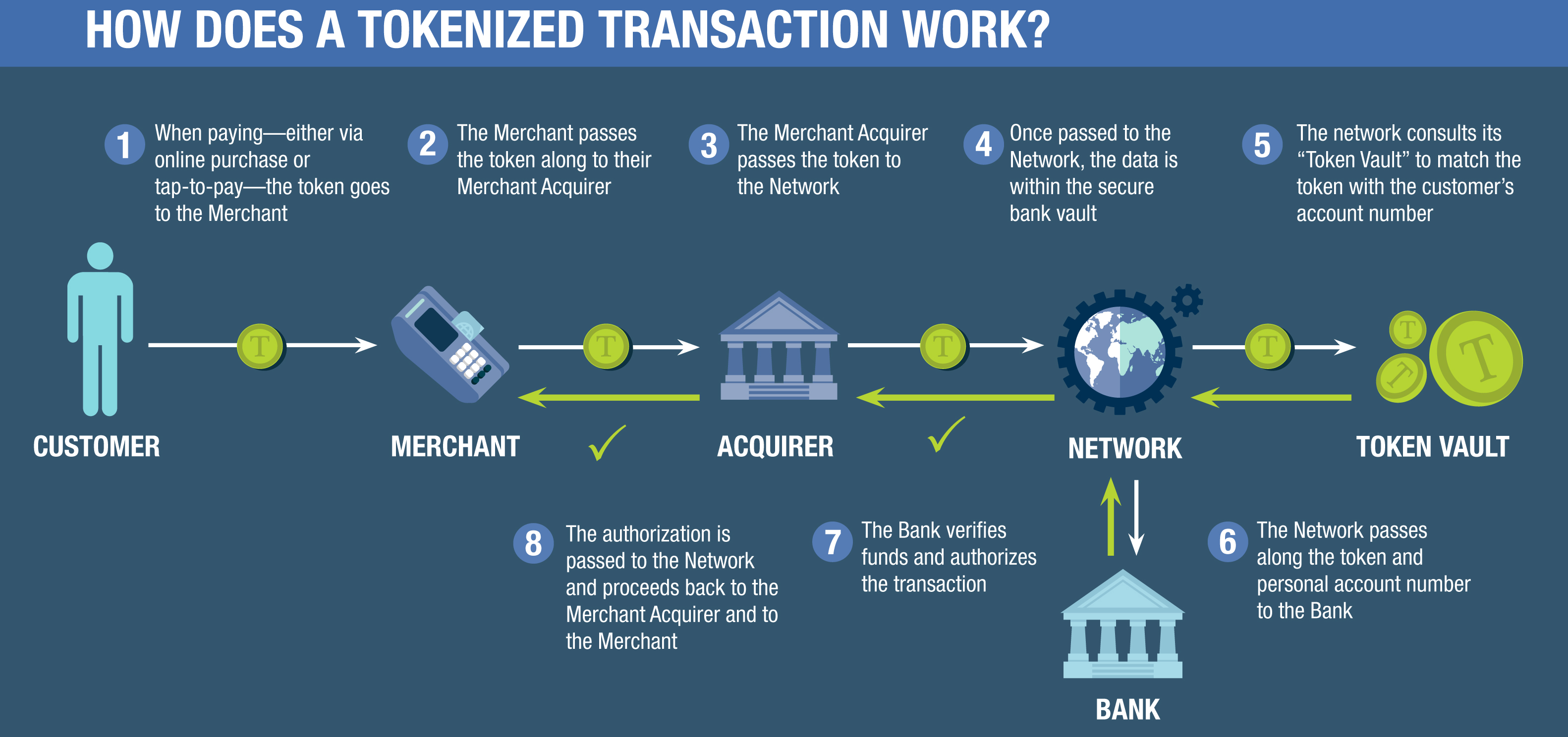
Tokenization began as a type of data security for businesses that replaces sensitive information with unique, non-sensitive data. Tokens don’t contain the original data, but they usually share similar characters or formatting. 

A user would need access to the tokens that are connected to the separately-stored originals in order to restore the tokens and view the secured data. Otherwise, a user would not be able to decipher the token to view the data. Therefore, they can be useful for securing personal information, financial transaction data and other sensitive data.

***

***

There are multiple types of blockchain tokenization and non-blockchain tokenization.

Blockchain Tokenization

Types of blockchain tokenization include:

  • Fungible tokenization. These are standard blockchain tokens. They have identical values, so they can easily replace one another — think of swapping one dollar for another dollar.
  • Non-fungible tokenization. These are less common blockchain tokens that do not have a set value. Instead, they represent ownership of an asset, such as digital art or real estate, that determines the value of the token.
  • Governance tokenization. These tokens represent voting rights and can be used to vote and collaborate on a blockchain system.
  • Utility tokenization. These tokens are used to give access to certain products and services on a specific blockchain, so they can be used to complete actions like paying transaction fees or operating a decentralized market system. 

Non-blockchain Tokenization

Types of non-blockchain tokenization include:

  • Vault tokenization. This is the standard type of tokenization to protect payment information, where the token is used to process payments without providing card numbers or other data.
  • Vaultless tokenization. This is a type of tokenization used for payment processing that doesn’t require a token vault for storage. Instead, it uses cryptographic devices and algorithms to convert data to a token.
  • Natural language processing tokenization. This type of tokenization breaks information down into simpler terms to make it more easily understood by computers. It includes word, sub word and character tokenization.

While tokenization began with the idea of protecting data assets using non-blockchain tokenization, it has developed into a way to protect the ownership of many other types of assets by using blockchain technology.

MORE: https://www.blockchain-council.org/blockchain/what-is-tokenization/

***

***

COMMENTS APPRECIATED

Thank You

***

COLLAPSE: How Greed and Leverage Destroyed the Crypto-Tulip Market

By Vitaliy Katsenelson CFA

Crypto currency was touted as antidote to central banking.

But with its own flaws, is the system itself to blame for this crypto market crash?

***

Cryptocurrencies were supposed to offer a new, virtual alternative to the current, mundane, “corrupt” system, in which a few dozen bureaucrats in conference rooms around the world – central bankers – manipulate the most important commodity of all – interest rates – the price of money.

CITE: https://www.r2library.com/Resource/Title/0826102549

The collapse of FTX (a cryptocurrency exchange that was valued at $30 billion just a few months ago) and the subsequent bankruptcies revealed what may have started as a kernel of sincere libertarian ideas to stand up to endless money printing and debt creation in our financial system, has been hijacked by what appears to be an immutable flaw of the human condition: our greed and desire to get rich fast.

READ: How Greed and Leverage Destroyed the Crypto Tulip Market

***

ORDER: https://www.amazon.com/Dictionary-Health-Information-Technology-Security/dp/0826149952/ref=sr_1_5?ie=UTF8&s=books&qid=1254413315&sr=1-5

***

COMMENTS APPRECIATED

Thank You

***

DAILY UPDATE: The Bitcoin Boost Up!

By Staff Reporters

***

***

Bitcoin prices climbed to as high as $27,293 last week, wrapping up the cryptocurrency’s best week since January 2021. And it has Silicon Valley Bank and friends to thank for it. Crypto diehards claim bitcoin’s gains are the result of people losing faith in traditional banking after SVB and Signature imploded (though it’s worth noting that Signature was a big player in the crypto world).

However, after the second-and third-biggest bank failures in history, economists started second-guessing whether the Fed would stick to the plan to hike interest rates again or change course to protect the rest of the very fragile banking industry. That could mean the crypto market, which slid into the dreaded Crypto Winter in the first half of last year because of macroeconomic factors like the Fed’s rate hikes, might finally be approaching spring.

So, according to MorningBrew, the Fed’s interest rate decision next week will likely serve as crypto’s redeux. And despite the banking industry hoping Jerome Powell pauses the interest rate hikes, February’s inflation numbers showed that the Fed may need to stick to its original plan to keep inflation in check.

***

COMMENTS APPRECIATED

Thank You

***

ORDER: https://www.amazon.com/Dictionary-Health-Information-Technology-Security/dp/0826149952/ref=sr_1_5?ie=UTF8&s=books&qid=1254413315&sr=1-5

***

BANKRUPT: Genesis Global Chapter 11

By Staff Reporters

***

***

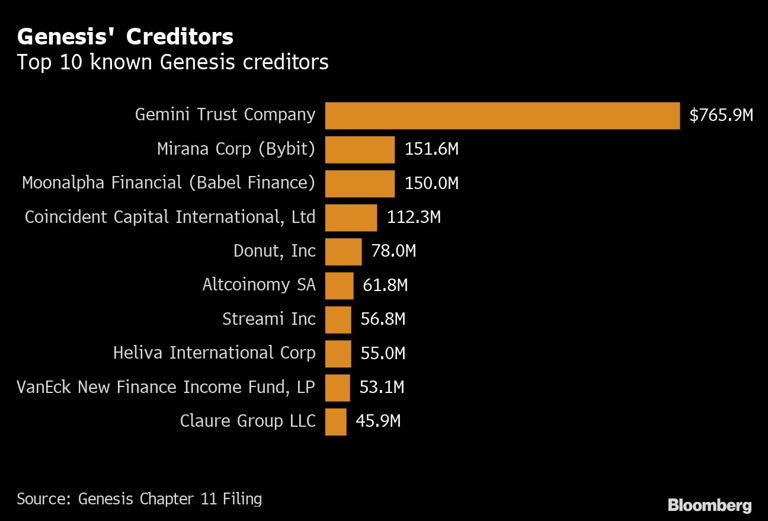
The bankruptcy of Barry Silbert’s Genesis Global may not have pummeled crypto markets like the implosion of Sam Bankman-Fried’s FTX did, but it features a list of top creditors with similarly large claims topping $3 billion in total.

According to Bloomberg, Genesis’s Chapter 11 filing on Thursday listed seven creditors owed at least $100 million. By far the biggest one is a $766 million claim related to customers of crypto exchange Gemini, who have money stuck with Genesis’s lending unit. FTX-linked entities have 10 claims of more than $100 million, according to a redacted list filed Saturday. 

In all, Genesis owes its top 50 creditors $3.4 billion; for FTX, that figure stands at $3.1 billion. While some of the names of Genesis’ biggest creditors have been redacted in the filing, below is a list of major names.

***

***

***

ORDER: https://www.amazon.com/Dictionary-Health-Information-Technology-Security/dp/0826149952/ref=sr_1_5?ie=UTF8&s=books&qid=1254413315&sr=1-5


COMMENTS APPRECIATED

Thank You

***

***

ORDER: https://www.routledge.com/Comprehensive-Financial-Planning-Strategies-for-Doctors-and-Advisors-Best/Marcinko-Hetico/p/book/9781482240283

***

CRYPTO-CURRENCY: Worth Since 2020?

By Staff Reporters

***

***

Winners Since March 2020:

Here’s how much $100 in each of the following cryptocurrencies and stocks back at the bottom of the U.S. market in March 2020 would be worth today:

CITE: https://www.r2library.com/Resource/Title/0826102549

  • Bitcoin (CRYPTO: BTC): $405.67
  • Ethereum (CRYPTO: ETH): $1,268.90
  • Dogecoin (CRYPTO: DOGE): $4,731.19

DHIT: https://www.amazon.com/Dictionary-Health-Information-Technology-Security-ebook/dp/B005F84GF2/ref=sr_1_3?crid=2SQPPJMMUV55D&keywords=david+marcinko&qid=1674073311&sprefix=david+marcinko%2Caps%2C115&sr=8-3

***

COMMENTS APPRECIATED

Thank You

***

CRYPTO-CURRENCY: Trades 24/7/365

***

***

The US stock and bond markets are closed today for MLK Day, so we’ll have to wait 24 more hours to see if this year-opening rally will continue for a third week.

But crypto currency trades 24/7, and the same hopeful inflation news that’s been lifting stocks has also given life to beaten-down cryptocurrencies. Bitcoin gained for the 11th straight day on Saturday, topping $20,000 for the first time in more than two months.

So, here are some ways in which the non-stop crypto market affects institutions — banks and exchanges, in particular.

The stock market takes a break every day, and every weekend. That gives all the players in the market — individual investors and institutions — a chance to assess and reposition their assets for their next moves. But since crypto trades all the time, there are stretches during the 24-hour day when banks and exchanges are effectively closed, and money isn’t being moved around as quickly or efficiently as it would during business hours.

This can cause lags — if a crypto trader is trying to deposit money into their crypto exchange account to execute a trade at, say, 2 am ET on a Sunday night, that money won’t actually move until the next day. That has the potential to cause some friction in the markets.

CITE: https://www.r2library.com/Resource/Title/0826102549

In short, there’s a mismatch between the standard business hours of many institutions and the 24-hour nature of the crypto markets, which may have an effect on the markets.

MORE: https://www.newsnow.co.uk/h/Business+&+Finance/Cryptocurrencies

COMMENTS APPRECIATED

Thank You

***

ORDER: https://www.routledge.com/Comprehensive-Financial-Planning-Strategies-for-Doctors-and-Advisors-Best/Marcinko-Hetico/p/book/9781482240283

***

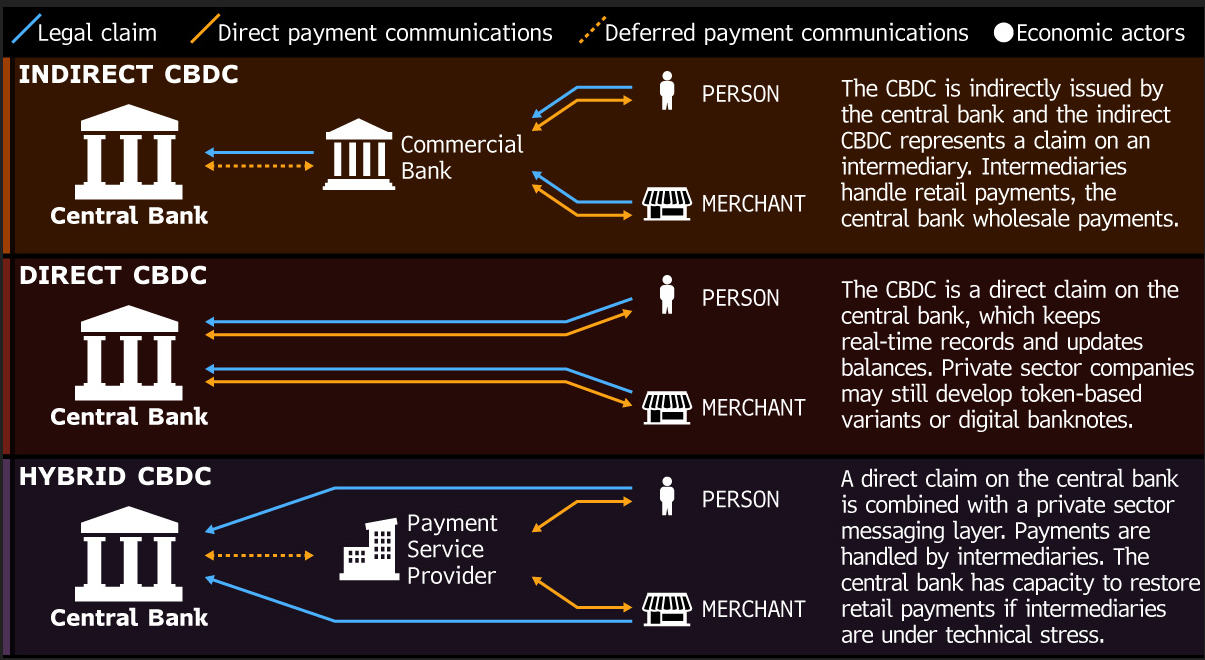
What is a CENTRAL BANK DIGITAL CURRENCY?

By Staff Reporters

***

***

DEFINITION: A CBDC is a digital form of central bank money that is widely available to the general public.

CITE: https://www.r2library.com/Resource/Title/082610254

“Central bank money” refers to money that is a liability of the central bank. In the United States, there are currently two types of central bank money: physical currency issued by the Federal Reserve and digital balances held by commercial banks at the Federal Reserve.

While Americans have long held money predominantly in digital form—for example in bank accounts, payment apps or through online transactions—a CBDC would differ from existing digital money available to the general public because a CBDC would be a liability of the Federal Reserve, not of a commercial bank.

MORE: https://www.federalreserve.gov/faqs/what-is-a-central-bank-digital-currency.htm

***

COMMENTS APPRECIATED

Thank You

***

ORDER: https://www.routledge.com/Comprehensive-Financial-Planning-Strategies-for-Doctors-and-Advisors-Best/Marcinko-Hetico/p/book/9781482240283

***

WASH SALE RULE: Not For Cryptocurrency?

By Staff Reporters

***

DEFINITION

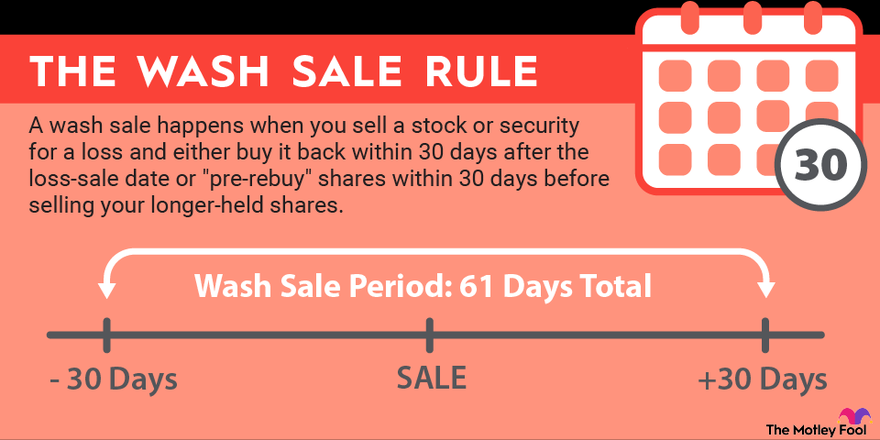
The wash-sale rule prohibits selling an investment for a loss and replacing it with the same or a “substantially identical” investment 30 days before or after the sale. If you do have a wash sale, the IRS will not allow you to write off the investment loss which could make your taxes for the year higher than you hoped.

CITE: https://www.r2library.com/Resource/Title/082610254

***

***

Don’t get soaked by the wash sale

Even if you sell at a loss from a brokerage account or IRA, it still might not want to permanently exit a portfolio position. It may want to get back into an investment now at a cheaper cost with room to re-grow.

BUT – Just wait a moment, according to the IRS “wash-sale” rule.

The IRS will not count a capital loss if, within 30 days before the sale or within 30 days afterwards, the taxpayer is also buying or acquiring a “substantially identical” investment. The rule applies to investments like stocks, bonds, mutual funds, exchange traded funds and options – but not cryptocurrency.

The basic trick is just keeping track of the days. Another skill is considering what counts as “substantially identical” for the fast-moving investor who sees a buying opportunity either 30 days before or after the day of sale.

An investor could sell a stock and buy an exchange traded fund or mutual fund that contains the stock and not run afoul of the rule, Going the other way, from a mutual fund or ETF containing a stock to a direct stock purchase, also will not trigger the rule, he noted.

EXAMPLE: Suppose an investor has several investment accounts — perhaps one is a long-term account and the other is more for short-term trades. The rule applies across the account. So if one sells and the other buys within 30 days before or after, the wash-sale rule will scrap the capital loss.

Buying and selling shares of two different funds tracking the same index within the 30-day period could also cause the wash sale rule to kick in. However, a move like selling a piece of an ETF tracking the S&P 500, and then soon buying an ETF tracking the Russell 1000 Index would be OK according to a tutorial from Charles Schwab SCHW, +3.70%. “That would preserve your tax break and keep you in the market with about the same asset allocation,” an explainer said.

But while someone’s eyeing a repurchase and letting the wash-sale window close one place, they may have a chance to start the tax strategy process in a different part of their portfolio. “There’s really tax loss harvesting opportunities across a number of different asset classes this year.”

***

COMMENTS APPRECIATED

Thank You

***

ORDER: https://www.routledge.com/Comprehensive-Financial-Planning-Strategies-for-Doctors-and-Advisors-Best/Marcinko-Hetico/p/book/9781482240283

***

SBF: Apologizes as FTX Scrambles to Live

By Staff Reporters

***

***

Following his crypto exchange’s epic implosion, FTX boss Sam Bankman-Fried (SBF) said he was sorry for mistakes he made, and pledged to “give anything I have to” in order to raise the $4 billion in capital FTX needs to avoid bankruptcy.

As the SEC bear down on the company, shady activities are coming to light: FTX loaned its affiliated firm, Alameda Research, ~$10 billion worth of customer assets to fund high-risk bets, per the WSJ.

***

COMMENTS APPRECIATED

Thank You

***

ORDER: https://www.amazon.com/Dictionary-Health-Information-Technology-Security/dp/0826149952/ref=sr_1_5?ie=UTF8&s=books&qid=1254413315&sr=1-5

***

STABLECOINS: Altering the US Banking System?

By Staff Reporters

***

***

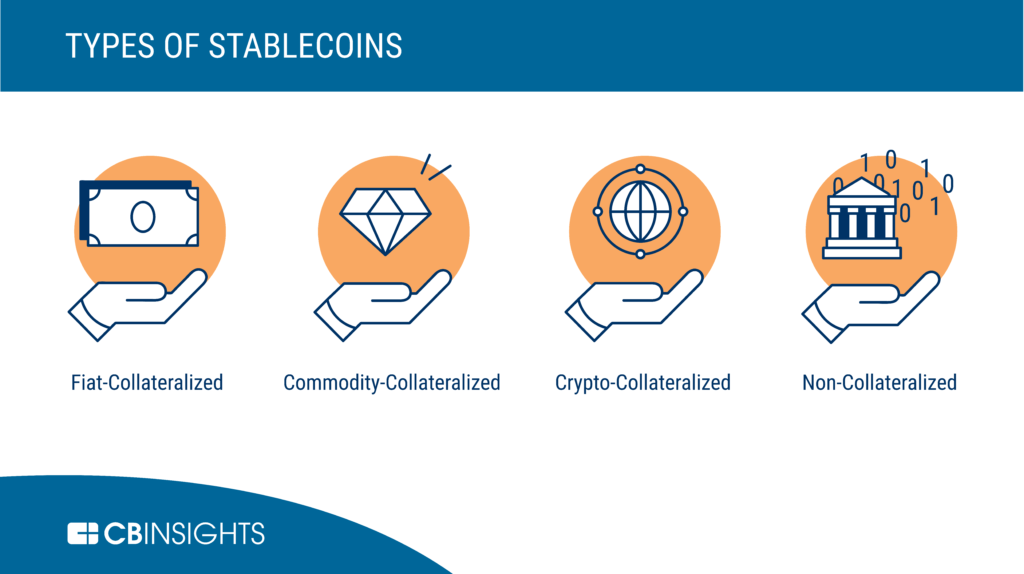
DEFINITION: Stablecoins are cryptocurrencies where the price is designed to be pegged to a reference asset. The reference asset may be fiat money, exchange-traded commodities, or a cryptocurrency.

CITE: https://www.r2library.com/Resource/Title/082610254

***

In fact, Stablecoins could have such a profound effect on the established banking system that U.S. regulators need to require that the digital tokens fit in without disrupting it, said Martin Gruenberg, the acting chairman of the Federal Deposit Insurance Corp. (FDIC). His remarks were delivered at a Brookings Institution event recently.

Gruenberg’s agency is among the U.S. banking watchdogs that will have significant influence over how stablecoins are regulated, and the FDIC has also had to weigh in with recent sanctions against firms – such as FTX US – that have made claims misrepresenting how FDIC deposit insurance backstops their operations. As U.S. banks have increasingly sought to offer crypto services, including maintaining custody of customer’s digital assets, Gruenberg said that his agency has been cautious about allowing regulated lenders to engage.

***

ORDER: https://www.amazon.com/Dictionary-Health-Information-Technology-Security/dp/0826149952/ref=sr_1_5?ie=UTF8&s=books&qid=1254413315&sr=1-5

***

FINANCE: https://www.routledge.com/Comprehensive-Financial-Planning-Strategies-for-Doctors-and-Advisors-Best/Marcinko-Hetico/p/book/9781482240283

***

COMMENTS APPRECIATED

Thank You

***

What is a Non-Fungible Token [NFT]?

About NFTs

[By staff reporters]

CMP logo

Sponsored: http://www.CertifiedMedicalPlanner.org

According to Wikipedia, a non-fungible token (NFT) (previously referred to as Bitcoin 2.0) is a unit of data stored on a digital ledger, called a blockchain, that certifies a digital asset to be unique and therefore not interchangeable. NFTs can be used to represent items such as photos, videos, audio, and other types of digital files. Access to any copy of the original file, however, is not restricted to the buyer of the NFT. While copies of these digital items are available for anyone to obtain, NFTs are tracked on blockchains to provide the owner with a proof of ownership that is separate from copyright.

In 2021, there has been increased interest in using NFTs. Blockchains like Ethereum, Flow, and Tezos have their own standards when it comes to supporting NFTs, but each works to ensure that the digital item represented is authentically one-of-a-kind. NFTs are now being used to commodify digital assets in art, music, sports, and other popular entertainment. Most NFTs are part of the Ethereum blockchain; however, other blockchains can implement their own versions of NFTs.

Crypto Currency Basics: https://medicalexecutivepost.com/2014/01/23/understanding-currencies-bitcoins/

https://medicalexecutivepost.com/2017/06/28/the-crypto-future-through-bitcoin-ethereum-ripple-xrp-and-iota/

Carbon Footprint!

See the source image

CARBON

The NFT market value tripled in 2020, reaching more than $250 million. The rise of NFT transactions has also led to increased environmental criticism. The computation-heavy processes associated with proof-of-work blockchains, the type primarily used for NFTs, require high energy inputs that are contributing to global warming. The carbon emissions produced by the energy needed to maintain these blockchains has forced some in the NFT market to rethink their carbon footprint.

Your thoughts are appreciated.

BITCOIN: https://medicalexecutivepost.com/2014/01/23/understanding-currencies-bitcoins/

Comprehensive Financial Planning Strategies for Doctors and Advisors: Best Practices from Leading Consultants and Certified Medical Planners™

ORDER Textbook: https://www.amazon.com/Comprehensive-Financial-Planning-Strategies-Advisors/dp/1482240289/ref=sr_1_1?ie=UTF8&qid=1418580820&sr=8-1&keywords=david+marcinko

Comments Appreciated

THANK YOU

***

Inflation and Crypto-Currency

***

***

By Staff Reporters

***

The inflation-proof nature of cryptocurrency works in the same way as stocks– inflation will cause prices to increase so companies can charge more for their goods which means people are willing to pay.

However, since cryptocurrencies are fairly new and not backed by anything at this point it’s better if they make up a small portion of your portfolio instead of trying to go all in with one coin unless you have enough money lying around where losing some won’t hurt too much.

A lot of corporate investment portfolios have started to include crypto because let’s face it, inflation matters.

***

COMMENTS APPRECIATED

Thank You

RELATED: https://www.routledge.com/Comprehensive-Financial-Planning-Strategies-for-Doctors-and-Advisors-Best/Marcinko-Hetico/p/book/9781482240283

***

UPDATE: Sentient GOOGLE, Corporate Earnings, the Markets and Cryptocurrency

By Staff Reporters

***

***

Blake Lemoine, an engineer for Google’s responsible AI organization, described an AI system that he has been working on since last fall as sentient, with a perception of, and ability to express thoughts and feelings that was equivalent to a human child. He was promptly suspended.

Earnings Are Under Threat. Companies from Target to Microsoft have warned their results will be lower than expected, while analysts have trimmed earnings forecasts across industries. Investors will get further clarity next month when companies begin reporting results for the second quarter.

The S&P is in a historic slump having fallen in nine out of the past 10 weeks for just the third time since 1980. And cryptocurrencies, which trade 24/7, tumbled following another red-hot inflation report.


***

COMMENTS APPRECIATED

Thank You

***

***

Cryptocurrency Trades and Income Taxes 2021

Virtual Currency – Real Taxation

By Staff Reporters

What you need to report to the IRS

The IRS treats virtual currencies as property, which means they’re taxed similarly to stocks. If all you did was purchase cryptocurrency with U.S. dollars, and those assets have been sitting untouched in an exchange or your cryptocurrency wallet, you shouldn’t need to worry about reporting to the IRS.

***

Reporting is required when certain events come into play, most commonly:

  • Trading one cryptocurrency for another.
  • Selling cryptocurrency for fiat dollars (government-issued currency).
  • Using cryptocurrency to buy goods or services (e.g., paying for a cup of coffee with cryptocurrency).

A critical distinction to make is that triggering a taxable event doesn’t necessarily mean you’ll owe taxes, said Andrew Gordon, an Illinois-based certified public accountant and tax attorney. Just because you have to report a transaction doesn’t mean you’ll end up owing the IRS for it.

READ HERE: https://www.msn.com/en-us/money/taxes/yes-you-must-pay-taxes-on-cryptocurrency-trades-heres-how/ar-AATamDL?li=BBnb7Kz

***
COMMENTS APPRECIATED.

Thank You

Subscribe to the Medical Executive-Post

FINANCE: https://www.amazon.com/Comprehensive-Financial-Planning-Strategies-Advisors/dp/1482240289/ref=sr_1_1?ie=UTF8&qid=1418580820&sr=8-1&keywords=david+marcinko

***

Understanding Crypto Currencies & Bitcoins

Join Our Mailing List

Understanding Risks and Benefits

By Timothy J. McIntosh CFP® MPH CFA CMP®

TMMedical professionals might not know rupees from ringgits, but any investor should consider the benefits of currency investing.  Buying currencies allow for a hedge against the U.S. dollar and also permit for an investor to take advantage of major movements of foreign currencies for profit.

Today, it is easier than ever to invest in currencies through mutual funds or exchange traded funds.  U.S. investors are impacted by foreign currency fluctuations through international stock and bond exposure.

Advantages

The advantage of investing in currencies is the investment generally has limited correlation with other real or liquid assets.  Medical professionals can initiate the process of currency investing by starting a forex account.  In many instances, an account can be opened with minimal investment.

Taxation

One caveat is the tax consequences, as currency-based profits are taxed as ordinary income rather than the more favorable capital gains rate.

Digital Currency

Bitcoin is an open sourcepeer-to-peer payment network and digital currency pioneered in 2009 by pseudonymous developer “Satoshi Nakamoto“. Bitcoin has been called a cryptocurrency because it utilizes public-key cryptography for protection. Users send payments by broadcasting digitally signed messages that reassign ownership of bitcoins. A decentralized network of specialized computers verifies and timestamps all transactions using a proof-of-work system. The operators of these computers, known as “miners“, are satisfied with transaction fees and newly minted bitcoins.

Commercial Use

The commercial use of Bitcoin, illicit or otherwise, is currently diminutive compared to its use by speculators, which has led to extreme price volatility.  Companies and merchants have an enticement to recognize the currency because transaction fees are lower than the 2 to 3% classically imposed by the major credit card companies like Visa®.

Bitcoin Graph

Assessment

Given the fact that Bitcoin is a new currency with extreme volatility, medical professionals should be very cautious with any potential investment.

UPDATE: 2017

Conclusion

Your thoughts and comments on this ME-P are appreciated. Feel free to review our top-left column, and top-right sidebar materials, links, URLs and related websites, too. Then, subscribe to the ME-P. It is fast, free and secure.

Link: http://feeds.feedburner.com/HealthcareFinancialsthePostForcxos

Speaker: If you need a moderator or speaker for an upcoming event, Dr. David E. Marcinko; MBA – Publisher-in-Chief of the Medical Executive-Post – is available for seminar or speaking engagements. Contact: MarcinkoAdvisors@msn.com

OUR OTHER PRINT BOOKS AND RELATED INFORMATION SOURCES:

DICTIONARIES: http://www.springerpub.com/Search/marcinko
PHYSICIANS: www.MedicalBusinessAdvisors.com
PRACTICES: www.BusinessofMedicalPractice.com
HOSPITALS: http://www.crcpress.com/product/isbn/9781466558731
CLINICS: http://www.crcpress.com/product/isbn/9781439879900
BLOG: www.MedicalExecutivePost.com
FINANCE: Financial Planning for Physicians and Advisors
INSURANCE: Risk Management and Insurance Strategies for Physicians and Advisors

Product DetailsProduct DetailsProduct Details

Product Details  Product Details

***

Risk Management, Liability Insurance, and Asset Protection Strategies for Doctors and Advisors: Best Practices from Leading Consultants and Certified Medical Planners™8Comprehensive Financial Planning Strategies for Doctors and Advisors: Best Practices from Leading Consultants and Certified Medical Planners™

Crypto-Currency “GAS” FEES: Ethereum Network

***

By Staff Reporters

According to Wikipedia, a cryptocurrency, crypto-currency, or crypto is a collection of binary data which is designed to work as a medium of exchange. Individual coin ownership records are stored in a ledger, which is a computerized database using strong cryptography to secure transaction records, to control the creation of additional coins, and to verify the transfer of coin ownership. Cryptocurrencies are generally fiat currencies, as they are not backed by or convertible into a commodity. Some crypto schemes use validators to maintain the cryptocurrency. In a proof-of-stake model, owners put up their tokens as collateral. In return, they get authority over the token in proportion to the amount they stake. Generally, these token stakers get additional ownership in the token over time via network fees, newly minted tokens or other such reward mechanisms.

***

Product Details

CITE: https://www.r2library.com/Resource/Title/0826102549

Cryptocurrency does not exist in physical form (like paper money) and is typically not issued by a central authority. Cryptocurrencies typically use decentralized control as opposed to a central bank digital currency (CBDC). When a cryptocurrency is minted or created prior to issuance or issued by a single issuer, it is generally considered centralized. When implemented with decentralized control, each cryptocurrency works through distributed ledger technology, typically a blockchain, that serves as a public financial transaction database.

A cryptocurrency is a tradable digital asset or digital form of money, built on blockchain technology that only exists online. Cryptocurrencies use encryption to authenticate and protect transactions, hence their name. There are currently over a thousand different cryptocurrencies in the world, and many see them as the key to a fairer future economy.

Bitcoin, first released as open-source software in 2009, is the first decentralized cryptocurrency. Since the release of bitcoin, many other cryptocurrencies have been created.

***

***

Enter GAS

Gas refers to the unit that measures the amount of computational effort required to execute specific operations on the cryptocurrency Ethereum network. Since each Ethereum transaction requires computational resources to execute, each transaction requires a fee. Gas refers to the fee required to conduct a transaction on Ethereum successfully.

READ: https://www.morningbrew.com/daily/stories/ethereum-gas-fees?utm_campaign=etb&utm_medium=newsletter&utm_source=morning_brew&mid=349b552221c994e2540a304649746d7c

CITE: https://www.r2library.com/Resource/Title/082610254

Gas fees are paid in Ethereum’s native currency, ether (ETH). Gas prices are denoted in gwei, which itself is a denomination of ETH – each gwei is equal to 0.000000001 ETH (10-9 ETH).

NFT: https://www.morningbrew.com/emerging-tech/stories/2021/02/22/nft-market-tripled-last-year-gaining-even-momentum-2021?email=marcinkoadvisors@msn.com&mid=349b552221c994e2540a304649746d7c&uid=jotgRJS1MLYGk2SSdfbR4b5r

***

See the source image

***

For example: Instead of saying that your gas costs 0.000000001 ether, you can say your gas costs 1 gwei. The word ‘gwei’ itself means ‘giga-wei’, and it is equal to 1,000,000,000 wei. Wei itself (named after Wei Dai, creator of b-money) is the smallest unit of ETH

MORE: https://swyftx.com/learn/what-are-ethereum-gas-fees/

COMMENTS APPRECIATED.

Subscribe to the Medical Executive-Post

THANK YOU

***

***

PODCASTS: What is a STABLECOIN?

HEDGE AGAINST INFLATION

By Dr. David E. Marcinko MBA CMP®

CMP logo

SPONSOR: http://www.CertifiedMedicalPlanner.org

***

What Are Stablecoins? - CB Insights Research

***

DEFINITION: Stablecoins are blockchain-based digital currencies that have been created with the aim to have a stable value. Stablecoins achieve price-stability through various different methods such as a peg against a fiat currency or a commodity, through collateralization against other cryptocurrencies or through algorithmic coin supply management.

CITE: https://www.r2library.com/Resource/Title/0826102549

Every stable coin includes a specific set of mechanisms that mostly behave in the same way. In general, stable coins keep collateral of the asset and manage the supply. In this way, they incentivize the market, which allows trade of the coin for no more or less than $1.

A stable coin can be considered the best depending on several factors: It should be stable. PAX is one the most stable stablecoin. It should be liquid and available on most exchanges. It should be backed by FIAT. PAX is 100% collateralized in US bank accounts. It should be regulated. It should be redeemable.

MORE: https://www.msn.com/en-us/money/markets/treasury-fed-fear-stablecoins-could-disrupt-financial-system/ar-AAOE7lO?li=BBnb7Kz

PODCAST #1: https://www.youtube.com/watch?v=O3rVWLhBIPo

PODCAST #2: https://www.youtube.com/watch?v=GsSSLDzKCOE

YOUR COMMENTS ARE APPRECIATED.

Thank You

***

PODCAST: Curmudgeon On “Crypto-Currency”

Curmudgeon on Crypto-currency


Vitaliy Katsenelson, CFA

Your thoughts and comments are appreciated.

THANK YOU

***

***

What Exactly is a Financial DAO?

A decentralized autonomous organization

DR. DAVID EDWARD MARCINKO FACFAS MBA CFP MBBS [Hon] [Executive Summary] -  PDF Free Download

BY. DR. DAVID EDWARD MARCINKO MBA CMP®

CMP logo

SPONSOR: http://www.CertifiedMedicalPlanner.org

****

What is DAO - Decentralized Autonomous Organizations

A decentralized autonomous organization (DAO), sometimes called a decentralized autonomous corporation (DAC), is an organization represented by rules encoded as a computer program that is transparent, controlled by the organization members and not influenced by a central government. A DAO’s financial transaction record and program rules are maintained on a blockchain. The precise legal status of this type of business organization is unclear.

A well-known example, intended for venture capital funding, was The DAO, which launched with $150 million in crowdfunding in June 2016, and was nearly immediately hacked and drained of US$50 million in cryptocurrency. The hack was reversed in the following weeks, and the money restored, via a hard fork of the Ethereum blockchain: the Ethereum miners and clients switched to the new fork.

CITE: https://www.r2library.com/Resource/Title/0826102549

MORE: https://www.msn.com/en-us/money/topstocks/what-is-a-dao/ar-AAOIpjw?li=BBnb7Kz

***

YOUR THOUGHTS AND COMMENTS ARE APPRECIATED.

***

Thank You

***

Bitcoin

The Beginners Guide

By Forbes Wealth

***

crypto

Bitcoin Part 1: The Beginners Guide

***

Comprehensive Financial Planning Strategies for Doctors and Advisors: Best Practices from Leading Consultants and Certified Medical Planners™

Risk Management, Liability Insurance, and Asset Protection Strategies for Doctors and Advisors: Best Practices from Leading Consultants and Certified Medical Planners™

***

Invite Dr. Marcinko

***

Bitcoin – “Millennials Fake Gold”

Bitcoin – The  Digital Generation’s Gold Surrogate

By Vitaliy Katsenelson CFA

I’ve been asked about Bitcoin a lot lately. I’ haven’t written anything about it because I find myself in an uncomfortable place in agreeing with the mainstream media: It’s a bubble.

Bitcoin started out as what I’d call “millennial gold” – the young (digital) generation looked at it as their gold substitute.

http://contrarianedge.com/2017/12/01/bitcoin-millennials-fake-gold/

***

Conclusion

Your thoughts and comments on this ME-P are appreciated. Feel free to review our top-left column, and top-right sidebar materials, links, URLs and related websites, too. Then, subscribe to the ME-P. It is fast, free and secure.

Speaker: If you need a moderator or speaker for an upcoming event, Dr. David E. Marcinko; MBA – Publisher-in-Chief of the Medical Executive-Post – is available for seminar or speaking engagements.

Book Marcinko: https://medicalexecutivepost.com/dr-david-marcinkos-bookings/

Subscribe: MEDICAL EXECUTIVE POST for curated news, essays, opinions and analysis from the public health, economics, finance, marketing, IT, business and policy management ecosystem.

***

Bitcoins for Retirement?

 In a Balanced Portfolio?

By Rick Kahler CFP®

A reader recently sent me the following email: “As you know, there are ‘market experts’ pitching bitcoins as an ‘investment’. Has a Huge YTD gain. I’d bet a lot of your readers would like to know if a bitcoin position has a place in a balanced financial portfolio.”

I always appreciate hearing from readers, especially when they challenge me with topics I would normally not have considered. Bitcoins are not something to which I’ve paid serious attention.

How they Work

First, let me explain that a Bitcoin is a type of digital currency which is traded person to person. It is not backed by a government or considered legal tender. While Bitcoin is one of the earliest and most widely known digital currency systems, it is not the only one that is available. These are sometimes called “altcoin,” “virtual currency,” or crypto-currency.”

Unlike government-created currencies where a central bank controls the creation of the currency, Bitcoins are uncontrolled or tracked by any government. This allows people to send or receive money across borders freely, with none of the restrictions, tracking, or caps that are normally placed on transactions by governments.

A digital money system has an inherent problem common to all money systems. How do you keep the currency, especially one that is entirely digital, from being counterfeited? What stops someone from creating Bitcoins or selling the same Bitcoin multiple times?

The solution is a type of open source, public ledger that tracks every Bitcoin transaction from the beginning of Bitcoin time. It makes it virtually impossible to cheat. The creation of new Bitcoins is controlled via a process called mining. Only a limited number of new Bitcoins are allowed into the system annually, similar to how the precious metal supply gradually expands annually based on the mining of new metal.

The market in trading Bitcoins is probably as “free” as a currency market can get. The price of Bitcoins is based on supply and demand. Since Bitcoin was only created in 2009, it has less than a decade of performance to evaluate, but throughout its short history the price has fluctuated wildly. For example, it reached $31 in July of 2011, then dropped back to $2 by that December. In November of 2013 it hit a high of $1,242. The following month, the price dropped to $600, rebounded, crashed, and eventually stabilized to a range of $650 to $800.

The reader who asked me about Bitcoin was certainly right about its impressive 2017 year-to-date performance. On January 1, 2017, a Bitcoin sold for $496.90. As of August 19 it closed at $4,109.10, nearly a ten-fold increase in just eight months.

***

***

Operating History

An article on Investopedia offers a good overview of Bitcoin‘s operation and history.

It also describes some of the risks to evaluate before considering it as an investment. These include the relative novelty and lack of track record of digital currency, the possibilities for hacking and fraud, the uncertainties of future regulation, and the competition of other developing virtual currency systems. It also points out that Bitcoin transactions are similar to dealing with cash. They are “permanent and irreversible,” with “no third party or a payment processor, as in the case of a debit or credit card – hence, no source of protection or appeal if there is a problem.”

Assessment

While I like the libertarian freedom of the idea of a currency uncontrolled by government intervention, I don’t consider owning such a currency an investment. I do consider buying or selling digital currencies like Bitcoin a speculation. Like other speculative investments, these do not belong in any retirement portfolio. 

Conclusion

Your thoughts and comments on this ME-P are appreciated. Feel free to review our top-left column, and top-right sidebar materials, links, urls and related websites, too. Then, subscribe to the ME-P. It is fast, free and secure.

Speaker: If you need a moderator or speaker for an upcoming event, Dr. David E. Marcinko; MBA – Publisher-in-Chief of the Medical Executive-Post – is available for seminar or speaking engagements. Contact: MarcinkoAdvisors@msn.com

OUR OTHER PRINT BOOKS AND RELATED INFORMATION SOURCES:

Risk Management, Liability Insurance, and Asset Protection Strategies for Doctors and Advisors: Best Practices from Leading Consultants and Certified Medical Planners™8Comprehensive Financial Planning Strategies for Doctors and Advisors: Best Practices from Leading Consultants and Certified Medical Planners™

***