Case Model Illustration of a Six Sigma Healthcare Pioneer

Join Our Mailing List

The Mount Carmel Health System

By Mark Matthews MD

A “Scrubbed” True Illustration

One of the earliest healthcare adopters of Six Sigma was the Mount Carmel Health System in Columbus, Ohio.

The organization was barely breaking even in the summer of 2000 when competition from surrounding providers made things worse. Employee layoffs added fuel to an already all-time low employee morale.

The CEO

Chief Executive Officer Joe Calvaruso was determined to stem the bleeding, break the cycle of poor financial performance and return the hospital system to profitability.  He sought the potential benefits of Six Sigma and began a full deployment of its methodology. The plan was a bold move, as the organization ensured that no one would be terminated as a result of a Six Sigma project having eliminated his or her previous duties. These employees would be offered an alternative position in a different department. Moreover, top personnel were asked to leave their current positions to be trained and work full time as Six Sigma expert practitioners who would oversee project deployment while their positions were backfilled.

Assessment

The Six Sigma deployment was the right decision. More than 50 projects were initiated with significant success. An example of an early Mount Carmel success story is the dramatic improvement in their Medicare + Choice product reimbursements, previously written off as uncollectible accounts. These accounts were often denied by HCFA due to coding of those patients as “working aged.”

Since the treatment process status often changed in these patients, HCFA often rejected claims or lessened reimbursement amounts, effectively making coding a difficult and elusive problem. The employment of the Six Sigma process fixed the problem, resulting in a real gain of $857,000 to the organization. The spillover of this methodology to other coding parameters also has dramatically boosted revenue collection.

A Glimpse of Lean Medical Management Tools and Techniques

Conclusion

Your thoughts and comments on this ME-P are appreciated. Feel free to review our top-left column, and top-right sidebar materials, links, URLs and related websites, too. Then, subscribe to the ME-P. It is fast, free and secure.

Link: http://feeds.feedburner.com/HealthcareFinancialsthePostForcxos

Speaker: If you need a moderator or speaker for an upcoming event, Dr. David E. Marcinko; MBA – Publisher-in-Chief of the Medical Executive-Post – is available for seminar or speaking engagements. Contact: MarcinkoAdvisors@msn.com

Our Other Print Books and Related Information Sources:

Health Dictionary Series: http://www.springerpub.com/Search/marcinko

Practice Management: http://www.springerpub.com/product/9780826105752

Physician Financial Planning: http://www.jbpub.com/catalog/0763745790

Medical Risk Management: http://www.jbpub.com/catalog/9780763733421

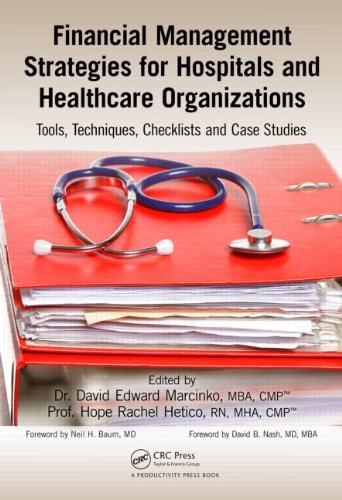
Hospitals: http://www.crcpress.com/product/isbn/9781439879900

Physician Advisors: www.CertifiedMedicalPlanner.org

From Our Newest Textbook Release

Buy from Amazon

Learn How to Profit and Thrive in the PP-ACA Era

BOOK FOREWORD / TESTIMONIAL

On Hospital Tax-Exempt Debt

Join Our Mailing List

An important means of external financing for hospitals

By Calvin W. Wiese CPA CMA

By Dr. David Edward Marcinko MBA

www.CertifiedMedicalPlanner.org

Tax-exempt debt has become an important means of external financing for hospitals, primarily because its cost is very attractive. Interest rates on tax-exempt financing are lower than interest rates on financing that is not tax-exempt because the interest income earned by the holders is exempt from federal income tax. In some states, it is also exempt from state income tax and in some cities; it is also exempt from city income tax. Thus, the holders of these debt instruments (usually bonds) are willing to accept lower rates of interest.

State and Local Governments Only

Hospitals themselves are not capable of issuing tax-exempt debt. Only state and local governments are. A state or local government issues tax-exempt debt for hospitals and then loans the proceeds to hospitals. This is called “conduit” financing: the state or local government acts as a conduit through which hospitals can access tax-exempt debt markets. State and local governments are authorized to loan proceeds of their bond issues to hospitals through state statutes, and each state statute is different. Some states authorize any state or local government to issue bonds to loan to hospitals. Other states restrict such power to special purpose governmental entities only. And some states restrict this power to a single governmental entity that is specially formed for the sole purpose of issuing tax-exempt bonds on behalf of hospitals.

The IRS

The Internal Revenue Service (IRS) regulates the issuance of tax-exempt financing. While the IRS code nominally provides that debt instruments issued by state and local governments are exempt from federal income tax, it imposes special rules on conduit issues. Thus, tax-exempt issues whose proceeds are loaned to hospitals must comply with special IRS rules. Although very complex, these rules primarily regulate the use of proceeds, restricting the use of tax-exempt proceeds to the acquisition of property, plant components and equipment.

Given state statutes, IRS code and applicable security laws (both state and federal), issuing tax-exempt bonds is legally complex. Many lawyers get paid handsome fees every time tax-exempt debt is issued. The quarterback of the legal team is the bond counsel who represents the interests of the bondholders; the bond counsel issues the critical tax opinion that investors rely upon to claim tax-exemption on the interest from these instruments. Everything revolves around getting this opinion.

The Underwriter’s

Given its critical nature, only highly qualified lawyers are accepted by the market to provide this opinion. Underwriter’s counsel represents the interests of the investment bankers; their primary concern is compliance with security laws. Issuer’s counsel represents the interests of the state or local government, and hospital counsel represents the interests of the hospital; both have relatively minor roles. In the event credit enhancement is involved, credit enhancement counsel represents their interests and has significant influence on the process.

The Trustees

Another unique party to most tax-exempt bond issues is the bond trustee. The bond trustee is usually a bank who performs a fiduciary duty on behalf of the bond holders throughout the life of the bonds. The face of the faceless bond holders, they act on their behalf. And they, too, are represented by counsel in the bond issuance process.

State or local government typically appoints bond counsel. In many cases, they work with only a single firm. Not unusually, these relationships are quite cozy, and often result in fees being paid that are well in excess of what otherwise would be paid.

The Documents

An excess of documents is involved in most tax-exempt financings. The heart of the documents is the indenture, which is the agreement between the bond trustee (on behalf of the bond holders) and the state or local government issuer. It contains the promises made to the bond holders, and it describes the work of the bond trustee. The bond trustee will only perform actions on behalf of bond holders that are explicitly set forth in the bond indenture. The bond indenture is the security given to the bond holders, describing all their recourses.

Assessment

The bond indenture is typically supported by the loan agreement between the state or local government that issues the bonds and the hospital to which the proceeds are loaned. Its terms complement the terms of the bond indenture, which together, form the conduit.

Conclusion

Your thoughts and comments on this ME-P are appreciated. Feel free to review our top-left column, and top-right sidebar materials, links, URLs and related websites, too. Then, subscribe to the ME-P. It is fast, free and secure.

Link: http://feeds.feedburner.com/HealthcareFinancialsthePostForcxos

Speaker: If you need a moderator or speaker for an upcoming event, Dr. David E. Marcinko; MBA – Publisher-in-Chief of the Medical Executive-Post – is available for seminar or speaking engagements. Contact: MarcinkoAdvisors@msn.com

Our Other Print Books and Related Information Sources:

Health Dictionary Series: http://www.springerpub.com/Search/marcinko

Practice Management: http://www.springerpub.com/product/9780826105752

Physician Financial Planning: http://www.jbpub.com/catalog/0763745790

Medical Risk Management: http://www.jbpub.com/catalog/9780763733421

Hospitals: http://www.crcpress.com/product/isbn/9781439879900

Physician Advisors: www.CertifiedMedicalPlanner.org

     From Our Newest Textbook Release

Buy from Amazon

Learn How to Profit and Thrive in the PP-ACA Era

BOOK FOREWORD / TESTIMONIAL

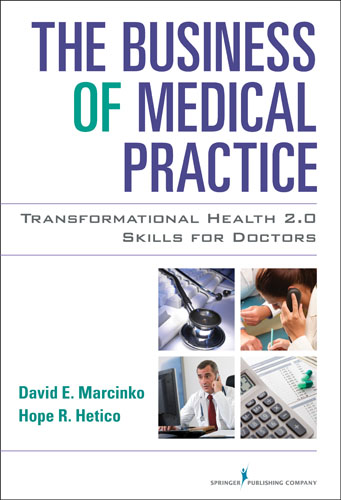
Succeed with the “Business of Medical Practice” Textbook

ADVERTISEMENT

[Transformational Health 2.0 Skills for Doctors]

By Ann Miller RN, MHA

www.BusinessofMedicalPractice.com

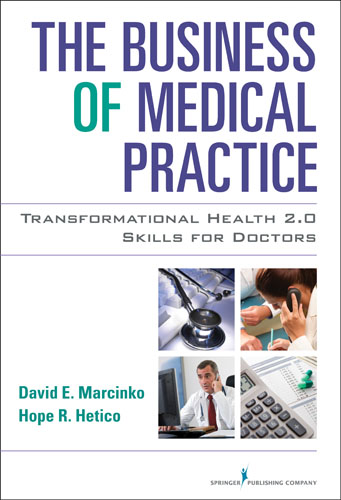
December 23rd, 2011 – The Institute of Medical Business Advisors [iMBA] Inc, in Atlanta, GA www.MedicalBusinessAdvisors.com and Springer Publishing Company of New York, just released the third edition of “The Business of Medical Practice” [Transformational Health 2.0 Skills for Doctors] edited by iMBA founder Dr. David Edward Marcinko MBA, CMP™ and President Hope Rachel Hetico RN, MHA, CPHQ, CMP™

Internal Contents

The 37 chapter, 750 page hard-cover textbook provides a comprehensive resource for those physicians, medical professionals, practice managers, nurse executives, health care administrators and graduate students seeking working knowledge on running a private facility or medical clinic.

Three Major Sections

The BoMP is comprised of three enterprise-wide sections: [1] Qualitative Office Operations, [2] Quantitative Aspects of Medical Practice and [3] Health Policies, Ethics and Leadership. Topics like ARRA, HITECH, ACA and the social networking aspects and ramifications of health 2.0 connectivity for all stakeholders are included for modernity.

Tools and Templates

Tools used throughout the book help readers reference and retain complex information. These tools include:

  • Sidebars. Key terms, key concepts, key sources, associations, and factoids all serve to enhance and reinforce the core takeaways from each chapter.
  • Tables. Tables are used to display and reference benchmark data, draw comparisons, and illustrate industry data trends.
  • Figures. Graphical depictions of concepts help you comprehend the material.
  • Charts. Charts allow easily referenced standard industry taxonomies alongside comparisons of related topics.

Assessment

For a further description of the Business of Medical Practice, with online “live’ community, please click: www.BusinessofMedicalPractice.com

To order directly: http://www.springerpub.com/product/9780826105752 

Conclusion

Your thoughts and comments on this ME-P are appreciated. Feel free to review our top-left column, and top-right sidebar materials, links, URLs and related websites, too. Then, subscribe to the ME-P. It is fast, free and secure.

Link: http://feeds.feedburner.com/HealthcareFinancialsthePostForcxos

Speaker: If you need a moderator or speaker for an upcoming event, Dr. David E. Marcinko; MBA – Publisher-in-Chief of the Medical Executive-Post – is available for seminar or speaking engagements. Contact: MarcinkoAdvisors@msn.com

OUR OTHER PRINT BOOKS AND RELATED INFORMATION SOURCES:

DICTIONARIES: http://www.springerpub.com/Search/marcinko
PHYSICIANS: www.MedicalBusinessAdvisors.com
PRACTICES: www.BusinessofMedicalPractice.com
HOSPITALS: http://www.crcpress.com/product/isbn/9781466558731
CLINICS: http://www.crcpress.com/product/isbn/9781439879900
BLOG: www.MedicalExecutivePost.com
FINANCE: Financial Planning for Physicians and Advisors
INSURANCE: Risk Management and Insurance Strategies for Physicians and Advisors

Product Details

Product DetailsProduct DetailsProduct Details

Doctors and Financial Advisors “Working 9 to 5”

Join Our Mailing List

What an “Old” Way to Make a Living

[Challenging the Current Business Process Model and Scheduling Paradigm]

By Dr. David Edward Marcinko FACFAS MBA CMP™

[Editor-in-Chief]

First off – my apologies to Dolly Parton for bastardizing the title of her song

My dad worked for General Motors; the 11-PM to 7-AM shift to be precise. The company ran 3 shifts [8hr. X 3da. = 24 hrs / day / 7 days / week]. He was always home during the day for his children. In fact, it seemed as though he never slept. My mom worked the 9-AM to 5-PM  shift / 5 days / week as a banker. What a great arrangement; loving parental child care 24/7/365.

Then, after my own medical school, internship, residency training, fellowship, clinical practice and business school, I often wondered why corporate America and her white collar workers used the 9-5 work day paradigm and not the traditional blue collar 3 shift [24/7/375] manufacturing model – like  GM?

Working

With a 24/7/365 work day schedule [3 shifts/day], fixed office costs would remain the same, while variable costs would increase slightly but be compensated for by increased revenues, less HR stress, fewer utilities and reduced private and public infra-structure maintenance, etc [old styled B-school pedagogy]. This would increase operating capacity and output [patient/client output, CPT® codes, hourly fees, AUMs, etc]. You know – real top line revenue and bottom line profits. And, that’s a good thing for business and commerce.

But, is this 3 shift model applicable to the healthcare industrial complex and the financial services industry? If not – why not? And, I mean real work – examining and treating patients and interviewing clients – not automatic websites or interactive blogs, etc. Doctors, consultants and FAs actually interacting with real folks; not avatars!

An Old but Novel Idea?

As a medical business process consultant, my simple idea is more than two decades old. Yet, it remains largely untested and still considered novel … Perhaps until now! Offering extended hours is one way that physicians – can position themselves for the changes coming in the new healthcare era. How else will we accomodate 34 million new Medicaid insured patients.

In fact, so should financial advisors and medical management consultants. Shoot, why can’t most professionals use this model. Why be constrained to person, place and time [3-Dimensions]?

The Decision

This decision, however, should not be taken lightly and should be evaluated both from a provider, patient, civics, cultural and business standpoint. So, please read this essay for an elegant description of this model.

Then, our ME-P text books can be used to go granular into the nitty-gritty details; with real-life tools, templates, case models and checklists, etc.

Assessment

Link: Ready to offer extended patient hours?

Link: New Medical Practice Entrepreneurial Business Rules for Young Physicians [circa 2012]

Conclusion

Your thoughts and comments on this ME-P are appreciated. Colleagues – when not if – are you going 24/5 … or 6 … or 7?

Feel free to review our top-left column, and top-right sidebar materials, links, URLs and related websites, too. Then, subscribe to the ME-P. It is fast, free and secure.

Link: http://feeds.feedburner.com/HealthcareFinancialsthePostForcxos

Speaker: If you need a moderator or speaker for an upcoming event, Dr. David E. Marcinko; MBA – Publisher-in-Chief of the Medical Executive-Post – is available for seminar or speaking engagements. Contact: MarcinkoAdvisors@msn.com

Our Other Print Books and Related Information Sources:

Health Dictionary Series: http://www.springerpub.com/Search/marcinko

Practice Management: http://www.springerpub.com/product/9780826105752

Physician Financial Planning: http://www.jbpub.com/catalog/0763745790

Medical Risk Management: http://www.jbpub.com/catalog/9780763733421

Hospitals: http://www.crcpress.com/product/isbn/9781439879900

Physician Advisors: www.CertifiedMedicalPlanner.org

Product DetailsProduct Details

Understanding The Federal Reserve Act

Join Our Mailing List

[By Staff Reporters]

Uncovering The FED

In the early 20th century, a financial crisis led panicked citizens to withdraw all their money at once, damaging banks. By 1913, Congress responded with the Federal Reserve Act, creating 12 regional banks acting as a federal bank to deal in local and global affairs with both private banks and the federal government.

Balancing v. Manipulation

Some say the Fed was meant to create a balanced economy, while others argue its purpose was to inorganically manipulate free enterprise, rescuing banks that we’d be better off without.

Assessment

Is the Fed still doing its job today? What secrets are being kept from us and how are the Fed’s actions impacting our economy?

Channel Surfing the ME-P

Have you visited our other topic channels? Established to facilitate idea exchange and link our community together, the value of these topics is dependent upon your input. Please take a minute to visit. And, to prevent that annoying spam, we ask that you register. It is fast, free and secure.

Conclusion

Your thoughts and comments on this ME-P are appreciated. Feel free to review our top-left column, and top-right sidebar materials, links, URLs and related websites, too. Then, subscribe to the ME-P. It is fast, free and secure.

Speaker: If you need a moderator or speaker for an upcoming event, Dr. David E. Marcinko; MBA – Publisher-in-Chief of the Medical Executive-Post – is available for seminar or speaking engagements. Contact: MarcinkoAdvisors@msn.com

OUR OTHER PRINT BOOKS AND RELATED INFORMATION SOURCES:

Product Details  Product Details

How Do We Improve Collaboration between Physicians and Hospital Administrators?

Join Our Mailing List

An Opinion Poll for Doctors, FAs and Patients

By Jennifer Tomasik MS [Principal: www.CFAR.com]

“It is the long history of humankind (and animal kind, too) those who learned to collaborate and improvise most effectively have prevailed.”

– Charles Darwin

Beyond institutional mergers and joint ventures, collaboration in healthcare is being driven by other factors; there is a need to move from a healthcare system driven by volume and characterized by fragmentation, waste, high cost, and inconsistent quality to a system where care is coordinated, costs are lower, and quality is higher.

Merger Mania

Merger mania in the 1990’s was driven by similar concerns, including the fear of for-profit competition and the rise of managed care. The results of this earlier round of mergers were unexpected. The 1990s ‘consolidation fever’ raised hospital prices by at least 5%, and did not measurably improve quality.[i] Hospitals purchased physician practices without a great deal of thought about expectations and mutual accountability, and many of those relationships failed—usually with significant financial implications.

Of Savvy Healthcare Leaders

Fearful of history repeating itself, savvy healthcare leaders are thinking differently about how to develop the collaborative relationships they need to succeed today. They see Accountable Care Organizations [ACOs] and Global Payments—where institutions will take on greater risk for the cost and quality of the services a patient requires—as an opportunity to get clear about how they can best position themselves across the full continuum of care. They believe potentials gains are not likely to show up simply as a result of mergers and acquisitions or consolidation per se. Rather than just integrating the bottom lines of their institutions, they are focused on ensuring that those individuals and teams who actually care for patients can productively collaborate with each other, and that they understand the clear and compelling rationale for why that collaboration is necessary.

Nowhere is this relationship more important than between hospital administrators and the medical staff.

What is “Collaboration” Anyway?

Merriam-Webster defines collaboration as “to work jointly with others or together especially in an intellectual endeavor.” While true, we find this definition insufficient for our purposes. Our colleagues at The Rhythm of Business, a consulting firm focused exclusively on collaboration, provide a more productive way to think about collaboration:

“Collaboration is a purposeful, strategic way of working that leverages the resources of each party for the benefit of all by coordinating activities and communicating information within an environment of trust and transparency.”

We add to this definition one additional, yet critical dimension. Collaboration also means working with, and through, differences. Any highly functioning team will, by its very nature, have differences – team members are ideally bringing innovative ideas that compete for “idea space” at the table.

Effective collaboration requires that teams not only value differences, but in fact encourage them to be surfaced. Viewed in this way, collaboration is not an event or an idea. It’s not “agreeing to get along.” Effective collaboration is an ongoing, systematic, strategic process. It is also, we believe, a business imperative – and nowhere more so than in healthcare.

Assessment

Given the often difficult nature of relationships between hospital administrators and medical staff, how do you improve collaboration to increase productivity and performance?


NOTE: [i] Vogt, William B and Robert Town. “How has hospital consolidation affected the price and quality of hospital care?” Robert Wood Johnson Foundation: Policy Brief No. 9. 2006.

Conclusion

And so, how do we improve collaboration between Physicians and Hospital Administrators?

Your thoughts and comments on this ME-P are appreciated. Feel free to review our top-left column, and top-right sidebar materials, links, URLs and related websites, too. Then, subscribe to the ME-P. It is fast, free and secure.

Link: http://feeds.feedburner.com/HealthcareFinancialsthePostForcxos

About the Author

Jennifer Tomasik, Principal,  leads CFAR’s Health and Hospital Systems practice. She works with her clients to solve complex strategic and organizational challenges. Her approach to consulting emphasizes communication and collaboration, supported by a blend of quantitative and qualitative analytics. Jennifer has worked in the health care sector for nearly 15 years, with expertise in public health, clinical quality measurement, strategic management, and organizational change. Her clients include some of the most prestigious hospitals, health systems and academic medical centers in the country. She has a Master’s in Health Policy and Management from the Harvard School of Public Health.

Speaker: If you need a moderator or speaker for an upcoming event, Dr. David E. Marcinko; MBA – Publisher-in-Chief of the Medical Executive-Post – is available for seminar or speaking engagements. Contact: MarcinkoAdvisors@msn.com

Our Other Print Books and Related Information Sources:

Health Dictionary Series: http://www.springerpub.com/Search/marcinko

Practice Management: http://www.springerpub.com/product/9780826105752

Physician Financial Planning: http://www.jbpub.com/catalog/0763745790

Medical Risk Management: http://www.jbpub.com/catalog/9780763733421

Hospitals: http://www.crcpress.com/product/isbn/9781439879900

Physician Advisors: www.CertifiedMedicalPlanner.org

Buy from Amazon

More on the Art of “Slow” Medicine

Join Our Mailing List

And … Slow Dentistry, too!

By Ann Miller RN MHA

[ME-P Executive-Director]

BOOK REVIEW

We don’t know exactly when, but the practice of medicine has morphed into the delivery of health care.

Of course, if healthcare has become big business, we at the ME-P through our publication, text and handbooks, advertisers and sponsors, as well as speaking and consulting engagements may be partially to blame. But, hopefully not to the extreme it has become in some cases.

For example, did you know that Medicare has a CPT® medical payment code for a ten minute “treadmill” office visit?

God’s Hotel – The Book

So, if you aren’t sure – or are too young to know – of what’s happening today, the new book “God’s Hotel” is for you. It’s an engaging book by Dr. Victoria Sweet, a general internist from Laguna Honda Hospital that chronicles her perspectives from the last almshouse in the United States.

IOW: She is off the insurance grid and has discovered a way to benefit patients, not necessarily medical providers, by practicing something called “slow” medicine.

THINK: Marcus Welby MD

Slow Dentistry

Of course, our own ME-P investigative reporter Darrell K. Pruitt DDS, has been commenting and opining on this issue vis-a-vie the dental insurance industry treadmill of “fast” production line oral care.

For example, he often asks his colleagues: Are you fed up with successfully doing intricate handwork to exacting tolerances in mouths of anxious patients and then having to fight to get the patients’ insurance company to pay what they rightfully owe THEIR CLIENT.

IOW: Working faster and faster, for less and less compensation.

Assessment

“God’s Hotel”: A Doctor, a Hospital, and a Pilgrimage to the Heart of Medicine

Link: http://www.amazon.com/Gods-Hotel-Hospital-Pilgrimage-Medicine/dp/1594488436/ref=sr_1_1?ie=UTF8&qid=1337177871&sr=8-1

More from the ME-P: The Emerging Discipline of “Slow Medicine” and Professional Liability

Conclusion

Your thoughts and comments on this ME-P are appreciated. Feel free to review our top-left column, and top-right sidebar materials, links, URLs and related websites, too. Then, subscribe to the ME-P. It is fast, free and secure.

Speaker: If you need a moderator or speaker for an upcoming event, Dr. David E. Marcinko; MBA – Publisher-in-Chief of the Medical Executive-Post – is available for seminar or speaking engagements. Contact: MarcinkoAdvisors@msn.com

OUR OTHER PRINT BOOKS AND RELATED INFORMATION SOURCES:

Product Details

About “Hospitals and Health Care Organizations”

ADVERTISEMENT

Hospitals & Healthcare Organizations: Management Strategies, Operational Techniques, Tools, Templates and Case Studies

Hospitals & Healthcare Organizations: Management Strategies, Operational Techniques, Tools, Templates and Case Studies

Buy from Amazon

Use Us – Don’t Abuse Us

The ME-P is Not Peer Reviewed but should be Cited

Join Our Mailing List

By Dr. David Edward Marcinko MBA

[Publisher-in-Chief]

There is an amusing historical story in academia about an unsuccessful candidate for a faculty position. It might serve as an object lesson for us all at the Medical Executive-Post.

The History

After faculty appointment interviews, the exhausted chairman of a prestigious university’s search committee quipped, “What his résumé lacked was five bad papers.”

The Rationale

By that, he meant that while the candidate had published several peer-reviewed papers containing enough genuinely important ideas to satisfy any rational hiring committee — more than could be said of most faculty members — he had too few to satisfy the bean counters, who fretted about how uninformed outsiders might react to the appointment.

Assessment

Researchers have responded as expected to these incentives. But, the additional papers they’ve written often have added little value. In other words, quality trumps quantity, even in the blog-o-sphere. So, please reference and cite us, comment about us, recommend us and use us – but don’t abuse us! Oh! We are copyrighted, too. We are – what we are – and proud of it.

Conclusion

In fact, the economist Philip Cook and Austin Frakt PhD, over at the Incidental Economist, found that in the first five years after publication, many fewer than half of all papers in the two most selective economics journals had ever been cited by other scholars.

So remember, at the ME-P, we are not peer reviewed. However, we are important, helpful, focused, crowdsourced, valuable and growing!

Conclusion

Your thoughts and comments on this ME-P are appreciated. Feel free to review our top-left column, and top-right sidebar materials, links, URLs and related websites, too. Then, subscribe to the ME-P. It is fast, free and secure.

Link: http://feeds.feedburner.com/HealthcareFinancialsthePostForcxos

Our Other Print Books and Related Information Sources:

Health Dictionary Series: http://www.springerpub.com/Search/marcinko

Practice Management: http://www.springerpub.com/product/9780826105752

Physician Financial Planning: http://www.jbpub.com/catalog/0763745790

Medical Risk Management: http://www.jbpub.com/catalog/9780763733421

Healthcare Organizations: www.HealthcareFinancials.com

Physician Advisors: www.CertifiedMedicalPlanner.com

Subscribe Now: Did you like this Medical Executive-Post, or find it helpful, interesting and informative? Want to get the latest ME-Ps delivered to your email box each morning? Just subscribe using the link below. You can unsubscribe at any time. Security is assured.

Link: http://feeds.feedburner.com/HealthcareFinancialsthePostForcxos

Sponsors Welcomed: And, credible sponsors and like-minded advertisers are always welcomed.

Link: https://healthcarefinancials.wordpress.com/2007/11/11/advertise

Product DetailsProduct DetailsProduct Details

Product Details  Product Details

Product Details

Should Dr. Marcinko Speak in Malaysia?

Join Our Mailing List

Information Sought on Laures International

By Dr. David Edward Marcinko MBA CMP™

[Editor-in-Chief]

Recently, I was pleased to be invited to speak at a Regional Public Workshop [RPW] for the healthcare clients of Laures International, in Malaysia, Kuala Lumpur. I don’t know if  I’m personally that famous, infamous, or our newest book is just garnering rave reviews.

“Healthcare Organizations” [Management Strategies, Tools, Techniques and Case Studies].

In-Process from: (c) Productivity Press 2012 http://www.crcpress.com/product/isbn/9781439879900

The Firm

Briefly, Laures International is touted to be at the forefront in organizing strategic business intelligence in Asia and Middle East with headquarters in Petaling Jaya, Malaysia. As of 2011, they’ve supposedly held events in Kuala Lumpur, Singapore, Philippines, Thailand, Indonesia, China and Dubai.

Goals and Objectives

Representatives state their goal is to provide world class events with an uncompromising attitude towards quality. The aim of Laures is to provide a platform for delegates to be involved in discussions and case studies to enhance their understanding and to apply what they learn immediately to improve their performance when they return to their respective workplace. A worthy goal!

Offices

+603 – 78034444

www.LauresInternational.com

Assessment

Now, I like to speak and learn, and have done so frequently around the country and in Eastern Europe the last three decades. Usually, my presentations are for medical societies, financial services groups, pharmaceutical companies or other consulting firms.

But, Laures is heretofore unknown to me, and other than their contact and website review, I am concerned about their credibility. With all due respect, I’d frankly hate to be duped or ultimately “stuck” in Kuala Lumpur!

Conclusion

Your thoughts and comments on this ME-P are appreciated. Is Laures International credible? Is the region safe? I’d love to experience its’ culture, people, food, colleagues, sights, sounds and sites. Accept or not? Your ME-P crowd sourced experience and wisdom is appreciated.

Feel free to review our top-left column, and top-right sidebar materials, links, URLs and related websites, too. Then, subscribe to the ME-P. It is fast, free and secure.

Link: http://feeds.feedburner.com/HealthcareFinancialsthePostForcxos

Our Other Print Books and Related Information Sources:

Health Dictionary Series: http://www.springerpub.com/Search/marcinko

Practice Management: http://www.springerpub.com/product/9780826105752

Physician Financial Planning: http://www.jbpub.com/catalog/0763745790

Medical Risk Management: http://www.jbpub.com/catalog/9780763733421

Healthcare Organizations: www.HealthcareFinancials.com

Physician Advisors: www.CertifiedMedicalPlanner.com

Subscribe Now: Did you like this Medical Executive-Post, or find it helpful, interesting and informative? Want to get the latest ME-Ps delivered to your email box each morning? Just subscribe using the link below. You can unsubscribe at any time. Security is assured.

Link: http://feeds.feedburner.com/HealthcareFinancialsthePostForcxos

Sponsors Welcomed: And, credible sponsors and like-minded advertisers are always welcomed.

Link: https://healthcarefinancials.wordpress.com/2007/11/11/advertise

ORDER HERE

http://www.crcpress.com/product/isbn/9781439879900

Health Industry Collaboration and e-Patients

More on Inter and Intra Healthcare Stakeholder Relationships 

Join Our Mailing List

According to Jennifer Tomasik MS [jtomasik@cfar.com], writing in the soon to be released ME-P textbook from iMBA Inc www.MedicalBusinessAdvisors.com: “Healthcare Organizations” [Management Strategies, Tools, Techniques and Case Studies], now in-process from (c) Productivity Press for 2012:

We are in a time of great change in healthcare. No one is certain how the future landscape will unfold, but it is clear that changes in regulation, reimbursement, technology, the economy, and science will significantly impact the work of those clinicians and administrators who dedicate their careers to improving patient care.

More Collaboration Needed

Experience has shown that better collaboration between patients and among the many different parts of the healthcare delivery system holds great potential to improve the quality of care and the relationships of those delivering it. It has also shown that the opportunities to improve collaboration are widespread.

Our focus, therefore, should be to introduce and share a selected set of tools that can be used to improve collaboration along several dimensions:

  • Clarifying roles and authority through decision charting,
  • Understanding the “give” and the “get” needed to establish effective alliances through the current state, and
  • Working jointly to establish and test a set of refined expectations through a physician-administrator compact.

Assessment

In the end, improved collaboration can help medical institutions with everything from inter professional productivity, to patient satisfaction to the most critical service of all: caring for patients and saving lives.

Link: http://www.crcpress.com/product/isbn/9781439879900

Conclusion

And so, your thoughts and comments on this ME-P are appreciated. Please review our top-left column, and top-right sidebar materials, links, URLs and related websites, too. Then, subscribe to the ME-P. It is fast, free and secure.

Link: http://feeds.feedburner.com/HealthcareFinancialsthePostForcxos

Speaker: If you need a moderator or speaker for an upcoming event, Dr. David E. Marcinko; MBA – Publisher-in-Chief of the Medical Executive-Post – is available for seminar or speaking engagements. Contact: MarcinkoAdvisors@msn.com

Our Other Print Books and Related Information Sources:

Health Dictionary Series: http://www.springerpub.com/Search/marcinko

Practice Management: http://www.springerpub.com/product/9780826105752

Physician Financial Planning: http://www.jbpub.com/catalog/0763745790

Medical Risk Management: http://www.jbpub.com/catalog/9780763733421

Healthcare Organizations: www.HealthcareFinancials.com

Physician Advisors: www.CertifiedMedicalPlanner.com

Subscribe Now: Did you like this Medical Executive-Post, or find it helpful, interesting and informative? Want to get the latest ME-Ps delivered to your email box each morning? Just subscribe using the link below. You can unsubscribe at any time. Security is assured.

Link: http://feeds.feedburner.com/HealthcareFinancialsthePostForcxos

Sponsors Welcomed: And, credible sponsors and like-minded advertisers are always welcomed.

Link: https://healthcarefinancials.wordpress.com/2007/11/11/advertise

Buy from Amazon

Learn How the ME-P Helps Hospitals Improve Patient Care and Still Be Profitable

ADVERTISEMENT

Join Our Mailing List 

Learn our Secrets – PreOrder Now for a First-Mover Advantage

Conclusion

And so, your thoughts and comments on this ME-P are appreciated. Please review our top-left column, and top-right sidebar materials, links, URLs and related websites, too. Then, subscribe to the ME-P. It is fast, free and secure.

Link: http://feeds.feedburner.com/HealthcareFinancialsthePostForcxos

Speaker: If you need a moderator or speaker for an upcoming event, Dr. David E. Marcinko; MBA – Publisher-in-Chief of the Medical Executive-Post – is available for seminar or speaking engagements. Contact: MarcinkoAdvisors@msn.com

Our Other Print Books and Related Information Sources:

Health Dictionary Series: http://www.springerpub.com/Search/marcinko

Practice Management: http://www.springerpub.com/product/9780826105752

Physician Financial Planning: http://www.jbpub.com/catalog/0763745790

Medical Risk Management: http://www.jbpub.com/catalog/9780763733421

Healthcare Organizations: www.HealthcareFinancials.com

Physician Advisors: www.CertifiedMedicalPlanner.com

Subscribe Now: Did you like this Medical Executive-Post, or find it helpful, interesting and informative? Want to get the latest ME-Ps delivered to your email box each morning? Just subscribe using the link below. You can unsubscribe at any time. Security is assured.

Link: http://feeds.feedburner.com/HealthcareFinancialsthePostForcxos

Sponsors Welcomed: And, credible sponsors and like-minded advertisers are always welcomed.

Link: https://healthcarefinancials.wordpress.com/2007/11/11/advertise

TESTIMONIAL

Hospitals and Healthcare Organizations” is a must-read for any physician and other health care provider to understand the multiple, and increasingly complex, interlocking components of the US Healthcare delivery system whether they are employed by a hospital system, or manage their own private practice.

The operational principles, methods, and examples in this book provide a framework applicable on both the large organizational and smaller private practice levels and will result in better patient care. Physicians today know they need to better understand business principles and this book by Dr. David E. Marcinko and Professor Hope Rachel Hetico provides an excellent framework and foundation to learn important principles all doctors need to know.

-Richard Berning, MD

[Pediatric Cardiologist]

ORDER HERE 

Buy from Amazon

About “Hospitals and Health Care Organizations”

ADVERTISEMENT

Join Our Mailing List

Management Strategies, Operational Techniques, Tools, Templates and Case Studies

PRE-RELEASE REVIEW

ORDER HERE

http://www.crcpress.com/product/isbn/9781439879900

Financial Planning for Physicians

A Handbook for Doctors and their Financial Advisors

ADVERTISEMENT

Financial Planning Handbook for Physicians and Advisors

Book Review and Summary

Financial Planning for Physicians and Advisors describes a personal financial planning program to help doctors avoid the perils of harsh economic sacrifice.

It outlines how to select a knowledgeable financial advisor and develop a comprehensive personal financial plan, and includes important sections on: insurance and risk management, asset diversification and modern portfolio construction, income tax and retirement planning, and medical practice succession and estate planning, etc.

When fully implemented with a professional’s assistance, this book will help physicians and their financial advisors develop an effective long-term financial plan.

Order now: http://www.jblearning.com/catalog/0763745790/

Speaker: If you need a moderator or speaker for an upcoming event, Dr. David E. Marcinko; MBA – Publisher-in-Chief of the Medical Executive-Post – is available for seminar or speaking engagements. Contact: MarcinkoAdvisors@msn.com

###

About Hospitals and Healthcare Organizations

Management Strategies, Operational Techniques, Tools, Templates and Case Studies

Join Our Mailing List

ADVERTISEMENT

Book Review and Summary

Drawing on the expertise of decision-making professionals, leaders, and managers in hospitals and healthcare organizations, this book addresses their ubiquitous struggles with decreasing revenues, increasing costs, and high consumer expectations in a competitive market.

Offering practical experience and applied operating vision, the authors integrate 5-S and six-sigma managerial applications and regulatory perspectives, with real-world case studies, models, and reports, as well as charts, tables, diagrams, and sample contracts.

The result is an integration of lean management and operational strategies vital to hospitals, clinics and healthcare administrators; CXOs, COOs and CEOs; comptrollers, nurse-leaders and physician-executives.

Pre-Order here: http://www.crcpress.com/product/isbn/9781439879900

Conclusion      

As always, your thoughts and comments on this ME-P are appreciated. Feel free to review our top-left column, and top-right sidebar materials, links, URLs and related websites, too. Then, subscribe to the ME-P. It is fast, free and secure.

Link: http://feeds.feedburner.com/HealthcareFinancialsthePostForcxos

Speaker: If you need a moderator or speaker for an upcoming event, Dr. David E. Marcinko; MBA – Publisher-in-Chief of the Medical Executive-Post – is available for seminar or speaking engagements. Contact: MarcinkoAdvisors@msn.com

Our Other Print Books and Related Information Sources:

Health Dictionary Series: http://www.springerpub.com/Search/marcinko

Practice Management: http://www.springerpub.com/product/9780826105752

Physician Financial Planning: http://www.jbpub.com/catalog/0763745790

Medical Risk Management: http://www.jbpub.com/catalog/9780763733421

Healthcare Organizations: www.HealthcareFinancials.com

Physician Advisors: www.CertifiedMedicalPlanner.com

Subscribe Now: Did you like this Medical Executive-Post, or find it helpful, interesting and informative? Want to get the latest ME-Ps delivered to your email box each morning? Just subscribe using the link below. You can unsubscribe at any time. Security is assured.

Link: http://feeds.feedburner.com/HealthcareFinancialsthePostForcxos

Sponsors Welcomed: And, credible sponsors and like-minded advertisers are always welcomed.

Link: https://healthcarefinancials.wordpress.com/2007/11/11/advertise

Product DetailsProduct DetailsProduct Details

Product Details  Product Details

   Product Details

About Hospitals & Healthcare Organizations

ADVERTISEMENT

 Join Our Mailing List 

Management Strategies, Operational Techniques, Tools, Templates and Case Studies

Healthcare Organizations: Management Strategies, Operational Techniques, Tools, Templates and Case Studies

Conclusion           

And so, your thoughts and comments on this textbook are appreciated. Please review our top-left column, and top-right sidebar materials, links, URLs and related websites, too. Then, subscribe to the ME-P. It is fast, free and secure.

Link: http://feeds.feedburner.com/HealthcareFinancialsthePostForcxos

Speaker: If you need a moderator or speaker for an upcoming event, Dr. David E. Marcinko; MBA – Publisher-in-Chief of the Medical Executive-Post – is available for seminar or speaking engagements. Contact: MarcinkoAdvisors@msn.com

Our Other Print Books and Related Information Sources:

Health Dictionary Series: http://www.springerpub.com/Search/marcinko

Practice Management: http://www.springerpub.com/product/9780826105752

Physician Financial Planning: http://www.jbpub.com/catalog/0763745790

Medical Risk Management: http://www.jbpub.com/catalog/9780763733421

Healthcare Organizations: www.HealthcareFinancials.com

Physician Advisors: www.CertifiedMedicalPlanner.com

Subscribe Now: Did you like this Medical Executive-Post, or find it helpful, interesting and informative? Want to get the latest ME-Ps delivered to your email box each morning? Just subscribe using the link below. You can unsubscribe at any time. Security is assured.

Link: http://feeds.feedburner.com/HealthcareFinancialsthePostForcxos

Sponsors Welcomed: And, credible sponsors and like-minded advertisers are always welcomed.

Link: https://healthcarefinancials.wordpress.com/2007/11/11/advertise

Product Details

Microsoft Corporation from Research to Development

Collaboration is the secret sauce of delivering new technologies

By Staff Reporters

Join Our Mailing List

U.K. Researcher Garners TR35 Accolade

Pioneering research into programming biology has earned a Microsoft Research scientist a prestigious TR35 award, presented by Technology Review.

BC at MSFT RC

Andrew Phillips, a 34-year-old scientist who leads the Biological Computation group at Microsoft Research Cambridge, received the award, given each year by Technology Review to recognize the world’s top innovators under the age of 35. The awards span energy, medicine, computing, communications, nanotechnology, and other fields.

Link: http://research.microsoft.com/en-us/news/features/phillipstr35-082311.aspx

How they do it?

Here is a glimpse at the transfer of ideas and research that happens every day at Microsoft.

Source: blogs.technet.com

Assessment

Now, here is a thought from a former physician Microsoftie on our own ME-P and iMBA Inc, achievements.

Link: https://medicalexecutivepost.com/2008/02/29/ahmad-hashem-md-phd

Conclusion

Your thoughts and comments on this ME-P are appreciated. Feel free to review our top-left column, and top-right sidebar materials, links, URLs and related websites, too. Then, subscribe to the ME-P. It is fast, free and secure.

Speaker: If you need a moderator or speaker for an upcoming event, Dr. David E. Marcinko; MBA – Publisher-in-Chief of the Medical Executive-Post – is available for seminar or speaking engagements. Contact: MarcinkoAdvisors@msn.com

OUR OTHER PRINT BOOKS AND RELATED INFORMATION SOURCES:

Product Details

Practice Management ‘Book of the Month’

“Book of the Month”

for

All Medical Professionals


Product Details
 

www.BusinessofMedicalPractice.com

 
Sponsor: www.MedicalBusinessAdvisors.com
 

Selecting Practice Management Consultants Wisely

Business Education Needed for Physicians and all Medical Colleagues

By Dr. David Edward Marcinko MBA CMP™

[Publisher-in-Chief]

While the doctors consult, the patient dies

-English Proverb

There are many self-help publications, online resources and management guru’s purporting to impart business information to their physician clients. Within the current managed care climate, economic malaise, and specter of nationalized healthcare following the 2010 health insurance reform legislation, medical business consultants are all the rage.

However, in the same vein, physician bankruptcies are mounting, medical student loan delinquencies are increasing, physician finances are friable and medical and ancillary practices are closing at record numbers. What gives?

Do Doctors Lack Business Knowledge?

Perhaps the answer lies in the lack of real business, accounting, financial and managerial acumen by the average practitioner? This growing concern is prompting more and more doctors to seek the help of a healthcare consultant or financial advisor. But, just what does a practice management consultant do, what credentials are needed to be in the business, and how can a healthcare advisor help you coordinate all aspects of your practice’s life? 

Here are two examples of major practice management fiascos.

Corporate Medicine and Doctor Super-Groups

As the managed and healthcare care crisis exacerbates, and Obama Care [Patient Protection and Affordable Care Act] unfolds over the next eight years, there will be many examples of irrational practice management behavior on the part of physicians, and no specialty is immune.

Just collectively reflect a moment on colleagues willing to securitize their practices a decade ago – and currently with so the so called medical super groups – and cash out to Wall Street for riches that were not rightly deserved. Where are firms such as MedPartners, Phycor, FPA and Coastal Healthcare now? A survey of the Cain Brothers Physician Practice Management Corporation Index of publicly traded PPMCs revealed a market capital loss of more than 99%, since inception; despite their various heath 2.0 re-incarnations. And, how will modern financial regulatory reform, Dodd-Frank, the SEC, insurance company and banking controls resulting from Wall Street’s 2008-09 economic debacles, impact physicians?

A Southern Gentleman and Solo Physician

Or, consider the personal situation of a solo Southern primary care physician who learned an accounting lesson the hard way when he asked his CPA to appraise his business. Upon sale, his attorney brother-in-law drew up the contract, as he was pleased the practice quickly sold for its full asking price. What he didn’t know, but would soon discover, is that accounting value or “book” value — the figure his accountant gave him — is far different than the fair-market value that he could have received for his long years of toil. Was the CPA wrong? Not really. Was the gentleman doctor incorrect? No. Both were merely operating under a different set of practice management terms, and accounting definitions, without communication or knowledge of each other’s perspectives. 

Assessment

Product Details

Link: www.BusinessofMedicalPractice.com

Conclusion

And so, your thoughts and comments on this ME-P are appreciated. Feel free to review our top-left column, and top-right sidebar materials, links, URLs and related websites, too. Then, subscribe to the ME-P. It is fast, free and secure.

http://feeds.feedburner.com/HealthcareFinancialsthePostForcxos

Speaker: If you need a moderator or speaker for an upcoming event, Dr. David E. Marcinko; MBA – Publisher-in-Chief of the Medical Executive-Post – is available for seminar or speaking engagements. Contact: MarcinkoAdvisors@msn.com

Our Other Print Books and Related Information Sources:

Health Dictionary Series: http://www.springerpub.com/Search/marcinko

Practice Management: http://www.springerpub.com/product/9780826105752

Physician Financial Planning: http://www.jbpub.com/catalog/0763745790

Medical Risk Management: http://www.jbpub.com/catalog/9780763733421

Healthcare Organizations: www.HealthcareFinancials.com

Physician Advisors: www.CertifiedMedicalPlanner.com

Subscribe Now: Did you like this Medical Executive-Post, or find it helpful, interesting and informative? Want to get the latest ME-Ps delivered to your email box each morning? Just subscribe using the link below. You can unsubscribe at any time. Security is assured.

Link: http://feeds.feedburner.com/HealthcareFinancialsthePostForcxos

Sponsors Welcomed: And, credible sponsors and like-minded advertisers are always welcomed.

Link: https://healthcarefinancials.wordpress.com/2007/11/11/advertise

Product DetailsProduct DetailsProduct Details       

A Social Security Owner’s Manual [Book Review]

A New Book by Jim Blankenship

By Staff Reporters

Who he is

Jim Blankenship is a Certified Financial Planner [CFP®], Enrolled Agent [EA] and the owner of Blankenship Financial Planning in Illinois.

Link: http://www.bfponline.com/

What he’s done

We’ve been following his blog Getting Your Financial Ducks In A Row for some time now. We also have referred to his online publication The IRA Owner’s Manual from time to time, with questions about inherited IRAs, etc. Jim knows his stuff.

Our Omission

Now, we admit that we’ve not paid much attention to Social Security because we are all still far from being eligible for it, and at the ME-P, we assume it won’t be here for us.

The Book

Nevertheless, when Jim published a new book A Social Security Owner’s Manual, we took the opportunity to learn more about Social Security.

And, we think, so should all medical professionals and their financial advisors.

Assessment

Jim provides expert guidance for retirement, education funding, and income tax issues, too. In addition to this all this, you’ll find Jim’s writings all around the internet, as he is a regular contributor to Forbes.com, TheStreet.com, and FiGuide. Several other sites also republish his work.

Conclusion                

Your thoughts and comments on social security and this ME-P are appreciated. Feel free to review our top-left column, and top-right sidebar materials, links, URLs and related websites, too. Then, subscribe to the ME-P. It is fast, free and secure.

Link: http://feeds.feedburner.com/HealthcareFinancialsthePostForcxos

Speaker: If you need a moderator or speaker for an upcoming event, Dr. David E. Marcinko; MBA – Publisher-in-Chief of the Medical Executive-Post – is available for seminar or speaking engagements. Contact: MarcinkoAdvisors@msn.com

Our Other Print Books and Related Information Sources:

Health Dictionary Series: http://www.springerpub.com/Search/marcinko

Practice Management: http://www.springerpub.com/product/9780826105752

Physician Financial Planning: http://www.jbpub.com/catalog/0763745790

Medical Risk Management: http://www.jbpub.com/catalog/9780763733421

Healthcare Organizations: www.HealthcareFinancials.com

Physician Advisors: www.CertifiedMedicalPlanner.com

Subscribe Now: Did you like this Medical Executive-Post, or find it helpful, interesting and informative? Want to get the latest ME-Ps delivered to your email box each morning? Just subscribe using the link below. You can unsubscribe at any time. Security is assured.

Link: http://feeds.feedburner.com/HealthcareFinancialsthePostForcxos

Sponsors Welcomed: And, credible sponsors and like-minded advertisers are always welcomed.

Link: https://healthcarefinancials.wordpress.com/2007/11/11/advertise

Product Details  Product Details

The Quest for “Alpha”

Join Our Mailing List

A New Book Review

By Peter Benedek PhD CFA

In “The Quest for Alpha” Larry Swedroe systematically dismantles the theory that active money management (defined by him as stock selection and market timing) can lead to alpha (returns above risk-adjusted benchmark) after fees. He argues that “if markets are highly efficient, efforts to outperform are unlikely to prove productive after the expense of the efforts.

If that’s true, the winning strategy is to focus on the following: asset allocation, fund construction, costs, tax efficiency, and the building of globally diversified portfolios that minimize, if not eliminate, the taking of idiosyncratic, and therefore uncompensated, risks.”

He also argues that “In order to show that markets are inefficient, we need to see evidence of persistent outperformance beyond the randomly expected. Otherwise, we cannot differentiate skill from luck.”

Swedroe then ploughs through the available evidence on: mutual funds, pension plans, hedge funds, private equity/venture capital, individual investors and behavioral finance, to conclude that the evidence does not support the pursuit of active management in the quest for persistent alpha after costs.

Some messages [for doctors] and us all

  • “all activity is counterproductive” or “please don’t do something, just stand there”
  • attempts to generate alpha by the various means mentioned above are thwarted by: (1) highly efficient markets, (2) “the costs of exploiting any inefficiencies are sufficiently great to make it difficult to generate persistent alpha sufficient to overcome the costs of the effort, and (3) “if there are inefficiencies, the competition to exploit them causes them to disappear rapidly”
  • “since the underlying basis of most stock market forecasts is an economic forecast, the evidence suggests that stock market strategists who predict bull and bear markets will have no greater success than do economists” (and he equates economists forecasting skill level equivalent to guessing)
  • described “the winning investment strategy” involves a globally diversified portfolio of passively managed funds (such as index funds and exchange traded funds) tailored to an individual’s unique ability, willingness and need to take risk….(as well as) integrating an investment plan into a well-developed estate, tax, and risk management (insurance  of all types) plan.”
  • referring to the futility of active management and getting its practitioners to recognize that, he quotes Sinclair “It is difficult to get a man to understand something when his salary depends on his not understanding it”
  • William Sharpe is quoted as explaining the active vs. passive debate as: “If “active” and “passive” management styles are defined in sensible ways, it must be the case that: (1) before costs, the return on the average actively managed dollar will equal the return on the average passively managed dollar, and (2) after costs, the return on the average actively managed dollar will be less than the return on the average passively managed dollar”…so “active management is a negative sum game, also known as the loser’s game…(and) the quest for the Holy Grail of alpha is the triumph of hope, hype, and marketing over wisdom and experience.
  • Swedroe explains how one might improve portfolio performance relative to S&P500 alone by increasing its diversification across asset classes

Assessment

To paraphrase the message of the book, you have to be lucky, not smart, to generate after costs, alpha on a risk-adjusted basis with active management. And there are very many smart [physician] investors competing, but very few will end up being lucky.

So doctors, you’ll want to read this book, and then re-read it every time you get the urge to be active.

Conclusion

Your thoughts and comments on this ME-P are appreciated. Feel free to review our top-left column, and top-right sidebar materials, links, URLs and related websites, too. Then, subscribe to the ME-P. It is fast, free and secure.

Link: http://feeds.feedburner.com/HealthcareFinancialsthePostForcxos

Speaker: If you need a moderator or speaker for an upcoming event, Dr. David E. Marcinko; MBA – Publisher-in-Chief of the Medical Executive-Post – is available for seminar or speaking engagements. Contact: MarcinkoAdvisors@msn.com

OUR OTHER PRINT BOOKS AND RELATED INFORMATION SOURCES:

DICTIONARIES: http://www.springerpub.com/Search/marcinko
PHYSICIANS: www.MedicalBusinessAdvisors.com
PRACTICES: www.BusinessofMedicalPractice.com
HOSPITALS: http://www.crcpress.com/product/isbn/9781466558731
CLINICS: http://www.crcpress.com/product/isbn/9781439879900
BLOG: www.MedicalExecutivePost.com
FINANCE: Financial Planning for Physicians and Advisors
INSURANCE: Risk Management and Insurance Strategies for Physicians and Advisors

Product DetailsProduct DetailsProduct Details

Product Details  Product Details

   Product Details 

About Healthcare Financials.com

WELCOME ALL HEALTH 2.0 COLLEAGUES

[An Open Invitation]

Product Details 

All hospitals and healthcare organizations, both emerging and mature, face a daunting financial scenario in today’s volatile healthcare reimbursement environment.  Decreasing revenues, increasing costs, and high consumer expectations present a complex challenge for CEOs, CFOs, physicians and nurse executives, administrators, financial advisors and department managers who must not only lead in today’s climate, but also position their organizations for tomorrow’s financial tumult and potential political changes of the Obama Administration.

Produced by a team of leading doctors, physician executives, nurses, medical professionals, economists, administrators, lawyers, and accountants, skilled business leaders and IT consultants, among many others; Healthcare Organizations [Journal of Financial Management Strategies] on CD-ROM, or SaaS, looks at ways to manage assets, costs, human resources and healthcare claims.  Everything – from inventory management to hybrid and activity based cost analysis in order to accelerate the cash conversion cycle – is scrutinized.  And, modern health economic themes like competitive strategy, workplace violence and financial benchmarks, for both public and private entities, are included.

We also examine contemporaneous topics such as the lessons learned from the corporate healthcare market competition and the PPMC imbroglio of the early 2000’s, and the domestic financial meltdown of 2009. This includes current methods for achieving hospital objectives, negotiating and analyzing cost-volume-profit contracts, and understanding the financial impact of regulatory requirements under HIPAA, STARK I-III, OSHA, the US Patriot Acts, the Deficit Reduction Act [DRA], the often contentious Sarbanes-Oxley Act, ARRA and HITECH Acts, and the Fair and Accurate Credit Transactions [FACT] Act.

In addition, information technology issues like electronic medical records (eMRs), RFID controls, RSS feeds and blogs, Health 2.0 initiatives and computerized physician order entry (CPOE) systems are examined in detail. Virtually no  operational, strategic business, health economics, or financial management topic is omitted.

“This wide-ranging examination of the fiscal

management scene for hospitals, healthcare

organizations, clinics and outpatient centers 

includes case models, extensive appendices, 

and detailed checklists and templates that

step the reader through a review of main

issues for each chapter.”

Health Care Organizations [Journal of Financial Management Strategies] on CD-ROM, or SaaS, is dedicated to meeting the administrative needs of our nation’s healthcare organizations in order to help them maintain a competitive edge in the markets they serve; and to take advantage of emerging business opportunities. We therefore invite you to be the first health economics cynosure in your hospital, facility, or healthcare system to join us for the journey.

Let Health Care Organizations [Journal of Financial Management Strategies] be your guide. 

Subscribe today … Succeed tomorrow!

Dr. David Edward Marcinko MBA, CMP

[Founder, CEO and Editor-in-Chief]

iMBA Inc – Suite #5901 Wilbanks Drive

Norcross, GA 30092-1141

Product Details 

Why I Rue the Hospital “Team-Based Medicine” Approach to In-Patient Care

Join Our Mailing List

Or, Whose Patient is it – Anyway?

By Dr. David Edward Marcinko MBA, CMP™

www.CertifiedMedicalPlanner.org

[ME-P Publisher-in-Chief]

Ok, I admit it; I may be an aging curmudgeon [just ask my wife and daughter] who has not regularly seen patients in the office for the last decade. A consult here, Independent Medical Examination [IME] there, or a surgical assist when needed has been the extent of my patient experience since my transition out of direct care medicine in 2000-01.

Moreover, I admit to not being an ardent fan of hospital-based medicine [with all due respect to colleague and uber-hospitalist Robert Wachter MD, who I admire and have frequently mentioned in my books, white papers, speaking engagements and here on this Medical-Executive Post].

I am also not completely in favor of the many new-fangled “specialties” and medical business models.  And, as recent models and linguistic evolution occurred, the nomenclature designation of hospitalist was followed by that of hospital-intensivist, hospital-proceduralist and hospital-nocturnalist, etc [http://medinnovationblog.blogspot.com and personal communication Richard L. Reece MD].

Enter the Team-Based Hospital Doctors

And now – for the last five years or so on my radar – there is a new term to add to the lexicon: team-based hospital medicine [practice], or similar. But, I ask, whose patient is it? Who is accountable? Where does the buck of responsibility stop?

The Quintessential Example

On Friday, May 9, 2003, a 5-year-old boy was undergoing diagnostic testing for his epilepsy at Children’s Hospital in Boston when he suffered a massive seizure. Two days later, on Mother’s Day, he died. Despite the fact that he was in intensive care at one of the world’s leading pediatric hospitals, none of the physicians caring for him ordered the treatment that could have saved his life.

The death was tragic, but even more troubling from an organizational perspective was the series of events that led up to it. The Massachusetts Department of Public Health investigated the death, and The Boston Globe reported on the results that, “the investigation portrays a situation where lines of authority were deeply tangled, and where no one person had accountability for the patient. Each of the doctors who initially worked on the case–two at the bedside and one consulting by phone–told investigators that they thought one of the others was in charge.” In the end, no one was in charge.

This is a striking example of how even the most talented clinicians in one of the world’s best hospitals can fail not only to provide adequate care, but to save a savable life—all because the lines of authority were unclear. The lack of clarity resulted in this team’s inability to collaborate effectively at a time when the stakes couldn’t have been higher.

Here are two other benign, but more personal, examples circa 2011.

My Personal Experiences

My Sister

This past summer, my sister was in a VA hospital [extremity injuries, nothing serious] for about a week. She was seen by 13 different physicians who were on her “team”; not to mention the plethora of other allied healthcare “team-members”. Me, my wife [RN], and/or her boyfriend [Army Medic and a PA] were at her bedside at least 12-15 hours each day. She was rarely left alone, by design, as we all recalled the admonition of former AMA President Tom R. Reardon MD, to always have a bedside advocate while in the hospital.

Yet, she was offered the wrong medications on one occasion, personally mis-identified twice, and it was obvious that her team-members rarely communicated or discussed her case [by their own admission], or even reviewed her electronic medical records [vistA system] before rounds. Here, the “system is down” was cited as causative: https://medicalexecutivepost.com/2009/09/21/what-is-a-client-server-system

My Dad

Now, later this same year and under the same patient advocate approach, my dad was in two different hospitals sequentially, both using the “team-based” care model. In each, members did not know, or were loathe acknowledging, who was in charge of his case! Malpractice phobia was apparent despite the coterie of, no doubt brilliant, MD/PhD interns, residents and fellows making daily rounds by starring at their shoes. One physician even cited her hectic return from vacation as the reason she examined my dad – for the first time – without reading his paper chart. “Doctors need vacations, too”, was her flippant response when challenged.

Outcomes

Fortunately, our insider knowledge and – shall we say – “charming swagger” was helpful in avoiding major complications with the continuity-of-care in the above two examples. But, most patients are not so blessed!

Our Newest Book

These stories reflect just one of many difficult collaboration challenges in healthcare, today.

In her textbook chapter, Collaborating to Improve Operating Performance in a Changing Healthcare Landscape [Opportunities for Improvement Widespread], contributing author Jennifer Tomasik MS, Principal at CFAR [Center For Applied Research Inc, in Cambridge, MA], focuses on the increasing need for collaboration among physicians, clinicians, hospital executives, and administrative leaders in the dynamic, complex healthcare environment. She looks specifically at collaboration along three different dimensions, including

  • inter-professional teams,
  • institution to institution, and
  • physicians and administrators.

In each instance, she describes useful tools that can be applied to improve collaboration and overall institutional performance—all in the service of providing better patient care.

Assessment

To me, it seems pretty obvious that “hospital team-based” medical care is an oxy-moron. On one hand, it appears to reduce risk, but on the other hand, it appears to reduce quality care as well. Moreover, it also seems to be an invoice generating machine, and revenue enhancing mechanism

And so, beyond this individual ME-P, and its’ tragic and trivial examples, it is important for hospitals and healthcare organizations to improve collaboration. Our patients depend on us to get the philosophy of “hospital team-based” care right, if it is to continue. Otherwise, it will become another good intention, gone awry, in the changing hospital ecosystem that is domestic health care.

Pre-Order Here:

“Healthcare Organizations” [Management Strategies, Tools, Techniques and Case Studies]

In-Process, 425 pages, est., from (c) Productivity Press 2012
http://www.crcpress.com/product/isbn/9781439879900

Product DetailsProduct Details

Conclusion

Your thoughts and comments on this ME-P are appreciated. Feel free to review our top-left column, and top-right sidebar materials, links, URLs and related websites, too. Then, subscribe to the ME-P. It is fast, free and secure.

Link: http://feeds.feedburner.com/HealthcareFinancialsthePostForcxos

Speaker: If you need a moderator or speaker for an upcoming event, Dr. David E. Marcinko; MBA – Publisher-in-Chief of the Medical Executive-Post – is available for seminar or speaking engagements. Contact: MarcinkoAdvisors@msn.com

OUR OTHER PRINT BOOKS AND RELATED INFORMATION SOURCES:

LEXICONS: http://www.springerpub.com/Search/marcinko
PHYSICIANS: www.MedicalBusinessAdvisors.com
PRACTICES: www.BusinessofMedicalPractice.com
HOSPITALS: http://www.crcpress.com/product/isbn/9781466558731
CLINICS: http://www.crcpress.com/product/isbn/9781439879900
ADVISORS: www.CertifiedMedicalPlanner.org
BLOG: www.MedicalExecutivePost.com

Product DetailsProduct DetailsProduct Details

Product Details  Product Details

   Product Details 

For Doctors Who Wish to Retire Wealthy [Despite the Economy?]

Financial Planning for Physicians and Advisors


Financial Planning Handbook for Physicians and Advisors


Speaker: If you need a moderator or speaker for an upcoming event, Dr. David E. Marcinko; MBA – Publisher-in-Chief of the Medical Executive-Post – is available for seminar or speaking engagements. Contact: MarcinkoAdvisors@msn.com


Knowledge Doctors Need to Survive the Financial Crisis on Wall Street

Dictionary of Health Economics and Finance 


Dictionary of Health Economics and Finance


Speaker: If you need a moderator or speaker for an upcoming event, Dr. David E. Marcinko; MBA – Publisher-in-Chief of the Medical Executive-Post – is available for seminar or speaking engagements. Contact: MarcinkoAdvisors@msn.com


Understanding the Risks of Health 2.0 in Medical Practice

Risk Management and Insurance Strategies for Physicians and Financial Advisors

Insurance and Risk Management Strategies for Physicians and Advisors

Channel Surfing the ME-P

Have you visited our other topic channels? Established to facilitate idea exchange and link our community together, the value of these topics is dependent upon your input. Please take a minute to visit. And, to prevent that annoying spam, we ask that you register. It is fast, free and secure.

Conclusion

Your thoughts and comments on this ME-P are appreciated. Feel free to review our top-left column, and top-right sidebar materials, links, URLs and related websites, too. Then, subscribe to the ME-P. It is fast, free and secure.

Speaker: If you need a moderator or speaker for an upcoming event, Dr. David E. Marcinko; MBA – Publisher-in-Chief of the Medical Executive-Post – is available for seminar or speaking engagements. Contact: MarcinkoAdvisors@msn.com

OUR OTHER PRINT BOOKS AND RELATED INFORMATION SOURCES:

Comprehensive Financial Planning Strategies for Doctors and Advisors: Best Practices from Leading Consultants and Certified Medical Planners(TM)* 8

A Review of Current Personal Finance and Investment Literature

Current Synopsis [Around the Literary World of Economics]

By Dr. Peter Benedek CFA

http://retirementaction.com/

Investors will grapple with more turbulence surrounding Europe’s deepening debt problems this week and the prospect of another round of dismal data on the faltering U.S. economy. So, let us listen while Doctor Benedek speaks.

Dr. David E. Marcinko; FACFAS, MBA, CMP[Publisher-in-Chief]

In the Globe and Mail’s “In an emergency, is your info safe?” Dianne Nice suggests a teachable moment associated with the recent US andOntario tornadoes, north-eastern earthquake and hurricane threat. Specifically, she suggests that we consider taking steps to safeguard our important papers, should our home be destroyed. The ICBA recommends keeping important documents in a bank safe: marriage certificate, tax returns, property deeds, birth certificates insurance policies, credit card number, and list of household valuables for insurance claims, paper or electronic copies of important computer records. Additionally consider keeping copies in the home in sealed plastic bags (Probably not a bad idea.)

Scott Willenbrock in the Financial Analysts Journal’s “Diversification return, portfolio rebalancing, and the commodity return puzzle” argues that “the underlying source of the diversification return is the rebalancing, which forces the investor to sell assets that have appreciated in relative value and buy assets that have declined in relative value, as measured by their weights in the portfolio. Although a buy-and-hold portfolio generally has a lower variance than the weighted average variance of its assets, it does not earn a diversification return. Diversification is often described as the only “free lunch’’ in finance because it allows for the reduction of risk for a given expected return. Diversification return might be described as the only “free dessert” in finance because it is an incremental return earned while maintaining a constant risk profile. The contrarian activity of rebalancing, however, must be performed to earn the diversification return; diversification is a necessary but not sufficient condition. Although an un-rebalanced portfolio generally has reduced risk, it does not earn a diversification return and suffers from a varying risk profile. The control of risk, together with the diversification return, is a powerful argument for rebalanced portfolios.”

In the CFA Institute’s Financial Analysts Journal’s “The winners’ game” Charles Ellis looks at the investment profession’s challenges and opportunities. He writes that the investment profession has made three errors:  two of commission and one of omission. He writes that “In addition to the two errors of commission—accepting the increasingly improbable prospect of beat-the-market performance as the best measure of our profession and focusing more and more attention on business achievements rather than on professional success— we have somehow lost sight of our best professional opportunity to serve our clients well and shifted our focus away from effective investment counseling. Some of the help clients need is in understanding that selecting managers who will actually beat the market over the long term is no longer a realistic assumption or a “given” … most investors need help in developing a balanced, objective understanding of themselves and their situation: their investment knowledge and skills; their tolerance for risk in assets, incomes, and liquidity; their financial and psychological needs; their financial resources; their financial aspirations and obligations in the short and long run … Our profession’s clients and practitioners would all benefit if we devoted less energy to attempting to “win” the loser’s game of beating the market and more skill, knowledge, and time to helping clients recognize market realities, understand themselves as investors, and clarify their realistic objectives and then stay the course that is best for each of them.” (Charles Ellis is the author of the must read book entitled“Winning the Loser’s Game- Timeless Strategies for Successful Investing”.)

Glenn Ruffenach in the WSJ SmartMoney’s “5 best online retirement guides” provides a list from  “One of the most comprehensive and valuable sites online is also among the least known: the Employee Benefits Security Administration.”

In WSJ SmartMoney’s “Why Wall Street’s forecast can’t be trusted” Alex Tarquinio writes that “Over the years, some market forecasters have been about as accurate as, well, weather forecasters… But some financial planners ignore the Wall Street prognostications altogether. George Papadopoulos, the owner of the eponymous financial planning firm in Novi, Mich., says most stock strategists tend to be too bullish, save a few who are “perma-bears.” Ignore the headline number, he says, and “focus on what you can control,” like finding a good balance of stocks and bonds for your portfolio.” (Now there is some sensible advice; ignore talking-heads, ‘strategists’, ‘prognosticators’ and soothsayers. Remember there are very few things that you can actually control: your spend-rate, saving-rate, investment fees and costs, asset allocation and rebalancing.)

In the Globe and Mail’s “Hunting high and low for safe yields” John Heinzl enumerates some of the available options for ‘safe yields’ and concludes that none come even close to paying off your 4% mortgage which at 40% tax rate gives you 6.67% guaranteed.

In Bloomberg’s “Homeowners on East Coast may have to pay for earthquake damage” Leondis and Ody report that “Earthquake protection is generally excluded from standard homeowners’ insurance policies, and consumers have to purchase coverage either as a separate policy…“For most of us, having earthquake insurance doesn’t make sense,” said Sheryl Garrett, founder of Shawnee Mission, Kansas-based Garrett Planning Network Inc., a network of fee-only financial planners. That’s because residents of areas where earthquakes rarely occur generally don’t need the coverage, and policies in parts of the country with frequent earthquakes are more expensive to compensate for the increased risk, she said.”

In the Globe and Mail’s “Vanguard to launch six ETFs in Canada” Shirley Won reports that Vanguard is launching “six exchange-traded funds (ETFs) inCanada. The stock ETFs include Vanguard MSCI Canada and the Vanguard MSCI Emerging Markets, as well as the Vanguard MSCI U.S. Broad Market and Vanguard MSCI EAFE, which will both be hedged to Canadian dollars. The bond category includes Vanguard Canadian Aggregate Bond and Vanguard Canadian Short-Term Bond ETFs.”

Real Estate

On the Canadian front, in the Globe and Mail’s “Most housing ‘reasonably affordable’: RBC” Steve Ladurantaye reports that Vancouver house prices are in “uncharted territory” and “it would take 92 per cent of the median household’s pretax income to own a bungalow in the city at current prices – the highest reading yet in its quarterly national survey on affordability. However according to RBC most (other) Canadian cities offered reasonably affordable” housing options in the second quarter compared to the first. Nationally, a condo required 29.2 per cent of pretax household income (a 0.8 per cent increase), a bungalow 43.3 per cent (1.7 per cent) and a detached home 49.3 per cent (1.8 per cent)… The bank’s affordability index looks at the proportion of pre-tax household income needed to service the costs of owning different categories of homes at current market values. Its standard measure is a 1,200-square-foot bungalow, and the carrying costs include mortgage payments (principal and interest), property taxes and utilities.”

However in the WSJ’s “Toronto wary of condo correction” (note this is in WSJ, not the Globe and Mail or the National Post) Monica Gutschi reports that “A condominium-building boom is lifting Canada’s largest city into the same stratosphere as London, Sydney, Vancouver and Miami, but deepening the worries about a potential tumble…Toronto is a long way from Miami, but the condominium boom north of the border has begun to evoke ominous comparisons, even among real-estate agents. TheToronto area is home to 1,198 condo projects with 210,000 units, according to research firm Urbanation. About 40,000 additional condominium units are under construction, including 16,000 set to hit the market next year. “There’s more supply coming than the market really needs, unless we have a stronger economy than we have today,” says independent housing economist Will Dunning…As many as 60% of recent condominium buyers in Toronto are investors who bought their units from developers before construction began—and then sold their condos…But buyers whose condominiums are investments are getting squeezed. Stagnant rents make it harder to cover mortgage payments.”

On the US front, in Bloomberg’s “Home prices decline 5.9% in second quarter” Kathleen Howley reports that “Home prices in the U.S. fell 5.9 percent in the second quarter from a year earlier, the biggest decline since 2009, as foreclosures added to the inventory of properties for sale…Purchases decreased 3.5 percent to a 4.67 million annual rate, the weakest since November.” Furthermore Nick Timiraos in WSJ’s  “Home-loan delinquencies rise again” reports that “The Mortgage Bankers Association said 12.87% of mortgage loans on one-to-four-unit homes were 30 days or longer past due or in the foreclosure process at the end of the second quarter, representing more than 6.3 million households. The second-quarter figure was down from 14.4% one year earlier but up from 12.84% at the end of March…While mortgage delinquencies remain highest in states hard hit by the housing bubble—such as Nevada, California and Florida—the inventory of loans in foreclosure is highest in states that require banks to obtain court approval when they foreclose on homeowners. Nationally, about 4.4% of all loans were in foreclosure at the end of June. Of the nine states that exceeded the national average, all but one—Nevada—have a judicial foreclosure process. Foreclosure rates were highest inFlorida (14.4%),Nevada (8.2%),New Jersey (8%),Illinois (7%),Maine andNew York (5.5%).”

In Florida context, in Palm Beach Post’s “Palm Beach County home sales slump in July from previous month” Kimberly Miller reports that “A Florida Realtors report released Thursday found 972 single-family Palm Beach County homes traded hands in July, a 21 percent increase from the same time in 2010, but an 18 percent drop from the previous month. The median sales price in Palm Beach County fell 17 percent from last year to $187,900 – a price not seen consistently since 2002. Statewide, sales of existing homes fell 12 percent in July from the previous month, but were up 12 percent compared to July 2010. The median sales price of $136,500 remained mostly stable…The inventory of homes for sale in Palm Beach County was down to an eight month supply in June, a 46.5 percent decrease from 2010 and down 62 percent from 2009, according to the Realtors Association of the Palm Beaches. That may change soon. Forbes, as well as Realtor Dean Hooker, owner of Pompano Beach-based Southeast REO, said banks are preparing to release more foreclosures for re-sale. Also in the PBP is Jeff Ostrowski’s article “Foreclosure-related sales’ prices fall, and the discount widens” in which ne reports that “The average price of a foreclosure sold inPalm BeachCounty in the second quarter was $116,642, down from $142,997 a year ago. And the discount for foreclosure sales compared to non-foreclosure sales widened to 38 percent this year from 23 percent a year ago. There were 3,253 distressed sales – including foreclosure sales, pre-foreclosure sales and sales after a lender has taken ownership – inPalm BeachCounty in April, May and June, according to RealtyTrac. Those sales made up 37 percent of all transactions in the county. In St. Lucie County, 701 foreclosure deals in the quarter accounted for 44 percent of all sales. Statewide, there were 34,558 foreclosure sales in the second quarter, accounting for 35 percent of all sales in the state.”

In the Globe and Mail’s “Foreign buyers see value in U.S. real estate” Simon Avery writes that with Florida prices off typically 50% since the peak, low mortgage rates, the strong Canadian dollar: ” As an alternative investment, U.S. real estate may never look so attractive to Canadians again…At the moment, the best deals in the Miami area are in South Beach, an area where the properties on average are older. There are currently 172 properties listed under $150,000 and 50 per cent of them are within walking distance to the beach. Generally, these are small, art deco-style, low rises. Their monthly maintenance fees run $320 or less and the sizes range from 240 square feet to 440 square feet.” (That doesn’t sound that cheap for an average of 340 SF units comes to about $441/SF…bargain??? You be the judge.)

Things to Ponder

In the Globe and Mail’s “Amid slowdown, Fed has few tools left” Kevin Carmichael discusses the limited remaining options available for the Fed to provide stimulus to rekindleUS growth and employment. The real problem, however, might be related to that “these aren’t normal times. When businesses and consumers would rather save than spend, as currently is the case in theUnited States, the power of monetary policy is muted. Corporations are sitting on some $2-trillion (U.S.) in profits and the household savings rate has climbed to more than 5 per cent from zero before the financial crisis, even though the cost of borrowing already is at record-low levels… What theU.S. economy needs is a massive jolt to demand that would encourage companies to hire and invest. The best way to do that, many economists argue, is through fiscal policy.”

Jack Hough in WSJ SmartMoney’s “Treasurys versus stocks: spot the safe one” provides some support to Jeremy Siegel’s arguments that “bonds are in a bubble and stocks are good deal”. Arnott says that the 10-year Treasurys yield about zero, given nominal yields of 2.1% and past year’s inflation of 3.6%; whereas the S&P 500 dividend yield is 2.3%. “Bond yields are usually larger because stock dividends tend to grow over time and bond coupons don’t, so bond buyers typically want to be compensated for this…The choice is between stocks’ higher and rising yield and bonds’ lower and flat one…The third reason is that stocks have a better chance of keeping up with inflation…Dividends have rarely looked safer…Today’s payments are 29% of S&P 500 profits. That’s the lowest level since 1900, and perhaps in history…(but) Economists have slashed growth forecasts for most rich economies, and many put the chances of renewed U.S. recession at a coin flip.” So it depends on your horizon/risk tolerance, but “savers with a decade to wait” will find the arguments for stocks persuasive. But not everyone agrees that the metrics are valid. For example, in the Financial Times Lex column’s “Equities: metrics of the trade” discusses pundits indicating that based on P/E ratios and dividend yields compared to bond yields, it is time to buy stocks. Lex suggests that “the big flaw with this approach is that current or near-future earnings are very unlikely to represent an equilibrium return from stocks… It is a fact that company returns normalise, so a much longer earnings period against which to compare stock prices is needed. Inflation also needs be taken into account, as do accounting changes over time. Robert Shiller’s cyclically adjusted p/e ratio is a step in the right direction. Such an approach holds the S&P 500 to be anywhere up to 40 per cent overvalued… Likewise, history shows there to be no predictive power comparing equity and bond yields. Why should there be? Dividends are risky and rise with inflation; coupons are risk free and do not. It is like buying apples because pears are cheap. There are good reasons why stocks might rally – flaky valuation metrics are not among them.”

In the Guardian’s “Rating agencies suffer ‘conflict of interest’, says former Moody’s boss” Rupert Neate reports that “ratings agencies suffer from a conflict of interest because they are paid by the banks and companies they are supposed to rate objectively.”This salient conflict of interest permeates all levels of employment, from entry-level analyst to the chairman and chief executive officer of Moody’s corporation,” Harrington said in a filing to theUS financial regulator the Securities and Exchange Commission (SEC), which is considering new rules to reform the agencies. Harrington claims that Moody’s uses a long-standing culture of “intimidation and harassment” to persuade its analysts to ensure ratings match those wanted by the company’s clients.” (Recommended by the CFA Institute Financial Newsbrief)

In Bloomberg’s “Baby Boomers selling shares may depress stocks for decades, Fed paper says” Vivien Lou Chen writes that “Aging baby boomers may hold down U.S. stock values for the next two decades as they sell their investments to finance retirement, according to researchers from the Federal Reserve Bank of San Francisco … Jeremy Siegel, 65, a finance professor at the University of Pennsylvania’s Wharton School in Philadelphia, has also researched the link between demographics and U.S. stocks. He said that growth in developing countries should generate enough demand to absorb a baby-boomer selloff and “keep stock prices high.””

In the Financial Times’ “Inflation a danger for safe havens” Steve Johnson argues that the US/UK/German 10-year government bonds yielding in the 2-2.2% range is due to their perceived “safe haven” status from the wild swings of the markets. “But these miserly yields must also reflect investors’ confidence that inflation will be muted over the next decade. How logical is this assumption?…this insouciance about the prospects for inflation misses the international dimension, that stemming from rising import prices … (but) For the seven US recessions between 1957 and 1991, commodity prices on average fell 1.6 per cent during the period between the start of the recession and two years after its end. The equivalent figure for the two recessions so far this century is a rise of 27.3 per cent… Rather than enjoying a tailwind from falling commodity prices and low inflation rates, it may become the norm for recession-ravaged developed nations to face a commodity headwind and stubbornly high inflation.”

Assessment

And finally, in the NYT’s “In Korea, the game of trading has rules” Floyd Norris writes that “Finance ought to provide an economy with an efficient means of allocating capital. It should provide a means of price discovery of assets, whether real or financial. It should provide a safe and reliable payments system. Financial innovations are worthwhile if, and only if, they help in those areas.  All too often, players see financial innovations as providing ways to manipulate the system and make money off less savvy traders.” In South Korea things are changing. Four traders were indicted for intentionally manipulating stock prices for profit, specifically for causing a market drop. “Countries around the world felt called upon to bail out banks during the financial crisis. That made sense because a functioning financial system is necessary. But these kind of games are not necessary, whether or not they are criminal. These charges provide an endorsement of the Volcker Rule, named for Paul A. Volcker, the former Federal Reserve chairman, and included in the Dodd-Frank law in theUnited States, which sought to restrict proprietary trading by banks whose deposits are insured. If such games are to be played, let them be played by others.“ The article concludes with the need for prison terms for these traders to insure a deterrent effect  (Thanks to DB for recommending.)

Conclusion

And so, your thoughts and comments on this ME-P are appreciated. Feel free to review our top-left column, and top-right sidebar materials, links, URLs and related websites, too. Then, subscribe to the ME-P. It is fast, free and secure.

Link: http://feeds.feedburner.com/HealthcareFinancialsthePostForcxos

Speakers: If you need a moderator or speaker for an upcoming event, Dr. Peter Benedek and Dr. David E. Marcinko; MBA – Publisher-in-Chief of the Medical Executive-Post – are available for seminar or speaking engagements. Contact: MarcinkoAdvisors@msn.com

Other Print Books and Related Information Sources for Doctor and Advisors:

Health Dictionary Series: http://www.springerpub.com/Search/marcinko

Practice Management: http://www.springerpub.com/product/9780826105752

Physician Financial Planning: http://www.jbpub.com/catalog/0763745790

Medical Risk Management: http://www.jbpub.com/catalog/9780763733421

Healthcare Organizations: www.HealthcareFinancials.com

Physician Advisors: www.CertifiedMedicalPlanner.com

Subscribe Now: Did you like this Medical Executive-Post, or find it helpful, interesting and informative? Want to get the latest ME-Ps delivered to your email box each morning? Just subscribe using the link below. You can unsubscribe at any time. Security is assured.

Link: http://feeds.feedburner.com/HealthcareFinancialsthePostForcxos

Sponsors Welcomed: And, credible sponsors and like-minded advertisers are always welcomed.

Link: https://healthcarefinancials.wordpress.com/2007/11/11/advertise

Product DetailsProduct DetailsProduct Details       

Product Details  Product Details

   Product Details 

Dr. David E. Marcinko is “In-the-News”

Our ME-P Editor is an Industry “Mover and Shaker”

By Ann Miller RN MHA

[Executive-Director]

Link: http://www.physiciansmoneydigest.com/search?get1=search&get2=marcinko

Link: www.medicalbusinessadvisors.com_forum-books.asp

Our Other Print Books and Related Information Sources:

Health Dictionary Series: http://www.springerpub.com/Search/marcinko

Practice Management: http://www.springerpub.com/product/9780826105752

Physician Financial Planning: http://www.jbpub.com/catalog/0763745790

Medical Risk Management: http://www.jbpub.com/catalog/9780763733421

Healthcare Organizations: www.HealthcareFinancials.com

Physician Advisors: www.CertifiedMedicalPlanner.com

Subscribe Now: Did you like this Medical Executive-Post, or find it helpful, interesting and informative? Want to get the latest ME-Ps delivered to your email box each morning? Just subscribe using the link below. You can unsubscribe at any time. Security is assured.

Link: http://feeds.feedburner.com/HealthcareFinancialsthePostForcxos

Sponsors Welcomed: And, credible sponsors and like-minded advertisers are always welcomed.

Link: https://healthcarefinancials.wordpress.com/2007/11/11/advertise

Product DetailsProduct DetailsProduct Details       

Product Details  Product Details

   Product Details 

Understanding MCO Fixed-Rate Contract Negotiations [Case Model]

The Hope Outreach Medical Clinic

By Staff Reporters

The Hope Outreach Medical Clinic (HOMC) is a private, for-profit, single specialty medical clinic in a south-eastern state.  It submitted its bi-annual Request for Proposal (RFP) to continue its current managed care fixed-rate contract.  Upon review of the RFP, however, Sunshine Indemnity Insurance Company, the managed care organization (MCO), denied the contract request for the upcoming year.

CEO Shock

In shock, the clinic’s CEO asked the clinic’s administrator to work with its legal team to develop a defensible estimate of economic damages that would occur as a result of the lost contract.  The clinic intended to bring suit against the MCO for breach-of-contract.  However, the administrator is not an attorney and is loathe to-enter the fray.  After consideration however, he decided to assist in filing the Statement of Claim (SOC) because he realized that changes in patient services (unit) volume would be a valid economic surrogate.  He then requested the following information from his controller, in order to develop a change in economic profit [damages] estimate:

  • Change in patient visits (unit) volume
  • Fees (price) per patient (unit)
  • Marginal (incremental) cost per patient (unit)
  • Change in current fees (prices)
  • Patient volume (units) affected

Key Issues:

1) Fee (price) per patient (units) may be obtained from the fee schedule used by the MCO to pay HOMC.

2) Marginal (incremental) costs per patient (unit) are approximated using variable costs.

3) Higher cost payers exist because lower patient volumes raise the average cost per patient (unit) due to existing fixed costs. The administrator’s financial work-product to estimate monetary damages and assist the legal team is explained as follows.

Assessment

Change in profit estimate by: www.MedicalBusinessAdvisors.com

Change-in-Profit = Change in patient (unit) volume X [Fee (price per patient unit) – Incremental (marginal) cost per patient (unit)] – [Change in current price (fees) X Patient (unit) volume affected].

Conclusion

And so, your thoughts and comments on this ME-P are appreciated. Feel free to review our top-left column, and top-right sidebar materials, links, URLs and related websites, too. Then, subscribe to the ME-P. It is fast, free and secure.

Speaker: If you need a moderator or speaker for an upcoming event, Dr. David E. Marcinko; MBA – Publisher-in-Chief of the Medical Executive-Post – is available for seminar or speaking engagements. Contact: MarcinkoAdvisors@msn.com and http://www.springerpub.com/Search/marcinko

Our Other Print Books and Related Information Sources:

Subscribe Now: Did you like this Medical Executive-Post, or find it helpful, interesting and informative? Want to get the latest ME-Ps delivered to your email box each morning? Just subscribe using the link below. You can unsubscribe at any time. Security is assured.

Link: http://feeds.feedburner.com/HealthcareFinancialsthePostForcxos

Sponsors Welcomed: And, credible sponsors and like-minded advertisers are always welcomed.

Product DetailsProduct DetailsProduct Details

Product Details  Product Details

   Product Details 

Understanding MCO-Medical Practice Contract Standards

The Conversion to Negotiated Managed Healthcare is Significant

Dr. David Edward Marcinko, MBA CMP™

Prof. Hope Rachel Hetico, RN MHA CPHQ CMP™

www.BusinessofMedicalPractice.com

The conversion to managed healthcare and capitation financing is a significant marketing force and not merely a temporary business trend. More than 60% of all physicians in the country are now employees of a MCO. Those that embrace these forces will thrive, while those opposed will not.

Developing an Attractive Practice

After you have evaluated the HMOs in your geographic area, you must then make your practice more attractive to them, since there are far too many physicians in most regions today. The following issues are considered by most MCO financial managers and business experts, as they decide whether or not to include you in their network:

General Standards

  • Is there a local or community need for your practice, with a sound patient base that is not too small or large? Remember, practices that already have a significant number of patients have some form of leverage since MCOs know that patients do not like switching their primary care doctors or pediatricians, and women do not want to be forced to change their OB/GYN specialist. If the group leaves the plan, members may complain to their employers and give a negative impression of the plan.
  • A positive return on investment (ROI) from your economically sound practice is important to MCOs because they wish to continue their relationship with you. Often, this means it is difficult for younger practitioners to enter a plan, since plan actuaries realize that there is a high attrition rate among new practitioners. They also realize that more established practices have high overhead costs and may tend to enter into less lucrative contract offerings just to pay the bills.
  • A merger or acquisition is a strategy for the MCO internal business plan that affords a seamless union should a practice decide to sell out or consolidate at a later date. Therefore, a strategy should include things such as: strong managerial and cost accounting principles, a group identity rather than individual mindset, profitability, transferable systems and processes, a corporate form of business, and a vertically integrated organization if the practice is a multi-specialty group.
  • Human resources, capital, and IT service should complement the existing management information system (MIS) framework. This is often difficult for the solo or small group practice and may indicate the need to consolidate with similar groups to achieve needed economies of scale and capital, especially in areas of high MCO penetration.
  • Consolidated financial statements should conform to Generally Accepted Accounting Principles (GAAP), Internal Revenue Code (IRC), Office of the Inspector General (OIG), and other appraisal standards.
  • Strong and respected MD leadership in the medical and business community is an asset. MCOs prefer to deal with physician executives with advanced degrees. You may not need a MBA or CPA, but you should be familiar with basic business, managerial, and financial principles. This includes a conceptual understanding of horizontal and vertical integration, cost principles, cost volume analysis, financial ratio analysis, and cost behavior.
  • The doctors on staff should be willing to treat all conditions and types of patients. The adage “more risk equates to more reward” is still applicable and most groups should take all the full risk contracting they can handle, providing they are not pooled contracts.
  • Are you a team player or solo act? The former personality type might do better in a group or MCO-driven practice, while a fee-for-service market is still possible and may be better suited to the latter personality type.
  • Each member of a physician group, or a solo doctor, should have a valid license, DEA narcotics license, continuing medical education, adequate malpractice insurance, board qualification or certification, hospital privileges, agree with the managed care philosophy, and have partners in a group practice that meet all the same participation criteria. Be available for periodic MCO review by a company representative.

Specific Medical Office Standards

MCOs may require that the following standards are maintained in the medical office setting:

  • It is clean and presentable with a professional appearance.
  • It is readily accessible and has a barrier-free design (see OSHA requirements).
  • There is appropriate medical emergency and resuscitation equipment.
  • The waiting room can accommodate 5 – 7 patients with private changing areas.
  • There is an adequate capacity (e.g., 5,000 – 10,000 member minimum), business plan, and office assistants for the plan.
  • There is an office hour minimum (e.g., 20 hours/week).
  • 24/7 on-call coverage is available, with electronic tracking and eMRs.
  • There are MCO-approved sub-contractors.

Assessment

What have we missed?

Front Matter Link: Front Matter BoMP – 3


Conclusion

Your thoughts and comments on this ME-P are appreciated. Feel free to review our top-left column, and top-right sidebar materials, links, URLs and related websites, too. Then, subscribe to the ME-P. It is fast, free and secure.

Speaker: If you need a moderator or speaker for an upcoming event, Dr. David E. Marcinko; MBA – Publisher-in-Chief of the Medical Executive-Post – is available for seminar or speaking engagements. Contact: MarcinkoAdvisors@msn.com

OUR OTHER PRINT BOOKS AND RELATED INFORMATION SOURCES:

Product Details 

Not so Fast – Examining eMR Options and Alternatives

Look Before you Leap

By Shahid N. Shah MS

Because of all the talk about electronic medical records [EMRs] and medical records software, doctors have many reasons to start immediately looking for an EMR vendor.

But, try to resist that urge and look at broader non-EMR solutions that can help remove some of the non-clinical burdens from your staff.

Here are some examples from Chapter 13, in our new book: www.BusinessofMedicalPractice.com

  • Using Microsoft Office Outlook® or an online calendaring system like Google to maintain patient schedules. While most vendors of clinical scheduling will tell you that medical scheduling is too complex to be handled by non-medical scheduling systems, most small and medium sized physician practices can easily get by with free or very inexpensive and non-specialized scheduling tools. By using general-purpose scheduling tools you will find that you can use less expensive consultants or IT help to manage your patient scheduling technology needs.
  • Using off-the-shelf address book software such as those built into Microsoft Office®, the Windows® and Macintosh® operating systems, or online tools such as Google apps you can maintain complete patient and contact registries for managing your patient lists. While a patient registry may not give you all of the features and functions you need immediately they can grow to a system that will meet your needs over time.
  • Using physician practice management systems you can remove much of the financial bookkeeping and insurance record-keeping burdens from your staff. Unlike calendaring or address book functionality which can be adapted from non-medical systems, insurance claims and related bookkeeping is an area where you should choose specific software based on how your practice earns its revenue. For example if a majority of your claims are Medicare related, then you should choose software that is specifically geared towards government claims management. If however your revenue comes less from insurance and more from traditional cash or related means you can easily use small business accounting software like Quicken® or Microsoft accounting.
  • Using computer telephony technology you can integrate automatic call in and call out the services that can be tied to your phone system so that you can track phone calls or send out call reminders.
  • Using integrated medical devices that can capture, collect, and transmit physiological patient data you can reduce paper capture of vital signs and other clinical data so that your staff are freed to do other work.
  • Using e-mail, instant messaging, social networking, and other online advanced tools you can reduce the number of phone calls that your practice receives and needs to return and yet continue to improve the patient physician communication process. One of the most time-consuming parts of any office is the back-and-forth phone calls so any reduction in phone calls will yield significant productivity increases.

Assessment

Any other ideas?

Link: Front Matter BoMP – 3

Conclusion

And so, your thoughts and comments on this ME-P are appreciated. Feel free to review our top-left column, and top-right sidebar materials, links, URLs and related websites, too. Then, subscribe to the ME-P. It is fast, free and secure.

Speaker: If you need a moderator or speaker for an upcoming event, Dr. David E. Marcinko; MBA – Publisher-in-Chief of the Medical Executive-Post – is available for seminar or speaking engagements. Contact: MarcinkoAdvisors@msn.com and http://www.springerpub.com/Search/marcinko

Our Other Print Books and Related Information Sources:

Health Dictionary Series: http://www.springerpub.com/Search/marcinko

Practice Management: http://www.springerpub.com/product/9780826105752

Physician Financial Planning: http://www.jbpub.com/catalog/0763745790

Medical Risk Management: http://www.jbpub.com/catalog/9780763733421

Healthcare Organizations: www.HealthcareFinancials.com

Physician Advisors: www.CertifiedMedicalPlanner.com

Subscribe Now: Did you like this Medical Executive-Post, or find it helpful, interesting and informative? Want to get the latest ME-Ps delivered to your email box each morning? Just subscribe using the link below. You can unsubscribe at any time. Security is assured.

Link: http://feeds.feedburner.com/HealthcareFinancialsthePostForcxos

Sponsors Welcomed: And, credible sponsors and like-minded advertisers are always welcomed.

Link: https://healthcarefinancials.wordpress.com/2007/11/11/advertise

Product Details 

Seeking Healthcare Administration Experts and Contributing Print Authors

Healthcare Organizations [second edition]

By Ann Miller RN MHA

[Executive-Director]

Join Our Mailing List 

Greetings ME-P Readers, Experts and Subscribers,

As you may know, we are now preparing the next edition of our book: Healthcare Organizations [Management Strategies, Operational Techniques and Case Studies]. And so, we solicit your interest in crafting new material or simply updating original chapters for subscriber, ACPE, Barnes & Noble, MGMA, ACHE and related distribution channels.

Tentative Table of Contents [400 pages]

  1. On the Origins and Development of Quality Initiatives in Healthcare
  2. Competitive Analysis of the Contemporary Healthcare Ecosystem
  3. Capital Formation Strategies for Healthcare Entities
  4. Inventory Management and Economic Order Quantity Analysis
  5. Improving Operations and Management to Achieve Objectives
  6. Financial and Clinical Features of Hospital Information Systems
  7. Managing Health Information Technology Security Risks
  8. Monitoring, Managing and Enhancing Hospital Revenue Cycles  
  9. Patient [Customer] Relations Management in Healthcare
  10. Healthcare Organization Compliance Processes and Tactics
  11. Reviewing OSHA Standards and Health Policy Practices
  12. Operational Impact of HIPAA, Sarbanes-Oxley and the USA PATRIOT ACT
  13. Understanding Continuous Healthcare Process Improvement
  14. Using Medical Informatics to Track Health Care
  15. Appreciating Six-Sigma Healthcare Quality Improvement
  16. Hospital-Flow Through Efficiency and Logistics.

Editorial support is available, and you would enjoy increasing subject-matter notoriety, exposure and public relations in an erudite and credible fashion. ME-P expert reader synergy seems ideal and our time line for submission is ample in a prose writing style that is “wide, and deep.”  Scheduled release is 2012.

Assessment [first edition]

Foreword: http://healthcarefinancials.com/aboutus.aspx

Style and format: http://healthcarefinancials.com/Documents/Clinical%20and%20Financial%20Features%20of%20Hospital%20IT%20Systems.pdf

Prior authors: http://healthcarefinancials.com/contributors.aspx

TOC: http://healthcarefinancials.com/Documents/TABLE%20OF%20CONTENTS.pdf

We look forward to working with you and appreciate your continued “crowd-sourced” interest in this important body of work. So, please advise me of your interest: MarcinkoAdvisors@msn.com

Conclusion

And so, your thoughts and comments on this ME-P are appreciated. Feel free to review our top-left column, and top-right sidebar materials, links, URLs and related websites, too. Then, subscribe to the ME-P. It is fast, free and secure.

Speaker: If you need a moderator or speaker for an upcoming event, Dr. David E. Marcinko; MBA – Publisher-in-Chief of the Medical Executive-Post – is available for seminar or speaking engagements. Contact: MarcinkoAdvisors@msn.com and http://www.springerpub.com/Search/marcinko

Our Other Print Books and Related Information Sources:

Health Dictionary Series: http://www.springerpub.com/Search/marcinko

Practice Management: http://www.springerpub.com/product/9780826105752

Physician Financial Planning: http://www.jbpub.com/catalog/0763745790

Medical Risk Management: http://www.jbpub.com/catalog/9780763733421

Healthcare Organizations: www.HealthcareFinancials.com

Physician Advisors: www.CertifiedMedicalPlanner.com

Subscribe Now: Did you like this Medical Executive-Post, or find it helpful, interesting and informative? Want to get the latest ME-Ps delivered to your email box each morning? Just subscribe using the link below. You can unsubscribe at any time. Security is assured.

Link: http://feeds.feedburner.com/HealthcareFinancialsthePostForcxos

Sponsors Welcomed: And, credible sponsors and like-minded advertisers are always welcomed.

Link: https://healthcarefinancials.wordpress.com/2007/11/11/advertise

Product DetailsProduct DetailsProduct Details       

Product Details  Product Details

   Product Details 

“Journal of Financial Management Strategies” for Healthcare Organizations

ADVERTISEMENT

Hospitals and Healthcare Organizations

[A Textbook of Financial Management Strategies]

Buy from Amazon


Financial Planning and Risk Management Strategies for Physicians

Financial Planning Handbook for Physicians and Advisors

Product Details

 • http://www.jblearning.com/catalog/9780763745790/

Insurance Planning and Risk Management Strategies for Physicians and Advisors

Product Details

http://www.jblearning.com/catalog/9780763733421/

ADVERTISEMENT

Speaker: If you need a moderator or speaker for an upcoming event, Dr. David E. Marcinko; MBA – Publisher-in-Chief of the Medical Executive-Post – is available for seminar or speaking engagements. Contact: MarcinkoAdvisors@msn.com and http://www.springerpub.com/Search/marcinko

Meet Speaker Dr. David Edward Marcinko MBA

Management Expert, Social Media Pioneer, Journalist and Financial Advisor

www.BusinessofMedicalPractice.com

I am available for a limited number of speaking engagements each year. As social media’s leading integrated voice for medical and financial service professionals, the ME-P voice was noted by the WSJ.com in 2009, which said thatThis website is packed with great information.” And, medical information technology  and eMR guru Alberto Borges MD recently opined You do have an exceptional website”. 

The ME-P’s Reach

With over 250,000 visitors, the ME-P is among the web’s most influential and prominent platforms. I frequently discuss the precarious intersection among medical practice management, financial services, health economics and related social media in keynote speeches, panel discussions, and media interviews. 

Journalist

I also use my two decade long medical, surgical, business management and financial advisory practice and journalistic experiences to engage the private practice community, culminating in the third edition of our book: The Business of Medical Practice [Transformational Health 2.0 Skills for Doctors].

Locale

I am based near Atlanta, GA, so travel for speaking opportunities is not problematic and very inexpensive.

Curriculum Vitae

Here is my CV: DEM Formal CV

Please contact me if you’re interested in having me engage your divese audience: MarcinkoAdvisors@msn.com

Sincerely,

Dr. David Edward Marcinko; MBA

Certified Medical Planner™
www.CertifiedMedicalPlanner.com

My Other Print Books and Related Information Sources:

Health Dictionary Series: http://www.springerpub.com/Search/marcinko

Practice Management: http://www.springerpub.com/product/9780826105752

Physician Financial Planning: http://www.jbpub.com/catalog/0763745790

Medical Risk Management: http://www.jbpub.com/catalog/9780763733421

Healthcare Organizations: www.HealthcareFinancials.com

Physician Advisors: www.CertifiedMedicalPlanner.com

Subscribe Now: Did you like this Medical Executive-Post, or find it helpful, interesting and informative? Want to get the latest ME-Ps delivered to your email box each morning? Just subscribe using the link below. You can unsubscribe at any time. Security is assured.

Link: http://feeds.feedburner.com/HealthcareFinancialsthePostForcxos

Sponsors Welcomed: And, credible sponsors and like-minded advertisers are always welcomed.

Link: https://healthcarefinancials.wordpress.com/2007/11/11/advertise

Product DetailsProduct DetailsProduct Details       

Product Details  Product Details

   Product Details 

David B. Nash MD MBA FACP

ADVERTISEMENT
Product Details

Hospitals & Healthcare Organizations

FOREWORD 

David Nash MD MBA

It should come as no surprise to our readers that the nation faces a financial crisis in healthcare. 

Currently, the United States spends nearly 16% of the world’s largest economy on providing healthcare services to its citizens.  Another way of looking at this same information is to realize that we spend nearly $6,500 per man, woman, and child per year to deliver health services.  And, what do we get for the money we spend?  

This is an important policy question and the answer is disquieting.  Although the man and woman on the street may believe we have the best health system in the world, on an international basis, using well-accepted epidemiologic outcome measures, our investment does not yield much!  

According to information from the World Health Organization and other international bodies, the United States of America ranks somewhere towards the bottom of the top fifteen developed nations in the world, regarding the outcome in terms of improved health for the monies we spend on healthcare. 

From a financial and economic perspective then, it appears as though the 16% of the GDP going to healthcare may not represent a solid investment with a good return. 

It is then timely that our colleagues at the Institute of Medical Business Advisors, Inc. have brought us their greatest work: Healthcare Organizations: [Financial Management Strategies]; a two-volume set of nearly 1,200 pages.  

Certainly, this comprehensive manual, and its quarterly updates, is not for everyone. It is intended only for those executives and administrators who understand that clinics, hospitals and healthcare organizations are complex businesses, with advances in science, technology, management principles and patient/consumer awareness often eclipsed by regulations, rights, and economic restrictions.  Navigating a course where sound organizational management is intertwined with financial acumen requires a strategy designed by subject matter experts. Fortunately, Healthcare Organizations: [Financial Management Strategies] provides that blueprint.

Allow me to outline its strengths and put it into context relative to other policy works around the nation. 

For nearly two years, the research team at iMBA, Inc., has sought out the best minds in the healthcare industrial complex to organize the seemingly impossible-to-understand strategic financial backbone of the domestic healthcare system.   

The periodical print-guide is organized into two volumes in order to appropriately cover many of the key topics at hand.  It has a natural flow, starting with Competitive Strategy and moving through Asset Management, Cost Management, and Claims Management.  

Volume 1, most especially the Competitive Strategy section, has broad appeal and would be of interest to most people in the health insurance industry, including managed care, hospitals, third party benefit managers and the pharmaceutical industry. 

Volume 2 continues in a well-organized theme, progressing from Risk Management and Compliance to Health Policy, Information Technology, and most importantly, Financial Benchmarking. 

Volume 2 would be of greater interest to those in the policy sphere, both in Washington, DC, in state legislatures, consulting companies, medical colleges, and graduate schools of health administration, public health and related fields. Every day colleagues ask me to help explain the seemingly incomprehensible financial design of our healthcare system.  These two volumes would go a long way toward answering their queries. 

I also believe both volumes would be appropriate as text books and reference tools in graduate level courses taught in schools of business, public health, health administration, and medicine. 

In my travels about the nation, many faculty members would also benefit from the support of these two volumes as it is nearly impossible, even for experts in the field, to grasp all of the rapidly evolving details. 

On a personal level, I was particularly taken with the Competitive Strategy section and it brought back enjoyable memories of my work nearly twenty-five years ago at the Wharton School, on the campus of the University of Pennsylvania.  There, I was exposed to some of the best economic minds in the healthcare business and it was a watershed event for me forming some of my earliest opinions about the healthcare system. 

I also very much enjoyed the section on Health Policy, most especially, the section on the Sarbanes-Oxley Act for hospitals and healthcare organizations.  I believe we have not fully embraced the comprehensive nature of Sarbanes-Oxley on the hospital side, and envision a day when hospital boards will be held accountable for quality, in the same way that proprietary corporations are held accountable for the strength and comprehensiveness of their audit reports. Simply put, Sarbanes-Oxley for quality is around the corner and this volume goes a long way toward preparing our basic understanding of the Act and its potential future implications. Congratulations to all authors, but this one in particular deserves specific mention. As a board member for a major national integrated delivery system, I am happy that there appears to be a greater interest in the intricacies of Sarbanes-Oxley on the healthcare side of the ledger. 

In summary, Healthcare Organizations: [Financial Management Strategies] represents a unique marriage between the Institute of Medical Business Advisors, Inc., and its many contributors from across the nation.  As its mission statement suggests, I believe this massive interpretive text carries out its vision to connect healthcare financial advisors, hospital administrators, business consultants, and medical colleagues everywhere. It will help them learn more about organizational behavior, strategic planning, medical management trends and the fluctuating healthcare environment; and consistently engage everyone in a relationship of trust and a mutually beneficial symbiotic learning environment.  

Editor-in-Chief and healthcare economist Dr. David Edward Marcinko and his colleagues at the Institute of Medical Advisors, Inc should be complimented for conceiving and completing this vitally important project. There is no question that Healthcare Organizations: [Journal of Financial Management Strategies] will indeed enable us to leverage our cognitive assets and prepare a future generation of leaders capable of tackling the many challenges present in our healthcare economy.  

My suggestion therefore, is to “read it, refer to it, recommend it, and reap.”  

David B. Nash MD, MBA
The Dr. Raymond C and Doris N. Professor and
Chair of the Department of Health Policy
Jefferson Medical College
Thomas Jefferson University
Philadelphia, Pa, USA
 

Conclusion

Your thoughts and comments on this ME-P are appreciated. Feel free to review our top-left column, and top-right sidebar materials, links, URLs and related websites, too. Then, subscribe to the ME-P. It is fast, free and secure.

Link: http://feeds.feedburner.com/HealthcareFinancialsthePostForcxos

Speaker: If you need a moderator or speaker for an upcoming event, Dr. David E. Marcinko; MBA – Publisher-in-Chief of the Medical Executive-Post – is available for seminar or speaking engagements. Contact: MarcinkoAdvisors@msn.com

OUR OTHER PRINT BOOKS AND RELATED INFORMATION SOURCES:

LEXICONS: http://www.springerpub.com/Search/marcinko
PHYSICIANS: www.MedicalBusinessAdvisors.com
PRACTICES: www.BusinessofMedicalPractice.com
HOSPITALS: http://www.crcpress.com/product/isbn/9781466558731
CLINICS: http://www.crcpress.com/product/isbn/9781439879900
ADVISORS: www.CertifiedMedicalPlanner.org
BLOG: www.MedicalExecutivePost.com

Product Details

Get a Free Retirement Planning e-Book

Unveiling the Retirement Myth

Review by: Dr. David Edward Marcinko MBA CMP™

[Publisher-and-Chief]

Jim Otar is a certified financial planner in Canada. He wrote the book: Unveiling the Retirement Myth on retirement income planning: how to make your retirement portfolio last as long as you do when you are living off your savings and investments in retirement.

The Print Version

The print version costs $49.99 on Amazon. But, for a limited time only, Jim Otar is offering a PDF version of this 525-page, 45 chapter book for FREE on his website retirementoptimizer.com.

The e-Book

Here’s the download link until January 10th, 2011:

http://www.retirementoptimizer.com/downloads/URMG/URMGreem.pdf

Assessment

This is a very worthwhile e-book offered at an excellent price-point. Its’ subtitle is advanced retirement planning based on market history, and that is exactly what is presented – much historical review although not especially of an advanced nature. But, it is voluminous. Additionally, since the past is no indication of the future – and current events like the potential of a “new economics normal” are not explicitly entertained – the treatise lacks a feeling of modernity!

Fortunately, the author does include many figures, graphs, illustrations and tables for ease of understanding. The mini case-examples also help keep it from trending to the boorish. This is an important point I have painfully learned after almost four decades of writing, editing and publishing [i.e., readability and interest]. Moreover, if the reader was not familiar with time-value of money calculations and concepts before reading, s/he will surely be after.

While mostly generic in nature – containing little tax, insurance, risk management and accounting information  – and not written for a physician or medical professional audience; the book represents a worthwhile review for doctor colleagues and/or those laymen unfamiliar with the ever widening topic. However, those physicians seeking healthcare specificity should look elsewhere for assistance www.CertifiedMedicalPlanner.com

Conclusion

And so, your thoughts and comments on this ME-P are appreciated. Feel free to review our top-left column, and top-right sidebar materials, links, URLs and related websites, too. Then, subscribe to the ME-P. It is fast, free and secure.

Speaker: If you need a moderator or speaker for an upcoming event, Dr. David E. Marcinko; MBA – Publisher-in-Chief of the Medical Executive-Post – is available for seminar or speaking engagements. Contact: MarcinkoAdvisors@msn.com and http://www.springerpub.com/Search/marcinko

Get our Widget: Get this widget!

Our Other Print Books and Related Information Sources:

Health Dictionary Series: http://www.springerpub.com/Search/marcinko

Practice Management: http://www.springerpub.com/product/9780826105752

Physician Financial Planning: http://www.jbpub.com/catalog/0763745790

Medical Risk Management: http://www.jbpub.com/catalog/9780763733421

Healthcare Organizations: www.HealthcareFinancials.com

Physician Advisors: www.CertifiedMedicalPlanner.com

Subscribe Now: Did you like this Medical Executive-Post, or find it helpful, interesting and informative? Want to get the latest ME-Ps delivered to your email box each morning? Just subscribe using the link below. You can unsubscribe at any time. Security is assured.

Link: http://feeds.feedburner.com/HealthcareFinancialsthePostForcxos

Sponsors Welcomed. And, credible sponsors and like-minded advertisers are always welcomed.

Link: https://healthcarefinancials.wordpress.com/2007/11/11/advertise

Product DetailsProduct DetailsProduct Details       

Product Details  Product Details

The Emerging Discipline of “Slow Medicine” and Professional Liability

Join Our Mailing List

Examining the Heuristic Relationship between Face-Time and Medical Negligence Lawsuits 

By Dr. David Edward Marcinko MBA CMP™

www.BusinessofMedicalPractice.com

[Editor-in-Chief]

Our colleague and blogger Kent Bottles MD has been thinking and posting about the emerging philosophy of “slow medicine”. Of course, health economists realize how complex and difficult it is to transform American health care so that we will enjoy lower per-capita costs along with increased medical care quality in our lives. Unfortunately, grass root practitioners have done just the opposite these last two decades or so. In other words, practicing “faster medicine” with assembly line efficiency relegating office visits to 15, 10 or even 7 minute increments etc, in order to compensate for diminishing MCO/HMO reimbursement. And, this may have been a financially acute perspective for modernity until now!

Defining the Obvious

Slow medicine is practiced by a small, but growing subculture whose pioneer and spokesperson is Dr. Dennis McCullough, author of the book My Mother, Your Mother [Embracing “Slow Medicine,” The Compassionate Approach to Caring for Your Aging Loved Ones].

In other words, slow medicine is a philosophy and set of practices that believes in a conservative medical approach to both acute and chronic care. However, I believe there may be more to it than first perceived.

Link: http://www.thehealthcareblog.com/the_health_care_blog/2010/12/slow-medicine.html#comments

My Experiences

After serving as a medical expert witness in hundreds of malpractice cases [consulting, chart review, discovery depositions, trial appearances and sworn testimony] – both directly and indirectly and for both plaintiff and defendant doctors [predominately] – thru almost twenty year of private practice, my gut tells me the following:

“Patients do not sue doctors they personally like – they do sue doctors they do not like.”

In my opinion and experience, great clinical doctors are often sued while their lesser adept souls are not. Moreover, I believe this pleasing reduced liability relationships is enhanced by more patient face-time; not less. This is not a function of competency, but one of human relationships and “connectedness” with one’s caregiver. It will not be changed by eMRs, or more diagnostic tests [malpractice phobia] or procedures. It will be improved by intense physical examination, touching, eye contact, sympathy, empathy and time [aka: a TRUSTING relationship and pleasing bedside manner forged by TIME]. Period!

And so, for our business managers, CEOs and medical executive readers, let us compromise on terminology and call it “slower medicine.”

Assessment

Link: http://www.amazon.com/Insurance-Management-Strategies-Physicians-Advisors/dp/0763733423/ref=sr_1_3?ie=UTF8&s=books&qid=1275315795&sr=1-3

Conclusion

Your thoughts and comments on this ME-P are appreciated. Feel free to review our top-left column, and top-right sidebar materials, links, URLs and related websites, too. Then, subscribe to the ME-P. It is fast, free and secure.

Speaker: If you need a moderator or speaker for an upcoming event, Dr. David E. Marcinko; MBA – Publisher-in-Chief of the Medical Executive-Post – is available for seminar or speaking engagements. Contact: MarcinkoAdvisors@msn.com

OUR OTHER PRINT BOOKS AND RELATED INFORMATION SOURCES:

Product DetailsProduct DetailsProduct Details

Product Details  Product Details

   Product Details 

“A Guide to Sound Money”

The ME-P Recommends

By Staff Reporters

Join Our Mailing List 

“A Guide to Sound Money”, by economist Judy Shelton PhD from the University of Utah, is a 19 page report on global finance, the value of money as a standard unit of worth, inflation, the USD and related monetary issues.

Link: http://www.soundmoneyproject.org/wp-content/uploads/2010/11/Booklet-SMP-Guide-Spread-PDF1.pdf

We highly recommend it for all doctors, financial advisors and ME-P readers and subscribers   

Get our Widget: Get this widget!

Our Other Print Books and Related Information Sources:

Health Dictionary Series: http://www.springerpub.com/Search/marcinko

Practice Management: http://www.springerpub.com/product/9780826105752

Physician Financial Planning: http://www.jbpub.com/catalog/0763745790

Medical Risk Management: http://www.jbpub.com/catalog/9780763733421

Healthcare Organizations: www.HealthcareFinancials.com

Physician Advisors: www.CertifiedMedicalPlanner.com

Subscribe Now: Did you like this Medical Executive-Post, or find it helpful, interesting and informative? Want to get the latest ME-Ps delivered to your email box each morning? Just subscribe using the link below. You can unsubscribe at any time. Security is assured.

Link: http://feeds.feedburner.com/HealthcareFinancialsthePostForcxos

Sponsors Welcomed: And, credible sponsors and like-minded advertisers are always welcomed.

Link: https://healthcarefinancials.wordpress.com/2007/11/11/advertise

Product Details  Product Details

ME-P Recommends the “Health Dictionary Series”

Product DetailsProduct DetailsProduct Details       

   ADVERTISEMENT 

“The ADA Practical Guide to HIPAA Compliance”

Book Review – Dark, Dark Reading

By Darrell K. Pruitt DDS

Complying with HIPAA is an investment in the future of your dental practice. HIPAA Privacy sets forth requirements regarding the proper protection, use, and disclosure of patient information. HIPAA Security addresses using and protecting electronic patient information and the electronic technology that can save time, increase revenues, and improve workflow.” So are those evidence-based claims or an advertisement in the $250 ADA publication I purchased?

On Being Leary 

I’ve learned to be wary when dentalcare stakeholders like authors Ed Jones and Carolyn P. Hartley call HIPAA an “investment in the future of your practice” much like I would advise people to be wary of a dentist who sells cosmetic veneers by calling it an “investment in your smile!” All too often it turns out to be an investment in the dentist’s smile.

Unsupported Claims

Contrary to the authors’ unsupported claims in the Introduction of “The ADA Practical Guide to HIPAA Compliance,” there is no evidence that electronic technology saves time, increases revenues or improves workflow in dental offices. And even though Jones and Hartley mention “investment” numerous times in their HIPAA guide, how smart is it for a dentist to sink money into expensive electronic technology that demands mind-numbing documentation (even if it’s done on a computer); that exposes a practice to government inspections which carry liabilities up to $1.5 million even before state attorneys general get involved; that endangers the long-term welfare of both the dental practice as well as dental patients, and that promises no financial return? So just how smart is a HIPAA investment in the future of one’s practice?

Disaster Recovery 

I wasn’t far into Jones and Hartley’s imaginative guide to HIPAA compliance before reading other long-since rejected selling points that are so lame that even rookie eDR vendors know better than to attempt them. The authors’ naïve claim of the digital advantage of easier “disaster recovery” from a fire or hurricane is a good example of ADA-approved HIT fiction. Just ask yourself why disaster recovery was hardly a concern throughout the history of dentistry until the ADA leadership mindlessly bought in to promoting paperless practices and suddenly needed selling points in the worst way.

ADA Slogan

“Dentistry is healthcare that works”.

Beware

Any time dentalcare stakeholders trot out solutions, before asking the price, dentists should determine that there is indeed a corresponding problem that needs to be solved. Here is a simple marketplace test of Jones and Hartley’s disaster recovery claim: Which is cheaper: Disaster recovery insurance or data breach insurance? Common sense says that dentists’ offices are much more likely to be hit by burglars than fires and hurricanes. When burglars break into dentists’ offices, they don’t go for filing cabinets and ledger cards. They steal computers that can contain thousands of patients’ identities. As for the small percentage of US dentists whose offices are located in coastal cities and vulnerable to hurricanes, perhaps those dentists should maintain both digital and paper patient records. After all, which kind is easier to read during power failures that are common with hurricanes as well as ice storms – which occur much more frequently and throughout the nation?  What’s more, pegboards and ledger card boxes in a paper-based practice are not only hack-proof, but their use is unaffected when Internet servers go down, or are hacked. Confused yet? 

“You may decide to engage a technology consultant at some point, but after reading this book, you’ll have specific reasons for that engagement.”

Still Not a Fan

I’m not a fan of creative writers Ed Jones and Carolyn P. Hartley’s style of humor, but I needed a few continuing education credits and decided to pick up 8 easy hours through the ADA by purchasing their HIPAA guide and accompanying test. After finally conquering the first 2 bureaucratic-tedious chapters, it’s a pretty sure bet that I’ll try to wing it on the test long before getting through all 360 pages – many with footnotes even.

In the Minority 

I think studying for a CPA exam would be more riveting reading for me, as well as perhaps more meaningful for my dental patients – even if I were a HIPAA-covered entity. But since I’m one of the 4% of dentists in the nation who still doesn’t store or transmit patients’ protected health information (PHI) in slippery digital form, I never have to worry about attracting a subjective inspection because of my highly visible opinions about the absurdity of HIPAA in dentistry. Fines for being “willfully negligent” start at $50,000, and my transparent lack of respect for the Law would understandably trigger an inspection if I were a HIPAA-covered entity.

Join Our Mailing List 

HIPAA Flexibility 

On the other hand, since the HIPAA Rule is “flexible” by design, and HIPAA-covered dentists can be charged with huge fines – the other 96% of dentists in the nation who use computers in the business office have good reason to be careful about exercising their basic freedoms in the land of the free. It’s easy to see why covered entities aren’t complaining. Not to worry. As always, Proots has your six, good buddy. Are flexible laws really in American citizen’s best interest?

Although authors Jones and Hartley repeatedly point out that the HIPAA Rule’s flexibility is its beauty – even to the extent of allowing dentists to decide whether or not to notify their patients of a breach – dentists simply must be warned of the dangers that are inherent in vague laws: Flexibility for the dentist always means subjectivity for the inspector. History has shown us that subjectivity is dangerous in the hands of poorly-trained people with badges working on commission. The odds of fair treatment following even a self-reported data breach are not in a dentist’s favor. Even the simplest investigation by HHS representatives will cost a dentist at least $100 – even if the dentist is determined to be innocent of a baseless complaint – perhaps filed by a disappointed patient or employee.

Investigations and Violations 

“Violation Category (A) Did Not Know:  For a violation in which it is established that the Covered Entity did not know and, by exercising reasonable diligence, would not have known the Covered Entity violated such provision [$100-$50,000 per violation]. Chapter 2, page 20. HHS Secretary Kathleen Sebelius promised Congress that she intends to efficiently investigate every complaint against providers and vows to stop data breaches through stricter enforcement of the (hazy) HIPAA Rule – starting real soon. How is that not tyranny?

HITECH Subjectivity?

The ADA’s guide to HIPAA compliance has reaffirmed to me that HITECH HIPAA is a subjective law designed for abuse by those who created it. What’s more, eDRs provide NOTHING to dental care that has not been adequately and safely handled by conventional means of communication for decades at far lower costs. Sooner or later, the sudden news about HIPAA’s absurdity in dentistry is going to hit the HIT market like a brick. Following that flash of honesty, anyone who doesn’t agree that HIPAA is absurd in dentistry will do so at risk of snickers. So how complicated is compliance?

Chapter One: Dentist’s Obligations 

Chapter 1, page 1: “This book is concerned with only a portion of [Public Law 104-191]: Subtitle F — Administrative Simplification, hereinafter referred to as ‘HIPAA.’” Later in Chapter 1, Jones and Hartley use a paragraph to describe dentists’ obligations.

“Adopting Health IT presents challenges as well. For example, a dental practice must research and evaluate available systems, assess the current and foreseeable needs of the practice, negotiate the terms of the contract for the system and related services, including items such as the cost and availability of tech support, the number of licenses and authorized users that the contract will include, and the hardware and software features that enable HIPAA and HITECH compliance. Time and energy must be devoted to training staff to use the electronic health record system. A dental practice adopting an electronic health record should consult its attorney both with regard to the acquisition itself (including any contracts, licenses, and other legal documents) as well as with regard to the legal implications of using an electronic health record (for example, the dental practice should understand what will constitute the legal record and how the electronic health record would affect document retention requirements). A dental practice that intends to take advantage of the HITECH Act Medicare or Medicaid reimbursement incentives must understand and stay abreast of developments regarding the incentives, such as the qualifications of an “eligible provider,” how to demonstrate compliance with the “meaningful use” criteria,  how reimbursement incentives will be structured, and certification criteria of dental information systems.” 

Now do you see why the name “HIPAA” works better for stakeholders than “Administrative Simplification”?

HIT Rot 

As another illustration of how effectively stakeholders have hidden rot in HIT, the most common misspelling of HIPAA is “HIPPA,” and most consumers trustingly assume at least one of the Ps stands for “Privacy.” HIPAA hasn’t been about patient privacy since it was amended 8 years ago, and the P stands for “Portability.” And boy-howdy are digital records ever portable! HIPAA has ceased to be a benevolent law for Americans. It’s become instead a bi-partisan plan to take control of healthcare from healthcare principals and award it to healthcare stakeholders such as the HIT industry.

Assessment

You’ll spend a good amount of time implementing the Security Rule in your dental practice, but it’s the maintenance measures that will keep you in compliance.” This is a beautiful, meaningless point, Ed Jones and Carolyn P. Hartley.

Conclusion

Your thoughts and comments on this ME-P are appreciated. Feel free to review our top-left column, and top-right sidebar materials, links, URLs and related websites, too. Then, subscribe to the ME-P. It is fast, free and secure.

Link: http://feeds.feedburner.com/HealthcareFinancialsthePostForcxos

Speaker: If you need a moderator or speaker for an upcoming event, Dr. David E. Marcinko; MBA – Publisher-in-Chief of the Medical Executive-Post – is available for seminar or speaking engagements. Contact: MarcinkoAdvisors@msn.com

OUR OTHER PRINT BOOKS AND RELATED INFORMATION SOURCES:

DICTIONARIES: http://www.springerpub.com/Search/marcinko
PHYSICIANS: www.MedicalBusinessAdvisors.com
PRACTICES: www.BusinessofMedicalPractice.com
HOSPITALS: http://www.crcpress.com/product/isbn/9781466558731
CLINICS: http://www.crcpress.com/product/isbn/9781439879900
BLOG: www.MedicalExecutivePost.com
FINANCE: Financial Planning for Physicians and Advisors
INSURANCE: Risk Management and Insurance Strategies for Physicians and Advisors

Product DetailsProduct DetailsProduct Details

Product Details  Product Details

   Product Details 

Is Medicine Still a Sovereign Profession? [A Voting Opinion Poll]

The Social Transformation of American Medicine

By Dr. David Edward Marcinko MBA CMP™

Historical Review, Book Excerpts and ME-P Survey for Modernity

Join Our Mailing List 

The Social Transformation of American Medicine [The rise of a sovereign profession and the making of a vast industry].

This classic book was written by Paul Starr in 1984. I first read it while in business school back in 1994-96. Here is an excerpt from pages 227 and 232. It is even more relevant for the healthcare industrial complex today.

Quoting Kenneth Arrow PhD

The structural features Arrow[*] discusses have a history. He writes that when the market fails, “society” will make adjustments. […] But, modern day economists like Austin Frakt PhD and others, have to ask: For whom did the market fail, and how did “society” make these adjustments?

Of Failed Markets

The competitive market was failing no one more than the medical profession, and it was the profession that organized to change it. […]. By the 1920s, the medical profession had successfully resolved the most difficult problems confronting it as late as 1900. It had […] won stronger licensing laws; turned hospitals, drug manufacturers and public health from threats to its position into bulwarks of support; and checked the entry into health services of corporations and mutual societies. It has succeeded in controlling the development of technology, organizational forms, and the division of labor. In short, it had helped shape the medical system so that its structure supported professional sovereignty instead of undermining it.

Master over Diseases

Over the next few decades, the advent of antibiotics and other advances gave physicians increased mastery of disease and confirmed confidence in their judgment and skill. The chief threat to the sovereignty of the profession was the result of this success. So valuable did medical care appear that to withhold it seemed deeply unjust. Yet as the felt need for medical care rose, so did its cost, beyond what many families could afford. Some agency to spread the cost was unavoidable. It would have to be a third party, and yet this was exactly what physicians feared. The struggle of the profession to maintain its autonomy then became a campaign of resistance not only to programs of reform but also to the very expectations and hopes that the progress of medicine was constantly arousing. To continue to escape the corporation and the state meant preserving a system that was at war with itself.

Notes: Arrow, Kenneth J. “Uncertainty and the Welfare Economics of Medical Care.” American Economic Review 53 (December 1963), pp. 941–73. Dr. Arrow is my favorite health economist and indeed father of the profession*.

Link: 1963Arrow_AER

The Opinion Poll [Please Vote]

Conclusion

And so, your thoughts and comments on this ME-P are appreciated. Is Medicine Still a Sovereign Profession? Feel free to review our top-left column, and top-right sidebar materials, links, URLs and related websites, too. Then, subscribe to the ME-P. It is fast, free and secure.

Speaker: If you need a moderator or speaker for an upcoming event, Dr. David E. Marcinko; MBA – Publisher-in-Chief of the Medical Executive-Post – is available for seminar or speaking engagements. Contact: MarcinkoAdvisors@msn.com and http://www.springerpub.com/Search/marcinko

Get our Widget: Get this widget!

Our Other Print Books and Related Information Sources:

Health Dictionary Series: http://www.springerpub.com/Search/marcinko 

Practice Management: http://www.springerpub.com/product/9780826105752

Physician Financial Planning: http://www.jbpub.com/catalog/0763745790

Medical Risk Management: http://www.jbpub.com/catalog/9780763733421

Healthcare Organizations: www.HealthcareFinancials.com

Physician Advisors: www.CertifiedMedicalPlanner.com

Subscribe Now: Did you like this Medical Executive-Post, or find it helpful, interesting and informative? Want to get the latest ME-Ps delivered to your email box each morning? Just subscribe using the link below. You can unsubscribe at any time. Security is assured.

Link: http://feeds.feedburner.com/HealthcareFinancialsthePostForcxos

Sponsors Welcomed: And, credible sponsors and like-minded advertisers are always welcomed.

Link: https://healthcarefinancials.wordpress.com/2007/11/11/advertise

Product DetailsProduct DetailsProduct Details       

Product Details  Product Details

   Product Details 

The ME-P Recommends: Financial Planning and Risk Management Handbooks

Product Details  Product Details

ADVERTISEMENT

Useful Managed Care Provider, Staffing, Activity and Financial Trends

Part Two

By Dr. David Edward Marcinko MBA

[Publisher-in-Chief]

Dr. DEMIf you read this ME-P regularly or have read my earlier blogs, you know that I am writing a book on practice management for the private medical practitioner.

The Business of Medical Practice [Transformational Health 2.0 Skills for Doctors]; third edition: www.BusinessofMedicalPractice.com

Link: Front Matter BoMP – 3

A recent story in the Chicago Tribune on the difficult business life of private practitioners today reminds me that I need to keep my nose to the grindstone.

For example, according to the sanofi-aventis Pharmaceutical Company Managed Care Digest Series, for 2008-10, the following patterns and comparative trend information has been empirically determined and may provide a basic starting point for medical practitioners to share business management, facilities, personnel, and records information for enhanced success www.managedcaredigest.com

Mid-Level Provider and Staffing Trends

  • Mid-level provider use increased among multi-specialty groups, especially in those with more than half of their revenue from capitated contracts. Use also rose with the size of the practice and was highest with OB/GYN groups.
  • Medical support staff for all multi-specialty groups fell and was lowest in medical groups with less than 10 full-time equivalent (FTE) physicians. However, groups with a large amount of capitated revenue actually added support staff. Smaller groups limited support staff.
  • Compensation costs of support staff increased and the percentages of total operating costs associated with laboratories, professional liability insurance, IT services, and imaging also increased. Support staff costs increase with capitation levels and more than half of all operating costs are tied to support staff endeavors.

Managed Care Activity and Contracting Trends

  • More medical group practices are likely to own interests in preferred provider organizations (PPOs) than in HMOs and the percentages of groups with managed care revenue continues to rise. Multi-specialty and large groups also derive more revenue from MCOs than single specialty or smaller groups.
  • Managed care has little effect on physician payment methods that are still predominantly based on productivity. Physicians were paid differently for at-risk managed care contracts in only a small percentage of cases.
  • Most medical groups (75%) participating in managed care medicine have PPO contracts. Group practices contract with network HMOs more often than solo practices. Single-specialty groups more often have PPO contracts.
  • Capitated lives often raise capitation revenues in large group practices. Group practices are more highly capitated than smaller groups or solo practices. Almost 30% of highly capitated medical groups have more than 15 contracts and 22% have globally capitated contracts.

  • Higher capitation is linked with increased risk contracting. Larger groups have more risk contracting than smaller groups.

Physician Health

Financial Profile Trends

  • Medicare fee-for-service reimbursement is decreasing. Highly capitated groups incur high consulting fees.
  • The share of total gross charges for OB/GYN groups associated with managed care at-risk contracts is rising while non-managed care, or not-at-risk charges are declining.
  • Capitated contracts have little effect on the amount of on-site office non-surgical work. Off-site surgeries are most common for surgery groups, not medical groups.
  • Half of all charges are for on-site non-surgical procedures.
  • Highly capitated medical groups have higher operating costs and lower net profits.
  • Groups without capitation have higher laboratory expenses than those who do.
  • Physician costs are highest in orthopedic surgery group practices. Generally, median costs at most specialty levels are rising and profits shrinking.

Assessment

Obviously, the above information is only a gauge since regional differences, and certain medical sub-specialty practices and carve-outs, do exist.

Part One: Useful Managed Care Patterns and Procedural Utilization Trends

Conclusion

Your thoughts and comments on this ME-P are appreciated. Feel free to review our top-left column, and top-right sidebar materials, links, URLs and related websites, too. Then, subscribe to the ME-P. It is fast, free and secure.

Speaker: If you need a moderator or speaker for an upcoming event, Dr. David E. Marcinko; MBA – Publisher-in-Chief of the Medical Executive-Post – is available for seminar or speaking engagements. Contact: MarcinkoAdvisors@msn.com

OUR OTHER PRINT BOOKS AND RELATED INFORMATION SOURCES:

Product DetailsProduct DetailsProduct Details

Product Details  Product Details

   Product Details 

Insurance and Risk Management Strategies for Physicians and Advisors

Join Our Mailing List

A Vital Handbook for Doctors

[By ME-P Staff Reporters and their Consulting Advisors]

Product Details

For practicing physicians, selecting a knowledgeable insurance advisor and developing a comprehensive personal and corporate risk management plan can be a daunting task. As a consequence of today’s litigious environment in the healthcare industry, physicians must now carefully assess their personal and practice risks as they seek to be indemnified should an event or cause of action occur. This process requires integrated knowledge of the healthcare industrial complex, as well as the rapidly changing insurance industry.

The Reality

Fortunately, Insurance and Risk Management Strategies for Physicians and Advisors confronts the reality that insurance planning in healthcare is decidedly more complex than most other businesses or professions and, in an easy-to-understand manner, explains to physicians and insurance professionals the background, theory, and practicalities of medical risk management and insurance planning.

Certified Medical Planner® Dr. David Edward Marcinko and his team of contributing authors go into great depth on the growing range of insurance planning options in order to assist physicians, and their advisors, to choose the “right” course that balances risk, cost, time, outcome as well as his or her own personal risk tolerance life style.

Insurance and Risk Management Strategies for Physicians and Advisors is ideal for medical professionals and the insurance advisors who seek to serve them, as well as for financial planners, insurance agents and healthcare business advisors wishing to re-educate and help doctors by adding lasting value to their client relationships.

Assessment

Includes tools, templates, case studies, glossary of terms, and examples required to make insurance issues “come alive” in a real world setting

From the Foreword:

“Insurance and Risk Management Strategies for Physicians and Advisors is an essential textbook because it explains to physicians and insurance professionals the background, theory, and practicalities of medical risk management and insurance planning.  The insurance haze is lifted by dual-degreed editor, and Certified Medical Planner© Dr. David Edward Marcinko, and his team of contributing authors.

Insurance and Risk Management Strategies for Physicians and Advisors fulfills its promise as a peerless tool for physicians wanting to make good decisions about the risks they face. It is also ideal for financial planners, insurance agents and healthcare business advisors wishing to re-educate and help doctors by adding lasting value to their client relationships. With time at a premium for all, and so much information packed into one well-organized resource, this book should be on the desk of every physician, or financial advisor serving the healthcare space.

Simply stated, if you read this compelling text with a mind focused on the future, the time you spend will be amply rewarded.”

Lloyd M. Krieger, MD, MBA
Rodeo Drive Plastic Surgery
The Rodeo Collection
421 North Rodeo Drive
Beverly Hills, CA 90210
Phone: 310.550.6300
Fax: 310.550.6363
Email: lkrieger@ucla.edu
http://www.RodeoDrivePlasticSurgery.com

Conclusion

Your thoughts and comments on this ME-P are appreciated. Feel free to review our top-left column, and top-right sidebar materials, links, URLs and related websites, too. Then, subscribe to the ME-P. It is fast, free and secure.

Speaker: If you need a moderator or speaker for an upcoming event, Dr. David E. Marcinko; MBA – Publisher-in-Chief of the Medical Executive-Post – is available for seminar or speaking engagements. Contact: MarcinkoAdvisors@msn.com

OUR OTHER PRINT BOOKS AND RELATED INFORMATION SOURCES:

Product DetailsProduct DetailsProduct Details

Product Details  Product Details

Useful Managed Care Patterns and Procedural Utilization Trends

Join Our Mailing List

Part One of Two

By Dr. David Edward Marcinko MBA

[Publisher-in-Chief]

If you read this ME-P regularly or have read my earlier blogs, you know that I am writing a book on practice management for the private medical practitioner.

The Business of Medical Practice [Transformational Health 2.0 Skills for Doctors]; third edition: www.BusinessofMedicalPractice.com

Link: Front Matter BoMP – 3

And, a recent story in the Chicago Tribune on the difficult business life of private practitioners today reminds me that I need to keep my nose to the grindstone.

For example, knowing your medical contract negotiation objectives, gathering information on the choices of contracts and discount payment systems, and understanding the pitfalls to watch for when evaluating a contract are the keys to any successful negotiation process.

Reimbursement Contract Negotiations

According to the sanofi-aventis Pharmaceutical Company Managed Care Digest Series, for 2008-10, the following pattern and trend comparative information has been empirically determined and may provide a basic starting point for practitioners to share business management, facilities, personnel, and other records for enhanced contract negotiation success.

www.managedcaredigest.com

hos

Procedural Utilization Trends

  • Among all physicians in a single-specialty group practice, invasive cardiologists averaged the most encounters with total hospital inpatient admissions down from the prior year. However, encounters rose for cardiologists in multispeciality group practices.
  • Echocardiography was the most commonly performed procedure on HMO seniors, followed by coronary artery bypass graft surgery. Group practices performed cardiovascular stress tests for circulatory problems most often.
  • CT studies of the brain and chest were the most common studies for HMO seniors, while MRI head studies were the most common diagnostic test on commercial HMO members.
  • Colonoscopy was the most common digestive system procedure on senior HMO members, while barium enemas were more common on commercial members.
  • Hospital admission volume decreased for allergists, family practitioners, internists, OB/GYNs, pediatricians, and general surgeons.
  • Internists ordered more in-hospital laboratory procedures than any other physicians in single-specialty groups.
  • Non-hospital MD/DOs used in-hospital radiology services most frequently, continuing a three-year upward trend.
  • Pediatricians averaged the most ambulatory encounters, down from the prior year.
  • Non-hospitalist internists ordered a higher number of in-hospital laboratory procedures than any other single medical specialty group, but allergists and immunologists increased their laboratory usage.
  • The number of ambulatory encounters increased for general surgeons, while group surgeons had the most cases. Capitated surgeons, of all types, had a lower mean number of surgical cases than surgeons in groups without capitation. Surgeons in internal medical groups also had more cases than those in multi-specialty groups.
  • The average number of total office visits per commercial and senior HMO visits fell, along with the number of institutional visits for both commercial and senior HMO members.
  • The average length of hospital stay for all commercial HMO members increased to 3.6 days but decreased to 6 days for all HMO members.
  • The total number of births increased for commercial HMO members served by medical group practices, and decreased for solo practitioners.
  • More than one-third of all medical groups use treatment protocols, rising from the year before. Multi-specialty groups were more likely to use them than single-specialty groups, who often develop their own protocols. The use of industry benchmarks to judge the quality of healthcare delivery also increased.
  • Outcome studies are most common at larger medical groups, and multi-specialty groups pursue quality assurance activities more often than single-specialty groups.
  • Provider interaction during office visits is increasingly coming under scrutiny. Patients approve of cardiologists more frequently than allergists and ophthalmologists.

Assessment

Obviously, the above information is only a gauge since regional differences, and certain medical sub-specialty practices and carve-outs, do exist.

Part Two: Useful Managed Care Provider, Staffing, Activity and Financial Trends

Conclusion

Your thoughts and comments on this ME-P are appreciated. Feel free to review our top-left column, and top-right sidebar materials, links, URLs and related websites, too. Then, subscribe to the ME-P. It is fast, free and secure.

Speaker: If you need a moderator or speaker for an upcoming event, Dr. David E. Marcinko; MBA – Publisher-in-Chief of the Medical Executive-Post – is available for seminar or speaking engagements. Contact: MarcinkoAdvisors@msn.com

OUR OTHER PRINT BOOKS AND RELATED INFORMATION SOURCES:

Product DetailsProduct DetailsProduct Details

Product Details  Product Details

   Product Details 

The ME-P Recommends [Our Newest Book Review]

http://www.springerpub.com/product/9780826105752


Book Review and Order Placement

http://www.springerpub.com/product/9780826105752

“Live” Website Community

www.BusinessofMedicalPractice.com

About the Editor-in-Chief

Dr. David Edward Marcinko, a former residency director, department chairman, and hospital vice-president in Atlanta GA, retired from clinical practice at the age of 45 after selling his Ambulatory Surgery Center to a public company. As a fellow and board certified surgeon, he authored more than two dozen medical and business textbooks in three languages, teaching and operating in the EuroZone, co-founding a pre-IPO PPMC, and forming a series of successful internet ventures while still maintaining a 60 hour work week.  

His companies have created dozens of cognitive products in the last few years that maintain a comfortable lifestyle that started from his home office after retirement. Dr. Marcinko picked up an MBA degree, became a certified financial planner and insurance agent, and developed a cult following thru collaborative on-ground and online education for physicians, financial advisors and management consultants. A social media pioneer and publisher, this Medical Executive-Post is an influential syndicated blog with thousands of content contributions from nationally know experts. 

Dr. Marcinko is a highly sought after futurist and speaker in the areas of health economics, financial planning, medical practice management and related entrepreneurial e-insights for intersecting sectors in the healthcare industrial complex.

Edited with Professor Hope Rachel Hetico of the Institute of Medical Business Advisors [iMBA] Inc www.MedicalBusinessAdvisors.com

Financial Planning and Risk Management Handbooks for Doctors