





 Support our online development, and advance our onground research initiatives in free market economics, as we seek to showcase the brightest Next-Gen minds.
THE ME-P DISCLAIMER: Posts, comments and opinions do not necessarily represent iMBA, Inc., but become our property after submission. Copyright © 2006 to-date. iMBA, Inc allows colleges, universities, medical and financial professionals and related clinics, hospitals and non-profit healthcare organizations to distribute our proprietary essays, photos, videos, audios and other documents; etc. However, please review copyright and usage information for each individual asset before submission to us, and/or placement on your publication or web site. Attestation references, citations and/or back-links are required. All other assets are property of the individual copyright holder.
Support our online development, and advance our onground research initiatives in free market economics, as we seek to showcase the brightest Next-Gen minds.
THE ME-P DISCLAIMER: Posts, comments and opinions do not necessarily represent iMBA, Inc., but become our property after submission. Copyright © 2006 to-date. iMBA, Inc allows colleges, universities, medical and financial professionals and related clinics, hospitals and non-profit healthcare organizations to distribute our proprietary essays, photos, videos, audios and other documents; etc. However, please review copyright and usage information for each individual asset before submission to us, and/or placement on your publication or web site. Attestation references, citations and/or back-links are required. All other assets are property of the individual copyright holder.


ADVERTISEMENT
[Transformational Health 2.0 Skills for Doctors]
By Ann Miller RN, MHA
www.BusinessofMedicalPractice.com
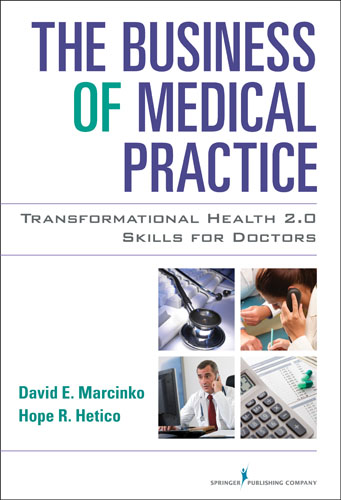
December 23rd, 2011 – The Institute of Medical Business Advisors [iMBA] Inc, in Atlanta, GA www.MedicalBusinessAdvisors.com and Springer Publishing Company of New York, just released the third edition of “The Business of Medical Practice” [Transformational Health 2.0 Skills for Doctors] edited by iMBA founder Dr. David Edward Marcinko MBA, CMP™ and President Hope Rachel Hetico RN, MHA, CPHQ, CMP™
Internal Contents
The 37 chapter, 750 page hard-cover textbook provides a comprehensive resource for those physicians, medical professionals, practice managers, nurse executives, health care administrators and graduate students seeking working knowledge on running a private facility or medical clinic.
Three Major Sections
The BoMP is comprised of three enterprise-wide sections: [1] Qualitative Office Operations, [2] Quantitative Aspects of Medical Practice and [3] Health Policies, Ethics and Leadership. Topics like ARRA, HITECH, ACA and the social networking aspects and ramifications of health 2.0 connectivity for all stakeholders are included for modernity.
Tools and Templates
Tools used throughout the book help readers reference and retain complex information. These tools include:
- Sidebars. Key terms, key concepts, key sources, associations, and factoids all serve to enhance and reinforce the core takeaways from each chapter.
- Tables. Tables are used to display and reference benchmark data, draw comparisons, and illustrate industry data trends.
- Figures. Graphical depictions of concepts help you comprehend the material.
- Charts. Charts allow easily referenced standard industry taxonomies alongside comparisons of related topics.
Assessment
For a further description of the Business of Medical Practice, with online “live’ community, please click: www.BusinessofMedicalPractice.com
To order directly: http://www.springerpub.com/product/9780826105752
Conclusion
Your thoughts and comments on this ME-P are appreciated. Feel free to review our top-left column, and top-right sidebar materials, links, URLs and related websites, too. Then, subscribe to the ME-P. It is fast, free and secure.
Link: http://feeds.feedburner.com/HealthcareFinancialsthePostForcxos
Speaker: If you need a moderator or speaker for an upcoming event, Dr. David E. Marcinko; MBA – Publisher-in-Chief of the Medical Executive-Post – is available for seminar or speaking engagements. Contact: MarcinkoAdvisors@msn.com
OUR OTHER PRINT BOOKS AND RELATED INFORMATION SOURCES:
DICTIONARIES: http://www.springerpub.com/Search/marcinko
PHYSICIANS: www.MedicalBusinessAdvisors.com
PRACTICES: www.BusinessofMedicalPractice.com
HOSPITALS: http://www.crcpress.com/product/isbn/9781466558731
CLINICS: http://www.crcpress.com/product/isbn/9781439879900
BLOG: www.MedicalExecutivePost.com
FINANCE: Financial Planning for Physicians and Advisors
INSURANCE: Risk Management and Insurance Strategies for Physicians and Advisors



Share this:

Filed under: Book Reviews, Health Economics, Health Insurance, Health Law & Policy, Healthcare Finance, iMBA, Inc., Information Technology, Practice Management, Recommended Books | Tagged: Business of Medical Practice, david marcinko, hope hetico, www.BusinessofMedicalPractice.com, www.medicalbusinessadvisors.com |


Praise for the previous edition:
“This comprehensive multi-authored text contains over 450 pages of highly specific and well-documented information that will be interest to physicians in private practice, academics, and in medical management. . . [Chapters are] readable, concise yet complete, and well developed. I could have used a book like this in the past, I will certainly refer to it frequently now.”
– 4 stars
Carol EH Scott-Conner, MD, PhD, MBA
[American College of Physician Executives]
LikeLike
Are independent medical practices an endangered species?
Writing for Time – journalist Bonnie Rochman divulged the ramifications of patients sharing information and tips online, an “empowerment movement” she calls “Patient 2.0.” And, in an investigative report, she profiled the newly created Society for Participatory Medicine, which “encourages patients to learn as much as they can about their condition to help doctors support them on their data-intensive quest”.
Moreover, the NEJM recently said that 50% of physicians will leave medicine within five years because of ObamaCare [Patient Protection and Affordable Care Act].
YET – BE NOT AFRAID!
Join us and re-engineer your medical practice to succeed as a participatory physician in the modern era.
Hope R. Hetico RN MHA
http://www.BusinessofMedicalPractice.com
[Managing Editor]
LikeLike
More about the Business of Medical Practice [3rd edition]
In this third edition, we update and extend the traditional content of both prior editions, and pragmatically offer, answer and/or re-frame significant questions about health 2.0 like:
• How do medical office, financial and cost accounting mechanisms work; and how does transparent business information and reimbursement data impact the modern competitive healthcare scene?
• Where does the marketing hype over social networks and patient generated content end; and fruitful advertising and ROI augmentation reality begin?
• How are medical practices, clinics and physicians evolving as a result of rapid health and non-health related technology changes?
• Does transparent quality information affect the private practice ecosystem?
• How are health 2.0 technologies like online patient communities, podcasts, wikis, blogs, micro-blogs and grid mash-ups, changing the face of medical practice and physician-patient encounters?
• What about eMRs and meaningful use: fiction versus reality?
• What health 2.0 policies are in place after recent domestic terrorist attacks?
• Does health 2.0 enhance or detract from traditional medical care delivery and can private practice business models – absent command control sovereignty – survive?
Dr. David Edward Marcinko MBA
http://www.BusinessofMedicalPractice.com
[Editor-in-Chief]
LikeLike
Doctors with MBAs
I guess I was prescient because I earned my MBA in 1996.
Back then, there was no MHA equivalent just the production-line driven MBA. So, I had to make the translation from the production, to the medical services sector, continually. Most of my classmates thought this strange. I was indeed a novel student and my mother cried when I told her I was going to B-School.
Since then, I served as a hospital medical staff VP, president of a privately held physician practice management corporation, financial advisor and planer for physicians, and managing partner of an Ambulatory Surgery Center that was sold to a public company.
In fact, all this led to codification of knowledge and experience in our successful practice management book for physicians, the “Business of Medical Practice”, just released in its’ third edition.
Good luck to all.
Dr. David E. Marcinko MBA
http://www.BusinessofMedicalPractice.com
LikeLike
David,
I recently purchased it, thank you!
Warmest wishes.
Philippa Kennealy; MD MPH CPCC PCC
[The Entrepreneurial MD]
http://www.entrepreneurialMD.com
(424) 229-1820 — Pacific Time
LikeLike
You could argue that medicine was never intended to be a business in the way selling cars, cosmetics, and fast food are businesses. Among the differences:
• There’s an asymmetry in the knowledge available to patients and doctors – a patient can’t possibly be as informed as a doctor about what’s wrong and what’s needed.
• Patients can’t predict when they’ll need medical care and often seek care when their health is threatened and when decisions must be made quickly.
• Unlike consumers of other goods and services, it’s the supplier – the doctor – who determines what the patient needs.
• Unlike other suppliers, the medical ethic assumes doctors will not sacrifice the medical needs of a patient to make a profit.
• Unlike other businesses, there’s a very steep entry cost to becoming a doctor.
• The health care market is basically not price competitive – a patient contemplating brain surgery is not going to be tempted by a surgeon offering a deep discount.
• What’s at stake in health care – the consequences of making a mistake – is death and disability, not simply a case of buyer’s remorse.
And yet, in the United States, health care has become a for-profit business. The story of how this happened is complex, but decisive elements include the advent of Medicaid and Medicare in 1966 and the widespread availability of employer-sponsored health insurance, which started during World War II. Once patients no longer needed to know the true cost of health care, business interests were free to create what Dr. Arnold Relman called the “medical-industrial complex.”
Regardless of how and why it happened, we now accept that medicine in the US is a profit-generating business, where many segments of the “industry” aim to reward investors, not patients. As a result, health care has become too expensive for many patients, for employers, and for the government. Everyone agrees this is a serious problem, but – with so many competing economic interests – the solution is extremely elusive.
Jan Henderson PhD
http://www.TheHealthCulture.com
http://www.thehealthculture.com/2011/03/from-md-to-mba-the-business-of-primary-care/
LikeLike
Small Business Jobs Act Provisions for Medical Practices
• Business equipment: The new law increases the limit of first-year deductions for equipment purchases to $500,000 for both 2010 and 2011, an increase from $250,000 under prior law. Moreover, leasehold improvements up to $250,000 may qualify for this tax benefit.
• Cellphones: The law removes a provision that has required anyone receiving an employer-provided cellphone to keep records of calls and pay tax on personal use.
Hope Hetico RN MHA
[Managing Editor]
LikeLike
From MD to MBA
[The Business of Primary Care]
Good blog and book, Dr. Marcinko.
But, one could argue that medicine was never meant to become a for-profit business the way selling cars, cosmetics, and fast food are businesses.
Read about the differences between being a patient and being a consumer of non-medical goods and services:
http://www.consultantlive.com/blog/how-health-happened/display/article/10162/1825792
Ken
LikeLike
Doc-Office PPI Rises 0.3% in July
Preliminary physician office wholesale prices climbed 0.3% in July after holding steady the month before.
In July 2010, the physician office Producer Price Index(PPI) increased 0.2%. For the 12-month period ended last month, wholesale physician office prices increased 1.3%. The figure is also preliminary. A year ago, the index showed a 2.5% rise in physician office wholesale prices.
Source: Melanie Evans, Modern Healthcare [8/17/11]
LikeLike
Back by popular demand with new [third editon social media] content!
Dr. Marcinko – I was [and am] always looking for ways to make my practice more profitable and boost my efficiency. So, I am pleased to report that your new book was very helpful in this regard. It was obviously designed with physicians’ needs in mind, with practical advice on the most vital traditional, and health 2.0, topics.
Many thanks.
Dr. Gary Smith
LikeLike
Docs – Wake Up Before It’s Too Late
According to colleague Hal Scherz, MD who recently wrote:
“It never ceases to astonish me how ill informed my colleagues are about what is currently going on in healthcare. I recently sat in a board meeting of a physician- hospital organization and the topic being discussed was accountable care organizations (ACOs)”.
The doctor sitting next to me leaned over and asked me what an ACO was. This is a board member representing 800 physicians in contract negotiations with insurance companies!
http://www.physiciansnews.com/2011/09/06/doctors-will-remain-a-target-until-they-wake-up/
Dr. David Edward Marcinko MBA
http://www.BusinessofMedicalPractice.com
LikeLike
A place for business in medical school
A recent article in the New York Times business section discusses an increase in the number of doctors getting M.B.A.’s in addition to their M.D. degree.
In fact, there have even been many new programs that combine getting both of these degrees together. The article emphasizes the importance of seeing that “healing is an art, medicine is a profession and health care is a business.”
http://www.kevinmd.com/blog/2011/09/place-business-medical-school.html
Julius
LikeLike
The “Bible”
This is the practice “Bible” for all physician owners and physician financial advisors.
With thirty seven chapters and over 700 pages this is mandatory reading on the topics related to all major topics covering the qualitative and quantitative aspects of the business side of today’s medical practice written by experts in the field. The evolution in health care has created even a greater need for business savvy physicians and has also created a entire niche of financial advisors that focus on advising these business owners physicians.
This text fills the gap left by Medical Schools and MBA programs that do not cover this subject matter with any degree of competency.
As a physician financial advisor I found the information about various aspects of medical practice management very useful in understanding and advising my physician clients concerning their practices.
David K. Luke MIM
Certified Medical Planner candidate
http://www.CertifiedMedicalPlanner.org
LikeLike
Rising Patient Deductibles May Mean Trouble for Doctors
Health plan deductibles are rising, and patient self-pay of deductibles is typically difficult for doctors to collect, meaning that increasingly more doctors may lose money on patient deductibles.
And, beware the January 2013 re-start.
Morris
LikeLike
Essential reading
[Format: Kindle Edition]
A very important reading for today’s physician. It’s not perfect however. Chapters and sub chapters seem disorganized and without logical flow.
Nevertheless, it is the best book out there now and I’ve read quite a few already.
D. Baag
LikeLike
Most Physicians Concerned About Future of Profession
Nearly 6 in 10 physicians in a Deloitte Center for Health Solutions survey said they are concerned about the future of medicine, pointing to declining clinical autonomy and income. Pessimism among physicians resulted in nearly 75% agreeing that “the best and brightest” may avoid a career in medicine. That number increased from 69% the year before.
Still, 7 in 10 physicians reported they were satisfied with their careers. The most satisfied groups were the non-surgical specialists (67%) and physicians aged 25 to 39 (80%). Primary care physicians were the least satisfied division, at 59%.
Source: Marcia Frellick, Medscape News [3/28/13]
LikeLike
Physician Recruiters See “Demise of Private Practice”
The American physician is evolving from self-employed practitioner to somebody’s employee, and nobody [supposedly] knows that trend better than headhunting companies such as Merritt Hawkins. The company’s latest annual review of recruiting trends, released last week, said its findings suggest that “the independent, private practice model is becoming an anachronism.”
Merritt Hawkins reported that 64% of physician search assignments from April 1, 2012, to March 31, 2013, came from hospitals looking to hire. In 2004, hospitals generated just 11% of physician searches. Back then, the majority of assignments came from group practices, physician partnerships, and solo practitioners, according to Merritt Hawkins.
Other organizations than hospitals also want to hire MDs and DOs – Merritt Hawkins is conducting more and more searches on behalf of retail clinics, urgent care centers, free-standing emergency departments, and community health centers.
Merritt Hawkins further opined that in all, between 85% and 90% of all search assignments involve some form of physician employment compared with 30% in 2004. “It’s a complete flip-flop in business”
Yet, Dr. David Edward Marcinko, MBA Editor-in-Chief of this ME-P states: “We’re seeing the demise of private practice; in certain areas – But, the pendulum will change back to solo, small or larger group practice and the free enterprise system. Who wants to be an employee, anyway”
http://www.BusinessofMedicalPractice.com
For the seventh year in a row, primary care tops the list of the most recruited medical fields, with first place belonging to family physicians and second to general internists. Rounding out the top ten are hospitalist, psychiatry, emergency medicine, pediatrics, OB/GYN, general surgery, neurology and nurse practitioner.
Your thoughts?
Ann Miller RN MHA
http://www.CertifiedMedicalPlanner.org
LikeLike
Healthcare Organization’s Implementation of Business Intelligence Systems
More than half of all healthcare organizations have yet to implement a business intelligence (BI) system. Fifty-eight percent of those surveyed indicated that their organization has not implemented a BI system. This number includes the 36 percent that simply do not have a BI system, 15 percent that do not have such a system but plan to implement one in the next 12-24 months and 7 percent that have a BI system but have yet to implement it. Forty-two percent of respondents have implemented and are currently using a BI system.
Finance, operations and clinical care top areas for planned use. Nearly three-quarters of respondents indicated they expected a BI system to be widely used in finance (76 percent), operations (75 percent) and clinical care (71 percent). Interestingly, about half (53 percent), expected it to be widely used for compliance.
Source: TEKsystems
LikeLike
Maybe medicine isn’t really a business after all
According to Geoffrey L. Fey MD:
I work a job where I am the boss, sort of, where I can tell technologists what to do, but I don’t employ them. So I can’t hire good ones and I can’t fire bad ones. I am the expert on what is best for the patient, but I don’t make a lot of the important decisions. I am paid for the work I do, but I am expected to provide a cost-effective, minimalist approach (crazy, right?). I am required to provide care, even if the patient can’t pay for the service. Oh, and the doctors who are on the medical staff must serve on the various committees, but they don’t get paid for the time, other than potentially in political capital.
http://www.kevinmd.com/blog/2014/03/medicine-business.html
Hope R. Hetico RN MHA
LikeLike
Is Healthcare a Business?
In the United States, the question has been asked time and again but never satisfactorily answered.
By virtue of publically financed healthcare systems, the rest of the developed world has decided, to a greater or lesser extent, that medicine and healthcare are not pure businesses—that citizens have a right to care, even when they can’t pay all associated costs.
It’s starting to look like Americans won’t be able to duck the question for much longer.
http://thehealthcareblog.com/blog/2014/09/09/the-squeeze-is-on-for-u-s-hospitals/
EDMUND BILLINGS, MD
+++++++++++++++++++++++++++++++++++++++++++++++++==
Ed,
Of course it’s a business.
Respectfully,
Dr. David Edward Marcinko MBA
LikeLike
AN EXCELLENT TEXTBOOK
“This is an excellent book on medical practice management for physicians and health professionals. It is all inclusive yet very easy to read with much valuable information.
And, I have been expanding my business knowledge with all of Dr. Marcinko’s prior books. I highly recommend this one, too. It is a fine educational tool for all doctors”.
Dr. David B. Lumsden MD MS MA
Orthopedic Surgeon
[Baltimore, Maryland]
LikeLike