On the Rise and Fall of Limited Partnerships

Taking A Historical Look at this Investment Vehicle

By Dr. David Edward Marcinko MBA CMP™

www.CertifiedMedicalPlanner.com

[Publisher-in-Chief]

Back in the 1980s – a time I am loathe admitting that I remember well – limited partnerships (LPs) were all the rage and often touted as the investment vehicle of the future; especially to tax-averse physicians and high income medical professionals and investors.

Oil and gas and real estate LPs dominated the market. But, there were also cattle feeding, master recording disks, equipment and aircraft leasing, and cable TV investments. The LP heyday was 1983 through 1989, and most early LPs were private or non-publicly traded.

Popularity Rising

Why were they so popular? LPs provided the benefits of direct ownership (income potential and tax benefits) without management responsibility and personal liability. Losses were limited to one’s original investment. Brokerage firms pushed them hard, paying their sales representatives [financial advisors?] the highest commissions and often characterizing these risky investments as “safe” and a “means of capital preservation.”

Early ’80s

In the early 80s, investors could use depreciation, interest, and investment tax credits to offset not only LP income but ordinary income from salary and other investments. This was a huge incentive for high income earning doctors. In 1981, the Tax Act allowed accelerated depreciation for real estate, and non-recourse debt was treated as depreciable cost (partners bore no risk of economic loss). Soon, the IRS began to attack LPs. Both real estate and oil and gas values declined. LPs soon became illiquid investments, producing little or no return.

’86 Tax Act

Then came the Tax Reform Act of 1986 (TRA), which brought with it “at risk” limitations to real estate tax shelters and the new passive loss provisions. LP sales then spiraled downward. The ’86 Tax Law provided that limited partners could not increase their basis in the LP for their share of partnership debt unless they were personally liable for repayment or if the lender had an interest other than as a creditor (unless “qualified non-recourse debt” was used).

1990s

In the ’90s, investors either hung on to – or sold – their LP investments in the secondary market. Investors were subject to substantial discounts upon sale and they had to recapture tax benefits previously received (including those from non-recourse financing).

Assessment

Simply abandoning these investments did not avoid unfavorable tax consequences, such as the decrease in a partner’s share of partnership liabilities being treated as a cash distribution. Capital gains were recognized to the extent that a partner’s share of partnership liabilities exceeds the adjusted basis of the partner’s interest.

Note: “What Happened to Limited Partnerships?” Lee Knight and Ray Knight Journal of Accountancy, July 1997, pp. 37–42, American Institute of Certified Public Accountants.

Conclusion

And so, your thoughts and comments on this ME-P are appreciated. Were you burned by LPs back in the day, or have a LP story to tell us? Please opine. Feel free to review our top-left column, and top-right sidebar materials, links, URLs and related websites, too. Then, subscribe to the ME-P. It is fast, free and secure.

Speaker: If you need a moderator or speaker for an upcoming event, Dr. David E. Marcinko; MBA – Publisher-in-Chief of the Medical Executive-Post – is available for seminar or speaking engagements. Contact: MarcinkoAdvisors@msn.com and http://www.springerpub.com/Search/marcinko

Our Other Print Books and Related Information Sources:

Health Dictionary Series: http://www.springerpub.com/Search/marcinko

Practice Management: http://www.springerpub.com/product/9780826105752

Physician Financial Planning: http://www.jbpub.com/catalog/0763745790

Medical Risk Management: http://www.jbpub.com/catalog/9780763733421

Healthcare Organizations: www.HealthcareFinancials.com

Physician Advisors: www.CertifiedMedicalPlanner.com

Subscribe Now: Did you like this Medical Executive-Post, or find it helpful, interesting and informative? Want to get the latest ME-Ps delivered to your email box each morning? Just subscribe using the link below. You can unsubscribe at any time. Security is assured.

Link: http://feeds.feedburner.com/HealthcareFinancialsthePostForcxos

Sponsors Welcomed: And, credible sponsors and like-minded advertisers are always welcomed.

Link: https://healthcarefinancials.wordpress.com/2007/11/11/advertise

Product DetailsProduct DetailsProduct Details       

Product Details  Product Details

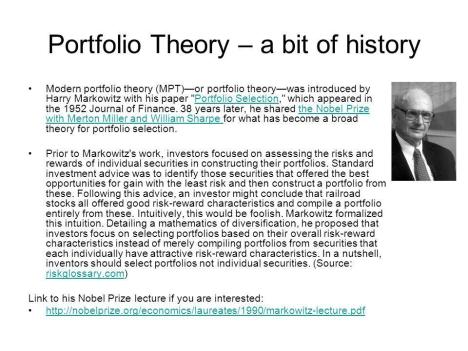
The Living Legacy of Dr. Harry Markowitz

Creating Diversified Portfolios of Uncorrelated Assets

By Dr. David Edward Marcinko MBA CMP™

[Publisher-in-Chief]

More than a half century ago, a paper appeared in The Journal of Finance written by a 24-year-old doctoral candidate in economics at the University of Chicago—Harry Markowitz. It was called “Portfolio Selection” and suggested that investors take into account risk in pursuit of the highest return—a concept that we take for granted today [Modern Portfolio Theory].

Markowitz drew a trade-off curve between risk and reward and called it the “efficient frontier.” A rational physician executive or other investor who knew his or her risk tolerance could choose an appropriate portfolio from a point on this curve. Markowitz led investors to diversified portfolios of uncorrelated investments.

Dissertation Follow-up

Markowitz followed up his dissertation in 1959 with a book entitled Portfolio Selection [Efficient Diversification of Investment]. His many contributions to finance earned him the Nobel Prize in Economic Science in 1990 along with William Sharpe and Merton Miller. He reasoned that diversification is about avoiding the covariance.

If risks are uncorrelated, you can reduce the risk of a portfolio to practically zero by sufficient diversification. This doesn’t work if risks are correlated. If one invests in a very large number of securities that are correlated, risk does not approach zero but rather the average covariance, which is a very substantial amount of risk.

Where It All Started

It was at the RAND Corporation that Markowitz met William [Bill] Sharpe who was working on his PhD at UCLA. Markowitz takes issue with Sharpe’s Capital Asset Pricing Model (CAPM), which claims that the expected return of a security depends only on its beta—ignoring fundamental analysis.

CAPM also implies that the market portfolio is efficient, even though investors in the market may not act rationally. It says that the market portfolio is a mean-variance efficient portfolio. Markowitz disputes this conclusion. He points to Fama and French and others who have found that expected returns are more closely related to book-to-price or size—not to beta.

hm

Assessment

The still living Markowitz fends off criticism of mean-variance analysis only being valid when probability distributions are normal by stating that he realizes that probability distributions are not normal in the real world.

But, if they are similar to a normal distribution, mean variance does a good job at approximating expected utility. He admits that when they are too dispersed, mean variance doesn’t work well.

Note: Travels along the Efficient Frontier,” an interview with Harry Markowitz by Jonathan Burton, Dow Jones Asset Management, May/June 1997, pp. 21–28, Dow Jones Financial Publishing Corp.

Conclusion

And so, your thoughts and comments on this ME-P are appreciated. Do you use MPT when investing, or CAP-M? Feel free to review our top-left column, and top-right sidebar materials, links, URLs and related websites, too. Then, subscribe to the ME-P. It is fast, free and secure.

OUR OTHER PRINT BOOKS AND RELATED INFORMATION SOURCES:

Product DetailsProduct DetailsProduct Details

Product Details  Product Details

Comprehensive Financial Planning Strategies for Doctors and Advisors: Best Practices from Leading Consultants and Certified Medical Planners™

***

On Stock Market [Mis]Timing Strategies

Do They Come Up Short?

Dr. David Edward Marcinko MBA CMP™

www.CertifiedMedicalPlanner.com

[Publisher-in-Chief]

Stock market investment rules are notorious for showing profit when tested on the same sample period from which they were developed, and then failing when applied to a new period. According to Professor Roger C. Vergin, it’s dangerous to use the same data to both discover and test the rules.

Of Marty Zweig

Using the “Zweig Strategies” developed by Martin Zweig and published back in 1986 in Winning on Wall Street (WOWS), Professor Vergin shoots some rather sizable holes in Zweig’s indicators by testing them against the 10-year period since WOWS was published. Zweig’s models are applied to various periods from 19 to 33 years, ending in 1985, and they claim to outperform a buy-and-hold strategy with annual rates of return as much as eight times as large, according to some measures. When the author ran these strategies for the 10-year period ending Dec. 5, 1995, not only did they not outperform a buy-and-hold strategy, but they trailed the market averages by a significant amount—9% vs. 14.4% for buy-and-hold.

The “Z” Indicators

Zweig’s indicators include a prime rate indicator, a Federal Reserve indicator, an installment debt indicator, a 4% indicator (market momentum), a monetary model, and a “super” model, which Zweig referred to as “the only investment model you will ever need.” 

Vergin corrects for inconsistencies in the evaluation criteria from one strategy to the next in WOWS and runs the numbers for the original test period first. Zweig’s strategies still outperform buy-and-hold. But, when run against an independent time period, as the author has done, the wheels fall off. Vergin runs the Zweig Strategies against the S&P 500, the Value Line Index, and an index developed by Zweig called ZUPI (all NYSE stocks).

Assessment

Over the 10-year period, none of the six Zweig Strategies outperformed a simple buy-and-hold strategy when compared against any of the three indexes mentioned above. They produced an average return of 9% compared to 14.4% for buy-and-hold.

In fact, Dr. Burton Malkiel’s [personal communication] conclusion in his book A Random Walk Down Wall Street, was that: “market timing is likely, not only to not add value, but to be counterproductive” seems to have borne out again.”

Note: “Market-Timing Strategies: Can You Get Rich?” by Roger C. Vergin. The Journal of Investing, Winter 1996, pp. 79–85, Institutional Investor, Inc. [212] 224-3185)

Conclusion

And so, your thoughts and comments on this ME-P are appreciated. By trying enough patterns against past events, one can always find simple rules that “would have” worked well in the past. But, do they hold up against differing periods of time; like say 2008-09? … At least not yet! What do you think?

Feel free to review our top-left column, and top-right sidebar materials, links, URLs and related websites, too. Then, subscribe to the ME-P. It is fast, free and secure.

Speaker: If you need a moderator or speaker for an upcoming event, Dr. David E. Marcinko; MBA – Publisher-in-Chief of the Medical Executive-Post – is available for seminar or speaking engagements. Contact: MarcinkoAdvisors@msn.com and http://www.springerpub.com/Search/marcinko

Get our Widget: Get this widget!

Our Other Print Books and Related Information Sources:

Health Dictionary Series: http://www.springerpub.com/Search/marcinko 

Practice Management: http://www.springerpub.com/product/9780826105752

Physician Financial Planning: http://www.jbpub.com/catalog/0763745790

Medical Risk Management: http://www.jbpub.com/catalog/9780763733421

Healthcare Organizations: www.HealthcareFinancials.com

Physician Advisors: www.CertifiedMedicalPlanner.com

Subscribe Now: Did you like this Medical Executive-Post, or find it helpful, interesting and informative? Want to get the latest ME-Ps delivered to your email box each morning? Just subscribe using the link below. You can unsubscribe at any time. Security is assured.

Link: http://feeds.feedburner.com/HealthcareFinancialsthePostForcxos

Sponsors Welcomed: And, credible sponsors and like-minded advertisers are always welcomed.

Link: https://healthcarefinancials.wordpress.com/2007/11/11/advertise

Product DetailsProduct DetailsProduct Details       

Product Details  Product Details

Are You Scared of Investment Losses?

Well Doctors – You Should Be!

By Somnath Basu PhD, MBA
President: AgeBander
Thousand Oaks, CA

There is a very simple way for medical professionals, and us all, to approach investment decision making. To start with, begin by asking yourself some basic and preliminary questions such as what is the investment for (to buy a house, to fund a kid’s education, or is it to fund retirement and the like) and how long these investments will last (for example, up to 40 – 50 years sometimes when one starts planning for retirement early).

Basic Questions

Once these basic questions are answered then ask this $64 million dollar question of your-self. Over your planning time horizon, how much of this money are you willing to lose? For example if you are trying to accumulate $100,000 for a house, how much could you afford to lose and still not lose your bearings? What if it is a five-year plan and in the 4th year you lose 50% of your accumulated funds with only one more year to go. How would you feel? This is the critical question in any investment decision. Typically you will not hear a financial planner [FP] or financial advisor [FA] talk in such terms; but perhaps they should!

www.CertifiedMedicalPlanner.com

Conservative Investing

When financial planners and financial advisors talk about conservative investing, they couch the same idea in terms of risk and return. In the language of these experts such measures are often quantitative and difficult to understand for the average investor. While return on investments seems like a fairly straightforward concept (8% or 11% for example), risk is mentioned usually in terms of standard deviation, a statistical terminology difficult both to explain and to understand. Hence, most physicians and investors are pretty much in the dark when it comes down to making the decision itself since it is their sole responsibility. Thus, the investor is left with no other choice but to decide on whether the suggested investment return sounds attractive or not. On this track, the higher the return, the more attractive the investment seems.

Furthermore, FAs may suggest that a return such as 8-10% is a conservative rate whereas 12-15% is aggressive. Hence if an 8-10% based investment is being suggested, the investor is likely to go with what she/he thinks is the most conservative decision, being the conservative investors they believe they are. (As an aside, there is a whole theory about physician investors being conservative and risk averse)

Unwinding the Mystery

To unwind this basic mystery, simply ask the FA the likelihood of various amounts of losses in any single year including the last year of the investment. Could half your funds be wiped out in any year including the last year? What is the likelihood of such an event? What is the likelihood that it could be 25% in any given year? Suppose your planner shows how your $100,000 will grow to $150,000 in five years if you were to earnings the average rate of 8% per year for five years. Under such a scenario, what is the likelihood that you could lose half your accumulated funds in the last year and come out with a negative investment return even though you still earned that 8% average rate over the five years? As we know now such possibilities not only exist but are not uncommon either. As an extreme case in point consider the 2008-09 financial debacle [flash-crash]! If your investment was maturing in 2009, the outcome would have been a lot worse.

The Driver of Concern

This concern of loss is what should drive us in our investment decisions. Most planners are unable to explain this concept of loss aversion to their clients because they themselves are not adequately educated to understand the concept themselves. However, as mentioned before, the solution is simple. Now reconsider the example above of earning an average annual rate of 8% over 5 years. While it sounds conservative on the surface, it is actually quite aggressive. Earning 8% a year for five consecutive years (or averaging out over the five years to an 8% rate) is a very tall order. To do so, especially under most circumstances, one would actually be exposed to a large amount of loss in any given year.

Without getting into the details of how the standard deviation measurement of risk converts into the loss propensity and using very rough estimates, another way to view the 8% investment opportunity is to understand that in any year, you may not even earn a dollar (0%) and this could happen in each and every year. The likelihood of such an outcome is astonishingly high – about 25%. Thus, the investment decision is about whether you are willing to bet where the odds of loss is one to four (25%) every year for each of the five years. Of course the reverse is also true that in each of the years you have a 75% chance to  earn a positive return on your investment and the earning rate itself could be anywhere from zero to the highest rate imaginable. Further, there is a 12% chance that you could be actually losing 8% a year for each of the five years! In prolonged economic downturns, which are not so uncommon, such are the outcomes. Now ask yourself this question: If you were told about these odds of losses, would you still consider the 8% investment opportunity to be conservative? Hopefully not, especially when you feel unsettled about the existing economic state of affairs. Further, would you consider a 10% return to be attractive and conservative if you were rejecting a 15% investment and choosing the 10% one?

Assessment

As mentioned earlier, this idea of loss aversion is probably the most powerful tool in the investor’s bag. Once you understand the implications of loss from any investment decision, then the loss aversion approach to making this decision is a dimensional shift, something that can be easily understood and applied by all investors. Furthermore, if most physicians and investors behaved similarly, collectively we would make the investment market a much safer place. Unfortunately for now, there are no known ways of educating all investors about this critical aspect since the tools that currently exist are all based on statistical concepts of risk and return which make little sense to most lay investors.

Conclusion

And so, your thoughts and comments on this ME-P are appreciated. Feel free to review our top-left column, and top-right sidebar materials, links, URLs and related websites, too. Then, subscribe to the ME-P. It is fast, free and secure.

Speaker: If you need a moderator or speaker for an upcoming event, Dr. David E. Marcinko; MBA – Publisher-in-Chief of the Medical Executive-Post – is available for seminar or speaking engagements. Contact: MarcinkoAdvisors@msn.com and http://www.springerpub.com/Search/marcinko

Get our Widget: Get this widget!

Our Other Print Books and Related Information Sources:

Health Dictionary Series: http://www.springerpub.com/Search/marcinko

Practice Management: http://www.springerpub.com/product/9780826105752

Physician Financial Planning: http://www.jbpub.com/catalog/0763745790

Medical Risk Management: http://www.jbpub.com/catalog/9780763733421

Healthcare Organizations: www.HealthcareFinancials.com

Physician Advisors: www.CertifiedMedicalPlanner.com

Subscribe Now: Did you like this Medical Executive-Post, or find it helpful, interesting and informative? Want to get the latest ME-Ps delivered to your email box each morning? Just subscribe using the link below. You can unsubscribe at any time. Security is assured.

Link: http://feeds.feedburner.com/HealthcareFinancialsthePostForcxos

Sponsors Welcomed: And, credible sponsors and like-minded advertisers are always welcomed.

Link: https://healthcarefinancials.wordpress.com/2007/11/11/advertise

Product DetailsProduct DetailsProduct Details       

Product Details  Product Details

   Product Details 

ProPublica Reports Standard’s & Poor’s Triple “A” Ratings Collapse Again

The Question is Why?

Join Our Mailing List 

By Jesse Eisinger

Several weeks ago, Standard & Poor’s put out a press release: The credit rating agency warned it was poised to downgrade almost 1,200 complex mortgage securities. This data is vital to all physician executives, financial  advisors and investors.

Assessment

So what? Isn’t that dog-bites-man at this point?

Link: http://www.propublica.org/thetrade/item/the-trade-credit-rating-agencies-standard-and-poors/

Our Other Print Books and Related Information Sources:

Health Dictionary Series: http://www.springerpub.com/Search/marcinko

Practice Management: http://www.springerpub.com/product/9780826105752

Physician Financial Planning: http://www.jbpub.com/catalog/0763745790

Medical Risk Management: http://www.jbpub.com/catalog/9780763733421

Healthcare Organizations: www.HealthcareFinancials.com

Physician Advisors: www.CertifiedMedicalPlanner.com

Subscribe Now: Did you like this Medical Executive-Post, or find it helpful, interesting and informative? Want to get the latest ME-Ps delivered to your email box each morning? Just subscribe using the link below. You can unsubscribe at any time. Security is assured.

Link: http://feeds.feedburner.com/HealthcareFinancialsthePostForcxos

Sponsors Welcomed: And, credible sponsors and like-minded advertisers are always welcomed.

Link: https://healthcarefinancials.wordpress.com/2007/11/11/advertise

Product DetailsProduct DetailsProduct Details       

Product Details  Product Details

Book Dr. Marcinko to Speak

At Your Next Medical Management, Pharma or Financial Services Seminar  

Our Editor-and-Chief, Dr. David Edward Marcinko MBA CMP™ is a former medical practitioner and board certified surgeon [FACFAS], certified financial planner, stock-broker, insurance agent, Registered Rep, RIA representative, writer, editor, journalist, expert witness and healthcare economist who enjoys public speaking and gives as many talks each year as possible, at a variety of medical society, pharmaceutical and financial services conferences around the country and world.

Many Venues

These have included lectures and visiting professorships at major academic centers, keynote lectures for hospitals, economic seminars, pharma conventions and health systems, endnote lectures at city and statewide financial coalitions, and break-out lectures for a variety of internal and external yearly meetings.

Assessment

More info: https://medicalexecutivepost.com/dr-david-marcinko%e2%80%99s-bookings/

Speaker: And so, if you need a moderator or speaker for an upcoming event, Dr. David E. Marcinko; MBA – Publisher-in-Chief of the Medical Executive-Post – is available for seminar or speaking engagements. Contact: MarcinkoAdvisors@msn.com and http://www.springerpub.com/Search/marcinko

Get our Widget: Get this widget!

Our Other Print Books and Related Information Sources:

Health Dictionary Series: http://www.springerpub.com/Search/marcinko

Practice Management: http://www.springerpub.com/product/9780826105752

Physician Financial Planning: http://www.jbpub.com/catalog/0763745790

Medical Risk Management: http://www.jbpub.com/catalog/9780763733421

Healthcare Organizations: www.HealthcareFinancials.com

Physician Advisors: www.CertifiedMedicalPlanner.com

Subscribe Now: Did you like this Medical Executive-Post, or find it helpful, interesting and informative? Want to get the latest ME-Ps delivered to your email box each morning? Just subscribe using the link below. You can unsubscribe at any time. Security is assured.

Link: http://feeds.feedburner.com/HealthcareFinancialsthePostForcxos

Sponsors Welcomed: And, credible sponsors and like-minded advertisers are always welcomed.

Link: https://healthcarefinancials.wordpress.com/2007/11/11/advertise

Product DetailsProduct DetailsProduct Details       

Product Details  Product Details

   Product Details 

Get a Free Retirement Planning e-Book

Unveiling the Retirement Myth

Review by: Dr. David Edward Marcinko MBA CMP™

[Publisher-and-Chief]

Jim Otar is a certified financial planner in Canada. He wrote the book: Unveiling the Retirement Myth on retirement income planning: how to make your retirement portfolio last as long as you do when you are living off your savings and investments in retirement.

The Print Version

The print version costs $49.99 on Amazon. But, for a limited time only, Jim Otar is offering a PDF version of this 525-page, 45 chapter book for FREE on his website retirementoptimizer.com.

The e-Book

Here’s the download link until January 10th, 2011:

http://www.retirementoptimizer.com/downloads/URMG/URMGreem.pdf

Assessment

This is a very worthwhile e-book offered at an excellent price-point. Its’ subtitle is advanced retirement planning based on market history, and that is exactly what is presented – much historical review although not especially of an advanced nature. But, it is voluminous. Additionally, since the past is no indication of the future – and current events like the potential of a “new economics normal” are not explicitly entertained – the treatise lacks a feeling of modernity!

Fortunately, the author does include many figures, graphs, illustrations and tables for ease of understanding. The mini case-examples also help keep it from trending to the boorish. This is an important point I have painfully learned after almost four decades of writing, editing and publishing [i.e., readability and interest]. Moreover, if the reader was not familiar with time-value of money calculations and concepts before reading, s/he will surely be after.

While mostly generic in nature – containing little tax, insurance, risk management and accounting information  – and not written for a physician or medical professional audience; the book represents a worthwhile review for doctor colleagues and/or those laymen unfamiliar with the ever widening topic. However, those physicians seeking healthcare specificity should look elsewhere for assistance www.CertifiedMedicalPlanner.com

Conclusion

And so, your thoughts and comments on this ME-P are appreciated. Feel free to review our top-left column, and top-right sidebar materials, links, URLs and related websites, too. Then, subscribe to the ME-P. It is fast, free and secure.

Speaker: If you need a moderator or speaker for an upcoming event, Dr. David E. Marcinko; MBA – Publisher-in-Chief of the Medical Executive-Post – is available for seminar or speaking engagements. Contact: MarcinkoAdvisors@msn.com and http://www.springerpub.com/Search/marcinko

Get our Widget: Get this widget!

Our Other Print Books and Related Information Sources:

Health Dictionary Series: http://www.springerpub.com/Search/marcinko

Practice Management: http://www.springerpub.com/product/9780826105752

Physician Financial Planning: http://www.jbpub.com/catalog/0763745790

Medical Risk Management: http://www.jbpub.com/catalog/9780763733421

Healthcare Organizations: www.HealthcareFinancials.com

Physician Advisors: www.CertifiedMedicalPlanner.com

Subscribe Now: Did you like this Medical Executive-Post, or find it helpful, interesting and informative? Want to get the latest ME-Ps delivered to your email box each morning? Just subscribe using the link below. You can unsubscribe at any time. Security is assured.

Link: http://feeds.feedburner.com/HealthcareFinancialsthePostForcxos

Sponsors Welcomed. And, credible sponsors and like-minded advertisers are always welcomed.

Link: https://healthcarefinancials.wordpress.com/2007/11/11/advertise

Product DetailsProduct DetailsProduct Details       

Product Details  Product Details

Is There an “Efficient Frontier” for Medicare Payment Reform?

An Essay on Financial Health Risk Self-Selection

By Dr. David Edward Marcinko MBA CMP™

http://www.CertifiedMedicalPlanner.org

[Publisher-in-Chief]

Health economist Austin Frakt PhD, of the Incidental Economist, alerted us to this recent publication “Achieving Cost Control, Care Coordination, and Quality Improvement through Incremental Payment System Reform”, by and from: (Averill, et al., JACM, 2010). The paper describes various Medicare payment reform methods.

The Abstract

The healthcare reform goal of increasing eligibility and coverage cannot be realized without simultaneously achieving control over healthcare costs. The reform of existing payment systems can provide the financial incentive for providers to deliver care in a more coordinated and efficient manner with minimal changes to existing payer and provider infrastructure. Pay for performance, best practice pricing, price discounting, alignment of incentives, the medical home, payment by episodes, and provider performance reports are a set of payment reforms that can result in lower costs, better coordination of care, improved quality of care, and increased consumer involvement. These reforms can produce immediate Medicare annual savings of $10 billion and create the framework for future savings by establishing financial incentives for long-term provider behavior changes that can lead to lower costs.

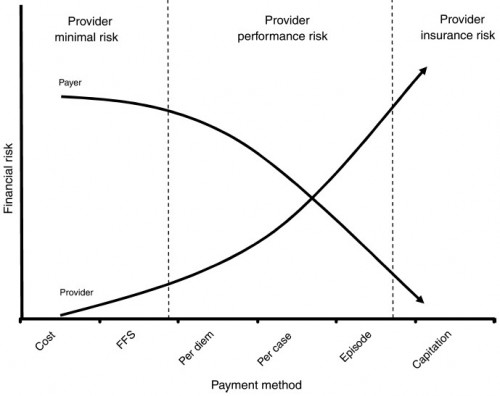
Patient Risk Sharing

Of course, the third dimension of risk [beyond traditional doctor/hospital provider and Medicare insurer] would be the risk borne by the patient insured (degree of cost-sharing or “consumer responsibility”). This relationship is represented diagrammatically right here:

Brief Review of MPT

Modern portfolio theory (MPT) attempts to maximize investment portfolio expected returns for a given level of risk by carefully choosing the proportions of various asset classes. As a mathematical formulation, the concept of diversification aims to select a collection of assets that collectively lowers risk [measured by standard deviation] more than any individual asset class. This pleasing point is known as the “efficient frontier.” And, it can be seen intuitively because different types of assets often change in value in opposite ways.

Is There an Insurance Efficient Frontier?

Health insurance [medical payment reform] econometric considerations may now be extended in this analogy to suggest that medical providers and CMS payers are the surrogates for two dimensions in the MPT. The third might be the risks borne by the patient insured (degree of cost-sharing or “consumer responsibility”), as above.

Assessment

Then, patients could self-select where they wish to fall on the health insurance “efficient frontier”, balancing all three dimensions as in MPT, along with lifestyle and moral hazard considerations, etc.

Conclusion

And so, your thoughts and comments on this ME-P are appreciated. Is there an “efficient frontier” for Medicare payment reform?

Feel free to review our top-left column, and top-right sidebar materials, links, URLs and related websites, too. Then, subscribe to the ME-P. It is fast, free and secure.

Link: http://feeds.feedburner.com/HealthcareFinancialsthePostForcxos

Speaker: If you need a moderator or speaker for an upcoming event, Dr. David E. Marcinko; MBA – Publisher-in-Chief of the Medical Executive-Post – is available for seminar or speaking engagements. Contact: MarcinkoAdvisors@msn.com

OUR OTHER PRINT BOOKS AND RELATED INFORMATION SOURCES:

Product DetailsProduct DetailsProduct Details

Product Details  Product Details

   Product Details 

Why You’re Better off with Variable Annuities than Mutual Funds?

Investing Under the Umbrella

By Dr. David Edward Marcinko MBA, CMP™

[Editor-in-Chief]

http://www.CertifiedMedicalPlanner.org

While participation in savings programs such as 401(k), 403(b), IRAs, and SEPs were at record numbers before the “flash-crash” of 2008-09, each of these plans is subject to a contribution cap.

Consequently, investors are always looking for tax-efficient methods to save more for retirement; especially medical professionals as the economy improves as it has been doing of late. Many have turned, or continue to use, mutual funds. In fact approximately 47% of mutual fund assets are composed of nonqualified funds. And, investors tend to buy mutual funds on the basis of before-tax performance rankings.

Enter the VAs

But these folks might far better off with variable annuities [VAs] according to C. Michael Carty and Robert E. Skinner in the article “Variable Annuities vs. Mutual Funds” (Financial Planning, November 1996, pp. 75–84, Securities Data Publishing, Inc). In fact, they present a strong case for investing in variable annuities (said to operate under an umbrella that protects them from current taxation and inflation) as compared to mutual funds, which may continue today.

The Dickson-Shoven Study

Carty and Skinner refer to a 1993 study by Dickson and Shoven conducted at Stanford University in which mutual funds were ranked on an after-tax basis. The change in relative rankings was dramatic. Dickson and Shoven concluded that:

  • Investors should always use after-tax rankings to evaluate and select mutual funds.
  • Given two investments with similar pretax returns, an investor should select the one involving fewer taxes.
  • A variety of approaches to sheltering or deferring taxes should be considered.

And, in one of the first comparison of returns between variable annuities and mutual funds, Rodney Rhoda of Fidelity Investments demonstrated that the difference in expense charges between variable annuities and mutual funds are less than one would expect because of lower variable annuity trading costs and a more stable asset base, which is usually more fully invested.

Assessment

I am not a fan of VAs as several essays in this ME-P suggest. Fees, expenses, loads and commissions are just too darned high.  And, most are sold, not bought.

However, the authors demonstrated that under either lump-sum or gradual withdrawal assumptions, variable annuities consistently beat mutual funds, particularly for medium to high tax-bracket investors who achieve only median investment performance. Low tax-bracket investors who achieve average or lower investment performance benefit least from variable annuities. Also, variable annuities have been shown to be more likely to withstand the ravages of inflation.

And so, the conundrum continues.

Conclusion

Your thoughts and comments on this ME-P are appreciated. Feel free to review our top-left column, and top-right sidebar materials, links, URLs and related websites, too. Then, subscribe to the ME-P. It is fast, free and secure.

Link: http://feeds.feedburner.com/HealthcareFinancialsthePostForcxos

Speaker: If you need a moderator or speaker for an upcoming event, Dr. David E. Marcinko; MBA – Publisher-in-Chief of the Medical Executive-Post – is available for seminar or speaking engagements. Contact: MarcinkoAdvisors@msn.com

OUR OTHER PRINT BOOKS AND RELATED INFORMATION SOURCES:

PRACTICES: www.BusinessofMedicalPractice.com
HOSPITALS: http://www.crcpress.com/product/isbn/9781466558731
CLINICS: http://www.crcpress.com/product/isbn/9781439879900
ADVISORS: www.CertifiedMedicalPlanner.org
BLOG: www.MedicalExecutivePost.com
FINANCE: Financial Planning for Physicians and Advisors
INSURANCE: Risk Management and Insurance Strategies for Physicians and Advisors

Product Details  Product Details

How Equity-Based Securities Affect a Physician’s Total Financial Plan

Equity Securities Provide a Portfolio Growth Engine

By Dr. David Edward Marcinko MBA, CMP™

www.HealthcareFinancials.com

[Editor-in-Chief]

Equity securities provide growth. Theoretically, the amount of growth potential in an equity security is infinite. A stock’s price appreciation possibilities have no limit. However, a stock’s price can also go to zero and an investor can lose the entire amount invested. Therefore, while stocks contribute long-term growth to a portfolio, they also add risk.

Stock Diversification is Key

Diversification is the best defense against risk, so only a portion of every portfolio should be in stocks. Other investments—fixed income securities; cash equivalents that can be used to take advantage of opportunities or for emergencies; real estate; and even commodities (precious metals, for instance, or securities of companies whose businesses are commodity-based)—should all be considered by the responsible physician-investor or financial advisor as components of a well-rounded, balanced portfolio.

And So is Portfolio Diversification

The stock portfolio itself should also be diversified. Diversify among all types of equity securities such as some large capitalization stocks, some small capitalization stocks, some utilities, some cyclical stocks, some value stocks, some growth stocks, and some defensive stocks. Because it is difficult to adequately diversify an equity portfolio with a small amount of money, consider mutual funds or ETFs for some doctors or financial advisory clients. At least this is the philosophy of our Certified Medical Planner™ [CMP] online educational program.  

www.CertifiedMedicalPlanner.com

Assessment

Always remember that, because the equity component of the portfolio can be expected to provide more than its proportionate share of the risk of a portfolio, it must be constantly monitored. Also remember that every physician-investor as a different level of risk tolerance, and some may be able to handle ownership of only the most solid and stable equity investments.

Conclusion

And so, your thoughts and comments on this ME-P are appreciated. But, what is “di-worsification?” Feel free to review our top-left column, and top-right sidebar materials, links, URLs and related websites, too. Then, subscribe to the ME-P. It is fast, free and secure.

Speaker: If you need a moderator or speaker for an upcoming event, Dr. David E. Marcinko; MBA – Publisher-in-Chief of the Medical Executive-Post – is available for seminar or speaking engagements. Contact: MarcinkoAdvisors@msn.com and http://www.springerpub.com/Search/marcinko

Get our Widget: Get this widget!

Our Other Print Books and Related Information Sources:

Health Dictionary Series: http://www.springerpub.com/Search/marcinko

Practice Management: http://www.springerpub.com/product/9780826105752

Physician Financial Planning: http://www.jbpub.com/catalog/0763745790

Medical Risk Management: http://www.jbpub.com/catalog/9780763733421

Healthcare Organizations: www.HealthcareFinancials.com

Physician Advisors: www.CertifiedMedicalPlanner.com

Subscribe Now: Did you like this Medical Executive-Post, or find it helpful, interesting and informative? Want to get the latest ME-Ps delivered to your email box each morning? Just subscribe using the link below. You can unsubscribe at any time. Security is assured.

Link: http://feeds.feedburner.com/HealthcareFinancialsthePostForcxos

Sponsors Welcomed: And, credible sponsors and like-minded advertisers are always welcomed.

Link: https://healthcarefinancials.wordpress.com/2007/11/11/advertise

Product Details  Product Details

What is the Role of a Physician-Focused Financial Advisor?

Changing Times – Demand Changing Roles

By Dr. David Edward Marcinko MBA, CMP™

Editor-in-Chief

www.HealthcareFinancials.com

As a financial advisor for more than 15 years, it has been my experience that many doctors who require assistance in developing a comprehensive personal financial plan also need help with implementing any investment planning recommendations. While perhaps not so true before the “flash-crash” of 2008-09, the issue seems especially true today as retirement portfolios have been decimated, and the specter of healthcare reform is no longer just a threat but a political reality. The mindset of hubris has been replaced by a tone of fear in many medical colleagues.

The Financial Advisors

Physician investors who develop an investment plan may use a competent financial advisor [FA] or other specialist in the investment area. A financial advisor can help clients understand their current financial situations and develop strategies for achieving their goals. Other FAs are specialists that help clients design and implement plans for investing. Still others use a more comprehensive approach to the entire financial planning process with extreme degrees of healthcare specificity

www.CertifiedMedicalPlanner.com

These Certified Medical Planners™ are fiduciaries at all times and put client needs first as registered investment advisors [RIAs], not commissioned sales agents or mere stock-brokers despite often confusing monikers.

Implementation

Implementation may be accomplished using professionally managed portfolios and mutual funds. The following shows how a plan may be implemented with an advisor assisting the physician-investor. The process may include:

• Developing investment policy and strategies

• Selecting and implementing managed portfolios and mutual funds

• Evaluating performance on a periodic basis

• Periodically reviewing and adjusting the investment plan as required

Note: The advisor may provide all of the investment services, or the physician investor may use other advisors in the process.

Example: 

A financial planner has developed a number of financial planning recommendations for a client. One recommendation is to develop a written investment plan, review current investments, and implement changes. The planner has recommended an investment advisor experienced in selecting and monitoring managed portfolios and mutual funds. The financial planner will meet with the client and advisor initially and once each year to monitor the plan.

Example: 

A financial planner has developed a financial plan for a client. The financial planner specializes in developing investment policy but not in implementing investments. The financial planner will use asset allocation software and develop a written long-term plan for the client. The doctor-client will work with a major brokerage firm to implement the plan using managed portfolios and mutual funds. The financial planner will monitor the brokerage firm and help the client evaluate performance.

Example:

A financial planner has developed a financial plan for a physician-client and will assist the client in developing asset allocation strategies. The planner has extensive knowledge in implementing the asset allocation strategies using managed portfolios and mutual funds. The planner will select and monitor the choices. The planner will provide the client with a quarterly performance report and meet with the client every six months to review the plan and strategies.

Assessment

Understanding the above is more critical than ever as physician-income continues to shrink going forward in the era of healthcare reform.

Conclusion

And so, your thoughts and comments on this ME-P are appreciated. Feel free to review our top-left column, and top-right sidebar materials, links, URLs and related websites, too. Do you seek professional assistance with your investing needs, or do you go-it-alone; why or why not? Then, subscribe to the ME-P. It is fast, free and secure.

Speaker: If you need a moderator or speaker for an upcoming event, Dr. David E. Marcinko; MBA – Publisher-in-Chief of the Medical Executive-Post – is available for seminar or speaking engagements. Contact: MarcinkoAdvisors@msn.com and http://www.springerpub.com/Search/marcinko

Get our Widget: Get this widget!

Our Other Print Books and Related Information Sources:

Health Dictionary Series: http://www.springerpub.com/Search/marcinko

Practice Management: http://www.springerpub.com/product/9780826105752

Physician Financial Planning: http://www.jbpub.com/catalog/0763745790

Medical Risk Management: http://www.jbpub.com/catalog/9780763733421

Healthcare Organizations: www.HealthcareFinancials.com

Physician Advisors: www.CertifiedMedicalPlanner.com

Subscribe Now: Did you like this Medical Executive-Post, or find it helpful, interesting and informative? Want to get the latest ME-Ps delivered to your email box each morning? Just subscribe using the link below. You can unsubscribe at any time. Security is assured.

Link: http://feeds.feedburner.com/HealthcareFinancialsthePostForcxos

Sponsors Welcomed: And, credible sponsors and like-minded advertisers are always welcomed.

Link: https://healthcarefinancials.wordpress.com/2007/11/11/advertise


Product DetailsProduct DetailsProduct Details       

Product Details  Product Details

   Product Details 

A Brief History of the ME-P

Enhancing Health 2.0 Connectivity for Physicians and their Financial Advisors

By Staff Reporters

Join Our Mailing List 

The Medical Executive-Post [ME-P] was launched in 2006, and was a resounding success. We first went online in October 2006 with an overwhelmingly positive response. Readers and subscribers alike reported finding it a credible source of information with more than half saying the information was far new to them. Our parent company remains: www.MedicalBusinessAdvisors.com

Our Research

In additional, our internal research revealed:

  • 85% of those surveyed considered practice-related, non-clinical information very important to them.
  • 82% heavily favored solutions and essays to specific needs versus general editorial content.
  • 77% found practice management information integrated with financial planning content very unique.
  • 68% felt a journal or newspaper presentation as increasingly irrelevant.

Physician and Financial Advisory Books Launched Since Inception

Product DetailsProduct DetailsProduct Details       

Product Details  Product Details

   Product Details 

Healthcare Organizations Financial Journal: www.HealthcareFinancials.com

Medical Practice Management CD-ROMs

Personal Financial and Medical Management Consulting Services

Link: https://medicalexecutivepost.com/schedule-a-consultation/

Certification Education for Financial Advisors and Management Consultants

Link: www.CertifiedMedicalPlanner.com

More about Us

Link: https://medicalexecutivepost.com/2007/10/08/hello-world/

Advertise with Us

Link: https://medicalexecutivepost.com/2007/11/11/advertise/

Sponsor Us                                             

Link: https://healthcarefinancials.wordpress.com/2007/11/11/advertise

Speaker: If you need a moderator or speaker for an upcoming event, Dr. David E. Marcinko; MBA – Publisher-in-Chief of the Medical Executive-Post – is available for seminar or speaking engagements. Contact: MarcinkoAdvisors@msn.com and http://www.springerpub.com/Search/marcinko

Get our Widget: Get this widget!

Our Other Print Books and Related Information Sources:

Health Dictionary Series: http://www.springerpub.com/Search/marcinko

Practice Management: http://www.springerpub.com/product/9780826105752

Physician Financial Planning: http://www.jbpub.com/catalog/0763745790

Medical Risk Management: http://www.jbpub.com/catalog/9780763733421

Healthcare Organizations: www.HealthcareFinancials.com

Physician Advisors: www.CertifiedMedicalPlanner.com

Subscribe Now: Did you like this Medical Executive-Post, or find it helpful, interesting and informative? Want to get the latest ME-Ps delivered to your email box each morning? Just subscribe using the link below. You can unsubscribe at any time. Security is assured.

Link: http://feeds.feedburner.com/HealthcareFinancialsthePostForcxos

The Asset Allocation Decision for Physician Investors

A Historical Perspective for all Lay and Medical Professionals

By Manning & Napier, Inc.

http://www.manning-napier.com/

Introduction

Join Our Mailing List 

To a large extent, your investment objectives are driven by your investment time horizon and the needs for cash that may arise from now until then.  Once these objectives have been set, you must decide how to allocate assets in pursuit of your goals.  Establishing the appropriate asset allocation for your portfolio is widely considered the most important factor in determining whether or not you meet your investment objectives.  In fact, academic studies have determined that more than 90% of a portfolio’s return can be attributed to the asset allocation decision.  The following will provide a historical perspective on the risks which need to be balanced when making the asset allocation decision, and the resulting implications regarding the way this important decision is made by investors today.

The Balance between Growth and Preservation of Capital

The asset allocation decision (i.e., identifying an appropriate mix between different types of investments, such as stocks, bonds and cash) is the primary tool available to manage risk for your portfolio.  The goal of any asset allocation should be to provide a level of diversification for the portfolio, while also balancing the goals of growth and preservation of capital required to meet your objectives.

How do investment professionals make asset allocation decisions?  One way is a passive approach, in which a set mix of stocks, bonds and cash is maintained based on a historical risk/return tradeoff.  The alternative is an active approach, in which the expected tradeoff between risk and return for the asset classes is based upon the current market and economic environment.

Can any single mix of stocks, bonds and cash achieve your needs in every market environment that may arise over your investment time frame?  If such a mix exists, then it is reasonable for you to maintain that particular passive asset allocation.  On the other hand, if no single mix exists that will certainly meet your objectives over your time frame, and then some judgment must be made regarding the best mix for you on a forward-looking basis.  This case implies that some form of active decision making is required when determining your portfolio’s asset allocation.  To answer this question, let’s consider the historical tradeoff between the pursuit of growth and the need to preserve capital over various investment time frames.

[picapp align=”none” wrap=”false” link=”term=stock+market&iid=163135″ src=”http://view1.picapp.com/pictures.photo/image/163135/foreign-money-newspaper/foreign-money-newspaper.jpg?size=500&imageId=163135″ width=”337″ height=”506″ /]

The Need for Growth

Our first conclusion is that you have to be willing to commit a majority of your assets to stocks to pursue capital growth, but even an equity-oriented portfolio is not guaranteed to meet your growth goals over a long-term time period.  To provide some historical perspective using Ibbotson data, a mix of 50% stocks and 50% bonds provided an 8.9% annualized return from 1926-1998, but failed to surpass what many consider to be a modest return of 8.0% in approximately 49% of the rolling ten and twenty year periods over this time.  In fact, a portfolio of 100% stocks provided an 11.2% annualized return, but failed to surpass 8.0% in almost 1 of every 3 ten-year periods and more than 1 of every 4 twenty-year periods.

This data also reflects the difficulty through history of consistently achieving an 8.0% rate even with an aggressive mix of stocks and bonds.  In this time of high flying stock markets, it is important to keep in mind that taking more risk is no guarantee of higher returns.  However, what is clear from this data is the importance of allowing a manager the flexibility to achieve meaningful exposure to stocks in attractive market environments to pursue the goal of long-term capital growth.

The Need for Capital Preservation

Of course, there is a clear risk of long-term declines in an equity-oriented investment approach, especially for a portfolio dealing with interim cash needs (e.g., a defined benefit plan with ongoing benefit payments, a defined contribution plan with participants having different dates until retirement, or an endowment with ongoing withdrawal needs).  An illustration of the sustained losses that may result from heavy allocations to stocks is the fact that 1 of every 4 one year periods and 1 of every 10 five-year periods resulted in a loss for a portfolio of 100% stocks.  Even the 50% stock and 50% bond portfolio has seen losses in almost 1 of every 5 one-year periods and more than 1 of every 25 five-year periods over the past 73 years of available data.  Thus, it is clear that no single mix of investments is likely to meet all of the needs for a portfolio in every market environment.

The Need for Active Management of Risk

The analysis to this point has discussed the need to balance long-term growth and preservation of capital, and it has summarized the tradeoff between these conflicting goals.  There remains, however, an important issue regarding the appropriate stock exposure for you in the current environment.  Even though returns over the long-term may have been strong for an all-stock portfolio, your returns will be very much dependent on the market conditions at the start of the investment period.

To set up this discussion, consider the risk of failing to achieve a target return of 5%, 8% or 10% in the S&P 500 over the last 44 years.

FAILURE RATES OF TARGET RETURNS IN STOCKS [1955-1998]


   1 Year  3 Years  5 Years  10 Years
 % Periods with Less Than a 5% Return:   32%   15%   17%   13%
 % Periods with Less Than an 8% Return   38%   29%   27%   32%
 % Periods with Less Than a 10% Return   41%   41%   41%   44%


Taking the risk of failing to achieve your return goals one step further, does this risk increase with an expensive stock market?  Looking at several different stock valuation measures, the U.S. stock market is currently at historically extreme levels.  As an example, the S&P Industrials price-to-sales ratio was 2.0 at the end of 1998.  High valuation measures are often associated with periods of high volatility in stocks, and a price-to-sales ratio greater than 1.0 (i.e., ½ of current level) has historically been considered high.

FAILURE OF STOCKS TO MEET GOALS WHEN S&P INDUSTRIALS PRICE-TO-SALES RATIO IS GREATER THAN 1.0 [1955-1998]


   1 Year  3 Years  5 Years  10 Years
 % Periods with Less Than a 5% Return:   42%   26%   24%   45%
 % Periods with Less Than an 8% Return   47%   55%   55%   79%
 % Periods with Less Than a 10% Return   49%   71%   71%   97%


Understanding the Data

The data in the table above indicates that high market valuations significantly increase the risk of failing to achieve even moderate return goals.  In all, there were 50 quarters from 1955 to 1998 in which the S&P Industrials price-to-sales ratio was over the 1.0.  During these periods, strong returns were possible, but less likely to be sustained than when there are less optimistic valuations in the market.  While this does not mean that a major correction or bear market will necessarily occur, the risk of failing to meet your goals is clearly higher than average based upon this data.  Because the market is a discounting mechanism, the positive economic environment we see today may become over discounted, resulting in moderate returns until fundamentals catch up with the optimism.

Assessment

Clearly, history tells us that no single mix of assets may provide both long-term capital growth and stability of market values in all market and economic conditions.  Far too often, investment professionals take a passive approach to asset allocation, relying on past average returns and correlations to determine asset allocation without a full understanding of the long periods of time in history over which there are significant deviations from long-term averages. This data confirms that a more active approach to asset allocation based on the risk faced in today’s market and economic environment is key to lowering the risk to your portfolio failing to meet its investment objectives.

Conclusion

And so, your thoughts and comments on this ME-P are appreciated. Feel free to review our top-left column, and top-right sidebar materials, links, URLs and related websites, too. Then, subscribe to the ME-P. It is fast, free and secure.

Speaker: If you need a moderator or speaker for an upcoming event, Dr. David E. Marcinko; MBA – Publisher-in-Chief of the Medical Executive-Post – is available for seminar or speaking engagements. Contact: MarcinkoAdvisors@msn.com 

Get our Widget: Get this widget!

Our Other Print Books and Related Information Sources:

Practice Management: http://www.springerpub.com/prod.aspx?prod_id=23759

Physician Financial Planning: http://www.jbpub.com/catalog/0763745790

Medical Risk Management: http://www.jbpub.com/catalog/9780763733421

Healthcare Organizations: www.HealthcareFinancials.com

Physician Advisors: www.CertifiedMedicalPlanner.com

Subscribe Now: Did you like this Medical Executive-Post, or find it helpful, interesting and informative? Want to get the latest ME-Ps delivered to your email box each morning? Just subscribe using the link below. You can unsubscribe at any time. Security is assured.

Link: http://feeds.feedburner.com/HealthcareFinancialsthePostForcxos

Sponsors Welcomed: And, credible sponsors and like-minded advertisers are always welcomed.

Link: https://healthcarefinancials.wordpress.com/2007/11/11/advertise

Product Details  Product Details

Financial Planning and Risk Management Handbooks from iMBA, Inc

For Doctors and their Financial Advisors

[By Staff Reporters]

For more on these topics, see the handbooks below:

Product Details  Product Details

Conclusion

Your thoughts and comments on this ME-P are appreciated. Feel free to review our top-left column, and top-right sidebar materials, links, URLs and related websites, too. Then, subscribe to the ME-P. It is fast, free and secure.

Speaker: If you need a moderator or speaker for an upcoming event, Dr. David E. Marcinko; MBA – Publisher-in-Chief of the Medical Executive-Post – is available for seminar or speaking engagements. Contact: MarcinkoAdvisors@msn.com

OUR OTHER PRINT BOOKS AND RELATED INFORMATION SOURCES:

Sponsors WelcomedAnd, credible sponsors and like-minded advertisers are always welcomed.

Product DetailsProduct DetailsProduct Details

Mortgage Investors Join Outcry Against Banks

Join Our Mailing List

Coordinated Strategies Emerging

[By Karen Weise ProPublica: Oct. 18, 2010, 1:18 p.m.]

Homeowners, and at times the government, have long complained that banks and other companies that service mortgages aren’t good at their job of collecting monthly payments, modifying loans and processing foreclosures. Now, a new cast of characters are piling on the criticism: the servicer’s own clients, the investors that actually own the mortgages.

The Servicers

Servicers handle the day-to-day of working with homeowners on behalf of the investors, who bought bundled mortgages from Wall Street. But investors are now threatening servicers with legal action. Just like homeowners, investors are frustrated by the poor job in modifying loans that servicers have been doing. They also say servicers are looking out for themselves, not investors’ interests as their contracts typically require.

For example, Investor Bill Frey, who runs the securities firm Greenwich Financial Services, says servicers view investors as “a Thanksgiving turkey to be carved up and shared among them-selves.” Investors can range from foreign governments and hedge funds to college endowments and pension funds. During the housing bubble, they gobbled up AAA-rated bonds created by pools of mortgages. Now that defaults and foreclosure are mounting, investors argue that flaws in how loans are serviced are costing them billions of dollars.

They say servicers have often dragged out foreclosures to rack up fees and refused to reduce second mortgages to make modifications sustainable. Investors often prefer modifications to foreclosures. But for modifications that won’t ultimately prevent a homeowner from defaulting, investors still prefer quick foreclosures so they can recoup their money and move on.

Of Terminal In-Decision

“Terminal indecision is not good,” says Frey. “If it can be fixed, fix it. If it can’t, nix it.”

Servicers have been slow [1] to modify mortgages—something we’ve written [1] about many times [2] — and when they do modify loans, homeowners are still saddled with other debt from second mortgages and home equity lines. Even after modifications under the government’s program, homeowners typically still must spend almost two-thirds of their income to pay off their mortgage and other loans, like credit cards or second mortgages.

Emerging Paperwork Scandal

The current mortgage paperwork scandal [3] adds more fuel [4] to the fire as major servicers have halted foreclosures because of potential paperwork irregularities around the country. Concerns are also growing that banks may not have properly transferred loans into the mortgage pools in the first place. “This deficient approach undermines the integrity and the operational framework of the housing finance and mortgage system as it exists today,” the Association of Mortgage Investors wrote [5] in a press release.

(For more on the growing scandal, check out our recent explanation of the main players involved.)

The Mortgage Bankers Association, which represents most major servicers, did not respond to ProPublica’s request for comment.

Legal Strategies

Investors from across the country have been coordinating legal strategies for over a year ago, with the effort ramping up in early spring, according to Frey. Since then, more and more investors have formed a loose consortium, gaining momentum “like a snowball going downhill,” he says. In the last month alone, the group added other investors that own an additional $100 billion in mortgage bonds.

They have not filed any suits yet, Frey says, because the group is first trying to grow even more. Also, since each investor group has different, nonmortgage business with the banks, some investors have conflicting interests in how to proceed, he says. The consortium now represents investors that own more than $600 billion in mortgage securities, which is around a third of the entire mortgage securitization market. The group includes 65 major mortgage investors; Bloomberg reported that large investment companies including Black Rock, PIMCO and Fortress are part of the effort, as are the quasi-governmental Fannie Mae and the Federal Home Loan Banks, which both own private securitized loans.

Coordinating investors is no easy task, since the mortgage bonds were sliced and diced to be sold off to investors around the world. To assert legal rights, investors must coordinate to prove that they collectively represent a certain percentage of each mortgage pool, or in some cases, a certain percentage of each slice of each mortgage pool. (The Wall Street Journal [6] and Bloomberg [7] both describe how Texas-based attorney Talcott Franklin is coordinating a clearinghouse to keep track of the various investments.)

Once investors have standing in each pool, they have the legal right to pressure servicers and trustees to improve or face litigation. The group says they have the legal authority to act in over 2,300 deals.

Investors say servicers must reduce or cancel second mortgages entirely before adjusting the primary loan, since that follows the legal pecking order of how loans should be paid off. But investors say servicers have are dragging their feet in reducing second mortgages to protect their own books, since the largest servicers — Bank of America, Citigroup, JPMorgan Chase and Wells Fargo — also own almost 60 percent of the $1 trillion second lien market.

Bank

Congressional Oversight Panel

A Congressional Oversight Panel concluded in April that there is “tension” between Treasury’s goal of supporting reductions to second mortgages and Treasury’s interest in ensuring that writing down second liens doesn’t severely weaken banks’ balance sheets. The panel wrote than when a servicer owns the second lien, the “inexorable conflict of interest” will more likely lead to modifications on the first loan, “as it benefits the bank at the expense of the mortgage-backed security investors.”

We’ve previously reported [8] that mortgages servicers frequently tell homeowners that investors are the roadblock to loan modifications, even though few mortgage deals actually restrict modifications.

Servicers are also supposed to act like watchdogs and report back to investors when they identify loans they suspect didn’t meet the lending standards promised when the bonds were initially sold to investors. If the banks did misrepresent the quality of the loans initially, the banks would have to buy back the invalid mortgages from the investors. But in many cases, the servicers are subsidiaries of the banks that sold the bonds, which investors say helps explain why servicers have been dragging their feet. Bloomberg noted [7] an analyst’s report that said mortgage repurchases could total over $179 billion.

Original Link: http://www.propublica.org/article/investors-join-outcry-against-mortgage-servicers

Assessment

According to an investor letter cited [6] in the Wall Street Journal, in some mortgage pools that have high default rates, the banks have not repurchased any loans when the servicers are subsidiaries of the banks that sold the bonds. Investors say this is all no small matter. Since the country’s mortgage market is heavily dependent on government support right now, they insist servicers make good on their contracts before start buying loans and supporting the mortgage market again.

Related Articles:

  1. http://www.propublica.org/article/mod-program-falling-short-of-govts-vague-goals
  2. http://www.propublica.org/article/loan-mod-profiles-runaround
  3. http://www.propublica.org/blog/item/biggest-banks-ensnared-as-foreclosure-paperwork-problem-broadens
  4. http://www.businessweek.com/news/2010-10-13/document-flaws-may-lead-investors-to-fight-mbs-deals.html
  5. http://www.propublica.org/documents/item/association-of-mortgage-investors-press-release-oct.-1-2010
  6. http://online.wsj.com/article/SB10001424052748704814204575508143329644732.html
  7. http://www.bloomberg.com/news/2010-09-23/mortgage-investors-target-banks-using-texas-lawyer-s-novel-clearing-house.html
  8. http://www.propublica.org/article/when-denying-loan-mods-loan-servicers-often-blame-investors-wrongly

Conclusion

Your thoughts and comments on this ME-P are appreciated. Feel free to review our top-left column, and top-right sidebar materials, links, URLs and related websites, too. Then, subscribe to the ME-P. It is fast, free and secure.

Link: http://feeds.feedburner.com/HealthcareFinancialsthePostForcxos

Speaker: If you need a moderator or speaker for an upcoming event, Dr. David E. Marcinko; MBA – Publisher-in-Chief of the Medical Executive-Post – is available for seminar or speaking engagements. Contact: MarcinkoAdvisors@msn.com

OUR OTHER PRINT BOOKS AND RELATED INFORMATION SOURCES:

Product Details  Product Details

How Well Behaved Are Your Financial Decisions-Doctor?

Join Our Mailing List

“Massively Confused Investors Making Conspicuously Ignorant Choices”

By Somnath Basu PhD, MBA

How well we make investment decisions depends in part on how reasoned or emotional the decision was. The greater the emotional content the more likely will be the mistake. It is useful for all of us to understand the emotional pitfalls of financial decision-making.

Financial Psychologists

An appropriately titled study by a financial psychologist Michael S. Rashes, “Massively Confused Investors Making Conspicuously Ignorant Choices” cites that the widespread phenomenon witnessed in the market, whereby several stocks with similar ticker symbols all went up in value when positive news was announced about any one of them.

Example: http://ideas.repec.org/a/bla/jfinan/v56y2001i5p1911-1927.html

A case in point is the parallel movement between two entirely unrelated stocks, MCIC (ticker symbol for the telecommunications firm, MCI, bought by Worldcom in 1997), and MCI (ticker symbol for the Massmutual Corporate Investors fund). The acquisition of MCI, the telecommunications firm, in 1997-8 caused an upward movement in its stock (MCIC). That movement was also closely correlated with the upward movement in the stock of Massmutual Corporate Investors (MCI), whose ticker symbol was the same as the telecommunications company’s name. Rampant confusion of this sort strongly supports the notion that irrationality, not rationality, rules the financial markets. Another noted scientist, B. Malkiel suggests that when it comes to investing, people generally follow their emotions, not their reason, their hearts, not their minds.

Behavioral Finance and Economic Gurus

This line of argument has been gaining credibility over the last decade or so, not only among behavioral finance experts, but also economists themselves, as well as stock market pundits and the population at large. There is a strong sense among all these groups that greed, exuberance, fear and herding behavior affect markets as much as or more than calculations of P/E ratios, profit projections, or market benchmarks. The bursting of the stock market bubbles of 2000 and 2008 only confirmed these long-held suspicions. As a result, widely used economic models based on rational investor behavior require some reevaluation and could be found to be unreliable at best and irrelevant at worst.

The Decision Biases

The following is only a partial list of the biases that may be induced in you if the financial decisions you make are based on emotion and not on reason. The list includes the bias name, a descriptive definition and an example of application error. Before closing that next trade you make, a good question to ask yourself is whether any of the biases from the list were included in your financial decision. If so, these decisions too need further evaluation.

1. Over-Confidence:

Over-estimating the chances of correctly predicting the direction of price changes!

Example: Attribute good outcomes (i.e., gains) to your skill while attributing bad outcomes (i.e., losses) to your bad luck.

2. Pride and Regret:

Investors often over-estimate their powers of discerning stock winners from losers. Some physicians and other investors (essentially, active traders) may rapidly sell and buy back stocks, in order to capture expected gains.

Example: Selling your winning picks early and holding onto losers hoping they rebound. Studies show that doing the opposite can increase your annual returns by 3-4%.

3. Cognitive Dissonance:

Suggests that investors experience an internal conflict when a belief or assumption of theirs is proven wrong

Example: It’s easier to remember your winning picks than your losing ones since the latter outcomes disagreed with your earlier beliefs.

4. Confirmation Bias:

Suggests that they try to seek out information that will help confirm their existing views whether those views be right or wrong.

Example: When you hear someone agreeing with your investment decision you feel that person is much more knowledgeable than one who disagrees with you.

5. Anchoring:

A phenomenon whereby people stay within range of what they already know in making guesses or estimates about what they do not know.

Example: The Dow Jones Industrial Average (DJIA), which grew from a value of 41 in 1896 to 9,181 in 1998, does not include dividends. They then value the index in 1998, including dividends, at a whopping 652,230. When asked, investors estimate the value of the DJIA would be if dividends were included, all were way off the mark, keeping their answers close to its familiar value of 9,181. The highest guesses came in at under 30,000, less than 5% of the actual value.

6. Representative Heuristics:

An over-reliance on familiar clues, such as past performance of a stock!

Example: most investors assume that the stock of a company with strong earnings will perform well and that the stock of a company with weak earnings will perform poorly. The law of large numbers suggests however that the exact opposite is much likelier to be true.

Conclusion

And so, your thoughts and comments on this ME-P are appreciated. Feel free to review our top-left column, and top-right sidebar materials, links, URLs and related websites, too. Then, subscribe to the ME-P. It is fast, free and secure.

NOTE: Somnath Basu is a Professor of Finance at California Lutheran University and the creator of the innovative AgeBander (www.agebander.com) retirement planning software.


Is Another [Double-Dip] Stock Market Crash Looming?

Join Our Mailing List

Understanding the Hindenburg Omen [A Bearish Sell Signal or Mere Folly?]

By Dr. David Edward Marcinko MBA, CMP™

[Editor-in-Chief]

According to Wikipedia, the Hindenburg Omen is a technical analysis pattern that is said to portend a stock market crash. It is named after the Hindenburg disaster of May 6, 1937, during which the German zeppelin Hindenburg was destroyed. The Omen is said to have originated with Jim Miekka. Miekka, who was probably the foremost expert on the Omen, suggesting to his friend Kennedy Gammage that the pattern be dubbed the “Hindenburg Omen” after that ill-fated dirigible.

Historical Review

The HO rests firmly on the logic of Norman G. Fosback’s High-Low Logic Index; and indeed the HLLI is the most important component of the HO. The HLLI was developed in 1979 and published in chapter 20 of Mr. Fosback’s book “Stock Market Logic”, ISBN 0-917604-48-2. The raw value of HLLI is the lesser of the NYSE New Highs or New Lows divided by the number of NYSE Issues Traded. For daily data Mr. Fosback recommended smoothing with an 18% exponential moving average, for weekly a 5% exponential smoothing.

Source: http://en.wikipedia.org/wiki/Hindenburg_Omen

Readings:

Assessment

DJIA = 10,400 2010

DJIA = 28,992 February 2020

***

h

***

Channel Surfing the ME-P

Have you visited our other topic channels? Established to facilitate idea exchange and link our community together, the value of these topics is dependent upon your input. Please take a minute to visit. And, to prevent that annoying spam, we ask that you register. It is fast, free and secure.

Conclusion

Your thoughts and comments on this ME-P are appreciated. Feel free to review our top-left column, and top-right sidebar materials, links, URLs and related websites, too. Then, subscribe to the ME-P. It is fast, free and secure.

Speaker: If you need a moderator or speaker for an upcoming event, Dr. David E. Marcinko; MBA – Publisher-in-Chief of the Medical Executive-Post – is available for seminar or speaking engagements. Contact: MarcinkoAdvisors@msn.com

****

Risk Management, Liability Insurance, and Asset Protection Strategies for Doctors and Advisors: Best Practices from Leading Consultants and Certified Medical Planners™8Comprehensive Financial Planning Strategies for Doctors and Advisors: Best Practices from Leading Consultants and Certified Medical Planners™

****

Product DetailsProduct DetailsProduct Details

Common Physician Retirement Plan Payout Methods

Join Our Mailing List

Targeting Portfolios and Medical Endowment Funds

[By Staff Reporters]

According to Wayne Firebaugh CPA, CFP® CMP™ recognizing the risk that market volatility represents to long-term portfolio portfolios or medical endowments utilize a variety of methods to calculate periodic payouts. These include the following:

  • Investment Yield: A portfolio/endowment using this method spends only its dividends and interest and re-invests any unrealized and realized gains. There would appear to be two primary disadvantages of this method. First, the payout amount will be extremely volatile as yields on equity and fixed income investments fluctuate. Second, the endowment manager could be encouraged to adopt a short-term focus on yield to the detriment of purchasing power preservation.
  • Percentage of the Prior Year’s Ending Market Value: An endowment/portfolio using this method would withdraw some fixed percentage of the prior year’s market value. As with the Investment Yield method, disbursements from the endowment can be somewhat volatile under this method.
  • Moving Average: This approach, which is most common among educational institutions, generally involves taking a percentage of a moving average of the endowment market value. The percentage commonly approximates 5% over a 3-year period.
  • Inflation Adjusted: This method simply adds some factor to the applicable rate of inflation for the institution/portfolio.
  • Banded Inflation or Corridor: This method is similar to the Inflation Adjusted method except that it establishes a corridor or band of minimum and maximum increases in an attempt to limit the volatility of disbursement amounts for the portfolio/endowment.

Mature Woman

Assessment

How does the above compare to the typical 4% withdrawal rate suggested by many FAs today … too much or too little?

Does a private MD “spend-down” or “conserve” principle like an endowment fund make sense?

Conclusion

Your thoughts and comments on this ME-P are appreciated. Feel free to review our top-left column, and top-right sidebar materials, links, URLs and related websites, too. Then, subscribe to the ME-P. It is fast, free and secure.

Speaker: If you need a moderator or speaker for an upcoming event, Dr. David E. Marcinko; MBA – Publisher-in-Chief of the Medical Executive-Post – is available for seminar or speaking engagements. Contact: MarcinkoAdvisors@msn.com

OUR OTHER PRINT BOOKS AND RELATED INFORMATION SOURCES:

Product Details  Product Details

Understanding the Tactical Approach to Medical Endowment Fund Management

Guiding Long-Term Investment Decisions

By Staff Reporters

www.HealthcareFinancials.com

According to Wayne Firebaugh CPA, CFP® CMP™ many successful medical endowment funds will establish a “strategic” allocation policy that is intended to guide long-term (greater than one-year) investment decisions. This strategic allocation reflects the endowment’s thinking regarding the existence of perceived fundamental shifts in the market.

Asset Class Target Ranges

Most endowments will also establish a target range or band for each asset class. The day-to-day managers then have the flexibility to make tactical decisions for a given class so long as they stay within the target range.

Definition

The term “tactical” when used in the context of investment strategy refers to the manager’s ability to take advantage of short-term (under one year) market anomalies such as pricing discrepancies between different sectors or across different styles.

Historically, tactical decisions with respect to asset allocation were derided as “market timing.” However, market timing implies moving outside of the target ranges whereas tactical decision making simply addresses the opportunistic deployment of funds within the asset class target range.

Product DetailsProduct DetailsProduct Details

Assessment

www.CertifiedMedicalPlanner.com

Conclusion

And so, your thoughts and comments on this ME-P are appreciated. Feel free to review our top-left column, and top-right sidebar materials, links, URLs and related websites, too. Then, subscribe to the ME-P. It is fast, free and secure.

Speaker: If you need a moderator or speaker for an upcoming event, Dr. David E. Marcinko; MBA – Publisher-in-Chief of the Medical Executive-Post – is available for seminar or speaking engagements. Contact: MarcinkoAdvisors@msn.com

Other Print Books and Related Information Sources:

Practice Management: http://www.springerpub.com/prod.aspx?prod_id=23759

Physician Financial Planning: http://www.jbpub.com/catalog/0763745790

Medical Risk Management: http://www.jbpub.com/catalog/9780763733421

Healthcare Organizations: www.HealthcareFinancials.com

Physician Advisors: www.CertifiedMedicalPlanner.com

Subscribe Now: Did you like this Medical Executive-Post, or find it helpful, interesting and informative? Want to get the latest ME-Ps delivered to your email box each morning? Just subscribe using the link below. You can unsubscribe at any time. Security is assured.

Link: http://feeds.feedburner.com/HealthcareFinancialsthePostForcxos

Sponsors Welcomed: And, credible sponsors and like-minded advertisers are always welcomed.

Link: https://healthcarefinancials.wordpress.com/2007/11/11/advertise

The “Life Cycle Investment Hypothesis”

Join Our Mailing List

Physicians Returning to Zero?

[By Somnath Basu PhD, MBA] 

How have your investments done over the last three years? If you were to ask doctors, or the myriads of people who are or even pose as professional financial advisors, they would generally say that it would depend on how well your portfolio was diversified. By this jargon, they would mean how your money (in what proportions) was invested among various asset classes such as stocks, bonds, commodities, cash etc. The more it was spread out around various asset classes, the safer they would have been.

To see how safe (or how risky) your portfolio was over the last few years, it’s useful to view how these asset classes themselves fared over this time period. That is what is shown in the next chart where the following asset class performances over the last few years are shown. The chart shows the performances of stocks (S&P 500 shown by the symbol ^GPSC, in red), bonds (symbol IEI, Barclay’s 3-7 Year Treasury Bond index etf, in light green), Commodities (DBC, Powershares etf, in dark green), Long dollar (UUP, Powershares long dollar etf, in orange; this fund allows speculating on the dollar going up against a basket of important currencies; whenever the world financial markets are in turmoil, this index generally goes up as investors around the world seek the “safe haven” status of the dollar.

Alternately, note that this index value will also typically rise when the domestic economy is in a sound condition and both domestic and international investors favor the U.S. financial markets) and the short dollar (UDN, the Powershares inverse of UUP). Note that the “Cash” asset class has been left out and returns on cash (or money market funds) have been close to zero the whole time.

There are a few startling observations from this period. The first part that arrests the eye is how commodities performed over this time period. If your portfolio was heavy in this sector, you had a heck of a ride these last three years. If you had a lot of stocks as well, heck, your ride just got wilder. As can also be seen from the picture, healthy doses of bonds and currencies would have made your ride that much smoother.

On the other hand, what is additionally startling to observe is that we all started this period close to zero returns in the beginning of 2007 (around March 2007) and in June 2010, we are all converging back to zero returns. No matter how you were diversified, you either took a smooth ride (well diversified portfolio) from a zero return environment to a zero return environment or a wilder ride. That is why diversification is so important. Another way to gauge your diversification benefit is to use a two-pronged system.

The first is what I refer to as the “monthly statement effect”. When your monthly financial statements come in, you first observe the current month’s ending balance, then the previous month’s ending balance and then have a great day, a lousy day or an uneventful day. Depending on how good or bad (how volatile the ride) the monthly effect is, it may last for much more than just a day, maybe days. The second piece is your age.

Life Cycle Investment Hypothesis

As you grow older, you ask yourself how wild a ride can you tolerate at this point in your life? Hopefully, as you age, this tolerance level should show significant declines. If it does, you are then joining a rational investment group practicing a “lifecycle-investment hypothesis” style. Finally, did anything do well during this time? Yes, and surprisingly from an asset class whose underlying asset is shaped too like a zero – mother earth and real estate. Having some real estate in your investment basket (another important diversification asset) would not only have smoothed your ride but would have made your financial life so much more pleasurable. Just take a look at this picture below (FRESX, an old Fidelity’s real estate index fund) which says it all.

Assessment

Even in the darkest days of falling real estate markets of 2008, this fund produced a positive return. Of course many other real estate indexes lost their bottoms; thus finding these stable indexes in all asset classes are well worth their salt. That is, if it is time for you to diversify.

Conclusion

Your thoughts and comments on this ME-P are appreciated. Feel free to review our top-left column, and top-right sidebar materials, links, URLs and related websites, too. Then, subscribe to the ME-P. It is fast, free and secure.

Speaker: If you need a moderator or speaker for an upcoming event, Dr. David E. Marcinko; MBA – Publisher-in-Chief of the Medical Executive-Post – is available for seminar or speaking engagements. Contact: MarcinkoAdvisors@msn.com

OUR OTHER PRINT BOOKS AND RELATED INFORMATION SOURCES:

Product Details  Product Details

Medical Endowment Fund Contingency Planning

Understanding Stock Market Volatility?

Source: www.HealthcareFinancials.com

Join Our Mailing List 

According to Wayne Firebaugh CPA, CFP®, CMP™ the many quantitative methods of stock, bond, derivatives, alternative assets and mutual fund investing would have suggested that the October 1987 crash was impossible; yet the flash-crash of 2008 still occurred.

The Improbable Happens

For example, Mark Rubenstein, a professor at University of California at Berkeley, noted that if annualized stock market volatility was assumed to be approximately 20% “(the historical average since 1928), the probability that the stock market could fall 29% in a single day is 10–160. So improbable is such an event that it would not be anticipated to occur even if the stock market were to last for 20 billion years. Indeed, such an event should not occur even if the stock market were to enjoy a rebirth for 20 billion years in each of 20 billion big bangs.”

Statistically Impossible

Although it was statistically impossible for it to happen, it did happen in 1987 and again 2008. The nature of crises is such that many will be unanticipated events with unexpected precipitators. As such, a medical endowment or physician’s portfolio contingency plan cannot address every conceivable event. What a contingency plan should address is the process for confronting these events. Most importantly, the plan should assign responsibility for actions and contain provisions to limit the ability of panic to impair long-term decisions.

Donor Trust is Core

Healthcare and all endowments have at their core donor trust. As such, it is important for an endowment’s contingency plan to include provisions for communicating promptly and forthrightly with the public. One only has to look at the Red Cross’ performance during the aftermath of the 9/11 tragedy to receive a lesson on an inappropriate approach. After donating more than $550 million to the Liberty Fund, donors learned that less than $175 million had been spent on direct aid for victims and that the Red Cross was allocating a large portion of the funds to other programs. After public outcry and congressional hearings, the Red Cross announced that all donations would be spent on direct victim relief.

Unfortunately, Dr. Bernadine Healy, the president of the Red Cross, resigned at least in part because of this controversy. These alleged violations of public confidence can have long-term impacts on an endowment’s donor base. Consider also the United Way whose national leader, William V. Aramony, was accused of fraud, embezzlement, and other charges in 1992. Even a decade later, inflation-adjusted contributions are lower than they were before the scandal even though charitable giving in general has doubled.

Assessment

The very nature of crises is such that pre-determined contingency plans generally allow more rapid and appropriate reaction. For an endowment, a well-considered contingency plan will include both an action (or standstill) plan and a public relations plan.

Note: Red Cross defends handling of September 11 donations on November 6, 2001: see: www.cnn.com

Conclusion

And so, your thoughts and comments on this ME-P are appreciated. Feel free to review our top-left column, and top-right sidebar materials, links, URLs and related websites, too. Then, subscribe to the ME-P. It is fast, free and secure.

Speaker: If you need a moderator or speaker for an upcoming event, Dr. David E. Marcinko; MBA – Publisher-in-Chief of the Medical Executive-Post – is available for seminar or speaking engagements. Contact: MarcinkoAdvisors@msn.com

Get our Widget: Get this widget!

Our Other Print Books and Related Information Sources:

Practice Management: http://www.springerpub.com/prod.aspx?prod_id=23759

Physician Financial Planning: http://www.jbpub.com/catalog/0763745790

Medical Risk Management: http://www.jbpub.com/catalog/9780763733421

Healthcare Organizations: www.HealthcareFinancials.com

Health Administration Terms: www.HealthDictionarySeries.com

Physician Advisors: www.CertifiedMedicalPlanner.com

Subscribe Now: Did you like this Medical Executive-Post, or find it helpful, interesting and informative? Want to get the latest ME-Ps delivered to your email box each morning? Just subscribe using the link below. You can unsubscribe at any time. Security is assured.

Link: http://feeds.feedburner.com/HealthcareFinancialsthePostForcxos

Sponsors Welcomed: And, credible sponsors and like-minded advertisers are always welcomed.

Link: https://healthcarefinancials.wordpress.com/2007/11/11/advertise

More on Modern Investment Portfolio Rebalancing

Understanding Risks and Benefits

By Dr. David Edward Marcinko MBA CMP™

Join Our Mailing List 

According to Wayne Firebaugh CPA, CFP®, CMP™ rebalancing a private physician’s portfolio or medical endowment contradicts conventional market “wisdom” that you allow your winners to run. Perhaps in speculation this is true, but for investing such a view can be deadly.

One Healthcare Case Example

Take, for example, the Cleveland Clinic’s experience with its endowment. In 1999, the Cleveland Clinic Foundation reported $1.2 billion in investments. Unfortunately, by the end of 2002, the Foundation’s investments were valued at $650 million, a loss of approximately 50%. Its losses reflected its substantial allocation into technology stocks during the technology boom of the late 1990s. As a result of these investment losses, the Clinic had to postpone a planned $300 million cardiology center and certain debt financing had to be restructured. In addition, both Moody’s and Standard & Poor lowered their ratings on the Clinic.

Definition

Since rebalancing by definition requires an endowment to take money from more successful investment classes and invest it into under-performing classes, it will always cause some measure of anguish. There will always be some reason why rebalancing should not take place. In 1987, the unprecedented single day decline in the market could have been presented as an argument against moving into equities. In 1998, the seemingly endless number of world financial crises could have provided a useful excuse to avoid rebalancing into emerging markets. So too; the flash crash of 2008!

Assessment

Current bond prices could provide similar reasons for not rebalancing into an appropriate fixed income position. However, since the whole reason for asset allocation policy decisions is to mitigate the negative impact that irrational behavior can have on a portfolio or an endowment’s investment performance, they should include a process for periodic rebalancing of its assets.

Conclusion

Your thoughts and comments on this ME-P are appreciated. Feel free to review our top-left column, and top-right sidebar materials, links, URLs and related websites, too. Then, subscribe to the ME-P. It is fast, free and secure.

Link: http://feeds.feedburner.com/HealthcareFinancialsthePostForcxos

Speaker: If you need a moderator or speaker for an upcoming event, Dr. David E. Marcinko; MBA – Publisher-in-Chief of the Medical Executive-Post – is available for seminar or speaking engagements. Contact: MarcinkoAdvisors@msn.com

OUR OTHER PRINT BOOKS AND RELATED INFORMATION SOURCES:

LEXICONS: http://www.springerpub.com/Search/marcinko
PHYSICIANS: www.MedicalBusinessAdvisors.com
PRACTICES: www.BusinessofMedicalPractice.com
HOSPITALS: http://www.crcpress.com/product/isbn/9781466558731
CLINICS: http://www.crcpress.com/product/isbn/9781439879900
ADVISORS: www.CertifiedMedicalPlanner.org
BLOG: www.MedicalExecutivePost.com

Product Details  Product Details

Tell the SEC What You Think Survey

Survey and Commentary Period

By Staff Reporters

Join Our Mailing List 

The Securities and Exchange Commission just posted a form for people to comment as part of its study of obligations and standards that should apply to broker-dealers and registered investment advisors.

http://www.sec.gov/cgi-bin/ruling-comments?ruling=4-606&rule_path=/comments/4-606&file_num=4-606&action=Show_Form&title=Study%20Regarding%20Obligations%20of%20Brokers%2C%20Dealers%2C%20and%20Investment%20Advisers

Assessment

As if it matters after the lobbyists enter the room; or does it?

 [picapp align=”none” wrap=”false” link=”term=financial+reform&iid=9397552″ src=”http://view4.picapp.com/pictures.photo/image/9397552/president-obama-signs/president-obama-signs.jpg?size=500&imageId=9397552″ width=”380″ height=”467″ /]

Conclusion

And so, your thoughts and comments on this ME-P are appreciated. Feel free to review our top-left column, and top-right sidebar materials, links, URLs and related websites, too. Then, subscribe to the ME-P. It is fast, free and secure.

Speaker: If you need a moderator or speaker for an upcoming event, Dr. David E. Marcinko; MBA – Publisher-in-Chief of the Medical Executive-Post – is available for seminar or speaking engagements. Contact: MarcinkoAdvisors@msn.com

Get our Widget: Get this widget!

Our Other Print Books and Related Information Sources:

Practice Management: http://www.springerpub.com/prod.aspx?prod_id=23759

Physician Financial Planning: http://www.jbpub.com/catalog/0763745790

Medical Risk Management: http://www.jbpub.com/catalog/9780763733421

Healthcare Organizations: www.HealthcareFinancials.com

Health Administration Terms: www.HealthDictionarySeries.com

Physician Advisors: www.CertifiedMedicalPlanner.com

Subscribe Now: Did you like this Medical Executive-Post, or find it helpful, interesting and informative? Want to get the latest ME-Ps delivered to your email box each morning? Just subscribe using the link below. You can unsubscribe at any time. Security is assured.

Link: http://feeds.feedburner.com/HealthcareFinancialsthePostForcxos

Sponsors Welcomed: And, credible sponsors and like-minded advertisers are always welcomed.

Link: https://healthcarefinancials.wordpress.com/2007/11/11/advertise

Product DetailsProduct DetailsProduct Details       

Product Details  Product Details

Where Are We in the Life Cycle of Stock Market Emotions?

Join Our Mailing List

An Opinion Poll

[By Staff Reporters]

According to behavioral economists and financial advisors like Brian Knabe MD CFP™ CMP™ people feel the pain of loss twice as much as they derive pleasure from an equal gain. Studies show that humans process investment losses using the same part of the brain that responds to mortal danger.

For example, a 10% loss in the market causes twice the emotion as a 10% gain would elicit, and the short time period involved in the “flash crash” of 2008-09 compounded this effect.

And so, we ask in this ME-P poll “Where Are We in the Life Cycle of Stock Market Emotions?”

Conclusion

Your thoughts and comments on this ME-P are appreciated. Feel free to review our top-left column, and top-right sidebar materials, links, URLs and related websites, too. Then, subscribe to the ME-P. It is fast, free and secure.

Link: http://feeds.feedburner.com/HealthcareFinancialsthePostForcxos

Speaker: If you need a moderator or speaker for an upcoming event, Dr. David E. Marcinko; MBA – Publisher-in-Chief of the Medical Executive-Post – is available for seminar or speaking engagements. Contact: MarcinkoAdvisors@msn.com

OUR OTHER PRINT BOOKS AND RELATED INFORMATION SOURCES:

DICTIONARIES: http://www.springerpub.com/Search/marcinko
PHYSICIANS: www.MedicalBusinessAdvisors.com
PRACTICES: www.BusinessofMedicalPractice.com
HOSPITALS: http://www.crcpress.com/product/isbn/9781466558731
CLINICS: http://www.crcpress.com/product/isbn/9781439879900
BLOG: www.MedicalExecutivePost.com
FINANCE: Financial Planning for Physicians and Advisors
INSURANCE: Risk Management and Insurance Strategies for Physicians and Advisors

Product Details  Product Details

Identifying Suspicious Short Selling

But Not Who’s Behind the Trades

By Karen Weise
ProPublica, July 8, 2010

Last weekend, The Wall Street Journal highlighted new academic research [1] showing that investors may be trading on insider information after companies approach hedge funds for loans.

Researchers found that on average, in the five days before companies announce a loan from a hedge fund, the volume of short sales increases by 75 percent as compared with the 60 days before a deal is announced. There was no comparable uptick in betting against companies that borrowed money from commercial banks instead.

Short Selling

With short selling, hedge funds and other investors make money by wagering that a stock’s price will fall. Borrowing from hedge funds rather than commercial banks can be seen as a sign of distress, as hedge funds tend to charge higher interest rates.

One of the researchers, Debarshi Nandy of the Schulich School of Business at York University in Toronto, told ProPublica that the findings pose an important question of whether hedge funds are using insider information inappropriately.

Working Draft

Here’s a PDF of a working draft of the paper [2]; the final version is not yet published. When companies ask hedge funds to consider giving them a loan, they typically require that the funds sign nondisclosure agreements. That’s because the borrowers divulge confidential financial information in the process of trying to get a loan — information that can provide insight into a company’s future performance. That, in turn, can be valuable to investors.

Examining Changes

In looking at instances when companies made changes to existing loans, researchers found that the short sales on companies amending loans from hedge funds were profitable, whereas similar short sales on companies amending loans from banks resulted in losses. But, the researchers stop short of saying that hedge funds definitely make insider trades. It’s all a little bit hazy because there is little disclosure required for hedge funds and short selling. While the paper identifies “abnormal” shorting activity, the identity of the investors making the trades is a mystery. “If it is truly insider trading by the fund or a ‘tip-ee’ of the fund, it would really be good to get some further data on who is actually doing the trading,” said Anita Krug, an expert in the laws governing hedge funds.

Assessment

Investors are required to notify the  Securities and Exchange Commission when taking large long positions, but there is no equivalent requirement for short bets. During the week that Lehman Brothers collapsed in the fall of 2008, the SEC issued a temporary order [3] requiring investors to report large short positions, but it did not renew that requirement last summer when the order lapsed [4]. The pending financial reform bill also would not require disclosure.

Join Our Mailing List

Conclusion

Short sellers say more regulations would discourage their trading, which they argue helps moderate market bubbles and contributes to market efficiency, says Mark Perlow, an attorney at K&L Gates who represents hedge funds.

Link: http://www.propublica.org/article/identifying-suspicious-short-selling-but-not-whos-behind-the-trades

And so, feel free to comment and review our top-left column, and top-right sidebar materials, links, URLs and related websites, too. Then, be sure to subscribe to the ME-P. It is fast, free and secure.

https://www.crcpress.com/Comprehensive-Financial-Planning-Strategies-for-Doctors-and-Advisors-Best/Marcinko-Hetico/p/book/9781482240283

Beware Medical and Money Management ‘Groupthink’

Join Our Mailing List

Helping Doctors Understand Peer Comparisons

By J. Wayne Firebaugh CPA, CFP® CMP™

By Dr. David E. Marcinko MBA, CMP™

Source: http://www.CertifiedMedicalPlanner.org

More than a few mutual, hedge and endowment fund managers have noted that they commonly compare their endowment and portfolio allocations to those of peer institutions and that as a result, allocations are often similar to the “average” as reported by one or more surveys/consulting firms.

One interviewed endowment fund manager expanded this thought by presciently noting that expecting materially different performance with substantially the same allocation is unreasonable. It is anecdotally interesting to wonder whether any “seminal” study “proving” the importance of asset allocation could have even had a substantially different conclusion. It seems likely that the pensions and funds surveyed in these types of studies have very similar allocations given the human tendency to measure one-self against peers and to use peers for guidance.

This is a truism in medicine as well as the financial services sector.

Understanding Peer Comparisons

Although peer comparisons can be useful in evaluating your portfolio, or your hospital or medical practice’s own processes, groupthink can be highly contagious and dangerous.

For historical example, in the first quarter of 2000, net flows into equity mutual funds were $140.4 billion as compared to net inflows of $187.7 billion for all of 1999. February’s equity fund inflows were a staggering $55.6 billion, the record for single month investments. For all of 1999, total net mutual fund investments were $169.8 billion[1] meaning that investors “rebalanced” out of asset classes such as bonds just in time for the market’s March 24, 2000 peak (as measured by the S&P 500).

Of course, physicians and investors are not immune to poor decision making in upward trending markets. In 2001, investors withdrew a then-record amount of $30 billion[2] in September, presumably in response to the September 11th terrorist attacks. These investors managed to skillfully “rebalance” their ways out of markets that declined approximately 11.5% during the first several trading sessions after the market reopened, only to reach September 10th levels again after only 19 trading days. In 2002, investors revealed their relentless pursuit of self-destruction when they withdrew a net $27.7 billion from equity funds[3] just before the S&P 500’s 29.9% 2003 growth.

Amateurs versus Professionals [is there such a thing?]

Although it is easy to dismiss the travails of mutual fund investors as representing only the performance of amateurs, it is important to remember that institutions are not automatically immune by virtue of being managed by investment professionals.

For example, in the 1960s and early 1970s, common wisdom stipulated that portfolios include the Nifty Fifty stocks that were viewed to be complete companies.  These stocks were considered “one-decision” stocks for which the only decision was how much to buy. Even institutions got caught up in purchasing such current corporate stalwarts as Joe Schlitz Brewing, Simplicity Patterns, and Louisiana Home & Exploration.  Collective market groupthink pushed these stocks to such prices that Price Earnings ratios routinely exceeded 50 [nothing in the internet age]. Subsequent disappointing performance of this strategy only revealed that common wisdom is often neither common nor wisdom.

The Bear Sterns Example

Recall that The New York Times reported on June 21, 2007, that Bear Stearns had managed to forestall the demise of the Bear Stearns High Grade Structured Credit Strategies and the related Enhanced Leveraged Fund.  The two funds held mortgage-backed debt securities of almost $2 billion many of which were in the sub-prime market.  To compound the problem, the funds borrowed much of the money used to purchase these securities.  The firms who had provided the loans to make these purchases represented some of the smartest names on Wall Street, including JP Morgan, Goldman Sachs, Bank of America, Merrill Lynch, and Deutsche Bank.[4]  Despite its efforts Bear Stearns had to inform investors less than a week later on June 27 that these two funds had collapsed. The subsequent fate of these firms, and the history of the past two years, need not be repeated to appreciate that the king surely had no clothes.

Assessment

What broader message lies in this post relative to such medical initiatives as P4P, various clinical quality improvement endeavors and benchmarks, hospital peer-review, PROs, Medicare compliance, etc?  

Conclusion

Your thoughts and comments on this ME-P are appreciated. Feel free to review our top-left column, and top-right sidebar materials, links, URLs and related websites, too. Then, subscribe to the ME-P. It is fast, free and secure.

Speaker: If you need a moderator or speaker for an upcoming event, Dr. David E. Marcinko; MBA – Publisher-in-Chief of the Medical Executive-Post – is available for seminar or speaking engagements. Contact: MarcinkoAdvisors@msn.com

OUR OTHER PRINT BOOKS AND RELATED INFORMATION SOURCES:

References


[1]   2001 Fact Book, Investment Company Institute.

[2]   Id.

[3]   2003 Fact Book, Investment Company Institute.

[4]    Bajaj, Vikas and Creswell, Julie. “Bear Stearns Staves off Collapse of 2 Hedge Funds.” New York Times, June 21, 2007.

Comprehensive Financial Planning Strategies for Doctors and Advisors: Best Practices from Leading Consultants and Certified Medical Planners(TM)

Understanding Absolute Investment Returns

Exploiting Market Inefficiencies

By J. Wayne Firebaugh CPA, CFP® CMP™

By Dr. David E. Marcinko MBA, CMP™

Source: www.HealthcareFinancials.com

This class of investments seeks to exploit market inefficiencies and generate positive returns regardless of broader market performance. Often, investments in this class are made through the use of hedge funds. Hedge funds will often employ leverage, short-selling, and arbitrage to take advantage of pricing distortions in their targeted strategy area.

Relation to Healthcare Endowments

When investing an endowment’s assets in this category, the physician director or money manager should be aware of fee structures that commonly include performance-related incentive fees, hurdle rates, and claw-back clauses. The endowment managers should also remember that these types of investments generally have much less transparency than other asset classes with which they may be more familiar.

Assessment

Finally, since many of these investments are offered only to accredited investors, the physician or investment manager is often free to pursue much more aggressive strategies than would otherwise be pursued for retail or lay customers.

Join Our Mailing List 

Conclusion

But, can we [anyone] exploit market inefficiencies? Is the market efficient or inefficient? What about Modern Portfolio Theory [MPT] or the Arbitrage Pricing Model? Did we really learn anything from the market crash of 2008?

Your comments on this ME-P are appreciated. Feel free to review our top-left column, and top-right sidebar materials, links, URLs and related websites, too. Then, be sure to subscribe. It is fast, free and secure.

Speaker: If you need a moderator or speaker for an upcoming event, Dr. David E. Marcinko; MBA – Publisher-in-Chief of the Medical Executive-Post – is available for seminar or speaking engagements. Contact: MarcinkoAdvisors@msn.com 

Get our Widget: Get this widget!

Our Other Print Books and Related Information Sources:

Practice Management: http://www.springerpub.com/prod.aspx?prod_id=23759

Physician Financial Planning: http://www.jbpub.com/catalog/0763745790

Medical Risk Management: http://www.jbpub.com/catalog/9780763733421

Healthcare Organizations: www.HealthcareFinancials.com

Health Administration Terms: www.HealthDictionarySeries.com

Physician Advisors: www.CertifiedMedicalPlanner.com

Subscribe Now: Did you like this Medical Executive-Post, or find it helpful, interesting and informative? Want to get the latest ME-Ps delivered to your email box each morning? Just subscribe using the link below. You can unsubscribe at any time. Security is assured.

Link: http://feeds.feedburner.com/HealthcareFinancialsthePostForcxos

Sponsors Welcomed: And, credible sponsors and like-minded advertisers are always welcomed.

Link: https://healthcarefinancials.wordpress.com/2007/11/11/advertise

Current Retirement Investment Options for Physicians

Understanding Build America Bonds

By Somnath Basu PhD, MBA [www.clunet.edu/cif]

[Director California Institute of Finance]

There is heartening news for those of us in retirement or approaching it. There’s a new type of bond called the Build America Bond or BAB. The BAB, along with an older and often ignored retirement investment, is viewed as positive developments for those saving for retirement. But, before a doctor, or any investor, jumps into these investments, some background information is required.

The Accumulation Phase

When people in their early careers save, their primary objective should be that their money grows healthily. They generally should invest in stocks which provides for longer run growth. This phase of our financial life can be called the “Accumulation Phase.”

The Preservation Phase

However, people in their mid- to end-careers (roughly between the ages of 40 – 65) start switching their objectives towards a more conservative future growth in their current savings, especially those associated with emergencies and retirement. This phase is usually identified as the “Preservation Phase” where individuals should begin switching their investments towards more fixed-income securities, such as bonds and bond funds. This idea of how reasonable people “should” behave is commonly known as the life-cycle hypothesis of investments.

The Decumulation Phase

Finally, people in retirement, those who are in the phase termed as the “Decumulation Phase,” should have a healthy dose of bond-type investments in their retirement portfolios.

Strange as it may be to some, this opinion about the investment life-cycle actually contains a lot of truth. If most people followed this basic rule, we would be better off this way than by any other method and especially in times like the recent financial tsunami that hit us. Those hit especially hard were people between the ages of 55 and older who held unhealthy amounts of stocks in their portfolios. Following this simplified version of retirement investments is both easy and effective.

All we do as we age is reduce our stock investments and increase our bond investments. While such a strategy reduces the growth of our wealth it also protects us from large to calamitous losses.

Unfortunately, the last 10 years or so have not been good for bond investments because bond prices have been at or near all-time highs and their returns near all-time lows. The following picture shows the rates one would earn by investing in the government’s (highest safety) 10-Year Treasury Note. Many bonds and mortgages (and subsequently the respective funds) use the 10-Year rate as the benchmark rate.

Graph: 10 T Year Note

As can easily be seen, these rates have come down steadily. A result has been the difficulty, of late, to find (the safer type) bond funds because they have been so expensive. However, one recent development in this field is worth mentioning: that is the emergence of a class of (stimulus-related) bonds known as the “Build America Bonds” or BABs, which for the first time in many years offers investors a very suitable entry to convert stocks into bonds. BABs, which were introduced in April 2009, are an innovative new tool for municipal financing created by the American Reinvestment and Recovery Act of 2009. BABs are taxable bonds for which the U.S. Treasury Department pays a maximum of 35 percent direct subsidy to the issuer to offset borrowing costs.

The second issue of note is that at this point, it is quite expensive to hold cash in money market type funds because of the dismal rates offered on very short-term products. An alternative that physicians and all investors should contemplate purchasing instead of CDs, and money market deposits, is a class of bonds, issued by the Government and known as Treasury Inflation Protected Securities, or TIPS. These investments sold directly by the government to you (at http://www.TreasuryDirect.gov) are excellent vehicles for holding funds as they guarantee that your money will hold its buying power over time and a bit more. TIPS are a great way to hold the capital you will need in the short term. The following picture shows the stability of the TIPS rate; a much safer and more stable investment opportunity than short term Bank CDs, recent money market funds, etc.

Graph: TIPS Rate

Build America Bonds [BAB]

The Build America Bonds program, created by the American Recovery and Reinvestment Act, allows state and local governments to obtain much-needed financing at lower borrowing costs for new capital projects such as construction of schools and hospitals, development of transportation infrastructure, and water and sewer upgrades, according to a recent U.S. Treasury Department press release. Under the Build America Bonds program, the Treasury Department makes a direct payment to the state or local governmental issuer in an amount equal to 35 percent of the interest payment on the bonds.

Here’s how BABs work according to the Treasury Department:

“The bonds, which allow a new direct federal payment subsidy, are taxable bonds issued by state and local governments that will give them access to the conventional corporate debt markets. At the election of the state and local governments, the Treasury Department will make a direct payment to the state or local governmental issuer in an amount equal to 35 percent of the interest payment on the Build America Bonds. As a result of this federal subsidy payment, state and local governments will have lower net borrowing costs and be able to reach more sources of borrowing than with more traditional tax-exempt or tax credit bonds. For example, if a state or local government were to issue Build America Bonds at a 10 percent taxable interest rate, the Treasury Department would make a payment directly to the government of 3.5 percent of that interest, and the government’s net borrowing cost would thus be only 6.5 percent on a bond that actually pays 10 percent interest.”

Join Our Mailing List

Assessment

According to the Treasury Department, Build America Bonds have had a very strong reception from both issuers and investors.  From the inception of the program in April 2009 to March 31, 2010, there have been 1,066 separate Build America Bonds issuances in 48 states for a total of more than $90 billion. Read more about BABs at this site

http://www.treas.gov/press/releases/docs/BuildAmericaandSchoolConstructionBondsFactsheetFinal.pdf

Now, until the general level of interest rates go back to their normal states, it will be difficult to find another opportunity such as this one. This is especially true of investments that are made to local governments through their taxable investments. Municipal bonds are typically considered less risky. Add to this the partial guarantee of the Govt. and you have the makings of a very safe Bond fund providing an average yield of nearly 6% for medium-term duration. There has been a dearth of such fixed income investments in the Bond markets for quite a while. Thus, for doctors and all of us at or nearing retirement age, an exploration and investigation of BABs is an absolute must.


Editor’s Note: Somnath Basu PhD is program director of the California Institute of Finance in the School of Business at California Lutheran University where he’s also a professor of finance. He can be reached at (805) 493 3980 or basu@callutheran.edu. See the agebander at work at www.agebander.com


Conclusion

Your thoughts and comments on this ME-P are appreciated. Feel free to review our top-left column, and top-right sidebar materials, links, URLs and related websites, too. Then, subscribe to the ME-P. It is fast, free and secure.

Link: http://feeds.feedburner.com/HealthcareFinancialsthePostForcxos

Speaker: If you need a moderator or speaker for an upcoming event, Dr. David E. Marcinko; MBA – Publisher-in-Chief of the Medical Executive-Post – is available for seminar or speaking engagements. Contact: MarcinkoAdvisors@msn.com

OUR OTHER PRINT BOOKS AND RELATED INFORMATION SOURCES:

Product Details  Product Details

[Doctor’s] Guide to Roth IRAs

Get Rich Slowly

By Ann Miller RN, MHA

[Executive Director]

Join Our Mailing List

From time to time, our readers send in e-books, files or e-chapters, pamphlets or other material they have created for client, educational or marketing use. Some of it may be worthwhile; some not so.

Nevertheless, these publications are often a good place to start the conversation, or thought-process on related topics. They will be occasionally offered as a complimentary membership feature of the Medical Executive-Post. We trust they are beneficial to you.

Guide to Roth IRAs [author]

  • JD Roth

Link: The GRS Guide to Roth IRAs

Disclaimer

No advice is offered. We make no copyright claim to these works. Veracity and information should be considered time sensitive. Consult a professional for your situation.

Assessment

Feel free to send in your own material for the benefit of all Medical Executive-Post readers and subscribers. All works will be considered; but not necessarily published.

More

Conclusion

Your thoughts and comments on this ME-P are appreciated. Feel free to review our top-left column, and top-right sidebar materials, links, URLs and related websites, too. Then, subscribe to the ME-P. It is fast, free and secure.

Link: http://feeds.feedburner.com/HealthcareFinancialsthePostForcxos

Speaker: If you need a moderator or speaker for an upcoming event, Dr. David E. Marcinko; MBA – Publisher-in-Chief of the Medical Executive-Post – is available for seminar or speaking engagements. Contact: MarcinkoAdvisors@msn.com

OUR OTHER PRINT BOOKS AND RELATED INFORMATION SOURCES:

DICTIONARIES: http://www.springerpub.com/Search/marcinko
PHYSICIANS: www.MedicalBusinessAdvisors.com
PRACTICES: www.BusinessofMedicalPractice.com
HOSPITALS: http://www.crcpress.com/product/isbn/9781466558731
CLINICS: http://www.crcpress.com/product/isbn/9781439879900
BLOG: www.MedicalExecutivePost.com
FINANCE: Financial Planning for Physicians and Advisors
INSURANCE: Risk Management and Insurance Strategies for Physicians and Advisors

Product Details  Product Details

The Madoff Circle

Who Knew What?

By Jake Bernstein, ProPublica – June 2, 2010 2:40 pm EDT

Join Our Mailing List

When Bernard Madoff pleaded guilty to running the biggest Ponzi scheme in history, he insisted he was the lone perpetrator, asserting that no one – not his family, not his colleagues, not his friends – knew of the fraud.

Alternative Narrative

But an alternate narrative is emerging from the pile of Madoff-related civil suits and court motions that have been filed in the last two years – one in which a small circle of men played knowing, integral roles in the scheme, in some cases benefiting more from it than even Madoff himself.

The evidence for this remains largely circumstantial. These relationships were forged in the days before e-mail, and none of the cases has yet produced anything for public consumption that delivers insights into what these men were thinking. In the one instance in which a judge has ruled on allegations against some of the men, he dismissed the charges for lack of evidence.

But the men’s actions, as described in the court cases, appear to have furthered the scheme. The Securities and Exchange Commission and the trustee charged with recovering money for Madoff’s victims have alleged that some of the men had expectations and influence far beyond what is typical for the usual investor. Most tellingly, the documents say that in at least one instance, and possibly more, these men helped keep the Madoff scam afloat, providing hundreds of millions of dollars of cash when it was on the verge of collapsing.

If this was a conspiracy – and the available information is by no means complete – it does not seem to have been one in which the perpetrators plotted together around a tavern table. Irving Picard, the trustee, has sued several of Madoff’s biggest beneficiaries, alleging they “knew or willfully ignored” that they were participating in a fraud.  The suits are silent on the question of whether those involved coordinated or knew of one another’s activities, but they don’t need to demonstrate that to be successful.

A Commonality

What these men undeniably shared were similar backgrounds and interests. Based largely in New York and South Florida, they moved through parallel milieus of affluent Jewish country clubs and synagogues. They were active in similar philanthropies and served on the boards of foundations, universities and yeshivas.

The cast of characters, spelled out mostly in complaints filed by the trustee and the SEC, includes: Carl Shapiro, [1] 97, a Boston-based philanthropist who made one fortune in ladies dresses and a larger one with Madoff; Robert Jaffe [2], 66, Shapiro’s son-in-law; Maurice “Sonny” Cohn, 79, a one-time Madoff neighbor turned business partner; Robert Jaffe [3], 83, a close friend of Madoff’s for more than 50 years and one of his earliest investors; and Jeffry Picower [4], a lawyer and accountant, who recently died of a heart attack at 67.

None of these men has been charged criminally. Thus far, federal authorities have indicated in court filings that just one of them – Chais – is the subject of a criminal inquiry. A year ago, The Wall Street Journal, citing anonymous sources, reported that the U.S. Attorney’s Office in Manhattan was investigating at least eight investors, including Picower, Chais and Shapiro [5].

All have denied being anything but victims of Madoff’s [6].

Chais, Cohn and Jaffe have drawn considerable ire from investors for running so-called feeder funds that channeled huge sums into Madoff’s investment business. Jaffe alone funneled more than $1 billion of investor money to Madoff, according to the SEC. He worked with Cohn in a business called Cohmad – a contraction of Cohn and Madoff – that operated out of Madoff’s offices. Contrary to what some investors in the funds believed, it appears the men did little to manage the money beyond simply collecting it for delivery to Madoff.

Inner Circle Fared Well

Members of this circle not only did far better than other investors, who averaged 10 percent to 12 percent returns annually, they also had a highly unusual level of input into the nature of their returns.

According to the trustee’s complaint, there were several instances in which Picower or his associates contacted Madoff’s office, asking for specific monthly returns [7]. Over a five-year period in the late ’90s, two of Picower’s accounts [8] had annual returns ranging between 120 percent and 550 percent. A third had yearly returns as high as 950 percent.

Chais and his family consistently received yearly returns higher than 100 percent, far exceeding the gains realized by investors in his funds. Moreover, according to an SEC complaint [9], when Madoff told Chais he was switching to a new strategy that might show occasional short-term trading losses without interfering with net gains, Chais made a special demand to maintain the appearance of loss-free investments.

“Chais told Madoff that he did not want there to be any losses in any of [his] Fund’s trades,” the SEC complaint alleges [9]. “Madoff complied with Chais’ request. Between 1999 and 2008, despite purportedly executing thousands of trades on behalf of the Funds, Madoff did not report a loss on a single equities trade.”

Chais disputes the allegations [9], and his lawyer characterized the SEC’s complaint in a statement as “a distorted and false picture of Stanley Chais.”

“Like so many others, Mr. Chais was blindsided and victimized by Bernard Madoff’s unprecedented and pervasive fraud,” the statement said. “Mr. Chais and his family have lost virtually everything – an impossible result were he involved in the underlying fraud.”

Many of those in the circle took money from the scheme as fees rather than investment gains.

Cohmad officials reaped a total of $98.4 million in payments between 1996 and 2008, most of it labeled income from “account supervision,” according to the SEC [10].

Chais charged fees equal to 25 percent of each Chais fund’s net profit for calendar years in which profits exceeded 10 percent, according to the trustee. As profits exceeded 10 percent every year, Chais took in almost $270 million in fees from 1995 to 2008.

Though Madoff receives the lion’s share of the blame and/or credit for his scheme, it appears that several of his close associates profited more handsomely than he did. Shortly after he confessed, Madoff declared in court documents that his household net worth was about $825 million.

Picower, the biggest beneficiary of the scheme by far, took in $7.2 billion in profit, according to the trustee. Picower’s widow and the trustee are currently haggling over the exact amount of a multibillion-dollar settlement. Carl Shapiro and his family received more than $1 billion, the trustee charged in a court document filed last November in U. S. Bankruptcy Court.

Chais and his family members withdrew approximately $200 million more than they invested with Madoff, according to the SEC. This came on top of the hundreds of millions in fees Chais charged investors.

Chais’ lawyer denied that his client had any knowledge of the Ponzi scheme or that he had raked in the vast riches alleged. “Despite the astronomical numbers mentioned by the Trustee in his complaint, the bulk of the funds alleged to have been distributed to Mr. Chais were in fact distributed to his investors,” his statement said.

Keeping the Scheme Going

At key moments, Madoff’s investors came to the rescue to keep the scheme going. The first instance came in 1992, when the SEC shut down a feeder fund run by the accountants Frank Avellino and Michael Bienes, then Madoff’s largest, accusing the pair of operating a Ponzi scheme. Avellino and Bienes admitted they had acted as unregistered investment managers, but insisted the money had been invested with Madoff, who promptly returned more than $300 million.

Ironically, the SEC mistook Madoff’s ability to raise that amount so quickly as proof that his business was legitimate and “the money was where we [the agency] would expect it to be,” a staff attorney told the SEC’s inspector general last year. Almost two decades later, investigators suspect Madoff may have tapped his circle to collect the cash while scrambling, with the help of his right-hand man, Frank DiPascali, to fabricate trading records, a scene detailed in the agency’s case against DiPascali.

Identifying precisely who helped Madoff repay Avellino and Bienes’ investors is currently an area of inquiry for law enforcement, according to a person familiar with the investigation.

Despite his ever-growing network of feeder funds, Madoff had another liquidity crisis in November 2005. According to a federal complaint [11] filed against his employee Daniel Bonventre, Madoff’s investor account had an end-of-day balance of about $13 million to cover about $105 million in wires scheduled to go out over the next three days.

Two days later, one of Madoff’s investors, identified in the complaint [11] as “Client A,” sent about $100 million in bonds to Madoff, which he used as collateral to secure a $95 million bank loan to continue the Ponzi scheme. The following January, Client A gave Madoff $54 million more in bonds, which were used as collateral for a $50 million loan.

Investigators have not revealed the identity of Client A, but a person close to the investigation said he was among Madoff’s group of longtime close associates.

The final bailout came toward the end of 2008, when Madoff was hit with a tidal wave of redemption requests from investors caught up in the larger financial crisis. Toward the end of 2008, he looked to Shapiro, who pitched in $250 million.

Shapiro and his family have said repeatedly through spokesmen that they were unaware of the true nature of Madoff’s business. The spokesman declined to comment on the $250 million.

No civil or criminal complaints have been filed against Shapiro, but a court filing by the trustee raised questions about the nonagenarian’s “contentions that he is a victim of Madoff’s scheme,” alleging “inconsistencies between Mr. Shapiro’s counsel’s account of the family history with Madoff and the records available to the Trustee.” The trustee is negotiating with the family to recover profits made over the years.

The emergency cash infusion failed. Just 10 days later, Madoff says he confessed to his sons that “it’s all just one big lie,” finally ending the scheme.

The Case-To-Date

So far, efforts to hold Madoff associates accountable have met with mixed results.

Civil claims by the SEC [10] against Jaffe, Cohmad and Cohn were largely rejected by Federal District Judge Louis Stanton, who ruled in February that the agency had failed to prove they “knew of, or recklessly disregarded, Madoff’s fraud.” The judge left the door open for the SEC to refile its complaint by June 18, if it can strengthen its case.

Lawyers for Maurice Cohn and Cohmad released the following statement in response to the ruling: “As we have maintained all along and Judge Stanton agrees, the SEC’s complaint supports nothing other than “the reasonable inference that Madoff fooled the defendants as he did individual investors, financial institutions and regulators.”

Assessment

If there were others involved in the Ponzi scheme, building federal or state criminal cases against Madoff’s circle may prove difficult. Though their relationships go back decades, most of their dealings were done verbally, and there isn’t a lot of correspondence, according to a person with knowledge of the investigations. Federal investigators are working with DiPascali to get a clearer picture of the degree of complicity of others in the scheme.

Illness and age also may become factors. Though a grand jury could consider charges against Chais by mid-June, he suffers from a rare blood disorder and is in and out of the hospital. Shapiro, too, is said to be in ill health.

The trustee is expected to file more lawsuits in coming months as the date approaches when the statute of limitations runs out.

Criminal cases brought against several former Madoff employees have already eroded the notion, lodged so powerfully in the public imagination, that Madoff worked alone, said Daniel Richman, a professor at Columbia Law School and a former prosecutor. With each additional case, he said, it may well crumble further.

“I imagine the paradigmatic Ponzi scheme with the evil genius who keeps all the secrets to himself and engineers this massive crime, like most stick figures, will probably not hold true,” he said.

Link: http://www.propublica.org/feature/the-madoff-circle-who-knew-what

Conclusion

Industry Indignation Index: 99

Conclusion

Your thoughts and comments on this ME-P are appreciated. Feel free to review our top-left column, and top-right sidebar materials, links, URLs and related websites, too. Then, subscribe to the ME-P. It is fast, free and secure.

Link: http://feeds.feedburner.com/HealthcareFinancialsthePostForcxos

Speaker: If you need a moderator or speaker for an upcoming event, Dr. David E. Marcinko; MBA – Publisher-in-Chief of the Medical Executive-Post – is available for seminar or speaking engagements. Contact: MarcinkoAdvisors@msn.com

OUR OTHER PRINT BOOKS AND RELATED INFORMATION SOURCES:

DICTIONARIES: http://www.springerpub.com/Search/marcinko
PHYSICIANS: www.MedicalBusinessAdvisors.com
PRACTICES: www.BusinessofMedicalPractice.com
HOSPITALS: http://www.crcpress.com/product/isbn/9781466558731
CLINICS: http://www.crcpress.com/product/isbn/9781439879900
BLOG: www.MedicalExecutivePost.com
FINANCE: Financial Planning for Physicians and Advisors
INSURANCE: Risk Management and Insurance Strategies for Physicians and Advisors

Product DetailsProduct DetailsProduct Details

Product Details  Product Details

   Product Details

Preparing Physicians for Financial Emergencies

Join Our Mailing List

Domestic Personal Savings Rate Increasing?

By Somnath Basu PhD, MBA [www.clunet.edu/cif]

[Director California Institute of Finance]

There is a heartening change that we are observing today, an event that is truly national in character. At the bottom of the financial abyss we single-handedly turned around our personal savings for the first time in 12 years.  The chart (Department of Commerce publications data) below expresses this turnaround emphatically.

Graph: Personal Savings Rate

It is the timing of this turnaround that is so heartening. The realization that this crisis may truly be worse than any other enabled us as a nation to halt this decline. We have our emergency “nest eggs’ rebuilt again. Amazing still is that this feat was achieved with a determined effort to curtail our consumption levels to ensure that our emergency funds were rebuilt. Again, a similar chart expresses this aspect much better.

Graph: Change in Consumption

What next then?  With our emergency nest eggs rebuilt, we must now ponder the question as to continue to increase our savings or not. For lay and senior physicians, the object would be to ensure they did not outlive their funds. For those medical professionals, and the rest of us, between the ages of 45-65 in general, retirement must loom somewhere, and retirement is sweet. Similarly, for those between ages 25 to 45, thoughts would turn towards families, home purchase and children’s education; all worthwhile savings objectives.

Assessment

Thus, the central question is whether we should increase our current consumption or postpone consumption to attain our future objectives. Only time will tell whether we continue the trend of increasing savings and moderating consumption or whether we go back to drawing down on our savings to increase current consumption.

Conclusion

And so, your thoughts and comments on this ME-P are appreciated. What is your propensity to save or consume? Is it more or less for medical professionals? Feel free to review our top-left column, and top-right sidebar materials, links, URLs and related websites, too. Then, be sure to subscribe. It is fast, free and secure.


Editor’s Note: Somnath Basu PhD is program director of the California Institute of Finance in the School of Business at California Lutheran University where he’s also a professor of finance. He can be reached at (805) 493 3980 or basu@callutheran.edu. See the agebander at work at www.agebander.com

Speaker: If you need a moderator or speaker for an upcoming event, Dr. David E. Marcinko; MBA – Publisher-in-Chief of the Medical Executive-Post – is available for seminar or speaking engagements. Contact: MarcinkoAdvisors@msn.com

OUR OTHER PRINT BOOKS AND RELATED INFORMATION SOURCES:

Product Details  Product Details

The Economics of Stock Market Fear for Physicians

Panic Control and the Possibility of Severe Financial Degradation 

By Somnath Basu PhD, MBA [www.clunet.edu/cif]

[Director California Institute of Finance]

An experiential learning of mammoth proportions occurred several weeks ago in the financial markets. The absolute 10 minute freefall of the prices of stocks and bonds, without any pre-notification froze the hearts of many physicians and lay others both in, and outside, of the investment community. The possibility of a one trillion dollar loss had suddenly and unexpectedly turned real. It happened in a matter of minutes. This experience of panic, of the possibility of a severe economic degradation of life becoming immediately real, is like none other that most of us can ever remember experiencing. Even the 1987 crash happened over a large part of that Monday. Like then, this time too there is no known reason of why it happened, though attempts are being made to understand the cause(s). Whatever the reasons may be, it will not change the experience we had of the realization of the fear of a sudden and unexpectedly large loss.

Event Analogies

Before going deeper into the experienced fear, it is useful to provide some analogies to the event. If the meltdown in the financial markets of 2008 was like an earthquake, then this was like a severe aftershock. It is also similar to going down one of those severe roller coaster freefalls that some may consider very undesirable. Alternately, what makes a 30 year old physician be mostly unconcerned about his/her lack of retirement savings while a 60 year old doctor in the same poor condition is much more concerned. Obviously, the possibility of a lower quality of economic life is much more real for the elder than the younger. In such cases we would expect the fear of an economically degraded life to spur people to take preventive or remedial action.

Understanding Fear

To truly understand our responses to fear, we need to go deeper into our minds. According to behavioral psychologists and neurologists both, there are various segments within our mind. For example, one segments of our mind (the frontal lobe) is understood to process analytical tasks. Similarly, other parts of our brain (the older limbic system composed of mammalian and reptilian brains) react to and affect/control our emotions and fear. When we are faced with an immediate threat, this older system takes over control of our reactions and often drives us towards instinctive responses and will not, in general, make the analytically reasoned response. It is similar to learning about all the different ways we need to behave in the wild if we came across a bear. When people actually are faced by such a situation, they rarely remember all their learning and respond with their instincts. Those are the limbic responses. In other words, when threats are real, our emotional mechanisms will dominate our rational mind and we will react according to our older and longer existing nature.

Shocked Limbic System

Such was the effect of the financial freeform. In those 10 minutes the economic shock to our limbic system was the first of its kind, in terms of magnitude. While discussions are held about sudden unexpected losses, typically the impact of sudden huge losses in a very very short period of time is rarely thought of in very meaningful ways because the probability is so very low. This time, it did actually happen! We will bear some consequences which will begin playing themselves out slowly over this summer. For one, the investing nation will be much more circumspect about stocks and other volatile financial instruments. In a more technical way, our risk aversion as a nation will have suddenly increased. This will have an impact on both trading volume and security market prices and eventually on portfolio values. How younger physicians and other investors will react is less known.

www.CertifiedMedicalPlanner.com

Assessment

Finally, there is one important lesson in behavioral finance for us all – and that is for medical professionals to find competent financial advisors and planners who can safely herald all people in these times. It also is probably an important point to understand why the portfolios of older physicians should consider safety of principal first whilst the younger ones focus on growing their wealth.

Editor’s Note: Somnath Basu PhD is program director of the California Institute of Finance in the School of Business at California Lutheran University where he’s also a professor of finance. He can be reached at (805) 493 3980 or basu@callutheran.edu. See the agebander at work at www.agebander.com

Conclusion

And so, your thoughts and comments on this ME-P are appreciated. Would anyone like to discuss neurotransmitters or chime in on the flight or fight response? Are these very human reactions any different for doctors? How about feelings of “fear” or stock-market “panic attacks?”

Feel free to review our top-left column, and top-right sidebar materials, links, URLs and related websites, too. Then, be sure to subscribe. It is fast, free and secure.

Get our Widget: Get this widget!

Our Other Print Books and Related Information Sources:

Practice Management: http://www.springerpub.com/prod.aspx?prod_id=23759

Physician Financial Planning: http://www.jbpub.com/catalog/0763745790

Medical Risk Management: http://www.jbpub.com/catalog/9780763733421

Healthcare Organizations: www.HealthcareFinancials.com

Health Administration Terms: www.HealthDictionarySeries.com

Physician Advisors: www.CertifiedMedicalPlanner.com

Subscribe Now: Did you like this Medical Executive-Post, or find it helpful, interesting and informative? Want to get the latest ME-Ps delivered to your email box each morning? Just subscribe using the link below. You can unsubscribe at any time. Security is assured.

Link: http://feeds.feedburner.com/HealthcareFinancialsthePostForcxos

Sponsors Welcomed

And, credible sponsors and like-minded advertisers are always welcomed. 

Link: https://healthcarefinancials.wordpress.com/2007/11/11/advertise

Financial Reform Amendment Would Address Loan Modification Problems

Proposed New ‘Office of the Homeowner Advocate’

By Paul Kiel, ProPublica – May 7, 2010 11:37 am EDT

An amendment to the financial reform bill filed recently by Sen. Al Franken, D-Minn., and Sen. Olympia Snowe, R-Maine, would create a special office to assist homeowners who are facing problems with the administration’s mortgage modification program. The measure has White House support [1], but is opposed by the financial services industry.

Mortgage Servicers

As we’ve reported, homeowners and housing counselors frequently complain that mortgage servicers frequently lose financial documents [2] and make mistakes [3]—mistakes that can result in foreclosure [4]. Homeowners regularly wait several months [5] for an answer on their application.

About $75 billion has been earmarked for the program from the TARP [6], but very little of that has so far been spent owing to the small number of permanent modifications so far: about 228,000 as of March [7].

The amendment proposes a new “Office of the Homeowner Advocate” that would be devoted to solving homeowner problems with the program. Right now, homeowners with complaints are told to call the HOPE Hotline, which has a staff of counselors to handle escalations—a process that’s been criticized as ineffective [8].

[picapp align=”none” wrap=”false” link=”term=mortgage+reform&iid=1896936″ src=”a/3/e/7/Jesse_Jackson_Rallies_e4dd.jpg?adImageId=12804308&imageId=1896936″ width=”380″ height=”246″ /]

Office of Homeowner Advocate

Under the amendment, all homeowner complaints about servicers would go to this new “Office of the Homeowner Advocate” within the Treasury Department. That would effectively create an appeals process for homeowners who think they’ve been wrongly denied a modification—something that housing counselors and other consumer advocates have long said is desperately needed [9].

“A mandated homeowner’s advocate, built into the process and reportable to Congress, would counteract the servicer unresponsiveness we’ve heard so much about and be able to serve as a recourse for homeowners,” said Richard H. Neiman, superintendent of banks for New York State and a member of the Congressional Oversight Panel for the TARP. Neiman has been pushing for the creation of the office.

The office would have the power to penalize servicers for noncompliance with the program‘s guidelines, but would need the sign-off from Herb Allison, the Treasury official in charge of the TARP, to do so. The Treasury currently has the power to penalize services, but so far has not done so [10].

Financial Services Industry Opposition

The idea has already garnered opposition from the financial services industry. Scott Talbott, a lobbyist with the Financial Services Roundtable, which counts the largest mortgage servicers among its many members [11], said the group opposed the amendment because it would just create “another layer of bureaucracy that could actually slow” the program’s process. He also said there is already adequate oversight of the program.

One of the watchdogs that over-sees the TARP, the Government Accountability Office, reported in March (PDF) that servicers have widely varying ways of dealing with homeowner complaints and some were not systematically tracking them. Several tracked only written ones, the GAO said. Another servicer had closely tracked only those complaints that were addressed to a company executive.

“The unnecessary problems with HAMP are found mostly with servicers who have provided inadequate, inconsistent service to homeowners and delayed or denied homeowner assistance on a mass basis,” said Alys Cohen of the National Consumer Law Center.

Join Our Mailing List

Assessment

The amendment has support from Americans for Financial Reform [12] and a host of consumer advocate groups, including the Center for Responsible Lending, the Service Employees International Union and the United Auto Workers.

The amendment also specifies that any candidate for the homeowner advocate position would have to come from an advocacy background and cannot have worked for a servicer or the Treasury in the previous four years. The advocate’s office would be funded out of the TARP and close down after the federal program ends. The idea is modeled after the Internal Revenue Service’s “taxpayer advocate.” [13] It’s not clear when the amendment might come up for a vote.

Link: http://www.propublica.org/ion/loan-mods/item/financial-reform-amendment-would-address-loan-mod-problems-with-homeowner-a

Conclusion

And so, your thoughts and comments on this ME-P are appreciated. Do you agree with this new proposal? How might medical professionals and/or financial advisors be affected?

Feel free to review our top-left column, and top-right sidebar materials, links, URLs and related websites, too. Then, be sure to subscribe. It is fast, free and secure.

Link: http://feeds.feedburner.com/HealthcareFinancialsthePostForcxos

Speaker: If you need a moderator or speaker for an upcoming event, Dr. David E. Marcinko; MBA – Publisher-in-Chief of the Medical Executive-Post – is available for seminar or speaking engagements. Contact: MarcinkoAdvisors@msn.com

Get our Widget: Get this widget!

Our Other Print Books and Related Information Sources:

Practice Management: http://www.springerpub.com/prod.aspx?prod_id=23759

Physician Financial Planning: http://www.jbpub.com/catalog/0763745790

Medical Risk Management: http://www.jbpub.com/catalog/9780763733421

Healthcare Organizations: www.HealthcareFinancials.com

Health Administration Terms: www.HealthDictionarySeries.com

Physician Advisors: www.CertifiedMedicalPlanner.com

Subscribe Now: Did you like this Medical Executive-Post, or find it helpful, interesting and informative? Want to get the latest ME-Ps delivered to your email box each morning? Just subscribe using the link below. You can unsubscribe at any time. Security is assured.

Link: http://feeds.feedburner.com/HealthcareFinancialsthePostForcxos

Sponsors Welcomed

And, credible sponsors and like-minded advertisers are always welcomed.

Link: https://healthcarefinancials.wordpress.com/2007/11/11/advertise

Product Details  Product Details

Should the Government Mandate 401(k) Annuities?

About the Guaranteed Retirement Accounts Proposal
By Robert Giese
bob.giese@chsfl.org

Recent hearings in the House and Senate have focused on the need for 401(k) and IRA accounts to provide better retirement income. Vice President Joe Biden referred to these discussions in the White House Task Force on the Middle Class. He suggested creating “Guaranteed Retirement Accounts [GRAs].”

The guaranteed retirement accounts may replace conventional 401(k)s and could eventually provide annuity income to individuals.

Response to GAO Report

In response to a White House request, the General Accounting Office (GAO) released a report on April 28, 2010 that discussed some of these retirement issues. The GAO noted that a couple age 62 has at least a 47% probability that one of the two spouses will live to age 90. While life expectancy is in the mid-to-late 70s when one is born, the age at maturity increases as we grow older. Therefore, the average retirement age couple in America has a reasonable prospect that the survivor will live to be age 90.

GAO reports that Social Security is the primary support for lower income retired Americans. For the median retired person, Social Security is expected to provide approximately 47% of retirement income. The balance will come from savings or investments, a qualified plan such as a 401(k) or IRA and retirement earnings from employment.

Better than Conservative Investments?

The GAO report notes that an annuity may provide more income than a conservative investment, such as a bond or CD.

Assessment

Republican lawmakers this week wrote a letter to Treasury Secretary Timothy Geithner and expressed concern about the guaranteed retirement accounts. They noted that a number of the witnesses before the various committees would “dismantle the present private-sector 401(k) system” and replace it with the GRA.
Their letter expressed concern and opposition to any effort to “nationalize” the 401(k) system. The Republican lawmakers continued by noting that over 90% of households have a favorable opinion of 401(k) or IRA accounts.

Conclusion

And so, your thoughts and comments on this ME-P are appreciated. Is this new vehicle really better than a bond or CD? Is it the correct vehicle for a long-term retirement strategy? Is it even appropriate for physicians and medical professionals?

Feel free to review our top-left column, and top-right sidebar materials, links, URLs and related websites, too. Then, be sure to subscribe. It is fast, free and secure.

Link: http://feeds.feedburner.com/HealthcareFinancialsthePostForcxos

Get our Widget: Get this widget!

Our Other Print Books and Related Information Sources:

Practice Management: http://www.springerpub.com/prod.aspx?prod_id=23759

Physician Financial Planning: http://www.jbpub.com/catalog/0763745790

Medical Risk Management: http://www.jbpub.com/catalog/9780763733421

Healthcare Organizations: www.HealthcareFinancials.com

Health Administration Terms: www.HealthDictionarySeries.com

Physician Advisors: www.CertifiedMedicalPlanner.com

Subscribe Now: Did you like this Medical Executive-Post, or find it helpful, interesting and informative? Want to get the latest ME-Ps delivered to your email box each morning? Just subscribe using the link below. You can unsubscribe at any time. Security is assured.

Link: http://feeds.feedburner.com/HealthcareFinancialsthePostForcxos

Sponsors Welcomed

And, credible sponsors and like-minded advertisers are always welcomed.

Link: https://healthcarefinancials.wordpress.com/2007/11/11/advertise

Product Details  Product Details

Geithner Talks Tough about Banks’ Loan Modification Efforts

But – More Bark Than Bite

By Paul Kiel, ProPublica – April 30, 2010 11:30 am EDT

For nearly a year now, we at ProPublica have been reporting on the problems [1] homeowners have encountered when seeking a mortgage modification [2] under the administration’s program [3].

Yesterday, Treasury Secretary Tim Geithner for the first time acknowledged the depths of the problems, but didn’t offer any new solutions. He committed to release more detailed data on how banks and other servicers are faring—a promise Treasury first made six months ago.

Geithner Speaks

“We are concerned by the wide variation in performance we see across servicers and by the countless frustrated phone calls we receive from borrowers,” Geithner testified yesterday before Congress. He added that the Treasury was “troubled” by “reports that servicers have foreclosed on potentially eligible homeowners” and frequent complaints from homeowners that servicers lose their documents. He said servicers are “not doing enough to help homeowners” and that it was not “acceptable.”

From the Treasury Department

This isn’t the first time Treasury Department officials have directed some tough talk [4] at servicers, including vague threats [5] of penalties [6]. But it remains to be seen whether, as Geithner says, the Treasury will follow through and punish servicers that break the program’s rules. Under the program, which involves paying incentives to servicers, investors and homeowners to encourage modifications, the Treasury has the power to punish servicers by withholding those payments. But Treasury has never issued any such penalties. Nor has the government outlined how much such penalties might be.

Geithner did promise to publish within a month or two more detailed information about each servicer’s performance, data that could give a much clearer picture of how servicers are treating homeowners. Treasury officials have actually been promising to release this sort of data since last year [7]. In December, Herb Allison, the official in charge of the TARP, said [8] it would be released in January. Like everything else with the government’s loan mod program, it’s taken several months longer than it was supposed to.

More Granular Data

The new, more detailed data will show how long it takes each servicer to answer calls from homeowners, how long they take to process applications, and the number of customer complaints each receives. A Treasury spokeswoman also said the reports will provide some sort of breakdown of how many people have been denied mods for which reasons, but it’s not clear yet if that data will be made available by servicer.

Up until now, the Treasury has only been releasing basic information for each of the largest servicers. And each month, we’ve transformed that data into an easy-to-digest breakdown [9].

Assessment

One major problem, the data show, has been the large volume of homeowners in limbo (376,000 as of March). A trial period under the program is supposed to last three months, but for those homeowners, it’s stretched longer, sometimes as long as ten months [6]. In total, 1.2 million homeowners have started trials since the program launched a year ago, but only 231,000 have made it to a permanent modification.

Link: http://www.propublica.org/ion/bailout/item/geithner-talks-tough-about-banks-loan-mod-efforts-but-more-bark-than-bite

Conclusion

And so, your thoughts and comments on this ME-P are appreciated. Feel free to review our top-left column, and top-right sidebar materials, links, URLs and related websites, too. Then, be sure to subscribe. It is fast, free and secure.

Link: http://feeds.feedburner.com/HealthcareFinancialsthePostForcxos

Get our Widget: Get this widget!

Our Other Print Books and Related Information Sources:

Practice Management: http://www.springerpub.com/prod.aspx?prod_id=23759

Physician Financial Planning: http://www.jbpub.com/catalog/0763745790

Medical Risk Management: http://www.jbpub.com/catalog/9780763733421

Healthcare Organizations: www.HealthcareFinancials.com

Health Administration Terms: www.HealthDictionarySeries.com

Physician Advisors: www.CertifiedMedicalPlanner.com

Subscribe Now: Did you like this Medical Executive-Post, or find it helpful, interesting and informative? Want to get the latest ME-Ps delivered to your email box each morning? Just subscribe using the link below. You can unsubscribe at any time. Security is assured.

Link: http://feeds.feedburner.com/HealthcareFinancialsthePostForcxos

Sponsors Welcomed

And, credible sponsors and like-minded advertisers are always welcomed.

Link: https://healthcarefinancials.wordpress.com/2007/11/11/advertise 

Bank Deals Similar to Goldman Sach’s Gone Awry

Other Major Banks Participated, Too?

By Marian Wang, ProPublica – April 16, 2010 1:36 pm EDT

As you may have heard, or read on this ME-P, Goldman Sachs is being sued for fraud [1] by the Securities and Exchange Commission [2] for allegedly misleading investors about a deal that Goldman helped structure and sell. In the civil suit, the SEC specifically faulted Goldman for failing to disclose that a hedge fund was helping create the investment while betting big the deal would fail.

According to the SEC, Goldman Sachs knew about the hedge fund’s bets, knew it played a significant role in choosing the assets in the portfolio, and yet did not tell investors about it. (Goldman Sachs has called the SEC’s accusations “completely unfounded in law and fact.” And in another more detailed statement [3], it said it “did not structure a portfolio that was designed to lose money.”) 

[picapp align=”none” wrap=”false” link=”term=Goldman+Sachs&iid=8541566″ src=”0/4/f/8/The_Goldman_Sachs_7d6f.jpg?adImageId=12513388&imageId=8541566″ width=”380″ height=”568″ /]

In ProPublica

As we reported at ProPublica last week, many other major investment banks were doing a similar thing [4].

Investment banks including JPMorgan Chase [5], Merrill Lynch [6] (now part of Bank of America), Citigroup, Deutsche Bank and UBS also created CDOs that a hedge fund named Magnetar was both helping create and betting would fail. Those investment banks marketed and sold the CDOs to investors without disclosing Magnetar’s role or the hedge fund’s interests.

Here is a list of the banks that were involved [7] in Magnetar deals, along with links to many of the prospectuses on the deals, which skip over Magnetar’s role. In all, investment banks created at least 30 CDOs with Magnetar, worth roughly $40 billion overall. Goldman’s 25 Abacus CDOs — one of which is the basis of the SEC’s lawsuit — amounted to $10.9 billion [8].

One reporter Jake Bernstein explained the investment banks’ disclosure failures on Chicago Public Radio’s This American Life [9]:

On the Magnetar Hedge Fund

The role of Magnetar, both as equity investor and in their bets against the very CDOs they helped create were not disclosed in any way to investors in the written documents about the deals. Not the marketing materials, not the prospectuses, not in the hundreds of pages that an investor could get to see information about the deal was it disclosed that it was in fact Magnetar who’d helped create the deal, and who’d bet against.

That is, of course, along the lines of what the SEC is suing Goldman Sachs for now. The SEC’s suit also says CDOs like the ones Goldman built “contributed to the recent financial crisis by magnifying losses associated with the downturn in the United States housing market.”

Notably, the SEC did not sue the hedge fund [10] involved in Goldman’s Abacus deals — Paulson & Co. — or its manager, John Paulson. Instead, it’s going after Goldman. And as we pointed out in our reporting, there’s no evidence that what Magentar did was illegal [11].

Assessment

We’ve called the major banks involved in Magnetar CDO deals to see if they were concerned about similar lawsuits. Thus far, Bank of America, Citigroup, Deutsche, Wells Fargo (which bought Wachovia) and UBS have responded and have all declined our requests for comment. Here is Magnetar’s response [12] to our original reporting.

Conclusion

And so, your thoughts and comments on this ME-P are appreciated. Who else can send us some insider-knowledge on this sordid topic? Feel free to review our top-left column, and top-right sidebar materials, links, URLs and related websites, too. Then, be sure to subscribe. It is fast, free and secure.

Link: http://feeds.feedburner.com/HealthcareFinancialsthePostForcxos

Get our Widget: Get this widget!

Our Other Print Books and Related Information Sources:

Practice Management: http://www.springerpub.com/prod.aspx?prod_id=23759

Physician Financial Planning: http://www.jbpub.com/catalog/0763745790

Medical Risk Management: http://www.jbpub.com/catalog/9780763733421

Healthcare Organizations: www.HealthcareFinancials.com

Health Administration Terms: www.HealthDictionarySeries.com

Physician Advisors: www.CertifiedMedicalPlanner.com

Subscribe Now: Did you like this Medical Executive-Post, or find it helpful, interesting and informative? Want to get the latest ME-Ps delivered to your email box each morning? Just subscribe using the link below. You can unsubscribe at any time. Security is assured.

Link: http://feeds.feedburner.com/HealthcareFinancialsthePostForcxos

Treasury Officials and Investment Firms Cozy Up for Business

The State of Oregon

By Marian Wang, ProPublica – April 12, 2010 4:13 pm EDT

Over the weekend, several stories about troubled state and local pension funds were published. In Seattle, officials are chasing down information about $20 million the city invested in a now-insolvent hedge fund [1]. And, in California, cities’ investments have not paid off as expected [2], forcing some local governments to cut other programs to pay for pensions. Across the country, the downturn has put a strain on many states’ fiscal health, and has caused extreme losses in higher-risk investments like pension funds. But, not so in Oregon, where investments are doing well, and state investment officers are doing even better.

[picapp align=”none” wrap=”false” link=”term=hedge+fund&iid=6715184″ src=”2/0/7/9/Swiss_Village_Becomes_85fc.jpg?adImageId=12469045&imageId=6715184″ width=”380″ height=”262″ /]

Why Oregon?

The Oregonian reports that state investment officers are being wined and dined by the private investment firms [3] whose services to the state they oversee. State Treasury officers, paid on average “just shy of $200,000 last year,” were treated to resort hotels, first-class airfare and high-end dinners—“all in the name of public service.”

The cozy relationship, reports the Oregonian, raises questions about whether the first-class treatment skews officers’ ability to oversee the investment firms that treat them so lavishly. For their part, the firms stand to gain quite a bit if they stay in the good graces of state Treasury officers:

Public investors such as Oregon are lucrative customers. Besides the cash to invest, investment firms collect huge fees for their day-to-day work. Oregon’s pension system alone paid $335 million in investment fees and expenses last year … The concept is much like an individual investor figuring out how to put spare cash to work in profitable ways. Except Oregon has billions in cash. Profits from investments cover state retiree pensions and care for Oregon’s injured and disabled workers.

Assessment

Oregon Treasurer Ted Wheeler announced last week that he was reviewing travel protocols, though Oregon Treaury’s chief investment officer Ron Schmitz has said high-end travel is “necessary normal business practice.” “We consider none of it luxurious,” he told the newspaper. But that’s not what it sounds like from communications between investment officers and the investment firms.

“I’m only packing my swimsuit, Tevas, and sun tan lotion and you guys will just have to find me on the beach or surfing the waves,” one Treasury employee wrote to a firm representative. The firm ended up paying for his stay in a Four Seasons Resort in Mexico.

Conclusion

And so, your thoughts and comments on this ME-P are appreciated. Feel free to review our top-left column, and top-right sidebar materials, links, URLs and related websites, too. Then, be sure to subscribe. It is fast, free and secure.

Link: http://feeds.feedburner.com/HealthcareFinancialsthePostForcxos

Get our Widget: Get this widget!

Our Other Print Books and Related Information Sources:

Practice Management: http://www.springerpub.com/prod.aspx?prod_id=23759

Physician Financial Planning: http://www.jbpub.com/catalog/0763745790

Medical Risk Management: http://www.jbpub.com/catalog/9780763733421

Healthcare Organizations: www.HealthcareFinancials.com

Health Administration Terms: www.HealthDictionarySeries.com

Physician Advisors: www.CertifiedMedicalPlanner.com

Subscribe Now: Did you like this Medical Executive-Post, or find it helpful, interesting and informative? Want to get the latest ME-Ps delivered to your email box each morning? Just subscribe using the link below. You can unsubscribe at any time. Security is assured.

Link: http://feeds.feedburner.com/HealthcareFinancialsthePostForcxos

Sponsors Welcomed

And, credible sponsors and like-minded advertisers are always welcomed.

Link: https://healthcarefinancials.wordpress.com/2007/11/11/advertise

Behind the Financial Reform Push

Join Our Mailing List

Of Worries on Warring Regulators

By Jeff Gerth, ProPublica – April 14, 2010 12:07 pm EDT

Backers of financial regulatory reform are gearing up for the final stretch in a yearlong effort to construct a new, streamlined architecture. But, recent reports and testimony about the financial crisis suggest a crucial ingredient in any new structure is in short supply: cooperation among the watchdogs.

Office of Thrift Supervision

A proposal to eliminate one regulator seen by many as particularly weak—the Office of Thrift Supervision—could alleviate some friction. A soon-to-be-released federal examination of the Washington Mutual collapse found that OTS resisted efforts by a more skeptical regulator, the Federal Deposit Insurance Corporation, to take a closer look at WaMu, according to an account in The New York Times [1].

Reform legislation pending in the Senate [2] (PDF) would also create new agencies, including a financial stability council to assess risk and a consumer protection watchdog. To work as envisioned, the agencies would need new levels of information sharing and decision making. By contrast, history suggests agencies can be stingy with what they know and eager to point blame at sister regulators.

Fall of the House of Lehman

Lehman Brothers, the investment bank that collapsed in September 2008, presents a case in point.

A lengthy examiner’s report [3] for the judge overseeing Lehman’s bankruptcy found that the Federal Reserve Board and the Securities and Exchange Commission kept crucial data from each other even though they had “overlapping” functions. The heads of the Federal Reserve and the SEC reached a formal sharing agreement in July 2008, but the two regulators “did not share all material information that each collected about Lehman’s liquidity.”

SEC Queries

The SEC, asked by the Federal Reserve Bank of New York to provide data on Lehman’s commercial real estate exposure and liquidity, “affirmatively declined to share” the information because it was still in draft form, the bankruptcy report found. The reserve bank never turned down an information request from the SEC, but bank officials “did not perceive any duty to volunteer” information about a $7 billion shortfall in Lehman’s liquidity they uncovered in August 2008.

The reason? The report says it was “because the SEC did not always share information” with them. One official at the Federal Reserve Bank of New York told the examiner “there was not a warm audience” for information sharing between the New York Fed and the SEC.

Lehman fell under the scrutiny of the Fed after it was allowed to tap Fed lending facilities, normally reserved for banks, in the spring of 2008.

Oh … the Irony

Ironically, examiners at the Office of Thrift Supervision, which regulated Lehman’s bank subsidiary, concluded in July 2008 that Lehman had violated its own risk limits by placing an “outsized bet” on commercial real estate. But, the OTS appears as a bit player in the autopsy of Lehman’s collapse; top Federal Reserve officials “considered the SEC to be Lehman’s regulator,” the bankruptcy report found.

One of those officials, Timothy Geithner, was president of the Federal Reserve Bank of New York from 2003 until early 2009, when he became secretary of the Treasury. Shortly after he joined the cabinet, Geithner was asked by a senator about the Fed’s supervisory responsibility [4] in connection with the collapse of institutions like Lehman and the insurance giant AIG.

“I just want to point out,” Geithner told the Senate Finance Committee, “the Federal Reserve was not given responsibility for overseeing investment banks, insurance companies, hedge funds, non-bank financial systems that were a critical part of making this crisis so intense.”

networking_0

Fed Responsibilities

The Fed is responsible for supervising bank holding companies, such as Citigroup. Those holding companies include investment banks and, as a sister regulator quietly pointed out last week, the Fed shared responsibility with the SEC for overseeing the risky practices of Citigroup’s broker dealer.

John C. Dugan, who oversees nationally chartered banks as comptroller of the currency, told the Financial Crisis Inquiry Commission [5] (PDF) last week that most of the problems that led to a massive bailout for Citigroup took place under the umbrella of the weaker holding company regulated by the Fed—not at Citibank, the banking subsidiary under Dugan’s authority.

Most of the losses, Dugan said at the end of a lengthy report to the commission, were in subprime lending, leveraged loans and the structuring and warehousing of CDOs (collateralized debt obligations) that are supervised, either all or in part, “by the Federal Reserve.”

Geithner has acknowledged [6] that he could have done a better job of supervising Citigroup during his tenure at the New York Fed.

Assessment

If the Senate bill becomes law, Geithner would sit atop the new financial stability council, whose members will include representatives of several different agencies—including the Fed, the SEC and the Office of the Comptroller of the Currency.

Conclusion

Your thoughts and comments on this ME-P are appreciated. Feel free to review our top-left column, and top-right sidebar materials, links, URLs and related websites, too. Then, subscribe to the ME-P. It is fast, free and secure.

Link: http://feeds.feedburner.com/HealthcareFinancialsthePostForcxos

Speaker: If you need a moderator or speaker for an upcoming event, Dr. David E. Marcinko; MBA – Publisher-in-Chief of the Medical Executive-Post – is available for seminar or speaking engagements. Contact: MarcinkoAdvisors@msn.com

OUR OTHER PRINT BOOKS AND RELATED INFORMATION SOURCES:

Product DetailsProduct DetailsProduct Details

Product DetailsProduct Details

Product Details

How One Hedge Fund Helped Keep the Bubble Going

Join Our Mailing List

On the Magnetar Trade

By Jesse Eisinger and Jake Bernstein, ProPublica – April 9, 2010 1:00 pm EDT

In late 2005, the booming U.S. housing market seemed to be slowing. The Federal Reserve had begun raising interest rates. Subprime mortgage company shares were falling. Investors began to balk at buying complex mortgage securities. The housing bubble, which had propelled a historic growth in home prices, seemed poised to deflate. And if it had, the great financial crisis of 2008, which produced the Great Recession of 2008-09, might have come sooner and been less severe.

Precise Timing

At just that moment, a few savvy financial engineers at a suburban Chicago hedge fund [1] helped revive the Wall Street money machine, spawning billions of dollars of securities ultimately backed by home mortgages.

Get ProPublica’s Top Stories and Major Investigations Delivered to Your Inbox

When the crash came, nearly all of these securities became worthless, a loss of an estimated $40 billion paid by investors, the investment banks who helped bring them into the world, and, eventually, American taxpayers.

Yet the hedge fund, named Magnetar for the super-magnetic field created by the last moments of a dying star, earned outsized returns in the year the financial crisis began.

The Magnetar Trade

How Magnetar pulled this off is one of the untold stories of the meltdown. Only a small group of Wall Street insiders was privy to what became known as the Magnetar Trade [2]. Nearly all of those approached by ProPublica declined to talk on the record, fearing their careers would be hurt if they spoke publicly. But interviews with participants, e-mails [3], thousands of pages of documents and details about the securities that until now have not been publicly disclosed shed light on an arcane, secretive corner of Wall Street.

According to bankers and others involved, the Magnetar Trade worked this way: The hedge fund bought the riskiest portion of a kind of securities known as collateralized debt obligations — CDOs. If housing prices kept rising, this would provide a solid return for many years. But that’s not what hedge funds are after. They want outsized gains, the sooner the better, and Magnetar set itself up for a huge win: It placed bets that portions of its own deals would fail.

Chance Enhancement

Along the way, it did something to enhance the chances of that happening, according to several people with direct knowledge of the deals. They say Magnetar pressed to include riskier assets in their CDOs that would make the investments more vulnerable to failure. The hedge fund acknowledges it bet against its own deals but says the majority of its short positions, as they are known on Wall Street, involved similar CDOs that it did not own. Magnetar says it never selected the assets that went into its CDOs.

Magnetar says it was “market neutral,” meaning it would make money whether housing rose or fell. (Read their full statement. [4]) Dozens of Wall Street professionals, including many who had direct dealings with Magnetar, are skeptical of that assertion. They understood the Magnetar Trade as a bet against the subprime mortgage securities market. Why else, they ask, would a hedge fund sponsor tens of billions of dollars of new CDOs at a time of rising uncertainty about housing?

Key details of the Magnetar Trade remain shrouded in secrecy and the fund declined to respond to most of our questions. Magnetar invested in 30 CDOs from the spring of 2006 to the summer of 2007, though it declined to name them. ProPublica has identified 26 [5].

Independent Analysis

An independent analysis [6] commissioned by ProPublica shows that these deals defaulted faster and at a higher rate compared to other similar CDOs. According to the analysis, 96 percent of the Magnetar deals were in default by the end of 2008, compared with 68 percent for comparable CDOs. The study [6] was conducted by PF2 Securities Evaluations, a CDO valuation firm. (Magnetar says defaults don’t necessarily indicate the quality of the underlying CDO assets.)

From what we’ve learned, there was nothing illegal in what Magnetar did; it was playing by the rules in place at the time. And the hedge fund didn’t cause the housing bubble or the financial crisis. But the Magnetar Trade does illustrate the perverse incentives and reckless behavior that characterized the last days of the boom.

Major Players

Magnetar worked with major banks, including Merrill Lynch, Citigroup, and UBS. At least nine banks helped Magnetar hatch deals. Merrill Lynch, Citigroup and UBS all did multiple deals with Magnetar. JPMorgan Chase, often lauded for having avoided the worst of the CDO craze, actually ended up doing one of the riskiest deals with Magnetar, in May 2007, nearly a year after housing prices started to decline. According to marketing material and prospectuses [5], the banks didn’t disclose to CDO investors the role Magnetar played.

Many of the bankers who worked on these deals personally benefited, earning millions in annual bonuses. The banks booked profits at the outset. But those gains were fleeting. As it turned out, the banks that assembled and marketed the Magnetar CDOs had trouble selling them. And when the crash came, they were among the biggest losers.

Assessment

Of course, some bankers involved in the Magnetar Trade now regret what they did. We showed one of the many people fired as a result of the CDO collapse a list of unusually risky mortgage bonds included in a Magnetar deal he had worked on. The deal was a disaster. He shook his head at being reminded of the details and said: “After looking at this, I deserved to lose my job.”

Magnetar wasn’t the only market player to come up with clever ways to bet against housing. Many articles and books, including a bestseller by Michael Lewis [7], have recounted how a few investors saw trouble coming and bet big. Such short bets can be helpful; they can serve as a counterweight to manias and keep bubbles from expanding.

Magnetar’s approach had the opposite effect — by helping create investments it also bet against, the hedge fund was actually fueling the market. Magnetar wasn’t alone in that: A few other hedge funds also created CDOs they bet against. And, as the New York Times has reported, Goldman Sachs did too. But Magnetar industrialized the process, creating more and bigger CDOs.

Conclusion

Several journalists have alluded to the Magnetar Trade in recent years, but until now none has assembled a full narrative. Yves Smith, a prominent financial blogger who has reported on aspects of the Magnetar Trade, writes in her new book, “Econned,” [8] that “Magnetar went into the business of creating subprime CDOs on an unheard of scale. If the world had been spared their cunning, the insanity of 2006-2007 would have been less extreme and the unwinding milder.”

And so, your thoughts and comments on this ME-P are appreciated. Dr. Mike Burry, please opine. All feel free to review our top-left column, and top-right sidebar materials, links, URLs and related websites, too. Then, be sure to subscribe. It is fast, free and secure.

Link: http://feeds.feedburner.com/HealthcareFinancialsthePostForcxos

Speaker: If you need a moderator or speaker for an upcoming event, Dr. David E. Marcinko; MBA – Publisher-in-Chief of the Medical Executive-Post – is available for seminar or speaking engagements. Contact: MarcinkoAdvisors@msn.com

OUR OTHER PRINT BOOKS AND RELATED INFORMATION SOURCES:

DICTIONARIES: http://www.springerpub.com/Search/marcinko
PHYSICIANS: www.MedicalBusinessAdvisors.com
PRACTICES: www.BusinessofMedicalPractice.com
HOSPITALS: http://www.crcpress.com/product/isbn/9781466558731
CLINICS: http://www.crcpress.com/product/isbn/9781439879900
BLOG: www.MedicalExecutivePost.com
FINANCE: Financial Planning for Physicians and Advisors
INSURANCE: Risk Management and Insurance Strategies for Physicians and Advisors


Product Details  Product Details

Tim Geithner’s Letter Shows Opposition to Fixed Capital Requirements for Banks

Join Our Mailing List

In Financial Reform Bill

By Marian Wang, ProPublica – April 2, 2010 2:10 pm EDT

Remember how earlier this week, in a post about financial reform and liquidity requirements [1], we noted how vague [2] Treasury Secretary Tim Geithner was being with The New York Times about setting hard and fast rules about how much cash should be required to hold?

Here’s what we excerpted from the Times on Tuesday: Mr. Geithner insists that if there is one change that needs to be made to the banking system to protect it against another high-stakes bank run like the one that claimed the life of Lehman Brothers, increasing capital requirements is it.

Bank

Pinning Down Geithner

But try pinning down Mr. Geithner, or anyone else in the Beltway, on how much capital banks should be required to keep, or even how the word “capital” should be defined, and certainties disappear.

Turns out he had a lot more to say on the subject than what he told the Times. Mike Konczal [3], blogging for Ezra Klein, unearthed a letter Geithner sent to a lawmaker in January, explaining his hesitancy—really, his opposition—to setting fixed capital requirements in current financial reform proposals. From the letter [4]:

Although the Administration strongly supports imposing a simple, non-risk-based leverage constraint on banks, bank holding companies, and other major financial firms, we do not believe that codifying a specific numerical leverage requirement in statute would be appropriate.

Assessment

So when Geithner said, “We have not made a judgment yet on the number,” what he really was thinking—if this letter is any indication—is that as far as financial reform legislation itself goes, he doesn’t want a number, period. And when it comes to actually imposing tighter capital requirements on financial institutions, he wants the Treasury, the Fed or some combination of regulators to have a free hand to pick and change the number. In other words, pretty close to the way things are now.

Conclusion

Your thoughts and comments on this ME-P are appreciated. Feel free to review our top-left column, and top-right sidebar materials, links, URLs and related websites, too. Then, subscribe to the ME-P. It is fast, free and secure.

Speaker: If you need a moderator or speaker for an upcoming event, Dr. David E. Marcinko; MBA – Publisher-in-Chief of the Medical Executive-Post – is available for seminar or speaking engagements. Contact: MarcinkoAdvisors@msn.com

OUR OTHER PRINT BOOKS AND RELATED INFORMATION SOURCES:

Product DetailsProduct Details

Modern Retirement Planning and “Banding” for Physicians

Join Our Mailing List

The “AgeBander” Approach Presents a More Accurate Portrayal

[By Somnath Basu, PhD, MBA]

A convergence of mega-trends will forever change the face of retirement planning and raise its importance in the pantheon of physician retirement planning and most all employee benefits. Chief among them: longer life expectancy, advances in medicine, healthier lifestyles and mounting concern about years of abysmally low savings rates.

What it all Means in Practical Terms

What this means in practical terms for future retired physicians and most all retirees is the need for employers, service providers and financial advisers [FAs] to plot a more accurate and thoughtful course to planning for retirement that acknowledges the necessity of pursuing an “age-banded” approach. The idea behind this new approach is that individuals undergo various changes in lifestyles during retirement that last for finite or “age-banded”, periods.

Example:

For example, doctors like most people spend more time and money on leisurely activities early on in retirement, while health care needs dominate the latter years. Further, the costs associated with these lifestyles also change at differential inflation rates than from the basic inflation rate. While the basic inflation rate is about 3%, the U.S. Census Bureau noted that annual recreation costs increased at 7.14% though most of the 1990s. Health care costs also increased by much higher rates than the basic rate. Since the traditional model bundles all costs (including leisure, health care, basic living, etc) and extrapolates at the basic rate, it tends to underestimate retirement expenses. The traditional model’s “static” approach to retirement can have dangerous implications since it may lead to under-funded retirement plans, especially those earmarked for the critical years.

A Flawed Model?

In a research paper published by the Association for Financial Counseling and Planning Education, I detailed the reasons why an age-banded approach is superior to the traditional view of retirement planning. This new model provides for a more accurate portrayal of retirement expenses and an algorithm to calculate the income-replacement ratio, as well as smaller resource requirements and greater flexibility in managing risk. It also allows easier incorporation of long-term care insurance (LTCI) and significantly reduces funding needs. Indeed, the funding needs of a husband and wife who are both age 60 and presumably five years away from retirement are reduced by more than 16% and contributions for a 35-year-old single woman are reduced by 42% compared with previous approaches.

Traditional Retirement Planning Weaknesses

There are five inherent weaknesses to the traditional approach to retirement planning. They include the assumption that all living expenses will increase at the overall rate of inflation as measured by the Consumer Price Index (CPI), bundling all expenses together and not allowing them to change based on the life-cycle, estimating those expenses as a fixed percentage (replacement ratio) of pre-retirement costs, investing in low-return assets and failing to consider contingencies such as LTCI benefits, which can have a significant impact on the amount of funding required for retirement.

Financial Advisory Estimates

When financial planners estimate how much income a client needs in retirement, the calculation hinges on their income just prior to retirement. The pre-retirement income is adjusted downward by 10% to 35%. This adjustment reflects the income necessary to maintain one’s standard of living and incorporates reductions in taxes and other work-related expenses that cease upon retirement. Unfortunately, there’s no objective way to estimate the replacement ratio. Aggressive financial planners typically use large ratios and conservative planners use smaller ones.

30-year Retirement Window

Under the age-banded model, an individual typically lives about 30 years in retirement (e.g., age 65 to 95) and experiences a lifestyle change every 10 years at 65, 75 and 85. Of course, both the retirement period and the width of the age bands are arbitrary but can be subjectively changed to fit each retiree as closely as possible. In addition, a number of steps are taken to produce a clearer picture of retirement costs by categorizing them based on taxes, living expenses, health care and leisure, as well as calculating anticipated expenses using the appropriate rate of inflation for each category, which is adjusted to reflect post-retirement lifestyle changes.

Those expenses are extrapolated through 30 years of retirement and the present value of post-retirement expenses are calculated at an amount deemed sufficient to finance the three following decade (each age band). Instead of discounting these values to the year of retirement (the traditional model), the age banding considers them to be three retirement portfolios that require funding.

Since the portfolio required to fund the expenses during the years 86 to 95 is 20 years behind the first band (66 to 75), investors can seek marginally higher rates of return to reflect the longer terms. Contributions toward these amounts can now be calculated.

Example:

For example, the couple mentioned earlier is able to seek higher rates of return for longer-term investment portfolios which more than mitigate the effects of escalating health care costs. In the case  of the 35-year-old single woman, since the funds required for these three portfolios are 30, 40 and 50 years away she should be willing to take on more risk since she has ample time to manage the portfolio risk.

The expenses for the age-banded method become considerably higher at the latter stages of retirement as compared to the traditional model. This is desirable since the over-funding is associated with an age at which one cannot afford to be out of funds. The higher estimate of the age band comes from higher inflation rates for health care and the incorporation of lifestyle changes that imply accelerated costs such as increased leisure spending upon retirement and higher health care costs in the latter years.

Thus, these higher costs are not only more realistic but they incorporate the dynamics of a retired life, unlike the traditional model. Incredible as it might seem, the ability to assume a marginally higher risk leads to an actual decrease in the funding requirements versus the traditional plan.

Join Our Mailing List 

Assessment

One caveat that doctors need to know, and that financial planners will need to keep in mind, is that their clients may be reticent to buy equities when markets are underperforming. Clear explanations are required regarding why it may still be beneficial for the long run and that the risk will be managed on an ongoing basis. But, the results will be well worth the effort for the multiple stakeholders involved in assuring that tomorrow’s retirees are able to live more comfortable after their working years. It’s a small price to pay for the peace of mind associated with knowing retirement expenses will be portrayed more accurately and plan participants will be afforded greater flexibility in managing their risk.

Table [Comparison of growth in retirement expenses]

Link: Age-Banded Retirement Planning FINAL[1]

Editor’s Note: Somnath Basu PhD is program director of the California Institute of Finance in the School of Business at California Lutheran University where he’s also a professor of finance. He can be reached at (805) 493 3980 or basu@callutheran.edu. See the agebander at work at www.agebander.com

Conclusion

And so, your thoughts and comments on this ME-P are appreciated. Financial advisors please chime in on the debate? Is Basu correct; why or why not? Review our top-left column, and top-right sidebar materials, links, URLs and related websites, too. Then, be sure to subscribe to the ME-P. It is fast, free and secure.

Speaker: If you need a moderator or speaker for an upcoming event, Dr. David E. Marcinko; MBA – Publisher-in-Chief of the Medical Executive-Post – is available for seminar or speaking engagements. Contact: MarcinkoAdvisors@msn.com

OUR OTHER PRINT BOOKS AND RELATED INFORMATION SOURCES:

Product Details  Product Details

Risk Management, Liability Insurance, and Asset Protection Strategies for Doctors and Advisors: Best Practices from Leading Consultants and Certified Medical Planners™8Comprehensive Financial Planning Strategies for Doctors and Advisors: Best Practices from Leading Consultants and Certified Medical Planners™

***

More on Lehman Brothers and Repo 105

Join Our Mailing List

The Auditors Attempt to Explain

By Marian Wang, ProPublica – March 25, 2010 4:18 pm

Ever since we began following the storyline of “Repo 105”, a sly balance-sheet maneuver performed by Lehman Brothers that helped it hide billions in dodgy assets, we noted that Lehman auditor Ernst & Young had some explaining to do. That explaining has begun.

The Contrarian Pundit

Contrarian Pundit posted a letter that Ernst & Young sent out yesterday, defending itself: not to the media, but to its clients. Check out both pages of the letter (PDFs).

A Few More Choice Bits

Lehman’s bankruptcy was the result of a series of unprecedented adverse events in the financial markets. The months leading up to Lehman’s bankruptcy were among the most turbulent periods in our economic history. Lehman’s bankruptcy was caused by a collapse in its liquidity, which was in turn caused by declining asset values and loss of market confidence in Lehman. It was not caused by accounting issues or disclosure issues.

Assessment

While no specific disclosures around Repo 105 transactions were reflected in Lehman’s financial statement footnotes, the 2007 audited financial statements were presented in accordance with US GAAP, and clearly portrayed Lehman as a leveraged entity operating in a risky and volatile industry. In other words, we at Ernst & Young didn’t point out that Lehman was doing things to hide its risks, but you should’ve known Lehman was in trouble anyway. Felix Salmon points out that at least they’re no longer denying that they knew about Repo 105.

Link: http://www.propublica.org/ion/blog/item/more-on-lehman-and-repo-105-the-auditors-attempt-to-explain

Conclusion

And so, your thoughts and comments on this ME-P are appreciated.

Get our Widget: Get this widget!

Our Other Print Books and Related Information Sources:

Practice Management: http://www.springerpub.com/prod.aspx?prod_id=23759

Physician Financial Planning: http://www.jbpub.com/catalog/0763745790

Medical Risk Management: http://www.jbpub.com/catalog/9780763733421

Healthcare Organizations: www.HealthcareFinancials.com

Health Administration Terms: www.HealthDictionarySeries.com

Physician Advisors: www.CertifiedMedicalPlanner.com

Subscribe Now: Did you like this Medical Executive-Post, or find it helpful, interesting and informative? Want to get the latest ME-Ps delivered to your email box each morning? Just subscribe using the link below. You can unsubscribe at any time. Security is assured.

Link: http://feeds.feedburner.com/HealthcareFinancialsthePostForcxos

Sponsors Welcomed: And, credible sponsors and like-minded advertisers are always welcomed.

Link: https://healthcarefinancials.wordpress.com/2007/11/11/advertise

Product DetailsProduct DetailsProduct Details

Product Details  Product Details

About the Covestor Mutual Fund Portfolio Sharing Service

Certified Medical Planner

What it is – How it works

By Dr. David Edward Marcinko; MBA, CMP™

[Publisher-in-Chief]

Covestor, with offices in New York and London, is a web platform started by entrepreneurs Perry Blancher, Richard Tachta and Simon Veingard http://www.covestor.com. Their belief was that salaried mutual fund managers have no monopoly on investment talent and shouldn’t have a lock on the rewards that come with investment success. As financial services, and online netizens, they also believed in democratizing the investment management industry and helping proven self-investors compete with the large institutions. This is known as the power of “crowd-sourcing.” All core philosophies seem to be shared by this ME-P.

What it is

According to their website, Covestor is both a portfolio sharing service for proven self-investors and for those wishing to track them; where data is private, secure and anonymous. With Covestor, one can coat-tail successful investors and follow their real trade activity. Or, have their moves auto-traded for you by Covestor Investment Management. Members can also keep track of their investments andBuild a free track record comparable to professional mutual funds. Members earn fees for their hard work, and Manage a model that their clients can mirror thru shared management fees.

Profit Sharing Investors

Covestor investors sharing portfolios include professionals, full time amateurs and industry specialists. They are a serious bunch with an average reported portfolio size of over $200,000 (excluding cash). Positions are typically held in over 5,000 different equities; are based in 50 countries and span the full range of ages, backgrounds and styles.

Issues

As a doctor-investor, health economist and former certified financial planner, there are at least three issues needed to be raised about this firm.

The first is SEC/NASD/FINRA rules and applicable SRO and state regulations for brokers, RIAs, FAs and related others? The status of suitability versus fiduciary accountability for ERISA regulated plans is also questioned. The third [and least important] is the potential negative impact on traditional financial services “professionals.”

In other words, is this another example of how technology will flatten the “intermediary curve” and reduce the profit of middle sales-men and sales-women? Oh! What about medical specificity for our target audience?

www.CertifiedMedicalPlanner.org

Assessment

I am sure there are other issues as well. Your thoughts and comments on this ME-Pare appreciated; especially from financial services “professionals”, lawyers and FAs, etc, Give em’ a click and tell us what you think http://www.covestor.com?

Conclusion

Your thoughts and comments on this ME-P are appreciated. Feel free to review our top-left column, and top-right sidebar materials, links, URLs and related websites, too. Then, subscribe to the ME-P. It is fast, free and secure.

Link: http://feeds.feedburner.com/HealthcareFinancialsthePostForcxos

Speaker: If you need a moderator or speaker for an upcoming event, Dr. David E. Marcinko; MBA – Publisher-in-Chief of the Medical Executive-Post – is available for seminar or speaking engagements. Contact: MarcinkoAdvisors@msn.com

OUR OTHER PRINT BOOKS AND RELATED INFORMATION SOURCES:

DICTIONARIES: http://www.springerpub.com/Search/marcinko
PHYSICIANS: www.MedicalBusinessAdvisors.com
PRACTICES: www.BusinessofMedicalPractice.com
HOSPITALS: http://www.crcpress.com/product/isbn/9781466558731
CLINICS: http://www.crcpress.com/product/isbn/9781439879900
BLOG: www.MedicalExecutivePost.com
FINANCE: Financial Planning for Physicians and Advisors
INSURANCE: Risk Management and Insurance Strategies for Physicians and Advisors

Product Details  Product Details

Lehman Brothers Autopsy

Repo 105 and Why Auditors Have Some “Splainen to Do”

Join Our Mailing List

[By Staff Reporters]

According to ProPublica on March 16, 2010 on 9:07 am EDT, a post-mortem report on Lehman Brothers revealed a shady accounting maneuver through which the bank hid its financial troubles for nearly a decade.

Pleading Ignorance

In this repot, Marian Wang takes a closer look at the parties pleading ignorance and the auditors who admit they knew, but insist they did no wrong.

Assessment

Link: http://www.propublica.org/ion/bailout/item/lehman-brothers-autopsy-repo-105-explained-auditors-in-trouble

Conclusion

And so, your thoughts and comments on this ME-P are appreciated. Feel free to review our top-left column, and top-right sidebar materials, links, URLs and related websites, too. Then, be sure to subscribe to the ME-P. It is fast, free and secure.

Link: http://feeds.feedburner.com/HealthcareFinancialsthePostForcxos

Our Other Print Books and Related Information Sources:

Practice Management: http://www.springerpub.com/prod.aspx?prod_id=23759

Physician Financial Planning: http://www.jbpub.com/catalog/0763745790

Medical Risk Management: http://www.jbpub.com/catalog/9780763733421

Subscribe Now: Did you like this Medical Executive-Post, or find it helpful, interesting and informative? Want to get the latest ME-Ps delivered to your email box each morning? Just subscribe using the link below. You can unsubscribe at any time. Security is assured.

Link: http://feeds.feedburner.com/HealthcareFinancialsthePostForcxos

Product Details  Product Details

On Employer Based Health Insurance Premium Costs

Join Our Mailing List

One Client’s Comparative Expense Analysis Experience

By Dr. David Edward Marcinko; MBA

[Publisher-in-Chief]

Hospital Costs

A colleague posted an interesting essay recently on his blog The Incidental Economist. Austin Frakt PhD is a health economist with an educational background in physics and engineering. After receiving a PhD in statistical and applied mathematics, he spent four years at a research and consulting firm conducting policy evaluations for various federal health agencies. Here is the post.

Link: http://theincidentaleconomist.com/index.php?s=Kaiser%2FHRET+

The Survey

In his essay, Austin reported these figures from a cited survey:

“The 2009 Kaiser/HRET employer health benefits survey found that employees pay 17% of the $4,824 annual premium for single coverage and 27% of the $13,375 annual premium for family coverage (all average figures)”.

Case Report Model

So, if the survey is correct, it got me thinking about how much a long-time client paid as a doctor-employer, when she last practiced in a certain medical group back in 2000. And, especially about how much she would be paying today if still in business with the same group. This brief case-report with comparative expense analysis [CEA} is the up-shot.

My Client’s Story

Her health insurance premium costs including doctor-partners, was about $13,500 annually, per employee. This was a sunk cost, but an above the AGI line deductible business expense to the practice and entirely employer paid as a fringe benefit [all valid corporate expenses are deductible as there is no AGI line on a business tax return]. She and her three partners were both very magnanimous to their employees, and naïve. They became virtually insolvent a few years later and were bought out by a larger medical group for a pittance. Today, they are grunt employee doctors in a 25 plus physician group practice.

My Numbers

Now, if I crunched the numbers correctly as an citizen economist, on my HP12-C calculator, using health insurance inflation rates of 3%, 5% and 7% respectively for a decade [low], she would be now be paying somewhere between $18,143 and $21,990 and $26,556 in 2010 [dangerously assuming linear economics]. Each of her 15-18 employees at the time was a female, head of household, with 1-4 dependents of their own; no singles. Her own family unit included a professional husband and young daughter in private elementary school. They were the most health conscious of the bunch.

Her Situation

So, she left the group in 2000, and we transitioned her to solo private practice with a HD-HCP indemnity-styled [better] plan that pays 100% after her $5,000, and later $10,000, deductible. She has 100% prescription drug coverage, no OB coverage and no networks, second opinions or pre-certification requirements. Today, she has more than $50-K in the savings portion [cash account earning 3.5%, tax deferred].

Her Reaction

As she just turned age 55, there as was significant jump in her family coverage premiums from about $1,350/quarter to $1,650/quarter! Of course, her carrier offered a ten percent discount to $1,485 quarter, when she pitched a fit, and completed a health and wellness survey which “they” verified.

My Intervention

So, I used my “insider” knowledge as a doctor, financial advisor and insurance agent and went back to the open market place for coverage. Her new direct halth insurance coverage [she used a non-fiduciary insurance agent intermediary previously] is better, and her premium is only $1,248/quarter or about $5,000 annually to age 58. Bye, bye insurance agent. Link:  www.CertifiedMedicalPlanner.com

Now, if we use the non-inflated [a conservative unlikely scenario] 27% employee premium contribution for the present value projections of $18,143 and $21,990 and $26,556 today – each employee would be responsible for about $4,898, $5,937 and $7,170 respectively [please again recall both our conservative nature and the repeat danger of linear economic assumptions].

Where Did the Money Go?

So, under the 3-5% health insurance inflation scenario, my client would have been contributing about $5,417 for her heath insurance. This is very close to what she is annually paying now! So, where did the much larger employer’s contribution portion of the money go? Probably to overhead costs, marketing, advertising, sales and commissions, HR, high-risk pool premiums, ie … down the drain?

What did my client do with the monetary difference? Well, she paid all family doctor and drug bills that were under the high-deductible threshold; some went to her annual family health club membership dues, covered extras and various “wants and nice-to-haves”, and the remainder of course, went into her savings account portion. In other words … not down the drain.

There is an additional $1.000 “catch up” savings provision for those over age 55. She paid it – to herself.

The Road Ahead – More Expensive

I informed my colleague-client that there likely will be another big premium jump when she turns 58, 60 and age 62 respectively. We will report back to ME-P readers on market competition and related health insurance pricing at that time, ceteris paribus.

Assessment

Does the competitive open marketplace find a way to reduce HI costs– sooner or later? High Deductible HealthCare Plans were launched as a temporary pilot project in 1997 and initially sold poorly. In the past few years however, there has been a boom in HD-HCPs and the pilot project was made permanent. What other HI innovations may be in the future?

Of course, President Obama was against them in his original healthcare reform plan. But, now in his weakened political position, they seem acceptable to him. So, go figure. Utility depends on political winds, not economic efficacy, I suppose. 

Conclusion

Your thoughts and comments on this ME-P are appreciated. Feel free to review our top-left column, and top-right sidebar materials, links, URLs and related websites, too. Then, subscribe to the ME-P. It is fast, free and secure.

Speaker: If you need a moderator or speaker for an upcoming event, Dr. David E. Marcinko; MBA – Publisher-in-Chief of the Medical Executive-Post – is available for seminar or speaking engagements. Contact: MarcinkoAdvisors@msn.com

OUR OTHER PRINT BOOKS AND RELATED INFORMATION SOURCES:

Product DetailsProduct Details

Congratulations Harry Markopolos

A Future SEC Chairman?

By Dr. David Edward Marcinko; MBA, CMP™

[Editor-in-Chief]

www.CertifiedMedicalPlanner.com

Harry Markopolos is finally taking his victory lap. He is out hustling a new book about his nearly decade-long pursuit of Bernie Madoff, and rightful criticism of the Securities Exchange Commission [SEC].

And, he’s been on a whirlwind media and PR tour of sorts: CNBC, MSNBC, “The Daily Show with Jon Stewart”, etc. Still, we’ve written about him before on this ME-P

No Schadenfreude

According to one trade magazine essay, Markopolos finally seems relaxed and at peace. Bernie Madoff is in jail. The Feds are closing in on his accomplices. Markopolos clearly is having some fun. After being ignored for so long, he’s finally the center of attention – on his terms.

But to be sure, schadenfreude was not a philosophy taught to Harry and I, while students back-in-the-day, at Loyola University Maryland.

http://www.fa-mag.com/fa-news/5322-harry-markopolos-sec-chairman.html

Conclusion

And so, your thoughts and comments on this ME-P are appreciated. In my opinion, Harry would be a much better SEC chairman than Mary L. Schapiro, the 29th SEC Chairman [January 2009] -or- Christopher Cox, the 28th Chairman [June 2005].

Dare I say it … I’m just wild about Harry.

So, FAs, investors and doctor colleagues; what do you think about Harry? Feel free to review our top-left column, and top-right sidebar materials, links, URLs and related websites, too. Then, be sure to subscribe to the ME-P. It is fast, free and secure.

Link: http://feeds.feedburner.com/HealthcareFinancialsthePostForcxos

Get our Widget: Get this widget!

Our Other Print Books and Related Information Sources:

Practice Management: http://www.springerpub.com/prod.aspx?prod_id=23759

Physician Financial Planning: http://www.jbpub.com/catalog/0763745790

Medical Risk Management: http://www.jbpub.com/catalog/9780763733421

Healthcare Organizations: www.HealthcareFinancials.com

Health Administration Terms: www.HealthDictionarySeries.com

Physician Advisors: www.CertifiedMedicalPlanner.com

Subscribe Now: Did you like this Medical Executive-Post, or find it helpful, interesting and informative? Want to get the latest ME-Ps delivered to your email box each morning? Just subscribe using the link below. You can unsubscribe at any time. Security is assured.

Link: http://feeds.feedburner.com/HealthcareFinancialsthePostForcxos

Sponsors Welcomed

And, credible sponsors and like-minded advertisers are always welcomed.

Link: https://healthcarefinancials.wordpress.com/2007/11/11/advertise

Product Details  Product Details

Doctors – Are You Ready to Retire?

Moneywise?

By Somnath Basu; PhD, MBA

For those of us between the ages of 45 to 54, the thought of retirement should be popping up a few times these days. And, for doctors between ages 55 and 64, the thought may be taking on urgent tones. Many of us are reconciling to the idea that it may be a fact that we have to either postpone our retirements or live a much simpler life during retirement. Whatever the thoughts may be, what’s driving them is our preparedness to retire.

Preparedness Components

So, we will now examine what the component (dos and don’ts) may be for physicians, and others, to assess whether they are on the right path in their preparations to retire. It is somewhat easier if we consider the preparedness issues of the expectant retirees along the two age groups we tagged earlier. It is possible that we may find that the proper components of our retirement plans may already exist for us and we need to give them a good and disciplined effort to carry us through in the retirement years. It is also important to note, in this vein, that as a nation, our savings rate has gone from -0.6% in 2006 to about 5% today. While most of the increase in savings is the result of people building back an emergency nest egg, we can also take heart in the fact that the savings habit has not become obsolete or even rusty, and given the proper motivation (e.g. a sub-standard retired lifestyle), we can alter our destinies by riding on the same savings wave.

The Possibilities

Let us begin by describing the possibilities for the younger group (ages 45-54) doctors and employees pondering their retirement moves. There are two aspects of retirement that needs consideration. First is the contemplation of the needs associated with retirement lifestyles and the corresponding financial requirements required to sustain such lifestyles.

The second is to consider our current lifestyles, living standards (consumption), our income and savings and to assess whether we are set to achieve our retirement lifestyle targets. To understand the many possibilities, we will examine some typical scenarios using data from the Employee Benefits Research Institute (EBRI). Note that all calculations are only approximations for a typical individual.

Join Our Mailing List 

Example:

If you are about 50 years of age, have worked and saved for about 20 years [401(k), or 403(b)] or other pension plan) and earn about $100,000 a year, you should have about $200,000 in your retirement account today. Assuming that Social Security (if the organization remains viable and makes its required payouts), covers about 27% of your needed retirement expenses. You could expect a Social Security payment of about $30,000 per year at age 65. This would mean that in about 15 years, you would need to generate an additional $80,000 per year from your own savings. While you may think that you are not consuming $110,000 worth of lifestyle today, it is useful to note that this estimate is in future (and inflated) dollar terms.

This brings us back to the second question of how much you may be consuming today. If you are paying about 25% as taxes and saving another 5%, then you are currently spending about $70,000 today. At a 3% inflation rate, in 15 years this amounts to a spending of $110,000 on an income of approximately $160,000.

Thus, if your 403(b) balance does not change from now till retirement and you estimate to plan for a 25 year retirement phase, then your 403(b) account will be equivalent to about an additional $8,000 per year, which itself will grow every year minimally at the inflation rate.

If you assume the 403(b) plan will itself grow at about 7% a year over the next 40 years (from ages 50 to 90) then at retirement (age 65) you’ll have about $550,000 and be able to withdraw about $50,000 per year. This will leave you with a shortfall of $30,000 per year. To be able to afford retirement to its fullest, you’ll need to save an additional $15,000 per year for the next 15 years. Before you begin thinking that is a doable task and start assessing which parts of current lifestyle to pare, note that many of the assumptions above may not hold true.
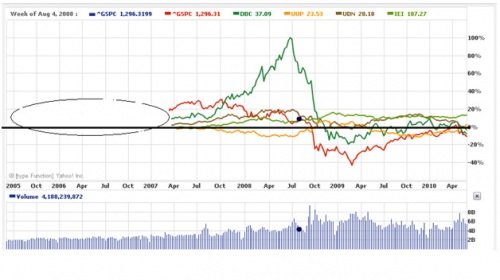
Average Rates of Return

For example, earning a 7% average rate of return over 40 years is no simple task; Social Security may not be able to deliver on its promise. Physician income and job security is a political issue. Paring current lifestyle is a bigger issue. Healthcare and leisure types of costs during retirement may increase by more than 3%, even as you consume more of these retirement lifestyle services.

Therefore, you may want to continue enjoying your current medical practice lifestyle and consider worrying about retirement about 10 years (or more) later or you may take stock of your current situation. If your situation is worse than the average portrayed above, a big issue for you is to keep your physical and mental health well balanced and not depressed and medicated; plan to postpone retirement and practice or work longer, albeit in good health.

Assessment

If you are about 60 years of age, have worked for about 25-30 years, earn $100,00 per year and have about $350,000 in your retirement accounts, your problems are more exacerbated and your fears (of postponing retirement, paring current or future lifestyle or not being able to make up shortfalls) are much more real. The strategies remain the same from earlier in that you have to make some urgent and difficult decisions. These are decisions that cannot be postponed any longer.

Note: First released “All Things Financial Planning Blog” on December 18, 2009.

Conclusion

Your thoughts and comments on this ME-P are appreciated. Feel free to review our top-left column, and top-right sidebar materials, links, URLs and related websites, too. Then, subscribe to the ME-P. It is fast, free and secure.

Link: http://feeds.feedburner.com/HealthcareFinancialsthePostForcxos

Speaker: If you need a moderator or speaker for an upcoming event, Dr. David E. Marcinko; MBA – Publisher-in-Chief of the Medical Executive-Post – is available for seminar or speaking engagements. Contact: MarcinkoAdvisors@msn.com

OUR OTHER PRINT BOOKS AND RELATED INFORMATION SOURCES:

Product Details  Product Details

Wall Street and athenahealth

More than just a Hiccup?

By Staff Reporters

According to TheStreet, health care information company AthenaHealth(ATHN Quote) just announced what seemed like a minor account hiccup.

Last night however, another accounting hiccup for AthenaHealth surfaced, and the health care information company announced that it will be postponing its fourth-quarter earnings.

Link: http://www.thestreet.com/story/10690575/1/athena-health-dives-on-accounting-issues.html

Assessment

Investors now fear that the seemingly isolated accounting events, one right on top of the other, could snowball.

According to one physician-investor,“this looks less like a hiccup, and more like a spasm of the diaphragm, which is innervated by the phrenic nerve.”

Conclusion

And so, your thoughts and comments on this ME-Pare appreciated. Feel free to review our top-left column, and top-right sidebar materials, links, URLs and related websites, too. Then, be sure to subscribe to the ME-P. It is fast, free and secure.

Link: http://feeds.feedburner.com/HealthcareFinancialsthePostForcxos

Speaker: If you need a moderator or speaker for an upcoming event, Dr. David E. Marcinko; MBA – Publisher-in-Chief of the Medical Executive-Post – is available for seminar or speaking engagements. Contact: MarcinkoAdvisors@msn.com

Our Other Print Books and Related Information Sources:

Practice Management: http://www.springerpub.com/prod.aspx?prod_id=23759

Physician Financial Planning: http://www.jbpub.com/catalog/0763745790

Medical Risk Management: http://www.jbpub.com/catalog/9780763733421

Subscribe Now: Did you like this Medical Executive-Post, or find it helpful, interesting and informative? Want to get the latest ME-Ps delivered to your email box each morning? Just subscribe using the link below. You can unsubscribe at any time. Security is assured.

Link: http://feeds.feedburner.com/HealthcareFinancialsthePostForcxos

Sponsors Welcomed: And, credible sponsors and like-minded advertisers are always welcomed.

Product Details  Product Details