On Bull Markets under Democrats

Join Our Mailing List

A Political Discourse by Kevin Outterson

[By Staff Reporters]

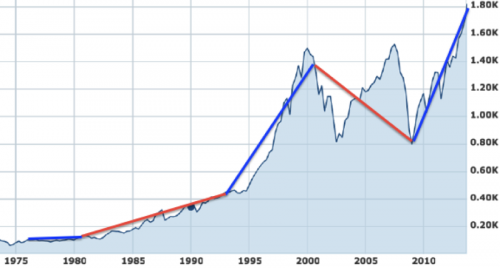
The Dow hit an inflation adjusted record high this week (WSJ). Here is the (unadjusted) S&P since 1975 with Republican administrations in red and Democrats in blue.

chart

Before you jump to partisan conclusions, last month, Tyler Cowan reviewed the Blinder and Watson paper on why Democrats preside over superior economic performance (their conclusion: mostly good luck).

Source: Bull markets under Democrats

More:

Conclusion

Your thoughts and comments on this ME-P are appreciated. Feel free to review our top-left column, and top-right sidebar materials, links, URLs and related websites, too. Then, subscribe to the ME-P. It is fast, free and secure.

Link: http://feeds.feedburner.com/HealthcareFinancialsthePostForcxos

Speaker: If you need a moderator or speaker for an upcoming event, Dr. David E. Marcinko; MBA – Publisher-in-Chief of the Medical Executive-Post – is available for seminar or speaking engagements. Contact: MarcinkoAdvisors@msn.com

OUR OTHER PRINT BOOKS AND RELATED INFORMATION SOURCES:

DICTIONARIES: http://www.springerpub.com/Search/marcinko
PHYSICIANS: www.MedicalBusinessAdvisors.com
PRACTICES: www.BusinessofMedicalPractice.com
HOSPITALS: http://www.crcpress.com/product/isbn/9781466558731
CLINICS: http://www.crcpress.com/product/isbn/9781439879900
BLOG: www.MedicalExecutivePost.com
FINANCE: Financial Planning for Physicians and Advisors
INSURANCE: Risk Management and Insurance Strategies for Physicians and Advisors

Product Details  Product Details

Seeking Securities Analysts, Stock-Brokers and Investment Bankers for New “Financial Planning Textbook for Doctors”

  Join Our Mailing List 

Planning our newest major textbook

By Ann Miller RN MHA [ph-770-448-0769]

[Executive-Director]

Dear Stock Brokers, IBs and Securities Analysts,

Greetings from the Institute of Medical Business Advisors, in Atlanta, Georgia.

Historical Review

As you may know, we released: Financial Planning Handbook for Physicians and Advisors, some time ago. It has enjoyed much success and acclaim in the medical and financial service sectors.

Recently, we have been asked to produce the next edition of this book for our target market of physicians, nurses, medical professionals, healthcare administrators – and those in the financial services sector who target this large and fertile, but rapidly changing niche market.

Why Now?

Urgency for the update has been prompted by ARRA, HI-TECH, the flash-crash of 2008 and the day-crash of 2011; by social, macro-economic and demographic changes; by political fiat and especially the PP-ACA.

Our medical colleagues are frustrated, afraid and fearful for their financial futures. They WANT informed advice.

Thus, true integrated financial planning information that targets this market – very expertly and specifically – is greatly needed.

The Invitation 

And so, we ask if you are interested in contributing an updated vision of an existing book chapter.

  • INVESTMENT BANKING-SECURITIES-MARKETS-MARGIN
  • HOSPITAL EMPLOYEE BENEFITS AND STOCK OPTIONS
  • INVESTMENT POLICY STATEMENT CONSTRUCTION

Not to worry – The original MS-WORD® chapter files are archived and available for use. We will forward it to you, upon assignment acceptance.

And, we are again fortunate that our Editor-in-Chief will be Dr. David Edward Marcinko FACFAS MBA CMP™ along with Professor Hope Rachel Hetico RN MHA CMP™ serving as Managing Editor.

They opined at a recent interview for the ME-P.

David and Hope” … We have entered into an emerging era in the financial planning ecosystem. It is a new era where one size does not fit all; and off-the-shelf financial products and mass sales customization is no long adequate for physicians and medical professionals; or their related generic financial planners or wire-house advisors.

It is a period of rapid change, shifting reimbursement paradigms and salary reductions that focus the healthcare industrial complex on pay-for-performance [P4], compensation for value and quality care; rather than procedures performed and quantity of care.

All must learn to do more with less professionally; and plan their personal financial lives more efficiently than ever before. Mistakes will be more difficult to overcome and the wiggle room that high income earning physicians, nurses and medical professionals used to enjoy is being narrowed by demographic, economic, social, technological and political fiat.

This emerging financial planning analog follows the health industry’s fiscal metamorphosis …”

Style Instructions 

The look and feel, format and style, and font and size of the book will remain the same. We use endnotes, not foot notes; and include mini-case reports or illustrative case models. It will be a major text; not a handbook.

Timeline for submission is about 3 months. Additional time is available, if needed, for a comprehensive update. But, we are trying to avoid running too far along into 2014 in order to avoid income tax season and the related time constraints on all concerned.

Writers Search

A Pleasure – Not Burden 

This should be a pleasurable project for you; and not anxiety provoking.

So, if you are a medically focused and experienced financial advisor with an: MBA, CFP®, PhD, MD, DDS, MSA/MS, CPA, RN, CMP®, DO, JD and/or CFA degree or designation, etc; please let me know if you are interested in updating and revising our chapters. OR, authoring a new to the world chapter.

Your Payback 

In return for your conscientious industry, you will receive a complimentary edition of the entire textbook; be listed on this ME-P as thought-leader with related book advertising content attributed to you; and given e-exposure to our almost 600,000 readers and ME-P subscribers …. Such the deal!

And, you will be added to our roster of experts for potential referrals, interviews, pod-casts and other marketing efforts

Assessment

Regardless of your decision, we remain apostles promoting your core vision of physician focused financial planning whenever possible.

Or, you may suggest another possible author- writer-expert contributor; if you wish.

Just let me know; ASAP [MarcinkoAdvisors@msn.com]

Thank you.
ANN
ANN MILLER RN MHA
[Executive-Director]
INSTITUTE OF MEDICAL BUSINESS ADVISORS, INC.
Suite #5901 Wilbanks Drive
Norcross, Georgia, 30092-1141 USA
[Ph] 770.448.0769

DICTIONARIES: http://www.springerpub.com/Search/marcinko
PRACTICES: www.BusinessofMedicalPractice.com
HOSPITALS: http://www.crcpress.com/product/isbn/9781466558731
CLINICS: http://www.crcpress.com/product/isbn/9781439879900
ADVISORS: www.CertifiedMedicalPlanner.org
BLOG: www.MedicalExecutivePost.com 

Product Details  Product Details

NOTICE: This invitation is not for all readers of the ME-P. It is a privilege invitation intended for those who possess the needed credentials, as decided by us, with an inclination to serve.  We reserve the right to accept or reject contributors, and content, at our own non-disclosed discretion.

##

On Investment Insurance?

Join Our Mailing List

Guaranteed living Benefits

Rick Kahler CFPBy Rick Kahler CFP® www.KahlerFinancial.com

Many investors, panicked by the market crash of 2008-2009, started a search for some type of investment vehicle to protect them from the next market downturn. Some decided the answer was a variable annuity with a “guaranteed living benefit” rider.

Insurance

At first blush, this seems to be a good use of insurance. For a nominal cost, insurance helps us spread the risk of a catastrophe. Consider auto insurance. There is a very small chance I will total my car in the next year. It’s hard to predict whether that will happen, but one thing is sure, it is all or nothing. Either I will or I won’t.

However, predicting the number out of a large group of people who will total their cars becomes much easier. While we don’t know who will total their cars, we do know about what percentage of people will. This predictability allows an insurance company to determine the average number of claims and set an annual premium that covers the anticipated claims and generates the company a profit.

Market Crashes

Insuring market crashes works much differently. Michael Kitces, in his Nerd’s Eye View blog post of November 20, explains, “The problem with trying to insure against a market catastrophe is that the risks don’t ‘average out’ over time, instead, they clump together.” In other words, the insurance company has either no claims or 100% of their policy holders having claims.

Why? When insuring against a stock market decline, there are absolutely no claims when markets trend upward. However, when markets head down, every policyholder potentially has a claim. Kitces notes that usually “companies are very cautious not to back risks that could result in a mass number of claims all at once. This is why most insurance policies have exclusions for terrorist attacks and war.”

Policies

To help insure against this concentrated risk, the companies use several methods to design these policies. One is to collect a fee for the guarantee that funds a reserve to offset potential losses. Kitces says this fee is so “tiny” that it “just doesn’t cut it.” He gives an example of a company with $300 billion of guaranteed annuities where the market declines 25%, exposing the company to a $75 billion loss. A guarantee fee of 0.5% is only $1.5 billion, not enough to even begin to cover the losses.

Loss Mitigation

Another way the companies mitigate their loss is that, unlike auto insurance, these policies do not pay immediate benefits. If the market drops by 50%, you don’t get a check for your original investment plus a fair return for the time they had your money. What you get is a promise to pay you a lifetime stream of income, usually at some date in the future. If you had a portfolio of mutual funds holding thousands of companies and purchased a “guaranteed living benefit,” you actually transfer the diversified risk to one insurance company that has actually concentrated, rather than spread, the risk.

Variable Annuities?

Does this mean you should avoid variable annuities? No, as not all of them concentrate their risk. Most allow you to invest in a broad range of securities and spread your risk. Consider avoiding annuities that have a “guaranteed living benefit” and fees of over 1%.

Stock Market

Other Options

Kitces cites two other options for investors. One is to keep your portfolio invested in mutual funds that hold a broad selection of securities and simply lower your risk by owning less equity and equity-like investments and more bonds.

A second is to spend less, keeping your withdrawal rate under 3%.

Assessment

Practicing both of these strategies is a way of providing your own insurance against market crashes.

More:

Conclusion

Your thoughts and comments on this ME-P are appreciated. Feel free to review our top-left column, and top-right sidebar materials, links, URLs and related websites, too. Then, subscribe to the ME-P. It is fast, free and secure.

Link: http://feeds.feedburner.com/HealthcareFinancialsthePostForcxos

Speaker: If you need a moderator or speaker for an upcoming event, Dr. David E. Marcinko; MBA – Publisher-in-Chief of the Medical Executive-Post – is available for seminar or speaking engagements. Contact: MarcinkoAdvisors@msn.com

OUR OTHER PRINT BOOKS AND RELATED INFORMATION SOURCES:

DICTIONARIES: http://www.springerpub.com/Search/marcinko
PHYSICIANS: www.MedicalBusinessAdvisors.com
PRACTICES: www.BusinessofMedicalPractice.com
HOSPITALS: http://www.crcpress.com/product/isbn/9781466558731
CLINICS: http://www.crcpress.com/product/isbn/9781439879900
BLOG: www.MedicalExecutivePost.com
FINANCE: Financial Planning for Physicians and Advisors
INSURANCE: Risk Management and Insurance Strategies for Physicians and Advisors

Product Details  Product Details

Medical Practice as a Portfolio Asset Class?

Join Our Mailing List

Valuing the Quintessential Alternative Investment

By Dr. David Edward Marcinko MBA CMP™

[Editor-in-Chief] www.CertifiedMedicalPlanner.org

Dr. MarcinkoAs all FAs, and informed physician investors know, the investment industry and Modern Portfolio Theory [MPT] strives to make optimal ‘allocations’ into different ‘asset classes’; according to some defined risk tolerance level or efficient frontier.

Equities, fixed income, property, private equity, emerging markets and so, are all ‘asset classes’, into which physician investors and mutual fund or portfolio managers will make an allocation of their total funds under management. It is quite proper for them to do this as they seek to balance the risk and potential returns for their own; ME, Inc., or other clients’ money.

But, by creating a “new” asset class, this concept opens the door to significant capital flows; advisory and management fees. Hence; the unrelenting innovation of Wall Street, and its’ commission driven and fee-seeking mavens, is unending.

Making an Impact

This secular and non-secular concept is broadly known as “impact investing”; and may be illustrated using Social Security as an example.

So, Wall Street opines,  if you’re not counting on Social Security benefits as a part of an overall asset allocation strategy, you may be missing out on bigger gains in a retirement portfolio. Those of this ilk say that retirement investors should consider the value of their Social Security as a portion of their fixed-income investments. Others believe it may be too risky for some.

The Strategy

Generally, adopting such strategy would mean shifting a big portion of investible assets out of bonds and into stocks. And, into the hands of money managers, stock brokers, wealth and endowment fund for a fee; of course. This is akin to those financial advisors who rightly or wrongly goaded clients a decade ago, to not pay off a home mortgage and instead reposition the free cash flow into a rising; and then falling; market.

Of course, there are detractors, as well as proponents, of this emerging financial planning philosophy.

Vanguard Group

Jack Bogle, founder of the Vanguard Group, often cites his penchant for basing one’s asset allocation on age. (If you’re 40 years old, you have 40% of your investments in fixed income and 60% in equities. By the time you’re 60, you’ve got 60% in fixed income, 40% in equities).

Example:

So, let’s consider Social Security, citing a physician with $300,000 in an investment portfolio, and capitalizing the stream of future payments.

If the $300,000 is all in equity funds, even equity-index funds, and $300,000 in Social Security, you are already at 50/50″ fixed income versus equities.  The next step is a conversation as a DIYer or ME Inc physician investor or advisory client. This is the nexus of where Social Security meets risk management.

Now, how will the doctor feel when market goes up and down? Some may believe the concept, but not enjoy the inevitable more fluctuating self-directed 401-k, or 403-b plan. So, one must be comfortable with taking on a larger stock position.

Source: Andrea Coombes; MarketWatch, September, 2013.

http://money.msn.com/mutual-fund/social-security-as-part-of-your-portfolio

MD

The Negative

Others experts, like Paul Merriman, opine that Social Security is not an asset class and the idea is fundamentally flawed and should not be a part of anyone’s portfolio.

Why? As classically defined, a portfolio is composed of financial assets. A financial asset is something that can be sold. Social Security cannot be bought and sold. Because of that, it has a market value of zero.

Source: Paul Merriman, MarketWatch, November 2013

Assessment

Therefore, the definitional decision is left up to the informed reader, modern physician or enlightened advisor. Is a medical practice an asset class?

MORE: About iMBA Inc Expertise in Healthcare Valuation

MORE: Social Security as an Asset Class?

Conclusion

Your thoughts and comments on this ME-P are appreciated. Feel free to review our top-left column, and top-right sidebar materials, links, URLs and related websites, too. Then, subscribe to the ME-P. It is fast, free and secure.

Link: http://feeds.feedburner.com/HealthcareFinancialsthePostForcxos

Speaker: If you need a moderator or speaker for an upcoming event, Dr. David E. Marcinko; MBA – Publisher-in-Chief of the Medical Executive-Post – is available for seminar or speaking engagements. Contact: MarcinkoAdvisors@msn.com

OUR OTHER PRINT BOOKS AND RELATED INFORMATION SOURCES:

DICTIONARIES: http://www.springerpub.com/Search/marcinko
PHYSICIANS: www.MedicalBusinessAdvisors.com
PRACTICES: www.BusinessofMedicalPractice.com
HOSPITALS: http://www.crcpress.com/product/isbn/9781466558731
CLINICS: http://www.crcpress.com/product/isbn/9781439879900
BLOG: www.MedicalExecutivePost.com
FINANCE: Financial Planning for Physicians and Advisors
INSURANCE: Risk Management and Insurance Strategies for Physicians and Advisors

Product Details  Product Details

Product DetailsProduct Details

Product Details

Understanding NYSE / NASD Minimum Credit Requirements

Join Our Mailing List

A Primer for Physician Investors and Medical Professionals

By: Dr. David Edward Marcinko; MBA, CMP™

[Editor-in-Chief]

[PART 8 OF 8]

NOTE: This is an eight part ME-P series based on a weekend lecture I gave more than a decade ago to an interested group of graduate, business and medical school students. The material is a bit dated and some facts and specifics may have changed since then. But, the overall thought-leadership information of the essay remains interesting and informative. We trust you will enjoy it.

Introduction

We have seen that there are rules which stipulate that no brokerage firm may arrange for any credit to any client whose margin account does not have an equity of at least $2,000. The principal application of this rule is to initial transactions in newly opened margin accounts, however, it does apply at all times. 

Example: A doctor buys 100 shares, at $15, in a new margin account. His margin call is $1,500.

Rationale: $2,000 would be too much to require as it exceeds the total purchase price. However, a loan to the doctor isn’t allowed to be extended until, and unless, the account has equity of $2,000. The trade is simply paid in full -100% of the purchase price is the margin call. 

Example: A doctor buys 200 shares, at $15, in a new margin account (assume Regulation T = 60%).

His margin call is $2,000 

Rational: Regulation T 60% would be $1,800 (60% x $3,000). Since this would be $200 shy of the minimum equity level of $2,000, the call is the $2,000 minimum equity. 

Example: A doctor buys 300 shares, at $15, in a new margin account. (assume Regulation T = 60%) His margin call is $2, 700. 

Rationale: The account will have equity of $2, 700 (60% x $4,500), which is more than the $2,000 minimum. Therefore, the Regulation T initial requirement prevails.

The important points to remember about minimum credit requirements are:

1. You are not called upon to pay more than the purchase price.

2. You cannot be granted a loan until the account has an equity of at least $2,000.

3. If a decline in the market value of an existing account puts the equity below $2,000, there is no requirement to bring the equity back up to $2,000.

4. You may not withdraw money or securities from the account, if in doing so, you either:

  1. bring the equity below $ 2,000, or
  2. bring the equity below the maintenance level

These are the only times SMA may not be withdrawn from an account

The Short Sale

Selling short is engaged in by medical professionals who anticipate a market decline. By selling borrowed property (shares of stock) at the current market value, the doctor expects to return the borrowed property (shares of the same issuer bought in the marketplace) to the lender, normally the investor’s brokerage firm, when the market price is lower, thus profiting from the drop in price.

Essentially this is the buy low, and sell high philosophy. However, when executing a short sale one is selling high initially, then buying low later to “cover”, or close out the deal by buying low and selling high in the reverse order .

Bear in mind that the short seller is borrowing property, not money. However, due to the high degree of risk inherent in short selling, it is permitted only in a margin account. A Regulation T call is required as a show of good faith, a way the client demonstrates the financial wherewithal to buy back the property. Let’s look at a short sale transaction and the subsequent effects of market fluctuations on equity, as we did previously with buying on margin (long margin).

Credit Balance and Equity

A doctor shorts (sells short) 100 shares at $100 per share with Regulation T at 60%. The margin account would be credited with the proceeds of the sale, though the doctor has no access to these monies at this point in the deal. The account should also be credited with the doctor’s required Regulation T margin call. Therefore, the credit balance in a doctor’s margin account is the sum of the  proceeds of the short sale, plus the Regulation T margin call. This number will not change, regardless of future market fluctuations. The credit balance in a short margin account is a constant.

What does change with market fluctuations?

  1. the cost of buying back the borrowed property to cover the short sale.
  2. the equity in the account.

Equity in a short margin account is computed as follows:

Credit of  $ 16,000 – CMV  $10,000 equals $ 6,000 equity.

Now, let’s evaluate the effect of appreciation in the market price

If the stock rises to $120 per share, then the credit of $16,000 – CMV $ 2, 000, equals $ 4,000 equity.

Remember, the credit balance does not change when CMV fluctuates. The equity in this account is no longer Regulation T.

Let’s determine the amount by which the account is restricted (remember, any margin account with equity below Regulation T is restricted). Or, 60% X $12,000 = $ 7,200 – $ 4,000 = $ 3,200

Also, it should be clear, the equity percentage of this account is less than 60%, by the formula:

Equity / CMV = $ 4,000/$ 12,000 = 33.33%

This is the basic principle of the short sale; as the market price of the shorted stock increases, the equity decreases. The reverse is also true; as the price declines, the equity rises. Remember, short sellers are anticipating a market decline. Also, when buying long, or selling short, any change in market value causes a dollar for dollar change in equity.

Minimum Maintenance Requirements (Short) 

If the market continues to appreciate to $160 per share, the equity drops to zero.

Suppose that the market price rose to its theoretical maximum, or infinity? The doctor’s loss would be infinite. Remember, the maximum potential loss on a short sale is unlimited!

To protect against such an occurrence, industry Self Regulatory Organizations (SROs) developed regarding the minimum equity that must be maintained in a margin account. The minimum maintenance in a short account is equity of 30% of CMV. Note that this is higher than the 25 % figure for long margin accounts due to the nature of extreme risk of loss in the short sale.

Given that the CMV has risen to $160 per share ($16,000 total CMV), the minimum equity required to be maintained under SRO rules is 30% x CMV or  $4,800 equity. The doctor would receive a $4,800 maintenance call to bring his equity from -0- to the $4,800 minimum.

Remember, as in (cash) long accounts, there is no requirement to bring a margin account up to Regulation T equity. The maintenance equity is the percentage up to which the account must be brought when and if equity drops below the 25% or 30% levels.

Excess Equity (SMA) and Buying Power

We have seen what market appreciation does to a short seller. Let’s evaluate the effects of market depreciation in value. If the declines to $85, per share, then $ 16,000 credit – CMV $ 8,500 = $ 7,500 equity. Again, market fluctuations don’t affect credit balance. The equity in the account is now higher than Regulation T, and SMA (excess equity) has just been created.

And, as before, excess equity (SMA) can be used to buy more securities. Couldn’t it also be used as the Regulation T down payment on another sale? Yes, this is another use of SMA that is called shorting power or “selling power”. The formula for buying power as well as shorting power is exactly the same: Remember, it’s SMA / RT to use buying power.

In this case, $2,400 / 60% = $4,000 of buying (shorting) power after the decline to $85, the doctor could buy long or sell short another $4,000 worth of stock and use his SMA to meet his 60% ($2,400) Regulation T Margin call. Recall, the margin call for a short sale is the same as for a long purchase.

Cheap Stock Rule

The SROs created a set of special maintenance rules in short margin accounts to protect against unreasonable risk in low-priced issues. These rules are appropriately labeled the “cheap stock” rules.

At all times, a doctor must maintain equity in a short margin account of the greater of the following:

  1. 30% of the CMV (SRO Minimum Maintenance Requirement)
  2. $2,000 (SRO Minimum Credit Requirement)

3.   Equity as required under the rules  below

The cheap stock rules are as follows:

Stock Price                                     Minimum Maintained Equity

0 – $2.50 per share             $ 2.50 per share

$2.50 – $5.00 per share      100% of per share price

$5.00 per share and up       $ 5.00 per share

Example: A doctor shorts 1,000 shares of a $1.50 per share stock. How much must he deposit initially and how much must be maintained in the account?

First, since Regulation T won’t come into play until equity hits $2,000, the SRO minimum credit requirement of $2,000 should come into play. However, since this is a cheap stock, we determine if the requirements of those special rules require more than $2,000. They do, and require a minimum be maintained in this short margin account of at least $2.50 per share sold short (1,000 shares at $2.50 each = $2,500 minimum that needs to be in this account at all times to comply with SRO rules).

Furthermore, if the market begins to rise, the cheap stock rules would require that at all times the amount of money in the account be at least 100% of the price per share until the stock hits $5. For example, if the stock rose to $4 per share, the doctor would have to have $4,000 in the account to carry the position (1,000 shares times 100% of CMV, $4 per share in this case).

Day Trading and the Internet

Internet day trading has become something of an, investment bubble of late, suggesting that something lighter than air can pop and disappear in an instant. This has occurred despite the fact that most lay and healthcare professionals who engage in such activities, do not appreciated even the basic rules of margin and debt, as reviewed review. History is filled with examples: from the tulip mania of 1630 Holland and the British South Sea Bubble of the 1700’s; to the Florida land boom of the roaring twenties and the Great Crash of 1929; and to $ 875 an ounce gold in the eighties and to the collapse of Japans stock and real estate market in  early 1990’s. To this list, one might now add day Internet trading

The cost of compulsive gambling, arising from internet day trading activities, may be high for the physician, his family and society at large. Compulsive gamblers, in the desperation phase of their gambling, exhibit high suicide ideation, as in the case of Mark O Barton’s the murderous day-trader in Atlanta. His idea actually became a final act of desperation. Less dramatically is a marked increase in subtle illegal activity. These acts include fraud, embezzlement, CPT up-coding, medical over utilization, excessive full risk HMO contracting, and other “alleged white collar crimes.”  Higher healthcare and social costs in police, judiciary (civil and criminal) and corrections result because of compulsive gambling. The impact on family members is devastating. Compulsive gamblers cause havoc and pain to all family members. The spouses and other family members also go through progressive deterioration in their lives. In this desperation phase, dysfunctional families are left with a legacy of anger, resentment, isolation and in many instances, outright hate.

Recent Updates

Since most people, including medical professions,  initially loose at day trading, they give up and decide not to do it anymore. As there is a minimum amount of money, about $ 25,000-50,000 of trading capital needed to start, this loss is a powerful de-motivator. Still, scared by the Barton incident, the NASD and NYSE have recently proposed new rules for those who engage in questionable day trading activities.  One proposal would provide that a minimum equity of $ 25,000 be maintained at all times, versus the current $ 2,000 for other margin accounts. If the amount of a pattern day trader fell below the new threshold, no further trading would be permitted until the threshold was maintained.

Options Trading

Stock options are contracts that obligate medical investors to either buy or sell a stock at a specific price, by a specific date. For example, a put option is a bet on falling prices. Let’s suppose Dr. Jane Smith holds a put option on XYZ stock, with a $ 50 exercise price, and the stock falls to $ 45. The value of the put rises in the options market because it lets her sell a $ 50 share, which is above the market price. A call option, on the other hand, is a bet on rising prices. Again, Dr. Smith holds a call option on XYZ stock, with an exercise price of $ 50. If the share rises to $ 55, the value of the option increase since she may buy for $ 50, a stock now worth $ 55.

In 1999, Charles Schwab, the biggest on-line brokerage executed more than 30 million option trades. Due to this demand, Schwab launched other complex services, such as the on-line simultaneous buying and selling of options. Also crowding the options field, are new upstart on-line brokerages, such as: Interactive Brokers, Preferred Capital Markets Technology and CyberCorp. They provide powerful software which will allow options in the future to trade as effortlessly and efficiently as stocks.

In  mid-2000 the Reuters Group PLC Instinet Corporation, the electronic network most widely used by institutional investors, opened an Internet brokerage aimed at consumers, including healthcare practitioners. Instinet will let retail clients place orders alongside institutions, and will offer access to charts, news and research. Thus, artificially empowering the individual investor, as well as again tempting the compulsive prone addict.

Acknowledgements

The assistance Mr. James Nash, of the Investment Training Institute, in Tucker, GA is acknowledged in the preparation of this ME-P.

Conclusion

Your thoughts and comments on this ME-P are appreciated. Feel free to review our top-left column, and top-right sidebar materials, links, URLs and related websites, too. Then, subscribe to the ME-P. It is fast, free and secure.

Link: http://feeds.feedburner.com/HealthcareFinancialsthePostForcxos

Speaker: If you need a moderator or speaker for an upcoming event, Dr. David E. Marcinko; MBA – Publisher-in-Chief of the Medical Executive-Post – is available for seminar or speaking engagements. Contact: MarcinkoAdvisors@msn.com

OUR OTHER PRINT BOOKS AND RELATED INFORMATION SOURCES:

LEXICONS: http://www.springerpub.com/Search/marcinko
PHYSICIANS: www.MedicalBusinessAdvisors.com
PRACTICES: www.BusinessofMedicalPractice.com
HOSPITALS: http://www.crcpress.com/product/isbn/9781466558731
CLINICS: http://www.crcpress.com/product/isbn/9781439879900
ADVISORS: www.CertifiedMedicalPlanner.org
PODIATRISTS: www.PodiatryPrep.com
BLOG: www.MedicalExecutivePost.com

Web Sites of Interest

http://www.tradehard.com

The ultimate super site for investment bankers and traders. Started by a group of well known stockbrokers, day traders, and money managers. This site offers advice about how to work the market to your advantage.

http://www.internetinvesting.com

This is an investor’s guide to on-line brokers, discount brokers, day trading and after hours investing. The site offers stock quotes, financial news, investment banking strategies, a book list and daily commentary about the market. This is a serious text heavy resource.

References and Readings

  • Atkinson,  W., and Crawford, AJ.:  On-line investing raises questions about suitability. Wall Street Journal, November, 28, 1999.
  • Farrell, C.: Day Trade On-line. John Wiley & Sons, New York, 1999.
  • Friedfertig, M.: Electronic Day Trader’s Secretes. McGraw-Hill, New York, 1999.
  • Gibowicz, Peter: Registered Representative (Study Program ,Volume II). Edward Fleur Financial Education Corporation, New York, 1998.
  • Gibowicz, Peter: Quick Seven. Edward Fleur Financial Education Corporation, New York, 1998.
  • Gibowicz, Peter: Registered Representative (Study Program, Volume I). Edward Fleur Financial Education Corporation, New York, 1998.
  • Kadlec, CW.: Dow 100,000: Fact or Fiction. New York Institute of Finance, New York, 1999
  • Nash, J: Securities Markets. In, Nash, J: (International Training Institute Manual). Atlanta, 1999.
  • Nassar, DS: How to Get Started in Electronic Day Trading. McGraw-Hill, New York,
  • 1999.
  • Schmuckler, E:  The Addictive Personality. In, Marcinko, DE (2001 Financial Planning for Medical Professionals. Harcourt Professional Publishing, New York, 2000. 

Product DetailsProduct DetailsProduct Details

Product Details  Product Details

Product DetailsProduct Details

Product Details


How to Succeed as an “Active-Passive” Investor [Part II]

Join Our Mailing List

An Oxymoron—Part Two

By Rick Kahler CFP® http://www.KahlerFinancial.com

Rick Kahler CFPContinued from last week, here are the remaining keys to help fine-tune your core passive investment strategy for optimum success.

5. Asset allocation.

This is critical. Study after study shows the most important determinate in your overall investment success isn’t picking the right stocks, bonds, or real estate. According to one researcher, a good asset allocation strategy can add about 0.5% to your long-term return. It’s your overall mix of various asset classes that will ultimately have the greatest impact on your success or failure. Investing your entire 401(k) in several stock index funds can be as insane as putting everything into bond funds. Even a mix of stocks and bonds, while better, can leave a portfolio over-exposed to the fortunes of one sector and exposed to the failing of one country’s economy.

6. Manager and index selection.

Especially if you are over 40 and have retirement in sight, successful passive investing isn’t quite as easy as calling Vanguard and putting everything in an S&P 500 index fund. Every asset class has multiple indexes, with managers who all have their differences in philosophy, execution, and fees. Some adhere to traditional indexes while others build their own indexes based on their research. Picking the right index with the right manager can add up to 2% over the long haul to the annual return generated by a good asset allocation.

7. Rebalancing.

Once you set your target allocations, you need to periodically sell off the advancing asset classes to purchase more of the lagging classes. Suppose you want 30% of your portfolio in U.S. stocks and 30% in bonds. If stocks are doing well and bonds are not, over time you might end up with 35% stocks and 25% bonds. Selling stocks and buying bonds to rebalance the allocations is a disciplined form of “buy low and sell high.” Without it, your portfolio will miss out on some extra returns and over time take on more risk and volatility. Research shows that periodic rebalancing can add 0.5% to 1.5% annually over the long term.

8. Asset placement and taxes.

Other adjustments need ongoing attention in any portfolio. Asset class location helps minimize tax consequences by matching the assets with the right account. IRA’s are best for certain asset classes, while Roth IRA’s do best with others and taxable accounts with still others. This matching can add up to 0.5% annually, so getting it right can be a big deal. It’s also important to tweak asset class allocations to adjust for long-term bear or bull markets, significant economic or tax policy changes, or changing personal situations. Another necessity is minimizing taxes by efficient and timely loss and gain harvesting.

9. Uncovering scams and ill-suited investments.

Recently a client asked me about a start-up online business in which several of her friends had invested. While there were many things about it that concerned me, at the core this just wasn’t an investment opportunity that suited my client’s expertise, goals, or risk tolerance. I strongly urged her to pass, and she did. Within six months the offering was found to be a well-pitched scam, and everyone who invested lost their money. Having someone to help investigate the legitimacy of investment ideas can always be helpful.

10. Keeping it sensibly simple.

Keeping things simple for simplicity’s sake doesn’t always produce the desired benefits. While it’s simple to put your whole portfolio into one stock or one mutual fund, the results could end up adding layers of complexity to your life. The right amount of sensible complexity can turn a good passive investing strategy into a highly successful one. 

MD

Assessment

How to Succeed as an “Active-Passive” Investor [Part I]

Conclusion

Your thoughts and comments on this ME-P are appreciated. Feel free to review our top-left column, and top-right sidebar materials, links, URLs and related websites, too. Then, subscribe to the ME-P. It is fast, free and secure.

Link: http://feeds.feedburner.com/HealthcareFinancialsthePostForcxos

Speaker: If you need a moderator or speaker for an upcoming event, Dr. David E. Marcinko; MBA – Publisher-in-Chief of the Medical Executive-Post – is available for seminar or speaking engagements. Contact: MarcinkoAdvisors@msn.com

OUR OTHER PRINT BOOKS AND RELATED INFORMATION SOURCES:

LEXICONS: http://www.springerpub.com/Search/marcinko
PHYSICIANS: www.MedicalBusinessAdvisors.com
PRACTICES: www.BusinessofMedicalPractice.com
HOSPITALS: http://www.crcpress.com/product/isbn/9781466558731
CLINICS: http://www.crcpress.com/product/isbn/9781439879900
ADVISORS: www.CertifiedMedicalPlanner.org
BLOG: www.MedicalExecutivePost.com

Product DetailsProduct DetailsProduct Details

Product Details  Product Details

Product DetailsProduct Details

Why Physician-Investors Must Understand TAMPs

Join Our Mailing List 

Third Party Outsourcing of Your Investments

By Dr. David Edward Marcinko MBA CMP™

Dr David E Marcinko MBATurnkey Asset Management Programs (TAMPs) allow independent financial advisors [FAs], Registered Investment Advisors [RIAs] – typically fiduciaries – to outsource the management of some or all of their clients’ assets.

More recently, Certified Public Accountants, law firms and banks also are using them to enter the financial advice marketplace

Managed Account Services

With a TAMP, financial advisors gain access to managed account services that allow them to offload time-consuming functions, such as research, portfolio construction, rebalancing, reconciliation, performance reporting, and tax optimization and reporting, which allows them to focus on clients’ personal financial needs, marketing, advertising and sales concerns

Fee-Based Accounts

TAMPs are a form of fee-account, which charge fees based on a percentage of the total assets managed in the program. TAMPs appeal to independent financial advisors who are building a fee-only business, because they can avoid the cost of building their own fee-accounts platform and can implement a TAMP in about 90 days, instead of the year or longer required to develop the same capabilities in-house.

TAMPs also help independent advisors avoid employee hiring and payroll costs related to internal administration and research, which for a modest program requiring a staff of 8-10 employees can typically cost $1 million per year in ongoing overhead. Because TAMPs serve financial advisors, individual retail investors are not able to directly invest their assets in a TAMP.

###

TAMPs

###

“Meet and Greet” Meetings

So, the next time your FA has a quarterly meeting with you to discuss the status of your investment account or retirement portfolio, just realize that s/he is usually only the middleman. S/he is not buying, selling or trading stocks for you. An “anonymous omniscient other” behemoth firm is actually doing the work and merely placing your name on a glossy automated printed report. Your FA passes the report along as his/her alone, complete with his/her name and firm embossed, therein.  Usually with a supplication like this.

The courtesy of your referral is our only reward.

And, the day of your quarterly meeting, in his/her fancy office, is probably the first and only day the report is even reviewed by the FA. This is why most of the FAs time is spent prospecting, or in marketing, advertising and/or other sales activities.  All the heavy-lifting is done elsewhere.

In the industry, this type of Financial Advisor is known as an asset aggregator. And, in the retail sector, most FAs are asset aggregators or gatherers.

http://en.wikipedia.org/wiki/Turnkey_Asset_Management_Program

Number Crunching

Now, let’s say you have one millions dollars to invest and the FA charges you one percent of your AUMs; annually. This is common in the industry with ranges up to 3%, or so. Yep; that’s ten grand out of your pocket.

The Financial Advisor thus receives about $5,000/per year and the TAMP gets the same; year after year. This is reduced to $2,500 or so, to the FA, after office overhead costs. It does not matter if the market, or your account, is up or down. Such the deal!

Nevertheless, the money is automatically flowing away from you much like an annuity; or cash cow. Since you do not actually write a check out to the FA or firm, you may forget about the fees. Get the idea!

Therefore, a firm with $100 million dollars in AUMs earns about: $1-M X 50% = $500,000/year. With scale-ability, it is easy to see how Wall Street has all those skyscrapers in Manhattan, Chicago, London or Tokyo. AUM fees go up drastically, with little increase in overhead. Remember the economic concepts of marginal revenues and marginal costs!

In the industry, we call this Recurring Income. RI is preferred over a one time stock-broker commission [one-time sale] because it’s producing revenue for the TAMP and FA 24/7/365.

To be sure, it is difficult for FAs to obtain such clients; but once in the fold, clients are loathe to leave.

Assessment

Is it a wonder why big firms and wire-houses [brokerages] place their employee FAs under non-compete clauses? In other words, you the client, are owned by the company. You are not a client of the individual FA. So, when an FA leaves or retires, your account stays with the firm unless you transfer it. Expect to receive a very hard sell to stay, when you threaten to leave.

More:

Conclusion

Now, you know why sales skills are needed – over financial acumen – in this business. A great personality trumps education and brain power, most every time.

Your thoughts and comments on this ME-P are appreciated. Feel free to review our top-left column, and top-right sidebar materials, links, URLs and related websites, too. Then, subscribe to the ME-P. It is fast, free and secure.

Link: http://feeds.feedburner.com/HealthcareFinancialsthePostForcxos

Speaker: If you need a moderator or speaker for an upcoming event, Dr. David E. Marcinko; MBA – Publisher-in-Chief of the Medical Executive-Post – is available for seminar or speaking engagements. Contact: MarcinkoAdvisors@msn.com

OUR OTHER PRINT BOOKS AND RELATED INFORMATION SOURCES:

LEXICONS: http://www.springerpub.com/Search/marcinko
PHYSICIANS: www.MedicalBusinessAdvisors.com
PRACTICES: www.BusinessofMedicalPractice.com
HOSPITALS: http://www.crcpress.com/product/isbn/9781466558731
CLINICS: http://www.crcpress.com/product/isbn/9781439879900
ADVISORS: www.CertifiedMedicalPlanner.org
BLOG: www.MedicalExecutivePost.com

Product DetailsProduct DetailsProduct Details

  Risk Management, Liability Insurance, and Asset Protection Strategies for Doctors and Advisors: Best Practices from Leading Consultants and Certified Medical Planners™8Comprehensive Financial Planning Strategies for Doctors and Advisors: Best Practices from Leading Consultants and Certified Medical Planners™

***

Invite Dr. Marcinko

***

How to Succeed as an “Active-Passive” Investor [Part I]

Join Our Mailing List 

An Oxymoron—Part One

By Rick Kahler CFP® http://www.KahlerFinancial.com

Rick Kahler CFPA fundamental principle I preach is that having a core of passively managed mutual funds is the foundation of successful long-term wealth building. I practice that principle, as well: about 75% of the securities in my personal portfolio are passively selected.

My commitment to this approach has evolved both from my own years of investing experience and from reading reams of research. I’m convinced that “beating the market” over the long term is as elusive a goal as capturing a wild jackalope.

Fundamental Strategy

Does that mean investing is as simple as giving most of your money to passive managers and kicking back? Not quite. Yes, investing in the index funds of a diversified group of asset classes and leaving them alone is a good fundamental strategy that will help you secure your financial future. To be even more successful, however, it helps to actively apply some additional strategies.

Additional Strategies

I was reminded of this by a June 2013 blog post from Bob Seawright of Madison Avenue Securities. Here, inspired by and adapted from his “top ten” list, are some of the factors that strongly affect the success of passive investors. While financial professionals can help with all of these strategies, investors going it alone can also benefit from paying attention to them.

Link: http://rpseawright.wordpress.com/2013/06/04/financial-advice-a-top-ten-list/

Top Ten List

1. What’s the point?

A successful investment strategy starts with establishing clear, objective, and realistic goals. Most people bypass this step, thinking it is unrelated to their investment selection. Yet very few people on their deathbeds focus on how great it was to get a 7% annual return on their investments. Drilling down to what is really important in your life is no simple task, but it is essential. Creating a life worth living means using portfolio returns to support your dreams and desires! Knowing where you are going and why is the first step to establishing a successful portfolio.

2. A written investment plan.

Yes, you need your investment strategy in writing. This both insures that you have one and helps you clarify it. I find that writing things down often helps me find gaps and inconsistencies in what I thought was a complete and rational plan.

A written investment plan should state:

a. Your investment philosophy. Are you a passive or active investor, or both?

b. Your goals and objectives for your funds. This answers the question, “How and when will this money support my life?”

c. Guidelines and constraints you will adhere to in managing your money. What tenure do you want in a manager, what is your upper limit on expense ratios, how much flexibility will you give a manager, what quantifiable factors will take you out of a market or bring you back in?

A written plan will bring structure and discipline to your investment strategy, qualities most investors lack.

3. Manage your behavior.

We all have blind spots, biases, and delusions. How you behave in the face of market declines and advances will affect your long-term portfolio returns more than any other single factor. To make this even more challenging, your brain is naturally wired for investment failure. Identifying and reframing your money scripts can help you rewire your brain for success instead. Working with a financial coach or therapist can be invaluable to help you negotiate your own mind.

4. Financial planning.

Many people think financial planning is limited to investment advice. Yet it is much broader and deeper. Financial planning not only helps you build wealth, but helps you use it wisely to support the life you want.

Doctors

More:

Assessment

Six more keys to successful passive investing will be covered soon in Part II.

How to Succeed as an “Active-Passive” Investor [Part II]

Conclusion

Your thoughts and comments on this ME-P are appreciated. Feel free to review our top-left column, and top-right sidebar materials, links, URLs and related websites, too. Then, subscribe to the ME-P. It is fast, free and secure.

Link: http://feeds.feedburner.com/HealthcareFinancialsthePostForcxos

Speaker: If you need a moderator or speaker for an upcoming event, Dr. David E. Marcinko; MBA – Publisher-in-Chief of the Medical Executive-Post – is available for seminar or speaking engagements. Contact: MarcinkoAdvisors@msn.com

OUR OTHER PRINT BOOKS AND RELATED INFORMATION SOURCES:

LEXICONS: http://www.springerpub.com/Search/marcinko
PHYSICIANS: www.MedicalBusinessAdvisors.com
PRACTICES: www.BusinessofMedicalPractice.com
HOSPITALS: http://www.crcpress.com/product/isbn/9781466558731
CLINICS: http://www.crcpress.com/product/isbn/9781439879900
ADVISORS: www.CertifiedMedicalPlanner.org
BLOG: www.MedicalExecutivePost.com

Product DetailsProduct DetailsProduct Details

Product Details  Product Details

Video on Wall Street’s View on Prospects for the Health Care Industry

Join Our Mailing List

Nashville Health Care Council

[By staff reporters]

The Nashville Health Care Council’s recent signature: “Wall Street’s View on Prospects for the Health Care Industry” panel discussion and video, offers timely insights and forecasts for Nashville’s $70 billion health care industry.

Medical tree

Video link: http://www.healthsharetv.com/content/wall-streets-view-prospects-health-care-industry

Assessment

The effects of the PP-ACA are still being revealed under the law of unintended consequences.

Conclusion

Your thoughts and comments on this ME-P are appreciated. Feel free to review our top-left column, and top-right sidebar materials, links, URLs and related websites, too. Then, subscribe to the ME-P. It is fast, free and secure.

Link: http://feeds.feedburner.com/HealthcareFinancialsthePostForcxos

Speaker: If you need a moderator or speaker for an upcoming event, Dr. David E. Marcinko; MBA – Publisher-in-Chief of the Medical Executive-Post – is available for seminar or speaking engagements. Contact: MarcinkoAdvisors@msn.com

OUR OTHER PRINT BOOKS AND RELATED INFORMATION SOURCES:

LEXICONS: http://www.springerpub.com/Search/marcinko
PHYSICIANS: www.MedicalBusinessAdvisors.com
PRACTICES: www.BusinessofMedicalPractice.com
HOSPITALS: http://www.crcpress.com/product/isbn/9781466558731
CLINICS: http://www.crcpress.com/product/isbn/9781439879900
ADVISORS: www.CertifiedMedicalPlanner.org
BLOG: www.MedicalExecutivePost.com

Product DetailsProduct Details

Product Details

Underwriting US Government Securities Issues

Join Our Mailing List

A Primer for Physician Investors and Medical Professionals

By: Dr. David Edward Marcinko; MBA, CMP™

[Editor-in-Chief] http://www.CertifiedMedicalPlanner.org

[PART 4 OF 8]

Dr. Marcinko at Emory University

NOTE: This is an eight part ME-P series based on a weekend lecture I gave more than a decade ago to an interested group of graduate, business and medical school students. The material is a bit dated and some facts and specifics may have changed since then. But, the overall thought-leadership information of the essay remains interesting and informative. We trust you will enjoy it.

Introduction

The underwriting of US Government securities is the largest underwriting market in the world, but are issued a bit differently than we have seen to date, in this series..

For example, there is no such thing as a negotiated underwriting on a US Government security. All offerings of the Treasury are sold by auction. The auction is conducted by the Federal Reserve Bank of New York in accordance with a published schedule. Unfortunately, they are not open to the public, just primary dealers. A bank or investment dealer is appointed by the president of the Federal Reserve Bank of New York and are the only entities authorized to buy and sell government securities in direct dealings with the FED. One becomes a primary dealer through qualifications of reputation, underwriting capacity, and adequacy of staff and facilities.

Currently, 13 and 26-week treasury bills are offered every week on Mondays, while 52- week bills are auctioned once a month. Treasury notes and bonds are auctioned much less frequently on a schedule that will not be asked on your exam. Those dealers wishing to acquire a particular Treasury security enter bids on a yield basis rather than at a specific  price. This method is sometimes called a Dutch auction. As a practical matter, about a week or so before the proposed auction, the Treasury announces the following four items: amount, maturity date, nominal or coupon rate anticipated, and  the minimum denominations available (except for T bills which don’t have interest coupons and always carry a minimum denomination of $10,000).

Can the individual medical professional purchase newly issued Treasuries? Yes! Rather than turning in a competitive bid, as the primary dealer does, the individual will turn in a non-competitive bid. Competitive bidding with governments is similar to the other competitive bidding discussed above. The underwriter turning in the lowest bid, wins. Due to the enormous size of Treasury offerings, it is extremely rare that the lowest bidder is able to take the entire issue. That being the case, the Treasury moves to the next best and the next best bidders, until most of the issue is taken. There is always a small portion left over for the non-competitive bidders.  Non-competitive bids may only be made in amounts of $1 million or less.  All non-competitive bids are automatically filled at the average yield of the competitive bids which have been accepted.

Underwriting  State Issues (Blue Sky Registration)

Unlike Federal issues, there are three types of State registration that are important for the medical professional to know:

Notification: This is the simplest form of registration and is used by a an issuer who has been in continuous operation for at least the previous three years.  Most, but not all, states permit registration by notification. 

Coordination: This occurs when an issuer wishes to coordinate a Federal registration under the Securities Act of 1933 with Blue Sky registration in one or more states. Under most circumstances, the Blue Sky registration automatically becomes effective when the Federal registration statement becomes effective.

Qualification: Any security may be registered in a state by qualification, but it’ s most commonly used by those issuers who are unable to use notification or coordination. Registration by Qualification becomes effective when so ordered by the State Administrator.

Exempt Securities

There are many securities which are exempt from the Act of ’33 registration and prospectus requirements. They include:

  • US Government and  Federal Agency issues.
  • Municipal, State issues and commercial paper with a maturity not in excess of 270 days.
  • Intra-state offerings (Rule 147)  because they are blue-sky chartered within the state.
  • Small Public offerings (Regulation A) if the value of the securities issued does not exceed $5,000,000 in any  12 month period. An issuer using the Regulation A exemption does not make the normal filings with the SEC in Washington. Instead, they file a simplified disclosure document with their SEC Regional Office, known as an Offering Statement. It must be file at least 10 business days prior to the initial offering of the securities. No securities may be sold unless issuer has furnished an offering circular (full disclosure document) to the purchaser at least 48 hours prior to the mailing of confirmation of the sale, and, if not completed within 9 months from the date of the offering circular, a revised circular must be filed. Every 6 months, issuers must file a report with the SEC of sales made under the Regulation A exemption until offering is completed.
  • Traditional insurance policies are considered to be securities and are exempt, as are fixed annuities. However, some of the newer forms of life insurance, like variable life, as well as variable annuities, have investment characteristics and, therefore are not exempt from registration.
  • Commercial paper and banker’s acceptances (9 month or shorter maturity), since they are money market instruments.

US capitol

The Private Placement (Regulation D) Securities Exemption

Since the Securities Act of 1933 requires disclosure of all public offerings (other than the exemptions just described), it should make sense that any securities offering not offered to the public would also be exempt. The Act provides a registration exemption for private placements, know as Regulation D.

Since one of the stated purposes of the Act of 1933 is to prevent fraud on the sale of new public issues, an issue which has only a limited possibility of injuring the public may be granted an exemption from registration. The SEC just doesn’t have the time to look at everything so they exempt offerings which do not constitute a “public offering”. Strict adherence to the provisions of the law, however, is expected and is scrutinized by the SEC. This exemption provision of the Act of ’33 lies within Regulation D.

Regulation D describes the type and number of investors who may purchase the issue, the dollar limitations on the issue, the manner of sale, and the limited disclosure requirements. Bear in mind at all times that from the issuer’s viewpoint, the principal justification for doing a private, rather than public offering, is to save time and money, not to evade the law. Remember, it is just as illegal to use fraud to sell a Regulation D issue as it is in a public issue. However, if done correctly, a Regulation D can save time and money, and six separate rules (501-506).

Rule 501: Accredited investors are defined as: corporations and partnerships with net worth of $5,000,000 not formed for the purpose of making the investment; corporate or partnership “insiders”; individuals and medical professionals with a net worth (individual or joint) in excess of $1,000,000; individuals with income in excess of $200,000 (or joint income of $300,000) in each of the last two years, with a reasonable expectation of having income in excess of $200,000 (joint income of $300,000) in the year of purchase; and any entity 100% owned by accredited investors.

Rule 502:  The violations of aggregation and integration are defined:

Aggregation: Sales of securities in violation of the dollar limitations imposed under Rules 504 and 505 (506 has no dollar limitations).

Integration: Sales of securities to too large a number of non-accredited investors, in violation of the “purchaser limitations” set forth in Rules 505 and 506 (504 has no “purchaser limitations”).

Rule 503: Sets forth notification requirements. An issuer will be considered in violation of Regulation D, and therefore subject to Federal penalties, if a Form D is not filed within 15 days after the Regulation D offering commences.

Rule 504: Enables a non-reporting company to raise up to $1,000,000 in a 12-month period without undergoing the time land expense of an SEC registration. Any number of accredited and non-accredited investors may purchase a 504 issue.

Rule 505: Enables corporations to raise up to $5,000,000 in a 12-month period without a registration. The “purchaser limitation” rule does apply here. It states that the number of non-accredited investors cannot exceed 35.

Rule 506: Differs from 505 in two significant ways. The dollar limit is waived and the issuer must take steps to assure itself that, if sales are to be made to non-accredited investors, those investors meet tests of investment “sophistication”. Generally speaking, this means that either the individual non-accredited investor has investment savvy and experience with this kind of offering, or he is represented by someone who has the requisite sophistication. This representative, normally a financial professional, such as an investment advisor, accountant, or attorney, is referred to in the securities business as a Purchaser Representative.

Obviously, we would have few problems if only medical investors in private placements were accredited investors, but that is not always the case. Since we are limited to a maximum of 35 non-accredited investors, how we count the purchasers becomes an important consideration. The SEC states that if a husband and wife each purchase securities in a private placement for their own accounts, they count as one non- accredited investor, not two. It would also be true that if these securities were purchased in UGMA accounts for their dependent children, we would still be counting only one non- accredited investor.

In the case of a partnership, it depends upon the purpose of the partnership. If the partnership was formed solely to make this investment, then each of the partners counts as an individual accredited or non-accredited investor based upon their own personal status, but if the partnership served some other purpose, such as a law firm, then it would only count as one purchaser .

Regulation D further states that no public advertising or solicitation of any kind is permitted. A tombstone ad may be used to advertise the completion of a private placement, not to announce the availability of the issue.

As a practical matter, however, whether required by the SEC or not, a Private Offering Memorandum for a limited partnership, for example, is normally prepared and furnished so that all investors receive disclosure upon which to base an investment judgment.

If any of the provisions of the Securities Act of 1933 are violated by an issuer, underwriter, or investor, this is known as “statutory underwriting”, underwriting securities in violation of statute. One who violates the ’33 Act is known as a statutory underwriter. One all too common example of this occurs when a purchaser of a Regulation D offering offers his unregistered securities for re-sale in violation of SEC Rule 144, an explanation of which is given below:

In simple English, SEC Rule 144 was created so that certain re-sales of already-existing securities could be made without having to file a complete registration statement with the SEC. The time and money involved in having to file such a registration is usually so prohibitive as to make it uneconomical for the individual seller. What kinds of re-sales are covered by Rule 144 and are important to the medical investor? Let’s first define a few terms.

Restricted Securities: Unregistered Securities purchased by a medical or other investor in a private placement. Also called Letter Securities, Legend Securities, referring to the fact that purchasers must sign an “Investment Letter” attesting to their understanding of the restrictions upon re-sale and to the “Legend” placed upon the certificates indicating restriction upon resale.

Control Person: A corporate director, officer, greater than 10% voting Stockholder, or the spouse of any of the preceding, are loosely referred to as Insiders or Affiliates due to their unique status within the issuer .

Control Stock: Stock held by a control person. What makes it control stock is who owns it, not so much how they acquired it.

Non-Affiliate:  An investor who is not a control person and has no other affiliation with the issuer other than as an owner of securities.

Rule 144 says that restricted securities cannot be offered for re-sale by any owner without first filing a registration statement with the SEC:

  1. unless the securities have been held in a fully paid-for status for at least two years;
  2. unless a notice of Sale is filed with the SEC at the time of sale and demonstrating compliance with Rule 144
  3. unless small certain quantity apply.

Your thoughts and comments on this ME-P are appreciated. Feel free to review our top-left column, and top-right sidebar materials, links, URLs and related websites, too. Then, subscribe to the ME-P. It is fast, free and secure.

Link: http://feeds.feedburner.com/HealthcareFinancialsthePostForcxos

Speaker: If you need a moderator or speaker for an upcoming event, Dr. David E. Marcinko; MBA – Publisher-in-Chief of the Medical Executive-Post – is available for seminar or speaking engagements. Contact: MarcinkoAdvisors@msn.com

OUR OTHER PRINT BOOKS AND RELATED INFORMATION SOURCES:

Product DetailsProduct DetailsProduct Details

Product DetailsProduct Details

Product Details

Risk Management, Liability Insurance, and Asset Protection Strategies for Doctors and Advisors: Best Practices from Leading Consultants and Certified Medical Planners™8Comprehensive Financial Planning Strategies for Doctors and Advisors: Best Practices from Leading Consultants and Certified Medical Planners™

Some US Federal Budget Proposals

Join Our Mailing List

Government Shutdown Hoopla for Retirees, Inheritors and Savers

By Rick Kahler CFP® http://www.KahlerFinancial.com

Rick Kahler CFPLost in the hoopla over the government shutdown, defunding Obamacare, and raising the debt ceiling are some proposals contained in President Obama’s budget that will have a significant impact on retirees, inheritors, and savers.

Most of the President’s proposals are aimed at enforcing higher taxes on savers who maximize their retirement plans. This is a way to raise revenue for government entitlement programs, like subsidies for health insurance, Medicare, and Social Security.

Retirement and Retirees

Back from last year is his proposal to cap contributions to IRA’s and 401(k)’s when the balance reaches a level determined by a set formula which is tied to interest rates. The proposal sets the cap at $3.4 million initially. As interest rates rise, the cap will lower. When a saver’s IRA balance hits the cap, he or she will not be allowed to make further contributions to any retirement plan.

This will mostly affect savers who terminate employment and roll large accumulations from profit-sharing plans and lump-sum distributions from defined benefit plans into their IRA’s. It will shut down their ability to save into the future.

Taxes and Inheritors

The President has yet another plan to end tax-deductible contributions for upper income earners. Only 28% of a contribution would be deductible for any taxpayer whose bracket exceeds 28%. For a taxpayer in the highest bracket, this means a tax increase of about 50%.

Another of the President’s proposals would end the ability of anyone other than a spouse to inherit a tax-deferred IRA. Under the proposal, all non-spouses inheriting an IRA would have five years to terminate the IRA and pay income taxes on the distributions. This proposal really impacts Roth IRA conversions, as most parents convert traditional IRA’s to Roths with the intention of leaving their children a non-taxable sum of money that can continue to grow tax free during their lifetime. If the President’s proposal passes, many older savers will discover that the intentions behind their Roth conversions have been nullified.

Forced Savings and Savers

While President Obama wants to cap what successful savers can stash away in retirement plans, he also wants to force employees to save for retirement. Employers will be required to open IRA’s for every employee and to fund the plan at a minimum of 3% of the employee’s pay, unless the employee specifically opts out. The employee can contribute more than 3%, up to the $5,000 cap for those under 50 and $6,000 for those over 50.

Of course, savvy savers and ME-P readers know most of us need to be saving 20% to 50% of our salaries, depending on our ages, so saving just 3% of pay won’t amount to much in the way of retirement income.

Good News

On the positive side, the President wants to end required minimum distributions on IRA balances under $75,000. This will reduce some paperwork for savers with smaller IRA’s who are not making withdrawals.

Typically, most retirees with small IRA’s are those with less savings anyway, who need to take withdrawals from their IRA’s to make ends meet. So it’s doubtful this rule change will have much impact.

Finally, the President proposes letting inherited non-spousal IRA’s enjoy the same benefit of a 60-day rollover window on any distribution, similar to what they can do with a non-inherited IRA. This will simply eliminate a lot of confusion, as most people don’t understand the 60-day rollover provision does not include inherited IRA’s.

Shutdown[US Federal Government Shut-Down]

Assessment

Of course, whether any or all of these proposals make it into law is anyone’s guess. Anyone whose retirement and estate planning includes saving in IRA’s will want to keep an eye on these provisions as the budget moves through Congress.

Conclusion

Your thoughts and comments on this ME-P are appreciated. Feel free to review our top-left column, and top-right sidebar materials, links, URLs and related websites, too. Then, subscribe to the ME-P. It is fast, free and secure.

Link: http://feeds.feedburner.com/HealthcareFinancialsthePostForcxos

Speaker: If you need a moderator or speaker for an upcoming event, Dr. David E. Marcinko; MBA – Publisher-in-Chief of the Medical Executive-Post – is available for seminar or speaking engagements. Contact: MarcinkoAdvisors@msn.com

OUR OTHER PRINT BOOKS AND RELATED INFORMATION SOURCES:

LEXICONS: http://www.springerpub.com/Search/marcinko
PHYSICIANS: www.MedicalBusinessAdvisors.com
PRACTICES: www.BusinessofMedicalPractice.com
HOSPITALS: http://www.crcpress.com/product/isbn/9781466558731
CLINICS: http://www.crcpress.com/product/isbn/9781439879900
ADVISORS: www.CertifiedMedicalPlanner.org
PODIATRISTS: www.PodiatryPrep.com
BLOG: www.MedicalExecutivePost.com

Product DetailsProduct DetailsProduct Details

Product Details  Product Details

On Our Financial Comfort Zones

Join Our Mailing List 

Exploring the Range

By Rick Kahler CFP® http://www.KahlerFinancial.com

Rick Kahler CFPTry to imagine the enormous range of possible financial conditions in which human beings can live. At the lowest end is bare subsistence—the minimum food and shelter possible to sustain life. At the highest end is unlimited wealth—multi-billionaires with more than they, their children, and their grandchildren could possibly spend.

Think: Abraham Maslow’s hierarchy of needs.

The Rest of Us

Most of us, including doctors of course, live in relatively narrow bands somewhere in between these extremes. In Wired for Wealth, we describe these bands as “financial comfort zones.”  People who share a financial comfort zone tend to have similar incomes, lifestyles, spending and savings habits, and beliefs about money.

For those growing up in wealthy families, “normal” may include private schools, international travel, live-in household help, and expectations of an Ivy-League education followed by a lucrative career.

Those growing up in families with limited incomes will inhabit a much lower financial comfort zone. Their “normal” might include shopping at thrift stores, squeaking by from month to month, and having little or no expectation of higher education.

In both cases, the expectations people grow up with tend to keep them in their financial comfort zones. These zones are artificial financial boundaries that we impose on ourselves, and they are not necessarily defined by what we can or cannot afford. Yet we become uncomfortable if we move too far outside them.

Expanding the Zone

Certainly, people can and do expand their financial comfort zones. Children who grow up in low-income families, for example, may be able to get an education and go on to careers that bring them financial success far beyond that of their parents.

The real problems arise when circumstances unexpectedly push people out of their financial comfort zones.

Out of the Zone

I once had a client couple inherit several million dollars. They had no idea Mom had that much money. All at once, they had the means to move into a much higher financial comfort zone. Yet their reaction was depression. They came into my office asking, “What is wrong with us?” We spent some time exploring their money beliefs and discovered their number-one money script was “Money we didn’t earn isn’t worth having.” Moving slowly out of their financial comfort zone thru their-own efforts would have been fine. Being shoved out of it by an unearned inheritance was a challenge.

It’s no wonder that many people, coming into unexpected wealth, unconsciously feel a need to get rid of it. It’s one way to get back into the familiar zone where they know how things work, they are comfortable, and they belong.

Solo Doc

The Higher Zone

The same thing can happen to those in higher financial comfort zones. Suppose a high-earning medical or professional couple, who are accustomed to an affluent lifestyle, lose nearly half their net worth in an economic downturn. Then; one of them is laid off. They aren’t going to starve. In fact, they could scale back their spending a great deal and still live perfectly comfortably.

Yet this may not seem like an option to them. Changing their financial circumstances would move them out of the place they belong. It’s possible they may go into debt or spend down the assets they do have left, jeopardizing their financial future, in order to maintain a lifestyle that keeps them in their financial comfort zone.

Assessment

Ironically, this couple would have a better chance of returning to their financial comfort zone if they were willing to live below it until their financial circumstances improved. Choosing to live at the low end of your financial comfort zone so you can invest for the future is one of the most important ways to build long-term financial independence and lasting financial comfort.

More:

Conclusion

Your thoughts and comments on this ME-P are appreciated. Feel free to review our top-left column, and top-right sidebar materials, links, URLs and related websites, too. Then, subscribe to the ME-P. It is fast, free and secure.

Link: http://feeds.feedburner.com/HealthcareFinancialsthePostForcxos

Speaker: If you need a moderator or speaker for an upcoming event, Dr. David E. Marcinko; MBA – Publisher-in-Chief of the Medical Executive-Post – is available for seminar or speaking engagements. Contact: MarcinkoAdvisors@msn.com

OUR OTHER PRINT BOOKS AND RELATED INFORMATION SOURCES:

Health Dictionary Series: http://www.springerpub.com/Search/marcinko

Practice Management: http://www.springerpub.com/product/9780826105752

Physician Financial Planning: http://www.jbpub.com/catalog/0763745790

Medical Risk Management: http://www.jbpub.com/catalog/9780763733421

Hospitals: http://www.crcpress.com/product/isbn/9781439879900

Physician Advisors: www.CertifiedMedicalPlanner.org

Product Details  Product Details

Product DetailsProduct Details

On Target Date Retirement Funds for Physicians

Join Our Mailing List 

What You Haven’t Considered

By Lon Jefferies MBA CFP® http://www.NewWorthAdvice.com

Lon JefferiesAn increasing number of physician investors are utilizing target-date funds in their investment accounts and employer retirement plans.

In theory, an individual should select a target-date fund that matches their estimated year of retirement, such as the Vanguard Target Retirement 2015, or Fidelity Freedom 2020 fund. The philosophy of these funds is that as one ages, the proportion of stocks in their portfolio should decline, while their exposure to less volatile fixed-income positions increases.

My Concerns

While I agree with the concept that investors should continually make their portfolios less aggressive as they age, there are two concerns I have about utilizing these funds.

First and most obviously, an appropriate asset allocation for an individual physician investor as they enter retirement is dependent on their risk tolerance and is best not left to generalizations. At retirement, an aggressive doctor may be comfortable holding a portfolio that is 70 percent stocks while a more conservative investor may not be able to tolerate the volatility that accompanies a portfolio that has any more than 40 percent exposure to equities.

Of course, assuming these two investors retired around the same time, a target-date fund would place both in a one-size-fits-all asset mix.

Next, and perhaps less obvious but equally important is the fact that an asset allocation is better designed around when the investor will need the money as opposed to when they will retire.

Case Examples:

Consider two hospital employees who are retiring in 2015, and consequently, are invested in the Fidelity Freedom 2015 target-date fund (which is quite conservative – only 45 percent stocks and a 55 percent mix of bonds and cash). One of these employees will be taking an early retirement at age 59 and won’t be allowed to draw a Social Security benefit for at least three years.

As a result, this individual will need to draw a large amount of funds from his retirement account in order to pay for the first several years of retirement. The worst thing that could happen to a retiree is to endure a market crash shortly after leaving the workforce and suffers an excessive loss right as the funds are needed.

In such a case, the physician investor wouldn’t have time to wait for the market to recover and would be forced to sell at a loss. If money will need to be withdrawn sooner rather than later, sound financial planning says it should be invested in a conservative portfolio that is likely to limit loss, potentially similar to the 45 percent stock and 55 percent bond mix that the Fidelity Freedom 2015 fund provides.

###

Financial

###

Another Case Example:

Now consider that the second hospital employee invested in the Fidelity Freedom 2015 fund is age 67, will immediately be receiving a full Social Security benefit when he retires, and has a healthy pension from his employer. With two significant sources of income immediately upon leaving the workforce, this employee may not need to withdraw meaningful assets from his investment portfolio during the early years of his retirement.

Now, with a longer investment time frame before funds will be withdrawn, a more assertive portfolio is likely appropriate for this investor as he can afford to endure a full market cycle of pullbacks and advances while attempting to achieve superior gains.

Assessment

Hopefully this example illustrates the importance of considering other potential income sources and the timing of your expenses during retirement rather than simply treating target-date funds as your entire asset base. While the theory of target-date funds is sound, other factors should be considered before utilizing them as a significant portion of your investment nest egg.

Conclusion

Your thoughts and comments on this ME-P are appreciated. Feel free to review our top-left column, and top-right sidebar materials, links, URLs and related websites, too. Then, subscribe to the ME-P. It is fast, free and secure.

Link: http://feeds.feedburner.com/HealthcareFinancialsthePostForcxos

Speaker: If you need a moderator or speaker for an upcoming event, Dr. David E. Marcinko; MBA – Publisher-in-Chief of the Medical Executive-Post – is available for seminar or speaking engagements. Contact: MarcinkoAdvisors@msn.com

OUR OTHER PRINT BOOKS AND RELATED INFORMATION SOURCES:

Health Dictionary Series: http://www.springerpub.com/Search/marcinko

Practice Management: http://www.springerpub.com/product/9780826105752

Physician Financial Planning: http://www.jbpub.com/catalog/0763745790

Medical Risk Management: http://www.jbpub.com/catalog/9780763733421

Hospitals: http://www.crcpress.com/product/isbn/9781439879900

Physician Advisors: www.CertifiedMedicalPlanner.org

Product Details  Product Details

Financial Freedom through Commercial Real Estate Education and Investing

Join Our Mailing List

A Viable Alternate Investment Class for Physicians?

By Dennis Bethel MD  www.nesteggrx.com

dennis-bethelI’ve worked as an Emergency Medicine Physician for over a decade now.

Most of that time, I’ve also been investing in real estate.

Real estate has been good to me and I’ve been asked to share my story with this ME-P

RESIDENTIAL REAL ESTATE

Not long after graduating from residency in 2002, I began investing in real estate.  I watched my father-in-law make some money in residential real estate (1 – 4 units), read some books, and jumped in feet first.  I purchased and rented out single family homes, a triplex, and multiple four-plexes (quads).  What I didn’t realize at the time was that I made two critical errors.

My First Mistake

The first mistake was that I purchased residential real estate when I should have gone bigger and purchased commercial multifamily.  I had limited resources and I thought bigger properties were out of my reach.  At that time, I had not heard of fractional investing.

My Second Mistake

The second error, that is inherent to residential real estate, is that I became a landlord.  At times I managed properties and at other times I employed a property manager and limited myself to managing the manager.  Regardless, I was putting in a significant amount of time at my unintended second career as a landlord without the desired compensation.

Not Scaleable

Since there are no economies of scale with residential real estate the cash flow is small and unpredictable.  I was on the long, hard path to financial freedom.  The rents from my properties would someday replace my income as a physician, however, that wasn’t going to happen until I paid off the mortgages completely.  Until then it was going to be too inconsistent and I would have to ride several market cycles including the very painful down-turns.

THE MOVE TO COMMERCIAL REAL ESTATE

Unfortunately, chronic understaffing in the ER coupled with increased regulation and the rigors of shift-work had begun to catch up to me.  I was beginning to feel the effects of burnout.  I began to question whether I could make it 30 years.  I began to see earned-income as a trap in which you trade your valuable time for heavily-taxed income.

Then some devastating news, my wife tested positive for the BRCA (breast cancer) gene mutation.  That was a game changer.  I could no longer rest on my laurels, slowly burning out waiting for a comfortable retirement.  The future was uncertain, and I needed to ensure our wealth.  Come what may, I was determined that she would get the best health care money could buy.

I knew real estate was an incredible wealth building investment vehicle and my path to financial freedom.  In fact, 90% of the Forbes 400 (wealthiest people in the US) either made or retain their wealth in real estate.  While I was doing far better than my colleagues who invested in the stock market, I knew that I could do better.

My New Mission

I made it my mission to become an expert in real estate.  I read even more books as well as attended numerous conferences and seminars.  I invested heavily in my education, took advanced real estate investing classes, retained mentors, and developed networks.  I also grew my experience, buying and selling more properties.

I learned that although real estate won’t make you rich overnight, it needn’t take 30 years either.  I needed to transition out of residential real estate and go bigger into commercial multifamily.  I ultimately landed on multifamily, because shelter is a basic need.  People will give up their luxuries long before they give up the roof over their head.  The difference is that I now look for properties that are between 80 – 250 units.  These types of properties afford the investor true economies of scale that provide for predictable multisource income.  I invest in these properties fractionally, pooling my money with other like-minded investors.

MULTISOURCE INCOME

Real estate is the only investment I know of in which the investor makes his or her money in four different ways.

  • Cash Flow (monthly, quarterly, or yearly distributions of net profits)
  • Appreciation (increasing value of the property as net operating income increases)
  • Tax Benefits (can result in little to no taxes on income and gains)
  • Principal Pay Down (Increased equity as the loan gets paid down by the residents)

Multisource income is an incredible benefit of multifamily commercial real estate investing.  In fact, in all of my commercial properties, I have been able to obtain double-digit returns year after year.  Making money and compounding those gains is what investing is all about.

###

real estate

###

SAFETY PROFILE

While all investments have risk, the safety profile of multifamily commercial real estate is impressive.  Let’s compare it to business.  We’ve all heard that 9 out of every 10 businesses fail.  These failures are not just limited to small business.  Every year, many big businesses fail as well.  Names like Circuit City, Hostess, Borders, and Mervyns just to name a few.  Many other, well known, national brands teeter on the brink of insolvency.

In contrast, the commercial multifamily properties I invest in meet current Fannie Mae underwriting standards.  Nationally these properties have a paltry 1% – 2% foreclosure rate.  That rate is even lower in the best markets.  In the hands of a quality syndicator, in thriving markets, utilizing proven property management these properties are FAR safer than stocks for capital preservation, equity growth, and current income.

Additional safety measures include the use of non-recourse lending, the ability to insure against loss, and the use of sole purpose entity structures to eliminate any liability risk.

The “Conversation”

Switching from residential real estate to commercial has enabled me to provide for my family and has allowed me to work only part-time in the emergency department.  A few years ago, I walked into the physician lounge and overheard a conversation between two colleagues.  Both around 20 years my senior, were lamenting their inability to retire.  They had each invested heavily in the stock market without any diversification into real estate.  They bemoaned the fact that they had each worked 25 – 30 years in medicine and were nowhere close to retirement.  They wondered how I could afford to work so many fewer shifts than them with two young boys to raise.

An Eye-Opener

This interaction was eye-opening.  I was grateful for the decisions I had made but saddened by the fate of my 60 year old colleagues.  I’ve watched far too many of them push back retirement as the stock market and economic cycles ruined their plans.

Assessment

I knew I could help.  I have recently started an educational website intended to demystify the subject of real estate investing.  My mission is to help physicians and other health care workers find financial freedom through real estate investing and education.

We also provide quality real estate investments for busy professionals looking to diversify a portion of their portfolio out of the stock market and into commercial multifamily real estate without having to become a landlord.  We do this by helping like-minded professionals pool their resources together to buy quality multimillion dollar assets as fractional investors.

I invite you to visit my website at www.nesteggrx.com and explore the content to learn more about real estate and see if it might be right for you.

NOTE: This ME-P is NOT a personal or professional endorsement.

More:

Physician’s Acquiring Real-Estate

Conclusion

Your thoughts and comments on this ME-P are appreciated. Feel free to review our top-left column, and top-right sidebar materials, links, URLs and related websites, too. Then, subscribe to the ME-P. It is fast, free and secure.

Link: http://feeds.feedburner.com/HealthcareFinancialsthePostForcxos

Speaker: If you need a moderator or speaker for an upcoming event, Dr. David E. Marcinko; MBA – Publisher-in-Chief of the Medical Executive-Post – is available for seminar or speaking engagements. Contact: MarcinkoAdvisors@msn.com

OUR OTHER PRINT BOOKS AND RELATED INFORMATION SOURCES:

DICTIONARIES: http://www.springerpub.com/Search/marcinko
PHYSICIANS: www.MedicalBusinessAdvisors.com
PRACTICES: www.BusinessofMedicalPractice.com
HOSPITALS: http://www.crcpress.com/product/isbn/9781466558731
CLINICS: http://www.crcpress.com/product/isbn/9781439879900
BLOG: www.MedicalExecutivePost.com
FINANCE: Financial Planning for Physicians and Advisors
INSURANCE: Risk Management and Insurance Strategies for Physicians and Advisors

Product DetailsProduct DetailsProduct Details

Product Details  Product Details

Product DetailsProduct Details

Is a Stock Market Correction Imminent?

Join Our Mailing List

Destined for a significant pullback; or not!

By Lon Jefferies MBA CFP® http://www.NewWorthAdvice.com

Lon JefferiesThe market has allowed itself a well-deserved “cool down” period during the month of August. The S&P 500 was down 3.13% while the Dow Jones Industrial Average was down 4.45% for the month.

After Running of the Bulls

After the roaring bull market we’ve enjoyed since April 2009, it is natural for investors to question whether this is a turning point and the market is destined for a significant pullback.

Currently, it is valuable to remind ourselves that even through the woes of August, the S&P 500 is only down 4.5% from its recent all-time high.

Wall Street Writes

Additionally, it is useful to define some terms, as Josh Brown, one of my favorite Wall Street writers, recently did:

Percentage    Drop: Defined    As: Feels    Like:
less than   5% Pause “whatever”
5% to 10% Dip Refreshing
10%+ Correction Nerve-wracking
20%+ Bear Market Panic
50%+ Crash Can’t Get   Out of Bed

The Market Pause

You may have heard the word correction in the financial media lately. With a market pause still under 5%, it’s probably a bit early to start talking about a correction. Still, let’s assume we are headed for an actual correction, or a loss of 10% to 20%.

Expectations

What should we expect? Here are some interesting numbers that Mr. Brown accumulated:

  • Since the end of World War II (1945), there have been 27 corrections of 10% or more. Only 12 of these corrections evolved into bear markets (a loss of 20%+). The average decline during these 27 episodes has been 13.3% and they’ve taken an average of 71 trading days to play out.
  • On average, the market has endured a correction every 20 months. Of course, the corrections aren’t evenly spaced out — 25% of the corrections occurred during the 1970′s, and another 20% occurred during the secular bear market of 2000-2010. However, from 1982 through 2000, there was just four corrections of 10% or more. This is relevant as it illustrates that bull markets can run for a long time without a lot of drama.
  • Since the stock market’s bottom in March of 2009, there have been two corrections. In the spring of 2010 the S&P 500 lost 16% over 69 trading days. In the summer of 2011, the S&P 500 dropped a hair over 20% before snapping back. Technically, this qualified as a bear market, which would mean the current rally is only two years old as opposed to almost five years old if dated from March of 2009.
  • The market pulled back 9.9% during 60 days in the summer of 2012. While not quite a correction, this dip set up one of the greatest rallies of all time.
  • There have been 58 bull market rallies (defined as market advances of 20% or more) in the post-war period, and they have run for an average of 221 trading days and resulted in an average gain of 32%. Comparatively, when measured by both length and magnitude, the current bull market is overdue for a correction and has been for awhile.

###

Stock_Market

###

Financial Action Plan

So what should you do assuming we are heading for a correction?

First, it is critical to remind yourself that if you are following sound financial planning principals, you already have an investment portfolio that matches your risk tolerance and investment time horizon.

Remember that just because the market loses 10% doesn’t mean your portfolio will lose 10%. In fact, if you scaled back the assertiveness of your portfolio as you transitioned into retirement and your portfolio is only 60% stocks, your portfolio would likely only be down approximately 6%.

Second, in the instance of an investor with a portfolio that is 60% equities, recall that you selected such a portfolio because you deemed a 6% loss to be acceptable. In fact, if due diligence was completed when you selected an asset allocation, you were aware that the largest loss a 60% stock, 40% bond portfolio suffered during the last 44 years was -19.35% (2008).

Additionally, you were aware that such a loss could (and likely would) happen again and you determined that was acceptable.

Grinding Teeth

Thus, for medical professionals and other investors who have done their planning, the best thing to do in the event of a market correction is grit your teeth and do very little!

For those doctors who haven’t planned in advance, now would be an ideal time to do your homework and create a portfolio that matches your situation and behavior patterns.

Assessment

Once you’ve done your planning, all you need to do is remember what Josh Brown calls the ABCs of investing: Always Be Cool.

Conclusion

Your thoughts and comments on this ME-P are appreciated. Feel free to review our top-left column, and top-right sidebar materials, links, URLs and related websites, too. Then, subscribe to the ME-P. It is fast, free and secure.

Link: http://feeds.feedburner.com/HealthcareFinancialsthePostForcxos

Speaker: If you need a moderator or speaker for an upcoming event, Dr. David E. Marcinko; MBA – Publisher-in-Chief of the Medical Executive-Post – is available for seminar or speaking engagements. Contact: MarcinkoAdvisors@msn.com

OUR OTHER PRINT BOOKS AND RELATED INFORMATION SOURCES:

DICTIONARIES: http://www.springerpub.com/Search/marcinko
PHYSICIANS: www.MedicalBusinessAdvisors.com
PRACTICES: www.BusinessofMedicalPractice.com
HOSPITALS: http://www.crcpress.com/product/isbn/9781466558731
CLINICS: http://www.crcpress.com/product/isbn/9781439879900
BLOG: www.MedicalExecutivePost.com
FINANCE: Financial Planning for Physicians and Advisors
INSURANCE: Risk Management and Insurance Strategies for Physicians and Advisors

Product DetailsProduct DetailsProduct Details

Product Details  Product Details

Got Cash Money in the Bank?

Join Our Mailing List

Is it Really a Long-Term Investment?

By Rick Kahler CFP® http://www.KahlerFinancial.com

Rick Kahler CFPGot money in the bank? Of course, that’s a good thing.

But, more than a fourth of Americans think the best long-term investment strategy is money in the bank. However, that may be a bad thing!

So, what about medical professionals; and what is a doctor to do?

The Bankrate Survey

Here is the rather discouraging result of a July survey by Bankrate. One of its questions was, “For money you wouldn’t need for more than 10 years, which one of the following do you think would be the best way to invest the money?”

Cash was the top choice at 26%, followed by real estate at 23%. Sixteen percent of the respondents chose precious metals such as gold. Only 14% would put their long-term investment into the stock market, and just 8% thought bonds were the best choice.

Head-on-Desk Syndrome

Doh! That thumping sound you hear is me banging my head on my desk.

I assume those who opted for cash did so because keeping money in the bank seemed to be the safest choice. For long-term investing, however, that safety is an illusion. The best and safest place to put your nest egg for the future is not in the bank, but in a well-diversified portfolio with a variety of asset classes.

Here’s why:

Savings accounts and CDs are safe places to store relatively small amounts of cash that you expect to need within the next few months or years. The funds are protected by insurance. You know exactly where your money is, and you can get your hands on it anytime you want.

Short Term Stability

This short-term safety does not make the bank a good place for money you will need for retirement or other needs ten years or so into the future. It may seem like safe investing because the amount in your account never goes down. You’re always earning interest. Yet, over time, that interest isn’t enough to keep pace with inflation. The purchasing power of your money decreases, which means you’re actually losing money. It just doesn’t feel like a loss because you don’t see the loss in value.

Stock Markets Fluctuate

In contrast, the stock market fluctuates. The media reports constantly that “the DOW is up” or “NASDAQ is down,” as if those day-to-day numbers matter. This fosters a perception that investing in the stock market is risky. Combine that with the scarcity of education about finances and economics, and it’s no wonder that so many people are afraid of the stock market and view investing almost as a form of gambling.

Wise long-term investing in the stock market is anything but gambling. Instead of trying to buy and sell a few stocks as their prices go up and down, wise investors neutralize the impact of market fluctuations by owning a vast assortment of assets.

A Dual Strategy

This is accomplished with a two-part strategy.

1. The first is to invest in mutual funds rather than individual stocks. With just one mutual fund that invests in an index of stocks, you might own thousands of different companies. Your hard-earned fortune isn’t dependent on the fortunes of just a few companies.

2. The second component is asset class diversification. An asset class is a type of investment, such as U. S. and International stocks, U. S. and International bonds, real estate investment trusts, commodities, market neutral funds, Treasury Inflation-Protected Securities, and junk bonds. Ideally, a diversified portfolio should include nine or more asset classes.

###

MD Retirement planning

###

Assessment

By holding small amounts of a great many different companies and asset classes, you spread your risk so broadly that the inevitable fluctuations are small ripples rather than steep gains or losses. As some types of investments decline in value, other types will be gaining value. Over the long term, the entire portfolio grows.

And, in the long term and for most medical professionals, investing this way is usually safer than money in the bank.

Conclusion

Your thoughts and comments on this ME-P are appreciated. Feel free to review our top-left column, and top-right sidebar materials, links, URLs and related websites, too. Then, subscribe to the ME-P. It is fast, free and secure.

Link: http://feeds.feedburner.com/HealthcareFinancialsthePostForcxos

Speaker: If you need a moderator or speaker for an upcoming event, Dr. David E. Marcinko; MBA – Publisher-in-Chief of the Medical Executive-Post – is available for seminar or speaking engagements. Contact: MarcinkoAdvisors@msn.com

OUR OTHER PRINT BOOKS AND RELATED INFORMATION SOURCES:

DICTIONARIES: http://www.springerpub.com/Search/marcinko
PHYSICIANS: www.MedicalBusinessAdvisors.com
PRACTICES: www.BusinessofMedicalPractice.com
HOSPITALS: http://www.crcpress.com/product/isbn/9781466558731
CLINICS: http://www.crcpress.com/product/isbn/9781439879900
ADVISORS: www.CertifiedMedicalPlanner.org
PODIATRISTS: www.PodiatryPrep.com
BLOG: www.MedicalExecutivePost.com
FINANCE: Financial Planning for Physicians and Advisors
INSURANCE: Risk Management and Insurance Strategies for Physicians and Advisors

Product Details  Product Details

Is Passive Investing Right for You?

Join Our Mailing List

On the “Buy low and Sell high” Strategy 

By Rick Kahler CFP® http://www.KahlerFinancial.com

Rick Kahler CFP“Buy low and sell high.” That was my simple approach when I was a smart young investment advisor. I poured over a company’s balance sheet, earnings statements, and forecasted returns. Then I bought those companies that were bargains and waited for my gains to roll in. More times than not, they did—eventually.

The problem came with the “not” and “eventually.” A majority of my picks did go up in value, but the minority that were “nots” still lost enough to have a negative impact on my bottom line. Even more frustrating, some of my “nots” turned into gains “eventually” after I sold them.

My investment returns were similar to findings from Dalbar, Inc., a financial services research firm. Dalbar’s studies have shown that average active investors barely beat inflation over the long term. They significantly underperform investors who put their money in an index fund of stocks and leave it alone.

So much for my early investment brilliance! Over the past 40 years, I’ve learned that with every passing year I know less than I thought I did the year before. I’ve proven to myself I have no idea where any market is going tomorrow, next month, next year, or in the next 10 years.

This awareness has led me to become increasingly passive in my investments. In passive investing, rather than trying to time the buying and selling of winners and losers, you instead buy a representative sample of the entire market. This is possible in any market: bonds, stocks, real estate investment trusts, or commodities. You simply buy mutual funds and exchange-traded funds (ETF’s) called index funds.

Benefits

The two biggest benefits of passive investing are cost and diversification.

Costs

Index funds have incredibly low costs, with annual fees as low as 0.1%. Contrast that with the average equity fund that costs 1.5%, fifteen times more. According to research, 97% of active mutual fund managers don’t beat the index over 20 years. Even the 3% who do must beat the index by more than the 1.5% fee they charge, in order for their investors to come out ahead.

Diversification

The smaller number of stocks owned – the more my fortunes are tied to those few companies. It’s the old adage, “don’t put all your eggs in one basket.” By owning index funds, I own hundreds or thousands of securities. While I will never hit a home run, I also will never strike out. My returns will be “average.” Investing may be one of the few professions where being average puts you in the 97th percentile of all investment managers.

The NaySayers

Not all of my peers agree with this philosophy. Many very smart investment advisors jumped off the passive investing bandwagon after 2008 and returned to tactical asset allocation, which is another name for timing the markets.

###

cropped-the-medical-executive-post3.jpg

###

Harold’ Strategy

A noted investment advisor, Harold Evensky MBA CFP® of Evensky & Katz, addressed this issue at a conference last year. After the 2008 crisis, his firm hired researchers to evaluate whether they could find any tactical strategies that would have avoided the crisis. They found some that, in hindsight, would have worked. Yet he didn’t feel those strategies could be comfortably applied looking forward. Instead, the firm decided to add a 20% allocation to non-correlated alternative investments, something I’ve done since the late 90’s. In other words, they increased their clients’ diversification.

Assessment

The bottom line is that passive investing actually gives you more control. It allows you to focus on reducing costs and taxes, the aspects of investing you can control. It frees you from trying to beat the market and worrying over what you can’t control.

Conclusion

Your thoughts and comments on this ME-P are appreciated. Feel free to review our top-left column, and top-right sidebar materials, links, URLs and related websites, too. Then, subscribe to the ME-P. It is fast, free and secure.

Link: http://feeds.feedburner.com/HealthcareFinancialsthePostForcxos

Speaker: If you need a moderator or speaker for an upcoming event, Dr. David E. Marcinko; MBA – Publisher-in-Chief of the Medical Executive-Post – is available for seminar or speaking engagements. Contact: MarcinkoAdvisors@msn.com

OUR OTHER PRINT BOOKS AND RELATED INFORMATION SOURCES:

Health Dictionary Series: http://www.springerpub.com/Search/marcinko

Practice Management: http://www.springerpub.com/product/9780826105752

Physician Financial Planning: http://www.jbpub.com/catalog/0763745790

Medical Risk Management: http://www.jbpub.com/catalog/9780763733421

Hospitals: http://www.crcpress.com/product/isbn/9781439879900

Physician Advisors: www.CertifiedMedicalPlanner.org

Product DetailsProduct DetailsProduct Details

Product Details  Product Details

Should Doctors Collect Treasures?

Join Our Mailing List

On Investing in Art and Collectibles

By Rick Kahler CFP®

Rick Kahler CFPAlmost everyone has a story about a cousin or an aunt who bought a box of junk at an auction and found in it a diamond ring worth several hundred dollars. Every once in a while a valuable painting by a famous artist turns up in someone’s attic. “Antiques Roadshow” sometimes features odd items that have been sitting around in someone’s house for years and that are appraised for thousands of dollars.

This doesn’t mean buying and selling art or collectibles is a good way to make money.

Collectibles

Buying art, antiques, or collectibles is extremely speculative, in part because values are so subjective. What a given item is worth depends entirely on what a collector might be willing to pay at any given time. A piece of pottery or jewelry might fluctuate considerably in value as trends come and go. Yesterday’s hot collectible (think Beanie Babies or Jim Beam bottles) might be tomorrow’s overpriced embarrassment.

Does this mean you should never buy art or antiques in hopes that they’ll increase in value? Not necessarily. I am suggesting, though, that investment shouldn’t be the primary reason for your purchase.

If you’re going to collect Art Deco jewelry or decorate your home with original artwork, do so because you like those things. Choose a painting because you want it hanging on your wall. Buy a carving or a pot because you want it. Collect iron toys or old books because you have fun searching for them at antique stores and garage sales. If your art or collectibles increase in value, consider it a nice bonus.

If you’re hanging onto a piece of art or an antique that you don’t like because you think it’s valuable and you think of it as an investment, why keep it? You could sell it and put the proceeds into your retirement portfolio. Then your investment wouldn’t be taking up space in your house, and you wouldn’t need to worry about maintaining it or insuring it. Another option would be to use the money to buy something you would enjoy owning.

Do the Research

If you do decide to sell an item, do some serious research and try to find out what it’s really worth. Don’t just stick a price on it for a garage sale or walk into an antiques store and take whatever they offer you. Get at least two or three estimates from dealers or other qualified experts. For something that’s potentially quite valuable, paying for an appraisal might be money well spent.

Finding valuable collectibles at rummage-sale prices is almost always sheer luck. Anyone who consistently makes money buying and selling art or collectibles has invested the time and effort to become an expert. Unless you’re willing to do the same—and you would enjoy it—don’t try to fund your retirement this way.

Making Memories

In the interests of full disclosure, I should confess that not all of my own purchases turn out perfectly. One of my travel memories is of the time I bought two hand-woven carpets at bargain prices. What made the purchase memorable was the experience of stuffing the bulky rolled-up rugs into a taxi and hauling them to the airport, only to find that the baggage handlers had gone on strike.

Those carpets still decorate the floors in our house. Are they worth more than I paid for them? After all the effort it took to get them home, I certainly hope so. But I bought them because I liked them and wanted them in my home.

Assessment

But, if my primary goal had been investing, I would have put the purchase price into several well-diversified mutual funds instead.

Conclusion

Your thoughts and comments on this ME-P are appreciated. Feel free to review our top-left column, and top-right sidebar materials, links, URLs and related websites, too. Then, subscribe to the ME-P. It is fast, free and secure.

Link: http://feeds.feedburner.com/HealthcareFinancialsthePostForcxos

Speaker: If you need a moderator or speaker for an upcoming event, Dr. David E. Marcinko; MBA – Publisher-in-Chief of the Medical Executive-Post – is available for seminar or speaking engagements. Contact: MarcinkoAdvisors@msn.com

OUR OTHER PRINT BOOKS AND RELATED INFORMATION SOURCES:

Risk Management, Liability Insurance, and Asset Protection Strategies for Doctors and Advisors: Best Practices from Leading Consultants and Certified Medical Planners™8Comprehensive Financial Planning Strategies for Doctors and Advisors: Best Practices from Leading Consultants and Certified Medical Planners™

***


Should You Comparison Shop for an Investment Advisor?

Join Our Mailing List

 Consumer’s Repot Not Available

By Rick Kahler CFP® www.KahlerFinancial.com

Rick Kahler CFPYou can spot comparison shoppers a few aisles away at any retail store. They are the ones carrying articles from Consumer Reports, badgering the salesperson with a million and one questions. People who manage money well are usually big fans of comparison shopping.

If comparison shopping is important before choosing a new refrigerator or lawn mower, it’s even more essential before choosing an investment advisor. Unfortunately, there is no easily available consumer’s report on advisors. Even more frustrating, those selling financial products often have incentives not to be forthcoming with the information that is crucial for comparing advisors.

A Focus on Investment Returns

One aspect of shopping for an investment advisor is to know what questions to ask. One common mistake is to focus on investment returns. Shoppers may ask for the average recent returns of the advisor’s portfolios or may want to know whether the advisor’s returns beat the market averages.

Problems:

There are several problems with focusing on returns.

First, the numbers mean nothing without also knowing how much risk the advisor took to produce the return. It’s like someone on a diet focusing only on fat grams without regard to total calories. Consuming ten soft drinks in a day may give you zero fat grams, but you could easily exceed your daily calorie limit before eating one bit of food.

Second, any unscrupulous advisor can put together a portfolio consisting of the hottest investment classes over the past 10 years and show you how fantastically they did.

Third, whether an advisor beats the market is overrated. Why? A whopping 97 percent of all mutual fund managers don’t generate an “average return” over 20 years. Just finding an advisor who has done so means you found someone in the top three percent.

Fourth, some financial advisors may show you a phenomenal track record for the short term (under 10 years). Since wise investing focuses on the long term, beating the averages over a short term isn’t necessarily significant.

Gamesmanship

If so many games can be played around returns, what questions should a savvy comparison shopper ask? Focus on one word: transparency. You want to find out if the returns, costs, and risk (standard deviation) of your portfolio will be clearly displayed and contrasted against appropriate benchmarks.

Transparency

Here is how to accomplish that goal. Most advisors have model portfolios. Ask them to show you the standard deviation and the expense ratio of their model over five and ten years. Ask them to contrast the return of the portfolio against a similar benchmark.

For example, if the portfolio has US stocks, US bonds, and foreign stocks, have them compare it to a benchmark of indexes proportionate to those asset classes.

Next, either ask the advisor to run a similar analysis on your existing portfolio or have one done independently. You may even have done better than the advisor’s model.

Ask the advisor to disclose all fees in addition to the expense ratios charged by mutual fund or sub-account managers. You need to find out how the advisor is paid and how much. Ask whether there are any wrap fees, transaction costs, administrative fees, mortality fees, redemption fees, annual 12b(1) fees, surrender charges, or up-front sales charges.

Referral

Assessment

Don’t be surprised if you get a bit of resistance when you ask for all this information. Brokerage firms, life insurance companies, and many commission-based advisors don’t have much incentive to give you this data and may not even be able to.

If you don’t get clear disclosure on fees and costs, keep asking. If you persist and still don’t get understandable answers, you may need to do more comparison shopping before you choose an advisor.

Conclusion

Your thoughts and comments on this ME-P are appreciated. Feel free to review our top-left column, and top-right sidebar materials, links, URLs and related websites, too. Then, subscribe to the ME-P. It is fast, free and secure.

Link: http://feeds.feedburner.com/HealthcareFinancialsthePostForcxos

Speaker: If you need a moderator or speaker for an upcoming event, Dr. David E. Marcinko; MBA – Publisher-in-Chief of the Medical Executive-Post – is available for seminar or speaking engagements. Contact: MarcinkoAdvisors@msn.com

OUR OTHER PRINT BOOKS AND RELATED INFORMATION SOURCES:

DICTIONARIES: http://www.springerpub.com/Search/marcinko
PHYSICIANS: www.MedicalBusinessAdvisors.com
PRACTICES: www.BusinessofMedicalPractice.com
HOSPITALS: http://www.crcpress.com/product/isbn/9781466558731
CLINICS: http://www.crcpress.com/product/isbn/9781439879900
BLOG: www.MedicalExecutivePost.com
FINANCE: Financial Planning for Physicians and Advisors
INSURANCE: Risk Management and Insurance Strategies for Physicians and Advisors

Product Details  Product Details

The Doctor’s Path to Wealth?

And … for us all

By Rick Kahler CFP® http://www.KahlerFinancial.com

Rick Kahler CFPAfter three decades as a financial planner, working with successful wealth-builders, you’d think I would have a clear idea of the right path for creating wealth.

Instead, what I’ve learned is that there is no such thing. Here are just a few of the paths that aren’t the sure routes to wealth they might seem to be:

Several Paths

1. Education and career choices. Going into a field like law or medicine might seem to guarantee financial success. Not necessarily. I’ve seen many physicians, for example, who have accumulated significant wealth. I’ve seen just as many who live paycheck to paycheck.

2. High earnings. Again, this isn’t the reliable predictor of wealth it would seem to be. True, someone who spends decades in low-wage jobs is unlikely to be able to accumulate much financial security. But a person earning $1 million a year will not necessarily have a larger net worth than someone earning $75,000. I’ve seen people who worked as janitors, nurses, and mechanics become millionaires. I’ve worked with others, earning a hundred times more in careers like sales or entertainment, who reach retirement age with absolutely nothing.

3. Owning your own business. Many hard-working, creative entrepreneurs build successful businesses that provide wealth, not just for themselves, but for their children and grandchildren. Others might see a business or even a series of businesses fail. Still others might work hard all their lives but never achieve more than the equivalent of an average salary in their field.

4. Investment choices. Some people have had great success investing in various types of real estate, businesses, and commodities. Others have lost everything they ever owned investing in those same vehicles.

Some Commonalities

So, sorry, I can’t give you a simple list of the top ways to build wealth. There’s little commonality in how my successful clients have made their money. What I can suggest are a few ways to help you find your own path to accumulating wealth.

1. Define “wealth” in your own way. Maybe you’re willing to live frugally in order to accumulate enough money to feel secure that your needs will be met even if you live to be 100. Maybe wealth to you is living a lavish lifestyle and being willing to work hard to pay for it. You might see wealth as the satisfaction and responsibility of having your own business. Maybe it means being able to give generously. Or perhaps you define wealth as the freedom of owning little and traveling around the world on a bicycle.

2. Know what you are willing to sacrifice—and what you are not—in order to accumulate wealth. There’s nothing wrong with earning a high salary doing work you hate for a time, as part of an overall strategy to get you to doing something you love. But doing so for a lifetime is hardly the road to either happiness or wealth.

3. Think long term. The most reliable way to build lifetime wealth, with the lowest risk, is through a long-term commitment to diversified investing. Yet even those who are successful on riskier paths to wealth take the long view. Business owners may fail more than once before they succeed. And those who have made fortunes in high-risk investments have also lost fortunes. They understand that success is about taking calculated risks.

4. Learn to make conscious financial decisions. I’ve seen many intelligent, capable people stuck in financial chaos and poverty because of emotional pain and dysfunction. Emotional health may not be essential for building financial wealth. It is, however, essential if you want to use that wealth to support a rich and satisfying life.

###

Stock Market

More:

Conclusion

Your thoughts and comments on this ME-P are appreciated. Feel free to review our top-left column, and top-right sidebar materials, links, URLs and related websites, too. Then, subscribe to the ME-P. It is fast, free and secure.

Speaker: If you need a moderator or speaker for an upcoming event, Dr. David E. Marcinko; MBA – Publisher-in-Chief of the Medical Executive-Post – is available for seminar or speaking engagements. Contact: MarcinkoAdvisors@msn.com

OUR OTHER PRINT BOOKS AND RELATED INFORMATION SOURCES:

***

  Risk Management, Liability Insurance, and Asset Protection Strategies for Doctors and Advisors: Best Practices from Leading Consultants and Certified Medical Planners™8Comprehensive Financial Planning Strategies for Doctors and Advisors: Best Practices from Leading Consultants and Certified Medical Planners™

***

Invite Dr. Marcinko

***

Are Doctors Bad Investors?

Join Our Mailing List

A Longboard Assessment Management Study for Lay Investors

###

stock_investing_cashsherpa-812x1024

Assessment

And so, are doctors and other medical professionals really bad investors?

More:

Conclusion

Your thoughts and comments on this ME-P are appreciated. Feel free to review our top-left column, and top-right sidebar materials, links, URLs and related websites, too. Then, subscribe to the ME-P. It is fast, free and secure.

Link: http://feeds.feedburner.com/HealthcareFinancialsthePostForcxos

Speaker: If you need a moderator or speaker for an upcoming event, Dr. David E. Marcinko; MBA – Publisher-in-Chief of the Medical Executive-Post – is available for seminar or speaking engagements. Contact: MarcinkoAdvisors@msn.com

OUR OTHER PRINT BOOKS AND RELATED INFORMATION SOURCES:

Health Dictionary Series: http://www.springerpub.com/Search/marcinko

Practice Management: http://www.springerpub.com/product/9780826105752

Physician Financial Planning: http://www.jbpub.com/catalog/0763745790

Medical Risk Management: http://www.jbpub.com/catalog/9780763733421

Hospitals: http://www.crcpress.com/product/isbn/9781439879900

Physician Advisors: www.CertifiedMedicalPlanner.org

Product Details  Product Details

How Volatile Is the Stock Market Today?

Join Our Mailing List

And … Is it Dangerous?

By Lon Jefferies CFP® MBA www.NetWorthAdvice.com

Lon JefferiesBased on conversations with physician and clients, I’d suggest that most investors view the market of the new millennium as more volatile and fragile than it’s been in the past.

JUNE 4, 2013

DOW 15,253.7 +138.1
NASDAQ 3,465.49 +9.58
S&P 1,640.61 +9.87

New concerns that could affect a portfolio are seemingly always coming to light – think of the near-financial collapse of the U.S. economy during the last recession, the U.S. debt downgrade, the potential bailout crises in Europe and the possible devaluation of the euro, domestic unemployment concerns, and the perennial concern about the inflation/deflation of the dollar.

Add to this the idea that the world has become a more unstable place and the reality that supercomputers make thousands of trades every second.

How Valid Are the Concerns?

To determine the validity of these perceptions, Allan Roth analyzed the performance of the Wilshire 5000 (an index of the market value of all stocks actively traded in the United States) since 1980 in the May edition of Financial Planning Magazine. Surprisingly, Mr. Roth found that market swings of more than 30% weren’t much more common during the past 10 years than they were from 1980-2002. In fact, on a monthly basis, market swings of more than 10% actually occur less these days than in the past.

On a daily basis, the mean standard deviation of returns (a measure of volatility) over the entire 32-year period was 1.01%. In other words, during 68% of trading days, the index increased or decreased by less than 1.01%. Further, on 95% of trading days the index went up or down by no more than 2.02% (or two standard deviations). While daily standard deviation hit a record in 2008 of more than 2.5%, last year actually had lower volatility than the overall average. Consequently, while volatility hit a high in 2008, it has been at a very normal level since.

###

Stock_Market

###

Why the Perceptions?

So why do investors perceive more uncertainty in today’s environment? Mr. Roth mentions a few hypotheses:

  • Magnitude Effect – To suffer a 2.5% decrease in 1972, the S&P 500 would have needed to decrease by 2.54 points. To endure a 2.5% decrease today, the index would need to decrease by 41.25 points. Although both represent the same investment loss, we perceive the double digit point swing as larger and more dramatic.
  • Availability Bias – Humans overestimate the probability of events associated with memorable or vivid occurrences. Memorable events are further magnified by excessive coverage in the media.  Because the market crash of 2008 was so remarkable, investors tend to overestimate the probability of a similar crash and underestimate the probability of market appreciation, which historical data says is significantly more likely.
  • Access to Information – Jason Zweig, a columnist for the Wall Street Journal, says “today between websites, Facebook, Twitter, the TV and smart phones, an investor couldn’t escape knowing about a big move in the stock market if he or she tried. Whatever you pay attention to, while you are attending to it, will always seem more significant than it really is.”
  • Simple Fear and Pessimism – Meir Statman, a finance professor at Santa Clara University, suggests “people who think the U.S. is in decline view investing as riskier now than in the past, when they believe the country was better off, and no amount of data showing actual volatility would change their minds.” Similarly, Daniel Kahneman, a Nobel laureate and Princeton professor suggests “people always think the present is more volatile than the past. Because we know that historic crises have resolved themselves, we may simply remember the past as being less volatile than we viewed it at the time.”

More:

Assessment

It’s likely beneficial for physicians and all investors to evaluate their behavior and determine if they exhibit any of these biases. History tells us that the most dominate factor leading to investment success is to keep your asset allocation steady. Being aware of tendencies that might encourage us to make rash investment decisions could save us a lot of stress during critical market movements.

Conclusion

Your thoughts and comments on this ME-P are appreciated. Feel free to review our top-left column, and top-right sidebar materials, links, URLs and related websites, too. Then, subscribe to the ME-P. It is fast, free and secure.

Link: http://feeds.feedburner.com/HealthcareFinancialsthePostForcxos

Speaker: If you need a moderator or speaker for an upcoming event, Dr. David E. Marcinko; MBA – Publisher-in-Chief of the Medical Executive-Post – is available for seminar or speaking engagements. Contact: MarcinkoAdvisors@msn.com

OUR OTHER PRINT BOOKS AND RELATED INFORMATION SOURCES:

Product Details  Product Details

Product DetailsProduct Details

Value Focused Frugality for Medical Professionals

Join Our Mailing List 

Authentic versus Misguided Frugality?

By Rick Kahler MS CFP® ChFC CCIM

http://www.KahlerFinancial.com

Rick Kahler CFPMedical professionals and those who successfully build wealth have one trait in common: they understand the art of frugality.

The Millionaires Next Door

These unassuming millionaires know how to live on much less than they make, and they know how to save money. But those behaviors alone aren’t enough. Why? Because not spending money today does not always result in having more money tomorrow!

On Frugal Types

Frugality for its own sake can result in doing without things that matter to you, failing to take care of basic needs like your health, and living with a sense of deprivation. It can also lead to spending more money, not less, in the long run.

Frugality for the sake of enhancing your life, on the other hand, features an eye for value. Most people who build wealth are masters at the art of getting value.

Thinking Savings        

There are many ways we might think we are saving money, but actually the opposite is true. We end up spending more money in the long term. Here are a few of the ways we can fail to get value:

1. Not spending the money to have legal documents drawn. A poorly-worded agreement—or even worse, no written agreement at all—can cost you a bundle in future legal fees or even result in your losing a business or other asset.

2. Doing your own taxes. Unless your finances are so simple you can file the 1040-EZ, you’re better off to pay a professional who will find deductions you’re likely to miss.

3. Buying a new car to save money on repairs. An occasional repair bill for a few hundred dollars is still a lot cheaper than a monthly payment.

4. “Saving” money by spending on bargains you don’t need or want. This includes settling for what’s cheapest instead of looking for the best price on what you really want.

5. Going without insurance. At a minimum, you should have homeowner’s or renter’s insurance, car insurance with maximum liability amounts, and a high-deductible health insurance policy. A loss or liability that isn’t covered can cost you everything you have.

6. Not getting regular medical checkups. “An ounce of prevention is worth a pound of cure” is a cliché because it’s so true.

7. Looking only at the initial price tag without comparing long-term costs. A more expensive but higher-quality item, whether it’s a car or a pair of shoes, might last much longer and be a better value than something cheaper.

8. Not focusing on value for services when purchasing investments. A discount broker, for example, isn’t always a better deal than a full-service broker. For “A” shares of mutual funds, you may pay the same in commissions without getting any personalized help. If you use a discount broker, be sure to purchase “no-load” funds, which don’t have commissions.

9. Paying hidden costs for financial advice. Writing a check to a fee-only planner may seem too expensive. Yet Bob Veres, editor of Inside Information, says that investors who don’t pay directly for the financial advice they get often pay two times more in hidden costs for the “free” advice. If you buy investments products from a financial salesperson, keep asking questions until you know exactly what you’re paying in commissions and fees.

10. Paying off a low-interest loan instead of putting the money into a retirement account. If you can earn more than you pay in interest, it may be wiser to keep making loan payments.

Fiscal Cliff

Assessment

Frugality that focuses on value is an essential wealth-building tool. Those who use it well do more than just save money. They know how to get the most value for the money they do spend. Do you, doctor?

Conclusion

Your thoughts and comments on this ME-P are appreciated. Feel free to review our top-left column, and top-right sidebar materials, links, URLs and related websites, too. Then, subscribe to the ME-P. It is fast, free and secure.

Link: http://feeds.feedburner.com/HealthcareFinancialsthePostForcxos

Speaker: If you need a moderator or speaker for an upcoming event, Dr. David E. Marcinko; MBA – Publisher-in-Chief of the Medical Executive-Post – is available for seminar or speaking engagements. Contact: MarcinkoAdvisors@msn.com

OUR OTHER PRINT BOOKS AND RELATED INFORMATION SOURCES:

DICTIONARIES: http://www.springerpub.com/Search/marcinko
PHYSICIANS: www.MedicalBusinessAdvisors.com
PRACTICES: www.BusinessofMedicalPractice.com
HOSPITALS: http://www.crcpress.com/product/isbn/9781466558731
CLINICS: http://www.crcpress.com/product/isbn/9781439879900
BLOG: www.MedicalExecutivePost.com
FINANCE: Financial Planning for Physicians and Advisors
INSURANCE: Risk Management and Insurance Strategies for Physicians and Advisors


Product Details  Product Details

Did You Survive the [Fleeting-Tweeting] “Flash-Crash” of 2013?

Join Our Mailing List 

The Day the Dow Jones Industrial Average Lost 150 Points

By Lon Jefferies, MBA CFP™  http://www.NetWorthAdvice.com

Lon JefferiesThe stock market just reached an all time high, crossing 15,000 for the first time.

But, within three minutes during last April 23, 2013, the Dow Jones Industrial Average lost nearly 150 points, and approximately $136 billion of market value was wiped out. The recovery was just as fast, and markets returned to having a profitable session (both the Dow and the S&P 500 were up over 1% for the day). The crash and recovery both happened so fast that many Americans, and physician-investors, weren’t even aware of the events.

So what happened?

On Tweeting

Believe it or not, the crash was caused by a tweet – a 140 character message posted on Twitter. The Associated Press Twitter account — which has nearly 2 million followers — was hacked and a false tweet of “Breaking: Two Explosions in the White House and Barack Obama is Injured” was posted. The message was quickly debunked by the President’s staff and markets corrected themselves. Both the crash and recovery took place in less than five minutes.

Lessons Learned

Several lessons were learned that day.

First, the power of social media is now undeniable. This was caused by a simple twelve-word lie on the internet. Further, information about the market collapse and recovery were widespread via Twitter and Facebook instantaneously, while the whole episode was over before television networks had a chance to report the events.

Second, it’s amazing how fragile our world is these days. News regarding terrorism has the potential to dramatically affect the market as well as other important aspects of our lives. It’s concerning how the world might respond if the President really was injured. (Interestingly, however, the market didn’t suffer after the Boston Marathon tragedy.)

Third, it is fascinating to examine how different asset categories responded in a time of perceived crisis. Investors build diversified portfolios hoping that when one asset category collapses, another asset class will rally. Some investors swear that gold will be the asset to own when the world struggles. Yet, when the market experienced a flash crash, gold did not rally but treasury bonds and the Japanese Yen did. Gold investors shouldn’t be as confident in their investment after this experience.

Finally, automated trading platforms have become more prevalent in the stock market. These tools execute mandatory, instant sell orders in defined market environments. When the crash occurred, algorithms read headlines and saw the initial market reaction and computers created automatic sell orders at what turned out to be the worst possible time. Traders utilizing automatic trading mechanisms with stop-loss orders suffered exaggerated losses, as they sold right after the market dip and didn’t participate in the recovery. This is a potential weakness of automatic trading that many didn’t recognize.

College Tuition Rising as Stocks are Dropping

Assessment

Why are many physician-investors unaware of this unusual market event? In reality, this drastic swing didn’t affect most investors hoping to improve their retirement. Individuals with a long-term investment strategy built around their risk tolerance don’t need to worry about these types of short-term market errors. At the end of the day, “buy-and-hold” investors had nothing to worry about and came out ahead. Perhaps we should be bragging via Twitter…

More:

Conclusion

Your thoughts and comments on this ME-P are appreciated. Feel free to review our top-left column, and top-right sidebar materials, links, URLs and related websites, too. Then, subscribe to the ME-P. It is fast, free and secure.

Link: http://feeds.feedburner.com/HealthcareFinancialsthePostForcxos

Speaker: If you need a moderator or speaker for an upcoming event, Dr. David E. Marcinko; MBA – Publisher-in-Chief of the Medical Executive-Post – is available for seminar or speaking engagements. Contact: MarcinkoAdvisors@msn.com

OUR OTHER PRINT BOOKS AND RELATED INFORMATION SOURCES:

Health Dictionary Series: http://www.springerpub.com/Search/marcinko

Practice Management: http://www.springerpub.com/product/9780826105752

Physician Financial Planning: http://www.jbpub.com/catalog/0763745790

Medical Risk Management: http://www.jbpub.com/catalog/9780763733421

Hospitals: http://www.crcpress.com/product/isbn/9781439879900

Physician Advisors: www.CertifiedMedicalPlanner.org

Product Details  Product Details

A New IRA Withdrawal Limit Proposal

Join Our Mailing List 

Capping Tax-Advantaged Retirement Plans?

By Rick Kahler MS CFP® ChFC CCIM http://www.KahlerFinancial.com

Rick Kahler CFP“Max out your retirement plans every year” has long been standard advice I’ve given to working adults, and all medical professionals, who want to secure a reliable income when they retire.

Individual Retirement Accounts (IRAs), along with 401(k), 403(b), and profit sharing plans offered by some employers, are among the most accessible ways for middle-class workers to provide for retirement and build wealth.

If a proposal in President Obama’s budget plan is approved by Congress, however, retirement plans may no longer be the first and best stop along the road to financial independence.

The New Proposal

The proposal would limit a person’s total withdrawals from all tax-advantaged retirement plans to the amount it would cost to purchase an immediate annuity paying $205,000 a year. And, it appears to not be indexed for inflation. The articles I’ve read and my own calculations suggest this would mean capping retirement accounts at around $3 million.

From the sketchy details available so far, the proposal appears to target traditional IRAs and other tax-deferred retirement plans. Contributions to these accounts are made with pre-tax dollars, and the earnings in the account are not taxed until they are withdrawn.

Since 58% of Americans don’t have any retirement plan, my guess is they will pay little attention to this proposal. Saving $3 million dollars seems well out of reach. While that may be true in today’s dollars, it most likely will not be true in future dollars.

If inflation over the next 40 years matches that of the past 40, a $3,000,000 IRA in 2053 will be equal to $575,000 today. If today’s 25-year-old, retiring then, wanted to be sure the money would last another 40 years, the IRA would provide an income equivalent to about $1,500 a month.

Tax-Advantaged Retirement Plans

Even in today’s dollars, the $3 million maximum isn’t as unreachable as it may seem. Employees can currently contribute a maximum of $5,500 per year ($6,500 for those 50 and older) to Roth or traditional IRAs. Small business owners and the self-employed may have SIMPLE (savings incentive match plan for employees) or SEP (simplified employee pension) IRAs. The maximum annual contribution is currently $17,000 for a SIMPLE and $51,000 for a SEP. A self-employed plumber, business owner, or doctor who was a conscientious saver with a diversified portfolio could certainly accumulate $3 million over a lifetime.

Or, suppose the wife of a small business owner, or doctor, was a self-employed counselor with her own SEP plan. If he died at age 58 and she inherited his IRA, the combined totals could easily put her over the $3 million cap.

###

MD Retirement planning

Unclear Options

It isn’t clear how the proposal would equate the withdrawal rate with the cap. One possibility would be to raise the required minimum distribution amount, which would erode the value of an IRA more quickly.

Another option would be to penalize excess accumulations with a hefty tax of 40% or more. Of course, the President could follow in Argentina’s footsteps and just confiscate any amount over the cap.

Any of these would add to the diminution of retirement plans as a vehicle for income during retirement.

The Caveat

The proposal includes this statement:

“But, under current rules, some wealthy individuals are able to accumulate many millions of dollars in these accounts, substantially more than is needed to fund reasonable levels of retirement saving.”

Assessment

Apparently we, as individual citizens, are not considered capable of defining “reasonable levels” of retirement saving for ourselves. The real goal of this plan appears to be wealth distribution, instead of encouraging more Americans to save and provide for their own retirement.

More:

If this proposal is passed, retirement plans will play a much smaller role in many middle class Americans’ golden years.

Channel Surfing the ME-P

Have you visited our other topic channels? Established to facilitate idea exchange and link our community together, the value of these topics is dependent upon your input. Please take a minute to visit. And, to prevent that annoying spam, we ask that you register. It is fast, free and secure.

Conclusion

Your thoughts and comments on this ME-P are appreciated. Feel free to review our top-left column, and top-right sidebar materials, links, URLs and related websites, too. Then, subscribe to the ME-P. It is fast, free and secure.

Speaker: If you need a moderator or speaker for an upcoming event, Dr. David E. Marcinko; MBA – Publisher-in-Chief of the Medical Executive-Post – is available for seminar or speaking engagements. Contact: MarcinkoAdvisors@msn.com

OUR OTHER PRINT BOOKS AND RELATED INFORMATION SOURCES:

Product Details  Product Details

Health 2.0 Financial Planning for Medical Executive-Post Members

A By-Product of Health 2.0?

By Dr. David Edward Marcinko FACFAS MBA CMP*

[Founder and CEO]

www.MedicalBusinessAdvisors.com

Dr David E Marcinko MBAA decade ago, Editor Gregory J. Kelley of Physician’s MONEY DIGEST and I reported that a 47 year old-doctor with $184,000 annual income would need about $5.5 million dollars for retirement at age 65. Then came the “flash-crash’ of 2007-08, the home mortgage fiasco and the Patient Protection and Accountable Care Act [PP-ACA] of 2010; etc.

No wonder that medical provider career panic is palpable. Much like the new medical home concept, the idea of holistic life planning was born.

Life Planning

Life planning has many detractors and defenders. Formally, life planning has been defined in the following way. 

Financial Life Planning is an approach to financial planning that places the history, transitions, goals, and principles of the client at the center of the planning process.  For the client, their life becomes the axis around which financial planning develops and evolves.

But, for physicians, life planning’s quasi-professional and informal approach to the largely isolated disciplines of medically focused financial planning, was still largely inadequate.

Why? 

Today’s personal financial and practice environment is incredibly more complex than it was in 2007-08, as economic stress from HMOs, Wall Street, liability fears, criminal scrutiny from government agencies, IT mischief from hackers, economic benchmarking from hospitals and the lost confidence of patients all converged to inspire a robust new financial planning 2.0 approach for medical professionals.

Example of a financial planning mistake 

Recall the tale of Dr. Debasis Kanjilal, a pediatrician from New York who put more than $500,000 into the dot.com company, InfoSpace, upon the advice of Merrill Lynch’s star but non fiduciary analyst Henry Bloget.

Is it any wonder that when the company crashed, the analyst was sued, and Merrill settled out of court? Other analysts, such as Mary Meeker of Morgan Stanley, Dean Witter and Jack Grubman from Salomon Smith Barney, were involved in similar fiascos.

Although sad, this story is a matter of public record. Hopefully, doctors now understand that the big brokerage houses that underwrite and recommend stocks may have credibility problems, and that physicians got burned with the adrenalin rush of “self-directed” investment portfolios.

Example of a medical practice management mistake 

Just reflect a moment on colleagues willing to securitize their medical practices a few years ago, and cash out to Wall Street for perceived riches that were not rightly deserved

Where are firms such as MedPartners, Phycor, FPA and Coastal now? A recent survey of the Cain Brothers Physician Practice Management Corporation Index of publicly traded PPMCs revealed a market capital loss of more than 95%, since inception. 

Another Approach?

This disruptive narrative shift was formally noted by the Institute of Medical Business Advisors Inc [iMBA, Inc] and introduced to the medical and financial services industry. This research and corpus of work resulted in hundreds of publications in the Library of Medicine, National Institute of Health (NIH) and the Library of Congress, along with related publications, a dozen textbooks and white papers

http://www.ncbi.nlm.nih.gov/nlmcatalog?term=marcinko

The iMBA approach to financial planning, as championed by the www.CertifiedMedicalPlanner.org professional charter designation, integrates the traditional concepts of fiduciary focused financial planning, with the increasing complex business concepts of medical practice management.

The former ideas are presented in our textbook on financial planning for doctors: Financial Planning for Physicians and Advisors

The later in our companion book: Business of Medical Practice [Edition 3.0]

A textbook for hospital CXOs and physician-executives: Hospitals & Healthcare Organizations

While most issues of risk management, liability and insurance are found in Risk Management and Insurance Strategies for Physicians and Advisors

And, for the perplexed, all definitions are codified in the dictionary glossary Health Dictionary Series

Health 2.0 Paradigm Shift

And so, the ME-P community now realizes that a more integrated approach is needed.  The traditional vision of medical practice management, personal physician financial planning and how they may look in the future are rapidly changing as the retail mentality of medicine is replaced with a wholesale philosophy.

Or, how views on maximizing current practice income might be more profitably sacrificed for the potential of greater wealth upon eventual practice sale and disposition.

Or, how Yale University economist Robert J Shiller warns in “The New Financial Order” [Risk in the 21st Century] that the risk for choosing the wrong healthcare profession or specialty might render physicians obsolete by technological changes, managed care systems or fiscally unsound demographics. 

Physician-Executive

My Assessment

Yet, the opportunity to re-vise the future at any age through personal re-engineering, exists for all of us, and allows a joint exploration of the medicine, business and the meaning and purpose of life.

To allow this deeper and more realistic approach, the advisor and the doctor must build relationships based on fiduciary trust, greater self-knowledge and true medical business and financial enhancement acumen.

Are you up to the task?

Conclusion

Your thoughts and comments on this ME-P are appreciated. Feel free to review our top-left column, and top-right sidebar materials, links, URLs and related websites, too. Then, subscribe to the ME-P. It is fast, free and secure.

Link: http://feeds.feedburner.com/HealthcareFinancialsthePostForcxos

Speaker: If you need a moderator or speaker for an upcoming event, Dr. David E. Marcinko; MBA – Publisher-in-Chief of the Medical Executive-Post – is available for seminar or speaking engagements. Contact: MarcinkoAdvisors@msn.com

OUR OTHER PRINT BOOKS AND RELATED INFORMATION SOURCES:

Product DetailsProduct DetailsProduct Details

Product Details  Product Details

Product DetailsProduct Details

Strategic Importance of Healthcare Capital Investing

Join Our Mailing List

For Leaders, Governors, Physicians and Hospital Executives

[By Calvin Weise CPA, CMA]

Some of the most important strategic decisions hospital executives make are related to capital expenditures. Almost every hospital has capital investment opportunities that are far in excess of their capital capacity. Capital investments are bets on the future. How these capital bets are placed has long-lasting implications. It is of utmost importance that hospitals bet right.

Hospitals as Business Entity

Hospitals are capital intensive businesses. Hospital buildings are unique structures that require large amounts of capital to construct and maintain. Inside these buildings are pieces of expensive equipment that have fairly short lives. Technological innovations continually drive demand for new and more expensive equipment and facilities. The ability to continually generate capital is the lifeblood of hospitals. In order to compete and succeed, it’s imperative for hospitals to continually invest in large amounts of capital equipment and expensive facilities.

Capital investment is fueled by profit. In order to continually make the necessary capital investments, hospitals must be profitable. Hospitals unable to generate sufficient profit will fail to make important capital investments, weakening their ability to compete and survive.

Hospital managers bear important responsibility in choosing which capital investments to make. There are always more capital opportunities than capital capacity. In many cases, capital opportunities not taken by hospitals create openings for others with capital capacity to fill the vacuum. By not taking such opportunities, hospitals are weakened, and their operating risk increases.

Responsibility

Stewardship is a term that aptly describes the responsibility borne by hospital managers in making capital investments. The New Testament parable of the talents describes this kind of stewardship. In this story, a merchant entrusted three managers with money to invest. One manager was given five units, another two, and a third one. At the end of the investment period, the two managers given five units and two units reported a 100% return. The manager given one unit reported zero return — he was fired and his unit was given to the first manager.

Healthcare Investment Risks

Leadership

This is stewardship — and hospital managers are stewards of their organizations’ assets. Too often, not-for-profit hospital managers hold an erroneous view of the returns expected of them. Like the third manager in the parable, they think zero return on equity is acceptable. They understand capital investment funded by debt needs to cover the interest on the debt, but they view capital investments funded by equity as having no cost associated with the equity. From an accounting perspective, they are right. From a stewardship perspective they are dead wrong — just like the third manager in the parable.

Here’s why: as stewards, they are responsible for managing the entrusted assets. They can either put these assets at risk themselves, or they can put those assets in the market and let other managers put them at risk. If they choose to put them at risk themselves, then they have the mandate of creating as much value from putting them at risk as they would realize if they put them in the market for other managers to put at risk. They have the duty to realize returns that are equivalent to the returns they could realize in the market; otherwise, they should just put them in the market. They can either invest in hospital assets or work the assets themselves, or they can invest in financial market assets so others can work the assets. When they choose to invest in hospital assets, the required return is not zero. That’s the return they get fired for. The required return is equivalent to market returns.

Assessment

Thus, when evaluating performance of hospital management teams, the minimum acceptable performance level is return on equity that is equivalent to the return that could be realized by investing the hospital assets in the market. And when evaluating a capital investment opportunity, it is important to apply a capital charge equivalent to the hospital’s weighted cost of capital — a measure that imputes an appropriate cost to the equity portion of the capital along with the stated interest rate for the debt portion of the capital structure.

Conclusion

Your thoughts and comments on this ME-P are appreciated. Feel free to review our top-left column, and top-right sidebar materials, links, URLs and related websites, too. Then, subscribe to the ME-P. It is fast, free and secure.

Link: http://feeds.feedburner.com/HealthcareFinancialsthePostForcxos

Speaker: If you need a moderator or speaker for an upcoming event, Dr. David E. Marcinko; MBA – Publisher-in-Chief of the Medical Executive-Post – is available for seminar or speaking engagements. Contact: MarcinkoAdvisors@msn.com

Our Other Print Books and Related Information Sources:

Health Dictionary Series: http://www.springerpub.com/Search/marcinko

Practice Management: http://www.springerpub.com/product/9780826105752

Physician Financial Planning: http://www.jbpub.com/catalog/0763745790

Medical Risk Management: http://www.jbpub.com/catalog/9780763733421

Hospitals: http://www.crcpress.com/product/isbn/9781439879900

Physician Advisors: www.CertifiedMedicalPlanner.org

Product DetailsProduct Details

What to do with a $25,000 Windfall?

Join Our Mailing List

What Do … You Do?

Doctor – Suddenly you receive a check for a large sum of money?

This infographic has some suggestions on what to do with that extra cash that will have a positive effect on your finances in the long-run.

###

mint-windfall-25kkf-copy

Assessment

Now, suppose the windfall was $250,000 or $2,500,000 or even more! What to do?

Conclusion

Your thoughts and comments on this ME-P are appreciated. Feel free to review our top-left column, and top-right sidebar materials, links, URLs and related websites, too. Then, subscribe to the ME-P. It is fast, free and secure.

Speaker: If you need a moderator or speaker for an upcoming event, Dr. David E. Marcinko; MBA – Publisher-in-Chief of the Medical Executive-Post – is available for seminar or speaking engagements. Contact: MarcinkoAdvisors@msn.com

OUR OTHER PRINT BOOKS AND RELATED INFORMATION SOURCES:

  Risk Management, Liability Insurance, and Asset Protection Strategies for Doctors and Advisors: Best Practices from Leading Consultants and Certified Medical Planners™
Comprehensive Financial Planning Strategies for Doctors and Advisors: Best Practices from Leading Consultants and Certified Medical Planners™

What Happens if the Stock Market Crashes – Doctor?

Join Our Mailing List

There is No Investing Crystal Ball

Lon JeffriesBy Lon Jefferies, MBA CFP CMP™

As the Dow has risen greatly since March 9, 2009, some physicians and investors worry that the market is overheated and due for a severe pullback; as recently experienced very minor events have illustrated.

But, an opposing view is that the current price of the S&P 500 is comparable to its value in 1999, despite the fact that its earnings and dividends have doubled since that time, and suggesting the market has additional room to grow.

The Future is UnKnown

There is no crystal ball. What the stock market will do in the near future is anyone’s guess. As uncertainty is always a factor when investing, developing a portfolio that represents your risk tolerance and investment time horizon is critical.

Many physicians and investors realize they need to scale back the assertiveness of their portfolio as they approach retirement, but why is this important? The mechanics of an investment portfolio are very different for a portfolio in the distribution phase than for a portfolio still accumulating assets. If an investor is taking withdrawals from their account, it is much more difficult to recover from losses because distributions only serve to exacerbate the market decline.

crystalball2

Dr. Israelsen Speaks

As Craig Israelsen PhD points out in the February 2013 issue of Financial Planning Magazine with the following illustration, a portfolio enduring annual 5% withdrawals faces a much steeper climb back to break even after a loss than does an accumulation portfolio:

Clearly, the conclusion is if you are taking distributions from your account, or intend to do so soon, it is vitally important to avoid large losses. As it may be realistic for investors still accumulating assets to recover from a -20% loss by obtaining an average annualized return of 7.7% for three years, it is unlikely that a retiree taking distributions from his account will get the 16.5% annual return required for three years in order to recover from a similar loss.

Diversify

Protect yourself from unsustainable losses by maintaining adequate diversification within your portfolio. Bonds serve as a buffer against volatility and will likely decrease your loss during stock market corrections.

Additionally, ensure your portfolio has sufficient exposure to various asset classes: large cap, mid cap, and small cap stocks; US, international, and emerging market stocks; government, corporate, international, and emerging market bonds. Investing in multiple asset categories will protect your portfolio from a catastrophic loss next time a bubble in a market sector pops.

chart

Assessment

Speak with a Certified Medical Planner™ or fiduciary and physician focused financial advisor to ensure your portfolio is assertive enough to meet your retirement goals while maintaining an acceptable level of risk. If you wait for the market to turn before taking action, it may be too late.

www.CertifiedMedicalPlanner.org

Conclusion

Your thoughts and comments on this ME-P are appreciated. Feel free to review our top-left column, and top-right sidebar materials, links, URLs and related websites, too. Then, subscribe to the ME-P. It is fast, free and secure.

Link: http://feeds.feedburner.com/HealthcareFinancialsthePostForcxos

Speaker: If you need a moderator or speaker for an upcoming event, Dr. David E. Marcinko; MBA – Publisher-in-Chief of the Medical Executive-Post – is available for seminar or speaking engagements. Contact: MarcinkoAdvisors@msn.com

***

Risk Management, Liability Insurance, and Asset Protection Strategies for Doctors and Advisors: Best Practices from Leading Consultants and Certified Medical Planners™8Comprehensive Financial Planning Strategies for Doctors and Advisors: Best Practices from Leading Consultants and Certified Medical Planners™

Are Physicians Investing in International Bonds?

Join Our Mailing List

A Global Approach to Investing

By Rick Kahler MS CFP® ChFC CCIM www.KahlerFinancial.com

Rick Kahler CFPUS investors and fans of the St. Louis Rams have something in common. Both have seen their home teams fall from prominence to mediocrity in the past ten years. In 2000 the Rams won the Super Bowl, but in 2011 they ended the season tied for the worst record in the league. The US ranked as the world’s third freest economy in 2000, but by 2010 had fallen to number 18.

So, how do physicians and other investors allocate their funds in a country that’s in economic decline? Much like an ardent fan of the Rams who is also an astute gambler! You cheer for your team to win, but you place your bets on the stronger opponents.

Global Investing

It’s critical today to take a global approach to investing. Since the US now makes up less than half of the world’s wealth, it makes sense to invest the majority of your portfolio in the stocks and bonds of other countries. This is simply another form of diversification. Not only does it make sense to have US government bonds and the bonds from a wide range of companies in your portfolio, it also makes sense to diversify and hold a wide range of bonds of international companies and foreign governments.

While it isn’t uncommon for physician investors to have some exposure to international stocks, I find it is unusual for them to have investments in international bonds.

Investing in Bonds

When you invest in bonds, you are lending to a borrower who promises to pay interest and to repay the loan on a certain date. Bonds represent an IOU from a US or foreign corporation or government.

As with any bond, an important factor to consider is the credit quality of the issuer. This can become more complex with foreign bonds, as many countries don’t have the same standards of accounting required in the US.

More:

Foreign Bonds

A unique feature of foreign bonds is the effect that currency exchange rates have on your investment. Fluctuations in the local currency can enhance or depress your returns.

For example, if you want to purchase bonds denominated in the Australian dollar (AUD) you will first need to exchange your US dollars (USD) for AUD and then purchase the bonds. If the USD drops in value against the AUD, then the value of your Australian bonds goes up because your AUD now buy more USD. The reverse happens if the USD appreciates against the AUD.

Global investing

Direct Purchase of Mutual Funds

There are two ways to purchase international bonds. You can buy bonds directly from a securities broker or purchase shares of a mutual fund that invests in foreign bonds. Any fund with “international” in its name invests only in bonds of countries outside the US. If the fund has “global” in its name, it includes both foreign and US bonds in its mix.

The two categories of international bonds include those issued by developed nations like the United Kingdom, Japan, or Germany, and those issued by emerging market nations like India, Brazil, or Morocco. Emerging market bond funds invest in bonds from developing nations, risking greater losses for the chance of higher returns.

In my portfolios, I generally split my bond allocations 50/50 between the US and foreign bonds. Currently, our fund manager favors the bonds of Australia, New Zealand, and Canada.

Assessment

The Rams did better in 2012 than in 2011, so fans can hope they regain their top status in 2013. We can also hope the US can stop its economic slide and regain its global prominence in the next decade. But, until there is evidence of a turnaround, international bonds are one way physicians can avoid betting too heavily on the home team.

Conclusion

Your thoughts and comments on this ME-P are appreciated. Feel free to review our top-left column, and top-right sidebar materials, links, URLs and related websites, too. Then, subscribe to the ME-P. It is fast, free and secure.

Link: http://feeds.feedburner.com/HealthcareFinancialsthePostForcxos

Speaker: If you need a moderator or speaker for an upcoming event, Dr. David E. Marcinko; MBA – Publisher-in-Chief of the Medical Executive-Post – is available for seminar or speaking engagements. Contact: MarcinkoAdvisors@msn.com

Our Other Print Books and Related Information Sources:

Health Dictionary Series: http://www.springerpub.com/Search/marcinko

Practice Management: http://www.springerpub.com/product/9780826105752

Physician Financial Planning: http://www.jbpub.com/catalog/0763745790

Medical Risk Management: http://www.jbpub.com/catalog/9780763733421

Hospitals: http://www.crcpress.com/product/isbn/9781439879900

Physician Advisors: www.CertifiedMedicalPlanner.org

Product Details  Product Details


Morgan Stanley Peddled Security Its Own Employee Called ‘Nuclear Holocaust’

Join Our Mailing List
An Explosive Charge
By Jesse Eisinger Pro Publica
###
A new lawsuit suggests employees at Morgan Stanley understood the housing market was in trouble and exploited that knowledge to bet against securities and unload garbage investments on the unsuspecting.

The bank denies wrongdoing.

Bank

Link: Explosive Charge: Morgan Stanley Peddled Security Its Own Employee Called ‘Nuclear Holocaust’

Conclusion

Your thoughts and comments on this ME-P are appreciated. Feel free to review our top-left column, and top-right sidebar materials, links, URLs and related websites, too. Then, subscribe to the ME-P. It is fast, free and secure.

Speaker: If you need a moderator or speaker for an upcoming event, Dr. David E. Marcinko; MBA – Publisher-in-Chief of the Medical Executive-Post – is available for seminar or speaking engagements. Contact: MarcinkoAdvisors@msn.com

OUR OTHER PRINT BOOKS AND RELATED INFORMATION SOURCES:

Product Details  Product Details

***

A Value Investing Metaphor for Doctors

Join Our Mailing List

Via a Cats and Dogs Allegory

By Rick MS CFP® ChFC CCIM www.KahlerFinancial.com

Rick Kahler CFP“I’d really like a Maine Coon cat, but they cost around $800. I’m not going to pay that much for a cat.”

The man who said this paid $500 for his purebred Lab. Obviously, he’s willing to spend money on things he enjoys, like hunting dogs. Yet when it comes to paying cold hard cash for a cat, he draws the line.

So, apparently, do a lot of other people. I have quite a few clients who are happy to spend hundreds of dollars for a particular breed of dog. I don’t know of a single client who has ever spent that much for a particular breed of cat.

Utility

Except my wife. Marcia has just begun breeding and selling Balinese cats, worth $1,000 each. She asked me why people are so much more willing to write checks for purebred dogs than they are for cats.

She didn’t buy my argument that dogs are inherently more intelligent, friendly, and worthwhile than cats.

If that isn’t the explanation, what is? Maybe it’s because the basic reason people buy purebred dogs or cats is to get specific looks and personality traits. Most dog breeds are quite distinct; anyone can tell a Great Dane from a Bichon Frise. Yet the only cat many people even recognize as a separate breed is probably the Siamese.

Maybe dogs are seen as more useful. I don’t know of any hunting cats, Seeing Eye cats, or watch cats. Still, that doesn’t explain all those Chihuahuas and tiny terriers that sell for hundreds of bucks a pound.

Value?

The point here is that whether a given commodity is seen as valuable depends on a variety of factors. Utility is one. In early Deadwood, Dakota Territory, an enterprising freighter brought in a load of cats and sold them at a premium to pioneers desperate for mouse and rat control. In that case, cats were more valuable than dogs.

Supply and Demand Economics

Supply and demand is another factor. A house that’s worth $150,000 in Box Elder, South Dakota, might be worth $600,000 in San Francisco, where unarguably more people would like to live. When there’s an over-abundance of cheap goods in the form of unwanted kittens flooding the market, people may be less likely to pay real cash for even purebred cats.

Commodity

Another reason people value one commodity over another is that they have been persuaded to see it as worth more. In Biblical times, frankincense and myrrh were highly prized and worth their weight in gold. Today, one pound of frankincense and myrrh goes for $13.95 on Amazon, while one pound of gold sells for around $24,000.

###

gold bars

Gold

Fifteen times more gold is mined each year than platinum, the rarest of all precious metals, yet gold sells for more per ounce. Why? Gold has a long history of being perceived as the world’s most precious metal.

Designer Clothes

For much the same reason, people will pay a hundred bucks or more for a pair of designer blue jeans when they could get essentially the same thing for $19.99 at a discount store. The brand name jeans are seen as more valuable.

Marketing and Perceived Value

The simple reason for this is marketing.

When it comes to perceived value, dogs have benefitted from better marketing than cats. Just think of heroic military dogs, hard-working Seeing Eye dogs, and screen stars like Lassie rescuing people from burning buildings. Even the Taco Bell Chihuahua gets to advertise fast food. Cats get to advertise kitty litter and cat food.

Assessment

Cats just need to find a better advertising agency. They have some work to do if they want to come up with a slogan to top “Man’s Best Friend.”

Conclusion

Your thoughts and comments on this ME-P are appreciated. Feel free to review our top-left column, and top-right sidebar materials, links, URLs and related websites, too. Then, subscribe to the ME-P. It is fast, free and secure.

Speaker: If you need a moderator or speaker for an upcoming event, Dr. David E. Marcinko; MBA – Publisher-in-Chief of the Medical Executive-Post – is available for seminar or speaking engagements. Contact: MarcinkoAdvisors@msn.com

OUR OTHER PRINT BOOKS AND RELATED INFORMATION SOURCES:

Product Details  Product Details

Doctor’s and the Fiscal Cliff

Join Our Mailing List

What’s a Physician-Investor to Do?

By Rick Kahler MS CFP® ChFC CCIM www.KahlerFinancial.com

Rick Kahler CFPSo the economic train is speeding faster and faster, and the edge of the fiscal cliff is getting closer and closer, and the passengers are starting to scream. Meanwhile, the guys in the cab of the engine are arguing about whether to hit the brakes or blow the whistle.

What’s the best thing for any investor to do?

Nothing!

Based on my emails this week from clients and readers of my column, there seems to be widespread concern among investors that we’re on the verge of panic and the markets are about to head south.

It reminds me of the good old days, back in the fall of 2008, when the markets were dropping 900 points a day. I’m sensing that the fear among investors about going over the fiscal cliff is similar to the fear of four years ago. The only difference is that the markets aren’t falling today.

Those who assume the markets are about to drop may be right. If that’s the case, what should you be doing to your portfolio to prepare? Assuming it is globally diversified, not a thing.

The News

Many investors, and medical professionals, already are sitting on the sidelines in bonds, shifting through a plethora of bad news and waiting for markets to tank. They have good reason for their expectations. There has been a steady stream of bad news over the past year: a feeble global economic recovery, the near certainty the US will raise taxes and cut spending (a/k/a the fiscal cliff), staggering budget deficits around the globe, the prospect of a EuroZone breakup, a highly negative and divisive presidential election, banking scandals, and a nationwide drought.

Bonds

Considering all the uncertainty, it’s easy to explain why investors have generally favored bonds over stocks during the past 12 months.

With all this bad news, one could expect stocks to be down significantly. For the 12-month period ending September 30, 2012, however, 40 markets had positive returns, with six countries—including the US—delivering a total return in excess of 30%. This is according to the investment analysis firm Morgan Stanley Capital International.

While most investors think successful investing requires constant attention to current events, research says the opposite is true. The more that investors pay attention to the breaking news and adjust their portfolios, the lower their returns.

Fiscal Cliff

Bailing Out

But, with the looming fiscal cliff, shouldn’t a wise investor bail out now and then buy back in at the bottom? It would be like jumping off the train before the crash, then waiting until it has hit the ground, been repaired, and is back on track before you get on again. The only problem is there’s no way to know whether the markets will go down, or if they do, how to know when they hit bottom and it’s time to get back in.

Going to Cash?

The worst action you could take right now is to sell out your portfolio and go to cash.

If you have a globally diversified portfolio, the US decision to tax more and spend less will have much less impact.

For example, our typical 60/40 portfolio only has 13.5% in US stocks and 25% in US bonds. Over half of it is in international stocks, bonds, and non-US correlated investment strategies. It’s designed to cushion even extreme fluctuations in the markets.

Assessment

Anyone who is appropriately diversified has no need for fear as we get closer to plunging off the fiscal cliff. To protect your investments, don’t sell out. To preserve your peace of mind, don’t panic. Above all, don’t jump. The best possible response is to simply stand by and watch the train wreck.

Conclusion

Your thoughts and comments on this ME-P are appreciated. Feel free to review our top-left column, and top-right sidebar materials, links, URLs and related websites, too. Then, subscribe to the ME-P. It is fast, free and secure.

Link: http://feeds.feedburner.com/HealthcareFinancialsthePostForcxos

Speaker: If you need a moderator or speaker for an upcoming event, Dr. David E. Marcinko; MBA – Publisher-in-Chief of the Medical Executive-Post – is available for seminar or speaking engagements. Contact: MarcinkoAdvisors@msn.com

Our Other Print Books and Related Information Sources:

Health Dictionary Series: http://www.springerpub.com/Search/marcinko

Practice Management: http://www.springerpub.com/product/9780826105752

Physician Financial Planning: http://www.jbpub.com/catalog/0763745790

Medical Risk Management: http://www.jbpub.com/catalog/9780763733421

Hospitals: http://www.crcpress.com/product/isbn/9781439879900

Physician Advisors: www.CertifiedMedicalPlanner.org

Product Details  Product Details

Product Details

Publications Related to Behavioral Finance, Economics and Money

Join Our Mailing List

Interesting Articles by Dan Ariely PhD

NOTE: Dan is the Irrational Economist: He blogs at: http://danariely.com/

By Staff Reporters

LIST:

Conclusion

Your thoughts and comments on this ME-P are appreciated. Feel free to review our top-left column, and top-right sidebar materials, links, URLs and related websites, too. Then, subscribe to the ME-P. It is fast, free and secure.

Link: http://feeds.feedburner.com/HealthcareFinancialsthePostForcxos

Speaker: If you need a moderator or speaker for an upcoming event, Dr. David E. Marcinko; MBA – Publisher-in-Chief of the Medical Executive-Post – is available for seminar or speaking engagements. Contact: MarcinkoAdvisors@msn.com

OUR OTHER PRINT BOOKS AND RELATED INFORMATION SOURCES:

DICTIONARIES: http://www.springerpub.com/Search/marcinko
PHYSICIANS: www.MedicalBusinessAdvisors.com
PRACTICES: www.BusinessofMedicalPractice.com
HOSPITALS: http://www.crcpress.com/product/isbn/9781466558731
CLINICS: http://www.crcpress.com/product/isbn/9781439879900
BLOG: www.MedicalExecutivePost.com
FINANCE: Financial Planning for Physicians and Advisors
INSURANCE: Risk Management and Insurance Strategies for Physicians and Advisors

Product Details

Will Higher Taxes Damage Your Portfolio?

Join Our Mailing List

Discussing Stock Market Performance

By Lon Jefferies CFP® MBA

Net Worth Advisory Group

Lon Jeffrieslon@networthadvice.com

www.networthadvice.com

Do higher taxes equate to negative stock market returns? Does anyone economic variable accurately predict stock market performance?

A number of our Net Worth Advisory Group physician and lay clients have indicated they are concerned about the impact higher taxes could have on the stock market. News organizations and campaign rhetoric create the impression that there is a cause and effect relationship between taxes (or whatever the hot discussion topic is) and stock market performance. Since 1926, the stock market has obtained positive returns during a calendar year 72% of the time.

Economic Variables

Here are the facts about how various economic variables have impacted investment returns:

  • PERSONAL INCOME TAXES: From 1926-2011 there were 20 years where personal income taxes (for incomes over $150,000, adjusted for inflation) increased over the previous year. The stock market went up 13 of those years, or 65% of the time.
  • CORPORATE TAXES: From 1926-2011 there were 11 years where corporate taxes increased over the previous year. The stock market went up 6 of those years, or 55% of the time.
  • LONG-TERM CAPITAL GAINS: From 1926-2011 there were 11 years where the long-term capital gains tax rate increased over the previous year. The stock market went up 9 of those years, or 82% of the time.
  • INTEREST RATES: From 1956-2011 there were 27 years where interest rates (measured by the Treasury Bill) increased over the previous year. The stock market went up 24 of those years, or 89% of the time.
  • INFLATION: From 1926-2011 there were 43 years where the inflation rate increased over the previous year. The stock market went up 33 of those years, or 77% of the time.
  • NATIONAL DEBT: From 1940-2011 there were 38 years where the national debt as a percentage of gross domestic product (GDP) increased over the previous year. The stock market went up 30 of those years, or 79% of the time.
  • DEFICITS SPENDING: From 1926-2011 there were 38 years where deficit spending increased over the previous year. The stock market went up 30 of those years, or 79% of the time.
  • COMPANY PROFITABILITY: From 1961-2011 there were 25 years where the earnings of S&P 500 companies increased over the previous year. The stock market went up 21 of those years, or 84% of the time.
  • COMPANY DIVIDENDS: From 1961-2011 there were 21 years where S&P 500 companies increased their dividends over the previous year. The stock market went up 17 of those years, or 81% of the time.
  • UNEMPLOYMENT: From 1948-2011 there were 20 years where the unemployment rate increased over the previous year. The stock market went up 9 of those years, or 45% of the time.

Investing and Taxes

Predictions?

As the data indicates, there is no single economic variable, positive or negative that consistently predicts stock market performance. The market may produce positive or negative returns in 2013, but it’s not likely to be because the personal income tax for high income families increased.

The Unemployment Figures

It’s worth noting that the only economic factor that led to a declining market more frequently than not is rising unemployment. While the unemployment rate remains at 7.8%, high by historical standards, it has been steadily decreasing since October of 2009 when it reached 10%.

Additionally, the only other individual indicator that seems to have even a marginally significant negative impact on stock market returns is an increase in the corporate tax rate; if President Obama can get Congress to agree with him, he would like to decrease that rate from 35% to 28% next year. Consequently, history indicates that neither rising unemployment nor increased corporate tax rates will apply in 2013 and should not hamper stock market returns.

Suggestions

History has taught us over and over again that time in the market is much more important than timing the market. It has also taught us that one of the biggest mistakes investors make is to say “these conditions have never existed before and this time is different.”

Need a recent example? Remember the general consensus investors reached about Europe near the beginning of the year? It may surprise you that Europe (as measured by the Vanguard MSCI Europe ETF) has returned over 17% year to date, significantly outpacing the growth of the S&P 500.

Assessment

I personally believe the best game plan for medical professionals is to develop a fundamentally sound diversified portfolio, only investing money you don’t anticipate spending for at least 10 years in stocks, and stay the course.

Conclusion

Your thoughts and comments on this ME-P are appreciated. Feel free to review our top-left column, and top-right sidebar materials, links, URLs and related websites, too. Then, subscribe to the ME-P. It is fast, free and secure.

Link: http://feeds.feedburner.com/HealthcareFinancialsthePostForcxos

Speaker: If you need a moderator or speaker for an upcoming event, Dr. David E. Marcinko; MBA – Publisher-in-Chief of the Medical Executive-Post – is available for seminar or speaking engagements. Contact: MarcinkoAdvisors@msn.com

Our Other Print Books and Related Information Sources:

Health Dictionary Series: http://www.springerpub.com/Search/marcinko

Practice Management: http://www.springerpub.com/product/9780826105752

Physician Financial Planning: http://www.jbpub.com/catalog/0763745790

Medical Risk Management: http://www.jbpub.com/catalog/9780763733421

Hospitals: http://www.crcpress.com/product/isbn/9781439879900

Physician Advisors: www.CertifiedMedicalPlanner.org

Product Details  Product Details

Product Details

Doctors Selecting the Wrong Financial Advisor [Video]

Join Our Mailing List

Does it Seem Like this … Sometimes?

MD versus FA

Link: http://www.youtube.com/watch?v=Vv4HQG2Hz0I

Assessment

Visit: www.CertifiedMedicalPlanner.org

Conclusion

Your thoughts and comments on this ME-P are appreciated. Feel free to review our top-left column, and top-right sidebar materials, links, URLs and related websites, too. Then, subscribe to the ME-P. It is fast, free and secure.

Link: http://feeds.feedburner.com/HealthcareFinancialsthePostForcxos

Speaker: If you need a moderator or speaker for an upcoming event, Dr. David E. Marcinko; MBA – Publisher-in-Chief of the Medical Executive-Post – is available for seminar or speaking engagements. Contact: MarcinkoAdvisors@msn.com

OUR OTHER PRINT BOOKS AND RELATED INFORMATION SOURCES:

Product Details  Product Details

Product Details

Risk Management, Liability Insurance, and Asset Protection Strategies for Doctors and Advisors: Best Practices from Leading Consultants and Certified Medical Planners™8Comprehensive Financial Planning Strategies for Doctors and Advisors: Best Practices from Leading Consultants and Certified Medical Planners™

With Obama Election Win “Mr. Market” Weighs in on the ACA Equity Winners and Losers

Join Our Mailing List

The Wisdom of Crowds

By David K. Luke MIM, Certified Medical Planner™

Website: www.networthadvice.com

The first trading session following the election on Wednesday, November 7, 2012 gave us some clues on how different sectors of the health care market may be affected by the ACA, as Obama’s win confirms that health reform marches forward. “Mr. Market” has spoken.

“Mr. Market”

For those that may be unaware, “Mr. Market” was Benjamin Graham’s term for the stock market in explaining fluctuations. Graham is the father of value investing and Warren Buffet’s most influential mentor. According to Graham, Mr. Market is emotionally unstable but doesn’t mind being slighted. If Mr. Market’s quotes are ignored, he will be back again tomorrow with a new quote.

So, the point is that successful investors do not place themselves in emotional whirlwinds often created by the market. This first post-election trading session was such a whirlwind. Large groups of people (such as those that voted with their pocketbook in this telling stock market session) are smarter than an elite few, or so goes the premise of James Surowiecki’s Wisdom of the Crowds.

Now; what did we learn from the combined investing public wisdom about the future of healthcare companies profitability with ACA?

Keep in mind the overall market was down 2.4% on the day as measured by both the Dow Jones Industrial Average and the Standard & Poor 500. The biggest concern of the day was investor worry about the so called “fiscal cliff” and the debate over billions in spending and tax increases. Considering the total market on November 7th, health care stocks performed as a group better than the averages, but Mr. Market definitely parsed health care stocks by sector from “great” to “dreadful” based on the implications of impending health care reform:

Great:

Hospital Stocks

  • Health Management Associates (HMA) +7.3%
  • HCA Holdings Inc. (HCA) +9.4%
  • Community Health Systems Inc. (CYH) +6.0%
  • Tenet Healthcare Corp. (THC) +9.6%

Yes, there were stocks that went up stridently on the big down day. Not surprisingly, hospital stocks are expected to benefit from the estimated 30 million Americans who will line up for insurance coverage beginning in 2014, increasing profits and decreasing bad debts.

Medicaid HMOs

  • Molina Healthcare Inc. (MOH) +4.6%
  • Centene Corp. (CNC) +10.1%
  • WellCare Health Plans Inc. (WCG) +4.4%

Health insurers that typically focus heavily on Medicaid are up in line with ACA provisions to expand care for the poor. Mr. Market tips his hat to Centene Corporation, which has been successful in procuring multi-line coverage contracts with States including long-term care, vision, dental, behavioral health, CHIP and disability.

Good:

Drug Wholesalers

  • McKesson (MCK) +1.3%
  • Cardinal Health (CAH) +.5%
  • AmerisourceBergen (ABC) +1.0%

Growth in prescription drug spending means increased revenues for the drug wholesalers, so ACA should be a positive for this group. But because a majority of wholesaler profits come from generic drugs, and because wholesalers are indirectly affected by changes in pharmacies, pricing pressures will keep the wholesalers in check.

Fair:

Pharmacy Benefit Mangers

  • Express Scripts (ESRX) -0.4%
  • CVS Caremark Corp (CVS) -0.4%

As an intermediary between the payor and everyone else in the health-care system, PBMs process prescriptions for groups such as insurance companies and corporations and use their large size to drive down prices. These companies are incentivized to cut costs and have been thought to benefit greatly from ACA, and will expand prescription drug insurance plans sold through health insurance exchanges starting in 2014.

Generic Pharmaceuticals

  • Teva Pharmaceutical Industries Ltd ADR (TEVA) -0.7%
  • Mylan Inc (MYL) -0.8%
  • Dr. Reddy’s Labs (RDY) -0.6%

Health care reform is good for generic drugs with anticipated increased dispensing of drugs in general.  With more funds spent on Medicaid, the ACA will certainly be generic oriented and should fare better than the name-brand drugs. Pricing pressures are expected over the longer term however.

Testing Laboratories

  • Quest Diagnostics (DGX) -1.5%
  • Laboratory Corp of America (LH) -1.9%

More patients you would think would mean more medical tests. In a recent Gallup survey, physicians attributed 34 percent of overall healthcare costs to defensive medicine (think diagnostic blood tests/invasive biopsies, etc). ACA may curb this expensive part of medicine and appears to have very negative implications going forward as Labs will have intense pressure to reduce rates. However, these larger labs held up better than the market averages suggesting that lab work isn’t going away with ACA.

Big Pharmaceutical Companies

  • Pfizer Inc.  (PFE) -2.2%
  • GlaxoSmithKline PLC (GSK) -0.8%
  • Eli Lily & Co. (LLY) -1.2%

The name-brand large Pharmaceutical companies have agreed to rebate Uncle Sam on Medicaid purchases and must give the elderly discounts. But there will be a lot more of us taking drugs too.

I’ve ranked these 4 health care sectors “fair” considering that broader stock market averages were down 2.4% for the day and Mr. Market was kinder to this group with only a slight negative. Likewise, it appears that he is anointing this group as a benefactor of upcoming reforms.

Not Good:

Medical Device Companies

  • Medtronic Inc. (MDT) -3.0%
  • Stryker Corporation (SYK) -1.6%
  • Boston Scientific Corp. (BSX) -3.6%
  • Zimmer Holdings Inc. (ZMH) -1.8%

The 2.3% excise tax on revenue of medical-device companies is looking more inevitable, in spite of industry lobbying group efforts.

Dreadful:

Medicare Part D Companies

  • Humana Inc. (HUM) -7.9%
  • WellPoint (WLP) -5.5%
  • Cigna Corp. (CI) -0.7%

Even though managed-care companies should gain millions of new customers thanks to the ACA, profit margins are expected to decline significantly.  Mr. Market went easy on Cigna, perhaps because of the company’s focus on self-insured large employers.

Currently

Currently it is unclear how the increased revenue generated from more patients will affect the increased margins to the various sectors of the healthcare market. Also, too much weight should not be placed on this one day action by the market. One thing is clear however, and that is how Mr. Market and the market at large feels at first blush towards the impending implementation of the ACA based on the November 7, 2012 trading of the respective stocks.

Assessment

Remember: Mr. Market is temperamental and can change his mind anytime!

About the Author:

David K. Luke MIM, a Certified Medical Planner™, focuses on helping physicians, medical professionals, and successful retirees with financial planning, investment and risk management. He directs physicians through their complex planning needs, helping them foster a better medical practice and lifestyle. David is a fee-only financial planner.

Disclosure:

Percentage changes in price of stocks represent published change in price from closing price November 6, 2012 to closing price November 7, 2012. Stocks listed here are not considered to be past, present or future recommendations to buy or sell securities and is for educational purposes only. This information should NOT be considered as investment recommendations or advice but rather summary comments and opinions on the health care market by David K. Luke, MIM CMP™, who is entirely responsible for the contents of this article.

Link: www.CertifiedMedicalPlanner.org

Conclusion

Your thoughts and comments on this ME-P are appreciated. Feel free to review our top-left column, and top-right sidebar materials, links, URLs and related websites, too. Then, subscribe to the ME-P. It is fast, free and secure.

Link: http://feeds.feedburner.com/HealthcareFinancialsthePostForcxos

Speaker: If you need a moderator or speaker for an upcoming event, Dr. David E. Marcinko; MBA – Publisher-in-Chief of the Medical Executive-Post – is available for seminar or speaking engagements. Contact: MarcinkoAdvisors@msn.com

OUR OTHER PRINT BOOKS AND RELATED INFORMATION SOURCES:

DICTIONARIES: http://www.springerpub.com/Search/marcinko
PHYSICIANS: www.MedicalBusinessAdvisors.com
PRACTICES: www.BusinessofMedicalPractice.com
HOSPITALS: http://www.crcpress.com/product/isbn/9781466558731
CLINICS: http://www.crcpress.com/product/isbn/9781439879900
BLOG: www.MedicalExecutivePost.com
FINANCE: Financial Planning for Physicians and Advisors
INSURANCE: Risk Management and Insurance Strategies for Physicians and Advisors

Product DetailsProduct DetailsProduct Details

Product Details  Product Details

What the Presidential Election Means to [Physician] Investors

Join Our Mailing List

Understanding the Fiscal Cliff

By Rick Kahler MS CFP® ChFC CCIM www.KahlerFinancial.com

Whether you’re pleased or disappointed with the outcome of the Presidential election, the question to ask now is, “What does this mean to me?” It’s an especially important question if you own a business, are a medical professional, or are investing for retirement.

Wealth Implications Not Good

If you have wealth, the implications are not good. Keeping the current tax code would take some type of lame duck session compromise in Congress, which Speaker Boehner has said is improbable. It’s wise to expect a reversion to the old tax code on January 1, 2013, which means higher taxes on income, capital gains, and dividends.

Tax Code

Even if Congress revises the tax code, the changes will probably not include lowering taxes for “the rich.” This is the first Presidential election I remember where both candidates promised not to taxes on “the rich,” defined by the current administration as individuals with an adjusted gross income of over $200,000 and couples with $250,000.

Small Businesses [Medical Practices]

If you are a small business person, like a doctor with a private practice, with retained earnings held in a C corporation, you need to move now to take dividends in 2012 and pay the 15% tax. Waiting until next year may mean you pay up to triple that amount, based on comments made by the President. You also need to consider accelerating profit-taking into 2012 to take advantage of the 15% capital gains rate that is sure to increase in 2013 and will possibly double. The large market drop right after Election Day was probably a result of investors harvesting gains.

A Sea Change Regarding Wealth

The fact that a sitting President overcame so many negative economic issues to win reelection is almost unprecedented. It’s a sign of a fundamental change in this country. There is a growing disdain for people who have wealth and a notion that they “owe” society for their success. If you have wealth, you don’t want to appear as if you do. Now is a good time to get serious about good asset protection planning to provide a firewall against those who feel they deserve your wealth more than you.

More Regulations

We can also expect the President and Congress to continue on the path of creating more regulations for all business owners. Not only does this make it harder for those wanting to pursue the old American dream of starting new businesses, it will drive up costs on everything while it drives productivity down.

More regulations will affect your pocketbook in many ways.

For example, while investors and their independent financial advisors need a healthier, more business-friendly regulatory environment, they are not going to get it anytime soon. One study suggests that proposed legislation aimed at independent advisors would raise our costs over $50,000 a year to comply with a plethora of new regulations. Some of those restrictions would even make it illegal for me to publish a blog.

Investing Fundamentals

When it comes to investments, it’s time to rely on the fundamentals we’ve preached forever: you must be globally diversified in many asset classes. You do not want a majority of your assets to be invested disproportionately in any one country, including the US. If more than half of your assets are in US securities, you need to consider better diversification sooner rather than later.

Assessment

This election made it very clear that our movement toward a more government controlled economy will not abate anytime soon. Rather than bemoaning this new economic climate, free-market proponents and capitalists will be wiser to focus on working within it. This includes taking appropriate action to protect themselves, their families, and their investments.

As always, wise physician investors will avoid knee-jerk responses to political and economic shifts, remembering to focus on the long term.

Conclusion

Your thoughts and comments on this ME-P are appreciated. Feel free to review our top-left column, and top-right sidebar materials, links, URLs and related websites, too. Then, subscribe to the ME-P. It is fast, free and secure.

Link: http://feeds.feedburner.com/HealthcareFinancialsthePostForcxos

Speaker: If you need a moderator or speaker for an upcoming event, Dr. David E. Marcinko; MBA – Publisher-in-Chief of the Medical Executive-Post – is available for seminar or speaking engagements. Contact: MarcinkoAdvisors@msn.com

Our Other Print Books and Related Information Sources:

Health Dictionary Series: http://www.springerpub.com/Search/marcinko

Practice Management: http://www.springerpub.com/product/9780826105752

Physician Financial Planning: http://www.jbpub.com/catalog/0763745790

Medical Risk Management: http://www.jbpub.com/catalog/9780763733421

Hospitals: http://www.crcpress.com/product/isbn/9781439879900

Physician Advisors: www.CertifiedMedicalPlanner.org

Product Details  Product Details

On the Decline of US Economic Freedom

Join Our Mailing List

A Remarkable Plunge in Economic Freedom

By Rick Kahler MS CFP® ChFC CCIM www.KahlerFinancial.com

The United States has experienced a “remarkable plunge in economic freedom” over the past ten years. This is the conclusion of the 2012 Economic Freedom of the World Annual Report, by Gwartney, Lawson, and Hall.

The GLH Report

The report measures the degree to which a country supports the cornerstones of economic freedom, defined as personal choice, voluntary exchange, freedom to compete, and the security of privately owned property. It surveys forty-two variables used to construct an index that measures 144 countries in five areas of economic freedom: the size of government, property rights, sound money, freedom to trade, and regulation.

Historical Review

For 20 years, from 1980 to 2000, the U.S. usually ranked as the third freest economy in the world behind Hong Kong and Singapore. By 2005 the U.S. fell to eighth, and by 2010 it was ranked 18th. In addition to Hong Kong and Singapore, the US is now less economically free than New Zealand, Switzerland, Australia, Canada, Bahrain, Mauritius, Finland, Chile, UAE, Ireland, United Kingdom, Estonia, Taiwan, Denmark, and Qatar. Right on our heels within .08 of a point are Kuwait, Cyprus, Japan, Oman, Jordan, and Peru.

Size of Government 

The size of government measures the degree to which a country relies on personal choice and free markets rather than government control of markets and politics. Countries with low levels of government spending, a smaller government sector, and lower tax rates did best in this measure. The U.S. ranks 78th in this category and has seen the size of its government and control over markets significantly expand in the past 10 years.

The security of property rights and a legal system that protects them is the foundation of economic freedom and free markets. If businesses and individuals don’t have confidence that contracts will be enforced and their investments protected, it sabotages their incentive to produce. And production is at the heart of any strong economy. The U.S. ranks 28th among nations in property rights and a strong legal system. This decline is one of the more surprising to me.

Reasons for Low US Ratings

The report suggests several reasons for the low rating. One is the U.S. expansion of eminent domain powers that now allows cities to condemn private property for resale to private developers, something that was once unthinkable. Another example is the violation of the property rights of bondholders in the government bailout of GM. Finally, the ramifications of the wars on drugs and terrorism, with laws allowing the government to invade and seize property, have contributed to the sharp decline of property rights.

Sound money is the oil that keeps an economy running. While sovereign governments cannot involuntarily go bankrupt because they can create money, they are constrained by inflation. To earn a high rating in this category a country must have a low and stable rate of inflation. This is where the US scored highest, ranking seventh.

Most Free Countries

The countries with the most freedom to trade internationally have low tariffs, easy clearance and efficient administration of customs, and few controls on the movement of capital. The US ranks 57th in free trade!

Finally, a free economy avoids regulations that restrict entry into markets and restrict exchange. It allows markets to determine prices and avoids regulations that increase costs and restrict people’s ability to get into business. Here, the U.S. ranks 31st.

Report Executive Summary

Link: http://www.cato.org/pubs/efw/efw2012/efw-2012-executive-summary.pdf

Assessment

Clearly, there can be no doubt that the U.S. is in economic decline. The economic freedoms we once took for granted are slowly slipping away. Only time will tell if we will rally and turn back toward the economic principles that once made American the envy of the world, or whether we will continue our slow fall to mediocrity.

Conclusion

Your thoughts and comments on this ME-P are appreciated. Feel free to review our top-left column, and top-right sidebar materials, links, URLs and related websites, too. Then, subscribe to the ME-P. It is fast, free and secure.

Speaker: If you need a moderator or speaker for an upcoming event, Dr. David E. Marcinko; MBA – Publisher-in-Chief of the Medical Executive-Post – is available for seminar or speaking engagements. Contact: MarcinkoAdvisors@msn.com

OUR OTHER PRINT BOOKS AND RELATED INFORMATION SOURCES:

Product Details

Remembering “Black Monday” 1987

Join Our Mailing List

The 1987 Stock-Market Crash by the Numbers

The worst one-day crash in stock trading took place 25 years ago on October 19th 1987. So, here’s a look back at Black Monday, on its quarter-century anniversary.

Link: http://www.financial-planning.com/gallery/fp/Crash-of-87-by-the-numbers-2681426-1.html?ET=financialplanning:e11960:86235a:&st=email&utm_source=editorial&utm_medium=email&utm_campaign=fp_alert_101912

Conclusion

Your thoughts and comments on this ME-P are appreciated. Feel free to review our top-left column, and top-right sidebar materials, links, URLs and related websites, too. Then, subscribe to the ME-P. It is fast, free and secure.

Speaker: If you need a moderator or speaker for an upcoming event, Dr. David E. Marcinko; MBA – Publisher-in-Chief of the Medical Executive-Post – is available for seminar or speaking engagements. Contact: MarcinkoAdvisors@msn.com

OUR OTHER PRINT BOOKS AND RELATED INFORMATION SOURCES:

Product Details

Gold as an Investment Option for Medical Professionals?

Join Our Mailing List

Gold in That There IRA

By Rick Kahler MS CFP® ChFC CCIM www.KahlerFinancial.com

Here in the Black Hills, home of the historic Homestake Mine, we know a gold rush when we see one. The last few years have tempted investors to take part in a modern gold rush. The precious metal is thought of as a safe harbor for investment capital during times of economic and political unrest and chaos.

Holding Gold

There are many ways to own gold, including holding an interest in it via a financial medium like a mutual fund or an Exchange Traded Fund (ETF). Those who want gold as protection against political or economic turmoil, though, probably are thinking of owning physical gold.

Since Americans’ savings and investing rates are so low, most folks don’t have any extra funds to put into gold. Their only investment vehicle may be an IRA. Yet IRAs are specifically excluded from owning collectibles, metals, and coins.

There are exceptions, however: U.S. gold coins minted by the U.S. Treasury, or bullion bars or coins of a fineness of 995 parts per 1,000. Several non-U.S. minted gold coins meet that standard. The key here is that the coins or bars must be in the physical possession of a qualified trustee. That means gold you stash in a safe or bury in the back yard does not qualify.

Most banks, brokerage firms, or mutual fund companies are not interested in holding physical gold, so finding a qualified trustee can be difficult. You must do a reasonable amount of due diligence to be sure the trustee you find is really trustworthy.

The Trustee 

A trustee needs to arrange for the shipping, handling, and storage of your gold. For this reason, you will certainly pay much higher fees than you would for normal stock, bond, and cash investments. The fees can amount to hundreds or thousands of dollars annually.

Even if you are willing to pay the high fees, first ask yourself, “What’s the point?” The reason most folks want to own physical gold or silver is to have “real” money available in case of an economic crisis or political uprising. How does owning physical gold in an unknown location that may be thousands of miles from you fulfill that requirement? Wouldn’t owning an ETF like GLD actually accomplish the same thing, only without the high costs? Yes, it would.

If you want to own gold, my strong suggestion is to own the GLD ETF and avoid all the high fees. The total cost of purchasing GLD is probably about $10.

Other Options 

Other options are mutual funds that purchase gold mining stocks, which is probably a better way to participate in the gold market. This is because of the leverage factor. In a rising market, the cost of mining gold is much lower relative to the market value of the gold. So if a mining company pays $1,000 to mine an ounce of gold and can sell it for $1,500, the company—and you, as an owner of its stock—make $500 per ounce. Gold could stay at that same price for a year and your company would continue to make a 33% gross profit.

However, if you owned the physical gold and it stayed at the same price for a year, your profit would be 0%. You would only make that same $500 profit if the gold appreciated from $1,500 to $2,000 an ounce.

Assessment 

Of course, the reverse is also true. If gold turns downward, you will stand to lose much more owning the mining company than the physical gold. That’s why I recommend owning gold, like any other asset, only as part of a diversified portfolio of investments.

Conclusion

Your thoughts and comments on this ME-P are appreciated. Feel free to review our top-left column, and top-right sidebar materials, links, URLs and related websites, too. Then, subscribe to the ME-P. It is fast, free and secure.

Link: http://feeds.feedburner.com/HealthcareFinancialsthePostForcxos

Speaker: If you need a moderator or speaker for an upcoming event, Dr. David E. Marcinko; MBA – Publisher-in-Chief of the Medical Executive-Post – is available for seminar or speaking engagements. Contact: MarcinkoAdvisors@msn.com

OUR OTHER PRINT BOOKS AND RELATED INFORMATION SOURCES:

DICTIONARIES: http://www.springerpub.com/Search/marcinko
PHYSICIANS: www.MedicalBusinessAdvisors.com
PRACTICES: www.BusinessofMedicalPractice.com
HOSPITALS: http://www.crcpress.com/product/isbn/9781466558731
CLINICS: http://www.crcpress.com/product/isbn/9781439879900
BLOG: www.MedicalExecutivePost.com
FINANCE: Financial Planning for Physicians and Advisors
INSURANCE: Risk Management and Insurance Strategies for Physicians and Advisors

Product Details  Product Details

Top Ten Wealth Management Posts for Doctors

Join Our Mailing List

By Michael Zhuang

Conclusion

Your thoughts and comments on this ME-P are appreciated. Feel free to review our top-left column, and top-right sidebar materials, links, URLs and related websites, too. Then, subscribe to the ME-P. It is fast, free and secure.

Speaker: If you need a moderator or speaker for an upcoming event, Dr. David E. Marcinko; MBA – Publisher-in-Chief of the Medical Executive-Post – is available for seminar or speaking engagements. Contact: MarcinkoAdvisors@msn.com

OUR OTHER PRINT BOOKS AND RELATED INFORMATION SOURCES:

Product Details  Product Details

Financial Update on Non-Profit Healthcare Organizations

COMMONFUND: NONPROFIT HEALTHCARE ORGANIZATIONS REPORT FLAT INVESTMENT RETURNS

Join Our Mailing List

For Fiscal Year 2011

By Ron Chernus

Press Release

Link: 2012 CBS Healthcare release final

Conclusion

Your thoughts and comments on this ME-P are appreciated. Feel free to review our top-left column, and top-right sidebar materials, links, URLs and related websites, too. Then, subscribe to the ME-P. It is fast, free and secure.

Link: http://feeds.feedburner.com/HealthcareFinancialsthePostForcxos

Speaker: If you need a moderator or speaker for an upcoming event, Dr. David E. Marcinko; MBA – Publisher-in-Chief of the Medical Executive-Post – is available for seminar or speaking engagements. Contact: MarcinkoAdvisors@msn.com

OUR OTHER PRINT BOOKS AND RELATED INFORMATION SOURCES:

DICTIONARIES: http://www.springerpub.com/Search/marcinko
PHYSICIANS: www.MedicalBusinessAdvisors.com
PRACTICES: www.BusinessofMedicalPractice.com
HOSPITALS: http://www.crcpress.com/product/isbn/9781466558731
CLINICS: http://www.crcpress.com/product/isbn/9781439879900
ADVISORS: www.CertifiedMedicalPlanner.org
PODIATRISTS: www.PodiatryPrep.com
BLOG: www.MedicalExecutivePost.com
FINANCE: Financial Planning for Physicians and Advisors
INSURANCE: Risk Management and Insurance Strategies for Physicians and Advisors

Product DetailsProduct DetailsProduct Details

Product Details Product Details

Product Details

Physicians and Discount or On-Line Brokerages

Join Our Mailing List

Why are Doctors and Investors Eschewing Full Service Brokers?

By Dr. David Edward Marcinko MBA CMP™

[Founder and CEO] www.CertifiedMedicalPlanner.org

There are many studies that show that active trading garners inferior results to a longer term buy and hold type of strategy.

The UC-Davis Study

One of the most publicized recently was conducted by a UC-Davis team led by Dr. Terrance Odean. The study examined the actual tracing activity of thousands of self-directed accounts at a major discount brokerage over a six-year period. The results were clear. Regardless of trading level, most of the accounts underperformed the market and showed that the higher the number of trades, the worse the result.

Link: http://faculty.haas.berkeley.edu/odean/

Ego Driven

In addition to cost savings, discounters appeal to one’s ego for business. Everyone wants to feel like a smart investor. There is also a strong appeal to one’s sense of control. Hiring a professional advisor should not result in losing these feelings, but should solidify them. And, advice to sell has a far greater impact on investment results than the cost of a purchase trade as long as the level of trading is kept at a prudent level.

Avoidance of Sales Pressure

The final reason people turn to discount and on-line brokerages is to avoid sales pressure.  Unlike the stereotypical stockbroker or financial advisor [FA], no one calls to push a particular stock.  Instead, sales pressure is created within the mind of the investor.

Assessment

By maintaining a steady flow of information about stocks and the markets to the account holders, brokerages keep these issues in the forefront of the investor’s minds. This increases the probability that the investor will act on the information and execute a trade. Ironically, this focus on trading is one of the very conflicts investors are trying to avoid by fleeing a traditional full service broker.

Conclusion

Your thoughts and comments on this ME-P are appreciated. Feel free to review our top-left column, and top-right sidebar materials, links, URLs and related websites, too. Then, subscribe to the ME-P. It is fast, free and secure.

Link: http://feeds.feedburner.com/HealthcareFinancialsthePostForcxos

Speaker: If you need a moderator or speaker for an upcoming event, Dr. David E. Marcinko; MBA – Publisher-in-Chief of the Medical Executive-Post – is available for seminar or speaking engagements. Contact: MarcinkoAdvisors@msn.com

OUR OTHER PRINT BOOKS AND RELATED INFORMATION SOURCES:

Product Details  Product Details

Product Details

Vital iMBA Inc Links for Savvy Doctors and their Financial Advisors

Join Our Mailing List

An Educational Resource Supporting Doctors and their Consulting Advisors 

Healthcare OrganizationsMedical Business AdvisorsCertified Medical PlannerHDS

We are an emerging online and onground community that connects medical professionals with financial advisors and management consultants. We participate in a variety of insightful educational seminars, teaching conferences and national workshops. We produce journals, textbooks and handbooks, white-papers, CDs and award-winning dictionaries. And, our didactic heritage includes innovative R&D, litigation support, opinions for engaged private clients and media sourcing in the sectors we passionately serve.

Through the balanced collaboration of this rich-media sharing and ranking forum, we have become a leading network at the intersection of healthcare administration, practice management, medical economics, business strategy and financial planning for doctors and their consulting advisors. Even if not seeking our products or services, we hope this knowledge silo is useful to you.

In the Health 2.0 era of political reform, our goal is to: “bridge the gap between practice mission and financial solidarity for all medical professionals.”

Join the ME-P Nation today … and tell us what you think!

###

We are sponsored by the Institute of Medical Business Advisors, Inc

www.MedicalBusinessAdvisors.com

INSTITUTE OF MEDICAL BUSINESS ADVISORS, INC.
Suite #5901 Wilbanks Drive
Norcross, Georgia, 30092-1141 USA
Phone: 770.448.0769

ADMINISTRATORS: http://www.springerpub.com/Search/marcinko
PHYSICIANS:www.MedicalBusinessAdvisors.com
PRACTICE: www.BusinessofMedicalPractice.com
PODIATRISTS: www.PodiatryPrep.com
HOSPITALS:http://www.crcpress.com/product/isbn/9781439879900
ADVISORS:www.CertifiedMedicalPlanner.org
BLOG: www.MedicalExecutivePost.com

Assessment

Link: Letterhead.iMBA_Inc.

Link: Letterhead CMP

Conclusion

Your thoughts and comments on this ME-P are appreciated. Feel free to review our top-left column, and top-right sidebar materials, links, URLs and related websites, too. Then, subscribe to the ME-P. It is fast, free and secure.

Link: http://feeds.feedburner.com/HealthcareFinancialsthePostForcxos

Speaker: If you need a moderator or speaker for an upcoming event, Dr. David E. Marcinko; MBA – Publisher-in-Chief of the Medical Executive-Post – is available for seminar or speaking engagements. Contact: MarcinkoAdvisors@msn.com

Our Other Print Books and Related Information Sources:

Health Dictionary Series: http://www.springerpub.com/Search/marcinko

Practice Management: http://www.springerpub.com/product/9780826105752

Physician Financial Planning: http://www.jbpub.com/catalog/0763745790

Medical Risk Management: http://www.jbpub.com/catalog/9780763733421

Hospitals: http://www.crcpress.com/product/isbn/9781439879900

Physician Advisors: www.CertifiedMedicalPlanner.org

Product DetailsProduct DetailsProduct Details

Product Details  Product Details

Product Details

Product Details 

An Rx for Physician’s Financial Health

Join Our Mailing List

Fundamental Principles for all Medical Professionals

Donald M. Roy CFP® CFS www.newealthadvisors.com

SPONSOR: www.PhysicianNexus.com

The demands on medical practitioners today can seem overwhelming. It’s no secret that health-care delivery is changing, and those changes are reflected in the financial issues that health-care professionals face every day. You must continually educate yourself about new research in your chosen specialty, stay current on the latest technology that is transforming health care, and pay attention to business considerations, including ever-changing state and federal insurance regulations.

Like many, you may have transitioned from medical school and residency to being on your own with little formal preparation for the substantial financial issues you now face. Even the day-to-day concerns that affect most people–paying college tuition bills or student loans, planning for retirement, buying a home, insuring yourself and your business–may be complicated by the challenges and rewards of a medical practice. It’s no wonder that many medical practitioners look forward to the day when they can relax and enjoy the fruits of their labors.

Unfortunately, substantial demands on your time can make it difficult for you to accurately evaluate your financial plan, or monitor changes that can affect it. That’s especially true given ongoing health care reform efforts that will affect the future of the industry as a whole. Just as patients need periodic checkups, you may need to work with a financial professional to make sure your finances receive the proper care.

Maximizing your personal assets

Much like medicine, the field of finance has been the subject of much scientific research and data, and should be approached with the same level of discipline and thoughtfulness. Making the most of your earning years requires a plan for addressing the following issues.

Retirement

Your years of advanced training and perhaps the additional costs of launching and building a practice may have put you behind your peers outside the health-care field by a decade or more in starting to save and invest for retirement. You may have found yourself struggling with debt from years of college, internship, and residency; later, there’s the ongoing juggling act between making mortgage payments, caring for your parents, paying for weddings and tuition for your children, and maybe trying to squeeze in a vacation here and there. Because starting to save early is such a powerful ally when it comes to building a nest egg, you may face a real challenge in assuring your own retirement. A solid financial plan can help.

Investments

Getting a late start on saving for retirement can create other problems.

For example, you might be tempted to try to make up for lost time by making investment choices that carry an inappropriate level or type of risk for you. Speculating with money you will need in the next year or two could leave you short when you need that money. And once your earnings improve, you may be tempted to overspend on luxuries you were denied during the lean years. One of the benefits of a long-range financial plan is that it can help you protect your assets–and your future–from inappropriate choices.

Tuition

Many medical professionals not only must pay off student loans, but also have a strong desire to help their children with college costs, precisely because they began their own careers saddled with large debts.

Tax considerations

Once the lean years are behind you, your success means you probably need to pay more attention to tax-aware investing strategies that help you keep more of what you earn.

Using preventive care

The nature of your profession requires that you pay special attention to making sure you are protected both personally and professionally from the financial consequences of legal action, a medical emergency of your own, and business difficulties. Having a well-defined protection plan can give you confidence that you can practice your chosen profession without putting your family or future in jeopardy.

Liability insurance

Medical professionals are caught financially between rising premiums for malpractice insurance and fixed reimbursements from managed-care programs and you may find yourself evaluating a variety of approaches to providing that protection. Some physicians also carry insurance that protects them against unintentional billing errors or omissions.

Remember that in addition to potential malpractice claims, you also face the same potential liabilities as other business owners. You might consider an umbrella policy as well as coverage that protects against business-related exposures such as fire, theft, employee dishonesty, or business interruption.

Disability insurance

Your income depends on your ability to function, especially if you’re a solo practitioner, and you may have fixed overhead costs that would need to be covered if your ability to work were impaired. One choice you’ll face is how early in your career to purchase disability insurance. Age plays a role in determining premiums, and you may qualify for lower premiums if you are relatively young. When evaluating disability income policies, medical professionals should pay special attention to how the policy defines disability. Look for a liberal definition such as “own occupation,” which can help ensure that you’re covered in case you can’t practice in your chosen specialty.

To protect your business if you become disabled, consider business overhead expense insurance that will cover routine expenses such as payroll, utilities, and equipment rental. An insurance professional can help evaluate your needs.

Practice management and business planning

Is a group practice more advantageous than operating solo, taking in a junior colleague, or working for a managed-care network? If you have an independent practice, should you own or rent your office space? What are the pros and cons of taking over an existing practice compared to starting one from scratch? If you’re part of a group practice, is the practice structured financially to accommodate the needs of all partners? Does running a “concierge” or retainer practice appeal to you? If you’re considering expansion, how should you finance it?

Questions like these are rarely simple and should be done in the context of an overall financial plan that takes into account both your personal and professional goals.

Many physicians have created processes and products for their own practices, and have then licensed their creations to a corporation. If you are among them, you may need help with legal and financial concerns related to patents, royalties, and the like. And if you have your own practice, you may find that cash flow management, maximizing return on working capital, hiring and managing employees, and financing equipment purchases and maintenance become increasingly complex issues as your practice develops.

Practice valuation

You may have to make tradeoffs between maximizing current income from your practice and maximizing its value as an asset for eventual sale. Also, timing the sale of a practice and minimizing taxes on its proceeds can be complex. If you’re planning a business succession, or considering changing practices or even careers, you might benefit from help with evaluating the financial consequences of those decisions.

Estate planning

Estate planning, which can both minimize taxes and further your personal and philanthropic goals, probably will become important to you at some point. Options you might consider include:

  • Life insurance
  • Buy-sell agreements for your practice
  • Charitable trusts

You’ve spent a long time acquiring and maintaining expertise in your field, and your patients rely on your specialized knowledge. Doesn’t it make sense to treat your finances with the same level of care?

Channel Surfing the ME-P

Have you visited our other topic channels? Established to facilitate idea exchange and link our community together, the value of these topics is dependent upon your input. Please take a minute to visit. And, to prevent that annoying spam, we ask that you register. It is fast, free and secure.

Conclusion

Your thoughts and comments on this ME-P are appreciated. Feel free to review our top-left column, and top-right sidebar materials, links, URLs and related websites, too. Then, subscribe to the ME-P. It is fast, free and secure.

Speaker: If you need a moderator or speaker for an upcoming event, Dr. David E. Marcinko; MBA – Publisher-in-Chief of the Medical Executive-Post – is available for seminar or speaking engagements. Contact: MarcinkoAdvisors@msn.com

OUR OTHER PRINT BOOKS AND RELATED INFORMATION SOURCES:

Dictionary of Health Insurance and Managed Care

Product DetailsProduct DetailsProduct Details

Product Details  Product Details

Product Details

About the Institute of Medical Business Advisors, Inc

Join Our Mailing List

iMBA, Inc

[www.MedicalBusinessAdvisors.com]

Championing the Financial Success of

Doctors and their Consulting Advisors

[Career Development Products and Services]

Comprehensive Financial Planning Strategies for Doctors and Advisors: Best Practices from Leading Consultants and Certified Medical Planners(TM)

Your Personal DR. Invitation: Letterhead.iMBA_Inc.

Why Doctors Must Consider Fees When Building A Retirement Nest Egg

Join Our Mailing List

Understanding Mutual Fund Share Classes and Costs

[By Rick Kahler MS CFP® ChFC CCIM]

www.KahlerFinancial.com

Doctors – Do you want to add $500,000 or more to your retirement nest egg? Pay attention to the fees that mutual funds charge you for investing your money. Few physicians or small investors understand that the same mutual fund can charge a wide range of fees, depending on the share class you select.

For many medical professionals and most Americans, the best way to build wealth is to live on less than you make and invest 15% to 35% of your paycheck into mutual funds. It’s essential to find funds that are diversified among five or more asset classes.

The Choice After Mutual Fund Selection

Once you’ve found a mutual fund with a mix of appropriate asset classes, there’s one more choice to make. What class of shares should you buy? The most popular classes are A, B, and I shares; however, many funds offer even more classes like C, F, and R shares.

The difference between the classes has nothing to do with the underlying management or structure of the mutual fund. All share classes own the same stocks or bonds. The difference lies in the fees you pay the mutual fund for their services and for commissions to brokers who sell the funds.

Types of Share Classes

Many A shares and almost all B, C, F, and R shares impose sales commissions, often called “loads,” which are based on the amount you invest. For example, A shares usually charge you a one-time commission ranging from 4.0% to 5.75% of your initial investment. With B shares there is no up-front commission, but they will charge you a stiff penalty to sell the funds in the early years and will impose an additional annual commission often ranging from .25% to 1.00% a year. Some discount brokers will waive the upfront commission on A shares for their customers.

Typically the best shares to purchase are the I class, which don’t have any commissions associated with them and offer the lowest management fees of any other share class. The downside is that I shares often require a minimum investment ranging from $10,000 to $1,000,000. Financial advisors often have relationships with discount brokers that allow them to purchase the shares for clients in smaller amounts.

Fee Comparisons

It pays to compare fees.

For example, a comparison of fees available at the website of the Financial Industry Regulatory Authority (finra.org/fundanalyzer) shows that a $10,000 investment in the Invesco S&P 500 Index fund’s A shares will cost you $129 a year, while the same investment in the C shares will run $163. If instead you invest in the Fidelity Spartan 500 Index fund you will pay just $11.50 annually, which is over 1% less than the Invesco A shares.

The Savings

It’s surprising what a 1% savings means to your retirement nest egg. According to a study by the Vanguard Group reported by Jack Hough in SmartMoney.com, if a 25-year old saves 9% of his pay in a mutual fund, paying .25% a year in expenses versus 1.25% amounts to having an additional $500,000 by age 65.

Assessment

With all that said, most investors don’t have either the knowledge or the time to construct a diversified portfolio of mutual funds that will carry them through to retirement. Paying a fee or commission for advice can ultimately save you a lot of money. There are advisors who will help smaller investors select investments for an hourly or flat fee. Others charge fees based on the size of your portfolio, which normally range from .3% to 1.5%.

Conclusion

Your thoughts and comments on this ME-P are appreciated. Feel free to review our top-left column, and top-right sidebar materials, links, URLs and related websites, too. Then, subscribe to the ME-P. It is fast, free and secure.

Speaker: If you need a moderator or speaker for an upcoming event, Dr. David E. Marcinko; MBA – Publisher-in-Chief of the Medical Executive-Post – is available for seminar or speaking engagements. Contact: MarcinkoAdvisors@msn.com

OUR OTHER PRINT BOOKS AND RELATED INFORMATION SOURCES:

Product Details  Product Details

Comprehensive Financial Planning Strategies for Doctors and Advisors: Best Practices from Leading Consultants and Certified Medical Planners(TM)