BRAIN AWARENESS MONTH: I’m Supporting “Adaptive Miami Beach Days” in June and Beyond

DR. KENT MERCADO JD

U.S. CONGRESS 11th DISTRICT – ILLINOIS

http://www.ElectDrKent.com

***

***

As a doctor and attorney, it is only logical for me to be the medical guardian for my adult learning and physically challenged cousin. So, I am here in Miami, Florida nearly every month for his physician appointments as well as social service visits. But, we also make sure we attend exciting and fun activities, as well!

In fact, last weekend was no exception as we went to the Sabrina Cohen Foundation for their Adaptive Beach Days event during Brain Awareness Month every June.

***

***

The Cohen Foundation provides adaptive services for physically impaired people to participate in water activities, particularly in the ocean and beach activities. Miss Cohen was injured 19 years ago in a terrible accident and had a spinal cord injury. Instead of feeling sorry for herself, she created a foundation where she helps others enjoy life and activities outdoors. She received a 2 1/2 million dollar grant from the city of Miami and has a permanent site on the Beach in Miami. And, she provides services and activities for many people and is trying to take her foundation nationwide.

LEARN MORE: http://www.sabrinacohenfoundation.org

***

ME-P NOTE: The Illinois’s 11th Congressional District is in the state of Illinois. It includes parts of Cook, DuPage, Kendall, Kane and Will counties, as well some suburbs of Chicago and rural areas. So, please drop us a line and consider learning about and supporting Dr. Kent, regardless of your congressional district, affiliation and/or U.S. state. He is a political centrist and surely a rising new national star.

DR KENT MERCADO JD FOR CONGRESS

VISIT: http://www.ElectDrKent.com

DONATE: https://tinyurl.com/yckrppn8

***

DAILY UPDATE: Business News Briefs Plus TESLA and the Markets

By Staff Reporters

***

***

1. Regional banks’ plight was Morgan Stanley’s perk. The bank saw nearly $20 billion in new client assets in the wake of the banking crisis that rocked smaller banks like First Republic. Why the bank became a “destination of choice” amid the crisis.

2. Taylor Swift was the only one asking the right question on FTX. The mega star didn’t sign a $100 million sponsorship deal with the crypto exchange because, unlike seemingly everyone in Silicon Valley, she did some form of due diligence.

3. The new-age pension plan. Fidelity and State Street are rolling out annuity options within their 401(k) products, The Wall Street Journal reports. But it comes with a hefty price tag, and not everyone is sold on it.

4. It’s starting to get scary in the housing market. Foreclosure filings were up 22% in Q1 compared to last year, and repossessions are headed in the wrong direction as well.

Finally, Fintel reports that on April 21, 2023, Goldman Sachs maintained coverage of Tesla (NASDAQ:TSLA) with a Buy recommendation. As of April 6th, 2023, the average one-year price target for Tesla is $203.14. The forecasts range from a low of $24.58 to a high of $315.00. The average price target represents an increase of 24.63% from its latest reported closing price of $162.99. The projected annual revenue for Tesla is $118,517MM, an increase of 37.75%. The projected annual non-GAAP EPS is $5.70.

CITE: https://www.r2library.com/Resource

***

  • The S&P 500® Index was up 3.52 points (0.1%) at 4137.04; the Dow Jones industrial average was up 66.44 (0.2%) at 33,875.40; the NASDAQ Composite was down 35.25 (0.3%) at 12,037.20.
  • The 10-year Treasury yield was down about 7 basis points at 3.50%.
  • CBOEs Volatility Index was up 0.12 at 16.89.

Real estate and financials were among Monday’s weakest-performing sectors, while energy companies led gainers thanks to a jump of about 1% in crude oil futures. The U.S. dollar index fell to about 101.37, its weakest level since mid-April, while Treasury yields eased slightly.

***

CITE: https://www.amazon.com/Dictionary-Health-Information-Technology-Security/dp/0826149952/ref=sr_1_5?ie=UTF8&s=books&qid=1254413315&sr=1-5

***

ORDER: https://www.routledge.com/Comprehensive-Financial-Planning-Strategies-for-Doctors-and-Advisors-Best/Marcinko-Hetico/p/book/9781482240283

***

COMMENTS APPRECIATED

Thank You

***

BEYOND: Advance Care Planning for Financial Advisors & Lawyers from Doctors on April 16-17th.

APRIL 17th. IS NATIONAL HEALTHCARE DECISION DAY 2023

By Dr. David Edward Marcinko MBA CMP

SPONSOR: http://www.CertifiedMedicalPlanner.org

Staff Reporters via National Institute of Health

***

National Healthcare Decisions Day (NHDD) exists to inspire, educate and empower the public and providers about the importance of advance care planning. NHDD is an initiative to encourage patients to express their wishes regarding healthcare and for providers and facilities to respect those wishes, whatever they may be.

NHDD was founded in 2008 by Nathan Kottkamp, a Virginia-based health care lawyer, to provide clear, concise, and consistent information on healthcare decision-making to both the public and providers/facilities through the widespread availability and dissemination of simple, free, and uniform tools (not just forms) to guide the process.

NHDD is a series of independent events held across the country, supported by a national media and public education campaign. In all respects, NHDD is inclusive and brings a variety of players in the larger healthcare, legal, and religious community together to work on a common project, to the benefit of patients, families, and providers. A key goal of NHDD is to demystify healthcare decision-making and make the topic of advance care planning inescapable. Among other things, NHDD helps people understand that advance healthcare decision-making includes much more than living wills; it is a process that should focus first on conversation and choosing an agent.

As of June 2016, The Conversation Project has been responsible for the management, finances, and structure of NHDD.  NHDD’s founder, Nathan Kottkamp, continues to be involved in NHDD and provides leadership by ensuring the maintenance of NHDD’s high quality resources and support for the community.

Read more about NHDD’s founding: https://theconversationproject.org/nhdd/origins/

***

***

DEFINITION: What is advance care planning for financial advisors and lawyers?

Advance care planning involves discussing and preparing for future decisions about your medical care if you become seriously ill or unable to communicate your wishes with your estate planning attorney or financial advisor. Having meaningful conversations with your loved ones is the most important part of advance care planning. Many people also choose to put their preferences in writing by completing legal documents called advance directives.

What are advance directives?

Advance directives are legal documents that provide instructions for medical care and only go into effect if you cannot communicate your own wishes.

The two most common advance directives for health care are the living will and the durable power of attorney for health care.

  • Living will: A living will is a legal document that tells doctors how you want to be treated if you cannot make your own decisions about emergency treatment. In a living will, you can say which common medical treatments or care you would want, which ones you would want to avoid, and under which conditions each of your choices applies. Learn more about preparing a living will.
  • Durable power of attorney for health care: A durable power of attorney for health care is a legal document that names your health care proxy, a person who can make health care decisions for you if you are unable to communicate these yourself. Your proxy, also known as a representative, surrogate, or agent, should be familiar with your values and wishes. A proxy can be chosen in addition to or instead of a living will. Having a health care proxy helps you plan for situations that cannot be foreseen, such as a serious car accident or stroke. Learn more about choosing a health care proxy.

Think of your advance directives as living documents that you review at least once each year and update if a major life event occurs such as retirement, moving out of state, or a significant change in your health.

CITE: https://www.r2library.com/Resource

Who needs an advance care plan?

Advance care planning is not just for people who are very old or ill. At any age, a medical crisis could leave you unable to communicate your own health care decisions. Planning now for your future health care can help ensure you get the medical care you want and that someone you trust will be there to make decisions for you.

  • Advance care planning for people with dementia. Many people do not realize that Alzheimer’s disease and related dementias are terminal conditions and ultimately result in death. People in the later stages of dementia often lose their ability to do the simplest tasks. If you have dementia, advance care planning can give you a sense of control over an uncertain future and enable you to participate directly in decision-making about your future care. If you are a loved one of someone with dementia, encourage these discussions as early as possible. In the later stages of dementia, you may wish to discuss decisions with other family members, your loved one’s health care provider, or a trusted friend to feel more supported when deciding the types of care and treatments the person would want.

What happens if you do not have an advance directive?

If you do not have an advance directive and you are unable to make decisions on your own, the state laws where you live will determine who may make medical decisions on your behalf. This is typically your spouse, your parents if they are available, or your children if they are adults. If you are unmarried and have not named your partner as your proxy, it’s possible they could be excluded from decision-making. If you have no family members, some states allow a close friend who is familiar with your values to help. Or they may assign a physician to represent your best interests. To find out the laws in your state, contact your state legal aid office or state bar association.

Will an advance directive guarantee your wishes are followed?

An advance directive is legally recognized but not legally binding. This means that your health care provider and proxy will do their best to respect your advance directives, but there may be circumstances in which they cannot follow your wishes exactly. For example, you may be in a complex medical situation where it is unclear what you would want. This is another key reason why having conversations about your preferences is so important. Talking with your loved ones ahead of time may help them better navigate unanticipated issues.

There is the possibility that a health care provider refuses to follow your advance directives. This might happen if the decision goes against:

  • The health care provider’s conscience
  • The health care institution’s policy
  • Accepted health care standards

In these situations, the health care provider must inform your health care proxy immediately and consider transferring your care to another provider.

Other advance care planning forms and orders from doctors

You might want to prepare documents to express your wishes about a single medical issue or something else not already covered in your advance directives, such as an emergency. For these types of situations, you can talk with a doctor about establishing the following orders:

  • Do not resuscitate (DNR) order: A DNR becomes part of your medical chart to inform medical staff in a hospital or nursing facility that you do not want CPR or other life-support measures to be attempted if your heartbeat and breathing stop. Sometimes this document is referred to as a do not attempt resuscitation (DNR) order or an allow natural death (AND) order. Even though a living will might state that CPR is not wanted, it is helpful to have a DNR order as part of your medical file if you go to a hospital. Posting a DNR next to your hospital bed might avoid confusion in an emergency. Without a DNR order, medical staff will attempt every effort to restore your breathing and the normal rhythm of your heart.
  • Do not intubate (DNI) order: A similar document, a DNI informs medical staff in a hospital or nursing facility that you do not want to be on a ventilator.
  • Do not hospitalize (DNH) order: A DNH indicates to long-term care providers, such as nursing home staff, that you prefer not to be sent to a hospital for treatment at the end of life.
  • Out-of-hospital DNR order: An out-of-hospital DNR alerts emergency medical personnel to your wishes regarding measures to restore your heartbeat or breathing if you are not in a hospital.
  • Physician orders for life-sustaining treatment (POLST) and medical orders for life-sustaining treatment (MOLST) forms:These forms provide guidance about your medical care that health care professionals can act on immediately in an emergency. They serve as a medical order in addition to your advance directive. Typically, you create a POLST or MOLST when you are near the end of life or critically ill and understand the specific decisions that might need to be made on your behalf. These forms may also be called portable medical orders or physician orders for scope of treatment (POST). Check with your state department of health to find out if these forms are available where you live.
  • MORE: https://www.kevinmd.com/2023/04/april-16th-is-national-healthcare-decisions-day-plan-for-your-end-of-life-care-now.html

Medicare Enrollment at CMS?

At enrollment, Medicare in the future could offer three advance directives with goals of care: Directive A: CONSENT to treat — inpatient medical treatment Directive B: CONSENT to comfort — home bound holistic care Directive C: CHOOSE against medical advice — outpatient palliative resources.

CITE: https://www.kevinmd.com/2023/04/the-heartbreaking-story-of-jimmy-carter-a-call-for-medicare-reform-in-end-of-life-care.html

You may also want to document your wishes about organ and tissue donation and brain donation. As well, learning about care options such as palliative care and hospice care can help you plan ahead.

***

COMMENTS APPRECIATED

Thank You

***

SECOND OPINIONS: Physician Financial Planning, Investing, Medical Practice Management and Business Valuations; etc!

BY DR. DAVID EDWARD MARCINKO MBA CMP

***

Financial Planning for Medical Professionals

HERE: https://medicalexecutivepost.com/schedule-a-consultation/

CONTACT: Ann Miller RN MHA

770-448-0769

***

ORDER: https://www.amazon.com/Comprehensive-Financial-Planning-Strategies-Advisors/dp/1482240289/ref=sr_1_1?ie=UTF8&qid=1418580820&sr=8-1&keywords=david+marcinko

THANK YOU

***

SECOND OPINIONS: Physician Financial Planning, Investing, Medical Practice Management and Business Valuations; etc!

BY DR. DAVID EDWARD MARCINKO MBA CMP

***

Financial Planning for Medical Professionals

HERE: https://medicalexecutivepost.com/schedule-a-consultation/

CONTACT: Ann Miller RN MHA

770-448-0769

***

ORDER: https://www.amazon.com/Comprehensive-Financial-Planning-Strategies-Advisors/dp/1482240289/ref=sr_1_1?ie=UTF8&qid=1418580820&sr=8-1&keywords=david+marcinko

THANK YOU

***

IRS: Lifetime Estate and Gift Tax Exemptions

By Staff Reporters

SPONSOR: http://www.CertifiedMedicalPlanner.org

***

***

Remember, in 2023, do not trigger the US estate and gift tax. Last year’s inflation, the highest in decades, means married couples can now hand their heirs almost $26 million tax-free, $1.7 million more than in 2022 and $2.4 million more than in 2021.

The hike in the lifetime estate-and-gift tax exemption — adjusted for price growth annually by the Internal Revenue Service — is the largest since 2018, when the amount was doubled by Republican-passed legislation signed by former President Donald Trump the prior year. As a result, the individual exemption, which is easily shared between spouses, has rocketed to $12.9 million from $5 million in 2011.

But, richer Americans may be running out of time to pass on this much wealth. The exemption is slated to be cut in half in three years, when provisions of Trump’s tax law are set to expire. While even $26 million is a drop in the bucket for the ultra-rich, the exemption’s size shows why generational wealth transfers — estimated by research firm Cerulli to total almost $73 trillion in the US through 2045 — go largely untouched by the government.

Plus, financial advisors may use loopholes and leverage to multiply the amount of tax-free money available to heirs. 

***

ORDER: https://www.routledge.com/Comprehensive-Financial-Planning-Strategies-for-Doctors-and-Advisors-Best/Marcinko-Hetico/p/book/9781482240283

***
COMMENTS APPRECIATED

Thank You

***

MIDDLE CLASS: Once-in-a-Generation Wealth Boom Ends?

By Staff Reporters

***

DEFINITION: The Pew Research Center defines the middle class as households that earn between two-thirds and double the median U.S. household income, which was $65,000 in 2021, according to the U.S. Census Bureau. 21 Using Pew’s yardstick, middle income is made up of people who make between $43,350 and $130,000.

CITE: https://www.r2library.com/Resource/Title/0826102549

***

***

The American middle class is facing the biggest hit to its wealth in a generation going into the midterm election, although it is also entering the vote richer than it has ever been thanks to a decade of cheap money and the wealth boom it fed.

That’s the conclusion of a Bloomberg News examination that paired new wealth data with an exclusive Harris Poll of attitudes of the 100 million adults who sit at the core of the US economy and its politics ahead of the election.

READ HERE: https://www.bloomberg.com/graphics/2022-us-midterms-middle-class-wealth/?leadSource=uverify%20wall

***

ORDER: https://www.routledge.com/Comprehensive-Financial-Planning-Strategies-for-Doctors-and-Advisors-Best/Marcinko-Hetico/p/book/9781482240283


***

COMMENTS APPRECIATED

Thank You

***

“Best” Physician Focused Financial Planning and Medical Practice Management Books for 2022

[Doctor-Advisor]

CAREER DEVELOPMENT

Buy from Amazon

Learn How to Profit and Thrive in the PP-ACA Era

BOOK FOREWORD / TESTIMONIAL

Best Sellers

Product Details

Product DetailsProduct Details

Product DetailsProduct DetailsProduct Details

###

Comprehensive Financial Planning Strategies for Doctors and Advisors: Best Practices from Leading Consultants and Certified Medical Planners(TM)

Comprehensive Financial Planning Strategies for Doctors and Advisors: Best Practices from Leading Consultants

***

site

***

PODCAST: Will Your Health Care Directives Protect You?

By Rick Kahler CFP

PODCAST: https://kahlerfinancial.com/financial-awakenings/estate-planning/will-your-health-care-directives-protect-you

***

***

MORE: https://www.nia.nih.gov/health/advance-care-planning-health-care-directives

CITE: https://www.r2library.com/Resource/Title/0826102549

***

***

Risk Management: https://www.routledge.com/Risk-Management-Liability-Insurance-and-Asset-Protection-Strategies-for/Marcinko-Hetico/p/book/9781498725989

***

***

COMMENTS APPRECIATED

Thank You

Subscribe to the Medical Executive-Post

***

BALANCE BILLING: The Emerging “No Surprise” Act

Balance Medical Billing

By Dr. David E. Marcinko MBA CMP®

CMP logo

The No Surprises Act is looking to make the practice of out of network balance billing a thing of the past.

CITE: https://www.r2library.com/Resource/Title/0826102549

***

No Surprises Act: New Law to Protect Against Surprise ...

***

Beginning in 2022, there will be few situations in which a patient can receive a bill for out-of-network care they believed would be covered by their insurance company. This new rule should especially benefit patients in emergency situations who don’t have the time or luxury to dig up the details on every provider they encounter.

CONGRESS: https://www.congress.gov/bill/116th-congress/house-bill/3630/

The No Surprises Act also requires insurance companies to provide patients with at least 90 days of coverage if an in-network provider moves out of network. That way, patients aren’t forced to switch providers immediately if such a move happens while they’re in the middle of a treatment plan.

DOCTORS: https://www.elixirehr.com/what-the-no-surprises-act-means-for-healthcare-providers/

Now, the No Surprises Act does have its limitations. Patients can still get a bill for out-of-network care if they visit an urgent care clinic for non-emergency purposes. Also, if consumers are informed that the care they’re about to receive is out of network and they give written consent to move forward, then they may get billed for that care even once the new rule takes effect.

CMS: https://www.cms.gov/nosurprises

YOUR COMMENTS ARE APPRECIATED.

***

***

Thank You

***

***

How Health Technology Entrepreneurs and Innovators are Streamlining Death!

Join Our Mailing List

Start-Ups for the End of Life

By MIT Technology Review
One Main Street
Cambridge, MA 02142

Technology has changed the way we grieve, but it’s also starting to make a difference to the way we deal with death’s logistics, too.

The New York Times reports that startups—often run by millennials, it drily notes—are increasingly creating digital tools that help people plan for their demise.

***

death

***

Human Skull

***

Assessment

Though for those determined not to admit defeat, cryogenics is still an option:

KrioRus, the only company outside of the U.S. prepared to put your head on ice after you die, will do so for a modest $12,000. It still doesn’t know what to do further down the line, though.

More:

Conclusion

Your thoughts and comments on this ME-P are appreciated. Feel free to review our top-left column, and top-right sidebar materials, links, URLs and related websites, too. Then, subscribe to the ME-P. It is fast, free and secure.

Speaker: If you need a moderator or speaker for an upcoming event, Dr. David E. Marcinko; MBA – Publisher-in-Chief of the Medical Executive-Post – is available for seminar or speaking engagements. Contact: MarcinkoAdvisors@msn.com

OUR OTHER PRINT BOOKS AND RELATED INFORMATION SOURCES:

8Product DetailsProduct Details

***

***

2021 TAXES: 8 Things All Physicians Must Know

By Staff Reporters

CITE: https://www.r2library.com/Resource/Title/082610254

***

Here are eight things to keep in mind as you prepare to file your 2021 taxes.

1. Income tax brackets have shifted a bit

There are still seven tax rates, but the income ranges (tax brackets) for each rate have shifted slightly to account for inflation. For 2021, the following rates and income ranges apply:

Tax rateTaxable income brackets: Single filersTaxable income brackets: Married couples filing jointly (and qualifying widows or widowers) 
10%$0 to $9,950$0 to $19,900
12%$9,951 to $40,525$19,901 to $81,050
22%$40,526 to $86,375$81,051 to $172,750
24%$86,376 to $164,925$172,751 to $329,850
32%$164,926 to $209,425$329,851 to $418,850
35%$209,426 to $523,600$418,851 to $628,300
37%$523,601 or more$628,301 or more

Source: Internal Revenue Service

2. The standard deduction has increased slightly

After an inflation adjustment, the 2021 standard deduction has increased slightly to $12,550 for single filers and married couples filing separately and $18,800 for single heads of household, who are generally unmarried with one or more dependents. For married couples filing jointly, the standard deduction has risen to $25,100.

3. Itemized deductions remain the same

For most filers, taking the higher standard deduction is more practical and saves the hassle of keeping track of receipts. But if you have enough tax-deductible expenses, you might benefit from itemizing.

The following rules for itemized deductions haven’t changed much for 2021, but they’re still worth pointing out.

  • State and local taxes: The deduction for state and local income taxes, property taxes, and real estate taxes is capped at $10,000. 
  • Mortgage interest deduction: The mortgage interest deduction is limited to $750,000 of indebtedness. But people who had $1,000,000 of home mortgage debt before December 16, 2017, will still be able to deduct the interest on that loan. 
  • Medical expenses: Only medical expenses that exceed 7.5% of adjusted gross income (AGI) can be deducted in 2021. 
  • Charitable donations: The cash donation limit of 100% of AGI remains in place for 2021, if donations were made to operating charities.1
  • Miscellaneous deductions: No miscellaneous itemized deductions are allowed. 
     

4. IRA and 401(k) contribution limits remain the same 

The traditional IRA and Roth contribution limits in 2021 remain the same as in 2020. Individuals can contribute up to $6,000 to an IRA, and those age 50 and older also qualify to make an additional $1,000 catch-up contribution. If you’re able to max out your IRA, consider doing so—you may qualify to deduct some or all of your contribution.

The 2021 contribution limit for 401(k) accounts also stays at $19,500. If you’re age 50 or older, you qualify to make an additional $6,500 catch-up contribution as well.

5. You can save a bit more in your health savings account (HSA) 

For 2021, the max you can contribute into an HSA is $3,600 for an individual (up $50 from 2020) and $7,200 for a family (up $100). People age 55 and older can contribute an extra $1,000 catch-up contribution.

To be eligible for an HSA, you must be enrolled in a high-deductible health plan (which usually has lower premiums as well). Learn more about the benefits of an HSA

6. The Child Tax Credit has been expanded 

For 2021, the American Rescue Plan Act (ARPA) has temporarily modified the Child Tax Credit requirements and amounts for household incomes below $75,000 for single filers and $150,000 for married filing jointly. 

First, the ARPA has raised the age limit for dependents from 16 to 17. In addition, the child tax credit has increased from $2,000 to $3,000 for children age 6 through 17 and up to $3,600 for children under 6. If your income exceeded the above limits but was below $200,000 for single filers or $400,000 for joint filers, you’ll receive the standard child tax credit of $2,000 per child. 

The IRS began sending monthly advance Child Tax Credit payments to eligible families in July and sent its last advance in December. If your dependent didn’t qualify for the child tax credit, you may still qualify for up to $500 of tax credits under the “credit for other dependents” (see IRS Publication 972 for more details). Tax credits, which reduce the tax you owe dollar for dollar, are generally better than deductions, which reduce your taxable income. 

7. The alternative minimum tax (AMT) exemption has gone up

Until the AMT exemption enacted by the Tax Cuts and Jobs Act expires in 2025, the AMT will continue to affect mostly households with incomes over $500,000. Still, the AMT has investment implications for some high earners. 

For 2021, the AMT exemptions are $73,600 for single filers and $114,600 for married taxpayers filing jointly. The phase-out thresholds are $1,047,200 for married taxpayers filing a joint return and $523,600 for all other taxpayers.  

8. The estate tax exemption is even higher

The estate and gift tax exemption, which is indexed to inflation, has risen to $11.7 million for 2021. But the now-higher exemption is set to expire at the end of 2025, meaning it could be essentially cut in half at that time if Congress doesn’t act. 

The annual gift exclusion, which allows you to give money to your loved ones each year without incurring any tax liability or using up any of your lifetime estate and gift tax exemption, stays at $15,000 per recipient.

Don’t get caught off guard

As you prepare to file your taxes for 2021, here are a few additional items to consider. 

  • If you’re not retired, the 10% early withdrawal penalty that was waived for retirement account distributions in 2020 has been reinstated for 2021.
  • If you’re age 72 or older, make sure you’ve taken your required minimum distribution (RMD) from your retirement accounts or else you face a 50% penalty on any undistributed funds (unless it’s your first RMD, in which case, you can wait until April 1, 2022).

If you haven’t contributed to your retirement accounts already, now is the time. Review your earnings for the year and take advantage of any deductions that can lower your tax bill. Also, keep an eye on Washington for any last-minute tax changes that could affect your return before you file. Tax season will be here before you know it, and it’s never too early to start preparing.

1Operating charities, or qualifying public charities, are defined by Internal Revenue Code section 170(b)(1)(A). You can use the Tax Exempt Organization Search tool on IRS.gov to check an organization’s eligibility.

***

MORE: https://www.msn.com/en-us/money/taxes/a-historically-underfunded-irs-is-preparing-for-a-rough-tax-season-and-only-has-1-person-for-every-16000-calls-it-gets/ar-AASFVds?li=BBnb7Kz

***

COMMENTS APPRECIATED.

Thank You

Subscribe to the Medical Executive-Post

***

***

Bundle Charitable Giving Through Donor Advised Funds

Bundle Charitable Giving Through Donor Advised Funds

By Rick Kahler CFP®

With changes to standard and itemized deductions under the new tax law, many CPA’s and tax attorneys are recommending a strategy of bunching or bundling deductible spending into alternate years. I wrote about this approach a few weeks ago.

One way to bundle charitable deductions efficiently and effortlessly is through a Donor Advised Fund (DAF).

Here’s how it works

Suppose you budget $15,000 a year for charitable donations. Around half of this goes to local charities you support regularly. The rest you give in different ways, depending on the needs you become aware of throughout the year.

You could double your denotations to charities you support regularly and give directly to them every other year, but you would lessen your ability to give spontaneously. Giving through a DAF allows you to keep that spontaneity. A DAF allows you to make a large, tax-deductible gift in one year, but decide in the future (a day, ten years, or 100 years later) when and how to distribute that gift. The money stays with the DAF, which invests it, until you instruct the DAF to disburse the funds to the charity of your choice.

New tax laws

With the advent of the new tax law, DAFs have become all the rage in charitable giving. According to an article in Advisor Perspectives by Ken Nopar, the senior philanthropic advisor for the American Endowment Foundation, there are now 300,000 DAF accounts. This is twice the number eight years ago and nearly four times the number of private foundations. But all DAFs are not equal, so establishing one should be done only after some thorough investigation.

Some of the areas the article suggests that you explore with your financial planner or tax preparer are:

1. What is the appropriate amount to donate to a DAF account? Donate too much or too little, and you may not realize the maximum benefit from your gift. Be sure to check with your tax preparer.

2. With some DAF sponsors, it’s possible for your financial advisor to continue to manage your assets in well-diversified, low-cost investments. Otherwise, you may be forced to choose from a very limited number of funds with higher expenses—funds your advisor would be unlikely to recommend. Management by your advisor, in many cases, can produce greater returns, actually allowing you to donate more.

3. Investigate these things before choosing a DAF: The fees they charge, whether they appear to have enough staff and experience to administer the DAF properly, how promptly they send out grants, whether they can accept complex assets like appreciated real estate, and whether you could transfer the fund to another DAF sponsor if you should want to do so.

4. Also ask about limitations and requirements. Some DAFs may limit how much you can give each year to individual charities. Others require a certain percentage (sometimes 50% or more) to be donated to the DAF sponsor itself. A DAF’s rules may require the entire balance to be distributed to the DAF sponsor upon a donor’s death.

As Advisor Perspectives notes, many CPAs and attorneys are providing wise advice in recommending that clients establish DAF accounts. It would be a good idea to take that advice one step further and consult your financial advisor first. Otherwise you might end up with a DAF sponsor that may not be the best fit for your needs or those of the charities you support.

Assessment

As good as bundling donations to a DAF can be, don’t make a decision to use one based on the tax advantages alone. Just as with any investment, it’s important to do your research carefully before you write a check.

Conclusion

Your thoughts and comments on this ME-P are appreciated. Feel free to review our top-left column, and top-right sidebar materials, links, URLs and related websites, too. Then, subscribe to the ME-P. It is fast, free and secure.

Speaker: If you need a moderator or speaker for an upcoming event, Dr. David E. Marcinko; MBA – Publisher-in-Chief of the Medical Executive-Post – is available for seminar or speaking engagements.

Book Marcinko: https://medicalexecutivepost.com/dr-david-marcinkos-bookings/

Subscribe: MEDICAL EXECUTIVE POST for curated news, essays, opinions and analysis from the public health, economics, finance, marketing, IT, business and policy management ecosystem.

DOCTORS:

“Insurance & Risk Management Strategies for Doctors” https://tinyurl.com/ydx9kd93

“Fiduciary Financial Planning for Physicians” https://tinyurl.com/y7f5pnox

“Business of Medical Practice 2.0” https://tinyurl.com/yb3x6wr8

HOSPITALS:

“Financial Management Strategies for Hospitals” https://tinyurl.com/yagu567d

“Operational Strategies for Clinics and Hospitals” https://tinyurl.com/y9avbrq5

Risk Management, Liability Insurance, and Asset Protection Strategies for Doctors and Advisors: Best Practices from Leading Consultants and Certified Medical Planners™8Comprehensive Financial Planning Strategies for Doctors and Advisors: Best Practices from Leading Consultants and Certified Medical Planners™

***

ME-P Speaking Invitations

Dr. David E. Marcinko is at your Service

thumbnail_IMG_1663.edit1

Dr. David Edward Marcinko MBA CMP® enjoys personal coaching and public speaking and gives as many talks each year as possible, at a variety of medical society and financial services conferences around the country and world.

These have included lectures and visiting professorships at major academic centers, keynote lectures for hospitals, economic seminars and health systems, keynote lectures at city and statewide financial coalitions, and annual keynote lectures for a variety of internal yearly meetings.

His talks tend to be engaging, iconoclastic, and humorous. His most popular presentations include a diverse variety of topics and typically include those in all iMBA, Inc’s textbooks, handbooks, white-papers and most topics covered on this blog.

CONTACT: Ann Miller RN MHA

MarcinkoAdvisors@msn.com

Ph: 770-448-0769

Abbreviated Topic List: https://medicalexecutivepost.com/wp-content/uploads/2009/02/imba-inc-firm-services.pdf

Second Opinions: https://medicalexecutivepost.com/schedule-a-consultation/

DIY Textbooks: https://medicalexecutivepost.com/2021/04/29/why-are-certified-medical-planner-textbooks-so-darn-popular/

THANK YOU

***

R.I.P. David Swensen; 67

David Swensen, the chief of Yale’s endowment fund, died Wednesday evening at 67 after a nine-year battle with cancer. 

Known for laying the groundwork for the modern venture capital- and private equity industries, Swensen made Yale’s endowment office the hottest place on campus. He diverted Yale’s money from just stocks and bonds into more alternative assets like hedge funds, real estate, and even timber (he knew).

David Swensen Net Worth 2021: Yale Endowment's Pioneer ...
  • Swensen’s strategies grew Yale’s endowment from $1.3 billion in 1985 → $31.2 billion in 2020. It’s currently the second largest university endowment, trailing only Harvard’s. 
  • In 2019, Yale’s endowment accounted for about a third of its entire operating budget.

The “Yale model.” Boasting returns better than some top hedge fund managers, Swensen could have traded it all in for a glamorous Wall Street high rise and a cartoonishly eye-popping salary, but he remained dedicated to the university. Swensen instilled the same principles in his mentees, who were scouted by private sector firms before ultimately following in his higher-ed footsteps.

REST-in-PEACE

***

Keep Medical Directives Up to Date

On Medical Directives

By Rick Kahler CFP®

One important component of estate planning is a document, usually called a medical directive, which can include a living will, that sets out your wishes for end-of-life care and a health care power of attorney that designates someone to make medical decisions if you are unable to do so. A medical directive addresses important issues that are inevitable, but that most of us don’t want to think about or talk about. Consequently, many people leave their family members and medical providers with no guidance.

If you have not executed a medical directive, I strongly recommend doing so. If you do have a living will, I suggest you review your document periodically to be sure it still provides the best options for carrying out your wishes.

Example:

Recently I’ve encountered two situations where medical directives that had been perfectly valid and appropriate at the time they were executed had become potentially useless. In both cases, a family member designated to make end-of-life decisions had subsequently developed dementia that affected their competency to make those decisions.

This possibility is one reason why, if your medical directive designates your spouse, it’s wise to name an alternate as well. Your spouse, aging along with you, may not be the most capable person to make hard decisions when the time comes.

It’s also a good idea to communicate your specific wishes to both your primary and alternate designees. Discuss with them, as well, whether they believe they will actually be able to carry out your wishes. Unfortunately, I have seen cases where family members, with the most loving of intentions, were so hesitant to make decisions that their inaction violated their loved ones’ last wishes.

These conversations are not easy. Yet they are essential. One of my clients recently was faced with the possibility of making end-of-life decisions for her father. Several years earlier, he had executed a medical power of attorney and living will document naming her as his designated agent. At that time, the two of them had talked about his wishes, so she knew the choices he would want her to make.

***

***

For now, my client was spared the necessity of making these difficult decisions because her father recovered. But, faced with the reality of “someday” contingencies becoming “right now” hard choices, she felt capable of doing what had to be done. She told me that what gave her the strength she needed was not the responsibility of being designated in the living will document. It was the conversations she and her father had had, both at the time he signed the document and during his recent illness.

“I made him a solemn promise that I would make the choices he needed and wanted me to make,” she said. “It felt like a vow that I couldn’t ever go back on.”

It may not be especially difficult for a family member to agree to become the designated representative in a medical directive. If the agent named in a healthcare power of attorney is in good health, the need to make hard decisions is somewhere in the future and can feel theoretical.

But at the time of a medical emergency or a draining final illness, a family member who is frightened, grieving, and exhausted may find actually making those decisions to be the hardest thing they’ve ever had to do.

Assessment

Giving your family members the clarity and direction to make end-of-life decisions for you requires more than putting their name into a document. It requires choosing someone who is willing to carry out your wishes, communicating your wishes to them through conversations, and checking periodically to make sure they are still willing and able to carry out the solemn promise that a living will entails. 

Conclusion

Your thoughts and comments on this ME-P are appreciated. Feel free to review our top-left column, and top-right sidebar materials, links, URLs and related websites, too. Then, subscribe to the ME-P. It is fast, free and secure.

Speaker: If you need a moderator or speaker for an upcoming event, Dr. David E. Marcinko; MBA – Publisher-in-Chief of the Medical Executive-Post – is available for seminar or speaking engagements.

Book Marcinko: https://medicalexecutivepost.com/dr-david-marcinkos-bookings/

Subscribe: MEDICAL EXECUTIVE POST for curated news, essays, opinions and analysis from the public health, economics, finance, marketing, IT, business and policy management ecosystem.

DOCTORS:

“Insurance & Risk Management Strategies for Doctors” https://tinyurl.com/ydx9kd93

“Fiduciary Financial Planning for Physicians” https://tinyurl.com/y7f5pnox

“Business of Medical Practice 2.0” https://tinyurl.com/yb3x6wr8

HOSPITALS:

“Financial Management Strategies for Hospitals” https://tinyurl.com/yagu567d

“Operational Strategies for Clinics and Hospitals” https://tinyurl.com/y9avbrq5

***

Risk Management, Liability Insurance, and Asset Protection Strategies for Doctors and Advisors: Best Practices from Leading Consultants and Certified Medical Planners™8Comprehensive Financial Planning Strategies for Doctors and Advisors: Best Practices from Leading Consultants and Certified Medical Planners™

On Legacy Parenting

What Are You Passing On?

By Rick Kahler CFP®

Fiduciary, client-centered financial planning is dynamic, ongoing, and evolving. The collaboration between client and planner is a relationship that often lasts for a client’s’ lifetime.

Sometimes that relationship even extends beyond a client’s lifetime if they have children or leave money to a foundation. It’s not uncommon for clients’ children to become the stewards of their parents’ financial legacy via an inheritance or being appointed the overseers of a trust fund. Nor is it unusual for the children to become clients of the financial planner, either as they create their own financial success or as they inherit from their parents.

Children often form partnerships with a parent’s financial planner as their parents age and they become caretakers of their parents’ financial affairs. It’s very common that at some point, a child will have a durable power of attorney. This responsibility includes not just paying bills, but maintaining the investment portfolio, selling real estate, and making a plethora of other financial decisions that are crucial to the parents’ wellbeing. If children don’t have good money skills or don’t know about the specifics of their parents’ finances, the task can be overwhelming. A planner’s help can be invaluable.

Evolution lack

Sometimes, however, that next generation of relationships doesn’t evolve. I once had a long-time client who developed dementia. My financial planning meetings were now with his children, who had no understanding of the history I had with their father or the investment philosophy of the portfolio. They questioned everything I was doing: the investments, our fees, our philosophy.

Eventually, the children suggested I liquidate the portfolio and loan the money to them to use in their business. Even though they had the legal right to direct me to do that, I resisted.

This created a real emotional conflict of interest. Even though my client had legally passed the decision-making on to the children, what they wanted was not in his best interest. And knowing my client as I did through our long relationship, he would have not agreed in the least to what they requested. I decided I would rather face a judge as a result of acting in the best interest of my client instead of following the requests of the children. Fortunately, they didn’t persist.

Example:

When the client passed away, almost immediately the children called and asked me to liquidate their father’s investments and distribute cash as quickly as possible. Before long, I heard that much of the father’s estate was being squandered. After I had worked closely with this man for so long and helped him build that estate, this saddened me.

Yet this client’s legacy was no longer my concern. When children become stewards of their parents’ legacies, the money belongs to them. They might feel chained by guilt and obligation to carry out a parent’s wishes. They might squander a parent’s legacy on ill-advised pursuits, spending, and investment schemes. Ideally, they will have developed enough financial and emotional intelligence to follow a more balanced middle path.

***

***

To help children find that middle path, perhaps the best legacy parents can leave is their values. This can be done by teaching children about finances, family businesses, and family history, by leaving ethical wills, and above all by example.

Assessment

Those values and the financial legacies to support them start a new cycle. Inheritances are meant to support children’s own dreams and quests for meaning. Unless the funds are left to a trust, the decision-making is literally and figuratively out of the hands of both the parents and their financial planner. The planner, as a torchbearer for clients, has the responsibility to pass that torch to the next generation.

Conclusion

Your thoughts and comments on this ME-P are appreciated. Feel free to review our top-left column, and top-right sidebar materials, links, URLs and related websites, too. Then, subscribe to the ME-P. It is fast, free and secure.

Speaker: If you need a moderator or speaker for an upcoming event, Dr. David E. Marcinko; MBA – Publisher-in-Chief of the Medical Executive-Post – is available for seminar or speaking engagements.

Book Marcinko: https://medicalexecutivepost.com/dr-david-marcinkos-bookings/

Subscribe: MEDICAL EXECUTIVE POST for curated news, essays, opinions and analysis from the public health, economics, finance, marketing, IT, business and policy management ecosystem.

DOCTORS:

“Insurance & Risk Management Strategies for Doctors” https://tinyurl.com/ydx9kd93

“Fiduciary Financial Planning for Physicians” https://tinyurl.com/y7f5pnox

“Business of Medical Practice 2.0” https://tinyurl.com/yb3x6wr8

HOSPITALS:

“Financial Management Strategies for Hospitals” https://tinyurl.com/yagu567d

“Operational Strategies for Clinics and Hospitals” https://tinyurl.com/y9avbrq5

Comprehensive Financial Planning Strategies for Doctors and Advisors: Best Practices from Leading Consultants and Certified Medical Planners™

***

An End of Year Financial Check List

Important for your Financial Health

By Patrick Bourbon CFA

The last few weeks of the year are often a mad rush so we thought that it is a good time to share this checklist of important items to consider before the calendar year ends, all related to your investments and finances so that you can reach your goals and dreams faster.

1. Review your IRA – 401(k) / 403(b) retirement accounts – Are you on track for a comfortable retirement?
2. Start tax planning! It’s not too early to think about taxes – Asset location & Tax efficiency
3. Rebalance your portfolio
4. Harvest your capital losses
5. Check your emergency fund
6. Review your insurance policies
7. Contribute to your Health Spending Account
8. Take your Required Minimum Distribution
9. Contribute to your 529 Plan
10. Determine your net worth
11. Check your credit score
12. Check your beneficiaries
13. Update your estate plan
14. Maximize your business deductions
15. Spending and automated savings – You want to look ahead

Assessment

Short and sweet.

Conclusion

Your thoughts and comments on this ME-P are appreciated. Feel free to review our top-left column, and top-right sidebar materials, links, urls and related websites, too. Then, subscribe to the ME-P. It is fast, free and secure.

Speaker: If you need a moderator or speaker for an upcoming event, Dr. David E. Marcinko; MBA – Publisher-in-Chief of the Medical Executive-Post – is available for seminar or speaking engagements.

Book Marcinko: https://medicalexecutivepost.com/dr-david-marcinkos-bookings/

Subscribe: MEDICAL EXECUTIVE POST for curated news, essays, opinions and analysis from the public health, economics, finance, marketing, I.T, business and policy management ecosystem.

***

On Living Wills

Death is Inevitable

By Rick Kahler CFP®

As inevitable as death is, given the way we avoid planning for it we seem to believe we will evade it if we don’t talk about it. Two-thirds of Americans don’t have a will or a health care advanced directive.

Financial planners like myself often preach that everyone must have both. However, there are exceptions to most rules, as well as times that the best preparation in the world goes awry.

No will

Here are some scenarios where you may not need a will.

First, you have no minor children and you don’t own anything of value or that you want to bequeath to someone.

Second, you do have assets, but all of them are transferable without a will. These include retirement accounts, annuities, assets like homes or bank accounts that are owned jointly, and assets like brokerage accounts or real estate that will Transfer on Death (TOD) to a named beneficiary.

Health care advanced directives

What about a health care advanced directive (HCAD)? This is any document that gives instructions or appoints someone to give direction about your health care. Living wills and Health Care Durable Powers of Attorney are two of the most popular HCADs.

Many people think you must use a state-provided form for a HCAD to be effective. According to the Commission of Law & Aging, most states do not require a form but do require your HCAD to be properly signed and witnessed. It’s best to have your directive drawn by an attorney, as most forms are too general or include generic options that may not apply to your needs or wishes.

Another myth is the notion that HCADs are legally binding on health care providers and their institutions. They are not. An advanced directive just gives healthcare providers immunity if they follow your instructions. The healthcare providers can refuse to comply with your directive. This is especially true in an emergency situation where the attending EMS must attempt to resuscitate you and get you to a hospital. In some states, if you and your doctor have signed a special form and you wear a special identification bracelet the attending EMS may choose not to resuscitate you.

Also, just giving your directive to your doctor is no guarantee that the directive will show up in your medical records. You, or your proxy, must check with each institution you visit or are transferred to and be sure it’s on file.

Some people fear that naming a health care agent means that you give up your right to make health care decisions. That is not true. A person retains the right to make all their own healthcare decisions unless they become incompetent.

Many people don’t do directives because they think they must understand all the choices and be crystal clear about their wishes. This is not necessarily the case. If nothing else, a directive appoints a person you trust to make decisions. And as with any legal document, you may always change your directive when you wish.

If all your relatives who can legally make healthcare decisions for you agree, you may not need an HCAD to stop treatment near the end of life. Still, a living will can make the decision less difficult. It becomes very important in the event your closest relatives disagree on what is best for you.

***

Not today – DEATH!

***

Like any good estate planning, the best strategy for both wills and HCADs is to focus on what you would like to happen today, rather than anticipating events and circumstances into the future. Then, as well as communicating your wishes verbally, put your thoughts in writing and provide copies to your doctors and loved ones. 

Conclusion

Your thoughts and comments on this ME-P are appreciated. Feel free to review our top-left column, and top-right sidebar materials, links, urls and related websites, too. Then, subscribe to the ME-P. It is fast, free and secure.

Speaker: If you need a moderator or speaker for an upcoming event, Dr. David E. Marcinko; MBA – Publisher-in-Chief of the Medical Executive-Post – is available for seminar or speaking engagements. Contact: MarcinkoAdvisors@msn.com

OUR OTHER PRINT BOOKS AND RELATED INFORMATION SOURCES:

Risk Management, Liability Insurance, and Asset Protection Strategies for Doctors and Advisors: Best Practices from Leading Consultants and Certified Medical Planners™8Comprehensive Financial Planning Strategies for Doctors and Advisors: Best Practices from Leading Consultants and Certified Medical Planners™

***

On Naming Beneficiaries

Estate  Planning

By Jason Dyken, MD MBA

[Dyken Wealth Strategies]

Dear David,

It’s not uncommon for people to assume that having a will in place is enough to ensure their assets will pass to their named beneficiaries in the manner they desire. However, certain financial assets, including 401(k) and IRA retirement accounts, as well as life insurance policies bypass a will or trust.

One benefit is that when the account owner dies, the assets go directly to the beneficiaries named on the accounts, bypassing the probate process. However, because these beneficiary designations override your will, they need to be carefully coordinated with your overall estate plan.

Some of the most common mistakes people make in regard to beneficiary designations include:

  • Forgetting to update named beneficiaries in the event of divorce. If your previous spouse is still listed as the beneficiary on your retirement account or life insurance policy at the time of your death, the assets will go to your ex, regardless of whether he or she is a named beneficiary in your will.
  • Naming minor children as beneficiaries or contingent beneficiaries. In the event you and your spouse predecease your children, they could directly inherit large sums of money from retirement accounts or life insurance policies—assets that are not governed by stipulations you may have included in your will or trust documents. Avoid leaving assets to minors outright. If you do, a court will appoint someone to look after the funds which can be a time consuming and expensive process.
  • Using beneficiary forms that don’t allow your assets to pass “per stirpes,” or equally among the branches of a family. For example, let’s say you name your three adult children as the beneficiaries of your IRA. If one of them predeceases you, you might want that child’s share to go to his or her children. However, many standard beneficiary forms don’t include per stirpes provisions and only allow per capita provisions where your two remaining adult children would share the assets. In certain cases, you can ask to include non-standard language to the beneficiary form, but make sure the financial services company actually has the capabilities in place to manage per stirpes distributions first.

***

***

Assessment

An estate planning attorney or financial advisor with experience in estate and legacy planning can help ensure your beneficiary designations are up-to-date and aligned with your wishes and preferences.

Conclusion

Your thoughts and comments on this ME-P are appreciated. Feel free to review our top-left column, and top-right sidebar materials, links, urls and related websites, too. Then, subscribe to the ME-P. It is fast, free and secure.

Speaker: If you need a moderator or speaker for an upcoming event, Dr. David E. Marcinko; MBA – Publisher-in-Chief of the Medical Executive-Post – is available for seminar or speaking engagements. Contact: MarcinkoAdvisors@msn.com

OUR OTHER PRINT BOOKS AND RELATED INFORMATION SOURCES:

Comprehensive Financial Planning Strategies for Doctors and Advisors: Best Practices from Leading Consultants and Certified Medical Planners™

***

On the “Care-Taking” of Your Financial Affairs

Join Our Mailing List

Rick Kahler MS CFP

By Rick Kahler MS CFP®

One area that few seniors prepare for is arranging for someone else to handle their financial affairs when they can no longer fully care for themselves.

This is easy to put off, for three primary reasons.

First, there are a lot of difficult emotions involved with the thought of losing our cognitive ability and the inherent freedom to financially care for ourselves. This is something we have done for ourselves all our lives, so it’s very hard to imagine not being able to do so.

Second, for many of us the loss of cognitive ability is slow and almost unrecognizable. There isn’t an urgency that suggests we need to do anything soon. Often by the time we do realize we need help, it’s too late for us to arrange for it.

Finally, while we’re in good health we tend not to consider the possibility of a sudden catastrophic health event. Yet such a crisis can leave us without a plan and no way in which to have any say in what happens.

National Association of Personal Financial Advisors

Fortunately, if you are reading this you have time to prepare. The following information is based on the work of Carolyn McClanahan, MD CFP®, particularly a presentation given to the National Association of Personal Financial Advisors in May of 2016.

She suggests the major questions to answer are:

  1. Who will be in charge?
  2. Are the right documents in place?
  3. How will you monitor your decline?
  4. Do you have a written investment policy?
  5. How will the transition occur?

Who will be in charge?

Choosing a trusted third party to take over bill paying, investment management, and financial caretaking is essential. Options include a spouse, a child or other relative, a friend, a professional bookkeeper, or a financial planner. For couples, the odds are that both partners won’t lose their ability to handle financial affairs at the same time. If one spouse handles most of the money matters, it’s important that the noninvolved spouse becomes involved in the bill paying routine and understands the basics of the couple’s finances. If you are the caretaking or surviving spouse, or if you are single, designating a financial caretaker is crucial.

***

200298593-001

***

Are the right documents in place?

The most important document is your power of attorney that names the person or organization who will be in charge of your finances. If the bulk of your net worth is in retirement accounts, annuities, and jointly owned, another option is to create a living trust, place everything you own individually in it, and identify the successor trustee who is in charge when you can no longer make decisions.

How will you monitor your decline?

It’s important to have some written agreement in place—even if for no one but yourself—that lists the triggering events which will indicate to you the time has come to transfer the control to someone else. It’s up to you to determine what these triggers are and to self-assess every few years.

Do you have a written investment policy?

And is it current? This is a good time to review your investment policy, making sure it’s been updated to reflect your changing cash flow needs and asset allocation. You might also evaluate your ownership of any complicated and illiquid assets like real estate or closely held business interests. It may be wise to simplify and liquidate them while you’re still capable of managing them, before it’s time to pass responsibility to a surrogate.

Assessment

Once you’ve answered these four questions, it’s time to consider the last step that will be addressed in a future ME-P: how the transition should take place?

Five Reasons Families Fight Over Estates

Conclusion

Your thoughts and comments on this ME-P are appreciated. Feel free to review our top-left column, and top-right sidebar materials, links, URLs and related websites, too. Then, subscribe to the ME-P. It is fast, free and secure.

Speaker: If you need a moderator or speaker for an upcoming event, Dr. David E. Marcinko; MBA – Publisher-in-Chief of the Medical Executive-Post – is available for seminar or speaking engagements. Contact: MarcinkoAdvisors@msn.com

OUR OTHER PRINT BOOKS AND RELATED INFORMATION SOURCES:

Comprehensive Financial Planning Strategies for Doctors and Advisors: Best Practices from Leading Consultants and Certified Medical Planners™

***

How to Die Like a Doctor!

Join Our Mailing List

Brian J. Knabe MD

By Brian J. Knabe; MD CMP© CFP®

http://www.SavantCapital.com

cmp-logo16

http://www.CertifiedMedicalPlanner.org

If you want to fix the problem of rising costs in the U.S. healthcare system, or at least reduce the looming Medicare/Medicaid entitlement burden, there’s a surprisingly easy solution.

Washington

In Washington policy circles, it has been estimated that more than 80% of all the dollars spent on healthcare in the U.S. are incurred in the last nine days of a person’s life. Many times, the money is spent keeping a person alive in a vegetative state, prolonging an incurable illness or painful conditions where there is little to no chance of recovery. The money is not just wasted; it may actually be used to prolong suffering when recovery is not an option. It doesn’t have to be this way.

Forbes

In an ongoing blog on the Forbes website, emergency room physician and financial planner Carolyn McClanahan MD tells us that doctors are among the best at avoiding this dismal fate at the end of their lives by taking a few simple recautions.

Dying like a doctor, she says, starts with understanding that we all get sick and die. Most people know this, but don’t realize it deep down, which is why individuals who experience near-death experiences–making death a more prominent part of their awareness–often choose to live more vital and productive lives thereafter, determined to make every second count.

As McClanahan says,

“When we live with no regrets, death isn’t scary.”

Doctors also see first-hand situations in which an unconscious person goes through a battery of procedures that keeps them alive until Friday, when they otherwise would have died the previous Tuesday.

McClanahan recommends that laypersons get a closer look at the transition from life to death by volunteering at your local hospice. Finally, doctors understand the power of documentation. They make sure they have a living will that describes how they want to be treated when faced with a serious accident or illness. They’ll have an advance directive which provides written instructions regarding their medical care preferences. In an earlier blog post, McClanahan stated that it is best to focus on outcome rather than actions.

Her favorite example is the routine question: “Do you want CPR?” –which, she says, seldom works at the end of life, will crush the bones in your chest and will become just another charge on the “superbill” the hospital sends the insurance company after your death.

The Flip

If instead you turn the question around, and make it: “What type of lifestyle is acceptable to you?” –then you might answer, “As long as I can use my brain, even if I can’t move, I want to be kept going.” That means you would be okay being a quadriplegic, but don’t want to be kept alive in a persistent vegetative state. Both of these documents will be entrusted to members of the family, or placed in a safe place that is accessible to your loved ones. They’ll go alongside a medical power of attorney, which empowers a friend or relative to make financial decisions when you are unable to.

Doctors also know to designate a health care agent who understands their wishes and will act accordingly when the hospital medical team presses for permission to keep them alive when there is little chance of recovery.

McClanahan tells the story of her own father, who was diagnosed with lung cancer. The doctors recommended chemotherapy and radiation. When he decided to forego this painful treatment, the doctors were indignant, and predicted he would be dead within six months. He lived three more years, and the hospice was a blessing at the end. He was one of the few non-physician Americans who had the knowledge and the documentation to die with dignity.

Assessment

Like a doctor. 

Conclusion

Your thoughts and comments on this ME-P are appreciated. Feel free to review our top-left column, and top-right sidebar materials, links, URLs and related websites, too. Then, subscribe to the ME-P. It is fast, free and secure.

Speaker: If you need a moderator or speaker for an upcoming event, Dr. David E. Marcinko; MBA – Publisher-in-Chief of the Medical Executive-Post – is available for seminar or speaking engagements. Contact: MarcinkoAdvisors@msn.com

OUR OTHER PRINT BOOKS AND RELATED INFORMATION SOURCES:

***

Risk Management, Liability Insurance, and Asset Protection Strategies for Doctors and Advisors: Best Practices from Leading Consultants and Certified Medical Planners™8Comprehensive Financial Planning Strategies for Doctors and Advisors: Best Practices from Leading Consultants and Certified Medical Planners™

***

EXPRESSING YOUR WISHES IN ADVANCE

Join Our Mailing List

dan

By Dan Dan Timotic CFA

EXPRESSING YOUR WISHES IN ADVANCE


It’s not pleasant to think about the possibility of being unable to make your own medical or financial decisions; even for doctors and financial advisors.

That may explain why many people don’t take the time to draw up appropriate documents expressing their wishes.

THINK: Prince.

***

death

[NOT today … Death!]

READ MORE

Conclusion

Your thoughts and comments on this ME-P are appreciated. Feel free to review our top-left column, and top-right sidebar materials, links, URLs and related websites, too. Then, subscribe to the ME-P. It is fast, free and secure.

Speaker: If you need a moderator or speaker for an upcoming event, Dr. David E. Marcinko; MBA – Publisher-in-Chief of the Medical Executive-Post – is available for seminar or speaking engagements. Contact: MarcinkoAdvisors@msn.com

OUR OTHER PRINT BOOKS AND RELATED INFORMATION SOURCES:

Risk Management, Liability Insurance, and Asset Protection Strategies for Doctors and Advisors: Best Practices from Leading Consultants and Certified Medical Planners™

***

About “Comments” on the Medical Executive-Post

Join Our Mailing List

One of Just Many Ways to Interact with Us

By Ann Miller RN MHA

[Executive-Director]

If you are not reading our subscriber “comments”, you are not getting all you can from each Medical Executive-Post. And, if you are not reading the links in each post, you are not getting all you can from the ME-P.

Industry Specificity

Then, purchase our textbooks, white-papers, handbooks, dictionaries and CDs for deeper integrated and peer-reviewed industry specificity.

Consulting Too!

And, we are now scheduling private consultations, events and corporate engagements, too. Online and on-ground seminars and private appointments are also available! But for now, read and learn from the comments  tab. It’s fast, free and secure!

Conclusion

So, there are several ways to interact with the ME-P, and more are scheduled in the future.

Speaker: If you need a moderator or speaker for an upcoming event, Dr. David E. Marcinko; MBA – Publisher-in-Chief of the Medical Executive-Post – is available for seminar or speaking engagements. Contact: MarcinkoAdvisors@msn.com

OUR OTHER PRINT BOOKS AND RELATED INFORMATION SOURCES:

***

Product DetailsProduct DetailsProduct Details

Product Details

Product DetailsProduct Details

Risk Management, Liability Insurance, and Asset Protection Strategies for Doctors and Advisors: Best Practices from Leading Consultants and Certified Medical Planners™8Comprehensive Financial Planning Strategies for Doctors and Advisors: Best Practices from Leading Consultants and Certified Medical Planners™

***


Talking about End-of-Life Care

Join Our Mailing List

The Importance of … EOL Care

[By Samantha Wanner]

***

It’s not easy, but the medical treatments you would want near the end of life need to be discussed with others. If you never bring up the topic and you were unexpectedly incapacitated and unable to speak for yourself, your medical wishes would never be known.

***

***

Important Topic

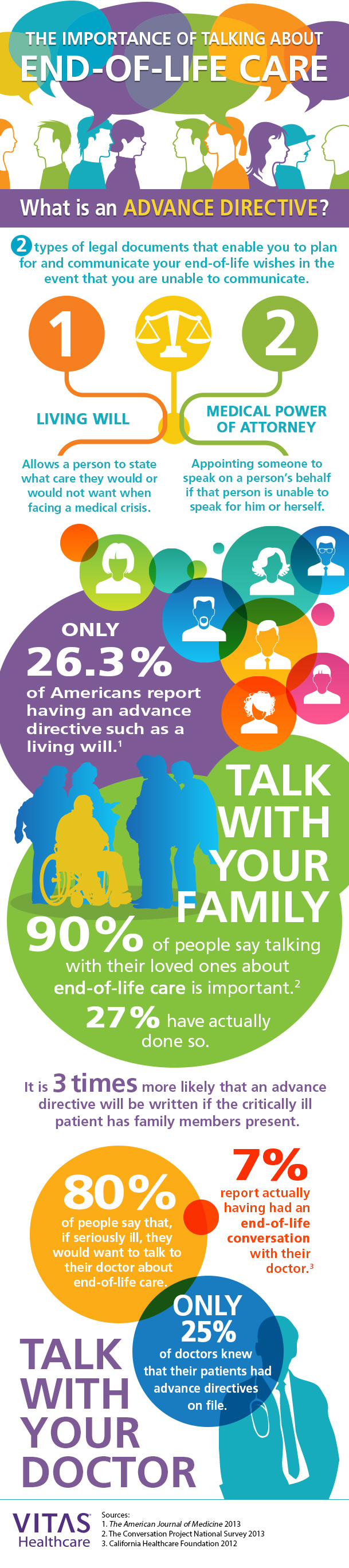
Despite the topic’s importance, only 27% of Americans report having talked with their families about end-of-life care. The best way to make your medical wishes known is to create an advance directive and share it with your family and your doctor.

An advance directive is actually two legal documents that enable you to plan and communicate your end-of-life wishes.  When you create your advance directive, you are being proactive about your medical care and sparing your loved ones from having to make difficult medical decisions in a time of crisis.

Don’t wait for a crisis. Create your advance directive, share copies with your loved ones and doctor and keep your copy in an accessible location others can find.

***

end_of_life_infographic

***

Channel Surfing

Have you visited our other topic channels? Established to facilitate idea exchange and link our community together, the value of these topics is dependent upon your input. Please take a minute to visit. And, to prevent that annoying spam, we ask that you register.

Link: http://feeds.feedburner.com/HealthcareFinancialsthePostForcxos

Give your loved ones peace of mind.

Would they know what you want if you couldn’t talk? Do you know what you would want near the end of life? Find your own answers. Then open the conversation with the people you love. You are giving everyone a priceless gift.

More About End of Life Planning

Conclusion

Your thoughts and comments on this ME-P are appreciated. Feel free to review our top-left column, and top-right sidebar materials, links, URLs and related websites, too. Then, subscribe to the ME-P. It is fast, free and secure.

Speaker: If you need a moderator or speaker for an upcoming event, Dr. David E. Marcinko; MBA – Publisher-in-Chief of the Medical Executive-Post – is available for seminar or speaking engagements. Contact: MarcinkoAdvisors@msn.com

OUR OTHER PRINT BOOKS AND RELATED INFORMATION SOURCES:

Risk Management, Liability Insurance, and Asset Protection Strategies for Doctors and Advisors: Best Practices from Leading Consultants and Certified Medical Planners™8Comprehensive Financial Planning Strategies for Doctors and Advisors: Best Practices from Leading Consultants and Certified Medical Planners™

BOOK REVIEW

Physicians have more complex liability challenges to overcome in their lifetime, and less time to do it, than other professionals. Combined with a focus on practicing their discipline, many sadly fail to plan for their own future. They need trustworthy advice on how to effectively protect themselves, families and practice, from the many overt and covert risks that could potentially disrupt years of hard work.

 Fortunately, this advice is contained within RISK MANAGEMENT, LIABILITY INSURANCE, AND ASSET PROTECTION STRATEGIES FOR DOCTORS AND ADVISORS [BEST PRACTICES FROM LEADING CONSULTANTS AND CERTIFIED MEDICAL PLANNERS™]. Written by Dr. David Edward Marcinko, Nurse Hope Rachel Hetico and their team of risk managers, accountants, insurance agents, attorneys and physicians, it is uniquely positioned as an integration of applied, academic and peer-reviewed strategies and research, with case studies, from top consultants and Certified Medical Planners. It contains the latest principles of risk management and asset protection strategies for the specific challenges of modern physicians. My belief is that any doctor who reads and applies even just a portion of this collective wisdom will be fiscally rewarded. The Institute of Medical Business Advisors has produced another outstanding reference for physicians that provide peace of mind in this unique marketplace! In my opinion, it is a mandatory read for all medical professionals.

DAVID K. LUKE; MS-PFP, MIM, CMP™

[Net Worth Advisory Group, Inc – Sandy, Utah]

Using mHealth to facilitate end-of-life care

Join Our Mailing List

An Infographic

Last week was National Healthcare Decisions Day (NHDD), “a day devoted to encouraging the completion of advance directives.”

When discussing end-of-life care, it’s a delicate issue that has to be handled carefully – and one in which mHealth can play an important role.

SOAR

***

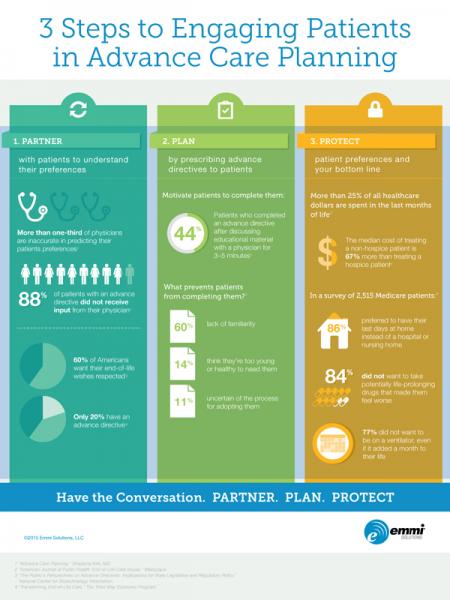
“There are serious communication challenges around advance care planning and they contribute to the emotional and financial burdens on patients, their families and their caretakers,” Geri Lynn Baumblatt, executive director of patient engagement for Emmi Solutions, said in a press release.

“Empowering people to make decisions about their own care before reaching a point where they can no longer speak for themselves can shift that experience from one of stress and confusion to one where everyone involved including the family and care team is readily prepared to follow the person’s wishes.”

“In a study of ICU patients with terminal conditions, only 12 percent of patients with an advance directive had received input from their physician in its development while another study showed that between 65 and 76 percent of physicians whose patients had an advance directive were not aware that it existed,” Nathan Kottkamp, founder of NHDD, in the release.

“These findings show that there is a huge communication gap between patients and their doctors around end of life care, NHDD’s mission is to help close that gap while Emmi Solutions’ program is a useful tool for doing so.”

For a closer look at how mHealth figures into advance directives, take a look at this infographic from Emmi Solutions.

***

end

[Click image to enlarge]

Conclusion

Your thoughts and comments on this ME-P are appreciated. Feel free to review our top-left column, and top-right sidebar materials, links, URLs and related websites, too. Then, subscribe to the ME-P. It is fast, free and secure.

Speaker: If you need a moderator or speaker for an upcoming event, Dr. David E. Marcinko; MBA – Publisher-in-Chief of the Medical Executive-Post – is available for seminar or speaking engagements. Contact: MarcinkoAdvisors@msn.com

OUR OTHER PRINT BOOKS AND RELATED INFORMATION SOURCES:

Product DetailsProduct Details

Death in the Digital Age

Join Our Mailing List

On Digital Assets

By co-operativefuneralcare.co.uk

An infographic to show the key statistics from our recent report which highlights how the growing use of digital channels in our daily lives can cause additional stress for bereaved loved ones.

***

Death-in-the-digital-age-infographic-the-co-operative-funeralcare-1024

On Children’s Inheritance

Join Our Mailing List 

In Estate Planning

By Rick Kahler MS CFP®  http://www.KahlerFinancial.com

Rick Kahler MS CFPEstate planning can be one of the most emotionally difficult aspects of financial planning. One often-overlooked aspect of estate planning is talking with your heirs about your legacy plans.

While most of us probably accept in theory that these conversations are important, actually carrying them out can be terribly difficult.

Suggestions

Here are a few suggestions that may help.

  1. Communicate your values about money in a larger context with both words and behavior. Our estate plans often reflect lifelong values such as a commitment to charitable giving or a wish to provide first for our families. If children are familiar with your values, chances are they will have a good idea of what to expect from your estate.
  2. Evaluate your children’s money skills. Just because kids grow up in the same family doesn’t mean they will have the same knowledge and attitudes about money. Especially if children will inherit significant amounts, conversations about estate planning can become part of larger conversations designed to help teach them how to manage and become comfortable with their legacies.
  3. If your estate plan does not treat children “equally,” for whatever reasons, it’s best to share that information well in advance and to communicate it privately to each child. There are many reasons why treating children differently in an estate plan can be the fairest thing to do, but that doesn’t mean it’s wise to let them learn the specifics when a will is read. If parents and individual children can discuss these provisions and the reasons for them ahead of time, there is less likelihood of conflict between siblings after the parents are gone.
  4. Don’t allow children to assume they are inheriting more than is the case. If most of your estate will go to charity, don’t keep it a secret. Not telling the kids may avoid conflict now, but it will sow seeds for deeper conflict and resentment after your death.
  5. Prepare children for large or unexpected inheritances. I’ve worked with heirs who were stunned to receive legacies much larger than their parents’ lifestyles had led them to expect. If you have a substantial net worth that’s “below the radar,” perhaps in the form of land or business ownership, your children may be totally unprepared for what they will inherit. Find ways to help them learn more about both the financial and the emotional aspects of managing inherited wealth. You might also consider options, such as giving more to the children during their lifetime, to help reduce the impact of a sudden inheritance.
  6. Acknowledge your own fears. Although it is seldom expressed, perhaps the strongest reason for not discussing estate plans with family members is fear. It’s natural for parents to be afraid that children will be angry or disappointed, will build too much on their expectations for an inheritance, or will be resentful of other heirs.

***

Currency

***

Communications

Talking to family members about estate planning and legacies can be difficult and even painful. Those discussions, however, will almost certainly be less painful in the long run than the stories children may make up about your decisions after you are gone.

Role of Planners and Coaches

Financial planners and financial coaches can play an important role that goes beyond providing financial advice. They may also be helpful in facilitating the family conversations. In especially difficult circumstances, the help of a financial therapist can also be invaluable.

Assessment

Using the available resources to help you discuss your wishes with family members can be an important aspect of estate planning. Having those difficult conversations is one way to enhance the legacy you want to pass on to your family.

Conclusion

Your thoughts and comments on this ME-P are appreciated. Feel free to review our top-left column, and top-right sidebar materials, links, URLs and related websites, too. Then, subscribe to the ME-P. It is fast, free and secure.

Speaker: If you need a moderator or speaker for an upcoming event, Dr. David E. Marcinko; MBA – Publisher-in-Chief of the Medical Executive-Post – is available for seminar or speaking engagements. Contact: MarcinkoAdvisors@msn.com

OUR OTHER PRINT BOOKS AND RELATED INFORMATION SOURCES:

Product Details  Product Details

Physician Creditor Protection for IRAs, Annuities and Insurance for 2014-15

Join Our Mailing List

A SPECIAL ME-P REPORT

###

Asset Protection Planning for Qualified and Non-Qualified Retirement Plans, IRAs, 403(b)s, Education IRAs (Coverdell ESAs), 529 Plans, UTMA Accounts, Health/Medical Savings Accounts (MSA/HSAs), Qualified and Non-Qualified Annuities, Long-Term Care Insurance, Disability Insurance and Group, Individual and Business Life Insurance [Ohio Focus]

By Edwin P. Morrow III; JD LLM MBA CFP® RFC®

[©2007-12-14. All rights reserved. USA]

EDITOR’S NOTE:

Hi Ann,

A couple years ago you posted an earlier version of the attached Asset Protection Outline. I updated it to include quite a bit more discussion of different protection levels for various kinds of accounts, and included more discussion of states other than Ohio, including a 50 state chart with IRA/403b protections.

So please delete the old one and replace with this one which contains more topics, including some substantial discussion of issues regarding current class action litigation jeopardizing asset protection for Schwab and Merrill Lynch IRAs.

Regards
Ed

###

The Importance of Asset Protection as Part of Financial and Estate Planning for Doctor’s and Medical Professionals

Asset Protection has become a ubiquitous buzz-word in the legal and financial community. It often means different things to different people. It may encompass anything from buying umbrella liability insurance to funding offshore trusts.

What is most likely to wipe out a client’s entire net worth? An investment scam, investment losses, a lawsuit, divorce or long-term health care expenses? “Asset Protection” may be construed to address all of these scenarios, but this outline will cover risk from non-spousal creditors as opposed to risk from bad investments, divorce, medical bills or excessive spending. Prudent business practice and limited liability entity use (LP, LLP, LLC, Corporation, etc) is the first line of defense against such risks. Similarly, good liability insurance and umbrella insurance coverage is paramount.

However, there is a palpable fear among many of frivolous lawsuits and rogue juries [especially among physicians and medical professionals]. Damages may exceed coverage limits. Moreover, insurance policies often have large gaps in coverage (e.g. intentional torts, “gross” negligence, asbestos or mold claims, sexual harassment).

As many doctors in Ohio know all too well, malpractice insurance companies can fail, too. Just as we advise clients regarding legal ways to legitimately avoid income and estate taxes or qualify for benefits, so we advise how to protect family assets from creditors. Ask your clients, “What level of asset protection do you want for yourself?

For the inheritance you leave to your family?” Do any clients answer “none” or “low”? Trusts that are mere beneficiary designation form or POD/TOD substitutes are going out of style in favor of “beneficiary-controlled trusts”, “inheritance trusts” and the like.

Table of Contents

While effort is made to ensure the material is accurate, this material is not intended as legal advice and no one may rely on it as such. Sections II(d), II(i), V, VI and XI were updated Feb 2012, but much of the material and citations have not been verified since 2010. Permission to reprint and share with fellow bar members is granted, but please contact author for updates if more than a year old.

T.O.C. [Page Number]

I. Importance of Asset Protection 2

II. State and Federal Protections Outside ERISA or Bankruptcy 4

a. Non-ERISA Qualified Plans: SEP, SIMPLE IRAs 5

b. Traditional and Roth IRAs, “Deemed IRAs” 7

c. Life Insurance 9

d. Long-Term Care, Accident/Disability Insurance 13

e. Non-Qualified Annuities 13

f. Education IRAs (now Coverdell ESAs) 16

g. 529 Plans 17

h. Miscellaneous State and Federal Benefits 18

i. HSAs, MSAs, FSAs, HRAs 18

III. Federal ERISA Protection Outside Bankruptcy 20

IV. Federal Bankruptcy Scheme of Creditor Protection 26

V. Non-Qualified Deferred Comp – Defying Easy Categorization 30

VI. Breaking the Plan – How Owners Can Lose Protection 32

(incl Prohibited Transactions and Schwab/Merrill Lynch IRA problems) 35

VII. Post-Mortem – Protections for a Decedent’s Estate 51

VIII. Post-Mortem – State Law Protections for Beneficiaries 52

IX. Post-Mortem – Bankruptcy Protections for Beneficiaries 54

X. Dangers and Advantages of Inheriting Through Trusts 56

XI. Piercing UTMA/UGMA and Other Third Party Created Trusts 59

XII. Exceptions for Spouses, Ex-Spouses and Dependents 61

XIII. Exceptions when the Federal Government (IRS) is Creditor 62

XIV. Fraudulent Transfer (UFTA) and Other Exceptions 68

XV. Disclaimer Issues – Why Ohio is Unique 69

XVI. Medicaid/Government Benefit Issues 71

XVII. Liability for Advisors 72

XVIII. Conflicts of Law – Multistate Issues 73

XIX. Conclusions 75

Appendices

A. Ohio exemptions – R.C. §2329.66 (excerpt), §3911.10, §3923.19 78

B. Bankruptcy exemptions – 11 U.S.C. § 522 excerpts 80

C. Florida IRA exemption – Fla Stat. § 222.21 (note-may be outdated) 85

D. Sal LaMendola’s Inherited IRA Win/Loss Case Chart 86

E. Multistate Statutory Debtor Exemption Chart 88

###

Assessment

This outline will discuss the sometimes substantial difference in legal treatment and protection for various investment vehicles and retirement accounts, with some further discussion of important issues to consider when trusts receive such assets.

Beware of general observations like: “retirement plans, insurance, IRAs and annuities are protected assets” – that may often be true, but Murphy’s law will make your client the exception to the general rules. The better part of this outline is pointing out those exceptions.

2012 WHITE PAPER LINK:

Creditor Protection for IRAs Annuities Insurance Nov 19 2010 WC CLE Feb 2012 update

***

2014 WHITE PAPER LINK UPDATE:

Optimal Basis Increase Trust Aug 2014

***

ABOUT THE AUTHOR:

Mr. Edwin P. Morrow III, a friend of the Medical Executive-Post, is a Wealth Specialist and Manager, Wealth Strategies Communications Ohio State Bar Association Certified Specialist, Estate Planning, Probate and Trust Law Key Private Bank Wealth Advisory Services. 10 W. Second St., 27th Floor Dayton, OH 45402. He is an ME-P “thought leader”.

Constructive criticism or other comments welcome.

Conclusion

Your thoughts and comments on this ME-P are appreciated. Feel free to review our top-left column, and top-right sidebar materials, links, URLs and related websites, too. Then, subscribe to the ME-P. It is fast, free and secure.

Speaker: If you need a moderator or speaker for an upcoming event, Dr. David E. Marcinko; MBA – Publisher-in-Chief of the Medical Executive-Post – is available for seminar or speaking engagements. Contact: MarcinkoAdvisors@msn.com

OUR OTHER PRINT BOOKS AND RELATED INFORMATION SOURCES:

Product Details  Product Details

When Financial Assets Get a ½ Step-Up in Cost Basis

Join Our Mailing List 

Unique to Spouses

By Lon Jefferies MBA CFP®

Lon JeffriesMany doctors are aware that when the owner of a taxable asset passes away, the party that inherits that asset does so at a stepped-up cost basis.

For example, suppose a husband owns a stock in a taxable investment account that he purchased for $100,000 but is now worth $150,000. If the husband sells the stock, there will be taxes due on the $50,000 of growth, or the difference between the current value and the cost basis.

However, if the husband passes away and a wife inherits the stock, the wife’s cost basis gets increased to the full $150,000, the value of the account on the date the husband passed away. This enables the wife to sell the stock and keep the full $150,000 of value without paying taxes.

Jointly Owned with Rights of Survivorship

However, what happens to assets that are owned jointly with a right of survivorship when one spouse passes away? Did you know in this scenario, it is possible for assets to receive a ½ step-up in basis? The formula looks like this:

(Date-of-death fair market value + Old basis) / 2 = New Basis

In a practical example, suppose John contributes $10,000 to a joint account with a right of survivorship and Jane contributed $5,000 to the same account. When John passes, the account is valued at $20,000. This will cause Jane to get a step-up in basis to $17,500 on the taxable account.

($20,000 + $15,000) / 2 = $17,500

Jane receives a ½ step-up in basis on each position within the investment account. She is unable to claim a full-step up on one stock within the account and no step-up on other assets.

Unique to Spouse

Notice that even though the spouse’s contributed different amounts to the account, they each share a full 50% share of the property for inclusion in their estates. However, this is unique to spouses with right of survivorship and the issue is more complex if the parties involved are not married.

Spouses

Assessment

To be clear, this step-up only occurs on taxable assets like physical property or taxable investment accounts. A step-up does not occur on tax-deferred investments like IRAs or 401(k)s.

Conclusion

Your thoughts and comments on this ME-P are appreciated. Feel free to review our top-left column, and top-right sidebar materials, links, URLs and related websites, too. Then, subscribe to the ME-P. It is fast, free and secure.

Speaker: If you need a moderator or speaker for an upcoming event, Dr. David E. Marcinko; MBA – Publisher-in-Chief of the Medical Executive-Post – is available for seminar or speaking engagements. Contact: MarcinkoAdvisors@msn.com

OUR OTHER PRINT BOOKS AND RELATED INFORMATION SOURCES:

Product DetailsProduct DetailsProduct Details

Product Details  Product Details

Planning for the Special Needs Child

Join Our Mailing List 

The Heart of Estate Planning

By Rick Kahler MS CFP® http://www.KahlerFinancial.com

Rick Kahler CFPThe heart of estate planning, for many of us, comes down to one issue: taking care of family. We do our best to make decisions that we hope will be right for surviving spouses and children.

Such decisions are especially challenging for parents of children with special needs. The question of “Who will take care of this child after we’re gone?” can be heart-wrenching. There are financial planners who specialize in this area, and the best option for many families might be to ask a generalist planner like me for a referral to one of them.

The following suggestions, then, are intended as starting points or a very general framework on which to build.

The Framework

A fundamental tool in providing for a special-needs child is a trust. My suggestion is to have this trust handled by a trust company that does not manage money, rather than a bank. It will charge a flat fee for its service, typically in the range of $3,500 to $10,000, and the trust need not be in the millions of dollars. The parents can empower the trust company to hire an appropriate investment advisor to manage the money. I suggest the trust require using an advisor who is a fiduciary to the trust and is compensated by fees rather than commissions. This, along with the trustee looking over the advisor’s shoulder, provides a good system of checks and balances.

Then, the parents can appoint an advocate for the beneficiary who serves as a co-trustee. This person does not manage the money, but is the trustee’s eyes and ears to make sure the trust is meeting the beneficiary’s specific needs. When the advocate can no longer serve, the corporate trustee can appoint a new advocate.

Example:

Advocates might be family members or representatives from an agency that provides care to the beneficiary. In Rapid City, for example, a nonprofit organization called Black Hills Works serves people with a variety of special needs. Many of its clients receive services throughout their lifetimes, and some of them are supported by trusts. An agency like this will not serve as a trustee for clients’ funds, which would be a conflict of interest, but it can serve as an advocate for a client who is the beneficiary of a trust.

Separation of Responsibilities

The basic approach I’m suggesting is to separate the responsibilities of caring for a special-needs child among several professionals, family members, or friends, according to their competencies and the child’s needs. A corporate trustee, not an individual, coordinates their functions. This goes a long way toward assuring consistent and coordinated support throughout the beneficiary’s lifetime.

Estate Planning

I also suggest not thinking of this approach only in terms of estate planning, but also to provide for a child as the parents age. As they become unable to provide care or manage funds themselves, they can turn responsibilities over to the corporate trustee, advisor, and advocate.

Making sure a handicapped child is taken care of may take all the parents’ assets, which could raise the question of fairness to other children. While the issue of what is fair depends on each family’s situation, my observation is that it isn’t necessarily a problem. Many siblings, rather than feeling deprived, are pleased to know the special-needs child is provided for. As with other estate planning concerns, clear communication about the parents’ intentions is crucial.

***

Molecular Thoughts

***

Assessment

My final suggestion regarding a trust is to make sure you design it to allow the beneficiary as much flexibility and participation in decisions as is appropriate for his or her abilities. Ideally, the trust will not limit the beneficiary’s independence, but will support it.

Conclusion

Your thoughts and comments on this ME-P are appreciated. Feel free to review our top-left column, and top-right sidebar materials, links, URLs and related websites, too. Then, subscribe to the ME-P. It is fast, free and secure.

Link: http://feeds.feedburner.com/HealthcareFinancialsthePostForcxos

Speaker: If you need a moderator or speaker for an upcoming event, Dr. David E. Marcinko; MBA – Publisher-in-Chief of the Medical Executive-Post – is available for seminar or speaking engagements. Contact: MarcinkoAdvisors@msn.com

OUR OTHER PRINT BOOKS AND RELATED INFORMATION SOURCES:

Product Details  Product Details

On “Ethical Wills”

Join Our Mailing List

AKA Heritage or Legacy Wills [An Ash Wednesday Tribute]

By Dr. David Edward Marcinko MBA CMP™

www.CertifiedMedicalPlanner.org

Dr. DEM

An ethical will is a document designed to pass ethical values from one generation to the next.

It was first postulated in 1998 by Barry K. Baines MD in his Ethical Will Resource Kit.

He then founded the www.EthicalWill.com website, now known as www.CelebrationsofLife.net His hospice care experience provided the impetus for developing resources to help people write and preserve their legacy of values at any stage of life [personal communication].

By 2005, Andrew Weil MD promoted ethic wills as a “‘gift of spiritual health”’ to leave family members. The goal is to link a person to both their family and cultural history, clarify ethical and spiritual values, and communicate a legacy to future generations.

Today, ethical wills are written by both men and women of every age, ethnicity, faith tradition, economic circumstance, and educational level. For FAs, an ethical will can open the door to start a bigger conversation about estate planning. Susan Turnbull, a principal with Personal Legacy Advisors in New Hampshire is author of The Wealth of Your Life: A Step By Step Guide for Creating Your Ethical Will, a document that some financial advisors offer their clients as a template for creating them.

###

ethical-exercises

###

Assessment

In recent years, the practice has been increasingly used by the general lay public and medical professionals. In fact, the American Bar Association [ABA] described it as an aid to estate planning in health care and hospice and as a spiritual healing tool.

More:

Conclusion

Your thoughts and comments on this ME-P are appreciated. Feel free to review our top-left column, and top-right sidebar materials, links, URLs and related websites, too. Then, subscribe to the ME-P. It is fast, free and secure.

Link: http://feeds.feedburner.com/HealthcareFinancialsthePostForcxos

Speaker: If you need a moderator or speaker for an upcoming event, Dr. David E. Marcinko; MBA – Publisher-in-Chief of the Medical Executive-Post – is available for seminar or speaking engagements. Contact: MarcinkoAdvisors@msn.com

OUR OTHER PRINT BOOKS AND RELATED INFORMATION SOURCES:

DICTIONARIES: http://www.springerpub.com/Search/marcinko
PHYSICIANS: www.MedicalBusinessAdvisors.com
PRACTICES: www.BusinessofMedicalPractice.com
HOSPITALS: http://www.crcpress.com/product/isbn/9781466558731
CLINICS: http://www.crcpress.com/product/isbn/9781439879900
BLOG: www.MedicalExecutivePost.com
FINANCE: Financial Planning for Physicians and Advisors
INSURANCE: Risk Management and Insurance Strategies for Physicians and Advisors

Product Details  Product Details

The “Die-Brokers”

Join Our Mailing List

Results of an HBSC Survey

By Rick Kahler CFP® http://www.KahlerFinancial.com

Rick Kahler CFP

In recent ME-P columns I reported on a survey done by the financial services company HBSC that found only 59% of US parents intend to leave their children an inheritance, the lowest of the 15 nations in the survey. The fact the US is last came as no surprise to me. What did surprise me was that 59% seemed high.

My Average Clients

My average client is someone who has saved over one million dollars. I am guessing that less than 2% of them have any intention or goal of constraining their current lifestyle in order to maximize their kids’ inheritance. Consuming their last penny of savings about the time they take that last breath is their spending plan of choice. There is even a name for these folks: “Die Brokers.”

If they did a good job of planning for retirement, however, most Die Brokers will leave something behind. Almost all of these I work with intend to divide what remains equally among their children. The point is that leaving an inheritance just isn’t a priority or a goal that constrains their current spending. As a side note, I rarely see any intention to leave any significant portion of their estate to charity.

The Survey

Why did the survey find such a high number of parents who intend on leaving their kids an inheritance, as compared to my observations that almost none intend to? My experience is that most people have a money script of, “Good parents should leave something to their children.” It is similar to another money script of, “Good parents should pay for their children’s college education.” These are seen as things “good” parents do. My hunch is that when most respondents answered the survey question, they let their money script do the talking, rather than their true intention.

The Explanation

Still, this does not explain why US parents intend to leave their children less than parents in any other country. One reason could be that more parents in other countries have money scripts that it’s necessary to leave their kids an inheritance.

One of the most common themes among my affluent clients is a desire to see their children “make it on their own.” Over 90 percent of these clients are first-generation wealth builders, meaning they didn’t inherit their money but accumulated it from saving, investing, or building a business. They value hard work and frugality and feel leaving a large inheritance to a child is more hurtful than helpful.

First Generation Millionaires

Many of these first-generation millionaires also feel accumulating wealth in the US is very attainable with hard work, discipline, and frugality. This is not the case worldwide. In many countries, it doesn’t matter how hard you work or how frugal you are, confiscatory taxes and oppressive regulations insure that those people not fortunate enough to be born into money will never have a chance to become affluent. The only way to have a comfortable net worth in many countries is to either inherit it or work for the government.

Sadly, the US is closer to adopting a model that makes accumulating wealth increasingly difficult. I can’t name a politician currently campaigning who advocates lowering income taxes on wealth builders. Yet I can name scores who are running on increasing taxes on “the rich.”

staitns572x0

Assessment

Affluent parents in the US may soon begin to feel that, without an inheritance, their children may never have the means to get ahead. If more US parents begin believing this, we will probably see increasing numbers intending to leave money to their kids. The money script of “Good parents should leave something to their children” might become the truth.

More:

Conclusion

Your thoughts and comments on this ME-P are appreciated. Feel free to review our top-left column, and top-right sidebar materials, links, URLs and related websites, too. Then, subscribe to the ME-P. It is fast, free and secure.

Link: http://feeds.feedburner.com/HealthcareFinancialsthePostForcxos

Speaker: If you need a moderator or speaker for an upcoming event, Dr. David E. Marcinko; MBA – Publisher-in-Chief of the Medical Executive-Post – is available for seminar or speaking engagements. Contact: MarcinkoAdvisors@msn.com

OUR OTHER PRINT BOOKS AND RELATED INFORMATION SOURCES:

DICTIONARIES: http://www.springerpub.com/Search/marcinko
PHYSICIANS: www.MedicalBusinessAdvisors.com
PRACTICES: www.BusinessofMedicalPractice.com
HOSPITALS: http://www.crcpress.com/product/isbn/9781466558731
CLINICS: http://www.crcpress.com/product/isbn/9781439879900
BLOG: www.MedicalExecutivePost.com
FINANCE: Financial Planning for Physicians and Advisors
INSURANCE: Risk Management and Insurance Strategies for Physicians and Advisors

Product Details  Product Details

On Parents’ Inheritance Excuses

Join Our Mailing List 

An Estate Planning Follow-Up Discussion

By Rick Kahler CFP® http://www.KahlerFinancial.com

Rick Kahler CFPPreviously on this ME-P, we explored three fears that stop adult children from talking with parents about their estate plans, even though such conversations could greatly benefit both generations.

These are: “It’s none of my business,” “I don’t want them to think I am greedy,” and, “It will ruin our relationship.”

Parents Fear, Too!

Children aren’t alone in their fear of approaching this topic. Most parents are just as reluctant—and for the same basic reasons. In my experience, parents’ biggest reasons for not talking with kids about legacy intentions are: “It’s none of their business,” “If I share financial information, they will take advantage of me,” and “Talking about money will hurt our relationship.”

Let’s look at each of these:

“It’s none of their business.” This is certainly true, unless you’ve made it their business. If you name a child as an executor of a will, a successor trustee of a trust, or an agent in a Durable Power of Attorney, you have made it that child’s business to know your business.

Shared Decision Making  

To throw a child into suddenly having to make financial decisions in your best interest without knowing what they must manage, where assets are held, and what your wishes are is unfair to both you and your child. Any time you put someone in a position of authority in any of your estate documents, it’s essential to carefully go through the document with them and to disclose details of the assets they will make decisions on. Start with showing them your financial statements, the contact information of your trusted advisors, and a listing of where you hold all your accounts.

If you feel you can’t trust a child with such information today, then why do you feel you can trust them as your agent or executor tomorrow? If you don’t trust a child, you’re better off to name a bank trust office or trust company to these positions.

Bank

“If I share financial information, they will take advantage of me.” This fear may be justified if your child has a history of taking advantage of you. If not, they probably aren’t going to start now. Preparing a child for an inheritance is not only prudent, it’s also a loving act of kindness you can give your child.

Sudden Money

I have worked with several families where children had no idea of their parents’ net worth. In every case, it was much higher than the kids ever imagined. Suddenly, they learned they were about to inherit hundreds of thousands or millions of dollars in various investments they knew nothing about. I witnessed these heirs try to cope with a plethora of emotions and money scripts, in addition to needing to learn the mechanics of managing a portfolio of investments. Without proper preparation, it’s not uncommon for what parents intended as a loving gift of wealth to turn into a destructive force of misery.

“Talking about money will hurt our relationship.” Parents are just as terrified to have money conversations with their kids as kids are afraid to talk with them. And no wonder—it’s parents who teach kids the no-talk rule in the first place.

Parental Wisdom

As parents, you can exercise the wisdom of age and begin the family money conversations. It may be helpful to have the first meeting with your financial planner or estate attorney, or engage the help of a financial therapist. You might be amazed to find that talking with your kids about money in a straightforward and healthy way can actually help your relationships.

Assessment

Do your kids a favor and break the no-talk rule. It’s a gift to both generations.

Conclusion

Your thoughts and comments on this ME-P are appreciated. Feel free to review our top-left column, and top-right sidebar materials, links, URLs and related websites, too. Then, subscribe to the ME-P. It is fast, free and secure.

Link: http://feeds.feedburner.com/HealthcareFinancialsthePostForcxos

Speaker: If you need a moderator or speaker for an upcoming event, Dr. David E. Marcinko; MBA – Publisher-in-Chief of the Medical Executive-Post – is available for seminar or speaking engagements. Contact: MarcinkoAdvisors@msn.com

OUR OTHER PRINT BOOKS AND RELATED INFORMATION SOURCES:

DICTIONARIES: http://www.springerpub.com/Search/marcinko
PHYSICIANS: www.MedicalBusinessAdvisors.com
PRACTICES: www.BusinessofMedicalPractice.com
HOSPITALS: http://www.crcpress.com/product/isbn/9781466558731
CLINICS: http://www.crcpress.com/product/isbn/9781439879900
BLOG: www.MedicalExecutivePost.com
FINANCE: Financial Planning for Physicians and Advisors
INSURANCE: Risk Management and Insurance Strategies for Physicians and Advisors

Product Details  Product Details

Children and Inheritances

Join Our Mailing List

The Last Money Taboo?

By Rick Kahler CFP® http://www.KahlerFinancial.com

Rick Kahler CFPTalking about money is taboo in the US. If you don’t believe me, next time you’re at a social gathering ask everyone these two questions:

1. “What was your taxable income last year?”

2. “What is your net worth?”

Well, it’s not a recommended way to make new friends.

The Money Taboo

The taboo on money conversations can cause real difficulties when it extends to families. My experience as a financial planner suggests most families in the US have a “no-talk” rule around money. While a lot of family members know each other’s earnings, fewer know family members’ net worth. Even fewer have asked about their parents’ estate planning.

Many don’t intend to ever ask.  A blogger who calls himself the Financial Samurai wrote: “I never want to have the inheritance talk with my parents unless they initiate the conversation.”

Based on the responses to his article, he isn’t the only person holding this opinion. Most children recoil at even the thought of asking their parents about the particulars of their estate plans.

None of My Business

In my experience, the most common reasons for not talking to parents about their inheritance plans are these:  “It’s none of my business,” “I don’t want them to think I am greedy,” and, “It will ruin our relationship.”

Why Not Ask?

Let’s look at each of these reasons:

1. “It’s none of my business.” It’s true that parents have no obligation to disclose their finances and estate plan to their children. Yet it could quickly become your business if you are named as an executor in their wills, a successor trustee in a trust, or an agent in their powers of attorney. Asking whether you are designated as any of these roles is totally reasonable. If you are, then knowing the particulars of their estate plan and finances would be helpful for you to know. It is such a reasonable request that, if your parents are not willing to discuss the details, you may be best served asking them to name someone else.

2. “I don’t want them to think I am greedy.” If you’ve had your hand out to your parents most of your life, asking them how much you’re going to get when they kick off may not evoke a loving response. However; if you have never asked your parents for money – or – if you have asked for money and have paid them back; then you probably don’t have much to worry about! If you approach the topic from the standpoint of wanting to be fully prepared to carry out any duties bestowed upon you, I seriously doubt your parents will suddenly think you’ve morphed into a greedy, money-sucking leach.

3. “It will ruin our relationship.” One of the strongest money scripts around talking about money is that doing so will permanently harm a relationship. The Financial Samurai wrote, “I hate thinking about money and family because so often money tears relationships apart.” While money issues can certainly tear apart a relationship, so can abusing alcohol, sex, drugs, work, power, and a host of other things.

Mature Woman

Assessment

What I’ve seen is that keeping secrets about money is more harmful to relationships than talking about money. When the no-talk rule is in effect, family members make up their own stories about what is real. Those stories are rarely true, and the assumptions around them can cause misunderstanding and mistrust.

Being the first to break a family’s “no money talk” rule isn’t easy. Yet having the courage to start money conversations can be a service to the whole family. In my experience, it ultimately leads to better estate plans, more trust, and stronger relationships.

Conclusion

Your thoughts and comments on this ME-P are appreciated. Feel free to review our top-left column, and top-right sidebar materials, links, URLs and related websites, too. Then, subscribe to the ME-P. It is fast, free and secure.

Link: http://feeds.feedburner.com/HealthcareFinancialsthePostForcxos

Speaker: If you need a moderator or speaker for an upcoming event, Dr. David E. Marcinko; MBA – Publisher-in-Chief of the Medical Executive-Post – is available for seminar or speaking engagements. Contact: MarcinkoAdvisors@msn.com

OUR OTHER PRINT BOOKS AND RELATED INFORMATION SOURCES:

DICTIONARIES: http://www.springerpub.com/Search/marcinko
PHYSICIANS: www.MedicalBusinessAdvisors.com
PRACTICES: www.BusinessofMedicalPractice.com
HOSPITALS: http://www.crcpress.com/product/isbn/9781466558731
CLINICS: http://www.crcpress.com/product/isbn/9781439879900
BLOG: www.MedicalExecutivePost.com
FINANCE: Financial Planning for Physicians and Advisors
INSURANCE: Risk Management and Insurance Strategies for Physicians and Advisors

Product Details  Product Details

On Inheritances by Country

Join Our Mailing List 

Spending an Inheritance

By Rick Kahler CFP® www.KahlerFinancial.comRick Kahler CFP

Stroll through a retirement camping resort or pass an RV on the highway, and you might see this bumper sticker:

“We’re spending our children’s inheritance”

No Joke

Apparently, this isn’t a joke. A December 13, 2013, article in CNN Money reported on a recent survey by the British-based international financial services company HSBC which asked more than 16,000 people in 15 countries about their estate plans. The US ranks last in the percentage of retired parents (56%) that intend to leave money to their kids. This is significantly below the 15-country average of 69% and far below the leading percentage of 86% in India.

US Rank

The US also ranks sixth in the amount of money ($177,000) that parents expect to pass on. This is behind Australia ($501,000), Singapore ($371,000), the UK ($234,185), France ($233,699), and Taiwan ($191,039).

No doubt there are many reasons for the country-by-country differences in what parents expect to leave their children. These may include differences in cultures, beliefs about family responsibilities, and attitudes toward charitable giving.

Contributing Factors

Other contributing factors, however, are differences in countries’ economic strength and tax laws. In a December 13 interview with The Australian, Graham Heunis, the head of retail banking and wealth management for HSBC Australia, credited some of the large inheritances there to the country’s unbroken 22 recent years of economic prosperity. Australian household wealth grew 7.6 per cent a year over the past decade, making it one of the richest nations per capita in the world.

Heunis also said, “In markets like the UK and US, inheritance and estate tax may cost heirs upwards of 40 per cent of an inheritance. With no inheritance tax in Australia, it’s no surprise the value and proportion of inheritance among Australian retirees is exponentially higher than the rest of the world.”

A Good Thing

It’s refreshing to see that accumulating and keeping wealth is still looked upon as a good thing in some countries. I doubt it’s a coincidence that most of those countries have strong economies, similar to what the US enjoyed in the past.

According to the 2013 Index of Economic Freedom, Singapore and Australia, the top two countries for inheritances, are two of the only three countries considered to have “free economies.” (The third is Hong Kong, where the average amount parents expect to pass on to kids is $145,943.) The US, considered the third top “free economy” in 2000, now sits at tenth as a “mostly free economy.”

Survey

This survey is not good news for baby boomers hoping to retire on inheritances from their parents. According to CNN Money, “About two-thirds of U.S. respondents said the inheritances they receive will at least partly fund their retirement, and 10% said they will rely on their inheritance completely to retire.”

If two-thirds of middle-aged Americans expect substantial inheritances, but only about half of elderly retired parents expect to leave inheritances, somebody is going to be disappointed.

Still, for those, like the majority of baby boomers, who are unprepared for retirement, every little bit helps. While an inheritance of $177,000 won’t put anyone on Easy Street in retirement, it could pay off a home mortgage or, if invested wisely, generate a monthly income of $450 for life.

inheritance

Another Problem

One last problem for potential heirs, of course, is that just because parents expect to leave an inheritance doesn’t mean they will be able to do so. Medical expenses or other unanticipated costs might well eat up parents’ resources during their lifetimes.

Assessment

Ultimately, relying on an inheritance for your retirement is never a wise move. It’s far wiser to use your own resources, start retirement planning early, and build your own financial security.

Conclusion

Your thoughts and comments on this ME-P are appreciated. Feel free to review our top-left column, and top-right sidebar materials, links, URLs and related websites, too. Then, subscribe to the ME-P. It is fast, free and secure.

Link: http://feeds.feedburner.com/HealthcareFinancialsthePostForcxos

Speaker: If you need a moderator or speaker for an upcoming event, Dr. David E. Marcinko; MBA – Publisher-in-Chief of the Medical Executive-Post – is available for seminar or speaking engagements. Contact: MarcinkoAdvisors@msn.com

OUR OTHER PRINT BOOKS AND RELATED INFORMATION SOURCES:

DICTIONARIES: http://www.springerpub.com/Search/marcinko
PHYSICIANS: www.MedicalBusinessAdvisors.com
PRACTICES: www.BusinessofMedicalPractice.com
HOSPITALS: http://www.crcpress.com/product/isbn/9781466558731
CLINICS: http://www.crcpress.com/product/isbn/9781439879900
BLOG: www.MedicalExecutivePost.com
FINANCE: Financial Planning for Physicians and Advisors
INSURANCE: Risk Management and Insurance Strategies for Physicians and Advisors

Product Details  Product Details

Update on Estate and Probate Law

Join Our Mailing List 

INCREASING TRUST INCOME TAX EFFICIENCY AFTER ATRA WITH BETTER BYPASS TRUST OPTIONS [Ohio]

By Edwin P. Morrow III; JD LL.M, MBA CFP® RFC® CMP® [Hon]

Ed Morrow III JDDave, Ann and ME-P Readers,

Many doctors are flummoxed with whether they need any “AB” trust in light of the new tax laws.  

I’ve written quite a lot on this and have attached a short and a long version to review:

VIEW: Ohio Law

VIEW: Optimal Basis Increase Trust Sept 2013

You could delete the outdated ME-P sections on EGTTRA and replace them with some of this (although it may be too much for doctors and laypeople, so I’ve also toned-it-down similar to the shorter version above).

Assessment

Also, you should cover captive insurance companies if you have not already. Which physician/practice owners should consider it?  How do you start? How do you choose a captive manager and attorney?  What should you watch out for?  I could do that too, I think I have some material.

More on Alternative Insurance Companies:

More on Asset Protection:

ABOUT THE AUTHOR:

Mr. Edwin P. Morrow III, a friend of the Medical Executive-Post, is a Wealth Specialist and Manager, Wealth Strategies Communications Ohio State Bar Association Certified Specialist, Estate Planning, Probate and Trust Law Key Private Bank Wealth Advisory Services. 10 W. Second St., 27th Floor Dayton, OH 45402. He is an ME-P “thought leader”.

This essay is based on presentation by the author at the Wealth Management Conference at Columbus on June 13, 2013.

Conclusion

Your thoughts and comments on this ME-P are appreciated. Feel free to review our top-left column, and top-right sidebar materials, links, URLs and related websites, too. Then, subscribe to the ME-P. It is fast, free and secure.

Link: http://feeds.feedburner.com/HealthcareFinancialsthePostForcxos

Speaker: If you need a moderator or speaker for an upcoming event, Dr. David E. Marcinko; MBA – Publisher-in-Chief of the Medical Executive-Post – is available for seminar or speaking engagements. Contact: MarcinkoAdvisors@msn.com

OUR OTHER PRINT BOOKS AND RELATED INFORMATION SOURCES:

LEXICONS: http://www.springerpub.com/Search/marcinko
PHYSICIANS: www.MedicalBusinessAdvisors.com
PRACTICES: www.BusinessofMedicalPractice.com
HOSPITALS: http://www.crcpress.com/product/isbn/9781466558731
CLINICS: http://www.crcpress.com/product/isbn/9781439879900
ADVISORS: www.CertifiedMedicalPlanner.org
BLOG: www.MedicalExecutivePost.com

Product DetailsProduct DetailsProduct Details

Product Details  Product Details

On Doctors Passing Wealth to Children

Join Our Mailing List 

Limiting your kid’s ability to tap principal

By Rick Kahler CFP® http://www.KahlerFinancial.com

Rick Kahler CFPWhen passing wealth to your kids, some medical professionals should consider creating a trust to limit the later generation’s ability to tap into the principal. Several astute readers suggested this strategy after my recent column citing research that shows 90% of inherited wealth is gone by the third generation.

Preserving Wealth

There is no question that a trust, done correctly, can go a long way to preserve wealth after the death of the wealth accumulator. Let’s explore what “done correctly” means.

1. Trust law is complex. Engage an accountant and attorney with strong skills and expertise in trusts.

2. Be sure the assets you intend to go into the trust will actually transfer.

Retirement plans like IRA’s, 401(k)’s, and profit sharing plans will pass to whomever you listed as the beneficiary. This must be the trust. In addition, the trust must include a number of special provisions in order for a retirement plan to be distributed according to your wishes and not as a fully taxable lump sum.

Annuities, insurance policies, and accounts with a TOD (transfer on death) clause will also pass to the named beneficiary.

Assets held in joint tenancy will not pass to the trust. Many married couples jointly own most of their major assets, such as the family home, investment real estate, brokerage accounts, or bank accounts.

3. Be sure there are enough assets in the trust to justify the trustee fees. Most professional corporate trustees charge $3,500 to $10,000 annually, or up to 1% of the trust assets. If a trust with $100,000 incurs an annual fee of $3,500, your hard-earned estate will benefit the trustee as much as your heirs. A trust probably doesn’t make financial sense if the total fees will exceed 2%.

4. If a trust still seems like a good strategy after the above caveats, the next question is how much to limit heirs’ ability to withdraw money. From an actuarial standpoint it’s fairly simple. If you limit annual withdrawals to 3% of the principal, there’s a strong probability of the money lasting several generations with its buying power intact. Provided, that is, the trustees pay close attention to the next point.

5. To generate sufficient returns to pay out up to 3% annually to heirs and also keep up with inflation, the majority of the portfolio must be invested in assets that will grow over time, such as stocks, real estate, and commodities. It needs to be broadly diversified among many asset classes and countries. The trustees must also limit the fees paid to manage the investments. Many corporate trustees have an inherent incentive to use their own bank’s mutual funds, which can have annual fees as high as 1.5%. One way to avoid this conflict of interest is to instruct the trustee to place the funds with a fee-only investment advisor who has a largely passive approach to managing money. This could cut the portfolio fees by 50% or more.

6. Finally, before setting up any trust, pay close attention to taxes. Congress recently increased the top income tax bracket to 39.6% on wealthy taxpayers. Any trust which keeps more than $11,950 of annual income is considered “wealthy.” So here is the problem. If the trust retains enough earnings to increase the principal to offset inflation, it will have to pay substantial income tax and will probably need to restrict withdrawals to 1 or 2%. All of a sudden a multi-million dollar inheritance becomes simply a source of secondary income similar to Social Security.

###

Tax and Financial Strategy 2012

Assessment

Trusts are valuable estate planning tools. But like any other powerful tools, they are best employed by someone with the skills to use them well.

More:

Conclusion

Your thoughts and comments on this ME-P are appreciated. Feel free to review our top-left column, and top-right sidebar materials, links, URLs and related websites, too. Then, subscribe to the ME-P. It is fast, free and secure.

Link: http://feeds.feedburner.com/HealthcareFinancialsthePostForcxos

Speaker: If you need a moderator or speaker for an upcoming event, Dr. David E. Marcinko; MBA – Publisher-in-Chief of the Medical Executive-Post – is available for seminar or speaking engagements. Contact: MarcinkoAdvisors@msn.com

OUR OTHER PRINT BOOKS AND RELATED INFORMATION SOURCES:

DICTIONARIES: http://www.springerpub.com/Search/marcinko
PHYSICIANS: www.MedicalBusinessAdvisors.com
PRACTICES: www.BusinessofMedicalPractice.com
HOSPITALS: http://www.crcpress.com/product/isbn/9781466558731
CLINICS: http://www.crcpress.com/product/isbn/9781439879900
BLOG: www.MedicalExecutivePost.com
FINANCE: Financial Planning for Physicians and Advisors
INSURANCE: Risk Management and Insurance Strategies for Physicians and Advisors

Product Details  Product Details

Health 2.0 Financial Planning for Medical Executive-Post Members

A By-Product of Health 2.0?

By Dr. David Edward Marcinko FACFAS MBA CMP*

[Founder and CEO]

www.MedicalBusinessAdvisors.com

Dr David E Marcinko MBAA decade ago, Editor Gregory J. Kelley of Physician’s MONEY DIGEST and I reported that a 47 year old-doctor with $184,000 annual income would need about $5.5 million dollars for retirement at age 65. Then came the “flash-crash’ of 2007-08, the home mortgage fiasco and the Patient Protection and Accountable Care Act [PP-ACA] of 2010; etc.

No wonder that medical provider career panic is palpable. Much like the new medical home concept, the idea of holistic life planning was born.

Life Planning

Life planning has many detractors and defenders. Formally, life planning has been defined in the following way. 

Financial Life Planning is an approach to financial planning that places the history, transitions, goals, and principles of the client at the center of the planning process.  For the client, their life becomes the axis around which financial planning develops and evolves.

But, for physicians, life planning’s quasi-professional and informal approach to the largely isolated disciplines of medically focused financial planning, was still largely inadequate.

Why? 

Today’s personal financial and practice environment is incredibly more complex than it was in 2007-08, as economic stress from HMOs, Wall Street, liability fears, criminal scrutiny from government agencies, IT mischief from hackers, economic benchmarking from hospitals and the lost confidence of patients all converged to inspire a robust new financial planning 2.0 approach for medical professionals.

Example of a financial planning mistake 

Recall the tale of Dr. Debasis Kanjilal, a pediatrician from New York who put more than $500,000 into the dot.com company, InfoSpace, upon the advice of Merrill Lynch’s star but non fiduciary analyst Henry Bloget.

Is it any wonder that when the company crashed, the analyst was sued, and Merrill settled out of court? Other analysts, such as Mary Meeker of Morgan Stanley, Dean Witter and Jack Grubman from Salomon Smith Barney, were involved in similar fiascos.

Although sad, this story is a matter of public record. Hopefully, doctors now understand that the big brokerage houses that underwrite and recommend stocks may have credibility problems, and that physicians got burned with the adrenalin rush of “self-directed” investment portfolios.

Example of a medical practice management mistake 

Just reflect a moment on colleagues willing to securitize their medical practices a few years ago, and cash out to Wall Street for perceived riches that were not rightly deserved

Where are firms such as MedPartners, Phycor, FPA and Coastal now? A recent survey of the Cain Brothers Physician Practice Management Corporation Index of publicly traded PPMCs revealed a market capital loss of more than 95%, since inception. 

Another Approach?

This disruptive narrative shift was formally noted by the Institute of Medical Business Advisors Inc [iMBA, Inc] and introduced to the medical and financial services industry. This research and corpus of work resulted in hundreds of publications in the Library of Medicine, National Institute of Health (NIH) and the Library of Congress, along with related publications, a dozen textbooks and white papers

http://www.ncbi.nlm.nih.gov/nlmcatalog?term=marcinko

The iMBA approach to financial planning, as championed by the www.CertifiedMedicalPlanner.org professional charter designation, integrates the traditional concepts of fiduciary focused financial planning, with the increasing complex business concepts of medical practice management.

The former ideas are presented in our textbook on financial planning for doctors: Financial Planning for Physicians and Advisors

The later in our companion book: Business of Medical Practice [Edition 3.0]

A textbook for hospital CXOs and physician-executives: Hospitals & Healthcare Organizations

While most issues of risk management, liability and insurance are found in Risk Management and Insurance Strategies for Physicians and Advisors

And, for the perplexed, all definitions are codified in the dictionary glossary Health Dictionary Series

Health 2.0 Paradigm Shift

And so, the ME-P community now realizes that a more integrated approach is needed.  The traditional vision of medical practice management, personal physician financial planning and how they may look in the future are rapidly changing as the retail mentality of medicine is replaced with a wholesale philosophy.

Or, how views on maximizing current practice income might be more profitably sacrificed for the potential of greater wealth upon eventual practice sale and disposition.

Or, how Yale University economist Robert J Shiller warns in “The New Financial Order” [Risk in the 21st Century] that the risk for choosing the wrong healthcare profession or specialty might render physicians obsolete by technological changes, managed care systems or fiscally unsound demographics. 

Physician-Executive

My Assessment

Yet, the opportunity to re-vise the future at any age through personal re-engineering, exists for all of us, and allows a joint exploration of the medicine, business and the meaning and purpose of life.

To allow this deeper and more realistic approach, the advisor and the doctor must build relationships based on fiduciary trust, greater self-knowledge and true medical business and financial enhancement acumen.

Are you up to the task?

Conclusion

Your thoughts and comments on this ME-P are appreciated. Feel free to review our top-left column, and top-right sidebar materials, links, URLs and related websites, too. Then, subscribe to the ME-P. It is fast, free and secure.

Link: http://feeds.feedburner.com/HealthcareFinancialsthePostForcxos

Speaker: If you need a moderator or speaker for an upcoming event, Dr. David E. Marcinko; MBA – Publisher-in-Chief of the Medical Executive-Post – is available for seminar or speaking engagements. Contact: MarcinkoAdvisors@msn.com

OUR OTHER PRINT BOOKS AND RELATED INFORMATION SOURCES:

Product DetailsProduct DetailsProduct Details

Product Details  Product Details

Product DetailsProduct Details

About Domestic Asset Protection Trusts

Join Our Mailing List

Is There Stronger Protection in DAPTs?

By Rick Kahler MS CFP® ChFC CCIM http://www.KahlerFinancial.com

Rick Kahler CFPMost financial advisors and attorneys who specialize in asset protection trusts have probably never visited South Dakota. Yet it’s one of their favorite places. A change made by the legislature this year has made them like it even more.

The reason asset protection experts are so fond of our state is that South Dakota is one of a few states (Nevada, Delaware, and Alaska are the others) to offer some of the strongest protections available for Domestic Asset Protection Trusts (About Domestic Asset Protection Trusts).

House Bill 1056

House Bill 1056, passed by the legislature and signed into law by Governor Dennis Daugaard, includes a small change in wording that makes DAPTs even stronger. The relevant section amends South Dakota Codified Law 55-16-15 by adding the five words shown here in all caps:

“Notwithstanding the provisions of §§ 55-16-9 to 55-16-14, inclusive, this chapter does not apply in any respect to any person to whom AT THE TIME OF TRANSFER the transferor is indebted on account of an agreement or order of court for the payment of support or alimony in favor of the transferor’s spouse, former spouse, or children, or for a division or distribution of property in favor of the transferor’s spouse or former spouse, to the extent of the debt.”

This change is not intended to allow divorcing spouses to hide assets from one another, cheat ex-spouses out of alimony, or avoid paying child support. Someone who owes alimony or child support to a former spouse cannot get out of that obligation by contributing assets to a DAPT. Any amounts owed at the time the trust is established must be paid. Attempting to avoid legitimate obligations through a DAPT would be fraud.

On Definitions and Meanings

What the new wording means is that, once a divorce settlement has been agreed upon, former spouses cannot come back later and make new claims against an ex-wife or ex-husband’s protected assets.

For many people, this change is irrelevant. Many divorcing couples, probably the majority, don’t have many financial assets and have never heard of a DAPT. They work out a financial settlement, go their separate ways, and that’s that.

Yet there are cases where this new law could make a huge difference.

Retirement vault

Here are just two examples: 

Suppose that at the time a couple divorce, the husband had just started a construction company. It had more debt than assets and wasn’t making any money yet. Several years later, business is booming and he is well on his way to becoming wealthy. Even though his ex-wife was not involved in building the company, she might try to benefit from his post-divorce success by suing for a share of his assets. He could protect those assets by contributing them to a DAPT.

Or suppose a divorce settlement required the wife to pay her husband a one-time cash amount in exchange for his share of their house and acreage. Several years after the divorce, he isn’t doing so well financially. She’s still living in the house, however, and the value of the property has increased significantly. He might sue to amend the original agreement in an effort to claim part of the real estate. His attempt to change the agreement after the fact couldn’t touch that property if she had contributed it to a DAPT.

Assessment

Until now, Nevada was the only state whose DAPT laws did not make an exception for former spouses. This change in the South Dakota law makes the two states very comparable in their DAPT provisions. It’s one more reason for asset protection professionals to find South Dakota a great place to do business. 

Conclusion

Your thoughts and comments on this ME-P are appreciated. Feel free to review our top-left column, and top-right sidebar materials, links, URLs and related websites, too. Then, subscribe to the ME-P. It is fast, free and secure.

Link: http://feeds.feedburner.com/HealthcareFinancialsthePostForcxos

Speaker: If you need a moderator or speaker for an upcoming event, Dr. David E. Marcinko; MBA – Publisher-in-Chief of the Medical Executive-Post – is available for seminar or speaking engagements. Contact: MarcinkoAdvisors@msn.com

OUR OTHER PRINT BOOKS AND RELATED INFORMATION SOURCES:

DICTIONARIES: http://www.springerpub.com/Search/marcinko
PHYSICIANS: www.MedicalBusinessAdvisors.com
PRACTICES: www.BusinessofMedicalPractice.com
HOSPITALS: http://www.crcpress.com/product/isbn/9781466558731
CLINICS: http://www.crcpress.com/product/isbn/9781439879900
BLOG: www.MedicalExecutivePost.com
FINANCE: Financial Planning for Physicians and Advisors
INSURANCE: Risk Management and Insurance Strategies for Physicians and Advisors

Product Details  Product Details

Controlling the Power of a “Power of Attorney”

Join Our Mailing List

A Primer and Review for Doctors

By Rick Kahler MS CFP® ChFC CCIM www.KahlerFinancial.com

Rick Kahler CFPIs it a good idea to give control of your finances to someone else through a power of attorney?

Maybe. Or maybe not. It’s foolish to sign away complete authority to someone who may or may not be trustworthy. It’s equally foolish to refuse to consider a power of attorney in circumstances where it could serve you well.

The Patricia Cornwell Case

In a recent case where a power of attorney might have been given too easily, best-selling author Patricia Cornwell charged a financial management firm with negligence, alleging that it cost her millions of dollars. She had hired the firm to take care of her financial affairs, authorizing its manager through a power of attorney to make decisions on her behalf.

A More Typical Case Example

At the other extreme, one of my clients was taking care of financial matters for her elderly father, who had Alzheimer’s. Yet when she mentioned a power of attorney, her father refused to sign one. Even with his memory failing, he had retained the idea that giving control of his money to someone else was a really bad idea.

Options are Wide Ranging

Doctors don’t necessarily realize that a power of attorney can offer a whole range of options between “go ahead and do everything” and “absolutely not.” There are many situations where a limited power of attorney might be useful. Such a document authorizes someone to act on your behalf only for a one narrow purpose. It spells out the boundaries of that person’s authority and often expires after a given period of time.

For example:

One common use for a limited power of attorney is to facilitate the sale of a piece of real estate or other property from a distance. If you have to move to Ohio but your house back in Nebraska hasn’t sold yet, you could authorize a trusted friend, relative, or financial professional to handle the transaction for you.

Another way a limited power of attorney is often used is to have someone take care of your affairs while you are temporarily unavailable or incapable. Suppose you’re undergoing treatment for a serious illness or injury, or you’re taking a three-month trip around the world. You might want to authorize a family member to pay your bills and make other necessary decisions. The authority you give them could be as broad or narrow as you deem appropriate.

Many physician-couples execute durable powers of attorney granting their spouses or children broad authority to act for them if they become disabled. This has become a common and helpful component of retirement/old age planning.

IBNRs

###

Limiting the Limited Power

Yet, I see far fewer folks, and even medical professionals, using limited powers of attorney. One reason for this may be the expense and hassle. You don’t necessarily want to hire an attorney to draw up a complex document every time you go on vacation.

If you think limited powers of attorney might be useful for you, one possibility could be to look online. Several sites offer legal forms at reasonable rates. Just keep in mind these are “one size fits all.” Be sure the forms are valid in your state and that you understand what you’re signing.

Another option might be to see if your attorney would draft one document as a template, including language to cover various situations. Then you could adapt it as needed for specific purposes.

Assessment

Whatever the circumstances; remember that a power of attorney is a useful but potentially dangerous tool. It’s a bit like a chainsaw—an expert can make beautiful sculpture with it, but an amateur can cut someone’s leg off. Before you put that much power into anyone’s hands, make sure you can trust the person to use it well.

Conclusion

Your thoughts and comments on this ME-P are appreciated. Feel free to review our top-left column, and top-right sidebar materials, links, URLs and related websites, too. Then, subscribe to the ME-P. It is fast, free and secure.

Link: http://feeds.feedburner.com/HealthcareFinancialsthePostForcxos

Speaker: If you need a moderator or speaker for an upcoming event, Dr. David E. Marcinko; MBA – Publisher-in-Chief of the Medical Executive-Post – is available for seminar or speaking engagements. Contact: MarcinkoAdvisors@msn.com

Our Other Print Books and Related Information Sources:

Health Dictionary Series: http://www.springerpub.com/Search/marcinko

Practice Management: http://www.springerpub.com/product/9780826105752

Physician Financial Planning: http://www.jbpub.com/catalog/0763745790

Medical Risk Management: http://www.jbpub.com/catalog/9780763733421

Hospitals: http://www.crcpress.com/product/isbn/9781439879900

Physician Advisors: www.CertifiedMedicalPlanner.org

Product Details  Product Details


Explaining the New Taxpayer Relief Act

Join Our Mailing List

aka … The Fiscal Cliff Deal Wake-Up Call

By Lon Jefferies MBA CFP®

www.NetWorthAdvice.com

Lon JeffriesBelow is a brief summary of the major implications of the Taxpayer Relief Act that was passed by congress. The changes under the act are permanent and do not expire like the previous round of Bush tax cuts. Note, however, that laws can always be changed.

The Tax Increase That Will Impact Us All

As of December 31, 2012, the Payroll Tax Cut expired. The cut reduced the FICA tax rate by 2% in 2011 and 2012. Consequently, this Social Security tax rate will return to 6.2% for employees (as opposed to the 4.2% rate during the last two years). This tax will apply to any income below the Social Security Wage Base of $113,700.

Essentially, this change will cause an average taxpayer earning $50k per year to pay $1,000 more in federal taxes.

Income Tax Brackets

The top tax bracket will increase from 35% to 39.6% and will apply to individuals with taxable income in excess of $400k and married couples with incomes over $450k. No other changes were made to the federal income tax.

Income Tax Brackets

Taxpayers in the 10% or 15% or income tax bracket will continue paying 0% tax on long-term capital gains and dividends. A 15% capital gains and dividend tax will continue to apply to all other taxpayers not in the highest tax bracket (again, individuals with incomes above $400k and married couples with incomes above $450k). For taxpayers in the top tax bracket, the capital gains and dividend tax effectually rises to 23.8% – consisting of 20% for capital gains or dividends plus an additional 3.8% Medicare tax to boot.

Phaseout of Deductions and Exemptions

Total itemized deductions are reduced by 3% of any excess income over an established limit. That limit is adjusted gross income (AGI) of $250k for individuals and $300k for married couples. Personal exemptions are also phased out once AGI is above the same limits. The exemptions are reduced by 2% for each $2,500 of excess income over these limits.

Professional Wake Up Call

Estate Taxes

While the top estate tax rate has been increased from 35% to 40%, individuals will continue to pay no taxes on estates less than $5,120,000. This figure will continue to rise with inflation. Note: couples essentially get two of these exemptions, allowing them to pass $10,240,000 to heirs without paying estate taxes.

Alternative Minimum Tax

The new AMT exemption amount will be $50,600 for individuals and $78,750 for married couples. These figures will be adjusted annually for inflation. Speak to an account to determine how this impacts your tax return.

Bonus – Potential 401k to Roth 401k Conversions

If your employer offers Roth 401k accounts, you can now convert your traditional 401k investments to the Roth plan while still employed. This process will be similar to converting a traditional IRA to a Roth IRA and taxes will be due upon conversion. However, your employer isn’t required to offer a Roth 401k, so speak to your employer’s HR department to determine if this is an option. Further, speak with your financial planner for information on whether this is a strategy you should explore.

Conclusion

Your thoughts and comments on this ME-P are appreciated. Feel free to review our top-left column, and top-right sidebar materials, links, URLs and related websites, too. Then, subscribe to the ME-P. It is fast, free and secure.

Link: http://feeds.feedburner.com/HealthcareFinancialsthePostForcxos

Speaker: If you need a moderator or speaker for an upcoming event, Dr. David E. Marcinko; MBA – Publisher-in-Chief of the Medical Executive-Post – is available for seminar or speaking engagements. Contact: MarcinkoAdvisors@msn.com

Our Other Print Books and Related Information Sources:

Health Dictionary Series: http://www.springerpub.com/Search/marcinko

Practice Management: http://www.springerpub.com/product/9780826105752

Physician Financial Planning: http://www.jbpub.com/catalog/0763745790

Medical Risk Management: http://www.jbpub.com/catalog/9780763733421

Hospitals: http://www.crcpress.com/product/isbn/9781439879900

Physician Advisors: www.CertifiedMedicalPlanner.org

Product Details  Product Details

Product Details

Physician’s Personal Income Tax Review for 2013

Join Our Mailing List

Are Dramatic Increases Ahead – For us All?

By Children’s Home Society of Florida Foundation

Following the November election, Congress will return for a “lame-duck” legislative session. Major decisions are needed on both taxes and spending. If Congress does not take action, there will be dramatic tax increases on January 1, 2013.

These potential changes include personal income taxes, long term capital gains tax, dividend tax, a new Medicare tax and the estate tax.

Personal Income Taxes

The major change in personal income taxes is that the rates will return to the 2003 schedule. The tax reductions passed in 2001 and 2003 are no longer applicable after 10 years. Therefore, tax rates are scheduled to increase. The table below shows the rates for 2012 and the new increased rates scheduled for 2013.

###

2012 Rates 2013 Rates
10% 15%
15% 15%
25% 28%
28% 31%
33% 36%
35% 39.6%

Long-Term Capital Gains

The long-term capital gains rate for 2012 is 15%. Most investment property held more than one year qualifies for the 15% rate. In 2013, long-term capital gains will be taxed at 20%. However, the new 3.8% Medicare tax will apply to capital gains for higher-income persons. Their top rate will be 23.8%.

Dividend Taxes

Dividend taxes in 2012 are at a reduced level for payments from U.S. corporations and some foreign corporations. In 2012, most dividends are taxed at the 15% long-term capital gain rate. If the law is not changed, in 2013 they will be taxed as ordinary income. The top rate for dividends could be 39.6%. In addition, the 3.8% Medicare tax applies to dividends, producing a potential tax on dividends of 43.4% for higher-income taxpayers.

New Medicare Tax

The Patient Protection and Affordable Care Act (PPACA) creates a new Medicare tax in 2013. The tax is 3.8% on the amount of income that exceeds $200,000 for a single person and $250,000 for a married couple. The tax is generally applicable on interest, dividends, passive income from a business, sales of property and other income from financial instruments.

Fortunately, IRA and other pension income are not subject to the increased Medicare tax. However, this retirement income may increase your total income levels. If total income exceeds the $250,000 or $200,000 levels, then your IRA distributions may cause other investment and capital gain income to be subject to the Medicare tax.

Other Personal Tax Changes

There are other changes that will affect individuals. Under PPACA, individuals with incomes over $200,000 (single) or $250,000 (married couples), will pay an additional payroll tax of 0.9% on the excess amount. The personal exemption phase out and limitations on itemized deductions will be reinstated.

Finally, the medical expense deduction floor increases from 7.5% to 10% for most taxpayers. It is retained at 7.5% for persons age 65 and older. Only qualified medical expenses in excess of the floor are deductible.

Estate Tax

In 2012, the applicable exclusion amount for gift and estate taxes is $5.12 million. In addition, a spouse may pass away and transfer his or her available exemption to a surviving spouse. The surviving spouse therefore could have an estate exemption up to double the standard amount.

If there is no tax bill, the exemption reverts to $1 million plus indexed increases over the past decade. In addition, the current 35% estate tax rate will increase to a top rate of 55%, starting at a $3 million estate. Estates from the $1 million plus indexed amount to $3 million will pay tax at a reduced rate. The marital portability, or option to transfer your exemption to a surviving spouse, will not apply unless extended by Congress.

Editor’s Note: It is probable that there will be significant tax changes on January 1, 2013. Because the November legislative session is very short, Congress may change some provisions, but is not likely to change all of these tax rates. It will be important for all Americans to be in contact with their tax advisor to take appropriate action to reduce taxes in December of 2012.

Conclusion

Your thoughts and comments on this ME-P are appreciated. Feel free to review our top-left column, and top-right sidebar materials, links, URLs and related websites, too. Then, subscribe to the ME-P. It is fast, free and secure.

Link: http://feeds.feedburner.com/HealthcareFinancialsthePostForcxos

Speaker: If you need a moderator or speaker for an upcoming event, Dr. David E. Marcinko; MBA – Publisher-in-Chief of the Medical Executive-Post – is available for seminar or speaking engagements. Contact: MarcinkoAdvisors@msn.com

Our Other Print Books and Related Information Sources:

Health Dictionary Series: http://www.springerpub.com/Search/marcinko

Practice Management: http://www.springerpub.com/product/9780826105752

Physician Financial Planning: http://www.jbpub.com/catalog/0763745790

Medical Risk Management: http://www.jbpub.com/catalog/9780763733421

Hospitals: http://www.crcpress.com/product/isbn/9781439879900

Physician Advisors: www.CertifiedMedicalPlanner.org

Product Details


AICPA Gift and Estate Requests

Join Our Mailing List

The American Institute of Certified Public Accounts Recommend

[By Children’s Home Society of Florida Foundation]

At a September 13th hearing of the House Committee on Small Business, Subcommittee on Economic Growth, Tax and Capital Access, Jeffrey A. Porter of the American Institute of Certified Public Accounts (AICPA) discussed recommended tax provisions to be considered in November.
A section of his testimony covered proposed gift and estate tax provisions:

1.  Generation Skipping Tax – AICPA requests that the technical GST  modifications passed in 2010 be made permanent.

2.  Estate and Gift Exemption – The $5 million exemption with indexing should be made permanent.  If a lower exemption is passed, there should be no recovery of gift taxes for transfers made in 2011 and 2012 with the larger exemption.

3.  Uniform Exemption Amount – The gift, estate and generation skipping tax exemptions should remain uniform to avoid undue complexity.

4.  Marital Portability – The option to permit use of the exemption of a prior deceased spouse should be made permanent.  Marital portability should also extend to generation skipping tax.

5.  State Tax Credits – Congress should reinstate a state tax credit.  Under the current system, many states have “decoupled” and the different federal and state systems have created undue complexity.

6.  Tax Liquidity – Revise the installment payment of taxes under Sec. 6166 and extend it to all types of business interest.

7.  Gift and Estate Brackets – Do not create gift and estate “cliff” brackets.  For example, a 15% and a 30% bracket could create great differences for taxpayers with moderately different-sized estates.

Conclusion

Your thoughts and comments on this ME-P are appreciated. Feel free to review our top-left column, and top-right sidebar materials, links, URLs and related websites, too. Then, subscribe to the ME-P. It is fast, free and secure.

Speaker: If you need a moderator or speaker for an upcoming event, Dr. David E. Marcinko; MBA – Publisher-in-Chief of the Medical Executive-Post – is available for seminar or speaking engagements. Contact: MarcinkoAdvisors@msn.com

OUR OTHER PRINT BOOKS AND RELATED INFORMATION SOURCES:

Product Details

IRS Tips for Charity Minded Medical Professionals

Join Our Mailing List

IRS Help for Charitable Taxpayers

[By Children’s Home Society of Florida Foundation]

The IRS has published a series of six tips that are designed to help charitable taxpayers.  Both the Department of the Treasury and the IRS hope to enable donors to support various charities.  The six recommendations will help donors to be certain that their gifts are deductible.

1.  Tax Exempt Status

A charity must be qualified under the IRS guidelines for a gift to be deductible.  At www.irs.gov there is an “Exempt Organization Select Check” that allows donors to be certain the charity is qualified to receive deductible gifts.

2.  Itemizing

Your charitable gifts are deductible only if you itemize deductions on IRS Form 1040, Schedule A.

3.  Fair Market Value

Gifts of cash are deductible at face value.  Gifts of appreciated stock, land and many other types of property are often deductible at fair market value.  There are special rules for cars, boats, clothing and household items.  If the charity gives value in return, such as goods, services, admission to a charity banquet or sporting event, that amount will reduce the value of your charitable deduction.

4.  Good Records

You need to maintain records of all donations.  All cash gifts must be documented even if they are quite small.  You should keep cancelled checks, bank or credit card statements, payroll deductions or a statement from the charity with its name, contribution, date and amount for your gifts.

5.  Larger Gifts

If your gift is $250 and above, you must receive a receipt or written acknowledgement from the charity.  The acknowledgement should state the amount of the gift and may include a description and fair market value for property gifts.  It must state whether the charity provided goods or services for your gift.  Non-cash gifts over $500 require you to file IRS Form 8283, Non-Cash Charitable Contributions, with your Form 1040.  If the non-cash property is over $5,000 and is not a public stock, bond or mutual fund, you usually must obtain a property appraisal from a qualified appraiser who holds himself or herself out to the public for that purpose.  In some cases, the appraisal must be attached to the return with a signed Form 8283.

6.  Timing

If you make a pledge, the gift will be deductible only when it actually is made.  For example, a donor may make a pledge in November and then make the gift the following March.  The gift is deductible in the year it is made.  End-of-year donations by check or credit card are generally deductible in the year that they are made or placed in the U.S. mail.

Editor’s Note:  In nearly all cases, your charitable gifts will qualify for a substantial reduction in your taxes.  For specific information, go to www.irs.gov and search for IRS Publication 526, Charitable Contributions.  Valuation rules are available in IRS Publication 561, Determining the Value of Donated Property.

Conclusion

Your thoughts and comments on this ME-P are appreciated. Feel free to review our top-left column, and top-right sidebar materials, links, URLs and related websites, too. Then, subscribe to the ME-P. It is fast, free and secure.

Speaker: If you need a moderator or speaker for an upcoming event, Dr. David E. Marcinko; MBA – Publisher-in-Chief of the Medical Executive-Post – is available for seminar or speaking engagements. Contact: MarcinkoAdvisors@msn.com

OUR OTHER PRINT BOOKS AND RELATED INFORMATION SOURCES:

Product Details  Product Details

Product Details

Vital iMBA Inc Links for Savvy Doctors and their Financial Advisors

Join Our Mailing List

An Educational Resource Supporting Doctors and their Consulting Advisors 

Healthcare OrganizationsMedical Business AdvisorsCertified Medical PlannerHDS

We are an emerging online and onground community that connects medical professionals with financial advisors and management consultants. We participate in a variety of insightful educational seminars, teaching conferences and national workshops. We produce journals, textbooks and handbooks, white-papers, CDs and award-winning dictionaries. And, our didactic heritage includes innovative R&D, litigation support, opinions for engaged private clients and media sourcing in the sectors we passionately serve.

Through the balanced collaboration of this rich-media sharing and ranking forum, we have become a leading network at the intersection of healthcare administration, practice management, medical economics, business strategy and financial planning for doctors and their consulting advisors. Even if not seeking our products or services, we hope this knowledge silo is useful to you.

In the Health 2.0 era of political reform, our goal is to: “bridge the gap between practice mission and financial solidarity for all medical professionals.”

Join the ME-P Nation today … and tell us what you think!

###

We are sponsored by the Institute of Medical Business Advisors, Inc

www.MedicalBusinessAdvisors.com

INSTITUTE OF MEDICAL BUSINESS ADVISORS, INC.
Suite #5901 Wilbanks Drive
Norcross, Georgia, 30092-1141 USA
Phone: 770.448.0769

ADMINISTRATORS: http://www.springerpub.com/Search/marcinko
PHYSICIANS:www.MedicalBusinessAdvisors.com
PRACTICE: www.BusinessofMedicalPractice.com
PODIATRISTS: www.PodiatryPrep.com
HOSPITALS:http://www.crcpress.com/product/isbn/9781439879900
ADVISORS:www.CertifiedMedicalPlanner.org
BLOG: www.MedicalExecutivePost.com

Assessment

Link: Letterhead.iMBA_Inc.

Link: Letterhead CMP

Conclusion

Your thoughts and comments on this ME-P are appreciated. Feel free to review our top-left column, and top-right sidebar materials, links, URLs and related websites, too. Then, subscribe to the ME-P. It is fast, free and secure.

Link: http://feeds.feedburner.com/HealthcareFinancialsthePostForcxos

Speaker: If you need a moderator or speaker for an upcoming event, Dr. David E. Marcinko; MBA – Publisher-in-Chief of the Medical Executive-Post – is available for seminar or speaking engagements. Contact: MarcinkoAdvisors@msn.com

Our Other Print Books and Related Information Sources:

Health Dictionary Series: http://www.springerpub.com/Search/marcinko

Practice Management: http://www.springerpub.com/product/9780826105752

Physician Financial Planning: http://www.jbpub.com/catalog/0763745790

Medical Risk Management: http://www.jbpub.com/catalog/9780763733421

Hospitals: http://www.crcpress.com/product/isbn/9781439879900

Physician Advisors: www.CertifiedMedicalPlanner.org

Product DetailsProduct DetailsProduct Details

Product Details  Product Details

Product Details

Product Details 

An Rx for Physician’s Financial Health

Join Our Mailing List

Fundamental Principles for all Medical Professionals

Donald M. Roy CFP® CFS www.newealthadvisors.com

SPONSOR: www.PhysicianNexus.com

The demands on medical practitioners today can seem overwhelming. It’s no secret that health-care delivery is changing, and those changes are reflected in the financial issues that health-care professionals face every day. You must continually educate yourself about new research in your chosen specialty, stay current on the latest technology that is transforming health care, and pay attention to business considerations, including ever-changing state and federal insurance regulations.

Like many, you may have transitioned from medical school and residency to being on your own with little formal preparation for the substantial financial issues you now face. Even the day-to-day concerns that affect most people–paying college tuition bills or student loans, planning for retirement, buying a home, insuring yourself and your business–may be complicated by the challenges and rewards of a medical practice. It’s no wonder that many medical practitioners look forward to the day when they can relax and enjoy the fruits of their labors.

Unfortunately, substantial demands on your time can make it difficult for you to accurately evaluate your financial plan, or monitor changes that can affect it. That’s especially true given ongoing health care reform efforts that will affect the future of the industry as a whole. Just as patients need periodic checkups, you may need to work with a financial professional to make sure your finances receive the proper care.

Maximizing your personal assets

Much like medicine, the field of finance has been the subject of much scientific research and data, and should be approached with the same level of discipline and thoughtfulness. Making the most of your earning years requires a plan for addressing the following issues.

Retirement

Your years of advanced training and perhaps the additional costs of launching and building a practice may have put you behind your peers outside the health-care field by a decade or more in starting to save and invest for retirement. You may have found yourself struggling with debt from years of college, internship, and residency; later, there’s the ongoing juggling act between making mortgage payments, caring for your parents, paying for weddings and tuition for your children, and maybe trying to squeeze in a vacation here and there. Because starting to save early is such a powerful ally when it comes to building a nest egg, you may face a real challenge in assuring your own retirement. A solid financial plan can help.

Investments

Getting a late start on saving for retirement can create other problems.

For example, you might be tempted to try to make up for lost time by making investment choices that carry an inappropriate level or type of risk for you. Speculating with money you will need in the next year or two could leave you short when you need that money. And once your earnings improve, you may be tempted to overspend on luxuries you were denied during the lean years. One of the benefits of a long-range financial plan is that it can help you protect your assets–and your future–from inappropriate choices.

Tuition

Many medical professionals not only must pay off student loans, but also have a strong desire to help their children with college costs, precisely because they began their own careers saddled with large debts.

Tax considerations

Once the lean years are behind you, your success means you probably need to pay more attention to tax-aware investing strategies that help you keep more of what you earn.

Using preventive care

The nature of your profession requires that you pay special attention to making sure you are protected both personally and professionally from the financial consequences of legal action, a medical emergency of your own, and business difficulties. Having a well-defined protection plan can give you confidence that you can practice your chosen profession without putting your family or future in jeopardy.

Liability insurance

Medical professionals are caught financially between rising premiums for malpractice insurance and fixed reimbursements from managed-care programs and you may find yourself evaluating a variety of approaches to providing that protection. Some physicians also carry insurance that protects them against unintentional billing errors or omissions.

Remember that in addition to potential malpractice claims, you also face the same potential liabilities as other business owners. You might consider an umbrella policy as well as coverage that protects against business-related exposures such as fire, theft, employee dishonesty, or business interruption.

Disability insurance

Your income depends on your ability to function, especially if you’re a solo practitioner, and you may have fixed overhead costs that would need to be covered if your ability to work were impaired. One choice you’ll face is how early in your career to purchase disability insurance. Age plays a role in determining premiums, and you may qualify for lower premiums if you are relatively young. When evaluating disability income policies, medical professionals should pay special attention to how the policy defines disability. Look for a liberal definition such as “own occupation,” which can help ensure that you’re covered in case you can’t practice in your chosen specialty.

To protect your business if you become disabled, consider business overhead expense insurance that will cover routine expenses such as payroll, utilities, and equipment rental. An insurance professional can help evaluate your needs.

Practice management and business planning

Is a group practice more advantageous than operating solo, taking in a junior colleague, or working for a managed-care network? If you have an independent practice, should you own or rent your office space? What are the pros and cons of taking over an existing practice compared to starting one from scratch? If you’re part of a group practice, is the practice structured financially to accommodate the needs of all partners? Does running a “concierge” or retainer practice appeal to you? If you’re considering expansion, how should you finance it?

Questions like these are rarely simple and should be done in the context of an overall financial plan that takes into account both your personal and professional goals.

Many physicians have created processes and products for their own practices, and have then licensed their creations to a corporation. If you are among them, you may need help with legal and financial concerns related to patents, royalties, and the like. And if you have your own practice, you may find that cash flow management, maximizing return on working capital, hiring and managing employees, and financing equipment purchases and maintenance become increasingly complex issues as your practice develops.

Practice valuation

You may have to make tradeoffs between maximizing current income from your practice and maximizing its value as an asset for eventual sale. Also, timing the sale of a practice and minimizing taxes on its proceeds can be complex. If you’re planning a business succession, or considering changing practices or even careers, you might benefit from help with evaluating the financial consequences of those decisions.

Estate planning

Estate planning, which can both minimize taxes and further your personal and philanthropic goals, probably will become important to you at some point. Options you might consider include:

  • Life insurance
  • Buy-sell agreements for your practice
  • Charitable trusts

You’ve spent a long time acquiring and maintaining expertise in your field, and your patients rely on your specialized knowledge. Doesn’t it make sense to treat your finances with the same level of care?

Channel Surfing the ME-P

Have you visited our other topic channels? Established to facilitate idea exchange and link our community together, the value of these topics is dependent upon your input. Please take a minute to visit. And, to prevent that annoying spam, we ask that you register. It is fast, free and secure.

Conclusion

Your thoughts and comments on this ME-P are appreciated. Feel free to review our top-left column, and top-right sidebar materials, links, URLs and related websites, too. Then, subscribe to the ME-P. It is fast, free and secure.

Speaker: If you need a moderator or speaker for an upcoming event, Dr. David E. Marcinko; MBA – Publisher-in-Chief of the Medical Executive-Post – is available for seminar or speaking engagements. Contact: MarcinkoAdvisors@msn.com

OUR OTHER PRINT BOOKS AND RELATED INFORMATION SOURCES:

Dictionary of Health Insurance and Managed Care

Product DetailsProduct DetailsProduct Details

Product Details  Product Details

Product Details

A Review of LP / LLC Transfer Hazards for Physicians

Join Our Mailing List

Can standard boilerplate and default corporate law provisions inadvertently disinherit your family from controlling the business or cost millions in additional estate/gift tax?

By Ed Morrow, JD, LL.M. (tax), MBA, CFP®

[Manager, Wealth Strategies Communications, Key Private Bank]

Many physicians use limited liability companies, limited liability partnerships or limited partnerships (“LLCs”, “LLPs” and “LPs”) to operate a trade or business, to hold real estate, or even to hold investment assets.  When only immediate family are owners, these are often referred to as family limited partnerships or limited liability companies (“FLPs” and “FLLCs”).  There are numerous business, asset protection and estate planning reasons for using these entities (hereinafter lumped together for simplicity as “LLCs”).  In many cases, these are preferable to old-fashioned corporations (see separate companion article on LP/LLC Advantages).

As a doctor – you must be very careful, however, when transferring LLC shares during lifetime or at death, to your spouse, children, trusts or others.  Especially when there are co-owners outside the immediate family.  This is due to a stark difference between LLC/partnership law and corporate law and the concept known as “assignee interests”.  Understanding this is even more crucial in 2012 because of the overwhelming demand and interest in transferring LLC interests to irrevocable trusts to exploit the $5.12million gift tax exclusion, which is slated to reduce to only $1 million in 2013.

An LLC owner (called a “member”, not a “stockholder”) has two bundles of rights:

  1. Economic rights – which are the rights to receive property from the LLC both during existence and upon liquidation, along with tax attributes and profit/losses; and
  2. Management rights – the right to vote, participate in management and receive reports and accountings.

It is the latter category that can cause problems when transferring LLC interests by gift or at death.

Members of an LLC usually establish an Operating Agreement to set the rules for transfer of interests.  State statutes (such as the Uniform Limited Liability Company Act) usually provide default rules where the document is silent.

The problem occurs when an LLC member transfers a portion of his or her ownership interest in the LLC to another person, either during lifetime or at death.  At that point, the transferee may become a “mere assignee” of the LLC interest, and not a full “substitute member.”  Under the laws of most states, unless the Operating Agreement provides or parties otherwise agree, an assignee only receives the transferor’s economic rights in the LLC, but not the management rights.

In fact, some court cases require member consent even if the operating agreement seems to otherwise permit such transfers (Ott v. Monroe, 719 S.E.2d 309, 282 Va. 403 (2011).  These state laws were enacted to protect business owners from unwillingly becoming partners with someone they never intended or contracted to be partners with.

This treatment is completely different from transferring C or S corporation stock – when you buy P&G stock, you get the same rights as the previous owner.  S Corporation stock is not even allowed to have differing classes of ownership interests (although voting/non-voting is permitted).  Usually, this quirk in the law has numerous asset protection benefits to LLC owners (discussed in the companion article), but it can cause havoc to one’s business planning in unforeseen circumstances.

Examples of Inadvertent Loss of Control

#1- Doctors Able and Baker, unrelated parties, form and operate an LLC.  Able owns 49% and Baker owns 51%.  Baker has a controlling interest in the LLC.  Baker dies and his 51% interest in the LLC is transferred to his revocable living trust.  Now, the trust is a “mere assignee” and while the trust receives 100% of Baker’s economic rights in the LLC (51% of the total LLC economic rights), it has none of the management rights.  After Baker’s death, Able will have 100% of the LLC’s management rights.  The trustee may have serious difficulty even getting books and records of the LLC, much less have any say on reviewing Able’s business decisions (including new hire and new salary expectations).

#2 – Same ownership structure as above, but Baker leaves assets via Transfer on Death designation or via Will to his spouse, children or others directly.  Same result.

#3 – Same ownership scenario as above, but Baker gifts his membership interests during life to his spouse, children, UTMA account or an irrevocable grantor trust.  Same result.

#3a – Same scenario as above, but Baker simply transfers his shares to his revocable living trust (called “funding”) via Schedule A attached to trust or other assignment.  Same result.

#4 – Same scenario, but Dr. Baker got express permission of Able to transfer his LLC interest to his revocable living trust and have it remain a full substitute member.  No issue – until Baker dies and the LLC interests pass to a new subtrust, such as a bypass, marital, QTIP, or other irrevocable trust, or to beneficiaries outright.  Able must have agreed to this subsequent transfer as well, otherwise the transfer to the new subtrust will be a mere assignee interest and the Baker family loses control.

Creditor Issues

Again, Able and Baker own 49%/51%.  Baker has some creditor issues from a tort claim and co-signed loans unrelated to the LLC.  He files bankruptcy to reorganize or get a clean start (or perhaps the creditor forces a bankruptcy).  This is probably another trigger that causes Baker to lose all of his management rights in the LLC.

Incapacity Issues

Again, Able and Baker own 49% and 51% economic and management rights respectively.  This time, Baker has a stroke or an accident and his wife or one of his family takes over as guardian or conservator.  Similar result.  Able now has 100% controlling management rights, even though Baker still keeps the same economic rights.  He can fire Baker and raise his own salary.

Estate/Gift Tax Issues 

Able and Baker’s company is worth $10Million.  Baker’s 51% interest gets marketability discount, but a controlling premium, so valuation experts and the IRS agree it is worth $4Million.  Able’s 49% interest gets a marketability and lack of control discount, so his interest is only worth $3 million.  Yet when Baker dies, he leaves this 51% interest to his spouse (or marital trust) as a mere assignee, and because the interest has no voting control or management rights, it may be worth only about $3 million in the hands of the spouse/trust (because there is no “control” or management rights, the 51% is worth considerably less).  Thus, Baker’s 51% interest is taxed at $4 million, but only gets a $3 million marital deduction (this same discrepancy is true for charitable gifts, which is why physicians should also be careful gifting LLC interests to charities or charitable trusts).  Did $1 million in value inadvertently pass to Able?  At best, this wastes Baker’s estate tax exemption.  At worst, it may lead to an additional 55% tax (and probably penalties, since it would unlikely be reported and caught on audit) on $1million, or $550,000 additional tax that could easily be avoided.

This same issue arises in gifting shares to a spouse or to a trust for a spouse that is intended to qualify for the marital deduction (or to charities or charitable trusts).

In addition, gifting a mere “assignee” interest risks disqualifying any LLC/LP gifts for the “present interest” annual exclusion under IRC 2503(e) ($13,000 per donor per donee) pursuant to the recent IRS wins in the Hackl, Fisher and Price cases.

Furthermore, it adds grist to a favorite line of attack that the IRS uses to add to taxpayers’ estate tax bill.  If a taxpayer has a “retained interest” in a gift, the IRS has been successful in pulling such gifts back into a taxpayer’s estate (therefore causing additional 35-55% estate tax).

What Can Physicians Who Own LP/LLCs Do?

If you want to transfer both economic rights and management rights in your LLCs, similar to shares of stock of a corporation, then the LLC’s written Operating Agreement should be reviewed and/or revised to admit certain transferees or assignees (like a guardian/conservator, spouse, children, trust, subtrusts, etc) as full “substitute members”, while other transferees (like creditors, ex-spouses) can remain “mere assignees”, with no management rights.

LLC owners may decide on other variations on the above solution if desired.  For instance, some owners might prefer to exclude a surviving spouse or children from management rights, but be perfectly comfortable with having an independent or agreed upon trustee of a marital trust accede to those rights.  The key to good planning is to know the consequences of gifts/bequests beforehand to adequately plan.

Make sure your entire wealth management team is on the same page when orchestrating your wealth planning.  Ask whether they use a checklist of any sorts in their planning, or even if they do, whether they communicate the checklist with other advisors on your team – many do not.

Assessment

As noted in Atul Gawande’s The Checklist Manifesto, simple checklists can often prevent mistakes and miscommunications among even the most educated of professionals – this is certainly true for asset protection and tax planning for LLC interests, and at no time more than in 2012 with all of the anticipated tax changes and proposals threatening to snare any missteps in planning.

ABOUT THE AUTHOR

© 2012 Edwin P. Morrow III and KeyBank, NA.  The author holds the following designations:  J.D., LL.M. (masters in tax law), MBA, CFP® and RFC®.  He is a Board Certified Specialist in Estate Planning, Probate and Trust Law through the Ohio State Bar Association.  He is an approved arbitrator for the Financial Industry Regulatory Association (FINRA).  He currently provides educational and consultative services nationwide for the financial advisors and clients of Key Private Bank.  Contact:  (937) 285-5343 or:  Edwin_P_Morrow@KeyBank.com Ed is also a friend of the ME-P and designated “thought-leader”. 

Conclusion

Your thoughts and comments on this ME-P are appreciated. Feel free to review our top-left column, and top-right sidebar materials, links, URLs and related websites, too. Then, subscribe to the ME-P. It is fast, free and secure.

Link: http://feeds.feedburner.com/HealthcareFinancialsthePostForcxos

Speaker: If you need a moderator or speaker for an upcoming event, Dr. David E. Marcinko; MBA – Publisher-in-Chief of the Medical Executive-Post – is available for seminar or speaking engagements. Contact: MarcinkoAdvisors@msn.com

OUR OTHER PRINT BOOKS AND RELATED INFORMATION SOURCES:

DICTIONARIES: http://www.springerpub.com/Search/marcinko
PHYSICIANS: www.MedicalBusinessAdvisors.com
PRACTICES: www.BusinessofMedicalPractice.com
HOSPITALS: http://www.crcpress.com/product/isbn/9781466558731
CLINICS: http://www.crcpress.com/product/isbn/9781439879900
BLOG: www.MedicalExecutivePost.com
FINANCE: Financial Planning for Physicians and Advisors
INSURANCE: Risk Management and Insurance Strategies for Physicians and Advisors

Product Details  Product Details

Helping Physicians Find a Trustworthy Trustee

Join Our Mailing List

Estate Planning Basics

By Rick Kahler MS CFP® ChFC CCIM

www.KahlerFinancial.com

Trusts are effective financial planning tools based on a structure that is simpler than it may seem. The creator of the trust [doctor-layman, etc] contributes something of value into the trust and creates instructions as to how it will be managed and eventually disbursed. The trustee [third party] is responsible for keeping the property safe and managing and distributing it according to the instructions. The beneficiary [spouse-children, etc ] is the person or entity that eventually will get the property in the trust.

Trusts may be useful in estate planning, asset protection, and providing for elderly parents or other family members who may be unable to manage their own affairs.

Establishing a trust isn’t especially difficult, but it’s not a do-it-yourself project. It’s important to work with an attorney to be sure the trust complies with legal requirements and will actually carry out its intended purpose.

Trustee Selection

What may be the hardest part of setting up a trust is choosing the trustee. Here are a few suggestions that may help. Some of them come from information provided by the Financial Planning Association [FPA]:

1. Be sure you as the creator of the trust understand the trustee’s role. Ideally, trustees will have some expertise in legal matters, taxes, and investments. The specific knowledge needed will vary, depending on the scope and purpose of the trust. It’s important to discuss that purpose in detail with any potential trustees to be sure they have the necessary skills and are comfortable taking on the responsibilities.

2. Consider the pros and cons of choosing a personal or a professional trustee. Generally your choice will come from one of three categories: A personal trustee who is a close friend or family member, a personal trustee who is a professional advisor, or a corporate trustee such as a bank’s trust department.

A family member or close friend may already have inside knowledge of your circumstances, as well as having personal relationships with the beneficiaries of the trust and a personal commitment to carrying out your wishes. The possible downside is that the trustee may have conflicts of interest or find it difficult to enforce some trust provisions.

Professional advisors such as attorneys or accountants will have specialized knowledge that may be important. Even advisors who have worked closely with you will have a level of professional detachment that may make it easier to carry out your wishes, especially any that involve saying “no.”

With a corporate trustee, the relationship is with the firm rather than an individual, which provides continuity and protects the trust even if the original trustee is unable to continue serving. The downside is the lack of detailed personal knowledge and involvement.

3. Evaluate costs. Professional or corporate trustees will, of course, charge for their services. Friends or family members may not charge fees but really should be compensated appropriately. State laws govern the maximum fees trustees can charge and the specific services provided.

4. A commitment to take on the responsibilities of the trust and to carry out your wishes with integrity may be the most important quality for a trustee. Someone without financial and legal knowledge can always get help from professional advisors.

Assessment

Finally, remember doctor, the word “trustee” isn’t used by accident or coincidence. The trustee’s role is to act in your stead when you are unable to, managing the assets of the trust with the same care you would use and making the decisions you would make in the best interests of the beneficiary of the trust. The most essential factor in choosing a trustee is finding someone you can rely on to act on your behalf.

Who is, in short, trustworthy?

Conclusion

Your thoughts and comments on this ME-P are appreciated. Feel free to review our top-left column, and top-right sidebar materials, links, URLs and related websites, too. Then, subscribe to the ME-P. It is fast, free and secure.

Link: http://feeds.feedburner.com/HealthcareFinancialsthePostForcxos

Speaker: If you need a moderator or speaker for an upcoming event, Dr. David E. Marcinko; MBA – Publisher-in-Chief of the Medical Executive-Post – is available for seminar or speaking engagements. Contact: MarcinkoAdvisors@msn.com

Our Other Print Books and Related Information Sources:

Health Dictionary Series: http://www.springerpub.com/Search/marcinko

Practice Management: http://www.springerpub.com/product/9780826105752

Physician Financial Planning: http://www.jbpub.com/catalog/0763745790

Medical Risk Management: http://www.jbpub.com/catalog/9780763733421

Hospitals: http://www.crcpress.com/product/isbn/9781439879900

Physician Advisors: www.CertifiedMedicalPlanner.org

Product Details  Product Details