US Income Distribution [Doctors versus Laymen]

Join Our Mailing List

Fortunate Medical Professionals

www.CertifiedMedicalPlanner.org

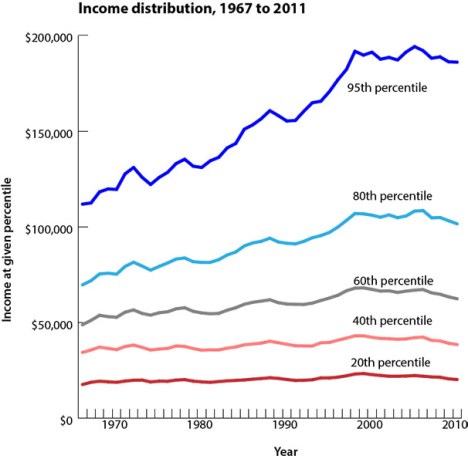
The income gap between the 95th percentile and 80th percentile grew by $1,424 from 2010 to 2011. Indeed, income distribution appears to be widening, and fast, according to the graphic below.

income distribution

Inequality Grows

Okay, we don’t have inequality figures for 2012 yet. But, we do have income data for 2011, and it suggests that the post-war trend of widening income gaps show little sign of abating.

Assessment

And so, the gap between the top 5 percent and the rest of the country just kept growing. But, what about doctors and related medical professionals?

Conclusion

Your thoughts and comments on this ME-P are appreciated. Feel free to review our top-left column, and top-right sidebar materials, links, URLs and related websites, too. Then, subscribe to the ME-P. It is fast, free and secure.

Speaker: If you need a moderator or speaker for an upcoming event, Dr. David E. Marcinko; MBA – Publisher-in-Chief of the Medical Executive-Post – is available for seminar or speaking engagements. Contact: MarcinkoAdvisors@msn.com

OUR OTHER PRINT BOOKS AND RELATED INFORMATION SOURCES:

Product Details  Product Details

Product Details

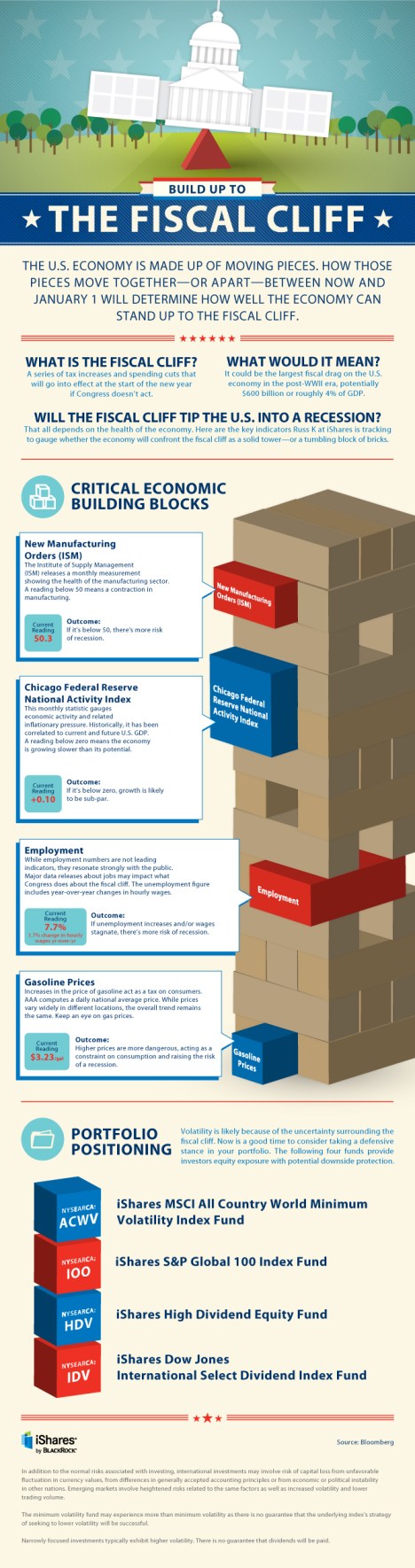
Building Up to the Fiscal Cliff

Join Our Mailing List

A Historic Review

Fiscal Cliff

Assessment

Doctors, FAs and all ME-P readers. What is your strategy for the fiscal cliff situation?

Conclusion

Your thoughts and comments on this ME-P are appreciated. Feel free to review our top-left column, and top-right sidebar materials, links, URLs and related websites, too. Then, subscribe to the ME-P. It is fast, free and secure.

Link: http://feeds.feedburner.com/HealthcareFinancialsthePostForcxos

Speaker: If you need a moderator or speaker for an upcoming event, Dr. David E. Marcinko; MBA – Publisher-in-Chief of the Medical Executive-Post – is available for seminar or speaking engagements. Contact: MarcinkoAdvisors@msn.com

Our Other Print Books and Related Information Sources:

Health Dictionary Series: http://www.springerpub.com/Search/marcinko

Practice Management: http://www.springerpub.com/product/9780826105752

Physician Financial Planning: http://www.jbpub.com/catalog/0763745790

Medical Risk Management: http://www.jbpub.com/catalog/9780763733421

Hospitals: http://www.crcpress.com/product/isbn/9781439879900

Physician Advisors: www.CertifiedMedicalPlanner.org

Product Details  Product Details

Fighting Mid-Level Medical Providers

Join Our Mailing List

Scope of practice’ stories vary according to state laws

One of the interesting stories to watch in the coming months in the states is the fight over “scope of practice.” That means: who gets to do what, and under whose supervision. It basically pits doctors against other health care providers — nurses, nurse practitioners, physician assistants, etc. They are sometimes called “extenders” or “non-physician providers.” (There are also big fights within dentistry.)

Dental Therapists [Emerging New Providers?]

The PP-ACA

These fights would heat up even without the Affordable Care Act — you’ve heard about the shortage of primary care physicians and you know there is an aging population that is going to need access to primary care. Throw in the health care law — millions of newly insured people entering the system — as well as delivery system reforms and care innovations that encourage more primary care, care coordination and team-based medicine that invites a larger role from those “extenders.”

Role of Retail Medical Clinics

Association of Health Care Journalists

Joanne Kenen, AHCJ’s health reform topic leader, writes about the questions and issues to be addressed and offers some resources to help reporters follow the story in their own communities. In a blog post tomorrow, she will point to two articles that have been done about the role nurses, physician assistants or other providers can have in providing primary care in underserved areas.

Next Generation Physician Recruitment

Conclusion

Your thoughts and comments on this ME-P are appreciated. Feel free to review our top-left column, and top-right sidebar materials, links, URLs and related websites, too. Then, subscribe to the ME-P. It is fast, free and secure.

Speaker: If you need a moderator or speaker for an upcoming event, Dr. David E. Marcinko; MBA – Publisher-in-Chief of the Medical Executive-Post – is available for seminar or speaking engagements. Contact: MarcinkoAdvisors@msn.com

OUR OTHER PRINT BOOKS AND RELATED INFORMATION SOURCES:

Product Details

How Bad Is Our National Debt Problem, Anyway?

Join Our Mailing List

And … Will a Deal Fix It?

By Theodoric Meyer
ProPublica, Dec. 28, 2012, 12:34 p.m.

President Obama will meet with congressional leaders today [1] in another attempt to avert the fiscal cliff — the automatic tax increases and spending cuts set to take effect Jan. 1st unless Congress can strike a deal. The cuts and tax hikes, which total more than $500 billion, are so large and so sudden that many economists fear they would plunge the country back into recession.

As Washington tries to hash out a deal, we’ve taken a step back to break down the numbers behind our deficit — how it grew so big, why it is actually shrinking and whether a deal can bring it under control.

How much are we in debt?

The federal debt is just shy of $16.4 trillion [2] at the moment, which also happens to be the debt limit that Congress set in 2011. Treasury Secretary Timothy F. Geithner announced on Wednesday [3] that the nation would hit the limit on Dec. 31. The Treasury can take some “extraordinary measures” to keep paying its bills for a few weeks, but it’ll run out of cash by February or March unless Congress raises the limit again.

And that’s different from the deficit, right?

Yes. The debt is the total amount of the government’s outstanding obligations. The deficit is how much the government is in the red in a given year. In the 2012 fiscal year, which ended Sept. 30, the deficit amounted to $1.1 trillion [4].

That seems like a huge number. How did the deficit get so big?

The 2012 deficit was actually the smallest one since 2008. But it’s still a giant shortfall.

As Binyamin Appelbaum noted in The New York Times [5], the federal government has run a deficit in 45 of the last 50 years. (The exceptions were 1969 and 1998 through 2001.) The financial crisis in 2008, however, caused the deficit to skyrocket, as tax revenues fell because of the slump in incomes and production, and government spending on the stimulus and safety net measures such as unemployment insurance shot up. The deficit for the 2008 fiscal year was $455 billion. In 2009, it surged to more than $1.4 trillion.

Since then, the deficit has been falling, albeit very slowly. The government took in 6.4 percent more in taxes in 2012 than in 2011, as the economy improved a bit and several tax breaks expired. And it spent less on Medicaid, unemployment insurance and the continuing operations in Iraq and Afghanistan.

What about the total debt? How much of that is President Obama’s fault?

The debt has grown by nearly $6 trillion since Obama took office, from $10.5 trillion to $16.4 trillion.

Figuring out how much of that is due to Obama is tougher. The Washington Post’s Ezra Klein, working with the Center on Budget and Policy Priorities, calculated in January [6] that the legislation Obama had actually signed — as opposed to factors like the economy — had added about $983 billion to the debt.

Klein has also rounded up several charts [7] that break down exactly what’s caused our debt to grow so large. The biggest single factor has been the weak economy; President George W. Bush’s tax cuts and the wars in Iraq and Afghanistan also fueled the debt buildup, as did President Obama’s stimulus.

Have debt levels ever been this high before?

Yes, proportionally. Economists like talk about a country’s debt in relation to its gross domestic product (a measure of the economy’s total annual output). And instead of using a country’s total outstanding debt to calculate this debt-to-GDP ratio, economists typically use the amount of debt held by the public. (Somewhat confusingly, the federal government holds about $5 trillion in obligations to itself, most of which is money owed to the funds that support Social Security and other programs.)

Using this measurement, our debt was about 67.7 percent of GDP last year. As this chart compiled by Quartz’s Ritchie King shows [8], that’s the highest our debt-to-GDP ratio has been since the 1940s, when the need to finance World War II caused the debt to surge to 112.7 percent of GDP. But the economy grew fast enough after the war that the debt soon became a much smaller percentage of the country’s GDP.

It’s worth noting that a number of other developed countries have higher debt-to-GDP ratios [9] than the U.S. Germany’s public debt is 80.6 percent of GDP, and Canada’s is 87.4 percent. The euro zone’s most troubled countries fare even worse: Italy’s debt is 120.1 percent of GDP; Greece’s is 165.3 percent.

US Capitol

At least we’re not Greece. How much longer can we keep borrowing?

That’s a tough one. Some commentators — including Paul Krugman, the Nobel-winning economist and columnist for The New York Times — have argued that our current deficits are mostly a product of the sluggish economy. The deficit, Krugman wrote last week [10], “is a side-effect of an economic depression, and the first order of business should be to end that depression — which means, among other things, leaving the deficit alone for now.”

Other economists — including Carmen Reinhart and Kenneth Rogoff, who studied eight centuries’ worth of financial crises for their book “This Time Is Different” — argue that countries with debt-to-GDP ratios above a certain level tend to experience slower economic growth. Reinhart and Rogoff suggest the level is around 90 percent of GDP [11] — which the U.S. is rapidly approaching. A recent Congressional Research Service report [12] concluded that while the debt-to-GDP ratio can’t keep rising forever, “it can rise for a time.” The report continued:

It is hard to predict at what point bond holders would deem it to be unsustainable. A few other advanced economies have debt-to-GDP ratios higher than that of the United States. Some of those countries in Europe have recently seen their financing costs rise to the point that they are unable to finance their deficits solely through private markets. But Japan has the highest debt-to-GDP ratio of any advanced economy, and it has continued to be able to finance its debt at extremely low costs.

How does all this fit into the fiscal cliff?  Would a deal to avert it fix our debt problem?

Actually, going over the fiscal cliff would almost singlehandedly erase the deficit. Tax rates would shoot up, and the fiscal cliff’s indiscriminate budget cuts would slash military and safety-net spending alike.

The problem is that all those tax increases and spending cuts would likely throw the economy back into a recession, causing the deficit to balloon again. “The economy will, I think, go off a cliff,” said Ben Bernanke [13], the Federal Reserve chairman.

(For more detail, see The Washington Post’s exhaustive fiscal cliff explainer [14].)

What the two sides are trying to do is identify cuts that are ultimately deep enough to bring down the deficit — and thus, eventually, the debt — without stalling the economy. But negotiations collapsed last week [15] after John Boehner, the Republican House speaker, tried and failed to pass a “Plan B” alternative to the president’s proposal in the House. Obama is set to meet with congressional leaders today to try to strike a deal to block at least some of the cliff’s impact by Monday night. But its prospects seem dim.

“I have to be very honest,” Sen. Harry Reid, the majority leader, said on Thursday. “I don’t know timewise how it can happen now.”

Assessment

Of course, some analysts have pointed out that people on both the Republican and the Democratic sides may actually want to move the cliff just slightly down the road into the next Congress, which convenes Thursday, Jan. 3. The advantages: Boehner can be safely re-elected as Speaker before he has to do serious twisting of arms of fellow GOP House members to get their votes for any compromise plan. And there will be a few more Democrats in the House and the Senate for the White House to rely on in enlisting the votes it needs to ratify any such deal. The disadvantage: Delay makes the risk of miscalculation greater for either or both sides — and for the public.

Link: http://www.propublica.org/article/how-bad-is-our-debt-problem-anyway-and-will-a-deal-fix-it

Conclusion

Your thoughts and comments on this ME-P are appreciated. Feel free to review our top-left column, and top-right sidebar materials, links, URLs and related websites, too. Then, subscribe to the ME-P. It is fast, free and secure.

Link: http://feeds.feedburner.com/HealthcareFinancialsthePostForcxos

Speaker: If you need a moderator or speaker for an upcoming event, Dr. David E. Marcinko; MBA – Publisher-in-Chief of the Medical Executive-Post – is available for seminar or speaking engagements. Contact: MarcinkoAdvisors@msn.com

OUR OTHER PRINT BOOKS AND RELATED INFORMATION SOURCES:

DICTIONARIES: http://www.springerpub.com/Search/marcinko
PHYSICIANS: www.MedicalBusinessAdvisors.com
PRACTICES: www.BusinessofMedicalPractice.com
HOSPITALS: http://www.crcpress.com/product/isbn/9781466558731
CLINICS: http://www.crcpress.com/product/isbn/9781439879900
BLOG: www.MedicalExecutivePost.com
FINANCE: Financial Planning for Physicians and Advisors
INSURANCE: Risk Management and Insurance Strategies for Physicians and Advisors


Product Details  Product Details

Product Details


A Guide to Patient Loyalty

Join Our Mailing List

A Multi-Factorial Visual Approach

Link: Chapter 15: I-Doctors I-Patients

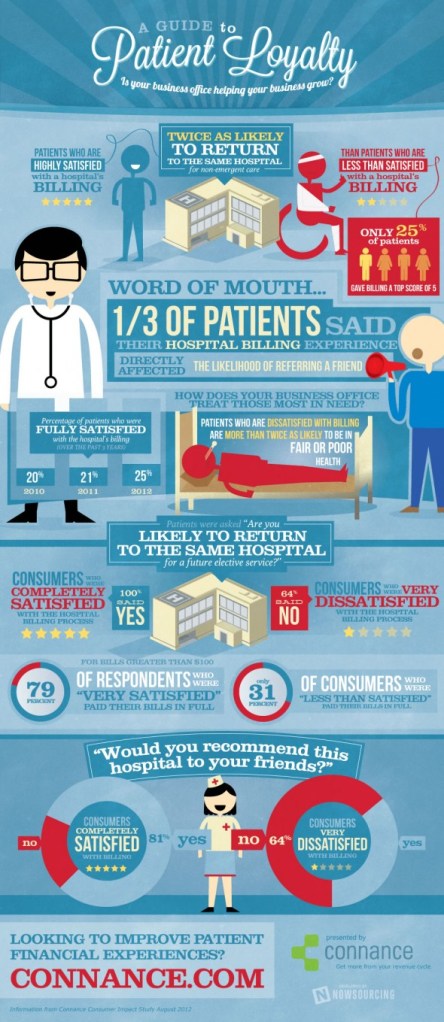
Many factors are involved when a patient has a good experience at a hospital, clinic or medical practice. One huge component in patient loyalty and satisfaction is the billing process.

This infographic colorfully shows what factors to consider in gaining and keeping loyal patients.

###

patient loyalty

Source:  www.connance.com and www.BusinessofMedicalPractice.com

Conclusion

Your thoughts and comments on this ME-P are appreciated. Feel free to review our top-left column, and top-right sidebar materials, links, URLs and related websites, too. Then, subscribe to the ME-P. It is fast, free and secure.

Link: http://feeds.feedburner.com/HealthcareFinancialsthePostForcxos

Speaker: If you need a moderator or speaker for an upcoming event, Dr. David E. Marcinko; MBA – Publisher-in-Chief of the Medical Executive-Post – is available for seminar or speaking engagements. Contact: MarcinkoAdvisors@msn.com

Our Other Print Books and Related Information Sources:

Health Dictionary Series: http://www.springerpub.com/Search/marcinko

Practice Management: http://www.springerpub.com/product/9780826105752

Physician Financial Planning: http://www.jbpub.com/catalog/0763745790

Medical Risk Management: http://www.jbpub.com/catalog/9780763733421

Hospitals: http://www.crcpress.com/product/isbn/9781439879900

Physician Advisors: www.CertifiedMedicalPlanner.org

Product Details

The Perils of Distracted Driving

Join Our Mailing List

Risks Varied and Increasing this Holiday Season

By Dr. David Edward Marcinko MBA

[ME-P Editor-in-Chief]

Editor-in-ChiefOur daily lives have become easier over the years. Just take a look at the gadgets we own and the amount of corners we cut.

One of the major problems of this new daily ease is high distractions. These distractions can be deadly when it comes to driving, in which case, there should not be any corners to cut.

So, here is a visual guide to the true cost of driving while distracted. It may be especially important during this holiday season.

###

Distracted-Driving

Assessment

Are doctors especially culpable with their tablet computers, smart phones, eHRs, PCs and CPOESs, etc?

Conclusion

Your thoughts and comments on this ME-P are appreciated. Feel free to review our top-left column, and top-right sidebar materials, links, URLs and related websites, too. Then, subscribe to the ME-P. It is fast, free and secure.

Link: http://feeds.feedburner.com/HealthcareFinancialsthePostForcxos

Speaker: If you need a moderator or speaker for an upcoming event, Dr. David E. Marcinko; MBA – Publisher-in-Chief of the Medical Executive-Post – is available for seminar or speaking engagements. Contact: MarcinkoAdvisors@msn.com

Our Other Print Books and Related Information Sources:

Health Dictionary Series: http://www.springerpub.com/Search/marcinko

Practice Management: http://www.springerpub.com/product/9780826105752

Physician Financial Planning: http://www.jbpub.com/catalog/0763745790

Medical Risk Management: http://www.jbpub.com/catalog/9780763733421

Hospitals: http://www.crcpress.com/product/isbn/9781439879900

Physician Advisors: www.CertifiedMedicalPlanner.org

Product Details

Spending for Private Health Insurance in the United States

Join Our Mailing List

Health Costs Doubled in the Past Decade

By NIHCM Foundation www.NIHCM.org

The total cost of health care for a typical family with employer-sponsored coverage has more than doubled in the past decade to nearly $21,000 per year, outpacing both inflation and income growth.

Skyrocketing health care costs are already straining budgets and could jeopardize the availability of affordable coverage under the ACA. To shed light on the factors behind increased spending on private insurance, this brief examines

  • trends in premiums and cost-sharing in the group and non-group markets,
  • how premium dollars are spent by insurers,
  • which sectors are driving premiums upward, and
  • the importance of price increases in explaining spending growth.

healthcare costs

Assessment

Read more…

Conclusion

Your thoughts and comments on this ME-P are appreciated. Feel free to review our top-left column, and top-right sidebar materials, links, URLs and related websites, too. Then, subscribe to the ME-P. It is fast, free and secure.

Speaker: If you need a moderator or speaker for an upcoming event, Dr. David E. Marcinko; MBA – Publisher-in-Chief of the Medical Executive-Post – is available for seminar or speaking engagements. Contact: MarcinkoAdvisors@msn.com

OUR OTHER PRINT BOOKS AND RELATED INFORMATION SOURCES:

Product Details  Product Details

Product Details

Merry Christmas 2012

All ME-P Readers and Subscribers

HAPPY HOLIDAYS

Holiday Greetings

###

 In warm appreciation of our association during the  past year, we extend our very best for a happy holiday season.

Best wishes for a happy New Year in 2013 filled with health, happiness, and spectacular success.

JOIN US IN 2013

Join Our Mailing List

The Medical App Debacle

Join Our Mailing List

Regulating the App Store

[By Adam Ghosh]

Back when Apple first released the idea of the app store to the public, they probably had no idea how proliferate it would be and how it would weave itself into countless workplaces and individuals’ hands.  A quick look on the store today will return you with some 700,000 apps of which 13,000 are health-related.  With so many apps being released on a weekly basis, the credibility as well as the usefulness of some of these applications began to be called into question (a good example of which is an “x-ray” app which just shows pre-rendered images and responds to movements made by the smartphone).

Enter the FDA

To combat this, the FDA has been working on a set of rules and guidelines that will better weed out the less than ideal applications that could potentially lead to misdiagnosis, as well as a host of other problems associated with individuals receiving information that has not been upheld by a healthcare professional or a credible source.

The problem with these apps comes down to one of categorization.  The FDA has the ability to regulate apps that enter the app store that have tags as “medical software,” but not those that have been submitted under the category of “wellness.”  As you can imagine, apps that have not had their credibility upheld generally don’t get submitted under the first category, but rather the second.  The real problem with this happens when a “wellness” app suggest or recommends healthcare advice that has not been backed up an industry professional and consequently may lead to some serious health problems.

Example:

Let’s take a closer look at a good example of this in action.  A ways back, a large number of software companies were capitalizing on the idea of the pedometer and the ability to track one’s footsteps throughout the day.  It was only a matter of time before the app store saw its versions enter the hands of iPhone users across the globe. The issue?  Some of these apps were just fine, giving users the ability to track their steps and better calculate the amount of calories burned over a given period of time.  However, if the same app has any wording linking the amount of steps you take to weight management or obesity then it moves out of the realm of simply being a wellness application and instead becomes a medical app that has not been thoroughly regulated.

Even though it is a suggestion that has become common knowledge (exercise leading to weight loss) the application has indeed violated the app stores regulatory language.  Often times, the software companies behind these aren’t even aware a violation has occurred until they receive a message detailing the removal of said app from the store. It is this exact problem that the FDA seeks to correct but the changes won’t come overnight.

The process will start with an evaluation of a given app to determine the risk level it poses and if the information given is inaccurate or not fleshed out enough.  Representatives in charge of this movement have stated several times that the process won’t be as all encompassing as once imagined.  The pedometer example is a good indicator of apps that might be passed by when a decision is being made.  While a certain pedometer app may not have a licensed professional substantiating its health claims, the risk an obese person has from exercising is fairly low and thus not a priority of the FDA to regulate said app.

smart phone mobile ME-P

Real Issues

The real issue lies with apps that are more closely tied to high-risk adverse health conditions like cancers, heart problems or acute viruses.  If an app gives you a series of pictures of individuals with a certain kind of rash that is indicative of “X” virus and a user then takes medical advice on the assumption that they share the same symptoms, a serious problem has occurred.

With such a high propensity for misdiagnosing, the FDA isn’t asking that you blatantly ignore or cease to use all applications that have not been backed up by an expert.  The FDA is rather suggesting that individuals use their best judgment when seeking out advice via the app store.  If something appears serious visit a physician or a doctor, not an automated response from an app you paid .99 cents for.

Assessment

The FDA hopes to put the final touches on their regulatory guidelines sometime in the next two months.  When the guidelines go live, you can expect to see a huge change to the quality and quantity of the medical apps that are released onto the iOS store.

About the Author:

Adam Ghosh has over twenty years experience as a researcher in the medical field. In that time he has worked with allergists and vascular surgeons, and everyone in between. Now he supplements his early retirement by contributing to: http://www.weatherbyhealthcare.com

Conclusion

Your thoughts and comments on this ME-P are appreciated. Feel free to review our top-left column, and top-right sidebar materials, links, URLs and related websites, too. Then, subscribe to the ME-P. It is fast, free and secure.

Speaker: If you need a moderator or speaker for an upcoming event, Dr. David E. Marcinko; MBA – Publisher-in-Chief of the Medical Executive-Post – is available for seminar or speaking engagements. Contact: MarcinkoAdvisors@msn.com

OUR OTHER PRINT BOOKS AND RELATED INFORMATION SOURCES:

Product Details

How To Stay Within Your Holiday Budget

   Yes – it Can be Done with these Secrets!
 By Dr. David Edward Marcinko MBA CMP
 www.CertifiedMedicalPlanner.org

Join Our Mailing List

For some doctors and many Americans, the holiday season is all about excess, and all the gifts, travel, drinks, decadent food, and party dresses can leave a gaping hole in your personal finances. And so, as a Certified Medical Planner, I know that a holiday budget is a helpful tool for managing your spending during the holiday season, so that you don’t start out the New Year in the red. Of course, a holiday budget is only effective if you stick with it, and these shopping tips can help you do just that.

Hallelujah!

Shorten your gift list

Sure, the holiday season is about generosity, but that doesn’t mean you need  to buy an extravagant gift for everyone on the neighborhood block or office floor. Gifts are easily one of the largest expense categories during the holiday season, so the fewer gifts you have to buy; the easier it is to stay within your holiday budget. When times are tight, it’s okay to scrutinize your gift list and cut out anyone whom you don’t really need or even want to buy for. This important step should be done before you even make your holiday budget.

Set a spending limit for each person

Once you’ve whittled down your gift list, set a spending limit for each person on that list. You may want to spend the most on family and friends, but these are also the relationships that leave the most room for creativity.

For example, it might be fun to have your family make gifts for one another this year or create a challenge among friends to see who can find the best gift for the least amount of money. Your boss, CMO or CXO on the other hand, may not appreciate inexpensive gifts like your homemade fudge or a handcrafted ornament.

Shop ahead for deals

When the holiday season is fast approaching, you’re pretty much forced to pay whatever prices the stores are offering, although you can sometimes save money by shopping online at websites like Amazon and eBay. However, if you’re smart, you’ll start your holiday shopping early, leaving yourself time to hunt down only the very best deals.

Shop with cash

Putting the credit cards away and shopping with cash is another smart way to stay within your holiday budget. In fact, shopping with cash is a good general rule for living within your means year-round, but it’s especially effective during the holiday season, when impulse purchases really go through the roof. If you only bring a designated amount of cash with you on each shopping trip, you’ll be forced to stick within your budget. Setting a time limit on your holiday shopping can also have the same budget-bolstering effect.

ME-P Classified Blast!

Simplify holiday parties

For many medical professionals, lavish parties are another major expense of the holiday season. If you’re invited to tons of holiday parties every year, you can stay within your holiday budget by choosing to RSVP to only a few; this saves on party attire, gas, cab fare, parking, host/hostess gifts, drinks, and more.

If you plan to host your own party, forget about all the unnecessary decadence that your guests will have forgotten by mid-January; instead, keep things simple, but classy, and keep your guest list small to help stay within your holiday budget.

Assessment

These are just a few of the many ways that you can stay within your holiday budget this season. Nearly any money-saving tips that you employ year-round can be tailored to help you save on your holiday shopping. As long as you take the time to create a holiday budget, and then stick to that plan, you should save major green and subsequently stay out of the red.

How very festive of you!

Conclusion

Your thoughts and comments on this ME-P are appreciated. Feel free to review our top-left column, and top-right sidebar materials, links, URLs and related websites, too. Then, subscribe to the ME-P. It is fast, free and secure.

Speaker: If you need a moderator or speaker for an upcoming event, Dr. David E. Marcinko; MBA – Publisher-in-Chief of the Medical Executive-Post – is available for seminar or speaking engagements. Contact: MarcinkoAdvisors@msn.com

OUR OTHER PRINT BOOKS AND RELATED INFORMATION SOURCES:


Product Details  Product Details

Macro-Economics and What the ‘Chained CPI’ Could Mean for Social Security?

Join Our Mailing List

Definition of Chain-Weighted CPI

By Dr. David Edward Marcinko MBA

Dr David E Marcinko MBAAn alternative BLS measurement for the Consumer Price Index (CPI), removing the biases associated with new products, changes in quality and discounted prices.

The chain weighted CPI incorporates the average changes in the quantity of goods purchased, along with standard pricing effects. This allows the chain weighted CPI to reflect situations where customers shift the weight of their purchases from one area of spending to another.

Read more: http://www.investopedia.com/terms/c/chain-linked-cpi.asp#ixzz2FdiMs25f

information

Investopedia Example:

The chain weighted CPI incorporates changes in both the quantities and prices of products. For example, let’s examine clothing purchases between two years. Last year you bought a sweater for $40 and two t-shirts at $35 each. This year, two sweaters were purchased at $35 each and one t-shirt for $45.

Standard CPI calculations would produce an inflation level of 13.64% 

((1 x 35 + 2 x 45)/ (1 x 40 + 2 x 35)) =1.1364

The chain weighted approach estimates inflation to be 4.55%

((2 x 35 + 1 x 45)/ (1 x 40 + 2 x 35)) =1.0455.

Using the chain weighted approach reveals the impact of a customer purchasing more sweaters than t-shirts.

Read more: http://www.investopedia.com/terms/c/chain-linked-cpi.asp#ixzz2FdiceVyv

BLS Application

  • What is the C-CPI-U and when did the Bureau of Labor Statistics (BLS) begin publishing it?

BLS began publishing the Chained Consumer Price Index for All Urban Consumers effective with the release of July 2002 CPI data. Designated the C-CPI-U, the index supplements the existing indexes already produced by the BLS: the CPI for All Urban Consumers (CPI-U) and the CPI for Urban Wage Earners and Clerical Workers (CPI-W).

The C-CPI-U employs a formula that reflects the effect of substitution that consumers make across item categories in response to changes in relative prices.

Read more: C-CPI-U data can be found on the BLS web site at http://data.bls.gov/cgi-bin/surveymost?su

Substitution Bias

  • What is substitution and substitution bias? And does the C-CPI-U eliminate it?

Traditionally, the CPI was considered an upper bound on a cost-of-living index in that the CPI did not reflect the changes in consumption patterns that consumers make in response to changes in relative prices.

Since January 1999, a geometric mean formula has been used to calculate most basic indexes within the CPI; this formula allows for a modest amount of substitution within item categories as relative price changes.

The geometric mean formula, though, does not account for consumer substitution taking place between CPI item categories. For example, pork and beef are two separate CPI item categories. If the price of pork increases while the price of beef does not, consumers might shift away from pork to beef. The C-CPI-U is designed to account for this type of consumer substitution between CPI item categories. In this example, the C-CPI-U would rise, but not by as much as an index that was based on fixed purchase patterns.

With the geometric mean formula in place to account for consumer substitution within item categories, and the C-CPI-U designed to account for consumer substitution between item categories, any remaining substitution bias would be quite small.

Assessment 

Link: What ‘chained CPI’ could mean for Social Security

White Paper: http://www.bls.gov/cpi/super_paris.pdf

Conclusion

Your thoughts and comments on this ME-P are appreciated. Feel free to review our top-left column, and top-right sidebar materials, links, URLs and related websites, too. Then, subscribe to the ME-P. It is fast, free and secure.

Link: http://feeds.feedburner.com/HealthcareFinancialsthePostForcxos

Speaker: If you need a moderator or speaker for an upcoming event, Dr. David E. Marcinko; MBA – Publisher-in-Chief of the Medical Executive-Post – is available for seminar or speaking engagements. Contact: MarcinkoAdvisors@msn.com

Our Other Print Books and Related Information Sources:

Health Dictionary Series: http://www.springerpub.com/Search/marcinko

Practice Management: http://www.springerpub.com/product/9780826105752

Physician Financial Planning: http://www.jbpub.com/catalog/0763745790

Medical Risk Management: http://www.jbpub.com/catalog/9780763733421

Hospitals: http://www.crcpress.com/product/isbn/9781439879900

Physician Advisors: www.CertifiedMedicalPlanner.org

Product DetailsProduct DetailsProduct Details

Product Details  Product Details

Product Details

Doctor’s and the Fiscal Cliff

Join Our Mailing List

What’s a Physician-Investor to Do?

By Rick Kahler MS CFP® ChFC CCIM www.KahlerFinancial.com

Rick Kahler CFPSo the economic train is speeding faster and faster, and the edge of the fiscal cliff is getting closer and closer, and the passengers are starting to scream. Meanwhile, the guys in the cab of the engine are arguing about whether to hit the brakes or blow the whistle.

What’s the best thing for any investor to do?

Nothing!

Based on my emails this week from clients and readers of my column, there seems to be widespread concern among investors that we’re on the verge of panic and the markets are about to head south.

It reminds me of the good old days, back in the fall of 2008, when the markets were dropping 900 points a day. I’m sensing that the fear among investors about going over the fiscal cliff is similar to the fear of four years ago. The only difference is that the markets aren’t falling today.

Those who assume the markets are about to drop may be right. If that’s the case, what should you be doing to your portfolio to prepare? Assuming it is globally diversified, not a thing.

The News

Many investors, and medical professionals, already are sitting on the sidelines in bonds, shifting through a plethora of bad news and waiting for markets to tank. They have good reason for their expectations. There has been a steady stream of bad news over the past year: a feeble global economic recovery, the near certainty the US will raise taxes and cut spending (a/k/a the fiscal cliff), staggering budget deficits around the globe, the prospect of a EuroZone breakup, a highly negative and divisive presidential election, banking scandals, and a nationwide drought.

Bonds

Considering all the uncertainty, it’s easy to explain why investors have generally favored bonds over stocks during the past 12 months.

With all this bad news, one could expect stocks to be down significantly. For the 12-month period ending September 30, 2012, however, 40 markets had positive returns, with six countries—including the US—delivering a total return in excess of 30%. This is according to the investment analysis firm Morgan Stanley Capital International.

While most investors think successful investing requires constant attention to current events, research says the opposite is true. The more that investors pay attention to the breaking news and adjust their portfolios, the lower their returns.

Fiscal Cliff

Bailing Out

But, with the looming fiscal cliff, shouldn’t a wise investor bail out now and then buy back in at the bottom? It would be like jumping off the train before the crash, then waiting until it has hit the ground, been repaired, and is back on track before you get on again. The only problem is there’s no way to know whether the markets will go down, or if they do, how to know when they hit bottom and it’s time to get back in.

Going to Cash?

The worst action you could take right now is to sell out your portfolio and go to cash.

If you have a globally diversified portfolio, the US decision to tax more and spend less will have much less impact.

For example, our typical 60/40 portfolio only has 13.5% in US stocks and 25% in US bonds. Over half of it is in international stocks, bonds, and non-US correlated investment strategies. It’s designed to cushion even extreme fluctuations in the markets.

Assessment

Anyone who is appropriately diversified has no need for fear as we get closer to plunging off the fiscal cliff. To protect your investments, don’t sell out. To preserve your peace of mind, don’t panic. Above all, don’t jump. The best possible response is to simply stand by and watch the train wreck.

Conclusion

Your thoughts and comments on this ME-P are appreciated. Feel free to review our top-left column, and top-right sidebar materials, links, URLs and related websites, too. Then, subscribe to the ME-P. It is fast, free and secure.

Link: http://feeds.feedburner.com/HealthcareFinancialsthePostForcxos

Speaker: If you need a moderator or speaker for an upcoming event, Dr. David E. Marcinko; MBA – Publisher-in-Chief of the Medical Executive-Post – is available for seminar or speaking engagements. Contact: MarcinkoAdvisors@msn.com

Our Other Print Books and Related Information Sources:

Health Dictionary Series: http://www.springerpub.com/Search/marcinko

Practice Management: http://www.springerpub.com/product/9780826105752

Physician Financial Planning: http://www.jbpub.com/catalog/0763745790

Medical Risk Management: http://www.jbpub.com/catalog/9780763733421

Hospitals: http://www.crcpress.com/product/isbn/9781439879900

Physician Advisors: www.CertifiedMedicalPlanner.org

Product Details  Product Details

Product Details

Publications Related to Behavioral Finance, Economics and Money

Join Our Mailing List

Interesting Articles by Dan Ariely PhD

NOTE: Dan is the Irrational Economist: He blogs at: http://danariely.com/

By Staff Reporters

LIST:

Conclusion

Your thoughts and comments on this ME-P are appreciated. Feel free to review our top-left column, and top-right sidebar materials, links, URLs and related websites, too. Then, subscribe to the ME-P. It is fast, free and secure.

Link: http://feeds.feedburner.com/HealthcareFinancialsthePostForcxos

Speaker: If you need a moderator or speaker for an upcoming event, Dr. David E. Marcinko; MBA – Publisher-in-Chief of the Medical Executive-Post – is available for seminar or speaking engagements. Contact: MarcinkoAdvisors@msn.com

OUR OTHER PRINT BOOKS AND RELATED INFORMATION SOURCES:

DICTIONARIES: http://www.springerpub.com/Search/marcinko
PHYSICIANS: www.MedicalBusinessAdvisors.com
PRACTICES: www.BusinessofMedicalPractice.com
HOSPITALS: http://www.crcpress.com/product/isbn/9781466558731
CLINICS: http://www.crcpress.com/product/isbn/9781439879900
BLOG: www.MedicalExecutivePost.com
FINANCE: Financial Planning for Physicians and Advisors
INSURANCE: Risk Management and Insurance Strategies for Physicians and Advisors

Product Details

Letter from the Editor on Sandy Hook Elementary School

Join Our Mailing List

A Painful Op-Ed Piece

By Dr. David Edward Marcinko FACFAS, MBA, CMP™

[Publisher and Editor-in-Chief]

Dr David E Marcinko MBAThe tragedy which struck the Sandy Hook Elementary School in Newtown, Connecticut last Friday left this Medical Executive-Post, and the entire nation, stunned. So many deaths of far too young victims! It is difficult to comprehend, explain or manage. It is not so difficult to feel some of the enormous loss of the parents, families and friends of the victims.

And, I’m sure it is unnecessary for me to encourage you to keep them in your thoughts and prayers. You, like me, have probably thought of little else since Friday.

At the ME-P, we will remember the people and families in Newtown, CT. Like the rest of the nation, our home-page flag will be at half-staff through this week.

If you have children of elementary school age, you may need some opportunities to process their reactions to this tragedy. Perhaps all they need is someone to listen, or to reassure them that these tragedies are rare events. We trust your local clergy, pediatricians and counselors are available to assist you or your child if that would be helpful.

More: www.CertifiedMedicalPlanner.org

In closing, I would like to share with you a Judeo-Christian reading which might bring some comfort during these difficult days:

A Prayer

The Spirit of the Lord God is upon me, because the Lord has anointed me to bring good news to the poor …  to comfort all who mourn; to grant to those who mourn in Zion— to give them a beautiful headdress instead of ashes, the oil of gladness instead of mourning, the garment of praise instead of a faint spirit; that they may be called oaks of righteousness, the planting of the Lord, that he may be glorified.

Assessment

ME-P Textbook: Chapter 07: Workplace Violence

We trust the deep knowledge and expertise on this topic by ME-P thought-leader Gene Schmuckler is available to you, as needed.

Fraternally,

David Edward Marcinko

Conclusion

Your thoughts and comments on this ME-P are appreciated. Feel free to review our top-left column, and top-right sidebar materials, links, URLs and related websites, too. Then, subscribe to the ME-P. It is fast, free and secure.

Product Details

Product Details

The Newtown, Conn School Massacre [Lessons to Learn?]

Join Our Mailing List

REPRINT: This re-publication is provided as a service to our readers, as we mourn the children and victims of the Newtown, Conn massacre. The workplace – healthcare setting analogy is self-evident.

Hospital Workplace Violence Risk Factors

[An NIOSH Summary and Review]

By Dr. Eugene Schmuckler MBA CTS

By Dr. David Edward Marcinko MBA CMP™

www.CertifiedMedicalPlanner.org

Domestically, the impact of workplace violence in the US became widely exposed on November 6, 2009 when 39 year old Army psychiatrist Maj. Nidal M. Hasan MD, a 1997 graduate of Virginia Tech University who received a medical doctorate in psychiatry from the Uniformed Services University of the Health Sciences in Bethesda, Maryland, and served as an intern, resident and fellow at the Walter Reed Army Medical Center in the District of Columbia, went on a savage 100 round shooting spree and rampage that killed 13 people and injured 32 others.

In April 2010 he was transferred to Bell County Jail in Belton, Texas. An Article 32 hearing, which determined whether Hasan would be fit to stand trial at court martial, began on 12 October 2010. Hasan subsequently deemed fit, was arraigned on July 20 2011 and trial was scheduled for March 2012. It was rescheduled again, but is now ongoing and in the news; almost daily.

The NIOSH

The National Institute for Occupational Safety and Health (NIOSH) summarizes the risk factors for occupational violence to hospital workers. These include:

  • working directly with volatile people, especially if they are under the influence of drugs or alcohol or have a history of violence or certain psychotic diagnoses;
  • working when understaffed — especially during meal times or visiting hours;
  • transporting patients and long waits for service;
  • overcrowded, uncomfortable waiting rooms;
  • working alone;
  • poor environmental design;
  • inadequate and/or ineffective security;
  • lack of staff training and policies for preventing or managing crises with potentially volatile patients;
  • drug and alcohol abuse;
  • access to firearms;
  • unrestricted movement of the public; and
  • poorly lit corridors, rooms, parking lots, and other areas.

Occupational Violence 

Violence occurring in other occupational groups is most often related to robbery. In healthcare settings, however, acts of violence are most often perpetrated by patients or clients. Family members who feel frustrated, vulnerable, and out of control; and colleagues of patients (especially when the patient is a gang member) are also identified as perpetrators of abuse! However, the presence of co-workers has been identified as a potential deterrent to assault in healthcare.

Healthcare and social service workers face an increased risk of work-related assaults stemming from several factors, including:

  • the prevalence of handguns and other weapons — as high as 25% among patients, their families, and friends. Handguns are increasingly used by police and the criminal justice system for criminal holds and the care of acutely disturbed, violent individuals;
  • the increasing number of acute and chronically mentally ill patients now being released from hospitals without follow-up care, who now have the right to refuse medicine and who can no longer be hospitalized involuntarily unless they pose an immediate threat to themselves or others;
  • the availability of drugs or money at hospitals, clinics, and pharmacies, making staff and patients likely robbery targets;
  • situational and circumstantial factors such as:
    • unrestricted movement of the public in clinics and hospitals;
    • the increasing presence of gang members, drug or alcohol abusers, trauma patients, or distraught family members;
    • long waits in emergency or clinic areas, leading to client frustration over an inability to obtain needed services promptly;
  • low staffing levels during times of specific increased activity such as meal times, visiting times, and when staff is transporting patients. This also includes isolated work with clients during examinations or treatment;
  • solo work, often in remote locations, particularly in high crime settings, with no back up or means of obtaining assistance such as communication devices or alarm systems;
  • lack of training of staff in recognizing and managing escalating hostile and assaultive behavior; and
  • poorly lighted parking areas.

OSHA

The Guidelines established by the Occupational Safety and Health Administration (OSHA) seek to set forth procedures leading to the elimination or reduction of worker exposure to conditions causing death or injury from violence by implementing effective security devices and administrative work practices, among other control measures. Healthcare professionals need to be aware that violence can occur anywhere and in any practice settings.

In hospitals and clinics, which are more likely to report incidents of violence than private offices, the most frequent sites are:

  • psychiatric wards;
  • acute care settings;
  • critical care units;
  • community health agencies;
  • homes for special care;
  • emergency rooms; and
  • waiting rooms and geriatric units.

Impact

The impact of workplace violence is far-reaching and affects individual staff members, co-workers, patients/clients, and their families. Those who have been affected, directly or indirectly, by a workplace violence incident report a broad spectrum of responses — anger is the most common. There are also reports of:

  • difficulty returning to work;
  • decreased job performance;
  • changes in relationships with co-workers;
  • sleep pattern disturbance;
  • helplessness and symptoms for post-traumatic stress disorders;
  • fear of other patients; and
  • fear of returning to the scene of the assault.

Assessment

Link: Chapter 07: Workplace Violence

More: Medical Workplace Violence

BREAKING NEWS: 3 shot in Alabama hospital *** Two die in Nev. hotel shooting

Conclusion

Your thoughts and comments on this ME-P are appreciated. Feel free to review our top-left column, and top-right sidebar materials, links, URLs and related websites, too. Then, subscribe to the ME-P. It is fast, free and secure.

Link: http://feeds.feedburner.com/HealthcareFinancialsthePostForcxos

Speaker: If you need a moderator or speaker for an upcoming event, Dr. David E. Marcinko; MBA – Publisher-in-Chief of the Medical Executive-Post – is available for seminar or speaking engagements. Contact: MarcinkoAdvisors@msn.com

Our Other Print Books and Related Information Sources:

Health Dictionary Series: http://www.springerpub.com/Search/marcinko

Practice Management: http://www.springerpub.com/product/9780826105752

Physician Financial Planning: http://www.jbpub.com/catalog/0763745790

Medical Risk Management: http://www.jbpub.com/catalog/9780763733421

Hospitals: http://www.crcpress.com/product/isbn/9781439879900

Physician Advisors: www.CertifiedMedicalPlanner.org

From Our Newest Textbook Release

Buy from Amazon

Learn How to Profit and Thrive in the PP-ACA Era

BOOK FOREWORD / TESTIMONIAL

Health Economics Defined

Join Our Mailing List

How We Use and Allocate Scarce Resources

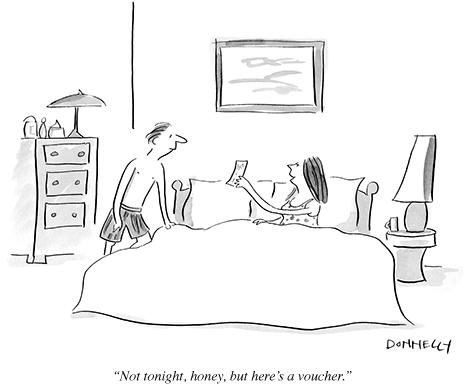
Sex Voucher

Asseessment

A sex voucher – delayed gratification?

Conclusion

Your thoughts and comments on this ME-P are appreciated. Feel free to review our top-left column, and top-right sidebar materials, links, URLs and related websites, too. Then, subscribe to the ME-P. It is fast, free and secure.

Link: http://feeds.feedburner.com/HealthcareFinancialsthePostForcxos

Speaker: If you need a moderator or speaker for an upcoming event, Dr. David E. Marcinko; MBA – Publisher-in-Chief of the Medical Executive-Post – is available for seminar or speaking engagements. Contact: MarcinkoAdvisors@msn.com

Our Other Print Books and Related Information Sources:

Health Dictionary Series: http://www.springerpub.com/Search/marcinko

Practice Management: http://www.springerpub.com/product/9780826105752

Physician Financial Planning: http://www.jbpub.com/catalog/0763745790

Medical Risk Management: http://www.jbpub.com/catalog/9780763733421

Hospitals: http://www.crcpress.com/product/isbn/9781439879900

Physician Advisors: www.CertifiedMedicalPlanner.org

Product DetailsProduct DetailsProduct Details

Confusion About “Meaningful Use” Reigns

Join Our Mailing List

Are Doctors Embracing or Ignoring ARRA?

By D. Kellus Pruitt DDS

pruittAre physicians embracing ARRA Meaningful Use cash incentives or ignoring them? That depends on whom one asks.

Doctors versus the Feds

National progress towards Meaningful Use of expensive EHRs depends on whether one talks to federal employees whose jobs depend on the stimulus mandate, or doctors who purchase EHRs to improve care rather than to use them … Meaningfully.

The Feds

Today, Joseph Conn, writing for ModernHealthcare, posted a rosy outlook for MU adoption according to researchers working for HHS’ Office of the National Coordinator (ONC). They base their optimism for job security on a recent National Center for Health Statistics (NCHS) survey:

“A growing number of office-based physicians are using more-robust EHRs that have higher-level functions needed to help the doctors qualify for federal EHR incentive payments [for Meaningful Use] and assist them in providing better, safer care for patients, the researchers reported.” (See “Researchers: More doctors using more-sophisticated EHRs”).

http://www.modernhealthcare.com/article/20121212/NEWS/312129956/researchers-more-doctors-using-more-sophisticated-ehrsJust

eMR and HIT Security

The Doctors

However, yesterday, in an InformationWeek article by Ken Terry titled, “Meaningful Use Doesn’t Drive Doctors’ EHR Selection,” doctors suggested a more depressing future for MU sophistication based on the same NCHS survey:

“Jason Mitchell, MD, assistant director of the Center for Health IT at the American Academy of Family Physicians (AAFP), told InformationWeek Healthcare that he found [the lagging adoption of MU-capable EHRs] puzzling. While there’s no doubt that Meaningful Use has driven much of the increase in EHR use, he said, it seems strange that so many physicians would buy and implement EHRs that could not be used to show Meaningful Use.”

http://www.informationweek.com/healthcare/electronic-medical-records/meaningful-use-doesnt-drive-doctors-ehr/240144093

Assessment

Whom should doctors believe – HHS employees who give away billions of stimulus dollars for Meaningful Use, or family physicians who have determined that the subsidy isn’t worth the cost and effort?

Conclusion

Your thoughts and comments on this ME-P are appreciated. Feel free to review our top-left column, and top-right sidebar materials, links, URLs and related websites, too. Then, subscribe to the ME-P. It is fast, free and secure.

Link: http://feeds.feedburner.com/HealthcareFinancialsthePostForcxos

Speaker: If you need a moderator or speaker for an upcoming event, Dr. David E. Marcinko; MBA – Publisher-in-Chief of the Medical Executive-Post – is available for seminar or speaking engagements. Contact: MarcinkoAdvisors@msn.com

OUR OTHER PRINT BOOKS AND RELATED INFORMATION SOURCES:

DICTIONARIES: http://www.springerpub.com/Search/marcinko
PHYSICIANS: www.MedicalBusinessAdvisors.com
PRACTICES: www.BusinessofMedicalPractice.com
HOSPITALS: http://www.crcpress.com/product/isbn/9781466558731
CLINICS: http://www.crcpress.com/product/isbn/9781439879900
BLOG: www.MedicalExecutivePost.com
FINANCE: Financial Planning for Physicians and Advisors
INSURANCE: Risk Management and Insurance Strategies for Physicians and Advisors


Product Details

What’s the Difference between a Millionaire and a Billionaire?

Join Our Mailing List

Three Zeroes … and a Comma

By Rick Kahler MS CFP® ChFC CCIM www.KahlerFinancial.com

Rick Kahler CFPNo, this isn’t a bad joke. It takes one thousand millions to make one billion. That’s a huge difference. And, how many doctors have arrived there?

A Political “Hot-Button”

Over the past couple of years, especially during the presidential election, one of the hot-button issues has been whether the wealthy are paying “their fair share” in taxes. A great deal of the media coverage and political rhetoric, from President Obama on down, has lumped “millionaires and billionaires” together.

That makes as much sense as putting a housecat and a tiger into the same cage and saying they’re just the same.

Who Wants to be a Billionaire?

The first issue to clarify is the definition of “millionaire” and “billionaire.” Is it someone with a net worth of $1 million or $1billion, or is it someone earning a million or a billion in a year?

According to wild.answers.com, only 80,000 Americans make $1 million or more a year. I couldn’t find a source listing how many people make over $1 billion a year, but I can guess. If you earned 6% on your investments, you would need a net worth of about $16 billion to provide an annual income of $1 billion. According to Forbes (March 2012), only 40 people in the entire world have a net worth of over $16 billion. Obviously, all those references we keep hearing to billionaires must refer to net worth, not income.

This is in line with the Merriam Webster dictionary, which defines millionaire (or billionaire) as “a person whose wealth is estimated at a million (or billion) or more.”

The Life-Style

What kind of lifestyle can you have with a net worth of a million as opposed to a billion dollars? Experts tell us the most reasonable sustainable withdrawal rate is 3%. That means your $1 million will provide $30,000 a year. Adding in Social Security of $18,000 a year means a millionaire can retire on an income of $48,000 a year. If you need assisted living, in-home care, or nursing home care in your later years, which at today’s rates cost a minimum of around $84,000 a year, you’ll be spending down your principal.

Three percent of $1 billion, on the other hand, will give you a retirement income of $30 million a year. At that rate, you could probably get by without bothering to file for Social Security.

MDs

Aiming High

Accumulating $1 million over a lifetime is certainly possible for middle-class earners who are willing to live on less than they make. If you started saving about $1,750 a month at age 25, you’d have your million by age 65. That’s about the same as a married couple each maximizing their 401(k) contributions.

To accumulate $1 billion by age 65, on the other hand, if you started at age 25 you’d need to save a mere $21 million a year.

Equating a millionaire with a billionaire is the same as equating the population of Rapid City, South Dakota (70,000) to the combined populations of California, Texas, and Virginia (70,000,000). There is simply no comparison.

Rich?

The point here is that in today’s world, a millionaire, especially one who is retired, isn’t “rich.” Accumulating a net worth of $1 million dollars by age 65 is a completely reasonable and achievable goal for anyone wanting a comfortable and secure retirement.

Assessment

Lumping “millionaires and billionaires” together might roll off the tongue with a rhythm that makes a nice sound bite. That doesn’t mean it makes sense. For anyone willing to do the math, the comparison is ludicrous. There’s a world of difference in earnings, wealth, and potential lifestyle in those extra three zeroes.

Conclusion

Your thoughts and comments on this ME-P are appreciated. Feel free to review our top-left column, and top-right sidebar materials, links, URLs and related websites, too. Then, subscribe to the ME-P. It is fast, free and secure.

Link: http://feeds.feedburner.com/HealthcareFinancialsthePostForcxos

Speaker: If you need a moderator or speaker for an upcoming event, Dr. David E. Marcinko; MBA – Publisher-in-Chief of the Medical Executive-Post – is available for seminar or speaking engagements. Contact: MarcinkoAdvisors@msn.com

Our Other Print Books and Related Information Sources:

Health Dictionary Series: http://www.springerpub.com/Search/marcinko

Practice Management: http://www.springerpub.com/product/9780826105752

Physician Financial Planning: http://www.jbpub.com/catalog/0763745790

Medical Risk Management: http://www.jbpub.com/catalog/9780763733421

Hospitals: http://www.crcpress.com/product/isbn/9781439879900

Physician Advisors: www.CertifiedMedicalPlanner.org

Product Details  Product Details

Product Details

Physician’s Personal Income Tax Review for 2013

Join Our Mailing List

Are Dramatic Increases Ahead – For us All?

By Children’s Home Society of Florida Foundation

Following the November election, Congress will return for a “lame-duck” legislative session. Major decisions are needed on both taxes and spending. If Congress does not take action, there will be dramatic tax increases on January 1, 2013.

These potential changes include personal income taxes, long term capital gains tax, dividend tax, a new Medicare tax and the estate tax.

Personal Income Taxes

The major change in personal income taxes is that the rates will return to the 2003 schedule. The tax reductions passed in 2001 and 2003 are no longer applicable after 10 years. Therefore, tax rates are scheduled to increase. The table below shows the rates for 2012 and the new increased rates scheduled for 2013.

###

2012 Rates 2013 Rates
10% 15%
15% 15%
25% 28%
28% 31%
33% 36%
35% 39.6%

Long-Term Capital Gains

The long-term capital gains rate for 2012 is 15%. Most investment property held more than one year qualifies for the 15% rate. In 2013, long-term capital gains will be taxed at 20%. However, the new 3.8% Medicare tax will apply to capital gains for higher-income persons. Their top rate will be 23.8%.

Dividend Taxes

Dividend taxes in 2012 are at a reduced level for payments from U.S. corporations and some foreign corporations. In 2012, most dividends are taxed at the 15% long-term capital gain rate. If the law is not changed, in 2013 they will be taxed as ordinary income. The top rate for dividends could be 39.6%. In addition, the 3.8% Medicare tax applies to dividends, producing a potential tax on dividends of 43.4% for higher-income taxpayers.

New Medicare Tax

The Patient Protection and Affordable Care Act (PPACA) creates a new Medicare tax in 2013. The tax is 3.8% on the amount of income that exceeds $200,000 for a single person and $250,000 for a married couple. The tax is generally applicable on interest, dividends, passive income from a business, sales of property and other income from financial instruments.

Fortunately, IRA and other pension income are not subject to the increased Medicare tax. However, this retirement income may increase your total income levels. If total income exceeds the $250,000 or $200,000 levels, then your IRA distributions may cause other investment and capital gain income to be subject to the Medicare tax.

Other Personal Tax Changes

There are other changes that will affect individuals. Under PPACA, individuals with incomes over $200,000 (single) or $250,000 (married couples), will pay an additional payroll tax of 0.9% on the excess amount. The personal exemption phase out and limitations on itemized deductions will be reinstated.

Finally, the medical expense deduction floor increases from 7.5% to 10% for most taxpayers. It is retained at 7.5% for persons age 65 and older. Only qualified medical expenses in excess of the floor are deductible.

Estate Tax

In 2012, the applicable exclusion amount for gift and estate taxes is $5.12 million. In addition, a spouse may pass away and transfer his or her available exemption to a surviving spouse. The surviving spouse therefore could have an estate exemption up to double the standard amount.

If there is no tax bill, the exemption reverts to $1 million plus indexed increases over the past decade. In addition, the current 35% estate tax rate will increase to a top rate of 55%, starting at a $3 million estate. Estates from the $1 million plus indexed amount to $3 million will pay tax at a reduced rate. The marital portability, or option to transfer your exemption to a surviving spouse, will not apply unless extended by Congress.

Editor’s Note: It is probable that there will be significant tax changes on January 1, 2013. Because the November legislative session is very short, Congress may change some provisions, but is not likely to change all of these tax rates. It will be important for all Americans to be in contact with their tax advisor to take appropriate action to reduce taxes in December of 2012.

Conclusion

Your thoughts and comments on this ME-P are appreciated. Feel free to review our top-left column, and top-right sidebar materials, links, URLs and related websites, too. Then, subscribe to the ME-P. It is fast, free and secure.

Link: http://feeds.feedburner.com/HealthcareFinancialsthePostForcxos

Speaker: If you need a moderator or speaker for an upcoming event, Dr. David E. Marcinko; MBA – Publisher-in-Chief of the Medical Executive-Post – is available for seminar or speaking engagements. Contact: MarcinkoAdvisors@msn.com

Our Other Print Books and Related Information Sources:

Health Dictionary Series: http://www.springerpub.com/Search/marcinko

Practice Management: http://www.springerpub.com/product/9780826105752

Physician Financial Planning: http://www.jbpub.com/catalog/0763745790

Medical Risk Management: http://www.jbpub.com/catalog/9780763733421

Hospitals: http://www.crcpress.com/product/isbn/9781439879900

Physician Advisors: www.CertifiedMedicalPlanner.org

Product Details


Another Property-Casualty Insurance Claims Experience

Join Our Mailing List

A Personal Scenario

By Rick Kahler MS CFP® ChFC CCIM www.KahlerFinancial.com

Rick Kahler CFPHurricane Sandy attacked the East Coast, did her worst, and disappeared. Yet cleaning up the mess she left behind will take months and even years. And, even dealing with damage from much smaller disasters can take a long time.

As an example, in July 2011 a severe storm with baseball-sized hail moved through southern Rapid City. It only took nature a few minutes to flatten gardens, beat up vehicles, and damage buildings. It will probably take until the second anniversary of the storm to repair all the damage to our house.

Such a delay isn’t unusual. The most common reasons are finding a contractor and negotiating with your insurance company.

Reporting Claims

Moving quickly to report a claim after a disaster is important. In fact, you should probably call a contractor even before you call your insurance agent. Insurance companies are fast to respond to disasters and easily move adjusters in from other areas. Local, credible contractors, on the other hand, fill their schedules fast. We spent hours on the phone to get bids from beleaguered roofers, painters, and carpenters.

These bids were worth our time, because they showed us that the initial repair estimates from our insurance company were low—usually by 50% to 66%.

For example, our roof had cedar shake shingles. The company’s replacement estimate was for much cheaper asphalt shingles. Estimates to repair our siding and deck were also low. It took us 15 months to come to an agreement on the cost of replacing the deck. The work probably won’t be done until summer of 2013.

Switching Companies?

Does this difficulty in getting a full settlement mean it’s time to switch insurance companies?  Certainly, I thought so more than once during the negotiating process. However, that isn’t necessarily the case. It’s important to remember that getting compensation from an insurance company is just business. And good business means not necessarily accepting the first offer. Negotiating will take time and effort, but it eventually should get you full compensation.

When you file a claim, you and your insurance company have competing interests. The company is not your advocate. You want as much money as possible from them for repairs, while they want to repair your damage for the lowest cost. There’s nothing out of place with either motivation.

Once I understood that the insurance company and I were natural adversaries, not friends, it helped me feel less victimized and more empowered. While getting the money we needed to make the repairs certainly took time and perseverance, the company readily acquiesced when we presented the facts. After all, their best interest also included keeping us as customers. We did not have to threaten a lawsuit or go to court.

Certainly, when it’s time to renew my home insurance I will ask my agent to investigate other companies. That’s just business. However, I won’t change companies just because I had to argue with this one.

policy insurance

The [Doctor’s] Claimant Role

Understanding your role in negotiating an insurance claim helps bring a healthy perspective to your relationship with any service provider. Unless they are a fiduciary to you (like an attorney, a doctor, or a fee-only financial planner), they have no responsibility to look out for you. Someone selling you something has no duty to put your interests before theirs. Protecting your interests is your duty and yours alone.
Assessment

When a natural disaster strikes, whether it’s a hail storm or a hurricane, we are certainly victims of nature’s whims. When it’s time to clean up the mess, though, we’re not victims. We’re our own advocates, with the responsibility and ability to look out for our own best interests.

Related: Dr. Marcinko Invites Mr. Wilson [CEO Allstate] to Debate

Related: As an Ex Agent – Why I’m Still Protesting My Open Allstate Home Owner’s Insurance Claim

Conclusion

Your thoughts and comments on this ME-P are appreciated. Feel free to review our top-left column, and top-right sidebar materials, links, URLs and related websites, too. Then, subscribe to the ME-P. It is fast, free and secure.

Link: http://feeds.feedburner.com/HealthcareFinancialsthePostForcxos

Speaker: If you need a moderator or speaker for an upcoming event, Dr. David E. Marcinko; MBA – Publisher-in-Chief of the Medical Executive-Post – is available for seminar or speaking engagements. Contact: MarcinkoAdvisors@msn.com

Our Other Print Books and Related Information Sources:

Health Dictionary Series: http://www.springerpub.com/Search/marcinko

Practice Management: http://www.springerpub.com/product/9780826105752

Physician Financial Planning: http://www.jbpub.com/catalog/0763745790

Medical Risk Management: http://www.jbpub.com/catalog/9780763733421

Hospitals: http://www.crcpress.com/product/isbn/9781439879900

Physician Advisors: www.CertifiedMedicalPlanner.org

Product Details  Product Details

The “Price” of eHRs

Join Our Mailing List

Race to electronic health records may come with a price

By Fred Schulte

Amid all the enthusiasm over increasing the use of information technology in health, politicians and policy makers paid little attention to the implications of a gold rush sparked when billions of taxpayers’ dollars suddenly came up for grabs. Hundreds of medical technology companies scrambled to sell digital systems — often by promising doctors and hospitals they could boost revenues by billing higher rates to Medicare and other health insurers.

The fallout from those early decisions could be coming back to haunt taxpayers, according to a three-part investigative series from the Center for Public Integrity. The series documented that thousands of medical professionals steadily billed Medicare for more complex and costly health care over the past decade — adding $11 billion or more to their fees — despite little evidence elderly patients required more treatment.

In this essay, reporter Fred Schulte explains how the project came about, how the Center did its reporting and provides plenty of background on medical coding, Medicare billing and the potential fallout as health care providers install and use electronic systems.

Assessment

Full link: Race to electronic health records may come with a price

Publisher’s Note: Fred Schulte is a four-time Pulitzer Prize finalist, most recently in 2007 for a series on Baltimore’s arcane ground rent system. Schulte’s other projects exposed excessive heart surgery death rates in veterans’ hospitals, substandard care by health insurance plans treating low-income people and the hidden dangers of cosmetic surgery in medical offices. He spent much of his career at The Baltimore Sun in Maryland, where I first noted his work, and then the South Florida Sun-Sentinel. Schulte has received the George Polk Award, two Investigative Reporters and Editors awards, three Gerald Loeb Awards for business writing and two Worth Bingham Prizes for investigative reporting. The University of Virginia graduate is the author of Fleeced!, an exposé of telemarketing scams. Schulte can be reached at fschulte@publicintegrity.org or 202-481-1210.

eHRs

Conclusion

Your thoughts and comments on this ME-P are appreciated. Feel free to review our top-left column, and top-right sidebar materials, links, URLs and related websites, too. Then, subscribe to the ME-P. It is fast, free and secure.

Link: http://feeds.feedburner.com/HealthcareFinancialsthePostForcxos

Speaker: If you need a moderator or speaker for an upcoming event, Dr. David E. Marcinko; MBA – Publisher-in-Chief of the Medical Executive-Post – is available for seminar or speaking engagements. Contact: MarcinkoAdvisors@msn.com

OUR OTHER PRINT BOOKS AND RELATED INFORMATION SOURCES:

DICTIONARIES: http://www.springerpub.com/Search/marcinko
PHYSICIANS: www.MedicalBusinessAdvisors.com
PRACTICES: www.BusinessofMedicalPractice.com
HOSPITALS: http://www.crcpress.com/product/isbn/9781466558731
CLINICS: http://www.crcpress.com/product/isbn/9781439879900
BLOG: www.MedicalExecutivePost.com
FINANCE: Financial Planning for Physicians and Advisors
INSURANCE: Risk Management and Insurance Strategies for Physicians and Advisors

Product Details

Your Private Medical Practice “Game-Plan”

Join Our Mailing List

Get Our “Game-Plan” for Modern Private Medical Practice Success

Product Details

Assessment

Link: www.BusinessofMedicalPractice.com Online “live” Social Network Community

Conclusion

Your thoughts and comments on this ME-P are appreciated. Feel free to review our top-left column, and top-right sidebar materials, links, URLs and related websites, too. Then, subscribe to the ME-P. It is fast, free and secure.

Link: http://feeds.feedburner.com/HealthcareFinancialsthePostForcxos

Speaker: If you need a moderator or speaker for an upcoming event, Dr. David E. Marcinko; MBA – Publisher-in-Chief of the Medical Executive-Post – is available for seminar or speaking engagements. Contact: MarcinkoAdvisors@msn.com

Our Other Print Books and Related Information Sources:

Health Dictionary Series: http://www.springerpub.com/Search/marcinko

Practice Management: http://www.springerpub.com/product/9780826105752

Physician Financial Planning: http://www.jbpub.com/catalog/0763745790

Medical Risk Management: http://www.jbpub.com/catalog/9780763733421

Hospitals: http://www.crcpress.com/product/isbn/9781439879900

Physician Advisors: www.CertifiedMedicalPlanner.org

Benchmarking Small Business Financial Fitness

Join Our Mailing List

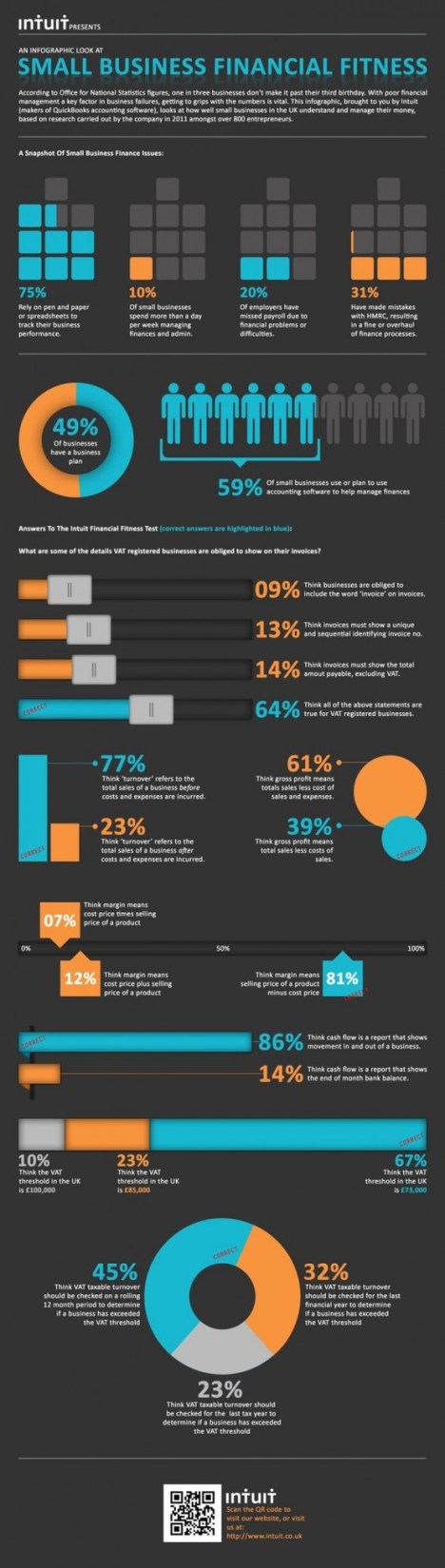
A Small Business Snapshot

Small Biz Finances

Source: Intuit

Assessment

Conclusion

Your thoughts and comments on this ME-P are appreciated. Feel free to review our top-left column, and top-right sidebar materials, links, URLs and related websites, too. Then, subscribe to the ME-P. It is fast, free and secure.

Link: http://feeds.feedburner.com/HealthcareFinancialsthePostForcxos

Speaker: If you need a moderator or speaker for an upcoming event, Dr. David E. Marcinko; MBA – Publisher-in-Chief of the Medical Executive-Post – is available for seminar or speaking engagements. Contact: MarcinkoAdvisors@msn.com

Our Other Print Books and Related Information Sources:

Health Dictionary Series: http://www.springerpub.com/Search/marcinko

Practice Management: http://www.springerpub.com/product/9780826105752

Physician Financial Planning: http://www.jbpub.com/catalog/0763745790

Medical Risk Management: http://www.jbpub.com/catalog/9780763733421

Hospitals: http://www.crcpress.com/product/isbn/9781439879900

Physician Advisors: www.CertifiedMedicalPlanner.org

Product Details  Product Details

Product Details

Will Higher Taxes Damage Your Portfolio?

Join Our Mailing List

Discussing Stock Market Performance

By Lon Jefferies CFP® MBA

Net Worth Advisory Group

Lon Jeffrieslon@networthadvice.com

www.networthadvice.com

Do higher taxes equate to negative stock market returns? Does anyone economic variable accurately predict stock market performance?

A number of our Net Worth Advisory Group physician and lay clients have indicated they are concerned about the impact higher taxes could have on the stock market. News organizations and campaign rhetoric create the impression that there is a cause and effect relationship between taxes (or whatever the hot discussion topic is) and stock market performance. Since 1926, the stock market has obtained positive returns during a calendar year 72% of the time.

Economic Variables

Here are the facts about how various economic variables have impacted investment returns:

  • PERSONAL INCOME TAXES: From 1926-2011 there were 20 years where personal income taxes (for incomes over $150,000, adjusted for inflation) increased over the previous year. The stock market went up 13 of those years, or 65% of the time.
  • CORPORATE TAXES: From 1926-2011 there were 11 years where corporate taxes increased over the previous year. The stock market went up 6 of those years, or 55% of the time.
  • LONG-TERM CAPITAL GAINS: From 1926-2011 there were 11 years where the long-term capital gains tax rate increased over the previous year. The stock market went up 9 of those years, or 82% of the time.
  • INTEREST RATES: From 1956-2011 there were 27 years where interest rates (measured by the Treasury Bill) increased over the previous year. The stock market went up 24 of those years, or 89% of the time.
  • INFLATION: From 1926-2011 there were 43 years where the inflation rate increased over the previous year. The stock market went up 33 of those years, or 77% of the time.
  • NATIONAL DEBT: From 1940-2011 there were 38 years where the national debt as a percentage of gross domestic product (GDP) increased over the previous year. The stock market went up 30 of those years, or 79% of the time.
  • DEFICITS SPENDING: From 1926-2011 there were 38 years where deficit spending increased over the previous year. The stock market went up 30 of those years, or 79% of the time.
  • COMPANY PROFITABILITY: From 1961-2011 there were 25 years where the earnings of S&P 500 companies increased over the previous year. The stock market went up 21 of those years, or 84% of the time.
  • COMPANY DIVIDENDS: From 1961-2011 there were 21 years where S&P 500 companies increased their dividends over the previous year. The stock market went up 17 of those years, or 81% of the time.
  • UNEMPLOYMENT: From 1948-2011 there were 20 years where the unemployment rate increased over the previous year. The stock market went up 9 of those years, or 45% of the time.

Investing and Taxes

Predictions?

As the data indicates, there is no single economic variable, positive or negative that consistently predicts stock market performance. The market may produce positive or negative returns in 2013, but it’s not likely to be because the personal income tax for high income families increased.

The Unemployment Figures

It’s worth noting that the only economic factor that led to a declining market more frequently than not is rising unemployment. While the unemployment rate remains at 7.8%, high by historical standards, it has been steadily decreasing since October of 2009 when it reached 10%.

Additionally, the only other individual indicator that seems to have even a marginally significant negative impact on stock market returns is an increase in the corporate tax rate; if President Obama can get Congress to agree with him, he would like to decrease that rate from 35% to 28% next year. Consequently, history indicates that neither rising unemployment nor increased corporate tax rates will apply in 2013 and should not hamper stock market returns.

Suggestions

History has taught us over and over again that time in the market is much more important than timing the market. It has also taught us that one of the biggest mistakes investors make is to say “these conditions have never existed before and this time is different.”

Need a recent example? Remember the general consensus investors reached about Europe near the beginning of the year? It may surprise you that Europe (as measured by the Vanguard MSCI Europe ETF) has returned over 17% year to date, significantly outpacing the growth of the S&P 500.

Assessment

I personally believe the best game plan for medical professionals is to develop a fundamentally sound diversified portfolio, only investing money you don’t anticipate spending for at least 10 years in stocks, and stay the course.

Conclusion

Your thoughts and comments on this ME-P are appreciated. Feel free to review our top-left column, and top-right sidebar materials, links, URLs and related websites, too. Then, subscribe to the ME-P. It is fast, free and secure.

Link: http://feeds.feedburner.com/HealthcareFinancialsthePostForcxos

Speaker: If you need a moderator or speaker for an upcoming event, Dr. David E. Marcinko; MBA – Publisher-in-Chief of the Medical Executive-Post – is available for seminar or speaking engagements. Contact: MarcinkoAdvisors@msn.com

Our Other Print Books and Related Information Sources:

Health Dictionary Series: http://www.springerpub.com/Search/marcinko

Practice Management: http://www.springerpub.com/product/9780826105752

Physician Financial Planning: http://www.jbpub.com/catalog/0763745790

Medical Risk Management: http://www.jbpub.com/catalog/9780763733421

Hospitals: http://www.crcpress.com/product/isbn/9781439879900

Physician Advisors: www.CertifiedMedicalPlanner.org

Product Details  Product Details

Product Details

Helping Doctors Understand Multi-Point Automobile Check-Up Inspections

Join Our Mailing List

Some Tips and Terms for Medical Professionals to Know for Keeping Your Car Healthy … and Saving Money!

By Dr. David Edward Marcinko MBA

Via Source: Nalley Lexus – Roswell, GA

Taking your vehicle in for service is often like going to the doctor for a routine checkup. As a car, and especially Jaguar, enthusiast I should know. There is a photo of my vintage 2000 XJ-V8-L below. My wife calls her “Ellie“; short for elegant.

If your car is having problems, it may be the human equivalent to the flu. It just goes to show how similar cars are, and while their blood may be made up of oil and gasoline, taking care of your car is still a very important task.

Regular Care

Neglect to take care of yourself or your car, and you could be staring down some pretty expensive bills.

When you take your vehicle in for service, the technicians will often perform a multi-point vehicle inspection. Just as a doctor would make notes in your medical chart, the repair technician has a list of areas to check on your vehicle. This record is given to you when service is complete so you can judge for yourself when to make repairs, and prepare accordingly.

The only problem is that many people simply don’t know what these records mean. While the inspections are intended to improve safety and save money in the long run, many owners ignore them and are forced to pay the consequences. No worries, as we’ll take a look at what the multi-point inspection form means and why it’s so important.

Checklist

At the top of the multi-point checklist inspection form are often the vehicle’s make, model, mileage, and the name of the technician performing service. The owner’s contact information is also noted here, as well as the vehicle’s identification number, or VIN for short. This is the vehicle’s version of a social security number and is just as important to your car for legality reasons.

From here on out, you’ll likely see a lot of green, yellow, and red boxes with check marks scattered throughout. To keep things simple, just think of it as a traffic signal: Green boxes that are checked mean that the component was inspected and found to be in good condition, while yellow means that the part will need attention and service in the future, and red boxes denote components requiring immediate attention for safety’s sake.

Issues

What kinds of things and issues are checked? Perhaps the most prevalent item on any inspection sheet is the condition of the vehicle’s tires. You’ll see conditions marked for each tire regarding tread depth, tire pressure, damage, and wear patterns, and whether an alignment check is necessary. You’ll also notice that brake condition is highly important on the inspection sheet. Again, the color of the marked box denotes overall condition of the braking system, and whether or not components such as brake pads need to be replaced.

Jag sedan

***

[The publisher’s classic automobile]

Even More Issus

Aside from the major components such as tires and brakes, other things being inspected are just as important, if a bit smaller and tougher for the normal owner to notice. All fluids such as coolant, transmission fluid, engine oil, brake fluid, and power steering fluid are checked, which is helpful as most owners don’t think to check the condition and levels of these fluids on a normal basis. Other components inspected include windshield wipers, air filters, steering linkage, lighting components, and suspension and steering pieces, among other things.

Assessment

Take it from me – it sure may all sound like a complex task, and one that seems pretty important. That’s because it is. It may just be a piece of paper, but it’s one that can give a great glimpse into the condition of your vehicle.

After all, wouldn’t you want to know if you had health problems?

Conclusion

Your thoughts and comments on this ME-P are appreciated. Feel free to review our top-left column, and top-right sidebar materials, links, URLs and related websites, too. Then, subscribe to the ME-P. It is fast, free and secure.

Speaker: If you need a moderator or speaker for an upcoming event, Dr. David E. Marcinko; MBA – Publisher-in-Chief of the Medical Executive-Post – is available for seminar or speaking engagements. Contact: MarcinkoAdvisors@msn.com

OUR OTHER PRINT BOOKS AND RELATED INFORMATION SOURCES:

Product DetailsProduct DetailsProduct Details

Product Details  Product Details

A Financial eMR “Got-Ya” from Uncle Sam?

Join Our Mailing List

CMS and the Feds Want to Verify Docs eMR Info Before Meaningful Use Payment

By ME-P Staff Reporters

The conversion to electronic medical records [eMRs] is “vulnerable” to fraud and abuse because of the failure of Medicare and CMS officials to develop appropriate safeguards, according to a sharply critical report just issued by federal investigators.

###

[mobile eMR in clincal use]

###

Full Report: https://oig.hhs.gov/oei/reports/oei-05-11-00250.pdf

Assessment

Requiring an audit before paying hospitals and doctors could  significantly delay payments to providers.

Ya think!

Conclusion

Your thoughts and comments on this ME-P are appreciated. Feel free to review our top-left column, and top-right sidebar materials, links, URLs and related websites, too. Then, subscribe to the ME-P. It is fast, free and secure.

Link: http://feeds.feedburner.com/HealthcareFinancialsthePostForcxos

Speaker: If you need a moderator or speaker for an upcoming event, Dr. David E. Marcinko; MBA – Publisher-in-Chief of the Medical Executive-Post – is available for seminar or speaking engagements. Contact: MarcinkoAdvisors@msn.com

Our Other Print Books and Related Information Sources:

Health Dictionary Series: http://www.springerpub.com/Search/marcinko

Practice Management: http://www.springerpub.com/product/9780826105752

Physician Financial Planning: http://www.jbpub.com/catalog/0763745790

Medical Risk Management: http://www.jbpub.com/catalog/9780763733421

Hospitals: http://www.crcpress.com/product/isbn/9781439879900

Physician Advisors: www.CertifiedMedicalPlanner.org

Product Details

Doctors Selecting the Wrong Financial Advisor [Video]

Join Our Mailing List

Does it Seem Like this … Sometimes?

MD versus FA

Link: http://www.youtube.com/watch?v=Vv4HQG2Hz0I

Assessment

Visit: www.CertifiedMedicalPlanner.org

Conclusion

Your thoughts and comments on this ME-P are appreciated. Feel free to review our top-left column, and top-right sidebar materials, links, URLs and related websites, too. Then, subscribe to the ME-P. It is fast, free and secure.

Link: http://feeds.feedburner.com/HealthcareFinancialsthePostForcxos

Speaker: If you need a moderator or speaker for an upcoming event, Dr. David E. Marcinko; MBA – Publisher-in-Chief of the Medical Executive-Post – is available for seminar or speaking engagements. Contact: MarcinkoAdvisors@msn.com

OUR OTHER PRINT BOOKS AND RELATED INFORMATION SOURCES:

Product Details  Product Details

Product Details

Risk Management, Liability Insurance, and Asset Protection Strategies for Doctors and Advisors: Best Practices from Leading Consultants and Certified Medical Planners™8Comprehensive Financial Planning Strategies for Doctors and Advisors: Best Practices from Leading Consultants and Certified Medical Planners™

On the Herpes Simplex Virus (Type 1 HSV-1 & Type 2 HSV-2)

Join Our Mailing List

Many Thanks 1980s

herpes

Sophisticated Ladies

###

Brothel

And … Not So Sophisticated

###

Assessment

herpes stats

50 Years of Herpes Stats

###

Info Link: http://www.cdc.gov/std/herpes/STDFact-herpes.htm

Conclusion

Your thoughts and comments on this ME-P are appreciated. Feel free to review our top-left column, and top-right sidebar materials, links, URLs and related websites, too. Then, subscribe to the ME-P. It is fast, free and secure.

Link: http://feeds.feedburner.com/HealthcareFinancialsthePostForcxos

Speaker: If you need a moderator or speaker for an upcoming event, Dr. David E. Marcinko; MBA – Publisher-in-Chief of the Medical Executive-Post – is available for seminar or speaking engagements. Contact: MarcinkoAdvisors@msn.com

Our Other Print Books and Related Information Sources:

Health Dictionary Series: http://www.springerpub.com/Search/marcinko

Practice Management: http://www.springerpub.com/product/9780826105752

Physician Financial Planning: http://www.jbpub.com/catalog/0763745790

Medical Risk Management: http://www.jbpub.com/catalog/9780763733421

Hospitals: http://www.crcpress.com/product/isbn/9781439879900

Physician Advisors: www.CertifiedMedicalPlanner.org

Product DetailsProduct DetailsProduct Details

Events Planner: December 2012

Join Our Mailing List

ADVERTISEMENT

Events-Planner: DECEMBER 2012

By Staff Writers

“Keeping track of important health economics and financial industry meetings, conferences and summits”

Welcome to this issue of the Medical Executive-Post and our Events-Planner. It contains the latest information on conferences, news, and relevant resources in healthcare finance, economics, research and development, business management, pharmaceutical pricing, and physician/entity reimbursement!  Watch for a new Events-Planner each month.

First, a little about us! The Medical Executive-Post is still a relative newcomer. But today, we have almost 175,000 visitors and readers each month from all over the country, in addition to our growing subscriber base. We have been a successful collaborative effort, thanks to your contributions.  As a result, we are adding new resources daily. And, we hope the website continues to provide the best place to go for journals, books, conferences, educational resources, tools, and other things you need to establish the value your healthcare consulting and financial advisory intervention.

So, enjoy the Medical Executive-Post and this monthly Events-Planner with our compliments.

A Look Ahead this Month – And now, the important dates:

  • December 05-06: Predictive Modeling Summit. Washington, DC
  • December 09-12: National Forum on Medical Quality Improvement. Orlando, FLA

MarcinkoAdvisors@msn.com

Speaker: If you need a moderator or speaker for an upcoming event, Dr. David E. Marcinko; MBA – Publisher-in-Chief of the Executive-Post – is available for seminar or speaking engagements. Contact: MarcinkoAdvisors@msn.com

Subscribe Now: Did you like this Medical Executive-Post, or find it helpful, interesting and informative? Want to get the latest E-Ps delivered to your email box each morning? Just subscribe using the link below. It’s free. You can unsubscribe at any time. Security is assured.

Link: http://feeds.feedburner.com/HealthcareFinancialsthePostForcxos

Our Newest Textbook Release

Buy from Amazon

Learn How to Profit and Thrive in the PP-ACA Era

BOOK FOREWORD / TESTIMONIAL