HEALTH INSURANCE COSTS: Set to Spike in 2027?

By Dr. David Edward Marcinko; MBA MEd

SPONSOR: http://www.MarcinkoAssociates.com

***

***

What to Expect?

As 2027 approaches, Americans are bracing for a significant spike in health insurance costs. Rising premiums are not new, but the scale and speed of the increases expected in 2027 represent a turning point. Households, employers, and healthcare providers will all feel the impact, and understanding what is driving these changes—and what to expect next—will be essential for navigating the year ahead.

One of the biggest forces behind the 2027 surge is the post‑pandemic cost rebound. Throughout the early 2020s, many insurers saw unusual fluctuations in claims: first a drop in elective care, then a surge as patients returned for delayed procedures. By 2026, insurers were still absorbing the financial consequences of those swings. Now, as utilization stabilizes, insurers are recalibrating premiums to reflect higher baseline costs. More people are seeking care, and they are seeking more expensive care. That alone pushes premiums upward.

Another major driver is the rapid rise in medical inflation. Healthcare costs have been increasing faster than general inflation for decades, but 2027 is expected to bring an acceleration. Hospital labor shortages, higher wages for nurses and technicians, increased pharmaceutical prices, and the growing cost of advanced medical technologies all contribute to a more expensive healthcare ecosystem. Insurers pass those costs along to consumers through higher premiums, deductibles, and out‑of‑pocket maximums.

A third factor is the aging population. As more Americans enter retirement age, demand for chronic disease management, specialty care, and long‑term services rises. Even though Medicare covers older adults, private insurers still bear significant costs through Medicare Advantage plans and supplemental policies. The demographic shift increases overall healthcare spending, and insurers adjust pricing accordingly.

Employers will face their own challenges in 2027. Many companies already struggle with the rising cost of providing health benefits, and the expected spike will force difficult decisions. Some employers may shift more costs to workers through higher payroll deductions or increased deductibles. Others may reduce coverage options, narrow provider networks, or move toward high‑deductible health plans paired with health savings accounts. Smaller businesses, in particular, may find it harder to offer competitive benefits, potentially affecting hiring and retention.

For individuals buying coverage on the marketplace or directly from insurers, the spike will be even more visible. Premiums for Affordable Care Act plans are expected to rise sharply, and while subsidies may soften the blow for some, many middle‑income families will feel the full weight of the increases. The result could be a rise in underinsurance—people technically covered but unable to afford meaningful care due to high deductibles and copays.

Another consequence of rising costs is the continued growth of alternative care models. Telehealth, direct primary care, and concierge medicine have gained traction as consumers seek more predictable costs and better access. In 2027, these models may expand further, especially among younger and tech‑savvy populations. While they do not replace comprehensive insurance, they can reduce reliance on traditional care pathways and help people manage routine health needs more affordably.

The spike in costs will also intensify debates around healthcare policy. Lawmakers, regulators, and industry leaders will face pressure to address affordability, transparency, and competition. Some will push for stronger oversight of insurance pricing, while others will advocate for reforms aimed at reducing underlying medical costs. Regardless of the political direction, the issue will be impossible to ignore as millions of Americans confront higher bills.

Consumers should prepare for 2027 by reviewing their coverage options carefully. Comparing plans, understanding cost‑sharing structures, and evaluating employer benefits will be more important than ever. Families may need to adjust budgets to account for higher premiums or explore supplemental coverage to manage risk. Preventive care, wellness programs, and chronic disease management will also play a larger role in controlling personal healthcare expenses.

EDUCATION: Books

SPEAKING: Dr. Marcinko will be speaking and lecturing, signing and opining, teaching and preaching, storming and performing at many locations throughout the USA this year! His tour of witty and serious pontifications may be scheduled on a planned or ad-hoc basis; for public or private meetings and gatherings; formally, informally, or over lunch or dinner. All medical societies, financial advisory firms or Broker-Dealers are encouraged to submit an RFP for speaking engagements: CONTACT: Ann Miller RN MHA at MarcinkoAdvisors1738@outlook.com -OR- http://www.MarcinkoAssociates.com

Like, Refer and Subscribe

HOSPITALS: http://www.crcpress.com/product/isbn/9781466558731

CLINICS: http://www.crcpress.com/product/isbn/9781439879900

ADVISORS: www.CertifiedMedicalPlanner.org

FINANCE:Financial Planning for Physicians and Advisors

INSURANCE:Risk Management and Insurance Strategies for Physicians and Advisors

Dictionary of Health Economics and Finance

Dictionary of Health Information Technology and Security

Dictionary of Health Insurance and Managed Care

***

Percentage of Americans Putting Off Medical Treatment Because of Costs

Join Our Mailing List

Do we really know?

www.MCOL.com

Health costs

Assessment

Conclusion

Your thoughts and comments on this ME-P are appreciated. Feel free to review our top-left column, and top-right sidebar materials, links, URLs and related websites, too. Then, subscribe to the ME-P. It is fast, free and secure.

Link: http://feeds.feedburner.com/HealthcareFinancialsthePostForcxos

Speaker: If you need a moderator or speaker for an upcoming event, Dr. David E. Marcinko; MBA – Publisher-in-Chief of the Medical Executive-Post – is available for seminar or speaking engagements. Contact: MarcinkoAdvisors@msn.com

OUR OTHER PRINT BOOKS AND RELATED INFORMATION SOURCES:

DICTIONARIES: http://www.springerpub.com/Search/marcinko
PHYSICIANS: www.MedicalBusinessAdvisors.com
PRACTICES: www.BusinessofMedicalPractice.com
HOSPITALS: http://www.crcpress.com/product/isbn/9781466558731
CLINICS: http://www.crcpress.com/product/isbn/9781439879900
BLOG: www.MedicalExecutivePost.com
FINANCE: Financial Planning for Physicians and Advisors
INSURANCE: Risk Management and Insurance Strategies for Physicians and Advisors

Product DetailsProduct Details

Product Details

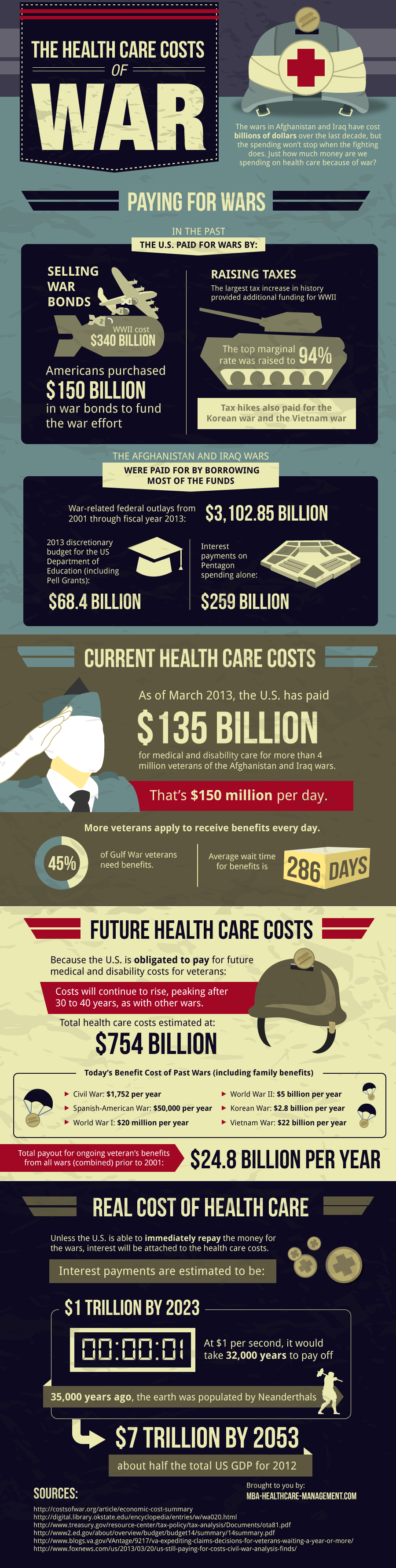
Afghanistan and Iraq’s Healthcare Costs

Join Our Mailing List

An Informative Infographic

###

war

###

Assessment

Over the next 40 years, Afghanistan and Iraq veterans will need an estimated $750 billion in healthcare, a challenge for the VA to innovate, especially when treating soldiers who grew up with the Internet.

Conclusion

Your thoughts and comments on this ME-P are appreciated. Feel free to review our top-left column, and top-right sidebar materials, links, URLs and related websites, too. Then, subscribe to the ME-P. It is fast, free and secure.

Link: http://feeds.feedburner.com/HealthcareFinancialsthePostForcxos

Speaker: If you need a moderator or speaker for an upcoming event, Dr. David E. Marcinko; MBA – Publisher-in-Chief of the Medical Executive-Post – is available for seminar or speaking engagements. Contact: MarcinkoAdvisors@msn.com

OUR OTHER PRINT BOOKS AND RELATED INFORMATION SOURCES:

Health Dictionary Series: http://www.springerpub.com/Search/marcinko

Practice Management: http://www.springerpub.com/product/9780826105752

Physician Financial Planning: http://www.jbpub.com/catalog/0763745790

Medical Risk Management: http://www.jbpub.com/catalog/9780763733421

Hospitals: http://www.crcpress.com/product/isbn/9781439879900

Physician Advisors: www.CertifiedMedicalPlanner.org

Product DetailsProduct DetailsProduct Details

Product Details  Product Details

Product DetailsProduct Details

Spending for Private Health Insurance in the United States

Join Our Mailing List

Health Costs Doubled in the Past Decade

By NIHCM Foundation www.NIHCM.org

The total cost of health care for a typical family with employer-sponsored coverage has more than doubled in the past decade to nearly $21,000 per year, outpacing both inflation and income growth.

Skyrocketing health care costs are already straining budgets and could jeopardize the availability of affordable coverage under the ACA. To shed light on the factors behind increased spending on private insurance, this brief examines

  • trends in premiums and cost-sharing in the group and non-group markets,
  • how premium dollars are spent by insurers,
  • which sectors are driving premiums upward, and
  • the importance of price increases in explaining spending growth.

healthcare costs

Assessment

Read more…

Conclusion

Your thoughts and comments on this ME-P are appreciated. Feel free to review our top-left column, and top-right sidebar materials, links, URLs and related websites, too. Then, subscribe to the ME-P. It is fast, free and secure.

Speaker: If you need a moderator or speaker for an upcoming event, Dr. David E. Marcinko; MBA – Publisher-in-Chief of the Medical Executive-Post – is available for seminar or speaking engagements. Contact: MarcinkoAdvisors@msn.com

OUR OTHER PRINT BOOKS AND RELATED INFORMATION SOURCES:

Product Details  Product Details

Product Details

What Health Care Fraud Costs Us

Join Our Mailing List

Scrutiny Needed from the Patient Citizenry – Too?

As health care takes the center stage at the forefront of contemporary politics it is under scrutiny from several angles.

The Fraud Rate

One aspect of the health care system that has been garnering growing levels of interest is the rate at which medical fraud occurs. As the developed world steeps itself further and further into the digital age, things like medical history and billing records become more easily susceptible to fraud since they’re accessible from virtually anywhere.

Expensive Care

And, the fact of the matter is that trying to stay healthy is an expensive business. Each year, 300 million Americans spend about $2 trillion on health care, but the amount of that money that is lost to fraud seems to have grown a great deal in recent years.

Types

The government continues to crack down and identify fraudsters in all their forms—and they do come in many forms. Perhaps the most common type of health care fraud concerns how medical care providers bill. This type of fraud relies heavily on the fact that many patients don’t take the proper amount of time to really scrutinize their medical bills and invoices.

Source: InsuranceQuotes.org

Assessment

Fraud can cost a huge amount of money for victim, insurance companies and society. The best defense against fraud remains understanding EOBs forms and what’s on your medical bills.

Conclusion

Your thoughts and comments on this ME-P are appreciated. Feel free to review our top-left column, and top-right sidebar materials, links, URLs and related websites, too. Then, subscribe to the ME-P. It is fast, free and secure.

Speaker: If you need a moderator or speaker for an upcoming event, Dr. David E. Marcinko; MBA – Publisher-in-Chief of the Medical Executive-Post – is available for seminar or speaking engagements. Contact: MarcinkoAdvisors@msn.com

OUR OTHER PRINT BOOKS AND RELATED INFORMATION SOURCES:


Product DetailsProduct DetailsProduct Details

Health Plan Management Navigator

August 2009 Edition

By Douglas B. Sherlock; CFA, MBALibrary

Linked below is the August 2009 edition of Plan Management Navigator. In this month’s edition, we update readers on the results for the Blue Cross Blue Shield universe, and provide product breakouts, summary functional area breakouts as well as expense trends. Cost increases are lower this year than last, though higher if product mix is considered. Twenty-two Blue Cross Blue Shield Plans serving 31.3 million members participated in this year’s benchmarking study.  Growth in Information Systems and Medical Management costs explained more than 40% of the total increase.

Link: Navigator August 09

Sherlock Expense Evaluation Report

This analysis is based on materials from our Sherlock Expense Evaluation Report (SEER) for Blue Cross Blue Shield Plans. Additional information about SEER is available at http://www.sherlockco.com/seer.shtml or by contacting us.

Assessment

In coming weeks, Plan Management Navigator will summarize other results of this year’s performance benchmarking studies. We expect to publish Medicare and Medicaid editions in late August or early September. Independent / Provider-Sponsored plan results were published two weeks ago in Plan Management Navigator and the associated presentation and transcript are found at  http://www.sherlockco.com/

Conclusion

And so, your thoughts and comments on this Medical Executive-Post are appreciated. Tell us what you think. Feel free to review our top-left column, and top-right sidebar materials, links, URLs and related websites, too. Then, be sure to subscribe to the ME-P. It is fast, free and secure.

Link: http://feeds.feedburner.com/HealthcareFinancialsthePostForcxos

Speaker: If you need a moderator or speaker for an upcoming event, Dr. David E. Marcinko; MBA – Publisher-in-Chief of the Executive-Post – is available for seminar or speaking engagements. Contact: MarcinkoAdvisors@msn.com 

Get our Widget: Get this widget!

Our Other Print Books and Related Information Sources:

Practice Management: http://www.springerpub.com/prod.aspx?prod_id=23759

Physician Financial Planning: http://www.jbpub.com/catalog/0763745790

Medical Risk Management: http://www.jbpub.com/catalog/9780763733421

Healthcare Organizations: www.HealthcareFinancials.com

Health Administration Terms: www.HealthDictionarySeries.com

Physician Advisors: www.CertifiedMedicalPlanner.com

Subscribe Now: Did you like this Medical Executive-Post, or find it helpful, interesting and informative? Want to get the latest ME-Ps delivered to your email box each morning? Just subscribe using the link below. You can unsubscribe at any time. Security is assured.

Link: http://feeds.feedburner.com/HealthcareFinancialsthePostForcxos

Sponsors Welcomed

And, credible sponsors and like-minded advertisers are always welcomed.

Link: https://healthcarefinancials.wordpress.com/2007/11/11/advertise

On HIT Cost Savings

Real or Imagined SolutionsUS Capitol

According to David M. Cutler, of the Center for American Progress Fund [CAPF] on May 11, 2009, health care will be the major challenge to the federal budget in coming decades. Rising health costs will account for nearly all of the expected increase in government spending relative to gross domestic product [GDP].

Healthcare Costs and GDP

Health care currently accounts for 16 percent of domestic GDP, and that share is forecast to nearly double in the next quarter century. Spending money on health care is not bad, but wasting money is very bad.

Link: http://www.americanprogressaction.org/issues/2009/05/health_modernization.htmlHIT

HIT to the Rescue

But, $600 billion might be saved over the next ten years, and $9 trillion saved over the next 25 years, if HIT initiatives are used; says the CAPF.

Assessment

Estimates suggest that a third or more of medical spending—perhaps $700 billion per year—is not known to be worth the cost. Wasting hundreds of billions of dollars on inefficient health care is a luxury the country cannot afford.

Conclusion

And so, your thoughts and comments on this Medical Executive-Post are appreciated? Feel free to review our top-left column, and top-right sidebar materials, links, URLs and related websites, too. Then, be sure to subscribe to the ME-P. It is fast, free and secure.

Link: http://feeds.feedburner.com/HealthcareFinancialsthePostForcxos

Speaker: If you need a moderator or speaker for an upcoming event, Dr. David E. Marcinko; MBA – Publisher-in-Chief of the Executive-Post – is available for seminar or speaking engagements. Contact: MarcinkoAdvisors@msn.com  or Bio: www.stpub.com/pubs/authors/MARCINKO.htm

Subscribe Now: Did you like this Medical Executive-Post, or find it helpful, interesting and informative? Want to get the latest ME-Ps delivered to your email box each morning? Just subscribe using the link below. You can unsubscribe at any time. Security is assured.

Link: http://feeds.feedburner.com/HealthcareFinancialsthePostForcxos