Managing Your 401(k)

Join Our Mailing List

MANAGING YOUR 401(k)

By Dan Timotic CFA

More than 73 million Americans actively participate in employer-sponsored defined-contribution plans such as 401(k), 403(b), and 457 plans.

If you are among this group, you’ve taken a big step on the road to retirement, but as with all investing, it’s important to understand your plan and what it can do for you.

Here are a few ways to make the most of this workplace benefit.

***

 investing

READ MORE

Conclusion

Your thoughts and comments on this ME-P are appreciated. Feel free to review our top-left column, and top-right sidebar materials, links, URLs and related websites, too. Then, subscribe to the ME-P. It is fast, free and secure.

Speaker: If you need a moderator or speaker for an upcoming event, Dr. David E. Marcinko; MBA – Publisher-in-Chief of the Medical Executive-Post – is available for seminar or speaking engagements. Contact: MarcinkoAdvisors@msn.com

OUR OTHER PRINT BOOKS AND RELATED INFORMATION SOURCES:

Risk Management, Liability Insurance, and Asset Protection Strategies for Doctors and Advisors: Best Practices from Leading Consultants and Certified Medical Planners™

***

Proposed IRA Changes in the Obama Federal Budget

Join Our Mailing List

Reviewing Potential IRA Changes 

Rick Kahler MS CFP

By Rick Kahler CFP® http://www.KahlerFinancial.com

The President has fired the first warning shot indicating that politicians are eying the tax advantages of the Roth IRA. For years I’ve strongly encouraged maximum funding of Roth IRAs & 401(k)s.

Physician-Clients have sometimes expressed concern that politicians would someday retroactively change the rules and strip the plans of their tax advantages. I’ve seen that concern as a possibility (for example, in 2008 Argentina confiscated the assets in IRAs and 401(k)s and replaced them with less than desirable Argentinian Government Bonds), but not much of a probability. 

With the introduction of the President’s 2016 budget, the probability of losing some Roth IRA tax benefits has increased.  

Each February the President submits a budget to Congress which is about far more than spending requests. It also contains scores of proposed changes to existing tax laws. One such proposal in the current budget would eliminate two tax advantages of the Roth IRA.  

The first change would require required minimum distributions (RMDs) for Roth IRAs as well as traditional IRAs.  

Currently, one of the benefits of a Roth IRA is not having to take RMDs. At age 70 1/2, owners of traditional IRAs are required withdraw a certain percentage annually, often around 4%. They must pay the tax due and, if they don’t need the funds for living expenses, must invest the remainder in a taxable account. The RMD denies them the option of leaving the money in the tax-deferred environment of the IRA and further compounding.  

Under the President’s proposal, owners of Roth IRAs will need to start withdrawing funds annually at age 70 1/2. While there won’t be any taxes due because contributions to Roths are post-tax, it will remove the funds from the tax-free environment, decreasing future returns by up to 40%. That’s a big deal. 

The second proposed change would eliminate tax-deferred inheritance of IRAs (sometimes called “stretch IRAs) for anyone except spouses. All other inherited IRAs would need to be dissolved and the funds distributed and taxed within five years after death. This will really impact Baby Boomers counting on their parents’ IRAs to assist them with their own retirement needs. 

Other budget proposals would also end Roth conversions to any after-tax IRAs, limiting them to IRAs where the contributions were before taxes. This would prohibit taxpayers with earnings above the traditional and Roth IRA threshold from making non-deductible contributions to a traditional IRA and then doing a Roth conversion. 

The final proposal would limit new IRA contributions for total retirement savings totaling over $3.4 million. This includes the aggregate total of IRAs, 401(k)s, and any other pension plan balances. Once the total reaches $3.4 million at the end of the tax year, no new contributions are possible. 

***

163_1

***

Capping IRA Growth?

To many Americans, especially the youth, this looks like a cap they will never see in their lifetime. Yet consider what $3.4 million will be worth in purchasing power 40 years from now, when today’s 30-year-olds will have to start RMDs. If inflation maintains its historical average of 3%, in 40 years $3.4 million will have the purchasing power of just over $1 million today. If someone wants to be assured they will never run out of money in retirement, $1 million only provides $30,000 a year of retirement income.

Capping IRA growth is another big deal.

Assessment 

These are a few of the tax changes proposed by the President’s budget. The chances for any to become law in 2016 are remote, given that Congress is currently controlled by Republicans. However, the proposals do signal the current thinking of lawmakers. In considering their retirement planning, taxpayers would be advised to pay attention to such signals.

Conclusion

Your thoughts and comments on this ME-P are appreciated. Feel free to review our top-left column, and top-right sidebar materials, links, URLs and related websites, too. Then, subscribe to the ME-P. It is fast, free and secure.

Speaker: If you need a moderator or speaker for an upcoming event, Dr. David E. Marcinko; MBA – Publisher-in-Chief of the Medical Executive-Post – is available for seminar or speaking engagements. Contact: MarcinkoAdvisors@msn.com

OUR OTHER PRINT BOOKS AND RELATED INFORMATION SOURCES:

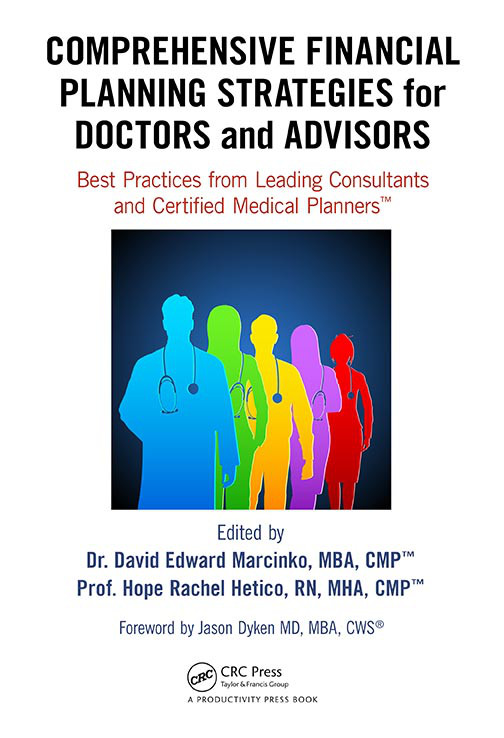
Comprehensive Financial Planning Strategies for Doctors and Advisors: Best Practices from Leading Consultants and Certified Medical Planners™

***

The “Perfect” Holiday Gift for your Favorite Doctor – YES REALLY!

http://www.CertifiedMedicalPlanner.org

Now, is the perfect time of year to consider one, or all, of these texts as the perfect holiday gift for your favorite doctor, or allied health care professional.

Also, may be used as a client-prospecting tool for Financial Advisors, Wealth and Practice Managers, and CPAs, etc.

Smile, learn and prosper with iMBA in 2016.

***holiday_gift***

Last Generation Holiday Gift for MDs

***

RECENT BOOKS FROM iMBA, Inc.

Comprehensive Financial Planning Strategies for Doctors and Advisors: Best Practices from Leading Consultants and Certified Medical Planners(TM)      

Product DetailsProduct Details

Product DetailsProduct DetailsProduct Details

    Product Details

  Next Generation Holiday Gifts for MDs

***

Newer Thoughts on Long Term Care Insurance

Join Our Mailing List

Most LTCI policies are SOLD… not Bought!

DEM white shirt

By Dr. David Edward Marcinko MBA CMP

To be sure, physicians and Financial Advisors are aware that there is a sometime need to recommend a LTCI policy to clients. Of course, in such cases, it is a good idea to work with a low load provider (or the physician or client’s agent).

The Need?

Yet, most LTCI policies are sold by insurance agents for big commissions; not bought, and that most statistics used to sell LTCI policies are fear-based and half-truths. I know, as I was a licensed insurance agent for more than a decade.

Even the Department of Health and Human Services [DHHS] gets into the fear mongering on their website quoting that “about 70 percent of people over age 65 require some type of long-term care services during their lifetime”

Source: http://www.longtermcare.gov/LTC/Main_Site/Planning/Index.aspx

Department of Health and Human Services

This may be a deceptive statistic as it omits the length of long-term care needed in these 70% of cases. And, it is not 3+ years in all these cases [our estimate is closer to 2.5]. With the stamp of approval by the Supreme Court of the United States SCOTUS on the PP-ACA, we may be looking at social LTCI in the US like other social medicine countries and give up on private LTCI insurance altogether.

Other Countries

Germany introduced mandatory long-term care insurance in 1995. Japan and France also have a LTCI tax funded insurance plan. And, the poor utilization and growing risks associated with long-term care insurance, are leading a growing number of insurance agents, financial advisors and Certified Medical Planners™ to recommend alternatives to their clients.

***

elderly

***

Assessment

To be a thought-leader ahead of the curve, the newest aging trend is away from LTCI and toward sheltering at home – living at home and dying at home. Perhaps, this is the way it should be.

Dying should not be a for-profit industry.

http://www.CertifiedMedicalPlanner.org

More:

Conclusion

Your thoughts and comments on this ME-P are appreciated. Feel free to review our top-left column, and top-right sidebar materials, links, URLs and related websites, too. Then, subscribe to the ME-P. It is fast, free and secure.

Speaker: If you need a moderator or speaker for an upcoming event, Dr. David E. Marcinko; MBA – Publisher-in-Chief of the Medical Executive-Post – is available for seminar or speaking engagements. Contact: MarcinkoAdvisors@msn.com

OUR OTHER PRINT BOOKS AND RELATED INFORMATION SOURCES:

***

[PHYSICIAN FOCUSED FINANCIAL PLANNING AND RISK MANAGEMENT COMPANION TEXTBOOK SET]

  Risk Management, Liability Insurance, and Asset Protection Strategies for Doctors and Advisors: Best Practices from Leading Consultants and Certified Medical Planners™    Comprehensive Financial Planning Strategies for Doctors and Advisors: Best Practices from Leading Consultants and Certified Medical Planners™

[Dr. Cappiello PhD MBA] *** [Foreword Dr. Krieger MD MBA]

***

ME-P Health Economics, Financial Planning & Investing, Medical Practice, Risk Management and Insurance Textbooksfor Doctors and Advisors

ME-P At Your Service!

***

[PHYSICIAN FOCUSED FINANCIAL PLANNING AND RISK MANAGEMENT COMPANION TEXTBOOK SET]

  Risk Management, Liability Insurance, and Asset Protection Strategies for Doctors and Advisors: Best Practices from Leading Consultants and Certified Medical Planners™Comprehensive Financial Planning Strategies for Doctors and Advisors: Best Practices from Leading Consultants and Certified Medical Planners™

[HOSPITAL OPERATIONS, ORGANIZATIONAL BEHAVIOR AND FINANCIAL MANAGEMENT COMPANION TEXTBOOK SET]

Product DetailsProduct Details

[Foreword Dr. Phillips MD JD MBA LLM] *** [Foreword Dr. Nash MD MBA FACP]

[HEALTH INSURANCE, MANAGED CARE, ECONOMICS, FINANCE AND HEALTH INFORMATION TECHNOLOGY COMPANION DICTIONARY SET]

      Product DetailsProduct DetailsProduct Details

[Mike Stahl PhD MBA] *** [Foreword Dr.Mata MD CIS] *** [Dr. Getzen PhD]

***

Product Details

http://www.BusinessofMedicalPractice.com

***

Dr. David Edward Marcinko, editor-in-chief, is a next-generation apostle of Nobel Laureate Kenneth Joseph Arrow, PhD, as a health-care economist, insurance advisor, financial advisor, risk manager, and board-certified surgeon from Temple University in Philadelphia. In the past, he edited eight practice-management books, three medical textbooks and manuals in four languages, five financial planning yearbooks, dozens of interactive CD-ROMs, and three comprehensive health-care administration dictionaries. Internationally recognized for his clinical work, he is a distinguished visiting professor of surgery and a recipient of an honorary Bachelor of Medicine–Bachelor of Surgery (MBBS) degree from Marien Hospital in Aachen, Germany. He provides litigation support and expert witness testimony in state and federal court, with medical publications archived in the Library of Congress and the Library of Medicine at the National Institutes of Health.

***

Social Security Update

Join Our Mailing List

Congress to curtail two useful benefits

Rick Kahler MS CFPBy Rick Kahler MS CFP http://www.KahlerFinancial.com

Congress is about to curtail two little-known, but very useful, benefits of Social Security. These are the ability to file-and-suspend and to file a restricted application. At the time of this writing, Congress had not formally passed the bill but it was expected to pass within days.

Background

Remember when Paul Ryan proposed we extend the full retirement age for Social Security from age 67 to 69 over a 40-year time period? The media went ballistic. Senior citizen groups sponsored TV ads of Paul Ryan dumping grandma over the cliff. His proposal never saw the light of day.

Fast forward to the current Bipartisan Budget Act of 2015, a bill that will cost Social Security recipients far more in benefits in the near future than Ryan’s proposal. Yet there has been nowhere near the outcry from the media, either political party, or the President.

Why?

The benefits that the budget bill strips from the Social Security program are little known by the average American and a bit complex, even though they can add up to tens of thousands of dollars of immediate cash benefits for nearly all Social Security recipients.

What Congress passed, and the President says he will sign, ends a benefit called file-and-suspend. This applies to married couples. It allows the higher-earning spouse to file for Social Security at full retirement age (currently 66), but to suspend taking the benefit so it can increase by 8% a year until age 70. This enables the lower-earning spouse to begin receiving spousal benefits.

The legislation will disallow that benefit and restrict the lower-earning spouse from receiving the spousal benefit until the higher-earning spouse actually starts receiving payments. This means if you wait until 70 to take the highest monthly Social Security benefit possible, your spouse will also have to wait until you turn 70 to receive spousal benefits.

e1c4e4b6-7e92-415c-9af3-74c8f31dc42b

Example:

As an example, assume Dr. Tyler’s full retirement age benefit is $3,000 per month. Her spouse Dana, the same age, has a full retirement benefit of $500. Under the current program, Dana could receive three times more, or $1,500 a month, at age 66, even though Tyler suspends her right to begin receiving her monthly benefit. By waiting until age 70, she would see her benefit grow to closer to $4,000 a month. Under this legislation, Dana would have to wait until age 70 to take the $1,500 spousal benefit. This costs the couple $1,500 a month for four years, or $72,000.

The second benefit stripped under this act affects everyone covered under the Social Security program, whether married or not. It is known as filing a restricted application. Currently, when you hit full retirement age and decide to suspend taking your benefit, you have the option to change your mind at any time before age 70 and retroactively receive your benefits.

Example:

This benefit is incredibly valuable in certain cases. Suppose, for example, Dr. Edgar has decided to wait until age 70 to begin receiving benefits but, at age 69, he becomes terminally ill. He could file to retroactively claim all three years of lost benefits. If Edgar’s full benefit amount were $3000 a month, the total retroactive benefit would be $108,000. This option is wiped out under the legislation.

Those currently receiving these benefits will become grandfathered under the legislation and continue to receive them. However, anyone currently qualifying for file-and-suspend benefits but not receiving them has until six months after Congress passes the Budget Act to complete the filing process.

More:

Assessment

While not all Social Security recipients will be affected by these changes, for those who are the impact will be significant.

 Conclusion

Your thoughts and comments on this ME-P are appreciated. Feel free to review our top-left column, and top-right sidebar materials, links, URLs and related websites, too. Then, subscribe to the ME-P. It is fast, free and secure.

Speaker: If you need a moderator or speaker for an upcoming event, Dr. David E. Marcinko; MBA – Publisher-in-Chief of the Medical Executive-Post – is available for seminar or speaking engagements. Contact: MarcinkoAdvisors@msn.com

OUR OTHER PRINT BOOKS AND RELATED INFORMATION SOURCES:

    [PHYSICIAN FOCUSED FINANCIAL PLANNING AND RISK MANAGEMENT COMPANION TEXTBOOK SET]

  Risk Management, Liability Insurance, and Asset Protection Strategies for Doctors and Advisors: Best Practices from Leading Consultants and Certified Medical Planners™Comprehensive Financial Planning Strategies for Doctors and Advisors: Best Practices from Leading Consultants and Certified Medical Planners™

***

EMERGING THOUGHTS ON “AGE-BANDING”

Join Our Mailing List

A Retirement Planning Model for Doctors

[By Staff Reporters]

What it is?

Age Banding is a model for retirement planning developed by Somnath Basu PhD MBA CFP™ that may provide a new approach to retirement needs.

How it works!

The model reduces errors in estimating expenses, provides an algorithm to calculate replacement ratio, allows easier incorporation of long term care insurance benefits and significantly reduces funding needs.

Example:

For example, rather than doing a simple ratio of expected future expenses as compared to current living expenses and lumping 30 to 40 years of retirement into one big event, Dr. Basu breaks down retirement age into various groups or “bands”. It is intuitive that the more active retirement years will be early on, and that more funds allocated to spending and enjoyment should be made for the beginning retirement years.

***

Three Reasons Doctors Are Ditching Insurance And Offering Care For Cash

***

Assessment

The current investment environment of low interest rates does not favor traditional retirement advice of moving more funds into bonds because they are “safe” money.

So, coupled with Dr. Basu’s age banding approach, physicians might consider more dividend paying equities, in their portfolio, as an alternative [personal communication].

ABOUT

Dr. Basu

Somnath Basu PhD is Professor of Finance at California Lutheran University and Director of its California Institute of Finance.

Basu is involved in the National Endowment for Financial Education (NEFE), the CFP™ Board of Standards, International CFP™ Board of Standards, and the FPA.

More:

Conclusion

Your thoughts and comments on this ME-P are appreciated. Feel free to review our top-left column, and top-right sidebar materials, links, URLs and related websites, too. Then, subscribe to the ME-P. It is fast, free and secure.

Speaker: If you need a moderator or speaker for an upcoming event, Dr. David E. Marcinko; MBA – Publisher-in-Chief of the Medical Executive-Post – is available for seminar or speaking engagements. Contact: MarcinkoAdvisors@msn.com

OUR OTHER PRINT BOOKS AND RELATED INFORMATION SOURCES:

 Our New Text – “Take a Peek Inside – Now Available

Comprehensive Financial Planning Strategies for Doctors and Advisors: Best Practices from Leading Consultants and Certified Medical Planners(TM)

Front Matter with Foreword by Jason Dyken MD MBA

logos

“BY DOCTORS – FOR DOCTORS – PEER REVIEWED – FIDUCIARY FOCUSED”

***

What does “Retirement” mean to You?

Join Our Mailing List 

A Mental Exercise … for You!

By Rick Kahler MS CFP® http://www.KahlerFinancial.com

Rick Kahler MS CFPHere’s a brief mental exercise to try: Quickly, without stopping to think, write down what comes to mind when you imagine yourself being retired.

If you’re 40 or younger, your answers might well include terms like “future” and “old age,” which probably don’t seem especially relevant or urgent at this stage in your life.

If you’re older, chances are you’ve had at least passing thoughts about retirement. You might associate it with concepts like these:

  • Freedom from the daily grind
  • Losing my earning power
  • Losing my identity
  • Enjoying financial independence
  • Being useless
  • Dependency and declining health
  • Doing what I’ve always wanted to do
  • I don’t ever plan to retire

Both the positives and negatives in the above list have one thing in common: they don’t tell the whole story. The idea of retirement is surrounded by a host of delusions, assumptions, and fears. Many of our expectations about it do not match the reality.

Examples:

Here are just two examples from “The 2013 Risks and Process of Retirement Survey,” done by the Society of Actuaries.

  • Of the pre-retirees surveyed, 38% expected to work until at least 65. Another 15% expected not to retire at all. Yet 54% of the retirees surveyed had retired before age 60.
  • Many pre-retirees—59%—planned to stop working gradually. Yet only 22% of retirees had done so. While 35% of pre-retirees intended to keep working part-time, only 10% of retirees actually did.

It’s no wonder that many workers plan to stay employed; they’ll need the money. The 2015 Transamerica Retirement Survey of Workers estimates the median amount that workers in their 50s have saved for retirement at only $117,000. For workers in their 60s and older, it is $172,000. Even combined with Social Security, that’s hardly enough to provide an adequate retirement income.

Yet even if you intend to keep working and earning until you’re 80, you may find your plans derailed. If companies downsize, older workers may be among the first to be laid off. Health problems (your own or those of family members you may need to care for) can force you to retire earlier than you expected to.

And, these are only two of the unfortunate realities that can jolt any of us out of our rosy expectations of enjoying a carefree retirement of good health, comfort, and independence.

Just because we can’t count on carrying out our retirement plans, though, doesn’t mean we should give up on retirement planning altogether.

Some Suggestions

Here are a few suggestions to deal with the realities of retirement:

  1. Save as much as you can. Make funding retirement your priority, especially if it’s too late to start early. Cut your spending, downsize, and pay off debt. Having more money in retirement gives you more options when bad things do happen.
  1. Improve your health: lose weight, exercise more, and eat a healthy diet. Improve your odds for staying well by changing what is within your power to change.
  1. Look at the whole retirement picture. Become willing to consider both the negative and positive possibilities in order to plan appropriately. Unreasonable pessimism and fear are no more realistic than unreasonable optimism.

***

7 ways retirement income

***

Assessment

Finally, the most realistic viewpoint may be accepting that retirement is no more or less predictable than any other stage of life. We can’t know if we’ll develop serious health problems in our 70s or still be able to go dancing when we’re 102. While we can and should prepare for the future, we also serve ourselves well when we remember to enjoy the present.

More:

Conclusion

Your thoughts and comments on this ME-P are appreciated. Feel free to review our top-left column, and top-right sidebar materials, links, URLs and related websites, too. Then, subscribe to the ME-P. It is fast, free and secure.

Speaker: If you need a moderator or speaker for an upcoming event, Dr. David E. Marcinko; MBA – Publisher-in-Chief of the Medical Executive-Post – is available for seminar or speaking engagements. Contact: MarcinkoAdvisors@msn.com

OUR OTHER PRINT BOOKS AND RELATED INFORMATION SOURCES:

Comprehensive Financial Planning Strategies for Doctors and Advisors: Best Practices from Leading Consultants and Certified Medical Planners(TM)

Front Matter with Foreword by Jason Dyken MD MBA

I plan to give a copy of this book written by doctors and for doctors’ to all my prospects, physician, and nurse clients. It may be the definitive text on this important topic.

Alexander Naruska CPA [Orlando, Florida]

logos

“BY DOCTORS – FOR DOCTORS – PEER REVIEWED – FIDUCIARY FOCUSED”

***

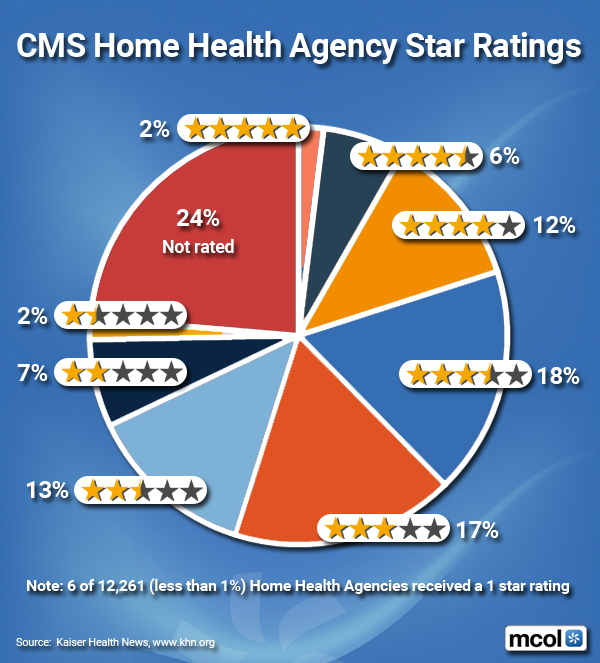
CMS Home Health Agencies

Join Our Mailing List

Star Ratings

By http://www.MCOL.com

MEDICARE @ 50 [1965-2015]

ImageProxy

More videos:

Conclusion

Your thoughts and comments on this ME-P are appreciated. Feel free to review our top-left column, and top-right sidebar materials, links, URLs and related websites, too. Then, subscribe to the ME-P. It is fast, free and secure.

Speaker: If you need a moderator or speaker for an upcoming event, Dr. David E. Marcinko; MBA – Publisher-in-Chief of the Medical Executive-Post – is available for seminar or speaking engagements. Contact: MarcinkoAdvisors@msn.com

OUR OTHER PRINT BOOKS AND RELATED INFORMATION SOURCES:

Product DetailsProduct Details

***

Well-Being Rankings for Older Americans

Join Our Mailing List

States with the Highest Scores

By http://www.MCOL.com

***

ImageProxy-2

***

Conclusion

Your thoughts and comments on this ME-P are appreciated. Feel free to review our top-left column, and top-right sidebar materials, links, URLs and related websites, too. Then, subscribe to the ME-P. It is fast, free and secure.

Speaker: If you need a moderator or speaker for an upcoming event, Dr. David E. Marcinko; MBA – Publisher-in-Chief of the Medical Executive-Post – is available for seminar or speaking engagements. Contact: MarcinkoAdvisors@msn.com

OUR OTHER PRINT BOOKS AND RELATED INFORMATION SOURCES:

Risk Management, Liability Insurance, and Asset Protection Strategies for Doctors and Advisors: Best Practices from Leading Consultants and Certified Medical Planners™8Comprehensive Financial Planning Strategies for Doctors and Advisors: Best Practices from Leading Consultants and Certified Medical Planners™

“With time at a premium, and so much vital information packed into one well organized resource, this comprehensive textbook should be on the desk of everyone serving in the healthcare ecosystem. The time you spend reading this frank and compelling book will be richly rewarded.”

Dr. J. Wesley Boyd MD PhD MA

[Harvard Medical School, Boston, Massachusetts, USA]

Is Social Security a Rip-Off?

Join Our Mailing List

 “WHERE DID THAT MONEY GO?”

Rick Kahler MS CFP

By Rick Kahler MS CFP http://www.KahlerFinancial.com

A reader recently forwarded me an email that began, “Who died before they collected Social Security?” It asked how many people only collected a small portion of what they paid into Social Security because they, or a spouse, died soon after retiring. Then it screamed in all caps, “WHERE DID THAT MONEY GO?”

Introduction

The rest of the piece, after calculations of how much an average person pays into Social Security, suggested the government is short-changing those who die before they receive back in benefits everything they paid in. It claimed that Social Security premiums were to have been put in a “locked box,” that instead they were loaned to the US Treasury, and that Social Security is therefore running out of money.

The many misstatements and errors in this piece highlight a common misunderstanding about the Social Security insurance program. It is not an income tax. Nor; is it actually insurance – or an investment!

Example:

If you earn a salary, you are familiar with the FICA (Federal Insurance Contributions Act) tax that, like federal income tax, is withheld from your paycheck. Everyone must pay it on their first $118,500 of earned income. The current rate for employees is 7.65% (6.2% for Social Security and 1.45% for Medicare), an amount matched by employers. The self-employed pay 15.3%.

FICA payments are not an income tax, but are insurance premiums used to fund the Social Security program. It is a direct transfer program, meaning the money coming into the plan is immediately paid out to retired or disabled participants. The proceeds are not directly deposited to the general account to be spent however Congress wishes.

***

train station

***

The Tipping Point?

However, in the past, because more money came into Social Security than was paid out in benefits, the program did loan the excess to the US Treasury Department (receiving bonds in return) to fund the operating expenses of the federal government. The program built up a significant investment in US Treasuries until 2010, when it began paying more out in benefits than it receives from participants. The program is now beginning to redeem the bonds. Officials project that in 2033 the program will have depleted the investment in bonds and will need to either adjust benefits, raise the payroll tax, or borrow from the US Treasury.

What it’s not?

  • Social Security isn’t insurance in the sense that insurance pays only when a person suffers a loss. With Social Security, everyone who has worked for more than 10 years will collect a monthly income upon retirement.
  • SS is also not a savings account or a retirement plan like an IRA or a 401(k). It is not set aside in a segregated account with your name on it. The money you pay in doesn’t accumulate or earn interest. If Social Security were designed as a retirement plan that would refund what participants pay in, plus some type of return, the payroll tax would far surpass 15.3%.

What it is?

So if Social Security isn’t an income tax, an insurance plan, or a retirement plan, what is it? It’s an annuity. Participants are guaranteed a monthly income for life; a lesser amount if they retire at age 62 or a higher amount if they wait until full retirement age or later.

Like any annuity, when you die the payments stop. The amount of the payroll tax/premium incorporates actuarial estimates of how many people will die before the average mortality age or live long past it. The money paid in by people who die early is not “missing.”

Assessment

If you have questions about Social Security, you can find detailed information at www.socialsecurity.gov. It’s a much more reliable source than anonymous forwarded emails.

Conclusion

Your thoughts and comments on this ME-P are appreciated. Feel free to review our top-left column, and top-right sidebar materials, links, URLs and related websites, too. Then, subscribe to the ME-P. It is fast, free and secure.

Speaker: If you need a moderator or speaker for an upcoming event, Dr. David E. Marcinko; MBA – Publisher-in-Chief of the Medical Executive-Post – is available for seminar or speaking engagements. Contact: MarcinkoAdvisors@msn.com

OUR OTHER PRINT BOOKS AND RELATED INFORMATION SOURCES:

Risk Management, Liability Insurance, and Asset Protection Strategies for Doctors and Advisors: Best Practices from Leading Consultants and Certified Medical Planners™8Comprehensive Financial Planning Strategies for Doctors and Advisors: Best Practices from Leading Consultants and Certified Medical Planners™


“The medical education system is grueling and designed to produce excellence in medical knowledge and patient care. What it doesn’t prepare us for is the slings and arrows that come our way once we actually start practicing medicine. Successfully avoiding these land mines can make all the difference in the world when it comes to having a fulfilling practice. Given the importance of risk management and mitigation, you would think these subjects would be front and center in both medical school and residency – ‘they aren’t.’

Thankfully, the brain trust over at iMBA Inc., has compiled this comprehensive guide designed to help you navigate these mine fields so that you can focus on what really matters – patient care.”

 Dennis Bethel MD [Emergency Medicine Physician]


Do you Want to be a Millionaire?

Join Our Mailing List

Millionaire versus Billionaire

By Rick Kahler MS CFP®  http://www.KahlerFinancial.com

Rick Kahler MS CFP

Doctor – Would you like to build up a million-dollar nest egg by the time you retire?

For middle-class earners, that goal is challenging but possible if you start at age 25 and save $1750 a month. Many married couples could do this by maxing out their 401(k) contributions. Or; you could take the route that many people follow and build a small business – or medical practice – into a million-dollar asset.

FREE WHITE PAPER [Is Medical Practice a New Asset Class?] from iMBA, Inc

Billion … with a “B”

What if you want to accumulate a billion-dollar nest egg instead? Starting at the same age of 25, you would need to save $21 million a year. Good luck with getting any employer match on that.

There’s a vast difference between a million and a billion. It’s completely misleading when activists, politicians, and the media refer glibly to “millionaires and billionaires” as if the two are almost interchangeable. Someone with a net worth of one million dollars isn’t even close to being in the same category as someone worth one billion.

Here are a few more examples to clarify the difference:

  • One million seconds from now is about 11 and a half days away. One billion seconds from now is about 31 and a half years in the future.
  • A million hours ago was 114 years in the past, early in the 20th century; our ancestors were using electricity and telephones. A billion hours ago was over 114,155 years in the past; our ancestors had evolved into Homo sapiens but were still using primitive stone tools.
  • Put one million ants on one side of a scale and a female Asian elephant on the other side. The million ants, at around six pounds, would hardly register against the elephant’s three tons. Put a billion ants on the scale, however, and they would balance or even outweigh the elephant.
  • One million pennies stacked on top of each other would make a tower nearly a mile high. One billion pennies stacked on top of each other would make a tower almost 870 miles high.
  • If you earned $45,000 a year and stashed it all under your mattress, you’d have one million dollars at the end of 22 years. To accumulate one billion dollars at that same rate, you’d need the help of your many-times-great grandchildren, because it would take 22,000 years.

Security versus Wealth

In today’s world, being a millionaire represents financial security, not vast wealth. At a withdrawal rate of 3%—the amount most experts consider sustainable—an investment portfolio of one million dollars will provide an income of $30,000 a year. Combined with Social Security, that would be enough to live comfortably but not lavishly in retirement.

Three percent of one billion dollars, on the other hand, will furnish an income of $30 million a year; definitely private jet and gated estate territory.

If millions and billions aren’t challenging enough, here’s a quick look at trillions. One trillion is a million millions, or a thousand billions. It would take one thousand elephants to balance the weight of one trillion ants. Astronomers estimate the number of stars in our Milky Way galaxy between 100 billion and 400 billion; not even close to a trillion. No wonder it’s so hard for most of us to wrap our minds around information like, “The current US national debt is more than 16.7 trillion dollars.”

***

how-much-is-a-trillion

***

Assessment

Becoming a millionaire? It’s not only achievable, but wise if you want financial security in old age. Becoming a billionaire? You’d better plan to invent something amazing, write several dozen international best-sellers, or build an incredibly successful business. Becoming a trillionaire? Don’t waste your time thinking about it. For good reason, the word isn’t even in the dictionary.

Speaker: If you need a moderator or speaker for an upcoming event, Dr. David E. Marcinko; MBA – Publisher-in-Chief of the Medical Executive-Post – is available for seminar or speaking engagements. Contact: MarcinkoAdvisors@msn.com

OUR OTHER PRINT BOOKS AND RELATED INFORMATION SOURCES:

 Risk Management, Liability Insurance, and Asset Protection Strategies for Doctors and Advisors: Best Practices from Leading Consultants and Certified Medical Planners™8Comprehensive Financial Planning Strategies for Doctors and Advisors: Best Practices from Leading Consultants and Certified Medical Planners™

Personal financial success in the PP-ACA era will be more difficult to achieve than ever before. It requires the next generation of doctors to rethink frugality, delay gratification, and redefine the very definition of success and work–life balance. And, they will surely need the subject matter medical specificity and new-wave professional guidance offered in this book.

This book is a ‘must-read’ for all health care professionals, and their financial advisors, who wish to take an active role in creating a new subset of informed and pioneering professionals known as Certified Medical Planners™.

Dr. Mark D. Dollard FACFAS [Private Practice, Tyson Corner, Virginia

http://www.CertifiedMedicalPlanner.org

Invite Dr. Marcinko

The Road to Crowd-Centric Retail Alternatives and the Future of Financial Products

Join Our Mailing List

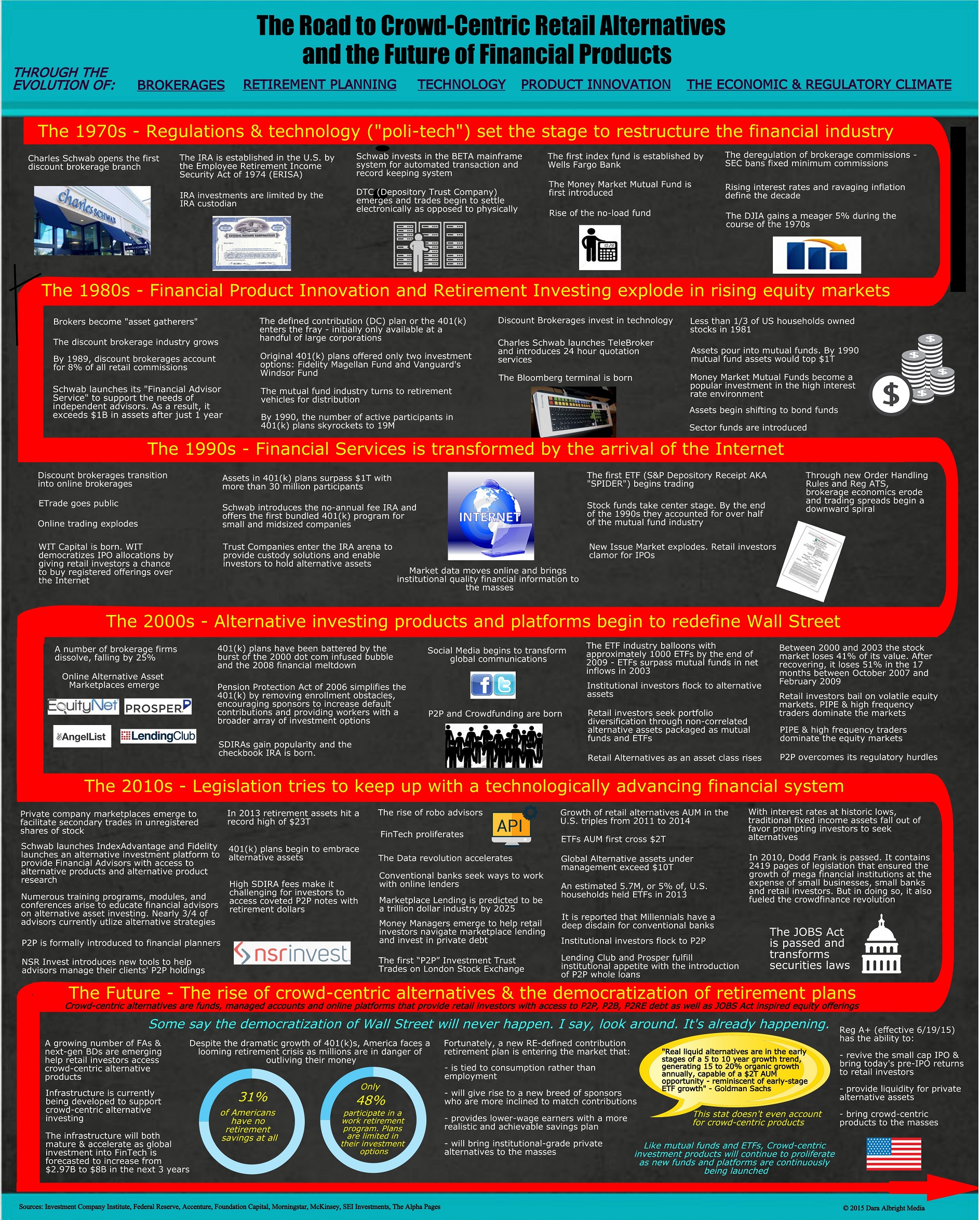
Including an Evolutionary Info-graphic

dara-pic

By Dara Albright

In simpler times, American workers relied on pensions to secure their retirement. Those who desired a supplement to their pension income opted to save during their pre-retirement years. Like television stations, investment options were primarily limited to three main providers. Instead of being bogged down with choices, savers essentially had their pick of placing money in interest bearing savings accounts, stocks or bonds. With the exception of occasionally having to get up from the sofa to change the television channel, life was pretty uncomplicated.

Then the 70s arrived – bringing a rash of polyester and laying the groundwork for sweeping changes throughout the financial system.

Ever since, our capital markets have been in a perpetual state of transformation fueled by innovations in brokerage services, advisory tools, investment products, retirement plans, financial technology and shifts in both the political as well as economic climate. The confluence of these evolutions – as depicted in the infographic below – continues to not only redefine retail investing, but America’s entire retirement framework.

***

the-road-to-crowd-centric-alternatives1

[Check out this spectacular infographic depicting the evolution of financial services and where it’s all headed]

Click photo twice to enlarge

***

From salespeople into asset gatherers

During the past four and a half decades the brokerage business has moved online, slashed commissions and turned its commission-based securities salespeople into asset gatherers. As the number of brokerage firms steadily declined, online alternative asset marketplaces began to rise.

The IRA and 401(k) transformed America’s retirement structure as pension plans became less and less prevalent. These new retail retirement vehicles fed the mutual fund business, and in tandem both industries ballooned into multi trillion dollar markets.

Tools were developed that would enable financial advisors to navigate across a growing number of asset classes and help ensure the proper diversification of retail portfolios. These advisory resources also contributed to the proliferation of new asset classes and retirement accounts.

Legislative changes coupled with technological achievement led to the democratization of both financial products as well as market data. This “poli-tech” dynamic not only furthered the growth of conventional asset classes, it inspired a host of innovative online investing platforms, lending models, equity financing structures and the creation of new asset classes.

A groundswell of investment products

Over the years, a groundswell of investment products has been engineered for the mass market resulting in the flow of retail dollars across money markets, mutual funds and ETFs. Particularly during the recent years, as interest rates reached historic lows and equity markets became excessively volatile, there has been an upsurge of interest in uncorrelated alternative assets.

To meet the mounting demand, a wave of retail alternative products entered the market. According to McKinsey, retail alternatives will soon account for almost 50% of total retail revenues. Furthermore, Goldman Sachs believes that retail alternatives are in the early stages of a 5-10 year growth trend – reminiscent of early-stage ETF growth and capable of becoming a $2T AUM opportunity.

As financial advisors were becoming acquainted with a growing number of retail alternative products packaged through mutual funds and ETFs, a new niche of alternatives known as crowd-centric alternatives had been gaining popularity – particularly among institutional and internet savvy retail investors.

These crowd-centric alternatives – designed to bring non-correlated yield and pre-IPO equity growth to mainstream investors’ portfolios – are made up of public as well as private funds, managed accounts and online platforms that provide investors with access to peer-to-peer, peer-to-business and peer-to-real estate debt as well as JOBS Act inspired equity offerings.

While momentum continues to build for crowd-centric alternatives, an interesting phenomenon has been brewing in the retirement plan industry. Flaws in the current IRA and 401(k) structures as well as the social security system have legislators as well as economists scrambling to prevent a looming retirement crisis. Thus far, none of the publicly proposed solutions even begin to scratch the surface of the predicament. That is until now.

Fortunately, a soon-to-be-unveiled RE-defined contribution retirement plan will resolve inherent issues by 1) unleashing a new generation of plan sponsors more inclined to match contributions, 2) providing lower-wage earners with a more realistic and achievable savings plan, and by 3) bringing higher yielding institutional-grade alternatives to the masses. (A new white paper: “The RE-defined Contribution Plan: Powering Economic Growth While Preventing a National Retirement Crisis” will be released shortly)

Fascinatingly, the RE-defined contribution plan and crowd-centric alternative assets have the potential to power one another’s expansion in much the same way that the IRA, 401(k) and mutual fund industry fueled each other’s massive growth in prior decades.

***

conference room

***

Crowd-centric alternatives

While the existing statistics for retail alternatives are staggering, none of the forecasters have even accounted for crowd-centric alternatives. If history is any guide, crowd-centric alternatives are about to catapult the retail alternative industry to unforeseen heights – particularly given the following key factors:

  • The surfacing of a more proficient retirement vehicle that accommodates alternative investing;
  • The introduction of new tools designed to assist financial advisors in managing their client’s crowd-centric holdings;
  • A growing number of financial advisors and next-gen BDs emerging to help retail investors access crowd-centric alternative products;
  • The prolific growth of marketplace lending;
  • Traditional offline private debt businesses migrating online;
  • The influx of P2P, P2B, P2RE managed products;
  • The maturation of the infrastructure to support crowd-centric alternative investing;
  • Venture capital is pouring into fintech (projected to nearly triple in the next 3 years). This will enthuse innovation and lead to greater sophistication of products, platforms and infrastructure;
  • The implementation of additional key components of the JOBS Act will inspire the creation of new investment products for the masses as well as provide liquidity for private alternatives.

Assessment

Although I cannot promise that polyester and orange shag carpets won’t make a comeback, I can absolutely guarantee that financial services will continue to evolve through the progression of new ideas, products, tools and technology.

More:

Conclusion

Your thoughts and comments on this ME-P are appreciated. Feel free to review our top-left column, and top-right sidebar materials, links, URLs and related websites, too. Then, subscribe to the ME-P. It is fast, free and secure.

Speaker: If you need a moderator or speaker for an upcoming event, Dr. David E. Marcinko; MBA – Publisher-in-Chief of the Medical Executive-Post – is available for seminar or speaking engagements. Contact: MarcinkoAdvisors@msn.com

OUR OTHER PRINT BOOKS AND RELATED INFORMATION SOURCES:

Risk Management, Liability Insurance, and Asset Protection Strategies for Doctors and Advisors: Best Practices from Leading Consultants and Certified Medical Planners™8Comprehensive Financial Planning Strategies for Doctors and Advisors: Best Practices from Leading Consultants and Certified Medical Planners™

Health professionals are small business owners who need to apply their self-discipline tactics in establishing and operating successful practices. Talented trainees are leaving the medical profession because they fail to balance the cost of attendance against a realistic business and financial plan. Principles like budgeting, saving, and living below one’s means, in order to make future investments for future growth, asset protection, and retirement possible are often lacking. This textbook guides the medical professional in his/her financial planning life journey from start to finish. It ranks a place in all medical school libraries and on each of our bookshelves.

Dr. Thomas M. DeLauro DPM [Professor and Chairman – Division of Medical Sciences, New York College of Podiatric Medicine]

Talking about End-of-Life Care

Join Our Mailing List

The Importance of … EOL Care

[By Samantha Wanner]

***

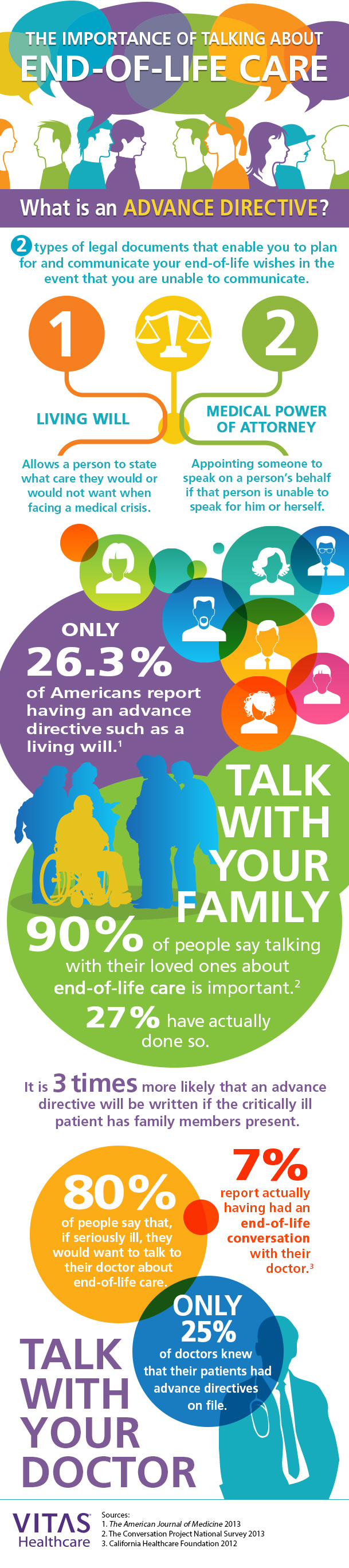
It’s not easy, but the medical treatments you would want near the end of life need to be discussed with others. If you never bring up the topic and you were unexpectedly incapacitated and unable to speak for yourself, your medical wishes would never be known.

***

***

Important Topic

Despite the topic’s importance, only 27% of Americans report having talked with their families about end-of-life care. The best way to make your medical wishes known is to create an advance directive and share it with your family and your doctor.

An advance directive is actually two legal documents that enable you to plan and communicate your end-of-life wishes.  When you create your advance directive, you are being proactive about your medical care and sparing your loved ones from having to make difficult medical decisions in a time of crisis.

Don’t wait for a crisis. Create your advance directive, share copies with your loved ones and doctor and keep your copy in an accessible location others can find.

***

end_of_life_infographic

***

Channel Surfing

Have you visited our other topic channels? Established to facilitate idea exchange and link our community together, the value of these topics is dependent upon your input. Please take a minute to visit. And, to prevent that annoying spam, we ask that you register.

Link: http://feeds.feedburner.com/HealthcareFinancialsthePostForcxos

Give your loved ones peace of mind.

Would they know what you want if you couldn’t talk? Do you know what you would want near the end of life? Find your own answers. Then open the conversation with the people you love. You are giving everyone a priceless gift.

More About End of Life Planning

Conclusion

Your thoughts and comments on this ME-P are appreciated. Feel free to review our top-left column, and top-right sidebar materials, links, URLs and related websites, too. Then, subscribe to the ME-P. It is fast, free and secure.

Speaker: If you need a moderator or speaker for an upcoming event, Dr. David E. Marcinko; MBA – Publisher-in-Chief of the Medical Executive-Post – is available for seminar or speaking engagements. Contact: MarcinkoAdvisors@msn.com

OUR OTHER PRINT BOOKS AND RELATED INFORMATION SOURCES:

Risk Management, Liability Insurance, and Asset Protection Strategies for Doctors and Advisors: Best Practices from Leading Consultants and Certified Medical Planners™8Comprehensive Financial Planning Strategies for Doctors and Advisors: Best Practices from Leading Consultants and Certified Medical Planners™

BOOK REVIEW

Physicians have more complex liability challenges to overcome in their lifetime, and less time to do it, than other professionals. Combined with a focus on practicing their discipline, many sadly fail to plan for their own future. They need trustworthy advice on how to effectively protect themselves, families and practice, from the many overt and covert risks that could potentially disrupt years of hard work.

 Fortunately, this advice is contained within RISK MANAGEMENT, LIABILITY INSURANCE, AND ASSET PROTECTION STRATEGIES FOR DOCTORS AND ADVISORS [BEST PRACTICES FROM LEADING CONSULTANTS AND CERTIFIED MEDICAL PLANNERS™]. Written by Dr. David Edward Marcinko, Nurse Hope Rachel Hetico and their team of risk managers, accountants, insurance agents, attorneys and physicians, it is uniquely positioned as an integration of applied, academic and peer-reviewed strategies and research, with case studies, from top consultants and Certified Medical Planners. It contains the latest principles of risk management and asset protection strategies for the specific challenges of modern physicians. My belief is that any doctor who reads and applies even just a portion of this collective wisdom will be fiscally rewarded. The Institute of Medical Business Advisors has produced another outstanding reference for physicians that provide peace of mind in this unique marketplace! In my opinion, it is a mandatory read for all medical professionals.

DAVID K. LUKE; MS-PFP, MIM, CMP™

[Net Worth Advisory Group, Inc – Sandy, Utah]

UNDERSTANDING MEDICAL PRACTICE CYBER SECURITY RISKS

Join Our Mailing List 

A SPECIAL ME-P REPORT

Risk Management, Liability Insurance, and Asset Protection Strategies for Doctors and Advisors: Best Practices from Leading Consultants and Certified Medical Planners™

Mitigations for the Digital Health Era

Shahid N. Shah MS

[By Shahid N. Shah MS]

There has been a tremendous explosion of information technology (IT) in healthcare caused by billions of dollars of government incentives for usage of digital healthcare tools.

But, IT systems face threats with significant adverse impacts on institutional assets, patients, and partners if sensitive data is ever compromised. Every health enterprise is required to confidentiality, integrity and availability of its information assets (this is called “information assurance” or IA). Confidentiality means private or confidential information must not be disclosed to unauthorized persons. Integrity means that the information can be changed only in an authorized manner so as to maintain the correctness of the information. Availability defines the characteristic that information systems work as intended and all services are available to its users whenever necessary.

It is well known that healthcare organizations face and have been mitigating many risks such as investment risk, budgetary risk, program management risk, safety risk, and inventory risk for many years. What’s new in the last decade or so is that organizations must now manage information assurance risks related to operating its information systems because information systems. IT is now just as a critical an asset as most other infrastructure managed by health systems. It is important that information security risks are given the same or more importance and priority as given to other organizational risks.

As health records move from paper native to digital native, it’s vital that organizations have information risk management programs and security procedures that woven into the culture of the organization. For this to happen, basic requirements of information security must be defined and implemented as part of both the operational and management processes. A framework that provides guidance on how to perform these activities, and the co-ordination required between these activities is needed.

***

hacker

[Black Hat Medical Hacker]

***

INTRODUCTION

The Risk Management Framework (RMF), supported by the National Institute of Standards and Technology (NIST) provides this framework. The NIST 800 series publications provide a structured approach to achieve risk management. It provides broad guidance and not necessarily all the prescriptions, which means it can be tailored to meet the organization’s specific needs and providing the flexibility needed for the different organizations. Using the NIST RMF helps organizations with risk management not only in a repeatable manner, but also with greater efficiency and effectiveness. Healthcare information assurance is complex and without a framework that takes into account a broad risk management approach, it is difficult to consider all the intricacies involved.

The NIST Risk Management Framework consists of a six step process designed to guide organizations in managing the risks in their information systems.

The various steps as defined in the NIST specifications are the following:

  • Categorize the information system and the information processed, stored, and transmitted by that system based on an impact analysis.
  • Select an initial set of baseline security controls for the information system based on the security categorization; tailoring and supplementing the security control baseline as needed based on an organizational assessment of risk and local conditions
  • Implement the security controls and describe how the controls are employed within the information system and its environment of operation.
  • Assess the security controls using appropriate assessment procedures to determine the extent to which the controls are implemented correctly, operating as intended, and producing the desired outcome with respect to meeting the security requirements for the system.
  • Authorize information system operation based on a determination of the risk to organizational operations and assets, individuals, other organizations, and the Nation resulting from the operation of the information system and the decision that this risk is acceptable.
  • Monitor the security controls in the information system on an ongoing basis including assessing control effectiveness, documenting changes to the system or its environment of operation, conducting security impact analyses of the associated changes, and reporting the security state of the system to designated organizational officials.

All information systems process, store and transmit information. What is the possible impact if a worst case scenario occurs that causes endangers this information? A structured way to find out the potential impact on the confidentiality, integrity and availability of information can be done through the first step of NIST RMP, the categorization of information systems.

***

keyboard

[Triple Redundant Passwords and Encryption]

***

The NIST SP 800-60 [1, 2, 3 4] provides such guidance. The potential impact is assigned qualitative values – low, moderate, or high. Based on these impact levels for each of the information type contained in the system, the high water mark level is calculated, that helps in selecting the appropriate controls in the subsequent steps.

Organizations need to mitigate risks adequately by selecting an appropriate set of controls that would work effectively. In the selection of security controls step, the set of controls are chosen based on the categorization of the information system, the high water mark and the goals of the organizations.

These baseline controls are selected from NIST SP 800-53 [5] specification, one of three sets of baseline controls, corresponding to low, moderate, high impact rating of the information system. These baseline controls can be modified to meet specific business needs and organization goals. These tailored controls can be supplemented with additional controls, if needed, to meet unique organizational policies and environment factors and its security requirements and its risk appetite. The minimum assurance requirements need to be specified here.

All the activities necessary for having the selected controls in place, is done in the implementation of security controls step. The implementation of the selected security controls will have an impact on the organization risks and its effects. NIST SP 800-70 [6, 7] can be used as guidance for the implementation. An implementation strategy has to be planned and the actions have to be defined and the implementation plan needs to be reviewed and approved, before the implementation is done.

Once the controls are implemented, then the assessment of security controls is done to find out whether the controls have been correctly implemented, working as intended, and giving the desired output with respect to the security requirements. In short, whether the applied security controls are indeed the right ones, done in the right way, giving the right outcome. NIST SP 800-53 [5], NIST 800-53A [6], NIST 800-115 [8-11] can provide the necessary guidance, here. 

***

md-defeated-

[Frustrated Physician]

***
The authorization of information systems is an official management decision, authorizing that the information system can be made operational, with the identified risks mitigated and the residual risks accepted, and is accountable for any adverse impacts on the confidentiality, integrity and availability of information systems. If the authorizing personnel find that the risks are not mitigated and hence can compromise the sensitive information, they can deny authorizing the information system. NIST SP 800-37 [2] provides guidance on authorization. The authorizing personnel are to be involved actively throughout the risk management process.

Risk management is not one-time process, that once it is done, it is forgotten. It is a continuous process, to be integrated with day-to-day activities. One of the key aspects of any risk management is the monitoring of security controls to check whether the controls are performing as intended. The main focus of monitoring security controls is to know whether the controls are still effective over a period time, given the changes that occur in the information systems — the changes in hardware, software and firmware, the changes in environment factors, operating conditions etc. NIST SP 800-37 [2] provides guidance about this. And, if the security controls are found to be ineffective, the cycle starts again, with either re-categorization or selecting another set of baseline controls, or assessing the effectiveness of the controls once more etc.

Regardless, in all the steps in risk management framework, one of the important aspects is communication. Appropriate documents needed to be generated in all the steps, reviewed and kept up-to-date.

Organizational risk management provides great benefits to the organization because it helps to prioritize the resources, increase interoperability, and reduce costs incurred due to the adverse effects. It helps to prevent unauthorized access to personally identifiable information which will lead to security breaches. 

Channel Surfing

Have you visited our other topic channels? Established to facilitate idea exchange and link our community together, the value of these topics is dependent upon your input. Please take a minute to visit. And, to prevent that annoying spam, we ask that you register.

Link: http://feeds.feedburner.com/HealthcareFinancialsthePostForcxos

ABOUT 

Mr. Shahid N. Shah is an internationally recognized healthcare thought-leader across the Internet. He is a consultant to various federal agencies on technology matters and winner of Federal Computer Week’s coveted “Fed 100″ Award, in 2009. Over a twenty year career, he built multiple clinical solutions and helped design-deploy an electronic health record solution for the American Red Cross and two web-based eMRs used by hundreds of physicians with many large groupware and collaboration sites. As ex-CTO for a billion dollar division of CardinalHealth, he helped design advanced clinical interfaces for medical devices and hospitals. Mr. Shah is senior technology strategy advisor to NIH’s SBIR/STTR program helping small businesses commercialize healthcare applications. He runs four successful blogs: At http://shahid.shah.org he writes about architecture issues; at http://www.healthcareguy.com he provides valuable insights on applying technology in health care; at http://www.federalarchitect.com he advises senior federal technologists; and at http://www.hitsphere.com he gives a glimpse of HIT as an aggregator. Mr. Shah is a Microsoft MVP (Solutions Architect) Award Winner for 2007, and a Microsoft MVP (Solutions Architect) Award Winner for 2006. He also served as a HIMSS Enterprise IT Committee Member. Mr. Shah received a BS in computer science from the Pennsylvania State University and MS in Technology Management from the University of Maryland. 

Conclusion

Your thoughts and comments on this ME-P are appreciated. Feel free to review our top-left column, and top-right sidebar materials, links, URLs and related websites, too. Then, subscribe to the ME-P. It is fast, free and secure.

***

Risk Management, Liability Insurance, and Asset Protection Strategies for Doctors and Advisors: Best Practices from Leading Consultants and Certified Medical Planners™

***

READINGS

[1] National Institute of Standards and Technology Special Publication 800-30 Revision 1, Guide for Conducting Risk Assessments, http://csrc.nist.gov/publications/nistpubs/800-30-rev1/sp800_30_r1.pdf

[2] National Institute of Standards and Technology Special Publication 800-37 Revision 1, Guide for Applying the Risk Management Framework to Federal Information Systems, http://csrc.nist.gov/publications/nistpubs/800-37-rev1/sp800-37-rev1-final.pdf

[3] National Institute of Standards and Technology Special Publication 800-60 Volume I Revision 1, Guide for Mapping Types of Information and Information Systems to Security Categories, http://csrc.nist.gov/publications/nistpubs/800-60-rev1/SP800-60_Vol1-Rev1.pdf

[4] National Institute of Standards and Technology Special Publication 800-60 Volume II Revision 1,  Appendices to Guide for Mapping Types of Information and Information Systems to Security Categories, http://csrc.nist.gov/publications/nistpubs/800-60-rev1/SP800-60_Vol2-Rev1.pdf

[5] National Institute of Standards and Technology Special Publication 800-53 Revision 4, Security and Privacy Controls for Federal Information Systems and Organizations, http://nvlpubs.nist.gov/nistpubs/SpecialPublications/NIST.SP.800-53r4.pdf

[6] National Institute of Standards and Technology Special Publication 800-53A Revision 4, Assessing Security and Privacy Controls in Federal Information Systems and Organizations, http://nvlpubs.nist.gov/nistpubs/SpecialPublications/NIST.SP.800-53Ar4.pdf

[7] National Institute of Standards and Technology Special Publication 800-70 Revision 2, National Checklist Program – Guidelines for Checklist Users and Developers Recommendations of the National Institute of Standards and Technology for IT Products, http://csrc.nist.gov/publications/nistpubs/800-70-rev2/SP800-70-rev2.pdf

[8] National Institute of Standards and Technology Special Publication 800-115, Technical Guide to Information Security Testing and Assessment, http://csrc.nist.gov/publications/nistpubs/800-115/SP800-115.pdf

[9] National Institute of Standards and Technology Special Publication 800-137, Information Security, http://csrc.nist.gov/publications/nistpubs/800-137/SP800-137-Final.pdf

[10] U.S. Department of Health and Human Services, HIPAA Security Series, Security Standards: Technical Safeguards, http://www.hhs.gov/ocr/privacy/hipaa/administrative/securityrule/techsafeguards.pdf

[11] U.S. Department of Health and Human Services, HIPAA Security Series, Security Standards: Physical Safeguards, http://www.hhs.gov/ocr/privacy/hipaa/administrative/securityrule/physsafeguards.pdf

Speaker: If you need a moderator or speaker for an upcoming event, Dr. David E. Marcinko; MBA – Publisher-in-Chief of the Medical Executive-Post – is available for seminar or speaking engagements. Contact: MarcinkoAdvisors@msn.com

OUR OTHER PRINT BOOKS AND RELATED INFORMATION SOURCES:

Risk Management, Liability Insurance, and Asset Protection Strategies for Doctors and Advisors: Best Practices from Leading Consultants and Certified Medical Planners™8Comprehensive Financial Planning Strategies for Doctors and Advisors: Best Practices from Leading Consultants and Certified Medical Planners™

Holistic Prevention for Alzheimer’s Disease?

Join Our Mailing List

The Time is Now!

md

By Mark MD MPH

A newly released study demonstrates that approximately one third of Alzheimer’s cases worldwide are attributable to seven modifiable risk factors: depression, physical inactivity, diabetes, midlife hypertension, midlife obesity, smoking, and low educational attainment.

The largest proportion of cases was attributed to physical inactivity, which affects more than half of all Americans. Depression, which affects approximately 14.8 million Americans, accounted for approximately one in ten cases of Alzheimer’s disease globally.

***

sad

 Holistic Prevention for Alzheimer’s: The Time is Now

***

ABOUT

Mark J. Harris received his MD/MPH from Columbia University in May 2015. He will be starting Anesthesiology residency in June at Brigham and Women’s Hospital in Boston, MA. Mark is interested in the intersection between medicine and public policy, especially as it relates to chronic disease prevention (such as for diabetes, heart disease, and obesity), and he wishes to merge medicine, outcomes research, and public policy to address issues of perioperative risk factors, pain management, and end-of-life care.

Conclusion

Your thoughts and comments on this ME-P are appreciated. Feel free to review our top-left column, and top-right sidebar materials, links, URLs and related websites, too. Then, subscribe to the ME-P. It is fast, free and secure.

Speaker: If you need a moderator or speaker for an upcoming event, Dr. David E. Marcinko; MBA – Publisher-in-Chief of the Medical Executive-Post – is available for seminar or speaking engagements. Contact: MarcinkoAdvisors@msn.com

OUR OTHER PRINT BOOKS AND RELATED INFORMATION SOURCES:

Product DetailsProduct Details

Talking about Retirement to Doctors with Caution!

Join Our Mailing List 

Instead … Talk Revenue Generation

By Vicki Rackner MD

vicki

As a financial advisor, wealth manager, stock-broker or financial planner, do you want to engage more doctor prospects?

Well, think twice about approaching them with educational content about retirement.

So, in this video presentation, I explain how and why this is not your best hook.

Assessment

Instead, talk to them about revenue generation.

***

pension

***

 https://www.youtube.com/watch?v=vyZ3cI9PKQA

ABOUT

Vicki Rackner MD is an author, speaker and consultant who offers a bridge between the world of medicine and the world of business. She helps businesses acquire physician clients, and she helps physicians run more successful practices. Contact her at (425) 451-3777

Conclusion

Your thoughts and comments on this ME-P are appreciated. Feel free to review our top-left column, and top-right sidebar materials, links, URLs and related websites, too. Then, subscribe to the ME-P. It is fast, free and secure.

Speaker: If you need a moderator or speaker for an upcoming event, Dr. David E. Marcinko; MBA – Publisher-in-Chief of the Medical Executive-Post – is available for seminar or speaking engagements. Contact: MarcinkoAdvisors@msn.com

OUR OTHER PRINT BOOKS AND RELATED INFORMATION SOURCES:

Comprehensive Financial Planning Strategies for Doctors and Advisors: Best Practices from Leading Consultants and Certified Medical Planners(TM)

The Quality of Life Structured Resident Interview and Care Plan

Join Our Mailing List

Creating person-centered care plans in the nursing home

[By Staff Reporters]

About

The Quality of Life Structured Resident Interview and Care Plan is a system for creating individualized, person-centered care plans in the nursing home.

This interview-based approach to care planning generates the information staff need to tailor a resident’s care plan to their preferences, as well as quantitative measurement of individual and facility-level outcomes.

Funding was provided through a seed money grant by the University of Pittsburgh Institute on Aging. For further information about the University of Pittsburgh Institute on Aging please visit http://www.aging.pitt.edu/

***

woman

***

More: Superannuation Demographics for Financial Advisors

Assessment

The major funding for the Improving Quality of Life in Nursing Homes Through Use of Structured Resident Interviews project was also provided by a grant through The Commonwealth Fund. More information about The Commonwealth Fund can be found at their website here: http://thecommonwealthfund.net/

Contact

Howard Degenholtz, PhD Prinicpal Investigator Department of Health Policy and Management Center for Bioethics and Health Law University of Pittsburgh 130 DeSoto St., A616 Pittsburgh, PA 15213

Link: http://www.improvingqol.pitt.edu/home

Conclusion

Your thoughts and comments on this ME-P are appreciated. Feel free to review our top-left column, and top-right sidebar materials, links, URLs and related websites, too. Then, subscribe to the ME-P. It is fast, free and secure.

Speaker: If you need a moderator or speaker for an upcoming event, Dr. David E. Marcinko; MBA – Publisher-in-Chief of the Medical Executive-Post – is available for seminar or speaking engagements. Contact: MarcinkoAdvisors@msn.com

OUR OTHER PRINT BOOKS AND RELATED INFORMATION SOURCES:

Product Details

Comprehensive Financial Planning Strategies for Doctors and Advisors: Best Practices from Leading Consultants and Certified Medical Planners(TM) 

Self-Directed IRA Rules Every Physician-Investor Should Know

Join Our Mailing List

Self Directed IRA investments

By Safeguard advisors

When considering Self Directed IRA investments, it’s important to understand the regulations. These include prohibited transactions and people, among other rules. Often, immediate family members are excluded in participating in transactions, including living in property purchased by your IRA.

There are also heavy restrictions on the investments your IRA can invest in, including collectibles and life insurance. Before making decisions surrounding your retirement account, be sure to consult an expert who can help you plan your investment. Safeguard advisors can answer your questions about Self Directed IRA regulations to make sure your retirement account grows as a result of your investments.

***

IRA

***

Conclusion

Your thoughts and comments on this ME-P are appreciated. Feel free to review our top-left column, and top-right sidebar materials, links, URLs and related websites, too. Then, subscribe to the ME-P. It is fast, free and secure.

More:

Even More:

Speaker: If you need a moderator or speaker for an upcoming event, Dr. David E. Marcinko; MBA – Publisher-in-Chief of the Medical Executive-Post – is available for seminar or speaking engagements. Contact: MarcinkoAdvisors@msn.com

OUR OTHER PRINT BOOKS AND RELATED INFORMATION SOURCES:

Comprehensive Financial Planning Strategies for Doctors and Advisors: Best Practices from Leading Consultants and Certified Medical Planners(TM)

Women Retirement Confidence

Join Our Mailing List 

Financial Preparation

By Rick Kahler MS CFP® http://www.KahlerFinancial.com

Rick Kahler MS CFPWhen it comes to being financially prepared for retirement, Chinese women are the most confident women in the world. In fact, they are almost twice as confident as their US counterparts.

The Survery

This conclusion comes from a 2014 global survey, the Aegon Retirement Readiness Index. It found that the percentage of women saying they are very confident or extremely confident about retirement is 42% in China, 35% in India, 29% in Brazil, 22% in the US, and 18% in Canada.

The survey included responses from 16,000 employees and retirees in 15 countries, half of whom were women. About 62% of the women were married, 52% had some higher education, and 80% took an active role in managing the household finances.

The Insights

Several aspects of this survey really caught my attention:

  • I was puzzled that only two developed countries—the US and Canada—made the top five. The first three—China, India, and Brazil—were  emerging markets with little or no social safety nets in place.
  • Even more notable is that, in the US and Canada, the number of women who do not feel prepared to retire (38% in the US and 36% in Canada) is almost twice as high as the number that are confident about retirement.
  • And more notable yet is that the bottom five includes three developed countries with strong social safety nets. In France, Japan, and Spain, less than 6% of women reported retirement confidence, while 60% or higher said they had no confidence.

It seems puzzling that the countries with large social safety nets spawned less retirement confidence than did developed countries with little or no safety net. Why isn’t it the opposite? Why aren’t women in countries where government plays a big part in retirement income more confident?

The Answer?

Therein may lay the answer. Possibly because of the lack of government retirement programs, people in the emerging market countries like China, India, and Brazil realize they cannot count on anyone but themselves in retirement. They know they must begin saving a significant amount of their income, starting early in life, to be able to sustain themselves in retirement. A failure to do so will result in them literally being “thrown out onto the street” or into the “poor house.” As harsh as that may sound to our Western ears, the reality must be a powerful motivator.

***

Depression

***

The Reality

This reality was brought home to me by two people I met on visits to China and India. One Chinese woman in her 20’s told me she saved a third of her income. She said, “People in America don’t need to save. China doesn’t have the social safety nets you have.” Part of surviving in their society is to learn money skills and how to save early in life for emergencies and retirement. A man I met in India told me much the same story; he had his retirement fully funded by age 45.

In the US and most other developed countries, government programs like Social Security have become the retirement plan of the masses. Yet the majority of women in developed countries don’t seem to find comfort in those programs.

However, neither do they save like their emerging market counterparts. In fact, 56% of Americans live hand to mouth, according to a 2005 survey of retirement savings for baby boomers and others, by Sharon A. Devaney and Sophia T. Chiremba, reported at the US Bureau of Labor Statistics [USBLS].

Assessment

What might motivate women globally to gain confidence in their retirement preparedness? I don’t know. But based on the results of this survey, the answer won’t be found in more government programs.

Conclusion

Your thoughts and comments on this ME-P are appreciated. Feel free to review our top-left column, and top-right sidebar materials, links, URLs and related websites, too. Then, subscribe to the ME-P. It is fast, free and secure.

Speaker: If you need a moderator or speaker for an upcoming event, Dr. David E. Marcinko; MBA – Publisher-in-Chief of the Medical Executive-Post – is available for seminar or speaking engagements. Contact: MarcinkoAdvisors@msn.com

OUR OTHER PRINT BOOKS AND RELATED INFORMATION SOURCES:

Comprehensive Financial Planning Strategies for Doctors and Advisors: Best Practices from Leading Consultants and Certified Medical Planners(TM)

On Money Withdrawn from Tax-Deferred Accounts before Age 59½

Join Our Mailing List 

For Doctors … Un-Locking the Money

By SHIKHA MITTRA; MBA, CFP®, CRPS®, CMFC®, AIF®

Shikha-MittraWithdrawing funds from a tax-deferred retirement account before age 59½ generally triggers a 10% federal income tax penalty; all distributions are subject to ordinary income tax.

However, there are certain situations in which you are allowed to make early withdrawals from a retirement account and avoid the tax penalty. IRAs and employer-sponsored retirement plans have different exceptions, although the regulations are similar.

IRA Exceptions

  • The death of the IRA owner: Upon death, your designated beneficiaries may begin taking distributions from your account. Beneficiaries are subject to annual required minimum distributions.
  • Disability: Under certain conditions, you may begin to withdraw funds if you are disabled.
  • Unreimbursed medical expenses: You can withdraw the amount you paid for unreimbursed medical expenses that exceed 10% of your adjusted gross income in a calendar year. Individuals older than 65 can claim expenses that surpass 7.5% of adjusted gross income through 2016.
  • Medical insurance: If you lost your job or are receiving unemployment benefits, you may withdraw money to pay for health insurance.
  • Part of a substantially equal periodic payment (SEPP) plan: If you receive a series of substantially equal payments over your life expectancy, or the combined life expectancies of you and your beneficiary, you may take payments over a period of five years or until you reach age 59½, whichever is longer, using one of three payment methods set by the government. Any change in the payment schedule after you begin distributions may subject you to paying the 10% tax penalty.
  • Qualified higher-education expenses: For you and/or your dependents.
  • First home purchase, up to $10,000 (lifetime limit).

lock

Employer-Sponsored Plan Exceptions

  • The death of the plan owner: Upon death, your designated beneficiaries may begin taking distributions from your account. Beneficiaries are subject to annual required minimum distributions.
  • Disability: Under certain conditions, you may begin to withdraw funds if you are disabled.
  • Part of a SEPP program (see above): If you receive a series of substantially equal payments over your life expectancy, or the combined life expectancies of you and your beneficiary, you may take payments over a period of five years or until you reach age 59½, whichever is longer.
  • Separation of service from your employer: Payments must be made annually over your life expectancy or the joint life expectancies of you and your beneficiary.
  • Attainment of age 55: The payment is made to you upon separation of service from your employer and the separation occurred during or after the calendar year in which you reached the age of 55.
  • Qualified Domestic Relations Order (QDRO): The payment is made to an alternate payee under a QDRO.
  • Medical care: You can withdraw the amount allowable as a medical expense deduction.
  • To reduce excess contributions: Withdrawals can be made if you or your employer made contributions over the allowable amount.
  • To reduce excess elective deferrals: Withdrawals can be made if you elected to defer an amount over the allowable limit.

Assessment

If you plan to withdraw funds from a tax-deferred account, make sure to carefully examine the rules on exemptions for early withdrawals. For more information on situations that are exempt from the early-withdrawal income tax penalty, visit the IRS website at www.irs.gov.

Channel Surfing the ME-P

Have you visited our other topic channels? Established to facilitate idea exchange and link our community together, the value of these topics is dependent upon your input. Please take a minute to visit. And, to prevent that annoying spam, we ask that you register. It is fast, free and secure.

About the Author 

Shikha Mittra has two decades industry experience working with physicians, dentists and top level executives in both public and private sector businesses and foundations; with several awards for her work. She was rated one of the top Financial Planners in the Country from 2006 – 2013. As a Certified Financial Planner®, she is also a Chartered Mutual Fund Counselor®, Chartered Retirement Plan Specialist® and Certified Cash Balance Consultant. Ms. Mittra is Adjunct Professor of Finance and Business, Rutgers University, New Brunswick, NJ; Regional Board Member of the National Association of Personal Financial Advisors NAPFA (2011-2013)  Board of Trustees of Financial Planning Association of New Jersey Chapter (2008-2011), Advisory Board Member of the ”Journal of Financial Planning” (2008-2009). Medical Economics listed her as a best financial advisor for doctors in 2012. Ms. Mittra is also an Accredited Investment Fiduciary® helping employers reduce their fiduciary liability by following global fiduciary standards of care in managing their retirement plans.

Conclusion

Your thoughts and comments on this ME-P are appreciated. Feel free to review our top-left column, and top-right sidebar materials, links, URLs and related websites, too. Then, subscribe to the ME-P. It is fast, free and secure.

Speaker: If you need a moderator or speaker for an upcoming event, Dr. David E. Marcinko; MBA – Publisher-in-Chief of the Medical Executive-Post – is available for seminar or speaking engagements. Contact: MarcinkoAdvisors@msn.com

OUR OTHER PRINT BOOKS AND RELATED INFORMATION SOURCES:

Comprehensive Financial Planning Strategies for Doctors and Advisors: Best Practices from Leading Consultants and Certified Medical Planners(TM)

How employees can acquire hospital securities without cash activity

Join Our Mailing List 

On discounted stock-purchase programs

[By Dr. David Edward Marcinko MBA CMP™]

DEM blueTo alleviate cash-flow problems of their employees, hospitals who want them to take part in a discounted stock-purchase program may lend the money to the employees to pay any taxes due and any purchase price for the stock.

Full recourse liability

However, it is important that any such loan be subject to a full recourse liability; if the loan is secured by the stock on a non recourse basis, the transaction may be treated as if it were a grant of an option, and thus there would be no transfer of property until the loan is paid.

The rationale for treatment as an option is that if the property drops in value below the amount of the debt, the employee will not pay the debt and walk away from the property, as he would an option. Thus, until the note is paid, no transfer has occurred. This could negate the effect of a Section 83(b) election.

Example:

The following example demonstrates how the use of employer loans, in connection with a Section 83(b) election, can be used to great advantage to an employee.

The employer in the example on Section 83(b) election (above) lends the employee the cash necessary to meet the income tax liability of the $10,000 grant at 30%, or $3,000. The employee gives the employer a promissory note for $3,000, bearing interest at 8%.

Thus, the employee acquires $100,000 worth of employer stock ownership after five years with no out-of-pocket cost at the date of the grant and an interest cost of approximately $1,300, payable over five years.

***

Hospital

***

Assessment

Of course, in lieu of making a loan to the employee, the employer can simply agree to give the employee, as a bonus, sufficient cash to cover the tax liability. This is obviously more costly to the employer, as it results in the employee acquiring stock at no out-of-pocket cost.

More:

Channel Surfing the ME-P

Have you visited our other topic channels? Established to facilitate idea exchange and link our community together, the value of these topics is dependent upon your input. Please take a minute to visit. And, to prevent that annoying spam, we ask that you register. It is fast, free and secure.

Conclusion

Your thoughts and comments on this ME-P are appreciated. Feel free to review our top-left column, and top-right sidebar materials, links, URLs and related websites, too. Then, subscribe to the ME-P. It is fast, free and secure.

Speaker: If you need a moderator or speaker for an upcoming event, Dr. David E. Marcinko; MBA – Publisher-in-Chief of the Medical Executive-Post – is available for seminar or speaking engagements. Contact: MarcinkoAdvisors@msn.com

OUR OTHER PRINT BOOKS AND RELATED INFORMATION SOURCES:

Comprehensive Financial Planning Strategies for Doctors and Advisors: Best Practices from Leading Consultants and Certified Medical Planners(TM)

Foreword Dyken MD MBA

Retirement Planning and Physicians [An Oxymoron]?

Join Our Mailing List 

Confidence Eluded

By Shikha Mittra MBA CFP® AIF® http://www.feeonlynetwork.com/Shikha-Mittra

Shikha-MittraAccording to a survey from the Employee Benefit Research Institute [EBRI] and Greenwald & Associates; nearly half of workers without a retirement plan were not at all confident in their financial security, compared to 11 percent for those who participated in a plan, according to the 2014 Retirement Confidence Survey (RCS).

Retirement Money

In addition, 35 percent of workers have not saved any money for retirement, while only 57 percent are actively saving for retirement. Thirty-six percent of workers said the total value of their savings and investments—not including the value of their home and defined benefit plan—was less than $1,000, up from 29 percent in the 2013 survey. But, when adjusted for those without a formal retirement plan, 73 percent have saved less than $1,000.

Debt

Debt is also a concern, with 20 percent of workers saying they have a major problem with debt. Thirty-eight percent indicate they have a minor problem with debt. And, only 44 percent of workers said they or their spouse have tried to calculate how much money they’ll need to save for retirement. But, those who have done the calculation tend to save more.

Shifting Demographics

The biggest shift in the 24 years has been the number of workers who plan to work later in life. In 1991, 84 percent of workers indicated they plan to retire by age 65, versus only 9 percent who planned to work until at least age 70. In 2014, 50 percent plan on retiring by age 65; with 22 percent planning to work until they reach 70.

***

z93

*** 

Physician Statistics

Now, compare and contrast the above to these statistics according to a 2013 survey of physicians on financial preparedness by American Medical Association [AMA] Insurance.

The statistics are still alarming:

  • The top personal financial concern for all physicians is having enough money to retire.
  • Only 6% of physicians consider themselves ahead of schedule in retirement preparedness.
  • Nearly half feel they were behind
  • 41% of physicians average less than $500,000 in retirement savings.
  • Nearly 70% of physicians don’t have a long term care plan.
  • Only half of US physicians have a completed estate plan including an updated will and Medical directives.

Assessment

More:

Conclusion

Your thoughts and comments on this ME-P are appreciated. Feel free to review our top-left column, and top-right sidebar materials, links, URLs and related websites, too. Then, subscribe to the ME-P. It is fast, free and secure.

Speaker: If you need a moderator or speaker for an upcoming event, Dr. David E. Marcinko; MBA – Publisher-in-Chief of the Medical Executive-Post – is available for seminar or speaking engagements. Contact: MarcinkoAdvisors@msn.com

OUR OTHER PRINT BOOKS AND RELATED INFORMATION SOURCES:

Comprehensive Financial Planning Strategies for Doctors and Advisors: Best Practices from Leading Consultants and Certified Medical Planners(TM)

About the INSTITUTE OF MEDICAL BUSINESS ADVISORS, Inc.

Join Our Mailing List

About

INSTITUTE OF MEDICAL BUSINESS ADVISORS, Inc.

  ***

The Institute of Medical Business Advisors, Inc provides a team of experienced, senior level consultants led by iMBA Chief Executive Officer Dr. David Edward Marcinko MBA CMPMBBS [Hon] and President Hope Rachel Hetico RN MHA CMP™ to provide going contact with our clients throughout all phases of each project, with most of the communications between iMBA and the key client participants flowing through this Senior Team.

Product Details

iMBA Inc., and its skilled staff of certified professionals have many years of significant experience, enjoy a national reputation in the healthcare consulting field, and are supported by an unsurpassed research and support staff of CPAs, MBAs, MPHs, PhDs, CMPs™, CFPs® and JDs to maintain a thorough and extensive knowledge of the healthcare environment.

Product Details

The iMBA team approach emphasizes providing superior service in a timely, cost-effective manner to our clients by working together to focus on identifying and presenting solutions for our clients’ unique, individual needs.

Product Details

The iMBA Inc project team’s exclusive focus on the healthcare industry provides a unique advantage for our clients.  Over the years, our industry specialization has allowed iMBA to maintain instantaneous access to a comprehensive collection of healthcare industry-focused data comprised of both historically-significant resources as well as the most recent information available.  iMBA Inc’s specific, in-depth knowledge and understanding of the “value drivers” in various healthcare markets, in addition to the transaction marketplace for healthcare entities, will provide you with a level of confidence unsurpassed in the public health, health economics, management, administration, and financial planning and consulting fields.

 Product DetailsProduct DetailsProduct Details

iMBA Inc’s information resources and network of healthcare industry textbook resources enhanced by our professional consultants and research staff, ensure that the iMBA project team will maintain the highest level of knowledge regarding the current and future trends of the specific specialty market related to the project, as well as the healthcare industry overall, which serves as the “foundation” for each of our client engagements.

Product Details  Product Details

Ann Miller RN MHA

www.MedicalBusinessAdvisors.com

Financial Advisor Education Letterhead CMP

Solicitation Letterhead.iMBA, Inc

Sample iMBA Engagements

iMBA Seminar Topics

***

Financial Planning MDs 2015

Comprehensive Financial Planning Strategies for Doctors and Advisors: Best Practices from Leading Consultants and Certified Medical Planners™

***

How Physicians Prepare for Retirement?

 Join Our Mailing List 

ME-P SPECIAL REPORT

On Physician DIY’s

[By Vicki Rackner MD]

VR MD

Dear ME-P Readers and Subscribers,

Employed physicians who use professional financial advisors v.s. physician financial do-it-yourself-ers):

Did you know the following:

  • Feel better prepared for retirement
  • Have more in emergency savings
  • Have more diverse financial investments and
  • Feel more confident about their personal financial decisions?

Did you also know:

Here are some other key survey findings:

  • 60% of practicing physicians are employed by hospitals, groups and medical schools.
  • 42% of of employed physicians are behind where they would like to be in retirement planning.
  • Employed physicians” #1 financial goal is to enjoy a comfortable retirement. Other top concerns include funding long-term care, minimizing losses and ensuring an inheritance for children/ grandchildren.
  • Half of employed physicians believe they have unique or more complex financial needs than other professionals.These finding affirm the intuitively obvious: experts get better results than dabblers.
  • Patients get the best medical outcomes when they work with physicians whom they trust; physicians get the best financial results when they work with financial advisors whom they trust.

***

Product Details  Product Details

***

What this means for you

These finding affirm the intuitively obvious: experts get better results than dabblers.

Patients get the best medical outcomes when they work with physicians whom they trust; physicians get the best financial results when they work with financial advisors whom they trust; as a fiduciary advisor.

Assessment

Enter the Certified Medical Planners

About the Author

Vicki Rackner MD, author, speaker and President of Targeting Doctors, helps financial advisors accelerate their practice growth by acquiring more physician clients. She calls on her experience as a practicing surgeon, clinical faculty at the University of Washington School of Medicine and nationally-noted expert in physician engagement to offer a bridge between the world of medicine and the world of business.

Conclusion

Your thoughts and comments on this ME-P are appreciated. Feel free to review our top-left column, and top-right sidebar materials, links, URLs and related websites, too. Then, subscribe to the ME-P. It is fast, free and secure.

Speaker: If you need a moderator or speaker for an upcoming event, Dr. David E. Marcinko; MBA – Publisher-in-Chief of the Medical Executive-Post – is available for seminar or speaking engagements. Contact: MarcinkoAdvisors@msn.com

OUR OTHER PRINT BOOKS AND RELATED INFORMATION SOURCES:

Financial Planning MDs 2015

Comprehensive Financial Planning Strategies for Doctors and Advisors: Best Practices from Leading Consultants and Certified Medical Planners™

The “ObamaCare Opportunity” for Financial Advisors

Join Our Mailing List

Why Physicians Need Financial Advisors Now!

[By Vicki Rackner MD]

http://www.CertifiedMedicalPlanner.org

VR MDI recently attended a surgical meeting. Most conversations with my physician colleagues turned to the same singular topic: physicians’ new financial reality.

And the message is, “It hurts!”

Physicians’ Financial Plans

Financially savvy physicians execute thoughtful retirement plans. Yet, today about half of surveyed physicians are behind where they would like to be in retirement preparedness. Further, today only about half of physicians work with professional financial planners.

As a physician myself, I understand why smart physicians fail to take smart financial action. We physicians dedicate ourselves to the alleviation of pain and suffering of others. Retirement is a distant personal concern that does not cause immediate financial pain today. We put it off.

Lesson from My Dentist

Years ago my dentist recommended that I undergo a procedure to replace a filling. He explained that the filling material put in my mouth about 40 years ago tends to pull from the tooth over time and allow new cavities to form.

As much as I like my dentist, I actively avoid spending time in his dental chair. I put off the recommended filling replacement year after year. That is, of course, until I experienced vague throbbing from that tooth. I rearranged my schedule so I could tend to this small problem before it became a much bigger problem. Who wants a root canal!

For physicians retirement planning is like that proactive filling replacement. We understand that without action there will be problems down the road. However, the threat of a problem in the distant future does not propel many like myself to action today.

***

Product Details  Product Details

***

The ObamaCare [PP-ACA] Opportunity for Financial Advisors

ObamaCare is the source of acute financial pain for physicians. It’s the financial toothache. Practicing physicians are looking at:

  • Higher taxes. Doctors represent 9 of the 10 highest earners in the US.
  • Rising costs of goods and services as businesses address their own higher tax bills.
  • The costs of building the infrastructure that will lead to greater healthcare efficiencies, like converting to electronic medical records, hiring new staff to address new administrative demands and aligning with new compliance requirements.
  • Lower professional fees. The 24% Medicare fee reduction that was averted this year will become reality soon. As Medicare goes, so, too, go the rest of the insurance fee schedules.
  • Decreasing patient referrals as primary care doctors sell their practices.
  • Physicians know they need to act now to avoid the financial root canal. Each physician is in the process of creating a personal ObamaCare plan.

Physicians’ Wants and Needs

As a financial advisor, you know that physicians NEED a retirement plan. Kids need to eat their broccoli, too. It’s good for them.

Physicians WANT a plan to help them achieve the personal, professional and financial goals that drew them to a career in medicine. Engaging physicians by address their ObamaCare plan is about as hard as getting kids to eat ice cream.

What This Means for You

Today physicians actively seek experts to help them create their ObamaCare plans.

Financial advisor are winning new physician clients. As Seattle Seahawks quarterback Russell Wilson asks, “Why not you?”

If you want to work with more physician clients, this is your moment! Seize it. You have a chance to join the high-performing financial advisors mining the treasures in the medical market.

Assessment

Should wish to learn more here’s a video that addresses 4 questions:

  • Why do physicians need you now?
  • What do you need to know about physicians now?
  • How do you engage physicians now?
  • How do you conduct yourself so physicians want to conduct business with you now?

About the Author

Vicki Rackner MD is an author, speaker and consultant who offers a bridge between the world of medicine and the world of business. She helps businesses acquire physician clients.

VIDEO: https://www.youtube.com/watch?v=CeCyidc4JP8&feature=player_embedded

Enter the Certified Medical Planners

Conclusion

Your thoughts and comments on this ME-P are appreciated. Feel free to review our top-left column, and top-right sidebar materials, links, URLs and related websites, too. Then, subscribe to the ME-P. It is fast, free and secure.

Speaker: If you need a moderator or speaker for an upcoming event, Dr. David E. Marcinko; MBA – Publisher-in-Chief of the Medical Executive-Post – is available for seminar or speaking engagements. Contact: MarcinkoAdvisors@msn.com

OUR OTHER PRINT BOOKS AND RELATED INFORMATION SOURCES:

Financial Planning MDs 2015

Comprehensive Financial Planning Strategies for Doctors and Advisors: Best Practices from Leading Consultants and Certified Medical Planners™

More on 401(k) Choices

Join Our Mailing List 

Studies, Research, Experiments and Experience

By Rick Kahler MS CFP® http://www.KahlerFinancial.com

Rick Kahler MS CFPHere is a conversation I’ve had too many times: An acquaintance says proudly that he invests the maximum into his 401(k). I ask what allocation he’s made between equities and bonds.

He says he just divides his contributions equally among the four investment choices the plan offers. I cringe.

The Book

While it’s wise to put the maximum into your 401(k), it’s also important to choose the right investment options. This is difficult for most people, as shown in the 2004 book, Pension Design and Structure, by Olivia Mitchell and Stephen Utkus.

The Study

In one study, participants were asked to allocate their 401(k) contributions between two investment funds. The first group was given a choice of a bond fund and a stock fund. A second group was given the choice of a bond fund and a balanced fund (50% in stocks and 50% in bonds). A third group was given the choice of a stock fund and a balanced fund.

In all three cases, a common strategy was for participants to split their contributions equally between the two funds offered. Yet because of the difference in the funds, the asset allocations of each group differed radically. The average allocation to stocks was 54% for the first group, 35% for the second, and 73% for the third.

The Experiment

In another experiment, participants were asked to select investments from three different menus offering options with varying degrees of risk. Most made their choices simply by avoiding both the high-risk and the low-risk extremes. They didn’t select a portfolio from the available options based on the appropriateness of the risk each presented.

Investing your retirement funds in such a haphazard manner is almost the same as playing the roulette wheel. A portfolio with 35% in stocks will perform very differently than one with 73%. Especially if you’re young, holding the portfolio with the 35% stock allocation or the 73% may mean a significant difference in your retirement lifestyle.

Another Study

In another study, when employees were given a choice between holding their own portfolio or that of the average participant in the plan, about 80% chose the average portfolio. That’s like going into a clothing store and telling the sales clerk, “Just give me a suit in whatever size you sell the most.

Implications

These studies suggest ways employers can help employees make better investment decisions. One strategy is to reduce their investment choices to a small number of funds that offer portfolios with an asset allocation based on various target retirement dates. Another is to offer employees a variety of investment choices, along with guidance and education so they could make intelligent choices.

My Experiences

In my 30 years of investment experience, the strategy I’ve seen work the best is having a wide variety of asset classes (global stocks, global bonds, treasury inflation protected securities, real estate investment trusts, and commodities) that do well in a variety of economic scenarios. A study reported on by Peng Chen in Financial Planning in 2010 found that from 1970 to 2009, a portfolio with a minimum of 10% to a maximum of 30% in each of these asset classes out-performed portfolios that did not have commodity exposure. Splitting 401(k) contributions equally among these asset classes would provide a greater chance of having an appropriately well-balanced portfolio.

***

Spreadsheet

***

Assessment

Once you’ve chosen a variety of asset classes, then keep your hands off except for periodic rebalancing. True, this strategy means that in any given year your portfolio will always have winners and losers. Yet with a broad range of assets, the losers and winners tend to balance out. Over the long run the odds are good that you will do fine.

Note: Ditto for 403(b) plans.

More:

Conclusion

Your thoughts and comments on this ME-P are appreciated. Feel free to review our top-left column, and top-right sidebar materials, links, URLs and related websites, too. Then, subscribe to the ME-P. It is fast, free and secure.

Speaker: If you need a moderator or speaker for an upcoming event, Dr. David E. Marcinko; MBA – Publisher-in-Chief of the Medical Executive-Post – is available for seminar or speaking engagements. Contact: MarcinkoAdvisors@msn.com

OUR OTHER PRINT BOOKS AND RELATED INFORMATION SOURCES:

Comprehensive Financial Planning Strategies for Doctors and Advisors: Best Practices from Leading Consultants

Update on Hospital Cafeteria Plans 2014

Join Our Mailing List 

Will that be Cash or Taxable Benefits?

[By Dr. David Edward Marcinko MBA]

Dr. DEMUnder hospital cafeteria plans, each eligible employee may choose to receive cash or taxable benefits, or, or an equivalent of qualified, non-taxable, fringe benefits. The amounts contributed by the employer are not taxable to the employee. In effect, the employee pays for the benefits with before-tax dollars.  They remain non-taxable even though the employee could have elected to receive those amounts in cash.

An additional benefit for both employee and employer is that nontaxable cafeteria plan benefits are not subject to FICA taxes, thus saving 7.65% on amounts that would otherwise be under the Social Security wage base.

However, if the employee does not use all of the monies that are diverted into the cafeteria plan, the unused amounts are forfeited.

The Essence 

The essence of a hospital cafeteria plan is that it permits each participating employee to choose among two or more benefits. In particular, the employee may “purchase” non-taxable benefits by forgoing taxable cash compensation.

This ability of participating employees, on an individual basis, to select benefits fitting their own needs, and to convert taxable compensation to non-taxable benefits, makes the cafeteria plan an attractive means of offering benefits to employees. Other qualified employee benefits, described above, are excluded from cafeteria plans.

Non-taxable benefits

Cafeteria plans may include the following non-taxable benefits:

  • 401 (k) retirement plan
  • health and accident insurance
  • adoption assistance
  • dependent care assistance
  • group term life insurance including premiums for coverage over $50,000.

Cafeteria plans and healthcare

It is always to the tax advantage of an employee to receive employer-provided health and accident benefits in a tax-free form, rather than paying them with after tax money. Note there is the potential drawback of employees thinking of health care benefits as an implicit condition of employment instead of true non-cash compensation.

Because of increases in healthcare costs, employers are not always willing or able to provide coverage for all of an employee’s medical expenses. This means many employees must often pay for a portion of their medical costs under a co-pay provision. If an employee is fortunate, the employer may establish a cafeteria plan to allow the employee to fund the co-pay healthcare costs with before-tax dollars.

Example:

For example, if an employee must spend $3,000 annually to provide healthcare coverage for his or her dependents, then the income-tax savings to the employee could be as much as $1129.50 annually, if the employee is in the 30% tax bracket ($900 in income taxes and $229.50 of FICA taxes). The employer saves $229.50, the 7.65% of gross pay “matching” FICA taxes.

***

Hospital cafeteria plans

***

Cafeteria plans and other nontaxable benefits

A cafeteria plan may be expanded to cover more than just medical benefits. It may offer participants a choice between one or more nontaxable benefits, and cash resulting from the employer’s contributions to the plan or the employee’s voluntary salary reduction. Participants in cafeteria plans are sometimes given a choice of using vacation days, selling them to the employer and then getting cash for them, or, buying additional vacation days. Some cafeteria plans also include one or more reimbursement accounts, often referred to as “flexible spending accounts” or “benefit banks.”

Under these plans, cash that is forgone by an employee, by means of a salary reduction agreement or other agreement, is credited to an account and drawn upon to reimburse the employee for uninsured medical or dental expenses, or for dependent-care expenses. Many cafeteria plans include both insurance coverage options and reimbursement accounts.

BOOK: Comprehensive Financial Planning Strategies for Doctors and Advisors: Best Practices from Leading Consultants and Certified Medical Planners™

Conclusion

Your thoughts and comments on this ME-P are appreciated. Feel free to review our top-left column, and top-right sidebar materials, links, URLs and related websites, too. Then, subscribe to the ME-P. It is fast, free and secure.

Speaker: If you need a moderator or speaker for an upcoming event, Dr. David E. Marcinko; MBA – Publisher-in-Chief of the Medical Executive-Post – is available for seminar or speaking engagements. Contact: MarcinkoAdvisors@msn.com

OUR OTHER PRINT BOOKS AND RELATED INFORMATION SOURCES:

Product DetailsProduct Details

Financial Planning MDs 2015

How Much Social Security Is Actually Taxed?

Join Our Mailing List

As much as 85 percent may be taxable

By Lon Jefferies  MBA CFP®

Lon Jefferies

If Social Security is your only source of income, it is unlikely that your monthly benefit is subject to taxation.

However, people like doctors and other medical professionals with substantial income outside of Social Security may have to pay federal income taxes on their benefits. In fact, it is possible that as much as 85 percent of your Social Security payout is taxable.

The Determination

To determine whether you are required to pay taxes on your benefit, the first step is to determine what the federal government deems your “combined income.” Your “combined income” is one-half of your Social Security benefit, plus all other income received during the year. Other income might include wages earned, capital gains recognized, dividends and interest collected, pension benefits received, and IRA funds distributed during the year.

Example:

For instance, consider a retired couple that receives an annual pension benefit of $20,000, takes an IRA distribution in the amount of $10,000, and receives $15,000 in Social Security benefits. This couple’s other income would total $30,000 (the pension and the IRA distribution). One-half of the Social Security benefit, or $7,500 would then be added to the other income to create a “combined income” of $37,500.

If a couple filing a joint tax return has a “combined income” of less than $32,000 ($25,000 for individuals), then all Social Security benefits are free of taxation. However, if the figure is between $32,000 and $44,000 ($25,000 and $34,000 for individuals), then as much as 50 percent of the Social Security benefit may be taxable. Further, if the “combined income” is greater than $44,000 ($34,000 for individuals), than as much as 85 percent of the Social Security payout may be taxable.

The “Combined Income” Threshold

So should couples do everything necessary to keep their “combined income” below $32,000 (the 50 percent threshold), or even $44,000 (the 85 percent threshold)? Fortunately, the tax system is progressive, meaning that just because a couple might fall in the bracket causing as much as 50 percent of their Social Security benefit to be taxable, not all of their benefit is necessarily taxed as such.

Example:

For instance, our sample couple with a “combined income” of $37,500 might be concerned that they are paying taxes on 50 percent of their Social Security benefit because that is the bracket they fall in. This would cause half of their $15,000 Social Security benefit, or $7,500, to be taxable. Fortunately, it is only the $5,500 of benefits received that pushes the couple’s “combined income” over and above the $32,000 threshold that is actually considered 50 percent taxable. As a result, only $2,750 (half of the $5,500 of “combined income” over the $32,000 threshold) of Social Security benefits is taxable. In this instance, the taxpayers are only paying taxes on 18 percent ($2,750/$15,000) of their Social Security benefits.

Getting Granular

Now suppose our imaginary couple received not $15,000 in total Social Security benefits, but $15,000 each, leading to a total benefit of $30,000. Assuming the same $20,000 pension benefit and $10,000 IRA distribution, the couple’s “combined income” would now be $45,000 (half of the $30,000 in Social Security benefits received plus the $30,000 of other income).

This provides another illustration of how the progressive tax system prevents higher-income taxpayers from feeling the need to do everything they can to get their “combined income” under the $44,000 threshold just to avoid the 85 percent bracket. First, a “combined income” of $45,000 clearly fills the entire 50 percent bracket of $32,000 – $44,000. Consequently, the entire $12,000 of Social Security benefits received within that range will be 50 percent taxable (or $6,000 of benefits received will be taxable). Additionally, another $1,000 of benefits over and above the $44,000 threshold will be 85 percent taxable, meaning another $850 of benefits are taxed. This means a total of $6,850 ($6,000 from the 50 percent taxable bracket, and $850 from the 85 percent taxable bracket) of Social Security benefits received will be taxable. Still, however, of the $30,000 of Social Security payments received by our couple, only 23 percent ($6,850/$30,000) ends up being taxable.

Taking this one step further, we can deduce that income outside of a Social Security benefit (the combination of pension benefits, IRA distributions, capital gains, etc) must be greater than $44,000 for there to even be a possibility that as much as 85% of a Social Security benefit would be taxable. If this other income portion of the “combined income” is less than $44,000, then at least some of our Social Security benefit will fall in the 50 percent threshold, if not the 0 percent threshold.

Benefits

The Calculations

Here is a useful calculator to determine the taxability of your Social Security benefit.

The point of this exercise is twofold. First, understanding the factors that may cause a Social Security benefit to be more or less taxable provides us with an advantage from a financial planning perspective. Second, it is important to realize that just because our “combined income” passes a threshold causing some of our Social Security benefit to be taxable doesn’t mean that the resulting tax liability is catastrophic.

Assessment

In fact, once realizing that the increase in tax liability from having some additional income is so inconsequential, some retirees may be more likely to spend and enjoy their retirement, which is the point of financial planning in the first place.

Conclusion

Your thoughts and comments on this ME-P are appreciated. Feel free to review our top-left column, and top-right sidebar materials, links, URLs and related websites, too. Then, subscribe to the ME-P. It is fast, free and secure.

Speaker: If you need a moderator or speaker for an upcoming event, Dr. David E. Marcinko; MBA – Publisher-in-Chief of the Medical Executive-Post – is available for seminar or speaking engagements. Contact: MarcinkoAdvisors@msn.com

OUR OTHER PRINT BOOKS AND RELATED INFORMATION SOURCES:

Product Details  Product Details

Product Details

Are you Over Paying for Your 401(k) Plan – Doctor?

Join Our Mailing List 

Checking it Twice

By Guy P. Jones CFP® http://www.guypjones.com

Guy P. Jones CFPMany of the doctor and medical professionals I meet are surprised to find that their 401(k) plan has hidden fees. They often don’t have or take the time to learn all the aspects of setting up a new plan.

As a consequence, they often times buy what I call “The 401(k) in a Box” from the first provider that comes along or from a current vendor that is providing ancillary services for them.  Many plans have significant hidden fees and this is especially true of 401(k) plans offered to small businesses like a medical practice or clinic.

According to a recent study, the average 401(k) plan has hidden fees of 0.72% per year. That may not seem like much but it costs the average participant about $11,000 over the lifetime of their participation. That’s $350 per year – and the fees are extracted directly from the 401(k) your account!

But, what about doctors and small business owners whose 401(k) plans have fewer than 20 employees and less than $1 million in total assets?

Well, their situation is much worse. For these small 401(k) plans, hidden fees can jump from 0.79% to 1.89%, or up to $920 per plan participant per year. This can mean paying an estimated $28,000 in hidden fees over the lifetime of their participation. If you selected one of these 401(k) for your employees, you could be unknowingly costing them $350 – $920 per year in hidden fees.

What are 401(k) Plan Fees and Who Pays for Them?

401(k) plan fees and expenses generally fall into three categories:

  • Plan Administration Fees – The day-to-day operation of a 401(k) plan involves expenses for basic administrative services – plan recordkeeping, accounting, legal and trustee services – that are necessary for administering the plan as a whole. Generally the more services provided, the higher the fees.
  • Investment Fees – the largest component of 401(k) plan fees and expenses is associated with managing plan investments. Your net total return is your return after these fees have been deducted.
  • Individual Service Fees – Individual service fees are charged separately to the accounts of participants who choose to take advantage of a particular plan feature. For example, individual service fees may be charged to a participant for taking a loan from the plan or for executing participant investment directions.We all evaluate our vendors occasionally. I find most doctors and small business owners do not evaluate their retirement plans because they do not know what questions to ask:

Questions

  • When was the last time you reviewed your retirement plan for cost savings or plan improvements?
  • Is it time to find out how to get a plan started?

Retirement

Assessment

Getting education from a physician focused fiduciary financial advisor is an important step in the process to either grow the profitability of your current plan or realize the benefits of a 401(k) Plan.

Conclusion

Your thoughts and comments on this ME-P are appreciated. Feel free to review our top-left column, and top-right sidebar materials, links, URLs and related websites, too. Then, subscribe to the ME-P. It is fast, free and secure.

Speaker: If you need a moderator or speaker for an upcoming event, Dr. David E. Marcinko; MBA – Publisher-in-Chief of the Medical Executive-Post – is available for seminar or speaking engagements. Contact: MarcinkoAdvisors@msn.com

OUR OTHER PRINT BOOKS AND RELATED INFORMATION SOURCES:

Product Details  Product Details

Product Details

The Superior Retirement Account – Will that be Traditional or Roth?

Join Our Mailing List 

Weighing the Costs

Lon Jeffries[By Lon Jefferies MBA CFP®]

As an informed investor and reader of this ME-P, you’re likely familiar with the difference between a traditional IRA/401(k) and a Roth IRA/401(k).

While the traditional account enables you to postpone taxes on both the income invested and its growth until the funds are withdrawn, a Roth account does not provide an initial tax benefit but investment growth is tax free. So which is better?

Let’s answer the question with some simple math. Suppose an investor in the 25 percent federal tax bracket invests $1,000 of pre-tax income, obtains an 8 percent annual return over the next 10 years, and is still in the 25 percent tax bracket in the future. Would this investor profit more investing in a traditional or a Roth account?

As the chart below illustrates, the investor in this scenario would end up with the exact same amount in either a traditional or a Roth account.

So does the decision to invest in a traditional or Roth retirement account not matter? Not so fast.

Constant Tax Rate
Traditional Roth
Initial Tax Bill (25%) $0 $250
Invested Amount (after-tax) $1,000 $750
Future Investment Value $2,159 $1,619
Future Tax Bill (25%) $540 $0
After-Tax Value in 10 Years $1,619 $1,619

Lower Tax Bracket in Future

Let’s assume our investor will have a reduced income when she retires in 10 years, causing her to be in the 15 percent tax bracket in the future. Perhaps the worker is in her prime earning years and will have less income during retirement. In this scenario, due to the up-front 25 percent tax bill, investing the funds in a Roth would lead to the same after-tax value of $1,619. But investing the funds in a traditional account would allow the full $1,000 to experience growth for 10 years, with a reduced future tax bill of 15 percent, leaving $1,835 of after-tax value in the account. This investor would benefit from delaying taxes into the future when she would be in a lower tax bracket.

Lower Tax Rate in the Future
Traditional Roth
Initial Tax Bill (25%) $0 $250
Invested Amount (after-tax) $1,000 $750
Future Investment Value $2,159 $1,619
Future Tax Bill (15%) $324 $0
After-Tax Value in 10 Years

$1,835

$1,619

Higher Tax Bracket in Future

On the other hand, if the investor was in the 15 percent tax bracket this year but expected to be in the 25 percent bracket during retirement (potentially a young employee expecting his earnings to rise), paying taxes now at 15 percent would allow $850 to be invested, which after 10 years of 8 percent growth would be worth $1,835 tax free.

Higher Tax Rate in the Future
Traditional Roth
Initial Tax Bill (15%) $0 $150
Invested Amount (after-tax) $1,000 $850
Future Investment Value $2,159 $1,835
Future Tax Bill (25%) $540 $0
After-Tax Value in 10 Years $1,619 $1,835

Roth Advantages

What if you expect to pay a comparable tax rate both now and in the future? A Roth account offers several advantages in this scenario.

First, as taxes have already been paid on a Roth account, the government doesn’t require investors to take required minimum distributions (RMDs) from these accounts, whereas RMDs are required from traditional retirement accounts beginning at age 70½. Without RMDs, Roth accounts can grow tax free for the investor’s entire lifespan.

Additionally, upon death, Roth accounts pass to an investor’s heirs without any tax liability, while those who inherit a traditional retirement account must pay taxes on the assets.

***

IRA

***

Second, money withdrawn from a traditional retirement account before the investor is 59½ may be subject to a 10 percent penalty. Yet contributed funds to a Roth account (but not the growth on the contributed funds) can be withdrawn at any time without penalty. While withdrawing funds before retirement isn’t advisable, the added liquidity of the Roth account can prove useful in emergencies.

Finally, even if your income is expected to remain constant, investing in a Roth account allows you to lock in your taxes at today’s rate as opposed to taking the risk that national tax rates might be raised in the future.

If you’re unsure how your future tax bracket will compare to your current rate, diversify. Nothing prevents you from having both a traditional and a Roth retirement account. This not only allows you to hedge your bets, but puts you in a position during retirement to take distributions from your tax-deferred account in low-income years and from the tax-free account in years when you are in a high tax bracket.

Assessment

http://www.utahbusiness.com/articles/view/weighing_the_costs/?pg=1

Conclusion

Your thoughts and comments on this ME-P are appreciated. Feel free to review our top-left column, and top-right sidebar materials, links, URLs and related websites, too. Then, subscribe to the ME-P. It is fast, free and secure.

Link: http://feeds.feedburner.com/HealthcareFinancialsthePostForcxos

Speaker: If you need a moderator or speaker for an upcoming event, Dr. David E. Marcinko; MBA – Publisher-in-Chief of the Medical Executive-Post – is available for seminar or speaking engagements. Contact: MarcinkoAdvisors@msn.com

OUR OTHER PRINT BOOKS AND RELATED INFORMATION SOURCES:

Product DetailsProduct DetailsProduct Details

Product Details  Product Details

Retirement Savings Opportunities for Self-Employed and Small Practice Physicians

Join Our Mailing List 

Funding your own Retirement

Guy P. Jones

  • By Guy P. Jones CFP®
  • 21 Stone Creek Place
  • The Woodlands, TX  77382
  • 832-677-1692 www.guypjones.com

As a self-employed physician or small practice physician, it’s up to you to fund your own retirement. You don’t have your employer furnishing you a retirement program with matching dollars and various investment options in which to invest.

On your Own

Basically, you’re on your own to figure out the best plans, the best investments, and the appropriate fees to pay for these services. Oftentimes, without the help of a retirement plan specialist, self-employed physicians and small practice physicians choose the simplest plan, which may not be the best plan for their particular situation.

The Choices

Given the myriad of choices available, let’s take a look at the various plan options and what savings opportunities exist.

Retirement Plan 2014 Savings Limits for an  MD age 52 earning $300-k*

Plan type SIMPLE IRA SEP/PROFIT SHARING 401(k) Single DB Single DB + 401(k)
Maximum contribution $22,300 $52,000 $57,500 $183,000 $221,600

*Defined Benefit plan maximum contribution limits for a 52 year old, including “catch-up” contributions of $2500 for SIMPLE IRA, $5500 for 401(K)

Due to the simplicity of setting up and administering the plan, most self-employed physicians and small practice physicians choose either a SIMPLE IRA or a SEP/Profit Sharing plan. While simple and easy to administer, these plans don’t offer the maximum opportunity to set aside large annual tax-deductible contributions which can accumulate as much as $1-2 million in just 5-10 years. This higher level of contributions can potentially reduce income tax liability by $40,000 or more annually for individuals in higher income tax brackets.

While these higher limit plans may not be right for everyone, they are best suited for physicians who have self-employment income or small practice physicians who are older and want to increase their retirement savings while reducing their tax liability.

Ideal candidates are:

  • 40+ year of age
  • Interested in contributing more than $50,000 per year or a higher percentage of compensation that is allowed in a 401(k)
  • Able to make contributions for at least 3-5 years
  • Earning at least $100,000 per year in one of these ways:
  1. Owns a practice with 5 or fewer FT employees including the physician
  2. Is self-employed as the primary way of earning a living
  3. Has a second source of income whereby he/she is earning self-employment income
  4. Is an independent contractor vs. an employee
  5. Receives payments or royalties from patents, books, consulting, Board of Directors fees, or speaking engagements, etc.

***

leadership1

***

These plans can work for physicians and practices that are sole proprietors, partnerships, corporations, LLCs, LLPs, or PA’s. High income sole proprietors and couples who are in business together can potentially maximize contributions by doing a combination of a 401(k) and Defined Benefit plan.Recent legislation has increased the flexibility of Defined Benefit plans so that the physician can better manage their contributions from year to year.

However, defined benefit plan contributions are required to keep the plan on track each year to deliver the promised retirement benefit. If the physician wants to terminate the plan, the assets can be rolled over into an IRA where they will continue to grow tax-deferred until withdrawn.

Assessment

If you want to find out if one of these higher limit plans would be appropriate for your situation, don’t wait until the last minute for 2014. Plans such as this have to be opened by the end of the fiscal year or by December 31st if the practice is on a calendar year basis.

Conclusion

Your thoughts and comments on this ME-P are appreciated. Feel free to review our top-left column, and top-right sidebar materials, links, URLs and related websites, too. Then, subscribe to the ME-P. It is fast, free and secure.

Link: http://feeds.feedburner.com/HealthcareFinancialsthePostForcxos

Speaker: If you need a moderator or speaker for an upcoming event, Dr. David E. Marcinko; MBA – Publisher-in-Chief of the Medical Executive-Post – is available for seminar or speaking engagements. Contact: MarcinkoAdvisors@msn.com

OUR OTHER PRINT BOOKS AND RELATED INFORMATION SOURCES:

Product Details  Product Details

What You Should Know About 401(k) Loans

Join Our Mailing List

Take Care this Option

Lon JeffriesBy Lon Jefferies MBA CFP®

According to 401k.org, about 20% of Americans eligible for a 401k loan have one, and the average outstanding loan balance is $7,600. As 401k loans are an option for many, it is a good idea to familiarize yourself with the pros and cons of this financial tool.

Additionally, be aware that not all 401(k) plans allow employees to borrow from their accounts. Check with your H.R. department before you even begin to consider a loan.

The Rules

The maximum loan amount allowed is restricted to the lesser of half the vested account balance or $50,000. While interest rates vary by plan, the most common rate is the prime rate plus one percent (prime is currently 3.25%). Unless lent funds are used to purchase a home, most 401k loans must be fully repaid within five years.

The Advantages:

  • Loans are not subject to income tax or early withdrawal penalties (unless the loan defaults).
  • Loans are convenient. There is no credit check or long application process.
  • Loans have low interest rates. Most 401k loans are cheaper than rates charged by credit cards and second mortgages.
  • Interest paid on the loan is paid to yourself, not a bank or other lender.

The Disadvantages:

  • Borrowed money will not be invested in the market so potential investment gains will be forfeited. Click here for a calculator illustrating what a loan will eventually cost in interest and lost investment return.
  • Borrowed funds will be taxed twice! Borrowers earn wages, pay taxes on those wages, and use those after-tax funds to repay the loan. During retirement, the retiree will again pay taxes on withdrawn funds. Consider an investor who is in the 25% federal tax bracket – being tax twice would be extremely expensive.
  • Investors with a 401k loan ultimately contribute less to their retirement plan because a portion of new contributions will go towards paying off the loan.
  • If you cease working with your current employer, your entire loan is usually due within 60 days. If you can’t repay the loan, it is considered defaulted and you will be taxed on the outstanding amount and subject to a 10% early withdrawal penalty if you are under age 59½.Generally, I feel that a 401(k) loan should be considered only if it’s essential and all other financial resources have been exhausted.

    Loans

    Assessment

    However, there are instances when a 401(k) loan can be a fantastic solution. For instance, I have a client who expects to receive an inheritance within the next few months. This client would like to purchase a new home immediately and needs funds for a down payment. It makes sense for this client to borrow from his 401(k) plan in order to cover the initial cost of the home loan and repay the loan in full once the inheritance is received. This enables this individual to borrow funds inexpensively but then not forfeit the great benefits provided by his retirement plan.

Conclusion

Your thoughts and comments on this ME-P are appreciated. Feel free to review our top-left column, and top-right sidebar materials, links, URLs and related websites, too. Then, subscribe to the ME-P. It is fast, free and secure.

Link: http://feeds.feedburner.com/HealthcareFinancialsthePostForcxos

Speaker: If you need a moderator or speaker for an upcoming event, Dr. David E. Marcinko; MBA – Publisher-in-Chief of the Medical Executive-Post – is available for seminar or speaking engagements. Contact: MarcinkoAdvisors@msn.com

OUR OTHER PRINT BOOKS AND RELATED INFORMATION SOURCES:

Product DetailsProduct DetailsProduct Details

Product Details  Product Details


How Obama’s 2015 Proposed Budget Impacts Retirement Accounts

 Join Our Mailing List 

Fore Warned is Fore Armed!

By Lon Jefferies MBA CFP®

Lon Jeffries

President Obama recently unveiled his proposed budget for 2015. Included in the proposal were the following potential changes to investor retirement accounts:

Apply Required Minimum Distribution Rule To Roth IRAs

There are currently two main reasons to invest in a Roth IRA – to pay taxes at your current rate in anticipation of being in a higher tax bracket in the future, and to invest in an account that does not require minimum distributions when the investor reaches age 70½. However, President Obama’s 2015 budget calls for Roth accounts to be subject to the same RMD requirements as other retirement accounts.

This change would make Roth IRA accounts much less appealing for a good portion of the investment community. Additionally, if enacted, the rule would dramatically reduce the benefit for many individuals to convert their traditional retirement accounts to Roth accounts. Lastly, this rule would essentially betray all investors who already converted their accounts to Roths by taking away a benefit they were counting on.

Eliminate Stretch IRA

Non-spouse beneficiaries of retirement accounts currently have the option of either withdrawing the funds from the inherited retirement account within five years of the original IRA owner’s death or stretching IRA distributions over their expected lifetime. Stretching distributions is considered favorable because it allows the investor to spread the tax liability from the income over their lifetime and continue taking advantage of the tax-deferral provided by the retirement account. However, Obama’s proposal would eliminate non-spouse beneficiaries’ ability to stretch distributions over a period of more than five years.

If implemented, this change would have severe tax implications on people inheriting a retirement account and drastically reduce the value of tax-deferred accounts as estate planning tools.

Cap on Tax Benefit for Retirement Account Contributions

Currently, investors obtain a full tax-deferral benefit on all contributions to retirement accounts. Under Obama’s proposal, the maximum tax benefit that would be allowed on retirement contributions would be 28%. Consequently, an investor in the 39.6% tax bracket would only be able to deduct 28% and would still need to pay taxes at 11.6% (39.6% – 28%) on all contributions made.

Eliminate RMDs For Retirement Accounts Less Than $100k

Currently, investors over the age of 70½ must begin taking taxable distributions from their retirement accounts in the form of required minimum distributions (RMDs). Under Obama’s proposal, individuals whose retirement accounts have a total value of less than $100k would no longer be subject to required minimum distribution rules. This would enable retirees with less in their retirement accounts to take greater advantage of the tax-deferral benefit an IRA provides.

Retirement

Retirement Account Value Capping New Contributions

Under the new proposal, once an individuals’ retirement account value grew to a certain cap, no further contributions would be allowed. This cap would be determined by calculating the lump-sum payment that would be required to produce a joint and 100% survivor annuity of $210,000 starting when the investor turns 62. Currently, this formula would indicate a cap of $3.2 million. This cap would be adjusted for inflation.

Proposal, Not Law…

Keep in mind that these potential changes are currently just proposals and are not certain to be implemented into law. In fact, with the exception of RMDs for Roth accounts, all of these suggested adjustments were proposed by Obama last year and none were approved by congress. Consequently, history suggests that Obama may have a hard time getting these changes implemented. Still, examining the proposals provides some insight into the direction President Obama would like to proceed.

Conclusion

Your thoughts and comments on this ME-P are appreciated. Feel free to review our top-left column, and top-right sidebar materials, links, URLs and related websites, too. Then, subscribe to the ME-P. It is fast, free and secure.

Link: http://feeds.feedburner.com/HealthcareFinancialsthePostForcxos

Speaker: If you need a moderator or speaker for an upcoming event, Dr. David E. Marcinko; MBA – Publisher-in-Chief of the Medical Executive-Post – is available for seminar or speaking engagements. Contact: MarcinkoAdvisors@msn.com

OUR OTHER PRINT BOOKS AND RELATED INFORMATION SOURCES:

Product Details  Product Details

Physicians and Retirement Planning

Join Our Mailing List 

More than Brokerage Accounts and Insurance Policies

Shikha-MittraBy Shikha Mittra; AIF®, CFP®, CRPS®, CMFC®, MBA

Many physicians think that by having a few brokerage accounts or a few insurance products, they are doing  retirement planning. Just as when a patient visits the physician with a heart condition, or a severe ailment, s/he would not rush into surgery or prescribe the most popular heart medication on the market without a detailed medical analysis.

Similarly, retirement planning is not cherry picking the best stocks or mutual funds  It’s similar to the process of diagnosing a major medical condition, finding alternatives and then charting the best course of action; through medications, surgery if required, and regular checkups. 

Integrated with Financial Planning

Retirement Planning involves an in depth analysis of your needs, wants and resources; and looking at alternative scenarios and then developing a long term strategy to achieve those goals. It takes into account all other areas of your financial planning situation such as cash flow, insurance needs, investments, taxes and estate planning. It’s based on your risk tolerance, time frame, annual savings and your prioritized goals.

And, you increase the probability of success by following this process and monitoring it on a regular basis to make sure you are on track. All assumptions made are strictly unique and there is no one size fits all retirement strategy!

###

financial-plan

Assessment

The more time you have to plan for your retirement, the less risks you have to take near retirement, and the easier it gets to make your retirement vision a reality!

More: http://www.medicalnewsinc.com/retirement-and-succession-planning-cms-351

Conclusion

Your thoughts and comments on this ME-P are appreciated. Feel free to review our top-left column, and top-right sidebar materials, links, URLs and related websites, too. Then, subscribe to the ME-P. It is fast, free and secure.

Link: http://feeds.feedburner.com/HealthcareFinancialsthePostForcxos

Speaker: If you need a moderator or speaker for an upcoming event, Dr. David E. Marcinko; MBA – Publisher-in-Chief of the Medical Executive-Post – is available for seminar or speaking engagements. Contact: MarcinkoAdvisors@msn.com

OUR OTHER PRINT BOOKS AND RELATED INFORMATION SOURCES:

DICTIONARIES: http://www.springerpub.com/Search/marcinko
PHYSICIANS: www.MedicalBusinessAdvisors.com
PRACTICES: www.BusinessofMedicalPractice.com
HOSPITALS: http://www.crcpress.com/product/isbn/9781466558731
CLINICS: http://www.crcpress.com/product/isbn/9781439879900
BLOG: www.MedicalExecutivePost.com
FINANCE: Financial Planning for Physicians and Advisors
INSURANCE: Risk Management and Insurance Strategies for Physicians and Advisors

Product Details  Product Details


Education versus Retirement

Join Our Mailing List

Not An “all-OR-nothing” Proposition

Rick Kahler CFPBy Rick Kahler MS CFP® http://www.KahlerFinancial.com

I recently had the opportunity to share an evening out with some friends, new parents with six-month-old twins.

The conversation centered on birthing, breastfeeding, and burping!

Thinking Education

One topic we didn’t discuss was baccalaureate degrees. Most people might think it’s premature to consider college education while your kids aren’t even crawling.

Actually, that’s the perfect time to think about it, especially if you intend to fund all or a significant part of your children’s education. Don’t wait till kids are 17, 14, or even 11 to settle on a philosophy of “who pays what” toward their education. If you do, you risk becoming a financial burden to your children in retirement.

Most parents perceive paying their children’s college expenses as a loving act. They believe it will help give their children a good start on a career and chance to get ahead. The facts suggest it actually may accomplish just the opposite. The reason? Most American parents who fund their children’s college education underfund their own retirement.

Parents who fail to fully fund their own retirement may dearly cost their children later. Such parents often rely on their children to take care of them in their final years. Research indicates that looking after parents in their old age comes at a great financial price.

The Research

According to Alan Blaustein, the founder of CarePlanners, elderly parents who underfunded their retirement cost their children an average of 18 hours a week, $30,000 a year in hard costs, and a total of $300,000 in forfeited wages and benefits. Most studies put the total cost from $250,000 to $750,000, depending on the length of time the parents needed care.

Considering that the tuition at many four-year colleges averages around $100,000, most children would be much further ahead to pay for their own education while parents fully funded their own retirement.

Not only does paying for kids’ college education potentially hurt them financially, it also can hurt them academically. I reported last year on research  that found children whose parents pay the tab for college have lower GPA’s than those who earn scholarships, borrow, or work their way through college.

humpty-dumpty

[Retirement-OR- Educational Funding?]

The Psychology

Clearly, the logical and loving approach for parents is to focus on retirement first, even if that means letting children pay for their own education. Yet the average American parent recoils from the thought, finding it unloving, selfish, or irresponsible even in the face of clear evidence that the opposite is true.

Such “illogical” emotional responses to factual data actually make perfect sense. The Nobel Prize-winning psychologist, Daniel Kahneman, discovered that we make 90% of all financial decisions emotionally, not logically. Moreover, the more complex the financial decision, the higher the probability is that we rely on our emotions to make it. Sadly, evolution wired our brains to make poor financial decisions.

So, Start Early

Do yourself and your children a favor and assess your ability to save for retirement when your children are very young. Fully fund your retirement first with maximum contributions to 401(k) plans or IRAs. If there is anything left over, start 529 college savings plans when kids are babies. This will allow the tax-free earnings to grow and multiply by the time they set off to college.

Assessment

Remember, too, that college funding isn’t an “all or nothing” proposition. Many parents choose to pay some college expenses and help the kids find ways to fund the rest through scholarships, jobs, and loans.

More:

Conclusion

In any case, early planning is the key to supporting both your kids’ futures and your retirement. Making logical college funding decisions, rather than emotional ones, creates a win/win for everyone.

Your thoughts and comments on this ME-P are appreciated. Feel free to review our top-left column, and top-right sidebar materials, links, URLs and related websites, too. Then, subscribe to the ME-P. It is fast, free and secure.

Link: http://feeds.feedburner.com/HealthcareFinancialsthePostForcxos

Speaker: If you need a moderator or speaker for an upcoming event, Dr. David E. Marcinko; MBA – Publisher-in-Chief of the Medical Executive-Post – is available for seminar or speaking engagements. Contact: MarcinkoAdvisors@msn.com

OUR OTHER PRINT BOOKS AND RELATED INFORMATION SOURCES:

DICTIONARIES: http://www.springerpub.com/Search/marcinko
PHYSICIANS: www.MedicalBusinessAdvisors.com
PRACTICES: www.BusinessofMedicalPractice.com
HOSPITALS: http://www.crcpress.com/product/isbn/9781466558731
CLINICS: http://www.crcpress.com/product/isbn/9781439879900
BLOG: www.MedicalExecutivePost.com
FINANCE: Financial Planning for Physicians and Advisors
INSURANCE: Risk Management and Insurance Strategies for Physicians and Advisors

Product Details  Product Details

The Baby-Boomer Retirement Crisis

Join Our Mailing List 

Panic or Warning?

By Rick Kahler CFP® http://www.KahlerFinancial.com

Rick Kahler CFP“The world braces for retirement crisis.”

This headline caught my attention because of its tone of near-panic. It implied that the pending retirement crisis was like a hurricane or other natural disaster, striking with little warning and beyond our control. Not so. Financial columnists like me have warned for the past two decades that Baby Boomers are woefully unprepared for retirement.

The AP Piece

The article itself, an AP piece published at the end of 2013, was actually quite a good summary of the problems looming as Boomers retire worldwide. It quotes a survey done by the Center for Strategic and International Studies as concluding, “Most countries are not ready to meet what is sure to be one of the defining challenges of the 21st century.”

Governmental Outsourcing 

Instead of limiting their lifestyles and saving for retirement like their parents did, Boomers around the world outsourced their retirement to government. Not only did the Boomers not save, they fostered an entire culture of spending more money than they’ve earned; a trend evident not only in their personal finances, but also in all levels of government.

The Blame Game

The financial press often blames the Great Recession of 2008 for the coming retirement crisis. Few reporters ever suggest that the personal and public overindulgences of the Boomers in the decade prior to 2008 were largely the cause of the crash. Neither the Boomers nor most of their governments have the cash to support them in retirement. Retirees need a nest egg of 25 times their desired annual income.  Most Boomers don’t have more than three or four times that income saved in retirement plans.

The Poll

According to a 2010 Gallup poll, Americans are concerned about the Social Security system but unwilling to make sacrifices in order to fix it. A majority of respondents favored raising taxes on high earners and limiting benefits to the wealthy. Otherwise, they didn’t want to limit benefits, raise retirement ages, or increase taxes for all workers. Given a choice between raising taxes OR reducing benefits, however, more respondents (49% to 40%) would opt for higher taxes.

The Dilemma

The problem with this is two-fold.

First, in many developed countries facing this problem, including the US, tax rates already exceed 50% on upper income earners, leaving little room for extra revenues.

Secondly, the AP articles notes that birth rates in most developed countries are declining “just as the bulge of people born in developed countries after World War II retires.” This means the younger taxpayers just will not be able to foot the bill.

The Solution

One possible solution has three components:

1. Lower taxes to spur economic activity, thus creating more jobs and ultimately increasing revenues to government.

2. Increase the Social Security retirement age. When Social Security was created, average Americans lived only a few years beyond age 65. Now we live into our 80’s. Increasing the retirement age to 75 or 80 would be keeping with the original intent of the program.

3. Create incentives for young Americans to save. Australia is already doing this. Allow taxpayers to save up to $75,000 a year, tax-free, and allow distributions to be tax-free.

For now, if you are a physician, medical professional or lay Boomer who has woefully underfunded your retirement plan, putting more money away now won’t make much difference unless you can save 30% to 50% of your income. Declining birth rates, however, mean fewer available skilled workers, so many Boomers will be able to work longer.

Assessment

The best retirement plan, then, might be to invest in improving your workplace skills, shedding weight, starting an exercise program, and eating healthier. The biggest assets Boomers may have for retirement are the skills and health to stay in the workforce.

But, what about doctors and other medical professionals?

MD Boomers

Conclusion

Your thoughts and comments on this ME-P are appreciated. Feel free to review our top-left column, and top-right sidebar materials, links, URLs and related websites, too. Then, subscribe to the ME-P. It is fast, free and secure.

Link: http://feeds.feedburner.com/HealthcareFinancialsthePostForcxos

Speaker: If you need a moderator or speaker for an upcoming event, Dr. David E. Marcinko; MBA – Publisher-in-Chief of the Medical Executive-Post – is available for seminar or speaking engagements. Contact: MarcinkoAdvisors@msn.com

OUR OTHER PRINT BOOKS AND RELATED INFORMATION SOURCES:

DICTIONARIES: http://www.springerpub.com/Search/marcinko
PHYSICIANS: www.MedicalBusinessAdvisors.com
PRACTICES: www.BusinessofMedicalPractice.com
HOSPITALS: http://www.crcpress.com/product/isbn/9781466558731
CLINICS: http://www.crcpress.com/product/isbn/9781439879900
BLOG: www.MedicalExecutivePost.com
FINANCE: Financial Planning for Physicians and Advisors
INSURANCE: Risk Management and Insurance Strategies for Physicians and Advisors

Product Details  Product Details

Do Doctors RV?

Join Our Mailing List

On Recreation Vehicles?

By Rick Kahler CFP® http://www.KahlerFinancial.com

Rick Kahler CFP“See new places!”

In my experience, the number-one activity most people look forward to when they retire from earning an income is travel. Seeing and experiencing the world has never been easier. True, air travel is rarely easy or pleasurable, and it can be expensive. Yet, with a little planning and work, travel can fit easily into many retirees’ budgets.

Affordable

The most affordable option is becoming a part-time or full-time RVer. While to me driving around the country in a motorhome or hauling a camper sounds like a lot of work, it’s very pleasurable for a lot of folks. There are no security lines, tour schedules to keep, or nights spent stranded in airports. You may not go fast, but you get to go where you want, when you want.

Options

RVing doesn’t mean you need to buy a motorhome as long or as pricy as a semi-trailer truck. It can be as simple as pulling a small camper/trailer or a fifth wheel. While you will need a heavier gas-guzzling vehicle than a Toyota Avalon to pull your rig, the costs can be significantly lower than staying in motels. This is the case even when you consider costs like auto insurance, depreciation, tires, maintenance, and camping fees. You can even minimize the camping fees as long as you’re okay with a view of the local Walmart’s parking lot.

A Lifestyle?

Judging from retirees I know, RVing can become a lifestyle very quickly. RVers develop networks and associations with other RVers to share experiences, costs, and information. Some of my clients enjoy the lifestyle so much they have actually sold their homes, preferring the RV as their primary residence.

This is when RVing can take financial efficiency to new levels. By not owning a home, you can take the money previously tied up in a personal asset and make it produce income.

Example:

Let’s illustrate with some numbers. It isn’t uncommon for couples in the Black Hills who are in their 50’s or 60’s to own a paid-for home worth $250,000. That amount, invested in passively-managed mutual funds diversified in five or more asset classes, reasonably produced an annualized return of 6% over the past 10, 20,or even 30 years. If you leave half this return to help keep up with inflation and withdraw the other half, you’ll have  about $625 a month in new income.

The good news is you don’t need a lot of money to retire to an RV lifestyle. The extra $625 a month from selling a home, combined with Social Security and a modest IRA, can go a long way. I know several RVers who do nicely on such income.

Economic Organization

Here’s how it might work for a typical couple. A total amount saved to IRA’s of $450,000, plus the proceeds from selling their home for $250,000, would produce income of $21,000 a year. Adding this to their combined Social Security income of around $30,000 a year would give them $51,000. That’s more than enough to enjoy modest but comfortable RV living.

An added benefit for residents of a state like South Dakota, which has no income tax but relatively high property tax, is a lower tax bill.

Road to Retirement

Assessment

Just one word of caution. Before you sell your house, make sure full-time RVing is right for you. Take a trial period of at least a year, renting out your home while you travel. Then, once you decide the roving lifestyle is what you want, you can cut your ties to terra firma and set out to enjoy the freedom of the open road.

Conclusion

So, do doctors and other medical professionals, RV? Really?

Your thoughts and comments on this ME-P are appreciated. Feel free to review our top-left column, and top-right sidebar materials, links, URLs and related websites, too. Then, subscribe to the ME-P. It is fast, free and secure.

Link: http://feeds.feedburner.com/HealthcareFinancialsthePostForcxos

Speaker: If you need a moderator or speaker for an upcoming event, Dr. David E. Marcinko; MBA – Publisher-in-Chief of the Medical Executive-Post – is available for seminar or speaking engagements. Contact: MarcinkoAdvisors@msn.com

OUR OTHER PRINT BOOKS AND RELATED INFORMATION SOURCES:

DICTIONARIES: http://www.springerpub.com/Search/marcinko
PHYSICIANS: www.MedicalBusinessAdvisors.com
PRACTICES: www.BusinessofMedicalPractice.com
HOSPITALS: http://www.crcpress.com/product/isbn/9781466558731
CLINICS: http://www.crcpress.com/product/isbn/9781439879900
BLOG: www.MedicalExecutivePost.com
FINANCE: Financial Planning for Physicians and Advisors
INSURANCE: Risk Management and Insurance Strategies for Physicians and Advisors

Product Details  Product Details

Are Employees Opting Out of 401(k) or 403(b) Plans?

Join Our Mailing List 

New Retirement Thoughts for all Employees

By Rick Kahler CFP® http://www.KahlerFinancial.com

Rick Kahler CFPHow hard is it to do things we know are good for us – like exercising more – or saving for retirement?

New Year’s Resolutions

This time of year, with broken New Year’s resolutions piling up like snow-banks, it’s clear that the answer is “very hard.” Most of us have good intentions, but we aren’t so good at taking consistent action to turn those intentions into reality.

Retirement Pans

One of the areas where many people don’t do what’s best for them-selves is participating in company retirement plans. If your employer offers a 401(k) or 403(b) plan, it’s ridiculous not to participate in it. For one thing, it’s an easy way to put money away for retirement before you see it—and before you pay taxes on it. Even better, the employer’s matching contributions give an extra boost to your savings that’s almost like found money.

Yet studies have shown that only 67% of eligible employees participate in these plans if they have to choose to sign up. When employees are automatically enrolled in the plans, and have to actively choose to opt out; however, the level of participation increases to 77%.

For this reason, the US government in recent years is encouraging large employers to offer automatic-enrollment retirement plans.

US News Report

Yet a recent article in US News points out a downside to this well-intentioned attempt to save procrastinating non-savers from themselves. Plans with automatic enrollment may have higher participation, but that doesn’t necessarily mean greater benefits for employees.

Why no Better?

When more employees participate in a 401(k) plan, the employer has higher costs in the form of increased matching contributions.

A study last fall by the Center for Retirement Research at Boston College found that companies with automatic enrollment tend to compensate for those higher costs with smaller matches. The average amount—3.2%, compared with 3.5% for plans that don’t have automatic enrollment—may seem insignificant. Yet over time it can make a big difference in the amount of money an employee has available at retirement.

Default Rates

More importantly, the study also found that the default contribution rate (the amount invested out of each paycheck) in some automatic-enrollment plans resulted in employees saving less than had they chosen that amount themselves. The default contribution rates are likely to be less than the rate required to receive the employer’s maximum matching contribution. The default investment options also tend to have underperforming investment choices compared to those chosen independently by participants.

Report Synopsis

One rather obvious conclusion of the study is that automatic enrollment means more retirement savings for employees who otherwise would not have signed up for a 401(k). At the same time, because of the lower employer matches, employees who would have chosen to sign up anyway are likely to end up with less retirement savings than they would have in a non-automatic plan.

MD Retirement planning

Questions

Does this mean automatic-enrollment 401(k) plans are not a good option for retirement saving? Not at all! If you passively participate in an automatic plan and leave your contributions at the default contribution rates and investment choices, you’ll still be better off than if you don’t participate at all.

Research

Yet the research suggests that settling for the employer defaults, a one-size-fits-most option, is probably not your best choice. You can choose instead to educate yourself about the investment choices in a plan, contribute the maximum amount you can, and take full advantage of the employer match. The more you learn about the available options, the better choices you’ll be able to make.

Assessment

Ultimately, no employer or plan manager will ever care more about your investments than you do. The most successful retirement savers are still those who take responsibility for their own future.

Conclusion

Your thoughts and comments on this ME-P are appreciated. Feel free to review our top-left column, and top-right sidebar materials, links, URLs and related websites, too. Then, subscribe to the ME-P. It is fast, free and secure.

Link: http://feeds.feedburner.com/HealthcareFinancialsthePostForcxos

Speaker: If you need a moderator or speaker for an upcoming event, Dr. David E. Marcinko; MBA – Publisher-in-Chief of the Medical Executive-Post – is available for seminar or speaking engagements. Contact: MarcinkoAdvisors@msn.com

OUR OTHER PRINT BOOKS AND RELATED INFORMATION SOURCES:

DICTIONARIES: http://www.springerpub.com/Search/marcinko
PHYSICIANS: www.MedicalBusinessAdvisors.com
PRACTICES: www.BusinessofMedicalPractice.com
HOSPITALS: http://www.crcpress.com/product/isbn/9781466558731
CLINICS: http://www.crcpress.com/product/isbn/9781439879900
BLOG: www.MedicalExecutivePost.com
FINANCE: Financial Planning for Physicians and Advisors
INSURANCE: Risk Management and Insurance Strategies for Physicians and Advisors

Product Details  Product Details

Seeking Securities Analysts, Stock-Brokers and Investment Bankers for New “Financial Planning Textbook for Doctors”

  Join Our Mailing List 

Planning our newest major textbook

By Ann Miller RN MHA [ph-770-448-0769]

[Executive-Director]

Dear Stock Brokers, IBs and Securities Analysts,

Greetings from the Institute of Medical Business Advisors, in Atlanta, Georgia.

Historical Review

As you may know, we released: Financial Planning Handbook for Physicians and Advisors, some time ago. It has enjoyed much success and acclaim in the medical and financial service sectors.

Recently, we have been asked to produce the next edition of this book for our target market of physicians, nurses, medical professionals, healthcare administrators – and those in the financial services sector who target this large and fertile, but rapidly changing niche market.

Why Now?

Urgency for the update has been prompted by ARRA, HI-TECH, the flash-crash of 2008 and the day-crash of 2011; by social, macro-economic and demographic changes; by political fiat and especially the PP-ACA.

Our medical colleagues are frustrated, afraid and fearful for their financial futures. They WANT informed advice.

Thus, true integrated financial planning information that targets this market – very expertly and specifically – is greatly needed.

The Invitation 

And so, we ask if you are interested in contributing an updated vision of an existing book chapter.

  • INVESTMENT BANKING-SECURITIES-MARKETS-MARGIN
  • HOSPITAL EMPLOYEE BENEFITS AND STOCK OPTIONS
  • INVESTMENT POLICY STATEMENT CONSTRUCTION

Not to worry – The original MS-WORD® chapter files are archived and available for use. We will forward it to you, upon assignment acceptance.

And, we are again fortunate that our Editor-in-Chief will be Dr. David Edward Marcinko FACFAS MBA CMP™ along with Professor Hope Rachel Hetico RN MHA CMP™ serving as Managing Editor.

They opined at a recent interview for the ME-P.

David and Hope” … We have entered into an emerging era in the financial planning ecosystem. It is a new era where one size does not fit all; and off-the-shelf financial products and mass sales customization is no long adequate for physicians and medical professionals; or their related generic financial planners or wire-house advisors.

It is a period of rapid change, shifting reimbursement paradigms and salary reductions that focus the healthcare industrial complex on pay-for-performance [P4], compensation for value and quality care; rather than procedures performed and quantity of care.

All must learn to do more with less professionally; and plan their personal financial lives more efficiently than ever before. Mistakes will be more difficult to overcome and the wiggle room that high income earning physicians, nurses and medical professionals used to enjoy is being narrowed by demographic, economic, social, technological and political fiat.

This emerging financial planning analog follows the health industry’s fiscal metamorphosis …”

Style Instructions 

The look and feel, format and style, and font and size of the book will remain the same. We use endnotes, not foot notes; and include mini-case reports or illustrative case models. It will be a major text; not a handbook.

Timeline for submission is about 3 months. Additional time is available, if needed, for a comprehensive update. But, we are trying to avoid running too far along into 2014 in order to avoid income tax season and the related time constraints on all concerned.

Writers Search

A Pleasure – Not Burden 

This should be a pleasurable project for you; and not anxiety provoking.

So, if you are a medically focused and experienced financial advisor with an: MBA, CFP®, PhD, MD, DDS, MSA/MS, CPA, RN, CMP®, DO, JD and/or CFA degree or designation, etc; please let me know if you are interested in updating and revising our chapters. OR, authoring a new to the world chapter.

Your Payback 

In return for your conscientious industry, you will receive a complimentary edition of the entire textbook; be listed on this ME-P as thought-leader with related book advertising content attributed to you; and given e-exposure to our almost 600,000 readers and ME-P subscribers …. Such the deal!

And, you will be added to our roster of experts for potential referrals, interviews, pod-casts and other marketing efforts

Assessment

Regardless of your decision, we remain apostles promoting your core vision of physician focused financial planning whenever possible.

Or, you may suggest another possible author- writer-expert contributor; if you wish.

Just let me know; ASAP [MarcinkoAdvisors@msn.com]

Thank you.
ANN
ANN MILLER RN MHA
[Executive-Director]
INSTITUTE OF MEDICAL BUSINESS ADVISORS, INC.
Suite #5901 Wilbanks Drive
Norcross, Georgia, 30092-1141 USA
[Ph] 770.448.0769

DICTIONARIES: http://www.springerpub.com/Search/marcinko
PRACTICES: www.BusinessofMedicalPractice.com
HOSPITALS: http://www.crcpress.com/product/isbn/9781466558731
CLINICS: http://www.crcpress.com/product/isbn/9781439879900
ADVISORS: www.CertifiedMedicalPlanner.org
BLOG: www.MedicalExecutivePost.com 

Product Details  Product Details

NOTICE: This invitation is not for all readers of the ME-P. It is a privilege invitation intended for those who possess the needed credentials, as decided by us, with an inclination to serve.  We reserve the right to accept or reject contributors, and content, at our own non-disclosed discretion.

##

Some US Federal Budget Proposals

Join Our Mailing List

Government Shutdown Hoopla for Retirees, Inheritors and Savers

By Rick Kahler CFP® http://www.KahlerFinancial.com

Rick Kahler CFPLost in the hoopla over the government shutdown, defunding Obamacare, and raising the debt ceiling are some proposals contained in President Obama’s budget that will have a significant impact on retirees, inheritors, and savers.

Most of the President’s proposals are aimed at enforcing higher taxes on savers who maximize their retirement plans. This is a way to raise revenue for government entitlement programs, like subsidies for health insurance, Medicare, and Social Security.

Retirement and Retirees

Back from last year is his proposal to cap contributions to IRA’s and 401(k)’s when the balance reaches a level determined by a set formula which is tied to interest rates. The proposal sets the cap at $3.4 million initially. As interest rates rise, the cap will lower. When a saver’s IRA balance hits the cap, he or she will not be allowed to make further contributions to any retirement plan.

This will mostly affect savers who terminate employment and roll large accumulations from profit-sharing plans and lump-sum distributions from defined benefit plans into their IRA’s. It will shut down their ability to save into the future.

Taxes and Inheritors

The President has yet another plan to end tax-deductible contributions for upper income earners. Only 28% of a contribution would be deductible for any taxpayer whose bracket exceeds 28%. For a taxpayer in the highest bracket, this means a tax increase of about 50%.

Another of the President’s proposals would end the ability of anyone other than a spouse to inherit a tax-deferred IRA. Under the proposal, all non-spouses inheriting an IRA would have five years to terminate the IRA and pay income taxes on the distributions. This proposal really impacts Roth IRA conversions, as most parents convert traditional IRA’s to Roths with the intention of leaving their children a non-taxable sum of money that can continue to grow tax free during their lifetime. If the President’s proposal passes, many older savers will discover that the intentions behind their Roth conversions have been nullified.

Forced Savings and Savers

While President Obama wants to cap what successful savers can stash away in retirement plans, he also wants to force employees to save for retirement. Employers will be required to open IRA’s for every employee and to fund the plan at a minimum of 3% of the employee’s pay, unless the employee specifically opts out. The employee can contribute more than 3%, up to the $5,000 cap for those under 50 and $6,000 for those over 50.

Of course, savvy savers and ME-P readers know most of us need to be saving 20% to 50% of our salaries, depending on our ages, so saving just 3% of pay won’t amount to much in the way of retirement income.

Good News

On the positive side, the President wants to end required minimum distributions on IRA balances under $75,000. This will reduce some paperwork for savers with smaller IRA’s who are not making withdrawals.

Typically, most retirees with small IRA’s are those with less savings anyway, who need to take withdrawals from their IRA’s to make ends meet. So it’s doubtful this rule change will have much impact.

Finally, the President proposes letting inherited non-spousal IRA’s enjoy the same benefit of a 60-day rollover window on any distribution, similar to what they can do with a non-inherited IRA. This will simply eliminate a lot of confusion, as most people don’t understand the 60-day rollover provision does not include inherited IRA’s.

Shutdown[US Federal Government Shut-Down]

Assessment

Of course, whether any or all of these proposals make it into law is anyone’s guess. Anyone whose retirement and estate planning includes saving in IRA’s will want to keep an eye on these provisions as the budget moves through Congress.

Conclusion

Your thoughts and comments on this ME-P are appreciated. Feel free to review our top-left column, and top-right sidebar materials, links, URLs and related websites, too. Then, subscribe to the ME-P. It is fast, free and secure.

Link: http://feeds.feedburner.com/HealthcareFinancialsthePostForcxos

Speaker: If you need a moderator or speaker for an upcoming event, Dr. David E. Marcinko; MBA – Publisher-in-Chief of the Medical Executive-Post – is available for seminar or speaking engagements. Contact: MarcinkoAdvisors@msn.com

OUR OTHER PRINT BOOKS AND RELATED INFORMATION SOURCES:

LEXICONS: http://www.springerpub.com/Search/marcinko
PHYSICIANS: www.MedicalBusinessAdvisors.com
PRACTICES: www.BusinessofMedicalPractice.com
HOSPITALS: http://www.crcpress.com/product/isbn/9781466558731
CLINICS: http://www.crcpress.com/product/isbn/9781439879900
ADVISORS: www.CertifiedMedicalPlanner.org
PODIATRISTS: www.PodiatryPrep.com
BLOG: www.MedicalExecutivePost.com

Product DetailsProduct DetailsProduct Details

Product Details  Product Details

On Target Date Retirement Funds for Physicians

Join Our Mailing List 

What You Haven’t Considered

By Lon Jefferies MBA CFP® http://www.NewWorthAdvice.com

Lon JefferiesAn increasing number of physician investors are utilizing target-date funds in their investment accounts and employer retirement plans.

In theory, an individual should select a target-date fund that matches their estimated year of retirement, such as the Vanguard Target Retirement 2015, or Fidelity Freedom 2020 fund. The philosophy of these funds is that as one ages, the proportion of stocks in their portfolio should decline, while their exposure to less volatile fixed-income positions increases.

My Concerns

While I agree with the concept that investors should continually make their portfolios less aggressive as they age, there are two concerns I have about utilizing these funds.

First and most obviously, an appropriate asset allocation for an individual physician investor as they enter retirement is dependent on their risk tolerance and is best not left to generalizations. At retirement, an aggressive doctor may be comfortable holding a portfolio that is 70 percent stocks while a more conservative investor may not be able to tolerate the volatility that accompanies a portfolio that has any more than 40 percent exposure to equities.

Of course, assuming these two investors retired around the same time, a target-date fund would place both in a one-size-fits-all asset mix.

Next, and perhaps less obvious but equally important is the fact that an asset allocation is better designed around when the investor will need the money as opposed to when they will retire.

Case Examples:

Consider two hospital employees who are retiring in 2015, and consequently, are invested in the Fidelity Freedom 2015 target-date fund (which is quite conservative – only 45 percent stocks and a 55 percent mix of bonds and cash). One of these employees will be taking an early retirement at age 59 and won’t be allowed to draw a Social Security benefit for at least three years.

As a result, this individual will need to draw a large amount of funds from his retirement account in order to pay for the first several years of retirement. The worst thing that could happen to a retiree is to endure a market crash shortly after leaving the workforce and suffers an excessive loss right as the funds are needed.

In such a case, the physician investor wouldn’t have time to wait for the market to recover and would be forced to sell at a loss. If money will need to be withdrawn sooner rather than later, sound financial planning says it should be invested in a conservative portfolio that is likely to limit loss, potentially similar to the 45 percent stock and 55 percent bond mix that the Fidelity Freedom 2015 fund provides.

###

Financial

###

Another Case Example:

Now consider that the second hospital employee invested in the Fidelity Freedom 2015 fund is age 67, will immediately be receiving a full Social Security benefit when he retires, and has a healthy pension from his employer. With two significant sources of income immediately upon leaving the workforce, this employee may not need to withdraw meaningful assets from his investment portfolio during the early years of his retirement.

Now, with a longer investment time frame before funds will be withdrawn, a more assertive portfolio is likely appropriate for this investor as he can afford to endure a full market cycle of pullbacks and advances while attempting to achieve superior gains.

Assessment

Hopefully this example illustrates the importance of considering other potential income sources and the timing of your expenses during retirement rather than simply treating target-date funds as your entire asset base. While the theory of target-date funds is sound, other factors should be considered before utilizing them as a significant portion of your investment nest egg.

Conclusion

Your thoughts and comments on this ME-P are appreciated. Feel free to review our top-left column, and top-right sidebar materials, links, URLs and related websites, too. Then, subscribe to the ME-P. It is fast, free and secure.

Link: http://feeds.feedburner.com/HealthcareFinancialsthePostForcxos

Speaker: If you need a moderator or speaker for an upcoming event, Dr. David E. Marcinko; MBA – Publisher-in-Chief of the Medical Executive-Post – is available for seminar or speaking engagements. Contact: MarcinkoAdvisors@msn.com

OUR OTHER PRINT BOOKS AND RELATED INFORMATION SOURCES:

Health Dictionary Series: http://www.springerpub.com/Search/marcinko

Practice Management: http://www.springerpub.com/product/9780826105752

Physician Financial Planning: http://www.jbpub.com/catalog/0763745790

Medical Risk Management: http://www.jbpub.com/catalog/9780763733421

Hospitals: http://www.crcpress.com/product/isbn/9781439879900

Physician Advisors: www.CertifiedMedicalPlanner.org

Product Details  Product Details

The Percentage of Covered Employees by Type of Health Plan

Join Our Mailing List

From 1988 to 2000

###

Health Plans

###

Conclusion

Your thoughts and comments on this ME-P are appreciated. Feel free to review our top-left column, and top-right sidebar materials, links, URLs and related websites, too. Then, subscribe to the ME-P. It is fast, free and secure.

Link: http://feeds.feedburner.com/HealthcareFinancialsthePostForcxos

Speaker: If you need a moderator or speaker for an upcoming event, Dr. David E. Marcinko; MBA – Publisher-in-Chief of the Medical Executive-Post – is available for seminar or speaking engagements. Contact: MarcinkoAdvisors@msn.com

OUR OTHER PRINT BOOKS AND RELATED INFORMATION SOURCES:

Health Dictionary Series: http://www.springerpub.com/Search/marcinko

Practice Management: http://www.springerpub.com/product/9780826105752

Physician Financial Planning: http://www.jbpub.com/catalog/0763745790

Medical Risk Management: http://www.jbpub.com/catalog/9780763733421

Hospitals: http://www.crcpress.com/product/isbn/9781439879900

Physician Advisors: www.CertifiedMedicalPlanner.org

Product DetailsProduct Details

Will Healthcare Reform Impact a Spine Surgeon’s Retirement Plan?

Certified Medical Planner

Q&A With Dr. Brian Knabe of Savant Capital Management

Brian J. Knabe MDBy Ann Miller RN MHA

Brian Knabe MD CFP® CMP® is a former medical physician turned financial advisor at Savant Capital Management, a fee-only wealth management firm.

Here, he discusses the smartest moves for spine surgeons at various stages in their careers to ensure an enjoyable retirement.

###

retirement

LINK: Will Healthcare Reform Impact a Spine Surgeon’s Retirement Plan? Q&A With Dr. Brian Knabe of Savant Capital Management

More

Conclusion

Your thoughts and comments on this ME-P are appreciated. Feel free to review our top-left column, and top-right sidebar materials, links, URLs and related websites, too. Then, subscribe to the ME-P. It is fast, free and secure.

Link: http://feeds.feedburner.com/HealthcareFinancialsthePostForcxos

Speaker: If you need a moderator or speaker for an upcoming event, Dr. David E. Marcinko; MBA – Publisher-in-Chief of the Medical Executive-Post – is available for seminar or speaking engagements. Contact: MarcinkoAdvisors@msn.com

OUR OTHER PRINT BOOKS AND RELATED INFORMATION SOURCES:

DICTIONARIES: http://www.springerpub.com/Search/marcinko
PHYSICIANS: www.MedicalBusinessAdvisors.com
PRACTICES: www.BusinessofMedicalPractice.com
HOSPITALS: http://www.crcpress.com/product/isbn/9781466558731
CLINICS: http://www.crcpress.com/product/isbn/9781439879900
BLOG: www.MedicalExecutivePost.com
FINANCE: Financial Planning for Physicians and Advisors
INSURANCE: Risk Management and Insurance Strategies for Physicians and Advisors

Product Details  Product Details

Product DetailsProduct Details

Recommended Readings for Financial Advisors from the No. 1 NBER Bulletin on Aging and Health for 2013

Join Our Mailing List

By Staff Reporters

The 2013 No. 1 Bulletin includes the articles below:

1)  Do Retirement Savings Policies Increase Total Retirement Saving?
by Raj Chetty, John Friedman, Soren Leth-Petersen, Torben Nielsen, and Tore Olsen

http://www.nber.org/bah/2013no1/w18565.html

2)  Behavioral Hazard in Health Insurance
by Katherine Baicker, Sendhil Mullainathan, and Joshua Schwartzstein

http://www.nber.org/bah/2013no1/w18468.html

3)  The Revenue Demands of Public Employee Pension Promises
by Robert Novy-Marx and Joshua Rauh

http://www.nber.org/bah/2013no1/w18489.html

4)  What Makes Annuitization More Appealing?
by John Beshears, James Choi, David Laibson, Brigitte Madrian, and Stephen Zeldes

http://www.nber.org/bah/2013no1/w18869.html

5)  The Prevalence and Economic Consequences of Disability
by Bruce Meyer and Wallace Mok

http://www.nber.org/bah/2013no1/w18575.html

Source: View a printable PDF copy of the at: http://www.nber.org/aginghealth/2013no1/2013no1.pdf

Conclusion

Your thoughts and comments on this ME-P are appreciated. Feel free to review our top-left column, and top-right sidebar materials, links, URLs and related websites, too. Then, subscribe to the ME-P. It is fast, free and secure.

Link: http://feeds.feedburner.com/HealthcareFinancialsthePostForcxos

Speaker: If you need a moderator or speaker for an upcoming event, Dr. David E. Marcinko; MBA – Publisher-in-Chief of the Medical Executive-Post – is available for seminar or speaking engagements. Contact: MarcinkoAdvisors@msn.com

OUR OTHER PRINT BOOKS AND RELATED INFORMATION SOURCES:

Health Dictionary Series: http://www.springerpub.com/Search/marcinko

Practice Management: http://www.springerpub.com/product/9780826105752

Physician Financial Planning: http://www.jbpub.com/catalog/0763745790

Medical Risk Management: http://www.jbpub.com/catalog/9780763733421

Hospitals: http://www.crcpress.com/product/isbn/9781439879900

Physician Advisors: www.CertifiedMedicalPlanner.org

Product DetailsProduct DetailsProduct Details

Product Details  Product Details

On Doctors Passing Wealth to Children

Join Our Mailing List 

Limiting your kid’s ability to tap principal

By Rick Kahler CFP® http://www.KahlerFinancial.com

Rick Kahler CFPWhen passing wealth to your kids, some medical professionals should consider creating a trust to limit the later generation’s ability to tap into the principal. Several astute readers suggested this strategy after my recent column citing research that shows 90% of inherited wealth is gone by the third generation.

Preserving Wealth

There is no question that a trust, done correctly, can go a long way to preserve wealth after the death of the wealth accumulator. Let’s explore what “done correctly” means.

1. Trust law is complex. Engage an accountant and attorney with strong skills and expertise in trusts.

2. Be sure the assets you intend to go into the trust will actually transfer.

Retirement plans like IRA’s, 401(k)’s, and profit sharing plans will pass to whomever you listed as the beneficiary. This must be the trust. In addition, the trust must include a number of special provisions in order for a retirement plan to be distributed according to your wishes and not as a fully taxable lump sum.

Annuities, insurance policies, and accounts with a TOD (transfer on death) clause will also pass to the named beneficiary.

Assets held in joint tenancy will not pass to the trust. Many married couples jointly own most of their major assets, such as the family home, investment real estate, brokerage accounts, or bank accounts.

3. Be sure there are enough assets in the trust to justify the trustee fees. Most professional corporate trustees charge $3,500 to $10,000 annually, or up to 1% of the trust assets. If a trust with $100,000 incurs an annual fee of $3,500, your hard-earned estate will benefit the trustee as much as your heirs. A trust probably doesn’t make financial sense if the total fees will exceed 2%.

4. If a trust still seems like a good strategy after the above caveats, the next question is how much to limit heirs’ ability to withdraw money. From an actuarial standpoint it’s fairly simple. If you limit annual withdrawals to 3% of the principal, there’s a strong probability of the money lasting several generations with its buying power intact. Provided, that is, the trustees pay close attention to the next point.

5. To generate sufficient returns to pay out up to 3% annually to heirs and also keep up with inflation, the majority of the portfolio must be invested in assets that will grow over time, such as stocks, real estate, and commodities. It needs to be broadly diversified among many asset classes and countries. The trustees must also limit the fees paid to manage the investments. Many corporate trustees have an inherent incentive to use their own bank’s mutual funds, which can have annual fees as high as 1.5%. One way to avoid this conflict of interest is to instruct the trustee to place the funds with a fee-only investment advisor who has a largely passive approach to managing money. This could cut the portfolio fees by 50% or more.

6. Finally, before setting up any trust, pay close attention to taxes. Congress recently increased the top income tax bracket to 39.6% on wealthy taxpayers. Any trust which keeps more than $11,950 of annual income is considered “wealthy.” So here is the problem. If the trust retains enough earnings to increase the principal to offset inflation, it will have to pay substantial income tax and will probably need to restrict withdrawals to 1 or 2%. All of a sudden a multi-million dollar inheritance becomes simply a source of secondary income similar to Social Security.

###

Tax and Financial Strategy 2012

Assessment

Trusts are valuable estate planning tools. But like any other powerful tools, they are best employed by someone with the skills to use them well.

More:

Conclusion

Your thoughts and comments on this ME-P are appreciated. Feel free to review our top-left column, and top-right sidebar materials, links, URLs and related websites, too. Then, subscribe to the ME-P. It is fast, free and secure.

Link: http://feeds.feedburner.com/HealthcareFinancialsthePostForcxos

Speaker: If you need a moderator or speaker for an upcoming event, Dr. David E. Marcinko; MBA – Publisher-in-Chief of the Medical Executive-Post – is available for seminar or speaking engagements. Contact: MarcinkoAdvisors@msn.com

OUR OTHER PRINT BOOKS AND RELATED INFORMATION SOURCES:

DICTIONARIES: http://www.springerpub.com/Search/marcinko
PHYSICIANS: www.MedicalBusinessAdvisors.com
PRACTICES: www.BusinessofMedicalPractice.com
HOSPITALS: http://www.crcpress.com/product/isbn/9781466558731
CLINICS: http://www.crcpress.com/product/isbn/9781439879900
BLOG: www.MedicalExecutivePost.com
FINANCE: Financial Planning for Physicians and Advisors
INSURANCE: Risk Management and Insurance Strategies for Physicians and Advisors

Product Details  Product Details

On Inherited Money

Join Our Mailing List 

The “money scripts” of inheritances

By Rick Kahler MS CFP® ChFC CCIM http://www.KahlerFinancial.com

Rick Kahler CFP“I’ve never seen money passed from one generation to another in a manner that actually benefited the recipient.”

When a psychologist said this to me several years ago, I was dumbfounded.

Many parents, like some doctors, scrimp, save, and sacrifice so they can “leave something to the kids” with the intention of doing them good. It’s hard to accept that inheritances may actually do harm instead. Most of us have money scripts that don’t support this idea.

Money Scripts

Typically, I used to hold several money scripts around inheritances. One was that leaving money to your children is a loving thing to do. Another was that parents should always leave their money to their children. A third was that anyone who received an inheritance would invest it wisely, using only the earnings to improve their lives.

Today I know those money scripts were not universal truths. I have more understanding of the problems involved in giving money away in a manner that is beneficial to the receiver. It isn’t as easy as I once thought.

Seed Money?

Many parents envision inheritances for their kids as “seed money” that will be used for the health, education, and welfare of their offspring for many generations. Research shows that is rarely the case; instead, inherited wealth does not last long. Missy Sullivan summarizes some of the research in “Lost Inheritances,” a Wall Street Journal article published online March 7, 2013. According to this article, 70 percent of those who receive an inheritance of any size spend it all in their lifetimes.

http://online.wsj.com/article/SB10001424127887324662404578334663271139552.html

For the 30 percent that do have something left to pass on, 70 percent of their kids also blow everything they get. That means by the end of the third generation, 90% of the money originally passed down is gone.

While it’s easy to understand how an inheritance of $10,000 may evaporate, it’s difficult to understand that inheritances in the hundreds of millions evaporate just as quickly. How is that possible? Is the average American just incompetent at managing money?

The Research

According to Sullivan, a study done by the Williams Group found that poor investment decisions were not the culprit. About 60 percent of large inheritances disappeared because of a lack of trust and communication between family members. Another 25 percent of the time, money evaporated because the parents failed to prepare the next generation to handle their impending inheritance. Poor investment advice and high fees were the cause in less than 15% of cases.

###

Money

Options

If more high net worth parents knew that only 10% of their hard-earned estates would be around at the end of their grandchildren’s lives, I wonder if they might do a few things differently.

One option would be to address the two biggest issues—lack of communication and preparation for heirs—head-on during their lives. Parents wanting their money to benefit their kids could engage the services of a financial therapist who could help the family address their communication and trust issues long before they pass on their wealth. Preparing their children to manage wealth and use it wisely would be the best way to increase the odds of making an inheritance a blessing rather than a burden.

Another option would be to secure their own retirement, then forget all the scrimping and saving and just have fun blowing the money on themselves.

Still another option would be to give their wealth to worthy causes during their lifetimes or upon their deaths.

Assessment

This would leave the kids to make their money by ingenuity, hard work, wise money management, frugality, and a little bit of luck. The same way, in fact, their parents did. Are medical professionals any different?

More:

Conclusion

Your thoughts and comments on this ME-P are appreciated. Feel free to review our top-left column, and top-right sidebar materials, links, URLs and related websites, too. Then, subscribe to the ME-P. It is fast, free and secure.

Link: http://feeds.feedburner.com/HealthcareFinancialsthePostForcxos

Speaker: If you need a moderator or speaker for an upcoming event, Dr. David E. Marcinko; MBA – Publisher-in-Chief of the Medical Executive-Post – is available for seminar or speaking engagements. Contact: MarcinkoAdvisors@msn.com

OUR OTHER PRINT BOOKS AND RELATED INFORMATION SOURCES:

DICTIONARIES: http://www.springerpub.com/Search/marcinko
PHYSICIANS: www.MedicalBusinessAdvisors.com
PRACTICES: www.BusinessofMedicalPractice.com
HOSPITALS: http://www.crcpress.com/product/isbn/9781466558731
CLINICS: http://www.crcpress.com/product/isbn/9781439879900
BLOG: www.MedicalExecutivePost.com
FINANCE: Financial Planning for Physicians and Advisors
INSURANCE: Risk Management and Insurance Strategies for Physicians and Advisors

Product Details  Product Details


Are Doctors NOW Members of the Middle Class?

In OR Out?

By Dr. David Edward Marcinko MBA CMP®

By Rick Kahler MS CFP® ChFC CCIM

Rick Kahler CFPThe middle class Marketers target it. Politicians champion it. Economists talk about it. Most of us consider ourselves part of it. FAs want to serve it.

Yet, when I’ve asked for a clear definition, I have not found anybody yet that really can tell me what “middle class” is.

Definition

I recently posted on Twitter that $90,000 was a middle-class household income and that it would take a nest egg of $3 million to generate that income in retirement.

A couple of my colleagues responded that my figures were way too high and accused me of being out of touch. As a lifelong South Dakotan, I’m used to being seen as “out of touch,” but the idea that $90,000 was beyond a middle-class income intrigued me.

I figured a few minutes with Google would point me to a definition of “middle class.” It wasn’t that simple. I soon discovered that neither politicians, nor economists, sociologists, nor financial advisors can agree on what makes someone middle class. It is a little easier to define a middle class income.

USA Today

I did find an excellent article in USA Today by Dan Horn of the Cincinnati Inquirer. He cited three surveys that attempted to define the middle class by income. The Pew Charitable Trust describes it as the middle 20%, an income range from $32,900 to $64,000. The U.S. Census Bureau disagrees.

They say a middle class income is the middle 60%, an income range of $20,600 to $102,000. The U.S. Department of Commerce begs to differ with both and says an income between $50,800 and $122,000 puts you in the middle class. Combining the income range of the three studies ($20,600 to $122,000) puts two-thirds of all income earners in the middle class.

My Personal POV

For me, defining middle class with such a broad income range just raises more questions than it answers.

First of all, the same income that will provide a comfortable middle-class lifestyle in a place like the Black Hills of South Dakota won’t necessarily do the same in San Francisco or Boston.

Second, if you want to assure yourself of a middle-class income throughout your lifetime, you apparently have to get rich.

Concept of expensive education - dollars and diploma

Case Model

Let’s assume a young couple, both allied healthcare professionals, earn $45,000 each for a household income of $90,000. Let’s assume they want to save enough to provide a similar income in retirement without counting on Social Security. To generate that income, with a 99% certainty they will never run out of money, how much will they need to save?

While financial advisors’ responses will vary, most will agree this couple would need between $2 million and $4 million in today’s dollars. Let’s settle on $3 million. If they each saved $1,000 monthly to 401k’s (about 25% of their salaries), our young couple could save $6,600,000 million ($3 million in today’s dollars adjusted for inflation) by the time they reached age 65.

However, while a couple needs $3 million to produce a middle-class income, someone with a net worth of $3 million is in the financial top 2% of Americans. That’s hardly middle class.

And to complicate things further, Gallup polls have shown that most Americans think anyone with a net worth of $1 million is rich. Yet having $1 million when you retire will generate a secure lifetime income of $30,000. So the net worth that we define as wealthy provides an income that we define as barely middle class.

More:

Assessment

Confused yet? I certainly am. There’s just one thing I’m still sure of. If you want a middle-class lifestyle after you retire, what you’d better do now is live a modest middle-class lifestyle so you can save enough to qualify as rich.

Conclusion

And so, are doctors members of the middle class – in potential retirement income under this model? Your thoughts and comments on this ME-P are appreciated. Feel free to review our top-left column, and top-right sidebar materials, links, URLs and related websites, too. Then, subscribe to the ME-P. It is fast, free and secure.

Link: http://feeds.feedburner.com/HealthcareFinancialsthePostForcxos

Speaker: If you need a moderator or speaker for an upcoming event, Dr. David E. Marcinko; MBA – Publisher-in-Chief of the Medical Executive-Post – is available for seminar or speaking engagements. Contact: MarcinkoAdvisors@msn.com

OUR OTHER PRINT BOOKS AND RELATED INFORMATION SOURCES:

DICTIONARIES: http://www.springerpub.com/Search/marcinko
PHYSICIANS: www.MedicalBusinessAdvisors.com
PRACTICES: www.BusinessofMedicalPractice.com
HOSPITALS: http://www.crcpress.com/product/isbn/9781466558731
CLINICS: http://www.crcpress.com/product/isbn/9781439879900
BLOG: www.MedicalExecutivePost.com
FINANCE: Financial Planning for Physicians and Advisors
INSURANCE: Risk Management and Insurance Strategies for Physicians and Advisors

Product Details  Product Details

Product DetailsProduct Details