Investment Adviser v. Mutual Fund Manager

“What’s the difference … and why pay fees to both?”

By Rick Kahler MS CFP®

http://www.KahlerFinancial.com

Rick Kahler MS CFPQuestions – from doctors – like these remind me that the workings of the financial services industry which I tend to take for granted but can be confusing to people outside the field.

The following analogy may help to explain.

Orchestra Analogy

Think of an orchestra. The investment adviser is the equivalent of the director/conductor and the money managers are the instrumentalists. Each one is a specialist who plays a particular type of instrument, and it takes a variety of these specialists to make up the orchestra.

Specialists

The broad specialties are the types of instruments, such as strings, brass, winds, and percussion. These are the equivalent of fund managers who specialize in asset classes like equities, bonds, real estate, commodities, and absolute returns.

Sub-Specialists

Within each specialty are a variety of subspecialists. Winds, for example, include clarinets, oboes, and saxophones—which are further divided into alto, soprano, tenor, and bass. The brass section has French horns, trumpets, and trombones. The divisions and sub-divisions go on and on. Similarly, within the various asset classes are a great many mutual fund managers who specialize in narrower subcategories.

Conductor

The task of the orchestra conductor-director is to pick, not just the best musicians, but the best mix of musicians. A group with only trumpets or every subspecialty of percussion, no matter how skilled, isn’t an orchestra. Before auditioning a single musician, the director’s first task is to clarify the purpose of the ensemble being created. A different mix of instruments will be required for a symphony, a marching band, an intimate chamber group, or a dance band. It all depends on what the audience wants.

The conductor-director needs to weigh the various musicians’ abilities against their cost and their specific specialties against the needs of the orchestra. When the right mix of players has been chosen, the director needs to pick the appropriate music, assemble the group, and rehearse. The director’s talent, experience, and leadership skills all serve to help the right players produce the right sound for their audiences.

***

globe

***

It takes similar coordination and skill to put together the right mix of asset classes and mutual fund managers to produce the best results for various clients, especially since there are some 17,000 mutual funds to choose from.

Fees

Just as both the orchestra director and the musicians are paid based on their skills and their work, both mutual fund managers and investment advisers are paid based on the assets they manage. Mutual fund managers earn 0.05% to 3.0%. Financial advisers earn 0.30% to 3.0%. An informed consumer could pay as low as 0.35% while an uninformed consumer could pay up to 6% a year, which would eat up most of the investment returns.

One essential responsibility for an adviser, then, is to choose mutual fund managers whose fees are low.

However, the cost of the mutual fund manager isn’t the be-all and end-all. One must also weigh performance, just as an orchestra director might pay more to get an outstanding musician who would add significant value to the performances.

Example:

For example, my firm’s overall average fee for mutual fund managers is 0.5%. We could get that as low as 0.1%, which might be impressive at first glance.

However, we would give up 0.25% to 1.00% of net return in some areas, resulting in poorer outcomes for the clients.

***

INV_03_15_XMIT.indd

***

Assessment

Skilled direction of an orchestra is obviously more art than science. Skilled coordination of mutual fund managers is the same. Both require knowledge, integrity, and commitment to the quality of the final product.

Channel Surfing the ME-P

Have you visited our other topic channels? Established to facilitate idea exchange and link our community together, the value of these topics is dependent upon your input. Please take a minute to visit. And, to prevent that annoying spam, we ask that you register. It is fast, free and secure.

Conclusion

Your thoughts and comments on this ME-P are appreciated. Feel free to review our top-left column, and top-right sidebar materials, links, URLs and related websites, too. Then, subscribe to the ME-P. It is fast, free and secure.

Speaker: If you need a moderator or speaker for an upcoming event, Dr. David E. Marcinko; MBA – Publisher-in-Chief of the Medical Executive-Post – is available for seminar or speaking engagements. Contact: MarcinkoAdvisors@msn.com

OUR OTHER PRINT BOOKS AND RELATED INFORMATION SOURCES:

Comprehensive Financial Planning Strategies for Doctors and Advisors: Best Practices from Leading Consultants and Certified Medical Planners(TM)

DAILY UPDATE: Dental and Digital Health Start-Ups as Stock Markets Collapse Again!

MEDICAL EXECUTIVE-POST TODAY’S NEWSLETTER BRIEFING

***

Essays, Opinions and Curated News in Health Economics, Investing, Business, Management and Financial Planning for Physician Entrepreneurs and their Savvy Advisors and Consultants

Serving Almost One Million Doctors, Financial Advisors and Medical Management Consultants Daily

A Partner of the Institute of Medical Business Advisors , Inc.

http://www.MedicalBusinessAdvisors.com

SPONSORED BY: Marcinko & Associates, Inc.

***

http://www.MarcinkoAssociates.com

Daily Update Provided By Staff Reporters Since 2007.
How May We Serve You?
© Copyright Institute of Medical Business Advisors, Inc. All rights reserved. 20224

REFER A COLLEAGUE: MarcinkoAdvisors@msn.com

SPONSORSHIPS AVAILABLE: https://medicalexecutivepost.com/sponsors/

ADVERTISE ON THE ME-P: https://tinyurl.com/ytb5955z

***

Here’s where the major stock market benchmarks ended:

  • The S&P 500 index fell 61.59 points (1.2%) to 5,061.82; the Dow Jones Industrial Average lost 248.13 points (0.7%) to 37,735.11; the NASDAQ Composite® ($COMP) dropped 290.08 points (1.8%) to 15,885.02.
  • The 10-year Treasury note yield (TNX) surged almost 12 basis points to 4.618%.
  • The CBOE Volatility Index® (VIX) rose 1.92 to 19.23.

Interest-rate-sensitive sectors like real estate and utilities were among the weakest performers Monday. Technology shares were also under pressure. The small-cap Russell 2000® Index (RUT) shed 1.4% and ended at a two-month low.

In other markets, the U.S. dollar index (DXY) strengthened for the fourth consecutive trading day and hit its highest level since early November, reflecting expectations rates will stay elevated. Volatility based on the VIX jumped near 19.50, its highest level since late October.

Monday’s session also produced technical damage on the charts of benchmarks like the S&P 500, which closed under its 50-day simple moving average, currently around 5,114, for the first time since early November. The S&P 500 has dropped almost 4% from a record intraday high posted March 28th.

CITE: https://www.r2library.com/Resource

And, after a tough funding year for digital health startups, the first quarter of 2024 saw a flurry of deals announced—a “positive signal” that the funding landscape is looking up, according to Adriana Krasniansky, head of research at digital health strategy group and venture fund Rock Health’s advisory arm. Overall, the number of digital health funding deals (133) that closed in Q1 was the highest in six quarters, though the average deal size ($20.6 million) was smaller, according to a Rock Health report. Total funding for digital health startups was $2.7 billion, the lowest level since 2019. An increase in the frequency of deals—even if they’re smaller—is a good sign, according to Krasniansky.

CITE: https://tinyurl.com/2h47urt5

Dental startup Tend aims to simplify the patient billing process via a partnership with health tech startup Cedar, the companies announced on April 11th, 2024. The US spends roughly $165 billion per year on dental services as of 2022, according to professional organization the American Dental Association—but the payment experience can be “opaque” and “confusing,” Matthew Fitzgerald, chief marketing officer at Tend, told Healthcare Brew. “From the outset, Tend has sought to innovate the dental experience by leveraging technology and hospitality to build a company around the patient,” Tend CEO Troy Bage said in a statement. “By partnering with Cedar, we’ll be able to streamline and simplify the payment process for all our members—further enhancing their overall experience with Tend, while unlocking new ways for us to elevate engagement.”

CITE: https://tinyurl.com/tj8smmes

COMMENTS APPRECIATED

PLEASE SUBSCRIBE: MarcinkoAdvisors@msns.com

Thank You

***

***

***

***

EDUCATIONAL TEXTBOOKS: https://tinyurl.com/4zdxuuwf

***

Understanding the Failure to Recognize Mutual Fund Fees

 Going Granular and Deep with Obligatory “Fund Facts”

SPONSOR: http://www.MARCINKOASSOCIATES.com

[By Dr. David Edward Marcinko MBA CMP™]

DEM blueAn attractive investment and a polished sales pitch can often hide the underlying costs of the investment, leading some medical professionals to give up a significant portion of the long-term growth of their assets to fees. Fees absolutely matter.

In a good market investors have a propensity to ignore them and in challenging markets they are scrutinized, but in the end no matter what type of market we are in fees do make a substantial difference in your long-term investment returns.

Assessing the Worth of the Investment

The first step in assessing the worth of the investment under consideration is figuring out what the fees actually are.  If a medical professional is investing in a mutual fund, these costs are found in mutual fund company’s now obligatory “Fund Facts”.

This manuscript clearly outlines all the fees paid – including upfront fees (or commissions/loads), deferred sales charges, and any switching fees.  Fund management expense ratios are also part of the overall cost of ownership. Trading costs within the mutual fund can also impact performance.

The List of Fees Keep Coming … and Coming!

Here is a list of the traditional fees from investing in a mutual fund:

  • Front end load: It is the commission charged to purchase the fund through a broker or financial advisor. The commission reduces the amount you have available to invest. Thus if you start with $100,000 to invest and the advisor charges a 5 percent front end load, you end up actually investing $95,000.
  • Deferred Sales Charge (DSC) or back end load: Charge imposed if you sell your position in the mutual fund within a pre-specified period of time (normally five years). It is initiated at a higher start percentage (i.e. as high as 10 percent) and declines over a specific period of time.
  • Operating Fees: These are costs charged by the mutual fund including the management fee rewarded to the manager for investment services. It also includes legal, custodial, auditing and marketing.
  • Annual Administration Fee: Many mutual fund companies also charge an additional fee just for administering the account – usually under $150 per year. A 1 percent disparity in fees for a medical professional may not seem like a lot. But fees do make a considerable impact over a longer time period. [For example, a $100,000 portfolio that earns 8 percent before fees, grows to $320,714 after 20 years if the client pays a 2 percent operating fee. In comparison, if the investor opted for a fund that charges a more reasonable 1 percent fee, after 20 years, the portfolio grows to be $386,968 – a divergence of over $66,000! For many investors, this is the value of passive or index investing. In the case of an index fund, fees are generally under 0.5 percent, thus offering even more fee savings over an elongated period of time].

***

  fd9dd41a78cfc9c81d890534ddf26cce

[The Carousel of Fees]

Assessment

Fees and expenses can have significant impact on the performance of your investments. Always monitor the costs of an investment program to ensure that fees and expenses are reasonable for the services provided and are not consuming a disproportionate amount of the investment returns.

Conclusion

Your thoughts and comments on this ME-P are appreciated. Feel free to review our top-left column, and top-right sidebar materials, links, URLs and related websites, too. Then, subscribe to the ME-P. It is fast, free and secure.

Speaker: If you need a moderator or speaker for an upcoming event, Dr. David E. Marcinko; MBA – Publisher-in-Chief of the Medical Executive-Post – is available for seminar or speaking engagements. Contact: MarcinkoAdvisors@msn.com

OUR OTHER PRINT BOOKS AND RELATED INFORMATION SOURCES:

Comprehensive Financial Planning Strategies for Doctors and Advisors: Best Practices from Leading Consultants and Certified Medical Planners(TM)

DAILY UPDATE: IRS Tax Day April 15th Exceptions as American Savings Rate is Down along with Nike, Jeep, Medicare Part C and these States?

MEDICAL EXECUTIVE-POST TODAY’S NEWSLETTER BRIEFING

“Worried about an IRS audit? Avoid what’s called a red flag. That’s something the IRS always looks for. For example, say you have some money left in your bank account after paying taxes. That’s a red flag.

― Jay Leno

***

Essays, Opinions and Curated News in Health Economics, Investing, Business, Management and Financial Planning for Physician Entrepreneurs and their Savvy Advisors and Consultants

Serving Almost One Million Doctors, Financial Advisors and Medical Management Consultants Daily

A Partner of the Institute of Medical Business Advisors , Inc.

http://www.MedicalBusinessAdvisors.com

SPONSORED BY: Marcinko & Associates, Inc.

***

http://www.MarcinkoAssociates.com

Daily Update Provided By Staff Reporters Since 2007.
How May We Serve You?
© Copyright Institute of Medical Business Advisors, Inc. All rights reserved. 20224

REFER A COLLEAGUE: MarcinkoAdvisors@msn.com

SPONSORSHIPS AVAILABLE: https://medicalexecutivepost.com/sponsors/

ADVERTISE ON THE ME-P: https://tinyurl.com/ytb5955z

***

HAPPY APRIL 15th 2024

Americans are saving less at their lowest pace in more than a year, and are apparently spending more than the growth of their incomes, according to an analysis by Wells Fargo that was shared with Newsweek.

In February, the personal savings rate hit 3.6 percent, “marking the lowest rate at which households saved in 14 months,” Wells Fargo economists noted in the Thursday report, adding that spending outpaced income growth for the month. The savings rate is higher than the below 3 percent level it fell to following the COVID-19 pandemic, but is nevertheless way down from the pre-pandemic rate of 6 percent.

CITE: https://www.r2library.com/Resource

The deadline for most people to file a 2023 tax return with the IRS is fast approaching; returns are due by 11:59 p.m., in your time zone, on Monday, April 15th today, with some exceptions. Taxpayers in Massachusetts and Maine have until April 17th to file and pay taxes because of the Patriots’ Day and Emancipation Day holidays. There are also extensions in some areas impacted by extreme weather. Individuals and businesses impacted by the October 7th attack on Israel have also been given an extension, the IRS announced. There are extensions for certain active-duty military members and citizens living abroad.

CITE: https://tinyurl.com/2h47urt5

Nike announced plans to lay off around 1,600 employees, or about 2% of its global workforce, as part of a $2 billion cost-cutting strategy. CEO John Donahoe said performance has not been the best and took responsibility. Donahoe said, “This is a painful reality and not one that I take lightly.”

CITE: https://tinyurl.com/tj8smmes

Stellantis is the world’s fourth-largest automaker by sales, behind Toyota, Volkswagen Group, and Hyundai Motor Group. The company designs, manufactures, and sells automobiles bearing its 14 brands: Abarth, Alfa Romeo, Chrysler, Citroën, Dodge, DS, Fiat, Jeep, Lancia, Maserati, Opel, Peugeot, Ram, and Vauxhall. Their headquarters is located in Amsterdam, and they have over 300,000 employees in 130 countries.

***

The Biden administration wants to make changes to private Medicare insurance plans that officials say will help seniors find plans that best suit their needs, promote access to behavioral health care and increase use of extra benefits such as fitness and dental plans. “We want to ensure that taxpayer dollars actually provide meaningful benefits to enrollees,” said Health and Human Services Secretary Xavier Becerra. If finalized, the proposed rules rolled out Monday could also give seniors faster access to some lower-cost drugs. Administration officials said the changes, which are subject to a 60-day comment period, build on recent steps taken to address what they called confusing or misleading advertisements for Medicare Advantage [Part C] plans. Just over half of those eligible for Medicare get coverage through a private insurance plan rather than traditional, government-run Medicare.

***

Healthcare varies substantially by state based on dozens of factors. The same is valid for cities. Some of this is due to the availability of medical facilities. Some have to do with health habits. Some have to do with incomes and poverty levels. People who live in poor states, based on income, almost always have unhealthy populations. A new study from Renew Bariatrics shows the “Healthiest (and Unhealthiest) States in the US—2024 Rankings,” and reviews alcohol use, diabetes, drug overdoses, mental health, isolation, tobacco use, exercise, and the presence of heart disease, obesity, and cancer. These, taken together, create an index from 0 to 100, with 100 being the worst possible score. These are the most expensive states to live in.

COMMENTS APPRECIATED

PLEASE SUBSCRIBE: MarcinkoAdvisors@msns.com

Thank You

***

***

***

***

EDUCATIONAL TEXTBOOKS: https://tinyurl.com/4zdxuuwf

***

DAILY UPDATE: Medicaid and Government Employee Health Insurance Changes as Stocks Tank

MEDICAL EXECUTIVE-POST TODAY’S NEWSLETTER BRIEFING

***

Essays, Opinions and Curated News in Health Economics, Investing, Business, Management and Financial Planning for Physician Entrepreneurs and their Savvy Advisors and Consultants

Serving Almost One Million Doctors, Financial Advisors and Medical Management Consultants Daily

A Partner of the Institute of Medical Business Advisors , Inc.

http://www.MedicalBusinessAdvisors.com

SPONSORED BY: Marcinko & Associates, Inc.

***

http://www.MarcinkoAssociates.com

Daily Update Provided By Staff Reporters Since 2007.
How May We Serve You?
© Copyright Institute of Medical Business Advisors, Inc. All rights reserved. 20224

REFER A COLLEAGUE: MarcinkoAdvisors@msn.com

SPONSORSHIPS AVAILABLE: https://medicalexecutivepost.com/sponsors/

ADVERTISE ON THE ME-P: https://tinyurl.com/ytb5955z

***

Texas Governor Greg Abbott has issued a sharp warning about proposed changes to Medicaid, claiming they could “strip millions of Americans” from access to healthcare. In February 2023, the Centers for Medicare & Medicaid Services (CMS) issued a new proposed rule that would change long-standing practices for how states fund the non-federal share of Medicaid payments. In particular, the CMS is pushing for greater oversight of how states use of healthcare provider taxes to help fund their programs.

CITE: https://tinyurl.com/2h47urt5

Democratic lawmakers Sen. Richard Blumenthal and Rep. Andy Kim have partnered up with Republican Rep. Jen Kiggans to introduce legislation aiming to give army reservists and members of the National Guard that also work for the federal government options on the type of health care plans they can receive. The bill, which could impact thousands of federal employees that are also in the U.S. Army, plans to give this group of Americans the ability to decide whether they want military or civilian health care. The lawmakers said in a shared statement that their proposal will fix current regulations that limit service members who also work for the government to enroll in the cheaper Tricare Reserve Select (TRS) health plan when they also qualify for federal health plans.

CITE: https://tinyurl.com/tj8smmes

Stocks tanked last Friday after the big banks reported underwhelming earnings and the sheen from the Magnificent Seven’s AI-driven surge earlier this week wore off. Meanwhile, oil prices continue to rise near six-month highs as concern grows over geopolitical tensions in the Middle East. The tech sector was highlighted in this market, particularly due to the exceptional performance of a group of mega-cap tech giants last year nicknamed the “Magnificent Seven.” This elite group includes Apple (AAPL), Amazon (AMZN), Alphabet (GOOGL), Meta Platforms (META), Microsoft (MSFT), Nvidia (NVDA) and Tesla (TSLA).

CITE: https://www.r2library.com/Resource

***

COMMENTS APPRECIATED

PLEASE SUBSCRIBE: MarcinkoAdvisors@msns.com

Thank You

***

***

***

***

EDUCATIONAL TEXTBOOKS: https://tinyurl.com/4zdxuuwf

***

DAILY UPDATE: Mike Burry MD, Private Equity in Health Systems, Drug Shortages, United Health Stock Sale and the Change Healthcare Hack as the Stock Markets Re-Collapse!

MEDICAL EXECUTIVE-POST TODAY’S NEWSLETTER BRIEFING

***

Essays, Opinions and Curated News in Health Economics, Investing, Business, Management and Financial Planning for Physician Entrepreneurs and their Savvy Advisors and Consultants

Serving Almost One Million Doctors, Financial Advisors and Medical Management Consultants Daily

A Partner of the Institute of Medical Business Advisors , Inc.

http://www.MedicalBusinessAdvisors.com

SPONSORED BY: Marcinko & Associates, Inc.

***

http://www.MarcinkoAssociates.com

Daily Update Provided By Staff Reporters Since 2007.
How May We Serve You?
© Copyright Institute of Medical Business Advisors, Inc. All rights reserved. 20224

REFER A COLLEAGUE: MarcinkoAdvisors@msn.com

SPONSORSHIPS AVAILABLE: https://medicalexecutivepost.com/sponsors/

ADVERTISE ON THE ME-P: https://tinyurl.com/ytb5955z

***

  • Medical colleague and our financial planning for physicians textbook contributor Michael Burry MD predicted a second inflation surge, and price growth re-accelerated in March,. 2024.
  • The “Big Short” investor first warned of inflation in April 2020, over two years before it peaked.
  • Burry expected a recession, rate cuts, and stimulus spending to reignite inflation.

CITE: https://www.r2library.com/Resource

A growing number of drugs are in short supply around the U.S., according to pharmacists. 

In the first three months of the year, there were 323 active medication shortages, surpassing the previous high of 320 shortages in 2014, according to a survey by the American Society of Health-System Pharmacists (ASHP) and Utah Drug Information Service. It also amounts to the most shortages since the trade group started keeping track in 2001. “All drug classes are vulnerable to shortages. Some of the most worrying shortages involve generic sterile injectable medications, including cancer chemotherapy drugs and emergency medications stored in hospital crash carts and procedural areas,” ASHP said in a statement

CITE: https://tinyurl.com/2h47urt5

Scheduling an appointment with a primary care doctor who belongs to a large health system might cause an increase in health care spending, according to a recent study. Such physicians tend to make more referrals to specialists, and emergency room visits and hospitalizations sometimes increase, according to the research out of Harvard T.H. Chan School of Public Health.

In short, physicians who work for health care systems like hospitals are more likely to recommend that patients use other services within those systems, compared with independent physicians. For the study — which was published in JAMA Health Forum, a journal of the American Medical Association — researchers analyzed the experiences of more than 4 million patients in Massachusetts.

CITE: https://tinyurl.com/tj8smmes

UnitedHealth Chairman Stephen Hemsley and other executives sold $102 million in company stock months before a federal antitrust probe became public, Bloomberg reported.

***

Small physician practices are still struggling in the wake of February’s Change Healthcare cyberattack, according to an American Medical Association (AMA) survey released Wednesday.

More than half of ~1,400 respondents (55%) reported that they’ve had to use personal funds to cover their practice’s expenses due to the cyberattack’s effects on cash flow. Practices across the country have been unable to fill prescriptions or process insurance claims as Change Healthcare systems went offline, Healthcare Brew previously reported. About two-thirds of respondents said they’ve experienced restrictions to core functions, such as suspending claim payments (36%), not being able to submit claims (32%), and not being able to obtain electronic remittance advice (39%), according to the survey.

CITE: https://tinyurl.com/2h47urt5

Here’s where the major benchmarks ended:

  • The S&P 500 index fell 75.65 points (1.5%) to 5,123.41, down 1.6% for the week; the Dow Jones Industrial Averagelost 475.84 points (1.2%) to 37,983.24, down 2.4% for the week; the NASDAQ Composite® ($COMP) dropped 267.10 points (1.6%) to 16,175.09, down 0.5% for the week.
  • The 10-year Treasury note yield (TNX) fell more than 5 basis points to 4.52%, still up about 12 basis points for the week.
  • The CBOE Volatility Index® (VIX) rose 2.38 to 17.30.

Semiconductor shares were also among the weakest performers Friday as chip makers reversed Thursday’s sharp gains. The Philadelphia Semiconductor Index (SOX) dropped more than 3% and ended with its third straight weekly decline. Energy companies were also under pressure after crude oil prices retreated from the morning rally. Oil futures are still up 20% this year. The small-cap Russell 2000® Index (RUT) lost 1.9% and posted a 2.9% drop for the week.

In other markets, the U.S. dollar index (DXY) strengthened to a five-month high and gained 1.7% this week, reflecting beliefs the hotter-than-expected inflation readings earlier this week will keep interest rates elevated. Volatility based on the VIX jumped to its highest level since late October.

COMMENTS APPRECIATED

PLEASE SUBSCRIBE: MarcinkoAdvisors@msns.com

Thank You

***

***

***

***

EDUCATIONAL TEXTBOOKS: https://tinyurl.com/4zdxuuwf

***

The Medicare Cost-Control Efficiency Paradox

Essay on the Eight-Hundred Pound Gorilla in the Medical Treatment Room

By Dr. David E. Marcinko MBA MEd CMP

[Editor-in-Chief]

According to economist Austin Frakt PhD, and others, there is a school of thought that says Congress is incapable of controlling costs in the Medicare and Medicaid System [CMS].

And, then there is the reality known by all practicing medical professionals regardless of specialty orientation or degree designation. That is to say, CMS really can control healthcare costs and with great ferocity and efficiency, and to non-public sectors as well …. PARADOXICAL?

On Getting What You Wish For

Blogger Ezra Klein opines that one of the dirty little secrets of the health-care system is that Medicare has done a much better job controlling costs than private health insurers.

http://voices.washingtonpost.com/ezra-klein/2010/11/what_happens_when_medicare_con.html

A Forehead-Palm Moment

Of course, we doctors know that the real problem is that Medicare seemingly [think Seinfeld’s character George Costanza] controls costs all too well; but not really. It is just that CMS pays doctors too little and thus it appears costs are controlled. What really is happening is that physician fees are being reduced carte’ blanche.

Nevertheless, and regardless of semantics, CMS will never control costs much more efficiently than private insurance companies or doctors will simply abandon Medicare for related payment models like direct reimbursement or concierge medicine. This is happening right now. Physicians, osteopaths and podiatrists etc, are opting out of Medicare in increasingly large numbers. In a world where there’s only Medicare and Medicare to control costs, doctors can either take the pay cut or stop seeing patients, and stop being doctors. “Taking what they are given – because they’re working for a livin.”

So sorry that this seems like a forehead-palm moment for Ezra, but not for healthcare practitioners or the ME-P!

Too Much Demand Elsewhere

And, as we see from other countries, many young bright folks want to be doctors, even if being a doctor doesn’t make one particularly wealthy [high demand and high eventual supply produces lower provider costs in the long term?]. Think medical tourism.

Not so much the case anymore in this country [lower demand and lower eventual supply produces higher reimbursement costs to the doctor survivors in the very long term?].

Our Domestic World

But, we are not elsewhere. In fact, in our present domestic healthcare ecosystem, when Medicare decides to control costs, many doctors can simply stop accepting Medicare patients, and the politicians will lose their jobs. One political party then declares that Medicare is rationing and will hurt senior citizens. The other party capitulates and pays MDs more [SGR]. Then, the federal budget looks bad as it does now. The circle is complete when one party asserts that Medicare actually can’t contain costs but the private insurance companies will.  It all fails, in an unending circular Boolean-like loop of illogic.

Listen Up!

So, listen up AARP, politicians, CMS and seniors as I admonish you to be careful what you wish for [medical cost controls]. It might just come true. As Ezra rightly says; rinse, repeat – rinse, repeat – ad nausea. You simply can’t have it both ways.  You either choose to spend less and offend certain cohorts, or spend more and offend different factions.  Either way, you’re going to piss someone off. A good healthcare reimbursement system would try to make that decision rationally [a-politically]. But, at least it would make an economics driven decision; wouldn’t it?

Assessment

Is CMS really the eight hundred pound cost-controlled gorilla in the increasingly large Medicare treatment room? Why or why not? Now, relative to the ACA of 2010, please read: The Case for Public Plan Choice in National Health Reform [Key to Cost Control and Quality Coverage], by Jacob S. Hacker, PhD. Link: Jacob Hacker Public Plan Choice

Conclusion

And so, your thoughts and comments on this ME-P are appreciated. Do we have a Medicare cost control efficiency paradox? Or, are the economists just reveling in the publication banal? Feel free to review our top-left column, and top-right sidebar materials, links, URLs and related websites, too. Then, subscribe to the ME-P. It is fast, free and secure.

Speaker: If you need a moderator or speaker for an upcoming event, Dr. David E. Marcinko; MBA – Publisher-in-Chief of the Medical Executive-Post – is available for seminar or speaking engagements. Contact: MarcinkoAdvisors@msn.com

Subscribe Now: Did you like this Medical Executive-Post, or find it helpful, interesting and informative? Want to get the latest ME-Ps delivered to your email box each morning? Just subscribe using the link below. You can unsubscribe at any time. Security is assured.

Sponsors Welcomed: And, credible sponsors and like-minded advertisers are always welcomed.

Link: https://healthcarefinancials.wordpress.com/2007/11/11/advertise

Product DetailsProduct DetailsProduct Details

     Product Details 

PODCAST: What is the “Paradox of Thrift”

The Opposite of Consumerism During the Corona Pandemic!

Dr. David Edward Marcinko MBA CMP©

Courtesy: www.CertifiedMedicalPlanner.org

The paradox of thrift (saving) states that an increase in autonomous saving leads to a decrease in aggregate demand and thus a decrease in gross output which will in turn lower total saving. The paradox is that total saving may fall because of individuals’ attempts to increase their saving, and, broadly speaking, that increase in saving may be harmful to an economy.

Both the narrow and broad claims are paradoxical within the assumption underlying the fallacy of composition, namely that which is true of the parts must be true of the whole. The narrow claim transparently contradicts this assumption, and the broad one does so by implication, because while individual thrift is generally averred to be good for the economy, the paradox of thrift holds that collective thrift may be bad for the economy.

PODCAST: https://www.bing.com/videos/search?q=paradoxofthrift&&view=detail&mid=F4F1B9C1E87276A8E2B3F4F1B9C1E87276A8E2B3&&FORM=VRDGAR&ru=%2Fvideos%2Fsearch%3Fq%3Dparadoxofthrift%26FORM%3DHDRSC3

Assessment: Your thoughts and comments are appreciated.

DICTIONARIES FOR DOCTORS & FINANCIAL ADVISORS

THANK YOU

Product DetailsProduct DetailsProduct Details

***

DAILY UPDATE: Costco Gold, CPI, US Stamps and the Mexican Peso as Technology Stocks Rise and Private Equity Takes on Medicine

MEDICAL EXECUTIVE-POST TODAY’S NEWSLETTER BRIEFING

***

Essays, Opinions and Curated News in Health Economics, Investing, Business, Management and Financial Planning for Physician Entrepreneurs and their Savvy Advisors and Consultants

Serving Almost One Million Doctors, Financial Advisors and Medical Management Consultants Daily

A Partner of the Institute of Medical Business Advisors , Inc.

http://www.MedicalBusinessAdvisors.com

SPONSORED BY: Marcinko & Associates, Inc.

***

http://www.MarcinkoAssociates.com

Daily Update Provided By Staff Reporters Since 2007.
How May We Serve You?
© Copyright Institute of Medical Business Advisors, Inc. All rights reserved. 20224

REFER A COLLEAGUE: MarcinkoAdvisors@msn.com

SPONSORSHIPS AVAILABLE: https://medicalexecutivepost.com/sponsors/

ADVERTISE ON THE ME-P: https://tinyurl.com/ytb5955z

***

Costco started selling gold bars to its members last August, and Wells Fargo analysts believe that the product is now bringing in between $100 million and $200 million a month. The retailer doesn’t reveal the price of the 1-ounce bullion to nonmembers online, but it’s estimated to be ~2% above the spot price gold trades at, per CNBC—and that price has soared since Costco got into the gold game. The price of gold has gone up 13% this year and reached record highs as investors pile in amid inflation worries.

The big numbers from the Consumer Price Index data released on Thursday

  • In March, inflation rose 3.5% from the year before, up from 3.2% in February.
  • The “core” CPI reading, which excludes volatile food and fuel prices, came in even higher, rising 3.8% on an annual basis. That’s the same as in February, but this time it’s serious.
  • Half of the increases came from rising gas prices and housing.

After seeing inflation fall by 3% over the course of 2023, Fed officials believed that higher inflation readings in January and February 2024 represented a hiccup in an otherwise downward trajectory. However, with the March reading also coming in hotter than anticipated, analysts say this is more than a fluke. That means hopes for a June interest rate cut are dashed. Even the US Postal Service plans to raise the price of “forever” stamps to $0.73 in July. Get yours now. And the Mexican peso is on an absolute tear, leaving the US dollar behind.

CITE: https://www.r2library.com/Resource/Title/082610254

Here’s where the major stock benchmarks ended:

  • The S&P 500® index (SPX) advanced 38.42 points (0.7%) to 5,199.06; the Dow Jones Industrial Average® ($DJI) lost 2.43 points to 38,459.08; the NASDAQ Composite gained 271.84 points (1.7%) to 16,442.20.
  • The 10-year Treasury note yield (TNX) rose nearly 2 basis points to 4.578%.
  • The CBOE Volatility Index® (VIX) fell 0.89 to 14.91.

Chip maker strength lifted the Philadelphia Semiconductor Index (SOX) more than 2% and extended the benchmark’s year-to-date gain to more than 17%. Communications services and transportation shares were also among the strongest sectors. Financial shares were mixed ahead of expected quarterly results Friday from some major banks including JPMorgan Chase (JPM), Citigroup (C), and Wells Fargo (WFC). 

CITE: https://tinyurl.com/2h47urt5

  • Big businesses such as hospital systems, insurers, and PE firms are gobbling up medical clinics.
  • Some doctors and industry experts fear corporate owners could prioritize profits ahead of patients.
  • The federal government is dialing up scrutiny of PE firms and other corporate owners in healthcare.

CITE: https://tinyurl.com/tj8smmes

QUESTION: Are Independent doctors almost a thing of the past?

COMMENTS APPRECIATED

PLEASE SUBSCRIBE: MarcinkoAdvisors@msns.com

Thank You

***

***

***

***

EDUCATIONAL TEXTBOOKS: https://tinyurl.com/4zdxuuwf

***

DAILY UPDATE: KPMG Fined, Aging Doctors, Water Fluoridation Outcries, Medicare Part C Down, CBO Deficit with Inflation Up as Stock Markets Crash!

MEDICAL EXECUTIVE-POST Today’s Newsletter

***

Essays, Opinions and Curated News in Health Economics, Investing, Business, Management and Financial Planning for Physician Entrepreneurs and their Savvy Advisors and Consultants

Serving Almost One Million Doctors, Financial Advisors and Medical Management Consultants Daily

A Partner of the Institute of Medical Business Advisors , Inc.

http://www.MedicalBusinessAdvisors.com

SPONSORED BY: Marcinko & Associates, Inc.

***

http://www.MarcinkoAssociates.com

Daily Update Provided By Staff Reporters.
How May We Serve You?
© Copyright Institute of Medical Business Advisors, Inc. All rights reserved. 20224

REFER A COLLEAGUE: MarcinkoAdvisors@msn.com

***

NEW YORK (Reuters) -The U.S. accounting watchdog on Wednesday said it has hit KPMG Netherlands with a $25 million civil penalty, a record for the regulator, in response to “egregious” and widespread exam cheating at the foreign affiliate of the major audit firm.

CITE: https://www.r2library.com/Resource

As millions of Americans approach age 66, they face the inevitable question, is it time to retire? The physician population is aging alongside the general population—more than 40% of physicians in the U.S. will be 65 years or older within the next decade. In the case of surgeons, there is little guidance on how to best ensure their competency throughout their career and at the same time maintain patient safety while preserving mature physician dignity.

CITE: https://tinyurl.com/2h47urt5

It is a scenario playing out nationwide. From Oregon to Pennsylvania, hundreds of communities have in recent years either stopped adding fluoride to their water supplies or voted to prevent its addition. Supporters of such bans argue that people should be given the freedom of choice. The broad availability of over-the-counter dental products containing the mineral makes it no longer necessary to add to public water supplies, they say. The Centers for Disease Control and Prevention says that while store-bought products reduce tooth decay, the greatest protection comes when they are used in combination with water fluoridation.

CITE: https://tinyurl.com/tj8smmes

More health systems are going to be opting out of Medicare Advantage (MA) plans, George Hill, a managing director at Deutsche Bank in Boston, predicted Monday at a “Wall Street Comes to Washington” webinar hosted by the Brookings Institution. “I think you’re going to see more large provider organizations threaten to opt out of networks, particularly as it relates to MA,” Hill said, adding that there are a number of reasons for this. “Prior authorizations are the problem, claims denials are a huge problem, delayed payments and rates are the problem — barriers in access to care in all varieties are the problem.”

CITE: https://tinyurl.com/tj8smmes

The latest budget update from the nonpartisan Congressional Budget Office (CBO) found that the federal government has spent more on paying interest on the national debt than on the military in fiscal year 2024. The CBO’s budget report for March showed that the U.S. has spent $412 billion on military programs at the Department of Defense through the first half of FY-2024, according to preliminary figures from CBO and the Treasury Department. 

CITE: https://www.r2library.com/Resource

Consumer price increases remained high last month, boosted by gas, rents, and car insurance, the government said Wednesday in a report that will likely give pause to the Federal Reserve as it weighs when and by how much to cut interest rates this year. Prices outside the volatile food and energy categories rose 0.4% from February to March, the same accelerated pace as in the previous month. Measured from a year earlier, these core prices were up 3.8%, unchanged from the year-over-year rise in February. The Fed closely tracks core prices because they tend to provide a good read of where inflation is headed.

Here’s where the major benchmarks ended:

  • The S&P 500® index (SPX) dropped 49.27 points (1.0%) to 5,160.64; the Dow Jones Industrial Average lost 422.16 points (1.1%) to 38,461.51; the NASDAQ Composite® ($COMP) fell 136.28 points (0.8%) to 16,170.36.
  • The 10-year Treasury note yield (TNX) soared more than 18 basis points to 4.548%.
  • The CBOE Volatility Index® (VIX) jumped 0.82 to 15.80.

Interest-rate-sensitive sectors like banks, real estate, and utilities led Wednesday’s decliners. The KBW Regional Bank Index (KRX) tumbled 5% to its lowest point since late November. The small-cap Russell 2000® Index (RUT) lost 2.5%. Energy shares were among the few gainers as WTI Crude Oil (/CL) futures rebounded after three-straight losing sessions.

In other markets, the U.S. dollar index (DXY) jumped 1% to a five-month high amid expectations interest rates will remain elevated.

COMMENTS APPRECIATED

PLEASE SUBSCRIBE: MarcinkoAdvisors@msns.com

Thank You

***

***

***

ALL EDUCATIONAL TEXTBOOKS: https://tinyurl.com/4zdxuuwf

***

DAILY UPDATE: Stocks Slightly Up Awaiting CPI Report

By Staff Reporters

***

Boeing had yet another rough day, at one point dropping 2.5% to its lowest mark in five months after reports that the FAA is investigating a whistleblower’s claims about safety issues with the 787 Dreamliner.

***

***

And, US stocks on Tuesday ended with small moves, weighed down by the financial sector ahead of key earnings reports later this week. Market participants also exhibited caution a day before the latest consumer inflation data. Wall Street’s three major averages opened in the green but then spent most of the day languishing in negative territory.

Finally, the tech-heavy NASDAQ Composite (COMP:IND) eventually closed 0.32% higher at 16,306.64 points, while the benchmark S&P 500 (SP500) added 0.15% to settle at 5,209.94 points. The blue-chip Dow (DJI) fell marginally by 0.02% to conclude at 38,883.67 points.

CITE: https://www.r2library.com/Resource

Here’s where the major benchmarks ended:

  • The S&P 500® index (SPX) gained 7.52 points (0.1%) to 5,209.91; the Dow Jones Industrial Average® ($DJI) lost 9.13 points (0.02%) to 38,883.67; the NASDAQ Composite® ($COMP) rose 52.68 points (0.3%) to 16,306.64.
  • The 10-year Treasury note yield (TNX) fell more than 6 basis points to 4.358%.
  • The CBOE Volatility Index® (VIX) fell 0.21 to 14.98.

Financial and industrial shares led Tuesday’s decliners. Oil services stocks were also soft as WTI Crude Oil (/CL) futures dropped for a third consecutive trading session. The Philadelphia Oil Service Index (OSX) lost 0.7% and ended at its lowest point since April 1. 

In other markets, Gold (GC) futures neared $2,400 per ounce and hit a record high for the eighth consecutive trading session. Gold’s rally has been driven by factors including reports of purchases by China’s central bank as well as expectations for lower interest rates and escalating conflict in the Middle East. Bitcoin (BTC) tumbled about 3.5% and fell to less than $70,000, giving up much of Monday’s gain.

COMMENTS APPRECIATED

Thank You

***

***

PODCAST: Doctors, Money and Conflicts of Interest

Medical Ethics – Ever on Guard

***
By Aaron Carroll MD, MS
 ***
I’m a doctor. My father is a doctor. My colleagues are doctors, the people I train are doctors, lots and lots of my friends are doctors.
 ***
But, that doesn’t meant that doctors sometimes aren’t blind to certain issues like their own financial conflicts of interest. Sometimes we have to poke doctors with a stick. That’s how we show our love.
 ***
Conflicts of interest are the topic of this Healthcare Triage video.

PLAY VIDEO LINK

ECON

Assessment

This video episode is adapted from Aaron’s NYT piece on the topic. References can be found in the links there: http://www.nytimes.com/2014/09/09/ups…

John Green — Executive Producer
Stan Muller — Director, Producer
Aaron Carroll — Writer
Mark Olsen — Graphics

http://www.twitter.com/aaronecarroll
http://www.twitter.com/crashcoursestan
http://www.twitter.com/realjohngreen
http://www.twitter.com/olsenvideo

About the Author

Dr. Carroll has published some of the seminal work on various types of health care reform, and continues to be a sought after speaker on cost, quality and access-and the Affordable Care Act and its implications for our future. Considered one of the leading pediatric informaticists in the U.S. he has received millions of dollars in grants to explore the use of information technology in health care. Dr. Carroll was the Primary Investigator on a grant from the Agency for Healthcare Research and Quality to study the true impact of malpractice claims on the practice of medicine.

Conclusion

Your thoughts and comments on this ME-P are appreciated. Feel free to review our top-left column, and top-right sidebar materials, links, URLs and related websites, too. Then, subscribe to the ME-P. It is fast, free and secure.

Speaker: If you need a moderator or speaker for an upcoming event, Dr. David E. Marcinko; MBA – Publisher-in-Chief of the Medical Executive-Post – is available for seminar or speaking engagements. Contact: MarcinkoAdvisors@msn.com

OUR OTHER PRINT BOOKS AND RELATED INFORMATION SOURCES:

Product DetailsProduct Details

PHYSICIAN PAYMENTS: Drug and Device Makers

By Staff Reporters

***

***

Physicians Received $12 Billion from Drug & Device Makers in Less Than 10 Years

A review of the federal Open Payments database found that the pharmaceutical and medical device industry paid physicians $12.1 billion over nearly a decade. Almost two thirds of eligible physicians — 826,313 doctors — received a payment from a drug or device maker from 2013 to 2022, according to a study published online in JAMA on March 28th. Overall, the median payment was $48 per physician.

CITE: https://www.r2library.com/Resource

Orthopedists received the largest amount of payments in aggregate, $1.3 billion, followed by neurologists and psychiatrists at $1.2 billion, and cardiologists at $1.29 billion. To find out what any physician was paid, click here.

Source: Alicia Ault, MD Edge [4/3/24]

COMMENTS APPRECIATED

Subscribe Today

***

***

DAILY UPDATE: U.S.A. Stock Markets Little Changed

By Staff Reporters

***

***

Like use, investors were a little checked out yesterday, focusing on the eclipse or maybe the fact that earnings season starts later this week, and stocks were relatively flat. Diamondback Energy hit an all-time high following several other energy companies that did so last week as oil prices surge.

Here’s where the major benchmarks ended:

  • The S&P 500® index (SPX) lost 1.95 points (0.04%) to 5,202.39; the Dow Jones Industrial Average® ($DJI) eased 11.24 points (0.03%) to 38,892.80; the NASDAQ Composite® ($COMP) gained 5.44 points (0.03%) to 16,253.96.
  • The 10-year Treasury note yield rose more than 4 basis points to 4.422%.
  • The CBOE Volatility Index® (VIX) fell 0.84 to 15.19.

Bank shares were among Monday’s strongest performers, sending the KBW Regional Banking Index (KRX) up 1.5%. Consumer discretionary companies were also strong. WTI Crude Oil (/CL) futures fell sharply earlier in the session following reports Israel had removed some troops from Gaza but bounced back to end down 0.5% at around $86.47 per barrel.

CITE: https://www.r2library.com/Resource

COMMENTS APPRECIATED

Thank You

***

***

The Path to Successful Investing

By Vitaliy Katsenelson, CFA
***

***

Something weird happened to me on Twitter a few months ago. A “follower” started lashing out at me about a stock we own. When people attack me for my views it doesn’t bother me (I wrote several chapters in Soul in the Game on this topic). I don’t let personal attacks get to me, unless people start attaching bricks to their 280 characters. 

This person’s lambasting of me was different. He was upset about the decline of a stock I had never publicly discussed in any of my newsletters or talks. This person was not a client. I didn’t know who he was; I had never met him. I was really confused why a stock my clients and I personally owned was so important to him. It’s like someone being upset about the color my wife chose to paint our kitchen.

Once gently confronted, he apologized, said he was a big fan, and explained that he had read my 13F (a form we have to file with the SEC 45 days after the quarter end, where we have to report our holdings in US stocks). He saw that the stock was one of our top holdings, and he bought it. Because I owned it, he made it a disproportionately large position.

I was truly upset about this incident. One of my principles in life is to have a net positive impact on the people I touch. If every single stock I discussed only went straight up, I wouldn’t have to worry about it. But this is not how life works.

Let me give you an example: No Shortcuts to Greatness: The Path to Successful Investing

COMMENTS APPRECIATED

Thank You

***

***

DAILY UPDATE: Nvidia in Medicine, IRs and the Big Banks

By Staff Reporters

SAFE SOLAR ECLIPSE DAY

***

***


NVIDIA
is accelerating the pace of healthcare innovation! Last week they unveiled a suite of AI microservices for developers, launched cutting-edge healthcare AI tools, and deepened their collaborations with giants like Johnson & Johnson. Plus, they’re ramping up investment in clinical trials and drug design. 

Do you ever struggle with finding the best sources of information about healthcare AI? Check out my new video, where I share my favorite newsletters, websites, sub-reddits, and a list of must-follow experts. With this toolkit, you won’t miss anything important. Also, I hope you enjoyed a restful and Happy Spring Break – should you celebrate it!

Bertalan Meskó, PhD
The Medical Futurist

READ MORE: https://www.cnbc.com/2024/03/24/nvidias-ai-ambitions-in-medicine-and-health-care-are-becoming-clear.html?utm_source=The+Medical+Futurist+Newsletter&utm_campaign=f5908296a8-EMAIL_CAMPAIGN_2024_04_07_Resend&utm_medium=email&utm_term=0_efd6a3cd08-f5908296a8-399696053&mc_cid=f5908296a8&mc_eid=40fee31c25

***

Last week, several Fed officials said they were in no rush to slash interest rates in 2024, which investors have been banking on this year. Meanwhile, oil prices have risen to five-month highs due to concerns about supply shocks in key areas around the world.

And, Wall Street is preparing for a crammed week, with crucial inflation data dropping on Wednesday and big banks (JPMorgan, Wells Fargo, Citigroup) inaugurating earnings season on Friday. The pressure is on companies to post beefy profits to back up their strong stock performance in Q1.

CITE: https://www.r2library.com/Resource

COMMENTS APPRECIATED

Subscribe Today

Thank You

***

***

***

CMS Announces Updates to ACO REACH Model

By Health Capital Consultants, LLC

CMS Announces Updates to ACO REACH Model

On August 14, 2023, the Centers for Medicare and Medicaid Services (CMS) announced updates to their Accountable Care Organization Realizing Equity, Access, and Community Health (ACO REACH) model.

CITE: https://www.r2library.com/Resource

In response to feedback from stakeholders, starting in performance year (PY) 2024, the agency expects to increase the predictability for the model and further advance health equity. Only in its first PY, ACO REACH is a revision and replacement of the Global and Professional Direct Contracting (GPDC) model and the Geographic Direct Contracting (Geo Model) model, a subset of the GPDC model. This Health Capital Topics article will discuss the updates to the ACO REACH model and its implications for existing accountable care organizations (ACOs). (Read more…)

RISK MANAGEMENT: https://www.routledge.com/Risk-Management-Liability-Insurance-and-Asset-Protection-Strategies-for/Marcinko-Hetico/p/book/9781498725989

***

COMMENTS APPRECIATED

Thank You

***

***

PODCAST: Medicare CMS Innovation Center

By Eric Bricker MD

***

***

COMMENTS APPRECIATED

Thank You

***

***

***

DOCTORS FEELING WEALTHY: How Much is [Really] Enough?

By Staff Reporters

SPONSOR: http://www.MARCINKOASSOCIATES.com

***

***

What does wealth mean to you?

In a recent survey by Edelman Financial Engines, 57% of respondents said they’d feel wealthy if they had $1 million in the bank. But for many people, like doctors, that may not be enough.

Among those with $500,000 and $3 million in assets, 53% said it would take over $3 million in the bank for them to feel wealthy, and 33% said it would take over $5 million. Given that these are amounts some people will never even come close to amassing in their lifetimes, it may be hard to wrap your head around these answers.

***

***

COMMENTS APPRECIATED

Thank You

***

RETIREMENT: The New “Magic Number” in 2024

By Staff Reporters

Since 2013 Americans believe they now need $1.46 million to retire in style

***

***

The new magic number for retirement, found in a study by Northwestern Mutual, is 15% higher than what people thought they needed last year—and 53% higher than the amount people in 2020 pictured themselves needing to feel comfortable leaving the workforce to sit on a beach in Florida.

In fact, it’s also more than most people have socked away: On average, US adults have $88,400 saved for retirement.

CITE: https://www.r2library.com/Resource

QUESTION: But what about doctors and medical professionals?

HABITS: https://medicalexecutivepost.com/2020/01/22/twenty-20-habits-of-eventual-millionaires/

DOCTORS PATH: https://medicalexecutivepost.com/2013/07/11/the-doctors-path-to-wealth/

COMMENTS APPRECIATED

Subscribe Today

***

***

DAILY UPDATE: Stock Markets Surge

By Staff Reporters

***

***

Here’s where the major benchmarks ended:

  • Markets: Stocks pulled it out for a Friday win after the government dropped encouraging economic data. But all three major indexes were still down for the week, with the Dow enduring its worst of 2024.
  • Stock spotlight: Tesla took a wild ride, plunging after Reuters reported it had scrapped plans to produce its long-awaited Model 2 affordable EV only to regain some ground after Elon Musk denied it. The company then jumped after hours because Musk said it’ll debut a robotaxi on August 8.
  • The S&P 500 index gained 57.13 points (1.1%) to 5,204.34, down 1.0% for the week; the Dow Jones Industrial Average added 307.06 points (0.8%) to 38,904.04, down 2.3% for the week; the NASDAQ Composite® ($COMP) rose 199.44 points (1.2%) to 16,248.52, down 0.8% for the week.
  • The 10-year Treasury note yield (TNX) rose more than 8 basis points to 4.392%.
  • The CBOE Volatility Index® (VIX) fell 0.32 to 16.03.

Meta Platforms (META) and Netflix (NFLX), two members of the “Magnificent Seven” mega-cap group, both jumped around 3% Friday, helping lift the S&P 500 Communication Services Index ($SP500#50) 1.6% to lead top-performing sectors. Meta shares closed at a record above $527, up 49% for the year. 

CITE: https://www.r2library.com/Resource

COMMENTS APPRECIATED

Thank You

***

***

AUGMENTED INTELLIGENCE: In Medicine Today

THE AMA A.U.I. REPORT

***

By Staff Reporters

Doctors are excited—yet cautious—about the role augmented intelligence (AUI) could play in the future of healthcare. That’s the takeaway from an American Medical Association (AMA) survey released last month.

About two-thirds (65%) of 1,000+ physicians that the AMA surveyed in August 2023 agreed that there was at least some advantage to using AUI-powered tools, particularly when it comes to diagnostic ability (72%), work efficiency (69%), and clinical outcomes (61%). More than half (56%) of doctors said AUI tools could best help address administrative burdens.

COMMENTS APPRECIATED

Thank You

***

***

COMPUTING: Intel, Amazon and Microsoft

By Staff Reporters

***

***

Intel revealed that its semiconductor-making unit lost $7 billion last year. The news sent the company’s stock down.

And, Amazon is laying off hundreds of employees from its cloud computing division, including the team overseeing its cashierless tech (and not just the Just Walk Out feature it’s pulling from stores), as well as people sales and marketing roles.

Finally, Microsoft and Quantinuum said they’ve had a major quantum computing breakthrough.

COMMENTS APPRECIATED

Subscribe Today

***

***

DAILY UPDATE: The “Lipstick Index” and Stock Market Crash

By Staff Reporters

***

***

Ulta and other major beauty companies that thrived during the past few years of economic instability provided good fodder for the “lipstick index”—a duct-tape economic measure that assumes people still buy small indulgences (like lipstick) during tough times, keeping the beauty industry recession-proof.

However…it’s not. Ulta’s full-year sales growth target is just 4% to 5%, which falls below Wall Street’s estimates, and Estée Lauder announced in February it was laying off 3% to 5% of its workforce after some difficult months.

And, other consumer goods powerhouses are bracing for a slowdown, too. The parent company of Calvin Klein and Tommy Hilfiger said this week that it’s preparing for a 6% to 7% revenue drop this year.

***

MORE: https://medicalexecutivepost.com/2023/09/23/economic-indicators-lipstick-index-and-cosmetic-others/

***

Here’s where the major benchmarks ended:

  • The S&P 500 index dropped 64.28 points (1.2%) to 5,147.21; the Dow Jones Industrial Average® ($DJI) tumbled 530.16 points (1.4%) to 38,596.98; the NASDAQ Composite® ($COMP) sank 228.38 points (1.4%) to 16,049.08.
  • The 10-year Treasury note yield (TNX) fell more than 5 basis points to 4.303.%.
  • The CBOE Volatility Index® (VIX) surged 2.07 to 16.39.

Semiconductors were among Thursday’s weakest performers as a drop of more than 8% in Advanced Micro Devices (AMD) helped send the Philadelphia Semiconductor Index (SOX) down 3% to a two-week low. Retail shares were also soft. WTI Crude Oil futures rose for the sixth consecutive day and topped $87 per barrel, marking a gain of 4.3% so far this week. Volatility based on the VIX ended at its highest level since early November. Brent Crude Oil (/BZ) futures, the global benchmark, topped $90 for the first time since October.

CITE: https://www.r2library.com/Resource

COMMENTS APPRECIATED

Thank You

***

***

Why Some Career Doctors Still DO NOT Get Rich?

SOME DIFFERENT REASONS WHY DOCTORS DON’T GET RICH

“Physicians have a significantly low propensity to accumulate substantial wealth.”

Thomas Stanley – Author “The Millionaire Next Door”

[New York Times]

How come doctors fail to get rich? Re-read the above!

http://www.MarcinkoAssociates.com

By Dr. David Edward Marcinko MBA CMP®

CMP logo

SPONSOR: http://www.CertifiedMedicalPlanner.org

The Institute of Medical Business Advisors Inc identified several reasons based on observations working with medical professional and physician clients over the years.

A late start

By the time doctors finish medical school and residency they’re typically in their middle or late thirties. Many have families to feed, and substantial student loans to pay off. It will be years before they can even start accumulating wealth. Consider that physicians typically enter careers at later ages, often with larger debts from training. Some specialties may not lead a case until 10 years of practice, and many specialties have limited longevity. Peak earning years may also be shorter for health care providers than other professionals. Financial survival skills are paramount for converting the limited earnings time period to personal financial security.

Challenging socio-political environment

It is increasingly challenging to practice medicine. With the Medicare Trust Fund slated to go bust in 2019, the Center for Medicare and Medicare Service (CMS) is increasingly resorting to cutting physician reimbursements and implementing capitation and bundled value based medical payments models. The medical reimbursement effects of the PP-ACA are not yet fully discerned; but appear to continue the decline in compensation. And to illustrate this potential governmental control, in what other industry can participants debate the simple question, “who is the customer?”

Lifestyle expectations

Society expects a doctor to live like a doctor, dress like a doctor, and drive like a doctor. Meeting social expectations can be quite expensive.

Time and energy

A doctor can’t be just a doctor any more. S/he also has to deal with ever increasing regulatory mandates, paperwork requirements by state and federal agencies and capricious insurance companies. It is estimated that for every hour spent on patient care, and additional half-hour is spent on paperwork. To-date, the use of electronic medical records has exacerbated; not ameliorated this problem. The demand on their time is mind-boggling. A typical doctor works a ten- to twelve-hour day. After work and family, they simply don’t have time and energy left to do comprehensive financial planning.

Financially naïve

Doctors are smart. They’re highly trained in their area of expertise. But, that doesn’t translate into understanding about finance or economics. Because they are smart, it’s easy for them to think they can easily master and execute concepts of personal financial planning, as well. Often, they don’t.

Lack of trust and delegation

Many doctors don’t trust financial advisors working for major Wall Street banks. They have the good instinct to realize that their interests are not aligned. Not knowing there are independent advisors out there who observe a strict fiduciary standard, they tend to do everything by themselves.

In fact, Paul Larson CFP®, President-CEO of the firm LARSON Financial Group LLC, noted a disquieting trend among physician client in his firm [personal communication]. Almost 90% of them fail to take care of their own family finances in a comprehensive manner; while only 10% are succeeding.  The strategies in this chapter and book are common to their success.

Too Trusting

Another aspect of naivety, many physicians do not realize that the financial advisory industry lacks the same discipline and regulation that the average physician operates in. A primary care doctor would never even attempt a complicated surgery on a patient, but is trained to refer such patients to a specialist in the field with the proper training and experience. Financial Advisors often come from a sales background and are trained to keep a client in house even if the advisor is lacking in expertise. Also, many physicians are not trained to discern a qualified financial advisor from a sales person dressed up like a financial advisor. It is illegal to call yourself a physician in the United States unless you have the credentials to back it up; yet, anyone in the US can legally call themselves a financial advisor or a financial planner.

Your thoughts are appreciated.

Comprehensive Financial Planning Strategies for Doctors and Advisors : Best Practices from Leading Consultants and Certified Medical Planners™ book cover

SECOND OPINIONS: https://medicalexecutivepost.com/schedule-a-consultation/

INVITE DR. MARCINKO: https://medicalexecutivepost.com/dr-david-marcinkos-bookings/

DOCTORS ARE VERY DIFFERENT: https://marcinkoassociates.com/doctors-unique/

DIY Textbook Order: https://www.amazon.com/Comprehensive-Financial-Planning-Strategies-Advisors/dp/1482240289/ref=sr_1_1?ie=UTF8&qid=1418580820&sr=8-1&keywords=david+marcinko

THANK YOU

***

DAILY UPDATE: Iger Survives as Ulta Beauty and Stock Markets Stall

By Staff Reporters

***

***

Ulta Beauty plunged after its CEO revealed that, despite the resilience of the beauty category, sales have slowed.

And, Walt Disney’s current rulers will continue to oversee the kingdom. The company’s board, helmed by CEO Bob Iger, defeated activist investors and Nelson Peltz who had hoped to replace current board members and steer the company in a new direction.

Here’s where the major benchmarks ended:

  • The S&P 500 index rose 5.68 points (0.1%) to 5,211.49; the Dow Jones Industrial Average lost 43.10 points (0.1%) to 39,127.14; the NASDAQ Composite® ($COMP) added 37.01 points (0.2%) to 16,277.46.
  • The 10-year Treasury note yield fell more than 1 basis point to 4.351%.
  • The CBOE Volatility Index® (VIX) declined 0.28 to 14.33.

Energy shares remained one of the market’s strongest performers behind strength in WTI Crude Oil (/CL) futures, which rose a fifth consecutive day and ended above $85 per barrel, the highest since October. The Philadelphia Oil Service Index (OSX) jumped1.6%, extending its year-to-date gain to almost 14%. 

CITE: https://www.r2library.com/Resource

COMMENTS APPRECIATED

Thank You

***

***

FUTURISTIC Medical Careers

By Bertalan Meskó, MD PhD

***

***

What are you going to do 10-20 years from now? We toyed with the idea and came up with a list of healthcare jobs we think will be born in the coming decades. In case you want to become an organ designer or an end-of-life therapist. OR telesurgery VR planner.

And before you say I’m looking too far into the future, let me remind you that researchers are experimenting with a computer made of DNA-coated microbeads, with wireless charging of electronic implants, an Osaka hospital uses smart glasses to connect remote teams, while the FDA cleared an A.I. software automatically flagging cases of pneumothorax.

I hope you will find the newsletter useful!

Best regards,
Bertalan Meskó, MD PhD
The Medical Futurist

***

COMMENTS APPRECIATED

Thank You

***

***

***

DAILY UPDATE: Medicare Advantage Plans Down as Stocks Crash

By Staff Reporters

***

Medicare Part C papers, glasses and stethoscope.

***

Humana and other managed-care stocks were down sharply in trading Tuesday after the Centers for Medicare and Medicaid Services announced an average 3.7% increase in revenue for Medicare Advantage plans in 2025. That amount is the same as the proposed increase the government had announced in January, but it came as a shock to investors who were hoping for a slight bump.

Humana  (HUM)  shares fell sharply in early Tuesday trading, while rivals UnitedHealth UNH and CVS Health  (CVS)  traded firmly in the red, as the health insurance industry received yet another blow to its 2024 profit forecasts. All three major health insurance groups have trailed the broader market this year, with Humana down nearly 25%, amid concern that profit margins will be hit by a surge in medical costs tied to a rise in elective procedures. Those procedures had been delayed by the Covid pandemic. 

CITE: https://www.r2library.com/Resource

Here’s where the major benchmarks ended:

  • The S&P 500 index fell 37.96 points (0.7%) to 5,205.81; the Dow Jones Industrial Average lost 396.61 points (1.0%) to 39,170.24; the NASDAQ Composite slipped 156.38 points (1.0%) to 16,240.45.
  • The 10-year Treasury note yield was up almost 3 basis points to 4.357%.
  • The CBOE Volatility Index® (VIX) rose 0.96 to 14.61.

Retailer, biotechnology, and regional bank shares were among the weakest performers Tuesday, leading a broad market slump in which declining stocks outnumber advancers by a greater than three-to-one ratio. The small-cap Russell 2000® Index (RUT) lost 1.8% and settled at a two-week low. 

Energy companies, by contrast, extended recent strength behind an ongoing climb in WTI Crude Oil (/CL) futures, which surpassed $85 per barrel for the first time since late October. The Philadelphia Oil Service Index (OSX) advanced 2.1% and ended at a 5-½-month high. Oil prices have surged this year due to OPEC production cuts and concern over supply disruptions stemming from the Middle East conflict.

COMMENTS APPRECIATED

Thank You

***

***

PODCAST:Safety Net Hospitals Explained

By Eric Bricker MD

***

***

MORE: https://medicalexecutivepost.com/2023/06/16/safety-net-hospitals-drug-discount-programs/

COMMENTS APPRECIATED

Thank You

***

***

***

DAILY UPDATE: Truth Social and Weak Stock Markets

By Staff Reporters

***

***

Quote: “This is a very unusual situation. The stock is pretty much divorced from fundamentals.”Jay Ritter, finance professor and IPO expert at the University of Florida, on the surging value of the newly public Trump Media. Truth Social, its only active product, has been shedding both users and cash. (CNN)

Shares of Truth Social owner Trump Media & Technology Group plunged Monday after the company disclosed that it lost more than $58 million and generated very little revenue in 2023. Former President Donald Trump is the company’s majority shareholder, and his net worth tumbled by more than $1 billion Monday as a result.

CITE: https://www.r2library.com/Resource

Here’s where the major benchmarks ended:

Stocks started Q2 off soft yesterday, as investors continued to fret about inflation. Stock spotlight: Trump Media, the newly public company that owns Truth Social, plunged yesterday after revealing that it lost $58 million last year, generated just $4.1 million in revenue, and had 10 times fewer users than Threads.

  • The S&P 500 index fell 10.58 points (0.2%) to 5,243.77; the Dow Jones Industrial Average® ($DJI) shed 240.52 points (0.6%) to 39,566.85; the NASDAQ Composite® ($COMP) added 17.37 points (0.1%) to 16,396.83.
  • The 10-year Treasury note yield jumped 13 basis points to 4.323%.
  • The CBOE Volatility Index® (VIX) rose 0.64 to 13.65.

Banks were among the market’s weakest performers Monday, likely reflecting concern that elevated interest rates could pinch margins. The KBW Regional Bank Index (KRX) sank 2% after ending at a two-month high last week. The small-cap Russell 2000® Index (RUT) was also soft, dropping 1% after closing at a two-year high last week. 

Communication services and semiconductor shares turned in strong performances, as did energy, lifted by WTI Crude Oil (/CL) futures’ extending a rally to its highest level since late October. WTI Crude Oil is up almost 18% so far this year amid concern over supply disruptions stemming from the Russia-Ukraine war and Middle East conflict.

In other markets, the U.S. dollar index ($DXY) strengthened for the fourth straight day and reached its highest point since mid-November behind expectations the Fed will keep interest rates high.

COMMENTS APPRECIATED

Thank You

***

***

PODCAST: Why Doctors on Salary is a Bad Idea?

Is Fee-for-Service a Public Health Threat?

This Video Contains Feedback from Doctors Who Are Against Doctors on Salary.

By Eric Bricker MD

***

***

CITE: https://www.r2library.com/Resource/Title/0826102549

BUSINESS MEDICINE: https://www.amazon.com/Business-Medical-Practice-Transformational-Doctors/dp/0826105750/ref=sr_1_9?ie=UTF8&qid=1448163039&sr=8-9&keywords=david+marcinko

***

COMMENTS APPRECIATED

Thank You

***

CONGRESS: Increases 2024 Medicare Physician Pay

By Health Capital Consultants, LLC

***

***

On March 9th, 2024, President Biden signed into law a $460 billion spending package to continue funding the federal government for the remainder of the 2024 fiscal year. Contained within the spending package was legislation to cut in half the 2024 Medicare physician payment update of approximately -3.4%.

This Health Capital Topics article discusses the payment update, other healthcare provisions contained in the bipartisan spending bills, and responses from stakeholders. (Read more…)

***

COMMENTS APPRECIATED

Thank You

***

***

RIP: Daniel Kahneman PHD

NOBEL PRIZE WINNER AND FATHER OF BEHAVIORAL ECONOMICS

By Staff Reporters

DEFINITION: According to Wikipedia, behavioral economics is the study of the psychological, cognitive, emotional, cultural and social factors involved in the decisions of individuals or institutions, and how these decisions deviate from those implied by classical economic theory.

Behavioral economics is primarily concerned with the bounds of rationality of economic agents. Behavioral models typically integrate insights from psychology, neuroscience and microeconomic theory. The study of behavioral economics includes how market decisions are made and the mechanisms that drive public opinion.

Behavioral economics began as a distinct field of study in the 1970s and ’80s, but can be traced back to 18th-century economists, such as Adam Smith, who deliberated how the economic behavior of individuals could be influenced by their desires.

The status of behavioral economics as a subfield of economics is a fairly recent development; the breakthroughs that laid the foundation for it were published through the last three decades of the 20th century. Behavioral economics is still growing as a field, being used increasingly in research and in teaching.

***

***

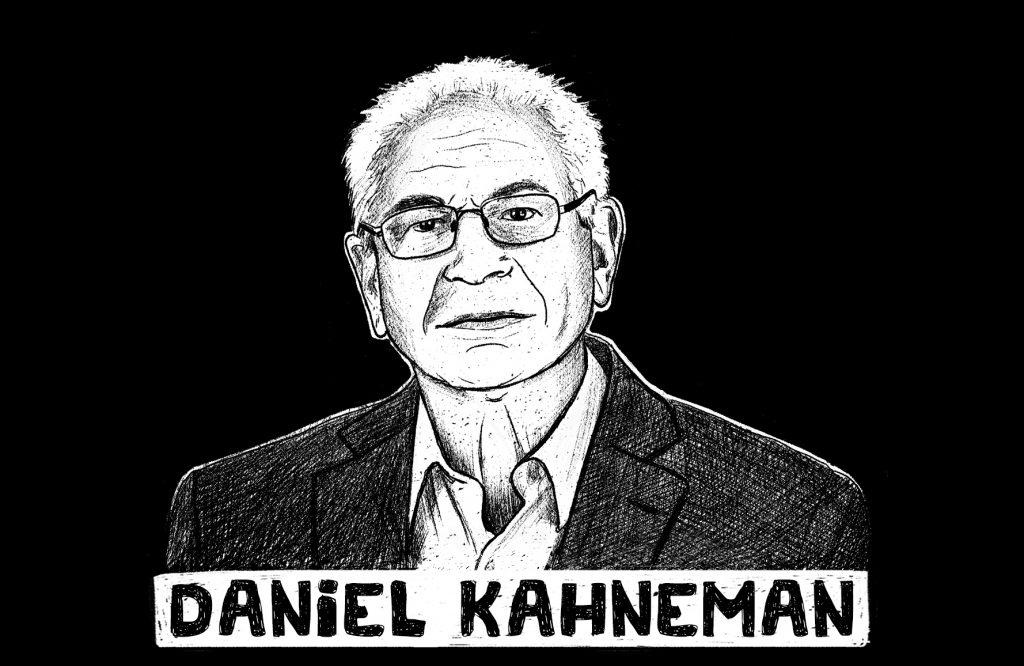
Daniel Kahneman PhD, the father of behavioral economics, died yesterday at age 90 years old. He’s best known for applying psychology to economics and uncovering biases and mental shortcuts that make people act irrationally, as he chronicled in his best-selling book Thinking, Fast and Slow.

Kahneman, along with his long-time collaborator and friend Amos Tversky PhD, developed “prospect theory,” or loss-aversion theory, which earned him the Nobel Prize in Economics in 2002 (which he shared with fellow economist Vernon Smith). The idea is that people value losses and gains differently, so we feel more bad about losing $100 than we feel good about making the same amount. He applied this theory to investors, who had previously been considered rational decision-makers. It shows up elsewhere, too—for example, golfers putt better when they’re facing the loss of a stroke than when they might gain one.

Two other biases he identified include:

  • The “peak-end rule” that people remember an experience primarily based on how they felt at its most intense moment and the final part of it. It’s why you consider a whole vacation good if the last day was good—or the opposite.
  • The conjunction fallacy where people erroneously think the probability of two things being true is more likely than just one thing, which the famous “Linda the Bank Teller” problem illustrates.

COMMENTS APPRECIATED

Thank You

***

***

***

DAILY UPDATE: Independent Pharmacies Struggle as Stocks Hit New Highs

By Staff Reporters

***

***

Independent pharmacies have struggled in recent years to stay open—and new financial constraints may mean a record number of pharmacy closures in 2024. And, nearly a third of independent pharmacies are at risk of going out of business due in part to a new rule from the Centers for Medicare and Medicaid Services (CMS) that results in lower prescription reimbursements, according to the National Community Pharmacists Association (NCPA), a trade group that represents more than 19,400 US pharmacies.

“This is an emergency,” NCPA CEO B. Douglas Hoey said in a statement. “If Congress fails to act again, thousands of local pharmacies could be closed within months and millions of patients could be stranded without a pharmacy.” The CMS rule, which went into effect on January 1st, requires payers and pharmacy benefit managers (PBMs) to apply what’s called direct and indirect remuneration (DIR) fees at the time a patient picks up a prescription.

CITE: https://www.r2library.com/Resource

Here’s where the major benchmarks ended:

  • The S&P 500 index added 44.91 points (0.9%) to 5,248.49; the Dow Jones Industrial Average climbed 477.75 points (1.2%) to 39,760.08; the NASDAQ Composite added 83.82 points (0.5%) to 16,399.52. 
  • The 10-year Treasury note yield fell four basis points to just under 4.2%.
  • The CBOE Volatility Index® (VIX) dropped 0.48 to 12.76.

In addition to utility stocks, real estate, industrials, and materials were the strongest sectors. Information technology and communications were the weakest but found late-day strength to finish higher.

COMMENTS APPRECIATED

Thank You

***

***

PODCAST: Healthcare Costs are Crazy!

By Eric Bricker MD

***

***

COMMENTS APPRECIATED

Subscribe Today!

***

***

DAILY UPDATE: “Digital Markets Act” Violations as Stocks Slide

By Staff Reporters

***

***

The European Union is investigating Meta, Apple, and Alphabet for potential violations of its Digital Markets Act. And its regulators have started looking into Amazon as well.

The Digital Markets Act is the EU’s law to make the markets in the digital sector fairer and more contestable. In order to do so, the Digital Markets Act (“DMA”) establishes a set of clearly defined objective criteria to identify “gatekeepers”.

And, stocks were headed for a great Tuesday before investors sent stock indexes back down and leaving the Dow largely unchanged. Meanwhile, Donald Trump’s social media company, Truth Social, surged 16% in its first day of trading, just as the former president must pay $175 million as part of his civil fraud trial.

Here’s where the major benchmarks ended:

  • The S&P 500 index lost 14.61 points (0.3%) to 5,203.58; the Dow Jones Industrial Average dropped 31.31 points (0.1%) to 39,282.33; the NASDAQ Composite tumbled 68.76 points (0.4%) to 16,315.70. 
  • The 10-year Treasury note yield (TNX) fell two basis points to 4.23%.
  • The CBOE Volatility Index edged up 0.05 to 13.24.

In terms of sector performance, utilities, information technology, and energy were the weakest. Health care and financials saw relative strength.

CITE: https://www.r2library.com/Resource

COMMENTS APPRECIATED

Thank You

***

***

MEDICAL SCHOOLS: Why They Don’t Teach Business and How it’s Costing Doctors?

SPONSOR: http://www.MarcinkoAssociates.com

[THE MILLION DOLLAR MISTAKE]

By Curtis G. Graham MD

***

The fact that every physician in private medical practice, without a business education, leaves approximately a million dollars on the table and is unaware of it is well known to business experts who work with medical doctors experiencing financial difficulties.

Business experts such as Dan S. Kennedy, Peter Drucker, Michael Gerber, Maxwell Maltz, Neil Baum, William Hanson, Huss and Coleman, Steven Hacker, Thomas Stanley, Chris Hurn, Napoleon Hill, and Dave Ramsey, among others, understand the financial problems faced by medical practices and how to solve them.

READ HERE: https://www.kevinmd.com/2023/01/the-million-dollar-mistake-why-medical-schools-dont-teach-business-and-how-its-costing-physicians.html

***

COMMENTS APPRECIATED

Thank You

***

***

ORDER: https://www.amazon.com/Business-Medical-Practice-Transformational-Doctors/dp/0826105750/ref=sr_1_9?ie=UTF8&qid=1448163039&sr=8-9&keywords=david+marcinko

***

ORDER: https://www.routledge.com/Comprehensive-Financial-Planning-Strategies-for-Doctors-and-Advisors-Best/Marcinko-Hetico/p/book/9781482240283

***

ORDER: https://www.routledge.com/Risk-Management-Liability-Insurance-and-Asset-Protection-Strategies-for/Marcinko-Hetico/p/book/9781498725989

***

DAILY UPDATE: Nurses Strike as Stocks Decline

By Staff Reporters

***

***

About 1,300 nurses at Staten Island University Hospital (SIUH) will strike on April 2nd if contract negotiations fail, the New York State Nurses Association (NYSNA) announced Thursday. The union, which represents about 42,000 nurses across the state, is looking for higher wages and improved nurse-to-patient ratios for their members—sticking points for Northwell Health, according to NYSNA.

AI RN Replacements: https://gizmodo.com/nvidia-wants-replace-nurses-with-ai-1851347917?utm_campaign=hcb&utm_medium=newsletter&utm_source=morning_brew

CITE: https://www.r2library.com/Resource

Here’s where the major benchmarks ended:

  • The S&P 500 index sank 15.99 points (0.3%) to 5,218.19; the Dow Jones Industrial Average dropped 162.26 points (0.4%) to 39,313.64; the NASDAQ Composite lost 44.35 points (0.3%) to 16,384.47. 
  • The 10-year Treasury note yield (TNX) rose three basis points to 4.25% after a four-day retreat.
  • The CBOE Volatility Index® (VIX) edged up 0.14 to 13.20.

The energy sector followed crude oil prices and was the strongest sector Monday. Utilities and materials also saw strength. Weakest sectors included industrials, information technology, and real estate.

COMMENTS APPRECIATED

Thank You

***

***

PODCAST: Time To Get Serious About Healthcare Costs

By Eric Bricker MD

***

***

CITE: https://www.r2library.com/Resource

***

***

***

***

PODCAST: Small and Medium Medical Practices are Struggling

By Colin Hung

***

Small- and medium-sized medical practices are struggling. The uncertain economic environment, staffing challenges, and the increasing complexity of providing care is putting practice owners under tremendous stress. EverHealth, providers of end-to-end solutions for healthcare providers, believes that these practices need support from partners that can take on some of the administrative, operational, and financial tasks so they can continue to deliver care to patients.

CITE: https://www.r2library.com/Resource

Healthcare IT Today sat down with Adam Laskey, General Manager of EverHealth at EverCommerce, to find out more about the company’s work, their vision for medical practices, and how the acquisitions of DrChrono and Updox is progressing.

***

COMMENTS APPRECIATED

Sign-Up

***

***

PODCAST: Health Insurance Medical Policy Explained

GUEST

By Eric Bricker MD

***

***

COMMENTS APPRECIATED

Thank You

***

***

DAILY UPDATE: Senior Care Facility Bankruptcies Up with Recession Life Spans?

By Staff Reporters

***

***

Financial hardship has led dozens of operators of senior facilities to file for bankruptcy over the past three years, with 13 companies filing petitions in 2021, 12 debtors filing in 2022 and 15 more in 2023, according to Gibbins Advisors.

***

***

Notable Chapter 11 filings over the past year have included Evangelical Retirement Homes of Greater Chicago, which filed Chapter 11 in the U.S. Bankruptcy Court for the Northern District of Illinois in June 2023 to sell its assets at auction. Also, Windsor Terrace Health, an operator of 32 nursing homes in California and three in Arizona, filed its petition in the U.S. Bankruptcy Court for the Central District of California in August 2023 listing $1 million to $10 million in assets and liabilities and unable to pay its debts.

CITE: https://www.r2library.com/Resource/Title/082610254

More recently, Magnolia Senior Living, an operator of four facilities in Georgia, filed for Chapter 11 protection on March. 19 in the U.S. Bankruptcy Court for the Northern District of Georgia.

***

The Great Recession of 2008 had a lot of downsides: People lost homes, jobs, and retirement savings, had their careers derailed, and were forced to learn what the heck synthetic collateralized debt obligations are. But according to recent research, it also made people in the US live longer.

COMMENTS APPRECIATED

Thank You

***

***

INVESTING: Putting a Charge Back into the EV Market

By Vitaliy Katsenelson CFA

***

***

Over the last few months, electric car sales seem to have gone from hot to cold. Hertz is dumping 20% of its 100,000 Tesla fleet, and Ford is cutting production of its F-150 Lightning. Tesla has gone from raising prices to cutting them. In fact, Tesla is reducing prices so much that the CEO of Stellantis (a merger between Fiat and Peugeot) has expressed concern that if other automakers join Tesla CEO Elon Musk in implementing similar cuts, it will result in a bloodbath for the industry.

And so, are electric cars a fad, like beanie babies, pet rocks, or fidget spinners?
The short answer is no. The full answer comes with a lot of nuance. READ HERE:

Putting a Charge Back into the EV Market

COMMENTS APPRECIATED

Thank You

***

***

DAILY UPDATE: Weak Sock Markets Following a Good Week

By Staff Reporters

***

***

Investors slowed their roll yesterday but the Dow still pulled off its best week of the year. Lululemon reported a disappointing forecast and slowing US sales growth. The athleisure company suffered its worst day since March 2020.

Here’s where the major benchmarks ended:

  • The S&P 500 index sank 7.35 points (0.1%) to 5,234.18, up 2.3% for the week; the Dow Jones Industrial Average dropped 305.47 points (0.8%) to 39,475.90, up 2% for the week; the NASDAQ Composite rose 26.98 points (0.2%) to 16,428.82, up 2.9% for the week. 
  • The 10-year Treasury note yield dipped five basis points to 4.22%, down nearly nine basis points for the week.
  • The CBOE Volatility Index edged up 0.14 to 13.06, falling 1.34 points for the week.

Utilities, information technology, and communication services were among the strongest sectors. Real estate and financials saw relative weakness Friday.

CITE: https://www.r2library.com/Resource

COMMENTS APPRECIATED

Thank You

***

***

INVESTING: A New Era of Global Tensions

By Vitaliy Katsenelson CFA

***

***

You don’t have to worry about the market and its crazy valuations. That’s your neighbor’s problem, not yours. In building your portfolio, we are aiming for resilience.

READ: https://investor.fm/investing-in-a-new-era-of-global-tensions/?mc_cid=e9237c7145&mc_eid=671e2735cc

COMMENTS APPRECIATED

Thank You

***

***

Health Care Entity: Venture Capital Funding

http://www.MARCINKOASSOCIATES.com

***

***

Venture capital funding in the digital health space cooled a bit in 2022 following a red-hot 2021. Overall, digital health companies raised $15.3 billion last year, down from the $29.1 billion raised in 2021—but still above the $14.1 billion raised in 2020, according to Rock Health a seed fund that supports digital health startups.

MORE: https://marcinkoassociates.com/fmv-appraisals/

Nevertheless, analysts predict VC investors and bankers will still put a good amount of money into digital health in 2024 and 2025, especially in alternative care, drug development, health information technology technology, EMRs and software that reduces physician workload.

CITE: https://www.r2library.com/Resource

Of course. an essential first part of attracting VC interest and money is the crafting and presentation of your formal business plan [“elevator pitch”]; as well as the needed technical and managerial experience. This is crucial for success and exactly where we can assist.

***

READ MORE: https://marcinkoassociates.com/welcome-medical-colleagues/

CONTACT: MarcinkoAdvisors@msn.com

***

***

PODCAST: Economic Cycles in Healthcare

By Eric Bricker MD

***

***

CITE: https://www.r2library.com/Resource

***

***

***

***

CITE: https://www.r2library.com/Resource

***
COMMENTS APPRECIATED

Thank You

***

DAILY UPDATE: Kroger Selling Pharma Business as Nvidia and Stock Markets Rise

By Staff Reporters

CHERRY BLOSSOM FESTIVAL, DC.

***

***

KROGER, the supermarket chain said it expects to close the sale of its specialty pharmacy business during the second half of 2024. Kroger said it is planning to sell its speciality pharmacy business to pharmacy benefit manager CarelonRx, a subsidiary of Elevance Health, the company just reported.

CITE: https://www.r2library.com/Resource

***

Nvidia continues its bid for world domination with the announcement of its new B200 “Blackwell” chip. The Blackwell is 2.5 times more powerful than the “Hopper” chip which helped it become a $2 trillion company. (Bloomberg)

Here’s where the major benchmarks ended:

  • The S&P 500 index added 46.11 points (0.9%) to 5,224.62; the Dow Jones Industrial Average gained 401.37 points (1%) to 39,512.13; the NASDAQ Composite rose 202.62 points (1.3%) to 16,369.41. 
  • The 10-year Treasury note yield slid two basis points to 4.27%.
  • The CBOE Volatility Index®(VIX) fell 0.77 to 13.06.
     

Health care was the biggest loser among the S&P 500 sectors. Energy was also lower after crude oil prices sank on the heels of weekly inventory data. Brent Crude Oil (/BZ) futures, the global benchmark, dropped 1.6% on the heels of five days of gains.

COMMENTS APPRECIATED

Thank You

***

***

DAILY UPDATE: Medicare Payment Policy and Inflation as the Stock Markets Gain

By Staff Reporters

***

***

MEDICARE: https://www.medpac.gov/wp-content/uploads/2024/03/Mar24_MedPAC_Report_To_Congress_SEC.pdf

The producer price index (PPI) rose 0.6% for the month, according to the Bureau of Labor Statisticsdouble the Dow Jones estimate, CNBC reported. February’s larger-than-expected PPI uptick follows a more modest 0.3% increase in January and a 0.1% decline in December. On an annual basis, the PPI increased 1.6%, “the largest rise since moving up 1.8% for the 12 months ended September 2023,” according to the BLS.

CITE: https://www.r2library.com/Resource

Here’s where the major benchmarks ended:

The market had a good Tuesday, with stocks climbing as investors await word from the Fed meeting today on any changes to interest rates. The bank is expected to keep rates the same for now, but could signal when (or how often) it’ll lower them later in the year. Meanwhile, Nordstrom shares surged following a report that the retailer’s founding family wants to take it private.
 

  • The S&P 500 index added 29.09 points (0.6%) to 5,178.51; the Dow Jones Industrial Average® ($DJI) gained 320.33 points (0.8%) to 39,110.76; the NASDAQ Composite® ($COMP) rose 63.34 points (0.40%) to 16,166.79.
  • The 10-year Treasury note yield (TNX) eased four basis points to just under 4.3%.
  • The CBOE Volatility Index® (VIX) lost 0.50 to 13.83. 

The energy sector was the top performer after crude oil prices notched multi-month highs ahead of weekly inventory data from the American Petroleum Institute. After a 2% rally to start the trading week, Brent Crude Oil (/BZ) futures, the global benchmark, added another 0.6% Tuesday.

Industrials, consumer discretionary, and utilities were among the other strong sectors. Communications, real estate, and materials finished modestly lower.

COMMENTS APPRECIATED

Thank You

***

***