MONEY SUPPLY: Measurement Tools

By Dr. David Edward Marcinko MBA MEd

BASIC DEFINITIONS

***

***

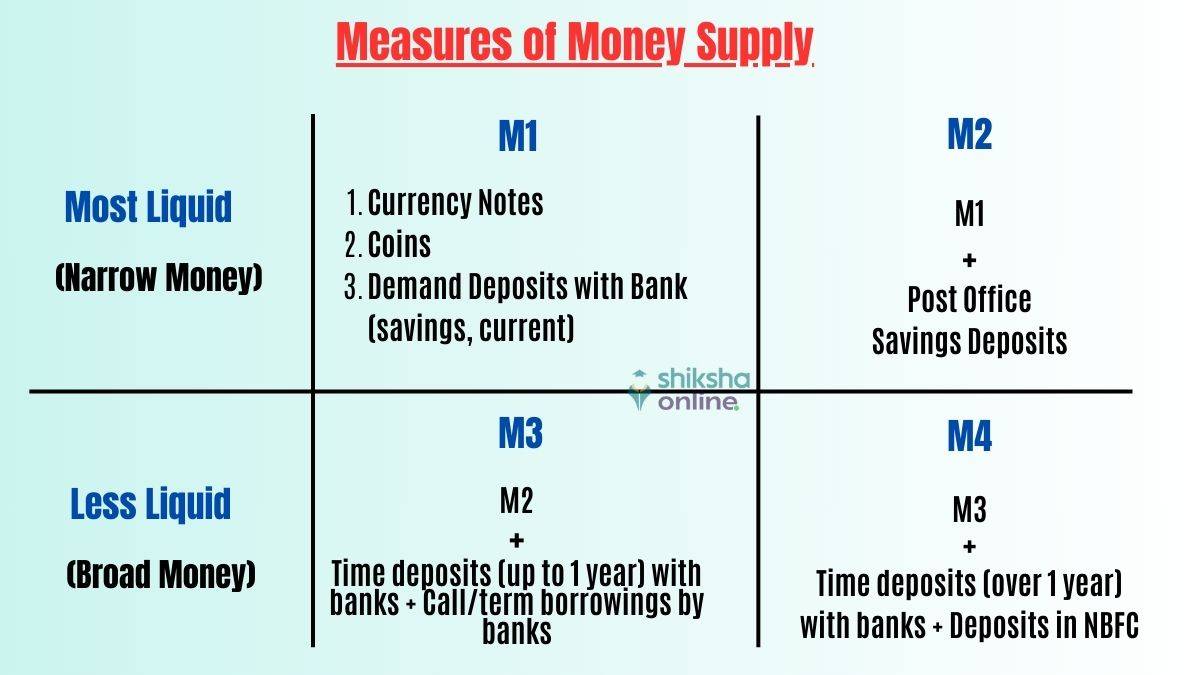
Money supply measures—M0, M1, M2, and M3—are essential tools used by economists and policymakers to assess liquidity, guide monetary policy, and understand economic health. Each measure reflects a different level of liquidity and plays a unique role in financial analysis.

The money supply refers to the total amount of monetary assets available in an economy at a specific time. It includes various forms of money, ranging from physical currency to more liquid financial instruments. To better understand and manage economic activity, central banks and economists categorize money into different measures based on liquidity: M0, M1, M2, and M3.

M0, also known as the monetary base or base money, includes all physical currency in circulation—coins and paper money—plus reserves held by commercial banks at the central bank. It represents the most liquid form of money and is directly controlled by the central bank through tools like open market operations and reserve requirements.

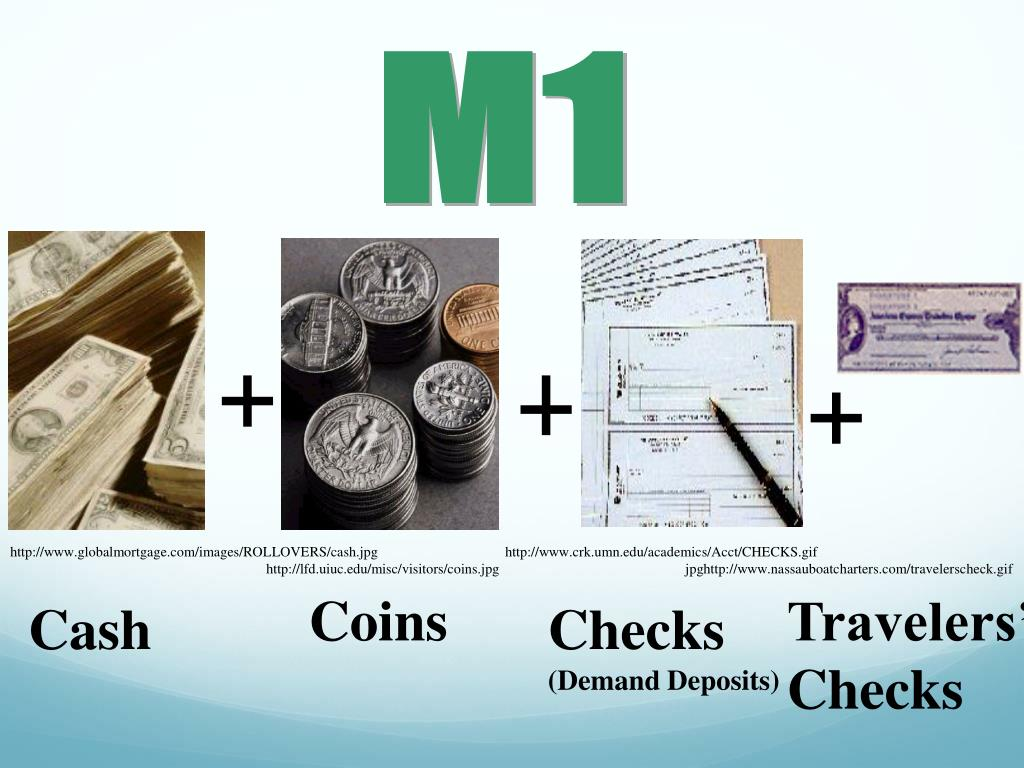
M1 builds on M0 by adding demand deposits (checking accounts) and other liquid deposits that can be quickly converted into cash. It includes:

  • Physical currency held by the public
  • Traveler’s checks
  • Demand deposits at commercial banks

M1 is a key indicator of immediate spending power in the economy. A rapid increase in M1 can signal rising consumer activity, while a decline may indicate tightening liquidity.

M2 expands further by including near-money assets—those that are not as liquid as M1 but can be converted into cash relatively easily. M2 includes:

  • All components of M1
  • Savings deposits
  • Money market securities
  • Certificates of deposit (under $100,000)

M2 is widely used by economists and the Federal Reserve to gauge intermediate-term economic trends. It reflects both spending and saving behavior, making it a critical tool for forecasting inflation and guiding interest rate decisions.

M3, though no longer published by the Federal Reserve since 2006, includes M2 plus large time deposits, institutional money market funds, and other larger liquid assets. M3 provides a broader view of the money supply, especially useful for analyzing long-term investment trends and credit expansion. Some countries, like the UK and India, still track M3 for macroeconomic planning.

These measures are not just academic—they have real-world implications. For instance, during the COVID-19 pandemic, the U.S. saw a historic surge in M2 due to stimulus payments and quantitative easing. This expansion raised concerns about future inflation, which materialized in subsequent years. Monitoring money supply helps central banks adjust monetary policy to maintain price stability and support economic growth.

In conclusion, money supply measures offer a layered view of liquidity in the economy, from the most liquid (M0) to broader aggregates (M3).

Understanding these categories helps policymakers, investors, and businesses anticipate economic shifts, manage inflation, and make informed financial decisions.

COMMENTS APPRECIATED

EDUCATION: Books

SPEAKING: Dr. Marcinko will be speaking and lecturing, signing and opining, teaching and preaching, storming and performing at many locations throughout the USA this year! His tour of witty and serious pontifications may be scheduled on a planned or ad-hoc basis; for public or private meetings and gatherings; formally, informally, or over lunch or dinner. All medical societies, financial advisory firms or Broker-Dealers are encouraged to submit an RFP for speaking engagements: CONTACT: Ann Miller RN MHA at MarcinkoAdvisors@outlook.com -OR- http://www.MarcinkoAssociates.com

Like, Refer and Subscribe

***

***

RISK ARBITRAGE: In Financial Markets

By Dr. David Edward Marcinko MBA MEd

***

***

Risk arbitrage, often referred to as merger arbitrage, is a specialized investment strategy that seeks to exploit pricing inefficiencies arising during corporate mergers, acquisitions, or other restructuring events. Unlike traditional arbitrage, which involves risk-free profit opportunities from price discrepancies across markets, risk arbitrage carries inherent uncertainty because it depends on the successful completion of corporate transactions. Despite its name, it is not risk-free; rather, it is a calculated approach to profiting from the probability of deal closure.

At its core, risk arbitrage involves buying the stock of a company being acquired and, in some cases, shorting the stock of the acquiring company. For example, if Company A announces it will acquire Company B at $50 per share, but Company B’s stock trades at $47, arbitrageurs may purchase shares of Company B, betting that the deal will close and the stock will rise to the agreed acquisition price. The $3 difference represents the potential arbitrage profit. However, this spread exists precisely because of uncertainty: regulatory approval, financing challenges, shareholder resistance, or unforeseen market conditions could derail the transaction, leaving arbitrageurs exposed to losses.

The practice of risk arbitrage has a long history in Wall Street. It gained prominence in the mid-20th century, particularly during the wave of conglomerate mergers in the 1960s and leveraged buyouts in the 1980s. Hedge funds and specialized arbitrage desks at investment banks became key players, using sophisticated models to assess the likelihood of deal completion. Today, risk arbitrage remains a central strategy for event-driven funds, which focus on corporate actions as catalysts for investment opportunities.

One of the defining features of risk arbitrage is its reliance on probability analysis. Investors must evaluate not only the financial terms of the deal but also the legal, regulatory, and political environment. For instance, antitrust regulators may block a merger if it reduces competition, or foreign investment committees may intervene in cross-border acquisitions. Arbitrageurs often assign probabilities to deal completion and calculate expected returns accordingly. A deal with high regulatory risk may offer a wider spread, but the probability of failure tempers the attractiveness of the trade.

Risk arbitrage also plays an important role in market efficiency. By narrowing the spread between target company stock prices and acquisition offers, arbitrageurs help align market prices with expected outcomes. Their activity provides liquidity to shareholders of target firms and signals market confidence—or skepticism—about deal success. In this sense, arbitrageurs act as informal referees of corporate transactions, reflecting collective judgment about feasibility.

Nevertheless, risk arbitrage is not without controversy. Critics argue that it can encourage speculative behavior and amplify volatility around merger announcements. Moreover, when deals collapse, arbitrageurs can suffer significant losses, as seen in high-profile failed mergers. The strategy requires not only financial acumen but also resilience in managing downside risk.

In conclusion, risk arbitrage is a sophisticated investment strategy that blends financial analysis with legal and regulatory insight. While it offers opportunities for profit, it demands careful risk management and a deep understanding of corporate dynamics. Far from being risk-free, it is a calculated gamble on the successful execution of complex transactions. For investors willing to navigate uncertainty, risk arbitrage remains a compelling, though challenging, avenue in modern financial markets.

COMMENTS APPRECIATED

EDUCATION: Books

SPEAKING: Dr. Marcinko will be speaking and lecturing, signing and opining, teaching and preaching, storming and performing at many locations throughout the USA this year! His tour of witty and serious pontifications may be scheduled on a planned or ad-hoc basis; for public or private meetings and gatherings; formally, informally, or over lunch or dinner. All medical societies, financial advisory firms or Broker-Dealers are encouraged to submit an RFP for speaking engagements: CONTACT: Ann Miller RN MHA at MarcinkoAdvisors@outlook.com -OR- http://www.MarcinkoAssociates.com

Like, Refer and Subscribe

***

***

BAD MONEY MOVES of Physicians!

By Dr. David Edward Marcinko MBA MEd

SPONSOR: http://www.MarcinkoAssociates.com

***

***

Money is a powerful tool. It can provide security, open opportunities, and help build a fulfilling life. Yet, when mismanaged, it can quickly become a source of stress and regret. Understanding the worst ways to use money is essential for anyone who wants to avoid financial pitfalls and build lasting stability.

1. Impulse Spending

One of the most damaging habits is spending without thought. Buying items on impulse—whether it’s clothes, gadgets, or luxury goods—often leads to regret and wasted resources. These purchases rarely align with long‑term goals and can drain savings meant for emergencies or investments.

2. High‑Interest Debt

Credit cards and payday loans can trap people in cycles of debt. Paying 20% or more in interest means that even small purchases balloon into massive financial burdens. Using debt irresponsibly is one of the fastest ways to erode wealth.

3. Ignoring Savings and Investments

Failing to save for the future is another critical mistake. Without an emergency fund, unexpected expenses like medical bills or car repairs can derail financial stability. Similarly, neglecting investments means missing out on compound growth that builds wealth over time.

4. Chasing Get‑Rich‑Quick Schemes

From pyramid schemes to speculative “hot tips,” chasing unrealistic returns is a recipe for disaster. These schemes prey on greed and impatience, often leaving participants with nothing but losses. Sustainable wealth comes from patience and discipline, not shortcuts.

5. Overspending on Status

Many people waste money trying to impress others—buying luxury cars, designer clothes, or extravagant experiences they cannot afford. This pursuit of status often leads to debt and financial insecurity, while providing only fleeting satisfaction.

6. Neglecting Insurance

Skipping health, auto, or home insurance to save money may seem smart in the short term, but it can be catastrophic when disaster strikes. Without protection, one accident or emergency can wipe out years of savings.

7. Failing to Budget

Living without a plan is like sailing without a map. Without a budget, it’s easy to overspend, miss bills, or fail to allocate money toward goals. Budgeting is not restrictive—it’s empowering, because it ensures money is used intentionally.

8. Ignoring Education and Skills

Spending money without investing in personal growth is another hidden mistake. Education, training, and skill development often yield lifelong returns. Neglecting these opportunities can limit earning potential and financial independence.

Conclusion

The worst things to do with money often stem from short‑term thinking, lack of discipline, or the desire for instant gratification. Impulse spending, high‑interest debt, chasing schemes, and neglecting savings all undermine financial health. By avoiding these traps and focusing on budgeting, investing wisely, and protecting against risks, money can serve as a foundation for security and freedom rather than a source of stress.

COMMENTS APPRECIATED

Like, Refer and Subscribe

EDUCATION: Books

SPEAKING: Dr. Marcinko will be speaking and lecturing, signing and opining, teaching and preaching, storming and performing at many locations throughout the USA this year! His tour of witty and serious pontifications may be scheduled on a planned or ad-hoc basis; for public or private meetings and gatherings; formally, informally, or over lunch or dinner. All medical societies, financial advisory firms or Broker-Dealers are encouraged to submit an RFP for speaking engagements: CONTACT: Ann Miller RN MHA at MarcinkoAdvisors@outlook.com -OR- http://www.MarcinkoAssociates.com

***

***

DI-WORSIFICATION: Stock Portfolio Pitfalls

By Dr. David Edward Marcinko MBA MEd

***

***

SPONSOR: http://www.MarcinkoAssociates.com

Diworsification is a term coined by Peter Lynch to describe when investors over‑diversify their portfolios, adding too many holdings and ultimately reducing returns instead of improving them.

Diversification has long been heralded as one of the cornerstones of sound investing. By spreading capital across different asset classes, industries, and geographies, investors can reduce risk and protect themselves against the volatility of individual securities. Yet, as with many strategies, there exists a point where the benefits diminish and the practice becomes counterproductive. This phenomenon, known as diworsification, was popularized by legendary investor Peter Lynch to describe the tendency of investors and corporations to dilute their strengths by expanding too broadly.

At its core, diworsification occurs when the pursuit of safety leads to excessive complexity. For individual investors, this often manifests in portfolios bloated with dozens or even hundreds of stocks, mutual funds, or exchange‑traded funds. While the intention is to minimize risk, the result is frequently a portfolio that mirrors the market index but with higher costs and less focus. Instead of achieving superior returns, the investor ends up with average performance weighed down by management fees, trading expenses, and the difficulty of monitoring so many positions. In essence, the investor has sacrificed the potential for meaningful gains in exchange for a false sense of security.

Corporations are not immune to this trap. In the corporate world, diworsification describes the tendency of firms to expand into unrelated businesses, diluting their competitive advantage. A company that excels in consumer electronics, for example, may attempt to branch into unrelated industries such as food services or real estate. Without the expertise, synergies, or strategic fit, these ventures often fail to deliver value, distracting management and eroding shareholder wealth. History is replete with examples of conglomerates that grew too large, too fast, only to later divest their non‑core businesses in recognition of the inefficiencies created.

The dangers of diworsification are not merely theoretical. They highlight the importance of discipline in both investing and corporate strategy. For investors, the lesson is clear: diversification should be purposeful, not indiscriminate. A well‑constructed portfolio might include a mix of equities, bonds, and alternative assets, but each holding should serve a specific role—whether it is growth, income, or risk mitigation. Beyond a certain point, adding more securities does not reduce risk meaningfully; instead, it complicates decision‑making and reduces the chance of outperforming the market.

Similarly, for corporations, strategic focus is paramount. Expansion should be guided by core competencies and long‑term vision rather than the allure of short‑term growth. Firms that resist the temptation to chase every opportunity are better positioned to strengthen their brand, innovate within their domain, and deliver sustainable value to shareholders.

In conclusion, diworsification serves as a cautionary tale against the excesses of diversification. While spreading risk is essential, overdoing it can undermine performance and clarity. Both investors and corporations must strike a balance between breadth and focus, ensuring that every addition to a portfolio or business strategy enhances rather than dilutes overall strength. In other words, “diversification means you will always have to say you’re sorry.”

True wisdom lies not in owning everything, but in owning the right things.

COMMENTS APPRECIATED

EDUCATION: Books

SPEAKING: Dr. Marcinko will be speaking and lecturing, signing and opining, teaching and preaching, storming and performing at many locations throughout the USA this year! His tour of witty and serious pontifications may be scheduled on a planned or ad-hoc basis; for public or private meetings and gatherings; formally, informally, or over lunch or dinner. All medical societies, financial advisory firms or Broker-Dealers are encouraged to submit an RFP for speaking engagements: CONTACT: Ann Miller RN MHA at MarcinkoAdvisors@outlook.com -OR- http://www.MarcinkoAssociates.com

Like, Refer and Subscribe

***

***

Rethinking Productivity in Wealth Management

By Vitaliy Katsenelsen CFA

***

***

One of the biggest hazards of being a professional money manager is that you are expected to behave in a certain way.

One of the biggest hazards of being a professional money manager is that you are expected to behave in a certain way: You have to come to the office every day, work long hours, slog through countless emails, be on top of your portfolio (that is, check performance of your securities minute by minute), watch business TV and consume news continuously, and dress well and conservatively, wearing a rope around the only part of your body that lets air get to your brain. Our colleagues judge us on how early we arrive at work and how late we stay. We do these things because society expects us to, not because they make us better investors or do any good for our clients.

Somehow we let the mindless, Henry Ford–assembly-line, 8:00 a.m. to 5:00 p.m., widgets-per-hour mentality dictate how we conduct our business thinking. Though car production benefits from rigid rules, uniforms, automation and strict working hours, in investing — the business of thinking — the assembly-line culture is counterproductive. Our clients and employers would be better off if we designed our workdays to let us perform our best.

Investing is not an idea-­per-hour profession; it more likely results in a few ideas per year. A traditional, structured working environment creates pressure to produce an output — an idea, even a forced idea. Warren Buffett once said at a Berkshire Hathaway annual meeting: “We don’t get paid for activity; we get paid for being right. As to how long we’ll wait, we’ll wait indefinitely.”

How you get ideas is up to you. I am not a professional writer, but as a professional money manager, I learn and think best through writing. I put on my headphones, turn on opera and stare at my computer screen for hours, pecking away at the keyboard — that is how I think. You may do better by walking in the park or sitting with your legs up on the desk, staring at the ceiling.

I do my best thinking in the morning. At 3:00 in the afternoon, my brain shuts off; that is when I read my emails. We are all different. My best friend is a brunch person; he needs to consume six cups of coffee in the morning just to get his brain going. To be most productive, he shouldn’t go to work before 11:00 a.m.

And then there’s the business news. Serious business news that lacked sensationalism, and thus ratings, has been replaced by a new genre: business entertainment (of course, investors did not get the memo). These shows do a terrific job of filling our need to have explanations for everything, even random events that require no explanation (like daily stock movements). Most information on the business entertainment channels — Bloomberg Television, CNBC, Fox Business — has as much value for investors as daily weather forecasts have for travelers who don’t intend to go anywhere for a year.

Yet many managers have CNBC, Fox or Bloomberg TV/Internet streaming on while they work.

COMMENTS APPRECIATED

Refer and Like

***

***

Understanding Newton’s First Law of Start-Up Investing

***

***

COMMENTS APPRECIATED

EDUCATION: Books

Like, Refer and Subscribe

***

***

PHYSICIANS BEWARE: The APR Car Lease “Money Factor”

By A.I. and Dr. David Edward Marcinko MBA MEd CMP

SPONSOR: http://www.CertifiedMedicalPlanner.org

***

***

What is it?

The so-called money factor (abbreviated as MF on invoices) is a number in a decimal form that dealers use to calculate the APR of a car lease. It’s a major part of your monthly payment and dealers are known to jack up the money factor to pad their profits.

BROKE DOCTORS: https://medicalexecutivepost.com/2025/08/02/doctors-going-broke-and-living-paycheck-to-paycheck/

How it works

Most doctors don’t ask to see it because they’re not aware of it or don’t know how to calculate it. Ask to see the money factor, then multiply it by 2,400.

For example, if the money factor is .00150, you multiply it by 2,400 to get 3.6%. If that’s higher than the prevailing rate, you have room to talk them down.

How to reduce it

So how do you get a good interest rate when you lease a vehicle? The same way you do when borrowing for any other reason, whether it’s buying a home or applying for a personal loan: by having good credit. This may reduce your interest rate because you’ll represent a lower risk to a lender.

A high residual value on the car could also help you get a better interest rate. A higher residual value means you’d have lower monthly payments because there would be less depreciation on the vehicle. Since interest is applied to your monthly payment, a lower monthly payment would equate to reduced interest charges.

MONEY DOCTORS: https://medicalexecutivepost.com/2025/04/08/psychology-a-money-relationship-questionnaire-for-doctors/

Financial implications

The money factor is one of the many numbers you may want to learn about when leasing a car. It’s one of the transactional costs that come with leasing, and allows dealers and finance companies to make a profit on every lease they execute. As a consumer, it’s a smart idea to learn the financial implications of this number and how it’ll affect your overall costs over the course of a multi-year lease.

***

***

If the interest rate is too high, you may need to shop around for a better rate, negotiate with the dealer or lender to lower the money factor, or consider leasing another vehicle that’s more in line with your budget. Either way, make sure you explore all your financial options before taking a car off the lot.

SALARY NEGOTIATIONS: https://medicalexecutivepost.com/2016/08/21/salary-negotiations-skills-for-doctors-hospitalists/

COMMENTS APPRECIATED

EDUCATION: Books

SPEAKING: Dr. Marcinko will be speaking and lecturing, signing and opining, teaching and preaching, storming and performing at many locations throughout the USA this year! His tour of witty and serious pontifications may be scheduled on a planned or ad-hoc basis; for public or private meetings and gatherings; formally, informally, or over lunch or dinner. All medical societies, financial advisory firms or Broker-Dealers are encouraged to submit an RFP for speaking engagements: CONTACT: Ann Miller RN MHA at MarcinkoAdvisors@outlook.com -OR- http://www.MarcinkoAssociates.com

Like and Subscribe

***

***

NET WORTH: Defined for Physicians

By Staff Reporters

SPONSOR: http://www.CertifiedMedicalPlanner.org

***

***

What does net worth really mean?

Net worth is everything you own of significance (Assets) minus what is owed in debts (Liabilities). Assets include cash and investments, real estate, cars and anything else of value.

BROKE DOCTORS: https://medicalexecutivepost.com/2025/08/02/doctors-going-broke-and-living-paycheck-to-paycheck/

How is net worth calculated? Assets – Debt = Net Worth. Net worth is calculated by adding all owned assets (anything of value) and then subtracting all of your liabilities.

Is net worth yearly? No, net worth is not yearly. Net worth isn’t inherently yearly but is often tracked on an annual basis to assess financial progress year over year.

What net worth is considered wealthy, rich and upper class?
In the U.S. salary average is around $59,000, and only 20% of Americans have a household income of $100,000 or more.

MONEY ADDICTION: https://medicalexecutivepost.com/2025/08/07/moiney-addicted-physicians-the-investing-and-trading-personality-of-doctors/

Is net worth the same as net income? No, net worth is not the same as net income. Net income is what you actually bring home after taxes and payroll deductions, like Social Security and 401(k) contributions.

Can one measure their net worth if they don’t have many assets or a high income? Yes. Knowing your net worth isn’t about the amount you have; it’s about understanding your financial position. It helps you track your progress, informs your financial decisions, and motivates you to improve your financial health, regardless of where you start.

HEDGE FUNDS: https://medicalexecutivepost.com/2025/06/08/hedge-funds-defined-for-doctors/

COMMENTS APPRECIATED

Like and Subscribe

***

***

ALTERNATE INVESTMENTS: 401[k] Accounts

By A.I. and Staff Reporters

***

***

President Trump is set to sign an executive order allowing alternative assets such as cryptocurrency, private equity investments, and real estate in 401(k) accounts. Those accounts are a veritable gold mine—Americans have stashed approximately $12.5 trillion away for retirement, and alternative asset managers have been chomping at the bit to get a piece of that pie.

WIND ENERGY: https://medicalexecutivepost.com/2012/08/20/wind-energy-alternate-investments/

According to Brew Markets, the changes have been a long time coming. All the way back in his first term, Trump ordered the Labor Department to review how to incorporate private equity investments into retirement accounts, an effort that was later reversed under President Biden. This latest move expands beyond private equity, coinciding with Trump’s push to bring crypto mainstream.

REAL ESTATE: https://medicalexecutivepost.com/2013/09/10/financial-freedom-through-commercial-real-estate-education-and-investing/

Proponents argue that alternative assets in 401(k) accounts will enhance investment diversification and could provide retirees with greater profits. Detractors note that these assets are less liquid, less transparent, and generally more risky than investing retirement funds into publicly traded stocks and bonds.

HEDGE FUNDS: https://medicalexecutivepost.com/2024/07/09/hedge-funds-understanding-fees-and-costs/

COMMENTS APPRECIATED

Like and Subscribe

***

***

MEDICAL PRACTICE: As a Financial Asset Class?

SPONSOR: http://www.MarcinkoAssociates.com

**

***

By Dr. David Edward Marcinko; MBA MEd CMP

***

What Is an Alternative Investment?

An alternative investment is a financial asset that does not fall into one of the conventional investment categories. Conventional categories include stocks, bonds, and cash. Alternative investments can include private equity or venture capital, hedge funds, managed futures, art and antiques, commodities, and derivatives contracts. Real estate is also often classified as an alternative investment.

QUESTION: But what about a medical, podiatric or dental practice?

***

***

An Alternate Asset Class Surrogate?

A medical practice is much like an alternative investment [AI], or alternate asset class in, two respects.

  • First, it provides the work environment that generates personal income which has been considered generous, to date. 
  • Second, it has inherent appreciation and sales value that can be part of an exit (retirement) or succession planning transfer strategy.

Conclusion

So, unlike the emerging thought that offers Social Security payments as a surrogate for an asset classes; or a federally insured AAA bond – a medical practice might also be considered by some folks as an asset class within a well diversified modern investment portfolio.

EDUCATION: Books

SPEAKING: Dr. Marcinko will be speaking and lecturing, signing and opining, teaching and preaching, storming and performing at many locations throughout the USA this year! His tour of witty and serious pontifications may be scheduled on a planned or ad-hoc basis; for public or private meetings and gatherings; formally, informally, or over lunch or dinner. All medical societies, financial advisory firms or Broker-Dealers are encouraged to submit a RFP for speaking engagements: MarcinkoAdvisors@outlook.com 

COMMENTS APPRECIATED

Read, Like, Refer and Subscribe

***

***

MONEY Supply in Circulation

By Staff Reporters

SPONSOR: http://www.MarcinkoAssociates.com

***

***

MONEY SUPPLY: The amount of money in circulation. The money supply measures
currently (1985) used by the Federal Reserve System are:


 M 1 – Currency in circulation + demand deposit + other check-type deposits. 35
 M2 – M 1 + savings and small denomination time deposits + overnight repurchase
agreements at commercial banks + overnight Eurodollars + money market mutual
fund shares.
 M3 – M2 + large-denomination time deposits (Jumbo CDs) + term repurchase
agreements.
 M4 – M3 + other liquid assets (such as term Eurodollars, bankers acceptances,
commercial paper, Treasury securities and U.S. Savings Bonds)

COMMENTS APPRECIATED

Like and Subscribe

***

***

The M1 and M2 Money Supply

By Staff Reporters

***

***

DEFINITION: In macro-economics, the money supply (or money stock) refers to the total volume of currency held by the public at a particular point in time. There are several ways to define “money”, but standard measures usually include currency in circulation (i.e. physical cash) and demand deposits (depositors’ easily accessed assets on the books of financial institutions . The Central Bank [FOMC] of a country may use a definition of what constitutes legal tender for its purposes.

CITE: https://www.r2library.com/Resource

***

Though there are a few variations of money supply, most economists tend to focus on M1 and M2. The former takes into account cash and coins in circulation, as well as demand deposits in checking accounts and traveler’s checks. In other words, money that’s either in your hand or can be accessed very easily.

Meanwhile, M2 accounts for everything in M1 and adds savings accounts, money market funds, and certificates of deposit (CDs) below $100,000. It’s money you have access to, but it takes a little extra effort to put this capital to work. It’s M2 money supply that’s raising eyebrows on Wall Street and making history.

***

What’s of interest is what’s happened to M2 money supply over the trailing year. Following a peak of $21.7 trillion in July 2022, M2 has fallen to a fresh reading of $20.81 trillion, as of May 2023. Although the May reading was higher than April and broke a nine-month downtrend, we’ve still witnessed a 4.1% aggregate drop in M2 from its all-time high. 

Considering that M2 enjoyed a historic expansion during the pandemic, it’s certainly possible that a 4.1% decline can be shrugged off as nothing more than money supply reverting back to the mean. But history suggests otherwise.

Though history rarely repeats itself on Wall Street, it often rhymes. We haven’t seen a meaningful year-over-year decline in M2 money supply since the Great Depression in 1933.

***

And so, based on what we’re seeing from M2 money supply, commercial bank lending, and domestic banks tightening their lending standards for C&I loans, the ingredients for a U.S. recession are most definitely there. Stock losses have, historically, been most pronounced in the months that follow the official declaration of a recession by the eight-economist panel of the National Bureau of Economic Research.

However, Wall Street’s performance is largely dependent on your investment time frame. If you’re patient, these and other potentially worrisome money metrics represent nothing more than temporary white noise.

***

COMMENTS APPRECIATED

Thank You

***

***

DAILY UPDATE: Sidelines Awash with Cash in Up Markets

By Staff Reporters

***

SPONSOR: http://www.MarcinkoAssociates.com

***

There’s almost $6 trillion of cash sitting on the sidelines in money-market funds, with the potential for some portion of it to be reallocated into “carefully selected risk assets.”

CITE: https://www.r2library.com/Resource

This is according to Ali Dibadj, chief executive of London-based Janus Henderson Investors, which had $308.3 billion in assets under management as of September. About $187.9 billion, or 61%, of that was in equity strategies.

***

Here’s where the major benchmarks ended:

  • The S&P 500 index was up 26.83 points (0.6%) at 4,594.63, up 0.8% for the week; the Dow Jones Industrial Average® (DJI) was up 294.61 points (0.8%) at 36,245.50, up 2.4% for the week; the NASDAQ Composite was up 78.81 points (0.6%) at 14,305.03, up 0.4% for the week.
  • The 10-year Treasury note yield was down about 14 basis points at 4.213%.
  • The CBOE® Volatility Index (VIX) was down 0.27 at 12.65.

Friday’s gains followed the market’s strongest month of the year, as the S&P 500 and NASDAQ surged 8.9% and 10.7% in November, respectively, their best monthly performances since July 2022. Among sectors, the KBW Regional Bank Index (KRX) jumped 5.3% Friday, and retail shares were also among the top gainers.

Shares of smaller companies extended a recent rally as the small-cap-focused Russell 2000® Index (RUT) gained 3.1% for the week and ended at a 2-1/2-month high.

***

COMMENTS APPRECIATED

Thank You

***

***

CASH AMERICANS: Stock Markets Up as We Spend Dollars

By Staff Reporters

SPONSOR: http://www.MARCINKOASSOCIATES.com

***

***

The S&P 500 Index was up 84.15 points (1.9%) at 4,495.70; the Dow Jones Industrial Average (DJI) was up 489.83 points (1.4%) at 34,827.70; the NASDAQ Composite (COMP) was up 326.64 points (2.4%) at 14,094.38.

And, new data shows Americans have more cash sitting in the bank than they did before the COVID pandemic.

  • Americans have ~10%–15% more in their bank accounts than they did in 2019,  according to a JPMorgan Chase analysis of 9 million Chase customers’ checking and savings accounts.
  • Meanwhile, after lagging behind inflation for two years, wages are finally rising faster than prices. Last month, hourly wages were up 4%, while prices for consumer goods only climbed 3%.

Though Americans have more funds than they did before they had an opinion on the best brand of hand sanitizer, median account balances have dipped more than 41% from their peak in April 2021, when people collected stimulus checks with nowhere to go spend them, the Chase analysis shows. And people still want to shop—consumer sentiment spiked to an almost two-year high this month.

It helps explain why the recession that Wall Street kept warning us about hasn’t materialized, according to the Washington Post.

***

***

COMMENTS APPRECIATED

Thank You

***

BEHAVIORAL FINANCE: Cash is Still “King”

TREATING YOURSELF WITH CASH

By Staff Reporters

http://www.MarcinkoAssociates.com

***

***

Folks are more likely to reach for dollar bills than credit cards when making a guilty pleasure purchase, according to new Stanford research.

MORE: https://medicalexecutivepost.com/2022/06/22/behavioral-finance-for-doctors/

In more than 118,000 real transactions at the university bookstore, buyers tended to slap their plastic on the counter for school supplies but pay with cash for “harder-to-justify” items like a stuffed plush mascot. And when asked how they’d pay for a hypothetical Reiki session, participants leaned toward credit card when the treatment was described as doctor-recommended but toward cash when they were told it was just an impulse purchase.

RELATED: https://medicalexecutivepost.com/2023/02/28/dr-richard-h-thaler-and-behavioral-economics/

***

COMMENTS APPRECIATED

Thank You

***

***

KING IS CASH: In a Tough Interest Rate Ecosystem

By Staff Reporters

***

***

Cash is king, especially in this tough interest rate environment. That’s proving true in the mergers and acquisitions market this year, according to PwC’s US Deals 2023 midyear outlook, which says companies and private equity with cash in hand are making deals happen. There are “opportunities for corporates with strong balance sheets. Private equity sponsors with large amounts of dry powder also have been getting deals done,” according to PwC.

CITE: https://www.r2library.com/Resource

Deal makers need cash because lending has become tougher and more expensive to obtain. Additionally, “the IPO market has remained quiet for over a year.”

Even the private equity market, which often leans heavily on debt financing, is reaching for other ways to get deals done: “Some PE sponsors have turned to more creative financing solutions, including higher equity contribution, seller’s notes, paid in-kind financing and the private credit markets.”

The challenging market is also impacting deal size. PwC found that deal makers are eschewing big deals in favor of smaller opportunities. However, although the deals appear to be smaller, the volume of M&A activity is “relatively strong compared toCOVID pre-pandemic levels.

***

COMMENTS APPRECIATED

Join the ME-P

***

***

AMERICANS: Cash Savings Rate Up!

By Staff Reporters

***

***

Whether we’ve got a recession coming remains the biggest will they or won’t they story, but it looks like more Americans are starting to sock away cash just in case.

CITE: https://www.r2library.com/Resource/Title/0826102549

Data just released by the Department of Commerce puts the savings rate for December at 3.4%—the highest level in seven months and the biggest uptick from the previous month since July 2021 (November’s rate was 2.9%).

EMERGENCY FUND: https://medicalexecutivepost.com/2022/08/20/the-national-emergency-fund/

Could be that everyone’s just saving up for breakfast eggs and Ticketmaster concerts?

MD Emergency Funds: https://medicalexecutivepost.com/2007/12/05/emergency-funds/

***

ORDER: https://www.routledge.com/Comprehensive-Financial-Planning-Strategies-for-Doctors-and-Advisors-Best/Marcinko-Hetico/p/book/9781482240283

***

COMMENTS APPRECIATED

Thank You

***

The “Life Cycle Investment Hypothesis”

Join Our Mailing List

Physicians Returning to Zero?

[By Somnath Basu PhD, MBA] 

How have your investments done over the last three years? If you were to ask doctors, or the myriads of people who are or even pose as professional financial advisors, they would generally say that it would depend on how well your portfolio was diversified. By this jargon, they would mean how your money (in what proportions) was invested among various asset classes such as stocks, bonds, commodities, cash etc. The more it was spread out around various asset classes, the safer they would have been.

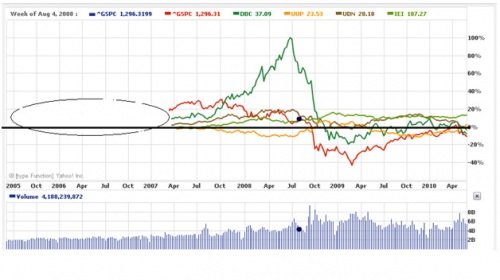
To see how safe (or how risky) your portfolio was over the last few years, it’s useful to view how these asset classes themselves fared over this time period. That is what is shown in the next chart where the following asset class performances over the last few years are shown. The chart shows the performances of stocks (S&P 500 shown by the symbol ^GPSC, in red), bonds (symbol IEI, Barclay’s 3-7 Year Treasury Bond index etf, in light green), Commodities (DBC, Powershares etf, in dark green), Long dollar (UUP, Powershares long dollar etf, in orange; this fund allows speculating on the dollar going up against a basket of important currencies; whenever the world financial markets are in turmoil, this index generally goes up as investors around the world seek the “safe haven” status of the dollar.

Alternately, note that this index value will also typically rise when the domestic economy is in a sound condition and both domestic and international investors favor the U.S. financial markets) and the short dollar (UDN, the Powershares inverse of UUP). Note that the “Cash” asset class has been left out and returns on cash (or money market funds) have been close to zero the whole time.

There are a few startling observations from this period. The first part that arrests the eye is how commodities performed over this time period. If your portfolio was heavy in this sector, you had a heck of a ride these last three years. If you had a lot of stocks as well, heck, your ride just got wilder. As can also be seen from the picture, healthy doses of bonds and currencies would have made your ride that much smoother.

On the other hand, what is additionally startling to observe is that we all started this period close to zero returns in the beginning of 2007 (around March 2007) and in June 2010, we are all converging back to zero returns. No matter how you were diversified, you either took a smooth ride (well diversified portfolio) from a zero return environment to a zero return environment or a wilder ride. That is why diversification is so important. Another way to gauge your diversification benefit is to use a two-pronged system.

The first is what I refer to as the “monthly statement effect”. When your monthly financial statements come in, you first observe the current month’s ending balance, then the previous month’s ending balance and then have a great day, a lousy day or an uneventful day. Depending on how good or bad (how volatile the ride) the monthly effect is, it may last for much more than just a day, maybe days. The second piece is your age.

Life Cycle Investment Hypothesis

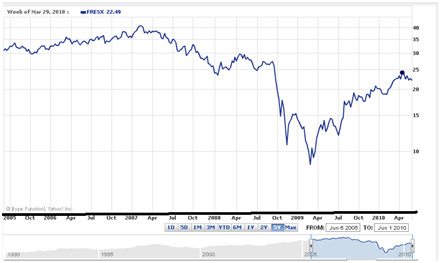
As you grow older, you ask yourself how wild a ride can you tolerate at this point in your life? Hopefully, as you age, this tolerance level should show significant declines. If it does, you are then joining a rational investment group practicing a “lifecycle-investment hypothesis” style. Finally, did anything do well during this time? Yes, and surprisingly from an asset class whose underlying asset is shaped too like a zero – mother earth and real estate. Having some real estate in your investment basket (another important diversification asset) would not only have smoothed your ride but would have made your financial life so much more pleasurable. Just take a look at this picture below (FRESX, an old Fidelity’s real estate index fund) which says it all.

Assessment

Even in the darkest days of falling real estate markets of 2008, this fund produced a positive return. Of course many other real estate indexes lost their bottoms; thus finding these stable indexes in all asset classes are well worth their salt. That is, if it is time for you to diversify.

Conclusion

Your thoughts and comments on this ME-P are appreciated. Feel free to review our top-left column, and top-right sidebar materials, links, URLs and related websites, too. Then, subscribe to the ME-P. It is fast, free and secure.

Speaker: If you need a moderator or speaker for an upcoming event, Dr. David E. Marcinko; MBA – Publisher-in-Chief of the Medical Executive-Post – is available for seminar or speaking engagements. Contact: MarcinkoAdvisors@msn.com

OUR OTHER PRINT BOOKS AND RELATED INFORMATION SOURCES:

Product Details  Product Details

Reflections on a Tent Hospital

Thoughts on Pop-Up Healthcare Facilities

By Dr. David Edward Marcinko; FACFAS, MBA, CMP™

Publisher-in-Chiefdr-david-marcinko13

According to the Philadelphia Inquirer, February 10, 2009, it took Mark Ross about 22 minutes to inflate the hospital for the first time. Yesterday, he did it in 14 minutes. In the event of a large-scale emergency – a direct hit by a hurricane for example, or a plane in the Delaware River [Think Hudson River, NY]  – Ross and other volunteers can have the mobile hospital running anywhere in Southeastern Pennsylvania within two to four hours of the first alert.

The Valley Forge Experiment

The day before, on February 9, in Valley Forge PA, dozens of current and potential volunteers got to see three tan and white tents – and reams of equipment – for the first time. The $1 million cost was paid by state and federal governments. With a portable generator, 50 cots, 130 ventilators, 26 wireless cardiac monitors and 27 patient carts loaded with tongue depressors, eye shields and IV sets, the rapid-response team is intended to fill the 72- hour gap before federal emergency help arrives after a disaster.

Back-in-the-Day

Now, despite this Valley Forge innovation, mobile, semi-permanent and pop-up healthcare facilities are not a new machination in civilian life or non-warfare times. In fact, please allow me to tell you of my canvass tent-hospital experience, back in the late seventies.

My Tent Hospital

At the time, I was completing my training program as a senior attending resident [SAR], and surgical fellow. The “hospital” where I moonlighted was located in a sleepy town about 40 miles North of Atlanta, Ga. Driving there in my lime-green, oil-burning 1969 Chevrolet Impala with balding tires [retreads] was always novel experience.

As I recall history, the tent-hospital began as a private medical clinic in a three bedroom converted brick ranch-house that was the style in the late 1950s’-60s. It was the private practice of a solo practitioner-internist for his rural patients who lived on farms too far from the big city – or for patient’s who mistrusted the medical establishment. There were many. It grew quickly, from the days before Medicare/Medicaid reimbursements, to modernity.

Think Cirque du Soleil

Expanding to a larger facility, with sparse economic resources, necessitated innovative thinking at the time. The hospital itself was a very large circular tent [bulls-eye configuration], built on semi-permanent concrete foundation with trampoline-like floor. The tent was shaped like a disc or sphere. In the center was an operating room for the visiting general surgeon. The next concentric layer was comprised of four rooms. The admissions, records department and triage room; a dirty-room with toilet; a clean room with bed and shower; and a kitchen with doctor/nurse station and lounge. The next third outer concentric layer consisted of about twelve patient “rooms”. The patients entered each room from the inner second layer, while the doctors and nurses opened a door-slot on the outer third layer for the introduction of food, information, gowns and equipment, visitor chit-chat and medications, etc. Each room was muck like a dungeon, jail or cell [Recall the Seinfeld episode where Kramer housed visiting Asians in his cabinet drawer or shelf]. The docs and nurses continually circulated the third outer “floor” layer, ministering to their respective patients. By the way; no staff nurse ever complained of tired feet, leg soreness or calf cramps because of the springy trampoline-like floor.

Not a TV MASH Unit

tent-man

This “hospital” was not like a military MASH unit, at all. It was definitely civilian in nature, purpose and construct:

Think: Army CASH unit; not MASH unit.

CASH = Combat Army Surgical Hospital [semi-permanent].

MASH = Mobile Army Surgical Hospital [ambulatory]  

My Experiences

During my summer working there, I managed a small part-time, two-room medical clinic with a singular nurse. We treated all sort of minor injuries and ills, cuts, scrapes; boils and blisters; aches and sprains; dog bites, bee stings and allergies, and simple closed extremity fractures, infections, etc. I even operated on a half-dozen patients under local anesthesia with conscious sedation. For the holidays, I received presents from several nurses and patients who remembered me from the previous summer.

New Facility

My “tent hospital” was in operation for almost two decades before the founding physician retired. The site was replaced by a publically funded, much larger and permanent “modern” facility, as the surrounding suburbs grew. The new Woodstock Hospital is now a short-term facility, with 21 beds, but is not yet rated by any hospital service agency because of statistically low volume requirements. It is a District Authority owned hospital facility.

Source: Centers for Medicare and Medicaid Services for the years 2005-2007. 

Assessment

Now, here’s the thing. My tent-hospitals’ claim-to-fame was that it, at the time of closure, was the only hospital in the State of Georgia to have never had a hospital acquired [nosocomial] or post-operative infection? To my knowledge, the feat has not been duplicated in this state. Of course, the new facility was not so fortunate. Increased medical acuity, treatment services and a different-mobile patient population was cited as the likely culprit.

Conclusion

And so, your thoughts and comments on this Medical Executive-Post are appreciated. Quality initiatives are good. And, health 2.0 information technology is the future of medicine. But, sometimes, prologue is past.

Speaker: If you need a moderator or speaker for an upcoming event, Dr. David E. Marcinko; MBA – Publisher-in-Chief of the Executive-Post – is available for seminar or speaking engagements. Contact: MarcinkoAdvisors@msn.com  or Bio: www.stpub.com/pubs/authors/MARCINKO.htm

Our Other Print Books and Related Information Sources:

Practice Management: http://www.springerpub.com/prod.aspx?prod_id=23759

Physician Financial Planning: http://www.jbpub.com/catalog/0763745790

Medical Risk Management: http://www.jbpub.com/catalog/9780763733421

Healthcare Organizations: www.HealthcareFinancials.com

Health Administration Terms: www.HealthDictionarySeries.com

Physician Advisors: www.CertifiedMedicalPlanner.com

Subscribe Now: Did you like this Medical Executive-Post, or find it helpful, interesting and informative? Want to get the latest E-Ps delivered to your email box each morning? Just subscribe using the link below. You can unsubscribe at any time. Security is assured.

Link: http://feeds.feedburner.com/HealthcareFinancialsthePostForcxos