ENCORE: How to Interview an Investment Portfolio Manager?

Selection Criteria Critical for Physicians

By Dr. David Edward Marcinko; MBA, CMP™

[Publisher-in-Chief and former certified financial plannerdem2]

Recently in the Atlanta area, two high-profile financial advisors and portfolio investment managers have been charged with client embezzlement, malfeasance, and more!

The first was Kirk Wright, a Harvard-educated fund manager who was convicted last week in a fraud scheme that bilked investors out of tens of millions of dollars.  He later hanged himself, according to the Fulton County Georgia medical examiner’s office.  A federal jury convicted Wright last week on all 47 counts of mail fraud, securities fraud and money laundering stemming from a scam run through his firm, International Management Associates. High-profile clients included sports-stars, celebrities and several well-known local physicians.

The second, Frederick J. Barton, received a Securities and Exchange Commission (SEC) civil action letter on June 3rd, 2008. Barton, formerly a registered representative of a national, registered broker-dealer and two entities he controlled: TwinSpan Capital Management, LLC (TwinSpan), an investment adviser formerly registered with the Commission, and Barton Asset Management, LLC (Barton Asset Management). The Commission alleges that, between 1999 and 2007, Barton, acting individually or through TwinSpan or Barton Asset Management, engaged in three separate securities frauds-including one involving a patient suffering from Alzheimer’s disease-and through his misconduct obtained over $3 million in ill-gotten gains. The Commission further alleges that he then spent his ill-gotten gains, among other things, to send his children to an exclusive private school, fund his own investment portfolio, and service his credit card debts. 

Manager Selection

So, how can the medical professional reduce the potential for similar behavior from his/her portfolio manager?

The first way is to skip the middle-man and “do-it-yourself.” But, doctors are sometimes hard-pressed to following this directive because of time constraints, knowledge paucity, fear/greed and/or disinterest; among other reasons.

The second way, of course, is to outsource the task by hiring a financial advisor. But, how do you find a financial advisor (easy), and more importantly, how do you discern a good fit (personally and professionally)? Still, there is no guarantee of honesty or capability.

But, your odds can be improved with insider knowledge of the financial services industry; a common-theme of the ME-P. And so, the following checklist may be a good place to start the selection, or triage process.  

SAMPLE: Engagement Letter

Mr. Joseph H. Sample

Vice President

Medical Capital Management of Nevada, LLC

RE: Letter to Request Pre-Interview Information from Portfolio Manager

Dear [Mr. Name]:

Thank you for agreeing to meet with us on [date, time] in our office. We are in the process of interviewing several portfolio investment managers.

So that we may obtain consistent information in our evaluation, we would appreciate the coverage of specific areas during your presentation. We are particularly interested in information regarding your approach to investment management in the following areas:

Investment philosophy and approach

• Describe your management style and any changes you have made over the past decade.

• Describe your investment decision-making process.

• Do you make the decisions or do you rely on others, and if so, who?

• Describe your sources of research.

• What contact, if any, do you have with the management of companies in which you invest?

• Briefly describe the sell disciplines employed by you and your firm.

• Describe whether/how you use top-down or bottom-up approaches to investment selection.

• Are you value or growth orientated; hedged or not; domestic or international?

Track record

• Please supply performance data by 5, 10 and 15-year intervals.

• Please supply performance records compared to benchmarks you feel appropriate.

• If balanced management, please provide performance data by asset class.

• Provide MPT or APT statistics such as beta, alpha, standard deviations, etc.

• What are your cash holdings; fully invested or selectively invested at various times?

• Turnover history and number of securities, industries and sectors; are guidelines in place?

• Typical portfolio percentage of largest ten positions.

Firm/advisor background

Please provide us with information regarding your background, including general information about the organization. In particular, please cover:

• The stability of ownership, managers, analysts or others directly involved in management.

• Who makes the investment decisions and how the firm dictates policy to managers?

• A description of expenses, including management fees, commissions, and other expenses.

• A detailed description of the growth of money under management over the past ten years.

• Please discuss the flexibility in design and management of a client’s portfolio by managers.

• If your firm is multidisciplined, what are your areas of expertise?

• Who is the custodian of securities? Does the firm have insurance?

Manager background

Please provide the resume(s) of the manager(s) as well as information about the manager’s style and consistency. Additional items of interest include:

• The manager’s record with other firms, if employed less than ten years.

• How the manager does research, including use of analysts and outside research?

• Regarding the decision process, what steps does the manager actually take?

• Manager’s ownership status in the firm?

• History of asset growth under the specific manager.

• Examples of past successes and failures on investment decisions.

Statistics

Please provide the following statistical information:

• Price/earnings ratios compared to market

• Price/book ratios compared to market

• Average earnings growth data

• Average market cap of companies in portfolio

• Average dividend yield information

• Average maturity and/or duration of fixed-income portfolios (and how this is managed)

• Average credit rating of fixed-income portfolios

• Where short-term funds are invested

Communication

• How often do you provide portfolio and performance reports?

• How do you compare performance to the market? What benchmarks do you use?

• Who will meet with us (and how often)?

• Who is the primary and secondary contact?

• Does the firm provide investment newsletters or promotional literature, with sample?

• Is the portfolio manager(s) available to meet or discuss issues with the client or advisor?

Compliance

• Are you a fiduciary? Will you sign-off as same?

• Are you a stoke-broker or registered representative?

• What securities licenses do you hold?

• Are you independent?

• Who is your broker-dealer?

• Who is your custodian and clearinghouse?

• Are you a RIA or RIA representative?

• May we please see you ADV Parts I, II, III

• May we review a sample investment policy statement?

• May we see your CRD report?

• Must we sign an arbitration clause?

• What educational degrees have earned?

• What financial/securities designation do you hold?

• What peer-reviewed or non-peered reviewed material have you published, and where? 

• What medical specificity do you possess?

• Do you hold the AIF® and/or AIFA® designations, and adhere to its code-of-ethics?

• Are you a [CMP] Certified Medical Planner™?

• Are you a [CFP] Certified Financial Planner™ with health economics knowledge?

• How do/can you demonstrate you specific knowledge on the heath care space?

Thank you.

Dr. Michael B. Sample; MD/DO

Managing Partner – Medical Associates of Nevada, PC  

Assessment

Some financial advisors, insurance agents, portfolio and wealth managers speak of “prospecting”, “hunting” or “screening” clients. In fact, potential doctor-clients are often, not-so-charmingly called, “prospects”.

Don’t you think it’s about time that the “tables-are-turned” by informed medical professionals, as the “hunted-becomes-the-hunter”, by the informed physician? Triage well, and always remember; caveat emptor and vendor emptor!

What other criteria should be included in this engagement letter, or personal interview itself? What has been your experience with portfolio manager selection? How do you select same, and what has been your success rate? Why don’t you do-it-yourself? Please comment and opine.

Conclusion

Your thoughts and comments on this ME-P are appreciated. Feel free to review our top-left column, and top-right sidebar materials, links, URLs and related websites, too. Then, subscribe to the ME-P. It is fast, free and secure.

Speaker: If you need a moderator or speaker for an upcoming event, Dr. David E. Marcinko; MBA – Publisher-in-Chief of the Medical Executive-Post – is available for seminar or speaking engagements. Contact: MarcinkoAdvisors@msn.com

OUR OTHER PRINT BOOKS AND RELATED INFORMATION SOURCES:

Product DetailsProduct DetailsProduct Details

Product Details  Product Details

Thinking Beyond Portfolio Asset Allocation

Join Our Mailing List

Don’t Forget Your Spending Policy – Doctors

By Dr. David Edward Marcinko MBA CMP™

www.CertifiedMedicalPlanner.com

[Publisher-in-Chief]

If you are economically literate – or read the ME-P regularly – you may be tired of hearing the familiar saw, “the single most important determinant of investment results over time is asset allocation.”

But, as most of us realize, this glosses over critical obstacles to building personal wealth—taxes, inflation, and spending policy. A doctor’s spending policy itself is as critical as asset allocation in preserving wealth, as well as for all investors who understand the trade-offs: there are both allocation and spending strategies that stand to preserve wealth and insulate against excessive equity risk at the same time.

Income versus Security

In proving his point a decade ago, the author—Roger Hertog in “Income Versus Security”— traced the growth of a $1 million portfolio during the period of 1960–1994. He showed that while an all-stock portfolio would have experienced a compound growth rate of 10.1%, an all-bond portfolio of 7.4%, and an all T-bill portfolio of 6.1%, these growth rates dropped to 8%, 5%, and 3.7%, respectively, after taxes and conservative transaction costs. When further reduced by inflation, they dropped to 3.1%, 0.2%, and -1%, respectively. Stocks still nearly tripled in real value after taxes.

Next, Hertog factored in spending. He showed that the greater the equity exposure, the more likely investors will preserve or increase their levels of real spending and wealth. Also, he demonstrated how a spending policy of a fixed percentage of the portfolio; or of spending all the income is ill-suited to estate building. He arrived at an optimum allocation of 60% stocks and 40% bonds with a policy of spending all stock dividends but only spending interest to the extent it exceeds inflation. This latter spending policy adjusts for the fact that in – unlike today but perhaps again in the near future – an inflationary environment a portion of bond interest is a return of principal. This type of asset allocation and spending policy resulted in the greatest amount of growth over the years and gained on inflation. Hertog contends that the 60/40 allocation provides an appealing combination of growth and protection.

IOW: It gives investors a milder ride.

Assessment

Over the 35-year period studied, a 60/40 mix returned almost as much as the all-stock portfolio both before taxes and after taxes and achieved some 75% of its real after-tax growth. Also, the portfolio’s worst year was only half as bad as the all-stock portfolio. Hertog believed that balancing with bonds softened the downside. But – what about the “flash-crash” of 2008-09?

Note: “Income Versus Security: Do You Have To Choose?” Roger Hertog, Trust & Estates, March 1997, pp. 44–62, Intertec Publishing Corporation.

Conclusion

And so, your thoughts and comments on this ME-P are appreciated. Is the bull market in bonds over? Do you believe Hertog? Feel free to review our top-left column, and top-right sidebar materials, links, URLs and related websites, too. Then, subscribe to the ME-P. It is fast, free and secure.

Speaker: If you need a moderator or speaker for an upcoming event, Dr. David E. Marcinko; MBA – Publisher-in-Chief of the Medical Executive-Post – is available for seminar or speaking engagements. Contact: MarcinkoAdvisors@msn.com and http://www.springerpub.com/Search/marcinko

Our Other Print Books and Related Information Sources:

Health Dictionary Series: http://www.springerpub.com/Search/marcinko

Practice Management: http://www.springerpub.com/product/9780826105752

Physician Financial Planning: http://www.jbpub.com/catalog/0763745790

Medical Risk Management: http://www.jbpub.com/catalog/9780763733421

Healthcare Organizations: www.HealthcareFinancials.com

Physician Advisors: www.CertifiedMedicalPlanner.com

Subscribe Now: Did you like this Medical Executive-Post, or find it helpful, interesting and informative? Want to get the latest ME-Ps delivered to your email box each morning? Just subscribe using the link below. You can unsubscribe at any time. Security is assured.

Link: http://feeds.feedburner.com/HealthcareFinancialsthePostForcxos

Sponsors Welcomed: And, credible sponsors and like-minded advertisers are always welcomed.

Link: https://healthcarefinancials.wordpress.com/2007/11/11/advertise

Product DetailsProduct DetailsProduct Details

Product Details  Product Details

How [DOCTORS] Construct Investment Portfolios That Protect Them

***

ASK AN ADVISOR

***

Vitaliy N. Katsenelson, CFA - YouTube

By Vitaliy N. Katsenelson, CFA

***

Question: How do you construct investment portfolios and determine position sizes (weights) of individual stocks?

I wanted to discuss this topic for a long time, so here is a very in-depth answer.
CITE: https://www.r2library.com/Resource/Title/082610254

Answer
For a while in the value investing community the number of positions you held was akin to bragging on your manhood– the fewer positions you owned the more macho an investor you were. I remember meeting two investors at a value conference. At the time they had both had “walk on water” streaks of returns. One had a seven-stock portfolio, the other held three stocks. Sadly, the financial crisis humbled both – the three-stock guy suffered irreparable losses and went out of business (losing most of his clients’ money). The other, after living through a few incredibly difficult years and an investor exodus, is running a more diversified portfolio today.

Under-diversification: Is dangerous, because a few mistakes or a visit from Bad Luck may prove to be fatal to the portfolio.

On the other extreme, you have a mutual fund industry where it is common to see portfolios with hundreds of stocks (I am generalizing). There are many reasons for that. Mutual funds have an army of analysts who need to be kept busy; their voices need to be heard; and thus their stock picks need to find their way into the portfolio (there are a lot of internal politics in this portfolio). These portfolios are run against benchmarks; thus their construction starts to resemble Noah’s Ark, bringing on board a few animals (stocks) from each industry. Also, the size of the fund may limit its ability to buy large positions in small companies.

There are several problems with this approach. First, and this is the important one, it breeds indifference: If a 0.5% position doubles or gets halved, it will have little impact on the portfolio. The second problem is that it is difficult to maintain research on all these positions. Yes, a mutual fund will have an army of analysts following each industry, but the portfolio manager is the one making the final buy and sell decisions. Third, the 75th idea is probably not as good as the 30th, especially in an overvalued market where good ideas are scarce.

Then you have index funds. On the surface they are over-diversified, but they don’t suffer from the over-diversification headaches of managed funds. In fact, index funds are both over-diversified and under-diversified. Let’s take the S&P 500 – the most popular of the bunch. It owns the 500 largest companies in the US. You’d think it was a diversified portfolio, right? Well, kind of. The top eight companies account for more than 25% of the index. Also, the construction of the index favors stocks that are usually more expensive or that have recently appreciated (it is market-cap-weighted); thus you are “diversified” across a lot of overvalued stocks.

If you own hundreds of securities that are exposed to the same idiosyncratic risk, then are you really diversified?

Our portfolio construction process is built from a first-principles perspective. If a Martian visited Earth and decided to try his hand at value investing, knowing nothing about common (usually academic) conventions, how would he construct a portfolio?

We want to have a portfolio where we own not too many stocks, so that every decision we make matters – we have both skin and soul in the game in each decision. But we don’t want to own so few that a small number of stocks slipping on a banana will send us into financial ruin.

In our portfolio construction, we are trying to maximize both our IQ and our EQ (emotional quotient). Too few stocks will decapitate our EQ – we won’t be able to sleep well at night, as the relatively large impact of a low-probability risk could have a devastating impact on the portfolio. I wrote about the importance of good sleep before (link here). It’s something we take seriously at IMA.

Holding too many stocks will result in both a low EQ and low IQ. It is very difficult to follow and understand the drivers of the business of hundreds of stocks, therefore a low IQ about individual positions will eventually lead to lower portfolio EQ. When things turn bad, a constant in investing, you won’t intimately know your portfolio – you’ll be surrounded by a lot of (tiny-position) strangers.

Portfolio construction is a very intimate process. It is unique to one’s EQ and IQ. Our typical portfolios have 20–30 stocks. Our “focused” portfolios have 12–15 stocks (they are designed for clients where we represent only a small part of their total wealth). There is nothing magical about these numbers – they are just the Goldilocks levels for us, for our team and our clients. They allow room for bad luck, but at the same time every decision we make matters.

Now let’s discuss position sizing. We determine position sizing through a well-defined quantitative process. The goals of this process are to achieve the following: Shift the portfolio towards higher-quality companies with higher returns. Take emotion out of the portfolio construction process. And finally, insure healthy diversification.

Our research process is very qualitative: We read annual reports, talk to competitors and ex-employees, build financial models, and debate stocks among ourselves and our research network. In our valuation analysis we try to kill the business – come up with worst-case fair value (where a company slips on multiple bananas) and reasonable fair value. We also assign a quality rating to each company in the portfolio. Quality is absolute for us – we don’t allow low-quality companies in, no matter how attractive the valuation is (though that doesn’t mean we don’t occasionally misjudge a company’s quality).

The same company, at different stock prices, will merit a higher or lower position size. In other words, if company A is worth (fair value) $100, at $60 it will be a 3% position and at $40 it will be a 5% position. Company B, of a lower quality than A but also worth $100, will be a 2% position at $60 and a 4% position at $40 (I just made up these numbers for illustration purposes). In other words, if there are two companies that have similar expected returns, but one is of higher quality than the other, our system will automatically allocate a larger percentage of the portfolio to the higher-quality company. If you repeat this exercise on a large number of stocks, you cannot but help to shift your portfolio to higher-quality, higher-return stocks. It’s a system of meritocracy where we marry quality and return.

Let’s talk about diversification. We don’t go out of our way to diversify the portfolio. At least, not in a traditional sense. We are not going to allocate 7% to mining stocks because that is the allocation in the index or they are negatively correlated to soft drink companies. (We don’t own either and are not sure if the above statement is even true, but you get the point.) We try to assemble a portfolio of high-quality companies that are attractively priced, whose businesses march to different drummers and are not impacted by the same risks.  Just as bank robbers rob banks because that is where the money is, value investors gravitate towards sectors where the value is. To keep our excitement (our emotions) in check, and to make sure we are not overexposed to a single industry, we set hard limits of industry exposure. These limits range from 10%–20%. We also set limits of country exposure, ranging from 7%–30% (ex-US).

CONCLUSION

In portfolio construction, our goal is not to limit the volatility of the portfolio but to reduce true risk – the permanent loss of capital. We are constantly thinking about the types of risks we are taking. Do we have too much exposure to a weaker or stronger dollar? To higher or lower interest rates? Do we have too much exposure to federal government spending? I know, risk is a four-letter word that has lost its meaning. But not to us. Low interest rates may have time-shifted risk into the future, but they haven’t cured it.

***

COMMENTS APPRECIATED

Thank You

Subscribe to the Medical Executive-Post

***

***

Risk Aversion and Investment Alternatives

Join Our Mailing List

Understanding Financial Tolerance in the New Era

[By Dr. David E. Marcinko MBA and Staff Reporters]

Some physicians and financial planners prefer to use a specific approach in determining these difficult-to-determine areas, in lieu of one of several psychological tests that are currently available.

Examples of this specific approach follow.

Investment Temperament

Which statement best describes your investment temperament? Please indicate by ranking the items below from 1 to 4, with 1 being the most descriptive and 4 being the least descriptive. Also, please indicate the extent of your risk aversion by indicating what percentage of your assets you would feel comfortable investing in each category (for example, 50% in the first category, 25% in the second, etc.).

***

Numerical   Percentage  
ranking   allocation  
* I prefer only the safest of investments.
* I am interested only in “blue-chip” investments.
* An occasional risk is worth the effort for above-average potential reward.
* I’m willing to put everything on the line if the potential reward is large enough.

Listed below are various forms of investments. Please indicate your familiarity with each.

  Familiarity
Description High   Low
Certificates of deposit 5 4 3 2 1
Treasury bills 5 4 3 2 1
Other short-term fixed income 5 4 3 2 1
Stocks 5 4 3 2 1
U.S. government bonds 5 4 3 2 1
Corporate bonds 5 4 3 2 1
Municipal bonds 5 4 3 2 1
Mutual funds 5 4 3 2 1
Real estate—direct ownership 5 4 3 2 1
Real estate—limited partnerships 5 4 3 2 1
Oil and gas 5 4 3 2 1
Collectibles 5 4 3 2 1
Precious metals 5 4 3 2 1
Insurance products 5 4 3 2 1

Assessment

Any other thoughts on behavioral finance topics, like this?

Conclusion

Your thoughts and comments on this ME-P are appreciated. Feel free to review our top-left column, and top-right sidebar materials, links, URLs and related websites, too. Then, subscribe to the ME-P. It is fast, free and secure.

Link: http://feeds.feedburner.com/HealthcareFinancialsthePostForcxos

Speaker: If you need a moderator or speaker for an upcoming event, Dr. David E. Marcinko; MBA – Publisher-in-Chief of the Medical Executive-Post – is available for seminar or speaking engagements. Contact: MarcinkoAdvisors@msn.com

OUR OTHER PRINT BOOKS AND RELATED INFORMATION SOURCES:

DICTIONARIES: http://www.springerpub.com/Search/marcinko
PHYSICIANS: www.MedicalBusinessAdvisors.com
PRACTICES: www.BusinessofMedicalPractice.com
HOSPITALS: http://www.crcpress.com/product/isbn/9781466558731
CLINICS: http://www.crcpress.com/product/isbn/9781439879900
BLOG: www.MedicalExecutivePost.com
FINANCE: Financial Planning for Physicians and Advisors
INSURANCE: Risk Management and Insurance Strategies for Physicians and Advisors

Product Details  Product Details

Risk Management, Liability Insurance, and Asset Protection Strategies for Doctors and Advisors: Best Practices from Leading Consultants and Certified Medical Planners™8Comprehensive Financial Planning Strategies for Doctors and Advisors: Best Practices from Leading Consultants and Certified Medical Planners™

On New Issues and Securities Stabilization

Join Our Mailing List

A Primer for Physician Investors and Medical Professionals

By: Dr. David Edward Marcinko; MBA, CMP™

[Editor-in-Chief] http://www.CertifiedMedicalPlanner.org

[PART 3 OF 8]

NEU Dr. Marcinko

NOTE: This is an eight part ME-P series based on a weekend lecture I gave more than a decade ago to an interested group of graduate, business and medical school students. The material is a bit dated and some facts and specifics may have changed since then. But, the overall thought-leadership information of the essay remains interesting and informative. We trust you will enjoy it.

Introduction

Some securities issues move very well, like traditional blue chips stocks (ie., Wallgreen). Some are dogs, like smaller dot.com companies (iixl.com). Then, there are issues that are former darling, but are now ice cold; like PPMCs (i.e., Phycor) and internet stocks (i.e., Dr. Koop).  How far can an underwriting manager go in nudging along an issue that’s not selling well? SEC rules do permit a certain amount of help by the manager, even if this takes on the appearance of price-fixing. This help is called stabilizing the issue.

Simply put, if shortly after a new offering begins, supply exceeds demand, there will be downward pressure on the price. But, the law requires that all purchasers of the new issue pay the official offering price on the prospectus. If public holders of the stock become willing to bail out and accept a low selling price, the investor looking to buy will find he is able to buy stock of the issuer cheaper in the open market than buying it new from the syndicate members.

To prevent such a decline in the price of a security during a public offering, SEC rules permit the manager to offer to buy shares in \ the open market at a bid price at, or just below, the official offering price of the new issue. This is referred to as stabilizing and his bid price is called the stabilizing bid. There is always the risk, in a firm commitment underwriting, that the underwriters will have difficulty selling the new issue. What they can’t sell, they’re “stuck” with. That’s where the term “sticky issue” comes from.

As a physician executive, or potential investor in a new issue, be aware that the best way to get an issue to sell is to increase the compensation to the sales force (i.e., stock broker or Registered Rep).

Another choice is through stabilization. Stabilizing is a permitted form of market manipulation which tends to protect underwriters against loss. It allows the underwriting syndicate (usually through the efforts of the syndicate manager) to stabilize (peg or fix) the secondary market trading price in a new issue at the published public offering price. It works something like this.

When a new issue is selling slowly, some of the investors who initially purchased, may be dissatisfied with the performance of the stock (if it is selling slowly and the underwriters have plenty to sell at the public offering price, this is anything but a hot issue and the security price will not have risen).

This dissatisfaction with performance leads to these investors desiring to sell the securities they have just purchased. If the underwriters are unable to sell at the public offering price, certainly an individual investor will have to take less when bailing out. As market makers begin to trade the stock in the secondary market, they would only be able to compete with the underwriters by offering the stock at a lower price than the public offering  price. This would make it difficult (if not impossible) for the underwriters to distribute the remaining new shares.

In order to prevent this from happening, the managing underwriter (who is usually the one to assume the role of stabilizing underwriter), agrees to purchase back any of the new shares at or just slightly below the public offering price. That is a higher price than any market maker could, in all practicality, bid for the shares. When the shares are repurchased by the stabilizing underwriter, it is as if the initial trade were annulled and never took place so that these new shares are now placed back into the distribution and are sold as new shares at the public offering price. SEC rules do, however, require disclosure of this practice.

Therefore, no syndicate manager may engage in stabilizing unless the following phrase appears in bold print on the inside front cover page of the prospectus:

IN CONNECTION WITH THIS OFFERING, THE UNDERWRITERS MAY OVER ALLOT OR EFFECT TRANSACTIONS WHICH STABILIZE OR MAINTAIN THE MARKET PRICE OF (XYZ COMPANY) AT A LEVEL ABOVE THAT WHICH MIGHT OTHERWISE PREVAIL IN THE OPEN MARKET. SUCH TRANSACTIONS MAY BE EFFECTED ON (NYSE) STABILIZING, IF COMMENCED, MAY BE DISCONTINUED AT ANY TIME.

Of course, it would be manipulation and, therefore, a violation of law, if this “price-pegging” activity continued after the entire new issue was sold out. This activity costs the syndicate manager money which is recouped by levying a syndicate penalty bid against those members of the syndicate whose clients turn shares in on a stabilizing bid.

One way to avoid stabilization is to over allot  to each of the syndicate members. This is the same concept as “over booking” that’s done by the airlines. Most airlines typically sell 5% to 10% more seats than the airplane has knowing that there will be last minute cancellations and no shows. This tends to ensure that the plan will fly full. In the same manner, managing under-writers frequently over allot an additional 10% to each of their syndicate members so that last minute cancellations should still leave the syndicate with sell orders for 100% of the issue. If there are no “drop outs”, one of two things may happen.

  1. The issuer will issue the additional shares (which results in it raising more money).
  2. The issuer will not issue the additional shares and the syndicate will have to go short. Any losses suffered by the syndicate through taking of this short position are shared proportionately by the syndicate members.

Now, what if market conditions and the fervor surrounding a new issue like e-commerce company Ariba,  in 1999, remain so that the issue doesn’t cool down during the cooling off period? Such hot issues are a mixed blessing to be sure.

On the one hand, the issue is a sure sell-out. On the other hand, just how many healthcare investors are going to be told by brokers that additional shares can not be obtained.

Furthermore, the SEC and the NASD/FINRA are vigorous [or should be] in their scrutiny of  proper distribution channels for hot issues. Just what is a “proper” distribution?  It can be summed up in one sentence. Member firms have an obligation to make a “bona fide” public distribution of all the shares at the public offering price. The key to this rule lies within the definition of bona fide public distribution.

While the underwriting procedures for corporate bonds are almost identical to corporate stock, there are significant differences in the underwriting of municipal securities. Municipal securities are exempt from the registration filing requirements or the Securities Act of 1933. A state or local government, in the issuance of municipal securities, is not required to register the offering with the SEC, so there is no filing of a registration statement and there is no prospectus which would otherwise have to be given to investors.

###

  Risk Management, Liability Insurance, and Asset Protection Strategies for Doctors and Advisors: Best Practices from Leading Consultants and Certified Medical Planners™8Comprehensive Financial Planning Strategies for Doctors and Advisors: Best Practices from Leading Consultants and Certified Medical Planners™

###

Municipal Underwriting

There are two main methods of financing when it comes to municipal securities. One method is known as negotiated. In the case of a negotiated sale, the municipality looking to borrow money would approach an investment bank and negotiate the terms of the offering directly with the firm. This is really not very different from the above equity discussions.

The other type of municipal underwriting is known as competitive bidding. Under the terms of competitive bidding, an issuer announces that it wishes to borrow money and is looking for syndicates to submit competitive bids. The issue will then be sold to the syndicate which submits the best bid, resulting in the municipality having the lowest net interest cost (lowest expense to the issuer).

If the issue is to be done by a competitive bid, the municipality will use a Notice of Sale to announce that fact. The notice of sale will generally include most or all of the following information.

  • Date, time, and place. This does not mean when the bonds will be sold to the public, but when the issue will be awarded (sold) to the syndicate issuing the bid.
  • Description of the issue and the manner in which the bid is to be made (sealed bid or oral). Type of bond (general obligation, revenue, etc.)
  • Semi-annual interest payment dates and the denominations in which the bonds will be printed.
  • Amount of good faith deposit required, if any.
  • Name of the law firm providing the legal opinion and where to acquire a bid form.
  • The basis upon which the bid will  e awarded, generally the lowest net interest cost.

Since municipal securities are not registered with the SEC, the municipality must hire a law firm in order to make sure that they are issuing the securities in compliance with all state, local and federal laws. This is known as the bond attorney, or independent bond counsel. Some functions are included below:

    1. Establishes the exemption from federal income tax by verifying  requirements for the exemption.
    2. Determines proper authority for the bond issuance.
    3. Identifies and monitors proper issuance procedures.
    4. Examines the physical bond  ertificates to make sure that they are proper
    5. Issues the debt and a legal opinion, since municipal bonds are the only securities that require an opinion.
    6. Does not prepare the official statement.

When medical investors purchase new issue municipal securities from syndicate or selling group members, there is no prospectus to be delivered to investors, but there is a document which is provided to purchasers very similar in nature to a prospectus. It is known as an Official Statement. The Official Statement contains all of the information an investor needs to make a prudent decision regarding a proposed municipal bond purchase.

The formation of a municipal underwriting syndicate is very similar to that for a corporate  issue. When there is a negotiated underwriting, an Agreement Among Underwriters (AAU) is used. When the issue is competitive bid, the agreement is known as a Syndicate Letter. In the syndicate letter, the managing underwriter details all of the underwriting agreements among members of the syndicate. Eastern (undivided) and Western (divided) accounts are also used, but there are  several different types of orders in a municipal underwriting. The traditional types of orders, in priority order, are:

Pre-Sale Order: Made before the syndicate actually offers the bonds. They have first priority over any other order turned in.

Syndicate (group net) Order: Made once the offering is under way at the public offering price. The purchase is credited to each syndicate member in proportion to its allotment. An institutional buyer will frequently purchase” group net”, since many of the firms in the syndicate may consider this buyer to be their client and he wishes to please all of them.

Designated Order: Sales to medical investors (usually healthcare institutions) at the public offering price where the investor designates which member or members of the syndicate are to be given credit.

Member Orders: Purchased  by members of  the syndicate at the take-down price (spread). The syndicate member keeps the full take-down if the bonds are sold to investors, or earns the take-down less the concession if the sale is made to a member of the selling group. Should the offering be over-subscribed, and the demand for the new bonds exceeds the supply, the first orders to be filled are the pre-sale orders. Those are followed by the syndicate (sometimes called group net) orders, the designated orders, and the last orders filled are the member’s.

Finally, be aware that the term bond scale, is a listing of coupon rates, maturity dates, and yield or price at which the syndicate is re-offering the bonds to the public. The scale is usually found in the center of a tombstone ad and on the front cover of the official statement.

One of the reasons why the word “scale” is used is, that like the scale on a piano, it normally goes up. A regular or positive scale is one in which the yield to maturity is lowest on the near term maturities and highest on the long term maturities. This is also known as a positive yield curve, since the longer the maturity, the higher the yield. In times of very tight money, such as in 1980-81, one might find a bond offering with a negative scale.

A negative (sometimes called inverted) scale is just the opposite of a positive one, with, yields on the short term maturities are higher than those on the long term maturities.

Your thoughts and comments on this ME-P are appreciated. Feel free to review our top-left column, and top-right sidebar materials, links, URLs and related websites, too. Then, subscribe to the ME-P. It is fast, free and secure.

Link: http://feeds.feedburner.com/HealthcareFinancialsthePostForcxos

Speaker: If you need a moderator or speaker for an upcoming event, Dr. David E. Marcinko; MBA – Publisher-in-Chief of the Medical Executive-Post – is available for seminar or speaking engagements. Contact: MarcinkoAdvisors@msn.com

OUR OTHER PRINT BOOKS AND RELATED INFORMATION SOURCES:

LEXICONS: http://www.springerpub.com/Search/marcinko

PHYSICIANS: www.MedicalBusinessAdvisors.com

PRACTICES: www.BusinessofMedicalPractice.com

HOSPITALS: http://www.crcpress.com/product/isbn/9781466558731

CLINICS: http://www.crcpress.com/product/isbn/9781439879900

ADVISORS: www.CertifiedMedicalPlanner.org

BLOG: www.MedicalExecutivePost.com

Product DetailsProduct DetailsProduct Details

Product Details  Product Details

Product DetailsProduct Details

Product Details

How to Buy Securities On Margin

Join Our Mailing List

How It Works and What Physicians’ Must Watch Out For

 Dr. David Edward Marcinko MBA CMP

“Buying on margin” is borrowing money from your stock-broker to buy a stock and using your investment as collateral. Physician-investors generally use margin to increase their purchasing power so that they can own more stock without fully paying for it. But, margin exposes all investors to the potential for higher losses.

This ME-P discusses the basics of buying on margin, some of the pitfalls inherent in margin buying, whether this financial tool is for you and how you can best use it.

How Does Margin Work?

Let’s say you buy a stock for $50 and the price of the stock rises to $75. If you bought the stock in a cash account and paid for it in full, you’ll earn a 50 percent return on your investment. But, if you bought the stock on margin – paying $25 in cash and borrowing $25 from your broker – you’ll earn a 100 percent return on the money you invested. Of course, you’ll still owe your brokerage $25 plus interest.

The downside to using margin is that if the stock price decreases, substantial losses can mount quickly. For example, let’s say the stock you bought for $50 falls to $25. If you fully paid for the stock, you’ll lose 50% of your money. But if you bought on margin, you’ll lose 100%, and you still must come up with the interest you owe on the loan.

Caution: In volatile markets, investors who put up an initial margin payment for a stock may, from time to time, be required to provide additional cash if the price of the stock falls. Investors have been shocked to learn that a broker has the right to sell the securities that were bought on margin – without any notification, and at a potentially substantial loss to the investor.

Caution: If your broker sells your stock after the price has plummeted, then you’ve lost out on the chance to recoup your losses if the market bounces back.

The Risks

Margin accounts can be very risky and they are not for everyone. Before opening a margin account, be aware that:

  • You can lose more money than you have invested;
  • You may have to deposit additional cash or securities in your account on short notice to cover market losses;
  • You may be forced to sell some or all of your securities when falling stock prices reduce the value of your securities; and
  • Your brokerage firm may sell some or all of your securities without consulting you to pay off the loan it made to you.

You can protect yourself by knowing how a margin account works and what happens if the price of the stock purchased on margin declines.

Tip: Your broker charges you interest for borrowing money; take into account how that will affect the total return on your investments.

Tip: Ask your broker whether it makes sense for you to trade on margin in light of your financial resources, investment objectives, and tolerance for risk.

Read Your Margin Agreement

To open a margin account, you must sign a margin agreement. The agreement may either be part of your account agreement or separate. The margin agreement states that you must abide by the rules of the Federal Reserve Board, the New York Stock Exchange, the National Association of Securities Dealers, Inc., and the firm where you have set up your margin account.

Caution: Carefully review the agreement before signing.

As with most loans, the margin agreement explains the terms and conditions of the margin account. The agreement describes how the interest on the loan is calculated, how you are responsible for repaying the loan, and how the securities you purchase serve as collateral for the loan. Carefully review the agreement to determine what notice, if any, your firm must give you before selling your securities to collect the money you have borrowed.

***

margin risk

***

Know the Margin Rules

The Federal Reserve Board and many self-regulatory organizations (SROs), such as the NYSE and NASD, have rules that govern margin trading. Brokerage firms can establish their own requirements as long as they are at least as restrictive as the Federal Reserve Board and SRO rules.

Here are some of the key rules you should know:

Before You Trade – Minimum Margin. Before trading on margin, the NYSE and NASD, for example, require you to deposit with your brokerage firm a minimum of $2,000 or 100 percent of the purchase price, whichever is less. This is known as the “minimum margin.” Some firms may require you to deposit more than $2,000.

Amount You Can Borrow – Initial Margin. According to Regulation T of the Federal Reserve Board, you may borrow up to 50 percent of the purchase price of securities that can be purchased on margin. This is known as the “initial margin.” Some firms require you to deposit more than 50 percent of the purchase price.

Tip: Not all securities can be purchased on margin.

Amount You Need After You Trade – Maintenance Margin. After you buy stock on margin, the NYSE and NASD require you to keep a minimum amount of equity in your margin account. The equity in your account is the value of your securities less how much you owe to your brokerage firm. The rules require you to have at least 25 percent of the total market value of the securities in your margin account at all times. The 25 percent is called the “maintenance requirement.” In fact, many brokerage firms have higher maintenance requirements, typically between 30 to 40 percent and sometimes higher, depending on the type of stock purchased.

Example: You purchase $16,000 worth of securities by borrowing $8,000 from your firm and paying $8,000 in cash or securities. If the market value of the securities drops to $12,000, the equity in your account will fall to $4,000 ($12,000 – $8,000 = $4,000). If your firm has a 25 percent maintenance requirement, you must have $3,000 in equity in your account (25 percent of $12,000 = $3,000). In this case, you do have enough equity because the $4,000 in equity in your account is greater than the $3,000 maintenance requirement.

But, if your firm has a maintenance requirement of 40%, you would not have enough equity. The firm would require you to have $4,800 in equity (40% of $12,000 = $4,800). Your $4,000 in equity is less than the firm’s $4,800 maintenance requirement. As a result, the firm may issue you a “margin call,” since the equity in your account has fallen $800 below the firm’s maintenance requirement.

Margin Calls

If your account falls below the firm’s maintenance requirement, your broker generally will make a margin call to ask you to deposit more cash or securities into your account. If you are unable to meet the margin call, your firm will sell your securities to increase the equity in your account up to or above the firm’s maintenance requirement.

Tip: Your broker may not be required to make a margin call or otherwise tell you that your account has fallen below the firm’s maintenance requirement. Your broker may be able to sell your securities at any time without consulting you first. Under most margin agreements, even if your firm offers to give you time to increase the equity in your account, it can sell your securities without waiting for you to meet the margin call.

  • Margin accounts involve a great deal more risk than cash accounts, where you fully pay for the securities you purchase. You may lose more than your initial investment when buying on margin. If you cannot afford to do so, then margin buying is not for you.
  • Read the margin agreement, and ask your broker questions about how a margin account works and whether it’s appropriate for you to trade on margin. Your broker should explain the terms and conditions of the margin agreement.
  • Know how much you will be charged on money you borrow from your broker, and know how these costs affect your overall return.
  • Remember that your brokerage firm can sell your securities without notice to you when you don’t have sufficient equity in your margin account.

More:

Channel Surfing the ME-P

Have you visited our other topic channels? Established to facilitate idea exchange and link our community together, the value of these topics is dependent upon your input. Please take a minute to visit. And, to prevent that annoying spam, we ask that you register. It is fast, free and secure.

???????????????????????????????????????

Conclusion

Your thoughts and comments on this ME-P are appreciated. Feel free to review our top-left column, and top-right sidebar materials, links, URLs and related websites, too. Then, subscribe to the ME-P. It is fast, free and secure.

Speaker: If you need a moderator or speaker for an upcoming event, Dr. David E. Marcinko; MBA – Publisher-in-Chief of the Medical Executive-Post – is available for seminar or speaking engagements. Contact: MarcinkoAdvisors@msn.com

OUR OTHER PRINT BOOKS AND RELATED INFORMATION SOURCES:

Comprehensive Financial Planning Strategies for Doctors and Advisors: Best Practices from Leading Consultants and Certified Medical Planners(TM)

***Invite Dr. Marcinko

(((* 8

RECAST: An Interview with Fiduciary Bennett Aikin AIF®

On Financial Fiduciary Accountability

[By Dr. David E. Marcinko MBA CMP™]

[By Ann Miller; RN, MHA]

Currently, there is a growing dilemma in the financial sales and services industry. It goes something like this:

  • What is a financial fiduciary?
  • Who is a financial fiduciary?
  • How can I tell if my financial advisor is a fiduciary?

Now, in as much as this controversy affects laymen and physician-investors alike, we went right to the source for up-to-date information regarding this often contentious topic, for an email interview and Q-A session, with Ben Aikin.ben-aikin

About Bennett Aikin AIF® and fi360.com

Bennett [Ben] Aikin is the Communications Coordinator for fi360.com. He oversees all communications for fi360. His responsibilities include messaging, brand management, copyrights and trademarks, and publications. Mr. Aikin received his BA in English from Virginia Tech in 2003 and is currently an MS candidate in Journalism from Ohio University.

Q. Medical Executive Post 

You have been very helpful and gracious to us. So, let’s get right to it, Ben. In the view of many; attorneys, doctors, CPAs and the clergy are fiduciaries; most all others who retain this title seem poseurs; sans documentation otherwise.

A. Mr. Aikin

You are correct. Attorneys, doctors and clergy are the prototype fiduciaries. They have a clear duty to put the best interests of their clients, patients, congregation, etc., above their own. [The duty of a CPA isn’t as clear to me, although I believe you are correct]. Furthermore, this is one of the first topics we address in our AIF training programs, and what we call the difference between a profession and an industry.  The three professions you name have three common characteristics that elevate them from an industry to a profession:

  1. Recognized body of knowledge
  2. Society depends upon practitioners to provide trustworthy advice
  3. Code of conduct that places the clients’ best interests first

Q. Medical Executive Post 

It seems that Certified Financial Planner®, Chartered Financial Analysts, Registered Investment Advisors and their representatives, Registered Representative [stock-brokers] and AIF® holders, etc, are not really financial fiduciaries, either by legal statute or organizational charter. Are we correct, or not? Of course, we are not talking ethics or morality here. That’s for the theologians to discuss.

A. Mr. Aikin

One of the reasons for the “alphabet soup”, as you put it in one of your white papers [books, dictionaries and posts] on financial designations, is that while there is a large body of knowledge, there is no one recognized body of knowledge that one must acquire to enter the financial services industry.  The different designations serve to provide a distinguisher for how much and what parts of that body of knowledge you do possess.  However, being a fiduciary is exclusively a matter of function. 

In other words, regardless of what designations are held, there are five things that will make one a fiduciary in a given relationship:

  1. You are “named” in plan or trust documents; the appointment can be by “name” or by “title,” such as CFO or Head of Human Resources
  2. You are serving as a trustee; often times this applies to directed trustees as well
  3. Your function or role equates to a professional providing comprehensive and continuous investment advice
  4. You have discretion to buy or sell investable assets
  5. You are a corporate officer or director who has authority to appoint other fiduciaries

So, if you are a fiduciary according to one of these definitions, you can be held accountable for a breach in fiduciary duty, regardless of any expertise you do, or do not have. This underscores the critical nature of understanding the fiduciary standard and delegating certain duties to qualified “professionals” who can fulfill the parts of the process that a non-qualified fiduciary cannot.

Q. Medical Executive Post 

How about some of the specific designations mentioned on our site, and elsewhere. I believe that you may be familiar with the well-known financial planner, Ed Morrow, who often opines that there are more than 98 of these “designations”? In fact, he is the founder of the Registered Financial Consultants [RFC] designation. And, he wrote a Foreword for one of our e-books; back-in-the-day. His son, an attorney, also wrote as a tax expert for us, as well. So, what gives?

A. Mr. Aikin

As for the specific designations you list above, and elsewhere, they each signify something different that may, or may not, lend itself to being a fiduciary: For example:

• CFP®: The act of financial planning does very much imply fiduciary responsibility.  And, the recently updated CFP® rules of conduct does now include a fiduciary mandate:

• 1.4 A certificant shall at all times place the interest of the client ahead of his or her own. When the certificant provides financial planning or material elements of the financial planning process, the certificant owes to the client the duty of care of a fiduciary as defined by CFP Board. [from http://www.cfp.net/Downloads/2008Standards.pdf]

•  CFA: Very dependent on what work the individual is doing.  Their code of ethics does have a provision to place the interests of clients above their own and their Standards of Practice handbook makes clear that when they are working in a fiduciary capacity that they understand and abide by the legally mandated fiduciary standard.

• FA [Financial Advisor]: This is a generic term that you may find being used by a non-fiduciary, such as a broker, or a fiduciary, such as an RIA.

• RIA: Are fiduciaries.  Registered Investment Advisors are registered with the SEC and have obligations under the Investment Advisers Act of 1940 to provide services that meet a fiduciary standard of care.

• RR: Registered Reps, or stock-brokers, are not fiduciaries if they are doing what they are supposed to be doing.  If they give investment advice that crosses the line into “comprehensive and continuous investment advice” (see above), their function would make them a fiduciary and they would be subject to meeting a fiduciary standard in that advice (even though they may not be properly registered to give advice as an RIA).

• AIF designees: Have received training on a process that meets, and in some places exceeds, the fiduciary standard of care.  We do not require an AIF® to always function as a fiduciary. For example, we allow registered reps to gain and use the AIF® designation. In many cases, AIF designees are acting as fiduciaries, and the designation is an indicator that they have the full understanding of what that really means in terms of the level of service they provide.  We do expect our designees to clearly disclose whether they accept fiduciary responsibility for their services or not and advocate such disclosure for all financial service representatives.

Q. Medical Executive Post 

Your website, http://www.fi360.com, seems to suggest, for example, that banks/bankers are fiduciaries. We have found this not to be the case, of course, as they work for the best interests of the bank and stockholders. What definitional understanding are we missing?

A. Mr. Aikin

Banks cannot generally be considered fiduciaries.  Again, it is a matter of function. A bank may be a named trustee, in which case a fiduciary standard would generally apply.  Banks that sell products are doing so according to their governing regulations and are “prudent experts” under ERISA, but not necessarily held to a fiduciary standard in any broader sense.

Q. Medical Executive Post 

And so, how do we rectify the [seemingly intentional] industry obfuscation on this topic. We mean, our readers, subscribers, book and dictionary purchasers, clients and colleagues are all confused on this topic. The recent financial meltdown only stresses the importance of understanding same.

For example, everyone in the industry seems to say they are the “f” word. But, our outreach efforts to contact traditional “financial services” industry pundits, CFP® practitioners and other certification organizations are continually met with resounding silence; or worse yet; they offer an abundance of parsed words and obfuscation but no confirming paperwork, or deep subject-matter knowledge as you have kindly done. We get the impression that some FAs honesty do-not have a clue; while others are intentionally vague.

A. Mr. Aikin

All of the evidence you cite is correct.  But that does not mean it is impossible to find an investment advisor who will manage to a fiduciary standard of care and acknowledge the same. The best way to rectify confusion as it pertains to choosing appropriate investment professionals is to get fiduciary status acknowledged in writing and go over with them all of the necessary steps in a fiduciary process to ensure they are being fulfilled. There also are great resources out there for understanding the fiduciary process and for choosing professionals, such as the Department of Labor, the SEC, FINRA, the AICPA’s Personal Financial Planning division, the Financial Planning Association, and, of course, Fiduciary360.

We realize the confusion this must cause to those coming from the health care arena, where MD/DO clearly defines the individual in question; as do other degrees [optometrist, clinical psychologist, podiatrist, etc] and medical designations [fellow, board certification, etc.]. But, unfortunately, it is the state of the financial services industry as it stands now.

Q. Medical Executive Post 

It is as confusing for the medical community, as it is for the lay community. And, after some research, we believe retail financial services industry participants are also confused. So, what is the bottom line?

A. Mr. Aikin

The bottom line is that lay, physician and all clients have a right to expect and demand a fiduciary standard of care in the managing of investments. And, there are qualified professionals out there who are providing those services.  Again, the best way to ensure you are getting it is to have fiduciary status acknowledged in writing, and go over the necessary steps in a fiduciary process with them to ensure it is being fulfilled.

Q. Medical Executive Post 

The “parole-evidence” rule, of contract law, applies, right? In dealing with medical liability situations, the medics and malpractice attorneys have a rule: “if it wasn’t written down, it didn’t happen.”  

A. Mr. Aikin

An engagement contract accepting fiduciary status should trump a subsequent attempt to claim the fiduciary standard didn’t apply. But, to reiterate an earlier point, if someone acts in one of the five functional fiduciary roles, they are a fiduciary whether they choose to acknowledge it or not.  I have attached a sample acknowledgement of fiduciary status letter with copies of our handbook, which details the fiduciary process we instruct in our programs, and our SAFE, which is basically a checklist that a fiduciary should be able to answer “Yes” to every question to ensure the entire fiduciary process is being covered.

Q. Medical Executive Post 

It is curious that you mention checklists. We have a post arguing that very theme for doctors and hospitals as they pursue their medial error reduction, and quality improvement, endeavors. And, we applaud your integrity, and wish only for clarification on this simple fiduciary query?

A. Mr. Aikin

Simple definition: A fiduciary is someone who is managing the assets of another person and stands in a special relationship of trust, confidence, and/or legal responsibility.

Q. Medical Executive Post 

Who is a financial fiduciary and what, if any, financial designation indicates same?

A. Mr. Aikin

Functional definition: See above for the five items that make you a fiduciary.

Financial designations that unequivocally indicate fiduciary duty: Short answer is none, only function can determine who is a fiduciary. 

Q. Medical Executive Post 

Please repeat that?

A. Mr. Aikin

Financial designations that indicate fiduciary duty: none. It is the function that determines who is a fiduciary.  Now, having said that, the CFP® certification comes close by demanding their certificants who are engaged in financial planning do so to a fiduciary standard. Similarly, other designations may certify the holder’s ability to perform a role that would be held to a fiduciary standard of care.  The point is that you are owed a fiduciary standard of care when you engage a professional to fill that role or they functionally become one.  And, if you engage a professional to fill a non-fiduciary role, they will not be held to a fiduciary standard simply because they have a particular designation.  One of the purposes the designations serve is to inform you what roles the designation holder is capable of fulfilling.

It is also worth keeping in mind that just being a fiduciary doesn’t equate to a full knowledge of the fiduciary standard. The AIF® designation indicates having been fully trained on the standard.

Q. Medical Executive Post 

Yes, your website mentions something about fiduciaries that are not aware of same! How can this be? Since our business model mimics a medical model, isn’t that like saying “the doctor doesn’t know he is doctor?” Very specious, with all due respect!

A. Mr. Aikin

I think it is first important to note that this statement is referring not just to investment professionals.  Part of the audience fi360 serves is investment stewards, the non-professionals who, due to facts and circumstances, still owe a fiduciary duty to another.  Examples of this include investment committee members, trustees to a foundation, small business owners who start 401k plans, etc.  This is a group of non-sophisticated investors who may not be aware of the full array of responsibilities they have. 

However, even on the professional side I believe the statement isn’t as absurd as it sounds.  This is basically a protection from both ignorant and unscrupulous professionals.  Imagine a registered representative who, either through ignorance or design, begins offering comprehensive and continuous investment advice.  Though they may deny or be unaware of the fact, they have opened themselves up to fiduciary liability. 

Q. Medical Executive Post 

Please clarify the use of arbitration clauses in brokerage account contracts for us. Do these disclaim fiduciary responsibility? If so, does the client even know same?

A. Mr. Aikin

By definition, an engagement with a broker is a non-fiduciary relationship.  So, unless other services beyond the scope of a typical brokerage account contract are specified, fiduciary responsibility is inherently not applicable.  Unfortunately, I do imagine there are clients who don’t understand this. Furthermore, AIF® designees are not prohibited from signing such an agreement and there are some important points to understand the reasoning.

First, by definition, if you are entering into such an agreement, you are entering into a non-fiduciary relationship. So, any fiduciary requirement wouldn’t apply in this scenario.

Second, if this same question were applied into a scenario of a fiduciary relationship, such as with an RIA, this would be a method of dispute resolution, not a practice method. So, in the event of dispute, the advisor and investor would be free to agree to the method of resolution of their choosing. In this scenario, however, typically the method would not be discussed until the dispute itself arose.

Finally, it is important to know that AIF/AIFA designees are not required to be a fiduciary. It is symbolic of the individuals training, knowledge and ongoing development in fiduciary processes, but does not mean they will always be acting as a fiduciary.

Q. Medical Executive Post 

Don’t the vast majority of arbitration hearings find in favor of the FA; as the arbitrators are insiders, often paid by the very same industry itself?

A. Mr. Aikin

Actual percentages are reported here: http://www.finra.org/ArbitrationMediation/AboutFINRADR/Statistics/index.htm However, brokerage arbitration agreements are a dispute resolution method for disputes that arise within the context of the securities brokerage industry and are not the only means of resolving differences for all types of financial advisors.  Investment advisers, for example, are subject to respond to disputes in a variety of forums including state and federal courts.  Clients should look at their brokerage or advisory agreement to see what they have agreed to. If you wanted to go into further depth on this question, we would recommend contacting Brian Hamburger, who is a lawyer with experience in this area and an AIFA designee. Bio page: http://www.hamburgerlaw.com/attorneys/BSH.htm.

Q. Medical Executive Post 

What about our related Certified Medical Planner® designation, and online educational program for financial advisors and medical management consultants? Is it a good idea – reasonable – for the sponsor to demand fiduciary accountability of these charter-holders? Cleary, this would not only be a strategic competitive advantage, but advance the CMP™ mission to put medical colleagues first and champion their cause www.CertifiedMedicalPlanner.org above all else. 

A. Mr. Aikin

I think it is a good idea for any plan sponsor to demand fiduciary status be acknowledged from anyone engaged to provide comprehensive and continuous investment advice.  I also think it is a good idea to be proactive in verifying that the fiduciary process is being followed.

Q. Medical Executive Post 

Is there anything else that we should know about this topic?

A. Mr. Aikin

Yes, a further note about fi360’s standards. I wrote generically about the fiduciary standard, because there is one that is defined by multiple sources of regulation, legislation and case law.  The process defined in our handbooks, we call a Fiduciary Standard of Excellence, because it covers that minimum standard and also best practice standards that go above and beyond.  All of our Practices, which comprise that standard, are legally substantiated in our Legal Memoranda handbook, which was written by Fred Reish’s law firm, who is considered a leading ERISA attorney.

Additional resources:

Q. Medical Executive Post 

Thank you so much for your knowledge and willingness to frankly share it with the Medical-Executive-Post.

Assessment

All are invited to continue the conversation with Mr. Aikin, asynchronously online, or thru this contact information:

fi360.com
438 Division Street
Sewickley, PA 15143
412-741-8140 Phone
866-390-5080 Toll-free phone
412-741-8142 Fax

Conclusion

Your thoughts and comments on this ME-P are appreciated. Feel free to review our top-left column, and top-right sidebar materials, links, URLs and related websites, too. Then, subscribe to the ME-P. It is fast, free and secure.

Link: http://feeds.feedburner.com/HealthcareFinancialsthePostForcxos

Speaker: If you need a moderator or speaker for an upcoming event, Dr. David E. Marcinko; MBA – Publisher-in-Chief of the Medical Executive-Post – is available for seminar or speaking engagements. Contact: MarcinkoAdvisors@msn.com

OUR OTHER PRINT BOOKS AND RELATED INFORMATION SOURCES:

LEXICONS: http://www.springerpub.com/Search/marcinko
PRACTICES: www.BusinessofMedicalPractice.com
HOSPITALS: http://www.crcpress.com/product/isbn/9781466558731
CLINICS: http://www.crcpress.com/product/isbn/9781439879900
ADVISORS: www.CertifiedMedicalPlanner.org
BLOG: www.MedicalExecutivePost.com

Product DetailsProduct DetailsProduct Details

Product Details  Product Details

Product DetailsProduct Details

Product Details

Risk Management, Liability Insurance, and Asset Protection Strategies for Doctors and Advisors: Best Practices from Leading Consultants and Certified Medical Planners™8Comprehensive Financial Planning Strategies for Doctors and Advisors: Best Practices from Leading Consultants and Certified Medical Planners™

PODCAST: How Modernized Self-Directed IRAs Help Democratize [Physician] Retirement

***

In this podcast, host Dara Albright and guest, Eric Satz, Founder and CEO of Alto IRA, discuss how modern Self-Directed IRAs (SDIRAs) are democratizing retirement planning by providing all Americans with the ability to add non-correlated alternative asset classes to tax-advantaged accounts.

The single greatest – and free – investment tool is also disclosed.

***

What are the Advantages of Rolling the Money of My Retirement Plan into an  IRA? - Protection Point Advisors, Inc.

Discussion highlights include:

  • How SDIRAs offer wealth building opportunities for “not-yet accredited investors”;
  • How SDIRAs have evolved to accommodate micro-sized alternative investments; 
  • Why alternative assets belong in retirement vehicles;
  • Three reasons most retirement savers are underweighted in non-correlated assets;
  • Trading cryptocurrencies without tax consequences; 
  • Why RIAs are looking to ALTO for clients’ crypto allocation;
  • How to open a cryptoIRA account.

PODCAST: https://dwealthmuse.podbean.com/e/episode-12-how-modernized-selfdirected-iras-help-democratize-retirement-1623424270/

Your comments are appreciated.

THANK YOU

RELATED TEXTS: https://medicalexecutivepost.com/2021/04/29/why-are-certified-medical-planner-textbooks-so-darn-popular/

INVITE DR. MARCINKO: https://medicalexecutivepost.com/dr-david-marcinkos-

******

Stress Testing your Investment Portfolio

Join Our Mailing List

What is Your Risk Number?

DG

[By David Gratke]

Are your current investments aligned with YOUR investment goals and expectations in 2022?

As we all know, the global financial markets have responded tremendously to the past seven years of Global Central Bank monetary polices. i.e. asset prices, stocks, bonds and real estate have all gone up in price as a result. But now, we have the pandemic and Ukraine war to consider.

So, when have you last ‘stress-tested’ your portfolio to see how durable it may through various market cycles? And, how do you determine if your current investment holdings are right for you? Maybe they are too conservative, or just the opposite, still too aggressive?  Maybe they are right where they need to be, but how do you know, how do you measure that?

  • Capture you Risk Tolerance
  • See if your portfolio fits you.
  • OK, How do I Start?

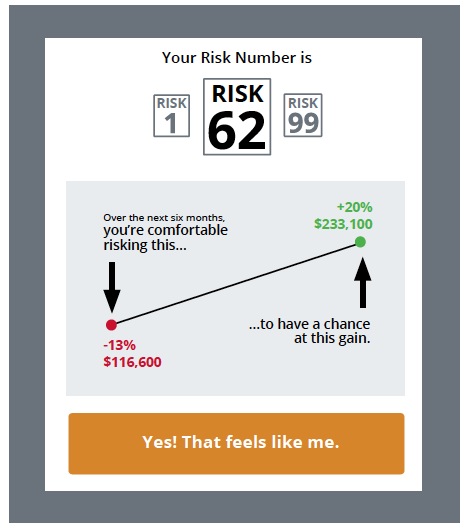
By simply answering a few questions, and spending 10 minutes of your time, based upon the size of your investment portfolio, you will quickly determine your own tolerance for risk.

Comparing your Risk Number to your Portfolio

Now that you have calculated your Risk Number, how does that number compare to your actual portfolio holdings? Is the portfolio you have today, the one you started with some time ago regarding risk and return? Is it still in alignment with your original expectations?

Does your portfolio have?

  • Too much risk?
  • Is it too conservative?
  • Or, is it just right
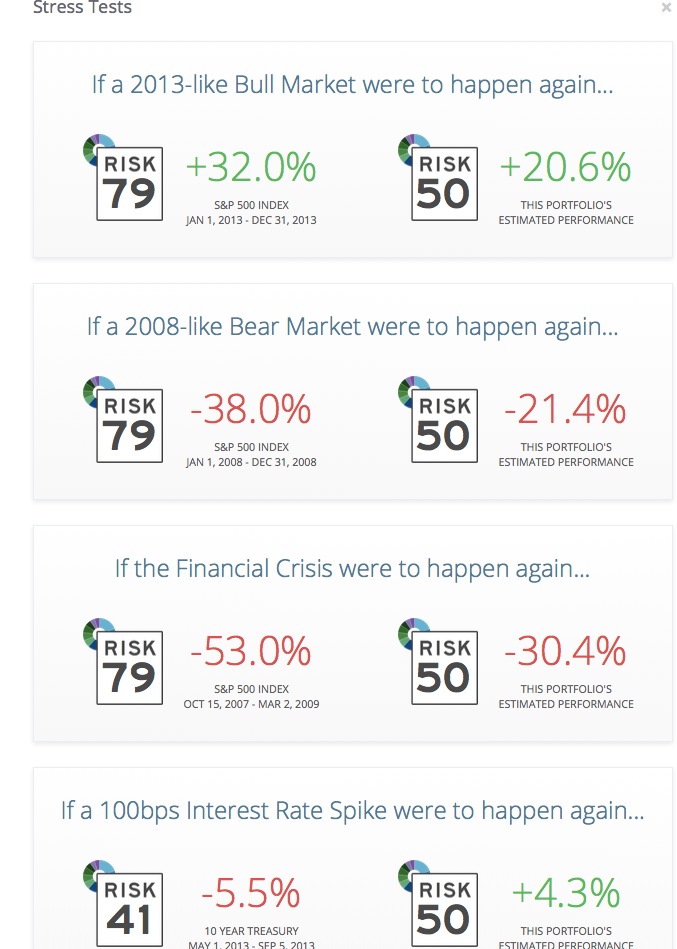
  • What if the market drops significantly? Instead, what if the market goes up significantly? See how your current portfolio will fair in any one of these market conditions:
  • Let’s put your portfolio onto the treadmill; just like the doctor’s office.
  • How do you know, how do you measure?

Let’s Stress Test your Portfolio

  1. Bull Market (Prices generally rise)
  2. Bear Market (Prices generally fall)
  3. Financial Crisis
  4. Rising Interest Rates

***

ScreenShot2015-06-01at11_34_02AM_113439

***

  • Are the results in alignment with your expectations?
  • Any ‘hot spots’ you need to know about?
  • Are there any individual holdings that will cause you loss of sleep over?
  • Maybe investments don’t generate enough income?
  • Maybe investments fluctuate too much in price?
  • Now you can have a look and see if there are any ‘hot spots’ where you may need to re-balance a portion of your holdings based upon these findings.

***

2

Yes! That feels like me

***

Congratulations. Once you have determined your Risk Number, and perhaps re-aligned your current portfolio to your Risk Number, then yes, you DO have the portfolio that is right for you, one that ‘feels like you’.

ABOUT

David Gratke is chief executive officer of Gratke Wealth LLC in Beaverton, Ore. A Registered Investment Advisory Firm.

***

Conclusion

Your thoughts and comments on this ME-P are appreciated. How does the current market tumult affect this ME-P or your own investing strategy? Feel free to review our top-left column, and top-right sidebar materials, links, URLs and related websites, too. Then, subscribe to the ME-P. It is fast, free and secure.

***

Risk Management, Liability Insurance, and Asset Protection Strategies for Doctors and Advisors: Best Practices from Leading Consultants and Certified Medical Planners™8Comprehensive Financial Planning Strategies for Doctors and Advisors: Best Practices from Leading Consultants and Certified Medical Planners™

“Physicians who don’t understand modern risk management, insurance, business and asset protection principles are sitting ducks waiting to be taken advantage of by unscrupulous insurance agents and financial advisors; and even their own prospective employers or partners. This comprehensive volume from Dr. David Marcinko, and his co-authors, will go a long way toward educating physicians on these critical subjects that were never taught in medical school or residency training.”

Dr. James M. Dahle MD FACEP [Editor of The White Coat Investor, Salt Lake City, Utah]

***

USA “With time at a premium, and so much vital information packed into one well organized resource, this comprehensive textbook should be on the desk of everyone serving in the healthcare ecosystem. The time you spend reading this frank and compelling book will be richly rewarded.”

Dr. J. Wesley Boyd MD PhD MA [Harvard Medical School, Boston, Massachusetts, USA]

Form ADV Part II [The Essential Document]

Join Our Mailing List

Lifting the “Veil of Secrecy” on Selecting Financial Advisors

[By Dr. David Edward Marcinko MBA CMP™]

DEM white  shirtBy law, financial advisors must provide you with a form ADV Part II or a brochure that covers the same information. Even if a brochure is provided, ask for the ADV. Today, it may even be online.

While it is acceptable, even desirable, for the brochure to be easier to read than the ADV, the ADV is what is filed with the appropriate state or SEC. If the brochure reads more like a slick sales brochure or the information in the brochure glosses over the items on the ADV to a high degree, one should consider eliminating the advisor from consideration.

Types of Advisors

Registering with a state or SEC gives an advisor a fiduciary duty to the client. This is a high standard under the law. There are several types of advisors who are exempt from registering and filing an ADV.

First, there are registered representatives (brokers).  Brokers have a fiduciary responsibility to their firms regardless of whether they are statutory employees or independent contractors.

Second are attorneys and accountants whose advice is “incidental” to their legal or accounting practices. But, why would one hire someone whose advice is “incidental” to his primary profession?

A top-notch advisor is a full-time professional and should be registered.  One should insist that their advisor be registered.

****

Lifting veil of secrecy

[The Author in Chicago Seeking Fiduciary Transparency]

***

The ADV will describe the advisor’s background and employment history, including any prior disciplinary issues. It will describe the ownership of the firm and outline how the firm and advisor are compensated. Any referral arrangements will be described. If an advisor has an interest in any of the investments to be recommended, it must be listed as well as the fee schedule. There is also a description of the types of investments recommended and the types of research information that is used.

Assessment

A review of the ADV should result in an alignment of what the advisor said during the interview and what is filed with the regulators. If there is a clear discrepancy, choose another advisor. If it is unclear, discuss the issue with the advisor.

  • SEC Headquarters
  • 100 F Street, NE Washington, DC 20549
  • (202) 942-8088

Channel Surfing the ME-P

Have you visited our other topic channels? Established to facilitate idea exchange and link our community together, the value of these topics is dependent upon your input. Please take a minute to visit. And, to prevent that annoying spam, we ask that you register. It is fast, free and secure.

Conclusion

Your thoughts and comments on this ME-P are appreciated. Feel free to review our top-left column, and top-right sidebar materials, links, URLs and related websites, too. Then, subscribe to the ME-P. It is fast, free and secure.

Speaker: If you need a moderator or speaker for an upcoming event, Dr. David E. Marcinko; MBA – Publisher-in-Chief of the Medical Executive-Post – is available for seminar or speaking engagements. Contact: MarcinkoAdvisors@msn.com

OUR OTHER PRINT BOOKS AND RELATED INFORMATION SOURCES:

Comprehensive Financial Planning Strategies for Doctors and Advisors: Best Practices from Leading Consultants and Certified Medical Planners(TM)

Why 75+ Years of American Finance Should Matter to Physician Investors

A Graphic Presentation [1861-1935] with Commentary from the Publisher

By Dr. David Edward Marcinko FACFAS MBA CPHQ CMP™

http://www.CertifiedMedicalPlanner.org

As our private iMBA Inc clients, ME-P subscribers, textbook and dictionary purchasers, seminar attendees and most ME-P readers know, Ken Arrow is my favorite economist. Why?

About Kenneth J. Arrow, PhD

Well, in 1972, Nobel Laureate Kenneth J. Arrow, PhD shocked Academe’ by identifying health economics as a separate and distinct field. Yet, the seemingly disparate insurance, asset allocation, econometric, statistical and portfolio management principles that he studied have been transparent to most financial professionals and wealth management advisors for years; at least until now.

Nevertheless, to informed cognoscenti, they served as predecessors to the modern healthcare advisory era. In 2004, Arrow was selected as one of eight recipients of the National Medal of Science for his innovative views. And, we envisioned the ME-P at that time to present these increasingly integrated topics to our audience.

Healthcare Economics Today

Today – as 2022 passes – savvy medical professionals, management consultants and financial advisors are realizing that the healthcare industrial complex is in flux; along with the Russian war, domestic inflation and this dynamic may be reflected in the overall flagging economy.

Like many laymen seeking employment, for example, physicians are frantically searching for new ways to improve office revenues and grow personal assets, because of the economic dislocation that is Managed Care, Medi Care and Obama Care [ACA], the depressed business cycle, etc.

Moreover, the largest transfer of wealth in US history is – or was – taking place as our lay elders and mature doctors sell their practices or inherit parents’ estates. Increasingly, the artificial academic boundary between the traditional domestic economy, financial planning and contemporaneous medical practice management is blurring.

I’m Not a Cassandra

Yet, I am no gloom and doom Cassandra like I have been accused, of late. I am not cut from the same cloth as a Jason Zweig, Jeremy Grantham or Nouriel Roubini PhD, for example.

However, I do subscribe to the philosophy of Hope for the Best – Plan for the Worst.

And so dear colleagues, I ask you, “Are the latest swings in the economic, healthcare and financial headlines making you wonder when it will ever stop?”

The short answer is: “It will never stop” because what’s been happening isn’t any “new normal”; it’s just the old normal playing out before a new audience; sans the war.

What audience?

The next-generation of investors, FAs, management consultants and the medical professionals of Health 2.0.

How do I know all this?

History tells me so! Just read this work, and opine otherwise, or reach a different conclusion.

Evidence from the American Financial Scene, circa 1861-1935

The work was created by L. Merle Hostetler in 1936, while he was at Cleveland College of Western Reserve University (now known as Case Western Reserve University). I learned of him while in B-School, back in the day.

At some point after it was printed, he added the years 1936-1938. Mr. Hostetler became a Financial Economist at the Federal Reserve Bank of Cleveland in 1943. In 1953 he was made Director of Research. He resigned from the Bank in 1962 to work for Union Commerce Bank in Cleveland. He died in 1990.

The volume appears to be self published and consists of a chart, approximately 85′ long, fan-folded into 40 pages with additional years attached to the last page. It also includes a “topical index” to the chart and some questions of technical interest which can be answered by the chart.

Link: http://fraser.stlouisfed.org/75years

Assessment

And so, as with Sir John Templeton’s [whose son is an MD] four most dangerous words in investing (It’s different this time), Hostetler effectively illustrates that it wasn’t so different in his era, and maybe—just maybe—it isn’t so different today for all these conjoined fields.

Conclusion      

Your thoughts and comments on this ME-P are appreciated. While not exactly a “sacred cow,” there is a current theory that investors will experience higher volatility and lower global returns for the foreseeable future.

In fact, it has gained widespread acceptance, from the above noted Cassandra’s and others, as problems in Europe persist and threats of a double-dip recession loom. But, how true is this notion; really?

Is Hostetler correct, or not; and why?

Feel free to review our top-left column, and top-right sidebar materials, links, URLs and related websites, too. Then, subscribe to the ME-P. It is fast, free and secure.

Speaker: If you need a moderator or speaker for an upcoming event, Dr. David E. Marcinko; MBA – Publisher-in-Chief of the Medical Executive-Post – is available for seminar or speaking engagements. Contact: MarcinkoAdvisors@msn.com

Our Other Print Books and Related Information Sources:

DOCTORS:

“Insurance & Risk Management Strategies for Doctors” https://tinyurl.com/ydx9kd93

“Fiduciary Financial Planning for Physicians” https://tinyurl.com/y7f5pnox

“Business of Medical Practice 2.0” https://tinyurl.com/yb3x6wr8

HOSPITALS:

“Financial Management Strategies for Hospitals” https://tinyurl.com/yagu567d

“Operational Strategies for Clinics and Hospitals” https://tinyurl.com/y9avbrq5

Subscribe Now: Did you like this Medical Executive-Post, or find it helpful, interesting and informative? Want to get the latest ME-Ps delivered to your email box each morning? Just subscribe using the link below. You can unsubscribe at any time. Security is assured.

Link: http://feeds.feedburner.com/HealthcareFinancialsthePostForcxos

Sponsors Welcomed: And, credible sponsors and like-minded advertisers are always welcomed. Link: https://healthcarefinancials.wordpress.com/2007/11/11/advertise

Product DetailsProduct DetailsProduct Details

  Risk Management, Liability Insurance, and Asset Protection Strategies for Doctors and Advisors: Best Practices from Leading Consultants and Certified Medical Planners™8Comprehensive Financial Planning Strategies for Doctors and Advisors: Best Practices from Leading Consultants and Certified Medical Planners™

   Product Details

General Obligation and Revenue Bonds

Understanding GOs and RBs

[By Staff Writers]fp-book2

General obligation bonds are secured by the taxing authority and are therefore considered safer than other municipals. The full faith and credit of the municipality ensures prompt payment of principal and interest.

Further more, most municipal bonds, including city, county, and school district issues, are secured by a pledge of unlimited property taxes (known as ad-valorem taxes), which further secures the bonds. If taxes are not paid, the property may be sold at a tax sale, at which the bondholder has a superior position.

Revenue bonds

Revenue bonds are payable from the earnings of a revenue-generating facility, such as water, sewers, or utility systems, toll bridges, or airports. The risk, however, is that the facility will not generate income sufficient to pay the interest, and therefore the yield is somewhat higher than for a general-obligation bond.

Revenue bonds are supported only by the revenue earned, so if the project does not produce revenues sufficient to pay the interest on the bonds, then the bonds go into default. Therefore, it is important to properly evaluate the municipality’s ability to tax and/or the assumptions used to project the facility’s revenue.

Conclusion

Your thoughts and comments on this ME-P are appreciated. Feel free to review our top-left column, and top-right sidebar materials, links, URLs and related websites, too. Then, subscribe to the ME-P. It is fast, free and secure.

Link: http://feeds.feedburner.com/HealthcareFinancialsthePostForcxos

Speaker: If you need a moderator or speaker for an upcoming event, Dr. David E. Marcinko; MBA – Publisher-in-Chief of the Medical Executive-Post – is available for seminar or speaking engagements. Contact: MarcinkoAdvisors@msn.com

OUR OTHER PRINT BOOKS AND RELATED INFORMATION SOURCES:

LEXICONS: http://www.springerpub.com/Search/marcinko
PHYSICIANS: www.MedicalBusinessAdvisors.com
PRACTICES: www.BusinessofMedicalPractice.com
HOSPITALS: http://www.crcpress.com/product/isbn/9781466558731
CLINICS: http://www.crcpress.com/product/isbn/9781439879900
ADVISORS: www.CertifiedMedicalPlanner.org
BLOG: www.MedicalExecutivePost.com

Product DetailsProduct DetailsProduct Details     

Product Details  Product Details

#6: The Six Commandments of Value Investing

***

6. In the long run, stocks revert to their fair value

***

***

EDITOR’S NOTE: Although it has been some time since speaking live with busy colleague Vitaliy Katsenelson CFA, I review his internet material frequently and appreciate this ME-P series contribution. I encourage all ME-P readers to do the same and consider his value investing insights carefully.

By Vitaliy Katsenelson, CFA

***

6. In the long run, stocks revert to their fair value

Reversion to fair value is not a pie-in-the-sky concept. If a stock is significantly undervalued for a long time, then this undervaluation gets cured, eventually. That can happen through share buybacks – the company can basically buy all of its shares and take itself private.

Or it can happen by the company’s paying out its earnings in dividends, thus creating yields that the market will not be able to ignore. Or the company’s competitors will realize that it is cheaper for them to buy the company than to replicate its assets on their own. Either way, undervaluation gets cured.

This faith that undervaluation will not last forever is paramount to value investing. But this is not your regular faith, which requires belief without proof. This is evidence-supported faith with hundreds of years of data to back it. Just look at the US stock market: it has gone through cycles when it was incredibly cheap and others when it was incredibly expensive. At some points in its journey from one extreme to the other, it touched its fair value, even if it was transitory.

Historically, value investing (owning undervalued companies) has done significantly better than other strategies. Paradoxically, the reason it has done well in the long run is because it did not work consistently in the short run. If something works consistently (keyword), everybody piles into it and it stops working.

These aforementioned cycles of temporary brilliance and dumbness are not just common to us mere mortals. Even Warren Buffett’s Berkshire Hathaway goes through them. As just one example, in 1999, when the stock market went up 21%, Berkshire Hathaway stock declined 19%. In 1999, the financial press was writing obituaries for Buffett’s investment prowess.

Suddenly, in 1999, Buffett’s IQ was lagging the market by 40%. At the time, investors were infatuated with internet stocks that were not making money but that were supposed to have a bright future. Investors were selling unsexy “old economy” stocks that Buffett owned in order to buy the “new economy” ones.

If at the end of 1999, you were to sell Berkshire Hathaway and buy the S&P 500 instead, you would have done the easy thing, but it would have been a large (though very common) mistake. Over the next three years Berkshire Hathaway gained over 30% while the S&P declined over 40%. During the year 1999, Buffett’s IQ did not change much; in fact, the (book) value of businesses Berkshire Hathaway owned went up by 0.5% that year. But in 1999, the market’s attention was somewhere else and it chose to price Berkshire Hathaway 19% lower. 

As a value investor, if you do a reasonable job estimating what the business is worth, then at some point the stock market will price it accordingly. You need to have faith. I am acutely aware how wishful this statement sounds. But this faith, the belief in mean reversion, has to be deeply ingrained in our psyche. It will allow us to remain rational when people around us are not. 

***

CITE: https://www.r2library.com/Resource/Title/0826102549

COMMENTS APPRECIATED

Editor’s Final Note; Many thanks to VK for this timely series on value investing. Our ME-P readers appreciate you.

Thank You

Subscribe to the Medical Executive-Post

***

***

#5: The Six Commandments of Value Investing

***

***

EDITOR’S NOTE: Although it has been some time since speaking live with busy colleague Vitaliy Katsenelson CFA, I review his internet material frequently and appreciate this ME-P series contribution. I encourage all ME-P readers to do the same and consider his value investing insights carefully.

By Vitaliy Katsenelson, CFA

***

5. Risk is a permanent loss of capital (not volatility)

Conventional wisdom views volatility as risk. Not value investors. We befriend volatility, embrace it, and try to take advantage of it. For someone who has not researched a company, it is not readily apparent whether a decline in shares is temporary or permanent. After all, if you don’t know what the company is worth, the quoted price becomes the quotient of intrinsic value. If you do know what the company is worth, then the change in intrinsic value is all that is going to matter. The price quoted on the exchange will be your friend, allowing you to take advantage of the difference between intrinsic value and quoted stock price. If the quoted stock price is significantly cheaper than your estimated intrinsic value, you buy it (or buy more of it if you already own it). If the opposite is true, you sell it.

What is a company worth?

Determining the intrinsic value requires a combination of art and science, in that order – it is not quoted on the exchanges. We go about this the same way a businessman would figure how much he’d want to pay for a gas station or a McDonald’s franchise. Analysis of each company will be different, but at the core we estimate the cash flows the business will produce for shareholders in the long run (at least ten years) and what the business will be worth then (based on our estimate of its earnings power at the time). The combination of the two provides us an approximation of what the business is worth now. To further embed “the right” type of risk analysis into our investment operating system, we build financial models. Models help us to understand businesses better and provide insights as to which metrics matter and which don’t. They allow us to stress test the business: We don’t just look at the upside but spend a lot of times looking at the downside – we try to “kill” the business. We look at known risks and try to imagine unknown ones; we try to quantify their impact on cash flows. This “killing” helps to us understand how much of a discount (margin of safety) we should demand to what the business is worth. By applying this discount to fair value, we arrive at a buy price. For every stock we buy we probably look at a few dozen (at least).

For instance, if we are looking at a company that is selling products or services to consumers, we’ll be focusing on customer-acquisition costs. We try to drill down to the essential operating metrics of each company. If it’s a convenience store retailer, we’ll look into gallons of gas sold and profit per gallon. If it’s an oil driller, we’ll look at utilization rates, rigs in service, average revenue per rig per day. If it’s a pharmaceuticals company, we’ll have revenue lines for each major drug it sells and model the company for the eventuality that patents will run out. (Revenues usually decline 80-90% when a patent expires).

These models help us to understand the economics of the business. We usually build two type of models. We start with what we call the “tablecloth” model. This is a very detailed, in-depth model that zeros in on different aspects of the business. But the risk we run with a tablecloth model is that we get lost in the trees and forget about the forest.

This brings us to our “napkin” model. It’s a much simpler and smaller model that focuses only on the essentials of the business. It is easier to build the tablecloth model than the “napkin.” If we can build a napkin model, that means we understand the drivers of the business – we understand what matters. Models are important because they help us remain rational. It is only the matter of time before a stock we own will “blow up” (or, in layman’s terms, decline).

In this type of analysis, what happens this month, this quarter, or even this year is only important in the context of the long run – unless the company’s good or bad earnings report in any quarter changes our assumptions on the company’s long-term cash flows. If you methodically focus on what the company is worth and if your Total IQ is maximized, then price fluctuations are just noise. Volatility becomes your friend because you can rationally take advantage of it. It’s an under-appreciated gift from Mr. Market.

Side Note: As an advisor, I feel it is one of my great responsibilities to be an honest and clear communicator. There is an asymmetry of information between us and our clients. We have invested weeks and months of research into the analysis of each stock; therefore, we have a good idea what each company is worth. Our clients have not done this research, and they should not have to – that is what they hired us to do.This is why we pour our heart and soul into our quarterly letters – we want to close this informational gap and so we try as hard as we can to explain what we think the companies in our portfolio are worth. Our letters are often 15-20 pages long. 

***
COMMENTS APPRECIATED

Thank You

Subscribe to the Medical Executive-Post

***

****

Why You CAN’T Turn Your Roth IRA Into a Billion-Dollar Tax Shelter

By Nadia Sussman, Sherene Strausberg and Justin Elliott

ProPublica is a Pulitzer Prize-winning investigative newsroom. Sign up for The Big Story newsletter to receive stories like this one in your inbox. Series: The Secret IRS Files Inside the Tax Records of the .001%

***

The Roth IRA: What It Is and How It Works | Personal ...

***

Last week, ProPublica published the story of how PayPal co-founder and tech investor Peter Thiel was able to turn a Roth IRA initially worth around $2,000 into a jaw-dropping $5 billion tax-free retirement stash in just 20 years.

The story is even more remarkable because Congress created the Roth IRA in 1997 to encourage middle-class Americans to save for their golden years. Most Americans have struggled to do even that; the average account was worth about $39,000 in 2018. But Thiel and other billionaires have managed to turn their mundane Roths into giant onshore tax shelters.

Thiel was able to launch his Roth into the stratosphere through a complicated strategy involving the purchase of nonpublic stock at bargain prices — the kind of deal most people can’t access. Experts say it risked running afoul of rules designed to prevent IRAs from becoming illegal tax shelters. (Thiel’s spokesman didn’t respond to questions.)

Other ultrawealthy Americans have used different means to build Roths worth tens or hundreds of millions of dollars. Senate Finance Chairman Ron Wyden is now looking at how to end the use of the Roth as “yet another tax dodge that allows mega millionaires and billionaires to avoid paying taxes.”

How are they able to do it while you can’t? Check out our explainer of one way the Roth works for the ultrawealthy and not for you.

***

Your thoughts and comments are appreciated.

Citation: https://www.r2library.com/Resource/Title/0826102549

MORE: https://www.routledge.com/Comprehensive-Financial-Planning-Strategies-for-Doctors-and-Advisors-Best/Marcinko-Hetico/p/book/9781482240283

***

THANK YOU

PORTFOLIO: How to Build One for Today’s Crazy Stock Markets

Insights For Doctors and All Investors

***

Amazon.com: Vitaliy Katsenelson: Books, Biography, Blog, Audiobooks, Kindle

By Vitaliy Katsenelson CFA

***

NOTE: This piece is a little more technical, and contains a bit more stock-market jargon, than most essays you get from me. While how we build portfolios is important to us and our clients, we realize that the puts and takes might bore many readers.

CITE: https://www.r2library.com/Resource/Title/082610254

***

***

COMMENTS APPRECIATED

Thank You

Subscribe to the Medical Executive-Post

***

***

Comprehensive Financial Planning and Risk Management Strategies for Doctors and their Advisors

***

Best Practices from Leading Consultants and Certified Medical Planners

SPONSOR: http://www.CertifiedMedicalPlanner.org

CMP logo

***

***

Risk Management, Liability Insurance, and Asset Protection Strategies for Doctors and Advisors: Best Practices from Leading Consultants and Certified Medical Planners™

ORDER: https://www.routledge.com/Risk-Management-Liability-Insurance-and-Asset-Protection-Strategies-for/Marcinko-Hetico/p/book/9781498725989

***

On Financial Futures for Physicians

What it is – How it works?

By Tim McIntosh MBA CFP CMP® MPH

Courtesy: http://www.CertifiedMedicalPlanner.org

TMA future is a financial derivative that represents the purchase of a particular investment at a predetermined date. Futures are traded on a wide range of investments (e.g., baskets of stocks, interest rates, currencies and commodities) and are useful tools for controlling the risk of cash flow timing for those that wish to lock in a particular price for a security.

Futures versus Options

Likewise, they also provide some insight as to the expected future price in the market of the security.

The key difference between futures and options is that futures obligate both parties to make the agreed upon transaction, whereas options give the option holder the right, but not the requirement, to make the transaction.

Trades

Futures are typically traded on an organized exchange, such as the Chicago Board of Trade (e.g., interest rate and stock index futures) or the Chicago Mercantile Exchange (e.g., foreign exchange and stock futures). The design of the contract traded on an exchange typically includes a pre-defined contract size and delivery month.

Margin Maintenance

Also, futures transactions generally require maintaining a margin deposit (i.e., a fraction of the trade value held in reserve to help ensure the final settlement at the contract settlement date) and the recognition of gains and losses on a daily basis with movements in contract prices.

Japan and world markets tumbling - dollar stronger

Assessment

The pricing of a futures contract is based upon the price of the underlying security (e.g., the S&P 500 Index price), the opportunity cost of cash (e.g., current borrowing rates) and any distributions expected from the security over the period (e.g., dividends).

MORE: Futures

About the Author

Timothy J. McIntosh is Chief Investment Officer and founder of SIPCO.  As chairman of the firm’s investment committee, he oversees all aspects of major client accounts and serves as lead portfolio manager for the firm’s equity and bond portfolios. Mr. McIntosh was a Professor of Finance at Eckerd College from 1998 to 2008. He is the author of The Bear Market Survival Guide and the The Sector Strategist

Conclusion

Your thoughts and comments on this ME-P are appreciated. Feel free to review our top-left column, and top-right sidebar materials, links, URLs and related websites, too. Then, subscribe to the ME-P. It is fast, free and secure.

Speaker: If you need a moderator or speaker for an upcoming event, Dr. David E. Marcinko; MBA – Publisher-in-Chief of the Medical Executive-Post – is available for seminar or speaking engagements. Contact: MarcinkoAdvisors@msn.com

Risk Management, Liability Insurance, and Asset Protection Strategies for Doctors and Advisors: Best Practices from Leading Consultants and Certified Medical Planners™8Comprehensive Financial Planning Strategies for Doctors and Advisors: Best Practices from Leading Consultants and Certified Medical Planners™

***

Medical FINANCIAL PLANNING “Holistic” STRATEGIES

BY AND FOR PHYSICIANS AND THEIR ADVISORS

INVITE DR. MARCINKO: https://medicalexecutivepost.com/dr-david-marcinkos-

***

SPONSOR: http://www.CertifiedMedicalPlanner.org

CMP logo

***

UPDATE: Stock Market and the Economy

By Staff Reporters

***

The stock market was very sharply mixed yesterday, and the NASDAQ Composite took the brunt of the damage. Even as the Dow Jones Industrial Average was up triple digits, the NASDAQ fell almost 2% as of 1:45 p.m. ET; and finishing down 210.08 points or (‎-1.33%).

Physicians and other investors looking at the biggest stocks in the NASDAQ would have to go through three dozen stocks on the list before finding a single one that rose more than 1%. Many of the top tech giants were down 1% to 5% or more on the day. Yet there were some winning NASDAQ stocks, and a few in particular might seem surprising to those used to seeing more popular names among top performers.

Bond yields gained thanks to bullish attitudes around economic growth.

Economy: The Great Resignation rolls on as a record 4.5 million Americans quit their jobs in November. That’s equivalent to 3% of the workforce.

COMMENTS APPRECIATED.

Thank You

Subscribe to the Medical Executive Post.com

***

***

Personal Financial Planning for Physicians and Medical Colleagues

ME Inc = Going it Alone but with a Team

BY DR. DAVID EDWARD MARCINKO MBA CMP®

CMP logo

SPONSOR: http://www.CertifiedMedicalPlanner.org

The physician, nurse, or other medical professional should easily recognize that there are a vast array of opportunities, obstacles, and pitfalls when it comes to managing one’s finances.  Still, with some modicum of effort, the basic aspects of insurance, investments, taxes, accounting, portfolio management, retirement and estate planning, debt reduction, asset protection and practice management can be largely self-taught. Yet, it is realized that nuances and subtleties can make a well-intentioned financial plan fall short.  The devil truly is in the details.  Moreover, none of these areas can be addressed in isolation. It is common for a solution in one area to cause a new set of problems in another. 

Accordingly, most health care practitioners would be well served to hire [independent, hourly compensated and prn] financial help. Unlike some medical problems, financial issues may not cause any “pain” or other obvious symptoms.  Medical professionals tend to have far more complex financial situations than most lay people. Despite the complexities of the new world of health reform, far too many either do nothing; or give up all control totally, to an external advisor. This either/or mistake can be costly in many ways, and should be avoided. 

In reality, and at various time in their careers, the medical professional needs a team comprised of at least a financial analyst, lawyer, management consultant, risk manager [actuary, mathematician or insurance counselor] and accountant. At various points in time, each member of the team, or significant others, will properly assume a role of more or less importance, but the doctor must usually remain the “quarterback” or leader; in the absence of a truly informed other, or Certified Medical Planner™.

This is necessary because only the doctor has the personal self-mandate with skin in the game, to take a big picture view.  And, rightly or wrongly, investments dominate the information available regarding personal finance and the attention of most physicians.  One is much more likely to need or want to discuss the financial markets with their financial advisor than private letter rulings by the IRS, or with their estate planning attorney or tax accountant. While hiring for expertise is a good idea, there is sinister way advisors goad doctors into using all their retail services; all of the time. That artifice is – the value of time. 

True integrated physician focused and financial planning is at its core a service business, not a product or sales endeavor. And, increasingly money is more likely to be at the top of the list for providers as the healthcare environment is contracting.

So, eschewing the quarterback model of advice, and choosing to self-educate thru this book and elsewhere, may be one of the best efforts a smart physician can make.

ASSESSMENT: Your thoughts are appreciated.

Comprehensive Financial Planning Strategies for Doctors and Advisors: Best Practices from Leading Consultants and Certified Medical Planners™

ORDER TEXTBOOK: https://www.routledge.com/Comprehensive-Financial-Planning-Strategies-for-Doctors-and-Advisors-Best/Marcinko-Hetico/p/book/9781482240283

RELATED TEXTS: https://medicalexecutivepost.com/2021/04/29/why-are-certified-medical-planner-textbooks-so-darn-popular/

INVITE DR. MARCINKO: https://medicalexecutivepost.com/dr-david-marcinkos-

THANK YOU!

*****

Doctors Living With Higher Stock Market Volatility

Join Our Mailing List 

Change is afoot in the market, the rally of which lulled many into complacency

DG

By David Gratke

DOW DJI 34,899.34 at close
-905.04 (‎-2.53%)

Volatility, on vacation for most of the past few years, is back this fall for physician investors and us all. It hit a new 52-week high in mid-October, double the level of August. That means change is afoot in the market, whose rally lulled many into complacency. So. this is a good time to see where your portfolio stands in risk terms.

The last time volatility really spiked, as measured by the Standard & Poor’s 500 volatility index, or VIX, was the fall of 2011 when the market last corrected by 20%. Then, the VIX level was twice as high as now. Volatility is market price fluctuation, and it signals greater risk.

Financial Risk

financial risk

The root cause of higher volatility is that the world’s major central banks, including our Federal Reserve, have flooded markets with liquidity – printing money, if you will. In other words, in an effort to jump-start local economies, they have kept rates so low that stocks are artificially higher, and thus ripe for a price-churning correction. The insidious side-effect of this money printing has been to greatly reduce, if not extinguish, historical, and normal, market price fluctuations.

As David Kotok, chairman and chief investment officer of Cumberland Advisors, puts it: “An era is ending: for over half a decade, nearly worldwide, zero interest rates suppressed volatilities. That is over.” The initial indication of this, Kotok says, was when then Fed-Chairman Ben Bernanke indicated that his bond-buying stimulus program was coming to an end. Well, now it’s over and the market fears interest rates are on the way up.

Investor Sentiment

Transferrable  Emotions

Stock market volatility can be measured and is used to gauge investor thinking, or what we call investor sentiment.

The VIX gauges investor sentiment. When volatility is low, the implication is that investors are complacent. Said differently, they are not paying attention to the underlying risks in the marketplace. Also during times of low volatility, markets are often fully valued, or even overvalued due to investor contentment.

When the VIX is high, as it was during the 2008-09 financial crisis, investors exhibited great amounts of fear. They sell out of their investments, and markets are typically undervalued.

Volatility was low prior to 2008, hovering around its historical average of 20. The index then zoomed to 90 during the 2008-09 stock market slide. In recent months, however, most notably June and July, we witnessed a historic low in this index, hovering near 10. Sure enough, there were high levels of margin balances and bullish investor sentiments, along with above-average stock valuations, as seen by lofty price/earnings ratios.

Now, the VIX is slightly below average, at about 15.

Since August, volatility rose from its sleepy historic mid-summer lows for many reasons: Middle East tensions, the Ebola outbreak, low gross domestic product growth, central bank stimulus slowing down, corporate stock buybacks, high P/E ratios, just to highlight a few.

Stock_Market

A New Normal?

Assuming this higher volatility is the new normal, what can you do about it? One alternative is to do nothing and ride this out. Another is to trade options, betting on which way the market will cut. But this is very risky and best done by professionals. Kotok says a volatility surge is a good time to examine your portfolio’s risk profile: His firm’s largest positions are in defensive stocks, like utilities and telecoms – ones that don’t tend to rocket around when the market gyrates.

During a recent volatility boost to the current level, in 2013, a Wall Street Journal story offered some market pros’ tips. Examples: putting money in a balanced fund, where stocks and bonds are in roughly equal proportion. Another warned that whenever stock holdings were over 70% of a portfolio, or under 30%, you are most vulnerable.

Regardless, Kotok cautions that “more and exciting volatilities lie ahead.”

Follow AdviceIQ on Twitter at @adviceiq.

About the Author

David Gratke is chief executive officer of Gratke Wealth LLC in Beaverton, Ore.

Conclusion

Your thoughts and comments on this ME-P are appreciated. Feel free to review our top-left column, and top-right sidebar materials, links, URLs and related websites, too. Then, subscribe to the ME-P. It is fast, free and secure.

Speaker: If you need a moderator or speaker for an upcoming event, Dr. David E. Marcinko; MBA – Publisher-in-Chief of the Medical Executive-Post – is available for seminar or speaking engagements. Contact: MarcinkoAdvisors@msn.com

OUR OTHER PRINT BOOKS AND RELATED INFORMATION SOURCES:

Financial Planning MDs 2015

Comprehensive Financial Planning Strategies for Doctors and Advisors: Best Practices from Leading Consultants and Certified Medical Planners™

COMPREHENSIVE FINANCIAL PLANNING STRATEGIES

For Doctors and Advisors

BOOK REVIEWS WITH FOREWORD

Reviews

Written by doctors and healthcare professionals, this textbook should be mandatory reading for all medical school students―highly recommended for both young and veteran physicians―and an eliminating factor for any financial advisor who has not read it. The book uses jargon like ‘innovative,’ ‘transformational,’ and ‘disruptive’―all rightly so! It is the type of definitive financial lifestyle planning book we often seek, but seldom find.
LeRoy Howard MA CMPTM,Candidate and Financial Advisor, Fayetteville, North Carolina

I taught diagnostic radiology for over a decade. The physician-focused niche information, balanced perspectives, and insider industry transparency in this book may help save your financial life.
Dr. William P. Scherer MS, Barry University, Ft. Lauderdale, Florida

This book was crafted in response to the frustration felt by doctors who dealt with top financial, brokerage, and accounting firms. These non-fiduciary behemoths often prescribed costly wholesale solutions that were applicable to all, but customized for few, despite ever-changing needs. It is a must-read to learn why brokerage sales pitches or Internet resources will never replace the knowledge and deep advice of a physician-focused financial advisor, medical consultant, or collegial Certified Medical Planner™ financial professional.
―Parin Khotari MBA,Whitman School of Management, Syracuse University, New York

In today’s healthcare environment, in order for providers to survive, they need to understand their current and future market trends, finances, operations, and impact of federal and state regulations. As a healthcare consulting professional for over 30 years supporting both the private and public sector, I recommend that providers understand and utilize the wealth of knowledge that is being conveyed in these chapters. Without this guidance providers will have a hard time navigating the supporting system which may impact their future revenue stream. I strongly endorse the contents of this book.

―Carol S. Miller BSN MBA PMP,President, Miller Consulting Group, ACT IAC Executive Committee Vice-Chair at-Large, HIMSS NCA Board Member

This is an excellent book on financial planning for physicians and health professionals. It is all inclusive yet very easy to read with much valuable information. And, I have been expanding my business knowledge with all of Dr. Marcinko’s prior books. I highly recommend this one, too. It is a fine educational tool for all doctors.

―Dr. David B. Lumsden MD MS MA,Orthopedic Surgeon, Baltimore, Maryland

There is no other comprehensive book like it to help doctors, nurses, and other medical providers accumulate and preserve the wealth that their years of education and hard work have earned them.
―Dr. Jason Dyken MD MBA, Dyken Wealth Strategies, Gulf Shores, Alabama

I plan to give a copy of this book written
by doctors and for doctors’ to all my prospects, physician, and nurse clients. It may be the definitive text on this important topic.
―Alexander Naruska CPA, Orlando, Florida

Health professionals are small business owners who need to apply their self-discipline tactics in establishing and operating successful practices. Talented trainees are leaving the medical profession because they fail to balance the cost of attendance against a realistic business and financial plan. Principles like budgeting, saving, and living below one’s means, in order to make future investments for future growth, asset protection, and retirement possible are often lacking. This textbook guides the medical professional in his/her financial planning life journey from start to finish. It ranks a place in all medical school libraries and on each of our bookshelves.
―Dr. Thomas M. DeLauro DPM, Professor and Chairman – Division of Medical Sciences, New York College of Podiatric Medicine

Physicians are notoriously excellent at diagnosing and treating medical conditions. However, they are also notoriously deficient in managing the business aspects of their medical practices. Most will earn $20-30 million in their medical lifetime, but few know how to create wealth for themselves and their families. This book will help fill the void in physicians’ financial education. I have two recommendations: 1) every physician, young and old, should read this book; and 2) read it a second time!
―Dr. Neil Baum MD, Clinical Associate Professor of Urology, Tulane Medical School, New Orleans, Louisiana

I worked with a Certified Medical Planner™ on several occasions in the past, and will do so again in the future. This book codified the vast body of knowledge that helped in all facets of my financial life and professional medical practice.
Dr. James E. Williams DABPS, Foot and Ankle Surgeon, Conyers, Georgia

***

Comprehensive Financial Planning Strategies for Doctors and Advisors: Best Practices from Leading Consultants and Certified Medical Planners™

***

YOUR THOUGHTS ARE APPRECIATED.

SECOND OPINIONS: https://medicalexecutivepost.com/schedule-a-consultation/

INVITE DR. MARCINKO: https://medicalexecutivepost.com/dr-david-marcinkos-bookings/

Thank You

PODCAST: Why Bitcoin is a “Once-in-a-Species” Asset Class

In this episode, DWealthMuse host, Dara Albright, and guest Jeff Ross, CIO of Vailshire Capital Management, discuss why bitcoin may just be that once-in-a-species asset class that saves the planet from economic and, yes, even environmental ruin.

This episode is loaded with so many great insights including:

See the source image
  • Why Jeff believes bitcoin’s investment risk has evaporated;
  • How bitcoin fits into Warren Buffet’s investment thesis;
  • Two characteristics bitcoin skeptics share: a lack of understanding and deep ties to the traditional banking system;
  • Why bitcoin is a dishonest politician’s worst nightmare;
  • Why every modern retirement portfolio should have bitcoin exposure;
  • Why regulatory scrutiny may be turning away from bitcoin and heading straight towards ethereum and altcoins;
  • How bitcoin could solve the world’s energy problems;
  • Why we may be nearing the end of the Keynesian economic experiment;
  • How bitcoin forces an honest unit of accounting by governments;
  • Why fiat is destined to self-destruct while bitcoin is designed to appreciate in time;
  • Whether bitcoin can reach a new all-time high by Jeff’s August 29th birthday and cross 100,000 by Dara’s December 24th birthday?

PODCAST: https://dwealthmuse.podbean.com/e/episode25bitcoinbulls/

Your comments are appreciated.

THANK YOU

****

FINANCIAL PLANNING: Strategies for Doctors and Advisors

SPONSOR: http://www.CertifiedMedicalPlanner.org

***

***

RELATED TEXTS: https://medicalexecutivepost.com/2021/04/29/why-are-certified-medical-planner-textbooks-so-darn-popular/

INVITE DR. MARCINKO: https://medicalexecutivepost.com/dr-david-marcinkos-

THANK YOU!

***

FINANCIAL PLANNING AND INVESTING FOR PHYSICIANS: Purchase Textbook Today & Relax Tomorrow

“MANIC MONDAY” 2021

INVITE DR. MARCINKO: https://medicalexecutivepost.com/dr-david-marcinkos-bookings/

YOUR THOUGHTS ARE APPRECIATED

SPONSOR: http://www.CertifiedMedicalPlanner.org

CMP logo

THANK YOU

***

FINANCIAL PLANNING: Strategies for Physicians and their Advisors

A Textbook Review

SECOND OPINIONS: https://medicalexecutivepost.com/schedule-a-consultation/

INVITE DR. MARCINKO: https://medicalexecutivepost.com/dr-david-marcinkos-bookings/

SPONSOR: http://www.CertifiedMedicalPlanner.org

CMP logo

THANK YOU

***

ME-P Speaking Invitations

Dr. David E. Marcinko is at your Service

thumbnail_IMG_1663.edit1

Dr. David Edward Marcinko MBA CMP® enjoys personal coaching and public speaking and gives as many talks each year as possible, at a variety of medical society and financial services conferences around the country and world.

These have included lectures and visiting professorships at major academic centers, keynote lectures for hospitals, economic seminars and health systems, keynote lectures at city and statewide financial coalitions, and annual keynote lectures for a variety of internal yearly meetings.

His talks tend to be engaging, iconoclastic, and humorous. His most popular presentations include a diverse variety of topics and typically include those in all iMBA, Inc’s textbooks, handbooks, white-papers and most topics covered on this blog.

CONTACT: Ann Miller RN MHA

MarcinkoAdvisors@msn.com

Ph: 770-448-0769

Abbreviated Topic List: https://medicalexecutivepost.com/wp-content/uploads/2009/02/imba-inc-firm-services.pdf

Second Opinions: https://medicalexecutivepost.com/schedule-a-consultation/

DIY Textbooks: https://medicalexecutivepost.com/2021/04/29/why-are-certified-medical-planner-textbooks-so-darn-popular/

THANK YOU

***

THE ANATOMIC BASIS OF HUMAN PHYSIOLOGY AND BEHAVIOR?

BRAIN ANATOMY

By Dr. David Edward Marcinko MBA CMP©

SPONSOR: http://www.CertifiedMedicalPlanner.org

CMP logo

I am not a neurologist, psychologist, or psychiatrist. But, it is well known that emotional and behavioral change involves the human nervous system. And, there are two parts of the nervous system that are especially significant for holistic financial advisor; the first is the limbic system and the second is the autonomic nervous system. 

According to Dr. C. George Boerre of Shippensburg University of Pennsylvania, this is known as the emotional nervous system.

1. The Limbic System

The limbic system is a set of structures that lies on both sides of the thalamus, just under the cerebrum.  It includes the hypothalamus, the hippocampus, the amygdala, and nearby areas.  It is primarily responsible for emotions, memories and recollection. 

Hypothalamus

The small hypothalamus is located just below the thalamus on both sides of the third ventricle (areas within the cerebrum filled with cerebrospinal fluid that connect to spinal fluid). It sits inside both tracts of the optic nerve, and just above the pituitary gland.

The hypothalamus is mainly concerned with homeostasis or the process of returning to some “set point.”  It works like a thermostat:  When the room gets too cold, the thermostat conveys that information to the furnace and turns it on.  As the room warms up and the temperature rises, it sends turns off the furnace.  The hypothalamus is responsible for regulating hunger, thirst, response to pain, levels of pleasure, sexual satisfaction, anger and aggressive behavior, and more.  It also regulates the functioning of the autonomic nervous system, which means it regulates functions like pulse, blood pressure, breathing, and arousal in response to emotional circumstances. In a recent discovery, the protein leptin is released by fat cells with over-eating.  The hypothalamus senses leptin levels in the bloodstream and responds by decreasing appetite.  So, it seems that some people might have a gene mutation which produces leptin, and can’t tell the hypothalamus that it is satiated.   The hypothalamus sends instructions to the rest of the body in two ways.  The first is to the autonomic nervous system.  This allows the hypothalamus to have ultimate control of things like blood pressure, heart rate, breathing, digestion, sweating, and all the sympathetic and parasympathetic functions.

The second way the hypothalamus controls things is via the pituitary gland.  It is neurally and chemically connected to the pituitary, which in turn pumps hormones called releasing factors into the bloodstream.  The pituitary is the so-called “master gland” as these hormones are vitally important in regulating growth and metabolism.

Hippocampus

The hippocampus consists of two “horns” that curve back from the amygdala.  It is important in converting things “in your mind” at the moment (short-term memory) into things that are remembered for the long run (long-term memory).  If the hippocampus is damaged, a patient cannot build new memories and lives in a strange world where everything they experience just fades away; even while older memories from the time before the damage are untouched!  Most patients who suffer from this kind of brain damage are eventually institutionalized.

Amygdala

The amygdalas are two almond-shaped masses of neurons on either side of the thalamus at the lower end of the hippocampus.  When it is stimulated electrically, animals respond with aggression.  And, if the amygdala is removed, animals get very tame and no longer respond to anger that would have caused rage before.  The animals also become indifferent to stimuli that would have otherwise have caused fear and sexual responses.

Related Anatomic Areas

Besides the hypothalamus, hippocampus, and amygdala, there are other areas in the structures near to the limbic system that are intimately connected to it:

  • The cingulate gyrus is the part of the cerebrum that lies closest to the limbic system, just above the corpus collosum.  It provides a pathway from the thalamus to the hippocampus, is responsible for focusing attention on emotionally significant events, and for associating memories to smells and to pain.
  • The ventral tegmental area of the brain stem (just below the thalamus) consists of dopamine pathways responsible for pleasure.  People with damage here tend to have difficulty getting pleasure in life, and often turn to alcohol, drugs, sweets, and gambling.
  • The basal ganglia (including the caudate nucleus, the putamen, the globus pallidus, and the substantia nigra) lie over to the sides of the limbic system, and are connected with the cortex above them.  They are responsible for repetitive behaviors, reward experiences, and focusing attention. 
  • The prefrontal cortex, which is the part of the frontal lobe which lies in front of the motor area, is also closely linked to the limbic system.  Besides apparently being involved in thinking about the future, making plans, and taking action, it also appears to be involved in the same dopamine pathways as the ventral tegmental area, and plays a part in pleasure and addiction.

https://wallpapercave.com/wp/wp3011600.jpg

2. The Autonomic Nervous System

The second part of the nervous system to have a particularly powerful part to play in our emotional life is the autonomic nervous system. 

The autonomic nervous system is composed of two parts, which function primarily in opposition to each other.  The first is the sympathetic nervous system, which starts in the spinal cord and travels to a variety of areas of the body.  Its function appears to be preparing the body for the kinds of vigorous activities associated with “fight or flight,” that is, with running from danger or with preparing for violence.  Activation of the sympathetic nervous system has the following effects:

  • dilates the pupils and opens the eyelids,
  • stimulates the sweat glands and dilates the blood vessels in large muscles,
  • constricts the blood vessels in the rest of the body,
  • increases the heart rate and opens up the bronchial tubes of the lungs, and
  • inhibits the secretions in the digestive system.

One of its most important effects is causing the adrenal glands (which sit on top of the kidneys) to release epinephrine (adrenalin) into the blood stream.  Epinephrine is a powerful hormone that causes various parts of the body to respond in much the same way as the sympathetic nervous system.  Being in the blood stream, it takes a bit longer to stop its effects, and may take some time to calm down again

The sympathetic nervous system also takes in information, mostly concerning pain from internal organs.  Because the nerves that carry information about organ pain often travel along the same paths that carry information about pain from more surface areas of the body, the information sometimes get confused.  This is called referred pain, and the best known example is the pain in the left shoulder and arm when having a heart attack.

The other part of the autonomic nervous system is called the parasympathetic nervoussystem.  It has its roots in the brainstem and in the spinal cord of the lower back.  Its function is to bring the body back from the emergency status that the sympathetic nervous system puts it into.

Some of the details of parasympathetic arousal include some of the following:.

  • pupil constriction and activation of the salivary glands,
  • stimulating the secretions of the stomach and activity of the intestines,
  • stimulating secretions in the lungs and constricting the bronchial tubes, and;
  • decreases heart rate.

The parasympathetic nervous system also has some sensory abilities:  It receives information about blood pressure, levels of carbon dioxide in the blood, etc.

There is actually another part of the autonomic nervous system that is not mentioned too often: the enteric nervous system.  It is a complex of nerves that regulate the activity of the stomach. 

For example, if you get sick to your stomach with a new financial advisory client – or feel nervous butterflies with your first patient encounter as a doctor- you can blame the enteric nervous system.

ASSESSMENT: Your thoughts are appreciated.

Comprehensive Financial Planning Strategies for Doctors and Advisors: Best Practices from Leading Consultants and Certified Medical Planners™

ORDER Textbook: https://www.amazon.com/Comprehensive-Financial-Planning-Strategies-Advisors/dp/1482240289/ref=sr_1_1?ie=UTF8&qid=1418580820&sr=8-1&keywords=david+marcinko

Risk Management, Liability Insurance, and Asset Protection Strategies for Doctors and Advisors : Best Practices from Leading Consultants and Certified Medical Planners™ book cover

Order Textbook: https://www.routledge.com/Risk-Management-Liability-Insurance-and-Asset-Protection-Strategies-for/Marcinko-Hetico/p/book/9781498725989

SECOND OPINIONS: https://medicalexecutivepost.com/schedule-a-consultation/

INVITE DR. MARCINKO: https://medicalexecutivepost.com/dr-david-marcinkos-bookings/

THANK YOU

***

PODCAST: Could Money be the Root of Optimal Patient Outcomes?

ETHICS AND THE HEALTH ECONOMICS OF THE DOCTOR-PATIENT RELATIONSHIP

QUERY: Is a financial relationship necessary to improve the doctor-patient relationship?

ANSWER: Dr. Tony Dale, a British-trained physician, emphatically says … YES.

Editor’s Note: Dr. Tony Dale, founder of Sedera Health, spoke at the 2020 FMMA Mini-Conference on Medical Entrepreneurship.

-Dr. David E. Marcinko MBA CMP®

[Editor-in-Chief]

Dr. Tony Dale - Entrepreneur and Founder of Sedera Health ...

PODCAST: https://www.youtube.com/watch?v=TER9xNUHAlE

ASSESSMENT: Your thoughts are appreciated.

This image has an empty alt attribute; its file name is Financial-or-doctor-patient_relationship-300x169.png

THANK YOU

***

PODCAST: Stock Market Impact on Health Care

The Dramatic Rise in the Stock Market Over the Last 10 Years Has Caused Institutional Investors Like Pension Funds to Re-balance to Private Equity

EP269: COVID-19—Prepping for the Next Wave: What Payers ...

By Eric Bricker MD

A Typical Pension Fund Portfolio Will Be 51% Bonds, 28% Equities, 6% Real Estate, 5% Private Equity, 4% Other and 6% Cash. As a Result of Rebalancing Money Out of Skyrocketing Equities, Private Equity Funding Has Doubled to Over $1.2 Trillion in the Last 10 Years.

Specifically in Healthcare, Private Equity Investment in Providers (i.e. Physician Groups, Surgery Centers, Imaging Centers, etc.) Doubled to $30 Billion in Just ONE YEAR. The Private Equity Investment on the Payor Side of Healthcare PALES in Comparison at Only $1 Billion. The Majority of These Private Equity Investments Plan on Making Money By INCREASING Healthcare Costs in a Fee-for-Service Payment Environment.

Healthcare Costs Don’t Rise By Accident. They Rise Because Specific People Make Specific Plans to Increase Costs to Earn a Return on Their Investment.

Sources: https://www.ssga.com/investment-topic…​, https://www.barrons.com/articles/reba…​, https://www.privateequityinternationa…

Private equity sees a lot to like in healthcare

PODCAST LINK: https://www.youtube.com/watch?v=X3hpyeQaKDk

ASSESSMENT: Your thoughts are appreciated.

Diversification: https://medicalexecutivepost.com/2014/11/12/the-negative-short-term-implications-of-diversification/

Hospital Endowment Fund: https://medicalexecutivepost.com/2015/01/08/on-hospital-endowment-fund-management/

ORDER Textbook: https://www.amazon.com/Comprehensive-Financial-Planning-Strategies-Advisors/dp/1482240289/ref=sr_1_1?ie=UTF8&qid=1418580820&sr=8-1&keywords=david+marcinko

Product Details

SECOND OPINIONS: https://medicalexecutivepost.com/schedule-a-consultation/

THANK YOU

***

Congress Ignores Doctor Shortages?

Medicare-Funded Residency Positions

Bonner Cohen | DeSmog

[By Bonner R. Cohen]

Congress bypassed an opportunity in recently enacted COVID-19 relief bills to significantly increase the number of Medicare-funded residency positions at hospitals.

In the last package, which amounted to $1.4 trillion in government spending and was signed by President Trump on December 31, lawmakers set aside $120 million for 1,000 new physician training slots over the next five years. There was a more ambitious bill on the table that would have added 15,000 residencies over the next five years, but it failed to make it into the giant year-end coronavirus relief package.

“The increase of 1,000 slots is a good first step but a far cry from what is needed,” said David Balat, director of the Right on Health initiative at the Texas Public Policy Foundation.

Your thoughts are appreciated.

THANK YOU

***

FREE FINANCIAL & BUSINESS ADVISORY CONSULTATIONS

iMBA IS NOW OFFERING FREE FINANCIAL & BUSINESS ADVISORY CONSULTATIONS

***

By Ann Miller RN MHA CMP®
[Executive Director]
***
The Institute of Medical Business Advisors [iMBA, Inc] is now offering free 30 minute phone or Skype® video consultations and second opinions to physicians, nurses and medical colleagues, on a limited scheduling and time basis, during the current Corona Virus outbreak 24/7.
***
***
According to Professor and CEO Dr. David Edward Marcinko MBA, “this is our small way to help give back to colleagues who are so clinically vital to the US public health system and wellness of the country.” Topics include a plethora of personal financial planning and / or medical practice management business issues.
***
SCHEDULE A CONSULT:
***
BUSINESS, FINANCE, INVESTING AND INSURANCE TEXTS FOR DOCTORS
***
FOR PHYSICIAN-EXECUTIVES AND MEDICAL CXOs
THANK YOU
***


WHAT IS Ro [r-NOUGHT] IN HEALTH EPIDEMIOLOGY?

A Relationship to Financial Investing?

Courtesy: www.CertifiedMedicalPlanner.org

By Dr. David E. Marcinko MBA CMP

The basic reproduction number R0, [r nought) of an infection is the number of cases it generates on average over the course of its infectious period, in an otherwise uninfected population.

LINK: https://www.amazon.com/Dictionary-Health-Insurance-Managed-Care/dp/0826149944/ref=sr_1_4?ie=UTF8&s=books&qid=1275315485&sr=1-4

The metric determines whether or not a disease can spread through a population. The root concept is traced to Alfred Lotka and Ronald Ross, but its first application was by George MacDonald in 1952, with malaria.

LINK: https://www.healthline.com/health/r-nought-reproduction-number

FORMULA: When

R0 < 1

the infection will die out in the long run. But if

R0 > 1

the infection will be able to spread in a population.

LINK: https://wwwnc.cdc.gov/eid/article/25/1/17-1901_article

ASSESSMENT: Generally, the larger the value of R0, the harder it is to control the epidemic. In the past week, Corona virus estimates ranged from 1.4 to 5.5. The World Health Organization (WHO) range was 1.4 and 2.5. In comparison, seasonal flu affects millions each year but has an R0 of just 1.3. The R0 rate for measles ranges from 12 to 18.

***

***

ECONOMY: http://www.msn.com/en-us/money/markets/coranavirus-outbreak-clouds-2020-view-global-economy-week/ar-BBZyEDY

Your thoughts are appreciated.

LINK: https://www.marketwatch.com/story/coronavirus-spreads-damage-to-wall-street-could-the-us-economy-be-next-2020-02-01?mod=home-page

BUSINESS, FINANCE AND INSURANCE TEXTS FOR DOCTORS:

1 – https://lnkd.in/ebWtzGg

2 – https://lnkd.in/ezkQMfR

3 – https://lnkd.in/ewJPTJs

THANK YOU

Risk Management, Liability Insurance, and Asset Protection Strategies for Doctors and Advisors: Best Practices from Leading Consultants and Certified Medical Planners™8Comprehensive Financial Planning Strategies for Doctors and Advisors: Best Practices from Leading Consultants and Certified Medical Planners™

***

Book Dr. David E. Marcinko MBA for your Next Seminar

 Join Our Mailing List

Schedule Marcinko for Your Next Seminar!

DEM 2012

***

http://www.CertifiedMedicalPlanner.org

***

Book Dr. David Edward Marcinko CMP®, MBA, MBBS for your Next Medical, Pharma or Financial Services Seminar or Personal and Corporate Coaching Sessions 

Dr. Dave Marcinko enjoys personal coaching and public speaking and gives as many talks each year as possible, at a variety of medical society and financial services conferences around the country and world.

These have included lectures and visiting professorships at major academic centers, keynote lectures for hospitals, economic seminars and health systems, keynote lectures at city and statewide financial coalitions, and annual keynote lectures for a variety of internal yearly meetings.

Topics Link: toc_ho

***

[PHYSICIAN FOCUSED FINANCIAL PLANNING AND RISK MANAGEMENT COMPANION TEXTBOOK SET]

  Risk Management, Liability Insurance, and Asset Protection Strategies for Doctors and Advisors: Best Practices from Leading Consultants and Certified Medical Planners™ Comprehensive Financial Planning Strategies for Doctors and Advisors: Best Practices from Leading Consultants and Certified Medical Planners™

***

[HOSPITAL OPERATIONS, ORGANIZATIONAL BEHAVIOR AND FINANCIAL MANAGEMENT COMPANION TEXTBOOK SET]

Product DetailsProduct Details

[Foreword Dr. Phillips MD JD MBA LLM] *** [Foreword Dr. Nash MD MBA FACP]

***

Value-at-Risk

Another Portfolio Risk Meter

 By Dr. David Edward Marcinko; MBA, CMP™

[Publisher-in-Chief]

Value at Risk [VAR] is a technique used to estimate the probability of portfolio losses based on the statistical analysis of historic price trends and volatilities.

And, as a measure of investment portfolio peril, VAR has been gaining in popularity for several reasons.  


Gaining Popularity 

  1. First, physician investors, portfolio managers and their clients intuitively evaluate risk in monetary terms rather than standard deviation.  
  2. Second, in marketable portfolios, deviations of a given amount below the mean are less common than deviations above the mean for that same amount.

Unfortunately, measures such as standard deviation assume symmetrical risk. VAR measures the risk of loss at some probability level over a given period of time.  

Risk Example

For example, a doctor or investment manager may desire to know the portfolio’s risk over a one-day time period. The VAR can be reported as being within a desired quantile of a single day’s loss.  

Paranoia 

For paranoid physicians or other risk-intolerant investors, risk is about the odds of losing money, and VAR is based on that common-sense fact.  

By assuming doctor-investors care about the odds of a really big loss, VAR answers the question, “What is my worst-case scenario?” or “How much could I lose in a really bad month?” 

VAR Example 

In other words, assume a portfolio possesses a one-day 90% VAR of $5 million. This means that in any one of 10 days the portfolio’s value could be expected to decline by more than $5 million.  

Assessment 

Note that VAR is only useful for the liquid portions of a portfolio and cannot be used to assess risks in classes such as private equity, commodities or real assets. 

Conclusion 

And so, are you aware of VAR, and have you considered it when constructing your own investment portfolio? Why or why not? 

Speaker: If you need a moderator or a speaker for an upcoming event, Dr. David Edward Marcinko; MBA – Editor and Publisher-in-Chief – is available for speaking engagements. Contact him at: MarcinkoAdvisors@msn.com or Bio: http://www.stpub.com/pubs/authors/MARCINKO.htm 

Risk Management, Liability Insurance, and Asset Protection Strategies for Doctors and Advisors: Best Practices from Leading Consultants and Certified Medical Planners™8Comprehensive Financial Planning Strategies for Doctors and Advisors: Best Practices from Leading Consultants and Certified Medical Planners™

Managing Your 401(k)

Join Our Mailing List

MANAGING YOUR 401(k)

By Dan Timotic CFA

More than 73 million Americans actively participate in employer-sponsored defined-contribution plans such as 401(k), 403(b), and 457 plans.

If you are among this group, you’ve taken a big step on the road to retirement, but as with all investing, it’s important to understand your plan and what it can do for you.

Here are a few ways to make the most of this workplace benefit.

***

 investing

READ MORE

Conclusion

Your thoughts and comments on this ME-P are appreciated. Feel free to review our top-left column, and top-right sidebar materials, links, URLs and related websites, too. Then, subscribe to the ME-P. It is fast, free and secure.

Speaker: If you need a moderator or speaker for an upcoming event, Dr. David E. Marcinko; MBA – Publisher-in-Chief of the Medical Executive-Post – is available for seminar or speaking engagements. Contact: MarcinkoAdvisors@msn.com

OUR OTHER PRINT BOOKS AND RELATED INFORMATION SOURCES:

Risk Management, Liability Insurance, and Asset Protection Strategies for Doctors and Advisors: Best Practices from Leading Consultants and Certified Medical Planners™

***

Seeking the “Perfect” Investment

Join Our Mailing List

If I only had a crystal ball

Rick Kahler MS CFP

By Rick Kahler MS CFP®  http://www.KahlerFinancial.com

“If I only had a crystal ball.” Every investor has probably made this wish from time to time; even physician-executives. We would all like a way to avoid the emotional pain and anxiety that are sure to come when our portfolios lose value due to inevitable market downturns.

The Pain – The Pain

Surely a perfect investment would spare us that pain. Suppose a mutual fund manager with a crystal ball knew which 10% of the 500 largest U. S. stocks would earn the highest returns for each upcoming five-year period. Investing only in those stocks should ensure gain with no pain.

According to an article by Bob Veres, editor of Inside Information, someone has looked back over more than 80 years to track such a hypothetical perfect fund. Alpha Architect, a research company, divided the 500 largest U.S. stocks into deciles and imagined a fund investing in only the 10% known to have the highest returns for the next five years. Beginning January 1, 1927, the hypothetical portfolio was adjusted every five years. If you could have purchased it then and held it to the end of 2009, you would have earned just under 29% a year. Lots of gain, no pain at all, right?

Enter the Bear

Except for the particularly bad bear market that started in 1929, when you would have seen your investment plummet 75.96%. Or the one-year period starting at the end of March 1937, when the fund would have fallen more than 44%.

Or, the nine more times over the years that the fund dropped by 20% or more. It lost 22% in 1974 when the S&P 500 was up 20%. In 2000-2001 you’d have watched it plummet 34% while the S&P 500 was only down 21%. Or how about the 20% drop from the end of September through the end of November 2002, at a time when the S&P 500 was sailing along with a 15% positive return.

Yes, the long-term returns in this “perfect” investment were amazing. The full ride, however, offered many opportunities for anxiety and even terror, when investors would have been strongly tempted to bail.

***

brain

***

Alpha Architect

Alpha Architect concluded that even if God—who presumably doesn’t need a crystal ball to have perfect foresight—were running this mutual fund, He would have lost a lot of investors. During the rough patches, many would have lost faith in His management skill.

Investors who are ultimately successful learn to hang on through thick and thin, knowing that markets eventually recover. Yet even if we could choose a perfect investment, staying with it for the long term is a challenge.

Speed Demons

One of the reasons market declines are so frightening is that they happen much faster than market gains.

Ben Carlson, author of A Wealth of Common Sense: Why Simplicity Trumps Complexity in Any Investment Plan, looked at all the bear markets and bull markets going back to 1928. The bull market rallies averaged 57% returns, while bear markets averaged losses of 24%. The bull markets lasted an average of 474 days. The bear market drops were more intense, compressed into an average of just 232 days before the next upturn.

Even when, by percentage, the gains far outweigh the losses, the more gradual pace of the bull markets doesn’t attract our attention in the same way as the heart-stopping downturns of bear markets.

Assessment

Veres calls the Alpha Architect research “a lesson in humility and patience.” We can’t look into the future with a real crystal ball. However, looking back at market patterns with an imaginary one can help us protect ourselves from our own tendency to bail out in the face of adversity.

Conclusion

Your thoughts and comments on this ME-P are appreciated. Feel free to review our top-left column, and top-right sidebar materials, links, URLs and related websites, too. Then, subscribe to the ME-P. It is fast, free and secure.

Speaker: If you need a moderator or speaker for an upcoming event, Dr. David E. Marcinko; MBA – Publisher-in-Chief of the Medical Executive-Post – is available for seminar or speaking engagements. Contact: MarcinkoAdvisors@msn.com

OUR OTHER PRINT BOOKS AND RELATED INFORMATION SOURCES:

[PHYSICIAN FOCUSED FINANCIAL PLANNING AND RISK MANAGEMENT COMPANION TEXTBOOK SET]

  Risk Management, Liability Insurance, and Asset Protection Strategies for Doctors and Advisors: Best Practices from Leading Consultants and Certified Medical Planners™  Comprehensive Financial Planning Strategies for Doctors and Advisors: Best Practices from Leading Consultants and Certified Medical Planners™

[Dr. Cappiello PhD MBA] *** [Foreword Dr. Krieger MD MBA]

Front Matter with Foreword by Jason Dyken MD MBA

***

Why A Global Diversified Portfolio?

Join Our Mailing List 

Investing at Home or Away?

Michael ZhuangBy Michael Zhuang

Recently a client asked me why we bother with investing in international markets.  After all, the S&P 500 has done quite well in the last year. Indeed, it has outperformed foreign markets three years in a row, and by a huge margin to boot.

Take 2014 for example-the S&P 500 was up 13%, while the international markets on aggregate were down 5%. So; why then?

Table

Well, let’s look at this table

***

untitled

***

The Lost Decade

The decade between 2000 and 2009 is what investors call “The Lost Decade,” but only if you invested solely in the S&P 500. If you had owned a globally diversified portfolio, the decade would not have been lost. In fact, after The Lost Decade, some of my clients asked me “Why bother with investing in US stocks at all?”

Assessment

My answers then and now are the same: because we don’t know what the future will bring and we don’t know which market will do best or worst, so we need a globally diversified portfolio to limit our risk of falling victim to another lost decade.

Conclusion

Your thoughts and comments on this ME-P are appreciated. Feel free to review our top-left column, and top-right sidebar materials, links, URLs and related websites, too. Then, subscribe to the ME-P. It is fast, free and secure.

Speaker: If you need a moderator or speaker for an upcoming event, Dr. David E. Marcinko; MBA – Publisher-in-Chief of the Medical Executive-Post – is available for seminar or speaking engagements. Contact: MarcinkoAdvisors@msn.com

OUR OTHER PRINT BOOKS AND RELATED INFORMATION SOURCES:

Comprehensive Financial Planning Strategies for Doctors and Advisors: Best Practices from Leading Consultants and Certified Medical Planners™

***

Understanding Your Real Rate of Return [RROR]

Join Our Mailing List

Some Modern ROR versus RORR Musings

Rick Kahler MS CFPBy Rick Kahler MS CFP®

http://www.KahlerFinancial.com

Is there anything more important than the overall rate of return you earn on your investment portfolio?

Yes, there is. It’s the real rate of return.

Past Half Decade

Over the past five years, even diversified portfolios have earned relatively low returns. Many investors are fearful that this has significantly reduced the income they can expect to receive upon retirement.

To see whether that fear is justified, let’s look at some numbers. Based on a model portfolio I follow that holds nine different asset classes, the average return for the past three years (after all fees and expenses) was 2.45%. The five-year return was a little better at 2.67%. However, the seven-year return was 5.62%.

If an expected long-term (10 years or more) overall return on the same portfolio was 5.00%, at first glance it appears the portfolio slightly exceeded its expectation for seven years, but fell considerably short the last three and five years.

Now – Take a Second Glance

But, if there is a first glance, you know there is a second glance coming. And that second glance highlights a seemingly obscure fact that changes the picture considerably. In every future return expectation, there is also another estimate that rarely is mentioned, but which is as important as the rate of return. This is the rate of inflation.

While the long-term expected overall return was 5.00%, the long-term expected rate of inflation was 3.00%. That means there was an expectation the investments would earn 2.00% above the rate of inflation.

This is known as the real rate of return (RROR) and it’s far more important than the overall rate of return.

For example, if the projected inflation rate was 4%, the expected real rate of return would have been 1%. At a projected inflation rate of 6%, the real rate of return would have actually been negative.

Most financial planners base their projections of a client’s retirement income on the real rate of return. A real rate of return of 2% is very common.

The Real Rate of Return

Taking into account the real rate of return, what has actually happened over the past three, five, and seven years? Overall expected returns have definitely been lower over the past three and five years. So has the rate of inflation. While the estimated inflation rate was 3.00%, the actual inflation rate was significantly lower, at 0.78% for the past three years and 1.03% for the past five. Subtracting these numbers from the overall rate of return (2.45% for three years and 2.67 for five years) gives us the real rates of return: 1.68% and 1.64% for the last three and five years. Compared with the estimated real return of 2.00%, this is slightly lower but still close to hitting the target.

***

stock market

***

Looking at the seven-year real rate of return, things go from “ok” to “phenomenal.” While the overall rate of return of 5.62% was higher than the expected return of 5.00%, the inflation rate was 1.03% instead of the expected 3.00%. This resulted in a real rate of return of 4.59%, more than double the expected real rate of return.

Bottom Line

The bottom line is that those investors who have been in the market for seven years will have more to spend in retirement than previously projected. In investment circles, this is called a home run.

For physician investors discouraged by recent overall return numbers, a second look might give you cause to cheer up. If you’ve invested in a diversified portfolio, rebalanced, and stayed the course during market crashes, things may be better than they seem.

Assessment

Thanks to one of the lowest inflation rates in modern history, you could be further ahead than you thought.

Conclusion

Your thoughts and comments on this ME-P are appreciated. Feel free to review our top-left column, and top-right sidebar materials, links, URLs and related websites, too. Then, subscribe to the ME-P. It is fast, free and secure.

Speaker: If you need a moderator or speaker for an upcoming event, Dr. David E. Marcinko; MBA – Publisher-in-Chief of the Medical Executive-Post – is available for seminar or speaking engagements. Contact: MarcinkoAdvisors@msn.com

OUR OTHER PRINT BOOKS AND RELATED INFORMATION SOURCES:

Risk Management, Liability Insurance, and Asset Protection Strategies for Doctors and Advisors: Best Practices from Leading Consultants and Certified Medical Planners™8Comprehensive Financial Planning Strategies for Doctors and Advisors: Best Practices from Leading Consultants and Certified Medical Planners™

***

On “Negative” Interest Rates

Join Our Mailing List

ArtBy Arthur Chalekian GEPC

[Financial Consultant]

Are markets suffering from excessive worry?

Last week, markets headed south because investors were concerned about the possibility of negative interest rates in the United States – even though the U.S. Federal Reserve has been tightening monetary policy (i.e., they’ve been raising interest rates).

The worries appear to have taken root after the House Financial Services Committee asked Fed Chair Janet Yellen whether the Federal Reserve was opposed to reducing its target rate below zero should economic conditions warrant it (e.g., if the U.S. economy deteriorated in a significant way). Barron’s reported on the confab between the House and the Fed:

“Another, equally remote scenario also gave markets the willies last week: that the Federal Reserve could potentially push its key interest-rate targets below zero, as its central-bank counterparts in Europe and Japan already have. Not that anybody imagined it was on the agenda of the U.S. central bank, which, after all, had just embarked on raising short-term interest rates in December and marching to a different drummer than virtually all other central banks, which are in rate-cutting mode.”

Worried investors may want to consider insights offered by the Financial Times, which published an article in January titled, “Why global economic disaster is an unlikely event.” It discussed global risks, including inflation shocks, financial crises, and geopolitical upheaval and conflict while pointing out:

“The innovation-driven economy that emerged in the late 18th and 19th centuries and spread across the globe in the 20th and 21st just grows. That is the most important fact about it. It does not grow across the world at all evenly – far from it. It does not share its benefits among people at all equally – again, far from it. But it grows. It grew last year. Much the most plausible assumption is that it will grow again this year. The world economy will not grow forever. But it will only stop when…resource constraints offset innovation. We are certainly not there yet.”

Assessment

Markets bounced at the end of the week when the Organization of Petroleum Exporting Countries (OPEC) indicated its members were ready to cut production. The news pushed oil prices about 12 percent higher and alleviated one worry – for now.

NY Fed Reserve Bank

Conclusion

Your thoughts and comments on this ME-P are appreciated. Feel free to review our top-left column, and top-right sidebar materials, links, URLs and related websites, too. Then, subscribe to the ME-P. It is fast, free and secure.

Speaker: If you need a moderator or speaker for an upcoming event, Dr. David E. Marcinko; MBA – Publisher-in-Chief of the Medical Executive-Post – is available for seminar or speaking engagements. Contact: MarcinkoAdvisors@msn.com

OUR OTHER PRINT BOOKS AND RELATED INFORMATION SOURCES:

***

Risk Management, Liability Insurance, and Asset Protection Strategies for Doctors and Advisors: Best Practices from Leading Consultants and Certified Medical Planners™8Comprehensive Financial Planning Strategies for Doctors and Advisors: Best Practices from Leading Consultants and Certified Medical Planners™

***

Are We Still in a Sideways Stock Market?”

Join Our Mailing List 

Are we there YET!

vitaly[By Vitaliy Katsenelson CFA]

In 1976 the Eagles came out with their most successful album, Hotel California, featuring the eponymous single. That song became their claim to fame. Over the next almost four decades the Eagles performed thousands of concerts and they wrote a lot of new songs, but you can’t see yourself going to an Eagle’s concert and not hearing “Hotel California.”  They performed “Hotel California” at every concert and maybe more than once at some. I don’t have the fame the Eagles do, nor do I entertain for a living (unless you call this entertainment).

But, I do feel a little bit like the Eagles when I talk about sideways markets. Let me explain.  I wrote Active Value Investing in 2007, and I followed up with a simplified version, The Little Book Of Sideways Markets, in 2010. Since the books came out, I have given hundreds of interviews and presentations all over the world on the subject.  And just as the Eagles grew sick of playing “Hotel California,” I am sick of sideways markets. When I do interviews now, I politely ask the interviewer to stay away from the topic of sideways markets, as it really bores me.

***

Bull markets

***

Now, recently I’ve received emails form loyal readers and reporters asking“I am attaching an article I wrote for Institutional Investor magazine in April 2013 that answers this question.  And if you want to peer deep into the entrails of sideways markets, read this very lengthy article I wrote for John Mauldin’s (must-read) Outside the Box newsletter.  IMAGE Very little has changed since I wrote this article (or the books).

Okay, the Donald and a Democratic Socialist are the lead contenders for the presidency of the US, but otherwise the framework I discussed in the article is much the same.  I could have written the article today, since the data points I used haven’t fundamentally changed – they’ve only gotten more extreme (despite the recent sell-off). The law of mean reversion (i.e., high valuations lead to lower valuations and high profit margins lead to lower profit margins) is still intact.

P.S. Lately I’ve been travelling more than usual.  I just came back from a two-day trip to San Diego, where I attended the Qualcomm analyst investor day.  I could have watched it online (I usually do), but Qualcomm is one of our largest positions and I wanted to be physically present to get a visceral feel for the management.  I’m glad I went.  I will be spending this week in Miami, attending one of my favorite investment conferences (and this time I have a hotel reservation).

Assessment

In late February a small group of my very close value investor friends is getting together in Denver.  First we’ll visit a few companies, then we’ll ski a few days in Vail and, most importantly, share and debate investment ideas until the wee hours.  We had a similar gathering in Atlanta a few months ago – it was absolutely amazing.

Conclusion

Your thoughts and comments on this ME-P are appreciated. Feel free to review our top-left column, and top-right sidebar materials, links, URLs and related websites, too. Then, subscribe to the ME-P. It is fast, free and secure.

Speaker: If you need a moderator or speaker for an upcoming event, Dr. David E. Marcinko; MBA – Publisher-in-Chief of the Medical Executive-Post – is available for seminar or speaking engagements. Contact: MarcinkoAdvisors@msn.com

OUR OTHER PRINT BOOKS AND RELATED INFORMATION SOURCES:

Risk Management, Liability Insurance, and Asset Protection Strategies for Doctors and Advisors: Best Practices from Leading Consultants and Certified Medical Planners™8Comprehensive Financial Planning Strategies for Doctors and Advisors: Best Practices from Leading Consultants and Certified Medical Planners™

***

How to Invest the Dale Carnegie Way

Join Our Mailing List 

How to Win Friends and Influence People

vitaly

By Vitaliy Katsenelson CFA

My History

The first time I read Dale Carnegie’s How to Win Friends and Influence People was in 1990. I was living in Russia; the Cold War had just ended. Capitalist American books suddenly became very popular. Carnegie’s was one of the first to be translated into Russian and was “the book to read.” Everyone wanted to be a capitalist, and this book was supposed to make me a better one. I decided, however, that it was stuffed with disingenuous fluff — that it taught the reader how to not be authentic; it turned you into a fake.

Thinking back, at the time I read it, that book had no chance of getting through to me. I was a product of the Soviet system. We were Seinfeld’s Soup Nazi “No soup for you” nation. Teachers who were kind and inspired students were considered weak. I remember two teachers in my school who were considered virtuosos. Neither one smiled. They rarely praised and were never afraid to insult their students for getting an answer wrong. But they were highly regarded because they knew their subjects well and thoroughly subjugated their students.

Here is how Carnegie puts it:

“When dealing with people, let us remember we are not dealing with creatures of logic. We are dealing with creatures of emotion, creatures bristling with prejudices and motivated by pride and vanity.”

If we were computers and had no emotions, then my Soviet teachers would have been right that knowledge is the only thing that matters. Then teaching (communicating) would be just data transfer from teacher to student.

But, if you have something you think is worth uploading to others, they have to be willing to download it. This is where the wisdom of Carnegie comes in. If we were computers, the way data was packaged would be irrelevant — the content would be all that mattered. However, because we are human, the way we package our content is paramount if the other side is to be willing to receive it.

Criticism is futile because it puts a person on the defensive and usually makes him strive to justify himself. Criticism is dangerous because it wounds a person’s precious pride, hurts his sense of importance and arouses resentment.

There is a person I work with (she is probably reading this, so I have to tread lightly). She has a task she does for me on a regular basis. She is a very diligent and hardworking person, but occasionally she makes a mistake. Pre–Dale Carnegie, I would criticize her. Not anymore. Now I start with praise — how she does a great job, how sometimes I wish I could match her attention to detail — and only then do I lightly mention her mistake. Everything I say about her work is absolutely true — she’d detect a lie. The data upload is the same — she made a mistake — but I package it differently. The result is that she has been making a lot fewer mistakes and the quality of our working environment has improved.

As an investor, I am constantly involved in arguing and debating with others. I debate ideas with my partner, Mike, and with my value investor friends. Mike and I often disagree — which is awesome, because if we always agreed, one of us would be extraneous. But this quote from Carnegie’s book changed how I debate: “You can’t win an argument. You can’t because if you lose it, you lose it; and if you win it, you lose it. Why? Well, suppose you triumph over the other man and shoot his argument full of holes and prove that he is non compos mentis. Then what? You will feel fine. But what about him? You have made him feel inferior. You have hurt his pride. He will resent your triumph.”

Carnegie provides this advice: “Our first natural reaction in a disagreeable situation is to be defensive. Be careful. Keep calm and watch out for your first reaction. It may be you at your worst, not your best. Control your temper. Remember, you can measure the size of a person by what makes him or her angry. Listen first. Give your opponents a chance to talk… Look for areas of agreement. When you have heard your opponents out, dwell first on the points and areas on which you agree.”

I used to feel I had to win every argument. I patted myself on the back when I did. Now I wish I hadn’t.

***

df6e2218796363_562d230ca763b

[Influence Meter]

***

Twenty-five years later I wish I could turn to my 17-year-old self and say, “Read this book slowly; pay attention; this is the most important thing you’ll ever read. It will change your life if you let it.” Unfortunately, due to the lack of a time machine, I can’t do that, but I can encourage everyone around me, including my kids, to read this very important book.

Carnegie’s book will turn anyone into a better businessperson or capitalist because it will help you to understand other people better. But more important, this book will make you a better spouse and a better parent.

P.S. I wish I’d reread Dale Carnegie’s book before my oldest child was born. I would have made fewer mistakes as a parent. I’ve been very good at trying not to criticize him and emphasizing his achievements. But I have not been careful enough in selecting his teachers. When Jonah was younger he liked to play chess, and we played together at least once a day. We got him a bona fide Russian chess teacher. He was a 70-something-year-old engineer, a brilliant chess player, Moscow champion. But he was tough. Rarely smiled. Emphasized the negatives (when Jonah made a wrong move) and underemphasized the positives (when Jonah made the right move). He was actually a genuinely good person, and he probably would be a good teacher for an adult – like me. But Jonah required a teacher that inspired, that poured water on the small seed of interest he had in chess. Instead, after a year, Jonah lost interest and quit playing chess.

Here is another example

My daughter Hannah had a Russian language teacher (the wife of Jonah’s chess teacher). The wife was not much different from the husband – emotionless and tough. Hannah studied Russian for a year and made little progress. She was scared, intimidated. Dissatisfied with her lack of progress, we changed teachers. Hannah’s new teacher is a beam of light and excitement. When she comes to our house she brings joy (and candy). After every lesson Hannah gets candy. Hannah’s Russian leaped forward. She got to the point where she started to read and memorize poems in Russian. She participated in her first “Russian poetry jam.” She looks forward to every lesson, not just because of the candy but because her new Russian teacher figured out a way to make Hannah feel good about herself when studies Russian – that is Dale Carnegie 101 

Conclusion

Your thoughts and comments on this ME-P are appreciated. Feel free to review our top-left column, and top-right sidebar materials, links, URLs and related websites, too. Then, subscribe to the ME-P. It is fast, free and secure.

Speaker: If you need a moderator or speaker for an upcoming event, Dr. David E. Marcinko; MBA – Publisher-in-Chief of the Medical Executive-Post – is available for seminar or speaking engagements. Contact: MarcinkoAdvisors@msn.com

OUR OTHER PRINT BOOKS AND RELATED INFORMATION SOURCES:

Risk Management, Liability Insurance, and Asset Protection Strategies for Doctors and Advisors: Best Practices from Leading Consultants and Certified Medical Planners™ Risk Management, Liability Insurance, and Asset Protection Strategies for Doctors and Advisors: Best Practices from Leading Consultants and Certified Medical Planners™

***

DOES THE STOCK MARKET OVER-REACT?

Join Our Mailing List 

Some say it does!

ArtBy Arthur Chalekian GEPC

[Financial Consultant]

Some experts say it does. In 1985, Werner DeBondt, currently a professor of finance at DePaul University, and Richard Thaler, currently a professor of behavioral science and economics at the University of Chicago, published an article titled, Does The Stock Market Overreact? 

Professor Speak

The professors were among the first economists to study behavioral finance, which explores the ways in which psychology explains investors’ behavior. Classic economic theory assumes all people make rational decisions all the time and always act in ways that optimize their benefits. Behavioral finance recognizes people don’t always act in rational ways, and it tries to explain how irrational behavior affects markets.

Research 

DeBondt and Thaler’s research, which has been explored and disputed over the years, supported the idea that markets tend to overreact to “unexpected and dramatic news and events.” The pair found people tend to give too much weight to new information. As a result, stock markets often are buffeted by bouts of optimism and bouts of pessimism, which push stock prices higher or lower than they deserve to be.

***

ambulance

***

In a recent memo, Oaktree Capital’s Howard Marks reiterated his long-held opinion, “…In order to be successful, an investor has to understand not just finance, accounting, and economics, but also psychology.” He makes a good point.

Assessment 

When markets become volatile, it’s a good idea to remember the words of Benjamin Graham, author of The Intelligent Investor, who wrote, “By developing your discipline and courage, you can refuse to let other people’s mood swings govern your financial destiny. In the end, how your investments behave is much less important than how you behave.”

Conclusion

Your thoughts and comments on this ME-P are appreciated. Feel free to review our top-left column, and top-right sidebar materials, links, URLs and related websites, too. Then, subscribe to the ME-P. It is fast, free and secure.

Speaker: If you need a moderator or speaker for an upcoming event, Dr. David E. Marcinko; MBA – Publisher-in-Chief of the Medical Executive-Post – is available for seminar or speaking engagements. Contact: MarcinkoAdvisors@msn.com

OUR OTHER PRINT BOOKS AND RELATED INFORMATION SOURCES:

Risk Management, Liability Insurance, and Asset Protection Strategies for Doctors and Advisors: Best Practices from Leading Consultants and Certified Medical Planners™8Comprehensive Financial Planning Strategies for Doctors and Advisors: Best Practices from Leading Consultants and Certified Medical Planners™

***

Video on The Current State Of The Stock Market

Join Our Mailing List

Earnings Crisis!

By Chapwood Investments, LLC   

          ***             

MARKETS CLOSED TODAY!   

A Message From Ed Butowsky On The Current State Of The Stock Market

[2/11/2016]

ImageProxy

Click on this link to view video message

***

Conclusion

Your thoughts and comments on this ME-P are appreciated. Feel free to review our top-left column, and top-right sidebar materials, links, URLs and related websites, too. Then, subscribe to the ME-P. It is fast, free and secure.

Speaker: If you need a moderator or speaker for an upcoming event, Dr. David E. Marcinko; MBA – Publisher-in-Chief of the Medical Executive-Post – is available for seminar or speaking engagements. Contact: MarcinkoAdvisors@msn.com

OUR OTHER PRINT BOOKS AND RELATED INFORMATION SOURCES:

Comprehensive Financial Planning Strategies for Doctors and Advisors: Best Practices from Leading Consultants and Certified Medical Planners™

***

“Sell Everything!”

 Join Our Mailing List

Rick Kahler MS CFP

[By Rick Kahler MS CFP]

“Sell Everything!”

That’s the advice to investors from RBS, a large investment bank based in Scotland, which issued the dire recommendation to its customers on January 8th, 2016.

The warning urged investors to sell everything except high-quality bonds, predicting the global economy was in for a “fairly cataclysmic year ahead …. similar to 2008.” They said this is a year to focus on the return of capital rather a return on capital.

Stunning

I was first stunned that a respectable investment bank would issue such a radical recommendation. Then I was amused at my own surprise. I had momentarily forgotten this is logical behavior for a company whose profits depend on its customers actively buying and selling. It is not legally required to look out for customers’ best interests and has no incentive to do so.

Clearly, the time-honored way of earning market returns over the long haul is to diversify among asset classes, rebalance religiously, and always stay in the markets. The research is overwhelming that shows those who attempt to time the markets have significantly lower returns over the long haul than those who don’t.

Example:

For example, according to a study by Dalbar, Inc., over the last twenty years the average underperformance of investors and advisors that timed the market was 7.12% a year.

What’s so bad about trying to minimize loses and selling out when things begin looking scary?

Nothing. Who wouldn’t want to exit markets just in time to watch them fall so low that you could sweep up bargains by buying back in? Therein lies the problem: not only do you need to get out on time (not too early and not too late), but you must then know when to get back in.

The Crystal Ball

The only way I know to do this is to own a crystal ball, which the economists at RBS apparently possess.

Here are a few of the things they say to expect:

  • Oil could fall as low as $16 a barrel.
  • The world has far too much debt to be able to grow well.
  • Advances in technology and automation will wipe out up to half of all jobs.
  • Global disinflation is turning to global deflation as China and the US sharply devalue their currencies.
  • Stocks could fall 10% to 20%.

Prediction

The last prediction was the one that grabbed my attention. Given the comparison of the coming year to 2008, I expected a forecast of a significantly greater drop in stocks, say 40% to 60%. Comparatively, their forecast of 10% to 20% seems almost rosy.

While RBS is particularly gloomy, bearish forecasts have also been issued by other investment brokerage firms, including JP Morgan, Morgan Stanley, Bank of America Merrill Lynch, Barclays, Deutsche Bank, Societe Generale, and Macquarie.

Just for perspective, here’s a look as reported by The Spectator at previous predictions from Andrew Roberts, the RBS analyst who issued the recent dire warning. In June 2010, he warned,

“We cannot stress enough how strongly we believe that a cliff-edge may be around the corner, for the global banking system (particularly in Europe) and for the global economy. Think the unthinkable.” In July 2012, he said, “People talk about recovery, but to me we are in a much worse shape than the Great Depression.”

Incidentally, one thing Roberts did not predict was the meltdown of 2008.

***

212_1

“Sell Everything?”

***

Assessment

The inaccuracy of earlier dire predictions should encourage physicians and all investors to stay the course.

As usual, chances are that those who diversify their investments among five or more asset classes and periodically rebalance their portfolios will come out on top. The odds greatly favor consumers who ignore doom-and-gloom warnings, especially from those whose companies may profit from investor panic.

Conclusion

Your thoughts and comments on this ME-P are appreciated. Feel free to review our top-left column, and top-right sidebar materials, links, URLs and related websites, too. Then, subscribe to the ME-P. It is fast, free and secure.

Speaker: If you need a moderator or speaker for an upcoming event, Dr. David E. Marcinko; MBA – Publisher-in-Chief of the Medical Executive-Post – is available for seminar or speaking engagements. Contact: MarcinkoAdvisors@msn.com

OUR OTHER PRINT BOOKS AND RELATED INFORMATION SOURCES:


Risk Management, Liability Insurance, and Asset Protection Strategies for Doctors and Advisors: Best Practices from Leading Consultants and Certified Medical Planners™         Comprehensive Financial Planning Strategies for Doctors and Advisors: Best Practices from Leading Consultants and Certified Medical Planners™

***

Investment Lessons Learned from the Poker Table

 Join Our Mailing List 

“I don’t know”

vitaly

               By Vitaliy Katsenelson CFA                   

These three words don’t inspire a lot of confidence in the messenger and probably will not get me invited onto CNBC, but that is exactly what I think about the topic I am about to discuss. I received a few e-mails from people who had a problem with a phrase in one of my blog posts this fall.

In that article I examined various risks that other investors and I are concerned about. The phrase was “the prospect of higher, maybe even much higher, interest rates.” These readers were convinced that higher interest rates and inflation are not a risk because we are not going to have them for a long, long time, that we are heading into deflation. These readers basically told me that I should worry about the things that will come next, not things that may or may not happen years and years down the road. I am pretty sure that if that phrase had addressed the risk of deflation and lower interest rates ahead, I’d have gotten as many e-mails arguing that I was wrong — that we’ll soon have inflation and skyrocketing interest rates, and deflation is not going to happen. I don’t know whether we are going to have inflation or deflation in the near future.

More important, I’d be very careful about trusting my money to anyone holding very strong convictions on this topic and positioning my portfolio on the basis of them. Any poker player knows that the worst thing that can happen is to have the second-best hand. If you have a weak hand, you are going to play defensively or fold (unless you are bluffing) and likely won’t lose much.

***

md-defeated-

***

But, if you’re pretty confident in your hand, you may bet aggressively (god forbid you go all-in) — after all, you could easily have the winning cards. Four of a kind is a great poker hand unless your opponent has a straight flush. Generally, the more confident you are in an investment, the larger portion of your portfolio will be placed in that position.

Therefore superconvinced inflationists will load up on gold, and superconvinced deflationists will be swimming in long-term bonds. If their predictions are right, they’ll make a boatload of money. If they’re wrong, however, they will have the second-best-hand problem — and lose a lot of money. The complexity of the global economy has been increased by monetary and fiscal government interventions everywhere. There is no historical example to which you can point and say, “That is what happened in the past, and this time looks just like that.” When was the last time every major global economy was this overlevered and overstimulated? I think never. (Okay almost never, but you have to go back to World War II.) What is going to happen when the Fed unwinds its $4 trillion balance sheet? I don’t know.

Also the transmission mechanism of problems in our new global economy is so much more dynamic now than it was even a decade ago. Just think about the importance of China to the global economy today versus 2004. That year U.S. imports from China stood at $196 billion. Just in the first eight months of 2014, they were $293 billion. China was single-handedly responsible for the appreciation of hard commodities (oil, iron ore, steel) over the past decade as it gobbled up the bulk of incremental demand.

Now, I don’t want to sink to the level of the one-armed economist — but conversation about inflation and deflation is just that, an “on one hand . . . but on the other hand” discussion. Just like in poker, second-best hands may be tolerable if, when you went all-in, you did not leverage your house, empty your kid’s college fund or pawn your mother-in-law’s cat. Even if you lost your money, you will live to play another hand — maybe just not today.

***

th

***

In the “I don’t know” world, second-best hands when you bet on inflation or deflation are acceptable on an individual position level (you can survive them) but are extremely dangerous, maybe fatal, on an overall portfolio level.

Investing in the current environment requires a lot of humility and an acceptance of the fact that we know very little of what the future holds. I’d want the person who manages my money to have some discomfort with his or her economic crystal ball and to construct my portfolio for the “I don’t know” world.

Assessment

As a writer, you know you are in trouble when you have to quote both Albert Einstein and Mahatma Gandhi in the same paragraph, but when I ask readers to do something as difficult as I am in this column, I need all the help I can get. “It is unwise to be too sure of one’s own wisdom,” Gandhi said. “It is healthy to be reminded that the strongest might weaken and the wisest might err.” Einstein took the idea a step further: “A true genius admits that he/she knows nothing.” Smarter and humbler people than me were willing to say, “I don’t know,” and it is okay for us mortals to say it too.

Repeat after me . . . 

Conclusion

Your thoughts and comments on this ME-P are appreciated. Feel free to review our top-left column, and top-right sidebar materials, links, URLs and related websites, too. Then, subscribe to the ME-P. It is fast, free and secure.

Speaker: If you need a moderator or speaker for an upcoming event, Dr. David E. Marcinko; MBA – Publisher-in-Chief of the Medical Executive-Post – is available for seminar or speaking engagements. Contact: MarcinkoAdvisors@msn.com

OUR OTHER PRINT BOOKS AND RELATED INFORMATION SOURCES:

Comprehensive Financial Planning Strategies for Doctors and Advisors: Best Practices from Leading Consultants and Certified Medical Planners™

***

THE REAL BLIZZARD OF 2016 FOR STOCKS

Join Our Mailing List

On Mean Reversion

Michael-Gayed-sepiaBy Michael A. Gayed CFA
[Portfolio Manager]
www.pensionpartners.com

Mean reversion is perhaps the one and only constant when it comes to markets and life.  Mean reversion is as old as the Bible – he who is first shall be last, and last first.  We go from 75-degree weather on Christmas day, to one of the most historic blizzards on the east coast ever nearly a month later.

Somehow, nature (and markets) return to balance by moving from one extreme to the other. Mean reversion is dependable, but tough to remember when living in the extreme.  This is so because it is hard to imagine that everything can change in the not-too-distant future.  When dealing with markets, study after study concludes that if you take the worst performing asset classes, country indices, or strategies over the last three years, the next three years tend to be very good ones.

Fund Flows

Yet, in looking at fund flows for those areas, inevitably most exit those investments towards the tail end of that cycle which did not favor those particular investments. With volatility on-going, it is worth asking if we are on the cusp of a mean reversion moment in quite literally everything.

The iShares MSCI Emerging Market ETF (EEM) is down 8.8% year to date, with the iShares China Large-Cap ETF (FXI) down 12.92%.  Looks like a crisis, until you look at the performance of the US iShares Russell 2000 ETF (IWM) which is down 9.98%.  Emerging markets more broadly are actually down less than the average small-cap US stock despite continuous hammering of the idea that a global slowdown and fears over China are the source of market volatility. The narrative lags reality, no different than how money flows lag in response to changing cycles.

The real blizzard in 2016 is one of significant mean reversion

There are major investment themes which can change this year.  First and foremost is the theme of passive over active.  For the past several years, passive investment vehicles have been all the rage as ETFs of every stripe came out, allowing for more index allocation options.  Indeed, indexing can be a strong strategy, but what is forgotten is that as more money goes into passive strategies, the less money there is taking advantage of active anomalies and opportunities.

Mean reversion here suggests that we may be entering an environment where passive investors don’t perform as well as they had, as new momentum opportunities and risk-off periods allow for tactical trading to really shine beyond the small sample. Whether stocks have bottomed or not is irrelevant for now.

The greatest opportunities will come from 1) avoiding or minimizing the impact of more frequent corrections in stocks (not one week extremes like the start of 2016), and 2) positioning in reflation trades through commodities and emerging markets which have been left for dead as being investable.

***

Bell Curve

***

Should mean reversion begin to take hold this year, betting against those areas can result in significant loss.   Investors in those areas now are suffering and doubting their investments, which may be precisely why tremendous money can be made.

Assessment

As 2016 unfolds, we will continue to address these potential opportunities in our writings (click here to read).  The thing about the future is that it’s hard to predict what happens next…except at extremes.

Conclusion

Your thoughts and comments on this ME-P are appreciated. Feel free to review our top-left column, and top-right sidebar materials, links, URLs and related websites, too. Then, subscribe to the ME-P. It is fast, free and secure.

Speaker: If you need a moderator or speaker for an upcoming event, Dr. David E. Marcinko; MBA – Publisher-in-Chief of the Medical Executive-Post – is available for seminar or speaking engagements. Contact: MarcinkoAdvisors@msn.com

OUR OTHER PRINT BOOKS AND RELATED INFORMATION SOURCES:

Comprehensive Financial Planning Strategies for Doctors and Advisors: Best Practices from Leading Consultants and Certified Medical Planners™

***