SCHWAB: Introduces Personalized Indexing

By Staff Reporters

***

***

‘Customized portfolio and tax management for a broader spectrum of investors’

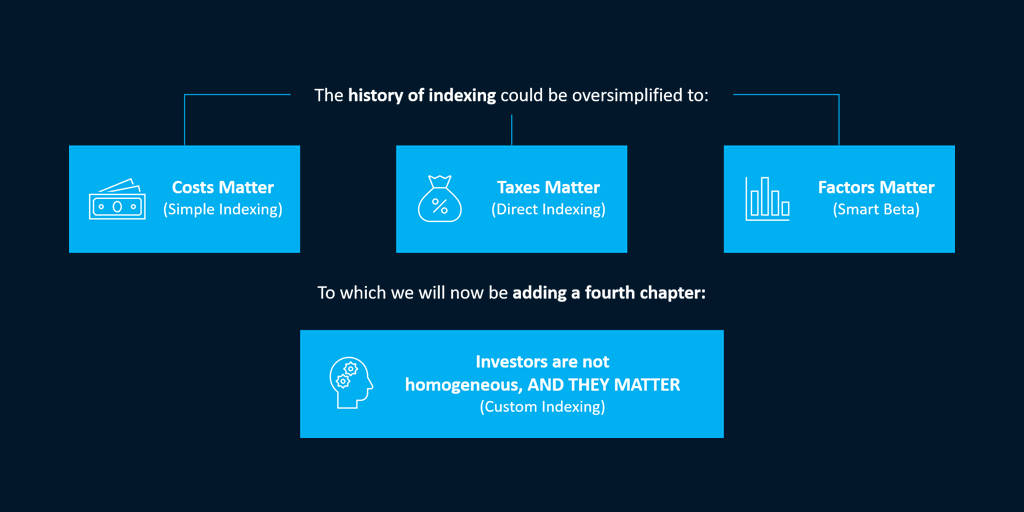
The Charles Schwab Corporation (SCHW) announced, on March 31, 2022, the upcoming launch of a new service, Schwab Personalized Indexing. Schwab touts this as a new solution that brings the power of customized portfolio and tax management to a broader spectrum of investors.

Rick Wurster, president of The Charles Schwab Corporation, stated in a press release: “Direct indexing has long been available to ultra-high net worth investors and institutions able to meet very high investment minimums. But now, thanks to technology innovations and industry developments like Schwab’s introduction of online commission-free trading, we’re able to lower the barriers to direct indexing for more investors and the advisors who serve them.” Schwab expects the new service, which is trademarked, to be available by the end of April 2022.

Key Takeaways

  • Charles Schwab (SCHW) is introducing Schwab Personalized Indexing, a direct indexing service for accounts as small as $100,000.
  • Direct indexing involves holding the individual securities in an index, allowing for greater tax management.
  • The service is expected to be available by the end of April 2022, and Schwab expects to add options and features over the next 12-18 months.

Key Features

Unlike an index fund, direct indexing involves direct ownership of the underlying securities in an index. Thus, it may offer a greater level of tax management for the investor. Within separately managed accounts, Schwab Personalized Indexing is based on a proprietary optimization process that includes daily monitoring of client portfolios and tax-loss harvesting technology. Each client account is to be optimized based on its current holdings and the potential capital gains taxes due on unrealized gains.

Available Strategies

Investors initially can choose among three index-based strategies that can be customized. These are a U.S. large cap strategy based on the Schwab 1000 Index, a U.S. small cap strategy based on the S&P SmallCap 600 Index, and an environmental, social, and governance (ESG) strategy based on the MSCI KLD 400 Social Index. Each strategy seeks index-like returns with enhanced after-tax benefits. Schwab expects to add more strategies and features during the next 12-18 months.

Account Minimums and Fees

Schwab Personalized Indexing initially will require an account minimum of $100,000. Schwab notes that most direct indexing offerings currently on the market start at $250,000 or higher.1

Fees start at 0.40% of assets. Schwab indicates that this is less expensive than many direct indexing programs currently available to advisors and investors.

CITE: https://pressroom.aboutschwab.com/press-releases/press-release/2022/Schwab-Introduces-Schwab-Personalized-Indexing/default.aspx

***

COMMENTS APPRECIATED

Thank You

***

ORDER: https://www.routledge.com/Comprehensive-Financial-Planning-Strategies-for-Doctors-and-Advisors-Best/Marcinko-Hetico/p/book/9781482240283

****

DAILY UPDATE: New IRS 1099-K Reporting Rule

By Staff Reporters

***

***

IRS

The IRS just noted that there are no changes made to the taxability of income but only in the reporting rules for Form 1099-K. Taxpayers are still required to report all income on their tax return unless it is excluded by law. This is whether they receive a Form 1099-NEC, Nonemployee Compensation; Form 1099-K; or any other information return.

Previously businesses would generally receive a 1099-K tax form only when their gross payments exceeded $20,000 for the year and the business conducted at least 200 transactions.

According to the new 1099-K rule, the gross payments threshold has been lowered to just over $600 for the year with the transactions threshold no longer applying. Now a single transaction exceeding $600 can trigger a 1099-K. This includes transactions through credit cards, debit cards, banks, PayPal, Uber, Lyft, and other third-party payment settlement entities.

The 1099-K form includes information about the payment processor and the company receiving payments, and a monthly breakdown of total payments, among other information.

According to the IRS, the lower information reporting threshold and the summary of income on Form 1099-K will make it easier for taxpayers to track the amounts received.

***

COMMENTS APPRECIATED

Thank You

***

ORDER: https://www.routledge.com/Comprehensive-Financial-Planning-Strategies-for-Doctors-and-Advisors-Best/Marcinko-Hetico/p/book/9781482240283

***

On Elon Musk’s Twitter Purchase

A Guest Column by Ryan Bernier

***

What the Skeptics and Naysayers Miss about Elon Musk’s Twitter Purchase

***

***

EDITOR’S NOTE: I first Met Richard Helppie when I was in business school. He was the CEO of Superior Consultant at the time and very gracious to me with with his advice. Today he is a respected philanthropist and publisher of The Common Bridge. -David E. Marcinko

***

COMMENTS APPRECIATED

Thank You

***

ORDER: https://www.routledge.com/Comprehensive-Financial-Planning-Strategies-for-Doctors-and-Advisors-Best/Marcinko-Hetico/p/book/9781482240283

***

SBF: Apologizes as FTX Scrambles to Live

By Staff Reporters

***

***

Following his crypto exchange’s epic implosion, FTX boss Sam Bankman-Fried (SBF) said he was sorry for mistakes he made, and pledged to “give anything I have to” in order to raise the $4 billion in capital FTX needs to avoid bankruptcy.

As the SEC bear down on the company, shady activities are coming to light: FTX loaned its affiliated firm, Alameda Research, ~$10 billion worth of customer assets to fund high-risk bets, per the WSJ.

***

COMMENTS APPRECIATED

Thank You

***

ORDER: https://www.amazon.com/Dictionary-Health-Information-Technology-Security/dp/0826149952/ref=sr_1_5?ie=UTF8&s=books&qid=1254413315&sr=1-5

***

The CPI and Stock Markets

By Staff Reporters

***

***

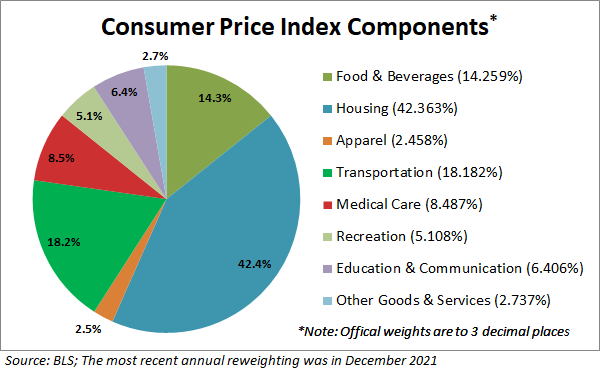
The consumer price index (CPI), the inflation report we dislike every month, dropped today and showed that price growth cooled off a bit in October (but is still far higher than where the FOMC wants it).

The Consumer Price Index (CPI) for October reflected a 7.7% increase over last year and 0.4% increase over the prior month, better than Wall Street expected. Economists surveyed by Bloomberg called for a 7.9% annual rise and 0.5% monthly gain.

The S&P 500 (^GSPC) rallied 5.5% — its biggest intraday gain since April 2020 — while the Dow Jones Industrial Average (^DJI) jumped 1,200 points, or 3.7%, the most since May 2020. The technology-heavy Nasdaq Composite (^IXIC) advanced a whopping 7.4%, its sharpest climb since emerging from the pandemic crash in March 2020. Meanwhile, Treasury yields tumbled following the report, with the benchmark 10-year note falling well below the 4% level.

Meanwhile, earnings season rolls on with reports from Disney, AMC, Palantir, Beyond Meat, and more.

***

ORDER: https://www.amazon.com/Comprehensive-Financial-Planning-Strategies-Advisors/dp/1482240289/ref=sr_1_1?ie=UTF8&qid=1418580820&sr=8-1&keywords=david+marcinko

***

COMMENTS APPRECIATED

Thank You

****

The Economy TODAY!

By Staff Reporters

***

***

It’s a big day for anyone trying to read Jerome Powell today because the October consumer price index report gets released this morning.

Economists expect to see the annual inflation rate come in at 7.9%, so anything higher is likely to spark fear that the Fed could get even more aggressive with its rate hikes.

***
COMMENTS APPRECIATED

Thank You

***

ORDER: https://www.r2library.com/Resource/Title/0826102549

PODCAST: Inflation Impact on Healthcare

By Eric Bricker MD

***

***

CITE: https://www.r2library.com/Resource/Title/0826102549

COMMENTS APPRECIATED

Thank You

***

ROBINHOOD: The Brokerage Collapses?

By Staff Reporters

***

***

Shares of Robinhood, the brokerage, plummeted by 15% as FTX was acquired to save it from collapsing. Sam Bankman-Fried bought a 7.6% stake in May in Robinhood, a brokerage meant to attract Millennial investors who sought to invest in cryptocurrencies.

But Bankman-Fried, the founder of FTX, a popular cryptocurrency exchange, faced even larger hurdles that investors were not aware of. 

Robinhood  (HOOD) – Get Free Report shares tumbled on Nov. 8, falling by as much as 15.54% in mid-day trading to $10.22 a share as Binance, the crypto behemoth, said it would acquire FTX, which was once its rival due to a “liquidity crunch.”

***

COMMENTS APPRECIATED

Thank You

***

ORDER: https://www.routledge.com/Comprehensive-Financial-Planning-Strategies-for-Doctors-and-Advisors-Best/Marcinko-Hetico/p/book/9781482240283

***

DAILY UPDATE: ARK Invest and Nvidia Corp.

By Staff Reporters

***

***

Last week was a rough one in the stock market, and this week could be even worse. The inflation report Thursday, and another group of earnings will give investors plenty of new information to absorb. Finally, Warren Buffett reported his company’s earnings over the weekend as Berkshire’s $109 billion cash pile has ballooned thanks to rising interest rates.

***

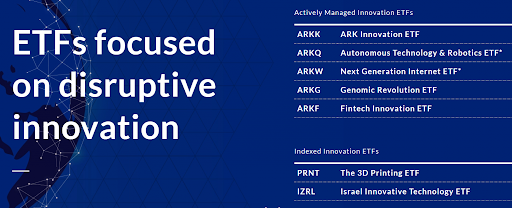
Cathie Wood is once again offloading shares in her long-time favorite Nvidia Corp., as a slight rebound emerged ahead of the company’s earnings. Her flagship Ark Innovation ETF sold 167,914 shares on Friday, adding to a sale of 50,252 shares on Oct. 20, according to Wood’s firm Ark Investment Management LLC’s daily trading disclosures.

Meanwhile, the Ark Next Generation Internet ETF sold 24,423 Nvidia shares on Thursday. Ark’s latest sales come days ahead of Nvidia’s third-quarter earnings — scheduled for Nov. 17 — similar to the prior quarter when the funds dumped the stock before the chipmaker reported revenue forecast that was about $1 billion short of the average Wall Street estimate. The stock has rebounded 26% from a more than two-year low on Oct. 14 to $141.46. That’s above the average closing price of $131.74 in September, when ETFs controlled by ARK Investment Management LLC picked up more than 400,000 Nvidia shares throughout the month. 

Still, Nvidia is down more than 50% this year as historical tightening by the Federal Reserve and global recession fears have continued to batter growth stocks.

***

FINANCE: https://www.routledge.com/Comprehensive-Financial-Planning-Strategies-for-Doctors-and-Advisors-Best/Marcinko-Hetico/p/book/9781482240283

BUSINESS MEDICINE: https://www.routledge.com/Comprehensive-Financial-Planning-Strategies-for-Doctors-and-Advisors-Best/Marcinko-Hetico/p/book/9781482240283

***

COMMENTS APPRECIATED

Thank You

***

TAX LOSS HARVESTING: What it is?

By Staff Reporters

***

***

What Is Tax-Loss Harvesting?

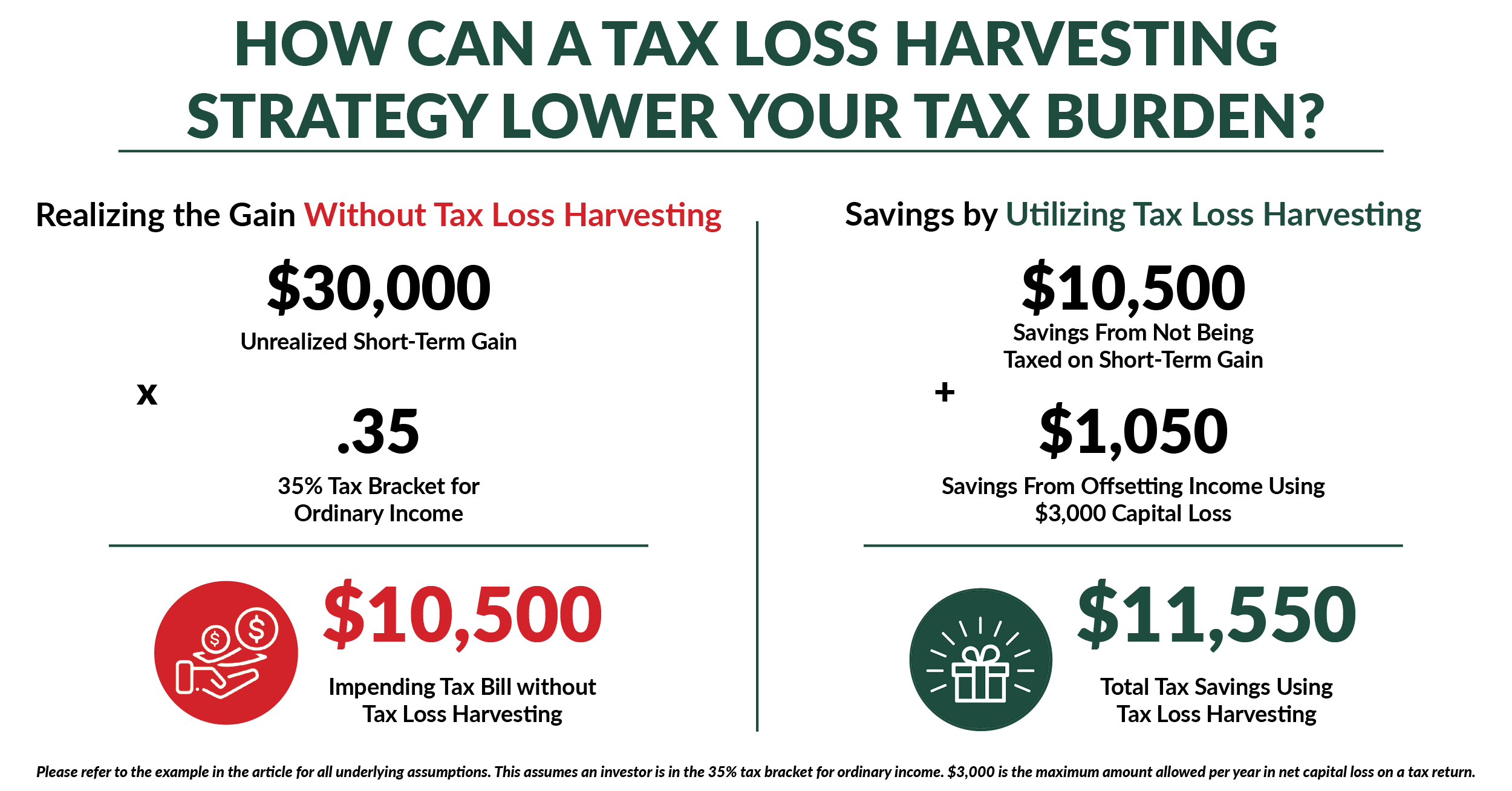
Tax-loss harvesting is the timely selling of securities at a loss in order to offset the amount of capital gains tax due on the sale of other securities at a profit. 

This strategy is most often used to limit the amount of taxes due on short-term capital gains, which are generally taxed at a higher rate than long-term capital gains. However, the method may also offset long-term capital gains. This strategy can help preserve the value of the investor’s portfolio while reducing the cost of capital gains taxes.

There is a $3,000 limit on the amount of capital gains losses that a federal taxpayer can deduct in a single tax year. However, Internal Revenue Service (IRS) rules allow additional losses to be carried forward into the following tax years.

4 Key Points

  • Tax-loss harvesting is a strategy investors can use to reduce the total amount of capital gains taxes due from the sale of profitable investments.
  • The strategy involves selling an asset or security at a net loss.
  • The investor can then use the proceeds to purchase a similar asset or security, maintaining the portfolio’s overall balance.
  • The investor must be careful not to violate the IRS rule against buying a “substantially identical” investment within 30 days.

***
COMMENTS APPRECIATED

Thank You

***

ORDER: https://www.amazon.com/Comprehensive-Financial-Planning-Strategies-Advisors/dp/1482240289/ref=sr_1_1?ie=UTF8&qid=1418580820&sr=8-1&keywords=david+marcinko

***

STABLECOINS: Altering the US Banking System?

By Staff Reporters

***

***

DEFINITION: Stablecoins are cryptocurrencies where the price is designed to be pegged to a reference asset. The reference asset may be fiat money, exchange-traded commodities, or a cryptocurrency.

CITE: https://www.r2library.com/Resource/Title/082610254

***

In fact, Stablecoins could have such a profound effect on the established banking system that U.S. regulators need to require that the digital tokens fit in without disrupting it, said Martin Gruenberg, the acting chairman of the Federal Deposit Insurance Corp. (FDIC). His remarks were delivered at a Brookings Institution event recently.

Gruenberg’s agency is among the U.S. banking watchdogs that will have significant influence over how stablecoins are regulated, and the FDIC has also had to weigh in with recent sanctions against firms – such as FTX US – that have made claims misrepresenting how FDIC deposit insurance backstops their operations. As U.S. banks have increasingly sought to offer crypto services, including maintaining custody of customer’s digital assets, Gruenberg said that his agency has been cautious about allowing regulated lenders to engage.

***

ORDER: https://www.amazon.com/Dictionary-Health-Information-Technology-Security/dp/0826149952/ref=sr_1_5?ie=UTF8&s=books&qid=1254413315&sr=1-5

***

FINANCE: https://www.routledge.com/Comprehensive-Financial-Planning-Strategies-for-Doctors-and-Advisors-Best/Marcinko-Hetico/p/book/9781482240283

***

COMMENTS APPRECIATED

Thank You

***

“I” Bonds: DOWN!

By Staff Reporters

***

DEFINITION: https://www.treasurydirect.gov/savings-bonds/i-bonds/

***

***

The rate for I bonds, an asset that’s tied to the rate of inflation, was lowered to 6.89% yesterday from its record high of 9.62%. But in the final days of the previous rate, investors hoarded I bonds like crazy.

Now, on Friday, the Treasury sold $979 million of I bonds, nearly as much as the entire amount sold in the three years from 2018 to 2020, per CNBC. The investors also crashed the website.

***

COMMENTS APPRECIATED

Thank You

***

ORDER: https://www.routledge.com/Comprehensive-Financial-Planning-Strategies-for-Doctors-and-Advisors-Best/Marcinko-Hetico/p/book/9781482240283

***

MEDICARE: “Dis” Advantage Plan Marketing

CMS Cracks Down on Medicare Advantage TV Marketing

Dr. David Edward Marcinko MBA

***

***

CMS is cracking down on deceptive marketing practices and will no longer allow Medicare Advantage or Part D prescription drug plans to advertise on television without agency approval first. The new policy is effective Jan. 1st and was discussed in an Oct. 19th memo from CMS to MA and Part D providers. The agency said it issued the new policy after reviewing thousands of beneficiary complaints regarding confusing, misleading or inaccurate information from plans — plan sponsors are also responsible for all marketing activities from brokers and third-party agencies.

“CMS has conducted so-called ‘secret shopping’ by calling numbers associated with television advertisements, mailings, newspaper advertisements and internet searches to monitor the experience beneficiaries have engaging these entities,” the agency wrote.

“Our secret shopping activities have discovered that some agents were not complying with current regulation and unduly pressuring beneficiaries, as well as failing to provide accurate or enough information to assist a beneficiary in making an informed enrollment decision.”

Source: Jakob Emerson, Becker’s Payer Issues [10/27/22]

***

OIG: https://oig.hhs.gov/oei/reports/OEI-09-18-00260.asp

RELATED: https://medicalexecutivepost.com/2021/05/21/podcast-medicare-advantage-plans-insurance-company-goldmine

MORE: https://medicalexecutivepost.com/2022/04/29/probe-medicare-advantage-part-c-plans-deny-needed-care-to-tens-of-thousands-of-patients/

***

ORDER: https://www.amazon.com/Dictionary-Health-Insurance-Managed-Care/dp/0826149944/ref=sr_1_4?ie=UTF8&s=books&qid=1275315485&sr=1-4

***
COMMENTS APPRECIATED

Thank You

****

“Prime Medicine” Post IPO

By Staff Reporters

***

***

Prime Medicine (NASDAQ:PRME) opened up its shares for public trading for the first time since it filed for IPO in September 2022. The company agreed to initially offer 10.29 million shares to the public at $17.00 per share. On its first day of trading, the stock decreased 18.98% from its opening price of $18.97 to its closing price of $15.37.

READ: https://primemedicine.com/

***

DHIT: https://www.amazon.com/Dictionary-Health-Information-Technology-Security/dp/0826149952/ref=sr_1_5?ie=UTF8&s=books&qid=1254413315&sr=1-5

***

ORDER: https://www.routledge.com/Comprehensive-Financial-Planning-Strategies-for-Doctors-and-Advisors-Best/Marcinko-Hetico/p/book/9781482240283

***

COMMENTS APPRECIATED

Thank You

***

TRANSACTIONAL STOCK ANALYSIS: What it is?

Versus Technical Analysis

By Staff Reporters

***

***

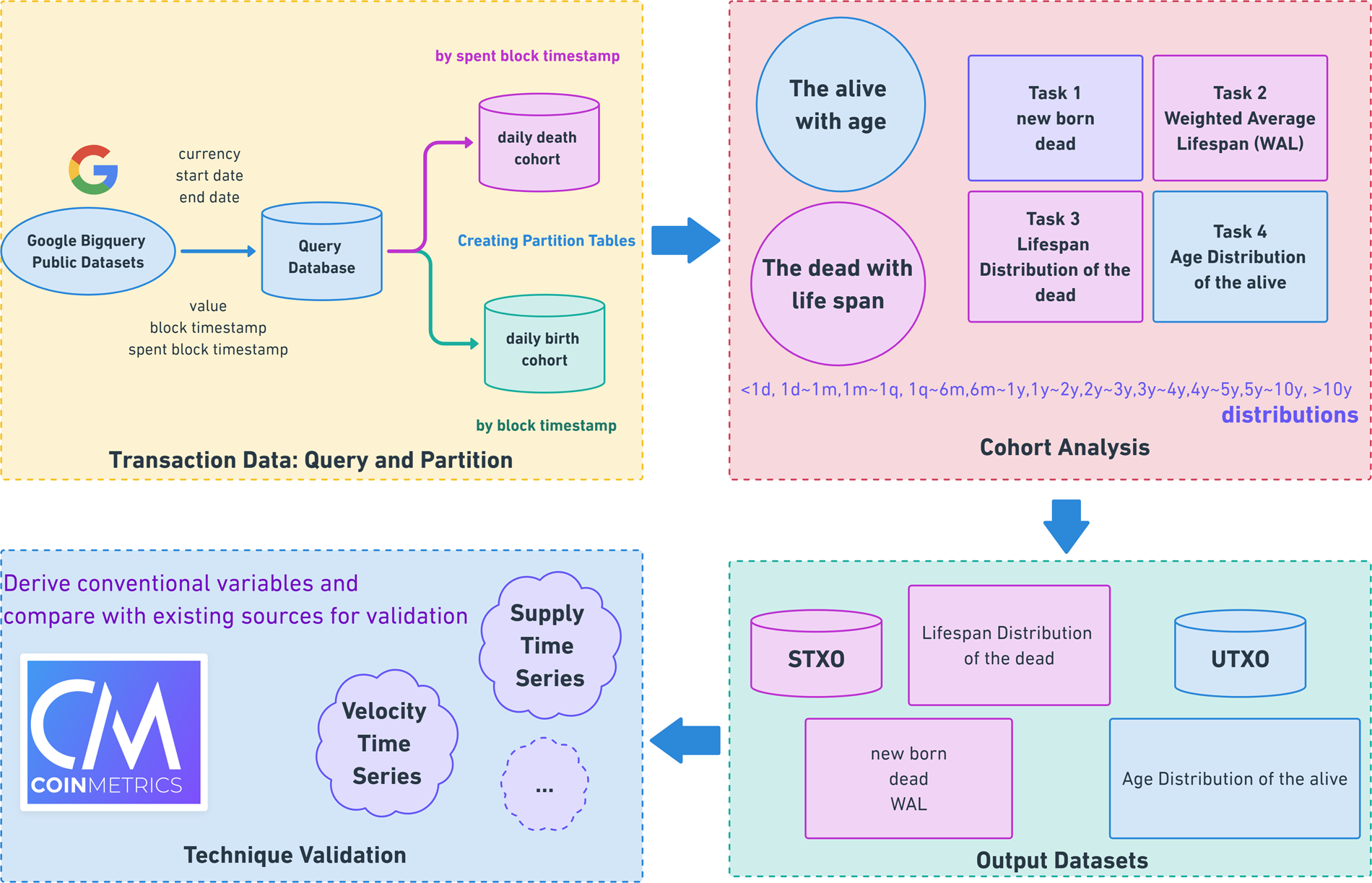
In traditional finance transaction data is guarded by exchanges, brokers, banks and regulators. It’s not accessible to everyone and big players pay a fortune for it.

But, in crypto, Transaction Data is public and on-chain – but it’s not usable by everyone. So, manually making sense of raw blockchain data is practically impossible. The data needs to be processed and analyzed to be made useful. That’s what sophisticated blockchain analytics tools are doing.

The combination of on-chain data and transaction analysis is something that hasn’t been before – in crypto or traditional finance. Getting access to transaction data and tools for searching and analyzing it will unlock a goldmine of potential insight.

People who have been on the inside of projects and see how the sausage is made know that the explanations for price movements are often simple and based on key players buying and selling. When the biggest holders are dumping the price is likely to go down. When a major new buyer takes a position prices are likely to go up.

That’s insight traditional Technical Analysis cannot provide, because it’s limited to looking at price movements. Transaction data, instead, is the underlying activity that generates prices in crypto.

CITE: https://www.r2library.com/Resource/Title/0826102549

Technical Analysis: https://medicalexecutivepost.com/2022/06/23/the-technicians/

Related: https://medicalexecutivepost.com/2022/09/25/what-is-sentimental-stock-market-analysis/

***

ORDER: https://www.amazon.com/Dictionary-Health-Information-Technology-Security/dp/0826149952/ref=sr_1_5?ie=UTF8&s=books&qid=1254413315&sr=1-5

ORDER MORE: : https://www.amazon.com/Financial-Management-Strategies-Healthcare-Organizations/dp/1466558733/ref=sr_1_3?ie=UTF8&qid=1380743521&sr=8-3&keywords=david+marcinko

***

COMMENTS APPRECIATED

Thank You

****

DAILY UPDATE: Are we living through Dot-com Bust 2.0?

By Staff Reporters

***

***

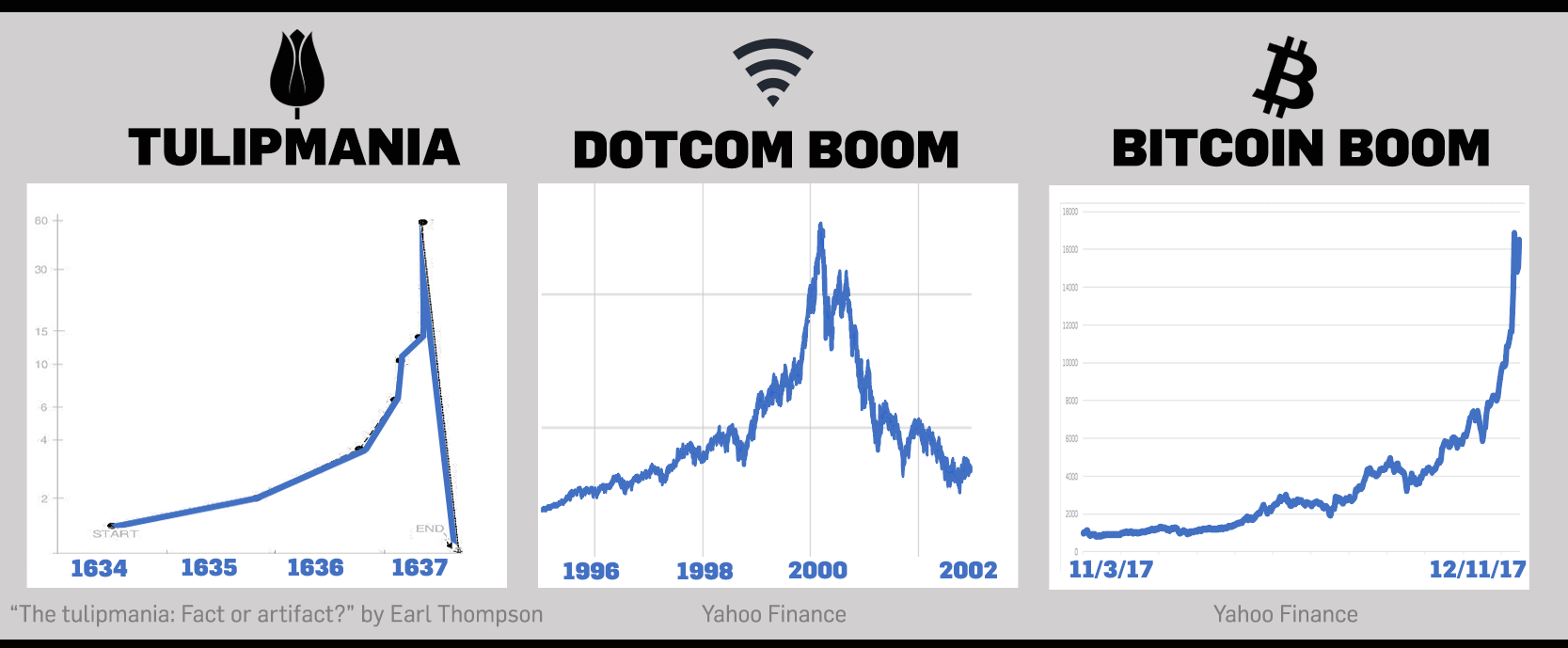
Also known as the internet bubble or the information technology bubble, the dotcom bubble was the unprecedented rise in equity valuations of internet-based tech companies during the bull market of the late 1990s.

Thanks mainly to speculation and substantial funding for these new internet start-ups, investments in dot-coms (named as such for the .com online top-level domain [TLD] used by such companies) boosted the NASDAQ Composite Index (COMP) from 751 in January 1995 to a peak of 5,048.62 on March 10, 2000. But the bubble eventually burst in March 2000, with many companies failing to even come close to fulfilling their promise. As such, the NASDAQ fell by more than 75 percent between March 2000 and October 2002, thus wiping out more than $5 trillion in market value.

***

  • Some financial and economic analysts are beginning to compare this year’s tech rout (which has cost the NASDAQ $8 trillion in value so far) with the bursting of the dot-com bubble in 2000–2002, when the NASDAQ lost the equivalent of $8.6 trillion in today’s dollars. The industrial-focused Dow, on the other hand, is on track for its best October in history.
  • The FOMC is likely a lock to hike interest rates by a large75 basis points on Wednesday for the fourth straight meeting. Evidence that its inflation-fighting campaign is working could come on Friday, with the October jobs report.

***

COMMENTS APPRECIATED

Thank You

***

FINANCE: https://www.routledge.com/Comprehensive-Financial-Planning-Strategies-for-Doctors-and-Advisors-Best/Marcinko-Hetico/p/book/9781482240283

BUSINESS MEDICINE: https://www.routledge.com/Comprehensive-Financial-Planning-Strategies-for-Doctors-and-Advisors-Best/Marcinko-Hetico/p/book/9781482240283

****

MONOGRAM: The “Knee Joint” Replacement IPO

Modernizing the $19.6B Knee Replacement Industry

By Staff Reporters

***

***

One way to classify joints is by range of motion. Immovable joints include the sutures of the skull, the articulations between teeth and the mandible, and the joint located between the first pair of ribs and the sternum. Some joints have slight movement; an example is the distal joint between the tibia and fibula. Joints that allow a lot of motion (think of the shoulder, wrist, hip, and ankle) are located in the upper and lower limbs.

***

KNEE: No bones about it

The $19.6b joint-replacement industry uses outdated methods, leading to 100,000 surgeries failing annually. Monogram aims to fix it with precision surgical robots + personalized implants.

***

COMMENTS APPRECIATED

Thank You
***

ORDER: https://www.amazon.com/Dictionary-Health-Information-Technology-Security/dp/0826149952/ref=sr_1_5?ie=UTF8&s=books&qid=1254413315&sr=1-5
***

HALLOWEEN: Stock Index Indicator?

SELL IN MAY – AND GO AWAY

By Staff Reporters

***

***

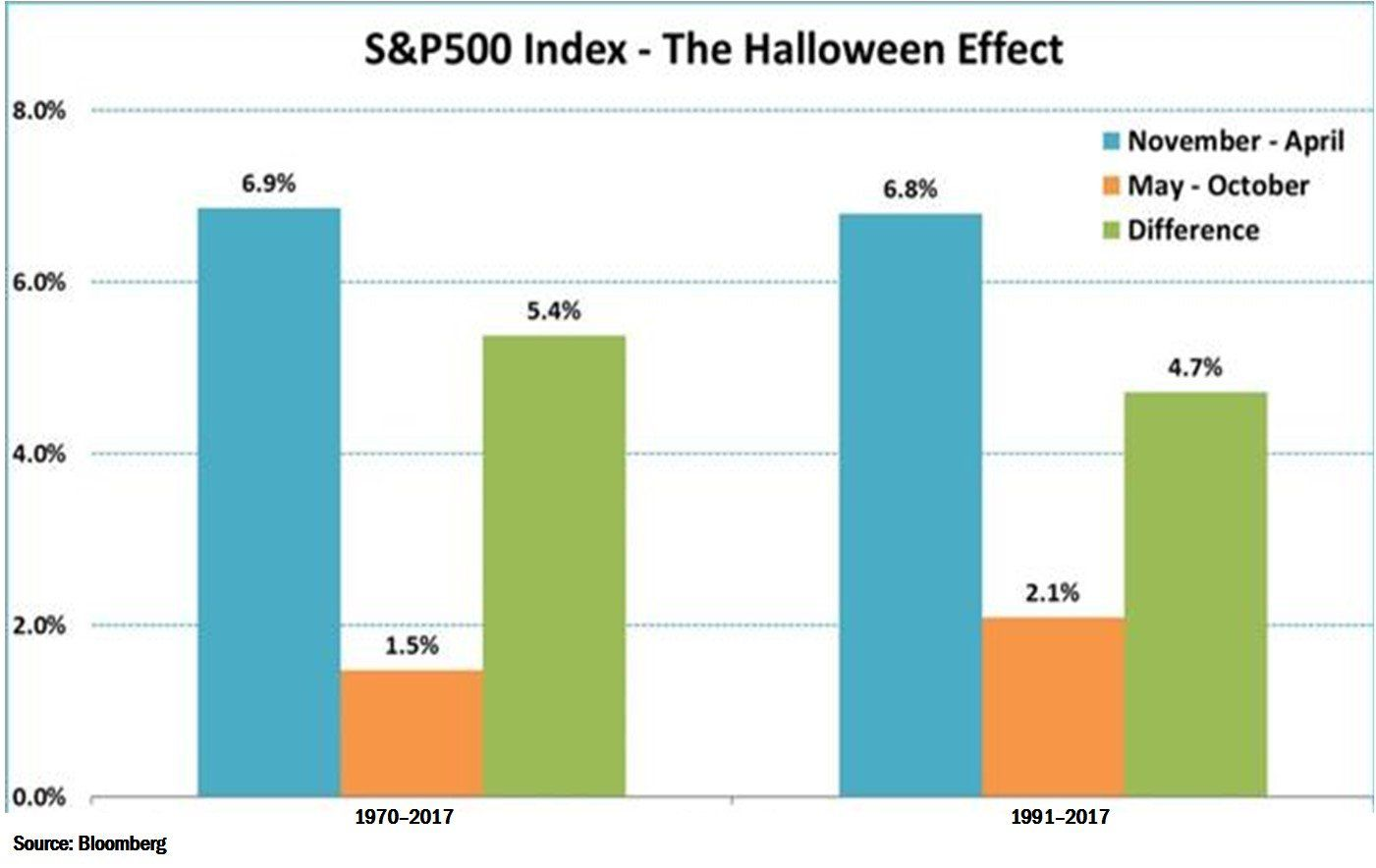
Essentially, the HALLOWEEN INDICATOR is a market-timing strategy. It argues that, by buying into the stock market after Halloween and selling at the end of April, investors would generate a better annual return on their portfolio than if they had remained invested throughout the year. Sell in May and go away is an investment strategy for stocks based on a theory that the period from November to April inclusive has significantly stronger stock market growth on average than the other months

The practice of abandoning stocks beginning in May of each year is widely thought to have its origins in the United Kingdom. The privileged class would leave London and head to their country estates for the summer months, where they would largely ignore their investment portfolios. To this day, many stock market watchers have postulated that the corresponding impact of summer vacations on market liquidity and investors’ risk aversion is at least partly responsible for the difference in seasonal returns.

In what is considered to be a seminal piece of research on the subject, “The Halloween Indicator, ‘Sell in May and Go Away’: Another Puzzle,” authors Sven Bouman and Ben Jacobsen were among the first to document a strong seasonal effect in global stock markets. In 36 of the 37 developed and emerging markets they studied between 1973 and 1998, the authors found returns in the November through April period to be, on average, significantly higher than those in the May through October period, even after taking transaction costs into account. What puzzled the authors was the fact that, while the anomaly was widely known and seemed to offer considerable economic rewards, it had not been arbitraged away.

More recently, Jacobsen partnered with Cherry Zhang on a follow up study, titled, “The Halloween Indicator: Everywhere and All the Time,” and extended the research to 108 stock markets using all historical data available. The result was a sample of 55,425 monthly observations (including more than 300 years of UK data), which helped to rebut any criticisms of data mining and sample selection bias. The results were compelling, as the November through April “winter” period delivered returns that were, on average, 4.52% higher than the “summer” returns. The Halloween effect was evident in 81 out of 108 countries. The size of the Halloween effect varied across geographies. It was found to be stronger in developed and emerging markets than in frontier markets.

***

MORE: https://medicalexecutivepost.com/2021/10/30/the-halloween-index-investment-strategy/

COMMENTS APPRECIATED

Thank You

***

***

ORDER https://www.routledge.com/Comprehensive-Financial-Planning-Strategies-for-Doctors-and-Advisors-Best/Marcinko-Hetico/p/book/9781482240283

***

BIG TECH STOCKS: Down … Down … Down!

By Staff Reporters

***

***

Plunging tech stocks are dragging the markets down and snapping a brief winning streak. Up next for the economy: The third-quarter GDP report.

America’s internet giants are slumping hard in this era of higher interest rates, lower advertising budgets, and widespread economic uncertainty

For example, Meta recently became the latest Big Tech company to post rough financial results for the prior quarter. It recorded its second straight quarter of declining revenue and provided a gloomy outlook for Q4. Perhaps Meta shouldn’t even be considered “Big Tech” anymore. Since its share price peaked in September 2021, the company lost nearly two-thirds of its value…before diving another ~20% in after-hours trading yesterday.

What went wrong? Younger people are fleeing Facebook, and investors aren’t confident CEO Mark Zuckerberg can reinvent the company as a metaverse platform. “Meta has drifted into the land of excess—too many people, too many ideas, too little urgency,” a prominent shareholder wrote this week in a scathing letter. Meta’s metaverse unit, Reality Labs, has lost $9.4 billion so far this year.

While Meta may be the poster child for Big Tech’s struggles, it’s not the only company that needs a checkup

  • Google parent Alphabet posted its slowest revenue growth since 2013 (outside of one early pandemic quarter), and YouTube ad sales actually fell in Q3. It’s “a tough time in the ad market,” CEO Sundar Pichai acknowledged. Alphabet shares had their worst day since March 2020.
  • And Microsoft also had its worst day since March 2020 after giving a disappointing forecast. Its push to dominate the metaverse is also faltering, per the WSJ.

Big view

Tech giants scored record profits during COVID, when interest rates were near zero, stimulus checks were flowing, and everyone was stuck inside with only the internet to entertain themselves. No anymore!

***

ORDER: https://www.amazon.com/Dictionary-Health-Information-Technology-Security/dp/0826149952/ref=sr_1_5?ie=UTF8&s=books&qid=1254413315&sr=1-5

***

COMMENTS APPRECIATED

Thank You

***

What is CHROMETOPHOBIA?

***

A great question to ponder during National Financial Planning Month!

About the “FEAR OF MONEY”

By Charles Patrick Davis, MD, PhD

Fear of money: An abnormal and persistent fear of money. Sufferers experience undue anxiety even though they realize their fear is irrational. They worry that they might mismanage money or that money might live up to its reputation as “the root of all evil.” Perhaps they remember well the ill fortune that befell the mythical King Midas. His wish that everything he touched be turned to gold was fulfilled, and even his food was transformed into gold.

The fear of money is termed chrometophobia or chrematophobia, from the Greek “chrimata” (money) and “phobos” (fear). The “chrome” in “chrometophobia” may also be related to the Greek word “chroma” (color) because of the brilliant colors of ancient coins — for example, gold, silver, bronze and copper.

CITE: https://www.r2library.com/Resource/Title/0826102549

YOUR COMMENTS ARE APPRECIATED.

Thank You

****

Comprehensive Financial Planning Strategies for Doctors and Advisors: Best Practices from Leading Consultants and Certified Medical Planners™

FINANCIAL PLANNING: https://www.routledge.com/Comprehensive-Financial-Planning-Strategies-for-Doctors-and-Advisors-Best/Marcinko-Hetico/p/book/9781482240283

***

Risk Management, Liability Insurance, and Asset Protection Strategies for Doctors and Advisors : Best Practices from Leading Consultants and Certified Medical Planners™ book cover

RISK MANAGEMENT: https://www.routledge.com/Risk-Management-Liability-Insurance-and-Asset-Protection-Strategies-for/Marcinko-Hetico/p/book/9781498725989

***

PHYSICIAN FINANCIAL ADVISORS: https://medicalexecutivepost.com/2021/10/11/

***

What is a JUMBO Home Loan Mortgage?

By Staff Reporters

***

***

What Is a Jumbo Loan?

A jumbo loan, also known as a jumbo mortgage, is a type of financing that exceeds the limits set by the Federal Housing Finance Agency (FHFA). Unlike conventional mortgages, a jumbo loan is not eligible to be purchased, guaranteed, or securitized by Fannie Mae or Freddie Mac. Designed to finance luxury properties and homes in highly competitive local real estate markets, jumbo mortgages come with unique underwriting requirements and tax implications. These kinds of mortgages have gained traction as the housing market continues to recover following the Great Recession.

The value of a jumbo mortgage varies by state—and even county. The FHFA sets the conforming loan limit size for different areas on an annual basis. The limit for 2022 was set at $647,200 for most of the country. This was an increase of $98,950 from the 2021 limit of $548,250. For counties that have higher home values, the baseline limit is set at $970,800, or 150% of $647,200.1

The FHFA has a different set of provisions for areas outside of the continental United States for loan limit calculations. As a result, the baseline limit for a jumbo loan in Alaska, Guam, Hawaii, and the U.S. Virgin Islands as of 2022 is also $970,800. That amount may actually be even higher in counties that have higher home values.

***

***

FINANCE: https://www.routledge.com/Comprehensive-Financial-Planning-Strategies-for-Doctors-and-Advisors-Best/Marcinko-Hetico/p/book/9781482240283

***

COMMENTS APPRECIATED

Thank You

***

IRS: Increases Contribution Limits for Retirement Savings Plans

By Staff Reporters

***

***

The IRS just said that the maximum contribution that an individual can make in 2023 to a 401(k), 403(b) and most 457 plans will be $22,500. That’s up from $20,500 this year.

People aged 50 and over, which have the option to make additional “catch-up” contributions to 401(k) and similar plans, will be able to contribute up to $7,500 next year, up from $6,500 this year. That’s means a 401(k) saver who is 50 or older can contribute a maximum of $30,000 to their retirement plan in 2023.

The IRS also raised the 2023 annual contribution limits on individual retirement arrangements, or IRAs, to $6,500, up from $6,000 this year. The IRA “catch-up” contribution limit remains at $1,000, as it’s not subject to an annual cost of living adjustment, the IRS said.

***

FINANCE: https://www.routledge.com/Comprehensive-Financial-Planning-Strategies-for-Doctors-and-Advisors-Best/Marcinko-Hetico/p/book/9781482240283

***

COMMENTS APPRECIATED

Thank You

***

What is an “INSIDER” Company Shareholder?

TERMS AND DEFINITIONS PHYSICIAN INVESTORS SHOULD KNOW

By Dr. David E. Marcinko MBA CMP®

CMP logo

SPONSOR: http://www.CertifiedMedicalPlanner.org

Insider transactions shouldn’t be used primarily to make an investing decision, however an insider transaction can be an important factor in the investing decision.

In legal terms, an “insider” refers to any shareholder who owns at least 10% of a company. This can include executives in the c-suite and large hedge funds. These insiders are required to let the public know of their transactions via a Form 4 filing, which must be filed within two business days of the transaction.

SEC: https://www.sec.gov/about/forms/form4data.pdf

CITE: https://www.r2library.com/Resource/Title/0826102549

INSIDER TRANSACTIONS

When a company insider makes a new purchase, that is an indication that they expect the stock to rise.

Insider sells, on the other hand, can be made for a variety of reasons, and may not necessarily mean that the seller thinks the stock will go down.

MORE: https://smartasset.com/financial-advisor/insider-trading

EXAMPLE:

Mark Zuckerberg, CEO at Facebook (NASDAQ:FB), just made a large buy and sell of company shares on November 3, according to a new SEC filing. A Form 4 filing from the U.S. Securities and Exchange Commission states that Mark Zuckerberg exercised options to purchase 62,300 Facebook shares for $0 on November 3. They then sold their shares on the same day in the open market. They sold at prices ranging from $324.04 to $332.02 to raise a total of $25,463,482 from the stock sale.

Zuckerberg still owns a total of 232,400 shares of Facebook worth, $78,226,142.

***

YOUR COMMENTS ARE APPRECIATED

FINANCE: https://www.amazon.com/Comprehensive-Financial-Planning-Strategies-Advisors/dp/1482240289/ref=sr_1_1?ie=UTF8&qid=1418580820&sr=8-1&keywords=david+marcinko

Thank You

RISK MANAGEMENT: https://www.routledge.com/Risk-Management-Liability-Insurance-and-Asset-Protection-Strategies-for/Marcinko-Hetico/p/book/9781498725989

***

What is a Corporate POISON PILL?

Arcane Financial Tactic

By Staff Reporters

I. DEFINITION: A poison pill is a defense tactic utilized by a target company to prevent or discourage hostile takeover attempts. Poison pills allow existing shareholders the right to purchase additional shares at a discount, effectively diluting the ownership interest of a new, hostile party.

KOHLS News: https://www.cnbc.com/2022/02/04/kohls-says-takeover-offers-undervalue-its-business.html

***

II. DEFINITION: A hostile takeover refers to the acquisition of one company by another corporation against the wishes of the former. The company being acquired in a hostile takeover is called the target company while the one executing the takeover is called the acquirer. In a hostile takeover, the acquirer goes directly to the company’s shareholders or fights to replace management to get the acquisition approved. Approval of a hostile takeover is generally completed through either a tender offer or a proxy fight.

***

CITE: https://www.r2library.com/Resource/Title/082610254

***

See the source image

***

MORE: https://www.wallstreetmojo.com/poison-pills/

***

FINANCE: https://www.amazon.com/Comprehensive-Financial-Planning-Strategies-Advisors/dp/1482240289/ref=sr_1_1?ie=UTF8&qid=1418580820&sr=8-1&keywords=david+marcinko

***

COMMENTS APPRECIATED

Thank You

Subscribe to the Medical Executive-Post

***

ELON MUSK: Thinks Twitter Can Run at 25% Workforce

By Staff Reporters

***

***

According to the Washington Post, Elon Musk told potential investors for his Twitter purchase that he would thin the company’s 7,500-person workforce by 75%, leaving less than 2,000 employees to protect against security threats and solve the bot problem.

But even if the deal didn’t go through, Twitter was probably headed for layoffs. Current management said they needed to cut payroll by nearly $800 million by the end of 2023. Musk’s acquisition of Twitter is expected to close by next week.

***

FINANCE: https://www.routledge.com/Comprehensive-Financial-Planning-Strategies-for-Doctors-and-Advisors-Best/Marcinko-Hetico/p/book/9781482240283

COMMENTS APPRECIATED

Thank You

***

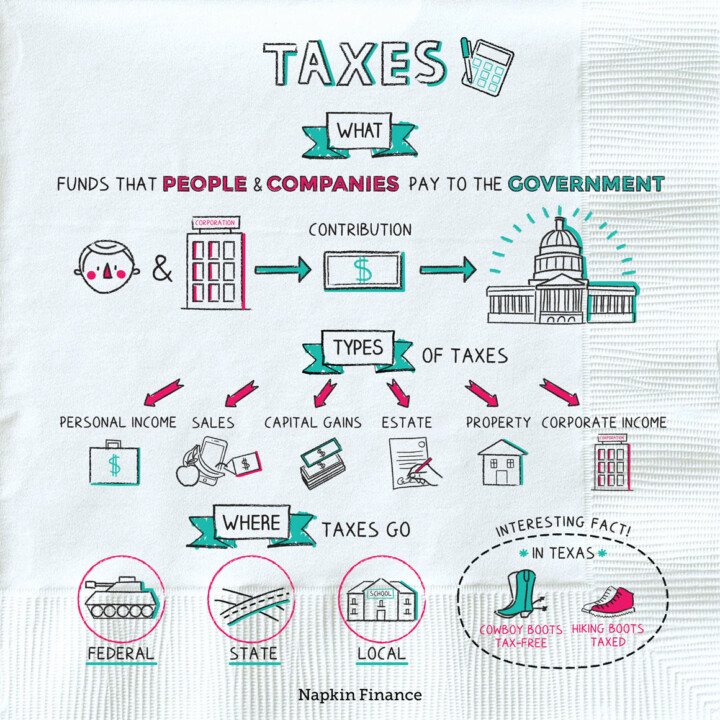
IRS: New Taxation Rates and Brackets for 2023

By Staff Reporters

***

***

The IRS just released inflation-adjusted marginal rates and brackets for 2023 on Tuesday, and many workers will see higher take-home pay in the new year as less tax is withheld from their paychecks.

Additionally, the agency released the standard deduction for next year. It is increasing by $900 to $13,850 for single taxpayers, and by $1,800 for married couples, to $27,700. For heads of household, the 2023 standard deduction will be $20,800. That’s an increase of $1,400.

Here are the marginal rates for for tax year 2023, depending on your tax status.

Single filers

  • 10%: income of $11,000 or less
  • 12%: income between $11,000 to $44,725
  • 22%: income between $44,725 to $95,375
  • 24%: income between $95,375 to $182,100
  • 32%: income between $182,100 to $231,250
  • 35% income between $231,250 to $578,125
  • 37%: income greater than $578,125

Married filing jointly

  • 10%: income of $22,000 or less
  • 12%: income between $22,000 to $89,450
  • 22%: income between $89,450 to $190,750
  • 24%: income between $190,750 to $364,200
  • 32%: income between $364,200 to $462,500
  • 35% income between $462,500 to $693,750
  • 37%: income greater than $693,750

Additionally, the maximum Earned Income Tax Credit for 2023 is $7,430 for those who have three or more qualifying children. The maximum contribution to a healthcare flexible spending account is also increasing, from $2,850 to $3,050.

Wealthy Americans will also be able to exclude significantly more assets from the estate tax in 2023. Individuals will be able to transfer up to $12.92 million tax-free to their descendants, up from just over $12 million in 2022. A married couple can pass on double that. And the annual exclusion for gifts increases to $17,000.

***
COMMENTS APPRECIATED

Thank You

***

INVESTING: https://www.routledge.com/Comprehensive-Financial-Planning-Strategies-for-Doctors-and-Advisors-Best/Marcinko-Hetico/p/book/9781482240283

***

***

BANKS: Goldman Sachs Overhaul

By Staff Reporters

***

***

Goldman Sachs is planning a major overhaul that would combine its investment banking and trading businesses into one unit and its asset and wealth management branches into another.

***

Bank Types: https://medicalexecutivepost.com/2022/10/14/the-three-various-types-of-banks/

FINANCE: https://www.routledge.com/Comprehensive-Financial-Planning-Strategies-for-Doctors-and-Advisors-Best/Marcinko-Hetico/p/book/9781482240283

***

COMMENTS APPRECIATED

Thank You

***

DAILY UPDATE: BLS and Machine Learning

By Staff Reporters

***

***

Increases in the shelter, food, and medical care indexes were the largest of many contributors to the monthly seasonally adjusted all items increase.”—Bureau of Labor Statistics’s Consumer Price Index Summary

According to Betterment, one of the world’s largest robo-advisors, whose consumer-facing investment offerings make virtually no use of machine learning. [Emerging Tech]

***

FINANCE: https://www.routledge.com/Comprehensive-Financial-Planning-Strategies-for-Doctors-and-Advisors-Best/Marcinko-Hetico/p/book/9781482240283

***

COMMENTS APPRECIATED

Thank You

***

What is the SELLING AWAY of Securities?

Information All Physician Investors Should Know

By Dr. David Edward Marcinko MBA CMP®

CMP logo

SPONSOR: http://www.CertifiedMedicalPlanner.org

According to Wikipedia, selling away in the U.S. securities brokerage industry is the inappropriate practice of an investment professional who sells, or solicits the sale of, securities not held or offered by the brokerage firm with which he is associated.

CITE: https://www.r2library.com/Resource/Title/0826102549

An example of the term expressed in a sentence is, “The broker was selling investments away from the firm.” Brokers marketing securities must have obtained the appropriate securities licenses for various types of investments. Brokers in the U.S. may be “associated” with one or more Brokerage firms and must obtain licenses by passing standardized Financial Industry Regulatory Authority exams such as the Series 6 or Series 7 exam.

***

In the past I’ve held these as well as a Series 63 and 65 license [SEC].

CFI: https://corporatefinanceinstitute.com/resources/knowledge/trading-investing/selling-away/

YOUR COMMENTS ARE APPRECIATED.

Thank You

FINANCE: https://www.amazon.com/Comprehensive-Financial-Planning-Strategies-Advisors/dp/1482240289/ref=sr_1_1?ie=UTF8&qid=1418580820&sr=8-1&keywords=david+marcinko

***

The Three [3] Types of Banks

Join Our Mailing List Understanding Differences

[By Dr. David Edward Marcinko MBA CMP™]

SPONSOR: http://www.CertifiedMedicalPlanner.org

CMP logo

***

dem-thinkingThere are several different kinds of banks.

A general understanding of these types is suggested for any medical professional prior to launching a self-directed [ME, Inc], or even a guided investment strategy or wealth building portfolio effort with a financial advisor [FA], stock broker or wealth manager, etc.

This banking information is usually not included in any text on financial planning, or related, until now.

CITE: https://www.r2library.com/Resource/Title/082610254

Definition of Retail Bank

A retail bank is a typical small mass-market financial institution in which individual customers use local branches; usually of larger commercial banks. Services offered include savings and checking accounts, mortgages, personal loans, debit/credit cards and certificates of deposit (CDs).

Definition of Commercial Bank

A financial institution that provides services, such as accepting deposits, giving business loans and auto loans, mortgage lending, and basic investment products like savings accounts and certificates of deposit. The traditional commercial bank is a brick and mortar institution with tellers, safe deposit boxes, vaults and ATMs.

However, some commercial banks do not have any physical branches and require consumers to complete all transactions by phone or Internet. In exchange, they generally pay higher interest rates on investments and deposits, and charge lower fees.

Definition of Investment Bank

Investment banking activities are different than those of retail and commercial banking and include underwriting securities, acting as an intermediary between an issuer of securities and the investing public, facilitating mergers and other corporate reorganizations, and also acting as a broker for institutional clients.

***

Bankers

***

Assessment

This brief review provides a retrospective on implications for modernity.

More:

Conclusion

Your thoughts and comments on this ME-P are appreciated. Feel free to review our top-left column, and top-right sidebar materials, links, URLs and related websites, too. Then, subscribe to the ME-P. It is fast, free and secure.

Speaker: If you need a moderator or speaker for an upcoming event, Dr. David E. Marcinko; MBA – Publisher-in-Chief of the Medical Executive-Post – is available for seminar or speaking engagements. Contact: MarcinkoAdvisors@msn.com

OUR OTHER PRINT BOOKS AND RELATED INFORMATION SOURCES:

***

CATHIE WOOD: Speaks on ARK Innovation

By Staff Reporters

***

***

Cathie Wood, whose tech-heavy ARK Innovation ETF fell more than 60% this year after soaring during the pandemic, fired off an open letter to the Fed saying rapid rate rises are a mistake.

***

FINANCE: https://www.routledge.com/Comprehensive-Financial-Planning-Strategies-for-Doctors-and-Advisors-Best/Marcinko-Hetico/p/book/9781482240283

COMMENTS APPRECIATED

Thank You

***

SPEAKER: Jamie Dimon at the JPM Techstars Conference

By Staff Reporters

***

***

PMorgan CEO Jamie Dimon just warned that the U.S. is headed for a recession in the next six to nine months as volatile markets coincide with disorderly financial conditions. Speaking to CNBC’s Julianna Tatebaum at the JPM Techstars conference in London, Dimon said U.S. consumers would be in better shape this time around than the 2008 global financial crisis but the current factors contributing to a recession were still a cause for concern. 

“But you can’t talk about the economy without talking about stuff in the future – and this is serious stuff,” Dimon said, citing inflation, quantitative easing, and Russia’s war with Ukraine

“These are very, very serious things which I think are likely to push the U.S. and the world – I mean, Europe is already in recession, and they’re likely to put the U.S. in some kind of recession six to nine months from now,” he said. 

NOTE: Dimon’s comments came after the September jobs report, released last Friday, showed that businesses kept hiring at a brisk pace, unemployment fell back to a half-century low and average pay rose.

***

COMMENTS APPRECIATED

Thank You

***

FINANCE: https://www.routledge.com/Comprehensive-Financial-Planning-Strategies-for-Doctors-and-Advisors-Best/Marcinko-Hetico/p/book/9781482240283

***

Inflation, Earnings Season the WB & IMF

By Staff Reporters

***

***

Inflation data incoming. Thursday’s consumer price index release will show how much we got clobbered by inflation in September. Last month, inflation came in hotter than expected, leading to a market rout. Economists hope to see some cooling in “core CPI,” which strips out food and gas prices, this time around.

CITE: https://medicalexecutivepost.com/2022/09/14/inflation-cpi-and-the-ppi/

Earnings season is back. A stock market that’s already on edge could get another jolt of volatility this week as corporations begin to report their Q3 earnings, starting with PepsiCo on Wednesday. These reports will reveal how companies are coping with the Fed’s interest rate hikes.

The World Bank and the International Monetary Fund will hold their annual meetings in Washington, DC, this week amid great macroeconomic uncertainty.

***

COMMENTS APPRECIATED

Thank You

***

FINANCE: https://www.routledge.com/Comprehensive-Financial-Planning-Strategies-for-Doctors-and-Advisors-Best/Marcinko-Hetico/p/book/9781482240283

***

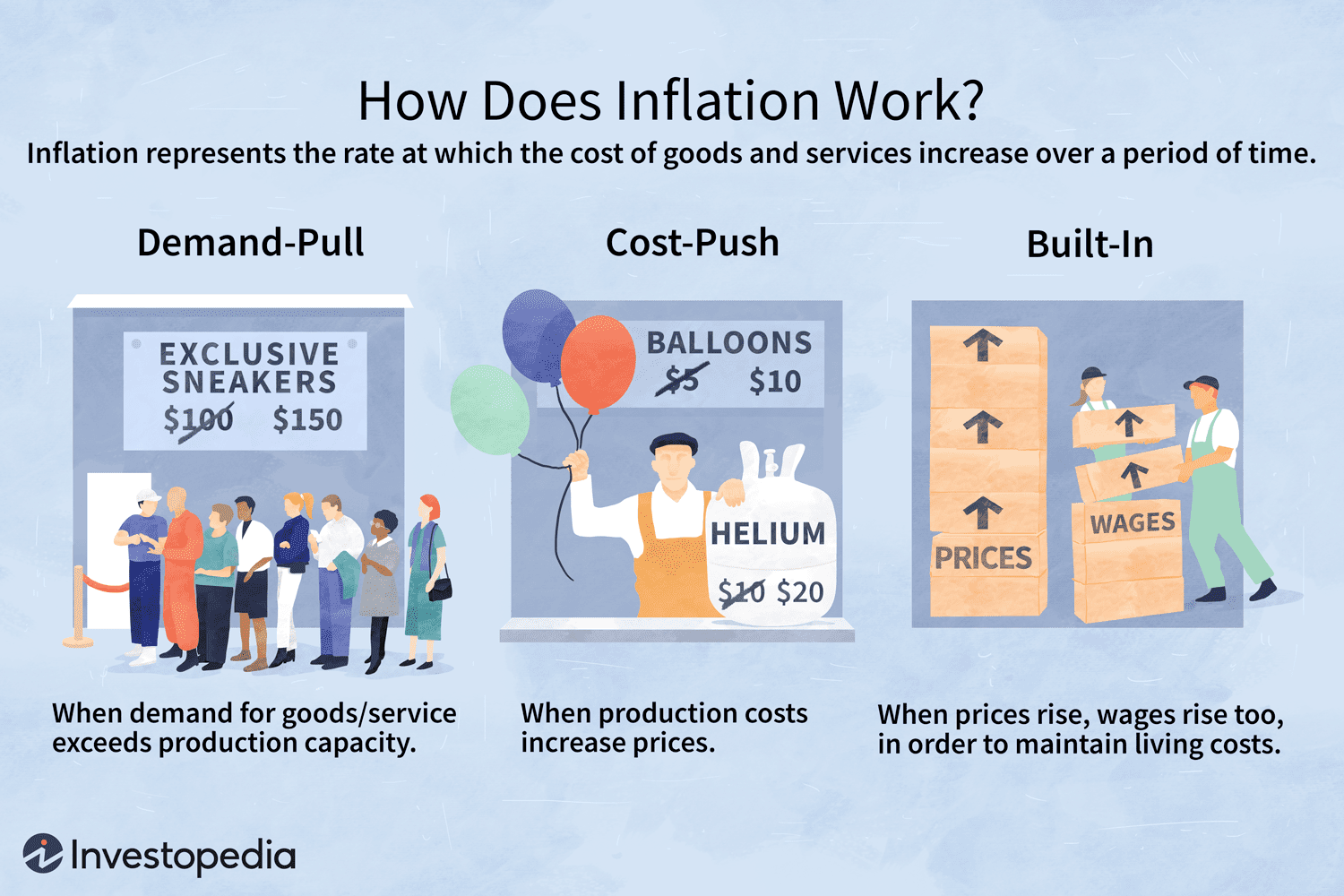
FIGHTING Inflation!

By Staff Reporters

Fed Official Says Inflation Fight Will Take Time, Despite Signs of Progress

Bringing inflation down from 40-year highs is likely to take time and will require a slowdown in economic growth and reduced demand for workers by employers, a Federal Reserve official said yesterday.

Those efforts are showing tentative signs of progress, said Fed governor Philip Jefferson, in his first public remarks since taking office in May. But Mr. Jefferson also said he remains concerned that higher prices could change consumer expectations around inflation in a way that makes further price increases self-fulfilling.

***

***

READ: Fed Official Says Inflation Fight Will Take Time, Despite Signs of Progress (msn.com)

COMMENTS APPRECIATED

Thank You

***

What is EBITDA?

A TERM ALL PHYSICIAN INVESTORS MUST KNOW

CMP logo

SPONSOR: http://www.CertifiedMedicalPlanner.org

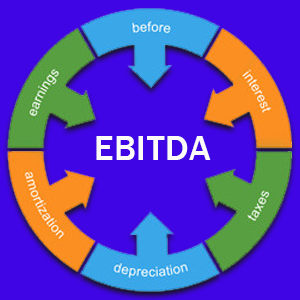
What Is Earnings Before Interest, Taxes, Depreciation, and Amortization (EBITDA)?

***

EBITDA, or earnings before interest, taxes, depreciation, and amortization, is a measure of a company’s overall financial performance and is used as an alternative to net income in some circumstances. EBITDA, however, can be misleading because it strips out the cost of capital investments like property, plant, and equipment.

This metric also excludes expenses associated with debt by adding back interest expense and taxes to earnings. Nonetheless, it is a more precise measure of corporate performance since it is able to show earnings before the influence of accounting and financial deductions.

Why EBITDA is still a Great Financial Management Metric

Simply put, EBITDA is a measure of profitability. While there is no legal requirement for companies to disclose their EBITDA, according to the U.S. generally accepted accounting principles (GAAP), it can be worked out and reported using the information found in a company’s financial statements.

The earnings, tax, and interest figures are found on the income statement, while the depreciation and amortization figures are normally found in the notes to operating profit or on the cash flow statement. The usual shortcut to calculate EBITDA is to start with operating profit, also called earnings before interest and tax (EBIT) then add back depreciation and amortization.

CITE: https://www.r2library.com/Resource/Title/0826102549

***

Comprehensive Financial Planning Strategies for Doctors and Advisors: Best Practices from Leading Consultants and Certified Medical Planners™

MORE: https://www.routledge.com/Comprehensive-Financial-Planning-Strategies-for-Doctors-and-Advisors-Best/Marcinko-Hetico/p/book/9781482240283

YOUR COMMENTS ARE APPRECIATED

Thank You

***

On “Triple” and “Quadruple” Witching Day?

By Staff Reporters

***

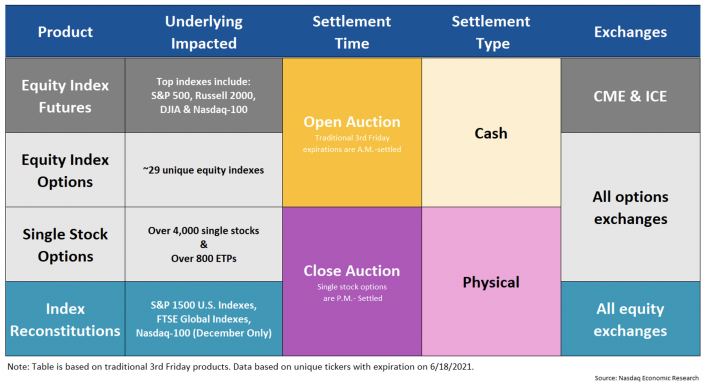
The final hour of trading on a Friday when stock index futures, stock index options, and stock options all expire. This happens on the third Friday in March, June, September, and December. See Quadruple Witching Hour.

CITE: https://www.r2library.com/Resource/Title/0826102549

According to TheStreet, Inc

Triple witching sounds like something from a horror movie, but it’s actually a financial term. Options and derivatives traders know this phenomenon well because it’s the day when three different types of contracts expire. It happens only once a quarter and can cause wild swings in volatility, as large institutional traders roll over futures contracts to free up cash. Doing so creates a ton of increased volume—sometimes 50% higher than average, especially in the last trading hour of the day—but individual investors needn’t feel spooked. In fact, some might even view this volatility as a profit-making opportunity.

Which 3 Types of Derivative Contracts Expire on Triple Witching Day?

  1. Stock Options: These are contracts taken out on the direction of a stock price at a future date. Unlike stocks, they’re not an investment in a company; rather, they’re the right to buy or sell shares of a company at a later time frame. Calls let you buy stock shares at a set price, known as the strike price, on or before the expiration date. Puts give you the right to sell shares.
  2. Index Options: These are futures contracts on a stock index, such as the S&P 500. These options are settled in cash.
  3. Index Futures: These are futures contracts on equity indexes. These contracts are also settled in cash.

A futures contract is also referred to as an “anticipated hedge” because it’s used to lock in prices on future buy or sell transactions. These hedges are a way to protect a portfolio from market setbacks without selling long-term holdings.

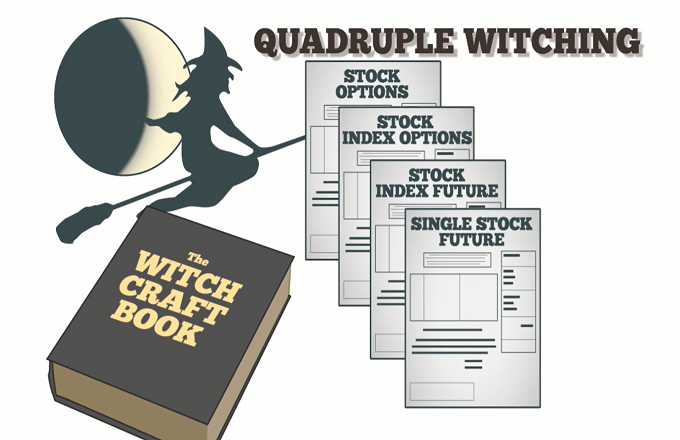
It’s worth noting that a few times a year, single stock futures also expire on witching day, adding a fourth asset to the trading cauldron, and that’s why some investors refer to this date as “quadruple witching,” although the terms are interchangeable.

When Is Triple Witching? Triple Witching Calendar 2022

In modern trading, triple witching happens on the third Friday of March, June, September, and December (the last month of each quarter).

Upcoming Triple Witching Dates

  • Friday, March 18, 2022
  • Friday, June 17, 2022
  • Friday, September 16, 2022
  • Friday, December 16, 2022

What Is the Witching Hour?

In the U.S. stock market, the last hour of the trading day, before the closing bell, sees the most trading activity, so the witching hour is from 3–4 pm EST. In folklore, the “witching hour” actually happens in the dead of night, from 3–4 am. It was known as a time when spirits reached the height of their powers. During the Middle Ages, the Catholic Church even banned people from venturing outside during this time, so as not to get caught in the chaos.

Today, such ideas aren’t taken any more seriously than mere superstition, but triple witching can cause chaos among investors, if they are not aware of what is happening.

***

***

What Happens During Triple Witching?

As you might imagine, a lot of trading activity happens in the market when stock options, index options, and index futures contracts all expire. We’re talking a lot of money here: during Triple Witching in September 2021, for example, around $3.4 trillion of equity options expired.

So, what exactly is going on? Should they keep their hedges on? Should they speculate? Should they roll, or close out, their contracts, and if so, by how much? This is what generates the increased trading activity, and the large trades, especially from offsetting trades, can cause temporary price distortions. 

At the same instant that the derivatives contracts expire, the anticipatory hedges that traders have placed become unnecessary, and so traders also seek to close these hedges, and the offsetting trades result in increased volume. These large volume increases can in turn cause price swing (i.e., volatility) in the underlying assets. 

How Does Triple Witching Affect the Stock Market?

Triple witching itself doesn’t move the stock market; it just creates increased volume. In the same way, the expiration of the options and futures contracts don’t necessarily result in volatility—that’s caused by the actions that traders take based on the temporary price fluctuations of their underlying assets which can be moved due to the increased volume.

When this happens, arbitrageurs try to take advantage, often making trades that are completed in mere seconds. An arbitrageur is a trader who looks for price inefficiencies in a security and then seeks to make a profit by buying and selling it simultaneously. This practice involves much risk.

Is Triple Witching Bullish or Bearish?

Historically speaking, triple witching is not always an “up” day, and it’s not always a “down” day for the markets. It does not signify a trend. Typically, it neither moves the market significantly higher nor lower; it simply adds a temporary increase in volume and liquidity.

However, it’s important to note that market volumes also tend to be higher on index re-balancing day as well as during and after broader macroeconomic news events, and so, when taken in tandem with triple witching, these events can cause big moves in the market.

Examples of Triple Witching Volatility in Light of News Events

On June 18, 2021, a record number—$818 billion—of stock options expired, which led to nearly $3 trillion in “open interest,” or open contracts. On this day, the Federal Reserve also announced that it might raise interest rates in 2023 due to inflationary pressures. These news events resulted in increased volatility, and the S&P 500 lost 1.3% while the Dow Jones Industrial Average dropped 1.6%.

On September 17th, 2021, one week ahead of the Federal Reserve’s meeting, market volatility was growing based on mounting concerns about the COVID-19 Delta variant impacting the economy as well as the Federal Reserve’s announcement that it would begin to unwind its monetary stimulus. These news events, taken along with the S&P 500’s quarterly index rebalancing, which also happened that day, caused the S&P 500 to lose 1%. 

Is There Such a Thing as “Quadruple” Witching?

Single Stock Futures are the fourth type of derivative contract which can expire on triple witching day. This can cause the phenomenon to be called “quadruple witching,” although one term can replace the other. Single stock futures are futures contracts placed on individual stocks, with one contract controlling 100 shares being typical. They are a hedging tool that was previously banned from trading in the United States. The Commodity Futures Modernization Act lifted the ban in 2000, and single stock futures were traded on the One Chicago Exchange from November, 2002 until September, 2020, although currently they are only available on overseas financial markets.

MORE: https://www.tradestation.com/insights/2022/02/03/quadruple-witching-dates-2022-trading/

***

How Did Triple Witching Affect 1987’s “Black Monday?”

On October 19th, 1987, the Dow Jones Industrial Average lost 22.6% in a single trading session. The day became known as “Black Monday,” but triple witching events, which took place the Friday before, on October 16, 1987, had caused the selloff of options and futures contracts to rapidly accelerate, resulting in stocks tanking in pre-day trading. The massive sell orders were left unchecked by any kinds of systematic stop gaps, and so financial markets roiled globally throughout the day. This stock market crash was the greatest one-day decline to occur since the Great Depression in 1929.

Taking lessons from the event, regulators moved the options expiration from the morning to the afternoon and put “circuit breakers” into place that would let the exchanges temporarily halt trading in the event of another massive sell off.

How Can Investors Prepare for Triple Witching Days? 

The triple witching takeaway is that investors should be aware of what happens on these days and understand that there is a lot more volume in the markets. There could be some drastic price swings, but investors shouldn’t be carried away by any short-term emotions (which, really, is great advice any day in the markets).

COMMENTS APPRECIATED

Thank You

Subscribe to the Medical Executive-Post

***

https://www.amazon.com/Comprehensive-Financial-Planning-Strategies-Advisors/dp/1482240289/ref=sr_1_1?ie=UTF8&qid=1418580820&sr=8-1&keywords=david+marcinko

***

What is a Stock Market CORRECTION?

By Staff Reporters

***

A correction is a decline of 10 percent or more from an asset’s most recent high. For a stock that recently reached an all-time high of $100 per share, a correction would occur if the stock fell to $90 or lower. Corrections can happen in any financial asset such as individual stocks, broad market indexes like the S&P 500 or commodities. The S&P 500 fell below 4,336 in January 2022, marking a more than 10 percent decline from its high earlier in the year.

***

Corrections can be caused by a number of different factors and they’re difficult, if not impossible, to predict ahead of time. Short-term concerns about economic growth, Federal Reserve policy, political issues or even a new variant of the COVID-19 virus all have the potential to trigger market corrections. These issues make investors fearful that their prior assumptions about the future might not be correct. When people are fearful, they typically look to sell stocks in favor of assets considered safer such as U.S. Treasury bonds.

CITE: https://www.r2library.com/Resource/Title/082610254

***

Difference between a correction and a crash

A stock-market correction may sound similar to a crash, but there are some key distinctions between the two. A crash is a sharp drop in share prices, typically a double-digit percentage decline, over the course of just a few days. A correction tends to happen at a slower pace, therefore making the drop less steep than a crash would be. One of the most famous stock-market crashes happened in October 1987, when the Dow Jones Industrial Average fell 22.6 percent in a single day that became historically known as Black Monday.

Corrections are more subtle and are sometimes even thought to be healthy for rising markets because they help things from becoming overheated. Like their name suggests, they correct prices back down from a slightly elevated level.

Difference between a correction and a bear market

The difference between a correction and a bear market is in the magnitude of the decline. A correction is a decline of at least 10 percent, but less than 20 percent, while a bear market begins at a decline of at least 20 percent from a recent peak. Bear markets also tend to last longer than corrections because they tend to reflect an economic reality, such as a recession, rather than a short-term concern that may or may not materialize. The challenge for investors is that it’s very difficult to determine in real time whether a market is just in a correction or if it could become a bear market.

Related: https://medicalexecutivepost.com/2022/05/16/update-stock-market-sentiment-and-capitulation/

MORE: https://www.merrilledge.com/article/how-weather-stock-market-correction

***

***

COMMENTS APPRECIATED

Thank You

***

FINANCE: https://www.amazon.com/Comprehensive-Financial-Planning-Strategies-Advisors/dp/1482240289/ref=sr_1_1?ie=UTF8&qid=1418580820&sr=8-1&keywords=david+marcinko

****

What is a BEAR MARKET Relief Rally?

Are We Experiencing a Bear Market Relief Rally?

***

Maybe yesterday – Not today!

By Staff Reporters

***

A bear market relief rally describes a period inside of a bear market in which prices of stocks temporarily increase during, sometimes quite sharply, before returning to new lows. This rise in prices is typically a short-lived increase, sometimes lasting anywhere from days to months, amidst an overall long-term downward trend in the market.

CITE: https://www.r2library.com/Resource/Title/082610254

Key Takeaways

  • A bear market rally is when prices rise during a bear market.
  • This type of rally is difficult to identify until after it has happened and can occur more than once in a prolonged bear market.
  • Day traders can make money shorting stocks, but individual investors should just stay the course with their investing strategy.

COMMENTS APPRECIATED

Thank You

Subscribe to the Medical Executive-Post

***

***

What is a “DEAD CAT” BOUNCE?

HOW IT WORKS

SPONSOR: http://www.CertifiedMedicalPlanner.org

CMP logo

By Dr. David E. Marcinko MBA CMP®

***

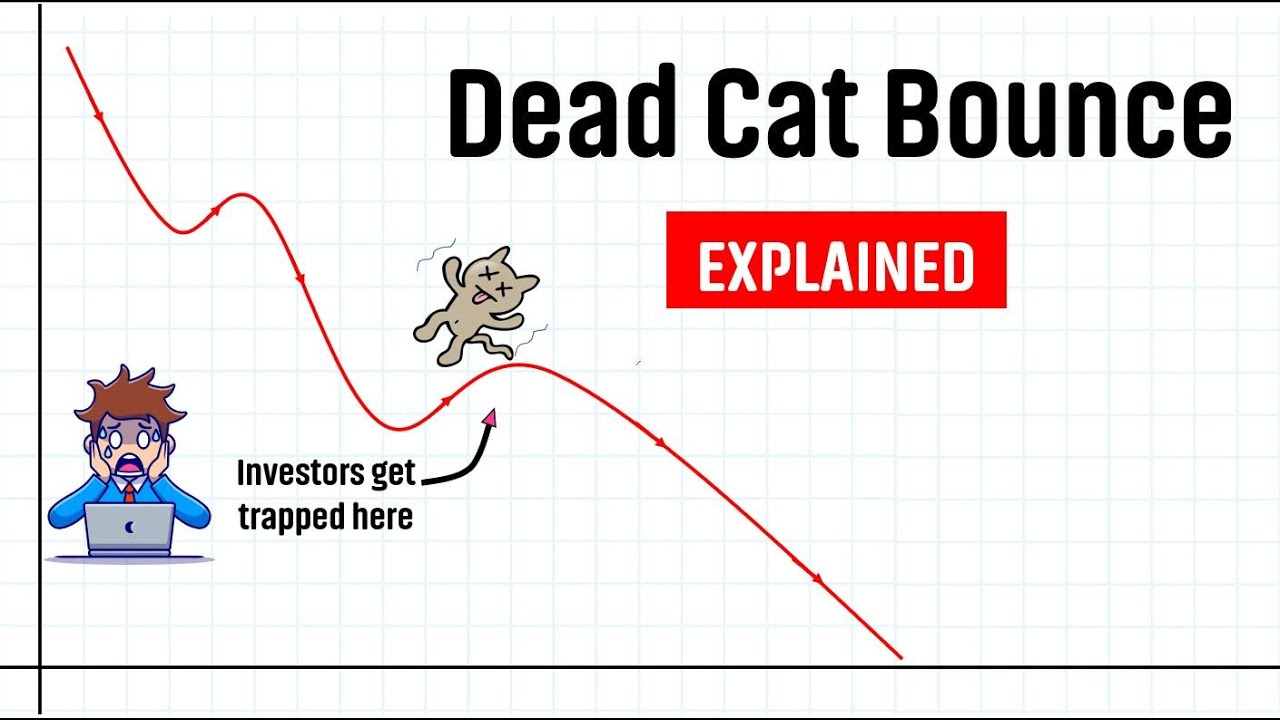
In finance, a dead cat bounce is a small, brief recovery in the price of a declining stock.

****

***

Derived from the idea that “even a dead cat will bounce if it falls from a great height”, the phrase, which originated on Wall Street, is also popularly applied to any case where a subject experiences a brief resurgence during or following a severe decline.

  • The dead cat bounce is a sudden and temporary increase in stock price caused by investors erroneously believing that the stock price’s reached its lowest.
  • The dead cat bounce can only be fully accurately determined with concrete data in hindsight.
  • Both falsely identifying a stock price trough (i.e., falling victim to a dead cat bounce) and falsely identifying a true price trough as a dead cat bounce will result in negative financial consequences.

CITE: https://www.r2library.com/Resource/Title/0826102549

YOUR COMMENTS ARE APPRECIATED.

FINANCE: https://www.amazon.com/Comprehensive-Financial-Planning-Strategies-Advisors/dp/1482240289/ref=sr_1_1?ie=UTF8&qid=1418580820&sr=8-1&keywords=david+marcinko

Thank You

***

A DENTIST ASKS: How to Invest When There’s Nowhere to Hide?

***

By Vitaliy Katsenelson CFA

***

How to Invest When There’s Nowhere to Hide
I was having lunch with a close friend of mine. He mentioned that he had accumulated a significant sum of money and did not know what to do with it. It was sitting in bonds, and inflation was eating its purchasing power at a very rapid rate.

He is a dentist and had originally thought about expanding his business, but a shortage of labor and surging wages turned expanding into a risky and low-return investment. He complained that the stock market was extremely expensive. I agreed.*

***

CITE: https://www.r2library.com/Resource/Title/082610254

COMMENTS APPRECIATED.

Subscribe to the Medical Executive-Post.

THANK YOU

***

INVESTING: https://www.amazon.com/Comprehensive-Financial-Planning-Strategies-Advisors/dp/1482240289/ref=sr_1_1?ie=UTF8&qid=1418580820&sr=8-1&keywords=david+marcinko

***

What Is Integrative Medicine?

By Staff Reporters

***

The term integrative medicine was born from combining the practice of so-called “conventional” medicine and “complementary medicine.” Conventional medicine is what most doctors practice. This is also called “traditional Western medicine.”

Adding “outside-the-box” treatments such as chiropractic care, acupuncture, and other lifestyle recommendations like improving diet, supplements, herbs, exercise, stress management, and functional specialty labs results in the actual integration of the two disciplines. And we need both.

READ: https://www.msn.com/en-us/health/medical/the-one-doctor-you-dont-have-but-likely-need/ar-AAXagMw?li=BBnb7Kz\

Complimentary Medicine: https://medicalexecutivepost.com/2007/12/16/complimentary-medicine/

***

BUSINESS MEDICINE: https://www.amazon.com/Business-Medical-Practice-Transformational-Doctors/dp/0826105750/ref=sr_1_9?s=books&ie=UTF8&qid=1287563112&sr=1-9

***

DHIMC: https://www.amazon.com/Dictionary-Health-Insurance-Managed-Care/dp/0826149944/ref=sr_1_4?ie=UTF8&s=books&qid=1275315485&sr=1-4

***

COMMENTS APPRECIATED

Thank You

***

What is the OTC-QX® Best Market?

By Staff Reporters

***

***

The OTCQX® Best Market offers transparent and efficient trading of established, investor-focused U.S. and global companies.

To qualify for the OTCQX market, companies must meet high financial standards, follow best practice corporate governance, demonstrate compliance with U.S. securities laws, and have a professional third-party sponsor introduction.

Penny stocks, shells and companies in bankruptcy cannot qualify for OTCQX.

The companies found on OTCQX are distinguished by the integrity of their operations and diligence with which they convey their qualifications.

READ HERE: https://tinyurl.com/4arvn826

***

COMMENTS APPRECIATED

Thank You

***

INVESTING: https://www.amazon.com/Comprehensive-Financial-Planning-Strategies-Advisors/dp/1482240289/ref=sr_1_1?ie=UTF8&qid=1418580820&sr=8-1&keywords=david+marcinko

****

PODCAST: Turning a PBS Interviewer into an NFT Interviewee

On the Non-Fungible Token Market

***

By Vitaliy Katseneson CFA

***

Turning a PBS Interviewer into Interviewee
I was interviewed on PBS Newshour about the insanity that is happening in the NFT (non-fungible token) market. You can watch it here. If you read my “I Kid You Not Crazy” article, then you know everything I have to say about NFTs and cryptocurrency. I can sum up my thoughts on NFTs in one sentence: NFTs, just like cryptocurrencies, are a technology of the future, but a speculative bubble induced by excess global liquidity in the present. 

I encourage you to watch this eight-minute video – PBS did a great job. 

COMMENTS APPRECIATED

Thank You

***

https://www.amazon.com/Comprehensive-Financial-Planning-Strategies-Advisors/dp/1482240289/ref=sr_1_1?ie=UTF8&qid=1418580820&sr=8-1&keywords=david+marcinko

***

https://www.amazon.com/Dictionary-Health-Information-Technology-Security/dp/0826149952/ref=sr_1_5?ie=UTF8&s=books&qid=1254413315&sr=1-5

****

PODCAST: HEALTHCARE NFTs [How to Monitize Health Data?]

***

By Bertalan Meskó, MD

***

The Medical Futurist

***

NFTs IN HEALTHCARE: HOW PATIENTS COULD MONETISE THEIR HEALTH DATA


Personal health sensors and apps equip patients with personalised data so that they can become more proactive in managing their health. But what is still mostly the norm is that these sensitive data are governed by the companies providing these services; and they often profit out of it, oblivious to patients.

***

How NFTs will revolutionize medicine - YouTube

***

But even though NFTs are still in their infancy, the technology might evolve in the future to become more compelling for patients to favor the agency it provides over their data.

READ: https://medicalfuturist.com/nfts-an-health-data/?utm_source=The%20Medical%20Futurist%20Newsletter&utm_campaign=39c284a71e-EMAIL_CAMPAIGN_2022_01_18&utm_medium=email&utm_term=0_efd6a3cd08-39c284a71e-399696053&mc_cid=39c284a71e&mc_eid=40fee31c25

***

More NTFs: https://medicalexecutivepost.com/2021/05/04/what-is-a-non-fungible-token/

***

COMMENTS APPRECIATED.

Subscribe to the Medical Executive-Post

THANK YOU

***

Product Details

CITE: https://www.r2library.com/Resource/Title/082610254

PODCAST: https://www.youtube.com/watch?v=TnhmUltTGo8

***

HITS: https://www.amazon.com/Dictionary-Health-Information-Technology-Security/dp/0826149952/ref=sr_1_5?ie=UTF8&s=books&qid=1254413315&sr=1-5

***

PODCAST: Start-Ups & Healthcare Venture Capital in the COVID-19 Recession

By Eric Bricker MD

***

***

COMMENTS APPRECIATED

Thank You

***

RISK MANAGEMENT: https://www.routledge.com/Risk-Management-Liability-Insurance-and-Asset-Protection-Strategies-for/Marcinko-Hetico/p/book/9781498725989

***