BOARD CERTIFICATION EXAM STUDY GUIDES Lower Extremity Trauma
[Click on Image to Enlarge]
ME-P Free Advertising Consultation
The “Medical Executive-Post” is about connecting doctors, health care executives and modern consulting advisors. It’s about free-enterprise, business, practice, policy, personal financial planning and wealth building capitalism. We have an attitude that’s independent, outspoken, intelligent and so Next-Gen; often edgy, usually controversial. And, our consultants “got fly”, just like U. Read it! Write it! Post it! “Medical Executive-Post”. Call or email us for your FREE advertising and sales consultation TODAY [678.779.8597] Email: MarcinkoAdvisors@outlook.com
Medical & Surgical e-Consent Forms
ePodiatryConsentForms.com
iMBA Inc., OFFICES
Suite #5901 Wilbanks Drive, Norcross, Georgia, 30092 USA [1.678.779.8597]. Our location is real and we are now virtually enabled to assist new long distance clients and out-of-town colleagues.
ME-P Publishing
SEEKING INDUSTRY INFO PARTNERS?
If you want the opportunity to work with leading health care industry insiders, innovators and watchers, the “ME-P” may be right for you? We are unbiased and operate at the nexus of theoretical and applied R&D. Collaborate with us and you’ll put your brand in front of a smart & tightly focused demographic; one at the forefront of our emerging healthcare free marketplace of informed and professional “movers and shakers.” Our Ad Rate Card is available upon request [678-779-8597].
Posted on October 6, 2025 by Dr. David Edward Marcinko MBA MEd CMP™
By Fierce Healthcare [7/29/25]
***
***
UnitedHealthcare CEO Tim Noel offered investors a deeper look at the medical cost spike that’s plaguing the insurance giant’s finances. He said during the company’s earnings call that pricing assumptions set by the company “were well short of actual medical costs” for 2025. UHC’s current outlook, he said, instead reflects an additional $6.5 billion in medical costs, with more than half, or about $3.6 billion, coming from its Medicare plans.
Noel said that in Medicare Advantage specifically, the team is looking to adjust pricing and benefit designs to account for the cost pressures, which they anticipate will stretch into much of 2026.
It has also decided to exit certain markets largely with plans that are more loosely designed, such as PPOs, in a move that will impact 600,000 beneficiaries.
SPEAKING: ME-P Editor Dr. David Edward Marcinko MBA MEd will be speaking and lecturing, signing and opining, teaching and preaching, storming and performing at many locations throughout the USA this year! His tour of witty and serious pontifications may be scheduled on a planned or ad-hoc basis; for public or private meetings and gatherings; formally, informally, or over lunch or dinner. All medical societies, financial advisory firms or Broker-Dealers are encouraged to submit an RFP for speaking engagements: CONTACT: Ann Miller RN MHA at MarcinkoAdvisors@outlook.com -OR-http://www.MarcinkoAssociates.com
Classic: A pre-payment plan refers to health insurance plans that provide medical or hospital benefits in service rather than dollars, such as the plans offered by various Health Maintenance Organizations. A method providing in advance for the cost of predetermined benefits for a population group, through regular periodic payments in the form of premiums, dues, or contributions including those contributions that are made to a health and welfare fund by employers on behalf of their employees!
Modern: A Prepaid Group Practice Plan specifies health services are rendered by participating physicians to an enrolled group of persons, with a fixed periodic payment made in advance by (or on behalf of) each person or family. If a health insurance carrier is involved, a contract to pay in advance for the full range of health services to which the insured is entitled under the terms of the health insurance contract.
Examples:
Pre-Paid Hospital Service Plan: The common name for a health maintenance organization (HMO), a plan that provides comprehensive health care to its members, who pay a flat annual fee for services.
Pre-Paid Premium: An insurance or other premium payment paid prior to the due date. In insurance, payment by the insured of future premiums, through paying the present (discounted) value of the future premiums or having interest paid on the deposit.
Pre-Paid Prescription Plan: A drug reimbursement plan that is paid in advance.
A silent, non-directed, ghost, blind, faux, or “mirror” PPO, HMO, or other provider model is not really a formalized managed care organization [MCO] at all. Rather, it was simply an intermediary attempt, and Ponzi-like scheme, to negotiate practitioner fees downward, by promising a higher volume of patients in exchange for the discount.
Of course, the intermediary [discount-broker] then resells the packaged contract product to any willing insurance company, HMO, PPO or other payer, thereby pocketing the difference as a nice profit. Sometime, these virtual organizations are just indemnity companies in disguise.
NOTE: The term indemnity insurance refers to an insurance policy that compensates an insured party for certain unexpected damages or losses up to a certain limit—usually the amount of the loss itself. Insurance companies provide coverage in exchange for premiums paid by the insured parties.
These policies are commonly designed to protect professionals and business owners when they are found to be at fault for a specific event such as misjudgment or malpractice. They generally take the form of a letter o indemnity.
***
As part of a silent PPO scheme, insurers try to pass off the discount as legitimate on Explanation of Benefit [EOB] forms. Physicians should not fall for this ploy, since pricing pressure will be forced even lower in the next round of “real” PPO negotiations!
Medical providers should also be on guard for silent HMOs, MCOs and any other silent insurance variation, since these virtual organizations do not exist, except as exploitable arbitrage situations for the middleman.
SPEAKING: Dr. Marcinko will be speaking and lecturing, signing and opining, teaching and preaching, storming and performing at many locations throughout the USA this year! His tour of witty and serious pontifications may be scheduled on a planned or ad-hoc basis; for public or private meetings and gatherings; formally, informally, or over lunch or dinner. All medical societies, financial advisory firms or Broker-Dealers are encouraged to submit an RFP for speaking engagements: CONTACT: Ann Miller RN MHA at MarcinkoAdvisors@outlook.com -OR-http://www.MarcinkoAssociates.com
Life planning and behavioral finance as proposed for physicians and integrated by the Institute of Medical Business Advisors Inc., is unique in that it emanates from a holistic union of personal financial planning, human physiology and medical practice management, solely for the healthcare space. Unlike pure life planning, pure financial planning, or pure management theory, it is both a quantitative and qualitative “hard and soft” science, with an ambitious economic, psychological and managerial niche value proposition never before proposed and codified, while still representing an evolving philosophy. Its’ first-mover practitioners are called Certified Medical Planners™.
Financial Life Planning is an approach to financial planning that places the history, transitions, goals, and principles of the client at the center of the planning process. For the financial advisor or planner, the life of the client becomes the axis around which financial planning develops and evolves.
Financial Life Planning is about coming to the right answers by asking the right questions. This involves broadening the conversation beyond investment selection and asset management to exploring life issues as they relate to money.
Financial Life Planning is a process that helps advisors move their practice from financial transaction thinking, to life transition thinking. The first step is aimed to help clients “see” the connection between their financial lives and the challenges and opportunities inherent in each life transition.
But, for informed physicians, life planning’s quasi-professional and informal approach to the largely isolate disciplines of financial planning and medical practice management is inadequate. Today’s practice environment is incredibly complex, as compressed economic stress from HMOs managed care, financial insecurity from insurance companies, ACOs and VBC, Washington DC and Wall Street; liability fears from attorneys, criminal scrutiny from government agencies, and IT mischief from malicious electronic medical record [eMR] hackers. And economic bench marking from hospital employers; lost confidence from patients; and the Patient Protection and Affordable Care Act [PP-ACA] more than a decade ago. All promote “burnout” and converge to inspire a robust new financial planning approach for physicians and most all medical professionals.
The iMBA Inc., approach to financial planning, as championed by the Certified Medical Planner™ professional certification designation program, integrates the traditional concepts of financial life planning, with the increasing complex business concepts of medical practice management. The former topics are presented in this textbook, the later in our recent companion text: The Business of Medical Practice [Transformational Health 2.0 Skills for Doctors].
***
***
For example, views of medical practice, personal lifestyle, investing and retirement, both what they are and how they may look in the future, are rapidly changing as the retail mentality of medicine is replaced with a wholesale and governmental philosophy. Or, how views on maximizing current practice income might be more profitably sacrificed for the potential of greater wealth upon eventual practice sale and disposition.
Or, how the ultimate fear represented by Yale University economist Robert J. Shiller, in The New Financial Order: Risk in the 21st Century, warns that the risk for choosing the wrong profession or specialty, might render physicians obsolete by technological changes, managed care systems or fiscally unsound demographics. OR, if a medical degree is even needed for future physicians?
Say, what medical license?
Dr. Shirley Svorny, chair of the economics department at California State University, Northridge, holds a PhD in economics from UCLA. She is an expert on the regulation of health care professionals who participated in health policy summits organized by Cato and the Texas Public Policy Foundation. She argues that medical licensure not only fails to protect patients from incompetent physicians, but, by raising barriers to entry, makes health care more expensive and less accessible. Institutional oversight and a sophisticated network of private accrediting and certification organizations, all motivated by the need to protect reputations and avoid legal liability, offer whatever consumer protections exist today.
Yet, the opportunity to revise the future at any age through personal re-engineering, exists for all of us, and allows a joint exploration of the meaning and purpose in life. To allow this deeper and more realistic approach, the informed transformation advisor and the doctor client, must build relationships based on trust, greater self-knowledge and true medical business management and personal financial planning acumen.
[A] The iMBA Philosophy
As you read this ME-P website, we hope you will embrace the opportunity to receive the focused and best thinking of some very smart people. Hopefully, along the way you will self-saturate with concrete information that proves valuable in your own medical practice and personal money journey. Maybe, you will even learn something that is so valuable and so powerful, that future reflection will reveal it to be of critical importance to your life. The contributing authors certainly hope so.
At the Institute of Medical Business Advisors, and thru the Certified Medical Planner™ program, we suggest that such an epiphany can be realized only if you have extraordinary clarity regarding your personal, economic and [financial advisory or medical] practice goals, your money, and your relationship with it. Money is, after only, no more or less than what we make of it.
Ultimately, your relationship with it, and to others, is the most important component of how well it will serve you.
SPEAKING: Dr. Marcinko will be speaking and lecturing, signing and opining, teaching and preaching, storming and performing at many locations throughout the USA this year! His tour of witty and serious pontifications may be scheduled on a planned or ad-hoc basis; for public or private meetings and gatherings; formally, informally, or over lunch or dinner. All medical societies, financial advisory firms or Broker-Dealers are encouraged to submit a RFP for speaking engagements: CONTACT: MarcinkoAdvisors@outlook.com
Suppose that in a new Accountable Care Organization [ACO] contract, a certain medical practice was awarded a new global payment or capitation styled contract that increased revenues by $100,000 for the next fiscal year. The practice had a gross margin of 35% that was not expected to change because of the new business. However, $10,000 was added to medical overhead expenses for another assistant and all Account’s Receivable (AR) are paid at the end of the year, upon completion of the contract.
Cost of Medical Services Provided (COMSP):
The Costs of Medical Services Provided (COMSP) for the ACO business contract represents the amount of money needed to service the patients provided by the contract. Since gross margin is 35% of revenues, the COMSP is 65% or $65,000. Adding the extra overhead results in $75,000 of new spending money (cash flow) needed to treat the patients. Therefore, divide the $75,000 total by the number of days the contract extends (one year) and realize the new contract requires about $ 205.50 per day of free cash flows.
Assumptions
Financial cash flow forecasting from operating activities allows a reasonable projection of future cash needs and enables the doctor to err on the side of fiscal prudence. It is an inexact science, by definition, and entails the following assumptions:
All income tax, salaries and Accounts Payable (AP) are paid at once.
Durable medical equipment inventory and pre-paid advertising remain constant.
Gains/losses on sale of equipment and depreciation expenses remain stable.
Gross margins remain constant.
The office is efficient so major new marginal costs will not be incurred.
***
***
Physician Reactions:
Since many physicians are still not entirely comfortable with global reimbursement, fixed payments, capitation or ACO reimbursement contracts; practices may be loath to turn away short-term business in the ACA era. Physician-executives must then determine other methods to generate the additional cash, which include the following general suggestions:
1. Extend Account’s Payable
Discuss your cash flow difficulties with vendors and emphasize their short-term nature. A doctor and her practice still has considerable cache’ value, especially in local communities, and many vendors are willing to work them to retain their business
2. Reduce Accounts Receivable
According to most cost surveys, about 30% of multi-specialty group’s accounts receivable (ARs) are unpaid at 120 days. In addition, multi-specialty groups are able to collect on only about 69% of charges. The rest was written off as bad debt expenses or as a result of discounted payments from Medicare and other managed care companies. In a study by Wisconsin based Zimmerman and Associates, the percentages of ARs unpaid at more than 90 days is now at an all time high of more than 40%. Therefore, multi-specialty groups should aim to keep the percentage of ARs unpaid for more than 120 days, down to less than 20% of the total practice. The safest place to be for a single specialty physician is probably in the 30-35% range as anything over that is just not affordable.
The slowest paid specialties (ARs greater than 120 days) are: multi-specialty group practices; family practices; cardiology groups; anesthesiology groups; and gastroenterologists, respectively. So work hard to get your money, faster. Factoring, or selling the ARs to a third party for an immediate discounted amount is not usually recommended.
3. Borrow with Short-Term Bridge Loans
Obtain a line of credit from your local bank, credit union or other private sources, if possible in an economically constrained environment. Beware the time value of money, personal loan guarantees, and onerous usury rates. Also, beware that lenders can reduce or eliminate credit lines to a medical practice, often at the most inopportune time.
4. Cut Expenses
While this is often possible, it has to be done without demoralizing the practice’s staff.
5. Reduce Supply Inventories
If prudently possible; remember things like minimal shipping fees, loss of revenue if you run short, etc.
6. Taxes
Do not stop paying withholding taxes in favor of cash flow because it is illegal.
Hyper-Growth Model:
Now, let us again suppose that the practice has attracted nine more similar medical contracts. If we multiple the above example tenfold, the serious nature of potential cash flow problem becomes apparent. In other words, the practice has increased revenues to one million dollars, with the same 35% margin, 65% COMSP and $100,000 increase in operating overhead expenses.
Using identical mathematical calculations, we determine that $750,000 / 365days equals $2,055.00 per day of needed new free cash flows! Hence, indiscriminate growth without careful contract evaluation and cash flow analysis is a prescription for potential financial disaster.
SPEAKING: Dr. Marcinko will be speaking and lecturing, signing and opining, teaching and preaching, storming and performing at many locations throughout the USA this year! His tour of witty and serious pontifications may be scheduled on a planned or ad-hoc basis; for public or private meetings and gatherings; formally, informally, or over lunch or dinner. All medical societies, financial advisory firms or Broker-Dealers are encouraged to submit a RFP for speaking engagements: CONTACT: MarcinkoAdvisors@outlook.com
Incentives: It is broadly accepted that incenting someone to do something is effective, whether it be paying office staff a commissions to sell more healthcare products, or giving bonuses to office employees if they work efficiently to see more HMO patients. Some experts even suggest there are five specific components1 that should be built into an overall physician incentive program:
Appropriate financial incentives.
Managed-care efficiency incentives.
Group citizenship.
Patient satisfaction.
Group profitability.
What is not well understood is that the incentives cause a sub-conscious distortion of decision-making ability in the incented person. This distortion causes the affected person – whether it is yourself or someone else – to truly believe in a certain decision, even if it is the wrong choice when viewed objectively. Service professionals, including financial advisors and lawyers, are affected by this bias, and it causes them to honestly offer recommendations that may be inappropriate, and that they would recognize as being inappropriate if they did not have this bias.
According to colleague Dan Ariely PhD, the existence of this bias makes it important for each one of us to examine our incentive biases and take extra care when advising physician clients, or to make sure we are appropriately considering non-incented alternatives.
In-network refers to a health care provider that has a contract with your health plan to provide health care services to its plan members at a pre-negotiated rate. Because of this relationship, you pay a lower cost-sharing when you receive services from an in-network doctor.
What does out-of-network mean?
Out-of-network refers to a health care provider who does not have a contract with your health insurance plan. If you use an out-of-network provider, health care services could cost more since the provider doesn’t have a pre-negotiated rate with your health plan. Or, depending on your health plan, the health care services may not be covered at all.
Classic: Any medical provider, supplier or facility that is in-network is one that has contracted with your health insurer to provide services;as above.
Modern: Depending on your plan, if you visit an out-of-network provider, it may not be covered or might be only partially covered. When making appointments with various doctors and service providers, you may notice some are listed as “in-network” while others are “out-of-network.”
THINK: Medicare Advantage {Part C] Plans
Example: You can expect a higher deductible and out-of-pocket limit at out-of-network providers. Your coinsurance and co-payment may also be higher for out-of-network providers.
A young clinician representative advising to consider the cost versus value of medicine. Health care concept for economic cost-effectiveness analysis, driving down medical costs, improved access.
***
Value Based CareClassic Definition: Value-based care is a type of payment model that pays doctors and hospitals for treating patients in the right place, at the right time and with just the right amount of care. You can look at it as a financial incentive to motivate healthcare providers to meet specific performance measures related to the quality and efficiency of the process. The same way, it penalizes weaker experiences, such as medical errors. The concept is often counter-intuitive.
Modern Circumstance: As healthcare costs continue to rise, value-based care has been growing in popularity compared to the traditional fee-for-service method.
Think: HMOs, PPOs, capitation payments and Medicare Advantage [Part C].
Paradox Examples:
Payment: A physician paid through fee-for-service compensation might like to see a packed medical office waiting room. More patients and services equate to higher pay. But, the same doctor paid through a VBC contract might wish to see an emptier waiting room as s/he will get the exact same daily pay for seeing fewer patients and working much less.
Prospectivity: Traditional Fee-for-Service medicine treats sick patients. VBC medicine seeks to keep patients healthy and out of the doctor’s office.
Posted on May 13, 2024 by Dr. David Edward Marcinko MBA MEd CMP™
The High Deductible Insurance Competition Heats Up
By Dr. David Edward Marcinko; MBA MEd CMP
[Editor-in-Chief]
As ME-P readers are aware, I’ve had a High Deductible Healthcare Plan [HDHP] coupled with a Health Savings Account [HSA] for my family, and consulting firm, for more than a decade. We’ve been very pleased with it thus far. No significant health problems along the way; just a few scares that proved costly, but benign, because of physician over-protection, over-reaction, or liability phobia; i.e., its better to be safe, than sorry!.
Still, having some economic skin in the insurance game because of the high-deductible feature, makes one an informed consumer. It also provides a sense of empowerment which, while ultimately illusionary for mortals, does offer a bit of self-control. After all, while we can’t mitigate against drunk-drivers and catastrophic diseases, we can live a healthy lifestyle and pay out of pocket for true health “maintenance” … much as we self-pay to maintain our cars and homes, etc. We can do our best … and hope for the rest.
Of course, the savings portion [HSA] has always been a secondary after-thought relative to the actual re-insurance coverage terms, exclusions and conditions. I personally remain focused on the indemnity or PPO type with full coverage, no co-payments and few restrictions. After all, if I use up my high-deductible for an adverse health incident, I figure I have far more problems to worry about than economic. My health, well-being and probably life are significantly in peril.
Nevertheless, as a health economist, I have always appreciated the above market rates given to my cash HSA account; 5% to 4.0% historically; and now 7.0%. Compared to the paltry 0.29% in my FDIC protected bank money market deposit account, or the 0.8% in my non-FDIC protected money market mutual fund [brokerage] account; this is a great deal.
Oh the Irony!
So, it comes as some surprise that after more than a decade, and the recent health insurance reform political re-debacle, that there is a surge of interest in the HSA companion. This time however, interest comes not from the insured’s – but the insurers. And, not from the health insurance industry, but rather from the affiliated [and desperate] banking industry.
How so – and why?
Well, it now seems some insurance companies actually desire the business of folks like me who are willing to bear a higher deductible in return for lower premiums, or who are willing to research CPT® code prices and question the efficacy of the procedures they negotiate with physicians in a collaborative fashion; or who are willing to watch their weights and abstain from over-indulgences for their own good. How novel; and again, why?
It’s the HSA pot-o-gold; Duh!
The Proof
Below, is a copy of an email I personally received from eHealthInsurance soliciting my separate health savings account [HSA] business; not my health insurance coverage business:
Dear David,
Did you know that your health insurance plan can be complemented by a Health Savings Account (HSA)? If you haven’t opened an HSA yet, it’s not too late! An HSA allows you to:
Use funds to pay for copays, deductibles, prescription drugs, dental services, vision care and more
Save money by deducting 100% of your HSA contributions from your taxable income
Earn tax-free interest on the funds that accrue in your account over time
Grow your account from year to year – the money you contribute won’t expire; you can even use an HSA as a secondary retirement savings account
There are no penalties or taxes when you use your HSA funds to pay for qualified medical expenses. Take advantage of your health plan’s benefits and open an HSA today! eHealthInsurance has partnered with nationally recognized, highly-rated HSA banks to offer you industry leading choices:
The Bancorp Bank
HSA Bank
JPMorgan Chase Bank
OptumHealth Bank
Sovereign Bank
Wells Fargo Bank
We’re with you every step of the way
Our representatives are also available for online chat 24 hours day.
Gary Matalucci
Vice President of Customer Care
The Question Is?
Such the deal; NOT!
So, any thinking HDHP participant [like me] must logically ask why such “nationally recognized, highly-rated HSA banks” would offer above market rates during these times of essentially high interest rate levels. Why the interest at all? Are they trying to loose money; or are they just befriending me?
As tennis player John McEnroe might say: are you serious!
Assessment
Yes John, the high rates are a serious loss-leader for more expensive products.
These banks want to make money; not from the interest rate spread on your HSA cash, but by enticing us to place this growing cash horde into their “investment vehicles.” In the recent past, some of us mortgaged our homes chasing the stock market or were goaded into flipping houses. And now, these same bankers are encouraging us to mortgage our health insurance on whatever high-priced, low-quality, fee-ridden, load bearing, snarky “investment vehicles” they can pawn off on us.
Of course, the health insurance companies get a fat sales commission or percentage cut, as well. A win-win situation for all but us – the insured.
Think AARP.
My Personal Advice
Do not do it. Do not take the bait.
The HSA portion of your HDHP is for paying premiums and future medical care in the event of a health catastrophe. It is for savings, not for investing in a risk-bearing vehicle. Far too many of us realized too late that a home is a place to live – not an investment. Likewise, a health savings account is for your health, and health insurance – not risky investing.
Assessment
Well, that’s my opinion as a retired surgeon, former insurance agent and financial advisor. Your own thoughts are appreciated.
Conclusion
Your thoughts and comments on this ME-P are appreciated. Feel free to review our top-left column, and top-right sidebar materials, links, urls and related websites, too. Then, subscribe to the ME-P. It is fast, free and secure.
Speaker: If you need a moderator or speaker for an upcoming event, Dr. David E. Marcinko; MBA – Publisher-in-Chief of the Medical Executive-Post – is available for seminar or speaking engagements. Contact: MarcinkoAdvisors@msn.com
OUR OTHER PRINT BOOKS AND RELATED INFORMATION SOURCES:
1) The 90s HMOs: Lower Premiums, Lower Out-of-Pocket Costs, Many Many Rules Restricting Care.
2) The 2000s PPOs: High and Even Higher Premiums, Lower Out-of-Pocket Costs, Fewer Rules Restricting Care.
3) The 2010s CDHPs: Lower Premiums, HIGH Out-of-Pocket Costs, Fewer Rules Restricting Care.
The Last 30 Years Have Taught Us that Employer-Sponsored Health Plans CANNOT Have All 3–Low Premiums, Low Out-of-Pocket Costs and Few Care Restrictions.
In the 2020s, Employers Are Moving More of Their Employee Healthcare OUTSIDE of the Traditional Healthcare and Health Insurance System with On-Site Clinics, Near-Site Clinics, Virtual Urgent Care, Virtual Primary Care and Bundled-Payment Centers-of-Excellence.
Your thoughts and comments on this ME-P are appreciated. Feel free to review our top-left column, and top-right sidebar materials, links, URLs and related websites, too. Then, subscribe to the ME-P. It is fast, free and secure.
Speaker: If you need a moderator or speaker for an upcoming event, Dr. David E. Marcinko; MBA – Publisher-in-Chief of the Medical Executive-Post – is available for seminar or speaking engagements. Contact: MarcinkoAdvisors@msn.com
OUR OTHER PRINT BOOKS AND RELATED INFORMATION SOURCES:
Posted on May 22, 2012 by Dr. David Edward Marcinko MBA MEd CMP™
Knowing Managed Care Terminology, too!
In this YouTube encore video presentation, Ricki Hasou from the MD Anderson Cancer Center talks about knowing your health insurance plan coverage and knowing the terminology behind managed care.
It is very important to understand how your health plan works when you sign up, before you begin making plans for cancer or any other type of medical treatment, and especially if you are leaving your designated healthcare service area.
Conclusion
Your thoughts and comments on this ME-P are appreciated. Feel free to review our top-left column, and top-right sidebar materials, links, URLs and related websites, too. Then, subscribe to the ME-P. It is fast, free and secure.
Speaker:If you need a moderator or speaker for an upcoming event, Dr. David E. Marcinko; MBA – Publisher-in-Chief of the Medical Executive-Post – is available for seminar or speaking engagements. Contact: MarcinkoAdvisors@msn.com
Our Other Print Books and Related Information Sources:
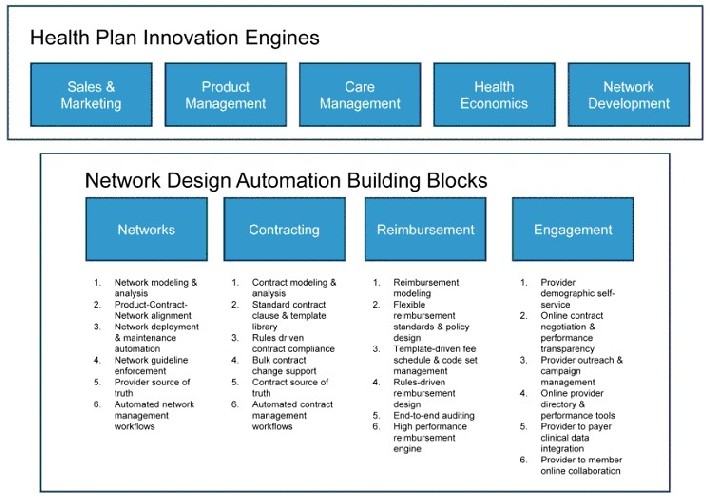
Previously, on this ME-P, I wrote about the barriers to alignment across product, network, care and reimbursement innovations. And, yes, I teased you with the three-word preview of what was to come this week: Integrated Building Blocks. The idea of building blocks lies at the heart of an approach to achieving alignment and scaling innovation, so let’s dive in.
Unlocking potential administrative, IT and medical savings — while also creating sustainable alignment of the innovation engines — requires various building blocks be in place as a sound foundation for network design and implementation. These building blocks deliver the required functionality in the most efficient manner. When these building blocks are utilized in an integrated fashion, the current barriers are removed and innovation alignment is achieved.
Four Essential Building Blocks
There are four essential network design automation building blocks that comprise the foundation for innovation: networks, contracting, reimbursement and engagement.
Each of these building blocks enables capabilities by delivering necessary functionality within and across the spectrum of network design. Reaching levels of maturity with this capability unlocks additional value and alignment.
Networks
The network building block enables health plans to differentiate and compete. The purpose is to differentiate their value for each customer segment by aligning the product and care model designs with the underlying network designs. It ensures network performance by facilitating the selection of appropriate providers into networks and the alignment of provider reimbursement with network design objectives. It enables networks to be mapped to member-facing and provider-facing products. The provider-facing products can be used for contracting and provider rate differentiation. The member-facing products can be aligned with benefits and serve as steerage targets for benefit designers.
These constructs, in conjunction with each other, enable productization of care model and payment innovation. For example, a health plan could define a “Medical Home Network” that consists of medical homes and supporting providers in a given geography. It could then enable PCMH-specific reimbursement (e.g., PMPM capitation + Fee For Services (FFS) for preventive services + P4P for EBM) by defining a provider-facing product and associating specific reimbursement policies with that provider product. Additionally, it could also define a member-facing product (e.g., PPO Value) which combines the medical home network with the general market PPO network. This in turn will allow the health plan to define a benefit extension which gives a 10 percent premium reduction to members who use Medical Home Network providers for their primary care. In short, a health plan is now able to monetize its care innovation (PCMH), align benefit design to network design for steerage, and align its provider payment with member incentives (around preventive services), while incenting higher quality care (P4P).
The network building block also achieves administrative cost leadership through comprehensive provider data governance and automation of core provider processes.
Contracting
The contracting building block is designed to enable health plans to reduce contract administrative costs while increasing provider payment accuracy. It optimizes the management of the provider contracting lifecycle through the automation of contract authoring, offering negotiating and acceptance while ensuring the standardization of terms and policies. This building block achieves reduced medical expenditure driven by contract standards adherence, reduced claims mis-payments, and increased speed to market for new payment innovations. It also can support rules-based enforcement of network level reimbursement guidelines to ensure consistent network performance.
Reimbursement
The reimbursement building block enables health plans to maximize the effectiveness of their medical expenditures by paying for value versus volume and by incenting team-based performance. It is the single source of truth for all forms of reimbursement including traditional claims pricing, episodes of care, shared savings, capitation and P4P. This building block enables the mixing and matching of reimbursement methodologies to incent optimal provider performance. It supports a modeling engine to analyze the financial impact of reimbursement and contract changes. It incorporates network-aware provider/contract selection for claims pricing intake. This is a rules driven, high performance service that leverages provider relationship information to select the right provider, the right governing contract and the right reimbursement model for each incoming claim. Additionally, it includes provider transparency services that enable health plan provider portals to support online pricing lookups and reimbursement status/detail inquiries for providers. These services can be extended to support provider performance scorecards and benchmarks.
Engagement
The engagement building block is designed to increase collaboration and participation. It enables meaningful engagement among health plans, providers and members in order to improve health outcomes and reduce costs. This building block achieves reduced administrative and service costs, increased member participation and adherence, increased provider satisfaction and adoption of care/payment initiatives, and the enablement of collaborative/integrated care delivery models such as PCMH and ACO.
Utilizing flexible, automated and integrated building block capabilities is the key to sustainable success that not only unlocks the promise of affordable care to customer segments but also delivers on reduced administrative, medical and IT costs. Incorporating information technologies that can facilitate, if not altogether replace, the manual interactions will be an important part of every organization’s evolution.
Assessment
Next week, in our final part 6 of this series, we’ll wrap up this discussion with a look at some of the potential savings health plans could achieve through alignment and an integrated approach to network design. The potential savings are not slight, so stay tuned. As always, if you just don’t want to wait for next week, visit our website and download the entire Unlocking Affordable Care by Aligning Products white paper; it’s available now.
Conclusion
Your thoughts and comments on this ME-P are appreciated. Feel free to review our top-left column, and top-right sidebar materials, links, URLs and related websites, too. Then, subscribe to the ME-P. It is fast, free and secure.
Speaker: If you need a moderator or speaker for an upcoming event, Dr. David E. Marcinko; MBA – Publisher-in-Chief of the Medical Executive-Post – is available for seminar or speaking engagements. Contact: MarcinkoAdvisors@msn.com
OUR OTHER PRINT BOOKS AND RELATED INFORMATION SOURCES:
The conversion to managed healthcare and capitation financing is a significant marketing force and not merely a temporary business trend. More than 60% of all physicians in the country are now employees of a MCO. Those that embrace these forces will thrive, while those opposed will not.
Developing an Attractive Practice
After you have evaluated the HMOs in your geographic area, you must then make your practice more attractive to them, since there are far too many physicians in most regions today. The following issues are considered by most MCO financial managers and business experts, as they decide whether or not to include you in their network:
General Standards
Is there a local or community need for your practice, with a sound patient base that is not too small or large? Remember, practices that already have a significant number of patients have some form of leverage since MCOs know that patients do not like switching their primary care doctors or pediatricians, and women do not want to be forced to change their OB/GYN specialist. If the group leaves the plan, members may complain to their employers and give a negative impression of the plan.
A positive return on investment (ROI) from your economically sound practice is important to MCOs because they wish to continue their relationship with you. Often, this means it is difficult for younger practitioners to enter a plan, since plan actuaries realize that there is a high attrition rate among new practitioners. They also realize that more established practices have high overhead costs and may tend to enter into less lucrative contract offerings just to pay the bills.
A merger or acquisition is a strategy for the MCO internal business plan that affords a seamless union should a practice decide to sell out or consolidate at a later date. Therefore, a strategy should include things such as: strong managerial and cost accounting principles, a group identity rather than individual mindset, profitability, transferable systems and processes, a corporate form of business, and a vertically integrated organization if the practice is a multi-specialty group.
Human resources, capital, and IT service should complement the existing management information system (MIS) framework. This is often difficult for the solo or small group practice and may indicate the need to consolidate with similar groups to achieve needed economies of scale and capital, especially in areas of high MCO penetration.
Consolidated financial statements should conform to Generally Accepted Accounting Principles (GAAP), Internal Revenue Code (IRC), Office of the Inspector General (OIG), and other appraisal standards.
Strong and respected MD leadership in the medical and business community is an asset. MCOs prefer to deal with physician executives with advanced degrees. You may not need a MBA or CPA, but you should be familiar with basic business, managerial, and financial principles. This includes a conceptual understanding of horizontal and vertical integration, cost principles, cost volume analysis, financial ratio analysis, and cost behavior.
The doctors on staff should be willing to treat all conditions and types of patients. The adage “more risk equates to more reward” is still applicable and most groups should take all the full risk contracting they can handle, providing they are not pooled contracts.
Are you a team player or solo act? The former personality type might do better in a group or MCO-driven practice, while a fee-for-service market is still possible and may be better suited to the latter personality type.
Each member of a physician group, or a solo doctor, should have a valid license, DEA narcotics license, continuing medical education, adequate malpractice insurance, board qualification or certification, hospital privileges, agree with the managed care philosophy, and have partners in a group practice that meet all the same participation criteria. Be available for periodic MCO review by a company representative.
Specific Medical Office Standards
MCOs may require that the following standards are maintained in the medical office setting:
It is clean and presentable with a professional appearance.
It is readily accessible and has a barrier-free design (see OSHA requirements).
There is appropriate medical emergency and resuscitation equipment.
The waiting room can accommodate 5 – 7 patients with private changing areas.
There is an adequate capacity (e.g., 5,000 – 10,000 member minimum), business plan, and office assistants for the plan.
There is an office hour minimum (e.g., 20 hours/week).
24/7 on-call coverage is available, with electronic tracking and eMRs.
Your thoughts and comments on this ME-P are appreciated. Feel free to review our top-left column, and top-right sidebar materials, links, URLs and related websites, too. Then, subscribe to the ME-P. It is fast, free and secure.
Speaker: If you need a moderator or speaker for an upcoming event, Dr. David E. Marcinko; MBA – Publisher-in-Chief of the Medical Executive-Post – is available for seminar or speaking engagements. Contact: MarcinkoAdvisors@msn.com
OUR OTHER PRINT BOOKS AND RELATED INFORMATION SOURCES:
Posted on July 16, 2009 by Dr. David Edward Marcinko MBA MEd CMP™
Show Me the Math
By Darrell K. Pruitt; DDS
I have noted here far too many times how it disappoints me that Delta Dental Plans Association vice president Janis Oshensky repeatedly chooses to turn to politicians rather than discuss Delta Dental’s arguably egregious and harmful policies with me, a dentist. I intend to put a stop to such disrespect one PR expert at a time if necessary.
Long ago I warned Oshensky that if she didn’t talk to me, she should probably just shut up in order to preserve what’s left of her Internet reputation. Since by posting her Letter to the Editor on POLITICO.com today, she obviously ignored my advice, this highly critical comment will reliably join three others of mine on her first page soon enough. Her employer is sacrificing her like a pawn.
The following comment is the one I posted on POLITICO.com in response to Oshensky’s letter. It might just help the vice president to finally come to a decision on this issue one way or the other. Either way, marketplace conversation like this cannot help but lead to safer air for the community … My pleasure.
This comment and subsequent invitation to Janis Oshensky is in response to the Delta Dental Plans Association vice president’s July 14, 2009 letter to you. Her letter is the most recent message she successfully sent Congress using a political news Website. Even though Ms. Oshensky holds the position of VP of dental relations as well as public policy, she has avoided answering this dentist’s questions about Delta Dental’s policies for months. If Ms. Oshensky is willing to do so, I would love for her to join me in discussion of Delta Dental’s taxation subsidy right here on POLITICO.com so that our lawmakers can witness a more balanced view of the issues.
Hello – It’s Me
Hello. My name is D. Kellus; Pruitt DDS, and I’m a practicing dentist in Fort Worth, Texas. It is my professional opinion that my patients are harmed by the policies of managed care dental plans like that sold by DDPA because there is no accountability to their clients or dentists. There is barely any accountability to those who select and pay for Delta’s products – dental patients’ naive bosses.
Like virtually every US citizen, your readers probably couldn’t care less about the dental industry. It is precisely because dentistry has been uninteresting for decades that make the microcosm of health care incredibly interesting to me. Let me uncover for your appreciation the event horizon in dental history. You could learn about more than just dentistry.
If left to natural forces of human nature, what happens to value when there is no accountability? For example, what do the 1975 East German Trabant and the 1979 Ford Pinto have in common? By popular vote, those products not only represent the two worst automobiles ever made, but the state shielded both manufacturers from accountability to consumers. Poor quality happens.
Oshensky argues against the taxation of managed care dental benefits like those sold to employers by Delta Dental. Let me offer that if Delta’s product were taxed like income, its value would quickly dive below the market threshold that attracts purchasers’ consideration.
Allow Me to Show-You the Math
Recently, Delta Dental of Michigan lost the accounts of thousands of GM retirees when their group dental benefits were cut in bankruptcy negotiations with UAW. Suddenly, Delta found itself forced to market their product to individuals who for once have the choice to keep their money. Faced with true competition for healthcare dollars, Delta leaders desperately cobbled together individual policies for the retirees who want to continue with their coverage. Even though Delta did everything possible to lower the cost of their coverage, the cheapest of the plans they offered still runs about $30 per person per month, and covers only 50% of everything, including preventive. So for premiums of $360 per year plus half the preferred providers’ 20% to 30% discounted fees, is this a bargain for Michigan retirees?
Free Markets
In my free-market, fee-for-service practice, if a patient comes in for two cleanings and routine x-rays during a year, 100% of my bill is $208. This is the market price in my neighborhood that is continually challenged by lively competition with other dentists for new patients who may not even have dental benefits. Those customers pay in full at the time of visit, just like most people whose bosses purchased Delta Dental Plans.
Value Comparisons
So let’s compare value of Delta Dental’s product with cash. If I were a Delta Dental preferred provider, my fee of $208, less Delta’s 25% discount would be $156. Never mind that my wife has problems with my 70% cut in pay, let’s move on.
The patient’s half of the $156 I earned is $78. $360 + $78 = $438. So for one uneventful year of discounted dental services with a dentist chosen from a list of names, a patient can expect to spend more than twice as much than if they paid the free-market price at the point of service.
Assessment
Not only is that hardly a bargain, but it is my opinion that managed care dentistry is dentistry by the lowest bidder with no quality control. That should be enough meat to get this conversation rolling. Now it’s your turn Ms. Oshensky. I think you have to admit that you’ve got holes to mend in the dental relations part of your job.
Conclusion
And so, your thoughts and comments on this Medical Executive-Post are appreciated. Tell us what you think. Feel free to review our top-left column, and top-right sidebar materials, links, URLs and related websites, too. Then, be sure to subscribe to the ME-P. It is fast, free and secure.
Speaker: If you need a moderator or speaker for an upcoming event, Dr. David E. Marcinko; MBA – Publisher-in-Chief of the Executive-Post – is available for seminar or speaking engagements. Contact: MarcinkoAdvisors@msn.com
Subscribe Now: Did you like this Medical Executive-Post, or find it helpful, interesting and informative? Want to get the latest ME-Ps delivered to your email box each morning? Just subscribe using the link below. You can unsubscribe at any time. Security is assured.
The changes in reimbursement for Medicare services through the introduction of prospective payment systems and physician reimbursement cuts for professional services, as well as the increased focus on patient quality and transparency initiatives and health 2.0 collaboration have forced healthcare providers to look for more efficient ways to provide services, as well as additional sources of revenue and margin-producing business.
Additionally, with the rise of corporate healthcare provider networks and health systems, together with rising healthcare costs, competition among providers has become prevalent in the healthcare industry.
Assessment
Strict control of reimbursement costs from payers and consistent decreases in physician professional component fee reimbursement yields; reduction in traditional hospital inpatient use; and higher costs of capital have all contributed to the trend of physician investment in outpatient (and inpatient) specialty provider enterprises [ASCs, specialty hospitals and clinics, etc] , which often compete with general acute care community hospital providers.
Conclusion
Your thoughts and comments on this ME-P are appreciated. Feel free to review our top-left column, and top-right sidebar materials, links, URLs and related websites, too. Then, subscribe to the ME-P. It is fast, free and secure.
Speaker: If you need a moderator or speaker for an upcoming event, Dr. David E. Marcinko; MBA – Publisher-in-Chief of the Medical Executive-Post – is available for seminar or speaking engagements. Contact: MarcinkoAdvisors@msn.com
OUR OTHER PRINT BOOKS AND RELATED INFORMATION SOURCES:
Posted on May 3, 2009 by Dr. David Edward Marcinko MBA MEd CMP™
Background, Education, and Certifications
By Dr. David Edward Marcinko; MBA, CMP™
Publisher-in-Chief
The following are sample questions and information gathered for Professional Liability Coverage
The Checklist
**Medical specialty information by percentage of practice.
**Information on medical education, including information on medical school, internship information, residency information, and fellowship information, if any.
**Information on medical experience, including information on military discharge (DD214), public health service, moonlighting, ‘locum tenens’, and private practice information. Have dates and locations available. Other information includes:
Information on completed continuing education hours in the past two years.
Publications, speeches, instruction, etc.
Information on medical licenses, including state, license number, expiration dates, and current status.
Information on board certifications.
The above information may be contained in a Curriculum Vita, if you have one.
On an “as applicable” basis:
Complete details including dates and outcomes of any board certification revocations or suspensions, license revocations or suspensions, alcohol or drug addictions and treatments, criminal or sexual misconduct charges, or Medicare or Medicaid charges.
Previous Insurance Information
Insurance history, including the name, policy number, whether the coverage form was occurrence or claims made, policy period, limits of liability, deductible amount, and prior acts date, for your current carrier, and your first, second, third, and fourth prior carrier, if applicable.
Information on any insurance company cancellations or non-renewals.
If your current policy is a claims-made policy, whether you are obtaining tail coverage from your current insurance company.
Copies of prior policies, if available.
Current Medical Practice Information
Information on supervision and employment of residents, physician assistants, nurse practitioners, CRNAs, nurse midwives and other physicians;
Information on networks or managed care organizations associated with (IPA, PHO, MSO, etc.), including group name, type of organization, and relationship;
Information on other contractual relationships other than PPOs, HMOs, IPA, etc;
Full information on all hospital privileges, including hospital name, location, and type of privilege.
Information on any suspension, denial, revocation, restriction, or other sanctioning of hospital privileges.
Classification and Specialty Identification
Full information on procedures performed, including details of surgeries, average number of patients seen weekly, specialty practice areas, etc.
Prior Claims History (if any)
For each claim, patient’s name; date of occurrence; insurance carrier; location of occurrence; date claim was reported; date claim was closed (if applicable); copies of subpoenas, pleadings, or judgments; amount reserved on your behalf; and amount paid on your behalf. Provide as complete a description of the allegations as possible.
Important Note
This checklist is provided as a guide to assist the Healthcare Professional in gathering the information that insurance companies typically request. Discuss this checklist with your agent to identify additional information as needed.
Assessment
The author has been an expert medical witness in both state and federal court. He is also a former licensed insurance agent and certified financial planner.
Conclusion
And so, your thoughts and comments on this Medical Executive-Post are appreciated.
Speaker: If you need a moderator or speaker for an upcoming event, Dr. David E. Marcinko; MBA – Publisher-in-Chief of the Executive-Post – is available for seminar or speaking engagements. Contact: MarcinkoAdvisors@msn.com or Bio: www.stpub.com/pubs/authors/MARCINKO.htm
Subscribe Now: Did you like this Medical Executive-Post, or find it helpful, interesting and informative? Want to get the latest E-Ps delivered to your email box each morning? Just subscribe using the link below. You can unsubscribe at any time. Security is assured.
Posted on April 27, 2009 by Dr. David Edward Marcinko MBA MEd CMP™
What it is – How it Works
By Staff Reporters
In the past, according to Robert James Cimasi MHA AVA CMP™ of Health Capital Consultants LLC in St. Louis MO, many employers had defined retirement benefits for employees. Today, most retirement benefits are in the form of 401K plans where companies make defined contributions, effectively shifting the financial risk of paying for retirement to employees.
Defined Health Contributions
Defined health contributions are similar to employer-funded defined retirement contributions like 401K plans. Currently, employers pay for some portion of about half of Americans’ health insurance. Traditional employer-funded plans are those for which the employee simply fills out a form; that is, an employer will offer one or possibly two health insurance plans, and the employee fills out application paperwork. The employer administers the plan and may charge the employee a portion of the monthly premium or pay the entire premium themselves. A defined contribution plan allows companies to shift the financial risk of paying for rising health insurance costs.
Defined Health Benefits
Although part of the “benefit” of a health benefit plan is that the employer also takes care of all the administrative paperwork related to the insurance, companies are increasingly uninvolved in the administration process, opting instead to let the employee decide which plan out of many choices suits them best. For example, if an employer typically spends about $5,000 per employee per year on health benefits, the employer would use that money as a “defined contribution.” The employee then has $5,000 to spend per year on benefits, but instead of using the employer-defined health plan, the employee may choose from a variety of HMOs, preferred provider organizations PPOs, or other health plans. If the insurance premiums rise above this amount, the employee must make up the difference.
Defined Contribution Package
Many employers are currently offering a defined contribution package to their employees. The definition of “defined contributions,” however, can range from one in which employers are completely uninvolved in the administration of benefits and simply give their employees cash or vouchers for the amount contributed that they can use to buy coverage, to a more “defined choice model” where employers offer a variety of health options at differing price levels along with a premium dollar contribution, and a variety of other options in between.
Risk Shifting
Thus, defined contributions shift the financial risk from the employer to the employee. Defined care is not a replacement for managed care, but will probably cause managed care to adapt under these new systems. That is, HMOs, PPOs and other managed care plans still appear to be the main choices in a defined care environment, so they are in fact a part of the system.
Assessment
Another challenge with a defined health benefit program is that the concept of risk-pooling becomes more difficult. In traditional employer-sponsored plans, rates are usually based on the pool of employees; a chronically ill employee who tries to find insurance independently may face rates drastically higher than if they had participated in an employer-sponsored plan.
Your thoughts and comments on this ME-P are appreciated. Feel free to review our top-left column, and top-right sidebar materials, links, URLs and related websites, too. Then, subscribe to the ME-P. It is fast, free and secure.
Speaker: If you need a moderator or speaker for an upcoming event, Dr. David E. Marcinko; MBA – Publisher-in-Chief of the Medical Executive-Post – is available for seminar or speaking engagements. Contact: MarcinkoAdvisors@msn.com
OUR OTHER PRINT BOOKS AND RELATED INFORMATION SOURCES:
Here are four important health care delivery models that should be understood by all financial advisors, their clients, patients and the public:
1. PHYSICIAN ORGANIZATION (PO)
A PO is a group of physicians banding together, usually for the purpose of contracting with managed care entities, or to represent the physician component in a Physician Hospital Organization. The PO is a managed care contracting entity owned by and composed exclusively of physicians. The PO tends to be more tightly controlled in terms of members and adherence to treatment protocols than an Independent Physician Association. POs typically share information systems, claims-processing procedures, financial data, medical records, and other technical support functions.
2. PHYSICIAN PRACTICE MANAGEMENT CORPORATION (PPMC)
A firm that purchases physicians’ practices in exchange for a percentage of the gross receivables. The PPMC leases the office back to the doctor or employs the doctor on a salaried basis. The PPMC then contracts with the areas MCOs.
3. POINT OF SERVICE PLAN (POSP)
A type of managed care plan that allows members to choose whether to seek medical care within the plan’s network or seek medical care out of network at the point of service (i.e., at the time services are rendered). It allows members to pay little or nothing, if they stay within the established HMO delivery system. But, it also permits members to choose and receive services from an outside doctor, any time, if they are willing to pay higher co-payments, deductibles and possibly monthly premiums. It is also called an “open-ended” plan.
4. PREFERRED PROVIDER ORGANIZATION (PPO)
A PPO is a select, approved panel of physicians, hospitals, and other providers who agree to accept a discounted fee schedule for patients and to follow utilization review and pre-authorization protocols for certain treatments. It is a system in which a payer negotiates lower prices with certain doctors and hospitals. Patients who go to a preferred provider get a higher benefit — for example, 90% or 100% coverage of their costs — than patients who go outside the network.
Feel free to review our top-left column, and top-right sidebar materials, links, URLs and related websites, too. Then, be sure to subscribe to the ME-P. It is fast, free and secure.
Speaker:If you need a moderator or speaker for an upcoming event, Dr. David E. Marcinko; MBA – Publisher-in-Chief of the Executive-Post – is available for seminar or speaking engagements. Contact: MarcinkoAdvisors@msn.comor Bio: www.stpub.com/pubs/authors/MARCINKO.htm
Subscribe Now:Did you like this Medical Executive-Post, or find it helpful, interesting and informative? Want to get the latest ME-Ps delivered to your email box each morning? Just subscribe using the link below. You can unsubscribe at any time. Security is assured.
Today, I met William Rusteberg on the PennWell forum when he replied to the thread, “Why the long NPI, BCBS-TX?” which I copied below, along with my response which includes a plug for Direct Reimbursement [DR].
Mr. Rusteberg represents a company called RiskManagers.Us, whose specialty involves the benefits market, yet it is not exactly an insurance company – just like there is no such thing as true dental insurance. RiskManagers.us is a firm that works directly with businesses to identify and develop cost-effective benefits packages – emphasizing transparency and fairness. Now that is refreshing, friends!
Defining RiskManagers.Us
Here is how RiskManagers.us describes itself:
“We do not work for an insurance company, we work for you. As an independent brokerage, and consulting firm we can represent any licensed insurance company in Texas, Colorado, Mississippi, Louisiana, Alabama, Illinois & Florida.”
If one visits the Web site’s “Reference Library,” here are some of the topics offered:
·Self Funding – Need a second opinion?
·Texas leads in transparency issues
·Can’t get claim information? HB 2015 May Solve Your Problem
·Medical Stop Loss Through a Captive
·PPO Discounts – Games People Play
·PPO Networks – Shell Game
·Can Hospitals waive Deductibles in Texas?
“What is a NPI number?”
Mr. Rusteberg’s initial question on the PennWell forum simply asked, “What is a NPI number?” Following my explanation, he wrote:
“It seems that many of those in your profession would do well in accepting cash only, or directly working with employer groups who sponsor dental/medical plans on a direct pay basis. We have had good success in doing this for our clients – we have one employer in San Antonio who pays medical care providers directly and quickly – providers like it and the plan pays a fair and reasonable rate, not relying on a PPO network to “re-price” claims. We have done the same on dental plans, eliminating the insurance company, PPO network and paying dental care providers submitted charges directly and quickly. We see little or no trend increases on dental charges using this method. In my view, insurance companies interfere in patient – provider relationships in a financially detrimental way.”
Thanks for your reply.
My Response:
I like you, William;
What you describe sounds like my all-time, personal favorite dental benefits plan. It is called Direct Reimbursement {DR}, and it not only gives the employer the unlimited capability to design a plan which reflects the level of commitment desired by the company, but most importantly, it naturally preserves quality of care by allowing employees unlimited freedom of choice in dentists. And that’s as good as the market gets.
In addition, since there are no NPI requirements for DR, employees are also permitted see dentists who decline NPI numbers for ethical reasons. That increases employees’ choice by 50% over BCBS-TX clients, according to recent information provided by the Healthcare IT Transition Group.
Just like the benefits plans you mention, with DR, very little money is spent on management because such policies are so simple and transparent that there is no room for profit-enhancing (wasteful) confusion used by unethical companies like BCBSTX, Aetna, Cigna, UnitedHealth, Delta Dental, United Concordia, and so many other members of the National Association of Dental Plans (NADP).
Assessment
Without transparency and the invisible hand of freedom-of-choice, free-market competition for healthcare dollars disappears as fast as executive bonuses rise. We’ll see where it goes from here. It would sure be swell if a Direct Reimbursement representative takes interest in the conversation; anyone home?
Conclusion
Your thoughts and comments on this ME-P are appreciated. Feel free to review our top-left column, and top-right sidebar materials, links, URLs and related websites, too. Then, subscribe to the ME-P. It is fast, free and secure.
Speaker: If you need a moderator or speaker for an upcoming event, Dr. David E. Marcinko; MBA – Publisher-in-Chief of the Medical Executive-Post – is available for seminar or speaking engagements. Contact: MarcinkoAdvisors@msn.com
OUR OTHER PRINT BOOKS AND RELATED INFORMATION SOURCES:
Posted on March 9, 2009 by Dr. David Edward Marcinko MBA MEd CMP™
Emerging Pre-Paid Cash-Based Medicine
By Bob Grove
Healthcare in America is in Turmoil. The No Insurance Club [NIC] feels private contracts may be the solution. More and more Americans are going without healthcare especially preventative healthcare. The reasons – costs are too high, patients can’t get accepted due to a pre-existing condition, companies are cutting back on benefits, people have been laid off from work; and the list goes on.
Governmental Solutions
What’s being done to improve healthcare? Barack Obama and the Government want more control and regulation and the system seems to be leaning toward socialized care. Private insurance companies continue to increase premiums, which prices healthcare out of reach for the average American. Employers can no longer float the cost of insurance so they pass it on to their employees. Patients aren’t the only ones being affected by the current state of healthcare. More and more doctors are going out of business and hospitals are cutting back due to escalating costs and payment defaults.
Private Solutions
The current remedy; Americans are taking out private major medical policies for catastrophic events with high-deductibles [MSA/HSAs] to keep monthly premiums down, or are turning to Medicaid, mini retail-clinics at grocery stores/pharmacies, and emergency room visits for common illnesses.
Innovative Solutions
What about prevention and maintenance? More than 90 percent of health related issues can be taken care of with preventative care and maintenance but only a small percentage of Americans currently enjoy the benefit of preventative healthcare.
The No Insurance Club
The NIC has come up with a fresh look at healthcare by offering an affordable alternative to traditional insurance options.
NIC Benefits and Features
The No Insurance Club connects patients with participating board certified physicians that will treat and care for preventative healthcare needs for a one-time prepaid annual membership fee:
NIC patients make a one-time annual payment that is typically less than a one-month premium with traditional insurance.
Patients receive up to 12 office visits per year that also include immunizations, $4 or less in-office prescriptions, and additional services including blood tests.
No deductible, no co-pays, no premiums.
No surprise bills to patients.
Viable alternative to COBRA for employees laid off from work.
Low cost option for the self-employed.
Assessment
What’s in it for the doctors? How about no insurance clerks, no need to snail mail medical insurance claims or use expensive electronic claims submission clearinghouse services, no bad debts or bad expense write-offs, no ARs; and fast cash!
I would be happy to speak with and connect ME-P readers, participating doctors and even patients for interviews to learn more about the NIC network and its benefits.
Bob Grove
Wild West PR
(801) 651-0290
bob@wildwestpr.com
Conclusion
And so, your thoughts and comments on this Medical Executive-Post are appreciated.
Speaker:If you need a moderator or speaker for an upcoming event, Dr. David E. Marcinko; MBA – Publisher-in-Chief of the Executive-Post – is available for seminar or speaking engagements. Contact: MarcinkoAdvisors@msn.comor Bio: www.stpub.com/pubs/authors/MARCINKO.htm
Subscribe Now:Did you like this Medical Executive-Post, or find it helpful, interesting and informative? Want to get the latest E-Ps delivered to your email box each morning? Just subscribe using the link below. You can unsubscribe at any time. Security is assured.







 Support our online development, and advance our onground research initiatives in free market economics, as we seek to showcase the brightest Next-Gen minds.
THE ME-P DISCLAIMER: Posts, comments and opinions do not necessarily represent iMBA, Inc., but become our property after submission. Copyright © 2006 to-date. iMBA, Inc allows colleges, universities, medical and financial professionals and related clinics, hospitals and non-profit healthcare organizations to distribute our proprietary essays, photos, videos, audios and other documents; etc. However, please review copyright and usage information for each individual asset before submission to us, and/or placement on your publication or web site. Attestation references, citations and/or back-links are required. All other assets are property of the individual copyright holder.
Support our online development, and advance our onground research initiatives in free market economics, as we seek to showcase the brightest Next-Gen minds.
THE ME-P DISCLAIMER: Posts, comments and opinions do not necessarily represent iMBA, Inc., but become our property after submission. Copyright © 2006 to-date. iMBA, Inc allows colleges, universities, medical and financial professionals and related clinics, hospitals and non-profit healthcare organizations to distribute our proprietary essays, photos, videos, audios and other documents; etc. However, please review copyright and usage information for each individual asset before submission to us, and/or placement on your publication or web site. Attestation references, citations and/or back-links are required. All other assets are property of the individual copyright holder.










































 The Leading Business Education Network for Doctors, Financial Advisors and Health Industry Consultants