10 YEAR T-BONDS: Hit Five Percent [5-%]

And … Bill Gross Speaks

By Staff Reporters

***

***

The yield on the 10-year Treasury bond shot above 5% in early trading yesterday—hitting its highest since 2007 and rattling investors—before retreating a bit so everyone could chill out. While a high return on long-term government debt sounds like something only a Wall Street wonk would fret about, it can raise borrowing costs for everyone from homebuyers to small businesses.

  • Treasury yields have been rising steadily for almost two years as investors kept anticipating (correctly) that Jerome Powell would raise interest rates to combat persistent inflation.
  • Bond yields are used as the measure against which lots of other interest rates are set, so recent sky-high yields have contributed to the current eye-popping mortgage rates, which have made homeownership 52% more expensive than renting, and they’re part of the reason why the number of Americans struggling to make car payments is at its highest since at least 1994.
  • CITE: https://www.treasurydirect.gov/

Yields crossed the symbolically significant 5% mark yesterday because investors rushed to sell off 10-year bonds, making them cheaper, per supply and demand—that boosted the bond yields, since yields move in the opposite direction from price.So, why did Wall Street press “sell” on Treasurys?

CITE: https://www.r2library.com/Resource

It’s usually a sign of confidence in the economy, but some analysts are concerned that this time, investors are shedding government debt because they perceive the US as being a spendthrift as the deficit grows. However, the traditional psychology may also be at play: The influential billionaire investor Bill Ackman is believed to have single-handedly stopped yesterday’s bond market sell-off by saying he’d ended his bet on 30-year Treasury bond prices falling because he thinks there is “too much risk in the world” and the economy isn’t as strong as it seems. The 10-year bonds dropped back to 4.85% yesterday afternoon.

BILL GROSS: https://fortune.com/recommends/investing/the-inverted-yield-curve-recession/?utm_source=search&utm_medium=suggested_search&utm_campaign=search_link_clicks

COMMENTS APPRECIATED

Thank You

***

***

PRIVATE COMPANIES: Raising Capital is Hard ~ No Very Tough!

By Staff Reporters

SPONSOR: http://www.MARCINKOAssociates.com

***

***

The markets are down again and stocks continued their September slump with tech companies getting hit especially hard as investors fretted about another possible Fed rate hike because of data showing prices for manufacturing and services trending upward. It was a mixed bag for the meme stock faithful, with AMC hitting an all-time low after releasing a plan to sell new shares and GameStop rising after-hours thanks to better-than-expected sales last quarter.

MEME: https://medicalexecutivepost.com/2021/10/23/what-are-meme-stocks/

***

This all may demonstrate that private companies looking to fund growth in this high-interest rate environment are facing a tough time raising capital amidst falling valuations, according to a new Deloitte survey.

The problem is particularly acute for smaller companies. Many of the companies challenged by capital raising saw themselves putting out the “For Sale” sign within the next six months, which could lead to an M&A boom later this year.

CITE: https://www.r2library.com/Resource/Title/0826102549

“The No. 1 largest factor that people saw as a challenge or a barrier was a decrease in valuations of their business,” Wolfe Tone, vice chair and US and Global Deloitte Private leader, told CFO Brew. “Clearly, increasing interest rates and pricing was closely behind that. Liquidity challenges not far behind that.”

Private companies have been looking to raise capital to fund a range of growth initiatives; meeting talent needs and expanding tech capabilities are at the top of the list, Tone said. Not far behind was “increasing productivity and improving cost structures.”

VC FUNDING: https://marcinkoassociates.com/fmv-appraisals/

COMMENTS APPRECIATED

Thank You

***

THE U.S. DOLLAR: It is Strong!

By Staff Reporters

***

***

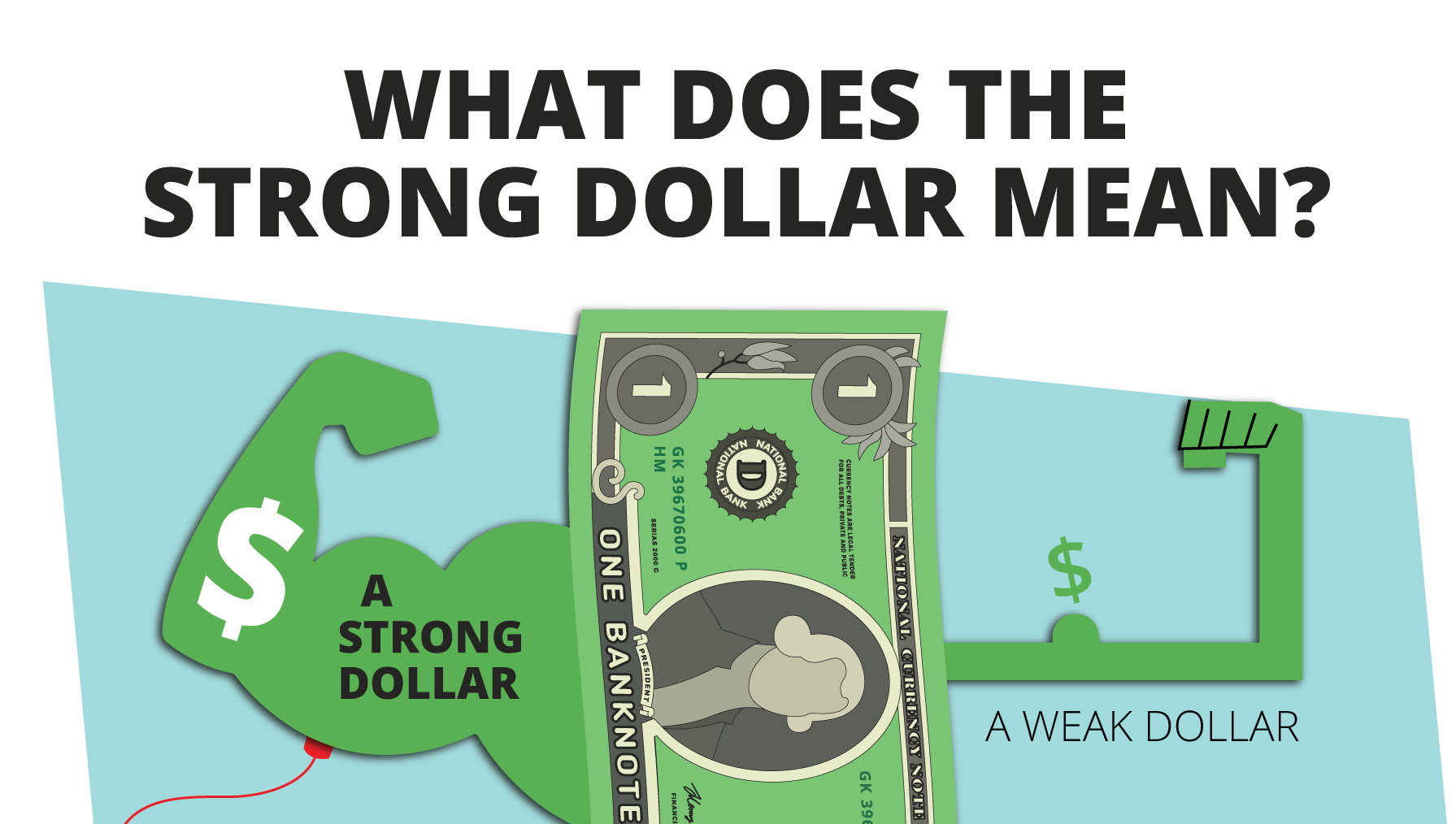
The dollar’s still strong—and recent earnings reports have reflected that, for better or worse.

Around this time last year, earnings took a significant forex hit. Power players like Coca-Cola and Procter & Gamble said the strong dollar hurt profits, while others, like Microsoft, cited currency fluctuations in lowered forecasts.

Back then, the dollar was at a 20-year high. In recent months, the dollar has stayed relatively high as a string of economic data suggested interest rates will stay elevated—at least for now. And after Federal Reserve Chair Jerome Powell suggested the Fed might have to keep raising rates, the US dollar index climbed to its highest since June 1st.

In any case, foreign exchange rates are yet again cropping up as a talking point in recent earnings reports.

***

COMMENTS APPRECIATED

Thank You

***

***

DAILY UPDATE: Mortgages Rates and the Markets are Up!

By Staff Reporters

***

***

Home Mortgage rates just hit their highest mark since 2002, making home ownership even less attainable to potential buyers. Stagnation in the housing market could also put a squeeze on consumer spending, slowing broader economic growth. The average 30-year fixed-rate mortgage, a popular home loan, hit 7.09% last Thursday, up from 6.96% the week before, according to mortgage behemoth the Federal Home Loan Mortgage Corporation (Freddie Mac).

In a statement tied to the release, Freddie Mac noted that the rise of the 10-year Treasury yield and the strength of the economy both contributed to the high rate.

***

Here is where the major benchmarks ended:

  • The S&P 500® Index rose 49 points (1.1%) to 4,436.02; the Dow Jones Industrial Average (DJIA) rose 184 points (0.54%) to 34,472.98; the NASDAQ Composite (COMP) rose 215 points (1.59%) to 13,721.03.
  • The 10-year Treasury note yield (TNX) fell 15 basis points to 4.180%.
  • CBOE’s Volatility Index (VIX) fell roughly 1 point to 16.03.

Communication services—which is home to tech-adjacent companies such as Google parent Alphabet (GOOG), Facebook parent Meta (META), and Netflix (NFLX)—and technology were the top-performing sectors Wednesday.

Energy was the laggard, as crude oil futures slipped more than 1% to below $79.

***

COMMENTS APPRECIATED

Thank You

***

***

INFLATION: The Interest Rate Balancing Act

By Staff Reporters

***

***

Whether we’ll see another interest rate increase soon depends on what happens between now and the Fed’s next meeting in September. Jerome Powell will be watching to see if consumer prices come down more than they already have, thanks to previous rate hikes.

There are some promising signs that the worst is behind us:

  • Tomorrow, when the government releases the latest personal consumption expenditures price index—the Fed’s preferred measure for tracking inflation—it’s expected to show the lowest inflation increase since the end of 2021. And last month, the consumer price index showed inflation fell to 3%, which is above the Fed’s 2% target but an improvement from last June’s 9.1%.
  • Meanwhile, Coca-Cola—whose prices were 10% higher last quarter compared to Q2 2022—said it’s done marking up drinks for the year, and the CFO of Unilever said the packaged goods giant’s price inflation has peaked (though prices may still get higher).

But the FOMC wants more: Chairman Powell said that for inflation to be truly conquered, the job market, which currently boasts a low unemployment rate of 3.6%, will need to slow.

***

***

COMMENTS APPRECIATED

Thank You

***

***

DAILY UPDATE: Dow and Fed Up but Markets Down

By Staff Reporters

***

***

The Federal Reserve raised its benchmark interest rate another 0.25% on Wednesday, reviving its inflation fight despite a significant cooldown of price increases in recent months. The rate hike brought the Fed’s benchmark interest rate to a 22-year high of between 5.25% and 5.5%. Inflation has fallen significantly from a peak last summer, but remains at a level one percentage point higher than the Federal Reserve’s target of 2%.

***

The Dow on Wednesday rose for a 13th straight day, matching its longest winning streak since 1987. If it closes higher today, it would be a streak not seen since 1897 — about a year after the benchmark was created — when the Dow advanced for 14 sessions in a row. During this latest run, the Dow has outperformed, gaining 5%. That momentum hasn’t been seen in the broader S&P 500 and NASDAQ Composite indexes, however. Both are up just 3% since the Dow’s streak began. The S&P 500 has fallen twice in that time, while the NASDAQ has posted three losing sessions

***

Here is where the major benchmarks ended for the day:

  • The S&P 500 Index was down 0.02% at 4,566.75; the Dow Jones Industrial Average (DJIA) was up about 82 points (0.23%) at 35,520.12; the NASDAQ Composite was down 17 points (0.12%) at 14,127.28.
  • The 10-year Treasury note yield (TNX) edged down to 3.867%.
  • CBOE’s Volatility Index (VIX) dropped 5 points to at 13.32.

***

ORDER: https://www.routledge.com/Comprehensive-Financial-Planning-Strategies-for-Doctors-and-Advisors-Best/Marcinko-Hetico/p/book/9781482240283

***

COMMENTS APPRECIATED

Thank You

***

Recession, Interest Rates and Earnings?

By Staff Reporters

***

***

Recession: Last October, economists surveyed by Bloomberg were predicting a 100% chance of a Recession. But currently, the Dow is riding a 10-day winning streak, and the S&P 500 is just over 5% away from its all-time high. This week, Wall Street will be glued to the Fed’s interest rate announcement and a heavy slate of earnings.

Final Fed rate hike? The Federal Reserve will likely announce another interest rate increase this week, but this could be the final hike in its 16-month quest to bring down inflation. If the Fed hikes 25 basis points as expected, interest rates would be at their highest level since 2001.

Earnings galore: Corporate America’s A-list will report Q2 earnings this week, including Meta, Alphabet, Microsoft, McDonald’s, Coca-Cola, and Exxon Mobil. In all, about one-third of companies in the S&P 500 will give financial updates over the next five days, so we should get a good look into the health of a bunch of different industries.

***

COMMENTS APPRECIATED

Thank You

***

***

KING IS CASH: In a Tough Interest Rate Ecosystem

By Staff Reporters

***

***

Cash is king, especially in this tough interest rate environment. That’s proving true in the mergers and acquisitions market this year, according to PwC’s US Deals 2023 midyear outlook, which says companies and private equity with cash in hand are making deals happen. There are “opportunities for corporates with strong balance sheets. Private equity sponsors with large amounts of dry powder also have been getting deals done,” according to PwC.

CITE: https://www.r2library.com/Resource

Deal makers need cash because lending has become tougher and more expensive to obtain. Additionally, “the IPO market has remained quiet for over a year.”

Even the private equity market, which often leans heavily on debt financing, is reaching for other ways to get deals done: “Some PE sponsors have turned to more creative financing solutions, including higher equity contribution, seller’s notes, paid in-kind financing and the private credit markets.”

The challenging market is also impacting deal size. PwC found that deal makers are eschewing big deals in favor of smaller opportunities. However, although the deals appear to be smaller, the volume of M&A activity is “relatively strong compared toCOVID pre-pandemic levels.

***

COMMENTS APPRECIATED

Join the ME-P

***

***

SPOTLIGHT: 23 Banks and 1 Stock

By Staff Reporters

***

***

The 23 biggest banks all passed a stress test that simulated a severe recession, the Federal Reserve said yesterday.

CITE: https://www.r2library.com/Resource

***

  • Markets: Stocks ended mixed yesterday after Jerome Powell (and other major central bankers around the world) signaled that more interest rate hikes are as inevitable. In fact, Jerome Powell hinted he couldn’t rule out two rate raises in a row.
  • Stock spotlight: AI-chip hero Nvidia fell on reports that the US is considering even more restrictions on chip exports to China.

***

***

COMMENTS APPRECIATED

Thank You

***

DAILY UPDATE: Summer Speaks, Powell Suggests and Gensler Escalates as the Markets Rise

By Staff Reporters

***

***

The US economy remains “very, very hot,” though not as much as it was six to 12 months ago, said former Treasury Secretary Lawrence Summers. “The United States is, today, an underlying 4.5-5% inflation country,” Summers said, speaking via video link at the start of the two-day Caixin Asia New Vision Forum in Singapore. At the same time, soft landings “represent the triumph of hope over experience,” and commercial real estate is one area where there are likely to be “pockets of distress,” said Professor Summers of Harvard University.

At its meeting this week, the Federal Reserve is expected to do something it hasn’t done in the last 15 months: not raise interest rates. Chair Jerome Powell suggested it might be time to take a breather as a series of rate hikes filters through the economy.

***

Last week, the S&P 500 reached its fourth consecutive winning week and the NASDAQ seventh as investors find fewer things to be worried about. In a sign of that cautious optimism, Goldman Sachs slashed its probability of a recession in the next year from 35% to 25%.

Crypto: SEC Chair Gary Gensler dramatically escalated his war on crypto-currency last week, and prices took a big hit. Four of the 10 most valuable cryptocurrencies fell by at least 15%, per CoinMarketCap.

***

ORDER: https://www.routledge.com/Risk-Management-Liability-Insurance-and-Asset-Protection-Strategies-for/Marcinko-Hetico/p/book/9781498725989

ORDER: https://www.routledge.com/Comprehensive-Financial-Planning-Strategies-for-Doctors-and-Advisors-Best/Marcinko-Hetico/p/book/9781482240283

***

COMMENTS APPRECIATED

Thank You

***

FOMC Hikes Interest Rates 0.25%

BREAKING NEWS!

By Staff Reporters

***

***

Dateline: WASHINGTON—The Federal Reserve raised its key short-term interest rate by a quarter percentage point today, pushing ahead with its aggressive campaign to tame inflation despite financial turmoil following Silicon Valley Bank’s collapse.

FOMC officials forecast another quarter point in rate increases this year to a peak range of 5% to 5.25%, in line with its December estimate and lower than the level markets anticipated before SVB’s meltdown.

In a statement after a two-day meeting, the Fed acknowledged recent strains in the nation’s banks and said they will soften the economy but added the financial system is stable.

CITE: https://www.r2library.com/Resource/Title/0826102549

***

COMMENTS APPRECIATED

Thank You

***

ORDER: https://www.routledge.com/Comprehensive-Financial-Planning-Strategies-for-Doctors-and-Advisors-Best/Marcinko-Hetico/p/book/9781482240283

***

FOMC: Interest Rates Up?

By Staff Reporters

***

***

DEFINITION:

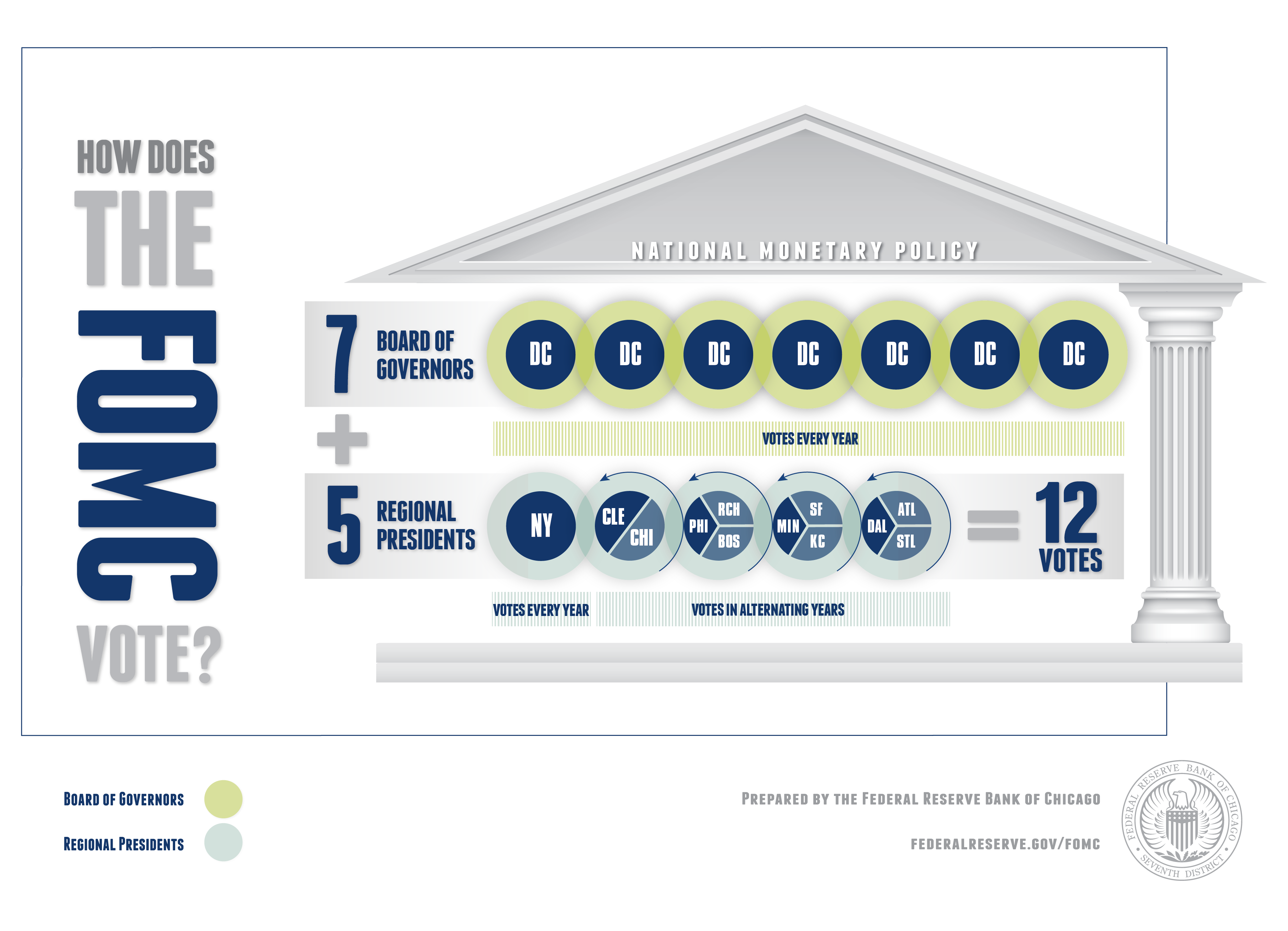
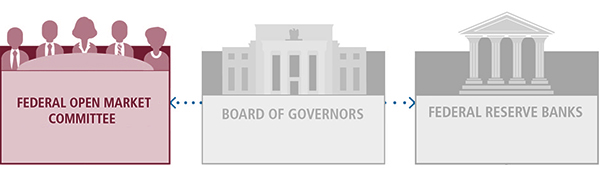
According to Wikipedia, the Federal Open Market Committee (FOMC), a committee within the Federal Reserve System (the Fed), is charged under United States law with overseeing the nation’s open market operations (e.g., the Fed’s buying and selling of United States Treasury securities). This Federal Reserve committee makes key decisions about interest rates and the growth of the United States money supply. Under the terms of the original Federal Reserve Act, each of the Federal Reserve banks was authorized to buy and sell in the open market bonds and short term obligations of the United States Government, bank acceptances, cable transfers, and bills of exchange. Hence, the reserve banks were at times bidding against each other in the open market. In 1922, an informal committee was established to execute purchases and sales. The Banking Act of 1933 formed an official FOMC.

The FOMC is the principal organ of United States national monetary policy. The Committee sets monetary policy by specifying the short-term objective for the Fed’s open market operations, which is usually a target level for the federal funds rate (the rate that commercial banks charge between themselves for overnight loans).

The FOMC also directs operations undertaken by the Federal Reserve System in foreign exchange markets, although any intervention in foreign exchange markets is coordinated with the U.S. Treasury, which has responsibility for formulating U.S. policies regarding the exchange value of the dollar.

The Federal Reserve is set to announce today whether it will impose another interest rate hike, the central bank’s latest move in a months long fight that has eased inflation but risks plunging the U.S. into a recession.

The Fed [FOMC] has put forward a string of borrowing cost increases as it tries to slash price hikes by slowing the economy and choking off demand. The approach, however, risks tipping the U.S. economy into a downturn and putting millions out of work.

CITE: https://www.r2library.com/Resource/Title/0826102549

And so, at a meeting in December 2022, the Fed raised its short-term borrowing rate a half-percentage point, pulling back from three consecutive 0.75% increases and signaling confidence that sky-high inflation could be brought down to normal levels.

Economists expect the Fed to continue softening its approach with a 0.25% rate hike today? The decision comes weeks after a government report showed that inflation slowed in December, marking six consecutive months of easing price increases.

***

COMMENTS APPRECIATED

Thank You

***

ORDER: https://www.routledge.com/Comprehensive-Financial-Planning-Strategies-for-Doctors-and-Advisors-Best/Marcinko-Hetico/p/book/9781482240283

***

Two Year Treasury Yields = HIGH!

By Staff Reporters

***

***

U.S. bond yields just rose to new cycle highs as the fallout from the Federal Reserve’s latest interest rate hike and commentary reverberated across markets. The policy-sensitive 2-year rate broke intermittently above 4.7%, shrinking its spread to the 10-year rate to as little as minus 60.9 basis points in a worrisome sign of the economic outlook. The 2-year yield finished the New York session at its highest level in more than 15 years.

What’s happening

  • The yield on the 2-year Treasury rose 13.1 basis points to 4.699% from 4.568% on Wednesday. Thursday’s level is the highest since July 25, 2007, based on 3 p.m. figures from Dow Jones Market Data.
  • The yield on the 10-year Treasury advanced 6.4 basis points to 4.123% from 4.059% as of late Wednesday. Thursday’s level is the highest since Oct. 24.
  • The yield on the 30-year Treasury climbed 2.9 basis points to 4.151% from 4.122% Wednesday afternoon.

***

COMMENTS APPRECIATED

Thank You

***


ORDER: https://www.routledge.com/Comprehensive-Financial-Planning-Strategies-for-Doctors-and-Advisors-Best/Marcinko-Hetico/p/book/9781482240283

***

BREAKING NEWS: The FOMC Raises Short-Term Interest Rate 0.75%

By Staff Reporters

***

The Federal Reserve jut raised its short-term borrowing rate another 0.75% to slow key areas of the economy and tame inflation, which is at a 40-year high. The central bank said its new target range is 3.75%-4%, the highest level since January 2008.

The aggressive move is the latest in a string of borrowing cost increases imposed by the Fed in recent months as it tries to slash price increases by cooling the economy and choking off demand. The approach, however, risks tipping the U.S. into a recession and putting millions out of work.

The fourth rate hike of 2022 also arrives less than a week before the midterm elections.

***

COMMENTS APPRECIATED

Thank You

***

ORDER: https://www.routledge.com/Comprehensive-Financial-Planning-Strategies-for-Doctors-and-Advisors-Best/Marcinko-Hetico/p/book/9781482240283

***

FOMC: Will Raise Interest Rates in November?

By Staff Reporters

***

The Fed is poised to raise interest rates just one more time in November before stopping, according to Ed Yardeni. That’s because there is a growing risk that financial markets are on the verge of instability due to a soaring US dollar.

“The soaring dollar has been associated in the past with creating financial crisis on a global basis,” Yardeni just told told Bloomberg.

CITE: https://www.yardeni.com/

***
COMMENTS APPRECIATED

Thank You

***
FINANCE: https://www.routledge.com/Comprehensive-Financial-Planning-Strategies-for-Doctors-and-Advisors-Best/Marcinko-Hetico/p/book/9781482240283

****

An Interest Rate Review for Physician-Executives

Managerial Accounting

By Dr. David E. Marcinko MBA

Recently, several major banking institutions have addressed the problem of escalating debt upon graduating physicians, mid-life practitioners and even seasoned healthcare providers; despite historically low rates for prime customers.

Unfortunately, one may still wonder how many clinicians truly appreciate the risks associated with usurious interest rates for homes, cars, medical equipment and other consumer items; as we offer the following review to reduce this peril.

WHITE-PAPER: IRs

Assessment: Your thoughts are appreciated.

***

Risk Management, Liability Insurance, and Asset Protection Strategies for Doctors and Advisors: Best Practices from Leading Consultants and Certified Medical Planners™8Comprehensive Financial Planning Strategies for Doctors and Advisors: Best Practices from Leading Consultants and Certified Medical Planners™

***

UPDATE: IRS Interest Rates Rising, Currency Inflation and Upcoming Earning Reports, etc.

By Staff Reporters

****

IRS: The IRS sent out a notice on February 23rd, warning taxpayers about a price hike coming in the next few months. The tax agency said that interest rates will increase for the calendar quarter starting April 1st, 2022. You can accrue interest on two types of payments: over-payment or underpayment. So starting in April, over-payments will have an interest rate of 4 percent, except for corporations which will earn a 3 percent rate and a 1.5 percent rate for the portion of a corporate over-payment that exceeds $10,000. In terms of underpayments, the interest rate will increase to 4 percent overall and 6 percent for large corporate underpayments.

“Under the Internal Revenue Code, the rate of interest is determined on a quarterly basis,” the IRS website explained. The tax agency did not change interest rates in this last quarter, which began Jan. 1, 2022. Before they get changed in April, the rates are currently 3 percent for general over-payments and 2 percent for corporation over-payments, with a 0.5 percent rate for the portion of a corporate over-payment exceeding $10,000. The underpayment interest is 3 percent right now, expect for large corporations which have a 5 percent rate.

***

***

CURRENCY INFLATION: Inflation may occur when the Federal Reserve, or another central bank, adds fiat currency into circulation at a rate that exceeds that of the economy’s growth rate. That creates a situation in which there are more dollars bidding on fewer goods and services. The result is that goods and services cost more. One reason that inflation has been a constant in the US since 1933 is that the FOMC has continually increased the money supply. In response to the 2008 financial crisis, the Fed dropped its lending rate close to zero as a way to inject more liquidity into the economy, which led to increased inflation but not hyperinflation. While those increases have usually moved in step with growth, that hasn’t always been the case.

CITE: https://www.r2library.com/Resource/Title/0826102549

And so, in response to the COVID-19 pandemic and subsequent lock-downs, the Federal Reserve released the equivalent of $3.8 trillion in new liquidity in 2020. That amount was equal to roughly 20% of the dollars previously in circulation. And it is one reason why many investors were watching the CPI closely in 2021.

EARNING REPORTS:

Monday: India GDP data; Earnings from Lordstown Motors, Groupon, HP, SmileDirectClub and Zoom Video

Tuesday: US and China manufacturing data; Earnings from AutoZone, Baidu, Domino’s Pizza, Hostess Brands, J.M. Smucker, Kohl’s, Target, AMC Entertainment and Salesforce

Wednesday: European inflation data; Earnings from Abercrombie & Fitch, Dine Brands, Dollar Tree, Snowflake and Victoria’s Secret

Thursday: ISM Non-Manufacturing Index; Earnings from Best Buy, Weibo, Costco and Gap

Friday: US jobs report

10-Year: Treasuries rallied to 1.902%.

Oil: The rise in oil prices is spilling over at the gas pump: The average gas price in the US has jumped 10 cents, to $3.64/gallon, in the past two weeks.

Partial SWIFT ban: Western governments put aside their hesitations and proposed banning some Russian lenders from SWIFT, the global messaging service that facilitates cross-border transactions. It’s a move that could cause turmoil across global financial markets.

***

COMMENTS APPRECIATED

Thank You

Subscribe to the Medical Executive-Post

***

***

UPDATE: Markets and Medicine

By Staff Reporters

***

The Federal Reserve announced that it will stop buying bonds about three months earlier than initially planned. The Fed now plans to trim its monthly Treasury and mortgage-backed security purchases by $30 billion a month starting next month. The new pace is expected to put an end to bond buying by March.

CITE: https://www.r2library.com/Resource/Title/0826102549

The Fed also announced that it would leave interest rates unchanged at near-zero percent. The announcement paves the way for three interest rate hikes by the end of 2022, which could weigh on tech and growth stocks.

UPDATE: https://www.msn.com/en-us/money/news/tech-takes-a-beating-as-central-banks-pull-back/vi-AARTp0n

  • Markets: Stocks reversed their post-Federal Reserve announcement rally with a stinker of a day—especially tech stocks. Semiconductor companies like AMD and Nvidia got particularly thwacked.
  • Covid: The CDC recommended adults use Moderna’s and Pfizer’s Covid vaccines over J&J’s due to the risk of developing rare but serious blood clots.

MORE: https://www.msn.com/en-us/money/markets/stocks-fall-as-investors-digest-feds-latest-move/vi-AARTm2C

***
COMMENTS APPRECIATED.

***

***

Thank You

***

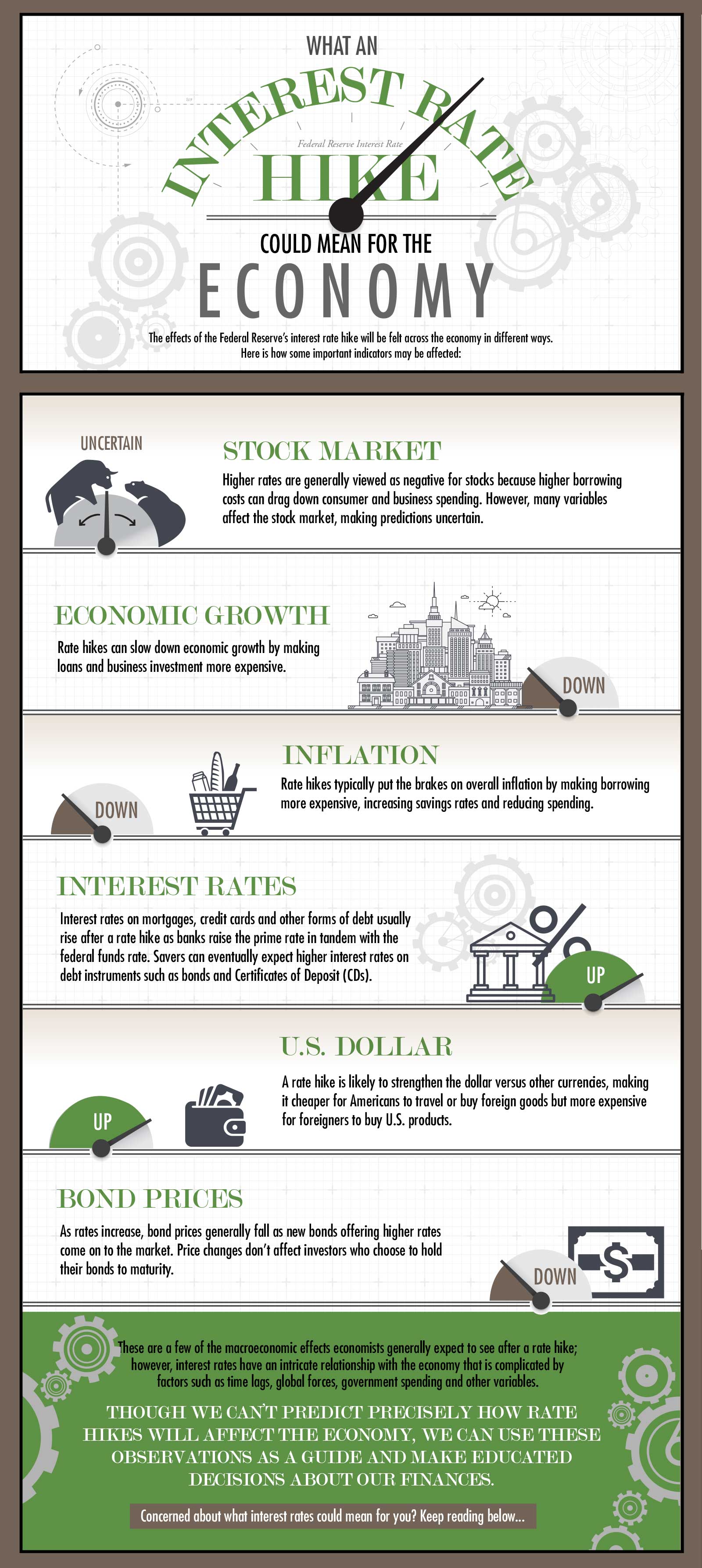
On Interest Rates and Economic Growth

Economic Growth and Index Value

***

***

More on Recent Interest Rate Hikes

Impending IRs and … the Economy

By http://www.MCOL.com

***

***

Conclusion

Your thoughts and comments on this ME-P are appreciated. Feel free to review our top-left column, and top-right sidebar materials, links, URLs and related websites, too. Then, subscribe to the ME-P. It is fast, free and secure.

Speaker: If you need a moderator or speaker for an upcoming event, Dr. David E. Marcinko; MBA – Publisher-in-Chief of the Medical Executive-Post – is available for seminar or speaking engagements. Contact: MarcinkoAdvisors@msn.com

OUR OTHER PRINT BOOKS AND RELATED INFORMATION SOURCES:

Risk Management, Liability Insurance, and Asset Protection Strategies for Doctors and Advisors: Best Practices from Leading Consultants and Certified Medical Planners™8Comprehensive Financial Planning Strategies for Doctors and Advisors: Best Practices from Leading Consultants and Certified Medical Planners™

***

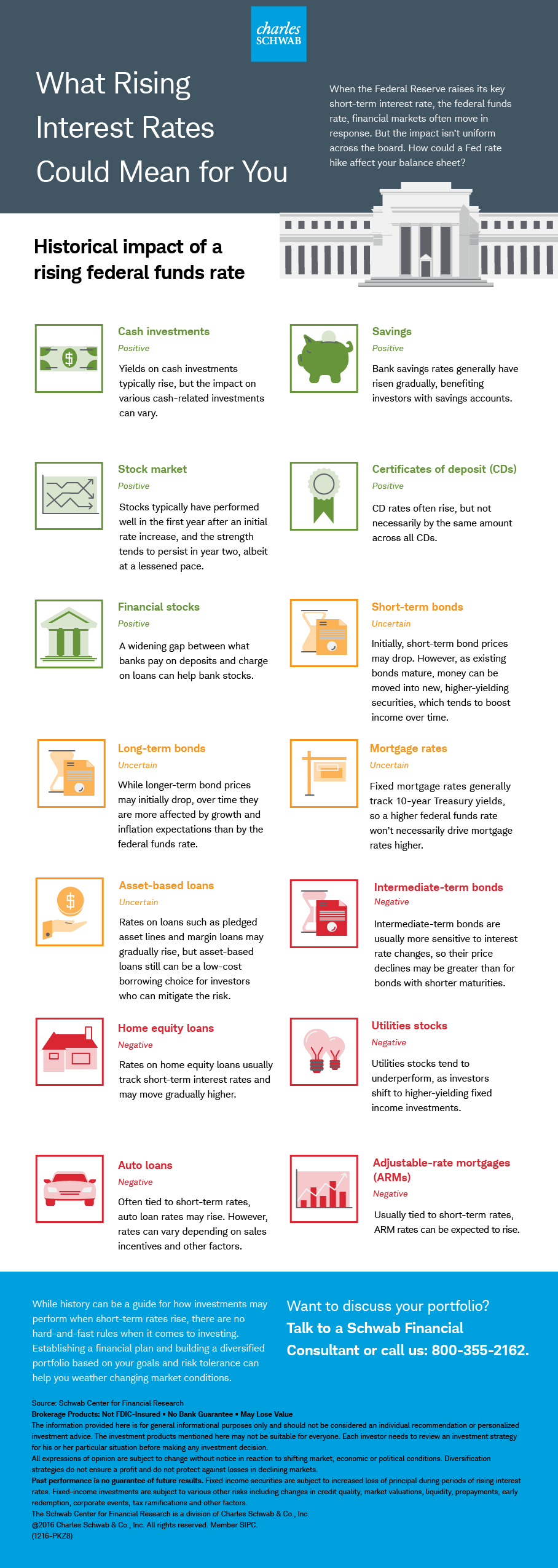
On Rising Interest Rates

Join Our Mailing List

By Charles Schwab

What They Could Mean for You

The FMOC rose interest rates today.

So, what does this mean for all of us?

***

infographic_120916_rising_interest_rates_mean_you_final

***

More:

Videos:

Assessment

Be aware that although the FED does indeed control overnight and short-term IRs; it is the market-place that controls longer-term rates. So, don’t fret.

-Dr. David Edward Marcinko MBA

No alt text provided for this image

Conclusion

Your thoughts and comments on this ME-P are appreciated. Feel free to review our top-left column, and top-right sidebar materials, links, URLs and related websites, too. Then, subscribe to the ME-P. It is fast, free and secure.

Speaker: If you need a moderator or speaker for an upcoming event, Dr. David E. Marcinko; MBA – Publisher-in-Chief of the Medical Executive-Post – is available for seminar or speaking engagements. Contact: MarcinkoAdvisors@msn.com

OUR OTHER PRINT BOOKS AND RELATED INFORMATION SOURCES:

Risk Management, Liability Insurance, and Asset Protection Strategies for Doctors and Advisors: Best Practices from Leading Consultants and Certified Medical Planners™8Comprehensive Financial Planning Strategies for Doctors and Advisors: Best Practices from Leading Consultants and Certified Medical Planners™

***

Update on the FOMC and Interest Rates

Join Our Mailing List

What if the Fed DOESN’T Raise Rates?

Michael-Gayed-sepia


 By Michael A. Gayed CFA

***

With odds high for the Federal Reserve’s first rate hike in nearly a decade, and seemingly everyone predicting that rising rates are coming in the next few weeks, why in the world is the yield curve not steepening aggressively?

Something curious is happening

There is a mistaken notion out there that if the Fed raises rates, the cost of capital on everything is going to rise.  This is far too simplistic a way of viewing the bond market.  If the Fed raises rates and the market perceives it as being too early, then longer duration bond yields likely would actually fall and credit spreads likely would widen.  In other words, some rates could fall because the Fed is raising short rates.

***

gv

***

In a healthy environment, Fed hiking would coincide with a steepening yield curve, as growth and inflation expectations become more aggressively priced in. As of late, it seems as though the bond market vastly disagree with the Fed’s December timing.

Of course all this could change, as probabilities continuously change

So, if the Fed decides not to raise rates, and the yield curve continues to flatten, then something very serious may be underway in terms of 2016 economic expectations.  It does seem plausible that from a cycle perspective, the era for passive buy and hold investing in large-cap stocks is nearing its end, allowing for more active alpha opportunities to present themselves.

This would likely translate into more volatility in equities, which we believe our alternative Morningstar 4 Star overall rated ATAC Inflation Rotation Fund (Ticker: ATACX, rating as of 9/30/15 among 234 Tactical Allocation Funds derived from a weighted average of the fund’s 3-year risk-adjusted return measures) is distinctly qualified to handle given our focus on being defensive in Treasuries at the right time.

Having said that, despite my own personal believe the Fed will raise rates, it is concerning to see how longer duration bonds are behaving.

The key needs to be a comeback in commodities and emerging market stocks

For the yield curve in the United States to steepen, and for the Federal Reserve to “get it right,” likely a surprise recovery is needed in cyclical growth sentiment.  Commodities and emerging markets are among the most sensitive areas of the investable landscape to that, so it stands to reason that their movement would show the whites of the eyes of that happening.  The issue however is that every time is looks like budding momentum is about to become more entrenched, that momentum quickly reverses and creates a false positive on rising growth expectations.

***

gears

***

Recent manufacturing data confirms that not much has changed on the growth side of the equation.  So far, broader equities seem to not care given historically favorable December seasonality.  That doesn’t mean one should not be considering this in an overall asset allocation policy.

Complicating-The European Central Bank

In many ways, crushing the Euro through more stimulus has the same effect as Federal Reserve tightening precisely because a rising Dollar is a contractionary force to exports.  European stimulus is Fed tightening IF it results in a Dollar super-spike.  Should that occur, the Fed would be more likely that not to not raise rates and actually do another round of stimulus.

Assessment

Insane sounding?  Maybe.  But; so is an environment where no amount of money printing seems to be accelerating the economy.

ABOUT

The ATAC Rotation Mutual Funds are managed by Pension Partners, LLC, an independent registered investment advisor.  The strategies were developed by Co-Portfolio Managers Edward M. Dempsey, CFP® and Michael A. Gayed, CFA. The Funds rotate offensively or defensively based on historically proven leading indicators of volatility, with the goal of taking less risk at the right time.

Conclusion

Your thoughts and comments on this ME-P are appreciated. Feel free to review our top-left column, and top-right sidebar materials, links, URLs and related websites, too. Then, subscribe to the ME-P. It is fast, free and secure.

Speaker: If you need a moderator or speaker for an upcoming event, Dr. David E. Marcinko; MBA – Publisher-in-Chief of the Medical Executive-Post – is available for seminar or speaking engagements. Contact: MarcinkoAdvisors@msn.com

OUR OTHER PRINT BOOKS AND RELATED INFORMATION SOURCES:

Risk Management, Liability Insurance, and Asset Protection Strategies for Doctors and Advisors: Best Practices from Leading Consultants and Certified Medical Planners™8Comprehensive Financial Planning Strategies for Doctors and Advisors: Best Practices from Leading Consultants and Certified Medical Planners™

****

Are Interest Rates expected to increase in December?

Join Our Mailing List

And, the Bureau of Labor Statistics (BLS) said …

Art

By Arthur Chalekian GEPC
[Financial Consultant]

U.S. job growth surpassed expectations in October. About 271,000 jobs were created across diverse industries: professional and business services, health care, retail, construction, and others. That was a significantly higher number than predicted by economists who participated in a survey conducted by The Wall Street Journal. They expected to see 183,000 new jobs for October.

BLS revised

The BLS revised August and September jobs numbers higher overall and reported improvement on the wage front, too. Average hourly earnings increased by nine cents during October. For the year, hourly earnings are up 2.5 percent. Rising wages and a 5 percent unemployment rate “appear to indicate the labor market has reached full employment,” reported Barron’s.

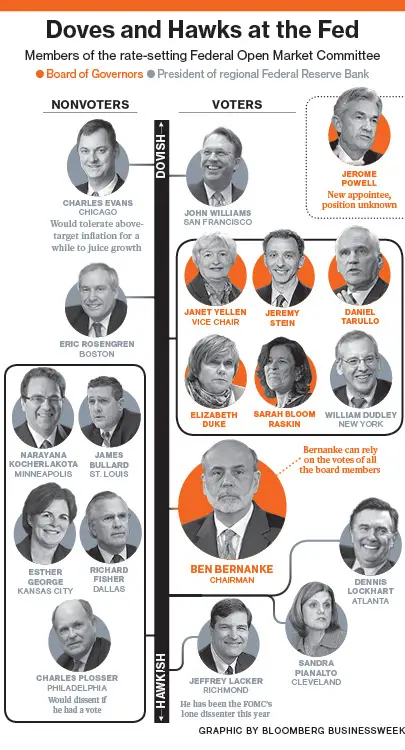
Strong employment data supports the idea the Fed will begin to lift the Fed funds rate this year. On Friday, former Chairman of the Federal Reserve Ben Bernanke wrote in his blog:

“Wednesday was something of a trifecta for Fed watchers: Chair Yellen, Board Vice-Chair Stanley Fischer, and Federal Reserve Bank of New York president Bill Dudley (who is also the vice chair of the Federal Open Market Committee) all made public appearances. Moreover, the comments by all three members of the Fed’s leadership explicitly or implicitly supported the idea that a December rate increase by the FOMC is a distinct possibility. (The possibility of a rate increase is even more distinct with this morning’s strong job market report.)”

Markets responded swiftly, according to The Wall Street Journal, as investors repositioned their portfolios in anticipation of a rate hike. While stock market indices remained relatively steady, there was considerable volatility within certain sectors. An expert cited by the publication commented:

“…one of the big rotation trades on Friday was investors taking money out of companies such as utilities and real-estate-investment trusts, and putting it into those that are expected to benefit from higher rates, such as financial companies.”

Conclusion

Your thoughts and comments on this ME-P are appreciated. Feel free to review our top-left column, and top-right sidebar materials, links, URLs and related websites, too. Then, subscribe to the ME-P. It is fast, free and secure.

Speaker: If you need a moderator or speaker for an upcoming event, Dr. David E. Marcinko; MBA – Publisher-in-Chief of the Medical Executive-Post – is available for seminar or speaking engagements. Contact: MarcinkoAdvisors@msn.com

OUR OTHER PRINT BOOKS AND RELATED INFORMATION SOURCES:

***

Comprehensive Financial Planning Strategies for Doctors and Advisors: Best Practices from Leading Consultants and Certified Medical Planners(TM)

***

HMO Physician Office Visit Co-Payment Creep

Patients Showing Doctors the Money [1999–2008]

By Staff Reporters

56371606

Copayment

2008

1999

$5

6%

23%

$10

16%

60%

$15

29%

12%

$20

30%

1%

Other

19%

3%

Source: Kaiser/HRETHRET Survey of Employer-Sponsored Health Benefits

www.kff.org

Assessment

Considering the “down and dirty” interest rate “rule of 72”, a twice doubling of copayments from $5 to $20, and a Hewlett-Packard 12-C hand-held financial calculator; allow us to suggest an annual copayment rise of 15% percent for the decade.

Conclusion

Your thoughts and comments on this ME-P are appreciated. Feel free to review our top-left column, and top-right sidebar materials, links, URLs and related websites, too. Then, subscribe to the ME-P. It is fast, free and secure.

Speaker: If you need a moderator or speaker for an upcoming event, Dr. David E. Marcinko; MBA – Publisher-in-Chief of the Medical Executive-Post – is available for seminar or speaking engagements. Contact: MarcinkoAdvisors@msn.com

OUR OTHER PRINT BOOKS AND RELATED INFORMATION SOURCES:

Product DetailsProduct DetailsProduct Details

***

Implications of Portfolio Withdrawals for Physician Investors

Obtaining Income in a Low Interest-Rate Economic Ecosystem

By Jeffery S. Coons; PhD, CFP®

Managing Principal-Manning & Napier Advisors, Inc

The general trend of declining interest rates experienced over the last decade and a-half, part of a long-term trend Manning & Napier Advisors, Inc. had focused on since the early 1980’s, created new challenges for managing investment portfolios with regular and significant cash withdrawals. And, this report will provide an analysis of the investment implications of withdrawals in light of the secular shift in the economic and market conditions; for all physician, healthcare executives, and financial advisors  The analysis aims to guide decisions as to the appropriate level of withdrawals from an account in this environment.

Restricted Ability to Generate Income

Declining interest rates restrict the ability to generate income from high quality investments, so a greater proportion of a given withdrawal requirement must come from the potential price appreciation of the securities. 

Of course, the inherently volatile nature of the financial markets makes price appreciation the less predictable of the sources of total return available to fund withdrawal needs. The natural questions that arise from this observation include:

·      What withdrawal rate inhibits the ability to pursue long-term capital growth as a primary investment objective?

·      What withdrawal rate may create a significant risk of a sustained deterioration of capital?

·      What is a reasonable range of withdrawal rates given the relatively low interest rate environment that we face?

Interest Rates and Dividend Yields

The answer to the first question can be derived by looking at interest rates and dividend yields of the recent past.  For example, with a dividend yield of 1.0%-2.0% on stocks (e.g., the current yield on the S&P 500 Index as of December 1999 is 1.2%) and yields on intermediate-term and long-term fixed income securities between 6.0% and 6.5% (e.g., as of December 1999, a one-year Treasury Bill has a yield of 6.0% and a thirty-year Treasury bond has a yield of 6.5%), growth-oriented portfolios should have generally produced a level of income adequate to allow 2.5%-3.5% withdrawals on an annual basis. 

Thus, rates of withdrawal of less than 3.5% generally should not inhibit the pursuit of long-term capital growth as a primary investment objective.

High End Results

To establish the high end of the achievable withdrawals under a management approach pursuing long-term capital growth, consider some additional historical evidence. 

For example, assume that withdrawals are taken from each of three portfolios (i.e., 100% stocks, 80% stocks/20% bonds, and 50% stocks/50% bonds using data from Ibbotson Associates, Inc.) starting at the beginning of 1973.  How many years did it take to regain the original capital of the portfolio? 

As can be seen in the table below, it took between 4-8 years for these portfolios to recover from the 1973-74 bear market with a 5.0% withdrawal rate.  If withdrawals are at a 7.5% rate per year, over ten years elapsed before the original capital was restored.  Finally, with a 10.0% withdrawal rate, it took between 13-15 years to restore the capital. 

While the 1973-74 bear market was severe, it is not the worst bear market that can be used to illustrate the risk of significant withdrawals taken when the portfolio’s market value is depressed.  The clear conclusion is that withdrawals of greater than 5.0% are a potential impediment to pursuing long-term capital growth, given the long periods required to restore capital for the various growth-oriented asset mixes offered in this analysis.


When Was Original (12/72) Capital Restored?


5.0% W/D

7.5% W/D

10.0% W/D

100%
Stock       


9/80

(7.75 years)


6/83

(10.5 years)


6/86

(14.5 years)


80% Stock/ 20% Bond


9/80

(7.75 years)


3/83

(10.25 years)


6/86

(14.5 years)


50% Stock/ 50% Bond


12/76

(4.0 years)


3/83

(10.25 years)


3/87

(15.25 years)


Understanding Market Value

Another key issue to remember is that the withdrawal rates above are a percentage of current market value, so the dollar value of the cash withdrawn from the account is assumed to decline in a bear market. 

However, most of us think of our withdrawal needs in terms of dollars instead of percentages (e.g., $50,000 from a $1,000,000 account, which translates to 5%).  If we attempt to maintain the dollar value of withdrawals in bear market periods, the percentage of current market value being withdrawn actually increases, and the impact on the portfolio far exceeds the example provided above. 

To demonstrate, consider maintaining withdrawals of $50,000, $75,000 and $100,000 on an account with a $1,000,000 market value as of 12/72 (see table below).  In the case of a $50,000 annual withdrawal, approximately 8-10 years elapse before the original $1,000,000 market value is restored.  If the withdrawals are $75,000 per year, 13 years elapse for the 50/50 asset mix and almost 19 years pass for the 80/20 asset mix before the $1,000,000 is restored.  For the 100% stock portfolio, nearly 25 years elapse before the original $1,000,000 is restored.

Finally, for $100,000 withdrawals off of a $1,000,000 market value in 1972, all capital in the account is depleted within 10-15 years given these withdrawals.  Thus, the risk of significant cash withdrawals having a detrimental impact on the ability to preserve and grow capital is much more pronounced when withdrawals remain high in dollar terms.


When Was Original Capital ($1,000,000 in 12/72) Restored?


$50,000 W/D

$75,000 W/D

$100,000 W/D

100% Stock


3/83

(10.25 years)


9/97

(24.75 years)


Capital Depleted

9/83


80% Stock/ 20% Bond


12/80

(8.0 years)


9/91

(18.75 years)


Capital Depleted

3/85


50% Stock/ 50% Bond


9/80

(7.75 years)


3/86

(13.25 years)


Capital Depleted

9/87


Pursuing Long-Term Capital Growth

So far, the major point we have established is that a withdrawal rate of 2.5%-3.5% may be achievable without hampering the pursuit of long-term capital growth, but withdrawals of 5% or greater may have a significant impact on the ability to manage for growth. 

Therefore, accounts expected to experience withdrawals of 4%-5% (or greater) should be managed with a goal of satisfying these withdrawal needs on a regular basis first, with the pursuit of capital growth taking secondary importance. 

However, the analysis provided above also implies that there is a rate of withdrawals that forces us to focus on capital preservation, because depletion of capital is a likely outcome. For withdrawals in the range of 10.0%, the example above shows that the risk of depletion of capital is significant at these high annual levels, especially if the withdrawals are on a dollar basis and not adjusted by the decline of current market value in a bear market.

In fact, with long-term U.S. government bond yields at approximately 6.0%-6.5%, annual withdrawals greater than 7.5% are likely to be too high to allow a manager to effectively pursue long-term capital growth without a high degree of risk to the capital of the account. That is, since attempts to provide returns above the current Treasury yields imply risk of volatility, and volatility can lead to the examples provided above, withdrawals at 7.5% or more and maintained on a dollar basis imply a high likelihood that original capital will be depleted over a 15-20 year period.  In general, the current level of yields in the market imply that management of a portfolio requiring over 7.5% per year in withdrawals faces a strong possibility of depleting capital under any scenario, and so portfolio management should focus on dampening market volatility so as to extend the life of the capital for as long as possible as it is drawn down.

Determining Appropriate Level of Withdrawals

The final question (i.e., the appropriate level of withdrawals) is driven by both the physician client’s need for the assets and the parameters outlined above:


1.    Withdrawals less than 3.5% of current market value should not inhibit the pursuit of long-term capital growth as a primary objective.

2.    Withdrawal rates between 3.6% and 7.4% require a primary focus on satisfying withdrawal needs over the market cycle, possibly with a secondary goal of long-term capital growth to protect future withdrawal needs.

3.    Withdrawal rates greater than 7.5% are likely to result in a depletion of capital, so the goal should be to manage the draw down of capital by dampening year-to-year volatility of the portfolio.


While we all would like to achieve capital growth, the ability to pursue growth-oriented strategies depends on the flexibility to moderate withdrawals, if required by market conditions, and on the overall reliance on these assets. 

As an example, an endowment or personal corpus can control its withdrawals to some extent, but there is a level beyond which the belt cannot be tightened without harming the services being funded. 

Another example comes from someone living primarily on an IRA account, especially after becoming accustomed to the high (and falling) interest rate/high asset return environment of the last fifteen years. Aggressively pursuing capital growth in the face of large withdrawals may result in exposure to significant risk of depletion of the IRA assets when other sources of income are unavailable.  If, on the other hand, the IRA was a small part of the wealth available in retirement, then there is some flexibility to work towards long-term capital growth. 

Finally, a defined benefit retirement plan may have an outside source of funding to help restore capital (i.e., contributions from the employer), but defined contribution and Taft-Hartley plans have much less of a safety net.  As a result, the risk taken to pursue growth in the face of significant withdrawals must take into account the nature of the assets and the problems associated with a deterioration of capital in the account.

Assessment

Portfolio withdrawals can have a significant impact on the ability of a wealth manager, or physician investor, to preserve capital and pursue long-term capital growth.  However, while lessening the level of withdrawals will help provide flexibility for the manager to pursue these goals, the need for the assets may require that withdrawals are maintained at a certain level.  Once withdrawals are minimized, the manager should focus on investment goals that correspond with this minimum level. 

If withdrawals are below 3% of current market value, pursuit of long-term capital growth can be a primary objective. Withdrawals between 4% and 7.5% of market value on an annual basis require a focus on working towards satisfying these annual needs. Long-term capital growth, in this case, should be a secondary goal. 

Finally, if withdrawals are above a 7.5% annual rate, then the investment management approach should focus on preserving capital and dampening market volatility so as to work towards allowing the assets to last as long as possible as they are drawn down.

Conclusion

As demonstrated above, income withdrawals can have a significant impact on the ability of a wealth manager, or physician investor, to preserve capital and pursue long-term capital growth. Does the current low interest-rate environment, and present financial ecosystem, mimic the above historic scenario and can it suggest strategies to be pursued today? Please opine and comment.

Related Information Sources:

Practice Management: http://www.springerpub.com/prod.aspx?prod_id=23759

Physician Financial Planning: http://www.jbpub.com/catalog/0763745790

Medical Risk Management: http://www.jbpub.com/catalog/9780763733421

Physician Advisors: www.CertifiedMedicalPlanner.org

Speaker:If you need a moderator or speaker for an upcoming event, Dr. David E. Marcinko; MBA – Publisher-in-Chief of the Medical Executive-Post – is available for seminar or speaking engagements. Contact: MarcinkoAdvisors@msn.com 

Subscribe Now:Did you like this Medical Executive-Post, or find it helpful, interesting and informative? Want to get the latest ME-Ps delivered to your email box each morning? Just subscribe using the link below. You can unsubscribe at any time. Security is assured.

Link: http://feeds.feedburner.com/HealthcareFinancialsthePostForcxos

Copyright 2008 iMBA Inc:All rights reserved, USA, unless otherwise noted. Use is restricted to Medical Executive-Post subscribers only. No redistribution is allowed. To avoid violation of iMBA Inc copyright restrictions and redistribution policy, please register for your own free Medical Executive-Post membership. Detailed information and registration links are available at:

Link: http://feeds.feedburner.com/HealthcareFinancialsthePostForcxos

Referrals:Thank you in advance for your electronic referrals to the Medical Executive-Post.

Product Details  Product Details