BOARD CERTIFICATION EXAM STUDY GUIDES Lower Extremity Trauma
[Click on Image to Enlarge]
ME-P Free Advertising Consultation
The “Medical Executive-Post” is about connecting doctors, health care executives and modern consulting advisors. It’s about free-enterprise, business, practice, policy, personal financial planning and wealth building capitalism. We have an attitude that’s independent, outspoken, intelligent and so Next-Gen; often edgy, usually controversial. And, our consultants “got fly”, just like U. Read it! Write it! Post it! “Medical Executive-Post”. Call or email us for your FREE advertising and sales consultation TODAY [678.779.8597] Email: MarcinkoAdvisors@outlook.com
Medical & Surgical e-Consent Forms
ePodiatryConsentForms.com
iMBA Inc., OFFICES
Suite #5901 Wilbanks Drive, Norcross, Georgia, 30092 USA [1.678.779.8597]. Our location is real and we are now virtually enabled to assist new long distance clients and out-of-town colleagues.
ME-P Publishing
SEEKING INDUSTRY INFO PARTNERS?
If you want the opportunity to work with leading health care industry insiders, innovators and watchers, the “ME-P” may be right for you? We are unbiased and operate at the nexus of theoretical and applied R&D. Collaborate with us and you’ll put your brand in front of a smart & tightly focused demographic; one at the forefront of our emerging healthcare free marketplace of informed and professional “movers and shakers.” Our Ad Rate Card is available upon request [678-779-8597].
Posted on March 22, 2022 by Dr. David Edward Marcinko MBA MEd CMP™
My Journey From Financial Advisor to Journalist to Fiduciary Ambassador
ByKathleen M. McBride, AIFA® [Founder, Fiduciarypath, LLC]
EDITOR’S NOTE: Kathleen M. McBride, AIFA®, Founder, Fiduciarypath, LLC and CEFEX-certified analyst, talks about her journey from advisor to journalist to fiduciary ambassador.
Posted on March 22, 2022 by Dr. David Edward Marcinko MBA MEd CMP™
By Eric Bricker MD
C.O.N. Legislation is Not New!
Certificate of need laws are state-level regulations that require healthcare institutions to obtain approval from state officials before moving forward on large capital expenditure projects, such as the construction of a new facility or the purchase of expensive new equipment.
A client recently asked me whether there is a difference in our sell discipline between high and low growth companies.
Selling is one of the hardest parts of investing. I wrote a lot on the subject in the past, but let’s zoom in on how our selling practice differs between high-growth companies with long runways for compounding and slow-growth companies.
EDITOR’S NOTE: It has been a few years since I spoke with my colleague Vitaliy. But, I read his newsletters and blog regularly and suggest all ME-P readers do the same.
Posted on March 19, 2022 by Dr. David Edward Marcinko MBA MEd CMP™
A WORKING WHITE PAPER
Orazio Attanasio
Agnes Kovacs
Patrick Moran
We propose a rich model of household behavior to study the effect of two important policies: mortgage interest tax deduction and mandatory mortgage amortization. These policies have attracted some controversy, first because they are conceived to increase overall saving, an objective that the literature does not agree they can achieve, and second because they incentivize illiquid savings and may thus increase the share of ‘wealthy hand-to-mouth’ households.
We build a life-cycle model where housing may act as a commitment device to counteract present biases arising from temptation. We show that the model matches several empirical facts, including the large share of wealthy hand-to-mouth households. We evaluate the effect of the two policies and find that they increase wealth accumulation by 7 and 10% respectively.
Our results demonstrate that these policies not only induce portfolio re-balancing, as emphasized by the previous literature, but also increase savings by making commitment more accessible.
Posted on March 17, 2022 by Dr. David Edward Marcinko MBA MEd CMP™
By Eric Bricker MD
An accumulator is a running total of money you’ve paid towards your out-of-pocket max for covered services. This includes any copayments, coinsurance, and other health care costs, but not your monthly premium payments.
Posted on March 17, 2022 by Dr. David Edward Marcinko MBA MEd CMP™
M.I.T TECHNOLOGY IN REVIEW
The 35 Innovators Under 35 is a yearly opportunity to take a look at not just where technology is now, but where it’s going and who’s taking it there. More than 500 people are nominated every year, and from this group MIT editors pick the most promising 100 to move on to the semifinalist round.
Their work is then evaluated by a panel of judges who have expertise in such areas as artificial intelligence, biotechnology, software, energy, and materials. With the insight gained from these rankings, the MIT editors pick the final list of 35.
Posted on March 16, 2022 by Dr. David Edward Marcinko MBA MEd CMP™
A Professional and Personal look at Health Insurance, with Karl Albrecht
Rich talks with the president of Action Benefits, Karl Albrecht about the state of Health Insurance.
Albrecht also gives a candid insight to his personal fight with pancreatic cancer and how being a Health Insurance executive as well as a patient, has given him a unique perspective on how things work, and how they could improve.
Posted on March 16, 2022 by Dr. David Edward Marcinko MBA MEd CMP™
Our broken healthcare supply chain – what can be done
By Dr. Marion Mass MD
Dr. Marion Mass graduated from Medical School at Duke University. She completed internship and residency at Northwestern University’s Robert Lurie Children’s Hospital in Chicago. Dr. Mass has worked in the Philadelphia area as a pediatrician for 21 years.
A study conducted by the RAND Corporation and published in the January 2022 issue of the Journal of the American Medical Association (JAMA) seeking to determine whether health systems primarily incentivize volume or value in their physician compensation models found that almost all physicians are still compensated through a volume-based model that rewards productivity over the value of care provided.
These study results are in direct contradiction to the longstanding narrative that the U.S. healthcare delivery system is shifting away from volume-based reimbursement and toward VBR. (Read more…)
Posted on March 14, 2022 by Dr. David Edward Marcinko MBA MEd CMP™
***
Investing and Chess
By Vitaliy Katsenelson, CFA
***
Conclusion: Investing and Chess
I read somewhere that chess is a game of small advantages. When the game starts, the players are equal – both hold the same number of pieces in the same positions. But then every move either adds to your position (competitive advantage) or subtracts from it. These little decisions (resulting in a better pawn structure, a more secure king, a centrally positioned knight, and so on) that you make with every move accumulate into victory.
Investing is not that much different, especially in today’s world where access to information has flattened. A mutual fund that manages $100 billion may spend $100 million on research, but that $100 million doesn’t buy any more than what a patient value investor can glean by reading financial statements.
I am not talking about Warren Buffett either, who doesn’t even have a PC in his office. Ted Weschler and Todd Combs (Warren Buffett’s right-hand men) achieved phenomenal investment success without a fancy research department by simply reading carefully and following our Six Commandments.
The key to succeeding in this irrational world is to actively ingrain each one of these principles into your investment operating system, improving your process just a little on a daily basis, and then success will follow.
Finally, this would not be a worthy chapter if I did not contradict myself, just a little. Investing is also unlike chess. Investing affords us a luxury that few people appreciate: You can choose your own opponent. In chess tournaments, you don’t get to choose your opponent. Tournament organizers match you to someone with an equal rating; then as you win, you are progressively matched against better opponents.
In investing, you are the “tournament organizer.” You get to walk into the room and, instead of choosing the geekiest opponent – the dude with thick glasses who hasn’t been on a date in years and has only thought and dreamt about chess – you can go for the muscular guy who spends five hours a day in the gym, and only joined the tournament because he lost a bet.
Money doesn’t know how you made it. A hundred dollars made by solving easy problems (buying stocks where both your IQ and EQ were at their highest) buys as much as a hundred dollars that caused you to lose your hair. In investing, you don’t have to solve the problems that everyone else is solving. There are thousands of stocks out there, and your portfolio needs only a few dozen.
Posted on March 12, 2022 by Dr. David Edward Marcinko MBA MEd CMP™
***
6. In the long run, stocks revert to their fair value
***
***
EDITOR’S NOTE: Although it has been some time since speaking live with busy colleague Vitaliy Katsenelson CFA, I review his internet material frequently and appreciate this ME-P series contribution. I encourage all ME-P readers to do the same and consider his value investing insights carefully.
By Vitaliy Katsenelson, CFA
***
6. In the long run, stocks revert to their fair value
Reversion to fair value is not a pie-in-the-sky concept. If a stock is significantly undervalued for a long time, then this undervaluation gets cured, eventually. That can happen through share buybacks – the company can basically buy all of its shares and take itself private.
Or it can happen by the company’s paying out its earnings in dividends, thus creating yields that the market will not be able to ignore. Or the company’s competitors will realize that it is cheaper for them to buy the company than to replicate its assets on their own. Either way, undervaluation gets cured.
This faith that undervaluation will not last forever is paramount to value investing. But this is not your regular faith, which requires belief without proof. This is evidence-supported faith with hundreds of years of data to back it. Just look at the US stock market: it has gone through cycles when it was incredibly cheap and others when it was incredibly expensive. At some points in its journey from one extreme to the other, it touched its fair value, even if it was transitory.
Historically, value investing (owning undervalued companies) has done significantly better than other strategies. Paradoxically, the reason it has done well in the long run is because it did not work consistently in the short run. If something works consistently (keyword), everybody piles into it and it stops working.
These aforementioned cycles of temporary brilliance and dumbness are not just common to us mere mortals. Even Warren Buffett’s Berkshire Hathaway goes through them. As just one example, in 1999, when the stock market went up 21%, Berkshire Hathaway stock declined 19%. In 1999, the financial press was writing obituaries for Buffett’s investment prowess.
Suddenly, in 1999, Buffett’s IQ was lagging the market by 40%. At the time, investors were infatuated with internet stocks that were not making money but that were supposed to have a bright future. Investors were selling unsexy “old economy” stocks that Buffett owned in order to buy the “new economy” ones.
If at the end of 1999, you were to sell Berkshire Hathaway and buy the S&P 500 instead, you would have done the easy thing, but it would have been a large (though very common) mistake. Over the next three years Berkshire Hathaway gained over 30% while the S&P declined over 40%. During the year 1999, Buffett’s IQ did not change much; in fact, the (book) value of businesses Berkshire Hathaway owned went up by 0.5% that year. But in 1999, the market’s attention was somewhere else and it chose to price Berkshire Hathaway 19% lower.
As a value investor, if you do a reasonable job estimating what the business is worth, then at some point the stock market will price it accordingly. You need to have faith. I am acutely aware how wishful this statement sounds. But this faith, the belief in mean reversion, has to be deeply ingrained in our psyche. It will allow us to remain rational when people around us are not.
Posted on March 11, 2022 by Dr. David Edward Marcinko MBA MEd CMP™
***
***
EDITOR’S NOTE: Although it has been some time since speaking live with busy colleague Vitaliy Katsenelson CFA, I review his internet material frequently and appreciate this ME-P series contribution. I encourage all ME-P readers to do the same and consider his value investing insights carefully.
By Vitaliy Katsenelson, CFA
***
5. Risk is a permanent loss of capital (not volatility)
Conventional wisdom views volatility as risk. Not value investors. We befriend volatility, embrace it, and try to take advantage of it. For someone who has not researched a company, it is not readily apparent whether a decline in shares is temporary or permanent. After all, if you don’t know what the company is worth, the quoted price becomes the quotient of intrinsic value. If you do know what the company is worth, then the change in intrinsic value is all that is going to matter. The price quoted on the exchange will be your friend, allowing you to take advantage of the difference between intrinsic value and quoted stock price. If the quoted stock price is significantly cheaper than your estimated intrinsic value, you buy it (or buy more of it if you already own it). If the opposite is true, you sell it.
What is a company worth?
Determining the intrinsic value requires a combination of art and science, in that order – it is not quoted on the exchanges. We go about this the same way a businessman would figure how much he’d want to pay for a gas station or a McDonald’s franchise. Analysis of each company will be different, but at the core we estimate the cash flows the business will produce for shareholders in the long run (at least ten years) and what the business will be worth then (based on our estimate of its earnings power at the time). The combination of the two provides us an approximation of what the business is worth now. To further embed “the right” type of risk analysis into our investment operating system, we build financial models. Models help us to understand businesses better and provide insights as to which metrics matter and which don’t. They allow us to stress test the business: We don’t just look at the upside but spend a lot of times looking at the downside – we try to “kill” the business. We look at known risks and try to imagine unknown ones; we try to quantify their impact on cash flows. This “killing” helps to us understand how much of a discount (margin of safety) we should demand to what the business is worth. By applying this discount to fair value, we arrive at a buy price. For every stock we buy we probably look at a few dozen (at least).
For instance, if we are looking at a company that is selling products or services to consumers, we’ll be focusing on customer-acquisition costs. We try to drill down to the essential operating metrics of each company. If it’s a convenience store retailer, we’ll look into gallons of gas sold and profit per gallon. If it’s an oil driller, we’ll look at utilization rates, rigs in service, average revenue per rig per day. If it’s a pharmaceuticals company, we’ll have revenue lines for each major drug it sells and model the company for the eventuality that patents will run out. (Revenues usually decline 80-90% when a patent expires).
These models help us to understand the economics of the business. We usually build two type of models. We start with what we call the “tablecloth” model. This is a very detailed, in-depth model that zeros in on different aspects of the business. But the risk we run with a tablecloth model is that we get lost in the trees and forget about the forest.
This brings us to our “napkin” model. It’s a much simpler and smaller model that focuses only on the essentials of the business. It is easier to build the tablecloth model than the “napkin.” If we can build a napkin model, that means we understand the drivers of the business – we understand what matters. Models are important because they help us remain rational. It is only the matter of time before a stock we own will “blow up” (or, in layman’s terms, decline).
In this type of analysis, what happens this month, this quarter, or even this year is only important in the context of the long run – unless the company’s good or bad earnings report in any quarter changes our assumptions on the company’s long-term cash flows. If you methodically focus on what the company is worth and if your Total IQ is maximized, then price fluctuations are just noise. Volatility becomes your friend because you can rationally take advantage of it. It’s an under-appreciated gift from Mr. Market.
Side Note:As an advisor, I feel it is one of my great responsibilities to be an honest and clear communicator. There is an asymmetry of information between us and our clients. We have invested weeks and months of research into the analysis of each stock; therefore, we have a good idea what each company is worth. Our clients have not done this research, and they should not have to – that is what they hired us to do.This is why we pour our heart and soul into our quarterly letters – we want to close this informational gap and so we try as hard as we can to explain what we think the companies in our portfolio are worth. Our letters are often 15-20 pages long.
Posted on March 11, 2022 by Dr. David Edward Marcinko MBA MEd CMP™
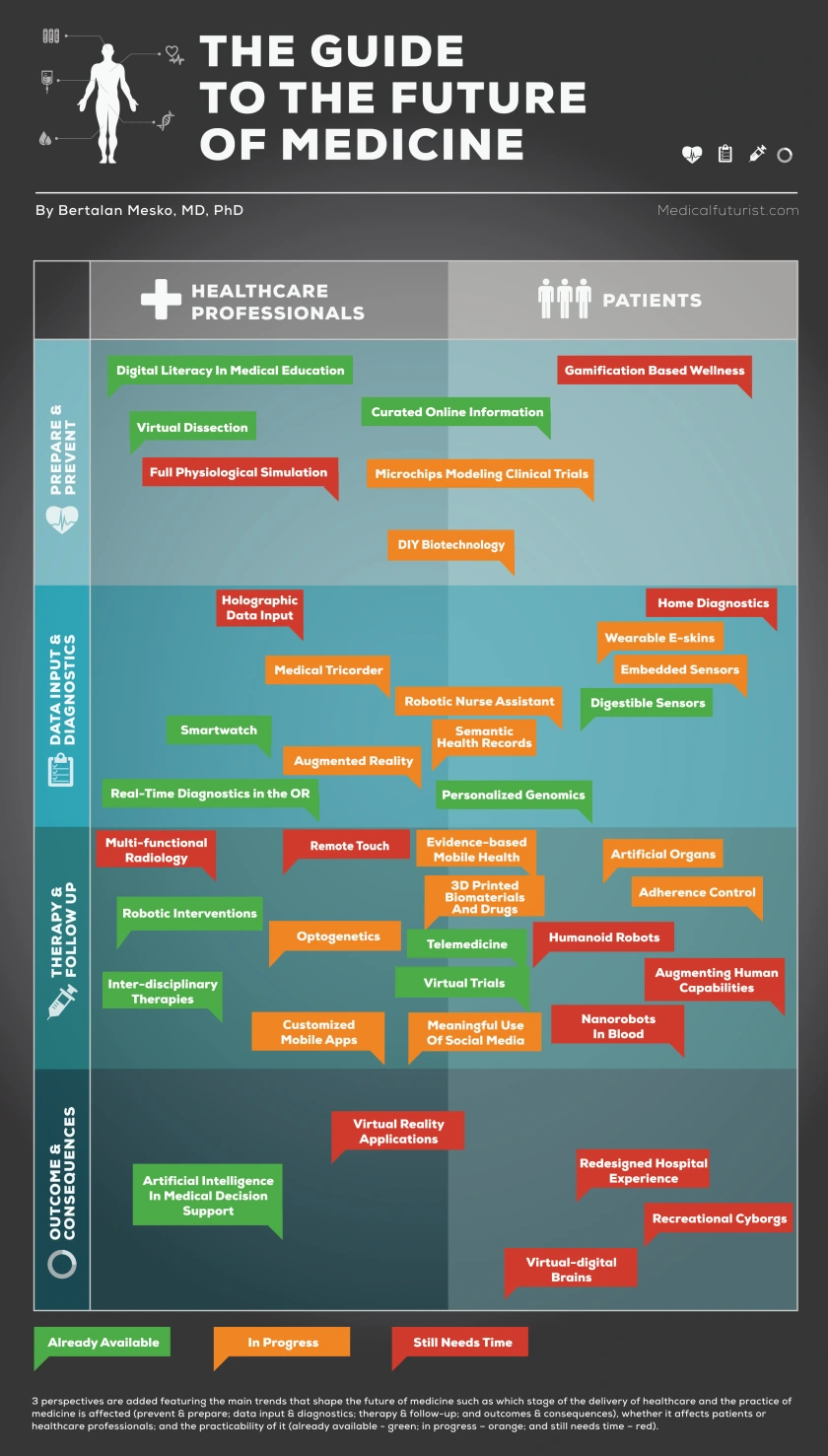
The Medical Futurist
By Dr. Bertalan Meskó MD PhD
***
I’m so happy and proud that I can finally share with you the biggest project The Medical Futurist has ever worked on: The Digital Health Course.
Today, we publicly launch the digital platform where you can learn about everything we and I personally find important about digital health. I mean EVERYTHING!
In this course I break down everything I’ve learned over the last 15 years about the future of healthcare and digital health, what changes are taking place now and over the next 5+ years, what impact they’ll have on you as a healthcare decision-maker, and exactly what you should be doing today to best position yourself or your company for this inevitable reality.
We designed this course to provide you with a complete overview of digital health, guide you through the technological aspects, and equip you to be able to predict and forecast what’s coming next.
From the basics and its definition, to why it’s a cultural transformation that is happening now, how it is a paradigm shift of care, how you can spot trends in it and forecast the near future.
***
***
As I guide you personally through the course, I have put my heart, brain and soul into the whole curriculum.
Posted on March 10, 2022 by Dr. David Edward Marcinko MBA MEd CMP™
***
***
EDITOR’S NOTE: Although it has been some time since speaking live with busy colleague Vitaliy Katsenelson CFA, I review his internet material frequently and appreciate this ME-P series contribution. I encourage all ME-P readers to do the same and consider his value investing insights carefully.
By Vitaliy Katsenelson, CFA
***
4. Margin of safety – leave room in your buy price for being wrong
Margin of safety is a function of two dimensions: a company’s quality and its growth.
I am generalizing here, but exogenous events have a greater impact on a lower-quality business than a higher-quality one. Thus a high-quality company needs a lower margin of safety than a lower-quality one.
A company that is growing earnings and paying dividends has time on its side and thus may not need as much margin of safety as a lower-growing one.
We quantify both a company’s quality and growth, and thus margin of safety is deeply embedded in our investment operating system.
The larger discount to the stock’s fair value (the $1) the less clairvoyance you need to have about the future of the business. For instance, in 2013, when Apple stock was trading at $400 (pre-split) we didn’t have to have a very clear crystal ball about Apple’s future; Apple just had to be able to barely fog the mirror.
In later years, at $900, we need to have a lot more precision in our analysis of Apple’s future.
Posted on March 9, 2022 by Dr. David Edward Marcinko MBA MEd CMP™
***
EDITOR’S NOTE: Although it has been some time since speaking live with busy colleague Vitaliy Katsenelson CFA, I review his internet material frequently and appreciate this ME-P series contribution. I encourage all ME-P readers to do the same and consider his value investing insights carefully.
By Vitaliy Katsenelson, CFA
***
***
3. The market is there to serve you, not the other way around (Part 2)
First, we increase it by subtraction, by shrinking our universe to stocks that lie within both our IQ and EQ comfort zones.
We are very careful about stocks or industries where either our IQ or EQ is questionable. For instance, we have recognized that our IQ is low when it comes to non-revenue-generating, single-future-product biotech companies. We have zero analytical insights into this business. None.
We find that our EQ is fairly low when it comes to complex financial businesses. We don’t invest in any.
The beauty of investing is that we only need 20-30 stocks, and we get to choose which problems we want to tackle. We usually like easy problems.
In other professions, that is a luxury you don’t have. If you are an orthopedic surgeon, you are not going to tell your patient that you only operate on right knees because the last time out you had a bad experience with a left knee.
Second, we look for areas where our EQ is highest.
Over the years, we’ve discovered that our EQ is much higher with higher-quality companies. Therefore, for every company in our portfolio or on our watch list, we quantify quality. And with very rare exceptions, we own only very-high-quality companies.
We quantify quality for another reason, too. As value investors, we are innately focused on a margin of safety. We found that if you don’t quantify quality, it is very easy to lower your standards when you reach for value, especially in a very expensive market.
We went a step further: Quality, for us, is a filter. If a company doesn’t pass its quality test, it is dead to us. It may have high growth prospects, pay high dividends, and it may sell at a mouthwatering valuation. But if it failed our quality test, it is still dead to us.
By quantifying quality, we can keep the overall quality of our portfolio very high. Just as importantly, we can keep our EQ high, too.
By maximizing both our IQ and EQ for individual stocks, we maximize the Total IQ of the portfolio. Thus, when we get punched in the mouth, we are able to rationally reanalyze a stock and may decide to buy more, do nothing, or sell.
We cautiously guard our EQ and long-term horizon. We don’t let the outside world come unchecked into our daily life. For instance, we spend little time watching business TV during the day, as we find it to be toxic to our time horizon and to our investor (as opposed to trader) mentality. For the same reason, we also don’t look at our portfolio more than twice a day.
Finally, and this applies to professional investors only, you need to have clients who will allow you to maintain your EQ. Following the Six Commandments is practically impossible if your clients don’t believe in them.
Here’s a real example:
On my recent purchase of Apple stock coming off a one year top and heading down.
On January 25th, 2013 at 3:55 pm I got this email from a client, David:
David and I talked on the phone, and I tried to explain our logic. I’m not going to bore you with that, but it was along the lines of “incredible brand, high recurrence of revenues, great management, a quarter of market capitalization in cash; we tried to kill it (we lowered its margins, cut sales) and we simply couldn’t.”
I told David that the price of the stock is an opinion of value, not a final verdict – he didn’t care. He’d talked to his neighbor who was a famous technician, who said, “Apple is going down.” To which my response was, “If it declines that will be a blessing – the company is buying back stock, and we are going to buy more.”
The “technician” was right: Apple declined from $455 ($65 split-adjusted), our initial purchase price, to $395 ($56 split-adjusted). We bought more Apple as it fell. This encounter also made me realize how this negative psychology around Apple was creating an opportunity in Apple, and I wrote a two-part article describing the aforementioned incident as evidence of that.
What I did not say in that article is that we had to amicably part ways with David. I tried very hard to communicate the Six Commandments to him, but he was not willing to (re)learn. Keeping him as a client would erode my overall EQ and would have impacted other clients.
Your mental state is as important as your ability to analyze a company’s balance sheet or your ability to value the business. You may spend days sharpening your investment process, your analytical skills; but in the end, if your EQ is low nothing else will matter.
If you’ve browsed the internet in the last couple of months, the term ‘metaverse’ is likely to have been thrown at you at least once. Facebook rebranded itself after the concept and other companies are adopting the metaverse with their own spin; betting heavily that it will be the next iteration of the internet where we will work and play alike.
It was time to dive into what the metaverse could mean to delivering healthcare.
Posted on March 8, 2022 by Dr. David Edward Marcinko MBA MEd CMP™
***
The Six Commandments of Value Investing(Part 1)
***
EDITOR’S NOTE: Although it has been some time since speaking live with busy colleague Vitaliy Katsenelson CFA, I review his internet material frequently and appreciate this ME-P series contribution. I encourage all ME-P readers to do the same and consider his value investing insights carefully.
By Vitaliy Katsenelson, CFA
***
The Six Commandments of Value Investing
3. The market is there to serve you, not the other way around.
Part 1: The market is there to price stocks on a daily basis, but it doesn’t value them on a daily basis. In the long run (the yardstick here is years, not days or months) the market will value stocks, but in the short run stock price movements are random.
Despite this randomness, the media will always find a rational explanation for a move. However, trying to understand randomness and predict stock movements in the short run is like trying to have an intelligent conversation with a two-year-old. It may be fun, but it will consume a lot of your time and energy, and the outcome is far from certain.
Stock fluctuations should be looked upon as a natural and benign feature of the stock market, but only if you know what the asset is worth. To make Mr. Market serve us and not become its slave, here is what we do.
If we know a stock is worth $1, then if its price falls from 50 cents to 30 cents (a 40% decline), that’s a blessing for several reasons: The company can now buy back a lot more of its stock at lower prices, and we can add to our position. After all, it’s 40% cheaper.
Here is the key, though: You have to make sure that what you thought was worth $1 is still worth $1.
To quote Mike Tyson, “Everyone has a plan till they get punched in the mouth.” How do you remain rational when Mr. Market has just smashed you in the face by repricing your $1 stock from 50 cents to 30 cents? Maybe Mr. Market is right and that company’s fair value was never really $1 but only 40 cents?
To remain rational, we focus on maximizing our Total IQ. I know we were not supposed to have math, especially this early in the book. But indulge me with this little equation: Total IQ = IQ x EQ (where EQ <=1)Before I explain I want to stress this point: Your IQ, EQ, and thus Total IQ will vary from stock to stock and from industry to industry.
Let’s start with IQ.
IQ – our intellectual capacity to analyze problems – will vary with the problem in front of us. Just as we breezed through some subjects in college and struggled with others, our ability to understand the current and future dynamics of various companies and industries will fluctuate as well. This is why we buy stocks that fall within our sphere of competence. We tend to stick with ones where our IQ is the highest.
As I have mentioned before but will continue to repeat: If investing were an exact science – a formulaic process by which you could (in a vacuum) constantly test and retest your hypotheses and repeat your results – then EQ, our emotional quotient, would be irrelevant.
If we were characters from Star Trek – with complete control over our emotions, like Mr. Spock, or lacking emotions entirely, like Lieutenant Commander Data – then our EQ wouldn’t matter. However, investing is not a science and we are humans. We have plenty of emotions, and thus EQ is a very important part of this equation.
Though we usually think about our capacity to analyze problems as being dependable and stable over time, it isn’t.
First, emotions distort probabilities. So, even if my intellectual capacity to analyze a problem is not impacted, my brain may be solving a distorted problem.
Second, my IQ is not constant, and my ability to process information effectively declines under emotional stress. I either lose the big picture or overlook important details. This dilemma is not unique to me; I’m sure it affects all of us to varying degrees.
A friend of mine who is a terrific investor, and who will remain nameless (though his name is George), once told me that he never invests in grocery store stocks because he can’t be rational when he holds them. If we spent some Freudian time with him, we’d probably discover that he experienced a traumatic childhood event at the grocery store (he may have been caught shoplifting a candy bar when he was eight), or he may have had a bad experience with a grocery stock early in his career. The reason for his problem is irrelevant, though. What is important is that he has realized that his high IQ will be impaired by his low EQ if he owns grocery stocks.
The higher my EQ is with regard to a particular company, the more likely my Total IQ will not degrade when things go wrong (or even when they go right). This is why in the little formula above, EQ cannot be greater than 1. In your most emotionally stable state (when EQ = 1), your Total IQ will equal your IQ.
There is a good reason why doctors don’t treat their own children: Their ability to be rational (properly weighing probabilities) may be severely compromised by their emotions.
Posted on March 6, 2022 by Dr. David Edward Marcinko MBA MEd CMP™
1. A stock is partial ownership of a business
***
By Vitaliy N. Katsenelson CFA
EDITOR’S NOTE: Although it has been some time since speaking live with busy colleague Vitaliy Katsenelson CFA, I review his internet material frequently and appreciate this ME-P series contribution. I encourage all ME-P readers to do the same and consider his value investing insights carefully.
***
The Six Commandments of Value Investing
Introduction
I wrote the core of this chapter in preparation for a speech I gave at an investment conference. In my speech, I wanted to show how at my firm, we took the Six Commandments of Value Investing and embedded them in our investment operating system.
Since I was speaking to fellow value investors, this speech was written not to promote my firm but to educate. I was going to rewrite the speech for this chapter and make a bit less about us and more about you –but each attempt resulted in a dull chapter. So here is a much extended version of my original speech.
The Six Commandments
These are the Six Commandments of Value Investing. I don’t expect any value investors reading this to be surprised by any one of them. They were brought down from the mountain by Ben Graham in his book Security Analysis.
1) A stock is fractional ownership of a business (not trading sardines). 2) Long-term time horizon (both analytical and expectation to hold) 3) Mr. Market is there to serve us (know who’s the boss). 4) Margin of safety – leave room in your buy price for being wrong. 5) Risk is permanent loss of capital (not volatility). 6) In the long run stocks revert to their fair value.
These commandments are very important and they sound great, but in the chaos of our daily lives it is so easy for them to turn into empty slogans.
A slogan without execution is a lie. For these “slogans” not to be lies, we need to deeply embed them in our investment operating system – our analytical framework and our daily routines – and act on them.
The focus of this chapter goes far beyond explaining what these commandments are: My goal is to give you a practical perspective and to show you how we embed the Six Commandments in our investment operating system at my firm.
1. A stock is partial ownership of a business
The US and most foreign markets we invest in are very liquid. We can sell any stock in our portfolios with ease – a few clicks and a few cents per share commission and it’s gone. This instant liquidity, though it can be tremendously beneficial (we wish selling a house were that easy, fast, and cheap), can also have harmful unintended consequences: It tends to shrink the investor’s analytical time horizon and often transforms investors into pseudo-investors.
For true traders, stocks are not businesses but trading widgets. Pork bellies, orange futures, stocks are all the same to them. Traders try to find some kind of order or a pattern in the hourly and daily chaos (randomness) of financial markets. As an investor, I cannot relate to traders –not only do we not belong to the same religion, we live in very different universes. Over the years I’ve met many traders, and I count a few as my dear friends. None of them confuse what they do with investing. In fact, traders are very explicit that their rules of engagement with stocks are very different from those of investors.
I have little insight to share with traders in these pages. My message is really to market participants who on the surface look at stocks as if they were investments but who have been morphed by the allure of the market’s instant liquidity into pseudo-investors. They are not quite traders – because they don’t use traders’ tools and are not trying to find order in the daily noise – but they aren’t investors, either, because their time horizon has been shrunk and their analysis deformed by market liquidity.
The best way to contrast the investor with the pseudo-investor is by explaining what an investor is. A true investor would do the same analysis of a public company that he would do for a private one. He’d analyze the company’s business, guestimate earnings power and cash flows. Assess its moat – the ability to protect cash flows from competition. Try to look “around the corner” to various risks. Then figure out what the business is worth and decide what price he’d want to pay for it (your required discount to what the business is worth). For an investor, the analysis would be the same if his $100,000 was buying 20% of a private business or 0.002% of a public one. This is how your rational uncle would analyze a business – your Warren Buffett or Ben Graham.
How do we maintain this rational attitude and prevent the stock market from turning us into pseudo-investors? Very simple. We start by asking, “Would we want to own this business if the stock market was closed for 10 years?” (Thank you, Warren Buffett). This simple question changes how we look at stocks.
Now, the immediate liquidity that is so alluring in a stock, and that turns investors into pseudo-investors, is gone from our analysis. Suddenly, quality – valuation, cash flows, competitive advantage, return on capital, balance sheet, management – has a much different, more complete meaning.
QPADEFINITION: The qualifying payment amount is generally the median of contracted rates for a specific service in the same geographic region within the same insurance market as of January 31, 2019. The rate will be adjusted per the Consumer Price Index for All Urban Consumers (CPI-U).
Posted on March 1, 2022 by Dr. David Edward Marcinko MBA MEd CMP™
***
Dr. Eric Bricker Explains How Medicare Can Take Money Back from Hospitals if itWants. If the Hospital Thinks Medicare is Being Unfair, the Appeals Process Takes 3 Years!
After an understandable slowdown in 2020, due to the onset of the COVID-19 pandemic, merger & acquisition (M&A) activity in the healthcare industry accelerated in 2021, and the industry is expected to continue the high number of deals and high deal volume in 2022.
***
***
This Health Capital Topics article will review the U.S. healthcare industry’s M&A activity in 2021, and discuss what these trends may mean for 2022. (Read more…)
QUERY: But, did you ever wonder what to say when you’re standing next to a senior physician colleague who could help further your academic and educational work?
Now, for some granular specificity; let’s cue the elevator pitch with David Acosta MD and Daniel Hashimoto MD MS who demonstrate what to do (and what not to do) to successfully deliver your medical educator’s elevator pitch.
Capital markets require confidence that all market participants have fair access to the same relevant information about a company and its prospects. Laws governing the trading of securities have been in existence since stocks were first traded. It seems as if each piece of legislation, from the Securities and Exchange Act of the 1930’s through to the 2002 Sarbanes-Oxley Law fought the prior corruption as successfully as preparing an army to fight the last war.
Curiously, the issue of insider trading by members of Congress is not a partisan issue. If behavior is any indication, certain Republicans and Democrats are fond of having the ability to profit from access to material, nonpublic information. Others of both parties are introducing legislation to block illegal insider trading.
Congress has passed laws that prohibit people with insider knowledge from trading on non-public information, and from sharing that non-public information with others who may trade stocks based on that information. The former is known as “illegal insider trading” and the latter as “tipping.” There exists legal insider trading, which is bound by rules of disclosure and third-party decision makers, but we will leave that for another day. Illegal insider trading is enforced through Federal Agencies including the Securities and Exchange Commission (SEC), Internal Revenue Service (IRS) and the Department of Justice (DOJ), as well as by regulations on major stock exchanges such as the New York Stock Exchange (NYSE) and National Association of Securities Dealers Automated Quotation Systems (NASDAQ).
While there is universal agreement that executives, board members, employees and others with access to non-public information may not use that information to trade stocks, members of Congress and their staffs face few practical barriers. And in more recent months, members of the Federal Reserve and their staffs have made questionable, if not downright suspicious trades of stocks.
History is littered with cases of both average citizens and celebrities like Martha Stewart being prosecuted for insider trading. Stewart was ultimately prosecuted and jailed for obstruction after denying insider knowledge.
There are members of both the US Senate and US House of Representatives who want to stop illegal insider trading by their peers. For example, in 2012, President Barack Obama signed the Stop Trading on Congressional Knowledge (STOCK) Act to prevent insider trading by members of Congress and Congressional Staff. However, there have been no prosecutions under this statute to date. The reason is that the “Speech and Debate” clause prohibits questioning an elected Senator or Congressional Representative.
Moreover, much of the disclosure of material, non-public information that would establish a foundation for illegal insider trading occurs outside the public eye. Members of Congress cannot act on information obtained from companies themselves. The difficulty arises in proving that a member of Congress or Congressional staff knew of material, non-public information acquired in a confidential congressional meeting. Let me rephrase that. There is no way of knowing what transpired in the confidential committee meeting so there is no provable path to a stock trade benefiting the member of Congress or their staff.
Suppose two publicly traded defense contractors were bidding on a new weapons system. In a confidential committee, a Department of Defense (DOD) recommendation to accept the bid of company A versus Company B was made and endorsed by the committee. At that point, everyone with access to the non-public information about the weapons system bid would know that it would be good for the stock of Company A and bad for the stock of Company B.
Take this a step further. Company A and Company B are notified about the confidential decision and advised to keep this material, non-public information protected. At this point, if any executive, board member or employee with that knowledge traded in the stock of Company A or Company B they would be subject to prosecution, including fines and imprisonment. Also, if any person at the company provided that material, non-public information to another person, including a member of Congress, that action would be subject to investigation and potential prosecution.
Now suppose a Senator, Congressional Representative or staff member, after receiving the news of the weapons system award went to their broker, computer or telephone and bought stock in Company A while selling (or shorting in another way) Company B. Or perhaps communicated to a friend or family member on a trade “suggestion.” Relaying or exploiting information – material, non-public information — behavior that would land any other person in an investigation and make them subject to prosecution, cannot be practically pursued because there is no way to use the committee deliberations as evidence.
When Senators Richard Burr (R-NC), Kelly Loeffler (R-GA) and Diane Feinstein (D-CA) were accused of insider trading, instead of being subjected to investigation and potential prosecution through the SEC, IRS, or DOJ, their actions instead were reviewed by the Senate Ethics Committee. The Senate Ethics Committee, made up of other US Senators, found no wrongdoing. Let me rephrase that – other US Senators, who might benefit themselves from insider trading – decided to give suspicious behavior a pass. Even if the conduct of the Senators was on the up-and-up, the optics do not inspire confidence.
The US Senate does not have a monopoly on suspicious trading. For example, Congresswoman Lois Frankel (D-FL), was accused of trading stocks of companies in the fossil fuel industry while a sitting on a Congressional subcommittee that oversees funding for the Department of Energy.
Legislation to Block Insider Trading by Congress and the Federal Reserve
US Senators and Congressional Representatives have made proposals to improve public perception of their ranks with more practical solutions and stiffer penalties. Pre-eminent among the reformers is Senator Elizabeth Warren (D-MA), a person with a strong background in financial matters. Senator Warren appears to be the leading voice in calling for members of the Federal Reserve and their staffs to also be subject to laws prohibiting illegal insider trading and tipping. These restrictions are long overdue, as statements by the Fed has caused wild gyrations in the prices of securities. Senator Warren’s ideas are recommended reading on her web site at
. Enter “Insider Trading” on the search bar of the Senator’s web site for 61 references.
Senators Jeff Merkley (D-OR) and Sherrod Brown (D-OH) have offered the “Ban Conflicted Trading Act.” Under the legislation, elected persons and their staffs would be required to either sell or freeze their stock holdings, or put them in a blind trust. Introduced in 2018, the legislation has stalled. Last winter, Representative Alexandria Ocasio-Cortez (D-NY) and others have indicated they would introduce the same legislation in the House.
Earlier this month, Senators Jon Ossoff (D-GA) and Mark Kelly (D-AZ) introduced the Ban Congressional Stock Trading Act. If it becomes law, every member of Congress—as well as their spouses and dependent children—would be required to place their stock portfolios into a blind trust. One benefit of an outright ban or blind trusts would mean that clerical matters would no longer be a concern of those elected. Kelly himself, according to news reports, did not make a timely disclosure about a stock option exercise.
Senator Josh Hawley (R-MO) announced he will introduce the Banning Insider Trading in Congress Act. Wryly pointing out that politicians manage to outperform the stock market year after year, Hawley’s bill would prohibit members of Congress and their spouses from buying and trading individual stocks. Those who violate it would have to disgorge their profits.
Congress: Keep it simple and fix this
The singular, clear way to avoid abuses of insider information is to ban the trade of individual stocks and industry-specific Exchange Traded Funds (ETF) by members of Congress, Congressional staffs, members of the Federal Reserve and their staffs. Double blind trusts (where neither the owner or trustee knows identity of the other) would be an acceptable form of investing. Finally, add stronger criminal penalties for tipping insider information.
This is one of the few things that seem to enjoy bipartisan support, and would seemingly be welcomed by nonpartisans and those on the political poles as well.
Of course, like everything political, proposals of these types do not enjoy absolute, clear-cut support. As House Speaker Nancy Pelosi (D-CA) said about her opposition to such restrictions “We are a free market economy,” Pelosi, purported to be one of the 25 wealthiest members of Congress, continued, “They (Congress) should be able to participate in that.” Pelosi’s recent financial disclosure is said to have 48 transactions made by her family valued at a total of some $50 million so she is sympathetic to serving in Congress and participating in trading.
Posted on February 18, 2022 by Dr. David Edward Marcinko MBA MEd CMP™
By Staff Reporters
GLOBALMARKETS: Stabilized on Friday after the threat of a potential Russian invasion of Ukraine propelled the Dow to its worst day of 2022. Australia’s S&P/ASX 200 and Japan’s benchmark Nikkei closed down 1% and 0.4%, respectively, while South Korea’s Kospi was little changed. Chinese markets were mixed. As the benchmark Shanghai Composite Index gained 0.7%, Hong Kong’s Hang Seng Index dropped 1.9%. In Europe, stocks were little changed at the open. London’s FTSE 100 and France’s CAC 40 each rose 0.2%, while Germany’s DAX ticked up 0.1%.
DOMESTIC MARKETS: The Dow plummeted 622 points, or 1.8% — hitting its lowest level so far this year in the process. The S&P 500 fell 2.1% and the NASDAQ was down 2.9%. All three indices are now in the red for the week. Finally, US futures pointed up slightly with Dow futures, S&P 500 futures and NASDAQ futures rising 0.6%, 0.7% and 0.8%, respectively.
FOMC: Jim Bullard, the president of the St. Louis Federal Reserve and member of the Federal Open Market Committee, said that the Federal Reserve wants to pursue the best policy as members debate how quickly they should raise interest rates. He called for a full percentage point interest rate hike by July, 2022. And, billionaire investor Carl Icahn predicts the Fed’s money-printing party will end badly because the government can’t control inflation
Posted on February 16, 2022 by Dr. David Edward Marcinko MBA MEd CMP™
By Staff Reporters
***
Entry-level Revenue Cycle Recruitment Takes 84 Days on Average
A recent AKASA survey of 514 chief financial officers and revenue cycle leaders at hospitals and health systems in the U.S. found:
• Entry-level revenue cycle talent (0-5 years): On average, costs $2,167 for recruitment and takes 84 days to fill vacant roles. • Mid-level revenue cycle talent (6-10 years): On average, costs $3,581 for recruitment and takes 153 days to fill vacant roles. • Senior-level revenue cycle talent (10+ years): On average, costs $5,699 for recruitment and takes 207 days to fill vacant roles.
Posted on February 16, 2022 by Dr. David Edward Marcinko MBA MEd CMP™
Berkeley’s Lester Center for Entrepreneurship
Entrepreneurship is a Calling
***
By Steve Blank
During the Cold War with the Soviet Union, science and engineering at both Stanford and U.C. Berkeley were heavily funded to develop Cold War weapon systems. Stanford’s focus was Electronic Intelligence and those advanced microwave components and systems were useful in a variety of weapons systems. Starting in the 1950’s, Stanford’s engineering department became “outward facing” and developed a culture of spinouts and active faculty support and participation in the first wave of Silicon Valley startups.
At the same time Berkeley was also developing Cold War weapons systems. However its focus was nuclear weapons – not something you wanted to be spinning out. So Berkeley started a half century history of “inward facing innovation” focused on the Lawrence Livermore nuclear weapons lab. (See the presentation here.)
Given its inward focus, Berkeley has always been the neglected sibling in Silicon Valley entrepreneurship. That has changed in the last few years.
Today the U.C. Berkeley Haas Business School is a leader in entrepreneurship education. It has replaced how to write a business plan with hands-on Lean Startup methods. It’s teaching the LaunchPad® and the I-Corps for the National Science Foundation and National Institutes of Health, as well as corporate entrepreneurship courses.
We are in the middle of a shift in entrepreneurship education from teaching the waterfall model of startup development (enshrined in business plans) to teaching the lean startup model
The Lean LaunchPad process works across a wide range of domains – from science and engineering to healthcare, energy, government, the social sector and for corporate innovation
Customer Development works outside Silicon Valley. In fact, it works globally
The Lean LaunchPad is a business process that teaches entrepreneurs and innovators to make business-focused, evidence-based decisions under conditions of chaos and uncertainty. It’s a big idea.
Your thoughts and comments on this ME-P are appreciated. Feel free to review our top-left column, and top-right sidebar materials, links, URLs and related websites, too. Then, subscribe to the ME-P. It is fast, free and secure.
Speaker: If you need a moderator or speaker for an upcoming event, Dr. David E. Marcinko; MBA – Publisher-in-Chief of the Medical Executive-Post – is available for seminar or speaking engagements. Contact: MarcinkoAdvisors@msn.com
OUR OTHER PRINT BOOKS AND RELATED INFORMATION SOURCES:
“When a practicing physician thinks about their risk exposure resulting from providing patient care, medical malpractice risk immediately comes to mind. But; malpractice and liability risk is barely the tip of the iceberg, and likely not even the biggest risk in the daily practice of medicine. There are risks from having medical records to keep private, risks related to proper billing and collections, risks from patients tripping on your office steps, risks from medical board actions, risk arising from divorce, and the list goes on and on. These liabilities put a doctor’s hard earned assets and career in a very vulnerable position.
These new books from Dr. David Marcinko and Prof. Hope Hetico show doctors the multiple types of risk they face and provides examples of steps to take to minimize them. They are written clearly and to the point, and are a valuable reference for any well-managed practice. Every doctor who wants to take preventive action against the risks coming at them from all sides needs to read these books.”
Richard Berning MD FACC [New Haven, Connecticut, USA]
Posted on February 14, 2022 by Dr. David Edward Marcinko MBA MEd CMP™
Insights For Doctors and All Investors
***
By Vitaliy Katsenelson CFA
***
NOTE: This piece is a little more technical, and contains a bit more stock-market jargon, than most essays you get from me. While how we build portfolios is important to us and our clients, we realize that the puts and takes might bore many readers.
DEFINITION: The Medicare Payment Advisory Commission is an independent, non-partisan legislative branch agency headquartered in Washington, D.C. MedPAC was established by the Balanced Budget Act of 1997.
*** In a January 2022 meeting of MedPAC, commissioners reviewed various recommendations related to the Medicare fee schedule for various health sectors, and unanimously agreed to update Medicare payments to hospitals and keep physician payment rates the same for 2023. This Health Capital Topics article will review the recommendations made by MedPAC for each of the health sectors and their respective payment systems. (Read more…)
The International Franchise Association (IFA) estimates that that about $1 trillion in sales, or 40% of all retail sales, were made through franchised establishment last year. On the positive side, franchises offer a branded practice concept with management training and access to proprietary methods, marketing and advertising campaigns and a host of support.
Moreover, there are franchises available for virtually every healthcare product or service, including: diet, weight loss and fitness; vein care and laser surgery; vitamins, nutriceuticals and pharmaceuticals; plastic and cosmetic surgery; dermatology, tanning and skin care; home healthcare and extended, etc. Some well know established healthcare and medical franchises are: Doctors Express, Being There Senior Care, Home Care Assistance, Personal Training Institute, Inches-A-Weigh, Remedy Intelligent Staffing, Visiting Angels, Unlimited MedSearch, prnYourHealth and Any Lab Test Now, etc.
On the downside, franchises incur high start-up costs, rules and obligations, payment of franchise percentages and many contractual obligations. Questions to consider when contemplating this business entity include:
Franchise stability, track record, licensing and costs.
Training, support and proximity of other franchises.
Independence, ownership laws, contracts and dispute resolutions,
Screening methods, market size and potential market share.
Replacement cost and transferability?
For more information on Uniform Franchise Offerings Circulars (UFOCs) contact www.FranChoice.com or:
Posted on February 6, 2022 by Dr. David Edward Marcinko MBA MEd CMP™
***
Guide to Telehealth – Then, Now, Tomorrow? By Rebecca Chi
Healthcare providers have employed various forms of telehealth since long before the start of the coronavirus pandemic. Telehealth delivers knowledge and expertise to people and places that need it. A movement that largely began as a way to improve access to healthcare in rural communities saw explosive growth in 2020. Today, telehealth is in wide use and here to stay.
***
What is telehealth? The US Health Resources and Services Administration defines telehealth as any electronic information and telecommunications technology that is used to support and promote long-distance clinical healthcare, patient and professional health-related education, public health and health administration. Telehealth technologies benefit providers, healthcare organizations and patients.
The importance of telehealth The key to maintaining population health and lowering expenditures is delivering timely access to high-quality care.
The US is struggling to improve the quality of healthcare and make the needed shift to value-based models. Innovative telehealth solutions that addressed our country’s worsening healthcare access problem reached the point of widespread adoption in 2020, when the pandemic pushed the healthcare system to its limits.
Telehealth increases convenience of care and access while decreasing costs and maximizing physician time. Providers, payers and employers are increasingly adopting various and connected types of telehealth solutions to improve healthcare operations and patient outcomes. Patients embrace the convenience, safety, accessibility and flexibility of telehealth options.







 Support our online development, and advance our onground research initiatives in free market economics, as we seek to showcase the brightest Next-Gen minds.
THE ME-P DISCLAIMER: Posts, comments and opinions do not necessarily represent iMBA, Inc., but become our property after submission. Copyright © 2006 to-date. iMBA, Inc allows colleges, universities, medical and financial professionals and related clinics, hospitals and non-profit healthcare organizations to distribute our proprietary essays, photos, videos, audios and other documents; etc. However, please review copyright and usage information for each individual asset before submission to us, and/or placement on your publication or web site. Attestation references, citations and/or back-links are required. All other assets are property of the individual copyright holder.
Support our online development, and advance our onground research initiatives in free market economics, as we seek to showcase the brightest Next-Gen minds.
THE ME-P DISCLAIMER: Posts, comments and opinions do not necessarily represent iMBA, Inc., but become our property after submission. Copyright © 2006 to-date. iMBA, Inc allows colleges, universities, medical and financial professionals and related clinics, hospitals and non-profit healthcare organizations to distribute our proprietary essays, photos, videos, audios and other documents; etc. However, please review copyright and usage information for each individual asset before submission to us, and/or placement on your publication or web site. Attestation references, citations and/or back-links are required. All other assets are property of the individual copyright holder.
















































 The Leading Business Education Network for Doctors, Financial Advisors and Health Industry Consultants