Take the Accountable Care Act Survey

Please Vote

Join Our Mailing List 

QUERY: Should the Supreme Court decide the future of the Accountable Care Act?

Conclusion

And so, your thoughts and comments on this ME-P are appreciated. Feel free to review our top-left column, and top-right sidebar materials, links, URLs and related websites, too. Then, subscribe to the ME-P. It is fast, free and secure.

Link: http://feeds.feedburner.com/HealthcareFinancialsthePostForcxos

Speaker: If you need a moderator or speaker for an upcoming event, Dr. David E. Marcinko; MBA – Publisher-in-Chief of the Medical Executive-Post – is available for seminar or speaking engagements. Contact: MarcinkoAdvisors@msn.com

Subscribe Now: Did you like this Medical Executive-Post, or find it helpful, interesting and informative? Want to get the latest ME-Ps delivered to your email box each morning? Just subscribe using the link below. You can unsubscribe at any time. Security is assured.

Link: http://feeds.feedburner.com/HealthcareFinancialsthePostForcxos

Sponsors Welcomed: And, credible sponsors and like-minded advertisers are always welcomed.

Link: https://healthcarefinancials.wordpress.com/2007/11/11/advertise

Healthcare Reform at a Glance

A One-Stop-Look-See with Comparisons

By Staff Reporters

Link: Health-Care-Reform-Comparison-in-Brief

[Courtesy: BuckConsultants]

Conclusion

And so, your thoughts and comments on this ME-P are appreciated. Feel free to review our top-left column, and top-right sidebar materials, links, URLs and related websites, too. Then, subscribe to the ME-P. It is fast, free and secure.

Speaker: If you need a moderator or speaker for an upcoming event, Dr. David E. Marcinko; MBA – Publisher-in-Chief of the Medical Executive-Post – is available for seminar or speaking engagements. Contact: MarcinkoAdvisors@msn.com and http://www.springerpub.com/Search/marcinko

Our Other Print Books and Related Information Sources:

Health Dictionary Series: http://www.springerpub.com/Search/marcinko

Practice Management: http://www.springerpub.com/product/9780826105752

Physician Financial Planning: http://www.jbpub.com/catalog/0763745790

Medical Risk Management: http://www.jbpub.com/catalog/9780763733421

Healthcare Organizations: www.HealthcareFinancials.com

Physician Advisors: www.CertifiedMedicalPlanner.com

Subscribe Now: Did you like this Medical Executive-Post, or find it helpful, interesting and informative? Want to get the latest ME-Ps delivered to your email box each morning? Just subscribe using the link below. You can unsubscribe at any time. Security is assured.

Link: http://feeds.feedburner.com/HealthcareFinancialsthePostForcxos

Sponsors Welcomed: And, credible sponsors and like-minded advertisers are always welcomed.

Link: https://healthcarefinancials.wordpress.com/2007/11/11/advertise

Product Details 

On eMRs and Disease Management

Join Our Mailing List

One Clinical Area Where Electronic Benefits May Exceed Paper’s Molecules

By Dr. David Edward Marcinko [Publisher-in-Chief]

www.BusinessofMedicalPractice.com

One area where technology assessments, clinical guidelines, and especially eMR aggregated data can make a true difference in patient care is in disease management.

The DMAA

The Disease Management Association of America (DMAA) defines disease management as “a system of coordinated health care interventions and communications for populations with conditions in which patient self-care efforts are significant”. 

Disease management supports the physician-patient relationship and places particular significance on the prevention of exacerbations and complications of chronic diseases using evidence-based clinical guidelines and integrating those recommendations into initiatives to empower patients to be active partners with their physicians in managing their conditions.

Disease Targets

Typically, targets for disease management efforts include chronic conditions such as asthma, diabetes, chronic obstructive pulmonary disease, coronary artery disease, and heart failure, where patients can be active in self-care and where appropriate lifestyle changes can have a significant favorable impact on illness progression.

Link: Front Matter BoMP – 3

Outcomes Measurement

The DMAA also emphasizes the importance of process and outcomes measurement and evaluation, along with using the data to influence management of the condition.

Assessment

Although claims and administrative data can be used to measure and evaluate selected processes and outcomes, eMRs will be needed to capture the full spectrum of data for analyzing illness response to disease management programs and to support necessary changes in care plans to improve both intermediate outcomes (such as lab values), and long-range goals (such as the prevention of illness exacerbations, managing co-orbidities, and halting the progression of complications).

Is this where eMRs can shine far and above traditional ink and paper medical records?

Channel Surfing the ME-P

Have you visited our other topic channels? Established to facilitate idea exchange and link our community together, the value of these topics is dependent upon your input. Please take a minute to visit. And, to prevent that annoying spam, we ask that you register. It is fast, free and secure.

Conclusion

Your thoughts and comments on this ME-P are appreciated. Feel free to review our top-left column, and top-right sidebar materials, links, URLs and related websites, too. Then, subscribe to the ME-P. It is fast, free and secure.

Speaker: If you need a moderator or speaker for an upcoming event, Dr. David E. Marcinko; MBA – Publisher-in-Chief of the Medical Executive-Post – is available for seminar or speaking engagements. Contact: MarcinkoAdvisors@msn.com

OUR OTHER PRINT BOOKS AND RELATED INFORMATION SOURCES:

Product Details 

Understanding the Collaborative Shift in Bedside Manner

Join Our Mailing List

Doctor-Patient Relations in the Modern Era

[By Mario Moussa PhD]

[By Jennifer Tomasik MS]

[By Dr. David E. Marcinko MBA]

www.BusinessofMedicalPractice.com

When it comes to the doctor-patient relationship, Health 2.0 needs guidelines. Several leading health providers have begun to call for them. We think guidelines would, among other things, help define the right mix of virtual and live communication.

Our relationship strategies take a step in this direction. Such a framework can be used to start a productive dialogue among health providers about social media. A hospital committee or some other governing body could easily use Web 2.0 tools—a blog or a wiki—to start the discussion. Before long, there would be ample case material to flesh out general principles.

Health 2.0 Needs Guidelines

Guidelines would also address a big barrier to using Health 2.0: getting paid. Currently reimbursement policies do not cover electronic communication, so physicians have little financial incentive to use it. In a 2003 study, only 9% of physicians were willing to use e-mail to communicate with patients. This has something to do with old habits. But it has a lot to do with payment schedules, too. Guidelines should feature the research that shows the positive health outcomes of strong physician-patient relationships and how social media tools help build relationships. In today’s “pay for performance” market, these outcomes help build credibility for wired communication.

Training Support

We also think Health 2.0 guidelines need to be supported by training. Studies show that training in interviewing and interpersonal skills produces substantial differences in the quality of care. Training in Health 2.0 communication would likely have a similar impact.

Assessment

Paradoxically, as patients can access and control more data, they have a greater need for trusted physicians who communicate well using various mediums. As Ted Epperly, President of the American Academy of Family Physicians, has said, patients need “wise counsel” in sifting through the prodigious amounts of information available via Health 2.0. And physicians as well as patients need to learn how to navigate this environment. No longer the sole authoritative source of medical information, physicians need to adapt, becoming an experienced partner and guide for inquiring patients. Training can help doctors get comfortable in this new role.

Conclusion

And so, your thoughts and comments on this ME-P are appreciated. Feel free to review our top-left column, and top-right sidebar materials, links, URLs and related websites, too. Then, subscribe to the ME-P. It is fast, free and secure.

Speaker: If you need a moderator or speaker for an upcoming event, Dr. David E. Marcinko; MBA – Publisher-in-Chief of the Medical Executive-Post – is available for seminar or speaking engagements. Contact: MarcinkoAdvisors@msn.com and http://www.springerpub.com/Search/marcinko

Subscribe Now: Did you like this Medical Executive-Post, or find it helpful, interesting and informative? Want to get the latest ME-Ps delivered to your email box each morning? Just subscribe using the link below. You can unsubscribe at any time. Security is assured.

Link: http://feeds.feedburner.com/HealthcareFinancialsthePostForcxos

Sponsors Welcomed: And, credible sponsors and like-minded advertisers are always welcomed.

Link: https://healthcarefinancials.wordpress.com/2007/11/11/advertise


Anderson, James G., Eysenbach, Gunther, and Rainey, Michelle R. “The Impact of CyberHealthcare on the Physician–Patient Relationship.” Journal of Medical Systems. 27 (2003): 67 – 84.

Kaplan, Sherrie H., Greenfield, Sheldon, Gandek, Barbara, et al. “Characteristics of physicians with participatory decision-making styles.” Annals of Internal Medicine. 124.5 (1996): 497–504

Product DetailsProduct DetailsProduct Details

Product Details

Social-Norms versus Market-Norms in Healthcare Reimbursement

Rogue Thoughts on Toppling the Current Payment System

By Dr. David Edward Marcinko MBA, CMP™

[ME-P Editor-in-Chief]

Recently, I reviewed a copy of “Predictably Irrational” by fellow blogger Dan Ariely, PhD. Dan is the James B. Duke Professor of Behavioral Economics at Duke University and a founding member of the Center for Advanced Hindsight.

In the book, he examines some of the positive effects that irrationality has in our lives and offers a new look on how irrational decisions might influence our personal lives and our workplace experiences. I found the chapter on social-norms v. market-norms particularly interesting and wondered about its’ applicability to healthcare economics and reimbursement.

Example:

Dan sites the example of various fund raising charitable goods that had been set at market prices [the norm in this country – little retail negotiating takes place in the USA], but that he recently chose to experiment and make them donation-based instead. 

The Difference

What a difference it made! He cites the case of one woman who bought a cupcake and reached for a dollar bill when asked about the price.  When told there was no set price, but donations-only were accepted, she put the one bill back in her wallet and pulled out a ten-spot. 

References and Research

Assessment

So, please allow me to use this trivial example and suggest a limited switch experiment to social-norms – instead of market-norms in some cases of healthcare reimbursement – perhaps starting with non-surgical, non-specialty, primary care providers [GPs, internists, FPs, DNPs, podiatrists, etc], or any “willing provider” for that matter. What do you think would happen?

Conclusion

And so, your thoughts and comments on this ME-P are appreciated. Is this idea too far out – or thought provoking enough for further consideration? Feel free to review our top-left column, and top-right sidebar materials, links, URLs and related websites, too. Then, subscribe to the ME-P. It is fast, free and secure.

Speaker: If you need a moderator or speaker for an upcoming event, Dr. David E. Marcinko; MBA – Publisher-in-Chief of the Medical Executive-Post – is available for seminar or speaking engagements. Contact: MarcinkoAdvisors@msn.com and http://www.springerpub.com/Search/marcinko

Get our Widget: Get this widget!

Our Other Print Books and Related Information Sources:

Health Dictionary Series: http://www.springerpub.com/Search/marcinko

Practice Management: http://www.springerpub.com/product/9780826105752

Physician Financial Planning: http://www.jbpub.com/catalog/0763745790

Medical Risk Management: http://www.jbpub.com/catalog/9780763733421

Healthcare Organizations: www.HealthcareFinancials.com

Physician Advisors: www.CertifiedMedicalPlanner.com

Subscribe Now: Did you like this Medical Executive-Post, or find it helpful, interesting and informative? Want to get the latest ME-Ps delivered to your email box each morning? Just subscribe using the link below. You can unsubscribe at any time. Security is assured.

Link: http://feeds.feedburner.com/HealthcareFinancialsthePostForcxos

Sponsors Welcomed: And, credible sponsors and like-minded advertisers are always welcomed.

Link: https://healthcarefinancials.wordpress.com/2007/11/11/advertise

Product DetailsProduct DetailsProduct Details       

Product Details  Product Details

   Product Details 

Join Our ME-P Partner Research Panel for 2011

Invitation to Respond

By Prof. Hope Rachel Hetico; RN MHA CPHQ CMP™

[Managing Editor]

Dear ME-P Readers and Subscribers,

On behalf of the Medical Executive-Post, I would like to invite you to become a member of the ME-P Partner Research Panel (MPRP) for 2011. This panel presents a chance for a limited number of M-E-P participants to have their voices heard through ongoing research studies with the www.MedicalBusinessAdvisors.com [iMBA, Inc].

The insights and suggestions of this vital partner community help shape products and programs which are critical to our mutual success.

The MPRP Panel

The MPRP panel is composed of ME-P readers and subscribers who have agreed to participate in a research program which asks their opinions via surveys typically once or twice a month. Most of your feedback would be submitted online, although there may be opportunities to participate in more in-depth types of research throughout the year. In all cases, it is up to you whether you choose to participate in the research request. All responses remain confidential and are reported only in aggregate.

Building Out the Process

As we continue to build out this process we are seeing greater internal iMBA Inc management participation and interest. External ME-P product development groups and business teams are asking for MPRP insights, as well. Complete studies have been developed around some topics, while at other times MPRP members have been asked to help with focus group activities and in-depth interviews. The help provided by the MPRP is not only appreciated by iMBA Inc, but has become vital to our work here at the ME-P.

Registration Required

I hope you will become a part of this new, vital component of the MPRP network. The registration process requires only a click on the “Join Us” tab, or confirmation-reply email to: MarcinkoAdvisors@msn.com Your membership will be a powerful way to present your thoughts and opinions to the management and staff of the ME-P. Please call us [770-448-0769] with queries, and/or “click” or email register now.

Join Our Mailing List 

Assessment

You’ve probably already noticed that we have asked two of our valued research partners and sponsors www.CertifiedMedicalPlanner.com to assist us in managing and maintaining the many details of the panel. The CMP™ program has been involved with partner research on an ongoing basis for more than five years. Over time, you will become familiar with both www.MedicalBusinessAdvisors.com and www.CertifiedMedicalPlanner.com as two of the primary contacts for the ME-P Partner Research Panel.

Conclusion

Thanks for your participation in the ME-P Partner Network. I look forward to hearing more from you in the future. And so, your thoughts and comments on this ME-P are appreciated. Feel free to review our top-left column, and top-right sidebar materials, links, URLs and related websites, too. Then, subscribe to the ME-P. It is fast, free and secure.

Speaker: If you need a moderator or speaker for an upcoming event, Dr. David E. Marcinko; MBA – Publisher-in-Chief of the Medical Executive-Post – is available for seminar or speaking engagements. Contact: MarcinkoAdvisors@msn.com and http://www.springerpub.com/Search/marcinko

Get our Widget: Get this widget!

Our Other Print Books and Related Information Sources:

Health Dictionary Series: http://www.springerpub.com/Search/marcinko

Practice Management: http://www.springerpub.com/product/9780826105752

Physician Financial Planning: http://www.jbpub.com/catalog/0763745790

Medical Risk Management: http://www.jbpub.com/catalog/9780763733421

Healthcare Organizations: www.HealthcareFinancials.com

Physician Advisors: www.CertifiedMedicalPlanner.com

Subscribe Now: Did you like this Medical Executive-Post, or find it helpful, interesting and informative? Want to get the latest ME-Ps delivered to your email box each morning? Just subscribe using the link below. You can unsubscribe at any time. Security is assured.

Link: http://feeds.feedburner.com/HealthcareFinancialsthePostForcxos

Sponsors Welcomed: And, credible sponsors and like-minded advertisers are always welcomed.

Link: https://healthcarefinancials.wordpress.com/2007/11/11/advertise

Product DetailsProduct DetailsProduct Details       

Product Details  Product Details

   Product Details 

1 in 7 Hospitalized Medicare Beneficiaries Harmed by their Health Care?

According to a New Government Report

By Marian Wang

ProPublica, Nov: 16, 2010, 3:30 pm

Join Our Mailing List 

One out of every seven hospitalized Medicare beneficiaries experiences an “adverse event,” which means the patient is harmed as a result of medical care. That’s according to a study released today [1] by the Department of Health and Human Services’ inspector general. The “adverse events” contribute to an estimated 15,000 patient deaths [2] each month and add at least $4.4 billion [3] to the government’s annual Medicare expenses, the report projected. These findings were based on a nationally representative random sample taken from the nearly 1 million Medicare beneficiaries discharged from hospitals in October 2008.

The report’s findings were “consistent with previous studies” but “nonetheless disturbing [4],” Carolyn Clancy, director of the Agency for Healthcare Research and Quality, said in a written response to the report.

Medicare and Medicaid chief Donald Berwick, in a separate response, said that his agency is working to improve care not only for hospitalized patients, but is also trying to address “issues in dialysis centers and ambulatory and long term care settings.”

Inspector General Report

It’s interesting that he mentions this. Because the inspector general report only covered hospital care, the statistics it contains don’t include many of the adverse events we’ve reported on in a particular subset of Medicare beneficiaries—patients receiving care in dialysis clinics [5].

Examples:

But, the report did highlight the story of one hospitalized dialysis patient who almost died when the tube feeding blood back into his body dislodged—an incident that as we’ve noted, is potentially deadly but also preventable [6]: [O]ne beneficiary had excessive bleeding after his kidney dialysis needle was inadvertently removed, which resulted in circulatory shock, a transfer to the intensive care unit, and emergency insertion of a tube into the trachea (windpipe) to ease breathing. When the tube was removed the following day, the patient aspirated (inhaled foreign material into his lungs), which required a life-sustaining intervention.

Assessment

Of the adverse events it identified, the inspector general’s report judged about 44 percent to be preventable. The inspector general called on both the Centers for Medicare and Medicaid Services and the Agency for Healthcare Research and Quality to broaden the definition of adverse events and better measure such incidents, noting that “to date, no adverse event reporting system exists, and there are no Federal standards regarding State systems.”

Link: http://www.propublica.org/blog/item/read-govt-report-showing-1-in-7-hospitalized-medicare-beneficiaries-harmed-

Conclusion

And so, your thoughts and comments on this ME-P are appreciated. Feel free to review our top-left column, and top-right sidebar materials, links, URLs and related websites, too. Then, subscribe to the ME-P. It is fast, free and secure.

Speaker: If you need a moderator or speaker for an upcoming event, Dr. David E. Marcinko; MBA – Publisher-in-Chief of the Medical Executive-Post – is available for seminar or speaking engagements. Contact: MarcinkoAdvisors@msn.com and http://www.springerpub.com/Search/marcinko

Get our Widget: Get this widget!

Our Other Print Books and Related Information Sources:

Health Dictionary Series: http://www.springerpub.com/Search/marcinko

Practice Management: http://www.springerpub.com/product/9780826105752

Physician Financial Planning: http://www.jbpub.com/catalog/0763745790

Medical Risk Management: http://www.jbpub.com/catalog/9780763733421

Healthcare Organizations: www.HealthcareFinancials.com

Physician Advisors: www.CertifiedMedicalPlanner.com

Subscribe Now: Did you like this Medical Executive-Post, or find it helpful, interesting and informative? Want to get the latest ME-Ps delivered to your email box each morning? Just subscribe using the link below. You can unsubscribe at any time. Security is assured.

Link: http://feeds.feedburner.com/HealthcareFinancialsthePostForcxos

Sponsors Welcomed: And, credible sponsors and like-minded advertisers are always welcomed.

Link: https://healthcarefinancials.wordpress.com/2007/11/11/advertise

Product DetailsProduct DetailsProduct Details       

Product Details  Product Details

   Product Details 


Useful Managed Care Patterns and Procedural Utilization Trends

Join Our Mailing List

Part One of Two

By Dr. David Edward Marcinko MBA

[Publisher-in-Chief]

If you read this ME-P regularly or have read my earlier blogs, you know that I am writing a book on practice management for the private medical practitioner.

The Business of Medical Practice [Transformational Health 2.0 Skills for Doctors]; third edition: www.BusinessofMedicalPractice.com

Link: Front Matter BoMP – 3

And, a recent story in the Chicago Tribune on the difficult business life of private practitioners today reminds me that I need to keep my nose to the grindstone.

For example, knowing your medical contract negotiation objectives, gathering information on the choices of contracts and discount payment systems, and understanding the pitfalls to watch for when evaluating a contract are the keys to any successful negotiation process.

Reimbursement Contract Negotiations

According to the sanofi-aventis Pharmaceutical Company Managed Care Digest Series, for 2008-10, the following pattern and trend comparative information has been empirically determined and may provide a basic starting point for practitioners to share business management, facilities, personnel, and other records for enhanced contract negotiation success.

www.managedcaredigest.com

hos

Procedural Utilization Trends

  • Among all physicians in a single-specialty group practice, invasive cardiologists averaged the most encounters with total hospital inpatient admissions down from the prior year. However, encounters rose for cardiologists in multispeciality group practices.
  • Echocardiography was the most commonly performed procedure on HMO seniors, followed by coronary artery bypass graft surgery. Group practices performed cardiovascular stress tests for circulatory problems most often.
  • CT studies of the brain and chest were the most common studies for HMO seniors, while MRI head studies were the most common diagnostic test on commercial HMO members.
  • Colonoscopy was the most common digestive system procedure on senior HMO members, while barium enemas were more common on commercial members.
  • Hospital admission volume decreased for allergists, family practitioners, internists, OB/GYNs, pediatricians, and general surgeons.
  • Internists ordered more in-hospital laboratory procedures than any other physicians in single-specialty groups.
  • Non-hospital MD/DOs used in-hospital radiology services most frequently, continuing a three-year upward trend.
  • Pediatricians averaged the most ambulatory encounters, down from the prior year.
  • Non-hospitalist internists ordered a higher number of in-hospital laboratory procedures than any other single medical specialty group, but allergists and immunologists increased their laboratory usage.
  • The number of ambulatory encounters increased for general surgeons, while group surgeons had the most cases. Capitated surgeons, of all types, had a lower mean number of surgical cases than surgeons in groups without capitation. Surgeons in internal medical groups also had more cases than those in multi-specialty groups.
  • The average number of total office visits per commercial and senior HMO visits fell, along with the number of institutional visits for both commercial and senior HMO members.
  • The average length of hospital stay for all commercial HMO members increased to 3.6 days but decreased to 6 days for all HMO members.
  • The total number of births increased for commercial HMO members served by medical group practices, and decreased for solo practitioners.
  • More than one-third of all medical groups use treatment protocols, rising from the year before. Multi-specialty groups were more likely to use them than single-specialty groups, who often develop their own protocols. The use of industry benchmarks to judge the quality of healthcare delivery also increased.
  • Outcome studies are most common at larger medical groups, and multi-specialty groups pursue quality assurance activities more often than single-specialty groups.
  • Provider interaction during office visits is increasingly coming under scrutiny. Patients approve of cardiologists more frequently than allergists and ophthalmologists.

Assessment

Obviously, the above information is only a gauge since regional differences, and certain medical sub-specialty practices and carve-outs, do exist.

Part Two: Useful Managed Care Provider, Staffing, Activity and Financial Trends

Conclusion

Your thoughts and comments on this ME-P are appreciated. Feel free to review our top-left column, and top-right sidebar materials, links, URLs and related websites, too. Then, subscribe to the ME-P. It is fast, free and secure.

Speaker: If you need a moderator or speaker for an upcoming event, Dr. David E. Marcinko; MBA – Publisher-in-Chief of the Medical Executive-Post – is available for seminar or speaking engagements. Contact: MarcinkoAdvisors@msn.com

OUR OTHER PRINT BOOKS AND RELATED INFORMATION SOURCES:

Product DetailsProduct DetailsProduct Details

Product Details  Product Details

   Product Details 

Higher Spending on Healthcare Doesn’t Always Deliver Quality

Join Our Mailing List

Law of Diminishing Returns

[By Staff Reporters] 

Health plans that spend the most on care don’t always deliver the best quality, concludes a new report from the National Committee for Quality Assurance (NCQA).

The Costly Chronic Illnesses

Insurers said they spend most on five costly, common chronic illnesses–asthma, cardiovascular disease, chronic obstructive pulmonary disease, diabetes and hypertension.

However, there was a high degree of variation among plans and no clear correlation between resource use and quality.

Quality Medial Management

Assessment

Sources:

http://www.fiercehealthpayer.com/story/insurers-high-spending-care-doesnt-always-deliver-quality/2010-10-15?utm_medium=nl&utm_source=internal

http://theincidentaleconomist.com/wordpress/how-do-we-rate-the-quality-of-the-us-health-care-system-%e2%80%93-infrastructure/?utm_source=feedburner&utm_medium=email&utm_campaign=Feed%3A+TheIncidentalEconomist+%28The+Incidental+Economist+%28Posts%29%29

Is this like the domestic public education system, or a modification of the Laffer Curve in economics?

Conclusion

Your thoughts and comments on this ME-P are appreciated. Feel free to review our top-left column, and top-right sidebar materials, links, URLs and related websites, too. Then, subscribe to the ME-P. It is fast, free and secure.

Speaker: If you need a moderator or speaker for an upcoming event, Dr. David E. Marcinko; MBA – Publisher-in-Chief of the Medical Executive-Post – is available for seminar or speaking engagements. Contact: MarcinkoAdvisors@msn.com

OUR OTHER PRINT BOOKS AND RELATED INFORMATION SOURCES:

Product DetailsProduct DetailsProduct Details

Product Details  Product Details

   Product Details 

Health Plan Management Navigator

Mid-September 2010 Edition

By Douglas B. Sherlock, CFA

Join Our Mailing List 

In this edition of Plan Management Navigator, we summarize on the results of selected TPAs. Administrative expenses for core services of selected TPAs were 84% of fees in 2009. This was $11.56 per employee per month (PEPM) or $6.06 per member per month (PMPM). Core Medical product costs were $25.28 PEPM and $11.56 PMPM.

Elite Performers

While the universe of participants was small, at 5 TPAs, the surveyed TPAs may be elite performers. Function-by-function, these TPAs had lower costs than are typically found in competitive products of Blue Cross Blue Shield and Independent/ Provider-Sponsored plans.  They are also typically among the largest 20% of TPAs. Finally, they have accounting systems sufficiently robust to report with the granularity of the Sherlock survey. This may be an indicator of strong management if “you manage what you measure.”

Sherlock Expense Evaluation Report

The summary in Navigator is excerpted from the 2010 TPA edition of the Sherlock Expense Evaluation Report, which is now available to licensees and participants.

Web Conference 

We will host a web conference on Wednesday, September 22 from 2:00 PM to 3:00 PM East Coast Time to discuss the summary results. Doug Sherlock will offer a brief presentation, followed by questions and answers. To participate in the web conference, please register at https://www2.gotomeeting.com/register/ 933935259. Once registered, dial-in information and a link to connect to the web will be provided in a confirmation email. Please note that if more than one person from your firm would like to participant in the conference call and everyone will be in one room, only ONE person needs to register for the conference. 

Assessment

Thank you for your continued interest in our research.

Link: Mid-September 2010 Navigator 09-20

Sherlock Company
sherlock@sherlockco.com
Ph:  215-628-2289
Fax: 215-542-0690

Conclusion

And so, your thoughts and comments on this ME-P are appreciated. Feel free to review our top-left column, and top-right sidebar materials, links, URLs and related websites, too. Then, subscribe to the ME-P. It is fast, free and secure.

Get our Widget: Get this widget!

Our Other Print Books and Related Information Sources:

Practice Management: http://www.springerpub.com/prod.aspx?prod_id=23759

Physician Financial Planning: http://www.jbpub.com/catalog/0763745790

Medical Risk Management: http://www.jbpub.com/catalog/9780763733421

Healthcare Organizations: www.HealthcareFinancials.com

Physician Advisors: www.CertifiedMedicalPlanner.com

Subscribe Now: Did you like this Medical Executive-Post, or find it helpful, interesting and informative? Want to get the latest ME-Ps delivered to your email box each morning? Just subscribe using the link below. You can unsubscribe at any time. Security is assured.

Link: http://feeds.feedburner.com/HealthcareFinancialsthePostForcxos

Sponsors Welcomed: And, credible sponsors and like-minded advertisers are always welcomed.

Link: https://healthcarefinancials.wordpress.com/2007/11/11/advertise

[Health] Plan Management Navigator

September 2010

ADVERTISEMENT

By Douglas B. Sherlock, CFA

Join Our Mailing List 

In this edition of Plan Management Navigator, we write on issues that are especially timely for health plans in their current budgeting process. Topics are as follows:

Trends in Health Plan Business Process Outsourcing

This analysis is based on data excerpted from recent editions of the Sherlock Expense Evaluation Report. Outsourcing and the use of external contractors has been increasing, especially in the information systems functional area.

TPAs: A New Universe for SEER

For the first time, we will be publishing on the administrative expenses of Third Party Administrators. We believe that this analysis is unprecedented in its depth and granularity. This publication is helpful for TPAs, those that compete with them and all their business partners.

Dashboard Summary

This reports on results and trends from the three months ended July 2010 for non-public health plans. Because of the timing of the publication of this data, we would expect this to be a leading indicator to national results.

SEER Publication Schedule

In the challenging economic environment and with the advent of health care reform, health plans are trying to identify whether they operate at best practice and, to the degree that they vary from this, what functional areas are the most fruitful for the focus of management attention! This outlines the publication schedule for the peer group that best matches your organization.

Assessment 

By the way, in the next month or so, Navigator will be summarizing the results of the Sherlock universes of TPAs, Medicare plans and Medicaid plans. We also will have an interesting discussion on best practices for Blue Cross Blue Shield Plans and Independent / Provider – Sponsored plans. (Incidentally, the definition of “best practice” that we will employ may be found in the Early July 2010 edition of Plan Management Navigator).

Conclusion

Thank you for your continued interest in our research.

September 2010 Navigator[1]

Sherlock Company
Senior Health Care Analyst
sherlock@sherlockco.com
Ph:  215-628-2289
Fax: 215-542-0690

Get our Widget: Get this widget!

Our Other Print Books and Related Information Sources:

Practice Management: http://www.springerpub.com/prod.aspx?prod_id=23759

Physician Financial Planning: http://www.jbpub.com/catalog/0763745790

Medical Risk Management: http://www.jbpub.com/catalog/9780763733421

Healthcare Organizations: www.HealthcareFinancials.com

Physician Advisors: www.CertifiedMedicalPlanner.com

Subscribe Now: Did you like this Medical Executive-Post, or find it helpful, interesting and informative? Want to get the latest ME-Ps delivered to your email box each morning? Just subscribe using the link below. You can unsubscribe at any time. Security is assured.

Link: http://feeds.feedburner.com/HealthcareFinancialsthePostForcxos

Sponsors Welcomed: And, credible sponsors and like-minded advertisers are always welcomed.

Link: https://healthcarefinancials.wordpress.com/2007/11/11/advertise

How Well Behaved Are Your Financial Decisions-Doctor?

Join Our Mailing List

“Massively Confused Investors Making Conspicuously Ignorant Choices”

By Somnath Basu PhD, MBA

How well we make investment decisions depends in part on how reasoned or emotional the decision was. The greater the emotional content the more likely will be the mistake. It is useful for all of us to understand the emotional pitfalls of financial decision-making.

Financial Psychologists

An appropriately titled study by a financial psychologist Michael S. Rashes, “Massively Confused Investors Making Conspicuously Ignorant Choices” cites that the widespread phenomenon witnessed in the market, whereby several stocks with similar ticker symbols all went up in value when positive news was announced about any one of them.

Example: http://ideas.repec.org/a/bla/jfinan/v56y2001i5p1911-1927.html

A case in point is the parallel movement between two entirely unrelated stocks, MCIC (ticker symbol for the telecommunications firm, MCI, bought by Worldcom in 1997), and MCI (ticker symbol for the Massmutual Corporate Investors fund). The acquisition of MCI, the telecommunications firm, in 1997-8 caused an upward movement in its stock (MCIC). That movement was also closely correlated with the upward movement in the stock of Massmutual Corporate Investors (MCI), whose ticker symbol was the same as the telecommunications company’s name. Rampant confusion of this sort strongly supports the notion that irrationality, not rationality, rules the financial markets. Another noted scientist, B. Malkiel suggests that when it comes to investing, people generally follow their emotions, not their reason, their hearts, not their minds.

Behavioral Finance and Economic Gurus

This line of argument has been gaining credibility over the last decade or so, not only among behavioral finance experts, but also economists themselves, as well as stock market pundits and the population at large. There is a strong sense among all these groups that greed, exuberance, fear and herding behavior affect markets as much as or more than calculations of P/E ratios, profit projections, or market benchmarks. The bursting of the stock market bubbles of 2000 and 2008 only confirmed these long-held suspicions. As a result, widely used economic models based on rational investor behavior require some reevaluation and could be found to be unreliable at best and irrelevant at worst.

The Decision Biases

The following is only a partial list of the biases that may be induced in you if the financial decisions you make are based on emotion and not on reason. The list includes the bias name, a descriptive definition and an example of application error. Before closing that next trade you make, a good question to ask yourself is whether any of the biases from the list were included in your financial decision. If so, these decisions too need further evaluation.

1. Over-Confidence:

Over-estimating the chances of correctly predicting the direction of price changes!

Example: Attribute good outcomes (i.e., gains) to your skill while attributing bad outcomes (i.e., losses) to your bad luck.

2. Pride and Regret:

Investors often over-estimate their powers of discerning stock winners from losers. Some physicians and other investors (essentially, active traders) may rapidly sell and buy back stocks, in order to capture expected gains.

Example: Selling your winning picks early and holding onto losers hoping they rebound. Studies show that doing the opposite can increase your annual returns by 3-4%.

3. Cognitive Dissonance:

Suggests that investors experience an internal conflict when a belief or assumption of theirs is proven wrong

Example: It’s easier to remember your winning picks than your losing ones since the latter outcomes disagreed with your earlier beliefs.

4. Confirmation Bias:

Suggests that they try to seek out information that will help confirm their existing views whether those views be right or wrong.

Example: When you hear someone agreeing with your investment decision you feel that person is much more knowledgeable than one who disagrees with you.

5. Anchoring:

A phenomenon whereby people stay within range of what they already know in making guesses or estimates about what they do not know.

Example: The Dow Jones Industrial Average (DJIA), which grew from a value of 41 in 1896 to 9,181 in 1998, does not include dividends. They then value the index in 1998, including dividends, at a whopping 652,230. When asked, investors estimate the value of the DJIA would be if dividends were included, all were way off the mark, keeping their answers close to its familiar value of 9,181. The highest guesses came in at under 30,000, less than 5% of the actual value.

6. Representative Heuristics:

An over-reliance on familiar clues, such as past performance of a stock!

Example: most investors assume that the stock of a company with strong earnings will perform well and that the stock of a company with weak earnings will perform poorly. The law of large numbers suggests however that the exact opposite is much likelier to be true.

Conclusion

And so, your thoughts and comments on this ME-P are appreciated. Feel free to review our top-left column, and top-right sidebar materials, links, URLs and related websites, too. Then, subscribe to the ME-P. It is fast, free and secure.

NOTE: Somnath Basu is a Professor of Finance at California Lutheran University and the creator of the innovative AgeBander (www.agebander.com) retirement planning software.


About the eHealth Initiative

Foundation for eHealth Initiative

By Staff Reporters

Join Our Mailing List 

The eHealth Initiative and the Foundation for eHealth Initiative are independent, non-profit affiliated organizations whose missions are the same: to drive improvement in the quality, safety, and efficiency of healthcare through information and information technology.

Dual Entities

Both organizations are focused on engaging multiple and diverse stakeholders – including hospitals and other healthcare organizations, clinician groups, consumer and patient groups, employers and purchasers, health plans, healthcare information technology organizations, manufacturers, public health agencies, academic and research institutions, and public sector stakeholders – to define and then implement specific actions that will address the quality, safety and efficiency challenges of our healthcare system through the use of interoperable information technology.

Strategic Initiatives

The eHealth Initiative is engaged in a number of strategic initiatives to raise national awareness about the value of using electronic health information to address health care challenges. Currently, the eHealth Initiative is focused the following initiatives:

Assessment

Their united vision is that consumers, health care providers, and those responsible for population health will have ready access to timely, relevant, reliable and secure information and services through an interconnected, electronic health information infrastructure to support better health and healthcare.

Conclusion

And so, your thoughts and comments on this ME-P are appreciated. Give em’ a click and tel us what you think http://www.ehealthinitiative.org? Feel free to review our top-left column, and top-right sidebar materials, links, URLs and related websites, too. Then, subscribe to the ME-P. It is fast, free and secure.

Speaker: If you need a moderator or speaker for an upcoming event, Dr. David E. Marcinko; MBA – Publisher-in-Chief of the Medical Executive-Post – is available for seminar or speaking engagements. Contact: MarcinkoAdvisors@msn.com

Our Other Print Books and Related Information Sources:

Practice Management: http://www.springerpub.com/prod.aspx?prod_id=23759

Physician Financial Planning: http://www.jbpub.com/catalog/0763745790

Medical Risk Management: http://www.jbpub.com/catalog/9780763733421

Healthcare Organizations: www.HealthcareFinancials.com

Health Administration Terms: www.HealthDictionarySeries.com

Physician Advisors: www.CertifiedMedicalPlanner.com

Subscribe Now: Did you like this Medical Executive-Post, or find it helpful, interesting and informative? Want to get the latest ME-Ps delivered to your email box each morning? Just subscribe using the link below. You can unsubscribe at any time. Security is assured.

Link: http://feeds.feedburner.com/HealthcareFinancialsthePostForcxos

Sponsors Welcomed: And, credible sponsors and like-minded advertisers are always welcomed.

Link: https://healthcarefinancials.wordpress.com/2007/11/11/advertise

About Healthcare for A Smarter Planet.Com

IBM’s Future Vision

By Staff Reporters

Join Our Mailing List 

Building A Smarter Planet is a blog intended to provide readers with a place to talk about the issues raised within its content space. The goal is for readers to feel compelled to share some of the things they see, read and hear with friends, family and peers. 

The Editor

The Smarter Planet blog is edited by James Mathewson. Click here for a full list of authors and their contributions. There are more than 40 topic channels from analytics to technology.

HealthCare Channel

The blog is not going to deliver final answers to the issues raised, but may serve as a starting point for conversations about how to make our planet smarter.

http://asmarterplanet.com/blog/category/smarter-healthcare

Assessment

Primary Care Sample: http://asmarterplanet.com/blog/2010/05/reinventing-primary-care-your-family-doc-may-never-look-the-same-again.html

Conclusion

And so, your thoughts and comments on this ME-P are appreciated. Give em’ a click and tell us what you think. Feel free to review our top-left column, and top-right sidebar materials, links, URLs and related websites, too. Then, subscribe to the ME-P. It is fast, free and secure.

Speaker: If you need a moderator or speaker for an upcoming event, Dr. David E. Marcinko; MBA – Publisher-in-Chief of the Medical Executive-Post – is available for seminar or speaking engagements. Contact: MarcinkoAdvisors@msn.com

Get our Widget: Get this widget!

Our Other Print Books and Related Information Sources:

Practice Management: http://www.springerpub.com/prod.aspx?prod_id=23759

Physician Financial Planning: http://www.jbpub.com/catalog/0763745790

Medical Risk Management: http://www.jbpub.com/catalog/9780763733421

Healthcare Organizations: www.HealthcareFinancials.com

Health Administration Terms: www.HealthDictionarySeries.com

Physician Advisors: www.CertifiedMedicalPlanner.com

Subscribe Now: Did you like this Medical Executive-Post, or find it helpful, interesting and informative? Want to get the latest ME-Ps delivered to your email box each morning? Just subscribe using the link below. You can unsubscribe at any time. Security is assured.

Link: http://feeds.feedburner.com/HealthcareFinancialsthePostForcxos

Sponsors Welcomed: And, credible sponsors and like-minded advertisers are always welcomed.

Link: https://healthcarefinancials.wordpress.com/2007/11/11/advertise

The “Life Cycle Investment Hypothesis”

Join Our Mailing List

Physicians Returning to Zero?

[By Somnath Basu PhD, MBA] 

How have your investments done over the last three years? If you were to ask doctors, or the myriads of people who are or even pose as professional financial advisors, they would generally say that it would depend on how well your portfolio was diversified. By this jargon, they would mean how your money (in what proportions) was invested among various asset classes such as stocks, bonds, commodities, cash etc. The more it was spread out around various asset classes, the safer they would have been.

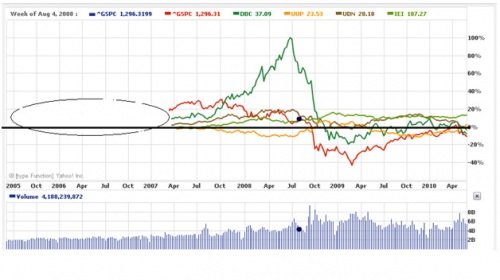
To see how safe (or how risky) your portfolio was over the last few years, it’s useful to view how these asset classes themselves fared over this time period. That is what is shown in the next chart where the following asset class performances over the last few years are shown. The chart shows the performances of stocks (S&P 500 shown by the symbol ^GPSC, in red), bonds (symbol IEI, Barclay’s 3-7 Year Treasury Bond index etf, in light green), Commodities (DBC, Powershares etf, in dark green), Long dollar (UUP, Powershares long dollar etf, in orange; this fund allows speculating on the dollar going up against a basket of important currencies; whenever the world financial markets are in turmoil, this index generally goes up as investors around the world seek the “safe haven” status of the dollar.

Alternately, note that this index value will also typically rise when the domestic economy is in a sound condition and both domestic and international investors favor the U.S. financial markets) and the short dollar (UDN, the Powershares inverse of UUP). Note that the “Cash” asset class has been left out and returns on cash (or money market funds) have been close to zero the whole time.

There are a few startling observations from this period. The first part that arrests the eye is how commodities performed over this time period. If your portfolio was heavy in this sector, you had a heck of a ride these last three years. If you had a lot of stocks as well, heck, your ride just got wilder. As can also be seen from the picture, healthy doses of bonds and currencies would have made your ride that much smoother.

On the other hand, what is additionally startling to observe is that we all started this period close to zero returns in the beginning of 2007 (around March 2007) and in June 2010, we are all converging back to zero returns. No matter how you were diversified, you either took a smooth ride (well diversified portfolio) from a zero return environment to a zero return environment or a wilder ride. That is why diversification is so important. Another way to gauge your diversification benefit is to use a two-pronged system.

The first is what I refer to as the “monthly statement effect”. When your monthly financial statements come in, you first observe the current month’s ending balance, then the previous month’s ending balance and then have a great day, a lousy day or an uneventful day. Depending on how good or bad (how volatile the ride) the monthly effect is, it may last for much more than just a day, maybe days. The second piece is your age.

Life Cycle Investment Hypothesis

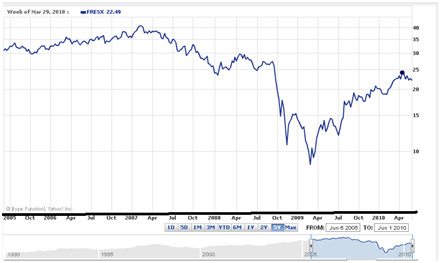
As you grow older, you ask yourself how wild a ride can you tolerate at this point in your life? Hopefully, as you age, this tolerance level should show significant declines. If it does, you are then joining a rational investment group practicing a “lifecycle-investment hypothesis” style. Finally, did anything do well during this time? Yes, and surprisingly from an asset class whose underlying asset is shaped too like a zero – mother earth and real estate. Having some real estate in your investment basket (another important diversification asset) would not only have smoothed your ride but would have made your financial life so much more pleasurable. Just take a look at this picture below (FRESX, an old Fidelity’s real estate index fund) which says it all.

Assessment

Even in the darkest days of falling real estate markets of 2008, this fund produced a positive return. Of course many other real estate indexes lost their bottoms; thus finding these stable indexes in all asset classes are well worth their salt. That is, if it is time for you to diversify.

Conclusion

Your thoughts and comments on this ME-P are appreciated. Feel free to review our top-left column, and top-right sidebar materials, links, URLs and related websites, too. Then, subscribe to the ME-P. It is fast, free and secure.

Speaker: If you need a moderator or speaker for an upcoming event, Dr. David E. Marcinko; MBA – Publisher-in-Chief of the Medical Executive-Post – is available for seminar or speaking engagements. Contact: MarcinkoAdvisors@msn.com

OUR OTHER PRINT BOOKS AND RELATED INFORMATION SOURCES:

Product Details  Product Details

How Expensive are Healthcare Data Breaches?

Join Our Mailing List

Estimating Financial Damage Often Difficult 

By D. Kellus Pruitt DDS

Dom Nicastro just posted an article on HealthLeaders Media titled “HITRUST: HIPAA Breaches Near $1 Billion.”

http://www.healthleadersmedia.com/content/TEC-255015/HITRUST-HIPAA-Breaches-Near-1-Billion##

“Covered entities and business associates reporting breaches of unsecured personal health information (PHI) affecting 500 or more individuals to the Office for Civil Rights (OCR) together could spend nearly $1 billion because of those breaches.”  Nicastro continues:

“HITRUST used the 2009 Ponemon Institute study that found the average cost for a compromised record to be approximately $144 in indirect costs and $60 of direct costs, for a total cost of $204.”

Fort Worth Star-Telegram

Just days ago, Jan Jarvis described a data breach in the Fort Worth Star-Telegram titled “Fort Worth medical clinic spends $15,000 notifying patients of theft.”

http://www.star-telegram.com/2010/08/06/2389717/fort-worth-medical-clinic-spends.html#ixzz0wIaU5AQa

Jarvis writes,

“In June, employees at a Fort Worth allergy clinic discovered that the office door had been kicked in and four computers containing patients’ personal information including Social Security numbers and birth dates had been stolen.”

Jarvis reports that 25,000 records were involved, and it only cost $15,000 to notify them. That’s only 60 cents per record instead of 60 dollars each as estimated by the Ponemon Institute. Instead of it costing the clinic $1.5 million for direct costs, it only cost them $15,000. That’s a savings of 99%.

Assessment

So what’s the deal? Is the Ponemon Institute that far off in their estimates?

Conclusion

Your thoughts and comments on this ME-P are appreciated. Feel free to review our top-left column, and top-right sidebar materials, links, URLs and related websites, too. Then, subscribe to the ME-P. It is fast, free and secure.

Link: http://feeds.feedburner.com/HealthcareFinancialsthePostForcxos

Speaker: If you need a moderator or speaker for an upcoming event, Dr. David E. Marcinko; MBA – Publisher-in-Chief of the Medical Executive-Post – is available for seminar or speaking engagements. Contact: MarcinkoAdvisors@msn.com

OUR OTHER PRINT BOOKS AND RELATED INFORMATION SOURCES:

DICTIONARIES: http://www.springerpub.com/Search/marcinko
PHYSICIANS: www.MedicalBusinessAdvisors.com
PRACTICES: www.BusinessofMedicalPractice.com
HOSPITALS: http://www.crcpress.com/product/isbn/9781466558731
CLINICS: http://www.crcpress.com/product/isbn/9781439879900
BLOG: www.MedicalExecutivePost.com
FINANCE: Financial Planning for Physicians and Advisors
INSURANCE: Risk Management and Insurance Strategies for Physicians and Advisors

Product Details

About the Managed Care Digest Series

Creating Custom Data Reports for Chronic Diseases

By Staff Reporters

Join Our Mailing List 

The sanofi-aventis Managed Care Digest Series online resource for Chronic Disease Information is part of their continuing commitment to provide the latest most essential information on the evolution of health care. The Series, available online or in print, provides key benchmarking data that can help assess value, control costs, and develop business strategies.

Updates

Updated information is available. Just keep looking for Digest Bytes from the team at the Managed Care Digest Series

Assessment

For step-by-step instructions please review their Articulate Presenter.

Conclusion

And so, your thoughts and comments on this ME-P are appreciated. Give em’ a click and tell us what you think? Feel free to review our top-left column, and top-right sidebar materials, links, URLs and related websites, too. Then, subscribe to the ME-P. It is fast, free and secure.

Speaker: If you need a moderator or speaker for an upcoming event, Dr. David E. Marcinko; MBA – Publisher-in-Chief of the Medical Executive-Post – is available for seminar or speaking engagements. Contact: MarcinkoAdvisors@msn.com

Get our Widget: Get this widget!

Our Other Print Books and Related Information Sources:

Practice Management: http://www.springerpub.com/prod.aspx?prod_id=23759

Physician Financial Planning: http://www.jbpub.com/catalog/0763745790

Medical Risk Management: http://www.jbpub.com/catalog/9780763733421

Healthcare Organizations: www.HealthcareFinancials.com

Health Administration Terms: www.HealthDictionarySeries.com

Physician Advisors: www.CertifiedMedicalPlanner.com

Subscribe Now: Did you like this Medical Executive-Post, or find it helpful, interesting and informative? Want to get the latest ME-Ps delivered to your email box each morning? Just subscribe using the link below. You can unsubscribe at any time. Security is assured.

Link: http://feeds.feedburner.com/HealthcareFinancialsthePostForcxos

Sponsors Welcomed: And, credible sponsors and like-minded advertisers are always welcomed.

Link: https://healthcarefinancials.wordpress.com/2007/11/11/advertise

About Tele-Health and Medicare

Medicare TeleHealth Enhancement Act of 2009

By Staff Reporters

Join Our Mailing List

According to Richard S. Bakalar, MD, past president of the American Telemedicine Association, many physicians think that telehealth is a wave of the future for Medicare, but so far the program has been slow to embrace technology. Congressional legislation in 1997 and 2000 largely established the telehealth component of Medicare, yet in 2006 the program spent only $2 million on medical services conducted electronically, out of more than $400 billion in total spending.

The Physical Presence Blockade

Remote patient visits, consultations and other care can generate payment only if they fall under a handful of Medicare payment codes approved for telehealth applications, while the patient must be physically present with a health professional at the originating call site located outside of a metropolitan area. Some types of facilities are not approved to get paid for these services, and Medicare will only pay for home telehealth devices and care as part of an approved pilot project.

Assessment

A major factor in Medicare’s cautious stance is concern that a large expansion would strain the system’s finances by opening the doors for physicians and others to bill for a whole host of costly and potentially unnecessary telehealth services. For further discussion, see www.atmeda.org.

Current Updates for 2010

Link: Medicare Telehealth

Conclusion

Your thoughts and comments on this ME-P are appreciated. Feel free to review our top-left column, and top-right sidebar materials, links, URLs and related websites, too. Then, subscribe to the ME-P. It is fast, free and secure.

Speaker: If you need a moderator or speaker for an upcoming event, Dr. David E. Marcinko; MBA – Publisher-in-Chief of the Medical Executive-Post – is available for seminar or speaking engagements. Contact: MarcinkoAdvisors@msn.com

OUR OTHER PRINT BOOKS AND RELATED INFORMATION SOURCES:

Product Details

Price Adjustment Medical Costing

End of Life Care Programs

By Dean G. Smith PhD and the Accounting Workgroup

Join Our Mailing List

An alternative to traditional medical resource costing is ‘price adjustment’.  In an international context, this method compares the monetary estimates of resource used, after adjustment for price level differences between countries and over time to standard current values.  In order to attempt comparisons of different cost estimates, analysts must be at least certain as to what items are included in costs and whether costs are being based on opportunity costs, charges, or average costs.

Medicare Cost-to-Charge Ratios

In the US context, the price adjustment approach underlies the use of Medicare Cost-to-Charge Ratios (CCR).  Costs are estimated using the CCR approach by multiplying the number of units of each procedure billed by its Medicare charge and CCR and then summing these costs.  Some health care organizations have begun to invest in sophisticated, computerized cost-accounting systems (CAS) that are capable of providing procedure-specific cost estimates, usually based on relative value units, but these systems often rely on billing data to obtain service units.

The Studies

A couple of studies have used a combination of CCR and CAS to estimate costs (costs to the institution – costs to Medicare are the Medicare charges). In both studies, the CAS was for hospital costs only, with Medicare reimbursement (not institution costs) being used for professional services by using relative value units and a conversion factor from the Medicare Fee Schedule.

Inaccuracy

To overcome the issues of inaccurately (or non-transparently) measuring resource units, it has become more common in clinical trials (a distinct sub-set of possible study methods) to develop case report forms to capture all study end points, including medical service use.  These studies then translate medical service use into costs using standard charges or costs, or a series of representative data sets of charges or costs, to the resource units. These methods have become so common that all submissions to the British Medical Journal are required to document methods using a 35-part form that includes items such as: part 16) Quantities of resources are reported separately from their unit costs; part 17) Methods for the estimation of quantities and unit costs are described; part 18) Currency and price data are recorded; and part 19) Details of currency of price adjustments for inflation or currency conversion are given.

Following these guidelines, a Michigan-based study is collecting data through a resource use data collection form and applying to standard costs per unit of service to produce costs for a RWJ-sponsored palliative care program.

Not the Usual Medical Care

There are a few studies on the costs and cost-effectiveness of end of life programs or the impact of serious illness on patient’s families.  Those studies that do evaluate end of life care programs are usually small in scope, compare the end of life program (e.g., as in hospice) to “usual care,” or have no comparison group, or do not evaluate the costs of the program.

Assessment

Criticisms of studies of only one medical resource/cost item often surround the total costs of care – suggesting that the use of focused studies may not be well received.  In fact, even studies that capture the total costs of medical care services are criticized for not capturing the indirect costs – family expenses on end of life care are substantial and are not factored into most cost-analysis studies. Very few studies try to capture all costs to enable adjustments of costs for selection processes that may influence resource use.

Editor’s Note: Accounting workgroup members:

1 Stephen Seninger PhD: Professor, Bureau of Business and Economic Research, University of Montana, Missoula, MT

2 Ira Byock, MD: Director, Promoting Excellence in End of Life Care, Practical Ethics Center, University of Montana, Missoula, MT

3 Carol D’Onofrio,DrPH: Research Director, Sutter Visiting Nurse Association & Hospice, Piedmont, CA

4 Jennifer Elston-Lafata PhD: Director, Center for Health Services Research, Henry Ford Health System, Detroit, MI 

5 Joe Engelhardt PhD: Research Coordinator, Life Institute VA Medical Center, Albany, NY

6 Carol A. Lockhart PhD: Project Director, Phoenix Care, Hospice of the Valley, Phoenix, AZ

7 Steven H. Miles MD: Professor of Medicine, Center for Bioethics, University of Minnesota, Minneapolis, MN

8 Herbert A. Rosefield: Corrections Care Consultant, Volunteers of America, Raleigh, NC

9 Anne M. Wilkinson PhD:Senior Health Policy Analyst, RAND, Arlington, VA

10 Barbara Volk-Craft RN, MBA  Program Manager: Phoenix Care, Hospice of the Valley, Phoenix, AZ

11 Dean G. Smith, PhD  Professor and Chair, Department of Health Management & Policy, University of Michigan, Ann Arbor, MI

Conclusion

Your thoughts and comments on this ME-P are appreciated. Feel free to review our top-left column, and top-right sidebar materials, links, URLs and related websites, too. Then, subscribe to the ME-P. It is fast, free and secure.

Speaker: If you need a moderator or speaker for an upcoming event, Dr. David E. Marcinko; MBA – Publisher-in-Chief of the Medical Executive-Post – is available for seminar or speaking engagements. Contact: MarcinkoAdvisors@msn.com

OUR OTHER PRINT BOOKS AND RELATED INFORMATION SOURCES:

Product Details

***

Do OTC DNA Tests Give Bogus Results?

Government Finds Little or No Useful Predictive Risk Information

[By Staff Reporters]

46CB1C3AA5898E7B3C85B59E571D

WASHINGTON — U.S. government investigators say personalized DNA tests that claim to predict a person’s likelihood of developing diseases are misleading and offer little or no useful information.

Link: http://www.msnbc.msn.com/id/38363300/ns/health

Assessment

The Energy and Commerce Committee recently heard testimony from the FDA and three genomic testing companies: 23andMe, Navigenics and Pathway Genomics Corp.

Government Report: Genetic tests

Conclusion

Feel free to comment on this ME-P and review our top-left column, and top-right sidebar materials, links, URLs and related websites, too. Then, be sure to subscribe to the ME-P. It is fast, free and secure.

Speaker: If you need a moderator or speaker for an upcoming event, Dr. David E. Marcinko; MBA – Publisher-in-Chief of the Medical Executive-Post – is available for seminar or speaking engagements. Contact: MarcinkoAdvisors@msn.com

Get our Widget: Get this widget!

Our Other Print Books and Related Information Sources:

Practice Management: http://www.springerpub.com/prod.aspx?prod_id=23759

Physician Financial Planning: http://www.jbpub.com/catalog/0763745790

Medical Risk Management: http://www.jbpub.com/catalog/9780763733421

Healthcare Organizations: www.HealthcareFinancials.com

Health Administration Terms: www.HealthDictionarySeries.com

Physician Advisors: www.CertifiedMedicalPlanner.com

Subscribe Now: Did you like this Medical Executive-Post, or find it helpful, interesting and informative? Want to get the latest ME-Ps delivered to your email box each morning? Just subscribe using the link below. You can unsubscribe at any time. Security is assured.

Link: http://feeds.feedburner.com/HealthcareFinancialsthePostForcxos

Sponsors Welcomed: And, credible sponsors and like-minded advertisers are always welcomed.

Link: https://healthcarefinancials.wordpress.com/2007/11/11/advertise

Product DetailsProduct DetailsProduct Details

Texas Mortgage Firm Survives and Thrives Despite Repeat Sanctions

The Allied Home Mortgage Capital Caper

By Charles Ornstein and Tracy Weber, ProPublica July 2, 12:24 a.m.

Join Our Mailing List

As his competitors imploded one by one, Jim Hodge, the folksy founder of Allied Home Mortgage Capital [1], touted his sprawling Houston firm as a survivor.

Not only was Allied still standing, Hodge told employees in a company newsletter in December, it was thriving. “The good news,” Hodge wrote, “is that even though we are all having to work harder, most branches are making lots of money.”

But an examination of Hodge’s mortgage company by ProPublica found that its prosperity has come at a price for dozens of customers who claim Allied brokers have put their homes at risk, lied to them or improperly siphoned money from their deals.

The firm has left behind a trail of alleged misconduct and piecemeal government sanctions spanning at least 18 states [2] and seven years. Yet Allied chugs along unimpeded, aided by access to the government-backed Federal Housing Administration [3] loan program.

Over the past year, the FBI and federal prosecutors have made mortgage fraud a priority, filing criminal charges across the country. Regulators, such as the U.S. Department of Housing and Urban Development [4], also say they are getting tough. But Allied’s [5] history shows how even repeat offenders can fall through gaps in the fragmented safety net meant to protect mortgage borrowers.

Now Consider

  • Allied has the highest serious delinquency rate [2] among the top 20 FHA loan originators from June 2008 through May.
  • Nine states have sanctioned the firm in the last 18 months for such violations as using unlicensed brokers and misleading a borrower.
  • Federal agencies have cited or settled with Allied or an affiliate at least six times since 2003 for overcharging clients, underpaying workers or other offenses.
  • At least five lenders have sued, claiming Allied tricked them into funding loans for unqualified buyers by falsifying documents and submitting grossly inflated appraisals, among other allegations.

“Everything is just a nightmare for me,” said Cheryl Stewart, who is suing Allied alleging that its Hammond, La., office misrepresented her income to qualify her for a loan, then deposited money from her closing into the branch manager’s bank account. Stewart said she is on the brink of losing her home as a result. Allied has successfully argued that the case should be moved out of state court and into arbitration.

Despite these repeated complaints, no single agency is investigating the sweep of the company’s actions and whether they represent a pattern or, as Hodge maintains, are to be expected for a company of Allied’s size. It bills itself as the nation’s biggest privately held mortgage broker-banker with some 200 branches.

William Black, an associate professor of economics and law at the University of Missouri-Kansas City, said Allied’s record exemplifies the failings of a regulatory system that has teeth but seldom bites.

“It’s a wonderful example of the overall crisis,” said Black, who has testified before Congress about financial fraud. “What would it take before somebody would take serious action?”

Federal housing officials would not discuss Allied’s performance or their own negative audits of the firm. But after a recent review, the FHA has recommended that the Mortgagee Review Board take action against Allied. The board can fine companies or revoke their access to the FHA market, which has caused firms to close.

Drs. Home

Secret Service Investigations

Separately, the Secret Service, which conducts criminal investigations for the Treasury Department and Federal Deposit Insurance Corp., confirmed that it is looking into allegations of fraud and wrongdoing at Allied’s now-shuttered branch in Hammond.

Although Allied is dwarfed by Wells Fargo, Bank of America, Quicken Loans and JPMorgan Chase, the nation’s largest mortgage firms, it remains a big player in FHA-insured loans.

In the last two years, Allied Home Mortgage Capital originated more FHA mortgages than all but 15 of the more than 10,000 firms that handled such loans. Since 2005, it has processed nearly 40,000 FHA loans worth nearly $5.85 billion, according to the FHA. Those loans now account for at least 70% of Allied’s business, Hodge said.

Allied differs from most other FHA players in that it is both a broker and a lender. It has an affiliated company with a nearly identical name that has been the lender on about 30% of its FHA loans in the last two years.

Since the collapse of the subprime market, the volume of FHA-insured loans has boomed, rising from about 5% of all home loans in 2007 to 20% in 2009. When these loans fail, an insurance fund supported by FHA borrowers picks up the tab.

Both as a broker and a lender, Allied’s rate of seriously delinquent loans is nearly 60% higher than the national average for the past two years. And the FHA paid out more than $500 million from 2005 to 2009 for claims on defaulted loans brokered by Allied, statistics show.

In an interview, Hodge said the delinquency rates reflect more on the lenders that funded the loans than on his brokers.

The $500 million in claims FHA paid out, he said, were covered in part by insurance premiums paid by Allied borrowers — who largely do not default. “They didn’t have a complete loss of a half a billion,” he said.

Hodge said the problems experienced at some of Allied’s branches should not tarnish his firm’s overall record. “If you look at the volume that we did or do,” he said, “it’s not significant.”

Broken Trust

Sal and Ashley DePaula said they had more reason than most people to trust their broker: The manager of Allied’s Hammond branch was a tenant in one of their rental houses.

Over the course of 2006 and 2007, Allied’s staff helped them sell that property to an acquaintance of the manager and refinance several others.

It wasn’t until months later, the DePaulas allege, that they realized they’d become pawns in a scam.

The buyer of the property the couple sold for $93,000, had actually paid $47,000 more than that, according to a lawsuit in state court by the couple and documents they provided. The cash ended up in the account of Shane Smith, the branch manager, a wire-transfer record shows.

Then, after a tornado hit one of the DePaulas’ refinanced rental homes in 2008, they learned they’d never been signed up for the insurance Allied said it had arranged — even though they’d paid for it every month. The couple said they expect to spend more than $36,000 on repairs.

“Had somebody robbed me and stole $50 out of my purse, they would be in jail,” said Ashley DePaula, who said she is “bitter” that no one has been punished.

Last year, the couple learned that Allied had put another borrower’s name on Sal DePaula’s retirement account statement and submitted it in a loan qualification packet.

That other borrower, Louisiana state criminal investigator Terry Apple, said he only realized he was part of an alleged scam when ProPublica showed him a copy of the statement.

“I’m now finding out that I’m just a small part of a very large puzzle,” Apple said.

At least four lawsuits, including one by the DePaulas, have been filed against Allied over the conduct of its Hammond branch. Other borrowers, some of whom are mentioned in legal filings, allege they, too, were defrauded but can’t afford to sue.

“You know how your body can be quivering?” said Franklin Morgan, 62, a disabled Vietnam veteran who faces losing his home. “That’s what my body’s been doing every day.”

In towering stacks of legal documents, attorneys allege that the Hammond office deceived their clients from 2005 through 2007 by misrepresenting loan terms, falsifying records, failing to pay off prior mortgages and diverting hundreds of thousands of dollars. A title lawyer who worked closely with the Allied branch also stands accused — and has been sued by Allied.

The alleged victims include friends and relatives of Allied staff and the birth mother of the assistant manager’s adopted daughter. That assistant manager’s past — including an arrest warrant for allegedly stealing $24,000 from a previous employer — has come to light.

The lawsuits are proceeding, but Ashley DePaula says Allied has offered a small settlement that has not been finalized.

In an interview, Hodge conceded that “serious fraud” had taken place at the branch, which closed in 2008. He also acknowledged personally hiring branch manager Smith even though Smith previously had lost a home to foreclosure and declared personal bankruptcy. Smith and his attorney could not be reached for comment.

Hodge said the Allied corporate office does not appear to be a target of any criminal probe.

“I don’t know all the details,” he said. “It’s a pretty bizarre situation.”

Row Homes

Customers’ Stories

Around the country, other Allied borrowers tell similar tales.

Pete Pauley, pictured with his wife Mary Ellen, sued Allied in W. Va. state court alleging that a broker misled him about a low-interest loan in 2004.

In Charleston, W.Va., businessman Pete Pauley sued Allied in state court alleging that a Weirton, W.Va., broker misled him into signing for a low-interest loan in 2004 whose rate began rapidly rising after one month.

As part of the loan approval process, the branch submitted a letter from a local accountant verifying Pauley’s ownership of his company. That accountant later testified he didn’t know Pauley or write the letter.

Pauley, who runs an oil and gas company, said the experience was humiliating. He and his wife, Mary Ellen, a nurse, learned of other complaints.

Four other couples alleged similar betrayals by another Weirton loan officer, the sister of Pauley’s broker.

Allied settled for $240,000, Pauley said. But Hodge said Allied did so only after the judge strongly encouraged it.

“We ended up buying that guy a house,” he said.

Allied also settled with the other four couples. In addition, it agreed to pay $12,000 in education and restitution costs after the West Virginia attorney general found it had misled borrowers about their loans.

Lenders, too, have felt aggrieved. AmericaHomeKey sold loans brokered by Allied to a secondary investor. After four borrowers failed to make even the first payments on their loans, the investor demanded the lender make good.

AmericaHomeKey then sued Allied in Harris County, Texas, alleging that it had misrepresented the self-employment status of three of the borrowers and failed to check out other basic facts.

“Clearly, these borrowers lacked the financial means and/or the intent to make the payments on these mortgage loans,” the lawsuit said.

Allied disputes the allegations and will defend itself “with vigor,” Hodge said.

In South Carolina, Charleston title attorney Elizabeth Stuckey Murphy testified in a deposition that she became so concerned about possible fraud at Allied’s Goose Creek branch that she complained to the FHA and law enforcement agencies in 2005.

The branch manager, Murphy claimed in a letter to authorities, had padded closing statements with invoices for contracting work by her husband that was never performed — nearly $30,000 in one case alone.

In a deposition two years later, Murphy was asked about her complaint to the FHA hotline. “To date,” she said, “I haven’t received any response.”

Frequent Troubles

Every year since 2003, Allied has landed in trouble somewhere.

It’s a streak that began with twin wallops from the U.S. Department of Housing and Urban Development totaling $420,000 in settlements — a significant sum for the agency. HUD oversees the FHA program, which insures mortgages for buyers who can’t afford big down payments.

In all, regulators and attorneys general in at least 18 states have acted against the firm or its brokers. Most of the matters have been settled without any admission of wrongdoing by Allied.

Washington state banned a former broker in Allied’s Spokane office after he was convicted of 10 felonies for stealing Allied clients’ money and laundering it. Arizona denied a broker’s license to a firm owned by Allied’s Tucson branch manager because she had previously been convicted of embezzling from a bank.

State regulators say they must limit their actions to what happens within their borders. Federal officials say they don’t generally look into state actions unless a mortgage company’s conduct may also violate federal rules.

Assessment

Although HUD and FHA have recently stepped up oversight of the mortgage industry, they have long had tools to police it. Using data collected on every loan, housing officials can statistically track whether mortgage firms are putting borrowers into FHA loans they can’t or don’t pay on. According to this data, Allied for several years has had a serious delinquency rate well above the national average. And, over the last two years at one Houston branch, some borrowers mustered only a few payments or none at all. The serious delinquency rate within one year of closing was 12%, compared with 4.2% nationwide.

Gary Lacefield, a former HUD investigator, said the numbers are an obvious red flag about Allied that regulators should have acted upon. “I see no reason,” he said, “why they shouldn’t have been hammered.”

Note: ProPublica director of research Lisa Schwartz contributed to this story. USA TODAY editors assisted in preparing it for publication.

http://www.propublica.org/article/texas-allied-home-mortgage-capital-thrives-despite-sanctions

Any ME-P medical professionals, readers, clients or FAs affected by this caper?

Channel Surfing the ME-P

Have you visited our other topic channels? Established to facilitate idea exchange and link our community together, the value of these topics is dependent upon your input. Please take a minute to visit. And, to prevent that annoying spam, we ask that you register. It is fast, free and secure.

Conclusion

Your thoughts and comments on this ME-P are appreciated. Feel free to review our top-left column, and top-right sidebar materials, links, URLs and related websites, too. Then, subscribe to the ME-P. It is fast, free and secure.

Speaker: If you need a moderator or speaker for an upcoming event, Dr. David E. Marcinko; MBA – Publisher-in-Chief of the Medical Executive-Post – is available for seminar or speaking engagements. Contact: MarcinkoAdvisors@msn.com

OUR OTHER PRINT BOOKS AND RELATED INFORMATION SOURCES:

Product Details  Product Details

Health Plan Management Navigator

ADVERTISEMENT

July 2010 Edition

By Erin Sawchuk

erinsawchuk@sherlockco.com

Join Our Mailing List

Dear ME-P Readers

Please find attached the early July 2010 Edition of our health Plan Management Navigator. In this month’s edition, we suggest an approach to quantifying best practice of administrative activities of health plans. Determining best practice for health plans is a knotty problem because of the complexity of the product and because some of what makes for best practice cannot be captured in the current year’s administrative expense line. We offer a solution that we hope to implement but we would be grateful for any insights you wish to share on this matter.

Financial and Operating Results

Navigator also summarizes some of the May financial and operating results of health plans reporting in our Dashboard. Operating earnings are weak on soft revenues and compressing margins. Enrollment trends in Medicare, Medicaid and ASO products are relative bright spots. Plans are adapting by reducing staffing ratios.

Link: Early July 2010 Navigator[1]

Web Casts

Please save 2:00 on July 16, and 2:00 on August 5 for two important web conferences. The first will summarize the results of this year’s SEER benchmarks for Independent / Provider-Sponsored plans. The second will summarize this year’s SEER benchmarks for Blue Cross Blue Shield Plans.

The Plan Management Navigators containing the respective peer group data will be sent to you a day or so before the web conference. There is no charge to participate, but we would be grateful if you would let us know in advance. Please reply back to me.

Assessment

Erin Sawchuk [Sherlock Company]

P.O. Box 413

Gwynedd, PA 19436

www.sherlockco.com

215-628-2289 – Phone

Conclusion

Feel free to comment and review our top-left column, and top-right sidebar materials, links, URLs and related websites, too. Then, be sure to subscribe to the ME-P. It is fast, free and secure

Get our Widget: Get this widget!

Our Other Print Books and Related Information Sources:

Practice Management: http://www.springerpub.com/prod.aspx?prod_id=23759

Physician Financial Planning: http://www.jbpub.com/catalog/0763745790

Medical Risk Management: http://www.jbpub.com/catalog/9780763733421

Healthcare Organizations: www.HealthcareFinancials.com

Health Administration Terms: www.HealthDictionarySeries.com

Physician Advisors: www.CertifiedMedicalPlanner.com

Subscribe Now: Did you like this Medical Executive-Post, or find it helpful, interesting and informative? Want to get the latest ME-Ps delivered to your email box each morning? Just subscribe using the link below. You can unsubscribe at any time. Security is assured.

Link: http://feeds.feedburner.com/HealthcareFinancialsthePostForcxos

Sponsors Welcomed: And, credible sponsors and like-minded advertisers are always welcomed.

Link: https://healthcarefinancials.wordpress.com/2007/11/11/advertise

Identifying Suspicious Short Selling

But Not Who’s Behind the Trades

By Karen Weise
ProPublica, July 8, 2010

Last weekend, The Wall Street Journal highlighted new academic research [1] showing that investors may be trading on insider information after companies approach hedge funds for loans.

Researchers found that on average, in the five days before companies announce a loan from a hedge fund, the volume of short sales increases by 75 percent as compared with the 60 days before a deal is announced. There was no comparable uptick in betting against companies that borrowed money from commercial banks instead.

Short Selling

With short selling, hedge funds and other investors make money by wagering that a stock’s price will fall. Borrowing from hedge funds rather than commercial banks can be seen as a sign of distress, as hedge funds tend to charge higher interest rates.

One of the researchers, Debarshi Nandy of the Schulich School of Business at York University in Toronto, told ProPublica that the findings pose an important question of whether hedge funds are using insider information inappropriately.

Working Draft

Here’s a PDF of a working draft of the paper [2]; the final version is not yet published. When companies ask hedge funds to consider giving them a loan, they typically require that the funds sign nondisclosure agreements. That’s because the borrowers divulge confidential financial information in the process of trying to get a loan — information that can provide insight into a company’s future performance. That, in turn, can be valuable to investors.

Examining Changes

In looking at instances when companies made changes to existing loans, researchers found that the short sales on companies amending loans from hedge funds were profitable, whereas similar short sales on companies amending loans from banks resulted in losses. But, the researchers stop short of saying that hedge funds definitely make insider trades. It’s all a little bit hazy because there is little disclosure required for hedge funds and short selling. While the paper identifies “abnormal” shorting activity, the identity of the investors making the trades is a mystery. “If it is truly insider trading by the fund or a ‘tip-ee’ of the fund, it would really be good to get some further data on who is actually doing the trading,” said Anita Krug, an expert in the laws governing hedge funds.

Assessment

Investors are required to notify the  Securities and Exchange Commission when taking large long positions, but there is no equivalent requirement for short bets. During the week that Lehman Brothers collapsed in the fall of 2008, the SEC issued a temporary order [3] requiring investors to report large short positions, but it did not renew that requirement last summer when the order lapsed [4]. The pending financial reform bill also would not require disclosure.

Join Our Mailing List

Conclusion

Short sellers say more regulations would discourage their trading, which they argue helps moderate market bubbles and contributes to market efficiency, says Mark Perlow, an attorney at K&L Gates who represents hedge funds.

Link: http://www.propublica.org/article/identifying-suspicious-short-selling-but-not-whos-behind-the-trades

And so, feel free to comment and review our top-left column, and top-right sidebar materials, links, URLs and related websites, too. Then, be sure to subscribe to the ME-P. It is fast, free and secure.

https://www.crcpress.com/Comprehensive-Financial-Planning-Strategies-for-Doctors-and-Advisors-Best/Marcinko-Hetico/p/book/9781482240283

Are Hospitals Auctioning Debt?

Understanding Modern Cash Flow Strategies

By Ross Filder

By Karen White PhD

www.HealthcareFinancials.com

As a sign of the contracting economic times, some struggling hospitals are using a new method to collect revenue: the Internet. It has become a channel to cut write-offs and bad debt ratios, which lower stock prices if publicly held.

Rather than simply hiring agencies to collect patient bills, hospitals have begun to put their accounts receivable (ARs) up for auction online. Bidders on the debt include the same agencies that serve the hospitals, some of which provide guaranteed payments to hospitals in exchange for access to the debt. 

Strategy Attractive to Buyer and Sellers

The auctions are also attracting other companies that buy the debt outright. For example, one method that a facility based medical practice used to auction debt was for the hospital to determine the criteria it would use for selecting the debt to be auctioned. The criteria generally focus on ARs that are a certain age, but demographic regions, legal accounts, and monthly payment accounts were also be considered.

[picapp align=”none” wrap=”false” link=”term=accounting&iid=289186″ src=”http://view4.picapp.com/pictures.photo/image/289186/corporate-details/corporate-details.jpg?size=500&imageId=289186″ width=”335″ height=”480″ /]

Request for Proposal

Once the criteria are determined, a listing of accounts is generated and supplied to potential buyers along with a Request for Proposal that asks each potential buyer to provide information on their experience in servicing hospital-type ARs, as well as details of their expertise, collection techniques, references, and price. 

Usually the winning bidder will pay a flat price for the entire AR.  It is important for the hospital to understand that when auctioning ARs the winning bidder owns the accounts and their collection tactics will not necessarily comply with the hospital’s standards for collections.

Automation

Automation can lead to decreased paperwork, process standardization, increased productivity, and cleaner claims. In 2004, Hospital & Health Network’s “Most Wired Survey” [1] found that the 100 most wired hospitals — including three out of the four AA+ hospitals in the country — had better control of expenses, higher productivity, and efficient utilization management. These numerics are much higher today. Additionally, these top hospitals tend to be larger and have better access to capital.

Assessment

The positive return on investment in technology increases allocation of funding to technology. This correlation is important because it begins to link the investment in information technology with positive financial returns in all areas of a hospital’s business, including the revenue cycle.

Conclusion

Please comment and opine on this ME-P? Feel free to review our top-left column, and top-right sidebar materials, links, URLs and related websites, too. Then, be sure to subscribe. It is fast, free and secure.

Speaker: If you need a moderator or speaker for an upcoming event, Dr. David E. Marcinko; MBA – Publisher-in-Chief of the Medical Executive-Post – is available for seminar or speaking engagements. Contact: MarcinkoAdvisors@msn.com 

Get our Widget: Get this widget!

Our Other Print Books and Related Information Sources:

Practice Management: http://www.springerpub.com/prod.aspx?prod_id=23759

Physician Financial Planning: http://www.jbpub.com/catalog/0763745790

Medical Risk Management: http://www.jbpub.com/catalog/9780763733421

Healthcare Organizations: www.HealthcareFinancials.com

Health Administration Terms: www.HealthDictionarySeries.com

Physician Advisors: www.CertifiedMedicalPlanner.com

Subscribe Now: Did you like this Medical Executive-Post, or find it helpful, interesting and informative? Want to get the latest ME-Ps delivered to your email box each morning? Just subscribe using the link below. You can unsubscribe at any time. Security is assured.

Link: http://feeds.feedburner.com/HealthcareFinancialsthePostForcxos

Sponsors Welcomed: And, credible sponsors and like-minded advertisers are always welcomed.

Link: https://healthcarefinancials.wordpress.com/2007/11/11/advertise

References:


[1]   See http://www.hhnmostwiredsurvey.com. The Most Wired Survey is conducted annually between January and March to “promote the effective use of information technology in achieving clinical and operating excellence.”

GE Violated Danish Drug Reporting Law

In the Omniscan Case

By Jeff Gerth, ProPublica – June 17, 2010 5:59 pm EDT

Join Our Mailing List 

General Electric’s health care unit failed to promptly and completely inform regulators about a patient who died after experiencing adverse effects from the company’s MRI drug Omniscan, Danish drug regulators concluded in a ruling last month.

Danish Medicines Agency

The finding by the Danish Medicines Agency comes in the case of a Danish woman who had been injected with Omniscan for a magnetic resonance scan in 2002 and gradually became immobilized and died of a lung embolism the following year. The woman, Birthe Madsen, is believed to be among the first patients whose use of Omniscan and similar medical imaging drugs was associated with a rare and potentially crippling disease now known as nephrogenic systemic fibrosis [1], or NSF. Hundreds of patients became ill after Madsen’s death, before regulators and drug companies learned enough about the risks to begin issuing alerting doctors a few years later.

Government Insurance Agency

Reviewing the reasons Madsen died, a Danish government insurance agency determined in 2004 that Omniscan caused her immobility and in turn her death. Although this was relayed to GE Healthcare, the company did not immediately report it to the medicines agency as required, nor did a follow-up include the insurance agency’s conclusion that Madsen’s death could be attributed to the drug.

Although the reporting lapses violated Danish drug law, the medicines agency told GE Healthcare in a May 21 letter that the statute of limitations had expired and it would not pursue further action against the company. GE Healthcare maintains that its reporting about Omniscan’s side effects has been proper, and spokesman Jeff DeMarrais said in an e-mail that the woman’s death was not initially attributed to Omniscan because the fatal embolism occurred during a lengthy course of treatment “following the patient’s adverse reaction.”

The ruling by the Danish Medicine Agency, coming years after the reporting lapse, appears to have been prompted by an inquiry last October from a member of the Danish parliament about the agency’s response after cases of NSF first came to light in early 2006.

[picapp align=”none” wrap=”false” link=”term=denmark&iid=5207011″ src=”http://view2.picapp.com/pictures.photo/image/5207011/low-angle-view-amalienborg/low-angle-view-amalienborg.jpg?size=500&imageId=5207011″ width=”323″ height=”529″ /]

Contesting Lawsuits

GE currently is contesting more than 400 lawsuits [2] involving U.S. patients who say they contracted the disease after being injected with Omniscan. The company says it acted properly to protect patients and denies its drug causes NSF. Some manufacturers of competing products also have been sued, but in far fewer numbers than GE.

One of the major points of debate in the litigation concerns what GE Healthcare knew [2] and disclosed to regulators about Omniscan’s risks. The company contends it has been proactive and cooperative, while the plaintiffs claim the company failed to disclose damaging information about the drug and put patients in jeopardy.

Critics of GE Healthcare say more forthright disclosure might have helped doctors and regulators respond earlier and more effectively. Among them is Madsen’s son, Casper Schmidt, a Copenhagen lawyer who has carefully documented her case and the actions of various Danish authorities.

“If my mother’s case had been reported more accurately, and if the company had to explain why a patient died,” Schmidt said in an e-mail, “it would have helped enable doctors and regulators to better understand the disease earlier.”

US and European Drug Makers

Drug manufacturers in the United States and Europe are required to promptly report serious adverse reactions so that regulators and medical providers can monitor a product’s safety. They also must update the reports as new information about a case develops. In the U.S., the Food and Drug Administration logs the reports in a database [3].

At the time Madsen was exposed to Omniscan in 2004, tens of millions of patients who had undergone MRIs had been safely injected with such products, known as contrast agents, to enhance the images.

Omniscan [4], approved for use in the United States in 1993, is among a class of such agents that rely on gadolinium, a highly toxic metal. The body normally eliminates the drug quickly after treatment, except in some patients who have impaired kidney function.

Madsen was such a patient. According to Schmidt’s timeline of her treatment, she had at least one dialysis treatment before being injected with Omniscan in January 2002 to evaluate whether her veins were healthy enough for a kidney transplant. She experienced a cascade of crippling symptoms until her death in October 2003 at age 55.

Madsen’s adverse reactions prompted a medical review by a Danish government insurance agency, called Patientforsikringen, or Patient Insurance Agency, to see whether she had suffered drug side effects that might qualify her for state compensation.

The review determined that while Madsen died of a pulmonary embolism, her “immobilization was caused by the acknowledged pharmaceutical injury.”

That conclusion was reported to GE Healthcare on June 1, 2004, but the company failed to relay the information as required, the Danish Medicines Agency said in its May letter. In addition, the agency said a follow-up report from GE Healthcare, while noting several of Madsen’s adverse reactions, was insufficient because it did not repeat the state insurance agency’s finding that she died from an embolism due to being immobilized.

The GE Spokesman

DeMarrais, the GE spokesman, said that at the time, the company’s drug safety experts had a different understanding of Madsen’s death.

“Our filings regarding the case in question reflect that, as of 2004,” DeMarrais wrote, “our (drug safety) unit had not concluded, based on the information available at the time and in good faith, that the patient’s death had been caused by the adverse event that had been linked to the administration of Omniscan, but rather by a pulmonary embolism occurring during a protracted medical course following the patient’s adverse reaction.”

In its May letter, the Danish Medicines Agency said it had combed its files and could find no report from GE about Madsen in June 2004. DeMarrais, however, said the company believes a report was sent that month “at the same time as it was sent to other regulators, as confirmed by the FDA’s receipt of this filing.”

ProPublica Inquiry

At ProPublica’s request, Conor McKechnie, another company spokesman, provided a copy of the FDA filing [5] with Madsen’s name and some other information redacted. (The filing was on the letterhead of Amersham Health, the British maker of scanning drugs that GE acquired in late 2003 and early 2004.)

The filing references “new information” from the Danish insurance agency and states that the patient involved “suffered pulmonary embolism due to immobilization and died.” But it does not quote the insurance agency’s conclusion that “pharmaceutical injury” was to blame for Madsen’s immobility.

McKechnie said the FDA filing is accurate and mentioned immobilization, the embolism and death. DeMarrais said GE Healthcare also has submitted half a dozen more supplemental filings on the case over the last six years. “It would be a mistake,” he added, “to attach unwarranted significance to this particular case at this juncture.”

“It is our position that, consistent with the relevant health risk communication protocols, we provided complete and timely reports to the DMA and other global authorities regarding the adverse events associated with Omniscan that were reported to us,” DeMarrais said in his e-mail.

Dr. Sidney Wolfe, director of the health research group at the consumer watchdog organization Public Citizen, said GE should have been more forthcoming in 2004.

“Incomplete and misleading reports such as this undermine the ability of the government to make decisions more quickly to improve the public health,” said Wolfe, who is on an FDA advisory committee [6] that late last year reviewed Omniscan and other contrast agents.

In May 2006, following the disclosure of 20 NSF cases in Copenhagen, GE Healthcare issued a safety alert to the DMA and regulators around the world. It discussed the new cases and attached a brief description of each one. In the section involving Madsen, the company reported her death as “unrelated to Omniscan.”

By 2007, at the urging of regulators, the manufacturers of gadolinium-based agents put warnings about NSF on their labels. Three years later, much about the disease remains a mystery [7], including the exact cause. Patients experience a painful hardening or thickening of skin around the joints. The disease can be disfiguring and may attack internal organs.

Current Updates

As of last fall, the Patientforsikringen had reviewed 38 cases in which people exposed to Omniscan had suffered injury or death. In 26 cases, the insurance agency determined that GE Healthcare’s drug was the likely cause, according to a spokesman. In those cases, including Madsen’s, the agency made payments to the victims or their relatives.

[picapp align=”none” wrap=”false” link=”term=General+Electric&iid=8962953″ src=”http://view2.picapp.com/pictures.photo/image/8962953/general-electric-ceo-and/general-electric-ceo-and.jpg?size=500&imageId=8962953″ width=”380″ height=”537″ /]

Assessment

GE Healthcare has the opportunity to appeal the insurance agency’s decisions but has not done so, the Patientforsikringen spokesman said in an e-mail last fall. McKechnie said the company did not appeal because it was not a direct party to the agency’s decision.

DeMarrais said the company would respond to the Danish Medicines Agency’s finding of a reporting violation, which can be appealed.

Madsen’s name is redacted in the May 21 letter from the agency, but it was confirmed by her son and by matching the details in the letter with other public information.

Link: http://www.propublica.org/feature/ge-violated-danish-drug-reporting-law-in-omniscan-case

Conclusion

Your thoughts and comments on this ME-P reprint are appreciated. Feel free to review our top-left column, and top-right sidebar materials, links, URLs and related websites, too. Then, be sure to subscribe. It is fast, free and secure.

Get our Widget: Get this widget!

Our Other Print Books and Related Information Sources:

Practice Management: http://www.springerpub.com/prod.aspx?prod_id=23759

Physician Financial Planning: http://www.jbpub.com/catalog/0763745790

Medical Risk Management: http://www.jbpub.com/catalog/9780763733421

Healthcare Organizations: www.HealthcareFinancials.com

Health Administration Terms: www.HealthDictionarySeries.com

Physician Advisors: www.CertifiedMedicalPlanner.com

Subscribe Now: Did you like this Medical Executive-Post, or find it helpful, interesting and informative? Want to get the latest ME-Ps delivered to your email box each morning? Just subscribe using the link below. You can unsubscribe at any time. Security is assured.

Link: http://feeds.feedburner.com/HealthcareFinancialsthePostForcxos

Sponsors Welcomed: And, credible sponsors and like-minded advertisers are always welcomed.

Link: https://healthcarefinancials.wordpress.com/2007/11/11/advertise

2010 Physician Sentiment Index™

Taking the Pulse of the Physician Community

By Ann Miller RN, MHA

[Executive Director]

From time to time, our readers send in e-books, files or e-chapters, pamphlets or other material they have created for client, educational or marketing use. Some of it may be worthwhile; some not so. Nevertheless, these publications are often a good place to start the conversation, or thought-process on related topics.

They will be occasionally offered as a complimentary membership feature of the Medical Executive-Post.

[picapp align=”none” wrap=”false” link=”term=doctors&iid=279612″ src=”0276/0e9a3c11-109e-45f7-8862-39f6ee6676a3.jpg?adImageId=13062844&imageId=279612″ width=”319″ height=”480″ /]

February 2010 Physician Sentiment Index

By athenahealth

By Sermo

Link: Sermo

Disclaimer

No advice is offered. We make no copyright claim to these works. Veracity should be checked and information should be considered time sensitive. Please contact a professional for your situation.

Assessment

Feel free to send in your own material for the benefit of all Medical Executive-Post readers and subscribers.

Conclusion

And so, your thoughts and comments on this ME-P are appreciated. Feel free to review our top-left column, and top-right sidebar materials, links, URLs and related websites, too. Then, be sure to subscribe. It is fast, free and secure.

Get our Widget: Get this widget!

Our Other Print Books and Related Information Sources:

Practice Management: http://www.springerpub.com/prod.aspx?prod_id=23759

Physician Financial Planning: http://www.jbpub.com/catalog/0763745790

Medical Risk Management: http://www.jbpub.com/catalog/9780763733421

Healthcare Organizations: www.HealthcareFinancials.com

Health Administration Terms: www.HealthDictionarySeries.com

Physician Advisors: www.CertifiedMedicalPlanner.com

Subscribe Now: Did you like this Medical Executive-Post, or find it helpful, interesting and informative? Want to get the latest ME-Ps delivered to your email box each morning? Just subscribe using the link below. You can unsubscribe at any time. Security is assured.

Link: http://feeds.feedburner.com/HealthcareFinancialsthePostForcxos

Sponsors Welcomed

And, credible sponsors and like-minded advertisers are always welcomed.

Link: https://healthcarefinancials.wordpress.com/2007/11/11/advertise

About ReachMD Media

The Center of New Media in Healthcare?

By Staff Reporters

Join Our Mailing List

ReachMD is an innovative communications company that provides thought-provoking medical news and information to healthcare practitioners. Established to help increasingly time-constrained medical providers stay abreast of new research, treatment protocols and continuing education requirements, ReachMD delivers innovative and informative radio programming via XM Satellite Radio Channel 160 and online streaming developed by doctors for doctors.

The Founder

Founded by Dr. David Preskill, a well-known OB/GYN, ReachMD is a communication and education platform that even the busiest clinician can use.

For example, ReachMD’s first innovation was to allow healthcare providers a method to receive education in 15-minute segments on demand by cell phone. Clinicians can call in anytime from any phone to listen to relevant content, answer a few short voice-activated questions and receive CME credit in a completely paperless transaction.

Launch

In April 2007 ReachMD launched the first-ever national radio channel for medical professionals: a platform for clinical discussion, news and education. This content is broadcast 24/7 on XM Satellite Radio channel 160.

In October 2007, ReachMD launched new online streaming access to all programming and CME content and continues to expand the listening audience and deliver on its’ mission of providing the best communication, education and information to America’s medical professionals.

Assessment

ReachMD strives to provide compelling information to the healthcare community in the most convenient formats. So, give em’ a click, and tell us what you think?

http://www.reachmd.com

Conclusion

And so, your thoughts and comments on this ME-P are appreciated Feel free to review our top-left column, and top-right sidebar materials, links, URLs and related websites, too. Then, be sure to subscribe. It is fast, free and secure.

Speaker: If you need a moderator or speaker for an upcoming event, Dr. David E. Marcinko; MBA – Publisher-in-Chief of the Medical Executive-Post – is available for seminar or speaking engagements. Contact: MarcinkoAdvisors@msn.com

Get our Widget: Get this widget!

Our Other Print Books and Related Information Sources:

Practice Management: http://www.springerpub.com/prod.aspx?prod_id=23759

Physician Financial Planning: http://www.jbpub.com/catalog/0763745790

Medical Risk Management: http://www.jbpub.com/catalog/9780763733421

Healthcare Organizations: www.HealthcareFinancials.com

Health Administration Terms: www.HealthDictionarySeries.com

Physician Advisors: www.CertifiedMedicalPlanner.com

Subscribe Now: Did you like this Medical Executive-Post, or find it helpful, interesting and informative? Want to get the latest ME-Ps delivered to your email box each morning? Just subscribe using the link below. You can unsubscribe at any time. Security is assured.

Link: http://feeds.feedburner.com/HealthcareFinancialsthePostForcxos

Sponsors Welcomed

And, credible sponsors and like-minded advertisers are always welcomed.

Link: https://healthcarefinancials.wordpress.com/2007/11/11/advertise

Sevocity® Announces Free Electronic Health Records (EHR) System

For Educators and Regional Extension Centers (REC)

ADVERTISEMENT

By Catherine G. Huddle

VP, Market Development

www.Sevocity.com

Ph: (210) 412-5653

True Internet / Cloud EHR System Ideal for Educating Providers, Clinical Staff, and REC Support Staff

San Antonio, TX –Sevocity, a division of Conceptual MindWorks, Inc. (CMI), today announced Sevocity U, its Internet-based Ambulatory Electronic Health Records (EHR) program for Regional Extension Centers (RECs), Local Extension Centers (LECs), Management Service Organizations (MSOs), Technical Colleges, Universities, Medical Schools, and other organizations needing a turn-key EHR for training.

The Program

Under the program, educational organizations will receive free use of the fully functional Sevocity EHR for up to 20 users (teachers and students) through a demonstration clinic specifically for the educational organization.   Because Sevocity is a true Internet-based EHR, these organizations will not need to purchase, install, or maintain any servers or special software.  All that is required to access the system is a standard personal computer and an Internet connection, making student access for training and practice easy for the educator.  Sevocity U demonstration clinics will use the fully functional production version of Sevocity EHR.

CCHIT Certified

Sevocity 08 is CCHIT Certified® by the Certification Commission for Healthcare Information Technology (CCHIT®) and meets the Commission’s ambulatory electronic health record (EHR) criteria for 2008.  Sevocity will release its next version of Sevocity EHR this summer, at which time the company will apply for CCHIT 2011.  Sevocity is also committed to “meaningful use” certification and plans to apply as soon as certification is available.  Sevocity’s customer agreement includes a commitment to certification and any other requirements for providers to receive EHR incentives under the American Reinvestment and Recovery Act of 2009 (ARRA).

“We developed this program because we recognize the tremendous challenge Regional Extension Centers and other educators have teaching clinicians and others about Electronic Health Records in a very short period of time and with limited funding,” stated Catherine Huddle, VP of Market Development with Sevocity.   “While more standardization of EHRs is coming, today most systems have the same basic functionality.  Because Sevocity is a true Internet-based EHR and is very easy to use, it provides the ideal platform for educators providing EHR training.”

Join Our Mailing List

Assessment

Sevocity is rolling out this program in phases. Phase I begins today with the availability of Sevocity to the first ten (10) educational organizations that apply. Interested organizations should contact Sevocity at 877-777-2298 or EHReducation@Sevocity.com.

About Sevocity

Based in San Antonio, Texas, Sevocity empowers physician practices and health centers to embrace electronic health record (EHRs) by providing an easy-to-use, Internet-based electronic health record system. Because Sevocity EHR is an Internet-based (or cloud computing) product that provides secure access to clinical information via the Internet, practices and health centers avoid the expensive upfront capital expenditure and ongoing maintenance costs associated with client/server offerings. For more information about Sevocity, visit www.sevocity.com or call (877) 777-2298.

Conclusion

And so, your thoughts and comments on this ME-P are appreciated. Use the product, or give them a click and tell us what you think.

Feel free to review our top-left column, and top-right sidebar materials, links, URLs and related websites, too. Then, be sure to subscribe. It is fast, free and secure.

Get our Widget: Get this widget!

Our Other Print Books and Related Information Sources:

Practice Management: http://www.springerpub.com/prod.aspx?prod_id=23759

Physician Financial Planning: http://www.jbpub.com/catalog/0763745790

Medical Risk Management: http://www.jbpub.com/catalog/9780763733421

Healthcare Organizations: www.HealthcareFinancials.com

Health Administration Terms: www.HealthDictionarySeries.com

Physician Advisors: www.CertifiedMedicalPlanner.com

Subscribe Now: Did you like this Medical Executive-Post, or find it helpful, interesting and informative? Want to get the latest ME-Ps delivered to your email box each morning? Just subscribe using the link below. You can unsubscribe at any time. Security is assured.

Link: http://feeds.feedburner.com/HealthcareFinancialsthePostForcxos

Sponsors Welcomed

And, credible sponsors and like-minded advertisers are always welcomed.

Link: https://healthcarefinancials.wordpress.com/2007/11/11/advertise

Of Wants, Needs, Economic Sustainability and Even Healthcare Reform

A Social Domestic Healthcare Initiative?

By Somnath Basu PhD, MBA [www.clunet.edu/cif]

[Director California Institute of Finance]

Necessities, conveniences and luxuries are an articulation of the hierarchy within wants and needs. The scale and scope of this hierarchy seems quite seamless at the surface. Food, micro waved dinners to gourmet meals. Transportation needs become personal transportation needs and then into Ferraris. Family picnics are replaced by TVs and then by exotic vacations. Home rentals needs change to the wanting of mansions.

As we move up each of the needs totem poles, our monetary requirements stretch endlessly; otherwise if we were all able to bask in everlasting luxury, the end of capitalism and free markets would be in sight. The ideal of everlasting luxury forever too is therefore necessarily unachievable but something that is pursuable, forever. In this vein of reasoning, all of society’s resources and endeavors must go towards attaining this ideal. What then are the limitations of such pursuits?

The above concept of needs and wants also defines layers of society by their consumption abilities. It also defines the pressures imposed upon the growth of GDP from large sections of society to increase their consumption. It is a single-minded pursuit by the upper middle-class of society to strive towards the entering the class of the wealthy, followed by the middle class seeking upper-middle class status, etc. The wealthy comprise a group who are small in number (10% or less) but who account for more than 67% of the ownership and consumption of resources and production, respectively. As large numbers of people start striving to break into the next higher classes of citizenry, pressures increase for GDP to grow. Over time, the wealthy get wealthier, some new entrants appear in each socio-economic group while the general population at large become poorer and more frustrated from this sum-zero game. At some point, the sustainability of the economic system is tested and then broken; societies develop, peak and then wither through strife.

GDP Pressures

For the event of the entire upper-middle class citizenry of joining the class of the wealthy to happen, the GDP would probably need to grow at about a rate of 10 – 12% per year, for each of the next 10 to 20 years! We can easily deduce that for the remaining 80% of the population, the ideal is mostly unachievable. Thus, it may be useful to ask ourselves what is a desirable benchmark for our way of life? “How much money do we need to be happy?” may be another variable approach. Clearly, there are social costs arising from our relentless pursuits of wealth.

To properly assess the cost-benefits of our economic system we need to explore two issues at the heart of the situation. One is the production of wealth. The second is its distribution. Clearly, distributing some wealth inequally is preferred to distributing nothing equally. The question then becomes one of society’s tolerances of inequality. Thought another way, how is enough provided at each level of society such that there is strive and not strife, such that the entire society is better off.

The Elderly

One victim to the current economic system is the elderly. In relentlessly pursuing growth and consumption of luxuries over anything else, we often forget to save for the years where we are no more productive, in a GDP sense.  The retirement woes of the generation of unprepared baby boomers can be seen in articles and papers in many depressing data forms. The main reason we fall victim to being unprepared for retirement is the need to spend every penny we earn on consumption so as not to forget that we are striving to attain the ranks of the upper echelons of society and which demands that our consumption and lifestyles mimic those we aspire to emulate. Using this example, we can take a closer look at some of our spending patterns and understand the pressures we impose upon our savings, GDP growth and the limitations inherent in such growth.


What is Enough?

We spend about 17% on transportation, another 15% on food, and about 35% on housing. This is the national average. If collectively we wished to move into the class of the wealthy, we would impose immense pressure on GDP, one that would clearly not be sustainable. That begs the question as to what’s enough. There is somewhere along these lines of reasoning a place of social well being, where the pressures of producing wealth do not dominate our lifestyles.

Global Considerations

On another plane an argument can be made for the prolongation of our imperial life cycle. As with any cycle, micro or macro, our rein at the top of the global economic cycle is waning; the question then becomes as to what course of action can slow down our descent. It is the respite we need where we can also plan for our grandchildren and beyond, rather than be engrossed in current mindless consumption and the bequest of their repercussions for generations to come. Slowing down consumption is one way of prolonging our place near the top; our “apparent” successor, China, depends mostly on us to buy the goods that they produce on our behalf. Developing fully China’s own middle markets for consumption and reducing its dependency on our consumption will take more than one lifetime for the Chinese. On the same note, let us not give away our technological supremacy to India either. In pursuit of the bottom line and exporting many technical and business jobs to India in the name of bottom line economics will also eventually impoverish our own citizens.

American Economics Nobel laureates

A recent study conducted by two American Economics Nobel laureates (Joseph Stiglitz and Amartya Kumar Sen) examined the very issue of GDP focus on behalf of the Government of France. Their findings were of a similar vein where they questioned the government’s fixation with GDP and society’s need for a balanced, sustainable and comfortable lifestyle. They found that using only GDP as the benchmark lead to myopia of sorts amongst government officials that people are happy and satisfied or that their relentless pursuit of GDP growth does not matter to them. The scientists also found that a need exists among people to also have an achievable benchmark of happiness and satisfaction with life without the mires of just GDP alone.

In a sense, if people can be liberated from the necessary requirements of basic living (food, shelter, basic healthcare and retirement), the self-induced pressures to outperform economically, along with the accompanying social malaises, would not be necessary; our lifestyles would also possibly change in very meaningful and simplifying ways as we seek more sustainable allocations of our land, labor and capital.

While the idea above may sound utopian at first, it may be useful to note that there are some societies in the world (primarily Scandinavia) where a much smaller version of such a system exists. First, a visit to any of those countries will persuade any American that their style of life is no less than ours. This is in spite of lesser wages and a staggering (income and sales) tax burden. However, ironically, it is the latter reason (high tax rate) that allows the citizens in Scandinavia to enjoy free education (up to any academic level and including boarding, lodging and international studies!), adequate and free healthcare, subsidized and efficient transportation and a basic pension for all upon retirement. However, this magic is mainly because of a small and highly efficient government giving back probably 90 cents for every dollar worth of taxes collected. Now, that is public good.

Join Our Mailing List

The First Issue

What are the issues for us to scale to such a system? Obviously, the first is not having such a big and unwieldy government. Unfortunately, a lean, mean and highly efficient government is not foreseeable for us either in the near future and neither are higher tax rates. Higher tax rates just drives high income individuals and businesses underground and is not a market solution. Can our society at large demanding such a welfare state, be willing participants in such a system and demand such a government? If it did, we certainly could sail smoother through our busy impersonal lives. Having the GDP monkey off our backs will certainly calm us; consider the intense polarization in political thought around the globe arising from inequities of both consumption and thought. A sustainable solution that creates a safety net for all citizens would indeed be desirable for any society.

The Second Issue

This brings back the second issue, the issue of wealth distribution among society. Even when a non-market system (such as taxes) does not work in making society more egalitarian, a reallocation of wealth is somewhat desirable but no tools exist to make this happen. Possibly, the only market solution is philanthropy where suppliers provide capital for fulfilling social needs.

In the true sense of a long run, the ethical decision of philanthropy is also utilitarian; the value of the family name pays back handsomely to the family over the years. It is well known that where moderately large inheritances are left purely to the children and family inheritors, the family descends into decadence and the wealth is squandered in about three generations.

Of Relentless Pursuits

In a society where economic demarcation lines cannot be drawn but exist, the population at large will go towards a state of constant strife for higher status and eventually self-destruct. In other words, a mass population fed on this idea of relentless pursuit of income or wealth will eventually not be able to sustain itself and disintegrate and decay in its social fabric. In the long run, keeping people distracted by wars, economic woes or other narrow global or domestic events will not keep people placated forever; people have a way of collectively being heard.

Our Global Role

While the above may seem like a commentary on our own social system, it is not. The recent financial disasters have taught us that going into the future, no solution can remain purely domestic in nature. This world, through the unifying effect of the financial disaster, has learnt like never before, that any sustainable solution has to be global in nature. Now, more than at any time before, we must shed any feeling of ethnocentrism and nationalism and prepare to enter and lead the world through global solutions. After all, in relation to the about 5.5 other billion people, our way of life is still grand and we remain the Mecca of all aspiring global citizens.

Politics

As a political nation, we have shown that we are more enlightened than any other nation when we elected the Mr. Barack H. Obama as the President of the country. Ask this simple question: which Caucasian majority country will next vote a non-Caucasian to its highest seat? Nowhere, not in our lifetimes, I think.

Yet by electing President Obama, we sent a clear signal to the rest of the world about our system of meritocracy which very few societies can show and also not brag about.  Through this action we have also shown that we have the political will and dedication to bring around changes in shape to global economic systems as well.

A social domestic healthcare initiative, even if it be a non-market solution, is one in the right vein, though only time will tell if we executed the policy correctly or not.


Editor’s Note: Somnath Basu PhD is program director of the California Institute of Finance in the School of Business at California Lutheran University where he’s also a professor of finance. He can be reached at (805) 493 3980 or basu@callutheran.edu. See the agebander at work at www.agebander.com

Assessment

As for myself, I would be willing to pay the costs for a social safety net. If I was assured of some basic amenities by way of food, lodging, healthcare and retirement, I would be quite willing to do the requisite work to pay the appropriate cost and spend the rest of my time in a warm sunny beach and eventually experience the liberating feeling of retirement and enjoy each day as the holiday it is.

Conclusion

Your thoughts and comments on this ME-P are appreciated. Feel free to review our top-left column, and top-right sidebar materials, links, URLs and related websites, too. Then, subscribe to the ME-P. It is fast, free and secure.

Speaker: If you need a moderator or speaker for an upcoming event, Dr. David E. Marcinko; MBA – Publisher-in-Chief of the Medical Executive-Post – is available for seminar or speaking engagements. Contact: MarcinkoAdvisors@msn.com

OUR OTHER PRINT BOOKS AND RELATED INFORMATION SOURCES:

Comprehensive Financial Planning Strategies for Doctors and Advisors: Best Practices from Leading Consultants and Certified Medical Planners™

***

About the Institute for Interactive Patient Care [IIPC]

Advancing the role and prevalence of patient and family engagement in the healthcare 2.0 era

By Staff Reporters

The Institute for Interactive Patient Care (IIPC) is a healthcare organization dedicated to empowering patients and improving health outcomes through direct patient engagement. Their mission is to foster widespread adoption of patient and family/caregiver engagement strategies, which are proven to optimize patient care outcomes.

[picapp align=”none” wrap=”false” link=”term=medical+care&iid=299749″ src=”0296/b744a919-026d-4cb2-8a9a-5edd2a9ce15d.jpg?adImageId=12868513&imageId=299749″ width=”317″ height=”480″ /]

Vision

The vision of IIPC and its’ national board of advisors is to create a forum through which healthcare leaders worldwide learn about and adopt best practices in patient engagement as a principle means of improving healthcare outcomes.  To achieve its mission, the IIPC engages in high quality research and advocates for advances in policy, standards and payment reform, all consistent with the mission of IIPC. The IIPC is governed by an independent National Advisory Board comprised of prominent leaders in healthcare. 

Responsibilities

Among its primary responsibilities, advisory members help oversee and validate research projects, as well as to guide the use and dissemination of information and findings from the research in order to promote establishment of patient engagement standards for all care providers. IIPC fills a unique role in healthcare by serving as a reliable source of information and evidence-based data on the impact and efficacy of patient and family/caregiver engagement.

Join Our Mailing List

Assessment

IIPC is a not for profit 501(3)(c) organization.

Link: http://www.instituteipc.org/research/

Conclusion

And so, your thoughts and comments on this ME-P are appreciated. Give the IIPC a click, and tell us what you think? Feel free to review our top-left column, and top-right sidebar materials, links, URLs and related websites, too. Then, be sure to subscribe. It is fast, free and secure.

Speaker: If you need a moderator or speaker for an upcoming event, Dr. David E. Marcinko; MBA – Publisher-in-Chief of the Medical Executive-Post – is available for seminar or speaking engagements. Contact: MarcinkoAdvisors@msn.com

Get our Widget: Get this widget!

Our Other Print Books and Related Information Sources:

Practice Management: http://www.springerpub.com/prod.aspx?prod_id=23759

Physician Financial Planning: http://www.jbpub.com/catalog/0763745790

Medical Risk Management: http://www.jbpub.com/catalog/9780763733421

Healthcare Organizations: www.HealthcareFinancials.com

Health Administration Terms: www.HealthDictionarySeries.com

Physician Advisors: www.CertifiedMedicalPlanner.com

Subscribe Now: Did you like this Medical Executive-Post, or find it helpful, interesting and informative? Want to get the latest ME-Ps delivered to your email box each morning? Just subscribe using the link below. You can unsubscribe at any time. Security is assured.

Link: http://feeds.feedburner.com/HealthcareFinancialsthePostForcxos

Sponsors Welcomed

And, credible sponsors and like-minded advertisers are always welcomed.

Link: https://healthcarefinancials.wordpress.com/2007/11/11/advertise

25 or so – Unintended Consequences of Healthcare Reform

Protean, Pervasive, Prolonged and Painful

By Dr. David Edward Marcinko; MBA, CMP™

[Publisher-in-Chief]

Definition of the Term

Much like the physical laws of nature, action begets consequences, which are usually known, unknown or disregarded by human foibles.

According to Robert Norton, the law of unintended consequences, often cited but rarely defined, is that actions of people—and especially of government—always have effects that are unanticipated or unintended. Economists and other social scientists have heeded its power for centuries; for just as long, politicians and popular opinion have largely ignored it.

My List

And so, regardless of your political affiliation or opinion on healthcare reform in America, passed on March 21 2010 [Patient Protection and Affordable Care Act], there is a plethora of unintended consequences with the [any] new law. So, please indulge me in a bit of healthcare administration prescience:

  1. Healthcare costs will be shifted to doctors in the form of lower reimbursement with higher practice overhead costs for private physicians, and with fewer office employees and more ancillary business and service line extensions.
  2. Hospital based physicians like pathologists, radiologists, anesthesiologists, emergency department doctors and hospitalists will demand, and receive, higher salaries.
  3. Fewer [under populated] primary care physicians with more [over populated] PAs, nurse practitioners and DNPs; with a blunted medical establishment oligopoly.
  4. Higher health insurance costs for employers and most patients, especially young adults without a commensurate increase in aggregate risk.
  5. Medical care access impediments for most Americans, but improvements for those previously uninsured.
  6. Health 2.0 electronic connectivity for the masses with medical data “internet-neutrality”.
  7. Continued rise of evidence based medicine and crowd-sourced healthcare information.
  8. Higher costs for DME, instruments and drugs; particularly in the filed of human genomics and personalized pharmaceuticals.
  9. Increased acceptance of MSAs, HSAs, concierge medicine, private-pay and other direct cash payment methods for medical care.
  10. Realization that eMRs do not improve patient care or reduce costs as “meaningful use” is diluted.
  11. An enterprise wide health data breach of epic proportions, with in-numerable smaller security breaches despite the HIPAA laws.
  12. Long term macro-economically induced national inflation with weakness in the US dollar
  13. Poor quality digital manipulation of medical information with eMR specific inflation due to ARRA and HI-TECH.
  14. Increased national unemployment with widespread underemployment for some Americans.
  15. Modified value added taxation in addition to increased federal tax brackets, rates and related others.
  16. Promotion of outcomes reimbursement models, values based healthcare [episodes of care] and various micro-capitation derivatives.
  17. Many more community hospitals, which lost 12 cents/dollar spent on Medicare and 35 cents/dollar on Medicaid patients last year, will close.
  18. Medicare will become the defacto health insurance, much like public housing, food stamps, the USPS and public transportation. 
  19. There will be fewer viable alternatives to commercial health insurance, other than Medicare and Medicaid, since the antitrust exemption for health insurers was not repealed.
  20. The impact of changing to ICD-10 for medical records coding and billing, will be as significant across the industry, as was Y2K and will push many other HIT projects to lower priority.
  21. New HIPAA 5010 requirements will present substantial changes in the content of the data submitted with claims as well as the data available in response to electronic inquiries.
  22. The Obama health insurance “police” program will be a policy failure, but a  job creator.
  23. Medical practices, often a doctor’s largest financial asset, will go down in value jeopardizing personal retirement plans.
  24. Medicine’s lost professional status will become complete as healthcare becomes commoditized and future grass-roots caregivers are neutered.
  25. Your 2 cents here.

[picapp align=”none” wrap=”false” link=”term=healthcare+professionals&iid=99522″ src=”0095/4e612b02-300a-4dfc-b17c-f2d0d0947cfc.jpg?adImageId=12656185&imageId=99522″ width=”380″ height=”429″ /]

Assessment

In order to be politically correct – not a known trait for me – I will adopt a scientist’s perspective and omit any value judgment regarding the above [positive or negative] unintended consequences.

www.BusinessofMedicalPractice.com

Conclusion

And so, your thoughts and comments on this ME-P are appreciated. 25 consequences not listed? Add your 2 cents. What else can you think of? Am I correct, or not, and how do you feel about the above?

Feel free to review our top-left column, and top-right sidebar materials, links, URLs and related websites, too. Then, be sure to subscribe. It is fast, free and secure.

Speaker: If you need a moderator or speaker for an upcoming event, Dr. David E. Marcinko; MBA – Publisher-in-Chief of the Medical Executive-Post – is available for seminar or speaking engagements. Contact: MarcinkoAdvisors@msn.com

Get our Widget: Get this widget!

Our Other Print Books and Related Information Sources:

Practice Management: http://www.springerpub.com/prod.aspx?prod_id=23759

Physician Financial Planning: http://www.jbpub.com/catalog/0763745790

Medical Risk Management: http://www.jbpub.com/catalog/9780763733421

Healthcare Organizations: www.HealthcareFinancials.com

Health Administration Terms: www.HealthDictionarySeries.com

Physician Advisors: www.CertifiedMedicalPlanner.com

Subscribe Now: Did you like this Medical Executive-Post, or find it helpful, interesting and informative? Want to get the latest ME-Ps delivered to your email box each morning? Just subscribe using the link below. You can unsubscribe at any time. Security is assured.

Join Our Mailing List

Sponsors Welcomed

And, credible sponsors and like-minded advertisers are always welcomed.

Link: https://healthcarefinancials.wordpress.com/2007/11/11/advertise

Behind the Financial Reform Push

Join Our Mailing List

Of Worries on Warring Regulators

By Jeff Gerth, ProPublica – April 14, 2010 12:07 pm EDT

Backers of financial regulatory reform are gearing up for the final stretch in a yearlong effort to construct a new, streamlined architecture. But, recent reports and testimony about the financial crisis suggest a crucial ingredient in any new structure is in short supply: cooperation among the watchdogs.

Office of Thrift Supervision

A proposal to eliminate one regulator seen by many as particularly weak—the Office of Thrift Supervision—could alleviate some friction. A soon-to-be-released federal examination of the Washington Mutual collapse found that OTS resisted efforts by a more skeptical regulator, the Federal Deposit Insurance Corporation, to take a closer look at WaMu, according to an account in The New York Times [1].

Reform legislation pending in the Senate [2] (PDF) would also create new agencies, including a financial stability council to assess risk and a consumer protection watchdog. To work as envisioned, the agencies would need new levels of information sharing and decision making. By contrast, history suggests agencies can be stingy with what they know and eager to point blame at sister regulators.

Fall of the House of Lehman

Lehman Brothers, the investment bank that collapsed in September 2008, presents a case in point.

A lengthy examiner’s report [3] for the judge overseeing Lehman’s bankruptcy found that the Federal Reserve Board and the Securities and Exchange Commission kept crucial data from each other even though they had “overlapping” functions. The heads of the Federal Reserve and the SEC reached a formal sharing agreement in July 2008, but the two regulators “did not share all material information that each collected about Lehman’s liquidity.”

SEC Queries

The SEC, asked by the Federal Reserve Bank of New York to provide data on Lehman’s commercial real estate exposure and liquidity, “affirmatively declined to share” the information because it was still in draft form, the bankruptcy report found. The reserve bank never turned down an information request from the SEC, but bank officials “did not perceive any duty to volunteer” information about a $7 billion shortfall in Lehman’s liquidity they uncovered in August 2008.

The reason? The report says it was “because the SEC did not always share information” with them. One official at the Federal Reserve Bank of New York told the examiner “there was not a warm audience” for information sharing between the New York Fed and the SEC.

Lehman fell under the scrutiny of the Fed after it was allowed to tap Fed lending facilities, normally reserved for banks, in the spring of 2008.

Oh … the Irony

Ironically, examiners at the Office of Thrift Supervision, which regulated Lehman’s bank subsidiary, concluded in July 2008 that Lehman had violated its own risk limits by placing an “outsized bet” on commercial real estate. But, the OTS appears as a bit player in the autopsy of Lehman’s collapse; top Federal Reserve officials “considered the SEC to be Lehman’s regulator,” the bankruptcy report found.

One of those officials, Timothy Geithner, was president of the Federal Reserve Bank of New York from 2003 until early 2009, when he became secretary of the Treasury. Shortly after he joined the cabinet, Geithner was asked by a senator about the Fed’s supervisory responsibility [4] in connection with the collapse of institutions like Lehman and the insurance giant AIG.

“I just want to point out,” Geithner told the Senate Finance Committee, “the Federal Reserve was not given responsibility for overseeing investment banks, insurance companies, hedge funds, non-bank financial systems that were a critical part of making this crisis so intense.”

networking_0

Fed Responsibilities

The Fed is responsible for supervising bank holding companies, such as Citigroup. Those holding companies include investment banks and, as a sister regulator quietly pointed out last week, the Fed shared responsibility with the SEC for overseeing the risky practices of Citigroup’s broker dealer.

John C. Dugan, who oversees nationally chartered banks as comptroller of the currency, told the Financial Crisis Inquiry Commission [5] (PDF) last week that most of the problems that led to a massive bailout for Citigroup took place under the umbrella of the weaker holding company regulated by the Fed—not at Citibank, the banking subsidiary under Dugan’s authority.

Most of the losses, Dugan said at the end of a lengthy report to the commission, were in subprime lending, leveraged loans and the structuring and warehousing of CDOs (collateralized debt obligations) that are supervised, either all or in part, “by the Federal Reserve.”

Geithner has acknowledged [6] that he could have done a better job of supervising Citigroup during his tenure at the New York Fed.

Assessment

If the Senate bill becomes law, Geithner would sit atop the new financial stability council, whose members will include representatives of several different agencies—including the Fed, the SEC and the Office of the Comptroller of the Currency.

Conclusion

Your thoughts and comments on this ME-P are appreciated. Feel free to review our top-left column, and top-right sidebar materials, links, URLs and related websites, too. Then, subscribe to the ME-P. It is fast, free and secure.

Link: http://feeds.feedburner.com/HealthcareFinancialsthePostForcxos

Speaker: If you need a moderator or speaker for an upcoming event, Dr. David E. Marcinko; MBA – Publisher-in-Chief of the Medical Executive-Post – is available for seminar or speaking engagements. Contact: MarcinkoAdvisors@msn.com

OUR OTHER PRINT BOOKS AND RELATED INFORMATION SOURCES:

Product DetailsProduct DetailsProduct Details

Product DetailsProduct Details

Product Details

Modern Retirement Planning and “Banding” for Physicians

Join Our Mailing List

The “AgeBander” Approach Presents a More Accurate Portrayal

[By Somnath Basu, PhD, MBA]

A convergence of mega-trends will forever change the face of retirement planning and raise its importance in the pantheon of physician retirement planning and most all employee benefits. Chief among them: longer life expectancy, advances in medicine, healthier lifestyles and mounting concern about years of abysmally low savings rates.

What it all Means in Practical Terms

What this means in practical terms for future retired physicians and most all retirees is the need for employers, service providers and financial advisers [FAs] to plot a more accurate and thoughtful course to planning for retirement that acknowledges the necessity of pursuing an “age-banded” approach. The idea behind this new approach is that individuals undergo various changes in lifestyles during retirement that last for finite or “age-banded”, periods.

Example:

For example, doctors like most people spend more time and money on leisurely activities early on in retirement, while health care needs dominate the latter years. Further, the costs associated with these lifestyles also change at differential inflation rates than from the basic inflation rate. While the basic inflation rate is about 3%, the U.S. Census Bureau noted that annual recreation costs increased at 7.14% though most of the 1990s. Health care costs also increased by much higher rates than the basic rate. Since the traditional model bundles all costs (including leisure, health care, basic living, etc) and extrapolates at the basic rate, it tends to underestimate retirement expenses. The traditional model’s “static” approach to retirement can have dangerous implications since it may lead to under-funded retirement plans, especially those earmarked for the critical years.

A Flawed Model?

In a research paper published by the Association for Financial Counseling and Planning Education, I detailed the reasons why an age-banded approach is superior to the traditional view of retirement planning. This new model provides for a more accurate portrayal of retirement expenses and an algorithm to calculate the income-replacement ratio, as well as smaller resource requirements and greater flexibility in managing risk. It also allows easier incorporation of long-term care insurance (LTCI) and significantly reduces funding needs. Indeed, the funding needs of a husband and wife who are both age 60 and presumably five years away from retirement are reduced by more than 16% and contributions for a 35-year-old single woman are reduced by 42% compared with previous approaches.

Traditional Retirement Planning Weaknesses

There are five inherent weaknesses to the traditional approach to retirement planning. They include the assumption that all living expenses will increase at the overall rate of inflation as measured by the Consumer Price Index (CPI), bundling all expenses together and not allowing them to change based on the life-cycle, estimating those expenses as a fixed percentage (replacement ratio) of pre-retirement costs, investing in low-return assets and failing to consider contingencies such as LTCI benefits, which can have a significant impact on the amount of funding required for retirement.

Financial Advisory Estimates

When financial planners estimate how much income a client needs in retirement, the calculation hinges on their income just prior to retirement. The pre-retirement income is adjusted downward by 10% to 35%. This adjustment reflects the income necessary to maintain one’s standard of living and incorporates reductions in taxes and other work-related expenses that cease upon retirement. Unfortunately, there’s no objective way to estimate the replacement ratio. Aggressive financial planners typically use large ratios and conservative planners use smaller ones.

30-year Retirement Window

Under the age-banded model, an individual typically lives about 30 years in retirement (e.g., age 65 to 95) and experiences a lifestyle change every 10 years at 65, 75 and 85. Of course, both the retirement period and the width of the age bands are arbitrary but can be subjectively changed to fit each retiree as closely as possible. In addition, a number of steps are taken to produce a clearer picture of retirement costs by categorizing them based on taxes, living expenses, health care and leisure, as well as calculating anticipated expenses using the appropriate rate of inflation for each category, which is adjusted to reflect post-retirement lifestyle changes.

Those expenses are extrapolated through 30 years of retirement and the present value of post-retirement expenses are calculated at an amount deemed sufficient to finance the three following decade (each age band). Instead of discounting these values to the year of retirement (the traditional model), the age banding considers them to be three retirement portfolios that require funding.

Since the portfolio required to fund the expenses during the years 86 to 95 is 20 years behind the first band (66 to 75), investors can seek marginally higher rates of return to reflect the longer terms. Contributions toward these amounts can now be calculated.

Example:

For example, the couple mentioned earlier is able to seek higher rates of return for longer-term investment portfolios which more than mitigate the effects of escalating health care costs. In the case  of the 35-year-old single woman, since the funds required for these three portfolios are 30, 40 and 50 years away she should be willing to take on more risk since she has ample time to manage the portfolio risk.

The expenses for the age-banded method become considerably higher at the latter stages of retirement as compared to the traditional model. This is desirable since the over-funding is associated with an age at which one cannot afford to be out of funds. The higher estimate of the age band comes from higher inflation rates for health care and the incorporation of lifestyle changes that imply accelerated costs such as increased leisure spending upon retirement and higher health care costs in the latter years.

Thus, these higher costs are not only more realistic but they incorporate the dynamics of a retired life, unlike the traditional model. Incredible as it might seem, the ability to assume a marginally higher risk leads to an actual decrease in the funding requirements versus the traditional plan.

Join Our Mailing List 

Assessment

One caveat that doctors need to know, and that financial planners will need to keep in mind, is that their clients may be reticent to buy equities when markets are underperforming. Clear explanations are required regarding why it may still be beneficial for the long run and that the risk will be managed on an ongoing basis. But, the results will be well worth the effort for the multiple stakeholders involved in assuring that tomorrow’s retirees are able to live more comfortable after their working years. It’s a small price to pay for the peace of mind associated with knowing retirement expenses will be portrayed more accurately and plan participants will be afforded greater flexibility in managing their risk.

Table [Comparison of growth in retirement expenses]

Link: Age-Banded Retirement Planning FINAL[1]

Editor’s Note: Somnath Basu PhD is program director of the California Institute of Finance in the School of Business at California Lutheran University where he’s also a professor of finance. He can be reached at (805) 493 3980 or basu@callutheran.edu. See the agebander at work at www.agebander.com

Conclusion

And so, your thoughts and comments on this ME-P are appreciated. Financial advisors please chime in on the debate? Is Basu correct; why or why not? Review our top-left column, and top-right sidebar materials, links, URLs and related websites, too. Then, be sure to subscribe to the ME-P. It is fast, free and secure.

Speaker: If you need a moderator or speaker for an upcoming event, Dr. David E. Marcinko; MBA – Publisher-in-Chief of the Medical Executive-Post – is available for seminar or speaking engagements. Contact: MarcinkoAdvisors@msn.com

OUR OTHER PRINT BOOKS AND RELATED INFORMATION SOURCES:

Product Details  Product Details

Risk Management, Liability Insurance, and Asset Protection Strategies for Doctors and Advisors: Best Practices from Leading Consultants and Certified Medical Planners™8Comprehensive Financial Planning Strategies for Doctors and Advisors: Best Practices from Leading Consultants and Certified Medical Planners™

***

Data Show Little-Known Bank Regulator Goes Easy on Enforcement

Office of the Comptroller of the Currency

By Marian Wang, ProPublica – March 29, 2010 12:51 pm EDT

The New York Times business section had a piece recently about a little-known bank regulator [1] called the Office of the Comptroller of the Currency. It points out that while the Federal Reserve has shouldered most of the criticism directed toward bank regulators, because of its relative obscurity, the OCC [2] has escaped much of the scrutiny.

[picapp align=”none” wrap=”false” link=”term=John+C.+Dugan&iid=5559429″ src=”b/6/1/5/House_committee_examines_a74a.JPG?adImageId=11861248&imageId=5559429″ width=”380″ height=”500″ /]

John C. Dugan

The Times piece focuses mostly on John C. Dugan, the former bank lobbyist who heads the agency. It highlights criticism that Dugan is too pro-bank, and goes back and forth between criticism and Dugan’s response. Mr. Dugan bristles at the notion that he is too easy on banks and says his agency’s record on consumer protection has been “vigorous and sustained.” He says it is a “cheap shot” to suggest that his lobbying years color his viewpoint and that it demeans his employees and his years of public service. In point-counterpoint situations, what’s often helpful is hard data [3]. The Times brings it into the story later on, with statistics on the OCC’s formal enforcement orders against banks.

Assessment

The OCC has both formal and informal enforcement orders against banks. The Times’ chart shows that the agency rarely takes formal enforcement action against banks, and even more rarely doles out actual penalties to the banks in the form of fines, restitutions or refunds to consumers. The agency defended its small number of enforcement actions, saying it works closely with banks [4] to fix problems while they’re small, so as not to require stronger measures.

Conclusion

And so, your thoughts and comments on this ME-P are appreciated. Feel free to review our top-left column, and top-right sidebar materials, links, URLs and related websites, too. Then, be sure to subscribe to the ME-P. It is fast, free and secure.

Link: http://feeds.feedburner.com/HealthcareFinancialsthePostForcxos

Our Other Print Books and Related Information Sources:

Practice Management: http://www.springerpub.com/prod.aspx?prod_id=23759

Physician Financial Planning: http://www.jbpub.com/catalog/0763745790

Medical Risk Management: http://www.jbpub.com/catalog/9780763733421

Healthcare Organizations: www.HealthcareFinancials.com

Health Administration Terms: www.HealthDictionarySeries.com

Physician Advisors: www.CertifiedMedicalPlanner.com

Subscribe Now: Did you like this Medical Executive-Post, or find it helpful, interesting and informative? Want to get the latest ME-Ps delivered to your email box each morning? Just subscribe using the link below. You can unsubscribe at any time. Security is assured.

Link: http://feeds.feedburner.com/HealthcareFinancialsthePostForcxos

Sponsors Welcomed

And, credible sponsors and like-minded advertisers are always welcomed.

Link: https://healthcarefinancials.wordpress.com/2007/11/11/advertise

Podcast: How the Health Care Bill Comparison News Application Came Together

A Problica Podcast

By Mike Webb, ProPublica – March 26, 2010 12:32 pm EDT

Last week, Olga Pierce and Jeff Larson created a side-by-side comparison of the health care bills [1] to help people see the exact changes in the legislation. Larson developed a news application that highlighted the changed, added or deleted provisions of the bill and Pierce had the unenviable task of going through the 2,000-plus page bill to decipher what the changes were. 

[picapp align=”none” wrap=”false” link=”term=insurance&iid=8337859″ src=”9/d/c/c/President_Obama_Signs_196b.JPG?adImageId=11862302&imageId=8337859″ width=”380″ height=”454″ /]

Assessment

We talked to the pair, as well as to ProPublica’s editor of news applications, Scott Klein, about how and why they did it and the challenges they faced in turning it around so quickly.

Articles related to this podcast:

Why You Should Check Out the Health Care Bills Side by Side [2]

Eye on Health Care Reform [3]

Download this episode

Conclusion

And so, your thoughts and comments on this ME-P and prodcast are appreciated. Feel free to review our top-left column, and top-right sidebar materials, links, URLs and related websites, too. Then, be sure to subscribe to the ME-P. It is fast, free and secure.

Link: http://feeds.feedburner.com/HealthcareFinancialsthePostForcxos

Our Other Print Books and Related Information Sources:

Practice Management: http://www.springerpub.com/prod.aspx?prod_id=23759

Physician Financial Planning: http://www.jbpub.com/catalog/0763745790

Medical Risk Management: http://www.jbpub.com/catalog/9780763733421

Healthcare Organizations: www.HealthcareFinancials.com

Health Administration Terms: www.HealthDictionarySeries.com

Physician Advisors: www.CertifiedMedicalPlanner.com

Subscribe Now: Did you like this Medical Executive-Post, or find it helpful, interesting and informative? Want to get the latest ME-Ps delivered to your email box each morning? Just subscribe using the link below. You can unsubscribe at any time. Security is assured.

Link: http://feeds.feedburner.com/HealthcareFinancialsthePostForcxos

Sponsors Welcomed

And, credible sponsors and like-minded advertisers are always welcomed.

Link: https://healthcarefinancials.wordpress.com/2007/11/11/advertise

More on Lehman Brothers and Repo 105

Join Our Mailing List

The Auditors Attempt to Explain

By Marian Wang, ProPublica – March 25, 2010 4:18 pm

Ever since we began following the storyline of “Repo 105”, a sly balance-sheet maneuver performed by Lehman Brothers that helped it hide billions in dodgy assets, we noted that Lehman auditor Ernst & Young had some explaining to do. That explaining has begun.

The Contrarian Pundit

Contrarian Pundit posted a letter that Ernst & Young sent out yesterday, defending itself: not to the media, but to its clients. Check out both pages of the letter (PDFs).

A Few More Choice Bits

Lehman’s bankruptcy was the result of a series of unprecedented adverse events in the financial markets. The months leading up to Lehman’s bankruptcy were among the most turbulent periods in our economic history. Lehman’s bankruptcy was caused by a collapse in its liquidity, which was in turn caused by declining asset values and loss of market confidence in Lehman. It was not caused by accounting issues or disclosure issues.

Assessment

While no specific disclosures around Repo 105 transactions were reflected in Lehman’s financial statement footnotes, the 2007 audited financial statements were presented in accordance with US GAAP, and clearly portrayed Lehman as a leveraged entity operating in a risky and volatile industry. In other words, we at Ernst & Young didn’t point out that Lehman was doing things to hide its risks, but you should’ve known Lehman was in trouble anyway. Felix Salmon points out that at least they’re no longer denying that they knew about Repo 105.

Link: http://www.propublica.org/ion/blog/item/more-on-lehman-and-repo-105-the-auditors-attempt-to-explain

Conclusion

And so, your thoughts and comments on this ME-P are appreciated.

Get our Widget: Get this widget!

Our Other Print Books and Related Information Sources:

Practice Management: http://www.springerpub.com/prod.aspx?prod_id=23759

Physician Financial Planning: http://www.jbpub.com/catalog/0763745790

Medical Risk Management: http://www.jbpub.com/catalog/9780763733421

Healthcare Organizations: www.HealthcareFinancials.com

Health Administration Terms: www.HealthDictionarySeries.com

Physician Advisors: www.CertifiedMedicalPlanner.com

Subscribe Now: Did you like this Medical Executive-Post, or find it helpful, interesting and informative? Want to get the latest ME-Ps delivered to your email box each morning? Just subscribe using the link below. You can unsubscribe at any time. Security is assured.

Link: http://feeds.feedburner.com/HealthcareFinancialsthePostForcxos

Sponsors Welcomed: And, credible sponsors and like-minded advertisers are always welcomed.

Link: https://healthcarefinancials.wordpress.com/2007/11/11/advertise

Product DetailsProduct DetailsProduct Details

Product Details  Product Details

About Guardian24/7 Premium Global Concierge Medical Care

What it is – How it works

[By Staff Reporters]

According to their website and TV infomercials, the principals of www.Guardian247.com developed the medical systems and protocols for the President of the United States [POTUS], senior White House officials and members of the President’s cabinet to ensure the best possible medical care anywhere in the world.

Today, the convergence of telemedicine technologies and reliable telecommunications has enabled a business model for this same level of service to be brought to the private sector – for the first time.

Telemedicine Enabled

Utilizing state of the art telemedicine broadband capability, and pre-positioned medical equipment, a team of former White House physicians administer services that are purportedly nearly as effectively as if they were on location, saving hours of time and anxiety for routine medical needs – and possibly saving a life in an emergency situation.

Like an Emergency Room

The company favors a core concept known as A ReadyRoom™ that is an installation of medical equipment, supplies and medications pre-placed and installed in a client’s primary residence and/or remote vacation home, jet or yacht. Custom-tailored to the needs and the client and his/her family and location, the ReadyRoom’s™ state of the art technology allows Guardian’s physicians to direct the proper use of the medicine, supplies and equipment either via telephonic or through advanced video teleconferencing links. The model is reminiscent of an emergency room; always on-call, available for use and expensive.  

Assessment

For those who recognize that their most important asset – is their health –  this company has a serious concierge medicine type solution that is not available to the masses. As CEO of Guardian 24/7, Jonathan Frye leads the company’s efforts to provide presidential-level medical care to clients; anywhere and anytime.

Conclusion

Your thoughts and comments on this ME-P are appreciated. Feel free to review our top-left column, and top-right sidebar materials, links, URLs and related websites, too. Then, subscribe to the ME-P. It is fast, free and secure.

Link: http://feeds.feedburner.com/HealthcareFinancialsthePostForcxos

Speaker: If you need a moderator or speaker for an upcoming event, Dr. David E. Marcinko; MBA – Publisher-in-Chief of the Medical Executive-Post – is available for seminar or speaking engagements. Contact: MarcinkoAdvisors@msn.com

OUR OTHER PRINT BOOKS AND RELATED INFORMATION SOURCES:


Product Details

What’s Next with Health Care?

And, Why the Process was Madness

By Staff Reporters

With the House passing health care reform yesterday, resident ProPublica blogger Marian Wang explains what’s next for the bill, and why the process keeps on changing.

Main Concerns

Sometimes things are a little clearer in retrospect. Now that health care reform has passed in the House, it seems there are two main questions in people’s minds:

  • What’s next?
  • Why, procedurally, was the legislative process so confusing and painful to watch?

So, Marian will answer that second question first with some helpful infographics.

Assessment

http://www.propublica.org/ion/blog/item/whats-next-with-health-care-and-why-this-process-was-madness

Conclusion

And so, your thoughts and comments on this ME-P are appreciated. Is Marian right? Feel free to review our top-left column, and top-right sidebar materials, links, URLs and related websites, too. Then, be sure to subscribe to the ME-P. It is fast, free and secure.

Link: http://feeds.feedburner.com/HealthcareFinancialsthePostForcxos

Get our Widget: Get this widget!

Our Other Print Books and Related Information Sources:

Practice Management: http://www.springerpub.com/prod.aspx?prod_id=23759

Physician Financial Planning: http://www.jbpub.com/catalog/0763745790

Medical Risk Management: http://www.jbpub.com/catalog/9780763733421

Healthcare Organizations: www.HealthcareFinancials.com

Health Administration Terms: www.HealthDictionarySeries.com

Physician Advisors: www.CertifiedMedicalPlanner.com

Subscribe Now: Did you like this Medical Executive-Post, or find it helpful, interesting and informative? Want to get the latest ME-Ps delivered to your email box each morning? Just subscribe using the link below. You can unsubscribe at any time. Security is assured.

Link: http://feeds.feedburner.com/HealthcareFinancialsthePostForcxos

Sponsors Welcomed

And, credible sponsors and like-minded advertisers are always welcomed.

Link: https://healthcarefinancials.wordpress.com/2007/11/11/advertise

eHRs and Clinical Trials

An Oft Neglected Topic

By Chris Thorman

I wanted to give the ME-P a heads up on an article I just finished about a neglected topic in the eHR debate concerning clinical trial participation.

It’s called: Electronic Health Records and Clinical Trials: An Incentive to Integrate.

The Argument

In the article, I make the argument that clinical trials should play a bigger role in whether or not to purchase eHR software because:

  • The potential profit from participating in clinical trials is so large that it dwarfs the HITECH Act incentives;
  • eHRs make clinical trial participation much easier than in the past; and,
  • eHR software has the potential to solve many of the problems that clinical trials face.

Editors Note: So, let’s try to spark some discussion on this oft-ignored topic. And, feel free to contact the author.

Chris Thorman
Senior Marketing Manager
Software Advice
(512) 364-0118

chris@softwareadvice.com

Conclusion

And so, your thoughts and comments on this ME-P are appreciated. Check out the essay and tell us what you think. Feel free to review our top-left column, and top-right sidebar materials, links, URLs and related websites, too. Then, be sure to subscribe to the ME-P. It is fast, free and secure.

Link: http://feeds.feedburner.com/HealthcareFinancialsthePostForcxos

Get our Widget: Get this widget!

Our Other Print Books and Related Information Sources:

Practice Management: http://www.springerpub.com/prod.aspx?prod_id=23759

Physician Financial Planning: http://www.jbpub.com/catalog/0763745790

Medical Risk Management: http://www.jbpub.com/catalog/9780763733421

Healthcare Organizations: www.HealthcareFinancials.com

Health Administration Terms: www.HealthDictionarySeries.com

Physician Advisors: www.CertifiedMedicalPlanner.com

Subscribe Now: Did you like this Medical Executive-Post, or find it helpful, interesting and informative? Want to get the latest ME-Ps delivered to your email box each morning? Just subscribe using the link below. You can unsubscribe at any time. Security is assured.

Link: http://feeds.feedburner.com/HealthcareFinancialsthePostForcxos

Sponsors Welcomed

And, credible sponsors and like-minded advertisers are always welcomed.

Link: https://healthcarefinancials.wordpress.com/2007/11/11/advertise

Physicians and FAs Dealing with Debt Collaboratively

A Holistic Approach to Financial Health Planning

[By Somnath Basu; PhD, MBA]

Financial Advisers [FAs] often feel helpless in the face of fierce resistance from clients, especially doctors, to rein in their spending, stop living beyond their means and salt away more of their paychecks. Even worse, the financial services industry’s less discerning practitioners are enabling reckless behavior for fear of losing business.

Psychological MoJo

A huge part of the problem is psychological. Look no further than the emerging field of behavioral finance to explain why average Americans of all ages and walks of life feel pressure to keep up with their neighbor. The unfortunate result, of course, is that consumers max out their credit cards, tap equity lines of credit or consolidate loans in pursuit of the American Dream. But, in the process, they often fall victim to over-consumption and under-saving.

Bad Faith Lenders

Unscrupulous lenders are exploiting doctors and consumers with interest-only loans and variable-rate home buying without a down payment – the latter labeled in one recent headline as a car-dealer tactic on the new-home lot. Another gimmick ties a home equity loan to life insurance with the promise of zero premiums, albeit no escape from a lien on equity no matter how it’s sold to an unsuspecting public.

Debt Consolidation Issues

There’s also the issue of determining whether it’s prudent for physicians to consolidate their debt. Many online calculators use the current monthly payment figure as the basis for comparison against monthly payments after debt consolidation, which is erroneous since payments in subsequent periods aren’t compared. This flawed approach is enough to convince unwary people they should consolidate their loans, and in many cases, it justifies a resumption of conspicuous consumption – leading to a vicious cycle.

Need for Discipline

Before a Financial Advisor even gets through a doctor-client’s front door, chances are that the person they’re meeting with might require the services of a psychotherapist and/or credit counselor (or require such a recommendation) to examine the root causes of their propensity for reckless spending and suggest a need for financial discipline.

Wants versus Needs

There must be a clear understanding of the difference between needs (i.e., retiring with peace of mind) and desires (i.e., living the high life), and a willingness to change. It means not eating out five times a week or financing a $75,000 kitchen remodeling makeover, cutting back on entertainment, or making more than the minimum payment on credit card balances. It means not rushing out to buy a house or perhaps finding a local college for children to attend and spare the added expense of housing them in a dormitory. Only then can physician’s and all of us, earmark increasing amounts from each paycheck to build a comfortable savings cushion.

A New Collaborative Approach

What’s needed is a collaborative approach [much like emerging Health 2.0 participatory medicine], since Financial Advisers cannot be the sole catalyst for change. The media too, needs to do much more reporting on the dangers of debt. Politicians need to make difficult choices [a balanced budget, for example] and business leaders need to be more vigilant about adopting ethical practices when it comes to lending, advertising or marketing products and services that feed the vicious cycle of indebtedness.

Join Our Mailing List 

The Courage to Deliver Tough Love

Astute Financial Advisers can take on a real collaborative leadership role with regard to helping doctors and other clients avoid or dig out of debt; but the FAs who have the intestinal fortitude tend to have the most affluent clients. So the question becomes, do they have the courage to deliver tough love to their working or upper-middle class, or affluent middle-class clients and prospects?

The Faithful

For doctors to have faith in their FAs, they need to trust their expertise as a financial health practitioner and believe in the power of a diversified investment portfolio. But, they also need to be repeatedly told to stick with their long-term financial plan whenever there’s a downturn in financial markets and not be swayed by fear or the lure of short-term gain.

Financial Advisers who are willing to recognize and treat the symptoms of irrational decision-making, and educate their physician-clients on the follies of making emotion-based decisions, will be able to distinguish themselves in a competitive market. They need to understand investor psychology, as well as identify behavioral biases and offer counsel about the perils and consequences of irrational decisions. They need to know their target physician market-audience, too. This will enhance the results of their long-term planning.

Rethinking Mission

At the end of the day, it’s not just a matter of offering financial planning. It’s as much about life planning as helping get a client’s financial house in order. Just ask Richard Wagner or George Kinder, who describe the movement they created as “the human side of financial planning” and holds workshops that teach advisers client-relationship skills.

But, an even better objective would be to offer financial health planning as part of a more holistic, and arguably, effective approach.

Avoiding Unscrupulous Lending Practices

The best Financial Advisers know how to steer their clients away from unscrupulous lending practices, resist the urge to over-consume and learn financial discipline; but unfortunately they’re a rare breed. Unless the status quo changes, financial planning runs the risk of irrelevance.

How can people possibly expect to amass adequate savings for a home, child’s education and/or retirement if they can’t first dig out of debt? The only possible result will be legions of unhappy clients.

NPOs?

One way to help combat the nation’s difficulty in dealing with debt would be through the creation of a quasi-governmental, nonprofit organization whose educational mission is to better understand the basic issues surrounding the need to borrow money.

But, perhaps the time has come for the some 200 educational institutions that teach financial planning to pool their resources in hopes of becoming a credible watchdog of the nation’s financial health.

Lawmakers increasingly have come to the realization that financial literacy needs to become a higher priority. Advisers should never forget that sound financial health is a necessary condition for good physical and mental health, especially since most married couples argue about money more than anything else and financial distress is a leading cause of depression.

Link: http://www.fa-mag.com/issues.php?id_content=2&idArticle=1640#

Assessment

In the future, Financial Advisers could serve as financial health practitioners in partnership with counselors, behavioralists and psychologists. The very health of financial planning just might depend upon it.

Somnath Basu, Ph.D., is program director of the California Institute of Finance in the School of Business at California Lutheran University where he’s also a professor of finance. He can be reached at (805) 493 3980 or basu@callutheran.edu.

Conclusion

Your thoughts and comments on this ME-P are appreciated. Feel free to review our top-left column, and top-right sidebar materials, links, URLs and related websites, too. Then, subscribe to the ME-P. It is fast, free and secure.

Link: http://feeds.feedburner.com/HealthcareFinancialsthePostForcxos

Speaker: If you need a moderator or speaker for an upcoming event, Dr. David E. Marcinko; MBA – Publisher-in-Chief of the Medical Executive-Post – is available for seminar or speaking engagements. Contact: MarcinkoAdvisors@msn.com

OUR OTHER PRINT BOOKS AND RELATED INFORMATION SOURCES:

Product Details  Product Details