Your Private Medical Practice “Game-Plan”

Join Our Mailing List

Get Our “Game-Plan” for Modern Private Medical Practice Success

Product Details

Assessment

Link: www.BusinessofMedicalPractice.com Online “live” Social Network Community

Conclusion

Your thoughts and comments on this ME-P are appreciated. Feel free to review our top-left column, and top-right sidebar materials, links, URLs and related websites, too. Then, subscribe to the ME-P. It is fast, free and secure.

Link: http://feeds.feedburner.com/HealthcareFinancialsthePostForcxos

Speaker: If you need a moderator or speaker for an upcoming event, Dr. David E. Marcinko; MBA – Publisher-in-Chief of the Medical Executive-Post – is available for seminar or speaking engagements. Contact: MarcinkoAdvisors@msn.com

Our Other Print Books and Related Information Sources:

Health Dictionary Series: http://www.springerpub.com/Search/marcinko

Practice Management: http://www.springerpub.com/product/9780826105752

Physician Financial Planning: http://www.jbpub.com/catalog/0763745790

Medical Risk Management: http://www.jbpub.com/catalog/9780763733421

Hospitals: http://www.crcpress.com/product/isbn/9781439879900

Physician Advisors: www.CertifiedMedicalPlanner.org

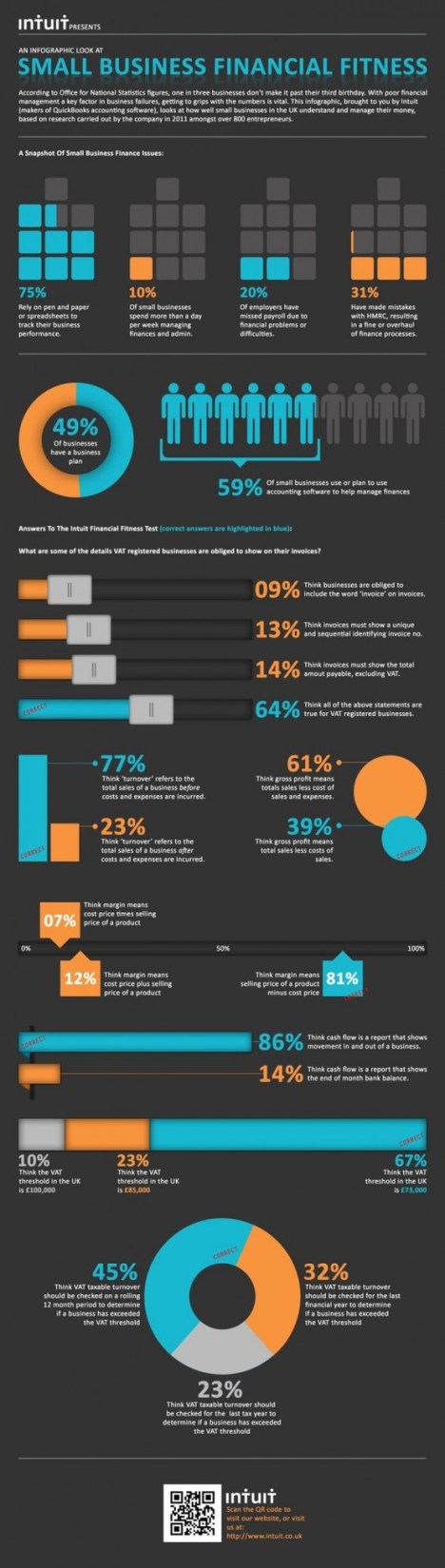
Benchmarking Small Business Financial Fitness

Join Our Mailing List

A Small Business Snapshot

Small Biz Finances

Source: Intuit

Assessment

Conclusion

Your thoughts and comments on this ME-P are appreciated. Feel free to review our top-left column, and top-right sidebar materials, links, URLs and related websites, too. Then, subscribe to the ME-P. It is fast, free and secure.

Link: http://feeds.feedburner.com/HealthcareFinancialsthePostForcxos

Speaker: If you need a moderator or speaker for an upcoming event, Dr. David E. Marcinko; MBA – Publisher-in-Chief of the Medical Executive-Post – is available for seminar or speaking engagements. Contact: MarcinkoAdvisors@msn.com

Our Other Print Books and Related Information Sources:

Health Dictionary Series: http://www.springerpub.com/Search/marcinko

Practice Management: http://www.springerpub.com/product/9780826105752

Physician Financial Planning: http://www.jbpub.com/catalog/0763745790

Medical Risk Management: http://www.jbpub.com/catalog/9780763733421

Hospitals: http://www.crcpress.com/product/isbn/9781439879900

Physician Advisors: www.CertifiedMedicalPlanner.org

Product Details  Product Details

Product Details

Understanding Modern Healthcare Market Competition

Join Our Mailing List

Updating Competitive Strategy Theory in Healthcare

By Robert James Cimasi; MHA ASA FRICs MCBA AVA CM&AA
By Todd A. Zigrang; MBA MHA ASA FACHE
By Anne P. Sharamitaro; Esq.

www.HealthCapital.com

Michael Porter[i] is considered by many to be one of the world’s leading authorities on competitive strategy and international competitiveness.  In 1980, he published Competitive Strategy: Techniques for Analyzing Industries and Competitors,[ii] in which he argues that all businesses must respond to five competitive forces.

(1) The Threat of New Market Entrants

This force may be defined as the risk of a similar company entering the marketplace and winning business.  There are many barriers to entry of new market entrants in healthcare including: the high cost of equipment, licensure, requirement for physicians and other highly trained technicians, development of physician referral networks and provider contracts, and other significant regulatory requirements.

Certificate of Need (CON) laws, which require governmental approval for new healthcare facilities, equipment, and services have been in place since they were federally mandated in 1974.  State CON laws create a regulatory barrier to entry.  New medical provider entrants commonly face substantial political opposition by established interests, which is manifested in the CON review process.

(2) The Bargaining Power of Suppliers

A supplier can be defined as any business relationship upon which a business relies to deliver a product, service, or outcome.  Healthcare equipment is a highly technical product produced by a limited number of manufacturers. This reduces the range of choices for providers and can increase costs.

(3) Threats from Substitute Products or Services

Substitute products or services are those that are sufficiently equivalent in function or utility to offer consumers an alternate choice of product or service.  An illustration of this in healthcare would be diagnostic imaging as a substitute for surgery, which is often a more costly and risky option for patients. The threat of less invasive or less expensive diagnostic tests other than diagnostic imaging is relatively small for the near term future.

(4) The Bargaining Power of Buyers

This force is the degree of negotiating leverage of an industry’s buyers or customers.  The buyers of healthcare services are ultimately the patients. However, the competitive force of buyers is manifested through healthcare insurers including the U.S. and state governments through the Medicare, Medicaid, TRICARE, and other programs; managed care payors (e.g., Blue Cross/Blue Shield affiliates); workers’ compensation insurers; and, others.  In addition to the government, many of these healthcare insurers are large, national companies, often publicly traded, commanding significant bargaining power over healthcare provider reimbursement.

(5) Rivalry Amongst Existing Firms

This is ongoing competition between existing firms without consideration of the other competitive forces which define industries. Healthcare providers face pressure from other existing providers to obtain favorable provider contracts; maintain the latest technology; increase efficiencies; and, lower prices.

References:

[i]  A professor of Business Administration at the Harvard Business School, Michael Porter serves as an advisor to heads of state, governors, mayors, and CEOs throughout the world.  The recipient of the Wells Prize in Economics, the Adam Smith Award, three McKinsey Awards, and honorary doctorates from the Stockholm School of Economics and six other universities, Porter is the author of fourteen books, among them Competitive Advantage, The Competitive Advantage of Nations, and Cases in Competitive Strategy.

[ii]  Porter, M.E. Competitive Strategy: Techniques for Analyzing Industries and Competitors. The Free Press, 1980.

Conclusion

Your thoughts and comments on this ME-P are appreciated. Feel free to review our top-left column, and top-right sidebar materials, links, URLs and related websites, too. Then, subscribe to the ME-P. It is fast, free and secure.

Link: http://feeds.feedburner.com/HealthcareFinancialsthePostForcxos

Speaker: If you need a moderator or speaker for an upcoming event, Dr. David E. Marcinko; MBA – Publisher-in-Chief of the Medical Executive-Post – is available for seminar or speaking engagements. Contact: MarcinkoAdvisors@msn.com

OUR OTHER PRINT BOOKS AND RELATED INFORMATION SOURCES:

DICTIONARIES: http://www.springerpub.com/Search/marcinko
PHYSICIANS: www.MedicalBusinessAdvisors.com
PRACTICES: www.BusinessofMedicalPractice.com
HOSPITALS: http://www.crcpress.com/product/isbn/9781466558731
CLINICS: http://www.crcpress.com/product/isbn/9781439879900
ADVISORS: www.CertifiedMedicalPlanner.org
PODIATRISTS: www.PodiatryPrep.com
BLOG: www.MedicalExecutivePost.com
FINANCE: Financial Planning for Physicians and Advisors
INSURANCE: Risk Management and Insurance Strategies for Physicians and Advisors


Our Newest Textbook Release

Buy from Amazon

Learn How to Profit and Thrive in the PP-ACA Era

BOOK FOREWORD / TESTIMONIAL

Medical Practice and Health 2.0 Risk Management is Now a Part of Financial Planning for Doctors

Join Our Mailing List

Ann Miller RN MHA [Executive-Director]

http://www.CertifiedMedicalPlanner.org

About Us

Our ME-P Editor, Dr. David Edward Marcinko MBA CMP™, is a nationally recognized healthcare financial and business advisor to physicians, clinics, hospitals and medical practices. Based in Atlanta Georgia, as a Certified Medical Planner™, Dr. Marcinko leads the industry delivering expert financial and managerial advice to all healthcare entities and stakeholders regarding managed care contracting, operations, strategic planning, revenue growth, health 2.0 business modeling and physician litigation support.

Dr. Marcinko is a sought-after author and speaker with three-decades of expert healthcare consulting experience. He has authored hundreds of healthcare business, finance, economics and management articles and dozens of text books. He is a chosen speaker among prominent national healthcare groups and financial services associations.

Committed to addressing the needs of each client, Dr. Marcinko and the iMBA Inc team takes great pride in personally leading every consulting team that produces effective response time and measurable results for satisfied colleagues and corporate clients www.MedicalBusinessAdvisors.com 

Product Details  Product Details

Educational Inititatives

That’s why the R&D efforts of our governing board of physician-directors, accountants, financial advisors, academics and health economists identified the need for integrated personal financial planning and medical practice management as an effective first step in the survival and wealth building life-cycle for physicians, nurses, healthcare executives, administrators and all medical professionals.

Now – more than ever – desperate doctors of all ages are turning to knowledge able financial advisors and medical management consultants for help. Symbiotically too, generalist advisors are finding that the mutual need for extreme niche synergy is obvious.

But, there was no established curriculum or educational program; no corpus of knowledge or codifying terms-of-art; no academic gravitas or fiduciary accountability; and certainly no identifying professional designation that demonstrated integrated subject matter expertise for the increasingly unique healthcare focused financial advisory niche … Until Now!

Enter the Certified Medical Planner™ charter professional designation www.CertifiedMedicalPlanner.org

Assessment

And so, for all financial services professionals interested in the fast-moving healthcare advisory space: Medical Practice and Risk Management is Now a Part of Financial Planning for Doctors

Certified Medical Planner

Conclusion

Your thoughts and comments on this ME-P are appreciated. Feel free to review our top-left column, and top-right sidebar materials, links, URLs and related websites, too. Then, subscribe to the ME-P. It is fast, free and secure.

Link: http://feeds.feedburner.com/HealthcareFinancialsthePostForcxos

Speaker: If you need a moderator or speaker for an upcoming event, Dr. David E. Marcinko; MBA – Publisher-in-Chief of the Medical Executive-Post – is available for seminar or speaking engagements. Contact: MarcinkoAdvisors@msn.com

OUR OTHER PRINT BOOKS AND RELATED INFORMATION SOURCES:

DICTIONARIES: http://www.springerpub.com/Search/marcinko
PHYSICIANS: www.MedicalBusinessAdvisors.com
PRACTICES: www.BusinessofMedicalPractice.com
HOSPITALS: http://www.crcpress.com/product/isbn/9781466558731
CLINICS: http://www.crcpress.com/product/isbn/9781439879900
BLOG: www.MedicalExecutivePost.com
FINANCE: Financial Planning for Physicians and Advisors
INSURANCE: Risk Management and Insurance Strategies for Physicians and Advisors

Product Details

More on Patient Centered Medical Homes

Join Our Mailing List

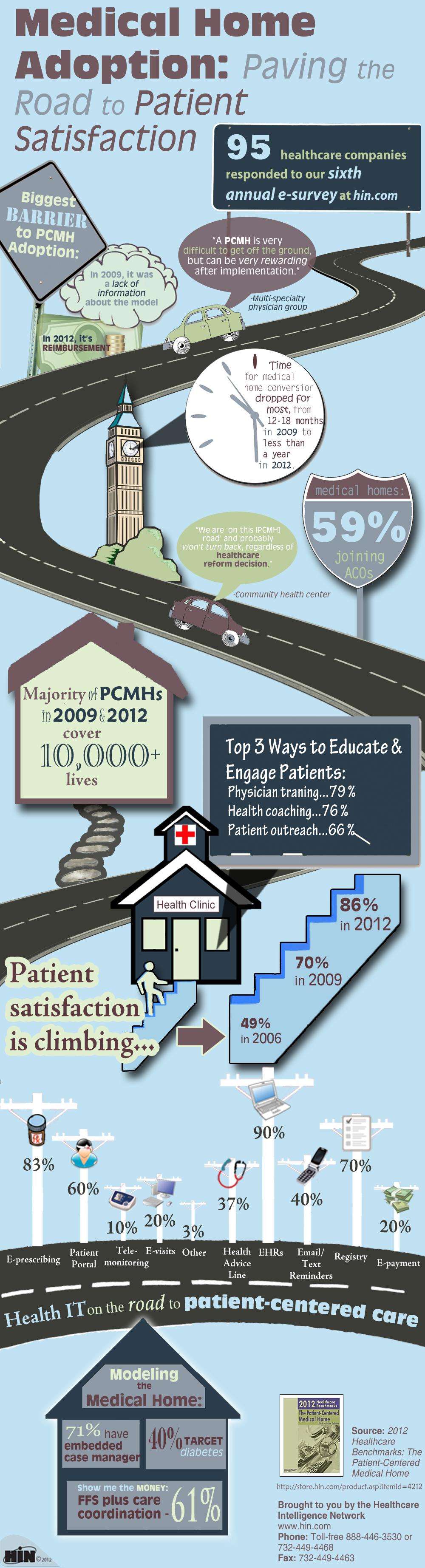
A Road to Patient Satisfaction?

The rise in the medical home concept started over the last six years has been driven by the growing shortage of primary care clinicians and the increase prevalence of chronic diseases.

And, medical home adoption has risen from 49 percent in 2006 to 79 percent in 2009 to 86 percent in 2012, according to 95 healthcare companies who completed the sixth annual Healthcare Intelligence Network survey on Patient Centered Medical Homes (PCMH).

The Survey

When asked in 2006, only 33 percent of respondents were trying to establish a medical home.

However, by 2012, 52 percent have established medical homes for their populations including 59 percent of existing medical homes are now or soon will be part of an accountable care organization (ACO). With the rise of patient centered medical homes, ACOs and other emerging healthcare delivery models, healthcare organizations will need to engage patients in ways that increase quality, reduce cost and improve their overall healthcare experience.

Assessment

Healthcare Intelligence Network also created the infographic shown below to accompany the survey highlighting following key areas in medical home adoption from 2006 to 2012:

  • Top three ways to educate and engage patients in the medical home
  • Barriers to patient centered medical home adoption
  • Time for medical home conversion
  • Climbing of patient satisfaction rates
  • Top health IT tools adoption

Conclusion

Your thoughts and comments on this ME-P are appreciated. Feel free to review our top-left column, and top-right sidebar materials, links, URLs and related websites, too. Then, subscribe to the ME-P. It is fast, free and secure.

Link: http://feeds.feedburner.com/HealthcareFinancialsthePostForcxos

Speaker: If you need a moderator or speaker for an upcoming event, Dr. David E. Marcinko; MBA – Publisher-in-Chief of the Medical Executive-Post – is available for seminar or speaking engagements. Contact: MarcinkoAdvisors@msn.com

OUR OTHER PRINT BOOKS AND RELATED INFORMATION SOURCES:

     Our Newest Textbook Release

Buy from Amazon

Learn How to Profit and Thrive in the PP-ACA Era

BOOK FOREWORD / TESTIMONIAL

Our Healthcare Referral System is Broken

Join Our Mailing List

About the Management Process

[By Staff Reporters]

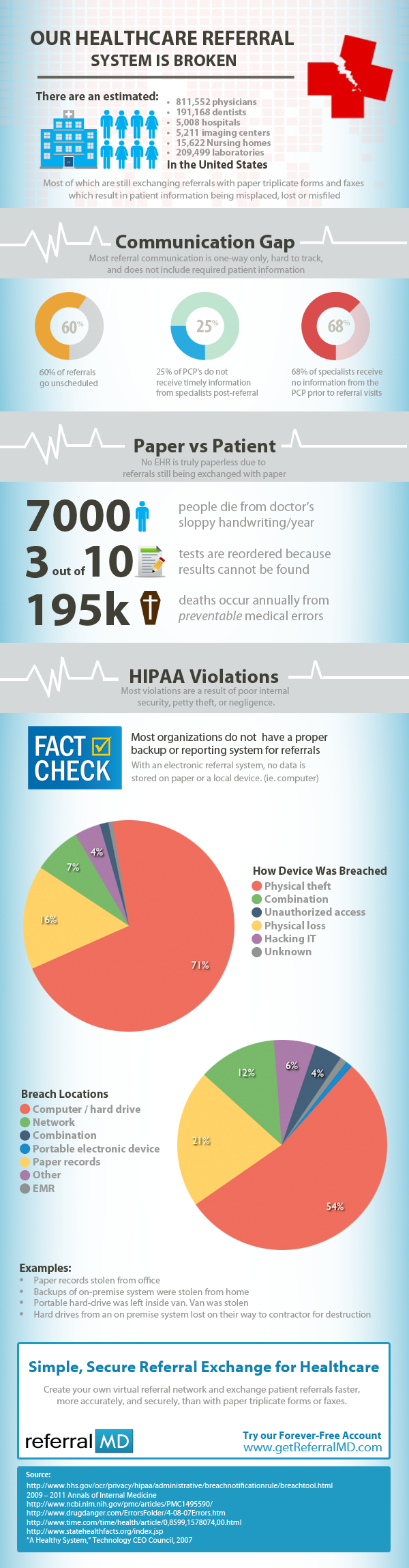
Our healthcare referral system is broken, according to Referral MD. The firm reviews some of the key factors that contribute to this system.

The Paper Trail

The following infographic highlights a key pain point in the healthcare referral system management process that despite healthcare providers adopting an EMR system, they are still utilizing paper.

A large percentage of processes in healthcare involve documents and forms that must be scanned and stored outside their existing EMR system such as records from referring physicians, patient consent forms, patient instructions, insurance authorization, etc.

Assessment

With so much paper still floating around, opportunities for HIPAA violations increase with as high as 86% of mistakes made in the healthcare industry stem from administrative activities.

Conclusion

Your thoughts and comments on this ME-P are appreciated. Feel free to review our top-left column, and top-right sidebar materials, links, URLs and related websites, too. Then, subscribe to the ME-P. It is fast, free and secure.

Speaker: If you need a moderator or speaker for an upcoming event, Dr. David E. Marcinko; MBA – Publisher-in-Chief of the Medical Executive-Post – is available for seminar or speaking engagements. Contact: MarcinkoAdvisors@msn.com

OUR OTHER PRINT BOOKS AND RELATED INFORMATION SOURCES:

Product Details

Our Newest Textbook Release for Healthcare Institutions

    From the ME-P and iMBA Inc

Buy from Amazon

Learn How to Profit and Thrive in the PP-ACA Era

BOOK FOREWORD / TESTIMONIAL

The High Cost of HIPAA Violations

Join Our Mailing List

A Review of Serious Penalties

The Health Insurance Portability and Accountability Act (HIPAA) was instituted in order to protect the personal health information held by covered entities, including doctors, pharmacies and health insurance companies.

The Violations

A HIPAA violation can cost an individual or entity millions of dollars in fines and can even land those responsible in prison.

Assessment

In this HIPAA infographic, we detail some of the most serious penalties ever dished out by the federal government and break down the various fines that are on the table for noncompliance.

Conclusion

Your thoughts and comments on this ME-P are appreciated. Feel free to review our top-left column, and top-right sidebar materials, links, URLs and related websites, too. Then, subscribe to the ME-P. It is fast, free and secure.

Link: http://feeds.feedburner.com/HealthcareFinancialsthePostForcxos

Speaker: If you need a moderator or speaker for an upcoming event, Dr. David E. Marcinko; MBA – Publisher-in-Chief of the Medical Executive-Post – is available for seminar or speaking engagements. Contact: MarcinkoAdvisors@msn.com

Our Other Print Books and Related Information Sources:

Health Dictionary Series: http://www.springerpub.com/Search/marcinko

Practice Management: http://www.springerpub.com/product/9780826105752

Physician Financial Planning: http://www.jbpub.com/catalog/0763745790

Medical Risk Management: http://www.jbpub.com/catalog/9780763733421

Hospitals: http://www.crcpress.com/product/isbn/9781439879900

Physician Advisors: www.CertifiedMedicalPlanner.org

Product Details

How Hospital Billing Impacts the Patient Experience

Join Our Mailing List

It’s About … the Invoice

By Staff Reporters

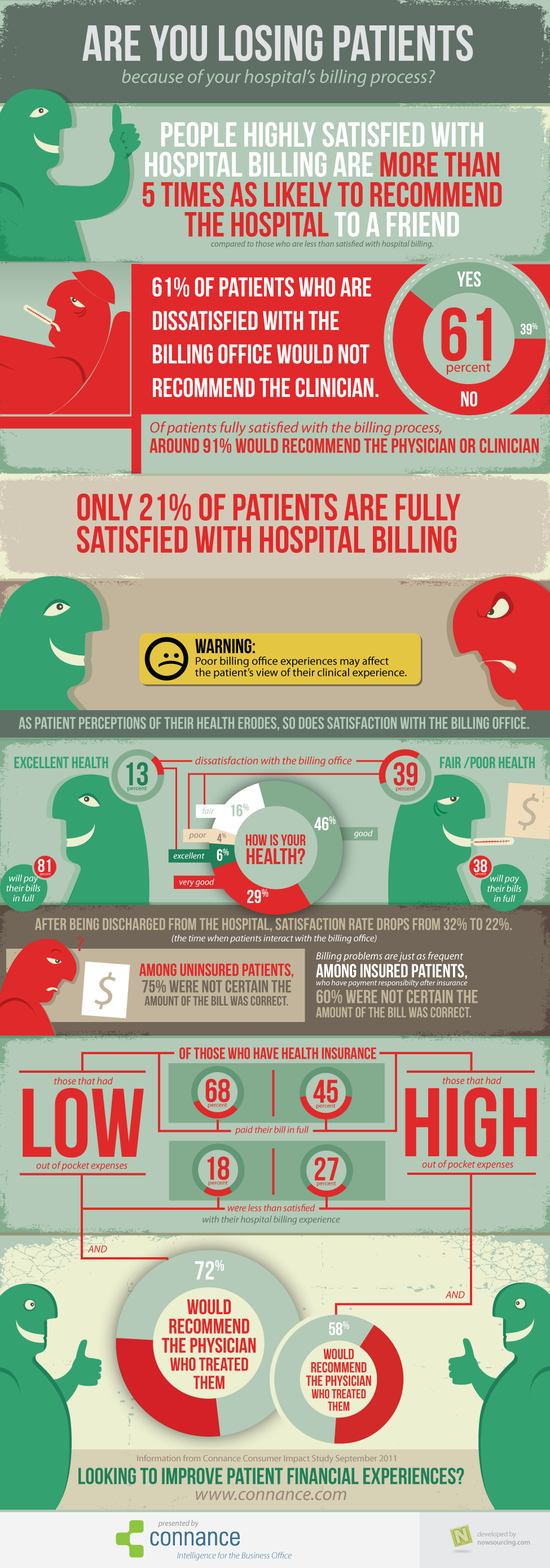
Here, Connance visually shows how hospital billing process is directly correlated to the patient experience.

Assessment

Patients who encounter problems with their physician’s billing office are less likely to recommend that physician/clinician to others.

www.BusinessofMedicalPractice.com

Conclusion

Your thoughts and comments on this ME-P are appreciated. Feel free to review our top-left column, and top-right sidebar materials, links, URLs and related websites, too. Then, subscribe to the ME-P. It is fast, free and secure.

Link: http://feeds.feedburner.com/HealthcareFinancialsthePostForcxos

Speaker: If you need a moderator or speaker for an upcoming event, Dr. David E. Marcinko; MBA – Publisher-in-Chief of the Medical Executive-Post – is available for seminar or speaking engagements. Contact: MarcinkoAdvisors@msn.com

Our Other Print Books and Related Information Sources:

Health Dictionary Series: http://www.springerpub.com/Search/marcinko

Practice Management: http://www.springerpub.com/product/9780826105752

Physician Financial Planning: http://www.jbpub.com/catalog/0763745790

Medical Risk Management: http://www.jbpub.com/catalog/9780763733421

Hospitals: http://www.crcpress.com/product/isbn/9781439879900

Physician Advisors: www.CertifiedMedicalPlanner.org

Our Newest Textbook Release

Buy from Amazon

Learn How to Profit and Thrive in the PP-ACA Era

BOOK FOREWORD / TESTIMONIAL

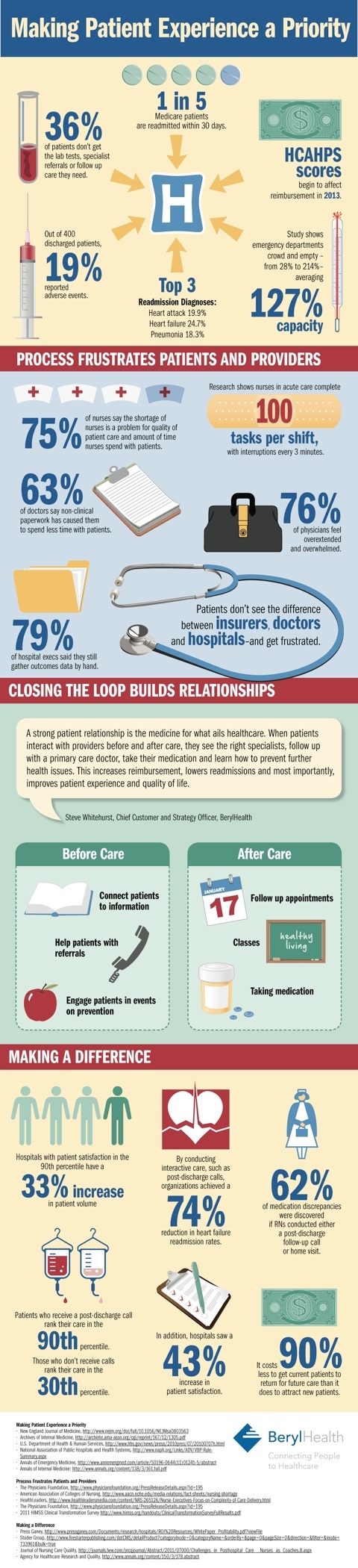
How Physicians Can Make the Patient Experience a Priority

Join Our Mailing List

By Staff Reporters

Connection Makes the Difference – A Collaborative Shift in Bedside Manner?

Healthcare 2.0 is all about connecting. Take your pick: you can communicate via blogs, tweets, IMs, wikis, or social networks. And then, of course, you can opt for just plain old face-to-face dialogue.

The Communication Explosion

According to ME-P experts and Business of Medical Practice textbook contributors Mario Moussa PhD and Jennifer Tomasik MA, on the face of it, the explosion of communication options seems like a very good thing indeed.

www.BusinessofMedicalPractice.com

In the most basic ways, human beings need connection. Without the give and take of social interaction, our health suffers. In extreme situations—in solitary confinement or similar conditions—the brain almost completely shuts down.

What We Can Learn from Terry Anderson

The journalist Terry Anderson was held hostage in Lebanon from 1985 to 1992, enduring months at a time of almost complete isolation. In his memoir Den of Lions, Anderson described the catastrophic result: “The mind is a blank…. Where are all the things I learned, the books I read, the poems I memorized? There’s nothing there, just a formless, gray-black misery. My mind’s gone dead.”

The Link Between Social Connection and Good Health

On the positive side, studies have established a link between social connection and good health. (Even contact with people you dislike is better than having no contact at all). The same goes for the relationship between doctor and patient: data show that when the relationship is satisfying, it has tangible health benefits.

For example, when patients have a positive emotional connection with their doctors, they remember a higher percentage of care-related information and even experience significantly better physiological outcomes.

The Conversation

And the way doctors converse with patients—apart from the actual content of the conversations—has an equally powerful effect:

Do you want your patient’s nagging headaches to go away?

Discuss their expectations and feelings, in addition to the neurological facts. This is much more effective than sticking to the facts alone, since a strong psychological bond is strong medicine.

Do you want your medical advice to be followed?

Draw your patient into conversations about treatment. The research shows that engagement makes a difference.

Assessment

Is there an analogy here for financial advisors and medical management consultants?

Conclusion

Your thoughts and comments on this ME-P are appreciated. Feel free to review our top-left column, and top-right sidebar materials, links, URLs and related websites, too. Then, subscribe to the ME-P. It is fast, free and secure.

Speaker: If you need a moderator or speaker for an upcoming event, Dr. David E. Marcinko; MBA – Publisher-in-Chief of the Medical Executive-Post – is available for seminar or speaking engagements. Contact: MarcinkoAdvisors@msn.com

OUR OTHER PRINT BOOKS AND RELATED INFORMATION SOURCES:

Product Details

Product DetailsProduct Details

About the Certified Medical Planner™ Program

Certified Medical Planner

ADVERTISEMENT

The Virtual Certified Medical Planner™ Program, from iMBA Inc.

Our flagship 500 hour Certified Medical Planner™ professional designation program is designed for fiduciary focused FAs, CFPs®, CPAs, RIAs and other financial services professionals and/or doctors, nurses, health entity CXOs, managers and administrators [medical management consultants] and those in career transition looking to enhance their theoretical knowledge and practical experience in the integrated and expanding fields of medical practice management and personal financial planning.

In all our courses, we cover the full spectrum for any given topic.  Best of all, we utilize real-life case studies from the marketplace, either as a financial advisor or medical management consultant, so students can actively participate in a mock “working financial advisory group” or “medical managerial team”.

And, our unique CMP™ teaching methodology uses “live” dedicated instructors to help [adult-learners] students understand how to fully integrate quantitative and qualitative analysis when advising clients.

We offer 24/7/365 classes designed for working professionals with a heavy workload or travel schedule. In addition, our courses can be taken without ever having to leave your desk, home, office, practice, or even your hotel room.

Our training program is internet based so most of our students take the course virtually. Nevertheless, while our service delivery model is virtual – the educational benefits and notoriety you receive are REAL!

More info:

Ann Miller RN MHA

[Executive-Director]

www.CertifiedMedicalPlanner.org

###

Product DetailsProduct DetailsProduct Details

Product Details  Product Details

Product DetailsProduct Details

Product Details

Making Medical Content Actionable

The Importance of Rules

(http://ow.ly/d3D2D)

By Jacqueline Mitus, MD, Senior Vice President, Product Strategy; Steve Silverstein, MD, FACEP, Vice President, Chief Clinical Architect; and Matthew Zubiller, Vice President, Decision Management, McKesson Health Solutions

Join Our Mailing List 

Clear, consistent and reproducible rules logic is at the core of translating information into actionable content. In other words, rules make content more intelligent by tying disparate pieces of information together — for example, heart failure codes and care guidelines — so that a conclusion can be drawn, a recommendation can be made or an action can occur. In so doing, the content becomes meaningful and can drive the right, timely intervention or behavior. 

Value Driven

Rules do not have to be complex to drive value. A very simple rule can be very actionable: for example, an automated reminder to both member and physician about annual mammograms.

Simple or complex, transforming clinical content into reproducible, actionable rules is a highly precise endeavor. Consider how nuance and meaning can be lost in any translation and the time and effort that can be spent debating an author’s original intent. In healthcare, the stakes are significantly higher in “getting it right,” and shades of gray in meaning can affect the intended outcome.

For example, concepts such as “worsening,” “severe” and “over time” are common parameters that need specific definition to become actionable and measurable.

“Rules” for a good rule:

  • Is complete, meaning that it has fully considered all the cases relevant to that circumstance
  • Similarly understands all the exceptions that can still allow a case to meet the rule
  • Considers elements such as timing and time spans, number of activities required before the rule comes into action, inclusions and exclusions
  • Is as transparent as possible to support a clear relationship between the input of data and the generation of recommendations
  • Is specific and unambiguous

Assessment

To learn more, download the full white paper on Actionable Content: A Framework for Better Decision-Making.

###

Learn more about McKesson Health Solutions at:http://www.mckesson.com/en_us/McKesson.com/Our+Businesses/McKesson+Health+Solutions/McKesson+Health+Solutions.html.

Conclusion

Your thoughts and comments on this ME-P are appreciated. Feel free to review our top-left column, and top-right sidebar materials, links, URLs and related websites, too. Then, subscribe to the ME-P. It is fast, free and secure.

Link: http://feeds.feedburner.com/HealthcareFinancialsthePostForcxos

Speaker: If you need a moderator or speaker for an upcoming event, Dr. David E. Marcinko; MBA – Publisher-in-Chief of the Medical Executive-Post – is available for seminar or speaking engagements. Contact: MarcinkoAdvisors@msn.com

Our Other Print Books and Related Information Sources:

Health Dictionary Series: http://www.springerpub.com/Search/marcinko

Practice Management: http://www.springerpub.com/product/9780826105752

Physician Financial Planning: http://www.jbpub.com/catalog/0763745790

Medical Risk Management: http://www.jbpub.com/catalog/9780763733421

Hospitals: http://www.crcpress.com/product/isbn/9781439879900

Physician Advisors: www.CertifiedMedicalPlanner.org

Product Details

Medical Office Fee Strategies for Disgruntled Patients

Join Our Mailing List

Adroitly Handling a Tough but Common Office Situation

[By Dr. Gary L. Bode MSA CPA]

A common scenario, in medical practice, is patient disgruntlement over professional fees.

The Scenario

This scenario should not occur in front of other patients. Many receptionists find that genuine, cute little quips like, “I know it seems high, but (wink), I’m expensive to maintain,” defuse the situation by gentling pointing out the overhead factor.

The Balk

When a patient balks at fees, gently and politely imply that we could inquire if the local plumber was available to do the exam, procedure or surgery.

Assessment

This brings training and relative cost issues into play while making them smile.  Costs are high, but justifiable.

More:

Conclusion

Your thoughts and comments on this ME-P are appreciated. Feel free to review our top-left column, and top-right sidebar materials, links, URLs and related websites, too. Then, subscribe to the ME-P. It is fast, free and secure.

Link: http://feeds.feedburner.com/HealthcareFinancialsthePostForcxos

Speaker: If you need a moderator or speaker for an upcoming event, Dr. David E. Marcinko; MBA – Publisher-in-Chief of the Medical Executive-Post – is available for seminar or speaking engagements. Contact: MarcinkoAdvisors@msn.com

OUR OTHER PRINT BOOKS AND RELATED INFORMATION SOURCES:

Product Details

Healthcare Job Expenses Can be Tax Deductible

Join Our Mailing List

Appreciating the Medical Academic Calendar

By Andrew D. Schwartz, CPA

Many healthcare professionals work based on the Academic Calendar. That means that a lot of Doctors switch jobs over the summer. According to our friends at the IRS in their IRS Summertime Tax Tip 2012-06:

Summertime is the season that often leads to major life decisions, such as buying a home, moving or a job change. If you are looking for a new job that is in the same line of work, you may be able to deduct some of your job hunting expenses on your federal income tax return.

The Seven Tips

Here are seven things the IRS wants you to know about deducting costs related to your job search:

  1. To qualify for a deduction, your expenses must be spent on a job search in your current occupation. You may not deduct expenses you incur while looking for a job in a new occupation.
  2. You can deduct employment and outplacement agency fees you pay while looking for a job in your present occupation. If your employer pays you back in a later year for employment agency fees, you must include the amount you received in your gross income, up to the amount of your tax benefit in the earlier year.
  3. You can deduct amounts you spend for preparing and mailing copies of your résumé to prospective employers as long as you are looking for a new job in your present occupation.
  4. If you travel to look for a new job in your present occupation, you may be able to deduct travel expenses to and from the area to which you travelled. You can only deduct the travel expenses if the trip is primarily to look for a new job. The amount of time you spend on personal activity unrelated to your job search compared to the amount of time you spend looking for work is important in determining whether the trip is primarily personal or is primarily to look for a new job.
  5. You cannot deduct your job search expenses if there was a substantial break between the end of your last job and the time you begin looking for a new one.
  6. You cannot deduct job search expenses if you are looking for a job for the first time.
  7. In order to be deductible, the amount that you spend for job search expenses, combined with other miscellaneous expenses, must exceed a certain threshold. To determine your deduction, use Schedule A, Itemized Deductions. Job search expenses are claimed as a miscellaneous itemized deduction. The amount of your miscellaneous deduction that exceeds two percent of your adjusted gross income is deductible.

Assessment

  • For more information about job search expenses, see IRS Publication 529, Miscellaneous Deductions. This publication is available on www.IRS.gov or by calling 800-TAX-FORM (800-829-3676).

Links:

  • Schedule A, Itemized Deductions ( PDF)
  • Publication 529, Miscellaneous Deductions ( PDF)

Conclusion

Your thoughts and comments on this ME-P are appreciated. Feel free to review our top-left column, and top-right sidebar materials, links, URLs and related websites, too. Then, subscribe to the ME-P. It is fast, free and secure.

Link: http://feeds.feedburner.com/HealthcareFinancialsthePostForcxos

Speaker: If you need a moderator or speaker for an upcoming event, Dr. David E. Marcinko; MBA – Publisher-in-Chief of the Medical Executive-Post – is available for seminar or speaking engagements. Contact: MarcinkoAdvisors@msn.com

OUR OTHER PRINT BOOKS AND RELATED INFORMATION SOURCES:

DICTIONARIES: http://www.springerpub.com/Search/marcinko
PHYSICIANS: www.MedicalBusinessAdvisors.com
PRACTICES: www.BusinessofMedicalPractice.com
HOSPITALS: http://www.crcpress.com/product/isbn/9781466558731
CLINICS: http://www.crcpress.com/product/isbn/9781439879900
BLOG: www.MedicalExecutivePost.com
FINANCE: Financial Planning for Physicians and Advisors
INSURANCE: Risk Management and Insurance Strategies for Physicians and Advisors

Product DetailsProduct DetailsProduct Details

Product Details  Product Details

Product Details

Succeed with the “Business of Medical Practice” Textbook

ADVERTISEMENT

[Transformational Health 2.0 Skills for Doctors]

By Ann Miller RN, MHA

www.BusinessofMedicalPractice.com

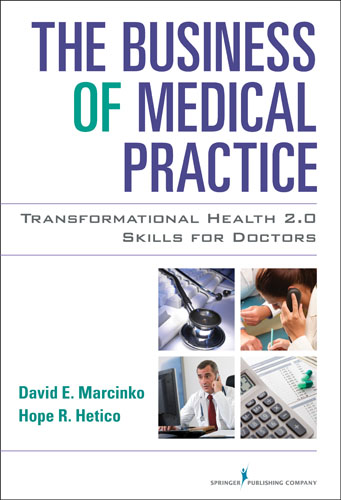
December 23rd, 2011 – The Institute of Medical Business Advisors [iMBA] Inc, in Atlanta, GA www.MedicalBusinessAdvisors.com and Springer Publishing Company of New York, just released the third edition of “The Business of Medical Practice” [Transformational Health 2.0 Skills for Doctors] edited by iMBA founder Dr. David Edward Marcinko MBA, CMP™ and President Hope Rachel Hetico RN, MHA, CPHQ, CMP™

Internal Contents

The 37 chapter, 750 page hard-cover textbook provides a comprehensive resource for those physicians, medical professionals, practice managers, nurse executives, health care administrators and graduate students seeking working knowledge on running a private facility or medical clinic.

Three Major Sections

The BoMP is comprised of three enterprise-wide sections: [1] Qualitative Office Operations, [2] Quantitative Aspects of Medical Practice and [3] Health Policies, Ethics and Leadership. Topics like ARRA, HITECH, ACA and the social networking aspects and ramifications of health 2.0 connectivity for all stakeholders are included for modernity.

Tools and Templates

Tools used throughout the book help readers reference and retain complex information. These tools include:

  • Sidebars. Key terms, key concepts, key sources, associations, and factoids all serve to enhance and reinforce the core takeaways from each chapter.
  • Tables. Tables are used to display and reference benchmark data, draw comparisons, and illustrate industry data trends.
  • Figures. Graphical depictions of concepts help you comprehend the material.
  • Charts. Charts allow easily referenced standard industry taxonomies alongside comparisons of related topics.

Assessment

For a further description of the Business of Medical Practice, with online “live’ community, please click: www.BusinessofMedicalPractice.com

To order directly: http://www.springerpub.com/product/9780826105752 

Conclusion

Your thoughts and comments on this ME-P are appreciated. Feel free to review our top-left column, and top-right sidebar materials, links, URLs and related websites, too. Then, subscribe to the ME-P. It is fast, free and secure.

Link: http://feeds.feedburner.com/HealthcareFinancialsthePostForcxos

Speaker: If you need a moderator or speaker for an upcoming event, Dr. David E. Marcinko; MBA – Publisher-in-Chief of the Medical Executive-Post – is available for seminar or speaking engagements. Contact: MarcinkoAdvisors@msn.com

OUR OTHER PRINT BOOKS AND RELATED INFORMATION SOURCES:

DICTIONARIES: http://www.springerpub.com/Search/marcinko
PHYSICIANS: www.MedicalBusinessAdvisors.com
PRACTICES: www.BusinessofMedicalPractice.com
HOSPITALS: http://www.crcpress.com/product/isbn/9781466558731
CLINICS: http://www.crcpress.com/product/isbn/9781439879900
BLOG: www.MedicalExecutivePost.com
FINANCE: Financial Planning for Physicians and Advisors
INSURANCE: Risk Management and Insurance Strategies for Physicians and Advisors

Product Details

Product DetailsProduct DetailsProduct Details

Doctors and Financial Advisors “Working 9 to 5”

Join Our Mailing List

What an “Old” Way to Make a Living

[Challenging the Current Business Process Model and Scheduling Paradigm]

By Dr. David Edward Marcinko FACFAS MBA CMP™

[Editor-in-Chief]

First off – my apologies to Dolly Parton for bastardizing the title of her song

My dad worked for General Motors; the 11-PM to 7-AM shift to be precise. The company ran 3 shifts [8hr. X 3da. = 24 hrs / day / 7 days / week]. He was always home during the day for his children. In fact, it seemed as though he never slept. My mom worked the 9-AM to 5-PM  shift / 5 days / week as a banker. What a great arrangement; loving parental child care 24/7/365.

Then, after my own medical school, internship, residency training, fellowship, clinical practice and business school, I often wondered why corporate America and her white collar workers used the 9-5 work day paradigm and not the traditional blue collar 3 shift [24/7/375] manufacturing model – like  GM?

Working

With a 24/7/365 work day schedule [3 shifts/day], fixed office costs would remain the same, while variable costs would increase slightly but be compensated for by increased revenues, less HR stress, fewer utilities and reduced private and public infra-structure maintenance, etc [old styled B-school pedagogy]. This would increase operating capacity and output [patient/client output, CPT® codes, hourly fees, AUMs, etc]. You know – real top line revenue and bottom line profits. And, that’s a good thing for business and commerce.

But, is this 3 shift model applicable to the healthcare industrial complex and the financial services industry? If not – why not? And, I mean real work – examining and treating patients and interviewing clients – not automatic websites or interactive blogs, etc. Doctors, consultants and FAs actually interacting with real folks; not avatars!

An Old but Novel Idea?

As a medical business process consultant, my simple idea is more than two decades old. Yet, it remains largely untested and still considered novel … Perhaps until now! Offering extended hours is one way that physicians – can position themselves for the changes coming in the new healthcare era. How else will we accomodate 34 million new Medicaid insured patients.

In fact, so should financial advisors and medical management consultants. Shoot, why can’t most professionals use this model. Why be constrained to person, place and time [3-Dimensions]?

The Decision

This decision, however, should not be taken lightly and should be evaluated both from a provider, patient, civics, cultural and business standpoint. So, please read this essay for an elegant description of this model.

Then, our ME-P text books can be used to go granular into the nitty-gritty details; with real-life tools, templates, case models and checklists, etc.

Assessment

Link: Ready to offer extended patient hours?

Link: New Medical Practice Entrepreneurial Business Rules for Young Physicians [circa 2012]

Conclusion

Your thoughts and comments on this ME-P are appreciated. Colleagues – when not if – are you going 24/5 … or 6 … or 7?

Feel free to review our top-left column, and top-right sidebar materials, links, URLs and related websites, too. Then, subscribe to the ME-P. It is fast, free and secure.

Link: http://feeds.feedburner.com/HealthcareFinancialsthePostForcxos

Speaker: If you need a moderator or speaker for an upcoming event, Dr. David E. Marcinko; MBA – Publisher-in-Chief of the Medical Executive-Post – is available for seminar or speaking engagements. Contact: MarcinkoAdvisors@msn.com

Our Other Print Books and Related Information Sources:

Health Dictionary Series: http://www.springerpub.com/Search/marcinko

Practice Management: http://www.springerpub.com/product/9780826105752

Physician Financial Planning: http://www.jbpub.com/catalog/0763745790

Medical Risk Management: http://www.jbpub.com/catalog/9780763733421

Hospitals: http://www.crcpress.com/product/isbn/9781439879900

Physician Advisors: www.CertifiedMedicalPlanner.org

Product DetailsProduct Details

How Do We Improve Collaboration between Physicians and Hospital Administrators?

Join Our Mailing List

An Opinion Poll for Doctors, FAs and Patients

By Jennifer Tomasik MS [Principal: www.CFAR.com]

“It is the long history of humankind (and animal kind, too) those who learned to collaborate and improvise most effectively have prevailed.”

– Charles Darwin

Beyond institutional mergers and joint ventures, collaboration in healthcare is being driven by other factors; there is a need to move from a healthcare system driven by volume and characterized by fragmentation, waste, high cost, and inconsistent quality to a system where care is coordinated, costs are lower, and quality is higher.

Merger Mania

Merger mania in the 1990’s was driven by similar concerns, including the fear of for-profit competition and the rise of managed care. The results of this earlier round of mergers were unexpected. The 1990s ‘consolidation fever’ raised hospital prices by at least 5%, and did not measurably improve quality.[i] Hospitals purchased physician practices without a great deal of thought about expectations and mutual accountability, and many of those relationships failed—usually with significant financial implications.

Of Savvy Healthcare Leaders

Fearful of history repeating itself, savvy healthcare leaders are thinking differently about how to develop the collaborative relationships they need to succeed today. They see Accountable Care Organizations [ACOs] and Global Payments—where institutions will take on greater risk for the cost and quality of the services a patient requires—as an opportunity to get clear about how they can best position themselves across the full continuum of care. They believe potentials gains are not likely to show up simply as a result of mergers and acquisitions or consolidation per se. Rather than just integrating the bottom lines of their institutions, they are focused on ensuring that those individuals and teams who actually care for patients can productively collaborate with each other, and that they understand the clear and compelling rationale for why that collaboration is necessary.

Nowhere is this relationship more important than between hospital administrators and the medical staff.

What is “Collaboration” Anyway?

Merriam-Webster defines collaboration as “to work jointly with others or together especially in an intellectual endeavor.” While true, we find this definition insufficient for our purposes. Our colleagues at The Rhythm of Business, a consulting firm focused exclusively on collaboration, provide a more productive way to think about collaboration:

“Collaboration is a purposeful, strategic way of working that leverages the resources of each party for the benefit of all by coordinating activities and communicating information within an environment of trust and transparency.”

We add to this definition one additional, yet critical dimension. Collaboration also means working with, and through, differences. Any highly functioning team will, by its very nature, have differences – team members are ideally bringing innovative ideas that compete for “idea space” at the table.

Effective collaboration requires that teams not only value differences, but in fact encourage them to be surfaced. Viewed in this way, collaboration is not an event or an idea. It’s not “agreeing to get along.” Effective collaboration is an ongoing, systematic, strategic process. It is also, we believe, a business imperative – and nowhere more so than in healthcare.

Assessment

Given the often difficult nature of relationships between hospital administrators and medical staff, how do you improve collaboration to increase productivity and performance?


NOTE: [i] Vogt, William B and Robert Town. “How has hospital consolidation affected the price and quality of hospital care?” Robert Wood Johnson Foundation: Policy Brief No. 9. 2006.

Conclusion

And so, how do we improve collaboration between Physicians and Hospital Administrators?

Your thoughts and comments on this ME-P are appreciated. Feel free to review our top-left column, and top-right sidebar materials, links, URLs and related websites, too. Then, subscribe to the ME-P. It is fast, free and secure.

Link: http://feeds.feedburner.com/HealthcareFinancialsthePostForcxos

About the Author

Jennifer Tomasik, Principal,  leads CFAR’s Health and Hospital Systems practice. She works with her clients to solve complex strategic and organizational challenges. Her approach to consulting emphasizes communication and collaboration, supported by a blend of quantitative and qualitative analytics. Jennifer has worked in the health care sector for nearly 15 years, with expertise in public health, clinical quality measurement, strategic management, and organizational change. Her clients include some of the most prestigious hospitals, health systems and academic medical centers in the country. She has a Master’s in Health Policy and Management from the Harvard School of Public Health.

Speaker: If you need a moderator or speaker for an upcoming event, Dr. David E. Marcinko; MBA – Publisher-in-Chief of the Medical Executive-Post – is available for seminar or speaking engagements. Contact: MarcinkoAdvisors@msn.com

Our Other Print Books and Related Information Sources:

Health Dictionary Series: http://www.springerpub.com/Search/marcinko

Practice Management: http://www.springerpub.com/product/9780826105752

Physician Financial Planning: http://www.jbpub.com/catalog/0763745790

Medical Risk Management: http://www.jbpub.com/catalog/9780763733421

Hospitals: http://www.crcpress.com/product/isbn/9781439879900

Physician Advisors: www.CertifiedMedicalPlanner.org

Buy from Amazon

Promoting the ME-P Holistic Physician Lifestyle

Join Our Mailing List

Enter the Certified Medical Planners™

By Ann Miller RN MHA

[Executive-Director]

Life planning and behavioral finance, as proposed by physicians and financial advisors, and as integrated by the Institute of Medical Business Advisors (iMBA), emanates from a holistic union of personal financial planning and medical practice management solely for the healthcare space.

Source: https://www.mapsforthat.com/map.php?m=587

The CMP™ Difference

Unlike pure life planning, pure financial planning, or pure management theory, it is both a quantitative and qualitative “hard and soft” science. It has an ambitious economic, psychological and managerial niche value proposition never before proposed and codified, while still representing an evolving philosophy. Its’ zealous practitioners are called Certified Medical Planners (CMPs).

Assessment

Health 2.0 focused physician baby boomers & modern Gen-X financial advisors can help transition you successfully through medical practice and life changing financial events by exchanging knowledge, experiences and inspiration with industry professionals and peers in the casual and friendly atmosphere of the ME-P. Join us today.

More: https://medicalexecutivepost.com/2009/10/20/understanding-behavioral-finance/

Conclusion

Your thoughts and comments on this ME-P are appreciated. Feel free to review our top-left column, and top-right sidebar materials, links, URLs and related websites, too. Then, subscribe to the ME-P. It is fast, free and secure.

Speaker: If you need a moderator or speaker for an upcoming event, Dr. David E. Marcinko; MBA – Publisher-in-Chief of the Medical Executive-Post – is available for seminar or speaking engagements. Contact: MarcinkoAdvisors@msn.com

OUR OTHER PRINT BOOKS AND RELATED INFORMATION SOURCES:


Product DetailsProduct DetailsProduct Details

Product Details  Product Details

Product Details

The Marcinko Method of Improving Quality while Reducing Medical Errors and Healthcare Costs

Join Our Mailing List

Dr. David Edward Marcinko FACFAS MBA CMP

[Former – Certified Physician in Healthcare Quality]

[Former – Certified Financial Planner]

www.CertifiedMedicalPlanner.org

[Publisher-in-Chief]

THINK TWICE!

Doctor’s Orders

Life Corollaries:

Marcinko’s Rx for Obesity: Eat less – Exercise more – Avoid noxious lifestyles.

Marcinko’s Rx for Practice Success: Treat sick patients – Be humble – Keep faith.

Marcinko’s Rx for Financial Success: Spend less – Earn more – Be a fiduciary. 

Marcinko’s Rx for Wealth & Happiness: Don’t divorce – Love kids – Practice philanthropy.

Professional Medical Corollary:

The Choosing Wisely® list, which is aimed at cutting down on unnecessary testing by doctors and patients.

Assessment  

I am not an oracle. What else can you ad to the list?

Conclusion

Your thoughts and comments on this ME-P are appreciated. Feel free to review our top-left column, and top-right sidebar materials, links, URLs and related websites, too. Then, subscribe to the ME-P. It is fast, free and secure.

Link: http://feeds.feedburner.com/HealthcareFinancialsthePostForcxos

Speaker: If you need a moderator or speaker for an upcoming event, Dr. David E. Marcinko; MBA – Publisher-in-Chief of the Medical Executive-Post – is available for seminar or speaking engagements. Contact: MarcinkoAdvisors@msn.com

OUR OTHER PRINT BOOKS AND RELATED INFORMATION SOURCES:

DICTIONARIES: http://www.springerpub.com/Search/marcinko
PHYSICIANS: www.MedicalBusinessAdvisors.com
PRACTICES: www.BusinessofMedicalPractice.com
HOSPITALS: http://www.crcpress.com/product/isbn/9781466558731
CLINICS: http://www.crcpress.com/product/isbn/9781439879900
BLOG: www.MedicalExecutivePost.com
FINANCE: Financial Planning for Physicians and Advisors
INSURANCE: Risk Management and Insurance Strategies for Physicians and Advisors

Certified Medical Planner

How a Medical Answering Service Really Works

Join Our Mailing List

The Traditional System

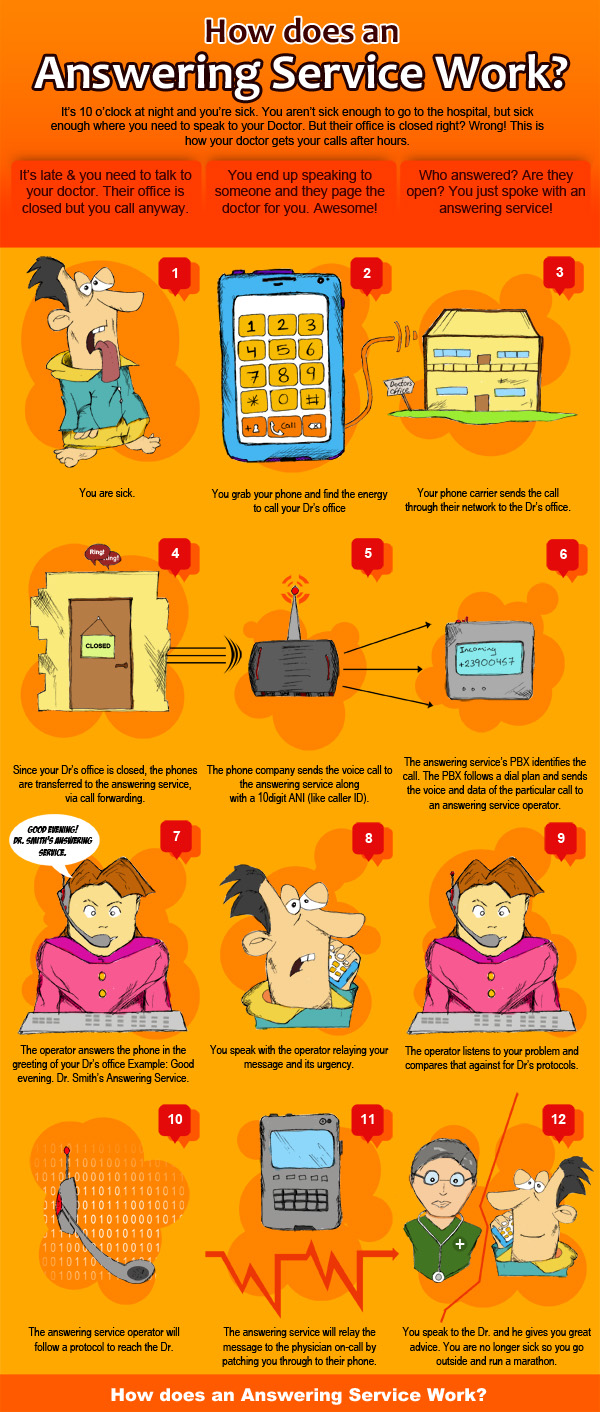
Ever wonder that happens when you call your doctor’s office after hours and someone picks up the phone? The office is not open at midnight if that’s what you were wondering. Most physicians / doctors / medical professionals have their phones forwarded to an answering service after hours!

What does that mean?

Well, it means that no matter what time it is you can always reach your doctor.

Check out the above infographic to learn out how the call routes from your cell phone to the service to the doctor.

Assessment

Now, with all these steps, it is no wonder modern doctors are using cell phones, iPads, direct or open access online patient scheduling systems.

Conclusion

Your thoughts and comments on this ME-P are appreciated. Feel free to review our top-left column, and top-right sidebar materials, links, URLs and related websites, too. Then, subscribe to the ME-P. It is fast, free and secure.

Link: http://feeds.feedburner.com/HealthcareFinancialsthePostForcxos

Speaker: If you need a moderator or speaker for an upcoming event, Dr. David E. Marcinko; MBA – Publisher-in-Chief of the Medical Executive-Post – is available for seminar or speaking engagements. Contact: MarcinkoAdvisors@msn.com

Our Other Print Books and Related Information Sources:

Health Dictionary Series: http://www.springerpub.com/Search/marcinko

Practice Management: http://www.springerpub.com/product/9780826105752

Physician Financial Planning: http://www.jbpub.com/catalog/0763745790

Medical Risk Management: http://www.jbpub.com/catalog/9780763733421

Hospitals: http://www.crcpress.com/product/isbn/9781439879900

Physician Advisors: www.CertifiedMedicalPlanner.org

Product Details

About the Institute of Medical Business Advisors, Inc

Join Our Mailing List

iMBA, Inc

[www.MedicalBusinessAdvisors.com]

Championing the Financial Success of

Doctors and their Consulting Advisors

[Career Development Products and Services]

Comprehensive Financial Planning Strategies for Doctors and Advisors: Best Practices from Leading Consultants and Certified Medical Planners(TM)

Your Personal DR. Invitation: Letterhead.iMBA_Inc.

Transparency Emerges in Dentistry

Join Our Mailing List

Cavities Blamed on Patients

[By D. Kellus Pruitt DDS]

If your car repeatedly requires costly repairs because you never change the oil, would you blame your mechanic?

PBS Frontline

Dentists are justifiably upset because the recent PBS Frontline documentary “Dollars and Dentists” blames them for our nation’s deteriorating oral health.

http://www.pbs.org/wgbh/pages/frontline/dollars-and-dentists/

When in reality, good oral hygiene habits are the very basics of personal accountability – reinforced by painful and embarrassing lessons as needed.

Tradition Dentists Usually Silent

Traditionally, dentists seldom speak up. But at a time when they are finding it difficult to keep their chairs filled, even by discounting their fees, “Dollars and Dentists” struck an inflamed nerve – causing dentists to publicly react in defense of the profession like never before.

As an example, here is Dr. Alan Mead’s blunt response which he posted for his patients to read on his Mead Family Dental website:

“If you have dental problems, it’s mostly your fault. And if you want to have less dental problems, it’s your responsibility. It’s not the fault of the dental insurance company. It’s not the government’s responsibility. It’s on you.”

http://meadfamilydental.com/2012/07/preventable/

Responses

According to other responses, apparently far fewer blameless people are born with “soft teeth” than one might be led to believe by people with lots of cavities. Dentists have politely, but futilely reminded people for decades that it’s refined sugar, bacteria and poor brushing habits that rots teeth.

Assessment

I think the demand for truth in healthcare is going to continue. Over the next few months watch for one or more recognized leaders in the dental profession to actually mention the word “transparency” for the first time since 2008 when an ADA President-elect candidate from California used the word in his campaign platform. He lost. But now that dentists are finally becoming sufficiently annoyed by reporters’ broad accusations of greed and malfeasance, it could be interesting to watch the predictable emergence from obscurity of this perky little healthcare niche – one agitated dentist at a time.

Conclusion

If openness were popular, someone would have long ago told Grandpa his breath smells like death.

Your thoughts and comments on this ME-P are appreciated. Feel free to review our top-left column, and top-right sidebar materials, links, URLs and related websites, too. Then, subscribe to the ME-P. It is fast, free and secure.

Speaker: If you need a moderator or speaker for an upcoming event, Dr. David E. Marcinko; MBA – Publisher-in-Chief of the Medical Executive-Post – is available for seminar or speaking engagements. Contact: MarcinkoAdvisors@msn.com

OUR OTHER PRINT BOOKS AND RELATED INFORMATION SOURCES:


Product Details

A Review of LP / LLC Transfer Hazards for Physicians

Join Our Mailing List

Can standard boilerplate and default corporate law provisions inadvertently disinherit your family from controlling the business or cost millions in additional estate/gift tax?

By Ed Morrow, JD, LL.M. (tax), MBA, CFP®

[Manager, Wealth Strategies Communications, Key Private Bank]

Many physicians use limited liability companies, limited liability partnerships or limited partnerships (“LLCs”, “LLPs” and “LPs”) to operate a trade or business, to hold real estate, or even to hold investment assets.  When only immediate family are owners, these are often referred to as family limited partnerships or limited liability companies (“FLPs” and “FLLCs”).  There are numerous business, asset protection and estate planning reasons for using these entities (hereinafter lumped together for simplicity as “LLCs”).  In many cases, these are preferable to old-fashioned corporations (see separate companion article on LP/LLC Advantages).

As a doctor – you must be very careful, however, when transferring LLC shares during lifetime or at death, to your spouse, children, trusts or others.  Especially when there are co-owners outside the immediate family.  This is due to a stark difference between LLC/partnership law and corporate law and the concept known as “assignee interests”.  Understanding this is even more crucial in 2012 because of the overwhelming demand and interest in transferring LLC interests to irrevocable trusts to exploit the $5.12million gift tax exclusion, which is slated to reduce to only $1 million in 2013.

An LLC owner (called a “member”, not a “stockholder”) has two bundles of rights:

  1. Economic rights – which are the rights to receive property from the LLC both during existence and upon liquidation, along with tax attributes and profit/losses; and
  2. Management rights – the right to vote, participate in management and receive reports and accountings.

It is the latter category that can cause problems when transferring LLC interests by gift or at death.

Members of an LLC usually establish an Operating Agreement to set the rules for transfer of interests.  State statutes (such as the Uniform Limited Liability Company Act) usually provide default rules where the document is silent.

The problem occurs when an LLC member transfers a portion of his or her ownership interest in the LLC to another person, either during lifetime or at death.  At that point, the transferee may become a “mere assignee” of the LLC interest, and not a full “substitute member.”  Under the laws of most states, unless the Operating Agreement provides or parties otherwise agree, an assignee only receives the transferor’s economic rights in the LLC, but not the management rights.

In fact, some court cases require member consent even if the operating agreement seems to otherwise permit such transfers (Ott v. Monroe, 719 S.E.2d 309, 282 Va. 403 (2011).  These state laws were enacted to protect business owners from unwillingly becoming partners with someone they never intended or contracted to be partners with.

This treatment is completely different from transferring C or S corporation stock – when you buy P&G stock, you get the same rights as the previous owner.  S Corporation stock is not even allowed to have differing classes of ownership interests (although voting/non-voting is permitted).  Usually, this quirk in the law has numerous asset protection benefits to LLC owners (discussed in the companion article), but it can cause havoc to one’s business planning in unforeseen circumstances.

Examples of Inadvertent Loss of Control

#1- Doctors Able and Baker, unrelated parties, form and operate an LLC.  Able owns 49% and Baker owns 51%.  Baker has a controlling interest in the LLC.  Baker dies and his 51% interest in the LLC is transferred to his revocable living trust.  Now, the trust is a “mere assignee” and while the trust receives 100% of Baker’s economic rights in the LLC (51% of the total LLC economic rights), it has none of the management rights.  After Baker’s death, Able will have 100% of the LLC’s management rights.  The trustee may have serious difficulty even getting books and records of the LLC, much less have any say on reviewing Able’s business decisions (including new hire and new salary expectations).

#2 – Same ownership structure as above, but Baker leaves assets via Transfer on Death designation or via Will to his spouse, children or others directly.  Same result.

#3 – Same ownership scenario as above, but Baker gifts his membership interests during life to his spouse, children, UTMA account or an irrevocable grantor trust.  Same result.

#3a – Same scenario as above, but Baker simply transfers his shares to his revocable living trust (called “funding”) via Schedule A attached to trust or other assignment.  Same result.

#4 – Same scenario, but Dr. Baker got express permission of Able to transfer his LLC interest to his revocable living trust and have it remain a full substitute member.  No issue – until Baker dies and the LLC interests pass to a new subtrust, such as a bypass, marital, QTIP, or other irrevocable trust, or to beneficiaries outright.  Able must have agreed to this subsequent transfer as well, otherwise the transfer to the new subtrust will be a mere assignee interest and the Baker family loses control.

Creditor Issues

Again, Able and Baker own 49%/51%.  Baker has some creditor issues from a tort claim and co-signed loans unrelated to the LLC.  He files bankruptcy to reorganize or get a clean start (or perhaps the creditor forces a bankruptcy).  This is probably another trigger that causes Baker to lose all of his management rights in the LLC.

Incapacity Issues

Again, Able and Baker own 49% and 51% economic and management rights respectively.  This time, Baker has a stroke or an accident and his wife or one of his family takes over as guardian or conservator.  Similar result.  Able now has 100% controlling management rights, even though Baker still keeps the same economic rights.  He can fire Baker and raise his own salary.

Estate/Gift Tax Issues 

Able and Baker’s company is worth $10Million.  Baker’s 51% interest gets marketability discount, but a controlling premium, so valuation experts and the IRS agree it is worth $4Million.  Able’s 49% interest gets a marketability and lack of control discount, so his interest is only worth $3 million.  Yet when Baker dies, he leaves this 51% interest to his spouse (or marital trust) as a mere assignee, and because the interest has no voting control or management rights, it may be worth only about $3 million in the hands of the spouse/trust (because there is no “control” or management rights, the 51% is worth considerably less).  Thus, Baker’s 51% interest is taxed at $4 million, but only gets a $3 million marital deduction (this same discrepancy is true for charitable gifts, which is why physicians should also be careful gifting LLC interests to charities or charitable trusts).  Did $1 million in value inadvertently pass to Able?  At best, this wastes Baker’s estate tax exemption.  At worst, it may lead to an additional 55% tax (and probably penalties, since it would unlikely be reported and caught on audit) on $1million, or $550,000 additional tax that could easily be avoided.

This same issue arises in gifting shares to a spouse or to a trust for a spouse that is intended to qualify for the marital deduction (or to charities or charitable trusts).

In addition, gifting a mere “assignee” interest risks disqualifying any LLC/LP gifts for the “present interest” annual exclusion under IRC 2503(e) ($13,000 per donor per donee) pursuant to the recent IRS wins in the Hackl, Fisher and Price cases.

Furthermore, it adds grist to a favorite line of attack that the IRS uses to add to taxpayers’ estate tax bill.  If a taxpayer has a “retained interest” in a gift, the IRS has been successful in pulling such gifts back into a taxpayer’s estate (therefore causing additional 35-55% estate tax).

What Can Physicians Who Own LP/LLCs Do?

If you want to transfer both economic rights and management rights in your LLCs, similar to shares of stock of a corporation, then the LLC’s written Operating Agreement should be reviewed and/or revised to admit certain transferees or assignees (like a guardian/conservator, spouse, children, trust, subtrusts, etc) as full “substitute members”, while other transferees (like creditors, ex-spouses) can remain “mere assignees”, with no management rights.

LLC owners may decide on other variations on the above solution if desired.  For instance, some owners might prefer to exclude a surviving spouse or children from management rights, but be perfectly comfortable with having an independent or agreed upon trustee of a marital trust accede to those rights.  The key to good planning is to know the consequences of gifts/bequests beforehand to adequately plan.

Make sure your entire wealth management team is on the same page when orchestrating your wealth planning.  Ask whether they use a checklist of any sorts in their planning, or even if they do, whether they communicate the checklist with other advisors on your team – many do not.

Assessment

As noted in Atul Gawande’s The Checklist Manifesto, simple checklists can often prevent mistakes and miscommunications among even the most educated of professionals – this is certainly true for asset protection and tax planning for LLC interests, and at no time more than in 2012 with all of the anticipated tax changes and proposals threatening to snare any missteps in planning.

ABOUT THE AUTHOR

© 2012 Edwin P. Morrow III and KeyBank, NA.  The author holds the following designations:  J.D., LL.M. (masters in tax law), MBA, CFP® and RFC®.  He is a Board Certified Specialist in Estate Planning, Probate and Trust Law through the Ohio State Bar Association.  He is an approved arbitrator for the Financial Industry Regulatory Association (FINRA).  He currently provides educational and consultative services nationwide for the financial advisors and clients of Key Private Bank.  Contact:  (937) 285-5343 or:  Edwin_P_Morrow@KeyBank.com Ed is also a friend of the ME-P and designated “thought-leader”. 

Conclusion

Your thoughts and comments on this ME-P are appreciated. Feel free to review our top-left column, and top-right sidebar materials, links, URLs and related websites, too. Then, subscribe to the ME-P. It is fast, free and secure.

Link: http://feeds.feedburner.com/HealthcareFinancialsthePostForcxos

Speaker: If you need a moderator or speaker for an upcoming event, Dr. David E. Marcinko; MBA – Publisher-in-Chief of the Medical Executive-Post – is available for seminar or speaking engagements. Contact: MarcinkoAdvisors@msn.com

OUR OTHER PRINT BOOKS AND RELATED INFORMATION SOURCES:

DICTIONARIES: http://www.springerpub.com/Search/marcinko
PHYSICIANS: www.MedicalBusinessAdvisors.com
PRACTICES: www.BusinessofMedicalPractice.com
HOSPITALS: http://www.crcpress.com/product/isbn/9781466558731
CLINICS: http://www.crcpress.com/product/isbn/9781439879900
BLOG: www.MedicalExecutivePost.com
FINANCE: Financial Planning for Physicians and Advisors
INSURANCE: Risk Management and Insurance Strategies for Physicians and Advisors

Product Details  Product Details

How Financial Advisors and Medical Management Consultants Grow their Business Online

Join Our Mailing List

Discover 30 Ways You Can Grow Your Business Online!

Free Guide. Learn how tap in to social media, ramp up your SEO efforts and work on your website and email marketing with InfusionSoft.

Download this FREE Internet Marketing Guidebook

Link: http://aj.600z.com/aj/121893/0/cc?z=1&b=121890&c=122209

Conclusion

Your thoughts and comments on this ME-P are appreciated. Feel free to review our top-left column, and top-right sidebar materials, links, URLs and related websites, too. Then, subscribe to the ME-P. It is fast, free and secure.

Link: http://feeds.feedburner.com/HealthcareFinancialsthePostForcxos

Speaker: If you need a moderator or speaker for an upcoming event, Dr. David E. Marcinko; MBA – Publisher-in-Chief of the Medical Executive-Post – is available for seminar or speaking engagements. Contact: MarcinkoAdvisors@msn.com

Our Other Print Books and Related Information Sources:

Health Dictionary Series: http://www.springerpub.com/Search/marcinko

Practice Management: http://www.springerpub.com/product/9780826105752

Physician Financial Planning: http://www.jbpub.com/catalog/0763745790

Medical Risk Management: http://www.jbpub.com/catalog/9780763733421

Hospitals: http://www.crcpress.com/product/isbn/9781439879900

Physician Advisors: www.CertifiedMedicalPlanner.org

Product Details  Product Details

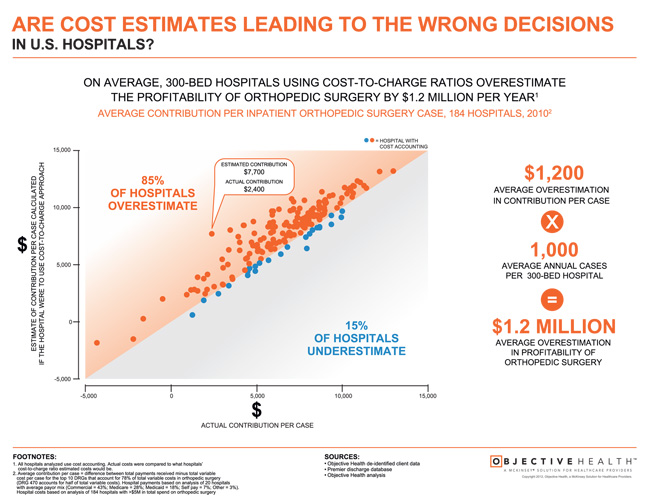
Are Cost Estimates Leading To The Wrong Decisions in US Hospitals?

Join Our Mailing List

Rethinking Cost-to-Charge Ratios

By www.ObjectiveHealth.com

More than half of US hospitals use cost-to-charge ratios as a primary cost estimation method since true procedural cost accounting can be prohibitively expensive.

Risks are Present

Although many hospitals believe that cost-to-charge ratios are relatively acceptable for internal planning purposes, there are many risks of this approach which can lead to sub-optimal strategic decisions.

###

Click to see the full size or download the PDF.

Conclusion

Your thoughts and comments on this ME-P are appreciated. Feel free to review our top-left column, and top-right sidebar materials, links, URLs and related websites, too. Then, subscribe to the ME-P. It is fast, free and secure.

Link: http://feeds.feedburner.com/HealthcareFinancialsthePostForcxos

Speaker: If you need a moderator or speaker for an upcoming event, Dr. David E. Marcinko; MBA – Publisher-in-Chief of the Medical Executive-Post – is available for seminar or speaking engagements. Contact: MarcinkoAdvisors@msn.com

Our Other Print Books and Related Information Sources:

Health Dictionary Series: http://www.springerpub.com/Search/marcinko

Practice Management: http://www.springerpub.com/product/9780826105752

Physician Financial Planning: http://www.jbpub.com/catalog/0763745790

Medical Risk Management: http://www.jbpub.com/catalog/9780763733421

Hospitals: http://www.crcpress.com/product/isbn/9781439879900

Physician Advisors: www.CertifiedMedicalPlanner.org

Product Details

Emergency Room Doctor Pet Peeves [A Humorous Video]

Join Our Mailing List

An Insider’s Look Around

[By Staff Reporters]

Are you tired of those long Emergency Room wait times and the overcrowding once inside? The ERs are usually jammed on weekends, and holidays, right?

***

***

Assessment

Well – This video is an example of the many issues an emergency department will unlikely be able to help you with this Memorial day weekend. But, those medical personnel, and ME-P readers, who work in the EMS or ER setting can hopefully relate to this encounter. A word to the …wise!

Video Link: http://www.youtube.com/watch?v=1KYmcwVGo9w&feature=related

Conclusion

Your thoughts and comments on this ME-P are appreciated. Feel free to review our top-left column, and top-right sidebar materials, links, URLs and related websites, too. Then, subscribe to the ME-P. It is fast, free and secure.

Speaker: If you need a moderator or speaker for an upcoming event, Dr. David E. Marcinko; MBA – Publisher-in-Chief of the Medical Executive-Post – is available for seminar or speaking engagements. Contact: MarcinkoAdvisors@msn.com

OUR OTHER PRINT BOOKS AND RELATED INFORMATION SOURCES:

Hospitals & Healthcare Organizations: Management Strategies, Operational Techniques, Tools, Templates and Case Studies

Hospitals & Healthcare Organizations: Management Strategies, Operational Techniques, Tools, Templates and Case Studies

Buy from Amazon

More on the Art of “Slow” Medicine

Join Our Mailing List

And … Slow Dentistry, too!

By Ann Miller RN MHA

[ME-P Executive-Director]

BOOK REVIEW

We don’t know exactly when, but the practice of medicine has morphed into the delivery of health care.

Of course, if healthcare has become big business, we at the ME-P through our publication, text and handbooks, advertisers and sponsors, as well as speaking and consulting engagements may be partially to blame. But, hopefully not to the extreme it has become in some cases.

For example, did you know that Medicare has a CPT® medical payment code for a ten minute “treadmill” office visit?

God’s Hotel – The Book

So, if you aren’t sure – or are too young to know – of what’s happening today, the new book “God’s Hotel” is for you. It’s an engaging book by Dr. Victoria Sweet, a general internist from Laguna Honda Hospital that chronicles her perspectives from the last almshouse in the United States.

IOW: She is off the insurance grid and has discovered a way to benefit patients, not necessarily medical providers, by practicing something called “slow” medicine.

THINK: Marcus Welby MD

Slow Dentistry

Of course, our own ME-P investigative reporter Darrell K. Pruitt DDS, has been commenting and opining on this issue vis-a-vie the dental insurance industry treadmill of “fast” production line oral care.

For example, he often asks his colleagues: Are you fed up with successfully doing intricate handwork to exacting tolerances in mouths of anxious patients and then having to fight to get the patients’ insurance company to pay what they rightfully owe THEIR CLIENT.

IOW: Working faster and faster, for less and less compensation.

Assessment

“God’s Hotel”: A Doctor, a Hospital, and a Pilgrimage to the Heart of Medicine

Link: http://www.amazon.com/Gods-Hotel-Hospital-Pilgrimage-Medicine/dp/1594488436/ref=sr_1_1?ie=UTF8&qid=1337177871&sr=8-1

More from the ME-P: The Emerging Discipline of “Slow Medicine” and Professional Liability

Conclusion

Your thoughts and comments on this ME-P are appreciated. Feel free to review our top-left column, and top-right sidebar materials, links, URLs and related websites, too. Then, subscribe to the ME-P. It is fast, free and secure.

Speaker: If you need a moderator or speaker for an upcoming event, Dr. David E. Marcinko; MBA – Publisher-in-Chief of the Medical Executive-Post – is available for seminar or speaking engagements. Contact: MarcinkoAdvisors@msn.com

OUR OTHER PRINT BOOKS AND RELATED INFORMATION SOURCES:

Product Details

About PAPERbecause.com

Join Our Mailing List

Paper is Good … Pass it On

Domtar is committed to the responsible use of paper.

They are also committed to communicating paper’s place and value to the businesses and people that use their products every day. Paper is a sustainable, renewable, recyclable, plant-based product that connects us in so many ways to the important things in life.

  • Great ideas are started on paper.

  • The world is educated on paper.
  • Businesses are founded on paper.
  • Love is professed on paper.
  • Important news is spread on paper.

That’s why they love paper.

Assessment

But, does this include paper medical records?

Visit: http://www.paperbecause.com/

Conclusion

Your thoughts and comments on this ME-P are appreciated. Feel free to review our top-left column, and top-right sidebar materials, links, URLs and related websites, too. Then, subscribe to the ME-P. It is fast, free and secure.

Link: http://feeds.feedburner.com/HealthcareFinancialsthePostForcxos

Speaker: If you need a moderator or speaker for an upcoming event, Dr. David E. Marcinko; MBA – Publisher-in-Chief of the Medical Executive-Post – is available for seminar or speaking engagements. Contact: MarcinkoAdvisors@msn.com

Our Other Print Books and Related Information Sources:

Health Dictionary Series: http://www.springerpub.com/Search/marcinko

Practice Management: http://www.springerpub.com/product/9780826105752

Physician Financial Planning: http://www.jbpub.com/catalog/0763745790

Medical Risk Management: http://www.jbpub.com/catalog/9780763733421

Hospitals: http://www.crcpress.com/product/isbn/9781439879900

Physician Advisors: www.CertifiedMedicalPlanner.org

Product Details

Evaluating ACOs at Mid-Launch

Join Our Mailing List

Moving Forward but Challenges Ahead

[By ME-P Staff]

Accountable Care Organizations [ACOs] are generating considerable attention for their potential to improve the value of our health care spending through better coordination of care and new payment incentives that focus on quality and efficiency of care.

The Challenges

Yet, even as ACOs develop at a fairly rapid clip across the nation, they face substantial challenges.

For example, In this essay, Steven Lieberman reviews the ACO landscape in both the public and private sectors and examines the major obstacles confronting these emerging organizations, including limited tools for influencing patient choice, the need for immediate and sustained cost savings, and system-wide concerns about rising costs due to enhanced market power.

Assessment

Link: http://nihcm.org/images/stories/EV_Lieberman_FINAL.pdf

Conclusion

Your thoughts and comments on this ME-P are appreciated. Feel free to review our top-left column, and top-right sidebar materials, links, URLs and related websites, too. Then, subscribe to the ME-P. It is fast, free and secure.

Link: http://feeds.feedburner.com/HealthcareFinancialsthePostForcxos

Speaker: If you need a moderator or speaker for an upcoming event, Dr. David E. Marcinko; MBA – Publisher-in-Chief of the Medical Executive-Post – is available for seminar or speaking engagements. Contact: MarcinkoAdvisors@msn.com

OUR OTHER PRINT BOOKS AND RELATED INFORMATION SOURCES:

DICTIONARIES: http://www.springerpub.com/Search/marcinko
PHYSICIANS: www.MedicalBusinessAdvisors.com
PRACTICES: www.BusinessofMedicalPractice.com
HOSPITALS: http://www.crcpress.com/product/isbn/9781466558731
CLINICS: http://www.crcpress.com/product/isbn/9781439879900
BLOG: www.MedicalExecutivePost.com
FINANCE: Financial Planning for Physicians and Advisors
INSURANCE: Risk Management and Insurance Strategies for Physicians and Advisors

Product Details

May Patients Privately Contract with their Doctors?

Join Our Mailing List

Ask-An-Advisor

QUESTION: A question to ME-P readers and subscribers.

Medicare may disallow private contracting by federal law. But, can private insurances, whether PPO or managed care, legally prevent a patient from privately contracting with their doctor for services or goods above the contracted rates, as long as informed consent and appropriate waivers are executed in advance of the service?

IOWs: Do private managed care insurance companies have the legal  right to limit a person’s liberty to seek care above the constraints of the health insurers contract, if the patient so desires?  I understand that an insurer by contract with provider and patient is obligated to pay only a negotiated fee for a specific service or good, but if the patient desires a more accommodating service or extra features to a durable good, do they have the right to privately contract for such services beyond the contract payment or benefit restraints. I believe that this goes into state law safeguards for patient welfare in as much as most non-federal or non-ERISA health insurances are guided by state law.

Assessment

This is not a naïve question for I have posed it to various plan medical directors in our area and have had surprisingly varied responses.

I welcome your crowd-sourced comments with thanks in advance.

Dr. Mark D. Dollard

Loudoun Foot and Ankle Center

46440 Benedict Drive

Suite #111  – Sterling, VA 20164

703 444-9555 [ph] 703 444-1190 [fax]

mdollard@erols.com

Conclusion

Your thoughts and comments on this ME-P are appreciated; especially from our healthlaw attorney readers, plan subscribers, consultants and medical directors. Feel free to review our top-left column, and top-right sidebar materials, links, URLs and related websites, too. Then, subscribe to the ME-P. It is fast, free and secure.

Link: http://feeds.feedburner.com/HealthcareFinancialsthePostForcxos

Our Other Print Books and Related Information Sources:

Health Dictionary Series: http://www.springerpub.com/Search/marcinko

Practice Management: http://www.springerpub.com/product/9780826105752

Physician Financial Planning: http://www.jbpub.com/catalog/0763745790

Medical Risk Management: http://www.jbpub.com/catalog/9780763733421

Hospitals: http://www.crcpress.com/product/isbn/9781439879900

Physician Advisors: www.CertifiedMedicalPlanner.org

Product Details

102 Personal Finance Tips Your Medical School Professor Never Taught You

Join Our Mailing List

Ask the Advisor

If you’re anything like most doctors, you graduated from college and perhaps even took a finance class or accounting class here or there, but you didn’t learn anything about managing your personal finances.

In fact, there probably wasn’t even an opportunity to take any such class in high school, college or medical school, either.

But, if medical school is partly about training for a job, shouldn’t we learn what to do with the money we earn from medical practice? Especially in a country where 45% of college students are in credit card debt and 40% of all Americans say they live beyond their means, many think it’s time to wise up to some of the challenges of money management.

Assessment

So, here are a few (say, 102) simple tips that can help get your money life (back) on the right track.

Link: http://www.yourcreditadvisor.com/blog/2006/10/102_personal_fi.html

Channel Surfing the ME-P

Have you visited our other topic channels? Established to facilitate idea exchange and link our community together, the value of these topics is dependent upon your input. Please take a minute to visit. And, to prevent that annoying spam, we ask that you register. It is fast, free and secure.

Conclusion

Your thoughts and comments on this ME-P are appreciated. Feel free to review our top-left column, and top-right sidebar materials, links, URLs and related websites, too. Then, subscribe to the ME-P. It is fast, free and secure.

Speaker: If you need a moderator or speaker for an upcoming event, Dr. David E. Marcinko; MBA – Publisher-in-Chief of the Medical Executive-Post – is available for seminar or speaking engagements. Contact: MarcinkoAdvisors@msn.com

OUR OTHER PRINT BOOKS AND RELATED INFORMATION SOURCES:

Comprehensive Financial Planning Strategies for Doctors and Advisors: Best Practices from Leading Consultants and Certified Medical Planners(TM)* 8

Some Physicians are Tenants, Too!

Join Our Mailing List

Tenant Improvements Can Be Good Investment

By Rick Kahler MS, CFP®, ChFC, CCIM

Recently I read a news story about a physician [small business owner] whose landlord was not renewing her lease. A chain restaurant was buying the building and intended to raze it. The doctor [business owner] was distraught, as she had recently spent $30,000 to remodel the property.

Dual Perspectives

One common reaction to stories like this is anger at a landlord for unfairly selling a building out from under a tenant.

Another is, “Why would tenants spend so much money remodeling a building they didn’t own?”

Neither response sees the whole story.

I empathized with this doctor’s loss as a result of a bad business decision. The bad decision wasn’t spending $30,000 to remodel a space she didn’t own. Business owners make such “tenant improvements” all the time. Every tenant or doctor’s office you see in a mall has poured thousands of dollars into fixing up and customizing their space. Tenant improvements can range from repainting a space to building a fast food restaurant on leased land.

Poor Decisions

The poor business decision this owner made was not being sure the lease term ran for long enough to recoup the cost of the tenant improvements. The cost of any tenant improvement is a pure expense that needs to be factored in as part of rent and amortized over the life of the lease. This is because when the lease expires, both parties have the right to not renegotiate a new lease. Any tenant improvements become the property of the owner. Landlords who choose to use property for something different when a lease expires aren’t abusing or taking advantage of tenants—they are simply exercising the contractual rights agreed to by both parties.

Mall Shells – Not Sea Shells

Most new strip centers or malls lease relatively unimproved spaces, sometimes called shells. Tenants get four walls, a cement floor, and bare girders above. It’s the tenants’ responsibility to finish the spaces in the manner they want. This makes a lot of sense, as usually each retailer is very specific about the floor plan, colors, and building materials they use in their spaces. At the end of the lease the relinquished tenant improvements, with years of wear and tear, are typically worth very little. New tenants will rip them out and finish the space according to their needs.

Example

Let’s take an example of a 5,000-square-foot shell that rents for $8 a square foot annually. Let’s say it will cost $100 a square foot for the retailer to finish the space. If the lease extends for 20 years, the annual cost of the tenant improvements is $5 a square foot ($100 divided by 20 years). This brings the total cost for the leased space to $13 a square foot ($8 shell rent plus $5 for improvements).

With a four-year lease, however, the amortized cost would be $27 a square foot. A one-year lease would cost $108 a square foot. Either one would make the space too expensive. A doctor business owner unable to get a longer term would either substantially reduce the cost of the tenant office improvements, or look elsewhere.

Sometimes a tenant needs to spend a lot to improve a space, but doesn’t want to commit to a long-term lease. In this case the tenant’s best strategy is to get the landlord to improve the space so the tenant isn’t left losing a substantial amount of money if either party doesn’t renew the lease.

Assessment

Medical provides who are business owners need to understand their rights and responsibilities as tenants. They also need to be sure the costs of rent and tenant improvements are reasonable over the life of the lease. It’s a good idea to consult both an attorney and an accountant before signing any lease.

Conclusion

Your thoughts and comments on this ME-P are appreciated. Feel free to review our top-left column, and top-right sidebar materials, links, URLs and related websites, too. Then, subscribe to the ME-P. It is fast, free and secure.

Link: http://feeds.feedburner.com/HealthcareFinancialsthePostForcxos

Speaker: If you need a moderator or speaker for an upcoming event, Dr. David E. Marcinko; MBA – Publisher-in-Chief of the Medical Executive-Post – is available for seminar or speaking engagements. Contact: MarcinkoAdvisors@msn.com

Our Other Print Books and Related Information Sources:

Health Dictionary Series: http://www.springerpub.com/Search/marcinko

Practice Management: http://www.springerpub.com/product/9780826105752

Physician Financial Planning: http://www.jbpub.com/catalog/0763745790

Medical Risk Management: http://www.jbpub.com/catalog/9780763733421

Hospitals: http://www.crcpress.com/product/isbn/9781439879900

Physician Advisors: www.CertifiedMedicalPlanner.org

Product Details

A Survey to Shape the Definition of Physician-Focused Financial Planning

Join Our Mailing List

Send us Your Thoughts

By Dr. David Edward Marcinko MBA CMP®

[Chairman, Founder and CEO]

www.CertifiedMedicalPlanner.org

The Institute of Medical Business Advisors, Inc is re-defining the role of “physician focused financial planning” and how the concept fits within the financial services industry.

Crowd-Sourcing Insights and Opinions

But, we can’t do it without your help. As a medical provider or seasoned financial professional, our readers can provide valuable input to determine exactly what constitutes a physician focused financial advisor in today’s complex healthcare industrial complex landscape.

For example, is it business as usual for FAs today; does it fall under the auspices of the Certified Medical Planner™ professional rubric, or is it something else?

Be a pioneer and help shape the industry’s definition of medically focused financial advice by sending us your thoughts on competency tasks and areas of subject matter expertise.

Results

The results will enhance iMBA’s Certified Medical Planner designation, which is designed to help financial advisors address the needs of physicians, medical professionals and all allied healthcare personnel; and help define the role of physician focused financial planning in the coming decade.

Learn More

To learn more about this growth specialty and designation, click here: www.CertifiedMedicalPlanner.org

Assessment

Please be assured that if you take the survey, your responses are confidential; we won’t share your contact information with third parties. Thank you for your participation!

Conclusion

Your thoughts and comments on this ME-P are appreciated. Feel free to review our top-left column, and top-right sidebar materials, links, URLs and related websites, too. Then, subscribe to the ME-P. It is fast, free and secure.

Link: http://feeds.feedburner.com/HealthcareFinancialsthePostForcxos

Speaker: If you need a moderator or speaker for an upcoming event, Dr. David E. Marcinko; MBA – Publisher-in-Chief of the Medical Executive-Post – is available for seminar or speaking engagements. Contact: MarcinkoAdvisors@msn.com

Our Other Print Books and Related Information Sources:

Health Dictionary Series: http://www.springerpub.com/Search/marcinko

Practice Management: http://www.springerpub.com/product/9780826105752

Physician Financial Planning: http://www.jbpub.com/catalog/0763745790

Medical Risk Management: http://www.jbpub.com/catalog/9780763733421

Hospitals: http://www.crcpress.com/product/isbn/9781439879900

Physician Advisors: www.CertifiedMedicalPlanner.org

Product DetailsProduct DetailsProduct Details

Product Details  Product Details

Product Details

Enter the HIPAA Fear Mongers

Join Our Mailing List

Fear of HIPAA Sells

[By Darrelkl K. Pruitt DDS]

“The HHS Office for Civil Rights (OCR) can show up at your door and ask to perform an audit on short notice, and your organization will need to be ready, or face fines of up to $50,000 per day for each regulatory provision violated.”

– Gene Kraemer [Customer Relationship Director at The Coding Institute]

http://www.audioeducator.com/hipaa-audits-and-enforcement-042412.html?utm_medium=email&utm_source=E99NAGAJ&utm_campaign=E99NAGAJ

The most successful of opportunistic HIPAA consultants are the scariest

As a dentist for almost 30 years, I’ve noticed that along with even rumors of mandate enforcement, ambitious compliance consultants’ fear-inspiring ads start interrupting happier thoughts. It happened with OSHA’s push into dentistry 20 years ago and we clearly see the aggressive sales pitches with HIPAA as well.

The scariest part of Gene Kraemer’s description of HIPAA’s tedious requirements and bankruptcy-level liabilities is that he is simply telling the truth. So if you are a HIPAA covered dentist, be scared.

On the other hand, if you don’t store or send your patients’ digital PHI – choosing instead to use the US Mail – you are increasingly fortunate in the dentistry market. For one thing, our patients are fed up with identity thefts, and paper dental records are the gold standard in security. In addition, nothing is holding down your competitors’ costs for HIPAA compliance and it is increasing much faster than the cost of postage.

De-identify now or lose computerization, Doc. If your patients’ PHI is not present it simply cannot be hacked by an identity thief. Guaranteed more secure than Cloud. Arguably more secure than even paper dental records.

Or … You can hire The Coding Institute.

You can bet Gene Kraemer isn’t someone who would hold down the cost of compliance.


From: Gene_Kraemer@mail.vresp.com

Subject: HIPAA Audits & Enforcement: New Penalties & Push for Compliance – Final Notice!

Good Morning,

The US Department of Health and Human Services (HHS) is currently implementing audits to meet requirements in the HITECH Act in the American Recovery and Reinvestment Act of 2009 (ARRA) for performing periodic audits of compliance with the HIPAA Privacy and Security Rules, and up to 150 random HIPAA compliance audits will be performed by the end of 2012.  While in the past, audits had been performed only at entities that had had a complaint filed against them, the new rule calls for audits whether or not there is a complaint.  This means, the HHS Office for Civil Rights (OCR) can show up at your door and ask to perform an audit on short notice, and your organization will need to be ready, or face fines of up to $50,000 per day for each regulatory provision violated.

Join us for this live audio conference on Tuesday, April 24, 2012 at 1 pm ET | 12 pm CT | 11 am MT | 10 am PT. This conference is being presented by Jim Sheldon-Dean, the founder and director of compliance services at Lewis Creek Systems, LLC, a Vermont-based consulting firm founded in 1982, providing information privacy and security regulatory compliance services to health care firms and businesses throughout the Northeast and nationally. He serves on the HIMSS Information Systems Security Workgroup, the Workgroup for Electronic Data Interchange Privacy and Security Workgroup, and co-chairs the WEDI HIPAA Updates sub-workgroup.  Sheldon-Dean is a participating member of the advisory board of Vermont Information Technology Leaders (VITL), and has participated in VITL’s Vermont Health Information Technology Plan working group, VITL’s Physician EMR adoption project, and the Security Workgroup of the New Hampshire/Vermont Strategic HIPAA Implementation Plan (NHVSHIP).

Highlights of the session :

• Fines and penalties for violations of the HIPAA regulations have been significantly increased and now include mandatory fines for willful negligence that begin at $10,000 minimum.

• HIPAA Audits have been few and far between in the past, but that’s now changing – the HHS will be auditing HIPAA covered entities and business associates even if there have been no complaints or problems reported.

• What HHS OCR is likely to ask you if you are selected for an audit, and what you’ll have to have prepared already when they do.

• The rules are that you need to comply with will be explained. Learn about the policies you can adopt that can help you come into compliance and be prepared for an audit.

• How the HIPAA rules have changed and how you may need to change. How you work to keep up with them.

• How having a good compliance process can help you stay compliant and respond to audits more easily.

• The documentation needed to survive an audit and avoid fines will be described.

• A discussion on what you’ll need to think about to deal with current and future threats to the security of patient information.

If interested, please click the following link to register and get your early bird discount : –

http://www.audioeducator.com/hipaa-audits-and-enforcement-042412.html?utm_medium=email&utm_source=E99NAGAJ&utm_campaign=E99NAGAJ

Please apply discount code “GENE20” at checkout to get your $20 discount on early registration.

Looking forward to having you onboard here.

Thanks,

Gene Kraemer

Customer Relationship Director

The Coding Institute LLC

2222 Sedwick Drive,

Durham, NC 27713

************************************************************************************8*************************

Conclusion

Your thoughts and comments on this ME-P are appreciated. Feel free to review our top-left column, and top-right sidebar materials, links, URLs and related websites, too. Then, subscribe to the ME-P. It is fast, free and secure.

Speaker: If you need a moderator or speaker for an upcoming event, Dr. David E. Marcinko; MBA – Publisher-in-Chief of the Medical Executive-Post – is available for seminar or speaking engagements. Contact: MarcinkoAdvisors@msn.com

OUR OTHER PRINT BOOKS AND RELATED INFORMATION SOURCES:

Product Details

Product Details

A Physician Practice Demographics Slide-Show

Join Our Mailing List

By SK & A Research

Link: http://www.physbiztech.com/slideshow/physician-practice-demographics-ska-research?s=0

Conclusion

Your thoughts and comments on this ME-P are appreciated. Feel free to review our top-left column, and top-right sidebar materials, links, URLs and related websites, too. Then, subscribe to the ME-P. It is fast, free and secure.

Link: http://feeds.feedburner.com/HealthcareFinancialsthePostForcxos

Speaker: If you need a moderator or speaker for an upcoming event, Dr. David E. Marcinko; MBA – Publisher-in-Chief of the Medical Executive-Post – is available for seminar or speaking engagements. Contact: MarcinkoAdvisors@msn.com

Our Other Print Books and Related Information Sources:

Health Dictionary Series: http://www.springerpub.com/Search/marcinko

Practice Management: http://www.springerpub.com/product/9780826105752

Physician Financial Planning: http://www.jbpub.com/catalog/0763745790

Medical Risk Management: http://www.jbpub.com/catalog/9780763733421

Hospitals: http://www.crcpress.com/product/isbn/9781439879900

Physician Advisors: www.CertifiedMedicalPlanner.org

Product Details

ACO Opinion and Voting Poll

Join Our Mailing List

Are Accountable Care Organizations Another Form of Medical Capitation Reimbursement?

Conclusion

Your thoughts and comments on this ME-P are appreciated. Feel free to review our top-left column, and top-right sidebar materials, links, URLs and related websites, too. Then, subscribe to the ME-P. It is fast, free and secure.

Link: http://feeds.feedburner.com/HealthcareFinancialsthePostForcxos

Speaker: If you need a moderator or speaker for an upcoming event, Dr. David E. Marcinko; MBA – Publisher-in-Chief of the Medical Executive-Post – is available for seminar or speaking engagements. Contact: MarcinkoAdvisors@msn.com

Our Other Print Books and Related Information Sources:

Health Dictionary Series: http://www.springerpub.com/Search/marcinko

Practice Management: http://www.springerpub.com/product/9780826105752

Physician Financial Planning: http://www.jbpub.com/catalog/0763745790

Medical Risk Management: http://www.jbpub.com/catalog/9780763733421

Healthcare Organizations: www.HealthcareFinancials.com

Physician Advisors: www.CertifiedMedicalPlanner.com

Subscribe Now: Did you like this Medical Executive-Post, or find it helpful, interesting and informative? Want to get the latest ME-Ps delivered to your email box each morning? Just subscribe using the link below. You can unsubscribe at any time. Security is assured.

Link: http://feeds.feedburner.com/HealthcareFinancialsthePostForcxos

Sponsors Welcomed: And, credible sponsors and like-minded advertisers are always welcomed.

Link: https://healthcarefinancials.wordpress.com/2007/11/11/advertise

Product DetailsProduct DetailsProduct Details

Product Details  Product Details

Product Details

Videos on Setting up an ACO

Join Our Mailing List

Opposing Viewpoints in Context?

The Theory

In this first didactic video, Thomas Cassels, Executive Director of the Advisory Board Company’s Health Care Advisory Board, summarizes the forces driving accountable care, outlines the steps necessary for a hospital or health system to transition toward operating as an accountable care organization (ACO), and provides insight into the question of whether all providers must plan to become ACOs.

The Reality

The second video is a real world look at negotiation between a hospital administrator and a PCP over setting up an Accountable Care Organization [ACO].

Video links:

Assessment

True or not?

Conclusion

Your thoughts and comments on this ME-P are appreciated. Feel free to review our top-left column, and top-right sidebar materials, links, URLs and related websites, too. Then, subscribe to the ME-P. It is fast, free and secure.

Link: http://feeds.feedburner.com/HealthcareFinancialsthePostForcxos

Speaker: If you need a moderator or speaker for an upcoming event, Dr. David E. Marcinko; MBA – Publisher-in-Chief of the Medical Executive-Post – is available for seminar or speaking engagements. Contact: MarcinkoAdvisors@msn.com

Our Other Print Books and Related Information Sources:

Health Dictionary Series: http://www.springerpub.com/Search/marcinko

Practice Management: http://www.springerpub.com/product/9780826105752

Physician Financial Planning: http://www.jbpub.com/catalog/0763745790

Medical Risk Management: http://www.jbpub.com/catalog/9780763733421

Healthcare Organizations: www.HealthcareFinancials.com

Physician Advisors: www.CertifiedMedicalPlanner.com

Subscribe Now: Did you like this Medical Executive-Post, or find it helpful, interesting and informative? Want to get the latest ME-Ps delivered to your email box each morning? Just subscribe using the link below. You can unsubscribe at any time. Security is assured.

Link: http://feeds.feedburner.com/HealthcareFinancialsthePostForcxos

Sponsors Welcomed: And, credible sponsors and like-minded advertisers are always welcomed.

Link: https://healthcarefinancials.wordpress.com/2007/11/11/advertise

Product DetailsProduct DetailsProduct Details

Product Details  Product Details

Product Details

Challenging the NPI Requirement of Blue Cross Blue Shield of Texas Again

Join Our Mailing List

How Far Can They be Pushed?

By D. Kellus Pruitt DDS

Command-and-control organizations like BCBSTX find Facebook difficult to control. Even a small nidus of a complaint posted by a client named Mark about poor service can attract a huge bolus of payback by a dentist, and nobody respects anonymous gatekeepers for huge, unresponsive companies like BCBSTX anyway:

https://www.facebook.com/bluecrossblueshieldoftexas

Mark, as a dentist, I’m very familiar with BCBSTX’s inconsiderate behavior in our communities. At least the anonymous moderator invited your feedback. When I sincerely asked her on Wednesday what federal employees are told about BCBSTX’s NPI requirement, she acted as if the absurd policy hadn’t already wasted enough of my time that day when she provided me an irrelevant link to nowhere – just to get rid of me.

Secret Requirement?

I would actually love to treat federal employees who have BCBSTX insurance because they are some of the nicest people I’ve met. But, BCBSTX’s secret requirement that their clients see only dentists with arbitrary NPI identification numbers (not required by law) makes their employment benefit purchased with taxpayer money worthless if they receive treatment in my office. My office has been told that it has become impossible for paper claims to enter BCBSTX’s modern, computerized system without NPI numbers, and nothing humanly possible can be done to correct the unfortunate problem for dentists who choose not to be HIPAA covered entities.

Evasion?

The moderator’s evasion confirms that even though BCBSTX’s federal customers are led to believe that they can use their dental benefits to help pay for treatment at any licensed dentist’s office, they are not being informed of the NPI requirement, and if they pay the dental bill in full for work done by a dentist without an NPI number, BCBXTX pockets the reimbursement. It just cannot be helped. That’s technology. Tough-luck!

BCBSTX executives naturally prefer that my office manager tell their clients about the obscure restrictions of the dental plans they sell. She catches most federal employees before blocking out time in our schedule to treat them, but nevertheless, one got through on Wednesday morning. It wasted my time as well as the federal employee’s.

Congressional Action?

It’s troublesome to know that the government callously encourages such waste of small business owner’s time and money, not to mention the inconvenience to patients. I’m simply fed up with open appointments for uninformed BCBSTX clients. What’s it take to force BCBSTX to take some responsibility in the community and warn their customers about the limitations of their dental policy before they call my office? Congressional action?

Assessment

I do hope the anonymous BCBSTX employee doesn’t choose to delete this post. Since it seems obvious that their windfall profit is a powerful disincentive for BCBSTX to warn their clients about the NPI restriction any time soon, the more federal employees I can ethically warn through BCBSTX Facebook, the fewer open appointments I’ll have, and less taxpayer money will be wasted on silliness.

cc: Senator John Cornyn

Conclusion

Your thoughts and comments on this ME-P are appreciated. Feel free to review our top-left column, and top-right sidebar materials, links, URLs and related websites, too. Then, subscribe to the ME-P. It is fast, free and secure.

Speaker: If you need a moderator or speaker for an upcoming event, Dr. David E. Marcinko; MBA – Publisher-in-Chief of the Medical Executive-Post – is available for seminar or speaking engagements. Contact: MarcinkoAdvisors@msn.com

OUR OTHER PRINT BOOKS AND RELATED INFORMATION SOURCES:

Product Details

Product Details  Product Details

Product Details

Why Your Medical Office or Financial Advisory Practice Must “Go-Social”

Join Our Mailing List 

Go Social -OR- Go Home?

By Staff Reporters

Likes, followers, circles, networks and shares are all jargon used around the internet. Social media is the new language and being fluent is very necessary in business today. In fact, we have written about it before on this ME-P. Why?

Social media allows you to connect with your patients, clients, customers and viewers on a level that becomes personalized and more intimate. This in turn brings loyal patients and clients who become a part of your business model; both professionally and socially.

However, social media integration is a gradual process with huge long term rewards, potential benefits and pitfalls. And, the jury is still out on its’ relevance to medical practices, financial advisors and medical management consultants? Or, is it?

Assessment

So, here is an infographic breaking down the important facts and tips of social media.

Source: wix.com

Conclusion

And so, your thoughts and comments on this ME-P are appreciated. Please review our top-left column, and top-right sidebar materials, links, URLs and related websites, too. Then, subscribe to the ME-P. It is fast, free and secure.

Link: http://feeds.feedburner.com/HealthcareFinancialsthePostForcxos

Speaker: If you need a moderator or speaker for an upcoming event, Dr. David E. Marcinko; MBA – Publisher-in-Chief of the Medical Executive-Post – is available for seminar or speaking engagements. Contact: MarcinkoAdvisors@msn.com

Our Other Print Books and Related Information Sources:

Health Dictionary Series: http://www.springerpub.com/Search/marcinko

Practice Management: http://www.springerpub.com/product/9780826105752

Physician Financial Planning: http://www.jbpub.com/catalog/0763745790

Medical Risk Management: http://www.jbpub.com/catalog/9780763733421

Healthcare Organizations: www.HealthcareFinancials.com

Physician Advisors: www.CertifiedMedicalPlanner.com

Subscribe Now: Did you like this Medical Executive-Post, or find it helpful, interesting and informative? Want to get the latest ME-Ps delivered to your email box each morning? Just subscribe using the link below. You can unsubscribe at any time. Security is assured.

Link: http://feeds.feedburner.com/HealthcareFinancialsthePostForcxos

Sponsors Welcomed: And, credible sponsors and like-minded advertisers are always welcomed.

Link: https://healthcarefinancials.wordpress.com/2007/11/11/advertise

###

ORDER HERE

Buy from Amazon

Learn How the ME-P Helps Hospitals Improve Patient Care and Still Be Profitable

ADVERTISEMENT

Join Our Mailing List 

Learn our Secrets – PreOrder Now for a First-Mover Advantage

Conclusion

And so, your thoughts and comments on this ME-P are appreciated. Please review our top-left column, and top-right sidebar materials, links, URLs and related websites, too. Then, subscribe to the ME-P. It is fast, free and secure.

Link: http://feeds.feedburner.com/HealthcareFinancialsthePostForcxos

Speaker: If you need a moderator or speaker for an upcoming event, Dr. David E. Marcinko; MBA – Publisher-in-Chief of the Medical Executive-Post – is available for seminar or speaking engagements. Contact: MarcinkoAdvisors@msn.com

Our Other Print Books and Related Information Sources:

Health Dictionary Series: http://www.springerpub.com/Search/marcinko

Practice Management: http://www.springerpub.com/product/9780826105752

Physician Financial Planning: http://www.jbpub.com/catalog/0763745790

Medical Risk Management: http://www.jbpub.com/catalog/9780763733421

Healthcare Organizations: www.HealthcareFinancials.com

Physician Advisors: www.CertifiedMedicalPlanner.com

Subscribe Now: Did you like this Medical Executive-Post, or find it helpful, interesting and informative? Want to get the latest ME-Ps delivered to your email box each morning? Just subscribe using the link below. You can unsubscribe at any time. Security is assured.

Link: http://feeds.feedburner.com/HealthcareFinancialsthePostForcxos

Sponsors Welcomed: And, credible sponsors and like-minded advertisers are always welcomed.

Link: https://healthcarefinancials.wordpress.com/2007/11/11/advertise

TESTIMONIAL

Hospitals and Healthcare Organizations” is a must-read for any physician and other health care provider to understand the multiple, and increasingly complex, interlocking components of the US Healthcare delivery system whether they are employed by a hospital system, or manage their own private practice.

The operational principles, methods, and examples in this book provide a framework applicable on both the large organizational and smaller private practice levels and will result in better patient care. Physicians today know they need to better understand business principles and this book by Dr. David E. Marcinko and Professor Hope Rachel Hetico provides an excellent framework and foundation to learn important principles all doctors need to know.

-Richard Berning, MD

[Pediatric Cardiologist]

ORDER HERE 

Buy from Amazon

Is there an IRS Smart Phone App for Taxes?

Yep –  Now Doctors Can Get IRS2GO

Join Our Mailing List 

By Children’s Home Society of Florida Foundation

IRS Commissioner Doug Shulman was pleased to just announce a substantially enhanced application for iPhone and Android phones.  The IRS2GO application was first announced in 2011 and had 350,000 downloads.  Commissioner Shulman expects the new application to be widely used.

He stated, “The new smartphone app provides an easy way for people to get helpful information about their taxes.  IRS2GO reflects a wider commitment at the IRS to find innovative ways to serve taxpayers in a rapidly changing world.”

The Top Five [5]

The new version has five major sections:

1. YouTube – The smartphone app includes links to many short YouTube videos.  The videos have titles such as “Tax Tips: Taxable and Non-Taxable Income,” “Tax Tips: When Will I Get My Refund,” “Healthcare: Small Business Healthcare Tax Credit,” and “Free Help Preparing Your Tax Return.”

2. News – The IRS periodically produces news releases.  These news items may be viewed on your iPhone or Android phone.

3. Get My Tax Record – By entering your Social Security Number and other identifying information, you may have access to your personal tax records.

4. Get My Refund Status – By entering your Social Security Number and other information, it is possible to obtain your refund status.

5. Follow Us – If you so desire, you may follow the IRS on Twitter.

Editor’s Note:  The IRS has developed a good smartphone application.  It is easy to use and includes very helpful content.  This updated IRS application will be very popular with taxpayers.  Finally, it is not very often that your editor uses the words “IRS” and “popular” in the same sentence.

Conclusion

And so, your thoughts and comments on this ME-P are appreciated. Please review our top-left column, and top-right sidebar materials, links, URLs and related websites, too. Then, subscribe to the ME-P. It is fast, free and secure.

Link: http://feeds.feedburner.com/HealthcareFinancialsthePostForcxos

Speaker: If you need a moderator or speaker for an upcoming event, Dr. David E. Marcinko; MBA – Publisher-in-Chief of the Medical Executive-Post – is available for seminar or speaking engagements. Contact: MarcinkoAdvisors@msn.com

Our Other Print Books and Related Information Sources:

Health Dictionary Series: http://www.springerpub.com/Search/marcinko

Practice Management: http://www.springerpub.com/product/9780826105752

Physician Financial Planning: http://www.jbpub.com/catalog/0763745790

Medical Risk Management: http://www.jbpub.com/catalog/9780763733421

Healthcare Organizations: www.HealthcareFinancials.com

Physician Advisors: www.CertifiedMedicalPlanner.com

Subscribe Now: Did you like this Medical Executive-Post, or find it helpful, interesting and informative? Want to get the latest ME-Ps delivered to your email box each morning? Just subscribe using the link below. You can unsubscribe at any time. Security is assured.

Link: http://feeds.feedburner.com/HealthcareFinancialsthePostForcxos

Sponsors Welcomed: And, credible sponsors and like-minded advertisers are always welcomed.

Link: https://healthcarefinancials.wordpress.com/2007/11/11/advertise

Product Details

Implementing “Meaningful Use” [A True Tale from the eHR Field]

Join Our Mailing List 

Maintaining Criteria for CMS Incentives

Anonymous Doctor

[By Anonymous Doctor]

If you qualified for year one … you qualified for year one. Deposit the check and pat yourself on the back. I too worked myself ragged, added a couple of hours to my charting each day … and collected $18,000 for 90 days (actually 6 months) of added stress.

But, I have opted NOT TO continue into year 2 … as $1,000 per month for 365 straight days of compliance is too much to bear. There is no mandatory need to comply until 2015.

I plan to use my software, comply as much as possible, not pull my hair out until 2015 when we have to be 100% compliant, 100% of the time. I know there are those with big staffs, and big overhead who will disagree, and have their assistants do all the charting.

For those of us in solo practice struggling to make ends meet, this burden is NOT WORTH carrying into year #2.

Source: Ann Miller RN MHA

via Name Withheld (FL)

PM Mews #4,382

Assessment

This story was originally a “comment”, but it has been re-published as a “post”, to illustrate the dichotomy between medical practitioners using eHRs and salesfolks recommending and selling them based on the government rebate feature rather than true market competition, efficiency and innovation.

MORE: MU GE Healthcare

Conclusion

Your thoughts and comments on this ME-P are appreciated. Feel free to review our top-left column, and top-right sidebar materials, links, URLs and related websites, too. Then, subscribe to the ME-P. It is fast, free and secure.

Speaker: If you need a moderator or speaker for an upcoming event, Dr. David E. Marcinko; MBA – Publisher-in-Chief of the Medical Executive-Post – is available for seminar or speaking engagements. Contact: MarcinkoAdvisors@msn.com

OUR OTHER PRINT BOOKS AND RELATED INFORMATION SOURCES:

Product Details

Small Medical Practice Confidence Index Rises in 2012

Join Our Mailing List 

According to Practice Fusion

Practice Fusion’s 2012 State of the Small Practice survey and infographic reveal 60 percent of small medical practices are helped by technology, while nearly half report improvements in their practice in the last year.

Assessment

More info link: http://www.practicefusion.com/pages/pr/state-of-the-small-practice-2012.html

Conclusion

And so, your thoughts and comments on this ME-P are appreciated. Please review our top-left column, and top-right sidebar materials, links, URLs and related websites, too. Then, subscribe to the ME-P. It is fast, free and secure.

Link: http://feeds.feedburner.com/HealthcareFinancialsthePostForcxos

Speaker: If you need a moderator or speaker for an upcoming event, Dr. David E. Marcinko; MBA – Publisher-in-Chief of the Medical Executive-Post – is available for seminar or speaking engagements. Contact: MarcinkoAdvisors@msn.com

Our Other Print Books and Related Information Sources:

Health Dictionary Series: http://www.springerpub.com/Search/marcinko

Practice Management: http://www.springerpub.com/product/9780826105752

Physician Financial Planning: http://www.jbpub.com/catalog/0763745790

Medical Risk Management: http://www.jbpub.com/catalog/9780763733421

Healthcare Organizations: www.HealthcareFinancials.com

Physician Advisors: www.CertifiedMedicalPlanner.com

Subscribe Now: Did you like this Medical Executive-Post, or find it helpful, interesting and informative? Want to get the latest ME-Ps delivered to your email box each morning? Just subscribe using the link below. You can unsubscribe at any time. Security is assured.

Link: http://feeds.feedburner.com/HealthcareFinancialsthePostForcxos

Sponsors Welcomed: And, credible sponsors and like-minded advertisers are always welcomed.

Link: https://healthcarefinancials.wordpress.com/2007/11/11/advertise

Product Details

Killer Domestic Violence

Join Our Mailing List

[By staff reporters]

Awareness and Philanthropy Needed

We wish there were a huge philanthropy organization focused on Domestic Violence. Why?

DV is as much a killer as is cancer or diabetes or sepsis. What’s worse: it’s a primary root in violence at large – it breeds dictators, influences foreign policies, and mutilates childhood development. And, we wonder about it’s relatonship, if any, to medical workplace violence and abusive physician behavior as we’ve written about previously on this ME-P?

https://medicalexecutivepost.com/2011/04/06/medical-workplace-violence-prevention-guidelines/

Some would even argue that Domestic Violence is one of the largest Public Relations opportunity of all time. And, if you don’t understand what we mean, we’ve proven our point.

***

psychopath

***

Assessment

So, what is the solution to domestic civilian and medical workplace violence?

If you a victim of  Domestic Violence, click here

Conclusion

Your thoughts and comments on this ME-P are appreciated. Feel free to review our top-left column, and top-right sidebar materials, links, URLs and related websites, too. Then, subscribe to the ME-P. It is fast, free and secure.

Speaker: If you need a moderator or speaker for an upcoming event, Dr. David E. Marcinko; MBA – Publisher-in-Chief of the Medical Executive-Post – is available for seminar or speaking engagements. Contact: MarcinkoAdvisors@msn.com

OUR OTHER PRINT BOOKS AND RELATED INFORMATION SOURCES:


Product Details

More On Social Media in Healthcare

Join Our Mailing List

Blurring Personal and Professional Lives

Social media is becoming increasingly more prevalent within the healthcare industry.

But, with more hospitals and doctors joining social-media platforms on a consistent basis, it begs the question of “helpful or harmful”?

Assessment

One thing is certain: clear parameters must be established, so professional and personal lines don’t become blurred.

Source: powerdms.com

Conclusion

Your thoughts and comments on this ME-P are appreciated. Feel free to review our top-left column, and top-right sidebar materials, links, URLs and related websites, too. Then, subscribe to the ME-P. It is fast, free and secure.

Speaker: If you need a moderator or speaker for an upcoming event, Dr. David E. Marcinko; MBA – Publisher-in-Chief of the Medical Executive-Post – is available for seminar or speaking engagements. Contact: MarcinkoAdvisors@msn.com

OUR OTHER PRINT BOOKS AND RELATED INFORMATION SOURCES:

   Product Details

Product DetailsProduct Details

Understanding Healthcare AR and PO Financing

Join Our Mailing List

A Normal or Strategic Business Imperative for Doctors?

If you, or your medical practice, can’t qualify for a traditional business loan, or if you don’t have time to wait for those funds, there are other alternative financing options that might be the answer — especially when those funds will equal a big return.

AR and PO financing (accounts receivable and purchase order financing) are two choices for business owners, and medical practices, when they need immediate capital, or have lower credit scores.

Assessment: This graphic should help decide if AR or PO financing is right for you.

Source: Dan Bischoff

 Conclusion

And so, your thoughts and comments on this ME-P are appreciated. Please review our top-left column, and top-right sidebar materials, links, URLs
and related websites, too. Then, subscribe to the ME-P. It is fast, free and secure.

Link: http://feeds.feedburner.com/HealthcareFinancialsthePostForcxos

Speaker: If you need a moderator or speaker for an upcoming event, Dr. David E. Marcinko; MBA – Publisher-in-Chief of the Medical Executive-Post – is available for seminar or speaking engagements. Contact: MarcinkoAdvisors@msn.com

Our Other Print Books and Related Information Sources:

Health Dictionary Series: http://www.springerpub.com/Search/marcinko

Practice Management: http://www.springerpub.com/product/9780826105752

Physician Financial Planning: http://www.jbpub.com/catalog/0763745790

Medical Risk Management: http://www.jbpub.com/catalog/9780763733421

Healthcare Organizations: www.HealthcareFinancials.com

Physician Advisors: www.CertifiedMedicalPlanner.com

Subscribe Now: Did you like this Medical Executive-Post, or find it helpful, interesting and informative? Want to get the latest ME-Ps delivered to your email box each morning? Just subscribe using the link below. You can unsubscribe at any time. Security is assured.

Link: http://feeds.feedburner.com/HealthcareFinancialsthePostForcxos

Sponsors Welcomed: And, credible sponsors and like-minded advertisers are always welcomed.

Link: https://healthcarefinancials.wordpress.com/2007/11/11/advertise

Product Details

Clarifying Some NPI Number Mis-Understandings

The NPI Number: What is is – How it works?

By Carol S. Miller RN, MBA

The National Provider Identifier (NPI) is a HIPAA Administrative Simplification Standard that provides a unique identification for covered health care providers, all health plans and health care clearinghouses.  The NPI must be used in administrative and financial transactions adopted under HIPAA and with one identifying number will simplify security and allow greater protection or encryption of the provider number.  The NPI can be used to identify the health care provider on prescriptions, COB between health care plans, inpatient medical record systems, program integrity files, and other areas.

Dependent on his/her medical practice, the provider can obtain an individual or group NPI; however, there are situations where an individual NPI number is required such as with the submission of pharmacy and lab claims.  The NPI remains with the provider regardless of job or location change.  NPI will eventually be the standard identifier for all e-prescribing under Medicare Part D.

A Ten Digit Number

The NPI is a ten digit, intelligence-free numeric identifier with a check digit in the last position to help detect keying errors.  If there is a security breach, the number in itself cannot identify the protected health organization.  The use of one identifier with a check digit simplifies encryption of this number when transmitted electronically and thereby enhances security.

On HIPPA

HIPAA also requires that employers have standard national numbers that identify them on standard transactions.  The Employer Identification Number (EIN), issued by the Internal Revenue Service (IRS) was selected as the identifier for employers.  This number is used as a Federal tax identification number for the means of identifying any business entity and for the purpose of reporting employment taxes.  The EIN number should be protected as a social security number is.

ITL and NIST

Both the Information Technology Laboratory (ITL) and the National Institute of Standards and Technology (NIST) are involved in the development of technical, physical, administrative, and management standards and guidelines for cost-effective security and privacy of sensitive unclassified information in federal computer systems.  These standards and guidelines can be applied to the management of medical IT.

Assessment

Additional reference material for NPI can be found at: www.cms.gov/nationalprovidentstand.

Conclusion

And so, your thoughts and comments on this ME-P are appreciated. Please review our top-left column, and top-right sidebar materials, links, URLs and related websites, too. Then, subscribe to the ME-P. It is fast, free and secure.

Link: http://feeds.feedburner.com/HealthcareFinancialsthePostForcxos

Speaker: If you need a moderator or speaker for an upcoming event, Dr. David E. Marcinko; MBA – Publisher-in-Chief of the Medical Executive-Post – is available for seminar or speaking engagements. Contact: MarcinkoAdvisors@msn.com

Our Other Print Books and Related Information Sources:

Health Dictionary Series: http://www.springerpub.com/Search/marcinko

Practice Management: http://www.springerpub.com/product/9780826105752

Physician Financial Planning: http://www.jbpub.com/catalog/0763745790

Medical Risk Management: http://www.jbpub.com/catalog/9780763733421

Healthcare Organizations: www.HealthcareFinancials.com

Physician Advisors: www.CertifiedMedicalPlanner.com

Subscribe Now: Did you like this Medical Executive-Post, or find it helpful, interesting and informative? Want to get the latest ME-Ps delivered to your email box each morning? Just subscribe using the link below. You can unsubscribe at any time. Security is assured.

Link: http://feeds.feedburner.com/HealthcareFinancialsthePostForcxos

Sponsors Welcomed: And, credible sponsors and like-minded advertisers are always welcomed.

Link: https://healthcarefinancials.wordpress.com/2007/11/11/advertise

PRE-ORDER HERE

http://www.crcpress.com/product/isbn/9781439879900

About “Hospitals and Health Care Organizations”

ADVERTISEMENT

Join Our Mailing List

Management Strategies, Operational Techniques, Tools, Templates and Case Studies

PRE-RELEASE REVIEW

ORDER HERE

http://www.crcpress.com/product/isbn/9781439879900

Broadening the Strategic Value of Integrated Medical Provider Management‏

How Health Plans Can Create Scalable and Competitive Products that Enable Affordable and High-Quality Care

Join Our Mailing List 

By Sam Muppalla – Vice President, McKesson Health Solutions Network Performance Management

[Part 6 in a 6 part series]

Over the past few weeks, I’ve covered a lot of ground in this ME-P series of six essays. We looked at the pressures on health plans and the ways in which those pressures are forcing a new dynamic in how the plans create new, scalable competitive products that enable affordable, high-quality care. We talked about some of the innovations that leading health plans are bringing to the areas of product, network, care model and reimbursement designs.

The pilot initiatives in these areas continue to show positive results. The next level of scaling requires an integrated and automated approach to enable health plans to deploy, manage and maintain these innovations in a much more rapid fashion. This all has to be done without increasing health plan costs while delivering new value to a health plan’s customers, providers and members.

Affordable Care Can be Achieved

It is our position at NPM that achieving this alignment will deliver affordable care. Additionally, through this alignment, health plans will gain a competitive and cost savings leadership position. Through collaborative and independent research with our health plan partners, we have identified three main areas of competitive and cost savings leadership. The potential cost savings of achieving alignment are impressive. For example, working with a regional Blues plan with three million members, the potential cost savings due to achieving an integrated approach to network design were projected to be:

Administrative Cost Savings [Total Potential Annual Savings = $13 million to $25 million]

  • Provider data administration cost reductions: $5 million to $10 million
  • Provider outreach cost reductions: $0.75 million to $1.25 million
  • Contract management cost reductions: $1 million to $3 million
  • Administrative reimbursement cost reductions: $3 million to $5 million
  • Provider service cost reductions: $1.5 million to $2.5 million
  • Credentialing cost reductions: $1.5 million to $3 million

Medical Cost Savings [Total Potential Annual Savings = $45 million to $100 million]

  • Streamlined member health advocacy: $5 million to $10 million
  • Pay for Performance: $15 million to $40 million
  • Network design and performance improvements: $25 million to $50 million

Provider IT Cost Savings [Total Potential Annual Savings = $.5 million to $2.5 million]

  • Redundant system consolidations: $0.25 million to $2 million
  • IT change management cost reductions: $0.25 million to $0.5 million

The total aggregated annual potential for savings is between $59 million and $127 million.

Some Final Thoughts

In 2009, the National Health Expenditure (NHE) rose to $2.5 trillion or 17.6 percent of the Gross Domestic Product (GDP) with private health insurance accounting for 32 percent of the NHE. Yet all of this spending is not translating into any measure of higher quality care as the World Health Organization (WHO) also ranks the U.S. as 72nd in overall level of health in the world. To affect high-quality, affordable care, health plans must be able to harness innovative product, network, care model and reimbursement designs. Network design is the critical element that will orchestrate the operational scaling of innovation. Therefore, automation of network design and efficient implementation of it through end-to-end integration will be crucial to success of health plans in the post reform world.

Assessment

Thanks for taking the time to follow me, and the ME-P, on this journey. If you’ve joined us late in the discussion, fear not. We’ve collected all the related threads in the Unlocking Affordable Care by Aligning Products white paper, which you can download by visiting our website at http://ow.ly/7MFKb.

MORE: Strategic Management Improvement

Conclusion

And so, your thoughts and comments on this ME-P are appreciated. Please review our top-left column, and top-right sidebar materials, links, URLs and related websites, too. Then, subscribe to the ME-P. It is fast, free and secure.

Link: http://feeds.feedburner.com/HealthcareFinancialsthePostForcxos

Speaker: If you need a moderator or speaker for an upcoming event, Dr. David E. Marcinko; MBA – Publisher-in-Chief of the Medical Executive-Post – is available for seminar or speaking engagements. Contact: MarcinkoAdvisors@msn.com

Our Other Print Books and Related Information Sources:

Health Dictionary Series: http://www.springerpub.com/Search/marcinko

Practice Management: http://www.springerpub.com/product/9780826105752

Physician Financial Planning: http://www.jbpub.com/catalog/0763745790

Medical Risk Management: http://www.jbpub.com/catalog/9780763733421

Healthcare Organizations: www.HealthcareFinancials.com

Physician Advisors: www.CertifiedMedicalPlanner.com

Subscribe Now: Did you like this Medical Executive-Post, or find it helpful, interesting and informative? Want to get the latest ME-Ps delivered to your email box each morning? Just subscribe using the link below. You can unsubscribe at any time. Security is assured.

Link: http://feeds.feedburner.com/HealthcareFinancialsthePostForcxos

Sponsors Welcomed: And, credible sponsors and like-minded advertisers are always welcomed.

Link: https://healthcarefinancials.wordpress.com/2007/11/11/advertise


An Integrated Approach to Healthcare Network Alignment and Scalable Innovation‏

More on Healthcare Network Design and Automation

Join Our Mailing List

[Part 5 in a 6 part series]

By Sam Muppalla – Vice President, McKesson Health Solutions Network Performance Management

Previously, on this ME-P, I wrote about the barriers to alignment across product, network, care and reimbursement innovations. And, yes, I teased you with the three-word preview of what was to come this week: Integrated Building Blocks. The idea of building blocks lies at the heart of an approach to achieving alignment and scaling innovation, so let’s dive in.

Unlocking potential administrative, IT and medical savings — while also creating sustainable alignment of the innovation engines — requires various building blocks be in place as a sound foundation for network design and implementation. These building blocks deliver the required functionality in the most efficient manner. When these building blocks are utilized in an integrated fashion, the current barriers are removed and innovation alignment is achieved.

Four Essential Building Blocks

There are four essential network design automation building blocks that comprise the foundation for innovation: networks, contracting, reimbursement and engagement.

Each of these building blocks enables capabilities by delivering necessary functionality within and across the spectrum of network design. Reaching levels of maturity with this capability unlocks additional value and alignment.

Networks

The network building block enables health plans to differentiate and compete. The purpose is to differentiate their value for each customer segment by aligning the product and care model designs with the underlying network designs. It ensures network performance by facilitating the selection of appropriate providers into networks and the alignment of provider reimbursement with network design objectives. It enables networks to be mapped to member-facing and provider-facing products. The provider-facing products can be used for contracting and provider rate differentiation. The member-facing products can be aligned with benefits and serve as steerage targets for benefit designers.

These constructs, in conjunction with each other, enable productization of care model and payment innovation. For example, a health plan could define a “Medical Home Network” that consists of medical homes and supporting providers in a given geography. It could then enable PCMH-specific reimbursement (e.g., PMPM capitation + Fee For Services (FFS) for preventive services + P4P for EBM) by defining a provider-facing product and associating specific reimbursement policies with that provider product. Additionally, it could also define a member-facing product (e.g., PPO Value) which combines the medical home network with the general market PPO network. This in turn will allow the health plan to define a benefit extension which gives a 10 percent premium reduction to members who use Medical Home Network providers for their primary care. In short, a health plan is now able to monetize its care innovation (PCMH), align benefit design to network design for steerage, and align its provider payment with member incentives (around preventive services), while incenting higher quality care (P4P).

The network building block also achieves administrative cost leadership through comprehensive provider data governance and automation of core provider processes.

Contracting

The contracting building block is designed to enable health plans to reduce contract administrative costs while increasing provider payment accuracy. It optimizes the management of the provider contracting lifecycle through the automation of contract authoring, offering negotiating and acceptance while ensuring the standardization of terms and policies. This building block achieves reduced medical expenditure driven by contract standards adherence, reduced claims mis-payments, and increased speed to market for new payment innovations. It also can support rules-based enforcement of network level reimbursement guidelines to ensure consistent network performance.

Reimbursement

The reimbursement building block enables health plans to maximize the effectiveness of their medical expenditures by paying for value versus volume and by incenting team-based performance. It is the single source of truth for all forms of reimbursement including traditional claims pricing, episodes of care, shared savings, capitation and P4P. This building block enables the mixing and matching of reimbursement methodologies to incent optimal provider performance. It supports a modeling engine to analyze the financial impact of reimbursement and contract changes. It incorporates network-aware provider/contract selection for claims pricing intake. This is a rules driven, high performance service that leverages provider relationship information to select the right provider, the right governing contract and the right reimbursement model for each incoming claim. Additionally, it includes provider transparency services that enable health plan provider portals to support online pricing lookups and reimbursement status/detail inquiries for providers. These services can be extended to support provider performance scorecards and benchmarks.

Engagement

The engagement building block is designed to increase collaboration and participation. It enables meaningful engagement among health plans, providers and members in order to improve health outcomes and reduce costs. This building block achieves reduced administrative and service costs, increased member participation and adherence, increased provider satisfaction and adoption of care/payment initiatives, and the enablement of collaborative/integrated care delivery models such as PCMH and ACO.

Utilizing flexible, automated and integrated building block capabilities is the key to sustainable success that not only unlocks the promise of affordable care to customer segments but also delivers on reduced administrative, medical and IT costs. Incorporating information technologies that can facilitate, if not altogether replace, the manual interactions will be an important part of every organization’s evolution.

Assessment

Next week, in our final part 6 of this series, we’ll wrap up this discussion with a look at some of the potential savings health plans could achieve through alignment and an integrated approach to network design. The potential savings are not slight, so stay tuned. As always, if you just don’t want to wait for next week, visit our website and download the entire Unlocking Affordable Care by Aligning Products white paper; it’s available now.

Conclusion

Your thoughts and comments on this ME-P are appreciated. Feel free to review our top-left column, and top-right sidebar materials, links, URLs and related websites, too. Then, subscribe to the ME-P. It is fast, free and secure.

Speaker: If you need a moderator or speaker for an upcoming event, Dr. David E. Marcinko; MBA – Publisher-in-Chief of the Medical Executive-Post – is available for seminar or speaking engagements. Contact: MarcinkoAdvisors@msn.com

OUR OTHER PRINT BOOKS AND RELATED INFORMATION SOURCES:


Product Details