Cyclical Stocks versus Defensive Stocks

 Join Our Mailing List 

Industry and Economic Cycles

By Tim McIntosh MBA CFP® MPH http://www.SIPLLC.com

TMThe distinction between cyclical stocks and defensive stocks lies in how closely related the stock’s performance is to industry and economic cycles.

Cyclical Stocks

Stocks that operate in industries that are highly correlated to the strength of the domestic economy are considered to be cyclical stocks.

For example, the construction and automobile industries are generally considered cyclical industries given that demand for their products is highly related to the current economic environment. In periods of weak or declining economic growth, demand for automobiles and new construction products decline, thus resulting in a decline in earnings for companies operating within those industries.

Defensive Sticks

Defensive stocks are viewed as being less susceptible to fluctuations in the overall economy.

For example, since demand for food products is generally considered to be less dependent on the strength or weakness of the overall economy, food stocks are generally considered defensive stocks.

Managing a Stock Portfolio

More:

Conclusion

Your thoughts and comments on this ME-P are appreciated. Feel free to review our top-left column, and top-right sidebar materials, links, URLs and related websites, too. Then, subscribe to the ME-P. It is fast, free and secure.

Link: http://feeds.feedburner.com/HealthcareFinancialsthePostForcxos

Speaker: If you need a moderator or speaker for an upcoming event, Dr. David E. Marcinko; MBA – Publisher-in-Chief of the Medical Executive-Post – is available for seminar or speaking engagements. Contact: MarcinkoAdvisors@msn.com

OUR OTHER PRINT BOOKS AND RELATED INFORMATION SOURCES:

Product Details  Product Details

Determining Intrinsic Stock Value Using the Dividend Discount Model

Join Our Mailing List

What it is – How it works?

By Dr. David Edward Marcinko MBA CMP™

http://www.CertifiedMedicalPlanner.org

DEMM high-def White

The Dividend Discount Model (DDM) is one of the most widely used valuation methods for estimating a stock’s intrinsic value.  A stock can be thought of as the right to receive future dividends. A stock’s intrinsic value is defined as the present value of its dividends under the DDM.

In its simplest form (i.e., zero-growth), the DDM determines a stock’s value by dividing the stock’s dividend by the investor’s required rate of return.  The investor’s required rate of return should reflect current interest rates plus the risk associated with investing in the stock.

Rate of Return

The rate of return determined under the CAP-M [Capital Asset Pricing Model] is frequently used in the DDM.

For example, assuming that ABC Corporation pays a $2.00 dividend per share and that an investor requires a 10 percent return for holding ABC stock, the stock’s intrinsic value is $20 ($2/0.10).

Shortcomings

Shortcomings of the zero growth DDM include the following:

  • The model assumes that the stock’s dividends will remain constant over time.
  • The model assumes that dividends are the only source of return available to stock investors, ignoring the effect of reinvested earnings.
  • The model can only be used to value stocks that pay dividends.
  • The model assumes that the company and the dividends last forever.

Despite its shortcomings, the DDM highlights the point that the stock market is discounting mechanism and that financial investments should be assessed in light of the future cash flows that they are expected to provide investors.

A Variation

One variation on the DDM that may be appealing to healthcare professionals involves determining the present value of a stock’s earnings rather than simply its dividends.

Theoretically, owning a stock entitles investors to a claim on the earnings that are left after accounting for the company’s costs (including interest costs).  A model accounting for a stock’s earnings rather than just dividends may help account for the capital appreciation element of owning stocks because a corporation can either invest its earnings back into the company to pursue growth opportunities or distribute the earnings to shareholders in the form of dividends.

Stock_Market

Conclusion

Your thoughts and comments on this ME-P are appreciated. Feel free to review our top-left column, and top-right sidebar materials, links, URLs and related websites, too. Then, subscribe to the ME-P. It is fast, free and secure.

Link: http://feeds.feedburner.com/HealthcareFinancialsthePostForcxos

Speaker: If you need a moderator or speaker for an upcoming event, Dr. David E. Marcinko; MBA – Publisher-in-Chief of the Medical Executive-Post – is available for seminar or speaking engagements. Contact: MarcinkoAdvisors@msn.com

OUR OTHER PRINT BOOKS AND RELATED INFORMATION SOURCES:

DICTIONARIES: http://www.springerpub.com/Search/marcinko
PHYSICIANS: www.MedicalBusinessAdvisors.com
PRACTICES: www.BusinessofMedicalPractice.com
HOSPITALS: http://www.crcpress.com/product/isbn/9781466558731
CLINICS: http://www.crcpress.com/product/isbn/9781439879900
BLOG: www.MedicalExecutivePost.com
FINANCE: Financial Planning for Physicians and Advisors
INSURANCE: Risk Management and Insurance Strategies for Physicians and Advisors

Product Details  Product Details

Learn the “Right” Investing Lessons from 2013

Join Our Mailing List 

Understanding the Recency Effect

Lon JeffriesBy Lon Jefferies MBA CFP® www.NetWorthAdvice.com

The year 2013 was viewed as a very positive one by most investors; especially physician-investors.

The S&P 500 index (measuring large cap U.S. stocks) was up 32.39% for the year.

However, the reality is most other asset categories didn’t come close to keeping up with the pace set by U.S. equities.

For instance:

  • Foreign Stocks (IEFA): 22.46%
  • Emerging Markets (IEMG): -2.77%
  • Real Estate (IYR): 1.16%
  • US Government Bonds (IEF): -6.09%
  • US TIPS (TIP): -8.49%
  • Corporate Bonds (LQD): -2.00%
  • International Bonds (IGOV): -1.37%
  • Emerging Market Bonds (LEMB): -6.73%
  • Commodities (DJP): -11.12%
  • Gold (GLD): -28.33%

In Hindsight

In retrospect, the way to maximize your gain last year would have been to hold a completely undiversified portfolio consisting of nothing but U.S. stocks. The danger going forward is to learn the wrong lesson from 2013. Investors always have the temptation to fall prey to the Recency Effect, continuing and exaggerating the behaviors that worked in the recent past believing the environment we’ve just been through will be permanent.

The Long-Term Benefits of Diversification

Many will abandon their investment strategy because it didn’t give them the absolute best result last year, failing to recognize the long-term benefit of diversification. I’d argue that a better perspective is to remind yourself that the definition of diversification is that you always dislike a portion of your portfolio.

Always Laggards

Even in the most widely prosperous market environment, a truly diversified portfolio will have an element or two that lags the market. In fact, if at any time a portion of your portfolio isn’t generating negative returns, you should be concerned about a lack of diversification in your investment strategy.

Allocate Assets Now

Now is an ideal time to review your asset allocation and remind yourself why we diversify. Modifying your allocation with a focus on what happened in 2013 would be similar to guessing a coin flip will land on tails because it did on the previous flip.

Stock Market

Assessment

The correct lesson to take from 2013 is that over time, a well-diversified portfolio is capable of producing sufficient returns to help you reach your investment goals while minimizing risk.

Conclusion

Your thoughts and comments on this ME-P are appreciated. Feel free to review our top-left column, and top-right sidebar materials, links, URLs and related websites, too. Then, subscribe to the ME-P. It is fast, free and secure.

Link: http://feeds.feedburner.com/HealthcareFinancialsthePostForcxos

Speaker: If you need a moderator or speaker for an upcoming event, Dr. David E. Marcinko; MBA – Publisher-in-Chief of the Medical Executive-Post – is available for seminar or speaking engagements. Contact: MarcinkoAdvisors@msn.com

OUR OTHER PRINT BOOKS AND RELATED INFORMATION SOURCES:

DICTIONARIES: http://www.springerpub.com/Search/marcinko
PHYSICIANS: www.MedicalBusinessAdvisors.com
PRACTICES: www.BusinessofMedicalPractice.com
HOSPITALS: http://www.crcpress.com/product/isbn/9781466558731
CLINICS: http://www.crcpress.com/product/isbn/9781439879900
BLOG: www.MedicalExecutivePost.com
FINANCE: Financial Planning for Physicians and Advisors
INSURANCE: Risk Management and Insurance Strategies for Physicians and Advisors

Product Details  Product Details

The Impact of Rising Interest Rates on Bonds

Join Our Mailing List

On Interest and Exchange Rates

Lon JeffriesBy Lon Jefferies MBA CFP® www.NetWorthAdvice.com

An interest rate hike has been widely anticipated for some time. According to an October survey of 50 top economists conducted by the Wall Street Journal, the yield on the 10-year Treasury was forecasted to rise nearly one percentage point to 3.47% by the end of 2014.

What impact would such a rise have on your investment or retirement portfolio?

The Impact

Christopher Philips, a senior analyst in Vanguard’s Investment Strategy Group, points out the historical inaccuracy of such forecasts.

For instance, a similar survey conducted in 2010 had economists predicting a 4.24% 10-year Treasury yield by the end of the year, an increase from 3.61% at the time of the forecast. In actuality, rates declines to 3.30% at year-end. The inaccuracy of these forecasts is well documented.

In fact, as Allen Roth mentioned in the December issue of Financial Planning Magazine, a 2005 study by the University of North Carolina titled “Professional Forecasts of Interest Rates and Exchange Rates” found economists predict future rates far less accurately than a random coin flip would fare as a predictor.

Clearly, we can’t be confident what interest rates will do in 2014, but what if economists are finally correct and rates rise? How damaging would an interest rate increase be for bonds? If interest rates rise one percentage point next year, the intermediate aggregate bond index is expected to lose -2.8% — far from catastrophic. Of course, such potential risk is notably minimal when compared to the downside of owning stocks (remember the -36.93% loss endured by the S&P 500 in 2008?).

Historical Performance

It is also interesting to study how bonds have historically performed in periods of rising interest rates. Craig Israelsen, a BYU professor, recently documented how bonds performed during the two most recent periods of rate increases. Israelsen points out that although the federal discount rate rose from 5.46% to 13.42% from 1977 through 1981, the intermediate government/credit index had a 5.63% annualized return during that period. The next period of rising interest rates was from 2002 through 2006, when the federal discount rate had a fivefold increase: from 1.17% to 5.96%. During this period, the intermediate government/credit index obtained a 4.53% annual return. Clearly, even in an environment of rising interest rates, bond performance was surprisingly strong.

##

Muni Bond Underwriters

###

Most importantly, investors should never forget the value bonds add to a portfolio as a diversifier to stocks. Frequently, the performance of stocks and bonds are inversely related.

For instance, when the stock market suffered during the tech bubble crash of 2000-2002, the Barclays Long-Term Government Bond Index rose 20.28%, 4.34%, and 16.99% in those years, respectively.

Current Indices

More recently, when the S&P 500 lost -36.93% in 2008, the Long-Term Government Bond Index rose 22.69% during the year. This diversification benefit may prove useful when stocks ultimately cool off from the extended hot streak they have experienced since 2009.

In 2013, the Aggregate Bond Index decreased in value by -1.98%. Given the occasional negative correlation in performance between stocks and bonds, is it really surprising that bonds didn’t produce a positive return given the incredible year stocks had (S&P 500 up over 32%)? Additionally, held within a diversified portfolio, isn’t the -1.98% return produced by bonds during the recent equity surge a small price to pay for the additional security they are likely to provide when markets reverse?

Assessment

It doesn’t seem prudent to avoid bonds entirely during periods of expected interest rate increases.

  1. First, forecasts of rising rates are far from certain.
  2. Second, even if interest rates rise bonds are still likely to be far less risky than stocks.
  3. Third, rising interest rates don’t necessarily mean declining bond values are a certainty – in fact, bonds performed quite well during the past two periods of rate increases.
  4. Finally, bonds are a vitally important part of a diversified portfolio, and owning uncorrelated and negatively correlated assets will be critical when equities ultimately lose their momentum.

Conclusion

Your thoughts and comments on this ME-P are appreciated. Feel free to review our top-left column, and top-right sidebar materials, links, URLs and related websites, too. Then, subscribe to the ME-P. It is fast, free and secure.

Link: http://feeds.feedburner.com/HealthcareFinancialsthePostForcxos

Speaker: If you need a moderator or speaker for an upcoming event, Dr. David E. Marcinko; MBA – Publisher-in-Chief of the Medical Executive-Post – is available for seminar or speaking engagements. Contact: MarcinkoAdvisors@msn.com

OUR OTHER PRINT BOOKS AND RELATED INFORMATION SOURCES:

DICTIONARIES: http://www.springerpub.com/Search/marcinko
PHYSICIANS: www.MedicalBusinessAdvisors.com
PRACTICES: www.BusinessofMedicalPractice.com
HOSPITALS: http://www.crcpress.com/product/isbn/9781466558731
CLINICS: http://www.crcpress.com/product/isbn/9781439879900
BLOG: www.MedicalExecutivePost.com
FINANCE: Financial Planning for Physicians and Advisors
INSURANCE: Risk Management and Insurance Strategies for Physicians and Advisors

Product Details  Product Details

On Bull Markets under Democrats

Join Our Mailing List

A Political Discourse by Kevin Outterson

[By Staff Reporters]

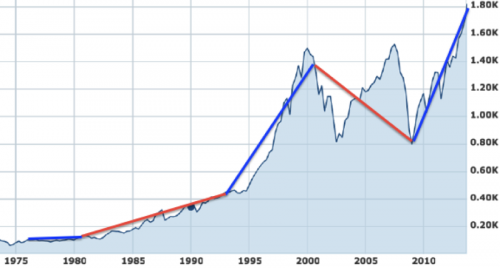
The Dow hit an inflation adjusted record high this week (WSJ). Here is the (unadjusted) S&P since 1975 with Republican administrations in red and Democrats in blue.

chart

Before you jump to partisan conclusions, last month, Tyler Cowan reviewed the Blinder and Watson paper on why Democrats preside over superior economic performance (their conclusion: mostly good luck).

Source: Bull markets under Democrats

More:

Conclusion

Your thoughts and comments on this ME-P are appreciated. Feel free to review our top-left column, and top-right sidebar materials, links, URLs and related websites, too. Then, subscribe to the ME-P. It is fast, free and secure.

Link: http://feeds.feedburner.com/HealthcareFinancialsthePostForcxos

Speaker: If you need a moderator or speaker for an upcoming event, Dr. David E. Marcinko; MBA – Publisher-in-Chief of the Medical Executive-Post – is available for seminar or speaking engagements. Contact: MarcinkoAdvisors@msn.com

OUR OTHER PRINT BOOKS AND RELATED INFORMATION SOURCES:

DICTIONARIES: http://www.springerpub.com/Search/marcinko
PHYSICIANS: www.MedicalBusinessAdvisors.com
PRACTICES: www.BusinessofMedicalPractice.com
HOSPITALS: http://www.crcpress.com/product/isbn/9781466558731
CLINICS: http://www.crcpress.com/product/isbn/9781439879900
BLOG: www.MedicalExecutivePost.com
FINANCE: Financial Planning for Physicians and Advisors
INSURANCE: Risk Management and Insurance Strategies for Physicians and Advisors

Product Details  Product Details

Seeking Securities Analysts, Stock-Brokers and Investment Bankers for New “Financial Planning Textbook for Doctors”

  Join Our Mailing List 

Planning our newest major textbook

By Ann Miller RN MHA [ph-770-448-0769]

[Executive-Director]

Dear Stock Brokers, IBs and Securities Analysts,

Greetings from the Institute of Medical Business Advisors, in Atlanta, Georgia.

Historical Review

As you may know, we released: Financial Planning Handbook for Physicians and Advisors, some time ago. It has enjoyed much success and acclaim in the medical and financial service sectors.

Recently, we have been asked to produce the next edition of this book for our target market of physicians, nurses, medical professionals, healthcare administrators – and those in the financial services sector who target this large and fertile, but rapidly changing niche market.

Why Now?

Urgency for the update has been prompted by ARRA, HI-TECH, the flash-crash of 2008 and the day-crash of 2011; by social, macro-economic and demographic changes; by political fiat and especially the PP-ACA.

Our medical colleagues are frustrated, afraid and fearful for their financial futures. They WANT informed advice.

Thus, true integrated financial planning information that targets this market – very expertly and specifically – is greatly needed.

The Invitation 

And so, we ask if you are interested in contributing an updated vision of an existing book chapter.

  • INVESTMENT BANKING-SECURITIES-MARKETS-MARGIN
  • HOSPITAL EMPLOYEE BENEFITS AND STOCK OPTIONS
  • INVESTMENT POLICY STATEMENT CONSTRUCTION

Not to worry – The original MS-WORD® chapter files are archived and available for use. We will forward it to you, upon assignment acceptance.

And, we are again fortunate that our Editor-in-Chief will be Dr. David Edward Marcinko FACFAS MBA CMP™ along with Professor Hope Rachel Hetico RN MHA CMP™ serving as Managing Editor.

They opined at a recent interview for the ME-P.

David and Hope” … We have entered into an emerging era in the financial planning ecosystem. It is a new era where one size does not fit all; and off-the-shelf financial products and mass sales customization is no long adequate for physicians and medical professionals; or their related generic financial planners or wire-house advisors.

It is a period of rapid change, shifting reimbursement paradigms and salary reductions that focus the healthcare industrial complex on pay-for-performance [P4], compensation for value and quality care; rather than procedures performed and quantity of care.

All must learn to do more with less professionally; and plan their personal financial lives more efficiently than ever before. Mistakes will be more difficult to overcome and the wiggle room that high income earning physicians, nurses and medical professionals used to enjoy is being narrowed by demographic, economic, social, technological and political fiat.

This emerging financial planning analog follows the health industry’s fiscal metamorphosis …”

Style Instructions 

The look and feel, format and style, and font and size of the book will remain the same. We use endnotes, not foot notes; and include mini-case reports or illustrative case models. It will be a major text; not a handbook.

Timeline for submission is about 3 months. Additional time is available, if needed, for a comprehensive update. But, we are trying to avoid running too far along into 2014 in order to avoid income tax season and the related time constraints on all concerned.

Writers Search

A Pleasure – Not Burden 

This should be a pleasurable project for you; and not anxiety provoking.

So, if you are a medically focused and experienced financial advisor with an: MBA, CFP®, PhD, MD, DDS, MSA/MS, CPA, RN, CMP®, DO, JD and/or CFA degree or designation, etc; please let me know if you are interested in updating and revising our chapters. OR, authoring a new to the world chapter.

Your Payback 

In return for your conscientious industry, you will receive a complimentary edition of the entire textbook; be listed on this ME-P as thought-leader with related book advertising content attributed to you; and given e-exposure to our almost 600,000 readers and ME-P subscribers …. Such the deal!

And, you will be added to our roster of experts for potential referrals, interviews, pod-casts and other marketing efforts

Assessment

Regardless of your decision, we remain apostles promoting your core vision of physician focused financial planning whenever possible.

Or, you may suggest another possible author- writer-expert contributor; if you wish.

Just let me know; ASAP [MarcinkoAdvisors@msn.com]

Thank you.
ANN
ANN MILLER RN MHA
[Executive-Director]
INSTITUTE OF MEDICAL BUSINESS ADVISORS, INC.
Suite #5901 Wilbanks Drive
Norcross, Georgia, 30092-1141 USA
[Ph] 770.448.0769

DICTIONARIES: http://www.springerpub.com/Search/marcinko
PRACTICES: www.BusinessofMedicalPractice.com
HOSPITALS: http://www.crcpress.com/product/isbn/9781466558731
CLINICS: http://www.crcpress.com/product/isbn/9781439879900
ADVISORS: www.CertifiedMedicalPlanner.org
BLOG: www.MedicalExecutivePost.com 

Product Details  Product Details

NOTICE: This invitation is not for all readers of the ME-P. It is a privilege invitation intended for those who possess the needed credentials, as decided by us, with an inclination to serve.  We reserve the right to accept or reject contributors, and content, at our own non-disclosed discretion.

##

Understanding NYSE / NASD Minimum Credit Requirements

Join Our Mailing List

A Primer for Physician Investors and Medical Professionals

By: Dr. David Edward Marcinko; MBA, CMP™

[Editor-in-Chief]

[PART 8 OF 8]

NOTE: This is an eight part ME-P series based on a weekend lecture I gave more than a decade ago to an interested group of graduate, business and medical school students. The material is a bit dated and some facts and specifics may have changed since then. But, the overall thought-leadership information of the essay remains interesting and informative. We trust you will enjoy it.

Introduction

We have seen that there are rules which stipulate that no brokerage firm may arrange for any credit to any client whose margin account does not have an equity of at least $2,000. The principal application of this rule is to initial transactions in newly opened margin accounts, however, it does apply at all times. 

Example: A doctor buys 100 shares, at $15, in a new margin account. His margin call is $1,500.

Rationale: $2,000 would be too much to require as it exceeds the total purchase price. However, a loan to the doctor isn’t allowed to be extended until, and unless, the account has equity of $2,000. The trade is simply paid in full -100% of the purchase price is the margin call. 

Example: A doctor buys 200 shares, at $15, in a new margin account (assume Regulation T = 60%).

His margin call is $2,000 

Rational: Regulation T 60% would be $1,800 (60% x $3,000). Since this would be $200 shy of the minimum equity level of $2,000, the call is the $2,000 minimum equity. 

Example: A doctor buys 300 shares, at $15, in a new margin account. (assume Regulation T = 60%) His margin call is $2, 700. 

Rationale: The account will have equity of $2, 700 (60% x $4,500), which is more than the $2,000 minimum. Therefore, the Regulation T initial requirement prevails.

The important points to remember about minimum credit requirements are:

1. You are not called upon to pay more than the purchase price.

2. You cannot be granted a loan until the account has an equity of at least $2,000.

3. If a decline in the market value of an existing account puts the equity below $2,000, there is no requirement to bring the equity back up to $2,000.

4. You may not withdraw money or securities from the account, if in doing so, you either:

  1. bring the equity below $ 2,000, or
  2. bring the equity below the maintenance level

These are the only times SMA may not be withdrawn from an account

The Short Sale

Selling short is engaged in by medical professionals who anticipate a market decline. By selling borrowed property (shares of stock) at the current market value, the doctor expects to return the borrowed property (shares of the same issuer bought in the marketplace) to the lender, normally the investor’s brokerage firm, when the market price is lower, thus profiting from the drop in price.

Essentially this is the buy low, and sell high philosophy. However, when executing a short sale one is selling high initially, then buying low later to “cover”, or close out the deal by buying low and selling high in the reverse order .

Bear in mind that the short seller is borrowing property, not money. However, due to the high degree of risk inherent in short selling, it is permitted only in a margin account. A Regulation T call is required as a show of good faith, a way the client demonstrates the financial wherewithal to buy back the property. Let’s look at a short sale transaction and the subsequent effects of market fluctuations on equity, as we did previously with buying on margin (long margin).

Credit Balance and Equity

A doctor shorts (sells short) 100 shares at $100 per share with Regulation T at 60%. The margin account would be credited with the proceeds of the sale, though the doctor has no access to these monies at this point in the deal. The account should also be credited with the doctor’s required Regulation T margin call. Therefore, the credit balance in a doctor’s margin account is the sum of the  proceeds of the short sale, plus the Regulation T margin call. This number will not change, regardless of future market fluctuations. The credit balance in a short margin account is a constant.

What does change with market fluctuations?

  1. the cost of buying back the borrowed property to cover the short sale.
  2. the equity in the account.

Equity in a short margin account is computed as follows:

Credit of  $ 16,000 – CMV  $10,000 equals $ 6,000 equity.

Now, let’s evaluate the effect of appreciation in the market price

If the stock rises to $120 per share, then the credit of $16,000 – CMV $ 2, 000, equals $ 4,000 equity.

Remember, the credit balance does not change when CMV fluctuates. The equity in this account is no longer Regulation T.

Let’s determine the amount by which the account is restricted (remember, any margin account with equity below Regulation T is restricted). Or, 60% X $12,000 = $ 7,200 – $ 4,000 = $ 3,200

Also, it should be clear, the equity percentage of this account is less than 60%, by the formula:

Equity / CMV = $ 4,000/$ 12,000 = 33.33%

This is the basic principle of the short sale; as the market price of the shorted stock increases, the equity decreases. The reverse is also true; as the price declines, the equity rises. Remember, short sellers are anticipating a market decline. Also, when buying long, or selling short, any change in market value causes a dollar for dollar change in equity.

Minimum Maintenance Requirements (Short) 

If the market continues to appreciate to $160 per share, the equity drops to zero.

Suppose that the market price rose to its theoretical maximum, or infinity? The doctor’s loss would be infinite. Remember, the maximum potential loss on a short sale is unlimited!

To protect against such an occurrence, industry Self Regulatory Organizations (SROs) developed regarding the minimum equity that must be maintained in a margin account. The minimum maintenance in a short account is equity of 30% of CMV. Note that this is higher than the 25 % figure for long margin accounts due to the nature of extreme risk of loss in the short sale.

Given that the CMV has risen to $160 per share ($16,000 total CMV), the minimum equity required to be maintained under SRO rules is 30% x CMV or  $4,800 equity. The doctor would receive a $4,800 maintenance call to bring his equity from -0- to the $4,800 minimum.

Remember, as in (cash) long accounts, there is no requirement to bring a margin account up to Regulation T equity. The maintenance equity is the percentage up to which the account must be brought when and if equity drops below the 25% or 30% levels.

Excess Equity (SMA) and Buying Power

We have seen what market appreciation does to a short seller. Let’s evaluate the effects of market depreciation in value. If the declines to $85, per share, then $ 16,000 credit – CMV $ 8,500 = $ 7,500 equity. Again, market fluctuations don’t affect credit balance. The equity in the account is now higher than Regulation T, and SMA (excess equity) has just been created.

And, as before, excess equity (SMA) can be used to buy more securities. Couldn’t it also be used as the Regulation T down payment on another sale? Yes, this is another use of SMA that is called shorting power or “selling power”. The formula for buying power as well as shorting power is exactly the same: Remember, it’s SMA / RT to use buying power.

In this case, $2,400 / 60% = $4,000 of buying (shorting) power after the decline to $85, the doctor could buy long or sell short another $4,000 worth of stock and use his SMA to meet his 60% ($2,400) Regulation T Margin call. Recall, the margin call for a short sale is the same as for a long purchase.

Cheap Stock Rule

The SROs created a set of special maintenance rules in short margin accounts to protect against unreasonable risk in low-priced issues. These rules are appropriately labeled the “cheap stock” rules.

At all times, a doctor must maintain equity in a short margin account of the greater of the following:

  1. 30% of the CMV (SRO Minimum Maintenance Requirement)
  2. $2,000 (SRO Minimum Credit Requirement)

3.   Equity as required under the rules  below

The cheap stock rules are as follows:

Stock Price                                     Minimum Maintained Equity

0 – $2.50 per share             $ 2.50 per share

$2.50 – $5.00 per share      100% of per share price

$5.00 per share and up       $ 5.00 per share

Example: A doctor shorts 1,000 shares of a $1.50 per share stock. How much must he deposit initially and how much must be maintained in the account?

First, since Regulation T won’t come into play until equity hits $2,000, the SRO minimum credit requirement of $2,000 should come into play. However, since this is a cheap stock, we determine if the requirements of those special rules require more than $2,000. They do, and require a minimum be maintained in this short margin account of at least $2.50 per share sold short (1,000 shares at $2.50 each = $2,500 minimum that needs to be in this account at all times to comply with SRO rules).

Furthermore, if the market begins to rise, the cheap stock rules would require that at all times the amount of money in the account be at least 100% of the price per share until the stock hits $5. For example, if the stock rose to $4 per share, the doctor would have to have $4,000 in the account to carry the position (1,000 shares times 100% of CMV, $4 per share in this case).

Day Trading and the Internet

Internet day trading has become something of an, investment bubble of late, suggesting that something lighter than air can pop and disappear in an instant. This has occurred despite the fact that most lay and healthcare professionals who engage in such activities, do not appreciated even the basic rules of margin and debt, as reviewed review. History is filled with examples: from the tulip mania of 1630 Holland and the British South Sea Bubble of the 1700’s; to the Florida land boom of the roaring twenties and the Great Crash of 1929; and to $ 875 an ounce gold in the eighties and to the collapse of Japans stock and real estate market in  early 1990’s. To this list, one might now add day Internet trading

The cost of compulsive gambling, arising from internet day trading activities, may be high for the physician, his family and society at large. Compulsive gamblers, in the desperation phase of their gambling, exhibit high suicide ideation, as in the case of Mark O Barton’s the murderous day-trader in Atlanta. His idea actually became a final act of desperation. Less dramatically is a marked increase in subtle illegal activity. These acts include fraud, embezzlement, CPT up-coding, medical over utilization, excessive full risk HMO contracting, and other “alleged white collar crimes.”  Higher healthcare and social costs in police, judiciary (civil and criminal) and corrections result because of compulsive gambling. The impact on family members is devastating. Compulsive gamblers cause havoc and pain to all family members. The spouses and other family members also go through progressive deterioration in their lives. In this desperation phase, dysfunctional families are left with a legacy of anger, resentment, isolation and in many instances, outright hate.

Recent Updates

Since most people, including medical professions,  initially loose at day trading, they give up and decide not to do it anymore. As there is a minimum amount of money, about $ 25,000-50,000 of trading capital needed to start, this loss is a powerful de-motivator. Still, scared by the Barton incident, the NASD and NYSE have recently proposed new rules for those who engage in questionable day trading activities.  One proposal would provide that a minimum equity of $ 25,000 be maintained at all times, versus the current $ 2,000 for other margin accounts. If the amount of a pattern day trader fell below the new threshold, no further trading would be permitted until the threshold was maintained.

Options Trading

Stock options are contracts that obligate medical investors to either buy or sell a stock at a specific price, by a specific date. For example, a put option is a bet on falling prices. Let’s suppose Dr. Jane Smith holds a put option on XYZ stock, with a $ 50 exercise price, and the stock falls to $ 45. The value of the put rises in the options market because it lets her sell a $ 50 share, which is above the market price. A call option, on the other hand, is a bet on rising prices. Again, Dr. Smith holds a call option on XYZ stock, with an exercise price of $ 50. If the share rises to $ 55, the value of the option increase since she may buy for $ 50, a stock now worth $ 55.

In 1999, Charles Schwab, the biggest on-line brokerage executed more than 30 million option trades. Due to this demand, Schwab launched other complex services, such as the on-line simultaneous buying and selling of options. Also crowding the options field, are new upstart on-line brokerages, such as: Interactive Brokers, Preferred Capital Markets Technology and CyberCorp. They provide powerful software which will allow options in the future to trade as effortlessly and efficiently as stocks.

In  mid-2000 the Reuters Group PLC Instinet Corporation, the electronic network most widely used by institutional investors, opened an Internet brokerage aimed at consumers, including healthcare practitioners. Instinet will let retail clients place orders alongside institutions, and will offer access to charts, news and research. Thus, artificially empowering the individual investor, as well as again tempting the compulsive prone addict.

Acknowledgements

The assistance Mr. James Nash, of the Investment Training Institute, in Tucker, GA is acknowledged in the preparation of this ME-P.

Conclusion

Your thoughts and comments on this ME-P are appreciated. Feel free to review our top-left column, and top-right sidebar materials, links, URLs and related websites, too. Then, subscribe to the ME-P. It is fast, free and secure.

Link: http://feeds.feedburner.com/HealthcareFinancialsthePostForcxos

Speaker: If you need a moderator or speaker for an upcoming event, Dr. David E. Marcinko; MBA – Publisher-in-Chief of the Medical Executive-Post – is available for seminar or speaking engagements. Contact: MarcinkoAdvisors@msn.com

OUR OTHER PRINT BOOKS AND RELATED INFORMATION SOURCES:

LEXICONS: http://www.springerpub.com/Search/marcinko
PHYSICIANS: www.MedicalBusinessAdvisors.com
PRACTICES: www.BusinessofMedicalPractice.com
HOSPITALS: http://www.crcpress.com/product/isbn/9781466558731
CLINICS: http://www.crcpress.com/product/isbn/9781439879900
ADVISORS: www.CertifiedMedicalPlanner.org
PODIATRISTS: www.PodiatryPrep.com
BLOG: www.MedicalExecutivePost.com

Web Sites of Interest

http://www.tradehard.com

The ultimate super site for investment bankers and traders. Started by a group of well known stockbrokers, day traders, and money managers. This site offers advice about how to work the market to your advantage.

http://www.internetinvesting.com

This is an investor’s guide to on-line brokers, discount brokers, day trading and after hours investing. The site offers stock quotes, financial news, investment banking strategies, a book list and daily commentary about the market. This is a serious text heavy resource.

References and Readings

  • Atkinson,  W., and Crawford, AJ.:  On-line investing raises questions about suitability. Wall Street Journal, November, 28, 1999.
  • Farrell, C.: Day Trade On-line. John Wiley & Sons, New York, 1999.
  • Friedfertig, M.: Electronic Day Trader’s Secretes. McGraw-Hill, New York, 1999.
  • Gibowicz, Peter: Registered Representative (Study Program ,Volume II). Edward Fleur Financial Education Corporation, New York, 1998.
  • Gibowicz, Peter: Quick Seven. Edward Fleur Financial Education Corporation, New York, 1998.
  • Gibowicz, Peter: Registered Representative (Study Program, Volume I). Edward Fleur Financial Education Corporation, New York, 1998.
  • Kadlec, CW.: Dow 100,000: Fact or Fiction. New York Institute of Finance, New York, 1999
  • Nash, J: Securities Markets. In, Nash, J: (International Training Institute Manual). Atlanta, 1999.
  • Nassar, DS: How to Get Started in Electronic Day Trading. McGraw-Hill, New York,
  • 1999.
  • Schmuckler, E:  The Addictive Personality. In, Marcinko, DE (2001 Financial Planning for Medical Professionals. Harcourt Professional Publishing, New York, 2000. 

Product DetailsProduct DetailsProduct Details

Product Details  Product Details

Product DetailsProduct Details

Product Details


How to Succeed as an “Active-Passive” Investor [Part II]

Join Our Mailing List

An Oxymoron—Part Two

By Rick Kahler CFP® http://www.KahlerFinancial.com

Rick Kahler CFPContinued from last week, here are the remaining keys to help fine-tune your core passive investment strategy for optimum success.

5. Asset allocation.

This is critical. Study after study shows the most important determinate in your overall investment success isn’t picking the right stocks, bonds, or real estate. According to one researcher, a good asset allocation strategy can add about 0.5% to your long-term return. It’s your overall mix of various asset classes that will ultimately have the greatest impact on your success or failure. Investing your entire 401(k) in several stock index funds can be as insane as putting everything into bond funds. Even a mix of stocks and bonds, while better, can leave a portfolio over-exposed to the fortunes of one sector and exposed to the failing of one country’s economy.

6. Manager and index selection.

Especially if you are over 40 and have retirement in sight, successful passive investing isn’t quite as easy as calling Vanguard and putting everything in an S&P 500 index fund. Every asset class has multiple indexes, with managers who all have their differences in philosophy, execution, and fees. Some adhere to traditional indexes while others build their own indexes based on their research. Picking the right index with the right manager can add up to 2% over the long haul to the annual return generated by a good asset allocation.

7. Rebalancing.

Once you set your target allocations, you need to periodically sell off the advancing asset classes to purchase more of the lagging classes. Suppose you want 30% of your portfolio in U.S. stocks and 30% in bonds. If stocks are doing well and bonds are not, over time you might end up with 35% stocks and 25% bonds. Selling stocks and buying bonds to rebalance the allocations is a disciplined form of “buy low and sell high.” Without it, your portfolio will miss out on some extra returns and over time take on more risk and volatility. Research shows that periodic rebalancing can add 0.5% to 1.5% annually over the long term.

8. Asset placement and taxes.

Other adjustments need ongoing attention in any portfolio. Asset class location helps minimize tax consequences by matching the assets with the right account. IRA’s are best for certain asset classes, while Roth IRA’s do best with others and taxable accounts with still others. This matching can add up to 0.5% annually, so getting it right can be a big deal. It’s also important to tweak asset class allocations to adjust for long-term bear or bull markets, significant economic or tax policy changes, or changing personal situations. Another necessity is minimizing taxes by efficient and timely loss and gain harvesting.

9. Uncovering scams and ill-suited investments.

Recently a client asked me about a start-up online business in which several of her friends had invested. While there were many things about it that concerned me, at the core this just wasn’t an investment opportunity that suited my client’s expertise, goals, or risk tolerance. I strongly urged her to pass, and she did. Within six months the offering was found to be a well-pitched scam, and everyone who invested lost their money. Having someone to help investigate the legitimacy of investment ideas can always be helpful.

10. Keeping it sensibly simple.

Keeping things simple for simplicity’s sake doesn’t always produce the desired benefits. While it’s simple to put your whole portfolio into one stock or one mutual fund, the results could end up adding layers of complexity to your life. The right amount of sensible complexity can turn a good passive investing strategy into a highly successful one. 

MD

Assessment

How to Succeed as an “Active-Passive” Investor [Part I]

Conclusion

Your thoughts and comments on this ME-P are appreciated. Feel free to review our top-left column, and top-right sidebar materials, links, URLs and related websites, too. Then, subscribe to the ME-P. It is fast, free and secure.

Link: http://feeds.feedburner.com/HealthcareFinancialsthePostForcxos

Speaker: If you need a moderator or speaker for an upcoming event, Dr. David E. Marcinko; MBA – Publisher-in-Chief of the Medical Executive-Post – is available for seminar or speaking engagements. Contact: MarcinkoAdvisors@msn.com

OUR OTHER PRINT BOOKS AND RELATED INFORMATION SOURCES:

LEXICONS: http://www.springerpub.com/Search/marcinko
PHYSICIANS: www.MedicalBusinessAdvisors.com
PRACTICES: www.BusinessofMedicalPractice.com
HOSPITALS: http://www.crcpress.com/product/isbn/9781466558731
CLINICS: http://www.crcpress.com/product/isbn/9781439879900
ADVISORS: www.CertifiedMedicalPlanner.org
BLOG: www.MedicalExecutivePost.com

Product DetailsProduct DetailsProduct Details

Product Details  Product Details

Product DetailsProduct Details

Why Physician-Investors Must Understand TAMPs

Join Our Mailing List 

Third Party Outsourcing of Your Investments

By Dr. David Edward Marcinko MBA CMP™

Dr David E Marcinko MBATurnkey Asset Management Programs (TAMPs) allow independent financial advisors [FAs], Registered Investment Advisors [RIAs] – typically fiduciaries – to outsource the management of some or all of their clients’ assets.

More recently, Certified Public Accountants, law firms and banks also are using them to enter the financial advice marketplace

Managed Account Services

With a TAMP, financial advisors gain access to managed account services that allow them to offload time-consuming functions, such as research, portfolio construction, rebalancing, reconciliation, performance reporting, and tax optimization and reporting, which allows them to focus on clients’ personal financial needs, marketing, advertising and sales concerns

Fee-Based Accounts

TAMPs are a form of fee-account, which charge fees based on a percentage of the total assets managed in the program. TAMPs appeal to independent financial advisors who are building a fee-only business, because they can avoid the cost of building their own fee-accounts platform and can implement a TAMP in about 90 days, instead of the year or longer required to develop the same capabilities in-house.

TAMPs also help independent advisors avoid employee hiring and payroll costs related to internal administration and research, which for a modest program requiring a staff of 8-10 employees can typically cost $1 million per year in ongoing overhead. Because TAMPs serve financial advisors, individual retail investors are not able to directly invest their assets in a TAMP.

###

TAMPs

###

“Meet and Greet” Meetings

So, the next time your FA has a quarterly meeting with you to discuss the status of your investment account or retirement portfolio, just realize that s/he is usually only the middleman. S/he is not buying, selling or trading stocks for you. An “anonymous omniscient other” behemoth firm is actually doing the work and merely placing your name on a glossy automated printed report. Your FA passes the report along as his/her alone, complete with his/her name and firm embossed, therein.  Usually with a supplication like this.

The courtesy of your referral is our only reward.

And, the day of your quarterly meeting, in his/her fancy office, is probably the first and only day the report is even reviewed by the FA. This is why most of the FAs time is spent prospecting, or in marketing, advertising and/or other sales activities.  All the heavy-lifting is done elsewhere.

In the industry, this type of Financial Advisor is known as an asset aggregator. And, in the retail sector, most FAs are asset aggregators or gatherers.

http://en.wikipedia.org/wiki/Turnkey_Asset_Management_Program

Number Crunching

Now, let’s say you have one millions dollars to invest and the FA charges you one percent of your AUMs; annually. This is common in the industry with ranges up to 3%, or so. Yep; that’s ten grand out of your pocket.

The Financial Advisor thus receives about $5,000/per year and the TAMP gets the same; year after year. This is reduced to $2,500 or so, to the FA, after office overhead costs. It does not matter if the market, or your account, is up or down. Such the deal!

Nevertheless, the money is automatically flowing away from you much like an annuity; or cash cow. Since you do not actually write a check out to the FA or firm, you may forget about the fees. Get the idea!

Therefore, a firm with $100 million dollars in AUMs earns about: $1-M X 50% = $500,000/year. With scale-ability, it is easy to see how Wall Street has all those skyscrapers in Manhattan, Chicago, London or Tokyo. AUM fees go up drastically, with little increase in overhead. Remember the economic concepts of marginal revenues and marginal costs!

In the industry, we call this Recurring Income. RI is preferred over a one time stock-broker commission [one-time sale] because it’s producing revenue for the TAMP and FA 24/7/365.

To be sure, it is difficult for FAs to obtain such clients; but once in the fold, clients are loathe to leave.

Assessment

Is it a wonder why big firms and wire-houses [brokerages] place their employee FAs under non-compete clauses? In other words, you the client, are owned by the company. You are not a client of the individual FA. So, when an FA leaves or retires, your account stays with the firm unless you transfer it. Expect to receive a very hard sell to stay, when you threaten to leave.

More:

Conclusion

Now, you know why sales skills are needed – over financial acumen – in this business. A great personality trumps education and brain power, most every time.

Your thoughts and comments on this ME-P are appreciated. Feel free to review our top-left column, and top-right sidebar materials, links, URLs and related websites, too. Then, subscribe to the ME-P. It is fast, free and secure.

Link: http://feeds.feedburner.com/HealthcareFinancialsthePostForcxos

Speaker: If you need a moderator or speaker for an upcoming event, Dr. David E. Marcinko; MBA – Publisher-in-Chief of the Medical Executive-Post – is available for seminar or speaking engagements. Contact: MarcinkoAdvisors@msn.com

OUR OTHER PRINT BOOKS AND RELATED INFORMATION SOURCES:

LEXICONS: http://www.springerpub.com/Search/marcinko
PHYSICIANS: www.MedicalBusinessAdvisors.com
PRACTICES: www.BusinessofMedicalPractice.com
HOSPITALS: http://www.crcpress.com/product/isbn/9781466558731
CLINICS: http://www.crcpress.com/product/isbn/9781439879900
ADVISORS: www.CertifiedMedicalPlanner.org
BLOG: www.MedicalExecutivePost.com

Product DetailsProduct DetailsProduct Details

  Risk Management, Liability Insurance, and Asset Protection Strategies for Doctors and Advisors: Best Practices from Leading Consultants and Certified Medical Planners™8Comprehensive Financial Planning Strategies for Doctors and Advisors: Best Practices from Leading Consultants and Certified Medical Planners™

***

Invite Dr. Marcinko

***

How to Succeed as an “Active-Passive” Investor [Part I]

Join Our Mailing List 

An Oxymoron—Part One

By Rick Kahler CFP® http://www.KahlerFinancial.com

Rick Kahler CFPA fundamental principle I preach is that having a core of passively managed mutual funds is the foundation of successful long-term wealth building. I practice that principle, as well: about 75% of the securities in my personal portfolio are passively selected.

My commitment to this approach has evolved both from my own years of investing experience and from reading reams of research. I’m convinced that “beating the market” over the long term is as elusive a goal as capturing a wild jackalope.

Fundamental Strategy

Does that mean investing is as simple as giving most of your money to passive managers and kicking back? Not quite. Yes, investing in the index funds of a diversified group of asset classes and leaving them alone is a good fundamental strategy that will help you secure your financial future. To be even more successful, however, it helps to actively apply some additional strategies.

Additional Strategies

I was reminded of this by a June 2013 blog post from Bob Seawright of Madison Avenue Securities. Here, inspired by and adapted from his “top ten” list, are some of the factors that strongly affect the success of passive investors. While financial professionals can help with all of these strategies, investors going it alone can also benefit from paying attention to them.

Link: http://rpseawright.wordpress.com/2013/06/04/financial-advice-a-top-ten-list/

Top Ten List

1. What’s the point?

A successful investment strategy starts with establishing clear, objective, and realistic goals. Most people bypass this step, thinking it is unrelated to their investment selection. Yet very few people on their deathbeds focus on how great it was to get a 7% annual return on their investments. Drilling down to what is really important in your life is no simple task, but it is essential. Creating a life worth living means using portfolio returns to support your dreams and desires! Knowing where you are going and why is the first step to establishing a successful portfolio.

2. A written investment plan.

Yes, you need your investment strategy in writing. This both insures that you have one and helps you clarify it. I find that writing things down often helps me find gaps and inconsistencies in what I thought was a complete and rational plan.

A written investment plan should state:

a. Your investment philosophy. Are you a passive or active investor, or both?

b. Your goals and objectives for your funds. This answers the question, “How and when will this money support my life?”

c. Guidelines and constraints you will adhere to in managing your money. What tenure do you want in a manager, what is your upper limit on expense ratios, how much flexibility will you give a manager, what quantifiable factors will take you out of a market or bring you back in?

A written plan will bring structure and discipline to your investment strategy, qualities most investors lack.

3. Manage your behavior.

We all have blind spots, biases, and delusions. How you behave in the face of market declines and advances will affect your long-term portfolio returns more than any other single factor. To make this even more challenging, your brain is naturally wired for investment failure. Identifying and reframing your money scripts can help you rewire your brain for success instead. Working with a financial coach or therapist can be invaluable to help you negotiate your own mind.

4. Financial planning.

Many people think financial planning is limited to investment advice. Yet it is much broader and deeper. Financial planning not only helps you build wealth, but helps you use it wisely to support the life you want.

Doctors

More:

Assessment

Six more keys to successful passive investing will be covered soon in Part II.

How to Succeed as an “Active-Passive” Investor [Part II]

Conclusion

Your thoughts and comments on this ME-P are appreciated. Feel free to review our top-left column, and top-right sidebar materials, links, URLs and related websites, too. Then, subscribe to the ME-P. It is fast, free and secure.

Link: http://feeds.feedburner.com/HealthcareFinancialsthePostForcxos

Speaker: If you need a moderator or speaker for an upcoming event, Dr. David E. Marcinko; MBA – Publisher-in-Chief of the Medical Executive-Post – is available for seminar or speaking engagements. Contact: MarcinkoAdvisors@msn.com

OUR OTHER PRINT BOOKS AND RELATED INFORMATION SOURCES:

LEXICONS: http://www.springerpub.com/Search/marcinko
PHYSICIANS: www.MedicalBusinessAdvisors.com
PRACTICES: www.BusinessofMedicalPractice.com
HOSPITALS: http://www.crcpress.com/product/isbn/9781466558731
CLINICS: http://www.crcpress.com/product/isbn/9781439879900
ADVISORS: www.CertifiedMedicalPlanner.org
BLOG: www.MedicalExecutivePost.com

Product DetailsProduct DetailsProduct Details

Product Details  Product Details

Underwriting US Government Securities Issues

Join Our Mailing List

A Primer for Physician Investors and Medical Professionals

By: Dr. David Edward Marcinko; MBA, CMP™

[Editor-in-Chief] http://www.CertifiedMedicalPlanner.org

[PART 4 OF 8]

Dr. Marcinko at Emory University

NOTE: This is an eight part ME-P series based on a weekend lecture I gave more than a decade ago to an interested group of graduate, business and medical school students. The material is a bit dated and some facts and specifics may have changed since then. But, the overall thought-leadership information of the essay remains interesting and informative. We trust you will enjoy it.

Introduction

The underwriting of US Government securities is the largest underwriting market in the world, but are issued a bit differently than we have seen to date, in this series..

For example, there is no such thing as a negotiated underwriting on a US Government security. All offerings of the Treasury are sold by auction. The auction is conducted by the Federal Reserve Bank of New York in accordance with a published schedule. Unfortunately, they are not open to the public, just primary dealers. A bank or investment dealer is appointed by the president of the Federal Reserve Bank of New York and are the only entities authorized to buy and sell government securities in direct dealings with the FED. One becomes a primary dealer through qualifications of reputation, underwriting capacity, and adequacy of staff and facilities.

Currently, 13 and 26-week treasury bills are offered every week on Mondays, while 52- week bills are auctioned once a month. Treasury notes and bonds are auctioned much less frequently on a schedule that will not be asked on your exam. Those dealers wishing to acquire a particular Treasury security enter bids on a yield basis rather than at a specific  price. This method is sometimes called a Dutch auction. As a practical matter, about a week or so before the proposed auction, the Treasury announces the following four items: amount, maturity date, nominal or coupon rate anticipated, and  the minimum denominations available (except for T bills which don’t have interest coupons and always carry a minimum denomination of $10,000).

Can the individual medical professional purchase newly issued Treasuries? Yes! Rather than turning in a competitive bid, as the primary dealer does, the individual will turn in a non-competitive bid. Competitive bidding with governments is similar to the other competitive bidding discussed above. The underwriter turning in the lowest bid, wins. Due to the enormous size of Treasury offerings, it is extremely rare that the lowest bidder is able to take the entire issue. That being the case, the Treasury moves to the next best and the next best bidders, until most of the issue is taken. There is always a small portion left over for the non-competitive bidders.  Non-competitive bids may only be made in amounts of $1 million or less.  All non-competitive bids are automatically filled at the average yield of the competitive bids which have been accepted.

Underwriting  State Issues (Blue Sky Registration)

Unlike Federal issues, there are three types of State registration that are important for the medical professional to know:

Notification: This is the simplest form of registration and is used by a an issuer who has been in continuous operation for at least the previous three years.  Most, but not all, states permit registration by notification. 

Coordination: This occurs when an issuer wishes to coordinate a Federal registration under the Securities Act of 1933 with Blue Sky registration in one or more states. Under most circumstances, the Blue Sky registration automatically becomes effective when the Federal registration statement becomes effective.

Qualification: Any security may be registered in a state by qualification, but it’ s most commonly used by those issuers who are unable to use notification or coordination. Registration by Qualification becomes effective when so ordered by the State Administrator.

Exempt Securities

There are many securities which are exempt from the Act of ’33 registration and prospectus requirements. They include:

  • US Government and  Federal Agency issues.
  • Municipal, State issues and commercial paper with a maturity not in excess of 270 days.
  • Intra-state offerings (Rule 147)  because they are blue-sky chartered within the state.
  • Small Public offerings (Regulation A) if the value of the securities issued does not exceed $5,000,000 in any  12 month period. An issuer using the Regulation A exemption does not make the normal filings with the SEC in Washington. Instead, they file a simplified disclosure document with their SEC Regional Office, known as an Offering Statement. It must be file at least 10 business days prior to the initial offering of the securities. No securities may be sold unless issuer has furnished an offering circular (full disclosure document) to the purchaser at least 48 hours prior to the mailing of confirmation of the sale, and, if not completed within 9 months from the date of the offering circular, a revised circular must be filed. Every 6 months, issuers must file a report with the SEC of sales made under the Regulation A exemption until offering is completed.
  • Traditional insurance policies are considered to be securities and are exempt, as are fixed annuities. However, some of the newer forms of life insurance, like variable life, as well as variable annuities, have investment characteristics and, therefore are not exempt from registration.
  • Commercial paper and banker’s acceptances (9 month or shorter maturity), since they are money market instruments.

US capitol

The Private Placement (Regulation D) Securities Exemption

Since the Securities Act of 1933 requires disclosure of all public offerings (other than the exemptions just described), it should make sense that any securities offering not offered to the public would also be exempt. The Act provides a registration exemption for private placements, know as Regulation D.

Since one of the stated purposes of the Act of 1933 is to prevent fraud on the sale of new public issues, an issue which has only a limited possibility of injuring the public may be granted an exemption from registration. The SEC just doesn’t have the time to look at everything so they exempt offerings which do not constitute a “public offering”. Strict adherence to the provisions of the law, however, is expected and is scrutinized by the SEC. This exemption provision of the Act of ’33 lies within Regulation D.

Regulation D describes the type and number of investors who may purchase the issue, the dollar limitations on the issue, the manner of sale, and the limited disclosure requirements. Bear in mind at all times that from the issuer’s viewpoint, the principal justification for doing a private, rather than public offering, is to save time and money, not to evade the law. Remember, it is just as illegal to use fraud to sell a Regulation D issue as it is in a public issue. However, if done correctly, a Regulation D can save time and money, and six separate rules (501-506).

Rule 501: Accredited investors are defined as: corporations and partnerships with net worth of $5,000,000 not formed for the purpose of making the investment; corporate or partnership “insiders”; individuals and medical professionals with a net worth (individual or joint) in excess of $1,000,000; individuals with income in excess of $200,000 (or joint income of $300,000) in each of the last two years, with a reasonable expectation of having income in excess of $200,000 (joint income of $300,000) in the year of purchase; and any entity 100% owned by accredited investors.

Rule 502:  The violations of aggregation and integration are defined:

Aggregation: Sales of securities in violation of the dollar limitations imposed under Rules 504 and 505 (506 has no dollar limitations).

Integration: Sales of securities to too large a number of non-accredited investors, in violation of the “purchaser limitations” set forth in Rules 505 and 506 (504 has no “purchaser limitations”).

Rule 503: Sets forth notification requirements. An issuer will be considered in violation of Regulation D, and therefore subject to Federal penalties, if a Form D is not filed within 15 days after the Regulation D offering commences.

Rule 504: Enables a non-reporting company to raise up to $1,000,000 in a 12-month period without undergoing the time land expense of an SEC registration. Any number of accredited and non-accredited investors may purchase a 504 issue.

Rule 505: Enables corporations to raise up to $5,000,000 in a 12-month period without a registration. The “purchaser limitation” rule does apply here. It states that the number of non-accredited investors cannot exceed 35.

Rule 506: Differs from 505 in two significant ways. The dollar limit is waived and the issuer must take steps to assure itself that, if sales are to be made to non-accredited investors, those investors meet tests of investment “sophistication”. Generally speaking, this means that either the individual non-accredited investor has investment savvy and experience with this kind of offering, or he is represented by someone who has the requisite sophistication. This representative, normally a financial professional, such as an investment advisor, accountant, or attorney, is referred to in the securities business as a Purchaser Representative.

Obviously, we would have few problems if only medical investors in private placements were accredited investors, but that is not always the case. Since we are limited to a maximum of 35 non-accredited investors, how we count the purchasers becomes an important consideration. The SEC states that if a husband and wife each purchase securities in a private placement for their own accounts, they count as one non- accredited investor, not two. It would also be true that if these securities were purchased in UGMA accounts for their dependent children, we would still be counting only one non- accredited investor.

In the case of a partnership, it depends upon the purpose of the partnership. If the partnership was formed solely to make this investment, then each of the partners counts as an individual accredited or non-accredited investor based upon their own personal status, but if the partnership served some other purpose, such as a law firm, then it would only count as one purchaser .

Regulation D further states that no public advertising or solicitation of any kind is permitted. A tombstone ad may be used to advertise the completion of a private placement, not to announce the availability of the issue.

As a practical matter, however, whether required by the SEC or not, a Private Offering Memorandum for a limited partnership, for example, is normally prepared and furnished so that all investors receive disclosure upon which to base an investment judgment.

If any of the provisions of the Securities Act of 1933 are violated by an issuer, underwriter, or investor, this is known as “statutory underwriting”, underwriting securities in violation of statute. One who violates the ’33 Act is known as a statutory underwriter. One all too common example of this occurs when a purchaser of a Regulation D offering offers his unregistered securities for re-sale in violation of SEC Rule 144, an explanation of which is given below:

In simple English, SEC Rule 144 was created so that certain re-sales of already-existing securities could be made without having to file a complete registration statement with the SEC. The time and money involved in having to file such a registration is usually so prohibitive as to make it uneconomical for the individual seller. What kinds of re-sales are covered by Rule 144 and are important to the medical investor? Let’s first define a few terms.

Restricted Securities: Unregistered Securities purchased by a medical or other investor in a private placement. Also called Letter Securities, Legend Securities, referring to the fact that purchasers must sign an “Investment Letter” attesting to their understanding of the restrictions upon re-sale and to the “Legend” placed upon the certificates indicating restriction upon resale.

Control Person: A corporate director, officer, greater than 10% voting Stockholder, or the spouse of any of the preceding, are loosely referred to as Insiders or Affiliates due to their unique status within the issuer .

Control Stock: Stock held by a control person. What makes it control stock is who owns it, not so much how they acquired it.

Non-Affiliate:  An investor who is not a control person and has no other affiliation with the issuer other than as an owner of securities.

Rule 144 says that restricted securities cannot be offered for re-sale by any owner without first filing a registration statement with the SEC:

  1. unless the securities have been held in a fully paid-for status for at least two years;
  2. unless a notice of Sale is filed with the SEC at the time of sale and demonstrating compliance with Rule 144
  3. unless small certain quantity apply.

Your thoughts and comments on this ME-P are appreciated. Feel free to review our top-left column, and top-right sidebar materials, links, URLs and related websites, too. Then, subscribe to the ME-P. It is fast, free and secure.

Link: http://feeds.feedburner.com/HealthcareFinancialsthePostForcxos

Speaker: If you need a moderator or speaker for an upcoming event, Dr. David E. Marcinko; MBA – Publisher-in-Chief of the Medical Executive-Post – is available for seminar or speaking engagements. Contact: MarcinkoAdvisors@msn.com

OUR OTHER PRINT BOOKS AND RELATED INFORMATION SOURCES:

Product DetailsProduct DetailsProduct Details

Product DetailsProduct Details

Product Details

Risk Management, Liability Insurance, and Asset Protection Strategies for Doctors and Advisors: Best Practices from Leading Consultants and Certified Medical Planners™8Comprehensive Financial Planning Strategies for Doctors and Advisors: Best Practices from Leading Consultants and Certified Medical Planners™

On Target Date Retirement Funds for Physicians

Join Our Mailing List 

What You Haven’t Considered

By Lon Jefferies MBA CFP® http://www.NewWorthAdvice.com

Lon JefferiesAn increasing number of physician investors are utilizing target-date funds in their investment accounts and employer retirement plans.

In theory, an individual should select a target-date fund that matches their estimated year of retirement, such as the Vanguard Target Retirement 2015, or Fidelity Freedom 2020 fund. The philosophy of these funds is that as one ages, the proportion of stocks in their portfolio should decline, while their exposure to less volatile fixed-income positions increases.

My Concerns

While I agree with the concept that investors should continually make their portfolios less aggressive as they age, there are two concerns I have about utilizing these funds.

First and most obviously, an appropriate asset allocation for an individual physician investor as they enter retirement is dependent on their risk tolerance and is best not left to generalizations. At retirement, an aggressive doctor may be comfortable holding a portfolio that is 70 percent stocks while a more conservative investor may not be able to tolerate the volatility that accompanies a portfolio that has any more than 40 percent exposure to equities.

Of course, assuming these two investors retired around the same time, a target-date fund would place both in a one-size-fits-all asset mix.

Next, and perhaps less obvious but equally important is the fact that an asset allocation is better designed around when the investor will need the money as opposed to when they will retire.

Case Examples:

Consider two hospital employees who are retiring in 2015, and consequently, are invested in the Fidelity Freedom 2015 target-date fund (which is quite conservative – only 45 percent stocks and a 55 percent mix of bonds and cash). One of these employees will be taking an early retirement at age 59 and won’t be allowed to draw a Social Security benefit for at least three years.

As a result, this individual will need to draw a large amount of funds from his retirement account in order to pay for the first several years of retirement. The worst thing that could happen to a retiree is to endure a market crash shortly after leaving the workforce and suffers an excessive loss right as the funds are needed.

In such a case, the physician investor wouldn’t have time to wait for the market to recover and would be forced to sell at a loss. If money will need to be withdrawn sooner rather than later, sound financial planning says it should be invested in a conservative portfolio that is likely to limit loss, potentially similar to the 45 percent stock and 55 percent bond mix that the Fidelity Freedom 2015 fund provides.

###

Financial

###

Another Case Example:

Now consider that the second hospital employee invested in the Fidelity Freedom 2015 fund is age 67, will immediately be receiving a full Social Security benefit when he retires, and has a healthy pension from his employer. With two significant sources of income immediately upon leaving the workforce, this employee may not need to withdraw meaningful assets from his investment portfolio during the early years of his retirement.

Now, with a longer investment time frame before funds will be withdrawn, a more assertive portfolio is likely appropriate for this investor as he can afford to endure a full market cycle of pullbacks and advances while attempting to achieve superior gains.

Assessment

Hopefully this example illustrates the importance of considering other potential income sources and the timing of your expenses during retirement rather than simply treating target-date funds as your entire asset base. While the theory of target-date funds is sound, other factors should be considered before utilizing them as a significant portion of your investment nest egg.

Conclusion

Your thoughts and comments on this ME-P are appreciated. Feel free to review our top-left column, and top-right sidebar materials, links, URLs and related websites, too. Then, subscribe to the ME-P. It is fast, free and secure.

Link: http://feeds.feedburner.com/HealthcareFinancialsthePostForcxos

Speaker: If you need a moderator or speaker for an upcoming event, Dr. David E. Marcinko; MBA – Publisher-in-Chief of the Medical Executive-Post – is available for seminar or speaking engagements. Contact: MarcinkoAdvisors@msn.com

OUR OTHER PRINT BOOKS AND RELATED INFORMATION SOURCES:

Health Dictionary Series: http://www.springerpub.com/Search/marcinko

Practice Management: http://www.springerpub.com/product/9780826105752

Physician Financial Planning: http://www.jbpub.com/catalog/0763745790

Medical Risk Management: http://www.jbpub.com/catalog/9780763733421

Hospitals: http://www.crcpress.com/product/isbn/9781439879900

Physician Advisors: www.CertifiedMedicalPlanner.org

Product Details  Product Details

R.I.P. Muriel “Mickie” Siebert

Join Our Mailing List

On Muriel Siebert

“Mickie” Siebert, founder of the brokerage firm that bears her name, Muriel Siebert & Co. Inc., bought a seat on the New York Stock Exchange in 1967.

She was one of the pioneers in the discount brokerage field, as she transformed Muriel Siebert & Company (now a subsidiary of Siebert Financial) into a discount brokerage in 1975, on the first day that Big Board members were allowed to negotiate commissions; the so-called “May Day” decision.

BORN: Sept. 12, 1932, in Cleveland.

DIED: Aug. 24, 2013, in New York.

EDUCATION: Attended Western Reserve University (now Case Western Reserve University) 1949-1952.

FAMILY: Never married and did not have any children.

Link: http://news.msn.com/obits/muriel-siebert-first-woman-member-of-the-nyse-dies?ocid=ansnews11

##

NYSE

###

Assessment

She was the first woman to become a member of the New York Stock Exchange [NYSE].

Visit: www.SiebertNet.com

Conclusion

Your thoughts and comments on this ME-P are appreciated. Feel free to review our top-left column, and top-right sidebar materials, links, URLs and related websites, too. Then, subscribe to the ME-P. It is fast, free and secure.

Link: http://feeds.feedburner.com/HealthcareFinancialsthePostForcxos

Speaker: If you need a moderator or speaker for an upcoming event, Dr. David E. Marcinko; MBA – Publisher-in-Chief of the Medical Executive-Post – is available for seminar or speaking engagements. Contact: MarcinkoAdvisors@msn.com

OUR OTHER PRINT BOOKS AND RELATED INFORMATION SOURCES:

Health Dictionary Series: http://www.springerpub.com/Search/marcinko

Practice Management: http://www.springerpub.com/product/9780826105752

Physician Financial Planning: http://www.jbpub.com/catalog/0763745790

Medical Risk Management: http://www.jbpub.com/catalog/9780763733421

Hospitals: http://www.crcpress.com/product/isbn/9781439879900

Physician Advisors: www.CertifiedMedicalPlanner.org

Product Details  Product Details

Passive Investing with a “Steroid Twist”

Join Our Mailing List 

A Core and Satellite Philosophy

By Rick Kahler CFP® http://www.KahlerFinancial.com

Rick Kahler CFP“Keep your hands away from your investments and back away from the market reports.”

That pretty much sums up passive investing, the approach I have practiced for years. I’ve preached it for years, too, and did so in a recent column. The wisest way to build wealth is by investing in a variety of asset classes, setting target allocations in each asset class, and then taking your hands off except to periodically rebalance to the original target allocations.

For most of us, including doctors, the best way to invest in an asset class is to give our funds to a mutual fund manager who will purchase the appropriate investments. Mutual fund managers have a choice of actively or passively managing the money you give them to invest.

Passivity 

Passive managers try to match market indexes, which are groups of companies representing a cross-section of a certain type of investment. The most popular index in the world is probably the S&P 500 index, which consists of the largest 500 companies in the United States. Another popular index is the Dow Jones Industrial Index which is made up of 30 companies. When we consider the US has almost 10,000 companies, we can quickly see that many indexes represent just a segment of the entire market.

Research indicates it is very hard to beat an index, especially with stocks, bonds, real estate investment trusts, and commodities. I prefer to keep about 80% of my investment portfolio in a broad variety of passively managed investments in these asset classes.

Timing or Strategy?

Where do I put the other 20%? In mutual funds with active managers who try to earn returns similar to stocks and bonds and that are not correlated to either.

This may seem to make me a hypocrite. I’ve been saying for years not to be a market timer, and now here I am suggesting you do just the opposite with a portion of your portfolio. Not hypocrisy at all. What I’ve preached for many years is that neither you nor I have any business timing investments. That doesn’t mean no one should ever do it.

So, is it timing or strategy?

Core and Satellite Philosophy

It can be wise to put a small portion [satellite] of our portfolios [core] into various investment strategies with active managers. The key is to find managers who have a disciplined approach that eliminates emotion and who have long-term track records of success. These strategies include managers who attempt to time markets by shorting stocks they think will decline in value and buying stocks they think will rise.

It also includes one investment strategy, managed futures, that I call “timing on steroids.”

###

Bull markets

###

Rationale

My reason for including some actively managed funds is to have part of my investment portfolio that is not correlated to stocks. I want these investments to have a positive return over a long period, but also to move in opposition to other major asset classes, especially stocks. So when stocks are up, I am not fazed if my managed futures are down. And, when stocks are down, I am thankful when my managed futures are up. If both asset classes earn 6 to 9% over a long period of time, I’m happy.

So, call it … passive investing with a steroid twist.

Assessment

So I stand by my commitment to passive investing. It’s based on research suggesting that timing the markets is a loser’s game.

Yet part of passive investing is having a fully diversified portfolio. This includes having a small portion—20% or less—in mutual funds with disciplined, successful active managers. My job is to research and find those managers. Then it’s okay to let them time their hearts out. I just make sure I don’t try to time the timers.

More:

Conclusion

Your thoughts and comments on this ME-P are appreciated. Feel free to review our top-left column, and top-right sidebar materials, links, URLs and related websites, too. Then, subscribe to the ME-P. It is fast, free and secure.

Link: http://feeds.feedburner.com/HealthcareFinancialsthePostForcxos

Speaker: If you need a moderator or speaker for an upcoming event, Dr. David E. Marcinko; MBA – Publisher-in-Chief of the Medical Executive-Post – is available for seminar or speaking engagements. Contact: MarcinkoAdvisors@msn.com

OUR OTHER PRINT BOOKS AND RELATED INFORMATION SOURCES:

DICTIONARIES: http://www.springerpub.com/Search/marcinko
PHYSICIANS: www.MedicalBusinessAdvisors.com
PRACTICES: www.BusinessofMedicalPractice.com
HOSPITALS: http://www.crcpress.com/product/isbn/9781466558731
CLINICS: http://www.crcpress.com/product/isbn/9781439879900
BLOG: www.MedicalExecutivePost.com
FINANCE: Financial Planning for Physicians and Advisors
INSURANCE: Risk Management and Insurance Strategies for Physicians and Advisors

***

  Risk Management, Liability Insurance, and Asset Protection Strategies for Doctors and Advisors: Best Practices from Leading Consultants and Certified Medical Planners™8Comprehensive Financial Planning Strategies for Doctors and Advisors: Best Practices from Leading Consultants and Certified Medical Planners™

Is Passive Investing Right for You?

Join Our Mailing List

On the “Buy low and Sell high” Strategy 

By Rick Kahler CFP® http://www.KahlerFinancial.com

Rick Kahler CFP“Buy low and sell high.” That was my simple approach when I was a smart young investment advisor. I poured over a company’s balance sheet, earnings statements, and forecasted returns. Then I bought those companies that were bargains and waited for my gains to roll in. More times than not, they did—eventually.

The problem came with the “not” and “eventually.” A majority of my picks did go up in value, but the minority that were “nots” still lost enough to have a negative impact on my bottom line. Even more frustrating, some of my “nots” turned into gains “eventually” after I sold them.

My investment returns were similar to findings from Dalbar, Inc., a financial services research firm. Dalbar’s studies have shown that average active investors barely beat inflation over the long term. They significantly underperform investors who put their money in an index fund of stocks and leave it alone.

So much for my early investment brilliance! Over the past 40 years, I’ve learned that with every passing year I know less than I thought I did the year before. I’ve proven to myself I have no idea where any market is going tomorrow, next month, next year, or in the next 10 years.

This awareness has led me to become increasingly passive in my investments. In passive investing, rather than trying to time the buying and selling of winners and losers, you instead buy a representative sample of the entire market. This is possible in any market: bonds, stocks, real estate investment trusts, or commodities. You simply buy mutual funds and exchange-traded funds (ETF’s) called index funds.

Benefits

The two biggest benefits of passive investing are cost and diversification.

Costs

Index funds have incredibly low costs, with annual fees as low as 0.1%. Contrast that with the average equity fund that costs 1.5%, fifteen times more. According to research, 97% of active mutual fund managers don’t beat the index over 20 years. Even the 3% who do must beat the index by more than the 1.5% fee they charge, in order for their investors to come out ahead.

Diversification

The smaller number of stocks owned – the more my fortunes are tied to those few companies. It’s the old adage, “don’t put all your eggs in one basket.” By owning index funds, I own hundreds or thousands of securities. While I will never hit a home run, I also will never strike out. My returns will be “average.” Investing may be one of the few professions where being average puts you in the 97th percentile of all investment managers.

The NaySayers

Not all of my peers agree with this philosophy. Many very smart investment advisors jumped off the passive investing bandwagon after 2008 and returned to tactical asset allocation, which is another name for timing the markets.

###

cropped-the-medical-executive-post3.jpg

###

Harold’ Strategy

A noted investment advisor, Harold Evensky MBA CFP® of Evensky & Katz, addressed this issue at a conference last year. After the 2008 crisis, his firm hired researchers to evaluate whether they could find any tactical strategies that would have avoided the crisis. They found some that, in hindsight, would have worked. Yet he didn’t feel those strategies could be comfortably applied looking forward. Instead, the firm decided to add a 20% allocation to non-correlated alternative investments, something I’ve done since the late 90’s. In other words, they increased their clients’ diversification.

Assessment

The bottom line is that passive investing actually gives you more control. It allows you to focus on reducing costs and taxes, the aspects of investing you can control. It frees you from trying to beat the market and worrying over what you can’t control.

Conclusion

Your thoughts and comments on this ME-P are appreciated. Feel free to review our top-left column, and top-right sidebar materials, links, URLs and related websites, too. Then, subscribe to the ME-P. It is fast, free and secure.

Link: http://feeds.feedburner.com/HealthcareFinancialsthePostForcxos

Speaker: If you need a moderator or speaker for an upcoming event, Dr. David E. Marcinko; MBA – Publisher-in-Chief of the Medical Executive-Post – is available for seminar or speaking engagements. Contact: MarcinkoAdvisors@msn.com

OUR OTHER PRINT BOOKS AND RELATED INFORMATION SOURCES:

Health Dictionary Series: http://www.springerpub.com/Search/marcinko

Practice Management: http://www.springerpub.com/product/9780826105752

Physician Financial Planning: http://www.jbpub.com/catalog/0763745790

Medical Risk Management: http://www.jbpub.com/catalog/9780763733421

Hospitals: http://www.crcpress.com/product/isbn/9781439879900

Physician Advisors: www.CertifiedMedicalPlanner.org

Product DetailsProduct DetailsProduct Details

Product Details  Product Details

Twelve Steps of Financial Independence for Doctors

Join Our Mailing List

A Basic Guide

By Lon Jefferies  MBA CFP® CMP®

Lon JeffriesWant to get your finances in order? Consider this comprehensive 12-step guide to address each element of your personal financial situation. In most cases, you should not address a step until all previous steps are satisfied.

1. 401(k) 403(b) Match: Without exception, if your employer matches 401(k) contributions, you should maximize whatever they’re offering. If it’s a dollar-for-dollar match, that’s an instant 100 percent return! Even the 50 percent return of a two-for-one match is irresistible.

2. Consumer Debt: Pay off your credit cards and all other unsecured loans, prioritizing the debts with the highest interest rates. Credit cards frequently charge rates as high as 30 percent. Paying off a card with 30 percent APR is comparable to getting a 30 percent investment return. Not completing this step will hamper your entire financial plan.

3. Cash Flow: You can’t develop wealth if you spend more than you make. Construct and follow a written budget to ensure you are living within your means. Your budget should include saving at least 10 percent of your gross income for retirement. Constantly compare actual spending with your budget and hold yourself accountable! Mint.com is an excellent free tool for this step.

4. Emergency Reserve: Develop a liquid savings account consisting of enough money to cover three to six months of expenses. These funds should only be utilized in crisis such as a job loss or medical emergency.

5. Life Insurance: If you have dependent children, you likely need life insurance. Cost-efficient coverage can frequently be obtained via your employer. To calculate the amount of coverage to purchase, first determine how much money your survivors would need to maintain a comfortable lifestyle, and then subtract any income they will generate as well as any savings you’ve accumulated. Alternatively, if you don’t have children in your household and your spouse is self-sufficient, you may not need life insurance coverage.

6. Disability Insurance: Getting hurt can completely derail your financial planning. A loss of income halts your savings and likely leads to increased debt. Obtain enough disability coverage to bridge the gap between earnings and expenses in the event of an injury. Coverage can frequently be purchased through your employer.

7. Estate Planning: Obtain a power of attorney, medical directive and living will. These documents allow you to designate the person you would like to make decisions for you if you become incapacitated. They also specify your preferences regarding life-prolonging medical treatments. Ensure both primary and contingent beneficiaries are assigned to your retirement accounts. Finally, develop a will or trust to ensure all other assets are distributed as you desire when you die.

8. Retirement Contributions: With risk exposures covered, it’s time to return to retirement planning efforts. Again, a 401(k) is an attractive retirement vehicle because it frequently offers an employer match and allows large annual contributions ($18,500 or $25,000 for individuals over age 50). If your employer doesn’t offer a 401(k), you can still contribute up to $6,500 (or $7,000 if over age 50) to an IRA. IRA contributions can be made on behalf of both spouses, even if only one is employed.

9. Traditional or Roth: The type of account that is best for you depends on when you want to pay taxes. A traditional retirement account allows an immediate tax deduction, the investments grow tax deferred, and the money isn’t taxed until the funds are withdrawn from the account. Alternatively, taxes are paid on Roth contributions immediately, but both contributions and growth are completely tax free when withdrawn during retirement. Put simply: will you be in a higher tax bracket now or when you withdraw the funds?

10. Asset Allocation: The most important investment decision you can make is how much of your portfolio will be invested in stocks versus bonds. A higher proportion of stocks leads to increased risk, but the potential for greater returns. The more time you have until the funds are needed, the more risk you can usually afford to take. Consequently, you should reduce the proportion of stocks in your portfolio as you approach retirement in order to minimize your risk factor. Identify an asset allocation that is aggressive enough to accomplish your investment goals while exposing you to an acceptable level of risk.

11. Get Caught Up: According to a recent Fidelity study, your nest egg should be one times your salary by age 35, three times your salary by 45, five times your salary by 55 and seven times your salary by 67.

12. Education Planning: Only after your retirement savings is where it should be can you focus on your children’s college education. At this point, explore a Utah Educational Savings Plan 529 (uesp.org) or a Coverdell Education Savings Account, both of which offer tax advantages if used for schooling.

Assessment

Does this mean you don’t need a financial advisor? Of course not! A qualified, comprehensive financial planner can add value, address shortcomings, and answer questions in each of these areas. Once you have completed each of these steps, you can be confident you have your financial ducks in a row.

###

healthcare-business

Conclusion

Your thoughts and comments on this ME-P are appreciated. Feel free to review our top-left column, and top-right sidebar materials, links, URLs and related websites, too. Then, subscribe to the ME-P. It is fast, free and secure.

Link: http://feeds.feedburner.com/HealthcareFinancialsthePostForcxos

Speaker: If you need a moderator or speaker for an upcoming event, Dr. David E. Marcinko; MBA – Publisher-in-Chief of the Medical Executive-Post – is available for seminar or speaking engagements. Contact: MarcinkoAdvisors@msn.com

Product DetailsProduct DetailsProduct Details

Product Details  Product Details

Risk Management, Liability Insurance, and Asset Protection Strategies for Doctors and Advisors: Best Practices from Leading Consultants and Certified Medical Planners™8Comprehensive Financial Planning Strategies for Doctors and Advisors: Best Practices from Leading Consultants and Certified Medical Planners™

Are Doctors Bad Investors?

Join Our Mailing List

A Longboard Assessment Management Study for Lay Investors

###

stock_investing_cashsherpa-812x1024

Assessment

And so, are doctors and other medical professionals really bad investors?

More:

Conclusion

Your thoughts and comments on this ME-P are appreciated. Feel free to review our top-left column, and top-right sidebar materials, links, URLs and related websites, too. Then, subscribe to the ME-P. It is fast, free and secure.

Link: http://feeds.feedburner.com/HealthcareFinancialsthePostForcxos

Speaker: If you need a moderator or speaker for an upcoming event, Dr. David E. Marcinko; MBA – Publisher-in-Chief of the Medical Executive-Post – is available for seminar or speaking engagements. Contact: MarcinkoAdvisors@msn.com

OUR OTHER PRINT BOOKS AND RELATED INFORMATION SOURCES:

Health Dictionary Series: http://www.springerpub.com/Search/marcinko

Practice Management: http://www.springerpub.com/product/9780826105752

Physician Financial Planning: http://www.jbpub.com/catalog/0763745790

Medical Risk Management: http://www.jbpub.com/catalog/9780763733421

Hospitals: http://www.crcpress.com/product/isbn/9781439879900

Physician Advisors: www.CertifiedMedicalPlanner.org

Product Details  Product Details

How Volatile Is the Stock Market Today?

Join Our Mailing List

And … Is it Dangerous?

By Lon Jefferies CFP® MBA www.NetWorthAdvice.com

Lon JefferiesBased on conversations with physician and clients, I’d suggest that most investors view the market of the new millennium as more volatile and fragile than it’s been in the past.

JUNE 4, 2013

DOW 15,253.7 +138.1
NASDAQ 3,465.49 +9.58
S&P 1,640.61 +9.87

New concerns that could affect a portfolio are seemingly always coming to light – think of the near-financial collapse of the U.S. economy during the last recession, the U.S. debt downgrade, the potential bailout crises in Europe and the possible devaluation of the euro, domestic unemployment concerns, and the perennial concern about the inflation/deflation of the dollar.

Add to this the idea that the world has become a more unstable place and the reality that supercomputers make thousands of trades every second.

How Valid Are the Concerns?

To determine the validity of these perceptions, Allan Roth analyzed the performance of the Wilshire 5000 (an index of the market value of all stocks actively traded in the United States) since 1980 in the May edition of Financial Planning Magazine. Surprisingly, Mr. Roth found that market swings of more than 30% weren’t much more common during the past 10 years than they were from 1980-2002. In fact, on a monthly basis, market swings of more than 10% actually occur less these days than in the past.

On a daily basis, the mean standard deviation of returns (a measure of volatility) over the entire 32-year period was 1.01%. In other words, during 68% of trading days, the index increased or decreased by less than 1.01%. Further, on 95% of trading days the index went up or down by no more than 2.02% (or two standard deviations). While daily standard deviation hit a record in 2008 of more than 2.5%, last year actually had lower volatility than the overall average. Consequently, while volatility hit a high in 2008, it has been at a very normal level since.

###

Stock_Market

###

Why the Perceptions?

So why do investors perceive more uncertainty in today’s environment? Mr. Roth mentions a few hypotheses:

  • Magnitude Effect – To suffer a 2.5% decrease in 1972, the S&P 500 would have needed to decrease by 2.54 points. To endure a 2.5% decrease today, the index would need to decrease by 41.25 points. Although both represent the same investment loss, we perceive the double digit point swing as larger and more dramatic.
  • Availability Bias – Humans overestimate the probability of events associated with memorable or vivid occurrences. Memorable events are further magnified by excessive coverage in the media.  Because the market crash of 2008 was so remarkable, investors tend to overestimate the probability of a similar crash and underestimate the probability of market appreciation, which historical data says is significantly more likely.
  • Access to Information – Jason Zweig, a columnist for the Wall Street Journal, says “today between websites, Facebook, Twitter, the TV and smart phones, an investor couldn’t escape knowing about a big move in the stock market if he or she tried. Whatever you pay attention to, while you are attending to it, will always seem more significant than it really is.”
  • Simple Fear and Pessimism – Meir Statman, a finance professor at Santa Clara University, suggests “people who think the U.S. is in decline view investing as riskier now than in the past, when they believe the country was better off, and no amount of data showing actual volatility would change their minds.” Similarly, Daniel Kahneman, a Nobel laureate and Princeton professor suggests “people always think the present is more volatile than the past. Because we know that historic crises have resolved themselves, we may simply remember the past as being less volatile than we viewed it at the time.”

More:

Assessment

It’s likely beneficial for physicians and all investors to evaluate their behavior and determine if they exhibit any of these biases. History tells us that the most dominate factor leading to investment success is to keep your asset allocation steady. Being aware of tendencies that might encourage us to make rash investment decisions could save us a lot of stress during critical market movements.

Conclusion

Your thoughts and comments on this ME-P are appreciated. Feel free to review our top-left column, and top-right sidebar materials, links, URLs and related websites, too. Then, subscribe to the ME-P. It is fast, free and secure.

Link: http://feeds.feedburner.com/HealthcareFinancialsthePostForcxos

Speaker: If you need a moderator or speaker for an upcoming event, Dr. David E. Marcinko; MBA – Publisher-in-Chief of the Medical Executive-Post – is available for seminar or speaking engagements. Contact: MarcinkoAdvisors@msn.com

OUR OTHER PRINT BOOKS AND RELATED INFORMATION SOURCES:

Product Details  Product Details

Product DetailsProduct Details

Strategic Importance of Healthcare Capital Investing

Join Our Mailing List

For Leaders, Governors, Physicians and Hospital Executives

[By Calvin Weise CPA, CMA]

Some of the most important strategic decisions hospital executives make are related to capital expenditures. Almost every hospital has capital investment opportunities that are far in excess of their capital capacity. Capital investments are bets on the future. How these capital bets are placed has long-lasting implications. It is of utmost importance that hospitals bet right.

Hospitals as Business Entity

Hospitals are capital intensive businesses. Hospital buildings are unique structures that require large amounts of capital to construct and maintain. Inside these buildings are pieces of expensive equipment that have fairly short lives. Technological innovations continually drive demand for new and more expensive equipment and facilities. The ability to continually generate capital is the lifeblood of hospitals. In order to compete and succeed, it’s imperative for hospitals to continually invest in large amounts of capital equipment and expensive facilities.

Capital investment is fueled by profit. In order to continually make the necessary capital investments, hospitals must be profitable. Hospitals unable to generate sufficient profit will fail to make important capital investments, weakening their ability to compete and survive.

Hospital managers bear important responsibility in choosing which capital investments to make. There are always more capital opportunities than capital capacity. In many cases, capital opportunities not taken by hospitals create openings for others with capital capacity to fill the vacuum. By not taking such opportunities, hospitals are weakened, and their operating risk increases.

Responsibility

Stewardship is a term that aptly describes the responsibility borne by hospital managers in making capital investments. The New Testament parable of the talents describes this kind of stewardship. In this story, a merchant entrusted three managers with money to invest. One manager was given five units, another two, and a third one. At the end of the investment period, the two managers given five units and two units reported a 100% return. The manager given one unit reported zero return — he was fired and his unit was given to the first manager.

Healthcare Investment Risks

Leadership

This is stewardship — and hospital managers are stewards of their organizations’ assets. Too often, not-for-profit hospital managers hold an erroneous view of the returns expected of them. Like the third manager in the parable, they think zero return on equity is acceptable. They understand capital investment funded by debt needs to cover the interest on the debt, but they view capital investments funded by equity as having no cost associated with the equity. From an accounting perspective, they are right. From a stewardship perspective they are dead wrong — just like the third manager in the parable.

Here’s why: as stewards, they are responsible for managing the entrusted assets. They can either put these assets at risk themselves, or they can put those assets in the market and let other managers put them at risk. If they choose to put them at risk themselves, then they have the mandate of creating as much value from putting them at risk as they would realize if they put them in the market for other managers to put at risk. They have the duty to realize returns that are equivalent to the returns they could realize in the market; otherwise, they should just put them in the market. They can either invest in hospital assets or work the assets themselves, or they can invest in financial market assets so others can work the assets. When they choose to invest in hospital assets, the required return is not zero. That’s the return they get fired for. The required return is equivalent to market returns.

Assessment

Thus, when evaluating performance of hospital management teams, the minimum acceptable performance level is return on equity that is equivalent to the return that could be realized by investing the hospital assets in the market. And when evaluating a capital investment opportunity, it is important to apply a capital charge equivalent to the hospital’s weighted cost of capital — a measure that imputes an appropriate cost to the equity portion of the capital along with the stated interest rate for the debt portion of the capital structure.

Conclusion

Your thoughts and comments on this ME-P are appreciated. Feel free to review our top-left column, and top-right sidebar materials, links, URLs and related websites, too. Then, subscribe to the ME-P. It is fast, free and secure.

Link: http://feeds.feedburner.com/HealthcareFinancialsthePostForcxos

Speaker: If you need a moderator or speaker for an upcoming event, Dr. David E. Marcinko; MBA – Publisher-in-Chief of the Medical Executive-Post – is available for seminar or speaking engagements. Contact: MarcinkoAdvisors@msn.com

Our Other Print Books and Related Information Sources:

Health Dictionary Series: http://www.springerpub.com/Search/marcinko

Practice Management: http://www.springerpub.com/product/9780826105752

Physician Financial Planning: http://www.jbpub.com/catalog/0763745790

Medical Risk Management: http://www.jbpub.com/catalog/9780763733421

Hospitals: http://www.crcpress.com/product/isbn/9781439879900

Physician Advisors: www.CertifiedMedicalPlanner.org

Product DetailsProduct Details

Are Physicians Investing in International Bonds?

Join Our Mailing List

A Global Approach to Investing

By Rick Kahler MS CFP® ChFC CCIM www.KahlerFinancial.com

Rick Kahler CFPUS investors and fans of the St. Louis Rams have something in common. Both have seen their home teams fall from prominence to mediocrity in the past ten years. In 2000 the Rams won the Super Bowl, but in 2011 they ended the season tied for the worst record in the league. The US ranked as the world’s third freest economy in 2000, but by 2010 had fallen to number 18.

So, how do physicians and other investors allocate their funds in a country that’s in economic decline? Much like an ardent fan of the Rams who is also an astute gambler! You cheer for your team to win, but you place your bets on the stronger opponents.

Global Investing

It’s critical today to take a global approach to investing. Since the US now makes up less than half of the world’s wealth, it makes sense to invest the majority of your portfolio in the stocks and bonds of other countries. This is simply another form of diversification. Not only does it make sense to have US government bonds and the bonds from a wide range of companies in your portfolio, it also makes sense to diversify and hold a wide range of bonds of international companies and foreign governments.

While it isn’t uncommon for physician investors to have some exposure to international stocks, I find it is unusual for them to have investments in international bonds.

Investing in Bonds

When you invest in bonds, you are lending to a borrower who promises to pay interest and to repay the loan on a certain date. Bonds represent an IOU from a US or foreign corporation or government.

As with any bond, an important factor to consider is the credit quality of the issuer. This can become more complex with foreign bonds, as many countries don’t have the same standards of accounting required in the US.

More:

Foreign Bonds

A unique feature of foreign bonds is the effect that currency exchange rates have on your investment. Fluctuations in the local currency can enhance or depress your returns.

For example, if you want to purchase bonds denominated in the Australian dollar (AUD) you will first need to exchange your US dollars (USD) for AUD and then purchase the bonds. If the USD drops in value against the AUD, then the value of your Australian bonds goes up because your AUD now buy more USD. The reverse happens if the USD appreciates against the AUD.

Global investing

Direct Purchase of Mutual Funds

There are two ways to purchase international bonds. You can buy bonds directly from a securities broker or purchase shares of a mutual fund that invests in foreign bonds. Any fund with “international” in its name invests only in bonds of countries outside the US. If the fund has “global” in its name, it includes both foreign and US bonds in its mix.

The two categories of international bonds include those issued by developed nations like the United Kingdom, Japan, or Germany, and those issued by emerging market nations like India, Brazil, or Morocco. Emerging market bond funds invest in bonds from developing nations, risking greater losses for the chance of higher returns.

In my portfolios, I generally split my bond allocations 50/50 between the US and foreign bonds. Currently, our fund manager favors the bonds of Australia, New Zealand, and Canada.

Assessment

The Rams did better in 2012 than in 2011, so fans can hope they regain their top status in 2013. We can also hope the US can stop its economic slide and regain its global prominence in the next decade. But, until there is evidence of a turnaround, international bonds are one way physicians can avoid betting too heavily on the home team.

Conclusion

Your thoughts and comments on this ME-P are appreciated. Feel free to review our top-left column, and top-right sidebar materials, links, URLs and related websites, too. Then, subscribe to the ME-P. It is fast, free and secure.

Link: http://feeds.feedburner.com/HealthcareFinancialsthePostForcxos

Speaker: If you need a moderator or speaker for an upcoming event, Dr. David E. Marcinko; MBA – Publisher-in-Chief of the Medical Executive-Post – is available for seminar or speaking engagements. Contact: MarcinkoAdvisors@msn.com

Our Other Print Books and Related Information Sources:

Health Dictionary Series: http://www.springerpub.com/Search/marcinko

Practice Management: http://www.springerpub.com/product/9780826105752

Physician Financial Planning: http://www.jbpub.com/catalog/0763745790

Medical Risk Management: http://www.jbpub.com/catalog/9780763733421

Hospitals: http://www.crcpress.com/product/isbn/9781439879900

Physician Advisors: www.CertifiedMedicalPlanner.org

Product Details  Product Details


Protecting Patient Privacy

Join Our Mailing List

How Important Is It – Really?

By Dr. David Edward Marcinko MBA

DEM blue

By Matthew Pelletier [safety consultant]

The U.S. Health Insurance Portability and Accountability Act (HIPAA) is the federal law protecting the privacy and security of patients’ health information and was enacted in 1996.

HIPAA laws also protect electronically communicated information. Understanding the significance and importance of HIPAA laws is vital to all medical and health organizations. Companies are required to follow HIPAA laws and protect patient privacy.

Share and Share Alike – NOT!

The privacy rule is an important aspect of HIPAA and makes it illegal for patient’s private health information to be shared by health professionals unless the patient consents. This encompasses patient information which is written, verbal or electronically communicated. Many health care and medical organizations use healthcare training videos in order to educate their workforce on the importance of patient privacy laws.

###

privacy

Review

As the infographic above illustrates, patient privacy is very important and the cost in breach of privacy can be costly:

• With 60% of hospitals having a minimum of 2 breaches in privacy the cost per hospital is estimated at $2 billion dollars.
• The average number of records which are lost or stolen in each violation of privacy is 1,769.
• The main causes of electronic patient information breaches is due to employees, portable electronic devices and third-party errors.
• 7 out of 10 hospitals don’t view patient privacy as a priority though it costs them money if breached.

With 38% of hospitals choosing not to inform anyone of patient privacy breaches while over 40% of breaches are only reported by the patients themselves, HIPAA violations can result in being very costly to medical and healthcare organizations, not just hospitals. HIPAA training videos are a solution to help the workforce understand the importance of patient privacy laws.

Assessment

Conclusion

Your thoughts and comments on this ME-P are appreciated. And, are these issues a moral equivalency? Does privacy even exist anymore in an era of social media, the Internet, Google Earth and Google Maps, etc.

Feel free to review our top-left column, and top-right sidebar materials, links, URLs and related websites, too. Then, subscribe to the ME-P. It is fast, free and secure.

Link: http://feeds.feedburner.com/HealthcareFinancialsthePostForcxos

Speaker: If you need a moderator or speaker for an upcoming event, Dr. David E. Marcinko; MBA – Publisher-in-Chief of the Medical Executive-Post – is available for seminar or speaking engagements. Contact: MarcinkoAdvisors@msn.com

OUR OTHER PRINT BOOKS AND RELATED INFORMATION SOURCES:

Product Details  Product Details

Doctor’s and the Fiscal Cliff

Join Our Mailing List

What’s a Physician-Investor to Do?

By Rick Kahler MS CFP® ChFC CCIM www.KahlerFinancial.com

Rick Kahler CFPSo the economic train is speeding faster and faster, and the edge of the fiscal cliff is getting closer and closer, and the passengers are starting to scream. Meanwhile, the guys in the cab of the engine are arguing about whether to hit the brakes or blow the whistle.

What’s the best thing for any investor to do?

Nothing!

Based on my emails this week from clients and readers of my column, there seems to be widespread concern among investors that we’re on the verge of panic and the markets are about to head south.

It reminds me of the good old days, back in the fall of 2008, when the markets were dropping 900 points a day. I’m sensing that the fear among investors about going over the fiscal cliff is similar to the fear of four years ago. The only difference is that the markets aren’t falling today.

Those who assume the markets are about to drop may be right. If that’s the case, what should you be doing to your portfolio to prepare? Assuming it is globally diversified, not a thing.

The News

Many investors, and medical professionals, already are sitting on the sidelines in bonds, shifting through a plethora of bad news and waiting for markets to tank. They have good reason for their expectations. There has been a steady stream of bad news over the past year: a feeble global economic recovery, the near certainty the US will raise taxes and cut spending (a/k/a the fiscal cliff), staggering budget deficits around the globe, the prospect of a EuroZone breakup, a highly negative and divisive presidential election, banking scandals, and a nationwide drought.

Bonds

Considering all the uncertainty, it’s easy to explain why investors have generally favored bonds over stocks during the past 12 months.

With all this bad news, one could expect stocks to be down significantly. For the 12-month period ending September 30, 2012, however, 40 markets had positive returns, with six countries—including the US—delivering a total return in excess of 30%. This is according to the investment analysis firm Morgan Stanley Capital International.

While most investors think successful investing requires constant attention to current events, research says the opposite is true. The more that investors pay attention to the breaking news and adjust their portfolios, the lower their returns.

Fiscal Cliff

Bailing Out

But, with the looming fiscal cliff, shouldn’t a wise investor bail out now and then buy back in at the bottom? It would be like jumping off the train before the crash, then waiting until it has hit the ground, been repaired, and is back on track before you get on again. The only problem is there’s no way to know whether the markets will go down, or if they do, how to know when they hit bottom and it’s time to get back in.

Going to Cash?

The worst action you could take right now is to sell out your portfolio and go to cash.

If you have a globally diversified portfolio, the US decision to tax more and spend less will have much less impact.

For example, our typical 60/40 portfolio only has 13.5% in US stocks and 25% in US bonds. Over half of it is in international stocks, bonds, and non-US correlated investment strategies. It’s designed to cushion even extreme fluctuations in the markets.

Assessment

Anyone who is appropriately diversified has no need for fear as we get closer to plunging off the fiscal cliff. To protect your investments, don’t sell out. To preserve your peace of mind, don’t panic. Above all, don’t jump. The best possible response is to simply stand by and watch the train wreck.

Conclusion

Your thoughts and comments on this ME-P are appreciated. Feel free to review our top-left column, and top-right sidebar materials, links, URLs and related websites, too. Then, subscribe to the ME-P. It is fast, free and secure.

Link: http://feeds.feedburner.com/HealthcareFinancialsthePostForcxos

Speaker: If you need a moderator or speaker for an upcoming event, Dr. David E. Marcinko; MBA – Publisher-in-Chief of the Medical Executive-Post – is available for seminar or speaking engagements. Contact: MarcinkoAdvisors@msn.com

Our Other Print Books and Related Information Sources:

Health Dictionary Series: http://www.springerpub.com/Search/marcinko

Practice Management: http://www.springerpub.com/product/9780826105752

Physician Financial Planning: http://www.jbpub.com/catalog/0763745790

Medical Risk Management: http://www.jbpub.com/catalog/9780763733421

Hospitals: http://www.crcpress.com/product/isbn/9781439879900

Physician Advisors: www.CertifiedMedicalPlanner.org

Product Details  Product Details

Product Details

Will Higher Taxes Damage Your Portfolio?

Join Our Mailing List

Discussing Stock Market Performance

By Lon Jefferies CFP® MBA

Net Worth Advisory Group

Lon Jeffrieslon@networthadvice.com

www.networthadvice.com

Do higher taxes equate to negative stock market returns? Does anyone economic variable accurately predict stock market performance?

A number of our Net Worth Advisory Group physician and lay clients have indicated they are concerned about the impact higher taxes could have on the stock market. News organizations and campaign rhetoric create the impression that there is a cause and effect relationship between taxes (or whatever the hot discussion topic is) and stock market performance. Since 1926, the stock market has obtained positive returns during a calendar year 72% of the time.

Economic Variables

Here are the facts about how various economic variables have impacted investment returns:

  • PERSONAL INCOME TAXES: From 1926-2011 there were 20 years where personal income taxes (for incomes over $150,000, adjusted for inflation) increased over the previous year. The stock market went up 13 of those years, or 65% of the time.
  • CORPORATE TAXES: From 1926-2011 there were 11 years where corporate taxes increased over the previous year. The stock market went up 6 of those years, or 55% of the time.

  • LONG-TERM CAPITAL GAINS: From 1926-2011 there were 11 years where the long-term capital gains tax rate increased over the previous year. The stock market went up 9 of those years, or 82% of the time.

  • INTEREST RATES: From 1956-2011 there were 27 years where interest rates (measured by the Treasury Bill) increased over the previous year. The stock market went up 24 of those years, or 89% of the time.
  • INFLATION: From 1926-2011 there were 43 years where the inflation rate increased over the previous year. The stock market went up 33 of those years, or 77% of the time.

  • NATIONAL DEBT: From 1940-2011 there were 38 years where the national debt as a percentage of gross domestic product (GDP) increased over the previous year. The stock market went up 30 of those years, or 79% of the time.
  • DEFICITS SPENDING: From 1926-2011 there were 38 years where deficit spending increased over the previous year. The stock market went up 30 of those years, or 79% of the time.
  • COMPANY PROFITABILITY: From 1961-2011 there were 25 years where the earnings of S&P 500 companies increased over the previous year. The stock market went up 21 of those years, or 84% of the time.
  • COMPANY DIVIDENDS: From 1961-2011 there were 21 years where S&P 500 companies increased their dividends over the previous year. The stock market went up 17 of those years, or 81% of the time.

  • UNEMPLOYMENT: From 1948-2011 there were 20 years where the unemployment rate increased over the previous year. The stock market went up 9 of those years, or 45% of the time.

Investing and Taxes

Predictions?

As the data indicates, there is no single economic variable, positive or negative that consistently predicts stock market performance. The market may produce positive or negative returns in 2013, but it’s not likely to be because the personal income tax for high income families increased.

The Unemployment Figures

It’s worth noting that the only economic factor that led to a declining market more frequently than not is rising unemployment. While the unemployment rate remains at 7.8%, high by historical standards, it has been steadily decreasing since October of 2009 when it reached 10%.

Additionally, the only other individual indicator that seems to have even a marginally significant negative impact on stock market returns is an increase in the corporate tax rate; if President Obama can get Congress to agree with him, he would like to decrease that rate from 35% to 28% next year. Consequently, history indicates that neither rising unemployment nor increased corporate tax rates will apply in 2013 and should not hamper stock market returns.

Suggestions

History has taught us over and over again that time in the market is much more important than timing the market. It has also taught us that one of the biggest mistakes investors make is to say “these conditions have never existed before and this time is different.”

Need a recent example? Remember the general consensus investors reached about Europe near the beginning of the year? It may surprise you that Europe (as measured by the Vanguard MSCI Europe ETF) has returned over 17% year to date, significantly outpacing the growth of the S&P 500.

Assessment

I personally believe the best game plan for medical professionals is to develop a fundamentally sound diversified portfolio, only investing money you don’t anticipate spending for at least 10 years in stocks, and stay the course.

Conclusion

Your thoughts and comments on this ME-P are appreciated. Feel free to review our top-left column, and top-right sidebar materials, links, URLs and related websites, too. Then, subscribe to the ME-P. It is fast, free and secure.

Link: http://feeds.feedburner.com/HealthcareFinancialsthePostForcxos

Speaker: If you need a moderator or speaker for an upcoming event, Dr. David E. Marcinko; MBA – Publisher-in-Chief of the Medical Executive-Post – is available for seminar or speaking engagements. Contact: MarcinkoAdvisors@msn.com

Our Other Print Books and Related Information Sources:

Health Dictionary Series: http://www.springerpub.com/Search/marcinko

Practice Management: http://www.springerpub.com/product/9780826105752

Physician Financial Planning: http://www.jbpub.com/catalog/0763745790

Medical Risk Management: http://www.jbpub.com/catalog/9780763733421

Hospitals: http://www.crcpress.com/product/isbn/9781439879900

Physician Advisors: www.CertifiedMedicalPlanner.org

Product Details  Product Details

Product Details

With Obama Election Win “Mr. Market” Weighs in on the ACA Equity Winners and Losers

Join Our Mailing List

The Wisdom of Crowds

By David K. Luke MIM, Certified Medical Planner™

Website: www.networthadvice.com

The first trading session following the election on Wednesday, November 7, 2012 gave us some clues on how different sectors of the health care market may be affected by the ACA, as Obama’s win confirms that health reform marches forward. “Mr. Market” has spoken.

“Mr. Market”

For those that may be unaware, “Mr. Market” was Benjamin Graham’s term for the stock market in explaining fluctuations. Graham is the father of value investing and Warren Buffet’s most influential mentor. According to Graham, Mr. Market is emotionally unstable but doesn’t mind being slighted. If Mr. Market’s quotes are ignored, he will be back again tomorrow with a new quote.

So, the point is that successful investors do not place themselves in emotional whirlwinds often created by the market. This first post-election trading session was such a whirlwind. Large groups of people (such as those that voted with their pocketbook in this telling stock market session) are smarter than an elite few, or so goes the premise of James Surowiecki’s Wisdom of the Crowds.

Now; what did we learn from the combined investing public wisdom about the future of healthcare companies profitability with ACA?

Keep in mind the overall market was down 2.4% on the day as measured by both the Dow Jones Industrial Average and the Standard & Poor 500. The biggest concern of the day was investor worry about the so called “fiscal cliff” and the debate over billions in spending and tax increases. Considering the total market on November 7th, health care stocks performed as a group better than the averages, but Mr. Market definitely parsed health care stocks by sector from “great” to “dreadful” based on the implications of impending health care reform:

Great:

Hospital Stocks

  • Health Management Associates (HMA) +7.3%
  • HCA Holdings Inc. (HCA) +9.4%
  • Community Health Systems Inc. (CYH) +6.0%
  • Tenet Healthcare Corp. (THC) +9.6%

Yes, there were stocks that went up stridently on the big down day. Not surprisingly, hospital stocks are expected to benefit from the estimated 30 million Americans who will line up for insurance coverage beginning in 2014, increasing profits and decreasing bad debts.

Medicaid HMOs

  • Molina Healthcare Inc. (MOH) +4.6%
  • Centene Corp. (CNC) +10.1%
  • WellCare Health Plans Inc. (WCG) +4.4%

Health insurers that typically focus heavily on Medicaid are up in line with ACA provisions to expand care for the poor. Mr. Market tips his hat to Centene Corporation, which has been successful in procuring multi-line coverage contracts with States including long-term care, vision, dental, behavioral health, CHIP and disability.

Good:

Drug Wholesalers

  • McKesson (MCK) +1.3%
  • Cardinal Health (CAH) +.5%
  • AmerisourceBergen (ABC) +1.0%

Growth in prescription drug spending means increased revenues for the drug wholesalers, so ACA should be a positive for this group. But because a majority of wholesaler profits come from generic drugs, and because wholesalers are indirectly affected by changes in pharmacies, pricing pressures will keep the wholesalers in check.

Fair:

Pharmacy Benefit Mangers

  • Express Scripts (ESRX) -0.4%
  • CVS Caremark Corp (CVS) -0.4%

As an intermediary between the payor and everyone else in the health-care system, PBMs process prescriptions for groups such as insurance companies and corporations and use their large size to drive down prices. These companies are incentivized to cut costs and have been thought to benefit greatly from ACA, and will expand prescription drug insurance plans sold through health insurance exchanges starting in 2014.

Generic Pharmaceuticals

  • Teva Pharmaceutical Industries Ltd ADR (TEVA) -0.7%
  • Mylan Inc (MYL) -0.8%
  • Dr. Reddy’s Labs (RDY) -0.6%

Health care reform is good for generic drugs with anticipated increased dispensing of drugs in general.  With more funds spent on Medicaid, the ACA will certainly be generic oriented and should fare better than the name-brand drugs. Pricing pressures are expected over the longer term however.

Testing Laboratories

  • Quest Diagnostics (DGX) -1.5%
  • Laboratory Corp of America (LH) -1.9%

More patients you would think would mean more medical tests. In a recent Gallup survey, physicians attributed 34 percent of overall healthcare costs to defensive medicine (think diagnostic blood tests/invasive biopsies, etc). ACA may curb this expensive part of medicine and appears to have very negative implications going forward as Labs will have intense pressure to reduce rates. However, these larger labs held up better than the market averages suggesting that lab work isn’t going away with ACA.

Big Pharmaceutical Companies

  • Pfizer Inc.  (PFE) -2.2%
  • GlaxoSmithKline PLC (GSK) -0.8%
  • Eli Lily & Co. (LLY) -1.2%

The name-brand large Pharmaceutical companies have agreed to rebate Uncle Sam on Medicaid purchases and must give the elderly discounts. But there will be a lot more of us taking drugs too.

I’ve ranked these 4 health care sectors “fair” considering that broader stock market averages were down 2.4% for the day and Mr. Market was kinder to this group with only a slight negative. Likewise, it appears that he is anointing this group as a benefactor of upcoming reforms.

Not Good:

Medical Device Companies

  • Medtronic Inc. (MDT) -3.0%
  • Stryker Corporation (SYK) -1.6%
  • Boston Scientific Corp. (BSX) -3.6%
  • Zimmer Holdings Inc. (ZMH) -1.8%

The 2.3% excise tax on revenue of medical-device companies is looking more inevitable, in spite of industry lobbying group efforts.

Dreadful:

Medicare Part D Companies

  • Humana Inc. (HUM) -7.9%
  • WellPoint (WLP) -5.5%
  • Cigna Corp. (CI) -0.7%

Even though managed-care companies should gain millions of new customers thanks to the ACA, profit margins are expected to decline significantly.  Mr. Market went easy on Cigna, perhaps because of the company’s focus on self-insured large employers.

Currently

Currently it is unclear how the increased revenue generated from more patients will affect the increased margins to the various sectors of the healthcare market. Also, too much weight should not be placed on this one day action by the market. One thing is clear however, and that is how Mr. Market and the market at large feels at first blush towards the impending implementation of the ACA based on the November 7, 2012 trading of the respective stocks.

Assessment

Remember: Mr. Market is temperamental and can change his mind anytime!

About the Author:

David K. Luke MIM, a Certified Medical Planner™, focuses on helping physicians, medical professionals, and successful retirees with financial planning, investment and risk management. He directs physicians through their complex planning needs, helping them foster a better medical practice and lifestyle. David is a fee-only financial planner.

Disclosure:

Percentage changes in price of stocks represent published change in price from closing price November 6, 2012 to closing price November 7, 2012. Stocks listed here are not considered to be past, present or future recommendations to buy or sell securities and is for educational purposes only. This information should NOT be considered as investment recommendations or advice but rather summary comments and opinions on the health care market by David K. Luke, MIM CMP™, who is entirely responsible for the contents of this article.

Link: www.CertifiedMedicalPlanner.org

Conclusion

Your thoughts and comments on this ME-P are appreciated. Feel free to review our top-left column, and top-right sidebar materials, links, URLs and related websites, too. Then, subscribe to the ME-P. It is fast, free and secure.

Link: http://feeds.feedburner.com/HealthcareFinancialsthePostForcxos

Speaker: If you need a moderator or speaker for an upcoming event, Dr. David E. Marcinko; MBA – Publisher-in-Chief of the Medical Executive-Post – is available for seminar or speaking engagements. Contact: MarcinkoAdvisors@msn.com

OUR OTHER PRINT BOOKS AND RELATED INFORMATION SOURCES:

DICTIONARIES: http://www.springerpub.com/Search/marcinko
PHYSICIANS: www.MedicalBusinessAdvisors.com
PRACTICES: www.BusinessofMedicalPractice.com
HOSPITALS: http://www.crcpress.com/product/isbn/9781466558731
CLINICS: http://www.crcpress.com/product/isbn/9781439879900
BLOG: www.MedicalExecutivePost.com
FINANCE: Financial Planning for Physicians and Advisors
INSURANCE: Risk Management and Insurance Strategies for Physicians and Advisors

Product DetailsProduct DetailsProduct Details

Product Details  Product Details

Medical Practice and Health 2.0 Risk Management is Now a Part of Financial Planning for Doctors

Join Our Mailing List

Ann Miller RN MHA [Executive-Director]

http://www.CertifiedMedicalPlanner.org

About Us

Our ME-P Editor, Dr. David Edward Marcinko MBA CMP™, is a nationally recognized healthcare financial and business advisor to physicians, clinics, hospitals and medical practices. Based in Atlanta Georgia, as a Certified Medical Planner™, Dr. Marcinko leads the industry delivering expert financial and managerial advice to all healthcare entities and stakeholders regarding managed care contracting, operations, strategic planning, revenue growth, health 2.0 business modeling and physician litigation support.

Dr. Marcinko is a sought-after author and speaker with three-decades of expert healthcare consulting experience. He has authored hundreds of healthcare business, finance, economics and management articles and dozens of text books. He is a chosen speaker among prominent national healthcare groups and financial services associations.

Committed to addressing the needs of each client, Dr. Marcinko and the iMBA Inc team takes great pride in personally leading every consulting team that produces effective response time and measurable results for satisfied colleagues and corporate clients www.MedicalBusinessAdvisors.com 

Product Details  Product Details

Educational Inititatives

That’s why the R&D efforts of our governing board of physician-directors, accountants, financial advisors, academics and health economists identified the need for integrated personal financial planning and medical practice management as an effective first step in the survival and wealth building life-cycle for physicians, nurses, healthcare executives, administrators and all medical professionals.

Now – more than ever – desperate doctors of all ages are turning to knowledge able financial advisors and medical management consultants for help. Symbiotically too, generalist advisors are finding that the mutual need for extreme niche synergy is obvious.

But, there was no established curriculum or educational program; no corpus of knowledge or codifying terms-of-art; no academic gravitas or fiduciary accountability; and certainly no identifying professional designation that demonstrated integrated subject matter expertise for the increasingly unique healthcare focused financial advisory niche … Until Now!

Enter the Certified Medical Planner™ charter professional designation www.CertifiedMedicalPlanner.org

Assessment

And so, for all financial services professionals interested in the fast-moving healthcare advisory space: Medical Practice and Risk Management is Now a Part of Financial Planning for Doctors

Certified Medical Planner

Conclusion

Your thoughts and comments on this ME-P are appreciated. Feel free to review our top-left column, and top-right sidebar materials, links, URLs and related websites, too. Then, subscribe to the ME-P. It is fast, free and secure.

Link: http://feeds.feedburner.com/HealthcareFinancialsthePostForcxos

Speaker: If you need a moderator or speaker for an upcoming event, Dr. David E. Marcinko; MBA – Publisher-in-Chief of the Medical Executive-Post – is available for seminar or speaking engagements. Contact: MarcinkoAdvisors@msn.com

OUR OTHER PRINT BOOKS AND RELATED INFORMATION SOURCES:

DICTIONARIES: http://www.springerpub.com/Search/marcinko
PHYSICIANS: www.MedicalBusinessAdvisors.com
PRACTICES: www.BusinessofMedicalPractice.com
HOSPITALS: http://www.crcpress.com/product/isbn/9781466558731
CLINICS: http://www.crcpress.com/product/isbn/9781439879900
BLOG: www.MedicalExecutivePost.com
FINANCE: Financial Planning for Physicians and Advisors
INSURANCE: Risk Management and Insurance Strategies for Physicians and Advisors

Product Details

About the Institute of Medical Business Advisors, Inc

Join Our Mailing List

iMBA, Inc

[www.MedicalBusinessAdvisors.com]

Championing the Financial Success of

Doctors and their Consulting Advisors

[Career Development Products and Services]

Comprehensive Financial Planning Strategies for Doctors and Advisors: Best Practices from Leading Consultants and Certified Medical Planners(TM)

Your Personal DR. Invitation: Letterhead.iMBA_Inc.

Why Doctors Must Consider Fees When Building A Retirement Nest Egg

Join Our Mailing List

Understanding Mutual Fund Share Classes and Costs

[By Rick Kahler MS CFP® ChFC CCIM]

www.KahlerFinancial.com

Doctors – Do you want to add $500,000 or more to your retirement nest egg? Pay attention to the fees that mutual funds charge you for investing your money. Few physicians or small investors understand that the same mutual fund can charge a wide range of fees, depending on the share class you select.

For many medical professionals and most Americans, the best way to build wealth is to live on less than you make and invest 15% to 35% of your paycheck into mutual funds. It’s essential to find funds that are diversified among five or more asset classes.

The Choice After Mutual Fund Selection

Once you’ve found a mutual fund with a mix of appropriate asset classes, there’s one more choice to make. What class of shares should you buy? The most popular classes are A, B, and I shares; however, many funds offer even more classes like C, F, and R shares.

The difference between the classes has nothing to do with the underlying management or structure of the mutual fund. All share classes own the same stocks or bonds. The difference lies in the fees you pay the mutual fund for their services and for commissions to brokers who sell the funds.

Types of Share Classes

Many A shares and almost all B, C, F, and R shares impose sales commissions, often called “loads,” which are based on the amount you invest. For example, A shares usually charge you a one-time commission ranging from 4.0% to 5.75% of your initial investment. With B shares there is no up-front commission, but they will charge you a stiff penalty to sell the funds in the early years and will impose an additional annual commission often ranging from .25% to 1.00% a year. Some discount brokers will waive the upfront commission on A shares for their customers.

Typically the best shares to purchase are the I class, which don’t have any commissions associated with them and offer the lowest management fees of any other share class. The downside is that I shares often require a minimum investment ranging from $10,000 to $1,000,000. Financial advisors often have relationships with discount brokers that allow them to purchase the shares for clients in smaller amounts.

Fee Comparisons

It pays to compare fees.

For example, a comparison of fees available at the website of the Financial Industry Regulatory Authority (finra.org/fundanalyzer) shows that a $10,000 investment in the Invesco S&P 500 Index fund’s A shares will cost you $129 a year, while the same investment in the C shares will run $163. If instead you invest in the Fidelity Spartan 500 Index fund you will pay just $11.50 annually, which is over 1% less than the Invesco A shares.

The Savings

It’s surprising what a 1% savings means to your retirement nest egg. According to a study by the Vanguard Group reported by Jack Hough in SmartMoney.com, if a 25-year old saves 9% of his pay in a mutual fund, paying .25% a year in expenses versus 1.25% amounts to having an additional $500,000 by age 65.

Assessment

With all that said, most investors don’t have either the knowledge or the time to construct a diversified portfolio of mutual funds that will carry them through to retirement. Paying a fee or commission for advice can ultimately save you a lot of money. There are advisors who will help smaller investors select investments for an hourly or flat fee. Others charge fees based on the size of your portfolio, which normally range from .3% to 1.5%.

Conclusion

Your thoughts and comments on this ME-P are appreciated. Feel free to review our top-left column, and top-right sidebar materials, links, URLs and related websites, too. Then, subscribe to the ME-P. It is fast, free and secure.

Speaker: If you need a moderator or speaker for an upcoming event, Dr. David E. Marcinko; MBA – Publisher-in-Chief of the Medical Executive-Post – is available for seminar or speaking engagements. Contact: MarcinkoAdvisors@msn.com

OUR OTHER PRINT BOOKS AND RELATED INFORMATION SOURCES:

Product Details  Product Details

Comprehensive Financial Planning Strategies for Doctors and Advisors: Best Practices from Leading Consultants and Certified Medical Planners(TM)

On the Financial Rain in Spain for Physician Investors

Join Our Mailing List

Understanding European Woes and the Global Financial Crisis

By Daniel Minihan

Spain has been the focus of the latest woes in Europe over the past few weeks. And, the key issue surrounding their banks is over lending into a property market that has fallen sharply. So, I thought the chart below best summed up their predicament.

GFC Confidence

In the lead up to the GFC, Spanish confidence was riding high and was directly correlated to retail spending, which is not dissimilar to where the USA was (and currently is).

But, after the property market tanked, so did confidence and with it went the desire to spend. With unemployment in Spain approaching 25% of the workforce, household spending is dropping which perpetuates a cycle of higher unemployment which in turn puts more pressure on the property market and the banks that lent into it

Assessment

The Spanish bank rally fizzled yesterday.

Link: http://money.msn.com/market-news/post.aspx?post=ee6e272d-7247-4e14-b33a-d8e82d337ffa

Not sure where this one will end. How about you?

Conclusion

Your thoughts and comments on this ME-P are appreciated. Feel free to review our top-left column, and top-right sidebar materials, links, URLs and related websites, too. Then, subscribe to the ME-P. It is fast, free and secure.

Link: http://feeds.feedburner.com/HealthcareFinancialsthePostForcxos

Speaker: If you need a moderator or speaker for an upcoming event, Dr. David E. Marcinko; MBA – Publisher-in-Chief of the Medical Executive-Post – is available for seminar or speaking engagements. Contact: MarcinkoAdvisors@msn.com

Our Other Print Books and Related Information Sources:

Health Dictionary Series: http://www.springerpub.com/Search/marcinko

Practice Management: http://www.springerpub.com/product/9780826105752

Physician Financial Planning: http://www.jbpub.com/catalog/0763745790

Medical Risk Management: http://www.jbpub.com/catalog/9780763733421

Hospitals: http://www.crcpress.com/product/isbn/9781439879900

Physician Advisors: www.CertifiedMedicalPlanner.org

Product DetailsProduct DetailsProduct Details

Product Details  Product Details

Euro Currency in the Cross Hairs? [Video]

Join Our Mailing List

How We Got There –  A Review for Physician Investors

By Jonathan Reyes

It’s been two decades since the dream of a unified Europe inched toward a reality. But, as crises have taken hold and bail-outs have become commonplace, how has the continent’s shared currency weathered the storms?

Video Link: http://www.infographicsarchive.com/economics/video-infographic-the-euro-in-the-crosshairs-how-we-got-here

Source: Video infographic made for Bloomberg TV.

Assessment

Important information for all medical professsionals and retail physician investors interested in emerging markets or international investing.

Conclusion

Your thoughts and comments on this ME-P are appreciated. Feel free to review our top-left column, and top-right sidebar materials, links, URLs and related websites, too. Then, subscribe to the ME-P. It is fast, free and secure.

Speaker: If you need a moderator or speaker for an upcoming event, Dr. David E. Marcinko; MBA – Publisher-in-Chief of the Medical Executive-Post – is available for seminar or speaking engagements. Contact: MarcinkoAdvisors@msn.com

OUR OTHER PRINT BOOKS AND RELATED INFORMATION SOURCES:


Product Details  Product Details

A Look at Some Famous IPOs [Including WebMD]

Join Our Mailing List

Where Are They Now?

Assessment

With all the FB hoopla recently, we thought it would be fun to look at some other famous IPOs.

Link: http://marketday.msnbc.msn.com/_news/2012/05/23/11830823-facebooks-dream-ipo-is-starting-to-look-like-a-nightmare?lite

Channel Surfing the ME-P

Have you visited our other topic channels? Established to facilitate idea exchange and link our community together, the value of these topics is dependent upon your input. Please take a minute to visit. And, to prevent that annoying spam, we ask that you register. It is fast, free and secure.

Conclusion

Your thoughts and comments on this ME-P are appreciated. Feel free to review our top-left column, and top-right sidebar materials, links, URLs and related websites, too. Then, subscribe to the ME-P. It is fast, free and secure.

Speaker: If you need a moderator or speaker for an upcoming event, Dr. David E. Marcinko; MBA – Publisher-in-Chief of the Medical Executive-Post – is available for seminar or speaking engagements. Contact: MarcinkoAdvisors@msn.com

OUR OTHER PRINT BOOKS AND RELATED INFORMATION SOURCES:

Product DetailsProduct DetailsProduct Details

Product Details  Product Details

Product Details

The Trouble with Stock Marketing Timing

Join Our Mailing List

Visual Statistics for ME-P Readers

Here are some statistics on the perils of market timing presented in an infographic format, including the facts that:

  • Over 20 years, ending in 2008, the annual return of the S&P 500 in the U.S. was 8.4% compared to the Average Investor who received 1.9%;
  • This cost market timers around $127,000 over that period; and
  • 85% of sell decisions are wrong and are manly based on emotion.

Conclusion

Your thoughts and comments on this ME-P are appreciated. Feel free to review our top-left column, and top-right sidebar materials, links, URLs and related websites, too. Then, subscribe to the ME-P. It is fast, free and secure.

Link: http://feeds.feedburner.com/HealthcareFinancialsthePostForcxos

Speaker: If you need a moderator or speaker for an upcoming event, Dr. David E. Marcinko; MBA – Publisher-in-Chief of the Medical Executive-Post – is available for seminar or speaking engagements. Contact: MarcinkoAdvisors@msn.com

Our Other Print Books and Related Information Sources:

Health Dictionary Series: http://www.springerpub.com/Search/marcinko

Practice Management: http://www.springerpub.com/product/9780826105752

Physician Financial Planning: http://www.jbpub.com/catalog/0763745790

Medical Risk Management: http://www.jbpub.com/catalog/9780763733421

Hospitals: http://www.crcpress.com/product/isbn/9781439879900

Physician Advisors: www.CertifiedMedicalPlanner.org

Product Details  Product Details

Public Misconceptions of Private Equity

Join Our Mailing List

A Political Season Review

By Rick Kahler CFP® MS ChFC CCIM

www.kahlerfinancial.com

During tax time and this very political season, some of the attacks on Mitt Romney as a Presidential candidate have focused on his tenure with the private equity firm Bain Capital. Critics and rivals have denounced Romney as “profiteering off the backs of fired workers,” and running a “vulture capital” rather than a “venture capital” fund. A PAC supporting Newt Gingrich even produced a documentary about Bain which tries hard to leave viewers with the idea that capitalism isn’t evil, but private equity firms are.

The Negative Impressions

Some of this negativity may come from a lack of understanding as to what “private equity” really means. Here’s my explanation.

First, equity just means “common stock.” Whether equity is public or private depends on whether the company lists its shares on a public exchange, like the New York Stock Exchange or the NASDAQ, or is privately held.  When you purchase a share of common stock, either directly or through a mutual fund, you buy it from a public stock exchange where anyone can buy or sell shares of stock. Private equity shares, however, are bought and sold privately, just like houses or small businesses.

One of the benefits of a public exchange is that it makes owning a slice of a company exceedingly affordable. For example, for about $600 you can own a share of Apple, the largest company in the U.S. If Apple were privately held, you would need $500 billion to buy it. If you were a little short on cash but still wanted a piece of Apple, you and 999 of your closest friends could pool your resources. You’d only need $500 million each.

That is exactly what a private equity company does. It brings together substantial investors, usually institutions, pooling their money to purchase companies not available on public exchanges. This requires raising or borrowing amounts that may be in the billions of dollars. The minimum to invest in a public equity company is often one million to 25 million dollars or more, putting it out of reach of most Americans.

An Asset Class

However, that doesn’t mean John Q. Public doesn’t own a slice of the private equity pie. Public pension funds, like the South Dakota Retirement System, have invested over $200 billion in private equity funds. The SDRS invests over 10% of its $7.8 billion fund in private equity. Many investment officers and committees feel this is such an important asset class that not holding a portion of their portfolio in private equity would violate their fiduciary duty to the fund.

Why Invest Privately?

Why invest in companies that are privately held? They often are purchased for lower prices than their publicly traded cousins, which makes owning them more profitable. In other cases a private equity firm will purchase a company that is failing or purchase a public firm and make it private.

In most every case, the private equity company’s aim is to try and improve the profitability of the company in the hope of reselling it at a profit or taking it public. Sometimes this is successful; sometimes it isn’t.

Goals of Private Equity Firms

What is the goal of a private equity company? Why, to produce a return for its investors, of course. Like any other business, its ultimate goal is not to create jobs. While more jobs may be a byproduct of creating better profitability, that isn’t always the case. Nor should it be.

Assessment

Failing to turn around a struggling company or laying off a division that is sucking a company dry in order to save the company isn’t evil. It is a natural and crucial component of a competitive free market system, a system that has given the U.S. one of the highest standards of living the world has ever known.

Conclusion

Your thoughts and comments on this ME-P are appreciated. Feel free to review our top-left column, and top-right sidebar materials, links, URLs and related websites, too. Then, subscribe to the ME-P. It is fast, free and secure.

Link: http://feeds.feedburner.com/HealthcareFinancialsthePostForcxos

Our Other Print Books and Related Information Sources:

Health Dictionary Series: http://www.springerpub.com/Search/marcinko

Practice Management: http://www.springerpub.com/product/9780826105752

Physician Financial Planning: http://www.jbpub.com/catalog/0763745790

Medical Risk Management: http://www.jbpub.com/catalog/9780763733421

Healthcare Organizations: www.HealthcareFinancials.com

Physician Advisors: www.CertifiedMedicalPlanner.com

Subscribe Now: Did you like this Medical Executive-Post, or find it helpful, interesting and informative? Want to get the latest ME-Ps delivered to your email box each morning? Just subscribe using the link below. You can unsubscribe at any time. Security is assured.

Link: http://feeds.feedburner.com/HealthcareFinancialsthePostForcxos

Sponsors Welcomed: And, credible sponsors and like-minded advertisers are always welcomed.

Link: https://healthcarefinancials.wordpress.com/2007/11/11/advertise

Product Details  Product Details

Financial Planning for Physicians

A Handbook for Doctors and their Financial Advisors

ADVERTISEMENT

Financial Planning Handbook for Physicians and Advisors

Book Review and Summary

Financial Planning for Physicians and Advisors describes a personal financial planning program to help doctors avoid the perils of harsh economic sacrifice.

It outlines how to select a knowledgeable financial advisor and develop a comprehensive personal financial plan, and includes important sections on: insurance and risk management, asset diversification and modern portfolio construction, income tax and retirement planning, and medical practice succession and estate planning, etc.

When fully implemented with a professional’s assistance, this book will help physicians and their financial advisors develop an effective long-term financial plan.

Order now: http://www.jblearning.com/catalog/0763745790/

Speaker: If you need a moderator or speaker for an upcoming event, Dr. David E. Marcinko; MBA – Publisher-in-Chief of the Medical Executive-Post – is available for seminar or speaking engagements. Contact: MarcinkoAdvisors@msn.com

###

The Quest for “Alpha”

Join Our Mailing List

A New Book Review

By Peter Benedek PhD CFA

In “The Quest for Alpha” Larry Swedroe systematically dismantles the theory that active money management (defined by him as stock selection and market timing) can lead to alpha (returns above risk-adjusted benchmark) after fees. He argues that “if markets are highly efficient, efforts to outperform are unlikely to prove productive after the expense of the efforts.

If that’s true, the winning strategy is to focus on the following: asset allocation, fund construction, costs, tax efficiency, and the building of globally diversified portfolios that minimize, if not eliminate, the taking of idiosyncratic, and therefore uncompensated, risks.”

He also argues that “In order to show that markets are inefficient, we need to see evidence of persistent outperformance beyond the randomly expected. Otherwise, we cannot differentiate skill from luck.”

Swedroe then ploughs through the available evidence on: mutual funds, pension plans, hedge funds, private equity/venture capital, individual investors and behavioral finance, to conclude that the evidence does not support the pursuit of active management in the quest for persistent alpha after costs.

Some messages [for doctors] and us all

  • “all activity is counterproductive” or “please don’t do something, just stand there”
  • attempts to generate alpha by the various means mentioned above are thwarted by: (1) highly efficient markets, (2) “the costs of exploiting any inefficiencies are sufficiently great to make it difficult to generate persistent alpha sufficient to overcome the costs of the effort, and (3) “if there are inefficiencies, the competition to exploit them causes them to disappear rapidly”
  • “since the underlying basis of most stock market forecasts is an economic forecast, the evidence suggests that stock market strategists who predict bull and bear markets will have no greater success than do economists” (and he equates economists forecasting skill level equivalent to guessing)
  • described “the winning investment strategy” involves a globally diversified portfolio of passively managed funds (such as index funds and exchange traded funds) tailored to an individual’s unique ability, willingness and need to take risk….(as well as) integrating an investment plan into a well-developed estate, tax, and risk management (insurance  of all types) plan.”
  • referring to the futility of active management and getting its practitioners to recognize that, he quotes Sinclair “It is difficult to get a man to understand something when his salary depends on his not understanding it”
  • William Sharpe is quoted as explaining the active vs. passive debate as: “If “active” and “passive” management styles are defined in sensible ways, it must be the case that: (1) before costs, the return on the average actively managed dollar will equal the return on the average passively managed dollar, and (2) after costs, the return on the average actively managed dollar will be less than the return on the average passively managed dollar”…so “active management is a negative sum game, also known as the loser’s game…(and) the quest for the Holy Grail of alpha is the triumph of hope, hype, and marketing over wisdom and experience.
  • Swedroe explains how one might improve portfolio performance relative to S&P500 alone by increasing its diversification across asset classes

Assessment

To paraphrase the message of the book, you have to be lucky, not smart, to generate after costs, alpha on a risk-adjusted basis with active management. And there are very many smart [physician] investors competing, but very few will end up being lucky.

So doctors, you’ll want to read this book, and then re-read it every time you get the urge to be active.

Conclusion

Your thoughts and comments on this ME-P are appreciated. Feel free to review our top-left column, and top-right sidebar materials, links, URLs and related websites, too. Then, subscribe to the ME-P. It is fast, free and secure.

Link: http://feeds.feedburner.com/HealthcareFinancialsthePostForcxos

Speaker: If you need a moderator or speaker for an upcoming event, Dr. David E. Marcinko; MBA – Publisher-in-Chief of the Medical Executive-Post – is available for seminar or speaking engagements. Contact: MarcinkoAdvisors@msn.com

OUR OTHER PRINT BOOKS AND RELATED INFORMATION SOURCES:

DICTIONARIES: http://www.springerpub.com/Search/marcinko
PHYSICIANS: www.MedicalBusinessAdvisors.com
PRACTICES: www.BusinessofMedicalPractice.com
HOSPITALS: http://www.crcpress.com/product/isbn/9781466558731
CLINICS: http://www.crcpress.com/product/isbn/9781439879900
BLOG: www.MedicalExecutivePost.com
FINANCE: Financial Planning for Physicians and Advisors
INSURANCE: Risk Management and Insurance Strategies for Physicians and Advisors

Product DetailsProduct DetailsProduct Details

Product Details  Product Details

   Product Details 

Let’s Meet Dr. Peter Benedek CFA

At Your Service as Our Newest ME-P “Thought-Leader”

By Ann Miller RN MHA

[Executive-Director]

www.retirementaction.com

Peter Benedek retired in 2002, after almost thirty years working as an engineer, manager and then executive in telecommunications Research and Development. While having a PhD in Electrical Engineering, he was always also interested in the financial world.

Enabling Others to Control their Destinies

However, due to work and family pressures, he had the opportunity to delve deeply in a formal finance related study only after retirement. The collapse of telecom industry, coincidental with retirement, reinforced his interest in financial related matters – not just as an intellectual pursuit – but also as a means to better understand how to manage his own personal financial affairs, and assist others to better manage their affairs in order to achieve some level of control over their destinies.

What Peter Brings to the ME-P Ecosystem

Dr. Benedek is no novice however. In the summer of 2006 he successfully completed the three levels of study toward the Chartered Financial Analyst designation offered by the CFA Institute®. He is thus a CFA charter-holder.

Assessment 

In addition to authoring his pro bono website, he started providing research and consulting services to investment management firms in 2009.

Conclusion

Your thoughts and comments on this ME-P are appreciated. Feel free to review our top-left column, and top-right sidebar materials, links, URLs and related websites, too. Then, subscribe to the ME-P. It is fast, free and secure.

Speaker: If you need a moderator or speaker for an upcoming event, Dr. David E. Marcinko; MBA – Publisher-in-Chief of the Medical Executive-Post – is available for seminar or speaking engagements. Contact: MarcinkoAdvisors@msn.com

OUR OTHER PRINT BOOKS AND RELATED INFORMATION SOURCES:


Product Details  Product Details

More on Life-Cycle Investing [Revolution or Evolution]?

Join Our Mailing List

Are you Ready for its Implications – Doctor?

By Peter Benedek, PhD CFA

Founder: www.RetirementAction.com

Background

The financial planning and investment advice, like that offered on this website, has been rolling along on a framework based on wealth accumulation by saving and investing for the long-term; especially for medical professionals, but generally for us all!

The emphasis is generally heavily slanted toward equities, which historically delivered much higher average return than fixed income investments; this of course is due to the fact that the higher volatility (risk) is rewarded by higher returns. The effect of average historical inflation is included by working with “real” dollars. The analysis to estimate required savings rates to achieve certain standard of living and withdrawal rates or methods once in retirement, tends to be built on historical average returns of different asset classes, largely disregarding the potential impact of volatility of equities around the expected retirement date (and start of de-accumulation); the implication being that stocks are a safe investment in the long-run. More recently, Monte-Carlo methods started to be used to include the effect of historical or predicted volatility, and then calculating the probability of exhausting your actual/expected assets at retirement, given various withdrawal rates or methods.

Chorus of Growing Rumblings

During the past few years a faint though growing rumble has been emerging. It remains to be determined if this is a revolution or just an evolution, but under the heading of “life-cycle investing” many are starting to challenge both the fundamental framework and implementation that is used in investing in preparation for retirement. This matter has taken on increasing urgency as the demise of traditional Defined Benefit pension plans and the corresponding transfer of risk from plan sponsors (professionals) to individuals (mostly untrained, undisciplined and incompetent in the financial field).

The New Framework

Zvi Bodie PhD, of Boston University is one of the earliest and most in-your-face advocates of this new framework. (The first time I came across his work was around the technology stock crash after I read in the papers that my lifetime employer had a $2.5B pension plan shortfall, and I started reading about how pension plans should be managed; contrary to practice he was advocating significant reduction of equity component in pension plans). One has to pay attention because he is a well respected financial economist of long standing and he challenges the current ‘common wisdom’ that leads to the following fallacies:

– stocks are safe in the long-run (not)
– diversification is the only way to reduce risk (not)
– wealth is about assets (not quite)
– stocks overcome the effect of inflation (maybe)
– target-date funds solve asset allocation/rebalancing problem (maybe).

Definition of Total Wealth

In fact the whole starting point of the new framework is about the definition of wealth (Total Capital), which in this new framework is defined as:

TC (Total Capital) = HC (Human Capital) + FC (Financial Capital)

and Human Capital is defined as the present value of future earnings.

Typically, we start out with a mix of 0% FC and 100% HC and ends up with 100% FC and 0% HC. Wealth is not about assets, but about sustainable ‘real’ spend-rate. Looking at wealth through the entire Life-Cycle as HC and FC forces us to rethink what is an expense vs. an investment (e.g. cost of higher education). But even more so, it forces us to think about risk.

Risks

So let’s look at risk, or rather risks and their changing nature/emphasis throughout the life-cycle:

–  disability (initially most wealth is HC, so loss of earning ability can be disastrous)
–  death (with young family/dependents, death of (a) breadwinner can lead to poverty)
–  investment/market (especially near the start of de-accumulation, when volatility around retirement can result in significant reduction in retirement income and/or delay in the start date of retirement)
– longevity (not only are people retiring earlier, but life expectancy has increased to 19 and 12 years, for 65 and 75 year olds and is growing; of course about 50% of individuals live past the life expectancy indicated.

For example, a 65 year old medical professional couple, there is about a 50%, 25% and 10% probability to one of them living to 90, 95 and 100, respectively).The net effect is that people are spending more time in retirement).

– inflation (this is scourge throughout the life-cycle, but it especially severe during retirement, eating away at your predominant financial capital).

Other risks are: are you saving enough? Are you annuitizing at the ‘right’ time (interest rates, mortality credits, costs)?

The Solution / Implementation

Now let’s look at some of the solutions proposed for each of these risks:

– disability and disability insurance AND/OR death and life insurance
– market/investment: diversification/asset-allocation (including futures and options), hedging (including options), single vs. multi-period investment horizon (i.e. in the long-run you appear to be OK, but on the way, as you are withdrawing funds annually during a succession of negative returns, you may become insolvent), cap investment in employer
– longevity: DB plans, (delayed) SS/CPP, immediate or deferred annuities (especially if inflation indexed), estate/bequest plan
– inflation: inflation indexed bonds, inflation indexed annuities.

Other solutions may be reverse mortgages, life settlements (assuming the need is dire and costs are not prohibitive).

Diversification

So you will note that diversification is part of the plan, but it is only a small part of the story in this framework. In addition the mechanisms (insurance and hedging) that are used to reduce/eliminate these various risks, introduce new problems: higher costs (e.g. insurance is not free) and counterparty risk (e.g. will the insurance company be solvent when the claim must be paid). So we’ll have to figure out what is the right mix of saving/investing, insuring and hedging and perhaps, as professor Bodie seems to suggest, a smaller but more certain piece of cake is what we should settle for! Pretty tough to swallow, considering that we’ve gotten used to believe that we can have it all if we do the right things.

Assessment

This new framework is more complex (not that today’s planners don’t worry about inflation, insurance and longevity), but it also make life-time sustainable income (not assets) as the focus of wealth, and it makes everything more explicit. Much of the ‘financial engineering’ mechanisms proposed as the solution are already used for HNWI, the challenge will be to get it delivered to doctors and the average investor.

References

You can learn more about life-cycle investing in the following:

1. In the FPA Journal of Financial Planning, Paula Hogan in “Life-cycle investing is rolling our way” discusses what life-cycle planning is about and the implications for planners.

2. Zvi Bodie in “Retirement investing: a new approach” appearing in Financial Engineering News, illustrates application of life-cycle investing principles using inflation protected bonds, determining suitable asset allocation based on investors’ willingness to postpone retirement and call options to protect downside while maintaining upside opportunity.

3. Still on the conference, there is Anna Rappaport’s post-conference update on “Expanding solutions for retirement income management- risks, barriers and dreams” where she looks at the various implications/perspectives of the stakeholders in retirement benefit delivery: individuals, insurer/financial services company, employer and regulatory.

4. And finally the related “Lifetime financial advice: human capital, asset allocation and insurance” by Ibbotson, Milevsky, Chen and Zhu tackles an integrated view of life-cycle finance. They also have an excellent presentation on annuities and show the principles of how to create an asset allocation composed of risk-free and risky assets, and annuities; they also show the impact of risk aversion and the bequest motive will affect the resulting mix.

Conclusion

Your thoughts and comments on this ME-P are appreciated. Feel free to review our top-left column, and top-right sidebar materials, links, URLs and related websites, too. Then, subscribe to the ME-P. It is fast, free and secure.

Speaker: If you need a moderator or speaker for an upcoming event, Dr. David E. Marcinko; MBA – Publisher-in-Chief of the Medical Executive-Post – is available for seminar or speaking engagements. Contact: MarcinkoAdvisors@msn.com

OUR OTHER PRINT BOOKS AND RELATED INFORMATION SOURCES:

Product Details  Product Details

Knowledge Doctors Need to Survive the Financial Crisis on Wall Street

Dictionary of Health Economics and Finance 


Dictionary of Health Economics and Finance


Speaker: If you need a moderator or speaker for an upcoming event, Dr. David E. Marcinko; MBA – Publisher-in-Chief of the Medical Executive-Post – is available for seminar or speaking engagements. Contact: MarcinkoAdvisors@msn.com


Is the Mutual Fund Company “Invesco” Dissing Podiatrists?

Attacking One of Us = Attacking all of Us

By Ann Miller RN MHA

[Executive-Director]

Join Our Mailing List 

Dear ME-P Readers, Subscribers and Visitors,

As you know, here at the Medical Executive-Post, we champion all hard working, honest and ethical medical professionals, regardless of specialty or degree designation. From the ME-P corporate executive suite, to the mailroom, we appreciate their laborious ministrations under increasingly difficult cultural, political and financial conditions on behalf of the US citizenry.

And so, it was with much dismay when this new advertisement from the behemoth mutual fund company Invesco, headquartered right here in Atlanta GA, was brought to our attention. Rest assured. We are not amused and request your input!

You Input Requested

Do you agree with the Ad? Is it an attack on one medical specialty – or on all of us? Would your opinion differ if the ad mentioned a proctologist – or a dentist? How about a brain surgeon or a nurse? Is the dated impression of doctors being on the golf-course still accurate?

More importantly, does the ad affect your impression of Invesco as a contemporaneous company aware of the modern Health 2.0 culture, or a backward thinking dinosaur resting on its [glorious or in-glorious] past?

Is it Time to Close the Door on Invesco?

Are they Aware?

Do you think that the huge and costly marketing department at Invesco is is even aware that our iMBA Inc sponsored, and ME-P promoted textbooks and handbooks, dictionaries, white papers and CD-ROMs on investing, financial planning, insurance, and risk and wealth management for physicians, was largely written by medical professionals of all stripes? Many holding dual degrees and designations like MBA, CFP®, CMP™, JD, MHA, CFA, etc.

Link: http://www.CertifiedMedicalPlanner.org

Or, that they have been used in [non-clinical] continuing education programs for medical professionals, for more than a decade?

Of course, this includes allopaths, osteopaths, podiatrists, nurses, physical therapists and other related members of the healthcare ecosystem? After all, it often takes a team to treat a poly-systemically ill patient.

Link: www.BusinessofMedicalPractice.com

Assessment

Feel free to contact Invesco directly and tell em’ what you think about their new ad campaign [positive or negative]:

Inveso Client Services:

  • Calls within the United States 800.959.4246
  • Calls outside of the United States 713.626.1919 (Call Collect)

Hours of Service – Monday-Friday, 7:00am-6:00pm CST; subject to change due to NYSE holidays or early market closings.

Contact Link: https://www.invesco.com/portal/site/us/menuitem.33e9ce03dea2c250a83af864f14bfba0/

Industry Indignation Index: 65/100 [probably smelly]

Conclusion

Over the next few weeks we will aggregate your thoughts and may report back to you, and Invesco, about the results. Till then, be sure to also tell us what you think. right here? Feel free to review our top-left column, and top-right sidebar materials, links, URLs and related websites, too. Then, subscribe to the ME-P. It is fast, free and secure.

Link: http://feeds.feedburner.com/HealthcareFinancialsthePostForcxos

Speaker: If you need a moderator or speaker for an upcoming event, Dr. David E. Marcinko; MBA – Publisher-in-Chief of the Medical Executive-Post – is available for seminar or speaking engagements. Contact: MarcinkoAdvisors@msn.com

OUR OTHER PRINT BOOKS AND RELATED INFORMATION SOURCES:


Product DetailsProduct DetailsProduct Details

Product Details  Product Details

   Product Details 

A Review of Current Personal Finance and Investment Literature

Current Synopsis [Around the Literary World of Economics]

By Dr. Peter Benedek CFA

http://retirementaction.com/

Investors will grapple with more turbulence surrounding Europe’s deepening debt problems this week and the prospect of another round of dismal data on the faltering U.S. economy. So, let us listen while Doctor Benedek speaks.

Dr. David E. Marcinko; FACFAS, MBA, CMP[Publisher-in-Chief]

In the Globe and Mail’s “In an emergency, is your info safe?” Dianne Nice suggests a teachable moment associated with the recent US andOntario tornadoes, north-eastern earthquake and hurricane threat. Specifically, she suggests that we consider taking steps to safeguard our important papers, should our home be destroyed. The ICBA recommends keeping important documents in a bank safe: marriage certificate, tax returns, property deeds, birth certificates insurance policies, credit card number, and list of household valuables for insurance claims, paper or electronic copies of important computer records. Additionally consider keeping copies in the home in sealed plastic bags (Probably not a bad idea.)

Scott Willenbrock in the Financial Analysts Journal’s “Diversification return, portfolio rebalancing, and the commodity return puzzle” argues that “the underlying source of the diversification return is the rebalancing, which forces the investor to sell assets that have appreciated in relative value and buy assets that have declined in relative value, as measured by their weights in the portfolio. Although a buy-and-hold portfolio generally has a lower variance than the weighted average variance of its assets, it does not earn a diversification return. Diversification is often described as the only “free lunch’’ in finance because it allows for the reduction of risk for a given expected return. Diversification return might be described as the only “free dessert” in finance because it is an incremental return earned while maintaining a constant risk profile. The contrarian activity of rebalancing, however, must be performed to earn the diversification return; diversification is a necessary but not sufficient condition. Although an un-rebalanced portfolio generally has reduced risk, it does not earn a diversification return and suffers from a varying risk profile. The control of risk, together with the diversification return, is a powerful argument for rebalanced portfolios.”

In the CFA Institute’s Financial Analysts Journal’s “The winners’ game” Charles Ellis looks at the investment profession’s challenges and opportunities. He writes that the investment profession has made three errors:  two of commission and one of omission. He writes that “In addition to the two errors of commission—accepting the increasingly improbable prospect of beat-the-market performance as the best measure of our profession and focusing more and more attention on business achievements rather than on professional success— we have somehow lost sight of our best professional opportunity to serve our clients well and shifted our focus away from effective investment counseling. Some of the help clients need is in understanding that selecting managers who will actually beat the market over the long term is no longer a realistic assumption or a “given” … most investors need help in developing a balanced, objective understanding of themselves and their situation: their investment knowledge and skills; their tolerance for risk in assets, incomes, and liquidity; their financial and psychological needs; their financial resources; their financial aspirations and obligations in the short and long run … Our profession’s clients and practitioners would all benefit if we devoted less energy to attempting to “win” the loser’s game of beating the market and more skill, knowledge, and time to helping clients recognize market realities, understand themselves as investors, and clarify their realistic objectives and then stay the course that is best for each of them.” (Charles Ellis is the author of the must read book entitled“Winning the Loser’s Game- Timeless Strategies for Successful Investing”.)

Glenn Ruffenach in the WSJ SmartMoney’s “5 best online retirement guides” provides a list from  “One of the most comprehensive and valuable sites online is also among the least known: the Employee Benefits Security Administration.”

In WSJ SmartMoney’s “Why Wall Street’s forecast can’t be trusted” Alex Tarquinio writes that “Over the years, some market forecasters have been about as accurate as, well, weather forecasters… But some financial planners ignore the Wall Street prognostications altogether. George Papadopoulos, the owner of the eponymous financial planning firm in Novi, Mich., says most stock strategists tend to be too bullish, save a few who are “perma-bears.” Ignore the headline number, he says, and “focus on what you can control,” like finding a good balance of stocks and bonds for your portfolio.” (Now there is some sensible advice; ignore talking-heads, ‘strategists’, ‘prognosticators’ and soothsayers. Remember there are very few things that you can actually control: your spend-rate, saving-rate, investment fees and costs, asset allocation and rebalancing.)

In the Globe and Mail’s “Hunting high and low for safe yields” John Heinzl enumerates some of the available options for ‘safe yields’ and concludes that none come even close to paying off your 4% mortgage which at 40% tax rate gives you 6.67% guaranteed.

In Bloomberg’s “Homeowners on East Coast may have to pay for earthquake damage” Leondis and Ody report that “Earthquake protection is generally excluded from standard homeowners’ insurance policies, and consumers have to purchase coverage either as a separate policy…“For most of us, having earthquake insurance doesn’t make sense,” said Sheryl Garrett, founder of Shawnee Mission, Kansas-based Garrett Planning Network Inc., a network of fee-only financial planners. That’s because residents of areas where earthquakes rarely occur generally don’t need the coverage, and policies in parts of the country with frequent earthquakes are more expensive to compensate for the increased risk, she said.”

In the Globe and Mail’s “Vanguard to launch six ETFs in Canada” Shirley Won reports that Vanguard is launching “six exchange-traded funds (ETFs) inCanada. The stock ETFs include Vanguard MSCI Canada and the Vanguard MSCI Emerging Markets, as well as the Vanguard MSCI U.S. Broad Market and Vanguard MSCI EAFE, which will both be hedged to Canadian dollars. The bond category includes Vanguard Canadian Aggregate Bond and Vanguard Canadian Short-Term Bond ETFs.”

Real Estate

On the Canadian front, in the Globe and Mail’s “Most housing ‘reasonably affordable’: RBC” Steve Ladurantaye reports that Vancouver house prices are in “uncharted territory” and “it would take 92 per cent of the median household’s pretax income to own a bungalow in the city at current prices – the highest reading yet in its quarterly national survey on affordability. However according to RBC most (other) Canadian cities offered reasonably affordable” housing options in the second quarter compared to the first. Nationally, a condo required 29.2 per cent of pretax household income (a 0.8 per cent increase), a bungalow 43.3 per cent (1.7 per cent) and a detached home 49.3 per cent (1.8 per cent)… The bank’s affordability index looks at the proportion of pre-tax household income needed to service the costs of owning different categories of homes at current market values. Its standard measure is a 1,200-square-foot bungalow, and the carrying costs include mortgage payments (principal and interest), property taxes and utilities.”

However in the WSJ’s “Toronto wary of condo correction” (note this is in WSJ, not the Globe and Mail or the National Post) Monica Gutschi reports that “A condominium-building boom is lifting Canada’s largest city into the same stratosphere as London, Sydney, Vancouver and Miami, but deepening the worries about a potential tumble…Toronto is a long way from Miami, but the condominium boom north of the border has begun to evoke ominous comparisons, even among real-estate agents. TheToronto area is home to 1,198 condo projects with 210,000 units, according to research firm Urbanation. About 40,000 additional condominium units are under construction, including 16,000 set to hit the market next year. “There’s more supply coming than the market really needs, unless we have a stronger economy than we have today,” says independent housing economist Will Dunning…As many as 60% of recent condominium buyers in Toronto are investors who bought their units from developers before construction began—and then sold their condos…But buyers whose condominiums are investments are getting squeezed. Stagnant rents make it harder to cover mortgage payments.”

On the US front, in Bloomberg’s “Home prices decline 5.9% in second quarter” Kathleen Howley reports that “Home prices in the U.S. fell 5.9 percent in the second quarter from a year earlier, the biggest decline since 2009, as foreclosures added to the inventory of properties for sale…Purchases decreased 3.5 percent to a 4.67 million annual rate, the weakest since November.” Furthermore Nick Timiraos in WSJ’s  “Home-loan delinquencies rise again” reports that “The Mortgage Bankers Association said 12.87% of mortgage loans on one-to-four-unit homes were 30 days or longer past due or in the foreclosure process at the end of the second quarter, representing more than 6.3 million households. The second-quarter figure was down from 14.4% one year earlier but up from 12.84% at the end of March…While mortgage delinquencies remain highest in states hard hit by the housing bubble—such as Nevada, California and Florida—the inventory of loans in foreclosure is highest in states that require banks to obtain court approval when they foreclose on homeowners. Nationally, about 4.4% of all loans were in foreclosure at the end of June. Of the nine states that exceeded the national average, all but one—Nevada—have a judicial foreclosure process. Foreclosure rates were highest inFlorida (14.4%),Nevada (8.2%),New Jersey (8%),Illinois (7%),Maine andNew York (5.5%).”

In Florida context, in Palm Beach Post’s “Palm Beach County home sales slump in July from previous month” Kimberly Miller reports that “A Florida Realtors report released Thursday found 972 single-family Palm Beach County homes traded hands in July, a 21 percent increase from the same time in 2010, but an 18 percent drop from the previous month. The median sales price in Palm Beach County fell 17 percent from last year to $187,900 – a price not seen consistently since 2002. Statewide, sales of existing homes fell 12 percent in July from the previous month, but were up 12 percent compared to July 2010. The median sales price of $136,500 remained mostly stable…The inventory of homes for sale in Palm Beach County was down to an eight month supply in June, a 46.5 percent decrease from 2010 and down 62 percent from 2009, according to the Realtors Association of the Palm Beaches. That may change soon. Forbes, as well as Realtor Dean Hooker, owner of Pompano Beach-based Southeast REO, said banks are preparing to release more foreclosures for re-sale. Also in the PBP is Jeff Ostrowski’s article “Foreclosure-related sales’ prices fall, and the discount widens” in which ne reports that “The average price of a foreclosure sold inPalm BeachCounty in the second quarter was $116,642, down from $142,997 a year ago. And the discount for foreclosure sales compared to non-foreclosure sales widened to 38 percent this year from 23 percent a year ago. There were 3,253 distressed sales – including foreclosure sales, pre-foreclosure sales and sales after a lender has taken ownership – inPalm BeachCounty in April, May and June, according to RealtyTrac. Those sales made up 37 percent of all transactions in the county. In St. Lucie County, 701 foreclosure deals in the quarter accounted for 44 percent of all sales. Statewide, there were 34,558 foreclosure sales in the second quarter, accounting for 35 percent of all sales in the state.”

In the Globe and Mail’s “Foreign buyers see value in U.S. real estate” Simon Avery writes that with Florida prices off typically 50% since the peak, low mortgage rates, the strong Canadian dollar: ” As an alternative investment, U.S. real estate may never look so attractive to Canadians again…At the moment, the best deals in the Miami area are in South Beach, an area where the properties on average are older. There are currently 172 properties listed under $150,000 and 50 per cent of them are within walking distance to the beach. Generally, these are small, art deco-style, low rises. Their monthly maintenance fees run $320 or less and the sizes range from 240 square feet to 440 square feet.” (That doesn’t sound that cheap for an average of 340 SF units comes to about $441/SF…bargain??? You be the judge.)

Things to Ponder

In the Globe and Mail’s “Amid slowdown, Fed has few tools left” Kevin Carmichael discusses the limited remaining options available for the Fed to provide stimulus to rekindleUS growth and employment. The real problem, however, might be related to that “these aren’t normal times. When businesses and consumers would rather save than spend, as currently is the case in theUnited States, the power of monetary policy is muted. Corporations are sitting on some $2-trillion (U.S.) in profits and the household savings rate has climbed to more than 5 per cent from zero before the financial crisis, even though the cost of borrowing already is at record-low levels… What theU.S. economy needs is a massive jolt to demand that would encourage companies to hire and invest. The best way to do that, many economists argue, is through fiscal policy.”

Jack Hough in WSJ SmartMoney’s “Treasurys versus stocks: spot the safe one” provides some support to Jeremy Siegel’s arguments that “bonds are in a bubble and stocks are good deal”. Arnott says that the 10-year Treasurys yield about zero, given nominal yields of 2.1% and past year’s inflation of 3.6%; whereas the S&P 500 dividend yield is 2.3%. “Bond yields are usually larger because stock dividends tend to grow over time and bond coupons don’t, so bond buyers typically want to be compensated for this…The choice is between stocks’ higher and rising yield and bonds’ lower and flat one…The third reason is that stocks have a better chance of keeping up with inflation…Dividends have rarely looked safer…Today’s payments are 29% of S&P 500 profits. That’s the lowest level since 1900, and perhaps in history…(but) Economists have slashed growth forecasts for most rich economies, and many put the chances of renewed U.S. recession at a coin flip.” So it depends on your horizon/risk tolerance, but “savers with a decade to wait” will find the arguments for stocks persuasive. But not everyone agrees that the metrics are valid. For example, in the Financial Times Lex column’s “Equities: metrics of the trade” discusses pundits indicating that based on P/E ratios and dividend yields compared to bond yields, it is time to buy stocks. Lex suggests that “the big flaw with this approach is that current or near-future earnings are very unlikely to represent an equilibrium return from stocks… It is a fact that company returns normalise, so a much longer earnings period against which to compare stock prices is needed. Inflation also needs be taken into account, as do accounting changes over time. Robert Shiller’s cyclically adjusted p/e ratio is a step in the right direction. Such an approach holds the S&P 500 to be anywhere up to 40 per cent overvalued… Likewise, history shows there to be no predictive power comparing equity and bond yields. Why should there be? Dividends are risky and rise with inflation; coupons are risk free and do not. It is like buying apples because pears are cheap. There are good reasons why stocks might rally – flaky valuation metrics are not among them.”

In the Guardian’s “Rating agencies suffer ‘conflict of interest’, says former Moody’s boss” Rupert Neate reports that “ratings agencies suffer from a conflict of interest because they are paid by the banks and companies they are supposed to rate objectively.”This salient conflict of interest permeates all levels of employment, from entry-level analyst to the chairman and chief executive officer of Moody’s corporation,” Harrington said in a filing to theUS financial regulator the Securities and Exchange Commission (SEC), which is considering new rules to reform the agencies. Harrington claims that Moody’s uses a long-standing culture of “intimidation and harassment” to persuade its analysts to ensure ratings match those wanted by the company’s clients.” (Recommended by the CFA Institute Financial Newsbrief)

In Bloomberg’s “Baby Boomers selling shares may depress stocks for decades, Fed paper says” Vivien Lou Chen writes that “Aging baby boomers may hold down U.S. stock values for the next two decades as they sell their investments to finance retirement, according to researchers from the Federal Reserve Bank of San Francisco … Jeremy Siegel, 65, a finance professor at the University of Pennsylvania’s Wharton School in Philadelphia, has also researched the link between demographics and U.S. stocks. He said that growth in developing countries should generate enough demand to absorb a baby-boomer selloff and “keep stock prices high.””

In the Financial Times’ “Inflation a danger for safe havens” Steve Johnson argues that the US/UK/German 10-year government bonds yielding in the 2-2.2% range is due to their perceived “safe haven” status from the wild swings of the markets. “But these miserly yields must also reflect investors’ confidence that inflation will be muted over the next decade. How logical is this assumption?…this insouciance about the prospects for inflation misses the international dimension, that stemming from rising import prices … (but) For the seven US recessions between 1957 and 1991, commodity prices on average fell 1.6 per cent during the period between the start of the recession and two years after its end. The equivalent figure for the two recessions so far this century is a rise of 27.3 per cent… Rather than enjoying a tailwind from falling commodity prices and low inflation rates, it may become the norm for recession-ravaged developed nations to face a commodity headwind and stubbornly high inflation.”

Assessment

And finally, in the NYT’s “In Korea, the game of trading has rules” Floyd Norris writes that “Finance ought to provide an economy with an efficient means of allocating capital. It should provide a means of price discovery of assets, whether real or financial. It should provide a safe and reliable payments system. Financial innovations are worthwhile if, and only if, they help in those areas.  All too often, players see financial innovations as providing ways to manipulate the system and make money off less savvy traders.” In South Korea things are changing. Four traders were indicted for intentionally manipulating stock prices for profit, specifically for causing a market drop. “Countries around the world felt called upon to bail out banks during the financial crisis. That made sense because a functioning financial system is necessary. But these kind of games are not necessary, whether or not they are criminal. These charges provide an endorsement of the Volcker Rule, named for Paul A. Volcker, the former Federal Reserve chairman, and included in the Dodd-Frank law in theUnited States, which sought to restrict proprietary trading by banks whose deposits are insured. If such games are to be played, let them be played by others.“ The article concludes with the need for prison terms for these traders to insure a deterrent effect  (Thanks to DB for recommending.)

Conclusion

And so, your thoughts and comments on this ME-P are appreciated. Feel free to review our top-left column, and top-right sidebar materials, links, URLs and related websites, too. Then, subscribe to the ME-P. It is fast, free and secure.

Link: http://feeds.feedburner.com/HealthcareFinancialsthePostForcxos

Speakers: If you need a moderator or speaker for an upcoming event, Dr. Peter Benedek and Dr. David E. Marcinko; MBA – Publisher-in-Chief of the Medical Executive-Post – are available for seminar or speaking engagements. Contact: MarcinkoAdvisors@msn.com

Other Print Books and Related Information Sources for Doctor and Advisors:

Health Dictionary Series: http://www.springerpub.com/Search/marcinko

Practice Management: http://www.springerpub.com/product/9780826105752

Physician Financial Planning: http://www.jbpub.com/catalog/0763745790

Medical Risk Management: http://www.jbpub.com/catalog/9780763733421

Healthcare Organizations: www.HealthcareFinancials.com

Physician Advisors: www.CertifiedMedicalPlanner.com

Subscribe Now: Did you like this Medical Executive-Post, or find it helpful, interesting and informative? Want to get the latest ME-Ps delivered to your email box each morning? Just subscribe using the link below. You can unsubscribe at any time. Security is assured.

Link: http://feeds.feedburner.com/HealthcareFinancialsthePostForcxos

Sponsors Welcomed: And, credible sponsors and like-minded advertisers are always welcomed.

Link: https://healthcarefinancials.wordpress.com/2007/11/11/advertise

Product DetailsProduct DetailsProduct Details       

Product Details  Product Details

   Product Details 

Understanding Over the Counter (OTC) Markets

A Decentralized, Dealer-2-Dealer Market

By Dr. David Edward Marcinko MBA

[Publisher-in-Chief]       

www.CertifiedMedicalPlanner.com

Securities are bought and sold every day by physicians and other investors who never meet each other. The market impersonally enables transfer (or sale) of securities from individuals who are selling to those who are buying. These trades may occur on an organized exchange such as the New York Stock Exchange, or, a decentralized, dealer to dealer market, which is called the over-the-counter (OTC).  Any transaction that does not take place on the floor of an exchange, takes place over-the-counter.

A Negotiated Market

The over-the-counter market is a national negotiated market, without a central market place, without a trading floor, composed of a network of thousands of brokers and dealers who make securities transactions for themselves and their customers. Professional buyers and sellers seek each other out electronically and by telephone and negotiate prices on the most favorable basis that can be achieved. Often, these negotiations are accomplished in a matter of seconds, there is no auction procedure comparable to that on the floor of an exchange.

The over-the-counter market is far the largest market in terms of numbers of securities issues traded. There are over 40,000 issues on which regular quotations are published OTC, while there are less than 5,000 stocks listed on all securities exchanges. There are frequently days when the reported volume of over-the-counter trades exceeds that of the NYSE. What really is the over-the-counter market? Is it where securities of inferior quality trade? Here is a list to remember of the types of securities traded exclusively over-the-counter:

  • All Government bonds .
  • All municipal bonds.
  • All mutual funds.
  • All new issues (primary distributions).
  • All variable annuities.
  • All tax shelter programs.
  • All equipment trust certificates.

Of course, the OTC market is also where all of the “unseasoned” issues are traded and most of them are quite speculative, but there certainly are many high quality issues available over-the- counter. Now, let’s take a look at how this over-the-counter market works.

The Market Maker

Whereas, the “main player” on the exchange is the specialist, his OTC counter part, in terms of importance, is the market maker. In the over-the-counter market, many securities firms act as dealers by creating and maintaining markets in selected securities. Dealers act as principals in a securities transaction and buy and sell securities for their own account and risk. Since they do not act as agents or brokers but instead as principals or dealers in securities transactions, they do not receive any commission for their services but instead buy at one price and sell at a higher price making a profit from “mark-up” on the security price. A dealer is said to have a position in a stock when he purchases and holds a security in his inventory. He, of course takes a risk that the market price of the security he holds may decline in value. This is how dealers make money; they buy wholesale and sell it retail, and the physician investor pays retail.

The OTC market bears little resemblance to the one of the mid-sixties. The major difference has been the electronic technological advances as embodied by the NASDAQ system. NASDAQ stands for National Association of Securities Dealers Automated Quotation system. Back in 1966, if you wanted to find out who was the market maker in the particular security you would go to a brightly colored stack of papers called the pink sheets, containing a listing, alphabetically, of over-the-counter stocks and underneath each issue is listed the name of one or more market makers, securities firms willing to trade that stock. After each firm name is the firm’s telephone number and a ‘bid and ask price”, that is, an approximate price representing what the dealer is asking for the stock and is bidding for the stock. 

Back 35-40 years ago, the only way of locating a market maker was by using the pink sheets, while O-T-C traded corporate bonds are quoted on yellow sheets. Under certain conditions, it could take a good deal of effort to try to get the best deal. Today, with the computer that sits on doctor’s desks, or a mobile device or smart-phone, you can push a few buttons and instantaneously see the best bid and the best offer that exists right now on over 5,000 of the most active over-the- counter stocks. Not only that, you can pull up the names of every market maker in that particular stock and the actual (firm) quotes on those securities right now.

Join Our Mailing List

Electronic Sources of Securities Information

Level 1 service, available on the stock broker’s desk top, provides price information only on the highest bid and the lowest offer (the inside market). No market makers are identified, and since this is an inside quote, it may not be used by the registered representative (stock broker) for giving firm quotes. 

Level 2 service provides a doctor subscriber with price information and quotation sizes of all participating registered market makers. When a trader, or medical investor, looks at his computer screen on Level 2, he sees who’s making a market, their firm bid – or – ask; and the size of the market. One can get firm calls from level 2 information.

Level 3 service takes it one step further; and allows registered market makers to enter bid and ask prices (quotes) and quotation sizes into the NASDAQ system and to report their trades. This is the level of service maintained by market makers.

Conclusion

And so, your thoughts and comments on this ME-P are appreciated. Feel free to review our top-left column, and top-right sidebar materials, links, URLs and related websites, too. Then, subscribe to the ME-P. It is fast, free and secure.

Speaker: If you need a moderator or speaker for an upcoming event, Dr. David E. Marcinko; MBA – Publisher-in-Chief of the Medical Executive-Post – is available for seminar or speaking engagements. Contact: MarcinkoAdvisors@msn.com and http://www.springerpub.com/Search/marcinko

Our Other Print Books and Related Information Sources:

Health Dictionary Series: http://www.springerpub.com/Search/marcinko

Practice Management: http://www.springerpub.com/product/9780826105752

Physician Financial Planning: http://www.jbpub.com/catalog/0763745790

Medical Risk Management: http://www.jbpub.com/catalog/9780763733421

Healthcare Organizations: www.HealthcareFinancials.com

Physician Advisors: www.CertifiedMedicalPlanner.com

Subscribe Now: Did you like this Medical Executive-Post, or find it helpful, interesting and informative? Want to get the latest ME-Ps delivered to your email box each morning? Just subscribe using the link below. You can unsubscribe at any time. Security is assured.

Link: http://feeds.feedburner.com/HealthcareFinancialsthePostForcxos

Sponsors Welcomed: And, credible sponsors and like-minded advertisers are always welcomed.

Link: https://healthcarefinancials.wordpress.com/2007/11/11/advertise

Product Details  Product Details

Understanding and Using Portfolio Performance Benchmarks

Concerning Periodic Measurements and Meters

By Dr. David Edward Marcinko MBA, CMP™

[Publisher-in-Chief]

The stock market has been booming lately; flirting with DJIA 12,000. Up almost 100% since March 2009, after being down almost 50%. And so, perhaps this is a good time to [re]-evaluate the performance of your investment portfolio[s]. But how?

Performance measurement has an important role in monitoring progress towards any physician’s portfolio’s goals.  The portfolio’s objective may be to preserve the purchasing power of the assets by achieving returns above inflation or to have total returns adequate to satisfy an annual spending need without eroding original capital, etc.  Whatever the absolute goal, performance numbers need to be evaluated based on an understanding of the market environment over the period being measured.

Time Weighted Return

One way to put a portfolio’s a time-weighted return in the context of the overall market environment is to compare the performance to relevant alternative investment vehicles.  This can be done through comparisons to either market indices, which are board baskets of investable securities, or peer groups, which are collections of returns from managers or funds investing in a similar universe of securities with similar objectives as the portfolio.  By evaluating the performance of alternatives that were available over the period, the physician investor and his/her advisor are able to gain insight to the general investment environment over the time period.

The Indices

Market indices are frequently used to gain perspective on the market environment and to evaluate how well the portfolio performed relative to that environment.  Market indices are typically segmented into different asset classes. 

Common stock market indices include the following:

  • Dow Jones Industrial Average- a price-weighted index of 30 large U.S. corporations.
  • Standard & Poor’s (S&P) 500 Index – a capitalization-weighted index of 500 large U.S. corporations.
  • Value Line Index – an equally-weighted index of 1700 large U.S. corporations.
  • Russell 2000 – a capitalization-weighted index of smaller capitalization U.S. companies.
  • Wilshire 5000 – a cap weighted index of the 5000 largest U.S. corporations.
  • Morgan Stanley Europe Australia, Far East (EAFE) Index – a capitalization-weighted index of the stocks traded in developed economies. 

Common bond market indices include the following:

  • Lehman Brothers Government Credit Index – an index of investment grade domestic bonds excluding mortgages [N/A].
  • Lehman Brothers Aggregate Index – the LBGCI plus investment grade mortgages [N/A].
  • Solomon Brothers Bond Index – similar in construction to the LBAI.
  • Merrill Lynch High Yield Index – an index of below investment grade bonds.
  • JP Morgan Global Government Bond – an index of domestic and foreign government-issued fixed income securities. 

The selection of an appropriate market index depends on the goals of the portfolio and the universe of securities from which the portfolio was selected.  Just as a portfolio with a short-time horizon and a primary goal of capital preservation should not be expected to perform in line with the S&P 500, a portfolio with a long-term horizon and a primary goal of capital growth should not be evaluated versus Treasury Bills.

While the Dow Jones Industrial Average and S&P 500 are often quoted in the newspapers, there are clearly broader market indices available to describe the overall performance of the U.S. stock market.  Likewise, indices like the S&P 500 and Wilshire 5000 are capitalization-weighted, so their returns are generally dominated by the largest 50 of their 500 – 5000 stocks.  While this capitalization-bias does not typically affect long-term performance comparisons, there may be periods of time in which large cap stocks out- or under-perform mid-to-small cap stocks, thus creating a bias when cap-weighted indices are used versus what is usually non-cap weighted strategies of managers or mutual funds. 

Finally, the fixed income indices tend to have a bias towards intermediate-term securities versus longer-term bonds.  Thus, an investor with a long-term time horizon, and therefore potentially a higher allocation to long bonds, should keep this bias in mind when evaluating performance.

Assessment

RIP: Lehman Brothers

Peer group comparisons tend to avoid the capitalization-bias of many market indices, although identifying an appropriate peer group is as difficult as identifying an appropriate market index.  Further, peer group universes will tend to have an additional problem of survivorship bias, which is the loss of (generally weaker) performance track records from the database.  This is the greatest concern with databases used for marketing purposes by managers, since investment products in these generally self-disclosure databases will be added when a track record looks good and dropped when the product’s returns falter.  Whether mutual funds or managers, the potential for survivorship bias and inappropriate manager universes make it important to evaluate the details of how a database is constructed before using it for relative performance comparisons.

Conclusion

And so, your thoughts and comments on this ME-P are appreciated. Feel free to review our top-left column, and top-right sidebar materials, links, URLs and related websites, too. Then, subscribe to the ME-P. It is fast, free and secure.

Speaker: If you need a moderator or speaker for an upcoming event, Dr. David E. Marcinko; MBA – Publisher-in-Chief of the Medical Executive-Post – is available for seminar or speaking engagements. Contact: MarcinkoAdvisors@msn.com and http://www.springerpub.com/Search/marcinko

Our Other Print Books and Related Information Sources:

Health Dictionary Series: http://www.springerpub.com/Search/marcinko 

Practice Management: http://www.springerpub.com/product/9780826105752

Physician Financial Planning: http://www.jbpub.com/catalog/0763745790

Medical Risk Management: http://www.jbpub.com/catalog/9780763733421

Healthcare Organizations: www.HealthcareFinancials.com

Physician Advisors: www.CertifiedMedicalPlanner.com

Subscribe Now: Did you like this Medical Executive-Post, or find it helpful, interesting and informative? Want to get the latest ME-Ps delivered to your email box each morning? Just subscribe using the link below. You can unsubscribe at any time. Security is assured.

Link: http://feeds.feedburner.com/HealthcareFinancialsthePostForcxos

Sponsors Welcomed: And, credible sponsors and like-minded advertisers are always welcomed.

Link: https://healthcarefinancials.wordpress.com/2007/11/11/advertise

Product DetailsProduct DetailsProduct Details       

Product Details  Product Details

How Investment Professionals Evaluate Time Periods for Portfolio Comparison

On Capturing a Full Range of Market Environments

By Dr. David Edward Marcinko MBA, CMP™

[Publisher-in-Chief]

What is the appropriate time period for portfolio growth comparison? 

Performance measurements over trailing calendar periods, such as the last one, three, five or 10 years, are often used in the mutual fund and investment industry.  While three-to-five-to-ten years may seem like a long enough time for an investment strategy to show its value added, these time periods will often be dominated by either a bull or bear market environment, and/or a large cap or small cap dominated environment, etc. 

Market Cycles

One way to lessen the possibility of the market environment biasing a performance comparison is to focus on a time period that captures full range of market environments; a market cycle. 

The market cycle is defined as a market peak, with high investor confidence and speculation, through a market trough, in which investor bullishness and speculation subsides, to the next market peak. 

A bull market is a market environment of generally rising prices and investor optimism.  While there have been several definitions of a bear market based upon market returns (e.g., a decline of –15 percent or more, two consecutive negative quarters, etc.), the idea implied by its name is a period of high pessimism and sustained losses. 

Thus, one returns-based rule-of-thumb that can be used to identify a bear market is a negative return in the market that takes at least four quarters to overcome. 

http://www.amazon.com/Financial-Planning-Handbook-Physicians-Advisors/dp/0763745790/ref=sr_1_1?ie=UTF8&s=books&qid=1276795609&sr=1-1

Assessment

The stock market has been booming lately. Up almost 100% since March 2009, after being down almost 50%. And so, perhaps this is a good time to re-evaluate the performance of your investment portfolio[s].

And so, by examining performance over a full market cycle, there is a greater likelihood that short-term market dislocations like the “flash crash” of 2009 will not bias the performance comparison.

Conclusion

Your thoughts and comments on this ME-P are appreciated. What is your time period for portfolio evaluation? Feel free to review our top-left column, and top-right sidebar materials, links, URLs and related websites, too. Then, subscribe to the ME-P. It is fast, free and secure.

Speaker: If you need a moderator or speaker for an upcoming event, Dr. David E. Marcinko; MBA – Publisher-in-Chief of the Medical Executive-Post – is available for seminar or speaking engagements. Contact: MarcinkoAdvisors@msn.com and http://www.springerpub.com/Search/marcinko

Our Other Print Books and Related Information Sources:

Health Dictionary Series: http://www.springerpub.com/Search/marcinko

Practice Management: http://www.springerpub.com/product/9780826105752

Physician Financial Planning: http://www.jbpub.com/catalog/0763745790

Medical Risk Management: http://www.jbpub.com/catalog/9780763733421

Healthcare Organizations: www.HealthcareFinancials.com

Physician Advisors: www.CertifiedMedicalPlanner.com

Subscribe Now: Did you like this Medical Executive-Post, or find it helpful, interesting and informative? Want to get the latest ME-Ps delivered to your email box each morning? Just subscribe using the link below. You can unsubscribe at any time. Security is assured.

Link: http://feeds.feedburner.com/HealthcareFinancialsthePostForcxos

Sponsors WelcomedAnd, credible sponsors and like-minded advertisers are always welcomed.

Link: https://healthcarefinancials.wordpress.com/2007/11/11/advertise

Product DetailsProduct DetailsProduct Details       

Product Details  Product Details

Do Physician Investors and/or their Financial Advisors Use and Abuse Modern Portfolio Theory?

Join Our Mailing List

The Cultural Clash of Passivity versus Activity

By Dr. David Edward Marcinko MBA CMP™

www.CertifiedMedicalPlanner.org

[Publisher-in-Chief]

Ninety-three year old Professor Harry Markowitz PhD, coined the phrase “modern portfolio theory” [MPT] and concluded that investors are rewarded for taking certain risks but may not get rewarded for taking others. He developed the notion of an “efficient frontier” for different groups of asset classes and the idea that the higher the expected return, the higher the risk.

The Brinson, Hood, Beebower Study

In their 1986 study, Brinson, Hood, and Beebower attempted to measure three investment activities: (1) asset class selection, (2) market timing, and (3) security selection. They concluded that asset class selection had, by far, the greatest effect on the risk/return characteristics of a portfolio (some 93.6% of performance). But the most startling conclusion was that, if left alone, investment policy would have produced a higher average return than when market timing and security selection were taken into account. These latter factors actually reduced the average return over a 10-year period.

The Fama & French Study

In 1982, Fama and French found that three factors—market exposure, company size, and “value”—were systematic risks that explained the vast majority of equity market returns. “U.S. small-cap value stocks” is therefore a discreet asset class possessing all three of these systematic risks.

Most physicians and financial advisors are aware of modern portfolio theory but some fail to apply the principles to actual investor situations. Three examples: (1) using erroneous asset-class definitions, (2) using actively managed funds, and (3) relying on market timing. The abuse of modern portfolio theory can create portfolios loaded with latent risks that, on the surface, appear benign.

Not all Agree

Not everyone is in agreement with modern portfolio theory. Some detractors agree in principle, recognizing, for example, that “value” stocks have had higher returns than “growth” issues but they cite the cause as “mispricing” rather than risk.

Assessment

Institutional investors have gradually increased their commitment to passive strategies from virtually zero 20 years ago to 30% or more in the last decade [Think: Vanguard].

Individual and physician investors, on the other hand, have less than a 5% commitment.

Note: “Modern Portfolio Theory: Fact or Fiction?,” Gerard F. Stellwagen and Robin P. LaCouture, NAPFA Advisor, July 1997, pp. 1–7, National Association of Personal Financial Advisors for Fee-Only Financial Advisors.

Conclusion

Your thoughts and comments on this ME-P are appreciated. Feel free to review our top-left column, and top-right sidebar materials, links, URLs and related websites, too. Then, subscribe to the ME-P. It is fast, free and secure.

Link: http://feeds.feedburner.com/HealthcareFinancialsthePostForcxos

Speaker: If you need a moderator or speaker for an upcoming event, Dr. David E. Marcinko; MBA – Publisher-in-Chief of the Medical Executive-Post – is available for seminar or speaking engagements. Contact: MarcinkoAdvisors@msn.com

OUR OTHER PRINT BOOKS AND RELATED INFORMATION SOURCES:

DICTIONARIES: http://www.springerpub.com/Search/marcinko
PHYSICIANS: www.MedicalBusinessAdvisors.com
PRACTICES: www.BusinessofMedicalPractice.com
HOSPITALS: http://www.crcpress.com/product/isbn/9781466558731
CLINICS: http://www.crcpress.com/product/isbn/9781439879900
ADVISORS: www.CertifiedMedicalPlanner.org
PODIATRISTS: www.PodiatryPrep.com
BLOG: www.MedicalExecutivePost.com
FINANCE: Financial Planning for Physicians and Advisors
INSURANCE: Risk Management and Insurance Strategies for Physicians and Advisors

Product DetailsProduct DetailsProduct Details

Product Details  Product Details

   Product Details 

A Doctor-Financial Advisor Makes the Case for Stock-Market Timing

Do a Growing Number of Stock-Market Timers Outperform?

By Dr. David Edward Marcinko MBA CMP™

www.CertifiedMedicalPlanner.com

[Publisher-in-Chief]

Money management styles tend to fall in and out of favor in cycles. When the market goes through a sustained bull market, buy-and-hold becomes the proclaimed path to investing success as I have opined previously. But, when the market enters a bear phase, like the flash crash of 2008-09, there is renewed belief in market timing as I now try to explain.

The Studies

And yet, studies of actual results of professional money managers using market-timing techniques reveal that the average timer’s results, like the average mutual fund, slightly lag behind the market indexes. But a growing number of timers consistently outperform the market over a full market cycle. When risk-adjusted return is used as the standard to measure performance, even the average market timer outperforms the market by a notable margin. A study of 25 market timers by Wagner, Shellans, and Paul (1992) during the period 1985–1990 (both bull and bear) shows that the level of risk assumed by the average timer was 40–60% below the S&P 500, even after subtracting fees, and the returns were comparable to the S&P 500.

Marketplace Phases

History has shown that starting from the market’s last high water mark, the market typically goes through three phases: (1) a correction, (2) a recovery to breakeven, and (3) a move to new highs. A study of the 108-year period from 1885 to 1993 reveals that the average correction phase consumed 32% of the time period and the return to breakeven exhausted an additional 44%. The market spent only 24% of the time moving to new highs. This is the only time that typical buy-and-hold investors saw their investments appreciate. This makes the stock market an extremely inefficient money-making vehicle.

Since the market timer who sold at the top will have more money at the bear market bottom than the buy-and-hold investor, the study indicates that the timer may have between 26% and 54% more to invest on the upswing. The study also shows that a timer does not have to be perfect in discerning entry and exit points. In fact, he or she can miss 20% of the advance, participate in 20% of the decline, and lose money as much as 47% of the time and still have an average gain equal to the net average gain for the buy-and-hold investor.

Assessment

Of course, it is quite a feat to obtain all the returns attributable from the buy-and-hold strategy while being in the market about half the time. 

Note: “Why Market Timing Works,” Jerry C. Wagner; The Journal of Investing; Summer of 1997, pp. 78–81, Institutional Investor, Inc.

Conclusion

And so, your thoughts and comments on this ME-P are appreciated. Did I make my case? Are you a market timer or buy-hold strategist; and why? Did this strategy work until the market meltdown of 2008-09; how about since then? Feel free to review our top-left column, and top-right sidebar materials, links, URLs and related websites, too. Then, subscribe to the ME-P. It is fast, free and secure.

Speaker: If you need a moderator or speaker for an upcoming event, Dr. David E. Marcinko; MBA – Publisher-in-Chief of the Medical Executive-Post – is available for seminar or speaking engagements. Contact: MarcinkoAdvisors@msn.com and http://www.springerpub.com/Search/marcinko

Our Other Print Books and Related Information Sources:

Health Dictionary Series: http://www.springerpub.com/Search/marcinko

Practice Management: http://www.springerpub.com/product/9780826105752

Physician Financial Planning: http://www.jbpub.com/catalog/0763745790

Medical Risk Management: http://www.jbpub.com/catalog/9780763733421

Healthcare Organizations: www.HealthcareFinancials.com

Physician Advisors: www.CertifiedMedicalPlanner.com

Subscribe Now: Did you like this Medical Executive-Post, or find it helpful, interesting and informative? Want to get the latest ME-Ps delivered to your email box each morning? Just subscribe using the link below. You can unsubscribe at any time. Security is assured.

Link: http://feeds.feedburner.com/HealthcareFinancialsthePostForcxos

Sponsors Welcomed: And, credible sponsors and like-minded advertisers are always welcomed.

Link: https://healthcarefinancials.wordpress.com/2007/11/11/advertise

Product DetailsProduct DetailsProduct Details       

Product Details  Product Details

   Product Details 

Do SPDRs Yield Tax Advantages?

How about Trading Efficiency?

By Dr. David Edward Marcinko; MBA CMP™

www.CertifiedMedicalPlanner.com

[Publisher-in-Chief]

The bull market generated large mutual fund capital gains distributions at the end of 2007; and maybe again for 2011. Accordingly, tax efficient mutual funds are getting more attention as a result. Also growing in popularity is Standard & Poor’s Depository Receipts (SPDRs), sponsored by and traded on the American Stock Exchange (AMEX). SPDRs are trusts that own stock positions that match a particular index, like the S&P 500. Investors then buy shares of the trust.

The Facts about SPDRs

Investors sell their shares of SPDRs on the Exchange rather than redeeming shares through the mutual fund. The trust does not sell stock to make cash redemptions. This avoids most of the capital gain distributions that annoy long-term investors. As a prospectus from the American Stock Exchange notes:

In-Kind Redemptions

While no unequivocal statement can be made as to the net tax impact on a conventional mutual fund resulting from the purchases and sales of its portfolio stocks over a period of time, conventional funds that have accumulated substantial unrealized capital gains, if they experience net redemptions and do not have sufficient available cash, may be required to make taxable capital gains distributions that are generated by changes in such fund’s portfolio. In contrast, the ‘in kind’ redemption mechanism of SPDRs may make them more tax efficient investments under most circumstances than comparable conventional mutual fund shares.

Fund Trading and AMEX Insight

The AMEX prospectus not only provides a detailed look at the in-kind redemption mechanism of the SPDRs, which is important to their tax efficiency, it also offers analysis of the economics of intraday SPDRs fund trading. Unlike mutual funds, for which prices are determined at the end of each trading day, SPDRs can be bought or sold at anytime during the day at the spot price. SPDRs trade like a stock, so the account does not need futures approval and shares can be sold short or margined. The SPDRs shares track the futures closely.

Assessment

The reservation that physicians and all investors, as well as we financial advisors, have is simply “Are the SPDRs expensive to trade?” The AMEX prospectus does not answer that question in so many words, but it provides the data needed to make a cost calculation. In 1996, the bid/asked spread on the SPDRs was 1/16 or less more than 62% of the time and 1/8 or less about 95% of the time. Each investor can make his or her own commission assumptions, but the range on the S&P 500 exceeded 0.5% more than 75% of the time and was greater than 1% approximately 25% of the time. With such a narrow bid/asked spread relative to the average move in the shares and a reasonable level of commissions, it is often easy to get in or out of the fund at a price appreciably better than closing NAV.

Assessment

What are these spreads today? Copies of the prospectus and other information on SPDRs are available by calling 1-800 THE AMEX

Conclusion

And so, your thoughts and comments on this ME-P are appreciated. Do you use SPDRs; why or why not? Feel free to review our top-left column, and top-right sidebar materials, links, URLs and related websites, too. Then, subscribe to the ME-P. It is fast, free and secure.

Speaker: If you need a moderator or speaker for an upcoming event, Dr. David E. Marcinko; MBA – Publisher-in-Chief of the Medical Executive-Post – is available for seminar or speaking engagements. Contact: MarcinkoAdvisors@msn.com and http://www.springerpub.com/Search/marcinko

Our Other Print Books and Related Information Sources:

Health Dictionary Series: http://www.springerpub.com/Search/marcinko

Practice Management: http://www.springerpub.com/product/9780826105752

Physician Financial Planning: http://www.jbpub.com/catalog/0763745790

Medical Risk Management: http://www.jbpub.com/catalog/9780763733421

Healthcare Organizations: www.HealthcareFinancials.com

Physician Advisors: www.CertifiedMedicalPlanner.com

Subscribe Now: Did you like this Medical Executive-Post, or find it helpful, interesting and informative? Want to get the latest ME-Ps delivered to your email box each morning? Just subscribe using the link below. You can unsubscribe at any time. Security is assured.

Link: http://feeds.feedburner.com/HealthcareFinancialsthePostForcxos

Sponsors Welcomed: And, credible sponsors and like-minded advertisers are always welcomed.

Link: https://healthcarefinancials.wordpress.com/2007/11/11/advertise

Product DetailsProduct DetailsProduct Details       

Product Details  Product Details

Why Classic Retirement Planning Often Fails Doctor Colleagues?

Monitor the Money – Not the Returns

Dr. David Edward Marcinko MBA CMP™

http://www.CertifiedMedicalPlanner.org

[Publisher-in-Chief]

While taking my certified financial planner courses to earn the CFP® designation, almost two decades ago at Oglethorpe University in Atlanta, I learned that in classic retirement planning engagements the financial planner or advisor determines the client’s retirement income needs, the assets already earmarked for the retirement portfolio, the desired retirement date, how distributions will need to be made, the assumed inflation rate, and life expectancy, etc.

Then, if a shortage develops, the advisor changes the asset allocation, increases the savings rate, proposes postponing retirement, or suggests reducing retirement income expectations, etc.

However, later in business school I learned that even when the inflation rate and investment returns prove to be accurate; this approach often fails doctors and all investors.

Geometry not Arithmetic

Why? Most planners focus on the wrong thing when monitoring portfolios. Possibly, there is confusion between compounding investment returns and compounding wealth. Planners tend to compound the arithmetical average return in projecting ending wealth over multi-period horizons. But, the accumulation of wealth is determined by the geometric compounding of actual returns.

Law of Large [Small]  Numbers

Still later on in B-school, I learned of the LoLN [normal distributions, parametric equations and cohorts], as well as Poisson distributions [non-normal or asymmetric distributions, and non-parametric equations and cohorts] or Law of Small Numbers.

Planners and Advisors often believe in the former Law of Large Numbers, and eschew [or are unaware of] the later — that is, that over time, average annual returns will approach ever more closely the expected return. The longer the investment horizon, the further the portfolio can wander from its expected dollar value despite the fact that it is approaching its expected return. The future value of each portfolio is determined by the unique and unpredictable pattern of compounded returns and inflation it suffers.

IOW: The longer the period over which this pattern can exercise its effects, the greater the potential divergence from its required return. In fact, while the expected range for the annualized rate of return narrows over time, the expected range for the terminal value of the portfolio diverges over time.

Assessment

Today, forward thinking advisors use “portfolio sufficiency monitoring” to adjust nominal performance results for inflation by establishing benchmarks for performance objectives, setting triggers for reevaluation of the portfolio when it wanders too far from established benchmarks, and monitoring and adjusting portfolio risk to maximize the probability of meeting retirement portfolio objectives.

It answers the question: “Will I have sufficient assets to meet my retirement income needs?” while investment performance monitoring answers the question, “Is my retirement portfolio performing well relative to other portfolios?” My doctor clients retire; not others!

Note: Monitoring Retirement Portfolio Sufficiency,” by Patrick J.Collins, Kristor J. Lawson, and Jon C. Chambers, Journal of Financial Planning, February 1997, pp. 66–74, Institute of Certified Financial Planners.

Conclusion

And so, your thoughts and comments on this ME-P are appreciated. How do you monitor your portfolio? And, how do FAs perform same for their physician and other clients. Feel free to review our top-left column, and top-right sidebar materials, links, URLs and related websites, too. Then, subscribe to the ME-P. It is fast, free and secure.

Speaker: If you need a moderator or speaker for an upcoming event, Dr. David E. Marcinko; MBA – Publisher-in-Chief of the Medical Executive-Post – is available for seminar or speaking engagements. Contact: MarcinkoAdvisors@msn.com

Practice Management: http://www.springerpub.com/product/9780826105752

Subscribe Now: Did you like this Medical Executive-Post, or find it helpful, interesting and informative? Want to get the latest ME-Ps delivered to your email box each morning? Just subscribe using the link below. You can unsubscribe at any time. Security is assured.

Link: http://feeds.feedburner.com/HealthcareFinancialsthePostForcxos

Product DetailsProduct DetailsProduct Details

Product Details  Product Details

   Product Details

Risk Management, Liability Insurance, and Asset Protection Strategies for Doctors and Advisors: Best Practices from Leading Consultants and Certified Medical Planners™8Comprehensive Financial Planning Strategies for Doctors and Advisors: Best Practices from Leading Consultants and Certified Medical Planners™

***

Invite Dr. Marcinko

***

The Living Legacy of Dr. Harry Markowitz

Creating Diversified Portfolios of Uncorrelated Assets

By Dr. David Edward Marcinko MBA CMP™

[Publisher-in-Chief]

More than a half century ago, a paper appeared in The Journal of Finance written by a 24-year-old doctoral candidate in economics at the University of Chicago—Harry Markowitz. It was called “Portfolio Selection” and suggested that investors take into account risk in pursuit of the highest return—a concept that we take for granted today [Modern Portfolio Theory].

Markowitz drew a trade-off curve between risk and reward and called it the “efficient frontier.” A rational physician executive or other investor who knew his or her risk tolerance could choose an appropriate portfolio from a point on this curve. Markowitz led investors to diversified portfolios of uncorrelated investments.

Dissertation Follow-up

Markowitz followed up his dissertation in 1959 with a book entitled Portfolio Selection [Efficient Diversification of Investment]. His many contributions to finance earned him the Nobel Prize in Economic Science in 1990 along with William Sharpe and Merton Miller. He reasoned that diversification is about avoiding the covariance.

If risks are uncorrelated, you can reduce the risk of a portfolio to practically zero by sufficient diversification. This doesn’t work if risks are correlated. If one invests in a very large number of securities that are correlated, risk does not approach zero but rather the average covariance, which is a very substantial amount of risk.

Where It All Started

It was at the RAND Corporation that Markowitz met William [Bill] Sharpe who was working on his PhD at UCLA. Markowitz takes issue with Sharpe’s Capital Asset Pricing Model (CAPM), which claims that the expected return of a security depends only on its beta—ignoring fundamental analysis.

CAPM also implies that the market portfolio is efficient, even though investors in the market may not act rationally. It says that the market portfolio is a mean-variance efficient portfolio. Markowitz disputes this conclusion. He points to Fama and French and others who have found that expected returns are more closely related to book-to-price or size—not to beta.

hm

Assessment

The still living Markowitz fends off criticism of mean-variance analysis only being valid when probability distributions are normal by stating that he realizes that probability distributions are not normal in the real world.

But, if they are similar to a normal distribution, mean variance does a good job at approximating expected utility. He admits that when they are too dispersed, mean variance doesn’t work well.

Note: Travels along the Efficient Frontier,” an interview with Harry Markowitz by Jonathan Burton, Dow Jones Asset Management, May/June 1997, pp. 21–28, Dow Jones Financial Publishing Corp.

Conclusion

And so, your thoughts and comments on this ME-P are appreciated. Do you use MPT when investing, or CAP-M? Feel free to review our top-left column, and top-right sidebar materials, links, URLs and related websites, too. Then, subscribe to the ME-P. It is fast, free and secure.

OUR OTHER PRINT BOOKS AND RELATED INFORMATION SOURCES:

Product DetailsProduct DetailsProduct Details

Product Details  Product Details

Comprehensive Financial Planning Strategies for Doctors and Advisors: Best Practices from Leading Consultants and Certified Medical Planners™

***

On Stock Market [Mis]Timing Strategies

Do They Come Up Short?

Dr. David Edward Marcinko MBA CMP™

www.CertifiedMedicalPlanner.com

[Publisher-in-Chief]

Stock market investment rules are notorious for showing profit when tested on the same sample period from which they were developed, and then failing when applied to a new period. According to Professor Roger C. Vergin, it’s dangerous to use the same data to both discover and test the rules.

Of Marty Zweig

Using the “Zweig Strategies” developed by Martin Zweig and published back in 1986 in Winning on Wall Street (WOWS), Professor Vergin shoots some rather sizable holes in Zweig’s indicators by testing them against the 10-year period since WOWS was published. Zweig’s models are applied to various periods from 19 to 33 years, ending in 1985, and they claim to outperform a buy-and-hold strategy with annual rates of return as much as eight times as large, according to some measures. When the author ran these strategies for the 10-year period ending Dec. 5, 1995, not only did they not outperform a buy-and-hold strategy, but they trailed the market averages by a significant amount—9% vs. 14.4% for buy-and-hold.

The “Z” Indicators

Zweig’s indicators include a prime rate indicator, a Federal Reserve indicator, an installment debt indicator, a 4% indicator (market momentum), a monetary model, and a “super” model, which Zweig referred to as “the only investment model you will ever need.” 

Vergin corrects for inconsistencies in the evaluation criteria from one strategy to the next in WOWS and runs the numbers for the original test period first. Zweig’s strategies still outperform buy-and-hold. But, when run against an independent time period, as the author has done, the wheels fall off. Vergin runs the Zweig Strategies against the S&P 500, the Value Line Index, and an index developed by Zweig called ZUPI (all NYSE stocks).

Assessment

Over the 10-year period, none of the six Zweig Strategies outperformed a simple buy-and-hold strategy when compared against any of the three indexes mentioned above. They produced an average return of 9% compared to 14.4% for buy-and-hold.

In fact, Dr. Burton Malkiel’s [personal communication] conclusion in his book A Random Walk Down Wall Street, was that: “market timing is likely, not only to not add value, but to be counterproductive” seems to have borne out again.”

Note: “Market-Timing Strategies: Can You Get Rich?” by Roger C. Vergin. The Journal of Investing, Winter 1996, pp. 79–85, Institutional Investor, Inc. [212] 224-3185)

Conclusion

And so, your thoughts and comments on this ME-P are appreciated. By trying enough patterns against past events, one can always find simple rules that “would have” worked well in the past. But, do they hold up against differing periods of time; like say 2008-09? … At least not yet! What do you think?

Feel free to review our top-left column, and top-right sidebar materials, links, URLs and related websites, too. Then, subscribe to the ME-P. It is fast, free and secure.

Speaker: If you need a moderator or speaker for an upcoming event, Dr. David E. Marcinko; MBA – Publisher-in-Chief of the Medical Executive-Post – is available for seminar or speaking engagements. Contact: MarcinkoAdvisors@msn.com and http://www.springerpub.com/Search/marcinko

Get our Widget: Get this widget!

Our Other Print Books and Related Information Sources:

Health Dictionary Series: http://www.springerpub.com/Search/marcinko 

Practice Management: http://www.springerpub.com/product/9780826105752

Physician Financial Planning: http://www.jbpub.com/catalog/0763745790

Medical Risk Management: http://www.jbpub.com/catalog/9780763733421

Healthcare Organizations: www.HealthcareFinancials.com

Physician Advisors: www.CertifiedMedicalPlanner.com

Subscribe Now: Did you like this Medical Executive-Post, or find it helpful, interesting and informative? Want to get the latest ME-Ps delivered to your email box each morning? Just subscribe using the link below. You can unsubscribe at any time. Security is assured.

Link: http://feeds.feedburner.com/HealthcareFinancialsthePostForcxos

Sponsors Welcomed: And, credible sponsors and like-minded advertisers are always welcomed.

Link: https://healthcarefinancials.wordpress.com/2007/11/11/advertise

Product DetailsProduct DetailsProduct Details       

Product Details  Product Details

Are You Scared of Investment Losses?

Well Doctors – You Should Be!

By Somnath Basu PhD, MBA
President: AgeBander
Thousand Oaks, CA

There is a very simple way for medical professionals, and us all, to approach investment decision making. To start with, begin by asking yourself some basic and preliminary questions such as what is the investment for (to buy a house, to fund a kid’s education, or is it to fund retirement and the like) and how long these investments will last (for example, up to 40 – 50 years sometimes when one starts planning for retirement early).

Basic Questions

Once these basic questions are answered then ask this $64 million dollar question of your-self. Over your planning time horizon, how much of this money are you willing to lose? For example if you are trying to accumulate $100,000 for a house, how much could you afford to lose and still not lose your bearings? What if it is a five-year plan and in the 4th year you lose 50% of your accumulated funds with only one more year to go. How would you feel? This is the critical question in any investment decision. Typically you will not hear a financial planner [FP] or financial advisor [FA] talk in such terms; but perhaps they should!

www.CertifiedMedicalPlanner.com

Conservative Investing

When financial planners and financial advisors talk about conservative investing, they couch the same idea in terms of risk and return. In the language of these experts such measures are often quantitative and difficult to understand for the average investor. While return on investments seems like a fairly straightforward concept (8% or 11% for example), risk is mentioned usually in terms of standard deviation, a statistical terminology difficult both to explain and to understand. Hence, most physicians and investors are pretty much in the dark when it comes down to making the decision itself since it is their sole responsibility. Thus, the investor is left with no other choice but to decide on whether the suggested investment return sounds attractive or not. On this track, the higher the return, the more attractive the investment seems.

Furthermore, FAs may suggest that a return such as 8-10% is a conservative rate whereas 12-15% is aggressive. Hence if an 8-10% based investment is being suggested, the investor is likely to go with what she/he thinks is the most conservative decision, being the conservative investors they believe they are. (As an aside, there is a whole theory about physician investors being conservative and risk averse)

Unwinding the Mystery

To unwind this basic mystery, simply ask the FA the likelihood of various amounts of losses in any single year including the last year of the investment. Could half your funds be wiped out in any year including the last year? What is the likelihood of such an event? What is the likelihood that it could be 25% in any given year? Suppose your planner shows how your $100,000 will grow to $150,000 in five years if you were to earnings the average rate of 8% per year for five years. Under such a scenario, what is the likelihood that you could lose half your accumulated funds in the last year and come out with a negative investment return even though you still earned that 8% average rate over the five years? As we know now such possibilities not only exist but are not uncommon either. As an extreme case in point consider the 2008-09 financial debacle [flash-crash]! If your investment was maturing in 2009, the outcome would have been a lot worse.

The Driver of Concern

This concern of loss is what should drive us in our investment decisions. Most planners are unable to explain this concept of loss aversion to their clients because they themselves are not adequately educated to understand the concept themselves. However, as mentioned before, the solution is simple. Now reconsider the example above of earning an average annual rate of 8% over 5 years. While it sounds conservative on the surface, it is actually quite aggressive. Earning 8% a year for five consecutive years (or averaging out over the five years to an 8% rate) is a very tall order. To do so, especially under most circumstances, one would actually be exposed to a large amount of loss in any given year.

Without getting into the details of how the standard deviation measurement of risk converts into the loss propensity and using very rough estimates, another way to view the 8% investment opportunity is to understand that in any year, you may not even earn a dollar (0%) and this could happen in each and every year. The likelihood of such an outcome is astonishingly high – about 25%. Thus, the investment decision is about whether you are willing to bet where the odds of loss is one to four (25%) every year for each of the five years. Of course the reverse is also true that in each of the years you have a 75% chance to  earn a positive return on your investment and the earning rate itself could be anywhere from zero to the highest rate imaginable. Further, there is a 12% chance that you could be actually losing 8% a year for each of the five years! In prolonged economic downturns, which are not so uncommon, such are the outcomes. Now ask yourself this question: If you were told about these odds of losses, would you still consider the 8% investment opportunity to be conservative? Hopefully not, especially when you feel unsettled about the existing economic state of affairs. Further, would you consider a 10% return to be attractive and conservative if you were rejecting a 15% investment and choosing the 10% one?

Assessment

As mentioned earlier, this idea of loss aversion is probably the most powerful tool in the investor’s bag. Once you understand the implications of loss from any investment decision, then the loss aversion approach to making this decision is a dimensional shift, something that can be easily understood and applied by all investors. Furthermore, if most physicians and investors behaved similarly, collectively we would make the investment market a much safer place. Unfortunately for now, there are no known ways of educating all investors about this critical aspect since the tools that currently exist are all based on statistical concepts of risk and return which make little sense to most lay investors.

Conclusion

And so, your thoughts and comments on this ME-P are appreciated. Feel free to review our top-left column, and top-right sidebar materials, links, URLs and related websites, too. Then, subscribe to the ME-P. It is fast, free and secure.

Speaker: If you need a moderator or speaker for an upcoming event, Dr. David E. Marcinko; MBA – Publisher-in-Chief of the Medical Executive-Post – is available for seminar or speaking engagements. Contact: MarcinkoAdvisors@msn.com and http://www.springerpub.com/Search/marcinko

Get our Widget: Get this widget!

Our Other Print Books and Related Information Sources:

Health Dictionary Series: http://www.springerpub.com/Search/marcinko

Practice Management: http://www.springerpub.com/product/9780826105752

Physician Financial Planning: http://www.jbpub.com/catalog/0763745790

Medical Risk Management: http://www.jbpub.com/catalog/9780763733421

Healthcare Organizations: www.HealthcareFinancials.com

Physician Advisors: www.CertifiedMedicalPlanner.com

Subscribe Now: Did you like this Medical Executive-Post, or find it helpful, interesting and informative? Want to get the latest ME-Ps delivered to your email box each morning? Just subscribe using the link below. You can unsubscribe at any time. Security is assured.

Link: http://feeds.feedburner.com/HealthcareFinancialsthePostForcxos

Sponsors Welcomed: And, credible sponsors and like-minded advertisers are always welcomed.

Link: https://healthcarefinancials.wordpress.com/2007/11/11/advertise

Product DetailsProduct DetailsProduct Details       

Product Details  Product Details

   Product Details 

Is There an “Efficient Frontier” for Medicare Payment Reform?

An Essay on Financial Health Risk Self-Selection

By Dr. David Edward Marcinko MBA CMP™

http://www.CertifiedMedicalPlanner.org

[Publisher-in-Chief]

Health economist Austin Frakt PhD, of the Incidental Economist, alerted us to this recent publication “Achieving Cost Control, Care Coordination, and Quality Improvement through Incremental Payment System Reform”, by and from: (Averill, et al., JACM, 2010). The paper describes various Medicare payment reform methods.

The Abstract

The healthcare reform goal of increasing eligibility and coverage cannot be realized without simultaneously achieving control over healthcare costs. The reform of existing payment systems can provide the financial incentive for providers to deliver care in a more coordinated and efficient manner with minimal changes to existing payer and provider infrastructure. Pay for performance, best practice pricing, price discounting, alignment of incentives, the medical home, payment by episodes, and provider performance reports are a set of payment reforms that can result in lower costs, better coordination of care, improved quality of care, and increased consumer involvement. These reforms can produce immediate Medicare annual savings of $10 billion and create the framework for future savings by establishing financial incentives for long-term provider behavior changes that can lead to lower costs.

Patient Risk Sharing

Of course, the third dimension of risk [beyond traditional doctor/hospital provider and Medicare insurer] would be the risk borne by the patient insured (degree of cost-sharing or “consumer responsibility”). This relationship is represented diagrammatically right here:

Brief Review of MPT

Modern portfolio theory (MPT) attempts to maximize investment portfolio expected returns for a given level of risk by carefully choosing the proportions of various asset classes. As a mathematical formulation, the concept of diversification aims to select a collection of assets that collectively lowers risk [measured by standard deviation] more than any individual asset class. This pleasing point is known as the “efficient frontier.” And, it can be seen intuitively because different types of assets often change in value in opposite ways.

Is There an Insurance Efficient Frontier?

Health insurance [medical payment reform] econometric considerations may now be extended in this analogy to suggest that medical providers and CMS payers are the surrogates for two dimensions in the MPT. The third might be the risks borne by the patient insured (degree of cost-sharing or “consumer responsibility”), as above.

Assessment

Then, patients could self-select where they wish to fall on the health insurance “efficient frontier”, balancing all three dimensions as in MPT, along with lifestyle and moral hazard considerations, etc.

Conclusion

And so, your thoughts and comments on this ME-P are appreciated. Is there an “efficient frontier” for Medicare payment reform?

Feel free to review our top-left column, and top-right sidebar materials, links, URLs and related websites, too. Then, subscribe to the ME-P. It is fast, free and secure.

Link: http://feeds.feedburner.com/HealthcareFinancialsthePostForcxos

Speaker: If you need a moderator or speaker for an upcoming event, Dr. David E. Marcinko; MBA – Publisher-in-Chief of the Medical Executive-Post – is available for seminar or speaking engagements. Contact: MarcinkoAdvisors@msn.com

OUR OTHER PRINT BOOKS AND RELATED INFORMATION SOURCES:

Product DetailsProduct DetailsProduct Details

Product Details  Product Details

   Product Details