ARTIFICIAL INTELLIGENCE: Healthcare

By Staff Reporters

***

***

The healthcare industry has tried for years—but to little avail—to figure out how artificial intelligence (AI) can be used to make work easier and improve patient care.

Despite the middling success healthcare has had with AI, Andreessen Horowitz (a16z), the largest venture capital firm in the US, has bet big on healthcare AI startups in the past year. The firm has invested in at least four startups and co-led three funding rounds totaling $328 million.

Investment partner Daisy Wolf and general partner Vijay Pande at a16z wrote in an August blog post that the VC firm is aware that “the AI hype cycle has hit healthcare before.” But, the two partners wrote, “we’re excited by today’s overlap of data availability, public foundation models, and widespread interest.”

COMMENTS APPRECIATED

Thank You

***

***

DAILY UPDATE: Walgreens, Healthcare Fraud and Opioids as Stock Markets Hurt

MEDICAL EXECUTIVE-POST TODAY’S NEWSLETTER BRIEFING

***

Essays, Opinions and Curated News in Health Economics, Investing, Business, Management and Financial Planning for Physician Entrepreneurs and their Savvy Advisors and Consultants

Serving Almost One Million Doctors, Financial Advisors and Medical Management Consultants Daily

A Partner of the Institute of Medical Business Advisors , Inc.

http://www.MedicalBusinessAdvisors.com

SPONSORED BY: Marcinko & Associates, Inc.

***

http://www.MarcinkoAssociates.com

Daily Update Provided By Staff Reporters Since 2007.
How May We Serve You?
© Copyright Institute of Medical Business Advisors, Inc. All rights reserved. 2024

REFER A COLLEAGUE: MarcinkoAdvisors@msn.com

SPONSORSHIPS AVAILABLE: https://medicalexecutivepost.com/sponsors/

ADVERTISE ON THE ME-P: https://tinyurl.com/ytb5955z

***

In an interview with the Wall Street Journal, CEO Tim Wentworth said the pharmacy chain Walgreens will shutter a significant share of its 8,600 locations in the US. The closures are part of a broader attempt to boost the ailing company, which also includes reducing its stake in the primary care business VillageMD. Wentworth said the company can reassign most employees instead of conducting layoffs. Shares cratered yesterday after Walgreens whiffed on Wall Street’s earnings projections due to weak consumer spending.

And, read how some counties reduced opioid overdose deaths during the pandemic. (Politico)

CITE: https://www.r2library.com/Resource

What’s up

  • Oliveda International, which makes beauty products from olive oil, rose 38.33% for no apparent reason. Maybe people just really like the feel of extra virgin olive oil on their skin?
  • Infinera popped 16.38% after Nokia announced it would acquire the telecommunications hardware manufacturer for $2.3 billion.
  • Synchrony Financial rose 6.17% after a Baird analyst initiated coverage of the financial services company with an outperform rating.
  • Regional banking stocks rose on the hopes that a good PCE reading means a better chance of the Fed cutting rates soon. Regions Financial rose 3.83%, while Citizens Financial Group rose 3.16%.

What’s down

A late round of selling in the Treasury market sent yields to fresh highs as the day ended so here’s where the major benchmarks ended:

  • The S&P 500® index (SPX) dipped 22.39 points (0.41%) to 5,460.48; the Dow Jones Industrial Average® ($DJI) fell 45.20 points (0.12%) to 39,118.86; the NASDAQ Composite® ($COMP) lost 126.08 points (0.71%) to 17,732.6.
  • The 10-year Treasury note yield climbed nine basis points to 4.38%.
  • The CBOE Volatility Index® (VIX) moved up slightly to 12.43.

CITE: https://tinyurl.com/2h47urt5

Nearly 200 people have been charged for their roles in various health care fraud schemes across the U.S. that federal authorities say amounted to over $2.7 billion in intended losses, the Justice Department announced. Attorney General Merrick Garland said charges against 193 people, including 76 doctors, nurse practitioners, and other licensed medical professionals in 32 different federal districts. The defendants were charged over a two-week sweep involving numerous law enforcement agencies nationwide, resulting in the seizure of more than “$231 million in cash, luxury vehicles, gold, and other assets,” according to Garland.

CITE: https://tinyurl.com/tj8smmes

COMMENTS APPRECIATED

PLEASE SUBSCRIBE: MarcinkoAdvisors@msn.com

Thank You

***

***

***

***

EDUCATIONAL TEXTBOOKS: https://tinyurl.com/4zdxuuwf

***

BEWARE FINANCIAL ADVISORS: ChatGPT and A.I. is Coming for Your Job?

Finance Jobs (Financial Analysts, Personal Financial Advisors and Consultants, etc.)

By Staff Reporters

***

SPONSOR: http://www.CertifiedMedicalPlanner.org

“The informed voice of a new generation of fiduciary advisors for healthcare”

***

Like market research analysts, financial analysts, personal financial advisors, and other jobs in personal finance that require manipulating significant amounts of numerical data can be affected by Artificial Intelligence, Mark Muro, a researcher at The Brookings Institute, said recently.

CITE: https://www.r2library.com/Resource

“AI can identify trends in the market, highlight what investments in a portfolio are doing better and worse, communicate all that, and then use various other forms of data by, say, a financial company to forecast a better investment mix.” 

These analysts make a lot of money, he said, but parts of their jobs are auto-matable.

READ HERE: https://tinyurl.com/4zk5ert7

COMMENTS APPRECIATED

Thank You

***

***

MUTUAL FUNDS: Institutional Shares

Institutional Shares

By Rick Kahler CFP®

One of the low points of my career was the day I lost a client because another advisor “had found a way to put their clients into the lowest cost shares available only to large institutions.”

This experience was especially painful because, through my office, the client already was invested in those same low-cost shares. I just hadn’t made sure the client knew that. It was a significant mistake in my personal communication.

Mutual Fund Classes

Many investors don’t know that most mutual fund companies offer a special class of share available only to investors with sizable minimum investments (usually over $1 million per fund). These shares carry the lowest expense ratio (annual fees paid to the fund manager) of any other share class and usually waive any front-end or trailing sales charges. Because it’s generally large private and public intuitions that have the large sums to meet the minimum investment, these are called institutional shares.

Most Registered Investment Advisers (RIAs) who don’t receive commissions have special access to institutional shares through their custodian. Over the life of your investments, these low-cost shares can result in thousands upon thousands of dollars of savings.

If you are in class A, B, C, or R shares, the expense ratio is higher than the fund’s institutional shares, often called I shares. The other share classes often include a commission paid to the broker/advisor. The average annual expense ratio of these funds is around 1.25%. That charge can drop to as little as 0.03% when an advisor places clients in institutional shares.

Example:

For example, take the Rydex S&P 500 Fund, Class C (RYSYX). The Rydex fund tracks the S&P 500, just like hundreds of other index funds. It charges investors 2.33 percent. As an alternative, you can buy the retail share of Vanguard’s S&P 500 Index Fund (VFINX) with a cost of just 0.14 percent, a 94% savings. But you can still save another 71% if your advisor places you in Vanguard’s institutional share of the same fund (VINIX), with a expense ratio of just 0.04 percent.

Any RIA who doesn’t accept commissions and who uses a major custodian like TD Ameritrade, Schwab, or Fidelity has access to institutional class shares. These advisers not only can use them, but are strongly encouraged by the SEC to use them if at all possible. RIAs who don’t put clients in institutional shares had better have a good reason: perhaps a company doesn’t have that class of share, or the client is so small that using a higher cost class of share which eliminates a transaction fee to the investor is actually cheaper.

Selling Point

t had never occurred to me to use our firm’s use of institutional shares as a selling point to prospective clients. After all, every other RIA not only does the same, but is basically required to do so by the SEC.

If you don’t use the services of a RIA and don’t have the $1 million minimum per fund to get into the I shares of the funds, you have several options.

  • One would be to look for a similar fund with a lower expense ratio, like the example above of replacing the Rydex 500 with the Vanguard 500.
  • You can also consider an online robo advisor that for 0.25 to 0.50 will put you in institutional shares.
  • Or you can consider engaging an advice-only planner who is an RIA.

Assessment

Whatever you do, check the share class of your mutual funds. If they are not I shares, ask your fund company or advisor why they are not and how you can move into the I shares. The savings could be phenomenal.

Conclusion

Your thoughts and comments on this ME-P are appreciated. Feel free to review our top-left column, and top-right sidebar materials, links, urls and related websites, too. Then, subscribe to the ME-P. It is fast, free and secure.

Speaker: If you need a moderator or speaker for an upcoming event, Dr. David E. Marcinko; MBA – Publisher-in-Chief of the Medical Executive-Post – is available for seminar or speaking engagements.

Contact: MarcinkoAdvisors@msn.com

Subscribe: MEDICAL EXECUTIVE POST for curated news, essays, opinions and analysis from the public health, economics, finance, marketing, I.T, business and policy management ecosystem.

***

DAILY UPDATE: Tenet, Rivian, Yen, Public Companies and the Light Stock Markets

MEDICAL EXECUTIVE-POST TODAY’S NEWSLETTER BRIEFING

***

Essays, Opinions and Curated News in Health Economics, Investing, Business, Management and Financial Planning for Physician Entrepreneurs and their Savvy Advisors and Consultants

Serving Almost One Million Doctors, Financial Advisors and Medical Management Consultants Daily

A Partner of the Institute of Medical Business Advisors , Inc.

http://www.MedicalBusinessAdvisors.com

SPONSORED BY: Marcinko & Associates, Inc.

***

http://www.MarcinkoAssociates.com

Daily Update Provided By Staff Reporters Since 2007.
How May We Serve You?
© Copyright Institute of Medical Business Advisors, Inc. All rights reserved. 2024

REFER A COLLEAGUE: MarcinkoAdvisors@msn.com

SPONSORSHIPS AVAILABLE: https://medicalexecutivepost.com/sponsors/

ADVERTISE ON THE ME-P: https://tinyurl.com/ytb5955z

***

Stat: 40%. That’s how much Tenet Healthcare’s shares jumped in Q1. (Yahoo Finance)

Stat: 12%. This is how much the yen has weakened so far this year against the US dollar, which has people wondering whether the Japanese government will need to intervene. (Bloomberg)

Quote: “We believe the opportunity ahead is significant.”—RJ Scaringe, CEO and co-founder of Rivian, commenting on Volkswagen Group’s plans to invest as much as $5 billion in the EV company. (CNBC)

CITE: https://www.r2library.com/Resource

What’s up

  • McCormick & Co rose 4.34% after the company posted spicy earnings results, absolutely crushing estimates.
  • Arista Networks rose 3.92% after Citigroup reiterated its buy rating for the cloud company but increased its price target from $330 to $385.
  • BlackBerry is still a company, and rose 10.41% after a berry good first quarter.

What’s down

  • Walgreens Boots Alliance plummeted 22.16% due to a worse-than-expected earnings report that saw the company slash its full-year guidance.
  • Hims & Hers dropped 7.19% after Hunter Growth Capital accused the company of using a shady supplier for its new weight-loss drugs.
  • Levi Strauss crashed 15.27% in a denim downfall for the ages, with second quarter earnings missing expectations after consumers spent less on blue jeans.
  • Micron Technology slid 7.12% despite beating analyst expectations in the third quarter. Unfortunately, management isn’t as bullish as analysts about the rest of the year.
  • Chewy fell 0.03% despite a tweet from Roaring Kitty of a cartoon dog—which is apparently all it takes to move markets these days.

CITE: https://tinyurl.com/2h47urt5

The U.S. government’s final gross domestic product (GDP) estimate announced early Thursday included a downward revision to quarterly consumer spending.

Treasury yields could move on the data, especially if the report is “hotter” than expected. Yields fell Thursday following mostly soft U.S. economic readings this morning.

Here’s where the major benchmarks ended:

  • The S&P 500® index (SPX) rose 4.97 points (0.1%) to 5,482.87; the Dow Jones Industrial Average® ($DJI) rose 36.26 points (0.1%) to 39,164.06; the NASDAQ Composite® ($COMP) rose 53.53 points (0.3%) to 17,858.68.
  • The 10-year Treasury note yield lost two basis points to 4.29%.
  • The CBOE Volatility Index® (VIX) fell to 12.29, its lowest close since June 13.

CITE: https://tinyurl.com/tj8smmes

COMMENTS APPRECIATED

PLEASE SUBSCRIBE: MarcinkoAdvisors@msn.com

Thank You

***

***

***

***

EDUCATIONAL TEXTBOOKS: https://tinyurl.com/4zdxuuwf

***

SPDRs vs. Index Mutual Funds

Understanding Vehicular Pros and Cons

By Dr. David Edward Marcinko MBA MEd CMP™

[Publisher-in-Chief]

It is possible to buy or sell during a trading day with SPDRs, just as one would with a common stock, and, accordingly, the trading price may be set anytime during the day. This could prove valuable in a sudden market downturn. Also, they may be traded using the same types of orders used for stocks (market, limit, at the close, and at the opening) and sold short, even on a downtick.

However, dividend reinvestment is provided by only a few brokers. Since SPDRs represent passive equity portfolios, they tend to be fully invested in the stock market, which removes a significant drag on performance; their expense ratios are significantly below that of stock mutual funds in general, and below many index mutual funds; and they have virtually no turnover and accordingly, minimal capital gains.

Index Mutual Funds

Index funds, on the other hand, may only be purchased or redeemed at the net asset value (NAV) at the end of the trading day. Short sales are not possible; however, dividend reinvestment is available.

The Disadvantages

On the down side, SPDRs are sold like common stocks and, therefore, incur brokerage commissions, but this can be minimized by using discount brokers. SPDRs have been so successful that both the American and New York Stock Exchanges launched internationally indexed products modeled after SPDRs in the spring of 1996. They are termed World Equity Benchmark Shares (WEBS) and Country Baskets.

Note: “Index Stocks: An Introduction to SPDRs—S&P 500 Depository Receipts,” Robert T. Kleiman, in his article, AAII Journal, January 1997, pp. 23–26, American Association of Individual Investors [312] 280-0170).

Conclusion

Your thoughts and comments on this ME-P are appreciated. Feel free to review our top-left column, and top-right sidebar materials, links, URLs and related websites, too. Then, subscribe to the ME-P. It is fast, free and secure.

Speaker: If you need a moderator or speaker for an upcoming event, Dr. David E. Marcinko; MBA – Publisher-in-Chief of the Medical Executive-Post – is available for seminar or speaking engagements. Contact: MarcinkoAdvisors@msn.com

OUR OTHER PRINT BOOKS AND RELATED INFORMATION SOURCES:

PRACTICES: www.BusinessofMedicalPractice.com
HOSPITALS: http://www.crcpress.com/product/isbn/9781466558731
CLINICS: http://www.crcpress.com/product/isbn/9781439879900
BLOG: www.MedicalExecutivePost.com
FINANCE: Financial Planning for Physicians and Advisors
INSURANCE: Risk Management and Insurance Strategies for Physicians and Advisors

Product DetailsProduct DetailsProduct Details

Product Details  Product Details

   Product Details 

ETFs and Tax Efficiency

A Better Financial Product than Mutual Funds?

[By JD Steinhilber]

Exchange-traded funds are inherently more tax efficient than actively managed mutual funds, which have been rightly criticized for their tax-inefficiency. Tax-efficiency is a critical issue for financial advisors and physician-investors because delaying the taxation of appreciating assets normally enhances after-tax returns over time.

For example, it is estimated that between 1994 and 1999, investors in diversified U.S. stock mutual funds lost, on average, 15% of their annual gains to taxes. The tax inefficiency of mutual funds is the result of portfolio turnover at the fund level caused by two factors: the trading activity of the portfolio manager and the activity of other shareholders in the fund.       

The Mutual Fund Performance / Redemption Problem

Due to fund manager efforts to outperform benchmarks, actively managed mutual funds almost invariably experience more “manager-driven” portfolio turnover than ETFs, where trading is generally driven by change in the composition of the underlying indexes being replicated. Mutual fund portfolio turnover can also be caused by the actions of shareholders in the fund. 

In a mutual fund structure, redemption requests by shareholders can force the fund to sell securities to raise cash. These sales may give rise to gains that, by law, must be distributed and will be taxed to all shareholders in the fund.

Unique Architectural Structure

ETFs, in contrast, are structured in such a way that the actions of one shareholder do not result in tax consequences to another shareholder.  ETFs accomplish this through the innovative architecture in which ETF “units” (which are subdivided into individual ETF shares) are created and redeemed to accommodate the fluctuating demand for the shares of a particular ETF.

ETF units are created and redeemed by institutional investors though non-taxable, “in-kind” transactions, which means that only securities – not cash – change hands in the creation and redemption process. 

An example of this process would be an institution exchanging a portfolio of stocks constituting the S&P 500 index for an S&P 500 ETF “creation unit”. And, once created, the S&P 500 ETF can be subdivided into individual shares that are tradable by investors on the exchange.   

Assessment

As a result of the above – physicians may be insulated from a tax standpoint by the actions of other investors – because taxable transactions don’t take place at the fund level.  Instead, ETF shares are traded between retail investors in transactions on the exchanges, so the tax accounting becomes very similar to that associated with individual stocks.    

Have you used ETFs in your own portfolio, and what is your tax efficiency experience with them; truth or hype? 

Conclusion

Your thoughts and comments on this ME-P are appreciated. Feel free to review our top-left column, and top-right sidebar materials, links, URLs and related websites, too. Then, subscribe to the ME-P. It is fast, free and secure.

Speaker: If you need a moderator or speaker for an upcoming event, Dr. David E. Marcinko; MBA – Publisher-in-Chief of the Medical Executive-Post – is available for seminar or speaking engagements. Contact: MarcinkoAdvisors@msn.com

OUR OTHER PRINT BOOKS AND RELATED INFORMATION SOURCES:

Product Details

Comprehensive Financial Planning Strategies for Doctors and Advisors: Best Practices from Leading Consultants and Certified Medical Planners(TM)

***

Are Target Date Mutual Funds a Good Choice?

An Easy Answer to Retirement Planning -or- MisStep?

By David Wallace [Search and social media marketer from Anthem, Arizona]

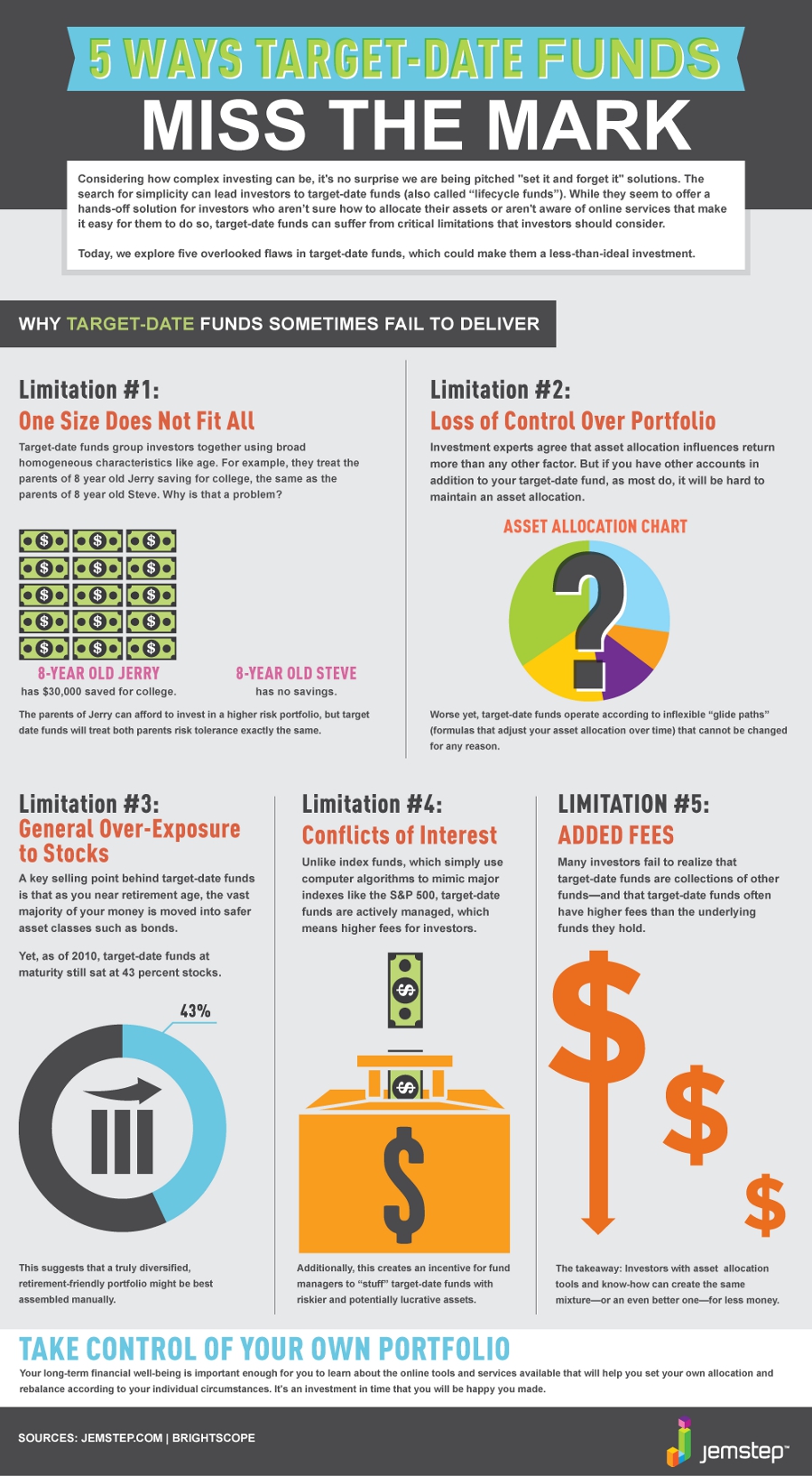
Investing in a target date mutual fund seems like the easy answer to retirement planning.

But, how can a single fund be appropriate for thousands of investors, doctors and medical professionals?

Assessment

Check out the above infographic to see the limitations of target date funds.

Conclusion

Your thoughts and comments on this ME-P are appreciated. Feel free to review our top-left column, and top-right sidebar materials, links, URLs and related websites, too. Then, subscribe to the ME-P. It is fast, free and secure.

Speaker: If you need a moderator or speaker for an upcoming event, Dr. David E. Marcinko; MBA – Publisher-in-Chief of the Medical Executive-Post – is available for seminar or speaking engagements. Contact: MarcinkoAdvisors@msn.com

Product DetailsProduct DetailsProduct Details

 ***

On Purchasing Individual BONDS!

A Seldom Discussed Investing Topics for Doctors and All Investors Until Now?

By Dr. David Edward Marcinko MBA MEd CMP®

http://www.MarcinkoAssociates.com

CMP logo

SPONSOR: http://www.CertifiedMedicalPlanner.org

Now – Trading individual bonds is not like trading stocks. Stocks can be bought at uniform prices and are traded through exchanges. Most bonds trade over the counter, and individual brokers price them.  But, price transparency has gotten better in the last decade. 

For example, in 1999, the bond markets gained clearness from the House of Representatives’ Bond Price Competition Improvement Act of 1999. Responding to this pioneering law, the site http://www.investinginbonds.com was established. This site provides current prices on bonds that have traded more than four times the previous day. With the advent of Investinginbonds.com and real-time reporting of many trades, investors are much better off today.  Many well regarded brokers including Schwab, Ameritrade, and Fidelity Investments now have dedicated websites devoted to bond trading and pricing. 

Fidelity Investments chose to disclose its fee structure for all bonds, making it clear what it will cost you per trade. Fidelity charges $1 per bond trade. Some on-line brokers charge a flat fee as well, ranging from $10.95 at Zions Direct to $45 at TD Ameritrade. Depending on the number of bonds trading, one may be more complimentary than another. The trading fee disclosures, however, do not divulge the spreads between the buy and sell price embedded in the transaction that some dealer is making in the channel. Keep in mind that only by comparison shopping can assist you in finding the best transaction price, after all fees are taken into account. Other sites may not charge any fee, but rather embed the profit in the spread.

Despite the difficulty in pricing and transparency, investing in individual bonds offers several rewards over purchasing bond mutual funds.

First, bond mutual funds never mature.

Second, you know exactly what you will be receiving in interest each year.  You will also know the exact maturity date. 

Furthermore, your individual investment is protected against interest rate risk, at least over the full term to maturity.  Both individual bonds and bond funds share interest-rate risk (the risk of locking up an investment at a given rate, only to see rates rise). This pushes bond prices down.  At least with an individual bond, you can re-invest it at the higher, market rate once the bond matures.

But, the lack of a fixed maturity date on a bond mutual fund causes an open ended problem; there is no promise of the original investment back.  Short of default, an individual bond will return all principal and pay all interest assuming you hold it to maturity.  Bond funds are not likely to default as most funds maintain positions in hundreds of individual bonds.  The force of interest rate risk to individual bond or bond mutual fund prices depends on the maturity of a bond investment: the longer the maturity of a bond or bond fund (average), the more the price will drop due to rising rates. This is known as duration.

Duration is a statistical term that measures the price sensitivity to yield, is the primary measurement of a bond or bond fund’s sensitivity to interest rate changes.  Duration indicates approximately how much the price of a bond or bond fund will adjust in the reverse direction given a rise in interest rates. For instance, an individual bond with an average duration of five years will fall in value approximately 5% if rates rise by 1% and the opposite is accurate as well.

Although stated in years, duration is not simply a gauge of time. Instead, duration signals how much the price of your bond investment is likely to oscillate when there is an up or down movement in interest rates. The higher the duration number, the more susceptible your bond investment will be to changes in interest rates.  If you have money in a bond or bond fund that holds primarily long-term bonds, expect the value of that fund to decline, perhaps significantly, when interest rates rise. The higher a bond’s duration, the greater its sensitivity to interest rates alterations. This means fluctuations in price, whether positive or negative, will be more prominent.

For example, a bond fund with 10-year duration will diminish in value by 10 percent if interest rates increase by one percent. On the other hand, the bond fund will rise in value by 10 percent if interest rates descend by one percent. The important concept to remember is once you recognize a bond’s or bond fund’s duration, you can forecast how it will react to a change in interest rates.

UPDATE:

The yield on the 10-year Treasury note serves as a benchmark for interest rates across the US economy. Since bond prices and yields move in opposite directions, falling yields signal higher demand for Treasuries.

Why it matters: At the most basic level, the 10-year yield is a key indicator of investors’ confidence in future US economic growth. As the Delta variant spreads and threatens to slow the economic recovery, the fall in yields means investors are souring on a mega growth spurt and snapping up safer assets rather than riskier stocks.

What does this mean for inflation? Because investors sell bonds when they think inflation is coming, the runup in bond prices means the worst of Wall Street’s inflation concerns may be over. “It feels like we have moved from thinking inflation will be transitory, to fearing growth will be transitory,” Art Hogan, chief marketing strategist at National Securities, said.

ASSESSMENT: Your thoughts are appreciated.

Comprehensive Financial Planning Strategies for Doctors and Advisors: Best Practices from Leading Consultants and Certified Medical Planners™

ORDER Textbook: https://www.amazon.com/Comprehensive-Financial-Planning-Strategies-Advisors/dp/1482240289/ref=sr_1_1?ie=UTF8&qid=1418580820&sr=8-1&keywords=david+marcinko

SECOND OPINIONS: https://medicalexecutivepost.com/schedule-a-consultation/

INVITE DR. MARCINKO: https://medicalexecutivepost.com/dr-david-marcinkos-bookings/

THANK YOU

***

DAILY UPDATE: MSFT Teams, Deloitte, HealthcCare Cyber Attacks as Markets Lift

MEDICAL EXECUTIVE-POST TODAY’S NEWSLETTER BRIEFING

***

Essays, Opinions and Curated News in Health Economics, Investing, Business, Management and Financial Planning for Physician Entrepreneurs and their Savvy Advisors and Consultants

Serving Almost One Million Doctors, Financial Advisors and Medical Management Consultants Daily

A Partner of the Institute of Medical Business Advisors , Inc.

http://www.MedicalBusinessAdvisors.com

SPONSORED BY: Marcinko & Associates, Inc.

***

http://www.MarcinkoAssociates.com

Daily Update Provided By Staff Reporters Since 2007.
How May We Serve You?
© Copyright Institute of Medical Business Advisors, Inc. All rights reserved. 2024

REFER A COLLEAGUE: MarcinkoAdvisors@msn.com

SPONSORSHIPS AVAILABLE: https://medicalexecutivepost.com/sponsors/

ADVERTISE ON THE ME-P: https://tinyurl.com/ytb5955z

***

The EU says Microsoft violated its antitrust laws by bundling Teams with Office, potentially setting the stage for a major fine.

And, Deloitte has billions of dollars’ worth of Medicaid contracts, but the consultancy’s eligibility systems are full of errors. (KFF Health News)

CITE: https://www.r2library.com/Resource

Here’s where the major benchmarks ended:

  • The S&P 500® index (SPX) rose 8.6 points (0.16%) to 5,477.9; the Dow Jones Industrial Average® ($DJI) added 15.64 points (0.04%) to 39,127.8; the NASDAQ Composite® ($COMP) climbed 87.5 points (0.49%) to 17,805.16.
  • The 10-year Treasury note yield rose 8 points to 4.32%.
  • The CBOE Volatility Index® (VIX) eased to 12.5

What’s up

What’s down

CITE: https://tinyurl.com/2h47urt5

The disastrous ransomware attacks on Change Healthcare and Ascension this year ran up staggering costs and put a spotlight on the healthcare sector’s vulnerability. But healthcare orgs are hardly new to eye-popping bills after a major hack. Analyzing attacks on organizations in 16 countries, IBM/Ponemon Institute has shown healthcare to be the industry with the highest cost per data breach for over a decade, coming in at an average hit of $10.93 million in 2023.

CITE: https://tinyurl.com/tj8smmes

COMMENTS APPRECIATED

PLEASE SUBSCRIBE: MarcinkoAdvisors@msn.com

Thank You

***

***

***

***

EDUCATIONAL TEXTBOOKS: https://tinyurl.com/4zdxuuwf

***

CORRELATION in Modern Portfolio Theory Investing

“Correlation” has been used over the past twenty years by institutions, [physician] investors and financial advisors to assemble portfolios of moderate INVESTMENT risk

By Dr. David Edward Marcinko MBA MEd CMP®

CMP logo

SPONSOR: http://www.CertifiedMedicalPlanner.org

Modern Portfolio Theory approaches investing by examining the complete market and the full economy. MPT places a great emphasis on the correlation between investments. 

DEFINITION: Correlation is a measure of how frequently one event tends to happen when another event happens. High positive correlation means two events usually happen together – high SAT scores and getting through college for instance. High negative correlation means two events tend not to happen together – high SATs and a poor grade record. No correlation means the two events are independent of one another.

CITATION: https://www.r2library.com/Resource/Title/0826102549

CORRELATION: https://medicalexecutivepost.com/2021/02/05/correlation-is-not-causation/

In statistical terms two events that are perfectly correlated have a “correlation coefficient” of 1; two events that are perfectly negatively correlated have a correlation coefficient of -1; and two events that have zero correlation have a coefficient of 0.

In calculating correlation, a statistician would examine the possibility of two events happening together, namely:

  • If the probability of A happening is 1/X;
  • And the probability of B happening is 1/Y; then
  • The probability of A and B happening together is (1/X) times (1/Y), or 1/(X times Y).

There are several laws of correlation including;

  1. Combining assets with a perfect positive correlation offers no reduction in portfolio risk.  These two assets will simply move in tandem with each other.
  2. Combining assets with zero correlation (statistically independent) reduces the risk of the portfolio.  If more assets with uncorrelated returns are added to the portfolio, significant risk reduction can be achieved.
  3. Combing assets with a perfect negative correlation could eliminate risk entirely.   This is the principle with “hedging strategies”.  These strategies are discussed later in the book.

In the real world, negative correlations are very rare.  Most assets maintain a positive correlation with each other.  The goal of a prudent investor is to assemble a portfolio that contains uncorrelated assets.  When a portfolio contains assets that possess low correlations, the upward movement of one asset class will help offset the downward movement of another.  This is especially important when economic and market conditions change.

As a result, including assets in your portfolio that are not highly correlated will reduce the overall volatility (as measured by standard deviation) and may also increase long-term investment returns. This is the primary argument for including dissimilar asset classes in your portfolio. Keep in mind that this type of diversification does not guarantee you will avoid a loss.  It simply minimizes the chance of loss. 

In this table provided by Ibbotson, the average correlation between the five major asset classes is displayed. The lowest correlation is between the U.S. Treasury Bonds and the EAFE (international stocks).  The highest correlation is between the S&P 500 and the EAFE; 0.77 or 77 percent. This signifies a prominent level of correlation that has grown even larger during this decade.   Low correlations within the table appear most with U.S. Treasury Bills.

Historical Correlation of Asset Classes

Benchmark                             1          2          3         4         5         6            

1 U.S. Treasury Bill                  1.00    

2 U.S. Bonds                          0.73     1.00    

3 S&P 500                               0.03     0.34     1.00    

4 Commodities                         0.15     0.04     0.08      1.00      

5 International Stocks              -0.13    -0.31    0.77      0.14    1.00       

6 Real Estate                           0.11      0.43    0.81     -0.02    0.66     1.00

Table Source: Ibbotson 1980-2012

ASSESSMENT: Your thoughts are appreciated.

Comprehensive Financial Planning Strategies for Doctors and Advisors: Best Practices from Leading Consultants and Certified Medical Planners™

ORDER Textbook: https://www.amazon.com/Comprehensive-Financial-Planning-Strategies-Advisors/dp/1482240289/ref=sr_1_1?ie=UTF8&qid=1418580820&sr=8-1&keywords=david+marcinko

SECOND OPINIONS: https://medicalexecutivepost.com/schedule-a-consultation/

INVITE DR. MARCINKO: https://medicalexecutivepost.com/dr-david-marcinkos-bookings/

THANK YOU

***


DAILY UPDATE: Gun Violence, Health & Public Companies as Technology Stocks Rebound

MEDICAL EXECUTIVE-POST TODAY’S NEWSLETTER BRIEFING

***

Essays, Opinions and Curated News in Health Economics, Investing, Business, Management and Financial Planning for Physician Entrepreneurs and their Savvy Advisors and Consultants

Serving Almost One Million Doctors, Financial Advisors and Medical Management Consultants Daily

A Partner of the Institute of Medical Business Advisors , Inc.

http://www.MedicalBusinessAdvisors.com

SPONSORED BY: Marcinko & Associates, Inc.

***

http://www.MarcinkoAssociates.com

Daily Update Provided By Staff Reporters Since 2007.
How May We Serve You?
© Copyright Institute of Medical Business Advisors, Inc. All rights reserved. 2024

REFER A COLLEAGUE: MarcinkoAdvisors@msn.com

SPONSORSHIPS AVAILABLE: https://medicalexecutivepost.com/sponsors/

ADVERTISE ON THE ME-P: https://tinyurl.com/ytb5955z

***

The U.S. surgeon general just declared gun violence a public health crisis, driven by the fast-growing number of injuries and deaths involving firearms in the country. The advisory issued by Dr. Vivek Murthy, the nation’s top doctor, came as the U.S. grappled with another summer weekend marked by mass shootings that left dozens of people dead or wounded.

CITE: https://www.r2library.com/Resource

Here’s where the major benchmarks ended:

  • The S&P 500 index rose 21.43 points (0.39%) to 5,469.30; the Dow Jones Industrial Average® ($DJI) fell 299.05 points (0.76%) to 39,112.6; the NASDAQ Composite® ($COMP) gained 220.84 points (1.26%) to 17,717.65.
  • The 10-year Treasury note yield (TNX) fell slightly to 4.24%.
  • The CBOE Volatility Index® (VIX) dropped to 12.84. 

What’s up

  • Nvidia rose 6.76% as investors realized they could buy shares of the world’s biggest semiconductor company at a discounted price.
  • Trump Media & Technology Group rose another 8.50% today on the hopes of a cash infusion, as well as hype ahead of Thursday’s presidential debate.
  • Carnival popped 8.85% after it beat analyst expectations for the second quarter, and raised its profit forecast for the rest of the year.
  • Novo Nordisk rose 3.25% after its weight-loss drug Wegovy was approved in China.
  • Enovix soared 35.05% on the news that it signed a major deal to provide VR headset batteries for an as-yet-unnamed California company.

What’s down

  • Pool Corp., maker of…pools, fell 8.04% today after cutting guidance for the year ahead.
  • SolarEdge Technologies dropped 20.60% through no fault of its own—instead, a key customer declared bankruptcy, and will be unable to pay the solar power company the $11.4 million it is owed.
  • Airbus fell 9.41% after the company announced it is cutting financial guidance for the remainder of 2024 thanks to supply chain snarls and higher costs.
  • Auto dealer stocks continue to suffer the effects of a massive cyberattack on CDK, a key supplier of dealership management software. The company says its systems will remain down until June 30, but in the meantime shares of Autonation fell 2.04%, Sonic Automotive dropped 2.56%, and Group 1 Automotive slid 2.49%.

CITE: https://tinyurl.com/2h47urt5

Digital health company Sharecare has agreed to be acquired by private equity firm Altaris for $1.43 in cash per share, or about $518 million.


Nearly three months after Kaiser Permanente’s Risant Health acquired Geisinger Health, the group has now agreed to terms with Cone Health in North Carolina.


And ... UnitedHealthcare says its Surest unit improves spending and utilization across all age groups and for people with various conditions.

CITE: https://tinyurl.com/tj8smmes

COMMENTS APPRECIATED

PLEASE SUBSCRIBE: MarcinkoAdvisors@msn.com

Thank You

***

***

***

***

EDUCATIONAL TEXTBOOKS: https://tinyurl.com/4zdxuuwf

***

PHYSICIANS BEWARE: Financial “Advice”

BEWARE THE “DOCTOR EFFECT”

Bread for the advisor – Crumbs for the client

By Dr. David Edward Marcinko MBA CMP

SPONSOR: http://www.MarcinkoAssociates.com

Several years ago a group of highly trusted and deeply experienced financial services professionals and estate planners noted that far too many of their physician clients, using traditional stock brokers, management consultants and financial advisors, seemed to be less successful than those who went it alone. These Do-it-Yourselfers [DIYs] had setbacks and made mistakes, for sure. But, the ME Inc. doctors seemed to learn from their mistakes and did not incur the high management and service fees demanded from general or retail one-size-fits-all “advisors.

”In fact, an informal inverse relationship was noted, and dubbed the “Doctor Effect.” In others words, the more consultants an individual doctor retained; the less well they did in all disciplines of the financial planning and medical practice management, continuum.

Of course, the reason for this discrepancy eluded many of them as Wall Street brokerages and wire-houses flooded the media with messages, infomercials, print, radio, TV, texts, tweets, and internet ads to the contrary. Rather than self-learn the basics, the prevailing sentiment seemed to purse the holy grail of finding the “perfect financial advisor.” This realization was a confirmation of the industry culture which seemed to be: Bread for the advisor – Crumbs for the client!

And so, at D.E. Marcinko & Associates, our informed cadre’ of technology focused and highly educated doctors, nurses, financial advisors, attorneys, accountants, psychologists and educational visionaries decided there must be a better way for their healthcare colleagues to receive financial planning advice and related management services within a culture of fiduciary responsibility.

CMP: http://www.CertifiedMedicalPlanner.org

COMMENTS APPRECIATED

Thank You

***

***

RISK MANAGEMENT: https://www.routledge.com/Comprehensive-Financial-Planning-Strategies-for-Doctors-and-Advisors-Best/Marcinko-Hetico/p/book/9781482240283

***

DAILY UPDATE: Dental Staffing, Various Companies & the Stock Markets

MEDICAL EXECUTIVE-POST TODAY’S NEWSLETTER BRIEFING

***

Essays, Opinions and Curated News in Health Economics, Investing, Business, Management and Financial Planning for Physician Entrepreneurs and their Savvy Advisors and Consultants

Serving Almost One Million Doctors, Financial Advisors and Medical Management Consultants Daily

A Partner of the Institute of Medical Business Advisors , Inc.

http://www.MedicalBusinessAdvisors.com

SPONSORED BY: Marcinko & Associates, Inc.

***

http://www.MarcinkoAssociates.com

Daily Update Provided By Staff Reporters Since 2007.
How May We Serve You?
© Copyright Institute of Medical Business Advisors, Inc. All rights reserved. 2024

REFER A COLLEAGUE: MarcinkoAdvisors@msn.com

SPONSORSHIPS AVAILABLE: https://medicalexecutivepost.com/sponsors/

ADVERTISE ON THE ME-P: https://tinyurl.com/ytb5955z

***

Here’s where the major benchmarks ended:

  • The S&P 500 index lost 16.75 points (0.31%) to 5,447.87; the Dow Jones Industrial Average ($DJI) gained 260.88 points (0.67%) to 39,411.21; the NASDAQ Composite ($COMP) dropped 192.54 points (1.09%) to 17,496.82.
  • The 10-year Treasury note yield (TNX) fell one basis point to 4.25%.
  • The CBOE Volatility Index® (VIX) ended slightly up at 13.47, the highest close since May 30.

CITE: https://www.r2library.com/Resource

What’s up

What’s down

  • Nvidia dropped 6.68% as the semiconductor stock continues to fall, with the stock entering correction territory earlier today—a sentence we never thought we’d write.
  • Eli Lilly’s weight-loss drug Zepbound can also help people with sleep apnea, cutting into the sleep-aid market, sending shares of ResMed down 11.40% and Inspire Medical Systems down 16.45% on the news.
  • Bitcoin-connected stocks are taking a hit as the crypto selloff continues. Coinbase Global fell 6%, while MicroStrategy fell 7.52%.

CITE: https://tinyurl.com/2h47urt5

The dental industrylike other parts of healthcare—is facing significant staffing challenges. The US is in need of nearly 10,000 dental professionals and has more than 6,800 health professional shortage areas (HPSAs), which the US Department of Health and Human Services defines as “a geographic area, population, or facility with a shortage of primary care, dental, or mental health providers and services.”

CITE: https://tinyurl.com/tj8smmes

COMMENTS APPRECIATED

PLEASE SUBSCRIBE: MarcinkoAdvisors@msn.com

Thank You

***

***

***

***

EDUCATIONAL TEXTBOOKS: https://tinyurl.com/4zdxuuwf

***

BEWARE FAKE: U.S. Savings Bonds!

Fake savings bond scheme leads to $50M in losses and issues for legitimate savers

By Staff Reporters

***

***

Authorities claimed that $1 million in counterfeit savings bonds showed up at South Texas banks as part of one crackdown on a scheme to steal money by cashing phony savings bonds, including inflation-indexed or I Bonds, according to the U.S. Attorney’s Office for the Southern District of Texas.

***

***

COMMENTS APPRECIATED

Thank You

***

DAILY UPDATE: Genome Testing, the Stock Markets and Microsoft, Apple & Meta

MEDICAL EXECUTIVE-POST TODAY’S NEWSLETTER BRIEFING

***

Essays, Opinions and Curated News in Health Economics, Investing, Business, Management and Financial Planning for Physician Entrepreneurs and their Savvy Advisors and Consultants

Serving Almost One Million Doctors, Financial Advisors and Medical Management Consultants Daily

A Partner of the Institute of Medical Business Advisors , Inc.

http://www.MedicalBusinessAdvisors.com

SPONSORED BY: Marcinko & Associates, Inc.

***

http://www.MarcinkoAssociates.com

Daily Update Provided By Staff Reporters Since 2007.
How May We Serve You?
© Copyright Institute of Medical Business Advisors, Inc. All rights reserved. 2024

REFER A COLLEAGUE: MarcinkoAdvisors@msn.com

SPONSORSHIPS AVAILABLE: https://medicalexecutivepost.com/sponsors/

ADVERTISE ON THE ME-P: https://tinyurl.com/ytb5955z

***

Apple and Meta are considering an AI partnership. The two tech giants are discussing integrating Meta’s generative AI model into Apple’s new AI platform, Apple Intelligence, the WSJ reports. Instead of building an in-house AI model, Apple opted for the partnership route and previously announced a deal with OpenAI to bring ChatGPT to iPhones. Apple has also reportedly held talks with AI startups Anthropic and Perplexity to fuse their AI models with Apple Intelligence and get that sweet, sweet distribution Apple provides.

CITE: https://www.r2library.com/Resource

Genome testing can spot rare disease risks at birth. Newborn babies typically get blood tested for dozens of diseases, but some parents living in North Carolina and New York have recently been able to get their bundles of joy screened for hundreds of potentially life-threatening medical conditions that regular tests can’t catch thanks to a growing field called genomic medicine. Early results from two ongoing studies are very promising, the Washington Post reported, but scaling the new type of testing could be tricky: A full genome read (which covers all of your DNA) costs around $1,000 per patient. Still, research into the cost-benefit of genome sequencing has found that it can ultimately save families money on hospital care.

CITE: https://tinyurl.com/2h47urt5

Markets: Sweating the upcoming election? Investors aren’t. The S&P 500 is on track for its best first-half performance in an election year going back to 1976, per Dow Jones Market Data. And as trading begins Monday morning, Microsoft is back on the Iron Throne as the US’ most valuable company following Nvidia’s stumbles at the end of last week.

CITE: https://tinyurl.com/tj8smmes

COMMENTS APPRECIATED

PLEASE SUBSCRIBE: MarcinkoAdvisors@msn.com

Thank You

***

***

***

***

EDUCATIONAL TEXTBOOKS: https://tinyurl.com/4zdxuuwf

***

BANKS: Eight Types; plus 1

DOCTORS NEED TO KNOW

SPONSOR: https://marcinkoassociates.com/

By Dr. David Edward Marcinko MBA MEd CMP

A general understanding of these bank types is suggested for any medical professional prior to launching a self-directed [ME, Inc] medical practice, clinic, guided investment strategy, personal financial plan or wealth building portfolio effort; etc.

READ HERE: https://marcinkoassociates.com/bank-types/

COMMENTS APPRECIATED

Thank You

***

***

Understanding Bond Duration

[By Dr. David Edward Marcinko; MBA, MEd, CMP™]

fp-book1

Because of today’s stock market volatility, and virtual collapse in some banks and world equities, an interesting question often arises when the physician-investor considers investing in bonds; as more and more are doing.

Question

How much will a bond’s price change from a 1 percent change in interest rates? 

Duration Defined

To answer this, consider the concept of duration.  According to Jeff Coons PhD, CFP™, a bond’s duration is the weighted average life of its cash flows.

Thus, if your bond pays $60 per year in coupon payments for ten years and $1,000 in par value at the end of the ten years, the duration is the length of time that it takes for you to receive the present value of the coupon payments and par value. 

CITE: https://www.r2library.com/Resource/Title/082610254

Rule-of-Thumb

How does this help answer the original question?  There is a handy rule-of-thumb that says the duration of a bond times the change in market interest rates is the approximate price change of the bond.  Thus, the price of a ten-year Treasury bond with a duration of approximately 7.8 years will appreciate (decline) by about 7.8 percent with a drop (increase) in interest rates of 1 percent.

Assessment

For each of the two basic types of bonds, the duration is the following:

1. Zero-Coupon Bond – Duration is equal to its time to maturity, and

2. Vanilla Bond – Duration will always be less than its time to maturity. 

Channel Surfing the ME-P

Have you visited our other topic channels? Established to facilitate idea exchange and link our community together, the value of these topics is dependent upon your input. Please take a minute to visit. And, to prevent that annoying spam, we ask that you register. It is fast, free and secure.

The BANKS: https://www.fool.com/investing/2023/03/30/why-is-everyone-talking-about-duration/

Conclusion

Your thoughts and comments on this ME-P are appreciated. Feel free to review our top-left column, and top-right sidebar materials, links, URLs and related websites, too. Then, subscribe to the ME-P. It is fast, free and secure.

Speaker: If you need a moderator or speaker for an upcoming event, Dr. David E. Marcinko; MBA – Publisher-in-Chief of the Medical Executive-Post – is available for seminar or speaking engagements. Contact: MarcinkoAdvisors@msn.com

OUR OTHER PRINT BOOKS AND RELATED INFORMATION SOURCES:

Product DetailsProduct DetailsProduct Details

Product Details  Product Details

Comprehensive Financial Planning Strategies for Doctors and Advisors: Best Practices from Leading Consultants and Certified Medical Planners(TM)

DAILY UPDATE: Reverse Aging, Credit Card Competition Act, Nvidia and a Market Re-Cap

MEDICAL EXECUTIVE-POST TODAY’S NEWSLETTER BRIEFING

***

Essays, Opinions and Curated News in Health Economics, Investing, Business, Management and Financial Planning for Physician Entrepreneurs and their Savvy Advisors and Consultants

Serving Almost One Million Doctors, Financial Advisors and Medical Management Consultants Daily

A Partner of the Institute of Medical Business Advisors , Inc.

http://www.MedicalBusinessAdvisors.com

SPONSORED BY: Marcinko & Associates, Inc.

***

http://www.MarcinkoAssociates.com

Daily Update Provided By Staff Reporters Since 2007.
How May We Serve You?
© Copyright Institute of Medical Business Advisors, Inc. All rights reserved. 2024

REFER A COLLEAGUE: MarcinkoAdvisors@msn.com

SPONSORSHIPS AVAILABLE: https://medicalexecutivepost.com/sponsors/

ADVERTISE ON THE ME-P: https://tinyurl.com/ytb5955z

***

The de-aging biz: Time to pull back the hospital curtain and see who’s behind the booming longevity market. This article, sponsored by Timeline, lays out who’s making $$$ on “reverse aging.*

CITE: https://www.r2library.com/Resource

  • The S&P 500 and NASDAQ have often outperformed the Dow in recent years thanks to their focus on tech, as well as their market-cap weighting vs the Dow’s price weighting. When tech stocks roar higher, the younger indexes rise above their older peer—but the last few days have seen a sell off of tech stocks led by NVIDIA, bringing the S&P 500 and NASDAQ lower to end the week while the Dow has continued to rise.
  • Bonds remained unchanged for most of the day, ending the trading session flat as investors parse through a week of economic data and prepare for next week’s PCE report.
  • Gold plunged after the dollar rose, making it more expensive for gold bugs to hold the precious metal.
  • As for oil, read on to learn why crude has high hopes today but may not be a smart investment tomorrow.

Nvidia faltered for the second day in a row, falling off the world’s most valuable company perch and shedding $220+ billion in market cap. But the S&P 500 has gone 377 days without a 2.05% sell-off, the longest streak since the 2008 financial crisis, per CNBC.

CITE: https://tinyurl.com/2h47urt5

The Credit Card Competition Act is proposed legislation in Congress that could fundamentally change credit card systems. If passed, it could devastate the future of cash-back and travel rewards.

CITE: https://tinyurl.com/tj8smmes

COMMENTS APPRECIATED

PLEASE SUBSCRIBE: MarcinkoAdvisors@msn.com

Thank You

***

***

***

***

EDUCATIONAL TEXTBOOKS: https://tinyurl.com/4zdxuuwf

***

DAILY UPDATE: Amazon Pharmacy, Healthcare Spending Boom, Companies and the Bi-Hybrid Markets

MEDICAL EXECUTIVE-POST TODAY’S NEWSLETTER BRIEFING

***

Essays, Opinions and Curated News in Health Economics, Investing, Business, Management and Financial Planning for Physician Entrepreneurs and their Savvy Advisors and Consultants

Serving Almost One Million Doctors, Financial Advisors and Medical Management Consultants Daily

A Partner of the Institute of Medical Business Advisors , Inc.

http://www.MedicalBusinessAdvisors.com

SPONSORED BY: Marcinko & Associates, Inc.

***

http://www.MarcinkoAssociates.com

Daily Update Provided By Staff Reporters Since 2007.
How May We Serve You?
© Copyright Institute of Medical Business Advisors, Inc. All rights reserved. 2024

REFER A COLLEAGUE: MarcinkoAdvisors@msn.com

SPONSORSHIPS AVAILABLE: https://medicalexecutivepost.com/sponsors/

ADVERTISE ON THE ME-P: https://tinyurl.com/ytb5955z

***

Amazon Pharmacy announced on June 18 that, effective immediately, its RxPass medication delivery service will be available to more than 50 million Medicare beneficiaries, a move the company says could save up to $2 billion annually for the federal health insurance program.

CITE: https://www.r2library.com/Resource

Here’s where the major benchmarks ended:

  • The S&P 500 index fell 8.55 points (0.2%) to 5,464.62, up 0.6% for the week; the Dow Jones Industrial Average® ($DJI) gained 15.57 points (0.04%) to 39,150.33, up 1.5% for the week; the NASDAQ Composite® ($COMP) shed 32.23 points (0.2%) to 17,689.36, little changed for the week.
  • The 10-year Treasury note yield (TNX) was little changed at 4.255%.
  • The CBOE Volatility Index® (VIX) dipped 0.06 to 13.22.

What’s up

  • Sarepta Therapeutics soared 30.14% thanks to FDA approval of Elevidys, its new Duchenne muscular dystrophy treatment.
  • Zealand Pharma rose 18.62% after Phase 1b trial results revealed its new weight-loss drug could compete with Ozempic.
  • Asana jumped 14.95% on the news that its board has approved a share repurchase program of up to $150 million of its own stock.
  • CarMax shares rose 0.37% after the company reported first-quarter earnings. The number isn’t big, but the performance is impressive considering the used car company posted a 33% decline in profits.
  • Hertz Global popped 15.95% after the company announced it was raising the size of its bond offering to $1 billion as it looks to update its fleet of rental cars.

What’s down

  • Nvidia fell another 3.22% today as the sell off continued, with investors taking profits after a record run higher.
  • Smith & Wesson Brands dropped 12.87% after the gun maker beat earnings forecasts but announced that next quarter’s sales will be lower than expected.
  • LendingTree slid 2.48% after a Bloomberg report revealed that hackers are auctioning off stolen customer data.
  • Palantir fell 6.78% after the company earned an analyst downgrade for its “gluttonous valuation,” a phrase you never want to hear as an investor.
  • Bitcoin mining stocks took a hit today, selling off after popping higher yesterday after bitcoin prices rallied. Marathon Digital Holdings dropped 7.02%, Riot Platforms fell 8.35%, and CleanSpark sank 9.81%.

CITE: https://tinyurl.com/2h47urt5

With a record number of people insured and seeking healthcare services post-pandemic, US health spend growth is outpacing GDP growth, and is expected to keep doing so through 2032, according to a June 12 report from actuaries at the Centers for Medicare and Medicaid Services (CMS). By 2032, CMS actuaries project healthcare spending will total $7.7 trillion and make up 19.7% of total US GDP, compared to $4.8 trillion and 17.6% of GDP in 2023.

CITE: https://tinyurl.com/tj8smmes

COMMENTS APPRECIATED

PLEASE SUBSCRIBE: MarcinkoAdvisors@msn.com

Thank You

***

***

***

***

EDUCATIONAL TEXTBOOKS: https://tinyurl.com/4zdxuuwf

***

DAILY UPDATE: Bilt, Mortgage Rates, Private Equity in Behavioral Health and the Stock Markets

MEDICAL EXECUTIVE-POST TODAY’S NEWSLETTER BRIEFING

***

Essays, Opinions and Curated News in Health Economics, Investing, Business, Management and Financial Planning for Physician Entrepreneurs and their Savvy Advisors and Consultants

Serving Almost One Million Doctors, Financial Advisors and Medical Management Consultants Daily

A Partner of the Institute of Medical Business Advisors , Inc.

http://www.MedicalBusinessAdvisors.com

SPONSORED BY: Marcinko & Associates, Inc.

***

http://www.MarcinkoAssociates.com

Daily Update Provided By Staff Reporters Since 2007.
How May We Serve You?
© Copyright Institute of Medical Business Advisors, Inc. All rights reserved. 2024

REFER A COLLEAGUE: MarcinkoAdvisors@msn.com

SPONSORSHIPS AVAILABLE: https://medicalexecutivepost.com/sponsors/

ADVERTISE ON THE ME-P: https://tinyurl.com/ytb5955z

***

Wells Fargo is losing $10 million per month on its partnership with Bilt, whose credit card offers users reward points for paying rent, and is looking to renegotiate, the WSJ reports. Apple has stopped offering its buy now, pay later program, Apple Pay Later, after partnering with outside companies, including Affirm.

CITE: https://www.r2library.com/Resource

Private equity (PE) is all over healthcare, with investment firms owning more than 400 hospitals around the US. But as the country faces a mental health crisis—US Surgeon General Vivek Murthy called it the “the defining public health crisis of our time”—PE has its sights set on one of the fastest-growing areas of the industry: behavioral health care. PE has accounted for over 60% of all behavioral health deal flow since 2018, and firms like Thurston Group and Five Points Capital now own about a quarter of facilities offering behavioral health care in some states, according to a recent cross-sectional study published in JAMA Psychiatry.

CITE: https://tinyurl.com/2h47urt5

U.S. markets were closed Wednesday for the Juneteenth holiday. Here’s where the major benchmarks ended:

  • The S&P 500 index fell 13.86 points (0.3%) to 5,473.17; the Dow Jones Industrial Average® ($DJI) gained 299.90 points (0.8%) to 39,134.76; the NASDAQ Composite® ($COMP) dropped 140.64 points (0.8%) to 17,721.59.
  • The 10-year Treasury note yield (TNX) climbed about 4 basis points to 4.257%.
  • The CBOE Volatility Index® (VIX) rose 0.80 to 13.28.

What’s up

  • Gilead jumped 8.46% after clinical data revealed that its new twice-a-year shot prevents 100% of HIV cases.
  • Penn Entertainment rose 9.93% on the news that Boyd Gaming has approached its competitor with an acquisition offer.
  • Accenture rose 7.30% after the IT consulting company missed earnings estimates but more than made up for it with bullish bookings data thanks to AI.
  • Darden Restaurants rose 1.53% after a mixed earnings report. Its acquisition of Ruth’s Chris Steak House propped up earnings, while Olive Garden’s same-store sales came in flat, probably because I eat several hundred free breadsticks there every month.

What’s down

  • Trump Media & Technology Group fell 14.56% after the SEC ruled that early shareholders can resell their stock in the company, diluting new shareholders—though providing upward of $247 million in funding for the beleaguered company.
  • Nikola plummeted 31.46% after the company announced a 1-for-30 stock split in a bid to stay listed on the Nasdaq.
  • Kroger fell 3.27% despite beating analyst revenue estimates in its fiscal first quarter as investors digest the chances of the company sealing a deal to buy Albertsons.
  • Tempest Therapeutics dropped 29.47% upon the release of the latest trial data for its liver cancer treatment.
  • Jabil fell 11.45% today after the electronics supplier beat earnings estimates but warned of softer growth in the year ahead.

Mortgage rates fell below 7% last week to their lowest level since March, but this didn’t spur much extra demand.

CITE: https://tinyurl.com/tj8smmes

COMMENTS APPRECIATED

PLEASE SUBSCRIBE: MarcinkoAdvisors@msn.com

Thank You

***

***

***

***

EDUCATIONAL TEXTBOOKS: https://tinyurl.com/4zdxuuwf

***

Whither the CERTIFIED MEDICAL PLANNER™ Marks?

Wither the CERTIFIED MEDICAL PLANNER™ Professional Certification?

CMP logo

DEAR INVESTMENT ADVISORS, CPAs, FINANCIAL PLANNERS, FINANCIAL ADVISORS & INSURANCE AGENTS

We believe that:

If you do not have a market niche; you are not deeply informed
If you are not deeply informed; you can’t different yourself
If you can’t differentiate yourself; you can’t differentiate price
If you can’t differentiate price; you have no market power
If you have no market power; you have no unique knowledge
If you have no unique knowledge; you have fewer profits

If you have fewer profits; you are not likely a CMP™

CMP

PROGRAM CURRICULUM: Enter the CMPs

POPULAR BOOKS: https://medicalexecutivepost.com/2021/04/29/why-are-certified-medical-planner-textbooks-so-darn-popular/

Dean Gene Schmuckler PhD MBA MEd CTS
http://www.CertifiedMedicalPlanner.org

THANK YOU

***

DAILY UPDATE: Nvidia, Golden Goose and the Summer Solstice

MEDICAL EXECUTIVE-POST TODAY’S NEWSLETTER BRIEFING

***

Essays, Opinions and Curated News in Health Economics, Investing, Business, Management and Financial Planning for Physician Entrepreneurs and their Savvy Advisors and Consultants

Serving Almost One Million Doctors, Financial Advisors and Medical Management Consultants Daily

A Partner of the Institute of Medical Business Advisors , Inc.

http://www.MedicalBusinessAdvisors.com

SPONSORED BY: Marcinko & Associates, Inc.

***

http://www.MarcinkoAssociates.com

Daily Update Provided By Staff Reporters Since 2007.
How May We Serve You?
© Copyright Institute of Medical Business Advisors, Inc. All rights reserved. 2024

REFER A COLLEAGUE: MarcinkoAdvisors@msn.com

SPONSORSHIPS AVAILABLE: https://medicalexecutivepost.com/sponsors/

ADVERTISE ON THE ME-P: https://tinyurl.com/ytb5955z

***

HAPPY SUMMER SOLSTICE

Today is the first day of summer in the Northern Hemisphere, aka summer solstice. It’s also the longest day of the year.

CITE: https://www.r2library.com/Resource

The markets were closed yesterday for Juneteenth, but they’ll be back today to see if they can keep their hot streak going.

But, the company known for selling shoes that look like they’ve been dragged through mud postponed its IPO, putting a pause on what has been a big year for European companies going public. Golden Goose announced Tuesday it wouldn’t go public in Milan on Friday as planned due to fraught market conditions in Europe stemming from parliamentary elections across the Continent.

CITE: https://tinyurl.com/2h47urt5

Nvidia is now the most valuable company in the world. The chipmaker passed Microsoft to become the world’s most valuable public company, topping $3.3 trillion in market cap. Earlier this month, it reached the $3 trillion mark for the first time, flying past Apple for second place. The AI boom has propelled Nvidia—which owns about 80% of the industry’s data center chip market—to new heights, enriching investors and CEO Jensen Huang along the way. Huang has added nearly $100 billion to his net worth in less than two years, making him the 13th richest person in the world as of June.

CITE: https://tinyurl.com/tj8smmes

COMMENTS APPRECIATED

PLEASE SUBSCRIBE: MarcinkoAdvisors@msn.com

Thank You

***

***

***

***

EDUCATIONAL TEXTBOOKS: https://tinyurl.com/4zdxuuwf

***

VENTURE CAPITAL FUNDING: Digital Health Space

Investment Banking

SPONSOR: http://www.MarcinkoAssociates.com

***

***

Venture capital funding in the digital health space cooled a bit in 2022 following a red-hot 2021. Overall, digital health companies raised $15.3 billion last year, down from the $29.1 billion raised in 2021—but still above the $14.1 billion raised in 2020, according to Rock Health a seed fund that supports digital health startups.

MORE: https://marcinkoassociates.com/welcome-medical-colleagues/

Nevertheless, analysts predict VC investors and IBs will still put a good amount of money into digital health in 2024 and 2025, especially in alternative care, drug development, health information technology, artificial intelligence, EMRs and software that reduces physician workload.

CITE: https://www.r2library.com/Resource

Of course. an essential first part of attracting VC interest and IB money is the crafting and presentation of your formal business plan [“pitch”] ; as well as the needed technical and managerial experience. This is crucial for success and exactly where we can assist.

READ MORE: investment-banking

***

***

COMMENTS APPRECIATED

Thank You

***

DAILY UPDATE: Wells Fargo, Public Companies as Stock Markets Extend Rally

MEDICAL EXECUTIVE-POST TODAY’S NEWSLETTER BRIEFING

***

Essays, Opinions and Curated News in Health Economics, Investing, Business, Management and Financial Planning for Physician Entrepreneurs and their Savvy Advisors and Consultants

Serving Almost One Million Doctors, Financial Advisors and Medical Management Consultants Daily

A Partner of the Institute of Medical Business Advisors , Inc.

http://www.MedicalBusinessAdvisors.com

SPONSORED BY: Marcinko & Associates, Inc.

***

http://www.MarcinkoAssociates.com

Daily Update Provided By Staff Reporters Since 2007.
How May We Serve You?
© Copyright Institute of Medical Business Advisors, Inc. All rights reserved. 2024

REFER A COLLEAGUE: MarcinkoAdvisors@msn.com

SPONSORSHIPS AVAILABLE: https://medicalexecutivepost.com/sponsors/

ADVERTISE ON THE ME-P: https://tinyurl.com/ytb5955z

***

Wells Fargo is losing $10 million per month on its partnership with Bilt, whose credit card offers users reward points for paying rent, and is looking to renegotiate, the WSJ reports. Apple has stopped offering its buy now, pay later program, Apple Pay Later, after partnering with outside companies, including Affirm.

CITE: https://www.r2library.com/Resource

Here’s where the major benchmarks ended:

  • The S&P 500 index gained 13.80 points (0.3%) to 5,487.03; the Dow Jones Industrial Average® ($DJI) added 56.76 points (0.2%) to 38,834.86; the NASDAQ Composite® ($COMP) rose 5.21 points (0.03%) to 17,862.23, a record close for the seventh day in a row.
  • The 10-year Treasury note yield (TNX) dipped more than 6 basis points to 4.215%.
  • The CBOE Volatility Index® (VIX) fell 0.45 to 12.30.

What’s up

What’s down

CITE: https://tinyurl.com/2h47urt5

And … precision medicine company Tempus AI is going public, raising $410.7 million through its initial public offering.

CITE: https://tinyurl.com/tj8smmes

COMMENTS APPRECIATED

PLEASE SUBSCRIBE: MarcinkoAdvisors@msn.com

Thank You

***

***

***

***

EDUCATIONAL TEXTBOOKS: https://tinyurl.com/4zdxuuwf

***

DAILY UPDATE: Microsoft & Google Cyber Security Discounts as Stock Markets Rally

MEDICAL EXECUTIVE-POST TODAY’S NEWSLETTER BRIEFING

***

Essays, Opinions and Curated News in Health Economics, Investing, Business, Management and Financial Planning for Physician Entrepreneurs and their Savvy Advisors and Consultants

Serving Almost One Million Doctors, Financial Advisors and Medical Management Consultants Daily

A Partner of the Institute of Medical Business Advisors , Inc.

http://www.MedicalBusinessAdvisors.com

SPONSORED BY: Marcinko & Associates, Inc.

***

http://www.MarcinkoAssociates.com

Daily Update Provided By Staff Reporters Since 2007.
How May We Serve You?
© Copyright Institute of Medical Business Advisors, Inc. All rights reserved. 2024

REFER A COLLEAGUE: MarcinkoAdvisors@msn.com

SPONSORSHIPS AVAILABLE: https://medicalexecutivepost.com/sponsors/

ADVERTISE ON THE ME-P: https://tinyurl.com/ytb5955z

***

  • Microsoft. According to a same-day announcement on its site, the company will give “nonprofit pricing and discounts for its security products optimized for smaller organizations, providing up to a 75% discount,” along with free cybersecurity training, assessments, and—for at least one year, the company says—Windows 10 security updates.
  • Google. The White House said that Google will “provide endpoint security advice to rural hospitals and nonprofit organizations at no cost,” as well as a pilot program designed to help rural facilities “develop a packaging of security capabilities that fit these hospitals’ unique needs.”

CITE: https://www.r2library.com/Resource

What’s up

What’s down

CITE: https://tinyurl.com/2h47urt5

Here’s where the major benchmarks ended:

  • The S&P 500 index gained 41.63 points (0.8%) to 5,473.23; the Dow Jones Industrial Average® ($DJI) added 188.94 points (0.5%) to 38,778.10; the NASDAQ Composite advanced 168.14 points (1.0%) to 17,857.02.
  • The 10-year Treasury note yield (TNX) rose more than 6 basis points to 4.279%.
  • The CBOE Volatility Index® (VIX) increased 0.10 to 12.76.

CITE: https://tinyurl.com/tj8smmes

COMMENTS APPRECIATED

PLEASE SUBSCRIBE: MarcinkoAdvisors@msn.com

Thank You

***

***

***

***

EDUCATIONAL TEXTBOOKS: https://tinyurl.com/4zdxuuwf

***

VALUE BASED CARE: CVS and Walgreens

The retail pharmacy giants have made a string of multi-billion dollar deals!

By Staff Reporters

***

***

CVS and Walgreens have been spending money like there is no tomorrow! In fact, the two retail pharmacy giants have made a string of multi-billion dollar acquisitions of primary care providers in the past couple years, including the $5.2 billion VillageMD acquisition in 2021 (Walgreens) and the $10.6 billion plan to buy Oak Street Health (CVS).

VillageMD also bought primary care clinic operator Summit Health-CityMD in January 2023, which Walgreens invested $3.5 billion in, and CVS spent roughly $8 billion to acquire Signify Health, a value-based payment platform, in September 2022.

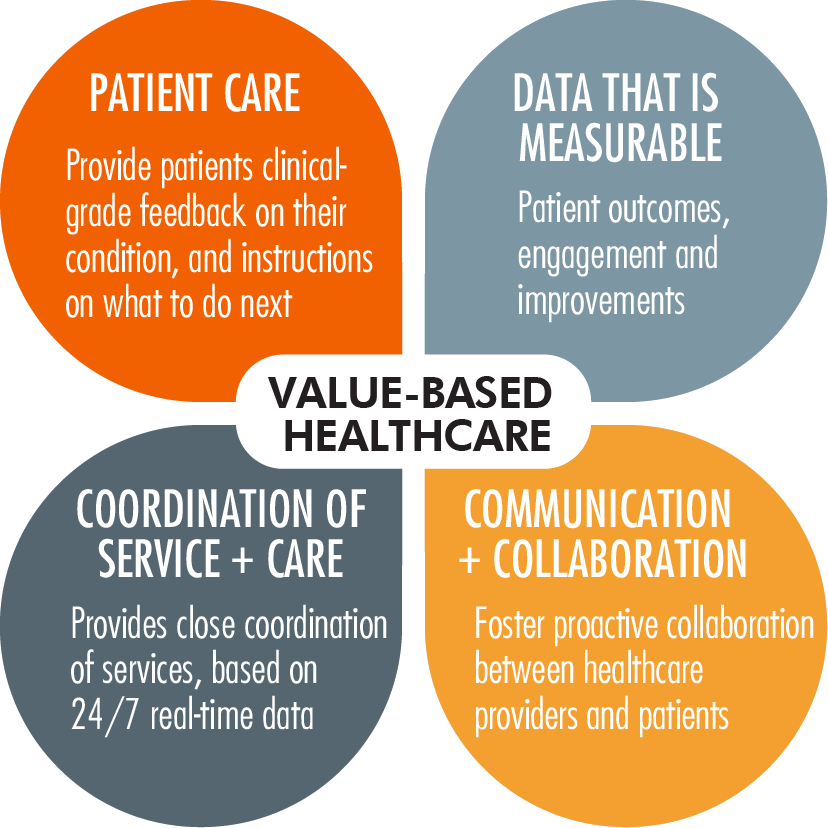
So what do all these deals have in common? Value-based care.

CITE: https://www.r2library.com/Resource/Title/082610254

READ Healthcare Brew: https://www.healthcare-brew.com/stories/2023/03/03/cvs-walgreens-value-based-care?cid=30723705.29836&mid=349b552221c994e2540a304649746d7c&utm_campaign=hcb&utm_medium=newsletter&utm_source=morning_brew

***

***

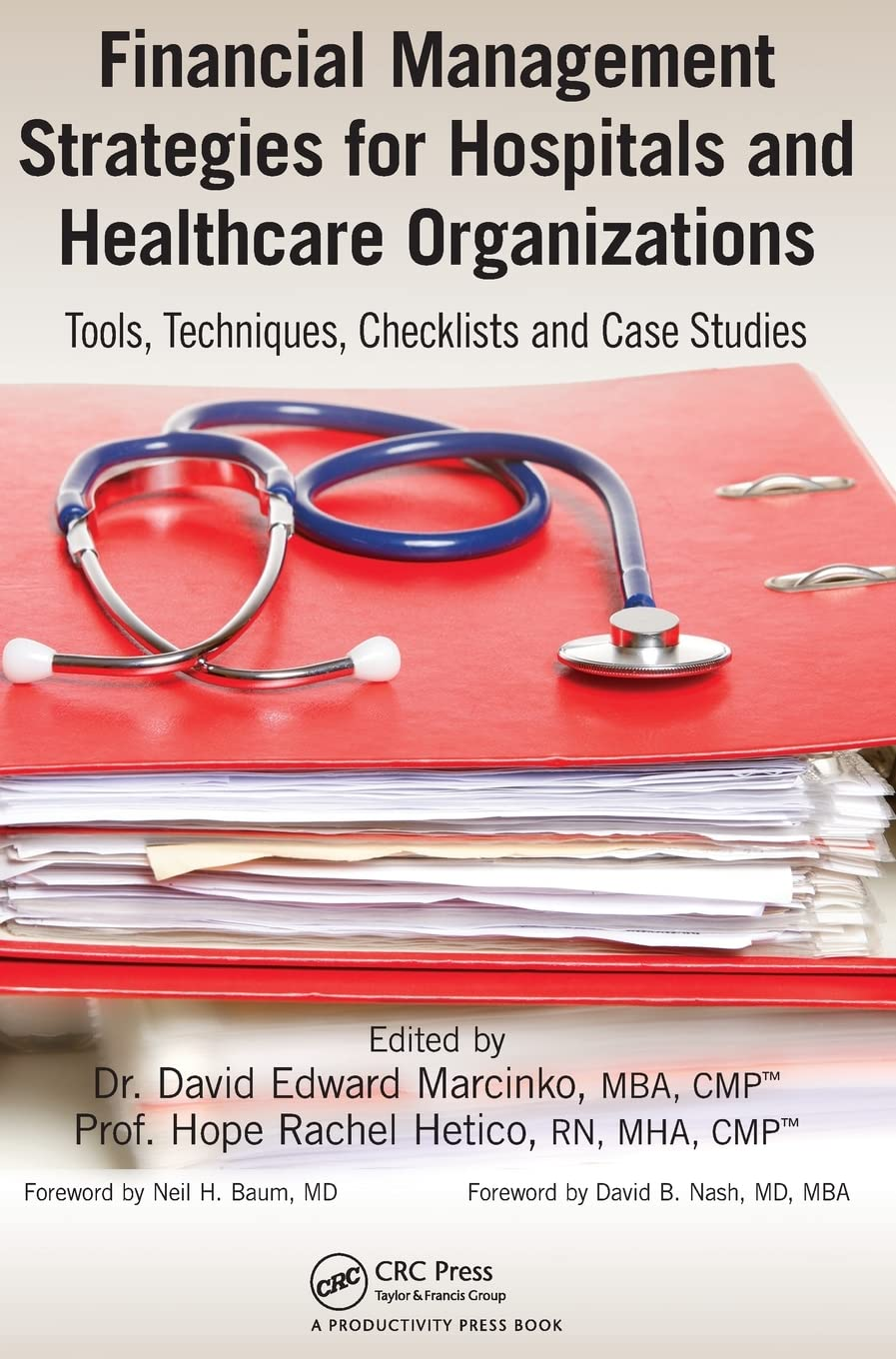
ORDER: https://www.amazon.com/Financial-Management-Strategies-Healthcare-Organizations/dp/1466558733/ref=sr_1_3?ie=UTF8&qid=1380743521&sr=8-3&keywords=david+marcinko

COMMENTS APPRECIATED

Thank You

***

What Physician Investors STILL NEED TO KNOW about “Monte Carlo” Simulation?

Probability Forecasting and Investing

By Dr. David Edward Marcinko MBA MEd CMP™

[Editor-in-Chief] www.CertifiedMedicalPlanner.org

dr-david-marcinko1Recently, I had a physician-client ask me about Monte Carlo simulation. You know the routine: what it is and how it works, etc.

From Monaco

Named after Monte Carlo, Monaco, which is famous for its games of chance, MCS is a technique that randomly changes a variable over numerous iterations in order to simulate an outcome and develop a probability forecast of successfully achieving an outcome.

In endowment management, MCS is used to demonstrate the probability of “success” as defined by achieving the endowment’s asset growth and payout goals.  In other words, MCS can provide the endowment manager with a comfort level that a given payout policy and asset allocation success will not deplete the real value of the endowment.

Quantitative Tools Problematic

The problem with many quantitative tools is the divorce of judgment from their use. Although useful, MCS has limitations that should not supplant the endowment manager’s, FA or physician-investor’s, experience.

MCS generates an efficient frontier by relying upon several inputs: expected return, expected volatility, and correlation coefficients. These variables are commonly input using historical measures as proxies for estimated future performance. This poses a variety of problems.

  • First, the MCS will generally assume that returns are normally distributed and that this distribution is stationary.  As such, asset classes with high historical returns are assumed to have high future returns.
  • Second, MCS is not generally time sensitive. In other words, the MCS optimizer may ignore current environmental conditions that would cause a secular shift in a given asset class returns.
  • Third, MCS may use a mean variance optimizer [MVO] that may be subject to selection bias for certain asset classes. For example, private equity firms that fail will no longer report results and will be eliminated from the index used to provide the optimizer’s historical data.

Healthcare Investment Risks

A Tabular Data Example

This table compares the returns, standard deviations for large and small cap stocks for the 20-year periods ended in 1979 and 2010.

Twenty Year Risk & Return Small Cap vs. Large Cap (Ibbotson Data)

[IA Micro-Cap Value 14.66 17.44 24.69 0.44]

1979

2010

Risk

Return

Correlation

Risk

Return

Correlation

Small   Cap Stocks 30.8% 17.4% 78.0% 18.1% 26.85% 59.0%
Large   Cap Stocks 16.5% 8.1% 13.1% 15.06%

[Reproduced from “Asset Allocation Math, Methods and Mistakes.” Wealthcare Capital Management White Paper, David B. Loeper, CIMA, CIMC (June 2, 2001)]

The Problems

Professor David Nawrocki identified a number of problems with typical MCS in that their mean variance optimizers assume “normal distributions and correlation coefficients of zero, neither of which are typical in the world of financial markets.”

Dr. Nawrocki subsequently described a number of other issues with MCS including nonstationary distributions and nonlinear correlations.

Finally, Dr. Nawrocki quoted financial advisor, Harold Evensky MS CFP™ who eloquently notes that “[t]he problem is the confusion of risk with uncertainty.” Risk assumes knowledge of the distribution of future outcomes (i.e., the input to the Monte Carlo simulation). Uncertainty or ambiguity describes a world (our world) in which the shape and location of the distribution is open to question.

Assessment

Contrary to academic orthodoxy, the distribution of U.S. stock market returns is “far from normal.”[1] Other critics have noted that many MCS simulators do not run enough iterations to provide a meaningful probability analysis.

Conclusion

Your thoughts and comments on this ME-P are appreciated. Feel free to review our top-left column, and top-right sidebar materials, links, URLs and related websites, too. Then, subscribe to the ME-P. It is fast, free and secure.

Speaker: If you need a moderator or speaker for an upcoming event, Dr. David E. Marcinko; MBA – Publisher-in-Chief of the Medical Executive-Post – is available for seminar or speaking engagements. Contact: MarcinkoAdvisors@msn.com

OUR OTHER PRINT BOOKS AND RELATED INFORMATION SOURCES:


[1]   Nawrocki, D., Ph.D. “The Problems with Monte Carlo Simulation.” FPA Journal (November 2001).

Product Details  Product Details

Risk Management, Liability Insurance, and Asset Protection Strategies for Doctors and Advisors: Best Practices from Leading Consultants and Certified Medical Planners™8Comprehensive Financial Planning Strategies for Doctors and Advisors: Best Practices from Leading Consultants and Certified Medical Planners™

Guidelines for Using an Equity Analyst’s Report

Trusting and Testing Fundamental Research

By Dr. David Edward Marcinko; MBA, MEd, CMP™

[Publisher-in-Chief]

It is not unreasonable to doubt the research of some security analysts; as evidenced by Wall Street’s recent upward implosion.

And so, trust but verify with your on research is always a good idea for the physician or lay investor in 2024.

25 Questions to Ask and Answer

Now, as a former financial planner, and professional investment advisor, please allow me to suggest the following before purchasing any equity:

  • How recent is the stock price on the report? If it is not recent, what is the current price? What is the current price relative to the 52-week high and low?
  • What is the P/E on trailing earnings per share? What is the stock’s projected price, based on estimated earnings for the periods shown?
  • What is the cash flow per share and the price-to-cash-flow ratio?
  • What is the book value? Price to book?
  • What is the trading volume relative to the number of shares outstanding?
  • How many shares are outstanding? What is the market capitalization based on current stock price and current shares outstanding? Is it a small, medium, or large-cap company?
  • Is the number of shares on a fully diluted basis shown? Is the fully diluted P/E shown? If there is a significant difference, read the report to find out where the extra shares will come from (convertible stock, a new or re-issue) and what the likelihood is that a conversion or a new issue or re-issue will occur.
  • What is the company’s earnings growth history? Is it a growth company or a cyclical company?
  • Does the company pay a dividend? If so, what is the dividend history and the payout ratio?
  • What is the debt-to-equity ratio? What kind of debt is it (publicly owned bonds, loans, etc.), and when does it have to be paid? What is the annual interest expense?
  • What are the cash ratios? Can the company cover its current liabilities easily? What is the ratio of annual earnings to interest expense?
  • What business is the company in? Are there comparisons to other companies in the same business? Are they similar in size? What is the outlook for the industry?
  • What is the company’s share of the market for its product? Does it have a particular niche? Does it have patents or protected rights on a special product? When do they expire?
  • How do the company’s financial ratios compare to those of other companies in its industry? How do the company’s ratios compare to those of the market as a whole or to narrower industry indexes?
  • Who are the company’s competitors? What advantages does the company have over its competitors?
  • How old is the company? How long has it been public? How long has the current management been running it? Who is the current management, and have there been significant management changes in the recent past?
  • How much of the company’s stock is owned by management? How much is owned by large institutional investors?
  • What kind of labor force does the company rely on? Where is it located?
  • Who are the company’s major customers? Is one customer very important?
  • Who are the company’s major suppliers? Is the company very dependent on one supplier?
  • How is the product distributed? Are there important relationships with distributors? How many different distributors are there?
  • What are the profit margins of the company? Where do they come from (incremental sales over break-even, or are they directly related to sales, no matter what level)?
  • What is the inventory turnover? Is there a lot of old, highly valued (on-the-books) inventory?
  • What is the history of sales revenue growth? What is the history of product mix in sales revenue?
  • Did the company issuing the research report also serve as investment banker?

Assessment

What did we miss – please advise?

Conclusion

And so, your thoughts and comments on this ME-P are appreciated. Feel free to review our top-left column, and top-right sidebar materials, links, URLs and related websites, too. Then, be sure to subscribe to the ME-P. It is fast, free and secure.

Subscribe Now: Did you like this Medical Executive-Post, or find it helpful, interesting and informative? Want to get the latest ME-Ps delivered to your email box each morning?

Sponsors Welcomed

And, credible sponsors and like-minded advertisers are always welcomed.

Link: https://healthcarefinancials.wordpress.com/2007/11/11/advertise

***

DAILY UPDATE: Father’s Day, Medical Debt and USAA

MEDICAL EXECUTIVE-POST TODAY’S NEWSLETTER BRIEFING

***

Essays, Opinions and Curated News in Health Economics, Investing, Business, Management and Financial Planning for Physician Entrepreneurs and their Savvy Advisors and Consultants

Serving Almost One Million Doctors, Financial Advisors and Medical Management Consultants Daily

A Partner of the Institute of Medical Business Advisors , Inc.

http://www.MedicalBusinessAdvisors.com

SPONSORED BY: Marcinko & Associates, Inc.

***

http://www.MarcinkoAssociates.com

Daily Update Provided By Staff Reporters Since 2007.
How May We Serve You?
© Copyright Institute of Medical Business Advisors, Inc. All rights reserved. 2024

REFER A COLLEAGUE: MarcinkoAdvisors@msn.com

SPONSORSHIPS AVAILABLE: https://medicalexecutivepost.com/sponsors/

ADVERTISE ON THE ME-P: https://tinyurl.com/ytb5955z

***

HAPPY FATHER’S DAY

News 4 in San Antonio Texas organized a video call with several USAA members who lost funds due to fraud — and have been left with little to no recourse. Some of them also belong to the Facebook group, USAA Fraud and Victims, which has 2,900 members. A few USAA members even reported being asked by the institution to cover the negative balances on their accounts after their money was stolen.

CITE: https://www.r2library.com/Resource

The race to a $3 trillion market cap seemed like it would always be between Apple and Microsoft. But over the last twelve months, Nvidia has come roaring to the front of the pack, neck and neck with the big tech incumbents. In the last two weeks alone it has replaced Apple in the #2 spot, only to be supplanted earlier this week when Apple’s AI plans propelled it back ahead. Now, it’s anybody’s race to the next big benchmark: a $4 trillion market cap.

CITE: https://tinyurl.com/2h47urt5

In a move that could be good for patients but bad for hospitals, the Consumer Financial Protection Bureau (CFPB) on Tuesday proposed regulation that would wipe medical debt from many consumers’ credit reports. The rule is meant to help the 15 million people in the US who creditors say still have a combined $49 billion of medical debt that negatively affects their credit scores, Rohit Chopra, director of the CFPB, said during a June 11 press briefing. About 100 million people in the US have some amount of medical debt, which totals roughly $220 billion, according to data from the Peterson-KFF Health System Tracker. The proposed regulation comes after three credit-reporting conglomeratesEquifax, Experian, and TransUnion—removed paid-off medical debt and medical debts under $500 from credit reports in 2022 and 2023, respectively.

CITE: https://tinyurl.com/tj8smmes

COMMENTS APPRECIATED

PLEASE SUBSCRIBE: MarcinkoAdvisors@msn.com

Thank You

***

***

***

***

EDUCATIONAL TEXTBOOKS: https://tinyurl.com/4zdxuuwf

***

DAILY UPDATE: Sat Healthcare Private Equity, Elder Abuse Awareness Day

MEDICAL EXECUTIVE-POST TODAY’S NEWSLETTER BRIEFING

***

Essays, Opinions and Curated News in Health Economics, Investing, Business, Management and Financial Planning for Physician Entrepreneurs and their Savvy Advisors and Consultants

Serving Almost One Million Doctors, Financial Advisors and Medical Management Consultants Daily

A Partner of the Institute of Medical Business Advisors , Inc.

http://www.MedicalBusinessAdvisors.com

SPONSORED BY: Marcinko & Associates, Inc.

***

http://www.MarcinkoAssociates.com

Daily Update Provided By Staff Reporters Since 2007.
How May We Serve You?
© Copyright Institute of Medical Business Advisors, Inc. All rights reserved. 2024

REFER A COLLEAGUE: MarcinkoAdvisors@msn.com

SPONSORSHIPS AVAILABLE: https://medicalexecutivepost.com/sponsors/

ADVERTISE ON THE ME-P: https://tinyurl.com/ytb5955z

***

Quote: “​​When private equity gets hold of healthcare systems, it is literally a matter of life and death, so if you drive a hospital like Steward into bankruptcy, putting patients and communities at risk, you should face real consequences.”—Sen. Elizabeth Warren on a proposed federal bill to impose jail time on executives who “loot” health systems, leading to patient harm (Fierce Healthcare)

CITE: https://www.r2library.com/Resource

Here’s where the major benchmarks ended:

  • The S&P 500 index fell 2.14 points (0.04%) to 5,431.60, up 1.6% for the week; the Dow Jones Industrial Average® ($DJI) lost 57.94 points (0.2%) to 38,589.16, down 0.5% for the week; the NASDAQ Composite gained 21.32 points (0.1%) to 17,688.88, up 3.2% for the week.
  • The 10-year Treasury note yield (TNX) fell more than 2 basis points to 4.215%, after earlier dropping under 4.19%, its lowest since late March.
  • The CBOE Volatility Index® (VIX) rose 0.72 to 12.66.

What’s up

  • Adobe soared 14.51% today after crushing analyst expectations when it announced earnings late yesterday.
  • Shopify rose 4.59% after it received yet another analyst upgrade. JPMorgan analysts gave the stock an overweight rating on June 11, while today Evercore analysts upgraded the company to outperform.
  • Hasbro popped 6% after the toy maker earned an upgrade to “buy” from Bank of America predicated on the company’s digital gaming strategy.

What’s down

  • Cruise stocks took a major blow today after a Bank of America report revealed that there was softer-than-expected pricing across the industry in May. Carnival fell 7.09%, Norwegian Cruise Line dropped 7.43%, and Royal Caribbean fell 4.35%.
  • RH plummeted 17% after the furniture maker reported a larger-than-expected loss in the previous quarter.
  • Stellantis fell 4.08% after the company’s CEO announced it will cut costs to compete with Chinese EV makers.
  • Penn Entertainment sank 8.66% on the news that competitor Boyd Gaming has voted in an M&A expert to its board of directors, which, combined with activist investors pushing Penn to put itself up for sale, could indicate an acquisition ahead.

CITE: https://tinyurl.com/2h47urt5

June 15th marks an important day on our calendar – Elder Abuse Awareness Day. It is a day for communities worldwide to unite in bringing attention to the challenges and difficulties faced by elders and our collective responsibility to protect and support them.

CITE: https://tinyurl.com/tj8smmes

COMMENTS APPRECIATED

PLEASE SUBSCRIBE: MarcinkoAdvisors@msn.com

Thank You

***

***

***

***

EDUCATIONAL TEXTBOOKS: https://tinyurl.com/4zdxuuwf

***

DAILY UPDATE: Flag Day, KKR, Wells Fargo and the S&P 500

MEDICAL EXECUTIVE-POST TODAY’S NEWSLETTER BRIEFING

***

Essays, Opinions and Curated News in Health Economics, Investing, Business, Management and Financial Planning for Physician Entrepreneurs and their Savvy Advisors and Consultants

Serving Almost One Million Doctors, Financial Advisors and Medical Management Consultants Daily

A Partner of the Institute of Medical Business Advisors , Inc.

http://www.MedicalBusinessAdvisors.com

SPONSORED BY: Marcinko & Associates, Inc.

***

http://www.MarcinkoAssociates.com

Daily Update Provided By Staff Reporters Since 2007.
How May We Serve You?
© Copyright Institute of Medical Business Advisors, Inc. All rights reserved. 2024

REFER A COLLEAGUE: MarcinkoAdvisors@msn.com

SPONSORSHIPS AVAILABLE: https://medicalexecutivepost.com/sponsors/

ADVERTISE ON THE ME-P: https://tinyurl.com/ytb5955z

HAPPY FLAG DAY

***

Wells Fargo found that some of its employees were pretending to work — and sent them packing. More than a dozen employees in the bank’s wealth and investment management divisions were discharged last month “after review of allegations involving simulation of keyboard activity creating impression of active work,” Bloomberg reported citing disclosures filed with the Financial Industry Regulatory Authority (FINRA).

CITE: https://www.r2library.com/Resource

Here’s where the major benchmarks ended:

  • The S&P 500 index gained 12.71 points (0.2%) to 5,433.74; the Dow Jones Industrial Average lost 65.11 points (0.2%) to 38,647.10; the NASDAQ Composite rose 59.12 points (0.3%) to 17,66756.
  • The 10-year Treasury note yield (TNX) fell about 5 basis points to 4.246%.
  • The CBOE Volatility Index® (VIX) declined 0.10 to 11.94.

What’s up

What’s down

CITE: https://tinyurl.com/2h47urt5

On Monday, private equity giant KKR jumped 12% after S&P Dow Jones Indices announced the company would be joining the index yesterday, along with CrowdStrike and GoDaddy, which saw their stocks jump 9% and 2%, respectively. The additions will be incorporated June 24.

CITE: https://tinyurl.com/tj8smmes

COMMENTS APPRECIATED

PLEASE SUBSCRIBE: MarcinkoAdvisors@msn.com

Thank You

***

***

***

***

EDUCATIONAL TEXTBOOKS: https://tinyurl.com/4zdxuuwf

***

DOCTOR: What is Your Investment Philosophy for [Second-Half] 2024?

HERE IS MINE IN BRIEF

DR. DAVID EDWARD MARCINKO MBA MEd CMP

***

SPONSOR: https://marcinkoassociates.com/

***

We have produced Investment Policy Statements of a hundred pages or more for our esteemed physician clients and colleagues. Or, others were just a few pages or a conversation.

ISP: https://medicalexecutivepost.com/2023/03/02/selecting-money-managers/

But, before deciding on any investment direction and philosophy in brief, however, we typically first focus on how much medical clients need to live on. For the income part of a client’s portfolio, that entails locking in rates of at least 4-5%, whether through municipal and corporate bonds, certificates of deposits, Treasury ladders, utilities or conservative dividend producing equities or ETFs, etc.

CITE: https://www.r2library.com/Resource

Once income requirements are fulfilled, whatever money is left over gets diversified into a portfolio of growth and value stocks—with some alternative investments. We limit making tactical shifts like putting money into cash when markets fell last year, or more recently, buying CDs and Treasuries as rates went up.  But, we do re-direct cash income, rather than sell assets in real time, as our philosophy trends to a “Buy and Hold” strategy.

Currently, we’re sitting on the sidelines with cash, some of which we are getting ready to deploy into the market as we position for any pullbacks later this 2024 year.

So, what is your investing philosophy for today, and or, tomorrow?

COMMENTS APPRECIATED

Thank You

***

***

DAILY UPDATE: Moody, CME Fedwatch and Ever Rising Stock Markets

MEDICAL EXECUTIVE-POST TODAY’S NEWSLETTER BRIEFING

***

Essays, Opinions and Curated News in Health Economics, Investing, Business, Management and Financial Planning for Physician Entrepreneurs and their Savvy Advisors and Consultants

Serving Almost One Million Doctors, Financial Advisors and Medical Management Consultants Daily

A Partner of the Institute of Medical Business Advisors , Inc.

http://www.MedicalBusinessAdvisors.com

SPONSORED BY: Marcinko & Associates, Inc.

***

http://www.MarcinkoAssociates.com

Daily Update Provided By Staff Reporters Since 2007.
How May We Serve You?
© Copyright Institute of Medical Business Advisors, Inc. All rights reserved. 2024

REFER A COLLEAGUE: MarcinkoAdvisors@msn.com

SPONSORSHIPS AVAILABLE: https://medicalexecutivepost.com/sponsors/

ADVERTISE ON THE ME-P: https://tinyurl.com/ytb5955z

***

On Monday, private equity giant KKR jumped 12% after S&P Dow Jones Indices announced the company would be joining the index on Friday, along with CrowdStrike and GoDaddy, which saw their stocks jump 9% and 2%, respectively. The additions will be incorporated June 24.

CITE: https://www.r2library.com/Resource

Stat: 99.4%. That’s the likelihood that interest rates will stay the same after the Fed’s meeting, according to the CME Fedwatch Tool. So it looks to be more “hurry up and wait” for interest rates to start coming down. 🫤 (Business Insider)

Quote: “It’s hard to think of a time when the US economy has diverged so fundamentally from its peers.”—Mark Zandi, chief economist at Moody’s Analytics, on the strength of the US economy compared to the weakness of other major economies. The US economy is continuing to grow while economies like Germany, Japan, and Canada are falling into recession. (The Atlantic)

CITE: https://tinyurl.com/2h47urt5

Here’s where the major benchmarks ended:

  • The S&P 500 index rose 45.71 points (0.9%) to 5,421.03; the Dow Jones Industrial Average  lost 35.21 points (0.1%) to 38,712.21; the NASDAQ Composite gained 264.89 points (1.5%) to 17,608.44.
  • The 10-year Treasury note yield (TNX) fell more than 7 basis points to 4.326%.
  • The CBOE Volatility Index® (VIX) declined 0.81 to  12.04.

What’s up

What’s down

CITE: https://tinyurl.com/tj8smmes

COMMENTS APPRECIATED

PLEASE SUBSCRIBE: MarcinkoAdvisors@msn.com

Thank You

***

***

***

***

EDUCATIONAL TEXTBOOKS: https://tinyurl.com/4zdxuuwf

***

WHAT IS THE PURPOSE OF A “Modern” CORPORATION?

An Emerging New Definition?

By Dr. David Edward Marcinko MBA MEd CMP

When I was in business school back-in-the day, I studied the late great economist Milton Friedman Ph.D who opined that the purpose of a corporation was to enhance shareholder value, in an ethical and legal manner; period? Shareholders could then do what they wished with profits; if any. Charitable giving or Selfish intent, etc!

***

***

Now, for those of you who haven’t had time to review the recent seismic tome from The Business Roundtable Announcement this week, let me review why this is as big a moment as the Larry Fink BlackRock letter.

  • The Business Roundtable, a group of chief executive officers of nearly 200 major U.S. corporations, issues a statement with a new definition of the “purpose of a corporation.” Seven [7] refused to sign.
  • The reimagined idea of a corporation drops the age-old notion that they function first and foremost to serve their shareholders and maximize profits.
  • Investing in employees, delivering value to customers, dealing ethically with suppliers and supporting outside communities are now at the forefront of American business goals; ie., community good.

MORE: https://www.forbes.com/sites/afdhelaziz/2019/08/23/the-power-of-purpose-milton-friedman-is-rolling-in-his-grave/#6ed8506f7532

DEFINITION: A shareholder or stockholder is an individual or institution (including a corporation) that legally owns a share of stock in a public or private corporation. Shareholders are the owners of a limited company. They buy shares which represent part ownership of a company.

DEFINITION: A stakeholder as defined in its first usage in a 1963 internal memorandum at the Stanford Research Institute, are “those groups without whose support the organization would cease to exist.” The theory was later developed and championed by R. Edward Freeman in the 1980s.

LINK: https://www.cnbc.com/2019/08/19/the-ceos-of-nearly-two-hundred-companies-say-shareholder-value-is-no-longer-their-main-objective.html

***

***

The Conundrum [real or perceived]

Shareholders are ever stakeholders in a corporation, but stakeholders are not always shareholders. A shareholder possesses part of a public company through shares of stock, while a stakeholder has a concern in the performance of a company for reasons other than stock performance or appreciation; ie., community good.

QUERY: So, exactly who will determine community good? And, who selects the stakeholders? Haven’t socially responsible companies, stocks, mutual funds and ETFs, etc., been in existence for decades? Is Professor Friedman rolling in his grave? OR, is this condundrum just linguistic gymnastics?

***

***

LINK: https://www.amazon.com/Dictionary-Health-Economics-Finance-Marcinko/dp/0826102549/ref=sr_1_6?ie=UTF8&s=books&qid=1254413315&sr=1-6

Your thoughts are appreciated.

***

Risk Management, Liability Insurance, and Asset Protection Strategies for Doctors and Advisors: Best Practices from Leading Consultants and Certified Medical Planners™8Comprehensive Financial Planning Strategies for Doctors and Advisors: Best Practices from Leading Consultants and Certified Medical Planners™

***

Invite Dr. Marcinko

***

DAILY UPDATE: Apple AI, Addus HomeCare, Waystar and the Rising Markets

MEDICAL EXECUTIVE-POST TODAY’S NEWSLETTER BRIEFING

***

Essays, Opinions and Curated News in Health Economics, Investing, Business, Management and Financial Planning for Physician Entrepreneurs and their Savvy Advisors and Consultants

Serving Almost One Million Doctors, Financial Advisors and Medical Management Consultants Daily

A Partner of the Institute of Medical Business Advisors , Inc.

http://www.MedicalBusinessAdvisors.com

SPONSORED BY: Marcinko & Associates, Inc.

***

http://www.MarcinkoAssociates.com

Daily Update Provided By Staff Reporters Since 2007.
How May We Serve You?
© Copyright Institute of Medical Business Advisors, Inc. All rights reserved. 2024

REFER A COLLEAGUE: MarcinkoAdvisors@msn.com

SPONSORSHIPS AVAILABLE: https://medicalexecutivepost.com/sponsors/

ADVERTISE ON THE ME-P: https://tinyurl.com/ytb5955z

***

Here’s where the major benchmarks ended:

  • The S&P 500 index rose 14.53 points (0.3%) to 5,375.32; the Dow Jones Industrial Average® ($DJI) declined 120.62 points (0.3%) to 38,747.42; the NASDAQ Composite gained 151.02 points (0.9%) to 17,343.55.
  • The 10-year Treasury note yield (TNX) fell about 7 basis points to 4.398%.
  • The CBOE Volatility Index® (VIX) rose 0.13 to 12.87.

CITE: https://www.r2library.com/Resource

What’s up

  • Apple shares rose 7.26%, hitting a new all-time high on hopes that the company’s AI innovations can make up for lost ground. Today’s surge reaffirmed its position as the second-largest publicly traded company in the US, retaking the #2 spot from Nvidia.
  • Affirm popped 11.04% as Apple’s newest partner, with its buy-now-pay-later loans to be embedded in Apple Pay.
  • FMC Corp rose 4% on the news that its president and CEO has stepped down. It can’t feel good when your company’s stock rises after you announce you’re leaving.
  • Calavo Growers was up 8.24% after the avocado producer announced strong second quarter results thanks to high avocado prices. Those darn millennials eating their avocado toast strike again!

What’s down

CITE: https://tinyurl.com/2h47urt5

The “A” in AI stands for Apple, the techies attending Apple’s annual Worldwide Developers Conference (WWDC) were told yesterday. CEO Tim Cook and Co. unveiled Apple Intelligence, a host of AI-powered features that will debut on iPhones, iPads, and Macs this fall.

CITE: https://tinyurl.com/tj8smmes

Addus HomeCare is making a major move to expand its business with plans to buy Gentiva’s personal care business for $350 million.


Healthcare payment software maker Waystar debuted on the public market Friday, raising $967.5 million, and marking the biggest health tech IPO since 2022. The company plans on paying off existing debt.

COMMENTS APPRECIATED

PLEASE SUBSCRIBE: MarcinkoAdvisors@msn.com

Thank You

***

***

***

***

EDUCATIONAL TEXTBOOKS: https://tinyurl.com/4zdxuuwf

***

About LOW Debt to Equity Ratios

WHAT AND WHY?

Low Debt / Equity Ratios

What? – Debt to Equity displays the financial leverage a company takes on to grow and support their operations. – It gives investors a glimpse if a company is raising capital through debt products more than they are using equity provided by investors.

Why? – If a company is highly leverage (i.e., having copious amounts of debt) then they are more susceptible to risk to their operations if any economic downturn occurs of if interests’ rates increase. Yet, they can grow at a faster pace and use the capital provided by investors on other growth projects.

If a company is uses equity, then they are less susceptible to risk to their operations if any economic downturn occurs of if interests’ rates increase. However, they cannot grow their business as fast as a company that uses more debt.

CITE: https://www.r2library.com/Resource/Title/0826102549

Now What? Compare the stocks within this list to equally sized stocks within a similar industry sector.

For example, Compare Small Cap tech stocks with one another. Determine if they are trying to grow their business or if they are trying to save the business by lending capital to turnaround their company and avoid bankruptcy.

RELATED: https://medicalexecutivepost.com/2021/10/10/what-is-medical-practice-financial-ratio-analysis/

YOUR COMMENTS ARE APPRECIATED.

***

***

Thank You

***

3 FINANCIAL SLANG “T” Terms

DEFINITIONS Physician-Investors Need to Know

By. Dr. David E. Marcinko MBA MEd CMP®

CMP logo


SPONSOR: http://www.CertifiedMedicalPlanner.org

***

Trading AheadUnethical and illegal trading by specialists or market makers.
A specialist may buy a stock for themselves from Dr. John Q. Public even though a better price is available from another seller. The specialist can view bid and ask prices and then manually mis-match them, or see ahead to a less favorable price. It happens in this editor’s experience, by observing how long it takes for a stop order to execute after the stop price was reached.
This practice is a form of shimming.
***
Trading ImbalanceA situation where a large block of stock is put up for sale, but not enough buyers are available for purchase, and a market maker is unable to buy the imbalance. Lightly traded and tightly held stocks are considered temporarily illiquid during such imbalances.
On occasion, a trading halt is put into place until enough buyers are available to purchase the deficit. On rare occasion, a handful of buyers can buy the stock at a huge discount if the stock was not halted during the imbalance.
On the New York Stock Exchange, large stocks usually have a “delayed open” for such imbalances, as a trading specialist will fill the order by lining up buyers for the block, and then open trading for the stock for the day.
***
Triple Witching HourThe final hour of trading on a Friday when stock index futures, stock index options, and stock options all expire. This happens on the third Friday in March, June, September, and December. See Quadruple Witching Hour.
***

CITE: https://www.r2library.com/Resource/Title/0826102549

***

YOUR COMMENTS ARE APPRECIATED.

Thank You

***

What is “Shelf Registration” for Securities?

What is “Shelf Registration” for Securities?

Dr. David E. Marcinko MBA CMP

http://www.MARCINKOASSOCIATES.com

SPONSOR: http://www.CertifiedMedicalPlanner.org

A relatively new method of registration under the Act of ’33 is known as shelf registration.

Under this rule, an issuer may register any amount of securities that, at the time the registration statement becomes effective, is reasonably expected to be offered and sold within two years of the initial effective date of the registration.

Once registered, the securities may be sold continuously or periodically within 2 years without any waiting period for a registration to clear issuers generally like shelf registration because of the flexibility it gives them to take advantage of changing market conditions.

LINK: https://www.crcpress.com/Comprehensive-Financial-Planning-Strategies-for-Doctors-and-Advisors-Best/Marcinko-Hetico/p/book/9781482240283

In addition, the legal, accounting, and printing costs involved in issuance are reduced, since a single registration statement suffices for multiple offerings within the 2 year period. In effect, what the issuer does is register securities that will meet its financing needs for the next 2 years.

It issues what it needs at the current time, and puts the balance on the “shelf” to be taken off the shelf as needed.

Conclusion:

Your thoughts and comments on this ME-P are appreciated. Feel free to review our top-left column, and top-right sidebar materials, links, urls and related websites, too. Then, subscribe to the ME-P. It is fast, free and secure.

Speaker: If you need a moderator or speaker for an upcoming event, Dr. David E. Marcinko; MBA – Publisher-in-Chief of the Medical Executive-Post – is available for seminar or speaking engagements.

Contact: MarcinkoAdvisors@msn.com

Subscribe: MEDICAL EXECUTIVE POST for curated news, essays, opinions and analysis from the public health, economics, finance, marketing, I.T, business and policy management ecosystem.

**

Risk Management, Liability Insurance, and Asset Protection Strategies for Doctors and Advisors: Best Practices from Leading Consultants and Certified Medical Planners™8Comprehensive Financial Planning Strategies for Doctors and Advisors: Best Practices from Leading Consultants and Certified Medical Planners™

Invite Dr. Marcinko

***

DAILY UPDATE: Tele-Health, Fortune 500, Companies and the Stocks Markets

MEDICAL EXECUTIVE-POST TODAY’S NEWSLETTER BRIEFING

***

Essays, Opinions and Curated News in Health Economics, Investing, Business, Management and Financial Planning for Physician Entrepreneurs and their Savvy Advisors and Consultants

Serving Almost One Million Doctors, Financial Advisors and Medical Management Consultants Daily

A Partner of the Institute of Medical Business Advisors , Inc.

http://www.MedicalBusinessAdvisors.com

SPONSORED BY: Marcinko & Associates, Inc.

***

http://www.MarcinkoAssociates.com

Daily Update Provided By Staff Reporters Since 2007.
How May We Serve You?
© Copyright Institute of Medical Business Advisors, Inc. All rights reserved. 2024

REFER A COLLEAGUE: MarcinkoAdvisors@msn.com

SPONSORSHIPS AVAILABLE: https://medicalexecutivepost.com/sponsors/

ADVERTISE ON THE ME-P: https://tinyurl.com/ytb5955z

***

The end has come for the Covid-19-era federal Affordable Connectivity Program, which some critics say will make telehealth access challenging for millions in rural and tribal areas. (NPR/KFF Health News)

CITE: https://www.r2library.com/Resource

Here’s where the major benchmarks ended yesterday:

  • The S&P 500 index rose 13.80 points (0.3%) to 5,360.79; the Dow Jones Industrial Average® ($DJI) gained 69.05 points (0.2%) to 38,868.04; the NASDAQ Composite added 59.40 points (0.4%) to 17,192.53.
  • The 10-year Treasury note yield (TNX) rose almost 4 basis points to 4.467%.
  • The CBOE Volatility Index® (VIX) rose 0.52 to 12.74.

What’s up

  • Diamond Offshore Drilling rose 10.91% after fellow offshore drilling company Noble Corp. announced it would acquire Diamond in a cash and stock deal worth $1.6 billion total. Noble shares rose 6.08% on the news as well.
  • Crowdstrike, GoDaddy, and KKR will be added to the S&P 500 when the index rebalances at the end of the quarter. Crowdstrike rose 7.29%, GoDaddy rose 1.94%, and KKR was up 11.22% on the news.
  • Texas Pacific Land Corporation shares also rose 24.57% on the news that the company will be inducted into the S&P MidCap 400.

What’s down

CITE: https://tinyurl.com/2h47urt5

Stat: 42. That’s how many healthcare industry companies were named on the latest Fortune 500, which lists the largest corporations in the US based on revenue for fiscal year 2023. (Advisory Board)

CITE: https://tinyurl.com/tj8smmes

COMMENTS APPRECIATED

PLEASE SUBSCRIBE: MarcinkoAdvisors@msns.com

Thank You

***

***

***

***

EDUCATIONAL TEXTBOOKS: https://tinyurl.com/4zdxuuwf

***

The Private Placement (Regulation D) Securities Exemption

What it is – How it works?

dem-2

By Dr. David Edward Marcinko MBA MEd CMP

http://www.CertifiedMedicalPlanner.org

Since the Securities Act of 1933 requires disclosure of all public offerings (other than the exemptions just described), it should make sense that any securities offering not offered to the public would also be exempt. The Act provides a registration exemption for private placements, know as Regulation D.

Since one of the stated purposes of the Act of 1933 is to prevent fraud on the sale of new public issues, an issue which has only a limited possibility of injuring the public may be granted an exemption from registration. The SEC just doesn’t have the time to look at everything so they exempt offerings which do not constitute a “public offering”. Strict adherence to the provisions of the law, however, is expected and is scrutinized by the SEC. This exemption provision of the Act of ’33 lies within Regulation D.

Regulation D describes the type and number of investors who may purchase the issue, the dollar limitations on the issue, the manner of sale, and the limited disclosure requirements. Bear in mind at all times that from the issuer’s viewpoint, the principal justification for doing a private, rather than public offering, is to save time and money, not to evade the law.

NOTE: Remember, it is just as illegal to use fraud to sell a Regulation D issue as it is in a public issue. However, if done correctly, a Regulation D can save time and money, and six separate rules (501-506).

***

334_1

***

The Rules

Rule 501: Accredited investors are defined as: corporations and partnerships with net worth of $5,000,000 not formed for the purpose of making the investment; corporate or partnership “insiders”; individuals and medical professionals with a net worth (individual or joint) in excess of $1,000,000; individuals with income in excess of $200,000 (or joint income of $300,000) in each of the last two years, with a reasonable expectation of having income in excess of $200,000 (joint income of $300,000) in the year of purchase; and any entity 100% owned by accredited investors. 

Rule 502: The violations of aggregation and integration are defined:

Aggregation: Sales of securities in violation of the dollar limitations imposed under Rules 504 and 505 (506 has no dollar limitations).

Integration: Sales of securities to a large number of non-accredited investors, in violation of the “purchaser limitations” set forth in Rules 505 and 506 (504 has no “purchaser limitations”). 

Rule 503: Sets forth notification requirements. An issuer will be considered in violation of Regulation D, and therefore subject to Federal penalties, if a Form D is not filed within 15 days after the Regulation D offering commences. 

Rule 504: Enables a non-reporting company to raise up to $1,000,000 in a 12-month period without undergoing the time land expense of an SEC registration. Any number of accredited and non-accredited investors may purchase a 504 issue. 

Rule 505: Enables corporations to raise up to $5,000,000 in a 12-month period without a registration. The “purchaser limitation” rule does apply here. It states that the number of non-accredited investors cannot exceed 35. Obviously, we would have few problems if only medical investors in private placements were accredited investors, but that is not always the case. Since we are limited to a maximum of 35 non-accredited investors, how we count the purchasers becomes an important consideration. The SEC states that if a husband and wife each purchase securities in a private placement for their own accounts, they count as one non- accredited investor, not two. It would also be true that if these securities were purchased in UGMA accounts for their dependent children, we would still be counting only one non- accredited investor. In the case of a partnership, it depends upon the purpose of the partnership. If the partnership was formed solely to make this investment, then each of the partners counts as an individual accredited or non-accredited investor based upon their own personal status, but if the partnership served some other purpose, such as a law firm, then it would only count as one purchaser.

Rule 506: Differs from 505 in two significant ways. The dollar limit is waived and the issuer must take steps to assure itself that, if sales are to be made to non-accredited investors, those investors meet tests of investment “sophistication”.

Generally speaking, this means that either the individual non-accredited investor has investment savvy and experience with this kind of offering, or he is represented by someone who has the requisite sophistication. This representative, normally a financial professional, such as an investment advisor, accountant, or attorney, is referred to in the securities business as a Purchaser Representative.

Regulation D further states that no public advertising or solicitation of any kind is permitted. A tombstone ad may be used to advertise the completion of a private placement, not to announce the availability of the issue. As a practical matter, however, whether required by the SEC or not, a Private Offering Memorandum for a limited partnership, for example, is normally prepared and furnished so that all investors receive disclosure upon which to base an investment judgment.

If any of the provisions of the Securities Act of 1933 are violated by an issuer, underwriter, or investor, this is known as “statutory underwriting” of underwriting securities in violation of statute. One who violates the ’33 Act is known as a statutory underwriter. One all too common example of this occurs when a purchaser of a Regulation D offering offers his unregistered securities for re-sale in violation of SEC Rule 144, an explanation of which is given below.

In simple English, SEC Rule 144 was created so that certain re-sales of already-existing securities could be made without having to file a complete registration statement with the SEC. The time and money involved in having to file such a registration is usually so prohibitive as to make it uneconomical for the individual seller. What kinds of re-sales are covered by Rule 144 and are important to the medical investor? Let’s first define a few terms. 

Restricted Securities: Are unregistered Securities purchased by an investor in a private placement. It is also called Letter Securities or Legend Securities referring to the fact that purchasers must sign an “Investment Letter” attesting to their understanding of the restrictions upon re-sale and to the “Legend” placed upon the certificates indicating restriction upon resale. 

Control Person: A corporate director, officer, greater than 10% voting Stockholder, or the spouse of any of the preceding, are loosely referred to as Insiders or Affiliates due to their unique status within the issuer. 

Control Stock: Stock held by a control person. What makes it control stock is who owns it, not so much how they acquired it. 

Non-Affiliate: An investor who is not a control person and has no other affiliation with the issuer other than as an owner of securities.

Rule 144 says that restricted securities cannot be offered for re-sale by any owner without first filing a registration statement with the SEC:

  1. unless the securities have been held in a fully paid-for status for at least two years;
  2. unless a notice of Sale is filed with the SEC at the time of sale and demonstrating compliance with Rule 144
  3. unless small certain quantity apply: 

***

fsu_campus_1

***

Assessment

  • Rule 500 – Use of Regulation D
  • Rule 501 – Definitions and terms used in Regulation D
  • Rule 502 – General conditions to be met
  • Rule 503 – Filing of notice of sales
  • Rule 504 – Exemption for offerings not exceeding $5,000,000
  • Rule 505 – No longer availible effective May 22, 2017
  • Rule 506 – Exemption for unlimited offering
  • Rule 507 – Disqualifying provision relating to exemptions 504, 505 and 506
  • Rule 508– Insignificant deviations from a term, condition or requirement of Regulation D

Conclusion

Your thoughts and comments on this ME-P are appreciated. Feel free to review our top-left column, and top-right sidebar materials, links, URLs and related websites, too. Then, subscribe to the ME-P. It is fast, free and secure.

Speaker: If you need a moderator or speaker for an upcoming event, Dr. David E. Marcinko; MBA – Publisher-in-Chief of the Medical Executive-Post – is available for seminar or speaking engagements. Contact: MarcinkoAdvisors@msn.com

OUR OTHER PRINT BOOKS AND RELATED INFORMATION SOURCES:

Comprehensive Financial Planning Strategies for Doctors and Advisors: Best Practices from Leading Consultants and Certified Medical Planners™

***

What is an Unregistered Security?

By Staff Reporters

***

***

A security, most simply, is a financial instrument traded for profit. They form the basis of investment contracts for thinks like equities, debt, and derivatives.

CITE: https://www.r2library.com/Resource/Title/0826102549

The SEC points to the Howey Test to determine if an asset can be classed as a security. This test has four prongs, all of which need to be passed to be determined a security: [1] An investment of money [2] in a common enterprise [3] with expectations of a profit [4] to be derived from the efforts of others.

In the US, if an asset is deemed to be a security it needs to be registered with the SEC. For example, an initial public offering (IPO) of a stock newly listed on the stock exchange represents the first offering of its freshly registered securities. Securities need to be registered as it gives the issuing company the relevant shareholder information to pay dividends and provide relevant stock-related information. It also helps reduce fraud by keeping on record the legitimate owner of the security.

According to the SEC, an unregistered security is simply one that hasn’t been rubber-stamped by the regulator. 

Unregistered securities have been the subject of several scams, with the SEC saying their hallmarks include the promise of high yields with no risk, aggressive sales tactics, and are backed by unqualified investment professionals. As such, their use is limited.

Only accredited investors, defined as those with a net worth higher than $1 million or an annual income exceeding $200,000, can trade unregistered securities, essentially locking out most retail investors. The threshold is seen as a gauge of financial sophistication and suggests a buffer for eligible investors against potential losses.

RELATED: https://medicalexecutivepost.com/2022/01/14/the-private-placement-regulation-d-securities-exemption/

***

COMMENTS APPRECIATED

Thank You

***

ORDER: https://www.routledge.com/Comprehensive-Financial-Planning-Strategies-for-Doctors-and-Advisors-Best/Marcinko-Hetico/p/book/9781482240283

***

MUTUAL FUNDS: Terms and Definitions for Physicians

A “Need-to-Know” Glossary for all Medical Professionals

http://www.HealthDictionarySeries.org

HDS

[ME-P Staff Writers] 

ADV: A two-part form filed by investment advisors who register with the Securities and Exchange Commission (SEC), as required under the Investment Advisers Act. ADV Part II information must be provided to potential investors and made available to current investors.

Alpha: A measure of the amount of a portfolio’s expected return that is not related to the portfolio’s sensitivity to market volatility. A benchmark that uses beta as a measure of risk, a benchmark and a risk free rate of return (usually T-bills) to compare actual performance with expected performance.

For example, a fund with a beta of .80 in a market that rises 10% is expected to rise 8%.

If the risk-free return is 3%, the alpha would be –.6%, calculated as follows: (Fund return – Risk-free return) – (Beta x Excess return) = Alpha   (8% – 3%) – [.8 × (10% – 3%)] = (–) .6%   

Note: A positive alpha indicates out-performance while a negative alpha means underperformance. 

Asset allocation: Strategic asset allocation refers to the long-term targets for allocation of a percentage of a portfolio among different asset classes. In contrast, tactical asset allocation refers to short-term targets.

Average maturity: The average weighted maturity of the bonds in a portfolio providing an indication of interest rate risk.

Benchmark: An index, managed portfolio, or fund used to compare performance characteristics with the targeted portfolio or fund.

Beta: A statistically computed measure of the portfolio’s relationship to changes in market value. If, compared to the S&P 500, a fund has a beta of .80; it is expected to under perform a rising market by 20% and outperform a falling market by 20%. 

Bond: Publicly traded debt instruments that are issued by governments and corporations. The issuer agrees to pay a fixed amount of interest over a specified time period and to repay the principal at maturity.

Closed-end mutual fund: An investment company that registers shares in accordance with SEC regulations and is traded in securities markets at prices determined by investments. 

Diversification: Buying a number of different investment vehicles to protect against default of a single vehicle, thereby reducing the risk of the portfolio.

Duration: A more technical calculation of interest rate risk exposure that uses the present value of expected cash flows to be returned to the bond holder over the term of the bond. 

Fundamental analysis: An analysis of a company’s stock that focuses on the economic environment, the industry the company is in, and the company’s financial situation and operating results.

Mutual fund: A regulated investment company that manages a portfolio of securities for its shareholders.

Net asset value (NAV): The value of fund assets fewer liabilities divided by outstanding shares. 

Open-end mutual fund: An investment company that invests money in accordance with specific objectives on behalf of investors. Fund assets expand or contract based on investment performance, new investments and redemptions.

Portfolio manager: The person(s) who is/are responsible for managing the portfolio in accordance with the objectives dictated by an investor or a fund’s prospectus.

Prospectus: A disclosure document filed with the SEC and made available to prospective and current investors. The prospectus covers sales charges, expenses, investment objectives and restrictions, management fees, financial highlights, and other information. 

R-squared (R2): Relationship of a fund or portfolio’s performance to a benchmark index.

For example, a fund R-squared of .5 means only 50% of its return is explained by the index. Other factors are responsible for the balance of performance. 

SEC yield: A standardized calculation of yield over a 30-day period, sometimes quoted as the “30-day yield.” It takes into account yield-to-maturity rather than current dividends. 

Standard deviation: A statistic that looks at a series of returns and expresses the average deviation from the mean return.

Statement of additional information: A disclosure document filed with the SEC that supplements the prospectus. It is made available to investors upon request. 

Technical analysis: An analysis that focuses on trends in financial markets generally.

For example, a technical analyst may view an entire industry’s group of stocks to be declining. Although the analyst may be correct about the group of stocks as a whole, there may be exceptions represented by specific, individual companies.

Total return: The combination of investment return from income, such as dividends and interest, and appreciation or depreciation in the value of the investment (Income returns plus capital return.) 

Turnover: Under SEC rules, a figure computed that indicates how often securities in the portfolio are bought and sold. For example, if turnover is 100% over a one-year period, the securities (on average) were replaced once. 

12b-1 fee: The maximum annual fee payable from fund assets for distribution and sales costs as allowed by the SEC. 

CITE: https://www.r2library.com/Resource

MORE: Glossary Terms Ap 3

Library

***

***

DAILY UPDATE: Markets, Cue Health Down, Blue Kansas Part C and the FOMC

MEDICAL EXECUTIVE-POST TODAY’S NEWSLETTER BRIEFING

***

Essays, Opinions and Curated News in Health Economics, Investing, Business, Management and Financial Planning for Physician Entrepreneurs and their Savvy Advisors and Consultants

Serving Almost One Million Doctors, Financial Advisors and Medical Management Consultants Daily

A Partner of the Institute of Medical Business Advisors , Inc.

http://www.MedicalBusinessAdvisors.com

SPONSORED BY: Marcinko & Associates, Inc.

***

http://www.MarcinkoAssociates.com

Daily Update Provided By Staff Reporters Since 2007.
How May We Serve You?
© Copyright Institute of Medical Business Advisors, Inc. All rights reserved. 2024

REFER A COLLEAGUE: MarcinkoAdvisors@msn.com

SPONSORSHIPS AVAILABLE: https://medicalexecutivepost.com/sponsors/

ADVERTISE ON THE ME-P: https://tinyurl.com/ytb5955z

***

CITE: https://www.r2library.com/Resource

Markets: Stocks dropped ever so slightly to end last week as investors tried to make sense of the big jobs report. Lots of jobs = good, but lots of jobs also = interest rates likely staying the same for awhile longer (more below). AMC had a rough day, tumbling 15% as the latest meme stock craze started to fizzle.

CITE: https://tinyurl.com/2h47urt5

Blue Kansas City Exiting MA Market by 2025 Due to ‘Regulatory Demands’

Blue Cross and Blue Shield of Kansas City (Blue KC) is leaving the Medicare Advantage (MA) market at the end of 2024, the insurer announced recently. The company blamed “heightened regulatory demands and rising market and financial pressures” for the decision but said it is still focused on employer-sponsored health plans, and Medicare supplement and Affordable Care Act plans in the state.

“We explored every alternative path for our MA members and are disappointed we must exit this line of business,” said Erin Stucky, Blue KC President and CEO, in a statement. “We value our MA members and are committed to providing uninterrupted, quality service to our current MA membership through the end of 2024.”

Source: Noah Tong, Fierce Healthcare [6/3/24]

CITE: https://tinyurl.com/tj8smmes

Cue Health, founded in 2010, started with great hopes as it promised a way to accurately test for Covid-19 without needing a lab. “We designed and developed a new molecular testing platform bringing lab complexity to an easy-to-use, portable device. Now you can get the best of lab molecular testing — speed, accuracy, and versatility – at home, the office, or on the go,” the company shared on its website. The company went public (with the ticker  (HLTH) ) in 2021 at $16 and rose to $20.55 and carried that massive $2.3 billion valuation. Through 2023 and into this year, Cue unsuccessfully tried to shore up operations, get new products to market, and find new capital.

In May, however, the FDA advised customers not to use two of its products at all because they did not deliver accurate results. Finally, its board and executives threw in the towel. On May 28th, the company announced it was ceasing operations and filed for bankruptcy in Delaware’s U.S. Bankruptcy Court. The company’s assets will be sold off at an undetermined date, and the proceeds will be distributed to creditors.       

***

Inflation data from the Fed meeting on Wednesday: Inflation data for May arrives in the morning, and it’s expected to show price growth held steady at 3.4% annually. In the afternoon, the FOMC will wrap up its meeting with a Jerome Powell press conference. The Fed is pretty much a lock to hold interest rates at their current level.

COMMENTS APPRECIATED

PLEASE SUBSCRIBE: MarcinkoAdvisors@msn.com

Thank You

***

***

***

***

EDUCATIONAL TEXTBOOKS: https://tinyurl.com/4zdxuuwf

***

DAILY UPDATE: Payroll Jobs and Longevity Up

MEDICAL EXECUTIVE-POST TODAY’S NEWSLETTER BRIEFING

***

Essays, Opinions and Curated News in Health Economics, Investing, Business, Management and Financial Planning for Physician Entrepreneurs and their Savvy Advisors and Consultants

Serving Almost One Million Doctors, Financial Advisors and Medical Management Consultants Daily

A Partner of the Institute of Medical Business Advisors , Inc.

http://www.MedicalBusinessAdvisors.com

SPONSORED BY: Marcinko & Associates, Inc.

***

http://www.MarcinkoAssociates.com

Daily Update Provided By Staff Reporters Since 2007.
How May We Serve You?
© Copyright Institute of Medical Business Advisors, Inc. All rights reserved. 2024

REFER A COLLEAGUE: MarcinkoAdvisors@msn.com

SPONSORSHIPS AVAILABLE: https://medicalexecutivepost.com/sponsors/

ADVERTISE ON THE ME-P: https://tinyurl.com/ytb5955z

***

CITE: https://www.r2library.com/Resource

People whose job it is to watch the economy are shocked at how many jobs the economy added last month: Payrolls added 272,000 more jobs in May, according to employer stats the government dropped yesterday, vastly exceeding the 190,000 increase that analysts predicted.

  • The biggest job gains were in healthcare (68k jobs), government (43k), and hospitality (42k).
  • The average hourly pay increased by 0.4% from the previous month and 4.1% over the year, also exceeding analysts’ predictions.

The surprisingly strong employment gains are prompting some head-scratching since they come amid slowing economic growth as consumers pull back on spending. The job market’s resilience has dashed hopes among investors and anyone planning to take out a loan that the Fed will lower interest rates soon. For example:

  • The unemployment rate ticked up to 4% from 3.9% in April, breaking its historic streak of 27 months under 4%.
  • A survey of households revealed that the number of Americans working dropped by 408,000 from April to May.

Some economists claim the household survey fails to properly account for immigrant workers, who have been the main driver of working population growth in recent years. But others say it checks out given the general cool-down vibes in the labor market: Job openings were at a three-year low in April, and many recent college grads have struggled to find work.

CITE: https://tinyurl.com/2h47urt5

While some companies would be thrilled if everyone started living to 120, it could spell trouble for the rest of us. Experts believe that centenarians becoming anything more than an anomaly would put the world in an economic pickle and require a societal overhaul to adapt. Even without futuristic tech that enables ultra-longevity, many developed countries are already in an economic bind due to aging populations and declining birth rates. The US Census Bureau projects that people older than 64 will reach 23% of the population by 2060 (compared to 17% in 2020), which means higher retirement and healthcare costs with fewer workers to offset them.

CITE: https://tinyurl.com/tj8smmes

COMMENTS APPRECIATED

PLEASE SUBSCRIBE: MarcinkoAdvisors@msn.com

Thank You

***

***

***

***

EDUCATIONAL TEXTBOOKS: https://tinyurl.com/4zdxuuwf

***

The Active v. Passive Investing Dichotomy

The Controversy Continues

LINK: http://www.CertifiedMedicalPlanner.org

[By Amaury S. Cifuentes CFP® CMP®]

Physician and all investors are often overloaded with information regarding this debate, and many advisors differ in the conclusion of which strategy is best.

Stock Picking

Stock picking is typically a waist of time and few investors or advisors demonstrate the constant ability in picking winning stocks. Timing the market also becomes difficult and typically has negative effects in a portfolio. Investors will also find that they will usually have very little luck finding money mangers that can consistently out perform the market. Investors over a long period of investing time horizon would benefit from passive investing vs. active trading, with some exceptions.

Active Investors

Active investors spend time analyzing stocks or mutual funds based on a mismatch of the price relative to its value. In an efficient market, there is little or no mismatch between the current price and the true value of the investment. Also, real cost and expenses of active management are rarely calculated;  some consider the stock market a zero sum game, if the total market returns eleven percent then the investors must deduct the cost of the transaction, which would lower their return relative to the market.

Mutual Fund Performance

For example, Mark Carhart’s comprehensive study of 1,892 mutual funds title “On Persistence in Mutual Fund Performance” showed that on average mutual fund manager under performs by 1.8% to their relative index.  In addition, William Sharpe Nobel laureate article “The Arithmetic of Active Management” stated that after cost, the return of active management dollars would be less than passive dollars.

Market Timing

Timing of markets is also very difficult. Timing the market can be defined by moving your asset from risky to non risky assets before negative events happen. The Random Walk Theory basically states that there are no patterns in the stock market prices. Basically, information moves the markets and information is random, so logic would suggest that timing the markets effectively is futile. Many reports demonstrate this effect, for example, a report form Javier Estrada, a finance professor at IESE Business School in Barcelona, Spain. He studied the DJIA form 1900-2008 and concluded that if you subtracted the ten best days from the market two thirds of the cumulative gains would disappear (10/29694 or .03%), almost impossible to predict even by the most astute investors. Much more extensive research showing that market timing does not work, Wei Jiang paper “A Nonparametric Test of Market Timing” concluded that timing ability on average is negative. There are countless of studies showing that there is no evidence that timing the markets can produce superior returns.

***

Investing Difficulties Continue

To make thing even more difficult, investors that seek profession help cannot guarantee that the active managers they hire can consistently over long period of time outperform their benchmarks.  Obviously, it is evident that past performance is no indication of future results as advertised by all financial institution, and most active managers who outperform their bench market do not do consistently over long periods of time. John Boggle’s comprehensive study in 1992 of the Forbes Honor Roll title “Selecting Equity Mutual Funds” concluded that after commissions loads were taken into account the honor roll under performed the market between 1974 and 1990 by a difference of 193.75% cumulative.

Of Professor Burton Malkiel

Furthermore, investors over long periods of time will find that stock picking, timing the market and selecting active managers do not produce superior returns. John Stossel of ABC’s 20/20 interview Professor Burton Malkiel of Princeton University and stated in the interview that “All the information an analyst can learn about a company, from balance sheets to marketing material, is already built into the stock price, because all of the other thousands of analysts have the same information. What they don’t have is the knowledge that will move the stock, knowledge such as a news event, which is unpredictable and impossible to forecast.”

Assessment

Physicians and all investors may be better off concentrating on asset allocation, picking low cost investment, deciding on tactical or strategic rebalancing and implementing models like the three factor model as pioneered by Professor Eugene Fama and Professor Kenneth French in lieu active management.

Conclusion

Your thoughts and comments on this ME-P are appreciated. Feel free to review our top-left column, and top-right sidebar materials, links, URLs and related websites, too. Then, subscribe to the ME-P. It is fast, free and secure.

Speaker: If you need a moderator or speaker for an upcoming event, Dr. David E. Marcinko; MBA – Publisher-in-Chief of the Medical Executive-Post – is available for seminar or speaking engagements. Contact: MarcinkoAdvisors@msn.com

Comprehensive Financial Planning Strategies for Doctors and Advisors: Best Practices from Leading Consultants and Certified Medical Planners™

***

What is IMPLIED Stock Volatility?

By Staff Reporters

***

Implied open attempts to predict the prices at which various stock indexes will open at 9:30 am EST. It is frequently shown on various cable television channels and websites prior to the start of the next business day.  This is a powerful tool that gives traders an indication on whether they should be bullish or bearish during the market for SPX, NDX, and RUT.

***

What is Implied Volatility?

Implied volatility shows how much movement the market is expecting in the future.

Options with high levels of implied volatility suggest that investors in the underlying stocks are expecting a big move in one direction or the other. It could also mean there is an event coming up soon that may cause a big rally or a huge sell-off.

MORE: https://medicalexecutivepost.com/2022/03/18/options-and-derivatives-glossary/

However, implied volatility is only one piece of the puzzle when putting together an options trading strategy.

***

RELATED: https://www.amazon.com/Comprehensive-Financial-Planning-Strategies-Advisors/dp/1482240289/ref=sr_1_1?ie=UTF8&qid=1418580820&sr=8-1&keywords=david+marcinko

VIX: https://medicalexecutivepost.com/2022/09/01/what-up-vix/

***

COMMENTS APPRECIATED

Thank You

***

DAILY UPDATE: Companies and Stocks Dip as Job Growth Rises

MEDICAL EXECUTIVE-POST TODAY’S NEWSLETTER BRIEFING

***

Essays, Opinions and Curated News in Health Economics, Investing, Business, Management and Financial Planning for Physician Entrepreneurs and their Savvy Advisors and Consultants

Serving Almost One Million Doctors, Financial Advisors and Medical Management Consultants Daily

A Partner of the Institute of Medical Business Advisors , Inc.

http://www.MedicalBusinessAdvisors.com

SPONSORED BY: Marcinko & Associates, Inc.

***

http://www.MarcinkoAssociates.com

Daily Update Provided By Staff Reporters Since 2007.
How May We Serve You?
© Copyright Institute of Medical Business Advisors, Inc. All rights reserved. 2024

REFER A COLLEAGUE: MarcinkoAdvisors@msn.com

SPONSORSHIPS AVAILABLE: https://medicalexecutivepost.com/sponsors/

ADVERTISE ON THE ME-P: https://tinyurl.com/ytb5955z

***

Bank of America analysts recently looked back at the last 100 years of stock market data, searching for asset bubbles and what indicated their approach. The nine historical bubbles they found all had one thing in common ahead of their bursting: rising volatility. But, right now the Volatility Index, or VIX, is nowhere near the highs seen before the dot-com bubble burst, which should soothe investor concerns.

CITE: https://www.r2library.com/Resource

What’s up

  • Jazz Pharmaceuticals rose 5.39% today thanks to RBC Capital reiterating its outperform rating of the stock, highlighting the potential of the company’s forthcoming essential tremor treatment.
  • CarGurus popped 4.05% after receiving a shiny new outperform rating from JMP Securities, which likes the company’s online marketplace business model.
  • Las Vegas Sands rose 3.11% today on no particular news, as did Cedar Fair, which rose 3.27%. Both are beneficiaries of the vacation season, and likely enjoyed a boost today due to nothing more than the fact that it was a sunny summer Friday.

What’s down

CITE: https://tinyurl.com/2h47urt5

Here’s where the major benchmarks ended:

  • The S&P 500 index declined 5.97 points (0.1%) to 5,346.99, up 1.3% for the week; the Dow Jones Industrial Average® ($DJI) lost 87.18 points (0.2%) to 38,798.99, up 0.3% for the week; the NASDAQ Composite® ($COMP) shed 39.99 points (0.2%) to 17,133.13, up 2.4% for the week.
  • The 10-year Treasury note yield (TNX) jumped about 15 basis points to 4.432%.
  • The CBOE Volatility Index® (VIX) fell 0.36 to 12.22.

Interest-rate-sensitive sectors including banking, real estate, and utilities were among this week’s poorest performers amid expectations the Fed is unlikely to lower rates from historically high levels. The Dow Jones Utility Average ($DJU) dropped 2.8% this week. Retailers also posted a down week. Semiconductors still clocked a firm week despite declines the past two days. The PHLX Semiconductor Index (SOX) advanced 3.2% for the week. 

CITE: https://tinyurl.com/tj8smmes

COMMENTS APPRECIATED

PLEASE SUBSCRIBE: MarcinkoAdvisors@msn.com

Thank You

***

***

***

***

EDUCATIONAL TEXTBOOKS: https://tinyurl.com/4zdxuuwf

***

STOCK SPLITS: A Vital Equity Investing Concept for Physicians and all Investors

By Dr. David Edward Marcinko MBA MEd CMP™

SPONSOR: http://www.CertifiedMedicalPlanner.org

***

***
One important equity concept that medical professionals should be aware of is the idea of stock splits.

In a stock split, a corporation issues a set number of shares in exchange for each share held by share holders. Typically, a stock split increases the number of shares owned by a shareholder.

CITE: https://www.r2library.com/Resource

For example, XYZ Corp. may declare a 2-for-1 split, which means that share holders will receive two shares for each share that they own. However, corporations can also declare a reverse stock split, such as a 1-for-2 split where shareholders would receive 1 share for every two shares that they own.


While stock splits can either increase or decrease the number of shares that a share holder owns, the most important thing to understand about stock splits is that they have no impact on the aggregate value of the shareholder’s position in the company.

Using the XYZ Corp. example above, if the stock is trading at $10 per share, an investor owning 100 shares has a 24 total position of $1,000. After the 2-for-1 split occurs the investor will now own 200 shares, but the value of the stock will adjust downward from $10 per share to $5 per share.

Thus, the investor still owns $1,000 of XYZ stock. While stock splits are often interpreted as signals from management that conditions in the company are strong, there is no intrinsic reason that a stock split will result in subsequent stock appreciation.

NVIDIA Splits: https://tinyurl.com/238yze4k

***

COMMENTS APPRECIATED

Thank You

***

***