Is it Fire Drill Time for Physician Investors?

Join Our Mailing List 

Catastrophes and “Black Swans” Happen

An ME-P Special Report

By Lon Jeffereis MBA CFP® CMP®

Lon JeffriesHistory tells us that over a long enough time span catastrophes are likely to occur. Fires, flooding, earthquakes – none can be prevented and all can be potentially devastating. While these events can’t always be avoided, we can prepare for these “black swans.”

Running practice fire drills enables us to act appropriately during misfortune while maintaining emergency food storage ensures we won’t starve when tragedy strikes.

Just as physical calamity can turn lives upside down, financial upheaval can lead to an unrecoverable loss. Fortunately, we have the ability to prepare for financial uncertainty in the same way we prepare for other exposures. As the current bull market is now both the fourth longest in history (64 months) and the fourth largest (+192% gain), now would be a perfect time to ensure you are prepared for the next market pullback.

Run a Portfolio Fire Drill

You can run a fire drill for your portfolio by understanding the loss potential of your holdings. It is critical to recognize that the amount of volatility your portfolio will experience in declining market environments is dependent on your asset allocation – how much of your account is invested in stocks vs. bonds. The larger the percentage of stocks in a portfolio, the more the portfolio’s value will increase during bull markets but decrease when the market declines. Let’s look at the historical performance and risk levels of a range of diversified stock-to-bond ratios:

Asset Allocation – Risk & Return (1970-2013)

***

Portfolio Allocation Average Annual Return Large Loss 08′
100% Stocks 10.85% -39%
80% Stocks20% Bonds 10.33% -30%
60% Stocks40% Bonds 9.99% -20%
50% Stocks50% Bonds 9.76% -15%
40% Stocks60% Bonds 9.49% -11%
20% Stocks80% Bonds 8.85% -4%

 ***

After determining the asset allocation of your portfolio, ask yourself how you would respond to another market correction like we experienced in 2008. For this exercise, considering loss in dollar terms is particularly productive. For instance, if 80% of your portfolio is invested in stocks, you might be able to convince yourself that you could sustain a 30% loss. However, supposing you have $500k invested, a 30% loss would mean your portfolio is suddenly depleted to $350k — $150k of hard earned money just evaporated. To many, the thought of losing $150k is more uncomfortable than the thought of a 30% loss.

Next, picture every media outlet sending warnings day after day about how the market is only going to get worse. Imagine yourself checking what the markets are doing multiple times a day and constantly being disappointed that it is another day of losses.

Lastly, visualize your occasional friend, neighbor or family member bragging about how he got out of the market before the collapse and telling you how you are a fool for not doing so.

***

Accidents Happen

[Accidents Happen]

How would you respond in such an environment? Would you have a hard time sleeping or digesting your food? It’s critical to be honest with yourself. If you would stray from your long-term investment strategy by selling after a market drop and waiting for the market to recover, your current portfolio may be too aggressive. If so, scale back the assertiveness of your portfolio by reducing your stock exposure now because selling stocks during a market decline is the last thing you want to do.

Sound financial planning suggests individuals should scale back the assertiveness of their portfolio as they approach retirement. While a young worker with 30 years until retirement can afford to be aggressive and has time to recover if a large loss in suffered, a person who is closer to retirement can’t afford to endure a significant loss right before the invested funds are needed to cover life expenses.

Maintain an Emergency Financial Storage

As stocks and bonds are the long-term portion of your investment portfolio, cash equivalents are your tool for dealing with short-term spending needs. Before even investing, everyone should have an emergency reserve holding enough cash to cover three to six months of expenses. These funds should only be tapped in the event of a job loss or a medical emergency.

Be Prepared

Additionally, investors who are taking withdrawals from their portfolio in order to meet cash flow needs should also have the equivalent of two years of necessary withdrawals in cash at all times. These funds should be used to cover living expenses during the next market correction. Having this emergency financial storage will prevent you from having to take withdrawals in a down market and allow your portfolio time to recover.

Assessment

No one knows when the next bear market will come. However, just like winter follows every fall, market corrections will ultimately come after every bull market.  Preparing for such a financial downturn will ensure you act appropriately when the time comes and prevent financial catastrophe.

BOOK: Comprehensive Financial Planning Strategies for Doctors and Advisors: Best Practices from Leading Consultants and Certified Medical Planners™

Conclusion

Your thoughts and comments on this ME-P are appreciated. Feel free to review our top-left column, and top-right sidebar materials, links, URLs and related websites, too. Then, subscribe to the ME-P. It is fast, free and secure.

Speaker: If you need a moderator or speaker for an upcoming event, Dr. David E. Marcinko; MBA – Publisher-in-Chief of the Medical Executive-Post – is available for seminar or speaking engagements. Contact: MarcinkoAdvisors@msn.com

OUR OTHER PRINT BOOKS AND RELATED INFORMATION SOURCES:

Product DetailsProduct DetailsProduct Details

Product Details  Product Details

 Financial Planning MDs 2015

BOOK:

Comprehensive Financial Planning Strategies for Doctors and Advisors: Best Practices from Leading Consultants and Certified Medical Planners™

Low Interest Rate Traps

Join Our Mailing List

IRs at Historic Lows

[By David K. Luke MIM CMP™ http://www.NetWorthAdvice.com]

David K. LukeWhile our economy is still in a “Land of Make Believe”, despite the “mini-crash” today and with interest rates still at historic low levels, now is a good time to remind ourselves of a couple tempting financial missteps:

Taking On New Debt

Debt is Debt!

When you borrow money to buy that second home, nice boat, or remodel the kitchen, it is easier to justify considering the lower monthly payments at 3 to 6%. That $110,000 Sea Ray 300 Sundeck boat you have always wanted is only $729 a month (240 months @ 5% no down). Affordable, right?

Whether or not it easily fits within your budget is one thing, but the low interest rate does not negate the fact that you now have an $110,000 liability on your Balance Sheet. Depending on depreciation and resale factors, you may also be draining your net worth with such a purchase if you end up “upside down” on the value.

Neglecting Existing Debt

Your mortgage is under 3.5%. Your practice just scored a low interest rate on a needed new piece of medical equipment. Your local bank just quoted you 1.99% on a new car loan. Life is good for medical professionals!

Perhaps because the emotional benefits of paying off debt is difficult to quantify, paying off low interest rate loans is not usually a priority for most physicians. Professor Obvious states: “Once a debt is paid, you have freed yourself of future recurring interest costs and an outstanding obligation.” While this seems like a trite concept, the point is that funds that have been previously used to pay interest, no matter how low the rate was, can be used for other purposes. Unfortunately physicians and financial advisors, CPAs, estate planning attorneys tend to be over analytical and miss the “happiness factor” of getting out of debt and owning your abode and other assets. For the strictly number-oriented person or over analytical physician, this can be a sticking point. After all, why pay off a 3.5 % mortgage (that after tax is costing you around 2.5% or less)?

***

Euro Debt

***

A physician would never remortgage their home to invest in a mutual fund. In fact, it is now accepted by FINRA, the SEC, and other regulatory bodies in the financial services industry that a financial advisor that encourages a client to leverage principle residence equity (take out a 1st or 2nd mortgage) to make a security investment is akin to committing malpractice. Yet I hear the rationale that funds are being deployed to other “investments” rather than paying off a low interest rate mortgage.

Life Is Good!

From a financial planning perspective, avoiding new debt and retiring existing debt obligations as soon as reasonable gives a physician and his or her family more options. Taking a locum tenens position, retiring early, and working less hours are just a few of these options.

Assessment

With a little consideration and restraint on your personal debt situation, even at these low interest rates, financial freedom and the resulting empowerment is achievable earlier.

Conclusion

Your thoughts and comments on this ME-P are appreciated. Feel free to review our top-left column, and top-right sidebar materials, links, URLs and related websites, too. Then, subscribe to the ME-P. It is fast, free and secure.

Speaker: If you need a moderator or speaker for an upcoming event, Dr. David E. Marcinko; MBA – Publisher-in-Chief of the Medical Executive-Post – is available for seminar or speaking engagements. Contact: MarcinkoAdvisors@msn.com

OUR OTHER PRINT BOOKS AND RELATED INFORMATION SOURCES:

Product DetailsProduct DetailsProduct Details

Product Details  Product Details

Product Details

Enter the Financial Advisory Gurus?

Join Our Mailing List 

Understanding the Nexus Between Fame and Quality

[By Rick Kahler CFP®]  http://www.KahlerFinancial.com

  • “I see that firm’s ads everywhere.”
  • “His books are best-sellers.”
  • “That advisor does all kinds of free seminars for retirees.”
  • “She’s on TV all the time.”

The Case … For?

When a financial advisor, someone with a radio or television show, or an author of financial books becomes well-known, it’s easy to assume you can trust that person’s advice. This isn’t necessarily the case.

Recently I was selected by an Internet community site called moneytips.com as one of their top 50 “social influencers.” This is a list of professionals in the areas of wealth and personal finance who use social media and other Internet tools effectively.

Among the top three on this list are Dave Ramsey and Suze Orman, whose books and advice include a great deal of solid information to help people get out of debt, manage money well, and provide for the future. Many others in the top 50 are respected financial journalists and advisors.

The Case … Against?

However, the list also includes a few advocates for high-risk investment methods, proponents of dubious get-rich-quick schemes, and purveyors of poorly researched advice. Those who put together the list focused on how well people established a presence on the Internet and used technology to communicate. That’s an assessment completely unrelated to the question of whether the advice or information being communicated was worthwhile.

Financial Planning

Financial planning, just like any other field, has a solid core of practitioners who quietly and ethically serve their clients. It also has its gurus, its outstanding marketers, and its fringe practitioners with extreme ideas. The challenge for consumers is not to assume fame and quality always go together.

Linking Fame and Quality?

Here are a few suggestions for keeping a balanced perspective about famous or familiar financial faces:

1. Knowing about a professional isn’t the same as knowing a professional. Everyone you know may have heard of Noted Local Advisor. That’s not the same as being able to recommend him or her. Get recommendations first-hand, from people who actually are clients of a firm or have used someone’s plan or advice. Ask specific questions about what they’ve done and how it worked for them.

2. Yes, there are shortcuts to building wealth, but they come with very high risks. For most of us, the best ways to build wealth are gradual and even boring: saving part of every paycheck, living on less than we earn, and investing for the long term in a well-diversified portfolio of different asset classes. It’s natural to wish for an easier, faster way, but that desire can make you more vulnerable to high-risk schemes and even scams.

3. Even if a method of building wealth is perfectly legitimate and works for others, it still may not be a good fit for you. If you’re a reclusive introvert, for example, sales is probably not your best path to success.

4. Apply the same common sense and skepticism to financial products or wealth-building methods that you would use anywhere else. For example, you probably don’t assume that a car’s advertised gas mileage is what you’ll actually get under real-world conditions. In the same way, it’s a good idea to assume that your real-world results from a proposed investment or business will be lower than the advertised numbers.

5. Don’t assume every financial guru is a crook. Many reputable professionals can teach you a great deal about money. Your job is to learn the financial basics so you can evaluate them with some educated skepticism.

networking advisors

More:

Assessment

And always keep in mind that a product or idea is not the same thing as the selling of that product or idea. The true genius of some financial “experts,” after all, is marketing.

Conclusion

Your thoughts and comments on this ME-P are appreciated. Feel free to review our top-left column, and top-right sidebar materials, links, URLs and related websites, too. Then, subscribe to the ME-P. It is fast, free and secure.

Speaker: If you need a moderator or speaker for an upcoming event, Dr. David E. Marcinko; MBA – Publisher-in-Chief of the Medical Executive-Post – is available for seminar or speaking engagements. Contact: MarcinkoAdvisors@msn.com

OUR OTHER PRINT BOOKS AND RELATED INFORMATION SOURCES:

Product Details  Product Details

The Dating and Money Conversation for Medical Students

Join Our Mailing List 

Honey, We Need to Talk … About Finances!

By Rick Kahler MS CFP® http://www.KahlerFinancial.com

Rick Kahler CFPWe are al aware of the student debt load crisis in this country.

But, one of the challenges at the beginning of a romantic relationship is having “the conversation” about an equally important issue for any couple: money.

Even more so for medical students, interns, residents, nurses, young doctors and medical professionals!

For example:

  1. What is okay to ask a potential partner about money, and when?
  2. How do you bring the subject up without seeming like a braggart, a coldhearted miser, or someone looking for a meal ticket?

There really ought to be some rules of etiquette for exploring this essential topic; something like, “by the sixth date, it’s appropriate to start undressing financially.” Unfortunately, we don’t have such guidelines.

The Money Minefield

Money is a topic fraught with emotional richness. In other words, it’s a minefield. Money is one of the top sources of conflict for couples, so if you’re dating, it’s crucial to learn a potential partner’s earnings, net worth, money habits, and financial beliefs. At the same time, talking specifically about money is so forbidden in our culture that we have no idea how to initiate a conversation about it.

Here are a few suggestions that might help:

1. Figure out your own money beliefs first. Before you even sign up with a dating site or accept your friend’s offer to set you up with her brother-in-law’s second cousin, think about what you want and need financially from a partner. Do you care if someone’s net worth is much higher or lower than yours? Is a certain level of debt a deal-breaker? What lifestyle are you comfortable with?

2. Tell before you ask. Begin with appropriate self-disclosure, in small steps, about your earnings, your long-term financial goals, or your beliefs about debt or spending. See how potential partners react. If they don’t disclose in turn, seem very uncomfortable with the conversation, or have beliefs or money habits much different from yours, you may be seeing red flags.

3. Observe. Watch how people handle money. Are there any patterns around spending or the use of credit cards that seem to indicate either overspending or excessive frugality? Do they throw cash around, or do they leave restaurant tips that Ebenezer Scrooge would be proud of?

Does someone’s home show signs of hoarding or stinginess? (A candlelight dinner of takeout Chinese at a card table is one thing for college students, but quite another for middle-aged professionals.) Do their cars or houses seem poorly maintained? Does their lifestyle seem more lavish than the typical earnings in their career field would support?

4. Listen. Despite the taboo on talking directly about money, we indirectly reveal a lot about our money beliefs by what we say. Notice how dates talk about saving or spending. Do they seem worried about money or reluctant to spend it even on basic needs? Do they seem angry about money or resentful of successful people? Do they boast about financial successes, things they own, or get-rich-quick schemes?

5. Ask. Even if everything else is all moonlight and roses. When you meet someone who seems like “the one,” don’t set aside everything that matters to you about money. Instead, remember how important this issue is to the long-term health of a relationship. Even if you can’t do it gracefully, ask the money questions. Talk frankly about debt, spending, saving for retirement, and each other’s expectations around lifestyles and careers.

Dating Currency

Assessment

Being the one to initiate that difficult money conversation doesn’t mean you’re coldhearted, unromantic, or greedy. It simply means you recognize that money is too important a topic to ignore. When we enter into a romantic relationship, it’s tempting to think that love means not having to talk about money. In truth, love means having the courage to talk about money.

Conclusion

Your thoughts and comments on this ME-P are appreciated. Feel free to review our top-left column, and top-right sidebar materials, links, URLs and related websites, too. Then, subscribe to the ME-P. It is fast, free and secure.

Speaker: If you need a moderator or speaker for an upcoming event, Dr. David E. Marcinko; MBA – Publisher-in-Chief of the Medical Executive-Post – is available for seminar or speaking engagements. Contact: MarcinkoAdvisors@msn.com

OUR OTHER PRINT BOOKS AND RELATED INFORMATION SOURCES:

  Product Details

***

Risk Management, Liability Insurance, and Asset Protection Strategies for Doctors and Advisors: Best Practices from Leading Consultants and Certified Medical Planners™8Comprehensive Financial Planning Strategies for Doctors and Advisors: Best Practices from Leading Consultants and Certified Medical Planners™

***

Invite Dr. Marcinko

***


Understanding Healthcare Employment Benefits that are NOT Taxed at Full Economic Value

Join Our Mailing List 

On Entirely Legal AUTOMOBILE Employment Fringe Benefit Strategies 

[By Perry Dalessio CPA]

perry-dalessio-cpaWhen an employment fringe benefit does not qualify for exclusion under a specific statute or regulation, the benefit is considered taxable to the recipient.  It is included in wages for withholding and employment-tax purposes, at the excess of its fair market value over any amount paid by the employee for the benefit.

Examples:

For example, hospitals often provide automobiles for use by employees. Treasury regulations exclude from income the value of the following types of vehicles’ use by an employee:

  • Vehicles not available for the personal use of an employee by reason of a written policy statement of the employer
  • Vehicles not available to an employee for personal use other than commuting (although in this case commuting is includable)
  • Vehicles used in connection with the business of farming [in which case the exclusion is equal to the value of an arbitrary 75% of the total availability for use, and the value of the balance may be includable or excludable, depending upon the facts (Treas. Regs. § 1.132-5(g)) involved)]
  • Certain vehicles identified in the regulations as “qualified non-personal-use vehicles,” which by reason of their design do not lend themselves to more than a de minimus amount of personal use by an employee [examples are ambulances and hearses].
  • Vehicles provided for qualified automobile demonstration use
  • Vehicles provided for product testing and evaluation by an employee outside the employer’s work place

If the employer-provided vehicle does not fall into one of the excluded categories, then the employee is required to report his personal use as a taxable benefit. The value of the availability for personal use may be determined under one of several approaches.

jag346_SWHT

Assessment

Under any of the approaches, the after-tax cost to the employee is substantially less than if the employee used his or her own dollars to purchase the automobile and then deducted a portion of the cost as a business expense.

Conclusion

Your thoughts and comments on this ME-P are appreciated. Feel free to review our top-left column, and top-right sidebar materials, links, URLs and related websites, too. Then, subscribe to the ME-P. It is fast, free and secure.

Speaker: If you need a moderator or speaker for an upcoming event, Dr. David E. Marcinko; MBA – Publisher-in-Chief of the Medical Executive-Post – is available for seminar or speaking engagements. Contact: MarcinkoAdvisors@msn.com

OUR OTHER PRINT BOOKS AND RELATED INFORMATION SOURCES:

Product Details  Product Details

Product Details

Is the CFP-BOD, and the CFP® mark, in Jeopardy? [VOTE]

Join Our Mailing List

Early CFP® Board Leader Says Future of Certification in Jeopardy

[By Staff Reporters]

The CFP® Board’s strategy of punishing some certificate holders over compensation disclosure issues in what critics charge is an arbitrary manner threatens the future of the CFP® designation, according to one of the early leaders of the board who also chaired its disciplinary commission.

Please vote

And so, we ask this question.

Assessment 

Link: http://www.financial-planning.com/news/early-cfp-board-leader-says-future-of-certification-in-jeopardy-2686698-1.html?ET=financialplanning:e14975:86235a:&st=email&utm_source=editorial&utm_medium=email&utm_campaign=FP_Weekend__092713

Read More:

Read even more:

2016 Update:


Conclusion

Your thoughts and comments on this ME-P are appreciated. Feel free to review our top-left column, and top-right sidebar materials, links, URLs and related websites, too. Then, subscribe to the ME-P. It is fast, free and secure.

Link: http://feeds.feedburner.com/HealthcareFinancialsthePostForcxos

Speaker: If you need a moderator or speaker for an upcoming event, Dr. David E. Marcinko; MBA – Publisher-in-Chief of the Medical Executive-Post – is available for seminar or speaking engagements. Contact: MarcinkoAdvisors@msn.com

OUR OTHER PRINT BOOKS AND RELATED INFORMATION SOURCES:

DICTIONARIES: http://www.springerpub.com/Search/marcinko
PHYSICIANS: www.MedicalBusinessAdvisors.com
PRACTICES: www.BusinessofMedicalPractice.com
HOSPITALS: http://www.crcpress.com/product/isbn/9781466558731
CLINICS: http://www.crcpress.com/product/isbn/9781439879900
BLOG: www.MedicalExecutivePost.com
FINANCE: Financial Planning for Physicians and Advisors
INSURANCE: Risk Management and Insurance Strategies for Physicians and Advisors

Product DetailsProduct DetailsProduct Details

Product Details  Product Details

Product DetailsProduct Details

How Much Money Do You Make – Doctor?

Join Our Mailing List

Ruminations on the Last Taboo!

By Rick Kahler MS CFP® http://www.KahlerFinancial.com

Rick Kahler CFP“How much money do you make?”

We don’t ask people, let alone doctors and medical professionals, that question; but we’d love to know the answer.

In this country, we’re fixated on a person’s annual income. That’s the primary measure we use to determine social status and define success.

Income Qualifier?

Income also is the qualifier for government welfare programs. It defines people as poor, middle class, or rich. And, of course, it determines how much of your income the government will take. The more you bring in, the higher the percentage of your earnings you will pay in federal, state, and local taxes.

Income as a Poor Indicator of Net Worth

While we project a lot of things onto someone’s income, most of what we project is untrue. Income is not the best indicator of a person’s wealth or net worth.

Examples:

Last year Dr. Brent’s tax return showed an adjusted gross income of $20,000. Dr. Bill’s was $2 million. Who is richer? Most people would say Bill. The US and state governments also would say Bill. Actually, Brent is far and away the wealthier of the two.

Why and How?

Consider these two real-life examples:

  • Dr. Bill lives in New York, New York, which has both high property taxes and a city income tax. Paying city, state, and federal income taxes, plus property taxes on his luxurious home, takes around half of his salary. With take-home pay of about $1 million, Bill spends $1.2 million a year on his mortgage payments, college and private school tuition, and his lifestyle. He overspends his net income by $200,000 a year. He owes more on his condo than it’s worth, and he has significant credit card debt. When you total his assets and liabilities, he has a negative net worth of $1 million. He has managed to hold everything together so far, but technically, Bill is bankrupt.

Jaguar XJ

  • Dr. Brent lives in Rapid City, South Dakota. He is retired, owns a modest home which is paid for, and lives on about $40,000 a year. He didn’t pay any income taxes last year, partly because some of his income is from tax-free municipal bonds and mostly because he wrote off a large investment loss which left him with $20,000 of adjusted gross income. Brent has no debt. His net worth is $5,000,000.

Steering Jaguar

The truth is that what people make tells us very little about whether they are rich or not. In these examples, judging from income alone, it would be easy to reach the inaccurate conclusion that Bill must be far wealthier than Brent. His lifestyle is certainly more lavish—which of course is part of the reason he isn’t wealthy.

Many people who have high incomes but are heavily in debt might have lifestyles lower than others who make significantly less but have no debt. It’s not uncommon that people with high incomes choose to live a lifestyle that is far below what they could afford. In fact, this is one of the best ways to build real wealth.

The Income Non-Indicator

Income is a poor indicator of whether someone is rich. Even more important, it’s a poor indicator of how they handle money. I once worked with a family with an annual income of around $5 million who had a net worth of minus $3.5 million. They may have looked like “millionaires,” but they were not.

On the other hand, I work with many clients who have annual incomes around $100,000 a year, spend $60,000 a year, and are worth $2 to $5 million.

Assessment

The bottom line is that wealth is defined by net worth, not income. A high income doesn’t equal wealth; it equals a better opportunity to build wealth. Not everyone is wise enough to take advantage of that opportunity.

More:

Conclusion

Your thoughts and comments on this ME-P are appreciated. Feel free to review our top-left column, and top-right sidebar materials, links, URLs and related websites, too. Then, subscribe to the ME-P. It is fast, free and secure.

Speaker: If you need a moderator or speaker for an upcoming event, Dr. David E. Marcinko; MBA – Publisher-in-Chief of the Medical Executive-Post – is available for seminar or speaking engagements. Contact: MarcinkoAdvisors@msn.com

OUR OTHER PRINT BOOKS AND RELATED INFORMATION SOURCES:

Product Details  Product Details

Product Details

Introducing US Treasury Floating Rate Notes

Join Our Mailing List

What they Are – How they Work?

[By Staff Reporters]

Back in January 2014, the US Treasury announced that it would hold an inaugural Floating Rate Notes (FRNs) auction this year, making FRNs the first new Treasury security since they introduced Treasury Inflation-Protected Securities (TIPS) more than 15 years ago.

Complimentary Products

FRNs will complement Treasury’s existing suite of securities, which include Treasury bills, notes, bonds, and TIPS.

The Treasury’s introduction of FRNs will provide a number of benefits to taxpayers including assisting Treasury in managing the maturity profile of the nation’s marketable debt outstanding, expanding Treasury’s investor base and, most importantly, helping to finance the government at the lowest cost over time.

Assessment

FRNs are a unique and attractive option for investors because the security features an interest payment that can adjust over time.

***

US Capitol

***

More:

Conclusion

Your thoughts and comments on this ME-P are appreciated. Feel free to review our top-left column, and top-right sidebar materials, links, URLs and related websites, too. Then, subscribe to the ME-P. It is fast, free and secure.

Speaker: If you need a moderator or speaker for an upcoming event, Dr. David E. Marcinko; MBA – Publisher-in-Chief of the Medical Executive-Post – is available for seminar or speaking engagements. Contact: MarcinkoAdvisors@msn.com

OUR OTHER PRINT BOOKS AND RELATED INFORMATION SOURCES:

Product Details  Product Details

Developing the Millionaire’s Mindset [Part 2]

Join Our Mailing List

Three More Components

By Rick Kahler MS CFP® http://www.KahlerFinancial.com

Rick Kahler CFPIn a previous ME-P, we looked at the first three components of a millionaire mindset: how to spend like a millionaire by living frugally, budget like a millionaire by putting essentials and savings first, and work like a millionaire by loving what you do and investing in your career.

All three of these are vital habits for anyone wanting to build financial independence and lead a satisfying life. But the millionaire mindset doesn’t stop there. Here are three more aspects of it.

4. Fail like a millionaire

The classic book, The Millionaire Next Door, by Thomas J. Stanley and William D. Danko, points out a statistic that initially seems backwards. The average millionaire makes 3.1 major financial, career, or business mishaps in a lifetime. The average non-millionaire makes 1.6 such mistakes.

Why do successful people fail so much more often? They don’t give up. They try again, and again, and again. As Steve Jobs, who had his own failures, said, “I’m convinced that about half of what separates successful entrepreneurs from the non-successful ones is pure perseverance.”

My own observation is that those who succeed also learn from their failures. A millionaire mindset means being willing to take risks, but also being smart enough not to keep making the same mistakes.

5. Network like a millionaire.

Those who succeed in starting businesses, building careers, and accumulating wealth aren’t afraid to ask for help. Millionaires know better than to rely solely on their own expertise. They are experts at building an expansive network of friends and acquaintances that they can turn to for help and advice. They understand that the more people you know, the more access you have to people you can learn from.

This, of course, is only one aspect of networking. Contrary to the projections of “greed” and “selfishness” often thrust upon them by public opinion and the media, successful people are also generous in giving back. The millionaire mindset includes an awareness that no one becomes successful in a vacuum. Millionaires are typically quick to acknowledge those who have helped them. They tend to pay it forward by mentoring, helping others to succeed, and sharing both their money and their wisdom.

6. Think like a millionaire

Having a millionaire mindset does not mean having a life goal of being rich. Millionaires think of money as a tool, not a goal. They don’t value wealth for its own sake. In fact, for many successful people, becoming rich is almost incidental. Their primary focus is succeeding at work they are passionate about.

A millionaire mindset is based on an attitude of gratitude, not one of entitlement. It includes the awareness that experiences and relationships are more valuable than things when it comes to creating sustainable happiness.

Successful millionaires understand that money itself will never give you meaning or make you happy. Yet they also understand that money is important. It is inseparable from our quest for meaning and happiness, because it touches everything we do. Financial planner Dick Wagner calls money “the most powerful and pervasive secular force on the planet.”

***

Classic Jaguar

***

If you are struggling to pay the bills on a meager income, overwhelmed by debt, or living in chronic financial chaos, it’s highly unlikely that you’ll feel fulfilled and satisfied with your life. Money is an essential tool in today’s world, and learning to use that tool wisely is as important as learning the skills required for your career.

Assessment

No matter what direction your life or medical specialty takes you, developing a millionaire mindset will serve you well. It’s a crucial set of values to help you achieve your goals and realize your dreams.

PART ONE: Developing the Millionaire’s Mindset [Part 1]

Conclusion

Your thoughts and comments on this ME-P are appreciated. Feel free to review our top-left column, and top-right sidebar materials, links, URLs and related websites, too. Then, subscribe to the ME-P. It is fast, free and secure.

Link: http://feeds.feedburner.com/HealthcareFinancialsthePostForcxos

Speaker: If you need a moderator or speaker for an upcoming event, Dr. David E. Marcinko; MBA – Publisher-in-Chief of the Medical Executive-Post – is available for seminar or speaking engagements. Contact: MarcinkoAdvisors@msn.com

OUR OTHER PRINT BOOKS AND RELATED INFORMATION SOURCES:


  Product DetailsProduct Details

Developing the Millionaire’s Mindset [Part 1]

Join Our Mailing List 

To Build a Solid Financial Foundation to Support your Goals

By Rick Kahler MS CFP® http://www.KahlerFinancial.com

Rick Kahler CFPIf you’re a new graduate, nursing or medical student, taking your first steps into the adult world, here is the most important financial advice I can offer: Develop a millionaire mindset.

This absolutely does not mean making wealth your life goal. But, thinking like a millionaire will help you build a solid financial foundation to support you in reaching your life goals.

Definitions

First of all, let me define “millionaire.” A millionaire is someone with a net worth of one million dollars. That amount would generate an income of around $30,000 a year. In today’s world, that’s not even close to lavish-lifestyle wealth.

You probably know several millionaires. If you don’t think of them as rich, it’s most likely because they practice the millionaire mindset.

Here’s how:

1. Spend like a millionaire

The number-one common denominator of wealth accumulators is frugality. Millionaires shop sales, clip coupons, read labels, compare prices, and bargain. People who build wealth usually don’t wear designer clothes, drive luxury cars, live in extravagant houses, or shop at Neiman Marcus. They typically wear jeans bought on sale, drive used Toyotas, live in middle class neighborhoods, and shop at Walmart.

There’s no place in a millionaire mindset for credit card debt. Pay cash for everything but your home. Use a credit card only for convenience and pay it off every month. If you ever find yourself unable to pay the full amount, cut up your card. Pay off the balance as quickly as you can, and then don’t use a credit card for at least one year.

2. Work like a millionaire

Most millionaires work long hours, and most of them love what they do. They often have some “skin in the game” by owning part or all of their own businesses. As much as possible, find a job and career you love. When you do, your work becomes play. Invest time and money to keep your career skills and knowledge current. The millionaire mindset knows that your career is your most valuable financial asset.

3. Budget like a millionaire

Most college students live on budgets that allow only a Ramen noodle lifestyle. When you start getting career paychecks, keep that lifestyle for a time. Don’t increase your budget when you get a new job, a raise, or a promotion. Always have your lifestyle at least one step below your income.

***

Millionaire's Jaguar

***

To budget like a millionaire, follow these steps on every gross dollar you earn:

  • First, pay your taxes. Estimate your total tax liability and be sure your employer withholds enough to cover it. If you are self-employed, deposit a percentage of every check into a savings account that you use solely to pay your quarterly estimated taxes. Never “raid” these funds.
  • Second, put away at least 20% or more of every gross dollar you earn until you have six months to one year of living expenses in an emergency account. Then continue to invest that 20% of your gross pay in qualified retirement plans like 401ks, 403bs, or IRAs.
  • Third, pay your fixed expenses like housing and utilities.
  • Fourth, set up short-term savings accounts for foreseeable future “unexpected” lump-sum expenses like car and home repairs, vacations, holiday giving, college tuition, and medical emergencies.
  • Fifth, go ahead and blow the rest any way you wish. For most people, this means living on 30 to 60 cents out of every gross dollar you earn.

Assessment

The ways you spend, budget, and work are only part of the millionaire mindset. In a future ME-P, we’ll look at other ways you can build a fulfilling life by thinking like a millionaire.

PART TWO: Developing the Millionaire’s Mindset [Part 2]

Conclusion

Your thoughts and comments on this ME-P are appreciated. Feel free to review our top-left column, and top-right sidebar materials, links, URLs and related websites, too. Then, subscribe to the ME-P. It is fast, free and secure.

Link: http://feeds.feedburner.com/HealthcareFinancialsthePostForcxos

Speaker: If you need a moderator or speaker for an upcoming event, Dr. David E. Marcinko; MBA – Publisher-in-Chief of the Medical Executive-Post – is available for seminar or speaking engagements. Contact: MarcinkoAdvisors@msn.com

OUR OTHER PRINT BOOKS AND RELATED INFORMATION SOURCES:

Product Details  Product Details

Why You Should [Still] Know Your Marginal Tax Rate?

Join Our Mailing List

And … Other Financial Planning Topics of Import

Lon JefferiesBy Lon Jefferies MBA CFP®

In 2014, the federal tax brackets are 10%, 15%, 25%, 28%, 33%, 35%, and 39.6%. For a taxpayer who is married and files jointly, regardless of how much the household makes, the first $18,150 of income after accounting for deductions and exemptions will only be taxed at the 10% rate.

Similarly, any income the household makes that is more than $18,150 but less than $73,800 is taxed at the 15% rate. At that point, the next $75,050 is taxed at 25%, and so on.

Consequently, not all income a household makes during the course of the year is taxed at the same rate. A marginal tax bracket is the tax rate that applies to the last dollar the household made.

It is crucial for all taxpayers to know their marginal tax rate. This information can help a client identify which type of investment accounts fits their situation best, how to structure an investment portfolio, and how to determine the value of certain deductions when filing their tax return.

Roth or Traditional Retirement Accounts

Contributions to traditional retirement accounts like IRAs and 401(k)s allow taxpayers to avoid recognizing income earned during the tax year and push the need to acknowledge the revenue into a future year. This is valuable because many people are in a higher tax bracket during their working years than they are during retirement. For instance, for a person who is currently in the 25% marginal tax bracket, it may be advantageous to delay recognizing the income until the investor retires and has less income, causing him to be in only the 15% marginal tax bracket. Doing this would enable the taxpayer to pay taxes at only 15% as opposed to 25%.

Alternatively, a Roth IRA or Roth 401(k) allows an investor to pay taxes on contributed income during the year it was earned but the money then grows tax-free. Consequently, a Roth retirement account is great for someone who believes they may be in a higher marginal tax bracket in the future. For example, a young employee in the early stages of his career who is in the 15% tax bracket but believes he may be in the 25% or 28% bracket in the future would benefit from paying all taxes on the income at his current rate of 15% and then getting tax-free investment growth. This would prevent the investor from having to pay the higher future tax rate of 25% or 28% on the invested dollars.

Knowing your marginal tax bracket can help you determine if you would favor paying taxes on your invested dollars at your current tax rate or if you believe you may benefit from pushing the need to recognize the income into a future tax year. This is a critical decision when planning for retirement and it can’t accurately be made without knowing your marginal tax rate.

Capital Gains Rate

A long term capital gains tax rate is the rate that applies to the growth of any asset held for longer than a year that is not within a tax-advantaged account. If you buy stock outside a tax-advantaged account, or purchase investment property, any growth in the value of the investment will be taxed as capital gains when sold.

An investor’s capital gains tax rate is determined by the investor’s marginal tax rate. For most taxpayers the long term capital gains tax rate is 15%. However, if a taxpayer is in the 10% or 15% marginal tax bracket, the long term capital gains tax rate is an amazing 0%! Additionally, many taxpayers in either the 35% or 39.6% tax bracket may end up paying capital gains at a rate of 20%.

Clearly, knowing your marginal tax bracket will help you analyze the appeal of making investments outside of tax-advantaged accounts. People who qualify for the 0% capital gains tax should actively search for ways to take advantage of this benefit.

Additionally, knowing your marginal tax rate can help you determine the best time to recognize long-term capital gains. If your marginal tax rate will be 25% in 2014 — leading to a capital gains tax rate of 15% — but you believe your marginal rate will be 15% in 2015 — leading to a capital gains tax rate of 0% — it would save you money and lower your tax bill to defer recognizing long-term capitals gains until next year.

***

FP

***

Annuities

Annuities are promoted as a way for invested dollars to obtain tax-deferred growth. However, when money is withdrawn from an annuity it is taxed at the investor’s marginal tax rate as opposed to his long term capital gains tax rate. Knowing your marginal tax bracket can help determine whether an annuity adds any value to your portfolio, or whether it could actually be detrimental.

Suppose an investor is in the 15% marginal tax bracket. If this person invests in an annuity, he will avoid paying taxes on any of the investment’s growth until the funds are withdrawn from the annuity. However, at that point the investment’s growth will be taxed at the taxpayer’s marginal income tax bracket of 15%. Alternatively, if this same investor utilized a taxable investment account rather than an annuity, the investment’s growth would be taxed at the investor’s capital gains tax rate of 0% when sold. In this case, investing in an annuity actually created a tax bill for this investor!

Clearly, knowing your marginal tax rate and your resulting capital gains tax rate can help you determine the best type of investment accounts for your personal situation.

Itemized Deductions

The value of your itemized deductions is essentially determined by your marginal tax bracket. For a simplified example, consider a taxpayer who could generate an additional $10,000 of deductions. Doing so would mean the individual would pay taxes on $10,000 of income less than he would without the deduction. If the individual is in the 15% tax bracket, generating the deduction would lower the person’s tax bill by $1,500 dollars ($10,000 x 15%). However, if the individual is in the 25% tax bracket, the same deduction would lower the person’s tax bill by $2,500 ($10,000 x 25%).

Consequently, knowing your marginal tax bracket can help determine when large itemized deductions should be taken. If you would like to donate funds to your favorite charitable institution, knowing which year you will be in the highest marginal tax bracket can help you determine the best time to make the contribution.

***

FA

***

Marginal Tax Rates Change

Many people’s income is relatively constant year-after-year. For these people, there may not be much fluctuation in their marginal tax bracket. However, any time you have a significant increase or decrease in income recognized during a year, your marginal tax rate may change. Whenever possible, it is best to anticipate how your current marginal tax rate might compare to your future marginal tax rate.This is another strong factor that can impact all the key financial decisions effected by your marginal tax rate.

Conclusion

Your thoughts and comments on this ME-P are appreciated. Feel free to review our top-left column, and top-right sidebar materials, links, URLs and related websites, too. Then, subscribe to the ME-P. It is fast, free and secure.

Link: http://feeds.feedburner.com/HealthcareFinancialsthePostForcxos

Speaker: If you need a moderator or speaker for an upcoming event, Dr. David E. Marcinko; MBA – Publisher-in-Chief of the Medical Executive-Post – is available for seminar or speaking engagements. Contact: MarcinkoAdvisors@msn.com

OUR OTHER PRINT BOOKS AND RELATED INFORMATION SOURCES:

Product DetailsProduct DetailsProduct Details

Product DetailsProduct Details

Product Details

Our ME-P Recommended Books Review

Join Our Mailing List

Purchase today and Profit in 2014

By Ann Miller RN MHA

[Executive-Director]

Product DetailsProduct DetailsProduct Details

Product Details  Product Details

Product DetailsProduct Details

Product Details

Conclusion

Your thoughts and comments on this ME-P are appreciated. Feel free to write a book review or check out our top-left column, and top-right sidebar materials, links, URLs and related websites, too. Then, subscribe to the ME-P. It is fast, free and secure.

Link: http://feeds.feedburner.com/HealthcareFinancialsthePostForcxos

Speaker: If you need a moderator or speaker for an upcoming event, Dr. David E. Marcinko; MBA – Publisher-in-Chief of the Medical Executive-Post – is available for seminar or speaking engagements. Contact: MarcinkoAdvisors@msn.com

###

The Associated Press “American Dream”?

Join Our Mailing List 

On Changing Definitions

By Rick Kahler CFP® http://www.KahlerFinancial.com

Rick Kahler CFPThe surest road to financial success and independence is a long one. That path includes working hard at a career you enjoy, living on less than you earn, taking educated and appropriate risks, and building wealth gradually through diversified investing.

The American Dream

I know many people who have followed this route successfully. Their achievement—what has long been described as the American Dream—should be something to be proud of.

The Associated Press

Apparently, in today’s world, that isn’t the case. At least not according to an Associated Press news article published in the Rapid City Journal on December 9, 2013. The headline was straightforward enough: “Rising riches: 1 in 5 in US reaches affluence.” The article stated that 20% of Americans will have household incomes of $250,000 or more at some point in their lives. This includes those with high incomes for only one year or a few years. During those periods of affluence, they are in the top 2% of earners.

AP Inaccuracies and Assumptions

Beyond that, the piece was filled with inaccuracies and assumptions.

First, its writers confused “affluence” and “wealth.” Someone with a high income in a given year is affluent. Anyone with a basic grasp of finance, however, understands that wealth is associated with net worth. When only 2% of Americans have a net worth of $1 million or more, 20% can’t be accurately described as wealthy.

A One Time Affluent Deal

Some high earners are two-income couples, or professionals like physicians, at the peak of their careers. For others, affluence is a one-time deal.

Consider this example: A couple in their 50’s have always earned around $40,000 a year (adjusted for inflation). The husband inherits a $250,000 IRA from his parents. The couple decides to distribute the money in the IRA, pay the income taxes, and use the balance to pay off their mortgage. For that one year only, their income exceeds $250,000. That certainly isn’t enough to earn the label of “new rich.”

The article notes these “new rich” tend to be “much more fiscally conservative” than other Americans and “less likely to support public programs, such as food stamps or early public education to help the disadvantaged.” This makes anyone who ever receives over $250,000 in any one year look like Ebenezer Scrooge before his transformation. but it is true.

Windfalls

Ask anyone, no matter how liberal, who received a windfall in 2013 and watched 25% to 50% of it disappear to federal and state income taxes, whether they are happy about this income redistribution.

The AP also notes the number of people reporting income of over $250,000 doubled since 1979, leaving the impression that the rich are getting richer while the poor are getting poorer. While this is technically correct, the figures are meaningless because they are not adjusted for inflation.

cropped-header.jpg

Accenture’s Institute for High Performance and Research

The article also cites Paul F. Nunes of Accenture’s Institute for High Performance and Research, in support of its contention that those who are newly or temporarily affluent aren’t spending enough. Their “capacity to spend more will be important to a U.S. economic recovery.” Instead, they “spend just 60 percent of their before-tax income, often setting the rest aside for retirement or investing.”

Taking Care of Business

In other words, these successful Americans are doing exactly what the American Dream says they should do. They are taking care of themselves and planning for the future by working to build their short-term affluence into lasting wealth and financial independence.

Assessment

For this, they should be applauded. It would be more helpful to our country, economically and socially, to see them as role models rather than part of the problem. Instead of trying to bring successful people down, we would achieve more by using their example to lift others up.

More:

Conclusion

Your thoughts and comments on this ME-P are appreciated. Feel free to review our top-left column, and top-right sidebar materials, links, URLs and related websites, too. Then, subscribe to the ME-P. It is fast, free and secure.

Link: http://feeds.feedburner.com/HealthcareFinancialsthePostForcxos

Speaker: If you need a moderator or speaker for an upcoming event, Dr. David E. Marcinko; MBA – Publisher-in-Chief of the Medical Executive-Post – is available for seminar or speaking engagements. Contact: MarcinkoAdvisors@msn.com

OUR OTHER PRINT BOOKS AND RELATED INFORMATION SOURCES:

DICTIONARIES: http://www.springerpub.com/Search/marcinko
PHYSICIANS: www.MedicalBusinessAdvisors.com
PRACTICES: www.BusinessofMedicalPractice.com
HOSPITALS: http://www.crcpress.com/product/isbn/9781466558731
CLINICS: http://www.crcpress.com/product/isbn/9781439879900
BLOG: www.MedicalExecutivePost.com
FINANCE: Financial Planning for Physicians and Advisors
INSURANCE: Risk Management and Insurance Strategies for Physicians and Advisors

Product Details  Product Details

Seeking Securities Analysts, Stock-Brokers and Investment Bankers for New “Financial Planning Textbook for Doctors”

  Join Our Mailing List 

Planning our newest major textbook

By Ann Miller RN MHA [ph-770-448-0769]

[Executive-Director]

Dear Stock Brokers, IBs and Securities Analysts,

Greetings from the Institute of Medical Business Advisors, in Atlanta, Georgia.

Historical Review

As you may know, we released: Financial Planning Handbook for Physicians and Advisors, some time ago. It has enjoyed much success and acclaim in the medical and financial service sectors.

Recently, we have been asked to produce the next edition of this book for our target market of physicians, nurses, medical professionals, healthcare administrators – and those in the financial services sector who target this large and fertile, but rapidly changing niche market.

Why Now?

Urgency for the update has been prompted by ARRA, HI-TECH, the flash-crash of 2008 and the day-crash of 2011; by social, macro-economic and demographic changes; by political fiat and especially the PP-ACA.

Our medical colleagues are frustrated, afraid and fearful for their financial futures. They WANT informed advice.

Thus, true integrated financial planning information that targets this market – very expertly and specifically – is greatly needed.

The Invitation 

And so, we ask if you are interested in contributing an updated vision of an existing book chapter.

  • INVESTMENT BANKING-SECURITIES-MARKETS-MARGIN
  • HOSPITAL EMPLOYEE BENEFITS AND STOCK OPTIONS
  • INVESTMENT POLICY STATEMENT CONSTRUCTION

Not to worry – The original MS-WORD® chapter files are archived and available for use. We will forward it to you, upon assignment acceptance.

And, we are again fortunate that our Editor-in-Chief will be Dr. David Edward Marcinko FACFAS MBA CMP™ along with Professor Hope Rachel Hetico RN MHA CMP™ serving as Managing Editor.

They opined at a recent interview for the ME-P.

David and Hope” … We have entered into an emerging era in the financial planning ecosystem. It is a new era where one size does not fit all; and off-the-shelf financial products and mass sales customization is no long adequate for physicians and medical professionals; or their related generic financial planners or wire-house advisors.

It is a period of rapid change, shifting reimbursement paradigms and salary reductions that focus the healthcare industrial complex on pay-for-performance [P4], compensation for value and quality care; rather than procedures performed and quantity of care.

All must learn to do more with less professionally; and plan their personal financial lives more efficiently than ever before. Mistakes will be more difficult to overcome and the wiggle room that high income earning physicians, nurses and medical professionals used to enjoy is being narrowed by demographic, economic, social, technological and political fiat.

This emerging financial planning analog follows the health industry’s fiscal metamorphosis …”

Style Instructions 

The look and feel, format and style, and font and size of the book will remain the same. We use endnotes, not foot notes; and include mini-case reports or illustrative case models. It will be a major text; not a handbook.

Timeline for submission is about 3 months. Additional time is available, if needed, for a comprehensive update. But, we are trying to avoid running too far along into 2014 in order to avoid income tax season and the related time constraints on all concerned.

Writers Search

A Pleasure – Not Burden 

This should be a pleasurable project for you; and not anxiety provoking.

So, if you are a medically focused and experienced financial advisor with an: MBA, CFP®, PhD, MD, DDS, MSA/MS, CPA, RN, CMP®, DO, JD and/or CFA degree or designation, etc; please let me know if you are interested in updating and revising our chapters. OR, authoring a new to the world chapter.

Your Payback 

In return for your conscientious industry, you will receive a complimentary edition of the entire textbook; be listed on this ME-P as thought-leader with related book advertising content attributed to you; and given e-exposure to our almost 600,000 readers and ME-P subscribers …. Such the deal!

And, you will be added to our roster of experts for potential referrals, interviews, pod-casts and other marketing efforts

Assessment

Regardless of your decision, we remain apostles promoting your core vision of physician focused financial planning whenever possible.

Or, you may suggest another possible author- writer-expert contributor; if you wish.

Just let me know; ASAP [MarcinkoAdvisors@msn.com]

Thank you.
ANN
ANN MILLER RN MHA
[Executive-Director]
INSTITUTE OF MEDICAL BUSINESS ADVISORS, INC.
Suite #5901 Wilbanks Drive
Norcross, Georgia, 30092-1141 USA
[Ph] 770.448.0769

DICTIONARIES: http://www.springerpub.com/Search/marcinko
PRACTICES: www.BusinessofMedicalPractice.com
HOSPITALS: http://www.crcpress.com/product/isbn/9781466558731
CLINICS: http://www.crcpress.com/product/isbn/9781439879900
ADVISORS: www.CertifiedMedicalPlanner.org
BLOG: www.MedicalExecutivePost.com 

Product Details  Product Details

NOTICE: This invitation is not for all readers of the ME-P. It is a privilege invitation intended for those who possess the needed credentials, as decided by us, with an inclination to serve.  We reserve the right to accept or reject contributors, and content, at our own non-disclosed discretion.

##

On Setting Your Household Budget [ugh!]

 Join Our Mailing List 

Trim Daily Expenditures or Don’t Sweat the Small Stuff?

By Lon Jefferies MBA CFP® http://www.NewWorthAdvice.com

Lon JefferiesHow often do you see articles containing money saving tips? Make dinner at home more often and eat out less, rent movies rather than going out, bring lunch to work rather than visit a restaurant, take advantage of coupons, and brew your coffee rather than driving-through Starbucks.

Do Advice Tips Work?

Are these tips worthwhile? If we spare the $8 expense of a lunch five days per week, 50 weeks per year, we could save $2,000 – nothing to scoff at!

However, what’s the cost of these savings? Eating at our desk everyday removes our ability to get outside and away from our work for that important hour, and prevents us from spending time, talking to, and laughing with friends. Is there a better way?

The DOL Report

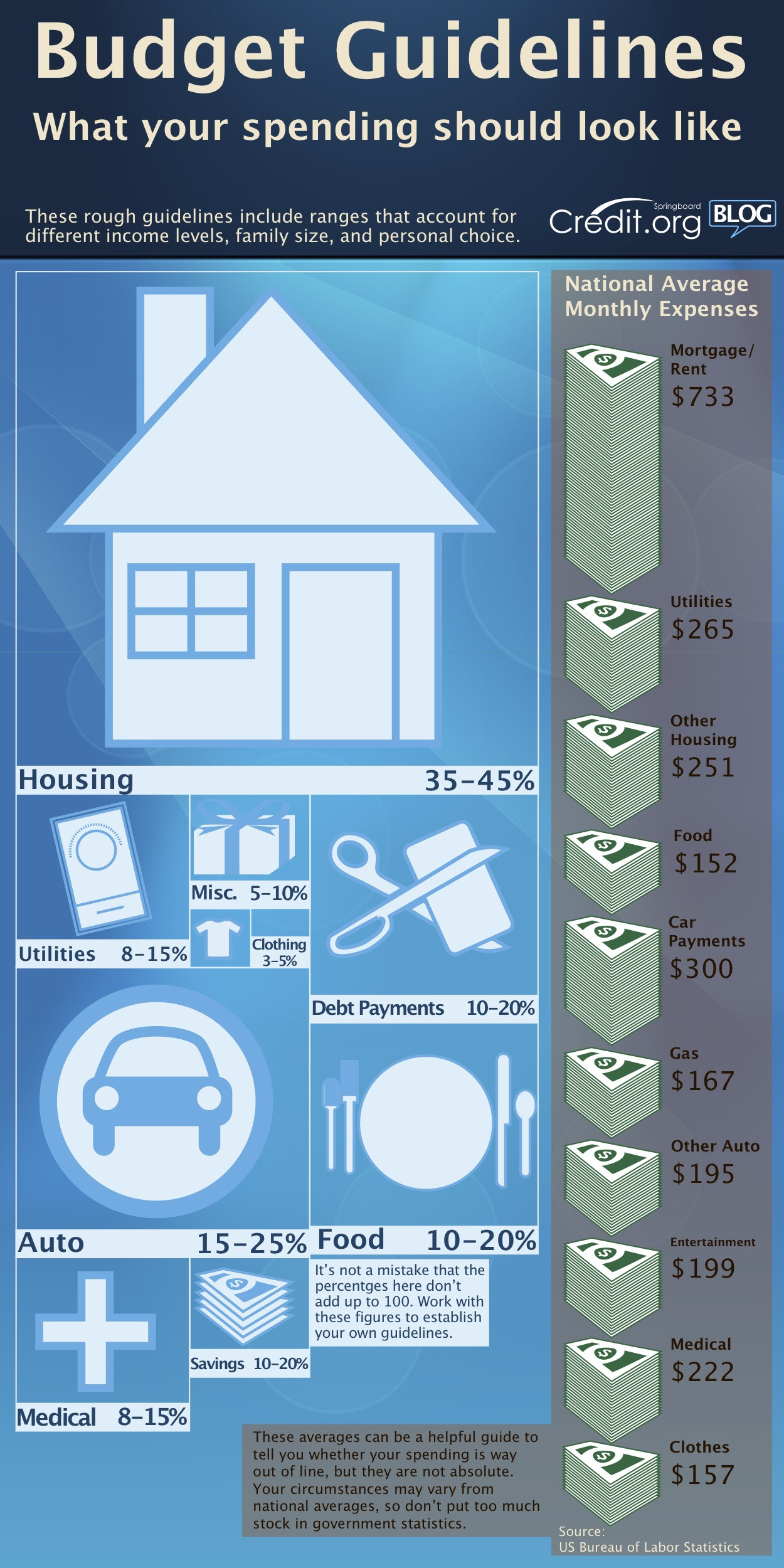
According to a new study released by the Department of Labor, the average U.S household earns $65,132 per year before taxes, and spends an average of $50,631 on annual expenditures (excluding taxes and savings). Of that spending, $20,093, or 39.7%, goes towards housing expenses.

Additionally, $11,211, another 22.1%, goes towards transportation and automobiles. Combined, those elements make up 61.8% of the average household’s spending!

By comparison, only $10,835, or 21.4%, of our spending goes toward food, apparel and services, and entertainment combined. If we are going to explore ways to reduce spending, shouldn’t we start with the elements that are costing us the most?

Example:

For instance, most financial professionals say only 28% of our gross income should be committed to housing costs. Of the average $65,132 gross income, 28% would mean reducing our housing spending from $20,093 to $18,236, saving us $1,857 per year.

Assuming a 250-day work year, this savings could allow us to spend nearly $7.50 per day on lunch, enjoying our friends, and taking a break from the office.

More dramatically, reducing our mortgage payment by $500 per month, saving us $6,000 per year, pays for a whole lot of dinner and movie date nights.

Similarly, assume we spend $4 per day enjoying our morning coffee at Starbucks with friends five times a week, for 50 weeks a year. Annually this would cost us $1,000. Now suppose we purchase a nice used automobile for $15,000 rather than a new car for $25,000. This saves us $10,000 or 10 years worth of coffee breaks with friends (plus interest!).

Prioritize

Of course, everyone has different priorities. I suggest spending your money on what you are passionate about. For the occasional car fanatic, perhaps spending more on a car that makes you happy each day is preferable to other spending options.

Likewise, if homes happen to be your hot spot, heavy spending in this area makes sense.

Different Doctors?

However, I’d suggest that for most people, the experience of constantly eating with friends or spending a night out with your spouse is more likely to bring happiness than the possession of an expensive home or car. After all, would you rather eat out with friends or clip coupons alone in a large kitchen?

But, are doctors any different?

Budgets

Assessment

Consequently, reducing large expenses like a home mortgage or car loan may be the most effective way to stay within your budget and maintain your level of happiness – especially for docs!

Conclusion

Your thoughts and comments on this ME-P are appreciated. Feel free to review our top-left column, and top-right sidebar materials, links, URLs and related websites, too. Then, subscribe to the ME-P. It is fast, free and secure.

Speaker: If you need a moderator or speaker for an upcoming event, Dr. David E. Marcinko; MBA – Publisher-in-Chief of the Medical Executive-Post – is available for seminar or speaking engagements. Contact: MarcinkoAdvisors@msn.com

OUR OTHER PRINT BOOKS AND RELATED INFORMATION SOURCES:

Product Details  Product Details

On Target Date Retirement Funds for Physicians

Join Our Mailing List 

What You Haven’t Considered

By Lon Jefferies MBA CFP® http://www.NewWorthAdvice.com

Lon JefferiesAn increasing number of physician investors are utilizing target-date funds in their investment accounts and employer retirement plans.

In theory, an individual should select a target-date fund that matches their estimated year of retirement, such as the Vanguard Target Retirement 2015, or Fidelity Freedom 2020 fund. The philosophy of these funds is that as one ages, the proportion of stocks in their portfolio should decline, while their exposure to less volatile fixed-income positions increases.

My Concerns

While I agree with the concept that investors should continually make their portfolios less aggressive as they age, there are two concerns I have about utilizing these funds.

First and most obviously, an appropriate asset allocation for an individual physician investor as they enter retirement is dependent on their risk tolerance and is best not left to generalizations. At retirement, an aggressive doctor may be comfortable holding a portfolio that is 70 percent stocks while a more conservative investor may not be able to tolerate the volatility that accompanies a portfolio that has any more than 40 percent exposure to equities.

Of course, assuming these two investors retired around the same time, a target-date fund would place both in a one-size-fits-all asset mix.

Next, and perhaps less obvious but equally important is the fact that an asset allocation is better designed around when the investor will need the money as opposed to when they will retire.

Case Examples:

Consider two hospital employees who are retiring in 2015, and consequently, are invested in the Fidelity Freedom 2015 target-date fund (which is quite conservative – only 45 percent stocks and a 55 percent mix of bonds and cash). One of these employees will be taking an early retirement at age 59 and won’t be allowed to draw a Social Security benefit for at least three years.

As a result, this individual will need to draw a large amount of funds from his retirement account in order to pay for the first several years of retirement. The worst thing that could happen to a retiree is to endure a market crash shortly after leaving the workforce and suffers an excessive loss right as the funds are needed.

In such a case, the physician investor wouldn’t have time to wait for the market to recover and would be forced to sell at a loss. If money will need to be withdrawn sooner rather than later, sound financial planning says it should be invested in a conservative portfolio that is likely to limit loss, potentially similar to the 45 percent stock and 55 percent bond mix that the Fidelity Freedom 2015 fund provides.

###

Financial

###

Another Case Example:

Now consider that the second hospital employee invested in the Fidelity Freedom 2015 fund is age 67, will immediately be receiving a full Social Security benefit when he retires, and has a healthy pension from his employer. With two significant sources of income immediately upon leaving the workforce, this employee may not need to withdraw meaningful assets from his investment portfolio during the early years of his retirement.

Now, with a longer investment time frame before funds will be withdrawn, a more assertive portfolio is likely appropriate for this investor as he can afford to endure a full market cycle of pullbacks and advances while attempting to achieve superior gains.

Assessment

Hopefully this example illustrates the importance of considering other potential income sources and the timing of your expenses during retirement rather than simply treating target-date funds as your entire asset base. While the theory of target-date funds is sound, other factors should be considered before utilizing them as a significant portion of your investment nest egg.

Conclusion

Your thoughts and comments on this ME-P are appreciated. Feel free to review our top-left column, and top-right sidebar materials, links, URLs and related websites, too. Then, subscribe to the ME-P. It is fast, free and secure.

Link: http://feeds.feedburner.com/HealthcareFinancialsthePostForcxos

Speaker: If you need a moderator or speaker for an upcoming event, Dr. David E. Marcinko; MBA – Publisher-in-Chief of the Medical Executive-Post – is available for seminar or speaking engagements. Contact: MarcinkoAdvisors@msn.com

OUR OTHER PRINT BOOKS AND RELATED INFORMATION SOURCES:

Health Dictionary Series: http://www.springerpub.com/Search/marcinko

Practice Management: http://www.springerpub.com/product/9780826105752

Physician Financial Planning: http://www.jbpub.com/catalog/0763745790

Medical Risk Management: http://www.jbpub.com/catalog/9780763733421

Hospitals: http://www.crcpress.com/product/isbn/9781439879900

Physician Advisors: www.CertifiedMedicalPlanner.org

Product Details  Product Details

Is a Stock Market Correction Imminent?

Join Our Mailing List

Destined for a significant pullback; or not!

By Lon Jefferies MBA CFP® http://www.NewWorthAdvice.com

Lon JefferiesThe market has allowed itself a well-deserved “cool down” period during the month of August. The S&P 500 was down 3.13% while the Dow Jones Industrial Average was down 4.45% for the month.

After Running of the Bulls

After the roaring bull market we’ve enjoyed since April 2009, it is natural for investors to question whether this is a turning point and the market is destined for a significant pullback.

Currently, it is valuable to remind ourselves that even through the woes of August, the S&P 500 is only down 4.5% from its recent all-time high.

Wall Street Writes

Additionally, it is useful to define some terms, as Josh Brown, one of my favorite Wall Street writers, recently did:

Percentage    Drop: Defined    As: Feels    Like:
less than   5% Pause “whatever”
5% to 10% Dip Refreshing
10%+ Correction Nerve-wracking
20%+ Bear Market Panic
50%+ Crash Can’t Get   Out of Bed

The Market Pause

You may have heard the word correction in the financial media lately. With a market pause still under 5%, it’s probably a bit early to start talking about a correction. Still, let’s assume we are headed for an actual correction, or a loss of 10% to 20%.

Expectations

What should we expect? Here are some interesting numbers that Mr. Brown accumulated:

  • Since the end of World War II (1945), there have been 27 corrections of 10% or more. Only 12 of these corrections evolved into bear markets (a loss of 20%+). The average decline during these 27 episodes has been 13.3% and they’ve taken an average of 71 trading days to play out.
  • On average, the market has endured a correction every 20 months. Of course, the corrections aren’t evenly spaced out — 25% of the corrections occurred during the 1970′s, and another 20% occurred during the secular bear market of 2000-2010. However, from 1982 through 2000, there was just four corrections of 10% or more. This is relevant as it illustrates that bull markets can run for a long time without a lot of drama.
  • Since the stock market’s bottom in March of 2009, there have been two corrections. In the spring of 2010 the S&P 500 lost 16% over 69 trading days. In the summer of 2011, the S&P 500 dropped a hair over 20% before snapping back. Technically, this qualified as a bear market, which would mean the current rally is only two years old as opposed to almost five years old if dated from March of 2009.
  • The market pulled back 9.9% during 60 days in the summer of 2012. While not quite a correction, this dip set up one of the greatest rallies of all time.
  • There have been 58 bull market rallies (defined as market advances of 20% or more) in the post-war period, and they have run for an average of 221 trading days and resulted in an average gain of 32%. Comparatively, when measured by both length and magnitude, the current bull market is overdue for a correction and has been for awhile.

###

Stock_Market

###

Financial Action Plan

So what should you do assuming we are heading for a correction?

First, it is critical to remind yourself that if you are following sound financial planning principals, you already have an investment portfolio that matches your risk tolerance and investment time horizon.

Remember that just because the market loses 10% doesn’t mean your portfolio will lose 10%. In fact, if you scaled back the assertiveness of your portfolio as you transitioned into retirement and your portfolio is only 60% stocks, your portfolio would likely only be down approximately 6%.

Second, in the instance of an investor with a portfolio that is 60% equities, recall that you selected such a portfolio because you deemed a 6% loss to be acceptable. In fact, if due diligence was completed when you selected an asset allocation, you were aware that the largest loss a 60% stock, 40% bond portfolio suffered during the last 44 years was -19.35% (2008).

Additionally, you were aware that such a loss could (and likely would) happen again and you determined that was acceptable.

Grinding Teeth

Thus, for medical professionals and other investors who have done their planning, the best thing to do in the event of a market correction is grit your teeth and do very little!

For those doctors who haven’t planned in advance, now would be an ideal time to do your homework and create a portfolio that matches your situation and behavior patterns.

Assessment

Once you’ve done your planning, all you need to do is remember what Josh Brown calls the ABCs of investing: Always Be Cool.

Conclusion

Your thoughts and comments on this ME-P are appreciated. Feel free to review our top-left column, and top-right sidebar materials, links, URLs and related websites, too. Then, subscribe to the ME-P. It is fast, free and secure.

Link: http://feeds.feedburner.com/HealthcareFinancialsthePostForcxos

Speaker: If you need a moderator or speaker for an upcoming event, Dr. David E. Marcinko; MBA – Publisher-in-Chief of the Medical Executive-Post – is available for seminar or speaking engagements. Contact: MarcinkoAdvisors@msn.com

OUR OTHER PRINT BOOKS AND RELATED INFORMATION SOURCES:

DICTIONARIES: http://www.springerpub.com/Search/marcinko
PHYSICIANS: www.MedicalBusinessAdvisors.com
PRACTICES: www.BusinessofMedicalPractice.com
HOSPITALS: http://www.crcpress.com/product/isbn/9781466558731
CLINICS: http://www.crcpress.com/product/isbn/9781439879900
BLOG: www.MedicalExecutivePost.com
FINANCE: Financial Planning for Physicians and Advisors
INSURANCE: Risk Management and Insurance Strategies for Physicians and Advisors

Product DetailsProduct DetailsProduct Details

Product Details  Product Details

Got Cash Money in the Bank?

Join Our Mailing List

Is it Really a Long-Term Investment?

By Rick Kahler CFP® http://www.KahlerFinancial.com

Rick Kahler CFPGot money in the bank? Of course, that’s a good thing.

But, more than a fourth of Americans think the best long-term investment strategy is money in the bank. However, that may be a bad thing!

So, what about medical professionals; and what is a doctor to do?

The Bankrate Survey

Here is the rather discouraging result of a July survey by Bankrate. One of its questions was, “For money you wouldn’t need for more than 10 years, which one of the following do you think would be the best way to invest the money?”

Cash was the top choice at 26%, followed by real estate at 23%. Sixteen percent of the respondents chose precious metals such as gold. Only 14% would put their long-term investment into the stock market, and just 8% thought bonds were the best choice.

Head-on-Desk Syndrome

Doh! That thumping sound you hear is me banging my head on my desk.

I assume those who opted for cash did so because keeping money in the bank seemed to be the safest choice. For long-term investing, however, that safety is an illusion. The best and safest place to put your nest egg for the future is not in the bank, but in a well-diversified portfolio with a variety of asset classes.

Here’s why:

Savings accounts and CDs are safe places to store relatively small amounts of cash that you expect to need within the next few months or years. The funds are protected by insurance. You know exactly where your money is, and you can get your hands on it anytime you want.

Short Term Stability

This short-term safety does not make the bank a good place for money you will need for retirement or other needs ten years or so into the future. It may seem like safe investing because the amount in your account never goes down. You’re always earning interest. Yet, over time, that interest isn’t enough to keep pace with inflation. The purchasing power of your money decreases, which means you’re actually losing money. It just doesn’t feel like a loss because you don’t see the loss in value.

Stock Markets Fluctuate

In contrast, the stock market fluctuates. The media reports constantly that “the DOW is up” or “NASDAQ is down,” as if those day-to-day numbers matter. This fosters a perception that investing in the stock market is risky. Combine that with the scarcity of education about finances and economics, and it’s no wonder that so many people are afraid of the stock market and view investing almost as a form of gambling.

Wise long-term investing in the stock market is anything but gambling. Instead of trying to buy and sell a few stocks as their prices go up and down, wise investors neutralize the impact of market fluctuations by owning a vast assortment of assets.

A Dual Strategy

This is accomplished with a two-part strategy.

1. The first is to invest in mutual funds rather than individual stocks. With just one mutual fund that invests in an index of stocks, you might own thousands of different companies. Your hard-earned fortune isn’t dependent on the fortunes of just a few companies.

2. The second component is asset class diversification. An asset class is a type of investment, such as U. S. and International stocks, U. S. and International bonds, real estate investment trusts, commodities, market neutral funds, Treasury Inflation-Protected Securities, and junk bonds. Ideally, a diversified portfolio should include nine or more asset classes.

###

MD Retirement planning

###

Assessment

By holding small amounts of a great many different companies and asset classes, you spread your risk so broadly that the inevitable fluctuations are small ripples rather than steep gains or losses. As some types of investments decline in value, other types will be gaining value. Over the long term, the entire portfolio grows.

And, in the long term and for most medical professionals, investing this way is usually safer than money in the bank.

Conclusion

Your thoughts and comments on this ME-P are appreciated. Feel free to review our top-left column, and top-right sidebar materials, links, URLs and related websites, too. Then, subscribe to the ME-P. It is fast, free and secure.

Link: http://feeds.feedburner.com/HealthcareFinancialsthePostForcxos

Speaker: If you need a moderator or speaker for an upcoming event, Dr. David E. Marcinko; MBA – Publisher-in-Chief of the Medical Executive-Post – is available for seminar or speaking engagements. Contact: MarcinkoAdvisors@msn.com

OUR OTHER PRINT BOOKS AND RELATED INFORMATION SOURCES:

DICTIONARIES: http://www.springerpub.com/Search/marcinko
PHYSICIANS: www.MedicalBusinessAdvisors.com
PRACTICES: www.BusinessofMedicalPractice.com
HOSPITALS: http://www.crcpress.com/product/isbn/9781466558731
CLINICS: http://www.crcpress.com/product/isbn/9781439879900
ADVISORS: www.CertifiedMedicalPlanner.org
PODIATRISTS: www.PodiatryPrep.com
BLOG: www.MedicalExecutivePost.com
FINANCE: Financial Planning for Physicians and Advisors
INSURANCE: Risk Management and Insurance Strategies for Physicians and Advisors

Product Details  Product Details

How Medical and Financial Professionals can Teach their Children Fiscal Discipline

Join Our Mailing List

Exercising Pediatric Fiscal Discipline

By Andrew D. Schwartz CPA

Andrew SchwartzI’m a CPA and my wife is a CFP (Certified Financial Planner). Many ME-P readers are the same; or are doctors or nurses; or MBAs, PhD, CFAs; or other learned professionals, etc.

Even so, I think together we’ve done a lousy job teaching our two kids – Jonathan (age 15) and Lizzie (age 14) – much about personal finances. We have also done little to help them learn anything about exercising fiscal discipline.

Over the years, we’ve toyed with monthly allowances and paying our kids for doing their household chores. The problem is that we have never been consistent with doling out the promised $20 per month or with enforcing the rules they need to follow to even be eligible to receive their allowance.

Our Allowance System

So my family’s allowance system has evolved to something like this:

Child: “Dad and/or Mom, I’m getting together with friends. Can I have some money?”

Parent: “Sure thing, Jonathan and/or Lizzie. Will $20 be sufficient?”

Well, as my kids continue to grow up, we have reached the point where this conversation happens pretty regularly. Our kids have no incentive not to ask us for money, since we have a track record of giving them money whenever they ask. And they also don’t have an incentive to try to earn any money on their own, since we have gladly been supporting 100% of their spending.

Change is Coming

That’s all about to change. Financial responsibility for the Schwartz Clan, here we come. As a parent of a teenager, you might be asking, “How will you pull this off Andrew?”

For Christmas/Chanukah last winter, we gave each child a Pass Card issued by American Express.  These cards are only available to kids 13 or older.

Enter AMEX

According to American Express, “Pass is a prepaid reloadable Card parents give to teens. It’s safer than cash, and unlike a debit or credit card, teens can only spend what’s preloaded on the Card.” For my two kids, we loaded each card with $100, and then will reload the card on the tenth of each month with their $25 allowance.

Pass cardholders can spend money on the prepaid card pretty much anywhere that takes credit cards. And while parents do have the right to deny their kids access to cash from ATMs, we decided to set up the cards to allow ATM withdrawals. We can change this setting at any time, however. The first ATM transaction each month is free for each kid, and then there is a charge of $2 per withdrawal.

The Thought Process

In theory, when either kid spends all the money on the card, they are out of money until they next receive the $25 on the tenth of the month. Here is where my wife and I will need to exercise some parental discipline and not just dole out more spending money.

Instead, we need to try to use this opportunity to remind Jonathan or Lizzie that if they want to spend more than $25 per month, they can always babysit, shovel snow or rake leaves for our neighbors, work at my office during tax season, or try to find another job that hires 14 and 15 year-old kids to earn extra money.

Referral

Other Advantages

For parents, the Pass Card has a nifty web interface that allows parents the opportunity to view balance and purchase history online at any time, transfer additional funds into the card, or tweak the amount or frequency of the automatic reloads. Teens will also be able to logon to the Pass website under a separate login to monitor balances and activity.

According to the site, the Pass Card also provides your child some additional benefits similar to the benefits that come with the AMEX card, including:

  • Purchase Protection if an item purchased with the Pass Card breaks within 90 days
  • Roadside Assistance if your child’s car won’t start
  • Global Assist Services to provide your child with emergency services while traveling

Assessment

I hope the Pass Card works out well for my family and helps my wife and I teach my kids a little about personal finances and fiscal discipline.

Conclusion

Your thoughts and comments on this ME-P are appreciated. Feel free to review our top-left column, and top-right sidebar materials, links, URLs and related websites, too. Then, subscribe to the ME-P. It is fast, free and secure.

Speaker: If you need a moderator or speaker for an upcoming event, Dr. David E. Marcinko; MBA – Publisher-in-Chief of the Medical Executive-Post – is available for seminar or speaking engagements. Contact: MarcinkoAdvisors@msn.com

OUR OTHER PRINT BOOKS AND RELATED INFORMATION SOURCES:

Product DetailsProduct DetailsProduct Details

Product Details  Product Details

Product DetailsProduct Details

Should You Comparison Shop for an Investment Advisor?

Join Our Mailing List

 Consumer’s Repot Not Available

By Rick Kahler CFP® www.KahlerFinancial.com

Rick Kahler CFPYou can spot comparison shoppers a few aisles away at any retail store. They are the ones carrying articles from Consumer Reports, badgering the salesperson with a million and one questions. People who manage money well are usually big fans of comparison shopping.

If comparison shopping is important before choosing a new refrigerator or lawn mower, it’s even more essential before choosing an investment advisor. Unfortunately, there is no easily available consumer’s report on advisors. Even more frustrating, those selling financial products often have incentives not to be forthcoming with the information that is crucial for comparing advisors.

A Focus on Investment Returns

One aspect of shopping for an investment advisor is to know what questions to ask. One common mistake is to focus on investment returns. Shoppers may ask for the average recent returns of the advisor’s portfolios or may want to know whether the advisor’s returns beat the market averages.

Problems:

There are several problems with focusing on returns.

First, the numbers mean nothing without also knowing how much risk the advisor took to produce the return. It’s like someone on a diet focusing only on fat grams without regard to total calories. Consuming ten soft drinks in a day may give you zero fat grams, but you could easily exceed your daily calorie limit before eating one bit of food.

Second, any unscrupulous advisor can put together a portfolio consisting of the hottest investment classes over the past 10 years and show you how fantastically they did.

Third, whether an advisor beats the market is overrated. Why? A whopping 97 percent of all mutual fund managers don’t generate an “average return” over 20 years. Just finding an advisor who has done so means you found someone in the top three percent.

Fourth, some financial advisors may show you a phenomenal track record for the short term (under 10 years). Since wise investing focuses on the long term, beating the averages over a short term isn’t necessarily significant.

Gamesmanship

If so many games can be played around returns, what questions should a savvy comparison shopper ask? Focus on one word: transparency. You want to find out if the returns, costs, and risk (standard deviation) of your portfolio will be clearly displayed and contrasted against appropriate benchmarks.

Transparency

Here is how to accomplish that goal. Most advisors have model portfolios. Ask them to show you the standard deviation and the expense ratio of their model over five and ten years. Ask them to contrast the return of the portfolio against a similar benchmark.

For example, if the portfolio has US stocks, US bonds, and foreign stocks, have them compare it to a benchmark of indexes proportionate to those asset classes.

Next, either ask the advisor to run a similar analysis on your existing portfolio or have one done independently. You may even have done better than the advisor’s model.

Ask the advisor to disclose all fees in addition to the expense ratios charged by mutual fund or sub-account managers. You need to find out how the advisor is paid and how much. Ask whether there are any wrap fees, transaction costs, administrative fees, mortality fees, redemption fees, annual 12b(1) fees, surrender charges, or up-front sales charges.

Referral

Assessment

Don’t be surprised if you get a bit of resistance when you ask for all this information. Brokerage firms, life insurance companies, and many commission-based advisors don’t have much incentive to give you this data and may not even be able to.

If you don’t get clear disclosure on fees and costs, keep asking. If you persist and still don’t get understandable answers, you may need to do more comparison shopping before you choose an advisor.

Conclusion

Your thoughts and comments on this ME-P are appreciated. Feel free to review our top-left column, and top-right sidebar materials, links, URLs and related websites, too. Then, subscribe to the ME-P. It is fast, free and secure.

Link: http://feeds.feedburner.com/HealthcareFinancialsthePostForcxos

Speaker: If you need a moderator or speaker for an upcoming event, Dr. David E. Marcinko; MBA – Publisher-in-Chief of the Medical Executive-Post – is available for seminar or speaking engagements. Contact: MarcinkoAdvisors@msn.com

OUR OTHER PRINT BOOKS AND RELATED INFORMATION SOURCES:

DICTIONARIES: http://www.springerpub.com/Search/marcinko
PHYSICIANS: www.MedicalBusinessAdvisors.com
PRACTICES: www.BusinessofMedicalPractice.com
HOSPITALS: http://www.crcpress.com/product/isbn/9781466558731
CLINICS: http://www.crcpress.com/product/isbn/9781439879900
BLOG: www.MedicalExecutivePost.com
FINANCE: Financial Planning for Physicians and Advisors
INSURANCE: Risk Management and Insurance Strategies for Physicians and Advisors

Product Details  Product Details

Are Doctors Spenders or Savers?

Join Our Mailing List 

Or … Just Delusional like the Rest of Us!

By Rick Kahler CFP® http://www.KahlerFinancial.com

Rick Kahler CFPAccording to Scarborough, a market research firm, only 9% of adults in the U.S. label themselves as spenders. This is the percentage that “mostly agrees” with the statement, “I am a spender rather than a saver.” On the opposite side, 29% “mostly disagree” with the statement and are considered savers. Presumably, the 62% in between consider themselves to have well-balanced financial habits that include both spending and saving.

Given these numbers, it would seem that most of the adults in this country ought to have healthy savings accounts. Unfortunately, that’s not the case.

Employee Benefit Research Institute

According to a report released in March 2013 by the Employee Benefit Research Institute, 57% of U.S. workers have less than $25,000 in total household investments and savings, not including the value of their homes. The Social Security Administration’s current figures show 34% of American workers have no savings set aside specifically for retirement.

Something doesn’t quite add up. Either a lot of Americans aren’t willing to admit that they are spenders, a lot of Americans are so poor that they can’t afford to save, or a lot of Americans are delusional.

Habits of Savors

Or maybe a lot of us just have different definitions of “saving.” Here are a few money habits that might encourage people to think of themselves as savers, but that don’t necessarily add up to being successful savers:

1. Buying things on sale. Waiting for discounts on items you need and want is a wise and standard practice for frugal shoppers. But you aren’t a saver if you buy bargains that you don’t need, might not even really want, or can’t afford. Maybe that $150 pair of shoes is half price. Yet if they will just sit in your closet, you haven’t saved $75. You’ve spent $75.

2. Having money in the bank. Yes, putting money into a savings account is the first place to start saving and a great habit to teach your kids. But once you have accumulated an emergency fund, keeping your money in the bank isn’t a good savings habit. Over time, savings accounts and CD’s don’t pay enough to keep pace with inflation. Money in the bank may be safe, but it isn’t really an investment because it isn’t growing. Mutual funds that include a well-diversified range of investments are far better places for your long-term retirement savings.

3. Not spending anything. There are times when choosing not to spend money now will only cost you more money later. Failing to maintain your car or do home repairs are two common non-spending habits that may seem like saving but actually turn into spending.

4. Saving for someone else. The time-tested advice to “pay yourself first” usually means taking money off the top for savings before you spend anything. Yet this has another application, as well. Make saving and investing for your own retirement your first priority. It needs to come ahead of saving for your kids’ college educations, weddings, or first homes. This may seem selfish or greedy, but in fact it’s the opposite. When you provide for your own financial well-being in retirement, your kids won’t end up having to help pay your bills.

###

spendthrift

Assessment

When we’re asked to label ourselves, it’s normal to tend to choose answers that fit the way we would like to think of ourselves. I’m sure most of us would prefer to think of ourselves as savers rather than spenders.

But, if we really want to become successful savers, we can’t settle for the money habits we wish we had. We need to look at the money habits we actually practice.

Psychologists and psychiatrists, please comment. Are doctors the same as the rest of us, or not?

Conclusion

Your thoughts and comments on this ME-P are appreciated. Feel free to review our top-left column, and top-right sidebar materials, links, URLs and related websites, too. Then, subscribe to the ME-P. It is fast, free and secure.

Link: http://feeds.feedburner.com/HealthcareFinancialsthePostForcxos

Speaker: If you need a moderator or speaker for an upcoming event, Dr. David E. Marcinko; MBA – Publisher-in-Chief of the Medical Executive-Post – is available for seminar or speaking engagements. Contact: MarcinkoAdvisors@msn.com

OUR OTHER PRINT BOOKS AND RELATED INFORMATION SOURCES:

Health Dictionary Series: http://www.springerpub.com/Search/marcinko

Practice Management: http://www.springerpub.com/product/9780826105752

Physician Financial Planning: http://www.jbpub.com/catalog/0763745790

Medical Risk Management: http://www.jbpub.com/catalog/9780763733421

Hospitals: http://www.crcpress.com/product/isbn/9781439879900

Physician Advisors: www.CertifiedMedicalPlanner.org

Product Details  Product Details

Recommended Readings for Financial Advisors from the No. 1 NBER Bulletin on Aging and Health for 2013

Join Our Mailing List

By Staff Reporters

The 2013 No. 1 Bulletin includes the articles below:

1)  Do Retirement Savings Policies Increase Total Retirement Saving?
by Raj Chetty, John Friedman, Soren Leth-Petersen, Torben Nielsen, and Tore Olsen

http://www.nber.org/bah/2013no1/w18565.html

2)  Behavioral Hazard in Health Insurance
by Katherine Baicker, Sendhil Mullainathan, and Joshua Schwartzstein

http://www.nber.org/bah/2013no1/w18468.html

3)  The Revenue Demands of Public Employee Pension Promises
by Robert Novy-Marx and Joshua Rauh

http://www.nber.org/bah/2013no1/w18489.html

4)  What Makes Annuitization More Appealing?
by John Beshears, James Choi, David Laibson, Brigitte Madrian, and Stephen Zeldes

http://www.nber.org/bah/2013no1/w18869.html

5)  The Prevalence and Economic Consequences of Disability
by Bruce Meyer and Wallace Mok

http://www.nber.org/bah/2013no1/w18575.html

Source: View a printable PDF copy of the at: http://www.nber.org/aginghealth/2013no1/2013no1.pdf

Conclusion

Your thoughts and comments on this ME-P are appreciated. Feel free to review our top-left column, and top-right sidebar materials, links, URLs and related websites, too. Then, subscribe to the ME-P. It is fast, free and secure.

Link: http://feeds.feedburner.com/HealthcareFinancialsthePostForcxos

Speaker: If you need a moderator or speaker for an upcoming event, Dr. David E. Marcinko; MBA – Publisher-in-Chief of the Medical Executive-Post – is available for seminar or speaking engagements. Contact: MarcinkoAdvisors@msn.com

OUR OTHER PRINT BOOKS AND RELATED INFORMATION SOURCES:

Health Dictionary Series: http://www.springerpub.com/Search/marcinko

Practice Management: http://www.springerpub.com/product/9780826105752

Physician Financial Planning: http://www.jbpub.com/catalog/0763745790

Medical Risk Management: http://www.jbpub.com/catalog/9780763733421

Hospitals: http://www.crcpress.com/product/isbn/9781439879900

Physician Advisors: www.CertifiedMedicalPlanner.org

Product DetailsProduct DetailsProduct Details

Product Details  Product Details

The Doctor’s Path to Wealth?

And … for us all

By Rick Kahler CFP® http://www.KahlerFinancial.com

Rick Kahler CFPAfter three decades as a financial planner, working with successful wealth-builders, you’d think I would have a clear idea of the right path for creating wealth.

Instead, what I’ve learned is that there is no such thing. Here are just a few of the paths that aren’t the sure routes to wealth they might seem to be:

Several Paths

1. Education and career choices. Going into a field like law or medicine might seem to guarantee financial success. Not necessarily. I’ve seen many physicians, for example, who have accumulated significant wealth. I’ve seen just as many who live paycheck to paycheck.

2. High earnings. Again, this isn’t the reliable predictor of wealth it would seem to be. True, someone who spends decades in low-wage jobs is unlikely to be able to accumulate much financial security. But a person earning $1 million a year will not necessarily have a larger net worth than someone earning $75,000. I’ve seen people who worked as janitors, nurses, and mechanics become millionaires. I’ve worked with others, earning a hundred times more in careers like sales or entertainment, who reach retirement age with absolutely nothing.

3. Owning your own business. Many hard-working, creative entrepreneurs build successful businesses that provide wealth, not just for themselves, but for their children and grandchildren. Others might see a business or even a series of businesses fail. Still others might work hard all their lives but never achieve more than the equivalent of an average salary in their field.

4. Investment choices. Some people have had great success investing in various types of real estate, businesses, and commodities. Others have lost everything they ever owned investing in those same vehicles.

Some Commonalities

So, sorry, I can’t give you a simple list of the top ways to build wealth. There’s little commonality in how my successful clients have made their money. What I can suggest are a few ways to help you find your own path to accumulating wealth.

1. Define “wealth” in your own way. Maybe you’re willing to live frugally in order to accumulate enough money to feel secure that your needs will be met even if you live to be 100. Maybe wealth to you is living a lavish lifestyle and being willing to work hard to pay for it. You might see wealth as the satisfaction and responsibility of having your own business. Maybe it means being able to give generously. Or perhaps you define wealth as the freedom of owning little and traveling around the world on a bicycle.

2. Know what you are willing to sacrifice—and what you are not—in order to accumulate wealth. There’s nothing wrong with earning a high salary doing work you hate for a time, as part of an overall strategy to get you to doing something you love. But doing so for a lifetime is hardly the road to either happiness or wealth.

3. Think long term. The most reliable way to build lifetime wealth, with the lowest risk, is through a long-term commitment to diversified investing. Yet even those who are successful on riskier paths to wealth take the long view. Business owners may fail more than once before they succeed. And those who have made fortunes in high-risk investments have also lost fortunes. They understand that success is about taking calculated risks.

4. Learn to make conscious financial decisions. I’ve seen many intelligent, capable people stuck in financial chaos and poverty because of emotional pain and dysfunction. Emotional health may not be essential for building financial wealth. It is, however, essential if you want to use that wealth to support a rich and satisfying life.

###

Stock Market

More:

Conclusion

Your thoughts and comments on this ME-P are appreciated. Feel free to review our top-left column, and top-right sidebar materials, links, URLs and related websites, too. Then, subscribe to the ME-P. It is fast, free and secure.

Speaker: If you need a moderator or speaker for an upcoming event, Dr. David E. Marcinko; MBA – Publisher-in-Chief of the Medical Executive-Post – is available for seminar or speaking engagements. Contact: MarcinkoAdvisors@msn.com

OUR OTHER PRINT BOOKS AND RELATED INFORMATION SOURCES:

***

  Risk Management, Liability Insurance, and Asset Protection Strategies for Doctors and Advisors: Best Practices from Leading Consultants and Certified Medical Planners™8Comprehensive Financial Planning Strategies for Doctors and Advisors: Best Practices from Leading Consultants and Certified Medical Planners™

***

Invite Dr. Marcinko

***

Twelve Steps of Financial Independence for Doctors

Join Our Mailing List

A Basic Guide

By Lon Jefferies  MBA CFP® CMP®

Lon JeffriesWant to get your finances in order? Consider this comprehensive 12-step guide to address each element of your personal financial situation. In most cases, you should not address a step until all previous steps are satisfied.

1. 401(k) 403(b) Match: Without exception, if your employer matches 401(k) contributions, you should maximize whatever they’re offering. If it’s a dollar-for-dollar match, that’s an instant 100 percent return! Even the 50 percent return of a two-for-one match is irresistible.

2. Consumer Debt: Pay off your credit cards and all other unsecured loans, prioritizing the debts with the highest interest rates. Credit cards frequently charge rates as high as 30 percent. Paying off a card with 30 percent APR is comparable to getting a 30 percent investment return. Not completing this step will hamper your entire financial plan.

3. Cash Flow: You can’t develop wealth if you spend more than you make. Construct and follow a written budget to ensure you are living within your means. Your budget should include saving at least 10 percent of your gross income for retirement. Constantly compare actual spending with your budget and hold yourself accountable! Mint.com is an excellent free tool for this step.

4. Emergency Reserve: Develop a liquid savings account consisting of enough money to cover three to six months of expenses. These funds should only be utilized in crisis such as a job loss or medical emergency.

5. Life Insurance: If you have dependent children, you likely need life insurance. Cost-efficient coverage can frequently be obtained via your employer. To calculate the amount of coverage to purchase, first determine how much money your survivors would need to maintain a comfortable lifestyle, and then subtract any income they will generate as well as any savings you’ve accumulated. Alternatively, if you don’t have children in your household and your spouse is self-sufficient, you may not need life insurance coverage.

6. Disability Insurance: Getting hurt can completely derail your financial planning. A loss of income halts your savings and likely leads to increased debt. Obtain enough disability coverage to bridge the gap between earnings and expenses in the event of an injury. Coverage can frequently be purchased through your employer.

7. Estate Planning: Obtain a power of attorney, medical directive and living will. These documents allow you to designate the person you would like to make decisions for you if you become incapacitated. They also specify your preferences regarding life-prolonging medical treatments. Ensure both primary and contingent beneficiaries are assigned to your retirement accounts. Finally, develop a will or trust to ensure all other assets are distributed as you desire when you die.

8. Retirement Contributions: With risk exposures covered, it’s time to return to retirement planning efforts. Again, a 401(k) is an attractive retirement vehicle because it frequently offers an employer match and allows large annual contributions ($18,500 or $25,000 for individuals over age 50). If your employer doesn’t offer a 401(k), you can still contribute up to $6,500 (or $7,000 if over age 50) to an IRA. IRA contributions can be made on behalf of both spouses, even if only one is employed.

9. Traditional or Roth: The type of account that is best for you depends on when you want to pay taxes. A traditional retirement account allows an immediate tax deduction, the investments grow tax deferred, and the money isn’t taxed until the funds are withdrawn from the account. Alternatively, taxes are paid on Roth contributions immediately, but both contributions and growth are completely tax free when withdrawn during retirement. Put simply: will you be in a higher tax bracket now or when you withdraw the funds?

10. Asset Allocation: The most important investment decision you can make is how much of your portfolio will be invested in stocks versus bonds. A higher proportion of stocks leads to increased risk, but the potential for greater returns. The more time you have until the funds are needed, the more risk you can usually afford to take. Consequently, you should reduce the proportion of stocks in your portfolio as you approach retirement in order to minimize your risk factor. Identify an asset allocation that is aggressive enough to accomplish your investment goals while exposing you to an acceptable level of risk.

11. Get Caught Up: According to a recent Fidelity study, your nest egg should be one times your salary by age 35, three times your salary by 45, five times your salary by 55 and seven times your salary by 67.

12. Education Planning: Only after your retirement savings is where it should be can you focus on your children’s college education. At this point, explore a Utah Educational Savings Plan 529 (uesp.org) or a Coverdell Education Savings Account, both of which offer tax advantages if used for schooling.

Assessment

Does this mean you don’t need a financial advisor? Of course not! A qualified, comprehensive financial planner can add value, address shortcomings, and answer questions in each of these areas. Once you have completed each of these steps, you can be confident you have your financial ducks in a row.

###

healthcare-business

Conclusion

Your thoughts and comments on this ME-P are appreciated. Feel free to review our top-left column, and top-right sidebar materials, links, URLs and related websites, too. Then, subscribe to the ME-P. It is fast, free and secure.

Link: http://feeds.feedburner.com/HealthcareFinancialsthePostForcxos

Speaker: If you need a moderator or speaker for an upcoming event, Dr. David E. Marcinko; MBA – Publisher-in-Chief of the Medical Executive-Post – is available for seminar or speaking engagements. Contact: MarcinkoAdvisors@msn.com

Product DetailsProduct DetailsProduct Details

Product Details  Product Details

Risk Management, Liability Insurance, and Asset Protection Strategies for Doctors and Advisors: Best Practices from Leading Consultants and Certified Medical Planners™8Comprehensive Financial Planning Strategies for Doctors and Advisors: Best Practices from Leading Consultants and Certified Medical Planners™

Some Vital Survival Tools for Physicians and their Consulting Advisors

OUR BOOKS, TEXTS AND DICTIONARIES ARE VITAL SURVIVAL TOOLS FOR ALL PHYSICIANS … AND THEIR CONSULTING ADVISORS 

###

Product DetailsProduct DetailsProduct Details

Product Details  Product Details

Product DetailsProduct Details

Speaker: If you need a moderator or speaker for an upcoming event, Dr. David E. Marcinko; MBA – Publisher-in-Chief of the Medical Executive-Post – is available for seminar or speaking engagements. Contact: MarcinkoAdvisors@msn.com

      Join Our Mailing List

Physician-Investors and the “F” Word

Join Our Mailing List

“Fiduciary”

By Rick Kahler MS CFP® ChFC CCIM http://www.KahlerFinancial.com

Rick Kahler CFPOkay, I did it again in a recent column. And, I got into trouble again. That’s what I get for using the F-word.

Mea Culpa

My most recent transgression was to point out the simple fact that insurance agents are compensated by commissions on the products they sell. They have no fiduciary duty to legally act in the best interests of their customers.

Every time I remind readers that sellers of financial products do not have a fiduciary duty to their customers, I get indignant responses from financial salespeople who seem to think I have accused them of being unethical.

Ethics

Not so. Someone who sells financial products may well operate with integrity. In fact, their licenses typically require that they be “fair” and “honest.” These salespeople may care about their customers and be committed to selling only products that they believe will meet their customers’ needs.

But being a fair, honest, and ethical salesperson is not the same thing as having a legal fiduciary duty to the consumer. The word “fiduciary” has a specific meaning in our legal system. It describes those in positions of trust or authority who are required by law to act in the best interests of those they represent. A fiduciary is an advocate for the consumer, who is legally termed a “client.”

Of Doctors and Attorneys

Doctors and attorneys have fiduciary relationships with their patients and clients. The executor of an estate is a fiduciary. So is a trustee, someone acting under a power of attorney, or an agent hired to represent you. Real estate agents can be fiduciaries if they are engaged to represent either buyers or sellers.

Financial planners can also be fiduciaries. Yet those who offer financial advice and services in conjunction with the sale of a financial product are not fiduciaries.

Fiuduciary

Follow the Money

How can you generally tell whether a financial professional is required by law to act in your best interests? Simple. You follow the money. Wherever the professional’s compensation comes from is most likely where the fiduciary responsibility goes.

If you hire a fee-only financial planner, you are directly paying that person for professional advice and services. The planner receives his or her income from you and others like you. You are clients, not customers, and the planner is legally obligated to act on your behalf.

This is not the case if you buy financial investment products or receive financial advice from someone who is compensated by commissions. It doesn’t matter whether this person’s business card says “financial consultant,” “financial planner,” “investment advisor,” or “broker.” Anyone can use those terms.

Commission Sales

But, if someone is paid by commissions from financial companies, he or she is a sales representative whose fiduciary responsibility is to those companies. They may call you their “client,” but in the legal sense, you are not. You are a customer who buys products from a salesperson. Just like those who sell cars, groceries, or shoes, these salespeople owe their primary loyalty to their employers. They are obliged to operate in the best interests of themselves and their companies.

This relationship has a built-in conflict of interest. Because financial salespeople make most of their money from commissions, their recommendations to customers are usually biased toward investments that will be the most profitable for themselves. Their legal responsibilities are to act fairly and honestly. Most either don’t or won’t disclose the amounts and sources of their commissions

More:

Assessment

A financial salesperson who is not a fiduciary certainly can act with integrity. I know many who do. That means they are honest people who want to thrive in business by selling legitimate products in a responsible and ethical way. It does not, however, make them fiduciaries.

Conclusion

Your thoughts and comments on this ME-P are appreciated. Feel free to review our top-left column, and top-right sidebar materials, links, URLs and related websites, too. Then, subscribe to the ME-P. It is fast, free and secure.

Link: http://feeds.feedburner.com/HealthcareFinancialsthePostForcxos

Speaker: If you need a moderator or speaker for an upcoming event, Dr. David E. Marcinko; MBA – Publisher-in-Chief of the Medical Executive-Post – is available for seminar or speaking engagements. Contact: MarcinkoAdvisors@msn.com

OUR OTHER PRINT BOOKS AND RELATED INFORMATION SOURCES:

DICTIONARIES: http://www.springerpub.com/Search/marcinko
PHYSICIANS: www.MedicalBusinessAdvisors.com
PRACTICES: www.BusinessofMedicalPractice.com
HOSPITALS: http://www.crcpress.com/product/isbn/9781466558731
CLINICS: http://www.crcpress.com/product/isbn/9781439879900
BLOG: www.MedicalExecutivePost.com
FINANCE: Financial Planning for Physicians and Advisors
INSURANCE: Risk Management and Insurance Strategies for Physicians and Advisors

Product Details  Product Details

Are Doctors NOW Members of the Middle Class?

In OR Out?

By Dr. David Edward Marcinko MBA CMP®

By Rick Kahler MS CFP® ChFC CCIM

Rick Kahler CFPThe middle class Marketers target it. Politicians champion it. Economists talk about it. Most of us consider ourselves part of it. FAs want to serve it.

Yet, when I’ve asked for a clear definition, I have not found anybody yet that really can tell me what “middle class” is.

Definition

I recently posted on Twitter that $90,000 was a middle-class household income and that it would take a nest egg of $3 million to generate that income in retirement.

A couple of my colleagues responded that my figures were way too high and accused me of being out of touch. As a lifelong South Dakotan, I’m used to being seen as “out of touch,” but the idea that $90,000 was beyond a middle-class income intrigued me.

I figured a few minutes with Google would point me to a definition of “middle class.” It wasn’t that simple. I soon discovered that neither politicians, nor economists, sociologists, nor financial advisors can agree on what makes someone middle class. It is a little easier to define a middle class income.

USA Today

I did find an excellent article in USA Today by Dan Horn of the Cincinnati Inquirer. He cited three surveys that attempted to define the middle class by income. The Pew Charitable Trust describes it as the middle 20%, an income range from $32,900 to $64,000. The U.S. Census Bureau disagrees.

They say a middle class income is the middle 60%, an income range of $20,600 to $102,000. The U.S. Department of Commerce begs to differ with both and says an income between $50,800 and $122,000 puts you in the middle class. Combining the income range of the three studies ($20,600 to $122,000) puts two-thirds of all income earners in the middle class.

My Personal POV

For me, defining middle class with such a broad income range just raises more questions than it answers.

First of all, the same income that will provide a comfortable middle-class lifestyle in a place like the Black Hills of South Dakota won’t necessarily do the same in San Francisco or Boston.

Second, if you want to assure yourself of a middle-class income throughout your lifetime, you apparently have to get rich.

Concept of expensive education - dollars and diploma

Case Model

Let’s assume a young couple, both allied healthcare professionals, earn $45,000 each for a household income of $90,000. Let’s assume they want to save enough to provide a similar income in retirement without counting on Social Security. To generate that income, with a 99% certainty they will never run out of money, how much will they need to save?

While financial advisors’ responses will vary, most will agree this couple would need between $2 million and $4 million in today’s dollars. Let’s settle on $3 million. If they each saved $1,000 monthly to 401k’s (about 25% of their salaries), our young couple could save $6,600,000 million ($3 million in today’s dollars adjusted for inflation) by the time they reached age 65.

However, while a couple needs $3 million to produce a middle-class income, someone with a net worth of $3 million is in the financial top 2% of Americans. That’s hardly middle class.

And to complicate things further, Gallup polls have shown that most Americans think anyone with a net worth of $1 million is rich. Yet having $1 million when you retire will generate a secure lifetime income of $30,000. So the net worth that we define as wealthy provides an income that we define as barely middle class.

More:

Assessment

Confused yet? I certainly am. There’s just one thing I’m still sure of. If you want a middle-class lifestyle after you retire, what you’d better do now is live a modest middle-class lifestyle so you can save enough to qualify as rich.

Conclusion

And so, are doctors members of the middle class – in potential retirement income under this model? Your thoughts and comments on this ME-P are appreciated. Feel free to review our top-left column, and top-right sidebar materials, links, URLs and related websites, too. Then, subscribe to the ME-P. It is fast, free and secure.

Link: http://feeds.feedburner.com/HealthcareFinancialsthePostForcxos

Speaker: If you need a moderator or speaker for an upcoming event, Dr. David E. Marcinko; MBA – Publisher-in-Chief of the Medical Executive-Post – is available for seminar or speaking engagements. Contact: MarcinkoAdvisors@msn.com

OUR OTHER PRINT BOOKS AND RELATED INFORMATION SOURCES:

DICTIONARIES: http://www.springerpub.com/Search/marcinko
PHYSICIANS: www.MedicalBusinessAdvisors.com
PRACTICES: www.BusinessofMedicalPractice.com
HOSPITALS: http://www.crcpress.com/product/isbn/9781466558731
CLINICS: http://www.crcpress.com/product/isbn/9781439879900
BLOG: www.MedicalExecutivePost.com
FINANCE: Financial Planning for Physicians and Advisors
INSURANCE: Risk Management and Insurance Strategies for Physicians and Advisors

Product Details  Product Details

Product DetailsProduct Details

Purchase ME-P Textbooks, Handbooks and Dictionaries to Thrive

 Our Library is Growing … thanks to you

Join Our Mailing List

By Ann Miller RN MHA

[ME-P Executive-Director]

We have been publishing the Medical Executive-Post for more than eight years now. And, with almost 3,000 formal posts, by the nation’s brightest experts, we have a treasure trove of information available to you.

So now, for the first time, all this information – and more – has been codified, updated, copy-righted and copy-protected in print form for your purchase and use. All have been edited by our Publisher – Dr. David Edward Marcinko and Professor Hope Rachel Hetico.

Just click on an image below to order.

Product DetailsProduct DetailsProduct Details

Product Details  Product Details

Product DetailsProduct Details

Assessment

Purchase our white papers, too: https://medicalexecutivepost.com/white-papers/

Conclusion

Your thoughts and comments on this ME-P are appreciated. Feel free to review our top-left column, and top-right sidebar materials, links, URLs and related websites, too. Then, subscribe to the ME-P. It is fast, free and secure.

Link: http://feeds.feedburner.com/HealthcareFinancialsthePostForcxos

Speaker: If you need a moderator or speaker for an upcoming event, Dr. David E. Marcinko; MBA – Publisher-in-Chief of the Medical Executive-Post – is available for seminar or speaking engagements. Contact: MarcinkoAdvisors@msn.com

OUR OTHER PRINT BOOKS AND RELATED INFORMATION SOURCES:

Health Dictionary Series: http://www.springerpub.com/Search/marcinko

Practice Management: http://www.springerpub.com/product/9780826105752

Physician Financial Planning: http://www.jbpub.com/catalog/0763745790

Medical Risk Management: http://www.jbpub.com/catalog/9780763733421

Hospitals: http://www.crcpress.com/product/isbn/9781439879900

Physician Advisors: www.CertifiedMedicalPlanner.org

Business%20Optimization

Finding Emotional Freedom [Access the Truth Your Brain Already Knows]

Join Our Mailing List

Book Review

By Rick Kahler MS CFP® ChFC CCIM http://www.KahlerFinancial.com

Rick Kahler CFP“It’s not about the money.” This saying has become almost a cliché among financial planners and therapists who help clients address the emotional aspects of their relationships with money.

We keep using this phrase because it is so true. Overspending, taking unreasonable risks, money conflicts that strain marriages, failing to learn from money mistakes, and a host of other problematic money patterns are not about money. They are about emotions. And since brain researchers tell us that 90% of all decisions are made emotionally, it literally “pays” to pay attention to your emotions.

Because money affects so many aspects of our lives, it’s only natural that destructive behavior around money is one of the ways people try to cope with emotional pain. Money dysfunction is really no different from other destructive behaviors like addiction or codependency. Like them, it can have high physical, emotional, relationship, and financial costs.

The more I learn about the relationship between our emotions and our money choices, the more I understand why financial knowledge alone isn’t enough to help people change unhelpful behaviors that keep them stuck. I am convinced of the value of financial therapy and other forms of counseling to help people create financial and emotional balance in their lives. It’s clear to me that psychotherapy offers clear financial benefits as well as emotional ones.

The Book

A new book by Dave Jetson, Finding Emotional Freedom: Access the Truth Your Brain Already Knows, addresses these issues in one of the more clear and succinct manners I’ve encountered.

Dave is one of the few counselors in the nation who understands and practices financial therapy. In his practice and workshops, he uses experiential therapy techniques that access both the conscious and unconscious parts of the brain to help people recover from any type of abuse and trauma, including financial. I’ve seen first-hand how effective this work is.

I also know that Dave is one of those rare guides who’s actually done and succeeded at what he teaches. He is one of those who walks the walk. Now he has written a book describing that walk.

Finding Emotional Freedom includes a clear, readable description of how our brains process emotions. This is useful, even critical information for anyone who wants to make wiser money choices.

Finding Emotional Freedom: Access the Truth Your Brain Already

Co-Dependency

Dave also describes how codependency develops and some of the patterns it takes. Many of these patterns—from addictions, to shopping as “retail therapy,” to excessive taking care of others—have financial as well as emotional costs.

Even though Dave offers financial therapy and has created a workshop on Financial Recovery, he doesn’t specifically discuss financial codependency in this book. This doesn’t mean the issue is not important. In fact, it serves to underscore the principle that that many money issues really are not about the money.

Assessment

Finally, this book explains how experiential therapy works and the deep changes it can make. Finding Emotional Freedom shows the possibilities for not only healing emotional wounds, but for increasing your emotional intelligence. It’s a powerful book, and I highly recommend it.

When I was starting out as a financial planner 30 years ago, I wouldn’t necessarily have even picked up a book like this, much less have felt comfortable recommending it to clients. Now I know better.

What I have learned over those years is that real financial planning is about much more than just the money. Providing investment advice that helps people achieve financial health is certainly important. But the larger role of a financial planner is to help clients prosper. Real prosperity includes not only financial health, but also emotional health and happiness.

Conclusion

Your thoughts and comments on this ME-P are appreciated. Feel free to review our top-left column, and top-right sidebar materials, links, URLs and related websites, too. Then, subscribe to the ME-P. It is fast, free and secure.

Link: http://feeds.feedburner.com/HealthcareFinancialsthePostForcxos

Speaker: If you need a moderator or speaker for an upcoming event, Dr. David E. Marcinko; MBA – Publisher-in-Chief of the Medical Executive-Post – is available for seminar or speaking engagements. Contact: MarcinkoAdvisors@msn.com

OUR OTHER PRINT BOOKS AND RELATED INFORMATION SOURCES:

Health Dictionary Series: http://www.springerpub.com/Search/marcinko

Practice Management: http://www.springerpub.com/product/9780826105752

Physician Financial Planning: http://www.jbpub.com/catalog/0763745790

Medical Risk Management: http://www.jbpub.com/catalog/9780763733421

Hospitals: http://www.crcpress.com/product/isbn/9781439879900

Physician Advisors: www.CertifiedMedicalPlanner.org

Product Details  Product Details

Value Focused Frugality for Medical Professionals

Join Our Mailing List 

Authentic versus Misguided Frugality?

By Rick Kahler MS CFP® ChFC CCIM

http://www.KahlerFinancial.com

Rick Kahler CFPMedical professionals and those who successfully build wealth have one trait in common: they understand the art of frugality.

The Millionaires Next Door

These unassuming millionaires know how to live on much less than they make, and they know how to save money. But those behaviors alone aren’t enough. Why? Because not spending money today does not always result in having more money tomorrow!

On Frugal Types

Frugality for its own sake can result in doing without things that matter to you, failing to take care of basic needs like your health, and living with a sense of deprivation. It can also lead to spending more money, not less, in the long run.

Frugality for the sake of enhancing your life, on the other hand, features an eye for value. Most people who build wealth are masters at the art of getting value.

Thinking Savings        

There are many ways we might think we are saving money, but actually the opposite is true. We end up spending more money in the long term. Here are a few of the ways we can fail to get value:

1. Not spending the money to have legal documents drawn. A poorly-worded agreement—or even worse, no written agreement at all—can cost you a bundle in future legal fees or even result in your losing a business or other asset.

2. Doing your own taxes. Unless your finances are so simple you can file the 1040-EZ, you’re better off to pay a professional who will find deductions you’re likely to miss.

3. Buying a new car to save money on repairs. An occasional repair bill for a few hundred dollars is still a lot cheaper than a monthly payment.

4. “Saving” money by spending on bargains you don’t need or want. This includes settling for what’s cheapest instead of looking for the best price on what you really want.

5. Going without insurance. At a minimum, you should have homeowner’s or renter’s insurance, car insurance with maximum liability amounts, and a high-deductible health insurance policy. A loss or liability that isn’t covered can cost you everything you have.

6. Not getting regular medical checkups. “An ounce of prevention is worth a pound of cure” is a cliché because it’s so true.

7. Looking only at the initial price tag without comparing long-term costs. A more expensive but higher-quality item, whether it’s a car or a pair of shoes, might last much longer and be a better value than something cheaper.

8. Not focusing on value for services when purchasing investments. A discount broker, for example, isn’t always a better deal than a full-service broker. For “A” shares of mutual funds, you may pay the same in commissions without getting any personalized help. If you use a discount broker, be sure to purchase “no-load” funds, which don’t have commissions.

9. Paying hidden costs for financial advice. Writing a check to a fee-only planner may seem too expensive. Yet Bob Veres, editor of Inside Information, says that investors who don’t pay directly for the financial advice they get often pay two times more in hidden costs for the “free” advice. If you buy investments products from a financial salesperson, keep asking questions until you know exactly what you’re paying in commissions and fees.

10. Paying off a low-interest loan instead of putting the money into a retirement account. If you can earn more than you pay in interest, it may be wiser to keep making loan payments.

Fiscal Cliff

Assessment

Frugality that focuses on value is an essential wealth-building tool. Those who use it well do more than just save money. They know how to get the most value for the money they do spend. Do you, doctor?

Conclusion

Your thoughts and comments on this ME-P are appreciated. Feel free to review our top-left column, and top-right sidebar materials, links, URLs and related websites, too. Then, subscribe to the ME-P. It is fast, free and secure.

Link: http://feeds.feedburner.com/HealthcareFinancialsthePostForcxos

Speaker: If you need a moderator or speaker for an upcoming event, Dr. David E. Marcinko; MBA – Publisher-in-Chief of the Medical Executive-Post – is available for seminar or speaking engagements. Contact: MarcinkoAdvisors@msn.com

OUR OTHER PRINT BOOKS AND RELATED INFORMATION SOURCES:

DICTIONARIES: http://www.springerpub.com/Search/marcinko
PHYSICIANS: www.MedicalBusinessAdvisors.com
PRACTICES: www.BusinessofMedicalPractice.com
HOSPITALS: http://www.crcpress.com/product/isbn/9781466558731
CLINICS: http://www.crcpress.com/product/isbn/9781439879900
BLOG: www.MedicalExecutivePost.com
FINANCE: Financial Planning for Physicians and Advisors
INSURANCE: Risk Management and Insurance Strategies for Physicians and Advisors


Product Details  Product Details

Health 2.0 Financial Planning for Medical Executive-Post Members

A By-Product of Health 2.0?

By Dr. David Edward Marcinko FACFAS MBA CMP*

[Founder and CEO]

www.MedicalBusinessAdvisors.com

Dr David E Marcinko MBAA decade ago, Editor Gregory J. Kelley of Physician’s MONEY DIGEST and I reported that a 47 year old-doctor with $184,000 annual income would need about $5.5 million dollars for retirement at age 65. Then came the “flash-crash’ of 2007-08, the home mortgage fiasco and the Patient Protection and Accountable Care Act [PP-ACA] of 2010; etc.

No wonder that medical provider career panic is palpable. Much like the new medical home concept, the idea of holistic life planning was born.

Life Planning

Life planning has many detractors and defenders. Formally, life planning has been defined in the following way. 

Financial Life Planning is an approach to financial planning that places the history, transitions, goals, and principles of the client at the center of the planning process.  For the client, their life becomes the axis around which financial planning develops and evolves.

But, for physicians, life planning’s quasi-professional and informal approach to the largely isolated disciplines of medically focused financial planning, was still largely inadequate.

Why? 

Today’s personal financial and practice environment is incredibly more complex than it was in 2007-08, as economic stress from HMOs, Wall Street, liability fears, criminal scrutiny from government agencies, IT mischief from hackers, economic benchmarking from hospitals and the lost confidence of patients all converged to inspire a robust new financial planning 2.0 approach for medical professionals.

Example of a financial planning mistake 

Recall the tale of Dr. Debasis Kanjilal, a pediatrician from New York who put more than $500,000 into the dot.com company, InfoSpace, upon the advice of Merrill Lynch’s star but non fiduciary analyst Henry Bloget.

Is it any wonder that when the company crashed, the analyst was sued, and Merrill settled out of court? Other analysts, such as Mary Meeker of Morgan Stanley, Dean Witter and Jack Grubman from Salomon Smith Barney, were involved in similar fiascos.

Although sad, this story is a matter of public record. Hopefully, doctors now understand that the big brokerage houses that underwrite and recommend stocks may have credibility problems, and that physicians got burned with the adrenalin rush of “self-directed” investment portfolios.

Example of a medical practice management mistake 

Just reflect a moment on colleagues willing to securitize their medical practices a few years ago, and cash out to Wall Street for perceived riches that were not rightly deserved

Where are firms such as MedPartners, Phycor, FPA and Coastal now? A recent survey of the Cain Brothers Physician Practice Management Corporation Index of publicly traded PPMCs revealed a market capital loss of more than 95%, since inception. 

Another Approach?

This disruptive narrative shift was formally noted by the Institute of Medical Business Advisors Inc [iMBA, Inc] and introduced to the medical and financial services industry. This research and corpus of work resulted in hundreds of publications in the Library of Medicine, National Institute of Health (NIH) and the Library of Congress, along with related publications, a dozen textbooks and white papers

http://www.ncbi.nlm.nih.gov/nlmcatalog?term=marcinko

The iMBA approach to financial planning, as championed by the www.CertifiedMedicalPlanner.org professional charter designation, integrates the traditional concepts of fiduciary focused financial planning, with the increasing complex business concepts of medical practice management.

The former ideas are presented in our textbook on financial planning for doctors: Financial Planning for Physicians and Advisors

The later in our companion book: Business of Medical Practice [Edition 3.0]

A textbook for hospital CXOs and physician-executives: Hospitals & Healthcare Organizations

While most issues of risk management, liability and insurance are found in Risk Management and Insurance Strategies for Physicians and Advisors

And, for the perplexed, all definitions are codified in the dictionary glossary Health Dictionary Series

Health 2.0 Paradigm Shift

And so, the ME-P community now realizes that a more integrated approach is needed.  The traditional vision of medical practice management, personal physician financial planning and how they may look in the future are rapidly changing as the retail mentality of medicine is replaced with a wholesale philosophy.

Or, how views on maximizing current practice income might be more profitably sacrificed for the potential of greater wealth upon eventual practice sale and disposition.

Or, how Yale University economist Robert J Shiller warns in “The New Financial Order” [Risk in the 21st Century] that the risk for choosing the wrong healthcare profession or specialty might render physicians obsolete by technological changes, managed care systems or fiscally unsound demographics. 

Physician-Executive

My Assessment

Yet, the opportunity to re-vise the future at any age through personal re-engineering, exists for all of us, and allows a joint exploration of the medicine, business and the meaning and purpose of life.

To allow this deeper and more realistic approach, the advisor and the doctor must build relationships based on fiduciary trust, greater self-knowledge and true medical business and financial enhancement acumen.

Are you up to the task?

Conclusion

Your thoughts and comments on this ME-P are appreciated. Feel free to review our top-left column, and top-right sidebar materials, links, URLs and related websites, too. Then, subscribe to the ME-P. It is fast, free and secure.

Link: http://feeds.feedburner.com/HealthcareFinancialsthePostForcxos

Speaker: If you need a moderator or speaker for an upcoming event, Dr. David E. Marcinko; MBA – Publisher-in-Chief of the Medical Executive-Post – is available for seminar or speaking engagements. Contact: MarcinkoAdvisors@msn.com

OUR OTHER PRINT BOOKS AND RELATED INFORMATION SOURCES:

Product DetailsProduct DetailsProduct Details

Product Details  Product Details

Product DetailsProduct Details

Are Doctors Protecting their Credit Standing?

Join Our Mailing List

Avoiding Credit Errors

By Lon Jefferies, MBA CFP™  http://www.NetWorthAdvice.comLon Jefferies

A clean, accurate credit history is a critical piece of the personal finance puzzle for doctors and us all. Staying on top of your credit standing over time can mean big savings since credit scores often determine your access to loans, interest rates, and monthly payments. An error on the report of any of the three major credit agencies – Experian, Equifax, or TransUnion – could be catastrophic next time you apply for a loan.

The Services

There are multiple credit-monitoring services you can utilize that charge approximately $15 per month, but these fees likely aren’t necessary. You can order a free credit report from each of the three major credit agencies every year by visiting AnnualCreditReport.com.

Additionally, several services will send you updates from the credit bureaus at no cost. Credit Sesame will track data on your Experian report daily and instantly email you if anything suspicious pops up. There are over 35 triggers for alerts, including new accounts opened, late payments, credit inquires, and address changes. The website also provides a running credit score daily.

Credit Karma has a similar tool that provides free daily monitoring of your TransUnion report. This tool also provides valuable data such as how many lines of credit are evaluated on your credit report and your auto insurance score (used to determine your insurance premiums).

Again, both monitoring tools are free, don’t require a credit card, and take no longer than a couple minutes to sign up for.

stand-out

Assessment

Getting an instant heads-up that there’s been a change in your report could help you fix errors quickly, catch an identity theft at work, or get on top of a delinquent account. As a doctor, you’ve worked hard to establish your credit, so make sure you protect it.

Conclusion

Your thoughts and comments on this ME-P are appreciated. Feel free to review our top-left column, and top-right sidebar materials, links, URLs and related websites, too. Then, subscribe to the ME-P. It is fast, free and secure.

Link: http://feeds.feedburner.com/HealthcareFinancialsthePostForcxos

Speaker: If you need a moderator or speaker for an upcoming event, Dr. David E. Marcinko; MBA – Publisher-in-Chief of the Medical Executive-Post – is available for seminar or speaking engagements. Contact: MarcinkoAdvisors@msn.com

OUR OTHER PRINT BOOKS AND RELATED INFORMATION SOURCES:

Health Dictionary Series: http://www.springerpub.com/Search/marcinko

Practice Management: http://www.springerpub.com/product/9780826105752

Physician Financial Planning: http://www.jbpub.com/catalog/0763745790

Medical Risk Management: http://www.jbpub.com/catalog/9780763733421

Hospitals: http://www.crcpress.com/product/isbn/9781439879900

Physician Advisors: www.CertifiedMedicalPlanner.org

Product Details  Product Details

Physician Financial Planning IS Medical Risk Management [video]

Join Our Mailing List

By Ann Miller RN MHA

Financial Planning Handbook for Physicians and Advisors

Product Details

Insurance and Risk Management Strategies for Physicians and Advisors

Product Details

[Click on icons for larger image]

###

Business protection strategies for small medical practices

A study recently released by insurance specialist firm The Hartford reveals that small businesses continue to succeed despite challenging economic conditions.

In this video, Ray Sprague, senior vice president for The Hartford’s small commercial insurance segment, shares key takeaways from the study and discusses strategies that small medical practices can implement to protect their business.

VIDEO

http://www.healthcarefinancenews.com/video/business-protection-strategies-small-medical-practices

Gun control dialog

###

How Banks Make Money From Home Loans

Join Our Mailing List

Understanding the Fractional Reserve US Banking System

The following infographic explains how banks make money from the deposits of customers. Fractional Reserve Banking is a banking system where banks keep a fraction of deposits from a customer, then use the rest for loans to other customers.

###

banks-money-home-loans

###

Assessment

Wiki: http://en.wikipedia.org/wiki/Fractional-reserve_banking

More:

Conclusion

Your thoughts and comments on this ME-P are appreciated. Feel free to review our top-left column, and top-right sidebar materials, links, URLs and related websites, too. Then, subscribe to the ME-P. It is fast, free and secure.

Speaker: If you need a moderator or speaker for an upcoming event, Dr. David E. Marcinko; MBA – Publisher-in-Chief of the Medical Executive-Post – is available for seminar or speaking engagements. Contact: MarcinkoAdvisors@msn.com

OUR OTHER PRINT BOOKS AND RELATED INFORMATION SOURCES:

Product Details  Product Details

Books for Savvy Doctors and their Financial Advisors and Management Consultants

Join Our Mailing List

Learn and Prosper from the ME-P

By Ann Miller RN MHA

Product DetailsProduct DetailsProduct Details

Product Details  Product Details

Product DetailsProduct Details

Assessment

Click on each image for more information.

Feel free to write a review and tell us what you think?

Conclusion

Your thoughts and comments on this ME-P are appreciated. Feel free to review our top-left column, and top-right sidebar materials, links, URLs and related websites, too. Then, subscribe to the ME-P. It is fast, free and secure.

Speaker: If you need a moderator or speaker for an upcoming event, Dr. David E. Marcinko; MBA – Publisher-in-Chief of the Medical Executive-Post – is available for seminar or speaking engagements. Contact: MarcinkoAdvisors@msn.com

OUR OTHER PRINT BOOKS AND RELATED INFORMATION SOURCES:

Product Details

It’s not how much you own [assets] – It’s how much you control

Join Our Mailing List

Are non-asset owners financially ahead?

By Rick Kahler MS CFP® ChFC CCIM http://www.KahlerFinancial.com

Rick Kahler CFPOwning a home is part of the American Dream. Financial experts tell us owning a car is better than leasing. And who would think of not owning the clothes you wear? The concept of “that’s mine” runs so deep it’s probably hardwired into our brains. To prove it, just try to take a toy away from a two-year-old.

On the other hand, the control of an asset is often more valuable than ownership. If you could lease a new $25,000 car for one dollar a month for 10 years, do you really care if you don’t own it? Absolutely not!

Or take a middle-aged tenant with a lifetime lease on a property subject to rent controls who pays rent at a tenth of current market rates. Who has the more value from that asset, the tenant or the owner? Clearly, the tenant has a valuable leasehold interest that in some cases could be worth more than the ownership interest.

If we can have regular access to something, whether it’s using a beach house through a home swap, sharing power tools, or renting a trailer to haul a piano, we don’t need to own it. Often, we’re financially ahead not to own it.

Income Receipt

Can this same concept apply to the income you receive? It may. For some people, having access to benefits and services they don’t “own” through their earnings may be the better deal. This is the conclusion Gary Alexander, Secretary of Public Welfare for Pennsylvania, reached in a paper called “Welfare’s Failure and the Solution.”

He published a chart showing the government benefits that accrue to single mothers. Alexander states, “The single mom is better off earning gross income of $29,000 with $57,327 in net income and benefits than to earn gross income of $69,000 with net income and benefits of $57,045.”

According to Alexander, benefits that accrue in Pennsylvania to a single mom with two preschool children, who earns $29,000, include health insurance for her children ($5,000), various childcare benefits ($15,000), housing ($6,000), and food ($2,300). A single mom earning $69,000 doesn’t qualify for any of these benefits and actually takes home $182 less than the mom earning $29,000.

A chart in Alexander’s paper with even more serious implications illustrates that 110 million privately employed workers in the US now support 88 million welfare recipients and government workers. This trend is not economically sustainable. While the government can print all the money needed to fund the 88 million, inflation becomes a huge concern. If inflation and taxes continue to climb, at some point, the producers/taxpayers may say “enough.” They will either choose to become recipients instead of producers, or they might relocate themselves and their skills to a country that rewards productivity and incentive.

###

landlords

A painful reality in America

The financial blog ZeroHedge.com published an article on this topic on November 27, 2012. The piece calls it a “painful reality in America” that “for increasingly more it is now more lucrative—in the form of actual disposable income—to sit, do nothing, and collect various welfare entitlements, than to work.”

This is a difficult subject to raise. I am sure my inbox will fill with unhappy emails from folks who will miss my point and others who will give me illustrations of those less fortunate who legitimately depend on welfare.

Assessment

However, the painful long-term costs and consequences of welfare is one of the essential topics we need to talk about if we are to solve our nation’s fiscal problems. If our representatives come to depend more for reelection on those who receive tax funds than those who provide tax funds, we will only dig ourselves further into debt.

Conclusion

Your thoughts and comments on this ME-P are appreciated. Feel free to review our top-left column, and top-right sidebar materials, links, URLs and related websites, too. Then, subscribe to the ME-P. It is fast, free and secure.

Link: http://feeds.feedburner.com/HealthcareFinancialsthePostForcxos

Speaker: If you need a moderator or speaker for an upcoming event, Dr. David E. Marcinko; MBA – Publisher-in-Chief of the Medical Executive-Post – is available for seminar or speaking engagements. Contact: MarcinkoAdvisors@msn.com

Our Other Print Books and Related Information Sources:

Health Dictionary Series: http://www.springerpub.com/Search/marcinko

Practice Management: http://www.springerpub.com/product/9780826105752

Physician Financial Planning: http://www.jbpub.com/catalog/0763745790

Medical Risk Management: http://www.jbpub.com/catalog/9780763733421

Hospitals: http://www.crcpress.com/product/isbn/9781439879900

Physician Advisors: www.CertifiedMedicalPlanner.org

Product Details  Product Details

Credit Reporting for Medical Students, Interns, Residents, Fellows and New Practitioners

Join Our Mailing List

Understanding and Building your Score [The Basics]

Credit-Infographic

More:

Conclusion

Your thoughts and comments on this ME-P are appreciated. Feel free to review our top-left column, and top-right sidebar materials, links, URLs and related websites, too. Then, subscribe to the ME-P. It is fast, free and secure.

Link: http://feeds.feedburner.com/HealthcareFinancialsthePostForcxos

Speaker: If you need a moderator or speaker for an upcoming event, Dr. David E. Marcinko; MBA – Publisher-in-Chief of the Medical Executive-Post – is available for seminar or speaking engagements. Contact: MarcinkoAdvisors@msn.com

Our Other Print Books and Related Information Sources:

Health Dictionary Series: http://www.springerpub.com/Search/marcinko

Practice Management: http://www.springerpub.com/product/9780826105752

Physician Financial Planning: http://www.jbpub.com/catalog/0763745790

Medical Risk Management: http://www.jbpub.com/catalog/9780763733421

Hospitals: http://www.crcpress.com/product/isbn/9781439879900

Physician Advisors: www.CertifiedMedicalPlanner.org

Product Details

Is Working with a Financial Advisor Worth It?

Join Our Mailing List

The Future of Retirement, the Power of Planning

By Lon Jefferies CFP® MBA

Lon JeffriesHSBC recently published an article titled “The Future of Retirement, the Power of Planning” which compares the circumstances of investors who work with a financial planner to those who invest on their own. The goal of the study was to determine if there is a benefit to working with an investment professional.

The Survey

The survey categorized survey respondents as non-planners, advice-seeking non-planners, self-guided planners, and advice seeking planners.

The Psychological Profile

  1. Non-planners have done nothing by way of financial planning or obtaining financial advice. This group represented 38% of all respondents.
  2. Advice-seeking non-planners are individuals who do not have a financial plan, though they do seek professional financial advice from time to time. They are likely to seek advice about one particular need rather than taking holistic, comprehensive advice. This group made up 12% of all respondents.
  3. Self-guided planners have a financial plan in place but do not seek professional expertise to help them make sense of their finances. Members of this group are likely to be younger, internet savvy, and mid-to-high income earners. This group accounted for 22% of respondents.
  4. Advice-seeking planners have a financial plan and utilize a financial professional to help manage their finances. Members of this grouping are more likely to be approaching retirement or retired, and are typically more wealthy. They made up 28% of survey respondents.

Errors

The most glaring findings of the study is the importance of a financial plan. Those with advisor directed financial plans have nest-eggs that are over four times as large as those without plans. Further, consistently working with a financial planner seems to add significant value; Advice-seeking planners had nest-eggs that were 57% larger than self-guided planners.

Why?

The Financial Engines & AON Hewitt report that investors who manage their investments with the aid of a financial advisor are more diversified, take less risk, and obtain better returns than self-directed investors. In fact, advisor directed investors were found to increase their returns by 2.92% per year after expenses!

Lastly, if you are curious how the size of your nest-egg compares to that of the average American worker, you might be shocked.

Homestead

Excluding the value of a primary residence and defined benefit plans (pensions), 60% of American workers have less than $50k in savings and investments, according to the Employee Benefit Research Institute. Moreover, 79% have less than $100k saved. Only 10% of workers have accumulated a nest-egg of over $250k.

Now, how does this compare with doctors and medical professionals; of today and yesterday. How about you? What about a fiduciary focused Certified Medical Planner www.CertifiedMedicalPlanner.org?

Assessment

Conclusion

Your thoughts and comments on this ME-P are appreciated. Feel free to review our top-left column, and top-right sidebar materials, links, URLs and related websites, too. Then, subscribe to the ME-P. It is fast, free and secure.

Link: http://feeds.feedburner.com/HealthcareFinancialsthePostForcxos

Speaker: If you need a moderator or speaker for an upcoming event, Dr. David E. Marcinko; MBA – Publisher-in-Chief of the Medical Executive-Post – is available for seminar or speaking engagements. Contact: MarcinkoAdvisors@msn.com

OUR OTHER PRINT BOOKS AND RELATED INFORMATION SOURCES:

DICTIONARIES: http://www.springerpub.com/Search/marcinko
PHYSICIANS: www.MedicalBusinessAdvisors.com
PRACTICES: www.BusinessofMedicalPractice.com
HOSPITALS: http://www.crcpress.com/product/isbn/9781466558731
CLINICS: http://www.crcpress.com/product/isbn/9781439879900
BLOG: www.MedicalExecutivePost.com
FINANCE: Financial Planning for Physicians and Advisors
INSURANCE: Risk Management and Insurance Strategies for Physicians and Advisors

Product Details  Product Details

Explaining the New Taxpayer Relief Act

Join Our Mailing List

aka … The Fiscal Cliff Deal Wake-Up Call

By Lon Jefferies MBA CFP®

www.NetWorthAdvice.com

Lon JeffriesBelow is a brief summary of the major implications of the Taxpayer Relief Act that was passed by congress. The changes under the act are permanent and do not expire like the previous round of Bush tax cuts. Note, however, that laws can always be changed.

The Tax Increase That Will Impact Us All

As of December 31, 2012, the Payroll Tax Cut expired. The cut reduced the FICA tax rate by 2% in 2011 and 2012. Consequently, this Social Security tax rate will return to 6.2% for employees (as opposed to the 4.2% rate during the last two years). This tax will apply to any income below the Social Security Wage Base of $113,700.

Essentially, this change will cause an average taxpayer earning $50k per year to pay $1,000 more in federal taxes.

Income Tax Brackets

The top tax bracket will increase from 35% to 39.6% and will apply to individuals with taxable income in excess of $400k and married couples with incomes over $450k. No other changes were made to the federal income tax.

Income Tax Brackets

Taxpayers in the 10% or 15% or income tax bracket will continue paying 0% tax on long-term capital gains and dividends. A 15% capital gains and dividend tax will continue to apply to all other taxpayers not in the highest tax bracket (again, individuals with incomes above $400k and married couples with incomes above $450k). For taxpayers in the top tax bracket, the capital gains and dividend tax effectually rises to 23.8% – consisting of 20% for capital gains or dividends plus an additional 3.8% Medicare tax to boot.

Phaseout of Deductions and Exemptions

Total itemized deductions are reduced by 3% of any excess income over an established limit. That limit is adjusted gross income (AGI) of $250k for individuals and $300k for married couples. Personal exemptions are also phased out once AGI is above the same limits. The exemptions are reduced by 2% for each $2,500 of excess income over these limits.

Professional Wake Up Call

Estate Taxes

While the top estate tax rate has been increased from 35% to 40%, individuals will continue to pay no taxes on estates less than $5,120,000. This figure will continue to rise with inflation. Note: couples essentially get two of these exemptions, allowing them to pass $10,240,000 to heirs without paying estate taxes.

Alternative Minimum Tax

The new AMT exemption amount will be $50,600 for individuals and $78,750 for married couples. These figures will be adjusted annually for inflation. Speak to an account to determine how this impacts your tax return.

Bonus – Potential 401k to Roth 401k Conversions

If your employer offers Roth 401k accounts, you can now convert your traditional 401k investments to the Roth plan while still employed. This process will be similar to converting a traditional IRA to a Roth IRA and taxes will be due upon conversion. However, your employer isn’t required to offer a Roth 401k, so speak to your employer’s HR department to determine if this is an option. Further, speak with your financial planner for information on whether this is a strategy you should explore.

Conclusion

Your thoughts and comments on this ME-P are appreciated. Feel free to review our top-left column, and top-right sidebar materials, links, URLs and related websites, too. Then, subscribe to the ME-P. It is fast, free and secure.

Link: http://feeds.feedburner.com/HealthcareFinancialsthePostForcxos

Speaker: If you need a moderator or speaker for an upcoming event, Dr. David E. Marcinko; MBA – Publisher-in-Chief of the Medical Executive-Post – is available for seminar or speaking engagements. Contact: MarcinkoAdvisors@msn.com

Our Other Print Books and Related Information Sources:

Health Dictionary Series: http://www.springerpub.com/Search/marcinko

Practice Management: http://www.springerpub.com/product/9780826105752

Physician Financial Planning: http://www.jbpub.com/catalog/0763745790

Medical Risk Management: http://www.jbpub.com/catalog/9780763733421

Hospitals: http://www.crcpress.com/product/isbn/9781439879900

Physician Advisors: www.CertifiedMedicalPlanner.org

Product Details  Product Details

Product Details

How To Stay Within Your Holiday Budget

   Yes – it Can be Done with these Secrets!
 By Dr. David Edward Marcinko MBA CMP
 www.CertifiedMedicalPlanner.org

Join Our Mailing List

For some doctors and many Americans, the holiday season is all about excess, and all the gifts, travel, drinks, decadent food, and party dresses can leave a gaping hole in your personal finances. And so, as a Certified Medical Planner, I know that a holiday budget is a helpful tool for managing your spending during the holiday season, so that you don’t start out the New Year in the red. Of course, a holiday budget is only effective if you stick with it, and these shopping tips can help you do just that.

Hallelujah!

Shorten your gift list

Sure, the holiday season is about generosity, but that doesn’t mean you need  to buy an extravagant gift for everyone on the neighborhood block or office floor. Gifts are easily one of the largest expense categories during the holiday season, so the fewer gifts you have to buy; the easier it is to stay within your holiday budget. When times are tight, it’s okay to scrutinize your gift list and cut out anyone whom you don’t really need or even want to buy for. This important step should be done before you even make your holiday budget.

Set a spending limit for each person

Once you’ve whittled down your gift list, set a spending limit for each person on that list. You may want to spend the most on family and friends, but these are also the relationships that leave the most room for creativity.

For example, it might be fun to have your family make gifts for one another this year or create a challenge among friends to see who can find the best gift for the least amount of money. Your boss, CMO or CXO on the other hand, may not appreciate inexpensive gifts like your homemade fudge or a handcrafted ornament.

Shop ahead for deals

When the holiday season is fast approaching, you’re pretty much forced to pay whatever prices the stores are offering, although you can sometimes save money by shopping online at websites like Amazon and eBay. However, if you’re smart, you’ll start your holiday shopping early, leaving yourself time to hunt down only the very best deals.

Shop with cash

Putting the credit cards away and shopping with cash is another smart way to stay within your holiday budget. In fact, shopping with cash is a good general rule for living within your means year-round, but it’s especially effective during the holiday season, when impulse purchases really go through the roof. If you only bring a designated amount of cash with you on each shopping trip, you’ll be forced to stick within your budget. Setting a time limit on your holiday shopping can also have the same budget-bolstering effect.

ME-P Classified Blast!

Simplify holiday parties

For many medical professionals, lavish parties are another major expense of the holiday season. If you’re invited to tons of holiday parties every year, you can stay within your holiday budget by choosing to RSVP to only a few; this saves on party attire, gas, cab fare, parking, host/hostess gifts, drinks, and more.

If you plan to host your own party, forget about all the unnecessary decadence that your guests will have forgotten by mid-January; instead, keep things simple, but classy, and keep your guest list small to help stay within your holiday budget.

Assessment

These are just a few of the many ways that you can stay within your holiday budget this season. Nearly any money-saving tips that you employ year-round can be tailored to help you save on your holiday shopping. As long as you take the time to create a holiday budget, and then stick to that plan, you should save major green and subsequently stay out of the red.

How very festive of you!

Conclusion

Your thoughts and comments on this ME-P are appreciated. Feel free to review our top-left column, and top-right sidebar materials, links, URLs and related websites, too. Then, subscribe to the ME-P. It is fast, free and secure.

Speaker: If you need a moderator or speaker for an upcoming event, Dr. David E. Marcinko; MBA – Publisher-in-Chief of the Medical Executive-Post – is available for seminar or speaking engagements. Contact: MarcinkoAdvisors@msn.com

OUR OTHER PRINT BOOKS AND RELATED INFORMATION SOURCES:


Product Details  Product Details

Publications Related to Behavioral Finance, Economics and Money

Join Our Mailing List

Interesting Articles by Dan Ariely PhD

NOTE: Dan is the Irrational Economist: He blogs at: http://danariely.com/

By Staff Reporters

LIST:

Conclusion

Your thoughts and comments on this ME-P are appreciated. Feel free to review our top-left column, and top-right sidebar materials, links, URLs and related websites, too. Then, subscribe to the ME-P. It is fast, free and secure.

Link: http://feeds.feedburner.com/HealthcareFinancialsthePostForcxos

Speaker: If you need a moderator or speaker for an upcoming event, Dr. David E. Marcinko; MBA – Publisher-in-Chief of the Medical Executive-Post – is available for seminar or speaking engagements. Contact: MarcinkoAdvisors@msn.com

OUR OTHER PRINT BOOKS AND RELATED INFORMATION SOURCES:

DICTIONARIES: http://www.springerpub.com/Search/marcinko
PHYSICIANS: www.MedicalBusinessAdvisors.com
PRACTICES: www.BusinessofMedicalPractice.com
HOSPITALS: http://www.crcpress.com/product/isbn/9781466558731
CLINICS: http://www.crcpress.com/product/isbn/9781439879900
BLOG: www.MedicalExecutivePost.com
FINANCE: Financial Planning for Physicians and Advisors
INSURANCE: Risk Management and Insurance Strategies for Physicians and Advisors

Product Details

What’s the Difference between a Millionaire and a Billionaire?

Join Our Mailing List

Three Zeroes … and a Comma

By Rick Kahler MS CFP® ChFC CCIM www.KahlerFinancial.com

Rick Kahler CFPNo, this isn’t a bad joke. It takes one thousand millions to make one billion. That’s a huge difference. And, how many doctors have arrived there?

A Political “Hot-Button”

Over the past couple of years, especially during the presidential election, one of the hot-button issues has been whether the wealthy are paying “their fair share” in taxes. A great deal of the media coverage and political rhetoric, from President Obama on down, has lumped “millionaires and billionaires” together.

That makes as much sense as putting a housecat and a tiger into the same cage and saying they’re just the same.

Who Wants to be a Billionaire?

The first issue to clarify is the definition of “millionaire” and “billionaire.” Is it someone with a net worth of $1 million or $1billion, or is it someone earning a million or a billion in a year?

According to wild.answers.com, only 80,000 Americans make $1 million or more a year. I couldn’t find a source listing how many people make over $1 billion a year, but I can guess. If you earned 6% on your investments, you would need a net worth of about $16 billion to provide an annual income of $1 billion. According to Forbes (March 2012), only 40 people in the entire world have a net worth of over $16 billion. Obviously, all those references we keep hearing to billionaires must refer to net worth, not income.

This is in line with the Merriam Webster dictionary, which defines millionaire (or billionaire) as “a person whose wealth is estimated at a million (or billion) or more.”

The Life-Style

What kind of lifestyle can you have with a net worth of a million as opposed to a billion dollars? Experts tell us the most reasonable sustainable withdrawal rate is 3%. That means your $1 million will provide $30,000 a year. Adding in Social Security of $18,000 a year means a millionaire can retire on an income of $48,000 a year. If you need assisted living, in-home care, or nursing home care in your later years, which at today’s rates cost a minimum of around $84,000 a year, you’ll be spending down your principal.

Three percent of $1 billion, on the other hand, will give you a retirement income of $30 million a year. At that rate, you could probably get by without bothering to file for Social Security.

MDs

Aiming High

Accumulating $1 million over a lifetime is certainly possible for middle-class earners who are willing to live on less than they make. If you started saving about $1,750 a month at age 25, you’d have your million by age 65. That’s about the same as a married couple each maximizing their 401(k) contributions.

To accumulate $1 billion by age 65, on the other hand, if you started at age 25 you’d need to save a mere $21 million a year.

Equating a millionaire with a billionaire is the same as equating the population of Rapid City, South Dakota (70,000) to the combined populations of California, Texas, and Virginia (70,000,000). There is simply no comparison.

Rich?

The point here is that in today’s world, a millionaire, especially one who is retired, isn’t “rich.” Accumulating a net worth of $1 million dollars by age 65 is a completely reasonable and achievable goal for anyone wanting a comfortable and secure retirement.

Assessment

Lumping “millionaires and billionaires” together might roll off the tongue with a rhythm that makes a nice sound bite. That doesn’t mean it makes sense. For anyone willing to do the math, the comparison is ludicrous. There’s a world of difference in earnings, wealth, and potential lifestyle in those extra three zeroes.

Conclusion

Your thoughts and comments on this ME-P are appreciated. Feel free to review our top-left column, and top-right sidebar materials, links, URLs and related websites, too. Then, subscribe to the ME-P. It is fast, free and secure.

Link: http://feeds.feedburner.com/HealthcareFinancialsthePostForcxos

Speaker: If you need a moderator or speaker for an upcoming event, Dr. David E. Marcinko; MBA – Publisher-in-Chief of the Medical Executive-Post – is available for seminar or speaking engagements. Contact: MarcinkoAdvisors@msn.com

Our Other Print Books and Related Information Sources:

Health Dictionary Series: http://www.springerpub.com/Search/marcinko

Practice Management: http://www.springerpub.com/product/9780826105752

Physician Financial Planning: http://www.jbpub.com/catalog/0763745790

Medical Risk Management: http://www.jbpub.com/catalog/9780763733421

Hospitals: http://www.crcpress.com/product/isbn/9781439879900

Physician Advisors: www.CertifiedMedicalPlanner.org

Product Details  Product Details

Product Details

Benchmarking Small Business Financial Fitness

Join Our Mailing List

A Small Business Snapshot

Small Biz Finances

Source: Intuit

Assessment

Conclusion

Your thoughts and comments on this ME-P are appreciated. Feel free to review our top-left column, and top-right sidebar materials, links, URLs and related websites, too. Then, subscribe to the ME-P. It is fast, free and secure.

Link: http://feeds.feedburner.com/HealthcareFinancialsthePostForcxos

Speaker: If you need a moderator or speaker for an upcoming event, Dr. David E. Marcinko; MBA – Publisher-in-Chief of the Medical Executive-Post – is available for seminar or speaking engagements. Contact: MarcinkoAdvisors@msn.com

Our Other Print Books and Related Information Sources:

Health Dictionary Series: http://www.springerpub.com/Search/marcinko

Practice Management: http://www.springerpub.com/product/9780826105752

Physician Financial Planning: http://www.jbpub.com/catalog/0763745790

Medical Risk Management: http://www.jbpub.com/catalog/9780763733421

Hospitals: http://www.crcpress.com/product/isbn/9781439879900

Physician Advisors: www.CertifiedMedicalPlanner.org

Product Details  Product Details

Product Details

Video on Physician Loans and Doctor Mortgages [Why Over-Pay Big Banks?]

Join Our Mailing List

Bank Offers a Zero Down Payment Physician Mortgage Loan in Kansas and Missouri

Doctors mortgage programs are offered as a benefit in many hospitals. Banks use these physician mortgage loans as an entry point to gain checking, savings, investment, and Home Equity Line of Credit accounts.

It’s important for physicians to realize that a Big banks objective is assets under management and not necessarily the best mortgage for them.

Many banks offered  special  zero down doctor loans and below market mortgages for physicians.  With the upheaval in the mortgage and secondary market requirements (the people who bought those special physician loans), most of the doctors mortgage programs advantages went away, or became no different than what is available to every other borrower.

Get a second opinion

For this reason, it is prudent for physicians to be aware of the changes in doctors loan programs and seek expert independent 2nd Opinions consultations.

Link: www.MedicalBusinessAdvisors.com

Assessment

Many physicians needlessly over pay $10’s of thousands of dollars in interest to big banks. Over a career of homes and refinances, this could add up to well over $100K that could stay in their account.

Video link: http://www.youtube.com/watch?v=ygs81Rsk-Zw

Source: http://www.Physician-Loans.org

Assessment

Conclusion

Your thoughts and comments on this ME-P are appreciated. Feel free to review our top-left column, and top-right sidebar materials, links, URLs and related websites, too. Then, subscribe to the ME-P. It is fast, free and secure.

Link: http://feeds.feedburner.com/HealthcareFinancialsthePostForcxos

Speaker: If you need a moderator or speaker for an upcoming event, Dr. David E. Marcinko; MBA – Publisher-in-Chief of the Medical Executive-Post – is available for seminar or speaking engagements. Contact: MarcinkoAdvisors@msn.com

OUR OTHER PRINT BOOKS AND RELATED INFORMATION SOURCES:

DICTIONARIES: http://www.springerpub.com/Search/marcinko
PHYSICIANS: www.MedicalBusinessAdvisors.com
PRACTICES: www.BusinessofMedicalPractice.com
HOSPITALS: http://www.crcpress.com/product/isbn/9781466558731
CLINICS: http://www.crcpress.com/product/isbn/9781439879900
BLOG: www.MedicalExecutivePost.com
FINANCE: Financial Planning for Physicians and Advisors
INSURANCE: Risk Management and Insurance Strategies for Physicians and Advisors

Product Details  Product Details

Comprehensive Financial Planning Strategies for Doctors and Advisors: Best Practices from Leading Consultants and Certified Medical Planners(TM)

How Doctors Might Buy a Pre-Owned Car?

Join Our Mailing List

Used Automobile Purchasing

This infographic on used car purchasing demonstrates the technical and detailed facts which are presented in a unique design.

Pre-Owned Vehicles

The Infographic shows what you should look for when buying a used car.

Source: DandLock

Assessment

Conclusion

Your thoughts and comments on this ME-P are appreciated. Feel free to review our top-left column, and top-right sidebar materials, links, URLs and related websites, too. Then, subscribe to the ME-P. It is fast, free and secure.

Link: http://feeds.feedburner.com/HealthcareFinancialsthePostForcxos

Speaker: If you need a moderator or speaker for an upcoming event, Dr. David E. Marcinko; MBA – Publisher-in-Chief of the Medical Executive-Post – is available for seminar or speaking engagements. Contact: MarcinkoAdvisors@msn.com

OUR OTHER PRINT BOOKS AND RELATED INFORMATION SOURCES:

Product Details  Product Details

On Financial Therapy Rising

Join Our Mailing List

Uniting Financial Planning and Behavioral Psychology

By Rick Kahler MS CFP® ChFC CCIM www.KahlerFinancial.com

The driver of the van that was to take me from the University of Missouri to the St. Louis airport asked where I was from. When I said, “Rapid City” and we struck up a conversation about his childhood trip to the Sturgis Rally. At one point he asked me, “What were you doing visiting MU?”

A Topic at the Financial Therapy Association (FTA) Conference

There I explained I had attended the third annual Financial Therapy Association (FTA) Conference. There was a silence. Then he continued talking about his memories of visiting the Black Hills.

Bringing up the topic of financial therapy tends to leave people speechless. It isn’t a common term. Plus, it combines two topics that most people want to avoid: therapy and finances. Put them together, and you have a real conversation killer.

Fortunately, there was plenty of conversation for the 85 professionals and students at the three-day FTA conference. For those attending for the first time, it was a “coming home” experience.

Mental Health Needs

Financial therapy addresses a need that until recent years most financial and mental health professionals didn’t talk about or didn’t even know existed. It’s the unconscious and unspoken thoughts, beliefs, and feelings around all things financial. Certified Financial Planners® aren’t required to have training in even basic communication skills, much less the more complex fundamentals of psychology or neuroscience.

Likewise, therapists and psychologists aren’t taught to deal with money, either in working with clients or in managing their own businesses.

As a result, neither profession provides the tools to address clients’ problematic and often self-destructive beliefs and behaviors around money. Destructive behaviors around money usually aren’t about the money.

For this reason, giving people more information about how money, investing, or financial planning works isn’t enough.

Financial Psychology

The exploration of financial psychology or emotion and money isn’t new. Dr. Jacob Needleman and Olivia Mellan were among the mental health pioneers who began raising questions around the psychological side of money in the 1990’s. About the same time, two financial planners, George Kinder and Dick Wagner, co-founded a leaderless group of financial planners, coaches, and therapists called the Nazrudin project to explore the emotional side of money. The Nazrudin project, which still meets annually, spawned scores of books, courses, and organizations raising the awareness and skill level of financial professionals and therapists.

The Nazrudin project was the primary influence that gave me, along with others, the idea of uniting financial planning with experiential therapy. I began referring to it as financial therapy after hearing the term from therapist Bari Tessler.

Financial Therapy

Typically, financial therapy involves a client-centered financial planner (typically only compensated by fee for service), and a therapist or psychologist, that conjointly work with clients. In my experience, this process helps clients who are in some way financially stuck make significant progress.

Academia Required

Link: www.CertifiedMedicalPlanner.org

The one thing missing in the evolution of financial therapy until recently was the involvement of academia. For the first time, the FTA unites academics, therapists, and financial planners in a common pursuit of defining and developing the concept of financial therapy. This is essential if financial therapy is to become a profession.

It may be some time before we see practitioners with advanced degrees in financial therapy. Before that time comes, the FTA has a lot of work to do, including coming up with a scholarly definition of financial therapy.

Assessment

In the meantime, Jeff Zaslow, who reported on our first financial therapy workshop in 2003 for The Wall Street Journal, wrote that it “combines experiential therapy with nuts-and-bolts financial planning.” As we work to foster the emerging profession of financial therapy, that’s still an accurate and effective way to describe it.

Conclusion

Your thoughts and comments on this ME-P are appreciated. Feel free to review our top-left column, and top-right sidebar materials, links, URLs and related websites, too. Then, subscribe to the ME-P. It is fast, free and secure.

Link: http://feeds.feedburner.com/HealthcareFinancialsthePostForcxos

Speaker: If you need a moderator or speaker for an upcoming event, Dr. David E. Marcinko; MBA – Publisher-in-Chief of the Medical Executive-Post – is available for seminar or speaking engagements. Contact: MarcinkoAdvisors@msn.com

Our Other Print Books and Related Information Sources:

Health Dictionary Series: http://www.springerpub.com/Search/marcinko

Practice Management: http://www.springerpub.com/product/9780826105752

Physician Financial Planning: http://www.jbpub.com/catalog/0763745790

Medical Risk Management: http://www.jbpub.com/catalog/9780763733421

Hospitals: http://www.crcpress.com/product/isbn/9781439879900

Physician Advisors: www.CertifiedMedicalPlanner.org

Product DetailsProduct DetailsProduct Details

Product Details  Product Details


Short Sale versus Mortgage Foreclosure

Join Our Mailing List

A Third Option?

By Lon Jefferies, CFP® MBA and Dr. David E. Marcinko MBA CMP®

An increasing number of homeowners – even some doctors – owe more on their mortgage than their property is worth. If the borrower doesn’t want to continue making payments, he could explore executing a short sale of the property, or foreclosing on their loan.

So, I’ve summarized some thoughts below.

Short Sale

A short sale enables a property owner to sell their home at market value, and the bank forgives whatever part of the loan isn’t covered by the proceeds of the sale. Some experts believe a bank will not begin discussing a short sale on a property until the owner stops making payments. However, there are reports of individuals obtaining an offer for their home and then negotiating with their lender, and the bank approving the short sale in an attempt to minimize its loss and property management responsibilities. There are even stories of people who were able to buy a new home before finalizing the short sale of their previous home. Of course, purchasing a new home wouldn’t likely be possible immediately after completing a short sale after suffering such a hit to one’s credit.

Before executing a short sale it is critical for the owner to determine whether the property is located in a recourse or nonrecourse state. In a recourse state, a bank may sue a borrower for the difference between a home’s selling price and the amount the seller still owes on a mortgage. As a result of this policy, in a recourse state a property owner may end up filing for bankruptcy even after the short sale. Consequently, a property owner might be better off keeping the home and paying off the mortgage. By contrast, in a nonrecourse state a bank that agrees to a short sale cannot recoup its full loss by suing the property owner. Find out whether your state is a recourse or nonrecourse state here (Utah is a nonrecourse state).

As you might expect, there are potential tax implications to a short sale. Usually, debt forgiven by a lender counts as taxable income. However, for the tax years 2007 through 2012, the Mortgage Forgiveness Debt Relief Act exempts homeowners from up to $2 million in forgiven debt on their primary residence. Note that the law doesn’t apply to business property, rental property or second homes, or to debt that was refinanced to pay off credit cards or other consumer debt. Additionally, beware that this law is set to expire at the end of this year.

Foreclosure

As an alternative to a short sale, foreclosure is another way to dispense with a property. With a foreclosure, the homeowner stops making the mortgage payments and the bank reclaims the house and then resells it in hopes of covering or offsetting the defaulted loan. Foreclosure requires very little from the defaulting borrower. Be aware, however, that in a recourse state a bank can sue the former homeowner for the difference between the amount owed and the resale price. The deficit could even be more than that in a short sale because the home’s post-foreclosure selling price may be hurt by vandalism, theft, or deterioration that can occur when a home stands empty.

Foreclosure also wrecks a defaulting borrower’s credit, making it very difficult for that person to get another loan at a reasonable rate. Experts say that outside of bankruptcy, foreclosure is the worst thing you can have on your credit report. For this reason, for most people a foreclosure should truly be a last resort.

As you might imagine, with both short sale and foreclosure situations an attorney and a real estate agent who specializes in such situations can be helpful, particularly if they have strong connections with the banking community.

A Third (Superior) Option

Lastly, before exploring a short sale or a foreclosure, a borrower should always attempt to work with their lender to modify their mortgage. Negotiating a reduction in the interest rate or principal can help some homeowners hang on to their property. There is no penalty for requesting a loan modification, so it is likely an appealing route to try before considering a short sale or foreclosure. Pursuing a loan modification is simply a matter of talking to your bank and informing them that you can’t meet your payment obligations as they stand.

Conclusion

Your thoughts and comments on this ME-P are appreciated. Feel free to review our top-left column, and top-right sidebar materials, links, URLs and related websites, too. Then, subscribe to the ME-P. It is fast, free and secure.

Link: http://feeds.feedburner.com/HealthcareFinancialsthePostForcxos

Speaker: If you need a moderator or speaker for an upcoming event, Dr. David E. Marcinko; MBA – Publisher-in-Chief of the Medical Executive-Post – is available for seminar or speaking engagements. Contact: MarcinkoAdvisors@msn.com

Our Other Print Books and Related Information Sources:

https://www.crcpress.com/Comprehensive-Financial-Planning-Strategies-for-Doctors-and-Advisors-Best/Marcinko-Hetico/p/book/9781482240283

Product Details  Product Details

The Challenges of Aging

Join Our Mailing List

A Concern of Financial Planning?

By Rick Kahler MS CFP® ChFC CCIM www.KahlerFinancial.com

“Are any of you concerned that you may be experiencing signs of early-onset Alzheimer’s?”

A social anthropologist recently asked this question of a group of us who were aging Baby Boomer professionals. Almost every person in the room slowly raised a hand. She then told us we could all relax. The human brain is not designed to multi-task or retain the flood of information and data we experience daily. The sighs of relief were audible.

Information overload aside, some memory loss is normal as we age. Having some trouble remembering names or thinking of the right word to use in a sentence is a normal part of the aging process. Forgetting where you left something, not remembering why you came into a room, and taking longer to learn new things are also normal and not signs of more serious problems.

Symptoms

Serious symptoms of memory loss can include things like asking the same questions repeatedly, getting lost in familiar places, not being able to follow directions, forgetting to eat or bathe, poor judgment about safety, driving problems, and confusion over time, people and places.

While these symptoms can be indicators of the onset of serious diseases like dementia or Alzheimer’s, they can also be caused by other underlying issues. Medication side effects, depression, dehydration, Lyme disease, lack of vitamins, head injuries, and thyroid problems can all exacerbate memory loss.

Personal Finances

You may be wondering what memory loss has to do with personal finances. In one word; everything. Someone with memory loss should not handle financial decisions. People suffering memory loss often forget to pay bills or pay them twice. They become extremely susceptible to being victimized by fraud and scams.

Unfortunately, the loss of mental capability often occurs gradually. By the time family members realize it’s time to step in, someone may be in serious financial trouble. This is one more reason why it’s valuable for elderly people to have someone monitoring their finances.

Case Model

Several years ago an elderly client called our office requesting we transfer $50,000 into his and his wife’s joint checking account. Since we knew there were ample funds in the account, my associate asked what they needed such a large amount of money for. “I don’t know,” responded our client. He turned away from the phone and shouted to his wife, “Honey, what do we need $50,000 for?” She said she didn’t know, either. He then said, “Well, just make it $30,000.”

We immediately began an audit of their finances and discovered a host of unpaid bills, including insurance policies that had lapsed. After bringing the clients current and reinstating their policies, we phoned their sons, who both lived out-of-state, to alert them to the issues we were seeing. Neither son was aware of how serious their parents’ memory loss had become. They immediately made plans to visit.

The clients acknowledged that they needed help. We facilitated automating most of their payments, and they executed a power of attorney empowering their sons to take complete oversight of all their finances.

Our clients had a trusted advisor and a supportive family looking out for their best interests. Many elderly people aren’t as lucky.

Resources

Fortunately, there are resources available to help. You can find general information on eldercare resources at http://www.eldercare.gov. A listing of geriatric care managers is available at http://www.caremanager.org. There is even an association of daily money managers that will assist with bill paying duties at www.aadmm.com

Assessment

Facing the unkind realities of aging such as memory loss can be daunting. Planning ahead, having family conversations, and using the resources that are available can make dealing with those realities possible.

Conclusion

Your thoughts and comments on this ME-P are appreciated. Feel free to review our top-left column, and top-right sidebar materials, links, URLs and related websites, too. Then, subscribe to the ME-P. It is fast, free and secure.

Speaker: If you need a moderator or speaker for an upcoming event, Dr. David E. Marcinko; MBA – Publisher-in-Chief of the Medical Executive-Post – is available for seminar or speaking engagements. Contact: MarcinkoAdvisors@msn.com

OUR OTHER PRINT BOOKS AND RELATED INFORMATION SOURCES:


Product Details  Product Details

***

Medical Practice and Health 2.0 Risk Management is Now a Part of Financial Planning for Doctors

Join Our Mailing List

Ann Miller RN MHA [Executive-Director]

http://www.CertifiedMedicalPlanner.org

About Us

Our ME-P Editor, Dr. David Edward Marcinko MBA CMP™, is a nationally recognized healthcare financial and business advisor to physicians, clinics, hospitals and medical practices. Based in Atlanta Georgia, as a Certified Medical Planner™, Dr. Marcinko leads the industry delivering expert financial and managerial advice to all healthcare entities and stakeholders regarding managed care contracting, operations, strategic planning, revenue growth, health 2.0 business modeling and physician litigation support.

Dr. Marcinko is a sought-after author and speaker with three-decades of expert healthcare consulting experience. He has authored hundreds of healthcare business, finance, economics and management articles and dozens of text books. He is a chosen speaker among prominent national healthcare groups and financial services associations.

Committed to addressing the needs of each client, Dr. Marcinko and the iMBA Inc team takes great pride in personally leading every consulting team that produces effective response time and measurable results for satisfied colleagues and corporate clients www.MedicalBusinessAdvisors.com 

Product Details  Product Details

Educational Inititatives

That’s why the R&D efforts of our governing board of physician-directors, accountants, financial advisors, academics and health economists identified the need for integrated personal financial planning and medical practice management as an effective first step in the survival and wealth building life-cycle for physicians, nurses, healthcare executives, administrators and all medical professionals.

Now – more than ever – desperate doctors of all ages are turning to knowledge able financial advisors and medical management consultants for help. Symbiotically too, generalist advisors are finding that the mutual need for extreme niche synergy is obvious.

But, there was no established curriculum or educational program; no corpus of knowledge or codifying terms-of-art; no academic gravitas or fiduciary accountability; and certainly no identifying professional designation that demonstrated integrated subject matter expertise for the increasingly unique healthcare focused financial advisory niche … Until Now!

Enter the Certified Medical Planner™ charter professional designation www.CertifiedMedicalPlanner.org

Assessment

And so, for all financial services professionals interested in the fast-moving healthcare advisory space: Medical Practice and Risk Management is Now a Part of Financial Planning for Doctors

Certified Medical Planner

Conclusion

Your thoughts and comments on this ME-P are appreciated. Feel free to review our top-left column, and top-right sidebar materials, links, URLs and related websites, too. Then, subscribe to the ME-P. It is fast, free and secure.

Link: http://feeds.feedburner.com/HealthcareFinancialsthePostForcxos

Speaker: If you need a moderator or speaker for an upcoming event, Dr. David E. Marcinko; MBA – Publisher-in-Chief of the Medical Executive-Post – is available for seminar or speaking engagements. Contact: MarcinkoAdvisors@msn.com

OUR OTHER PRINT BOOKS AND RELATED INFORMATION SOURCES:

DICTIONARIES: http://www.springerpub.com/Search/marcinko
PHYSICIANS: www.MedicalBusinessAdvisors.com
PRACTICES: www.BusinessofMedicalPractice.com
HOSPITALS: http://www.crcpress.com/product/isbn/9781466558731
CLINICS: http://www.crcpress.com/product/isbn/9781439879900
BLOG: www.MedicalExecutivePost.com
FINANCE: Financial Planning for Physicians and Advisors
INSURANCE: Risk Management and Insurance Strategies for Physicians and Advisors

Product Details