On Rising Unemployment

Will Tax Reform Create Jobs?

By Children’s Home Society of Florida Foundation

Join Our Mailing List 

With a jobs report showing 54,000 new jobs last month, unemployment moved back up to 9.1%. Both parties are in agreement that the current economy is not producing a sufficient number of new jobs to reduce the unemployment rate.

House Ways and Means Committee

The House Ways and Means Committee continued to conduct hearings on tax reform that may increase employment. Chairman Dave Camp (R-MI) opened the June 2 meeting with a statement that it is time for “a systematic review of the tax code for a very simple reason – the tax code is preventing, not promoting, job creation.”

Chairman Camp notes that it is important to reform the tax code by lowering rates. He suggests that lowering marginal tax rates on business income will facilitate job creation.

Camp stated that the “combined federal-state corporate tax rate of 39.1%” is one of the highest in the world. In addition, there are over 200 federal tax provisions that are expected to expire in the next few years. Without a stable tax system and low rates, it is difficult for companies to grow and create new jobs. Chairman Camp has proposed a reduction in corporate and individual tax rates to 25%. The purpose of the hearings is to discuss how to reduce corporate and personal deductions so that overall tax rates can be lowered.

Ranking Minority Member Sander Levin (D-MI) commented, “I think most of us agree that a lower corporate rate is desirable. But the trade-offs involved in getting there truly matter.”

Assessment

At a subsequent meeting the next day with a group in Washington, Levin noted that it is one thing to propose a reduction in rates to 25%. However, reducing the personal rate would require a substantial change in the rules for mortgage interest and health insurance deductions. Similarly, reducing corporate rates would require a substantial change in the manufacturing deduction and the research credit.

While both individuals and corporations like the concept of lower rates, the changes in those deductions will affect many Americans. Rep. Levin suggests that it will be important to have an extensive discussion of those changes before there is legislation.

Editor’s Note: Tax reform for 2011 is still quite uncertain. However, as the unemployment numbers continue to hold near 9%, both parties are clearly concerned about the 14 million unemployed Americans. The high level of unemployment may be a motivator to consider substantial tax change this year.

Conclusion

And so, your thoughts and comments on this ME-P are appreciated. Feel free to review our top-left column, and top-right sidebar materials, links, URLs and related websites, too. Then, subscribe to the ME-P. It is fast, free and secure.

Link: http://feeds.feedburner.com/HealthcareFinancialsthePostForcxos

Speaker: If you need a moderator or speaker for an upcoming event, Dr. David E. Marcinko; MBA – Publisher-in-Chief of the Medical Executive-Post – is available for seminar or speaking engagements. Contact: MarcinkoAdvisors@msn.com

Our Other Print Books and Related Information Sources:

Health Dictionary Series: http://www.springerpub.com/Search/marcinko

Practice Management: http://www.springerpub.com/product/9780826105752

Physician Financial Planning: http://www.jbpub.com/catalog/0763745790

Medical Risk Management: http://www.jbpub.com/catalog/9780763733421

Healthcare Organizations: www.HealthcareFinancials.com

Physician Advisors: www.CertifiedMedicalPlanner.com

Subscribe Now: Did you like this Medical Executive-Post, or find it helpful, interesting and informative? Want to get the latest ME-Ps delivered to your email box each morning? Just subscribe using the link below. You can unsubscribe at any time. Security is assured.

Link: http://feeds.feedburner.com/HealthcareFinancialsthePostForcxos

Sponsors Welcomed: And, credible sponsors and like-minded advertisers are always welcomed.

Link: https://healthcarefinancials.wordpress.com/2007/11/11/advertise 

Product DetailsProduct DetailsProduct Details       

Product Details  Product Details

US Reaches Debt Limit

May 16th 2011 Deadline

By Children’s Home Society of Florida Foundation

Join Our Mailing List 

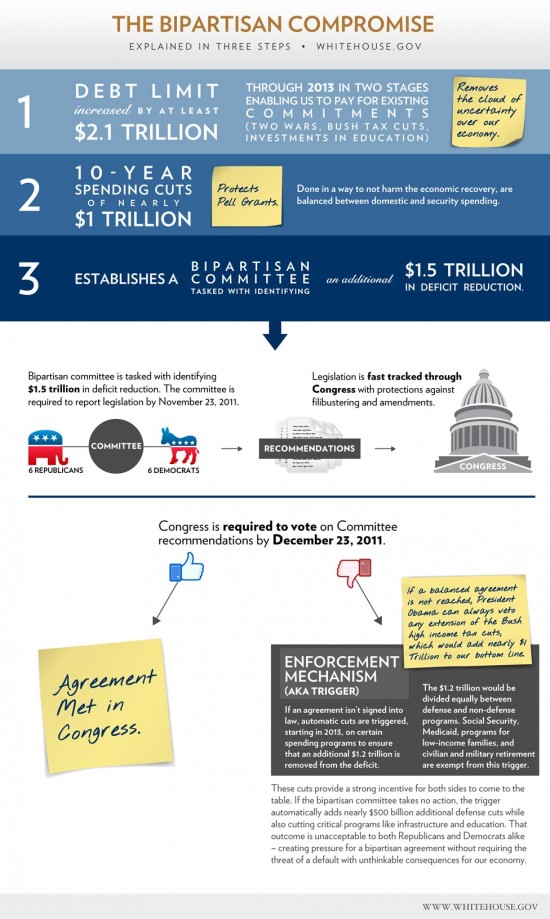
In February of 2010, the federal debt limit was set by Congress at $14.294 trillion. Treasury Secretary Timothy Geithner indicates that the United States will reach that debt limit on May 16th, 2011. Through various internal borrowing strategies, Secretary Geithner believes that there will not be an actual default on U.S. bonds until August 2nd, 2011. However, the Federal Government may face funding problems by late July if there is no expansion of the debt limit.

Three Sets of Negotiations

Facing a serious economic problem if the debt limit is not expanded, there are at least three sets of negotiations underway in Washington.

  • First, the “Gang of Six” Senators from both parties are still attempting to move forward with a bill that implements the recommended solution by the 2010 Presidential Fiscal Commission.
  • Second, at the request of President Obama, Vice President Joseph Biden is meeting with House and Senate leaders of both parties.
  • Finally, Senate Majority Leader Harry Reid (D-NV) disclosed this week that Senate Budget Chair Kent Conrad (D-ND) has prepared a new proposed compromise plan. The proposal by Sen. Conrad is to increase taxes in an amount equal to the budget cuts. In effect, the proposal is 50% tax increases and 50% budget reductions.

The Skeptics

Minority Leader Mitch McConnell (R-KY) was skeptical that the “Gang of Six” plan would succeed. He stated, “With all due respect to the Gang of Six or any other bipartisan discussion going on in this issue, the discussions that can lead to a result between now and August are the talks being led by Vice President Biden.”

House Speaker John Boehner (R-OH) spoke May 9th to the Economic Club of New York. He indicated that tax increases were not acceptable and that the deficit plan should instead focus on spending reductions.

In response to the comments by Boehner, White House Press Secretary Jay Carney suggested that the Speaker is “holding the US economy hostage.” Press Secretary Carney indicated that there needs to be flexibility in order to produce compromise.

Assessment

Majority Leader Reid continued the discussion later in the week and noted that it would be essential to have some tax increases. He stated that it “can’t all be done with spending cuts.

“House Majority Leader Eric Cantor (R-VA) is part of the discussion group with Vice President Biden. He indicated that he cannot disclose the specifics of the negotiations. However, in his view, House Republicans continue to support the spending reduction plan introduced by Rep. Paul Ryan (R-WI).

Editors Note: Your editor and this organization take no specific position on these comments. It is widely expected that the discussions on increasing the federal debt limit will lead to a compromise before the August deadline. The Republican negotiators continue to seek a solution that involves spending cuts. It now appears that Democratic negotiators are moving to a proposal with 50% tax increases and 50% budget reductions. Final negotiations are likely to produce a result that reduces federal spending and may include tax increases.

Conclusion

Your thoughts and comments on this ME-P are appreciated. Feel free to review our top-left column, and top-right sidebar materials, links, URLs and related websites, too. Then, subscribe to the ME-P. It is fast, free and secure.

Speaker: If you need a moderator or speaker for an upcoming event, Dr. David E. Marcinko; MBA – Publisher-in-Chief of the Medical Executive-Post – is available for seminar or speaking engagements. Contact: MarcinkoAdvisors@msn.com

OUR OTHER PRINT BOOKS AND RELATED INFORMATION SOURCES:

Sponsors Welcomed: Credible sponsors and like-minded advertisers are always welcomed.

Product DetailsProduct DetailsProduct Details

Product Details  Product Details

   Product Details 

On Oil and Gas Tax Breaks

Reducing Tax Incentives?

By Children’s Home Society of Florida Foundation

Join Our Mailing List

In his address to the nation last week, President Obama indicated that he favors a reduction in the tax incentives for oil and gas companies. He noted that gas in some communities is now over $4.00 a gallon and oil companies had $25 billion in profits during the early months of 2011.

While he does not have “a problem with any company or industry being rewarded for their success,” the President suggests that it would be appropriate to reduce tax incentives for the oil and gas industry.

The Response

House Ways and Means Committee Democrats responded with a letter to Chairman Dave Camp (R-MI). They noted that a specific Sec. 199 Domestic Manufacturing Deduction saved the oil companies approximately $1 billion last year in taxes. Democratic Members of the House Ways and Means Committee recommend that this benefit be eliminated for the oil companies.

Assessment

The energy industry responded to the proposals. American Petroleum Institute (API) President Jack Gerard suggested, “We need to stay focused on energy policy, not demonizing industries.” The energy industry notes that there are 9.2 million Americans who are engaged in the domestic oil and gas industry. Oil and gas represents 7.7% of GDP. If the incentives were reduced, there could be lower employment and higher costs due to greater imports of foreign oil.

Editor’s Note: Sen. Max Baucus has indicated that he will introduce legislation to reduce the oil and gas tax incentives within the next two weeks. He plans to spend the revenue gained through changes in oil and gas tax rules on new incentives for clean energy.

Conclusion

And so, your thoughts and comments on this ME-P are appreciated. Feel free to review our top-left column, and top-right sidebar materials, links, URLs and related websites, too. Then, subscribe to the ME-P. It is fast, free and secure.

Link: http://feeds.feedburner.com/HealthcareFinancialsthePostForcxos

Speaker: If you need a moderator or speaker for an upcoming event, Dr. David E. Marcinko; MBA – Publisher-in-Chief of the Medical Executive-Post – is available for seminar or speaking engagements. Contact: MarcinkoAdvisors@msn.com

Our Other Print Books and Related Information Sources:

Health Dictionary Series: http://www.springerpub.com/Search/marcinko

Practice Management: http://www.springerpub.com/product/9780826105752

Physician Financial Planning: http://www.jbpub.com/catalog/0763745790

Medical Risk Management: http://www.jbpub.com/catalog/9780763733421

Healthcare Organizations: www.HealthcareFinancials.com

Physician Advisors: www.CertifiedMedicalPlanner.com

Subscribe Now: Did you like this Medical Executive-Post, or find it helpful, interesting and informative? Want to get the latest ME-Ps delivered to your email box each morning? Just subscribe using the link below. You can unsubscribe at any time. Security is assured.

Link: http://feeds.feedburner.com/HealthcareFinancialsthePostForcxos

Sponsors Welcomed: And, credible sponsors and like-minded advertisers are always welcomed.

Link: https://healthcarefinancials.wordpress.com/2007/11/11/advertise

Product DetailsProduct DetailsProduct Details       

Product Details  Product Details

On the US Tax Code Complexity

Recent Ways and Means Committee Meeting

By Children’s Home Society of Florida Foundation

Join Our Mailing List

At an April 13th 2011 hearing on the tax code before the Ways and Means Committee, witnesses noted that there is a general consensus on the complexity of the tax code.

Enter Albert Einstein

One witness quoted Albert Einstein, recipient of 1921 Nobel Prize in Physics. While he was the world expert on the Theory of Relativity, Dr. Einstein also commented that “the hardest thing in the world is to understand the income tax.”

At the hearing, Chairman Dave Camp (R-MI) noted there are “nearly 4,500 changes in the last decade – 579 of them in 2010 alone – the code is too complex.” Other representatives and witnesses agreed that the sheer size and complexity of the Internal Revenue Code make compliance very challenging.

Enter the AICPA

Annette Nellen represented the American Institute of Certified Public Accountants in the hearing. She indicated that there are five specific steps that could be taken to substantially reduce the complexity and cost of complying with the code. These include the following actions.

1. Higher Education Deductions and Credits – Reduce the Hope Credit, American Opportunity Credit, Lifetime Learning Credit, the tuition and fees deduction and other benefits into one simple credit.

2. Education Phase Out – Create one definition for qualified education expenses and eliminate the multiple phase outs under the current system.

3. Kiddie Tax – For children with unearned income under age 18 or students under age 24, simplify the current method where they pay tax at their parents’ rate.

4. Mileage Rates – Create the same mileage rate for business purposes, medical purposes and qualified charitable travel.

5. Alternative Minimum Tax – Repeal the tax because it is too complicated to modify.

Enter the Financial Planner

Financial Planner Mark Johannessen is a CFP™ and Managing Director of a McLean, Virginia financial firm. He was President of the Financial Planning Association in 2008 and suggested that there are a number of Internal Revenue Code issues that make financial planning difficult.

First, there are temporary provisions. For example, the 2011 tax rate on dividends is 15%, but the scheduled tax rate on dividends in 2013 is 43.4%. While it’s possible that Congress could change the law between now and 2013, it makes investment planning very difficult.

Second, many changes are temporary and Congress tends to act very late in the year. Congress passed the IRA Charitable Rollover for 2010 on December 17. By that date, most individuals had already taken their required minimum distribution. Johannessen indicated that the late date “negatively impacted both the individuals’ planned charitable giving” and also the charities who received fewer gifts.

Third, the uncertainty in estate tax law continues to make planning quite difficult. While the current exemption is $5 million and there now is portability for couples, the current law only applies for 2011 and 2012. To do good planning, it is essential to know what the law will be in future years.

Assessment

Conclusion

And so, your thoughts and comments on this ME-P are appreciated. Feel free to review our top-left column, and top-right sidebar materials, links, URLs and related websites, too. Then, subscribe to the ME-P. It is fast, free and secure.

Link: http://feeds.feedburner.com/HealthcareFinancialsthePostForcxos

Speaker: If you need a moderator or speaker for an upcoming event, Dr. David E. Marcinko; MBA – Publisher-in-Chief of the Medical Executive-Post – is available for seminar or speaking engagements. Contact: MarcinkoAdvisors@msn.com

Our Other Print Books and Related Information Sources:

Health Dictionary Series: http://www.springerpub.com/Search/marcinko

Practice Management: http://www.springerpub.com/product/9780826105752

Physician Financial Planning: http://www.jbpub.com/catalog/0763745790

Medical Risk Management: http://www.jbpub.com/catalog/9780763733421

Healthcare Organizations: www.HealthcareFinancials.com

Physician Advisors: www.CertifiedMedicalPlanner.com

Subscribe Now: Did you like this Medical Executive-Post, or find it helpful, interesting and informative? Want to get the latest ME-Ps delivered to your email box each morning? Just subscribe using the link below. You can unsubscribe at any time. Security is assured.

Link: http://feeds.feedburner.com/HealthcareFinancialsthePostForcxos

Sponsors Welcomed: And, credible sponsors and like-minded advertisers are always welcomed.

Link: https://healthcarefinancials.wordpress.com/2007/11/11/advertise

Product DetailsProduct DetailsProduct Details       

Product Details  Product Details

Budget Committee Proposes 25% Tax Rate

The Ryan Plan for FY 2012

By Children’s Home Society of Florida Foundation

Join Our Mailing List

On April 5th House Budget Committee Chair Paul Ryan (R-WI) presented his budget proposal for Fiscal Year 2012. The comprehensive proposal included over $4 trillion in reduced spending during the next decade and a plan to reduce both the personal and corporate top tax rates to 25%.

House Ways and Means Committee

The tax reform provisions will be handled by the House Ways and Means Committee. Chairman Dave Camp (R-MI) noted that, “with nearly 4,500 changes in the last decade alone, the code is too complex. And with Americans spending over 6 billion hours and over $160 billion annually to comply with the code, it is too costly and too burdensome. Clearly, the time for comprehensive reform has come.”

Many Loopholes

Both parties have raised the possibility of tax reform this year. At a meeting in Pennsylvania, President Obama was asked about the potential for reforming corporate taxes. He noted that the U.S. has “one of the highest tax codes for corporations in the world.”

However, due to “many loopholes” a number of U.S. corporations pay little or no taxes. Moreover, President Obama suggests that it would be good “to reform our tax code, simplify it, lower the rate for corporations, but eliminate a bunch of the loopholes.”

Assessment

Treasury Secretary Timothy Geithner also indicated to the Senate Committee on Appropriations that he is developing a “comprehensive corporate tax reform plan” and it will be released quite soon. Sec. Geithner indicated his plan would include, “a very strong pro-investment, pro-growth, pro-competitiveness proposal.”

Conclusion

And so, your thoughts and comments on this ME-P are appreciated. Feel free to review our top-left column, and top-right sidebar materials, links, URLs and related websites, too. Then, subscribe to the ME-P. It is fast, free and secure.

Link: http://feeds.feedburner.com/HealthcareFinancialsthePostForcxos

Speaker: If you need a moderator or speaker for an upcoming event, Dr. David E. Marcinko; MBA – Publisher-in-Chief of the Medical Executive-Post – is available for seminar or speaking engagements. Contact: MarcinkoAdvisors@msn.com

Our Other Print Books and Related Information Sources:

Health Dictionary Series: http://www.springerpub.com/Search/marcinko

Practice Management: http://www.springerpub.com/product/9780826105752

Physician Financial Planning: http://www.jbpub.com/catalog/0763745790

Medical Risk Management: http://www.jbpub.com/catalog/9780763733421

Healthcare Organizations: www.HealthcareFinancials.com

Physician Advisors: www.CertifiedMedicalPlanner.com

Subscribe Now: Did you like this Medical Executive-Post, or find it helpful, interesting and informative? Want to get the latest ME-Ps delivered to your email box each morning? Just subscribe using the link below. You can unsubscribe at any time. Security is assured.

Link: http://feeds.feedburner.com/HealthcareFinancialsthePostForcxos

Sponsors Welcomed: And, credible sponsors and like-minded advertisers are always welcomed.

Link: https://healthcarefinancials.wordpress.com/2007/11/11/advertise

Product DetailsProduct DetailsProduct Details       

Product Details  Product Details

The Truth about Frivolous Tax Arguments

An IRS Warning Report for Doctors and All Citizens

[No Lame Excuses]

By Staff Reporters

Join Our Mailing List 

This IRS report responds to some of the more common frivolous “legal” arguments made by individuals and groups who oppose compliance with the federal tax laws.

Three Parts

The first section groups these arguments under six general categories, with variations within each category. Each contention is briefly explained, followed by a discussion of the legal authority that rejects the contention.

The second section responds to some of the more common frivolous arguments made in collection due process cases brought pursuant to sections 6320 or 6330. These arguments are grouped under ten general categories and contain a brief description of each contention followed by a discussion of the correct legal authority.

A final section explains the penalties that the courts may impose on those who pursue tax cases on frivolous grounds. It should be noted that the cases cited as relevant legal authority are illustrative and are not intended to provide an all-inclusive list relating to frivolous tax arguments.

Link: http://www.irs.gov/taxpros/article/0,,id=159853,00.html

Conclusion

And so, your thoughts and comments on this ME-P are appreciated. Feel free to review our top-left column, and top-right sidebar materials, links, URLs and related websites, too. Then, subscribe to the ME-P. It is fast, free and secure.

Speaker: If you need a moderator or speaker for an upcoming event, Dr. David E. Marcinko; MBA – Publisher-in-Chief of the Medical Executive-Post – is available for seminar or speaking engagements. Contact: MarcinkoAdvisors@msn.com and http://www.springerpub.com/Search/marcinko

Our Other Print Books and Related Information Sources:

Health Dictionary Series: http://www.springerpub.com/Search/marcinko 

Practice Management: http://www.springerpub.com/product/9780826105752

Physician Financial Planning: http://www.jbpub.com/catalog/0763745790

Medical Risk Management: http://www.jbpub.com/catalog/9780763733421

Healthcare Organizations: www.HealthcareFinancials.com

Physician Advisors: www.CertifiedMedicalPlanner.com

Subscribe Now: Did you like this Medical Executive-Post, or find it helpful, interesting and informative? Want to get the latest ME-Ps delivered to your email box each morning? Just subscribe using the link below. You can unsubscribe at any time. Security is assured.

Link: http://feeds.feedburner.com/HealthcareFinancialsthePostForcxos

Sponsors Welcomed: And, credible sponsors and like-minded advertisers are always welcomed.

https://healthcarefinancials.wordpress.com/2007/11/11/advertise

Product DetailsProduct DetailsProduct Details       

Product Details  Product Details

Tax Exempt Hospitals Granted IRS Filing Delay

Recent Developments on Form 990 and Schedule H

By Children’s Home Society of Florida Foundation

Join Our Mailing List 

In Announcement 2011-20; 2011-10 IRB 1 (23 Feb 2011), the IRS granted a three-month automatic filing extension for most tax-exempt hospitals.

Form 990 and Schedule H

Following the development of a new Form 990 Return for Charitable Organizations, the IRS published a comprehensive Schedule H for medical centers. With the passage of the Patient Protection and Affordable Care Act of 2010, both the IRS and many medical centers need additional time to properly prepare for filing of Form 990 with the Schedule H for medical centers.

As a result, the IRS indicates that the earliest permitted filing date for tax-exempt medical centers filing Form 990 and Schedule H will be July 1, 2010. This is the earliest filing date whether the filing is in paper form or electronic format.

Filing Extension Form 8868

For those medical centers with return due dates before August 15, 2011, there is an automatic three-month extension of time to file. This extension is available without filing Form 8868, Application for Extension of Time to File an Exempt Organization Return.

However, there may be new organizations that have not filed Form 990 Schedule H for tax year 2009. In this case, they may choose to file Form 8868 to clarify their intention to extend the deadline. If a medical center requires an additional three months to file, then it should file Form 8868.

Assessment

Finally, for those medical centers that qualify for this automatic extension, there will be no penalty if they file within the additional three-month period.

Conclusion

And so, your thoughts and comments on this ME-P are appreciated. Feel free to review our top-left column, and top-right sidebar materials, links, URLs and related websites, too. Then, subscribe to the ME-P. It is fast, free and secure.

Speaker: If you need a moderator or speaker for an upcoming event, Dr. David E. Marcinko; MBA – Publisher-in-Chief of the Medical Executive-Post – is available for seminar or speaking engagements. Contact: MarcinkoAdvisors@msn.com and http://www.springerpub.com/Search/marcinko

Our Other Print Books and Related Information Sources:

Health Dictionary Series: http://www.springerpub.com/Search/marcinko

Practice Management: http://www.springerpub.com/product/9780826105752

Physician Financial Planning: http://www.jbpub.com/catalog/0763745790

Medical Risk Management: http://www.jbpub.com/catalog/9780763733421

Healthcare Organizations: www.HealthcareFinancials.com

Physician Advisors: www.CertifiedMedicalPlanner.com

Subscribe Now: Did you like this Medical Executive-Post, or find it helpful, interesting and informative? Want to get the latest ME-Ps delivered to your email box each morning? Just subscribe using the link below. You can unsubscribe at any time. Security is assured.

Link: http://feeds.feedburner.com/HealthcareFinancialsthePostForcxos

Sponsors Welcomed: And, credible sponsors and like-minded advertisers are always welcomed.

Link: https://healthcarefinancials.wordpress.com/2007/11/11/advertise

Product DetailsProduct DetailsProduct Details       

Product Details  Product Details

   Product Details 

Financial Planning and Risk Management Strategies for Physicians

Financial Planning Handbook for Physicians and Advisors

Product Details

 • http://www.jblearning.com/catalog/9780763745790/

Insurance Planning and Risk Management Strategies for Physicians and Advisors

Product Details

http://www.jblearning.com/catalog/9780763733421/

ADVERTISEMENT

Speaker: If you need a moderator or speaker for an upcoming event, Dr. David E. Marcinko; MBA – Publisher-in-Chief of the Medical Executive-Post – is available for seminar or speaking engagements. Contact: MarcinkoAdvisors@msn.com and http://www.springerpub.com/Search/marcinko

Remember Tax Deadline Day is April 18th 2011

Tax Emancipation Day is April 15th 2011

By Dr. Gary L. Bode MSA, CPA, PC

In the 2011 tax filing season, taxpayers have until Monday, April 18 to file their 2010 tax returns and pay any tax due. Emancipation Day, a holiday observed in the District of Columbia, falls this year on Friday, April 15. By law, District of Columbia holidays impact tax deadlines in the same way that federal holidays do; therefore, all taxpayers will have three extra days to file this year. Taxpayers requesting an extension will have until October 17 to file their 2010 tax returns.

Who Must Wait to File

For most taxpayers, the 2011 tax filing season starts on schedule. However, tax law changes enacted by Congress and signed by President Obama in December mean some people need to wait until mid to late February to file their tax returns in order to give the IRS time to reprogram its processing systems. The IRS recently announced February 14, 2011 as the start date for processing these delayed tax returns.

Some taxpayers, including those who itemize deductions on Form 1040 Schedule A, will need to wait until February 14, 2011 to file. This includes taxpayers impacted by any of three tax provisions that expired at the end of 2009 and were renewed by the Tax Relief, Unemployment Insurance Reauthorization, and Job Creation Act of 2010 enacted December 17, 2010. Those who need to wait to file include:

  • Taxpayers Claiming Itemized Deductions on Schedule A. Itemized deductions include mortgage interest, charitable deductions, and medical and dental expenses as well as state and local taxes. In addition, itemized deductions include the state and local general sales tax deduction that was also extended and that primarily benefits people living in areas without state and local income taxes.
  • Taxpayers Claiming the Higher Education Tuition and Fees Deduction. This deduction for parents and students, covering up to $4,000 of tuition and fees paid to a post-secondary institution, is claimed on Form 8917. However, the IRS emphasized that there will be no delays for millions of parents and students who claim other education credits, including the American Opportunity Tax Credit extended last month and the Lifetime Learning Credit.
  • Taxpayers Claiming the Educator Expense Deduction. This deduction is for kindergarten through grade 12 educators with out-of-pocket classroom expenses of up to $250. The educator expense deduction is claimed on Form 1040, Line 23 and Form 1040A, Line 16.

Assessment

In addition to extending those tax deductions for 2010, the Tax Relief, Unemployment Insurance Reauthorization, and Job Creation Act also extended those deductions for 2011 and a number of other tax deductions and credits for 2011 and 2012, such as the American Opportunity Tax Credit and the modified Child Tax Credit. The Act also provides various job creation and investment incentives, including 100% expensing and a 2% payroll tax reduction for 2011. Those changes have no effect on the 2011 filing season.

http://www.amazon.com/Financial-Planning-Handbook-Physicians-Advisors/dp/0763745790/ref=sr_1_1?ie=UTF8&s=books&qid=1276795609&sr=1-1

Conclusion

And so, your thoughts and comments on this ME-P are appreciated. Feel free to review our top-left column, and top-right sidebar materials, links, URLs and related websites, too. Then, subscribe to the ME-P. It is fast, free and secure.

Our Other Print Books and Related Information Sources:

Health Dictionary Series: http://www.springerpub.com/Search/marcinko

Practice Management: http://www.springerpub.com/product/9780826105752

Physician Financial Planning: http://www.jbpub.com/catalog/0763745790

Medical Risk Management: http://www.jbpub.com/catalog/9780763733421

Healthcare Organizations: www.HealthcareFinancials.com

Physician Advisors: www.CertifiedMedicalPlanner.com

Subscribe Now: Did you like this Medical Executive-Post, or find it helpful, interesting and informative? Want to get the latest ME-Ps delivered to your email box each morning? Just subscribe using the link below. You can unsubscribe at any time. Security is assured.

Link: http://feeds.feedburner.com/HealthcareFinancialsthePostForcxos

Sponsors Welcomed: And, credible sponsors and like-minded advertisers are always welcomed.

Link: https://healthcarefinancials.wordpress.com/2007/11/11/advertise

Product DetailsProduct DetailsProduct Details      

e-Filing Tax Season is Now Open

About IR-20 11-5

By Children’s Home Society of Florida Foundation

In a flurry of information letters, the IRS just announced that e-Filing is now open. According to IR-2011-5, the benefit of e-filing is that any taxpayer may receive faster refunds and ensure that their tax return is accurately reported.

The Commissioner Speaks

IRS Commissioner Doug Shulman stated, “IRS e-File is the best option for everyone, especially for people impacted by recent tax law changes. e-File ensures people can file accurately and get refunds quickly. With a new legislative e-File mandate for tax preparers, we anticipate that more tax return preparers will be using e-File this year and we urge people who prepare their own taxes to give it a try.”

Methods of Filing

The e-Filing may be accomplished through three different methods. Tax return preparers may e-File, commercial software may offer the option or there is IRS Free File. The Free File program is available on www.irs.gov. Taxpayers should click on “Free File” and will be permitted to access tax software to prepare their returns. Free File is available for taxpayers with 2010 adjusted gross income of $58,000 or less.

In the view of the IRS, Free File is “perfect for first-time filers, families looking to save money or older Americans adept at using the Internet.”

e-Signature Needed

Those who file electronically will also need an electronic signature. The electronic signature requires a five-digit personal identification number (PIN). There are three ways to obtain your PIN.

1. Self Select – You may use your tax software and select your own five-digit PIN. If you used a PIN in 2009, you may use that number. Alternatively, you may enter your adjusted gross income from your 2009 return to obtain your PIN. The PIN can be a five-digit number, but may not be all zeros.

2. Practitioner PIN – If you are using a paid tax preparer, you may sign IRS Form 8879 and authorize your paid preparer to generate your five-digit PIN. The paid preparer will retain Form 8879, but will not mail it to the IRS.

3. IRS Issue of PIN – If you do not know your 2009 adjusted gross income or your 2009 PIN, the IRS will request a temporary Form 8879(EFP). The Electronic Filing PIN may be obtained using your tax preparation software or through http://www.irs.gov. With the Electronic Filing PIN you may complete your electronic signature.

Military

If your spouse is a military person serving in a combat zone, you are permitted to use the self-select PIN. You will need to obtain IRS Form 8453, attach a Power of Attorney and mail it to the IRS.

Assessment

This program may also be ideal for FAs, medical students, interns, residents, fellows, nurses, new practitioners and all allied medical professionals who qualify.

Conclusion

And so, your thoughts and comments on this ME-P are appreciated. Feel free to review our top-left column, and top-right sidebar materials, links, URLs and related websites, too. Then, subscribe to the ME-P. It is fast, free and secure.

Speaker: If you need a moderator or speaker for an upcoming event, Dr. David E. Marcinko; MBA – Publisher-in-Chief of the Medical Executive-Post – is available for seminar or speaking engagements. Contact: MarcinkoAdvisors@msn.com and http://www.springerpub.com/Search/marcinko

Our Other Print Books and Related Information Sources:

Health Dictionary Series: http://www.springerpub.com/Search/marcinko

Practice Management: http://www.springerpub.com/product/9780826105752

Physician Financial Planning: http://www.jbpub.com/catalog/0763745790

Medical Risk Management: http://www.jbpub.com/catalog/9780763733421

Healthcare Organizations: www.HealthcareFinancials.com

Physician Advisors: www.CertifiedMedicalPlanner.com

Subscribe Now: Did you like this Medical Executive-Post, or find it helpful, interesting and informative? Want to get the latest ME-Ps delivered to your email box each morning? Just subscribe using the link below. You can unsubscribe at any time. Security is assured.

Link: http://feeds.feedburner.com/HealthcareFinancialsthePostForcxos

Sponsors Welcomed: And, credible sponsors and like-minded advertisers are always welcomed.

Link: https://healthcarefinancials.wordpress.com/2007/11/11/advertise


Product Details  Product Details

On the Rise and Fall of Limited Partnerships

Taking A Historical Look at this Investment Vehicle

By Dr. David Edward Marcinko MBA CMP™

www.CertifiedMedicalPlanner.com

[Publisher-in-Chief]

Back in the 1980s – a time I am loathe admitting that I remember well – limited partnerships (LPs) were all the rage and often touted as the investment vehicle of the future; especially to tax-averse physicians and high income medical professionals and investors.

Oil and gas and real estate LPs dominated the market. But, there were also cattle feeding, master recording disks, equipment and aircraft leasing, and cable TV investments. The LP heyday was 1983 through 1989, and most early LPs were private or non-publicly traded.

Popularity Rising

Why were they so popular? LPs provided the benefits of direct ownership (income potential and tax benefits) without management responsibility and personal liability. Losses were limited to one’s original investment. Brokerage firms pushed them hard, paying their sales representatives [financial advisors?] the highest commissions and often characterizing these risky investments as “safe” and a “means of capital preservation.”

Early ’80s

In the early 80s, investors could use depreciation, interest, and investment tax credits to offset not only LP income but ordinary income from salary and other investments. This was a huge incentive for high income earning doctors. In 1981, the Tax Act allowed accelerated depreciation for real estate, and non-recourse debt was treated as depreciable cost (partners bore no risk of economic loss). Soon, the IRS began to attack LPs. Both real estate and oil and gas values declined. LPs soon became illiquid investments, producing little or no return.

’86 Tax Act

Then came the Tax Reform Act of 1986 (TRA), which brought with it “at risk” limitations to real estate tax shelters and the new passive loss provisions. LP sales then spiraled downward. The ’86 Tax Law provided that limited partners could not increase their basis in the LP for their share of partnership debt unless they were personally liable for repayment or if the lender had an interest other than as a creditor (unless “qualified non-recourse debt” was used).

1990s

In the ’90s, investors either hung on to – or sold – their LP investments in the secondary market. Investors were subject to substantial discounts upon sale and they had to recapture tax benefits previously received (including those from non-recourse financing).

Assessment

Simply abandoning these investments did not avoid unfavorable tax consequences, such as the decrease in a partner’s share of partnership liabilities being treated as a cash distribution. Capital gains were recognized to the extent that a partner’s share of partnership liabilities exceeds the adjusted basis of the partner’s interest.

Note: “What Happened to Limited Partnerships?” Lee Knight and Ray Knight Journal of Accountancy, July 1997, pp. 37–42, American Institute of Certified Public Accountants.

Conclusion

And so, your thoughts and comments on this ME-P are appreciated. Were you burned by LPs back in the day, or have a LP story to tell us? Please opine. Feel free to review our top-left column, and top-right sidebar materials, links, URLs and related websites, too. Then, subscribe to the ME-P. It is fast, free and secure.

Speaker: If you need a moderator or speaker for an upcoming event, Dr. David E. Marcinko; MBA – Publisher-in-Chief of the Medical Executive-Post – is available for seminar or speaking engagements. Contact: MarcinkoAdvisors@msn.com and http://www.springerpub.com/Search/marcinko

Our Other Print Books and Related Information Sources:

Health Dictionary Series: http://www.springerpub.com/Search/marcinko

Practice Management: http://www.springerpub.com/product/9780826105752

Physician Financial Planning: http://www.jbpub.com/catalog/0763745790

Medical Risk Management: http://www.jbpub.com/catalog/9780763733421

Healthcare Organizations: www.HealthcareFinancials.com

Physician Advisors: www.CertifiedMedicalPlanner.com

Subscribe Now: Did you like this Medical Executive-Post, or find it helpful, interesting and informative? Want to get the latest ME-Ps delivered to your email box each morning? Just subscribe using the link below. You can unsubscribe at any time. Security is assured.

Link: http://feeds.feedburner.com/HealthcareFinancialsthePostForcxos

Sponsors Welcomed: And, credible sponsors and like-minded advertisers are always welcomed.

Link: https://healthcarefinancials.wordpress.com/2007/11/11/advertise

Product DetailsProduct DetailsProduct Details       

Product Details  Product Details

Chairman Bernanke Advocates Tax Reform

Reform Coming in 2011?

By The Children’s Home Society of Florida Foundation

Join Our Mailing List 

Chairman of the Federal Reserve [the FED], Ben Bernanke met January 7th 2011 with the Senate Budget Committee. He spoke on the topic of tax reform during 2011. According to sources, Mr. Bernanke noted, “Greater clarity and certainty is obviously beneficial, and to the extent you can create more certainty about where the tax code is going to be over the next couple years, that would be helpful.”

Budget Committee Seems to Agree

Chairman Bernanke and the Senate members of the Budget Committee all noted that with the current weak economy and high level of unemployment, it is a very key year for potentially reforming the tax code. Sen. Ron Wyden (D-OR) joined with Sen. Judd Gregg (R-NH) to introduce the bipartisan Tax Fairness and Simplification Act of 2010. Sen. Wyden noted, “The big idea for economic growth in our country is fundamental tax reform, where you go in there and clean out this job-killing, thoroughly discredited mess.” Senate Budget Chair Kent Conrad (D-ND) agreed that the tax code “is just completely out of date.” He responded, “It does not take account of the world that we live in today.”

Assessment

In the House, the new Chairman of the Ways and Means Committee, Dave Camp (R-MI), also showed interest in tax reform during 2011. He suggested that it will be necessary to “streamline the tax code that today is too costly, too complex and too burdensome for families and employers.”

Editor’s Note: Both House and Senate Finance Leaders will be holding hearings this year on tax reform. Because 2011 is not an election year, it is a potentially good year for major tax reform. As was evident from the tax bill that was signed in December 2010, tax reform will require compromise between the Senate, the House and the White House. However, with the unemployment rate currently at 9.4%, there is now a growing consensus on the need for continued improvements in the tax system in order to reduce unemployment.

Conclusion

And so, your thoughts and comments on this ME-P are appreciated. Does the tax code, and IRS, need revising? Feel free to review our top-left column, and top-right sidebar materials, links, URLs and related websites, too. Then, subscribe to the ME-P. It is fast, free and secure.

Speaker: If you need a moderator or speaker for an upcoming event, Dr. David E. Marcinko; MBA – Publisher-in-Chief of the Medical Executive-Post – is available for seminar or speaking engagements. Contact: MarcinkoAdvisors@msn.com and http://www.springerpub.com/Search/marcinko

Our Other Print Books and Related Information Sources:

Health Dictionary Series: http://www.springerpub.com/Search/marcinko

Practice Management: http://www.springerpub.com/product/9780826105752

Physician Financial Planning: http://www.jbpub.com/catalog/0763745790

Medical Risk Management: http://www.jbpub.com/catalog/9780763733421

Healthcare Organizations: www.HealthcareFinancials.com

Physician Advisors: www.CertifiedMedicalPlanner.com

Subscribe Now: Did you like this Medical Executive-Post, or find it helpful, interesting and informative? Want to get the latest ME-Ps delivered to your email box each morning? Just subscribe using the link below. You can unsubscribe at any time. Security is assured.

Link: http://feeds.feedburner.com/HealthcareFinancialsthePostForcxos

Sponsors Welcomed: And, credible sponsors and like-minded advertisers are always welcomed.

Link: https://healthcarefinancials.wordpress.com/2007/11/11/advertise

Product DetailsProduct DetailsProduct Details       

Product Details  Product Details

   Product Details 

On the Estate and Gift Law Tax Changes

Update on the New Tax Laws

[By Chris Miller JD and Nicole McNair]

Robinson & Miller, PC

Dear ME-P Readers and Subscribers,

On behalf of attorney J. Christopher Miller of our firm, please find attached a letter summarizing the changes in the estate and gift tax law enacted last month by the Obama Administration. We trust you find it interesting and informative.

Link: 2010 Estate Tax Reform Letter

Assessment

Please call with questions.

  • Robinson & Miller, PC
  • 3460 Preston Ridge Road, Suite 100
  • Alpharetta, GA 30005
  • http://www.robinsonmiller.com
  • Tel: 770-817-4999
  • Fax: 770-817-4994

Conclusion

Your thoughts and comments on this ME-P are appreciated. Feel free to review our top-left column, and top-right sidebar materials, links, URLs and related websites, too. Then, subscribe to the ME-P. It is fast, free and secure.

Link: http://feeds.feedburner.com/HealthcareFinancialsthePostForcxos

Speaker: If you need a moderator or speaker for an upcoming event, Dr. David E. Marcinko; MBA – Publisher-in-Chief of the Medical Executive-Post – is available for seminar or speaking engagements. Contact: MarcinkoAdvisors@msn.com

OUR OTHER PRINT BOOKS AND RELATED INFORMATION SOURCES:

DICTIONARIES: http://www.springerpub.com/Search/marcinko
PHYSICIANS: www.MedicalBusinessAdvisors.com
PRACTICES: www.BusinessofMedicalPractice.com
HOSPITALS: http://www.crcpress.com/product/isbn/9781466558731
CLINICS: http://www.crcpress.com/product/isbn/9781439879900
BLOG: www.MedicalExecutivePost.com
FINANCE: Financial Planning for Physicians and Advisors
INSURANCE: Risk Management and Insurance Strategies for Physicians and Advisors

Product Details  Product Details

The New 2011 Income Tax Rates

A “First-Look” for Medical Professionals

By Children’s Home Society of Florida Foundation

In Rev. Proc. 2011-12, 2011-2 IRB 1 (21 Dec 2010)

Join Our Mailing List 

TABLE 1 – Section 1(a) – Married Individuals Filing Joint Returns and Surviving Spouses

If Taxable Income Is:   The Tax Is:
Not over $17,000   10% of the taxable income
Over $17,000 but
not over $69,000
  $1,700 plus 15% of
the excess over $17,000
Over $69,000 but
not over $139,350
  $9,500 plus 25% of
the excess over $69,000
Over $139,350 but
not over $212,300
  $27,087.50 plus 28% of
the excess over $139,350
Over $212,300 but
not over $379,150
  $47,513.50 plus 33% of
the excess over $212,300
Over $379,150
 
  $102,574 plus 35% of
the excess over $379,150

TABLE 2 – Section 1(b) – Heads of Households

If Taxable Income Is:   The Tax Is:
Not over $12,150   10% of the taxable income
Over $12,150 but
not over $46,250
  $1,215 plus 15% of
the excess over $12,150
Over $46,250 but
not over $119,400
  $6,330 plus 25% of
the excess over $46,250
Over $119,400 but
not over $193,350
  $24,617.50 plus 28% of
the excess over $119,400
Over $193,350 but
not over $379,150
  $45,323.50 plus 33% of
the excess over $193,350
Over $379,150
 
  $106,637.50 plus 35% of
the excess over $379,150

TABLE 3 – Section 1(c) – Unmarried Individuals (other than Surviving Spouses and Heads of Households)

If Taxable Income Is:   The Tax Is:
Not over $8,500   10% of the taxable income
Over $8,500 but
not over $34,500
  $850 plus 15% of
the excess over $8,500
Over $34,500 but
not over $83,600
  $4,750 plus 25% of
the excess over $34,500
Over $83,600 but
not over $174,400
  $17,025 plus 28% of
the excess over $83,600
Over $174,400 but
not over $379,150
  $42,449 plus 33% of
the excess over $174,400
Over $379,150
 
  $110,016.50 plus 35% of
the excess over $379,150

TABLE 4 – Section 1(d) – Married Individuals Filing Separate Returns

If Taxable Income Is:   The Tax Is:
Not over $8,500   10% of the taxable income
Over $8,500 but
not over $34,500
  $850 plus 15% of
the excess over $8,500
Over $34,500 but
not over $69,675
  $4,750 plus 25% of
the excess over $34,500
Over $69,675 but
not over $106,150
  $13,543.75 plus 28% of
the excess over $69,675
Over $106,150 but
not over $189,575
  $23,756.75 plus 33% of
the excess over $106,150
Over $189,575
 
  $51,287 plus 35% of
the excess over $189,575

TABLE 5 – Section 1(e) – Estates and Trusts

If Taxable Income Is:   The Tax Is:
Not over $2,300   15% of the taxable income
Over $2,300 but
not over $5,450
  $345 plus 25% of
the excess over $2,300
Over $5,450 but
not over $8,300
  $1,132.50 plus 28% of
the excess over $5,450
Over $8,300 but
not over $11,350
  $1,930.50 plus 33% of
the excess over $8,300
Over $11,350
 
  $2,937 plus 35% of
the excess over $11,350

6. Child Credits — The credit per child is $3,000.

7. Standard Deduction — For a married couple, the standard deduction is $11,600. Single persons have a standard deduction of $5,800.

8. Aged or Blind — The additional deduction for an aged or blind person is $1,150. It is $1,450 for a single person who is not a surviving spouse.

9. Personal Exemptions — The personal exemption in 2011 will be $3,700.

Conclusion

And so, your thoughts and comments on this ME-P are appreciated. Feel free to review our top-left column, and top-right sidebar materials, links, URLs and related websites, too. Then, subscribe to the ME-P. It is fast, free and secure.

Speaker: If you need a moderator or speaker for an upcoming event, Dr. David E. Marcinko; MBA – Publisher-in-Chief of the Medical Executive-Post – is available for seminar or speaking engagements. Contact: MarcinkoAdvisors@msn.com and http://www.springerpub.com/Search/marcinko

Get our Widget: Get this widget!

Our Other Print Books and Related Information Sources:

Health Dictionary Series: http://www.springerpub.com/Search/marcinko

Practice Management: http://www.springerpub.com/product/9780826105752

Physician Financial Planning: http://www.jbpub.com/catalog/0763745790

Medical Risk Management: http://www.jbpub.com/catalog/9780763733421

Healthcare Organizations: www.HealthcareFinancials.com

Physician Advisors: www.CertifiedMedicalPlanner.com

Subscribe Now: Did you like this Medical Executive-Post, or find it helpful, interesting and informative? Want to get the latest ME-Ps delivered to your email box each morning? Just subscribe using the link below. You can unsubscribe at any time. Security is assured.

Link: http://feeds.feedburner.com/HealthcareFinancialsthePostForcxos

Sponsors Welcomed: And, credible sponsors and like-minded advertisers are always welcomed.

Link: https://healthcarefinancials.wordpress.com/2007/11/11/advertise

Product DetailsProduct DetailsProduct Details       

Product Details  Product Details

   Product Details 

The ME-P Recommends: Financial Planning and Risk Management Handbooks

Product Details  Product Details

ADVERTISEMENT

US Budget Deficits Require Both Spending Cuts and Tax Increases

The CRFB Speaks

By Children’s Home Society of Florida Foundation

Join Our Mailing List 

The nonpartisan Committee for a Responsible Federal Budget (CRFB) has published a release on October 20 that discusses some of the options to tackle the federal deficit. According to a Bloomberg News poll, there are two major issues that are foremost in the minds of voters as they go to the polls on November 2nd. The first is jobs and the US economy. The second issue focuses on federal finances and the budget deficit.

CFRB Suggestions

The CFRB suggests that there are four potential options for reducing expenditures and one for increasing revenue.

1. Fraud, Waste and Abuse – A favorite comment of all political candidates is that he or she will reduce fraud, waste and abuse. While there may be some savings, this historically has been a fairly modest part of actual deficit reduction.

2. Strengthen Social Security – Congress will need to address methods for strengthening Social Security. The Social Security program used to run a substantial surplus each year. However, in 2010 the federal deficit will total approximately $40 billion. That is, the amounts received by Social Security will be $40 billion lower than the amounts distributed for benefits.

Social Security

By 2020, Social Security could be running a $100 billion deficit. Social Security Trustees have stated, “The projected trust fund shortfalls should be addressed in a timely way so that necessary changes can be phased in gradually and workers can be given time to plan for them.”

3. Healthcare – The Congressional Budget Office notes that the current healthcare programs could require nearly one-half of the federal budget by 2030 or 2040. Therefore, there will need to be further changes in healthcare in order to make the program fiscally sustainable.

4. Defense – Defense expenditures in 2010 were 4.7% of Gross Domestic Product (GDP). This amounted to $692 billion. Defense Secretary Gates has acknowledged that there may be opportunities to eliminate some weapons systems and reduce expenditures.

5. Increased Taxes – The CFRB release states, “It is very difficult to lay out a credible deficit plan that would not increase taxes. It is also very difficult to develop a comprehensive plan that would not raise taxes on families making less than $250,000 per year.” The potential for increased taxes has focused on income taxes, capital gains taxes, estate taxes and a consumption tax such as a gas tax or a value added tax.

Assessment

The Fiscal Commission appointed by President Obama is expected to issue a report in December that discusses these issues.

Editor’s Note: Your editor and this organization take no position with respect to the many financial and tax options that are available to Congress. This information is offered as a public service to our readers.

Conclusion

And so, your thoughts and comments on this ME-P are appreciated. How does this state of affairs affect the healthcare industrial complex? Feel free to review our top-left column, and top-right sidebar materials, links, URLs and related websites, too. Then, subscribe to the ME-P. It is fast, free and secure.

Get our Widget: Get this widget!

Our Other Print Books and Related Information Sources:

Health Dictionary Series: http://www.springerpub.com/Search/marcinko

Practice Management: http://www.springerpub.com/product/9780826105752

Physician Financial Planning: http://www.jbpub.com/catalog/0763745790

Medical Risk Management: http://www.jbpub.com/catalog/9780763733421

Healthcare Organizations: www.HealthcareFinancials.com

Physician Advisors: www.CertifiedMedicalPlanner.com

Subscribe Now: Did you like this Medical Executive-Post, or find it helpful, interesting and informative? Want to get the latest ME-Ps delivered to your email box each morning? Just subscribe using the link below. You can unsubscribe at any time. Security is assured.

Link: http://feeds.feedburner.com/HealthcareFinancialsthePostForcxos

Sponsors Welcomed: And, credible sponsors and like-minded advertisers are always welcomed: https://healthcarefinancials.wordpress.com/2007/11/11/advertise

Product Details  Product Details

On the US Budget Deficit in 2010

Now North of $1.3 Trillion Dollars

By Children’s Home Society of Florida Foundation

Join Our Mailing List 

The federal fiscal year for 2010 concluded on September 30th. The Office of Management and Budget and Department of Treasury have released the official figures for fiscal year 2010. The deficit was $1.294 trillion.

Geithner Speaks

Treasury Secretary Tim Geithner noted that the cost of the financial rescue of banks and automotive companies was lower than expected. He stated, “By carefully managing the emergency initiatives to stop the financial panic and by accelerating our exit from those investments, we have significantly lowered the cost to taxpayers, bringing the costs of the financial rescue down by more than $240 billion this year.”

TARP

The Troubled Asset Recovery Program (TARP) cost to Treasury was $9 billion in 2010. During this year, the Federal Government also spent $52.6 billion to support the housing industry through troubled lenders Freddie Mac and Fannie Mae.

Deficit Concerns

The deficit declined slightly from 10% in 2009 to 8.9% of the 2010 gross domestic product (GDP). Tax receipts for 2010 were $2.16 trillion or 14.9% of the economy. Government expenditures were $3.45 trillion or 23.8% of the economy. Senate Budget Committee Ranking Minority Member Judd Gregg (R-NH) expressed concern about this deficit and noted, “These abrupt and shocking changes in our fiscal situation cannot be dismissed as “inherited” problems when the tally of the majority’s spending spree has climbed into the trillions.”

Assessment

The Fiscal Commission appointed by President Barack Obama is developing a plan to reduce the deficit. The target for the Fiscal Commission is to reduce the current 8.9% GDP deficit down to 3% of GDP within five years.

Editor’s Note: Your editor and this organization take no position with respect to the many financial and tax options that are available to Congress. This information is offered as a public service to our readers.
Conclusion

And so, your thoughts and comments on this ME-P are appreciated. How does this state of affairs affect the healthcare industrial complex? Feel free to review our top-left column, and top-right sidebar materials, links, URLs and related websites, too. Then, subscribe to the ME-P. It is fast, free and secure.

Get our Widget: Get this widget!

Our Other Print Books and Related Information Sources:

Health Dictionary Series: http://www.springerpub.com/Search/marcinko 

Practice Management: http://www.springerpub.com/product/9780826105752

Physician Financial Planning: http://www.jbpub.com/catalog/0763745790

Medical Risk Management: http://www.jbpub.com/catalog/9780763733421

Healthcare Organizations: www.HealthcareFinancials.com

Physician Advisors: www.CertifiedMedicalPlanner.com

Subscribe Now: Did you like this Medical Executive-Post, or find it helpful, interesting and informative? Want to get the latest ME-Ps delivered to your email box each morning? Just subscribe using the link below. You can unsubscribe at any time. Security is assured.

Link: http://feeds.feedburner.com/HealthcareFinancialsthePostForcxos

Sponsors Welcomed: And, credible sponsors and like-minded advertisers are always welcomed: https://healthcarefinancials.wordpress.com/2007/11/11/advertise

Product Details  Product Details

Schumer Proposes Permanent IRA Rollover

Provision on the Currency Exchange Rate Oversight Reform Act

By Children’s Home Society of Florida Foundation

Join Our Mailing List 

Senator Charles Schumer and 15 co-sponsors of the Currency Exchange Rate Oversight Reform Act of 2010 included provisions that would make four charitable deductions permanent. The bill is designed to modify the laws on currency transactions but it provided a platform to add in the four charitable provisions.

Assessment

The senators propose making permanent the IRA Charitable Rollover, the deduction for gifts of food inventory, the deduction for gifts of book inventory to public schools and the enhanced deduction for gifts of computers for educational purposes.

Editor’s Note: While there may not be prompt action on this bill, it is very encouraging that these 16 senators believe it is important to extend these four charitable provisions permanently. The IRA Charitable Rollover was the first of the four in the bill. That suggests that there is strong support in the Senate for permanent status for the rollover. And, as of the date of this publication, the House has passed the tax extenders including the Charitable IRA Rollover but the Senate has been unable to come to agreement on a bill. It is possible that the Senate may act in September to attach the 40 tax extenders to legislation. While that is the earliest possible date for passage of the IRA Charitable Rollover for 2010, it is still probable that the rollover will pass with an effective date of January 1, 2010.

Conclusion

Your thoughts and comments on this ME-P are appreciated. Feel free to review our top-left column, and top-right sidebar materials, links, URLs and related websites, too. Then, subscribe to the ME-P. It is fast, free and secure.

Speaker: If you need a moderator or speaker for an upcoming event, Dr. David E. Marcinko; MBA – Publisher-in-Chief of the Medical Executive-Post – is available for seminar or speaking engagements. Contact: MarcinkoAdvisors@msn.com

OUR OTHER PRINT BOOKS AND RELATED INFORMATION SOURCES:

Product Details  Product Details

Tim Geithner and Harry Reid Support Top Tax Rate Increases

Obama Plans to Increase Top Two Tax Brackets

By Children’s Home Society of Florida Foundation

Join Our Mailing List 

On a national media program on July 25, 2010, Treasury Secretary Timothy Geithner emphasized that the Obama administration plans to increase the tax rates for the top two brackets. When asked whether the 2001/2003 tax reductions should be extended for all brackets, Secretary Geithner stated, “I don’t believe they should and I don’t believe they will.”

New Top Rates

In the view of Secretary Geithner, the increase of the top two rates to 36% and 39.6% affects only “2% to 3% of Americans, the highest-earning Americans in the country.” He suggested that the increased rates on top earners will not have a “negative effect on growth.”

[picapp align=”none” wrap=”false” link=”term=income+tax&iid=76590″ src=”http://view.picapp.com/pictures.photo/image/76590/drawer-full-receipts/drawer-full-receipts.jpg?size=500&imageId=76590″ width=”337″ height=”506″ /]

Steny Speaks

House Majority Leader Steny Hoyer (D-MD) agreed with Secretary Geithner. He advocated extending the tax cuts for middle-income taxpayers and remarked that their taxes are “lower than they were in any single year” when compared to prior administrations. However, in his view, the increase in the top two brackets is necessary to keep America from going “deeper into debt.”

So Does Orrin

Sen. Orrin Hatch (R-UT) is a member of the Senate Finance Committee. He spoke on the floor of the Senate and expressed frustration over the decision by Majority Leader Harry Reid (D-NV) to refuse to allow a vote on the Hatch proposal to extend all of the tax cuts. Sen. Hatch offered a motion to commit the pending small business bill back to the Finance Committee in order to amend it and extend all of the tax cuts.

Sen. Hatch indicated that this “largest tax increase in history” will dramatically impact small businesses. These businesses, with between 20 to 500 workers, are owned by individuals who face substantial tax increases.

In the view of Sen. Hatch, the top bracket tax increases will reduce the ability of small business to perform its normal function during an economic recovery of generating 70% of new jobs. Sen. Hatch noted that new jobs typically have three components.

Assessment

First, there must be entrepreneurs who are willing to take risks. Second, there must be adequate access to capital. He indicated that the banks and large companies currently hold record amounts of cash reserves, so there certainly is cash available. Third, there must be “reasonable economic certainly” so that the businesses are willing to expand. With the prospect of higher taxes and greater regulations, Sen. Hatch indicates that there is a high level of uncertainly that is directly reducing job growth in America.

Conclusion

And so, your thoughts and comments on this ME-P are appreciated. How will this turn of events impact medical professionals? Feel free to review our top-left column, and top-right sidebar materials, links, URLs and related websites, too. Then, subscribe to the ME-P. It is fast, free and secure.

Speaker: If you need a moderator or speaker for an upcoming event, Dr. David E. Marcinko; MBA – Publisher-in-Chief of the Medical Executive-Post – is available for seminar or speaking engagements. Contact: MarcinkoAdvisors@msn.com

Get our Widget: Get this widget!

Our Other Print Books and Related Information Sources:

Practice Management: http://www.springerpub.com/prod.aspx?prod_id=23759

Physician Financial Planning: http://www.jbpub.com/catalog/0763745790

Medical Risk Management: http://www.jbpub.com/catalog/9780763733421

Healthcare Organizations: www.HealthcareFinancials.com

Health Administration Terms: www.HealthDictionarySeries.com

Physician Advisors: www.CertifiedMedicalPlanner.com

Subscribe Now: Did you like this Medical Executive-Post, or find it helpful, interesting and informative? Want to get the latest ME-Ps delivered to your email box each morning? Just subscribe using the link below. You can unsubscribe at any time. Security is assured.

Link: http://feeds.feedburner.com/HealthcareFinancialsthePostForcxos

Sponsors Welcomed: And, credible sponsors and like-minded advertisers are always welcomed.

Link: https://healthcarefinancials.wordpress.com/2007/11/11/advertise

Understanding the 2010 Estate Tax Basis Problems

AICPA Tax Basis Issues

By Children’s Home Society of Florida Foundation

Join Our Mailing List 

At a July 27, 2010 conference sponsored by the American Institute of Certified Public Accountants, Treasury Representative Catherine Hughes discussed the basis issues that are arising concerning 2010 decedents.

2010 Estate Tax Repeal

While the estate tax is repealed during 2010, under Internal Revenue Code Sec. 1022 there are new and complex rules on basis adjustments. For large estates, a majority of the assets will be transferred with a “flow through” of the basis. That is, the heirs will be able to use the basis of the decedent in any future sales for the purpose of reporting capital gain. Because many decedents have few or no records of the basis, it is quite possible that these heirs will pay capital gains tax on the full value of future sales.

Allowances for Basis “Step-Up”

However, there are allowances for a basis “step-up” of $1.3 million. In addition, for a surviving spouse, the basis step-up can be $3 million. The step-up in basis cannot be greater than the fair market value of the applicable property. Determining how to allocate the adjusted basis step-up in an estate has caused great concern among estate planning attorneys and CPAs. Treasurer Representative Hughes stated, “I anticipate there will be a lot of mistakes where there isn’t an affirmative allocation” of basis. Treasury is studying the situation and may issue guidance with recommended default allocation rules.

Assessment

While Congress continues to debate estate tax law and, therefore, has not made any decision on a potential retroactive estate tax, the nonpartisan Tax Policy Center this week released an estimate of the potential number of 2011 taxable estates. If a $1 million exemption is applicable in 2011, there will be an estimated 43,500 estates subject to tax. If the 2009 exemption amount of $3.5 million per decedent is applicable next year, the number of taxable estates is reduced to $650,000.

Editor’s Note: The discussion in Washington on the practical aspects of allocating the basis step-up now suggests that there may not be a mandatory retroactive estate tax law. With the pending election, it now seems very likely that Congress will not act on the estate tax before December. The Senate continues to have great difficulty developing a plan acceptable to 60 Senators and to the House of Representatives. However, Senators now recognize that a $1 million exemption and tax on 43,500 estates will impact a large number of middle-class children and other beneficiaries. Therefore, it seems quite likely that a compromise should be passed in December. However, as the AICPA basis adjustment discussion suggests, this compromise is now less likely to mandate an extension of the 2009 exemption for 2010. As a result, attorneys and CPAs will need to address the very complex and uncertain basis adjustment problems for 2010 estates.

Conclusion

Your thoughts and comments on this ME-P are appreciated. Feel free to review our top-left column, and top-right sidebar materials, links, URLs and related websites, too. Then, subscribe to the ME-P. It is fast, free and secure.

Link: http://feeds.feedburner.com/HealthcareFinancialsthePostForcxos

Speaker: If you need a moderator or speaker for an upcoming event, Dr. David E. Marcinko; MBA – Publisher-in-Chief of the Medical Executive-Post – is available for seminar or speaking engagements. Contact: MarcinkoAdvisors@msn.com

OUR OTHER PRINT BOOKS AND RELATED INFORMATION SOURCES:

Product Details  Product Details

Top Income Tax Rates Will Increase

So Says Speaker Nancy Pelosi

By Children’s Home Society of Florida Foundation

Join Our Mailing List

Members of both Parties joined the debate this week on income taxes. Without action by Congress, all of the tax reductions in the 2001/2003 tax acts will be phased out on January 1, 2011.

White House Steadfast

The White House has steadfastly maintained that the reductions for lower and middle-income brackets should be retained, while the reductions for the top brackets must be phased out. Under the White House proposal, individuals with incomes over $200,000 ($250,000 for married couples) would pay higher taxes. The top two brackets will increase to 36% and 39.6%. In addition, the White House proposes that the capital gains tax rate returns to 20%.

The Concerns

Senator Ben Nelson (D-NE) has expressed concern about the increase in taxes on upper income individuals. He is joined by Sen. Charles Grassley (R-IA), who has consistently supported extending all of the 2001/2003 tax brackets. Sen. Grassley suggested that it would be important to continue the tax reductions in order to encourage small business owners to hire new employees and reduce unemployment.

A Temporary Extension?

A long-term deficit hawk on the Democratic side is Senate Budget Committee Chair Kent Conrad (D-ND). He stated for the first time this week that he may be open to a temporary extension of the top brackets at the current 33% and 35% rate. Senator Conrad indicated that at some future time it will be necessary to “pivot” and move aggressively toward deficit reduction. However, he questioned whether the economy is strong enough to start the process of tax increases this year.

[picapp align=”none” wrap=”false” link=”term=income+tax&iid=76487″ src=”http://view4.picapp.com/pictures.photo/image/76487/hourglass-top-calendar/hourglass-top-calendar.jpg?size=500&imageId=76487″ width=”337″ height=”506″ /]

Assessment

House Speaker Nancy Pelosi (D-CA) joined the debate with a strong affirmation of the White House position. She stated, “Our position has been that we support middle-income tax cuts. The tax cuts at the high end have increased the deficit enormously and they have not created jobs in the eight years.”

Editor’s Note: With Congress soon turning to the fall election, it is highly probable that action on income taxes will be deferred until after the election. With bipartisan concern about unemployment and the economy, it is quite likely that the tax reductions at the lower and middle brackets will be extended. The result for upper-income individuals is still uncertain.

Conclusion

And so, your thoughts and comments on this ME-P are appreciated. Feel free to review our top-left column, and top-right sidebar materials, links, URLs and related websites, too. Then, be sure to subscribe to the ME-P. It is fast, free and secure

Speaker: If you need a moderator or speaker for an upcoming event, Dr. David E. Marcinko; MBA – Publisher-in-Chief of the Medical Executive-Post – is available for seminar or speaking engagements. Contact: MarcinkoAdvisors@msn.com

Get our Widget: Get this widget!

Our Other Print Books and Related Information Sources:

Practice Management: http://www.springerpub.com/prod.aspx?prod_id=23759

Physician Financial Planning: http://www.jbpub.com/catalog/0763745790

Medical Risk Management: http://www.jbpub.com/catalog/9780763733421

Healthcare Organizations: www.HealthcareFinancials.com

Health Administration Terms: www.HealthDictionarySeries.com

Physician Advisors: www.CertifiedMedicalPlanner.com

Subscribe Now: Did you like this Medical Executive-Post, or find it helpful, interesting and informative? Want to get the latest ME-Ps delivered to your email box each morning? Just subscribe using the link below. You can unsubscribe at any time. Security is assured.

Link: http://feeds.feedburner.com/HealthcareFinancialsthePostForcxos

Sponsors Welcomed: And, credible sponsors and like-minded advertisers are always welcomed.

Link: https://healthcarefinancials.wordpress.com/2007/11/11/advertise

On the Proposed Tax Cuts

Senate Debate on Extending 2001/2003 Tax Cuts

By Children’s Home Society of Florida Foundation

Join Our Mailing List

The Senate Finance Committee conducted a hearing on July 14, 2010 to discuss the potential extension of tax cuts. In the Economic Growth and Tax Relief Reconciliation Act of 2001 (EGTRRA) and the Jobs and Growth Tax Relief Reconciliation Act of 2003 (JGTRRA), there were tax reductions for nearly all Americans. The tax reductions continue through 2010, but are set to be repealed on January 1, 2011.

Proposals

The White House has proposed to extend these tax cuts for single persons with incomes under $200,000 ($250,000 for couples), but to increase the capital gain rate and top income tax brackets. Under the White House plan, the capital gain rate will increase from 15% to 20%, the 33% bracket increases to 36% and the 35% tax bracket is raised to 39.6%.

[picapp align=”none” wrap=”false” link=”term=income+tax&iid=238905″ src=”http://view1.picapp.com/pictures.photo/image/238905/thinkstock-single-image/thinkstock-single-image.jpg?size=500&imageId=238905″ width=”337″ height=”506″ /]

The Senate

Senate Finance Chair Max Baucus (D-MT) opened the hearing by stating, “Americans are struggling to make ends meet, and we need to do all we can to put more money back in the hands of workers, middle-class families and small businesses so our economy can grow. I support extending the middle-class tax cuts permanently, as soon as possible, so working families can keep more of their hard-earned money.”

Sen. Baucus and the White House are both advocating a permanent extension of the tax cuts for low and middle-income taxpayers, with an increase in taxes for those in the upper brackets.

Ranking Member on the Senate Finance Committee Charles Grassley (R-IA) has repeatedly expressed concern about the increase of taxes on small business owners. He noted, “To those who are pushing the higher marginal rates, I say the burden is on you to show that you are not harming our primary job creators.” Sen. Grassley has noted that two-thirds of new jobs in the past decade have been created by the small business owners who will be subject to the higher taxes.

Editor’s Note: The hearings on taxes are the first step in creation of a tax bill. Because the failure to act this year would result in repeal of all of the tax cuts, it is probable that there will be a tax bill prior to the end of 2010. However, with the shortened legislative calendar due to the fall elections, the tax bill is quite likely to be deferred until after the election.

Conclusion

Douglas Holtz-Eakin is President of the American Action Forum and was formerly the Congressional Budget Office Director. He testified that approximately one-half of the $1 trillion in business income that will be reported in 2011 will be subject to the higher 36% and 39.6% tax brackets. In his opinion these higher rates will reduce the willingness of small businesses to hire new employees.

Please comment and feel free to review our top-left column, and top-right sidebar materials, links, URLs and related websites, too. Then, be sure to subscribe to the ME-P. It is fast, free and secure.

Get our Widget: Get this widget!

Our Other Print Books and Related Information Sources:

Practice Management: http://www.springerpub.com/prod.aspx?prod_id=23759

Physician Financial Planning: http://www.jbpub.com/catalog/0763745790

Medical Risk Management: http://www.jbpub.com/catalog/9780763733421

Healthcare Organizations: www.HealthcareFinancials.com

Physician Advisors: www.CertifiedMedicalPlanner.com

Subscribe Now: Did you like this Medical Executive-Post, or find it helpful, interesting and informative? Want to get the latest ME-Ps delivered to your email box each morning? Just subscribe using the link below. You can unsubscribe at any time. Security is assured.

Link: http://feeds.feedburner.com/HealthcareFinancialsthePostForcxos

Sponsors Welcomed: And, credible sponsors and like-minded advertisers are always welcomed.

Link: https://healthcarefinancials.wordpress.com/2007/11/11/advertise

Will Fiscal Commission Consider a VAT to Reduce the Federal Deficit?

Moro on the National Commission on Fiscal Responsibility and Reform

By Robert Giese
bob.giese@chsfl.org

The National Commission on Fiscal Responsibility and Reform [NCFRR] continues to develop a comprehensive proposal to address the federal deficit. It has invited comments from members of Congress, leaders of all types of American organizations and private individuals.

We invite ME-P contributions, as well.

A Four- Point Proposal

James Q. Riordan, Sr. sent a letter this week to co-chair Alan K. Simpson, the former Senator from Wyoming. Mr. Riordan made four basic points about the fiscal problems and suggested a Value Added Tax (VAT) as a solution.

[picapp align=”none” wrap=”false” link=”term=National+Commission+on+Fiscal+Responsibility+and+R&iid=8643885″ src=”8/6/7/2/Obama_Speaks_On_32c4.jpg?adImageId=13115540&imageId=8643885″ width=”380″ height=”536″ /]

First, he indicated that there is too much “unaffordable spending.” Even with limited spending growth, the income tax cannot be sufficiently increased to pay for current and future proposed spending without doing damage to the economy and increasing unemploymen.

Second, Riordan claims that the only potential solution is a VAT. However, because the VAT is a tax on consumption and would have great impact on middle and lower incomes, it needs to be accompanied by a progressive income tax.

His third point is that the new income tax would need to be very simple. In his view, there would be no deductions for home mortgage interest, charitable gifts or medical expenses.

Fourth, he would tax all income only once. There would presumably not be a corporate-level tax or an estate tax under this theory.

Inadequate Staff Resources

As the fiscal commission considers the options for reducing spending and increasing taxes, it has indicated that the current staff resources are inadequate. In response to a request by the commission, Senate Majority Reid sent a letter this week to the White House and requested additional staff support. The White House indicated that it will be pleased to “work with him” to provide additional assistance.

At a hearing on the financial challenges, Senator George Voinovich (R-OH) noted that the commission is under great pressure to develop an effective plan. He stated, “If we don’t get something out of that commission, we are over the cliff.”

Assessment

Senate Budget Committee Chair Kent Conrad (D-ND) was the prime supporter of the commission. He stated, “This is not a time to impose austerity in my judgment.” However, he indicated that austerity will be necessary in the future, and that budget cuts and tax increases “must be imposed in a way that is convincing.”

Editors Note: For now, we take no specific position on VAT or other tax and spending recommendations by the Fiscal Commission. This information is offered because potential Fiscal Commission plans may affect many of our ME-P physician readers, subscribers, consultants and advisors.

Join Our Mailing List

Conclusion

And so, your thoughts and comments on this ME-P are appreciated. Feel free to review our top-left column, and top-right sidebar materials, links, URLs and related websites, too. Then, be sure to subscribe. It is fast, free and secure.

Get our Widget: Get this widget!

Our Other Print Books and Related Information Sources:

Practice Management: http://www.springerpub.com/prod.aspx?prod_id=23759

Physician Financial Planning: http://www.jbpub.com/catalog/0763745790

Medical Risk Management: http://www.jbpub.com/catalog/9780763733421

Healthcare Organizations: www.HealthcareFinancials.com

Health Administration Terms: www.HealthDictionarySeries.com

Physician Advisors: www.CertifiedMedicalPlanner.com

Subscribe Now: Did you like this Medical Executive-Post, or find it helpful, interesting and informative? Want to get the latest ME-Ps delivered to your email box each morning? Just subscribe using the link below. You can unsubscribe at any time. Security is assured.

Link: http://feeds.feedburner.com/HealthcareFinancialsthePostForcxos

Sponsors Welcomed: And, credible sponsors and like-minded advertisers are always welcomed.

Link: https://healthcarefinancials.wordpress.com/2007/11/11/advertise

”Tremendous Upheaval” Over Estate Tax

An IRS Prediction by Senator Charles Grassley

By Robert Giese
bob.giese@chsfl.org

Senate Charles Grassley (R-IA) is the ranking Republican on the Senate Finance Committee. In a conference call with several reporters on June 2nd, 2010, he discussed the uncertain future of the estate tax.

The Proposal [Kyle-Lincoln Estate Tax Compromise]

Sen. Grassley noted that Sen. Jon Kyle (R-AZ) and Sen. Blanche Lincoln (D-AR) have proposed that the Senate Finance Committee pass an estate tax bill with a $5 million per person exemption and a 35% top estate tax rate.

However, Grassley expressed the opinion that “the Finance Committee would like to take up consideration of legislation, but we aren’t assured by the majority leader that the bill passed out of committee will be taken up on the floor.”

Senate Rules

Under the Senate rules, even if the Finance Committee were to pass the Kyle-Lincoln estate tax compromise, Majority Leader Harry Reid (D-NV) is not obligated to schedule a floor vote and could simply stall the legislation.

Assessment

In December of 2009, the House passed the Permanent Estate Tax Relief for Families, Farmers and Small Businesses Act of 2009. This makes permanent the 2009 estate exemption of $3.5 million and top estate tax rate of 45%. If the House and Senate are not able to take action on estate taxes by the end of 2010 then on January 1, 2011 the estate tax returns with a 55% top rate and an exemption of $1 million (plus indexed increases).

This would affect many medical professionals as well as hardworking Americans.

Conclusion

If this were to happen, Sen. Grassley stated that there will be a “tremendous upheaval at the grassroots of America.”

And so, we invite IRS head Douglas Shulman to respond. Your thoughts and comments on this ME-P are also appreciated. Feel free to review our top-left column, and top-right sidebar materials, links, URLs and related websites, too. Then, be sure to subscribe. It is fast, free and secure.

Subscribe Now: Did you like this Medical Executive-Post, or find it helpful, interesting and informative? Want to get the latest ME-Ps delivered to your email box each morning? Just subscribe using the link below. You can unsubscribe at any time. Security is assured.

Link: http://feeds.feedburner.com/HealthcareFinancialsthePostForcxos

Sponsors Welcomed

And, credible sponsors and like-minded advertisers are always welcomed.

Link: https://healthcarefinancials.wordpress.com/2007/11/11/advertise

Of Wants, Needs, Economic Sustainability and Even Healthcare Reform

A Social Domestic Healthcare Initiative?

By Somnath Basu PhD, MBA [www.clunet.edu/cif]

[Director California Institute of Finance]

Necessities, conveniences and luxuries are an articulation of the hierarchy within wants and needs. The scale and scope of this hierarchy seems quite seamless at the surface. Food, micro waved dinners to gourmet meals. Transportation needs become personal transportation needs and then into Ferraris. Family picnics are replaced by TVs and then by exotic vacations. Home rentals needs change to the wanting of mansions.

As we move up each of the needs totem poles, our monetary requirements stretch endlessly; otherwise if we were all able to bask in everlasting luxury, the end of capitalism and free markets would be in sight. The ideal of everlasting luxury forever too is therefore necessarily unachievable but something that is pursuable, forever. In this vein of reasoning, all of society’s resources and endeavors must go towards attaining this ideal. What then are the limitations of such pursuits?

The above concept of needs and wants also defines layers of society by their consumption abilities. It also defines the pressures imposed upon the growth of GDP from large sections of society to increase their consumption. It is a single-minded pursuit by the upper middle-class of society to strive towards the entering the class of the wealthy, followed by the middle class seeking upper-middle class status, etc. The wealthy comprise a group who are small in number (10% or less) but who account for more than 67% of the ownership and consumption of resources and production, respectively. As large numbers of people start striving to break into the next higher classes of citizenry, pressures increase for GDP to grow. Over time, the wealthy get wealthier, some new entrants appear in each socio-economic group while the general population at large become poorer and more frustrated from this sum-zero game. At some point, the sustainability of the economic system is tested and then broken; societies develop, peak and then wither through strife.

GDP Pressures

For the event of the entire upper-middle class citizenry of joining the class of the wealthy to happen, the GDP would probably need to grow at about a rate of 10 – 12% per year, for each of the next 10 to 20 years! We can easily deduce that for the remaining 80% of the population, the ideal is mostly unachievable. Thus, it may be useful to ask ourselves what is a desirable benchmark for our way of life? “How much money do we need to be happy?” may be another variable approach. Clearly, there are social costs arising from our relentless pursuits of wealth.

To properly assess the cost-benefits of our economic system we need to explore two issues at the heart of the situation. One is the production of wealth. The second is its distribution. Clearly, distributing some wealth inequally is preferred to distributing nothing equally. The question then becomes one of society’s tolerances of inequality. Thought another way, how is enough provided at each level of society such that there is strive and not strife, such that the entire society is better off.

The Elderly

One victim to the current economic system is the elderly. In relentlessly pursuing growth and consumption of luxuries over anything else, we often forget to save for the years where we are no more productive, in a GDP sense.  The retirement woes of the generation of unprepared baby boomers can be seen in articles and papers in many depressing data forms. The main reason we fall victim to being unprepared for retirement is the need to spend every penny we earn on consumption so as not to forget that we are striving to attain the ranks of the upper echelons of society and which demands that our consumption and lifestyles mimic those we aspire to emulate. Using this example, we can take a closer look at some of our spending patterns and understand the pressures we impose upon our savings, GDP growth and the limitations inherent in such growth.


What is Enough?

We spend about 17% on transportation, another 15% on food, and about 35% on housing. This is the national average. If collectively we wished to move into the class of the wealthy, we would impose immense pressure on GDP, one that would clearly not be sustainable. That begs the question as to what’s enough. There is somewhere along these lines of reasoning a place of social well being, where the pressures of producing wealth do not dominate our lifestyles.

Global Considerations

On another plane an argument can be made for the prolongation of our imperial life cycle. As with any cycle, micro or macro, our rein at the top of the global economic cycle is waning; the question then becomes as to what course of action can slow down our descent. It is the respite we need where we can also plan for our grandchildren and beyond, rather than be engrossed in current mindless consumption and the bequest of their repercussions for generations to come. Slowing down consumption is one way of prolonging our place near the top; our “apparent” successor, China, depends mostly on us to buy the goods that they produce on our behalf. Developing fully China’s own middle markets for consumption and reducing its dependency on our consumption will take more than one lifetime for the Chinese. On the same note, let us not give away our technological supremacy to India either. In pursuit of the bottom line and exporting many technical and business jobs to India in the name of bottom line economics will also eventually impoverish our own citizens.

American Economics Nobel laureates

A recent study conducted by two American Economics Nobel laureates (Joseph Stiglitz and Amartya Kumar Sen) examined the very issue of GDP focus on behalf of the Government of France. Their findings were of a similar vein where they questioned the government’s fixation with GDP and society’s need for a balanced, sustainable and comfortable lifestyle. They found that using only GDP as the benchmark lead to myopia of sorts amongst government officials that people are happy and satisfied or that their relentless pursuit of GDP growth does not matter to them. The scientists also found that a need exists among people to also have an achievable benchmark of happiness and satisfaction with life without the mires of just GDP alone.

In a sense, if people can be liberated from the necessary requirements of basic living (food, shelter, basic healthcare and retirement), the self-induced pressures to outperform economically, along with the accompanying social malaises, would not be necessary; our lifestyles would also possibly change in very meaningful and simplifying ways as we seek more sustainable allocations of our land, labor and capital.

While the idea above may sound utopian at first, it may be useful to note that there are some societies in the world (primarily Scandinavia) where a much smaller version of such a system exists. First, a visit to any of those countries will persuade any American that their style of life is no less than ours. This is in spite of lesser wages and a staggering (income and sales) tax burden. However, ironically, it is the latter reason (high tax rate) that allows the citizens in Scandinavia to enjoy free education (up to any academic level and including boarding, lodging and international studies!), adequate and free healthcare, subsidized and efficient transportation and a basic pension for all upon retirement. However, this magic is mainly because of a small and highly efficient government giving back probably 90 cents for every dollar worth of taxes collected. Now, that is public good.

Join Our Mailing List

The First Issue

What are the issues for us to scale to such a system? Obviously, the first is not having such a big and unwieldy government. Unfortunately, a lean, mean and highly efficient government is not foreseeable for us either in the near future and neither are higher tax rates. Higher tax rates just drives high income individuals and businesses underground and is not a market solution. Can our society at large demanding such a welfare state, be willing participants in such a system and demand such a government? If it did, we certainly could sail smoother through our busy impersonal lives. Having the GDP monkey off our backs will certainly calm us; consider the intense polarization in political thought around the globe arising from inequities of both consumption and thought. A sustainable solution that creates a safety net for all citizens would indeed be desirable for any society.

The Second Issue

This brings back the second issue, the issue of wealth distribution among society. Even when a non-market system (such as taxes) does not work in making society more egalitarian, a reallocation of wealth is somewhat desirable but no tools exist to make this happen. Possibly, the only market solution is philanthropy where suppliers provide capital for fulfilling social needs.

In the true sense of a long run, the ethical decision of philanthropy is also utilitarian; the value of the family name pays back handsomely to the family over the years. It is well known that where moderately large inheritances are left purely to the children and family inheritors, the family descends into decadence and the wealth is squandered in about three generations.

Of Relentless Pursuits

In a society where economic demarcation lines cannot be drawn but exist, the population at large will go towards a state of constant strife for higher status and eventually self-destruct. In other words, a mass population fed on this idea of relentless pursuit of income or wealth will eventually not be able to sustain itself and disintegrate and decay in its social fabric. In the long run, keeping people distracted by wars, economic woes or other narrow global or domestic events will not keep people placated forever; people have a way of collectively being heard.

Our Global Role

While the above may seem like a commentary on our own social system, it is not. The recent financial disasters have taught us that going into the future, no solution can remain purely domestic in nature. This world, through the unifying effect of the financial disaster, has learnt like never before, that any sustainable solution has to be global in nature. Now, more than at any time before, we must shed any feeling of ethnocentrism and nationalism and prepare to enter and lead the world through global solutions. After all, in relation to the about 5.5 other billion people, our way of life is still grand and we remain the Mecca of all aspiring global citizens.

Politics

As a political nation, we have shown that we are more enlightened than any other nation when we elected the Mr. Barack H. Obama as the President of the country. Ask this simple question: which Caucasian majority country will next vote a non-Caucasian to its highest seat? Nowhere, not in our lifetimes, I think.

Yet by electing President Obama, we sent a clear signal to the rest of the world about our system of meritocracy which very few societies can show and also not brag about.  Through this action we have also shown that we have the political will and dedication to bring around changes in shape to global economic systems as well.

A social domestic healthcare initiative, even if it be a non-market solution, is one in the right vein, though only time will tell if we executed the policy correctly or not.



Editor’s Note: Somnath Basu PhD is program director of the California Institute of Finance in the School of Business at California Lutheran University where he’s also a professor of finance. He can be reached at (805) 493 3980 or basu@callutheran.edu. See the agebander at work at www.agebander.com

Assessment

As for myself, I would be willing to pay the costs for a social safety net. If I was assured of some basic amenities by way of food, lodging, healthcare and retirement, I would be quite willing to do the requisite work to pay the appropriate cost and spend the rest of my time in a warm sunny beach and eventually experience the liberating feeling of retirement and enjoy each day as the holiday it is.

Conclusion

Your thoughts and comments on this ME-P are appreciated. Feel free to review our top-left column, and top-right sidebar materials, links, URLs and related websites, too. Then, subscribe to the ME-P. It is fast, free and secure.

Speaker: If you need a moderator or speaker for an upcoming event, Dr. David E. Marcinko; MBA – Publisher-in-Chief of the Medical Executive-Post – is available for seminar or speaking engagements. Contact: MarcinkoAdvisors@msn.com

OUR OTHER PRINT BOOKS AND RELATED INFORMATION SOURCES:

Comprehensive Financial Planning Strategies for Doctors and Advisors: Best Practices from Leading Consultants and Certified Medical Planners™

***

New Agreement on IRA Charitable Rollovers

Join Our Mailing List

Includes Tax Extenders
By Robert Giese
bob.giese@chsfl.org

After months of negotiation, Senate Finance Committee Chair Max Baucus (D-MT) and House Ways and Means Committee Chair Sander Levin (D-MI) have announced an agreement.

Passed House and Senate

The House and Senate both previously passed bills that would extend over 40 tax provisions, including the IRA Charitable Rollover. Because there were different tax offsets in the House and Senate bills, extended negotiations were required to find tax increases acceptable to both.

The House bill paid for the tax extenders by increasing the tax rate on hedge fund managers. Currently, the “carried interest” or income of hedge fund managers is taxed at capital gain rates. The House proposed to tax this income at the higher ordinary income rates.

American Jobs and Closing Tax Loopholes Act of 2010

Under the compromise published in the American Jobs and Closing Tax Loopholes Act of 2010 (H.R. 4213), the “carried interest” amounts will be subject to increased tax. For hedge fund managers, 75% of income is taxed at ordinary rates and 25% is taxed as long-term capital gain.

Vote this Week

The House plans to vote on the bill the week of May 24. Former Chair of the House Ways and Means Committee Charles Rangel (D-NY) stated, “For a lot of members, it’s a very difficult vote and they don’t want to take a vote unless they have assurance that the Senate is going to pass it.”

Assessment

Sen. Max Baucus indicated that he expected to find the 60 votes required for passage in the Senate. As is true in the House, a number of Senators who represent regions with financial service firms are concerned about the change in the tax on hedge fund managers. However, Sen. Baucus indicates that the votes are likely to be sufficient to pass the bill.

Editor’s Note: Because the tax extenders portion of the bill includes the educational deduction for teachers, a research and development credit for business and many other popular provisions, similar bills normally pass by large margins. Even with the tax offsets, it is probable that the bill will pass in the next few weeks. Charities should begin planning their fall IRA Charitable Rollover marketing campaigns. Because most individuals with larger IRAs take their required minimum distributions in the fall, there is still time to have a successful IRA Rollover Campaign in 2010.

Channel Surfing the ME-P Have you visited our other topic channels? Established to facilitate idea exchange and link our community together, the value of these topics is dependent upon your input. Please take a minute to visit. And, to prevent that annoying spam, we ask that you register. It is fast, free and secure.

Conclusion

Your thoughts and comments on this ME-P are appreciated. Feel free to review our top-left column, and top-right sidebar materials, links, URLs and related websites, too. Then, subscribe to the ME-P. It is fast, free and secure.

Speaker: If you need a moderator or speaker for an upcoming event, Dr. David E. Marcinko; MBA – Publisher-in-Chief of the Medical Executive-Post – is available for seminar or speaking engagements. Contact: MarcinkoAdvisors@msn.com

OUR OTHER PRINT BOOKS AND RELATED INFORMATION SOURCES:

Product Details  Product Details

Slow, Steady Progress on Estate Tax and Extenders

Increased Exemption Possible?
By Robert Giese
bob.giese@chsfl.org

Senate Finance Chair Max Baucus (D-MT) has been in intensive negotiations with Sen. Jon Kyl (R-AZ) and Sen. Blanche Lincoln (D-AR) over the estate tax. Sen. Kyl and Sen. Lincoln have proposed increasing the $3.5 million exemption that was applicable in 2009 to $5 million per person. In addition, the previous estate tax rate of 45% would be reduced to 35%.

Ongoing Negotiations

Negotiations have been ongoing for several weeks. On May 11, 2010, Sen. Kyl reported, “We have an agreement about how we would like to move forward and an agreement on many of the offsets.” He continued by observing that the offsets are still subject to discussion. It is estimated that the offsets will be from $60 billion to $80 billion.

An Option

While the details of the proposed compromise have not been released, several aides suggested that it may include an estate tax option in 2010. If the option is enacted, lawyers, financial and estate planners could choose either the repeal of estate tax and lose part of the step-up in basis under the 2010 rules or select the new compromise estate exemption and estate tax rate.

Assessment

It may occur that the tax extenders and the estate tax are combined in one legislative bill. Senate Budget Chair Kent Conrad (D-ND) observed this week, “You have got 13 legislative weeks. It seems to me it would be wise to put all the tax measures together.”

Conclusion

The House proposal for the offsets for the tax extenders (including the IRA charitable rollover) is to change the “carried interests” of hedge fund managers from being taxed at capital gain rates to ordinary rates. It now is possible that the change in the law will occur, but it may be phased in over a number of years.

Editor’s Note: The Senate continues to attempt to complete work on the estate tax and the tax extenders by early June. The estate planning community and the charitable community are both hopeful that the Senate will resolve the current great uncertainty in planning by passing compromise legislation in both areas.

And so, your thoughts and comments on this ME-P are appreciated. Feel free to review our top-left column, and top-right sidebar materials, links, URLs and related websites, too. Then, be sure to subscribe. It is fast, free and secure.

Speaker: If you need a moderator or speaker for an upcoming event, Dr. David E. Marcinko; MBA – Publisher-in-Chief of the Medical Executive-Post – is available for seminar or speaking engagements. Contact: MarcinkoAdvisors@msn.com

Get our Widget: Get this widget!

Our Other Print Books and Related Information Sources:

Practice Management: http://www.springerpub.com/prod.aspx?prod_id=23759

Physician Financial Planning: http://www.jbpub.com/catalog/0763745790

Medical Risk Management: http://www.jbpub.com/catalog/9780763733421

Healthcare Organizations: www.HealthcareFinancials.com

Health Administration Terms: www.HealthDictionarySeries.com

Physician Advisors: www.CertifiedMedicalPlanner.com

Subscribe Now: Did you like this Medical Executive-Post, or find it helpful, interesting and informative? Want to get the latest ME-Ps delivered to your email box each morning? Just subscribe using the link below. You can unsubscribe at any time. Security is assured.

Link: http://feeds.feedburner.com/HealthcareFinancialsthePostForcxos

Sponsors Welcomed

And, credible sponsors and like-minded advertisers are always welcomed.

Link: https://healthcarefinancials.wordpress.com/2007/11/11/advertise

Product Details

Taxing Sin to Modify Behavior and Raise Revenue‏

NIHCM Expert Voices

By Nancy Chockley PhD [President & CEO]
[NIHCM Foundation]

Sin taxes on tobacco and alcohol have a long history in the U.S., and many credit cigarette taxes as being the single most effective strategy in achieving our dramatic reductions in smoking.  Similar taxes have been proposed in recent years as one weapon in our fight against rising obesity rates, and a new study has just added support for this policy by showing that higher prices for sweetened sodas are associated with lower caloric intake, lower weight, and better health.

Rationale Reviews

In his essay, Dr. Jonathan Gruber reviews the rationales for and experience with sin taxes for cigarettes and alcoholic beverages, and offers his insights on using sin taxes to combat obesity.

http://www.nihcm.org/pdf/ExpertVoices_Gruber_April2010.pdf

Related Others

Other recent “Expert Voices” essays on health reform include:

Assessment

I hope you enjoy reading these essays and those that follow, down-line.

Phone: 202-296-4426
email:
nihcm@nihcm.org
Website: www.nihcm.org

Conclusion

Your thoughts and comments on this ME-P are appreciated. Feel free to review our top-left column, and top-right sidebar materials, links, URLs and related websites, too. Then, subscribe to the ME-P. It is fast, free and secure.

Link: http://feeds.feedburner.com/HealthcareFinancialsthePostForcxos

Speaker: If you need a moderator or speaker for an upcoming event, Dr. David E. Marcinko; MBA – Publisher-in-Chief of the Medical Executive-Post – is available for seminar or speaking engagements. Contact: MarcinkoAdvisors@msn.com

OUR OTHER PRINT BOOKS AND RELATED INFORMATION SOURCES:

DICTIONARIES: http://www.springerpub.com/Search/marcinko
PHYSICIANS: www.MedicalBusinessAdvisors.com
PRACTICES: www.BusinessofMedicalPractice.com
HOSPITALS: http://www.crcpress.com/product/isbn/9781466558731
CLINICS: http://www.crcpress.com/product/isbn/9781439879900
BLOG: www.MedicalExecutivePost.com
FINANCE: Financial Planning for Physicians and Advisors
INSURANCE: Risk Management and Insurance Strategies for Physicians and Advisors

Product Details  Product Details

Take the DME Inventory Switching Challenge!

Join Our Mailing List

 Calling all Administrators and Management Consultants – Are You CMP™ Worthy?

 [By Staff Reporters]ME-P Logo.2

The new administrator for the ABC Medical Clinic understood that all inventory costing methods were acceptable to use in his Durable Medical Equipment [DME] department. LIFO, FIFO, specific identification, and the average cost method are all attractive methods under different circumstances in the business cycle, and companies may use the method that best fits their circumstances.

Reducing Taxes

For example, if ABC wished to reduce corporate income taxes in a period of inflation and rising prices, it would use LIFO. If matching DME sales revenue with the current cost of DME goods sold was desired, LIFO would also be used. Unfortunately, LIFO may charge against DME revenue the cost of DME not actually sold, and LIFO may allow the ABC Medical Clinic to manipulate net income by varying the time-periods it makes additional DME purchases. On the other hand, FIFO and specific identification method allows a more precise matching of ABC revenue with historic DME costs. However, FIFO too, can promote “paperless-phantom profits,” while specific identification can promote possible income manipulation.  It is only under FIFO that net income manipulation is not possible.

CEO – 2 – CFO [Case Model]

“Let’s go with FIFO,” the new administrator said to his Chief Financial Officer, Bert. “The profits will make us look good to the home office and we can always switch back to LIFO if inflation starts back-up again, right Bert?” He mused, but he was not amused because freedom of choice does not include changing DME inventory methods every few years, especially if only to report higher income. “The switching of methods violates the basic tenet of consistency, which requires the use of the same inventory cost and accounting methods in preparing financial reports and statements,” Bert emphatically stated.

Key Issues

1) Is this sort of inventory costing and maneuvering permissible?

2) What is its justification?

3) How is it notated in financial reports?

4) Is this sort of thing ethical?

Assessment

“The switching of methods violates the basic tenet of consistency, which requires the use of the same inventory cost and accounting methods in preparing financial reports and statements,” Bert emphatically stated.

Conclusion

Your thoughts and comments on this ME-P are appreciated. Feel free to review our top-left column, and top-right sidebar materials, links, URLs and related websites, too. Then, subscribe to the ME-P. It is fast, free and secure.

Link: http://feeds.feedburner.com/HealthcareFinancialsthePostForcxos

Speaker: If you need a moderator or speaker for an upcoming event, Dr. David E. Marcinko; MBA – Publisher-in-Chief of the Medical Executive-Post – is available for seminar or speaking engagements. Contact: MarcinkoAdvisors@msn.com

OUR OTHER PRINT BOOKS AND RELATED INFORMATION SOURCES:

DICTIONARIES: http://www.springerpub.com/Search/marcinko
PHYSICIANS: www.MedicalBusinessAdvisors.com
PRACTICES: www.BusinessofMedicalPractice.com
HOSPITALS: http://www.crcpress.com/product/isbn/9781466558731
CLINICS: http://www.crcpress.com/product/isbn/9781439879900
BLOG: www.MedicalExecutivePost.com
FINANCE: Financial Planning for Physicians and Advisors
INSURANCE: Risk Management and Insurance Strategies for Physicians and Advisors

Product Details 

Medical Inventory Management Methodologies

Understanding Traditional Costing Methods

By David J. Piasecki, with
Hope Rachel Hetico; RN MHA, CMP™cmp-logo1

A good inventory management system offers opportunities for improved efficiency in any healthcare organization. The following traditional methods of inventory cost accounting and management are useful when one is calculating the cost of supplies (as opposed to medical items for resale and DME).

a. LIFO

The last-in first-out (LIFO) inventory costing method means the last items purchased are the first to be used (at least for cost calculations if the inventory consists of identical units). In times of rising prices, a lower total cost inventory is produced with a higher cost of goods sold. The last items purchased are most often the most expensive, and used first for the calculation. This happens because LIFO increases an expense (cost of goods sold) and decreases taxable income. Given the same revenue, higher expenses mean less profit. Deflation has the opposite effect.

b. FIFO

The first-in first-out (FIFO) inventory costing method means the first items purchased are the first to be used (at least for cost calculations if the inventory consists of identical units). In times of rising prices, a higher total cost inventory is produced with a lower cost of goods sold. This happens because FIFO decreases an expense (cost of goods sold) and increases taxable income. Deflation has the opposite effect.

Note: Any switch from FIFO to LIFO does not change reality, and although a decrease in reported incomes occurs, it does not increase cash outflows. However, for a taxable healthcare entity, after-tax net cash flow does increase.

c. Specific Identification

Specific identification is used for larger pieces of equipment, as it traces actual costs to an identifiable unit of product and is usually applied with an identification tag, serial plate, or radio frequency identification device (RFID) scanner. It does not involve flow-of-cost analysis. It does, however, permit the manipulation of income because healthcare entities state their cost of goods sold, and ending inventory, at the actual cost of specific units sold.

d. Average Cost

Average costing calculates ending inventory using a weighted average unit cost. When prices are rising, cost of good sold is less than under LIFO, but more than that under FIFO, and hence income manipulation is also possible.

e. Just-in-time Management

Although technically not a costing technique, JIT inventory management means that inventory supplies like DME are delivered as soon as needed by the healthcare organization, the prescribing doctor, or the patient. In JIT, inventory is “pulled” through the flow process. This is contrasted to the “push” approach used by conventional IM. In the push system, DME is already on-site, with little regard to when it is actually needed. In the JIT “pull” system, the overriding concern is to keep a minimum cost inventory, so that means having a system in which inventory is obtained on an as-needed basis.

The key elements of JIT consist of six parts:

1. a few dependable vendors or suppliers willing to ship with little advance notice;

2. total sharing of demand information throughout the supply chain;

3. more frequent orders;

4. smaller size of individual orders;

5. improved physical plant (hospital or clinic) layout to reduce travel flow distance; and

6. use of a total quality control system to reduce flawed medical products.

Using the JIT method, inventory is delivered when needed, rather than in advance, saving handling and storage costs. The healthcare entity never needs to stockpile inventory, and cash flow is enhanced. JIT is further characterized as follows:

  • little or no work orders;
  • little or no tracing of materials;
  • fewer inventory accounts or accounts payables;
  • reduction or elimination of work-in-progress or handling activities; and
  • no tracing of overhead and direct labor costs

JIT requires a dependable working relationship with suppliers and the precise calculation of inventory needs, especially for the following:

  • sterile surgical packs;
  • gastro-intestinal and gastro-urinary instrumentation;
  • orthopedic and OB-GYN inventory;
  • invasive heart and lung equipment;
  • radio isotopes and trace radiographic materials; and
  • equipment for almost all pre-schedule medical interventions and procedures.

Assessment

This means that, when JIT inventory monitoring is used, healthcare managers are better prepared with the proper inputs to control and reduce inventory, including when dramatic bursts or declines occur. This means a more rapid and higher cash flow balance, rather than inventory balance. Each of these traditional methods of inventory cost accounting is adequate for most healthcare facilities, but as inventory orders and costs continue to increase, economic order quantity [EOQ] costing may be the most effective means of accounting for inventory in DME-intensive organizations.

Conclusion

And so, your thoughts and comments on this Medical Executive-Post are appreciated. Can you think of any other inventory management technologies?  Tell us what you think. Feel free to review our top-left column, and top-right sidebar materials, links, URLs and related websites, too. Then, be sure to subscribe to the ME-P. It is fast, free and secure.

Link: http://feeds.feedburner.com/HealthcareFinancialsthePostForcxos

Speaker: If you need a moderator or speaker for an upcoming event, Dr. David E. Marcinko; MBA – Publisher-in-Chief of the Executive-Post – is available for seminar or speaking engagements. Contact: MarcinkoAdvisors@msn.com

Subscribe Now: Did you like this Medical Executive-Post, or find it helpful, interesting and informative? Want to get the latest ME-Ps delivered to your email box each morning? Just subscribe using the link below. You can unsubscribe at any time. Security is assured.

Link: http://feeds.feedburner.com/HealthcareFinancialsthePostForcxos

Sponsors Welcomed

And, credible sponsors and like-minded advertisers are always welcomed.

Link: https://healthcarefinancials.wordpress.com/2007/11/11/advertise

Product DetailsProduct Details

***

Meet Brian J. Knabe MD CFP™ CMP™

A New ME-P Thought-Leader

By Ann Miller; RN, MHA

[Executive Director]Brian J. Knabe MD

Brian J Knabe MD is a financial advisor with Savant Capital Management www.SavantCapital.com. He uses his experience from the medical field in his work with clients, portfolio managers, physicians and other financial advisors to develop comprehensive planning, investment, and tax strategies for professionals.

Medical and Financial Background

Brian is a magna cum laude graduate of Marquette University with an honors degree in biomedical engineering. He earned his medical degree from the University Illinois College of Medicine. Brian also attended the University of Illinois for his family practice residency, where he served as chief resident. Brian is currently pursuing his Certified Financial Planner (CFP®) designation, and he recently passed the exam.

Certified Medical Planner™

Dr. Knabe is also matriculating in the online www.CertifiedMedicalPlanner.org [CMP™] charter-designation program for financial advisors and medical management consultants, from the Institute of Medical Business Advisors, Inc.

Personal Background

As if the above were not enough to keep him busy, Brian is also a clinical assistant professor in the Department of Family Medicine with the University of Illinois. He is a member of several professional organizations, including the American Academy of Family Physicians, the American Medical Association [AMA], and the Catholic Medical Association. Brian has also served as the vice president of membership for the Blackhawk Area Council of the Boy Scouts of America.

Our Congratulations

And so, we trust all ME-P readers will give a congratulatory “shout-out” to Brian J. Knabe MD, our newest “thought-leader.” Read his position paper here:

Evidence Based Investing [A Scientific Framework for the Art of Investing]

Link: Evidence Based Investing[1][1]

We trust we will hear much more from him in the future.

Conclusion

And so, your thoughts and comments on this Medical Executive-Post are appreciated. Tell us what you think about the credentials of Dr. Knabe. Is this extreme education a new-wave of fiduciary focus for all financial advisors and planners in the healthcare space? Feel free to review our top-left column, and top-right sidebar materials, links, URLs and related websites, too. Then, be sure to subscribe to the ME-P. It is fast, free and secure.

Link: http://feeds.feedburner.com/HealthcareFinancialsthePostForcxos

Speaker: If you need a moderator or speaker for an upcoming event, Dr. David E. Marcinko; MBA – Publisher-in-Chief of the Executive-Post – is available for seminar or speaking engagements. Contact: MarcinkoAdvisors@msn.com

Our Other Print Books and Related Information Sources:

Practice Management: http://www.springerpub.com/prod.aspx?prod_id=23759

Physician Financial Planning: http://www.jbpub.com/catalog/0763745790

Medical Risk Management: http://www.jbpub.com/catalog/9780763733421

Subscribe Now: Did you like this Medical Executive-Post, or find it helpful, interesting and informative? Want to get the latest ME-Ps delivered to your email box each morning? Just subscribe using the link below. You can unsubscribe at any time. Security is assured.

Link: http://feeds.feedburner.com/HealthcareFinancialsthePostForcxos

Sponsors Welcomed

And, credible sponsors and like-minded advertisers are always welcomed.

Link: https://healthcarefinancials.wordpress.com/2007/11/11/advertise

Product Details  Product Details

Product DetailsProduct Details

Doctor’s and Tax Deductions

Physicians Can Take More Tax Deductions

By Staff Reportersfp-book2

Now that tax season is over, it’s time for physician practices to start saving receipts and filing tax records again.

The Report

According to the May 04, 2009 report of Chelsey Ledue, Associate Editor of Healthcare Finance News; there are more than 400 possible deductions that medical practices can take, although most physicians only know of a few common ones.

Link: www.CertifiedMedicalPlanner.org

Assessment

In reality, “most docs are taking somewhere in the neighborhood of 40 deductions”, according to one industry expert.

Link: http://www.healthcarefinancenews.com/news/physicians-can-take-more-tax-deductions

Conclusion

Your thoughts and comments on this ME-P are appreciated. Feel free to review our top-left column, and top-right sidebar materials, links, URLs and related websites, too. Then, subscribe to the ME-P. It is fast, free and secure.

Link: http://feeds.feedburner.com/HealthcareFinancialsthePostForcxos

Speaker: If you need a moderator or speaker for an upcoming event, Dr. David E. Marcinko; MBA – Publisher-in-Chief of the Medical Executive-Post – is available for seminar or speaking engagements. Contact: MarcinkoAdvisors@msn.com

OUR OTHER PRINT BOOKS AND RELATED INFORMATION SOURCES:

DICTIONARIES: http://www.springerpub.com/Search/marcinko
PHYSICIANS: www.MedicalBusinessAdvisors.com
PRACTICES: www.BusinessofMedicalPractice.com
HOSPITALS: http://www.crcpress.com/product/isbn/9781466558731
CLINICS: http://www.crcpress.com/product/isbn/9781439879900
BLOG: www.MedicalExecutivePost.com
FINANCE: Financial Planning for Physicians and Advisors
INSURANCE: Risk Management and Insurance Strategies for Physicians and Advisors

Product Details  Product Details

More about Healthcare Organizations [Financial Management Strategies]

Our Print-Journal Preface

By Hope Rachel Hetico; RN, MHA, CMP™hetico1

As Managing Editor of a two volume – 1,200 pages – premium quarterly print journal, I am often asked about our Preface.

A Two-Volume Guide

As so, our hope is that Healthcare Organizations: [Financial Management Strategies] will shape the hospital management landscape by following three important principles.

What it is – How it works

1. First, we have assembled a world-class editorial advisory board and independent team of contributors and asked them to draw on their experience in economic thought leadership and managerial decision making in the healthcare industrial complex. Like many readers, each struggles mightily with the decreasing revenues, increasing costs, and high consumer expectations in today’s competitive healthcare marketplace. Yet, their practical experience and applied operating vision is a source of objective information, informed opinion, and crucial information for this manual and its quarterly updates.

2. Second, our writing style allows us to condense a great deal of information into each quarterly issue.  We integrate prose, applications and regulatory perspectives with real-world case models, as well as charts, tables, diagrams, sample contracts, and checklists.  The result is a comprehensive oeuvre of financial management and operation strategies, vital to all healthcare facility administrators, comptrollers, physician-executives, and consulting business advisors.

3. Third, as editors, we prefer engaged readers who demand compelling content. According to conventional wisdom, printed manuals like this one should be a relic of the past, from an era before instant messaging and high-speed connectivity. Our experience shows just the opposite.  Applied healthcare economics and management literature has grown exponentially in the past decade and the plethora of Internet information makes updates that sort through the clutter and provide strategic analysis all the more valuable. Oh, it should provide some personality and wit, too! Don’t forget, beneath the spreadsheets, profit and loss statements, and financial models are patients, colleagues and investors who depend on you.ho-journal9

www.HealthcareFinancials.com

Assessment

Rest assured, Healthcare Organizations: [Financial Management Strategies] will become an important peer-reviewed vehicle for the advancement of working knowledge and the dissemination of research information and best practices in our field. In the years ahead, we trust these principles will enhance utility and add value to your subscription. Most importantly, we hope to increase your return on investment [ROI] in some small increment.

Visit and Order Now

Specialty Technical Publishers

8 – 14th Street

Blaine, WA 98230

1-800-251-0381

orders@stpub.com

http://www.stpub.com/pubs/ho.htm

TOC: http://www.stpub.com/pdfs/toc_ho.pdf

Conclusion

And so, your thoughts and comments on this Medical Executive-Post, complimentary e-companion are appreciated. If you would like to contribute material or suggest topics for a future update, please contact me. Subscribers, have we attained our goals and objectives, as a work-in-progress in this preface statement?

Link: http://feeds.feedburner.com/HealthcareFinancialsthePostForcxos

Speaker: If you need a moderator or speaker for an upcoming event, Dr. David E. Marcinko; MBA – Publisher-in-Chief of the Executive-Post – is available for seminar or speaking engagements. Contact: MarcinkoAdvisors@msn.com  or Bio: www.stpub.com/pubs/authors/MARCINKO.htm

Get our Widget: Get this widget!

Our Other Print Books and Related Information Sources:

Practice Management: http://www.springerpub.com/prod.aspx?prod_id=23759

Physician Financial Planning: http://www.jbpub.com/catalog/0763745790

Medical Risk Management: http://www.jbpub.com/catalog/9780763733421

Healthcare Organizations: www.HealthcareFinancials.com

Health Administration Terms: www.HealthDictionarySeries.com

Physician Advisors: www.CertifiedMedicalPlanner.com

Subscribe Now: Did you like this Medical Executive-Post, or find it helpful, interesting and informative? Want to get the latest E-Ps delivered to your email box each morning? Just subscribe using the link below. You can unsubscribe at any time. Security is assured.

Link: http://feeds.feedburner.com/HealthcareFinancialsthePostForcxos

Impact of Size on Mutual Fund Performance

Vital Information for Doctors to Consider

[By Dr. David Edward Marcinko; FACFAS, MBA, CMP™]

[By Professor Hope Rachel Hetico; RN, MHA, CMP™]dave-and-hope3

The actual size of a mutual or index fund, in terms of amount of assets, and the growth rate of a fund are the two aspects of size to consider. The impact of size on mutual fund performance varies—it can be negative, neutral, or positive. Size affects different types of funds differently; it also affects the manager’s ability to achieve objectives. Monitor size changes and make investment decisions accordingly.

Economies of Scale

A relatively large amount of assets available to a portfolio manager presents various economies. The costs at most funds (e.g., expense ratios) are reduced as a percentage of net asset value as the fund grows. Expense ratios can have a major impact on performance. In addition to being an effect of size, low fees can cause size changes. Funds do at times waive some fees to attract assets.

Asset Base

A larger asset base provides more liquidity to a fund. With more assets, the manager can buy more shares and more stocks. Transaction costs are reduced if higher trading volumes are achieved. A larger asset base also can reduce relative tax costs. Realized but undistributed capital gain can be spread over more shares at the time of year-end distribution. A larger asset base and manager success attracts higher-caliber managers to the management team.

fp-book20

Fund Growth

Growth of fund assets impairs certain funds more than others. Generally, bond funds are less affected by asset growth and size than equity funds. Growth may have a positive impact on bond funds because buying bonds of similar characteristics further diversifies credit, event, and other risks. Equity funds that invest in larger capitalization stocks can be less affected than funds buying less liquid small-cap stocks. (This is so because funds usually limit their investments in a single company, i.e., many funds will not buy more than 5% of a specific company. Five percent of a small company uses up less cash than 5% of a large company. Therefore, a small-cap fund is more likely to exhaust its choice of available companies sooner than a large-cap fund. A large-cap fund could increase its investment to a 5% level, whereas a small-cap fund may already be fully invested in the companies the manager likes to own.)

Growth Rate

The rate of growth can affect performance. Rapid growth may mean that a large portion of the portfolio remains un-invested. A rapidly growing growth-type equity fund with a high percentage of cash earns lower returns in a rising market than a fully invested fund. With rapid growth, the fund may not provide pure exposure to the desired asset class. At a certain point, however, fund asset growth impairs the manager’s ability to achieve objectives. For this reason, funds often close to new investors or to new investment once they have reached a certain size. Growth affects managers in many ways. Many fund managers or teams of managers direct a number of funds and possibly even private accounts. As the fund grows, managers are spread thin and may have difficulty in reacting quickly or efficiently to changing market conditions. Managers may need to hire assistant portfolio managers or delegate work to analysts or other employees. As a result, the manager manages people, administration, or internal quality control systems rather than studying companies or investment strategies. Also, a manager may become complacent in periods of rapid asset growth. Such growth can mean their own compensation is substantially greater, which may in turn change the manager’s motivation. Rapid growth often changes a fund because there are not enough opportunities to invest in the targeted securities. For example, a fund can change from aggressive to conservative, small cap to large cap. Managers may have to slow trading or increase liquidity in the portfolio to prevent this occurrence.

Meaningful Positions Difficult

Rapid growth or a large asset base can prevent managers from taking meaningful positions in market sectors they believe will outperform others. Smaller funds are more flexible and may take advantage of opportunities or liquidate unwanted positions faster than larger funds. A large fund that owns a significant position will negatively affect a security’s market price if it unloads shares all at one time. Rapid growth also impairs research of funds, affecting an investor’s choice of funds. A fund with outstanding performance over the past 5 years and a $150 million asset base may be much different when its base grows to $1 billion; at that point, it may no longer be the “right choice” for an investor.

insurance-book9Asset Declinations

Just as rapid asset growth affects performance, a rapid decline of fund assets also may impact performance. Significant quantities of redemptions over short periods force managers to liquidate security positions, often at the wrong time (i.e., they would rather be buying in a declining market than selling to accommodate redemptions). To prevent this scenario, some funds have redemption charges to discourage investors from such short-term decisions. Such environments can negatively impact bond funds as easily as equity funds. Large redemptions compound the effect of declining fund net asset values.

What a Doctor-Investor Can Do?

What can physician-investors do to avoid negative effects on investment? Avoid overloading a portfolio with hot, rapidly growing funds, if possible. Generally, size should be a neutral factor for most bond funds. Small and/or aggressive equity funds can be affected by growth, however. Emphasize funds that promise to close to new investors after assets reach a certain size. Once a fund becomes large, monitor it closely for problems caused by the growth. If there is a better, smaller fund, it may be wise to change. Also, closed-end funds are always a possibility. These funds have a major advantage in that their asset base is a factor of growth in security values, not new investment (unless the fund makes a secondary stock offering). Closed-end managers work with a finite portfolio, which reduces the problem of sudden asset growth.

Assessment

To the extent that a lack of SEC and FINRA over-sight, and the recent financial, insurance and banking meltdown has affected the above; such investing is left up to the doctor’s discretion and personal situation.  When it comes to the financial services product sales industry; always remember “caveat emptor” or “buyer-beware.”

Disclaimer: Both contributors are former licensed insurance agents and financial advisors.

Conclusion

Your thoughts and comments on this ME-P are appreciated. Feel free to review our top-left column, and top-right sidebar materials, links, URLs and related websites, too. Then, subscribe to the ME-P. It is fast, free and secure.

Link: http://feeds.feedburner.com/HealthcareFinancialsthePostForcxos

Speaker: If you need a moderator or speaker for an upcoming event, Dr. David E. Marcinko; MBA – Publisher-in-Chief of the Medical Executive-Post – is available for seminar or speaking engagements. Contact: MarcinkoAdvisors@msn.com

OUR OTHER PRINT BOOKS AND RELATED INFORMATION SOURCES:

DICTIONARIES: http://www.springerpub.com/Search/marcinko
PHYSICIANS: www.MedicalBusinessAdvisors.com
PRACTICES: www.BusinessofMedicalPractice.com
HOSPITALS: http://www.crcpress.com/product/isbn/9781466558731
CLINICS: http://www.crcpress.com/product/isbn/9781439879900
BLOG: www.MedicalExecutivePost.com
FINANCE: Financial Planning for Physicians and Advisors
INSURANCE: Risk Management and Insurance Strategies for Physicians and Advisors

Product Details  Product Details

The Gay Doctor Dilemma

Join Our Mailing List

Understanding Domestic Partnership Problems

[By Staff Reporters]fp-book16

Legal Strangers

In spite of many changes to state laws and with a few exceptions, for all intents and purposes, unmarried physician couples are still considered strangers to one another. The unmarried partner has no right to make health care decisions, no right to Social Security survivor benefits, and no inheritance rights without proper documentation. An unmarried partner generally has no standing to seek damages for the “wrongful death” of a spouse, nor any standing for any other contractual rights.

Tax Treatment

Unmarried couples do not get the same tax treatment—such as the ability to file a joint tax return—as do married couples. While this may not necessarily mean higher taxes for married couples, it can make deductions difficult to determine for unmarried couples. Nor can an unmarried couple use the spousal Individual Retirement Account deductions for a nonworking spouse. An unmarried couple may not use a family partnership for tax purposes.

Non-Tax Benefits

Unmarried partners do not have the benefits that spouses have when a relationship ends or one partner dies. Domestic partners may not receive alimony or child support, except in special cases. A partner may not receive pension rights, and generally will not receive employer benefits, except in certain companies and municipalities. One partner who is forced to quit practice when the other partner is transferred may not receive unemployment benefits, while a spouse can. Unmarried partners may not qualify to get residency status for a non-citizen partner to avoid deportation.

Estates and Gift Problems

Estate tax law allows married couples an unlimited deduction for estate and gift tax purposes. Unmarried couples do not get this benefit, and may be taxed on what would otherwise be a tax-free transfer. If one partner dies intestate (without a will) the couple’s joint property would not necessarily go to the survivor. A married couple can give away $26,000 per recipient each year without gift tax consequences, but an unmarried individual with a high income is limited to $13,000, per recipient per year, even when living with a partner.

Personal Benefits

Domestic partners may be kept from visiting a partner in a prison or in the hospital or any other place restricted to “immediate family” members. Without specific legal permission, such as a durable power of attorney, the blood relatives of the partner who is ill can keep the domestic partner from seeing his or her mate. Except in a few municipalities and companies, domestic partners may not be eligible for bereavement leave when one partner dies.

Conclusion

Your thoughts and comments on this ME-P are appreciated. Feel free to review our top-left column, and top-right sidebar materials, links, URLs and related websites, too. Then, subscribe to the ME-P. It is fast, free and secure.

Link: http://feeds.feedburner.com/HealthcareFinancialsthePostForcxos

Speaker: If you need a moderator or speaker for an upcoming event, Dr. David E. Marcinko; MBA – Publisher-in-Chief of the Medical Executive-Post – is available for seminar or speaking engagements. Contact: MarcinkoAdvisors@msn.com

OUR OTHER PRINT BOOKS AND RELATED INFORMATION SOURCES:

DICTIONARIES: http://www.springerpub.com/Search/marcinko
PHYSICIANS: www.MedicalBusinessAdvisors.com
PRACTICES: www.BusinessofMedicalPractice.com
HOSPITALS: http://www.crcpress.com/product/isbn/9781466558731
CLINICS: http://www.crcpress.com/product/isbn/9781439879900
ADVISORS: www.CertifiedMedicalPlanner.org
PODIATRISTS: www.PodiatryPrep.com
BLOG: www.MedicalExecutivePost.com
FINANCE: Financial Planning for Physicians and Advisors
INSURANCE: Risk Management and Insurance Strategies for Physicians and Advisors

Product Details  Product Details

Risk Management, Liability Insurance, and Asset Protection Strategies for Doctors and Advisors: Best Practices from Leading Consultants and Certified Medical Planners™8Comprehensive Financial Planning Strategies for Doctors and Advisors: Best Practices from Leading Consultants and Certified Medical Planners™

Say it Ain’t So Kathy Sebelius

More HHS Nominee Tax Problems

[By Staff Reporters]56359795

Although it’s sounding more and more like comedian Bill Murray’s movie “Ground Hog Day”, according to Tracy Staton, Health and Human Services department secretary-nominee Kathleen Sebelius, became the second appointee for the agency to admit underpaying her taxes.

Unintentional Problems

Sebelilus fixed three years’ worth of returns due to “unintentional” problems, and paid almost $8,000 in back taxes and interest. The snafu may not be serious enough to jeopardize her nomination, however. Senate Finance Chair Max Baucus issued a statement saying the errors were “minor” and accidental, and that he supported her confirmation (The committee’s ranking Republican Charles Grassley is reserving judgment until after her confirmation hearing).

A Daschle “Do-Over”

We all know that Senator Tom Daschle’s nomination to head up HHS hit the wall after a tax review found he owed some $140,000 in back taxes and interest. Is this a similar KS do-over; aka “mulligan”?

Industry Indignation Index: 45

Assessment

More importantly, are these so-called healthcare demagogues and gurus aware that “perception is reality”; especially in the healthcare space where integrity and trust matters most? Or, as ME-P Publisher Dr. David Edward Marcinko wondered aloud,

“Do politicians and/or those of us in healthcare really believe we are above it all?

Link: http://blogs.wsj.com/health/2009/04/01/sebelius-runs-into-tax-problems-but-daschles-were-bigger

Conclusion

Your thoughts and comments on this ME-P are appreciated. Feel free to review our top-left column, and top-right sidebar materials, links, URLs and related websites, too. Then, subscribe to the ME-P. It is fast, free and secure.

Link: http://feeds.feedburner.com/HealthcareFinancialsthePostForcxos

Speaker: If you need a moderator or speaker for an upcoming event, Dr. David E. Marcinko; MBA – Publisher-in-Chief of the Medical Executive-Post – is available for seminar or speaking engagements. Contact: MarcinkoAdvisors@msn.com

OUR OTHER PRINT BOOKS AND RELATED INFORMATION SOURCES:

LEXICONS: http://www.springerpub.com/Search/marcinko
PHYSICIANS: www.MedicalBusinessAdvisors.com
PRACTICES: www.BusinessofMedicalPractice.com
HOSPITALS: http://www.crcpress.com/product/isbn/9781466558731
CLINICS: http://www.crcpress.com/product/isbn/9781439879900
ADVISORS: www.CertifiedMedicalPlanner.org
BLOG: www.MedicalExecutivePost.com

Product DetailsProduct Details

Product Details

Asset Allocation Methods for Physician-Investors

What’s Old … is New Again?

By Dr. David Edward Marcinko; MBA, CMP™

Publisher-in-Chiefdem23

Asset allocation policies, incorporating the risk/return fundamental equation, have traditionally been classified under the following approaches: Principal Stability and Income, Income, Income-Oriented, Balanced, Growth, and Aggressive Growth.

Traditional Concepts

In all forms of traditional asset allocation and diversification policy approaches, the physician-investor is presumed to diversify within the chosen asset class in order to reduce the potential for specific or unsystematic risk.

Principal stability and income approach

Objective: Income, liquidity, and stability of principal.

Investment: Shorter-term fixed income securities with a large concentration in money market exposure to enhance liquidity and price stability. Accounts tend to maintain cash equivalent reserve balance of 30–50% of the portfolio.

Income approach

Objective: Maximum income.

Investment: 100% fixed income exposure.

Income portfolios arise from the traditional notion that an investor should spend only income and reinvest capital gains. Sometimes this is a legal requirement, as in a trust that has an income beneficiary distinct from the principal beneficiary.

Income-oriented approach

Objective: Income and some capital growth.

Investment: Accounts tend to maintain 15–35% in equity investments; balance of investment in fixed income.

Income and growth approach

Objective: Capital growth and income using a balanced approach to limit volatility.

Investment:  Accounts tend to maintain 45–65% equity exposure; balance of investment in fixed income.

Income and growth portfolio policies generally refer to both the fixed income and equity portions of the portfolios. Because of the income bias, the overall stock portion of the portfolio will usually have a dividend yield greater than the market yield. This method allows the portfolio manager to invest in some no- or low-dividend yielding issues.

Growth approach

Objective: Capital growth with income as a secondary objective.

Investment: Accounts tend to maintain between 65%–85% equity exposure; balance of investment in fixed income, usually cash reserves.

Aggressive growth approach

Objective: Long-term capital growth.

Investment: Accounts maintain 100% equity exposure. Exposure to variety of equity types normal (small capitalization, international, emerging markets, etc).

fp-book15

Assessment Of course, the above is much more accurate during stable economic times, than it is today; don’t you think? Are newer concepts required today … or is past … prologue.

Link: https://healthcarefinancials.wordpress.com/2008/10/25/new-wave-thoughts-on-investing/

Conclusion

And so, your thoughts and comments on this Medical Executive-Post are appreciated.

Speaker: If you need a moderator or speaker for an upcoming event, Dr. David E. Marcinko; MBA – Publisher-in-Chief of the Executive-Post – is available for seminar or speaking engagements. Contact: MarcinkoAdvisors@msn.com  or Bio: www.stpub.com/pubs/authors/MARCINKO.htm

Get our Widget: Get this widget!

Our Other Print Books and Related Information Sources:

Practice Management: http://www.springerpub.com/prod.aspx?prod_id=23759

Physician Financial Planning: http://www.jbpub.com/catalog/0763745790

Medical Risk Management: http://www.jbpub.com/catalog/9780763733421

Healthcare Organizations: www.HealthcareFinancials.com

Health Administration Terms: www.HealthDictionarySeries.com

Physician Advisors: www.CertifiedMedicalPlanner.com

Subscribe Now: Did you like this Medical Executive-Post, or find it helpful, interesting and informative? Want to get the latest E-Ps delivered to your email box each morning? Just subscribe using the link below. You can unsubscribe at any time. Security is assured.

Link: http://feeds.feedburner.com/HealthcareFinancialsthePostForcxos

Medical Practice Financial Statement Valuation Adjustments

Why Benchmarks are Out – and Scrutiny is In

By Dr. David Edward Marcinko; MBA, CMP™

Publisher-in-Chief

CEO: www.MedicalBusinessAdvisors.comdr-david-marcinko11

As discussed elsewhere on this ME-P, the medical practice appraiser’s primary goal is to determine the value of the business based on its expected earnings or cash flow. To accomplish this, the medical practice appraiser looks to the company’s historical financial statements to see how it has been reporting its earnings. Because of differences in accounting practices across organizations, the appraiser must analyze how the medical practice’s financial statements differ from those of other practices and how those differences might have an effect on the practice’s value. This is particularly true when the appraiser is comparing the performance of the medical practice company being valued with those of so-called industry benchmarks. In all instances, it is important that the appraiser compare numbers that have been accounted for in the same way. Below is a discussion of the most common adjustments.biz-book4

Nonrecurring or Extraordinary Items

Nonrecurring or extraordinary items of income or expense reported by the practice will be eliminated from the profit and loss statement. These include the following:

• Insurance settlements (income or expense) or life insurance proceeds on the death of the key physician-partner.

• Large payments in settlement of lawsuits (either as income or as expense).

• The gain or loss on the sale of certain assets or portions of the practice which are not likely to be repeated.

• Expenses related to the start-up or discontinuance of a new or old segment of the practice.

• Moving and related expenses.

• Expenses relating to fire or flood damage not covered by insurance.

• Adjustments to prior years’ financial statements when the practice discontinued an employee benefit (such as eliminating the company’s pension or profit-sharing plan).

• Adjustments for income and/or expenses related to non-operating assets, such as a portfolio of marketable securities not used in the practice or medical real estate held for investment purposes.fp-book12

Valuation Calculations

The appraiser needs to gather the following facts regarding the financial statements of the practice and may need to make adjustments to account for these differences. The information will give the appraiser an understanding of the company’s normalized earnings and will be used to make valuation calculations.

• How does a specialty practice [such as physiatry’s DME] value its inventory—LIFO or FIFO? In certain specialties, inventory is accounted for on the LIFO or “last-in, first-out” basis. When prices are rising, profits are reduced because the DME items being sold are presumably bought most recently at higher prices. The “old” or lower-cost inventory is held in reserve while the higher-cost inventory is sold off. This situation may reverse in times of recession and low or no inflation. At that point, profits will be distorted by the low-cost items. Recognizing these facts, practice owners have more commonly used FIFO or “first-in, first-out,” inventory accounting to value their inventory.

• What kind of reserves has the practice been taking for doubtful accounts receivable? Some doctors will not – or very slowly – write off bad debts or take reserves for them, and thus the income is improperly overstated. The appraiser will look at the actual bad debt expenses relative to the doubtful accounts receivable booked to determine if the practice’s adjustments are reasonable.

• How does the practice depreciate its hard assets? A variety of approved methods are used to depreciate assets over their useful lives. It is important for the appraiser to recognize the impact these methods have on corporate earnings. Some assets can be depreciated over a short time frame, which will mean higher annual write-offs; others, such as real estate, must be depreciated over a much longer period and thus will have a smaller impact on annual expenses.insurance-book6

Asset-Related Issues

The appraiser must address asset-related issues, such as:

• Has the practice’s assets been valued recently? If not, will current appraisals be required?

• Are any non-operating assets carried on the books of the practice? These assets may have to be valued separately and added to the operating value of the business.

Assessment

In our experience valuating medical practices, adjustments made for excess compensation and perquisites paid to the physician-owner and other family members, are the most common items of contention between buyer and seller.

For example, above average physician income usually equates to lower medical practice transferrable enterprise value; and vice versa.

Link: https://healthcarefinancials.wordpress.com/2007/11/30/90

Channel Surfing the ME-P

Have you visited our other topic channels? Established to facilitate idea exchange and link our community together, the value of these topics is dependent upon your input. Please take a minute to visit. And, to prevent that annoying spam, we ask that you register. It is fast, free and secure.

Conclusion

Your thoughts and comments on this ME-P are appreciated. Feel free to review our top-left column, and top-right sidebar materials, links, URLs and related websites, too. Then, subscribe to the ME-P. It is fast, free and secure.

Speaker: If you need a moderator or speaker for an upcoming event, Dr. David E. Marcinko; MBA – Publisher-in-Chief of the Medical Executive-Post – is available for seminar or speaking engagements. Contact: MarcinkoAdvisors@msn.com

OUR OTHER PRINT BOOKS AND RELATED INFORMATION SOURCES:

Product DetailsProduct Details

About Healthcare Employee Cash-Balance Plans

What they Are – How they Work

By Staff Reportershuman-drones

Motivated by cost savings, an increasing number of hospitals, healthcare systems and large healthcare organizations are converting their traditional legacy defined benefit pension plans to cash balance plans. While the trend seems sudden, it is not surprising. Healthcare related companies are reaping substantial savings from cash balance plans. And for the most part, younger doctors and other employees are enthusiastic about the plans.

However, older employees (age 50 or above) realize  that in switching from a traditional defined benefit [legacy] plan to a cash balance plan, their retirement benefits decreased, initiating an onslaught of overwhelmingly negative publicity. Indeed, several years ago, Congress rushed to pass legislation requiring employers to provide benefits computations to affected employees.

Overview

Even though many defined-benefit plans are under/over-funded, they are calculated on an actuarial basis and are quite costly to maintain. And because plan costs can vary from one year to the next, budgeting is difficult.

However, if a healthcare company terminates a pension plan, replacing it with a defined contribution plan such as a profit sharing plan, all employees must be 100% vested, any surplus is subject to income tax, and a portion of the surplus is subject to an additional excise tax even if all of it is transferred to a succession plan. A cash balance plan is a pension plan, so the change is viewed as an amendment to the pension plan. This is true even though in many respects the cash balance plan operates like a defined contribution plan.

The Cash Balance Planfp-book13

A cash balance plan works in the following manner: The sum accrued in a hospital’s employee’s defined benefit plan is converted to a lump sum cash value; the employer agrees to make specified contributions to the employee’s account based on compensation; and the account earns a specified rate of interest, say 5%. The employee receives regular statements showing the current cash value of his or her account. [The amount is listed as a lump sum amount even though it is usually paid as an annuity].

If the hospital or other employer already has a defined benefit pension plan and converts it to a cash balance plan, there is no tax on the surplus. The reason, as noted above, is that a cash balance plan is treated as a pension plan. Thus, the employer merely amended its pension plan and can use the existing surplus to provide the required contributions, which are usually less than the actuarial costs of maintaining a traditional pension plan. And, in the former bull market this recent decade, many employers did not have to make contributions at all. Today, of course, the opposite may be true.

Example

Let’s say the average earnings on an investment is 15%, and the rate of interest payable to the plan is 5%. In recent years, many funds have earned 15% or more if they invested in an index fund. It was thought that, if continued, it would be quite some time before some employers are required to make any contributions out of their own funds. Not so today, however.

Clearly, the savings can be substantial, and the costs of maintaining the plan are easily budgeted for. These advantages convinced some public utilities, telephone companies, financial, hospitals and healthcare institutions to convert their plans to cash balance plans.  

Impact on Employees

The cash balance plan is actually a hybrid plan—a cross between a traditional defined benefit pension plan and a defined contribution plan. But one of the key differences between the cash balance plan and a defined benefit plan is the manner in which the benefits are calculated. In a traditional defined benefit plan, an employee’s retirement benefit grows slowly in the early years and more rapidly as he or she approaches retirement. By contrast, a cash balance plan increases growth in the early years and decreases growth in later years of employment.

Youngsters

Younger healthcare employees usually liked the change; before the recent financial meltdown. Their accounts were portable; they grew quickly; and could be rolled over into an IRA or into a new employer’s plan. And, their account balances were listed as lump sums, so they know precisely how much they’ve accumulated. Today unfortunately, they have mostly been decimated.

Oldsters

Older healthcare employees initially liked the concept because the values of their pensions (on an actuarial basis) were converted to dollar amounts so they could see how much had accrued in their accounts without having to calculate an anticipated pension award. But, after further review, it was evident that upon retirement the cash bonus plans would yield smaller pensions than the defined benefit plans. Opinions differ today?

Health Workers in the Middle

When a hospital or similar entity converts from a defined benefit plan to a cash balance plan, employees their late 40s may see their pensions reduced by 25% or more while older employees see reductions of up to 50%. If the formula for calculating benefits under the defined benefit plan is 2% times years of service, and high-five compensation, then each year of service increases an employee’s pension. More importantly each time high-five compensation increases, the amount is accrued back to the employee’s original date of employment. So, as a hospital employee gets older, the high five-has tremendous impact. An employee who is age 60 can actually accrue most of his or her pension in the last five years of employment.

www.HealthDictionarySeries.com

dhimc-book5

No “Mo”

Cash balance plans don’t have that type of momentum [“Mo”]. The company contributes a certain amount based upon compensation and a specified interest rate. Usually, the interest rate is based on the 30-year treasury rate (approximately 2.5%).

Closing the Gap

Some employers are offering a grandfathered benefit designed to reverse the penalty for older workers. For example, employees within 10 years of retirement (usually age 65) will receive the greater of the cash balance plan or the pension under the original plan. This reduces the cost savings for the company.

Some employers increase the contribution percentage for employees based on age (i.e., 7% of compensation is contributed for employees aged 40—rather than the standard 5%—and 9% of compensation for those aged 50).

Assessment

Finally, some hospital employees are offered special “sweetners” in the form of additional lump sum credits when converting from an existing plan to a cash plan. The best benefit provides that all existing employees will receive the greater of the old plan or the new plan upon retirement. Only a small number of employers typically adopt this approach.

Conclusion

And so, your thoughts and comments on this Medical Executive-Post are appreciated. Nurses, hospital workers and hospitalists – please opine and subscribe to the ME-P here – it’s fast free and secure:

Link: http://feeds.feedburner.com/HealthcareFinancialsthePostForcxos

Speaker: If you need a moderator or speaker for an upcoming event, Dr. David E. Marcinko; MBA – Publisher-in-Chief of the Executive-Post – is available for seminar or speaking engagements. Contact: MarcinkoAdvisors@msn.com  or Bio: www.stpub.com/pubs/authors/MARCINKO.htm

Get our Widget: Get this widget!

Our Other Print Books and Related Information Sources:

Practice Management: http://www.springerpub.com/prod.aspx?prod_id=23759

Physician Financial Planning: http://www.jbpub.com/catalog/0763745790

Medical Risk Management: http://www.jbpub.com/catalog/9780763733421

Healthcare Organizations: www.HealthcareFinancials.com

Health Administration Terms: www.HealthDictionarySeries.com

Physician Advisors: www.CertifiedMedicalPlanner.com

Subscribe Now: Did you like this Medical Executive-Post, or find it helpful, interesting and informative? Want to get the latest E-Ps delivered to your email box each morning? Just subscribe using the link below. You can unsubscribe at any time. Security is assured.

Link: http://feeds.feedburner.com/HealthcareFinancialsthePostForcxos

Integrating Financial and Medical Practice Succession Planning

Some Steps to Consider

By Dr. David Edward Marcinko; MBA, CMP™

[Publisher-in-Chief]dr-david-marcinko8

Medical practice succession planning is a dynamic process requiring current physician ownership and management to plan for the future and implement the resulting plan. Many doctors approach succession planning initially through retirement planning. Once they understand the issues and realities of the tax laws, they are much more amenable to working out a viable succession plan. At the Institute of Medical Business Advisors Inc, we find that some physician-clients have not clearly articulated their goals, but have many pieces of the plan that need to be organized and analyzed to meet their objectives; including both personal and financial issues.

Link: www.MedicalBusinessAdvisors.com

A Step Wise Process

The steps necessary for successful succession planning are as follows: 

  • Gathering and analyzing data and personal information
  • Contacting the doctor’s other advisors
  • Valuing the practice according to USPAP and IRS guidelines
  • Indentifying the right qualified physician purchaser
  • Projecting estate and transfer taxes
  • Presenting liquidity needs
  • Gathering additional corporate information
  • Identifying dispositive and financial goals
  • Analyzing the needs and desires of non-key employees

An Integrated Approach 

Succession planning can help address financial and nonfinancial issues in a timely manner. Proper planning can also help the doctor accomplish goals with effective, appropriate strategies that satisfy family needs as well as tax issues. Here is a triad approach:

1. First: Address financial and nonfinancial issues in a timely manner

As with other estate planning engagements, there is no due date for succession planning. The owner of a medical practice is busy growing and managing the office. S/he is often not focused on the desirable outcomes in an orderly practice succession. For example, if family members are involved in the practice, there is a good chance that personal issues will need to be addressed. These nonfinancial issues can be just as important as financial concerns when building a comprehensive, workable succession plan.

2. Next: Focus on taxes

Taxes are important because the medical practice probably represents the largest concentration of wealth in the doctor’s estate. When planning for estates with large amounts of wealth, doctors frequently ignore personal issues. It’s important not to make the critical error of maximizing tax savings but destroying the practice through a poor succession plan.

3. Finally: Identify and reach goals

When the physician-owner has addressed succession planning issues in a timely manner, s/he has the opportunity to develop the most effective objectives to accomplish goals. Given enough time, the doctor can even modify goals to reflect changes in the economic environments, as well changes in his or her personal life.

Assessment 

fp-book8

Medical practices exhibit particular strengths and weaknesses not typically found in publicly owned companies or non-professional family businesses. For example, many times the doctor doesn’t realize the type and amount of planning that needs to be done to transfer the business to a new doctor for maximum value. That is why doctors often need the advice of professionals to define goals and formulate medical practice succession strategies.

Conclusion

Your thoughts and comments on this ME-P are appreciated. Feel free to review our top-left column, and top-right sidebar materials, links, URLs and related websites, too. Then, subscribe to the ME-P. It is fast, free and secure.

Link: http://feeds.feedburner.com/HealthcareFinancialsthePostForcxos

Speaker: If you need a moderator or speaker for an upcoming event, Dr. David E. Marcinko; MBA – Publisher-in-Chief of the Medical Executive-Post – is available for seminar or speaking engagements. Contact: MarcinkoAdvisors@msn.com

OUR OTHER PRINT BOOKS AND RELATED INFORMATION SOURCES:

DICTIONARIES: http://www.springerpub.com/Search/marcinko
PHYSICIANS: www.MedicalBusinessAdvisors.com
PRACTICES: www.BusinessofMedicalPractice.com
HOSPITALS: http://www.crcpress.com/product/isbn/9781466558731
CLINICS: http://www.crcpress.com/product/isbn/9781439879900
BLOG: www.MedicalExecutivePost.com
FINANCE: Financial Planning for Physicians and Advisors
INSURANCE: Risk Management and Insurance Strategies for Physicians and Advisors

Product DetailsProduct DetailsProduct Details