Introducing the ProPublica Patient Harm Community

Join Our Mailing List

By Daniel Victor and Marshall Allen
ProPublica, May 21, 2012, 2:32 p.m.

On Facebook

You could fill a baseball stadium many times with the people who experts say die each year from an error [1], injury or infection [2] suffered while undergoing medical treatment. Many more are harmed.

Using Facebook, we’ve created a space to bring together those who have been harmed and others concerned about the problem. Join the community or follow the conversation here. [3]

Shared Stories

Group members have already shared stories of personal disability or the death of a loved one due to surgical mistakes, becoming infected with deadly drug-resistant bacteria and dental mishaps — including cases they claim were not properly addressed by health care providers.

For example, some of ProPublica’s past health-care reporting focused on gaps in nursing oversight [4], drug company payments to doctors [5] and abuses at psychiatric facilities [6]. With Facebook, we want to build a community of people — patients as well as doctors, nurses, regulators and health-care executives and others — who are interested in discussing patient harm, its causes and solutions. Among other things, we’ll post Q&As with experts and provide links to the latest reports, research and policy proposals. Your suggestions are welcome along the way.

Please Join Us

Share your story, ask questions and provide your perspective with other members. Your contribution may help shape our reporting.

The community is moderated by ProPublica reporters Marshall Allen [7] and Olga Pierce [8].

Marshall has covered patient harm since 2006. While at the Las Vegas Sun, Marshall’s series, “Do No Harm: Hospital Care in Las Vegas,” [9] won a Goldsmith Prize for Investigative Journalism and was a Pulitzer Prize finalist.

Assessment

Olga specializes in health policy, insurance issues and data journalism. She is a graduate of the Stabile Investigative Journalism Seminar at Columbia University and a finalist for the 2011 Livingston Awards.

Daniel Victor [10] and Blair Hickman [11], ProPublica’s social media team, try to also keep an eye on things.

Conclusion

Your thoughts and comments on this ME-P are appreciated. Feel free to review our top-left column, and top-right sidebar materials, links, URLs and related websites, too. Then, subscribe to the ME-P. It is fast, free and secure.

Link: http://feeds.feedburner.com/HealthcareFinancialsthePostForcxos

Speaker: If you need a moderator or speaker for an upcoming event, Dr. David E. Marcinko; MBA – Publisher-in-Chief of the Medical Executive-Post – is available for seminar or speaking engagements. Contact: MarcinkoAdvisors@msn.com

Our Other Print Books and Related Information Sources:

Health Dictionary Series: http://www.springerpub.com/Search/marcinko

Practice Management: http://www.springerpub.com/product/9780826105752

Physician Financial Planning: http://www.jbpub.com/catalog/0763745790

Medical Risk Management: http://www.jbpub.com/catalog/9780763733421

Hospitals: http://www.crcpress.com/product/isbn/9781439879900

Physician Advisors: www.CertifiedMedicalPlanner.org

Product Details

The Anatomy of a DUI

Join Our Mailing List

Do Not Drink and Drive

Drinking and driving has been one of America’s top issues in recent years. Just ask any emergency room doctor or nurse.

The current generation has been told over and over again about the dangers of drinking and driving. They’ve seen videos, brutal live-action plays, heart-wrenching self testimonies and even real life examples. Although, this infection of automobile alcoholism has managed to decrease fatalities by 5% in the last 3 years, the sheer amount of people who still drink and drive is astounding.

In fact, some universities have escort programs where students volunteer to be a ride home for those under the influence on Friday and Saturday nights.

Assessment

The battle against drunk drivers is one steep uphill treck. Alcohol has always been rooted in American tradition, but luckily taxies are too.

Conclusion

Your thoughts and comments on this ME-P are appreciated. Feel free to review our top-left column, and top-right sidebar materials, links, URLs and related websites, too. Then, subscribe to the ME-P. It is fast, free and secure.

Link: http://feeds.feedburner.com/HealthcareFinancialsthePostForcxos

Speaker: If you need a moderator or speaker for an upcoming event, Dr. David E. Marcinko; MBA – Publisher-in-Chief of the Medical Executive-Post – is available for seminar or speaking engagements. Contact: MarcinkoAdvisors@msn.com

OUR OTHER PRINT BOOKS AND RELATED INFORMATION SOURCES:

DICTIONARIES: http://www.springerpub.com/Search/marcinko
PHYSICIANS: www.MedicalBusinessAdvisors.com
PRACTICES: www.BusinessofMedicalPractice.com
HOSPITALS: http://www.crcpress.com/product/isbn/9781466558731
CLINICS: http://www.crcpress.com/product/isbn/9781439879900
BLOG: www.MedicalExecutivePost.com
FINANCE: Financial Planning for Physicians and Advisors
INSURANCE: Risk Management and Insurance Strategies for Physicians and Advisors

Product Details

Financial Infidelity – Are Doctors Different?

Join Our Mailing List

On Marriage and Money

Married people are happier by many measures, yet many marriages are unhappy or fail because couples bring to the partnership significant debt, including [medical and graduate] student loans and credit card balances, as well as self-deceptions and outright lies about money.

Assessment

Creditdonkey’s new research infographic urges couples to take a clear-eyed look at their prospects for happiness if they are not honest with themselves and their partners about money.

But, is this perspective also true for doctors and medical professionals?

Conclusion

Your thoughts and comments on this ME-P are appreciated. Feel free to review our top-left column, and top-right sidebar materials, links, URLs and related websites, too. Then, subscribe to the ME-P. It is fast, free and secure.

Link: http://feeds.feedburner.com/HealthcareFinancialsthePostForcxos

Speaker: If you need a moderator or speaker for an upcoming event, Dr. David E. Marcinko; MBA – Publisher-in-Chief of the Medical Executive-Post – is available for seminar or speaking engagements. Contact: MarcinkoAdvisors@msn.com

Our Other Print Books and Related Information Sources:

Health Dictionary Series: http://www.springerpub.com/Search/marcinko

Practice Management: http://www.springerpub.com/product/9780826105752

Physician Financial Planning: http://www.jbpub.com/catalog/0763745790

Medical Risk Management: http://www.jbpub.com/catalog/9780763733421

Hospitals: http://www.crcpress.com/product/isbn/9781439879900

Physician Advisors: www.CertifiedMedicalPlanner.org

Product Details  Product Details

New-Age Physician Risks Courtesy of Health Information Technology

Join Our Mailing List

Issues You May Not Have Considered

By David K. Luke MIM, Certified Medical Planner™

www.CertifiedMedicalPlanner.org

The entire nation continues to experience a medical malpractice liability crisis.

Facing physicians is the concern of frequency and severity of claims that either continues to rise or remains steady. And, much has been written about the impact of the liability crisis on physicians, the medical community, patients and access to care.

But, with health 2.0 connectivity, there are even more risks for doctors, and most all medical professionals, to consider.

So, here are a few fresh liability risks to your medical practice, to you, and to your patients courtesy of the health information age:

  1. Data breech risk. While not a new risk, the higher prevalence is new. The risks of a being fined by OCR due to the privacy rules of HIPAA because a practice had a data-breech with their EHR is becoming more common and very expensive
  2. Risks of telemedicine. As physicians become more technologically enabled in their practice of medicine, some are turning to real-time videoconferencing and other technologies. Some specialties such as psychiatry have been early adopters, but have to make sure they are still employing the same standards of care required by an in office visit (Cash 26). Also, the telephone can facilitate medical care but also result in adverse outcomes leading to telephone-related malpractice suits (Mondor, et al 517).
  3. Risks of new age medicine practices and their regulation. Case in point: Dry needling, which is like acupuncture, is a growing practice in places like Australia but is unregulated. Physicians should understand all regulatory and other risks when implementing new unregulated practices pushed by our new age society (Janz). Home births are on the rise in North America (even in Canada with government provided hospital delivery) but physicians end up dealing with the disasters and associated risks when they occur (Bochove 68).
  4. Reputation Risk. Reputation is a doctor’s most valuable asset. With the new age of internet and instant information, physicians must take great care in managing their reputation on such media sources as they are under increasing public and press scrutiny (Boyd 221).
  5. Communication risks to immigrants with limited non-native language proficiency. With today’s higher immigrant population in the United States, more medical practices are treating patients with limited English language proficiency. Clinicians now run the risk of not properly communicating medical risk information to these populations. A recent study shows that materials that include visual aids are being used by medical practices to effectively communicate with the patient (Garcia-Retamero, Rocio, and Mandeep, K. Dhami 47).
  6. The rise of the informed distrusting patient and related risks. With the ubiquity of medical information on the internet, the risks incurred by a medical practice in properly dealing with the newly informed patients with medical degrees from the University of Google Medical School are on the rise. Physicians must refine their “bed side manner” and improve their communication skills in order to deal with a more questioning patient population. Clinicians should actively discuss what patients have read on the internet when patients refer to their internet diagnoses (Lam-Po-Tang, John, and Diana McKay 130).

Works Cited

  • Bochove, Danielle. “Don’t Try This At Home.” Maclean’s 124.33/34 (2011): 68. MasterFILE Premier. Web. 27 Apr. 2012.
  • Boyd, M. “Managing Risk To Reputation.” Clinical Risk 15.6 (2009): 221-223. CINAHL Plus with Full Text. Web. 27 Apr. 2012.
  • Cash, Charles, D. “Telepsychiatry And Risk Management.” Innovations In Clinical Neuroscience 8.9 (2011): 26-30. CINAHL Plus with Full Text. Web. 27 Apr. 2012.
  • Garcia-Retamero, Rocio, and Mandeep, K. Dhami. “Pictures Speak Louder Than Numbers: On Communicating Medical Risks To Immigrants With Limited Non-Native Language Proficiency.” Health Expectations 14.(2011): 46-57. CINAHL Plus with Full Text. Web. 27 Apr. 2012.
  • Janz, StephenAdams “Acupuncture by Another Name: Dry Needling in Australia.” Australian Journal Of Acupuncture & Chinese Medicine 6, no. 2: 3-11. Alt HealthWatch, EBSCOhost. Web. 27 Apr. 2012
    • Lam-Po-Tang, John, and Diana McKay. “Dr Google, MD: A Survey Of Mental Health-Related Internet Use In A Private Practice Sample.” Australasian Psychiatry 18.2 (2010): 130-133. Academic Search Complete. Web. 27 Apr. 2012.
    • Maureen Mondor, et al. “Patient Safety And Telephone Medicine.” JGIM: Journal Of General Internal Medicine 23.5 (2008): 517-522. Academic Search Complete. Web. 27 Apr. 2012

Conclusion

Your thoughts and comments on this ME-P are appreciated. Feel free to review our top-left column, and top-right sidebar materials, links, URLs and related websites, too. Then, subscribe to the ME-P. It is fast, free and secure.

Speaker: If you need a moderator or speaker for an upcoming event, Dr. David E. Marcinko; MBA – Publisher-in-Chief of the Medical Executive-Post – is available for seminar or speaking engagements. Contact: MarcinkoAdvisors@msn.com

OUR OTHER PRINT BOOKS AND RELATED INFORMATION SOURCES:

Product Details

Ten Ways to Prevent Consumer Financial Fraud Transactions

By Dr. David Edward Marcinko MBA CMP™

[Publisher-in-Chief]

Join Our Mailing List

Avoid Being Ripped-Off in the Modern Era

OK, I grew up on the “mean streets” of Baltimore City and took public transportation to high school through the crack addled neighborhoods, and drug-induced “zombies”, of West Baltimore.

I played stick ball in the parking lot of Johns Hopkins Medical School and Hospital, and watched the gang bangers “groan in – and bail out” of the ER.

Later, I attended Loyola University, daily also via public bus, and then came of age on the streets of South Philadelphia long before attending Temple University. And, I walked to work in the emergency room of Pennsylvania Hospital through it all.

So, as a journalist, doctor and financial advisor today, I guess I’ve got some street credibility or some sort of rep [good or bad]!

Accordingly, it is not unusual for me to be asked to speak or write about modern financial fraud prevention. Simple really … Street smarts!

Assessment

Link: Ten Ways to Prevent Fraud

What else can you add in sanitized form.

Conclusion

Your thoughts and comments on this ME-P are appreciated. Feel free to review our top-left column, and top-right sidebar materials, links, URLs and related websites, too. Then, subscribe to the ME-P. It is fast, free and secure.

Link: http://feeds.feedburner.com/HealthcareFinancialsthePostForcxos

Speaker: If you need a moderator or speaker for an upcoming event, Dr. David E. Marcinko; MBA – Publisher-in-Chief of the Medical Executive-Post – is available for seminar or speaking engagements. Contact: MarcinkoAdvisors@msn.com

OUR OTHER PRINT BOOKS AND RELATED INFORMATION SOURCES:

LEXICONS: http://www.springerpub.com/Search/marcinko
PHYSICIANS: www.MedicalBusinessAdvisors.com
PRACTICES: www.BusinessofMedicalPractice.com
HOSPITALS: http://www.crcpress.com/product/isbn/9781466558731
CLINICS: http://www.crcpress.com/product/isbn/9781439879900
ADVISORS: www.CertifiedMedicalPlanner.org
BLOG: www.MedicalExecutivePost.com

Product Details  Product Details

Hand Hygiene Goes High-Tech

Join Our Mailing List
More on Hospital Acquired Infections with a Basic Review
As pressure to reduce infection rates builds, many hospitals are reevaulating their hand hygiene protocols. Of course, as a bone and joint surgeon, this was an important clinical concern to me and my patients. And, as a health economist, this is a vital issue of cost control and health insurance today.
###

But, according to Jeff  Ferenc, “secret shoppers” and other self-reporting programs can lead  to inaccuracies, and many hospitals are turning to a slew of new electronic  surveillance products that give clinicians automatic hand-washing reminders that then verify compliance.

Link: http://www.hfmmagazine.com/hfmmagazine_app/jsp/articledisplay.jsp?dcrpath=HFMMAGAZINE/Article/data/04APR2012/0412HFM_FEA_Marketplace&domain=HFMMAGAZINE

Conclusion

Your thoughts and comments on this ME-P are appreciated. Feel free to review our top-left column, and top-right sidebar materials, links, URLs and related websites, too. Then, subscribe to the ME-P. It is fast, free and secure.

Link: http://feeds.feedburner.com/HealthcareFinancialsthePostForcxos

Speaker: If you need a moderator or speaker for an upcoming event, Dr. David E. Marcinko; MBA – Publisher-in-Chief of the Medical Executive-Post – is available for seminar or speaking engagements. Contact: MarcinkoAdvisors@msn.com

OUR OTHER PRINT BOOKS AND RELATED INFORMATION SOURCES:

DICTIONARIES: http://www.springerpub.com/Search/marcinko
PHYSICIANS: www.MedicalBusinessAdvisors.com
PRACTICES: www.BusinessofMedicalPractice.com
HOSPITALS: http://www.crcpress.com/product/isbn/9781466558731
CLINICS: http://www.crcpress.com/product/isbn/9781439879900
BLOG: www.MedicalExecutivePost.com
FINANCE: Financial Planning for Physicians and Advisors
INSURANCE: Risk Management and Insurance Strategies for Physicians and Advisors

Product Details

A Visual Guide to Pissing Off The Financial World

Join Our Mailing List

On the History of AIG

According to Wikipedia, the American International Group, Inc. (NYSE: AIG) or AIG is an American multinational insurance corporation. Its corporate headquarters is located in the American International Building in New York City. The British headquarters office is on Fenchurch Street in London, continental Europe operations are based in La Défense, Paris, and its Asian headquarters office is in Hong Kong.

According to the 2011 Forbes Global 2000 list, AIG was the 29th-largest public company in the world. It was listed on the Dow Jones Industrial Average from April 8, 2004 to September 22nd, 2008.

AIG suffered from a liquidity crisis when its credit ratings were downgraded below “AA” levels in September 2008. The United States Federal Reserve Bank on September 16, 2008 created an $85 billion credit facility to enable the company to meet increased collateral obligations consequent to the credit rating downgrade, in exchange for the issuance of a stock warrant to the Federal Reserve Bank for 79.9% of the equity of AIG.

###

A Visual Guide to Pissing Off The Financial World

Assessment

The Federal Reserve Bank and the United States Treasury by May 2009 had increased the potential financial support to AIG, with the support of an investment of as much as $70 billion, a $60 billion credit line and $52.5 billion to buy mortgage-based assets owned or guaranteed by AIG, increasing the total amount available to as much as $182.5 billion.

AIG subsequently sold a number of its subsidiaries and other assets to pay down loans received, and continues to seek buyers of its assets.

Many physician investors were affected.

Source: www.CreditLoan.com

Conclusion

And so, your thoughts and comments on this ME-P are appreciated. Please review our top-left column, and top-right sidebar materials, links, URLs and related websites, too. Then, subscribe to the ME-P. It is fast, free and secure.

Link: http://feeds.feedburner.com/HealthcareFinancialsthePostForcxos

Speaker: If you need a moderator or speaker for an upcoming event, Dr. David E. Marcinko; MBA – Publisher-in-Chief of the Medical Executive-Post – is available for seminar or speaking engagements. Contact: MarcinkoAdvisors@msn.com

Our Other Print Books and Related Information Sources:

Health Dictionary Series: http://www.springerpub.com/Search/marcinko

Practice Management: http://www.springerpub.com/product/9780826105752

Physician Financial Planning: http://www.jbpub.com/catalog/0763745790

Medical Risk Management: http://www.jbpub.com/catalog/9780763733421

Healthcare Organizations: www.HealthcareFinancials.com

Physician Advisors: www.CertifiedMedicalPlanner.com

Subscribe Now: Did you like this Medical Executive-Post, or find it helpful, interesting and informative? Want to get the latest ME-Ps delivered to your email box each morning? Just subscribe using the link below. You can unsubscribe at any time. Security is assured.

Link: http://feeds.feedburner.com/HealthcareFinancialsthePostForcxos

Sponsors Welcomed: And, credible sponsors and like-minded advertisers are always welcomed.

Link: https://healthcarefinancials.wordpress.com/2007/11/11/advertise

Product Details  Product Details

How the ME-P Helps Doctors Avoid Malpractice Lawsuits and Related Litigation

ADVERTISEMENT

Join Our Mailing List 

Insurance and Risk Management Strategies for Physicians and Advisors

  Risk Management, Liability Insurance, and Asset Protection Strategies for Doctors and Advisors: Best Practices from Leading Consultants and Certified Medical Planners™

Conclusion

And so, your thoughts and comments on this ME-P are appreciated. Please review our top-left column, and top-right sidebar materials, links, URLs and related websites, too. Then, subscribe to the ME-P. It is fast, free and secure.

Link: http://feeds.feedburner.com/HealthcareFinancialsthePostForcxos

Speaker: If you need a moderator or speaker for an upcoming event, Dr. David E. Marcinko; MBA – Publisher-in-Chief of the Medical Executive-Post – is available for seminar or speaking engagements. Contact: MarcinkoAdvisors@msn.com

***

TESTIMONIAL

 Physicians are all too familiar with the risks and liabilities inherent in the clinical practice of medicine. An exploding scientific literature, increasing sub-specialization, and a public awareness of “quality healthcare” have challenged conventional practice. Some of our colleagues have a very personal understanding of issues like illness, divorce and disability that accompany these professional challenges. Physician executives perceive even greater threats arising not only from the innumerable personal and professional issues of a singular practice, but also the complexities associated with operating a healthcare organization including personnel agreements, conflict mediation, and asset protection.

Understanding the risks associated with these very divergent areas and providing useful information to protect the physician from liability are the primary aims of Dr. David Marcinko’s latest book, Insurance and Risk Management Strategies For Physicians and Advisors.

This book is an excellent primer for physicians of all levels and interests providing important personal and professional advice. It is “must reading” for all medical students who need a fundamental understanding of the current healthcare environment and is equally important to the established physician executive looking for a reference on topics like capitation or the Health Insurance Portability and Accountability Act (HIPAA).

The book begins with a discussion of personal issues for the physician including life, homeowner’s and disability insurance as well as the financial and professional risks associated with divorce. Next the physician’s practice is considered with clear and concise coverage of issues ranging from documentation to business operations. Of importance, the book extends beyond the first layer of practice management to address important topics like sexual harassment and workplace violence.

Dr. David E. Marcinko and his twenty authors from http://www.MedicalBusinessAdvisors.com are all knowledgeable contributors. They have prepared a product that is excellent in its content and organization. The book is organized in a way that is highly useful for a busy practitioner. Topics are introduced without the overuse of jargon and more than adequately explained. There are numerous subheadings and bulleted lists to assist the reader with moving through the text or highlighting a particular topic. Robust examples throughout the book provide the reader with an applied knowledge that complements the didactic sections. The book is well referenced for more in-depth reading on a particular topic with materials from both the written and electronic media.

Of its few limitations, Insurance and Risk Management Strategies For Physicians and Advisors ambitiously attempts to briefly cover a large number of topics. For the most part, this is accomplished well. However, some of the topics were unexpected by the book’s title. While the physician executive will still require a financial or insurance advisor after reading this book, this well written text assists in providing the necessary background on what type of assistance is needed. As a result, physician executives will be in a better position to address insurance, risk management, and financial decisions for themselves, their families, their practices or the organizations they lead.

David C. Stockwell, MD

Anthony D. Slonim, MD, MPH

ORDER HERE 

Buy from Amazon

Personal Budgeting Guidelines for Doctors

Join Our Mailing List 

Some Cost of Living and Expense Benchmarks for Us All

By Dr. David Edward Marcinko MBA

[Editor-in-Chief]

There are many types of budgets. Fixed and variable budgets; semi-variable, cost plus/minus, managerial and even zero-based budgets! And, we’ve written about some of them on this ME-P.

Nevertheless, I’ve never been a big fan of personal budgeting. For clients, they seem to be a neurotic crutch, and for me a pointless exercise as I make sure I live on less than I make. Yet, this philosophy is most unusual in the financial advisory world.

But, like minds to the contrary do exist. Just ask my colleague, and financial planner, Rick Kahler CFP® MS ChFC CCIM.

Link: https://healthcarefinancials.wordpress.com/2011/12/27/can-doctors-achieve-financial-independence-without-budgeting/

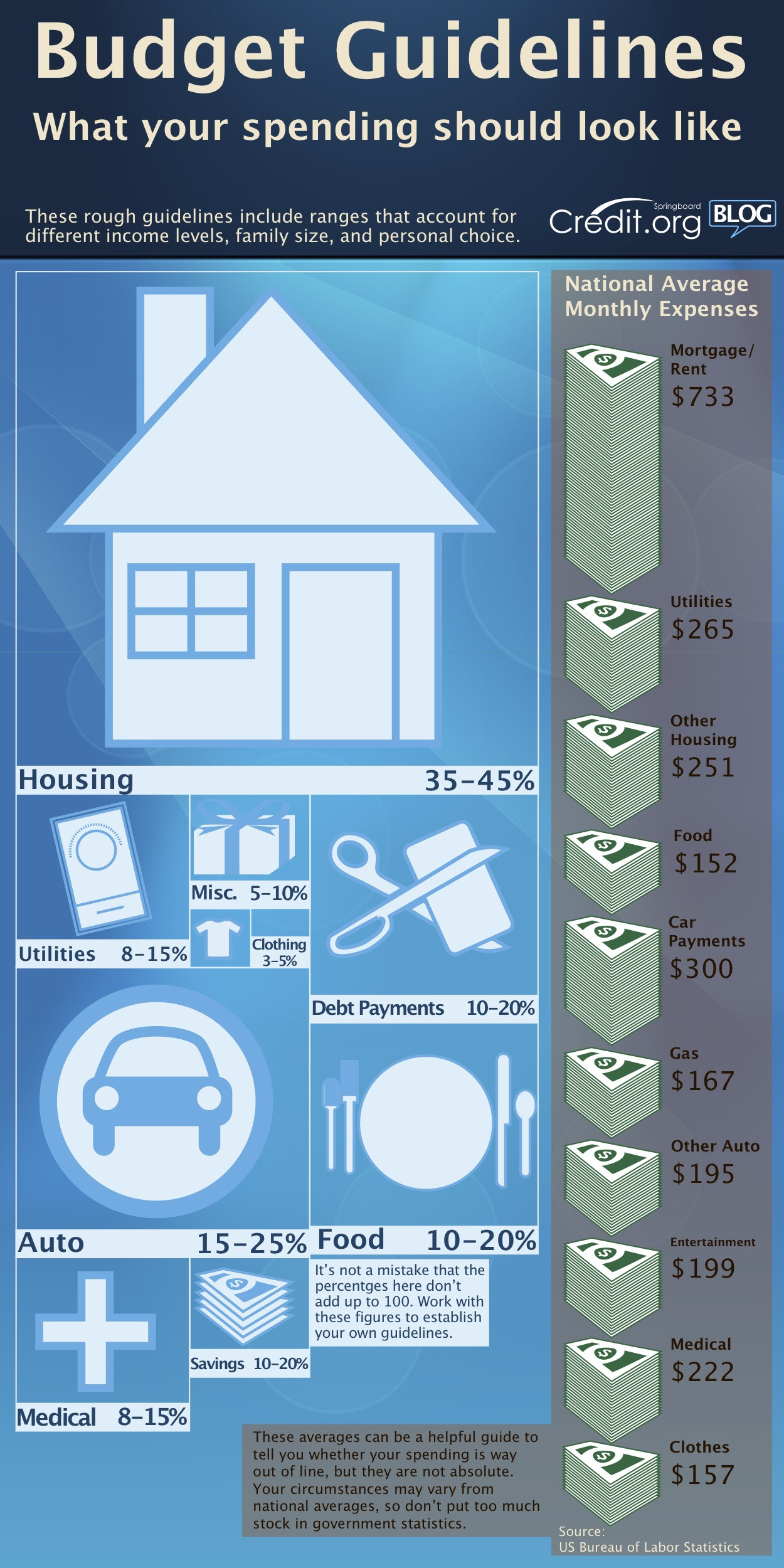
Still, this visual will give you a rough idea of the average cost-of-living as a percentage of income for laymen.  We all love benchmarks; don’t we?

Assessment

But, does the above infographic relate to medical and financial services professionals; why or why not, and if so, how?

Conclusion

Your thoughts and comments on this ME-P are appreciated. Feel free to review our top-left column, and top-right sidebar materials, links, URLs and related websites, too. Then, subscribe to the ME-P. It is fast, free and secure.

Speaker: If you need a moderator or speaker for an upcoming event, Dr. David E. Marcinko; MBA – Publisher-in-Chief of the Medical Executive-Post – is available for seminar or speaking engagements. Contact: MarcinkoAdvisors@msn.com

OUR OTHER PRINT BOOKS AND RELATED INFORMATION SOURCES:


Product Details  Product Details

Too Big to Fail?

Join Our Mailing List

The 2008 Financial Crisis –OR– Ponzi Scheme?

Conclusion

And so, your thoughts and comments on this ME-P are appreciated. Please review our top-left column, and top-right sidebar materials, links, URLs and related websites, too. Then, subscribe to the ME-P. It is fast, free and secure.

Link: http://feeds.feedburner.com/HealthcareFinancialsthePostForcxos

Speaker: If you need a moderator or speaker for an upcoming event, Dr. David E. Marcinko; MBA – Publisher-in-Chief of the Medical Executive-Post – is available for seminar or speaking engagements. Contact: MarcinkoAdvisors@msn.com

Our Other Print Books and Related Information Sources:

Health Dictionary Series: http://www.springerpub.com/Search/marcinko

Practice Management: http://www.springerpub.com/product/9780826105752

Physician Financial Planning: http://www.jbpub.com/catalog/0763745790

Medical Risk Management: http://www.jbpub.com/catalog/9780763733421

Healthcare Organizations: www.HealthcareFinancials.com

Physician Advisors: www.CertifiedMedicalPlanner.com

Subscribe Now: Did you like this Medical Executive-Post, or find it helpful, interesting and informative? Want to get the latest ME-Ps delivered to your email box each morning? Just subscribe using the link below. You can unsubscribe at any time. Security is assured.

Link: http://feeds.feedburner.com/HealthcareFinancialsthePostForcxos

Sponsors Welcomed: And, credible sponsors and like-minded advertisers are always welcomed.

Link: https://healthcarefinancials.wordpress.com/2007/11/11/advertise

Product DetailsProduct DetailsProduct Details

Managing and Mitigating a Doctor’s Risky Life

Insurance and Risk Management Strategies for Doctors

and their Advisors

Book Preview 

http://www.amazon.com/Insurance-Management-Strategies-Physicians-Advisors/dp/0763733423/ref=sr_1_4?s=books&ie=UTF8&qid=1328701489&sr=1-4

ORDER HERE

http://www.jblearning.com/catalog/9780763733421/

Is it Time for a Credit Check-Up [brief doctor visit or extendend consultation]?

Join Our Mailing List 

Reviewing your Credit Report for the New Year [A CPT® code analogy]

Source: creditdonkey.com

Conclusion     

And so, your thoughts and comments on this ME-P are appreciated. Please excuse our pun and review the top-left column, and top-right sidebar materials, links, URLs and related websites, too. Then, subscribe to the ME-P. It is fast, free and secure.

Link: http://feeds.feedburner.com/HealthcareFinancialsthePostForcxos

Speaker: If you need a moderator or speaker for an upcoming event, Dr. David E. Marcinko; MBA – Publisher-in-Chief of the Medical Executive-Post – is available for seminar or speaking engagements. Contact: MarcinkoAdvisors@msn.com

Our Other Print Books and Related Information Sources:

Health Dictionary Series: http://www.springerpub.com/Search/marcinko

Practice Management: http://www.springerpub.com/product/9780826105752

Physician Financial Planning: http://www.jbpub.com/catalog/0763745790

Medical Risk Management: http://www.jbpub.com/catalog/9780763733421

Healthcare Organizations: www.HealthcareFinancials.com

Physician Advisors: www.CertifiedMedicalPlanner.com

Subscribe Now: Did you like this Medical Executive-Post, or find it helpful, interesting and informative? Want to get the latest ME-Ps delivered to your email box each morning? Just subscribe using the link below. You can unsubscribe at any time. Security is assured.

Link: http://feeds.feedburner.com/HealthcareFinancialsthePostForcxos

Sponsors Welcomed: And, credible sponsors and like-minded advertisers are always welcomed.

Link: https://healthcarefinancials.wordpress.com/2007/11/11/advertise


Product Details  Product Details

Automobile Insurance Update for Medical Professionals

Some Need-to-Know [Not Boring] Information for Doctors, Nurses and CXOs

Join Our Mailing List

By Dr. David Edward Marcinko FACFAS, MBA, CPHQ, CMP™

[Publisher-in-Chief]

As regular ME-P readers know, I held a property and casualty insurance license for more than 15 years; this included homeowners and automobile insurance.

BTW:  P&C also includes malpractice insurance [doctors and medical professionals] and E&O insurance [accountants, financial advisors, attorneys, etc]. Yep! Med-mal is classified under the property-casualty moniker. I even edited a handbook on the topic. But, I digress.

On the Importance of Automobiles

With the possible exception of the handgun, the automobile represents the greatest single item of ownership that is capable of inflicting death, injury and damage. I learned this first-hand after covering the ER for many years.

America’s fascination with the automobile has resulted in a marked increase in the power and potential speed of our vehicles.  The aging trend in Sports Utility Vehicles (SUVs) has also witnessed a substantial increase in damage due to their higher ground clearance and heavier frames.  The owners and operators of any vehicle must be financially able to respond to any resulting claims, or they need to transfer the risk through insurance.  All states require some minimal coverage for personal vehicles.

The F.A.P.

The most frequently used policy to insure individual private passenger vehicle risks is the Family Automobile Policy (FAP).   It provides two major types of coverage: liability and physical damage.

Liability coverage includes both bodily injury and property damage. Physical damage, on the other hand, includes comprehensive and collision coverage.

[A] Liability Coverage

The liability section of the FAP is contained within most policies as Part A – Liability and Part B -Personal Injury Protection.

[1] Bodily Injury

Bodily injury liability coverage generally includes sickness, disease and death, and is expressed in dual limits — per person and per occurrence.  Nearly half of the states require minimums of $25,000 per person and $50,000 per occurrence.  Higher limits of $100,000 per person and $300,000 per occurrence are often required for consideration of umbrella coverage.

[2] Property Damage

Property damage liability is coverage for damage or destruction to the property of others and includes loss of use.  Liability coverage limits usually include property damage limits as the third number, i.e., $100/300/25.  The coverage here would be for $25,000 of property damage.  As automobiles become more expensive, however, coverage to $50,000 is not considered excessive.

[3] Personal Injury

Personal injury coverage is provided for medical expenses, funeral expenses and loss of earnings for anyone sustaining an injury while occupying your vehicle, or from being struck by your vehicle while a pedestrian.

Liability insurance follows the vehicle, not the driver.  Coverage is extended to the vehicle owner and any resident in the same household.  It also covers anyone using the insured vehicle with the permission of the owner and within the scope of that permission.

Newly acquired vehicles are usually covered automatically for liability for 15-30 [getting shorter] days after acquisition, but physical damage must have been on all currently covered vehicles to be included.  Coverage is also typically extended to a temporary substitute automobile, but only if this vehicle is used in place of the covered automobile, because of its breakdown, repair, servicing, loss or destruction.

[B] Physical Damage Coverage

[1] Comprehensive

Comprehensive physical damage includes coverage for theft, vandalism, broken windshields, falling objects, riot or civil commotion, and even damage from foreign substances, such as paint.  Comprehensive is often described as coverage for all those hazards other than collision.

[2] Collision

Collision involves the upset of the covered vehicle and collision with an object, usually another vehicle, and not enumerated in the discussion of comprehensive.  Colliding with a bird or animal is considered under the comprehensive coverage.

The distinction between comprehensive coverage and collision coverage is more than technical.  The deductible provisions of the FAP often show a considerable difference in these areas, with the collision deductible typically being much greater.

Damage to tires can be covered by provisions in either comprehensive or collision.  Exclusions typically include normal wear and tear, rough roads, hard driving or hitting or scraping curbs.

[C] Repairs after the Accident

Following a collision, the insurance company will assign a claims adjuster to determine the extent of damage and the cost of repairs.  If these repairs exceed the estimated value of the vehicle, it may be “totaled.”  Experience tells me that the value of the vehicle to the owner nearly always exceeds that estimated by the insurance company.

[D] Uninsured / Underinsured Motorists Coverage

Uninsured motorist coverage provides protection from the other driver who is operating his/her vehicle without any insurance coverage.  It covers expenses resulting from injury or death as well as property damage.  There are currently a dozen states where it is estimated that over 20 percent of the vehicles on the highway are being operated without any insurance.  This is not coverage that should be rejected when buying automobile insurance.

Underinsured motorist coverage provides protection from the other driver who purchased only the state-mandated minimum liability insurance coverage.  Again, this is not coverage that the medical professional or healthcare practitioner should thoughtlessly reject when buying automobile insurance.

Assessment

The medical professional is strongly urged to consider purchasing replacement cost coverage rather than accepting actual cash value car insurance, which is the depreciated value of the vehicle. The cost may be higher for this coverage, but accepting a larger deductible will often make up the difference. Paying a little more towards the deductible could easily be worth it, if the damage is extensive.

Or, if you have a classic pristine Eurpean touring sedan [2000 pearl-white Jaguar, XJ-V8-L], built for the Queen in Coventry England, like I do. Jay Leno is my hero!

Conclusion                

And so, your thoughts and comments on this ME-P are appreciated. Feel free to review our top-left column, and top-right sidebar materials, links, URLs and related websites, too. Then, subscribe to the ME-P. It is fast, free and secure.

Link: http://feeds.feedburner.com/HealthcareFinancialsthePostForcxos

Speaker: If you need a moderator or speaker for an upcoming event, Dr. David E. Marcinko; MBA – Publisher-in-Chief of the Medical Executive-Post – is available for seminar or speaking engagements. Contact: MarcinkoAdvisors@msn.com

Our Other Print Books and Related Information Sources:

Health Dictionary Series: http://www.springerpub.com/Search/marcinko

Practice Management: http://www.springerpub.com/product/9780826105752

Physician Financial Planning: http://www.jbpub.com/catalog/0763745790

Medical Risk Management: http://www.jbpub.com/catalog/9780763733421

Healthcare Organizations: www.HealthcareFinancials.com

Physician Advisors: www.CertifiedMedicalPlanner.com

Subscribe Now: Did you like this Medical Executive-Post, or find it helpful, interesting and informative? Want to get the latest ME-Ps delivered to your email box each morning? Just subscribe using the link below. You can unsubscribe at any time. Security is assured.

Link: http://feeds.feedburner.com/HealthcareFinancialsthePostForcxos

Sponsors Welcomed: And, credible sponsors and like-minded advertisers are always welcomed.

Link: https://healthcarefinancials.wordpress.com/2007/11/11/advertise

Product Details  Product Details

Medical Identity Theft on the Rise

Join Our Mailing List

Open Up Dentists – and Physicians, Too!

[By D. Kellus Pruitt DDS]

If I tell you that your patients’ insurance identities can be sold for $50 each, how much will you trust your employees on Monday, Doc?

The Experts Speak

According to a panel of cyber-security experts at a recent Digital Health Conference, medical identity theft has become one of the most lucrative forms of identity theft. “DHC: EHR Data Target for Identity Thieves” by MedPage Today Associate Staff Writer Cole Petrochko, was posted last week

http://www.medpagetoday.com/PracticeManagement/InformationTechnology/30074

“Presentations at the Digital Health Conference here indicated that a single patient’s electronic health records can fetch $50 on the black market — a much fatter target than more familiar forms of identity theft, such as Social Security numbers ($3), credit card information ($1.50), date of birth ($3), or mother’s maiden name ($6).”

eMRs Not Like Credit-Cards

“And, unlike a credit card number, patients’ healthcare records cannot be cancelled or changed to prevent stolen data from being used by criminals”, said John DeLuca, of EMC Corp., an information technology company.

The Street Value of eDRs 

What do you want to bet that medical identities downloaded from dentists’ computers bring $50; as well. I’d like to share a special, visceral sentiment with my shy, HIPAA covered colleagues:

I warned you, damn it! And, I assume, just like virtually all other silent dentists in the nation, you’ve done NOTHING to safeguard your patients’ identities. Even if you don’t like truth served bluntly, this dentist has your reputation in mind when I warn that if your practice experiences a reportable data breach of over 500 records, and your patients’ identities aren’t encrypted, those who choose to remain with your practice will never trust you as much as they do today – even if you properly report the breach. Of the estimated 20% who will never return, many will probably look for a gentle dentist who doesn’t store patients’ Protected Health Information (PHI) on computers …. Like me. (Yea, that was a sales pitch. As one might expect, I certainly welcome discussion of it with anyone).

ADA Laggards 

After 5 years of awaiting responses from unaccountable leaders inside and outside the American Dental Association concerning HIPAA and EDRs, It feels really good to aggravate 9 out of 10 dentists still reading this – challenging those who normally take offense with professional stoicism to loosen up and share their feelings with everyone for once … God help me, I do love this so.

More About the Black Market 

The black market price for EHRs has increased ten-fold in the last 5 years. In 2006, I warned in a guest column on WTN that it only takes one dishonest employee needing a couple of thousand quick dollars to potentially bankrupt a practice almost without risk of being caught. Back then, the black market price for a stolen medical identity was estimated at only $5 (See: “Careful with that electronic health record, Mr. Leavitt,” WTN News, October 18, 2006).

http://wtnnews.com/articles/3407/

It’s no secret that reticent ADA officials like President-elect Dr. Robert Faiella have suspiciously failed in their duty to be transparent with dues-paying members about the liabilities of the EHRs – even as they continue to recklessly promote paperless practices. The result: Almost all dentists in theUSstill maintain patients’ unencrypted medical identities on their office computers – often guarded by a flimsy password that is still cute a decade later. (Did I hear a gasp?).

Consider This!

Consider this, Doc! If a practice has 3000 active patients with identities worth $150,000, all one dishonest employee needs for dreams to come true is a flash drive and private time with your computer.

Assessment

Show me a dentist who thinks the benefits of EHRs to dental patients still outweigh the liabilities and I’ll show you a dangerously naive healthcare provider who probably doesn’t know about KPMG Auditors. Let’s face the facts bravely, Doc. Now would be a terrible time to invest in an EDR system – even cloud based. The proven, avoidable danger EDRs bring to American dental patients is unacceptable and only getting worse. Give it a year or so.

Channel Surfing the ME-P

Have you visited our other topic channels? Established to facilitate idea exchange and link our community together, the value of these topics is dependent upon your input. Please take a minute to visit. And, to prevent that annoying spam, we ask that you register. It is fast, free and secure.

Conclusion

Your thoughts and comments on this ME-P are appreciated. Feel free to review our top-left column, and top-right sidebar materials, links, URLs and related websites, too. Then, subscribe to the ME-P. It is fast, free and secure.

Speaker: If you need a moderator or speaker for an upcoming event, Dr. David E. Marcinko; MBA – Publisher-in-Chief of the Medical Executive-Post – is available for seminar or speaking engagements. Contact: MarcinkoAdvisors@msn.com

OUR OTHER PRINT BOOKS AND RELATED INFORMATION SOURCES:

Product DetailsProduct Details

Product Details

Top Ten Car Insurance Companies for Doctors

Information All Medical Professionals Need to Know

By Dr. David Edward Marcinko MBA CMP™

[Publisher-in-Chief]

As regular ME-P readers know, I held a property and casualty insurance license for more than 15 years; this included homeowners and automobile insurance.

It also included malpractice [doctors and medical professionals] and E&O insurance [accountants, financial advisors, attorneys, etc]. Yep! Med-mal is classified under the property-casualty moniker. I even edited a handbook on the topic.

So, it is no surprise that car insurance companies number well over 100 in many states. But, who are the top 10 car insurance companies? Most doctors and lay drivers would not be surprised to see Allstate, State Farm or GEICO on the list of top 10 car insurance companies by market share; but how about USAA, Farmers or Liberty Mutual?

Source: Carinsurancecompanies.net

After an Accident

Following a collision, the insurance company will assign a claims adjuster to determine the extent of damage and the cost of repairs.  If these repairs exceed the estimated value of the vehicle, it may be “totaled.”  Experience tells me that the value of the vehicle to the owner nearly always exceeds that estimated by the insurance company. This is true in my case, as well.

Assessment

The medical professional is therefore strongly urged to consider purchasing replacement cost coverage rather than accepting actual cash value, which is the depreciated value of the vehicle. The cost may be higher for this coverage, but accepting a larger deductible will often make up the difference. Paying a little more towards the deductible could easily be worth it, if the damage is extensive.

Or, if you have a special vehicle [pristine pearl white 2001 Jaguar, XJ-V8-LWB] like I do.

Conclusion

Your thoughts and comments on this ME-P are appreciated. Feel free to review our top-left column, and top-right sidebar materials, links, URLs and related websites, too.

Then, subscribe to the ME-P. It is fast, free and secure.

Speaker: If you need a moderator or speaker for an upcoming event, Dr. David E. Marcinko; MBA – Publisher-in-Chief of the Medical Executive-Post – is available for seminar or speaking engagements. Contact: MarcinkoAdvisors@msn.com

OUR OTHER PRINT BOOKS AND RELATED INFORMATION SOURCES:

  Product DetailsProduct Details

How to Select a Property and Casualty Insurance Agent

Eschewing Conventional Wisdom

[By Dr. David Edward Marcinko MBA CMP™]

http://www.CertifiedMedicalPlanner.org

In my travels, and various consulting engagements, I am often asked how to select a good PC agent. As a former insurance agent myself, I know what is required for my medical colleagues. And, there is no doubt that a good property and casualty (P&C) agent is needed to protect the physicians’ home and medical practice business entity, etc.

No Dedicated Agents

The P&C agent should not be dedicated to a single company, but have an array of carriers with which the home or practice can be placed.  I opine thusly even though most insurance companies will offer a discount if you place multiple coverage with them.

Select “Best of Breed”

However, this may not be as beneficial as insuring each need with a specialist. So, do not hesitate to place different types of coverage with different insurers. Selecting the “best of breed” may be more work; but it also may be more beneficial when a claim is made.

Assessment

Remember, by agency law, and definition, P&C agents are not fiduciaries.

Conclusion

Your thoughts and comments on this ME-P are appreciated. Feel free to review our top-left column, and top-right sidebar materials, links, URLs and related websites, too. Then, subscribe to the ME-P. It is fast, free and secure.

Speaker: If you need a moderator or speaker for an upcoming event, Dr. David E. Marcinko; MBA – Publisher-in-Chief of the Medical Executive-Post – is available for seminar or speaking engagements. Contact: MarcinkoAdvisors@msn.com

OUR OTHER PRINT BOOKS AND RELATED INFORMATION SOURCES:

Product Details  Product Details

Why I Rue the Hospital “Team-Based Medicine” Approach to In-Patient Care

Join Our Mailing List

Or, Whose Patient is it – Anyway?

By Dr. David Edward Marcinko MBA, CMP™

www.CertifiedMedicalPlanner.org

[ME-P Publisher-in-Chief]

Ok, I admit it; I may be an aging curmudgeon [just ask my wife and daughter] who has not regularly seen patients in the office for the last decade. A consult here, Independent Medical Examination [IME] there, or a surgical assist when needed has been the extent of my patient experience since my transition out of direct care medicine in 2000-01.

Moreover, I admit to not being an ardent fan of hospital-based medicine [with all due respect to colleague and uber-hospitalist Robert Wachter MD, who I admire and have frequently mentioned in my books, white papers, speaking engagements and here on this Medical-Executive Post].

I am also not completely in favor of the many new-fangled “specialties” and medical business models.  And, as recent models and linguistic evolution occurred, the nomenclature designation of hospitalist was followed by that of hospital-intensivist, hospital-proceduralist and hospital-nocturnalist, etc [http://medinnovationblog.blogspot.com and personal communication Richard L. Reece MD].

Enter the Team-Based Hospital Doctors

And now – for the last five years or so on my radar – there is a new term to add to the lexicon: team-based hospital medicine [practice], or similar. But, I ask, whose patient is it? Who is accountable? Where does the buck of responsibility stop?

The Quintessential Example

On Friday, May 9, 2003, a 5-year-old boy was undergoing diagnostic testing for his epilepsy at Children’s Hospital in Boston when he suffered a massive seizure. Two days later, on Mother’s Day, he died. Despite the fact that he was in intensive care at one of the world’s leading pediatric hospitals, none of the physicians caring for him ordered the treatment that could have saved his life.

The death was tragic, but even more troubling from an organizational perspective was the series of events that led up to it. The Massachusetts Department of Public Health investigated the death, and The Boston Globe reported on the results that, “the investigation portrays a situation where lines of authority were deeply tangled, and where no one person had accountability for the patient. Each of the doctors who initially worked on the case–two at the bedside and one consulting by phone–told investigators that they thought one of the others was in charge.” In the end, no one was in charge.

This is a striking example of how even the most talented clinicians in one of the world’s best hospitals can fail not only to provide adequate care, but to save a savable life—all because the lines of authority were unclear. The lack of clarity resulted in this team’s inability to collaborate effectively at a time when the stakes couldn’t have been higher.

Here are two other benign, but more personal, examples circa 2011.

My Personal Experiences

My Sister

This past summer, my sister was in a VA hospital [extremity injuries, nothing serious] for about a week. She was seen by 13 different physicians who were on her “team”; not to mention the plethora of other allied healthcare “team-members”. Me, my wife [RN], and/or her boyfriend [Army Medic and a PA] were at her bedside at least 12-15 hours each day. She was rarely left alone, by design, as we all recalled the admonition of former AMA President Tom R. Reardon MD, to always have a bedside advocate while in the hospital.

Yet, she was offered the wrong medications on one occasion, personally mis-identified twice, and it was obvious that her team-members rarely communicated or discussed her case [by their own admission], or even reviewed her electronic medical records [vistA system] before rounds. Here, the “system is down” was cited as causative: https://medicalexecutivepost.com/2009/09/21/what-is-a-client-server-system

My Dad

Now, later this same year and under the same patient advocate approach, my dad was in two different hospitals sequentially, both using the “team-based” care model. In each, members did not know, or were loathe acknowledging, who was in charge of his case! Malpractice phobia was apparent despite the coterie of, no doubt brilliant, MD/PhD interns, residents and fellows making daily rounds by starring at their shoes. One physician even cited her hectic return from vacation as the reason she examined my dad – for the first time – without reading his paper chart. “Doctors need vacations, too”, was her flippant response when challenged.

Outcomes

Fortunately, our insider knowledge and – shall we say – “charming swagger” was helpful in avoiding major complications with the continuity-of-care in the above two examples. But, most patients are not so blessed!

Our Newest Book

These stories reflect just one of many difficult collaboration challenges in healthcare, today.

In her textbook chapter, Collaborating to Improve Operating Performance in a Changing Healthcare Landscape [Opportunities for Improvement Widespread], contributing author Jennifer Tomasik MS, Principal at CFAR [Center For Applied Research Inc, in Cambridge, MA], focuses on the increasing need for collaboration among physicians, clinicians, hospital executives, and administrative leaders in the dynamic, complex healthcare environment. She looks specifically at collaboration along three different dimensions, including

  • inter-professional teams,
  • institution to institution, and
  • physicians and administrators.

In each instance, she describes useful tools that can be applied to improve collaboration and overall institutional performance—all in the service of providing better patient care.

Assessment

To me, it seems pretty obvious that “hospital team-based” medical care is an oxy-moron. On one hand, it appears to reduce risk, but on the other hand, it appears to reduce quality care as well. Moreover, it also seems to be an invoice generating machine, and revenue enhancing mechanism

And so, beyond this individual ME-P, and its’ tragic and trivial examples, it is important for hospitals and healthcare organizations to improve collaboration. Our patients depend on us to get the philosophy of “hospital team-based” care right, if it is to continue. Otherwise, it will become another good intention, gone awry, in the changing hospital ecosystem that is domestic health care.

Pre-Order Here:

“Healthcare Organizations” [Management Strategies, Tools, Techniques and Case Studies]

In-Process, 425 pages, est., from (c) Productivity Press 2012
http://www.crcpress.com/product/isbn/9781439879900

Product DetailsProduct Details

Conclusion

Your thoughts and comments on this ME-P are appreciated. Feel free to review our top-left column, and top-right sidebar materials, links, URLs and related websites, too. Then, subscribe to the ME-P. It is fast, free and secure.

Link: http://feeds.feedburner.com/HealthcareFinancialsthePostForcxos

Speaker: If you need a moderator or speaker for an upcoming event, Dr. David E. Marcinko; MBA – Publisher-in-Chief of the Medical Executive-Post – is available for seminar or speaking engagements. Contact: MarcinkoAdvisors@msn.com

OUR OTHER PRINT BOOKS AND RELATED INFORMATION SOURCES:

LEXICONS: http://www.springerpub.com/Search/marcinko
PHYSICIANS: www.MedicalBusinessAdvisors.com
PRACTICES: www.BusinessofMedicalPractice.com
HOSPITALS: http://www.crcpress.com/product/isbn/9781466558731
CLINICS: http://www.crcpress.com/product/isbn/9781439879900
ADVISORS: www.CertifiedMedicalPlanner.org
BLOG: www.MedicalExecutivePost.com

Product DetailsProduct DetailsProduct Details

Product Details  Product Details

   Product Details 

Understanding the Risks of Health 2.0 in Medical Practice

Risk Management and Insurance Strategies for Physicians and Financial Advisors

Insurance and Risk Management Strategies for Physicians and Advisors

Channel Surfing the ME-P

Have you visited our other topic channels? Established to facilitate idea exchange and link our community together, the value of these topics is dependent upon your input. Please take a minute to visit. And, to prevent that annoying spam, we ask that you register. It is fast, free and secure.

Conclusion

Your thoughts and comments on this ME-P are appreciated. Feel free to review our top-left column, and top-right sidebar materials, links, URLs and related websites, too. Then, subscribe to the ME-P. It is fast, free and secure.

Speaker: If you need a moderator or speaker for an upcoming event, Dr. David E. Marcinko; MBA – Publisher-in-Chief of the Medical Executive-Post – is available for seminar or speaking engagements. Contact: MarcinkoAdvisors@msn.com

OUR OTHER PRINT BOOKS AND RELATED INFORMATION SOURCES:

Comprehensive Financial Planning Strategies for Doctors and Advisors: Best Practices from Leading Consultants and Certified Medical Planners(TM)* 8

RAC Demand Letters Replaced

CMS Transfers Responsibility

By Staff Reporters

Join Our Mailing List 

January 2012 marks a significant change for Recovery Auditors as the Centers for Medicare & Medicaid Services (CMS) is transferring the responsibility for demand letters from the auditors to claims processing contracts. The reason for the change is “to avoid any delays in demand letter issuance,” according to MLN Matters article 7436.

The Result

As a result, when a Recovery Auditor finds improper payments, they will submit claim adjustments to your Medicare (claims processing) contractor. The contractors will carry the responsibility of fielding concerns throughout the time frame of the payment recovery and the appeals process.

Assessment

Read the full article here.

Conclusion

And so, your thoughts and comments on this ME-P are appreciated. Feel free to review our top-left column, and top-right sidebar materials, links, URLs and related websites, too. Then, subscribe to the ME-P. It is fast, free and secure.

Link: http://feeds.feedburner.com/HealthcareFinancialsthePostForcxos

Our Other Print Books and Related Information Sources:

Health Dictionary Series: http://www.springerpub.com/Search/marcinko

Practice Management: http://www.springerpub.com/product/9780826105752

Physician Financial Planning: http://www.jbpub.com/catalog/0763745790

Medical Risk Management: http://www.jbpub.com/catalog/9780763733421

Healthcare Organizations: www.HealthcareFinancials.com

Physician Advisors: www.CertifiedMedicalPlanner.com

Subscribe Now: Did you like this Medical Executive-Post, or find it helpful, interesting and informative? Want to get the latest ME-Ps delivered to your email box each morning? Just subscribe using the link below. You can unsubscribe at any time. Security is assured.

Link: http://feeds.feedburner.com/HealthcareFinancialsthePostForcxos

Sponsors Welcomed: And, credible sponsors and like-minded advertisers are always welcomed.

Link: https://healthcarefinancials.wordpress.com/2007/11/11/advertise

Product DetailsProduct DetailsProduct Details       

Product Details  Product Details

   Product Details 

Dr. David E. Marcinko is “In-the-News”

Our ME-P Editor is an Industry “Mover and Shaker”

By Ann Miller RN MHA

[Executive-Director]

Link: http://www.physiciansmoneydigest.com/search?get1=search&get2=marcinko

Link: www.medicalbusinessadvisors.com_forum-books.asp

Our Other Print Books and Related Information Sources:

Health Dictionary Series: http://www.springerpub.com/Search/marcinko

Practice Management: http://www.springerpub.com/product/9780826105752

Physician Financial Planning: http://www.jbpub.com/catalog/0763745790

Medical Risk Management: http://www.jbpub.com/catalog/9780763733421

Healthcare Organizations: www.HealthcareFinancials.com

Physician Advisors: www.CertifiedMedicalPlanner.com

Subscribe Now: Did you like this Medical Executive-Post, or find it helpful, interesting and informative? Want to get the latest ME-Ps delivered to your email box each morning? Just subscribe using the link below. You can unsubscribe at any time. Security is assured.

Link: http://feeds.feedburner.com/HealthcareFinancialsthePostForcxos

Sponsors Welcomed: And, credible sponsors and like-minded advertisers are always welcomed.

Link: https://healthcarefinancials.wordpress.com/2007/11/11/advertise

Product DetailsProduct DetailsProduct Details       

Product Details  Product Details

   Product Details 

Scientists Cast Doubt on TSA Tests of Full Body Scanners

Safe or Not – A Controversy

By Michael Grabell

ProPublica, May 16, 2011, 2:11 p.m.

Join Our Mailing List 

The Transportation Security Administration says its full-body X-ray scanners are safe and that radiation from a scan is equivalent to what’s received in about two minutes of flying. The company that makes them says it’s safer than eating a banana [1].

But some scientists with expertise in imaging and cancer say the evidence made public to support those claims is unreliable. And in a new letter [2] sent to White House science adviser John Holdren, they question why the TSA won’t make the scanners available for independent testing by outside scientists.

The machines, which are designed to reveal objects hidden under clothing, have the potential to close a significant security gap for the TSA because metal detectors can’t find explosives or ceramic knives, which can be just as sharp as the box cutters that hijackers used on 9/11.

Enhanced Pat-Downs

They are also important for TSA’s public relations battle over the alternative, the “enhanced pat-down,” which has bred an epidemic of viral videos: A 6-year-old girl [3] is touched from head to toe. A former Miss USA [4] says she was violated. A software programmer warns a screener, “If you touch my junk [5], I’m going to have you arrested.”

After the underwear bomber tried to blow up a Northwest Airlines plane on Christmas Day 2009, the TSA ramped up deployment of full-body scanners and plans to have them at nearly every security line by 2014.

Scanner Types

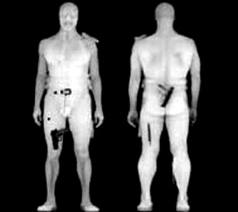
There are two types of body scanners [6]. Millimeter wave machines emit a radio frequency similar to cellphones. Backscatters work like a fast-moving X-ray. In the latter, the rays bounce off the skin and create a fuzzy white image [7] of the passenger’s body. Because the beam doesn’t go through the body, most of its radiation is received by the skin

The FDA

The TSA says the backscatter technology has been evaluated by the Food and Drug Administration [8], the National Institute for Standards and Technology [9] and the Johns Hopkins University Applied Physics Laboratory [10]. Survey teams are using radiation-detecting dosimeters to check the machines at airports. The TSA says the results have all confirmed that the scanners don’t pose a significant risk to public health.

According to the agency and many radiation experts, the dose is so low, even for children or cancer patients; that someone would have to pass through the machines more than a thousand times before approaching the annual limit set by radiation safety organizations.

Test Flaws

But the letter to the White House science adviser, signed by five professors at University of California, San Francisco, and one at Arizona State University, points out several flaws in the tests. Studies published in scientific journals in the last few months have also cast doubt on the radiation dose and the machines’ ability to find explosives.

A number of scientists, including some who believe the radiation is trivial, say more testing should be done given the government’s plans to put millions of passengers through the machines. And they have been disturbed by the TSA’s reluctance to do so.

“There’s no real data on these machines, and in fact, the best guess of the dose is much, much higher than certainly what the public thinks,” said John Sedat, a professor emeritus in biochemistry and biophysics at UCSF and the primary author of the letter.

The same group stirred controversy last year when it sent a letter to Holdren [11] arguing that while the overall dose to the body may be low, the TSA hadn’t quantified the dose to the skin. Last fall, FDA and TSA officials released a study [12] that estimated the dose to the skin to be twice the dose to the body, though still extremely low.

In the most recent letter sent to Holdren on April 28th, the professors note that the Johns Hopkins lab didn’t test an actual airport machine. Instead, the tests were done on a model built by the manufacturer, Rapiscan [13], and configured to resemble a system previously tested by the TSA.

The researchers’ names have been kept secret, and the report on the tests is so “heavily redacted” that “there is no way to repeat any of these measurements,” they wrote.

The physics and medical professors also took issue with the device used to measure the radiation. Although the device, known as an ion chamber, is commonly used to test medical equipment, they argue that the detector gets overwhelmed by the amount of radiation the backscatter deposits in a short time and might not provide accurate readings.
Helen Worth, a spokeswoman for the Johns Hopkins lab, referred questions to the TSA.

Part of the trouble is that there is no ideal device for measuring the radiation dose given by backscatter X-rays, said David Brenner, director of theColumbia University Centerf or Radiological Research. The machines emit a pencil beam that rapidly moves across and up and down the body, he said.

“We are one of the oldest and biggest radiological research centers in the country, and we find this to be a very hard technical problem,” said Brenner, who was not involved with the letter.

Another issue is that there is a lot of uncertainty with the model used to estimate cancer risk from radiation exposure to the skin, said Rebecca Smith-Bindman, a UCSF radiologist who also was not involved in the letter.

Smith-Bindman, who has testified before Congress about excessive radiation from medical scans, studied the TSA reports and said she wasn’t concerned about the airport X-rays.

The risks are “truly trivial,” she wrote in an article [14] for the Archives of Internal Medicine. A passenger would have to undergo 50 airport scans to reach the level of a dental X-ray, 1,000 for a chest X-ray, and 4,000 for a mammogram.

Though imperfect, the available models predict that the backscatters would lead to only six cancers over the course of a lifetime among the approximately 100 million people who fly every year, Smith-Bindman concluded.

“There’s really unnecessary fear related to these scans,” she said. “What I’m not as comfortable with is that there has not been access to these machines. They are not being tested on the same regulatory basis that we see on medical equipment.”

After her article was published, Smith-Bindman was contacted by a TSA public affairs officer. During the conversation, she suggested that she or other outside scientists be allowed to test the machine. The official was shocked by the suggestion and said such access could tip off people who want to avoid detection, Smith-Bindman said.

“It was not appreciating that there’s legitimate scientific questions that have to be balanced against the security questions,” she said.

ProPublica

The TSA did not respond to ProPublica’s questions about why it wouldn’t allow outside testing. But at a congressional hearing [15] in March, Robin Kane, assistant administrator for security technology, said doing so would expose a lot of sensitive information the agency wouldn’t normally share publicly. The machines had already been tested several times, he said, and if set up securely, the agency would allow more testing.

The available information leaves scientists with little to work with. Peter Rez, theArizonaStatephysics professor who signed the letter to Holdren, has tried to calculate the radiation by examining the handful of backscatter images that have been released publicly.

The Electronic Privacy Information Center [16], a civil liberties group, sued the Department of Homeland Security, TSA’s parent agency, in federal court seeking release of 2,000 backscatter images used in testing. But, it has not been successful.

The few images that have been made public do not reveal faces or detailed private features. The TSA says the images Rez used are out of date, but Rez says the current image on TSA’s website is unusable.

Using the earlier images, Rez concluded [17] in the Radiation Protection Dosimetry journal that it was highly unlikely the machines could have produced such high-quality images with doses of radiation as low as those described by TSA. He estimated the dose, while still very small, is 45 times higher than the results measured by Johns Hopkins.

Applying Rez’s numbers, Brenner wrote a paper [18] for the journal Radiology, estimating that 100 additional cancers would develop for every 1 billion scans.

For Rez, the real danger occurs if the machine stops in the middle of a scan, allowing the beam to focus on a tiny area for several seconds. Given that the backscatter works with a wheel rotating at a high speed, and that the agency plans to use the scanners continuously 365 days a year, mechanical failures are likely, he said.

Assessment

The TSA says that the scanners have safety systems, such as automatic shutoffs and emergency stop buttons, that will kill the beam in the event of any problem that could result in abnormal radiation. How those fail-safe systems work isn’t entirely clear.

When Johns Hopkins researchers visited the Rapiscan facility, the automatic termination appeared to work. But, the full results of the shutoff tests are redacted.

What’s more, the test system didn’t have an emergency stop button.

Link: http://www.propublica.org/article/scientists-cast-doubt-on-tsa-tests-of-full-body-scanners

Conclusion

Your thoughts and comments on this ME-P are appreciated. Feel free to review our top-left column, and top-right sidebar materials, links, URLs and related websites, too. Then, subscribe to the ME-P. It is fast, free and secure.

Speaker: If you need a moderator or speaker for an upcoming event, Dr. David E. Marcinko; MBA – Publisher-in-Chief of the Medical Executive-Post – is available for seminar or speaking engagements. Contact: MarcinkoAdvisors@msn.com

OUR OTHER PRINT BOOKS AND RELATED INFORMATION SOURCES:

Product DetailsProduct DetailsProduct Details

Product Details  Product Details

   Product Details 

The Epsilon Hack [An Opinion Poll Survey]

An Internet Security Survey

Join Our Mailing List

The recent breach at Epsilon, the Dallas online marketing vendor to more than 2,000 businesses, generated a lot of headlines.  Epsilon clients include financial companies like American Express, Ameriprise Financial, Barclays Bank, Capital One, Citibank, City Market, JPMorgan Chase, as well as Best Buy, The College Board, Disney Vacations, Hilton Honors, The Home Shopping Network, Kroger, Marriott Rewards, Ritz-Carleton, TiVo, Verizon and Walgreens, among others. 

VOTE AND OPINE

And so, should companies be all that worried? How about doctors, hospitals, medical clinics, patients, FAs, BDs, RIAs, CPAs etc? 

Our Other Print Books and Related Information Sources:

Health Dictionary Series: http://www.springerpub.com/Search/marcinko 

Practice Management: http://www.springerpub.com/product/9780826105752

Physician Financial Planning: http://www.jbpub.com/catalog/0763745790

Medical Risk Management: http://www.jbpub.com/catalog/9780763733421

Healthcare Organizations: www.HealthcareFinancials.com

Physician Advisors: www.CertifiedMedicalPlanner.com

Subscribe Now: Did you like this Medical Executive-Post, or find it helpful, interesting and informative? Want to get the latest ME-Ps delivered to your email box each morning? Just subscribe using the link below. You can unsubscribe at any time. Security is assured.

Link: http://feeds.feedburner.com/HealthcareFinancialsthePostForcxos

Sponsors Welcomed:  And, credible sponsors and like-minded advertisers are always welcomed.

Link: https://healthcarefinancials.wordpress.com/2007/11/11/advertise

Product Details  Product Details

   Product Details 

Vows of Change at Moody’s

But, the Flaws Remain the Same

By Jesse Eisinger ProPublica | @eisingerj 

Join Our Mailing List

In the aftermath of the financial crisis, nobody has gone to prison and there haven’t been any serious structural changes in the financial system. But at least everyone involved feels bad about it and has vowed to change, right? For Moody’s Investors Service, those pledges are empty, Bill Harrington says.

In this column, co-published with New York Times’ DealBook, I monitor the financial markets to hold companies, executives and government officials accountable for their actions.

A Window to the Debacle

Mr. Harrington was an analyst in the structured finance group at Moody’s for more than a decade, much of it spent rating collateralized debt obligations. He worked at Moody’s until the middle of last year, although he left the C.D.O. group in 2006. In his job, he had a window on the biggest debacle in the history of credit ratings. Companies like his allowed banks to pass off hundreds of billions worth of paper onto investors by waving their magic wands and deeming the securities investment-worthy.

Since then, the government has tried to change the ratings agencies. The Dodd-Frank financial reform law has some bold measures, like making the ratings firms liable for their judgments. Unfortunately, the rules are in danger of not being enforced because of budget constraints and resistance from the agencies.

But the biggest problems at Moody’s may have been cultural. The dominant ethos during the boom, instilled by Brian M. Clarkson, the former president and chief operating officer [1], was that customer service was Job 1. And the customers were the bankers.

Banker Customers

The ability for bankers to run the show has long been an obvious flaw in the ratings system for structured products. Investment banks create the securities and benefit when they receive generous ratings. Banks pay the agencies that supply the ratings. Yet the agencies are somehow supposed to hold the line with the people who are responsible for their paychecks.

To Moody’s credit, Mr. Clarkson is now gone. To Moody’s discredit, however, his philosophy is largely still in place, at least according to Mr. Harrington.

To the last day Mr. Harrington was there, he says, bankers remained hard-charging and aggressive advocates for their deals, sometimes to the point of abusing the analysts.

Wall Street ain’t beanbag, so that’s not surprising. The troubling aspect is that the Moody’s bosses acted like disinterested brokers between two sides in disputes with analysts, instead of standing up for the analysts and defending their independence. “That was the standard operating procedure that got worse and worse. We didn’t get the benefit of the doubt,” Mr. Harrington said.

When I asked Moody’s about Mr. Harrington’s experiences, a spokesman wrote in an e-mail: “We take strong exception to your characterization of Moody’s culture. We have always had an unwavering culture of integrity, analytical independence and objectivity and that culture has only grown stronger since the financial crisis.” He pointed to numerous efforts at Moody’s to improve the ratings process and to bolster Moody’s procedures.

In the spring of 2009, Mr. Harrington was working on a deal and a banker was persistently calling him. He returned the first call, but had other work that day and didn’t return the next two calls right away. “I thought caller ID served a purpose,” he said wryly.

Soon after, his boss alerted him to a call he’d received from Michael Kanef, the head of compliance. Mr. Kanef wanted to know why Mr. Harrington hadn’t returned the banker’s call. Mr. Harrington was shocked. Why was the head of compliance getting involved? But he got the apparent message: Analysts are to lean over backward for the bankers. That had been Mr. Clarkson’s philosophy, and now it was his successors’.

“The culture persists — and it’s being enforced by compliance department,” Mr. Harrington said.

So who is Mr. Kanef? Before he was the head of regulatory affairs and compliance, he was in charge of ratings on residential mortgage-backed securities [2]. Did such an executive deserve a promotion?

And then there is Raymond W. McDaniel, the chief executive throughout the housing boom, the bust and the entire financial crisis. He remains at the helm. And he had to swallow the bitter pill of more than $9 million in compensation last year. Indeed, most of Moody’s top management has been in place through the crisis.

Moody’s didn’t make Mr. Kanef or Mr. McDaniel available for comment.

The Blame Game

So if Moody’s doesn’t think the executives who ran the company were responsible for its collapse in reputation and contribution to the multitrillion-dollar financial crisis, who do they think is to blame? The analysts, Mr. Harrington says. The hard-working, low-level minions with little decision-making power.

Mr. McDaniel has conceded that sometimes “we drink the Kool-Aid.”

But that hardly makes the analysts to blame.

“If some analysts drank the Kool-Aid, it was only because management mixed and stirred it up and threatened that analysts wouldn’t get to heaven on the spaceship unless he or she drank it,” Mr. Harrington said.

Moody’s has recognized it has a disaster on its hands — a public relations disaster. Clients — the investors who use ratings — have been losing faith in the agencies. Mr. Harrington said that Moody’s executives marched analysts into meetings to explain how they were going to tell their clients about how much Moody’s had grown and learned from its mistakes. It was as if they were in “Communist re-education camp,” he said.

At one of these meetings, an analyst asked if they could be given training in how to deal with banker abuse, Mr. Harrington recalls. The suggestion was immediately shot down by the executive running the meeting.

Moody’s says that its retraining efforts are part of its continuing efforts to reach out to investors to improve its ratings.

Assessment

When Moody’s executives make public presentations, as when Mr. McDaniel testified [3] in front of the Financial Crisis Inquiry Commission, the overarching theme is that the agency’s problem was limited to the housing-related structured finance. Few people saw how fast and deep the housing market would crash. How could the ratings agencies?

A few weeks ago, Alan Greenspan penned an instantly notorious line: “With notably rare exceptions,” [4] he wrote, unfettered financial markets have worked well. Moody’s persists in believing that with notably rare exceptions, so too have credit ratings.

Full Article: http://www.propublica.org/thetrade/item/vows-of-change-at-moodys-but-the-flaws-remain-the-same/

Conclusion

And so, your thoughts and comments on this ME-P are appreciated. Feel free to review our top-left column, and top-right sidebar materials, links, URLs and related websites, too. Then, subscribe to the ME-P. It is fast, free and secure.

Link: http://feeds.feedburner.com/HealthcareFinancialsthePostForcxos

Speaker: If you need a moderator or speaker for an upcoming event, Dr. David E. Marcinko; MBA – Publisher-in-Chief of the Medical Executive-Post – is available for seminar or speaking engagements. Contact: MarcinkoAdvisors@msn.com

Our Other Print Books and Related Information Sources:

Health Dictionary Series: http://www.springerpub.com/Search/marcinko

Practice Management: http://www.springerpub.com/product/9780826105752

Physician Financial Planning: http://www.jbpub.com/catalog/0763745790

Medical Risk Management: http://www.jbpub.com/catalog/9780763733421

Healthcare Organizations: www.HealthcareFinancials.com

Physician Advisors: www.CertifiedMedicalPlanner.com

Subscribe Now: Did you like this Medical Executive-Post, or find it helpful, interesting and informative? Want to get the latest ME-Ps delivered to your email box each morning? Just subscribe using the link below. You can unsubscribe at any time. Security is assured.

Link: http://feeds.feedburner.com/HealthcareFinancialsthePostForcxos

Sponsors Welcomed: And, credible sponsors and like-minded advertisers are always welcomed.

Link: https://healthcarefinancials.wordpress.com/2007/11/11/advertise

Product DetailsProduct DetailsProduct Details       

Product Details  Product Details

“Journal of Financial Management Strategies” for Healthcare Organizations

ADVERTISEMENT

Hospitals and Healthcare Organizations

[A Textbook of Financial Management Strategies]

Buy from Amazon


Financial Planning and Risk Management Strategies for Physicians

Financial Planning Handbook for Physicians and Advisors

Product Details

 • http://www.jblearning.com/catalog/9780763745790/

Insurance Planning and Risk Management Strategies for Physicians and Advisors

Product Details

http://www.jblearning.com/catalog/9780763733421/

ADVERTISEMENT

Speaker: If you need a moderator or speaker for an upcoming event, Dr. David E. Marcinko; MBA – Publisher-in-Chief of the Medical Executive-Post – is available for seminar or speaking engagements. Contact: MarcinkoAdvisors@msn.com and http://www.springerpub.com/Search/marcinko

About Cyber Insurance for Doctors

Join Our Mailing List

What it is – How it works?

By Staff Reporters

All medical practitioners and ME-P readers and subscribers are aware that there are stiff penalties for protected health information [PHI] data breaches. And, the HIPPA policies and laws are legendary.

Security Standards

Cyber security standards are standards which enable healthcare and other organizations to practice safe security techniques to minimize the number of successful cyber security attacks and HIPPA information breaches.

Assessment

These guides provide general outlines as well as specific techniques for implementing cyber security. For certain specific standards, cyber security certification by an accredited body can be obtained. There are many advantages to obtaining certification including the ability to get cyber security insurance.

Link: ISA – Cyber-Insurance Metrics and Impact on Cyber-Security

Conclusion

Your thoughts and comments on this ME-P are appreciated. Feel free to review our top-left column, and top-right sidebar materials, links, URLs and related websites, too. Then, subscribe to the ME-P. It is fast, free and secure.

Speaker: If you need a moderator or speaker for an upcoming event, Dr. David E. Marcinko; MBA – Publisher-in-Chief of the Medical Executive-Post – is available for seminar or speaking engagements. Contact: MarcinkoAdvisors@msn.com

OUR OTHER PRINT BOOKS AND RELATED INFORMATION SOURCES:

Product DetailsProduct DetailsProduct Details

Product Details  Product Details

   Product Details 

Understanding Client Engagement Letters for Financial Advisors

Review the Basics to Protect Yourself from Liability

By Dr. David Edward Marcinko MBA CMP™

http://www.CertifiedMedicalPlanner.org

[Publisher-in-Chief]

According to the Professional Liability Agents Network (PLAN), a nonprofit association of insurance agencies specializing in risk management and loss prevention, there are two things that FAs should remember about engagement letters: have them and revise them. In fact, according to iMBA Inc’s Dr. Gary L. Bode CPA MSA – an accountant, financial advisor and board certified doctor – not all financial advisors and financial planners use engagement letters. “And, I think they are making a big mistake.”

www.MedicalBusinessAdvisors.com

Moreover, merely having a standard engagement letter is not enough: The changing scope of client service requires advisors and planners to review and update their engagement letters annually. Engagement letters should be updated to reflect changes in the engagement’s scope or timing. Many attorneys also recommend using a separate engagement letter each year to avoid problems of continuous representation and to establish the date of the statute of limitations before the engagement begins (thereby limiting the time period in which a client can file a claim).

The 10 Essential Elements

Even short, simple engagement letters are binding contracts. When creating or updating your engagement letters, make sure several essential provisions are included. Although additional clauses may be necessary, these basic provisions are the framework of your engagement letter.

1. Scope of Services and Limitations

Many doctors and lay professionals think of financial planning as a comprehensive analysis. If your engagement is limited, you must state that clearly in your engagement letter. Courts have held that it is reasonable for a client to expect a comprehensive analysis unless you state otherwise.

2. Client Responsibilities

The client’s role in an engagement is to provide the advisor or planner with certain data and to verify its accuracy. An engagement letter should contain a provision identifying the assistance you expect from your client in providing information and verifying its accuracy. The engagement letter should also specify any timetables applicable to this information.

3. Fees and Billing Procedures

Fee collection suits by advisors and planners against clients can result in professional liability counter-suits. You can prepare for this problem by specifying fees and billing procedures. An important part of this provision is your right to suspend work in progress until unpaid balances are brought current.

4. SEC Provisions for Investment Advisors

Planners who serve in investment advisory roles are required by the SEC to add several clauses to their engagement letters. First, if you collect any part of your fee in advance, you must explain in your engagement letter how a refund of the advance fee will be calculated if the client decides to stop the relationship before you have finished your work.

Second, you must state that you will not assign your responsibilities as a planner to a third party without the written consent of the client.

Finally, you can avoid regulatory responsibilities resulting from your possessing discretionary authority to act on behalf of your client by including in your engagement letter a disclaimer that says you will not exercise your discretionary authority without the client’s express written consent.

5. IRS Requirements

The IRS requires financial advisors and financial planners to have written consent to use a client’s tax return for purposes other than preparing a tax return. Thus, to protect yourself from liability, it’s important to add a “consent to use tax return information” clause in engagement letters.

6. Sharing of Information

Many financial advisors and planners recommend including in engagement letters a clause that allows the planner to receive information from and share information with their client’s other advisors. But, if you’re going to exchange information about a client, you’d better have the client’s affirmation; much like the HIPAA Statutes [business associates agreement].

7. Dispute Resolution

Include an arbitration clause in every engagement letter – arbitration is much faster and cheaper than taking a case through the court system. This theory is supported by PLAN, which recommends including in every engagement letter details about the type of dispute resolution to be used in the case of a disagreement.

8. Limitation of Liability

PLAN recommends that client service professionals require clients to either indemnify them from certain types of claims or establish a dollar limit on their liability. Although this provision has been used successfully in other professions, the SEC position on such clauses seems unclear. So, before adding a limitation of liability or indemnification clause, then, check with your state and federal regulatory agencies about standard procedure.

9. Good Will

Many firms conclude an engagement letter with a “good will” provision that thanks the client for his or her business and offers to discuss the letter and its provisions if the client has questions. While this provision may appear gratuitous, PLAN believes this can be critically important to a defense if a client claims to not know what he or she was signing.

10. Signature

As mentioned above, your engagement letter becomes your contract for professional service. As such, it is important to have it signed by your client http://www.plan.org

Assessment

Much like medical and surgical consent forms, or even treatment plans, client engagement letters for financial services professionals now seem the norm.

Note: Julie Schaeffer, a Chicago-based freelance writer, assisted in the original version of this essay.

Conclusion

Your thoughts and comments on this ME-P are appreciated. Feel free to review our top-left column, and top-right sidebar materials, links, URLs and related websites, too. Then, subscribe to the ME-P. It is fast, free and secure.

Link: http://feeds.feedburner.com/HealthcareFinancialsthePostForcxos

Speaker: If you need a moderator or speaker for an upcoming event, Dr. David E. Marcinko; MBA – Publisher-in-Chief of the Medical Executive-Post – is available for seminar or speaking engagements. Contact: MarcinkoAdvisors@msn.com

OUR OTHER PRINT BOOKS AND RELATED INFORMATION SOURCES:

Product DetailsProduct DetailsProduct Details

Product Details  Product Details

What is Universal-Variable Life Insurance and How Does it Work?

 Insurance Basics for Medical Professionals

By By Jeffrey H. Rattiner, CPA, CFP®, MBA

Join Our Mailing List 

After determining the need for insurance and the amount to purchase, the doctor-client and financial planner’s next task is to match those needs to the client’s objectives to determine what type of policy the client should purchase. The life insurance industry features more products today than ever before. One reason for this change is that, clearly, the insurance industry has expanded its product base to become more competitive. Another reason is that clients’ needs are constantly changing and the insurance companies must keep up with those needs or run the risk of having funds withdrawn from their companies. New and different types of life insurance products are here to stay. Since life insurance represents a significant part of a doctor-client’s risk-management program, planners have to be versed in the specifics of the varied product base.

Definition

Universal variable life insurance is a hybrid of universal life and variable life insurance. It lets policyholders adjust premiums and reconfigure the death benefit level. The cost of this increased flexibility depends on the equities that are invested.

Similarity to Variable Life Insurance

Similar to the variable life contract, the policyholder gets to choose the investment medium under this contract, with no guaranteed cash value levels or growth. Policyowners are given the choice of option A death benefits (face amount only) or option B death benefits (face amount plus cash value). Because of the daily changes in cash value, however, option B is often not available. Premiums and death benefits are flexible and not guaranteed.

Assessment

Universal variable life policies are most appropriate for people with changing financial needs or long-term needs and for those who are willing to give up all guarantees in exchange for policy and investment flexibility.

Conclusion

And so, your thoughts and comments on this ME-P are appreciated. What kind of life insurance do you have doctor, and is it enough? Feel free to review our top-left column, and top-right sidebar materials, links, URLs and related websites, too. Then, subscribe to the ME-P. It is fast, free and secure.

Speaker: If you need a moderator or speaker for an upcoming event, Dr. David E. Marcinko; MBA – Publisher-in-Chief of the Medical Executive-Post – is available for seminar or speaking engagements. Contact: MarcinkoAdvisors@msn.com and http://www.springerpub.com/Search/marcinko

Get our Widget: Get this widget!

Our Other Print Books and Related Information Sources:

Health Dictionary Series: http://www.springerpub.com/Search/marcinko

Practice Management: http://www.springerpub.com/product/9780826105752

Physician Financial Planning: http://www.jbpub.com/catalog/0763745790

Medical Risk Management: http://www.jbpub.com/catalog/9780763733421

Healthcare Organizations: www.HealthcareFinancials.com

Physician Advisors: www.CertifiedMedicalPlanner.com

Subscribe Now: Did you like this Medical Executive-Post, or find it helpful, interesting and informative? Want to get the latest ME-Ps delivered to your email box each morning? Just subscribe using the link below. You can unsubscribe at any time. Security is assured.

Link: http://feeds.feedburner.com/HealthcareFinancialsthePostForcxos

Sponsors Welcomed: And, credible sponsors and like-minded advertisers are always welcomed.

Link: https://healthcarefinancials.wordpress.com/2007/11/11/advertise

Product DetailsProduct DetailsProduct Details       

Product Details  Product Details

   Product Details 

Where Are the Financial Crisis Prosecutions?

The White Collar Slump?

By Jesse Eisinger
ProPublica: jesse@propublica.org

Join Our Mailing List 

You may have noticed that prosecutors in this country are in something of a white-collar slump lately.

The stock options backdating prosecutions have largely been a bust [1], not because it wasn’t a true scandal. The Securities and Exchange Commission and the Justice Department investigated more than 100 companies. Over a hundred took accounting restatements. Yet only a handful of executives went to prison, with some high-profile cases fizzling out. Prosecutors also stumbled in other high priority corporate fraud prosecutions, like the KPMG [2] tax shelter and the stock-exchange specialists [3] cases.

Bear Sterns

The most spectacular prosecutorial flameout [4] was the case against the Bear Stearns hedge fund managers. The consequences of that disaster are still reverberating. The United States attorney’s office in Brooklyn rushed to haul low-level executives in front of a jury based on a few seemingly incriminating emails. The defense was easily able to convince jurors that these represented only out-of-context glimpses of fear as markets swooned, not a conspiracy to mislead. But, now we have a supposedly new push: the insider trading scandal.

Insider Trading

The United States attorney in Manhattan, Preet Bharara, and the United States Attorney, General Eric H. Holder Jr., are hyping their efforts. “Illegal insider trading is rampant and may even be on the rise,” Mr. Bharara dubiously pronounced in a speech [5] in October. The Feds are raiding [6] hedge funds and publicly celebrating their criminal investigations related to insider trading.

The storyline is that Wall Street now lives in fear. Hedge fund managers’ phones might be tapped, any stray remark is suspect, and old trades are being exhumed so that the entrails can be examined.

In fact, plenty of folks on Wall Street are happy about the investigation. A scant few — the ones with clean consciences — like the idea that the world of special access to favorable tips is being cleaned up.

But others are pleased for a different reason: They realize the investigation is a sideshow.

All the hype carries an air of defensiveness. Everyone is wondering: Where are the investigations related to the financial crisis?

Enron, Lehman, Merrill, Citigroup and Others

John Hueston, a former lead Enron prosecutor, wonders: “Have they committed the resources in the right place? Do these scandals warrant apparent national priority status?”

Nobody from Lehman, Merrill Lynch or Citigroup has been charged criminally with anything. No top executives at Bear Stearns have been indicted. All former American International Group executives are running free. No big mortgage company executive has had to face the law.

How about someone other than the Fabulous Fab [7] at Goldman Sachs? How could the Securities and Exchange Commission merely settle with Countrywide’s Angelo Mozilo [8] — and for a fraction of what he made as CEO?

The world was almost brought low by the American banking system and we are supposed to think that no one did anything wrong?

The most common explanation from lawyers for this bizarre state of affairs is that it’s hard work. It’s complicated to make criminal cases in corporate fraud. Getting a case that shows the wrong-doer acted with intent — and proving it to a jury — is difficult.

But, of course, Enron was complicated too, and prosecutors got the big boys. Ken Lay was found guilty (he died before he served his time). Jeff Skilling is in prison now, though the end result was bittersweet for prosecutors when much of his conviction was overturned by the Supreme Court. WorldCom’s Bernie Ebbers and Tyco’s Dennis Kozlowski are wearing stripes.

Complicated Cases

Sure, it takes time to investigate complicated cases. Many people think that the SEC, at the least, will bring some charges against top executives at Lehman Brothers. The huge, ground-breaking special examiner’s report [9] on Lehman Brothers laid bare problems with Lehman’s accounting. But that report came out back in March — on a bank that blew up more than two years ago. That seems awfully slow.

The most popular reason offered for the dearth of financial crisis prosecutions is the 100-year flood excuse: The banking system was hit by a systemic and unforeseeable disaster, which means that, as unpleasant as it may be to laymen, it’s unlikely that anyone committed any crimes.

Stupidity is No Crime

Or, barring that wildly implausible explanation (since, indeed, many people saw the crash coming and warned about it), the argument is that acting stupidly and recklessly is no crime.

As I ride the subway every morning, I often fantasize about criminalizing stupidity and fecklessness. But alas, it’s not to be.

Nevertheless, it’s hardly reassuring that bankers, out of necessity, have universally adopted the dumb-rather-than-venal justification. That doesn’t mean, however, that the rest of us need to buy it. It’s shocking how pervasive and triumphant this narrative of the financial crisis has been.

Link: http://www.propublica.org/thetrade/item/where-are-the-financial-crisis-prosecutions/

Assessment

Just as it’s clear that not all bankers were guilty of crimes in the lead-up to the crisis, it strains credulity to contend no one was. Corporate crime is usually the act of desperate people who have initially made relatively innocent mistakes and then seek to cover them up. Some banks went down innocently. Surely some housed bad actors who broke laws.

As a society, we have the bankers we deserve. Sadly, it’s looking like we have the regulators and prosecutors we deserve, too.

Conclusion

Your thoughts and comments on this ME-P are appreciated. Feel free to review our top-left column, and top-right sidebar materials, links, URLs and related websites, too. Then, subscribe to the ME-P. It is fast, free and secure.

Speaker: If you need a moderator or speaker for an upcoming event, Dr. David E. Marcinko; MBA – Publisher-in-Chief of the Medical Executive-Post – is available for seminar or speaking engagements. Contact: MarcinkoAdvisors@msn.com

OUR OTHER PRINT BOOKS AND RELATED INFORMATION SOURCES:

Product DetailsProduct DetailsProduct Details

Product Details  Product Details

Do Passwords Protect the Identity of Patients?

Essay on eDR and eHR Data Integrity

By D. Kellus Pruitt DDS

“ADA Tip: Password protection is the responsibility of each workforce member. Strong alphanumeric passwords provide a strong defense against unauthorized electronic system intrusion. Passwords that cannot be guessed, that are not publicly posted, and that are changed on a regular basis will help your practice avoid the occurrence of security incidents.”

– 2010 ADA Practical Guide to HIPAA Compliance, Chapter 4, page 26.

Not So Fast, ADA 

I read a recent article on lifehacker.com titled “How to Break into a Windows PC (And Prevent It from Happening to You).” The unnamed author tells a different story.

http://lifehacker.com/5674972/how-to-break-into-a-windows-pc-and-prevent-it-from-happening-to-you

Running on Windows®  

Apparently, if a healthcare provider’s office computer runs on Windows and it is not encrypted, password protection is worse than ineffective security. Passwords are false security. If lifehacker.com is correct, all a dishonest employee needs to download thousands of patient identities to sell for a few hundred bucks is a Linux CD and 10 minutes of snuggle-time with an office terminal.

What’s more, it is unlikely that if the thief will ever be caught if he or she sports common sense. Months or years following the silent heist, the doctor could learn of a rash of neighborhood identity thefts from a federal investigator with a badge – waiting in the reception room for the doc’s next break between patients. Please remember this gaping hole in security the next time a HIT stakeholder like the ADA assures Americans that HIPAA is swell protection from identity theft. HIPAA empowers identity theft. The amendments to the 1996 Rule in 2002 gave too much away to campaign contributors, in my opinion.

About De-identification 

Now then; since you’ve made it this far, is anyone ready to consider a different path to the benefits of electronic dental records? It’s called de-identification. My goal has always been to stimulate open discussion of de-identifying dental records because it is so common sense to remove fuses from bombs. In 5 years, I’ve had very little success attracting sincere discussion about de-identification other than privately. Nevertheless, over the years I entertained an adequate amount of ridicule that stopped a few months ago. Like Charlie Brown and his persevering faith in the Great Pumpkin, I’m resolute.

HIPPA Data-Breach Liability 

Physicians might not be able to get away with sidestepping HIPAA and data-breach liability using de-identification because it is so easy to re-identify owners of medical records. And insurance company CEOs who don’t know the difference between cost control and quality control will fight de-identification of dental records before giving up the exclusive right to bend proprietary algorithms toward bonuses.

Here Comes the Pitch!  

Is America interested in better dental care through a transparent 2.0 platform that incentivizes value-based competition for dental patients instead of paid ads? I have a better solution than HIPAA: Drop the PHI identifiers from dental records and store volatile health histories on one or two well-guarded flash drives. It’s that simple. Want to see miracle discoveries in dentistry? Offer the boring but safe raw, de-identified dental data to anyone who cares to perform Evidence-Based Dental research. Interoperability will still be incredibly tedious and expensive, but at least the effort won’t be doomed by dangerous and expensive HIPAA regulations.

Assessment

So how about it? Imagine the incentives for self-improvement if dentists could privately compare their treatment results with competitors’ – without risk of harming their patients or practices – on an “opt-in” basis rather than a mandated fantasy of a “pay-for-performance” [P4P] model run by stakeholders with investors to answer to. If our grandchildren are to benefit from unbiased Evidence-Based Dental research mined from facts rather than manicured dental claims, passwords won’t allow them a return on ARRA investment and encryption is just one more layer of expensive and futile complication.

Conclusion

Your thoughts and comments on this ME-P are appreciated. Feel free to review our top-left column, and top-right sidebar materials, links, URLs and related websites, too. Then, subscribe to the ME-P. It is fast, free and secure.

Speaker: If you need a moderator or speaker for an upcoming event, Dr. David E. Marcinko; MBA – Publisher-in-Chief of the Medical Executive-Post – is available for seminar or speaking engagements. Contact: MarcinkoAdvisors@msn.com

OUR OTHER PRINT BOOKS AND RELATED INFORMATION SOURCES:


Product DetailsProduct DetailsProduct Details

   Product Details 

What is Universal Life Insurance and How Does it Work?

Insurance Basics for Medical Professionals

By Jeffrey H. Rattiner, CPA, CFP®, MBA

Join Our Mailing List 

After determining the need for insurance and the amount to purchase, the doctor-client and financial planner’s next task is to match those needs to the doctor-client’s objectives to determine what type of policy the client should purchase. The life insurance industry features more products today than ever before. One reason for this change is that, clearly, the insurance industry has expanded its product base to become more competitive. Another reason is that clients’ needs are constantly changing and the insurance companies must keep up with those needs or run the risk of having funds withdrawn from their companies. New and different types of life insurance products are here to stay. Since life insurance represents a significant part of a client’s risk-management program, planners have to be versed in the specifics of the varied product base.

Universal Life Insurance

Universal life is a flexible premium life insurance policy that permits the policyholder to change the death benefit periodically (with satisfactory evidence of insurability for increases) or change the amount or frequency of the premium level (decreasing the amount as long as a sufficient cash value exists that would be used to pay current premiums). A fixed percentage of the gross premium is allocated to the insurer’s operating expenses and to mortality charges for the insured’s classification that changes constantly on the basis of net amount at risk and age. The remainder is credited to the policy’s cash value. Each month, the reserve fund is credited with monthly interest in a manner similar to that for whole life products. Universal life policies guarantee a minimum rate equal to that of whole life products but will credit the fund if the current rate is higher than the guaranteed rate. The excess return is accrued to the policyholder like a dividend.

Policyholders earn a fixed rate for the first year only and then a variable rate on a monthly basis thereafter on investment earnings. Interest credited to the policy depends on the insurer’s investment results. It is not possible for the insurer to predict the exact amount of cash value the insured will have down the road. The risk is that if interest rates are lower than anticipated, the insured may be required to make additional payments into the policy. Also, the insured can withdraw money without terminating the contract or can borrow money (as opposed to withdrawing or surrendering) in order to avoid tax consequences. A good rule of thumb is never to borrow more than 95% of the cash surrender value, since the remaining 5% is used to pay mortality and operating costs for the policy in the future. In the first year, the charges are unusually high because the costs of underwriting, policy issuance, and agents’ commissions are high. If the insurance company has lower expenses and passes them on to its policyholders, however, policyholders will benefit from the lower charge.

  • Required Premiums

Universal life policies usually have a minimum required premium in the first year that all insureds must pay. After that, the insured can change the premium amount and run it as an expensive term policy (i.e., pay a smaller amount) by using the cash surrender value to pay premiums. This works as an artificially paid-up policy by paying more premiums in a shorter period of time. Federal law, however, limits the amounts the insured may pay into a policy. Amounts in excess of the maximum will turn the policy into a modified endowment contract (MEC).

Death Benefit Options

There are two death benefit options under a universal life policy: option A and option B. Option A pays the face amount of the policy. Option B pays the face amount plus the cash surrender value of the policy. For example, let’s say a nonsmoking 30-year-old male wants to purchase a $200,000 universal life policy. For this, he pays an annual premium of $1,200. If the cash value at age 35 is $3,000, under option A the beneficiary would receive $200,000. Under option B, however, the beneficiary would receive a combined $203,000, which represents the death benefit plus the cash value. There is a higher cost for option B, which reflects the higher mortality charge based on the higher death benefit. Further, as in all cash value policies, if a policy loan is outstanding at the time of the insured’s death, that amount is ultimately subtracted from the death benefit.

No Flexibility

The insurance company retains the right to change the charges that it makes for mortality, and also for expenses (a maximum mortality chart will be found in the policy). This right makes it possible to know the changes being made for mortality at various ages. The insured has the ability to change the face amount or premium level. The insured has to pay only the charges for expenses and mortality to keep the policy in force. There is no flexibility within the investment, however, because universal life policies are invested in short- to medium-term money markets. The safety of cash value is high and the potential rate of return is moderate to high.

Advantages and Dis-Advantages

Advantages of universal life include policy flexibility, higher stated rate of return, and full disclosure of fees, loads, and proportion of premium invested. Disadvantages include the lack of a forced savings element if run as an expensive term policy, a potential drop in the rate of return, and lack of the most competitive investment vehicle.

  • Assessment

Historically, because the universal life product had not been tested for an entire business cycle, an adverse selection of insureds could affect the profitability of the product and, subsequently, the amount received by the policyholder. Therefore, actuaries couldn’t predict with reasonable certainty whether their mortality predictions were realistic. Also, the policy was introduced at the top of the interest rate cycle. Therefore, insureds are now learning the effects of lower current and future interest rates in this decade. Policyholders may find that the earnings in their accounts are not sufficient to cover the mortality and expense charges incurred in their policies, in some cases. If the cash value goes too low, policyholders will receive a call on their account, similar to a margin call on a leveraged stock portfolio. If a universal life policy is underfunded, there is little in the way of investment characteristics. The key to analyzing universal life policies is to have the monthly breakdown of (a) state premium taxes, (b) expenses, (c) amount at risk, (d) mortality charges, (e) account values, (f) interest earnings, and (g) surrender values. This policy is most appropriate for people who want choice and flexibility.

Conclusion

And so, your thoughts and comments on this ME-P are appreciated. What kind of life insurance do you have doctor; and is it enough? Feel free to review our top-left column, and top-right sidebar materials, links, URLs and related websites, too. Then, subscribe to the ME-P. It is fast, free and secure.

Speaker: If you need a moderator or speaker for an upcoming event, Dr. David E. Marcinko; MBA – Publisher-in-Chief of the Medical Executive-Post – is available for seminar or speaking engagements. Contact: MarcinkoAdvisors@msn.com and http://www.springerpub.com/Search/marcinko

Subscribe Now: Did you like this Medical Executive-Post, or find it helpful, interesting and informative? Want to get the latest ME-Ps delivered to your email box each morning? Just subscribe using the link below. You can unsubscribe at any time. Security is assured.

Link: http://feeds.feedburner.com/HealthcareFinancialsthePostForcxos

Sponsors Welcomed: And, credible sponsors and like-minded advertisers are always welcomed.

Link: https://healthcarefinancials.wordpress.com/2007/11/11/advertise

Product DetailsProduct DetailsProduct Details

Comprehensive Financial Planning Strategies for Doctors and Advisors: Best Practices from Leading Consultants and Certified Medical Planners™

Risk Management, Liability Insurance, and Asset Protection Strategies for Doctors and Advisors: Best Practices from Leading Consultants and Certified Medical Planners™

   Product Details 

The ME-P Recommends: Financial Planning and Risk Management Handbooks

Product Details  Product Details

ADVERTISEMENT

What is Variable Life Insurance and How Does it Work?

Insurance Basics for Medical Professionals

By Jeffrey H. Rattiner, CPA, CFP®, MBA

Join Our Mailing List 

After determining the need for insurance and the amount to purchase, the doctor-client and financial planner’s next task is to match those needs to the doctor-client’s objectives to determine what type of policy the client should purchase. The life insurance industry features more products today than ever before. One reason for this change is that, clearly, the insurance industry has expanded its product base to become more competitive. Another reason is that clients’ needs are constantly changing and the insurance companies must keep up with those needs or run the risk of having funds withdrawn from their companies. New and different types of life insurance products are here to stay. Since life insurance represents a significant part of a client’s risk-management program, planners have to be versed in the specifics of the varied product base.

Variable Life Insurance

A variable life insurance policy is similar to a whole life policy. It was designed as a solution to the problem of the decline in purchasing power that accompanies inflation. The premium is fixed, and the face amount of the policy varies with the type of investment. For example, the cash value within a variable life policy may increase substantially due to the types of investment selected for that policy. Further, because IRC regulations require that the cash value not exceed a specified percentage of the death benefit, an increase in cash value may also increase the face amount of the policy so that it is in compliance.

Cash Value Not Guaranteed

The cash value of the policy is not guaranteed. The death benefit never goes below the original face amount. In other words, there is a built-in guaranteed death benefit. Variable life policy funds are in a separate account of the company. If the company should go into receivership, insureds who have their policies in a separate account are unaffected by what happens to the general account of the insurance company. When the insured takes out a loan, the equity from the account becomes collateralized. The insurance company then transfers an amount equal to the loan to the general account. The collateralized equity stays in the general account until the loan is paid off.

Advantages of Direction

The ability to direct the account value to the investment of the policyholder’s choice is the key advantage of variable life insurance policies. The sale of one fund and the purchase of another within the contract is not a taxable event. The premium can never be raised, no matter how poor the investment is. The policy must be registered under the Securities Act of 1933 as a security and sold with a prospectus. The agent selling the policy must be licensed under the Securities Exchange Act of 1934 and in most states must pass the National Association of Securities Dealers (NASD-FINRA) series 6 and 63 examination. Because of the uncertain nature of the investments in variable life policies, policyholders sometimes are given a limited option to return to a fixed life type of policy (called the 6E-2 Rule). A disadvantage to variable life policies is the limited number of fund choices available to the policyholder.

Assessment

Variable life insurance is most appropriate for younger individuals, people with moderate-to-high risk tolerance, people who want to control their investment account over the long term, and people who do not necessarily have to rely on their account balance.

Conclusion

And so, your thoughts and comments on this ME-P are appreciated. What kind of life insurance do you have doctor, and is it enough? Feel free to review our top-left column, and top-right sidebar materials, links, URLs and related websites, too. Then, subscribe to the ME-P. It is fast, free and secure.

Speaker: If you need a moderator or speaker for an upcoming event, Dr. David E. Marcinko; MBA – Publisher-in-Chief of the Medical Executive-Post – is available for seminar or speaking engagements. Contact: MarcinkoAdvisors@msn.com and http://www.springerpub.com/Search/marcinko

Get our Widget: Get this widget!

Our Other Print Books and Related Information Sources:

Health Dictionary Series: http://www.springerpub.com/Search/marcinko

Practice Management: http://www.springerpub.com/product/9780826105752

Physician Financial Planning: http://www.jbpub.com/catalog/0763745790

Medical Risk Management: http://www.jbpub.com/catalog/9780763733421

Healthcare Organizations: www.HealthcareFinancials.com

Physician Advisors: www.CertifiedMedicalPlanner.com

Subscribe Now: Did you like this Medical Executive-Post, or find it helpful, interesting and informative? Want to get the latest ME-Ps delivered to your email box each morning? Just subscribe using the link below. You can unsubscribe at any time. Security is assured.

Link: http://feeds.feedburner.com/HealthcareFinancialsthePostForcxos

Sponsors Welcomed: And, credible sponsors and like-minded advertisers are always welcomed.

Link: https://healthcarefinancials.wordpress.com/2007/11/11/advertise

Product DetailsProduct DetailsProduct Details       

Product Details  Product Details

   Product Details 

1 in 7 Hospitalized Medicare Beneficiaries Harmed by their Health Care?

According to a New Government Report

By Marian Wang

ProPublica, Nov: 16, 2010, 3:30 pm

Join Our Mailing List 

One out of every seven hospitalized Medicare beneficiaries experiences an “adverse event,” which means the patient is harmed as a result of medical care. That’s according to a study released today [1] by the Department of Health and Human Services’ inspector general. The “adverse events” contribute to an estimated 15,000 patient deaths [2] each month and add at least $4.4 billion [3] to the government’s annual Medicare expenses, the report projected. These findings were based on a nationally representative random sample taken from the nearly 1 million Medicare beneficiaries discharged from hospitals in October 2008.

The report’s findings were “consistent with previous studies” but “nonetheless disturbing [4],” Carolyn Clancy, director of the Agency for Healthcare Research and Quality, said in a written response to the report.

Medicare and Medicaid chief Donald Berwick, in a separate response, said that his agency is working to improve care not only for hospitalized patients, but is also trying to address “issues in dialysis centers and ambulatory and long term care settings.”

Inspector General Report

It’s interesting that he mentions this. Because the inspector general report only covered hospital care, the statistics it contains don’t include many of the adverse events we’ve reported on in a particular subset of Medicare beneficiaries—patients receiving care in dialysis clinics [5].

Examples:

But, the report did highlight the story of one hospitalized dialysis patient who almost died when the tube feeding blood back into his body dislodged—an incident that as we’ve noted, is potentially deadly but also preventable [6]: [O]ne beneficiary had excessive bleeding after his kidney dialysis needle was inadvertently removed, which resulted in circulatory shock, a transfer to the intensive care unit, and emergency insertion of a tube into the trachea (windpipe) to ease breathing. When the tube was removed the following day, the patient aspirated (inhaled foreign material into his lungs), which required a life-sustaining intervention.

Assessment

Of the adverse events it identified, the inspector general’s report judged about 44 percent to be preventable. The inspector general called on both the Centers for Medicare and Medicaid Services and the Agency for Healthcare Research and Quality to broaden the definition of adverse events and better measure such incidents, noting that “to date, no adverse event reporting system exists, and there are no Federal standards regarding State systems.”

Link: http://www.propublica.org/blog/item/read-govt-report-showing-1-in-7-hospitalized-medicare-beneficiaries-harmed-

Conclusion

And so, your thoughts and comments on this ME-P are appreciated. Feel free to review our top-left column, and top-right sidebar materials, links, URLs and related websites, too. Then, subscribe to the ME-P. It is fast, free and secure.

Speaker: If you need a moderator or speaker for an upcoming event, Dr. David E. Marcinko; MBA – Publisher-in-Chief of the Medical Executive-Post – is available for seminar or speaking engagements. Contact: MarcinkoAdvisors@msn.com and http://www.springerpub.com/Search/marcinko

Get our Widget: Get this widget!

Our Other Print Books and Related Information Sources:

Health Dictionary Series: http://www.springerpub.com/Search/marcinko

Practice Management: http://www.springerpub.com/product/9780826105752

Physician Financial Planning: http://www.jbpub.com/catalog/0763745790

Medical Risk Management: http://www.jbpub.com/catalog/9780763733421

Healthcare Organizations: www.HealthcareFinancials.com

Physician Advisors: www.CertifiedMedicalPlanner.com

Subscribe Now: Did you like this Medical Executive-Post, or find it helpful, interesting and informative? Want to get the latest ME-Ps delivered to your email box each morning? Just subscribe using the link below. You can unsubscribe at any time. Security is assured.

Link: http://feeds.feedburner.com/HealthcareFinancialsthePostForcxos

Sponsors Welcomed: And, credible sponsors and like-minded advertisers are always welcomed.

Link: https://healthcarefinancials.wordpress.com/2007/11/11/advertise

Product DetailsProduct DetailsProduct Details       

Product Details  Product Details

   Product Details 


What is Term Life Insurance and How Does it Work?

Insurance Basics for Medical Professionals

By Jeffrey H. Rattiner, CPA, CFP®, MBA

Join Our Mailing List 

After determining the need for insurance and the amount to purchase, the doctor-client and financial planner’s next task is to match those needs to the client’s objectives to determine what type of policy the client should purchase. The life insurance industry features more products today than ever before. One reason for this change is that, clearly, the insurance industry has expanded its product base to become more competitive. Another reason is that clients’ needs are constantly changing and the insurance companies must keep up with those needs or run the risk of having funds withdrawn from their companies. New and different types of life insurance products are here to stay. Since life insurance represents a significant part of a client’s risk-management program, planners have to be versed in the specifics of the varied product base.

Term Insurance

Term insurance provides protection against financial loss resulting from death during a specified time. Term insurance is often characterized as providing “pure” protection because it pays only death benefits and does not contain any cash value features. Coverage stops at the end of the policy period. Term insurance comes in two forms: nonrenewable term and annual renewable term.

Nonrenewable Term Insurance

Nonrenewable term insurance offers the client the poorest quality because the insured has to requalify or prove evidence of insurability for coverage every year. As a result, its cost is the lowest since the insurance company annually re-underwrites the individual applying for coverage. This allows the insurance company to be selective and avoid adverse risks.

Risk Management, Liability Insurance, and Asset Protection Strategies for Doctors and Advisors: Best Practices from Leading Consultants and Certified Medical Planners™8

Annual Renewable Term Insurance

Annual renewable term insurance is a quality term product. Under this type of term insurance, the policyholder may continue coverage on an annual basis. The rates are higher than nonrenewable term since the insurance company must continue to renew the policy at the insured’s option. The premiums generally increase as the policy matures, and the policy offers no flexibility. Coverage automatically stops if the premiums are not paid.

Conversion Provisions

Term insurance may offer a conversion provision that allows the insured to convert the term policy into a cash value policy without evidence of insurability, providing the insured with a guaranteed hedge against future un-insurability. The insured can convert the policy to a whole life policy at a later date. This can be done in one of two ways:

1. The insured can go back to the original policy date of issue and pay premiums on the basis of the younger age. All back premiums, including interest, must be paid to date.

2. The insured can pay premiums at the attained age (or at the age of the insured at the time of conversion).

Advantages of term insurance policies include a lower initial cost, allowing dollars to be invested elsewhere, and pure death protection. Disadvantages include the lack of permanence, the absence of a savings element, the expiration of the policy after a specified period, and a periodic increase in cost. The increasing premium structure of term insurance results from the decreased life expectancies of an individual’s later years.

Comprehensive Financial Planning Strategies for Doctors and Advisors: Best Practices from Leading Consultants and Certified Medical Planners™

Assessment

Term insurance is most appropriate for young couples who have children or who otherwise may need a large amount of insurance. It is also appropriate for people who do not want to invest in a cash value insurance vehicle, who cannot afford the higher premiums of cash surrender policies, whose insurance needs will decrease over time, or who have temporary needs. Term insurance consists of mortality charges and policy expense. Because term insurance is quite expensive at the older ages, an alternative product was developed.

Conclusion

Your thoughts and comments on this ME-P are appreciated. Feel free to review our top-left column, and top-right sidebar materials, links, URLs and related websites, too. Then, subscribe to the ME-P. It is fast, free and secure.

Link: http://feeds.feedburner.com/HealthcareFinancialsthePostForcxos

Speaker: If you need a moderator or speaker for an upcoming event, Dr. David E. Marcinko; MBA – Publisher-in-Chief of the Medical Executive-Post – is available for seminar or speaking engagements. Contact: MarcinkoAdvisors@msn.com

OUR OTHER PRINT BOOKS AND RELATED INFORMATION SOURCES:

Product DetailsProduct DetailsProduct Details

  Risk Management, Liability Insurance, and Asset Protection Strategies for Doctors and Advisors: Best Practices from Leading Consultants and Certified Medical Planners™
Comprehensive Financial Planning Strategies for Doctors and Advisors: Best Practices from Leading Consultants and Certified Medical Planners™

   Product Details 

Financial Planning and Risk Management Handbooks from iMBA, Inc

For Doctors and their Financial Advisors

[By Staff Reporters]

For more on these topics, see the handbooks below:

Product Details  Product Details

Conclusion

Your thoughts and comments on this ME-P are appreciated. Feel free to review our top-left column, and top-right sidebar materials, links, URLs and related websites, too. Then, subscribe to the ME-P. It is fast, free and secure.

Speaker: If you need a moderator or speaker for an upcoming event, Dr. David E. Marcinko; MBA – Publisher-in-Chief of the Medical Executive-Post – is available for seminar or speaking engagements. Contact: MarcinkoAdvisors@msn.com

OUR OTHER PRINT BOOKS AND RELATED INFORMATION SOURCES:

Sponsors WelcomedAnd, credible sponsors and like-minded advertisers are always welcomed.

Product DetailsProduct DetailsProduct Details

Insurance and Risk Management Strategies for Physicians and Advisors

Join Our Mailing List

A Vital Handbook for Doctors

[By ME-P Staff Reporters and their Consulting Advisors]

Product Details

For practicing physicians, selecting a knowledgeable insurance advisor and developing a comprehensive personal and corporate risk management plan can be a daunting task. As a consequence of today’s litigious environment in the healthcare industry, physicians must now carefully assess their personal and practice risks as they seek to be indemnified should an event or cause of action occur. This process requires integrated knowledge of the healthcare industrial complex, as well as the rapidly changing insurance industry.

The Reality

Fortunately, Insurance and Risk Management Strategies for Physicians and Advisors confronts the reality that insurance planning in healthcare is decidedly more complex than most other businesses or professions and, in an easy-to-understand manner, explains to physicians and insurance professionals the background, theory, and practicalities of medical risk management and insurance planning.

Certified Medical Planner® Dr. David Edward Marcinko and his team of contributing authors go into great depth on the growing range of insurance planning options in order to assist physicians, and their advisors, to choose the “right” course that balances risk, cost, time, outcome as well as his or her own personal risk tolerance life style.

Insurance and Risk Management Strategies for Physicians and Advisors is ideal for medical professionals and the insurance advisors who seek to serve them, as well as for financial planners, insurance agents and healthcare business advisors wishing to re-educate and help doctors by adding lasting value to their client relationships.

Assessment

Includes tools, templates, case studies, glossary of terms, and examples required to make insurance issues “come alive” in a real world setting

From the Foreword:

“Insurance and Risk Management Strategies for Physicians and Advisors is an essential textbook because it explains to physicians and insurance professionals the background, theory, and practicalities of medical risk management and insurance planning.  The insurance haze is lifted by dual-degreed editor, and Certified Medical Planner© Dr. David Edward Marcinko, and his team of contributing authors.

Insurance and Risk Management Strategies for Physicians and Advisors fulfills its promise as a peerless tool for physicians wanting to make good decisions about the risks they face. It is also ideal for financial planners, insurance agents and healthcare business advisors wishing to re-educate and help doctors by adding lasting value to their client relationships. With time at a premium for all, and so much information packed into one well-organized resource, this book should be on the desk of every physician, or financial advisor serving the healthcare space.

Simply stated, if you read this compelling text with a mind focused on the future, the time you spend will be amply rewarded.”

Lloyd M. Krieger, MD, MBA
Rodeo Drive Plastic Surgery
The Rodeo Collection
421 North Rodeo Drive
Beverly Hills, CA 90210
Phone: 310.550.6300
Fax: 310.550.6363
Email: lkrieger@ucla.edu
http://www.RodeoDrivePlasticSurgery.com

Conclusion

Your thoughts and comments on this ME-P are appreciated. Feel free to review our top-left column, and top-right sidebar materials, links, URLs and related websites, too. Then, subscribe to the ME-P. It is fast, free and secure.

Speaker: If you need a moderator or speaker for an upcoming event, Dr. David E. Marcinko; MBA – Publisher-in-Chief of the Medical Executive-Post – is available for seminar or speaking engagements. Contact: MarcinkoAdvisors@msn.com

OUR OTHER PRINT BOOKS AND RELATED INFORMATION SOURCES:

Product DetailsProduct DetailsProduct Details

Product Details  Product Details

The LLC Defined for Physicians

A Hybrid Business Entity

By Staff Reporters

Join Our Mailing List 

A limited liability company (LLC) is a form of business entity some physician use that can provide many advantages to a physician medical practice owner.

Definition

As the name indicates, there is limited liability to the physician. Therefore, the practice owner’s personal assets are protected from claims against the practice and also from practice business debts, unless of course, the owner personally guaranteed any business debts.

No Absolute Immunity

But, limited liability protection is not absolute. There are instances where a doctor owner’s personal assets can be reached.

Assessment

Limited liability protection is similar to that of a corporation. However, unlike a C corporations, an LLC is a “pass-though” entity for taxation purposes. The benefit of being a pass through entity is that there is only one level of tax imposed on the LLC’s earnings. With a C corporation, the earnings are taxed at the corporate level and taxed again at the shareholder level when the earnings are distributed to shareholder.

Thus, the LLC can be considered a hybrid between a corporation and a partnership.

Charitable Business Planning and the LLC

http://www.chslegacy.org/giftlaw/article.jsp?WebID=GL2007-1230&D=201010

Conclusion

And so, your thoughts and comments on this ME-P are appreciated. What type of business entity is your medical practice, and why? Feel free to review our top-left column, and top-right sidebar materials, links, URLs and related websites, too. Then, subscribe to the ME-P. It is fast, free and secure.

Speaker: If you need a moderator or speaker for an upcoming event, Dr. David E. Marcinko; MBA – Publisher-in-Chief of the Medical Executive-Post – is available for seminar or speaking engagements. Contact: MarcinkoAdvisors@msn.com and http://www.springerpub.com/Search/marcinko

Get our Widget: Get this widget!

Our Other Print Books and Related Information Sources:

Health Dictionary Series: http://www.springerpub.com/Search/marcinko

Practice Management: http://www.springerpub.com/product/9780826105752

Physician Financial Planning: http://www.jbpub.com/catalog/0763745790

Medical Risk Management: http://www.jbpub.com/catalog/9780763733421

Healthcare Organizations: www.HealthcareFinancials.com

Physician Advisors: www.CertifiedMedicalPlanner.com

Subscribe Now: Did you like this Medical Executive-Post, or find it helpful, interesting and informative? Want to get the latest ME-Ps delivered to your email box each morning? Just subscribe using the link below. You can unsubscribe at any time. Security is assured.

Link: http://feeds.feedburner.com/HealthcareFinancialsthePostForcxos

Sponsors Welcomed: And, credible sponsors and like-minded advertisers are always welcomed.

Link: https://healthcarefinancials.wordpress.com/2007/11/11/advertise

Product DetailsProduct DetailsProduct Details       

Creditor and Asset Protection Strategies for Medical and Other Professionals

IRAs, Education IRA [Coverdell Accounts], 529 Plans, Qualified and Non-Qualified Annuities and Insurance – in the State of Ohio

Join Our Mailing List

By Edwin P. Morrow III, J.D., LL.M., MBA, CFP®, RFC®
Wealth Specialist – Manager, Wealth Strategies Communications
Ohio State Bar Association Certified Specialist, Estate Planning, Probate and Trust Law – Key Private Bank – Wealth Advisory Services
10 W. Second St.
MailCode OH-18-00-2701
Dayton, OH 45402
(937) 285-5343 direct phone
(937) 422-8330 cell phone

Hi Ann and All ME-P Readers

Would you be interested in posting this article on creditor and asset protection and planning for retirement accounts and similar? It is highly useful for physicians and other professionals

[picapp align=”none” wrap=”false” link=”term=retirement+planning&iid=8453241″ src=”http://view.picapp.com/pictures.photo/image/8453241/investments-ira-401k-and/investments-ira-401k-and.jpg?size=500&imageId=8453241″ width=”353″ height=”484″ /]

Assessment

Link: Creditor Protection for IRAs Annuities Insurance August 2010 NBI CLE[1]

Conclusion

And so, your thoughts and comments on this ME-P are appreciated. Feel free to review our top-left column, and top-right sidebar materials, links, URLs and related websites, too. Then, subscribe to the ME-P. It is fast, free and secure.

Get our Widget: Get this widget!

Our Other Print Books and Related Information Sources:

Health Dictionary Series: http://www.springerpub.com/Search/marcinko

Practice Management: http://www.springerpub.com/product/9780826105752

Physician Financial Planning: http://www.jbpub.com/catalog/0763745790

Medical Risk Management: http://www.jbpub.com/catalog/9780763733421

Healthcare Organizations: www.HealthcareFinancials.com

Physician Advisors: www.CertifiedMedicalPlanner.com

Subscribe Now: Did you like this Medical Executive-Post, or find it helpful, interesting and informative? Want to get the latest ME-Ps delivered to your email box each morning? Just subscribe using the link below. You can unsubscribe at any time. Security is assured.

Link: http://feeds.feedburner.com/HealthcareFinancialsthePostForcxos

Sponsors Welcomed: And, credible sponsors and like-minded advertisers are always welcomed.

Link: https://healthcarefinancials.wordpress.com/2007/11/11/advertise

Product Details  Product Details

Understanding Medical Practice Stock Sale vs. Assets Sale

Join Our Mailing List

Insights for Physician-Focused Financial Advisors

By Dr. Charles F. Fenton III, FACFAS, JD

www.BusinessofMedicalPractice.com

In most cases, healthcare knowledgeable financial advisors [FAs] recommend that the physician buyer of a medical practice solely purchase the assets of the practice and not the stock of the practice itself http://www.CertifiedMedicalPlanner.org

A Risk Reduction Strategy

Why? By purchasing selected assets, the buyer is ensured that he will not become responsible for the known or unknown liabilities of the corporation; thus a risk reduction strategy. In prior days, avoiding purchasing the stock of the corporation was a wise recommendation www.MedicalBusinessAdvisors.com

Enter the Managed Care Era

However, with the advent of managed care, the purchase of the stock of the corporation can provide the new practitioner with certain competitive advantages.

For example, it may take a new practitioner three to nine months to get onto enough managed care panels to make the practice profitable. Purchase of the stock of the corporation ensures the new practitioner of acquiring the Federal tax identification number of the corporate entity.

Assessment

Since most managed care corporations identify providers by the Federal tax identification number, purchase of the stock of the corporation should allow the new practitioner to be enrolled on managed care panels in a shorter period of time. Instead of applying anew to the managed care entity, the new practitioner merely needs to be listed as a new member of a provider already on the managed care panel.

Conclusion

Your thoughts and comments on this ME-P are appreciated. Feel free to review our top-left column, and top-right sidebar materials, links, URLs and related websites, too. Then, subscribe to the ME-P. It is fast, free and secure.

Speaker: If you need a moderator or speaker for an upcoming event, Dr. David E. Marcinko; MBA – Publisher-in-Chief of the Medical Executive-Post – is available for seminar or speaking engagements. Contact: MarcinkoAdvisors@msn.com

OUR OTHER PRINT BOOKS AND RELATED INFORMATION SOURCES:

Product Details  Product Details

Financial Planning & Risk Management Handbook for Doctors and Financial Advisors

Financial Planning and Risk Management Handbooks for Doctors and Financial Advisors

Product Details  Product Details

Hope R. Hetico RN, MHA
[Managing Editor]
http://www.MedicalBusinessAdvisors.com

About LegallyMine.Org

The National Foundation for Asset Protection

[By Staff Reporters]

Join Our Mailing List 

Legally Mine is a new name for a company formally known as The National Foundation for Asset Protection. The name change reflects the fact that they are a for-profit company and always have been.

Company Focus

The focus of the company is the education of professionals on the best tools available in the US for the purpose of asset protection.

Healthcare

Medical practitioners have taken a particularly hard hit from trial attorneys, and for years the firm has been the nation’s largest champion in defending them. However; they are not alone and many other professionals find themselves staring down the barrel of a legal shotgun. According to their website, Legally Mine knows the right tools to use in order to stop the loss of assets to legal pariahs, as well as the tools needed to lower tax bills. They not only know the right tools and how to use them, but reportedly know how to teach these concepts to others.

Assessment

The purpose and goals of Legally Mine is to teach professional associations how and why these tools will work and how to implement them.

Visit: http://www.legallymine.org/index.html 

Conclusion

Your thoughts and comments on this ME-P are appreciated. Feel free to review our top-left column, and top-right sidebar materials, links, URLs and related websites, too. Then, subscribe to the ME-P. It is fast, free and secure.

Link: http://feeds.feedburner.com/HealthcareFinancialsthePostForcxos

Speaker: If you need a moderator or speaker for an upcoming event, Dr. David E. Marcinko; MBA – Publisher-in-Chief of the Medical Executive-Post – is available for seminar or speaking engagements. Contact: MarcinkoAdvisors@msn.com

OUR OTHER PRINT BOOKS AND RELATED INFORMATION SOURCES:

DICTIONARIES: http://www.springerpub.com/Search/marcinko
PHYSICIANS: www.MedicalBusinessAdvisors.com
PRACTICES: www.BusinessofMedicalPractice.com
HOSPITALS: http://www.crcpress.com/product/isbn/9781466558731
CLINICS: http://www.crcpress.com/product/isbn/9781439879900
BLOG: www.MedicalExecutivePost.com
FINANCE: Financial Planning for Physicians and Advisors
INSURANCE: Risk Management and Insurance Strategies for Physicians and Advisors

Product DetailsProduct DetailsProduct Details

Product DetailsProduct Details

Do OTC DNA Tests Give Bogus Results?

Government Finds Little or No Useful Predictive Risk Information

[By Staff Reporters]

46CB1C3AA5898E7B3C85B59E571D

WASHINGTON — U.S. government investigators say personalized DNA tests that claim to predict a person’s likelihood of developing diseases are misleading and offer little or no useful information.

Link: http://www.msnbc.msn.com/id/38363300/ns/health

Assessment

The Energy and Commerce Committee recently heard testimony from the FDA and three genomic testing companies: 23andMe, Navigenics and Pathway Genomics Corp.

Government Report: Genetic tests

Conclusion

Feel free to comment on this ME-P and review our top-left column, and top-right sidebar materials, links, URLs and related websites, too. Then, be sure to subscribe to the ME-P. It is fast, free and secure.

Speaker: If you need a moderator or speaker for an upcoming event, Dr. David E. Marcinko; MBA – Publisher-in-Chief of the Medical Executive-Post – is available for seminar or speaking engagements. Contact: MarcinkoAdvisors@msn.com

Get our Widget: Get this widget!

Our Other Print Books and Related Information Sources:

Practice Management: http://www.springerpub.com/prod.aspx?prod_id=23759

Physician Financial Planning: http://www.jbpub.com/catalog/0763745790

Medical Risk Management: http://www.jbpub.com/catalog/9780763733421

Healthcare Organizations: www.HealthcareFinancials.com

Health Administration Terms: www.HealthDictionarySeries.com

Physician Advisors: www.CertifiedMedicalPlanner.com

Subscribe Now: Did you like this Medical Executive-Post, or find it helpful, interesting and informative? Want to get the latest ME-Ps delivered to your email box each morning? Just subscribe using the link below. You can unsubscribe at any time. Security is assured.

Link: http://feeds.feedburner.com/HealthcareFinancialsthePostForcxos

Sponsors Welcomed: And, credible sponsors and like-minded advertisers are always welcomed.

Link: https://healthcarefinancials.wordpress.com/2007/11/11/advertise

Product DetailsProduct DetailsProduct Details

Understanding HIT Security Risks – The Ugly Truth!

Join Our Mailing List

On the Privacy and Security of Healthcare Records

Dr. Mata

[By Richard J. Mata, MD, CIS]

There is no privacy …  get over it.

Scott McNealy, Former Sun Microsystems CEO

Storing and transmitting health information in electronic form exposes it to risks that do not exist, or exist to a lesser extent, when the information is maintained in paper.  For example, although both paper-based and electronic systems need protection from fire, water, and wear and tear because of aging, electronic data is also vulnerable to hardware or software malfunctions that can make data inaccessible or become corrupt, and to non-secure policies that can make data vulnerable to illegal access.  In addition, cyber-crimes, and unauthorized intrusions originating both internally and externally, are increasing dramatically every year, costing companies millions of dollars.  Nonetheless, electronic medical records (EMRs) are usually considered more secure than paper patient charts because paper records lack an audit trail, papers are easily lost, and their contents can be illegible.

Take Care the Risks

Healthcare organizations must take the new risks seriously, however, because health information is a vital business asset, and protecting it preserves the value of this asset.  In addition, securing patients’ information protects their privacy and enhances the organization’s reputation for professionalism, patient well-being, and trustworthiness.  Hospitals, emerging healthcare organizations (EHOs), physicians, and healthcare entities long ago recognized the value of health information, and implemented security policies and procedures, but as they move more into the electronic arena, it is vital to revise and update policies and procedures to acknowledge the different risks inherent in the digital age.

Three Components of Security

The three classic components of information security are confidentiality, integrity, and availability.  Donn B. Parker, a pioneer in the field of computer information protection,[1] added possession, authenticity, and utility to the original three.  These six attributes of information that need to be protected by information security measures can be defined as follows:  

  • Confidentiality: The protection and ethics of guarding personal information — for example, being cognizant of verbal communication leaks beyond conversation with associated healthcare colleagues.
  • Possession: The ownership or control of information, as distinct from confidentiality — a database of protected health information (PHI) belongs to the patients.
  • Data integrity: The process of retaining the original intention of the definition of the data by an authorized user — this is achieved by preventing accidental or deliberate but unauthorized insertion, modification or destruction of data in a database.  Make frequent backups of data to compare with other versions for changes made.
  • Authenticity: The correct attribution of origin — such as the authorship of an e-mail message or the correct description of information such as a data field that is properly named.  Authenticity may require encryption.
  • Availability: The accessibility of a system resource in a timely manner — for example, the measurement of a system’s uptime.  Is the intranet available?
  • Utility: Usefulness; fitness for a particular use — for example, if data are encrypted and the decryption key is unavailable, the breach of security is in the lack of utility of the data (they are still confidential, possessed, integral, authentic and available).

Ethics

When these attributes are considered in the healthcare context, another factor comes into play: ethics.  According to Dr. J. A. Magnuson, professor of public health informatics at Oregon Health Science University’s Medical Informatics Program, privacy,[2] security, and ethics are inextricably intertwined, and all are critical to public health’s role as a trustee of the public’s data.  As public health becomes increasingly involved in Electronic Data Interchange (EDI;[3]), the information aspects of privacy, security, and ethics become ever more critical.  All doctors take an ethical oath to protect the patient, and the obligation to uphold this oath extends to health data management, even for employees who do not take an oath.

The fields of medicine and information technology (IT) each have separate and related ethical considerations.  Ethics may prohibit technology, for example, when using a specific application that would make a security breach likely.  However, ethics may also demand technology.  Suppose that a new surveillance application would improve public health — is it not ethically imperative to utilize it to save countless lives?  But suppose it also almost guarantees a security breach — what does the ethical position on use of the application become then?  That is an extreme example, though not completely unrealistic.

FISA

Varied Uses

Complicating the picture is the fact that IT in the healthcare arena has so many and varied uses.  For instance, office-, clinic-, and hospital-based medical enterprise resource planning (ERP) is based on the same back-end functions that a company requires, including manufacturing, logistics, distribution, inventory, shipping, invoicing, and accounting.  ERP software can also aid in the control of many business activities, like sales, delivery, billing, production, inventory management, quality management, and human resources management.  However, other applications particular to the medical setting include the following:

  • The EMR, which has the potential to replace medical charts in the future, is feasible.[4]
  • Healthcare application service providers (ASPs)[5] are available via Internet portals.
  • Custom software production may produce more solution-specific applications.
  • Medical speech recognition systems and implementation are replacing dictation systems.
  • Healthcare local area networks (LANs), wide area networks (WANs), voice-over Internet protocol (IP) networks, Web and ATM file servers are ubiquitous.
  • The use of barcodes to monitor pharmaceuticals is decreasing the chance of medication errors and warns providers of potential adverse reactions.
  • Telemedicine and real-time video conferencing are already a reality.
  • Biometrics will be used more often for data access.
  • Personal digital assistant (PDA) wireless connectivity, which relies on digital or broadband technology including satellites, and radio-wave communications are increasingly common.
  • The use of wireless technology in medical devices will be increasing.

No Healthcare Standardization

All of these applications offer advantages, but the security of these IT methods and devices is not yet fully standardized or familiar to health professionals; despite the CCHIT, Office of the National Coordinator for Health Information Technology, etc.  They all involve inherent security and privacy risks, and the prudent healthcare organization will want to ensure that these risks are identified and contained.  For instance, a single firewall or intrusion detection system (IDS) may not be enough.

The process must begin by conducting a security risk assessment — that is, doing a thorough assessment of current systems and data, and performing checks such as real-time intrusion testing, validation of data audit trails, firewall testing, and remediation when gaps or failed systems are exposed.  These activities are part of developing a healthcare security plan, including disaster recovery.

Privacy Officers

To ensure that the risk assessment is thorough, hospital network administrators and Privacy Officers should have a working knowledge of federal regulations and of the following security mechanisms:

  • vulnerability assessment;
  • security policy development;
  • risk management;
  • firewall assessment;
  • security application assessment;
  • network security assessment;
  • incident response and recovery assessment;
  • authentication and authorization systems;
  • security products;
  • firewall implementation;
  • public key infrastructure (PKI) design;
  • virtual private network (VPN) design and implementation
  • intrusion detection systems;
  • penetration testing;
  • security program implementation;
  • security policy assessment; and
  • security awareness training.

The federal government has recognized the importance of health information security by establishing regulatory guidance with its Health Insurance Portability and Accountability Act of 1996 (HIPAA).

The International Standards Organization

Join Our Mailing List 

IT system managers in healthcare settings are also familiar with the comprehensive security model offered by the International Standards Organization (ISO).  For instance, using ISO’s 17799 Code of Practice for Information Security Management, versions 2000, 2005, or 2010 information security is achieved by implementing a suitable set of controls to govern policies, processes, procedures, organizational structures and software and hardware functions.  The Code requires the IT manager to establish, implement, monitor, review, and where necessary, improve these controls to ensure that the specific security and business objectives of a healthcare organization are met.

Assessment

The work of the National Institute of Science and Technology (NIST) in developing innovative technology for the healthcare sector is also of interest to IT system managers.  For instance, research on a computer note-writing system that captures clinical data automatically and a data repository system that captures patient data and integrates it with clinical decision support and knowledge bases are two of the initiatives that have originated with NIST.  In addition, the organization publishes numerous Special Publications that provide guidance on how to establish and maintain IT security.

CASE MODEL: HIT Security

Conclusion

Your thoughts and comments on this ME-P are appreciated. Feel free to review our top-left column, and top-right sidebar materials, links, URLs and related websites, too. Then, subscribe to the ME-P. It is fast, free and secure.

Speaker: If you need a moderator or speaker for an upcoming event, Dr. David E. Marcinko; MBA – Publisher-in-Chief of the Medical Executive-Post – is available for seminar or speaking engagements. Contact: MarcinkoAdvisors@msn.com

OUR OTHER PRINT BOOKS AND RELATED INFORMATION SOURCES:

References:


[1]   Donn B. Parker developed the so-called Parkerian Hexad Principles, which discuss the attributes of information security.

[2]   Privacy generally refers to a ‘people’ context, a state of being free from unauthorized intrusion or invasion.  This concept is as applicable to medical records as it is to your own house.  Confidentiality is viewed more in the context of information, usually dealing with accessing and sharing information or data.

[3]   EDI involves electronic transmission methods, often utilizing networks or the Internet.[3]  The benefits of EDI include speed, data entry savings, and reduction of manual errors; the risks are legion.

[4]   Terms used in the field include electronic medical record (EMR), electronic patient record (EPR), electronic health record (EHR), computer-based patient record (CPR), etc.  These terms can be used interchangeably or generically, but some specific differences have been identified.  For example, an EPR has been defined as encapsulating a record of care provided by a single site, in contrast to an EHR, which provides a longitudinal record of a patient’s care carried out across different institutions and sectors.  However, such differentiations are not consistently observed.

[5]   An application service provider (ASP) is a business that provides computer-based services to customers over a network.

Buy from Amazon

Health Information Privacy Breaches

Breaches Affecting 500 or More Individuals

By Staff Reporters

Join Our Mailing List

As required by section 13402(e)(4) of the HITECH Act, the DHHS Secretary must post a list of breaches of unsecured protected health information affecting 500 or more individuals. The following breaches have been reported to the Secretary.

www.hhs.gov/ocr/privacy/hipaa/administrative/breachnotificationrule/postedbreaches.html

Conclusion

Your thoughts and comments on this ME-P are appreciated. Feel free to review our top-left column, and top-right sidebar materials, links, URLs and related websites, too. Then, subscribe to the ME-P. It is fast, free and secure.

Link: http://feeds.feedburner.com/HealthcareFinancialsthePostForcxos

Speaker: If you need a moderator or speaker for an upcoming event, Dr. David E. Marcinko; MBA – Publisher-in-Chief of the Medical Executive-Post – is available for seminar or speaking engagements. Contact: MarcinkoAdvisors@msn.com

OUR OTHER PRINT BOOKS AND RELATED INFORMATION SOURCES:

DICTIONARIES: http://www.springerpub.com/Search/marcinko
PHYSICIANS: www.MedicalBusinessAdvisors.com
PRACTICES: www.BusinessofMedicalPractice.com
HOSPITALS: http://www.crcpress.com/product/isbn/9781466558731
CLINICS: http://www.crcpress.com/product/isbn/9781439879900
BLOG: www.MedicalExecutivePost.com
FINANCE: Financial Planning for Physicians and Advisors
INSURANCE: Risk Management and Insurance Strategies for Physicians and Advisors

Product DetailsProduct DetailsProduct Details

Why Hospital IT is Almost like a Retail Mall

Hospital Bar-Coding Systems

By Brent A. Metfessel; MD, MIS

www.HealthcareFinancials.com

Given anticipated benefits in patient safety, the FDA required in April 2006, that bar codes be installed on all medications used in hospitals and dispensed based on a physician’s order.  The bar code must contain at least the National Drug Code (NDC) number, which specifically identifies the drug. 

Unfortunately, by 2008 only about 18% of hospitals used bedside bar coding systems. Nevertheless, this ruling heightened the priority of implementing hospital-wide systems for patient/drug matching using bar codes and implementation that is still growing rapidly today.

Procedures

Conceptually, the procedure for bar coding is as follows:

  • The drug is given to the nurse or other provider for administration to the patient.
  • Once in the patient’s room, the provider scans the bar code on the patient’s identification badge, which positively identifies the patient.
  • The medication container is then passed through the scanner, which then identifies the drug.
  • The computer matches the patient to the drug order.  If there is not a match, including drug, dosage, and time of administration, an alert is displayed in real-time, enabling correction of the error prior to drug administration.

Enter the FDA

The FDA estimates that over 500,000 fewer adverse events will occur over the next 20 years, a result of an expected 50% decrease in drug dispensing and administration errors. The decrease in pain, suffering, and lengths of stay from drug errors is estimated to result in $93 billion in savings over the next 20 years. 

Avoidance of litigation, decreased malpractice premiums, reduction in inventory carrying costs, and increase in revenue from more accurate billing result from the improvement in quality and efficiency of care.

This makes implementation of bar coding technology relatively low-risk, although there needs to be sufficient informatics capability to capture and store drug orders.

Estimated Cost Savings

For a bar coding system, a 300-bed hospital may expect up-front costs of $700,000 to $1.5 million with about $150,000 in maintenance fees annually.  The returns, however, in terms of improved patient safety and cost of care make an investment in bar coding technology one of the more cost-effective information systems investments.

Assessment

Also, given the increasing consumerism in healthcare, prospective patients will be more assured of care quality from a hospital investing in state-of-the-art technology in this area, giving the medical center a competitive advantage.

Conclusion

Thus, hospitals are becoming more like retail businesses every day … finally!

And so, your thoughts and comments on this ME-P are appreciated. Feel free to review our top-left column, and top-right sidebar materials, links, URLs and related websites, too. Then, be sure to subscribe. It is fast, free and secure.

Speaker: If you need a moderator or speaker for an upcoming event, Dr. David E. Marcinko; MBA – Publisher-in-Chief of the Medical Executive-Post – is available for seminar or speaking engagements. Contact: MarcinkoAdvisors@msn.com

Get our Widget: Get this widget!

Our Other Print Books and Related Information Sources:

Practice Management: http://www.springerpub.com/prod.aspx?prod_id=23759

Physician Financial Planning: http://www.jbpub.com/catalog/0763745790

Medical Risk Management: http://www.jbpub.com/catalog/9780763733421

Healthcare Organizations: www.HealthcareFinancials.com

Health Administration Terms: www.HealthDictionarySeries.com

Physician Advisors: www.CertifiedMedicalPlanner.com

Subscribe Now: Did you like this Medical Executive-Post, or find it helpful, interesting and informative? Want to get the latest ME-Ps delivered to your email box each morning? Just subscribe using the link below. You can unsubscribe at any time. Security is assured.

Link: http://feeds.feedburner.com/HealthcareFinancialsthePostForcxos

Sponsors Welcomed

And, credible sponsors and like-minded advertisers are always welcomed.

Link: https://healthcarefinancials.wordpress.com/2007/11/11/advertise

Product DetailsProduct DetailsProduct Details     

The Economics of Stock Market Fear for Physicians

Panic Control and the Possibility of Severe Financial Degradation 

By Somnath Basu PhD, MBA [www.clunet.edu/cif]

[Director California Institute of Finance]

An experiential learning of mammoth proportions occurred several weeks ago in the financial markets. The absolute 10 minute freefall of the prices of stocks and bonds, without any pre-notification froze the hearts of many physicians and lay others both in, and outside, of the investment community. The possibility of a one trillion dollar loss had suddenly and unexpectedly turned real. It happened in a matter of minutes. This experience of panic, of the possibility of a severe economic degradation of life becoming immediately real, is like none other that most of us can ever remember experiencing. Even the 1987 crash happened over a large part of that Monday. Like then, this time too there is no known reason of why it happened, though attempts are being made to understand the cause(s). Whatever the reasons may be, it will not change the experience we had of the realization of the fear of a sudden and unexpectedly large loss.

Event Analogies

Before going deeper into the experienced fear, it is useful to provide some analogies to the event. If the meltdown in the financial markets of 2008 was like an earthquake, then this was like a severe aftershock. It is also similar to going down one of those severe roller coaster freefalls that some may consider very undesirable. Alternately, what makes a 30 year old physician be mostly unconcerned about his/her lack of retirement savings while a 60 year old doctor in the same poor condition is much more concerned. Obviously, the possibility of a lower quality of economic life is much more real for the elder than the younger. In such cases we would expect the fear of an economically degraded life to spur people to take preventive or remedial action.

Understanding Fear

To truly understand our responses to fear, we need to go deeper into our minds. According to behavioral psychologists and neurologists both, there are various segments within our mind. For example, one segments of our mind (the frontal lobe) is understood to process analytical tasks. Similarly, other parts of our brain (the older limbic system composed of mammalian and reptilian brains) react to and affect/control our emotions and fear. When we are faced with an immediate threat, this older system takes over control of our reactions and often drives us towards instinctive responses and will not, in general, make the analytically reasoned response. It is similar to learning about all the different ways we need to behave in the wild if we came across a bear. When people actually are faced by such a situation, they rarely remember all their learning and respond with their instincts. Those are the limbic responses. In other words, when threats are real, our emotional mechanisms will dominate our rational mind and we will react according to our older and longer existing nature.

Shocked Limbic System

Such was the effect of the financial freeform. In those 10 minutes the economic shock to our limbic system was the first of its kind, in terms of magnitude. While discussions are held about sudden unexpected losses, typically the impact of sudden huge losses in a very very short period of time is rarely thought of in very meaningful ways because the probability is so very low. This time, it did actually happen! We will bear some consequences which will begin playing themselves out slowly over this summer. For one, the investing nation will be much more circumspect about stocks and other volatile financial instruments. In a more technical way, our risk aversion as a nation will have suddenly increased. This will have an impact on both trading volume and security market prices and eventually on portfolio values. How younger physicians and other investors will react is less known.

www.CertifiedMedicalPlanner.com

Assessment

Finally, there is one important lesson in behavioral finance for us all – and that is for medical professionals to find competent financial advisors and planners who can safely herald all people in these times. It also is probably an important point to understand why the portfolios of older physicians should consider safety of principal first whilst the younger ones focus on growing their wealth.

Editor’s Note: Somnath Basu PhD is program director of the California Institute of Finance in the School of Business at California Lutheran University where he’s also a professor of finance. He can be reached at (805) 493 3980 or basu@callutheran.edu. See the agebander at work at www.agebander.com

Conclusion

And so, your thoughts and comments on this ME-P are appreciated. Would anyone like to discuss neurotransmitters or chime in on the flight or fight response? Are these very human reactions any different for doctors? How about feelings of “fear” or stock-market “panic attacks?”

Feel free to review our top-left column, and top-right sidebar materials, links, URLs and related websites, too. Then, be sure to subscribe. It is fast, free and secure.

Get our Widget: Get this widget!

Our Other Print Books and Related Information Sources:

Practice Management: http://www.springerpub.com/prod.aspx?prod_id=23759

Physician Financial Planning: http://www.jbpub.com/catalog/0763745790

Medical Risk Management: http://www.jbpub.com/catalog/9780763733421

Healthcare Organizations: www.HealthcareFinancials.com

Health Administration Terms: www.HealthDictionarySeries.com

Physician Advisors: www.CertifiedMedicalPlanner.com

Subscribe Now: Did you like this Medical Executive-Post, or find it helpful, interesting and informative? Want to get the latest ME-Ps delivered to your email box each morning? Just subscribe using the link below. You can unsubscribe at any time. Security is assured.

Link: http://feeds.feedburner.com/HealthcareFinancialsthePostForcxos

Sponsors Welcomed

And, credible sponsors and like-minded advertisers are always welcomed. 

Link: https://healthcarefinancials.wordpress.com/2007/11/11/advertise

Be a Financial Services Whistle-Blower!

Have You Ever Worked in the Financial Services Industry?

By Ann Miller; RN, MHA

[Executive-Director]

Join Our Mailing List

Do you have experience in the financial services sector? Have you ever worked for a broker-dealer, or on Wall Street, or for a wire-house, financial advisory or planning firm, or even an insurance company, retail, commercial or investment bank?

If so – the Medical Executive Post is interested in your gossip, insider information, knowledge, personal opinion, insight or related hearsay – both positive and negative. Remain anonymous or be named outright.

Please contact us today: MarcinkoAdvisors@msn.com

Our Other Print Books and Related Information Sources:

Practice Management: http://www.springerpub.com/prod.aspx?prod_id=23759

Physician Financial Planning: http://www.jbpub.com/catalog/0763745790

Medical Risk Management: http://www.jbpub.com/catalog/9780763733421

Physician Advisors: www.CertifiedMedicalPlanner.org

Subscribe Now: Did you like this Medical Executive-Post, or find it helpful, interesting and informative? Want to get the latest ME-Ps delivered to your email box each morning? Just subscribe using the link below. You can unsubscribe at any time. Security is assured.


Link: http://feeds.feedburner.com/HealthcareFinancialsthePostForcxos

Sponsors Welcomed

And, credible sponsors and like-minded advertisers are always welcomed.

Link: https://healthcarefinancials.wordpress.com/2007/11/11/advertise

Product Details  Product Details