Understanding MCO Fixed-Rate Contract Negotiations [Case Model]

The Hope Outreach Medical Clinic

By Staff Reporters

The Hope Outreach Medical Clinic (HOMC) is a private, for-profit, single specialty medical clinic in a south-eastern state.  It submitted its bi-annual Request for Proposal (RFP) to continue its current managed care fixed-rate contract.  Upon review of the RFP, however, Sunshine Indemnity Insurance Company, the managed care organization (MCO), denied the contract request for the upcoming year.

CEO Shock

In shock, the clinic’s CEO asked the clinic’s administrator to work with its legal team to develop a defensible estimate of economic damages that would occur as a result of the lost contract.  The clinic intended to bring suit against the MCO for breach-of-contract.  However, the administrator is not an attorney and is loathe to-enter the fray.  After consideration however, he decided to assist in filing the Statement of Claim (SOC) because he realized that changes in patient services (unit) volume would be a valid economic surrogate.  He then requested the following information from his controller, in order to develop a change in economic profit [damages] estimate:

  • Change in patient visits (unit) volume
  • Fees (price) per patient (unit)
  • Marginal (incremental) cost per patient (unit)
  • Change in current fees (prices)
  • Patient volume (units) affected

Key Issues:

1) Fee (price) per patient (units) may be obtained from the fee schedule used by the MCO to pay HOMC.

2) Marginal (incremental) costs per patient (unit) are approximated using variable costs.

3) Higher cost payers exist because lower patient volumes raise the average cost per patient (unit) due to existing fixed costs. The administrator’s financial work-product to estimate monetary damages and assist the legal team is explained as follows.

Assessment

Change in profit estimate by: www.MedicalBusinessAdvisors.com

Change-in-Profit = Change in patient (unit) volume X [Fee (price per patient unit) – Incremental (marginal) cost per patient (unit)] – [Change in current price (fees) X Patient (unit) volume affected].

Conclusion

And so, your thoughts and comments on this ME-P are appreciated. Feel free to review our top-left column, and top-right sidebar materials, links, URLs and related websites, too. Then, subscribe to the ME-P. It is fast, free and secure.

Speaker: If you need a moderator or speaker for an upcoming event, Dr. David E. Marcinko; MBA – Publisher-in-Chief of the Medical Executive-Post – is available for seminar or speaking engagements. Contact: MarcinkoAdvisors@msn.com and http://www.springerpub.com/Search/marcinko

Our Other Print Books and Related Information Sources:

Subscribe Now: Did you like this Medical Executive-Post, or find it helpful, interesting and informative? Want to get the latest ME-Ps delivered to your email box each morning? Just subscribe using the link below. You can unsubscribe at any time. Security is assured.

Link: http://feeds.feedburner.com/HealthcareFinancialsthePostForcxos

Sponsors Welcomed: And, credible sponsors and like-minded advertisers are always welcomed.

Product DetailsProduct DetailsProduct Details

Product Details  Product Details

   Product Details 

Planning your eMR Escape from IT Hell

Lessons I Learned in B-School

Dr. David Edward Marcinko MBA

[Publisher-in-Chief]

www.BusinessofMedicalPractice.com

Of course, as a doctor, you will spend weeks or months in the “sales and demo cycle” for selecting an EMR. If you’re lucky you will have time to consider all workflows; if you’re even luckier you will test drive the system and make sure training goes smoothly. You will also try to ensure that deployment will be easy. However, another thing not to forget is to plan how to get out of an HIT application or her system after it’s been installed for a while.

Why Get Out?

Why is getting out important? Every application looks better in a demo than in a working environment and every solution becomes “legacy” sooner or later. Every system will be replaced or augmented at some point in time. The cost of acquisition (“barrier to entry”) is well understood now as something we need to calculate. But the “barrier to exit” or switching cost is something you must calculate at the time you decide what systems to purchase.

If you can’t answer the “how, in 6, 18, or 24 months, will I be able to move on to the next-better technology or system?” Question if you’ve not completed your due diligence in the sales cycle. Vendor sales staff are quite reticent to answer the “how do I leave your system” question; you will need to press hard and ask for a plan before signing any contracts.

The Hard Questions

When preparing an RFI or RFP, ask eMR vendors specific questions about how easy it is to get out of their technology (rather than just how easy to it is to deploy and interoperate). Put in specific test cases and have your folks consider this fact when they are looking at all new purchases.

The Expert Speaks

And, according to HIT expert Shahid N. Shah MS, writing for Chapter 13 in the third edition of our book, the “Business of Medical Practice”, here are some specific factors to consider:

Front Matter Link: Front Matter BoMP – 3

  • Do you own your data or does the vendor? If you don’t have crystal clear statements in writing that the data is yours and that you can do whatever you want with it, don’t sign the contract. Look for a new vendor.
  • Is the database structure and all data easily accessible to you without involving the vendor? If only your vendor can see the data, you’re locked in so be very wary. Find out what database the vendor is using and make sure you can get to the database directly without needing their permission.
  • Are the data formats that the system uses to communicate with other vendors open? If not, you don’t own your data. Be sure that at least CCR and CCD formats are available and that all document data is accessible in standard PDF or MS Office friendly formats. Discrete data should be extractable in XML or HL7.
  • How much of the technology stack is based on industry standards? The more proprietary the tech, the more you’re locked in.
  • Are all the programming APIs open, documented, and available without paying royalties or license costs? If not, when you try to get out you’ll pay dearly.

Assessment

In B-school, back in the day, the first thing we learned when writing a business plan and/or seeking banking, angel or VC money was formulating an exit strategy. Or, how do I get my [own] investors money back? A lesson I still remember today and can apply to eMRs. How about you?

Conclusion

And so, your thoughts and comments on this ME-P are appreciated. Feel free to review our top-left column, and top-right sidebar materials, links, URLs and related websites, too. Then, subscribe to the ME-P. It is fast, free and secure.

Speaker: If you need a moderator or speaker for an upcoming event, Dr. David E. Marcinko; MBA – Publisher-in-Chief of the Medical Executive-Post – is available for seminar or speaking engagements. Contact: MarcinkoAdvisors@msn.com and http://www.springerpub.com/Search/marcinko

Our Other Print Books and Related Information Sources:

Health Dictionary Series: http://www.springerpub.com/Search/marcinko

Practice Management: http://www.springerpub.com/product/9780826105752

Physician Financial Planning: http://www.jbpub.com/catalog/0763745790

Medical Risk Management: http://www.jbpub.com/catalog/9780763733421

Healthcare Organizations: www.HealthcareFinancials.com

Physician Advisors: www.CertifiedMedicalPlanner.com

Subscribe Now: Did you like this Medical Executive-Post, or find it helpful, interesting and informative? Want to get the latest ME-Ps delivered to your email box each morning? Just subscribe using the link below. You can unsubscribe at any time. Security is assured.

Link: http://feeds.feedburner.com/HealthcareFinancialsthePostForcxos

Sponsors Welcomed: And, credible sponsors and like-minded advertisers are always welcomed.

Link: https://healthcarefinancials.wordpress.com/2007/11/11/advertise

Product DetailsProduct DetailsProduct Details       

Product Details  Product Details

   Product Details 

Understanding Workers’ Compensation

Join Our Mailing List

A Primer for the Physician Executive

By Dr. David Edward Marcinko MBA

[Publisher-in-Chief]

Workers’ Compensation is reported to be the largest line of commercial insurance, possibly because it is also a statutory obligation for employers, like doctors, who have common law employees.  Workers’ Compensation provides coverage for lost income due to on-the-job accidents or work-related disability or death, and benefits vary by state.  Its purpose is not only to provide these benefits but also to reduce potential litigation. Employees accepting the benefit payments from a Workers’ Compensation claim generally forego the right to sue their employer. Workers’ Compensation rates are established by job descriptions and commercial rates for the medical professional’s office are some of the lowest available.

The Methods

There are three methods of providing Workers’ Compensation coverage:

1.   Private commercial insurance

2.   Governmental insurance funds

3.   Self-insure

The medical professional may be inclined to the third method, especially in the larger offices. Since the weekly benefits are typically below $500, this would seem to make a lot of sense. But, as in larger groups, the officers and owners can elect not to be covered – it is usually more convenient for the medical professional to cover this risk with personal disability income insurance.

The Monopolistic States

There are, however, seven “monopolistic” states – Nevada, North Dakota, Ohio, Washington, West Virginia, and Wyoming – which do not permit private commercial insurance.

Assessment

Larger offices or companies, which wish to take more direct control of costs and benefit management, should consider self-insuring only after receiving expert advice.  This is one form of coverage that truly requires a trusted, knowledgeable insurance advisor.

Channel Surfing the ME-P

Have you visited our other topic channels? Established to facilitate idea exchange and link our community together, the value of these topics is dependent upon your input. Please take a minute to visit. And, to prevent that annoying spam, we ask that you register. It is fast, free and secure.

Conclusion

Your thoughts and comments on this ME-P are appreciated. Feel free to review our top-left column, and top-right sidebar materials, links, URLs and related websites, too. Then, subscribe to the ME-P. It is fast, free and secure.

Speaker: If you need a moderator or speaker for an upcoming event, Dr. David E. Marcinko; MBA – Publisher-in-Chief of the Medical Executive-Post – is available for seminar or speaking engagements. Contact: MarcinkoAdvisors@msn.com

OUR OTHER PRINT BOOKS AND RELATED INFORMATION SOURCES:

Product DetailsProduct DetailsProduct Details

Product Details  Product Details

   Product Details 

Next Generation Physician Recruitment

Filling the Funnel with Candidates

By Susan L. Theuns; PA-C, CPC, CHC

The best-kept secret about physician recruiting is to keep the funnel filled with a pool of candidates. With the dearth of primary care physicians – and some specialists for example – modern healthcare organizations can’t afford to wait for doctors to beat a path to their door; they have to go after the physicians they want.  That means generating a sizeable list of prospects on the front end to narrow it down to the 100 or so doctors who will be called for an initial conversation.  From there, the team may do some 50 telephone screening interviews to generate five site visits in order to select the one perfectly matched prospect who will sign on the dotted line.

The Prospect List

Depending upon the opportunity, there are a number of ways to generate a list of prospects:

  • Direct mail using a purchased list of physicians culled from criteria such as medical specialty and current geographical location.  The American Board of Medical Specialties, the American Medical Association [AMA], and licensure boards can supply these lists.  The organization sends direct mail announcing the opportunity and then has a team member follow-up with outbound calling.  If the physician is not interested, the caller should ask if s/he knows someone who is.
  • Personal calls following recruitment fairs and specialty meetings.
  • Advertising in medical and specialty journals and on the web, Twitter, etc.
  • Resident campaign using posted flyers and announcements.
  • Physician networking based on group member recommendations.
  • Medical Staff Office contacts at the local hospital.
  • Networking through specialty or group management organizations. Some organizations offer free on-line job postings for members.
  • Affiliations with residency programs.

Screenings and Interviews

From the initial pool of candidates, the internal recruiter must call prospects and conduct preliminary screenings to verify licensure status and board certification, gather professional and personal details about the candidate, and answer his or her questions about the opportunity. Whenever possible, research should be done to secure the prospect’s home or cell telephone number. Calling prospects in the evening at home gives them more time and privacy to talk freely.

www.BusinessofMedicalPractice.com

Assessment

Although this screening step generates a smaller list of credible prospects that meet the search criteria generated at the beginning of the recruitment process, it is a more viable one.

Front Matter: Front Matter BoMP – 3

About the Author: Susan Theuns has an extensive background in healthcare, business management, facilities/operations and compliance that spans three decades. She holds degrees in Allied Health and Business Management and has been a Certified Physician Assistant for 32 years. She is also a Certified Professional Coder and is certified in Healthcare Compliance. Susan has published a variety of articles for Coding Edge, Healthcare Compliance Today, and the Group Practice Journal and serves on the Advisory Board for Ingenix.  Her professional memberships and affiliations include the American Medical Group Association, National Honor Society in Business Administration (Delta Mu Delta), Health Care Compliance Association, American Academy of Professional Coders, and the National Commission on Certification of Physician Assistants. She was MedStar Health’s Compliance Director of the Year in 2003 and is currently Administrative Director of Physician Practices for Union Memorial Hospital in Baltimore, Maryland. 

Conclusion

And so, your thoughts and comments on this ME-P are appreciated. Feel free to review our top-left column, and top-right sidebar materials, links, URLs and related websites, too. Then, subscribe to the ME-P. It is fast, free and secure.

Speaker: If you need a moderator or speaker for an upcoming event, Dr. David E. Marcinko; MBA – Publisher-in-Chief of the Medical Executive-Post – is available for seminar or speaking engagements. Contact: MarcinkoAdvisors@msn.com and http://www.springerpub.com/Search/marcinko

Our Other Print Books and Related Information Sources:

Health Dictionary Series: http://www.springerpub.com/Search/marcinko

Practice Management: http://www.springerpub.com/product/9780826105752

Physician Financial Planning: http://www.jbpub.com/catalog/0763745790

Medical Risk Management: http://www.jbpub.com/catalog/9780763733421

Healthcare Organizations: www.HealthcareFinancials.com

Physician Advisors: www.CertifiedMedicalPlanner.com

Subscribe Now: Did you like this Medical Executive-Post, or find it helpful, interesting and informative? Want to get the latest ME-Ps delivered to your email box each morning? Just subscribe using the link below. You can unsubscribe at any time. Security is assured.

Link: http://feeds.feedburner.com/HealthcareFinancialsthePostForcxos

Sponsors Welcomed: And, credible sponsors and like-minded advertisers are always welcomed.

Link: https://healthcarefinancials.wordpress.com/2007/11/11/advertise

Product Details 

About Physician Executive Bonus Plans

A Primer for Physicians

By Dr. David Edward Marcinko MBA

[Publisher-in-Chief]

An executive bonus plan (or § 162 plan) is an effective way for a medical practice, clinic or other healthcare company to provide valued, select physician or other employees an additional employment benefit.  One of the main advantages to an executive bonus plan, when compared to other benefits, is its simplicity. In a typical executive bonus plan, an agreement is made between the employer and employee, whereby the employer agrees to pay for the cost of a life insurance policy, in the form of a bonus, on the life of the employee.

Benefits

The major benefits of such a plan to the employee are that he or she is the immediate owner of the cash values and the death benefit provided.  The only cost to the employee is the payment of income tax on any bonus received.  The employer receives a tax deduction for providing the benefit, improves the moral of its selected employees, and can use the plan as a tool to attract additional talent.

Example Dr. Stern is a sole practitioner in rural West Virginia.  Among his employees is Nurse Jackson, who has been with him for over ten years.  She is the single parent for two boys.   Although he pays well, and provides additional benefits, he has been looking for a way to selectively reward Nurse Jackson for her years of service and hard work.  Recently Nurse Jackson has expressed a concern for her children if she were to die prematurely.

Dr. Stern chooses to provide an executive bonus plan by allowing Nurse Jackson to purchase a life insurance policy on her life.  Dr. Stern will provide the premium payments in the form of a bonus to her.  Nurse Jackson must simply pay the tax on this additional income.  Dr. Stern’s practice will get a tax deduction for the premium and improve the morale of an important employee.  Nurse Jackson will get needed protection for her family.

Assessment

More info: http://www.jblearning.com/catalog/9780763733421/

Conclusion

And so, your thoughts and comments on this ME-P are appreciated. Feel free to review our top-left column, and top-right sidebar materials, links, URLs and related websites, too. Then, subscribe to the ME-P. It is fast, free and secure.

Speaker: If you need a moderator or speaker for an upcoming event, Dr. David E. Marcinko; MBA – Publisher-in-Chief of the Medical Executive-Post – is available for seminar or speaking engagements. Contact: MarcinkoAdvisors@msn.com and http://www.springerpub.com/Search/marcinko

Our Other Print Books and Related Information Sources:

Health Dictionary Series: http://www.springerpub.com/Search/marcinko

Practice Management: http://www.springerpub.com/product/9780826105752

Physician Financial Planning: http://www.jbpub.com/catalog/0763745790

Medical Risk Management: http://www.jbpub.com/catalog/9780763733421

Healthcare Organizations: www.HealthcareFinancials.com

Physician Advisors: www.CertifiedMedicalPlanner.com

Subscribe Now: Did you like this Medical Executive-Post, or find it helpful, interesting and informative? Want to get the latest ME-Ps delivered to your email box each morning? Just subscribe using the link below. You can unsubscribe at any time. Security is assured.

Link: http://feeds.feedburner.com/HealthcareFinancialsthePostForcxos

Sponsors Welcomed: And, credible sponsors and like-minded advertisers are always welcomed.

Link: https://healthcarefinancials.wordpress.com/2007/11/11/advertise

Product DetailsProduct DetailsProduct Details       

Product Details  Product Details

   Product Details 

Mike Kitces asks: What Can Financial Planners Learn from Suze Orman and Dave Ramsey?

Join Our Mailing List

Follow Paretto’s Law – or Learn Something Unique and Compete?

By Dr. David Edward Marcinko; FACFAS, MBA, CMP™

[Publisher-in-Chief]

Michael Kitces is an industry pundit, and well known certified financial planner [CFP], who writes for a financial advisory and financial planner audience at thewebsite Nerd’s Eye View:

http://www.kitces.com

He is a bright guy, who holds the following professional degrees and designations:

  • MSFS – Master of Science in Financial Services
  • MTAX – Master’s in Taxation
  • CFP – Certified Financial Planner
  • CLU – Chartered Life Underwriter
  • ChFC – Chartered Financial Consultant
  • RHU – Registered Health Underwriter
  • REBC – Registered Employee Benefits Consultant
  • CASL – Chartered Advisor of Senior Living
  • CWPP – Chartered Wealth Preservation Planner

Yet, in a recent essay, he laments that all the CFPs® in the country added together don’t have as much reach, or impact, as three mass marketing gurus: Suze Orman, David Bach, and Dave Ramsey. And, he is correct.

Markets Vary

These gurus, and the CFPs®, serve different markets for sure. The gurus’ products are free or inexpensive. Their messages are simple and actionable. Once you go beyond the simple messages, however, you will find the gurus no longer satisfying. So, it’s no coincidence that the three gurus focus on controlling spending and getting out of debt. Why?

Eighty percent of us do need to get out of debt and control our spending, period!

Link: Do Financial Planners Have Something To Learn From Suze Orman and Dave Ramsey?

Pareto’s Law

Here is where the mass market is located, said economist V. Pareto PhD more than a century ago. The Pareto principle (also known as the 80-20 rule, the law of the vital few, or the principle of scarsity) states that, for many events, roughly 80% of the effects come from 20% of the causes. It is a common thumb-rule in business; e.g., “80% of your sales come from 20% of your clients”.

Look, most clients can’t control their income but they can be taught to control spending and debt habits [needs versus wants]. Most patients need a family doctor; not a brain surgeon.  And, most of us do not have Einstein’s intelligence, Gate’s wealth, or Hercules’s strength.

But, our lives can vastly be improved by 80%, with just 20% more effort and cost. This is what the gurus know – most of us are average – not so the CFPs® who believe we all need a comprehensive financial plan and have the ability to pay for it and the time to execute and monitor it.

Assessment

And so, CFPs® can’t charge an 80% premium – to 80% of the population – when clients don’t need or want a comprehensive financial plan. Or, when clients can be better off by 80%, and such success can be had for 20% of the cost and effort offered by the CFPs®.

Basic supply-demand economics 101! Ford autos are fine – we all don’t need or want a Mercedes.

More confusing is the fact that even the CFPs® themselves are suspect since prior to 2008 a college degree was not required for the certification mark. And, having same allows the practitioner no additional diagnostic or interventional tools.

IOW: Whatever a CFP® can do – a non-CFP® can do.  And, it is increasingly considered by the well-informed …. to be a marketing mark …. to hold a marketing mark. This is akin to being famous; for being famous.  That’s why I resigned my CFP® mark years ago.

Full Disclosure: I am the Founder of the: http://www.CertifiedMedicalPlanner.org online program. CMP™ certificants – like doctors – hold fiduciary accountability at all times and with unique healthcare industry specificity.

Conclusion

Your thoughts and comments on this ME-P are appreciated. Feel free to review our top-left column, and top-right sidebar materials, links, URLs and related websites, too. Then, subscribe to the ME-P. It is fast, free and secure.

Speaker: If you need a moderator or speaker for an upcoming event, Dr. David E. Marcinko; MBA – Publisher-in-Chief of the Medical Executive-Post – is available for seminar or speaking engagements. Contact: MarcinkoAdvisors@msn.com

OUR OTHER PRINT BOOKS AND RELATED INFORMATION SOURCES:


Product DetailsProduct Details

  Product Details

   Product Details 

Understanding MCO-Medical Practice Contract Standards

The Conversion to Negotiated Managed Healthcare is Significant

Dr. David Edward Marcinko, MBA CMP™

Prof. Hope Rachel Hetico, RN MHA CPHQ CMP™

www.BusinessofMedicalPractice.com

The conversion to managed healthcare and capitation financing is a significant marketing force and not merely a temporary business trend. More than 60% of all physicians in the country are now employees of a MCO. Those that embrace these forces will thrive, while those opposed will not.

Developing an Attractive Practice

After you have evaluated the HMOs in your geographic area, you must then make your practice more attractive to them, since there are far too many physicians in most regions today. The following issues are considered by most MCO financial managers and business experts, as they decide whether or not to include you in their network:

General Standards

  • Is there a local or community need for your practice, with a sound patient base that is not too small or large? Remember, practices that already have a significant number of patients have some form of leverage since MCOs know that patients do not like switching their primary care doctors or pediatricians, and women do not want to be forced to change their OB/GYN specialist. If the group leaves the plan, members may complain to their employers and give a negative impression of the plan.
  • A positive return on investment (ROI) from your economically sound practice is important to MCOs because they wish to continue their relationship with you. Often, this means it is difficult for younger practitioners to enter a plan, since plan actuaries realize that there is a high attrition rate among new practitioners. They also realize that more established practices have high overhead costs and may tend to enter into less lucrative contract offerings just to pay the bills.
  • A merger or acquisition is a strategy for the MCO internal business plan that affords a seamless union should a practice decide to sell out or consolidate at a later date. Therefore, a strategy should include things such as: strong managerial and cost accounting principles, a group identity rather than individual mindset, profitability, transferable systems and processes, a corporate form of business, and a vertically integrated organization if the practice is a multi-specialty group.
  • Human resources, capital, and IT service should complement the existing management information system (MIS) framework. This is often difficult for the solo or small group practice and may indicate the need to consolidate with similar groups to achieve needed economies of scale and capital, especially in areas of high MCO penetration.
  • Consolidated financial statements should conform to Generally Accepted Accounting Principles (GAAP), Internal Revenue Code (IRC), Office of the Inspector General (OIG), and other appraisal standards.
  • Strong and respected MD leadership in the medical and business community is an asset. MCOs prefer to deal with physician executives with advanced degrees. You may not need a MBA or CPA, but you should be familiar with basic business, managerial, and financial principles. This includes a conceptual understanding of horizontal and vertical integration, cost principles, cost volume analysis, financial ratio analysis, and cost behavior.
  • The doctors on staff should be willing to treat all conditions and types of patients. The adage “more risk equates to more reward” is still applicable and most groups should take all the full risk contracting they can handle, providing they are not pooled contracts.
  • Are you a team player or solo act? The former personality type might do better in a group or MCO-driven practice, while a fee-for-service market is still possible and may be better suited to the latter personality type.
  • Each member of a physician group, or a solo doctor, should have a valid license, DEA narcotics license, continuing medical education, adequate malpractice insurance, board qualification or certification, hospital privileges, agree with the managed care philosophy, and have partners in a group practice that meet all the same participation criteria. Be available for periodic MCO review by a company representative.

Specific Medical Office Standards

MCOs may require that the following standards are maintained in the medical office setting:

  • It is clean and presentable with a professional appearance.
  • It is readily accessible and has a barrier-free design (see OSHA requirements).
  • There is appropriate medical emergency and resuscitation equipment.
  • The waiting room can accommodate 5 – 7 patients with private changing areas.
  • There is an adequate capacity (e.g., 5,000 – 10,000 member minimum), business plan, and office assistants for the plan.
  • There is an office hour minimum (e.g., 20 hours/week).
  • 24/7 on-call coverage is available, with electronic tracking and eMRs.
  • There are MCO-approved sub-contractors.

Assessment

What have we missed?

Front Matter Link: Front Matter BoMP – 3


Conclusion

Your thoughts and comments on this ME-P are appreciated. Feel free to review our top-left column, and top-right sidebar materials, links, URLs and related websites, too. Then, subscribe to the ME-P. It is fast, free and secure.

Speaker: If you need a moderator or speaker for an upcoming event, Dr. David E. Marcinko; MBA – Publisher-in-Chief of the Medical Executive-Post – is available for seminar or speaking engagements. Contact: MarcinkoAdvisors@msn.com

OUR OTHER PRINT BOOKS AND RELATED INFORMATION SOURCES:

Product Details 

Learning from a Hospital Cash Flow Management Case Model

Join Our Mailing List

The Mackenzie Hospital Clinic

[By Staff Reporters]


The Mackenzie Hospital Clinic was offered a private fixed-rate MCO contract that would increase revenues by $50,000 for the next fiscal year. The clinic’s 30% gross margin would not change because of the new business.

However, $10,000 would be added to overhead expenses for another part-time assistant. More importantly, the AR collection time would be lengthened to one year, or paid at the end of the contract period.

The cost of services provided for the contract represents the amount of money needed to service the patients produced by the contract. Since gross margin is 30% of revenues, the cost of services is 70% or $35,000.

The financial manager had to decide whether there would be enough internally generated cash flow to accept the contract.

The Financial Facts

The manager knew that adding the extra overhead would result in $45,000 of new spending money (cash flow) needed to care for the patients. He had to further refine his calculations by dividing the $45,000 total by the number of days the contract extends (i.e., 365 days) to determine that the new contract would cost about $123.29 per day of cash flow. Now, the financial manger had to ask: where would the money come from?

He was reluctant to turn away any business for the clinic, so decided he must develop other methods to generate the additional cash. He made the following suggestions:

  • extend AP timelines and reduce AR times; and/or
  • borrow with short-term bridge loans or a line of credit; and/or
  • discuss the situation with vendors for longer or more favorable terms; and
  • do not stop paying corporate taxes.

Key Issues:

1) Consider what changes the Mackenzie Hospital Clinic might implement to ensure that it regularly makes good cash management, budgeting, and risk projection decisions?

2) If the Mackenzie Hospital Clinic is successful and attracts more long-term managed care fixed contracts, the serious nature of the cash flow problem becomes apparent. For instance, adding another nine contracts would multiply the above example tenfold. In other words, the clinic would increase revenues to $1 million with the same 70% cost of services and $100,000 increases in operating overhead expenses.

3) How much free cash flow would be required?

[Using identical mathematical calculations, we determine that $450,000/365 days equals $1,232.88 per day of needed new cash flow.]

4) What happens if the contract only pays off at the end of the year?

Assessment

Any other thoughts?

Conclusion

Your thoughts and comments on this ME-P are appreciated. Feel free to review our top-left column, and top-right sidebar materials, links, URLs and related websites, too. Then, subscribe to the ME-P. It is fast, free and secure.

Speaker: If you need a moderator or speaker for an upcoming event, Dr. David E. Marcinko; MBA – Publisher-in-Chief of the Medical Executive-Post – is available for seminar or speaking engagements. Contact: MarcinkoAdvisors@msn.com

OUR OTHER PRINT BOOKS AND RELATED INFORMATION SOURCES:

Product DetailsProduct DetailsProduct Details

Self-Branding For Physicians

In the Modern Era

[By Eugene Schmuckler PhD, MBA]

www.BusinessofMedicalPractice.com

Join Our Mailing List 

In 1987 the magazine Fast Company published an article authored by Tom Peters entitled “The Brand Called You.” Although some individuals may shy away from the concept of self-branding in actuality, many of the online social network sites such as Facebook become media by which we in fact brand ourselves. In his article, Peter’s stated. “Regardless of position, regardless of the business we happen to be in, all of us need to understand the importance of branding.

Me, Inc

We are CEOs of their own companies: Me Inc. to be in business today, our most important job is to be head marketer for the brand called you. As a medical practitioner how do you differentiate yourself from others in your specialty and why should a new patient choose your practice above those of the others in the field? Branding is about finding your big idea and building your identity and game plan around it. The bottom line: if you can’t explain who you are, and the value you bring to your practice in a short sentence or two, you have work to do.

Coaching

According to Catherine Kaputa, a personal coach she suggests that there are the objective things: your credentials, the schools you went to, your years of experience, and your skill set, which represent what she refers to as hard power. Then there’s soft power: your image and reputation, your visibility in the community, your network of contacts, supporters and mentors. In today’s competitive marketplace, soft power plays a vital role in attracting people to you and your practice.

Stand Out

Peters suggests that everyone has a chance to stand out. Everyone has a chance to learn, improve, and build up their skills. Everyone has a chance to be a brand worthy of remark. Corporations spend millions of dollars creating and maintaining their distinct brand. The Olympic Rings are representative of a brand which the International Olympic Committee guards zealously.

CMP

Self-Branding

Professional services firms such as McKinsey, foster self-branding among their employees. Major corporations have as employees those individuals who are smart, motivated and talented. Self-branding allows the employees to differentiate themselves from their peers.

For one to engage in self-branding is first necessary to ask the question, “What is it that my practice does that makes it different?” You can begin by identifying the qualities or characteristics that make you distinctive from your competitors-or your colleagues. What have you done lately-this week-to make yourself stand out? What would your colleagues say is your greatest and clearest strength? What would they say is your most noteworthy personal trait?

Assessment

As a medical practitioner does your patient-customer get dependable, reliable service that meets his or her strategic needs?

In addition, ask yourself: “what do I do that adds remarkable, measurable, distinguished distinctive value.”

BRANDING WHITE PAPER: Leadership Self Branding MARCINKO

Conclusion

And so, your thoughts and comments on this ME-P are appreciated. Feel free to review our top-left column, and top-right sidebar materials, links, URLs and related websites, too. Then, subscribe to the ME-P. It is fast, free and secure.

Speaker: If you need a moderator or speaker for an upcoming event, Dr. David E. Marcinko; MBA – Publisher-in-Chief of the Medical Executive-Post – is available for seminar or speaking engagements. Contact: https://medicalexecutivepost.com/dr-david-marcinkos-bookings/

Subscribe Now: Did you like this Medical Executive-Post, or find it helpful, interesting and informative? Want to get the latest ME-Ps delivered to your email box each morning? Just subscribe using the link below. You can unsubscribe at any time. Security is assured.

Link: http://feeds.feedburner.com/HealthcareFinancialsthePostForcxos

Sponsors Welcomed: And, credible sponsors and like-minded advertisers are always welcomed.

Link: https://healthcarefinancials.wordpress.com/2007/11/11/advertise

Product DetailsProduct DetailsProduct Details

Product Details  Product Details

   Product Details 

***

Smartphone App Market Outperformes Other Booming Markets – 3 Years Benchmark

The Smartphone Applications Market is Impressive 

By Markus Pohl

Join Our Mailing List 

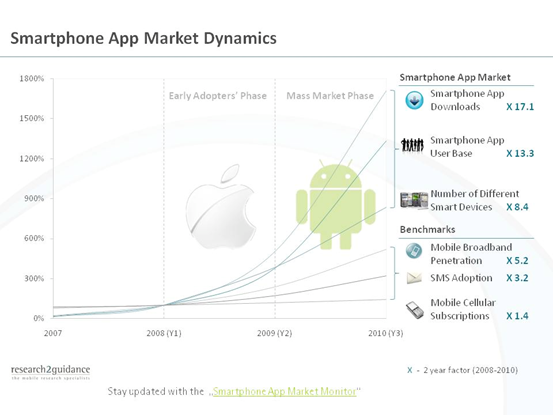
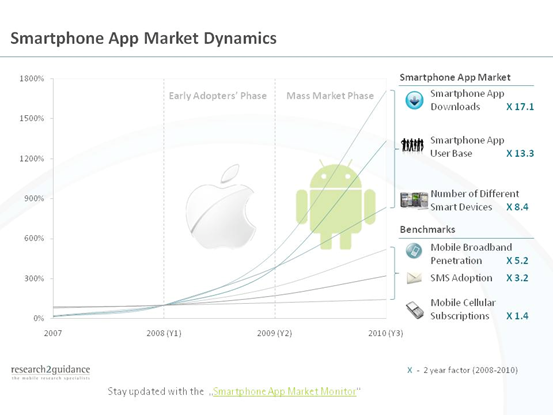
The mobile applications market made it from ramp-up phase to a mass market in only 3 years. This is much faster than previous mobile market sectors needed.

Berlin, March 8th, 2011 

The numbers regarding the smartphone applications market are impressive: Global app download numbers increased by 1700%, user base by 1300%, number of different smart devices by 800%, number of apps by 500% and even app store number increased by 300% in the first 3 years.

With application numbers increasing by almost 100.000 apps per quarter on all major app stores the competition level in a category and platform can change over night, which has an immediate impact on download numbers. Compared to these trends user behavior and demographics in terms of age, gender, usage time, downloads etc. has not changed so quickly over the last three years but will do when applications are proliferating into the mass market. There will be substantial differences per country and platform any company should be aware of, when formulating their application strategy.

Apple dominated the years 2008 and 2009. Since 2010 the hype moved over to Android. With the partnership of Microsoft and Nokia, this might change again as deteriorating average application download numbers on the Android platform will make developers shift again their priorities. What will be the most promising application types and categories will be the next big question.

When looking at the initial phases of other markets, companies really had a lot of time to decide on if, how and when to enter the market. It seems that industry cycles become shorter and shorter and the ability of a company to react very quickly becomes even more important. To stay updated on current trends subscribe to our new “Smartphone App Market Monitor”. This monitoring subscription service will be updated every quarter. Benefit from the intro offer, which saves you 20% until 31st of March.

Twitter: #smartphone #app market outperformes other booming markets – 3 years #benchmark http://j.mp/hRMi6c

About research2guidance:

research2guidance is a Berlin-based market research company specialized in the mobile industry. The company’s service offerings include comprehensive market studies, as well as bespoke research and consultancy.

research2guidance | The Mobile Research Specialists

phone: +49 (0) 30 60 989 3363

mobile: +49 (0) 178 4007736

fax: +49 (0) 30 60 989 3369

email: mp@research2guidance.com

www.research2guidance.com

Conclusion

And so, your thoughts and comments on this ME-P are appreciated. Feel free to review our top-left column, and top-right sidebar materials, links, URLs and related websites, too. Then, subscribe to the ME-P. It is fast, free and secure.

Speaker: If you need a moderator or speaker for an upcoming event, Dr. David E. Marcinko; MBA – Publisher-in-Chief of the Medical Executive-Post – is available for seminar or speaking engagements. Contact: MarcinkoAdvisors@msn.com and http://www.springerpub.com/Search/marcinko

Our Other Print Books and Related Information Sources:

Health Dictionary Series: http://www.springerpub.com/Search/marcinko 

Practice Management: http://www.springerpub.com/product/9780826105752

Physician Financial Planning: http://www.jbpub.com/catalog/0763745790

Medical Risk Management: http://www.jbpub.com/catalog/9780763733421

Healthcare Organizations: www.HealthcareFinancials.com

Physician Advisors: www.CertifiedMedicalPlanner.com

Subscribe Now: Did you like this Medical Executive-Post, or find it helpful, interesting and informative? Want to get the latest ME-Ps delivered to your email box each morning? Just subscribe using the link below. You can unsubscribe at any time. Security is assured.

Link: http://feeds.feedburner.com/HealthcareFinancialsthePostForcxos

Sponsors Welcomed: And, credible sponsors and like-minded advertisers are always welcomed.

Link: https://healthcarefinancials.wordpress.com/2007/11/11/advertise

About Consent Care.Net

The Case for Fully Informed Consent

By Dr. Martin Young

MBChB, FCS(SA)Otol.

martin@carespace.net

The issue of ‘informed consent’ is an ever present bugbear in all healthcare systems around the world, raising its head time after time in journals, weblogs, healthcare administration policies and, above all, medical malpractice lawsuits. Every mention emphasizes the need for improving this difficult issue, but in spite thereof little seems to change.  ConsentCare is a new initiative aiming at addressing the challenges of facilitating and enhancing informed consent.

Why the big deal?

Medical ethicists have long known that, if trust is indeed the cornerstone of the successful doctor-patient relationship, that subjecting a person to medical or surgical treatment without discussing all aspects thereof wherever possible, i.e. fully informed consent, constitutes a betrayal of that trust.

Common opinion asserts that good informed consent creates better mental preparation for surgery, decreased anxiety, shorter hospital stays, earlier recognition of complications by patients before they become serious, and a generally higher success rate and satisfaction rate for the surgery.

70% of the detail of discussion about surgical detail and risk held in doctors’ rooms is forgotten by patients by the time the consultation is over. Patients are ordinarily asked to consent to surgical procedures ‘on the spot’ without access to the detailed documentation of the risks of those procedures that they can consider in their own time and own comfortable environment.

A person knowing all the information about his or her procedure acts as another measure of control to avoid outright human error, such as the wrong operation, or operating on the wrong side.

Almost every case of litigation following surgery will address the adequacy of the consent process.

The right to full knowledge about medical or surgical interventions is entrenched as a human right, even legally enforceable by inclusion in the constitutions of some countries.

No longer is a successful surgical outcome adequate protection against litigation, particularly where the consent is deemed to have contained inadequate information.

In an environment where litigation is on the increase, and expectations, demands and knowledge by the public have heightened, adequate and fully informed consent is one of the few protections doctors can apply both to their own benefit and to that of their patients.

The challenges

Good informed consent is not just presentation of a form that demands the patient’s signature on the bottom.  The process is dependent on all aspects of a good doctor-patient interaction, i.e. positive and empathetic communication, good bedside manner, open and frank discussion of alternatives and costs, opportunity to ask questions, to seek independent advice, and to make decisions based on full disclosure of relevant facts.  The result can however be a valuable clinical record of benefit to all role-players in the process of having a surgical procedure.

The demands of taking fully informed consent are considerable.  No patient is the same, and a standard ‘one size fits all’ approach cannot take this into consideration. The same can be said for the doctor taking the consent.  All have individual approaches and styles that should facilitated by the consent process.  Again, ‘one size fits all’ is as inappropriate for doctors as it is for patients.  The challenge for doctors is in documenting the process for both their patients’ and their own benefit.  Without technological assistance this is impossible to do, for example, to the satisfaction of a medical malpractice lawyer hell-bent on proving medical negligence.

Solutions

ConsentCare was designed taking all these considerations into account, but preserving the traditional and familiar signed document as a final result .  A web-based platform was used, making the system accessible to both doctors and patients through a doctor portal and a patient portal, and opening the possibilities of direct doctor-patient communication around the specified procedure.  Call it if you like a ‘mini-Facebook’ around the consent process.

On logging in a doctor adds a new patient, and proceeds through progressive steps, selecting procedure name, adding or editing graphics, and having editorial control over the content at all stages.  An “editor’s” function allows preset information to be saved, speeding up the process for subsequent consents.

For all procedures a detailed consent document specific to the doctor, patient and procedure is produced in pdf form within a few minutes. This can be emailed to a patient beforehand, edited digitally using tablet PC’s, or printed out and discussed on the spot, leaving all options open as per the doctor’s preferences.

The potential

No other process leaves better evidence of a doctor’s ethical approach, transparency, patient care and responsibility than the informed consent process.  This is a document that should be in the patient’s possession as well as in the medical record, an ethical yardstick of due diligence.  It gives very little clinical detail away other than a patient’s name, the procedure, and likelihood of expected risks.  As such, this can assist the detailed case management of patients, warn nursing staff of anticipated complications, and allocate patients to different levels of post operative care.  It becomes a valuable nursing tool, not just a medicolegal hassle.

The record of a doctor’s approach to his patients in terms of attention to informed consent can be an ethical yardstick that raises that doctor’s profile above the rest.  In an era of doctor and hospital ratings, rising healthcare costs, rising litigation, and increasingly limited resources, all payers, i.e. patients, funders and insurers, could benefit from recognizing where their money is best spent.

The doctor’s excuse “I don’t have the time” should no longer be relevant. Technology takes care of that issue.  The consent process is so important, and with such cost-saving potential in the long term, that time considerations should be far secondary to ethical considerations.  In an era where low markups on doctors’ services promote the push to do high numbers of procedures, the consent process could be the one determinant to start reversing that process.

So, doctors, please make the time, cut the volumes, but, funders and insurers, make sure the doctor does not pay a financial penalty, and is remunerated properly for work done properly.  And malpractice insurers, please take note, and lower premiums for users.

Herein lies the true potential of facilitated informed consent, a ‘win-win’ for everyone involved.

Our position 

ConsentCare is a working proof-of-concept,  available for ‘reskinning’ to the designs of any users /institutions, with the same design elements applied to the final document, and can be hosted on private servers.

Interested users are invited to sign in on the website at www.consentcare.net for more information and a look around with basic functionality, and to contact me for more information.

Conclusion

And so, your thoughts and comments on this ME-P are appreciated. Feel free to review our top-left column, and top-right sidebar materials, links, URLs and related websites, too. Then, subscribe to the ME-P. It is fast, free and secure.

Channel Surfing the ME-P

Have you visited our other topic channels? Established to facilitate idea exchange and link our community together, the value of these topics is dependent upon your input. Please take a minute to visit. And, to prevent that annoying spam, we ask that you register. It is fast, free and secure.

Conclusion

Your thoughts and comments on this ME-P are appreciated. Feel free to review our top-left column, and top-right sidebar materials, links, URLs and related websites, too. Then, subscribe to the ME-P. It is fast, free and secure.

Speaker: If you need a moderator or speaker for an upcoming event, Dr. David E. Marcinko; MBA – Publisher-in-Chief of the Medical Executive-Post – is available for seminar or speaking engagements. Contact: MarcinkoAdvisors@msn.com

OUR OTHER PRINT BOOKS AND RELATED INFORMATION SOURCES:

Product Details    

On Track for Meaningful Use?

Are we on track to be a huge disappointment to our children’s children – or What?

[By Darrell K. Pruitt DDS]

When our grandchildren get the bill for the Obama administration’s subsidies benefitting primarily the health information technology industry, I bet they’re going to be really, really pissed at us for allowing today’s lawmakers to blow their 28 billion dollars to please HIT advocates who mislead consumers as well as lawmakers about the benefits of EHRs.

The Doctors Speak 

According to physicians who actually do the hard lifting in healthcare, the “meaningful use” requirements that they must prove in order to qualify for stimulus money will arguably increase both the cost and danger of healthcare – all for the benefit of stakeholders rather than principals. For one thing, “meaningful use” is meaningless if it fails to help physicians treat their patients. I think HIT stakeholders’ grandchildren should somehow be held accountable to my grandchildren.

Opposing Opinions  

Just days apart this week, two HIT reporters, Rich Daly from ModernHealthcare.com and Joseph Goedert from HealthDataManagment.com described two opposing letters the Office of the National Coordinator for Health Information Technology (ONC) recently received: One from doctors and one from patients (et al).

On Monday, here is how Daly’s article “AMA to ONC: EHR program doesn’t work for docs” began:

http://www.modernhealthcare.com/article/20110302/NEWS/303029950/1153

“Many physicians—specialists in particular—will not participate in the federal electronic health-record adoption incentive program because it requires them to include patient data that they do not otherwise collect, according to a Feb. 25 letter from 39 medical organizations letter to the Office of the National Coordinator for Health Information Technology”

On Wednesday, Joseph Goedert, writing for HealthDataManagment.com began “Consumer Groups: Hold Strong on MU” with this:

http://www.healthdatamanagement.com/news/meaningful-use-criteria-comments-consumers-42080-1.html

“A coalition of 25 consumer groups and unions is asking federal officials to hold firm on more stringent criteria for Stage 2 of electronic health records meaningful use, and expressing support for going further. For instance, because patients still trust their providers more than other information sources, holding providers accountable for actual usage of a patient Web portal ‘is entirely appropriate and we strongly urge ONC to resist pressure from the provider community to absolve them from responsibility for making these services available and useful to their patients,’ according to a comment letter to the Office of the National Coordinator”

  • AARP
  • Advocacy for Patients with Chronic Illness, Inc.
  • AFL-CIO
  • American Association on Health and Disability
  • American Hospice Foundation
  • Caring from a Distance
  • Center for Democracy & Technology
  • Childbirth Connection
  • Consumers for Affordable Health Care
  • Consumers Union
  • Families USA
  • Family Caregiver Alliance
  • Healthwise
  • Mothers Against Medical Error
  • National Alliance for Caregiving
  • National Coalition for Cancer Survivorship
  • National Consumers League
  • National Family Caregivers Association
  • National Health Law Program
  • National Partnership for Women & Families
  • National Women’s Health Network
  • OWL – The Voice of Midlife and Older Women
  • SEIU
  • The Children’s Partnership

Like the “Record Demographics” MU mandate, this is all for the “common good” I suppose. Consumer Advocasy groups wouldn’t mislead patients, would they?

I doubt many Americans represented by these 25 organizations ever imagined a new federal requirement that doctors record each patient’s demographics. (Notice of Proposed Rulemaking: Medicare and Medicaid Programs; Electronic Health Record Incentive Program; Federal Register / Vol. 75, No. 8 / Wednesday, January 13, 2010 / page 1861; RIN 0938-AP78).

This means that the 25 stakeholder groups are doing their best to help American taxpayers hold physicians accountable to record and share their patients’ demographic information with the US government – private information about me and my family members that I personally don’t trust the government to be given – even if I’m in vulnerable need of health care.

Daly’s Article 

According to Daly’s article, the demands of MU are distractions for increasingly busy doctors and staff whose focus, I believe, should include eye-contact with patients with specific health problems rather than irrelevant data needs of third parties, including consumer advocacy groups.

On the other hand, if consumer advocacy groups have successfully defined for the federal government what clueless patients allegedly need, who will the mandate really benefit? 25 consumer advocacy groups don’t equal one consumer, so their letter isn’t grass roots at all. It’s deception wearing lipstick. Gullible and vulnerable patients are again being misrepresented by HIT stakeholders for a cut of our grandchildren’s 28 billion.

Assessment

Finally, if MU requirements are an arguably expensive and dangerous distraction for physicians, how can the law possibly be any less absurd for dentists? I’ll look at meaningful use as well at the ADA’s apparently flagging commitment to EHRs next. The ADA is abandoning state informatics departments – leaving them exposed to ADA members’ questions they are unable to answer. It looks to me that intra-ADA relationships are deteriorating quickly, but nevertheless, traditional stoicism still hasn’t been broken. “Image is everything” – ADA/IDM slogan.

Dentists

Here’s a teaser, dentists: Chances are, your state ADA organization hasn’t yet shared with you how the MU requirement of CPOE (Computerized physician order entry – page 1858) will change your practice communications. If you are a HIPAA-covered entity with an NPI number and you don’t email instructions to your denture lab rather than include a hand-written note with the relevant patient’s plaster models, you won’t qualify for stimulus money. What can possibly go wrong with that meaningful idea?

Conclusion

Your thoughts and comments on this ME-P are appreciated. Feel free to review our top-left column, and top-right sidebar materials, links, URLs and related websites, too. Then, subscribe to the ME-P. It is fast, free and secure.

Speaker: If you need a moderator or speaker for an upcoming event, Dr. David E. Marcinko; MBA – Publisher-in-Chief of the Medical Executive-Post – is available for seminar or speaking engagements. Contact: MarcinkoAdvisors@msn.com

OUR OTHER PRINT BOOKS AND RELATED INFORMATION SOURCES:

Product DetailsProduct DetailsProduct Details

Product Details  Product Details

   Product Details 

Protecting Personal Health Information [PHI on Talk Radio]

Check out the Xerox Blog Talk Radio

By Staff Reporters

Join Our Mailing List 

Federal regulations require that healthcare organizations put new safeguards be put in place to protect a person’s personal health information, also known as PHI. This means new challenges for anyone who handles sensitive data [covered entities]. And, there are also severe penalties if the guidelines aren’t followed.

From ACS

Mark Tripodi, chief innovation officer for ACS’ government healthcare solutions group will explain why data can easily be put at risk and what can be done to ensure organizations meet privacy standards.

Assessment

You can access the recording here: http://bit.ly/eyv65U.

For more on Xerox: http://xrx.sm/news.

Conclusion

Your thoughts and comments on this ME-P are appreciated. Feel free to review our top-left column, and top-right sidebar materials, links, URLs and related websites, too. Then, subscribe to the ME-P. It is fast, free and secure.

Link: http://feeds.feedburner.com/HealthcareFinancialsthePostForcxos

Speaker: If you need a moderator or speaker for an upcoming event, Dr. David E. Marcinko; MBA – Publisher-in-Chief of the Medical Executive-Post – is available for seminar or speaking engagements. Contact: MarcinkoAdvisors@msn.com

OUR OTHER PRINT BOOKS AND RELATED INFORMATION SOURCES:

DICTIONARIES: http://www.springerpub.com/Search/marcinko
PHYSICIANS: www.MedicalBusinessAdvisors.com
PRACTICES: www.BusinessofMedicalPractice.com
HOSPITALS: http://www.crcpress.com/product/isbn/9781466558731
CLINICS: http://www.crcpress.com/product/isbn/9781439879900
BLOG: www.MedicalExecutivePost.com
FINANCE: Financial Planning for Physicians and Advisors
INSURANCE: Risk Management and Insurance Strategies for Physicians and Advisors

Product Details 

About HealthCareAndYou.org

What it is – How it works?

By Staff Reporters

Join Our Mailing List 

At a time when many Americans are confused about the healthcare overhaul law, a coalition of groups representing doctors, nurses, pharmacists and consumers has launched a website to answer questions about the Affordable Care Act.

The new website – HealthCareandYou.org – doesn’t delve into the politics behind the law, but spells out what the law means to consumers, depending on the state they live in and their age. The website also provides a timeline, telling consumers when different parts of the law go into effect.

The Site

According to the site, The Affordable Care Act is a health care law that aims to improve our current health care system by increasing access to health coverage for Americans and introducing new protections for people who have health insurance.

If you have health insurance, you will benefit from steps to stop insurance companies from cancelling your coverage if you get sick. The law will also require insurance plans to cover your out-of-pocket costs for many proven preventive and screening services, such as colonoscopies and mammograms, to catch problems at their earliest, most treatable stages.

Your job might not offer health insurance. Or, maybe you have been denied coverage because of a pre-existing condition such as asthma or cancer. The law now offers health plans for people with pre-existing conditions who have had trouble finding care. And it will increase access to coverage for more Americans in 2014.

The law helps small businesses pay for health insurance for their employees. And it supports programs that will help increase the number of primary care physicians, nurses, physician assistants and other health care professionals.

Assessment

It is important to understand what the law means for you. Check out what changes have already taken place and learn more about what is happening in your state.

Link: http://www.healthcareandyou.org

Conclusion

And so, your thoughts and comments on this ME-P are appreciated. Feel free to review our top-left column, and top-right sidebar materials, links, URLs and related websites, too. Then, subscribe to the ME-P. It is fast, free and secure.

Speaker: If you need a moderator or speaker for an upcoming event, Dr. David E. Marcinko; MBA – Publisher-in-Chief of the Medical Executive-Post – is available for seminar or speaking engagements. Contact: MarcinkoAdvisors@msn.com and http://www.springerpub.com/Search/marcinko

Our Other Print Books and Related Information Sources:

Health Dictionary Series: http://www.springerpub.com/Search/marcinko

Practice Management: http://www.springerpub.com/product/9780826105752

Physician Financial Planning: http://www.jbpub.com/catalog/0763745790

Medical Risk Management: http://www.jbpub.com/catalog/9780763733421

Healthcare Organizations: www.HealthcareFinancials.com

Physician Advisors: www.CertifiedMedicalPlanner.com

Subscribe Now: Did you like this Medical Executive-Post, or find it helpful, interesting and informative? Want to get the latest ME-Ps delivered to your email box each morning? Just subscribe using the link below. You can unsubscribe at any time. Security is assured.

Link: http://feeds.feedburner.com/HealthcareFinancialsthePostForcxos

Sponsors Welcomed: And, credible sponsors and like-minded advertisers are always welcomed.

Link: https://healthcarefinancials.wordpress.com/2007/11/11/advertise

Product DetailsProduct DetailsProduct Details       

Product Details  Product Details

   Product Details 

Quality Business Issues in the 21st Century

A  Revisit –  Circa 2011

By Henry H. Goldman PhD, CPCM

[Risk Management Associates International, LLP]

Dear Ms. Ann Miller RN MHA

I’ve attached an article which might be of interest to your ME-P readers, subscribers and clients. 

It’s new and can easily be modified to meet your healthcare needs.

Link: QUALITY ISSUES IN THE 21ST CENTURY[1]

Assessment

Although this essay is not medically specific, the general concepts are applicable to the healthcare industrial complex.

About the Author

Henry H. Goldman PhD

Executive Managing Partner
Risk Management Associates International, LLP
5005 SW Raintree Circle
Lee’s Summit, MO 64082

Henry H. Goldman, Ph.D. is the Managing Director of the GOLDMAN-NELSON GROUP (USA), a global management consulting and executive training organization that he founded in 1981. Dr. Goldman’s areas of expertise include supervisory and management training, decision-making and problem solving, team building, international financial management, and strategic planning. He is frequently invited to facilitate programs and workshops on such diverse subjects as “Leading Organizational Change,” “Decision-Making for Managers,” “Budgeting in the Borderlands,” as well as issues dealing with global business and finance. Goldman recently served as Co-Editor of Taking Stock: A Survey on the Practice and Future of Change Management (Berlin, 2005). He has worked with executives and managers, worldwide, to develop an understanding of management and financial concerns in a global marketplace. He has conducted training programs along the Pacific Rim, Southern Africa, and the Middle East and among the Newly Independent States of the former Soviet Union. His clients include MGM Studios, Lucent Technologies–China, General Motors, Hughes Aircraft Company and Citizens’ Development Corps. He served as adjunct professor of management at the University of Macau, China, where he taught “Team Building” to MBA students. He is currently affiliated with the National Graduate School and Boston University’s Center for Executive Education. Dr. Goldman was recently appointed to the Mine Relief Global Business Council to assist in the remediation of land mines, world-wide, with a particular focus on the Turkey-Syria border.

Conclusion

And so, your thoughts and comments on this ME-P are appreciated. Feel free to review our top-left column, and top-right sidebar materials, links, URLs and related websites, too. Then, subscribe to the ME-P. It is fast, free and secure.

Our Other Print Books and Related Information Sources:

Health Dictionary Series: http://www.springerpub.com/Search/marcinko

Practice Management: http://www.springerpub.com/product/9780826105752

Physician Financial Planning: http://www.jbpub.com/catalog/0763745790

Medical Risk Management: http://www.jbpub.com/catalog/9780763733421

Healthcare Organizations: www.HealthcareFinancials.com

Physician Advisors: www.CertifiedMedicalPlanner.com

Subscribe Now: Did you like this Medical Executive-Post, or find it helpful, interesting and informative? Want to get the latest ME-Ps delivered to your email box each morning? Just subscribe using the link below. You can unsubscribe at any time. Security is assured.

Link: http://feeds.feedburner.com/HealthcareFinancialsthePostForcxos

Sponsors Welcomed: And, credible sponsors and like-minded advertisers are always welcomed.

Link: https://healthcarefinancials.wordpress.com/2007/11/11/advertise

Product DetailsProduct DetailsProduct Details       

Product Details  Product Details

   Product Details 

“Journal of Financial Management Strategies” for Healthcare Organizations

ADVERTISEMENT

Hospitals and Healthcare Organizations

[A Textbook of Financial Management Strategies]

Buy from Amazon


Medical Practice Social Media Marketing Plan Survey

Medical Practice Marketing Plan Survey for Doctors?

Join Our Mailing List 

“We’re considering integrating social media into our medical practice marketing plan,” Dr. Joseph Frank Stankowsy started out saying.

Then he backtracked—“Yet, all we hear about it is what we can’t do from a HIPAA and security compliance perspective.”

And so, do you incorporate social media into your medical practice marketing plan? Please vote and opine here.

Channel Surfing the ME-P

Have you visited our other topic channels? Established to facilitate idea exchange and link our community together, the value of these topics is dependent upon your input. Please take a minute to visit. And, to prevent that annoying spam, we ask that you register. It is fast, free and secure.

Conclusion

Your thoughts and comments on this ME-P are appreciated. Feel free to review our top-left column, and top-right sidebar materials, links, URLs and related websites, too. Then, subscribe to the ME-P. It is fast, free and secure.

Speaker: If you need a moderator or speaker for an upcoming event, Dr. David E. Marcinko; MBA – Publisher-in-Chief of the Medical Executive-Post – is available for seminar or speaking engagements. Contact: MarcinkoAdvisors@msn.com

OUR OTHER PRINT BOOKS AND RELATED INFORMATION SOURCES:

Product DetailsProduct DetailsProduct Details

Product Details  Product Details

   Product Details 

Improving Revenue Cycles at a West Coast Public Hospital?

Ask an Advisor?

www.BusinessofMedicalPractice.com

Mr. Johnson was the chief financial officer (CFO) of a 222-bed teaching hospital in southern California. Mr. Johnson recognized a lot of problems with the processes within the various revenue cycle departments he managed which impacted cash flow for the facility.  Mr. Johnson met with the hospital chief executive officer (CEO) to express his concerns and the fact that he felt his existing staff did not have the expertise to fix many of the problems they were facing.

Ms. Thomas, the hospital CEO, agreed with Mr. Johnson’s evaluations and concerns and the two prepared a package for the Board of Supervisors to submit a request for proposal to several revenue cycle improvement vendors.  This request was approved by the Board and sent to several vendors with known successful track records in this area.  During the next several weeks the responses were evaluated and a final vendor selected.

It was determined through a Revenue Cycle Performance Evaluation completed by the vendor prior to the kick-off of the engagement that the largest opportunity for improved cash would be to address the bottlenecks in the cash flow, the excessive days in accounts receivable, the backlogged accounts in denied claims and improved process through the entire revenue cycle at this public hospital.

When the engagement began, the net days in accounts receivable were 103 and the time from discharge to final bill was 33 days. The vendor was engaged for a four-year period to provide cash acceleration and revenue cycle improvement on a “pay for performance” [P4P] fee structure.  A historical review of the hospital’s financial data determined an average monthly collection amount (baseline) the hospital was achieving each month prior to the start of this engagement.  The P4P fee structure required the vendor to reach the baseline each month before the hospital was required to pay any profession fees for the services of the vendor.

KEY ISSUES:

What could the hospital do to realize immediate benefits with regard to:

– accelerated cash flow?

– reduced days in accounts receivables?

– streamlined revenue cycle processes?

– better trained existing staff?

– return on investment?

MORE: Rev Cycle Mgmnt

Conclusion

And so, your thoughts and comments on this ME-P are appreciated. Feel free to review our top-left column, and top-right sidebar materials, links, URLs and related websites, too. Then, subscribe to the ME-P. It is fast, free and secure.

Speaker: If you need a moderator or speaker for an upcoming event, Dr. David E. Marcinko; MBA – Publisher-in-Chief of the Medical Executive-Post – is available for seminar or speaking engagements. Contact: MarcinkoAdvisors@msn.com and http://www.springerpub.com/Search/marcinko

Our Other Print Books and Related Information Sources:

Health Dictionary Series: http://www.springerpub.com/Search/marcinko

Practice Management: http://www.springerpub.com/product/9780826105752

Physician Financial Planning: http://www.jbpub.com/catalog/0763745790

Medical Risk Management: http://www.jbpub.com/catalog/9780763733421

Healthcare Organizations: www.HealthcareFinancials.com

Physician Advisors: www.CertifiedMedicalPlanner.com

Subscribe Now: Did you like this Medical Executive-Post, or find it helpful, interesting and informative? Want to get the latest ME-Ps delivered to your email box each morning? Just subscribe using the link below. You can unsubscribe at any time. Security is assured.

Link: http://feeds.feedburner.com/HealthcareFinancialsthePostForcxos

Sponsors Welcomed: And, credible sponsors and like-minded advertisers are always welcomed.

Link: https://healthcarefinancials.wordpress.com/2007/11/11/advertise

Product DetailsProduct DetailsProduct Details

Meet Speaker Dr. David Edward Marcinko MBA

Management Expert, Social Media Pioneer, Journalist and Financial Advisor

www.BusinessofMedicalPractice.com

I am available for a limited number of speaking engagements each year. As social media’s leading integrated voice for medical and financial service professionals, the ME-P voice was noted by the WSJ.com in 2009, which said thatThis website is packed with great information.” And, medical information technology  and eMR guru Alberto Borges MD recently opined You do have an exceptional website”. 

The ME-P’s Reach

With over 250,000 visitors, the ME-P is among the web’s most influential and prominent platforms. I frequently discuss the precarious intersection among medical practice management, financial services, health economics and related social media in keynote speeches, panel discussions, and media interviews. 

Journalist

I also use my two decade long medical, surgical, business management and financial advisory practice and journalistic experiences to engage the private practice community, culminating in the third edition of our book: The Business of Medical Practice [Transformational Health 2.0 Skills for Doctors].

Locale

I am based near Atlanta, GA, so travel for speaking opportunities is not problematic and very inexpensive.

Curriculum Vitae

Here is my CV: DEM Formal CV

Please contact me if you’re interested in having me engage your divese audience: MarcinkoAdvisors@msn.com

Sincerely,

Dr. David Edward Marcinko; MBA

Certified Medical Planner™
www.CertifiedMedicalPlanner.com

My Other Print Books and Related Information Sources:

Health Dictionary Series: http://www.springerpub.com/Search/marcinko

Practice Management: http://www.springerpub.com/product/9780826105752

Physician Financial Planning: http://www.jbpub.com/catalog/0763745790

Medical Risk Management: http://www.jbpub.com/catalog/9780763733421

Healthcare Organizations: www.HealthcareFinancials.com

Physician Advisors: www.CertifiedMedicalPlanner.com

Subscribe Now: Did you like this Medical Executive-Post, or find it helpful, interesting and informative? Want to get the latest ME-Ps delivered to your email box each morning? Just subscribe using the link below. You can unsubscribe at any time. Security is assured.

Link: http://feeds.feedburner.com/HealthcareFinancialsthePostForcxos

Sponsors Welcomed: And, credible sponsors and like-minded advertisers are always welcomed.

Link: https://healthcarefinancials.wordpress.com/2007/11/11/advertise

Product DetailsProduct DetailsProduct Details       

Product Details  Product Details

   Product Details 

ICD-10 is Not an Airplane

It’s Another Part of HIPAA the ADA Won’t Discuss

By D. Kellus Pruitt DDS

A couple of days following the heads up I posted concerning the imminent upgrade from the tedious ICD-9 coding system to the ICD-10 that is said to be exponentially more complicated, informatics specialist Tom Sullivan posted a signal to fellow coders nationwide: “7 tactics for making ICD-10 urgent.”

http://www.healthcareitnews.com/blog/7-tactics-making-icd-10-urgent 

If you are fed up with unfunded, non-productive and ineffective mandates like I am, I imagine an alert to coders to create urgency in your practice makes your ear lobes burn bright red as well.

Tedious Administrative Tasks 

According to Sullivan, the ICD-10 presents providers with new requirements for “care management protocols, clinical and financial databases and reports, reimbursement, registries, quality management and research.” These requirements do not promote patients’ best interests. These tedious administrative tasks only enable HIPAA-covered entities to get paid.

ADA

If you are a HIPAA-covered dentist with a voluntary but permanent 10-digit NPI number which is required for ICD-10 compliancy, are you aware if ADA leaders have yet described the ICD-10 coding system any better than they described the NPI number that Delta Dental, BCBSTX, as well as the ADA aggressively promoted years ago?

Who knows? The ICD-10 may not even apply to dentistry. Somewhere deep in the HIPAA Rule, there might be a footnote that says “except in dental practices.”

Department of Dental Informatics

This isn’t the first time I’ve heard rumors about HIPAA’s nasty surprises for dentists. Five years ago this month, “quality” control through dental informatics was enthusiastically but perhaps prematurely revealed to me by an excited spokesman for the ADA Department of Dental Informatics. It was his email that equipped me with everything I needed for this 5 year adventure.

Shortly afterwards, the topic of HIPAA became so poisonous for ADA officials to discuss that the misled leaders who unwittingly signed on to promote digital fantasies in dentistry only rarely appeared in print and never on the internet – leaving the responsibility of informing naïve and trusting ADA members about the downsides of EHRs to those who sell EHRs.

Nevertheless, following three years of official silence about HIPAA from the ADA, in the last 14 months there have been two commentaries published in the JADA which promote quality control in dentistry. The first was written by James Bader DDS and appeared in the December 2009 edition of the JADA titled “Challenges in quality assessment of dental care.”

http://jada.ada.org/cgi/content/full/140/12/1456  

Quality Control 

The second commentary concerning quality control was written by Editor Michael Glick DMD titled ““When good may not be good enough — The need for clinical performance measures in dentistry.” (I’m no longer able to access JADA online).

EBD 

HIT stakeholders Bader and Glick, who are both fervent supporters of Evidence Based Dentistry as well as paperless dental practices, carefully tiptoe around what looks to me like an oppressive, micromanaged future for dentists. They both argue what must be a desperate committee-approved talking point – that quality assessment is critically important for ADA members so that fully-licensed dentists will have digital, Evidence-Based proof that their care is better than dental therapists’ who work for much less money.

Are ADA leaders sitting around a big table in ADA Headquarters when they think up this crap?

In addition, the cloistered committee concludes that patients’ opinions of their dentists is too difficult to collect and less reliable than algorithms based on dental claims and other data provided by the ICD-10 (?).

In fact, Dr. Bader is so confident in Evidence-Based digital results, he dismisses the need for any patient involvement in quality assessment: “Patient satisfaction has been shown to be associated only weakly with other assessments of quality of care, which means that it cannot be used as a surrogate for measures of technical quality.” Try telling that to a formerly satisfied dental patient who suddenly must pick his or her next dentist from a “preferred” provider list of strangers.

Assessment 

You mean like Ingenix’s measures of technical quality, Dr. Bader? In 2008, NY Attorney General Andrew Cuomo spanked the UnitedHealth subsidiary for selling algorithmic excuses to insurers to be used to cheat out-of-network physicians.

Conclusion

If you are a small business owner who reasonably asks to be paid no more and no less than what one is owed as quickly as possible – if not immediately like all other businesses in the land of the free – I’m pretty sure Sullivan’s 7 pearls intended to make ICD-10 more urgent for doctors will light up the lobes again. And so, your thoughts and comments on this ME-P are appreciated. Feel free to review our top-left column, and top-right sidebar materials, links, URLs and related websites, too. Then, subscribe to the ME-P. It is fast, free and secure.

Speaker: If you need a moderator or speaker for an upcoming event, Dr. David E. Marcinko; MBA – Publisher-in-Chief of the Medical Executive-Post – is available for seminar or speaking engagements. Contact: MarcinkoAdvisors@msn.com and http://www.springerpub.com/Search/marcinko

Our Other Print Books and Related Information Sources:

Health Dictionary Series: http://www.springerpub.com/Search/marcinko

Practice Management: http://www.springerpub.com/product/9780826105752

Physician Financial Planning: http://www.jbpub.com/catalog/0763745790

Medical Risk Management: http://www.jbpub.com/catalog/9780763733421

Healthcare Organizations: www.HealthcareFinancials.com

Physician Advisors: www.CertifiedMedicalPlanner.com

Subscribe Now: Did you like this Medical Executive-Post, or find it helpful, interesting and informative? Want to get the latest ME-Ps delivered to your email box each morning? Just subscribe using the link below. You can unsubscribe at any time. Security is assured.

Link: http://feeds.feedburner.com/HealthcareFinancialsthePostForcxos

Sponsors Welcomed: And, credible sponsors and like-minded advertisers are always welcomed.

Link: https://healthcarefinancials.wordpress.com/2007/11/11/advertise

Product Details 


Professional HR Options for Physicians

Understanding Professional Medical Employer Organizations

www.BusinessofMedicalPractice.com

By Eric Galtress

Join Our Mailing List 

“In-house service and support activities are monopolies.  They have little incentive to improve productivity. In fact, they have considerable disincentive to improve their productivity. Clerical, maintenance and support work, do not make a direct and measurable contribution to the bottom line.”

–“Sell the Mailroom” by Peter F. Drucker

As a medical practitioner, labor Law compliance begins with the hire of your very first practice employee. Thus, a well managed human resources (HR) function should be an area of strategic focus by the medical executive, regardless of practice size or the number of employees. Consideration of this vital role can help contribute to an efficient, highly effective and productive professional staff committed to the goals of the practice encompassing a positive and nurturing culture evident to your patients, while maintaining your competitive edge.

Costly HR

HR is the major expense driver of today’s medical practice and addresses staffing requirements, wages and other compensation, payroll and tax compliance, labor law compliance, employee benefits, training, employee turnover, safety, risk management and workers’ compensation. These responsibilities must be performed in accordance with State and Federal guidelines, beginning with the hire of your very first employee.

Employer Requirements

At specific employee level thresholds, employers are required to comply with a growing number of employee-related requirements including State and Federal Laws.  A partial list is shown even though the total number is vast considering each and every State has its own extensive regulatory and compliance burden. These laws govern the proper method of how employees must be treated and paid, as well as ensuring that their rights in the workplace are protected. State and Federal Regulators each create vast amounts of workplace legislation every year, many of which become law. In most cases, the specific requirement (either State or Federal) that affords the employee the most workplace rights and/or protection and benefits takes precedence over the other.  Non-compliance can subject the practitioner/business owner to hefty fines, penalties, business interruption, litigation, and in some cases, even practice failure.

In most cases, these HR efforts are backed by labor attorneys, service providers, brokers and other consultants. Given the typical size of a medical practice, this presents a compelling argument that practices should consider taking advantage of an innovative alternative:  being able to delegate (outsource) part or most of the HR burden as well as the employee/employer related liabilities.

Outsourced Services

Simply put, instead of the practitioner/staff performing the HR requirements, part or most of this responsibility can be outsourced to an off-site HR services provider that specializes in labor law compliance, employee management and cost control. The practitioner retains functional control of the employees and the service provider handles the HR issues. Added value is achieved by the practice in receiving these services more cost effectively since their needs are combined with those of the many other practices and businesses the provider already serves. Outsourcing is a matter of simple economics, enabling the practitioner to gain relief from cumbersome employee administration, while enhancing productivity and benefits for the staff members.

Link: Front Matter BoMP – 3

Assessment

The HR outsourcing relationship is not to be confused with a Physician Practice Management Company (PPMC).  The HR services provider has no financial interest or ownership whatsoever in the practice.

Conclusion

And so, your thoughts and comments on this ME-P are appreciated. Have you ever used a medical PEO? Feel free to review our top-left column, and top-right sidebar materials, links, URLs and related websites, too. Then, subscribe to the ME-P. It is fast, free and secure.

Speaker: If you need a moderator or speaker for an upcoming event, Dr. David E. Marcinko; MBA – Publisher-in-Chief of the Medical Executive-Post – is available for seminar or speaking engagements. Contact: MarcinkoAdvisors@msn.com and http://www.springerpub.com/Search/marcinko

Our Other Print Books and Related Information Sources:

Health Dictionary Series: http://www.springerpub.com/Search/marcinko

Practice Management: http://www.springerpub.com/product/9780826105752

Physician Financial Planning: http://www.jbpub.com/catalog/0763745790

Medical Risk Management: http://www.jbpub.com/catalog/9780763733421

Healthcare Organizations: www.HealthcareFinancials.com

Physician Advisors: www.CertifiedMedicalPlanner.com

Subscribe Now: Did you like this Medical Executive-Post, or find it helpful, interesting and informative? Want to get the latest ME-Ps delivered to your email box each morning? Just subscribe using the link below. You can unsubscribe at any time. Security is assured.

Link: http://feeds.feedburner.com/HealthcareFinancialsthePostForcxos

Sponsors Welcomed: And, credible sponsors and like-minded advertisers are always welcomed.

Link: https://healthcarefinancials.wordpress.com/2007/11/11/advertise

Product DetailsProduct DetailsProduct Details

Product Details

Is Informatics the The Curse of Healthcare Reform?

Join Our Mailing List

Medical Coding Complications and Greed

[By Darrell K. Pruitt DDS]

Coding complications in government healthcare ALWAYS favor the house — CMS guarantees it with lawsuits and whistleblower rewards that could attract dishonest employees. Are you careful who you hire?

Complications 

Complications in healthcare informatics – including 5-digit CPT® code mistakes as well as foul-ups that involve physicians’ “voluntary” 10-digit National Provider Identifier numbers – ALWAYS grant insurers more time to pay past-due bills owed to their clients and their clients’ doctors.

Call me Cynical 

Call me cynical, but if interest rates climb ever higher as predicted, watch for unexplained, proportional increases in coding errors to help fund insurance CFOs’ bonuses while raising the cost of healthcare even more without improving value. Is it any wonder why Americans don’t get the quality of healthcare we purchase compared to citizens in other countries? Tax-payers in my neighborhood are begging for in-network providers who put their patients’ interests ahead of insurers’ as much as allowed by insurers’ self-serving rules – without committing fraud. As a general rule, healthcare stakeholders accommodate parasites more than principals.

CPT® Codes and Patient Care 

Accurate CPT® coding may have nothing to do with patient care, but CMS makes it nevertheless important to physicians. Whereas the most innocent NPI foul-ups reliably delay payment and never turn out well for providers, the new fraud and abuse provisions of the Patient Protection and Affordable Care Act [ACA] can cause an innocent coding mistake on a Medicare claim to land the doc in court with charges of fraud depending on the quality of employees one hires – but only if the error favors the provider and not the payer. In June, David Burda posted “Attorney tells audience to brace for a storm of whistle-blower lawsuits” on ModernHealthcare.com.

http://www.modernhealthcare.com/article/20100623/NEWS/306209989/-1

Of Whistle-Blower Lawsuits

Burda reports that healthcare attorney Joanne Judge, a partner with Stevens & Lee in Reading, Pa., predicts a significant increase in whistle-blower lawsuits simply because the new law makes it far too easy for a dishonest employee to file an unwarranted lawsuit. No longer is there a requirement for the whistleblower, who stands to win money from his or her patriotic effort, to directly witness the crime. That kind of idea could catch on in this economy.

computer-hardware1

“The new law also converts accidental Medicare overpayments to providers into potential false claims, Judge said. She said the law considers an overpayment as fraud if the overpayment isn’t identified by the provider and returned to the government within 60 days. Judge said that will require providers to beef up their internal billing systems to detect an overpayment as soon as possible and then send Medicare back its money.”

Assessment 

What can possibly go wrong with that plan? Thorough background checks on all new employees is increasingly important, doc. For my employment security issues, I’ve learned to depend on Richard at Investigation Resource Service out of Dallas. He’s never let me down (This is not a paid ad).

Conclusion

Your thoughts and comments on this ME-P are appreciated. Feel free to review our top-left column, and top-right sidebar materials, links, URLs and related websites, too. Then, subscribe to the ME-P. It is fast, free and secure.

Speaker: If you need a moderator or speaker for an upcoming event, Dr. David E. Marcinko; MBA – Publisher-in-Chief of the Medical Executive-Post – is available for seminar or speaking engagements. Contact: MarcinkoAdvisors@msn.com

OUR OTHER PRINT BOOKS AND RELATED INFORMATION SOURCES:

Product Details 

Why Doctors DO NOT Need eMRs?

Join Our Mailing List

Why Doctors DO NEED Patient Collaboration Tools!

By Shahid N. Shah MS

As a doctor, it seems as though you’re being told by everyone that you need to jump into electronic health records and electronic medical records software; that’s like telling you that you need to manage patients’ records and is so obvious as to be useless advice.

Focus on Patient Care

Of course, it’s true you need tools to manage records but that’s just the first step. Try not to think about or talk about EMRs; instead, focus on patient care collaboration tools. Here are the kinds of collaboration you need to do on a daily basis and where EMRs and EHRs usually do not help you:

Collaborative Tools

  • Reach out and market to new patients and communicate with existing patients that you may have lost touch with; you need tools that will promote you and your practice so that you can convert visitors to your website into paying patients and clients.
  • Register new patients and maintain patient data – find and work with tools that make the patient fill out major portions of your EMR for you; think of it as “self-service” EMR with tools that can be exposed on your website so that patients can do it themselves.
  • Help cover your medical risks by presenting medical liability coverage information to patients via your website using tools that can prove that they read the materials like informed consent, surgical prep, preparing for a procedure, etc.
  • Allow patients to see their schedule and help manage their appointments directly; if airlines can coordinate and manage aircraft and seats you should be able to get a system that allows patients to schedule an appointment with you.
  • Encourage the use of personal health records (PHRs) and make sure you review and link to the patient’s PHRs. This allows you to be ready to pull data from the PHRs in the future and get out of daily data entry when possible.
  • Get feedback about your practice and patient satisfaction using online surveys.
  • Be able to and receive send secure e-mails and documents to colleagues instead of playing phone tag or faxing constantly.

Assessment

As you can see from the simple list above, when people tell you to use EMRs they forget that the EMR is not only not enough but may be the wrong thing to focus on if you’re looking to streamline operations.

Link: Front Matter BoMP – 3

http://www.BusinessofMedicalPractice.com

Conclusion

Your thoughts and comments on this ME-P are appreciated. Feel free to review our top-left column, and top-right sidebar materials, links, URLs and related websites, too. Then, subscribe to the ME-P. It is fast, free and secure.

Speaker: If you need a moderator or speaker for an upcoming event, Dr. David E. Marcinko; MBA – Publisher-in-Chief of the Medical Executive-Post – is available for seminar or speaking engagements. Contact: MarcinkoAdvisors@msn.com

OUR OTHER PRINT BOOKS AND RELATED INFORMATION SOURCES:

Link: https://healthcarefinancials.wordpress.com/2007/11/11/advertise

Product DetailsProduct DetailsProduct Details

To PAR or Not to PAR?

The Essential Question for Most Medical Providers

By Staff Reporters

Join Our Mailing List 

Ever since 1992, doctors are paid per resource-based relative value unit (RBRVU) and according to the lesser of the actual billed charges or the fee schedule amount. But, there are two types of providers. 

  • Those who accept Medicare assignment only bill the patient for the co-payment, which is usually 20%. 
  • Those who do not accept Medicare assignment are offered a lower fee schedule of 95% of the approved schedule, which is a 115% maximum fee limit of the approved schedule.

So, how does this work in real life?

Example:

A participating physician’s approved fee schedule charge of $100 would yield $80 from Medicare and $20 from the patient.

A non-participating (Non-Par) doctor with charges of $200, and with an approved fee schedule of $100, would yield: $109.25 = (.95 X $100) X 1.15 entirely from the patient. If the Non-Par doctor selects payment type on a case-by-case basis, Medicare will pay its portion of the bill directly to the physician, but the doctor must accept the Non-Par fee schedule.

Assessment

Continuing our example yields: (.8 X $95) plus the patient’s co-payment of (.2 X $95), OR $76 plus $19 = $95.00.

Conclusion

And so, your thoughts and comments on this ME-P are appreciated. Feel free to review our top-left column, and top-right sidebar materials, links, URLs and related websites, too. Then, subscribe to the ME-P. It is fast, free and secure.

Speaker: If you need a moderator or speaker for an upcoming event, Dr. David E. Marcinko; MBA – Publisher-in-Chief of the Medical Executive-Post – is available for seminar or speaking engagements. Contact: MarcinkoAdvisors@msn.com and http://www.springerpub.com/Search/marcinko

Our Other Print Books and Related Information Sources:

Health Dictionary Series: http://www.springerpub.com/Search/marcinko

Practice Management: http://www.springerpub.com/product/9780826105752

Physician Financial Planning: http://www.jbpub.com/catalog/0763745790

Medical Risk Management: http://www.jbpub.com/catalog/9780763733421

Healthcare Organizations: www.HealthcareFinancials.com

Physician Advisors: www.CertifiedMedicalPlanner.com

Subscribe Now: Did you like this Medical Executive-Post, or find it helpful, interesting and informative? Want to get the latest ME-Ps delivered to your email box each morning? Just subscribe using the link below. You can unsubscribe at any time. Security is assured.

Link: http://feeds.feedburner.com/HealthcareFinancialsthePostForcxos

Sponsors Welcomed: And, credible sponsors and like-minded advertisers are always welcomed.

Link: https://healthcarefinancials.wordpress.com/2007/11/11/advertise

Product DetailsProduct DetailsProduct Details       

Product Details  Product Details

   Product Details 

How to Choose eMR and HIT Consultants

Seeking Unbiased – Not Vendor Driven – Advice

By Shahid N. Shah, MS

www.BusinessofMedicalPractice.com

When you choose to implement your medical records technology, you’ll want to be sure that you get sound and unbiased advice. If you think the selections and decisions are too complicated to do by yourself so getting help is prudent. After you’ve learned more about RECs, which can give you free advice and help, look at some paid consultants as well because most RECs will simply choose a few local consultants that marketed themselves well to the RECs and not because the consultants are necessarily good at their jobs.

Consulting Types

The kinds of consultants you will need include:

  • Meaningful Use (MU) Consultant. An MU consultant should only be needed if you’re going after government stimulus funds. This is a person that knows how a medical practice works, inside and out, and all the legal and regulatory details about Meaningful Use. This is not a typical IT contractor or technical consultant; it must be someone who is focused on MU. Because you will not get increased government reimbursements unless you meet MU, the MU Consultant is probably more important than your IT consultant. The MU consultant should help you figure out whether or not you qualify for incentives, how to take advantage of incentive program, how to use RECs, how to ensure that you can qualify for MU without disrupting your practice and losing money, and finally whether you should even care about MU.
  • A good MU Consultant will tell you when to walk away from MU and not implement certain technologies just as readily as when to implement it.
  • Another major thing to focus on when choosing an MU consultant is to be sure that they know your local area’s rules, regulations, and technology providers (not national).
  • Try to make sure that your MU Consultants are paid very little upfront and will share the risk with you as you try to achieve success. They should get paid when you get paid and should not be paid full price unless you get incentive payments from the government. 
  • EMR Consultant. If you’re ready to buy an EMR the MU Consultant can help you pick products but getting advice from an EMR Consultant who knows all the hundreds of packages (and doesn’t just know 1 or 2 that he’s seen before) and which one will be best for you may be worth investing in. Be careful if your EMR Consultant is coming from a REC or a vendor side – ask them to disclose any ties to the products they are helping you select. Some EMR consultants are business focused and others are technically focused; you should pick the one based on what your needs are: for example, if you’re great at technology, choose a business-focused consultant (and vice-versa). 
  • IT Consultant. This is something that’s obvious but you need excellent advice on hardware, software, inter-office networking, Internet connectivity, bandwidth analysis, and a whole host of other technology needs. 
  • Integration Consultant. Most people forget this consultant because it’s not obvious but in order to make sure that all the medical records data you’re collecting can be shared in between your systems, your hospital, and with the government you need an integration consultant. Their job is to know all the relevant standards like HL7, DICOM, CCR, CCD, XML, etc. along with things like HL7 routers and tools that can share medical data records between your EMR, practice management system, and health information exchanges (HIEs).

Assessment 

Front Matter BoMP – 3

Conclusion

And so, your thoughts and comments on this ME-P are appreciated. How do you select an eMR consultant? Feel free to review our top-left column, and top-right sidebar materials, links, URLs and related websites, too. Then, subscribe to the ME-P. It is fast, free and secure.

Speaker: If you need a moderator or speaker for an upcoming event, Dr. David E. Marcinko; MBA – Publisher-in-Chief of the Medical Executive-Post – is available for seminar or speaking engagements. Contact: MarcinkoAdvisors@msn.com and http://www.springerpub.com/Search/marcinko

Our Other Print Books and Related Information Sources:

Health Dictionary Series: http://www.springerpub.com/Search/marcinko 

Practice Management: http://www.springerpub.com/product/9780826105752

Physician Financial Planning: http://www.jbpub.com/catalog/0763745790

Medical Risk Management: http://www.jbpub.com/catalog/9780763733421

Healthcare Organizations: www.HealthcareFinancials.com

Physician Advisors: www.CertifiedMedicalPlanner.com

Subscribe Now: Did you like this Medical Executive-Post, or find it helpful, interesting and informative? Want to get the latest ME-Ps delivered to your email box each morning? Just subscribe using the link below. You can unsubscribe at any time. Security is assured.

Link: http://feeds.feedburner.com/HealthcareFinancialsthePostForcxos

Sponsors Welcomed: And, credible sponsors and like-minded advertisers are always welcomed.

Link: https://healthcarefinancials.wordpress.com/2007/11/11/advertise

Product DetailsProduct DetailsProduct Details      

Has the HIT Bubble Already Popped?

Long Before Reaching … Dentistry

[By Darrell K. Pruitt DDS]

HCPlexus recently partnered with Thompson Reuters to conduct a nationwide survey of almost 3,000 physicians about their opinions of the quality of health care in the near future considering the Patient Protection and Affordable Care Act (PPACA), Electronic Medical Records, and their effects on physicians and their patients. (See “5-page Executive Summary”)

http://www.hcplexus.com/PDFs/Summary—2011-Thomson-Reuters-HCPlexus-National-P

Results:

“Sixty-five percent of respondents believe that the quality of health care in the country will deteriorate in the near term. Many cited political reasons, anger directed at insurance companies, and critiques of the reform act – some articulating the strong feelings they have regarding the negative effects they expect from the PPACA.”

What’s more, one in four physicians think eHRs will cause more harm than help. So what’s the accepted threshold for the Hippocratic Oath to come into play?

Do you also find excitement in healthcare reform’s surprises? Experiencing the sudden, last minute turns healthcare reform has taken lately is like riding shotgun with Mayhem behind the wheel, texting. Here’s other discouraging news from the same HCPlexus-Thompston Reuters survey: “A surprising 45% of all respondents indicated they did not know what an ACO is, exposing a much lower awareness of ACOs versus the broader implications of PPACA. It appears there has been a lack of physician education in this area.”

ACOs Defined 

Since I also had no idea what an ACO is, I searched the term and came across a timely article that was posted on NPR only days ago titled, “Accountable Care Organizations, Explained.”

http://www.npr.org/2011/01/18/132937232/accountable-care-organizations-explained

Author Jenny Gold writes: “ACOs are a new model for delivering health services that offers doctors and hospitals financial incentives to provide good quality care to Medicare beneficiaries while keeping down costs.” Does that remind anyone of insurance HMO promises just before the bad idea collided with surprisingly intelligent consumers in the early 1990s? Kelly Devers, a senior fellow at the nonprofit Urban Institute, is quoted: “Some people say ACOs are HMOs in drag,” There’s a sharp turn nobody warned us about.

HMO Differentiation 

Further blurring the difference between ACOs and HMOs, Gold adds “An ACO is a network of doctors and hospitals that shares responsibility for providing care to patients. Under the new law, ACOs would agree to manage all of the health care needs of a minimum of 5,000 Medicare beneficiaries for at least three years.” I wonder if we’ll see a resurrection of HMO gag orders preventing physicians from discussing effective but expensive treatment alternatives not offered by the ACO.

As expected, not only are hospitals and doctors competing for the opportunity to run ACOs, but so are former HMO insurance agents. Devers explains, “Insurers say they can play an important role in ACOs because they track and collect data on patients, which is critical for coordinating care and reporting on the results.” As a provider, do you trust UnitedHealth’s Ingenix data mining tendencies? A few years ago, NY State Attorney General Andrew Cuomo spanked the company for selling insurers pseudo-scientific excuses to cheat out-of-network physicians.

Just like Health Maintenance Organizations don’t maintain health, insurer-based Accountable Care Organizations will not bring accountability to care any more than the Patient Protection and Affordable Care Act provides patient protection and affordable care. And since I’m exposing blatant bi-partisan deceptions, there is no privacy or accountability in the Health Insurance Portability and Accountability Act, and the “HIPAA Administrative Simplification Statute and Rules Act” doesn’t.

HITECH Funding

Gold suggests that because HITECH rules were written intentionally vague in order to push the envelope of stakeholders’ imaginations, similar to HIPAA’s ineffective security rules I suppose, the doctors’ predictable ignorance of ACOs is understandable.

But then again, all this may not even matter in a few months. According to Howard Anderson, Executive Editor of HealthcareInfoSecurity.com, HITECH funding itself is threatened. He recently posted “GOP Bill Would Gut HITECH Funding – Unobligated HITECH Act Funds Would be Eliminated.”

http://www.govinfosecurity.com/articles.php?art_id=3306

Assessment

While Obama’s healthcare reform teeters between two houses, I encourage consumers to plead with their lawmakers to stop being suckered in by cheap, meaningless buzzwords sprinkled in the titles of bills. I’m hoping we can at least get them to read a little deeper. Be on your toes. Mayhem is “recalculating.”

Conclusion

Your thoughts and comments on this ME-P are appreciated. Feel free to review our top-left column, and top-right sidebar materials, links, URLs and related websites, too. Then, subscribe to the ME-P. It is fast, free and secure.

Speaker: If you need a moderator or speaker for an upcoming event, Dr. David E. Marcinko; MBA – Publisher-in-Chief of the Medical Executive-Post – is available for seminar or speaking engagements. Contact: MarcinkoAdvisors@msn.com

OUR OTHER PRINT BOOKS AND RELATED INFORMATION SOURCES:

Product DetailsProduct DetailsProduct Details

Product Details  Product Details

   Product Details 

[Do] eHRs Fail to Improve Healthcare Quality?

I told you so … wow! That felt really, really good!

By D. Kellus Pruitt DDS 

If you haven’t been following the bad news for electronic health records that has broken in the popular media in the last few days, you may be unaware of recent studies that are about as welcome in Washington DC as Wikileaks revelations of diplomatic farts – but much more serious. Healthcare reform itself is in the balance, and President Obama’s credibility with mandates is already shot.

Records will show that a few politically-incorrect troublemakers knew all along that EHRs will fail to save money or improve the quality of healthcare – ever – unless doctors and patients are involved in their development. This troublemaker warned dentists 5 years ago about how HIT stakeholder and former Speaker of the House Newt Gingrich deceived naïve ADA Delegates about benefits of eHRs to dental patients. In turn, 3 years later, the ADA’s HIT stakeholder, Dr. Robert Ahlstrom, deceived Bush’s HHS Secretary Michael Leavitt with biased, self-serving testimony he gave to the NCVHS. (See “Dr. Robert H. Ahlstrom’s controversial HIPAA testimony” that I posted in 2008.)

http://community.pennwelldentalgroup.com/forum/topics/dr-robert-h-ahlstroms

Do you still not agree that long ago, I told you so?

At a time when President Obama’s healthcare reform is teetering between the Houses, just wait until lawmakers catch the news I’m bringing to you hours, days or even weeks ahead of Fox News: Transparency just caused a huge chunk of anticipated funding for reform to evaporate like American’s property values. After billions of stimulus dollars have been gleefully spent benefiting influential healthcare stakeholders rather than principals, the bi-partisan feel-good digital fantasy is bankrupt. Pop goes the bubble.

Although there have been minor news reports of growing disappointment in eHRs for years, the results of two recent studies by Public Library of Sciences (PLoS) and Stanford clearly expose the lack of value of eHRs for Americans. We’ve been had.

The WSJ 

On January 21, the Wall Street Journal posted an article titled, “Study Looks For, Can’t Find Much Evidence of E-Health’s Benefits,” by Katherine Hobson.

http://blogs.wsj.com/health/2011/01/21/study-looks-for-cant-find-much-evidence-of-e-healths-benefits/

Hobson writes: “With the U.S. and the U.K. heading full steam towards electronic medical records and other health IT applications, how much evidence is there that they improve care?

Not a whole lot, according to a review of existing research on the topic published this week by PLoS Medicine. While governments and other proponents are claiming that digitizing health records can save lives and increase efficiency, the review’s ‘key conclusion is that these claims need to be scrutinized before people invest quite large sums of money in these technologies,’ Aziz Sheikh, lead author of the study and a professor of primary care research and development at the Center for Population Health Sciences at the University of Edinburgh, tells the Health Blog.’”

US News & World Report

And; only hours ago, US News & World Report posted a story titled “Electronic Record-Keeping Alone May Not Boost Health Care.” (no byline).

http://health.usnews.com/health-news/managing-your-healthcare/policy/articles/2011/01/25/electronic-record-keeping-alone-may-not-boost-health-care

“Electronic health records have so far done little to improve the quality of health care in the United States, a new study states.

Researchers from the Stanford University School of Medicine analyzed data on use of electronic records from 2005 through 2007. The data came from a nationwide physician survey that encompassed nearly 250,000 outpatient visits.”

The ADA 

So how does the truth about eHRs affect ADA leadership’s stubborn push for paperless practices in dentistry? Well, if as a trusting ADA member, you haven’t already swallowed the propaganda, now wouldn’t be a good time to convert to paperless.

eDRs

Though my unpopular but accurate statements about eDRs eventually got me in secret trouble with vetted, anonymous Texas Dental Association officials, I predicted this week’s bad news years ago on the TDA online forum. Unfortunately, my warnings to other TDA members about the ADA’s biggest blunder in history were censored by the TDA Executive Director without warning or explanation. Why? She isn’t accountable to anyone and “Image is everything.” (ADA/IDM slogan).

Just how difficult can it be to recognize that eHRs are inefficient in dental practices for simple, common sense reasons? First of all, dental records which involve prevention and treatment of disease in the lower third of the face rarely include laboratory test results like medical records which concern the whole body. In addition, dentists maintain tenfold fewer thin patient charts than physicians’ thick ones. So if the value of eHRs are questionable for hospital care involving millions of charts, I think dentists are safe to ignore Presidential eHR mandates. The bottleneck in dental offices isn’t the front desk, it’s the dentist … or at least it should be. As for thumbing your nose at a Presidential mandate, I wouldn’t get too concerned. Obama also mandated that the prison at Guantanamo Bay was to be closed over a year ago. It didn’t happen, and nobody went to jail.

Unfunded Mandates 

Unfunded mandates just don’t carry the respect they once did when they were less common and actually made sense. Considering the absurdity of eHRs in dentistry, worse things could happen for trusting, clueless Americans.

Those who represent our concerns in government probably don’t yet realize that in the last four days, the price of healthcare reform skyrocketed even further out of reach, and we simply cannot borrow any more money from our grandchildren just to throw it away on expensive hi-tech crap. As for myself, I’m sending this ME-P to my national and state representatives: Cornyn, Hutchison, Barton, Burgess, Harris, Davis, Patrick and Veasey, I hope you will contact your representatives as well. The Internet makes it so easy these days to educate those who would otherwise determine our future based on deception from healthcare stakeholders.

Assessment 

I publicly challenge Dr. Robert Ahlstrom, who is currently a member of the ADA Council on Dental Practice and chair of the Members Advisory Group to an Internet discussion concerning electronic health records in dentistry. It’s the same unanswered challenge I issued to the influential dentist over 3 years ago: I still say electronic dental records are an expensive hobby paid for by dental patients in higher fees, and they do nothing to improve patient care. What do you have to say about that, Dr. Robert Ahlstrom? You know you’re going to have to face me again and again, so please don’t disappoint ADA members by continuing to hide. It makes the whole ADA look cowardly.

Conclusion

Always remember: I told you so, Dr. Robert Ahlstrom. And so, your thoughts and comments on this ME-P are appreciated. How do you select an eMR consultant? Feel free to review our top-left column, and top-right sidebar materials, links, URLs and related websites, too. Then, subscribe to the ME-P. It is fast, free and secure.

Speaker: If you need a moderator or speaker for an upcoming event, Dr. David E. Marcinko; MBA – Publisher-in-Chief of the Medical Executive-Post – is available for seminar or speaking engagements. Contact: MarcinkoAdvisors@msn.com and http://www.springerpub.com/Search/marcinko

Our Other Print Books and Related Information Sources:

Health Dictionary Series: http://www.springerpub.com/Search/marcinko

Practice Management: http://www.springerpub.com/product/9780826105752

Physician Financial Planning: http://www.jbpub.com/catalog/0763745790

Medical Risk Management: http://www.jbpub.com/catalog/9780763733421

Healthcare Organizations: www.HealthcareFinancials.com

Physician Advisors: www.CertifiedMedicalPlanner.com

Subscribe Now: Did you like this Medical Executive-Post, or find it helpful, interesting and informative? Want to get the latest ME-Ps delivered to your email box each morning? Just subscribe using the link below. You can unsubscribe at any time. Security is assured.

Link: http://feeds.feedburner.com/HealthcareFinancialsthePostForcxos

Sponsors Welcomed: And, credible sponsors and like-minded advertisers are always welcomed.

Link: https://healthcarefinancials.wordpress.com/2007/11/11/advertise

Product Details 

Building a Modern Electronic Heath Data Warehouse

A Brief “How-to” Essay with Commentary

By Staff Reporters

Join Our Mailing List 

According to a Standish Group survey, more than 70% of Health Information Technology applications go over budget and time and medical data warehouse applications are no exception. However, if you adopt a process, an oriented development approach and implement a rigorous project management discipline, your increase the likelihood that your medical data warehouse will be effective.

Key Steps

This is a simplified list, but reveals some of the key steps needed to build a medical data warehouse.

  • Extracting data from the data sources – can be very challenging as data might reside on different systems and this forces you to prioritize what data you want and what role that plays in your patient relations management decision-making. This step involves moving data from the source (for example to your Web site) to a central location (e.g. your marketing data mart).
  • Transforming the data – a key activity after data extraction.  This is critical to have cleaner data and involves modification, enhancement or elimination of data based on the job instructions.
  • Loading the transformed data into a dimensional database.
  • Building reports for decision makers (e.g. this could be a report for your marketing management outlining the analysis of your latest patient acquisition campaign).

Assessment

The first 3 steps – Effective data extract, transform and load (ETL) processes represent the number one success factor for your medical data warehouse project and can absorb up to 70 percent of the time spent on a typical warehousing project.

Conclusion

Your thoughts and comments on this ME-P are appreciated. Feel free to review our top-left column, and top-right sidebar materials, links, URLs and related websites, too. Then, subscribe to the ME-P. It is fast, free and secure.

Link: http://feeds.feedburner.com/HealthcareFinancialsthePostForcxos

Speaker: If you need a moderator or speaker for an upcoming event, Dr. David E. Marcinko; MBA – Publisher-in-Chief of the Medical Executive-Post – is available for seminar or speaking engagements. Contact: MarcinkoAdvisors@msn.com

OUR OTHER PRINT BOOKS AND RELATED INFORMATION SOURCES:

LEXICONS: http://www.springerpub.com/Search/marcinko
PHYSICIANS: www.MedicalBusinessAdvisors.com
PRACTICES: www.BusinessofMedicalPractice.com
HOSPITALS: http://www.crcpress.com/product/isbn/9781466558731
CLINICS: http://www.crcpress.com/product/isbn/9781439879900
ADVISORS: www.CertifiedMedicalPlanner.org
BLOG: www.MedicalExecutivePost.com


Product DetailsProduct DetailsProduct Details

Doctor – “The eMR Made Me Do It?”

Podiatrist Disciplined for Inaccurate eHR Records

Source: James T. Mulder: The Post-Standard [1/21/11]

 Join Our Mailing List 

What

The state Education Department has taken disciplinary action against a Liverpool foot doctor charged with professional misconduct.

Who

Dr. Bryan Gregory Popovici, a podiatrist, was fined $2,500 and placed on probation for two years by the state Education Department. Popovici admitted in a signed consent agreement that he failed to keep accurate patient records.

Why

The state said Popovici failed to document diagnostics performed, whether treatment options were discussed with a patient, and his rationale for placing a patient in a hard cast rather than a soft cast. 

The Defense

Meghann N. Roehl, Popovici’s attorney, said the problems stemmed from Popovici’s new electronic medical record system. “Dr. Popovici was an early adopter of electronic medical records,” Roehl said. “The earlier versions had software glitches which he is working hard to correct.”

Editor’s Note: The potential for increased liability because of eMR use has been discussed elsewhere on this ME-P.

Conclusion

And so, your thoughts and comments are appreciated. Do eMRs increase medical malpractice liability? Will eMRs be used as a plaintiff / defense argument in other disciplinary or liability actions? Feel free to review our top-left column, and top-right sidebar materials, links, URLs and related websites, too. Then, subscribe to the ME-P. It is fast, free and secure.

Speaker: If you need a moderator or speaker for an upcoming event, Dr. David E. Marcinko; MBA – Publisher-in-Chief of the Medical Executive-Post – is available for seminar or speaking engagements. Contact: MarcinkoAdvisors@msn.com and http://www.springerpub.com/Search/marcinko

Our Other Print Books and Related Information Sources:

Health Dictionary Series: http://www.springerpub.com/Search/marcinko

Practice Management: http://www.springerpub.com/product/9780826105752

Physician Financial Planning: http://www.jbpub.com/catalog/0763745790

Medical Risk Management: http://www.jbpub.com/catalog/9780763733421

Healthcare Organizations: www.HealthcareFinancials.com

Physician Advisors: www.CertifiedMedicalPlanner.com

Subscribe Now: Did you like this Medical Executive-Post, or find it helpful, interesting and informative? Want to get the latest ME-Ps delivered to your email box each morning? Just subscribe using the link below. You can unsubscribe at any time. Security is assured.

Link: http://feeds.feedburner.com/HealthcareFinancialsthePostForcxos

Sponsors Welcomed: And, credible sponsors and like-minded advertisers are always welcomed.

Link: https://healthcarefinancials.wordpress.com/2007/11/11/advertise

Product Details 

Let’s Consider Two New Emerging Medical Delivery Models

Join Our Mailing List

Entrepreneurial, New-Wave and Outside-the-Box Competitive Models

Dr. David Edward Marcinko MBA CMP™

www.CertifiedMedicalPlanner.com

[Publisher-in-Chief]

I travel quite a bit in my professional and personal life. And, have been told possess an above-average curiosity in all things medical management. I look – see and report. So, what have I noted recently?

There are a number of new-wave health care delivery models now being explored to improve the manner in which medical care can be delivered. Let’s take a quick look at two emerging options at both the individual and institutional levels.

1. The Micro Medical Practice [MMP]

A micro medical practice [MMP] is a low overhead, high-tech, labor reduced and often mobile office model that allows more physician control and patient face-time [i.e., Dr. Ramona Seidel, Annapolis, Maryland]. This concept can be extended to those patients who want or need to pay cash for their health care; high deductible health insurance, health insurance with high co pays and residuals, etc.

Or, the concept may include that seen with the practice of physician-assistant Cheryl DeMonner PA-C at the Micro Medical Practice of Santa Cruz County. William Morris MD is her supervising physician.

Source: www.micromedsc.com

2. Satisfaction Guaranteed Medical Care

At the Detroit Medical Center, patient focused medical care is taken to a competitive extreme with this promise:

“If our patients are not absolutely satisfied with any aspect of their inpatient service or overnight stay in a DMC hospital, we will credit their patient pay balance up to $100.”

Guarantee applies to all inpatient (or overnight) stays and all surgery services provided at a DMC hospital. Adjustment/Refund is dependent upon the nature of dissatisfaction as follows:

  • Tier 1 ($25) Problems with physical facilities
  • Tier 2 ($50) Inadequate communication
  • Tier 3 ($75) Excessive wait issues
  • Tier 4 ($100) Poor service from employees

And, they have the twenty-nine minute emergency room guarantee.

Source: http://doctorandpatient.blogspot.com/2007/01/29-minute-er-guarantee.html

Assessment

If you were to take a good guess as to what sort of new healthcare delivery business model will spring up next, you would be well served by looking at smaller private and more entrepreneurial entities [personal and primary care], rather than behemoth organizations [secondary or tertiary care].

Conclusion

Your thoughts and comments on this ME-P are appreciated. Feel free to review our top-left column, and top-right sidebar materials, links, URLs and related websites, too. Then, subscribe to the ME-P. It is fast, free and secure.

Speaker: If you need a moderator or speaker for an upcoming event, Dr. David E. Marcinko; MBA – Publisher-in-Chief of the Medical Executive-Post – is available for seminar or speaking engagements. Contact: MarcinkoAdvisors@msn.com

OUR OTHER PRINT BOOKS AND RELATED INFORMATION SOURCES:


Product Details

***

Has the ADA Ever Mentioned Quality Control?

About My Tell-All Book?

By D. Kellus Pruitt DDS

One day, I’m going to write a tell-all book about quality control dentistry …  But, for all I’ve been told, it might be fiction.

The Quality Mandate 

Here’s something I find entertaining about the “quality” reporting mandate that was quietly written into HIPAA about the time President Clinton amended the 1966 Freedom of Information Act – making doctors’ records no longer proprietary business information. The 1996 HIPAA Rule is modular, and around every corner, we’ve learned there is an exploding surprise that was slipped into a thick bill long ago. The bolus technique of passing difficult legislation is not unlike the way the 2000 page healthcare reform bill was handled. It gets crap through the system too quick to be read, understood and debated by principals in healthcare who aren’t paying attention anyway. It’s a rule-making policy that simply favors stakeholders rather than doctors and patients. Depending on the campaign contributions, silliness can catch fire like a Madoff investment.

Dental Quality Compliance 

I don’t know about physicians, but dentists have never been warned about the quality control part of compliance. Now that it’s an integral part of healthcare reform’s imaginary funding, it’s a sure bet that no ADA official is willing to discuss the egregious blunder even anonymously.

ADA Department of Informatics

Soon enough, ADA members will learn about the clandestine quality control efforts of the ADA Department of Informatics – the brainchild of former ADA Sr. Vice President Dr. John Luther, who I hear is no longer part of the organization. Although I’m a persistent, nosey outsider peeking into a secretive not-for-profit organization (?), from what I can tell, the ADA’s interest in quality control began about 6 years ago following a visit to the ADA Headquarters by Newt Gingrich – which evidently favored the ADA Department of Dental Informatics with federal funding to replace dependence on finicky members’ dues. Had ADA members who were busy treating dental patients actually known the directions the ADA took the ADA’s mission statement for easy money, Dr. Luther’s career with the organization would have been even shorter.

Anonymous ADA Leaders 

Knowing that anonymous ADA leaders’ blunders no longer stay hidden forever, don’t you find the shyness of today’s dental leaders amusing? Don’t you just know the trusting early-adopters of interoperable eDRs will be pissed off when they discover that long ago, the ADA could have warned them about ambitious stakeholders’ plans for the profession?

Assessment

Who’s going to break the sweet news to dues-paying members before CMS, insurers, and quality control consultants (today’s dental insurance consultants), are granted a back door to HIPAA-compliant dentists’ interoperable computers allowing access for real-time quality control authorities, as well as fraud, HIPAA, FTC and other inspectors working on commission? It’s a dark tale.

Conclusion

And so, your thoughts and comments on this ME-P are appreciated. Feel free to review our top-left column, and top-right sidebar materials, links, URLs and related websites, too. Then, subscribe to the ME-P. It is fast, free and secure.

Our Other Print Books and Related Information Sources:

Health Dictionary Series: http://www.springerpub.com/Search/marcinko

Practice Management: http://www.springerpub.com/product/9780826105752

Physician Financial Planning: http://www.jbpub.com/catalog/0763745790

Medical Risk Management: http://www.jbpub.com/catalog/9780763733421

Healthcare Organizations: www.HealthcareFinancials.com

Physician Advisors: www.CertifiedMedicalPlanner.com

Subscribe Now: Did you like this Medical Executive-Post, or find it helpful, interesting and informative? Want to get the latest ME-Ps delivered to your email box each morning? Just subscribe using the link below. You can unsubscribe at any time. Security is assured.

Link: http://feeds.feedburner.com/HealthcareFinancialsthePostForcxos

Sponsors Welcomed: And, credible sponsors and like-minded advertisers are always welcomed.

Link: https://healthcarefinancials.wordpress.com/2007/11/11/advertise

Product DetailsProduct DetailsProduct Details       

David B. Nash MD MBA FACP

ADVERTISEMENT
Product Details

Hospitals & Healthcare Organizations

FOREWORD 

David Nash MD MBA

It should come as no surprise to our readers that the nation faces a financial crisis in healthcare. 

Currently, the United States spends nearly 16% of the world’s largest economy on providing healthcare services to its citizens.  Another way of looking at this same information is to realize that we spend nearly $6,500 per man, woman, and child per year to deliver health services.  And, what do we get for the money we spend?  

This is an important policy question and the answer is disquieting.  Although the man and woman on the street may believe we have the best health system in the world, on an international basis, using well-accepted epidemiologic outcome measures, our investment does not yield much!  

According to information from the World Health Organization and other international bodies, the United States of America ranks somewhere towards the bottom of the top fifteen developed nations in the world, regarding the outcome in terms of improved health for the monies we spend on healthcare. 

From a financial and economic perspective then, it appears as though the 16% of the GDP going to healthcare may not represent a solid investment with a good return. 

It is then timely that our colleagues at the Institute of Medical Business Advisors, Inc. have brought us their greatest work: Healthcare Organizations: [Financial Management Strategies]; a two-volume set of nearly 1,200 pages.  

Certainly, this comprehensive manual, and its quarterly updates, is not for everyone. It is intended only for those executives and administrators who understand that clinics, hospitals and healthcare organizations are complex businesses, with advances in science, technology, management principles and patient/consumer awareness often eclipsed by regulations, rights, and economic restrictions.  Navigating a course where sound organizational management is intertwined with financial acumen requires a strategy designed by subject matter experts. Fortunately, Healthcare Organizations: [Financial Management Strategies] provides that blueprint.

Allow me to outline its strengths and put it into context relative to other policy works around the nation. 

For nearly two years, the research team at iMBA, Inc., has sought out the best minds in the healthcare industrial complex to organize the seemingly impossible-to-understand strategic financial backbone of the domestic healthcare system.   

The periodical print-guide is organized into two volumes in order to appropriately cover many of the key topics at hand.  It has a natural flow, starting with Competitive Strategy and moving through Asset Management, Cost Management, and Claims Management.  

Volume 1, most especially the Competitive Strategy section, has broad appeal and would be of interest to most people in the health insurance industry, including managed care, hospitals, third party benefit managers and the pharmaceutical industry. 

Volume 2 continues in a well-organized theme, progressing from Risk Management and Compliance to Health Policy, Information Technology, and most importantly, Financial Benchmarking. 

Volume 2 would be of greater interest to those in the policy sphere, both in Washington, DC, in state legislatures, consulting companies, medical colleges, and graduate schools of health administration, public health and related fields. Every day colleagues ask me to help explain the seemingly incomprehensible financial design of our healthcare system.  These two volumes would go a long way toward answering their queries. 

I also believe both volumes would be appropriate as text books and reference tools in graduate level courses taught in schools of business, public health, health administration, and medicine. 

In my travels about the nation, many faculty members would also benefit from the support of these two volumes as it is nearly impossible, even for experts in the field, to grasp all of the rapidly evolving details. 

On a personal level, I was particularly taken with the Competitive Strategy section and it brought back enjoyable memories of my work nearly twenty-five years ago at the Wharton School, on the campus of the University of Pennsylvania.  There, I was exposed to some of the best economic minds in the healthcare business and it was a watershed event for me forming some of my earliest opinions about the healthcare system. 

I also very much enjoyed the section on Health Policy, most especially, the section on the Sarbanes-Oxley Act for hospitals and healthcare organizations.  I believe we have not fully embraced the comprehensive nature of Sarbanes-Oxley on the hospital side, and envision a day when hospital boards will be held accountable for quality, in the same way that proprietary corporations are held accountable for the strength and comprehensiveness of their audit reports. Simply put, Sarbanes-Oxley for quality is around the corner and this volume goes a long way toward preparing our basic understanding of the Act and its potential future implications. Congratulations to all authors, but this one in particular deserves specific mention. As a board member for a major national integrated delivery system, I am happy that there appears to be a greater interest in the intricacies of Sarbanes-Oxley on the healthcare side of the ledger. 

In summary, Healthcare Organizations: [Financial Management Strategies] represents a unique marriage between the Institute of Medical Business Advisors, Inc., and its many contributors from across the nation.  As its mission statement suggests, I believe this massive interpretive text carries out its vision to connect healthcare financial advisors, hospital administrators, business consultants, and medical colleagues everywhere. It will help them learn more about organizational behavior, strategic planning, medical management trends and the fluctuating healthcare environment; and consistently engage everyone in a relationship of trust and a mutually beneficial symbiotic learning environment.  

Editor-in-Chief and healthcare economist Dr. David Edward Marcinko and his colleagues at the Institute of Medical Advisors, Inc should be complimented for conceiving and completing this vitally important project. There is no question that Healthcare Organizations: [Journal of Financial Management Strategies] will indeed enable us to leverage our cognitive assets and prepare a future generation of leaders capable of tackling the many challenges present in our healthcare economy.  

My suggestion therefore, is to “read it, refer to it, recommend it, and reap.”  

David B. Nash MD, MBA
The Dr. Raymond C and Doris N. Professor and
Chair of the Department of Health Policy
Jefferson Medical College
Thomas Jefferson University
Philadelphia, Pa, USA
 

Conclusion

Your thoughts and comments on this ME-P are appreciated. Feel free to review our top-left column, and top-right sidebar materials, links, URLs and related websites, too. Then, subscribe to the ME-P. It is fast, free and secure.

Link: http://feeds.feedburner.com/HealthcareFinancialsthePostForcxos

Speaker: If you need a moderator or speaker for an upcoming event, Dr. David E. Marcinko; MBA – Publisher-in-Chief of the Medical Executive-Post – is available for seminar or speaking engagements. Contact: MarcinkoAdvisors@msn.com

OUR OTHER PRINT BOOKS AND RELATED INFORMATION SOURCES:

LEXICONS: http://www.springerpub.com/Search/marcinko
PHYSICIANS: www.MedicalBusinessAdvisors.com
PRACTICES: www.BusinessofMedicalPractice.com
HOSPITALS: http://www.crcpress.com/product/isbn/9781466558731
CLINICS: http://www.crcpress.com/product/isbn/9781439879900
ADVISORS: www.CertifiedMedicalPlanner.org
BLOG: www.MedicalExecutivePost.com

Product Details

Looking to Convert to a Paperless Dental [Medical] Practice?

Why Does the ADA Promote eDRs?

By Darrell K. Pruitt DDS

Not so Fast!

Before a dentist trustingly accepts the recommendation of the American Dental Association and unwittingly converts his or her practice to paperless, one should read the story I copied below which was posted on VillageSoup.com yesterday.

Unlucky dentist loses everything …

http://waldo.villagesoup.com/business/brief/business-services/unlucky-dentist-loses-everything/373672

Worst Way to Start Off the Year

I have been on my own for last 7 yrs. We have a small business server (windows 2003) 6 work stations, completely paperless using Dentrix 11 and Vixwin platinum. One morning, when we returned to work, we could not access the server. Went into panic mode! Not able to get anything! Not knowing the schedule. Who is coming what they are coming for, etc. It was decided that my server crashed. It was set up w/2 hard drives to mirror each other and also had an external drive back up (Seagate). We ended up rushing the drives to a data recovery company in (data doctors). They sounded very promising claim 90% success). I agreed to pay additional $4100 to rush case! We were led to believe all is well once they diagnosed case. A few hrs later every thing changed. We got the bad news that both drives are not recoverable since they found a minute scratch on one of the plates. Also we are not able to recover anything from the external drive.

At this point I have lost all patient records including x rays going back 7 yrs. I have no access to schedule, ledgers, notes, insurance, X-rays, anything. This is leading both me and my wife into depression. We are very stressed, at a loss. This is a catastrophic loss. Not sure how to move forward?

I am worried about the liability on top of everything else. How do I tell my patients? How do I know who paid for what balances on work that needs to be done, etc. I keep waking up at night thinking of all the possible problems.

This is the lowest point in my career. I don’t even want to go into the office from stress. If any one can offer any advice I would really appreciate it. I know in the past you guys lifted me up. I love forum name.

Thank you.

Assessment

On top of the anguish this person already suffers, the HIPAA violation must be reported to the Department of Health and Human Services. Thanks to HITECH, an expensive inspection is likely to follow. The dentist’s letter reminds me of a desperate private note from a dentist a few months ago describing his HIPAA violation. He lost a laptop computer he was using as a daily backup device. Since there were thousands of his patients’ unencrypted PHI on the computer, he was similarly paralyzed by the same cold and lonely panic a professional feels when optimistic career plans suddenly crumble into a dark void that includes abject business failure. People sometimes hurt themselves and others when even choosing to do the right thing leads to ruin. A person with any compassion can tell from reading the dentist’s plea for help that the newer harsher penalties from HHS and state Attorneys General for data breaches will only further destroy the lives of innocent dentists and their families. HITECH is cruel nonsense in dentistry and ADA leaders are stone-cold heartless.

Although encryption is strongly advised in the “ADA Practical Guide to HIPAA Compliance,” If ADA officials dared to keep track of their failure in promoting safe digital dental records, I bet their own data would show that less than 3% of US dental patients’ PHI is encrypted. Yet proud leaders in my profession remain stoically unresponsive to members’ and patients’ concerns about risks of data breaches. They call their aloofness “professionalism.” It infuriates me that shy ADA officials hide from personal accountability for the careless harm they cause dentists and dental patients.

“Image is everything” ADA/IDM slogan

The nation’s ambulatory healthcare providers – including dentists, podiatrists, chiropractic doctors and physicians – cannot continue to blindly trust our professional organizations to protect our practices from the dangers of the electronic health records they promote for their personal benefit. We’ve been sold out.

Assessment

As far as I can tell, selfish ADA leaders with careers invested in dental informatics just can’t tolerate truth. When I consider the pain they cause at no risk to themselves, I say the parasites should be encouraged to move on down the road and look for their power in a field where they won’t endanger others.

Conclusion

Your thoughts and comments on this ME-P are appreciated. Feel free to review our top-left column, and top-right sidebar materials, links, URLs and related websites, too. Then, subscribe to the ME-P. It is fast, free and secure.

Speaker: If you need a moderator or speaker for an upcoming event, Dr. David E. Marcinko; MBA – Publisher-in-Chief of the Medical Executive-Post – is available for seminar or speaking engagements. Contact: MarcinkoAdvisors@msn.com

OUR OTHER PRINT BOOKS AND RELATED INFORMATION SOURCES:


Product DetailsProduct DetailsProduct Details

***

PhysAssist Scribes for eMRs [Necessity or Frivolity?]

Join Our Mailing List

On Human eHR Input Devices [aka Personal Secretaries]

By Dr. David Edward Marcinko MBA CMP™

[Publisher-in-Chief] www.CertifiedMedicalPlanner.org

What it Is – How it Works?

According to their website, PhysAssist Scribes provide turn-key solutions, recruits, interviews, trains and certifies staff, schedules and maintains highly-trained human eHR input scribes for their clients [$8-10/hour wages]. Emergency room departments and physicians were an initial target market.

Data Input Services

Scribes provide real-time charting for physicians by shadowing them throughout their shifts and performing a variety of tasks including recording patients’ history and chief complaints, transcribing the physical exam, ordering x-rays, recording diagnostic test results, and preparing plans for follow-up care, etc.

Typical Clients

Clients are mostly hospital based physicians, but one can imagine progressing down the food chain to large medical practices and even to solo practitioners as technology advances and HR costs are reduced. So, give em’ a click, and tell us what you think.

http://iamscribe.com

Reported Benefits

  • Increase physician performance
  • Increase physician job satisfaction
  • Increase overall patient satisfaction
  • Improve chart accuracy
  • Decrease patient length of stay
  • Increase communication among ED staff
  • Improve physician recruiting and [retension] retention.

Related story: http://www.hhnmag.com/hhnmag_app/jsp/articledisplay.jsp?dcrpath=HHNMAG/Article/data/12DEC2010/1210HHN_FEA_staffingissues&domain=HHNMAG

Assessment

  • It seems implausible to me that in order to facilitate the widespread use of eMRs, one has to hire another layer of bureaucracy in order to input the patient encounter. Is this an indictment of the various speech recognition systems or physician keyboarding ability? I am not a technophobe but eHRs are not yet up to pragmatic-use snuff. This is reminiscent of jeweled encrusted “buggy-whips” of the 1850’s. They were expensive, cumbersome and added no utility; but were “nice-to-have” devices for the affluent until the internal combustion engine came along [i.e. non-solo or small group medical practitioner].
  • Of course, injecting another human resource [i.e. personal secretary] into the data input equation increases privacy breach possibilities for this protected health information [PHI]. And, it is not exactly the model of a contemporary and lean micro-medical office.
  • Does a secretary-scribe really have to be “certified”? Won’t a good typist do just as well? Is this an example of vertical integration in the PhysAssist business model?  How long till the scribes join the labor-union movement and seek employment benefits?
  • What happens to the doctor, patient and data input chain when a scribe quits, or is a no-show for work?
  • What ever happened to Occam’s razor (or Ockham’s razor), often expressed in Latin as the lex parsimoniae (translating to the law of parsimony, law of economy or law of succinctness), which is a principle that generally recommends selecting a hypothesis that makes the fewest new assumptions. IOW: KISS
  • Of additional interest to note is the misspelling of the word retention, as “retension” on the www.IAmScribe.com website. Not a very good impression for a transcribing firm; or am I just an aging editorial curmudgeon?
  • Are e-MR scribes a necessity or mere frivolity?

Conclusion

And so, your thoughts and comments on this ME-P are appreciated. Are such secretary scribes a “covered entity” or “business associate” under the HIPAA laws with the needed paperwork, etc? Or, is this an Obama administration job creation initiative?

And, feel free to review our top-left column, and top-right sidebar materials, links, URLs and related websites, too. Then, subscribe to the ME-P. It is fast, free and secure.

Link: http://feeds.feedburner.com/HealthcareFinancialsthePostForcxos

Speaker: If you need a moderator or speaker for an upcoming event, Dr. David E. Marcinko; MBA – Publisher-in-Chief of the Medical Executive-Post – is available for seminar or speaking engagements. Contact: MarcinkoAdvisors@msn.com

OUR OTHER PRINT BOOKS AND RELATED INFORMATION SOURCES:

DICTIONARIES: http://www.springerpub.com/Search/marcinko
PHYSICIANS: www.MedicalBusinessAdvisors.com
PRACTICES: www.BusinessofMedicalPractice.com
HOSPITALS: http://www.crcpress.com/product/isbn/9781466558731
CLINICS: http://www.crcpress.com/product/isbn/9781439879900
BLOG: www.MedicalExecutivePost.com
FINANCE: Financial Planning for Physicians and Advisors
INSURANCE: Risk Management and Insurance Strategies for Physicians and Advisors

Product DetailsProduct DetailsProduct Details

Product Details  Product Details

   Product Details 

About ZocDoc!

What it is – How it works?

By Staff Reporters

Join Our Mailing List 

ZocDoc is a free service that allows patients to book medical appointments online. ZocDoc started in September of 2007 as a service to help people find and make dentist appointments in New York City.

Expanded Offerings

Today ZocDoc also offers primary care, dermatologist, eye-specialist, ENT, orthopedist, OB/GYN, allergist, podiatrist, cardiologist, pediatrician, radiologist and psychiatrist appointments in New York City, Washington DC, San Francisco, Chicago and Dallas. More are slated to onboard soon.

Assessment

So, use em’ – or give em’ a click – and tell us what you think?

http://www.zocdoc.com

Conclusion

And so, your thoughts and comments on this ME-P are appreciated. Is this a valuable service or un-needed intermediary? Feel free to review our top-left column, and top-right sidebar materials, links, URLs and related websites, too. Then, subscribe to the ME-P. It is fast, free and secure.

Speaker: If you need a moderator or speaker for an upcoming event, Dr. David E. Marcinko; MBA – Publisher-in-Chief of the Medical Executive-Post – is available for seminar or speaking engagements. Contact: MarcinkoAdvisors@msn.com and http://www.springerpub.com/Search/marcinko

Get our Widget: Get this widget!

Our Other Print Books and Related Information Sources:

Health Dictionary Series: http://www.springerpub.com/Search/marcinko

Practice Management: http://www.springerpub.com/product/9780826105752

Physician Financial Planning: http://www.jbpub.com/catalog/0763745790

Medical Risk Management: http://www.jbpub.com/catalog/9780763733421

Healthcare Organizations: www.HealthcareFinancials.com

Physician Advisors: www.CertifiedMedicalPlanner.com

Subscribe Now: Did you like this Medical Executive-Post, or find it helpful, interesting and informative? Want to get the latest ME-Ps delivered to your email box each morning? Just subscribe using the link below. You can unsubscribe at any time. Security is assured.

Link: http://feeds.feedburner.com/HealthcareFinancialsthePostForcxos

Sponsors Welcomed: And, credible sponsors and like-minded advertisers are always welcomed.

Link: https://healthcarefinancials.wordpress.com/2007/11/11/advertise

Product DetailsProduct DetailsProduct Details      

Social-Norms versus Market-Norms in Healthcare Reimbursement

Rogue Thoughts on Toppling the Current Payment System

By Dr. David Edward Marcinko MBA, CMP™

[ME-P Editor-in-Chief]

Recently, I reviewed a copy of “Predictably Irrational” by fellow blogger Dan Ariely, PhD. Dan is the James B. Duke Professor of Behavioral Economics at Duke University and a founding member of the Center for Advanced Hindsight.

In the book, he examines some of the positive effects that irrationality has in our lives and offers a new look on how irrational decisions might influence our personal lives and our workplace experiences. I found the chapter on social-norms v. market-norms particularly interesting and wondered about its’ applicability to healthcare economics and reimbursement.

Example:

Dan sites the example of various fund raising charitable goods that had been set at market prices [the norm in this country – little retail negotiating takes place in the USA], but that he recently chose to experiment and make them donation-based instead. 

The Difference

What a difference it made! He cites the case of one woman who bought a cupcake and reached for a dollar bill when asked about the price.  When told there was no set price, but donations-only were accepted, she put the one bill back in her wallet and pulled out a ten-spot. 

References and Research

Assessment

So, please allow me to use this trivial example and suggest a limited switch experiment to social-norms – instead of market-norms in some cases of healthcare reimbursement – perhaps starting with non-surgical, non-specialty, primary care providers [GPs, internists, FPs, DNPs, podiatrists, etc], or any “willing provider” for that matter. What do you think would happen?

Conclusion

And so, your thoughts and comments on this ME-P are appreciated. Is this idea too far out – or thought provoking enough for further consideration? Feel free to review our top-left column, and top-right sidebar materials, links, URLs and related websites, too. Then, subscribe to the ME-P. It is fast, free and secure.

Speaker: If you need a moderator or speaker for an upcoming event, Dr. David E. Marcinko; MBA – Publisher-in-Chief of the Medical Executive-Post – is available for seminar or speaking engagements. Contact: MarcinkoAdvisors@msn.com and http://www.springerpub.com/Search/marcinko

Get our Widget: Get this widget!

Our Other Print Books and Related Information Sources:

Health Dictionary Series: http://www.springerpub.com/Search/marcinko

Practice Management: http://www.springerpub.com/product/9780826105752

Physician Financial Planning: http://www.jbpub.com/catalog/0763745790

Medical Risk Management: http://www.jbpub.com/catalog/9780763733421

Healthcare Organizations: www.HealthcareFinancials.com

Physician Advisors: www.CertifiedMedicalPlanner.com

Subscribe Now: Did you like this Medical Executive-Post, or find it helpful, interesting and informative? Want to get the latest ME-Ps delivered to your email box each morning? Just subscribe using the link below. You can unsubscribe at any time. Security is assured.

Link: http://feeds.feedburner.com/HealthcareFinancialsthePostForcxos

Sponsors Welcomed: And, credible sponsors and like-minded advertisers are always welcomed.

Link: https://healthcarefinancials.wordpress.com/2007/11/11/advertise

Product DetailsProduct DetailsProduct Details       

Product Details  Product Details

   Product Details 

eMR Privacy versus Healthcare Efficiency [A Voting Opinion Poll]

The Electronic Controversy Continues

By Anonymous

Medicine may be the last industry to resist the digital revolution as many doctors still use paper medical records.

Framing the Debate

Privacy advocates worry that if the move to eMRs is rushed, patient privacy will suffer. Supporters, on the other hand, argue that health information technologies have advanced to the point that such concerns are vastly overblown. Any loss of privacy will, they insist, be more than offset by efficiency gains. Who is right?

Link: http://www.economist.com/debate/debates/overview/189

Assessment

Will any privacy loss from eMRs be compensated for by commensurate welfare gains from increased medical delivery efficiency?

Conclusion

And so, your thoughts and comments on this ME-P are appreciated. Feel free to review our top-left column, and top-right sidebar materials, links, URLs and related websites, too. Then, subscribe to the ME-P. It is fast, free and secure.

Speaker: If you need a moderator or speaker for an upcoming event, Dr. David E. Marcinko; MBA – Publisher-in-Chief of the Medical Executive-Post – is available for seminar or speaking engagements. Contact: MarcinkoAdvisors@msn.com and http://www.springerpub.com/Search/marcinko

Get our Widget: Get this widget!

Our Other Print Books and Related Information Sources:

Health Dictionary Series: http://www.springerpub.com/Search/marcinko

Practice Management: http://www.springerpub.com/product/9780826105752

Physician Financial Planning: http://www.jbpub.com/catalog/0763745790

Medical Risk Management: http://www.jbpub.com/catalog/9780763733421

Healthcare Organizations: www.HealthcareFinancials.com

Physician Advisors: www.CertifiedMedicalPlanner.com

Subscribe Now: Did you like this Medical Executive-Post, or find it helpful, interesting and informative? Want to get the latest ME-Ps delivered to your email box each morning? Just subscribe using the link below. You can unsubscribe at any time. Security is assured.

Link: http://feeds.feedburner.com/HealthcareFinancialsthePostForcxos

Sponsors Welcomed: And, credible sponsors and like-minded advertisers are always welcomed.

Link: https://healthcarefinancials.wordpress.com/2007/11/11/advertise

Product DetailsProduct DetailsProduct Details       

Product Details  Product Details

   Product Details 

Dental Therapists [Emerging New Providers?]

Coming to a State Near You

By D. Kellus Pruitt DDS

The topic of the day in the dental industry concerns the recent WK Kellogg Foundation announcement of their $16 million initiative to help dentalcare stakeholders in five U.S. states, including Kansas and New Mexico, develop dental therapist programs similar to Alaska’s experiment in low cost – high risk dentalcare. The project is moving forward because of reportedly excellent results in a 2 year study following 5 therapists who are a couple of years out of high school with 400 hours of training and 300 Alaskan patients in hard to reach places. That’s risky even in the best of conditions in better climates. It doesn’t take many tragedies to eat up the savings from cheap.

A Balanced Article

DrBicuspid.com contributing writer Mary Otto posted a balanced article on the topic titled “More states moving forward with midlevel providers.”

http://www.drbicuspid.com/index.aspx?d=1&sec=sup&sub=pmt&pag=dis&ItemID=306190

In My Opinion

I am very pleased to see ADA President Dr. Raymond Gist making his presence known concerning the dental therapist controversy. At last count, his name has come out on the Internet four times since yesterday – even though the ADA had to pay a lot of money for the press releases. If dentists fail to represent the interests of dental patients, nobody else will.

Assessment

Paid advertisement is not as effective and not as cheap as an ADA Facebook would be, but press releases are certainly better than silence from ADA President Dr. Raymond Gist.

Conclusion

And so, your thoughts and comments on this ME-P are appreciated. Feel free to review our top-left column, and top-right sidebar materials, links, URLs and related websites, too! Then, subscribe to the ME-P. It is fast, free and secure.

Speaker: If you need a moderator or speaker for an upcoming event, Dr. David E. Marcinko; MBA – Publisher-in-Chief of the Medical Executive-Post – is available for seminar or speaking engagements. Contact: MarcinkoAdvisors@msn.com and http://www.springerpub.com/Search/marcinko

Get our Widget: Get this widget!

Our Other Print Books and Related Information Sources:

Health Dictionary Series: http://www.springerpub.com/Search/marcinko

Practice Management: http://www.springerpub.com/product/9780826105752

Physician Financial Planning: http://www.jbpub.com/catalog/0763745790

Medical Risk Management: http://www.jbpub.com/catalog/9780763733421

Healthcare Organizations: www.HealthcareFinancials.com

Physician Advisors: www.CertifiedMedicalPlanner.com

Subscribe Now: Did you like this Medical Executive-Post, or find it helpful, interesting and informative? Want to get the latest ME-Ps delivered to your email box each morning? Just subscribe using the link below. You can unsubscribe at any time. Security is assured.

Link: http://feeds.feedburner.com/HealthcareFinancialsthePostForcxos

Sponsors Welcomed: And, credible sponsors and like-minded advertisers are always welcomed.

Link: https://healthcarefinancials.wordpress.com/2007/11/11/advertise

Product DetailsProduct DetailsProduct Details       

     Product Details 

On Physicians’ Responses to Payment Changes‏

Expect the Unexpected?

By Nancy Chockley, PhD
President & CEO
National Institute for Health Care Management

Join Our Mailing List 

Across the Blogosphere – Expert Voices

Reducing unit prices is one possible weapon in the battle to stem rising health care spending, but this approach can have unintended consequences if utilization increases by more than prices have fallen.

Current Essay on Medicare Drug Payment Reductions

In his essay, Dr. Jacobson and Dr. Newhouse present findings from their recent research on how physicians have responded to reductions in Medicare payments for chemotherapy drugs. Their work documents an increase in chemotherapy use rates and a switch from the drugs whose reimbursement declined to a drug that offered a higher profit for physicians. These findings serve as a reminder to policymakers that unanticipated behavioral responses can undermine their ability to achieve savings simply through fee reductions.

Assessment

I hope you enjoy reading the essay and others on the NIHCM website.

http://www.nihcm.org/pdf/EV-JacobsonNewhouseFINAL.pdf

Contact Information:

phone:202-296-4426
email: nihcm@nihcm.org
website: www.nihcm.org

Conclusion

And so, your thoughts and comments on this ME-P are appreciated. Feel free to review our top-left column, and top-right sidebar materials, links, URLs and related websites, too. Then, subscribe to the ME-P. It is fast, free and secure.

Speaker: If you need a moderator or speaker for an upcoming event, Dr. David E. Marcinko; MBA – Publisher-in-Chief of the Medical Executive-Post – is available for seminar or speaking engagements. Contact: MarcinkoAdvisors@msn.com and http://www.springerpub.com/Search/marcinko

Get our Widget: Get this widget!

Our Other Print Books and Related Information Sources:

Health Dictionary Series: http://www.springerpub.com/Search/marcinko

Practice Management: http://www.springerpub.com/product/9780826105752

Physician Financial Planning: http://www.jbpub.com/catalog/0763745790

Medical Risk Management: http://www.jbpub.com/catalog/9780763733421

Healthcare Organizations: www.HealthcareFinancials.com

Physician Advisors: www.CertifiedMedicalPlanner.com

Subscribe Now: Did you like this Medical Executive-Post, or find it helpful, interesting and informative? Want to get the latest ME-Ps delivered to your email box each morning? Just subscribe using the link below. You can unsubscribe at any time. Security is assured.

Link: http://feeds.feedburner.com/HealthcareFinancialsthePostForcxos

Sponsors Welcomed:  And, credible sponsors and like-minded advertisers are always welcomed.

Link: https://healthcarefinancials.wordpress.com/2007/11/11/advertise

Product DetailsProduct DetailsProduct Details       

Product Details  Product Details

   Product Details 

Understanding Patient [Client] Satisfaction

The Fine Art of Exceeding Expectations

By Dr. David E. Marcinko MBA, CMP™

By Dr. Gary L. Bode CPA

www.BusinessofMedicalPractice.com

Join Our Mailing List 

Patient [client] satisfaction occurs when patient perceptions exceed their expectations. They get an intangible “something extra” from the visit, above what they paid for.  We’ll concentrate on managing patient perceptions of their physicians in this ME-P.  It is applicable to financial advisors [FAs], as well.

Note that when patient expectations match their perceptions, mutual obligations are fulfilled, making both practitioner and patient “even”.

Clinical Results

The clinical result, within a relevant range, is only part of the patient’s perceptions.  Numerous unconscious impressions comprise the remainder.  We’ve all had patients love us despite a less than optimal result.  We’ve all had patients angrily leave the practice over some non-clinical matter like a trivial billing dispute. A patient’s perception of any health care service is colored by a vast array of prior experiences that set up current expectations.  The patient is pleased to the extent that his current perceptions exceed his pre existing expectations.  This encompasses far more than the clinical result (within a relevant range), and includes such non-treatment issues as the demeanor of the staff, condition of the physical premises, psychological comfort during the visit, etc.

Patients Talk

Remember, all patients talk about you anyway. In the past, a happy patient told four others about what a nice doctor you are. Today, patients post website comments or blogs immediately after their visits. They are more likely to complete treatment and follow instructions, thus obtaining a better medical outcome, and, generating additional fees for the practice. They pay quicker, cause less bad-debt and help create a pleasant environment for us to work in.

Un-Happy Patients [Clients]

An unhappy patient vehemently tells nine others, onground or online, what a nasty greedy rip-off artist you are. Sad, but true!  They are not as likely to complete treatment, thus incurring a less than optimal result, and generate fewer fees.  They pay slower, if at all, create a stressed environment and detrimentally affect the attitude of other patients in the office.

Try to eliminate problems that might cause negative perceptions (i.e., a filthy restroom) and implement controls that help assure positive perceptions.

A Soft Science

Patient satisfaction is a soft managerial science.  It is a numbers game.  Most patients don’t pre- define what would be “acceptable” from this encounter, but have vaguely defined ranges of prior expectations anyway, gleaned from a lifetime of health care related experience.  Any variance between these this “acceptable” range of expectations and each trivial encounter invokes some degree positive or negative feeling in the patient.

Total Perceptions

The total perception of the office experience is an aggregate of multiple trivial, often subliminal, observations. Patient satisfaction is an intangible and amorphous process complicated by:

  • Inter patient variables:  Significant differences between patients in their “expectations”. 
  • Intra patient variables: A single patient can perceive the same thing or situation differently at different times, depending on uncontrollable variables like mood, or, context of occurrence which may (sometimes and/or partially) be controllable by the practice.
  • Luck of the draw” in physical variables: Does Sally or Mary escort the patient to the exam room?  Was it the blue or green exam room?  Did the last patient to use the rest room, five minutes ago, leave a disgusting mess?
  • Heterogeneous staff variables: Even with appropriate training, people are not machines and have their own quirks.

A Multi-Faceted Amorphous Subject

By proactively anticipating the entire visit, from the patient’s perspective, the practitioner can structure and arrange things such that most patients have, mostly positive perceptions, most of the time.  This can be done despite all the potential heterogenicity of the above factors. Patient satisfaction can be improved in any office, and can be done by anyone.

Because patient satisfaction is a multi-faceted amorphous subject, there are multiple correct approaches to the subject and no “cook book” recipe on how to proceed.  Try and get the big picture.  Identify the worst areas and fix them.  Identify the best areas and reinforce them.  Proceed slowly.  It can be done one facet at a time.  Adapt things to your own managerial style and personality.  Be completely open to suggestion and change.  Be aware that patient relationship and satisfaction implementation strategies frequently overlap.

Assessment

The tone of this post is equally applicable to financial advisors and medical management consultants.

Conclusion

And so, your thoughts and comments on this ME-P are appreciated. How do you define patient [medical professionals] or client [FAs] satisfaction? Feel free to review our top-left column, and top-right sidebar materials, links, URLs and related websites, too. Then, subscribe to the ME-P. It is fast, free and secure.

Speaker: If you need a moderator or speaker for an upcoming event, Dr. David E. Marcinko; MBA – Publisher-in-Chief of the Medical Executive-Post – is available for seminar or speaking engagements. Contact: MarcinkoAdvisors@msn.com and http://www.springerpub.com/Search/marcinko

Get our Widget: Get this widget!

Our Other Print Books and Related Information Sources:

Health Dictionary Series: http://www.springerpub.com/Search/marcinko

Practice Management: http://www.springerpub.com/product/9780826105752

Physician Financial Planning: http://www.jbpub.com/catalog/0763745790

Medical Risk Management: http://www.jbpub.com/catalog/9780763733421

Healthcare Organizations: www.HealthcareFinancials.com

Physician Advisors: www.CertifiedMedicalPlanner.com

Subscribe Now: Did you like this Medical Executive-Post, or find it helpful, interesting and informative? Want to get the latest ME-Ps delivered to your email box each morning? Just subscribe using the link below. You can unsubscribe at any time. Security is assured.

Link: http://feeds.feedburner.com/HealthcareFinancialsthePostForcxos

Sponsors Welcomed: And, credible sponsors and like-minded advertisers are always welcomed.

Link: https://healthcarefinancials.wordpress.com/2007/11/11/advertise

Product DetailsProduct DetailsProduct Details       

Product Details  Product Details

   Product Details 

Do Passwords Protect the Identity of Patients?

Essay on eDR and eHR Data Integrity

By D. Kellus Pruitt DDS

“ADA Tip: Password protection is the responsibility of each workforce member. Strong alphanumeric passwords provide a strong defense against unauthorized electronic system intrusion. Passwords that cannot be guessed, that are not publicly posted, and that are changed on a regular basis will help your practice avoid the occurrence of security incidents.”

– 2010 ADA Practical Guide to HIPAA Compliance, Chapter 4, page 26.

Not So Fast, ADA 

I read a recent article on lifehacker.com titled “How to Break into a Windows PC (And Prevent It from Happening to You).” The unnamed author tells a different story.

http://lifehacker.com/5674972/how-to-break-into-a-windows-pc-and-prevent-it-from-happening-to-you

Running on Windows®  

Apparently, if a healthcare provider’s office computer runs on Windows and it is not encrypted, password protection is worse than ineffective security. Passwords are false security. If lifehacker.com is correct, all a dishonest employee needs to download thousands of patient identities to sell for a few hundred bucks is a Linux CD and 10 minutes of snuggle-time with an office terminal.

What’s more, it is unlikely that if the thief will ever be caught if he or she sports common sense. Months or years following the silent heist, the doctor could learn of a rash of neighborhood identity thefts from a federal investigator with a badge – waiting in the reception room for the doc’s next break between patients. Please remember this gaping hole in security the next time a HIT stakeholder like the ADA assures Americans that HIPAA is swell protection from identity theft. HIPAA empowers identity theft. The amendments to the 1996 Rule in 2002 gave too much away to campaign contributors, in my opinion.

About De-identification 

Now then; since you’ve made it this far, is anyone ready to consider a different path to the benefits of electronic dental records? It’s called de-identification. My goal has always been to stimulate open discussion of de-identifying dental records because it is so common sense to remove fuses from bombs. In 5 years, I’ve had very little success attracting sincere discussion about de-identification other than privately. Nevertheless, over the years I entertained an adequate amount of ridicule that stopped a few months ago. Like Charlie Brown and his persevering faith in the Great Pumpkin, I’m resolute.

HIPPA Data-Breach Liability 

Physicians might not be able to get away with sidestepping HIPAA and data-breach liability using de-identification because it is so easy to re-identify owners of medical records. And insurance company CEOs who don’t know the difference between cost control and quality control will fight de-identification of dental records before giving up the exclusive right to bend proprietary algorithms toward bonuses.

Here Comes the Pitch!  

Is America interested in better dental care through a transparent 2.0 platform that incentivizes value-based competition for dental patients instead of paid ads? I have a better solution than HIPAA: Drop the PHI identifiers from dental records and store volatile health histories on one or two well-guarded flash drives. It’s that simple. Want to see miracle discoveries in dentistry? Offer the boring but safe raw, de-identified dental data to anyone who cares to perform Evidence-Based Dental research. Interoperability will still be incredibly tedious and expensive, but at least the effort won’t be doomed by dangerous and expensive HIPAA regulations.

Assessment

So how about it? Imagine the incentives for self-improvement if dentists could privately compare their treatment results with competitors’ – without risk of harming their patients or practices – on an “opt-in” basis rather than a mandated fantasy of a “pay-for-performance” [P4P] model run by stakeholders with investors to answer to. If our grandchildren are to benefit from unbiased Evidence-Based Dental research mined from facts rather than manicured dental claims, passwords won’t allow them a return on ARRA investment and encryption is just one more layer of expensive and futile complication.

Conclusion

Your thoughts and comments on this ME-P are appreciated. Feel free to review our top-left column, and top-right sidebar materials, links, URLs and related websites, too. Then, subscribe to the ME-P. It is fast, free and secure.

Speaker: If you need a moderator or speaker for an upcoming event, Dr. David E. Marcinko; MBA – Publisher-in-Chief of the Medical Executive-Post – is available for seminar or speaking engagements. Contact: MarcinkoAdvisors@msn.com

OUR OTHER PRINT BOOKS AND RELATED INFORMATION SOURCES:


Product DetailsProduct DetailsProduct Details

   Product Details 

Doctors Will Replace App Stores as Main Distribution Channels for Mobile Health Apps

ADVERTISEMENT

In the Year 2015?

By Markus Pohl

Join Our Mailing List 

Dear Publisher Dr. David Edward Marcinko

Please review this brief survey and press release. We think it is of some interest to you and your ME-P readers.

Berlin, 24 November 2010A global survey by research2guidance amongst leading mHealth developers and healthcare companies shows that mHealth apps will predominantly be distributed through traditional healthcare channels by 2015.

mHealth

In the years to come mHealth applications will cease to be distributed primarily through the app stores survey participants anticipate. At the moment app stores are still the distribution channels of choice but in the future it is expected that traditional healthcare distribution channels like hospitals and specialized healthcare product vendors will become the predominant distribution channels. This would represent a significant shift when compared to the market today, as the smartphone app store model has been the key driver behind the initial success of mHealth applications over the last two years.

The Survey Results

More than half of all respondents (53%) believe that currently app stores are the best distribution channels followed only by healthcare websites (49%). Traditional health distribution channels like doctors (34%), hospitals (31%) and pharmacies (16%) are ranked as second and third tier distribution channels today. Despite the fact that mobile operators are regarded as players who will help the mHealth market to grow, they are not seen as appropriate distribution channels either now or in the future.

In 5 years’ time survey participants anticipate that the traditional distribution channels like hospitals (68%), doctors (65%) and traditional healthcare websites (56%) will become the main platforms on which to sell mHealth solutions. Generally speaking all distribution channels will grow in importance, but developers envision that in just 5 years’ time the major distribution channel will be doctors prescribing or suggesting applications to patients as a component of treatment.

About the Survey

The survey was conducted by research2guidance to identify emerging trends demonstrated by common thinking amongst early adopters in this new market. It is part of the comprehensive “Mobile Health Market Report 2010-2015“ (http://www.research2guidance.com/shop/index.php/mhealth-report).

About research2guidance:

research2guidance is a Berlin-based market research company specialized in the mobile industry. The company’s service offerings include comprehensive market studies, as well as bespoke research and consultancy.

Contact:

Robert Kuersten

Conclusion

Your thoughts and comments on this ME-P are appreciated. Feel free to review our top-left column, and top-right sidebar materials, links, URLs and related websites, too. Then, subscribe to the ME-P. It is fast, free and secure.

Link: http://feeds.feedburner.com/HealthcareFinancialsthePostForcxos

Speaker: If you need a moderator or speaker for an upcoming event, Dr. David E. Marcinko; MBA – Publisher-in-Chief of the Medical Executive-Post – is available for seminar or speaking engagements. Contact: MarcinkoAdvisors@msn.com

OUR OTHER PRINT BOOKS AND RELATED INFORMATION SOURCES:

DICTIONARIES: http://www.springerpub.com/Search/marcinko
PHYSICIANS: www.MedicalBusinessAdvisors.com
PRACTICES: www.BusinessofMedicalPractice.com
HOSPITALS: http://www.crcpress.com/product/isbn/9781466558731
CLINICS: http://www.crcpress.com/product/isbn/9781439879900
BLOG: www.MedicalExecutivePost.com
FINANCE: Financial Planning for Physicians and Advisors
INSURANCE: Risk Management and Insurance Strategies for Physicians and Advisors

Product DetailsProduct DetailsProduct Details

On Dental Economics and Truth in Advertising

About Dentistry iQ

D. Kellus Pruitt DDS

I just read a misleading press release on Dental Economics subsidiary Dentistry iQ that is presented as a credible article titled “Guardian Recognized as One of the Nation’s Leading Dental Carriers by Benefits Selling Magazine Readers” (no byline).

http://www.dentistryiq.com/index/display/news-display/1307102704.html

“NEW YORK, Nov. 19, 2010 (GLOBE NEWSWIRE) — The Guardian Life Insurance Company of America (Guardian), one of the largest mutual life insurers and a leading provider of employee benefits, today announced that it has been recognized by the readers of Benefits Selling magazine as one of the nation’s leading dental insurance carriers for the second consecutive year…”

My Research 

I did some quick research on Guardian’s discount dentistry plans and I have some questions for Dental Economics Vice President Lyle Hoyt – the official who approved the advertisement deal (as far as anyone can tell). First of all, how come at least 19 out of the 25 Austin, Texas dentists listed in their DentalGuard Preferred Provider list work for “clinics”? 12 of them work for Castle Dental.

http://www.geoaccess.com/guardian/po56/DisplayResults.asp

It took me 3 minutes to come up with this information. I ask you, Lyle, did you do any fact checking before you took Guardian’s money? I also glanced at Guardian’s PPO lists from other cities with the same result – If one purchases DentalGuard, one should be prepared for McDentist.

My Bias 

But maybe I judge Castle Dental too harshly. After all, I am admittedly biased. To me, a name on the door of a business connotes accountability backed up by transparency and a suggestion of permanence. Guardian officials should know that their clients don’t like to change dentists, so why are so many of them sent to Castle – 12 months per contract period? And how good of a job is Castle doing? So, I checked the Austin Better Business Bureau to see if Castle Dental has a history with them. Indeed they do! Of the 5 encounters Castle Dental has had with the Austin BBB, they were awarded grades of 3 Bs and 2 Fs.

http://austin.bbb.org/Find-Business-Reviews/

If Castle Dental’s dentists had college grades like that, they would have never made it to dental school. Although, if they lived in New Mexico, I hear one can do discount dentistry as a dental therapists with little more than a high school education … sorry. I digress.

The Advertisement 

The ad for Guardian’s discount dentistry continues: “Benefit Selling’s readership of 55,000 benefits brokers voted Guardian as one of the top dental carriers in the 2010 Readers’ Choice Awards, which were announced in the magazine’s November issue. With more than 70,000 dentists, Guardian boasts one of the largest dental networks in the country and was cited by one participant as ‘the most innovative carrier for dental and a great partner for all ancillary products from life to DI and vision.’”

So Guardian is both “Innovative” and “a great partner” in dentistry? Really-Lyle? Those who stand to profit from dental therapists in New Mexico say the same things – based on an experiment in Alaska that involved 5 therapists and 300 patients … Sorry. There I go again.

My Business Policy Interpretation  

Please allow me to share my interpretation of Dental Economics business policy: If it’s a paid ad with no byline and no opportunity for troublemakers to comment – thus protecting Dental Economics VP Lyle Hoyt – nobody spends any effort checking for misleading and harmful information their bosses promote. After all, even if someone were to demand personal accountability from an online publisher like Dental Economics, what harm could they possibly do to such a well-established news outlet’s credibility? Let’s just see.

Assessment 

I know Dental Economics has to make money somehow, but you should show more respect to dentists and more compassion for dental patients, Lyle Hoyt.

Conclusion

Your thoughts and comments on this ME-P are appreciated. Feel free to review our top-left column, and top-right sidebar materials, links, URLs and related websites, too. Then, subscribe to the ME-P. It is fast, free and secure.

Link: http://feeds.feedburner.com/HealthcareFinancialsthePostForcxos

Speaker: If you need a moderator or speaker for an upcoming event, Dr. David E. Marcinko; MBA – Publisher-in-Chief of the Medical Executive-Post – is available for seminar or speaking engagements. Contact: MarcinkoAdvisors@msn.com

OUR OTHER PRINT BOOKS AND RELATED INFORMATION SOURCES:

Product DetailsProduct DetailsProduct Details

Product Details  Product Details

   Product Details 

The ME-P Recommends: Financial Planning and Risk Management Handbooks

Product Details  Product Details

ADVERTISEMENT

A Brief History of the ME-P

Enhancing Health 2.0 Connectivity for Physicians and their Financial Advisors

By Staff Reporters

Join Our Mailing List 

The Medical Executive-Post [ME-P] was launched in 2006, and was a resounding success. We first went online in October 2006 with an overwhelmingly positive response. Readers and subscribers alike reported finding it a credible source of information with more than half saying the information was far new to them. Our parent company remains: www.MedicalBusinessAdvisors.com

Our Research

In additional, our internal research revealed:

  • 85% of those surveyed considered practice-related, non-clinical information very important to them.
  • 82% heavily favored solutions and essays to specific needs versus general editorial content.
  • 77% found practice management information integrated with financial planning content very unique.
  • 68% felt a journal or newspaper presentation as increasingly irrelevant.

Physician and Financial Advisory Books Launched Since Inception

Product DetailsProduct DetailsProduct Details       

Product Details  Product Details

   Product Details 

Healthcare Organizations Financial Journal: www.HealthcareFinancials.com

Medical Practice Management CD-ROMs

Personal Financial and Medical Management Consulting Services

Link: https://medicalexecutivepost.com/schedule-a-consultation/

Certification Education for Financial Advisors and Management Consultants

Link: www.CertifiedMedicalPlanner.com

More about Us

Link: https://medicalexecutivepost.com/2007/10/08/hello-world/

Advertise with Us

Link: https://medicalexecutivepost.com/2007/11/11/advertise/

Sponsor Us                                             

Link: https://healthcarefinancials.wordpress.com/2007/11/11/advertise

Speaker: If you need a moderator or speaker for an upcoming event, Dr. David E. Marcinko; MBA – Publisher-in-Chief of the Medical Executive-Post – is available for seminar or speaking engagements. Contact: MarcinkoAdvisors@msn.com and http://www.springerpub.com/Search/marcinko

Get our Widget: Get this widget!

Our Other Print Books and Related Information Sources:

Health Dictionary Series: http://www.springerpub.com/Search/marcinko

Practice Management: http://www.springerpub.com/product/9780826105752

Physician Financial Planning: http://www.jbpub.com/catalog/0763745790

Medical Risk Management: http://www.jbpub.com/catalog/9780763733421

Healthcare Organizations: www.HealthcareFinancials.com

Physician Advisors: www.CertifiedMedicalPlanner.com

Subscribe Now: Did you like this Medical Executive-Post, or find it helpful, interesting and informative? Want to get the latest ME-Ps delivered to your email box each morning? Just subscribe using the link below. You can unsubscribe at any time. Security is assured.

Link: http://feeds.feedburner.com/HealthcareFinancialsthePostForcxos

Inviting Debate with eDR Stakeholders

An ME-P Exclusive – Almost

By D. Kellus Pruitt DDS

I really, really love being provocative in my neighborhood that I know so well. It just doesn’t seem fair. In fact, for five years, I’ve watched the electronic dental record [eDR] market very closely, and I tell you, something big is moving under the radar. If you recall, in the last couple of weeks I brought your attention to unexplained interest blips appearing on the Medical Executive-Post www.MedicalExecutivePost.com concerning eDRs. I suggested that Internet interest in the topic following years of silence from even the ADA, could be a sign that important news about electronic health records in dentistry may be breaking soon.

CCHIT Seeking Comments 

Just a couple of hours ago, Andis Robeznieks posted “CCHIT seeks comments on specialized EHRs” on ModernHealthcare.com.

http://www.modernhealthcare.com/article/20101119/NEWS/311199996/#

Robeznieks writes: “The Certification Commission for Health Information Technology has opened a public comment period for its proposed oncology and women’s-health electronic health-record certification criteria and test scripts. The comment period will end December 10th at 5 pm CT.”

Meaningful Dental Use 

Is it possible that following the establishment of “meaningful use” guidelines for these specialists, dentistry could be next in line? The nature of the approaching bolus of news concerning eDRs is pure speculation, but rest assured I’ll be right in the middle of it – which brings me to the next sign that eDR stakeholders are getting restless: An almost unheard of conversation about eDRs appeared today on the Internet. Since the only news about eDRs on the Internet are press releases from Dentrix – the largest vendor in the nation – conversations about value of electronic dental records only rarely break out. But, when they appear, I always try my best to be provocative – just to tease out new rationalizations I might have otherwise missed.

I think I found promising opportunity this morning following an article by “John” titled, “EMR Stimulus Q and A: EMR Stimulus Money and Dentists.” It was posted yesterday on the EMR and HIPAA blog.

http://www.emrandhipaa.com/emr-and-hipaa/2010/11/18/emr-stimulus-q-and-a-emr-stimulus-money-and-dentists/comment-page-1/#comment-126257

My Comments

I’ve looked into whether stimulus money will be available to dentists. Many in your audience won’t like it, but here’s your answer: 

Dentists will not receive any ARRA stimulus to help pay for electronic dental records – even if a practice is 30% Medicaid as required. For one thing, it’s already too late to collect on the biggest portion of our grandchildren’s money unless the practice can prove utilization of an ONC-certified eDR in a “meaningful” way by this time next year. And, that’s simply impossible because there are no ONC-certified eDRs, and meaningful use has still not been defined by HHS – with help from the ADA. Eventually, someone from the ADA will either have to promote computer busywork as meaningful use, or concede that meaningful use of eHRs in dentistry simply does not exist.

Example

For example, do you want to log on to a password-protected, HIPAA-compliant computer just to notify the lab that you have a pick-up? For dental practices, speed-dial on the telephone – or fax machine – is much more meaningful, and neither requires the dentist to be a HIPAA-covered entity. In addition, none of the conventional ways of communicating put patients’ identities at risk like digital records on a stolen or hacked computer. That’s Hippocratic meaningful.

Digital Drawbacks 

Here’s another drawback to digitalization: Even though electronic dental records are cutting-edge cool, they have yet to show a return on investment for dental practices, and data breaches will continue to make them more and more expensive. Without ROI, paperless is a hobby paid for by clueless patients in higher fees. Bet you haven’t heard that chunk of honesty very often. Honesty about hi-tech non-solutions is repressed even in the ADA because it is so politically incorrect to admit that our dental leaders who misled members were misled themselves by HIT stakeholders and Newt Gingrich. It’s really difficult for high officials inside and outside dentistry to stand up and say, “Oops! We were wrong.”

See: “Is ARRA Stimulus Money for Dentists?”

https://medicalexecutivepost.com/2010/11/16/is-arra-stimulus-money-for-dentists/

Assessment

I happened to post the article on the Medical Executive-Post two days before John’s article was posted here on the EMR and HIPAA forum. I invite you to read it, and tell me what you think. Other than here, nobody talks about these issues. That can’t be good for dental patients.

Conclusion

And so, your thoughts and comments on this ME-P are appreciated. Feel free to review our top-left column, and top-right sidebar materials, links, URLs and related websites, too. Then, subscribe to the ME-P. It is fast, free and secure.

Speaker: If you need a moderator or speaker for an upcoming event, Dr. David E. Marcinko; MBA – Publisher-in-Chief of the Medical Executive-Post – is available for seminar or speaking engagements. Contact: MarcinkoAdvisors@msn.com and http://www.springerpub.com/Search/marcinko

Get our Widget: Get this widget!

Our Other Print Books and Related Information Sources:

Health Dictionary Series: http://www.springerpub.com/Search/marcinko

Practice Management: http://www.springerpub.com/product/9780826105752

Physician Financial Planning: http://www.jbpub.com/catalog/0763745790

Medical Risk Management: http://www.jbpub.com/catalog/9780763733421

Healthcare Organizations: www.HealthcareFinancials.com

Physician Advisors: www.CertifiedMedicalPlanner.com

Subscribe Now: Did you like this Medical Executive-Post, or find it helpful, interesting and informative? Want to get the latest ME-Ps delivered to your email box each morning? Just subscribe using the link below. You can unsubscribe at any time. Security is assured.

Link: http://feeds.feedburner.com/HealthcareFinancialsthePostForcxos

Sponsors Welcomed: And, credible sponsors and like-minded advertisers are always welcomed.

Link: https://healthcarefinancials.wordpress.com/2007/11/11/advertise

Product DetailsProduct DetailsProduct Details       

Product Details  Product Details

   Product Details 

Is ARRA Stimulus Money for Dentists?

Join Our Mailing List

Now is the Time to Say “No Thank You” to the ADA

[By D. Kellus Pruitt DDS]

A few days ago on Twitter, @techguy said: “@Dentrix, Are you guys helping dentists get access to the ARRA EHR Stimulus money?” This morning I “retweeted” his question to the electronic dental record giant: “That’s a great question, @Dentrix. What are you doing to help dentists receive stimulus money?

Of Faded Promises  

Dentrix officials no longer shop faded promises of free stimulus money to help dentists purchase their software. The truth is, without taxpayer help, Dentrix’s product offers dentists no return on investment, and it’s unlikely that the profession will ever see a cent of stimulus money. In fact, if American Dental Association President Raymond Gist wants to be a national hero, now would be the time to purchase a press release to tell the nation, “American dentists graciously decline your offer of stimulus money, taxpayers. We say, let our grandchildren keep it for themselves.” The deficit-weary public is very interested in that kind of good news these days. But, the ADA’s PR opportunity has a shelf life. The sooner they jump on this minor deception the more generous American dentists will appear. A year from now, the chunk of faux-generosity won’t work.

Too Late for Cash Give-Aways 

For one thing, it’s simply too late for dentists to take part in the cash giveaway. And even if there was time for a significant number of dentists to convert from paper to digital before September 2011, to receive promised stimulus money, a dentist’s practice has to be 30% Medicaid. That qualification rules out almost all dental practices right off, and here in Texas last week, Governor Perry threatened to opt my state out of Medicaid (and stimulus money) completely. A year ago, Perry threatened secession from the Union. It sounds to me like you are softening him up, Washington.

Meaningful Use Requirements 

That’s not all. Before a dentist can qualify to be reimbursed up to $44,000 dollars, the practice must show “meaningful use” of certified electronic dental records. However, meaningful use of digital records in dentistry has not yet been determined and perhaps does not actually exist. Nevertheless, the best minds in the ADA and HHS are searching for the next best thing – humorous rationalizations. For example, imagine the convenience of the speed-dial on the telephone compared to logging on to a highly secure, password-protected, HIPAA-compliant, encrypted computer just to tell the lab you have a pick up – just to show the Department of Health and Human Services that you are making “meaningful use” of your Dentrix product and spending taxpayer money wisely.

Assessment 

Do you know what is scary about the leadership in my profession? I’m apparently the only dentist in the nation who dares admit that as far as ARRA stimulus money goes, American dentists are out of luck and clueless. Even @techguy is in the dark for crying out loud!

Conclusion

Your thoughts and comments on this ME-P are appreciated. Feel free to review our top-left column, and top-right sidebar materials, links, URLs and related websites, too. Then, subscribe to the ME-P. It is fast, free and secure.

Speaker: If you need a moderator or speaker for an upcoming event, Dr. David E. Marcinko; MBA – Publisher-in-Chief of the Medical Executive-Post – is available for seminar or speaking engagements. Contact: MarcinkoAdvisors@msn.com

OUR OTHER PRINT BOOKS AND RELATED INFORMATION SOURCES:

Product Details 

Front Matter BoMP – 3