How Smart Doctors Can Save Big at the Pump

Easing the Pain of High Gas Prices

By Dr. David Edward Marcinko MBA CMP®

[Editor-in-Chief]

We published a popular post on Easter Sunday 2012 about high gas prices. It was well received. So, since medical professionals often drive expensive, and inefficient cars [read expensive gas guzzlers], I thought it might be a good idea to relay my personal driving tips on how medical and all ME-P colleagues [MDs and FAs], can save big [or at least a bit] at the gas pump.

Link: https://medicalexecutivepost.com/2012/04/08/pain-at-the-2012-easter-sunday-pump/

Guilty – as Charged?

Look, I am a doctor and financial advisor, as well as journalist, editor, surgeon and expert legal witness. I wear many hats and my one indulgence is my pearl white Jaguar XJ-V8-LWB. This classic baby was a gift from my wife who bought it from a singular previous owner [software mogul] in pristine physical and engineering condition after years of meticulous and loving garaged care.

In other words, she let some someone else take the huge depreciation hit on a luxury European touring vehicle that originally sold for up to $100,000 direct from Coventry England. Fortunately, this is not a primary vehicle and I use it only on the weekends, weather permitting. What a joy to drive. Smooth and quiet; just like a hybrid vehicle. And, it is not unusual for nearby folks to stop, stare and even wave at me as I drive by.


Why?

So, if rising gas prices are making a huge dent in your wallet, I have a solution to save you money at the pump! Try these simple tips and you’ll find the savings quickly add up.

Tips and Quips

* At least once a month, make sure your tires are properly inflated according to the vehicle’s specifications. Over-inflating tires by even a pound or two might improve fuel mileage in the short run, but it causes tires to wear prematurely. The money you save in fuel is less than what you would pay to replace the tires. But, I am guilty of this tactic because I have Pirelli tires on my Jag.

* Buy the right octane. Look in your vehicle’s owner’s manual for the correct octane level for your car’s engine. Odds are that it will be regular unleaded. Your vehicle should run just fine on regular if that’s what the manual recommends; and it costs less. Again, I use and need 93 plus Octane.

* An annual full-vehicle inspection, including the air conditioning system, may help you avoid costly repairs. I detail and check out my automobile every quarter.

* Vehicles use less fuel the more slowly they travel. Try dropping your highway speed by 10 mph to see big savings at the pump. Here, I follow the rules.

* Extra weight in your vehicle makes it work harder, hence less fuel mileage. If you have a trunk full of junk, empty it out for better fuel economy and to save money. My Jag weighs 4,800 pounds.

* Nothing can put a damper on spring travel plans more than unpredictable gas prices. Search for the best price before you go to fill up. I use a smart-phone and auto navigation system for this chore.

Assessment

With such gorgeous weather, driving your car with sunroof open might be the first thing on your mind. So, just by taking a few small steps, you’ll save money on your vehicle, meaning more money stays in your wallet – while enjoying it more.

Conclusion

Your thoughts and comments on this ME-P are appreciated. Feel free to review our top-left column, and top-right sidebar materials, links, URLs and related websites, too. Then, subscribe to the ME-P. It is fast, free and secure.

Link: http://feeds.feedburner.com/HealthcareFinancialsthePostForcxos

Speaker: If you need a moderator or speaker for an upcoming event, Dr. David E. Marcinko; MBA – Publisher-in-Chief of the Medical Executive-Post – is available for seminar or speaking engagements. Contact: MarcinkoAdvisors@msn.com

Our Other Print Books and Related Information Sources:

Health Dictionary Series: http://www.springerpub.com/Search/marcinko

Practice Management: http://www.springerpub.com/product/9780826105752

Physician Financial Planning: http://www.jbpub.com/catalog/0763745790

Medical Risk Management: http://www.jbpub.com/catalog/9780763733421

Hospitals: http://www.crcpress.com/product/isbn/9781439879900

Physician Advisors: www.CertifiedMedicalPlanner.org

Product Details  Product Details

More photos: DEM’s JAGUAR

How Our Brain Ages

Join Our Mailing List 

A Reminder for Doctors, Management Consultants and FAs

By Muhammad Saleem

It’s no surprise that our brains change as we age.  In fact, some new studies show that mental decline may start as early as age 45

Source: www.TermLifeInsurance.org

Conclusion

Your thoughts and comments on this ME-P are appreciated. Feel free to review our top-left column, and top-right sidebar materials, links, URLs and related websites, too. Then, subscribe to the ME-P. It is fast, free and secure.

Link: http://feeds.feedburner.com/HealthcareFinancialsthePostForcxos

Speaker: If you need a moderator or speaker for an upcoming event, Dr. David E. Marcinko; MBA – Publisher-in-Chief of the Medical Executive-Post – is available for seminar or speaking engagements. Contact: MarcinkoAdvisors@msn.com

Our Other Print Books and Related Information Sources:

Health Dictionary Series: http://www.springerpub.com/Search/marcinko

Practice Management: http://www.springerpub.com/product/9780826105752

Physician Financial Planning: http://www.jbpub.com/catalog/0763745790

Medical Risk Management: http://www.jbpub.com/catalog/9780763733421

Hospitals: http://www.crcpress.com/product/isbn/9781439879900

Physician Advisors: www.CertifiedMedicalPlanner.org

Product DetailsProduct DetailsProduct Details

Welfare Benefit Trust Plans for Physicians?

 Join Our Mailing List

A SPECIAL REPORT FOR THE ME-P

“Hall of Fame” for Egregious Investment Advice

By David K. Luke MIM, Certified Medical Planner™ – candidate

[Physician Financial Advisor – Fee Only]

www.NetWorthAdvice.com

www.CertifiedMedicalPlanner.org

Physicians unfortunately often become unwitting targets of some very egregious investment advice. Usually it involves an investment product with an imbedded fat commission just waiting to be deposited in a “financial advisor’s” bank account.

In the “Hall of Fame” of egregious investment advice is the Welfare Benefit Trust. About 10 years ago, while I was working for a top five national brokerage firm (this was before my fee-only days when I was still on the “dark side”) our internal Insurance Products Department at the brokerage firm’s head office presented an amazing investment product. This “Welfare Benefit Trust” we were told should be shown to our profitable small business owners as a cure for their every ill caused by paying too much taxes. A Welfare Benefit Trust essentially works like this:

  • The business provides a fringe benefit for their employees, such as health insurance and life insurance.
  • The benefit is established in the name of a trust and funded with a cash value life insurance policy
  • Here is the gravy: the entire amount deposited into the trust (insurance policy) is tax deductible to the company, and
  • The owners of the company can withdraw the cash value from the policy in later years tax-free.

Yes, the holy grail of tax avoidance has been achieved: tax deductible up front and tax-free when you withdraw. By the way, if you are not familiar with such investments there is a reason. They are not legal by the tax code. Physician practices, as well as other small and mid-sized businesses, became buyers into these welfare benefit trusts as they were sold as a way for the practice to “protect” a large profit in a certain year from being taxed. We were told it was not uncommon for a single transaction into a welfare benefit trust to be $200,000 to $300,000 dollars or more in a single premium payment, yielding typically a six-figure commission check.

A few years later the gig was up as it became obvious these could not be tax legal. My understanding is that most medical practices that bought these “unrolled” them when the major brokerage firms realized that avarice got the best of them and stopped selling them. In 2007, the IRS and the Treasury Department issued a formal warning cautioning “about certain Trust Arrangements Sold as Welfare Benefit Funds”. The IRS called these “abusive schemes” and made such a transaction what the IRS lovingly calls a “listed transaction”. Essentially, a listed transaction is a transaction that the IRS has determined to be a tax avoidance transaction. The IRS even keeps these Listed Transactions on their website, listed in chronological order from 1 to 34. Welfare Benefit Trusts is #33.

Good Welfare Benefit Trusts

First of all, it is important to mention that “there are many legitimate welfare benefit funds that provide benefits” according to the IRS. Internal Revenue Code Sections 419 and 419A spell out the rules allowing employers to make tax-deductible contributions to Welfare Benefit Plans. There is nothing wrong with these plans and no mystery to them. After all, a medical practice or any business for that matter is allowed to deduct the costs of doing business as an expense. This includes employee salary and benefits.

VEBAs (Voluntary Employee Benefits Association) have been around since 1928 and are used by employers to provide health, life, disability, education and other benefits for their employees and are the original Welfare Benefit Trusts. When properly established and executed, a VEBA can be a legitimate employee benefit structure. In 2007 the United Auto Workers, in order to relieve the Big 3 Automakers from carrying the liability for their health plans on their accounting books, formed the world’s largest VEBA with over $45 billion in assets.

Bad Welfare Benefit Trusts

However, the IRS does have a problem with Welfare Benefit Plans that are promoted to small business owners as a scheme to avoid taxes and provide medical and life insurance benefits to key employees that in substance primarily serve the owner(s) of the business. These 419 Welfare Benefit Plan schemes claim that the employer’s contributions are deductible under IRC section 419 as ordinary and necessary business expenses, allowing the business owner to provide a life insurance policy for his favorite employee, himself, and accumulate cash value in a life insurance policy.

Lest there be any confusion or debate, IRC 264(a)(1) states:

(a) General rule

No deduction shall be allowed for –

(1) Premiums on any life insurance policy, or endowment or

annuity contract, if the taxpayer is directly or indirectly a

beneficiary under the policy or contract.

While VEBAs have been used properly, as in the UAW example above, unfortunately they are often a front for an abusive tax shelter. In the 1970’s VEBAs were being used by the wealthy as a popular tool for tax reduction and asset protection. In 1984 Congress passed the Deficit Reduction Act, which limited the use of VEBAs. In the 1990’s however VEBAs were structured to give business owners tax benefits not allowed and got back on the IRS radar. Two state medical societies along with a neonatology group practice became test cases by the IRS that helped close those VEBAs with abusive tax structures and purporting to be employee welfare benefit plans: Southern California Medical Professionals Association VEBA, New Jersey Medical Profession Association VEBA and Neonatology Associates, PA. Although the VEBAs claimed to have favorable determination letters, the actual execution of the plan did not comply with the law, mainly by allowing the employees to hold term policies in the plan that could be converted into universal life policies at the same insurer and use the conversion credit account to spring cash value in the policy. This then allowed policyholders to borrow against the UL policy as a supposedly nontaxable source of retirement income, with the repayment of the loan paid out of the policy’s death benefits. (“Making Welfare Plans Work”, Advisor Today, September 2000 P 110). This of course is not allowed under the tax code.

Those that think that they may be in the clear with their abusive tax shelter because:

  1. A large passage of time has occurred since they have owned it
  2. They have a favorable determination letter
  3. Other honorable businesses/ Medical Societies also have the same tax shelter
  4. My insurance agent said it was legal

may want to read the 98-page ruling by the United States Tax Court filed on July 31, 2000 in the case of the above-mentioned Neonatology and related cases. The long arm of the IRS reached back 9 years to 1991, 1992, 1993 disallowing hundreds of thousands of dollars and assessing deficiencies and huge “accuracy-related” tax penalties. Even the doctors that had died since then were not given a break either; their estates and surviving widows were assessed the deficiencies and penalties.

In 2002 the IRS talked Congress into passing new laws basically killing the use of multiple employer 419 plans. Some TPAs (third party administrators) that had set up the multiple employer plans discovered that they could use single employer 419 welfare benefit trusts and VEBAs because Congress forgot to include them when they passed the negative laws shutting done the multiple employer plans. This forced the IRS to issue notices 2007-83 and 2007-84, Rev. Ruling 2007-65 and make welfare benefit trusts listed tax transactions now on the listed tax transactions list. (“Negative IRS Notices On 419 and VEBA Plans” Roccy M. Defrancesco Nov 1, 2007)

Ugly Welfare Benefit Trusts

I call these “Ugly” because these Welfare Benefit Trusts were sold to small business owners after the 2007 IRS listed transaction warning, and after the multiple IRS notices and revenue rulings. The major brokerage firms by 2004 had stopped selling Welfare Benefit Trusts to protect their own financial interests, realizing these were compliance and lawsuit time bombs. The 2007 IRS listed transaction notice along with multiple other notices however did not seem to stop some smaller broker dealer firms and life insurance agents from promoting these.

I have become aware of the fact that Welfare Benefit Trusts that are in violation of the basics of the tax code (unlimited full deduction of premium,  100% tax free distribution to owner of cash value) are still being sold even today and even affecting existing clients. These Welfare Benefit Trusts go by many different names and the insurance agents selling them are using a number of different insurance companies to fund the plan. These plans involve the sale of an insurance policy usually with a six-digit premium that often pays the insurance agent a six-digit commission, so perhaps I should not be surprised that individuals (physicians?) are still being victimized

Conversation with IRS Attorney on Welfare Benefit Trusts

On January 20, 2012 I discussed with Betty Clary, an IRS attorney that helped draft the listed transaction #33 on the IRS website, on what exactly the IRS considers an abusive Welfare Benefit Plan. She stated that, once you take out the fact that the trust cannot be offering a collective bargaining element which is covered by another IRS code, there were three elements they look for:

  1. There has to be a Trust that claims to be providing welfare benefits
  2. There is either a cash value policy involved that offers accumulation or a policy in which money is set aside for a future policy in which accumulation occurs, such as a term policy that can then offer a higher accumulated value.
  3. The plan cannot deduct in any year more than the benefit provided. For example if the plan just provides a death benefit, the most that can be deducted in a year is only the term cost of that benefit, not the entire premium. If the plan offers medical benefits, then only the cost (what was paid out to the employee) for that benefit can be deducted in that year.

I found it interesting that the IRS is pursuing this broader definition as an abusive plan. Betty explained that in the case of a discovered abusive Welfare Benefit Plan, the IRS would disallow the deductions, assert income back to the owner as a distribution of profits, and assess penalties. The courts are clear that you cannot get out of penalties by claiming you are relying on the person that sold you the Welfare Benefit Plan.

What if you currently have a Welfare Benefit Trust for your Practice?

Realizing that someone you trusted has financially devastated you, carelessly misguided you and sold you a bogus tax program in order to pay cash for his new 7 series BMW can be a difficult and rude awakening. After accepting the fact that your Welfare Benefit Plan you have for your practice meets the basic criteria as mentioned in this article as an abusive transaction, I would recommend that you consult an attorney that specializes in pursuing promoters of abusive Welfare Benefit Plans and discuss your options. I have had discussions with Lance Wallach, an accountant and expert witness used in a number of Welfare Benefit Trust cases, which has confirmed to me that you must be proactive. You may be advised to file an IRS form 8886, which is a disclosure form related to prohibited tax shelter transactions. The penalties for failure to file a form 8886 can be stiff. Of course, filing this form will open the Pandora’s Box on your Welfare Benefit Trust to the IRS. Lance has told me that many of these 8886 filings are done incorrectly. An incorrectly filed IRS form is an unfiled IRS form, so please consult a CPA who is experienced in this area. Your attorney that has expertise with Welfare Benefit Trusts will be able to guide you with this. Regarding recourse, according to Lance, most all cases are settled out of court, as the insurance company, the agent, and the agency prefer to avoid the publicity.

Conclusion

Your thoughts and comments on this ME-P are appreciated. Feel free to review our top-left column, and top-right sidebar materials, links, URLs and related websites, too. Then, subscribe to the ME-P. It is fast, free and secure.

Speaker: If you need a moderator or speaker for an upcoming event, Dr. David E. Marcinko; MBA – Publisher-in-Chief of the Medical Executive-Post – is available for seminar or speaking engagements. Contact: MarcinkoAdvisors@msn.com

OUR OTHER PRINT BOOKS AND RELATED INFORMATION SOURCES:

Product DetailsProduct DetailsProduct Details

Product Details  Product Details

Product Details

On the Protecting Access to Healthcare (PATH) Act

Join Our Mailing List

ADA Makes Progress Against McCarran-Ferguson

By D. Kellus Pruitt DDS

The ADA makes real progress against McCarran-Ferguson. I’ve watched the American Dental Association fight long and hard against the unfair McCarran-Ferguson Act of 1945. ADA leaders and I still don’t agree on the need for transparency in the professional organization instead of proud unresponsiveness, but nevertheless, I’ve always been publicly supportive of their efforts to repeal the M-F Act.

Insurance Industry

The insurance industry is powerful in Washington. Over the short term, common sense has proven to be far less influential than their generous campaign contributions – making this a long haul for ADA officials. Yet the amendment to H.R. 5, Protecting Access to Healthcare (PATH) Act, which was offered by Rep. Paul Gosar (R-Ariz.), a dentist, is finally scheduled to come up for a vote on Thursday, March 22, 2012

Good Work – ADA

http://www.ada.org/news/6926.aspx

If passed, the legislation will restore the application of antitrust laws to the business of health insurance. Makes sense, right? After all, if every other business in the nation, including professional organizations, can be prosecuted by the FTC for collusion, why should Delta Dental, BCBSTX and other members of the National Association of Dental Plans (NADP) be exempt from antitrust laws which protect their clients.

I and others are hopeful that this will end many of dental insurers’ current business practices which unfairly force dentists to accept take it or leave it terms that would be unacceptable in a fair market. Maybe the repeal will also make insurance lawyers think twice before alerting the FTC when ADA News speaks honestly about the harm caused by suspiciously similar policies of numerous NADP members.

Assessment

Even if the M-F is repealed, here is an example of truth in dental care that I bet ADA leaders still won’t be able to share with Americans: Unfair downward pressure on contracted dentists’ payments always hurts clueless dental patients the most. Delta Dental’s greed will never be satisfied and dentists’ ethics aren’t free.

NADP, meet the FTC.

Conclusion

Your thoughts and comments on this ME-P are appreciated. Feel free to review our top-left column, and top-right sidebar materials, links, URLs and related websites, too. Then, subscribe to the ME-P. It is fast, free and secure.

Link: http://feeds.feedburner.com/HealthcareFinancialsthePostForcxos

Our Other Print Books and Related Information Sources:

Health Dictionary Series: http://www.springerpub.com/Search/marcinko

Practice Management: http://www.springerpub.com/product/9780826105752

Physician Financial Planning: http://www.jbpub.com/catalog/0763745790

Medical Risk Management: http://www.jbpub.com/catalog/9780763733421

Healthcare Organizations: www.HealthcareFinancials.com

Physician Advisors: www.CertifiedMedicalPlanner.com

Subscribe Now: Did you like this Medical Executive-Post, or find it helpful, interesting and informative? Want to get the latest ME-Ps delivered to your email box each morning? Just subscribe using the link below. You can unsubscribe at any time. Security is assured.

Link: http://feeds.feedburner.com/HealthcareFinancialsthePostForcxos

Sponsors Welcomed: And, credible sponsors and like-minded advertisers are always welcomed.

Link: https://healthcarefinancials.wordpress.com/2007/11/11/advertise

Product DetailsProduct DetailsProduct Details

A Visual Guide to Pissing Off The Financial World

Join Our Mailing List

On the History of AIG

According to Wikipedia, the American International Group, Inc. (NYSE: AIG) or AIG is an American multinational insurance corporation. Its corporate headquarters is located in the American International Building in New York City. The British headquarters office is on Fenchurch Street in London, continental Europe operations are based in La Défense, Paris, and its Asian headquarters office is in Hong Kong.

According to the 2011 Forbes Global 2000 list, AIG was the 29th-largest public company in the world. It was listed on the Dow Jones Industrial Average from April 8, 2004 to September 22nd, 2008.

AIG suffered from a liquidity crisis when its credit ratings were downgraded below “AA” levels in September 2008. The United States Federal Reserve Bank on September 16, 2008 created an $85 billion credit facility to enable the company to meet increased collateral obligations consequent to the credit rating downgrade, in exchange for the issuance of a stock warrant to the Federal Reserve Bank for 79.9% of the equity of AIG.

###

A Visual Guide to Pissing Off The Financial World

Assessment

The Federal Reserve Bank and the United States Treasury by May 2009 had increased the potential financial support to AIG, with the support of an investment of as much as $70 billion, a $60 billion credit line and $52.5 billion to buy mortgage-based assets owned or guaranteed by AIG, increasing the total amount available to as much as $182.5 billion.

AIG subsequently sold a number of its subsidiaries and other assets to pay down loans received, and continues to seek buyers of its assets.

Many physician investors were affected.

Source: www.CreditLoan.com

Conclusion

And so, your thoughts and comments on this ME-P are appreciated. Please review our top-left column, and top-right sidebar materials, links, URLs and related websites, too. Then, subscribe to the ME-P. It is fast, free and secure.

Link: http://feeds.feedburner.com/HealthcareFinancialsthePostForcxos

Speaker: If you need a moderator or speaker for an upcoming event, Dr. David E. Marcinko; MBA – Publisher-in-Chief of the Medical Executive-Post – is available for seminar or speaking engagements. Contact: MarcinkoAdvisors@msn.com

Our Other Print Books and Related Information Sources:

Health Dictionary Series: http://www.springerpub.com/Search/marcinko

Practice Management: http://www.springerpub.com/product/9780826105752

Physician Financial Planning: http://www.jbpub.com/catalog/0763745790

Medical Risk Management: http://www.jbpub.com/catalog/9780763733421

Healthcare Organizations: www.HealthcareFinancials.com

Physician Advisors: www.CertifiedMedicalPlanner.com

Subscribe Now: Did you like this Medical Executive-Post, or find it helpful, interesting and informative? Want to get the latest ME-Ps delivered to your email box each morning? Just subscribe using the link below. You can unsubscribe at any time. Security is assured.

Link: http://feeds.feedburner.com/HealthcareFinancialsthePostForcxos

Sponsors Welcomed: And, credible sponsors and like-minded advertisers are always welcomed.

Link: https://healthcarefinancials.wordpress.com/2007/11/11/advertise

Product Details  Product Details

Managing and Mitigating a Doctor’s Risky Life

Insurance and Risk Management Strategies for Doctors

and their Advisors

Book Preview 

http://www.amazon.com/Insurance-Management-Strategies-Physicians-Advisors/dp/0763733423/ref=sr_1_4?s=books&ie=UTF8&qid=1328701489&sr=1-4

ORDER HERE

http://www.jblearning.com/catalog/9780763733421/

The High Cost of Dying

Join Our Mailing List

An RIP Visual Presentation

You might think that once you expire, your financial worries are over. But alas, even in the afterlife you will still be paying your debts.

Funerals rank among the most expensive purchases many people will ever make, and the burden of payment often falls on family.

Learn how expensive it really is to die.

Source: lifeinsurancequotes.info

Assessment

So, why hasn’t the cost of healthcare come down over the same period?

Conclusion

And so, your thoughts and comments on this ME-P are appreciated. Please review our top-left column, and top-right sidebar materials, links, URLs and related websites, too. Then, subscribe to the ME-P. It is fast, free and secure.

Link: http://feeds.feedburner.com/HealthcareFinancialsthePostForcxos

Speaker: If you need a moderator or speaker for an upcoming event, Dr. David E. Marcinko; MBA – Publisher-in-Chief of the Medical Executive-Post – is available for seminar or speaking engagements. Contact: MarcinkoAdvisors@msn.com

Our Other Print Books and Related Information Sources:

Health Dictionary Series: http://www.springerpub.com/Search/marcinko

Practice Management: http://www.springerpub.com/product/9780826105752

Physician Financial Planning: http://www.jbpub.com/catalog/0763745790

Medical Risk Management: http://www.jbpub.com/catalog/9780763733421

Healthcare Organizations: www.HealthcareFinancials.com

Physician Advisors: www.CertifiedMedicalPlanner.com

Subscribe Now: Did you like this Medical Executive-Post, or find it helpful, interesting and informative? Want to get the latest ME-Ps delivered to your email box each morning? Just subscribe using the link below. You can unsubscribe at any time. Security is assured.

Link: http://feeds.feedburner.com/HealthcareFinancialsthePostForcxos

Sponsors Welcomed: And, credible sponsors and like-minded advertisers are always welcomed.

Link: https://healthcarefinancials.wordpress.com/2007/11/11/advertise

Product Details  Product Details

Automobile Insurance Update for Medical Professionals

Some Need-to-Know [Not Boring] Information for Doctors, Nurses and CXOs

Join Our Mailing List

By Dr. David Edward Marcinko FACFAS, MBA, CPHQ, CMP™

[Publisher-in-Chief]

As regular ME-P readers know, I held a property and casualty insurance license for more than 15 years; this included homeowners and automobile insurance.

BTW:  P&C also includes malpractice insurance [doctors and medical professionals] and E&O insurance [accountants, financial advisors, attorneys, etc]. Yep! Med-mal is classified under the property-casualty moniker. I even edited a handbook on the topic. But, I digress.

On the Importance of Automobiles

With the possible exception of the handgun, the automobile represents the greatest single item of ownership that is capable of inflicting death, injury and damage. I learned this first-hand after covering the ER for many years.

America’s fascination with the automobile has resulted in a marked increase in the power and potential speed of our vehicles.  The aging trend in Sports Utility Vehicles (SUVs) has also witnessed a substantial increase in damage due to their higher ground clearance and heavier frames.  The owners and operators of any vehicle must be financially able to respond to any resulting claims, or they need to transfer the risk through insurance.  All states require some minimal coverage for personal vehicles.

The F.A.P.

The most frequently used policy to insure individual private passenger vehicle risks is the Family Automobile Policy (FAP).   It provides two major types of coverage: liability and physical damage.

Liability coverage includes both bodily injury and property damage. Physical damage, on the other hand, includes comprehensive and collision coverage.

[A] Liability Coverage

The liability section of the FAP is contained within most policies as Part A – Liability and Part B -Personal Injury Protection.

[1] Bodily Injury

Bodily injury liability coverage generally includes sickness, disease and death, and is expressed in dual limits — per person and per occurrence.  Nearly half of the states require minimums of $25,000 per person and $50,000 per occurrence.  Higher limits of $100,000 per person and $300,000 per occurrence are often required for consideration of umbrella coverage.

[2] Property Damage

Property damage liability is coverage for damage or destruction to the property of others and includes loss of use.  Liability coverage limits usually include property damage limits as the third number, i.e., $100/300/25.  The coverage here would be for $25,000 of property damage.  As automobiles become more expensive, however, coverage to $50,000 is not considered excessive.

[3] Personal Injury

Personal injury coverage is provided for medical expenses, funeral expenses and loss of earnings for anyone sustaining an injury while occupying your vehicle, or from being struck by your vehicle while a pedestrian.

Liability insurance follows the vehicle, not the driver.  Coverage is extended to the vehicle owner and any resident in the same household.  It also covers anyone using the insured vehicle with the permission of the owner and within the scope of that permission.

Newly acquired vehicles are usually covered automatically for liability for 15-30 [getting shorter] days after acquisition, but physical damage must have been on all currently covered vehicles to be included.  Coverage is also typically extended to a temporary substitute automobile, but only if this vehicle is used in place of the covered automobile, because of its breakdown, repair, servicing, loss or destruction.

[B] Physical Damage Coverage

[1] Comprehensive

Comprehensive physical damage includes coverage for theft, vandalism, broken windshields, falling objects, riot or civil commotion, and even damage from foreign substances, such as paint.  Comprehensive is often described as coverage for all those hazards other than collision.

[2] Collision

Collision involves the upset of the covered vehicle and collision with an object, usually another vehicle, and not enumerated in the discussion of comprehensive.  Colliding with a bird or animal is considered under the comprehensive coverage.

The distinction between comprehensive coverage and collision coverage is more than technical.  The deductible provisions of the FAP often show a considerable difference in these areas, with the collision deductible typically being much greater.

Damage to tires can be covered by provisions in either comprehensive or collision.  Exclusions typically include normal wear and tear, rough roads, hard driving or hitting or scraping curbs.

[C] Repairs after the Accident

Following a collision, the insurance company will assign a claims adjuster to determine the extent of damage and the cost of repairs.  If these repairs exceed the estimated value of the vehicle, it may be “totaled.”  Experience tells me that the value of the vehicle to the owner nearly always exceeds that estimated by the insurance company.

[D] Uninsured / Underinsured Motorists Coverage

Uninsured motorist coverage provides protection from the other driver who is operating his/her vehicle without any insurance coverage.  It covers expenses resulting from injury or death as well as property damage.  There are currently a dozen states where it is estimated that over 20 percent of the vehicles on the highway are being operated without any insurance.  This is not coverage that should be rejected when buying automobile insurance.

Underinsured motorist coverage provides protection from the other driver who purchased only the state-mandated minimum liability insurance coverage.  Again, this is not coverage that the medical professional or healthcare practitioner should thoughtlessly reject when buying automobile insurance.

Assessment

The medical professional is strongly urged to consider purchasing replacement cost coverage rather than accepting actual cash value car insurance, which is the depreciated value of the vehicle. The cost may be higher for this coverage, but accepting a larger deductible will often make up the difference. Paying a little more towards the deductible could easily be worth it, if the damage is extensive.

Or, if you have a classic pristine Eurpean touring sedan [2000 pearl-white Jaguar, XJ-V8-L], built for the Queen in Coventry England, like I do. Jay Leno is my hero!

Conclusion                

And so, your thoughts and comments on this ME-P are appreciated. Feel free to review our top-left column, and top-right sidebar materials, links, URLs and related websites, too. Then, subscribe to the ME-P. It is fast, free and secure.

Link: http://feeds.feedburner.com/HealthcareFinancialsthePostForcxos

Speaker: If you need a moderator or speaker for an upcoming event, Dr. David E. Marcinko; MBA – Publisher-in-Chief of the Medical Executive-Post – is available for seminar or speaking engagements. Contact: MarcinkoAdvisors@msn.com

Our Other Print Books and Related Information Sources:

Health Dictionary Series: http://www.springerpub.com/Search/marcinko

Practice Management: http://www.springerpub.com/product/9780826105752

Physician Financial Planning: http://www.jbpub.com/catalog/0763745790

Medical Risk Management: http://www.jbpub.com/catalog/9780763733421

Healthcare Organizations: www.HealthcareFinancials.com

Physician Advisors: www.CertifiedMedicalPlanner.com

Subscribe Now: Did you like this Medical Executive-Post, or find it helpful, interesting and informative? Want to get the latest ME-Ps delivered to your email box each morning? Just subscribe using the link below. You can unsubscribe at any time. Security is assured.

Link: http://feeds.feedburner.com/HealthcareFinancialsthePostForcxos

Sponsors Welcomed: And, credible sponsors and like-minded advertisers are always welcomed.

Link: https://healthcarefinancials.wordpress.com/2007/11/11/advertise

Product Details  Product Details

The Ten Best Apps for [MD] Car Phones

Physician Necessity or Luxury?

By Dr. David Edward Marcinko MBA

[Editor-in-Chief]

The ME-P has published many insightful essays and comments on health information technology and related issues. It’s a hot topic, no doubt. Robust and controversial, too!

Regular readers of the ME-P also know that I’m a Jaguar fanatic; not the animal –  the British automobile. In fact, I’ve got a classic 2000 pearl white, XJ-V8-LWB from Coventry England, sitting in my garage right now. She’s never seen snow or rain; and when I’m not out jogging, on speaking tour or consulting with clients; or involved with this publication – you can usually find me ministering to her needs [and there are many]. Do I spend too much time with her; just ask my wife? She’s another high maintenance babe, but we both love her.

So, how do smart phones and tablet PCs relate to HIT and Jaguars?

Of Smart Phonese and Tablet PCs

Smartphones and tablets have revolutionized the way many of us live, and practice medicine. This change was undoubtedly what prompted one manufacturer to coin the marketing phrase, “There’s an app for that.”

Apps can help with shopping, exercising, learning, health information–and even driving.  So, here we look at the 10 best apps for car owners [courtesy Nalley Lexus-Jaguar] that help with everything from maximizing fuel efficiency and organizing a carpool to locating roadside assistance while using your hands-free via voice commands [checking patient status or relaying hospital orders]. Doctors, Jaguar owners and laymen alike, often love em’.

More http://www.nalleylexusroswellnews.com/Articles/10BestAppsforCarOwners/

Conclusion

Your thoughts and comments on this ME-P are appreciated. Feel free to review our top-left column, and top-right sidebar materials, links, URLs and related websites, too. Then, subscribe to the ME-P. It is fast, free and secure.

Link: http://feeds.feedburner.com/HealthcareFinancialsthePostForcxos

Speaker: If you need a moderator or speaker for an upcoming event, Dr. David E. Marcinko; MBA – Publisher-in-Chief of the Medical Executive-Post – is available for seminar or speaking engagements. Contact: MarcinkoAdvisors@msn.com

OUR OTHER PRINT BOOKS AND RELATED INFORMATION SOURCES:

DICTIONARIES: http://www.springerpub.com/Search/marcinko
PHYSICIANS: www.MedicalBusinessAdvisors.com
PRACTICES: www.BusinessofMedicalPractice.com
HOSPITALS: http://www.crcpress.com/product/isbn/9781466558731
CLINICS: http://www.crcpress.com/product/isbn/9781439879900
BLOG: www.MedicalExecutivePost.com
FINANCE: Financial Planning for Physicians and Advisors
INSURANCE: Risk Management and Insurance Strategies for Physicians and Advisors

   Product Details

Top Ten Car Insurance Companies for Doctors

Information All Medical Professionals Need to Know

By Dr. David Edward Marcinko MBA CMP™

[Publisher-in-Chief]

As regular ME-P readers know, I held a property and casualty insurance license for more than 15 years; this included homeowners and automobile insurance.

It also included malpractice [doctors and medical professionals] and E&O insurance [accountants, financial advisors, attorneys, etc]. Yep! Med-mal is classified under the property-casualty moniker. I even edited a handbook on the topic.

So, it is no surprise that car insurance companies number well over 100 in many states. But, who are the top 10 car insurance companies? Most doctors and lay drivers would not be surprised to see Allstate, State Farm or GEICO on the list of top 10 car insurance companies by market share; but how about USAA, Farmers or Liberty Mutual?

Source: Carinsurancecompanies.net

After an Accident

Following a collision, the insurance company will assign a claims adjuster to determine the extent of damage and the cost of repairs.  If these repairs exceed the estimated value of the vehicle, it may be “totaled.”  Experience tells me that the value of the vehicle to the owner nearly always exceeds that estimated by the insurance company. This is true in my case, as well.

Assessment

The medical professional is therefore strongly urged to consider purchasing replacement cost coverage rather than accepting actual cash value, which is the depreciated value of the vehicle. The cost may be higher for this coverage, but accepting a larger deductible will often make up the difference. Paying a little more towards the deductible could easily be worth it, if the damage is extensive.

Or, if you have a special vehicle [pristine pearl white 2001 Jaguar, XJ-V8-LWB] like I do.

Conclusion

Your thoughts and comments on this ME-P are appreciated. Feel free to review our top-left column, and top-right sidebar materials, links, URLs and related websites, too.

Then, subscribe to the ME-P. It is fast, free and secure.

Speaker: If you need a moderator or speaker for an upcoming event, Dr. David E. Marcinko; MBA – Publisher-in-Chief of the Medical Executive-Post – is available for seminar or speaking engagements. Contact: MarcinkoAdvisors@msn.com

OUR OTHER PRINT BOOKS AND RELATED INFORMATION SOURCES:

  Product DetailsProduct Details

Caffeine, Health and Health Insurance Premiums

Join Our Mailing List

Physically Harmful, Risk Premium Rated — or Not?

[By Dr. David Edward Marcinko MBA CMP™]

[Editor-in-Chief]

Q: As both a doctor and health insurance agent, back in the day, many patients asked me about the health effects of caffeine consumption; especially malpractice attorneys during my expert witness depositions.

Other clients often wondered about how consumption affected their health insurance premium quotes.

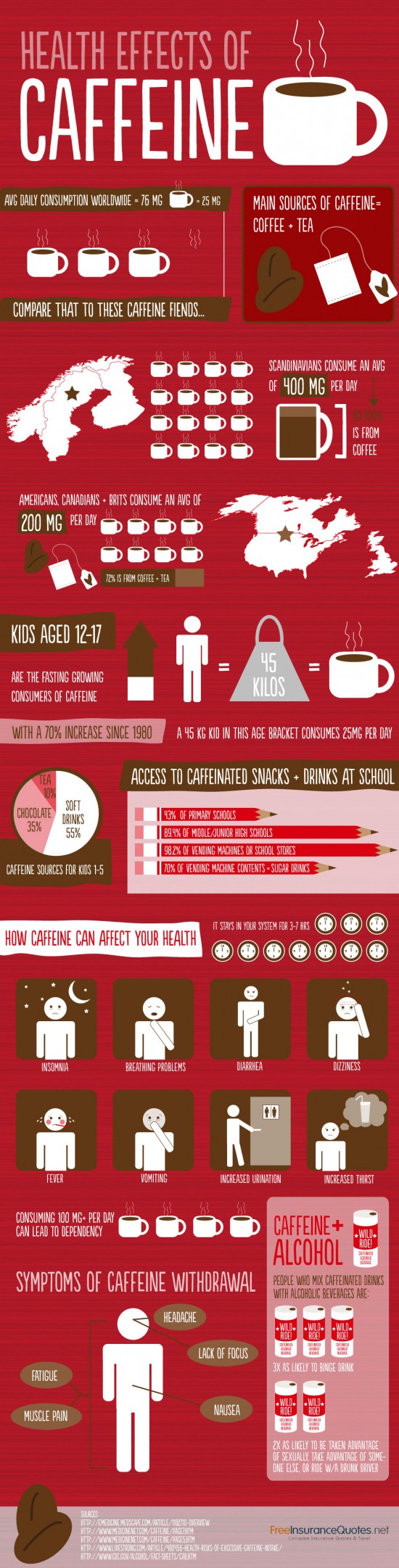
A-1: Here are some reported effects of caffeine. The following effects are commonly attributed to over-use of caffeine. While reading them, bear in mind that what is true for one person may not be true for someone else:

1. Stimulates your heart, respiratory system, and central nervous system

2. Makes your blood more `sludgy’ by raising the level of fatty acids in the blood

3. Causes messages to be passed along your nervous system more quickly

4. Stimulates blood circulation

5. Raises blood pressure

6. Causes your stomach to produce more acid

7. Irritates the stomach lining

8. Makes digestion less effective by relaxing the muscles of your intestinal system

9. Its diuretic effect caused increased urination – although you’d have to drink about 8 coups of coffee in one sitting for this to occur

And so, here is an additional sampling of information about the health effects of caffeine.

A-2: And, caffeine has no affects on health insurance premium rates; smoking does!

Assessment

Source: www.freeinsurancequotes.net

Conclusion

Your thoughts and comments on this ME-P are appreciated. Feel free to review our top-left column, and top-right sidebar materials, links, URLs and related websites, too. Then, subscribe to the ME-P. It is fast, free and secure.

Speaker: If you need a moderator or speaker for an upcoming event, Dr. David E. Marcinko; MBA – Publisher-in-Chief of the Medical Executive-Post – is available for seminar or speaking engagements. Contact: MarcinkoAdvisors@msn.com

OUR OTHER PRINT BOOKS AND RELATED INFORMATION SOURCES:

Product Details  Product Details

A Look at Level Life Insurance Commissions!

Join Our Mailing List

Will It Ever Happen?

[By David K. Luke; MIM]

Investment Advisor

www.NetWorthAdvice.com

The current structure of the life insurance industry regarding cash-value life insurance policies with most major insurance companies is to reward the selling agent with the entire commission upfront on a newly issued policy.

The criticism to this practice is that this of course reduces the needed client-agent reviews and interaction and generates more “churning” and “flipping”.

Unscrupulous agents are tempted to sell clients another policy for another commission rather than encourage them to maintain and keep their existing policy, which most likely would have lower costs than any new policy considering the client was younger and most likely in better health with the existing contract. A model in which the insurance agent would have a financial incentive for their client’s continued patronage could create a win-win for both parties. We see this “pay as you” model currently operating successfully with wealth advisors and property/casualty agents, why not life insurance agents?

A Flawed Argument

There are some flaws to this argument. The reality is that the captive life insurance industry and their agents prefer this form of lump compensation. The claim is that selling an individual a life insurance policy (the ultimate intangible product) is hard work, and likewise the 70% – 105% of the first year premium is fair compensation for the efforts.

For existing agents to reduce their current income to a fraction of this commission upfront, but convert it into a trail over a multiyear period is actually quite distasteful. Therefore, this change will likewise not be initiated from the Insurance agent or insurance industry side unless other forces prevail.

Consumers [Even some Doctors] are Un-Aware

The drive by the consumer to change this up front lump form of compensation has not yet presented itself in full force. After all, why does the consumer care about how the agent is paid if the consumer is satisfied with the end result? One must acknowledge that the drive to reduce commissions and up front loads in the investment advisory business was driven by the consumer that insisted on lower fees and costs.

However, the relevant costs of a life insurance policy are not quite as obvious. Only by comparing a quote from different companies can a consumer compare costs, and even then it is unknown and not understood how the pricing mechanisms used by the insurance company work. The advent of non-agent sold policies however is decreasing the cost of life insurance (there is no big commission check written to the selling agent) and is hitting the radar of consumers. The consumer can notice this difference if the consumer compares the proposed agent sold policy premium with one sold directly by a financial institution such as USAA or AARP. These companies have a work force of sales people that are compensated primarily on salary. Likewise the company can structure more competitive pricing, and in effect offers a levelized cost (in place of commission) insurance product.

A Personal Opinion 

Mark Maurer CFP® of Low Load Insurance Services believes that a levelized compensation basis will not occur unless all the insurance companies were to go to such a plan all at once. If an agent can “pick and choose” he/she may use a “levelized compensation” policy when in a competitive situation, as such a policy should in theory make a policy more inexpensive. An agent would then use the higher “front-end” policy when there is a large up-front premium or in a scenario with limited competition.

Mark believes the answer to the whole argument is full disclosure. Both agents and home offices would not want the purchaser to know that 100% or more of their premium is going to sales costs and that products would then get better.

Assessment

The insurance industry has a powerful lobby in Washington. I believe that only market pressure will cause a change in this decades old insurance industry practice that has made many life insurance policies expensive and inefficient. Pricing from non-agent sold life insurance companies will be the impetus that drives the old-line Insurance companies to restructure their commissions to agents.

I remember the days of 8% load mutual fund commissions and minimum $60 dollar commissions on stock trades in the late 1980’s when I first became a stockbroker! That is an inflation equivalent of more than $130 a trade minimum commission. The current investing world would laugh at these costs [charges] today. When the consumer realizes, through full disclosure and outside competitive market pressures, that life insurance protection can be more affordable from other non-traditional channels, then the consumer will insist on a better, more affordable product. Then the big agent driven life insurance companies will have to change their commission structure. The transition is currently in process. Only time will tell now.

Editor’s Note: David K. Luke is currently enrolled in the online http://www.certifiedmedicalplanner.org chartered professional designation program.

More: Can the Hourly FA Survive?

Channel Surfing

Have you visited our other topic channels? Established to facilitate idea exchange and link our community together, the value of these topics is dependent upon your input. Please take a minute to visit. And, to prevent that annoying spam, we ask that you register.

Link: http://feeds.feedburner.com/HealthcareFinancialsthePostForcxos

Conclusion

Your thoughts and comments on this ME-P are appreciated. Feel free to review our top-left column, and top-right sidebar materials, links, URLs and related websites, too. Then, subscribe to the ME-P. It is fast, free and secure.

Speaker: If you need a moderator or speaker for an upcoming event, Dr. David E. Marcinko; MBA – Publisher-in-Chief of the Medical Executive-Post – is available for seminar or speaking engagements. Contact: MarcinkoAdvisors@msn.com

OUR OTHER PRINT BOOKS AND RELATED INFORMATION SOURCES:

Product Details  Risk Management, Liability Insurance, and Asset Protection Strategies for Doctors and Advisors: Best Practices from Leading Consultants and Certified Medical Planners™8Comprehensive Financial Planning Strategies for Doctors and Advisors: Best Practices from Leading Consultants and Certified Medical Planners™Product Details

How to Select a Property and Casualty Insurance Agent

Eschewing Conventional Wisdom

[By Dr. David Edward Marcinko MBA CMP™]

http://www.CertifiedMedicalPlanner.org

In my travels, and various consulting engagements, I am often asked how to select a good PC agent. As a former insurance agent myself, I know what is required for my medical colleagues. And, there is no doubt that a good property and casualty (P&C) agent is needed to protect the physicians’ home and medical practice business entity, etc.

No Dedicated Agents

The P&C agent should not be dedicated to a single company, but have an array of carriers with which the home or practice can be placed.  I opine thusly even though most insurance companies will offer a discount if you place multiple coverage with them.

Select “Best of Breed”

However, this may not be as beneficial as insuring each need with a specialist. So, do not hesitate to place different types of coverage with different insurers. Selecting the “best of breed” may be more work; but it also may be more beneficial when a claim is made.

Assessment

Remember, by agency law, and definition, P&C agents are not fiduciaries.

Conclusion

Your thoughts and comments on this ME-P are appreciated. Feel free to review our top-left column, and top-right sidebar materials, links, URLs and related websites, too. Then, subscribe to the ME-P. It is fast, free and secure.

Speaker: If you need a moderator or speaker for an upcoming event, Dr. David E. Marcinko; MBA – Publisher-in-Chief of the Medical Executive-Post – is available for seminar or speaking engagements. Contact: MarcinkoAdvisors@msn.com

OUR OTHER PRINT BOOKS AND RELATED INFORMATION SOURCES:

Product Details  Product Details

Is it Time for Level Life Insurance Commissions? [A Voting and Opinion Poll]

Ending the Churn-em’ and Burn-em’ Ethos 

By Staff Reporters

Join Our Mailing List 

Some insurance agents are currently noting that life insurance ownership is almost at an all time low because of the economy. And, some have even prompted suggestions that a “level commissions” payout would reverse the trend.

The argument goes something like this:

If agents were compensated 10% a year over a 10-year period rather than 100% in year one, annual reviews would increase substantially. The long-standing current method is not geared toward ongoing service, but to “churning” and “flipping”. Clients get better service from their property/casualty agents and wealth advisors because these practitioners have a financial inventive for their clients’ continued allegiance.

What do you think? Please vote and be sure to add your comments below.

Conclusion

And so, your thoughts and comments on this ME-P are appreciated. Feel free to review our top-left column, and top-right sidebar materials, links, URLs and related websites, too. Then, subscribe to the ME-P. It is fast, free and secure.

Link: http://feeds.feedburner.com/HealthcareFinancialsthePostForcxos

Speaker: If you need a moderator or speaker for an upcoming event, Dr. David E. Marcinko; MBA – Publisher-in-Chief of the Medical Executive-Post – is available for seminar or speaking engagements. Contact: MarcinkoAdvisors@msn.com 

Product Details  Product Details

For Doctors Who Wish to Retire Wealthy [Despite the Economy?]

Financial Planning for Physicians and Advisors


Financial Planning Handbook for Physicians and Advisors


Speaker: If you need a moderator or speaker for an upcoming event, Dr. David E. Marcinko; MBA – Publisher-in-Chief of the Medical Executive-Post – is available for seminar or speaking engagements. Contact: MarcinkoAdvisors@msn.com


Injured War Contractors Sue Over Health Care

And … Disability Payments

By T. Christian Miller
ProPublica, September 27, 2011, 10:11 am

Join Our Mailing List 

Private contractors injured while working for the U.S. government in Iraq and Afghanistan filed a class action lawsuit [1] in federal court on Monday, claiming that corporations and insurance companies had unfairly denied them medical treatment and disability payments.

The Law Suit

The suit, filed in district court in Washington, D.C., claims that private contracting firms and their insurers routinely lied, cheated and threatened injured workers, while ignoring a federal law requiring compensation for such employees. Attorneys for the workers are seeking $2 billion in damages.

The Defense Base Act

The suit is largely based on the Defense Base Act, an obscure law that creates a workers-compensation system for federal contract employees working overseas. Financed by taxpayers, the system was rarely used until the wars in Iraq and Afghanistan, the most privatized conflicts in American history.

Hundreds of thousands of civilians working for federal contractors have been deployed to war zones to deliver mail, cook meals and act as security guards for U.S. soldiers and diplomats. As of June 2011, more than 53,000 civilians have filed claims for injuries in the war zones. Almost 2,500 contract employees have been killed, according to figures [2] kept by the Department of Labor, which oversees the system.

An investigation by ProPublica, the Los Angeles Times and ABC’s 20/20 [3] into the Defense Base Act system found major flaws, including private contractors left without medical care and lax federal oversight. Some Afghan, Iraqi and other foreign workers for U.S. companies were provided with no care at all.

Assessment

The lawsuit, believed to be the first of its kind, charges that major insurance corporations such as AIG and large federal contractors such as Houston-based KBR deliberately flouted the law, thereby defrauding taxpayers and boosting their profits. In interviews and at congressional hearings, AIG and KBR have denied such allegations and said they fully complied with the law. They blamed problems in the delivery of care and benefits on the chaos of the war zones.

Conclusion

And so, your thoughts and comments on this ME-P are appreciated. Feel free to review our top-left column, and top-right sidebar materials, links, URLs and related websites, too. Then, subscribe to the ME-P. It is fast, free and secure.

Link: http://feeds.feedburner.com/HealthcareFinancialsthePostForcxos

Speaker: If you need a moderator or speaker for an upcoming event, Dr. David E. Marcinko; MBA – Publisher-in-Chief of the Medical Executive-Post – is available for seminar or speaking engagements. Contact: MarcinkoAdvisors@msn.com

Our Other Print Books and Related Information Sources:

Health Dictionary Series: http://www.springerpub.com/Search/marcinko

Practice Management: http://www.springerpub.com/product/9780826105752

Physician Financial Planning: http://www.jbpub.com/catalog/0763745790

Medical Risk Management: http://www.jbpub.com/catalog/9780763733421

Healthcare Organizations: www.HealthcareFinancials.com

Physician Advisors: www.CertifiedMedicalPlanner.com

Subscribe Now: Did you like this Medical Executive-Post, or find it helpful, interesting and informative? Want to get the latest ME-Ps delivered to your email box each morning? Just subscribe using the link below. You can unsubscribe at any time. Security is assured.

Link: http://feeds.feedburner.com/HealthcareFinancialsthePostForcxos

Sponsors Welcomed: And, credible sponsors and like-minded advertisers are always welcomed.

Link: https://healthcarefinancials.wordpress.com/2007/11/11/advertise

Product DetailsProduct DetailsProduct Details       

Understanding the Risks of Health 2.0 in Medical Practice

Risk Management and Insurance Strategies for Physicians and Financial Advisors

Insurance and Risk Management Strategies for Physicians and Advisors

Channel Surfing the ME-P

Have you visited our other topic channels? Established to facilitate idea exchange and link our community together, the value of these topics is dependent upon your input. Please take a minute to visit. And, to prevent that annoying spam, we ask that you register. It is fast, free and secure.

Conclusion

Your thoughts and comments on this ME-P are appreciated. Feel free to review our top-left column, and top-right sidebar materials, links, URLs and related websites, too. Then, subscribe to the ME-P. It is fast, free and secure.

Speaker: If you need a moderator or speaker for an upcoming event, Dr. David E. Marcinko; MBA – Publisher-in-Chief of the Medical Executive-Post – is available for seminar or speaking engagements. Contact: MarcinkoAdvisors@msn.com

OUR OTHER PRINT BOOKS AND RELATED INFORMATION SOURCES:

Comprehensive Financial Planning Strategies for Doctors and Advisors: Best Practices from Leading Consultants and Certified Medical Planners(TM)* 8

Things You Didn’t Know About Death

Not a Unique Experience

Join Our Mailing List 

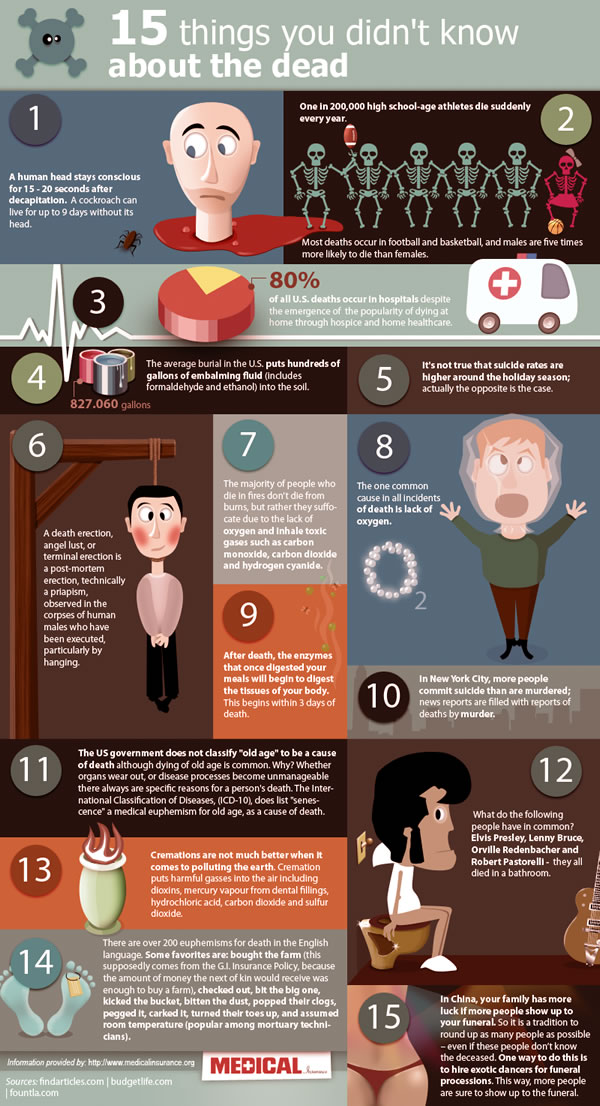
Death is an experience that we’re all going to have at one point or another. Why not take a few minutes to learn some interesting and some truly bizarre facts about death, dying, and the dead? Brought to you by medicalinsurance.org

Conclusion

Your thoughts and comments on this ME-P are appreciated. Feel free to review our top-left column, and top-right sidebar materials, links, URLs and related websites, too. Then, subscribe to the ME-P. It is fast, free and secure.

Speaker: If you need a moderator or speaker for an upcoming event, Dr. David E. Marcinko; MBA – Publisher-in-Chief of the Medical Executive-Post – is available for seminar or speaking engagements. Contact: MarcinkoAdvisors@msn.com

OUR OTHER PRINT BOOKS AND RELATED INFORMATION SOURCES:

Product Details  Product Details

Should Health Insurance Pay for Patient Exercise Programs?

Or – Enough with the “Benefits” Already!

By Dr. David Edward Marcinko MBA, CMP™

[Former Licensed Insurance Agent]

[ME-P Editor-in-Chief]

An editorial just published in the Journal of the American Medical Association says research supports consideration of a wider policy of reimbursing for structured exercise programs, particularly in high-risk groups, such as diabetics.

Link: http://jama.ama-assn.org/content/305/17/1808.full

Present Status

Currently, health-insurance plans don’t treat exercise as medicine; only some plans offer a fitness benefit, usually a partial reimbursement for gym membership.

Link: http://blogs.wsj.com/health/2011/05/04/reader-consult-should-insurance-reimburse-for-exercise-programs/

Yet, the push for this benefit does seem to be growing.

My Opinion

And yes, as a doctor and surgeon who treated diabetic bone and soft tissue infections, ulcers and related necrotic gangrene for two decades, there’s something to this philosophy in-theory. But, this “theory” is not grounded in risk-management principles or economic sense; and it does seem counter-intuitive to most insurance models that I know.

Note: Most adult diabetics are Type II, maturity onset and controllable.

Examples

For example, auto insurance does not pay for routine car maintenance, nor does home owner’s insurance or most other standard insurance policy types.

Question: Why should health insurance be any different?

Answer: Because it is a public good.

Oh, come on now!  Obeying moral codes and legal boundaries is also a public good for civility; but we don’t mitigate the risk of breaking them with insurance policies; do we?

Why? They would be too expensive. Believe me, if insurance companies thought they could make a buck this way, they surely would!

Assessment

Aren’t these types of benefits already in place in some Flexible Spending Accounts, High Deductible Medical [Health] Savings Accounts , and employee cafeteria plans, etc.

Moreover, don’t we all know that we aren’t supposed to smoke, use street drugs, drink excessively, pig-out, or have promiscuous sex? Yet – we still do – like the diabetic who excessively indulges.

If you want to get-or-stay healthy[ier]; exercise more and eat less. A simple – understandable – and free healthcare Rx; but no best selling book, “breaking news” or JAMA report, here.

Conclusion

And so, your thoughts and comments on this ME-P are appreciated. Should health insurance pay for exercise programs? Feel free to review our top-left column, and top-right sidebar materials, links, URLs and related websites, too. Then, subscribe to the ME-P. It is fast, free and secure.

Link: http://feeds.feedburner.com/HealthcareFinancialsthePostForcxos

Speaker: If you need a moderator or speaker for an upcoming event, Dr. David E. Marcinko; MBA – Publisher-in-Chief of the Medical Executive-Post – is available for seminar or speaking engagements. Contact: MarcinkoAdvisors@msn.com

Our Other Print Books and Related Information Sources:

Health Dictionary Series: http://www.springerpub.com/Search/marcinko

Practice Management: http://www.springerpub.com/product/9780826105752

Physician Financial Planning: http://www.jbpub.com/catalog/0763745790

Medical Risk Management: http://www.jbpub.com/catalog/9780763733421

Healthcare Organizations: www.HealthcareFinancials.com

Physician Advisors: www.CertifiedMedicalPlanner.com

Subscribe Now: Did you like this Medical Executive-Post, or find it helpful, interesting and informative? Want to get the latest ME-Ps delivered to your email box each morning? Just subscribe using the link below. You can unsubscribe at any time. Security is assured.

Link: http://feeds.feedburner.com/HealthcareFinancialsthePostForcxos

Sponsors Welcomed: And, credible sponsors and like-minded advertisers are always welcomed.

Link: https://healthcarefinancials.wordpress.com/2007/11/11/advertise

Product DetailsProduct DetailsProduct Details       

Product Details  Product Details

   Product Details 

Understanding Workers’ Compensation

Join Our Mailing List

A Primer for the Physician Executive

By Dr. David Edward Marcinko MBA

[Publisher-in-Chief]

Workers’ Compensation is reported to be the largest line of commercial insurance, possibly because it is also a statutory obligation for employers, like doctors, who have common law employees.  Workers’ Compensation provides coverage for lost income due to on-the-job accidents or work-related disability or death, and benefits vary by state.  Its purpose is not only to provide these benefits but also to reduce potential litigation. Employees accepting the benefit payments from a Workers’ Compensation claim generally forego the right to sue their employer. Workers’ Compensation rates are established by job descriptions and commercial rates for the medical professional’s office are some of the lowest available.

The Methods

There are three methods of providing Workers’ Compensation coverage:

1.   Private commercial insurance

2.   Governmental insurance funds

3.   Self-insure

The medical professional may be inclined to the third method, especially in the larger offices. Since the weekly benefits are typically below $500, this would seem to make a lot of sense. But, as in larger groups, the officers and owners can elect not to be covered – it is usually more convenient for the medical professional to cover this risk with personal disability income insurance.

The Monopolistic States

There are, however, seven “monopolistic” states – Nevada, North Dakota, Ohio, Washington, West Virginia, and Wyoming – which do not permit private commercial insurance.

Assessment

Larger offices or companies, which wish to take more direct control of costs and benefit management, should consider self-insuring only after receiving expert advice.  This is one form of coverage that truly requires a trusted, knowledgeable insurance advisor.

Channel Surfing the ME-P

Have you visited our other topic channels? Established to facilitate idea exchange and link our community together, the value of these topics is dependent upon your input. Please take a minute to visit. And, to prevent that annoying spam, we ask that you register. It is fast, free and secure.

Conclusion

Your thoughts and comments on this ME-P are appreciated. Feel free to review our top-left column, and top-right sidebar materials, links, URLs and related websites, too. Then, subscribe to the ME-P. It is fast, free and secure.

Speaker: If you need a moderator or speaker for an upcoming event, Dr. David E. Marcinko; MBA – Publisher-in-Chief of the Medical Executive-Post – is available for seminar or speaking engagements. Contact: MarcinkoAdvisors@msn.com

OUR OTHER PRINT BOOKS AND RELATED INFORMATION SOURCES:

Product DetailsProduct DetailsProduct Details

Product Details  Product Details

   Product Details 

Financial Planning and Risk Management Strategies for Physicians

Financial Planning Handbook for Physicians and Advisors

Product Details

 • http://www.jblearning.com/catalog/9780763745790/

Insurance Planning and Risk Management Strategies for Physicians and Advisors

Product Details

http://www.jblearning.com/catalog/9780763733421/

ADVERTISEMENT

Speaker: If you need a moderator or speaker for an upcoming event, Dr. David E. Marcinko; MBA – Publisher-in-Chief of the Medical Executive-Post – is available for seminar or speaking engagements. Contact: MarcinkoAdvisors@msn.com and http://www.springerpub.com/Search/marcinko

About Cyber Insurance for Doctors

Join Our Mailing List

What it is – How it works?

By Staff Reporters

All medical practitioners and ME-P readers and subscribers are aware that there are stiff penalties for protected health information [PHI] data breaches. And, the HIPPA policies and laws are legendary.

Security Standards

Cyber security standards are standards which enable healthcare and other organizations to practice safe security techniques to minimize the number of successful cyber security attacks and HIPPA information breaches.

Assessment

These guides provide general outlines as well as specific techniques for implementing cyber security. For certain specific standards, cyber security certification by an accredited body can be obtained. There are many advantages to obtaining certification including the ability to get cyber security insurance.

Link: ISA – Cyber-Insurance Metrics and Impact on Cyber-Security

Conclusion

Your thoughts and comments on this ME-P are appreciated. Feel free to review our top-left column, and top-right sidebar materials, links, URLs and related websites, too. Then, subscribe to the ME-P. It is fast, free and secure.

Speaker: If you need a moderator or speaker for an upcoming event, Dr. David E. Marcinko; MBA – Publisher-in-Chief of the Medical Executive-Post – is available for seminar or speaking engagements. Contact: MarcinkoAdvisors@msn.com

OUR OTHER PRINT BOOKS AND RELATED INFORMATION SOURCES:

Product DetailsProduct DetailsProduct Details

Product Details  Product Details

   Product Details 

David B. Nash MD MBA FACP

ADVERTISEMENT
Product Details

Hospitals & Healthcare Organizations

FOREWORD 

David Nash MD MBA

It should come as no surprise to our readers that the nation faces a financial crisis in healthcare. 

Currently, the United States spends nearly 16% of the world’s largest economy on providing healthcare services to its citizens.  Another way of looking at this same information is to realize that we spend nearly $6,500 per man, woman, and child per year to deliver health services.  And, what do we get for the money we spend?  

This is an important policy question and the answer is disquieting.  Although the man and woman on the street may believe we have the best health system in the world, on an international basis, using well-accepted epidemiologic outcome measures, our investment does not yield much!  

According to information from the World Health Organization and other international bodies, the United States of America ranks somewhere towards the bottom of the top fifteen developed nations in the world, regarding the outcome in terms of improved health for the monies we spend on healthcare. 

From a financial and economic perspective then, it appears as though the 16% of the GDP going to healthcare may not represent a solid investment with a good return. 

It is then timely that our colleagues at the Institute of Medical Business Advisors, Inc. have brought us their greatest work: Healthcare Organizations: [Financial Management Strategies]; a two-volume set of nearly 1,200 pages.  

Certainly, this comprehensive manual, and its quarterly updates, is not for everyone. It is intended only for those executives and administrators who understand that clinics, hospitals and healthcare organizations are complex businesses, with advances in science, technology, management principles and patient/consumer awareness often eclipsed by regulations, rights, and economic restrictions.  Navigating a course where sound organizational management is intertwined with financial acumen requires a strategy designed by subject matter experts. Fortunately, Healthcare Organizations: [Financial Management Strategies] provides that blueprint.

Allow me to outline its strengths and put it into context relative to other policy works around the nation. 

For nearly two years, the research team at iMBA, Inc., has sought out the best minds in the healthcare industrial complex to organize the seemingly impossible-to-understand strategic financial backbone of the domestic healthcare system.   

The periodical print-guide is organized into two volumes in order to appropriately cover many of the key topics at hand.  It has a natural flow, starting with Competitive Strategy and moving through Asset Management, Cost Management, and Claims Management.  

Volume 1, most especially the Competitive Strategy section, has broad appeal and would be of interest to most people in the health insurance industry, including managed care, hospitals, third party benefit managers and the pharmaceutical industry. 

Volume 2 continues in a well-organized theme, progressing from Risk Management and Compliance to Health Policy, Information Technology, and most importantly, Financial Benchmarking. 

Volume 2 would be of greater interest to those in the policy sphere, both in Washington, DC, in state legislatures, consulting companies, medical colleges, and graduate schools of health administration, public health and related fields. Every day colleagues ask me to help explain the seemingly incomprehensible financial design of our healthcare system.  These two volumes would go a long way toward answering their queries. 

I also believe both volumes would be appropriate as text books and reference tools in graduate level courses taught in schools of business, public health, health administration, and medicine. 

In my travels about the nation, many faculty members would also benefit from the support of these two volumes as it is nearly impossible, even for experts in the field, to grasp all of the rapidly evolving details. 

On a personal level, I was particularly taken with the Competitive Strategy section and it brought back enjoyable memories of my work nearly twenty-five years ago at the Wharton School, on the campus of the University of Pennsylvania.  There, I was exposed to some of the best economic minds in the healthcare business and it was a watershed event for me forming some of my earliest opinions about the healthcare system. 

I also very much enjoyed the section on Health Policy, most especially, the section on the Sarbanes-Oxley Act for hospitals and healthcare organizations.  I believe we have not fully embraced the comprehensive nature of Sarbanes-Oxley on the hospital side, and envision a day when hospital boards will be held accountable for quality, in the same way that proprietary corporations are held accountable for the strength and comprehensiveness of their audit reports. Simply put, Sarbanes-Oxley for quality is around the corner and this volume goes a long way toward preparing our basic understanding of the Act and its potential future implications. Congratulations to all authors, but this one in particular deserves specific mention. As a board member for a major national integrated delivery system, I am happy that there appears to be a greater interest in the intricacies of Sarbanes-Oxley on the healthcare side of the ledger. 

In summary, Healthcare Organizations: [Financial Management Strategies] represents a unique marriage between the Institute of Medical Business Advisors, Inc., and its many contributors from across the nation.  As its mission statement suggests, I believe this massive interpretive text carries out its vision to connect healthcare financial advisors, hospital administrators, business consultants, and medical colleagues everywhere. It will help them learn more about organizational behavior, strategic planning, medical management trends and the fluctuating healthcare environment; and consistently engage everyone in a relationship of trust and a mutually beneficial symbiotic learning environment.  

Editor-in-Chief and healthcare economist Dr. David Edward Marcinko and his colleagues at the Institute of Medical Advisors, Inc should be complimented for conceiving and completing this vitally important project. There is no question that Healthcare Organizations: [Journal of Financial Management Strategies] will indeed enable us to leverage our cognitive assets and prepare a future generation of leaders capable of tackling the many challenges present in our healthcare economy.  

My suggestion therefore, is to “read it, refer to it, recommend it, and reap.”  

David B. Nash MD, MBA
The Dr. Raymond C and Doris N. Professor and
Chair of the Department of Health Policy
Jefferson Medical College
Thomas Jefferson University
Philadelphia, Pa, USA
 

Conclusion

Your thoughts and comments on this ME-P are appreciated. Feel free to review our top-left column, and top-right sidebar materials, links, URLs and related websites, too. Then, subscribe to the ME-P. It is fast, free and secure.

Link: http://feeds.feedburner.com/HealthcareFinancialsthePostForcxos

Speaker: If you need a moderator or speaker for an upcoming event, Dr. David E. Marcinko; MBA – Publisher-in-Chief of the Medical Executive-Post – is available for seminar or speaking engagements. Contact: MarcinkoAdvisors@msn.com

OUR OTHER PRINT BOOKS AND RELATED INFORMATION SOURCES:

LEXICONS: http://www.springerpub.com/Search/marcinko
PHYSICIANS: www.MedicalBusinessAdvisors.com
PRACTICES: www.BusinessofMedicalPractice.com
HOSPITALS: http://www.crcpress.com/product/isbn/9781466558731
CLINICS: http://www.crcpress.com/product/isbn/9781439879900
ADVISORS: www.CertifiedMedicalPlanner.org
BLOG: www.MedicalExecutivePost.com

Product Details

Why Doctors Must Take Care When Swapping Insurance Policies and Annuities

Understanding Section 1035 Treatment of Exchanges

By Dr. David Edward Marcinko MBA CMP™

www.CertifiedMedicalPlanner.org

[Publisher-in-Chief]

With the passage of the Tax Equity and Fiscal Responsibility Act, back in 1982 (TEFRA), insurance companies were required to report the payment of all surrender proceeds, forcing physicians and all individuals to be more compliant in reporting gains on the surrender of an old policy. As a result, insureds took advantage of IRC Section 1035 and made tax-free exchanges of insurance, endowment, and annuity contracts. If the exchange is structured properly, gains (and losses) on the surrender of an old policy must be deferred beyond the life of the policyholder.

Section 1035 Treatment

The following types of exchanges qualify for tax-free treatment:

1. A life insurance contract for another life insurance, annuity, or endowment contract

2. An endowment contract for an annuity contract or for another endowment contract in which the payments begin at a date no later than the date that payment would have begun under the original contract

3. An annuity contract for another annuity contract

However, to the extent that money or other property (“boot”) is received by the insured in a 1035 exchange, gain may be recognized to the extent of the “boot.” The new policy received takes the basis of the old contract exchanged, decreased by the value of boot received, and increased by any gain required to be recognized.

Limits

Unlike exchanges subject to Section 1031, in which there is a 180-day limit, there is apparently no statutory time limit for completing an exchange under Section 1035. However, be careful in the case of an exchange of immediate annuity contracts in which the annuity starting date must begin no later than one year from the date of the purchase of the annuity. When an exchange has occurred, the holding period of the original contract attaches to the new contract. Therefore, the insured may not have begun to receive the annuity within one year from the date of the annuity’s purchase, and therefore, the 10% premature withdrawal penalty may apply.

Section 403(b) Annuities

The IRS has even allowed tax-free exchange of Section 403(b) annuities provided the new contract’s distribution restrictions are at least as stringent as those of the old contract. And, distributions from financially troubled life insurance companies, if reinvested within 60 days of receipt, can qualify for 1035 treatment. But, in most cases, a doctor or taxpayer should undertake a direct exchange whenever possible.

Note: “Nontaxable Exchanges of Insurance Contracts and Annuities Under Section 1035,” John C. Zimmerman and Tamara K. Kowalczyk, Journal of Taxation of Investments, Summer 1997, pp. 307–315, Warren, Gorham & Lamont, (800) 950-1205.

Conclusion

And so, your thoughts and comments on this ME-P are appreciated. Have you ever made this sort of exchange; successful or not? Feel free to review our top-left column, and top-right sidebar materials, links, URLs and related websites, too. Then, subscribe to the ME-P. It is fast, free and secure.

Link: http://feeds.feedburner.com/HealthcareFinancialsthePostForcxos

Speaker: If you need a moderator or speaker for an upcoming event, Dr. David E. Marcinko; MBA – Publisher-in-Chief of the Medical Executive-Post – is available for seminar or speaking engagements. Contact: MarcinkoAdvisors@msn.com

OUR OTHER PRINT BOOKS AND RELATED INFORMATION SOURCES:

DICTIONARIES: http://www.springerpub.com/Search/marcinko
PHYSICIANS: www.MedicalBusinessAdvisors.com
PRACTICES: www.BusinessofMedicalPractice.com
HOSPITALS: http://www.crcpress.com/product/isbn/9781466558731
CLINICS: http://www.crcpress.com/product/isbn/9781439879900
BLOG: www.MedicalExecutivePost.com
FINANCE: Financial Planning for Physicians and Advisors
INSURANCE: Risk Management and Insurance Strategies for Physicians and Advisors

Product DetailsProduct DetailsProduct Details

Product Details  Product Details

   Product Details 

More on Disability Insurance for Physicians

Join Our Mailing List

Some Advice from a Doctor, Insurance Agent and Financial Advisor

Dr. David Edward Marcinko MBA CMP™

www.CertifiedMedicalPlanner.org

[Publisher-in-Chief]

Policies Are Harder to Get, More Expensive, and Offer Less Protection Than Before

Due principally to large claims from anesthesiologists, surgeons, emergency room physicians, and trial attorneys, disability insurance underwriting is becoming stricter. Among the effects on policyholders: revised definitions of disability; restriction of benefits to two years on so-called “soft tissue” disabilities and mental and nervous disorders; and downgrading of professionals to the general white-collar category. The result is higher premiums.

Buy a Good Individual Policy

Based upon the fact that disability is the only insurance product on the market that is non-cancelable (premiums and policy features are locked in until age 65), my advice is to buy a good quality individual policy as early as possible and hang on to it. Group benefits should be added later. Also, many group plans only include straight salary in compensation. Incentive compensation, which makes up a large portion of an executive’s compensation, is not considered. Under the Revenue Reconciliation Act of 1993, employee disability benefits can only cover up to $150,000 in compensation. Finally, don’t forget that if the employer pays the premiums, benefits are taxable. This can substantially reduce an executive’s disability income.

Pay More for Non-Cancelable Coverage

I also may recommend paying a 15–20% higher premium to obtain non-cancelable coverage, if available, as compared to guaranteed renewable coverage. In both cases, coverage cannot be canceled. However, in the latter case, premiums can be increased on a class basis. Also, investigate the partial-disability benefits as well as the residual benefits after returning to work.

Note: “Your Disability Is Your Opportunity,” by Jaberta C. Evans, Dow Jones Investment Advisor, December 1996, pp. 76–80, Dow Jones Financial Publishing Corp., [908] 389-8700.)

Conclusion

Your thoughts and comments on this ME-P are appreciated. Feel free to review our top-left column, and top-right sidebar materials, links, URLs and related websites, too. Then, subscribe to the ME-P. It is fast, free and secure.

Link: http://feeds.feedburner.com/HealthcareFinancialsthePostForcxos

Speaker: If you need a moderator or speaker for an upcoming event, Dr. David E. Marcinko; MBA – Publisher-in-Chief of the Medical Executive-Post – is available for seminar or speaking engagements. Contact: MarcinkoAdvisors@msn.com

OUR OTHER PRINT BOOKS AND RELATED INFORMATION SOURCES:

DICTIONARIES: http://www.springerpub.com/Search/marcinko
PHYSICIANS: www.MedicalBusinessAdvisors.com
PRACTICES: www.BusinessofMedicalPractice.com
HOSPITALS: http://www.crcpress.com/product/isbn/9781466558731
CLINICS: http://www.crcpress.com/product/isbn/9781439879900
BLOG: www.MedicalExecutivePost.com
FINANCE: Financial Planning for Physicians and Advisors
INSURANCE: Risk Management and Insurance Strategies for Physicians and Advisors

Product DetailsProduct DetailsProduct Details

Product Details  Product Details

   Product Details 

What is Universal-Variable Life Insurance and How Does it Work?

 Insurance Basics for Medical Professionals

By By Jeffrey H. Rattiner, CPA, CFP®, MBA

Join Our Mailing List 

After determining the need for insurance and the amount to purchase, the doctor-client and financial planner’s next task is to match those needs to the client’s objectives to determine what type of policy the client should purchase. The life insurance industry features more products today than ever before. One reason for this change is that, clearly, the insurance industry has expanded its product base to become more competitive. Another reason is that clients’ needs are constantly changing and the insurance companies must keep up with those needs or run the risk of having funds withdrawn from their companies. New and different types of life insurance products are here to stay. Since life insurance represents a significant part of a doctor-client’s risk-management program, planners have to be versed in the specifics of the varied product base.

Definition

Universal variable life insurance is a hybrid of universal life and variable life insurance. It lets policyholders adjust premiums and reconfigure the death benefit level. The cost of this increased flexibility depends on the equities that are invested.

Similarity to Variable Life Insurance

Similar to the variable life contract, the policyholder gets to choose the investment medium under this contract, with no guaranteed cash value levels or growth. Policyowners are given the choice of option A death benefits (face amount only) or option B death benefits (face amount plus cash value). Because of the daily changes in cash value, however, option B is often not available. Premiums and death benefits are flexible and not guaranteed.

Assessment

Universal variable life policies are most appropriate for people with changing financial needs or long-term needs and for those who are willing to give up all guarantees in exchange for policy and investment flexibility.

Conclusion

And so, your thoughts and comments on this ME-P are appreciated. What kind of life insurance do you have doctor, and is it enough? Feel free to review our top-left column, and top-right sidebar materials, links, URLs and related websites, too. Then, subscribe to the ME-P. It is fast, free and secure.

Speaker: If you need a moderator or speaker for an upcoming event, Dr. David E. Marcinko; MBA – Publisher-in-Chief of the Medical Executive-Post – is available for seminar or speaking engagements. Contact: MarcinkoAdvisors@msn.com and http://www.springerpub.com/Search/marcinko

Get our Widget: Get this widget!

Our Other Print Books and Related Information Sources:

Health Dictionary Series: http://www.springerpub.com/Search/marcinko

Practice Management: http://www.springerpub.com/product/9780826105752

Physician Financial Planning: http://www.jbpub.com/catalog/0763745790

Medical Risk Management: http://www.jbpub.com/catalog/9780763733421

Healthcare Organizations: www.HealthcareFinancials.com

Physician Advisors: www.CertifiedMedicalPlanner.com

Subscribe Now: Did you like this Medical Executive-Post, or find it helpful, interesting and informative? Want to get the latest ME-Ps delivered to your email box each morning? Just subscribe using the link below. You can unsubscribe at any time. Security is assured.

Link: http://feeds.feedburner.com/HealthcareFinancialsthePostForcxos

Sponsors Welcomed: And, credible sponsors and like-minded advertisers are always welcomed.

Link: https://healthcarefinancials.wordpress.com/2007/11/11/advertise

Product DetailsProduct DetailsProduct Details       

Product Details  Product Details

   Product Details 

Where Are the Financial Crisis Prosecutions?

The White Collar Slump?

By Jesse Eisinger
ProPublica: jesse@propublica.org

Join Our Mailing List 

You may have noticed that prosecutors in this country are in something of a white-collar slump lately.

The stock options backdating prosecutions have largely been a bust [1], not because it wasn’t a true scandal. The Securities and Exchange Commission and the Justice Department investigated more than 100 companies. Over a hundred took accounting restatements. Yet only a handful of executives went to prison, with some high-profile cases fizzling out. Prosecutors also stumbled in other high priority corporate fraud prosecutions, like the KPMG [2] tax shelter and the stock-exchange specialists [3] cases.

Bear Sterns

The most spectacular prosecutorial flameout [4] was the case against the Bear Stearns hedge fund managers. The consequences of that disaster are still reverberating. The United States attorney’s office in Brooklyn rushed to haul low-level executives in front of a jury based on a few seemingly incriminating emails. The defense was easily able to convince jurors that these represented only out-of-context glimpses of fear as markets swooned, not a conspiracy to mislead. But, now we have a supposedly new push: the insider trading scandal.

Insider Trading

The United States attorney in Manhattan, Preet Bharara, and the United States Attorney, General Eric H. Holder Jr., are hyping their efforts. “Illegal insider trading is rampant and may even be on the rise,” Mr. Bharara dubiously pronounced in a speech [5] in October. The Feds are raiding [6] hedge funds and publicly celebrating their criminal investigations related to insider trading.

The storyline is that Wall Street now lives in fear. Hedge fund managers’ phones might be tapped, any stray remark is suspect, and old trades are being exhumed so that the entrails can be examined.

In fact, plenty of folks on Wall Street are happy about the investigation. A scant few — the ones with clean consciences — like the idea that the world of special access to favorable tips is being cleaned up.

But others are pleased for a different reason: They realize the investigation is a sideshow.

All the hype carries an air of defensiveness. Everyone is wondering: Where are the investigations related to the financial crisis?

Enron, Lehman, Merrill, Citigroup and Others

John Hueston, a former lead Enron prosecutor, wonders: “Have they committed the resources in the right place? Do these scandals warrant apparent national priority status?”

Nobody from Lehman, Merrill Lynch or Citigroup has been charged criminally with anything. No top executives at Bear Stearns have been indicted. All former American International Group executives are running free. No big mortgage company executive has had to face the law.

How about someone other than the Fabulous Fab [7] at Goldman Sachs? How could the Securities and Exchange Commission merely settle with Countrywide’s Angelo Mozilo [8] — and for a fraction of what he made as CEO?

The world was almost brought low by the American banking system and we are supposed to think that no one did anything wrong?

The most common explanation from lawyers for this bizarre state of affairs is that it’s hard work. It’s complicated to make criminal cases in corporate fraud. Getting a case that shows the wrong-doer acted with intent — and proving it to a jury — is difficult.

But, of course, Enron was complicated too, and prosecutors got the big boys. Ken Lay was found guilty (he died before he served his time). Jeff Skilling is in prison now, though the end result was bittersweet for prosecutors when much of his conviction was overturned by the Supreme Court. WorldCom’s Bernie Ebbers and Tyco’s Dennis Kozlowski are wearing stripes.

Complicated Cases

Sure, it takes time to investigate complicated cases. Many people think that the SEC, at the least, will bring some charges against top executives at Lehman Brothers. The huge, ground-breaking special examiner’s report [9] on Lehman Brothers laid bare problems with Lehman’s accounting. But that report came out back in March — on a bank that blew up more than two years ago. That seems awfully slow.

The most popular reason offered for the dearth of financial crisis prosecutions is the 100-year flood excuse: The banking system was hit by a systemic and unforeseeable disaster, which means that, as unpleasant as it may be to laymen, it’s unlikely that anyone committed any crimes.

Stupidity is No Crime

Or, barring that wildly implausible explanation (since, indeed, many people saw the crash coming and warned about it), the argument is that acting stupidly and recklessly is no crime.

As I ride the subway every morning, I often fantasize about criminalizing stupidity and fecklessness. But alas, it’s not to be.

Nevertheless, it’s hardly reassuring that bankers, out of necessity, have universally adopted the dumb-rather-than-venal justification. That doesn’t mean, however, that the rest of us need to buy it. It’s shocking how pervasive and triumphant this narrative of the financial crisis has been.

Link: http://www.propublica.org/thetrade/item/where-are-the-financial-crisis-prosecutions/

Assessment

Just as it’s clear that not all bankers were guilty of crimes in the lead-up to the crisis, it strains credulity to contend no one was. Corporate crime is usually the act of desperate people who have initially made relatively innocent mistakes and then seek to cover them up. Some banks went down innocently. Surely some housed bad actors who broke laws.

As a society, we have the bankers we deserve. Sadly, it’s looking like we have the regulators and prosecutors we deserve, too.

Conclusion

Your thoughts and comments on this ME-P are appreciated. Feel free to review our top-left column, and top-right sidebar materials, links, URLs and related websites, too. Then, subscribe to the ME-P. It is fast, free and secure.

Speaker: If you need a moderator or speaker for an upcoming event, Dr. David E. Marcinko; MBA – Publisher-in-Chief of the Medical Executive-Post – is available for seminar or speaking engagements. Contact: MarcinkoAdvisors@msn.com

OUR OTHER PRINT BOOKS AND RELATED INFORMATION SOURCES:

Product DetailsProduct DetailsProduct Details

Product Details  Product Details

What is Universal Life Insurance and How Does it Work?

Insurance Basics for Medical Professionals

By Jeffrey H. Rattiner, CPA, CFP®, MBA

Join Our Mailing List 

After determining the need for insurance and the amount to purchase, the doctor-client and financial planner’s next task is to match those needs to the doctor-client’s objectives to determine what type of policy the client should purchase. The life insurance industry features more products today than ever before. One reason for this change is that, clearly, the insurance industry has expanded its product base to become more competitive. Another reason is that clients’ needs are constantly changing and the insurance companies must keep up with those needs or run the risk of having funds withdrawn from their companies. New and different types of life insurance products are here to stay. Since life insurance represents a significant part of a client’s risk-management program, planners have to be versed in the specifics of the varied product base.

Universal Life Insurance

Universal life is a flexible premium life insurance policy that permits the policyholder to change the death benefit periodically (with satisfactory evidence of insurability for increases) or change the amount or frequency of the premium level (decreasing the amount as long as a sufficient cash value exists that would be used to pay current premiums). A fixed percentage of the gross premium is allocated to the insurer’s operating expenses and to mortality charges for the insured’s classification that changes constantly on the basis of net amount at risk and age. The remainder is credited to the policy’s cash value. Each month, the reserve fund is credited with monthly interest in a manner similar to that for whole life products. Universal life policies guarantee a minimum rate equal to that of whole life products but will credit the fund if the current rate is higher than the guaranteed rate. The excess return is accrued to the policyholder like a dividend.

Policyholders earn a fixed rate for the first year only and then a variable rate on a monthly basis thereafter on investment earnings. Interest credited to the policy depends on the insurer’s investment results. It is not possible for the insurer to predict the exact amount of cash value the insured will have down the road. The risk is that if interest rates are lower than anticipated, the insured may be required to make additional payments into the policy. Also, the insured can withdraw money without terminating the contract or can borrow money (as opposed to withdrawing or surrendering) in order to avoid tax consequences. A good rule of thumb is never to borrow more than 95% of the cash surrender value, since the remaining 5% is used to pay mortality and operating costs for the policy in the future. In the first year, the charges are unusually high because the costs of underwriting, policy issuance, and agents’ commissions are high. If the insurance company has lower expenses and passes them on to its policyholders, however, policyholders will benefit from the lower charge.

  • Required Premiums

Universal life policies usually have a minimum required premium in the first year that all insureds must pay. After that, the insured can change the premium amount and run it as an expensive term policy (i.e., pay a smaller amount) by using the cash surrender value to pay premiums. This works as an artificially paid-up policy by paying more premiums in a shorter period of time. Federal law, however, limits the amounts the insured may pay into a policy. Amounts in excess of the maximum will turn the policy into a modified endowment contract (MEC).

Death Benefit Options

There are two death benefit options under a universal life policy: option A and option B. Option A pays the face amount of the policy. Option B pays the face amount plus the cash surrender value of the policy. For example, let’s say a nonsmoking 30-year-old male wants to purchase a $200,000 universal life policy. For this, he pays an annual premium of $1,200. If the cash value at age 35 is $3,000, under option A the beneficiary would receive $200,000. Under option B, however, the beneficiary would receive a combined $203,000, which represents the death benefit plus the cash value. There is a higher cost for option B, which reflects the higher mortality charge based on the higher death benefit. Further, as in all cash value policies, if a policy loan is outstanding at the time of the insured’s death, that amount is ultimately subtracted from the death benefit.

No Flexibility

The insurance company retains the right to change the charges that it makes for mortality, and also for expenses (a maximum mortality chart will be found in the policy). This right makes it possible to know the changes being made for mortality at various ages. The insured has the ability to change the face amount or premium level. The insured has to pay only the charges for expenses and mortality to keep the policy in force. There is no flexibility within the investment, however, because universal life policies are invested in short- to medium-term money markets. The safety of cash value is high and the potential rate of return is moderate to high.

Advantages and Dis-Advantages

Advantages of universal life include policy flexibility, higher stated rate of return, and full disclosure of fees, loads, and proportion of premium invested. Disadvantages include the lack of a forced savings element if run as an expensive term policy, a potential drop in the rate of return, and lack of the most competitive investment vehicle.

  • Assessment

Historically, because the universal life product had not been tested for an entire business cycle, an adverse selection of insureds could affect the profitability of the product and, subsequently, the amount received by the policyholder. Therefore, actuaries couldn’t predict with reasonable certainty whether their mortality predictions were realistic. Also, the policy was introduced at the top of the interest rate cycle. Therefore, insureds are now learning the effects of lower current and future interest rates in this decade. Policyholders may find that the earnings in their accounts are not sufficient to cover the mortality and expense charges incurred in their policies, in some cases. If the cash value goes too low, policyholders will receive a call on their account, similar to a margin call on a leveraged stock portfolio. If a universal life policy is underfunded, there is little in the way of investment characteristics. The key to analyzing universal life policies is to have the monthly breakdown of (a) state premium taxes, (b) expenses, (c) amount at risk, (d) mortality charges, (e) account values, (f) interest earnings, and (g) surrender values. This policy is most appropriate for people who want choice and flexibility.

Conclusion

And so, your thoughts and comments on this ME-P are appreciated. What kind of life insurance do you have doctor; and is it enough? Feel free to review our top-left column, and top-right sidebar materials, links, URLs and related websites, too. Then, subscribe to the ME-P. It is fast, free and secure.

Speaker: If you need a moderator or speaker for an upcoming event, Dr. David E. Marcinko; MBA – Publisher-in-Chief of the Medical Executive-Post – is available for seminar or speaking engagements. Contact: MarcinkoAdvisors@msn.com and http://www.springerpub.com/Search/marcinko

Subscribe Now: Did you like this Medical Executive-Post, or find it helpful, interesting and informative? Want to get the latest ME-Ps delivered to your email box each morning? Just subscribe using the link below. You can unsubscribe at any time. Security is assured.

Link: http://feeds.feedburner.com/HealthcareFinancialsthePostForcxos

Sponsors Welcomed: And, credible sponsors and like-minded advertisers are always welcomed.

Link: https://healthcarefinancials.wordpress.com/2007/11/11/advertise

Product DetailsProduct DetailsProduct Details

Comprehensive Financial Planning Strategies for Doctors and Advisors: Best Practices from Leading Consultants and Certified Medical Planners™

Risk Management, Liability Insurance, and Asset Protection Strategies for Doctors and Advisors: Best Practices from Leading Consultants and Certified Medical Planners™

   Product Details 

The ME-P Recommends: Financial Planning and Risk Management Handbooks

Product Details  Product Details

ADVERTISEMENT

What is Variable Life Insurance and How Does it Work?

Insurance Basics for Medical Professionals

By Jeffrey H. Rattiner, CPA, CFP®, MBA

Join Our Mailing List 

After determining the need for insurance and the amount to purchase, the doctor-client and financial planner’s next task is to match those needs to the doctor-client’s objectives to determine what type of policy the client should purchase. The life insurance industry features more products today than ever before. One reason for this change is that, clearly, the insurance industry has expanded its product base to become more competitive. Another reason is that clients’ needs are constantly changing and the insurance companies must keep up with those needs or run the risk of having funds withdrawn from their companies. New and different types of life insurance products are here to stay. Since life insurance represents a significant part of a client’s risk-management program, planners have to be versed in the specifics of the varied product base.

Variable Life Insurance

A variable life insurance policy is similar to a whole life policy. It was designed as a solution to the problem of the decline in purchasing power that accompanies inflation. The premium is fixed, and the face amount of the policy varies with the type of investment. For example, the cash value within a variable life policy may increase substantially due to the types of investment selected for that policy. Further, because IRC regulations require that the cash value not exceed a specified percentage of the death benefit, an increase in cash value may also increase the face amount of the policy so that it is in compliance.

Cash Value Not Guaranteed

The cash value of the policy is not guaranteed. The death benefit never goes below the original face amount. In other words, there is a built-in guaranteed death benefit. Variable life policy funds are in a separate account of the company. If the company should go into receivership, insureds who have their policies in a separate account are unaffected by what happens to the general account of the insurance company. When the insured takes out a loan, the equity from the account becomes collateralized. The insurance company then transfers an amount equal to the loan to the general account. The collateralized equity stays in the general account until the loan is paid off.

Advantages of Direction

The ability to direct the account value to the investment of the policyholder’s choice is the key advantage of variable life insurance policies. The sale of one fund and the purchase of another within the contract is not a taxable event. The premium can never be raised, no matter how poor the investment is. The policy must be registered under the Securities Act of 1933 as a security and sold with a prospectus. The agent selling the policy must be licensed under the Securities Exchange Act of 1934 and in most states must pass the National Association of Securities Dealers (NASD-FINRA) series 6 and 63 examination. Because of the uncertain nature of the investments in variable life policies, policyholders sometimes are given a limited option to return to a fixed life type of policy (called the 6E-2 Rule). A disadvantage to variable life policies is the limited number of fund choices available to the policyholder.

Assessment

Variable life insurance is most appropriate for younger individuals, people with moderate-to-high risk tolerance, people who want to control their investment account over the long term, and people who do not necessarily have to rely on their account balance.

Conclusion

And so, your thoughts and comments on this ME-P are appreciated. What kind of life insurance do you have doctor, and is it enough? Feel free to review our top-left column, and top-right sidebar materials, links, URLs and related websites, too. Then, subscribe to the ME-P. It is fast, free and secure.

Speaker: If you need a moderator or speaker for an upcoming event, Dr. David E. Marcinko; MBA – Publisher-in-Chief of the Medical Executive-Post – is available for seminar or speaking engagements. Contact: MarcinkoAdvisors@msn.com and http://www.springerpub.com/Search/marcinko

Get our Widget: Get this widget!

Our Other Print Books and Related Information Sources:

Health Dictionary Series: http://www.springerpub.com/Search/marcinko

Practice Management: http://www.springerpub.com/product/9780826105752

Physician Financial Planning: http://www.jbpub.com/catalog/0763745790

Medical Risk Management: http://www.jbpub.com/catalog/9780763733421

Healthcare Organizations: www.HealthcareFinancials.com

Physician Advisors: www.CertifiedMedicalPlanner.com

Subscribe Now: Did you like this Medical Executive-Post, or find it helpful, interesting and informative? Want to get the latest ME-Ps delivered to your email box each morning? Just subscribe using the link below. You can unsubscribe at any time. Security is assured.

Link: http://feeds.feedburner.com/HealthcareFinancialsthePostForcxos

Sponsors Welcomed: And, credible sponsors and like-minded advertisers are always welcomed.

Link: https://healthcarefinancials.wordpress.com/2007/11/11/advertise

Product DetailsProduct DetailsProduct Details       

Product Details  Product Details

   Product Details 

What is Term Life Insurance and How Does it Work?

Insurance Basics for Medical Professionals

By Jeffrey H. Rattiner, CPA, CFP®, MBA

Join Our Mailing List 

After determining the need for insurance and the amount to purchase, the doctor-client and financial planner’s next task is to match those needs to the client’s objectives to determine what type of policy the client should purchase. The life insurance industry features more products today than ever before. One reason for this change is that, clearly, the insurance industry has expanded its product base to become more competitive. Another reason is that clients’ needs are constantly changing and the insurance companies must keep up with those needs or run the risk of having funds withdrawn from their companies. New and different types of life insurance products are here to stay. Since life insurance represents a significant part of a client’s risk-management program, planners have to be versed in the specifics of the varied product base.

Term Insurance

Term insurance provides protection against financial loss resulting from death during a specified time. Term insurance is often characterized as providing “pure” protection because it pays only death benefits and does not contain any cash value features. Coverage stops at the end of the policy period. Term insurance comes in two forms: nonrenewable term and annual renewable term.

Nonrenewable Term Insurance

Nonrenewable term insurance offers the client the poorest quality because the insured has to requalify or prove evidence of insurability for coverage every year. As a result, its cost is the lowest since the insurance company annually re-underwrites the individual applying for coverage. This allows the insurance company to be selective and avoid adverse risks.

Risk Management, Liability Insurance, and Asset Protection Strategies for Doctors and Advisors: Best Practices from Leading Consultants and Certified Medical Planners™8

Annual Renewable Term Insurance

Annual renewable term insurance is a quality term product. Under this type of term insurance, the policyholder may continue coverage on an annual basis. The rates are higher than nonrenewable term since the insurance company must continue to renew the policy at the insured’s option. The premiums generally increase as the policy matures, and the policy offers no flexibility. Coverage automatically stops if the premiums are not paid.

Conversion Provisions

Term insurance may offer a conversion provision that allows the insured to convert the term policy into a cash value policy without evidence of insurability, providing the insured with a guaranteed hedge against future un-insurability. The insured can convert the policy to a whole life policy at a later date. This can be done in one of two ways:

1. The insured can go back to the original policy date of issue and pay premiums on the basis of the younger age. All back premiums, including interest, must be paid to date.

2. The insured can pay premiums at the attained age (or at the age of the insured at the time of conversion).

Advantages of term insurance policies include a lower initial cost, allowing dollars to be invested elsewhere, and pure death protection. Disadvantages include the lack of permanence, the absence of a savings element, the expiration of the policy after a specified period, and a periodic increase in cost. The increasing premium structure of term insurance results from the decreased life expectancies of an individual’s later years.

Comprehensive Financial Planning Strategies for Doctors and Advisors: Best Practices from Leading Consultants and Certified Medical Planners™

Assessment

Term insurance is most appropriate for young couples who have children or who otherwise may need a large amount of insurance. It is also appropriate for people who do not want to invest in a cash value insurance vehicle, who cannot afford the higher premiums of cash surrender policies, whose insurance needs will decrease over time, or who have temporary needs. Term insurance consists of mortality charges and policy expense. Because term insurance is quite expensive at the older ages, an alternative product was developed.

Conclusion

Your thoughts and comments on this ME-P are appreciated. Feel free to review our top-left column, and top-right sidebar materials, links, URLs and related websites, too. Then, subscribe to the ME-P. It is fast, free and secure.

Link: http://feeds.feedburner.com/HealthcareFinancialsthePostForcxos

Speaker: If you need a moderator or speaker for an upcoming event, Dr. David E. Marcinko; MBA – Publisher-in-Chief of the Medical Executive-Post – is available for seminar or speaking engagements. Contact: MarcinkoAdvisors@msn.com

OUR OTHER PRINT BOOKS AND RELATED INFORMATION SOURCES:

Product DetailsProduct DetailsProduct Details

  Risk Management, Liability Insurance, and Asset Protection Strategies for Doctors and Advisors: Best Practices from Leading Consultants and Certified Medical Planners™
Comprehensive Financial Planning Strategies for Doctors and Advisors: Best Practices from Leading Consultants and Certified Medical Planners™

   Product Details 

Financial Planning and Risk Management Handbooks from iMBA, Inc

For Doctors and their Financial Advisors

[By Staff Reporters]

For more on these topics, see the handbooks below:

Product Details  Product Details

Conclusion

Your thoughts and comments on this ME-P are appreciated. Feel free to review our top-left column, and top-right sidebar materials, links, URLs and related websites, too. Then, subscribe to the ME-P. It is fast, free and secure.

Speaker: If you need a moderator or speaker for an upcoming event, Dr. David E. Marcinko; MBA – Publisher-in-Chief of the Medical Executive-Post – is available for seminar or speaking engagements. Contact: MarcinkoAdvisors@msn.com

OUR OTHER PRINT BOOKS AND RELATED INFORMATION SOURCES:

Sponsors WelcomedAnd, credible sponsors and like-minded advertisers are always welcomed.

Product DetailsProduct DetailsProduct Details

Insurance and Risk Management Strategies for Physicians and Advisors

Join Our Mailing List

A Vital Handbook for Doctors

[By ME-P Staff Reporters and their Consulting Advisors]

Product Details

For practicing physicians, selecting a knowledgeable insurance advisor and developing a comprehensive personal and corporate risk management plan can be a daunting task. As a consequence of today’s litigious environment in the healthcare industry, physicians must now carefully assess their personal and practice risks as they seek to be indemnified should an event or cause of action occur. This process requires integrated knowledge of the healthcare industrial complex, as well as the rapidly changing insurance industry.

The Reality

Fortunately, Insurance and Risk Management Strategies for Physicians and Advisors confronts the reality that insurance planning in healthcare is decidedly more complex than most other businesses or professions and, in an easy-to-understand manner, explains to physicians and insurance professionals the background, theory, and practicalities of medical risk management and insurance planning.

Certified Medical Planner® Dr. David Edward Marcinko and his team of contributing authors go into great depth on the growing range of insurance planning options in order to assist physicians, and their advisors, to choose the “right” course that balances risk, cost, time, outcome as well as his or her own personal risk tolerance life style.

Insurance and Risk Management Strategies for Physicians and Advisors is ideal for medical professionals and the insurance advisors who seek to serve them, as well as for financial planners, insurance agents and healthcare business advisors wishing to re-educate and help doctors by adding lasting value to their client relationships.

Assessment

Includes tools, templates, case studies, glossary of terms, and examples required to make insurance issues “come alive” in a real world setting

From the Foreword:

“Insurance and Risk Management Strategies for Physicians and Advisors is an essential textbook because it explains to physicians and insurance professionals the background, theory, and practicalities of medical risk management and insurance planning.  The insurance haze is lifted by dual-degreed editor, and Certified Medical Planner© Dr. David Edward Marcinko, and his team of contributing authors.

Insurance and Risk Management Strategies for Physicians and Advisors fulfills its promise as a peerless tool for physicians wanting to make good decisions about the risks they face. It is also ideal for financial planners, insurance agents and healthcare business advisors wishing to re-educate and help doctors by adding lasting value to their client relationships. With time at a premium for all, and so much information packed into one well-organized resource, this book should be on the desk of every physician, or financial advisor serving the healthcare space.

Simply stated, if you read this compelling text with a mind focused on the future, the time you spend will be amply rewarded.”

Lloyd M. Krieger, MD, MBA
Rodeo Drive Plastic Surgery
The Rodeo Collection
421 North Rodeo Drive
Beverly Hills, CA 90210
Phone: 310.550.6300
Fax: 310.550.6363
Email: lkrieger@ucla.edu
http://www.RodeoDrivePlasticSurgery.com

Conclusion

Your thoughts and comments on this ME-P are appreciated. Feel free to review our top-left column, and top-right sidebar materials, links, URLs and related websites, too. Then, subscribe to the ME-P. It is fast, free and secure.

Speaker: If you need a moderator or speaker for an upcoming event, Dr. David E. Marcinko; MBA – Publisher-in-Chief of the Medical Executive-Post – is available for seminar or speaking engagements. Contact: MarcinkoAdvisors@msn.com

OUR OTHER PRINT BOOKS AND RELATED INFORMATION SOURCES:

Product DetailsProduct DetailsProduct Details

Product Details  Product Details

Creditor and Asset Protection Strategies for Medical and Other Professionals

IRAs, Education IRA [Coverdell Accounts], 529 Plans, Qualified and Non-Qualified Annuities and Insurance – in the State of Ohio

Join Our Mailing List

By Edwin P. Morrow III, J.D., LL.M., MBA, CFP®, RFC®
Wealth Specialist – Manager, Wealth Strategies Communications
Ohio State Bar Association Certified Specialist, Estate Planning, Probate and Trust Law – Key Private Bank – Wealth Advisory Services
10 W. Second St.
MailCode OH-18-00-2701
Dayton, OH 45402
(937) 285-5343 direct phone
(937) 422-8330 cell phone

Hi Ann and All ME-P Readers

Would you be interested in posting this article on creditor and asset protection and planning for retirement accounts and similar? It is highly useful for physicians and other professionals

[picapp align=”none” wrap=”false” link=”term=retirement+planning&iid=8453241″ src=”http://view.picapp.com/pictures.photo/image/8453241/investments-ira-401k-and/investments-ira-401k-and.jpg?size=500&imageId=8453241″ width=”353″ height=”484″ /]

Assessment

Link: Creditor Protection for IRAs Annuities Insurance August 2010 NBI CLE[1]

Conclusion

And so, your thoughts and comments on this ME-P are appreciated. Feel free to review our top-left column, and top-right sidebar materials, links, URLs and related websites, too. Then, subscribe to the ME-P. It is fast, free and secure.

Get our Widget: Get this widget!

Our Other Print Books and Related Information Sources:

Health Dictionary Series: http://www.springerpub.com/Search/marcinko

Practice Management: http://www.springerpub.com/product/9780826105752

Physician Financial Planning: http://www.jbpub.com/catalog/0763745790

Medical Risk Management: http://www.jbpub.com/catalog/9780763733421

Healthcare Organizations: www.HealthcareFinancials.com

Physician Advisors: www.CertifiedMedicalPlanner.com

Subscribe Now: Did you like this Medical Executive-Post, or find it helpful, interesting and informative? Want to get the latest ME-Ps delivered to your email box each morning? Just subscribe using the link below. You can unsubscribe at any time. Security is assured.

Link: http://feeds.feedburner.com/HealthcareFinancialsthePostForcxos

Sponsors Welcomed: And, credible sponsors and like-minded advertisers are always welcomed.

Link: https://healthcarefinancials.wordpress.com/2007/11/11/advertise

Product Details  Product Details

Are Hospitals Auctioning Debt?

Understanding Modern Cash Flow Strategies

By Ross Filder

By Karen White PhD

www.HealthcareFinancials.com

As a sign of the contracting economic times, some struggling hospitals are using a new method to collect revenue: the Internet. It has become a channel to cut write-offs and bad debt ratios, which lower stock prices if publicly held.

Rather than simply hiring agencies to collect patient bills, hospitals have begun to put their accounts receivable (ARs) up for auction online. Bidders on the debt include the same agencies that serve the hospitals, some of which provide guaranteed payments to hospitals in exchange for access to the debt. 

Strategy Attractive to Buyer and Sellers

The auctions are also attracting other companies that buy the debt outright. For example, one method that a facility based medical practice used to auction debt was for the hospital to determine the criteria it would use for selecting the debt to be auctioned. The criteria generally focus on ARs that are a certain age, but demographic regions, legal accounts, and monthly payment accounts were also be considered.

[picapp align=”none” wrap=”false” link=”term=accounting&iid=289186″ src=”http://view4.picapp.com/pictures.photo/image/289186/corporate-details/corporate-details.jpg?size=500&imageId=289186″ width=”335″ height=”480″ /]

Request for Proposal

Once the criteria are determined, a listing of accounts is generated and supplied to potential buyers along with a Request for Proposal that asks each potential buyer to provide information on their experience in servicing hospital-type ARs, as well as details of their expertise, collection techniques, references, and price. 

Usually the winning bidder will pay a flat price for the entire AR.  It is important for the hospital to understand that when auctioning ARs the winning bidder owns the accounts and their collection tactics will not necessarily comply with the hospital’s standards for collections.

Automation

Automation can lead to decreased paperwork, process standardization, increased productivity, and cleaner claims. In 2004, Hospital & Health Network’s “Most Wired Survey” [1] found that the 100 most wired hospitals — including three out of the four AA+ hospitals in the country — had better control of expenses, higher productivity, and efficient utilization management. These numerics are much higher today. Additionally, these top hospitals tend to be larger and have better access to capital.

Assessment

The positive return on investment in technology increases allocation of funding to technology. This correlation is important because it begins to link the investment in information technology with positive financial returns in all areas of a hospital’s business, including the revenue cycle.

Conclusion

Please comment and opine on this ME-P? Feel free to review our top-left column, and top-right sidebar materials, links, URLs and related websites, too. Then, be sure to subscribe. It is fast, free and secure.

Speaker: If you need a moderator or speaker for an upcoming event, Dr. David E. Marcinko; MBA – Publisher-in-Chief of the Medical Executive-Post – is available for seminar or speaking engagements. Contact: MarcinkoAdvisors@msn.com 

Get our Widget: Get this widget!

Our Other Print Books and Related Information Sources:

Practice Management: http://www.springerpub.com/prod.aspx?prod_id=23759

Physician Financial Planning: http://www.jbpub.com/catalog/0763745790

Medical Risk Management: http://www.jbpub.com/catalog/9780763733421

Healthcare Organizations: www.HealthcareFinancials.com

Health Administration Terms: www.HealthDictionarySeries.com

Physician Advisors: www.CertifiedMedicalPlanner.com

Subscribe Now: Did you like this Medical Executive-Post, or find it helpful, interesting and informative? Want to get the latest ME-Ps delivered to your email box each morning? Just subscribe using the link below. You can unsubscribe at any time. Security is assured.

Link: http://feeds.feedburner.com/HealthcareFinancialsthePostForcxos

Sponsors Welcomed: And, credible sponsors and like-minded advertisers are always welcomed.

Link: https://healthcarefinancials.wordpress.com/2007/11/11/advertise

References:


[1]   See http://www.hhnmostwiredsurvey.com. The Most Wired Survey is conducted annually between January and March to “promote the effective use of information technology in achieving clinical and operating excellence.”

Become a Whistle Blower in the Healthcare Industrial Complex

Have You Ever Worked in the Medical Profession?

By Ann Miller; RN, MHA

[Executive-Director]

Join Our Mailing List

If you ever worked for a private medical practice, health insurance company, third party administrator or payer, hospital, public health clinic, VA or anywhere else in the healthcare space, we’d like to hear from you.

Tell the Medical Executive-Post about your work conditions, doctors or nurses, management shenanigans, or the politics and your observations of what is happening at your healthcare organization. Gossip, insider information, knowledge, personal opinion, insight or related hearsay – both positive and negative – is sought.

The clinical, financial, legal, insurance, pharma or administrative scenes are all fertile grounds for exposure and transparency. You may remain an anonymous tipster, or we will publish your identity upon request for additional credibility.

Please email MarcinkoAdvisors@msn.com or call us at: 770.448.0769

Please contact us today: MarcinkoAdvisors@msn.com

Conclusion

Your thoughts and comments on this ME-P are appreciated. Feel free to review our top-left column, and top-right sidebar materials, links, URLs and related websites, too. Then, subscribe to the ME-P. It is fast, free and secure.

Link: http://feeds.feedburner.com/HealthcareFinancialsthePostForcxos

Speaker: If you need a moderator or speaker for an upcoming event, Dr. David E. Marcinko; MBA – Publisher-in-Chief of the Medical Executive-Post – is available for seminar or speaking engagements. Contact: MarcinkoAdvisors@msn.com

OUR OTHER PRINT BOOKS AND RELATED INFORMATION SOURCES:

LEXICONS: http://www.springerpub.com/Search/marcinko
PHYSICIANS: www.MedicalBusinessAdvisors.com
PRACTICES: www.BusinessofMedicalPractice.com
HOSPITALS: http://www.crcpress.com/product/isbn/9781466558731
CLINICS: http://www.crcpress.com/product/isbn/9781439879900
ADVISORS: www.CertifiedMedicalPlanner.org
BLOG: www.MedicalExecutivePost.com

Product DetailsProduct DetailsProduct Details

Should the Government Mandate 401(k) Annuities?

About the Guaranteed Retirement Accounts Proposal
By Robert Giese
bob.giese@chsfl.org

Recent hearings in the House and Senate have focused on the need for 401(k) and IRA accounts to provide better retirement income. Vice President Joe Biden referred to these discussions in the White House Task Force on the Middle Class. He suggested creating “Guaranteed Retirement Accounts [GRAs].”

The guaranteed retirement accounts may replace conventional 401(k)s and could eventually provide annuity income to individuals.

Response to GAO Report

In response to a White House request, the General Accounting Office (GAO) released a report on April 28, 2010 that discussed some of these retirement issues. The GAO noted that a couple age 62 has at least a 47% probability that one of the two spouses will live to age 90. While life expectancy is in the mid-to-late 70s when one is born, the age at maturity increases as we grow older. Therefore, the average retirement age couple in America has a reasonable prospect that the survivor will live to be age 90.

GAO reports that Social Security is the primary support for lower income retired Americans. For the median retired person, Social Security is expected to provide approximately 47% of retirement income. The balance will come from savings or investments, a qualified plan such as a 401(k) or IRA and retirement earnings from employment.

Better than Conservative Investments?

The GAO report notes that an annuity may provide more income than a conservative investment, such as a bond or CD.

Assessment

Republican lawmakers this week wrote a letter to Treasury Secretary Timothy Geithner and expressed concern about the guaranteed retirement accounts. They noted that a number of the witnesses before the various committees would “dismantle the present private-sector 401(k) system” and replace it with the GRA.
Their letter expressed concern and opposition to any effort to “nationalize” the 401(k) system. The Republican lawmakers continued by noting that over 90% of households have a favorable opinion of 401(k) or IRA accounts.

Conclusion

And so, your thoughts and comments on this ME-P are appreciated. Is this new vehicle really better than a bond or CD? Is it the correct vehicle for a long-term retirement strategy? Is it even appropriate for physicians and medical professionals?

Feel free to review our top-left column, and top-right sidebar materials, links, URLs and related websites, too. Then, be sure to subscribe. It is fast, free and secure.

Link: http://feeds.feedburner.com/HealthcareFinancialsthePostForcxos

Get our Widget: Get this widget!

Our Other Print Books and Related Information Sources:

Practice Management: http://www.springerpub.com/prod.aspx?prod_id=23759

Physician Financial Planning: http://www.jbpub.com/catalog/0763745790

Medical Risk Management: http://www.jbpub.com/catalog/9780763733421

Healthcare Organizations: www.HealthcareFinancials.com

Health Administration Terms: www.HealthDictionarySeries.com

Physician Advisors: www.CertifiedMedicalPlanner.com

Subscribe Now: Did you like this Medical Executive-Post, or find it helpful, interesting and informative? Want to get the latest ME-Ps delivered to your email box each morning? Just subscribe using the link below. You can unsubscribe at any time. Security is assured.

Link: http://feeds.feedburner.com/HealthcareFinancialsthePostForcxos

Sponsors Welcomed

And, credible sponsors and like-minded advertisers are always welcomed.

Link: https://healthcarefinancials.wordpress.com/2007/11/11/advertise

Product Details  Product Details

Financial Advisory Reform Going Down in Flames

A [False] Hobson’s Choice*

By Staff Reporters

In political Washington DC, according to Ian Salisbury, almost anything will fly if you can make an argument it will benefit the middle class. It worked in the fight against requiring advisors to act in clients’ best interests … Say what?

Is this the case of a classic Hobson’s choice?

[picapp align=”none” wrap=”false” link=”term=bank+reform&iid=8227139″ src=”c/3/0/3/Sen_Dodd_Discusses_655e.jpg?adImageId=12270785&imageId=8227139″ width=”380″ height=”570″ /]

The Strategy

Yep, its true! At least, this strategy worked for the National Association of Insurance and Financial Advisors [NAIFA], which fought a recent proposal that would have made all financial advisors act in clients’ best interests … you know – the “F” word.

Assessment

It seems that there are few protections for the public from unscrupulous FAs, stockbrokers, and insurance agents. And, few wish to become fiduciaries.

http://www.fa-mag.com/online-extras/5406-a-phony-argument.html

*A Hobson’s choice is a free, usually economic, choice in which only one option is offered.

Conclusion

And so, your thoughts and comments on this ME-P are appreciated. Please visit: www.CertifiedMedicalPlanner.com

As former certified financial planner, insurance agent, stockbroker, surgeon and this ME-P publisher Dr. David Edward Marcinko MBA, CMP™ has always opined to physician colleagues: it is “buyer-beware” out there!

Feel free to review our top-left column, and top-right sidebar materials, links, URLs and related websites, too. Then, be sure to subscribe to the ME-P. It is fast, free and secure.

Speaker: If you need a moderator or speaker for an upcoming event, Dr. David E. Marcinko; MBA – Publisher-in-Chief of the Medical Executive-Post – is available for seminar or speaking engagements. Contact: MarcinkoAdvisors@msn.com

Get our Widget: Get this widget!

Our Other Print Books and Related Information Sources:

Practice Management: http://www.springerpub.com/prod.aspx?prod_id=23759

Physician Financial Planning: http://www.jbpub.com/catalog/0763745790

Medical Risk Management: http://www.jbpub.com/catalog/9780763733421

Healthcare Organizations: www.HealthcareFinancials.com

Health Administration Terms: www.HealthDictionarySeries.com

Physician Advisors: www.CertifiedMedicalPlanner.com

Subscribe Now: Did you like this Medical Executive-Post, or find it helpful, interesting and informative? Want to get the latest ME-Ps delivered to your email box each morning? Just subscribe using the link below. You can unsubscribe at any time. Security is assured.

Link: http://feeds.feedburner.com/HealthcareFinancialsthePostForcxos

Sponsors Welcomed

And, credible sponsors and like-minded advertisers are always welcomed.

Link: https://healthcarefinancials.wordpress.com/2007/11/11/advertise

Lehman Brothers Autopsy

Repo 105 and Why Auditors Have Some “Splainen to Do”

Join Our Mailing List

[By Staff Reporters]

According to ProPublica on March 16, 2010 on 9:07 am EDT, a post-mortem report on Lehman Brothers revealed a shady accounting maneuver through which the bank hid its financial troubles for nearly a decade.

Pleading Ignorance

In this repot, Marian Wang takes a closer look at the parties pleading ignorance and the auditors who admit they knew, but insist they did no wrong.

Assessment

Link: http://www.propublica.org/ion/bailout/item/lehman-brothers-autopsy-repo-105-explained-auditors-in-trouble

Conclusion

And so, your thoughts and comments on this ME-P are appreciated. Feel free to review our top-left column, and top-right sidebar materials, links, URLs and related websites, too. Then, be sure to subscribe to the ME-P. It is fast, free and secure.

Link: http://feeds.feedburner.com/HealthcareFinancialsthePostForcxos

Our Other Print Books and Related Information Sources:

Practice Management: http://www.springerpub.com/prod.aspx?prod_id=23759

Physician Financial Planning: http://www.jbpub.com/catalog/0763745790

Medical Risk Management: http://www.jbpub.com/catalog/9780763733421

Subscribe Now: Did you like this Medical Executive-Post, or find it helpful, interesting and informative? Want to get the latest ME-Ps delivered to your email box each morning? Just subscribe using the link below. You can unsubscribe at any time. Security is assured.

Link: http://feeds.feedburner.com/HealthcareFinancialsthePostForcxos

Product Details  Product Details

Does Life Insurance Cover Intra-Operative Death?

ASK-AN-ADVISOR

Courts at Odds over Wether Hospital Mishaps are Accidents?

By Staff Reporters

A spouse dies while in surgery. Was he or she covered under your family life insurance plan? Are you entitled to collect?

Assessment

Explore this issue thru an original article by Asher Hawkins [02.08.10] 06:18 PM EST, from Forbes.

Link: http://www.forbes.com/2010/02/08/life-insurance-medical-malpractice-personal-finance-mistake.html?partner=msn

Conclusion

Your thoughts and comments on this ME-P are appreciated. Feel free to review our top-left column, and top-right sidebar materials, links, URLs and related websites, too. Then, subscribe to the ME-P. It is fast, free and secure.

Link: http://feeds.feedburner.com/HealthcareFinancialsthePostForcxos

Speaker: If you need a moderator or speaker for an upcoming event, Dr. David E. Marcinko; MBA – Publisher-in-Chief of the Medical Executive-Post – is available for seminar or speaking engagements. Contact: MarcinkoAdvisors@msn.com

***

Risk Management, Liability Insurance, and Asset Protection Strategies for Doctors and Advisors: Best Practices from Leading Consultants and Certified Medical Planners™8Comprehensive Financial Planning Strategies for Doctors and Advisors: Best Practices from Leading Consultants and Certified Medical Planners™

[Dr. Cappiello PhD MBA] *** [Foreword Dr. Krieger MD MBA]

Front Matter with Foreword by Jason Dyken MD MBA

Book of Month


Appreciating Home Owner’s Title Insurance

Matters Covered and Not Covered by Title Insurance

By Staff Reporters

During the current housing market implosion it is prudent to understand that home owner’s title insurance enables the buyer of real property to take clear title of the purchased property. That means there are no outstanding liens in existence and no one has a prior claim to said property.

Covered Items

In general, items that are covered by title insurance can be determined solely from review of the property records and court records:

  • Judgments
  • Liens (Except to the extent that they have superiority, i.e., once recorded, they gain a priority ahead of things recorded prior to the lien, for example, mechanic’s liens.)
  • Deeds of trust, mortgages, and real estate contracts
  • Easements
  • Restrictive covenants
  • Rights granted in real property by divorce degree (right to half proceeds of sale of property)
  • Mineral rights reserved by prior owner or granted to a third party
  • Recorded leases
  • Latecomer’s agreements
  • Recorded no-contest agreements (agreement not to contest future imposition of taxes or assessments, usually for things like traffic, water, and sewer mitigation)
  • Deeds transferring ownership of any interests in the property
  • Whether the property has access to a public road
  • Taxes and recorded assessments
  • Condemnation actions filed with the court or property records.

Not-Covered Items

Generally, items that are not covered by title insurance cannot be determined by reviewing the property records and court records:

  • Zoning laws, restrictions on the use of property
  • Building codes, setbacks, lot coverage, construction standards
  • Wetlands regulations
  • Storm water drainage permits
  • Flood plain, location of property in relation to flood plain
  • Unrecorded leases
  • Use permits
  • Hazardous materials, environmental contaminants
  • Subdivision regulations
  • Shoreline Management Act
  • State Environmental Policy Act (SEPA)
  • Persons claiming an interest in the property, through adverse possession (both ownership of the property and easement rights)
  • Compliance of the property with recorded restrictive covenants.

Additional Extended Coverage Policy Items

Coverage extends beyond basic coverage. This covers items that show up during an inspection of the property:

  • Additional matters include those that the title company can determine from either an inspection of the property or a review of a survey showing all improvements to the property and the location of all easements.
  • Mechanic’s liens filed after the date of the policy, but that take priority prior to the date of the policy
  • Encroachments (the buildings on the property that overlap the property lines or buildings on adjacent property that overlap onto the client’s property)
  • Persons claiming an interest in the property through adverse possession (both ownership of the property and easement rights).

Additional Matters Covered by Endorsement

  • Compliance with subdivision laws (Guarantees that the property constitutes one or more legal lots)
  • Zoning laws.

Assessment

Join Our Mailing List

Conclusion

And so, your thoughts and comments on this ME-P are appreciated. Feel free to review our top-left column, and top-right sidebar materials, links, URLs and related websites, too. Then, be sure to subscribe to the ME-P. It is fast, free and secure.

Subscribe Now: Did you like this Medical Executive-Post, or find it helpful, interesting and informative? Want to get the latest ME-Ps delivered to your email box each morning? Just subscribe using the link below. You can unsubscribe at any time. Security is assured.

Link: http://feeds.feedburner.com/HealthcareFinancialsthePostForcxos

Sponsors Welcomed: And, credible sponsors and like-minded advertisers are always welcomed.

Link: https://healthcarefinancials.wordpress.com/2007/11/11/advertise

Product Details  Product Details

About the Scribbos Secure Communication Platform

What it is – How it works

By Staff Reporters

Scribbos is a secure business communications solution that enables clients to easily and quickly send confidential messages or large files to colleagues, business partners or outsourced service providers.

Scribbos uses an intuitive email-like interface that provides secure communications whether sending a confidential message, or a file with sensitive or proprietary information. Additionally, as most financial and covered healthcare entities must comply with federal and industry regulations, Scribbos helps maintain compliance with all mandates whether corporate, federal or industry-specific [Sarbanes-Oxley and HIPAA, etc].

Several Industry Verticals

Scribbos offers four industry specific and scaleable verticals for healthcare, insurance, finance and professional services; all centers of focus for the ME-P subscriber. For example:

1. The financial vertical enables providers to securely send company financials, accounting reports, internal systems transfers, payments and remittances, etc.

2. The healthcare vertical enables providers to confidentially send personal healthcare information, claims adjudication, eligibility, billing information, insurance claims, X-rays, medical necessity documentation, PHR (Personal Health Records) and eMRs (Electronic Medical Records), etc

3. The insurance vertical enables providers to encrypt policy information, payments, enrollments and claims information, etc.

4. The professional vertical is ideal for healthcare attorneys.

Assessment

So give www.scribbos.com a click today, and tell us what you think?

Conclusion

Join Our Mailing List

And so, your thoughts and comments on this ME-P are appreciated. Feel free to review our top-left column, and top-right sidebar materials, links, URLs and related websites, too. Then, be sure to subscribe to the ME-P. It is fast, free and secure.

Link: http://feeds.feedburner.com/HealthcareFinancialsthePostForcxos

Speaker: If you need a moderator or speaker for an upcoming event, Dr. David E. Marcinko; MBA – Publisher-in-Chief of the Executive-Post – is available for seminar or speaking engagements. Contact: MarcinkoAdvisors@msn.com 


Get our Widget: Get this widget!

Our Other Print Books and Related Information Sources:

Practice Management: http://www.springerpub.com/prod.aspx?prod_id=23759

Physician Financial Planning: http://www.jbpub.com/catalog/0763745790

Medical Risk Management: http://www.jbpub.com/catalog/9780763733421

Healthcare Organizations: www.HealthcareFinancials.com

Health Administration Terms: www.HealthDictionarySeries.com

Physician Advisors: www.CertifiedMedicalPlanner.com

Subscribe Now: Did you like this Medical Executive-Post, or find it helpful, interesting and informative? Want to get the latest ME-Ps delivered to your email box each morning? Just subscribe using the link below. You can unsubscribe at any time. Security is assured.

Link: http://feeds.feedburner.com/HealthcareFinancialsthePostForcxos

Sponsors Welcomed

And, credible sponsors and like-minded advertisers are always welcomed.

Link: https://healthcarefinancials.wordpress.com/2007/11/11/advertise

How Much Do “Financial Advisors” Pay for Doctor [Any Client] Prospect Leads?

More Than you Think in this Murky Advertising World – but – Are Matching Services Effective? 

By Dr. David Edward Marcinko; MBA, CMP™

[Publisher-in-Chief]Dr. David E. Marcinko MBA

Recently, I received the sixth telephone cold call from one Mr. Tim Smith [866 952 4065], in as many months, regarding a service called Prospect Match of Concord California. It purports to match financial advisors with pre-screened clients [like affluent doctors] in my area.

Of course, because of their high quality selection process, only three advisors are “needed” in my locale. I also received this email sales-service pitch.

The Introductory e-mail Sales Pitch

We are hosting a live presentation with Ilene Hirsch of ProspectMatch, and new agent Wayne Dunlap will show you a service that will prospect for you—even in a terrible economy. See How Wayne Dunlap invested $1,094 in his business to earn $39,560 and does it again and again. Join us for 30 minutes and learn how Wayne:

  • Outsources his prospecting, and was
  • Introduced to 73 new prospects; resulting in 23 appointments and in 9 sales. 

Thank you
Eric Palmer (800) 290-7226
www.Brokersalliance.com 

About Prospect Match

“ProspectMatch helps financial professionals who are wasting time and earning too little. If you are earning less than $100,000 a year, you’re either not serious, or doing the wrong things and we can show you what to do. If you are earning $100,000-$300,000 annually, you’ve figured some things out. But those who use our systems see their income top $500,000 annually because they spend their days doing marketing the right way, talking to motivated affluent prospects and they sell the right way.”

Link: www.ProspectMatch.com

Costs

The blog states that there is a one time non-refundable registration [fixed-cost] fee of $149; so that prospects meeting their selection criteria are assigned to me exclusively. For each prospect match, the charge is an additional $20 [variable-cost] fee. This is known as a hybrid business cost model.   

Assessment

Here are a few interesting thoughts and co-incidences for further ME-P subscriber consideration and commentary:

  • The site is a pre or post-retiree sales lead generator for the 45 +age market for annuities; typically the most commission loaded and profitable financial product in the industry today. The fear of Obama-care may be self-promoting for annuities. 
  • It appears to be geared more for insurance sales agents; not RIAs or fiduciaries.
  • The service appears to help mitigate the so-called national “do-not-call” prohibitions. 
  • Explanatory sales booklets and other customized self-promotional literature are available for an additional surcharge, along with other premium upgrade services.
  • We have been getting more than the usual number of contacts recently, either to buy our ME-P mailing list [not for sale-confidentially assured], or to purchase an AMA. APMA or ADA mailing list for doctors, podiatrists and dentists. These folks are apparently unaware of our medical affiliations.
  • How do you feel about being called a “prospect” or book-of-business?
  • I am not – and have never been – a member of the Financial Planning Association [FPA], and I haven’t been a certified financial planner for the last three years; having quit that organization in abject disgust after more than a decade [read related posts – why?]. So, how and why did they target me? Big mistake, too.

Disclosure

I am not a member of the AMA; 82% of eligible [cogent and modern] physicians are not. But, I am founder of the www.CertifiedMedicalPlanner.com for fiduciary advisors and medical management consultants.

ConclusionProspecting Advisors  

And so, your thoughts and comments on this Medical Executive-Post are appreciated. What are the good and bad points of this service? Has any FA used it and what is your experience with it? As a doctor, how do you feel about being targeted as a “prospect” by a third-party head-hunter? Be sure to give the website a click and tell us what you think? 

We will try to contact Tim, or other representative of this advertising/marketing program, for an email interview. Let’s be objective.

Feel free to review our top-left column, and top-right sidebar materials, links, URLs and related websites, too. Then, be sure to subscribe to the ME-P. It is fast, free and secure.

Link: http://feeds.feedburner.com/HealthcareFinancialsthePostForcxos

Speaker: If you need a moderator or speaker for an upcoming event, Dr. David E. Marcinko; MBA – Publisher-in-Chief of the Executive-Post – is available for seminar or speaking engagements. Contact: MarcinkoAdvisors@msn.com 

Our Other Print Books and Related Information Sources:

Practice Management: http://www.springerpub.com/prod.aspx?prod_id=23759

Physician Financial Planning: http://www.jbpub.com/catalog/0763745790

Medical Risk Management: http://www.jbpub.com/catalog/9780763733421

Healthcare Organizations: www.HealthcareFinancials.com

Health Administration Terms: www.HealthDictionarySeries.com

Physician Advisors: www.CertifiedMedicalPlanner.com

Join Our Mailing List

Product Details  Product Details

Ask an Advisor – Must an Insurance Claim CramDown be Accepted?

Calling on Insurance Professionals to Expose the “Wizard” Behind the Curtain

By ME-P Staff ReportersOp-Ed

We received the following request recently. Apparently, this ME-P reader-nurse sustained a covered loss with valid home insurance property-casuality claim. It resulted in disagreement with her insurance adjuster [a common occurrence]. The adjuster cited his/her supervisor’s insistence on claim settlement and closure.  The nurse’s general contractor thinks the monetary amount is significant [$50,000 range after three independent estimates]. The insurance company wants to settle for about half that amount. 

What say you about this scenario?   

INSURED

Dear Big Insurance Company Adjuster

”Many thanks for reaching out to us by phone yesterday. Please be aware that we did not agree to partial payment or supplements and are sorry for any confusion. 

We would however, be pleased to assist by informing your management of our declination of same. Thus, there is no need to issue any payments at this time.

It seems to make far more sense to get all the numbers together with our general contractor and then arrive at a consensus before moving forward. As you know, this was our original plan. We appreciate your deeper understanding of these very complex issues.”

Your Small Client 

INSURANCE ADJUSTER

Dear Client

“This email will serve as a follow up to our telephone call yesterday. I am sorry we were disconnected but I attempted to call you several times and I was unable to leave a message. I am attaching a copy of the updated Big Insurance Company estimate which reflects those changes made due to additional information gathered during my second inspection of your property on September 8th.  Also you will find an updated Replacement Cost Letter.

As discussed, due to the fact we know we owe you the value of the attached estimate, I am processing the actual cash value payment in the amount of $ XYZ. Any additional payments will be handled as supplements. Please feel free to contact me with any questions.

Your Big Insurance Company Adjuster

MANAGEMENT

Dear Client

Also, my management told me I need to proceed with issuing payment based on the amount I know I owe you [insured] as of now, and that I should handle any further negotiations as supplements. I have already discussed this with your husband.

Your Big Insurance Company Adjuster

Assessment

After some internet research, our RN reader discovered that abut 85% of all folks accept inadequate PC insurance payments after being strong-armed by their insurance company in various ways. She is determined to be made whole and indemnified. She also understands that future negotiations and “supplements” after acceptance are typically not favorable to her, and she wishes to maintain her leverage by not accepting them. Can she refuse to cash the check, if sent to her, until satisfied? She is not feeling in good hands, at the moment!

Industry Indignation Index: 85%

Audio Razz: Click to play :

Conclusion

And so, your thoughts and comments on this Medical Executive-Post are appreciated. Must our reader “accept assignment” in the form of this under payment cram-down? How can she expose the Wizard of Oz manager behind the curtain? Will she be the “squeaky wheel” of informed insureds who “get the economic grease” they deserve. Should our Industry Indignation Index percentage be higher, or lower? Is the audio razz deserved, or not. What can she do? Insurance agent and attorney input is appreciated.

Feel free to review our top-left column, and top-right sidebar materials, links, URLs and related websites, too. Then, be sure to subscribe to the ME-P. It is fast, free and secure.

Link: http://feeds.feedburner.com/HealthcareFinancialsthePostForcxos

Speaker: If you need a moderator or speaker for an upcoming event, Dr. David E. Marcinko; MBA – Publisher-in-Chief of the Executive-Post – is available for seminar or speaking engagements. Contact: MarcinkoAdvisors@msn.com 

Get our Widget: Get this widget!

Our Other Print Books and Related Information Sources:

Practice Management: http://www.springerpub.com/prod.aspx?prod_id=23759

Physician Financial Planning: http://www.jbpub.com/catalog/0763745790

Medical Risk Management: http://www.jbpub.com/catalog/9780763733421

Healthcare Organizations: www.HealthcareFinancials.com

Health Administration Terms: www.HealthDictionarySeries.com

Physician Advisors: www.CertifiedMedicalPlanner.com

den window

Superannuation Demographics for Financial Advisors

Join Our Mailing List

www.CertifiedMedicalPlanner.org

“Live Long and Prosper”

By Dr. David Edward Marcinko; MBA, CMP™

By Thomas A. Muldowney; MSFS, CLU, CFP®, CMP™

By Hope Rachel Hetico; RN, MHA, CMP™Senior Citizens

The words of Mr. Spock!

Recently, during my promotional speaking tour for the summer of 2009, I had the occasion to visit a few nursing and related homes for the elderly, sick, infirmed and aged. This harkened warm thoughts back to my time at Temple University in Philadelphia, PA as a young medical student. So, as a health economist and former certified financial planner, I recruited some folks and did some research on the domestic aging population to refresh my understanding of the facts and figures; especially in light of the current healthcare reform political debates [DEM].

Just the Facts  

According to the U.S. Bureau of the Census, there were almost 49 million people in the United States who were over age 60 in 2001. There are approximately 4 million people over the age of 85 living in the US and there are over 60,000 people older than age 100 estimated as of July 1st 2004. For every100 middle aged persons in the United States there are at present about 114 persons over the age of 65. This statistic will change as we move forward through time. In the year 2025, there will be about 253 people over age 65 for every 100 middle-aged people.

Enter the Baby Boomers

Beginning on January 1, 2006 at midnight and every 12 seconds thereafter for fifteen years, a baby boomer will have a birthday and cross over the age threshold of age 60. In the next 30 years, the 60+ age group will more than double, becoming 25% of the total population, and will have to be supported by a proportionately smaller workforce. Research published in June 2005 by AARP (based on data from 2002) estimates that: ‘‘In 2002, roughly $140 billion was spent on nursing home and home health care, with 24% of these costs being paid out of pocket” (O’Brien and Elias, 2004).

Aging Boomers

As the baby boom generation ages, the care needs will expand precipitously. Add to this, scientific and technological improvements in healthcare. These very same people will need more expensive healthcare and more expensive custodial care, and they will need it for an even longer period of time. Who will pay for this expanded need is not so clear. What is clear is that it will take money and lots of it to make these payments.

Money Preservation Variables

There are only three variables associated with the accumulation or preservation of money: ‘‘time, money and rate of return.’’ Time is reduced to the following two questions ‘‘How long until I will need my money?’’ and ‘‘How long will I live?’’ an uncertainty to be sure. Rate of return is either a function of the financial markets or the successful maintenance of a Long Term Care Insurance [LTCI] plan. Because of the volatility in the financial markets, the ‘‘money’’ question is equally as uncertain. In order to accumulate sufficient assets; an aging physician must ’tradeoff’ many other alternatives such as ’lifestyle.’

Assessment

What is certain is this—financial planning is important. More important is the implementation.

Conclusion

Your thoughts and comments on this ME-P are appreciated. Feel free to review our top-left column, and top-right sidebar materials, links, URLs and related websites, too. Then, subscribe to the ME-P. It is fast, free and secure.

Speaker: If you need a moderator or speaker for an upcoming event, Dr. David E. Marcinko; MBA – Publisher-in-Chief of the Medical Executive-Post – is available for seminar or speaking engagements. Contact: MarcinkoAdvisors@msn.com

OUR OTHER PRINT BOOKS AND RELATED INFORMATION SOURCES:

Product Details  Product Details

Business Property and Liability Insurance Coverage for MDs

General Commercial Property Insurance for Physicians

By Gary A Cook; MSFS, CLU, ChFC, RHU, CFP® CMP™ (Hon)

insurance-book8

One category of property and casualty coverage is commercial or business coverage.  Commercial Insurance protects against those perils and losses that a medical practitioner routinely faces in their practice of healthcare. These exposures are both wide and varied and include aspects that may never affect most practitioners, such as the explosion of boilers, or aviation mishaps, or ship’s hulls failing. However, many risk exposures should be considered.  This post will outline the covered property, covered perils, and a little known area titled Loss Settlement.

Covered Property

  • Buildings
  • Business personal property of the policyowner (which, remember, may be the practice)
  • Property and equipment used in the business
  • Personal property of others in the care and custody of the policyowner.

Covered Perils

This topic defies clear summarization because it usually defines the exposures unique to the healthcare practice. The risks of loss for a radiology practice are different from those of an obstetrician / gynecology office. Within numerous policy forms, “named perils” are identified in addition to the “all-risks” form that generally cover common perils such as crime or fire. In addition, just like with the individual Homeowners policies, endorsements can be obtained to cover unique and specific risks, such as earthquakes in California and hurricanes in Florida.

Loss Settlement

This special provision of commercial policies provides for the settle of losses on a cash value basis.  Most policies are subject to a deductible amount, although “Full loss replacement value” coverage is usually available. Typically, the deductible is 20 percent of the covered value, with the insurance company only covering the balance. As with personal lines of coverage, the amount of the deductible effects the premium charged.

www.HealthDictionarySeries.com

fp-book3

Commercial General Liability Insurance

Commercial general liability (CGL) provides coverage for a wide variety of risks that a medical/healthcare facility may face.  In brief, these exposures will include (there are others in a general liability policy that may be “endorsed out” for the particular practice):


  • Premises liability – injuries on the property owned or occupied by the policy-owner
  • Business operations liability – losses caused by business activities of employees
  • Contractual liability – litigation arising from oral or written contracts assumed by the organization.

Unfortunately, for the medical practitioner, as with many property and liability contracts, liabilities that occur “from the rendering or failure to render professional services” are standard exclusions from this section of liability coverage.

BOP

Often, insurance companies offer “packaged” programs or, Businessowners Policy (BOP) especially for small to medium medical practices.  These policies include “all–risks” coverages for the property and limited liability. Most BOP programs include such coverages as:

  • Debris removal  
  • Fire department service charges
  • Pollutant cleanup and removal                
  • Water damage.

Most importantly, BOP contracts will cover:

  • Loss of Business Income (it is difficult to run the practice if half of it was destroyed by water damage from the fire in the office upstairs);
  • Extra Expense Coverage (the cost of renting substitute property while the covered property is being repaired); and
  • Payroll Expense (the need to retain specialists or key employees while the property is being rehabilitated).

Although the latter is limited in amounts and period of coverage, it is valuable coverage, especially for professional practices.

biz-book3

Assessment

Finally, the Businessowners Policy will cover losses due to crime (such as, forgery and alteration). As with Commercial Liability coverage, professional liability is excluded from Businessowner policies. 

Conclusion

And so, your thoughts and comments on this Medical Executive-Post are appreciated.

Speaker: If you need a moderator or speaker for an upcoming event, Dr. David E. Marcinko; MBA – Publisher-in-Chief of the Executive-Post – is available for seminar or speaking engagements. Contact: MarcinkoAdvisors@msn.com  or Bio: www.stpub.com/pubs/authors/MARCINKO.htm

Get our Widget: Get this widget!

Our Other Print Books and Related Information Sources:

Practice Management: http://www.springerpub.com/prod.aspx?prod_id=23759

Physician Financial Planning: http://www.jbpub.com/catalog/0763745790

Medical Risk Management: http://www.jbpub.com/catalog/9780763733421

Healthcare Organizations: www.HealthcareFinancials.com

Health Administration Terms: www.HealthDictionarySeries.com

Physician Advisors: www.CertifiedMedicalPlanner.com

Subscribe Now: Did you like this Medical Executive-Post, or find it helpful, interesting and informative? Want to get the latest E-Ps delivered to your email box each morning? Just subscribe using the link below. You can unsubscribe at any time. Security is assured.

Link: http://feeds.feedburner.com/HealthcareFinancialsthePostForcxos

Non-Traditional Property and Liability Insurance Coverage for Doctors

Review of Other Insurance Forms for Medical Providers

By Dr. David Edward Marcinko; MBA, CMP™

Publisher-in-Chief

dem23Obviously, not all forms of P and L insurance coverage can be described in detail on this post. However, the healthcare professional or medical practitioner should consider these other forms of commercial property and liability coverage.

Directors and Officers Liability Insurance

The officers and directors of large practices, or healthcare facilities can be held personally accountable, and thus liable, for breaches of their duties by a number of parties.

Commercial Automobile / Vehicle Insurance

As the name suggests, this coverage provides protection for any commercial vehicles owned and operated by the healthcare corporation. If the practice or facility owns automobiles or other vehicles that are used in the “usual and customary” business activities, this coverage is required.  The policy-owner should be aware of the nine classifications of automobiles insured to ensure that coverage is appropriate.

Commercial Umbrella Liability Insurance

This coverage is very similar to the umbrella coverage that falls under the personal coverage area. Again, risks above the limits established by the underlying commercial liability coverage trigger the umbrella policy. The word of caution for this coverage is “Read the Provisions Carefully” as there is little standardization among insurance companies. Make sure the umbrella policy covers what you want it to cover, with the right limits of benefits and “trigger” points, with proper exclusions, and proper endorsements (if being used specifically for a medical practice.)

Employee Benefits Liability Insurance

Virtually each medical practice or healthcare facility has employee non-cash benefits in addition to their payroll. These benefits usually include group insurance and some form of retirement plan (a 401(k), for example). Nevertheless, each of these benefit packages expose the employer to liabilities under state and federal statutes. Employee Benefits Liability Insurance covers an employer, or if so stipulated by some policies, the employees who act on behalf of the employer, against liability claims involving alleged errors or omissions, or improper advice or administration of the employee fringe benefit plans.  For example, an employer may be liable for not enrolling an employee on a timely manner resulting in no medical coverage. Frequent litigation also arises out of violations of the Employee Retirement Income Security Act (ERISA) of 1974.  Since 1974, the provisions and reach of this Act has become massive and errors can occur.insurance-book3

Disclaimer: The author is a former licensed insurance agent and certified financial planner and advisor.

Conclusion

And so, your thoughts and comments on this Medical Executive-Post are appreciated. What have we missed, and who might wish to update this post?

Speaker: If you need a moderator or speaker for an upcoming event, Dr. David E. Marcinko; MBA – Publisher-in-Chief of the Executive-Post – is available for seminar or speaking engagements. Contact: MarcinkoAdvisors@msn.com  or Bio:

Our Other Print Books and Related Information Sources:

Practice Management: http://www.springerpub.com/prod.aspx?prod_id=23759

Physician Financial Planning: http://www.jbpub.com/catalog/0763745790

Medical Risk Management: http://www.jbpub.com/catalog/9780763733421

Physician Advisors: www.CertifiedMedicalPlanner.org

Subscribe Now: Did you like this Medical Executive-Post, or find it helpful, interesting and informative? Want to get the latest E-Ps delivered to your email box each morning? Just subscribe using the link below. You can unsubscribe at any time. Security is assured.

Link: http://feeds.feedburner.com/HealthcareFinancialsthePostForcxos

Product Details  Product Details

Understanding Automobile Insurance

A Review for Physicians

By Gary A Cook; MSFS, CLU, ChFC, RHU, CFP® CMP™ (Hon)

insurance-book7

Like the Home Owners policy, automobile insurance comes in a package (commonly called a Personal Auto Policy, or PAP) containing declarations, forms and endorsements.

These are: Liability Coverage, Medical Payments coverage, Uninsured Motorist coverage, and Coverage for Damage to your auto.

Important Elements

The important elements of automobile coverage are:

  • The vehicle or vehicles is covered, whether owned or leased
  • The insured – the covered driver
  • What is covered?
  • What are the limits of coverage – for both property and liability?

Exclusions

What are the exclusions – for example, the business use of a vehicle may not be covered under the personal policy? Other coverage for example includes a friend driving your car, or, coverage driving a rental vehicle. The medical payments coverage outlines the limits of liability for medical services needed as the result of an accident.

PULP

The final area of common personal coverages is the Personal Umbrella Liability Policy. To say that our society has become very litigious may be a gross understatement. The umbrella liability policy transfers the risk of losing substantial assets or future personal income to pay legal obligations resulting from an adverse judgment. The umbrella policy originated to provide risk protection against catastrophic legal claims or judgments. Typically, coverage limits begin at $1 million with upper limits of $10 million, and some unique situations, more. The term “umbrella” arises from the contract language that reflects that the individual carries the appropriate underlying basic coverages (homeowners or automobile) and that this coverage is triggered after the limits of the base contracts are exhausted.

Provided Coverage

An important element of this policy is that coverage provides for protection for the named insured, spouse, and family members living in the household.  This coverage should be very important to those households with teenage drivers.  Organizations may also obtain the protection of an umbrella policy, with certain limitations and exclusions. Unfortunately, “failure to render proper professional services” is very frequently a common exclusion, though some insurance companies will cover this loss exposure with an increased premium.

biz-book2

Other Policies

Other common policies available include: Watercraft and Airplane coverage, Title Insurance, Flood Insurance (offered by very few private insurance companies), Renters Insurance (which covers the contents), and Condominium protection (like homeowners, but has language for common wall risks).

Personal Legal Expense Protection

Finally, there is the issue of the taxation of premiums and claim payments. Premiums for personal property and casualty coverage are not deductible. Therefore, only under unusual circumstances will any benefits received from the coverage be considered taxable income.

fp-book2

Assessment

However, the benefit payments may be considered capital gain if they happen to exceed the insured’s basis in the property. Uninsured losses are generally deductible under the current Internal Revenue Code.

As usual, specific questions concerning the taxation of premiums or benefits should be directed to your professional advisors.

Conclusion

Your thoughts and comments on this ME-P are appreciated. Feel free to review our top-left column, and top-right sidebar materials, links, URLs and related websites, too. Then, subscribe to the ME-P. It is fast, free and secure.

Link: http://feeds.feedburner.com/HealthcareFinancialsthePostForcxos

Speaker: If you need a moderator or speaker for an upcoming event, Dr. David E. Marcinko; MBA – Publisher-in-Chief of the Medical Executive-Post – is available for seminar or speaking engagements. Contact: MarcinkoAdvisors@msn.com

OUR OTHER PRINT BOOKS AND RELATED INFORMATION SOURCES:

Product Details  Product Details

Physician Property, Casualty and Liability Protection

Essentials of Risk Management

By Gary A Cook; MSFS, CLU, ChFC, RHU, CFP® CMP™ (Hon)

Medical professionals may not be familiar with the unique differences between the terms – property, casualty and liability.  Property insurance is coverage for the loss of, or damage to, real and personal property caused by fire, theft, explosion, riot, vandalism and a host of other risks.  Casualty and liability are generally interchangeable terms for the coverage of legal liability due to injury to others or damage to their property.

dhimc-book1

Personal Liability Coverage

One of the most common of all personal liability coverages is the Homeowner’s policy. This is not one policy, but several policy declarations (what is insured – the location), forms, endorsements, and “floaters,” which protect the structure of the home against loss, as well as the personal property (contents) to various degrees. Risks for homeowners need not be consistent across the country and the rates generally reflect the differences. For example, homes in the Midwest need protection from tornados, while homes along the East, West and Southern coasts need coverage for hurricanes and flood risks. 

Policy Form

The Home Owners Policy Form contains five categories of coverage for property:

  • The dwelling
  • Other structures
  • Personal property
  • Loss of use
  • Additional coverages, such as debris removal, trees, shrubs, and plants, or now, electronic theft (credit card, checking account theft).

The Contract

The contract contains three areas of Liability Coverage:

  • Personal liability
  • Medical payments to others
  • Miscellaneous liability benefits.

The Endorsements

Endorsements are an important aspect of the Homeowners coverage because they permit the customization of the coverage to the unique requirements of the individual. Two examples:

We noted that the West coast does not have tornados, however, they do have earthquakes and therefore, an endorsement can be added which will transfer the risk for earthquakes – or even volcanic eruptions. If the individual doctor has a home business, the business property can be protected against such perils as loss of business records due to fire or water damage. There is, however, no coverage for liability for providing poor professional services.

The Floaters

Finally, the Homeowners policy may contain “floaters” (named because the articles covered are moveable, thus “float around.”). The use of floaters can be very beneficial for coverage of unique or expensive electronic equipment and most commonly, jewelry. The other common personal coverage is Automobile Insurance. Forty-two states have compulsory insurance laws that require insurance on automobiles before it is registered. Various states have unique laws pertaining to:

  • Financial Responsibility, or proof of responsibility, by carrying insurance, a cash deposit, bond or security for future liability effective after an accident, which is the major criticism of these laws. 
  • Unsatisfied Judgment Funds that compensate individuals who are unable to collect from a judgment resulting from an automobile accident.
  • Uninsured Motorist Coverage is required in most states as mandated by state insurance regulators.  In essence, the insured’s own insurance company acts as the insurance company for the uninsured motorist.
  • No-fault Automobile Insurance stems from the problems associated with today’s tort law.  These policy forms, however, vary dramatically by state and a full discussion is not possible here.  Information and advice from a professional insurance agent is always recommended.

Conclusion

And so, your thoughts and comments on this Medical Executive-Post are appreciated.

Speaker: If you need a moderator or speaker for an upcoming event, Dr. David E. Marcinko; MBA – Publisher-in-Chief of the Executive-Post – is available for seminar or speaking engagements. Contact: MarcinkoAdvisors@msn.com  or Bio: www.stpub.com/pubs/authors/MARCINKO.htm

Our Other Print Books and Related Information Sources:

Practice Management: http://www.springerpub.com/prod.aspx?prod_id=23759

Physician Financial Planning: http://www.jbpub.com/catalog/0763745790

Medical Risk Management: http://www.jbpub.com/catalog/9780763733421

Healthcare Organizations: www.HealthcareFinancials.com

Health Administration Terms: www.HealthDictionarySeries.com

Physician Advisors: www.CertifiedMedicalPlanner.com

Subscribe Now: Did you like this Medical Executive-Post, or find it helpful, interesting and informative? Want to get the latest E-Ps delivered to your email box each morning? Just subscribe using the link below. You can unsubscribe at any time. Security is assured.

Link: http://feeds.feedburner.com/HealthcareFinancialsthePostForcxos

Product Details