Why Physician-Investors Must Understand TAMPs

Join Our Mailing List 

Third Party Outsourcing of Your Investments

By Dr. David Edward Marcinko MBA CMP™

Dr David E Marcinko MBATurnkey Asset Management Programs (TAMPs) allow independent financial advisors [FAs], Registered Investment Advisors [RIAs] – typically fiduciaries – to outsource the management of some or all of their clients’ assets.

More recently, Certified Public Accountants, law firms and banks also are using them to enter the financial advice marketplace

Managed Account Services

With a TAMP, financial advisors gain access to managed account services that allow them to offload time-consuming functions, such as research, portfolio construction, rebalancing, reconciliation, performance reporting, and tax optimization and reporting, which allows them to focus on clients’ personal financial needs, marketing, advertising and sales concerns

Fee-Based Accounts

TAMPs are a form of fee-account, which charge fees based on a percentage of the total assets managed in the program. TAMPs appeal to independent financial advisors who are building a fee-only business, because they can avoid the cost of building their own fee-accounts platform and can implement a TAMP in about 90 days, instead of the year or longer required to develop the same capabilities in-house.

TAMPs also help independent advisors avoid employee hiring and payroll costs related to internal administration and research, which for a modest program requiring a staff of 8-10 employees can typically cost $1 million per year in ongoing overhead. Because TAMPs serve financial advisors, individual retail investors are not able to directly invest their assets in a TAMP.

###

TAMPs

###

“Meet and Greet” Meetings

So, the next time your FA has a quarterly meeting with you to discuss the status of your investment account or retirement portfolio, just realize that s/he is usually only the middleman. S/he is not buying, selling or trading stocks for you. An “anonymous omniscient other” behemoth firm is actually doing the work and merely placing your name on a glossy automated printed report. Your FA passes the report along as his/her alone, complete with his/her name and firm embossed, therein.  Usually with a supplication like this.

The courtesy of your referral is our only reward.

And, the day of your quarterly meeting, in his/her fancy office, is probably the first and only day the report is even reviewed by the FA. This is why most of the FAs time is spent prospecting, or in marketing, advertising and/or other sales activities.  All the heavy-lifting is done elsewhere.

In the industry, this type of Financial Advisor is known as an asset aggregator. And, in the retail sector, most FAs are asset aggregators or gatherers.

http://en.wikipedia.org/wiki/Turnkey_Asset_Management_Program

Number Crunching

Now, let’s say you have one millions dollars to invest and the FA charges you one percent of your AUMs; annually. This is common in the industry with ranges up to 3%, or so. Yep; that’s ten grand out of your pocket.

The Financial Advisor thus receives about $5,000/per year and the TAMP gets the same; year after year. This is reduced to $2,500 or so, to the FA, after office overhead costs. It does not matter if the market, or your account, is up or down. Such the deal!

Nevertheless, the money is automatically flowing away from you much like an annuity; or cash cow. Since you do not actually write a check out to the FA or firm, you may forget about the fees. Get the idea!

Therefore, a firm with $100 million dollars in AUMs earns about: $1-M X 50% = $500,000/year. With scale-ability, it is easy to see how Wall Street has all those skyscrapers in Manhattan, Chicago, London or Tokyo. AUM fees go up drastically, with little increase in overhead. Remember the economic concepts of marginal revenues and marginal costs!

In the industry, we call this Recurring Income. RI is preferred over a one time stock-broker commission [one-time sale] because it’s producing revenue for the TAMP and FA 24/7/365.

To be sure, it is difficult for FAs to obtain such clients; but once in the fold, clients are loathe to leave.

Assessment

Is it a wonder why big firms and wire-houses [brokerages] place their employee FAs under non-compete clauses? In other words, you the client, are owned by the company. You are not a client of the individual FA. So, when an FA leaves or retires, your account stays with the firm unless you transfer it. Expect to receive a very hard sell to stay, when you threaten to leave.

More:

Conclusion

Now, you know why sales skills are needed – over financial acumen – in this business. A great personality trumps education and brain power, most every time.

Your thoughts and comments on this ME-P are appreciated. Feel free to review our top-left column, and top-right sidebar materials, links, URLs and related websites, too. Then, subscribe to the ME-P. It is fast, free and secure.

Link: http://feeds.feedburner.com/HealthcareFinancialsthePostForcxos

Speaker: If you need a moderator or speaker for an upcoming event, Dr. David E. Marcinko; MBA – Publisher-in-Chief of the Medical Executive-Post – is available for seminar or speaking engagements. Contact: MarcinkoAdvisors@msn.com

OUR OTHER PRINT BOOKS AND RELATED INFORMATION SOURCES:

LEXICONS: http://www.springerpub.com/Search/marcinko
PHYSICIANS: www.MedicalBusinessAdvisors.com
PRACTICES: www.BusinessofMedicalPractice.com
HOSPITALS: http://www.crcpress.com/product/isbn/9781466558731
CLINICS: http://www.crcpress.com/product/isbn/9781439879900
ADVISORS: www.CertifiedMedicalPlanner.org
BLOG: www.MedicalExecutivePost.com

Product DetailsProduct DetailsProduct Details

  Risk Management, Liability Insurance, and Asset Protection Strategies for Doctors and Advisors: Best Practices from Leading Consultants and Certified Medical Planners™8Comprehensive Financial Planning Strategies for Doctors and Advisors: Best Practices from Leading Consultants and Certified Medical Planners™

***

Invite Dr. Marcinko

***

Stakeholder Changes for Involvement in Medical Homes [2012-13]

Join Our Mailing List

Update on the Patient Centered Medical Home Movement

By: www.MCOL.com

The medical home, also known as the patient-centered medical home (PCMH), is a team based health care delivery model led by a physician, PA, NP or ANP that provides comprehensive and continuous medical care to patients with the goal of obtaining maximized health outcomes. It is “an approach to providing comprehensive primary care for children, youth and adults”.

The provision of medical homes may allow better access to health care, increase satisfaction with care, and improve health. Joint principles that define a PCMH have been established through the cohesive efforts of the American Academy of Pediatrics (AAP), American Academy of Family Physicians (AAFP), American College of Physicians (ACP), and American Osteopathic Association (AOA).

MHs

Assessment

With a medical home, care coordination is an essential component of the PCMH. Care coordination requires additional resources such as health information technology, and appropriately trained staff to provide coordinated care through team-based models.

Additionally, payment models that compensate PCMHs for their effort devoted to care coordination activities and patient-centered care management that fall outside the face-face patient encounter may help encourage coordination.

More:

Conclusion

Your thoughts and comments on this ME-P are appreciated. Feel free to review our top-left column, and top-right sidebar materials, links, URLs and related websites, too. Then, subscribe to the ME-P. It is fast, free and secure.

Link: http://feeds.feedburner.com/HealthcareFinancialsthePostForcxos

Speaker: If you need a moderator or speaker for an upcoming event, Dr. David E. Marcinko; MBA – Publisher-in-Chief of the Medical Executive-Post – is available for seminar or speaking engagements. Contact: MarcinkoAdvisors@msn.com

OUR OTHER PRINT BOOKS AND RELATED INFORMATION SOURCES:

LEXICONS: http://www.springerpub.com/Search/marcinko
PHYSICIANS: www.MedicalBusinessAdvisors.com
PRACTICES: www.BusinessofMedicalPractice.com
HOSPITALS: http://www.crcpress.com/product/isbn/9781466558731
CLINICS: http://www.crcpress.com/product/isbn/9781439879900
ADVISORS: www.CertifiedMedicalPlanner.org
BLOG: www.MedicalExecutivePost.com

Product DetailsProduct DetailsProduct Details

Product DetailsProduct Details

Product Details

Should We With-Hold Payment to Doctors, Financial Advisors and Others Who Make Mistakes?

Join Our Mailing List 

A Modified Reprint … and Different Perspective on “Never-Events”

By Dr. David Edward Marcinko FACFAS, MBA, CMP™

Dr. MarcinkoOK; I admit it. I played HS baseball as a youth. Today, I am a doctor and financial advisor. I owned and operated a surgical center and did musculoskeletal surgery for two decades.

Later, as a health economist and financial planner, I acted as an SEC registered investment advisor to medical colleagues for almost 15 years.  I’ve been a reporter, writer and journalist for three decades and Editor-in-Chief of this ME-P for eight years. Along my career path several physician-partners were dual degreed lawyers.

I still am deeply involved in all these activities as a hobbyist, consultant, part-time practitioner, editor and educator. Occasionally, I do make mistakes. There … I admit it. I am not perfect!

For example; I remember the time when I ordered the wrong patient medication dose [noted and corrected by an astute RN] – Dropped an infield fly ball and lost the game – Used the wrong corporate EBIDTA, for an estimated financial calculation, which cost me and the client a few bucks – Referenced the wrong citation and made an author angry – Forgot to check a reference source which made my publisher mad at me – AND – Confused two different medical malpractice cases I was reviewing to the chagrin of my defendant doctor and his attorney; etc, etc.  You get the picture.

Mea culpa – mea maxima culpa!

The Encore Post

And so, it is with delight that the ME-P re-posts the following essay – on mistakes – by colleague Dr. Michael Kirsch who is a gastroenterologist that blogs at MD Whistleblower.
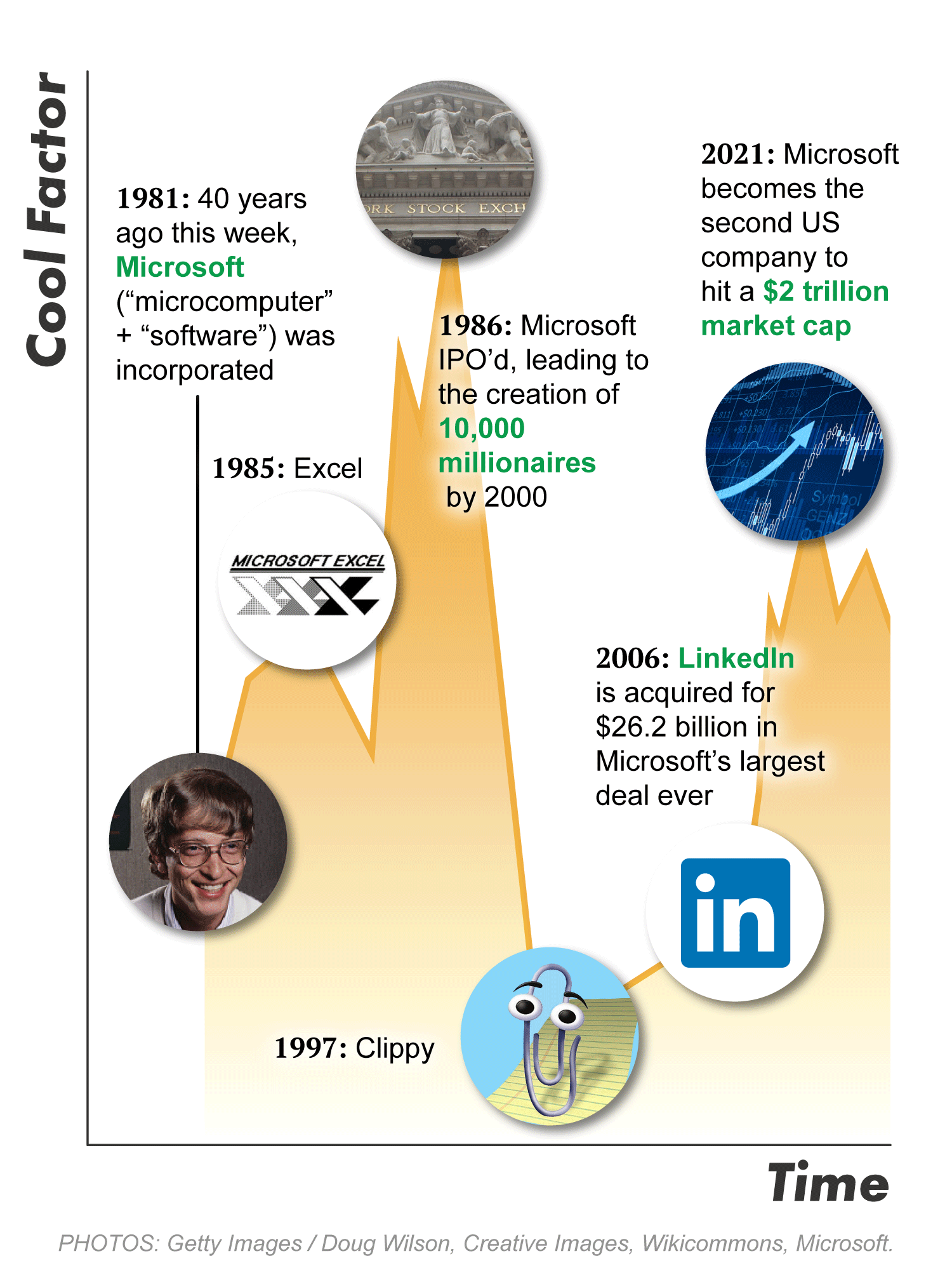
Medical Errors Earn Hospitals Money – Who Knew?

In brief, it goes something like this.

Never-Events

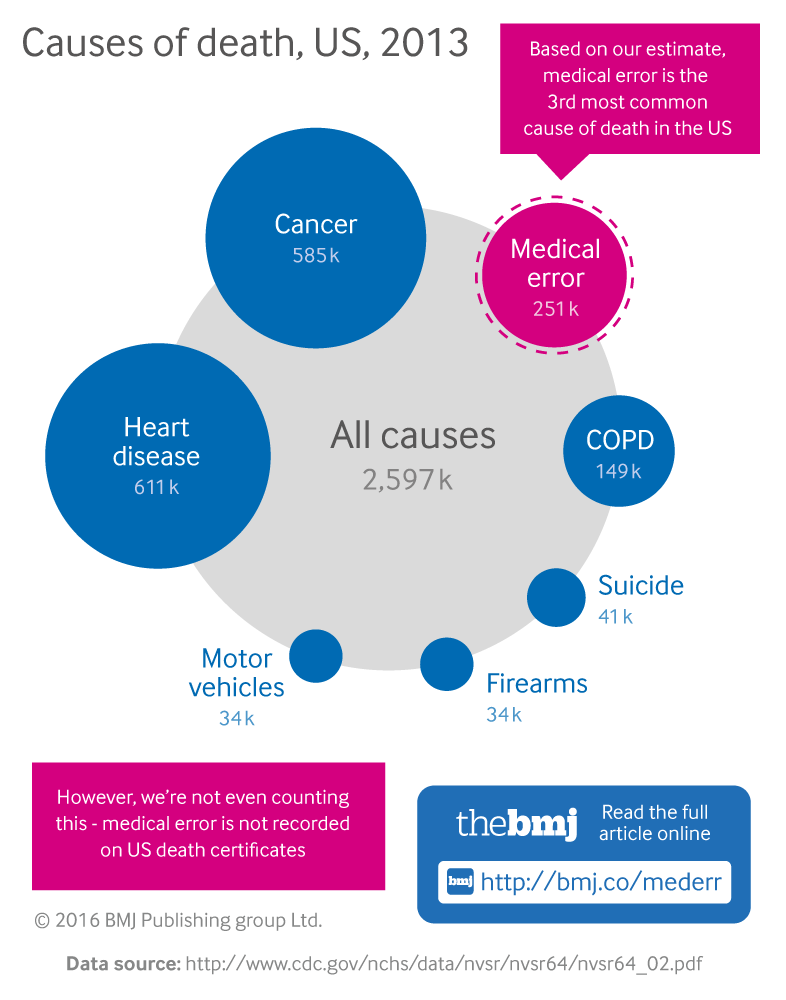
The argument to withhold payment for medical care that resulted from medical error is potent.  This is known as a never-event because it is not supposed to happen – ever! Giving a patient the wrong blood type during a transfusion is a good example of a never-event.

Unfortunately – Keep in mind that defining a medical error is not as easy as it sounds.  One can easily imagine how easy it would be too confuse a medical complication, which is a blameless event, from an error or a negligent act.

Consider This

If the patient develops a complication, should I, the hospital and those I consult not be paid for the additional care required?

Now, by extension, let us consider some other professions in the same way; especially those for which I am associated.

IOW: Would every profession consent to returning fees for mistaken advice or service?  So, do you agree with the following?

  • Financial advisors should return fees if investment performance is below a designated threshold or differs from their peers.
  • Attorneys that offered ineffective legal arguments at trial should surrender fees after appeal.
  • A professional baseball player who drops a fly ball should lose a day’s pay.
  • A newspaper publisher should offer a rebate to all readers if a news story is found to be inaccurate owing to a lack of proper editorial oversight; etc.

I think you get the picture! And, see how I personalized these examples.

More

We realize that mistakes of all types cost money, as do some of the hypothetical examples above.  We also accept that financial incentives can change behavior and can be an effective tool.

Medical-errors

Assessment

But, every human endeavor has a finite error rate and we should be cautious before using an economic drone attack against only the medical profession; or even the others mentioned above … and more.

Let’s use a scalpel here and not a sledge hammer.  And, those of you outside of medicine; please feel free to explain why your occupation should be spared from this health reform strategy?
The Reprint: Would every profession consent to returning fees for mistakes?

Conclusion

Your thoughts and comments on this ME-P are appreciated. Feel free to review our top-left column, and top-right sidebar materials, links, URLs and related websites, too. Then, subscribe to the ME-P. It is fast, free and secure.

Link: http://feeds.feedburner.com/HealthcareFinancialsthePostForcxos

  • Speaker: If you need a moderator or speaker for an upcoming event, Dr. David E. Marcinko; MBA – Publisher-in-Chief of the Medical Executive-Post – is available for seminar or speaking engagements. Contact: MarcinkoAdvisors@msn.com


Product DetailsProduct Details

Risk Management, Liability Insurance, and Asset Protection Strategies for Doctors and Advisors: Best Practices from Leading Consultants and Certified Medical Planners™8Comprehensive Financial Planning Strategies for Doctors and Advisors: Best Practices from Leading Consultants and Certified Medical Planners™

***

Invite Dr. Marcinko

***

How the Medical Executive-Post Survived to our 8th Anniversary?

Join Our Mailing List

And … Why the American Medical News was Shuttered after 50 Years!

[Some Musing on our Eighth Anniversary]

Ann Miller RN MHA

[Executive-Director]

Happy BirthdayAccording to well known healthcare industry journalist Kevin B. O’Reilly, a dramatic drop in medical-publishing revenues caused the recent closure of the American Medical News, effective with a final edition of the newspaper published just last month.

Published for more than five decades, AMNews was hit hard by industrywide trends. The newspaper’s revenue fell by two-thirds during the last decade, as reported by Thomas J. Easley, senior vice-president and publisher of periodic publications for the American Medical Association [AMA].

Unsustainable financial losses forced the move despite the newspaper’s editorial quality, the AMA’s senior management reportedly said. But, the Association’s other news operations will be enhanced.

###

amn

###

What the Death of American Medical News Says About the Future of American Medicine

###

How we survive!

We’ve been online for eight years now. We have a skeleton staff, a scalable business model, an almost free distribution model, no print analog, and a tiny electronic advertising revenue stream.

Oh, let’s not forget some brilliant essayists, contrarian contributors, insightful commentators and controversial opinions that are often the elephant in the virtual room. 

Our gratitude to you all is without limits.

So, how else do we do it?

Interestingly – Our print books are good, better and best sellers. We’ve been releasing one major, semi-peer reviewed text each year …. and sales are brisk. And, we are now negotiating to begin our next and ninth volume for 2014-15. We maintain our own copy-rights, perform in-house editing, seek out the best contributing authors, and reduce the cost of numerous channels of distribution. How do we do it, year after year? In a word, professional crowdsourcing.

Our consulting business is increasingly robust, too. Cudos to healthcare reform, managed care, and the PP-ACA!

And … another thing

I ask again. How do we do it? How do we stay in business?

Here are some more ways to help-us, do just that:

  1. Subscribe to the ME-P site
  2. Tell a friend or colleague about us
  3. Visit our Blogroll list
  4. Use our classified ads or advertise with us
  5. Purchase a printed handbook, dictionary, software product or textbook
  6. Use our career and educational resources
  7. “Ask a Consultant” for free advice
  8. Request a strategic competitive consultation
  9. Hire us for a medical practice valuation or revenue enhancement review
  10. Request a medical business planning RFP
  11. Purchase a practice management checklist
  12. Seek out our financial planning advice
  13. Ask for second opinion; hire our thought-leaders
  14. Request a healthcare econometrics review
  15. Seek out our practice management or business advice
  16. Become a Certified Medical Planner™ www.CertifiedMedicalPlanner.org
  17. Request a speaker for a pharmaceutical seminar or health convention
  18. Attend a seminar, sponsor or take a learning-teaching cruise with us
  19. Donate to us …  and repeat
  20. Buy a link … and repeat again
  21. Send a thank you note to our Publisher-in-Chief and Managing Editor
  22. Visit us often to review, read, rant and rave.

Bottom Line Eight Years Out

The ME-P is an austere … Labor of Love.

Please support us: Support the “Medical Executive-Post”

Printable Donation Form: Printable Donation Form

Electronic Donations: www.e-junkie.com/ecom/gb.php?c=cart&i=641232&cl=109140&ejc=2

Multi-Year Pledge Form: Multi-Year Pledge

###

QuestionEverythingWallpaper

###

Assessment

So, does the demise of the American Medical News really say anything at all about the ME-P; in addition to the future of domestic medicine? How do we avoid the same fate? Please tell us. Question Everything … Trust No One … Paddle your Own Canoe … Keep the Faith!

Conclusion

Your thoughts and comments on this ME-P are appreciated. Did the AMNews forget the aphorism; No margin – No Mission?

Feel free to review our top-left column, and top-right sidebar materials, links, URLs and related websites, too. Then, subscribe to the ME-P. It is fast, free and secure.

Link: http://feeds.feedburner.com/HealthcareFinancialsthePostForcxos

Speaker: If you need a moderator or speaker for an upcoming event, Dr. David E. Marcinko; MBA – Publisher-in-Chief of the Medical Executive-Post – is available for seminar or speaking engagements. Contact: MarcinkoAdvisors@msn.com

OUR OTHER PRINT BOOKS AND RELATED INFORMATION SOURCES:

LEXICONS: http://www.springerpub.com/Search/marcinko
PHYSICIANS: www.MedicalBusinessAdvisors.com
PRACTICES: www.BusinessofMedicalPractice.com
HOSPITALS: http://www.crcpress.com/product/isbn/9781466558731
CLINICS: http://www.crcpress.com/product/isbn/9781439879900
ADVISORS: www.CertifiedMedicalPlanner.org
BLOG: www.MedicalExecutivePost.com

Product DetailsProduct DetailsProduct Details

Product Details  Product Details

Product DetailsProduct Details

Product Details

It’s Here: Financial Management Strategies for Hospitals and Healthcare Organizations

Join Our Mailing List

Finally … Our Newest ME-P Textbook Release

By Ann Miller RN MHA

[Executive-Director]

In this book, a world-class editorial advisory board and an independent team of contributors draw on their experience in operations, leadership, and Lean managerial decision making to share helpful insights on the valuation of hospitals in today’s changing reimbursement and regulatory environments.

Using language that is easy to understand, Financial Management Strategies for Hospitals and Healthcare Organizations [Tools, Techniques, Checklists and Case Studies]  integrates prose, managerial applications, and regulatory policies with real-world case studies, models, checklists, reports, charts, tables, and diagrams. It has a natural flow, starting with costs and revenues, progressing to clinic and technology, and finishing with institutional and professional benchmarking. The book is organized into three sections:

  1. Costs and Revenues: Fundamental Principles
  2. Clinic and Technology: Contemporary Issues
  3. Institutional and Professional Benchmarking: Advanced Applications

The text uses healthcare financial management case studies to illustrate Lean management and operation strategies that are essential for healthcare facility administrators, comptrollers, physician-executives, and consulting business advisors. Discussing the advancement of financial management and health economic principles in healthcare, the book includes coverage of the financial features of electronic medical records, financial and clinical features of hospital information systems, entity cost reduction models, the financial future of mental health programs, and hospital revenue enhancements.

CASE MODEL: Managerial Costs

###

book

Description

Table of Contents

Editor Bio(s)

Reviews

Foreword.Baum

Foreword.Nash

###

The Companion Text

Product Details

BOOK FOREWORD / TESTIMONIAL

Conclusion

Your thoughts and comments on this ME-P are appreciated. Feel free to review our top-left column, and top-right sidebar materials, links, URLs and related websites, too. Then, subscribe to the ME-P. It is fast, free and secure.

Link: http://feeds.feedburner.com/HealthcareFinancialsthePostForcxos

And, send us a book review; the good, bad and ugly!

Speaker: If you need a moderator or speaker for an upcoming event, Dr. David E. Marcinko; MBA – Publisher-in-Chief of the Medical Executive-Post – is available for seminar or speaking engagements. Contact: MarcinkoAdvisors@msn.com

Product Details  Product Details

Some Prudent Thoughts on Hospital Stewardship

Join Our Mailing List 

And … Capital Formation

By Calvin Weise MBA CPA CMA

By Dr. David Edward Marcinko MBA CMP™

Some of the most important strategic decisions hospital executives make are related to capital expenditures. Almost every hospital has capital investment opportunities that are far in excess of their capital capacity. Capital investments are bets on the future. How these capital bets are placed has long-lasting implications. It is of utmost importance that hospitals bet right.

Hospitals as Businesses

Hospitals are capital intensive businesses. Hospital buildings are unique structures that require large amounts of capital to construct and maintain. Inside these buildings are pieces of expensive equipment that have fairly short lives. Technological innovations continually drive demand for new and more expensive equipment and facilities. The ability to continually generate capital is the lifeblood of hospitals.

But – Profits Needed

In order to compete and succeed, it’s imperative for hospitals to continually invest in large amounts of capital equipment and expensive facilities.

Capital investment is fueled by profit. In order to continually make the necessary capital investments, hospitals must be profitable. Hospitals unable to generate sufficient profit will fail to make important capital investments, weakening their ability to compete and survive.

Hospital managers bear important responsibility in choosing which capital investments to make. There are always more capital opportunities than capital capacity. In many cases, capital opportunities not taken by hospitals create openings for others with capital capacity to fill the vacuum. By not taking such opportunities, hospitals are weakened, and their operating risk increases.

Stewardship

Stewardship is a term that aptly describes the responsibility borne by hospital managers in making capital investments. The New Testament parable of the talents describes this kind of stewardship. In this story, a merchant entrusted three managers with money to invest. One manager was given five units, another two, and a third one. At the end of the investment period, the two managers given five units and two units reported a 100% return. The manager given one unit reported zero return — he was fired and his unit was given to the first manager.

CXOs are Stewards

This is stewardship — and hospital managers are stewards of their organizations’ assets. Too often, not-for-profit hospital managers hold an erroneous view of the returns expected of them. Like the third manager in the parable, they think zero return on equity is acceptable. They understand capital investment funded by debt needs to cover the interest on the debt, but they view capital investments funded by equity as having no cost associated with the equity.

From an accounting perspective, they are right. From a stewardship perspective they are dead wrong — just like the third manager in the parable.

###

Hospital

####

Here’s Why

As stewards, they are responsible for managing the entrusted assets. They can either put these assets at risk themselves, or they can put those assets in the market and let other managers put them at risk. If they choose to put them at risk themselves, then they have the mandate of creating as much value from putting them at risk as they would realize if they put them in the market for other managers to put at risk.

CXOs have the duty to realize returns that are equivalent to the returns they could realize in the market; otherwise, they should just put them in the market. They can either invest in hospital assets or work the assets themselves, or they can invest in financial market assets so others can work the assets. When they choose to invest in hospital assets, the required return is not zero. That’s the return they get fired for. The required return is equivalent to market returns.

Assessment

Thus, when evaluating performance of hospital management teams, the minimum acceptable performance level is return on equity that is equivalent to the return that could be realized by investing the hospital assets in the market. And when evaluating a capital investment opportunity, it is important to apply a capital charge equivalent to the hospital’s weighted cost of capital — a measure that imputes an appropriate cost to the equity portion of the capital along with the stated interest rate for the debt portion of the capital structure.

Conclusion

Your thoughts and comments on this ME-P are appreciated. Feel free to review our top-left column, and top-right sidebar materials, links, URLs and related websites, too. Then, subscribe to the ME-P. It is fast, free and secure.

Link: http://feeds.feedburner.com/HealthcareFinancialsthePostForcxos

Speaker: If you need a moderator or speaker for an upcoming event, Dr. David E. Marcinko; MBA – Publisher-in-Chief of the Medical Executive-Post – is available for seminar or speaking engagements. Contact: MarcinkoAdvisors@msn.com

OUR OTHER PRINT BOOKS AND RELATED INFORMATION SOURCES:

Health Dictionary Series: http://www.springerpub.com/Search/marcinko

Practice Management: http://www.springerpub.com/product/9780826105752

Physician Financial Planning: http://www.jbpub.com/catalog/0763745790

Medical Risk Management: http://www.jbpub.com/catalog/9780763733421

Hospitals: http://www.crcpress.com/product/isbn/9781439879900

Physician Advisors: www.CertifiedMedicalPlanner.org

Product DetailsProduct Details

More ME-P Industry Leading “WORKING WHITE-PAPERS”

Join Our Mailing List

OUR INDUSTRY “WORKING WHITE-PAPER” KNOWLEDGE SERIES … for only $99 each!

By Ann Miller RN MHA

[ME-P Executive Director]

At the ME-P working white-paper and iMBA Knowledge Center, we bring to life health administration best practices for BDs, RIAs, consulting firms, private equity and mutual fund companies, institutional wealth managers, physician-executives, administratrors, CXOs, hospitals and clinics, and large financial planning and business management firms.

Books

Certified Medical Planner

###

Therefore, as part of the combined ME-P and iMBA Research Library®, we highly recommend these Working White-Papers [WW-Ps] on various business management principles of the healthcare industry.

Topics: https://medicalexecutivepost.com/wp-content/uploads/2009/02/imba-inc-firm-services.pdf

Sample: http://certifiedmedicalplannerdotorg1.files.wordpress.com/2012/03/summary-white-paper-topics2.pdf

Checklists: https://medicalexecutivepost.com/office-checklists-on-cd-rom/

PayPal: Only $99 each.

ORDER HERE: MarcinkoAdvisors@msn.com

More Info

https://medicalexecutivepost.com/white-papers/

Business%20Optimization

R.I.P. Muriel “Mickie” Siebert

Join Our Mailing List

On Muriel Siebert

“Mickie” Siebert, founder of the brokerage firm that bears her name, Muriel Siebert & Co. Inc., bought a seat on the New York Stock Exchange in 1967.

She was one of the pioneers in the discount brokerage field, as she transformed Muriel Siebert & Company (now a subsidiary of Siebert Financial) into a discount brokerage in 1975, on the first day that Big Board members were allowed to negotiate commissions; the so-called “May Day” decision.

BORN: Sept. 12, 1932, in Cleveland.

DIED: Aug. 24, 2013, in New York.

EDUCATION: Attended Western Reserve University (now Case Western Reserve University) 1949-1952.

FAMILY: Never married and did not have any children.

Link: http://news.msn.com/obits/muriel-siebert-first-woman-member-of-the-nyse-dies?ocid=ansnews11

##

NYSE

###

Assessment

She was the first woman to become a member of the New York Stock Exchange [NYSE].

Visit: www.SiebertNet.com

Conclusion

Your thoughts and comments on this ME-P are appreciated. Feel free to review our top-left column, and top-right sidebar materials, links, URLs and related websites, too. Then, subscribe to the ME-P. It is fast, free and secure.

Link: http://feeds.feedburner.com/HealthcareFinancialsthePostForcxos

Speaker: If you need a moderator or speaker for an upcoming event, Dr. David E. Marcinko; MBA – Publisher-in-Chief of the Medical Executive-Post – is available for seminar or speaking engagements. Contact: MarcinkoAdvisors@msn.com

OUR OTHER PRINT BOOKS AND RELATED INFORMATION SOURCES:

Health Dictionary Series: http://www.springerpub.com/Search/marcinko

Practice Management: http://www.springerpub.com/product/9780826105752

Physician Financial Planning: http://www.jbpub.com/catalog/0763745790

Medical Risk Management: http://www.jbpub.com/catalog/9780763733421

Hospitals: http://www.crcpress.com/product/isbn/9781439879900

Physician Advisors: www.CertifiedMedicalPlanner.org

Product Details  Product Details

Medical Director Needed for NovaSys Health

Join Our Mailing List

Physician Career Opportunity

By Paul Esselman

[Executive Vice President, and Managing Principal]

Cejka Executive Search

Dear Dr. Marcinko,

Centene Corporation is seeking a Medical Director for NovaSys Health, a full-service managed care company and health plan administrator based in Little Rock. This newly created position will be responsible for assisting in the development of a medical management infrastructure for the health plan as NovaSys expands their member base through the participation in the Arkansas Healthcare Exchange.

A Fortune 500 company, Centene is a national leader in low-cost solutions for high quality healthcare services for uninsured and underinsured patients. Centene’s subsidiary health plans bring better health outcomes to their 1.5 million members. Centene’s core philosophy is that quality healthcare is best delivered locally. This local approach enables them to provide accessible, high quality and culturally sensitive healthcare services to their members in their own communities.

The Medical Director will perform utilization review, quality assurance and medical review of services; oversee the activities of physician advisors; assist in provider network development and expansion; and participate in strategic program developments for improving quality of care while lowering costs. The Medical Director will also work closely with the Plan President and Vice President, Medical Management (RN) in establishing and carrying out the strategic vision of the organization working closely with external constituents as appropriate.

Successful candidates will be physician leaders with knowledge of quality improvement practices and familiarity with medical information systems, medical claims payment processing and coding. Knowledge of managed care, Medicaid and case management programs are preferred. Board certification in a recognized medical specialty, preferably in internal medicine, family practice, pediatrics or emergency medicine, and an active medical license are required.

###

inheritance

Assessment

Qualified candidates should submit their resumes for consideration to me:

Thank you. 

Paul Esselman Executive Vice President, Managing Principal Cejka Executive Search 4 CityPlace Dr., Ste. 300 St. Louis, MO 63141 314.236.4588 Office pesselman@cejkasearch.com http://www.cejkaexecutivesearch.com

Conclusion

Your thoughts and comments on this ME-P are appreciated. Feel free to review our top-left column, and top-right sidebar materials, links, URLs and related websites, too. Then, subscribe to the ME-P. It is fast, free and secure.

Speaker: If you need a moderator or speaker for an upcoming event, Dr. David E. Marcinko; MBA – Publisher-in-Chief of the Medical Executive-Post – is available for seminar or speaking engagements. Contact: MarcinkoAdvisors@msn.com

OUR OTHER PRINT BOOKS AND RELATED INFORMATION SOURCES:

Product DetailsProduct DetailsProduct Details

Product Details  Product Details

Product DetailsProduct Details

Why Hospitals Should Use Financial Management Checklists

Join Our Mailing List

Financial Management Strategies for Hospital and Healthcare Organizations [Tools, Techniques, Checklists and Case Studies]

By Neil H. Baum MD

Dr. BaumIt is fitting that ME-P Editor Dr. David Edward Marcinko MBA CMP™ and his fellow experts, have laid out a plan of action in Financial Management Strategies for Hospital and Healthcare Organizations: Tools, Techniques, Checklists and Case Studies that physicians, nurse-executives, administrators and institutional Chief Executive Officers, Chief Financial Officers, MBAs, lawyers and healthcare accountants can follow to help move healthcare financial fitness forward during these unchartered waters.

In medicine – It all began with Dr. Atul Gawande, a surgeon at Massachusetts General Hospital, who reviewed the airline industry and their use of checklists prior to take off of an airplane.

The history of aviation checklists began in 1934 when Boeing was in the final process of testing a U.S. Army fighter plane with a potential contract of nearly 200 planes riding on the final test of the plane. The test aircraft made a normal taxi and takeoff. It began a smooth climb, but then suddenly stalled. The aircraft turned on one wing and fell, bursting into flames upon impact killing two of the test pilots. The investigation found pilot error as the cause. One of the pilots who was unfamiliar with the aircraft had neglected to release the elevator lock prior to take off. The contract with Boeing was in jeopardy.

Thus, the pilots sat down and put their heads together. What was needed was some way of making sure that everything to prevent crashes was being done; that nothing was overlooked. What resulted was a pilot’s checklist developed before takeoff, during flight, before landing, and after landing. These checklists for the pilot and co-pilot made sure that nothing was forgotten and safety of the planes was insured.

Medical Care and Hospitals

So, what does airline safety have to with medical care and hospitals?

There are so many activities that take place in medicine such as the operating room, that are far too complicated to be left to memory of doctors, nurses, anesthesiologists, and others involved in the surgical care of patients.  Dr. Gawande identified the key components of a surgical procedure which include the name of the patient, the procedure to be performed, the estimated length of the procedure, whether the right or left side is the surgical target, how much blood loss is anticipated, whether antibiotics have been given prior to making the incision, and the anesthetic risk of the patient.  This use of a checklist which takes approximately 30 seconds has not only prevented wrong side surgery but also instills a discipline of higher performance.

###

Financial Management Strategies for Hospitals and Healthcare Organizations

Financial Management Strategies for Hospitals and Healthcare Organizations: Tools, Techniques, Checklists and Case Studies

###

From the Clinic to the Boardroom

And so, should [can] we port the clinical checklist example of Atul Gawande for use with non-clinical topics like hospital financial management and administration?

Assessment

Yes – We have a challenge and the Financial Management Strategies for Hospital and Healthcare Organizations: Tools, Techniques, Checklists and Case Studies is a step in the direction to make all of the stakeholders in the healthcare arena become sensitive to reducing and controlling costs and at the same time preserve quality of care.

This can be done.  I suggest you start by reading, using and referring to this excellent book.

And so, what is my final advice? Read the Book!

Some of you who will read this book are CXOs COOs, Chief Medical Officers and maybe even COS. (Chiefs of Staff). But, all of you should become CLOs (Chief Life Officers)!  Read this book and the initials CLO will appear after your name!

Note:

Neil H. Baum MD is a Clinical Associate Professor of Urology at the Tulane Medical School, New Orleans, LA. He is also a thought-leader for this ME-P. 

Conclusion

Your thoughts and comments on this ME-P are appreciated. Feel free to review our top-left column, and top-right sidebar materials, links, URLs and related websites, too. Then, subscribe to the ME-P. It is fast, free and secure.

Speaker: If you need a moderator or speaker for an upcoming event, Dr. David E. Marcinko; MBA – Publisher-in-Chief of the Medical Executive-Post – is available for seminar or speaking engagements. Contact: MarcinkoAdvisors@msn.com

OUR OTHER PRINT BOOKS AND RELATED INFORMATION SOURCES:

Product DetailsProduct DetailsProduct Details

Product DetailsProduct Details

Events Planner: June 2013

Join Our Mailing List

ADVERTISEMENT

Events-Planner: JUNE 2013

By Staff Writers
Calendar Calculator“Keeping track of important health economics and financial industry meetings, conferences and summits”

Welcome to this issue of the Medical Executive-Post and our Events-Planner. It contains the latest information on conferences, news, and relevant resources in healthcare finance, economics, research and development, business management, pharmaceutical pricing, and physician/entity reimbursement!  Watch for a new Events-Planner each month.

First, a little about us! The Medical Executive-Post is still a relative newcomer. But today, we have almost 175,000 visitors and readers each month from all over the country, in addition to our growing subscriber base. We have been a successful collaborative effort, thanks to your contributions.  As a result, we are adding new resources daily. And, we hope the website continues to provide the best place to go for journals, books, conferences, educational resources, tools, and other things you need to establish the value your healthcare consulting and financial advisory intervention.

So, enjoy the Medical Executive-Post and this monthly Events-Planner with our compliments.

A Look Ahead this Month – And now, the important dates:

  • June 16-19: HFMA Institute Meeting. Orlando, FLA
  • June 25-27: AHA Health Forum Summit. San Diego, CA.

MarcinkoAdvisors@msn.com

Speaker: If you need a moderator or speaker for an upcoming event, Dr. David E. Marcinko; MBA – Publisher-in-Chief of the Executive-Post – is available for seminar or speaking engagements. Contact: MarcinkoAdvisors@msn.com

Subscribe Now: Did you like this Medical Executive-Post, or find it helpful, interesting and informative? Want to get the latest E-Ps delivered to your email box each morning? Just subscribe using the link below. It’s free. You can unsubscribe at any time. Security is assured.

Link: http://feeds.feedburner.com/HealthcareFinancialsthePostForcxos


Product DetailsProduct Details

Contribute to the Medical Executive-Post and Tell Us What You Think

Join Our Mailing List

Call for Guest Medical Executive-Posts!

By Ann Miller RN MHA

[Executive-Director]

MarcinkoAdvisors@msn.com

ME-P

Now that we’ve wrapped up our newest textbook, we thought it would be fun to keep everybody writing to share your best posts and comments with our ever-growing online community.

###

We’re open to all kinds of related subjects on the business of medical practice, healthcare economics and finance, HIT and personal financial planning and investing for doctors and all medical professionals.

###

So, if you’d like to comment or be a featured guest on our blog, or know of a great post we should feature or re-print, just let us know by emailing me! BROADCAST yourself.

Product Details

www.CertifiedMedicalPlanner.org

###

What Physician-Investors Need to Know about the Shiller PE Ratio

Join Our Mailing List 

What it is – How it works

By Michael Zhuang MS www.MZCap.com

This Shiller PE index is a stock market metric invented by Yale University Professor Robert Shiller, PhD.

Basically, it is the average PE ratio of all S&P 500 stocks for the last ten years. The Shiller PE is also called PE10. Professor Shiller found it to be a reasonably good measure of valuation of the whole market.

IOW: The higher the Shiller PE, the more expensive the market. So, with Shiller PE at 24, we can call this market relatively expensive.

Assessment

Here is what I know currently.

  1. The  higher the Shiller PE – the lower the one-year and three-year return propensity.
  2. Return variability is so high as to render the Shiller PE’s predictive power very weak.
  3. Only when Shiller PE is over 35 are the three-year forward returns overwhelmingly negative.

So, the market may or may not be headed for a fall immediately, but we do need to temper our expectation of future returns.

About the Author

Michael Zhuang is founder and principal of MZ Capital, a fee-only registered investment advisor firm located in the Greater Washington D.C. metropolitan area.

Conclusion

Your thoughts and comments on this ME-P are appreciated. Feel free to review our top-left column, and top-right sidebar materials, links, URLs and related websites, too. Then, subscribe to the ME-P. It is fast, free and secure.

Link: http://feeds.feedburner.com/HealthcareFinancialsthePostForcxos

Speaker: If you need a moderator or speaker for an upcoming event, Dr. David E. Marcinko; MBA – Publisher-in-Chief of the Medical Executive-Post – is available for seminar or speaking engagements. Contact: MarcinkoAdvisors@msn.com

OUR OTHER PRINT BOOKS AND RELATED INFORMATION SOURCES:

Physician Advisors: www.CertifiedMedicalPlanner.org

Product Details  Product Details

Need a Manager of Surgical Nurses and Operating Rooms

Join Our Mailing List 

Seeking A Direct Hire in Kansas

By Kathy Williams kathyw@thorgroup.com
Resource Manager
Thor Group, Inc.

Dear Dr. David E Marcinko,

Hello!  We are looking for a Manager of Surgical Nurses and Operating Rooms.

Our client has a wonderful opportunity to have a work balance life style.  If one of your ME-P readers would like the peace and quiet of a small town plus a great opportunity for your career, this opportunity is for them!

This position will manage and supervise functions related to patient care in the operating rooms; ensure effective delivery of patient care and compliance with administrative and facility policies and procedures.  This position will pay $60-75K depending in experience.  Direct Hire in Kansas.

Responsibilities:

• Guides and directs nursing staff regarding safe, effective patient care, problem-solving and decision making according to patient needs, staff capabilities and facility resources.
• Maintains up-to-date knowledge of new procedures, products and equipment used in the OR.
• Interviews, orients, assigns work schedules, conducts and reviews evaluations and disciplines personnel to manage performance.  Oversees OR staff in conducting annual performance evaluations and competency documentation.
• Ensure proper daily staffing levels in all operating rooms.
• Assist in investigating and initiating follow-up and corrective action when necessary in response to complaints and/or concerns from patients, families, physicians or employees.  Develops, implements and monitors, methods and strategies to achieve high patient satisfaction results.
• Is familiar with, and maintains compliance within the OR Department, on all regulatory agency requirements.
• Maintains compliance with accreditation/licensure requirements.
• Identify operational needs; manage appropriate level of equipment and supplies and monitors equipment maintenance.  Assess the environment and make recommendations to ensure optimal patient comfort, safety and compliance with various regulatory bodies.

Qualifications:

• Diploma from accredited nursing program.
• Current Licensure as Registered Nurse and able to obtain a Kansas license.
• Minimum of 3 years management experience in hospital setting preferred.
• Certification in area of specialization.
• Demonstrated excellent communication skills.

###

Healthcare Jobs

Assessment

THOR, Inc. is a cutting-edge business solutions firm that has been working with some of the top companies throughout the United States for nearly 40 years.

If you are interested in the Manager of Surgical Nurses and Operating Rooms position, please send your updated resume along with salary history to kathyw@thorgroup.com. If you are not interested in this opportunity, perhaps you know someone who might be, please have them forward their resume to me!

Conclusion

Your thoughts and comments on this ME-P are appreciated. Feel free to review our top-left column, and top-right sidebar materials, links, URLs and related websites, too. Then, subscribe to the ME-P. It is fast, free and secure.

Link: http://feeds.feedburner.com/HealthcareFinancialsthePostForcxos

Speaker: If you need a moderator or speaker for an upcoming event, Dr. David E. Marcinko; MBA – Publisher-in-Chief of the Medical Executive-Post – is available for seminar or speaking engagements. Contact: MarcinkoAdvisors@msn.com

OUR OTHER PRINT BOOKS AND RELATED INFORMATION SOURCES:

Health Dictionary Series: http://www.springerpub.com/Search/marcinko

Practice Management: http://www.springerpub.com/product/9780826105752

Physician Financial Planning: http://www.jbpub.com/catalog/0763745790

Medical Risk Management: http://www.jbpub.com/catalog/9780763733421

Hospitals: http://www.crcpress.com/product/isbn/9781439879900

Physician Advisors: www.CertifiedMedicalPlanner.org

Product DetailsProduct DetailsProduct Details

Product DetailsProduct Details


More on Medical Practice Patient Scheduling Issues

Join Our Mailing List 

And … Waiting Room Wait-Times

By Dr. David Edward Marcinko MBA

Dr. MarcinkoRecently, I read the following post on: 8 surprising thoughts about patient wait times.

And so, I decided to offer a follow-up commentary based on my experiences, and as outlined in our newest book: www.BusinessofMedicalPractice.com

Obviating the Problem

The point here is not to “react” but to avoid the dreaded “waiting time” problem in the first place.

Now, realize that most mature doctors follow a linear (series-singular) time allocation strategy for scheduling patients (i.e., every 15 or 20 minutes). This can create bottlenecks because of emergencies, late patients, traffic jams, absent office personal, paperwork delays, etc. Therefore, as suggested by colleague Neil Baum MD, one of these three newer scheduling approaches might prove more useful.

1. Customized Scheduling

The bottleneck problem may be reduced by trying to customize, estimate or project the time needed for the patient’s next office visit. For example: CPT #99211 (5 minutes), #99212 (10 minutes), #99213 (15 minutes), #99214 (25 minutes), or #99215 (40 minutes). Occasionally, extra time is need, and can be accommodated, if the allocated times are not too tightly scheduled.

2. Wave Scheduling

Some patient populations do not mind a brief 20-30 minute wait prior to seeing the doctor. Wave scheduling assumes that no patient will wait longer than this time period, and that for every three patients; two will be on time and one will be late. This model begins by scheduling the three patients on the hour; and works like this. The first patient is seen on schedule, while the second and third wait for a few minutes. The later two patients are booked at 20 minutes past the hour and one or both may wait a brief time. One patient is scheduled for 40 minutes past the hour. The doctor then has 20 minutes to finish with the last three patients and may then get back on schedule before the end of the hour.

3. Bundle Scheduling

Bundling involves scheduling like-patient activities in blocks of time to increase efficiency.

For example, schedule minor surgical checkups on Monday morning, immunizations on Tuesday afternoon, and routine physical examinations on Wednesday evening, or make Thursday kid’s day and Friday senior citizens day. Do not be too rigid, but by scheduling similar activities together, assembly-line efficiency is achieved without assembly line mentality, and allows you to develop the most economically profitable operational flow process possible for the office.

###

Product Details

###

4. Patient Self Scheduling (Internet Based Access Management)

The traditional linear patient scheduling system is slowly being abandoned by modern medical practitioners; an all venues (medical practices, clinics, hospitals and various other healthcare entireties). New software programs, and internet cloud applications, allow patients to schedule their own appointments over the internet. The software allows solo or individual group physicians with a practice to set their own parameters of time, availability and even insurance plans. Through a series of interrogatories, the program confirms each appointment. When the patient arrives, a software tracker communicates with office staff and follows the patients from check-in, to procedures, to checkout.

Assessment 

Today, many hospitals have even abandoned the check-in or admissions, department. It has been replaced by access management systems.

Conclusion

Your thoughts and comments on this ME-P are appreciated. Feel free to review our top-left column, and top-right sidebar materials, links, URLs and related websites, too. Then, subscribe to the ME-P. It is fast, free and secure.

Link: http://feeds.feedburner.com/HealthcareFinancialsthePostForcxos

Speaker: If you need a moderator or speaker for an upcoming event, Dr. David E. Marcinko; MBA – Publisher-in-Chief of the Medical Executive-Post – is available for seminar or speaking engagements. Contact: MarcinkoAdvisors@msn.com

OUR OTHER PRINT BOOKS AND RELATED INFORMATION SOURCES:

DICTIONARIES: http://www.springerpub.com/Search/marcinko
PHYSICIANS: www.MedicalBusinessAdvisors.com
PRACTICES: www.BusinessofMedicalPractice.com
HOSPITALS: http://www.crcpress.com/product/isbn/9781466558731
CLINICS: http://www.crcpress.com/product/isbn/9781439879900
BLOG: www.MedicalExecutivePost.com
FINANCE: Financial Planning for Physicians and Advisors
INSURANCE: Risk Management and Insurance Strategies for Physicians and Advisors

Product Details


Searching for Chief Medical Director [CMD]

Join Our Mailing List

Centene Corporation Seeking CMD

By Jennifer Sonneland jsonneland@cejkasearch.com

Cejka Executive Search www.cejkaexecutivesearch.com

Dear Dr. Marcinko,

I am assisting Centene Corporation in their recruitment for a Chief Medical Director for IlliniCare Health Plan, a wholly owned subsidiary and HMO for the state of Illinois.  The regional headquarters for IlliniCare is in Chicago. 

The Chief Medical Director (CMD) will be responsible for directing and coordinating the medical management, quality improvement and credentialing functions for IlliniCare. S/he will serve as a clinical advisor and educator of the medical management staff, ensuring the clinical quality and efficacy of patient care.

jobs

The CMD will also help identify trends in patient treatment data and proactively develop programs to improve patient health and wellness needs.  As an integral part of IlliniCare’s senior leadership team, the CMD will have an active role in supporting the strategic plans and vision of the organization.  

Ideal candidates will have a minimum of five years of progressive experience in healthcare enterprises and demonstrated success in establishing population health management programs and driving quality outcomes and financial performance for the underserved population. Board certification, preferably in geriatrics, and an unrestricted medical license are required. 

A post-graduate business degree (MBA/MMM) is preferred.

Assessment

More details about this opportunity upon request.

Product DetailsProduct DetailsProduct Details

Product Details  Product Details

Product DetailsProduct Details

Introducing Neil H. Baum MD

Join Our Mailing List

Our Newest ME-P “Thought-Leader”

By Ann Miller RN MHA

[Executive-Director]

Dr. BaumDr. Neil Baum is Associate Clinical Professor of Urology at Tulane Medical School and Louisiana State University Medical School, both in New Orleans, LA.

He is also on the medical staff at Touro Infirmary in New Orleans, and East Jefferson General Hospital in Metairie, LA.

Medical Background

Dr. Baum received his medical degree from Ohio State University Medical School in Columbus. He completed an internship at the University of California at Los Angeles, a residency in surgery at Harbor General Hospital, Torrance, California, followed by a second residency in surgery and a residency in urology, both at Baylor College of Medicine in Texas. Dr. Baum is certified by the American Board of Urology.

ME-P Relevance

Dr. Baum often shares his extensive experience from his urologic office and regularly speaks to medical practices, hospitals, and pharmaceutical and manufacturing companies on improving communications between physicians and patients, practice management, guerilla marketing, practice promotion and motivation.

He has also several books on efficient medical marketing. In fact, he is the author of Marketing Your Clinical Practice-Ethically, Effectively, and Economically, 4th Edition (Jones-Bartlett, 2010).

###

Product Details

###

Product Details

###

And so, we are pleased he accepted our invitation as ME-P “thought-leader.” All our readers and subscribers look forward to his essays, comments and insightful contributions.

Essential ME-P Reader Concerns

I recently caught up with Dr. Baum with these two readership questions.

Q: Why Market and Promote Your Practice in the Era of Managed Care?

A: “Often physicians will discuss the current health care situation in their community and believe that their days of practice promotion are over when they have joined all of the managed care plans in the vicinity. The reality is that noting could be farther from the truth. Now marketing and practice promotion is even more important than in the “good ol’ days” of fee-for-service”.

Q: What is the Most Common Medical Practice Disaster?

A: “Natural disasters are not the most common cause of practice failure; man-made disasters such as computer crashes, power outages, and loss of electronic data are more likely to impact a medical practice”.

Assessment

Conclusion

Your thoughts and comments on this ME-P are appreciated. Feel free to review our top-left column, and top-right sidebar materials, links, URLs and related websites, too. Then, subscribe to the ME-P. It is fast, free and secure.

Speaker: If you need a moderator or speaker for an upcoming event, Dr. David E. Marcinko; MBA – Publisher-in-Chief of the Medical Executive-Post – is available for seminar or speaking engagements. Contact: MarcinkoAdvisors@msn.com

OUR OTHER PRINT BOOKS AND RELATED INFORMATION SOURCES:

Product Details

Foreword.Baum

[Available Now]

Understanding Vacation Time Shares

Join Our Mailing List 

Including Participatory Vacation Exchanges

By Rick Kahler MS CFP® ChFC CCIM http://www.KahlerFinancial.com

Rick Kahler CFPFor residents of places like the Black Hills, where the first day of spring usually brings a snowstorm, timeshares for resorts in Florida or Mexico can have a lot of appeal. They seem like a fun idea for a vacation in the sunshine as well as a good deal financially.

My Research

Over the past 30 years I’ve researched hundreds of timeshare offers. I’ve never bought one. When you take a close look at the numbers and the restrictions, they simply don’t add up to a good value.

One of the biggest problems with timeshares in general is that they can lock you into a specific vacation. Spending a week at that resort in Mexico in February, exploring the local area and relaxing by the pool, might be wonderful for a year or even several years. But eventually you may get tired of going to the same location, doing the same things, and seeing the same people. After a while, even a rut person like me might want to do something different.

PVEs

Some timeshares mitigate this problem by participating in vacation exchanges [PVEs] like RCI, Interval International, and others. These services will add on a fee.

Not Liquid

You might think that, if you get tired of a timeshare, you can just sublease or sell it. These aren’t necessarily easy to do. There may be restrictions on subleasing, which is another good reason to read the fine print before you sign any timeshare contract. Selling is often difficult, and you certainly aren’t likely to get back your original purchase price. Meanwhile, you’re  paying annual fees whether you use the timeshare or not.

Total Costs

In figuring the cost of a timeshare, those annual fees are what really get you. You’re told up front what the fees are at the time you buy a timeshare. Yet you have no control over what the fees may be in five or ten years. The only thing you can count on is that they will increase.

Examples:

To illustrate these points, I recently investigated a resale site that listed a timeshare in a property in Boston, MA. It originally sold for $20,000 and was priced at $1,000. I passed on the opportunity because of the high fees.

In another example, I once took a serious look at a timeshare in a luxury apartment complex in London. It seemed like a possibility for fulfilling one of my dreams, living part of the year in Europe.

It wasn’t. As the salesperson told me, comparing the cost to buy a timeshare versus the cost to stay as a non-member, it would take around 30 years to recoup the purchase price. Then I—or more likely, my heirs—would have ten more years to stay for “free.” Free, that is, except for the annual fees.

Dr. Marcinko at Johns Hopkins University

[ME-P Editor-in-Chief in a Spring Fever Garden] 

Investment in Lifestyle

The sales rep was quite clear that a membership at this complex wasn’t intended as a good financial investment. She described it as an “investment in lifestyle.”

So, when it comes to timeshares; that’s the bottom line. If the lifestyle being sold truly fits for you, and you believe it will continue to fit for the long term, then it’s possible that a timeshare may make sense.

Assessment

For most doctors and folks like us however, my conclusion is that most timeshares are too expensive even if someone gives you one. The annual fees alone will keep it from being a good value. I’ve never found one that was cheaper than getting a nice hotel or resort for a couple of weeks. Paying for a hotel stay will cost less in the long run, and you can enjoy relaxing vacations with no long-term commitment.

Conclusion

Your thoughts and comments on this ME-P are appreciated. Feel free to review our top-left column, and top-right sidebar materials, links, URLs and related websites, too. Then, subscribe to the ME-P. It is fast, free and secure.

Link: http://feeds.feedburner.com/HealthcareFinancialsthePostForcxos

Speaker: If you need a moderator or speaker for an upcoming event, Dr. David E. Marcinko; MBA – Publisher-in-Chief of the Medical Executive-Post – is available for seminar or speaking engagements. Contact: MarcinkoAdvisors@msn.com

Our Other Print Books and Related Information Sources:

Health Dictionary Series: http://www.springerpub.com/Search/marcinko

Practice Management: http://www.springerpub.com/product/9780826105752

Physician Financial Planning: http://www.jbpub.com/catalog/0763745790

Medical Risk Management: http://www.jbpub.com/catalog/9780763733421

Hospitals: http://www.crcpress.com/product/isbn/9781439879900

Physician Advisors: www.CertifiedMedicalPlanner.org

Product Details  Product Details

The status of African American insurance coverage

Join Our Mailing List

A Struggling PP-ACA Sector    

By FinancesOnline.com

The Affordable Care Act has developed into one of the critical pivots on which the success of President Obama’s second term is expected to turn. Yet, one sector that’s already struggling is African Americans.

In 2012, 17.4 percent of non-Hispanic African Americans were uninsured. More critically, only 55.9 percent of African Americans are expected to continue to live in good health, while a more or less healthy life is expected in 69.4 percen of white Americans.

###

infographic-health-insurance-of-african-americans

###

Assessment

These and other alarming facts were revealed by the National Health Interview Survey of the Center for Disease Control and Prevention, and corroborated by data from the U.S. Census Bureau. Both these agencies were data sources for this infographic, which takes a closer look at the health insurance situation of African Americans.

Conclusion

Your thoughts and comments on this ME-P are appreciated. Feel free to review our top-left column, and top-right sidebar materials, links, URLs and related websites, too. Then, subscribe to the ME-P. It is fast, free and secure.

Link: http://feeds.feedburner.com/HealthcareFinancialsthePostForcxos

Speaker: If you need a moderator or speaker for an upcoming event, Dr. David E. Marcinko; MBA – Publisher-in-Chief of the Medical Executive-Post – is available for seminar or speaking engagements. Contact: MarcinkoAdvisors@msn.com

Our Other Print Books and Related Information Sources:

Health Dictionary Series: http://www.springerpub.com/Search/marcinko

Practice Management: http://www.springerpub.com/product/9780826105752

Physician Financial Planning: http://www.jbpub.com/catalog/0763745790

Medical Risk Management: http://www.jbpub.com/catalog/9780763733421

Hospitals: http://www.crcpress.com/product/isbn/9781439879900

Physician Advisors: www.CertifiedMedicalPlanner.org

Product DetailsProduct DetailsProduct Details

Product Details  Product Details

Product DetailsProduct Details

But …. enough about me!

Join Our Mailing List

Did you read my interviews?

Dr. David Edward Marcinko MBA

www.MedicalBusinessAdvisors.com

[CEO and Editor-in-Chief]

DEM 2013

AMA News:

Goodwill hunting – what’s your medical practice worth?

AMA News.Valuation.Marcinko

Best practices can help hospitals in recession

Arkansas Medical News:

Arkansas Medical News Interviews Dr. Marcinko

Conclusion

Your thoughts and comments on this ME-P are appreciated. Feel free to review our top-left column, and top-right sidebar materials, links, URLs and related websites, too. Then, subscribe to the ME-P. It is fast, free and secure.

Link: http://feeds.feedburner.com/HealthcareFinancialsthePostForcxos

Speaker: If you need a moderator or speaker for an upcoming event, Dr. David E. Marcinko; MBA – Publisher-in-Chief of the Medical Executive-Post – is available for seminar or speaking engagements. Contact: MarcinkoAdvisors@msn.com

Our Other Print Books and Related Information Sources:

Health Dictionary Series: http://www.springerpub.com/Search/marcinko

Practice Management: http://www.springerpub.com/product/9780826105752

Physician Financial Planning: http://www.jbpub.com/catalog/0763745790

Medical Risk Management: http://www.jbpub.com/catalog/9780763733421

Hospitals: http://www.crcpress.com/product/isbn/9781439879900

Physician Advisors: www.CertifiedMedicalPlanner.org

Product DetailsProduct Details

ME-P Book Reviewers Needed

Join Our Mailing List
New Text Book Testimonials Requested
By Dr. David Edward Marcinko MBA
[Editor-in-Chief]
DEM 2013
Greetings all ME-P Readers from Atlanta, Georgia
###
After reading and being inspired by Dr. Atul Gawandi’s December 10, 2007 New  Yorker article, “The Checklist”, as well as the Checklist Manifesto, I am writing to ask that you consider this request to write a 3-5 sentence testimonial review to our upcoming new textbook:  Financial  Management Strategies for Hospitals and Healthcare Organizations: Tools,  Techniques, Checklists and Case Studies

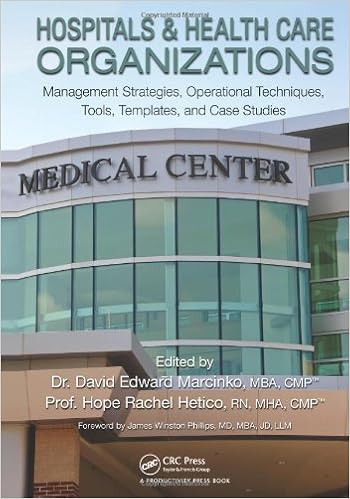
It is the follow up to: Hospitals & Health Care Organizations: Management Strategies, Operational Techniques,  Tools, Templates, and Case Studies

Book Focus

Please realize that the focus of the work is non-clinical in nature, and is replete with managerial case models and administrative checklists following each chapter.

Just as Atul believed the time is right for medical checklists, we believe in a similar philosophy for hospitals, health enitites, and healthcare administration. It is right for any physician or medical practitioner, regardless of degree or specialty designation.

New Book

Ideal Reviewers

Ideal book reviewers are doctors, financial advisors, economists, accountants, nurses, insurance agents, politicians and healthcare CXOs. So, please see the TOC links as we ask you to keep this request confidential.  Regardless of your decision, we remain an apostle of your core vision whenever possible.

Fraternally,

Dr. David Edward Marcinko MBA

[Editor-in-Chief]

INSTITUTE OF MEDICAL BUSINESS ADVISORS, INC.

Suite #5901 Wilbanks Drive Norcross, Georgia, 30092 USA

Phone: 770.448.0769

MarcinkoAdvisors@msn.com

Secrets

###

Hiring a Director of Post-Surgical and Specialty Care

Join Our Mailing List

For an independent community hospital in the Midwest

By B. Kim Woods RN

[National Healthcare Practice Manager]

Dear Dr. David E Marcinko,

GREETINGS!

Our client has engaged the THOR Group to assist them in hiring a Director of Post-Surgical and Specialty Care for their 260-bed, not-for-profit, JCAHO-accredited, independent community hospital located in the beautiful Midwest.

If any of your ME-P readers is a Registered Nurse with supervisory experience interested in furthering their career in an innovative, high- technology organization, and have a passion for leading a professional team in their provision of high quality patient care, this could be just the job for them.  So, if you know of someone who may be interested in this opportunity, please let me know!

Please see the overview and description of the location below and contact: Kim Woods, RN,  at (816) 401-6622 or email your resume to kimberlyw@thorgroup.com today!

OVERVIEW: 

This Nursing Director is responsible for 3 units: a 10-bed orthopedic post-operative unit, a 12-bed OB/GYN unit comprised of 4 surgical rooms and 8 LDRPs, and a 27-bed post-operative unit with a total of 65 FTEs. You will be leading a professional team to ensure the highest quality of patient care in an innovative, state-of-the art facility.  The organization strives to be the Employer of Choice, committed to upholding their core values, providing highly competitive compensation and benefits, as well as remaining focused on their vision of passionately pursuing excellence in collaboration with physicians, staff, and the community.

###

ME-P Careers

###

ABOUT THE LOCATION:

This beautiful Midwest location has a population of approximately 30,000, yet is just 35 miles from the largest city in the state and 50 miles from the state capitol. Educational, cultural, historic, and outdoor activities abound. The retail sector boasts a thriving downtown historic business district with a wide range of shopping choices that fill the needs of the most discriminating shopper. This community is just right for people who want to enjoy good neighbors, a low crime rate, and an exceptional quality of life.

ABOUT THOR:

For nearly 40 years, The THOR Group, Inc. has provided cutting-edge business solutions to 50,000 top companies and leading healthcare providers throughout the United States.

Regards,

Kimberly Woods, RN, BSN, MBA
National Healthcare Practice Manager
Direct Line: (816) 401-6622
kimberlyw@thorgroup.com

Product DetailsProduct DetailsProduct Details

Product Details  Product Details

Product DetailsProduct Details

“The Doctor’s Dilemma”

Join Our Mailing List

On Hospital Monopolistic Powers

By Ann Miller RN MHA

As George Bernard Shaw, whose works include “The Doctor’s Dilemma” might have put it, that any lawmaker would grant hospitals monopolistic powers plus the freedom to price as they see fit is enough to make one despair of political humanity.

C.O.N.

And, here is a post on Certificates of Need, too.

http://www.ncsl.org/issues-research/health/con-certificate-of-need-state-laws.aspx

Conclusion

Your thoughts and comments on this ME-P are appreciated. Feel free to review our top-left column, and top-right sidebar materials, links, URLs and related websites, too. Then, subscribe to the ME-P. It is fast, free and secure.

Link: http://feeds.feedburner.com/HealthcareFinancialsthePostForcxos

Speaker: If you need a moderator or speaker for an upcoming event, Dr. David E. Marcinko; MBA – Publisher-in-Chief of the Medical Executive-Post – is available for seminar or speaking engagements. Contact: MarcinkoAdvisors@msn.com

Our Other Print Books and Related Information Sources:

Health Dictionary Series: http://www.springerpub.com/Search/marcinko

Practice Management: http://www.springerpub.com/product/9780826105752

Physician Financial Planning: http://www.jbpub.com/catalog/0763745790

Medical Risk Management: http://www.jbpub.com/catalog/9780763733421

Hospitals: http://www.crcpress.com/product/isbn/9781439879900

Physician Advisors: www.CertifiedMedicalPlanner.org

Product DetailsProduct Details

Events Planner: February 2013

Join Our Mailing List

Events-Planner: FEBRUARY 2013

By Staff Writers
Calendar Calculator“Keeping track of important health economics and financial industry meetings, conferences and summits”

Welcome to this issue of the Medical Executive-Post and our Events-Planner. It contains the latest information on conferences, news, and relevant resources in healthcare finance, economics, research and development, business management, pharmaceutical pricing, and physician/entity reimbursement!  Watch for a new Events-Planner each month.

First, a little about us! The Medical Executive-Post is still a relative newcomer. But today, we have almost 175,000 visitors and readers each month from all over the country, in addition to our growing subscriber base. We have been a successful collaborative effort, thanks to your contributions.  As a result, we are adding new resources daily. And, we hope the website continues to provide the best place to go for journals, books, conferences, educational resources, tools, and other things you need to establish the value your healthcare consulting and financial advisory intervention.

So, enjoy the Medical Executive-Post and this monthly Events-Planner with our compliments.

A Look Ahead this Month – And now, the important dates:

  • February 04-05: IMCA New York Consultants Conference. Mariott Marquis, NY
  • February 10-12: Inside ETFs Conference. Hollywood, FLA
  • February 10-13: Rural Health Care Leadership Conference. Phoenix, AZ
  • February 17-20: Center for Health Care Governance Symposium. Phoenix, AZ.

Speaker: If you need a moderator or speaker for an upcoming event, Dr. David E. Marcinko; MBA – Publisher-in-Chief of the Medical Executive-Post – is available for seminar or speaking engagements. Contact: MarcinkoAdvisors@msn.com

Subscribe Now: Did you like this Medical Executive-Post, or find it helpful, interesting and informative? Want to get the latest E-Ps delivered to your email box each morning? Just subscribe using the link below. It’s free. You can unsubscribe at any time. Security is assured.

Link: http://feeds.feedburner.com/HealthcareFinancialsthePostForcxos

Product Details

Crafting a Business Plan and Starting a Medical Practice “Live” Audio Conference

Medical Office Business PlanCrafting A Business Plan And Starting A Medical Practice
Speaker: Dr. David Edward Marcinko MBA CMP
Live Audio Conference
Date:Wednesday, January 30, 2013 Time: 1 pm Eastern | 12 pm Central | 11 am Mountain | 10 am Pacific Length: 60 Minutes
 Order
Do you need money to start or Grow your medical practice?
The “Business Plan” is a key tool for raising start-up capital for a new medical practice, or financing a medical / surgical service line extension for a mature one. It is also used for acquiring loans to finance growth of an existing practice. Although long recognized as a quintessential business tool, its’ formal structure and mental rigor are only now being recognized in the medical community as competition increases in the healthcare industrial complex. There are many reasons to write a medical practice business plan. The process of gathering, compiling and analyzing information is an invaluable experience to the beginning practitioner, or experienced veteran physician. Our expert Dr. David, will discuss all these, step by step in this 1-hour enlightening event. See the steps below:

  • Determine the feasibility of a new practice start-up.
  • Raise money from investment bankers for a new practice.
  • Obtain financing to expand an existing office or turn-around a declining satellite.
  • Develop an operational strategic plan and conduct due diligence.
  • Create a budget, time frame or business direction for a practice.
  • Unmask potential problems, risks or benefits of a medical practice.
  • Focus on market opportunities by determining revenue centers or cost drivers.
  • Persuade third party payers, networks and insurance carriers that your practice has a future and represents a viable synergistic partner for their organization.
  • And more
As a attendee you will get:

  • Power Point slide presentation.
  • Time-line checklist to new medical office launch.
  • Topical comprehensive white paper.
  • Electronic blog forum for further information.
  • And more
Dr. David in this 60-minute conference will present to you:

  • Executive Summary: Where you concisely state the purpose of the loan, the exact amount of money required, an explanation of what the loan will be used for and why it’s needed.
  • Pro-forma Cash Budgets and Financial Statements:You’ll learn to how effectively use your data and underlying assumptions to prepare information that your banker can easily read and buy into.
  • Doctor’s Personal Financial Statements: Learn how to use copies of the last 3 years of personal tax returns for the bank as well as identify the collateral being pledged as security for the loan.
  • Representation: Here is where this presentation is invaluable.
  • And more
Order
Call 1-866-458-2965 and mention code STCIGH02
Ask a question at the Q&A session following the live event and get advice unique to your situation
About Our Speaker
Dr. David Edward Marcinko MBA CMP is founding CEO of the Institute of Medical Business Advisors, Inc www.MedicalBusinessAdvisors.com and Publisher of the Medical Executive-Post www.MedicalExecutivePost.com iMBA Inc is a leading national scope provider of real time medical practice management reports, books, dictionaries, journals, financial planning and advisory opinions, Fair Market Value appraisals and educational seminars www.CertifiedMedicalPlanner.org  The firm serves physicians, nurses and medical societies; financial advisors, wealth managers and CPAs; emerging healthcare entities, hospitals, clinics, IPAs and their CXOs; the press, media and all related organizations. Read more
Get $20 Off On Registering NOW!(Use Codé “David20” at Checkóut )

Order

Certified Medical Planner

How to Start a Private Medical Practice

Our Next e-VENT

###

[Writing a Medical Practice Business Plan for Capital]

Speaker: Dr. David Edward Marcinko MBA CMP

 A Live Audio Conference with QA Session

Date: Wednesday, January 30, 2013 Time: 1 pm Eastern | 12 pm Central | 11 am Mountain | 10 am Pacific Length: 60 Minutes

 Dr. David E. Marcinko MBA


Live Audio Conference

Date: Wednesday, January 30, 2013 Time: 1 pm Eastern | 12 pm Central | 11 am Mountain | 10 am Pacific Length: 60 Minutes

Product Details

Automobile Windshield Maintenance Tips for Physicians

 Join Our Mailing ListCan you see clearly – now?

By Dr. David E. Marcinko MBA CMPvia Nalley Lexus Roswell, GA

Dr David E Marcinko MBA

Doctor – How often do you think about your windshield?

If you’re in the vast majority of doctors and drivers of all sort, chances are you only notice it when a large bug happens to meet an untimely end and creates a goopy mess on your glass.

But, as an insurance agent and Certified Medical Planner, I know there’s a long list of reasons why you should note the condition of your windshield, not the least of which is for clear vision. In fact, a quick visual check with each gas fill-up, and a more thorough inspection each month, is suggested

Think about it: Windshield. It’s a shield against the wind. But, it’s also a shield against many of the dangers that are commonplace out on the highways, such as those pesky bugs, wayward stones, or other roadway hazards. That’s not to mention how unpleasant a drive in the rain or cold would be without a barrier between you and the elements.

DEM's Jaguar

Importance

That’s why it’s incredibly important to take note of your windshield’s condition. Clear vision is of the utmost importance for safety and convenience, but there’s much more to it than that. If you were to be in an accident, your windshield can play a huge role in keeping you safe from the debris that might be flying due to the impact.

Shattered

Needless to say, if your windshield is shattered, there is no option: your windshield needs to be replaced as soon as possible. It’s tough to see out of, not that great for protection from the elements, and if something were to hit the glass, it’ll soon be sitting in the cabin with you. Not only that, but your local authorities might be paying you a visit, as vehicles with shattered windshields are often considered unroadworthy by law.

Cracked

If your windshield is cracked or has unrepaired rock chips, you’re not in much better of a situation. Though a small crack or chip may look harmless, the environment can cause big problems for you and your windshield. Small chips and cracks that go unrepaired can quickly consume the entire glass surface due to a shocking event, such as cold water on a hot day, or even hitting a pothole. Then you’re left with a much more expensive repair.

Road Rash

Road rash, in medicine, is a colloquial term for skin and bone injury caused by abrasion with road surfaces, usually as a consequence of cycling, automobile and motorcycling accidents. In this case, the pepper shotgun-like marks on a windshield.

Assessment

There is good news, however. If your windshield is foggy, discolored, cracked, shattered, chipped – you name it – many car dealers and local independent shops can help. Repairing your chipped windshield doesn’t cost much money and it can prevent an entire glass replacement further down the road. This service usually only takes a few minutes, but you must act fast, as repair isn’t always possible if the damage has spread. And, in many cases, insurance will help foot some, or all of the bill.

Conclusion

Your thoughts and comments on this ME-P are appreciated. Feel free to review our top-left column, and top-right sidebar materials, links, URLs and related websites, too. Then, subscribe to the ME-P. It is fast, free and secure.

Speaker: If you need a moderator or speaker for an upcoming event, Dr. David E. Marcinko; MBA – Publisher-in-Chief of the Medical Executive-Post – is available for seminar or speaking engagements. Contact: MarcinkoAdvisors@msn.com

OUR OTHER PRINT BOOKS AND RELATED INFORMATION SOURCES:

  Product Details  Product Details

Hear Dr. Marcinko on Audio-Educator [Do you Need Money to Start or Grow Your Medical Practice?]

Join Our Mailing List

Crafting a Business Plan and Starting a Medical Practice [A “Live” Audio-Conference]

Conference Registration: http://www.audioeducator.com/hospitals-and-health-systems/business-plan-for-medical-practice-013012.html

Wednesday, Jan 30th, 2013 at 1 PM, EST for 60 minutes

Order

By Staf Reporters www.CertifiedMedicalPlanner.org

Dr David E Marcinko MBAThe “Business Plan” is a key tool for raising start-up capital for a new medical practice, or financing a medical / surgical service line extension for a mature one. It is also used for acquiring loans to finance growth of an existing practice.
Although long recognized as a quintessential business tool, its’ formal structure and mental rigor are only now being recognized in the medical community as competition increases in the healthcare industrial complex.

Reasons for the Plan

There are many reasons to write a medical practice business plan. The process of gathering, compiling and analyzing information is an invaluable experience to the beginning practitioner, or experienced veteran physician. Our expert Dr. David E. Marcinko MBA CMPwill discuss all these, step by step in this 1-hour enlightening event.

See the steps below:

  • Determine the feasibility of a new practice start-up.
  • Raise money from investment bankers for a new practice.
  • Obtain financing to expand an existing office or turn-around a declining satellite.
  • Develop an operational strategic plan and conduct due diligence.
  • Create a budget, time frame or business direction for a practice.
  • Unmask potential problems, risks or benefits of a medical practice.
  • Focus on market opportunities by determining revenue centers or cost drivers.
  • Persuade third party payers, networks and insurance carriers that your practice has a future and represents a viable synergistic partner for their organization.

Medical Office Business Plan

As an attendee you will get:

  • Power Point slide presentation.
  • Time-line checklist to new medical office launch.
  • Topical comprehensive white paper.
  • Electronic blog forum for further information.

Dr. Marcinko in this 60-minute conference will present to you:

  • Executive Summary: Where you concisely state the purpose of the loan, the exact amount of money required, an explanation of what the loan will be used for and why it’s needed.
  • Pro-forma Cash Budgets and Financial Statements: You’ll learn to how effectively use your data and underlying assumptions to prepare information that your banker can easily read and buy into.
  • Doctor’s Personal Financial Statements: Learn how to use copies of the last 3 years of personal tax returns for the bank as well as identify the collateral being pledged as security for the loan.
  • Representation: Here is where this presentation is invaluable.

Ask a question at the Q&A session following the live event and get advice unique to your situation, directly from our expert speaker.

Who should attend? Medical students, interns, residents and fellows, New, mid-career and mature medical practitioners, Office managers, clinic administrators, healthcare CXOs and physician / nurse executives, All doctors who wish to be employers; not employees.

http://businessofmedicalpractice.com/chapter-3-2/

Why use AudioEducator?

  • Save money on travel. Our conferences are available from the comfort and convenience of your own office or meeting room.
  • Meet your specific training needs. Whether you attend a live event, load up one of our encore broadcasts, or purchase a CD or PDF transcript — you’ll get the information you need on your schedule.
  • Keep learning after the event. Every conference purchase includes the speaker’s materials so you can keep learning long after the conference is over.
  • Save time training your whole staff. Gather around a speaker phone or computer and enlighten your entire team for one low price.
  • Do you work with a virtual team or multiple locations? Ask our customer specialists about discounts for your whole staff.

REGISTER HERE

http://www.audioeducator.com/speakers/index/speaker/600

###

 Product Details

www.BusinessofMedicalPractice.com

Order


Selected NBER Papers of Note for MDs and FAs

Join Our Mailing List

National Bureau of Economic Research

www.NBER.org

The 2012 No. 3 Bulletin includes the articles below:

1)  The Value of Planning Prompts
by Katherine Milkman, John Beshears, James Choi, David Laibson, and Brigitte Madrian
http://www.nber.org/aginghealth/2012no3/w17994.html

2)  The Effect of the Earned Income Tax Credit on Infant Health
by Hilary Hoynes, Douglas Miller, and David Simon
http://www.nber.org/aginghealth/2012no3/w18206.html

3)  Can Health Explain Differences in Employment of Older Men Across Countries?
by Kevin Milligan and David Wise
http://www.nber.org/aginghealth/2012no3/w18229.html

Assessment

Abstracts of Selected Recent NBER Working Papers:
http://www.nber.org/aginghealth/2012no3/WorkingPaperSummaries.html

###

Product DetailsProduct DetailsProduct Details

Product Details  Product Details

Product DetailsProduct Details

About Average Hospital Stay Costs

Join Our Mailing List

About $33,079 … plus gratuity?

The cost of the average American hospital stay nearly doubled from 2000 to 2010 while average stay length declined. The decade was a period of low inflation, but some sectors of the economy didn’t get the memo. Charges for a hospitalization soared from an average $17,390 in 2000 to $33,079 in 2010.

Link: http://www.BusinessofMedicalPractice.com

The USA

In the U.S. we spend almost three times as much on a hospital stay as other industrialized countries, even though their average stay tends to be longer.

###

Hospital costs

Source: www.FaceThe factsUSA.org

Conclusion

Your thoughts and comments on this ME-P are appreciated. Feel free to review our top-left column, and top-right sidebar materials, links, URLs and related websites, too. Then, subscribe to the ME-P. It is fast, free and secure.

Link: http://feeds.feedburner.com/HealthcareFinancialsthePostForcxos

Speaker: If you need a moderator or speaker for an upcoming event, Dr. David E. Marcinko; MBA – Publisher-in-Chief of the Medical Executive-Post – is available for seminar or speaking engagements. Contact: MarcinkoAdvisors@msn.com

OUR OTHER PRINT BOOKS AND RELATED INFORMATION SOURCES:

DICTIONARIES: http://www.springerpub.com/Search/marcinko
PHYSICIANS: www.MedicalBusinessAdvisors.com
PRACTICES: www.BusinessofMedicalPractice.com
HOSPITALS: http://www.crcpress.com/product/isbn/9781466558731
CLINICS: http://www.crcpress.com/product/isbn/9781439879900
BLOG: www.MedicalExecutivePost.com
FINANCE: Financial Planning for Physicians and Advisors
INSURANCE: Risk Management and Insurance Strategies for Physicians and Advisors

Our Newest Textbook Release

Buy from Amazon

Learn How to Profit and Thrive in the PP-ACA Era

BOOK FOREWORD / TESTIMONIAL

A Guide to Patient Loyalty

Join Our Mailing List

A Multi-Factorial Visual Approach

Link: Chapter 15: I-Doctors I-Patients

Many factors are involved when a patient has a good experience at a hospital, clinic or medical practice. One huge component in patient loyalty and satisfaction is the billing process.

This infographic colorfully shows what factors to consider in gaining and keeping loyal patients.

###

patient loyalty

Source:  www.connance.com and www.BusinessofMedicalPractice.com

Conclusion

Your thoughts and comments on this ME-P are appreciated. Feel free to review our top-left column, and top-right sidebar materials, links, URLs and related websites, too. Then, subscribe to the ME-P. It is fast, free and secure.

Link: http://feeds.feedburner.com/HealthcareFinancialsthePostForcxos

Speaker: If you need a moderator or speaker for an upcoming event, Dr. David E. Marcinko; MBA – Publisher-in-Chief of the Medical Executive-Post – is available for seminar or speaking engagements. Contact: MarcinkoAdvisors@msn.com

Our Other Print Books and Related Information Sources:

Health Dictionary Series: http://www.springerpub.com/Search/marcinko

Practice Management: http://www.springerpub.com/product/9780826105752

Physician Financial Planning: http://www.jbpub.com/catalog/0763745790

Medical Risk Management: http://www.jbpub.com/catalog/9780763733421

Hospitals: http://www.crcpress.com/product/isbn/9781439879900

Physician Advisors: www.CertifiedMedicalPlanner.org

Product Details

Merry Christmas 2012

All ME-P Readers and Subscribers

HAPPY HOLIDAYS

Holiday Greetings

###

 In warm appreciation of our association during the  past year, we extend our very best for a happy holiday season.

Best wishes for a happy New Year in 2013 filled with health, happiness, and spectacular success.

JOIN US IN 2013

Join Our Mailing List

The Medical App Debacle

Join Our Mailing List

Regulating the App Store

[By Adam Ghosh]

Back when Apple first released the idea of the app store to the public, they probably had no idea how proliferate it would be and how it would weave itself into countless workplaces and individuals’ hands.  A quick look on the store today will return you with some 700,000 apps of which 13,000 are health-related.  With so many apps being released on a weekly basis, the credibility as well as the usefulness of some of these applications began to be called into question (a good example of which is an “x-ray” app which just shows pre-rendered images and responds to movements made by the smartphone).

Enter the FDA

To combat this, the FDA has been working on a set of rules and guidelines that will better weed out the less than ideal applications that could potentially lead to misdiagnosis, as well as a host of other problems associated with individuals receiving information that has not been upheld by a healthcare professional or a credible source.

The problem with these apps comes down to one of categorization.  The FDA has the ability to regulate apps that enter the app store that have tags as “medical software,” but not those that have been submitted under the category of “wellness.”  As you can imagine, apps that have not had their credibility upheld generally don’t get submitted under the first category, but rather the second.  The real problem with this happens when a “wellness” app suggest or recommends healthcare advice that has not been backed up an industry professional and consequently may lead to some serious health problems.

Example:

Let’s take a closer look at a good example of this in action.  A ways back, a large number of software companies were capitalizing on the idea of the pedometer and the ability to track one’s footsteps throughout the day.  It was only a matter of time before the app store saw its versions enter the hands of iPhone users across the globe. The issue?  Some of these apps were just fine, giving users the ability to track their steps and better calculate the amount of calories burned over a given period of time.  However, if the same app has any wording linking the amount of steps you take to weight management or obesity then it moves out of the realm of simply being a wellness application and instead becomes a medical app that has not been thoroughly regulated.

Even though it is a suggestion that has become common knowledge (exercise leading to weight loss) the application has indeed violated the app stores regulatory language.  Often times, the software companies behind these aren’t even aware a violation has occurred until they receive a message detailing the removal of said app from the store. It is this exact problem that the FDA seeks to correct but the changes won’t come overnight.

The process will start with an evaluation of a given app to determine the risk level it poses and if the information given is inaccurate or not fleshed out enough.  Representatives in charge of this movement have stated several times that the process won’t be as all encompassing as once imagined.  The pedometer example is a good indicator of apps that might be passed by when a decision is being made.  While a certain pedometer app may not have a licensed professional substantiating its health claims, the risk an obese person has from exercising is fairly low and thus not a priority of the FDA to regulate said app.

smart phone mobile ME-P

Real Issues

The real issue lies with apps that are more closely tied to high-risk adverse health conditions like cancers, heart problems or acute viruses.  If an app gives you a series of pictures of individuals with a certain kind of rash that is indicative of “X” virus and a user then takes medical advice on the assumption that they share the same symptoms, a serious problem has occurred.

With such a high propensity for misdiagnosing, the FDA isn’t asking that you blatantly ignore or cease to use all applications that have not been backed up by an expert.  The FDA is rather suggesting that individuals use their best judgment when seeking out advice via the app store.  If something appears serious visit a physician or a doctor, not an automated response from an app you paid .99 cents for.

Assessment

The FDA hopes to put the final touches on their regulatory guidelines sometime in the next two months.  When the guidelines go live, you can expect to see a huge change to the quality and quantity of the medical apps that are released onto the iOS store.

About the Author:

Adam Ghosh has over twenty years experience as a researcher in the medical field. In that time he has worked with allergists and vascular surgeons, and everyone in between. Now he supplements his early retirement by contributing to: http://www.weatherbyhealthcare.com

Conclusion

Your thoughts and comments on this ME-P are appreciated. Feel free to review our top-left column, and top-right sidebar materials, links, URLs and related websites, too. Then, subscribe to the ME-P. It is fast, free and secure.

Speaker: If you need a moderator or speaker for an upcoming event, Dr. David E. Marcinko; MBA – Publisher-in-Chief of the Medical Executive-Post – is available for seminar or speaking engagements. Contact: MarcinkoAdvisors@msn.com

OUR OTHER PRINT BOOKS AND RELATED INFORMATION SOURCES:

Product Details

How To Stay Within Your Holiday Budget

   Yes – it Can be Done with these Secrets!
 By Dr. David Edward Marcinko MBA CMP
 www.CertifiedMedicalPlanner.org

Join Our Mailing List

For some doctors and many Americans, the holiday season is all about excess, and all the gifts, travel, drinks, decadent food, and party dresses can leave a gaping hole in your personal finances. And so, as a Certified Medical Planner, I know that a holiday budget is a helpful tool for managing your spending during the holiday season, so that you don’t start out the New Year in the red. Of course, a holiday budget is only effective if you stick with it, and these shopping tips can help you do just that.

Hallelujah!

Shorten your gift list

Sure, the holiday season is about generosity, but that doesn’t mean you need  to buy an extravagant gift for everyone on the neighborhood block or office floor. Gifts are easily one of the largest expense categories during the holiday season, so the fewer gifts you have to buy; the easier it is to stay within your holiday budget. When times are tight, it’s okay to scrutinize your gift list and cut out anyone whom you don’t really need or even want to buy for. This important step should be done before you even make your holiday budget.

Set a spending limit for each person

Once you’ve whittled down your gift list, set a spending limit for each person on that list. You may want to spend the most on family and friends, but these are also the relationships that leave the most room for creativity.

For example, it might be fun to have your family make gifts for one another this year or create a challenge among friends to see who can find the best gift for the least amount of money. Your boss, CMO or CXO on the other hand, may not appreciate inexpensive gifts like your homemade fudge or a handcrafted ornament.

Shop ahead for deals

When the holiday season is fast approaching, you’re pretty much forced to pay whatever prices the stores are offering, although you can sometimes save money by shopping online at websites like Amazon and eBay. However, if you’re smart, you’ll start your holiday shopping early, leaving yourself time to hunt down only the very best deals.

Shop with cash

Putting the credit cards away and shopping with cash is another smart way to stay within your holiday budget. In fact, shopping with cash is a good general rule for living within your means year-round, but it’s especially effective during the holiday season, when impulse purchases really go through the roof. If you only bring a designated amount of cash with you on each shopping trip, you’ll be forced to stick within your budget. Setting a time limit on your holiday shopping can also have the same budget-bolstering effect.

ME-P Classified Blast!

Simplify holiday parties

For many medical professionals, lavish parties are another major expense of the holiday season. If you’re invited to tons of holiday parties every year, you can stay within your holiday budget by choosing to RSVP to only a few; this saves on party attire, gas, cab fare, parking, host/hostess gifts, drinks, and more.

If you plan to host your own party, forget about all the unnecessary decadence that your guests will have forgotten by mid-January; instead, keep things simple, but classy, and keep your guest list small to help stay within your holiday budget.

Assessment

These are just a few of the many ways that you can stay within your holiday budget this season. Nearly any money-saving tips that you employ year-round can be tailored to help you save on your holiday shopping. As long as you take the time to create a holiday budget, and then stick to that plan, you should save major green and subsequently stay out of the red.

How very festive of you!

Conclusion

Your thoughts and comments on this ME-P are appreciated. Feel free to review our top-left column, and top-right sidebar materials, links, URLs and related websites, too. Then, subscribe to the ME-P. It is fast, free and secure.

Speaker: If you need a moderator or speaker for an upcoming event, Dr. David E. Marcinko; MBA – Publisher-in-Chief of the Medical Executive-Post – is available for seminar or speaking engagements. Contact: MarcinkoAdvisors@msn.com

OUR OTHER PRINT BOOKS AND RELATED INFORMATION SOURCES:


Product Details  Product Details

The Newtown, Conn School Massacre [Lessons to Learn?]

Join Our Mailing List

REPRINT: This re-publication is provided as a service to our readers, as we mourn the children and victims of the Newtown, Conn massacre. The workplace – healthcare setting analogy is self-evident.

Hospital Workplace Violence Risk Factors

[An NIOSH Summary and Review]

By Dr. Eugene Schmuckler MBA CTS

By Dr. David Edward Marcinko MBA CMP™

www.CertifiedMedicalPlanner.org

Domestically, the impact of workplace violence in the US became widely exposed on November 6, 2009 when 39 year old Army psychiatrist Maj. Nidal M. Hasan MD, a 1997 graduate of Virginia Tech University who received a medical doctorate in psychiatry from the Uniformed Services University of the Health Sciences in Bethesda, Maryland, and served as an intern, resident and fellow at the Walter Reed Army Medical Center in the District of Columbia, went on a savage 100 round shooting spree and rampage that killed 13 people and injured 32 others.

In April 2010 he was transferred to Bell County Jail in Belton, Texas. An Article 32 hearing, which determined whether Hasan would be fit to stand trial at court martial, began on 12 October 2010. Hasan subsequently deemed fit, was arraigned on July 20 2011 and trial was scheduled for March 2012. It was rescheduled again, but is now ongoing and in the news; almost daily.

The NIOSH

The National Institute for Occupational Safety and Health (NIOSH) summarizes the risk factors for occupational violence to hospital workers. These include:

  • working directly with volatile people, especially if they are under the influence of drugs or alcohol or have a history of violence or certain psychotic diagnoses;
  • working when understaffed — especially during meal times or visiting hours;
  • transporting patients and long waits for service;
  • overcrowded, uncomfortable waiting rooms;
  • working alone;
  • poor environmental design;
  • inadequate and/or ineffective security;
  • lack of staff training and policies for preventing or managing crises with potentially volatile patients;
  • drug and alcohol abuse;
  • access to firearms;
  • unrestricted movement of the public; and
  • poorly lit corridors, rooms, parking lots, and other areas.

Occupational Violence 

Violence occurring in other occupational groups is most often related to robbery. In healthcare settings, however, acts of violence are most often perpetrated by patients or clients. Family members who feel frustrated, vulnerable, and out of control; and colleagues of patients (especially when the patient is a gang member) are also identified as perpetrators of abuse! However, the presence of co-workers has been identified as a potential deterrent to assault in healthcare.

Healthcare and social service workers face an increased risk of work-related assaults stemming from several factors, including:

  • the prevalence of handguns and other weapons — as high as 25% among patients, their families, and friends. Handguns are increasingly used by police and the criminal justice system for criminal holds and the care of acutely disturbed, violent individuals;
  • the increasing number of acute and chronically mentally ill patients now being released from hospitals without follow-up care, who now have the right to refuse medicine and who can no longer be hospitalized involuntarily unless they pose an immediate threat to themselves or others;
  • the availability of drugs or money at hospitals, clinics, and pharmacies, making staff and patients likely robbery targets;
  • situational and circumstantial factors such as:
    • unrestricted movement of the public in clinics and hospitals;
    • the increasing presence of gang members, drug or alcohol abusers, trauma patients, or distraught family members;
    • long waits in emergency or clinic areas, leading to client frustration over an inability to obtain needed services promptly;
  • low staffing levels during times of specific increased activity such as meal times, visiting times, and when staff is transporting patients. This also includes isolated work with clients during examinations or treatment;
  • solo work, often in remote locations, particularly in high crime settings, with no back up or means of obtaining assistance such as communication devices or alarm systems;
  • lack of training of staff in recognizing and managing escalating hostile and assaultive behavior; and
  • poorly lighted parking areas.

OSHA

The Guidelines established by the Occupational Safety and Health Administration (OSHA) seek to set forth procedures leading to the elimination or reduction of worker exposure to conditions causing death or injury from violence by implementing effective security devices and administrative work practices, among other control measures. Healthcare professionals need to be aware that violence can occur anywhere and in any practice settings.

In hospitals and clinics, which are more likely to report incidents of violence than private offices, the most frequent sites are:

  • psychiatric wards;
  • acute care settings;
  • critical care units;
  • community health agencies;
  • homes for special care;
  • emergency rooms; and
  • waiting rooms and geriatric units.

Impact

The impact of workplace violence is far-reaching and affects individual staff members, co-workers, patients/clients, and their families. Those who have been affected, directly or indirectly, by a workplace violence incident report a broad spectrum of responses — anger is the most common. There are also reports of:

  • difficulty returning to work;
  • decreased job performance;
  • changes in relationships with co-workers;
  • sleep pattern disturbance;
  • helplessness and symptoms for post-traumatic stress disorders;
  • fear of other patients; and
  • fear of returning to the scene of the assault.

Assessment

Link: Chapter 07: Workplace Violence

More: Medical Workplace Violence

BREAKING NEWS: 3 shot in Alabama hospital *** Two die in Nev. hotel shooting

Conclusion

Your thoughts and comments on this ME-P are appreciated. Feel free to review our top-left column, and top-right sidebar materials, links, URLs and related websites, too. Then, subscribe to the ME-P. It is fast, free and secure.

Link: http://feeds.feedburner.com/HealthcareFinancialsthePostForcxos

Speaker: If you need a moderator or speaker for an upcoming event, Dr. David E. Marcinko; MBA – Publisher-in-Chief of the Medical Executive-Post – is available for seminar or speaking engagements. Contact: MarcinkoAdvisors@msn.com

Our Other Print Books and Related Information Sources:

Health Dictionary Series: http://www.springerpub.com/Search/marcinko

Practice Management: http://www.springerpub.com/product/9780826105752

Physician Financial Planning: http://www.jbpub.com/catalog/0763745790

Medical Risk Management: http://www.jbpub.com/catalog/9780763733421

Hospitals: http://www.crcpress.com/product/isbn/9781439879900

Physician Advisors: www.CertifiedMedicalPlanner.org

From Our Newest Textbook Release

Buy from Amazon

Learn How to Profit and Thrive in the PP-ACA Era

BOOK FOREWORD / TESTIMONIAL

Physician / Medical Director Needed

Join Our Mailing List

Kuwait (Middle East) position with growing Global Health Care Company‏

By Martin Jones
Research Associate
Sterling Life Sciences

Our firm was hired by a growing Global Health Care Company to help them find an experienced Physician / Medical Director.

The Search

Is there any chance you know of someone who might want to hear about it? They are doing well and have a good reputation so it will be a nice situation for someone who needs a change.

The Job

Here is a copy of job description: http://goo.gl/9yVU8

Assessment

Anyone interested can directly apply online and resume will come to me. They are looking to hire immediately so please feel free to share this information with anyone you think would want to learn more.

Best regards,

Email:martin@sterlinglifesciences.com

www.sterlinglifesciences.com

Conclusion

Your thoughts and comments on this ME-P are appreciated. Feel free to review our top-left column, and top-right sidebar materials, links, URLs and related websites, too. Then, subscribe to the ME-P. It is fast, free and secure.

Link: http://feeds.feedburner.com/HealthcareFinancialsthePostForcxos

Speaker: If you need a moderator or speaker for an upcoming event, Dr. David E. Marcinko; MBA – Publisher-in-Chief of the Medical Executive-Post – is available for seminar or speaking engagements. Contact: MarcinkoAdvisors@msn.com

OUR OTHER PRINT BOOKS AND RELATED INFORMATION SOURCES:

DICTIONARIES: http://www.springerpub.com/Search/marcinko
PHYSICIANS: www.MedicalBusinessAdvisors.com
PRACTICES: www.BusinessofMedicalPractice.com
HOSPITALS: http://www.crcpress.com/product/isbn/9781466558731
CLINICS: http://www.crcpress.com/product/isbn/9781439879900
BLOG: www.MedicalExecutivePost.com
FINANCE: Financial Planning for Physicians and Advisors
INSURANCE: Risk Management and Insurance Strategies for Physicians and Advisors

Product Details

Update on Pension Plans for 2013

Join Our Mailing List

The IRS Announces Major Changes

By Children’s Home Society of Florida Foundation

In IR 2012 77 (18 Oct 2012), the IRS announced multiple pension adjustments for 2013:

1. Elective Deferral – An individual with a 401(k) or 403(b) plan may defer income up to $17,500.

2. Catch-Up Contributions – Individuals age 50 and older may contribute an additional amount of $5,500 to a 401(k) or 403(b).

3. IRA Phase-Out – Contributions to a traditional IRA are phased out for individuals with a workplace retirement plan and modified adjusted gross incomes from $59,000 to $69,000. For married couples where the contributing spouse is covered by a workplace retirement plan, the phase-out range is $95,000 to $115,000. If the married couple IRA owner is not covered by a workplace plan, the phase-out range is $178,000 to $188,000.

4. Roth IRA Contributions – Taxpayers who are married may make Roth IRA contributions with a phase-out AGI of $178,000 to $188,000. Singles and heads of household have a phase-out range of $112,000 to $127,000.

Conclusion

Your thoughts and comments on this ME-P are appreciated. Feel free to review our top-left column, and top-right sidebar materials, links, URLs and related websites, too. Then, subscribe to the ME-P. It is fast, free and secure.

Speaker: If you need a moderator or speaker for an upcoming event, Dr. David E. Marcinko; MBA – Publisher-in-Chief of the Medical Executive-Post – is available for seminar or speaking engagements. Contact: MarcinkoAdvisors@msn.com

OUR OTHER PRINT BOOKS AND RELATED INFORMATION SOURCES:


Product Details

Happy Birthday ME-P

Join Our Mailing List

Celebrating our Sixth Year of Successful e-Publication

Click on image for a surprise!

Conclusion

Your thoughts and comments on this ME-P are appreciated. Feel free to review our top-left column, and top-right sidebar materials, links, URLs and related websites, too. Then, subscribe to the ME-P. It is fast, free and secure.

Link: http://feeds.feedburner.com/HealthcareFinancialsthePostForcxos

Speaker: If you need a moderator or speaker for an upcoming event, Dr. David E. Marcinko; MBA – Publisher-in-Chief of the Medical Executive-Post – is available for seminar or speaking engagements. Contact: MarcinkoAdvisors@msn.com

Our Other Print Books and Related Information Sources:

Health Dictionary Series: http://www.springerpub.com/Search/marcinko

Practice Management: http://www.springerpub.com/product/9780826105752

Physician Financial Planning: http://www.jbpub.com/catalog/0763745790

Medical Risk Management: http://www.jbpub.com/catalog/9780763733421

Hospitals: http://www.crcpress.com/product/isbn/9781439879900

Physician Advisors: www.CertifiedMedicalPlanner.org

Product DetailsProduct DetailsProduct Details

Product Details  Product Details

Product Details

Cardiac Director Needed in Philadelphia

Join Our Mailing List

Cardiac Center Service Line

By Megan Morris
Sr. Recruiter
The Children’s Hospital of Philadelphia

Dr. Marcinko,

The Children’s Hospital of Philadelphia is currently putting out a call for applicants for a vacant Director role with oversight of the Cardiac Center Service Line. Based on your experience in the field, I’m reaching out to you for referrals and networking suggestions to ensure that qualified candidates are given every opportunity to apply.

CHOP

The Cardiac Center at The Children’s Hospital of Philadelphia is one of the largest cardiac programs in North America with over 1,700 inpatient admissions and 22,000 outpatient visits representing $350 million in hospital gross revenue.

The Director, Cardiac Service Line will work in partnership with physician leadership, physician practice leadership, and nursing leadership to support and lead the Cardiac service line. The Director, Cardiac Center is accountable for strategic and operational planning, business development, program development, financial management, project implementation, common administrative functions and allied health operations, as appropriate.

Candidates

Ideal candidates will have a Master’s Degree in Business Administration or a related degree; though skilled Bachelor’s level applicants will be considered. The role requires a minimum of 7 years of health care management, preferably in an academic setting.

Assessment

If you know of anyone who may be a strong fit for the role, please feel free to connect them with me directly.

Thank you in advance for your help.

MorrisM@email.chop.edu
Megan (LaFleur) Morris : LinkedIn 

Conclusion

Your thoughts and comments on this ME-P are appreciated. Feel free to review our top-left column, and top-right sidebar materials, links, URLs and related websites, too. Then, subscribe to the ME-P. It is fast, free and secure.

Link: http://feeds.feedburner.com/HealthcareFinancialsthePostForcxos

Speaker: If you need a moderator or speaker for an upcoming event, Dr. David E. Marcinko; MBA – Publisher-in-Chief of the Medical Executive-Post – is available for seminar or speaking engagements. Contact: MarcinkoAdvisors@msn.com

Our Other Print Books and Related Information Sources:

Health Dictionary Series: http://www.springerpub.com/Search/marcinko

Practice Management: http://www.springerpub.com/product/9780826105752

Physician Financial Planning: http://www.jbpub.com/catalog/0763745790

Medical Risk Management: http://www.jbpub.com/catalog/9780763733421

Hospitals: http://www.crcpress.com/product/isbn/9781439879900

Physician Advisors: www.CertifiedMedicalPlanner.org

       Our Newest Textbook Release

Buy from Amazon

Learn How to Profit and Thrive in the PP-ACA Era

BOOK FOREWORD / TESTIMONIAL

The Rapid Rise of Mobile Health Management Tools

Join Our Mailing List

Chronicling the rapid rise of mobile health management tools

By Staff Reporters

According to UK-based Juniper Research, the number of downloads for health-related apps in 2012 will total 44 million by the end of next year. The research firm also predicts that the number of health app downloads will jump to 142 million by 2016.

m-Health

This infographic created by Allied Health World highlights the rapid rise of mobile health management tools available to the consumer on their smart-phones.

Assessment

It identifies the following three major benefits of m-Health apps:

  • 2x Greater Access to Care
  • 24% Reduction in Lower Admin Costs
  • 25% Savings for Seniors

Conclusion

Your thoughts and comments on this ME-P are appreciated. Feel free to review our top-left column, and top-right sidebar materials, links, URLs and related websites, too. Then, subscribe to the ME-P. It is fast, free and secure.

Link: http://feeds.feedburner.com/HealthcareFinancialsthePostForcxos

Speaker: If you need a moderator or speaker for an upcoming event, Dr. David E. Marcinko; MBA – Publisher-in-Chief of the Medical Executive-Post – is available for seminar or speaking engagements. Contact: MarcinkoAdvisors@msn.com

Our Other Print Books and Related Information Sources:

Health Dictionary Series: http://www.springerpub.com/Search/marcinko

Practice Management: http://www.springerpub.com/product/9780826105752

Physician Financial Planning: http://www.jbpub.com/catalog/0763745790

Medical Risk Management: http://www.jbpub.com/catalog/9780763733421

Hospitals: http://www.crcpress.com/product/isbn/9781439879900

Physician Advisors: www.CertifiedMedicalPlanner.org

Product DetailsProduct DetailsProduct Details

Vote on Election Day 2012

Join Our Mailing List

The ME-P … Endorses?

Dr. David Edward Marcinko MBA

[Publisher-in-Chief]

President Barack Obama and GOP nominee Mitt Romney are essentially neck-and-neck in the homestretch to the presidential election today with considerable healthcare, economic, tax and financial consequences at stake. All are integral topics of this electronic ME-P publication.

And so, although your publisher, editors and staff seek to remain fair, neutral and balanced on the presidential election, we encourage all Medical Executive-Post readers, subscribers and visitors to vote today.

### 

Exercise your franchise or loose it!


Election Day 2012

Our Newest Textbook Release for Healthcare Institutions

    From the ME-P and iMBA Inc

Buy from Amazon

Learn How to Profit and Thrive in the PP-ACA Era

BOOK FOREWORD / TESTIMONIAL

Vinod Khosla’s Controversial Thoughts on Health Innovation Video [Exit the Doctors]

Join Our Mailing List

Will technology replace doctors?

[By ME-P Staff Reporters]

Here is a video encore presentation of Silicon Valley investor Vinod Khosla‘s controversial interview with Thomas Goetz from last month’s Health Innovation Summit where he likens modern healthcare to witchcraft and says technology will replace 80% of doctors.

Video link: http://www.hitconsultant.net/2012/09/15/vinod-khosla-thoughts-health-innovation/

Channel Surfing the ME-P

Have you visited our other topic channels? Established to facilitate idea exchange and link our community together, the value of these topics is dependent upon your input. Please take a minute to visit. And, to prevent that annoying spam, we ask that you register. It is fast, free and secure.

Conclusion

Your thoughts and comments on this ME-P are appreciated. Feel free to review our top-left column, and top-right sidebar materials, links, URLs and related websites, too. Then, subscribe to the ME-P. It is fast, free and secure.

Speaker: If you need a moderator or speaker for an upcoming event, Dr. David E. Marcinko; MBA – Publisher-in-Chief of the Medical Executive-Post – is available for seminar or speaking engagements. Contact: MarcinkoAdvisors@msn.com

OUR OTHER PRINT BOOKS AND RELATED INFORMATION SOURCES:

Product Details


A Review of Social Security Benefits

A Bird in Hand May Not Give Maximum Benefits

Join Our Mailing List

By Rick Kahler MS CFP® ChFC CCIM

“A bird in the hand is worth two in the bush.”

That may be good advice for pheasant hunters, but it isn’t necessarily great financial advice for trying to decide when to file for Social Security benefits.

A Social Security Review in [Very] Brief

Social Security pays your full benefit amount at your full retirement age (FRA). Depending on your birth year, this is around age 65 to 67. You can choose to take a lesser amount beginning at age 62 or wait until age 70 and receive a greater amount.

Many people want to grab that bird in the hand by filing at age 62. The most common reason I hear for this choice is, “Why should I wait till age 66 or 70 to collect benefits? I might not even be around by then. There are no guarantees about how long I’ll live.”

Obviously, knowing when we can expect to die would be really helpful in making Social Security decisions. If you are going to leave the planet at age 70, you would be ahead to start receiving your Social Security benefit at age 62. For every year you will live past 62, however, the odds increase that delaying your benefit to the FRA or even age 70 is the wiser financial decision.

Are You Terminal?

Unless you have a terminal illness, you will most likely be better off to wait until age 70 to begin receiving your benefits. Here’s why:

  1. First, if you are still working between age 62 and your FRA, any earnings above the $14,160 limit will reduce your Social Security benefit by one dollar for every two dollars earned.
  2. Second, the average monthly check you receive by waiting till age 70 is 66% more than what you receive at age 62. If your benefit at full retirement age is $1,000, at age 62 it is around $750, but if you wait until age 70 it is probably closer to $1,250. On average, if you will live 15 to 20 years past age 62 you are ahead to wait until 70 to start receiving your benefits. And if you are alive at age 62 and don’t have a terminal illness, the odds are that you will live another 15 years.

Of course, Social Security benefits are also indexed to inflation. This advantage is much greater than it might appear. For example, if inflation averages 3.5% a year, your benefit check will double in 20 years. If your initial monthly benefit at age 66 is $1,000, by the time you’re 86 it will have doubled to $2,000.

And … Another Reason!

Financial planner and writer Michael Kitces has pointed out another reason to delay receiving Social Security benefits. The risks and rewards of delaying benefits are not equal when you consider the break-even point. This is the age, typically 77, when your total benefit from filing at age 62 equals your total benefit from filing at age 70. He says, “While the risks of delaying benefits and dying early are limited, the upside is potentially far greater.”

If you give up one year of early benefits, you risk losing that amount only if you don’t live to age 77. But you receive double that one year of benefits if you live to age 83, and you triple it if you live to 89. “The penalty for not living to life expectancy is modest, while the benefit for outliving life expectancy is tremendous,” Kitces says.

Assessment

It’s important to look at all the numbers, including your own probable life expectancy, before  you decide to file at age 62. If you settle too easily for that bird in the hand, it may turn out to be a turkey.

Conclusion

Your thoughts and comments on this ME-P are appreciated. Feel free to review our top-left column, and top-right sidebar materials, links, URLs and related websites, too. Then, subscribe to the ME-P. It is fast, free and secure.

Speaker: If you need a moderator or speaker for an upcoming event, Dr. David E. Marcinko; MBA – Publisher-in-Chief of the Medical Executive-Post – is available for seminar or speaking engagements. Contact: MarcinkoAdvisors@msn.com

OUR OTHER PRINT BOOKS AND RELATED INFORMATION SOURCES:

     Our Newest Textbook Release

Comprehensive Financial Planning Strategies for Doctors and Advisors: Best Practices from Leading Consultants and Certified Medical Planners(TM)

Learn How to Profit and Thrive in the PP-ACA Era

In Case of ME-P Technical Emergency

Medical Executive-Post Disaster Preparedness Instructions

Join Our Mailing List

By Ann Miller RN MHA [Executive-Director]

It occurrs to us that if this ME-P blog’s RSS feed fails (due to Feedburner troubles) those who subscribe that way won’t know it.

So, here’s a big hint: we rarely go a day without a post. It’s probably been years since we’ve gone two days without one. So, if you don’t see the ME-P in your reader for a day or two, check the site. We will have posted instructions for how to regain the RSS feed, or otherwise communicate what we’re doing to resolve the interruption.

By the way, another way to find out what is going on in an ME-P technical emergency is to contact me:

MarcinkoAdvisors@msn.com

Conclusion

Your thoughts and comments on this ME-P are appreciated. Feel free to review our top-left column, and top-right sidebar materials, links, URLs and related websites, too. Then, subscribe to the ME-P. It is fast, free and secure.

Link: http://feeds.feedburner.com/HealthcareFinancialsthePostForcxos

Speaker: If you need a moderator or speaker for an upcoming event, Dr. David E. Marcinko; MBA – Publisher-in-Chief of the Medical Executive-Post – is available for seminar or speaking engagements. Contact: MarcinkoAdvisors@msn.com

Our Other Print Books and Related Information Sources:

Health Dictionary Series: http://www.springerpub.com/Search/marcinko

Practice Management: http://www.springerpub.com/product/9780826105752

Physician Financial Planning: http://www.jbpub.com/catalog/0763745790

Medical Risk Management: http://www.jbpub.com/catalog/9780763733421

Hospitals: http://www.crcpress.com/product/isbn/9781439879900

Physician Advisors: www.CertifiedMedicalPlanner.org

     Our Newest Textbook Release

Buy from Amazon

Learn How to Profit and Thrive in the PP-ACA Era

BOOK FOREWORD / TESTIMONIAL

About the Certified Medical Planner™ Program

Certified Medical Planner

ADVERTISEMENT

The Virtual Certified Medical Planner™ Program, from iMBA Inc.

Our flagship 500 hour Certified Medical Planner™ professional designation program is designed for fiduciary focused FAs, CFPs®, CPAs, RIAs and other financial services professionals and/or doctors, nurses, health entity CXOs, managers and administrators [medical management consultants] and those in career transition looking to enhance their theoretical knowledge and practical experience in the integrated and expanding fields of medical practice management and personal financial planning.

In all our courses, we cover the full spectrum for any given topic.  Best of all, we utilize real-life case studies from the marketplace, either as a financial advisor or medical management consultant, so students can actively participate in a mock “working financial advisory group” or “medical managerial team”.

And, our unique CMP™ teaching methodology uses “live” dedicated instructors to help [adult-learners] students understand how to fully integrate quantitative and qualitative analysis when advising clients.

We offer 24/7/365 classes designed for working professionals with a heavy workload or travel schedule. In addition, our courses can be taken without ever having to leave your desk, home, office, practice, or even your hotel room.

Our training program is internet based so most of our students take the course virtually. Nevertheless, while our service delivery model is virtual – the educational benefits and notoriety you receive are REAL!

More info:

Ann Miller RN MHA

[Executive-Director]

www.CertifiedMedicalPlanner.org

###

Product DetailsProduct DetailsProduct Details

Product Details  Product Details

Product DetailsProduct Details

Product Details

Case Model Illustration of a Six Sigma Healthcare Pioneer

Join Our Mailing List

The Mount Carmel Health System

By Mark Matthews MD

A “Scrubbed” True Illustration

One of the earliest healthcare adopters of Six Sigma was the Mount Carmel Health System in Columbus, Ohio.

The organization was barely breaking even in the summer of 2000 when competition from surrounding providers made things worse. Employee layoffs added fuel to an already all-time low employee morale.

The CEO

Chief Executive Officer Joe Calvaruso was determined to stem the bleeding, break the cycle of poor financial performance and return the hospital system to profitability.  He sought the potential benefits of Six Sigma and began a full deployment of its methodology. The plan was a bold move, as the organization ensured that no one would be terminated as a result of a Six Sigma project having eliminated his or her previous duties. These employees would be offered an alternative position in a different department. Moreover, top personnel were asked to leave their current positions to be trained and work full time as Six Sigma expert practitioners who would oversee project deployment while their positions were backfilled.

Assessment

The Six Sigma deployment was the right decision. More than 50 projects were initiated with significant success. An example of an early Mount Carmel success story is the dramatic improvement in their Medicare + Choice product reimbursements, previously written off as uncollectible accounts. These accounts were often denied by HCFA due to coding of those patients as “working aged.”

Since the treatment process status often changed in these patients, HCFA often rejected claims or lessened reimbursement amounts, effectively making coding a difficult and elusive problem. The employment of the Six Sigma process fixed the problem, resulting in a real gain of $857,000 to the organization. The spillover of this methodology to other coding parameters also has dramatically boosted revenue collection.

A Glimpse of Lean Medical Management Tools and Techniques

Conclusion

Your thoughts and comments on this ME-P are appreciated. Feel free to review our top-left column, and top-right sidebar materials, links, URLs and related websites, too. Then, subscribe to the ME-P. It is fast, free and secure.

Link: http://feeds.feedburner.com/HealthcareFinancialsthePostForcxos

Speaker: If you need a moderator or speaker for an upcoming event, Dr. David E. Marcinko; MBA – Publisher-in-Chief of the Medical Executive-Post – is available for seminar or speaking engagements. Contact: MarcinkoAdvisors@msn.com

Our Other Print Books and Related Information Sources:

Health Dictionary Series: http://www.springerpub.com/Search/marcinko

Practice Management: http://www.springerpub.com/product/9780826105752

Physician Financial Planning: http://www.jbpub.com/catalog/0763745790

Medical Risk Management: http://www.jbpub.com/catalog/9780763733421

Hospitals: http://www.crcpress.com/product/isbn/9781439879900

Physician Advisors: www.CertifiedMedicalPlanner.org

From Our Newest Textbook Release

Buy from Amazon

Learn How to Profit and Thrive in the PP-ACA Era

BOOK FOREWORD / TESTIMONIAL

On Hospital Tax-Exempt Debt

Join Our Mailing List

An important means of external financing for hospitals

By Calvin W. Wiese CPA CMA

By Dr. David Edward Marcinko MBA

www.CertifiedMedicalPlanner.org

Tax-exempt debt has become an important means of external financing for hospitals, primarily because its cost is very attractive. Interest rates on tax-exempt financing are lower than interest rates on financing that is not tax-exempt because the interest income earned by the holders is exempt from federal income tax. In some states, it is also exempt from state income tax and in some cities; it is also exempt from city income tax. Thus, the holders of these debt instruments (usually bonds) are willing to accept lower rates of interest.

State and Local Governments Only

Hospitals themselves are not capable of issuing tax-exempt debt. Only state and local governments are. A state or local government issues tax-exempt debt for hospitals and then loans the proceeds to hospitals. This is called “conduit” financing: the state or local government acts as a conduit through which hospitals can access tax-exempt debt markets. State and local governments are authorized to loan proceeds of their bond issues to hospitals through state statutes, and each state statute is different. Some states authorize any state or local government to issue bonds to loan to hospitals. Other states restrict such power to special purpose governmental entities only. And some states restrict this power to a single governmental entity that is specially formed for the sole purpose of issuing tax-exempt bonds on behalf of hospitals.

The IRS

The Internal Revenue Service (IRS) regulates the issuance of tax-exempt financing. While the IRS code nominally provides that debt instruments issued by state and local governments are exempt from federal income tax, it imposes special rules on conduit issues. Thus, tax-exempt issues whose proceeds are loaned to hospitals must comply with special IRS rules. Although very complex, these rules primarily regulate the use of proceeds, restricting the use of tax-exempt proceeds to the acquisition of property, plant components and equipment.

Given state statutes, IRS code and applicable security laws (both state and federal), issuing tax-exempt bonds is legally complex. Many lawyers get paid handsome fees every time tax-exempt debt is issued. The quarterback of the legal team is the bond counsel who represents the interests of the bondholders; the bond counsel issues the critical tax opinion that investors rely upon to claim tax-exemption on the interest from these instruments. Everything revolves around getting this opinion.

The Underwriter’s

Given its critical nature, only highly qualified lawyers are accepted by the market to provide this opinion. Underwriter’s counsel represents the interests of the investment bankers; their primary concern is compliance with security laws. Issuer’s counsel represents the interests of the state or local government, and hospital counsel represents the interests of the hospital; both have relatively minor roles. In the event credit enhancement is involved, credit enhancement counsel represents their interests and has significant influence on the process.

The Trustees

Another unique party to most tax-exempt bond issues is the bond trustee. The bond trustee is usually a bank who performs a fiduciary duty on behalf of the bond holders throughout the life of the bonds. The face of the faceless bond holders, they act on their behalf. And they, too, are represented by counsel in the bond issuance process.

State or local government typically appoints bond counsel. In many cases, they work with only a single firm. Not unusually, these relationships are quite cozy, and often result in fees being paid that are well in excess of what otherwise would be paid.

The Documents

An excess of documents is involved in most tax-exempt financings. The heart of the documents is the indenture, which is the agreement between the bond trustee (on behalf of the bond holders) and the state or local government issuer. It contains the promises made to the bond holders, and it describes the work of the bond trustee. The bond trustee will only perform actions on behalf of bond holders that are explicitly set forth in the bond indenture. The bond indenture is the security given to the bond holders, describing all their recourses.

Assessment

The bond indenture is typically supported by the loan agreement between the state or local government that issues the bonds and the hospital to which the proceeds are loaned. Its terms complement the terms of the bond indenture, which together, form the conduit.

Conclusion

Your thoughts and comments on this ME-P are appreciated. Feel free to review our top-left column, and top-right sidebar materials, links, URLs and related websites, too. Then, subscribe to the ME-P. It is fast, free and secure.

Link: http://feeds.feedburner.com/HealthcareFinancialsthePostForcxos

Speaker: If you need a moderator or speaker for an upcoming event, Dr. David E. Marcinko; MBA – Publisher-in-Chief of the Medical Executive-Post – is available for seminar or speaking engagements. Contact: MarcinkoAdvisors@msn.com

Our Other Print Books and Related Information Sources:

Health Dictionary Series: http://www.springerpub.com/Search/marcinko

Practice Management: http://www.springerpub.com/product/9780826105752

Physician Financial Planning: http://www.jbpub.com/catalog/0763745790

Medical Risk Management: http://www.jbpub.com/catalog/9780763733421

Hospitals: http://www.crcpress.com/product/isbn/9781439879900

Physician Advisors: www.CertifiedMedicalPlanner.org

     From Our Newest Textbook Release

Buy from Amazon

Learn How to Profit and Thrive in the PP-ACA Era

BOOK FOREWORD / TESTIMONIAL

On Vacation Cruises for Doctors

Join Our Mailing List

Something for Everyone

By Rick Kahler MS CFP® ChFC CCIM

www.KahlerFinancial.com

My family and I recently took our 20th cruise-ship vacation. Obviously, we’ve found that cruising offers something for each of us. Perhaps more medical professionals can too?

First Time

I was reluctant to go on my first cruise, both because I’m prone to motion sickness and because I couldn’t see why anyone would want to spend a vacation cooped up on a boat. I quickly learned two things that changed my mind. First, a number of drugs, patches, and shots are available to prevent or cure seasickness. Second, if you get bored on a cruise ship, it’s only because you choose to.

Benefits

A major asset of cruising is the 18 hours a day of tailor-made, supervised activities available for kids of various ages, even when the ship is in port. This allows parents plenty of time to tour ports of call unencumbered by cranky kids who couldn’t care less about museums or ancient ruins. Our kids are now old enough that they enjoy most of the shore excursions, but this still leaves them the option to opt out of any port that doesn’t call to them.

Bargains

Most people assume cruising with a family must be prohibitively expensive. We’ve found it to be a highly affordable way to vacation if you follow a few rules.

You can get some incredible cruising bargains, but it does take a little legwork. You will want to get on the email lists of the major cruise lines; my top picks are Cunard, Celebrity, Holland America, and Princess. They send out sales and last-minute offers continuously.

One of the best places to shop and compare deals is Cruise.com. However, when I’ve run into issues like an incorrect booking or an issue with the cruise company, Cruise.com wasn’t much help. I was left pretty much on my own to resolve the problems. I’ve found it’s better to shop the deals online with sites like Cruise.com or Cruisecritic.com, but to place the order with my local travel agent or directly with the cruise company.

Food

It will come as no surprise that one of the main features I look for in a ship is really good food. Many of the newer ships offer alternative dining rooms, where for an additional $25 to $40 per person, you can dine in true gourmet fashion. Some of the best specialty dining is found on Cunard and Celebrity.

Cost Balance

To balance the cost of my specialty dining habit, I select the least expensive stateroom, typically an inside cabin. It’s the same size as 80% of the cabins on the ship; it just doesn’t have a window. You can enjoy the same view—water and sky—from a lounge on deck while you relax with a cool drink. And the cheaper cabin leaves several hundred extra dollars to spend on food and shore excursions. For our latest 12-day cruise, our inside cabin cost $800 per person.

Rates

You typically get the best rates by booking the cruise as far in advance as possible. A small deposit is due upon booking but is totally refundable until about 60 days prior to the cruise date. Often, the prices rise the closer you get to that 60-day deadline, when the cruise must be paid in full and your deposit becomes non-refundable. If you are flexible, another great time to shop for cruises is about 30 to 60 days prior to sailing.

Assessment

A cruise isn’t what we typically think of as a middle-class family vacation. Yet when you figure in lodging, food, and admission fees for visiting major US vacation destinations, cruising can be just as affordable and just as much fun.

Conclusion

Your thoughts and comments on this ME-P are appreciated. Feel free to review our top-left column, and top-right sidebar materials, links, URLs and related websites, too. Then, subscribe to the ME-P. It is fast, free and secure.

Link: http://feeds.feedburner.com/HealthcareFinancialsthePostForcxos

Speaker: If you need a moderator or speaker for an upcoming event, Dr. David E. Marcinko; MBA – Publisher-in-Chief of the Medical Executive-Post – is available for seminar or speaking engagements. Contact: MarcinkoAdvisors@msn.com

Our Other Print Books and Related Information Sources:

Health Dictionary Series: http://www.springerpub.com/Search/marcinko

Practice Management: http://www.springerpub.com/product/9780826105752

Physician Financial Planning: http://www.jbpub.com/catalog/0763745790

Medical Risk Management: http://www.jbpub.com/catalog/9780763733421

Hospitals: http://www.crcpress.com/product/isbn/9781439879900

Physician Advisors: www.CertifiedMedicalPlanner.org

Product DetailsProduct DetailsProduct Details

Product Details  Product Details

Product Details