About Docs4PatientCare

Politically Involved Physicians

By Staff ReportersUS Senate

Docs4PatientCare is a grassroots organization of concerned physicians committed to the establishment of a health care system that preserves the sanctity of the doctor-patient relationship, promotes quality of care, supports affordable access to all Americans, and protects patients’ freedom of choice.

Mission

According to their website, Docs4PatientCare urges patients and physicians to get involved in the current healthcare debates in order to preserve the good qualities of our healthcare system, address the problems, while preventing their bureaucratic destruction.

Board Members

President: Hal Scherz, MD
Vice President: Fred Shessel, MD
Secretary: Tod Rubin, MD
Treasurer: Joanne Thurston CPA

Board of Directors

Scott Barbour, MD
Carl Capelouto, MD
Ron Anglade, MD
Terry Murphy, MD
Mike Koriwchak, MD
Barry Zisholtz, MD

Assessment

D4PC is a group of practicing physicians uniting to represent the interests and concerns of both patients and doctors in the healthcare reform debate.  D4PC endorses the concept of needed healthcare reform, but recognizes it can only be accomplished by proceeding in a cautious and responsible manner. Their recommendations seek to enable them to reach this goal without requiring the nationalization of the entire American healthcare system.

But, should medical professionals be involved in such political organizations?

Link: http://docs4patientcare.org

Conclusion

And so, your thoughts and comments on this Medical Executive-Post are appreciated. Are these sorts of organizations a form of self-aggrandizement; or not? Can you cite any others? Feel free to review our top-left column, and top-right sidebar materials, links, URLs and related websites, too. Then, be sure to subscribe to the ME-P. It is fast, free and secure.

Link: http://feeds.feedburner.com/HealthcareFinancialsthePostForcxos

Speaker: If you need a moderator or speaker for an upcoming event, Dr. David E. Marcinko; MBA – Publisher-in-Chief of the Executive-Post – is available for seminar or speaking engagements. Contact: MarcinkoAdvisors@msn.com 

Get our Widget: Get this widget!

Our Other Print Books and Related Information Sources:

Practice Management: http://www.springerpub.com/prod.aspx?prod_id=23759

Physician Financial Planning: http://www.jbpub.com/catalog/0763745790

Medical Risk Management: http://www.jbpub.com/catalog/9780763733421

Healthcare Organizations: www.HealthcareFinancials.com

Health Administration Terms: www.HealthDictionarySeries.com

Physician Advisors: www.CertifiedMedicalPlanner.com

Off-Road Touring with Dr. Marcinko [Part VIII]

Interview with David B. Lumsden; MD

By Dr. David Edward Marcinko; MBA, CMP™

[Publisher-in-Chief]

Dateline: Baltimore Maryland,Dr. Lumsden Formal August 10, 2009.

About David B. Lumsden MD

Dr. David Lumsden; MS, MA practices general orthopedic surgery and trauma as a board certified surgeon and partner with Orthopedic and Hand Surgery Associates in Baltimore, Maryland. He completed his training in community health at Towson State University, earned Master’s Degree in Anatomy / Neuroanatomy at University of Maryland/Baltimore and Exercise Physiology at University of Maryland, College Park. He is a graduate of Penn State University School of Medicine. Dr. Lumsden completed his internship and residency at Union Memorial Hospital with associative residency training at Johns Hopkins and the world renowned Shock Trauma Center at the University of Maryland, Baltimore City. 

Our Brief Interview

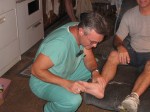
When I caught up with David during a recent house-call visit, we discussed many things; especially the American Affordable Health Choices Act [HR-3200]. Unfortunately; I did not have my audio-recorder with me. So, here are a few points of interest about him that I jotted down, from memory, in my ever-present reporter’s notebook. No doubt, I missed many more:

  • He became a physician as a career change in mid-life.
  • He has read HR 3200 in its’ entirety.
  • He hired an attorney for HR 3200 interpretation and review.
  • He is for healthcare reform, but against HR 3200.
  • He is against a public health care plan.
  • He is against individual insurance mandates.
  • He does 10-12 house-calls every month.
  • He does not charge MC, MD or VA house-call patients; rarely bills them and/or accepts assignment without balance billing.
  • He regularly operates on same, under similar terms.
  • He does other pro-bono work.
  • He practices defensive medicine.
  • He is for tort reform.
  • He is not a member of the AMA with no plans to join.

Assessment

Review and vote for -or- against HR 3200 here: http://www.opencongress.org/bill/111-h3200/text

About Off Road with Dr. MarcinkoDavid Lumsden; MD

These sporadic off-road segments will continue through-out my 2009 summer promotional tour. Formal attendance increased toward the later part of the summer as the Obama Administration’s healthcare debates heated up. Our many local book stores and sponsors noted a spike in our CD and book sales, as well as interest in our online www.CertifiedMedicalPlanner.com program and premier quarterly guide: Healthcare Organizations [Journal of Financial Management Strategies] www.HealthcareFinancials.com

Part VII: https://healthcarefinancials.wordpress.com/2009/09/01/off-road-touring-with-dr-marcinko-part-vii/

Conclusion

And so, your thoughts and comments on this Medical Executive-Post are appreciated. Feel free to review our top-left column, and top-right sidebar materials, links, URLs and related websites, too. Then, be sure to subscribe to the ME-P. It is fast, free and secure.

Link: http://feeds.feedburner.com/HealthcareFinancialsthePostForcxos

Speaker: If you need a moderator or speaker for an upcoming event, Dr. David E. Marcinko; MBA – Publisher-in-Chief of the Executive-Post – is available for seminar or speaking engagements. Contact: MarcinkoAdvisors@msn.com 

Get our Widget: Get this widget!

Our Other Print Books and Related Information Sources:

Practice Management: http://www.springerpub.com/prod.aspx?prod_id=23759

Physician Financial Planning: http://www.jbpub.com/catalog/0763745790

Medical Risk Management: http://www.jbpub.com/catalog/9780763733421

Healthcare Organizations: www.HealthcareFinancials.com

Health Administration Terms: www.HealthDictionarySeries.com

Physician Advisors: www.CertifiedMedicalPlanner.com

Subscribe Now: Did you like this Medical Executive-Post, or find it helpful, interesting and informative? Want to get the latest ME-Ps delivered to your email box each morning? Just subscribe using the link below. You can unsubscribe at any time. Security is assured.

Link: http://feeds.feedburner.com/HealthcareFinancialsthePostForcxos

Sponsors Welcomed

And, credible sponsors and like-minded advertisers are always welcomed.

Link: https://healthcarefinancials.wordpress.com/2007/11/11/advertise

Tightening Payment Rules for Non-Physicians

Understanding the Medicare “Incident To” Rules

By Staff ReportersGator

Under the “incident to” rules, Medicare Part B pays for some services that are billed by physicians, but performed by non-physicians. And, the Department of Health and Human Services [DHHS] and Office of Inspector General [OIG] says that some of these services might be used improperly.

Suggestions to CMS

The agency recommends the Centers for Medicare & Medicaid Services [CMS] perform the following:

  • Revise the “incident to” rule to require that physicians who bill Medicare, but don’t perform the services themselves, ensure that the services are provided by a licensed physician, or a non-physician with the necessary training, certification or licensure.
  • Require that physicians who use non-physician services identify this with a service code modifier on bills.
  • Take appropriate action to detect when physicians bill for “incident to” services that are not covered under the rule.

Assessment

In the current healthcare reform environment, Medicare services by non-physicians are coming under increased scrutiny. And, the OIG is finding that the “incident to” rule is allowing medical care to be provided by non-physicians who may lack the necessary qualifications. This may be a healthcare financial, insurance and quality breach. So, don’t let this trap “bite” you.

Source: HHS Office of Inspector General (www.oig.hhs.gov/oei/reports/oei-09-06-00430.pdf)

Conclusion

And so, your thoughts and comments on this Medical Executive-Post are appreciated. Has anyone been bitten by the ‘incident to” rules? Tell us what you think. Feel free to review our top-left column, and top-right sidebar materials, links, URLs and related websites, too. Then, be sure to subscribe to the ME-P. It is fast, free and secure.

Link: http://feeds.feedburner.com/HealthcareFinancialsthePostForcxos

Speaker: If you need a moderator or speaker for an upcoming event, Dr. David E. Marcinko; MBA – Publisher-in-Chief of the Executive-Post – is available for seminar or speaking engagements. Contact: MarcinkoAdvisors@msn.com 

Get our Widget: Get this widget!

Our Other Print Books and Related Information Sources:

Practice Management: http://www.springerpub.com/prod.aspx?prod_id=23759

Physician Financial Planning: http://www.jbpub.com/catalog/0763745790

Medical Risk Management: http://www.jbpub.com/catalog/9780763733421

Healthcare Organizations: www.HealthcareFinancials.com

Health Administration Terms: www.HealthDictionarySeries.com

Physician Advisors: www.CertifiedMedicalPlanner.com

Subscribe Now: Did you like this Medical Executive-Post, or find it helpful, interesting and informative? Want to get the latest ME-Ps delivered to your email box each morning? Just subscribe using the link below. You can unsubscribe at any time. Security is assured.

Link: http://feeds.feedburner.com/HealthcareFinancialsthePostForcxos

Sponsors Welcomed

And, credible sponsors and like-minded advertisers are always welcomed.

Link: https://healthcarefinancials.wordpress.com/2007/11/11/advertise

On PHI Security Breaches

Join Our Mailing List

New HHS Regulations

[By Staff Reporters]

Effective September 23, 2009, new regulations issued by the U.S. Department of Health and Human Services (“HHS”) will require covered entities to notify affected individuals and HHS following the discovery of a breach of patient information. These regulations are more expansive than other notification laws that may already exist. Under these new regulations, covered entities must analyze every privacy and/or security incident to determine whether a notification requirement exists and then satisfy detailed notice requirements.

Breach Defined 

According to Garfunkel, Wild and Travis PC, a “breach” may be defined as the unauthorized acquisition, access, use or disclosure of unsecured Protected Health Information (“PHI”) which compromises the security or privacy of the PHI. It is important to note that this definition of breach is broader than most state notification laws under which most covered entities have already been operating for a number of years. While state notification laws may only require notification when there is an unauthorized disclosure of social security numbers or other specific kinds of personal information, under these new Federal regulations, unauthorized access, acquisition, use or disclosure of any PHI, not just social security number, is a potential breach. Furthermore; unauthorized uses of PHI, not just access or disclosure, requires notification.

Assessment

For more info: http://www.gwtlaw.com

Conclusion

Your thoughts and comments on this ME-P are appreciated. Feel free to review our top-left column, and top-right sidebar materials, links, URLs and related websites, too. Then, subscribe to the ME-P. It is fast, free and secure.

Link: http://feeds.feedburner.com/HealthcareFinancialsthePostForcxos

Speaker: If you need a moderator or speaker for an upcoming event, Dr. David E. Marcinko; MBA – Publisher-in-Chief of the Medical Executive-Post – is available for seminar or speaking engagements. Contact: MarcinkoAdvisors@msn.com

OUR OTHER PRINT BOOKS AND RELATED INFORMATION SOURCES:

DICTIONARIES: http://www.springerpub.com/Search/marcinko
PHYSICIANS: www.MedicalBusinessAdvisors.com
PRACTICES: www.BusinessofMedicalPractice.com
HOSPITALS: http://www.crcpress.com/product/isbn/9781466558731
CLINICS: http://www.crcpress.com/product/isbn/9781439879900
BLOG: www.MedicalExecutivePost.com
FINANCE: Financial Planning for Physicians and Advisors
INSURANCE: Risk Management and Insurance Strategies for Physicians and Advisors

Product DetailsProduct DetailsProduct Details

About HealthDataRights.org

Mitigating the Unintended Consequences of HIPAA

By Staff ReportersWaiting for Medical Records

Many patients and pundits opine how today’s HIPAA regulations [written in the relative paper based stone age] say that while doctors must provide a copy of your records, they can take a month to do so. And, if they want, they can say that’s not enough and take another month. However, when a patient needs medical care; that time-line is not acceptable.

Enter a Website and Start a Movement

According to the website www.HealthDataRights.org, in an era when technology allows personal health information to be more easily stored, updated, accessed and exchanged, the following rights should be self-evident and inalienable. We the people:

  • Have the right to our own health data.
  • Have the right to know the source of each health data element.
  • Have the right to take possession of a complete copy of our individual health data, without delay, at minimal or no cost; if data exist in computable form, they must be made available in that form.
  • Have the right to share our health data with others as we see fit.

Assessment

These principles express basic human rights as well as essential elements of health care that is participatory, Health 2.0 appropriate and in the interests of each patient. No law or policy should abridge these rights.

Conclusion

And so, your thoughts and comments on this Medical Executive-Post are appreciated. Visit the site, join the movement by signing their petition, and tell us what you think. Feel free to review our top-left column, and top-right sidebar materials, links, URLs and related websites, too. Then, be sure to subscribe to the ME-P. It is fast, free and secure.

Link: http://feeds.feedburner.com/HealthcareFinancialsthePostForcxos

Speaker: If you need a moderator or speaker for an upcoming event, Dr. David E. Marcinko; MBA – Publisher-in-Chief of the Executive-Post – is available for seminar or speaking engagements. Contact: MarcinkoAdvisors@msn.com 

Get our Widget: Get this widget!

Our Other Print Books and Related Information Sources:

Practice Management: http://www.springerpub.com/prod.aspx?prod_id=23759

Physician Financial Planning: http://www.jbpub.com/catalog/0763745790

Medical Risk Management: http://www.jbpub.com/catalog/9780763733421

Healthcare Organizations: www.HealthcareFinancials.com

Health Administration Terms: www.HealthDictionarySeries.com

Physician Advisors: www.CertifiedMedicalPlanner.com

Subscribe Now: Did you like this Medical Executive-Post, or find it helpful, interesting and informative? Want to get the latest ME-Ps delivered to your email box each morning? Just subscribe using the link below. You can unsubscribe at any time. Security is assured.

Link: http://feeds.feedburner.com/HealthcareFinancialsthePostForcxos

Sponsors Welcomed

And, credible sponsors and like-minded advertisers are always welcomed.

Link: https://healthcarefinancials.wordpress.com/2007/11/11/advertise

Henry Louis Gehrig, eMRs and Healthcare Reform

What’s the “Iron Horse” Got to Do with Health IT?

By Dr. David Edward Marcinko; MBA, CMP™

[Publisher-in-Chief]Jacobetti VA

According to UPI reports from Charlestown, WVa on August 24 2009, at least 1,200 veterans across the country were mistakenly told by the Veterans Administration [VA] that they suffered from a fatal neurological disorder.

Link: http://www.msnbc.msn.com/id/32541579/ns/health-health_care/

Panicked Veterans

One of the leaders of a Gulf War veterans group is reported to have said that panicked veterans from the states of Alabama, Florida, Kansas, North Carolina, West Virginia and Wyoming contacted the group about the error. Denise Nichols, the vice president of the National Gulf War Resource Center, reportedly blamed a “coding error” for the mistake. In medicine, we call this a “false positive.”

About Henry Louis “Lou” Gehrig

Henry Louis “Lou” Gehrig (June 19, 1903 – June 2, 1941), born Ludwig Heinrich Gehrig, was an American baseball player in the 1920s and 1930s; chiefly remembered for his prowess as a hitter, the longevity of his consecutive games played record and the pathos of his tearful farewell from baseball at age 36, when he was stricken with a fatal disease. Of course, Gehrig was known as the “The Iron Horse” for his durability. Yet, the irony is that Amyotrophic Lateral Sclerosis [ALS], or Lou Gehrig’s disease [sometimes also called Maladie de Charcot] is progressive and fatal. Lou died in 1941 after developing the illness. Will the same death-spiral happen to eHRs and Obama care?

Link: http://www.lougehrig.com

Assessment

Having rotated through the VA system as a young medical student back-in-the-day, I have never been a fan. It smacked of socialized medicine and government plutocracy, and was never a leading-edge example of domestic healthcare, in my informed opinion. Recent HIPAA administrative, security, IT and clinical medical errors are well known. So, to blame the mix-up on an insurance billing and “coding error” seems somewhat disingenuous. Especially now, at a time when eMRs and the Obama Administration’s healthcare reform itself is being vigorously debated by the citizenry. I mean, are there no human checks and balances? Would there be any human intervention if a public healthcare policy was adopted?

Of course, we have written about military medicine previously on this Medical Executive-Post, and devoted an entire channel to it. And, I do realize that more than fifty percent of us receive similar governmental care in some form, or another [Medicare, Medicaid, CHIPS, the Indian and Prison Healthcare Systems, etc].

Link: https://healthcarefinancials.wordpress.com/category/military-medicine/

Nevertheless, shall we give a new moniker to this mistake? How about “Lou Gehrig’s coding error”, and document it in our www.HealthDictionarySeries.com

Conclusion

And so, your thoughts and comments on this Medical Executive-Post are appreciated. Is it even fair to relate this “isolated incident” to the current healthcare reform debate, the eMR conundrum and/or similar discussions on health Information Technology [IT]? Tell us what you think. Feel free to review our top-left column, and top-right sidebar materials, links, URLs and related websites, too. Then, be sure to subscribe to the ME-P. It is fast, free and secure.

Link: http://feeds.feedburner.com/HealthcareFinancialsthePostForcxos

Speaker: If you need a moderator or speaker for an upcoming event, Dr. David E. Marcinko; MBA – Publisher-in-Chief of the Executive-Post – is available for seminar or speaking engagements. Contact: MarcinkoAdvisors@msn.com 

Get our Widget: Get this widget!

Our Other Print Books and Related Information Sources:

Practice Management: http://www.springerpub.com/prod.aspx?prod_id=23759

Physician Financial Planning: http://www.jbpub.com/catalog/0763745790

Medical Risk Management: http://www.jbpub.com/catalog/9780763733421

Healthcare Organizations: www.HealthcareFinancials.com

Health Administration Terms: www.HealthDictionarySeries.com

Physician Advisors: www.CertifiedMedicalPlanner.com

Subscribe Now: Did you like this Medical Executive-Post, or find it helpful, interesting and informative? Want to get the latest ME-Ps delivered to your email box each morning? Just subscribe using the link below. You can unsubscribe at any time. Security is assured.

Link: http://feeds.feedburner.com/HealthcareFinancialsthePostForcxos

Sponsors Welcomed

And, credible sponsors and like-minded advertisers are always welcomed.

Link: https://healthcarefinancials.wordpress.com/2007/11/11/advertise

BCBS-TX Reverses NPI Policy

Victory at Last

[By Darrell K. Pruitt; DDS]pruitt

Every now and then, I enjoy little victories. My war with BCBS-TX started when they began declining to pay their clients’ claims if they originated in my office. Since I’m not a HIPAA-covered entity, I didn’t volunteer for an arbitrary National Provider Identification number.

The behemoth insurance company not only successfully drove away some of my long term patients, but their clever policy blocked my access to their pool of clients who were led to believe their dental insurance was good everywhere – until my office manager had to tell them otherwise. BCBSTX is a sleazy company simply because it lies to its clients as policy. 

Successful Claims

In the last two weeks, my office manager has successfully filed a couple of claims and it appears that unless payment is blocked in the next day or so, BCBSTX no longer requires Texas dentists to have NPI numbers.

Asessment

That’s nice, but I want more. I want the state CHIP program to drop its NPI requirement as well. Why limit access to dental care to the poor because of a number that only helps insurers. I’m just getting started, Texas.

Conclusion

Your thoughts and comments on this ME-P are appreciated. Feel free to review our top-left column, and top-right sidebar materials, links, URLs and related websites, too. Then, subscribe to the ME-P. It is fast, free and secure.

Speaker: If you need a moderator or speaker for an upcoming event, Dr. David E. Marcinko; MBA – Publisher-in-Chief of the Medical Executive-Post – is available for seminar or speaking engagements. Contact: MarcinkoAdvisors@msn.com

OUR OTHER PRINT BOOKS AND RELATED INFORMATION SOURCES:

Product DetailsProduct Details


ADA President and Broken Promises

The Future President

By Darrell K. Puritt; DDS

pruitt8

The election for a future ADA president occurs the first week in October in Hawaii at the 2009 annual meeting. A couple of days ago, the ADA News Online posted the ADA President-elect candidates’ statements.

http://www.ada.org/prof/resources/pubs/adanews/adanewsarticle.asp?articleid=3133

All three sound like they support meaningful dialogue with membership: Candidate Dr. Raymond Gist says one of his goals is: “To protect and preserve ownership of the intellectual property of the ADA while demonstrating transparency and fostering an understanding of how our system works.” Candidate Dr. William Glecos says “My first goal will be to coordinate and improve our communication efforts within the ADA. To make sure we are engaging all our members and imparting a sense of connection and transparency.” Candidate Dr. Marie Schweinebraten says “… communication, internal and external, must be improved to respond in today’s world … barriers must be eliminated to allow member input and volunteer involvement when solving specific issues.” I’ve seen candidates use these same buzzwords before, but not mean them. Dentistry is being severely threatened right now, and I’m too young to retire. So I want to see a future leader confident enough to walk through fire with me on behalf of my patients.

Promises from ADA President-elect candidates have been very disappointing so far. Past President Dr. Mark Feldman, President Dr. John Findley and President-elect Dr. Ron Tankersley each promised “transparency.” Feldman and Findley broke their promises very early, and so far, Tankersley has done no better. Nine months ago I invited Dr. Tankersley to a conversation about the future of electronic dental records and he chose to insult me with silence rather than respond. I took it personally, Ron, and I’ll never forget it. Because all three of these presidents are simply rude people, it wouldn’t bother me to never ask any of them for friendship. 

So do you think our fresh leaders are any more sincere about transparency with membership? Or are they also hoping to be safely elected. This could be an opportunity for one or more of the three to break loose and be counted as a brave leader… or not. Let me show you what Feldman, Findley and Tankersley have gotten us into. Below is a list of duties expected of dentists with NPI numbers that came out today on ANCO Online. If any of you three candidates have the courage to respond to my challenging comments about what I consider to be a perfect example of a renegade department, jump right in. Concerned members need to be warned about the courage we can count on. If you cannot defend the Department of Dental Informatics, just say so. We’ll all be better off. And on truth, we can build. What an opportunity for you! I bet one could easily gain the delegates’ attention by doing the right thing, even if it is unpopular at first to those who may have helped you to power.

Responding to this article in a respectful, professional way could be just what it takes to get a person elected to the highest position in the American Dental Association. That’s what you intensely want, isn’t it? You just have to recognize what I am spelling out for you, Raymond, William and Marie. Just look at the growing discontent with the ADA on the Internet. Whoever is the first to show sincerity and courage, will become a hero to those of us who feel betrayed by those we once trusted. Victory will never be easier. I’ve had a look around. Believe me when I tell you that things are soo bad that even I could be a contender. Don’t make me run for the job.

Here is the first issue for discussion if you are interested: For dentists who were persuaded by the ADA Department of Dental Informatics to quickly volunteer for the 10 digit identifying number, let me ask you this: If you had been told what ADA employees are paid to tell you, which you can read below, would you have applied for an NPI number? And if you were forced to apply for a number by a managed care contract with BCBSTX, Delta Dental or other discount dentistry broker, would that be considered an unfair business practice?

Let’s look at fairness: Who does the NPI number help? Dental patients or BCBSTX? Or perhaps the ADA? We were told again and again in ADA News Online articles written by Arlene Furlong that the best reason for the NPI number was convenience. She said office managers would love it because it would replace numerous identification numbers. When one reads the list of NPI obligations a dentist volunteers their office manager for, all those other numbers don’t seem so bad after all. Why was HIPAA so important that the ADA Department of Dental Informatics forced employees under its supervision to intentionally mislead membership? Does the ADA work for dentists and their patients or for CMS? There you go, Dr. Raymond Gist, Dr. William Glecos and Dr. Marie Schweinebraten. It’s your turn now. If you have the guts to step up to a challenge, it could pay off big. Besides, even if you get elected without first responding to my concerns doesn’t mean you’ll get rid of me. Oh heaven’s no.

D. Kellus Pruitt; DDS

http://anco- .blogspot.com/2009/08/asco-coa-cms-palmettoj1mac-news.html

**** CMS NEWS ****

This message is for health care providers, particularly physicians and other practitioners, who have obtained National Provider Identifiers (NPIs) and have records in the National Plan and Provider Enumeration System (NPPES). The Centers for Medicare & Medicaid Services (CMS) recommends that each health care provider, including individual physicians and non-physician practitioners: · Secure and maintain their own NPPES account information (i.e., User ID, Password, and Secret Question/Answer) for safety and accessibility purposes. Health care providers should maintain the confidentiality of their User ID, password, and Secret Question/Answer in order to protect their NPPES information from unauthorized access. Reset their NPPES passwords at least once a year.

See the NPPES Application Help page at https://nppes.cms.hhs.gov/NPPES/Help.do and select the ‘Reset Password Page’ for applicable rules. Those rules indicate the length, format, content and requirements of NPPES passwords. Review their NPPES records in order to ensure that the information reflects current and correct information. Covered health care providers are required to update their NPPES information within 30 days of the effective date of the change.

Viewing NPPES Information Health care providers, including physicians and non-physician practitioners, can view their NPPES information in one of two ways: (1) By accessing the NPPES record at https://nppes.cms.hhs.gov/NPPES/Welcome.do and following the NPI hyperlink and selecting Login. The user will be prompted to enter the User ID and password that he/she previously created. If the health care provider has forgotten the password, enter the User ID and click the “Reset Forgotten Password” button to navigate to the Reset Password Page. If the health care provider enters an incorrect User ID and Password combination three times, the User ID will be disabled. Please contact the NPI Enumerator at 1-800-465-3203 if the account is disabled or if the health care provider has forgotten the User ID. OR (2) By accessing the NPI Registry at https://nppes.cms.hhs.gov/NPPES/NPIRegistryHome.do.

The NPI Registry gives the health care provider an online view of Freedom of Information Act (FOIA)-disclosable NPPES data. The health care provider can search for its information using the name or NPI as the criterion. Information regarding NPPES data that are FOIA-disclosable can be found at http://www.cms.hhs.gov/NationalProvIdentStand/ by selecting ‘Data Dissemination’. Please note: Business Mailing Address and Business Practice location information (full address and corresponding telephone numbers) are key data elements that are FOIA-disclosable.

Health care providers should not report their residential address unless it is their Business Mailing Address or Business Practice location. The NPPES data appearing on the NPI Registry cannot be deleted; however, it can be updated or changed. Updating NPPES Information Health care providers, including physicians and non-physician practitioners, can correct, add, or delete information in their NPPES records by accessing their NPPES records at https://nppes.cms.hhs.gov/NPPES/Welcome.do and following the NPI hyperlink and selecting Login. The user will be prompted to enter the User ID and password that he/she previously created.

Please note: Required information cannot be deleted from an NPPES record; however, required information can be changed/updated to ensure that NPPES captures the correct information. Certain information is inaccessible via the web, thus requiring the change/update to be made via paper application. The paper NPI Application/Update Form (CMS-10114) can be downloaded and printed at http://www.cms.hhs.gov/cmsforms/downloads/CMS10114.pdf.

Deactivating the NPI Health care providers, including physicians and non-physician practitioners, can deactivate their NPIs if the NPIs are no longer required or needed. Reasons for deactivation include retirement, business dissolved, or death of the health care provider. A request for deactivation must be submitted via paper application. The paper NPI Application/Update Form (CMS-10114) can be downloaded and printed at http://www.cms.hhs.gov/cmsforms/downloads/CMS10114.pdf.

Health care providers should review the instructions located on the application regarding deactivations in order to properly complete the deactivation request. The Power of Attorney or Executor of the Will may complete the application for deactivation due to death of the health care provider.

Need More Information?

Providers can apply for an NPI online at https://nppes.cms.hhs.gov or can call the NPI enumerator to request a paper application at 1-800-465-3203. Visit CMS’ dedicated NPI web page at www.cms.hhs.gov/NationalProvIdentStand for additional NPI information.

Channel Surfing

Have you visited our other topic channels? Established to facilitate idea exchange and link our community together, the value of these topics is dependent upon your input. Please take a minute to visit. And, to prevent that annoying spam, we ask that you register.  

Link: http://feeds.feedburner.com/HealthcareFinancialsthePostForcxos

Speaker: If you need a moderator or speaker for an upcoming event, Dr. David E. Marcinko; MBA – Publisher-in-Chief of the Executive-Post – is available for seminar or speaking engagements. Contact: MarcinkoAdvisors@msn.com 

Get our Widget: Get this widget!

OSHA and Sharp Medical Instruments

Understanding OSHA Requirements

By Patricia A. Trites; MPA, CHBC, CHCC, CMP™ (Hon)
Dr. Charles F. Fenton, III; JD, FACFAS
Hope Rachel Hetico; RN, MHA, CMP™

The OSHA Standard requires that contaminated needles and other contaminated sharp instruments (sharps) must not be bent, recapped, or removed.

Definition

Contaminated sharps are defined as any contaminated object that can penetrate the skin including, but not limited to: needles, scalpels, broken glass, broken capillary tubes, and exposed ends of dental wires.

Contaminated needles and other contaminated sharps must not be recapped or removed from the syringes unless the employer can demonstrate that no alternative is feasible or that such action is required by a specific medical procedure. Also, shearing or breaking of contaminated needles is prohibited. This would include those instances, such as during surgery, where recapping was necessary due to the need to give multiple injections from the same syringe. If needles are recapped, it must be through the use of a one-handed technique.

Two-Handed Recapping

Two-handed needle recapping is strictly prohibited by the Standard. Recapping of needles can be a very dangerous procedure. It is during recapping that most skin punctures occur.

Immediately, or as soon as possible after use, contaminated reusable sharps must be discarded and placed in appropriate containers until properly reprocessed. The containers must be:

  • puncture resistant;
  • labeled or color-coded; and
  • leak proof on the sides and bottom.

Assessment

Finally, containers must be at the site as close as feasible to the use of the sharps. This will limit the risk of injury during the time the sharp would otherwise have been transported from the site of use to the site of disposal. During use, the sharps container must be maintained upright, not be allowed to be overfilled, and replaced routinely. When moving containers of contaminated sharps from the area of use, the containers must be closed immediately prior to removal or replacement to prevent spillage or protrusion of contents during handling. The container must be placed in a secondary container if leakage is possible. Reusable containers must not be opened, emptied, or cleaned manually or in any other manner that would expose employees to the risk of percutaneous injury. Physicians can purchase turn-key sharps containers that, when full, can be shipped back to the distributor for proper disposal.

Sharps

Conclusion

And so, your thoughts and comments on this Medical Executive-Post are appreciated. Tell us what you think. How has OSHA affected your practice? Feel free to review our top-left column, and top-right sidebar materials, links, URLs and related websites, too. Then, be sure to subscribe to the ME-P. It is fast, free and secure.

Link: http://feeds.feedburner.com/HealthcareFinancialsthePostForcxos

Speaker: If you need a moderator or speaker for an upcoming event, Dr. David E. Marcinko; MBA – Publisher-in-Chief of the Executive-Post – is available for seminar or speaking engagements. Contact: MarcinkoAdvisors@msn.com

Subscribe Now: Did you like this Medical Executive-Post, or find it helpful, interesting and informative? Want to get the latest ME-Ps delivered to your email box each morning? Just subscribe using the link below. You can unsubscribe at any time. Security is assured.

Link: http://feeds.feedburner.com/HealthcareFinancialsthePostForcxos

Sponsors Welcomed: And, credible sponsors and like-minded advertisers are always welcomed.

Link: https://healthcarefinancials.wordpress.com/2007/11/11/advertise

Product DetailsProduct DetailsProduct Details

Dictionary of Health Insurance and Managed Care

ADVERTISEMENT

Whither the Dictionary of Health Insurance and Managed Care?

HDS

A simple query that demands a cogent answer!

Why do we need the Dictionary of Health Insurance and Managed Care, and, why do payers, providers, benefits managers, consultants, and consumers need a credible and unbiased source of explanations for their health insurance needs and managed care products?

The Answer is Clear!

Health care is the most rapidly changing domestic industry. The revolution occurring in health insurance and managed care delivery is particularly fast. Some might even suggest these machinations were malignant, as many industry segments, professionals, and patients suffer because of them. And so, because knowledge is power in times of great flux, codified information protects all people from physical, as well as economic harm.

We appreciate the support of our sponsors. So, click-on on the links and review all dictionary products.

Link: http://healthdictionaryseries.com/TechnologySecurity.aspx

Link: http://www.findbookprices.com/author/Hope_Hetico

Subscribe Now: Did you like this Medical Executive-Post, or find it helpful, interesting and informative? Want to get the latest ME-Ps delivered to your email box each morning? Just subscribe using the link below. You can unsubscribe at any time. Security is assured.

Link: http://feeds.feedburner.com/HealthcareFinancialsthePostForcxos

Sponsors Welcomed

And, credible sponsors and like-minded advertisers are always welcomed.

Link: https://healthcarefinancials.wordpress.com/2007/11/11/advertise

Product DetailsProduct DetailsProduct Details

Hand Washing for Healthcare Facilities

Join Our Mailing List

Understanding OSHA Standards

[By Dr. David E. Marcinko; FACFAS, MBA, CPHQ, CMP™]

[By Patricia A. Trites; MPA, CHBC, CHCC, CMP™ (Hon)]

The OSHA Standards for healthcare require that hand washing facilities be readily available to employees.

Definition

Hand washing facilities are defined as a facility providing an adequate supply of:

  • running potable water;
  • antiseptic soap; and
  • single-use disposable towels or hot air drying machines.

Location

The hand washing facilities must be located where the employee will have easy access. This will ensure that the employee will be likely to use the hand washing facility and will minimize the time that the contamination will remain in contact with the employee. In those instances where the provision of hand washing facilities is not feasible, either an appropriate antiseptic hand cleaner (e.g., alcohol-based rinse, antiseptic foam, or antiseptic-impregnated paper wipes) in conjunction with clean cloth or paper towels, or antiseptic towelettes, must be provided.

Soap and Running Water

When using antiseptic hand cleansers or towelettes, the hands must be washed with soap and running water as soon as feasible. Not only must the employer provide the hand washing facilities, he or she must also ensure that employees in fact do wash their hands immediately or as soon as feasible following contact with blood or other potentially infectious material [OPIM].

The employee must also wash his or her hands immediately after removal of gloves or other personal protective equipment [PPE]. It is the employer’s responsibility to ensure that hand washing occurs. OSHA states that hand washing must be strictly enforced by the employer.

***

handwashing-550x2190

***

Assessment

How has OSHA affected your hospital, medical practice or healthcare facility?

Channel Surfing the ME-P

Have you visited our other topic channels? Established to facilitate idea exchange and link our community together, the value of these topics is dependent upon your input. Please take a minute to visit. And, to prevent that annoying spam, we ask that you register. It is fast, free and secure.

Conclusion

Your thoughts and comments on this ME-P are appreciated. Feel free to review our top-left column, and top-right sidebar materials, links, URLs and related websites, too. Then, subscribe to the ME-P. It is fast, free and secure.

Speaker: If you need a moderator or speaker for an upcoming event, Dr. David E. Marcinko; MBA – Publisher-in-Chief of the Medical Executive-Post – is available for seminar or speaking engagements. Contact: MarcinkoAdvisors@msn.com

OUR OTHER PRINT BOOKS AND RELATED INFORMATION SOURCES:

Product DetailsProduct DetailsProduct Details

Understanding Universal Healthcare Precautions

The OSHA Definition for Medicine

By Patricia A. Trites; MPA, CHBC, CHCC, CMP™ (Hon)
Dr. Charles F. Fenton, III; JD, FACFAS
Hope Rachel Hetico; RN, MHA, CMP™

www.HealthcareFinancials.comHO-JFMS-CD-ROM

OSHA defines universal precautions (sometimes referred to as “normal precautions”) as an approach to infection control whereby all human blood and certain human body fluids are treated as if known to be infected by HIV, HBV [hepatitis], or other blood borne pathogens.


Assessment

Universal precautions must be observed to prevent contact with blood; or; Other Potentially Infectious Materials [OPIM]. Under circumstances in which differentiation between body fluid types is difficult or impossible, all body fluids should be considered potentially infectious.

ConclusionGloves

And so, your thoughts and comments on this Medical Executive-Post are appreciated. Tell us what you think. Feel free to review our top-left column, and top-right sidebar materials, links, URLs and related websites, too. Then, be sure to subscribe to the ME-P. It is fast, free and secure.

Link: http://feeds.feedburner.com/HealthcareFinancialsthePostForcxos

Speaker: If you need a moderator or speaker for an upcoming event, Dr. David E. Marcinko; MBA – Publisher-in-Chief of the Executive-Post – is available for seminar or speaking engagements. Contact: MarcinkoAdvisors@msn.com 

Get our Widget: Get this widget!

Our Other Print Books and Related Information Sources:

Practice Management: http://www.springerpub.com/prod.aspx?prod_id=23759

Physician Financial Planning: http://www.jbpub.com/catalog/0763745790

Medical Risk Management: http://www.jbpub.com/catalog/9780763733421

Healthcare Organizations: www.HealthcareFinancials.com

Health Administration Terms: www.HealthDictionarySeries.com

Physician Advisors: www.CertifiedMedicalPlanner.com

Subscribe Now: Did you like this Medical Executive-Post, or find it helpful, interesting and informative? Want to get the latest ME-Ps delivered to your email box each morning? Just subscribe using the link below. You can unsubscribe at any time. Security is assured.

Link: http://feeds.feedburner.com/HealthcareFinancialsthePostForcxos

Sponsors Welcomed

And, credible sponsors and like-minded advertisers are always welcomed.

Link: https://healthcarefinancials.wordpress.com/2007/11/11/advertise

OSHA and Workplace Pathogen Control

Join Our Mailing List

Engineering and Medical Work Practice Controls

By Patricia A. Trites; MPA, CHBC, CHCC, CMP™ (Hon)
Dr. Charles F. Fenton, III; JD, FACFAS
Hope Rachel Hetico; RN, MHA, CMP™

Engineering and medical practice controls are methods used to isolate or remove bloodborne pathogen hazards from the workplace. These practices should be used to eliminate or minimize employee exposure by removing the hazard or isolating the employee from the exposure. However, where occupational exposure remains after institution of these controls, personal protective equipment [PPE] must be employed, as described below.

Engineering Controls

Engineering controls can be described as those an employer purchases and makes available to protect his or her employees. Examples are sharps containers, eye-wash stations, spill-kits, and safer needle systems. It is the employer’s responsibility to implement and maintain a system for ensuring engineering that controls are used. The engineering controls must be examined and maintained or replaced on a regular schedule to ensure their effectiveness. Conducting only an annual review of the engineering controls is inappropriate under the OSHA Standard.

Healthcare Work Practice Controls

Unlike engineering controls, healthcare work practice controls depend upon the behavior of the employee to reduce exposure. Examples are hand washing, utilizing universal precautions, and wearing appropriate PPE. Even with properly implemented work practice controls, exposure can still occur. Some of the engineering and work practice controls that must be addressed (if applicable to the specific healthcare organization) within the employee control plan [ECP] include:

  • hand washing facilities and practices,
  • treatment of sharp instruments,
  • separation of food from contamination,
  • certain procedures in the treatment of contamination,
  • sterilization, and
  • care of equipment.

Assessment

These engineering controls must be examined and maintained or replaced on a regular schedule to ensure their effectiveness. Conducting only an annual review of the engineering controls is inappropriate under the OSHA Standard.

Surgical prep

Conclusion

How has OSHA affected your practice? Or, is it so 1999?

Your thoughts and comments on this ME-P are appreciated. Feel free to review our top-left column, and top-right sidebar materials, links, URLs and related websites, too. Then, subscribe to the ME-P. It is fast, free and secure.

Speaker: If you need a moderator or speaker for an upcoming event, Dr. David E. Marcinko; MBA – Publisher-in-Chief of the Medical Executive-Post – is available for seminar or speaking engagements. Contact: MarcinkoAdvisors@msn.com

OUR OTHER PRINT BOOKS AND RELATED INFORMATION SOURCES:

Product DetailsProduct Details

Concierge Medicine and the “Zombie” Medical Practices

Continued Growth of Boutique Medical Practices Today

[By Dr. David Edward Marcinko; MBA CMP™]dem2

The boutique, or direct reimbursement, or cash based medicine, or concierge medical practice business model requires an annual fee for personalized treatment that includes amenities far beyond those offered in the typical practice, or suggested by physician medical unions. Patients pay annual out-of-pocket fees for top tier service, but also use traditional health insurance to cover allowable expenses, such as inpatient hospital stays, outpatient diagnostics and care, and basic tests and physician exams. Typical annual fees can range from $1,500 to $ 5,000 per patient, to family fees that top $25,000 a year, or more. The concept, initially developed for busy corporate executives, has now made its way to others desiring such service.

A Higher Level of Care

Medical providers get to provide a much higher level of care and get to know their patients as they enjoy the incentive to spend appropriate time with them, and over time, get to know them within their unique social/cultural context as well (hence the house calls become important). Patients enjoy the access, the attentiveness, and are willing to spend cash to have the type of unhurried, contemplative time with physicians that is required to develop a trusted relationship and deliver high quality care. The financial remuneration potential is compelling as well.

Now, let us compare and contrast various parameters of traditional medical practice [third party reimbursement] with the same parameters of  so-called “new-wave” concierge medicine. Then, let the next-generation of doctors decide.

Current Traditional Model

  • patients seen at 15-20 min increments
  • 2,000 – 3,000 patients
  • Paperwork, administrative burdens, frustrations, and lack coordinated care
  • Impersonal experience (long waits, un-intelligible interactions with health care system)
  • Average Salary = $150,000-250,000

Concierge Practice Model Potential

  • direct relationship with patients
  • 300-500 patients
  • $1,500 – $3,000 access/retainer fee
  • Reduced overhead, positive interactions, care coordination and increased quality
  • Personalized experience (reduced headaches and paperwork with transparent pricing)
  • 24/7 access, same day appointments with multiple other amenities
  • Average Salary = $100,000 – $500,000

Enter the Franchisors

Concierge medical practices can be developed organically, or use a franchise business model [personal communication, Suzanne R. Dewey, Forté Partners, LLC, Williamstown, MA]. Examples of franchisors include:

Opponents and Pessimists

There have been plenty of opponents, within medicine and outside, to the idea of concierge practices almost from the first day.  For example,

The state of Washington’s insurance commissioner attacked the concept of practices offering all the primary care patients needed for a prepaid fee or retainer, arguing that such practices amounted to the business of underwriting health insurance. He said that the practices would have to meet all the regulatory requirements for such an insurance business, including establishing capital reserves and maintaining loss reserves for the payment of claims. It didn’t work, and besides, few concierge practices offer free traditional medical care once retainers are paid–most concierge physician’s bill insurance plans for all the services covered under their patients’ coverage.  The Medicare folks chimed in and managed to drive one physician out of business, arguing that he had tried to charge Medicare patients an extra $600 a year for services already covered by Medicare, hence he was guilty of illegal “balance billing.” Rather than fight Medicare over the issue, the doctor gave up and closed his practice. [C. Davis, “Big Problems for Medicare and Concierge Medicine,” Sierra Sacramento Valley Medicine, 55:3, May/June, 2004 (www.ssvms.org)]” 

Attacking ME?

Objections to concierge medicine focus on both its causes and its effects, and some critics have even attack me, personally. For example, just look what “they” said in the online journal: “Health Care Strategic Management.”

Many critics argue that concierge medicine merely reflects physician greed and unconcern over the needs of the community. Indeed, a recent book by David Marcinko, Business of Medical Practice [Advanced Profit Maximization Techniques for Savvy Doctors], includes a chapter on “The Case for Concierge Medicine” (Ch. 24) as one of the ways ‘savvy’ physicians can maximize their profit, as if that is what medicine is all about. While the image of physicians may retain some Marcus Welby elements of their rushing to the hospital or a patient’s home in the middle of the night, most physicians would rather stay home and leave the job to someone else, it is argued”.

Nicht Schadenfreude

Just think! My mother always feared I’d be a no-body. Good publicity – bad publicity – just spell the name correctly. Schadenfreude may be defined as a “largely unanticipated delight in the suffering of another which is cognized as trivial “ and I take no delight in the slow collapse of traditional medical practice models; or the economic, professional or personal pain of colleagues. But, I also often tell my critics – and clients – that although it’s awfully nice to be altruistic; I am always mindful of the competitive business adage: “no margin-no mission.” And, in as much as this attack was written in July 2005, I can only wonder if I was prescient, or just lucky? With all due respect, I believe it was the former, rather than the later. Why so? Well, just consider how fast www.ChoiceMed.com is growing. This stuff is not rocket-science.

www.MedicalBusinessAdvisors.combiz-book1

About Concierge Choice Physicians

Concierge Choice Physicians: http://choice.md  is a national organization offering a hybrid business model. Physicians divide their practice between a traditional practice and a retainer practice. The retainer practice is limited to approximately 150 patients. A typical concierge practitioner may have 300-500 patients, while the norm for a traditionalist is about 2,000-3,000 patients.

Assessment – Whither the “Zombies”

I, also ruefully wonder how many “zombie” medical practices [practitioners] are out there? You know the kind – a medical practice with neither a good/bad balance sheet. One with only subsistence level operating performance; a practice that is not growing organically or thru merger activity. It is just barely existing as the doctor-in-charge slowly, agonizingly, milks it to death; or retires, whichever comes first.

Conclusion

Your thoughts and comments on this ME-P are appreciated. Feel free to review our top-left column, and top-right sidebar materials, links, URLs and related websites, too. Then, subscribe to the ME-P. It is fast, free and secure.

Link: http://feeds.feedburner.com/HealthcareFinancialsthePostForcxos

Speaker: If you need a moderator or speaker for an upcoming event, Dr. David E. Marcinko; MBA – Publisher-in-Chief of the Medical Executive-Post – is available for seminar or speaking engagements. Contact: MarcinkoAdvisors@msn.com

OUR OTHER PRINT BOOKS AND RELATED INFORMATION SOURCES:

DICTIONARIES: http://www.springerpub.com/Search/marcinko
PHYSICIANS: www.MedicalBusinessAdvisors.com
PRACTICES: www.BusinessofMedicalPractice.com
HOSPITALS: http://www.crcpress.com/product/isbn/9781466558731
CLINICS: http://www.crcpress.com/product/isbn/9781439879900
BLOG: www.MedicalExecutivePost.com
FINANCE: Financial Planning for Physicians and Advisors
INSURANCE: Risk Management and Insurance Strategies for Physicians and Advisors

Product DetailsProduct DetailsProduct Details

Product DetailsProduct Details

Invite Dr. Marcinko

***

IRS Warning on Hospital Charity Care

On Hospital Community Benefit Laws 

By Staff ReportersOslo Port

According to an Internal Revenue Service survey of nearly 500 not-for-profit hospitals in May 2006, only nine percent of total revenues were dedicated to community charity care. The report warned charity [Samaritan] and not-for-profit healthcare entities that attempts to set a percentage threshold for determining tax-exempt compliance may have a:

disproportionate impact on hospitals, depending upon their size, where they are located their community benefit mix, and other hospital and community demographics.”

In a follow-up, February 12, 2009, the IRS reported on executive compensation of the same tax-exempt hospitals”.

Link: http://greisguide.com/wp-content/uploads/2009/02/eo_interim_hospital_report_072007.pdf

Existence Justification

HO-JFMS-CD-ROMWhile the question whether  tax-exempt hospitals are providing enough charity care to justify their tax exemption remains, the report failed to reach specific conclusions on whether existing community benefit standards are appropriate and if tax-exempt hospital executives are being compensated too richly. The findings also serve as a caution to long term acute care hospital [LTACH] governance and compensation committees.  The CEOs and CFOs of these entities should note that a similar survey may be performed on for-profit hospitals in the near future.

Defining “Community Benefits”

According to Jason Greis, of the Gries Guide on LTACHs, on February 12, 2009:

“The current ‘community benefit’ standard was established by the IRS in 1969 in Revenue Ruling 69-545.  The standard sets out factors to be considered in measuring community benefit, including: (i) a board made up of a broad base of community members; (ii) an open medical staff; (iii) participation in Medicare and Medicaid; (iv) application of surplus funds toward improving facilities, equipment, patient care, medical training, research, and education; and (v) a full-time emergency room open to all regardless of ability to pay (the emergency room standard applies differently to tax-exempt Long Term and Acute Care Hospitals [LTACH] that do not maintain a full array of emergency department services).  Under the current community benefit standard, individual hospitals are given flexibility to determine what services will-best serve their communities.”

Today, some pundits suggest that if Congress doesn’t establish new charity care requirements imminently, the IRS should revert to its community benefit standard above, and revise down or eliminate the tax exemption.

Link: http://greisguide.com/wp-content/uploads/2009/02/eo_interim_hospital_report_072007.pdf

Conclusion

And so, your thoughts and comments on this Medical Executive-Post are appreciated. Should non-profit hospitals be evaluated more carefully by the IRS for their community benefit? Feel free to review our top-left column, and top-right sidebar materials, links, URLs and related websites, too. Then, be sure to subscribe to the ME-P. It is fast, free and secure.

Link: http://feeds.feedburner.com/HealthcareFinancialsthePostForcxos

Speaker: If you need a moderator or speaker for an upcoming event, Dr. David E. Marcinko; MBA – Publisher-in-Chief of the Executive-Post – is available for seminar or speaking engagements. Contact: MarcinkoAdvisors@msn.com

Our Other Print Books and Related Information Sources:

Practice Management: http://www.springerpub.com/prod.aspx?prod_id=23759

Physician Financial Planning: http://www.jbpub.com/catalog/0763745790

Medical Risk Management: http://www.jbpub.com/catalog/9780763733421

Physician Advisors: www.CertifiedMedicalPlanner.org

Subscribe Now: Did you like this Medical Executive-Post, or find it helpful, interesting and informative? Want to get the latest ME-Ps delivered to your email box each morning? Just subscribe using the link below. You can unsubscribe at any time. Security is assured.

Link: http://feeds.feedburner.com/HealthcareFinancialsthePostForcxos

Sponsors Welcomed

And, credible sponsors and like-minded advertisers are always welcomed.

Link: https://healthcarefinancials.wordpress.com/2007/11/11/advertise

Product Details

On Growing Tensions in Healthcare Services Markets

Join Our Mailing List

Stressors Affecting all Stakeholders

[By Robert James Cimsai; MHA, AVA, ASA, CMP™]

http://www.HealthCapital.com

The changes in reimbursement for Medicare services through the introduction of prospective payment systems and physician reimbursement cuts for professional services, as well as the increased focus on patient quality and transparency initiatives and health 2.0 collaboration have forced healthcare providers to look for more efficient ways to provide services, as well as additional sources of revenue and margin-producing business.

Additionally, with the rise of corporate healthcare provider networks and health systems, together with rising healthcare costs, competition among providers has become prevalent in the healthcare industry.

Assessment

Strict control of reimbursement costs from payers and consistent decreases in physician professional component fee reimbursement yields; reduction in traditional hospital inpatient use; and higher costs of capital have all contributed to the trend of physician investment in outpatient (and inpatient) specialty provider enterprises [ASCs, specialty hospitals and clinics, etc] , which often compete with general acute care community hospital providers.

Conclusion

Your thoughts and comments on this ME-P are appreciated. Feel free to review our top-left column, and top-right sidebar materials, links, URLs and related websites, too. Then, subscribe to the ME-P. It is fast, free and secure.

Link: http://feeds.feedburner.com/HealthcareFinancialsthePostForcxos

Speaker: If you need a moderator or speaker for an upcoming event, Dr. David E. Marcinko; MBA – Publisher-in-Chief of the Medical Executive-Post – is available for seminar or speaking engagements. Contact: MarcinkoAdvisors@msn.com

OUR OTHER PRINT BOOKS AND RELATED INFORMATION SOURCES:

Product Details 

The Power of “ME Inc” for Physicians

Embracing a New Competitive Practice Culture

By Dr. David Edward Marcinko; MBA, CMP™

[Publisher-in-Chief]dem21

There are more than 900,000 physicians in the United States. Yet, the brutal supply/demand/demographic calculus of the matter is that there are just too many aging patients chasing too few doctors. Compensation and reimbursement is plummeting as Uncle Sam becomes the payer-of-choice for more than 52% of us. And, the government as payer will likely increase with the Obama Administration. So, going forward, it is not difficult to imagine the following four rules for a new-wave competitive medical care culture for all physicians.

[A] Rule No. 1

Forget about large office suites, surgery centers, fancy equipment and the bricks and mortar that comprised traditional medical practices. One doctor with a great idea, good bedside manner or competitive advantage, can outfox a slew of CPAs, while still serving the public and making money. It’s a unit-of-one healthcare economy where “ME Inc.”, is the standard and physicians must maneuver for advantages that boost their standing and credibility among patients and payers. Examples include patient satisfaction surveys, the rise of evidence-based medicine; outcomes research analysis, concierge medicine, direct reimbursement payment plans, and economic credentialing; etc.

 [B] Rule No. 2

Challenge conventional wisdom, think outside the traditional payer box, recapture your dreams and ambitions, disregard conventional gurus and work harder – and smarter – than you have ever worked before. Remember the old saying, “if everyone is thinking alike, then nobody is thinking”. Do insurance panel members think rationally or react irrationally?

However, you should realize the power of networking, vertical integration and the establishment of virtual medical practices, which come together to treat a patient, and then disband when a successful outcome achieved. Job security in this structure is achieved with successful outcomes, and perhaps not necessarily a degree in the near future. Medical futurists even presume the establishment of virtual medical schools and hospitals, where students and doctors learn and practice their art on cyber-entities that look and feel like real patients, but are generated electronically through the wonders of virtual reality units.

www.HealthcareFinancials.com

HOFMS

[C] Rule No 3

Differentiate yourself among your medical peers. Do or learn something new and unknown by your competitors. Market your accomplishments and let the world know. Be a non-conformist. The conformity of health insurance plans are an operational standard and a straitjacket on creativity. Doctors should create and innovate, not blindly follow entrenched medical society leaders into oblivion. Seek, and practice, health 2.0 collaboration with all stakeholders.

[D] Rule No 4

Realize that the present situation is not necessarily the future. Attempt to see the future and discern your place in it. Master the art of the quick change and fast but informed decision making. Do what you love, disregard what you don’t, and let the fates have their way with you. Then, decide for yourself if health plans adhere to any of the above rules?

AssessmentKung Fu

Regardless of the future de facto business model of the learned profession of medicine, current practice models are no longer the structure of choice. Rather, a more laissez-faire and highly competitive business model should be pursuedPhysicians have been slow to accept this philosophy.  Remember, as a physician, if you merely want a static job with promised security, pledged retirement benefits, limited goals and structured regulations; join a health plan panel and become their laborer.

However, if you desire more, such as the possibility of a dynamic career, the unlimited security of your brainpower, non-defined retirement contributions, infinite potential with rules you can create along the way; incorporate the power of ME, Inc., in everything you do. Remain a competitive professional and be a physician ... Get fly! 

Conclusion

And so, your thoughts and comments on this Medical Executive-Post are appreciated. Feel free to review our top-left column, and top-right sidebar materials, links, URLs and related websites, too. Then, be sure to subscribe to the ME-P. It is fast, free and secure.

Link: http://feeds.feedburner.com/HealthcareFinancialsthePostForcxos

Speaker: If you need a moderator or speaker for an upcoming event, Dr. David E. Marcinko; MBA – Publisher-in-Chief of the Executive-Post – is available for seminar or speaking engagements. Contact: MarcinkoAdvisors@msn.com  or Bio: www.stpub.com/pubs/authors/MARCINKO.htm

Get our Widget: Get this widget!

Our Other Print Books and Related Information Sources:

Practice Management: http://www.springerpub.com/prod.aspx?prod_id=23759

Physician Financial Planning: http://www.jbpub.com/catalog/0763745790

Medical Risk Management: http://www.jbpub.com/catalog/9780763733421

Healthcare Organizations: www.HealthcareFinancials.com

Health Administration Terms: www.HealthDictionarySeries.com

Physician Advisors: www.CertifiedMedicalPlanner.com

Subscribe Now: Did you like this Medical Executive-Post, or find it helpful, interesting and informative? Want to get the latest ME-Ps delivered to your email box each morning? Just subscribe using the link below. You can unsubscribe at any time. Security is assured.

Link: http://feeds.feedburner.com/HealthcareFinancialsthePostForcxos

Sponsors Welcomed

And, credible sponsors and like-minded advertisers are always welcomed.

Link: https://healthcarefinancials.wordpress.com/2007/11/11/advertise

Product DetailsProduct DetailsProduct Details       

Product Details  Product Details

   Product Details 

About Timely Medical Alternatives; Inc

Understanding Canadian Health System Alternatives

By Staff Reporters

ObamaIn 2003, Timely Medical Alternatives Inc. was formed to help Canadians, on long medical waiting lists, to take personal responsibility for their own medical care and “Leave the queue” [the national healthcare system waiting-list].

Urgent Need

According to their website, the need for private medical services is thriving in Canada. The mission of Timely Medical Alternatives [TMA] is to accommodate Canadian’s needs for private medical services by providing them with options, referrals to hospitals, clinics and diagnostic imaging facilities.

Link: http://www.timelymedical.ca

Assessment

Timely Medical Alternatives, a PPO, says it is able to expedite most types of private medical services from diagnostics to virtually all types of surgery, including procedures not available within the Canadian healthcare system. Wait times for clients are measured in days rather than in months or years.

Link: www.HealthDictionarySeries.com

Sicko Alternative

The movie documentary Sicko was directed by Michael Moore in 2007. It compared the highly profitable American health care industry to other nations, and HMO horror stories

Link: www.michaelmoore.com

Conclusion

And so, your thoughts and comments on this Medical Executive-Post are appreciated. Please compare and contrast TMA to “Sicko”, our current domestic health system, and the Obama administration’s vision of national healthcare for the US; and opine .Feel free to review our top-left column, and top-right sidebar materials, links, URLs and related websites, too. Then, be sure to subscribe to the ME-P. It is fast, free and secure.

Link: http://feeds.feedburner.com/HealthcareFinancialsthePostForcxos

Speaker: If you need a moderator or speaker for an upcoming event, Dr. David E. Marcinko; MBA – Publisher-in-Chief of the Executive-Post – is available for seminar or speaking engagements. Contact: MarcinkoAdvisors@msn.com  or Bio: www.stpub.com/pubs/authors/MARCINKO.htm

Get our Widget: Get this widget!

Our Other Print Books and Related Information Sources:

Practice Management: http://www.springerpub.com/prod.aspx?prod_id=23759

Physician Financial Planning: http://www.jbpub.com/catalog/0763745790

Medical Risk Management: http://www.jbpub.com/catalog/9780763733421

Healthcare Organizations: www.HealthcareFinancials.com

Health Administration Terms: www.HealthDictionarySeries.com

Physician Advisors: www.CertifiedMedicalPlanner.com

Subscribe Now: Did you like this Medical Executive-Post, or find it helpful, interesting and informative? Want to get the latest ME-Ps delivered to your email box each morning? Just subscribe using the link below. You can unsubscribe at any time. Security is assured.

Link: http://feeds.feedburner.com/HealthcareFinancialsthePostForcxos

Sponsors Welcomed

And, credible sponsors and like-minded advertisers are always welcomed.

Link: https://healthcarefinancials.wordpress.com/2007/11/11/advertise

On the Patient Friendly Google Health Initiative

Join Our Mailing List

Data Integrity and Health 2.0 Accuracy Concerns Linger

google3

[By Staff Reporters]

According to its’ website, and mission statement, Google Health aims to put patients in charge of their digital health information. It’s safe, secure, and free.

Triple Play of Benefits

Google Health purports to:

  • Organize health information all in one place.
  • Gather medical records from doctors, hospitals, and pharmacies.
  • Share information securely with family members doctors and caregivers, etc.

Google says members are always in control of how data is used. It will not sell information. Members decide what to share, and what to keep private.

Link: privacy policy

Blogsite

Google health was launched in the spring of 2008. Since then, it even maintains its own blog-site, which stated on 3/4/09.

 “We continue to learn a tremendous amount since launching Google Health in the spring of 2008. We’re listening to feedback from users every day about their needs, and one issue we hear regularly is that people want help coordinating their care and the care of loved ones. They want the ability to share their medical records and personal health information with trusted family members, friends, and doctors in their care network”

Link: http://googleblog.blogspot.com/2009/03/google-health-helping-you-better.html

Good thing too!

A Cautionary Tale

However, privacy advocates worry about the vast amount of data that Google is redacting. Growing consumer market clout means the early-adopter patient who cares about digital records, and eHRs, may have fewer choices in the future. And, for medical professionals, what does this say about CCHIT, Allscripts and the Military, etc; or, the emerging Wal-Mart eMR initiative for doctors?

Assessment

For example, when one now [in]famous patient named Dave deBronkart – a tech-savvy kidney cancer survivor – tried to transfer his medical records from Beth Israel Deaconess Medical Center to Google Health, he was stunned at what he found.

Read this Link: http://www.boston.com/news/nation/washington/articles/2009/04/13/electronic_health_records_raise_doubt

Is MSN’s Health Vault any better?

Channel Surfing the ME-P

Have you visited our other topic channels? Established to facilitate idea exchange and link our community together, the value of these topics is dependent upon your input. Please take a minute to visit. And, to prevent that annoying spam, we ask that you register. It is fast, free and secure.

Conclusion

Your thoughts and comments on this ME-P are appreciated. Feel free to review our top-left column, and top-right sidebar materials, links, URLs and related websites, too. Then, subscribe to the ME-P. It is fast, free and secure.

Speaker: If you need a moderator or speaker for an upcoming event, Dr. David E. Marcinko; MBA – Publisher-in-Chief of the Medical Executive-Post – is available for seminar or speaking engagements. Contact: MarcinkoAdvisors@msn.com

OUR OTHER PRINT BOOKS AND RELATED INFORMATION SOURCES:

Product DetailsProduct DetailsProduct Details

Beware the Faux Medical Journals

When is a “Journal” … not a Journal?

By Dr. David Edward Marcinko; MBA, CMP™

Publisher-in-Chiefdem23

Allow me to begin this post by making the unusual disclosure that I was the Editor-in-Chief of a print guide in healthcare finance and economics [aka periodical or journal].

Formally, the title was: Healthcare Organizations [Financial Management Strategies]. At 2 volumes, and more than 1,200 pages, it was quite a job to update it quarterly. And, with more than two dozen contributing authors, it was a labor of love indeed. Alas … no more!

ho-journal9

Varying Levels of Credibility

Now, we doctors know that medical journals are not all alike. There are different levels of “credibility.” Some are peer-reviewed, others not. Some are trade magazines. Frankly, some “real” journals are better, and more respected than others. Some entrenched journals are in decline, while other emerging journals are leading-edge in the health 2.0 space. Still others, like the formerly esteemed Journal of the American Medical Association [JAMA], have been accused of outright censorship.

Link: https://healthcarefinancials.wordpress.com/2009/04/02/is-jama-censoring-physician-dissent/

Adventures

Of course, doctors also know that pharmaceutical companies routinely offer us reprints of articles from medical journals that are favorable to their products. But, news of a Merck-sponsored publication for doctors in Australia has come to light in a personal injury lawsuit over Vioxx. It raised more than a few eyebrows in international medical publishing circles. It may have even crossed the line of journalistic, not to mention medical, ethics.

Read: Merck Paid for Medical ‘Journal’ Without Disclosure; by Natasha Singer, May 13, 2009.

Link: http://www.nytimes.com/2009/05/14/business/14vioxxside.html?_r=1&adxnnl=1&adxnnlx=1242313549-xaAEwW4MCd7pJh9OdgWdUQ

Mis-Adverntures

Tracy Staton wrote more about these mis-adventures in a story, dated May 14, 2009, in FiercePharma.

Analysis and Apology

Analysis in the Pipeline: http://seekingalpha.com/article/136942-merck-and-elsevier-cross-the-line-in-joint-medical-journal?source=yahoo

Libology Mea Culpa: http://www.libology.com/blog/tag/excerpta-medica

Assessment

Perhaps; Merck ought to read our Medical-Executive Post on health journalists?

Link: https://healthcarefinancials.wordpress.com/2009/03/17/battered-health-journalists

Or, our Medical-Executive Post on medical experts, reporters and journalists?

Link: https://healthcarefinancials.wordpress.com/2009/03/09/healthcare-experts-versus-health-journalists

Conclusion

Your thoughts and comments on this ME-P are appreciated. Feel free to review our top-left column, and top-right sidebar materials, links, URLs and related websites, too. Then, subscribe to the ME-P. It is fast, free and secure.

Link: http://feeds.feedburner.com/HealthcareFinancialsthePostForcxos

Speaker: If you need a moderator or speaker for an upcoming event, Dr. David E. Marcinko; MBA – Publisher-in-Chief of the Medical Executive-Post – is available for seminar or speaking engagements. Contact: MarcinkoAdvisors@msn.com

OUR OTHER PRINT BOOKS AND RELATED INFORMATION SOURCES:

Product DetailsProduct DetailsProduct Details

Product Details  Product Details

Product Details

More On Attempted ME-Post Censorship

Return to Ethridge’s Hill

By Darrell K. Pruitt; DDSpruitt

For those who have stayed up late, here is a sneak preview of some upcoming action – hopefully attracting the best PR people BCBS of New Mexico can field – Becky Kenny and Ross Blackstone. 

ModernHealthcare.com – The Strong Arm? – NOT

You may or may not recall that about two months ago, Martin Ethridgehill, who once worked for BCBSNM, posted a comment on ModernHealthcare.com that was later removed as ordered by Becky Kenny – a PR specialist who represents the interests of BCBSNM. So what did Becky’s recently laid-off colleague say that justified field censorship? The title says it all:  “Don’t Rush eHRs Without Addressing Medical ID Theft.”  It attracted my attention before it attracted BCBSNM’s. They move slower than I do.

Blue Cross – Blue Shield 

Apparently, even though leaders of BCBS think caution might be prudent in paying Texas physicians for health care, the organization is not necessarily in favor of delaying the adoption of eHRs … or something like that. Maybe Jon Stewart will explain it some day for us on Comedy Central.

ME-P … Marcinko Does Not Fold 

And who is this Ross Blackstone? He’s a manly piece of PR. He tried to persuade Dr. David E. Marcinko, publisher of the ME-P, to remove my comment which is not a copy of Ethridgehill’s statement, but is a report on his statement. Blackstone learned that Marcinko doesn’t fold as easily as the publisher of ModernHealthcare.com folded to Becky Kenny’s demand. I bet she got nasty with them.

The Blackstone Video 

So who is Ross Blackstone? I’m trying to get away from posting links because they are so tedious. But you just have to watch “Ross Blackstone Reporter Resume” video on YouTube. 

http://www.youtube.com/watch?v=IuHBnNiYvcU

Assessment

“First they ignore you, then they attack you, and then you win”

-Mohandas Karamchand Gandhi

Conclusion

And so, your thoughts and comments on this Medical Executive-Post are appreciated.

Speaker: If you need a moderator or speaker for an upcoming event, Dr. David E. Marcinko; MBA – Publisher-in-Chief of the Executive-Post – is available for seminar or speaking engagements. Contact: MarcinkoAdvisors@msn.com  or Bio: www.stpub.com/pubs/authors/MARCINKO.htm

Get our Widget: Get this widget!

Our Other Print Books and Related Information Sources:

Practice Management: http://www.springerpub.com/prod.aspx?prod_id=23759

Physician Financial Planning: http://www.jbpub.com/catalog/0763745790

Medical Risk Management: http://www.jbpub.com/catalog/9780763733421

Healthcare Organizations: www.HealthcareFinancials.com

Health Administration Terms: www.HealthDictionarySeries.com

Physician Advisors: www.CertifiedMedicalPlanner.com

Subscribe Now: Did you like this Medical Executive-Post, or find it helpful, interesting and informative? Want to get the latest E-Ps delivered to your email box each morning? Just subscribe using the link below. You can unsubscribe at any time. Security is assured.

Link: http://feeds.feedburner.com/HealthcareFinancialsthePostForcxos

About HealthCareTownHall.com

The Great eHR Debates

By Staff Writers

US CapitolMilliman hosts this blog to encourage an informed dialogue about healthcare reform. Healthcare is complicated, and there is no single, silver-bullet answer to the question of “How do we best improve the current system?”  But thoughtful discussions will help move reform in the right direction and mend the fractured system.

Assessment

A shout-out of thanks, for this link, goes to Jeremy Engdahl Johnson of Healthcare Town Hall.

Link: http://www.healthcaretownhall.com/

Conclusion

And so, your thoughts and comments on this Medical Executive-Post are appreciated? Feel free to review our top-left column, and top-right sidebar materials, links, URLs and related websites, too. Then, be sure to subscribe to the ME-P. It is fast, free and secure.

Link: http://feeds.feedburner.com/HealthcareFinancialsthePostForcxos

Speaker: If you need a moderator or speaker for an upcoming event, Dr. David E. Marcinko; MBA – Publisher-in-Chief of the Executive-Post – is available for seminar or speaking engagements. Contact: MarcinkoAdvisors@msn.com  or Bio: www.stpub.com/pubs/authors/MARCINKO.htm

Get our Widget: Get this widget!

Our Other Print Books and Related Information Sources:

Practice Management: http://www.springerpub.com/prod.aspx?prod_id=23759

Physician Financial Planning: http://www.jbpub.com/catalog/0763745790

Medical Risk Management: http://www.jbpub.com/catalog/9780763733421

Healthcare Organizations: www.HealthcareFinancials.com

Health Administration Terms: www.HealthDictionarySeries.com

Physician Advisors: www.CertifiedMedicalPlanner.com

Subscribe Now: Did you like this Medical Executive-Post, or find it helpful, interesting and informative? Want to get the latest ME-Ps delivered to your email box each morning? Just subscribe using the link below. You can unsubscribe at any time. Security is assured.

Link: http://feeds.feedburner.com/HealthcareFinancialsthePostForcxos

ADSL – DSL Primer for Physicians

Asynchronous Data Subscriber Line versus Digital Subscriber Loop

By Carol S. Miller; RN, MBAbiz-book20

Asynchronous Data Subscriber Lines

ADSL is a very fast digital line provided by the telephone company. If available in your area, the ADSL provides fast connections, but generally not as fast as cable. There are various choices, beginning around 256 kbps (about five to six times the speed of a fast modem) going up to 7 Mbps.  Prices begin around $60 per month (including Internet service). There is also a set-up charge and a card needs to be inserted in your computer.

Digital Subscriber Lines

DSL is a high-speed direct line that can be 20-100 times faster in communication over the modem, depending on the type selected. Prices for the DSL begin at approximately $30-$40 per month and that includes Internet access. In addition, there is a set-up charge and a network card will need to be installed into the computer. Office workstations can usually share DSL circuits over their existing local area network (LAN).

Internet Connection

To connect with the Internet, as a rule of thumb, the faster the better; therefore, the office should have at least 56 kbps.  DSL normally runs over the same line as a basic telephone voice circuit and provides Internet access from speeds of 384 kbps all the way up to 1.54 mbps (megabits per second). The advantage of this configuration is you not only have high-speed access to the Internet, your telephone is still free to make and receive calls at the same time.

Integrated Services Digital Network   

A digital telephone line that allows voice and data to be transmitted on the same line in a digital format – instead of analog – and at a relatively high speed, usually around 64 to 128 kbps.  When reviewing this service, make sure the ISP has an ISDN connection. If not, you will be charge more by both the telephone company and the ISP. Prices for the ISDN average around $300 plus, with an extra fee to install the telephone line and a monthly service charge of $25 to $100 plus to maintain.

Wireless Network (WiFi – 802.11b)

The biggest change to happen to computers in the last ten years has undoubtedly been the Internet. Close on its heels in importance may just be the adoption of the wireless network access.  Wireless Fidelity, or Wi-Fi, is now cost effective and available at the computer store.  It is no longer necessary to re-wire buildings with Category 5 wire to provide LAN connectivity and resource sharing to multiple computers. Wi-Fi, or IEE standard 802.11b, enables small offices to connect up to four computers to a single network for less than the cost of a single computer.  This means the days of multiple analog lines to offer Internet access to every computer, or a printer on every desktop, are going away. Now a single cable modem or DSL line and a centralized printer can service four users. This can save a small business hundreds of dollars a year.

www.HealthDictionarySeries.comdhimc-book28

Limited Connectivity

For limited connectivity, computer stores are stocked with wireless vendor products that are cost effective, easy to install, and very robust that will push even the most cautious computer user to take the leap to wireless computing.  Not only does it make the initial cost to install a network cheaper than it has ever been before, it eliminates the cost to remodel or move computers within a building since instead of requiring data wiring at each proposed desktop all you need now is an electrical outlet to power the PC itself. 

Satellite

This is a more modern device. In the past, satellite connections were at 400K bps or fourteen times faster than the average modem.  As an example, a 2MB file would be downloaded in 30-40 seconds.  Benefits of the satellite connection are:  The connection is always on; it is reliable; there is a secure connection; office can have multiple e-mail addresses; the web space is free; and there is tech support coverage nationwide.  Costs include around $300 for the equipment, $150 plus to install the equipment, and around $30 to $50 per month for service.  Web site reference is satcast.com (DirecWay Satellite Dish).

Conclusion

And so, your thoughts and comments on this Medical Executive-Post are appreciated? Who can update the above post for modernity?

Link: https://healthcarefinancials.wordpress.com/2009/03/13/rip-retail-financial-services-industry/

Feel free to review our top-left column, and top-right sidebar materials, links, URLs and related websites, too. Then, be sure to subscribe to the ME-P. It is fast, free and secure.

Link: http://feeds.feedburner.com/HealthcareFinancialsthePostForcxos

Speaker: If you need a moderator or speaker for an upcoming event, Dr. David E. Marcinko; MBA – Publisher-in-Chief of the Executive-Post – is available for seminar or speaking engagements. Contact: MarcinkoAdvisors@msn.com  or Bio: www.stpub.com/pubs/authors/MARCINKO.htm

Get our Widget: Get this widget!

Our Other Print Books and Related Information Sources:

Practice Management: http://www.springerpub.com/prod.aspx?prod_id=23759

Physician Financial Planning: http://www.jbpub.com/catalog/0763745790

Medical Risk Management: http://www.jbpub.com/catalog/9780763733421

Healthcare Organizations: www.HealthcareFinancials.com

Health Administration Terms: www.HealthDictionarySeries.com

Physician Advisors: www.CertifiedMedicalPlanner.com

Subscribe Now: Did you like this Medical Executive-Post, or find it helpful, interesting and informative? Want to get the latest ME-Ps delivered to your email box each morning? Just subscribe using the link below. You can unsubscribe at any time. Security is assured.

Link: http://feeds.feedburner.com/HealthcareFinancialsthePostForcxos

Selecting an Assisted-Living Facility

Join Our Mailing List

Checklist for Financial Planners

[By Staff Reporters]

Thousands of boarding homes cater to the elderly. Their operators promise to provide at least a place to sleep and food to eat. Beyond that, the services and assistance offered will vary from facility to facility. This checklist will help the financial planner or his or her client find a facility that is appropriate in all respects to the client’s resources and needs. Unlike nursing homes, assisted-living facilities often operate without any scrutiny from public agencies. Furthermore, Medicaid often will not be a source of funds.

The Checklist

The items the financial planner and client should consider when selecting a facility are listed below.

      1.   Determine the client’s willingness to live in a group environment.

      2.   Avoid unlicensed facilities, particularly if Medicaid-provided services may be needed in the future.

      3.   Review the facility’s inspection report.

      4.   Review the facility’s service contract and house rules. Look for answers to the following questions:

            a.         Where will the resident live?

                        Are there any types of ownership rights?

                        What flexibility is there with respect to furnishings?

                        Will the same unit be available after a hospital stay?

            b.         What meals are included?

                        Will the facility provide appropriate meals and a special diet?

            c.         What form of transportation does the resident currently use?

                        What transportation is provided by the facility?

                        Can residents shop, dine, attend services or visit doctors?

            d.         What help does the facility provide during a medical emergency?

                        What type of staff training is provided or required? Is there 24-                        hour-a-day staffing?

            e.         What provisions are there for privacy? When are rooms cleaned and when can staff access the rooms?

            f.          What is the basic cost and what are the costs for extras?

                        What is included in each?

                        What provisions for fee increases are there?

            g.         Can a resident see his or her own doctor?

                        Does the facility offer transportation for appointments?

            h.         Who’s in charge of administering and scheduling medication?

                        Can medication and other supplies be purchased at the facility?

            i.          What happens if the resident’s health begins to fail?

                        Does the facility provide additional services to help with ADLs?

            j.          What is the procedure for transfers from one unit to another?

                        Does the resident have any opportunity to express an opinion?

            k.         What’s required if a contract is terminated by facility or resident?

                        What is the provision with respect to refunded fees?

                        Is there a required minimum stay?

Assessment

What have we missed?

Conclusion

Your thoughts and comments on this ME-P are appreciated. Feel free to review our top-left column, and top-right sidebar materials, links, URLs and related websites, too. Then, subscribe to the ME-P. It is fast, free and secure.

Link: http://feeds.feedburner.com/HealthcareFinancialsthePostForcxos

Speaker: If you need a moderator or speaker for an upcoming event, Dr. David E. Marcinko; MBA – Publisher-in-Chief of the Medical Executive-Post – is available for seminar or speaking engagements. Contact: MarcinkoAdvisors@msn.com

OUR OTHER PRINT BOOKS AND RELATED INFORMATION SOURCES:

DICTIONARIES: http://www.springerpub.com/Search/marcinko
PHYSICIANS: www.MedicalBusinessAdvisors.com
PRACTICES: www.BusinessofMedicalPractice.com
HOSPITALS: http://www.crcpress.com/product/isbn/9781466558731
CLINICS: http://www.crcpress.com/product/isbn/9781439879900
BLOG: www.MedicalExecutivePost.com
FINANCE: Financial Planning for Physicians and Advisors
INSURANCE: Risk Management and Insurance Strategies for Physicians and Advisors

Product DetailsProduct DetailsProduct Details

Product Details  Product Details

Advisor’s Checklist for Physicians Seeking Insurance

Background, Education, and Certifications

By Dr. David Edward Marcinko; MBA, CMP™

Publisher-in-Chiefdem22

The following are sample questions and information gathered for Professional Liability Coverage

The Checklist

**Medical specialty information by percentage of practice.

**Information on medical education, including information on medical school, internship information, residency information, and fellowship information, if any.

**Information on medical experience, including information on military discharge (DD214), public health service, moonlighting, ‘locum tenens’, and private practice information. Have dates and locations available. Other information includes:

  • Information on completed continuing education hours in the past two years.
  • Publications, speeches, instruction, etc.
  • Information on medical licenses, including state, license number, expiration dates, and current status.
  • Information on board certifications.
  • The above information may be contained in a Curriculum Vita, if you have one.
  • On an “as applicable” basis:
  • Complete details including dates and outcomes of any board certification revocations or suspensions, license revocations or suspensions, alcohol or drug addictions and treatments, criminal or sexual misconduct charges, or Medicare or Medicaid charges.
  • Previous Insurance Information
  • Insurance history, including the name, policy number, whether the coverage form was occurrence or claims made, policy period, limits of liability, deductible amount, and prior acts date, for your current carrier, and your first, second, third, and fourth prior carrier, if applicable.
  • Information on any insurance company cancellations or non-renewals.
  • If your current policy is a claims-made policy, whether you are obtaining tail coverage from your current insurance company.
  • Copies of prior policies, if available.

Current Medical Practice Information

  • Information on supervision and employment of residents, physician assistants, nurse practitioners, CRNAs, nurse midwives and other physicians;
  • Information on networks or managed care organizations associated with (IPA, PHO, MSO, etc.), including group name, type of organization, and relationship;
  • Information on other contractual relationships other than PPOs, HMOs, IPA, etc;
  • Full information on all hospital privileges, including hospital name, location, and type of privilege.
  • Information on any suspension, denial, revocation, restriction, or other sanctioning of hospital privileges.

Classification and Specialty Identification

Full information on procedures performed, including details of surgeries, average number of patients seen weekly, specialty practice areas, etc.

Prior Claims History (if any)

For each claim, patient’s name; date of occurrence; insurance carrier; location of occurrence; date claim was reported; date claim was closed (if applicable); copies of subpoenas, pleadings, or judgments; amount reserved on your behalf; and amount paid on your behalf.  Provide as complete a description of the allegations as possible.

insurance-book2

Important Note

This checklist is provided as a guide to assist the Healthcare Professional in gathering the information that insurance companies typically request.  Discuss this checklist with your agent to identify additional information as needed.

Assessment

The author has been an expert medical witness in both state and federal court. He is also a former licensed insurance agent and certified financial planner.

Conclusion

And so, your thoughts and comments on this Medical Executive-Post are appreciated.

Speaker: If you need a moderator or speaker for an upcoming event, Dr. David E. Marcinko; MBA – Publisher-in-Chief of the Executive-Post – is available for seminar or speaking engagements. Contact: MarcinkoAdvisors@msn.com  or Bio: www.stpub.com/pubs/authors/MARCINKO.htm

Get our Widget: Get this widget!

Our Other Print Books and Related Information Sources:

Practice Management: http://www.springerpub.com/prod.aspx?prod_id=23759

Physician Financial Planning: http://www.jbpub.com/catalog/0763745790

Medical Risk Management: http://www.jbpub.com/catalog/9780763733421

Healthcare Organizations: www.HealthcareFinancials.com

Health Administration Terms: www.HealthDictionarySeries.com

Physician Advisors: www.CertifiedMedicalPlanner.com

Subscribe Now: Did you like this Medical Executive-Post, or find it helpful, interesting and informative? Want to get the latest E-Ps delivered to your email box each morning? Just subscribe using the link below. You can unsubscribe at any time. Security is assured.

Link: http://feeds.feedburner.com/HealthcareFinancialsthePostForcxos

Reviewing Medical PDAs

Physician Use Growing Slowly

By Carol S. Miller; RN, MBAbiz-book10

Handheld personal digital assistants (PDAs), such as Palm Pilot M130, 500 or 515, Sony Clie, Visor Prism or Pro, Psion, RIM Blackberry, Zaurus, iPhone, Zune and other comparable PDA OS platforms, have revolutionized the communication world this past decade. PDAs and their future counterparts are becoming the catalyst for physicians to use information technology, are becoming the intro for physicians into the world of the electronic medical record software, and becoming the virtual office tool, enabling providers to communicate away from the desktop as well as away from his office practice. The reasons for increased utilization with physicians are portability, pocket-size, provides easy access to information at point of care and regardless of location, improves practice efficiency and workflow, improves drug related decisions and decreases adverse drug events.  

PDA Components

The common uses of PDAs by physician practices are:


  • Personal applications such as scheduling, telephone directories, dictionary, “to-do lists” and others
  • Drug databases
  • Clinic suite that ties into the hospital information system
  • Charge and procedure capture
  • Communications, from provider to provider, provider to hospital, provider to office, and vice versa

Palm Operating System

Palm OS still represents the standard in handheld computing, assisting individuals to manage and access information at any time, at any location.  Handhelds are easy to use.  Physicians are using the Palm OS and/or compatible PDAs to access their office schedules, receive downloads of clinical information on their patients, and enter clinical services and charges when performing services at remote locations.

PDA Selection

In selecting not only the PDA but also the software, the physician needs to answer the following questions:


  • What would you like to use the PDA for – clinical reference data, patient information, non-clinical applications, personal data, etc.?
  • What information do you need to know about the patient that the PDA can simplify?
  • What is the connection route between the hospital, managed care, or lab and your practice? In other words, how do you get access to the data?
  • What are your price considerations?
  • Do you need a color or black and white screen?
  • What is the system support and warranty?
  • How do you plan to connect to the office or hospital? 
  • Do you want to go wireless or obtain information via a telephone connection?
  • Do you plan to render care outside of your office practice, such as in the home, a clinic, hospital setting, etc?  If so, what would you like included on the PDA that would improve communication with the office and save time at point-of-service in documentation?

HIPAA

HIPAA regulations do not specifically address the specific term PDA, but the regulations do include guidelines for protecting patient information and transmission of this data that can impact the use of PDAs.  Physicians are utilizing handheld digital assistants whether they contain clinical information; or just resource data, may be or not are password protected, and may or may not be officially supported by hospitals or clinics.  Providers as they prepare for future applications and usage of PDAs involving patient information must understand the scope of the new HIPAA regulations as it impacts on patient data collected, stored or transmitted.  Any application involving patient identifiable data must be HIPAA compliant.  The key issues are how to protect the patient information stored on the device, i.e., if lost or stolen, and second how to protect patient information transmitted during a synchronization or wireless transaction.  Probably the most vulnerable aspect is the loss rate with recent studies indicating at least 30%.

Security

Most providers using PDAs for patient data utilize a user ID or password level of security. To maintain security, the provider should be required to re-enter their user ID or password every time they enter the application. Likewise, each PDA should have a “time out” feature, requiring a provider to re-enter his ID or password again. This feature will not prevent individuals with technical skills from accessing this information – the only mechanism is encryption.

Synchronization versus Wireless Applications

1. Synchronization transfers information from the enterprise database to the PDA, i.e., hospital lab or x-ray results, patient demographics, consultative notes, and others.  It is important that the hospital or hospital system authorize and approve the physician for using and transmitting this information and in turn, the provider authenticates and validates his agreement with the hospital before data is transmitted.  In addition for protection, an audit trail of who synchronized and what data was transmitted should be maintained by the hospital system.

2. Wireless providers have immediate real time access to patient data; however this process of transmission is more vulnerable than synchronization.  Wireless solutions can utilize a public or private network. HIPAA require encryption for the transmission of data over the public networks – Encryption is optional for others. Sharing data from a wireless over the Internet represents potential security issues; however, more and more technical firms and providers are using a wireless VPN that allows PDA users to connect securely from remote locations just as laptop users do today.

Other Issues

The other issues are who owns the PDA. If the provider does, he or she should be responsible for the security; however if the hospital does, the hospital should be responsible.  More current applications of Palm OS will include built-in modems for easier wireless communication, improved secure transactions, and ability of greater resolution for graphics, and other Web-based services. In addition, current and future applications will include refined voice dictation.  As an example, MDEverywhere’s package called Everynote allows the provider to digitally record notes and in turn links with MDEverywhere’s coded patient encounter.

The Blackberry

A very versatile product is the Blackberry.  It has web browsing capabilities, embedded wireless modem and can (1) write, send receive and respond to messages right from the unit, (2) access web information, (3) has nationwide coverage with no roaming fees, (4) has voice mail message capabilities, and (5) can be the size of a pager or PDA. The next feature with Blackberry will be its text messages to cell telephones.  New units start around $150-$300 with monthly service charges of $20-$50 depending on the plan.  The wireless Internet connection can be accomplished through Go.Web. 

Assessment

The typical cost for a PDA averages between $300 and $600 – depending on color or black and white – plus the cost of additional software and accessories.  For wireless connectivity, the physician will need to connect with a communication partner. Reference sites for PDAs are: www.handheldmed.com (for clinical, reviews, and news), www.pdamd.com (PDA resources), www.freewarepalm.com (free software programs), www.palmpilot.com, www.handspring.com.  The active shopper can refer to www.zdnet.com or www.palmblvd.com

Conclusion

And so, your thoughts and comments on this Medical Executive-Post are appreciated? Who can update the above for modernity?

Subscribe: Link: http://feeds.feedburner.com/HealthcareFinancialsthePostForcxos

Speaker: If you need a moderator or speaker for an upcoming event, Dr. David E. Marcinko; MBA – Publisher-in-Chief of the Executive-Post – is available for seminar or speaking engagements. Contact: MarcinkoAdvisors@msn.com  or Bio: www.stpub.com/pubs/authors/MARCINKO.htm

Get our Widget: Get this widget!

Our Other Print Books and Related Information Sources:

Practice Management: http://www.springerpub.com/prod.aspx?prod_id=23759

Physician Financial Planning: http://www.jbpub.com/catalog/0763745790

Medical Risk Management: http://www.jbpub.com/catalog/9780763733421

Healthcare Organizations: www.HealthcareFinancials.com

Health Administration Terms: www.HealthDictionarySeries.com

Physician Advisors: www.CertifiedMedicalPlanner.com

Subscribe Now: Did you like this Medical Executive-Post, or find it helpful, interesting and informative? Want to get the latest ME-Ps delivered to your email box each morning? Just subscribe using the link below. You can unsubscribe at any time. Security is assured.

Link: http://feeds.feedburner.com/HealthcareFinancialsthePostForcxos

On Baseline Medical Practice Compliance Audits

Establishing a Reference Point is Key to Success

Submitted by Pati Trites; MPA, CHBC with Staff Reporters 

www.HealthcareFinancials.comho-journal11

There are several types of compliance audits that a medical practice, clinic or healthcare organization might need to perform. The starting point is to obtain a baseline audit. The next step, discussed elsewhere on this ME-P, is periodic audits or reviews that are performed after information is obtained from the baseline audit.

Baseline Audits

Baseline audits are preliminary assessments to develop a reference point. Until a medical practice or healthcare organization establishes a track record with items such as coding accuracy or documentation to support medical necessity, it is difficult to determine any performance issues. In the spirit of Total Quality Management [TQM], the information that is shared should be done in a non-punitive manner to demonstrate that the intent of the process is to create a positive environment geared towards fixing the problems. A baseline audit can help any organization understand where the program is and establish a reference for future activities.

Assessment

Additional audits can also be performed whenever new employees are added, or if there are complaints, or issues that arise in the course of business.

Conclusion

And so, your thoughts and comments on this Medical Executive-Post are appreciated? Have you ever discovered an untoward past event, or interesting prior fact, with your baseline audit?

Subscribe: Link: http://feeds.feedburner.com/HealthcareFinancialsthePostForcxos

Speaker: If you need a moderator or speaker for an upcoming event, Dr. David E. Marcinko; MBA – Publisher-in-Chief of the Executive-Post – is available for seminar or speaking engagements. Contact: MarcinkoAdvisors@msn.com  or Bio: www.stpub.com/pubs/authors/MARCINKO.htm

Get our Widget: Get this widget!

Our Other Print Books and Related Information Sources:

Practice Management: http://www.springerpub.com/prod.aspx?prod_id=23759

Physician Financial Planning: http://www.jbpub.com/catalog/0763745790

Medical Risk Management: http://www.jbpub.com/catalog/9780763733421

Healthcare Organizations: www.HealthcareFinancials.com

Health Administration Terms: www.HealthDictionarySeries.com

Physician Advisors: www.CertifiedMedicalPlanner.com

Subscribe Now: Did you like this Medical Executive-Post, or find it helpful, interesting and informative? Want to get the latest ME-Ps delivered to your email box each morning? Just subscribe using the link below. You can unsubscribe at any time. Security is assured.

Link: http://feeds.feedburner.com/HealthcareFinancialsthePostForcxos

Understanding the Emergency Medical Treatment and Active Labor Act

An Important and Contemporary Issue – Once Again

[By Patricia Trites; MPA, CHBC, CMP™ (Hon) with Staff Reporters]

tritesThe Emergency Medical Treatment and Active Labor Act (EMTALA) is receiving increasing scrutiny from prosecutors during these times of financials stress and credit tightening. The statute is intended to ensure that all patients who come to the emergency department of a hospital receive care, regardless of their insurance or ability to pay. Both hospitals and physicians need to work together to ensure compliance with the provisions of this law.

Triad of Requirements

EMTALA imposes three fundamental requirements upon hospitals that participate in the Medicare program with regard to patients requesting emergency care.

First, the hospital must conduct an appropriate medical screening examination to determine if an emergency medical condition exists.

Second, if the hospital determines that an emergency medical condition exists, it must either provide the treatment necessary to stabilize the emergency medical condition or comply with the statute’s requirements to affect a proper transfer of a patient whose condition has not been stabilized. A hospital is considered to have met this second requirement if an individual refuses the hospital’s offer of additional examination or treatment, or refuses to consent to a transfer, after having been informed of the risks and benefits of treatment.

Third, EMTALA’s requirement is activated if an individual’s emergency medical condition has not been stabilized.

Hospital Transfers

A hospital may not transfer an individual with an unstable emergency medical condition unless:

(1) the individual or his or her representative makes a written request for transfer to another medical facility after being informed of the risk of transfer and the transferring hospital’s obligation under the statute to provide additional examination or treatment;

(2) a physician has signed a certification summarizing the medical risks and benefits of a transfer and certifying that, based upon the information available at the time of transfer, the medical benefits reasonably expected from the transfer outweigh the increased risks; or

(3) a qualified medical person signs the certification after the physician, in consultation with the qualified medical person, has made the determination that the benefits of transfer outweigh the increased risks, if a physician is not physically present when the transfer decision is made. The physician must later countersign the certification.dhimc-book21

On-Call Responsibilities

One area of particular concern is physician on-call responsibilities. Physician practices whose members serve as on-call hospital emergency room physicians are advised to familiarize themselves with the hospital’s policies regarding on-call physicians. This can be done by reviewing the medical staff bylaws or policies and procedures of the hospital that must define the responsibility of on-call physicians to respond to, examine, and treat patients with emergency medical conditions. Physicians should also be aware of the requirement that, when medically indicated, on-call physicians must generally come to the hospital to examine the patient. Patients may be sent to see the on-call physician at a hospital-owned contiguous or on-campus facility to conduct or complete the medical screening examination due to the following reasons:

  • all persons with the same medical condition are moved to this location;
  • there is a bona fide medical reason to move the patient;
  • qualified medical personnel accompany the patient; and
  • teaching physicians may participate.

Channel Surfing the ME-P

Have you visited our other topic channels? Established to facilitate idea exchange and link our community together, the value of these topics is dependent upon your input. Please take a minute to visit. And, to prevent that annoying spam, we ask that you register. It is fast, free and secure.

Conclusion

Your thoughts and comments on this ME-P are appreciated. Feel free to review our top-left column, and top-right sidebar materials, links, URLs and related websites, too. Then, subscribe to the ME-P. It is fast, free and secure.

Speaker: If you need a moderator or speaker for an upcoming event, Dr. David E. Marcinko; MBA – Publisher-in-Chief of the Medical Executive-Post – is available for seminar or speaking engagements. Contact: MarcinkoAdvisors@msn.com

OUR OTHER PRINT BOOKS AND RELATED INFORMATION SOURCES:


Product DetailsProduct Details       

Product DetailsProduct Details

Healthcare Projections and the US Budget 2007-09

Issues and Challenges for Obama Administration Reform

By Staff ReportersUS Capitol

Read the complete testimony and statement of Peter R. Orzag, OMB Director, to the US Senate, dated June 21, 2007.

For more information:

Congressional Budget Office

Second and D Streets; SW

Washington, DC 20515

Link: 06-21-healthcarereform

Assessment

Now, almost two years later, and with the new Obama Administration, has your opinion changed on the potential of healthcare reform; why or why not?

Conclusion

And so, your thoughts and comments on this Medical Executive-Post are appreciated?

Speaker: If you need a moderator or speaker for an upcoming event, Dr. David E. Marcinko; MBA – Publisher-in-Chief of the Executive-Post – is available for seminar or speaking engagements. Contact: MarcinkoAdvisors@msn.com  or Bio: www.stpub.com/pubs/authors/MARCINKO.htm

Get our Widget: Get this widget!

Our Other Print Books and Related Information Sources:

Practice Management: http://www.springerpub.com/prod.aspx?prod_id=23759

Physician Financial Planning: http://www.jbpub.com/catalog/0763745790

Medical Risk Management: http://www.jbpub.com/catalog/9780763733421

Healthcare Organizations: www.HealthcareFinancials.com

Health Administration Terms: www.HealthDictionarySeries.com

Physician Advisors: www.CertifiedMedicalPlanner.com

Subscribe Now: Did you like this Medical Executive-Post, or find it helpful, interesting and informative? Want to get the latest ME-Ps delivered to your email box each morning? Just subscribe using the link below. You can unsubscribe at any time. Security is assured.

Link: http://feeds.feedburner.com/HealthcareFinancialsthePostForcxos

Alternative Design Options for a Public Health Plan

Join Our Mailing List

New Lewin Group Report Examines Potential Impact

[By Staff Reporters]

April 6, 2009US Capitol

FALLS CHURCH, VA – The Lewin Group released a report titled “The Cost and Coverage Impacts of a Public Plan: Alternative Design Options.” The report examines potential impacts that a “public health plan” might have in competing for enrollment with the private insurance industry.

Healthcare Reform

As ME-P readers are aware, a public plan is currently being considered in a number of health reform proposals being considered by President Obama and the US Congress. This analysis enhances prior work done by The Lewin Group of the major party presidential candidate’s health reform proposals, during the 2008 campaign, as well as more recent analyses of the Congressional plans now being considered. The report estimates the impact on cost and coverage based on different levels of eligibility and reimbursement rates.

Key Findings Review

According to The Health Care Blog writer Robert Laszewski, key study findings include:

  • If Medicare payment levels are used in the public plan, premiums would be up to 30 percent less than premiums for comparable private coverage. On average, the monthly premium in the public plan for a typical benefits package would be $761 per family compared with an average of $970 per family in the private market for the same coverage.
  • If as the President proposed, eligibility is limited to only small employers, individuals and the self-employed, public plan enrollment would reach 42.9 million people. The number of people with private coverage would fall by 32.0 million people. If private payer reimbursement levels are used by the public plan, enrollment would be lower, with only 10.4 million people switching to the public plan from private insurance.
  • If the public plan is opened to all employers as proposed by former Senators Clinton and Edwards, at Medicare payment levels we estimate that about 131.2 million people would enroll in the public plan. The number of people with private health insurance would decline by 119.1 million people. This would be a two-thirds reduction in the number of people with private coverage (currently 170 million people). Here again, if the higher private payer levels are used, enrollment in private insurance would decline by only 12.5 million people.
  • Assuming Medicare reimbursement rates and eligibility for all individuals and employers, provider net income would decline under this public plan proposal, even after accounting for reduced uncompensated care and increased utilization for the newly insured. Net hospital revenues would fall by $36 billion (4.6 percent), and physician net income would fall by $33 billion (6.8 percent). If eligibility is restricted to individuals and small firms, net hospital revenues would actually increase by $11.3 billion due to the increase in newly insured individuals. But net physician incomes would decline by $3.0 billion.

Assessment

Full report: lewin-report

Conclusion

Your thoughts and comments on this ME-P are appreciated. Feel free to review our top-left column, and top-right sidebar materials, links, URLs and related websites, too. Then, subscribe to the ME-P. It is fast, free and secure.

Speaker: If you need a moderator or speaker for an upcoming event, Dr. David E. Marcinko; MBA – Publisher-in-Chief of the Medical Executive-Post – is available for seminar or speaking engagements. Contact: MarcinkoAdvisors@msn.com

OUR OTHER PRINT BOOKS AND RELATED INFORMATION SOURCES:

Product DetailsProduct Details

More about Healthcare Organizations [Financial Management Strategies]

Our Print-Journal Preface

By Hope Rachel Hetico; RN, MHA, CMP™hetico1

As Managing Editor of a two volume – 1,200 pages – premium quarterly print journal, I am often asked about our Preface.

A Two-Volume Guide

As so, our hope is that Healthcare Organizations: [Financial Management Strategies] will shape the hospital management landscape by following three important principles.

What it is – How it works

1. First, we have assembled a world-class editorial advisory board and independent team of contributors and asked them to draw on their experience in economic thought leadership and managerial decision making in the healthcare industrial complex. Like many readers, each struggles mightily with the decreasing revenues, increasing costs, and high consumer expectations in today’s competitive healthcare marketplace. Yet, their practical experience and applied operating vision is a source of objective information, informed opinion, and crucial information for this manual and its quarterly updates.

2. Second, our writing style allows us to condense a great deal of information into each quarterly issue.  We integrate prose, applications and regulatory perspectives with real-world case models, as well as charts, tables, diagrams, sample contracts, and checklists.  The result is a comprehensive oeuvre of financial management and operation strategies, vital to all healthcare facility administrators, comptrollers, physician-executives, and consulting business advisors.

3. Third, as editors, we prefer engaged readers who demand compelling content. According to conventional wisdom, printed manuals like this one should be a relic of the past, from an era before instant messaging and high-speed connectivity. Our experience shows just the opposite.  Applied healthcare economics and management literature has grown exponentially in the past decade and the plethora of Internet information makes updates that sort through the clutter and provide strategic analysis all the more valuable. Oh, it should provide some personality and wit, too! Don’t forget, beneath the spreadsheets, profit and loss statements, and financial models are patients, colleagues and investors who depend on you.ho-journal9

www.HealthcareFinancials.com

Assessment

Rest assured, Healthcare Organizations: [Financial Management Strategies] will become an important peer-reviewed vehicle for the advancement of working knowledge and the dissemination of research information and best practices in our field. In the years ahead, we trust these principles will enhance utility and add value to your subscription. Most importantly, we hope to increase your return on investment [ROI] in some small increment.

Visit and Order Now

Specialty Technical Publishers

8 – 14th Street

Blaine, WA 98230

1-800-251-0381

orders@stpub.com

http://www.stpub.com/pubs/ho.htm

TOC: http://www.stpub.com/pdfs/toc_ho.pdf

Conclusion

And so, your thoughts and comments on this Medical Executive-Post, complimentary e-companion are appreciated. If you would like to contribute material or suggest topics for a future update, please contact me. Subscribers, have we attained our goals and objectives, as a work-in-progress in this preface statement?

Link: http://feeds.feedburner.com/HealthcareFinancialsthePostForcxos

Speaker: If you need a moderator or speaker for an upcoming event, Dr. David E. Marcinko; MBA – Publisher-in-Chief of the Executive-Post – is available for seminar or speaking engagements. Contact: MarcinkoAdvisors@msn.com  or Bio: www.stpub.com/pubs/authors/MARCINKO.htm

Get our Widget: Get this widget!

Our Other Print Books and Related Information Sources:

Practice Management: http://www.springerpub.com/prod.aspx?prod_id=23759

Physician Financial Planning: http://www.jbpub.com/catalog/0763745790

Medical Risk Management: http://www.jbpub.com/catalog/9780763733421

Healthcare Organizations: www.HealthcareFinancials.com

Health Administration Terms: www.HealthDictionarySeries.com

Physician Advisors: www.CertifiedMedicalPlanner.com

Subscribe Now: Did you like this Medical Executive-Post, or find it helpful, interesting and informative? Want to get the latest E-Ps delivered to your email box each morning? Just subscribe using the link below. You can unsubscribe at any time. Security is assured.

Link: http://feeds.feedburner.com/HealthcareFinancialsthePostForcxos

About: Healthcare Organizations [Financial Management Strategies]

Our Print Mission Statement

[By Dr. David Edward Marcinko; MBA, CMP™]

Publisher-in-Chief

dem25As Editor-in-Chief of a two volume – 1,200 pages – premium quarterly print journal, I am often asked about our mission statement; or the journal’s raison d’etra.

A Two-Volume Guide

As so, Healthcare Organizations: [Financial Management Strategies], with its quarterly updates, will promote and integrate academic and applied research, and serve as a multi-disciplined communications forum for the dissemination of financial, managerial, business and related economic information to decision makers in hospitals, outpatient centers, clinics, medical practices and all mature and emerging healthcare organizations. 

Target Market and Ideal Reader

Healthcare Organizations [Financial Management Strategies] and its quarterly updates should be in the hands of all:

* CFOs, CEOs, COOs, CTOs, VPs and CIOs from every type of hospital and healthcare organization including: public, federal, state, Veteran’s Administration and Indian Health Services hospitals; district, rural, long-term care and community hospitals; specialty, children’s and rehabilitation hospitals; diagnostic imaging centers and laboratories; private, religious-sponsored, and psychiatric institutions.

*  Physician Hospital Organizations, Management Services Organizations (MSOs), Independent Practice Associations (IPAs), Group Practices Without Walls (GPWWs), Integrated Delivery Systems (IDSs) and their administrators, comptrollers, cost accountants, budget directors, cash managers, auditors, healthcare attorneys and consultants,  and actuaries, and all endowment fund directors, executives, consultants and strategic financial managers.

*  Ambulatory care centers, hospices, and outpatient clinics; skilled nursing facilities, integrated networks and group practices; academic medical centers, nurses and physician executives; business school and health administration students, and all economic decision-makers and directors of allopathic, dental, podiatric and osteopathic healthcare organizations.

Assessment

After publication, my suggestion is to read, study and act upon the guide in this way:

1. First, browse through the entire text.

2. Next, slowly read those chapters and sections that are of specific interest to your professional efforts.

3. Then, extrapolate portions that can be implemented in specific strategies helpful to your healthcare setting.

4. Finally, use its’ ME-P updates as a reference manual to return to time and time again; and enjoy!

Conclusion

Your thoughts and comments on this ME-P are appreciated. Feel free to review our top-left column, and top-right sidebar materials, links, URLs and related websites, too. Then, subscribe to the ME-P. It is fast, free and secure.

Speaker: If you need a moderator or speaker for an upcoming event, Dr. David E. Marcinko; MBA – Publisher-in-Chief of the Medical Executive-Post – is available for seminar or speaking engagements. Contact: MarcinkoAdvisors@msn.com

OUR OTHER PRINT BOOKS AND RELATED INFORMATION SOURCES:

Product DetailsProduct Details

More JAMA [Hypocritical] Censorship on Big-Pharma Funding

Join Our Mailing List

Janus-Like Opposing Views Becoming Contentious

[By Staff Reporters]

mac-runningAccording to Tracy Staton, the Journal of the American Medical Association may be fighting to keep long-running internal arguments over conflicts-of-interest with big pharma a secret. But, in public, it’s advocating strict limits on industry funding for medical associations.

JAMA Proposals

A set of proposals published recently in JAMA, calls for associations such as the American Society of Clinical Oncologists, to refuse general budget support from drug and device companies. Currently, many specialty physicians’ groups are partly funded by industry. Companies also sponsor conferences, physician fellowships and buy ads in the societies’ journals. The proposed guidelines would allow associations to continue to accept industry advertising and to allow industry-sponsored booths at conferences.

Distinction

The key distinction, the article’s lead author said, is that ads and booths are clearly presenting a company’s point of view. “You can read the ads, skip the ads, but there’s nothing hidden,” David J. Rothman, a professor at the College of Physicians and Surgeons at Columbia University, told the Wall Street Journal. “What I don’t like is when I can’t tell if what I’m hearing is science, or marketing in the guise of science.”

Opposing Viewpoints

But others disagree. For example, the American College of Cardiology’s chief allegedly told the paper that industry funding has “zero impact on the content of any program here.” And PhRMA said that the guidelines could limit the information doctors receive. “It’s important to realize that [doctors] have their own sense of integrity,” a PhRMA spokeswoman.

Assessment

ME-P publisher, Dr. David Edward Marcinko, on the other hand, believes that Columbia University’s torturous verbal parsing is

“merely a distinction with little substantive difference.”

Link:http://online.wsj.com/article/SB123854648226076095.html

Conclusion

And so, your thoughts and comments on this Medical Executive-Post are appreciated? Do you agree with the current – but aging medical establishment – or the emerging generation of young and idealistic medical students and physicians who increasingly abhor the big-pharma practices? Is this another example of tawdry JAMA censorship? Is the AMA running away from its moral ethos of professional integrity?

Link: http://feeds.feedburner.com/HealthcareFinancialsthePostForcxos

Speaker: If you need a moderator or speaker for an upcoming event, Dr. David E. Marcinko; MBA – Publisher-in-Chief of the Medical Executive-Post – is available for seminar or speaking engagements. Contact: MarcinkoAdvisors@msn.com  

Our Other Print Books and Related Information Sources:

Practice Management: http://www.springerpub.com/prod.aspx?prod_id=23759

Physician Financial Planning: http://www.jbpub.com/catalog/0763745790

Medical Risk Management: http://www.jbpub.com/catalog/9780763733421

Subscribe Now:Did you like this Medical Executive-Post, or find it helpful, interesting and informative? Want to get the latest ME-Ps delivered to your email box each morning? Just subscribe using the link below. You can unsubscribe at any time. Security is assured.

Link: http://feeds.feedburner.com/HealthcareFinancialsthePostForcxos

Product DetailsProduct DetailsProduct Details

Hospital Non-Profit Care and Community Benefits

The IRS Sounds-Off 

Staff Reportersstk212064rke

According to the Internal Revenue Service [IRS], a survey of nearly 500 not-for-profit hospitals in 2006 revealed that 9 percent total revenues were dedicated to community benefit. The just finalized 2006 report warned that attempts to set a percentage threshold for determining compliance may have a

“disproportionate impact on hospitals, depending upon their size, where they are located their community benefit mix, and other hospital and community demographics.”

Link: http://greisguide.com/?p=1059

Definition

The current “community benefit” standard was established by the IRS in 1969 in Revenue Ruling 69-545.  The standard sets out factors to be considered in measuring community benefit, including: (i) a board made up of a broad base of community members; (ii) an open medical staff; (iii) participation in Medicare and Medicaid; (iv) application of surplus funds toward improving facilities, equipment, patient care, medical training, research, and education; and (v) a full-time emergency room open to all regardless of ability to pay (the emergency room standard applies differently to tax-exempt Long Term and Acute Care Hospitals [LTACH] that do not maintain a full array of emergency department services).  Under the current community benefit standard, individual hospitals are given flexibility to determine what services will-best serve their communities.

www.HealthDictionarySeries.com 

dhimc-book2

Assessment

Some pundits suggest that if Congress doesn’t establish new charity care requirements, the IRS should revert to its community benefit standard last in force in 1969.

Interim Report: http://greisguide.com/wp-content/uploads/2009/02/eo_interim_hospital_report_072007.pdf

Conclusion

And so, your thoughts and comments on this Medical Executive-Post are appreciated? Then, subscribe to the ME-P. It is fast, free and secure.

Link: http://feeds.feedburner.com/HealthcareFinancialsthePostForcxos

Speaker: If you need a moderator or speaker for an upcoming event, Dr. David E. Marcinko; MBA – Publisher-in-Chief of the Executive-Post – is available for seminar or speaking engagements. Contact: MarcinkoAdvisors@msn.com  or Bio: www.stpub.com/pubs/authors/MARCINKO.htm

Get our Widget: Get this widget!

Our Other Print Books and Related Information Sources:

Practice Management: http://www.springerpub.com/prod.aspx?prod_id=23759

Physician Financial Planning: http://www.jbpub.com/catalog/0763745790

Medical Risk Management: http://www.jbpub.com/catalog/9780763733421

Healthcare Organizations: www.HealthcareFinancials.com

Health Administration Terms: www.HealthDictionarySeries.com

Physician Advisors: www.CertifiedMedicalPlanner.com

Subscribe Now: Did you like this Medical Executive-Post, or find it helpful, interesting and informative? Want to get the latest ME-Ps delivered to your email box each morning? Just subscribe using the link below. You can unsubscribe at any time. Security is assured.

Link: http://feeds.feedburner.com/HealthcareFinancialsthePostForcxos

Inspect our 2-Volume Hospital Print Guide [for Free]

ADVETISEMENT

Evaluate “Healthcare Organizations” [Financial Management Strategies] AND Order Now!

By Dr. David Edward Marcinko; MBA

By Professor Hope Rachel Hetico; RN, MHA

[Editor and Managing Editor]ho-journal10

As healthcare continues to evolve, leaders and executives have the formidable and immediate challenge of creating both short-term and long-term financial strategies. Given that today’s knowledge-base is different from that of even six-months ago, and the need is for solutions to tomorrow’s economic problems, success seems always just beyond your grasp!

Why Subscribe?

But fortunately, you can be ready; Healthcare Organizations: [Financial Management Strategies] is your blueprint for success. To ensure your organization’s competitive edge and perhaps even its survival, you must quickly gain the financial management tools and techniques necessary to lead in the 21st century. What you learn and implement using this Guide enables you to respond proactively to the rapidly changing healthcare environment. Your subscription to Healthcare Organizations: [Financial Management Strategies] not only helps you lead, it brings together healthcare executives and visionary thought leaders to help you develop essential models and successful financial management strategies, going forward.

www.HealthcareFinancials.com

Subscription Support

Specialty Technical Publishers is pleased to provide customer information and support services for Healthcare Organizations: [Financial Management Strategies] by phone, fax, or e-mail. Customer information services hours are between 7 am and 5 pm Pacific Standard Time; or http://www.stpub.com/pubs/custinfo.htm
Testimonials

“This well-organized financial management guide is easy to use and perfect for the healthcare organization, hospital or clinic manager; CFO, CEO, administrator or comptroller; CNO, CMO or physician-executive  who is tasked with developing, implementing and extending a comprehensive (and integrated) financial, accounting, health economics and enterprise-wide business management program.”

Operating Room Supervisor

Hospital Administrator

Baltimore, Maryland

Assessment 

For today … for tomorrow … for all healthcare organizations … for you! Remember, the Guide is available on a 30-day, risk-free trial. You may contact http://www.STPub.com at (604) 983-3434, fax (604) 983-3445, or e-mail at custinfo@stpub.com to place an order, or ask questions regarding pricing and/or availability. All shipments arrive within 5 to 10 days. Prepayment is required for all international shipments and a courier charge will be added to the subscription price. After hours, we suggest you review the STP website FAQs section for answer to your inquiry: www.stpub.com/pubs/custinfo.htm

Specialty Technical Publishers

8 – 14th Street

Blaine, WA 98230

1-800-251-0381 

orders@stpub.com

http://www.stpub.com/pubs/ho.htm

TOC: http://www.stpub.com/pdfs/toc_ho.pdf

Speaker: If you need a moderator or speaker for an upcoming event, Dr. David E. Marcinko; MBA – Publisher-in-Chief of the Executive-Post – is available for seminar or speaking engagements. Contact: MarcinkoAdvisors@msn.com  or Bio: www.stpub.com/pubs/authors/MARCINKO.htm

Get our Widget: Get this widget!

Subscribe Now: Did you like this Medical Executive-Post, or find it helpful, interesting and informative? Want to get the latest E-Ps delivered to your email box each morning? Just subscribe using the link below. You can unsubscribe at any time. Security is assured.

Link: http://feeds.feedburner.com/HealthcareFinancialsthePostForcxos

Opinion Poll on eMRs

SPONSORED ADVERTISEMENT

www.MedicalBusinessAdvisors.com

Please Vote

Evaluate our 2-Volume Institutional Print Guide

Healthcare Organizations [Financial Management Strategies]

ADVERTISEMENTho-journal2

www.HealthcareFinancials.com

Our 1,200 pages, 2-volume, quarterly institutional print guide Healthcare Organizations [Financial Management Strategies] is available on a 30-day, risk-free trial.

You may contact http://www.STPub.com at (604) 983-3434, fax (604) 983-3445, or e-mail at custinfo@stpub.com to place an order, or ask questions regarding pricing and/or availability.

All shipments arrive within 5 to 10 days. Prepayment is required for all international shipments and a small courier charge will be added to the subscription price.

After hours, we suggest you review the STP website FAQs section for answer to your inquiry: www.stpub.com/pubs/custinfo.htm

Assessment

Rest assured, Healthcare Organizations: [Financial Management Strategies] will become an important peer-reviewed vehicle for the advancement of working knowledge and the dissemination of research information and best practices in our field. In the years ahead, we trust these principles will enhance utility and add value to your subscription. Most importantly, we hope to increase your return on investment [ROI] by some small increment.

Review and Ordering Information:

Specialty Technical Publishers

8 – 14th Street

Blaine, WA 98230

1-800-251-0381

orders@stpub.com

http://www.stpub.com/pubs/ho.htm

TOC: http://www.stpub.com/pdfs/toc_ho.pdfcmp-logo

Note: The guide is sponsored by www.MedicalBusinessAdvisors.com with contributions from www.CertifiedMedicalPlanner.com and is edited by ME-P’s Dr. David E. Marcinko and Professor Hope R. Hetico; RN, MHA. Definitions and terms supplied by www.HealthDictionarySeries.com

Conclusion

And so, your thoughts and comments on this Medical Executive-Post are appreciated? Reviews from current journal-guide subscribers are encouraged and appreciated.

Speaker: If you need a moderator or speaker for an upcoming event, Dr. David E. Marcinko; MBA – Publisher-in-Chief of the Executive-Post – is available for seminar or speaking engagements. Contact: MarcinkoAdvisors@msn.com  or Bio: www.stpub.com/pubs/authors/MARCINKO.htm

Get our Widget: Get this widget!

Subscribe Now: Did you like this Medical Executive-Post, or find it helpful, interesting and informative? Want to get the latest E-Ps delivered to your email box each morning? Just subscribe using the link below. You can unsubscribe at any time. Security is assured.

Link: http://feeds.feedburner.com/HealthcareFinancialsthePostForcxos

Say it Ain’t So Kathy Sebelius

More HHS Nominee Tax Problems

[By Staff Reporters]56359795

Although it’s sounding more and more like comedian Bill Murray’s movie “Ground Hog Day”, according to Tracy Staton, Health and Human Services department secretary-nominee Kathleen Sebelius, became the second appointee for the agency to admit underpaying her taxes.

Unintentional Problems

Sebelilus fixed three years’ worth of returns due to “unintentional” problems, and paid almost $8,000 in back taxes and interest. The snafu may not be serious enough to jeopardize her nomination, however. Senate Finance Chair Max Baucus issued a statement saying the errors were “minor” and accidental, and that he supported her confirmation (The committee’s ranking Republican Charles Grassley is reserving judgment until after her confirmation hearing).

A Daschle “Do-Over”

We all know that Senator Tom Daschle’s nomination to head up HHS hit the wall after a tax review found he owed some $140,000 in back taxes and interest. Is this a similar KS do-over; aka “mulligan”?

Industry Indignation Index: 45

Assessment

More importantly, are these so-called healthcare demagogues and gurus aware that “perception is reality”; especially in the healthcare space where integrity and trust matters most? Or, as ME-P Publisher Dr. David Edward Marcinko wondered aloud,

“Do politicians and/or those of us in healthcare really believe we are above it all?

Link: http://blogs.wsj.com/health/2009/04/01/sebelius-runs-into-tax-problems-but-daschles-were-bigger

Conclusion

Your thoughts and comments on this ME-P are appreciated. Feel free to review our top-left column, and top-right sidebar materials, links, URLs and related websites, too. Then, subscribe to the ME-P. It is fast, free and secure.

Link: http://feeds.feedburner.com/HealthcareFinancialsthePostForcxos

Speaker: If you need a moderator or speaker for an upcoming event, Dr. David E. Marcinko; MBA – Publisher-in-Chief of the Medical Executive-Post – is available for seminar or speaking engagements. Contact: MarcinkoAdvisors@msn.com

OUR OTHER PRINT BOOKS AND RELATED INFORMATION SOURCES:

LEXICONS: http://www.springerpub.com/Search/marcinko
PHYSICIANS: www.MedicalBusinessAdvisors.com
PRACTICES: www.BusinessofMedicalPractice.com
HOSPITALS: http://www.crcpress.com/product/isbn/9781466558731
CLINICS: http://www.crcpress.com/product/isbn/9781439879900
ADVISORS: www.CertifiedMedicalPlanner.org
BLOG: www.MedicalExecutivePost.com

Product DetailsProduct Details

Product Details

Usual and Customary UnitedHealthcare?

Join Our Mailing List

More on “Sleazy” Healthcare Stakeholders

1-darrellpruitt

[By Darrell K. Pruitt; DDS]

If the leaders of the American Dental Association have the power and stoic determination to casually sweep aside trouble-making members who might tarnish their image, one would think that they could certainly avoid associating with sleazy healthcare stakeholders; such as UnitedHealthcare.

The Insurance Giants 

Have you ever suspected that insurance giants like UnitedHealthcare, WellPoint, Aetna and Cigna (and other members of the National Association of Dental Plans) lie to patients when the say a dentist’s fees are above “usual, customary and reasonable” levels?  You could be correct.  NY Attorney General Andrew Cuomo says UnitedHealthcare, WellPoint, Aetna and Cigna lie to physicians’ patients – understating New York state physician’s fees up to 28 percent.  Why would the crooks treat dentists’ patients any differently?

Employing Tapeworms to Control Fat

Cuomo caught UHC and others cheating their customers with smoke, mirrors and Ingenix – its wholly-owned data mining and consulting subsidiary.  Who would have guessed that UHC would tweak Ingenix to manipulate claims data to favor UHC and other insurance companies who subscribe to their services?  These are the same parasites who want to run the nation’s Pay-For-Performance (P4P) mandate – a cornerstone of President Bush’s healthcare reform ideas.  They want to tweak professional reputations for healthcare reform and the common good. 

And of Ingenix 

Ingenix is a full-service consulting business for insurers, backed with the credibility of 14 years of accumulated health claims it is privy to.  The “friend in the business” not only cooks the data to produce profit-enhancing Usual, Customary and Reasonable (UCR) fee schedules, Ingenix is also active in “pay-for-performance program assessment, strategy, planning, design, implementation, evaluation and improvement.” 

http://www.ingenixconsulting.com/about_history.html

So if you like the way UnitedHealthcare dental consultants treat you now, just wait until they are given authority to determine your worth to society using Ingenix leveraging tools.

P-4-P 

I first read about pay-for-performance [P4P] in dentistry in February 2006 in an email from Patrick Cannady who is an employee in the ADA Department of Dental Informatics.  He told me that nation-wide quality control in dentistry is an important benefit of having a HIPAA-compliant, paperless dental practice – and that the Department of Dental Informatics is very excited about the opportunity to help prepare US dentists for the future.  A month or so later, I learned that the NPI number the ADA still pushes on membership is the crucial legal link to government-approved P4P data-mills like Ingenix – a wholly-owned UnitedHealthcare profit center.  Do you think it is odd that the NPI is “voluntary,” yet irreversible?

AMA’s Award 

In January, the AMA was awarded $350 million in a lawsuit against UnitedHealthcare and Ingenix on behalf of physicians, and they plan to sue other major insurance companies as well.  So what has the ADA done to discourage UnitedHealthcare’s and other NADP members’ atrocious behavior that undeniably harms dental patients?  You won’t believe it when I tell you. Here’s more:  In a recent Associated Press interview, Sen. Jay Rockefeller, chairman of the Senate Commerce, Science and Transportation Committee, said UnitedHealthcare is nothing but a company of cheats.  He says, “They’re lowballing deliberately. They deliberately cut the numbers so the consumer has to pay more of the cost.”

http://www.google.com/hostednews/ap/article/ALeqM5gL4XFckx9sah3eFEMuHYD3V2WGhQD97763800

So if Cannady’s department is all for P4P and other benefits from interoperable digital records, the question on most ADA members’ minds should be:  What does the ADA think of UnitedHealthcare?

ADA News Online

Two weeks ago the ADA News Online posted an advertisement that looks like an article (with no byline) for the spring meeting of the American Association of Dental Consultants (AADC) on May 7-9 in Scottsdale, Arizona.

http://www.ada.org/prof/resources/pubs/adanews/adanewsarticle.asp?articleid=3493

Since it is so well known that UnitedHealthcare is the major funding sponsor of the AADC, the word in the neighborhood says AADC, like Ingenix, is another UnitedHealthcare profit center awaiting the wrecking-ball.

Link: http://www.google.com/hostednews/ap/article/ALeqM5gL4XFckx9sah3eFEMuHYD3V2WGhQD97763800

Assessment

Last year’s annual meeting of the dental consultants – who deny dental claims to protect the ethics in dentistry – featured ADA Senior Vice-President Dr. John Luther as a guest speaker.  Dr. Luther is Cannady’s boss.  He oversees the Department of Dental Informatics.  Yep.  The ADA is tight with UnitedHealthcare. One can tell a person’s character by the company he or she keeps. 

Conclusion

Your thoughts and comments on this ME-P are appreciated. Feel free to review our top-left column, and top-right sidebar materials, links, URLs and related websites, too. Then, subscribe to the ME-P. It is fast, free and secure.

Speaker: If you need a moderator or speaker for an upcoming event, Dr. David E. Marcinko; MBA – Publisher-in-Chief of the Medical Executive-Post – is available for seminar or speaking engagements. Contact: MarcinkoAdvisors@msn.com

OUR OTHER PRINT BOOKS AND RELATED INFORMATION SOURCES:

Product DetailsProduct DetailsProduct Details      

Medicare and Medicaid Health IT Network Proposal

Governmental Initiative for the Elderly and Poor

By Staff Reporters200298593-001

According to Nancy Ferris of Government Health IT, on Mar 18, 2009, a rapid learning health information data network could close some gaps in medical knowledge and cut costs for Medicare and Medicaid recipients.

A Congressional Letter

In a letter to Congress, a group of health policy experts urged creation of a network to share information on Medicare and Medicaid patients in order to improve treatment received. In particular, Lynn Etheredge, one signatory of the letter, wants information to be shared on “dual eligible’s”. This term is defined as low income, elderly patients who receive money for medical care from both Medicare [Federal] and Medicaid [State] sources.dhimc-book6

www.HealthDictionarySeries.com

According to Etheredge, there are 7 million such dually-eligible patients in the US, which represents 40 percent of Medicaid spending, and 25 percent of Medicare spending. Etheredge and the others suggest that a network backed by government policy would hasten treatments for everyone.

Assessment

Others who signed the letter include Kenneth Kizer, who created the health-records system for the Department of Veteran Affairs; Commonwealth Fund President Karen Davis; National Quality Forum [NQF] President and CEO Janet Corrigan and National Committee for Quality Assurance [NCQA] President Margaret O’Kane. 

Link: http://govhealthit.com/articles/2009/03/18/network-for-data-on-medicaid-medicare-patients.aspx

Conclusion

And so, your thoughts and comments on this Medical Executive-Post are appreciated. One conclusion of this letter was that“[Researchers] spend way too much time simply acquiring data.” Do you agree, why or why not? Please opine. Will networked eHRs, eMRs and eDRs really save money and time; or cost money and time? Can they be inter-operable and connected on a nationally networked basis that is cost-effective, secure and available to all providers? What about CCHIT, and other vendors?

Link: http://feeds.feedburner.com/HealthcareFinancialsthePostForcxos

Speaker: If you need a moderator or speaker for an upcoming event, Dr. David E. Marcinko; MBA – Publisher-in-Chief of the Medical Executive-Post – is available for seminar or speaking engagements. Contact: MarcinkoAdvisors@msn.com  or Bio: www.stpub.com/pubs/authors/MARCINKO.htm

Get our Widget: Get this widget!

Our Other Print Books and Related Information Sources:

Practice Management: http://www.springerpub.com/prod.aspx?prod_id=23759

Physician Financial Planning: http://www.jbpub.com/catalog/0763745790

Medical Risk Management: http://www.jbpub.com/catalog/9780763733421

Healthcare Organizations: www.HealthcareFinancials.com

Health Administration Terms: www.HealthDictionarySeries.com

Physician Advisors: www.CertifiedMedicalPlanner.com

Subscribe Now:Did you like this Medical Executive-Post, or find it helpful, interesting and informative? Want to get the latest ME-Ps delivered to your email box each morning? Just subscribe using the link below. You can unsubscribe at any time. Security is assured.

Link: http://feeds.feedburner.com/HealthcareFinancialsthePostForcxos


Product DetailsProduct DetailsProduct Details       

Video: Protecting Protected Health Information

Join Our Mailing List

The eEHR Privacy Debate Continues

[By Staff Reporters]

According to our colleague Richard Mata; MD, MIS, writing in the premium print-journal Healthcare Organizations [Financial Management Strategies], a critical feature of any healthcare information system [HIS] is compliance with privacy requirements. Of course, the most important compliance regulation is the Health Insurance Portability and Accountability Act of 1996 (HIPAA).

The key here is to have computer systems, terminals, workstations, servers and hand-held systems fully in communication with each other — including the ability to send data outside the fire-walls of the institution; interoperability as needed — while ensuring the confidentiality of protected health information (PHI), which is health information where the person to whom it belongs is identifiable

Federal Privacy Regulations

The federal government required hospital and healthcare entity compliance with HIPAA security regulations since April 2005. Briefly, the following are features of HIPAA which concern HIS:

·         HIPAA presents a unique opportunity for automation of information since it is easier to protect secure information electronically as compared to having a paper chart that can be lost or open in front of patients and visitors.

·         Secure password protection must be in place at multiple levels to ensure that access to PHI is restricted to those who need the information at that time.

·         Appropriate encryption of data is essential for transmission between systems in order to prevent the interception of data.

National Spotlight

Yet, in this video clip, CNN’s Campbell Brown and Elizabeth Cohen examined how easy it is for someone to obtain private medical information online by simply using someone’s Social Security number and date of birth www.HealthDictionarySeries.com

Assessment

Whenever the subject of proliferating eHRs catches the national spotlight, you can bet that debates about privacy aren’t far behind. Indeed the privacy issue has already started to gain some traction in the media with the above video, and more.

Conclusion

Your thoughts and comments on this ME-P are appreciated. Feel free to review our top-left column, and top-right sidebar materials, links, URLs and related websites, too. Then, subscribe to the ME-P. It is fast, free and secure.

Speaker: If you need a moderator or speaker for an upcoming event, Dr. David E. Marcinko; MBA – Publisher-in-Chief of the Medical Executive-Post – is available for seminar or speaking engagements. Contact: MarcinkoAdvisors@msn.com

OUR OTHER PRINT BOOKS AND RELATED INFORMATION SOURCES:

Product DetailsProduct Details

Frank Gehry, Health Reform and the Cleveland Clinic

Join Our Mailing List

Las Vegas Hospital Uses Celebrity Architecture to Fight Disease?

By Dr. David Edward Marcinko; MBA, CMP

[Publisher-in-Chief]

dr-david-marcinko6According to the Las Vegas Sun Newspaper on March 2, 2009, the Cleveland Clinic is the newest top-tier player in Sin-City with an emerging health care system that will shake up the status quo, supposedly creating a multitude of direct and residual benefits for patients throughout the region.

Lou Ruvo Center for Brain Health

In its role as partner with the Cleveland Clinic’s Lou Ruvo Center for Brain Health, the hospital — ranked fourth best nationally by U.S. News & World Report — is projected to influence medical care in Nevada on the strength of its immense organization. And, it is being designed by, none other than esteemed architect, Frank Gehry.

A Huge Project

And, if you believe numerous websites, the behemoth project will include office towers, a park, a 60-story tower for jewelry trading, a hotel conceived by celebrity chef Charlie Palmer, thousands of apartments and a $360 million performing arts center. Of course, in typically flamboyant Gehry fashion, the highly embellished main facility is said to model curvy metallic shapes and “folds of the brain.” Other nescient drawings of the Ruvo Center show it divided in two sections. Offices and examination rooms will be housed in stacked rectangular blocks set slightly off kilter, like a fortress wall built by children.

The Architect

Gehry used this method to design his world famous Guggenheim Museum in Bilbao, Spain (1997) and his Peter B. Lewis Building for the Weatherhead School of Management at Case Western Reserve University in 2002. His style is well known.

Misplaced Priorities

But, with an estimated 40 million uninsured citizens, one only can wonder if this facility could have been built more cost effectively and/or more utilitarian?

Assessment

Moreover, some Clevelanders are grumbling about the clinic’s involvement in such a glamorous project far away, and imagine that the project will drain local resources just as sun-parched Western states have fantasized about tapping the Great Lakes.

Industry Indignation Index: 70

Conclusion

Your thoughts and comments on this ME-P are appreciated. Feel free to review our top-left column, and top-right sidebar materials, links, URLs and related websites, too. Then, subscribe to the ME-P. It is fast, free and secure.

Link: http://feeds.feedburner.com/HealthcareFinancialsthePostForcxos

Speaker: If you need a moderator or speaker for an upcoming event, Dr. David E. Marcinko; MBA – Publisher-in-Chief of the Medical Executive-Post – is available for seminar or speaking engagements. Contact: MarcinkoAdvisors@msn.com

OUR OTHER PRINT BOOKS AND RELATED INFORMATION SOURCES:

Product DetailsProduct DetailsProduct Details

Product Details  Product Details

Product DetailsProduct Details

On the HITECH Act of 2009

The American Recovery and Reinvestment Act

By Staff Reportersdigital-signature2

On February 17, 2009, President Obama signed into law the American Recovery and Reinvestment Act [ARRA]. According to some, the law provides an opportunity to transform healthcare in the United States.

HIT

The law also provides $19 billion in health information technology [HIT] funding to ensure widespread adoption and use of interoperable HIT systems like the electronic health records funding provision. But, as ME-P readers are aware; this is not apparently for electronic Dental Records [eDRs]; and CCHIT is no advocate of professional diversity.

Link: https://healthcarefinancials.wordpress.com/2009/03/02/cchit-is-prejudiced-and-lacks-diversity-%e2%80%93-an-indictment

HITECH

Obama’s signing of the Health Information Technology for Economic and Clinical Health (HITECH) Act [a portion of the stimulus package] recognized the importance of HIT as the foundation for health care reform and cost savings.

Assessment

Is this report correct? Read all 187 pages and decide.

Link: HITECH http://democrats.science.house.gov/Media/File/Commdocs/HealthIT%20Bill.pdf

Conclusion

And so, your thoughts and comments on this Medical Executive-Post are appreciated.

Speaker: If you need a moderator or speaker for an upcoming event, Dr. David E. Marcinko; MBA – Publisher-in-Chief of the Executive-Post – is available for seminar or speaking engagements. Contact: MarcinkoAdvisors@msn.com  or Bio: www.stpub.com/pubs/authors/MARCINKO.htm

Get our Widget: Get this widget!

Our Other Print Books and Related Information Sources:

Practice Management: http://www.springerpub.com/prod.aspx?prod_id=23759

Physician Financial Planning: http://www.jbpub.com/catalog/0763745790

Medical Risk Management: http://www.jbpub.com/catalog/9780763733421

Healthcare Organizations: www.HealthcareFinancials.com

Health Administration Terms: www.HealthDictionarySeries.com

Physician Advisors: www.CertifiedMedicalPlanner.com

Subscribe Now: Did you like this Medical Executive-Post, or find it helpful, interesting and informative? Want to get the latest Medical E-Ps delivered to your email box each morning? Just subscribe using the link below. You can unsubscribe at any time. Security is assured.

Link: http://feeds.feedburner.com/HealthcareFinancialsthePostForcxos

Product Details 

About the Hospital Debt Justice Project

Aggressive Debt Collectors Take to the Web

By Staff Reportersradar2

Thousands of patients face crippling debt to hospitals and healthcare systems across the country; even though they may have qualified for free care.

www.HealthcareFinancials.com

Yale-New Haven Health System

Now, the Yale-New Haven Health System, Yale-New Haven Hospital and Bridgeport Hospitals are pursuing aggressive debt-collection practices—including liens, wage garnishments and foreclosures—even though they have millions of dollars set aside for free care for patients who can’t pay. Others have colossal endowments as well, and often pay their CEOs handsomely.

Assessment

But, according to their website, the Hospital Debt Justice Project is only fighting for fair treatment and accountability from our community hospitals.

Link: http://www.hospitaldebtjustice.org

Industry Indignation Index: 85

Conclusion

Your thoughts and comments on this Medical Executive-Post are appreciated. Isn’t it a charity hospital standard that not-for-profits typically charge the poor and indigent up to four times the UCR of insured patients? Your experiences are welcomed. 

Speaker: If you need a moderator or speaker for an upcoming event, Dr. David E. Marcinko; MBA – Publisher-in-Chief of the Executive-Post – is available for seminar or speaking engagements. Contact: MarcinkoAdvisors@msn.com  or Bio: www.stpub.com/pubs/authors/MARCINKO.htm

Get our Widget: Get this widget!

Our Other Print Books and Related Information Sources:

Practice Management: http://www.springerpub.com/prod.aspx?prod_id=23759

Physician Financial Planning: http://www.jbpub.com/catalog/0763745790

Medical Risk Management: http://www.jbpub.com/catalog/9780763733421

Healthcare Organizations: www.HealthcareFinancials.com

Physician Advisors: www.CertifiedMedicalPlanner.com

Subscribe Now: Did you like this Medical Executive-Post, or find it helpful, interesting and informative? Want to get the latest ME-Ps delivered to your email box each morning? Just subscribe using the link below. You can unsubscribe at any time. Security is assured.

Link: http://feeds.feedburner.com/HealthcareFinancialsthePostForcxos

Product DetailsProduct DetailsProduct Details