Books for Savvy Doctors and their Financial Advisors and Management Consultants

Join Our Mailing List

Learn and Prosper from the ME-P

By Ann Miller RN MHA

Product DetailsProduct DetailsProduct Details

Product Details  Product Details

Product DetailsProduct Details

Assessment

Click on each image for more information.

Feel free to write a review and tell us what you think?

Conclusion

Your thoughts and comments on this ME-P are appreciated. Feel free to review our top-left column, and top-right sidebar materials, links, URLs and related websites, too. Then, subscribe to the ME-P. It is fast, free and secure.

Speaker: If you need a moderator or speaker for an upcoming event, Dr. David E. Marcinko; MBA – Publisher-in-Chief of the Medical Executive-Post – is available for seminar or speaking engagements. Contact: MarcinkoAdvisors@msn.com

OUR OTHER PRINT BOOKS AND RELATED INFORMATION SOURCES:

Product Details

Dr. Benjamin Solomon Carson, Sr for President?

Join Our Mailing List

Forget …. Being like Mike – Instead … Be like Ben 

By Dr. David Edward Marcinko MBA CMP™

Hopkins Medical SchoolA unique speech was delivered by neuro-surgeon Benjamin Carson MD on February 7, 2013 at the National Prayer Breakfast in President Barack Obama’s presence.

Who is Ben Carson MD?

Benjamin Solomon “Ben” Carson, Sr. (born September 18, 1951) is an American neurosurgeon and the Director of Pediatric Neurosurgery at Johns Hopkins Hospital. He was awarded the Presidential Medal of Freedom, the highest civilian award in the United States, by President George W. Bush, in 2008.

The Breakfast

During the breakfast, Carson suggested that political correctness is a “dangerous” threat to free speech and encouraged Americans to share their views without hesitation. Carson also included his ideas on the national debt, deficits, taxation and health care; he explains his personal position on each matter.

Here is a teaser quote:

I don’t like to bring up problems without coming up with solutions… What about our taxation system? It is so complex, there is no one who can possibly comply with every jot and tittle. That doesn’t make any sense.

What we need to do is come up with something that’s simple. The inherently fair principle is proportionality: you make 10 billion dollars, you put in a billion. You make 10 dollars, you put in one. Of course, you have to get rid of the loopholes.

Some people say, ‘That’s not fair! It’s doesn’t hurt the guy who made 10 billion dollars.’ Where does it say you have to hurt that guy? He just put a billion dollars into the pot!

My Connectinon to Ben Carson

Ok, I really don’t have any connection to Dr. Carson despite the seven degrees of separation philosophy. But, I did grow up in Baltimore Maryland and played stickball in the parking lot of the famed Johns Hopkins University  Hospital. I was even seen in the ER for a minor injury as a kid.

But, I was not accepted into medical school there, and could not attend Johns Hopkins University up on North Charles Street for my undergraduate career, because of the expense.

The Video

Nevertheless, this video is worth watching. It is 26 minutes in length and it is interesting to watch the president grimace as he gives a complete opposite solution to every problem the country faces.

Link: http://www.youtube.com/watch?v=vyyHegP255g

Ben’s Proposals

I especially liked Ben’s thoughts on the following topics:

  • Replacing the IRS with tithing for all income levels. No need to hurt the successful among us with a graduated tax system.
  • Giving all Americans a Health Savings Account [HSA] at birth. This will not only give them some financial skin-in-the game, but makes them educated stewards of their healthcare needs, treatments and expenses. And, the savings portion would be transferrable to a next generation beneficiary for estate-like continuity.
  • Giving everyone a personal electronic health record [pEHR] at birth.
  • Reforming the welfare state so it does not become a way of life
  • Morality and the PC mania.

Assessment

Ben is one smart pediatric brain surgeon. I would consider voting for him in a heart-beat. But, as a surgeon, I am like him, a doer who wants to solve a problem.

Unfortunately, Washington politicians are often talkers who place self-interest above all. Problem solving often takes a back-seat to pleasing constituents. 

Conclusion

Your thoughts and comments on this ME-P are appreciated. Feel free to review our top-left column, and top-right sidebar materials, links, URLs and related websites, too. Then, subscribe to the ME-P. It is fast, free and secure.

Link: http://feeds.feedburner.com/HealthcareFinancialsthePostForcxos

Speaker: If you need a moderator or speaker for an upcoming event, Dr. David E. Marcinko; MBA – Publisher-in-Chief of the Medical Executive-Post – is available for seminar or speaking engagements. Contact: MarcinkoAdvisors@msn.com

Our Other Print Books and Related Information Sources:

Health Dictionary Series: http://www.springerpub.com/Search/marcinko

Practice Management: http://www.springerpub.com/product/9780826105752

Physician Financial Planning: http://www.jbpub.com/catalog/0763745790

Medical Risk Management: http://www.jbpub.com/catalog/9780763733421

Hospitals: http://www.crcpress.com/product/isbn/9781439879900

Physician Advisors: www.CertifiedMedicalPlanner.org

Product DetailsProduct DetailsProduct Details

Product Details  Product Details

Product DetailsProduct Details

The Monetary Value of Human Life

Join Our Mailing List
How Much are We Worth?
By Matthew Pelletier
[Director of Public Relations]
Compliance and Safety LLC

###

Monetary-Value-of-a-Human-Life
 Assessment

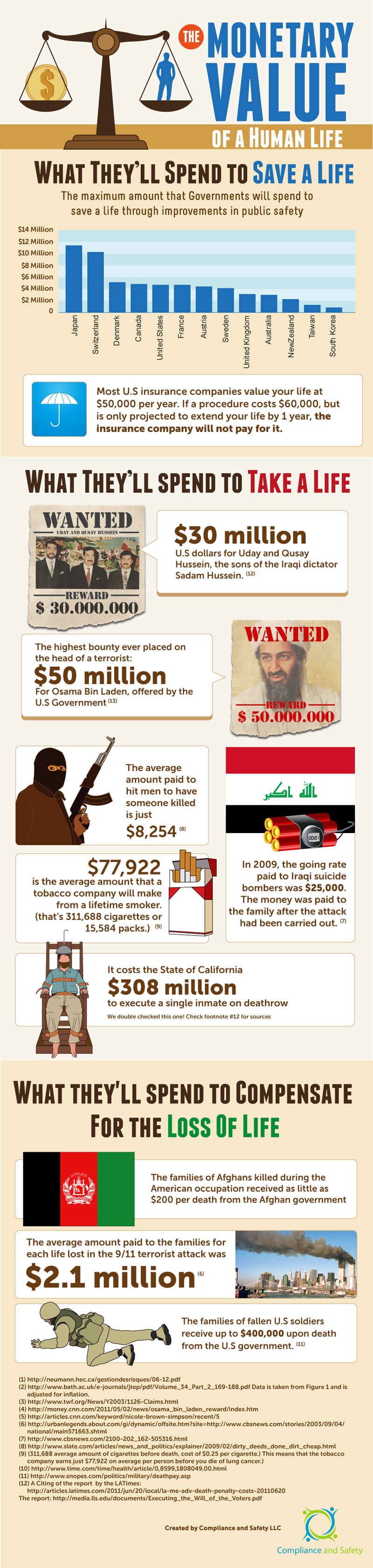
• Japan places the highest value on a human life, spending $11,728,000 to save a single life through improvements in public safety.
• South Korea spent the least, at a measly $878,000.00 per life saved.
• Health insurance companies value life at $50,000 per year of quality life, a depressingly low number compared to what government entities will pay. Keep your workforce healthy with proper Health & Wellness training.
• The families of suicide bombers receive just $25,000 per suicide.
• While the families that lossed a loved one on 9/11 received an average of $2.1 million per death, families of fallen soldiers receive a maximum of just $400,000. Rush Limbaugh did an interesting piece about this huge disparity back in 2002.

Conclusion

Your thoughts and comments on this ME-P are appreciated. Feel free to review our top-left column, and top-right sidebar materials, links, URLs and related websites, too. Then, subscribe to the ME-P. It is fast, free and secure.

Link: http://feeds.feedburner.com/HealthcareFinancialsthePostForcxos

Speaker: If you need a moderator or speaker for an upcoming event, Dr. David E. Marcinko; MBA – Publisher-in-Chief of the Medical Executive-Post – is available for seminar or speaking engagements. Contact: MarcinkoAdvisors@msn.com

OUR OTHER PRINT BOOKS AND RELATED INFORMATION SOURCES:

DICTIONARIES: http://www.springerpub.com/Search/marcinko
PHYSICIANS: www.MedicalBusinessAdvisors.com
PRACTICES: www.BusinessofMedicalPractice.com
HOSPITALS: http://www.crcpress.com/product/isbn/9781466558731
CLINICS: http://www.crcpress.com/product/isbn/9781439879900
BLOG: www.MedicalExecutivePost.com
FINANCE: Financial Planning for Physicians and Advisors
INSURANCE: Risk Management and Insurance Strategies for Physicians and Advisors

  Risk Management, Liability Insurance, and Asset Protection Strategies for Doctors and Advisors: Best Practices from Leading Consultants and Certified Medical Planners™ Risk Management, Liability Insurance, and Asset Protection Strategies for Doctors and Advisors: Best Practices from Leading Consultants and Certified Medical Planners™

Invite Dr. Marcinko

The Case for Domestic Healthcare Change—Why Bother?

Join Our Mailing List

A Crisis of Volume and Cost

By Jennifer Tomasik MS

“Fee-for-service” has been the dominant financial dynamic in the US healthcare system for decades, whereby providers are reimbursed for the quantity of visits, tests, or procedures that are performed, often without adequate regard for the cost of the interventions relative to patient outcomes.

Atul Speaks

This focus has arguably fueled incredible advances in medical devices, diagnostic tests, pharmaceuticals, and other innovations. Atul Gawande MD, surgeon and author, describes how far medicine has come since the days before penicillin—when convalescence in the shelter of a hospital was the best of only a few treatment options and, therefore, “when what was known you [as a doctor] could know. You could hold it all in your head, and you could do it all.”

The surge in the number of diagnoses and treatments that physicians have access to today is transforming their profession from a field of autonomous craftsmen wielding basic tools to what Gawande suggests should be race-car like “pit crews” that together can deliver on the scientific promise of 4,000 medical and surgical procedures and 6,000 drugs.

A Double-Edged Sword

This is a double-edged sword, as the autonomous mentality on which the field developed is now often at odds with the machine-like functioning expected of an effective and efficient “pit crew.” Together with the fee-for-service incentive structure, these realities have collided in a perfect storm propelling tremendous growth in healthcare spending characterized by fragmentation and high volume, a high cost per episode, and inconsistent quality.

Assessment

And so, we are now witnessing the costly “failure of success” from focusing so extremely on “sick care” while ignoring “well care” attempts to keep individuals and populations healthy from the start.

More info Link: http://www.routledge.com/books/details/9781466558731/

Conclusion

Your thoughts and comments on this ME-P are appreciated. Feel free to review our top-left column, and top-right sidebar materials, links, URLs and related websites, too. Then, subscribe to the ME-P. It is fast, free and secure.

Link: http://feeds.feedburner.com/HealthcareFinancialsthePostForcxos

Speaker: If you need a moderator or speaker for an upcoming event, Dr. David E. Marcinko; MBA – Publisher-in-Chief of the Medical Executive-Post – is available for seminar or speaking engagements. Contact: MarcinkoAdvisors@msn.com

Our Other Print Books and Related Information Sources:

Health Dictionary Series: http://www.springerpub.com/Search/marcinko

Practice Management: http://www.springerpub.com/product/9780826105752

Physician Financial Planning: http://www.jbpub.com/catalog/0763745790

Medical Risk Management: http://www.jbpub.com/catalog/9780763733421

Hospitals: http://www.crcpress.com/product/isbn/9781439879900

Physician Advisors: www.CertifiedMedicalPlanner.org

Our Newest Textbook Release

Buy from Amazon

Learn How to Profit and Thrive in the PP-ACA Era

BOOK FOREWORD / TESTIMONIAL

The Challenges of Pricing Health Insurance for the 2014 Exchanges

Join Our Mailing List

Expert Voices Essay – NIHCM Foundation

By Ann Miller RN MHA

The PP-ACA has introduced sweeping market changes that bring new uncertainty to the task of developing premiums for products to be offered in the health insurance exchanges beginning in 2014. The added complexity greatly increases the chances that these premiums will be off the mark.

In this essay, Alice Rosenblatt explains how actuaries set premiums, shows how key provisions of the ACA will affect their pricing for the October 2013 open enrollment period and describes what’s at stake if they don’t get it right.

Read more…

PDF: http://nihcm.org/images/stories/The_Challenges_of_Pricing_Health_Insurance_for_the_2014_Exchanges.pdf

Conclusion

Your thoughts and comments on this ME-P are appreciated. Feel free to review our top-left column, and top-right sidebar materials, links, URLs and related websites, too. Then, subscribe to the ME-P. It is fast, free and secure.

Link: http://feeds.feedburner.com/HealthcareFinancialsthePostForcxos

Speaker: If you need a moderator or speaker for an upcoming event, Dr. David E. Marcinko; MBA – Publisher-in-Chief of the Medical Executive-Post – is available for seminar or speaking engagements. Contact: MarcinkoAdvisors@msn.com

OUR OTHER PRINT BOOKS AND RELATED INFORMATION SOURCES:

DICTIONARIES: http://www.springerpub.com/Search/marcinko
PHYSICIANS: www.MedicalBusinessAdvisors.com
PRACTICES: www.BusinessofMedicalPractice.com
HOSPITALS: http://www.crcpress.com/product/isbn/9781466558731
CLINICS: http://www.crcpress.com/product/isbn/9781439879900
BLOG: www.MedicalExecutivePost.com
FINANCE: Financial Planning for Physicians and Advisors
INSURANCE: Risk Management and Insurance Strategies for Physicians and Advisors

Product Details

How Hospital Billing Impacts the Patient Experience

Join Our Mailing List

It’s About … the Invoice

By Staff Reporters

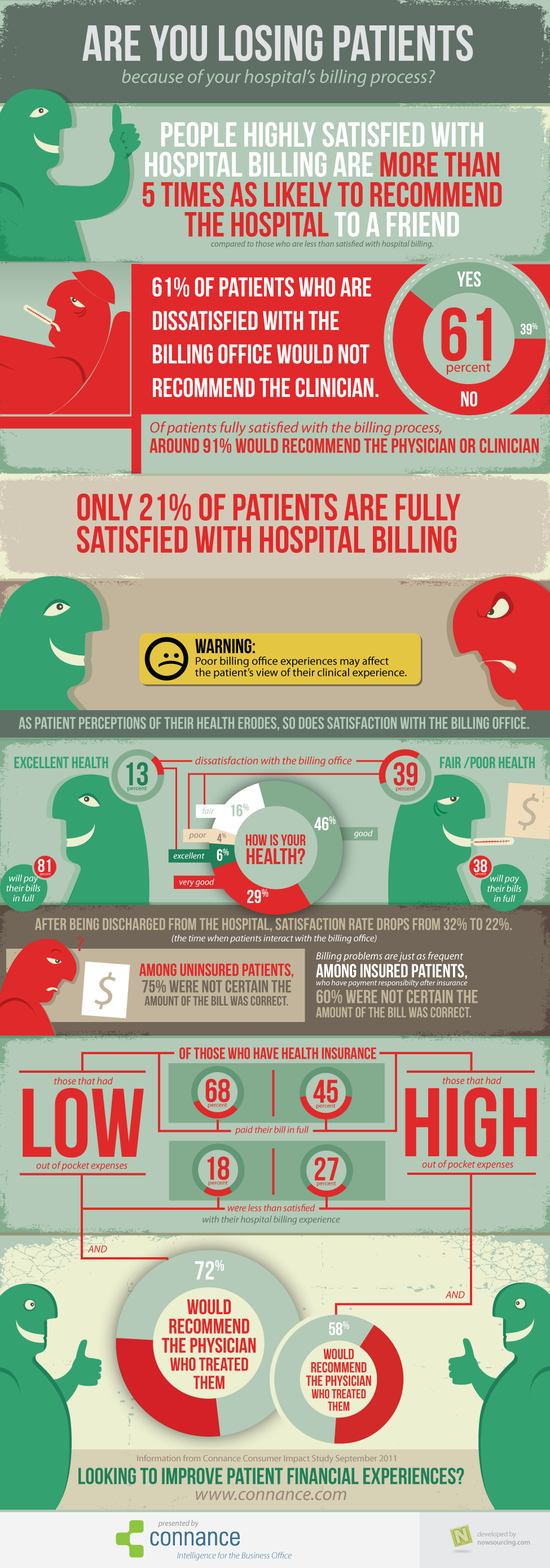
Here, Connance visually shows how hospital billing process is directly correlated to the patient experience.

Assessment

Patients who encounter problems with their physician’s billing office are less likely to recommend that physician/clinician to others.

www.BusinessofMedicalPractice.com

Conclusion

Your thoughts and comments on this ME-P are appreciated. Feel free to review our top-left column, and top-right sidebar materials, links, URLs and related websites, too. Then, subscribe to the ME-P. It is fast, free and secure.

Link: http://feeds.feedburner.com/HealthcareFinancialsthePostForcxos

Speaker: If you need a moderator or speaker for an upcoming event, Dr. David E. Marcinko; MBA – Publisher-in-Chief of the Medical Executive-Post – is available for seminar or speaking engagements. Contact: MarcinkoAdvisors@msn.com

Our Other Print Books and Related Information Sources:

Health Dictionary Series: http://www.springerpub.com/Search/marcinko

Practice Management: http://www.springerpub.com/product/9780826105752

Physician Financial Planning: http://www.jbpub.com/catalog/0763745790

Medical Risk Management: http://www.jbpub.com/catalog/9780763733421

Hospitals: http://www.crcpress.com/product/isbn/9781439879900

Physician Advisors: www.CertifiedMedicalPlanner.org

Our Newest Textbook Release

Buy from Amazon

Learn How to Profit and Thrive in the PP-ACA Era

BOOK FOREWORD / TESTIMONIAL

Accounting for the Cost of US Health Care

Join Our Mailing List

Conclusion

Your thoughts and comments on this ME-P are appreciated. What are your thoughts on the pre-reform trends and the impact of the recession?

Feel free to review our top-left column, and top-right sidebar materials, links, URLs and related websites, too. Then, subscribe to the ME-P. It is fast, free and secure.

Link: http://feeds.feedburner.com/HealthcareFinancialsthePostForcxos

Speaker: If you need a moderator or speaker for an upcoming event, Dr. David E. Marcinko; MBA – Publisher-in-Chief of the Medical Executive-Post – is available for seminar or speaking engagements. Contact: MarcinkoAdvisors@msn.com

Our Other Print Books and Related Information Sources:

Health Dictionary Series: http://www.springerpub.com/Search/marcinko

Practice Management: http://www.springerpub.com/product/9780826105752

Physician Financial Planning: http://www.jbpub.com/catalog/0763745790

Medical Risk Management: http://www.jbpub.com/catalog/9780763733421

Hospitals: http://www.crcpress.com/product/isbn/9781439879900

Physician Advisors: www.CertifiedMedicalPlanner.org

Our Newest Textbook Release

Buy from Amazon

Learn How to Profit and Thrive in the PP-ACA Era

BOOK FOREWORD / TESTIMONIAL


The NBER Bulletin on Aging and Health

Join Our Mailing List

The National Bureau of Economic Research — 2012 No. 2

The 2012 No. 2 Bulletin includes the articles below:

1)  Can Low-Cost Interventions Affect Retirement Saving Behavior?

by Gopi Shah Goda, Colleen Flaherty Manchester, and Aaron Sojourner –  #17927
by James Choi, Emily Haisley, Jennifer Kurkoski, and Cade Massey – #17843

http://www.nber.org/aginghealth/2012no2/w17927.html

2)  Labor Market Effects of the Massachusetts Health Insurance Reform

by Jonathan Kolstad and Amanda Kowalski

http://www.nber.org/aginghealth/2012no2/w17933.html

3)  Can Germany’s Riester Pensions Fill the Pension Gap?

by Axel Boersch-Supan, Michela Coppola, and Anette Reil-Held

http://www.nber.org/aginghealth/2012no2/w18014.html

4)  Retirement Before the Social Security Entitlement Age

by Kevin Milligan

http://www.nber.org/aginghealth/2012no2/w18051.html

5)  Are Consumers Forward-Looking in Responding to Health Care Prices?

by Aviva Aron-Dine, Liran Einav, Amy Finklestein, and Mark Cullen

http://www.nber.org/aginghealth/2012no2/w17802.html

NBER Profile:  Patricia Danzon

http://www.nber.org/aginghealth/2012no2/danzon.html

NBER Profile:  Doug Staiger

http://www.nber.org/aginghealth/2012no2/staiger.html

Conclusion

Your thoughts and comments on this ME-P are appreciated. Feel free to review our top-left column, and top-right sidebar materials, links, URLs and related websites, too. Then, subscribe to the ME-P. It is fast, free and secure.

Link: http://feeds.feedburner.com/HealthcareFinancialsthePostForcxos

Speaker: If you need a moderator or speaker for an upcoming event, Dr. David E. Marcinko; MBA – Publisher-in-Chief of the Medical Executive-Post – is available for seminar or speaking engagements. Contact: MarcinkoAdvisors@msn.com

Our Other Print Books and Related Information Sources:

Health Dictionary Series: http://www.springerpub.com/Search/marcinko

Practice Management: http://www.springerpub.com/product/9780826105752

Physician Financial Planning: http://www.jbpub.com/catalog/0763745790

Medical Risk Management: http://www.jbpub.com/catalog/9780763733421

Hospitals: http://www.crcpress.com/product/isbn/9781439879900

Physician Advisors: www.CertifiedMedicalPlanner.org

Product DetailsProduct DetailsProduct Details

Product Details Product Details

Product Details

About the RetireMark Planning System

Join Our Mailing List

From HealthView Services (HVS)

By Staff Reporters

According to their website, HealthView Services (HVS) is one of the only firms in the country that builds solutions for the financial services industry to address out-of-pocket health care costs that individuals will face during retirement.

Founding

HVS was founded in 2008 by a team of experienced executives who identified a serious deficiency in financial planning in relation to retirement planning. In order to fill this void, HVS founders employed a group of expert physicians, experienced actuaries, and healthcare industry programmers to develop the HVS RetireMark Planning System.

Financial Planning and Health-Risk Assessment Tools

At its core, RetireMark is a combination of financial planning and health-risk assessment tools that provide financial institutions, independent advisors, and healthcare related firms with web-based reports. These customized reports project personalized out-of-pocket healthcare costs, life expectancy, and the Income Floor—a sophisticated and revolutionary approach to income distribution for retirement protection.

Customization

HVS’s product offerings can be customized to meet each institution`s exclusive needs and be seamlessly integrated into existing marketing and branding platforms. In addition to the software, HVS provides clients with training programs, seminars, and customized presentations in order to expand sales and grow revenues.

Assessmernt

In collaboration with industry leaders such as the Retirement Income Industry Association (RIIA), HVS has developed innovative solutions to address the growing needs of investors in transition. HVS is also a regular contributor to the HealthWatch segment of Retirement Weekly, a www.MarketWatch.com publication. By partnering with such prominent organizations, the firm hopes to become a pioneer in this emerging field.

Conclusion

So, give em’ a click and tell us what you think www.hvsfinancial.com

Your thoughts and comments on this ME-P are appreciated. Feel free to review our top-left column, and top-right sidebar materials, links, URLs and related websites, too. Then, subscribe to the ME-P. It is fast, free and secure.

Link: http://feeds.feedburner.com/HealthcareFinancialsthePostForcxos

Speaker: If you need a moderator or speaker for an upcoming event, Dr. David E. Marcinko; MBA – Publisher-in-Chief of the Medical Executive-Post – is available for seminar or speaking engagements. Contact: MarcinkoAdvisors@msn.com

Our Other Print Books and Related Information Sources:

Health Dictionary Series: http://www.springerpub.com/Search/marcinko

Practice Management: http://www.springerpub.com/product/9780826105752

Physician Financial Planning: http://www.jbpub.com/catalog/0763745790

Medical Risk Management: http://www.jbpub.com/catalog/9780763733421

Hospitals: http://www.crcpress.com/product/isbn/9781439879900

Physician Advisors: www.CertifiedMedicalPlanner.org

Product DetailsProduct DetailsProduct Details

Product Details  Product Details

Product Details

Succeed with the “Business of Medical Practice” Textbook

ADVERTISEMENT

[Transformational Health 2.0 Skills for Doctors]

By Ann Miller RN, MHA

www.BusinessofMedicalPractice.com

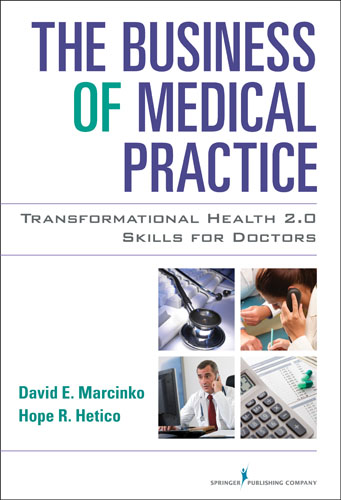
December 23rd, 2011 – The Institute of Medical Business Advisors [iMBA] Inc, in Atlanta, GA www.MedicalBusinessAdvisors.com and Springer Publishing Company of New York, just released the third edition of “The Business of Medical Practice” [Transformational Health 2.0 Skills for Doctors] edited by iMBA founder Dr. David Edward Marcinko MBA, CMP™ and President Hope Rachel Hetico RN, MHA, CPHQ, CMP™

Internal Contents

The 37 chapter, 750 page hard-cover textbook provides a comprehensive resource for those physicians, medical professionals, practice managers, nurse executives, health care administrators and graduate students seeking working knowledge on running a private facility or medical clinic.

Three Major Sections

The BoMP is comprised of three enterprise-wide sections: [1] Qualitative Office Operations, [2] Quantitative Aspects of Medical Practice and [3] Health Policies, Ethics and Leadership. Topics like ARRA, HITECH, ACA and the social networking aspects and ramifications of health 2.0 connectivity for all stakeholders are included for modernity.

Tools and Templates

Tools used throughout the book help readers reference and retain complex information. These tools include:

  • Sidebars. Key terms, key concepts, key sources, associations, and factoids all serve to enhance and reinforce the core takeaways from each chapter.
  • Tables. Tables are used to display and reference benchmark data, draw comparisons, and illustrate industry data trends.
  • Figures. Graphical depictions of concepts help you comprehend the material.
  • Charts. Charts allow easily referenced standard industry taxonomies alongside comparisons of related topics.

Assessment

For a further description of the Business of Medical Practice, with online “live’ community, please click: www.BusinessofMedicalPractice.com

To order directly: http://www.springerpub.com/product/9780826105752 

Conclusion

Your thoughts and comments on this ME-P are appreciated. Feel free to review our top-left column, and top-right sidebar materials, links, URLs and related websites, too. Then, subscribe to the ME-P. It is fast, free and secure.

Link: http://feeds.feedburner.com/HealthcareFinancialsthePostForcxos

Speaker: If you need a moderator or speaker for an upcoming event, Dr. David E. Marcinko; MBA – Publisher-in-Chief of the Medical Executive-Post – is available for seminar or speaking engagements. Contact: MarcinkoAdvisors@msn.com

OUR OTHER PRINT BOOKS AND RELATED INFORMATION SOURCES:

DICTIONARIES: http://www.springerpub.com/Search/marcinko
PHYSICIANS: www.MedicalBusinessAdvisors.com
PRACTICES: www.BusinessofMedicalPractice.com
HOSPITALS: http://www.crcpress.com/product/isbn/9781466558731
CLINICS: http://www.crcpress.com/product/isbn/9781439879900
BLOG: www.MedicalExecutivePost.com
FINANCE: Financial Planning for Physicians and Advisors
INSURANCE: Risk Management and Insurance Strategies for Physicians and Advisors

Product Details

Product DetailsProduct DetailsProduct Details

What Health Care Fraud Costs Us

Join Our Mailing List

Scrutiny Needed from the Patient Citizenry – Too?

As health care takes the center stage at the forefront of contemporary politics it is under scrutiny from several angles.

The Fraud Rate

One aspect of the health care system that has been garnering growing levels of interest is the rate at which medical fraud occurs. As the developed world steeps itself further and further into the digital age, things like medical history and billing records become more easily susceptible to fraud since they’re accessible from virtually anywhere.

Expensive Care

And, the fact of the matter is that trying to stay healthy is an expensive business. Each year, 300 million Americans spend about $2 trillion on health care, but the amount of that money that is lost to fraud seems to have grown a great deal in recent years.

Types

The government continues to crack down and identify fraudsters in all their forms—and they do come in many forms. Perhaps the most common type of health care fraud concerns how medical care providers bill. This type of fraud relies heavily on the fact that many patients don’t take the proper amount of time to really scrutinize their medical bills and invoices.

Source: InsuranceQuotes.org

Assessment

Fraud can cost a huge amount of money for victim, insurance companies and society. The best defense against fraud remains understanding EOBs forms and what’s on your medical bills.

Conclusion

Your thoughts and comments on this ME-P are appreciated. Feel free to review our top-left column, and top-right sidebar materials, links, URLs and related websites, too. Then, subscribe to the ME-P. It is fast, free and secure.

Speaker: If you need a moderator or speaker for an upcoming event, Dr. David E. Marcinko; MBA – Publisher-in-Chief of the Medical Executive-Post – is available for seminar or speaking engagements. Contact: MarcinkoAdvisors@msn.com

OUR OTHER PRINT BOOKS AND RELATED INFORMATION SOURCES:


Product DetailsProduct DetailsProduct Details

Update on Health Insurance Claims Processing Costs

Join Our Mailing List

Paper versus Electronic

[By Matias Klein]

[Senior VP Technology Portico Systems Integrated Provider Management Solutions]

The average cost of processing a single, clean, paper-based or electronic claim can range from 85 cents to $1.58.

However, according to AHIP, nearly half of all claims (48 percent) were pended due to the submission of duplicate claims (35 percent), lack of complete information or other information needed to justify the claim (12 percent), or invalid codes (1 percent).

The manual adjudication of these duplicate or incorrect claim submissions increases the cost of administration to $2.05. The $2.05 scenario is a best case calculation. In our actual field experience the cost can be as high as $10.00 per claim.

Payment Delays

In addition to the increased administrative cost, one must not forget about the delayed payment to the provider. As stated by AHIP, a duplicate claim can take 9 days to remediate and missing information on a claim can take up to 11 days. This kind of delay damages the relationship between the provider and the health plan, which in terms of costs is priceless.

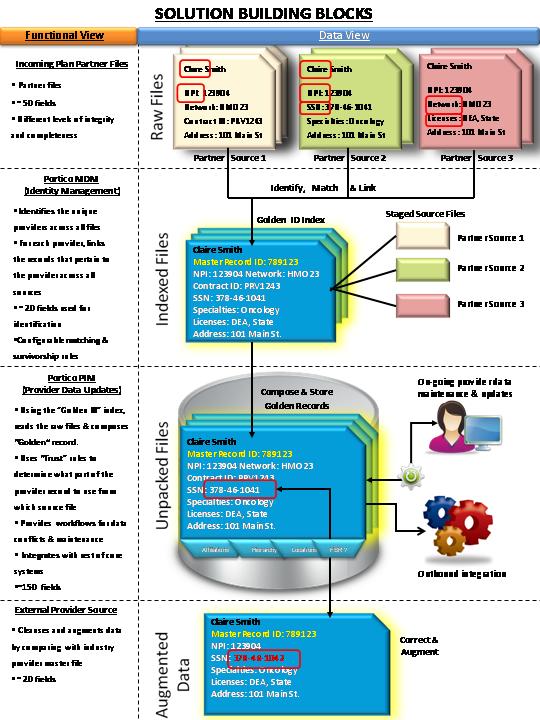
Enter ID Management

To solve this problem, some healthcare organizations are implementing Master Identity Management (IDM)—a valuable approach to creating an enterprise “source of truth” for provider identity information. But when it comes to payment integrity and claims processing, IDM without a Provider Information Management (PIM) system doesn’t work. Provider relationship and contract data are far too complex, and both types of data are needed to supplement provider identity data in support of claims administration.

Provider Information Management

When IDM is fully integrated with PIM, payers can successfully establish a single, accurate and effective source of truth. An integrated approach also:

  • Ensures quality – by standardizing, cleansing, cross-referencing and consolidating relevant data, while removing duplicate entries.
  • Mitigates risk – reducing the downstream impact of inaccurate data on all claims processing, contracting, credentialing, provider directory and connected systems.
  • Saves millions of dollars – by reducing duplicate entries by even a fraction of a percent, thus ensuring that claims are being processed in an efficient and effective manner.

Assessment

IDM plays a pivotal role in the future of healthcare. As new, collaborative and accountable care delivery models evolve, reliable provider identity management is absolutely critical. Combining IDM with PIM gives payers the most powerful solution for assuring payment integrity while improving provider identity and duplication management.

Conclusion

Your thoughts and comments on this ME-P are appreciated. Feel free to review our top-left column, and top-right sidebar materials, links, URLs and related websites, too. Then, subscribe to the ME-P. It is fast, free and secure.

Conclusion

Your thoughts and comments on this ME-P are appreciated. Feel free to review our top-left column, and top-right sidebar materials, links, URLs and related websites, too. Then, subscribe to the ME-P. It is fast, free and secure.

Speaker: If you need a moderator or speaker for an upcoming event, Dr. David E. Marcinko; MBA – Publisher-in-Chief of the Medical Executive-Post – is available for seminar or speaking engagements. Contact: MarcinkoAdvisors@msn.com

OUR OTHER PRINT BOOKS AND RELATED INFORMATION SOURCES:

Our Newest Textbook Release

Buy from Amazon

Learn How to Profit and Thrive in the PP-ACA Era

BOOK FOREWORD / TESTIMONIAL

About the Institute of Medical Business Advisors, Inc

Join Our Mailing List

iMBA, Inc

[www.MedicalBusinessAdvisors.com]

Championing the Financial Success of

Doctors and their Consulting Advisors

[Career Development Products and Services]

Comprehensive Financial Planning Strategies for Doctors and Advisors: Best Practices from Leading Consultants and Certified Medical Planners(TM)

Your Personal DR. Invitation: Letterhead.iMBA_Inc.

How Health Reform Could Expand Medicaid

Join Our Mailing List

PP-ACA Results State-by-State

By Lena Groeger
ProPublica

Experts estimate that nearly 16 million Americans could be added to the Medicaid rolls by 2019 under an expansion in the Affordable Care Act. But, the Supreme Court ruled last Thursday that states can opt out without risk of losing federal support for Medicaid, raising the stakes that some may do so.

The Big Picture

Here is a look at forecast growth in state Medicaid rolls under the expansion. Twenty-six challenged the act in court.

IMAGE LINK: http://www.propublica.org/special/state-by-state-how-health-reform-could-expand-medicaid

Related: Mystery After the Health Care Ruling: Which States Will Refuse Medicaid Expansion?

Conclusion

Your thoughts and comments on this ME-P are appreciated. Feel free to review our top-left column, and top-right sidebar materials, links, URLs and related websites, too. Then, subscribe to the ME-P. It is fast, free and secure.

Speaker: If you need a moderator or speaker for an upcoming event, Dr. David E. Marcinko; MBA – Publisher-in-Chief of the Medical Executive-Post – is available for seminar or speaking engagements. Contact: MarcinkoAdvisors@msn.com

OUR OTHER PRINT BOOKS AND RELATED INFORMATION SOURCES:

Product Details

The Supreme Court Permits Healthcare Taxation “Penalty”

Join Our Mailing List

On the PP-ACA

By Children’s Home Society of Florida Foundation

In 2010 Congress passed the Patient Protection and Affordable Care Act (PPACA). A key part of the Act is an individual mandate for health insurance. All individuals must have health insurance by 2014 or pay a tax-penalty.

The Tax Penalty

The tax-penalty starts at the greater of $285 per family or 1% of income in 2014. However, by 2016, the tax-penalty increases to $2,085 per family or 2.5% of income, whichever is larger.

Commerce Clause

Many states sued the federal government and asked that the individual mandate be held invalid. While the various courts had different positions on the issue, some federal judges were concerned that requiring a person to purchase insurance could be a violation of the Commerce Clause of the U.S. Constitution.

CJSC John Roberts

Chief Justice of the Supreme Court John Roberts wrote the opinion for a 5-4 majority in the PPACA case. First, he determined whether or not the Court was prohibited from ruling on the case under the Anti-Injunction Act. He decided that the required payment would be a “penalty” for purposes of that Act and not a tax. Therefore, the Supreme Court could issue a ruling.

Second, Chief Justice Roberts reviewed the powers of government under the Commerce Clause. He agreed with the other four justices opposing PPACA that Congress had the right to regulate commerce, but does not have the right to regulate non-activity. Therefore, requiring individuals to purchase health insurance is not a permitted power under that provision. PPACA could not be approved under the Commerce Clause.

However, Roberts observed that it is permissible for the Court to consider the validity of PPACA under the power of the government to tax. He determined that the individual mandate to purchase insurance or pay a penalty-tax is permitted under that power. Roberts stated, “Because the Constitution permits such a tax, it is not our role to forbid it, or to pass upon its wisdom or fairness.” He carefully approved the use of the power without discussing the appropriateness of PPACA provisions.

Roberts found several reasons for permitting the taxing power. The tax-penalty will be paid when filing IRS Form 1040. As is true with other tax provisions, lower-income individuals are excluded from this tax-penalty. The tax-penalty is part of the Internal Revenue Code and will be collected by the IRS.

Dissenters

The four dissenting Justices would have determined that PPACA fails to meet the requirements of the Commerce Clause and would have invalidated the entire bill.

Editor’s Note: The taxes to pay for PPACA include a new tax on medical devices that will increase costs to individuals and healthcare providers. There also is a new 3.8% Medicare tax. It applies in 2013 to income and capital gains. If the expected post-election tax bill extends the current 15% capital gain rate, then the capital gains tax rate will be 18.8% in 2013. However, if the 15% federal capital gains tax rate is increased to 20%, then the new rate in January of 2013 will be 23.8%. The increase in capital gains rate may influence charitable gifts of appreciated property in 2013.

Conclusion

Your thoughts and comments on this ME-P are appreciated. Feel free to review our top-left column, and top-right sidebar materials, links, URLs and related websites, too. Then, subscribe to the ME-P. It is fast, free and secure.

Link: http://feeds.feedburner.com/HealthcareFinancialsthePostForcxos

Speaker: If you need a moderator or speaker for an upcoming event, Dr. David E. Marcinko; MBA – Publisher-in-Chief of the Medical Executive-Post – is available for seminar or speaking engagements. Contact: MarcinkoAdvisors@msn.com

Our Other Print Books and Related Information Sources:

Health Dictionary Series: http://www.springerpub.com/Search/marcinko

Practice Management: http://www.springerpub.com/product/9780826105752

Physician Financial Planning: http://www.jbpub.com/catalog/0763745790

Medical Risk Management: http://www.jbpub.com/catalog/9780763733421

Hospitals: http://www.crcpress.com/product/isbn/9781439879900

Physician Advisors: www.CertifiedMedicalPlanner.org

Product Details

Taxes and the SCOTUS ACA Decision

Join Our Mailing List

My Synopsis for Physician Investors

By Dr. David Edward Marcinko FACFAS MBA CMP™

www.CertifiedMedicalPlanner.org

[Publisher-in-Chief]

I was at Emory University this past weekend for an unrelated colloquium. But all the chatter, of course, was about SCOTUS, taxes and the just announced ACA decision.

Most doctors I know – just don’t like paying needless taxes. So, what’s the buzz for physicians and other medical professional investors, and their financial advisors [FAs]?

The Synopsis

The taxes to pay for the Affordable Care Act include a new tax on medical devices that will increase costs to individuals and healthcare providers.

There also is a new 3.8% Medicare tax. It applies in 2013 to income and capital gains.

If the expected post-election tax bill extends the current 15% capital gain rate, then the capital gains tax rate will be 18.8% in 2013. However, if the 15% federal capital gains tax rate is increased to 20%, then the new rate in January of 2013 will be 23.8%.

In addition to dividend seeking investors, the increase in capital gains rate may also influence charitable gifts of appreciated property in 2013.

Assessment

Please weigh-in all you FAs and healthcare focused CPAs. What is a physician investor supposed to do, now?

Conclusion

Your thoughts and comments on this ME-P are appreciated. Feel free to review our top-left column, and top-right sidebar materials, links, URLs and related websites, too. Then, subscribe to the ME-P. It is fast, free and secure.

Speaker: If you need a moderator or speaker for an upcoming event, Dr. David E. Marcinko; MBA – Publisher-in-Chief of the Medical Executive-Post – is available for seminar or speaking engagements. Contact: MarcinkoAdvisors@msn.com

OUR OTHER PRINT BOOKS AND RELATED INFORMATION SOURCES:

Product Details

Community Rating and Guaranteed Issue in the Individual Health Insurance Market

Join Our Mailing List

Expert Voices

[By Staff Reporters]

In this essay Dr. Anthony Lo Sasso provides empirical evidence of the adverse selection that resulted when states adopted community rating and guaranteed issue requirements in their individual health insurance markets but did not implement complementary mechanisms to keep lower risk individuals in the insurance risk pools.

Results of Adverse Selection

Such adverse selection can raise premiums, destabilize markets and even lead to market failure through the following cycle of events:

  • Community rating prohibits differential premiums based on health status, effectively lowering premiums for individuals in poorer health and increasing them for healthier individuals.
  • Guaranteed issue allows people to purchase coverage when they get sick, decreasing the need to maintain insurance coverage.
  • Healthy individuals respond by dropping coverage and entering the market only when they need coverage, thus the pool of enrollees becomes increasingly older and sicker.
  • This adverse selection pushes premiums for all remaining enrollees higher, provoking further departures by those at the healthier end of the spectrum.
  • Premiums increase again to reflect the ever-worsening risk pool of enrollees.
  • The cycles continue, further destabilizing the market and potentially leading to complete market collapse.

Assessment

Dr. Lo Sasso’s findings highlight the importance of providing effective mechanisms to protect the integrity of the risk pool in conjunction with the community rating and guaranteed issue provisions contained in the SCOTUS upheld Patient Protection and Affordable Care Act.

Link: EV-LoSassoFINAL

Conclusion

Your thoughts and comments on this ME-P are appreciated. Feel free to review our top-left column, and top-right sidebar materials, links, URLs and related websites, too. Then, subscribe to the ME-P. It is fast, free and secure.

Speaker: If you need a moderator or speaker for an upcoming event, Dr. David E. Marcinko; MBA – Publisher-in-Chief of the Medical Executive-Post – is available for seminar or speaking engagements. Contact: MarcinkoAdvisors@msn.com

OUR OTHER PRINT BOOKS AND RELATED INFORMATION SOURCES:

Product DetailsProduct DetailsProduct Details

Product Details  Product Details

Product Details


ACA – UPHELD

The Patient Protection and Affordable Care Act

S.C.O.T.U.S.

UPHELD

Read the Entire Court Ruling

How Americans Embrace Medicare Reform

Join Our Mailing List

The 2012 Elections … and Medigap

[By Staff Reporters]

Americans are spending more on Medicare than is coming in.

In fact, Rand Paul states, “It’s your grandparents’ fault for having too many kids and then your fault for not having enough kids. It’s a demographic problem.”

Source: www.mostmedicare.com

Conclusion

Your thoughts and comments on this ME-P are appreciated. Feel free to review our top-left column, and top-right sidebar materials, links, URLs and related websites, too. Then, subscribe to the ME-P. It is fast, free and secure.

Speaker: If you need a moderator or speaker for an upcoming event, Dr. David E. Marcinko; MBA – Publisher-in-Chief of the Medical Executive-Post – is available for seminar or speaking engagements. Contact: MarcinkoAdvisors@msn.com

OUR OTHER PRINT BOOKS AND RELATED INFORMATION SOURCES:

Product Details

Cash May Soon be King in Hospital Care

Join Our Mailing List

Forget About Health Insurance, Darling!

Only the little people pay with insurance.

By Dr. David Edward Marcinko MBA CMP™

[Editor-in-Chief]

www.CertifiedMedicalPlanner.org

Like many other doctors, I remember my dismay when I saw uninsured patients paying full price for their medical care. Insurance companies used their market clout and patient volumes to negotiate discounts for their insureds that have always been unavailable to the uninsured, MSA, HSA participants or individual healthcare consumers.

The Insider Gossip

There is even industry hearsay that some charity-care and non-profit hospitals charge their indigent patients up to four times more than their insured patients in order to have huge write-offs [bad-debt expenses] so as to secure private and public monetary grants. After all; many non-profit CEOs are well paid, indeed.

But, the tide may be turning on the healthcare institutional level as cash becomes king in the new economy and world of healthcare 2.0

Cash Patients Rule – Insured Patients Drool

Of course, we’ve written about direct care, concierge care and cash care medical practice business models before on this ME-P. And, I’ve been ranting and raving, opining and testifying, as well.  It is being written about in the blog-o-sphere, on the hospital level, increasingly.

Link:  http://www.kevinmd.com/blog/2012/06/hide-health-insurance-status-pay-cash.html

We even have an entire Chapter 29 devoted to the codified topic in our newest book The Business of Medical Practice.

Link: http://businessofmedicalpractice.com/chapter-29/

Source: Austin Frakt PhD’s TIE cartoon via Brad Flansbaum.

The Coming Payment Apocalypse

The days of paying more when paying cash may be coming to an end. Doctors and hospitals are starting to do what every other business has done since the beginning of time – give a discount for cash. States are beginning to require pricing transparency and hospitals and physicians are starting to publish their “cash prices” for all to see.

And, why not when it can take up to two years to be reimbursed a fraction of the billed amount from Medicaid and Medicare payers, and CMS, etc? Now, don’t get me started on some highly discounted private payers and managed care plans.

Assessment

What do you think of this trend as a healthcare provider; Financial Advisor, medical management consultant or patient? Are you in favor of this private business arrangement; or do you favor the proposed public Obama Care business model?  Is it even legal? How about keeping the status-quo?

Conclusion

Your thoughts and comments on this ME-P are appreciated. Feel free to review our top-left column, and top-right sidebar materials, links, URLs and related websites, too. Then, subscribe to the ME-P. It is fast, free and secure.

Link: http://feeds.feedburner.com/HealthcareFinancialsthePostForcxos

Speaker: If you need a moderator or speaker for an upcoming event, Dr. David E. Marcinko; MBA – Publisher-in-Chief of the Medical Executive-Post – is available for seminar or speaking engagements. Contact: MarcinkoAdvisors@msn.com

Our Other Print Books and Related Information Sources:

Health Dictionary Series: http://www.springerpub.com/Search/marcinko

Practice Management: http://www.springerpub.com/product/9780826105752

Physician Financial Planning: http://www.jbpub.com/catalog/0763745790

Medical Risk Management: http://www.jbpub.com/catalog/9780763733421

Hospitals: http://www.crcpress.com/product/isbn/9781439879900

Physician Advisors: www.CertifiedMedicalPlanner.org

Product Details

Product Details

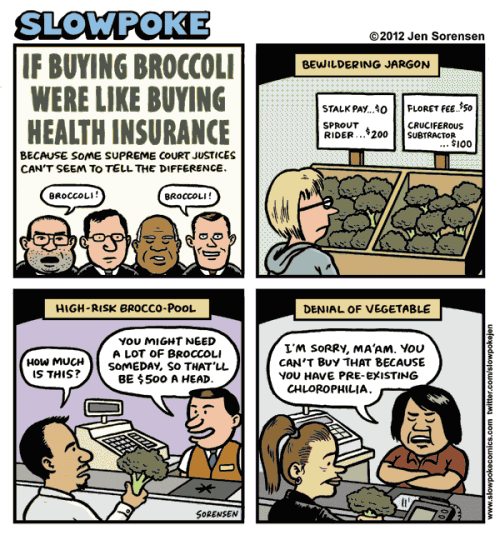
What If Broccoli Were Like Buying Health Insurance?

Join Our Mailing List

Some Food for Thought

Source: Jen Sorensen via Austin Frakt PhD of the Incidental Economist.

Assessment

Many a true word hath been spoke in jest. [c 1665 in Roxburghe Ballads (1890) VII. 366].

Conclusion

Your thoughts and comments on this ME-P are appreciated. Feel free to review our top-left column, and top-right sidebar materials, links, URLs and related websites, too. Then, subscribe to the ME-P. It is fast, free and secure.

Link: http://feeds.feedburner.com/HealthcareFinancialsthePostForcxos

Speaker: If you need a moderator or speaker for an upcoming event, Dr. David E. Marcinko; MBA – Publisher-in-Chief of the Medical Executive-Post – is available for seminar or speaking engagements. Contact: MarcinkoAdvisors@msn.com

Our Other Print Books and Related Information Sources:

Health Dictionary Series: http://www.springerpub.com/Search/marcinko

Practice Management: http://www.springerpub.com/product/9780826105752

Physician Financial Planning: http://www.jbpub.com/catalog/0763745790

Medical Risk Management: http://www.jbpub.com/catalog/9780763733421

Hospitals: http://www.crcpress.com/product/isbn/9781439879900

Physician Advisors: www.CertifiedMedicalPlanner.org

Pre-Order Now!

http://www.crcpress.com/product/isbn/9781439879900

Emergency Room Doctor Pet Peeves [A Humorous Video]

Join Our Mailing List

An Insider’s Look Around

[By Staff Reporters]

Are you tired of those long Emergency Room wait times and the overcrowding once inside? The ERs are usually jammed on weekends, and holidays, right?

***

***

Assessment

Well – This video is an example of the many issues an emergency department will unlikely be able to help you with this Memorial day weekend. But, those medical personnel, and ME-P readers, who work in the EMS or ER setting can hopefully relate to this encounter. A word to the …wise!

Video Link: http://www.youtube.com/watch?v=1KYmcwVGo9w&feature=related

Conclusion

Your thoughts and comments on this ME-P are appreciated. Feel free to review our top-left column, and top-right sidebar materials, links, URLs and related websites, too. Then, subscribe to the ME-P. It is fast, free and secure.

Speaker: If you need a moderator or speaker for an upcoming event, Dr. David E. Marcinko; MBA – Publisher-in-Chief of the Medical Executive-Post – is available for seminar or speaking engagements. Contact: MarcinkoAdvisors@msn.com

OUR OTHER PRINT BOOKS AND RELATED INFORMATION SOURCES:

Hospitals & Healthcare Organizations: Management Strategies, Operational Techniques, Tools, Templates and Case Studies

Hospitals & Healthcare Organizations: Management Strategies, Operational Techniques, Tools, Templates and Case Studies

Buy from Amazon

Understanding Health Insurance Plan Coverage [A Video]

Join Our Mailing List

Knowing Managed Care Terminology, too!

In this YouTube encore video presentation, Ricki Hasou from the MD Anderson Cancer Center talks about knowing your health insurance plan coverage and knowing the terminology behind managed care.

Link: http://www.youtube.com/watch?v=bDSm6vyHVVE&feature=related

Assessment

It is very important to understand how your health plan works when you sign up, before you begin making plans for cancer or any other type of medical treatment, and especially if you are leaving your designated healthcare service area.

Conclusion

Your thoughts and comments on this ME-P are appreciated. Feel free to review our top-left column, and top-right sidebar materials, links, URLs and related websites, too. Then, subscribe to the ME-P. It is fast, free and secure.

Link: http://feeds.feedburner.com/HealthcareFinancialsthePostForcxos

Speaker: If you need a moderator or speaker for an upcoming event, Dr. David E. Marcinko; MBA – Publisher-in-Chief of the Medical Executive-Post – is available for seminar or speaking engagements. Contact: MarcinkoAdvisors@msn.com

Our Other Print Books and Related Information Sources:

Health Dictionary Series: http://www.springerpub.com/Search/marcinko

Practice Management: http://www.springerpub.com/product/9780826105752

Physician Financial Planning: http://www.jbpub.com/catalog/0763745790

Medical Risk Management: http://www.jbpub.com/catalog/9780763733421

Hospitals: http://www.crcpress.com/product/isbn/9781439879900

Physician Advisors: www.CertifiedMedicalPlanner.org

Product DetailsProduct DetailsProduct Details

Anatomy of Health Insurance

Join Our Mailing List

An Overview

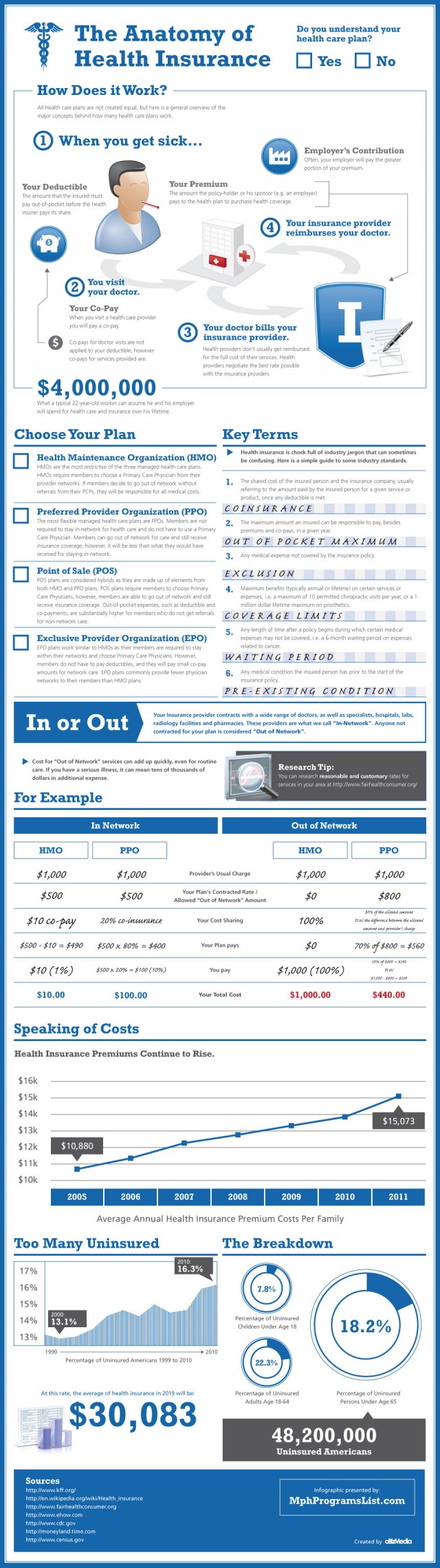
Health insurance is a hotly debated topic in this year’s presidential elections. Obama-care has some doctors and citizens fuming over the possibility of universal healthcare. But, before preaching, one should get a full grasp of what health insurance entails for a typical buyer.

This infographic gives an overview of how the health insurance industry works. One thing for sure, the health insurance industry is a booming business, as the typical 22-year old will pay $400,000 for health care and insurance in his or her lifetime.

Assessment

So study up with our handbooks, textbooks, dictionaries and this ME-P so you can responsibly select an insurance plan that is right for you.

Conclusion

Your thoughts and comments on this ME-P are appreciated. Feel free to review our top-left column, and top-right sidebar materials, links, URLs and related websites, too. Then, subscribe to the ME-P. It is fast, free and secure.

Link: http://feeds.feedburner.com/HealthcareFinancialsthePostForcxos

Speaker: If you need a moderator or speaker for an upcoming event, Dr. David E. Marcinko; MBA – Publisher-in-Chief of the Medical Executive-Post – is available for seminar or speaking engagements. Contact: MarcinkoAdvisors@msn.com

Our Other Print Books and Related Information Sources:

Health Dictionary Series: http://www.springerpub.com/Search/marcinko

Practice Management: http://www.springerpub.com/product/9780826105752

Physician Financial Planning: http://www.jbpub.com/catalog/0763745790

Medical Risk Management: http://www.jbpub.com/catalog/9780763733421

Hospitals: http://www.crcpress.com/product/isbn/9781439879900

Physician Advisors: www.CertifiedMedicalPlanner.org

Product DetailsProduct DetailsProduct Details

Product Details  Product Details

Product Details

On the Genetic Information Non-Discrimination Act

Join Our Mailing List

A Review of GINA – 2008

[By Carol Miller RN MBA]

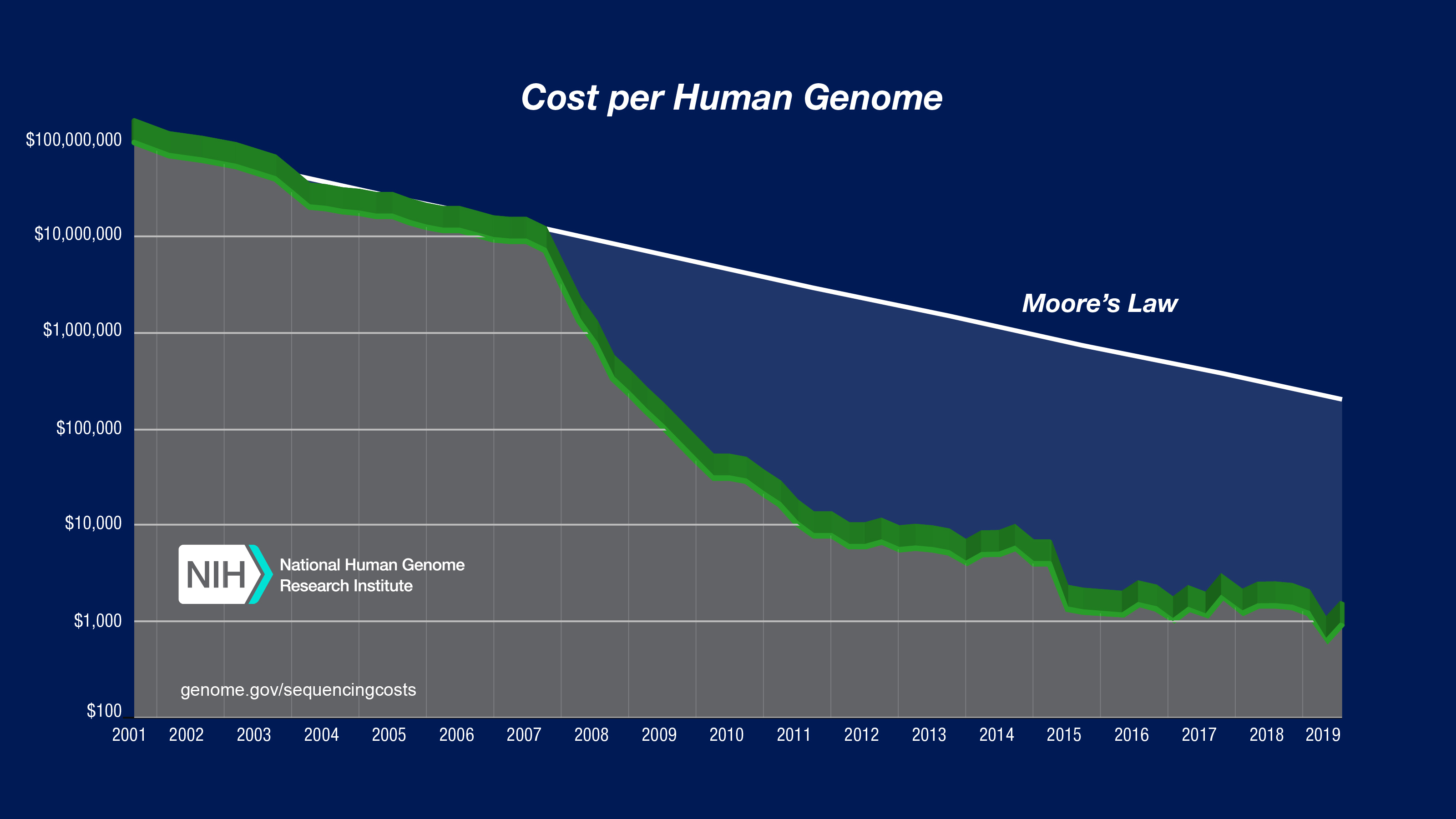
This Act prohibits the use of genetic information to make health insurance coverage determinations and in employment-related decisions.

GINA supports a patient’s privacy. Forty states have enacted legislation related to genetic discrimination in health insurance and thirty-one states have adopted laws regarding genetic discrimination in the workplace according to the National Human Genome Research Institute.

Assessment

For more info: www.genome.gov

***

UPDATE 2020

Channel Surfing the ME-P

Have you visited our other topic channels? Established to facilitate idea exchange and link our community together, the value of these topics is dependent upon your input. Please take a minute to visit. And, to prevent that annoying spam, we ask that you register. It is fast, free and secure.

Conclusion

Your thoughts and comments on this ME-P are appreciated. Feel free to review our top-left column, and top-right sidebar materials, links, URLs and related websites, too. Then, subscribe to the ME-P. It is fast, free and secure.

Speaker: If you need a moderator or speaker for an upcoming event, Dr. David E. Marcinko; MBA – Publisher-in-Chief of the Medical Executive-Post – is available for seminar or speaking engagements. Contact: MarcinkoAdvisors@msn.com

OUR OTHER PRINT BOOKS AND RELATED INFORMATION SOURCES:

Product DetailsProduct DetailsProduct Details

Evaluating ACOs at Mid-Launch

Join Our Mailing List

Moving Forward but Challenges Ahead

[By ME-P Staff]

Accountable Care Organizations [ACOs] are generating considerable attention for their potential to improve the value of our health care spending through better coordination of care and new payment incentives that focus on quality and efficiency of care.

The Challenges

Yet, even as ACOs develop at a fairly rapid clip across the nation, they face substantial challenges.

For example, In this essay, Steven Lieberman reviews the ACO landscape in both the public and private sectors and examines the major obstacles confronting these emerging organizations, including limited tools for influencing patient choice, the need for immediate and sustained cost savings, and system-wide concerns about rising costs due to enhanced market power.

Assessment

Link: http://nihcm.org/images/stories/EV_Lieberman_FINAL.pdf

Conclusion

Your thoughts and comments on this ME-P are appreciated. Feel free to review our top-left column, and top-right sidebar materials, links, URLs and related websites, too. Then, subscribe to the ME-P. It is fast, free and secure.

Link: http://feeds.feedburner.com/HealthcareFinancialsthePostForcxos

Speaker: If you need a moderator or speaker for an upcoming event, Dr. David E. Marcinko; MBA – Publisher-in-Chief of the Medical Executive-Post – is available for seminar or speaking engagements. Contact: MarcinkoAdvisors@msn.com

OUR OTHER PRINT BOOKS AND RELATED INFORMATION SOURCES:

DICTIONARIES: http://www.springerpub.com/Search/marcinko
PHYSICIANS: www.MedicalBusinessAdvisors.com
PRACTICES: www.BusinessofMedicalPractice.com
HOSPITALS: http://www.crcpress.com/product/isbn/9781466558731
CLINICS: http://www.crcpress.com/product/isbn/9781439879900
BLOG: www.MedicalExecutivePost.com
FINANCE: Financial Planning for Physicians and Advisors
INSURANCE: Risk Management and Insurance Strategies for Physicians and Advisors

Product Details

May Patients Privately Contract with their Doctors?

Join Our Mailing List

Ask-An-Advisor

QUESTION: A question to ME-P readers and subscribers.

Medicare may disallow private contracting by federal law. But, can private insurances, whether PPO or managed care, legally prevent a patient from privately contracting with their doctor for services or goods above the contracted rates, as long as informed consent and appropriate waivers are executed in advance of the service?

IOWs: Do private managed care insurance companies have the legal  right to limit a person’s liberty to seek care above the constraints of the health insurers contract, if the patient so desires?  I understand that an insurer by contract with provider and patient is obligated to pay only a negotiated fee for a specific service or good, but if the patient desires a more accommodating service or extra features to a durable good, do they have the right to privately contract for such services beyond the contract payment or benefit restraints. I believe that this goes into state law safeguards for patient welfare in as much as most non-federal or non-ERISA health insurances are guided by state law.

Assessment

This is not a naïve question for I have posed it to various plan medical directors in our area and have had surprisingly varied responses.

I welcome your crowd-sourced comments with thanks in advance.

Dr. Mark D. Dollard

Loudoun Foot and Ankle Center

46440 Benedict Drive

Suite #111  – Sterling, VA 20164

703 444-9555 [ph] 703 444-1190 [fax]

mdollard@erols.com

Conclusion

Your thoughts and comments on this ME-P are appreciated; especially from our healthlaw attorney readers, plan subscribers, consultants and medical directors. Feel free to review our top-left column, and top-right sidebar materials, links, URLs and related websites, too. Then, subscribe to the ME-P. It is fast, free and secure.

Link: http://feeds.feedburner.com/HealthcareFinancialsthePostForcxos

Our Other Print Books and Related Information Sources:

Health Dictionary Series: http://www.springerpub.com/Search/marcinko

Practice Management: http://www.springerpub.com/product/9780826105752

Physician Financial Planning: http://www.jbpub.com/catalog/0763745790

Medical Risk Management: http://www.jbpub.com/catalog/9780763733421

Hospitals: http://www.crcpress.com/product/isbn/9781439879900

Physician Advisors: www.CertifiedMedicalPlanner.org

Product Details

The Best, Most Revealing Reporting on Our Healthcare System

Join Our Mailing List

Reading and Reviewing

By Blair Hickman and Cora Currier

ProPublica,  March 30, 2012, 1:44 pm

As we wait for the Supreme Court to issue its verdict on the health-care reform law  we rounded up some of the most revealing reporting on the issues.

They’re grouped roughly into articles on high costs and those on insurance.

Assesment

Link: http://www.propublica.org/article/top-muckreads-the-best-most-revealing-reporting-on-our-healthcare-system

Conclusion

Your thoughts and comments on this ME-P are appreciated. Feel free to review our top-left column, and top-right sidebar materials, links, URLs and related websites, too. Then, subscribe to the ME-P. It is fast, free and secure.

Link: http://feeds.feedburner.com/HealthcareFinancialsthePostForcxos

Speaker: If you need a moderator or speaker for an upcoming event, Dr. David E. Marcinko; MBA – Publisher-in-Chief of the Medical Executive-Post – is available for seminar or speaking engagements. Contact: MarcinkoAdvisors@msn.com

Our Other Print Books and Related Information Sources:

Health Dictionary Series: http://www.springerpub.com/Search/marcinko

Practice Management: http://www.springerpub.com/product/9780826105752

Physician Financial Planning: http://www.jbpub.com/catalog/0763745790

Medical Risk Management: http://www.jbpub.com/catalog/9780763733421

Hospitals: http://www.crcpress.com/product/isbn/9781439879900

Physician Advisors: www.CertifiedMedicalPlanner.org

Hospitals & Healthcare Organizations: Management Strategies, Operational Techniques, Tools, Templates and Case Studies

Hospitals & Healthcare Organizations: Management Strategies, Operational Techniques, Tools, Templates and Case Studies

Buy from Amazon

On the Control of Birth Control

Join Our Mailing List

The cost of FDA-approved contraceptive drugs

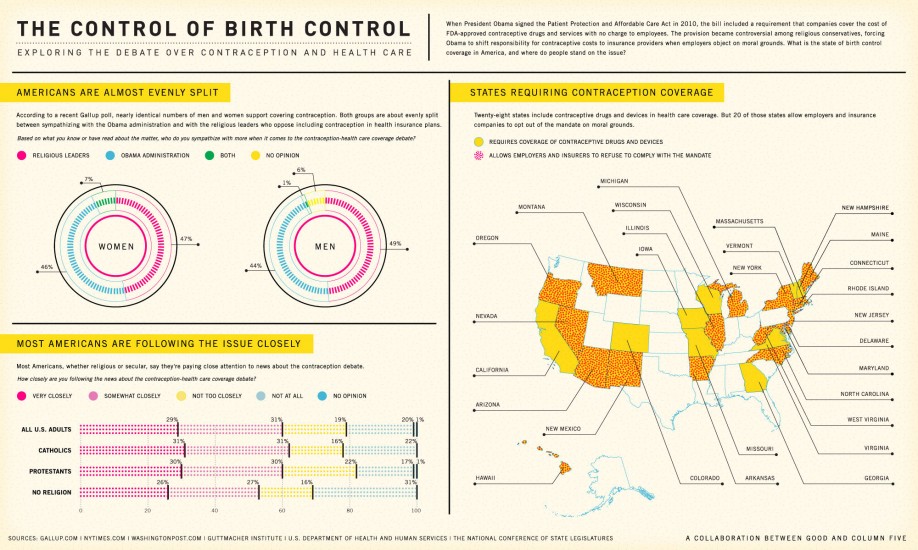
When President Obama signed the Patient Protection and Affordable Care Act in 2012, the bill included a requirement that companies cover the cost of FDA-approved contraceptive drugs and services with no charge to employees.

The provision became controversial among religious conservatives, forcing Obama to shift responsibility for contraceptive costs to insurance providers when employers object on moral grounds.

Assessment

This infographic created with GOOD looks to answer the question: what is the state of birth-control coverage in America, and where do people stand on the issue?

Conclusion

Your thoughts and comments on this ME-P are appreciated. Feel free to review our top-left column, and top-right sidebar materials, links, URLs and related websites, too. Then, subscribe to the ME-P. It is fast, free and secure.

Link: http://feeds.feedburner.com/HealthcareFinancialsthePostForcxos

Speaker: If you need a moderator or speaker for an upcoming event, Dr. David E. Marcinko; MBA – Publisher-in-Chief of the Medical Executive-Post – is available for seminar or speaking engagements. Contact: MarcinkoAdvisors@msn.com

Our Other Print Books and Related Information Sources:

Health Dictionary Series: http://www.springerpub.com/Search/marcinko

Practice Management: http://www.springerpub.com/product/9780826105752

Physician Financial Planning: http://www.jbpub.com/catalog/0763745790

Medical Risk Management: http://www.jbpub.com/catalog/9780763733421

Hospitals: http://www.crcpress.com/product/isbn/9781439879900

Physician Advisors: www.CertifiedMedicalPlanner.org

Product DetailsProduct DetailsProduct Details

NBER Bulletin on Aging and Health

Join Our Mailing List

Year 2012 – Number One [Selected ME-P Reading Suggestions]

View a printable PDF copy of the 2012 No. 1 NBER Bulletin on Aging and Health at http://www.nber.org/aginghealth/2012no1/2012no1.pdf

The 2012 No. 1 Bulletin includes the articles below:

1)  Why Are Recessions Good for Your Health? by Ann Huff Stevens, Douglas Miller, Marianne Page, and Mateusz Filipski http://www.nber.org/aginghealth/2012no1/w17657.html

2)  How Did the Great Recession Affect Near Retirement-Age Households? by Alan Gustman, Thomas Steinmeier, and Nahid Tabatabai http://www.nber.org/aginghealth/2012no1/w17547.html

3)  The Draw-Down of Retirement Savings by James Poterba, Steven Venti, and David Wise http://www.nber.org/aginghealth/2012no1/w17536.html

4)  Abstracts of Selected Recent NBER Working Papers: http://www.nber.org/aginghealth/2012no1/WorkingPaperSummaries.html

Assessment

NBER Profile: David Neumark http://www.nber.org/aginghealth/2012no1/Neumark.html
Conclusion

Your thoughts and comments on this ME-P are appreciated. Feel free to review our top-left column, and top-right sidebar materials, links, URLs and related websites, too. Then, subscribe to the ME-P. It is fast, free and secure.

Link: http://feeds.feedburner.com/HealthcareFinancialsthePostForcxos

Speaker: If you need a moderator or speaker for an upcoming event, Dr. David E. Marcinko; MBA – Publisher-in-Chief of the Medical Executive-Post – is available for seminar or speaking engagements. Contact: MarcinkoAdvisors@msn.com

Our Other Print Books and Related Information Sources:

Health Dictionary Series: http://www.springerpub.com/Search/marcinko

Practice Management: http://www.springerpub.com/product/9780826105752

Physician Financial Planning: http://www.jbpub.com/catalog/0763745790

Medical Risk Management: http://www.jbpub.com/catalog/9780763733421

Hospitals: http://www.crcpress.com/product/isbn/9781439879900

Physician Advisors: www.CertifiedMedicalPlanner.org

Product DetailsProduct DetailsProduct Details

Product Details  Product Details

Product Details


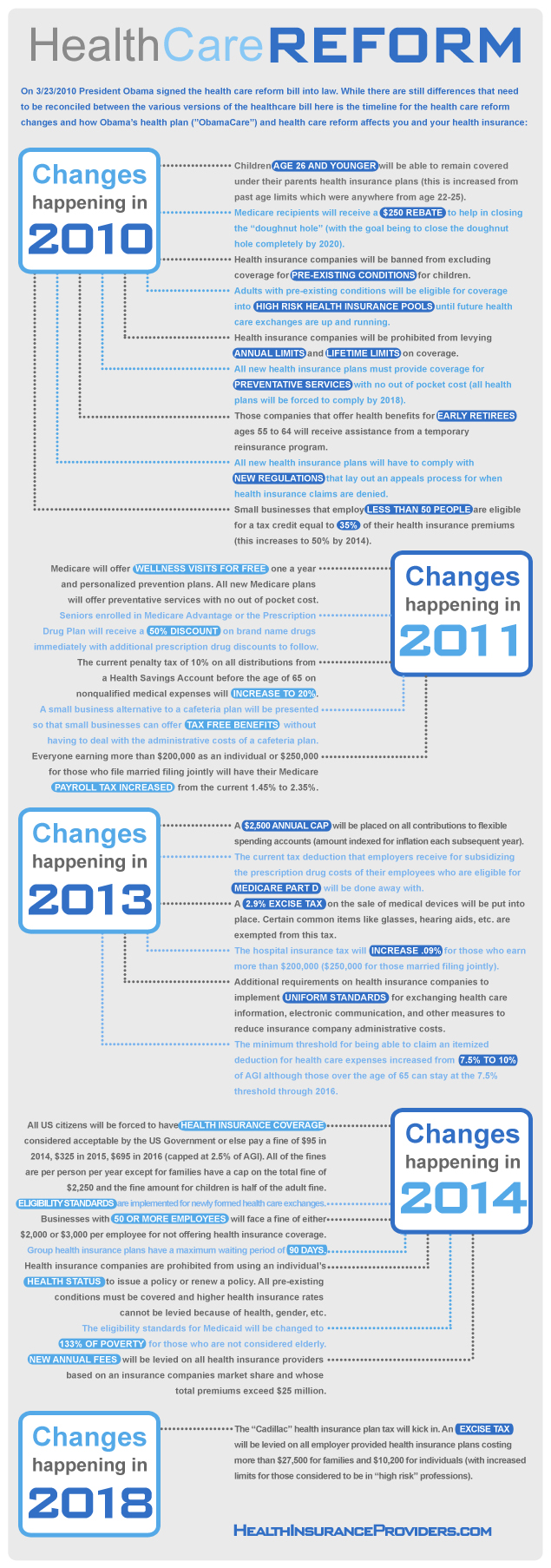
Healthcare Reform Thru 2018

Join Our Mailing List

An Evolving System

Conclusion

Your thoughts and comments on this ME-P are appreciated. Feel free to review our top-left column, and top-right sidebar materials, links, URLs and related websites, too. Then, subscribe to the ME-P. It is fast, free and secure.

Link: http://feeds.feedburner.com/HealthcareFinancialsthePostForcxos

Speaker: If you need a moderator or speaker for an upcoming event, Dr. David E. Marcinko; MBA – Publisher-in-Chief of the Medical Executive-Post – is available for seminar or speaking engagements. Contact: MarcinkoAdvisors@msn.com

Our Other Print Books and Related Information Sources:

Health Dictionary Series: http://www.springerpub.com/Search/marcinko

Practice Management: http://www.springerpub.com/product/9780826105752

Physician Financial Planning: http://www.jbpub.com/catalog/0763745790

Medical Risk Management: http://www.jbpub.com/catalog/9780763733421

Hospitals: http://www.crcpress.com/product/isbn/9781439879900

Physician Advisors: www.CertifiedMedicalPlanner.org

Product DetailsProduct DetailsProduct Details

Product Details  Product Details

Product Details

ACO Opinion and Voting Poll

Join Our Mailing List

Are Accountable Care Organizations Another Form of Medical Capitation Reimbursement?

Conclusion

Your thoughts and comments on this ME-P are appreciated. Feel free to review our top-left column, and top-right sidebar materials, links, URLs and related websites, too. Then, subscribe to the ME-P. It is fast, free and secure.

Link: http://feeds.feedburner.com/HealthcareFinancialsthePostForcxos

Speaker: If you need a moderator or speaker for an upcoming event, Dr. David E. Marcinko; MBA – Publisher-in-Chief of the Medical Executive-Post – is available for seminar or speaking engagements. Contact: MarcinkoAdvisors@msn.com

Our Other Print Books and Related Information Sources:

Health Dictionary Series: http://www.springerpub.com/Search/marcinko

Practice Management: http://www.springerpub.com/product/9780826105752

Physician Financial Planning: http://www.jbpub.com/catalog/0763745790

Medical Risk Management: http://www.jbpub.com/catalog/9780763733421

Healthcare Organizations: www.HealthcareFinancials.com

Physician Advisors: www.CertifiedMedicalPlanner.com

Subscribe Now: Did you like this Medical Executive-Post, or find it helpful, interesting and informative? Want to get the latest ME-Ps delivered to your email box each morning? Just subscribe using the link below. You can unsubscribe at any time. Security is assured.

Link: http://feeds.feedburner.com/HealthcareFinancialsthePostForcxos

Sponsors Welcomed: And, credible sponsors and like-minded advertisers are always welcomed.

Link: https://healthcarefinancials.wordpress.com/2007/11/11/advertise

Product DetailsProduct DetailsProduct Details

Product Details  Product Details

Product Details

On the Protecting Access to Healthcare (PATH) Act

Join Our Mailing List

ADA Makes Progress Against McCarran-Ferguson

By D. Kellus Pruitt DDS

The ADA makes real progress against McCarran-Ferguson. I’ve watched the American Dental Association fight long and hard against the unfair McCarran-Ferguson Act of 1945. ADA leaders and I still don’t agree on the need for transparency in the professional organization instead of proud unresponsiveness, but nevertheless, I’ve always been publicly supportive of their efforts to repeal the M-F Act.

Insurance Industry

The insurance industry is powerful in Washington. Over the short term, common sense has proven to be far less influential than their generous campaign contributions – making this a long haul for ADA officials. Yet the amendment to H.R. 5, Protecting Access to Healthcare (PATH) Act, which was offered by Rep. Paul Gosar (R-Ariz.), a dentist, is finally scheduled to come up for a vote on Thursday, March 22, 2012

Good Work – ADA

http://www.ada.org/news/6926.aspx

If passed, the legislation will restore the application of antitrust laws to the business of health insurance. Makes sense, right? After all, if every other business in the nation, including professional organizations, can be prosecuted by the FTC for collusion, why should Delta Dental, BCBSTX and other members of the National Association of Dental Plans (NADP) be exempt from antitrust laws which protect their clients.

I and others are hopeful that this will end many of dental insurers’ current business practices which unfairly force dentists to accept take it or leave it terms that would be unacceptable in a fair market. Maybe the repeal will also make insurance lawyers think twice before alerting the FTC when ADA News speaks honestly about the harm caused by suspiciously similar policies of numerous NADP members.

Assessment

Even if the M-F is repealed, here is an example of truth in dental care that I bet ADA leaders still won’t be able to share with Americans: Unfair downward pressure on contracted dentists’ payments always hurts clueless dental patients the most. Delta Dental’s greed will never be satisfied and dentists’ ethics aren’t free.

NADP, meet the FTC.

Conclusion

Your thoughts and comments on this ME-P are appreciated. Feel free to review our top-left column, and top-right sidebar materials, links, URLs and related websites, too. Then, subscribe to the ME-P. It is fast, free and secure.

Link: http://feeds.feedburner.com/HealthcareFinancialsthePostForcxos

Our Other Print Books and Related Information Sources:

Health Dictionary Series: http://www.springerpub.com/Search/marcinko

Practice Management: http://www.springerpub.com/product/9780826105752

Physician Financial Planning: http://www.jbpub.com/catalog/0763745790

Medical Risk Management: http://www.jbpub.com/catalog/9780763733421

Healthcare Organizations: www.HealthcareFinancials.com

Physician Advisors: www.CertifiedMedicalPlanner.com

Subscribe Now: Did you like this Medical Executive-Post, or find it helpful, interesting and informative? Want to get the latest ME-Ps delivered to your email box each morning? Just subscribe using the link below. You can unsubscribe at any time. Security is assured.

Link: http://feeds.feedburner.com/HealthcareFinancialsthePostForcxos

Sponsors Welcomed: And, credible sponsors and like-minded advertisers are always welcomed.

Link: https://healthcarefinancials.wordpress.com/2007/11/11/advertise

Product DetailsProduct DetailsProduct Details

Challenging the NPI Requirement of Blue Cross Blue Shield of Texas Again

Join Our Mailing List

How Far Can They be Pushed?

By D. Kellus Pruitt DDS

Command-and-control organizations like BCBSTX find Facebook difficult to control. Even a small nidus of a complaint posted by a client named Mark about poor service can attract a huge bolus of payback by a dentist, and nobody respects anonymous gatekeepers for huge, unresponsive companies like BCBSTX anyway:

https://www.facebook.com/bluecrossblueshieldoftexas

Mark, as a dentist, I’m very familiar with BCBSTX’s inconsiderate behavior in our communities. At least the anonymous moderator invited your feedback. When I sincerely asked her on Wednesday what federal employees are told about BCBSTX’s NPI requirement, she acted as if the absurd policy hadn’t already wasted enough of my time that day when she provided me an irrelevant link to nowhere – just to get rid of me.

Secret Requirement?

I would actually love to treat federal employees who have BCBSTX insurance because they are some of the nicest people I’ve met. But, BCBSTX’s secret requirement that their clients see only dentists with arbitrary NPI identification numbers (not required by law) makes their employment benefit purchased with taxpayer money worthless if they receive treatment in my office. My office has been told that it has become impossible for paper claims to enter BCBSTX’s modern, computerized system without NPI numbers, and nothing humanly possible can be done to correct the unfortunate problem for dentists who choose not to be HIPAA covered entities.

Evasion?

The moderator’s evasion confirms that even though BCBSTX’s federal customers are led to believe that they can use their dental benefits to help pay for treatment at any licensed dentist’s office, they are not being informed of the NPI requirement, and if they pay the dental bill in full for work done by a dentist without an NPI number, BCBXTX pockets the reimbursement. It just cannot be helped. That’s technology. Tough-luck!

BCBSTX executives naturally prefer that my office manager tell their clients about the obscure restrictions of the dental plans they sell. She catches most federal employees before blocking out time in our schedule to treat them, but nevertheless, one got through on Wednesday morning. It wasted my time as well as the federal employee’s.

Congressional Action?

It’s troublesome to know that the government callously encourages such waste of small business owner’s time and money, not to mention the inconvenience to patients. I’m simply fed up with open appointments for uninformed BCBSTX clients. What’s it take to force BCBSTX to take some responsibility in the community and warn their customers about the limitations of their dental policy before they call my office? Congressional action?

Assessment

I do hope the anonymous BCBSTX employee doesn’t choose to delete this post. Since it seems obvious that their windfall profit is a powerful disincentive for BCBSTX to warn their clients about the NPI restriction any time soon, the more federal employees I can ethically warn through BCBSTX Facebook, the fewer open appointments I’ll have, and less taxpayer money will be wasted on silliness.

cc: Senator John Cornyn

Conclusion

Your thoughts and comments on this ME-P are appreciated. Feel free to review our top-left column, and top-right sidebar materials, links, URLs and related websites, too. Then, subscribe to the ME-P. It is fast, free and secure.

Speaker: If you need a moderator or speaker for an upcoming event, Dr. David E. Marcinko; MBA – Publisher-in-Chief of the Medical Executive-Post – is available for seminar or speaking engagements. Contact: MarcinkoAdvisors@msn.com

OUR OTHER PRINT BOOKS AND RELATED INFORMATION SOURCES:

Product Details

Product Details  Product Details

Product Details

Health Industry Collaboration and e-Patients

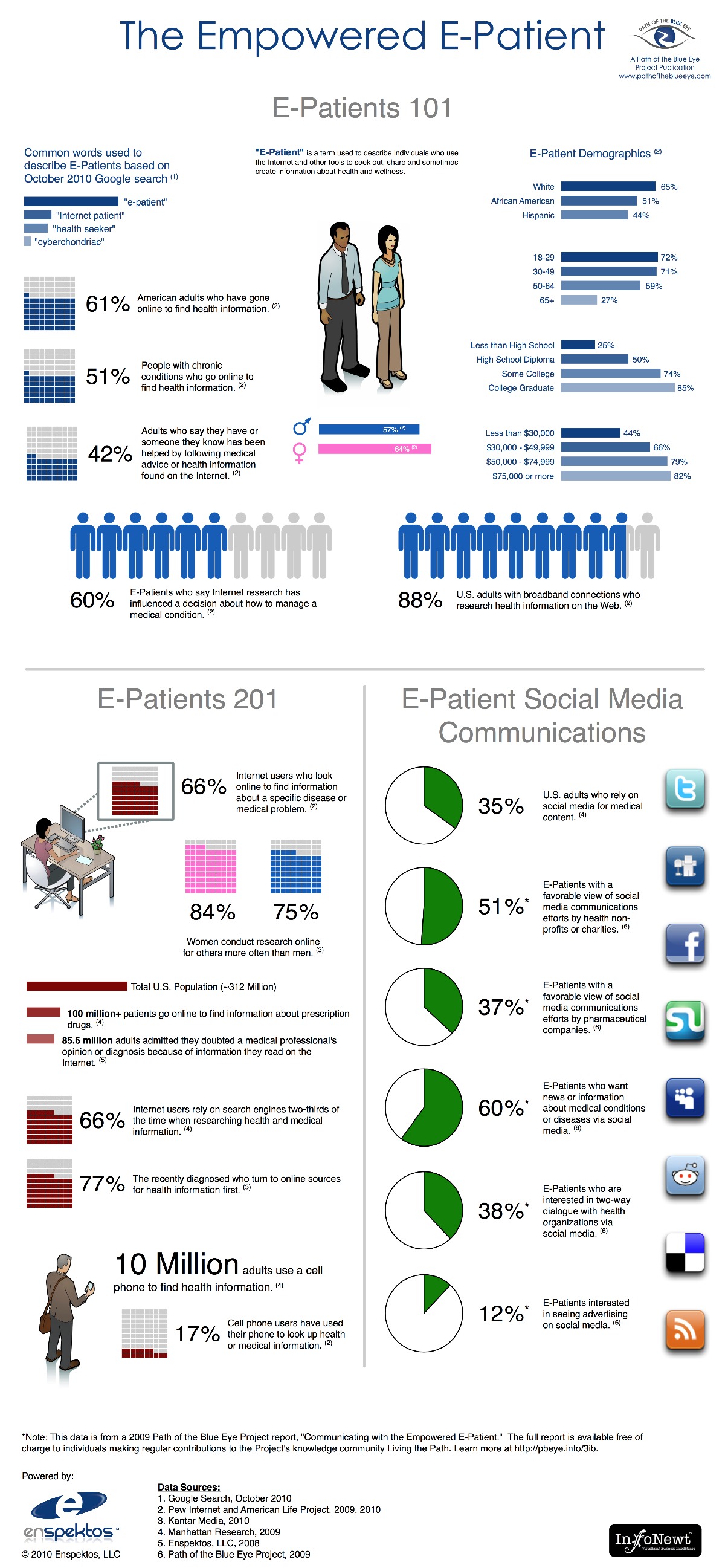
More on Inter and Intra Healthcare Stakeholder Relationships 

Join Our Mailing List

According to Jennifer Tomasik MS [jtomasik@cfar.com], writing in the soon to be released ME-P textbook from iMBA Inc www.MedicalBusinessAdvisors.com: “Healthcare Organizations” [Management Strategies, Tools, Techniques and Case Studies], now in-process from (c) Productivity Press for 2012:

We are in a time of great change in healthcare. No one is certain how the future landscape will unfold, but it is clear that changes in regulation, reimbursement, technology, the economy, and science will significantly impact the work of those clinicians and administrators who dedicate their careers to improving patient care.

More Collaboration Needed

Experience has shown that better collaboration between patients and among the many different parts of the healthcare delivery system holds great potential to improve the quality of care and the relationships of those delivering it. It has also shown that the opportunities to improve collaboration are widespread.

Our focus, therefore, should be to introduce and share a selected set of tools that can be used to improve collaboration along several dimensions:

  • Clarifying roles and authority through decision charting,
  • Understanding the “give” and the “get” needed to establish effective alliances through the current state, and
  • Working jointly to establish and test a set of refined expectations through a physician-administrator compact.

Assessment

In the end, improved collaboration can help medical institutions with everything from inter professional productivity, to patient satisfaction to the most critical service of all: caring for patients and saving lives.

Link: http://www.crcpress.com/product/isbn/9781439879900

Conclusion

And so, your thoughts and comments on this ME-P are appreciated. Please review our top-left column, and top-right sidebar materials, links, URLs and related websites, too. Then, subscribe to the ME-P. It is fast, free and secure.

Link: http://feeds.feedburner.com/HealthcareFinancialsthePostForcxos

Speaker: If you need a moderator or speaker for an upcoming event, Dr. David E. Marcinko; MBA – Publisher-in-Chief of the Medical Executive-Post – is available for seminar or speaking engagements. Contact: MarcinkoAdvisors@msn.com

Our Other Print Books and Related Information Sources:

Health Dictionary Series: http://www.springerpub.com/Search/marcinko

Practice Management: http://www.springerpub.com/product/9780826105752

Physician Financial Planning: http://www.jbpub.com/catalog/0763745790

Medical Risk Management: http://www.jbpub.com/catalog/9780763733421

Healthcare Organizations: www.HealthcareFinancials.com

Physician Advisors: www.CertifiedMedicalPlanner.com

Subscribe Now: Did you like this Medical Executive-Post, or find it helpful, interesting and informative? Want to get the latest ME-Ps delivered to your email box each morning? Just subscribe using the link below. You can unsubscribe at any time. Security is assured.

Link: http://feeds.feedburner.com/HealthcareFinancialsthePostForcxos

Sponsors Welcomed: And, credible sponsors and like-minded advertisers are always welcomed.

Link: https://healthcarefinancials.wordpress.com/2007/11/11/advertise

Buy from Amazon

The ACA and Rising Healthcare Costs?

Join Our Mailing List
Effects of Affordable Care Act on Private Health Care Costs Remain to be Seen
[By Staff Reporters]
###
The latest data on economic growth shows the American economy spent the last quarter growing at a rate equal to 2.5 percent a year. That’s neither recession-level bad nor full employment recovery-level good, but it’s worth diving into the numbers to see exactly what’s driving this slow expansion.
###
A significant part of the growth came from personal spending on health care as insurance premiums continue to rise, meaning a lot of that growth wasn’t very productive. That health care costs are rising—and rising faster than most other expenses—is a problem that businesses and policymakers have struggled with for years: It’s the major cause of federal budget deficits and the reason behind the health care law passed in 2010. While the effects of the Affordable Care Act on private health care costs remain to be seen—many of its provisions will not go into affect for another two years—health care economists like Harvard’s David Cutler say it draws on nearly every idea that exists to lower costs.
###
But, Cutler adds that while we wait for pilot programs to succeed and scale or fail, more changes to the system—including a public insurance option and further incentives for health providers to reform delivery—should be on the table.While policymakers in Washington and state capitals wait on politics and legal challenges to the 2010 law, consumers can take action themselves to lower costs. Innovative health care companies are coming up with new ways to make cost savings easier to find.

infographic, healthcare, politics, business, cost, transparency, GOOD

Source: Simplee

Conclusion

Your thoughts and comments on this ME-P are appreciated. Feel free to review our top-left column, and top-right sidebar materials, links, URLs and related websites, too. Then, subscribe to the ME-P. It is fast, free and secure.

Link: http://feeds.feedburner.com/HealthcareFinancialsthePostForcxos

Speaker: If you need a moderator or speaker for an upcoming event, Dr. David E. Marcinko; MBA – Publisher-in-Chief of the Medical Executive-Post – is available for seminar or speaking engagements. Contact: MarcinkoAdvisors@msn.com

OUR OTHER PRINT BOOKS AND RELATED INFORMATION SOURCES:

DICTIONARIES: http://www.springerpub.com/Search/marcinko
PHYSICIANS: www.MedicalBusinessAdvisors.com
PRACTICES: www.BusinessofMedicalPractice.com
HOSPITALS: http://www.crcpress.com/product/isbn/9781466558731
CLINICS: http://www.crcpress.com/product/isbn/9781439879900
ADVISORS: www.CertifiedMedicalPlanner.org
PODIATRISTS: www.PodiatryPrep.com
BLOG: www.MedicalExecutivePost.com
FINANCE: Financial Planning for Physicians and Advisors
INSURANCE: Risk Management and Insurance Strategies for Physicians and Advisors

Product DetailsProduct Details

Public versus Private Healthcare

Around the World

Conclusion

And so, your thoughts and comments on this ME-P are appreciated. Please review our top-left column, and top-right sidebar materials, links, URLs and related websites, too. Then, subscribe to the ME-P. It is fast, free and secure.

Link: http://feeds.feedburner.com/HealthcareFinancialsthePostForcxos

Speaker: If you need a moderator or speaker for an upcoming event, Dr. David E. Marcinko; MBA – Publisher-in-Chief of the Medical Executive-Post – is available for seminar or speaking engagements. Contact: MarcinkoAdvisors@msn.com

Our Other Print Books and Related Information Sources:

Health Dictionary Series: http://www.springerpub.com/Search/marcinko

Practice Management: http://www.springerpub.com/product/9780826105752

Physician Financial Planning: http://www.jbpub.com/catalog/0763745790

Medical Risk Management: http://www.jbpub.com/catalog/9780763733421

Healthcare Organizations: www.HealthcareFinancials.com

Physician Advisors: www.CertifiedMedicalPlanner.com

Subscribe Now: Did you like this Medical Executive-Post, or find it helpful, interesting and informative? Want to get the latest ME-Ps delivered to your email box each morning? Just subscribe using the link below. You can unsubscribe at any time. Security is assured.

Link: http://feeds.feedburner.com/HealthcareFinancialsthePostForcxos

Sponsors Welcomed: And, credible sponsors and like-minded advertisers are always welcomed.

Link: https://healthcarefinancials.wordpress.com/2007/11/11/advertise

Product DetailsProduct DetailsProduct Details

January 2012 [Health] Plan Management Navigator

Join Our Mailing List

With 2012 Benchmarking Study Invitation

By Marco Georeno

Health Care Analyst

Dear Dr. Marcinko and ME-P Readers

At the risk of appearing overwhelmed with New Year’s enthusiasm, we think the attached edition of Plan Management Navigator is especially interesting:

1. We report on the cost decisions made by low cost Blue Cross Blue Shield plans. Low cost plans make decisions that differ from their higher cost peers. Hallmarks of these decisions include levels and distributions of expenses between functions, the levels and distribution of staff between functions, the levels of compensation and its distribution between functions and the distribution between functions, and levels of, non-labor expenses. Overall, low cost Blue Cross Blue Shield Plans have “tactical” administrative expenses that were $5.63 PMPM, or 29%, lower than their higher cost counterparts. These tactical expenses are all administrative expenses excluding medical management and sales and marketing.

2. We provide an update on the most recent operating and financial results for firms participating in our monthly Dashboard.

3. We invite appropriate ME-P readers to participate in the 2012 benchmarking study. Participation is very timely given that the weak economy is placing great pressure on commercial enrollment, creating the risk that administrative expenses could be a source of negative operating leverage.

Assessment

A more detailed version of this analysis is available to licensed users of Blue Cross Blue Shield Sherlock Expense Evaluation Report (SEER). Please call us for further information if you have an interest.

Link: Navigator Late January 2012

Sherlock Company

mgeoreno@sherlockco.com

Ph: 215-628-2289

Fax: 215-542-0690

Conclusion

And so, your thoughts and comments on this ME-P are appreciated. Please review our top-left column, and top-right sidebar materials, links, URLs and related websites, too. Then, subscribe to the ME-P. It is fast, free and secure.

Link: http://feeds.feedburner.com/HealthcareFinancialsthePostForcxos

Speaker: If you need a moderator or speaker for an upcoming event, Dr. David E. Marcinko; MBA – Publisher-in-Chief of the Medical Executive-Post – is available for seminar or speaking engagements. Contact: MarcinkoAdvisors@msn.com

Our Other Print Books and Related Information Sources:

Health Dictionary Series: http://www.springerpub.com/Search/marcinko

Practice Management: http://www.springerpub.com/product/9780826105752

Physician Financial Planning: http://www.jbpub.com/catalog/0763745790

Medical Risk Management: http://www.jbpub.com/catalog/9780763733421

Healthcare Organizations: www.HealthcareFinancials.com

Physician Advisors: www.CertifiedMedicalPlanner.com

Subscribe Now: Did you like this Medical Executive-Post, or find it helpful, interesting and informative? Want to get the latest ME-Ps delivered to your email box each morning? Just subscribe using the link below. You can unsubscribe at any time. Security is assured.

Link: http://feeds.feedburner.com/HealthcareFinancialsthePostForcxos

Sponsors Welcomed: And, credible sponsors and like-minded advertisers are always welcomed.

Link: https://healthcarefinancials.wordpress.com/2007/11/11/advertise

Product DetailsProduct DetailsProduct Details

Product Details Product Details

Product Details

On e-Claim Only Dental Plans

About their Hidden Costs – I’m Talking PHI Breaches

By D. Kellus Pruitt DDS

If the rumor is true about Bluebell Ice Cream’s “e-claim-only” dental benefit plan that is to go into effect in March, how many in the east-central Texas town of Brenham (pop. 16,000) will be properly warned about the danger to themselves, their families and Bluebell officials’ reputations because of reckless policy?

Transmissions Risks

Each time their dentists send an electronic dental claim (e-claim) over the internet to insurance employees in Chicago as a favor to a patient – and especially the insurer – the Bluebell employee’s digital medical identity which is worth fifty bucks on the black market, rides along to destinations unknown. It’s my guess that very few Bluebell employees are yet aware of the increasing risk of medical identity theft from dentists’ e-claims – much less given the opportunity to opt out of the risk by simply visiting a dentist who still uses the telephone, fax and US Mail.

Security Risks Growing

It certainly won’t improve my popularity with 9 out of 10 dentists for saying this, but risks of identity theft from HIPAA-covered dental offices are climbing daily. In the introduction to a recent interview with Larry Ponemon, chairman and founder of the Ponemon Institute, GovernmentIT.com editor Tom Sullivan ominously described the ever-increasing risk of a massive “data spill” of perhaps millions of patients’ protected health information (PHI):

 “The street value of health information is 50 times greater than that of other data types. Even worse, the healthcare industry is among the weakest at protecting such information. With organized criminals trying to steal medical IDs, sloppy mistakes becoming more commonplace, mobile devices serving as single sign-on gateways to records and even bioterrorism now a factor, healthcare is ripe for some a wake-up call – one that just might come in the form a damaging ‘data spill.’” (See: “Q&A: How a health ‘data spill’ could be more damaging than what BP did to the Gulf.”

Tom Sullivan – Editor [December 05, 2011]

http://govhealthit.com/news/qa-how-health-data-spill-could-be-worse-what-bp-did-gulf?page=0,0

According to Dr. Ponemon:

“The basic issue, when you think about data theft not data loss – because it’s hard to know whether that lost data ultimately ends up in the hands of the cybercriminal and all of these bad things occur – but in the case of identity theft, the end goal has been historically to steal a person’s identity, and just like getting a financial record, getting a health record probably has your credit card, debit card, and payment information contained in that record.”

Of Credit Cards … and More!

But that’s not all. Credit cards are just chump change. He continues:

“The financial records are actually lucrative for the bad guy, but the health record is actually much, much more valuable item because it not only gives you the financial information but it also contains the health credential, and it’s very hard to detect a medical identity theft. What we’ve found in our studies is that medical identity theft is likely to be on the rise and, of course, there’s an awareness within the healthcare organizations that participate in our study that they’re starting to see this as more of a medical identity theft crime. It’s not just about stealing credit cards and buying goodies, it’s about stealing who you are, possibly getting medical treatment and, therefore, messing up your medical record.”

Dr. Ponemon suggests that the victim may not know about the theft until he or she “stumbles on something that alerts them their medical identity was stolen.” Perhaps something like death following anaphylactic shock from a medication that was once digitally highlighted as “Allergic to.” Understandably, Ponemon adds that respondents recognized altered medical histories as an emerging threat they believed was affecting the patients in their organizations. Such danger for dental patients is almost non-existent if their dentists simply don’t put PHI on office computers.

Should a data breach of Bluebell Ice Cream employees’ identities occur in Brenham or Chicago, which is more likely than not, the fact that electronic dental records do nothing to improve the quality of dental care won’t make Brenham citizens any happier with local Bluebell officials. 

Conclusion       

And so, your thoughts and comments on this ME-P are appreciated. Please review our top-left column, and top-right sidebar materials, links, URLs and related websites, too. Then, subscribe to the ME-P. It is fast, free and secure.

Link: http://feeds.feedburner.com/HealthcareFinancialsthePostForcxos

Speaker: If you need a moderator or speaker for an upcoming event, Dr. David E. Marcinko; MBA – Publisher-in-Chief of the Medical Executive-Post – is available for seminar or speaking engagements. Contact: MarcinkoAdvisors@msn.com

Our Other Print Books and Related Information Sources:

Health Dictionary Series: http://www.springerpub.com/Search/marcinko

Practice Management: http://www.springerpub.com/product/9780826105752

Physician Financial Planning: http://www.jbpub.com/catalog/0763745790

Medical Risk Management: http://www.jbpub.com/catalog/9780763733421

Healthcare Organizations: www.HealthcareFinancials.com

Physician Advisors: www.CertifiedMedicalPlanner.com

Subscribe Now: Did you like this Medical Executive-Post, or find it helpful, interesting and informative? Want to get the latest ME-Ps delivered to your email box each morning? Just subscribe using the link below. You can unsubscribe at any time. Security is assured.

Link: http://feeds.feedburner.com/HealthcareFinancialsthePostForcxos

Sponsors Welcomed: And, credible sponsors and like-minded advertisers are always welcomed.

Link: https://healthcarefinancials.wordpress.com/2007/11/11/advertise


Product Details

About Pancreas Cancer Survival Rates

 Still Not Improving

Join Our Mailing List

Here is an infographic to highlight the main statistics about pancreatic cancer that are unknown – you know, less than 3% of people who are diagnosed will live to see five years post-diagnosis?

Assessment

The tree maps showing the difference between death rates and funding for the different forms of cancer is also interesting

Source: Pancreatic Cancer UK

Speaker: If you need a moderator or speaker for an upcoming event, Dr. David E. Marcinko; MBA – Publisher-in-Chief of the Medical Executive-Post – is available for seminar or speaking engagements. Contact: MarcinkoAdvisors@msn.com

Our Other Print Books and Related Information Sources:

Health Dictionary Series: http://www.springerpub.com/Search/marcinko

Practice Management: http://www.springerpub.com/product/9780826105752

Physician Financial Planning: http://www.jbpub.com/catalog/0763745790

Medical Risk Management: http://www.jbpub.com/catalog/9780763733421

Healthcare Organizations: www.HealthcareFinancials.com

Physician Advisors: www.CertifiedMedicalPlanner.com

Subscribe Now: Did you like this Medical Executive-Post, or find it helpful, interesting and informative? Want to get the latest ME-Ps delivered to your email box each morning? Just subscribe using the link below. You can unsubscribe at any time. Security is assured.

Link: http://feeds.feedburner.com/HealthcareFinancialsthePostForcxos

Sponsors Welcomed: And, credible sponsors and like-minded advertisers are always welcomed.

Link: https://healthcarefinancials.wordpress.com/2007/11/11/advertise

Product DetailsProduct DetailsProduct Details

Controlling Health Care Spending [An NIHCM Foundation Webinar]

The Imperative to Act and Diverse Views of the Road Forward

Join Our Mailing List 

The U.S.now spends $2.5 trillion annually on health care, accounting for well over 17 percent of GDP and growing rapidly with challenging fiscal consequences. Despite the imperative to control spending, we face much uncertainty about how to move to a more sustainable path.

Political opposition threatens implementation of the Affordable Care Act, and many of its cost-control measures are still unproven. A long-term fix for Medicare physician payment remains elusive. The trigger mechanism activated by the failure of the Super Committee is poised to affect myriad health programs, but decisions on the specific cuts await sure-to-be intense congressional negotiations.

And, the many ideas for entitlement reform that were advanced during deficit reduction talks continue to generate much debate but little consensus.

Topics

To shed light on these complex issues, this webinar will feature leading health policy experts discussing topics including:

  • health spending growth and the implications for government budgets, employers and individuals
  • the societal trade-offs we face as health spending grows and as we think about ways to control spending
  • alternative viewpoints on the viability of cost control approaches now being tried and the most promising options for the future.

Assessment

Visit NIHCM Foundation’s website to view an agenda and additional resources on health care spending. And, please register by noon (EST) on February 1st.

Conclusion        

And so, your thoughts and comments on this ME-P are appreciated. Please review our top-left column, and top-right sidebar materials, links, URLs and related websites, too. Then, subscribe to the ME-P. It is fast, free and secure.

Link: http://feeds.feedburner.com/HealthcareFinancialsthePostForcxos

Speaker: If you need a moderator or speaker for an upcoming event, Dr. David E. Marcinko; MBA – Publisher-in-Chief of the Medical Executive-Post – is available for seminar or speaking engagements. Contact: MarcinkoAdvisors@msn.com

Our Other Print Books and Related Information Sources:

Health Dictionary Series: http://www.springerpub.com/Search/marcinko

Practice Management: http://www.springerpub.com/product/9780826105752

Physician Financial Planning: http://www.jbpub.com/catalog/0763745790

Medical Risk Management: http://www.jbpub.com/catalog/9780763733421

Healthcare Organizations: www.HealthcareFinancials.com

Physician Advisors: www.CertifiedMedicalPlanner.com

Subscribe Now: Did you like this Medical Executive-Post, or find it helpful, interesting and informative? Want to get the latest ME-Ps delivered to your email box each morning? Just subscribe using the link below. You can unsubscribe at any time. Security is assured.

Link: http://feeds.feedburner.com/HealthcareFinancialsthePostForcxos

Sponsors Welcomed: And, credible sponsors and like-minded advertisers are always welcomed.

Link: https://healthcarefinancials.wordpress.com/2007/11/11/advertise

Product Details

Apply AcademyHealth / NCHS Health Policy Fellowships

How to Apply – January 9th Deadline Looming!

Join Our Mailing List 

Vision

AcademyHealth seeks to improve health and health care by generating new knowledge and moving knowledge into action.

Mission

As the pre-eminent professional society for health services researchers and health policy analysts, AcademyHealth collaborates with the health services research community and other key stakeholders to support the development of health services research by:

  • Expanding and improving the scientific basis of the field;
  • Increasing the capabilities and skills of researchers;  
  • Promoting the development of the necessary financial, human, infrastructure, and data resources;
  • Facilitate the use of the best available research and information;
  • Translating research findings and the lessons of experience into useful information for clinical, management, and policy decisions;  
  • Enhancing communication and interaction between health services researchers and health policymakers;
  • Assist health policy and practice leaders in addressing major health challenges;
  • Providing high quality policy and technical assistance;
  • Offering educational programs that advance the use of policy analysis and research; and
  • Identifying areas where additional research and information are needed.

Assessment

Link: http://www.academyhealth.org/Training/content.cfm?ItemNumber=1435&navItemNumber=2332

Conclusion      

And so, your thoughts and comments on this ME-P are appreciated. Please review our top-left column, and top-right sidebar materials, links, URLs and related websites, too. Then, subscribe to the ME-P. It is fast, free and secure.

Link: http://feeds.feedburner.com/HealthcareFinancialsthePostForcxos

Speaker: If you need a moderator or speaker for an upcoming event, Dr. David E. Marcinko; MBA – Publisher-in-Chief of the Medical Executive-Post – is available for seminar or speaking engagements. Contact: MarcinkoAdvisors@msn.com

Our Other Print Books and Related Information Sources:

Health Dictionary Series: http://www.springerpub.com/Search/marcinko

Practice Management: http://www.springerpub.com/product/9780826105752

Physician Financial Planning: http://www.jbpub.com/catalog/0763745790

Medical Risk Management: http://www.jbpub.com/catalog/9780763733421

Healthcare Organizations: www.HealthcareFinancials.com

Physician Advisors: www.CertifiedMedicalPlanner.com

Subscribe Now: Did you like this Medical Executive-Post, or find it helpful, interesting and informative? Want to get the latest ME-Ps delivered to your email box each morning? Just subscribe using the link below. You can unsubscribe at any time. Security is assured.

Link: http://feeds.feedburner.com/HealthcareFinancialsthePostForcxos

Sponsors Welcomed: And, credible sponsors and like-minded advertisers are always welcomed.

Link: https://healthcarefinancials.wordpress.com/2007/11/11/advertise

Product DetailsProduct DetailsProduct Details       


Do Doctors have an Obligation to Bill their Patients for Co-Payments?

Ask an Advisor – Query

Join Our Mailing List 

I have read about pro-bono care on the ME-P. But, as doctors, are we required to bill our patients their co-pay amount by law, or can it be written off at our discretion? In other words, if we decide not to bill them, will we be penalized by Medicare.

Conclusion

And so, your thoughts and comments on this ME-P are appreciated.  Feel free to review our top-left column, and top-right sidebar materials, links, URLs and related websites, too. Then, subscribe to the ME-P. It is fast, free and secure.

Link: http://feeds.feedburner.com/HealthcareFinancialsthePostForcxos

Speaker: If you need a moderator or speaker for an upcoming event, Dr. David E. Marcinko; MBA – Publisher-in-Chief of the Medical Executive-Post – is available for seminar or speaking engagements. Contact: MarcinkoAdvisors@msn.com

Our Other Print Books and Related Information Sources:

Health Dictionary Series: http://www.springerpub.com/Search/marcinko

Practice Management: http://www.springerpub.com/product/9780826105752

Physician Financial Planning: http://www.jbpub.com/catalog/0763745790

Medical Risk Management: http://www.jbpub.com/catalog/9780763733421

Healthcare Organizations: www.HealthcareFinancials.com

Physician Advisors: www.CertifiedMedicalPlanner.com

Subscribe Now: Did you like this Medical Executive-Post, or find it helpful, interesting and informative? Want to get the latest ME-Ps delivered to your email box each morning? Just subscribe using the link below. You can unsubscribe at any time. Security is assured.

Link: http://feeds.feedburner.com/HealthcareFinancialsthePostForcxos

Sponsors Welcomed: And, credible sponsors and like-minded advertisers are always welcomed.

Link: https://healthcarefinancials.wordpress.com/2007/11/11/advertise  

   Product Details

Health Plans and the Three Levers of Innovation for Affordable Care

Unlocking Affordable Care

Number 2 in a Series of 6

By Sam Muppalla – Vice President, McKesson Health Solutions, Network Performance Management (NPM)

Last week, for the ME-P, I wrote about the increasing Pressure to Deliver Affordable, High-Quality Care.

In the face of those pressures, many health plans have begun to explore innovative approaches to product, care model, and reimbursement designs. What are they doing?

In this second installment of our series about unlocking affordable care, I’d like to take look at how some of the pilots in these areas show promise.

Product Innovation

One path health plans are using to achieve affordable care is through the deployment of value-based insurance designs (VBID). At the heart of this approach is the utilization of member incentives to reduce barriers to high value Rx and services. Conversely, it also incorporates disincentives for low value services or Rx. Typical member incentives include premium reduction, co-pay/coinsurance waiver/reduction, and health reimbursement accounts (HRA). Co-pay increase or cost sharing are typical disincentives. Member steerage to high value providers is another typical goal of VBID. The design of the supporting networks is critical to the success of VBID products. The network design has to ensure that the composition, the quality and the value of the participating providers can fulfill the benefit design and match steerage goals of the member incentives. Furthermore, the network level provider reimbursement guidelines should be complimentary to the member incentives.

For example, member incentive for a preventive exam during a Primary Care Physician (PCP) office visit could be matched by a Pay for Performance (P4P) provider incentive (on top of regular capitation) to perform the examination. Without the incentive, the Per Member Per Month (PMPM) capitation might be a disincentive for the PCP to perform the preventative exam.

describe the image

Figure 1: Network steerage is a critical component of product innovation.

Care Model Innovation

Innovative care models provide another approach to the delivery of affordable, high-quality health services. Population management-based care model designs, such as Patient Centered Medical Home (PCMH) and Accountable Care Organization (ACO) designs, are an important advancement towards affordable care. These designs deploy a care team-based approach rather than a traditional siloed services approach to ensure a continuity of care.

The PCMH care model results in continuity of care via a physician who leads the medical team that coordinates all aspects of preventive, acute and chronic needs of patients using the best available evidence and appropriate technology. The emphasis for PCMH is about collaboration to manage a population’s health.

Another example of a care model with a team-based approach is the ACO care model. In this care model, the emphasis is on accountability for providing the required healthcare services for a defined population. Health plans are rolling out ACO pilots across the nation.

For example, the Pension System (of the California Public Employees’ Retirement System) formed a partnership with the Blue Shield of California Health Maintenance Organization, Catholic Healthcare West, and Hill Physicians Medical Group with the goal of improving quality of care while reducing costs. Some of the early findings are showing positive results:

  • 17 percent reduction in patient re-admissions since the pilot began
  • Length of stay reduced by one half day
  • Almost a 14 percent drop in the total days patients spend in a facility
  • 50 percent reduction in the number of patients who stay in a hospital 20 or more days

These results show that it is possible to utilize care models to improve the quality of outcomes while reducing the cost of healthcare.

It is worth noting that health plans are not limited to adopting one care design innovation over another. Greater benefits can accrue to both consumer and provider by combining approaches—leveraging both collaborative and accountable care designs.

Adoption of population management is forcing a change from paying for individual providers’ services to paying for health management of a population across a team of providers. Supporting this requires the reimbursement systems to understand the structure of the care team, role of the various providers within the care team and the relationships between the providers in the care team.

In other words, it will need to understand the provider network structure to calculate the reimbursement. Another complexity is that providers participating in PCMH or ACO care models may also be directly contracted with the health plan. Selecting which payment arrangement to use in these scenarios will require an understanding of providers’ relationships with the plan.

Reimbursement Innovation

Along with innovations in product and care model designs, health plans are also innovating in the area of provider reimbursement. These innovation efforts primarily focus on enabling incentives for quality and performance, while controlling the rate of medical cost growth. These objectives reflect the need to move away from a healthcare system that bases provider reimbursement on volume to one that bases provider reimbursement on the value of the outcome. Within this approach, a variety of different models are evolving (see Figure 2). 

describe the image

Figure 2: Mixing and matching payment models.

Evolving in parallel with individual models is an understanding that the ability to mix and match different reimbursement designs will deliver greater value than the utilization of just one design. Health plans are mixing and matching different reimbursement methodologies to optimize provider performance. This implies that a provider is likely to have multiple valid payment arrangements at any given time. Picking the appropriate payment arrangement will require the reimbursement engine to understand the role of the provider in the network and the full context of all of the provider’s relationships.

Assessment

Next week, I’ll be discussing why the alignment between products, care models, provider reimbursement, and network design is so important when it comes to scaling these innovative approaches.

If you can’t wait that long for that discussion, you can read the entire Unlocking Affordable Care by Aligning Products white paper now; it’s available on our website.

Conclusion

And so, your thoughts and comments on this ME-P are appreciated. Feel free to review our top-left column, and top-right sidebar materials, links, URLs and related websites, too. Then, subscribe to the ME-P. It is fast, free and secure.

Link: http://feeds.feedburner.com/HealthcareFinancialsthePostForcxos

Speaker: If you need a moderator or speaker for an upcoming event, Dr. David E. Marcinko; MBA – Publisher-in-Chief of the Medical Executive-Post – is available for seminar or speaking engagements. Contact: MarcinkoAdvisors@msn.com

Our Other Print Books and Related Information Sources:

Health Dictionary Series: http://www.springerpub.com/Search/marcinko

Practice Management: http://www.springerpub.com/product/9780826105752

Physician Financial Planning: http://www.jbpub.com/catalog/0763745790

Medical Risk Management: http://www.jbpub.com/catalog/9780763733421

Healthcare Organizations: www.HealthcareFinancials.com

Physician Advisors: www.CertifiedMedicalPlanner.com

Subscribe Now: Did you like this Medical Executive-Post, or find it helpful, interesting and informative? Want to get the latest ME-Ps delivered to your email box each morning? Just subscribe using the link below. You can unsubscribe at any time. Security is assured.

Link: http://feeds.feedburner.com/HealthcareFinancialsthePostForcxos

Sponsors Welcomed: And, credible sponsors and like-minded advertisers are always welcomed. Link: https://healthcarefinancials.wordpress.com/2007/11/11/advertise

   Product Details

Health Plans Under Pressure to Deliver Affordable and High Quality Care

Join Our Mailing List

US Healthcare Expenditures Reaching Unsustainable Levels

[By Sam Muppalla]

Vice President: McKesson Health Solutions, Network Performance Management (NPM)

Expenditures on healthcare in the United States continue to increase and are rapidly reaching unsustainable levels. Pressures by businesses, households and the government to address these escalating costs and ensure high-quality healthcare are multiplying.

This is the first in a series of six essays that examine the challenges facing health plans and the ways that network design can unlock affordable care by aligning products, care models, and reimbursement.

Health insurance companies are faced with addressing a rapidly changing healthcare environment on multiple fronts. These changes are being driven by the goal of achieving a more affordable, higher quality healthcare system. Shifting market needs, increased regulatory initiatives, and a demand for administrative efficiency are requiring innovative approaches to unlocking affordable care. These pressures are originating from key healthcare stakeholders—employers, members and the government (Figure 1).

Employer Pressure

As the competition for the group insurance market increases, health plans need to respond to employer demands for products that deliver greater value. Delivering high value requires products which are tailored to the health of the employer’s specific population and emphasize wellness and prevention. An employer that can offer benefits and programs tailored to meet their employee needs can both improve their workforce productivity and optimize their healthcare spend. The employer’s insistence for reduction in premiums and decrease in the rate of premium growth is challenging health plans to develop more innovative strategies.

Consumer/Member Pressure

With the passage of the Patient Protection and Affordable Care Act of 2010 (PPACA), the Congressional Budget Office (CBO) estimates (Figure 2) that approximately 32 million more individuals will require access to healthcare services. This represents a significant increase in the number of new healthcare consumers at a time when health insurance companies are required to guarantee issue and re-newability of coverage. Steering this influx of new members to the right care teams will be a very critical core competency for health plans to develop. It is one of the few risk management tools left in the plan’s arsenal in a guaranteed access world. The growth of the individual market is also being accompanied by an increase in member financial responsibility. Members are increasingly demanding greater transparency into their provider quality, performance and cost information.

Government/Regulatory Pressure

Evolving healthcare regulation puts still more pressure on health plans. New regulations within the PPACA Section 9016, stipulate an 80% MLR cap for small groups (fewer than 100 lives) and an 85% Medical Loss Ratio (MLR) cap for large groups (more than 100 lives). These regulations also cap the percentage of revenues that can be earmarked for operational and administrative expenses at 15-20%. This poses a unique challenge for health plans; it requires plans to innovate in the areas of products, care models, and reimbursement designs without increasing the administrative and operational overhead.

There are roughly eighteen additional PPACA provisions that put further pressure on health plans by promoting increased collaboration (sections: 6301, 4201, 3027, 3011, 3021, 10333, 3022, 3024) and accountability (sections: 2705, 3006 & 10301, 3001, 3025, 2706, 2704, 3023, 3004, 3008 and 3002). The Bureau of National Affairs best summarized these provisions by stating,

“The comprehensive provisions in the act regarding payment and delivery reform reflect both the payment system continuum—from fee-for-service to bonus incentives for quality to bundled payments to partial and full global payments as well as the delivery system continuum—from independent clinicians and hospitals to small group practices to multi-provider networks to partially or virtually integrated organizations to fully integrated systems with common ownership and employment.”

These demands mean that health plans need to offer new high-value products that incorporate outcome-based reimbursement to drive quality outcomes and not pay for potentially avoidable costs.

According to studies by the Robert Wood Johnson Foundation and Prometheus Payment (2009), “Up to 40 cents of every dollar spent on chronic conditions and 15 to 20 cents of every dollar spent on acute hospitalization and procedures are attributable to potentially avoidable complications (PACs).”

With evidence like this health plans are taking a new, hard look at when and how care is delivered.

Assessment

Next time, we’ll be looking at how health plans are responding to these challenges with innovations in products, care models, and reimbursement structures. Visit the blog next week for “The Three Levers of Innovation for Care Affordability.”

If you can’t wait, you can read the entire Unlocking Affordable Care by Aligning Products white paper now; it’s available on our website.

A Webinar 

On December 8th, we’ll be hosting a webinar on Lean Provider Lessons for Post Reform Success. Plan to attend this free webinar for more insights into designing for affordable high-quality care.

Channel Surfing the ME-P

Have you visited our other topic channels? Established to facilitate idea exchange and link our community together, the value of these topics is dependent upon your input. Please take a minute to visit. And, to prevent that annoying spam, we ask that you register. It is fast, free and secure.

Conclusion

Your thoughts and comments on this ME-P are appreciated. Feel free to review our top-left column, and top-right sidebar materials, links, URLs and related websites, too. Then, subscribe to the ME-P. It is fast, free and secure.

Speaker: If you need a moderator or speaker for an upcoming event, Dr. David E. Marcinko; MBA – Publisher-in-Chief of the Medical Executive-Post – is available for seminar or speaking engagements. Contact: MarcinkoAdvisors@msn.com

OUR OTHER PRINT BOOKS AND RELATED INFORMATION SOURCES:

Product DetailsProduct DetailsProduct Details

Product Details  Product Details

   Product Details

Newt Gingrich has his Way with the ADA

Dentists should be furious with Gingrich for commandeering the ADA

By D. Kellus Pruitt DDS

On This Week roundtable discussion this morning [Sunday], George Will began his comments about Newt Gingrich, now a frontrunner, by saying that he “embodies everything disagreeable about modern Washington.”

Dentists should be furious with not only Gingrich, but with our inattentive dental leaders as well.

Why? 

A couple of days ago, Steve Chapman posted “Gingrich’s corruption” on the ChicagoTribune.com.

http://www.chicagotribune.com/news/opinion/chapman/chi-gingrichs-corruption-20111118,0,4581968.story

Chapman writes:

“Conservatives may be able to forgive Newt Gingrich for being an adulterer and for his flip-flops on climate change and mandatory health insurance. They are willing to put those aside because they think he’s shown a fierce attachment to their cause. But, the latest revelations will be harder to digest, because they suggest that his allegiance is for sale.”

He punctuates the condemnation with a quote from USA Today:

http://www.usatoday.com/news/politics/story/2011-11-16/newt-gingrich-think-tank-opeds/51246512/1  

“In a series of op-eds stretching over several years, Gingrich repeatedly advocated for various health-care related issues, including electronic health care records, ways to improve the health care sector, and medical malpractice reform without acknowledging the issues were directly connected to members of the Center for Health Transformation, a for-profit think tank he founded in 2003.”

Newt, for a Freddie Mac historian, you’re pretty sly!

According to information that Center for Health Transformation [CHT] spokeswoman Susan Meyers provided USA Today, healthcare stakeholders participating in Gingrich’s “think tank” can expect to pay Gingrich between $5,000 and $200,000, “depending on how many employees attend the center’s meetings and use other services.”

Wouldn’t you just love to ask Ms. Meyers if Gingrich’s think tank members are more likely to realize a return on their investment than their software offers dentists?

I suggested to the editor of the Chicago Tribune to specifically ask ADA President-elect Dr. Robert Faiella questions about the cost and safety of EHRs in dentistry. Then I followed the comment with,

 “And, be sure to tell Dr. Faiella that D. Kellus Pruitt DDS referred you to him. Though we’ve never met, he knows who I am. If you get around to it, you might ask him how much HIPAA compliance raises the cost of dentistry. There are thousands of dentists who would find the President-elect’s answer to that question truly enlightening.”

I Do Find this Fun

Psst…! Chicago Tribune Editor; want a hot tip? I know of a local but far-reaching lead concerning the malignant, corporate corruption described by Steve Chapman in his article. A reporter wouldn’t have to travel far to aggravate employees of a secretive, command and control organization. The ADA National Headquarters is just down the street at 211 East Chicago Avenue. In 2004, the widely-overlooked, not-for-profit’s lack of transparency made it especially vulnerable to Gingrich’s deceptive selling points!

ADA Officials

I think everyone agrees that asking ADA officials reasonable questions about the cost and safety of any high-tech dental product they recommend – including electronic dental record systems – is not unreasonable.

In fact, now that Steve Chapman has shown Newt Gingrich’s profit motives for misleading our dental leaders, caution seems prudent.

This could be ornery-fun if, like me, someone on your staff gets a kick out of asking shy good ol’ boys questions they are hardly ready to answer. I wish the Tribune luck getting past anonymous, unaccountable gatekeepers who shield ADA officials from accountability. I suggest sending your questions to Dr. Robert Faiella. He is not only the unresponsive Chair of the ADA Electronic Health Record Workgroup, but he is the ADA’s latest insensitive President-elect.

Dentists should be furious with Newt Gingrich for commandeering the ADA

Psst…! Chicago Tribune Editor! You interested in another hot tip? I know of a local but potentially far-reaching lead concerning the malignant, corporate corruption described by Steve Chapman in his article exposing Newt Gingrich’s poor manners.

Should you choose to do so, you won’t have to travel far to aggravate employees of a stoic, command and control organization. The national headquarters for the American Dental Association is just down the street at 211 East Chicago Avenue. The widely-forgotten, not-for-profit’s traditional lack of transparency made it especially vulnerable to Gingrich’s deception back in 2004.

I think everyone agrees that asking ADA leaders reasonable questions about the cost and safety of any high-tech dental product they recommend – including electronic dental record systems – is not unreasonable.

In fact, now that Steve Chapman has shown us Newt Gingrich’s motives for misleading our dental leaders, caution seems prudent.

This could be ornery-fun if someone on your staff gets a kick out of asking shy good ol’ boys questions they are not yet ready to answer.

Nevertheless, the ADA will refuse to respond to questions, Editor. Even while I was still a member of the professional organization up until a year ago, it clearly aggravated dental leaders when I repeatedly questioned the cost and safety of EDRs on local, state and national levels of the organization.

I always find evasion intriguing. Maybe you will have better luck getting past anonymous, unaccountable gatekeepers who shield the good ol’ boys from transparency.

Assessment 

Join Our Mailing List

Here’s the official to whom I suggest you futileyly address your questions: Dr. Robert Faiella. He is not only the unresponsive Chair of the ADA Electronic Health Record Workgroup, but he is theADA’s latest insensitive President-elect.

Conclusion

And so, your thoughts and comments on this ME-P are appreciated. Feel free to review our top-left column, and top-right sidebar materials, links, URLs and related websites, too. Then, subscribe to the ME-P. It is fast, free and secure.

Link: http://feeds.feedburner.com/HealthcareFinancialsthePostForcxos

Our Other Print Books and Related Information Sources:

Health Dictionary Series: http://www.springerpub.com/Search/marcinko

Practice Management: http://www.springerpub.com/product/9780826105752

Physician Financial Planning: http://www.jbpub.com/catalog/0763745790

Medical Risk Management: http://www.jbpub.com/catalog/9780763733421

Healthcare Organizations: www.HealthcareFinancials.com

Physician Advisors: www.CertifiedMedicalPlanner.com

Subscribe Now: Did you like this Medical Executive-Post, or find it helpful, interesting and informative? Want to get the latest ME-Ps delivered to your email box each morning? Just subscribe using the link below. You can unsubscribe at any time. Security is assured.

Link: http://feeds.feedburner.com/HealthcareFinancialsthePostForcxos

Sponsors Welcomed: And, credible sponsors and like-minded advertisers are always welcomed.

Link: https://healthcarefinancials.wordpress.com/2007/11/11/advertise

Product DetailsProduct DetailsProduct Details       

Product Details  Product Details

   Product Details

Caffeine, Health and Health Insurance Premiums

Join Our Mailing List

Physically Harmful, Risk Premium Rated — or Not?

[By Dr. David Edward Marcinko MBA CMP™]

[Editor-in-Chief]

Q: As both a doctor and health insurance agent, back in the day, many patients asked me about the health effects of caffeine consumption; especially malpractice attorneys during my expert witness depositions.

Other clients often wondered about how consumption affected their health insurance premium quotes.

A-1: Here are some reported effects of caffeine. The following effects are commonly attributed to over-use of caffeine. While reading them, bear in mind that what is true for one person may not be true for someone else:

1. Stimulates your heart, respiratory system, and central nervous system

2. Makes your blood more `sludgy’ by raising the level of fatty acids in the blood

3. Causes messages to be passed along your nervous system more quickly

4. Stimulates blood circulation

5. Raises blood pressure

6. Causes your stomach to produce more acid

7. Irritates the stomach lining

8. Makes digestion less effective by relaxing the muscles of your intestinal system

9. Its diuretic effect caused increased urination – although you’d have to drink about 8 coups of coffee in one sitting for this to occur

And so, here is an additional sampling of information about the health effects of caffeine.

A-2: And, caffeine has no affects on health insurance premium rates; smoking does!

Assessment

Source: www.freeinsurancequotes.net

Conclusion

Your thoughts and comments on this ME-P are appreciated. Feel free to review our top-left column, and top-right sidebar materials, links, URLs and related websites, too. Then, subscribe to the ME-P. It is fast, free and secure.

Speaker: If you need a moderator or speaker for an upcoming event, Dr. David E. Marcinko; MBA – Publisher-in-Chief of the Medical Executive-Post – is available for seminar or speaking engagements. Contact: MarcinkoAdvisors@msn.com

OUR OTHER PRINT BOOKS AND RELATED INFORMATION SOURCES:

Product Details  Product Details

Healthcare Videos Worth Watching for 2011 [A Parody]

At Least According to … FierceHealthcare.com

By Staff Reporters

Join Our Mailing List 

What do “Top Gun,” “The Terminator” and “West Side Story” all have in common with the healthcare industry? Each is parodied in videos that make the HealthcareFinance 2011 list of must-watch YouTube clips from the medical realm.

(Check out our previous must-watch list of healthcare videos)

Deeper Value

Although each video–five in all–clearly has high entertainment value (for example, you’ll never be able to listen to Johnny Cash’s “Ring of Fire” in the same way again), some do have messages that go beyond the wackiness portrayed on the parody surface … to reveal a deeper more insightful truth or value!

Link: Click here to get started

Assessment of the Parody

“Many a true word is spoken in jest” and “Some truths, too painful or too likely to provoke, can be spoken only when the listener has been disarmed by laughter” are proverbial truths.

The idea appears to have been recorded first by Geoffrey Chaucer with the line, “A man may seye full sooth (truth) in game and pley” in his “The Canterbury Tales” (circa 1387).

In “King Lear” (1605), William Shakespeare wrote,”Jesters do oft prove prophets”; and some years later, the modern version was rendered in the “Roxburghe Ballad” (circa 1665): “Many a true word hath been spoken in jest.”

Conclusion

And so, your thoughts and comments on this ME-P are appreciated. Feel free to review our top-left column, and top-right sidebar materials, links, URLs and related websites, too. Then, subscribe to the ME-P. It is fast, free and secure.

Link: http://feeds.feedburner.com/HealthcareFinancialsthePostForcxos

Speaker: If you need a moderator or speaker for an upcoming event, Dr. David E. Marcinko; MBA – Publisher-in-Chief of the Medical Executive-Post – is available for seminar or speaking engagements. Contact: MarcinkoAdvisors@msn.com

Our Other Print Books and Related Information Sources:

Health Dictionary Series: http://www.springerpub.com/Search/marcinko

Practice Management: http://www.springerpub.com/product/9780826105752

Physician Financial Planning: http://www.jbpub.com/catalog/0763745790

Medical Risk Management: http://www.jbpub.com/catalog/9780763733421

Healthcare Organizations: www.HealthcareFinancials.com

Physician Advisors: www.CertifiedMedicalPlanner.com

Subscribe Now: Did you like this Medical Executive-Post, or find it helpful, interesting and informative? Want to get the latest ME-Ps delivered to your email box each morning? Just subscribe using the link below. You can unsubscribe at any time. Security is assured.

Link: http://feeds.feedburner.com/HealthcareFinancialsthePostForcxos

Sponsors Welcomed: And, credible sponsors and like-minded advertisers are always welcomed.

Link: https://healthcarefinancials.wordpress.com/2007/11/11/advertise

Product DetailsProduct DetailsProduct Details       

Product Details  Product Details

   Product Details